DISIT Lab, Distributed Data Intelligence and Technologies 
Distributed Systems and Internet Technologies 
Department of Information Engineering (DINFO) 
http://www.disit.dinfo.unifi.it 
http://log.disit.org 
Linked Open Graph: browsing 
multiple SPARQL entry points 
to build your own LOD views 
Pierfrancesco Bellini, Paolo Nesi, 
Alessandro Venturi 
Dipartimento di Ingegneria dell’Informazione, DINFO 
Università degli Studi di Firenze 
Via S. Marta 3, 50139, Firenze, Italy 
Tel: +39-055-4796567, fax: +39-055-4796363 
DISIT Lab 
http://www.disit.dinfo.unifi.it alias http://www.disit.org 
paolo.nesi@unifi.it 
Proc. of the 20th International Conference on Distributed Multimedia Systems, 
Pittsburgh, USA, August 2014 
DISIT Lab (DINFO UNIFI), DMS 2014, USA, August 2014 1
DISIT Lab, Distributed Data Intelligence and Technologies 
Distributed Systems and Internet Technologies 
Department of Information Engineering (DINFO) 
http://www.disit.dinfo.unifi.it 
Context and motivations 
• Open Data vs Linked Data / Linked Open Data 
– OD  hundreds of formats 
– Linked Data URI as a large network of definitions: triples, 
not quereable 
• Linked Open Data towards RDF Stores + SPARQL 
entry point 
– RDF Stores as Knowledge base storing, quereable 
– Huge number of OD, limited of LD, a few RDF‐SPARQL 
entry point services 
– SPARQL entry points services present many dialects and 
maturity (versions) 
DISIT Lab (DINFO UNIFI), DMS 2014, USA, August 2014 2
DISIT Lab, Distributed Data Intelligence and Technologies 
Distributed Systems and Internet Technologies 
Department of Information Engineering (DINFO) 
http://www.disit.dinfo.unifi.it 
Grow‐up Knowledge base 
• Developing knowledge base, distributed 
knowledge base 
– Reusing: Definitions, Ontologies, SKOS, vocabularies,.. 
– Reusing / linking: LD triples, RDF Stores + SPARQL 
– A unique storage by copying  linking: 
– Distributing RDF segments SPARQL queries 
•  Exploiting the KB 
– Integrating multiple RDF Stores & LD 
– Understanding and browsing: RDF Stores, LD 
– Enriching KB with other triples, LD / URI 
DISIT Lab (DINFO UNIFI), DMS 2014, USA, August 2014 3
DISIT Lab, Distributed Data Intelligence and Technologies 
Distributed Systems and Internet Technologies 
Department of Information Engineering (DINFO) 
http://www.disit.dinfo.unifi.it 
DISIT Lab (DINFO UNIFI), DMS 2014, USA, August 2014 4 
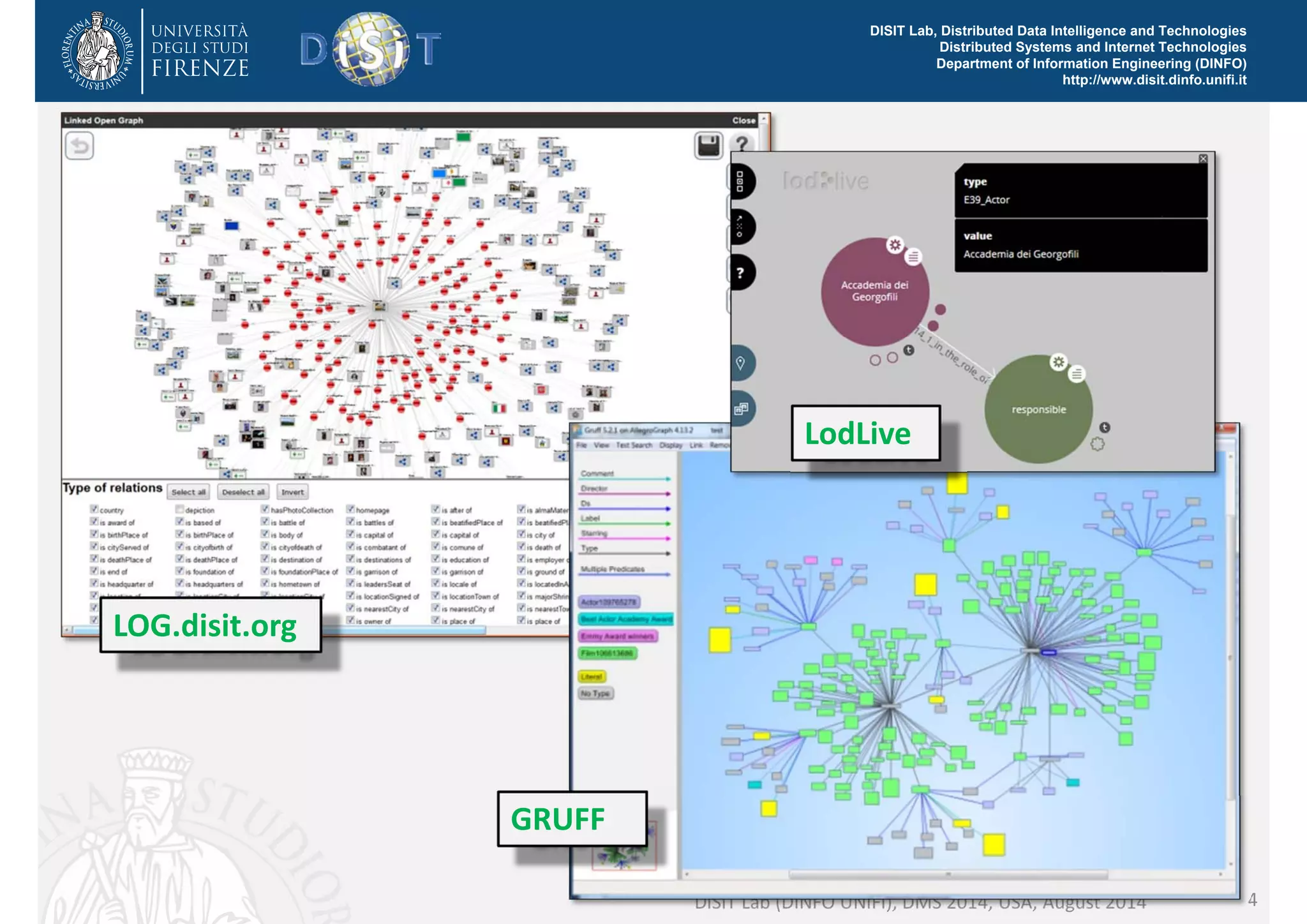
LOG.disit.org 
GRUFF 
LodLive
DISIT Lab, Distributed Data Intelligence and Technologies 
Distributed Systems and Internet Technologies 
Department of Information Engineering (DINFO) 
http://www.disit.dinfo.unifi.it 
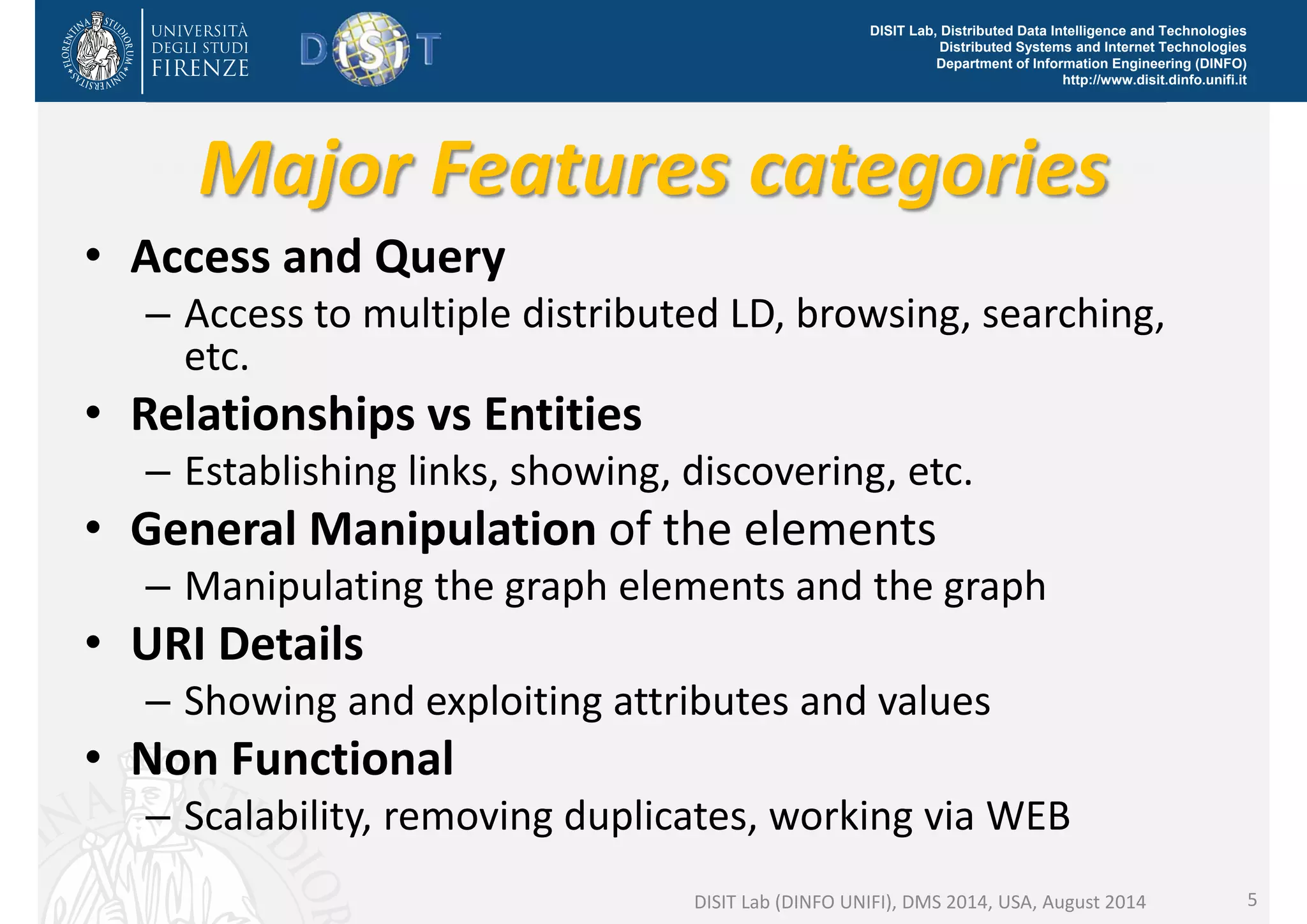
Major Features categories 
• Access and Query 
– Access to multiple distributed LD, browsing, searching, 
etc. 
• Relationships vs Entities 
– Establishing links, showing, discovering, etc. 
• General Manipulation of the elements 
– Manipulating the graph elements and the graph 
• URI Details 
– Showing and exploiting attributes and values 
• Non Functional 
– Scalability, removing duplicates, working via WEB 
DISIT Lab (DINFO UNIFI), DMS 2014, USA, August 2014 5
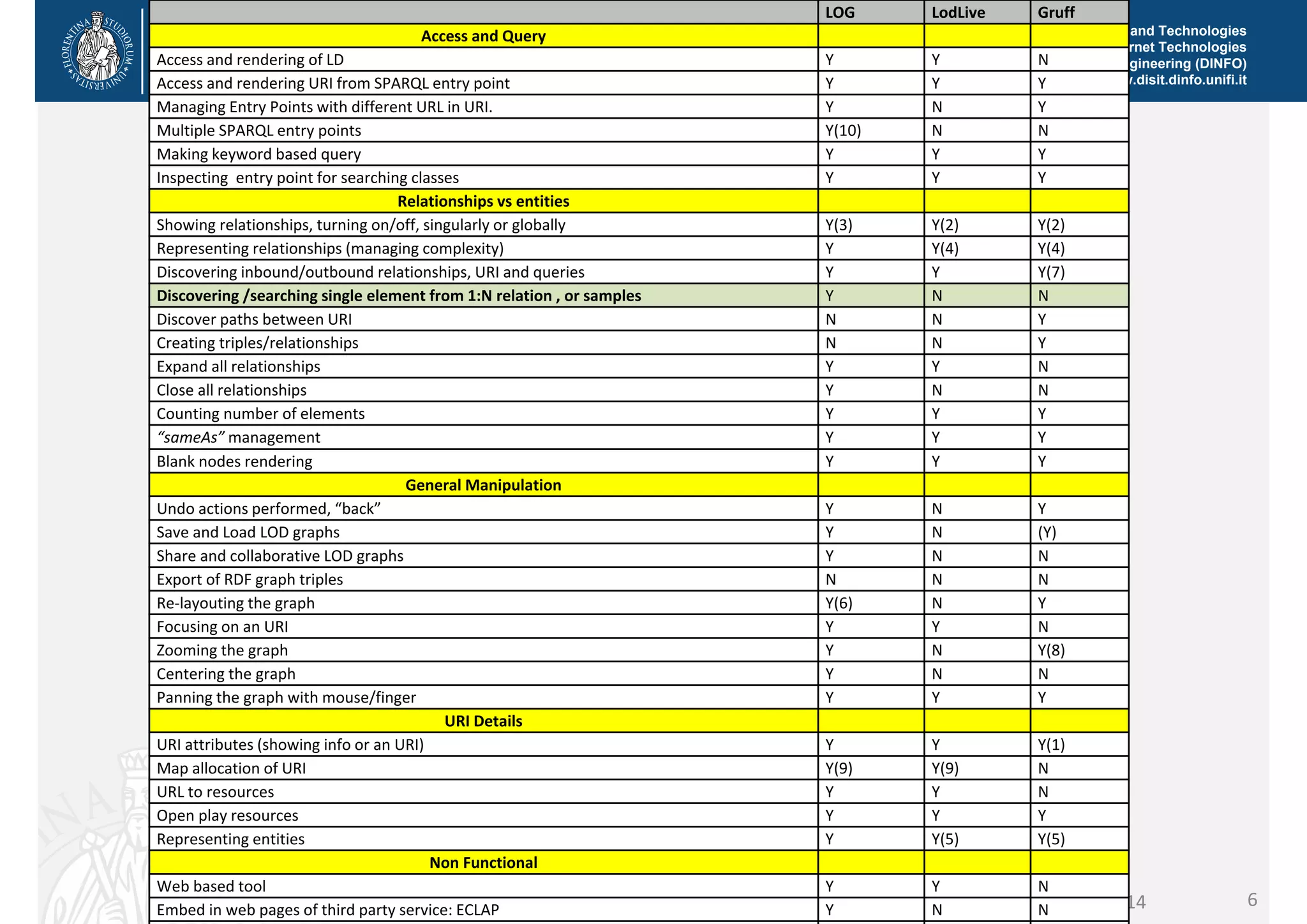
LOG LodLive Gruff 
DISIT Lab, Distributed Data Intelligence and Technologies 
Distributed Systems and Internet Technologies 
Department of Information Engineering (DINFO) 
http://www.disit.dinfo.unifi.it 
DISIT Lab (DINFO UNIFI), DMS 2014, USA, August 2014 6 
Access and Query 
Access and rendering of LD Y Y N 
Access and rendering URI from SPARQL entry point Y Y Y 
Managing Entry Points with different URL in URI. Y N Y 
Multiple SPARQL entry points Y(10) N N 
Making keyword based query Y Y Y 
Inspecting entry point for searching classes Y Y Y 
Relationships vs entities 
Showing relationships, turning on/off, singularly or globally Y(3) Y(2) Y(2) 
Representing relationships (managing complexity) Y Y(4) Y(4) 
Discovering inbound/outbound relationships, URI and queries Y Y Y(7) 
Discovering /searching single element from 1:N relation , or samples Y N N 
Discover paths between URI N N Y 
Creating triples/relationships N N Y 
Expand all relationships Y Y N 
Close all relationships Y N N 
Counting number of elements Y Y Y 
“sameAs” management Y Y Y 
Blank nodes rendering Y Y Y 
General Manipulation 
Undo actions performed, “back” Y N Y 
Save and Load LOD graphs Y N (Y) 
Share and collaborative LOD graphs Y N N 
Export of RDF graph triples N N N 
Re‐layouting the graph Y(6) N Y 
Focusing on an URI Y Y N 
Zooming the graph Y N Y(8) 
Centering the graph Y N N 
Panning the graph with mouse/finger Y Y Y 
URI Details 
URI attributes (showing info or an URI) Y Y Y(1) 
Map allocation of URI Y(9) Y(9) N 
URL to resources Y Y N 
Open play resources Y Y Y 
Representing entities Y Y(5) Y(5) 
Non Functional 
Web based tool Y Y N 
Embed in web pages of third party service: ECLAP Y N N
DISIT Lab, Distributed Data Intelligence and Technologies 
Distributed Systems and Internet Technologies 
Department of Information Engineering (DINFO) 
http://www.disit.dinfo.unifi.it 
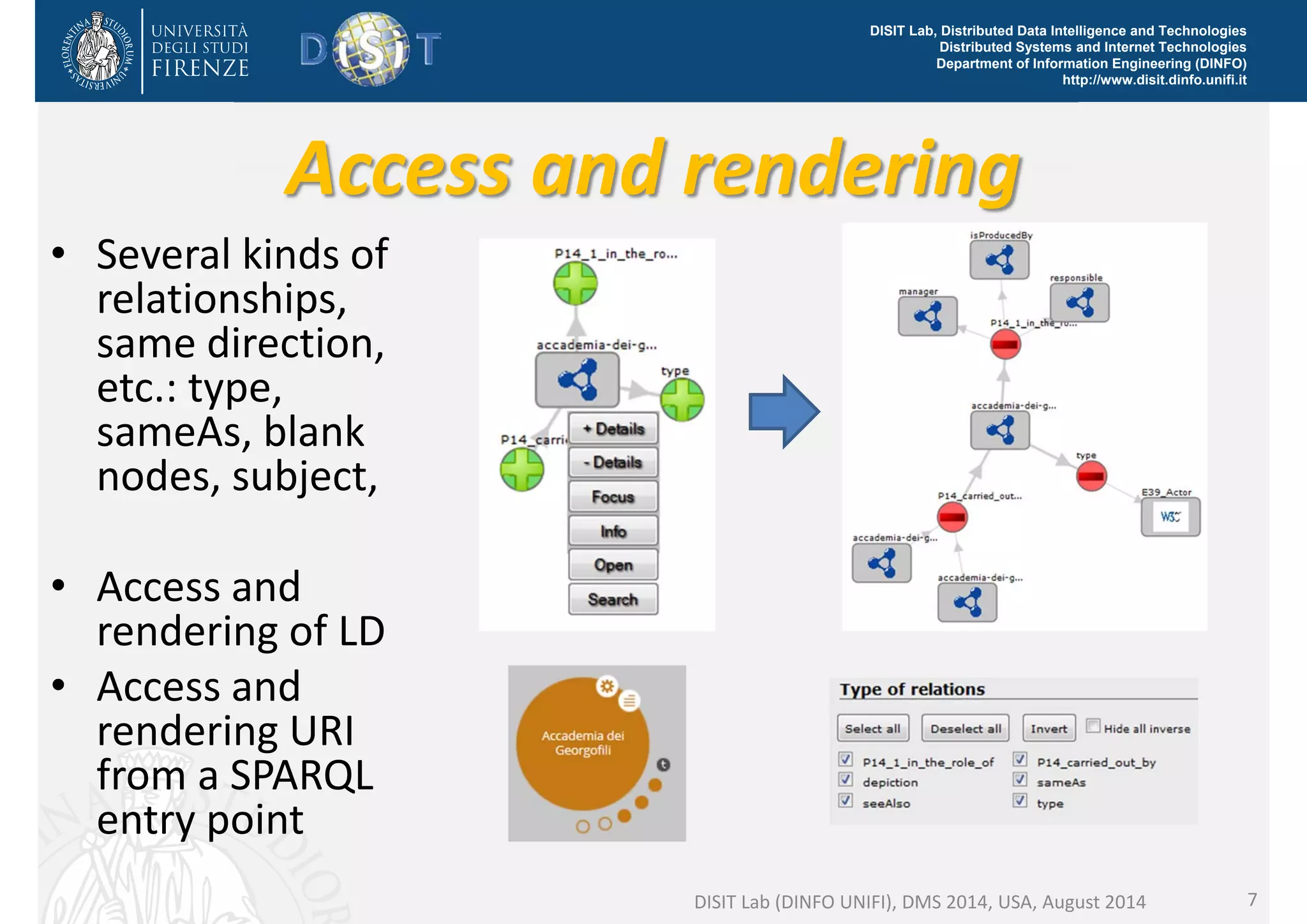
Access and rendering 
• Several kinds of 
relationships, 
same direction, 
etc.: type, 
sameAs, blank 
nodes, subject, 
• Access and 
rendering of LD 
• Access and 
rendering URI 
from a SPARQL 
entry point 
DISIT Lab (DINFO UNIFI), DMS 2014, USA, August 2014 7
DISIT Lab, Distributed Data Intelligence and Technologies 
Distributed Systems and Internet Technologies 
Department of Information Engineering (DINFO) 
http://www.disit.dinfo.unifi.it 
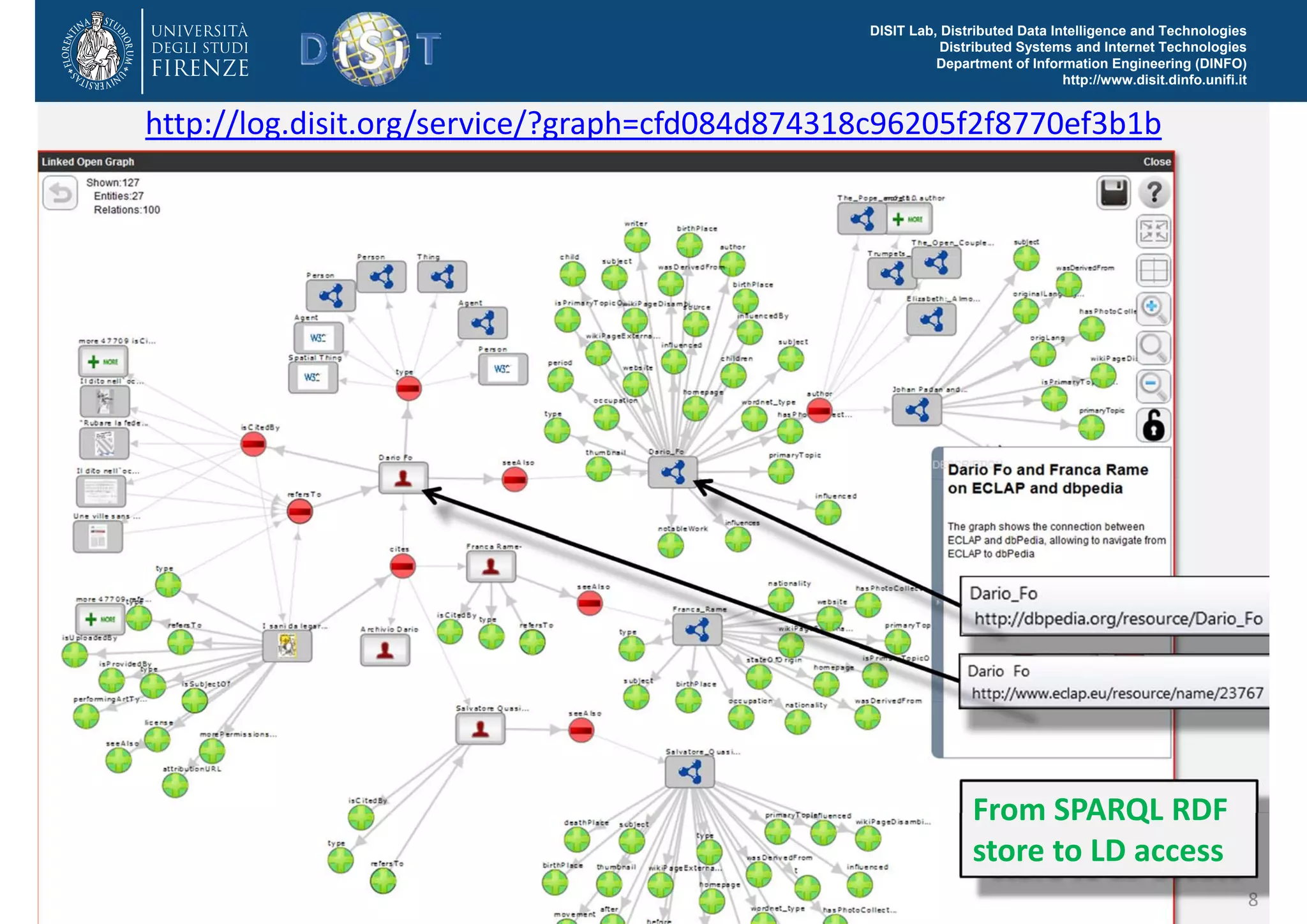
http://log.disit.org/service/?graph=cfd084d874318c96205f2f8770ef3b1b 
From SPARQL RDF 
store to LD access 
DISIT Lab (DINFO UNIFI), DMS 2014, USA, August 2014 8
DISIT Lab, Distributed Data Intelligence and Technologies 
Distributed Systems and Internet Technologies 
Department of Information Engineering (DINFO) 
http://www.disit.dinfo.unifi.it 
Access and Rendering 
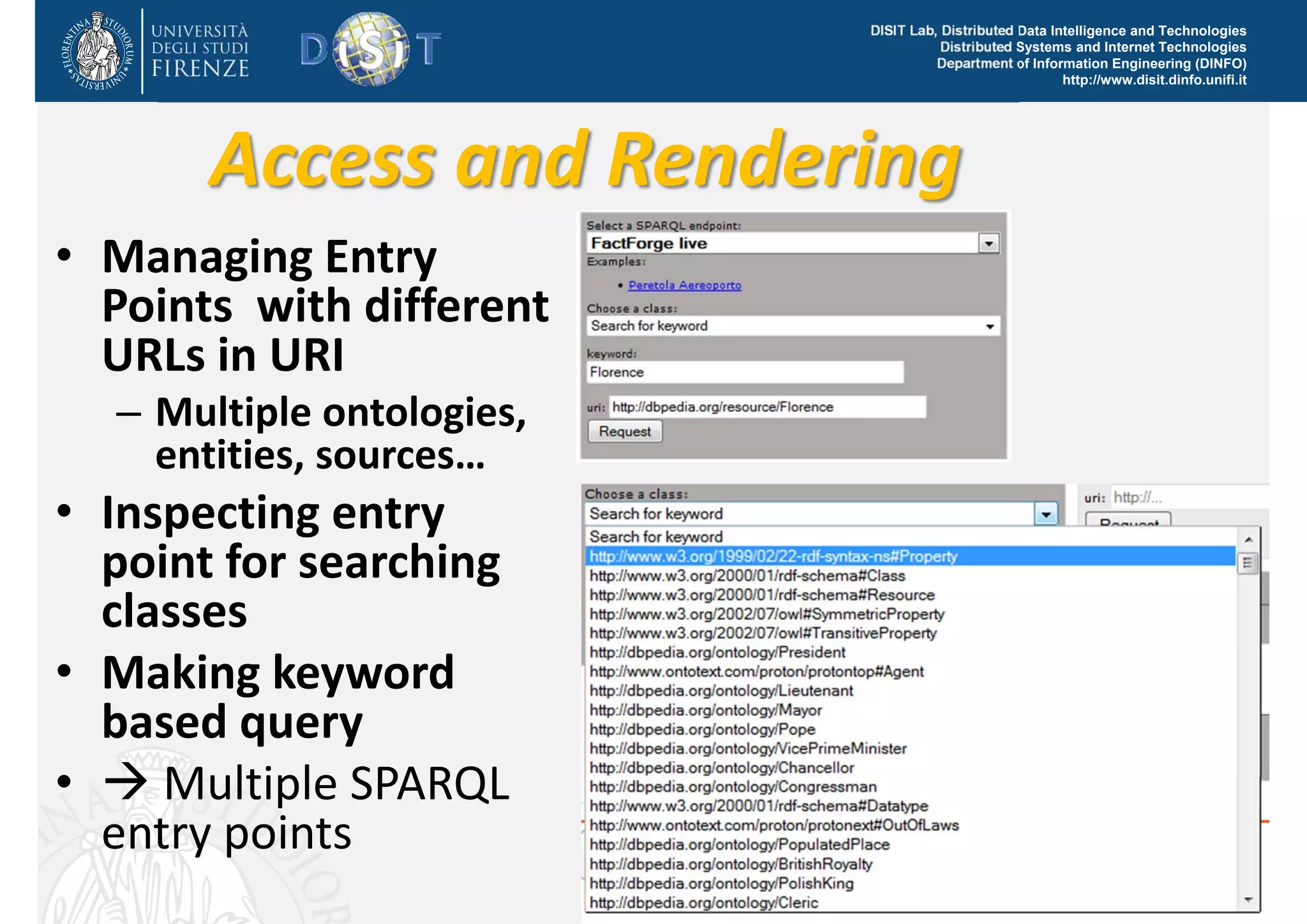
• Managing Entry 
Points with different 
URLs in URI 
– Multiple ontologies, 
entities, sources… 
• Inspecting entry 
point for searching 
classes 
• Making keyword 
based query 
•  Multiple SPARQL 
entry points 
DISIT Lab (DINFO UNIFI), DMS 2014, USA, August 2014 9
DISIT Lab, Distributed Data Intelligence and Technologies 
Distributed Systems and Internet Technologies 
Department of Information Engineering (DINFO) 
http://www.disit.dinfo.unifi.it 
Relationships vs entities 
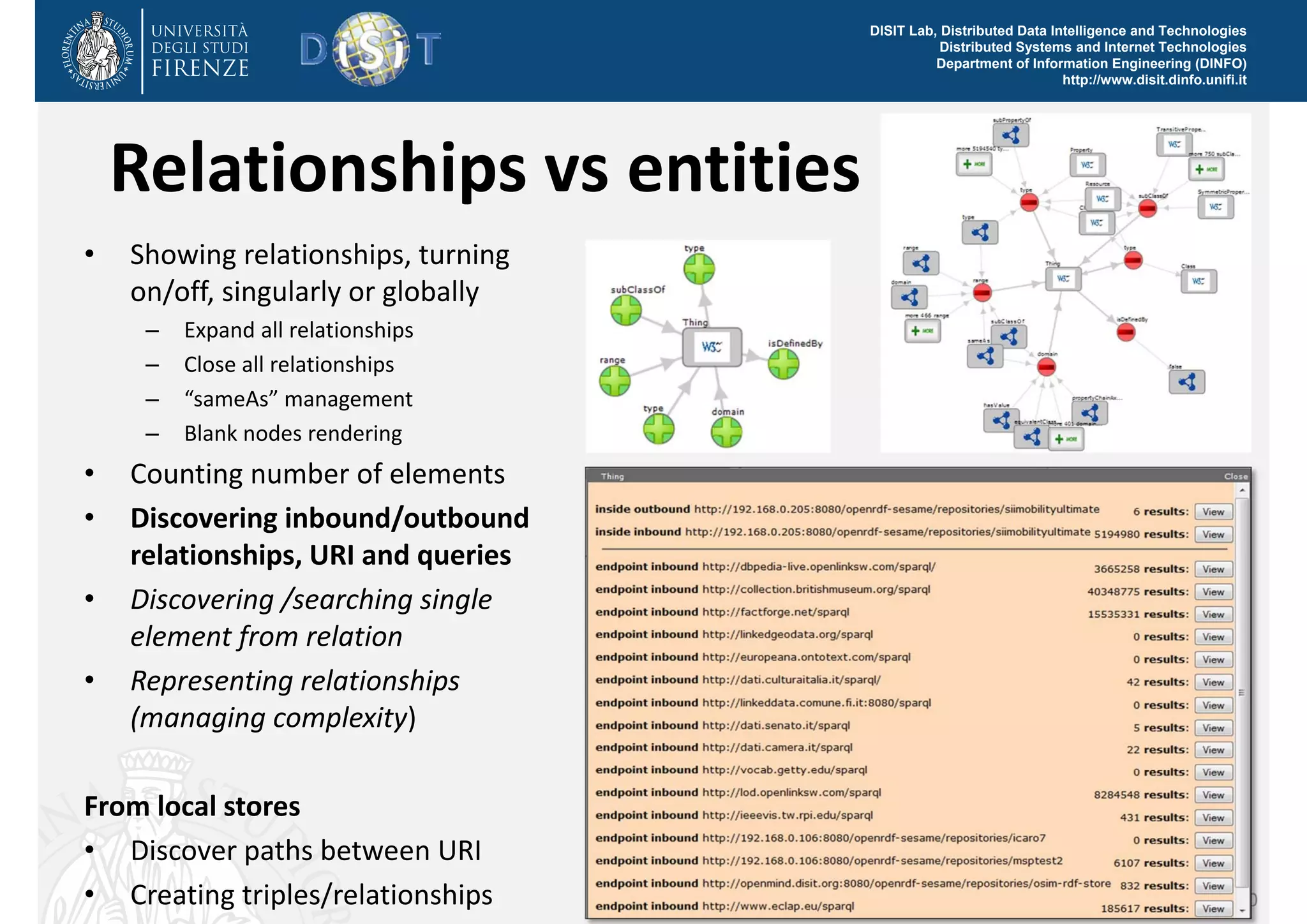
• Showing relationships, turning 
on/off, singularly or globally 
– Expand all relationships 
– Close all relationships 
– “sameAs” management 
– Blank nodes rendering 
• Counting number of elements 
• Discovering inbound/outbound 
relationships, URI and queries 
• Discovering /searching single 
element from relation 
• Representing relationships 
(managing complexity) 
From local stores 
• Discover paths between URI 
• Creating triples/relationships DISIT Lab (DINFO UNIFI), DMS 2014, USA, August 2014 10
DISIT Lab, Distributed Data Intelligence and Technologies 
Distributed Systems and Internet Technologies 
Department of Information Engineering (DINFO) 
http://www.disit.dinfo.unifi.it 
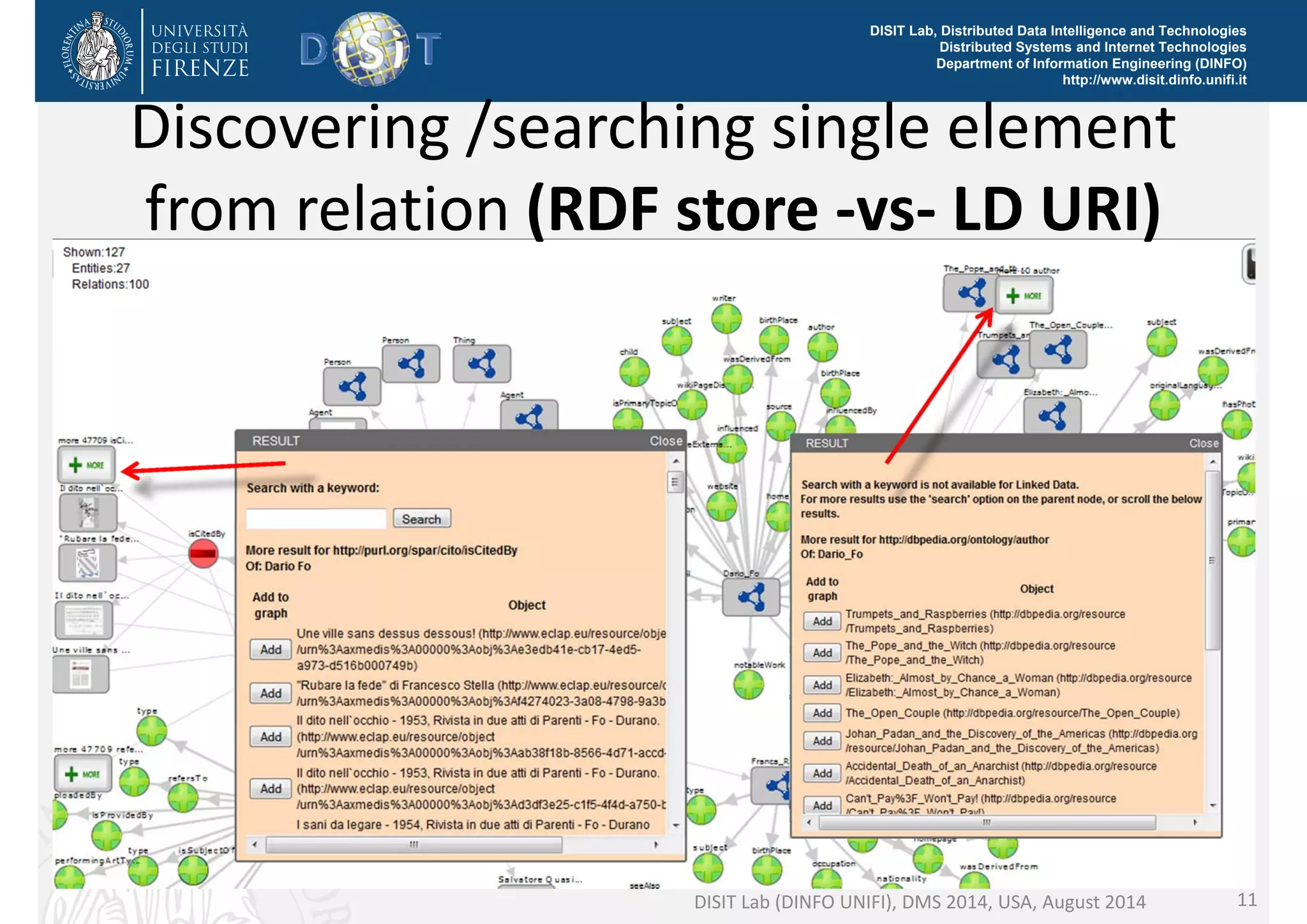
Discovering /searching single element 
from relation (RDF store ‐vs‐ LD URI) 
DISIT Lab (DINFO UNIFI), DMS 2014, USA, August 2014 11
DISIT Lab, Distributed Data Intelligence and Technologies 
Distributed Systems and Internet Technologies 
Department of Information Engineering (DINFO) 
http://www.disit.dinfo.unifi.it 
General Manipulation 
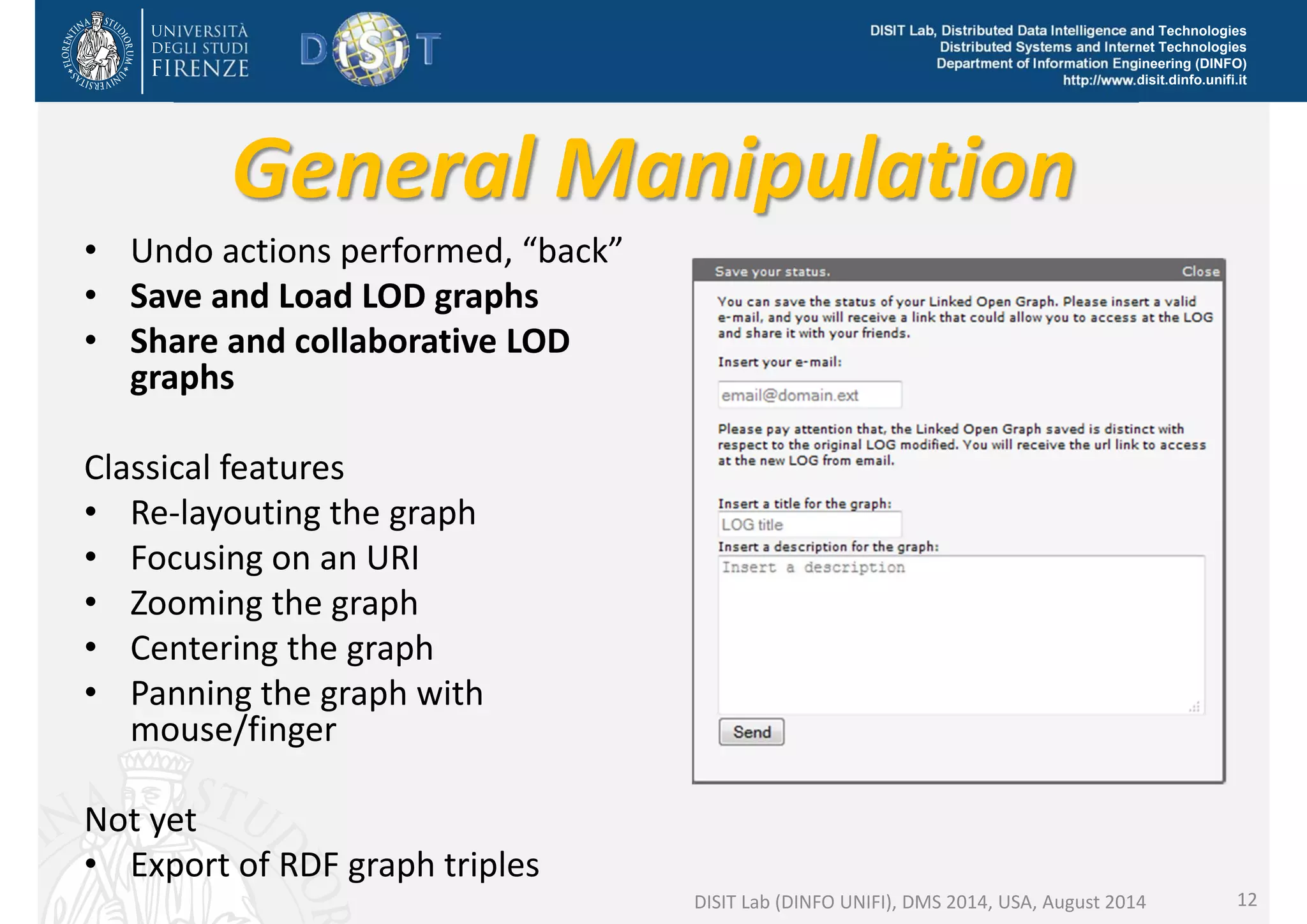
• Undo actions performed, “back” 
• Save and Load LOD graphs 
• Share and collaborative LOD 
graphs 
Classical features 
• Re‐layouting the graph 
• Focusing on an URI 
• Zooming the graph 
• Centering the graph 
• Panning the graph with 
mouse/finger 
Not yet 
• Export of RDF graph triples 
DISIT Lab (DINFO UNIFI), DMS 2014, USA, August 2014 12
DISIT Lab, Distributed Data Intelligence and Technologies 
Distributed Systems and Internet Technologies 
Department of Information Engineering (DINFO) 
http://www.disit.dinfo.unifi.it 
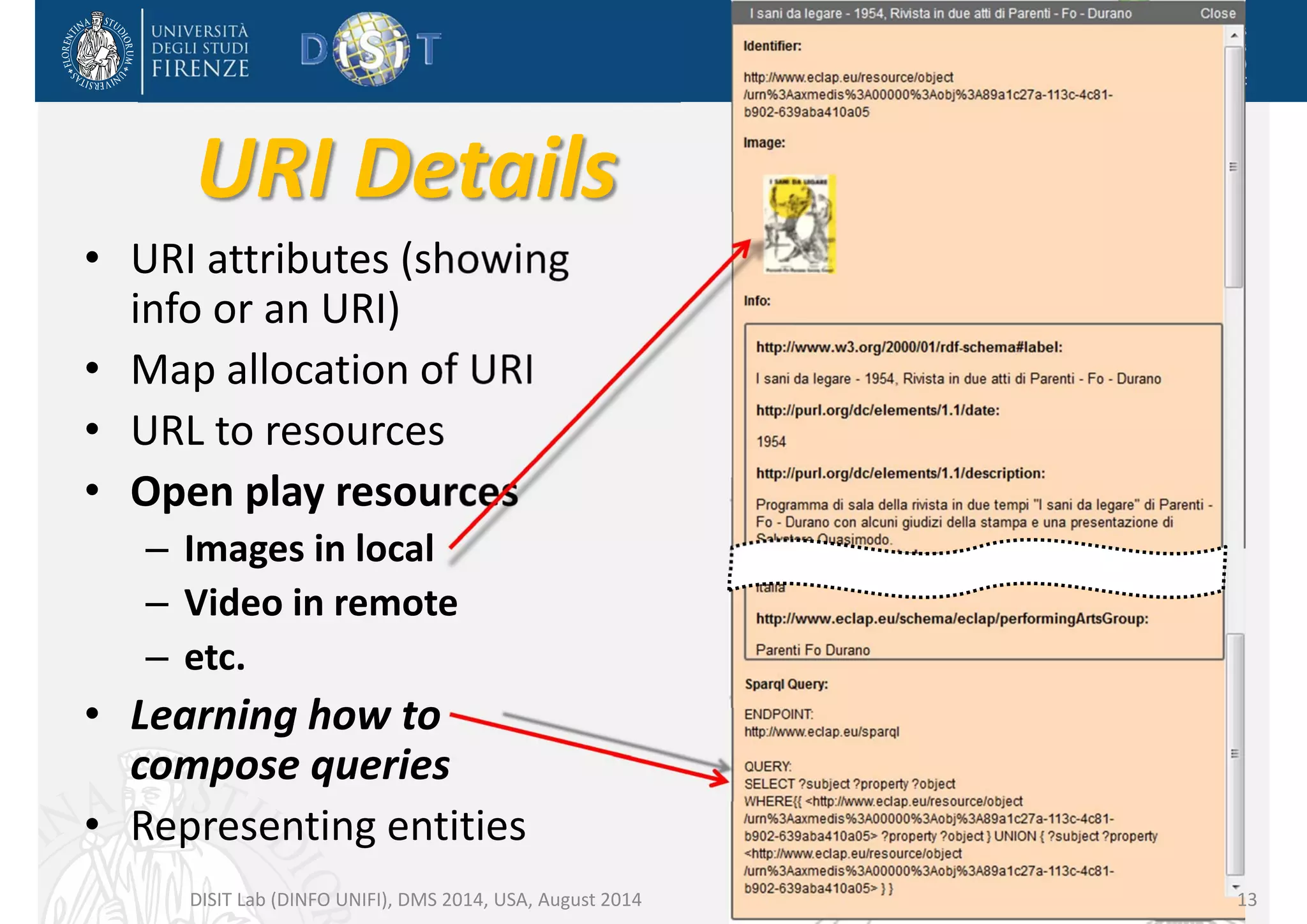
URI Details 
• URI attributes (showing 
info or an URI) 
• Map allocation of URI 
• URL to resources 
• Open play resources 
– Images in local 
– Video in remote 
– etc. 
• Learning how to 
compose queries 
• Representing entities 
DISIT Lab (DINFO UNIFI), DMS 2014, USA, August 2014 13
DISIT Lab, Distributed Data Intelligence and Technologies 
Distributed Systems and Internet Technologies 
Department of Information Engineering (DINFO) 
http://www.disit.dinfo.unifi.it 
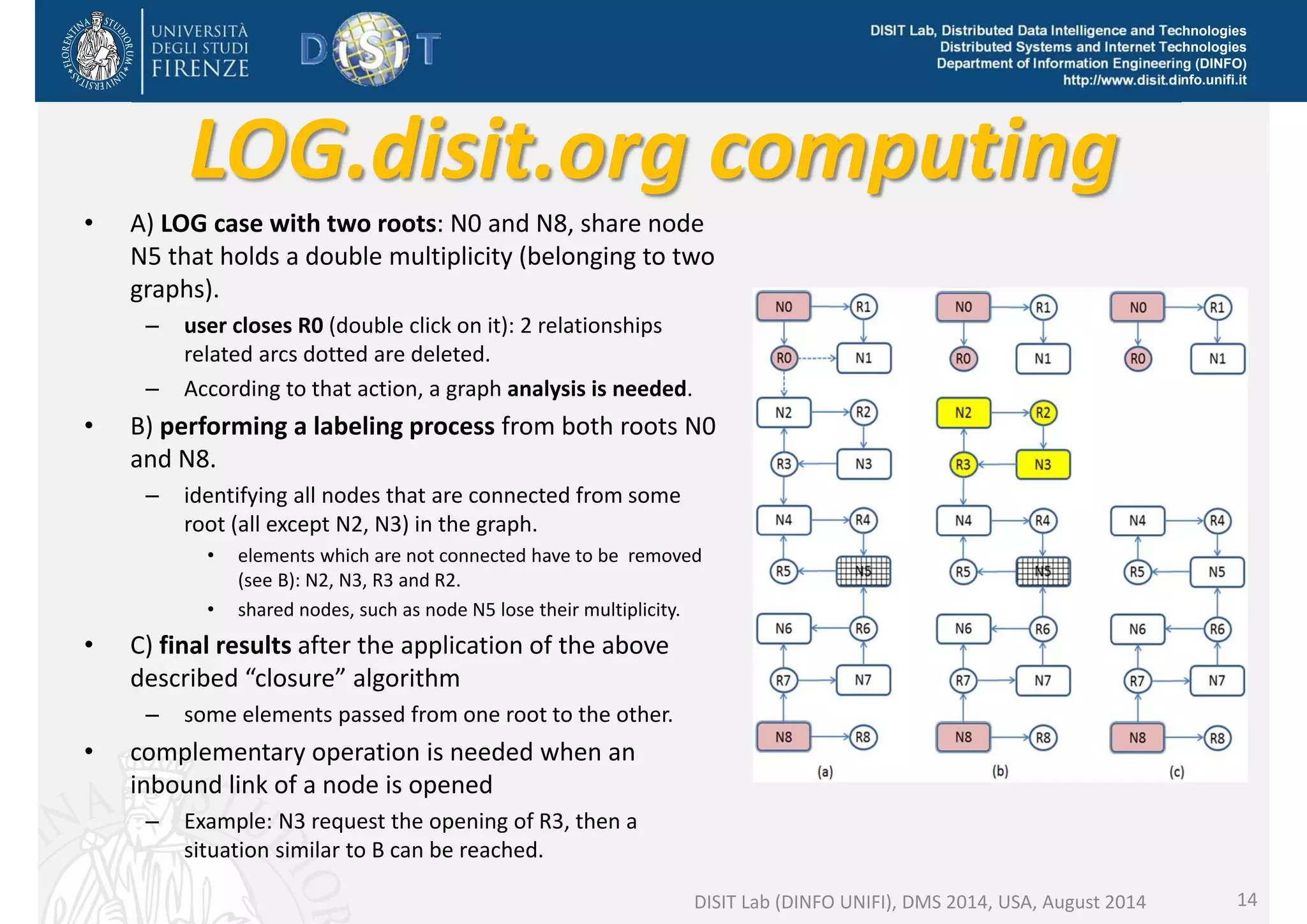
LOG.disit.org computing 
• A) LOG case with two roots: N0 and N8, share node 
N5 that holds a double multiplicity (belonging to two 
graphs). 
– user closes R0 (double click on it): 2 relationships 
related arcs dotted are deleted. 
– According to that action, a graph analysis is needed. 
• B) performing a labeling process from both roots N0 
and N8. 
– identifying all nodes that are connected from some 
root (all except N2, N3) in the graph. 
• elements which are not connected have to be removed 
(see B): N2, N3, R3 and R2. 
• shared nodes, such as node N5 lose their multiplicity. 
• C) final results after the application of the above 
described “closure” algorithm 
– some elements passed from one root to the other. 
• complementary operation is needed when an 
inbound link of a node is opened 
– Example: N3 request the opening of R3, then a 
situation similar to B can be reached. 
DISIT Lab (DINFO UNIFI), DMS 2014, USA, August 2014 14
DISIT Lab, Distributed Data Intelligence and Technologies 
Distributed Systems and Internet Technologies 
Department of Information Engineering (DINFO) 
http://www.disit.dinfo.unifi.it 
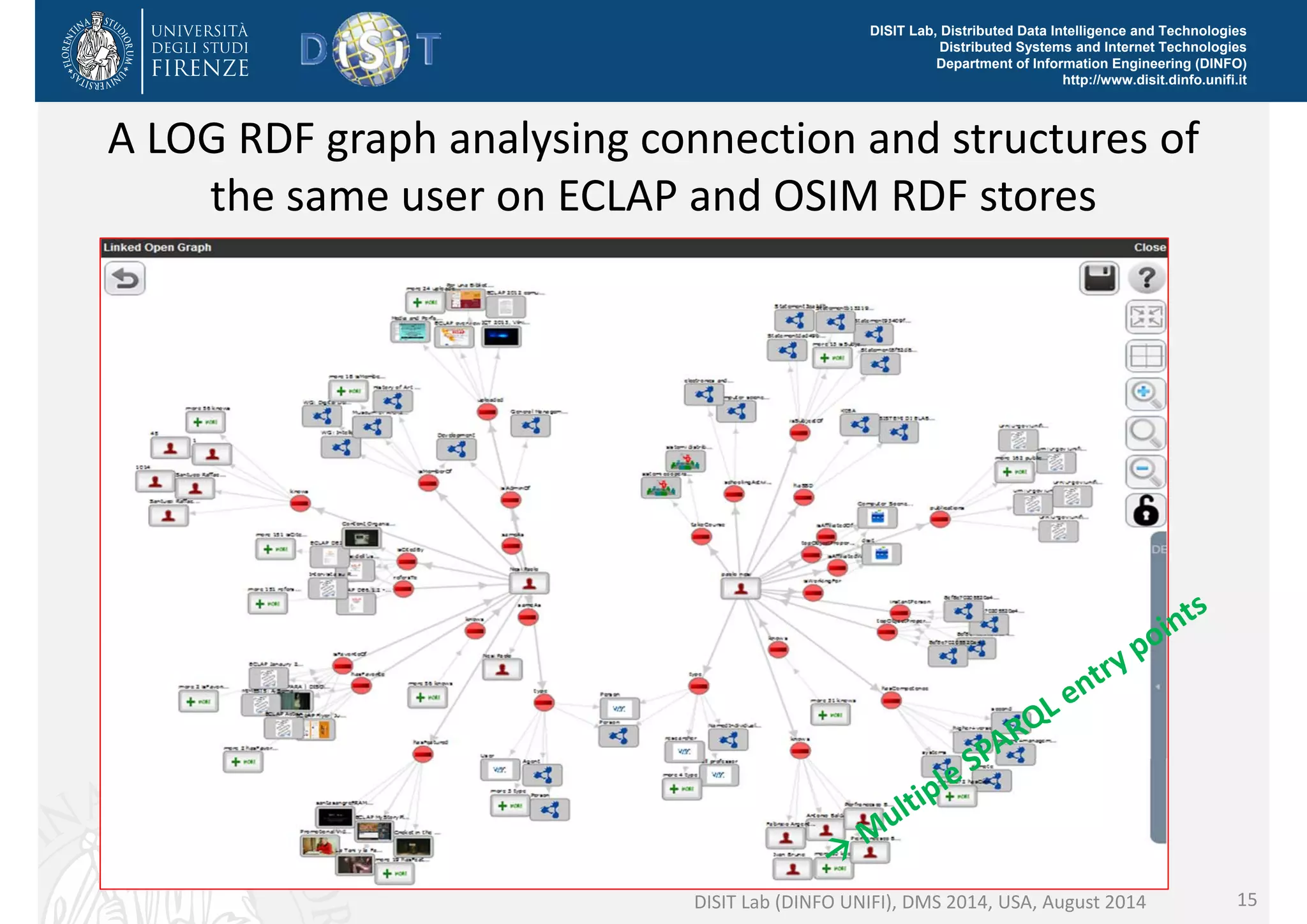
A LOG RDF graph analysing connection and structures of 
the same user on ECLAP and OSIM RDF stores 
DISIT Lab (DINFO UNIFI), DMS 2014, USA, August 2014 15
DISIT Lab, Distributed Data Intelligence and Technologies 
Applications http://www.disit.dinfo.unifi.it 
Distributed Systems and Internet Technologies 
Department of Information Engineering (DINFO) 
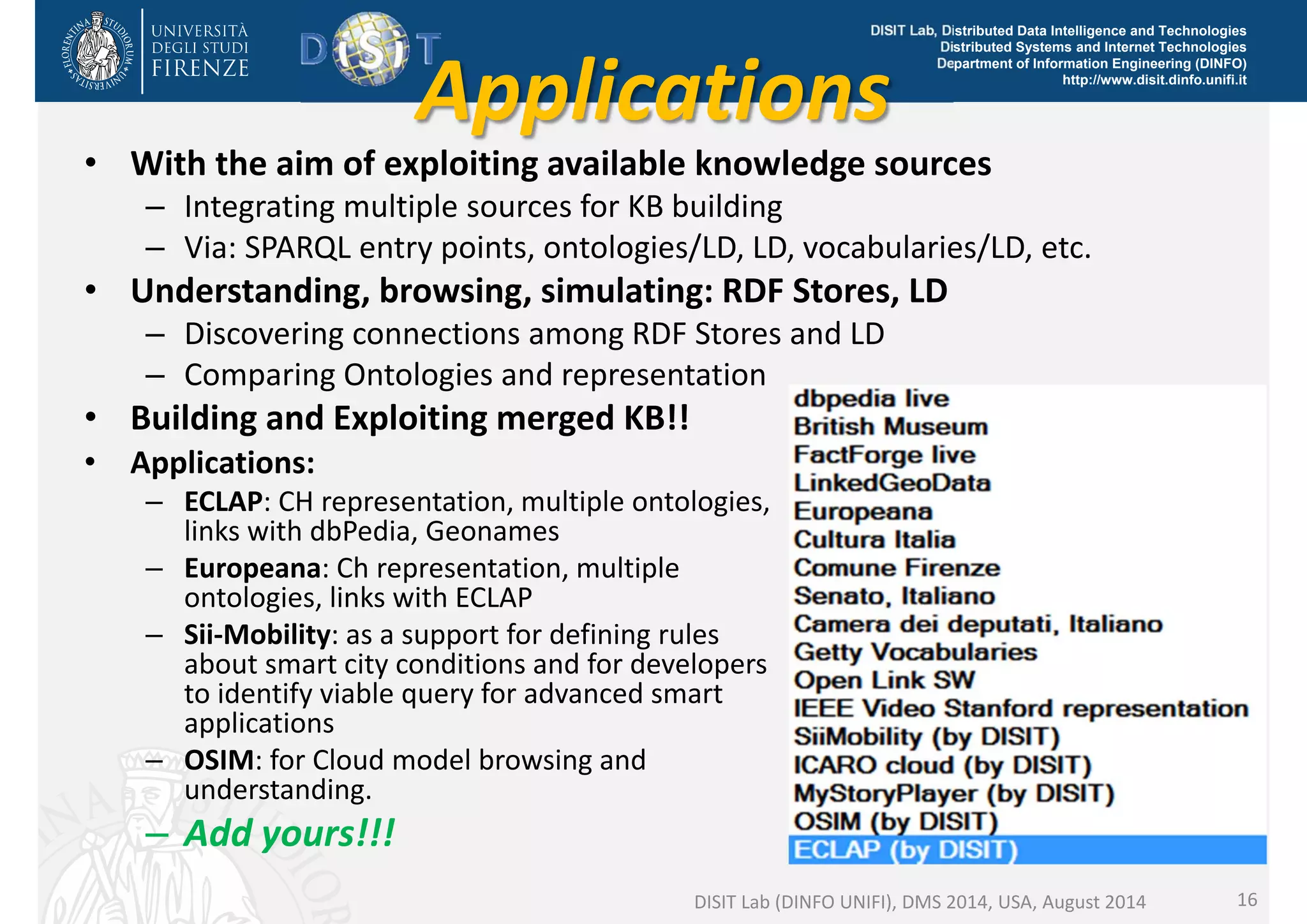
• With the aim of exploiting available knowledge sources 
– Integrating multiple sources for KB building 
– Via: SPARQL entry points, ontologies/LD, LD, vocabularies/LD, etc. 
• Understanding, browsing, simulating: RDF Stores, LD 
– Discovering connections among RDF Stores and LD 
– Comparing Ontologies and representation 
• Building and Exploiting merged KB!! 
DISIT Lab (DINFO UNIFI), DMS 2014, USA, August 2014 16 
• Applications: 
– ECLAP: CH representation, multiple ontologies, 
links with dbPedia, Geonames 
– Europeana: Ch representation, multiple 
ontologies, links with ECLAP 
– Sii‐Mobility: as a support for defining rules 
about smart city conditions and for developers 
to identify viable query for advanced smart 
applications 
– OSIM: for Cloud model browsing and 
understanding. 
– Add yours!!!
DISIT Lab, Distributed Data Intelligence and Technologies 
Distributed Systems and Internet Technologies 
Department of Information Engineering (DINFO) 
http://www.disit.dinfo.unifi.it 
Conclusions 
• LOG.DISIT, a new Model and Tool 
– as a support for KB development in the advanced 
semantic web era. 
– advanced and more complete features with respect to 
the state of the art tools, solving and enabling 
• collaborative work, and sharing 
• progressive browsing of the graphs 
• graph composition: multiple SPARQL entry, plus LD, .. 
• support to pose specific queries 
• progressive discovering/selection of instances 
• currently used in a number of projects and activities in the 
area of semantic web. Add yours!!! 
DISIT Lab (DINFO UNIFI), DMS 2014, USA, August 2014 17
DISIT Lab, Distributed Data Intelligence and Technologies 
Distributed Systems and Internet Technologies 
Department of Information Engineering (DINFO) 
http://www.disit.dinfo.unifi.it 
References 
• T. Berners‐Lee, “Linked Data”, http://www.w3.org/DesignIssues/LinkedData.html, 2006. 
• C. Bizer, T. Heath and T. Berners‐Lee (2009) Linked Data ‐ the story so far. Int. Journal on Semantic Web and Information Systems, 5, (3), 1‐22. 
• G. Klyne, J. Carroll, “Resource Description Framework (RDF): Concepts and Abstract Syntax ‐ W3C Recommendation”, 2004 
• FOAF, http://www.foaf‐project.org/ 
• G. Tummarello, R. Delbru, and E. Oren. 2007. Sindice.com: weaving the open linked data. In Proc. of ISWC'07/ASWC'07, Springer, Berlin, 
Heidelberg, pp.552‐565. 
• O. Hartig, C. Bizer, J.‐C. Freytag. 2009. Executing SPARQL Queries over the Web of Linked Data. In Proc. of ISWC '09, Springer, pp.293‐309. 
• S. Ramakrishnan and A. Vijayan. 2014. A study on development of cognitive support features in recent ontology visualization tools. Artif. Intell. 
Rev. 41, 4 (April 2014), pp.595‐623. 
• Protégé http://protege.stanford.edu/ 
• iSPARQL, http://oat.openlinksw.com/isparql/index.html, 
• O. Ambrus, K. Moller, S. Handschuh, “Konduit VQB: a Visual Query Builder for SPARQL on the Social Semantic Desktop”, proc of VISSW2010, 
IUI2010, 2010, Hong Kong, China. 
• A. Russell, P.R. Smart, D. Braines, Dave, N.R. Shadbolt, “NITELIGHT: A Graphical Tool for Semantic Query Construction”, In, SWUI 2008, Florence, 
Italy, 
• Gfacet, http://www.visualdataweb.org/gfacet.php 
• D. V. Camarda, S. Mazzini, A. Antonuccio. 2012. LodLive, exploring the web of data. In Proc. of the I‐SEMANTICS '12, ACM, pp.197‐200. 
http://lodlive.it 
• P. Bellini, P. Nesi, "Modeling Performing Arts Metadata and Relationships in Content Service for Institutions", Multimedia Systems Journal, 
Springer, 2014. http://www.eclap.eu 
• D3, Data‐Driven Documents, http://d3js.org/ 
• P. Bellini, P. Nesi, N. Rauch, “Smart City data via LOD/LOG Service”, Workshop Linked Open Data: where are we?, LOD2014, org. by W3C. 
• Prud'hommeaux, E., Seaborne, A., SPARQL Query Language for RDF, http://www.w3.org/TR/2004/WD‐rdf‐sparql‐query‐20041012/ 
• OTN, Ontology of Transportation Networks, Deliverable A1‐D4, Project REWERSE, 2005 http://rewerse.net/deliverables/m18/a1‐d4.pdf 
• http://dublincore.org, http://dublincore.org/documents/dcmi‐terms/ 
• VCARD, http://www.w3.org/TR/vcard‐rdf/ 
• wgs84, http://www.w3.org/2003/01/geo/wgs84_pos 
• dbPedia, http://dbpedia.org/resource/ DISIT Lab (DINFO UNIFI), DMS 2014, USA, August 2014 18
DISIT Lab, Distributed Data Intelligence and Technologies 
Distributed Systems and Internet Technologies 
Department of Information Engineering (DINFO) 
http://www.disit.dinfo.unifi.it 
Thank you! 
http://www.disit.dinfo.unifi.it 
Paolo Nesi 
Dipartimento di Ingegneria dell’Informazione, DINFO 
Università degli Studi di Firenze 
Via S. Marta 3, 50139, Firenze, Italy 
Tel: +39-055-4796567, fax: +39-055-4796363 
DISIT Lab 
http://www.disit.dinfo.unifi.it alias http://www.disit.org 
paolo.nesi@unifi.it 
DISIT Lab (DINFO UNIFI), DMS 2014, USA, August 2014 19

Linked Open Graph: browsing multiple SPARQL entry points to build your own LOD views

  • 1.
    DISIT Lab, DistributedData Intelligence and Technologies Distributed Systems and Internet Technologies Department of Information Engineering (DINFO) http://www.disit.dinfo.unifi.it http://log.disit.org Linked Open Graph: browsing multiple SPARQL entry points to build your own LOD views Pierfrancesco Bellini, Paolo Nesi, Alessandro Venturi Dipartimento di Ingegneria dell’Informazione, DINFO Università degli Studi di Firenze Via S. Marta 3, 50139, Firenze, Italy Tel: +39-055-4796567, fax: +39-055-4796363 DISIT Lab http://www.disit.dinfo.unifi.it alias http://www.disit.org paolo.nesi@unifi.it Proc. of the 20th International Conference on Distributed Multimedia Systems, Pittsburgh, USA, August 2014 DISIT Lab (DINFO UNIFI), DMS 2014, USA, August 2014 1
  • 2.
    DISIT Lab, DistributedData Intelligence and Technologies Distributed Systems and Internet Technologies Department of Information Engineering (DINFO) http://www.disit.dinfo.unifi.it Context and motivations • Open Data vs Linked Data / Linked Open Data – OD  hundreds of formats – Linked Data URI as a large network of definitions: triples, not quereable • Linked Open Data towards RDF Stores + SPARQL entry point – RDF Stores as Knowledge base storing, quereable – Huge number of OD, limited of LD, a few RDF‐SPARQL entry point services – SPARQL entry points services present many dialects and maturity (versions) DISIT Lab (DINFO UNIFI), DMS 2014, USA, August 2014 2
  • 3.
    DISIT Lab, DistributedData Intelligence and Technologies Distributed Systems and Internet Technologies Department of Information Engineering (DINFO) http://www.disit.dinfo.unifi.it Grow‐up Knowledge base • Developing knowledge base, distributed knowledge base – Reusing: Definitions, Ontologies, SKOS, vocabularies,.. – Reusing / linking: LD triples, RDF Stores + SPARQL – A unique storage by copying  linking: – Distributing RDF segments SPARQL queries •  Exploiting the KB – Integrating multiple RDF Stores & LD – Understanding and browsing: RDF Stores, LD – Enriching KB with other triples, LD / URI DISIT Lab (DINFO UNIFI), DMS 2014, USA, August 2014 3
  • 4.
    DISIT Lab, DistributedData Intelligence and Technologies Distributed Systems and Internet Technologies Department of Information Engineering (DINFO) http://www.disit.dinfo.unifi.it DISIT Lab (DINFO UNIFI), DMS 2014, USA, August 2014 4 LOG.disit.org GRUFF LodLive
  • 5.
    DISIT Lab, DistributedData Intelligence and Technologies Distributed Systems and Internet Technologies Department of Information Engineering (DINFO) http://www.disit.dinfo.unifi.it Major Features categories • Access and Query – Access to multiple distributed LD, browsing, searching, etc. • Relationships vs Entities – Establishing links, showing, discovering, etc. • General Manipulation of the elements – Manipulating the graph elements and the graph • URI Details – Showing and exploiting attributes and values • Non Functional – Scalability, removing duplicates, working via WEB DISIT Lab (DINFO UNIFI), DMS 2014, USA, August 2014 5
  • 6.
    LOG LodLive Gruff DISIT Lab, Distributed Data Intelligence and Technologies Distributed Systems and Internet Technologies Department of Information Engineering (DINFO) http://www.disit.dinfo.unifi.it DISIT Lab (DINFO UNIFI), DMS 2014, USA, August 2014 6 Access and Query Access and rendering of LD Y Y N Access and rendering URI from SPARQL entry point Y Y Y Managing Entry Points with different URL in URI. Y N Y Multiple SPARQL entry points Y(10) N N Making keyword based query Y Y Y Inspecting entry point for searching classes Y Y Y Relationships vs entities Showing relationships, turning on/off, singularly or globally Y(3) Y(2) Y(2) Representing relationships (managing complexity) Y Y(4) Y(4) Discovering inbound/outbound relationships, URI and queries Y Y Y(7) Discovering /searching single element from 1:N relation , or samples Y N N Discover paths between URI N N Y Creating triples/relationships N N Y Expand all relationships Y Y N Close all relationships Y N N Counting number of elements Y Y Y “sameAs” management Y Y Y Blank nodes rendering Y Y Y General Manipulation Undo actions performed, “back” Y N Y Save and Load LOD graphs Y N (Y) Share and collaborative LOD graphs Y N N Export of RDF graph triples N N N Re‐layouting the graph Y(6) N Y Focusing on an URI Y Y N Zooming the graph Y N Y(8) Centering the graph Y N N Panning the graph with mouse/finger Y Y Y URI Details URI attributes (showing info or an URI) Y Y Y(1) Map allocation of URI Y(9) Y(9) N URL to resources Y Y N Open play resources Y Y Y Representing entities Y Y(5) Y(5) Non Functional Web based tool Y Y N Embed in web pages of third party service: ECLAP Y N N
  • 7.
    DISIT Lab, DistributedData Intelligence and Technologies Distributed Systems and Internet Technologies Department of Information Engineering (DINFO) http://www.disit.dinfo.unifi.it Access and rendering • Several kinds of relationships, same direction, etc.: type, sameAs, blank nodes, subject, • Access and rendering of LD • Access and rendering URI from a SPARQL entry point DISIT Lab (DINFO UNIFI), DMS 2014, USA, August 2014 7
  • 8.
    DISIT Lab, DistributedData Intelligence and Technologies Distributed Systems and Internet Technologies Department of Information Engineering (DINFO) http://www.disit.dinfo.unifi.it http://log.disit.org/service/?graph=cfd084d874318c96205f2f8770ef3b1b From SPARQL RDF store to LD access DISIT Lab (DINFO UNIFI), DMS 2014, USA, August 2014 8
  • 9.
    DISIT Lab, DistributedData Intelligence and Technologies Distributed Systems and Internet Technologies Department of Information Engineering (DINFO) http://www.disit.dinfo.unifi.it Access and Rendering • Managing Entry Points with different URLs in URI – Multiple ontologies, entities, sources… • Inspecting entry point for searching classes • Making keyword based query •  Multiple SPARQL entry points DISIT Lab (DINFO UNIFI), DMS 2014, USA, August 2014 9
  • 10.
    DISIT Lab, DistributedData Intelligence and Technologies Distributed Systems and Internet Technologies Department of Information Engineering (DINFO) http://www.disit.dinfo.unifi.it Relationships vs entities • Showing relationships, turning on/off, singularly or globally – Expand all relationships – Close all relationships – “sameAs” management – Blank nodes rendering • Counting number of elements • Discovering inbound/outbound relationships, URI and queries • Discovering /searching single element from relation • Representing relationships (managing complexity) From local stores • Discover paths between URI • Creating triples/relationships DISIT Lab (DINFO UNIFI), DMS 2014, USA, August 2014 10
  • 11.
    DISIT Lab, DistributedData Intelligence and Technologies Distributed Systems and Internet Technologies Department of Information Engineering (DINFO) http://www.disit.dinfo.unifi.it Discovering /searching single element from relation (RDF store ‐vs‐ LD URI) DISIT Lab (DINFO UNIFI), DMS 2014, USA, August 2014 11
  • 12.
    DISIT Lab, DistributedData Intelligence and Technologies Distributed Systems and Internet Technologies Department of Information Engineering (DINFO) http://www.disit.dinfo.unifi.it General Manipulation • Undo actions performed, “back” • Save and Load LOD graphs • Share and collaborative LOD graphs Classical features • Re‐layouting the graph • Focusing on an URI • Zooming the graph • Centering the graph • Panning the graph with mouse/finger Not yet • Export of RDF graph triples DISIT Lab (DINFO UNIFI), DMS 2014, USA, August 2014 12
  • 13.
    DISIT Lab, DistributedData Intelligence and Technologies Distributed Systems and Internet Technologies Department of Information Engineering (DINFO) http://www.disit.dinfo.unifi.it URI Details • URI attributes (showing info or an URI) • Map allocation of URI • URL to resources • Open play resources – Images in local – Video in remote – etc. • Learning how to compose queries • Representing entities DISIT Lab (DINFO UNIFI), DMS 2014, USA, August 2014 13
  • 14.
    DISIT Lab, DistributedData Intelligence and Technologies Distributed Systems and Internet Technologies Department of Information Engineering (DINFO) http://www.disit.dinfo.unifi.it LOG.disit.org computing • A) LOG case with two roots: N0 and N8, share node N5 that holds a double multiplicity (belonging to two graphs). – user closes R0 (double click on it): 2 relationships related arcs dotted are deleted. – According to that action, a graph analysis is needed. • B) performing a labeling process from both roots N0 and N8. – identifying all nodes that are connected from some root (all except N2, N3) in the graph. • elements which are not connected have to be removed (see B): N2, N3, R3 and R2. • shared nodes, such as node N5 lose their multiplicity. • C) final results after the application of the above described “closure” algorithm – some elements passed from one root to the other. • complementary operation is needed when an inbound link of a node is opened – Example: N3 request the opening of R3, then a situation similar to B can be reached. DISIT Lab (DINFO UNIFI), DMS 2014, USA, August 2014 14
  • 15.
    DISIT Lab, DistributedData Intelligence and Technologies Distributed Systems and Internet Technologies Department of Information Engineering (DINFO) http://www.disit.dinfo.unifi.it A LOG RDF graph analysing connection and structures of the same user on ECLAP and OSIM RDF stores DISIT Lab (DINFO UNIFI), DMS 2014, USA, August 2014 15
  • 16.
    DISIT Lab, DistributedData Intelligence and Technologies Applications http://www.disit.dinfo.unifi.it Distributed Systems and Internet Technologies Department of Information Engineering (DINFO) • With the aim of exploiting available knowledge sources – Integrating multiple sources for KB building – Via: SPARQL entry points, ontologies/LD, LD, vocabularies/LD, etc. • Understanding, browsing, simulating: RDF Stores, LD – Discovering connections among RDF Stores and LD – Comparing Ontologies and representation • Building and Exploiting merged KB!! DISIT Lab (DINFO UNIFI), DMS 2014, USA, August 2014 16 • Applications: – ECLAP: CH representation, multiple ontologies, links with dbPedia, Geonames – Europeana: Ch representation, multiple ontologies, links with ECLAP – Sii‐Mobility: as a support for defining rules about smart city conditions and for developers to identify viable query for advanced smart applications – OSIM: for Cloud model browsing and understanding. – Add yours!!!
  • 17.
    DISIT Lab, DistributedData Intelligence and Technologies Distributed Systems and Internet Technologies Department of Information Engineering (DINFO) http://www.disit.dinfo.unifi.it Conclusions • LOG.DISIT, a new Model and Tool – as a support for KB development in the advanced semantic web era. – advanced and more complete features with respect to the state of the art tools, solving and enabling • collaborative work, and sharing • progressive browsing of the graphs • graph composition: multiple SPARQL entry, plus LD, .. • support to pose specific queries • progressive discovering/selection of instances • currently used in a number of projects and activities in the area of semantic web. Add yours!!! DISIT Lab (DINFO UNIFI), DMS 2014, USA, August 2014 17
  • 18.
    DISIT Lab, DistributedData Intelligence and Technologies Distributed Systems and Internet Technologies Department of Information Engineering (DINFO) http://www.disit.dinfo.unifi.it References • T. Berners‐Lee, “Linked Data”, http://www.w3.org/DesignIssues/LinkedData.html, 2006. • C. Bizer, T. Heath and T. Berners‐Lee (2009) Linked Data ‐ the story so far. Int. Journal on Semantic Web and Information Systems, 5, (3), 1‐22. • G. Klyne, J. Carroll, “Resource Description Framework (RDF): Concepts and Abstract Syntax ‐ W3C Recommendation”, 2004 • FOAF, http://www.foaf‐project.org/ • G. Tummarello, R. Delbru, and E. Oren. 2007. Sindice.com: weaving the open linked data. In Proc. of ISWC'07/ASWC'07, Springer, Berlin, Heidelberg, pp.552‐565. • O. Hartig, C. Bizer, J.‐C. Freytag. 2009. Executing SPARQL Queries over the Web of Linked Data. In Proc. of ISWC '09, Springer, pp.293‐309. • S. Ramakrishnan and A. Vijayan. 2014. A study on development of cognitive support features in recent ontology visualization tools. Artif. Intell. Rev. 41, 4 (April 2014), pp.595‐623. • Protégé http://protege.stanford.edu/ • iSPARQL, http://oat.openlinksw.com/isparql/index.html, • O. Ambrus, K. Moller, S. Handschuh, “Konduit VQB: a Visual Query Builder for SPARQL on the Social Semantic Desktop”, proc of VISSW2010, IUI2010, 2010, Hong Kong, China. • A. Russell, P.R. Smart, D. Braines, Dave, N.R. Shadbolt, “NITELIGHT: A Graphical Tool for Semantic Query Construction”, In, SWUI 2008, Florence, Italy, • Gfacet, http://www.visualdataweb.org/gfacet.php • D. V. Camarda, S. Mazzini, A. Antonuccio. 2012. LodLive, exploring the web of data. In Proc. of the I‐SEMANTICS '12, ACM, pp.197‐200. http://lodlive.it • P. Bellini, P. Nesi, "Modeling Performing Arts Metadata and Relationships in Content Service for Institutions", Multimedia Systems Journal, Springer, 2014. http://www.eclap.eu • D3, Data‐Driven Documents, http://d3js.org/ • P. Bellini, P. Nesi, N. Rauch, “Smart City data via LOD/LOG Service”, Workshop Linked Open Data: where are we?, LOD2014, org. by W3C. • Prud'hommeaux, E., Seaborne, A., SPARQL Query Language for RDF, http://www.w3.org/TR/2004/WD‐rdf‐sparql‐query‐20041012/ • OTN, Ontology of Transportation Networks, Deliverable A1‐D4, Project REWERSE, 2005 http://rewerse.net/deliverables/m18/a1‐d4.pdf • http://dublincore.org, http://dublincore.org/documents/dcmi‐terms/ • VCARD, http://www.w3.org/TR/vcard‐rdf/ • wgs84, http://www.w3.org/2003/01/geo/wgs84_pos • dbPedia, http://dbpedia.org/resource/ DISIT Lab (DINFO UNIFI), DMS 2014, USA, August 2014 18
  • 19.
    DISIT Lab, DistributedData Intelligence and Technologies Distributed Systems and Internet Technologies Department of Information Engineering (DINFO) http://www.disit.dinfo.unifi.it Thank you! http://www.disit.dinfo.unifi.it Paolo Nesi Dipartimento di Ingegneria dell’Informazione, DINFO Università degli Studi di Firenze Via S. Marta 3, 50139, Firenze, Italy Tel: +39-055-4796567, fax: +39-055-4796363 DISIT Lab http://www.disit.dinfo.unifi.it alias http://www.disit.org paolo.nesi@unifi.it DISIT Lab (DINFO UNIFI), DMS 2014, USA, August 2014 19