2013
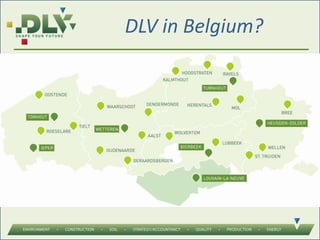
DLV in Belgium?
DLV?
• Founded in 1996, by Dirk Coucke (current CEO)
• 2013: 130 employees including 16 shareholders
• Sales volume 2011: 6,16 mio EUR
• Added value 2011: 0,683 mio EUR
• 7 offices in Belgium, 1 in Croatia
Our goal
• To make companies better and enterprising, by
being enterprising and creative ourselves
• We achieve this through our independent
position in the market. We are full-time
consultants, we don’t construct or sell
products, we only sell knowledge and common
sense
Our focus
• Environmental and waste management
• Market advisory services
• Construction concepts and follow up
• Soil studies and remediation follow up
• Management systems (ISO, HACCP, …)
• Business strategies and accountancy
• Technical crop advise
• Energy management
DLV?
• Joint venture with 12 accountancy companies
in Flanders
• Several joint ventures with other companies in
Belgium and neighboring countries, to achieve
a win-win situation for the client, the partner
and DLV
• Active in
Switzerland, Poland, France, Luxembourg, the
Netherlands, Germany, Croatia, …
DLV international
• www.dlv.be
• Dlv.world@dlv.be
• Stationsstraat 100, 3360 Bierbeek
• Hilde De Wachter hdw@dlv.be
• +32 495 29 25 31
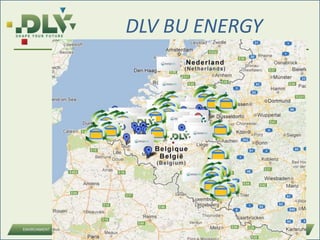
DLV BU ENERGY
DLV ENERGY
• Focus on biogas, biomass, waste(water)
solutions
• Feasibility studies
• Business Concepts
• Waste management
• Energy management
• In Belgium, we also take care of all licensing,
permits, attestation and administration
DLV ENERGY
Output: specific waste &energy plan
Some projects
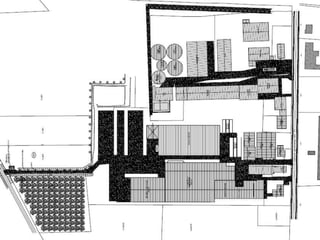
• Biogasplant (industrial)
• Biogasplant (agricultural)
Biogasplant
Biogasplant
Biogasplant
• 60 000 ton/year
• 4 digesters of 3 500 ton
• Co-digestion with animal waste products
• 3*1064 kW
• 1*2000 kW PPO engine
• Heat valorization: evaporation and drying of
the digestate
• Air scrubber
The process
• Storage of different feedstock
• 50 ton bulk bin and 60 ton mixing feeder
• Pretreatement and shredding of solids
• Pumping solid biomass to 20 ton mixing tanks
• Pumping liquid organic biologic waste to mixing
tanks
The process
• Mixing of biomass in mixing tanks.
• AD of the biomass
• Aerobic desulfurization of the biogas
• Use of the biogas in CHP
• Pasteurization (1h 70°C) in tanks
• Processing of the digestate
The process
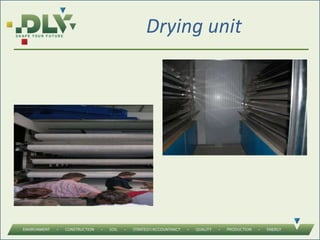
• Drying unit with engine on PPO
• Water scrubber (dust and ammonia)
• Biological scrubber (smell and sulfur)
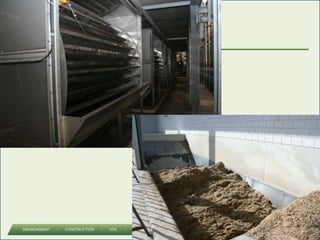
Drying unit
Drying unit
Biogasplant pigs
http://www.molenheide.be/en/press/green-energie
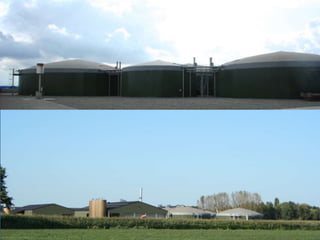
Biogasplant in Houthalen
Biogasplant pigs
Numbers and facts
• 60,000 ton biomass / year
• Electricity: 22,400 MWh/year (+/- 5,000
families)
• Heat: 25,600 MWh/year (+/- 1,000 families)
• CO2 reduction: 28,000 ton (+/- 20,000 family
cars)
Biogasplant dairy
Biogasplant pigs
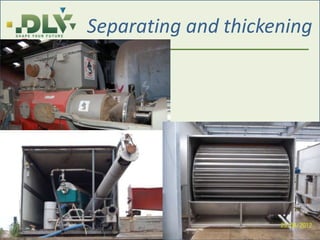
Separating and thickening
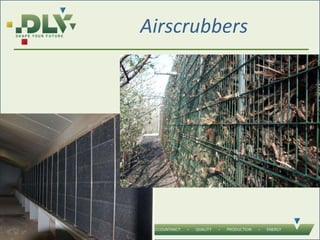
Airscrubbers
Biogasplant pigs
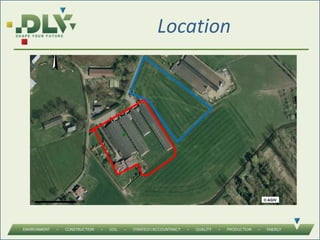
Will be built in 2014
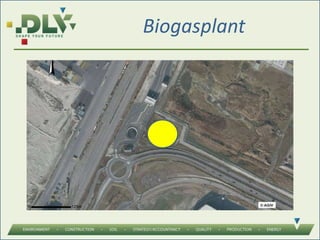
Location
The process
• Co-digestion 60,000 ton/year
• 60% agro related feedstcock (manure, energy
crops, agricultural organic waste)
• 40% non-agro related feedstock (organic
biological waste)
• Electricity: 22,400 MWh/year (6,400 families)
• Heat: 25,600 MWh/year (1,000 families)
• CO2-reduction: 28,000 ton (equivalent 20,000
family cars)
The process
• Mixing biomass
• Pasteurization (1 h 70°C)
• AD
• Desulfurization
• CHP
• Separating the digestate in thin and thick
fraction
The process
• Purifying liquids: dischargable effluent
• Drying solids: pellets
• Air scrubber: acid scrubber, multistage scrubber
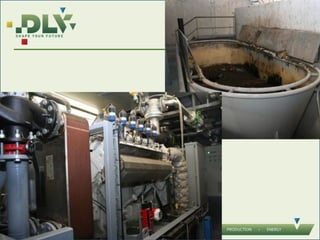
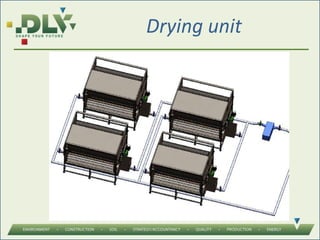
Drying unit
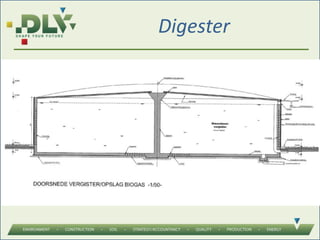
Digester
DLV InnoVision
A clear VISION on INNOVATION
Partners
45
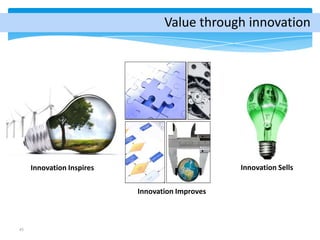
Innovation Inspires
Innovation Improves
Innovation Sells
Value through innovation
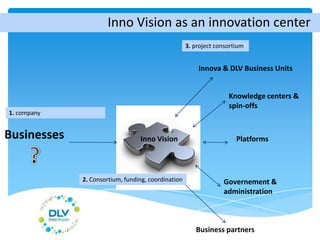
Businesses Inno Vision
Knowledge centers &
spin-offs
Innova & DLV Business Units
Business partners
Governement &
administration
Platforms
1. company
2. Consortium, funding, coordination
3. project consortium
Inno Vision as an innovation center
DLV InnoVision
PROJECTS
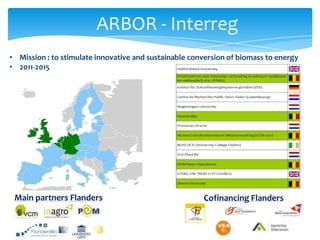
ARBOR - Interreg
Main partners Flanders Cofinancing Flanders
• Mission : to stimulate innovative and sustainable conversion of biomass to energy
• 2011-2015
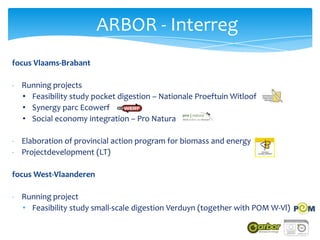
ARBOR - Interreg
focus Vlaams-Brabant
- Running projects
• Feasibility study pocket digestion – Nationale Proeftuin Witloof
• Synergy parc Ecowerf
• Social economy integration – Pro Natura
- Elaboration of provincial action program for biomass and energy
- Projectdevelopment (LT)
focus West-Vlaanderen
- Running project
• Feasibility study small-scale digestion Verduyn (together with POM W-Vl)
FP7 - INEMAD
INEMAD – FP7
Partners Vlaanderen
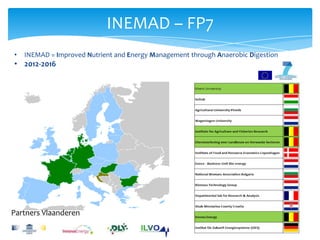
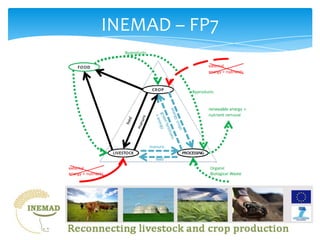
• INEMAD = Improved Nutrient and Energy Management through Anaerobic Digestion
• 2012-2016
INEMAD – FP7
INEMAD – FP7
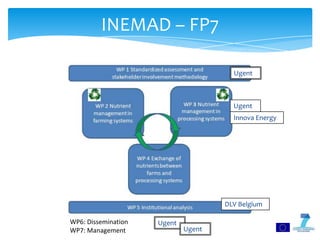
Ugent
WP6: Dissemination
WP7: Management
Ugent
Innova Energy
DLV Belgium
Ugent
Ugent
Hooibeekhoeve
Hooibeekhoeve
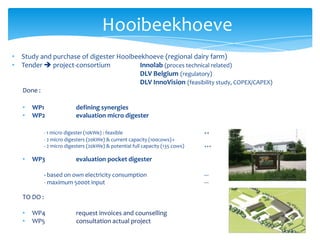
• Study and purchase of digester Hooibeekhoeve (regional dairy farm)
• Tender  project-consortium Innolab (proces technical related)
DLV Belgium (regulatory)
DLV InnoVision (feasibility study, COPEX/CAPEX)
Done :
• WP1 defining synergies
• WP2 evaluation micro digester
- 1 micro digester (10kWe) : feasible ++
- 2 micro digesters (20kWe) & current capacity (100cows)+
- 2 micro digesters (20kWe) & potential full capacity (135 cows) +++
• WP3 evaluation pocket digester
- based on own electricity consumption ---
- maximum 5000t input ---
TO DO :
• WP4 request invoices and counselling
• WP5 consultation actual project
VEA – Pocket digester
VEA Pocket digester
UPDATE :
- Past 6 months :
- Final technical concept
- Finalisation of negotiations with suppliers (BioDynamics, CEE)
- Construction
- Foreseen start- up: January 2013
- After start-up :
- Follow up on the nutrient and organic balance
- Reporting to VEA
MIP - Nutricycle
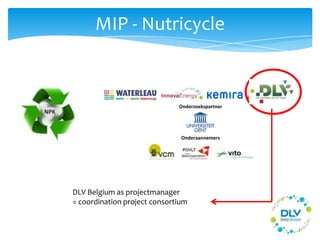
MIP - Nutricycle
Onderzoekspartner
Onderaannemers
DLV Belgium as projectmanager
= coordination project consortium
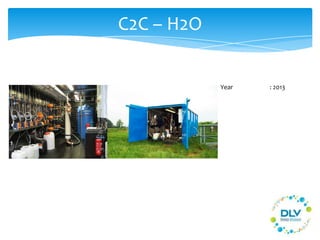
C2C – H2O
C2C – H2O
Year : 2013
Interreg COMBINE
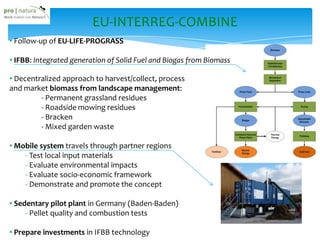
EU-INTERREG-COMBINE
• Follow-up of EU-LIFE-PROGRASS
• IFBB: Integrated generation of Solid Fuel and Biogas from Biomass
• Decentralized approach to harvest/collect, process
and market biomass from landscape management:
- Permanent grassland residues
- Roadside mowing residues
- Bracken
- Mixed garden waste
• Mobile system travels through partner regions
- Test local input materials
- Evaluate environmental impacts
- Evaluate socio-economic framework
- Demonstrate and promote the concept
• Sedentary pilot plant in Germany (Baden-Baden)
- Pellet quality and combustion tests
• Prepare investments in IFBB technology
• University of Kassel, Faculty of Grassland Science
• BUPNET (training and project network)
• City of Baden-Baden
• Vogelsberg County
• Severn Wye Energy Agency
• National Trust (nature conservancy)
• Burdens (utilities, infrastructure, construction)
• University of Ghent (EcoChem)
• Inagro
• Pro Natura
• AILE (energy agency)
• Cotes d’Armor County
EU-INTERREG-COMBINE
Consortium
Interreg BIOREFINE
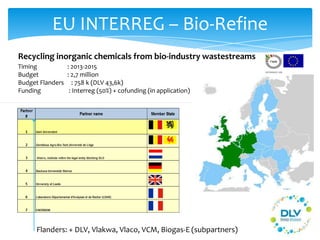
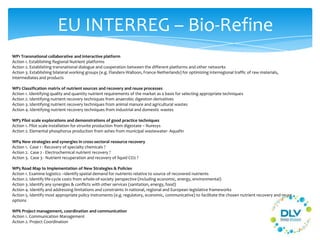
EU INTERREG – Bio-Refine
Recycling inorganic chemicals from bio-industry wastestreams
Flanders: + DLV, Vlakwa, Vlaco, VCM, Biogas-E (subpartners)
Timing : 2013-2015
Budget : 2,7 million
Budget Flanders : 758 k (DLV 43,6k)
Funding : Interreg (50%) + cofunding (in application)
EU INTERREG – Bio-Refine
WP1 Transnational collaborative and interactive platform
Action 1. Establishing Regional Nutrient platforms
Action 2. Establishing transnational dialogue and cooperation between the different platforms and other networks
Action 3. Establishing bilateral working groups (e.g. Flanders-Walloon, France-Netherlands) for optimizing interregional traffic of raw materials,
intermediates and products
WP2 Classification matrix of nutrient sources and recovery and reuse processes
Action 1. Identifying quality and quantity nutrient requirements of the market as a basis for selecting appropriate techniques
Action 2. Identifying nutrient recovery techniques from anaerobic digestion derivatives
Action 3. Identifying nutrient recovery techniques from animal manure and agricultural wastes
Action 4. Identifying nutrient recovery techniques from industrial and domestic wastes
WP3 Pilot scale explorations and demonstrations of good practice techniques
Action 1. Pilot scale installation for struvite production from digestate – Nuresys
Action 2. Elemental phosphorus production from ashes from municipal wastewater- Aquafin
WP4 New strategies and synergies in cross-sectoral resource recovery
Action 1. Case 1 - Recovery of specialty chemicals ?
Action 2. Case 2 - Electrochemical nutrient recovery ?
Action 3. Case 3 - Nutrient recuperation and recovery of liquid CO2 ?
WP5 Road Map to Implementation of New Strategies & Policies
Action 1. Examine logistics –identify spatial demand for nutrients relative to source of recovered nutrients
Action 2. Identify life-cycle costs from whole-of-society perspective (including economic, energy, environmental)
Action 3. Identify any synergies & conflicts with other services (sanitation, energy, food)
Action 4. Identify and addressing limitations and constraints in national, regional and European legislative frameworks
Action 5. Identify most appropriate policy instruments (e.g. regulatory, economic, communicative) to facilitate the chosen nutrient recovery and reuse
options
WP6 Project management, coordination and communication
Action 1. Communication Management
Action 2. Project Coordination
IEE - GR3
GRass as a GReen Gas Resource
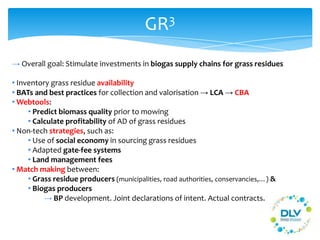
GR3
→ Overall goal: Stimulate investments in biogas supply chains for grass residues
• Inventory grass residue availability
• BATs and best practices for collection and valorisation → LCA → CBA
• Webtools:
• Predict biomass quality prior to mowing
• Calculate profitability of AD of grass residues
• Non-tech strategies, such as:
• Use of social economy in sourcing grass residues
• Adapted gate-fee systems
• Land management fees
• Match making between:
• Grass residue producers (municipalities, road authorities, conservancies,…) &
• Biogas producers
→ BP development. Joint declarations of intent. Actual contracts.
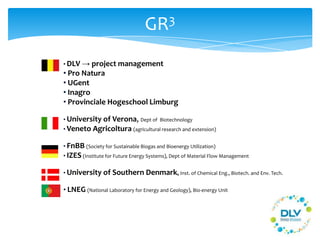
GR3
• DLV → project management
• Pro Natura
• UGent
• Inagro
• Provinciale Hogeschool Limburg
• University of Verona, Dept of Biotechnology
• Veneto Agricoltura (agricultural research and extension)
• FnBB (Society for Sustainable Biogas and Bioenergy Utilization)
• IZES (Institute for Future Energy Systems), Dept of Material Flow Management
• University of Southern Denmark, Inst. of Chemical Eng., Biotech. and Env. Tech.
• LNEG (National Laboratory for Energy and Geology), Bio-energy Unit
GR 3
• Funding : IEE (Intelligent Energy Europe)
• Overall project budget : 1 588 440 €
• Funding rate: 75 %
• Duration : 36 months (start 01/03/2013)
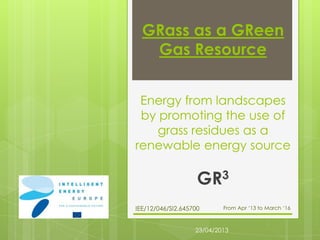
GRass as a GReen
Gas Resource
Energy from landscapes
by promoting the use of
grass residues as a
renewable energy source
GR3
IEE/12/046/SI2.645700 From Apr ‘13 to March ‘16
23/04/2013
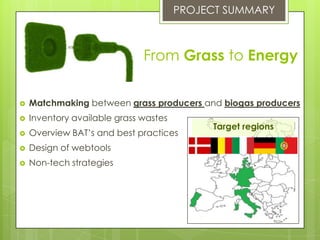
From Grass to Energy
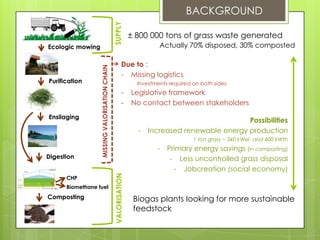
 Matchmaking between grass producers and biogas producers
 Inventory available grass wastes
 Overview BAT’s and best practices
 Design of webtools
 Non-tech strategies
PROJECT SUMMARY
Target regions
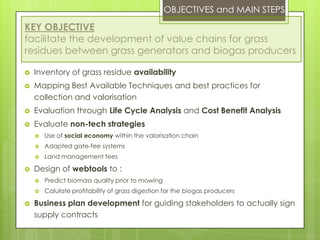
Ecologic mowing
Purification
Ensilaging
Digestion
Composting
CHP
Biomethane fuel
SUPPLYVALORISATION
BACKGROUND
± 800 000 tons of grass waste generated
Actually 70% disposed, 30% composted
Biogas plants looking for more sustainable
feedstock
MISSINGVALORISATIONCHAIN
Due to :
- Missing logistics
Investments required on both sides
- Legislative framework
- No contact between stakeholders
Possibilities
- Increased renewable energy production
1 ton grass ~ 340 kWel and 400 kWth
- Primary energy savings (in composting)
- Less uncontrolled grass disposal
- Jobcreation (social economy)
OBJECTIVES and MAIN STEPS
KEY OBJECTIVE
facilitate the development of value chains for grass
residues between grass generators and biogas producers
 Inventory of grass residue availability
 Mapping Best Available Techniques and best practices for
collection and valorisation
 Evaluation through Life Cycle Analysis and Cost Benefit Analysis
 Evaluate non-tech strategies
 Use of social economy within the valorisation chain
 Adapted gate-fee systems
 Land management fees
 Design of webtools to :
 Predict biomass quality prior to mowing
 Calulate profitability of grass digestion for the biogas producers
 Business plan development for guiding stakeholders to actually sign
supply contracts
During the action
 5 grass residue producers make investment decisions for
better grass quality
 5 biogas plants make investment decisions for integration of
grass in the feedstock
 15 Supply contracts are established
 2 composting facilities integrate biogasproduction
 5 endorsements from policy makers for policy proposals
developed during the project
EXPECTED IMPACTS
 7200 renewable energy production triggered (toe/year)
 300 primary energy savings (toe/year)
 Reduction of greenhouse gase emissions : 39 000 t CO2e/year
Partners & Contact
Flanders (Belgium)
Portugal Italy
Germany
Denmark
Project coordinator : DLV Belgium cvba
Rijkelstraat 28, B-3550 Heusden-Zolder, Belgium
T : +32 11 60 90 60 F: +32 11 60 90 69
Contact person : Lies Bamelis
M: +32 499 14 08 58
ESF
CO – 4 - Energy
CO – 4 - Energy
• OVERAL GOAL : set-up of a blue-print for cooperation between different kinds of
companies / organisations / SME’s with as a goal the joint digestion of the organic
waste flows
• START CASE : University Ghent – kitchen waste from student restaurants
• Workplan :
• Mapping the possible market and associates
• Draw-up of the organisation model
• Draw-up of the financial model
• Evaluation and guidance (interaction with possible – future – associates)
• Dissemination
• Consortium:
• DLV Belgium (Promotor)
• Subcontracting : Agro Plan Consulting
• Pro Natura
• University Ghent
• Inagro
• Biogas - E
Co – 4 - Energy
• Funding : ESF (European Social Fund)
• Overall project budget : 142 770€
• Funding rate: 70 %
• Duration : 12 months (start 01/01/2013)
Social Economy
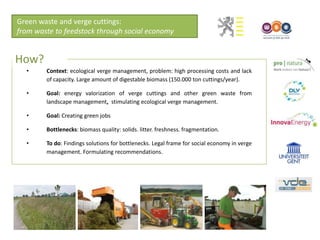
• Context: ecological verge management, problem: high processing costs and lack
of capacity. Large amount of digestable biomass (150.000 ton cuttings/year).
• Goal: energy valorization of verge cuttings and other green waste from
landscape management, stimulating ecological verge management.
• Goal: Creating green jobs
• Bottlenecks: biomass quality: solids. litter. freshness. fragmentation.
• To do: Findings solutions for bottlenecks. Legal frame for social economy in verge
management. Formulating recommendations.
Green waste and verge cuttings:
from waste to feedstock through social economy
How?
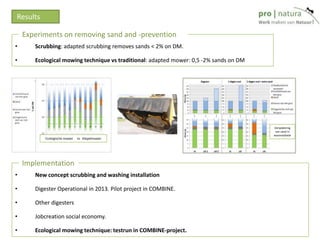
• Scrubbing: adapted scrubbing removes sands < 2% on DM.
• Ecological mowing technique vs traditional: adapted mower: 0,5 -2% sands on DM
Experiments on removing sand and -prevention
Verwijdering
van zand in
wasinstallatie
Ecologische maaier vs Klepelmaaier
Results
• New concept scrubbing and washing installation
• Digester Operational in 2013. Pilot project in COMBINE.
• Other digesters
• Jobcreation social economy.
• Ecological mowing technique: testrun in COMBINE-project.
Implementation
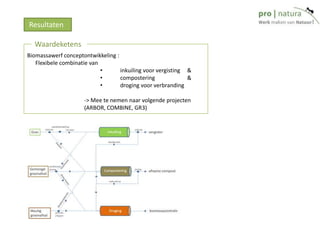
Biomassawerf conceptontwikkeling :
Flexibele combinatie van
• inkuiling voor vergisting &
• compostering &
• droging voor verbranding
-> Mee te nemen naar volgende projecten
(ARBOR, COMBINE, GR3)
Waardeketens
Resultaten

DLV Belgium: activities in Anaerobic Digestion

  • 1.
  • 2.
  • 3.
    DLV? • Founded in1996, by Dirk Coucke (current CEO) • 2013: 130 employees including 16 shareholders • Sales volume 2011: 6,16 mio EUR • Added value 2011: 0,683 mio EUR • 7 offices in Belgium, 1 in Croatia
  • 4.
    Our goal • Tomake companies better and enterprising, by being enterprising and creative ourselves • We achieve this through our independent position in the market. We are full-time consultants, we don’t construct or sell products, we only sell knowledge and common sense
  • 5.
    Our focus • Environmentaland waste management • Market advisory services • Construction concepts and follow up • Soil studies and remediation follow up • Management systems (ISO, HACCP, …) • Business strategies and accountancy • Technical crop advise • Energy management
  • 6.
    DLV? • Joint venturewith 12 accountancy companies in Flanders • Several joint ventures with other companies in Belgium and neighboring countries, to achieve a win-win situation for the client, the partner and DLV • Active in Switzerland, Poland, France, Luxembourg, the Netherlands, Germany, Croatia, …
  • 7.
    DLV international • www.dlv.be •Dlv.world@dlv.be • Stationsstraat 100, 3360 Bierbeek • Hilde De Wachter hdw@dlv.be • +32 495 29 25 31
  • 8.
  • 9.
    DLV ENERGY • Focuson biogas, biomass, waste(water) solutions • Feasibility studies • Business Concepts • Waste management • Energy management • In Belgium, we also take care of all licensing, permits, attestation and administration
  • 10.
    DLV ENERGY Output: specificwaste &energy plan
  • 11.
    Some projects • Biogasplant(industrial) • Biogasplant (agricultural) • Biogasplant (agricultural) • Biogasplant (agricultural) • Biogasplant (agricultural)
  • 12.
  • 13.
  • 14.
    Biogasplant • 60 000ton/year • 4 digesters of 3 500 ton • Co-digestion with animal waste products • 3*1064 kW • 1*2000 kW PPO engine • Heat valorization: evaporation and drying of the digestate • Air scrubber
  • 15.
    The process • Storageof different feedstock • 50 ton bulk bin and 60 ton mixing feeder • Pretreatement and shredding of solids • Pumping solid biomass to 20 ton mixing tanks • Pumping liquid organic biologic waste to mixing tanks
  • 16.
    The process • Mixingof biomass in mixing tanks. • AD of the biomass • Aerobic desulfurization of the biogas • Use of the biogas in CHP • Pasteurization (1h 70°C) in tanks • Processing of the digestate
  • 17.
    The process • Dryingunit with engine on PPO • Water scrubber (dust and ammonia) • Biological scrubber (smell and sulfur)
  • 19.
  • 20.
  • 21.
  • 22.
  • 23.
  • 25.
    Numbers and facts •60,000 ton biomass / year • Electricity: 22,400 MWh/year (+/- 5,000 families) • Heat: 25,600 MWh/year (+/- 1,000 families) • CO2 reduction: 28,000 ton (+/- 20,000 family cars)
  • 26.
  • 30.
  • 31.
  • 32.
  • 35.
  • 36.
  • 37.
    The process • Co-digestion60,000 ton/year • 60% agro related feedstcock (manure, energy crops, agricultural organic waste) • 40% non-agro related feedstock (organic biological waste) • Electricity: 22,400 MWh/year (6,400 families) • Heat: 25,600 MWh/year (1,000 families) • CO2-reduction: 28,000 ton (equivalent 20,000 family cars)
  • 38.
    The process • Mixingbiomass • Pasteurization (1 h 70°C) • AD • Desulfurization • CHP • Separating the digestate in thin and thick fraction
  • 39.
    The process • Purifyingliquids: dischargable effluent • Drying solids: pellets • Air scrubber: acid scrubber, multistage scrubber
  • 40.
  • 42.
  • 43.
    DLV InnoVision A clearVISION on INNOVATION
  • 44.
  • 45.
  • 46.
    Businesses Inno Vision Knowledgecenters & spin-offs Innova & DLV Business Units Business partners Governement & administration Platforms 1. company 2. Consortium, funding, coordination 3. project consortium Inno Vision as an innovation center
  • 47.
  • 49.
    ARBOR - Interreg Mainpartners Flanders Cofinancing Flanders • Mission : to stimulate innovative and sustainable conversion of biomass to energy • 2011-2015
  • 50.
    ARBOR - Interreg focusVlaams-Brabant - Running projects • Feasibility study pocket digestion – Nationale Proeftuin Witloof • Synergy parc Ecowerf • Social economy integration – Pro Natura - Elaboration of provincial action program for biomass and energy - Projectdevelopment (LT) focus West-Vlaanderen - Running project • Feasibility study small-scale digestion Verduyn (together with POM W-Vl)
  • 51.
  • 52.
    INEMAD – FP7 PartnersVlaanderen • INEMAD = Improved Nutrient and Energy Management through Anaerobic Digestion • 2012-2016
  • 53.
  • 54.
    INEMAD – FP7 Ugent WP6:Dissemination WP7: Management Ugent Innova Energy DLV Belgium Ugent Ugent
  • 55.
  • 56.
    Hooibeekhoeve • Study andpurchase of digester Hooibeekhoeve (regional dairy farm) • Tender  project-consortium Innolab (proces technical related) DLV Belgium (regulatory) DLV InnoVision (feasibility study, COPEX/CAPEX) Done : • WP1 defining synergies • WP2 evaluation micro digester - 1 micro digester (10kWe) : feasible ++ - 2 micro digesters (20kWe) & current capacity (100cows)+ - 2 micro digesters (20kWe) & potential full capacity (135 cows) +++ • WP3 evaluation pocket digester - based on own electricity consumption --- - maximum 5000t input --- TO DO : • WP4 request invoices and counselling • WP5 consultation actual project
  • 57.
  • 58.
    VEA Pocket digester UPDATE: - Past 6 months : - Final technical concept - Finalisation of negotiations with suppliers (BioDynamics, CEE) - Construction - Foreseen start- up: January 2013 - After start-up : - Follow up on the nutrient and organic balance - Reporting to VEA
  • 59.
  • 60.
    MIP - Nutricycle Onderzoekspartner Onderaannemers DLVBelgium as projectmanager = coordination project consortium
  • 61.
  • 62.
  • 63.
  • 64.
    EU-INTERREG-COMBINE • Follow-up ofEU-LIFE-PROGRASS • IFBB: Integrated generation of Solid Fuel and Biogas from Biomass • Decentralized approach to harvest/collect, process and market biomass from landscape management: - Permanent grassland residues - Roadside mowing residues - Bracken - Mixed garden waste • Mobile system travels through partner regions - Test local input materials - Evaluate environmental impacts - Evaluate socio-economic framework - Demonstrate and promote the concept • Sedentary pilot plant in Germany (Baden-Baden) - Pellet quality and combustion tests • Prepare investments in IFBB technology
  • 65.
    • University ofKassel, Faculty of Grassland Science • BUPNET (training and project network) • City of Baden-Baden • Vogelsberg County • Severn Wye Energy Agency • National Trust (nature conservancy) • Burdens (utilities, infrastructure, construction) • University of Ghent (EcoChem) • Inagro • Pro Natura • AILE (energy agency) • Cotes d’Armor County EU-INTERREG-COMBINE Consortium
  • 66.
  • 67.
    EU INTERREG –Bio-Refine Recycling inorganic chemicals from bio-industry wastestreams Flanders: + DLV, Vlakwa, Vlaco, VCM, Biogas-E (subpartners) Timing : 2013-2015 Budget : 2,7 million Budget Flanders : 758 k (DLV 43,6k) Funding : Interreg (50%) + cofunding (in application)
  • 68.
    EU INTERREG –Bio-Refine
  • 69.
    EU INTERREG –Bio-Refine WP1 Transnational collaborative and interactive platform Action 1. Establishing Regional Nutrient platforms Action 2. Establishing transnational dialogue and cooperation between the different platforms and other networks Action 3. Establishing bilateral working groups (e.g. Flanders-Walloon, France-Netherlands) for optimizing interregional traffic of raw materials, intermediates and products WP2 Classification matrix of nutrient sources and recovery and reuse processes Action 1. Identifying quality and quantity nutrient requirements of the market as a basis for selecting appropriate techniques Action 2. Identifying nutrient recovery techniques from anaerobic digestion derivatives Action 3. Identifying nutrient recovery techniques from animal manure and agricultural wastes Action 4. Identifying nutrient recovery techniques from industrial and domestic wastes WP3 Pilot scale explorations and demonstrations of good practice techniques Action 1. Pilot scale installation for struvite production from digestate – Nuresys Action 2. Elemental phosphorus production from ashes from municipal wastewater- Aquafin WP4 New strategies and synergies in cross-sectoral resource recovery Action 1. Case 1 - Recovery of specialty chemicals ? Action 2. Case 2 - Electrochemical nutrient recovery ? Action 3. Case 3 - Nutrient recuperation and recovery of liquid CO2 ? WP5 Road Map to Implementation of New Strategies & Policies Action 1. Examine logistics –identify spatial demand for nutrients relative to source of recovered nutrients Action 2. Identify life-cycle costs from whole-of-society perspective (including economic, energy, environmental) Action 3. Identify any synergies & conflicts with other services (sanitation, energy, food) Action 4. Identify and addressing limitations and constraints in national, regional and European legislative frameworks Action 5. Identify most appropriate policy instruments (e.g. regulatory, economic, communicative) to facilitate the chosen nutrient recovery and reuse options WP6 Project management, coordination and communication Action 1. Communication Management Action 2. Project Coordination
  • 70.
    IEE - GR3 GRassas a GReen Gas Resource
  • 71.
    GR3 → Overall goal:Stimulate investments in biogas supply chains for grass residues • Inventory grass residue availability • BATs and best practices for collection and valorisation → LCA → CBA • Webtools: • Predict biomass quality prior to mowing • Calculate profitability of AD of grass residues • Non-tech strategies, such as: • Use of social economy in sourcing grass residues • Adapted gate-fee systems • Land management fees • Match making between: • Grass residue producers (municipalities, road authorities, conservancies,…) & • Biogas producers → BP development. Joint declarations of intent. Actual contracts.
  • 72.
    GR3 • DLV →project management • Pro Natura • UGent • Inagro • Provinciale Hogeschool Limburg • University of Verona, Dept of Biotechnology • Veneto Agricoltura (agricultural research and extension) • FnBB (Society for Sustainable Biogas and Bioenergy Utilization) • IZES (Institute for Future Energy Systems), Dept of Material Flow Management • University of Southern Denmark, Inst. of Chemical Eng., Biotech. and Env. Tech. • LNEG (National Laboratory for Energy and Geology), Bio-energy Unit
  • 73.
    GR 3 • Funding: IEE (Intelligent Energy Europe) • Overall project budget : 1 588 440 € • Funding rate: 75 % • Duration : 36 months (start 01/03/2013)
  • 74.
    GRass as aGReen Gas Resource Energy from landscapes by promoting the use of grass residues as a renewable energy source GR3 IEE/12/046/SI2.645700 From Apr ‘13 to March ‘16 23/04/2013
  • 75.
    From Grass toEnergy  Matchmaking between grass producers and biogas producers  Inventory available grass wastes  Overview BAT’s and best practices  Design of webtools  Non-tech strategies PROJECT SUMMARY Target regions
  • 76.
    Ecologic mowing Purification Ensilaging Digestion Composting CHP Biomethane fuel SUPPLYVALORISATION BACKGROUND ±800 000 tons of grass waste generated Actually 70% disposed, 30% composted Biogas plants looking for more sustainable feedstock MISSINGVALORISATIONCHAIN Due to : - Missing logistics Investments required on both sides - Legislative framework - No contact between stakeholders Possibilities - Increased renewable energy production 1 ton grass ~ 340 kWel and 400 kWth - Primary energy savings (in composting) - Less uncontrolled grass disposal - Jobcreation (social economy)
  • 77.
    OBJECTIVES and MAINSTEPS KEY OBJECTIVE facilitate the development of value chains for grass residues between grass generators and biogas producers  Inventory of grass residue availability  Mapping Best Available Techniques and best practices for collection and valorisation  Evaluation through Life Cycle Analysis and Cost Benefit Analysis  Evaluate non-tech strategies  Use of social economy within the valorisation chain  Adapted gate-fee systems  Land management fees  Design of webtools to :  Predict biomass quality prior to mowing  Calulate profitability of grass digestion for the biogas producers  Business plan development for guiding stakeholders to actually sign supply contracts
  • 78.
    During the action 5 grass residue producers make investment decisions for better grass quality  5 biogas plants make investment decisions for integration of grass in the feedstock  15 Supply contracts are established  2 composting facilities integrate biogasproduction  5 endorsements from policy makers for policy proposals developed during the project EXPECTED IMPACTS  7200 renewable energy production triggered (toe/year)  300 primary energy savings (toe/year)  Reduction of greenhouse gase emissions : 39 000 t CO2e/year
  • 79.
    Partners & Contact Flanders(Belgium) Portugal Italy Germany Denmark Project coordinator : DLV Belgium cvba Rijkelstraat 28, B-3550 Heusden-Zolder, Belgium T : +32 11 60 90 60 F: +32 11 60 90 69 Contact person : Lies Bamelis M: +32 499 14 08 58
  • 80.
    ESF CO – 4- Energy
  • 81.
    CO – 4- Energy • OVERAL GOAL : set-up of a blue-print for cooperation between different kinds of companies / organisations / SME’s with as a goal the joint digestion of the organic waste flows • START CASE : University Ghent – kitchen waste from student restaurants • Workplan : • Mapping the possible market and associates • Draw-up of the organisation model • Draw-up of the financial model • Evaluation and guidance (interaction with possible – future – associates) • Dissemination • Consortium: • DLV Belgium (Promotor) • Subcontracting : Agro Plan Consulting • Pro Natura • University Ghent • Inagro • Biogas - E
  • 82.
    Co – 4- Energy • Funding : ESF (European Social Fund) • Overall project budget : 142 770€ • Funding rate: 70 % • Duration : 12 months (start 01/01/2013)
  • 83.
  • 84.
    • Context: ecologicalverge management, problem: high processing costs and lack of capacity. Large amount of digestable biomass (150.000 ton cuttings/year). • Goal: energy valorization of verge cuttings and other green waste from landscape management, stimulating ecological verge management. • Goal: Creating green jobs • Bottlenecks: biomass quality: solids. litter. freshness. fragmentation. • To do: Findings solutions for bottlenecks. Legal frame for social economy in verge management. Formulating recommendations. Green waste and verge cuttings: from waste to feedstock through social economy How?
  • 85.
    • Scrubbing: adaptedscrubbing removes sands < 2% on DM. • Ecological mowing technique vs traditional: adapted mower: 0,5 -2% sands on DM Experiments on removing sand and -prevention Verwijdering van zand in wasinstallatie Ecologische maaier vs Klepelmaaier Results • New concept scrubbing and washing installation • Digester Operational in 2013. Pilot project in COMBINE. • Other digesters • Jobcreation social economy. • Ecological mowing technique: testrun in COMBINE-project. Implementation
  • 86.
    Biomassawerf conceptontwikkeling : Flexibelecombinatie van • inkuiling voor vergisting & • compostering & • droging voor verbranding -> Mee te nemen naar volgende projecten (ARBOR, COMBINE, GR3) Waardeketens Resultaten