Science 9
Science 9
Argenio, Jones U.
BSEd-Mathematics 2
Balanquit, John Rey P.
BSEd-Science 2
Colo, Angelica Niña V.
BSEd-Science 2
Lagrimas, Ronnel M.
BSEd-Science 2
Maunio, Mary Jane L.
BSEd-Science 2
Surio, Edilberto C.
BSEd-Science 2
What is Detailed Lesson Plan?
A detailed lesson plan is a thorough description of a teacher’s instructions for a
particular class. A teacher usually makes a daily lesson plan to teach a specific course
of instructions.
The sole purpose of a detailed lesson plan is to outline the program for a lesson
in simple details, which will include the lesson’s objective, how the objective is
going to be achieved and a way of testing how well the objective was received
by the students.
What is MELC?
MELC stands for Most Essential Learning Competencies. It was
curriculum made by DepEd to serve as guide for distance learning.
• Enable to focus instruction to the most essential and indispensable
competencies that our learners must acquire
• Lighten the burden of converting classroom-oriented learning
resources into learning resources adapted to distance learning
Learning Objectives
Learning can be divided into three domains:
Cognitive: This is the most commonly used domain. It deals with the
intellectual side of learning.
Affective: This domain includes objectives relating to interest, attitude, and
values relating to learning the information.
Psychomotor: This domain focuses on motor skills and actions that require
physical coordination.
What verbs
should I use for
each domain?
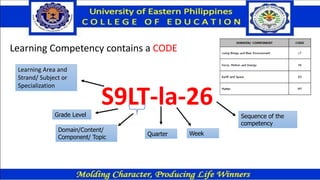
Learning Competency contains a CODE
S9LT-la-26
Learning Area and
Strand/ Subject or
Specialization
Grade Level
Domain/Content/
Component/ Topic
Quarter Week
Sequence of the
competency
The subject matter pertains to the specific topic
Learning resources refers to the references used in
crafting lesson plan as well in the delivery of the lesson.
OTHER LEARNING RESOURCES – refers to some of the references used
LRMDS - The Learning Resources Management and Development
System (LRMDS) is designed to support increased distribution and
access to learning, teaching and professional development resources at
the Region, Division and School/Cluster levels of DepEd.
SlideShare is a popular presentation and document sharing platform.
Values Integration - is a channel of values development through
the teaching-learning activities in the different learning areas.
Subject Integration – is to connects different areas of study by
cutting across subject-matter lines and emphasizing unifying
concepts.
ROUTINARY ACTIVITIES – refers to the activities before the
discussion starts. It includes prayer, greetings, checking of
attendance, and collecting and passing the assignment.
Review – is to check the prior knowledge of the students in their
previous lesson. A review of previous learning at the start of each
lesson is one way to strengthen students' retention of knowledge.
Motivation – serves as the energizer task of the lesson. It is like the
climax of the story in which the students are more curious on what
will be the lesson to be discussed. It can be a song, game, problem,
story or poem.
Presentation of the Lesson – After the motivation in which
the students are curious and thinking of what will be the
lesson to be discussed, you are now going to present the
lesson in this part.
Lesson Proper – it depends on what strategy you are going to
used. It can be 4A’s, 5E’s or 7E’s
In our lesson plan, we used the 4A’s Strategy.
• Activity
• Analysis
• Abstraction
• Application
ACTIVITY
• “what to do” phase
• serves as a springboard for new learning
• engages the learners
• elicits adults’ prior learning experience (principle of
constructivism)
ANALYSIS
• “why” phase; a process of inquiry
• questions clarify key understanding about the topic;
questions are organized to structure the discussion;
last question should lead the learners to understand
new concepts or skills
ABSTRACTION
• “so what” phase
• integrate Activity and Analysis or various concepts in
the learning session the key concepts, important
skills that should be enhanced, the proper attitude
that should be emphasized, and ways to improve
one’s professional competencies
APPLICATION
• “now what” phase
• transfer insights into the real-life concerns
Evaluation – is a set of question to test the student’s
knowledge prior to the lesson being discussed.
Assignment - tasks given to students by their teachers to
complete in a defined time. They can also be referred to
as the work given to someone as a part of learning.
GRASPS is a model for demonstrating performance of
understanding using authentic assessments. It is one of many
performance of understanding models.
Goal: A definition of the problem
Role: Define the role of the student
Audience: Identify the target audience
Situation: This is the context or scenario of the goal
Product: What is created and why it will be created
Standards: Rubrics or success criteria
How can we fairly rate the activity and
performance of the students?
A rubric is a scoring tool that explicitly represents the
performance expectations for an assignment or piece of
work of the students.
It can be:
• Holistic rubrics may use a percentage or text only scoring method.
• Analytic rubrics - Two-dimensional rubrics with levels of
achievement as columns and assessment criteria as rows.
DLP ppt.pptx

DLP ppt.pptx

  • 1.
  • 2.
  • 3.
    Argenio, Jones U. BSEd-Mathematics2 Balanquit, John Rey P. BSEd-Science 2 Colo, Angelica Niña V. BSEd-Science 2 Lagrimas, Ronnel M. BSEd-Science 2 Maunio, Mary Jane L. BSEd-Science 2 Surio, Edilberto C. BSEd-Science 2
  • 4.
    What is DetailedLesson Plan? A detailed lesson plan is a thorough description of a teacher’s instructions for a particular class. A teacher usually makes a daily lesson plan to teach a specific course of instructions. The sole purpose of a detailed lesson plan is to outline the program for a lesson in simple details, which will include the lesson’s objective, how the objective is going to be achieved and a way of testing how well the objective was received by the students.
  • 5.
    What is MELC? MELCstands for Most Essential Learning Competencies. It was curriculum made by DepEd to serve as guide for distance learning. • Enable to focus instruction to the most essential and indispensable competencies that our learners must acquire • Lighten the burden of converting classroom-oriented learning resources into learning resources adapted to distance learning
  • 7.
    Learning Objectives Learning canbe divided into three domains: Cognitive: This is the most commonly used domain. It deals with the intellectual side of learning. Affective: This domain includes objectives relating to interest, attitude, and values relating to learning the information. Psychomotor: This domain focuses on motor skills and actions that require physical coordination.
  • 8.
    What verbs should Iuse for each domain?
  • 9.
    Learning Competency containsa CODE S9LT-la-26 Learning Area and Strand/ Subject or Specialization Grade Level Domain/Content/ Component/ Topic Quarter Week Sequence of the competency
  • 10.
    The subject matterpertains to the specific topic Learning resources refers to the references used in crafting lesson plan as well in the delivery of the lesson.
  • 11.
    OTHER LEARNING RESOURCES– refers to some of the references used LRMDS - The Learning Resources Management and Development System (LRMDS) is designed to support increased distribution and access to learning, teaching and professional development resources at the Region, Division and School/Cluster levels of DepEd. SlideShare is a popular presentation and document sharing platform.
  • 12.
    Values Integration -is a channel of values development through the teaching-learning activities in the different learning areas. Subject Integration – is to connects different areas of study by cutting across subject-matter lines and emphasizing unifying concepts.
  • 13.
    ROUTINARY ACTIVITIES –refers to the activities before the discussion starts. It includes prayer, greetings, checking of attendance, and collecting and passing the assignment.
  • 14.
    Review – isto check the prior knowledge of the students in their previous lesson. A review of previous learning at the start of each lesson is one way to strengthen students' retention of knowledge. Motivation – serves as the energizer task of the lesson. It is like the climax of the story in which the students are more curious on what will be the lesson to be discussed. It can be a song, game, problem, story or poem.
  • 15.
    Presentation of theLesson – After the motivation in which the students are curious and thinking of what will be the lesson to be discussed, you are now going to present the lesson in this part.
  • 16.
    Lesson Proper –it depends on what strategy you are going to used. It can be 4A’s, 5E’s or 7E’s In our lesson plan, we used the 4A’s Strategy. • Activity • Analysis • Abstraction • Application
  • 17.
    ACTIVITY • “what todo” phase • serves as a springboard for new learning • engages the learners • elicits adults’ prior learning experience (principle of constructivism)
  • 18.
    ANALYSIS • “why” phase;a process of inquiry • questions clarify key understanding about the topic; questions are organized to structure the discussion; last question should lead the learners to understand new concepts or skills
  • 19.
    ABSTRACTION • “so what”phase • integrate Activity and Analysis or various concepts in the learning session the key concepts, important skills that should be enhanced, the proper attitude that should be emphasized, and ways to improve one’s professional competencies
  • 20.
    APPLICATION • “now what”phase • transfer insights into the real-life concerns
  • 21.
    Evaluation – isa set of question to test the student’s knowledge prior to the lesson being discussed. Assignment - tasks given to students by their teachers to complete in a defined time. They can also be referred to as the work given to someone as a part of learning.
  • 22.
    GRASPS is amodel for demonstrating performance of understanding using authentic assessments. It is one of many performance of understanding models. Goal: A definition of the problem Role: Define the role of the student Audience: Identify the target audience Situation: This is the context or scenario of the goal Product: What is created and why it will be created Standards: Rubrics or success criteria
  • 23.
    How can wefairly rate the activity and performance of the students?
  • 24.
    A rubric isa scoring tool that explicitly represents the performance expectations for an assignment or piece of work of the students. It can be: • Holistic rubrics may use a percentage or text only scoring method. • Analytic rubrics - Two-dimensional rubrics with levels of achievement as columns and assessment criteria as rows.