
DESIGN PRINCIPLES FOR DIGITAL
LEARNING AND
NSQOL STANDARDS:
COMMONALITIES & DIFFERENCES
Randy LaBonte, Canadian eLearning Network
Michael Barbour, Touro University
LAND ACKNOWLEDGMENT
We acknowledge our CANeLearn office is situated in xwilkway on the traditional
land of the shíshàlth nation who cared for this land for centuries before.
They continue to lead our Coast Salish community’s development and sustainability
as advisors, leaders, and investors. We are grateful for their stewardship of the
Sunshine Coast of British Columbia, an hour north of Vancouver by water.
ABOUT THE CANADIAN ELEARNING NETWORK
• CANELEARN IS A PAN-CANADIAN NETWORK OF K-12 ONLINE AND
BLENDED LEARNING SCHOOLS, ORGANIZATIONS, AND EDUCATORS
• FOCUS IS ON PD, RESEARCH, SHARING RESOURCES
• INTENT IS TO LEVERAGE OUR CANADIAN COLLECTIVE TO PROMOTE
ONLINE AND BLENDED, OR E-LEARNING
MISSION: TO BE THE LEADING VOICE IN CANADA FOR
LEARNER SUCCESS IN K-12 ONLINE AND BLENDED LEARNING.
CANeLearn.net
k12sotn.ca/
Annual report: State of e-learning in
Canada
RESEARCH
PROJECTS
CANeLEARN.NET/
RESEARCH/
PROJECTS/
POLICY, QUALITY, STANDARDS,
AND DESIGN PRINCIPLES
POLICIES – RULES/REGULATIONS FROM AUTHORITIES
QUALITY – IS A PURSUIT; A MISSION IN AID OF A VISION
STANDARDS – EXPECTATIONS/BENCHMARKS TO MEASURE
DESIGN PRINCIPLES
- FUNDAMENTAL CONCEPTS AND GUIDELINES THAT INFORM
THE CREATION AND IMPLEMENTATION OF EDUCATIONAL
PROGRAMS, MATERIALS, AND SYSTEMS
- MAY ALIGN WITH POLICY, GOALS, AND STANDARDS
- KEY ELEMENTS IN EFFECTIVE E-LEARNING
EIGHT DESIGN PRINCIPLES WERE DERIVED
Access to models of
effective e-learning
Ongoing professional
learning opportunities
Deep understanding of
engagement in digital
Knowledge how to
enhance relationships,
foster connections
Understanding
technologies enable, not
dictate, teaching
Special preparation and
mentorship throughout
career cycle
Ongoing strategic
research specific to e-
learning practice
System-level focus on
health, wellness, and
well-being specific to
teaching and learning
online
bit.ly/CANdesign
Purpose to gain understanding of online educator lived experiences using Design Thinking/Participatory Design
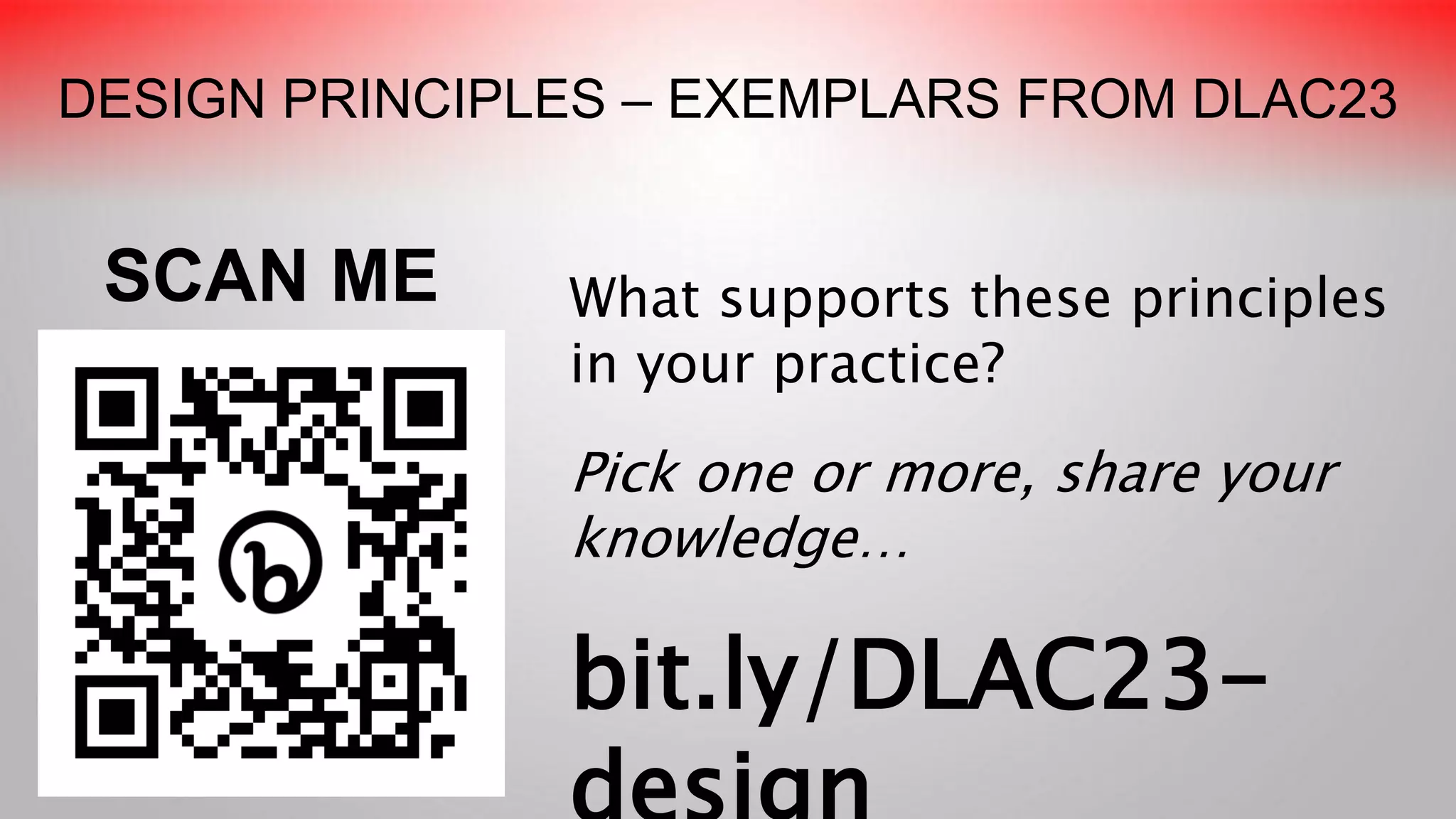
DESIGN PRINCIPLES – EXEMPLARS FROM DLAC23
SCAN ME What supports these principles
in your practice?
Pick one or more, share your
knowledge…
bit.ly/DLAC23-
WHAT DID WE DO?
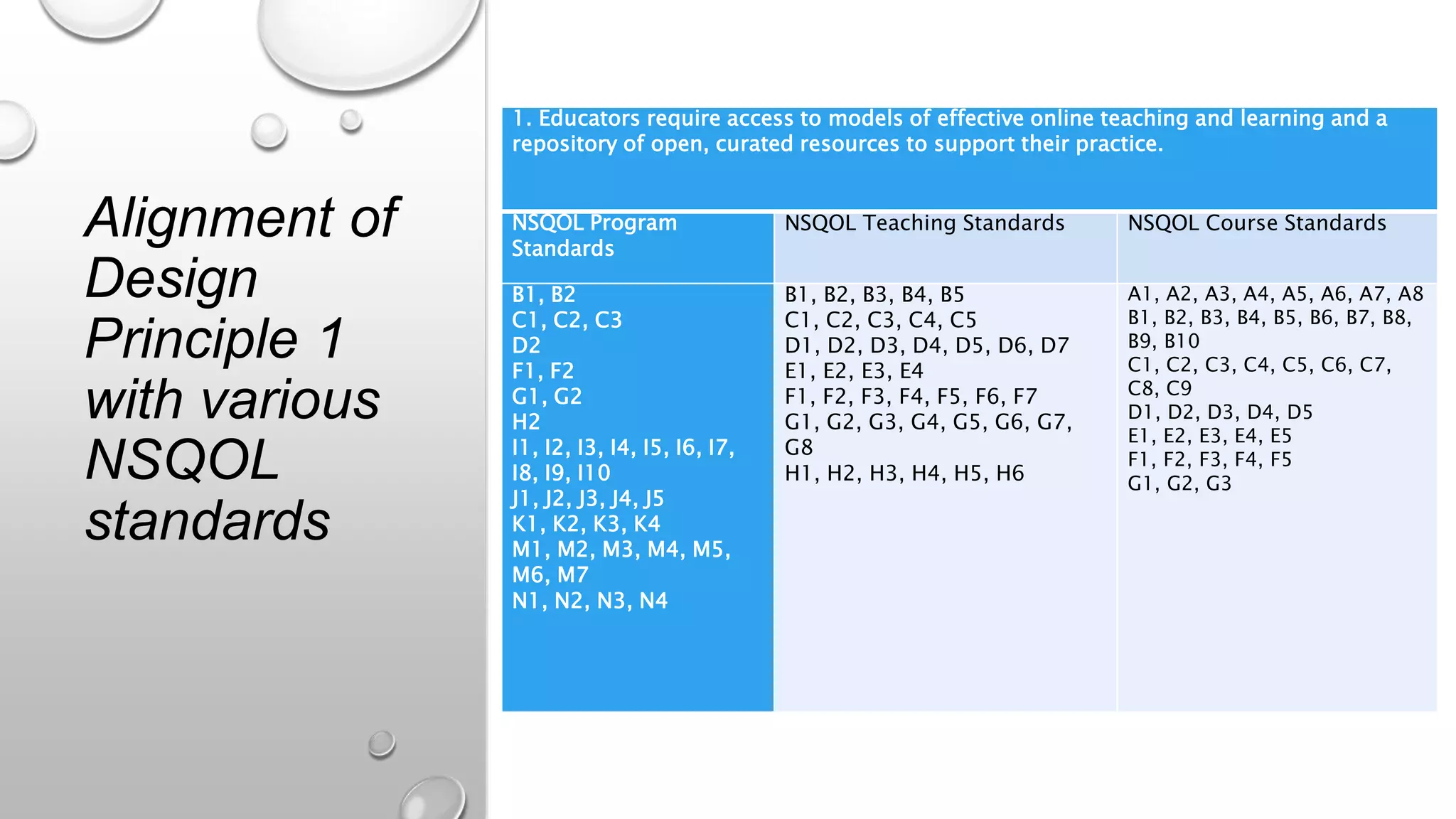
Alignment of
Design
Principle 1
with various
NSQOL
standards
1. Educators require access to models of effective online teaching and learning and a
repository of open, curated resources to support their practice.
NSQOL Program
Standards
NSQOL Teaching Standards NSQOL Course Standards
B1, B2
C1, C2, C3
D2
F1, F2
G1, G2
H2
I1, I2, I3, I4, I5, I6, I7,
I8, I9, I10
J1, J2, J3, J4, J5
K1, K2, K3, K4
M1, M2, M3, M4, M5,
M6, M7
N1, N2, N3, N4
B1, B2, B3, B4, B5
C1, C2, C3, C4, C5
D1, D2, D3, D4, D5, D6, D7
E1, E2, E3, E4
F1, F2, F3, F4, F5, F6, F7
G1, G2, G3, G4, G5, G6, G7,
G8
H1, H2, H3, H4, H5, H6
A1, A2, A3, A4, A5, A6, A7, A8
B1, B2, B3, B4, B5, B6, B7, B8,
B9, B10
C1, C2, C3, C4, C5, C6, C7,
C8, C9
D1, D2, D3, D4, D5
E1, E2, E3, E4, E5
F1, F2, F3, F4, F5
G1, G2, G3
Alignment
of Design
Principle 2
with various
NSQOL
standards
2. Educators require ongoing, timely and relevant professional learning
opportunities and supports that (1) model effective online teaching and
learning design principles and (2) are fostered and honed through the
development of supportive and flexible learning communities that
reflect educators’ career cycles and contexts
NSQOL Program NSQOL Teaching NSQOL Course
B4
C1, C2, C3
G2
I6, I9, I10
J1, J2, J3, J4, J5
K1, K2, K3, K4
L1, L2, L3, L4, L5
N5, N7, N8, N9
A1, A2, A3, A5, A6, A7
B1, B2, B3, B4, B5
C1, C2, C3, C4, C5
D1, D2, D3, D4, D5, D6, D7
E1, E2, E3, E4
F1, F2, F3, F4, F5, F6, F7
G1, G2, G3, G4, G5, G6,
G7, G8
H1, H2, H3, H4, H5, H6
ALIGNMEN
T OF
DESIGN
PRINCIPLE
1 WITH
VARIOUS
QM
STANDARD
S
1. Educators require access to models of effective
online teaching and learning and a repository of
open, curated resources to support their practice
QM Course Standards QM Online Instructor
1.1, 1.2, 1.3, 1.4, 1.5, 1.6, 1.7, 1.8
2.1, 2.2, 2.3, 2.4
3.1, 3.2, 3.3, 3.4, 3.5
4.1, 4.2 , 4.3, 4.4., 4.5, 4.6, 4.7
5.1, 5.2, 5.3, 5.4, 5.5
6.1, 6.2, 6.3, 6.4
7.1, 7.2, 7.3, 7.4
8.1, 8.2, 8.3, 8.4, 8.5, 8.6
II. Technologies
III. Instructional Design
IV. Pedagogy
V. Assessment
VI. Social Presence
Alignment of
Design
Principle 2
with various
QM
standards
2. Educators require ongoing, timely and relevant professional learning
opportunities and supports that (1) model effective online teaching and learning
design principles and (2) are fostered and honed through the development of
supportive and flexible learning communities that reflect educators’ career
cycles and contexts
QM Online Instructor QM Course
II. Technologies
III. Instructional Design
IV. Pedagogy
V. Assessment
VI. Social Presence
WHAT DID WE FIND?
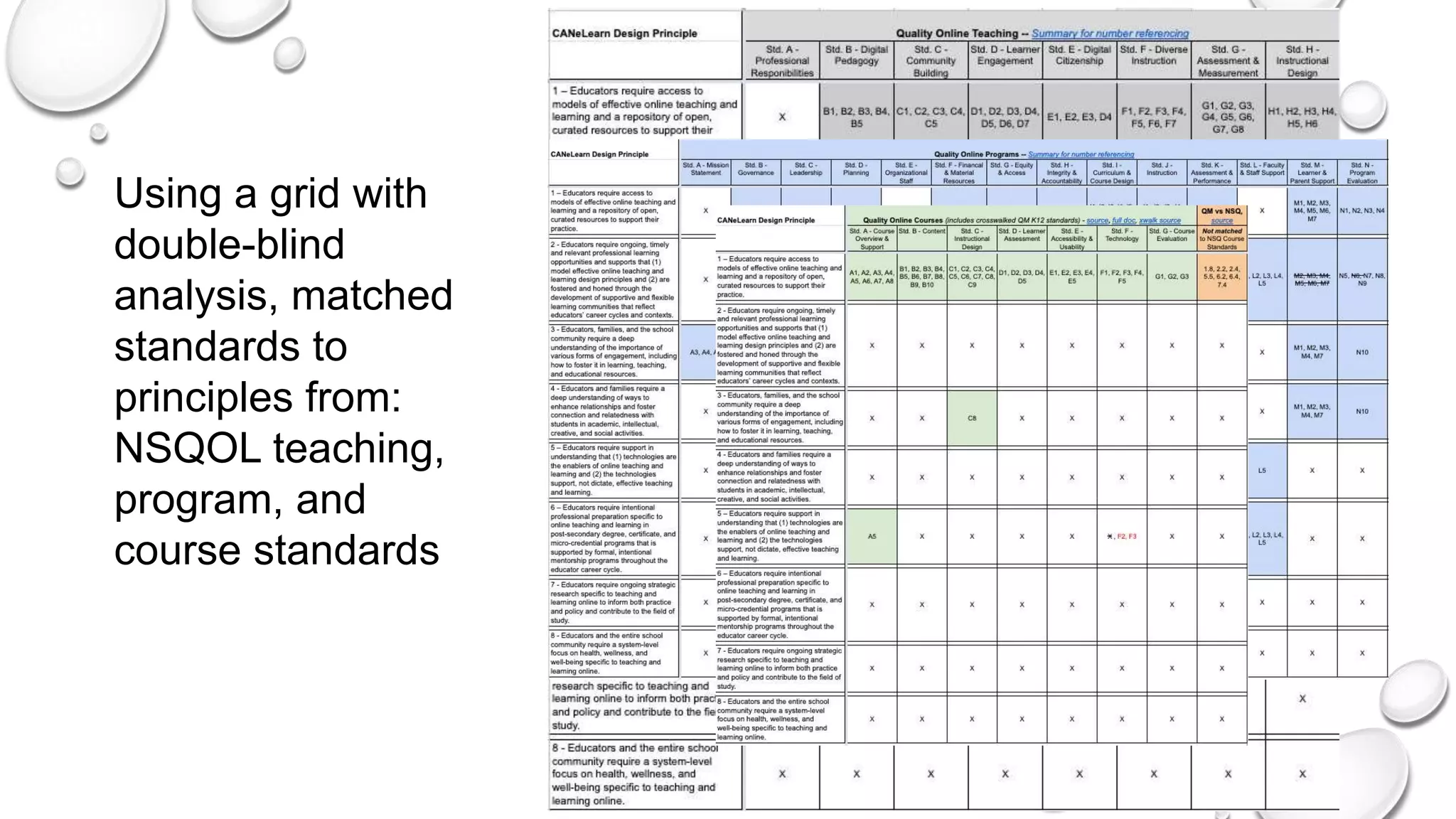
Using a grid with
double-blind
analysis, matched
standards to
principles from:
NSQOL teaching,
program, and
course standards
Using a grid with
double-blind analysis,
matched standards to
principles from:
Specific Review
Standards from the
QM K-12 Rubric and
Quality Matters:
Online Instructor
Skills Set
DESIGN PRINCIPLES – EXEMPLARS FROM DLAC23
SCAN ME What supports these principles
in your practice?
Pick one or more, share your
knowledge…
bit.ly/DLAC23-
Questions??
• What can we do for you?
• What are you still wondering about?
• What advice do you have for us?
19
Randy LaBonte
rlabonte@CANeLearn.net
Michael Barbour
mkbarbour@gmail.com
DESIGN PRINCIPLE #1
Access to models of effective online
teaching and learning and a
repository of open, curated
resources to support their practice.
What supports this principle
in your practice?
DESIGN PRINCIPLE #2
Ongoing professional learning that
(1) models effective online teaching
and learning that is
(2) fostered through flexible learning
communities that reflect educators’
career cycles and contexts.
What supports this principle
in your practice?
DESIGN PRINCIPLE #3
Educators, families, and the school
community require a deep
understanding of the importance of
forms of engagement and how to
foster it in online learning, teaching,
and educational resources.
What supports this principle
in your practice?
DESIGN PRINCIPLE #4
Educators and families understand
ways to enhance relationships and
foster connection with students in
academic, intellectual, creative, and
social activities.
What supports this principle
in your practice?
DESIGN PRINCIPLE #5
Educators require support in
understanding that (1) technologies
are the enablers and (2) the
technologies support, not dictate,
effective teaching and learning.
What supports this principle
in your practice?
DESIGN PRINCIPLE #6
Educators require professional
preparation specific to online
teaching and learning in post-
secondary degree, certificate, and
micro-credential programs
supported by mentorship programs
throughout the educator career cycle
What supports this principle
in your practice?
DESIGN PRINCIPLE #7
Educators require ongoing strategic
research specific to teaching and
learning online to inform both
practice and policy and contribute to
the field of study.
What supports this principle
in your practice?
DESIGN PRINCIPLE #8
Educators and the entire school
community require a system-level
focus on health, wellness, and well-
being specific to teaching and
learning online.
What supports this principle
in your practice?

DLAC 2023 - Design Principles for Digital Learning and NSQOL Standards: Commonalities & Differences

  • 1.
    DESIGN PRINCIPLES FORDIGITAL LEARNING AND NSQOL STANDARDS: COMMONALITIES & DIFFERENCES Randy LaBonte, Canadian eLearning Network Michael Barbour, Touro University
  • 2.
    LAND ACKNOWLEDGMENT We acknowledgeour CANeLearn office is situated in xwilkway on the traditional land of the shíshàlth nation who cared for this land for centuries before. They continue to lead our Coast Salish community’s development and sustainability as advisors, leaders, and investors. We are grateful for their stewardship of the Sunshine Coast of British Columbia, an hour north of Vancouver by water.
  • 3.
    ABOUT THE CANADIANELEARNING NETWORK • CANELEARN IS A PAN-CANADIAN NETWORK OF K-12 ONLINE AND BLENDED LEARNING SCHOOLS, ORGANIZATIONS, AND EDUCATORS • FOCUS IS ON PD, RESEARCH, SHARING RESOURCES • INTENT IS TO LEVERAGE OUR CANADIAN COLLECTIVE TO PROMOTE ONLINE AND BLENDED, OR E-LEARNING MISSION: TO BE THE LEADING VOICE IN CANADA FOR LEARNER SUCCESS IN K-12 ONLINE AND BLENDED LEARNING. CANeLearn.net
  • 4.
    k12sotn.ca/ Annual report: Stateof e-learning in Canada
  • 5.
  • 6.
    POLICY, QUALITY, STANDARDS, ANDDESIGN PRINCIPLES POLICIES – RULES/REGULATIONS FROM AUTHORITIES QUALITY – IS A PURSUIT; A MISSION IN AID OF A VISION STANDARDS – EXPECTATIONS/BENCHMARKS TO MEASURE DESIGN PRINCIPLES - FUNDAMENTAL CONCEPTS AND GUIDELINES THAT INFORM THE CREATION AND IMPLEMENTATION OF EDUCATIONAL PROGRAMS, MATERIALS, AND SYSTEMS - MAY ALIGN WITH POLICY, GOALS, AND STANDARDS - KEY ELEMENTS IN EFFECTIVE E-LEARNING
  • 7.
    EIGHT DESIGN PRINCIPLESWERE DERIVED Access to models of effective e-learning Ongoing professional learning opportunities Deep understanding of engagement in digital Knowledge how to enhance relationships, foster connections Understanding technologies enable, not dictate, teaching Special preparation and mentorship throughout career cycle Ongoing strategic research specific to e- learning practice System-level focus on health, wellness, and well-being specific to teaching and learning online bit.ly/CANdesign Purpose to gain understanding of online educator lived experiences using Design Thinking/Participatory Design
  • 8.
    DESIGN PRINCIPLES –EXEMPLARS FROM DLAC23 SCAN ME What supports these principles in your practice? Pick one or more, share your knowledge… bit.ly/DLAC23-
  • 9.
  • 10.
    Alignment of Design Principle 1 withvarious NSQOL standards 1. Educators require access to models of effective online teaching and learning and a repository of open, curated resources to support their practice. NSQOL Program Standards NSQOL Teaching Standards NSQOL Course Standards B1, B2 C1, C2, C3 D2 F1, F2 G1, G2 H2 I1, I2, I3, I4, I5, I6, I7, I8, I9, I10 J1, J2, J3, J4, J5 K1, K2, K3, K4 M1, M2, M3, M4, M5, M6, M7 N1, N2, N3, N4 B1, B2, B3, B4, B5 C1, C2, C3, C4, C5 D1, D2, D3, D4, D5, D6, D7 E1, E2, E3, E4 F1, F2, F3, F4, F5, F6, F7 G1, G2, G3, G4, G5, G6, G7, G8 H1, H2, H3, H4, H5, H6 A1, A2, A3, A4, A5, A6, A7, A8 B1, B2, B3, B4, B5, B6, B7, B8, B9, B10 C1, C2, C3, C4, C5, C6, C7, C8, C9 D1, D2, D3, D4, D5 E1, E2, E3, E4, E5 F1, F2, F3, F4, F5 G1, G2, G3
  • 11.
    Alignment of Design Principle 2 withvarious NSQOL standards 2. Educators require ongoing, timely and relevant professional learning opportunities and supports that (1) model effective online teaching and learning design principles and (2) are fostered and honed through the development of supportive and flexible learning communities that reflect educators’ career cycles and contexts NSQOL Program NSQOL Teaching NSQOL Course B4 C1, C2, C3 G2 I6, I9, I10 J1, J2, J3, J4, J5 K1, K2, K3, K4 L1, L2, L3, L4, L5 N5, N7, N8, N9 A1, A2, A3, A5, A6, A7 B1, B2, B3, B4, B5 C1, C2, C3, C4, C5 D1, D2, D3, D4, D5, D6, D7 E1, E2, E3, E4 F1, F2, F3, F4, F5, F6, F7 G1, G2, G3, G4, G5, G6, G7, G8 H1, H2, H3, H4, H5, H6
  • 12.
    ALIGNMEN T OF DESIGN PRINCIPLE 1 WITH VARIOUS QM STANDARD S 1.Educators require access to models of effective online teaching and learning and a repository of open, curated resources to support their practice QM Course Standards QM Online Instructor 1.1, 1.2, 1.3, 1.4, 1.5, 1.6, 1.7, 1.8 2.1, 2.2, 2.3, 2.4 3.1, 3.2, 3.3, 3.4, 3.5 4.1, 4.2 , 4.3, 4.4., 4.5, 4.6, 4.7 5.1, 5.2, 5.3, 5.4, 5.5 6.1, 6.2, 6.3, 6.4 7.1, 7.2, 7.3, 7.4 8.1, 8.2, 8.3, 8.4, 8.5, 8.6 II. Technologies III. Instructional Design IV. Pedagogy V. Assessment VI. Social Presence
  • 13.
    Alignment of Design Principle 2 withvarious QM standards 2. Educators require ongoing, timely and relevant professional learning opportunities and supports that (1) model effective online teaching and learning design principles and (2) are fostered and honed through the development of supportive and flexible learning communities that reflect educators’ career cycles and contexts QM Online Instructor QM Course II. Technologies III. Instructional Design IV. Pedagogy V. Assessment VI. Social Presence
  • 14.
  • 15.
    Using a gridwith double-blind analysis, matched standards to principles from: NSQOL teaching, program, and course standards
  • 16.
    Using a gridwith double-blind analysis, matched standards to principles from: Specific Review Standards from the QM K-12 Rubric and Quality Matters: Online Instructor Skills Set
  • 17.
    DESIGN PRINCIPLES –EXEMPLARS FROM DLAC23 SCAN ME What supports these principles in your practice? Pick one or more, share your knowledge… bit.ly/DLAC23-
  • 18.
    Questions?? • What canwe do for you? • What are you still wondering about? • What advice do you have for us?
  • 19.
  • 20.
    DESIGN PRINCIPLE #1 Accessto models of effective online teaching and learning and a repository of open, curated resources to support their practice. What supports this principle in your practice?
  • 21.
    DESIGN PRINCIPLE #2 Ongoingprofessional learning that (1) models effective online teaching and learning that is (2) fostered through flexible learning communities that reflect educators’ career cycles and contexts. What supports this principle in your practice?
  • 22.
    DESIGN PRINCIPLE #3 Educators,families, and the school community require a deep understanding of the importance of forms of engagement and how to foster it in online learning, teaching, and educational resources. What supports this principle in your practice?
  • 23.
    DESIGN PRINCIPLE #4 Educatorsand families understand ways to enhance relationships and foster connection with students in academic, intellectual, creative, and social activities. What supports this principle in your practice?
  • 24.
    DESIGN PRINCIPLE #5 Educatorsrequire support in understanding that (1) technologies are the enablers and (2) the technologies support, not dictate, effective teaching and learning. What supports this principle in your practice?
  • 25.
    DESIGN PRINCIPLE #6 Educatorsrequire professional preparation specific to online teaching and learning in post- secondary degree, certificate, and micro-credential programs supported by mentorship programs throughout the educator career cycle What supports this principle in your practice?
  • 26.
    DESIGN PRINCIPLE #7 Educatorsrequire ongoing strategic research specific to teaching and learning online to inform both practice and policy and contribute to the field of study. What supports this principle in your practice?
  • 27.
    DESIGN PRINCIPLE #8 Educatorsand the entire school community require a system-level focus on health, wellness, and well- being specific to teaching and learning online. What supports this principle in your practice?