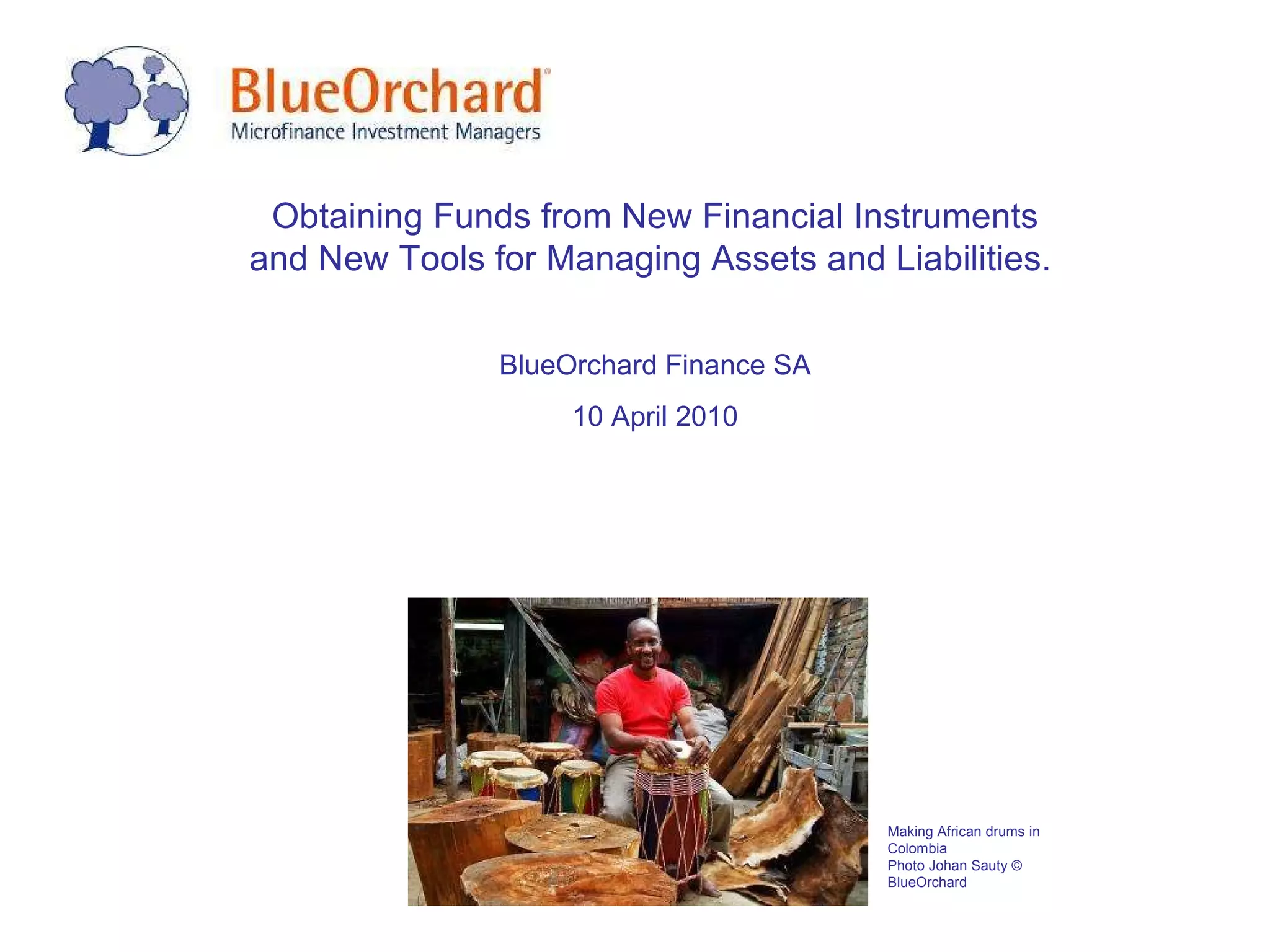
Making African drums in Colombia Photo Johan Sauty © BlueOrchard Obtaining Funds from New Financial Instruments and New Tools for Managing Assets and Liabilities.  BlueOrchard Finance SA 10 April 2010
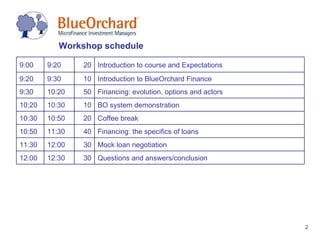
Workshop schedule Questions and answers/conclusion 30 12:30 12:00 Mock loan negotiation 30 12:00 11:30 Financing: the specifics of loans 40 11:30 10:50 Coffee break 20 10:50 10:30 BO system demonstration 10 10:30 10:20 Financing: evolution, options and actors 50 10:20 9:30 Introduction to BlueOrchard Finance 10 9:30 9:20  Introduction to course and Expectations 20 9:20 9:00
BlueOrchard is a leading commercial microfinance intermediary , providing loans to microfinance institutions through its subsidiary BlueOrchard Finance S.A. and investing in the equity of microfinance institutions and microfinance network funds through its subsidiary BlueOrchard Investments Sàrl. Our mission BlueOrchard’s mission is to  empower the poor world-wide and improve their quality of life by promoting  income-generating activities  through private  investments in microfinance Our philosophy We are convinced that microfinance investments can  simultaneously produce social progress and financial returns . This is what makes microfinance a powerful tool to sustain economic development and alleviate poverty; as well as an attractive asset class, worthy of inclusion in any diversified investment portfolio strategy. Our approach We provide innovative financial instruments and solutions for placements in microfinance , bridging the gap between capital markets and microfinance institutions.  W e generate profitable returns on investments while supporting the development of millions of promising small enterprises.  We believe in  creating value through solid long-term relationships by providing debt and equity to microfinance institutions in all stages of their development . We share their mission to provide financial services to those who have few resources and excluded from mainstream financial services. We regard our cooperation with them as the primary means to support financial and social integration worldwide. Our values We believe in establishing  trust through transparency . We attach high importance to our  capacity to innovate . We treasure our  integrity and professionalism . We work with  zeal and enthusiasm . About BlueOrchard
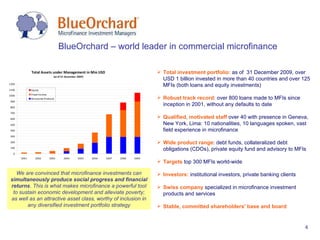
Total investment portfolio:  as of  31 December 2009, over USD  1 billion  invested in more than 40 countries and over 125 MFIs (both loans and equity investments) Robust track record : over 800 loans made to MFIs since inception in 2001, without any defaults to date Qualified, motivated staff  over 40 with presence in Geneva, New York, Lima: 10 nationalities, 10 languages spoken, vast field experience in microfinance Wide product range : debt funds, collateralized debt obligations (CDOs), private equity fund and advisory to MFIs Targets  top 300 MFIs world-wide Investors:  institutional investors, private banking clients Swiss company  specialized in microfinance investment products and services Stable, committed   shareholders' base and board BlueOrchard – world leader in commercial microfinance We are convinced that microfinance investments can  simultaneously produce social progress and financial returns . This is what makes microfinance a powerful tool to sustain economic development and alleviate poverty; as well as an attractive asset class, worthy of inclusion in any diversified investment portfolio strategy
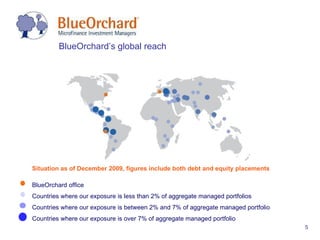
Situation as of December 2009, figures include both debt and equity placements BlueOrchard office Countries where our exposure is less than 2% of aggregate managed portfolios Countries where our exposure is between 2% and 7% of aggregate managed portfolio Countries where our exposure is over 7% of aggregate managed portfolio BlueOrchard’s global reach
Evolution and options for financing Types of lenders Lender due diligence process Loan documentation Loan negotiation Key discussion points
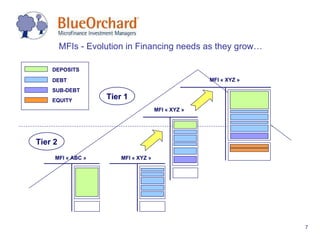
DEBT SUB-DEBT EQUITY DEPOSITS MFIs -  Evolution in Financing needs as they grow… Tier 2 Tier 1 MFI « XYZ » MFI « XYZ » MFI « XYZ »  MFI « ABC »
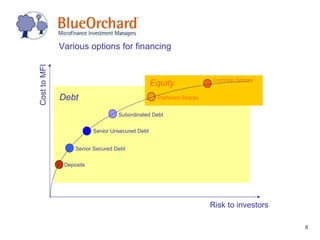
Various options for financing  Senior Unsecured Debt Subordinated Debt Senior Secured Debt Deposits Debt Preferred Shares Common Shares Equity Risk to investors Cost to MFI
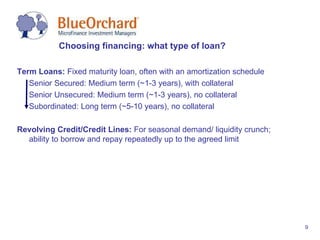
Choosing financing: what type of loan? Term Loans:  Fixed maturity loan, often with an amortization schedule Senior Secured: Medium term (~1-3 years), with collateral  Senior Unsecured: Medium term (~1-3 years), no collateral Subordinated: Long term (~5-10 years), no collateral Revolving Credit/Credit Lines:  For seasonal demand/ liquidity crunch; ability to borrow and repay repeatedly up to the agreed limit
Evolution and options for financing Types of lenders Lender due diligence process Loan documentation Loan negotiation Key discussion points
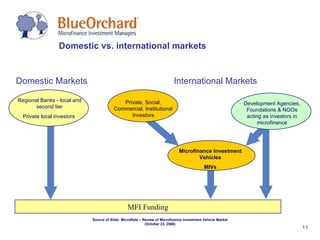
Domestic vs. international markets International Markets Domestic Markets MFI Funding Source of Slide: MicroRate – Review of Microfinance Investment Vehicle Market (October 23, 2006) Microfinance Investment Vehicles MIVs Development Agencies, Foundations & NGOs acting as investors in microfinance Regional Banks - local and second tier Private local investors   Private, Social, Commercial, Institutional Investors
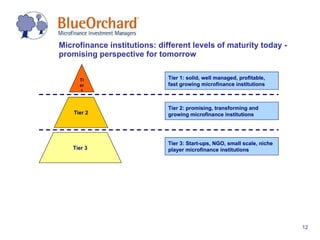
Microfinance institutions: different levels of maturity today - promising perspective for tomorrow Tier1 Tier 2 Tier 3 Tier 1: solid, well managed, profitable, fast growing microfinance institutions Tier 2: promising, transforming and growing microfinance institutions Tier 3: Start-ups, NGO, small scale, niche player microfinance institutions
Evolution and options for financing Types of lenders Lender due diligence process Loan documentation Loan negotiation Key discussion points
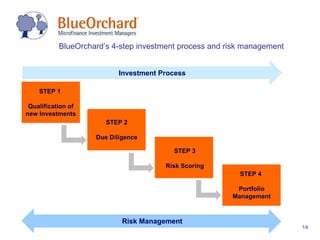
Investment Process Risk Management STEP 2 Due Diligence STEP 3 Risk Scoring STEP 4  Portfolio Management STEP 1  Qualification of new Investments BlueOrchard’s 4-step investment process and risk management
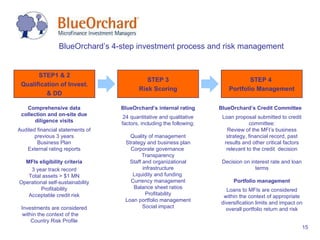
STEP1 & 2 Qualification of Invest. & DD Comprehensive data collection and on-site due diligence visits Audited financial statements of previous 3 years Business Plan External rating reports MFIs eligibility criteria 3 year track record Total assets > $1 MN Operational self-sustainability Profitability Acceptable credit risk Investments are considered within the context of the  Country Risk Profile STEP 3 Risk Scoring STEP 4  Portfolio Management BlueOrchard’s internal rating 24 quantitative and qualitative factors, including the following: Quality of management Strategy and business plan Corporate governance  Transparency Staff and organizational infrastructure Liquidity and funding  Currency management Balance sheet ratios Profitability Loan portfolio management Social impact BlueOrchard’s Credit Committee Loan proposal submitted to credit committee: Review of the MFI’s business strategy, financial record, past results and other critical factors relevant to the credit  decision Decision on interest rate and loan terms Portfolio management Loans to MFIs are considered within the context of appropriate diversification limits and impact on overall portfolio return and risk BlueOrchard’s 4-step investment process and risk management
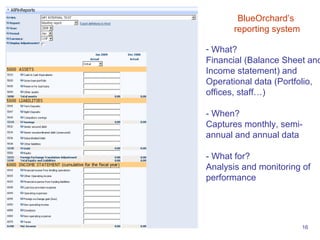
BlueOrchard’s  reporting system What? Financial (Balance Sheet and Income statement) and Operational data (Portfolio, offices, staff…) - When? Captures monthly, semi-annual and annual data - What for? Analysis and monitoring of performance
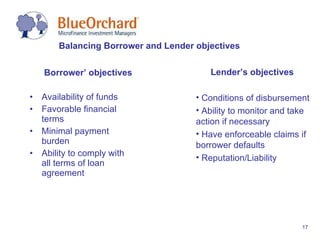
  Borrower’ objectives Availability of funds Favorable financial terms Minimal payment burden Ability to comply with all terms of loan agreement Balancing Borrower and Lender objectives Lender’s objectives Conditions of disbursement Ability to monitor and take action if necessary Have enforceable claims if borrower defaults Reputation/Liability
Evolution and options for financing Types of lenders Lender due diligence process Loan documentation Loan negotiation Key discussion points
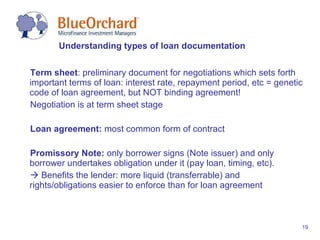
Term sheet : preliminary document for negotiations which sets forth important terms of loan: interest rate, repayment period, etc = genetic code of loan agreement, but NOT binding agreement! Negotiation is at term sheet stage Loan agreement:  most common form of contract  Promissory Note:  only borrower signs (Note issuer) and only borrower undertakes obligation under it (pay loan, timing, etc).     Benefits the lender: more liquid (transferrable) and rights/obligations easier to enforce than for loan agreement Understanding types of loan documentation
Interest rate : Fixed vs. Floating rate Disbursement : Way in which loan is disbursed (availability, single vs. multiple disbursements) Repayment :  Way in which loan is repayed (amortization, bullet, grace period, etc) Voluntary prepayment:  often not accepted, but can be with a fee. Overdue payments  of principal or interest Fees : arrangement fees, commitment fees  Covenants:  promises from borrower about conduct and financial situation after disbursement. Affirmative or negative. Loan Agreement provisions
Evolution and options for financing Types of lenders Lender due diligence process Loan documentation Loan negotiation Key discussion points
MFI   Lender - MFI CEO  - Lender’s representative - MFI lawyer - Lender’s lawyer Split in groups and discuss the arguments raised. Mock negotiation of a commercial bank loan between
Commercial Loan Agreements: A Technical Guide for Microfinance Institutions http://www.microfinancegateway.org/gm/document-1.9.28341/36554_file_36554.pdf   MFI Capital Structure Decision Making: http://www.cgap.org/gm/document-1.9.2735/BR_MFI_Capital_Structure_Decision_Making.pdf How Should Microfinance Institutions Best Fund Themselves? http://www.iadb.org/sds/doc/intD4C.PDF Additional reading
Thank you!  BlueOrchard Finance S.A.  32 rue de Malatrex,  1201 Geneva, Switzerland Tel.: +41 22 596 4777 Fax: +41 22 596 4799 [email_address] BlueOrchard Finance USA, Inc.  1140 Broadway, #304,  New York NY 10017, USA Tel.: +1 212 944 8748,  Fax: +1 212 944 8749 [email_address] BlueOrchard Finance  America Latina S.A.C.  Pasaje Mártir Olaya 129 Lima 18, Peru Tel.: + 511 255 7049 [email_address] www.blueorchard.com Raising cattle in Mongolia P hoto Johan Sauty © BlueOrchard

AMERMS Course 4: Obtaining Funds from New Financial Instruments - PPT 1

  • 1.
    Making African drumsin Colombia Photo Johan Sauty © BlueOrchard Obtaining Funds from New Financial Instruments and New Tools for Managing Assets and Liabilities. BlueOrchard Finance SA 10 April 2010
  • 2.
    Workshop schedule Questionsand answers/conclusion 30 12:30 12:00 Mock loan negotiation 30 12:00 11:30 Financing: the specifics of loans 40 11:30 10:50 Coffee break 20 10:50 10:30 BO system demonstration 10 10:30 10:20 Financing: evolution, options and actors 50 10:20 9:30 Introduction to BlueOrchard Finance 10 9:30 9:20 Introduction to course and Expectations 20 9:20 9:00
  • 3.
    BlueOrchard is aleading commercial microfinance intermediary , providing loans to microfinance institutions through its subsidiary BlueOrchard Finance S.A. and investing in the equity of microfinance institutions and microfinance network funds through its subsidiary BlueOrchard Investments Sàrl. Our mission BlueOrchard’s mission is to empower the poor world-wide and improve their quality of life by promoting income-generating activities through private investments in microfinance Our philosophy We are convinced that microfinance investments can simultaneously produce social progress and financial returns . This is what makes microfinance a powerful tool to sustain economic development and alleviate poverty; as well as an attractive asset class, worthy of inclusion in any diversified investment portfolio strategy. Our approach We provide innovative financial instruments and solutions for placements in microfinance , bridging the gap between capital markets and microfinance institutions.  W e generate profitable returns on investments while supporting the development of millions of promising small enterprises. We believe in creating value through solid long-term relationships by providing debt and equity to microfinance institutions in all stages of their development . We share their mission to provide financial services to those who have few resources and excluded from mainstream financial services. We regard our cooperation with them as the primary means to support financial and social integration worldwide. Our values We believe in establishing trust through transparency . We attach high importance to our capacity to innovate . We treasure our integrity and professionalism . We work with zeal and enthusiasm . About BlueOrchard
  • 4.
    Total investment portfolio: as of 31 December 2009, over USD 1 billion invested in more than 40 countries and over 125 MFIs (both loans and equity investments) Robust track record : over 800 loans made to MFIs since inception in 2001, without any defaults to date Qualified, motivated staff over 40 with presence in Geneva, New York, Lima: 10 nationalities, 10 languages spoken, vast field experience in microfinance Wide product range : debt funds, collateralized debt obligations (CDOs), private equity fund and advisory to MFIs Targets top 300 MFIs world-wide Investors: institutional investors, private banking clients Swiss company specialized in microfinance investment products and services Stable, committed shareholders' base and board BlueOrchard – world leader in commercial microfinance We are convinced that microfinance investments can simultaneously produce social progress and financial returns . This is what makes microfinance a powerful tool to sustain economic development and alleviate poverty; as well as an attractive asset class, worthy of inclusion in any diversified investment portfolio strategy
  • 5.
    Situation as ofDecember 2009, figures include both debt and equity placements BlueOrchard office Countries where our exposure is less than 2% of aggregate managed portfolios Countries where our exposure is between 2% and 7% of aggregate managed portfolio Countries where our exposure is over 7% of aggregate managed portfolio BlueOrchard’s global reach
  • 6.
    Evolution and optionsfor financing Types of lenders Lender due diligence process Loan documentation Loan negotiation Key discussion points
  • 7.
    DEBT SUB-DEBT EQUITYDEPOSITS MFIs - Evolution in Financing needs as they grow… Tier 2 Tier 1 MFI « XYZ » MFI « XYZ » MFI « XYZ » MFI « ABC »
  • 8.
    Various options forfinancing Senior Unsecured Debt Subordinated Debt Senior Secured Debt Deposits Debt Preferred Shares Common Shares Equity Risk to investors Cost to MFI
  • 9.
    Choosing financing: whattype of loan? Term Loans: Fixed maturity loan, often with an amortization schedule Senior Secured: Medium term (~1-3 years), with collateral Senior Unsecured: Medium term (~1-3 years), no collateral Subordinated: Long term (~5-10 years), no collateral Revolving Credit/Credit Lines: For seasonal demand/ liquidity crunch; ability to borrow and repay repeatedly up to the agreed limit
  • 10.
    Evolution and optionsfor financing Types of lenders Lender due diligence process Loan documentation Loan negotiation Key discussion points
  • 11.
    Domestic vs. internationalmarkets International Markets Domestic Markets MFI Funding Source of Slide: MicroRate – Review of Microfinance Investment Vehicle Market (October 23, 2006) Microfinance Investment Vehicles MIVs Development Agencies, Foundations & NGOs acting as investors in microfinance Regional Banks - local and second tier Private local investors Private, Social, Commercial, Institutional Investors
  • 12.
    Microfinance institutions: differentlevels of maturity today - promising perspective for tomorrow Tier1 Tier 2 Tier 3 Tier 1: solid, well managed, profitable, fast growing microfinance institutions Tier 2: promising, transforming and growing microfinance institutions Tier 3: Start-ups, NGO, small scale, niche player microfinance institutions
  • 13.
    Evolution and optionsfor financing Types of lenders Lender due diligence process Loan documentation Loan negotiation Key discussion points
  • 14.
    Investment Process RiskManagement STEP 2 Due Diligence STEP 3 Risk Scoring STEP 4 Portfolio Management STEP 1 Qualification of new Investments BlueOrchard’s 4-step investment process and risk management
  • 15.
    STEP1 & 2Qualification of Invest. & DD Comprehensive data collection and on-site due diligence visits Audited financial statements of previous 3 years Business Plan External rating reports MFIs eligibility criteria 3 year track record Total assets > $1 MN Operational self-sustainability Profitability Acceptable credit risk Investments are considered within the context of the Country Risk Profile STEP 3 Risk Scoring STEP 4 Portfolio Management BlueOrchard’s internal rating 24 quantitative and qualitative factors, including the following: Quality of management Strategy and business plan Corporate governance Transparency Staff and organizational infrastructure Liquidity and funding Currency management Balance sheet ratios Profitability Loan portfolio management Social impact BlueOrchard’s Credit Committee Loan proposal submitted to credit committee: Review of the MFI’s business strategy, financial record, past results and other critical factors relevant to the credit decision Decision on interest rate and loan terms Portfolio management Loans to MFIs are considered within the context of appropriate diversification limits and impact on overall portfolio return and risk BlueOrchard’s 4-step investment process and risk management
  • 16.
    BlueOrchard’s reportingsystem What? Financial (Balance Sheet and Income statement) and Operational data (Portfolio, offices, staff…) - When? Captures monthly, semi-annual and annual data - What for? Analysis and monitoring of performance
  • 17.
    Borrower’objectives Availability of funds Favorable financial terms Minimal payment burden Ability to comply with all terms of loan agreement Balancing Borrower and Lender objectives Lender’s objectives Conditions of disbursement Ability to monitor and take action if necessary Have enforceable claims if borrower defaults Reputation/Liability
  • 18.
    Evolution and optionsfor financing Types of lenders Lender due diligence process Loan documentation Loan negotiation Key discussion points
  • 19.
    Term sheet :preliminary document for negotiations which sets forth important terms of loan: interest rate, repayment period, etc = genetic code of loan agreement, but NOT binding agreement! Negotiation is at term sheet stage Loan agreement: most common form of contract Promissory Note: only borrower signs (Note issuer) and only borrower undertakes obligation under it (pay loan, timing, etc).  Benefits the lender: more liquid (transferrable) and rights/obligations easier to enforce than for loan agreement Understanding types of loan documentation
  • 20.
    Interest rate :Fixed vs. Floating rate Disbursement : Way in which loan is disbursed (availability, single vs. multiple disbursements) Repayment : Way in which loan is repayed (amortization, bullet, grace period, etc) Voluntary prepayment: often not accepted, but can be with a fee. Overdue payments of principal or interest Fees : arrangement fees, commitment fees Covenants: promises from borrower about conduct and financial situation after disbursement. Affirmative or negative. Loan Agreement provisions
  • 21.
    Evolution and optionsfor financing Types of lenders Lender due diligence process Loan documentation Loan negotiation Key discussion points
  • 22.
    MFI Lender - MFI CEO - Lender’s representative - MFI lawyer - Lender’s lawyer Split in groups and discuss the arguments raised. Mock negotiation of a commercial bank loan between
  • 23.
    Commercial Loan Agreements:A Technical Guide for Microfinance Institutions http://www.microfinancegateway.org/gm/document-1.9.28341/36554_file_36554.pdf MFI Capital Structure Decision Making: http://www.cgap.org/gm/document-1.9.2735/BR_MFI_Capital_Structure_Decision_Making.pdf How Should Microfinance Institutions Best Fund Themselves? http://www.iadb.org/sds/doc/intD4C.PDF Additional reading
  • 24.
    Thank you! BlueOrchard Finance S.A. 32 rue de Malatrex, 1201 Geneva, Switzerland Tel.: +41 22 596 4777 Fax: +41 22 596 4799 [email_address] BlueOrchard Finance USA, Inc. 1140 Broadway, #304, New York NY 10017, USA Tel.: +1 212 944 8748, Fax: +1 212 944 8749 [email_address] BlueOrchard Finance America Latina S.A.C. Pasaje Mártir Olaya 129 Lima 18, Peru Tel.: + 511 255 7049 [email_address] www.blueorchard.com Raising cattle in Mongolia P hoto Johan Sauty © BlueOrchard

Editor's Notes

  • #9 Debt financing - borrowing money from a lender or investor with the understanding that the full amount will be repaid in the future, usually with interest. Equity financing - investors receive partial ownership in the company in exchange for their funds—does not have to be repaid. In most cases, debt financing does not include any provision for ownership of the company (although some types of debt are convertible to equity). Instead, small businesses that employ debt financing accept a direct obligation to repay the funds within a certain period of time. The interest rate charged on the borrowed funds reflects the level of risk that the lender undertakes by providing the money. For example, a lender might charge a startup company a higher interest rate than it would a company that had shown a profit for several years. Since lenders are paid off before owners in the event of business liquidation, debt financing entails less risk than equity financing and thus usually commands a lower return. Though there are several possible methods of debt financing available to small businesses—including private placement of bonds, convertible debentures, industrial development bonds, and leveraged buyouts—by far the most common type of debt financing is a regular loan. Loans can be classified as long-term (with a maturity longer than one year), short-term (with a maturity shorter than two years), or a credit line (for more immediate borrowing needs). They can be endorsed by co-signers, guaranteed by the government, or secured by collateral—such as real estate, accounts receivable, inventory, savings, life insurance, stocks and bonds, or the item purchased with the loan.
  • #12 Advantages Disadvantages Private market Faster More expensive Less disclosure than public offering More restrictive covenants Less legal liability risk Less market visibility for MFI More accessible (historically) for MFIs Public market More liquidity Disclosure requirement more onerous Cheaper Legal liability risk greater Greater market visibility Slower to issue More difficult to restructure or renegotiate terms
  • #21 Fixed uniform interest rate, established at the commencement of the loan, which stays in effect throughout the life of the loan. Floating interest: reset at specified intervals, usually by reference to a market indicator in the domestic or international borrowing markets.