Divisibility rules
Prepared By
Prof. Rajanikant Soni
M. Tech Electronics
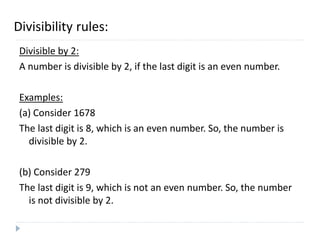
Divisibility rules:
Divisible by 2:
A number is divisible by 2, if the last digit is an even number.
Examples:
(a) Consider 1678
The last digit is 8, which is an even number. So, the number is
divisible by 2.
(b) Consider 279
The last digit is 9, which is not an even number. So, the number
is not divisible by 2.
Divisibility rules(continued):
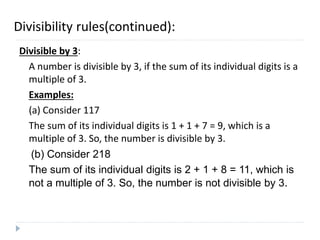
Divisible by 3:
A number is divisible by 3, if the sum of its individual digits is a
multiple of 3.
Examples:
(a) Consider 117
The sum of its individual digits is 1 + 1 + 7 = 9, which is a
multiple of 3. So, the number is divisible by 3.
(b) Consider 218
The sum of its individual digits is 2 + 1 + 8 = 11, which is
not a multiple of 3. So, the number is not divisible by 3.
Divisibility rules(continued):
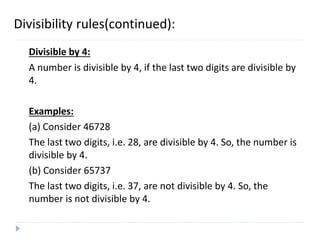
Divisible by 4:
A number is divisible by 4, if the last two digits are divisible by
4.
Examples:
(a) Consider 46728
The last two digits, i.e. 28, are divisible by 4. So, the number is
divisible by 4.
(b) Consider 65737
The last two digits, i.e. 37, are not divisible by 4. So, the
number is not divisible by 4.
Divisibility rules(continued):
Divisible by 5:
A number is divisible by 5 if the last digit is either 0 or 5.
Examples:
(a) Consider 20505
The last digit is 5. So, the number is divisible by 5.
(b) Consider 263
The last digit is 3. So, the number is not divisible by 5.
Thank You

Divisibility rules

  • 1.
    Divisibility rules Prepared By Prof.Rajanikant Soni M. Tech Electronics
  • 2.
    Divisibility rules: Divisible by2: A number is divisible by 2, if the last digit is an even number. Examples: (a) Consider 1678 The last digit is 8, which is an even number. So, the number is divisible by 2. (b) Consider 279 The last digit is 9, which is not an even number. So, the number is not divisible by 2.
  • 3.
    Divisibility rules(continued): Divisible by3: A number is divisible by 3, if the sum of its individual digits is a multiple of 3. Examples: (a) Consider 117 The sum of its individual digits is 1 + 1 + 7 = 9, which is a multiple of 3. So, the number is divisible by 3. (b) Consider 218 The sum of its individual digits is 2 + 1 + 8 = 11, which is not a multiple of 3. So, the number is not divisible by 3.
  • 4.
    Divisibility rules(continued): Divisible by4: A number is divisible by 4, if the last two digits are divisible by 4. Examples: (a) Consider 46728 The last two digits, i.e. 28, are divisible by 4. So, the number is divisible by 4. (b) Consider 65737 The last two digits, i.e. 37, are not divisible by 4. So, the number is not divisible by 4.
  • 5.
    Divisibility rules(continued): Divisible by5: A number is divisible by 5 if the last digit is either 0 or 5. Examples: (a) Consider 20505 The last digit is 5. So, the number is divisible by 5. (b) Consider 263 The last digit is 3. So, the number is not divisible by 5.
  • 6.