Challenging Educators to
      Broaden Beliefs System and
       Shift Mind Sets to Address
                Opportunity Gaps

Aurora Fiengo-Varn, Ph.D.
Associate Professor of Spanish

Mississippi Valley State University
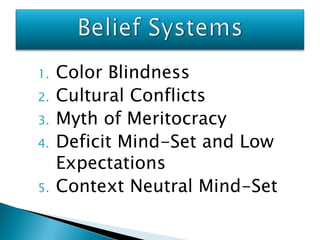
1.   Color Blindness
2.   Cultural Conflicts
3.   Myth of Meritocracy
4.   Deficit Mind-Set and Low
     Expectations
5.   Context Neutral Mind-Set
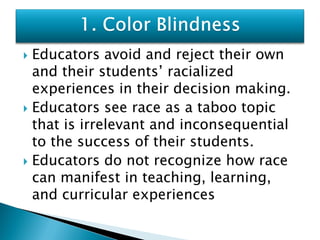
 Educators avoid and reject their own
  and their students’ racialized
  experiences in their decision making.
 Educators see race as a taboo topic
  that is irrelevant and inconsequential
  to the success of their students.
 Educators do not recognize how race
  can manifest in teaching, learning,
  and curricular experiences
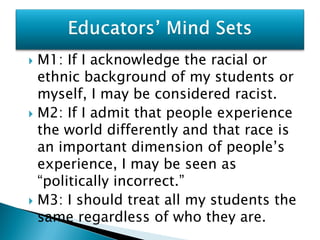
 M1: If I acknowledge the racial or
  ethnic background of my students or
  myself, I may be considered racist.
 M2: If I admit that people experience
  the world differently and that race is
  an important dimension of people’s
  experience, I may be seen as
  “politically incorrect.”
 M3: I should treat all my students the
  same regardless of who they are.
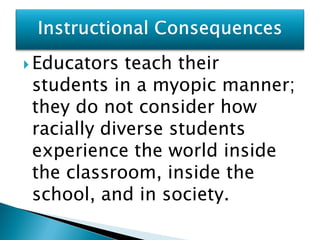
 Educators  teach their
 students in a myopic manner;
 they do not consider how
 racially diverse students
 experience the world inside
 the classroom, inside the
 school, and in society.
 Curriculum and
instructional decisions are
grounded in “white norm”
that students of color have
to just “deal with.”
 Race
     is seen as marginal,
not central, issue in
developing lessons and
enacting those lessons.
 Inconsistency emerges in the
  teaching and learning context
  based on gender, socioeconomics,
  age, geography, etc.
 Conflicts may be historically or
  currently shaped.
 Educators see their culture as
  superior to that of their students.
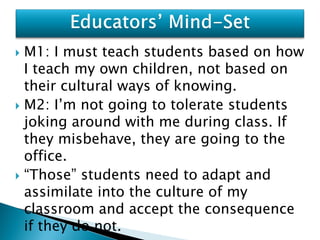
 M1: I must teach students based on how
  I teach my own children, not based on
  their cultural ways of knowing.
 M2: I’m not going to tolerate students
  joking around with me during class. If
  they misbehave, they are going to the
  office.
 “Those” students need to adapt and
  assimilate into the culture of my
  classroom and accept the consequence
  if they do not.
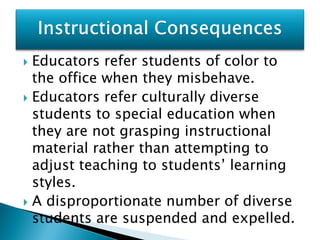
 Educators refer students of color to
  the office when they misbehave.
 Educators refer culturally diverse
  students to special education when
  they are not grasping instructional
  material rather than attempting to
  adjust teaching to students’ learning
  styles.
 A disproportionate number of diverse
  students are suspended and expelled.
 Educators   accept the idea that
  people are rewarded based on
  their ability, performance, effort,
  and talents.
 Systemic and institutional
  structures and barriers are not
  considered.
 Individual achievement is seen as
  an independent variable.
 M1  All people are born with the
  same opportunities; if they just
  follow the formula for success:
  work hard, put forth effort, and
  follow the law.
 M2 If students do not succeed, it
  is because they are not working
  hard enough. It has nothing to
  do with outside factors.
 Somestudents do not have
aptitude to reach academic
success. There is no
problem with the system.
 Educators do not give students multiple
  chances for success because they believe
  the students are not working hard
  enough.
 Educators do not delve deeply into the
  reasons behind students’ lack of
  engagement.
 Students’ family or financial problems
  are not considered as a source of
  impediment for academic achievement.
 Educators approach their work
  focusing on what students lack
  than on the assets they bring.
 Educators have a narrow view of
  what it means to be “normal” or
  “successful.” These views are based
  on their own cultural references,
  which may be inconsistent with
  others.
 Educators do not believe that
 culturally diverse students are
 capable of rigorous academic
 curriculum, so they provide
 unchallenging learning
 opportunities in the classroom.
I  need to distance students
  from the bleak reality of their
  present condition.
 If I expect too much, I am
  setting them up for failure.
 Teachers have to make up for
  deficiencies rather than build
  up on what students have.
 Itis my job to concentrate
  on test scores.
 Those students do not
  have resources to meet
  expectation.
 Educators  spend their time
  remediating students instead of
  building on the knowledge students
  bring into the classroom.
 Educators refuse to allow students
  to develop their own thinking skills.
  Students are expected to
  regurgitate a right answer that the
  educator has provided.
 Very little discussion and creative
  learning opportunities are available,
  only busy work.
 Water down curriculum and low
  expectations.
 Push to get the right answer.
 No thinking outside the box to
  develop critical and analytical skills.
 Educators approach their work without
  a keen sense of how contextual,
  ecological, and environmental realities
  shape opportunities to learn.
 Educators concentrate on learning
  subject matters and consider it
  unimportant the complexities of
  teaching in different contexts such as
  urban/rural spaces.
 Kids are just kids. If I teach my class
  well, the type of school does not
  matter.
 It is not necessary for me to
  understand the historical and current
  realities of the school communities
  where I teach.
 It is not necessary for me to rally the
  local community to empower,
  energize, and motivate students
  inside the school.
 Educators  do not build from the
  knowledge or established
  resources of the local community.
 Rather than constructing
  knowledge with the community,
  educators miss opportunities to
  build partnerships in the social
  context.
Diversity workshop
Diversity workshop

Diversity workshop

  • 1.
    Challenging Educators to Broaden Beliefs System and Shift Mind Sets to Address Opportunity Gaps Aurora Fiengo-Varn, Ph.D. Associate Professor of Spanish Mississippi Valley State University
  • 6.
    1. Color Blindness 2. Cultural Conflicts 3. Myth of Meritocracy 4. Deficit Mind-Set and Low Expectations 5. Context Neutral Mind-Set
  • 7.
     Educators avoidand reject their own and their students’ racialized experiences in their decision making.  Educators see race as a taboo topic that is irrelevant and inconsequential to the success of their students.  Educators do not recognize how race can manifest in teaching, learning, and curricular experiences
  • 8.
     M1: IfI acknowledge the racial or ethnic background of my students or myself, I may be considered racist.  M2: If I admit that people experience the world differently and that race is an important dimension of people’s experience, I may be seen as “politically incorrect.”  M3: I should treat all my students the same regardless of who they are.
  • 11.
     Educators teach their students in a myopic manner; they do not consider how racially diverse students experience the world inside the classroom, inside the school, and in society.
  • 12.
     Curriculum and instructionaldecisions are grounded in “white norm” that students of color have to just “deal with.”
  • 13.
     Race is seen as marginal, not central, issue in developing lessons and enacting those lessons.
  • 15.
     Inconsistency emergesin the teaching and learning context based on gender, socioeconomics, age, geography, etc.  Conflicts may be historically or currently shaped.  Educators see their culture as superior to that of their students.
  • 17.
     M1: Imust teach students based on how I teach my own children, not based on their cultural ways of knowing.  M2: I’m not going to tolerate students joking around with me during class. If they misbehave, they are going to the office.  “Those” students need to adapt and assimilate into the culture of my classroom and accept the consequence if they do not.
  • 20.
     Educators referstudents of color to the office when they misbehave.  Educators refer culturally diverse students to special education when they are not grasping instructional material rather than attempting to adjust teaching to students’ learning styles.  A disproportionate number of diverse students are suspended and expelled.
  • 21.
     Educators accept the idea that people are rewarded based on their ability, performance, effort, and talents.  Systemic and institutional structures and barriers are not considered.  Individual achievement is seen as an independent variable.
  • 22.
     M1 All people are born with the same opportunities; if they just follow the formula for success: work hard, put forth effort, and follow the law.  M2 If students do not succeed, it is because they are not working hard enough. It has nothing to do with outside factors.
  • 23.
     Somestudents donot have aptitude to reach academic success. There is no problem with the system.
  • 26.
     Educators donot give students multiple chances for success because they believe the students are not working hard enough.  Educators do not delve deeply into the reasons behind students’ lack of engagement.  Students’ family or financial problems are not considered as a source of impediment for academic achievement.
  • 27.
     Educators approachtheir work focusing on what students lack than on the assets they bring.  Educators have a narrow view of what it means to be “normal” or “successful.” These views are based on their own cultural references, which may be inconsistent with others.
  • 28.
     Educators donot believe that culturally diverse students are capable of rigorous academic curriculum, so they provide unchallenging learning opportunities in the classroom.
  • 29.
    I needto distance students from the bleak reality of their present condition.  If I expect too much, I am setting them up for failure.  Teachers have to make up for deficiencies rather than build up on what students have.
  • 30.
     Itis myjob to concentrate on test scores.  Those students do not have resources to meet expectation.
  • 33.
     Educators spend their time remediating students instead of building on the knowledge students bring into the classroom.  Educators refuse to allow students to develop their own thinking skills. Students are expected to regurgitate a right answer that the educator has provided.
  • 34.
     Very littlediscussion and creative learning opportunities are available, only busy work.  Water down curriculum and low expectations.  Push to get the right answer.  No thinking outside the box to develop critical and analytical skills.
  • 35.
     Educators approachtheir work without a keen sense of how contextual, ecological, and environmental realities shape opportunities to learn.  Educators concentrate on learning subject matters and consider it unimportant the complexities of teaching in different contexts such as urban/rural spaces.
  • 36.
     Kids arejust kids. If I teach my class well, the type of school does not matter.  It is not necessary for me to understand the historical and current realities of the school communities where I teach.  It is not necessary for me to rally the local community to empower, energize, and motivate students inside the school.
  • 39.
     Educators do not build from the knowledge or established resources of the local community.  Rather than constructing knowledge with the community, educators miss opportunities to build partnerships in the social context.