Topic :Calibration of dissolution apparatus
Presented by,
R.Venkatesan.
M.Pharm 1st semester
Dept. pharmaceutical analysis
Karnataka college of pharmacy
Bangalore
28-Mar-2023
Presented to,
Dr.C.Sreedhar,
Professor and HOD
Dept. pharmaceutical analysis
Karnataka college of pharmacy
Bangalore
Pharmaceutical Validation
Content 01 INTRODUCTION
02 NEED FOR DISSOLUTION
03 QUALIFICATION
04 CALIBRATION OF DISSOLUTION
APPARATUS
KARNATAKA COLLEGE OF PHARMACY
2
Definition
• Dissolution is a process in which a solid substance solubilizes in a
given solvent.
Lke, Mass transfer from the solid surface to the liquid phase.
• Dissolution is rate determining step for hydrophobic, poorly aqueous
soluble drugs.
Ex. Griseofulvin, spironolactone
KARNATAKA COLLEGE OF PHARMACY
3
KARNATAKA COLLEGE OF PHARMACY
4
Dissolution testing
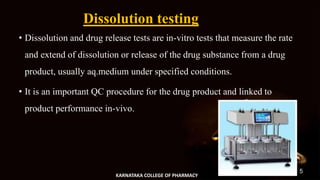
• Dissolution and drug release tests are in-vitro tests that measure the rate
and extend of dissolution or release of the drug substance from a drug
product, usually aq.medium under specified conditions.
• It is an important QC procedure for the drug product and linked to
product performance in-vivo.
KARNATAKA COLLEGE OF PHARMACY
5
Need for dissolution testing
• Evaluation of bioavilability.
• Batch to batch drug relese uniformity.
• Development of more efficacious and therapeutically optical dosage
forms.
• Ensure quality and stability of the product.
• Product development, quality control, research and application
KARNATAKA COLLEGE OF PHARMACY
6
Qualification
Action of providing that any equipment works correctly and actually
leads to the expected results
1.DesignQualification(DQ)
2.InstallationQualification(IQ)
3.OperationQualification(OQ)
4.PerformanceQualification(PQ)
KARNATAKA COLLEGE OF PHARMACY
7
Design qualification
• When developing dissolution method DQ is build into apparatus
selection of process,
• Dosage form and delivery system will determine choice of equipment
Ex. First choice for beaded product may be USP app 3 as it is designed
to confine beads in a screened in cylinder.
KARNATAKA COLLEGE OF PHARMACY
8
Installation qualification
• Used to verify that instrument has assembled in the appropriate
environment and its functioning according to predetermined set of
limit.
Ex setting up fully automated dissolution testing apparatus requires
proper plumbing, hot water source, stable bench top
KARNATAKA COLLEGE OF PHARMACY
9
Operational qualification
• During this qualification analyst or vendor assess that equipment
works as specified and generates documented data.
Ex: For dissolution water bath temperature, shaft rpm, speed would be
obvious operational parameters.
KARNATAKA COLLEGE OF PHARMACY
10
Basket and Paddle depth:
• Attach the basket and paddle to the shaft.
• Place the depth gauge on the bottom of the vessel. All the paddles are lowered
into the vessel until those touch to the top of the depth gauge.
• Measure the depth gauge of the peddles in the respective vessels.
• Similarly, measure the basket depth.
• Acceptance Criteria:
• The Depth should be 25 ± 2 mm for both apparatus 1 and apparatus 2.
KARNATAKA COLLEGE OF PHARMACY
11
Base Plate Level:
• Fill the water bath up to the mark without a vessel.
• Measure the inclination on the base plate in two orthogonal
directions by using calibrated digital degree protractor.
• Acceptance Criteria:
• Base plate inclination shall be not more than 0.5°.
KARNATAKA COLLEGE OF PHARMACY
12
Shaft Vertically:
• Verify the verticality of the stirring elements by using a calibrated
digital protractor.
• Measure the verticality for each stirring element in two orthogonal
positions.
• The ideal reading obtained on the vertical surface shall be 90.0°.
• Acceptance Criteria:
• The deviation shall be not more than 0.5°.
KARNATAKA COLLEGE OF PHARMACY
13
Vessel Vertically
• Verify the verticality of the vessel by using a calibrated digital protractor.
• Measure the verticality for each vessel in two orthogonal positions oriented
at 90.0°. around the vessel axis.
• Measurement shall be made on the vessel’s inner surface.
• The ideal reading obtained on the vertical surface shall be 90.0°
• Acceptance Criteria:
• The deviation shall be not more than 0.5°.
KARNATAKA COLLEGE OF PHARMACY
14
Centering:
• Centering shall be evaluated for the stirring elements placed within the vessel as
it would be during the test.
• Measure the centering of the vessel with respect to the shaft at two different
positions using centering measured using an inside divider to obtain a distance
and measuring a distance with the Vernier caliper or micrometer at top of the rim
of the vessel and just above the paddle or basket level in the vessel.
• Repeat the same procedure of the above two points to check centering of other
vessels.
• Acceptance Criteria:
• The difference between the smallest and largest reading shall not be more than
1.0 mm from the center line.
KARNATAKA COLLEGE OF PHARMACY
15
Rotation Per Minute (RPM)
• Set the RPM to 50
• Mark each paddle holder with radium paper, and count the
revolutions by using calibrated Tachometer.
• Repeat procedure for 100 RPM also.
• Acceptance Criteria:
• The RPM shall be ± 1 for the set value.
KARNATAKA COLLEGE OF PHARMACY
16
Temperature:
• Fill each vessel with 500 ml purified water and set RPM as 50.
• Set the temperature to 37°c and with intervals of 30 minutes and 60 minutes.
• Record the temperature of the individual bowl by using calibrated tachometer at the
beginning, middle (30min), and end (60min) of the run.
• Acceptance Criteria:
• The difference between the set temperature and the observed temperature shall not
be more than 0.5°c
• The temperature measured by the equipment in all the vessels shall be within the
range of 0.4°c at a specified time interval.
• The difference between the temperature shown by the external thermometer and
equipment should be not more than 0.5°c.
KARNATAKA COLLEGE OF PHARMACY
17
Time
• Set the timer for 30 minutes.
• Simultaneously start the timer and calibrated stopwatch.
• When the beep sound starts, check the time on a stopwatch and record it.
• Follow the same procedure to calibrate 45 minutes intervals.
• Acceptance Criteria:
1.The difference shall not be more than ± 36 seconds for 30 minutes.
2.The difference shall not be more than ± 54 seconds for 45 minutes.
KARNATAKA COLLEGE OF PHARMACY
18
Wobbling:
• For Paddle: Fix the calibrated dial gauge about 1 cm above the paddle
blade.
• For Basket: Fix the calibrated dial gauge at the bottom of the basket
rim.
• Run the system with 25 RPM and observe the wobble on a dial gauge.
• Acceptance Criteria:
• The deflection of the probe tip shall be not more than 0.039 inches (1
mm). KARNATAKA COLLEGE OF PHARMACY
19
Vibration Check
• Fill each vessel with 900ml of purified water and set RPM as 100.
• Place the digital or analog vibration meter on the base plate.
• Check the vibrations at 4 corners.
• Acceptance Criteria:
• For Information.
• This is the Dissolution Apparatus Calibration procedure and physical calibration
parameters in pharmaceuticals.
KARNATAKA COLLEGE OF PHARMACY
20
Performance qualification
• This is conducted to ensure that system is in normal operating
environment and performing designed set of tasks within the
specifications.
• Ex: Centering, wobble, height of paddle or basket attached to shaft,
speed, temperature.
KARNATAKA COLLEGE OF PHARMACY
21
THANK YOU

DISSOLUTION

  • 1.
    Topic :Calibration ofdissolution apparatus Presented by, R.Venkatesan. M.Pharm 1st semester Dept. pharmaceutical analysis Karnataka college of pharmacy Bangalore 28-Mar-2023 Presented to, Dr.C.Sreedhar, Professor and HOD Dept. pharmaceutical analysis Karnataka college of pharmacy Bangalore Pharmaceutical Validation
  • 2.
    Content 01 INTRODUCTION 02NEED FOR DISSOLUTION 03 QUALIFICATION 04 CALIBRATION OF DISSOLUTION APPARATUS KARNATAKA COLLEGE OF PHARMACY 2
  • 3.
    Definition • Dissolution isa process in which a solid substance solubilizes in a given solvent. Lke, Mass transfer from the solid surface to the liquid phase. • Dissolution is rate determining step for hydrophobic, poorly aqueous soluble drugs. Ex. Griseofulvin, spironolactone KARNATAKA COLLEGE OF PHARMACY 3
  • 4.
  • 5.
    Dissolution testing • Dissolutionand drug release tests are in-vitro tests that measure the rate and extend of dissolution or release of the drug substance from a drug product, usually aq.medium under specified conditions. • It is an important QC procedure for the drug product and linked to product performance in-vivo. KARNATAKA COLLEGE OF PHARMACY 5
  • 6.
    Need for dissolutiontesting • Evaluation of bioavilability. • Batch to batch drug relese uniformity. • Development of more efficacious and therapeutically optical dosage forms. • Ensure quality and stability of the product. • Product development, quality control, research and application KARNATAKA COLLEGE OF PHARMACY 6
  • 7.
    Qualification Action of providingthat any equipment works correctly and actually leads to the expected results 1.DesignQualification(DQ) 2.InstallationQualification(IQ) 3.OperationQualification(OQ) 4.PerformanceQualification(PQ) KARNATAKA COLLEGE OF PHARMACY 7
  • 8.
    Design qualification • Whendeveloping dissolution method DQ is build into apparatus selection of process, • Dosage form and delivery system will determine choice of equipment Ex. First choice for beaded product may be USP app 3 as it is designed to confine beads in a screened in cylinder. KARNATAKA COLLEGE OF PHARMACY 8
  • 9.
    Installation qualification • Usedto verify that instrument has assembled in the appropriate environment and its functioning according to predetermined set of limit. Ex setting up fully automated dissolution testing apparatus requires proper plumbing, hot water source, stable bench top KARNATAKA COLLEGE OF PHARMACY 9
  • 10.
    Operational qualification • Duringthis qualification analyst or vendor assess that equipment works as specified and generates documented data. Ex: For dissolution water bath temperature, shaft rpm, speed would be obvious operational parameters. KARNATAKA COLLEGE OF PHARMACY 10
  • 11.
    Basket and Paddledepth: • Attach the basket and paddle to the shaft. • Place the depth gauge on the bottom of the vessel. All the paddles are lowered into the vessel until those touch to the top of the depth gauge. • Measure the depth gauge of the peddles in the respective vessels. • Similarly, measure the basket depth. • Acceptance Criteria: • The Depth should be 25 ± 2 mm for both apparatus 1 and apparatus 2. KARNATAKA COLLEGE OF PHARMACY 11
  • 12.
    Base Plate Level: •Fill the water bath up to the mark without a vessel. • Measure the inclination on the base plate in two orthogonal directions by using calibrated digital degree protractor. • Acceptance Criteria: • Base plate inclination shall be not more than 0.5°. KARNATAKA COLLEGE OF PHARMACY 12
  • 13.
    Shaft Vertically: • Verifythe verticality of the stirring elements by using a calibrated digital protractor. • Measure the verticality for each stirring element in two orthogonal positions. • The ideal reading obtained on the vertical surface shall be 90.0°. • Acceptance Criteria: • The deviation shall be not more than 0.5°. KARNATAKA COLLEGE OF PHARMACY 13
  • 14.
    Vessel Vertically • Verifythe verticality of the vessel by using a calibrated digital protractor. • Measure the verticality for each vessel in two orthogonal positions oriented at 90.0°. around the vessel axis. • Measurement shall be made on the vessel’s inner surface. • The ideal reading obtained on the vertical surface shall be 90.0° • Acceptance Criteria: • The deviation shall be not more than 0.5°. KARNATAKA COLLEGE OF PHARMACY 14
  • 15.
    Centering: • Centering shallbe evaluated for the stirring elements placed within the vessel as it would be during the test. • Measure the centering of the vessel with respect to the shaft at two different positions using centering measured using an inside divider to obtain a distance and measuring a distance with the Vernier caliper or micrometer at top of the rim of the vessel and just above the paddle or basket level in the vessel. • Repeat the same procedure of the above two points to check centering of other vessels. • Acceptance Criteria: • The difference between the smallest and largest reading shall not be more than 1.0 mm from the center line. KARNATAKA COLLEGE OF PHARMACY 15
  • 16.
    Rotation Per Minute(RPM) • Set the RPM to 50 • Mark each paddle holder with radium paper, and count the revolutions by using calibrated Tachometer. • Repeat procedure for 100 RPM also. • Acceptance Criteria: • The RPM shall be ± 1 for the set value. KARNATAKA COLLEGE OF PHARMACY 16
  • 17.
    Temperature: • Fill eachvessel with 500 ml purified water and set RPM as 50. • Set the temperature to 37°c and with intervals of 30 minutes and 60 minutes. • Record the temperature of the individual bowl by using calibrated tachometer at the beginning, middle (30min), and end (60min) of the run. • Acceptance Criteria: • The difference between the set temperature and the observed temperature shall not be more than 0.5°c • The temperature measured by the equipment in all the vessels shall be within the range of 0.4°c at a specified time interval. • The difference between the temperature shown by the external thermometer and equipment should be not more than 0.5°c. KARNATAKA COLLEGE OF PHARMACY 17
  • 18.
    Time • Set thetimer for 30 minutes. • Simultaneously start the timer and calibrated stopwatch. • When the beep sound starts, check the time on a stopwatch and record it. • Follow the same procedure to calibrate 45 minutes intervals. • Acceptance Criteria: 1.The difference shall not be more than ± 36 seconds for 30 minutes. 2.The difference shall not be more than ± 54 seconds for 45 minutes. KARNATAKA COLLEGE OF PHARMACY 18
  • 19.
    Wobbling: • For Paddle:Fix the calibrated dial gauge about 1 cm above the paddle blade. • For Basket: Fix the calibrated dial gauge at the bottom of the basket rim. • Run the system with 25 RPM and observe the wobble on a dial gauge. • Acceptance Criteria: • The deflection of the probe tip shall be not more than 0.039 inches (1 mm). KARNATAKA COLLEGE OF PHARMACY 19
  • 20.
    Vibration Check • Filleach vessel with 900ml of purified water and set RPM as 100. • Place the digital or analog vibration meter on the base plate. • Check the vibrations at 4 corners. • Acceptance Criteria: • For Information. • This is the Dissolution Apparatus Calibration procedure and physical calibration parameters in pharmaceuticals. KARNATAKA COLLEGE OF PHARMACY 20
  • 21.
    Performance qualification • Thisis conducted to ensure that system is in normal operating environment and performing designed set of tasks within the specifications. • Ex: Centering, wobble, height of paddle or basket attached to shaft, speed, temperature. KARNATAKA COLLEGE OF PHARMACY 21
  • 22.