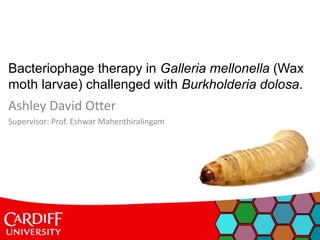
Bacteriophage therapy in Galleria mellonella (Wax
moth larvae) challenged with Burkholderia dolosa.
Ashley David Otter
Supervisor: Prof. Eshwar Mahenthiralingam
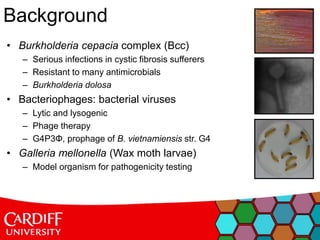
• Burkholderia cepacia complex (Bcc)
– Serious infections in cystic fibrosis sufferers
– Resistant to many antimicrobials
– Burkholderia dolosa
• Bacteriophages: bacterial viruses
– Lytic and lysogenic
– Phage therapy
– G4P3Φ, prophage of B. vietnamiensis str. G4
• Galleria mellonella (Wax moth larvae)
– Model organism for pathogenicity testing
Background
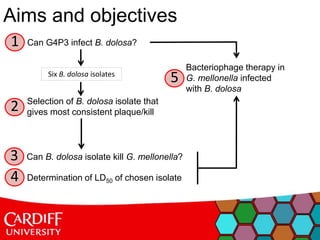
Aims and objectives
Can G4P3 infect B. dolosa?1
Selection of B. dolosa isolate that
gives most consistent plaque/kill2
Determination of LD50 of chosen isolate4
Six B. dolosa isolates
Can B. dolosa isolate kill G. mellonella?3
Bacteriophage therapy in
G. mellonella infected
with B. dolosa
5
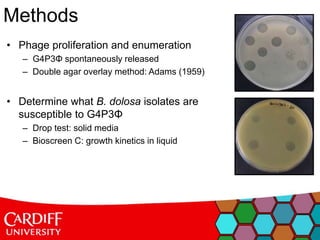
• Phage proliferation and enumeration
– G4P3Φ spontaneously released
– Double agar overlay method: Adams (1959)
• Determine what B. dolosa isolates are
susceptible to G4P3Φ
– Drop test: solid media
– Bioscreen C: growth kinetics in liquid
Methods
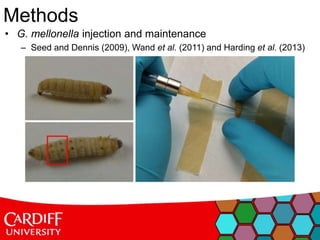
• G. mellonella injection and maintenance
– Seed and Dennis (2009), Wand et al. (2011) and Harding et al. (2013)
Methods
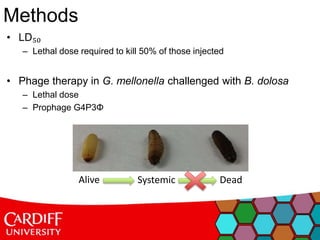
• LD₅₀
– Lethal dose required to kill 50% of those injected
• Phage therapy in G. mellonella challenged with B. dolosa
– Lethal dose
– Prophage G4P3Φ
Methods
Alive Systemic Dead
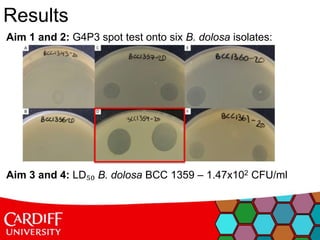
Aim 1 and 2: G4P3 spot test onto six B. dolosa isolates:
Results
Aim 3 and 4: LD₅₀ B. dolosa BCC 1359 – 1.47x10² CFU/ml
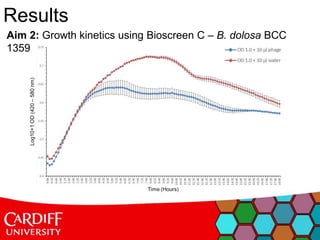
Aim 2: Growth kinetics using Bioscreen C – B. dolosa BCC
1359
Results
Results
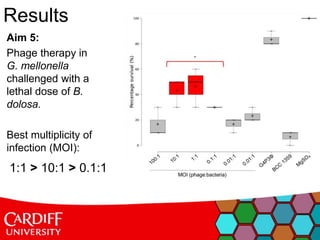
Aim 5:
Phage therapy in
G. mellonella
challenged with a
lethal dose of B.
dolosa.
Best multiplicity of
infection (MOI):
1:1 > 10:1 > 0.1:1
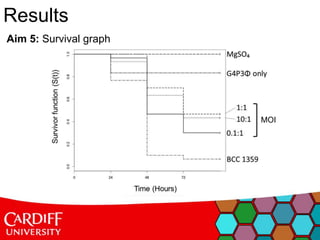
Aim 5: Survival graph
Results
MOI
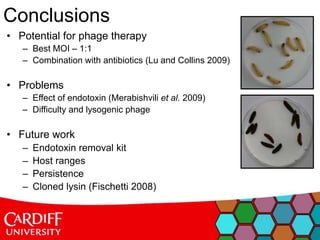
• Potential for phage therapy
– Best MOI – 1:1
– Combination with antibiotics (Lu and Collins 2009)
• Problems
– Effect of endotoxin (Merabishvili et al. 2009)
– Difficulty and lysogenic phage
• Future work
– Endotoxin removal kit
– Host ranges
– Persistence
– Cloned lysin (Fischetti 2008)
Conclusions
Fischetti, V. A. (2008). Bacteriophage lysins as effective antibacterials. Current Opinion in Microbiology 11:393-400.
Harding, C. R., Schroeder, G. N., Collins, J. W. and Frankel, G. (2013). Use of Galleria mellonella as a Model Organism
to Study Legionella pneumophila Infection. Journal of Visualized Experiments(JoVE).
Lu, T. K. and Collins, J. J. (2009). Engineered bacteriophage targeting gene networks as adjuvants for antibiotic
therapy. Proceedings of the National Academy of Sciences 106:4629-4634.
Merabishvili, M., Pirnay, J.-P., Verbeken, G., Chanishvili, N., Tediashvili, M., Lashkhi, N., Glonti, T. et al. (2009). Quality-
controlled small-scale production of a well-defined bacteriophage cocktail for use in human clinical trials. PloS One
4:e4944.
Seed, K. D. and Dennis, J. J. (2009). Experimental bacteriophage therapy increases survival of Galleria mellonella
larvae infected with clinically relevant strains of the Burkholderia cepacia complex. Antimicrobial Agents and
Chemotherapy 53:2205-2208.
Wand, M. E., Müller, C. M., Titball, R. W. and Michell, S. L. (2011). Macrophage and Galleria mellonella infection
models reflect the virulence of naturally occurring isolates of B. pseudomallei, B. thailandensis and B. oklahomensis.
BMC Microbiology 11:11.
References

Dissertation Presentation - Ashley Otter

  • 1.
    Bacteriophage therapy inGalleria mellonella (Wax moth larvae) challenged with Burkholderia dolosa. Ashley David Otter Supervisor: Prof. Eshwar Mahenthiralingam
  • 2.
    • Burkholderia cepaciacomplex (Bcc) – Serious infections in cystic fibrosis sufferers – Resistant to many antimicrobials – Burkholderia dolosa • Bacteriophages: bacterial viruses – Lytic and lysogenic – Phage therapy – G4P3Φ, prophage of B. vietnamiensis str. G4 • Galleria mellonella (Wax moth larvae) – Model organism for pathogenicity testing Background
  • 3.
    Aims and objectives CanG4P3 infect B. dolosa?1 Selection of B. dolosa isolate that gives most consistent plaque/kill2 Determination of LD50 of chosen isolate4 Six B. dolosa isolates Can B. dolosa isolate kill G. mellonella?3 Bacteriophage therapy in G. mellonella infected with B. dolosa 5
  • 4.
    • Phage proliferationand enumeration – G4P3Φ spontaneously released – Double agar overlay method: Adams (1959) • Determine what B. dolosa isolates are susceptible to G4P3Φ – Drop test: solid media – Bioscreen C: growth kinetics in liquid Methods
  • 5.
    • G. mellonellainjection and maintenance – Seed and Dennis (2009), Wand et al. (2011) and Harding et al. (2013) Methods
  • 6.
    • LD₅₀ – Lethaldose required to kill 50% of those injected • Phage therapy in G. mellonella challenged with B. dolosa – Lethal dose – Prophage G4P3Φ Methods Alive Systemic Dead
  • 7.
    Aim 1 and2: G4P3 spot test onto six B. dolosa isolates: Results Aim 3 and 4: LD₅₀ B. dolosa BCC 1359 – 1.47x10² CFU/ml
  • 8.
    Aim 2: Growthkinetics using Bioscreen C – B. dolosa BCC 1359 Results
  • 9.
    Results Aim 5: Phage therapyin G. mellonella challenged with a lethal dose of B. dolosa. Best multiplicity of infection (MOI): 1:1 > 10:1 > 0.1:1
  • 10.
    Aim 5: Survivalgraph Results MOI
  • 11.
    • Potential forphage therapy – Best MOI – 1:1 – Combination with antibiotics (Lu and Collins 2009) • Problems – Effect of endotoxin (Merabishvili et al. 2009) – Difficulty and lysogenic phage • Future work – Endotoxin removal kit – Host ranges – Persistence – Cloned lysin (Fischetti 2008) Conclusions
  • 12.
    Fischetti, V. A.(2008). Bacteriophage lysins as effective antibacterials. Current Opinion in Microbiology 11:393-400. Harding, C. R., Schroeder, G. N., Collins, J. W. and Frankel, G. (2013). Use of Galleria mellonella as a Model Organism to Study Legionella pneumophila Infection. Journal of Visualized Experiments(JoVE). Lu, T. K. and Collins, J. J. (2009). Engineered bacteriophage targeting gene networks as adjuvants for antibiotic therapy. Proceedings of the National Academy of Sciences 106:4629-4634. Merabishvili, M., Pirnay, J.-P., Verbeken, G., Chanishvili, N., Tediashvili, M., Lashkhi, N., Glonti, T. et al. (2009). Quality- controlled small-scale production of a well-defined bacteriophage cocktail for use in human clinical trials. PloS One 4:e4944. Seed, K. D. and Dennis, J. J. (2009). Experimental bacteriophage therapy increases survival of Galleria mellonella larvae infected with clinically relevant strains of the Burkholderia cepacia complex. Antimicrobial Agents and Chemotherapy 53:2205-2208. Wand, M. E., Müller, C. M., Titball, R. W. and Michell, S. L. (2011). Macrophage and Galleria mellonella infection models reflect the virulence of naturally occurring isolates of B. pseudomallei, B. thailandensis and B. oklahomensis. BMC Microbiology 11:11. References

Editor's Notes

  • #4 The aims and objectives of this project were can g4P3 infect burkholderia dolosa Can B. dolosa kill G. Mellonella? Choice of Burkholderia to use Ld50 of BCC 1359 Then finally establish if bacteriophage therapy is possible using galleria mellonella as a model for testing whether phage G4P3 is able to prolong the life of those infected with a lethal dose of B. dolosa
  • #5 Phage G4P3 found in supernatant of B. vietnamiensis g4 Proliferated as described by Adams 1959, using double agar overlay method and isolating individual plaques and repeating Using B. dolosa isolates, find out which isolates are susceptible to phage G4P3 using a simple drop test onto an overlay of each isolate and using a bioscreen C plate reader to determine the effect if any, g4p3 has on the growth rate of each isolate
  • #6 Injected into the haemocoel between the last set of pro legs Injections of between 10 and 20ul were used – bacteria or phage resuspended in MgS04 with 10 mg Ampicillin to prevent contamination or injection of bacteria on the surface of larvae 3 groups of 10 larvae – replicates Control injections – life control – MgSO4, death control – Psuedomonas aeruginosa – 10 ul of overnight culture
  • #10 1:1 1x10⁶ 1x10^6 - same concentration offered best percentage of survival 100:1 1x10⁸ 1x10⁶ 10:1 1x10⁷ 1x10⁶ 0.1:1 1x10⁵ 1x10⁶ 0.01:1 1x10⁴ 1x10⁶ 0.001:1 1x10³ 1x10⁶
  • #11 Small sample size Unable to perform multivariate tests . Statistical comparison using a non-parametric data obtained from the phage therapy experiment (Kruskal-Wallis test, multivariate states) and post-hoc tests (pairwise comparison) yielded no results due to the small sample size. Further experiments will need to be conducted with more replicates to determine if results are stastically significant.