July/August 2012 PHARMACEUTICAL ENGINEERING	 1
Supply Chain Management
This article
presents the
R&D supply
chain and
manufacturing
operations,
from the
manufacturing
of Active
Pharmaceutical
Ingredients
(APIs)
through to
the delivery of
Investigational
Medicinal
Products (IMPs)
at the clinical
site and on to
the patient.
Managing the Extended R&D Supply
Chain
by Petra Bielmeier and Geert Crauwels
Increasing Business Pressures
M
ost recent research on clinical trials
focuses on the outsourced Research
and Development (R&D) activities,
such as data delivery, site conduct,
and development. This article describes, for
both sponsors and contractors,the clinical sup-
ply chain and manufacturing operations, from
the manufacturing of Active Pharmaceutical
Ingredients (APIs) through to the delivery of
Investigational Medicinal Products (IMPs) at
the clinical site and on to the patient.
	 Sponsors and contractors have undergone
substantive change in recent years as the
pharmaceutical industry and its needs have
changed.New technologies and target diseases
require more complex trials and in search of
patient mass and lower cost, the clinical trial
base has shifted toward markets such as India
and China.
	 This has driven a drive for scale in some
leadingClinicalResearchOrganizations(CROs)
andtheemergenceoftrulyglobalplayers,while
others have responded by focusing in emerging
markets, adding niche and specialized services
and targeting selected disease areas.
	 Many traditional activities have shifted to
CROs,oftenwithverydifferentriskandreward
mechanisms.The redrawing of the activity map
requires new and often more complex working
practicesinvolvingmultiplepartners,oftenwith
differing motivations,and a consequent need to
ensure that control is demonstrably sustained
throughout the supply chain.
	 This puts increased demands on the CRO at
a time when their finances are already under
pressure,and the benefits are yet to be realized.
	 Sponsorsremainaccountablefortheirclinical
trials and also need to rethink and/or develop
the R&D supply chain.
Streamlining Clinical Trials
Clinical trials are an essential part of the drug
development process and if run efficiently can
provide the pharmaceutical/biotech company
with a competitive advantage. Many internal
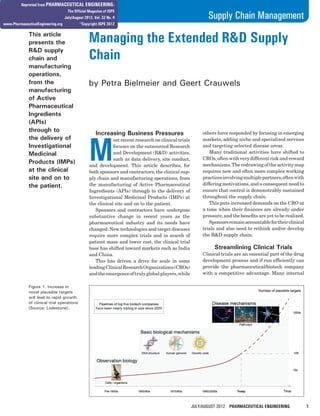
Figure 1. Increase in
novel plausible targets
will lead to rapid growth
of clinical trial operations
(Source: Lodestone).
Reprinted from PHARMACEUTICAL ENGINEERING®
The Official Magazine of ISPE
July/August 2012, Vol. 32 No. 4
www.PharmaceuticalEngineering.org	 ©Copyright ISPE 2012
2	 PHARMACEUTICAL ENGINEERING July/August 2012
Supply Chain Management
and external company stakeholders point to developments
costs as a barrier to innovation. The US Food and Drug
Administration (FDA) has confirmed as part of its “Critical
Path Initiative” that “streamlining clinical trials” is one of
its key priorities.1
	 The shift toward global trials adds a further layer of com-
plexity to the clinical supply chain2
; therefore, companies
must be able to manage both global and local regulatory
requirements.
	 However,regulatoryguidelinesdescribemeasurestoprotect
patient safety, but not necessarily how to conduct trials. An
effective operating model that supports integrated processes,
inventory visibility, and compliance in manufacturing and
distribution of clinical trial supplies becomes a priority. The
integration of contractors in the R&D supply chain has been
underestimatedinmanyoutsourcingstrategies.Alsocontrac-
tors are not profitable enough to ensure sustainable growth
and to put capabilities in place in order to deal with future
challenges. This constitutes a considerable industry risk.
	 Future risk assessments need to differentiate between
smallerlifesciencescompaniesandbigpharmaceutical/biotech
sponsors. Outsourcing of almost the complete study supply
chainwillbeincreasinglyattractivetosmallercompanieswho
need the critical mass and footprint of global contractors. Big
biotechandpharmaceuticalsponsorsrequirethehighestlevels
of transparency and compliance in their global harmonized
R&D supply chains, and will likely maintain clinical trials
supply in-house in combination with outsourcing.
	 Contractors will make contributions in specific steps and
they will need to establish new capabilities for collaborating
with sponsors. Beside the externalization of physical manu-
facturing and logistics activities, outsourced services can be
used for the coordination of stocks and enrollments at clinical
sites. Their relationships and integration touch points are
specific by category:
•	 API and DP contract manufacturing: prior to the point of
finished goods packaging,the R&D supply chain employs a
numberofcontractmanufacturersforAPIandDP.Integra-
tiontouchpointsbetweenbothpartiesincludedetailsabout
materialinventory,includingstatus,location,andquantity
updates. The sponsor provides supply requirement plans
and details about manufacturing orders, including bill of
materials and detailed order instructions. The contractor
istypicallyaccountableforallingredientbatchtraceability
unless sponsor material is provided to the contractor.
•	 Third party logistics:API,raw materials,and drug product
need to be moved through the supply chain. The transfer
requestsandconfirmationsareexchangedbetweensponsor
and contractors. Also “cold chain aspects” are part of the
information flow, especially the decision making in case
of deviations.
•	 Contract packaging and labeling of clinical finished goods:
the information exchange between sponsor and contractor
is similar as for API and DP manufacturing. The blinding
of IMP requires exchange of label samples and package
numbers. Complex packaging designs and work instruc-
tions need to be specified and provided to co-packers for
every clinical trial.
•	 Third party clinical finished goods distribution: clinical
depots are located across the globe.Many low-volume pick,
pack, and shipment operations (thousands of patients can
participate in a study) are executed by multiple logistics
providers. Inventory quantity, package numbers, and
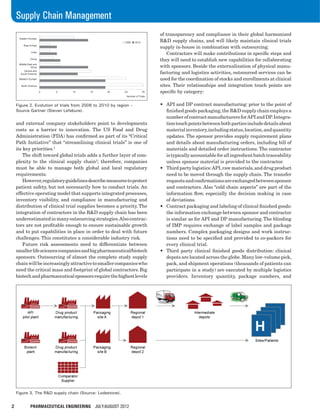
Figure 2. Evolution of trials from 2006 to 2010 by region –
Source Gartner (Steven Lefebure).
Figure 3. The R&D supply chain (Source: Lodestone).
July/August 2012 PHARMACEUTICAL ENGINEERING	 3
Supply Chain Management
status information are continuously shared for planning
and traceability purposes.Also in this area, extensive cold
chain information needs to be exchanged.
•	 Site stock control: stocks and enrollment information at
clinical sites can be handled by external or internal moni-
tors.Study teams need this information to manage the site
supply which can be captured and exchanged in multiple
ways. Drug Accountability (DA) systems and Interactive
Response Technology (IRT) are typically used for high vol-
ume and global studies. Sponsors can use external service
providers that provide this technology including the staff
required to manage the IMP supply to and in the sites.
The Challenges of the R&D Supply Chain
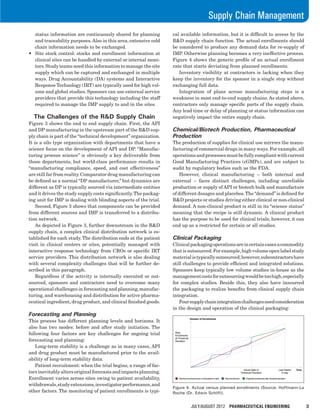
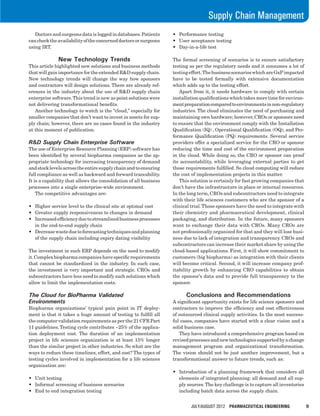
Figure 3 shows the end to end supply chain. First, the API
and DP manufacturing in the upstream part of the R&D sup-
ply chain is part of the “technical development” organization.
It is a silo type organization with departments that have a
science focus on the development of API and DP. “Manufac-
turing process science” is obviously a key deliverable from
those departments, but world-class performance results in
“manufacturing compliance, speed, and cost effectiveness”
are still far from reality.Comparator drug manufacturing can
be defined as a normal “DP manufacturer,” but dynamics are
different as DP is typically sourced via intermediate entities
and it drives the study supply costs significantly.The packag-
ing unit for IMP is dealing with blinding aspects of the trial.
	 Second, Figure 3 shows that components can be provided
from different sources and IMP is transferred to a distribu-
tion network.
	 As depicted in Figure 3, further downstream in the R&D
supply chain, a complex clinical distribution network is es-
tablished for each study.The distribution ends at the patient
visit in clinical centers or sites, potentially managed with
interactive response technology from CROs or specific IRT
service providers. This distribution network is also dealing
with several complexity challenges that will be further de-
scribed in this paragraph.
	 Regardless if the activity is internally executed or out-
sourced, sponsors and contractors need to overcome many
operational challenges in forecasting and planning,manufac-
turing, and warehousing and distribution for active pharma-
ceutical ingredient, drug product, and clinical finished goods.
Forecasting and Planning
This process has different planning levels and horizons. It
also has two modes: before and after study initiation. The
following four factors are key challenges for ongoing trial
forecasting and planning:
	 Long-term stability is a challenge as in many cases, API
and drug product must be manufactured prior to the avail-
ability of long-term stability data.
	 Patient recruitment: when the trial begins, a range of fac-
torsinevitablyaltersoriginalforecastsandimpactsplanning.
Enrollment varies across sites owing to patient availability,
withdrawals,studyextensions,investigatorperformance,and
other factors. The monitoring of patient enrollments is typi-
cal available information, but it is difficult to access by the
R&D supply chain function. The actual enrollments should
be considered to produce any demand data for re-supply of
IMP. Otherwise planning becomes a very ineffective process.
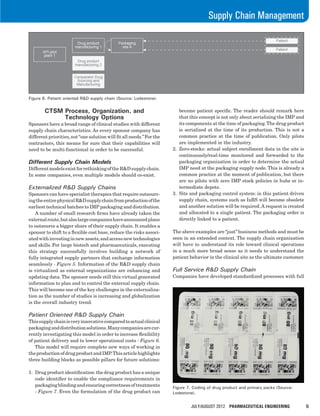
Figure 4 shows the generic profile of an actual enrollment
rate that starts deviating from planned enrollments.
	 Inventory visibility at contractors is lacking when they
keep the inventory for the sponsor in a single step without
exchanging full data.
	 Integration of plans across manufacturing steps is a
weakness in most end-to-end supply chains.As stated above,
contractors only manage specific parts of the supply chain.
Any lead time or delay of planning or status information can
negatively impact the entire supply chain.
Chemical/Biotech Production, Pharmaceutical
Production
The production of supplies for clinical use mirrors the manu-
facturing of commercial drugs in many ways.For example,all
operationsandprocessesmustbefullycompliantwithcurrent
Good Manufacturing Practices (cGMPs), and are subject to
audit by regulatory bodies such as the FDA.
	 However, clinical manufacturing – both internal and
external – faces distinct challenges, including unreliable
production or supply of API or biotech bulk and manufacture
of different dosages and placebos.The“demand”is defined for
R&D projects or studies driving either clinical or non-clinical
demand. A non-clinical product is still in its “science status”
meaning that the recipe is still dynamic. A clinical product
has the purpose to be used for clinical trials; however, it can
end up as a restricted for certain or all studies.
Clinical Packaging
Clinicalpackagingoperationsareincertaincasesacommodity
that is outsourced.For example,high volume open label study
materialistypicallyoutsourced;however,subcontractorshave
still challenges to provide efficient and integrated solutions.
Sponsors keep typically low volume studies in-house as the
managementcostsforoutsourcingwouldbetoohigh,especially
for complex studies. Beside this, they also have insourced
the packaging to realize benefits from clinical supply chain
integration.
	 Foursupplychainintegrationchallengesneedconsideration
in the design and operation of the clinical packaging:
Figure 4. Actual versus planned enrollments (Source: Hoffmann-La
Roche (Dr. Edwin Schiff)).
4	 PHARMACEUTICAL ENGINEERING July/August 2012
Supply Chain Management
•	 Translationofprotocolsintopackagingneedsandobtaining
approval from clinical operations on complex packaging
designs is awkward. It requires several iterations to make
sure that the designs match the needs.A protocol has typi-
cally multiple treatment groups, countries, and possibly
different study phases. Different packaging types (e.g.,
comparator versus active, multiple visits) are used for the
dispensing of IMP to patients. The IMP can have a bill of
materialwithseverallevelsandmanycomponents.Clinical
supply coordinators have to make sure that the require-
ments from the study team are correctly translated into
this packaging data.This information needs to be properly
shared across departments and possibly company borders.
As protocols are approved only a limited period before the
first patient visit, it is important to ensure seamless data
exchange, ideally with a graphical representation of the
packaging design and labels in order to avoid misunder-
standings between study team and packaging.
•	 A high volume of GMP information is required for a
packaging order. Currently, companies need to re-enter
such data multiple times due to separation of solutions.
A packaging order is not a simple instruction to produce
a quantity of a certain kit assembly by a due date. It is
a very comprehensive set of GMP relevant information,
for example: along with the various master label design
information, each component label that is used in the kit
needs to be printed with the package number of the kit.
Work instructions - that are study and material specific -
must describe in detail what needs to be executed by the
packaging operator. A specific label must be applied on a
component in the bill of material. The distribution center
requires the link between the license plate number of the
outer box carrying all package numbers.This high volume
data generated by packaging is in many companies still
manually registered. The cost of verifying the quality of
multiple data sources is too high; therefore, a single entry
and secure distribution of data needs to be implemented.
•	 Introduction of new packaging and labeling technolo-
gies to improve quality control. Reliable technologies are
available on the market while many companies have still
manual work methods, even for high volume packaging.
For example, label print verification can be integrated in
the label printing process. It provides automatic feedback
for re-printing of labels. This avoids rework or correction
duringthepackagingprocess.Alsoin-lineprintingoflabels
during packaging doesn’t require witnessing by peers and
post label reconciliation as the labels are only printed at
the time that a kit is assembled.
•	 Re-labeling or over-labeling is necessary when a product
is expired. The process starts with a shelf-life prolonga-
tion request and approval. Once the new retest date or
use-by-date is approved, the data must be forwarded to
multiple parties, such as the in-house or outsourced label
room, internal or external packaging or distribution loca-
tion where the IMP is located, quality people who review
and approve the re-label operations,etc.Manual processes
suchasemailsareerror-proneandinducecompliancerisks;
therefore, a validated system needs to be in place for this
process.
Distribution
The shipment of IMP to many different countries became a
highlynicheandspecializedoperation.Manycompanieshave
still cumbersome processes:
•	 24-hours-recall requires upstream tracking ofAPI and DP
batch information. Currently, distribution vendors don’t
have full visibility of the upstream supply chain for a recall
which requires crisis teams and multiple data consolida-
tions between sponsors and contractors.
•	 Drugaccountabilityisstillexpensiveandmanagedbystudy
teams.There are limited solutions that approach the drug
accountability with cross-study standardized processes.
•	 Distribution planning is typically managed by the study
team and based on a single IRT/IxRS contract. Due to lack
of cross-study inventory data at distribution depots, it is
difficult to standardize replenishment planning.
•	 Expiry dating on the IMP label is complex in clinical trials
as companies – especially in Europe – are still conserva-
tive in the interpretation of health authority guidelines.
Health authorities are also challenging sponsors as their
processesforexpirydateupdating,forexample,audittrial,
is poor.
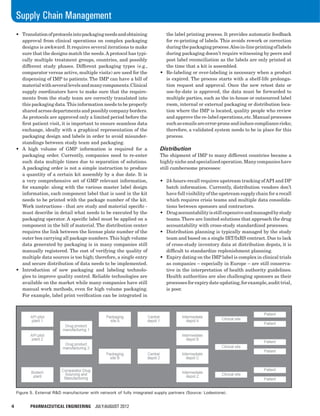
Figure 5. External R&D manufacturer with network of fully integrated supply partners (Source: Lodestone).
July/August 2012 PHARMACEUTICAL ENGINEERING	 5
Supply Chain Management
CTSM Process, Organization, and
Technology Options
Sponsors have a broad range of clinical studies with different
supply chain characteristics. As every sponsor company has
different priorities,not“one solution will fit all needs.”For the
contractors, this means for sure that their capabilities will
need to be multi-functional in order to be successful.
Different Supply Chain Models
DifferentmodelsexistforrethinkingoftheR&Dsupplychain.
In some companies, even multiple models should co-exist.
Externalized R&D Supply Chains
Sponsors can have specialist therapies that require outsourc-
ingtheentirephysicalR&Dsupplychainfromproductionofthe
earliest technical batches to IMP packaging and distribution.
	 A number of small research firms have already taken the
externalroute,butalsolargecompanieshaveannouncedplans
to outsource a bigger share of their supply chain. It enables a
sponsor to shift to a flexible cost base, reduce the risks associ-
atedwithinvestinginnewassets,andaccessnewtechnologies
and skills. For large biotech and pharmaceuticals, executing
this strategy successfully involves building a network of
fully integrated supply partners that exchange information
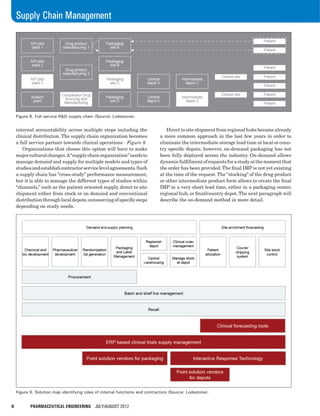
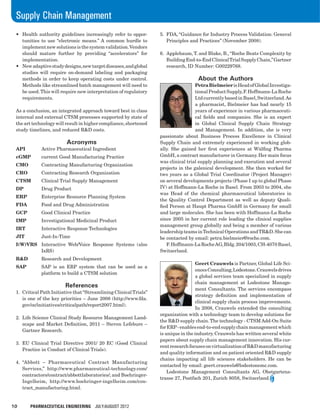
seamlessly - Figure 5. Information of the R&D supply chain
is virtualized as external organizations are enhancing and
updating data.The sponsor needs still this virtual generated
information to plan and to control the external supply chain.
This will become one of the key challenges in the externaliza-
tion as the number of studies is increasing and globalization
is the overall industry trend.
Patient Oriented R&D Supply Chain
Thissupplychainisveryinnovativecomparedtoactualclinical
packaginganddistributionsolutions.Manycompaniesarecur-
rently investigating this model in order to increase flexibility
of patient delivery and to lower operational costs - Figure 6.
	 This model will require complete new ways of working in
theproductionofdrugproductandIMP.Thisarticlehighlights
three building blocks as possible pillars for future solutions:
1.	 Drug product identification:the drug product has a unique
code identifier to enable the compliance requirements in
packagingblindingandensuringcorrectnessoftreatments
- Figure 7. Even the formulation of the drug product can
become patient specific. The reader should remark here
that this concept is not only about serializing the IMP and
its components at the time of packaging.The drug product
is serialized at the time of its production. This is not a
common practice at the time of publication. Only pilots
are implemented in the industry.
2.	 Zero-stocks: actual subject enrollment data in the site is
continuously/real-time monitored and forwarded to the
packaging organization in order to determine the actual
IMP need at the packaging supply node. This is already a
common practice at the moment of publication, but there
are no pilots with zero IMP stock policies in hubs or in-
termediate depots.
3.	 Site and packaging control system: in this patient driven
supply chain, systems such as IxRS will become obsolete
and another solution will be required.A request is created
and allocated to a single patient. The packaging order is
directly linked to a patient.
The above examples are “just” business methods and must be
seen in an extended context. The supply chain organization
will have to understand its role toward clinical operations
in a much more broad sense as it needs to understand the
patient behavior in the clinical site as the ultimate customer.
Full Service R&D Supply Chain
Companies have developed standardized processes with full
Figure 6. Patient oriented R&D supply chain (Source: Lodestone).
Figure 7. Coding of drug product and primary packs (Source:
Lodestone).
6	 PHARMACEUTICAL ENGINEERING July/August 2012
Supply Chain Management
internal accountability across multiple steps including the
clinical distribution. The supply chain organization becomes
a full service partner towards clinical operations - Figure 8.
	 Organizations that choose this option will have to make
majorculturalchanges.A“supplychainorganization”needsto
manage demand and supply for multiple models and types of
studiesandestablishcontractorservicelevelagreements.Such
a supply chain has “cross-study” performance measurement,
but it is able to manage the different types of studies within
“channels,” such as the patient oriented supply, direct to site
shipment either from stock or on demand and conventional
distributionthroughlocaldepots,outsourcingofspecificsteps
depending on study needs.
	 Direct to site shipment from regional hubs became already
a more common approach in the last few years in order to
eliminate the intermediate storage lead time at local or coun-
try specific depots; however, on-demand packaging has not
been fully deployed across the industry. On-demand allows
dynamicfulfillmentofrequestsforastudyatthemomentthat
the order has been provided.The final IMP is not yet existing
at the time of the request. The “stocking” of the drug product
or other intermediate product form allows to create the final
IMP in a very short lead time, either in a packaging center,
regional hub, or final/country depot.The next paragraph will
describe the on-demand method in more detail.
Figure 8. Full service R&D supply chain (Source: Lodestone).
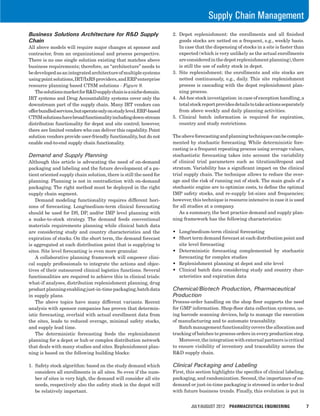
Figure 9. Solution map identifying roles of internal functions and contractors (Source: Lodestone).
July/August 2012 PHARMACEUTICAL ENGINEERING	 7
Supply Chain Management
Business Solutions Architecture for R&D Supply
Chain
All above models will require major changes at sponsor and
contractor, from an organizational and process perspective.
There is no one single solution existing that matches above
business requirements; therefore, an “architecture” needs to
bedevelopedasanintegratedarchitectureofmultiplesystems
usingpointsolutions,IRT/IxRSproviders,andERPenterprise
resource planning based CTSM solutions - Figure 9.
	 ThesolutionsmarketforR&Dsupplychainisanichedomain.
IRT systems and Drug Accountability systems cover only the
downstream part of the supply chain. Many IRT vendors can
offerbundledservices,butoperateonlyonstudylevel.ERP-based
CTSMsolutionshavebroadfunctionalityincludingdown-stream
distribution functionality for depot and site control; however,
there are limited vendors who can deliver this capability. Point
solution vendors provide user-friendly functionality, but do not
enable end-to-end supply chain functionality.
Demand and Supply Planning
Although this article is advocating the need of on-demand
packaging and labeling and the future development of a pa-
tient oriented supply chain solution, there is still the need for
planning. Planning is not in contradiction with on-demand
packaging. The right method must be deployed in the right
supply chain segment.
	 Demand modeling functionality requires different hori-
zons of forecasting. Long/medium-term clinical forecasting
should be used for DS, DP, and/or IMP level planning with
a make-to-stock strategy. The demand feeds conventional
materials requirements planning while clinical batch data
are considering study and country characteristics and the
expiration of stocks. On the short term, the demand forecast
is aggregated at each distribution point that is supplying to
sites. Site level forecasting is even more granular.
	 A collaborative planning framework will empower clini-
cal supply professionals to integrate the actions and objec-
tives of their outsourced clinical logistics functions. Several
functionalities are required to achieve this in clinical trials:
what-if analyses, distribution replenishment planning, drug
productplanningenablingjust-in-timepackaging,batchdata
in supply plans.
	 The above topics have many different variants. Recent
analysis with sponsor companies has proven that determin-
istic forecasting, overlaid with actual enrollment data from
the sites, leads to reduced overage, minimal safety stocks,
and supply lead time.
	 The deterministic forecasting feeds the replenishment
planning for a depot or hub or complex distribution network
that deals with many studies and sites. Replenishment plan-
ning is based on the following building blocks:
1.	 Safety stock algorithm: based on the study demand which
considers all enrollments in all sites. So even if the num-
ber of sites is very high, the demand will consider all site
needs, respectively also the safety stock in the depot will
be relatively important.
2.	Depot replenishment: the enrollments and all finished
goods stocks are netted on a frequent, e.g., weekly basis.
In case that the dispensing of stocks in a site is faster than
expected (which is very unlikely as the actual enrollments
areconsideredinthedepotreplenishmentplanning),there
is still the use of safety stock in depot.
3.	 Site replenishment: the enrollments and site stocks are
netted continuously, e.g., daily. This site replenishment
process is cascading with the depot replenishment plan-
ning process.
4.	 Ad-hoc stock investigation:in case of exception handling,a
totalstockreportprovidesdetailstotakeactionsseparately
from above weekly and daily planning activities.
5.	Clinical batch information is required for expiration,
country and study restrictions.
Theaboveforecastingandplanningtechniquescanbecomple-
mented by stochastic forecasting. While deterministic fore-
casting is a frequent repeating process using average values,
stochastistic forecasting takes into account the variability
of clinical trial parameters such as titration/dropout and
stratum. Variability has a significant impact on the clinical
trial supply chain. The technique allows to reduce the over-
age and the risk of running out of stock. The main goals of a
stochastic engine are to optimize costs, to define the optimal
IMP safety stocks, and re-supply lot-sizes and frequencies;
however,this technique is resource intensive in case it is used
for all studies at a company.
	 As a summary, the best practice demand and supply plan-
ning framework has the following characteristics:
•	 Long/medium-term clinical forecasting
•	 Short term demand forecast at each distribution point and
site level forecasting
•	 Deterministic forecasting complemented by stochastic
forecasting for complex studies
•	 Replenishment planning at depot and site level
•	 Clinical batch data considering study and country char-
acteristics and expiration data
Chemical/Biotech Production, Pharmaceutical
Production
Process-order handling on the shop floor supports the need
for GMP information. Shop-floor data collection systems, us-
ing barcode scanning devices, help to manage the execution
of manufacturing and to automate traceability.
	 Batchmanagementfunctionalitycoverstheallocationand
tracking of batches to process orders in every production step.
	 Moreover,the integration with external partners is critical
to ensure visibility of inventory and traceability across the
R&D supply chain.
Clinical Packaging and Labeling
First, this section highlights the specifics of clinical labeling,
packaging, and randomization. Second, the importance of on-
demand or just-in-time packaging is stressed in order to deal
with future business trends. Finally, this evolution is put in
8	 PHARMACEUTICAL ENGINEERING July/August 2012
Supply Chain Management
the context of the extended supply chain.
	 Labeling management is the design and approval of labels
for a study and/or participating countries. Electronic rout-
ing and approval of labels is important due to the multiple
hand-overs and iterations. Label variable data should be
integrated with process order handling to ensure seamless
data processing.
	 Packagingneedstodealwithinitialandon-goingsupply.At
initial supply, the IMP is stored to deal with the uncertainty
of unexpected demand as site activations are not 100% pre-
dictable. On-going supply needs to avoid any stock-out while
expiration is a key constraint.
	 Creation and handling of randomization lists is complex
as multiple parties need to be involved. The randomization
solution could be incorporated in the packaging operations
and provide access for the biostatistician and possibly IxRS
vendor, or in general, the list must be electronically routed
and approved by multiple stakeholders.
	 On-demand or just-in-time packaging will increase impor-
tance in the industry in order to reduce batch expiration and
re-labeling costs. New trends in clinical studies will require
that batches can be re-supplied more frequently or even im-
mediately for a site request or individual patient need.
	 On-demand or just-in-time packaging allows dynamic
fulfillment of IMP requests for a study. This means that
IMP stocks are not on-hand available for the requester. This
on-demand method can be deployed in many variants and
combinations:
•	 Use at different location types: the method is not always
executed in a packaging center facility. It can be used at
hubs or local depots.
•	 Use of pooling: investigational medication product stocks
will be stored independently of the protocols requiring it.
At the receipt of order, the protocol is added to the IMP
identification.
•	 Label printing only at receipt of site request: this method
avoids use of expensive booklet labels (booklets are used
in order to share stocks across countries).
•	 Use of on-hand stock of drug product or other intermedi-
ates: as IMP is immediately packed the drug product or
other intermediates must be planned according to a make-
to-stock strategy.
For the use of above methods, packaging and labeling opera-
tions are highly impacted.They require more advanced solu-
tions, such as following solution building blocks:
1.	 Electronic batch recording will reduce the“records review”
effort on the shop-floor and will shorten the lead times of
batch record handling.
2.	On-line printing prints the label during the packaging
which eliminates the label room storage or external label
printing services from a printer vendor, especially if the
bookletsareleadingtohighoperatingcosts,labelreconcili-
ation tasks, and human witnessing of label application is
also labor intensive.
3.	 Streamlined batch management is an advanced quality
control method during the packaging and labeling across
multipleorderstore-supplyfrequently.Ordersareexecuted
for multiple countries. The streamlined batch solution
avoids that the sampling and batch record handling will
leadtouneconomicpackagingandqualityoperations.There
is no industrial use of this method yet at the moment of
publication; however, this new business method will only
be used once the clinical supply business and regulatory
agencies mature.
Seamlessdataexchangebetweencontractpackagerandspon-
sor or direct access to sponsor processes provides information
visibility. Conventional packaging, labeling, and randomiza-
tion techniques requires frequent and complex exchange of
above data contractors. Just-in-time packaging will even
increase the complexity to this data exchange model.
Warehousing and Distribution
The integrationbetween depot warehouse and ordermanage-
ment needs to be automated for compliance and cost control.
New techniques such as portal technology allows to connect
the external partners to the sponsor inventory backbone.
	 Multi-levelwarehousemanagementandshippingisdriven
by consignment requests for serialized kits. This requires
highly automated process controls to avoid errors when se-
lecting multi-level kits.
	 Cold-chain shipper time measurement and temperature
deviation logging are methods applied in cold material han-
dling. Sponsor pipeline products are becoming increasingly
cold chain with the influx of biomolecules and management
of these items. Their temperature excursion is becoming
increasingly costly. It is likely to become a burden for com-
mercial sites as well as these products launch.
	 The cold chain solution is defining the allowable time by
itemforabatchoperation,monitoringtimeofindividualbatch
operations, monitoring the temperature along operation, and
ensuring deviation logging and resolution. This solution be-
comes highly complicated in case that cumulating operation
time over the lot genealogy is required.
	 Centralized un-blinding provides automatic alerts of an
un-blinding event by fax or e-mail.Only specifically indicated
study personnel have access to the un-blinded data.
Subject Enrollment and Site Stock Control
Site stock control is providing visibility on inventory informa-
tion in sites. Employees managing inventories at sites can
report inventory needs and current status by using IRT.Stock
control triggers with parameters, such as level, buffer levels,
and visit projection windows reduce waste. Information such
as threshold days until stock-out and current screen-fail rate
allows better prediction of site supply needs.
	 Patient allocation is the process of individual assignment
to treatment arms and their respective kit type IDs. The
patient code is also applied in medical records. Investigators
furthermore maintain a patient diary to keep track of the
patient’s history and to improve advice during future visits.
July/August 2012 PHARMACEUTICAL ENGINEERING	 9
Supply Chain Management
	 Doctors and surgeons data is logged in databases.Patients
canchecktheavailabilityoftheconcerneddoctorsorsurgeons
using IRT.
New Technology Trends
This article highlighted new solutions and business methods
that will gain importance for the extended R&D supply chain.
New technology trends will change the way how sponsors
and contractors will design solutions. There are already ref-
erences in the industry about the use of R&D supply chain
enterprise software.This trend is new as point solutions were
not delivering transformational benefits.
	 Another technology to watch is the “cloud,” especially for
smaller companies that don’t want to invest in assets for sup-
ply chain; however, there are no cases found in the industry
at this moment of publication.
R&D Supply Chain Enterprise Software
The use of Enterprise Resource Planning (ERP) software has
been identified by several biopharma companies as the ap-
propriate technology for increasing transparency of demand
andstocklevelsacrosstheentiresupplychainandtoensuring
full compliance as well as backward and forward traceability.
It is a capability that allows the consolidation of all business
processes into a single enterprise-wide environment.
	 The competitive advantages are:
•	 Higher service level to the clinical site at optimal cost
•	 Greater supply responsiveness to changes in demand
•	 Increased efficiency due to streamlined business processes
in the end-to-end supply chain
•	 Decreasewasteduetoforecastingtechniquesandplanning
of the supply chain including expiry dating visibility
The investment in such ERP depends on the need to modify
it.Complexbiopharmacompanieshavespecificrequirements
that cannot be standardized in the industry. In such case,
the investment is very important and strategic. CROs and
subcontractors have less need to modify such solutions which
allow to limit the implementation costs.
The Cloud for BioPharma Validated
Environments
Biopharma organizations’ typical pain point in IT deploy-
ment is that it takes a huge amount of testing to fulfill all
the computer validation requirements as per the 21 CFR Part
11 guidelines. Testing cycle contributes ~25% of the applica-
tion deployment cost. The duration of an implementation
project in life sciences organization is at least 15% longer
than the similar project in other industries. So what are the
ways to reduce these timelines, effort, and cost? The types of
testing cycles involved in implementation for a life sciences
organization are:
•	 Unit testing
•	 Informal screening of business scenarios
•	 End to end integration testing
•	 Performance testing
•	 User acceptance testing
•	 Day-in-a-life test
The formal screening of scenarios is to ensure satisfactory
testing as per the regulatory needs and it consumes a lot of
testingeffort.ThebusinessscenarioswhichareGxPimpacted
have to be tested formally with extensive documentation
which adds up to the testing effort.
	 Apart from it, it needs hardware to comply with certain
installation qualifications which takes more time for environ-
mentpreparationcomparedtoenvironmentsinnon-regulatory
industries. The cloud eliminates the need of purchasing and
maintaining own hardware; however, CROs or sponsors need
to ensure that the environment comply with the Installation
Qualification (IQ) , Operational Qualification (OQ), and Per-
formance Qualification (PQ) requirements. Several service
providers offer a specialized service for the CRO or sponsor
reducing the time and cost of the environment preparation
in the cloud. While doing so, the CRO or sponsor can proof
its accountability, while leveraging external parties to get
those requirements fulfilled. So cloud computing will reduce
the cost of implementation projects in this matter.
	 This solution is certainly for fast growing companies that
don’t have the infrastructure in place or internal resources.
In the long term,CROs and subcontractors need to integrate
with their life sciences customers who are the sponsor of a
clinical trial.Those sponsors have the need to integrate with
their chemistry and pharmaceutical development, clinical
packaging, and distribution. In the future, many sponsors
want to exchange their data with CROs. Many CROs are
not professionally organized for that and they will lose busi-
ness due to lack of integration and transparency. CROs and
subcontractors can increase their market share by using the
cloud-based applications. First, it will show commitment to
customers (big biopharma) as integration with their clients
will become critical. Second, it will increase company prof-
itability growth by enhancing CRO capabilities to obtain
the sponsor’s data and to provide full transparency to the
sponsor.
Conclusions and Recommendations
A significant opportunity exists for life science sponsors and
contractors to improve the efficiency and cost effectiveness
of outsourced clinical supply activities. In the most success-
ful cases, companies have started with a clear vision and a
solid business case.
	 They have introduced a comprehensive program based on
revisedprocessesandnewtechnologiessupportedbyachange
management program and organizational transformation.
The vision should not be just another improvement, but a
transformational answer to future trends, such as:
•	 Introduction of a planning framework that considers all
elements of integrated planning: all demand and all sup-
ply sources.The key challenge is to capture all inventories
including batch data across the supply chain.
10	 PHARMACEUTICAL ENGINEERING July/August 2012
Supply Chain Management
5.	 FDA, “Guidance for Industry Process Validation: General
Principles and Practices” (November 2008).
6.	 Applebaum, T. and Blake, B., “Roche Beats Complexity by
BuildingEnd-to-EndClinicalTrialSupplyChain,”Gartner
research, ID Number: G00229768.
About the Authors
PetraBielmeierisHeadofGlobalInvestiga-
tionalProductSupply,F.Hoffmann-LaRoche
LtdcurrentlybasedinBasel,Switzerland.As
a pharmacist, Bielmeier has had nearly 15
years of experience in various pharmaceuti-
cal fields and companies. She is an expert
in Global Clinical Supply Chain Strategy
and Management. In addition, she is very
passionate about Business Process Excellence in Clinical
Supply Chain and extremely experienced in working glob-
ally. She gained her first experiences at Wülfing Pharma
GmbH, a contract manufacturer in Germany. Her main focus
was clinical trial supply planning and execution and several
projects in the galenical development. She then worked for
two years as a Global Trial Coordinator (Project Manager)
on several developments projects (Phase I up to global Phase
IV) at Hoffmann-La Roche in Basel. From 2003 to 2004, she
was Head of the chemical pharmaceutical laboratories in
the Quality Control Department as well as deputy Quali-
fied Person at Haupt Pharma GmbH in Germany for small
and large molecules. She has been with Hoffmann-La Roche
since 2005 in her current role leading the clinical supplies
management group globally and being a member of various
leadershipteamsinTechnicalOperationsandTR&D.Shecan
be contacted by email: petra.bielmeier@roche.com.
	 F.Hoffmann-LaRocheAG,Bldg.204/1003,CH-4070Basel,
Switzerland.
Geert Crauwels is Partner, Global Life Sci-
encesConsulting,Lodestone.Crauwelsdrives
a global services team specialized in supply
chain management at Lodestone Manage-
ment Consultants. The services encompass
strategy definition and implementation of
clinical supply chain process improvements.
In 2008, Crauwels extended the consulting
organization with a technology team to develop solutions for
the R&D supply chain.The technology - CTSM Add-On Suite
forERP-enablesend-to-endsupplychainmanagementwhich
is unique in the industry.Crauwels has written several white
papers about supply chain management innovation. His cur-
rentresearchfocusesonvirtualizationofR&Dmanufacturing
and quality information and on patient oriented R&D supply
chains impacting all life sciences stakeholders. He can be
contacted by email: geert.crauwels@lodestonemc.com.
	 Lodestone Management Consultants AG, Obstgartens-
trasse 27, Postfach 201, Zurich 8058, Switzerland.
•	 Health authority guidelines increasingly refer to oppor-
tunities to use “electronic means.” A common hurdle to
implementnewsolutionsisthesystemvalidation.Vendors
should mature further by providing “accelerators” for
implementation.
•	 Newadaptivestudydesigns,newtargetdiseases,andglobal
studies will require on-demand labeling and packaging
methods in order to keep operating costs under control.
Methods like streamlined batch management will need to
be used.This will require new interpretation of regulatory
requirements.
As a conclusion, an integrated approach toward best in class
internal and external CTSM processes supported by state of
the art technology will result in higher compliance,shortened
study timelines, and reduced R&D costs.
Acronyms
API		 Active Pharmaceutical Ingredient
cGMP	 current Good Manufacturing Practice
CMO		 Contracting Manufacturing Organization
CRO		 Contracting Research Organization
CTSM	 Clinical Trial Supply Management
DP		 Drug Product
ERP		 Enterprise Resource Planning System
FDA		 Food and Drug Administration
GCP		 Good Clinical Practice
IMP		 Investigational Medicinal Product
IRT		 Interactive Response Technologies
JIT		 Just-In-Time
I(W)VRS	 Interactive Web/Voice Response Systems (also
IxRS)
R&D		 Research and Development
SAP		 SAP is an ERP system that can be used as a
platform to build a CTSM solution
References
1.	 Critical Path Initiative that“Streamlining ClinicalTrials”
is one of the key priorities – June 2008 (http://www.fda.
gov/oc/initiatives/criticalpath/report2007.html).
2.	 Life Science Clinical Study Resource Management Land-
scape and Market Definition, 2011 – Steven Lefebure –
Gartner Research.
3.	EU Clinical Trial Directive 2001/ 20 EC (Good Clinical
Practice in Conduct of Clinical Trials).
4.	“Abbott – Pharmaceutical Contract Manufacturing
Services,” http://www.pharmaceutical-technology.com/
contractors/contract/abbottlaboratories/; and Boehringer-
Ingelheim, http://www.boehringer-ingelheim.com/con-
tract_manufacturing.html.

12JA-ISPE

  • 1.
    July/August 2012 PHARMACEUTICALENGINEERING 1 Supply Chain Management This article presents the R&D supply chain and manufacturing operations, from the manufacturing of Active Pharmaceutical Ingredients (APIs) through to the delivery of Investigational Medicinal Products (IMPs) at the clinical site and on to the patient. Managing the Extended R&D Supply Chain by Petra Bielmeier and Geert Crauwels Increasing Business Pressures M ost recent research on clinical trials focuses on the outsourced Research and Development (R&D) activities, such as data delivery, site conduct, and development. This article describes, for both sponsors and contractors,the clinical sup- ply chain and manufacturing operations, from the manufacturing of Active Pharmaceutical Ingredients (APIs) through to the delivery of Investigational Medicinal Products (IMPs) at the clinical site and on to the patient. Sponsors and contractors have undergone substantive change in recent years as the pharmaceutical industry and its needs have changed.New technologies and target diseases require more complex trials and in search of patient mass and lower cost, the clinical trial base has shifted toward markets such as India and China. This has driven a drive for scale in some leadingClinicalResearchOrganizations(CROs) andtheemergenceoftrulyglobalplayers,while others have responded by focusing in emerging markets, adding niche and specialized services and targeting selected disease areas. Many traditional activities have shifted to CROs,oftenwithverydifferentriskandreward mechanisms.The redrawing of the activity map requires new and often more complex working practicesinvolvingmultiplepartners,oftenwith differing motivations,and a consequent need to ensure that control is demonstrably sustained throughout the supply chain. This puts increased demands on the CRO at a time when their finances are already under pressure,and the benefits are yet to be realized. Sponsorsremainaccountablefortheirclinical trials and also need to rethink and/or develop the R&D supply chain. Streamlining Clinical Trials Clinical trials are an essential part of the drug development process and if run efficiently can provide the pharmaceutical/biotech company with a competitive advantage. Many internal Figure 1. Increase in novel plausible targets will lead to rapid growth of clinical trial operations (Source: Lodestone). Reprinted from PHARMACEUTICAL ENGINEERING® The Official Magazine of ISPE July/August 2012, Vol. 32 No. 4 www.PharmaceuticalEngineering.org ©Copyright ISPE 2012
  • 2.
    2 PHARMACEUTICAL ENGINEERINGJuly/August 2012 Supply Chain Management and external company stakeholders point to developments costs as a barrier to innovation. The US Food and Drug Administration (FDA) has confirmed as part of its “Critical Path Initiative” that “streamlining clinical trials” is one of its key priorities.1 The shift toward global trials adds a further layer of com- plexity to the clinical supply chain2 ; therefore, companies must be able to manage both global and local regulatory requirements. However,regulatoryguidelinesdescribemeasurestoprotect patient safety, but not necessarily how to conduct trials. An effective operating model that supports integrated processes, inventory visibility, and compliance in manufacturing and distribution of clinical trial supplies becomes a priority. The integration of contractors in the R&D supply chain has been underestimatedinmanyoutsourcingstrategies.Alsocontrac- tors are not profitable enough to ensure sustainable growth and to put capabilities in place in order to deal with future challenges. This constitutes a considerable industry risk. Future risk assessments need to differentiate between smallerlifesciencescompaniesandbigpharmaceutical/biotech sponsors. Outsourcing of almost the complete study supply chainwillbeincreasinglyattractivetosmallercompanieswho need the critical mass and footprint of global contractors. Big biotechandpharmaceuticalsponsorsrequirethehighestlevels of transparency and compliance in their global harmonized R&D supply chains, and will likely maintain clinical trials supply in-house in combination with outsourcing. Contractors will make contributions in specific steps and they will need to establish new capabilities for collaborating with sponsors. Beside the externalization of physical manu- facturing and logistics activities, outsourced services can be used for the coordination of stocks and enrollments at clinical sites. Their relationships and integration touch points are specific by category: • API and DP contract manufacturing: prior to the point of finished goods packaging,the R&D supply chain employs a numberofcontractmanufacturersforAPIandDP.Integra- tiontouchpointsbetweenbothpartiesincludedetailsabout materialinventory,includingstatus,location,andquantity updates. The sponsor provides supply requirement plans and details about manufacturing orders, including bill of materials and detailed order instructions. The contractor istypicallyaccountableforallingredientbatchtraceability unless sponsor material is provided to the contractor. • Third party logistics:API,raw materials,and drug product need to be moved through the supply chain. The transfer requestsandconfirmationsareexchangedbetweensponsor and contractors. Also “cold chain aspects” are part of the information flow, especially the decision making in case of deviations. • Contract packaging and labeling of clinical finished goods: the information exchange between sponsor and contractor is similar as for API and DP manufacturing. The blinding of IMP requires exchange of label samples and package numbers. Complex packaging designs and work instruc- tions need to be specified and provided to co-packers for every clinical trial. • Third party clinical finished goods distribution: clinical depots are located across the globe.Many low-volume pick, pack, and shipment operations (thousands of patients can participate in a study) are executed by multiple logistics providers. Inventory quantity, package numbers, and Figure 2. Evolution of trials from 2006 to 2010 by region – Source Gartner (Steven Lefebure). Figure 3. The R&D supply chain (Source: Lodestone).
  • 3.
    July/August 2012 PHARMACEUTICALENGINEERING 3 Supply Chain Management status information are continuously shared for planning and traceability purposes.Also in this area, extensive cold chain information needs to be exchanged. • Site stock control: stocks and enrollment information at clinical sites can be handled by external or internal moni- tors.Study teams need this information to manage the site supply which can be captured and exchanged in multiple ways. Drug Accountability (DA) systems and Interactive Response Technology (IRT) are typically used for high vol- ume and global studies. Sponsors can use external service providers that provide this technology including the staff required to manage the IMP supply to and in the sites. The Challenges of the R&D Supply Chain Figure 3 shows the end to end supply chain. First, the API and DP manufacturing in the upstream part of the R&D sup- ply chain is part of the “technical development” organization. It is a silo type organization with departments that have a science focus on the development of API and DP. “Manufac- turing process science” is obviously a key deliverable from those departments, but world-class performance results in “manufacturing compliance, speed, and cost effectiveness” are still far from reality.Comparator drug manufacturing can be defined as a normal “DP manufacturer,” but dynamics are different as DP is typically sourced via intermediate entities and it drives the study supply costs significantly.The packag- ing unit for IMP is dealing with blinding aspects of the trial. Second, Figure 3 shows that components can be provided from different sources and IMP is transferred to a distribu- tion network. As depicted in Figure 3, further downstream in the R&D supply chain, a complex clinical distribution network is es- tablished for each study.The distribution ends at the patient visit in clinical centers or sites, potentially managed with interactive response technology from CROs or specific IRT service providers. This distribution network is also dealing with several complexity challenges that will be further de- scribed in this paragraph. Regardless if the activity is internally executed or out- sourced, sponsors and contractors need to overcome many operational challenges in forecasting and planning,manufac- turing, and warehousing and distribution for active pharma- ceutical ingredient, drug product, and clinical finished goods. Forecasting and Planning This process has different planning levels and horizons. It also has two modes: before and after study initiation. The following four factors are key challenges for ongoing trial forecasting and planning: Long-term stability is a challenge as in many cases, API and drug product must be manufactured prior to the avail- ability of long-term stability data. Patient recruitment: when the trial begins, a range of fac- torsinevitablyaltersoriginalforecastsandimpactsplanning. Enrollment varies across sites owing to patient availability, withdrawals,studyextensions,investigatorperformance,and other factors. The monitoring of patient enrollments is typi- cal available information, but it is difficult to access by the R&D supply chain function. The actual enrollments should be considered to produce any demand data for re-supply of IMP. Otherwise planning becomes a very ineffective process. Figure 4 shows the generic profile of an actual enrollment rate that starts deviating from planned enrollments. Inventory visibility at contractors is lacking when they keep the inventory for the sponsor in a single step without exchanging full data. Integration of plans across manufacturing steps is a weakness in most end-to-end supply chains.As stated above, contractors only manage specific parts of the supply chain. Any lead time or delay of planning or status information can negatively impact the entire supply chain. Chemical/Biotech Production, Pharmaceutical Production The production of supplies for clinical use mirrors the manu- facturing of commercial drugs in many ways.For example,all operationsandprocessesmustbefullycompliantwithcurrent Good Manufacturing Practices (cGMPs), and are subject to audit by regulatory bodies such as the FDA. However, clinical manufacturing – both internal and external – faces distinct challenges, including unreliable production or supply of API or biotech bulk and manufacture of different dosages and placebos.The“demand”is defined for R&D projects or studies driving either clinical or non-clinical demand. A non-clinical product is still in its “science status” meaning that the recipe is still dynamic. A clinical product has the purpose to be used for clinical trials; however, it can end up as a restricted for certain or all studies. Clinical Packaging Clinicalpackagingoperationsareincertaincasesacommodity that is outsourced.For example,high volume open label study materialistypicallyoutsourced;however,subcontractorshave still challenges to provide efficient and integrated solutions. Sponsors keep typically low volume studies in-house as the managementcostsforoutsourcingwouldbetoohigh,especially for complex studies. Beside this, they also have insourced the packaging to realize benefits from clinical supply chain integration. Foursupplychainintegrationchallengesneedconsideration in the design and operation of the clinical packaging: Figure 4. Actual versus planned enrollments (Source: Hoffmann-La Roche (Dr. Edwin Schiff)).
  • 4.
    4 PHARMACEUTICAL ENGINEERINGJuly/August 2012 Supply Chain Management • Translationofprotocolsintopackagingneedsandobtaining approval from clinical operations on complex packaging designs is awkward. It requires several iterations to make sure that the designs match the needs.A protocol has typi- cally multiple treatment groups, countries, and possibly different study phases. Different packaging types (e.g., comparator versus active, multiple visits) are used for the dispensing of IMP to patients. The IMP can have a bill of materialwithseverallevelsandmanycomponents.Clinical supply coordinators have to make sure that the require- ments from the study team are correctly translated into this packaging data.This information needs to be properly shared across departments and possibly company borders. As protocols are approved only a limited period before the first patient visit, it is important to ensure seamless data exchange, ideally with a graphical representation of the packaging design and labels in order to avoid misunder- standings between study team and packaging. • A high volume of GMP information is required for a packaging order. Currently, companies need to re-enter such data multiple times due to separation of solutions. A packaging order is not a simple instruction to produce a quantity of a certain kit assembly by a due date. It is a very comprehensive set of GMP relevant information, for example: along with the various master label design information, each component label that is used in the kit needs to be printed with the package number of the kit. Work instructions - that are study and material specific - must describe in detail what needs to be executed by the packaging operator. A specific label must be applied on a component in the bill of material. The distribution center requires the link between the license plate number of the outer box carrying all package numbers.This high volume data generated by packaging is in many companies still manually registered. The cost of verifying the quality of multiple data sources is too high; therefore, a single entry and secure distribution of data needs to be implemented. • Introduction of new packaging and labeling technolo- gies to improve quality control. Reliable technologies are available on the market while many companies have still manual work methods, even for high volume packaging. For example, label print verification can be integrated in the label printing process. It provides automatic feedback for re-printing of labels. This avoids rework or correction duringthepackagingprocess.Alsoin-lineprintingoflabels during packaging doesn’t require witnessing by peers and post label reconciliation as the labels are only printed at the time that a kit is assembled. • Re-labeling or over-labeling is necessary when a product is expired. The process starts with a shelf-life prolonga- tion request and approval. Once the new retest date or use-by-date is approved, the data must be forwarded to multiple parties, such as the in-house or outsourced label room, internal or external packaging or distribution loca- tion where the IMP is located, quality people who review and approve the re-label operations,etc.Manual processes suchasemailsareerror-proneandinducecompliancerisks; therefore, a validated system needs to be in place for this process. Distribution The shipment of IMP to many different countries became a highlynicheandspecializedoperation.Manycompanieshave still cumbersome processes: • 24-hours-recall requires upstream tracking ofAPI and DP batch information. Currently, distribution vendors don’t have full visibility of the upstream supply chain for a recall which requires crisis teams and multiple data consolida- tions between sponsors and contractors. • Drugaccountabilityisstillexpensiveandmanagedbystudy teams.There are limited solutions that approach the drug accountability with cross-study standardized processes. • Distribution planning is typically managed by the study team and based on a single IRT/IxRS contract. Due to lack of cross-study inventory data at distribution depots, it is difficult to standardize replenishment planning. • Expiry dating on the IMP label is complex in clinical trials as companies – especially in Europe – are still conserva- tive in the interpretation of health authority guidelines. Health authorities are also challenging sponsors as their processesforexpirydateupdating,forexample,audittrial, is poor. Figure 5. External R&D manufacturer with network of fully integrated supply partners (Source: Lodestone).
  • 5.
    July/August 2012 PHARMACEUTICALENGINEERING 5 Supply Chain Management CTSM Process, Organization, and Technology Options Sponsors have a broad range of clinical studies with different supply chain characteristics. As every sponsor company has different priorities,not“one solution will fit all needs.”For the contractors, this means for sure that their capabilities will need to be multi-functional in order to be successful. Different Supply Chain Models DifferentmodelsexistforrethinkingoftheR&Dsupplychain. In some companies, even multiple models should co-exist. Externalized R&D Supply Chains Sponsors can have specialist therapies that require outsourc- ingtheentirephysicalR&Dsupplychainfromproductionofthe earliest technical batches to IMP packaging and distribution. A number of small research firms have already taken the externalroute,butalsolargecompanieshaveannouncedplans to outsource a bigger share of their supply chain. It enables a sponsor to shift to a flexible cost base, reduce the risks associ- atedwithinvestinginnewassets,andaccessnewtechnologies and skills. For large biotech and pharmaceuticals, executing this strategy successfully involves building a network of fully integrated supply partners that exchange information seamlessly - Figure 5. Information of the R&D supply chain is virtualized as external organizations are enhancing and updating data.The sponsor needs still this virtual generated information to plan and to control the external supply chain. This will become one of the key challenges in the externaliza- tion as the number of studies is increasing and globalization is the overall industry trend. Patient Oriented R&D Supply Chain Thissupplychainisveryinnovativecomparedtoactualclinical packaginganddistributionsolutions.Manycompaniesarecur- rently investigating this model in order to increase flexibility of patient delivery and to lower operational costs - Figure 6. This model will require complete new ways of working in theproductionofdrugproductandIMP.Thisarticlehighlights three building blocks as possible pillars for future solutions: 1. Drug product identification:the drug product has a unique code identifier to enable the compliance requirements in packagingblindingandensuringcorrectnessoftreatments - Figure 7. Even the formulation of the drug product can become patient specific. The reader should remark here that this concept is not only about serializing the IMP and its components at the time of packaging.The drug product is serialized at the time of its production. This is not a common practice at the time of publication. Only pilots are implemented in the industry. 2. Zero-stocks: actual subject enrollment data in the site is continuously/real-time monitored and forwarded to the packaging organization in order to determine the actual IMP need at the packaging supply node. This is already a common practice at the moment of publication, but there are no pilots with zero IMP stock policies in hubs or in- termediate depots. 3. Site and packaging control system: in this patient driven supply chain, systems such as IxRS will become obsolete and another solution will be required.A request is created and allocated to a single patient. The packaging order is directly linked to a patient. The above examples are “just” business methods and must be seen in an extended context. The supply chain organization will have to understand its role toward clinical operations in a much more broad sense as it needs to understand the patient behavior in the clinical site as the ultimate customer. Full Service R&D Supply Chain Companies have developed standardized processes with full Figure 6. Patient oriented R&D supply chain (Source: Lodestone). Figure 7. Coding of drug product and primary packs (Source: Lodestone).
  • 6.
    6 PHARMACEUTICAL ENGINEERINGJuly/August 2012 Supply Chain Management internal accountability across multiple steps including the clinical distribution. The supply chain organization becomes a full service partner towards clinical operations - Figure 8. Organizations that choose this option will have to make majorculturalchanges.A“supplychainorganization”needsto manage demand and supply for multiple models and types of studiesandestablishcontractorservicelevelagreements.Such a supply chain has “cross-study” performance measurement, but it is able to manage the different types of studies within “channels,” such as the patient oriented supply, direct to site shipment either from stock or on demand and conventional distributionthroughlocaldepots,outsourcingofspecificsteps depending on study needs. Direct to site shipment from regional hubs became already a more common approach in the last few years in order to eliminate the intermediate storage lead time at local or coun- try specific depots; however, on-demand packaging has not been fully deployed across the industry. On-demand allows dynamicfulfillmentofrequestsforastudyatthemomentthat the order has been provided.The final IMP is not yet existing at the time of the request. The “stocking” of the drug product or other intermediate product form allows to create the final IMP in a very short lead time, either in a packaging center, regional hub, or final/country depot.The next paragraph will describe the on-demand method in more detail. Figure 8. Full service R&D supply chain (Source: Lodestone). Figure 9. Solution map identifying roles of internal functions and contractors (Source: Lodestone).
  • 7.
    July/August 2012 PHARMACEUTICALENGINEERING 7 Supply Chain Management Business Solutions Architecture for R&D Supply Chain All above models will require major changes at sponsor and contractor, from an organizational and process perspective. There is no one single solution existing that matches above business requirements; therefore, an “architecture” needs to bedevelopedasanintegratedarchitectureofmultiplesystems usingpointsolutions,IRT/IxRSproviders,andERPenterprise resource planning based CTSM solutions - Figure 9. ThesolutionsmarketforR&Dsupplychainisanichedomain. IRT systems and Drug Accountability systems cover only the downstream part of the supply chain. Many IRT vendors can offerbundledservices,butoperateonlyonstudylevel.ERP-based CTSMsolutionshavebroadfunctionalityincludingdown-stream distribution functionality for depot and site control; however, there are limited vendors who can deliver this capability. Point solution vendors provide user-friendly functionality, but do not enable end-to-end supply chain functionality. Demand and Supply Planning Although this article is advocating the need of on-demand packaging and labeling and the future development of a pa- tient oriented supply chain solution, there is still the need for planning. Planning is not in contradiction with on-demand packaging. The right method must be deployed in the right supply chain segment. Demand modeling functionality requires different hori- zons of forecasting. Long/medium-term clinical forecasting should be used for DS, DP, and/or IMP level planning with a make-to-stock strategy. The demand feeds conventional materials requirements planning while clinical batch data are considering study and country characteristics and the expiration of stocks. On the short term, the demand forecast is aggregated at each distribution point that is supplying to sites. Site level forecasting is even more granular. A collaborative planning framework will empower clini- cal supply professionals to integrate the actions and objec- tives of their outsourced clinical logistics functions. Several functionalities are required to achieve this in clinical trials: what-if analyses, distribution replenishment planning, drug productplanningenablingjust-in-timepackaging,batchdata in supply plans. The above topics have many different variants. Recent analysis with sponsor companies has proven that determin- istic forecasting, overlaid with actual enrollment data from the sites, leads to reduced overage, minimal safety stocks, and supply lead time. The deterministic forecasting feeds the replenishment planning for a depot or hub or complex distribution network that deals with many studies and sites. Replenishment plan- ning is based on the following building blocks: 1. Safety stock algorithm: based on the study demand which considers all enrollments in all sites. So even if the num- ber of sites is very high, the demand will consider all site needs, respectively also the safety stock in the depot will be relatively important. 2. Depot replenishment: the enrollments and all finished goods stocks are netted on a frequent, e.g., weekly basis. In case that the dispensing of stocks in a site is faster than expected (which is very unlikely as the actual enrollments areconsideredinthedepotreplenishmentplanning),there is still the use of safety stock in depot. 3. Site replenishment: the enrollments and site stocks are netted continuously, e.g., daily. This site replenishment process is cascading with the depot replenishment plan- ning process. 4. Ad-hoc stock investigation:in case of exception handling,a totalstockreportprovidesdetailstotakeactionsseparately from above weekly and daily planning activities. 5. Clinical batch information is required for expiration, country and study restrictions. Theaboveforecastingandplanningtechniquescanbecomple- mented by stochastic forecasting. While deterministic fore- casting is a frequent repeating process using average values, stochastistic forecasting takes into account the variability of clinical trial parameters such as titration/dropout and stratum. Variability has a significant impact on the clinical trial supply chain. The technique allows to reduce the over- age and the risk of running out of stock. The main goals of a stochastic engine are to optimize costs, to define the optimal IMP safety stocks, and re-supply lot-sizes and frequencies; however,this technique is resource intensive in case it is used for all studies at a company. As a summary, the best practice demand and supply plan- ning framework has the following characteristics: • Long/medium-term clinical forecasting • Short term demand forecast at each distribution point and site level forecasting • Deterministic forecasting complemented by stochastic forecasting for complex studies • Replenishment planning at depot and site level • Clinical batch data considering study and country char- acteristics and expiration data Chemical/Biotech Production, Pharmaceutical Production Process-order handling on the shop floor supports the need for GMP information. Shop-floor data collection systems, us- ing barcode scanning devices, help to manage the execution of manufacturing and to automate traceability. Batchmanagementfunctionalitycoverstheallocationand tracking of batches to process orders in every production step. Moreover,the integration with external partners is critical to ensure visibility of inventory and traceability across the R&D supply chain. Clinical Packaging and Labeling First, this section highlights the specifics of clinical labeling, packaging, and randomization. Second, the importance of on- demand or just-in-time packaging is stressed in order to deal with future business trends. Finally, this evolution is put in
  • 8.
    8 PHARMACEUTICAL ENGINEERINGJuly/August 2012 Supply Chain Management the context of the extended supply chain. Labeling management is the design and approval of labels for a study and/or participating countries. Electronic rout- ing and approval of labels is important due to the multiple hand-overs and iterations. Label variable data should be integrated with process order handling to ensure seamless data processing. Packagingneedstodealwithinitialandon-goingsupply.At initial supply, the IMP is stored to deal with the uncertainty of unexpected demand as site activations are not 100% pre- dictable. On-going supply needs to avoid any stock-out while expiration is a key constraint. Creation and handling of randomization lists is complex as multiple parties need to be involved. The randomization solution could be incorporated in the packaging operations and provide access for the biostatistician and possibly IxRS vendor, or in general, the list must be electronically routed and approved by multiple stakeholders. On-demand or just-in-time packaging will increase impor- tance in the industry in order to reduce batch expiration and re-labeling costs. New trends in clinical studies will require that batches can be re-supplied more frequently or even im- mediately for a site request or individual patient need. On-demand or just-in-time packaging allows dynamic fulfillment of IMP requests for a study. This means that IMP stocks are not on-hand available for the requester. This on-demand method can be deployed in many variants and combinations: • Use at different location types: the method is not always executed in a packaging center facility. It can be used at hubs or local depots. • Use of pooling: investigational medication product stocks will be stored independently of the protocols requiring it. At the receipt of order, the protocol is added to the IMP identification. • Label printing only at receipt of site request: this method avoids use of expensive booklet labels (booklets are used in order to share stocks across countries). • Use of on-hand stock of drug product or other intermedi- ates: as IMP is immediately packed the drug product or other intermediates must be planned according to a make- to-stock strategy. For the use of above methods, packaging and labeling opera- tions are highly impacted.They require more advanced solu- tions, such as following solution building blocks: 1. Electronic batch recording will reduce the“records review” effort on the shop-floor and will shorten the lead times of batch record handling. 2. On-line printing prints the label during the packaging which eliminates the label room storage or external label printing services from a printer vendor, especially if the bookletsareleadingtohighoperatingcosts,labelreconcili- ation tasks, and human witnessing of label application is also labor intensive. 3. Streamlined batch management is an advanced quality control method during the packaging and labeling across multipleorderstore-supplyfrequently.Ordersareexecuted for multiple countries. The streamlined batch solution avoids that the sampling and batch record handling will leadtouneconomicpackagingandqualityoperations.There is no industrial use of this method yet at the moment of publication; however, this new business method will only be used once the clinical supply business and regulatory agencies mature. Seamlessdataexchangebetweencontractpackagerandspon- sor or direct access to sponsor processes provides information visibility. Conventional packaging, labeling, and randomiza- tion techniques requires frequent and complex exchange of above data contractors. Just-in-time packaging will even increase the complexity to this data exchange model. Warehousing and Distribution The integrationbetween depot warehouse and ordermanage- ment needs to be automated for compliance and cost control. New techniques such as portal technology allows to connect the external partners to the sponsor inventory backbone. Multi-levelwarehousemanagementandshippingisdriven by consignment requests for serialized kits. This requires highly automated process controls to avoid errors when se- lecting multi-level kits. Cold-chain shipper time measurement and temperature deviation logging are methods applied in cold material han- dling. Sponsor pipeline products are becoming increasingly cold chain with the influx of biomolecules and management of these items. Their temperature excursion is becoming increasingly costly. It is likely to become a burden for com- mercial sites as well as these products launch. The cold chain solution is defining the allowable time by itemforabatchoperation,monitoringtimeofindividualbatch operations, monitoring the temperature along operation, and ensuring deviation logging and resolution. This solution be- comes highly complicated in case that cumulating operation time over the lot genealogy is required. Centralized un-blinding provides automatic alerts of an un-blinding event by fax or e-mail.Only specifically indicated study personnel have access to the un-blinded data. Subject Enrollment and Site Stock Control Site stock control is providing visibility on inventory informa- tion in sites. Employees managing inventories at sites can report inventory needs and current status by using IRT.Stock control triggers with parameters, such as level, buffer levels, and visit projection windows reduce waste. Information such as threshold days until stock-out and current screen-fail rate allows better prediction of site supply needs. Patient allocation is the process of individual assignment to treatment arms and their respective kit type IDs. The patient code is also applied in medical records. Investigators furthermore maintain a patient diary to keep track of the patient’s history and to improve advice during future visits.
  • 9.
    July/August 2012 PHARMACEUTICALENGINEERING 9 Supply Chain Management Doctors and surgeons data is logged in databases.Patients canchecktheavailabilityoftheconcerneddoctorsorsurgeons using IRT. New Technology Trends This article highlighted new solutions and business methods that will gain importance for the extended R&D supply chain. New technology trends will change the way how sponsors and contractors will design solutions. There are already ref- erences in the industry about the use of R&D supply chain enterprise software.This trend is new as point solutions were not delivering transformational benefits. Another technology to watch is the “cloud,” especially for smaller companies that don’t want to invest in assets for sup- ply chain; however, there are no cases found in the industry at this moment of publication. R&D Supply Chain Enterprise Software The use of Enterprise Resource Planning (ERP) software has been identified by several biopharma companies as the ap- propriate technology for increasing transparency of demand andstocklevelsacrosstheentiresupplychainandtoensuring full compliance as well as backward and forward traceability. It is a capability that allows the consolidation of all business processes into a single enterprise-wide environment. The competitive advantages are: • Higher service level to the clinical site at optimal cost • Greater supply responsiveness to changes in demand • Increased efficiency due to streamlined business processes in the end-to-end supply chain • Decreasewasteduetoforecastingtechniquesandplanning of the supply chain including expiry dating visibility The investment in such ERP depends on the need to modify it.Complexbiopharmacompanieshavespecificrequirements that cannot be standardized in the industry. In such case, the investment is very important and strategic. CROs and subcontractors have less need to modify such solutions which allow to limit the implementation costs. The Cloud for BioPharma Validated Environments Biopharma organizations’ typical pain point in IT deploy- ment is that it takes a huge amount of testing to fulfill all the computer validation requirements as per the 21 CFR Part 11 guidelines. Testing cycle contributes ~25% of the applica- tion deployment cost. The duration of an implementation project in life sciences organization is at least 15% longer than the similar project in other industries. So what are the ways to reduce these timelines, effort, and cost? The types of testing cycles involved in implementation for a life sciences organization are: • Unit testing • Informal screening of business scenarios • End to end integration testing • Performance testing • User acceptance testing • Day-in-a-life test The formal screening of scenarios is to ensure satisfactory testing as per the regulatory needs and it consumes a lot of testingeffort.ThebusinessscenarioswhichareGxPimpacted have to be tested formally with extensive documentation which adds up to the testing effort. Apart from it, it needs hardware to comply with certain installation qualifications which takes more time for environ- mentpreparationcomparedtoenvironmentsinnon-regulatory industries. The cloud eliminates the need of purchasing and maintaining own hardware; however, CROs or sponsors need to ensure that the environment comply with the Installation Qualification (IQ) , Operational Qualification (OQ), and Per- formance Qualification (PQ) requirements. Several service providers offer a specialized service for the CRO or sponsor reducing the time and cost of the environment preparation in the cloud. While doing so, the CRO or sponsor can proof its accountability, while leveraging external parties to get those requirements fulfilled. So cloud computing will reduce the cost of implementation projects in this matter. This solution is certainly for fast growing companies that don’t have the infrastructure in place or internal resources. In the long term,CROs and subcontractors need to integrate with their life sciences customers who are the sponsor of a clinical trial.Those sponsors have the need to integrate with their chemistry and pharmaceutical development, clinical packaging, and distribution. In the future, many sponsors want to exchange their data with CROs. Many CROs are not professionally organized for that and they will lose busi- ness due to lack of integration and transparency. CROs and subcontractors can increase their market share by using the cloud-based applications. First, it will show commitment to customers (big biopharma) as integration with their clients will become critical. Second, it will increase company prof- itability growth by enhancing CRO capabilities to obtain the sponsor’s data and to provide full transparency to the sponsor. Conclusions and Recommendations A significant opportunity exists for life science sponsors and contractors to improve the efficiency and cost effectiveness of outsourced clinical supply activities. In the most success- ful cases, companies have started with a clear vision and a solid business case. They have introduced a comprehensive program based on revisedprocessesandnewtechnologiessupportedbyachange management program and organizational transformation. The vision should not be just another improvement, but a transformational answer to future trends, such as: • Introduction of a planning framework that considers all elements of integrated planning: all demand and all sup- ply sources.The key challenge is to capture all inventories including batch data across the supply chain.
  • 10.
    10 PHARMACEUTICAL ENGINEERINGJuly/August 2012 Supply Chain Management 5. FDA, “Guidance for Industry Process Validation: General Principles and Practices” (November 2008). 6. Applebaum, T. and Blake, B., “Roche Beats Complexity by BuildingEnd-to-EndClinicalTrialSupplyChain,”Gartner research, ID Number: G00229768. About the Authors PetraBielmeierisHeadofGlobalInvestiga- tionalProductSupply,F.Hoffmann-LaRoche LtdcurrentlybasedinBasel,Switzerland.As a pharmacist, Bielmeier has had nearly 15 years of experience in various pharmaceuti- cal fields and companies. She is an expert in Global Clinical Supply Chain Strategy and Management. In addition, she is very passionate about Business Process Excellence in Clinical Supply Chain and extremely experienced in working glob- ally. She gained her first experiences at Wülfing Pharma GmbH, a contract manufacturer in Germany. Her main focus was clinical trial supply planning and execution and several projects in the galenical development. She then worked for two years as a Global Trial Coordinator (Project Manager) on several developments projects (Phase I up to global Phase IV) at Hoffmann-La Roche in Basel. From 2003 to 2004, she was Head of the chemical pharmaceutical laboratories in the Quality Control Department as well as deputy Quali- fied Person at Haupt Pharma GmbH in Germany for small and large molecules. She has been with Hoffmann-La Roche since 2005 in her current role leading the clinical supplies management group globally and being a member of various leadershipteamsinTechnicalOperationsandTR&D.Shecan be contacted by email: petra.bielmeier@roche.com. F.Hoffmann-LaRocheAG,Bldg.204/1003,CH-4070Basel, Switzerland. Geert Crauwels is Partner, Global Life Sci- encesConsulting,Lodestone.Crauwelsdrives a global services team specialized in supply chain management at Lodestone Manage- ment Consultants. The services encompass strategy definition and implementation of clinical supply chain process improvements. In 2008, Crauwels extended the consulting organization with a technology team to develop solutions for the R&D supply chain.The technology - CTSM Add-On Suite forERP-enablesend-to-endsupplychainmanagementwhich is unique in the industry.Crauwels has written several white papers about supply chain management innovation. His cur- rentresearchfocusesonvirtualizationofR&Dmanufacturing and quality information and on patient oriented R&D supply chains impacting all life sciences stakeholders. He can be contacted by email: geert.crauwels@lodestonemc.com. Lodestone Management Consultants AG, Obstgartens- trasse 27, Postfach 201, Zurich 8058, Switzerland. • Health authority guidelines increasingly refer to oppor- tunities to use “electronic means.” A common hurdle to implementnewsolutionsisthesystemvalidation.Vendors should mature further by providing “accelerators” for implementation. • Newadaptivestudydesigns,newtargetdiseases,andglobal studies will require on-demand labeling and packaging methods in order to keep operating costs under control. Methods like streamlined batch management will need to be used.This will require new interpretation of regulatory requirements. As a conclusion, an integrated approach toward best in class internal and external CTSM processes supported by state of the art technology will result in higher compliance,shortened study timelines, and reduced R&D costs. Acronyms API Active Pharmaceutical Ingredient cGMP current Good Manufacturing Practice CMO Contracting Manufacturing Organization CRO Contracting Research Organization CTSM Clinical Trial Supply Management DP Drug Product ERP Enterprise Resource Planning System FDA Food and Drug Administration GCP Good Clinical Practice IMP Investigational Medicinal Product IRT Interactive Response Technologies JIT Just-In-Time I(W)VRS Interactive Web/Voice Response Systems (also IxRS) R&D Research and Development SAP SAP is an ERP system that can be used as a platform to build a CTSM solution References 1. Critical Path Initiative that“Streamlining ClinicalTrials” is one of the key priorities – June 2008 (http://www.fda. gov/oc/initiatives/criticalpath/report2007.html). 2. Life Science Clinical Study Resource Management Land- scape and Market Definition, 2011 – Steven Lefebure – Gartner Research. 3. EU Clinical Trial Directive 2001/ 20 EC (Good Clinical Practice in Conduct of Clinical Trials). 4. “Abbott – Pharmaceutical Contract Manufacturing Services,” http://www.pharmaceutical-technology.com/ contractors/contract/abbottlaboratories/; and Boehringer- Ingelheim, http://www.boehringer-ingelheim.com/con- tract_manufacturing.html.