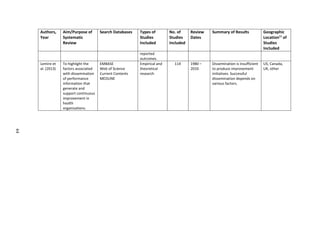
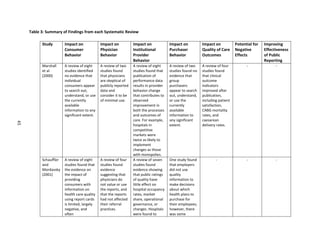
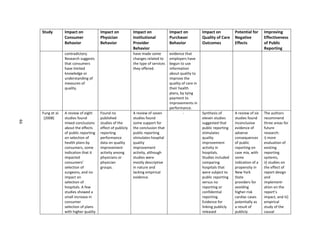
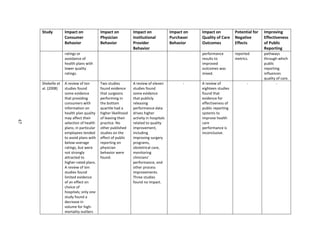
i
HOW CAN WE EVALUATE AND ENHANCE THE IMPACT OF THIRD-PARTY PUBLIC REPORTING ON QUALITY
IMPROVEMENT FOR HEALTH CARE IN THE PROVINCE OF ONTARIO, CANADA?
Anne C. Wojtak
A dissertation submitted to the faculty at the University of North Carolina at Chapel Hill in partial
fulfillment of the requirements for the degree of Doctor of Public Health in the
Department of Health Policy and Management in
the Gillings School of Global Public Health.
Chapel Hill
2016
Approved by:
Suzanne Babich
Adalsteinn Brown
Sheila Leatherman
George Pink
Thomas Ricketts
ii
© 2016
Anne C. Wojtak
ALL RIGHTS RESERVED
iii
ABSTRACT
Anne C. Wojtak: How Can We Evaluate And Enhance The Impact Of Third-Party Public Reporting On
Quality Improvement For Health Care In The Province of Ontario?
(Under the direction of Suzanne Babich)
Mandated public reporting on health care performance at the level of individual health care
institutions and providers has been in place in most Western countries for at least three decades. The
capacity to evaluate and report on quality of care is widely regarded as critical for system-wide
improvement of health care delivery and patient health outcomes. However, evidence from the
literature indicates that evaluation of the effectiveness of public reporting is scant. The purpose of this
research is to propose an approach to evaluate the impact of third-party1
public reporting on improving
quality of health care in the province of Ontario, Canada.
Canada has a universal health care system and similar to other Canadian provinces, Ontario’s
provincial government is responsible for publicly-funded health care. Public reports in Ontario come in
various formats and are used for multiple purposes, including for promoting accountability,
transparency, quality improvement, consumer choice, and research. The array of uses for public
reporting makes it challenging to understand its impact.
Starting with the research question ‘How can we evaluate and enhance the impact of third-party
public reporting on quality improvement for health care’, the researcher used an explanatory sequential
mixed-methods design to assess the current state of public reporting in Ontario and identify
opportunities to improve its effectiveness for quality improvement. Through analysis of provincial-level
1 Third-party refers to an organization responsible for public reporting that is independent from data collection,
service delivery or funding of health care services.
iv
publicly-reported measures, the researcher found that performance results are improving for about
one-third of the measures; however, where public reporting is combined with other accountability
mechanisms, such as funding agreements or legislation, there is greater indication of improvement
and/or sustained improvement over time. The researcher concluded that there is insufficient evidence
that public reporting improves health care quality; however, public reporting can be effective when
bundled with other improvement mechanisms. The researcher identified a number of opportunities to
improve the effectiveness of public reporting in Ontario based on literature evidence and the research
findings. The findings may be applicable to Canada as a whole and to other countries that have
nationalized health care or any large-scale health system.
v
For my mother, forever in my heart.
And for Denis, who provided me with endless support and encouragement,
and kept me well-fed throughout.
vi
ACKNOWLEDGEMENTS
There are many people to whom I owe a great deal of thanks for their support and advice
throughout my research and in the writing of this dissertation. I feel honored to have had the chance to
work with advisory committee members who are experts in this area of research and I thank them
profusely for their contributions and guidance. My family and friends, the amazing faculty in the UNC
DrPH program, and my current and former colleagues at the Toronto Central Community Care Access
Centre (notably Stacey Daub and Camille Orridge) provided me with lots of encouragement along the
way. In particular I would like to acknowledge my mother, who embedded in her children the value of
education. I would also like to recognize the many people who agreed to participate in and support my
research, especially the team at Health Quality Ontario, who were incredibly helpful to me. The DrPH
program gave me the opportunity to get to know a truly inspiring group of individuals - my Cohort 8
colleagues. They are the ones who made an already great experience even better. Finally, I would like to
especially acknowledge my husband, Denis. For almost three and a half years during this program, he
provided daily support and encouragement as I studied, researched, analyzed, and wrote feverishly. It is
to him that I dedicate the ‘D’ in my ‘DrPH’.
vii
TABLE OF CONTENTS
LIST OF TABLES............................................................................................................................................................................x
LIST OF FIGURES.......................................................................................................................................................................xii
LIST OF ABBREVIATIONS.......................................................................................................................................................xiii
CHAPTER 1: INTRODUCTION.................................................................................................................................................. 1
Statement of the Issue..........................................................................................................................1
Significance of the Research .................................................................................................................8
Background: Introduction to Public Reporting in Ontario ....................................................................9
Research Question ..............................................................................................................................16
CHAPTER 2: LITERATURE REVIEW ......................................................................................................................................18
Introduction to the Literature Review Methods.................................................................................18
Overview of the Literature..................................................................................................................20
Specific Findings from the Overview of the Literature ...........................................................21
Discussion of the Overview of the Literature..........................................................................29
Review of Systematic Reviews ............................................................................................................31
Sources and Search Strategy...................................................................................................31
Inclusion criteria......................................................................................................................32
Review Results.........................................................................................................................33
Excluded Studies......................................................................................................................33
Results .....................................................................................................................................35
Discussion and Implications for Further Research..................................................................52
Limitations of this study ..........................................................................................................53
CHAPTER 3: RESEARCH METHODOLOGY .........................................................................................................................55
Conceptual Framework for the Research ...........................................................................................55
Logic Model .............................................................................................................................56
The Evaluation Framework......................................................................................................58
Overview of Research Methods..........................................................................................................61
viii
Quantitative Research: What do we know about the value of public reporting in Ontario?
– Assessing the results of existing public reporting efforts.....................................................62
Qualitative Research: What do we know about how to improve the effectiveness of public
reporting in Ontario? – Interviews with key informants.........................................................67
IRB Approval........................................................................................................................................73
Research Delimitations .......................................................................................................................74
Research Limitations...........................................................................................................................74
CHAPTER 4: RESEARCH RESULTS ........................................................................................................................................76
Summary of Quantitative Results .......................................................................................................76
General Results........................................................................................................................79
Category Results......................................................................................................................79
Impact of External Factors.......................................................................................................86
Summary of Qualitative Results..........................................................................................................95
1. Audiences ................................................................................................................................97
2. Objectives of Public Reporting ..............................................................................................100
3. Effectiveness of Public Reporting..........................................................................................104
4. Determining what gets reported...........................................................................................107
5. Adverse Consequences and Criticisms..................................................................................110
6. Data Quality...........................................................................................................................112
7. Alignment with Priorities.......................................................................................................114
8. Alignment of Incentives.........................................................................................................116
9. Determining who should be responsible for public reporting..............................................119
10. Target Setting........................................................................................................................120
11. Using Comparative Data in Public Reporting ........................................................................123
12. Stakeholder Engagement ......................................................................................................125
13. Evaluating Public Reporting...................................................................................................127
14. Improving Public Reporting...................................................................................................129
CHAPTER 5: SUMMARY OF FINDINGS AND DISCUSSION.........................................................................................131
CHAPTER 6: RECOMMENDATIONS, POLICY IMPLICATIONS AND PLAN FOR CHANGE...................................151
Recommendations ............................................................................................................................152
Plan for Change.................................................................................................................................161
APPENDIX A: DEFINITIONS USED IN THIS DOCUMENT.............................................................................................164
ix
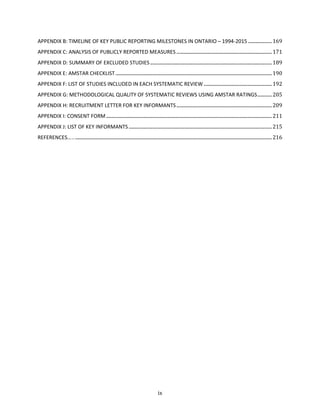
APPENDIX B: TIMELINE OF KEY PUBLIC REPORTING MILESTONES IN ONTARIO – 1994-2015 ....................169
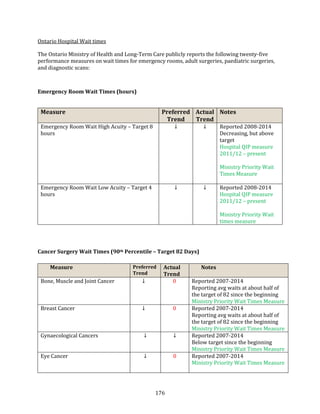
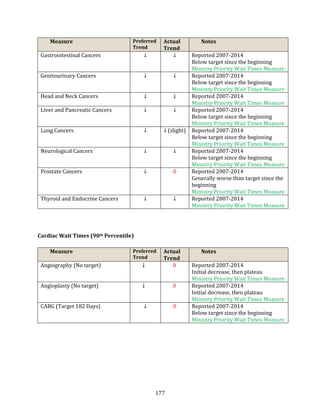
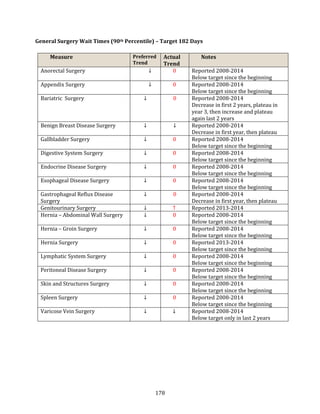
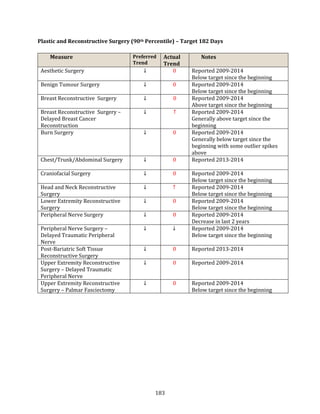
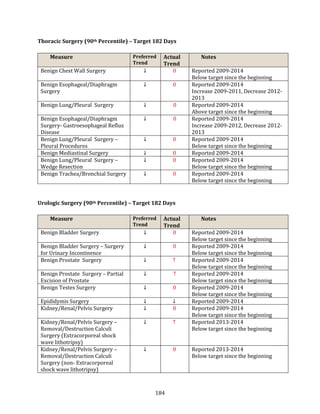
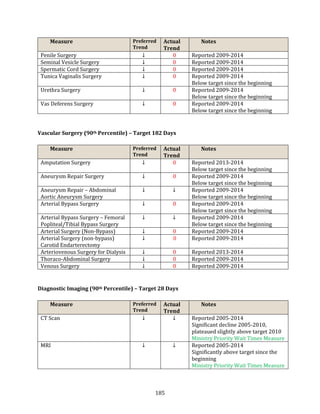
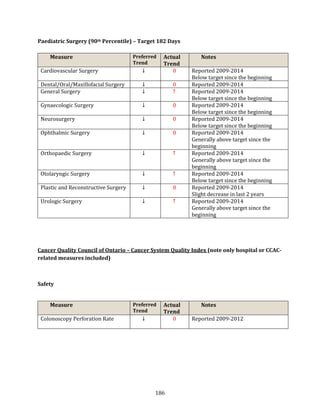
APPENDIX C: ANALYSIS OF PUBLICLY REPORTED MEASURES ................................................................................171
APPENDIX D: SUMMARY OF EXCLUDED STUDIES......................................................................................................189
APPENDIX E: AMSTAR CHECKLIST ...................................................................................................................................190
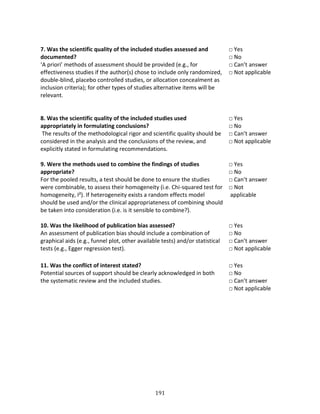
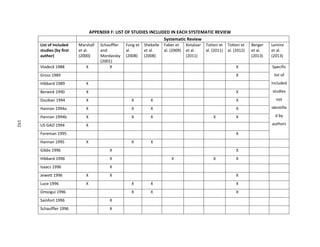
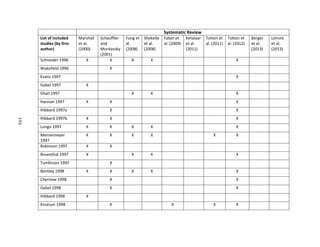
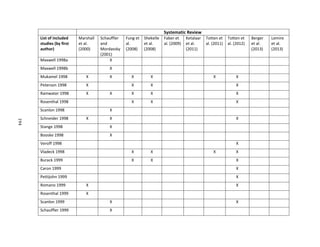
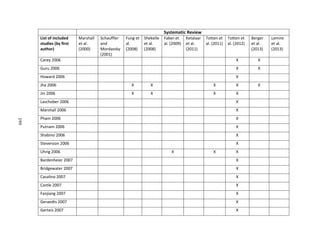
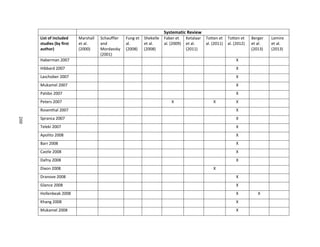
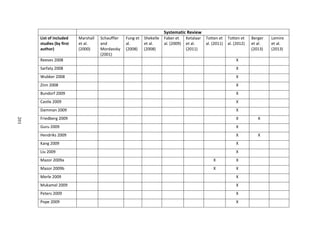
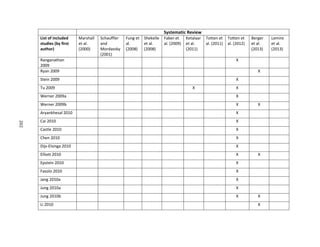
APPENDIX F: LIST OF STUDIES INCLUDED IN EACH SYSTEMATIC REVIEW .........................................................192
APPENDIX G: METHODOLOGICAL QUALITY OF SYSTEMATIC REVIEWS USING AMSTAR RATINGS............205
APPENDIX H: RECRUITMENT LETTER FOR KEY INFORMANTS................................................................................209
APPENDIX I: CONSENT FORM...........................................................................................................................................211
APPENDIX J: LIST OF KEY INFORMANTS ........................................................................................................................215
REFERENCES….......................................................................................................................................................................216
x
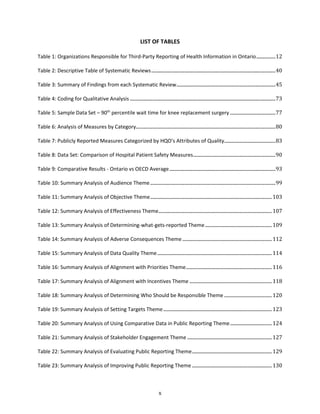
LIST OF TABLES
Table 1: Organizations Responsible for Third-Party Reporting of Health Information in Ontario................12
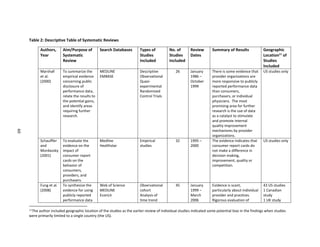
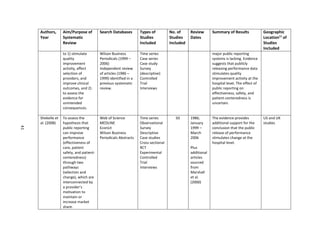
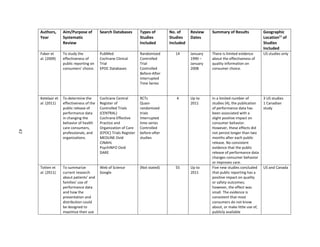
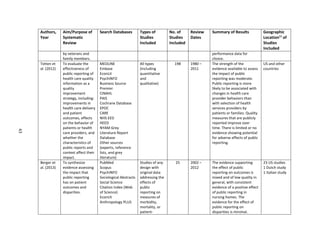
Table 2: Descriptive Table of Systematic Reviews........................................................................................................40
Table 3: Summary of Findings from each Systematic Review...................................................................................45
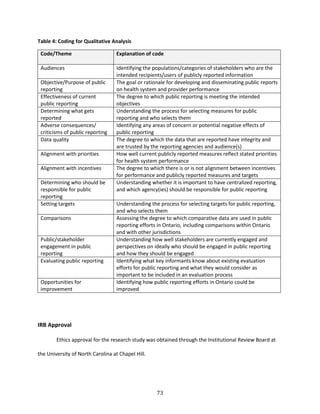
Table 4: Coding for Qualitative Analysis ..........................................................................................................................73
Table 5: Sample Data Set – 90th
percentile wait time for knee replacement surgery ......................................77
Table 6: Analysis of Measures by Category.....................................................................................................................80
Table 7: Publicly Reported Measures Categorized by HQO's Attributes of Quality...........................................83
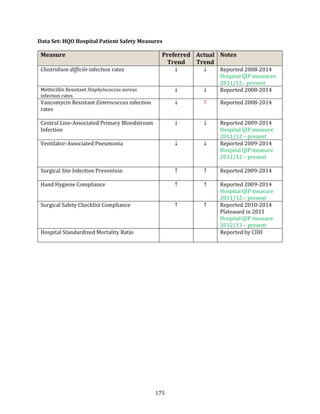
Table 8: Data Set: Comparison of Hospital Patient Safety Measures.....................................................................90
Table 9: Comparative Results - Ontario vs OECD Average.........................................................................................93
Table 10: Summary Analysis of Audience Theme.........................................................................................................99
Table 11: Summary Analysis of Objective Theme......................................................................................................103
Table 12: Summary Analysis of Effectiveness Theme...............................................................................................107
Table 13: Summary Analysis of Determining-what-gets-reported Theme........................................................109
Table 14: Summary Analysis of Adverse Consequences Theme ...........................................................................112
Table 15: Summary Analysis of Data Quality Theme................................................................................................114
Table 16: Summary Analysis of Alignment with Priorities Theme........................................................................116
Table 17: Summary Analysis of Alignment with Incentives Theme .....................................................................118
Table 18: Summary Analysis of Determining Who Should be Responsible Theme ........................................120
Table 19: Summary Analysis of Setting Targets Theme...........................................................................................123
Table 20: Summary Analysis of Using Comparative Data in Public Reporting Theme...................................124
Table 21: Summary Analysis of Stakeholder Engagement Theme .......................................................................127
Table 22: Summary Analysis of Evaluating Public Reporting Theme...................................................................129
Table 23: Summary Analysis of Improving Public Reporting Theme ...................................................................130
xi
Table 24: Comparative Analysis of Two Logic Models for Public Reporting .....................................................143
xii
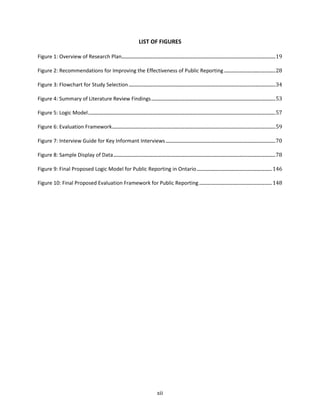
LIST OF FIGURES
Figure 1: Overview of Research Plan.................................................................................................................................19
Figure 2: Recommendations for Improving the Effectiveness of Public Reporting ...........................................28
Figure 3: Flowchart for Study Selection...........................................................................................................................34
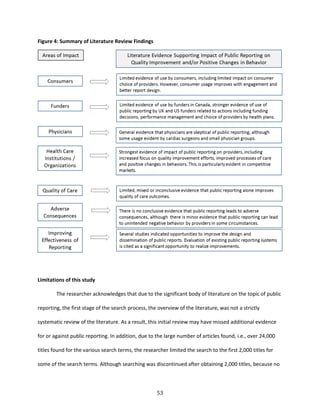
Figure 4: Summary of Literature Review Findings........................................................................................................53
Figure 5: Logic Model.............................................................................................................................................................57
Figure 6: Evaluation Framework.........................................................................................................................................59
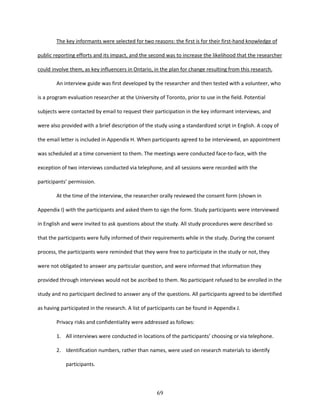
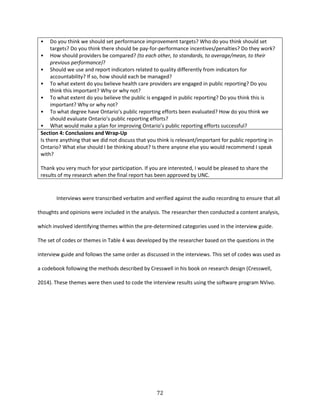
Figure 7: Interview Guide for Key Informant Interviews............................................................................................70
Figure 8: Sample Display of Data........................................................................................................................................78
Figure 9: Final Proposed Logic Model for Public Reporting in Ontario...............................................................146
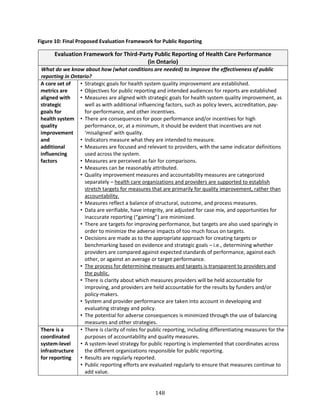
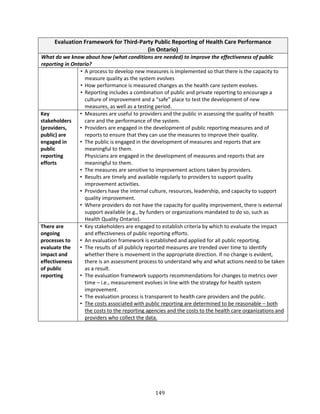
Figure 10: Final Proposed Evaluation Framework for Public Reporting.............................................................148
xiii
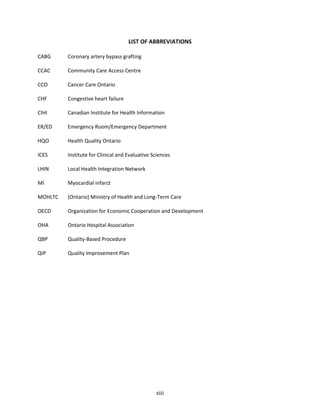
LIST OF ABBREVIATIONS
CABG Coronary artery bypass grafting
CCAC Community Care Access Centre
CCO Cancer Care Ontario
CHF Congestive heart failure
CIHI Canadian Institute for Health Information
ER/ED Emergency Room/Emergency Department
HQO Health Quality Ontario
ICES Institute for Clinical and Evaluative Sciences
LHIN Local Health Integration Network
MI Myocardial infarct
MOHLTC (Ontario) Ministry of Health and Long-Term Care
OECD Organization for Economic Cooperation and Development
OHA Ontario Hospital Association
QBP Quality-Based Procedure
QIP Quality Improvement Plan
1
CHAPTER 1: INTRODUCTION
Statement of the Issue
Over the last few decades in Canada, mirroring global trends, there has been a significant
increase in public reporting of health system performance and quality of care information at the level of
individual institutions and health care providers. The more recent trends for reporting on health systems
build on a long history of government and third-party public reporting of economic, social, and public
health information. The available public information on health system performance includes a growing
body of reports and a range of report cards for health care systems, hospitals, long-term care homes,
home care agencies, community agencies, specialists, and primary care practices, among others.
Performance metrics for quality of care include measures of access (e.g. surgical wait times), patient
safety (e.g. rates of hospital-acquired infections), patient experience (e.g. experience with hospital
discharge planning), and health outcomes (e.g. preventable mortality). Public reports are shifting
attention to accountability for quality of care and are introducing benchmarking, ranking, and other
types of comparisons (Brown et al., 2012).
Despite the abundance of publicly available information about health care performance, public
reporting has been controversial. Criticisms of public reporting include the potential for adverse
consequences from excessive focus on measures and targets, as well as concerns related to data quality
and integrity, inappropriate comparisons or benchmarks, lack of application of evidence-based
practices, attribution issues, and deficiencies in actionability of results. However, there is increasing
consensus that we will continue to see ever greater volumes of publicly-disseminated information
2
(Marshall et al., 2004). In recent years, voices of opposition have faded, replaced with more thoughtful
dialogue on how best to publish information in a way that engages the various audiences, maximizes the
benefits of public disclosure, and minimizes the potential for adverse consequences (Marshall and
Romano, 2005). In other words, now the most important question to ask about public reporting is not
whether it should be done but, rather, how it can be done more effectively (Wallace et al., 2007).
For the purposes of this paper, the definition used for public reporting comes from Totten et al.
(2012), “Public reporting is data, publicly available or available to a broad audience free of charge or at a
nominal cost, about a health care structure, process, or outcome at any provider level (individual
clinician, group, or organizations [e.g., hospitals, nursing facilities]) or at the health plan level” (Totten et
al., 2012). Additional definitions used in this dissertation are included in Appendix A.
Public reports are standardized ways within a reporting organization or at an aggregated health
system-level to present measures of the quality of health care and facilitate comparison of performance
over time, among providers, and against defined standards of good practice (Marshall et al., 2000).
Public reports are often produced in the form of “report cards,” “performance reports”, “consumer
reports”, “dashboards”, or “quality reports”, among other titles, and generally include a combination of
structural quality measures, such as number of specialists or number of beds; process measures, such as
preventative screening rates; and outcome measures, such as in-patient mortality or patient satisfaction
(Marshall et al., 2000).
Public reporting of health information for this level of assessment is not a new concept. Early
forays into public reporting in the U.S. began in the 1980s and report cards (also known as ‘league
tables’) have been available in the U.K. for several decades (Marshall et al., 2003). The rationale for
public reporting, like the process of public reporting itself, has evolved. Originally, stimulus for the
publication of performance information primarily came from government and from the ideological belief
that this would make public services more accountable for the outcome(s) they deliver, as well as to
3
reduce unacceptable geographical, institutional, or provider-level variations within centrally managed or
centrally financed services (Coles, 1999). Over time, we have seen the emergence of other types of
third-party reporting by both public and private institutions, including the generation of reporting for
commercial purposes, such as selling consulting services. More recently, the need for governments to
restore or improve public confidence has become an important driver of public reporting efforts, as
identified in reports stemming from public inquiries into critical deficiencies in quality (State of New
South Wales, 2008; UK report, 2013). In addition, the capacity to evaluate and report on quality is now
widely regarded as a critical foundation for system-wide improvement of health care delivery and
patient health outcomes, as well as for achieving higher value for health care funding and accountability.
Reliable, comparative data on quality are needed for multiple purposes and audiences: to
enable and motivate providers to improve the quality of care by tracking their performance against
national and regional benchmarks, to facilitate competition on quality, to promote consumer choice, to
inform government policies for improving health care quality, as a means to facilitate regulation and
public accountability, to better understand value for money in health care spending, and to provide
access to data for clinical research (Miller and Leatherman, 1999; Marshall et al., 2000; Mannion and
Goddard, 2003). “Done well, public reporting can draw the attention of clinicians to areas of deficiencies
and motivate positive change” (Brown et al., 2012). Done poorly, there are concerns that public
reporting efforts can lead to lower quality care; have unintended negative consequences, including
refusal to treat patients who are higher risk or who are less compliant with treatment directives; provide
higher or lower levels of care than is needed in order to achieve performance targets; divert resources
from more critical concerns; and provide an inaccurate and incomplete picture of provider performance
(Davies et al., 2002; Dranove et al., 2002; Farmer et al., 2013; Konetzka, 2014; Muller and Detsky, 2010;
Wachter et al., 2008; Werner and Asch, 2005).
4
While public reporting can be controversial, and the criticisms will be explored later in this
paper, it does receive attention from institutional and organizational health care providers2
, but less so
from physicians, purchasers/funders, policy-makers, and the public, with a few exceptions (Mannion and
Davies, 2002; Rexe et al., 2008; Totten, 2012). A 2013 report entitled ‘Rate My Hospital’, which both
ranked Canadian hospitals based on selected measures and allowed the public to rate their own
experience, received particular attention (CBC website, 2013); however, from the studies assessed
herein, evidence from the literature indicates that the public generally does not access or use publicly
reported health performance information (Faber et al., 2009; Clough et al., 2002; Marshall et al., 2000).
This lack of usage by the public is one of the primary reasons that many reporting organizations are
making efforts to improve reporting and make it more useful and accessible for a public audience.
The Ontario Context
Ontario is the most populous of Canada’s ten provinces and three territories, with over 13
million residents representing almost 40% of Canada’s population. Canada has a universal, publicly-
funded health system that provides coverage for medically-necessary primary care, hospital-based care
and other services. Although roles and responsibilities for health care are shared between the federal
and provincial-territorial governments, funding and delivery of health care is generally the responsibility
of each provincial and territorial government. Approximately 70% of health care in Canada is publicly-
funded, with the remaining 30% covered through private insurance, employment benefits, or private
financing. Canada spends approximately $219 Billion or 11% of its GDP on health care. Ontario spends
$50 Billion or 42% of its total budget on health care. Most hospitals are independent non-profit
2The literature on public reporting makes a distinction between ‘institutional providers’ and ‘physicians’. Although physicians
are included as health care providers in other circumstances, for the purposes of this paper, the researcher uses the same
differentiation as the literature evidence and identifies institutional or organizational providers, including hospitals, long-term
care homes, and home care agencies from physicians. Herein, physicians are defined separately as solo-practitioners,
specialists, or physician group practices, including clinics.
5
corporations funded through global budgets and governed by volunteer Boards of Directors. Physicians
operate as independent practitioners or in group practices and are remunerated through provincial
insurance plans primarily through fee-for-service payments, although other types of funding
arrangements such as capitation and salaried options are also available. From a public reporting
perspective, most data collection for hospitals and primary care is through administrative and billing
systems, although other forms of data collection are increasing.
In Ontario, one of the earliest initiatives related to public reporting at an individual health care
organization level was the publication of the first ‘Hospital Report’ in 1999, through a collaborative
effort between the University of Toronto, the Ontario Ministry of Health and Long-Term Care (MOHLTC),
and the Ontario Hospital Association (OHA) (Pink et al., 2001). Since the early days of ‘Hospital Report’,
public reporting has increased substantially in Ontario and now includes expanded measures of hospital
performance, as well as indicators related to home care and long-term care. There is little information
yet on primary care or other physician care that is publicly reported at an individual clinician or physician
level; however, this is changing with the planned publication of new performance goals and indicators
for teams of primary care practitioners. Public reporting is currently decentralized across multiple
organizations and there are significant opportunities to bring the reports together, align them with an
overarching strategy, and present a comprehensive picture of the performance of Ontario’s health
system (Wodchis, 2012).
Ontario has the opportunity to learn from other jurisdictions regarding their experiences with
performance frameworks and public reporting strategies. National strategies for health that include
improvement in both the population’s health and the health care system have been developed in the
U.K. and Australia, as well as other countries. The U.K. has created successive national performance
frameworks with goals that describe health outcomes and clinically relevant outcome measures. In
Australia, the approach has been to develop national strategic plans for health and health system
6
reform that are aligned and contain specific policy goals, performance measures, and targets. Both
initiatives are intended to improve accountability (Health Council of Canada, 2012). The U.S. has one of
the longest and most expansive modern histories for public reporting of health care information,
starting in the 1980s with the publication of hospital mortality data by the Health Care Financing
Administration, as well as experiments with cardiac care report cards in a few states, such as New York
and Pennsylvania in the early 1990s (Totten et al., 2012). Given that Ontario has the largest provincial
health system in Canada, these other jurisdictions provide Ontario with comparative examples of
reporting frameworks in large health care systems.
Focus of Research
For the purposes of this dissertation, the researcher has focused on the impact of third-party
public reporting of quality measures at the individual organization or provider level. The scope of this
research therefore makes a distinction between:
1) third-party reporting by organizations that are independent from data collection, service
delivery, or funding of health services versus information that is self-reported by health
care institutions or other providers,
2) publicly available3
comparative information versus privately-disseminated comparative
information that is only available to contributing institutions or providers,
3) quality measures, for example, those focused on access to care, patient safety, outcomes, or
patient experience, versus other types of measures, such as human resources or financial
status, and
3The researcher recognizes that there is a further delineation in defining public reporting with respect to information that is
made available to the public, such as information available on open-access websites, versus structured reports that are
specifically designed for a public audience, such as annual reports to the public. For the purposes of this dissertation, the
researcher is primarily focused on information that is made available to the public.
7
4) institutional or provider level (i.e., reports from an individual hospital, agency, or physician)
versus aggregate level reporting (consolidated reports sourced from multiple organizations,
providers or physicians in a given jurisdiction).
Distinguishing between types of reporting is critical for this research, in part because scoping the
research is necessary for reasons of practicality, but also because analysis of performance measurement
and ranking systems in different jurisdictions suggests that, for a system of performance measurement
to have an impact, “it needs to have the potential to inflict reputational damage by producing
information that is reliable, robust to criticism from the providers being assessed, understood in broad
terms by the public, published, and then widely disseminated” (Bevan, 2010).
The focus on third-party reporting reflects an increasing trend in Canada towards a reporting
body that is somewhat independent of government or service providers (Fooks and Maslove, 2004;
Wallace et al., 2007). “The increased transparency from public reporting is expected to motivate
providers to improve quality either to capture consumer demand or to enhance provider reputation”
(Berwick et al., 2003). The evidence in favour of public versus private reporting of performance results is
supported by a study by Hibbard and colleagues, in which the researchers randomly assigned hospitals
in Wisconsin to receive publicly reported quality information, privately reported quality information, or
no quality information (Hibbard et al., 2003). The investigators found that the hospitals that had their
quality information released publicly engaged in a higher number of quality improvement activities
compared with the other hospitals. These findings indicate that “publicly releasing information has a
stimulus effect over and above its managerial informative value” (Contandriopoulos et al., 2014). Finally,
the focus on quality, rather than other types of measures, is due to the researcher’s interest in better
understanding how to drive higher quality of care in Ontario’s health system. Given that evaluation of
8
public reporting systems is generally lacking, there is significant opportunity through this research to
understand whether public reporting is effective in achieving such objectives.
Significance of the Research
From the studies assessed herein, the literature shows that while concerns about the value of
public reporting remain, demand for public reporting is increasing. Studies also indicate that “rigorous
evaluation of many major public reporting systems is lacking” (Fung et al., 2008) and evaluation of the
impact of report cards has not kept pace with the development of reporting systems (Marshall et al.,
2000). Public reporting has been advocated as a mechanism to regulate providers of care, ensure
accountability, provide information to different audiences, improve quality, promote patient choice,
improve value and sustainability of health care investments, and encourage cost control. These diverse
aims have made it difficult to identify evaluation criteria that can be used to assess its impact (Marshall
et al., 2000). Additional research is required to understand the effectiveness of public reporting, and
ultimately, how we can make it more effective. Marshall and colleagues (Marshall et al., 2000) have
advocated that public reporting be evaluated just like any new medical technology; it has risks and
benefits and must be evaluated for evidence of its impact.
What we learn from the literature is that there are considerable risks and opportunity costs
related to public reporting. There is the potential for risks and damages to providers and patients from
inadequate or poor quality reporting, and there is also the potential for an over-focus on measures and
targets to distract policy-makers, funders, and health care providers from investing time and energy
where it would make the most difference. However, there are also significant opportunities presented
by high quality reporting. Given this context, it is critical that we consider the need to formally evaluate
Ontario’s public reporting efforts. This leads us to the research question for this dissertation:
9
“How can we evaluate and enhance the impact of third-party public reporting on
quality improvement for health care in Ontario, Canada?”
The purpose of this dissertation is to identify a conceptual framework for evaluating the
effectiveness of existing public reporting for improving health care quality, to assess the current state of
public reporting, and then to develop a plan for change for that uses the study findings to identify
opportunities to improve the effectiveness of public reporting, and ultimately to use public reporting as
a means to improve quality of health care.
Background: Introduction to Public Reporting in Ontario
A comprehensive timeline of key milestones for public reporting of Ontario’s health system
performance is included in Appendix B; this section includes selected summary information. In 1994, the
Institute for Clinical and Evaluative Sciences published the first edition of its practice atlas4
, which is a
compilation of health indicators, processes of care, utilization patterns, and resource consequences to
enable improvements in health care delivery in Ontario. In 1997, hospitals in Ontario, supported by the
Ontario Hospital Association (OHA), elected to participate in the development of a comprehensive,
system-wide report on hospital performance to be released publicly in a format adapted from Kaplan
and Norton’s Balanced Scorecard framework (Kaplan and Norton, 1992). The OHA recognized the value
of having a third-party, arms-length research team develop the report in order to add credibility to the
results. Indicators of performance were developed in four areas: clinical utilization and outcomes,
patient satisfaction, system integration and change, and financial performance and condition. In
November 1998, the research team, known as the Hospital Report Research Collaborative, published the
first aggregated report on acute care hospital performance, followed in 1999 by the first public reporting
4
http://www.ices.on.ca/Publications/Atlases-and-Reports?year=1994&page=1
10
on the performance of specific hospital organizations in Ontario, as well as performance at an aggregate
level (Pink et al., 2001).
From 2000-2007, the Ontario Ministry of Health and Long-Term Care (MOHLTC) co-sponsored
the Hospital Reports with the OHA and, in 2003, the Canadian Institute for Health Information (CIHI) was
asked to publish the reports. The Hospital Reports were produced annually and were intended to
support efforts to enhance the quality of hospital services by allowing the hospitals to compare their
performance with their peers and to identify areas of strength and/or areas for improvement (MOHLTC
website, 2013). In 2007, responsibility for public reporting of hospital performance was transferred to
the Ontario Health Quality Council, now part of Health Quality Ontario, which had just been established
by the provincial government with a specific mandate to improve health system quality. Although the
provincial government continued some of the research-related funding for a subsequent period,
Hospital Report was no longer published after the Ontario Health Quality Council began focusing on
provincial-level reporting (A. Brown personal communication, January 31, 2016). However, hospital-level
performance data are publicly available through several sources including CIHI, Health Quality Ontario
HQO), Cancer Care Ontario (CCO), and the MOHLTC.
While early forays into public reporting by Ontario’s hospitals were voluntary, over time the
public reporting landscape in Ontario has evolved to include an ever greater focus on public reporting
and strategies for performance improvement. Starting in 2004, the focus on the performance of the
Ontario’s health care system changed in a number of ways: the government launched a strategy that
included targeted initiatives to reduce wait times and strengthen primary care; it created regional health
networks, called Local Health Integration Networks (LHINs) to devolve substantial managerial authority
to the local level for improving integration and efficiency across the health system; it created an
organization with a specific mandate for public reporting of health system performance by establishing
11
the Ontario Health Quality Council, now part of HQO; and finally, it created several ‘Health Results
Teams’ to drive performance improvement (Veillard et al., 2010).
More recently, the Government of Ontario passed new legislation designed to increase
provider-level accountability for quality of health care, known as The Excellent Care for All Act (2010).
This legislation requires health care providers to comply with directives intended to improve the quality
of care they provide, including: establishing quality committees; annually publishing quality
improvement plans with performance measures and improvement targets; linking hospital executive
compensation to the achievement of performance improvement targets; and implementing patient,
caregiver, and staff satisfaction surveys (MOHLTC website, 2013).
Although the Government of Ontario has not undertaken an evaluation of its overall public
reporting efforts, some aspects of performance reporting have been evaluated, including an evaluation
and recommendations for the Hospital Report Research Collaborative on their hospital reports (Bevan
and Spiegelhalter, 2006), an early study on benchmarking data used by academic teaching hospitals in
Toronto (Pink and Freedman, 1998), a study on the impact of public reporting of hospital-acquired
infection rates (Daneman et al., 2012), as well as an assessment of cardiac scorecards (Tu and Cameron,
2003). These evaluations and research studies identified improvements to public reports, including
identifying ways to reduce variation in data production and collection, improving data quality,
developing methods of aggregation and presentation for different audiences, improving data
visualization and graphical presentations, expanding use of measures for health care equity across
populations, trending over time, and enhancing dissemination of the information. These evaluations
were helpful for improving the usefulness, accuracy, and reach of the reporting; however, only two of
the studies, the one by Daneman and colleagues (Daneman et al., 2012) and the one by Tu and Cameron
(Tu and Cameron, 2003), evaluated the effectiveness of the reporting or its impact on quality
improvement.
12
Responsibility for public reporting of health system performance information is currently
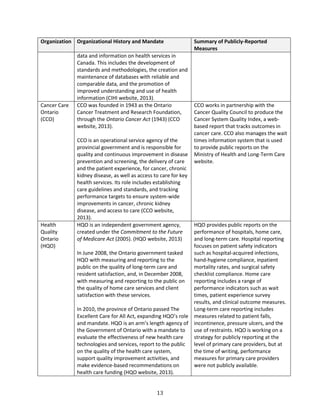
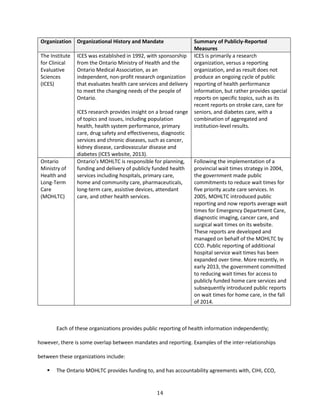
distributed across several third-party government-funded organizations in Ontario. Table 1 describes the
organizations5
responsible for provider-level public reporting on health system indicators and the types
of reporting they provide. Each of these organizations will have an important role in supporting the
researcher’s ‘Plan for Change’ as described later in this document. In addition to the organizations listed
in Table 1, there are other third-party organizations that produce reports and analyses on health system
performance. These additional organizations include the Cardiac Care Network, Ontario Stroke Network,
Critical Care Network, and BORN (Better Outcomes Registry and Network), among others. For the
purposes of this study, only organizations that have a specific mandate for public reporting, are funded
to provide public reporting, and make data available, versus primarily focusing on structured published
reports, were included in the research.
Table 1: Organizations Responsible for Third-Party Reporting of Health Information in Ontario
Organization Organizational History and Mandate Summary of Publicly-Reported
Measures
Canadian
Institute for
Health
Information
(CIHI)
CIHI was established in 1994 following a
recommendation in the report “Health
Information for Canada, 1991: A Report by the
National Task Force on Health Information”
that recommended creating a national health
information coordinating council and an
independent institute for health information
(National Health Information Council, 1991).
With a Board of Directors that includes
representation from Federal, Provincial, and
Territorial Health Ministries, CIHI has a
mandate to coordinate the collection and
reporting of high-quality, relevant and timely
CIHI publicly reports on health system
performance at both the aggregate and
institutional levels. At the provider
level, CIHI reports on a range of
measures by hospital including
mortality rates, hospital readmission
rates, Caesarean section rates, and
patient safety measures.
5 While other organizations, such as private institutes, mainstream media, and social media, may also produce public reports at
a provider level for the purposes of rating providers or other activities that may be ‘reputational’ in nature (e.g. “Rate my
Doctor” websites), this research will only focus on public reporting from third-party organizations that receive funding from the
government and that have a government-supported mandate to provide public reporting on health system performance. This
differentiation is important in considering the policy-level applications of a public reporting strategy and evaluation framework
for public reporting.
13
Organization Organizational History and Mandate Summary of Publicly-Reported
Measures
data and information on health services in
Canada. This includes the development of
standards and methodologies, the creation and
maintenance of databases with reliable and
comparable data, and the promotion of
improved understanding and use of health
information (CIHI website, 2013).
Cancer Care
Ontario
(CCO)
CCO was founded in 1943 as the Ontario
Cancer Treatment and Research Foundation,
through the Ontario Cancer Act (1943) (CCO
website, 2013).
CCO is an operational service agency of the
provincial government and is responsible for
quality and continuous improvement in disease
prevention and screening, the delivery of care
and the patient experience, for cancer, chronic
kidney disease, as well as access to care for key
health services. Its role includes establishing
care guidelines and standards, and tracking
performance targets to ensure system-wide
improvements in cancer, chronic kidney
disease, and access to care (CCO website,
2013).
CCO works in partnership with the
Cancer Quality Council to produce the
Cancer System Quality Index, a web-
based report that tracks outcomes in
cancer care. CCO also manages the wait
times information system that is used
to provide public reports on the
Ministry of Health and Long-Term Care
website.
Health
Quality
Ontario
(HQO)
HQO is an independent government agency,
created under the Commitment to the Future
of Medicare Act (2005). (HQO website, 2013)
In June 2008, the Ontario government tasked
HQO with measuring and reporting to the
public on the quality of long-term care and
resident satisfaction, and, in December 2008,
with measuring and reporting to the public on
the quality of home care services and client
satisfaction with these services.
In 2010, the province of Ontario passed The
Excellent Care for All Act, expanding HQO’s role
and mandate. HQO is an arm’s length agency of
the Government of Ontario with a mandate to
evaluate the effectiveness of new health care
technologies and services, report to the public
on the quality of the health care system,
support quality improvement activities, and
make evidence-based recommendations on
health care funding (HQO website, 2013).
HQO provides public reports on the
performance of hospitals, home care,
and long-term care. Hospital reporting
focuses on patient safety indicators
such as hospital-acquired infections,
hand-hygiene compliance, inpatient
mortality rates, and surgical safety
checklist compliance. Home care
reporting includes a range of
performance indicators such as wait
times, patient experience survey
results, and clinical outcome measures.
Long-term care reporting includes
measures related to patient falls,
incontinence, pressure ulcers, and the
use of restraints. HQO is working on a
strategy for publicly reporting at the
level of primary care providers, but at
the time of writing, performance
measures for primary care providers
were not publicly available.
14
Organization Organizational History and Mandate Summary of Publicly-Reported
Measures
The Institute
for Clinical
Evaluative
Sciences
(ICES)
ICES was established in 1992, with sponsorship
from the Ontario Ministry of Health and the
Ontario Medical Association, as an
independent, non-profit research organization
that evaluates health care services and delivery
to meet the changing needs of the people of
Ontario.
ICES research provides insight on a broad range
of topics and issues, including population
health, health system performance, primary
care, drug safety and effectiveness, diagnostic
services and chronic diseases, such as cancer,
kidney disease, cardiovascular disease and
diabetes (ICES website, 2013).
ICES is primarily a research
organization, versus a reporting
organization, and as result does not
produce an ongoing cycle of public
reporting of health performance
information, but rather provides special
reports on specific topics, such as its
recent reports on stroke care, care for
seniors, and diabetes care, with a
combination of aggregated and
institution-level results.
Ontario
Ministry of
Health and
Long-Term
Care
(MOHLTC)
Ontario’s MOHLTC is responsible for planning,
funding and delivery of publicly funded health
services including hospitals, primary care,
home and community care, pharmaceuticals,
long-term care, assistive devices, attendant
care, and other health services.
Following the implementation of a
provincial wait times strategy in 2004,
the government made public
commitments to reduce wait times for
five priority acute care services. In
2005, MOHLTC introduced public
reporting and now reports average wait
times for Emergency Department Care,
diagnostic imaging, cancer care, and
surgical wait times on its website.
These reports are developed and
managed on behalf of the MOHLTC by
CCO. Public reporting of additional
hospital service wait times has been
expanded over time. More recently, in
early 2013, the government committed
to reducing wait times for access to
publicly funded home care services and
subsequently introduced public reports
on wait times for home care, in the fall
of 2014.
Each of these organizations provides public reporting of health information independently;
however, there is some overlap between mandates and reporting. Examples of the inter-relationships
between these organizations include:
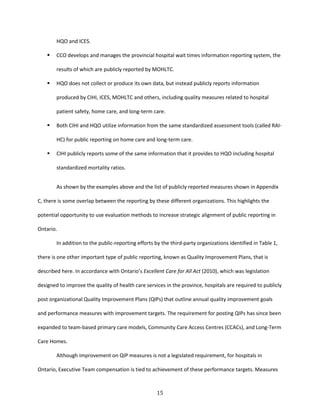
 The Ontario MOHLTC provides funding to, and has accountability agreements with, CIHI, CCO,
15
HQO and ICES.
 CCO develops and manages the provincial hospital wait times information reporting system, the
results of which are publicly reported by MOHLTC.
 HQO does not collect or produce its own data, but instead publicly reports information
produced by CIHI, ICES, MOHLTC and others, including quality measures related to hospital
patient safety, home care, and long-term care.
 Both CIHI and HQO utilize information from the same standardized assessment tools (called RAI-
HC) for public reporting on home care and long-term care.
 CIHI publicly reports some of the same information that it provides to HQO including hospital
standardized mortality ratios.
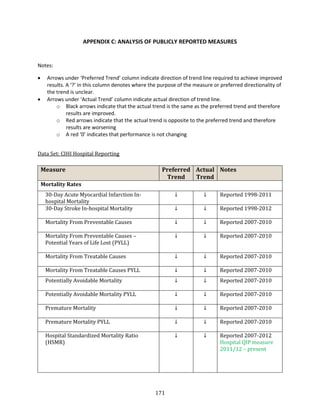
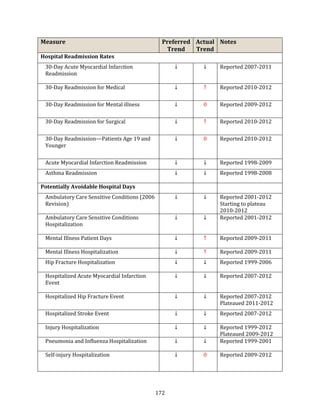
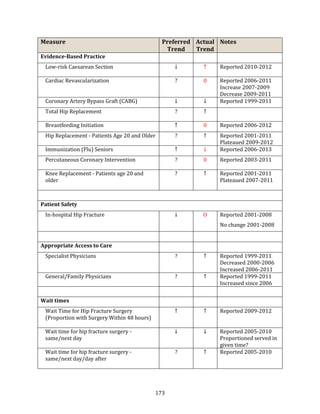
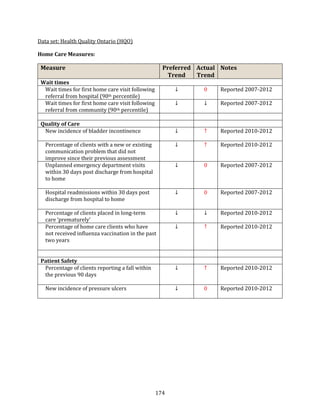
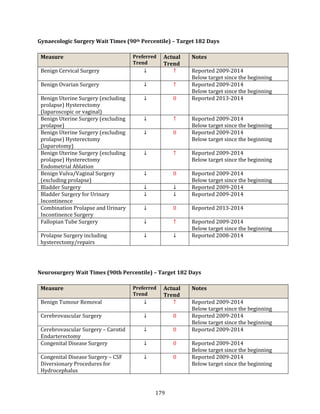
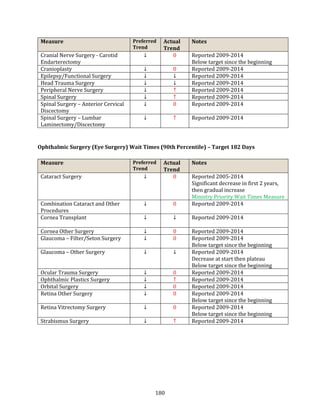
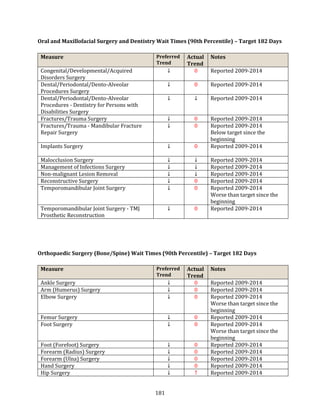
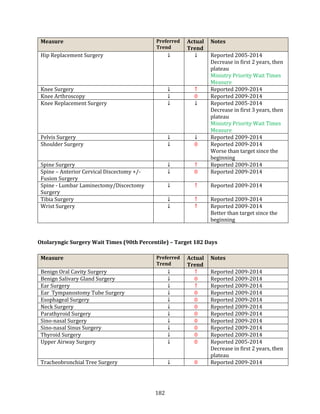
As shown by the examples above and the list of publicly reported measures shown in Appendix
C, there is some overlap between the reporting by these different organizations. This highlights the
potential opportunity to use evaluation methods to increase strategic alignment of public reporting in
Ontario.
In addition to the public-reporting efforts by the third-party organizations identified in Table 1,
there is one other important type of public reporting, known as Quality Improvement Plans, that is
described here. In accordance with Ontario’s Excellent Care for All Act (2010), which was legislation
designed to improve the quality of health care services in the province, hospitals are required to publicly
post organizational Quality Improvement Plans (QIPs) that outline annual quality improvement goals
and performance measures with improvement targets. The requirement for posting QIPs has since been
expanded to team-based primary care models, Community Care Access Centres (CCACs), and Long-Term
Care Homes.
Although improvement on QIP measures is not a legislated requirement, for hospitals in
Ontario, Executive Team compensation is tied to achievement of these performance targets. Measures
16
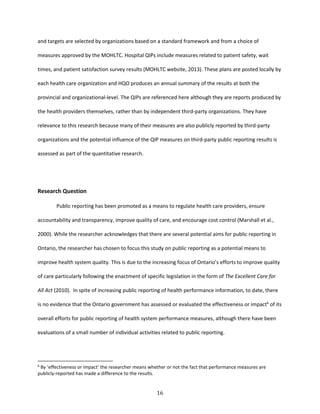
and targets are selected by organizations based on a standard framework and from a choice of
measures approved by the MOHLTC. Hospital QIPs include measures related to patient safety, wait
times, and patient satisfaction survey results (MOHLTC website, 2013). These plans are posted locally by
each health care organization and HQO produces an annual summary of the results at both the
provincial and organizational-level. The QIPs are referenced here although they are reports produced by
the health providers themselves, rather than by independent third-party organizations. They have
relevance to this research because many of their measures are also publicly reported by third-party
organizations and the potential influence of the QIP measures on third-party public reporting results is
assessed as part of the quantitative research.
Research Question
Public reporting has been promoted as a means to regulate health care providers, ensure
accountability and transparency, improve quality of care, and encourage cost control (Marshall et al.,
2000). While the researcher acknowledges that there are several potential aims for public reporting in
Ontario, the researcher has chosen to focus this study on public reporting as a potential means to
improve health system quality. This is due to the increasing focus of Ontario’s efforts to improve quality
of care particularly following the enactment of specific legislation in the form of The Excellent Care for
All Act (2010). In spite of increasing public reporting of health performance information, to date, there
is no evidence that the Ontario government has assessed or evaluated the effectiveness or impact6
of its
overall efforts for public reporting of health system performance measures, although there have been
evaluations of a small number of individual activities related to public reporting.
6
By ‘effectiveness or impact’ the researcher means whether or not the fact that performance measures are
publicly-reported has made a difference to the results.
17
Given that Ontario has not formally evaluated its public reporting efforts, the researcher
conducted a review of the literature to help answer the following sub-questions:
“What do we know about the value of public reporting7
?”
“What do we know about how to improve the effectiveness of public reporting?”
The results of the literature review were then used by the researcher to help build the methodology for
answering the dissertation question:
“How can we evaluate and enhance the impact of third-party public reporting on
quality improvement for health care in the province of Ontario, Canada?”
These three questions form the thread of research in this dissertation that follows through the
literature review, conceptual model, research methods, results, discussion, and ultimately the plan for
change.
7
By ‘value of public reporting’ the researcher means the relative importance of public reporting as a quality
improvement strategy.
18
CHAPTER 2: LITERATURE REVIEW
Introduction to the Literature Review Methods
In order to begin to answer the dissertation question, the researcher completed a staged
approach to the literature. This staged approach is described as follows:
i) The researcher initiated a literature review based on the first sub-question “What do we
know about the value of public reporting?”. The purpose of the review was to identify
what could be understood from the literature about public reporting and its value in
terms of whether it produces desirable effects in the form of higher quality care.
ii) As the literature review progressed, it became apparent that as experience with public
reporting increased over time, the focus in the literature shifted from understanding the
value of public reporting to figuring out how to make it more effective. This then led the
researcher to add a second sub-question to the literature review “What do we know
about how to improve the effectiveness of public reporting?”
iii) As the researcher continued with the literature review process, it became further
apparent that the sheer volume of individual studies available on the topic of public
reporting made a systematic review of the literature prohibitive in terms of time. To
make the process more manageable, the researcher opted to separate the literature
review into two types of reviews. The first review, based on the questions described in
19
(i) and (ii) above, is described as an overview8
of the literature, and its purpose was to
assist the researcher in understanding the general findings from the literature on this
topic. Given the extent of the literature, the researcher decided to undertake a second,
more systematic review of the literature that focused exclusively on a review of
systematic reviews on the topic of public reporting. This purpose of the second, and
more systematic, review was primarily to validate and refine the findings from the first
review.
Details of the two reviews (the overview of the literature and the review of systematic reviews)
are described in more detail in the following sections. Both of the reviews were useful in developing and
refining the conceptual framework for the research approach, including a logic model and evaluation
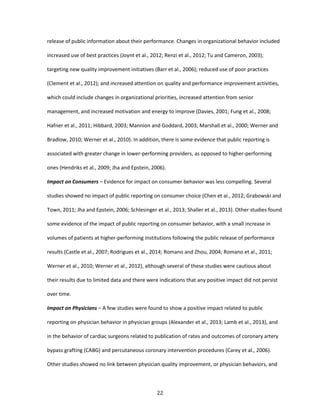
framework for public reporting. Figure 1 depicts the flow of the research stemming from the research
questions and literature review process.
Figure 1: Overview of Research Plan
8The term ‘overview’ of the literature is based on the definition by M.J. Grant and A. Booth (Grant and Booth, 2009).
20
Overview of the Literature
This initial stage of the literature review was designed to 1) identify individual studies that
demonstrated why public reporting is important or effective in helping improve the quality or
performance of the health care system, 2) understand the criticisms and potential for negative impacts,
and, 3) identify best practices and how to increase its effectiveness. No specific hypothesis was
generated prior to developing the research questions.
PubMed was the primary electronic research database used to identify relevant literature for
the initial literature review of this topic. The literature review was conducted in PubMed using the
following MeSH terms in a Boolean formula ‘public reporting’, ‘health care’, ‘outcome’, ‘performance’,
and ‘evaluation’. These terms were identified from an article by Wallace and colleagues on public
reporting (Wallace et al., 2007), which was particularly relevant to this research. The literature review,
based on the key word search in PubMed for titles and abstracts with these Boolean search terms,
resulted in over 25,000 titles. The author reviewed the first 2,000 titles and selected 133 based on the
following categories:
 Studies that provided empirical evidence of the value of public reporting.
 Studies that provided empirical evidence of non-value or negative impact of public
reporting.
 Articles or reports that focused on improving the effectiveness of public reporting.
The overview of the literature enabled the researcher to identify four different audiences for public
reporting as referenced in the following sections. These audiences are defined by the researcher below,
as well as in Appendix A:
1) Consumers – defined as patients and patient representatives.
2) Funders – defined as organizations that provide funding to support or purchase health care
delivery including government, government agencies, and health insurance plans. In many
21
jurisdictions, funders are also policy-makers, those legislatively responsible for determining
government policy including political or government bureaucracy leadership. In the literature,
where there is evidence for differences between funders and policy-makers, these are noted by
the researcher; otherwise, they have been included in the same group.
3) Physicians – defined as solo-practitioners, specialists, physician group practices, including clinics.
4) Institutional Providers – defined as institutional or organizational entities including hospitals,
long-term care homes, and home care agencies that are responsible for the provision of direct
care to a group of patients.
The following four key themes were identified from the literature overview:
1) Public reporting appears to have a positive impact on the behavior of institutional providers, but
has less impact on consumers, physicians, and funders.
2) Public reporting shows mixed impact on outcomes and performance.
3) There is no conclusive evidence in the literature that links public reporting to adverse
consequences.
4) There is significant opportunity to improve the effectiveness of public reporting and there are
many examples and recommendations provided in the literature.
Each of these themes is explored in more detail in the next section.
Specific Findings from the Overview of the Literature:
1. Public reporting can have a positive impact on the behavior of institutional providers, but has less
influence on the behavior of consumers, physicians, and funders.
Impact on Institutional Providers – Several studies showed that both hospitals and long-term care
homes increased their focus on quality improvement efforts either following, or in relation to, the
22
release of public information about their performance. Changes in organizational behavior included
increased use of best practices (Joynt et al., 2012; Renzi et al., 2012; Tu and Cameron, 2003);
targeting new quality improvement initiatives (Barr et al., 2006); reduced use of poor practices
(Clement et al., 2012); and increased attention on quality and performance improvement activities,
which could include changes in organizational priorities, increased attention from senior
management, and increased motivation and energy to improve (Davies, 2001; Fung et al., 2008;
Hafner et al., 2011; Hibbard, 2003; Mannion and Goddard, 2003; Marshall et al., 2000; Werner and
Bradlow, 2010; Werner et al., 2010). In addition, there is some evidence that public reporting is
associated with greater change in lower-performing providers, as opposed to higher-performing
ones (Hendriks et al., 2009; Jha and Epstein, 2006).
Impact on Consumers – Evidence for impact on consumer behavior was less compelling. Several
studies showed no impact of public reporting on consumer choice (Chen et al., 2012; Grabowski and
Town, 2011; Jha and Epstein, 2006; Schlesinger et al., 2013; Shaller et al., 2013). Other studies found
some evidence of the impact of public reporting on consumer behavior, with a small increase in
volumes of patients at higher-performing institutions following the public release of performance
results (Castle et al., 2007; Rodrigues et al., 2014; Romano and Zhou, 2004; Romano et al., 2011;
Werner et al., 2010; Werner et al., 2012), although several of these studies were cautious about
their results due to limited data and there were indications that any positive impact did not persist
over time.
Impact on Physicians – A few studies were found to show a positive impact related to public
reporting on physician behavior in physician groups (Alexander et al., 2013; Lamb et al., 2013), and
in the behavior of cardiac surgeons related to publication of rates and outcomes of coronary artery
bypass grafting (CABG) and percutaneous coronary intervention procedures (Carey et al., 2006).
Other studies showed no link between physician quality improvement, or physician behaviors, and
23
public reporting (Chen et al., 2012; Lanier et al., 2003). Evidence from the literature indicates that
physicians are skeptical of public report cards citing concerns about intent, accuracy, the ability to
attribute results to the actions of individual physicians, and relevance (Dehmer et al., 2014;
Glickman and Schulman, 2013; Marshall et al., 2000; Natale et al., 2011; Rosenstein, 2000; Sherman
et al., 2013). The implications of these findings are that physicians are less likely to change behaviors
as a result of public reporting.
Impact on Funders – Although studies in the U.S. and U.K. showed growing evidence of the use of
public reporting results by policy-makers and funders (Baker et al., 2013; Higgins et al., 2013;
Lindenauer et al., 2007), this does not appear to be the case in Canada. Studies reviewed evidence
for changes in behaviour of funders, including selection of higher performing providers, avoiding or
delisting lower-performing providers, or changing volumes or funding-levels related to performance
of health care providers. Earlier studies showed that health plan purchasers gave only minimal
consideration to publicly-reported quality when selecting providers (Totten et al., 2012). However,
the situation of funders is now changing in the U.S. with the implementation of the Affordable Care
Act (2010) that provides incentives for organizations to improve quality and performance through
Medicaid funding. The ‘star’ rating system in the U.K. is perhaps one of the best known examples of
government use of performance information to both incent high performance and punish poor
performance among hospitals (Bevan and Hood, 2006). Canadian researchers noted that
governments in Canada need to be more strategic in their approach to health care and ensure
greater accountability for the performance of their health systems (Abbott, 2012), and that there
needs to be greater accountability and consequences for poor performance (Fooks and Maslove,
2004).
24
2. Public reporting shows mixed impact on outcomes and performance.
Several studies that found positive changes in performance results, or in health outcomes
related to public reporting, included improved patient satisfaction/experience scores (Barr et al.,
2002; Elliott et al., 2010); reduced wait times for clinical care, including emergency department,
inpatient and outpatient care (Bevan, 2010); improved post-cardiac surgery outcomes and cardiac
care (Carey et al., 2006; McLean, 2010); reduced hospital-acquired infection rates (Daneman et al.,
2012); improved access to treatment (Renzi et al., 2014); and reduced rates for inpatient mortality
(Hollenbeak, 2008; McCrum et al., 2013). While these studies identified a positive impact related to
public reporting, either through increased attention to quality improvement efforts, improved
outcomes, or both, in general researchers were cautious about identifying a direct causal pathway
but instead focused on a general association between public reporting and positive impacts.
Concerns about attribution were particularly noted when no comparative group was available
(Elliott et al., 2010) or when other factors, such as pre-existing trends, may have contributed to
positive outcomes (Ryan et al., 2012).
Multiple studies showed no impact from public reporting on health outcomes or on the
behavior of institutional providers, physicians, consumers, policy-makers or funders. Research
evidence on health outcomes found no association between public reporting and changes in:
 hospital mortality rates (Clough et al., 2002; Joynt et al., 2012; Ryan et al., 2012),
 avoidable hospital readmissions (Jha et al., 2009),
 infection rates (Linkin et al., 2013; Rinke et al., 2014),
 consumer behavior related to their choice of health care providers (Clough et al., 2002;
Faber et al., 2009; Grabowski and Town, 2011; Jha and Epstein, 2006; Ketalaar et al.,
2011; Marshall et al., 2003; Marshall et al., 2000; Rodrigues et al., 2014; Romano and
25
Zhou, 2004; Schauffler and Mordavsky, 2001; Schneider and Lieberman, 2001; Werner
et al., 2012),
 institutional provider behavior (Ketalaar et al., 2011; Tu et al., 2009),
 physician behavior (Chen et al., 2012; Fung et al., 2008; Lanier et al., 2003; Marshall et
al., 2000; Rosenstein, 2000), or
 behaviors of funders or policy-makers, including no increased focus on accountability
(Abbott, 2012; Fooks and Maslove, 2004; Mannion and Goddard, 2003; Marshall et al.,
2000).
One Canadian study showed that outcomes improved sharply after performance results were
confidentially disclosed at an institutional level, but when the results were later publicly reported,
there was no discernible impact on performance indicating that in some cases, the confidential
disclosure of outcomes was sufficient to accelerate quality improvement in a public system with
little competition for patients between hospitals (Guru et al., 2006).
3) There is no conclusive evidence in the literature that links public reporting to adverse consequences.
While there is evidence supporting the value of public reporting, the literature also identified
some evidence of the lack of value or effectiveness of public reporting, and raised the possibility for
adverse consequences. Concerns raised in the literature included 1) questions about the potential
for inappropriate diversion of resources to public reporting, 2) attention drawn to what is publicly
reported and not necessarily to what is most important, 3) questions about data quality and validity,
4) questions about the ability to attribute outcomes to providers, 5) lack of adjustment for changes
in case mix, 6) “gaming” of data by providers, 7) lagging data, and 8) the potential for perverse
incentives (Bevan, 2010; Coles, 1999; Davies, 2001; Dranove et al., 2002; Farmer et al., 2013;
Gruenir et al., 2010; Guru et al., 2009; McLoughlin et al., 2001; Miller and Leatherman, 1999).
26
The most significant concern about public reporting was the potential for adverse and
unintended consequences related to the publishing of performance data, in particular, the potential
for public reports to create perverse incentives that might reduce quality or harm patients,
including: not treating marginalized patients who tend to have lower compliance with treatment
directives (Davies et al., 2002), avoiding patients who are sicker and therefore likely to have poorer
outcomes (Dranove et al., 2002; Fung et al., 2008; Guru et al., 2009; Hofer et al., 1999; Mosucci et al.
2005), or over/under treating patients in order to achieve performance targets (Konetzka et al.,
2014; Rambur et al., 2013; Wachter et al., 2008; Werner and Asch, 2005). In addition, there is the
potential for providers to impact the accuracy of reporting rates (“gaming”) in order to improve
their standing in public reports (Bevan and Hood, 2006; Farmer et al., 2013; Guru et al., 2009;
Hamblin, 2007; McLoughlin et al., 2001; Muller and Detsky, 2010).
Friedberg and colleagues (Friedberg et al., 2009) explored concerns that public reporting was
associated with the over-diagnosis of pneumonia, excessive antibiotic use, and the inappropriate
prioritization of patients with respiratory symptoms. These concerns were related to previous
studies showing that payment systems increased inappropriate use of antibiotics (Wachter et al.,
2008). Results of the analysis showed no difference in provider practice patterns related to public
reporting (Freidberg et al., 2009). A study on the effects of bypass surgery in New York, with regard
to access to care and patient outcomes in the elderly, showed no evidence that elderly high risk
patients were being denied access to surgery due to their increased likelihood of poor outcomes. In
fact, this same study showed a link between public reporting and significantly improved outcomes
as compared to the national average (Peterson et al., 1998). Another study on post-acute care found
that both unreported and reported care improved following the launch of public reporting. The
findings were more consistent with the hypothesis that the positive effect of public reporting
influences other important but unreported areas of care, and were less consistent with the
27
hypothesis that measuring and reporting quality in some areas crowds out quality in other areas
(Werner et al., 2009). In the end, the researcher found no conclusive evidence in the literature that
linked public reporting to adverse consequences.
4) Recommendations for improving the effectiveness of public reporting.
Not surprisingly, recommendations for improvements to public reporting are also a reflection of
the strengths and criticisms. It appears that substantial improvements in public reporting are
required in order for it to be effective in influencing consumer behavior (Hibbard, 2008; Hibbard et
al., 2002; Hibbard and Peters, 2003; Mannion and Goddard, 2003; van den Heuvel et al., 2013). One
study noted a change in consumer views after the release of a report on hospital performance that
was made easy to understand and widely available (Hibbard et al., 2005). Multiple researchers
provide recommendations for improving the effectiveness of public reporting, as listed in Figure 2.
28
Figure 2: Recommendations for Improving the Effectiveness of Public Reporting
 Adjusting for case mix
 Aligning measures with stakeholders’ needs
 Assessing the impact of public reporting on
disadvantaged groups
 Comparing performance against standards
rather than comparing providers to each
other
 Creating a culture and environment within
organizations that enables the appropriate
use of performance information
 Creating clear objectives for public reporting
 Engaging the public
 Evaluating public reporting efforts
 Increasing accountability for results
 Improving measures and data quality
 Improving motivation of providers to make
improvements
 Introducing test periods
 Placing greater emphasis on outcome rather
than process measures
 Prioritizing measures
 Reducing the potential for “gaming” of results
by providers
 Reducing potential for perverse incentives
 Understanding factors that impact patient
choice
 Using appropriate performance incentives
 Using standardized measures.
(Auras et al., 2012; Berger et al., 2013; Berwick et
al., 2003; Bevan, 2010; Davies et al., 2002;
Dranove et al., 2002; El Turabi et al., 2007; Fooks
and Maslove, 2004; Friedberg and Damberg 2012;
Greene and Hall, 2012; Hibbard, 2008; Hibbard et
al., 2002; Hibbard et al, 2003; Klazinga et al.,
2011; Klein and Nashef, 2008; Lucet et al., 2013;
Mannion and Goddard, 2003; Marshall et al.,
2004; Marshall et al., 2000; McLoughlin et al.
2001; Meddings et al., 2013; Meltzer and Chung,
2014’ Morris and Zelmer, 2005; Papadimitriou et
al., 2013; Powell et al., 2003; Reineck et al., 2014;
Robinowitz and Dudley, 2006; Rodrigues et al.,
2014; Smith, 2003; Specchia et al., 2012; Tehrani
et al., 2013; Wallace et al., 2007; Walker et al.,
2013)
A few articles recommended checklists or frameworks for improving the effectiveness of public
reporting (Friedberg and Damberg, 2012; Hibbard, 2008; McKibben et al., 2006; McMurtry, 2005; Miller
and Leatherman, 1999) (Morris and Zelmer, 2005; Suchy, 2010; van den Berg, 2014; van den Heuvel et
al., 2013). One of the most often cited recommendations for improving the effectiveness of public
reporting was to evaluate its impact, noting that rigorous evaluation of public reporting efforts is
generally lacking (Brown et al., 2005; Friedberg and Damberg, 2012; Fung et al., 2008; Marshall et al.,
2000; McKibben et al., 2006; Werner et al., 2012).
29
Discussion of the Overview of the Literature
The purpose of this overview of the literature was to understand generally what the literature
reveals about the value of third-party public reporting for quality improvement and improved health
outcomes, as well as to identify opportunities to improve the effectiveness of public reporting. This
review was also intended to help identify what Ontario could learn from other jurisdictions, to inform an
approach to evaluating Ontario’s existing public reporting efforts, and to identify potential opportunities
to improve its effectiveness for improving health system quality. The literature review was useful in
understanding the benefits and challenges of public reporting; however, the evidence supporting its
value in improving quality of care was mixed. The researcher’s conclusion from this review was that,
although evidence for the value of public reporting is mixed and it remains controversial, on balance it
appears to have more benefit than harm. It also seems likely that increasing societal trends for greater
transparency will mean that public reporting efforts will continue to grow and will remain as an
important means to increase the accountability of health providers and as a contributing factor to
improving health system quality.
The researcher further found that while the literature identifies lower levels of impact and/or
sometimes mixed impact of public reporting on behaviors of consumers, physicians, policy-makers, and
funders, the same is not true of health care organizations. Of all the research on the impact of public
reporting, the strongest evidence is for use of the data as a catalyst to stimulate and promote internal
quality improvement efforts at the level of the organizational provider. Marshall et al. urged a more
targeted approach to public reporting based on evidence, stating that “it is critical to articulate the
purpose for public disclosure and the development of an evidence base to guide its implementation to
ensure that disclosure is conducted in a way that will maximize the potential benefits and reduce the
associated risks” (Marshall et al., 2000). The researcher finds that the literature review supports the
30
rationale for focusing public reporting efforts on providers as a means to improve quality of care, which
then informs the research methodology for this dissertation.
Although this initial overview was helpful in providing a broad summation of the literature as
described in this discussion, it was evident that the large body of literature required a more systematic
approach to a literature review. In addition, the researcher concluded from a review of the MeSH terms
in the literature that using only five search terms (‘public reporting’, ‘health care’, ‘outcome’,
‘performance’, and ‘evaluation’) was not sufficiently inclusive for this topic. The researcher therefore
opted to conduct a second more systematic literature review, as described in the next section.
The final contribution of the overview of the literature was to assist the researcher with the
identification of the key categories in the literature as the basis for an analytic framework for the large
body of literature that is available on this topic. Different studies touched on some or all of the following
themes:
1) Impact on consumers
2) Impact on organizational or institutional providers
3) Impact on physicians
4) Impact on funders/policy-makers
5) Impact on quality of care outcomes
6) Potential for negative/adverse consequences
7) Opportunities to improve public reporting
The researcher then used these themes to help support analysis of a more systematic review of
the literature, as described in the next section and summarized in Tables 2 and 3.
31
Review of Systematic Reviews
As a second stage in the literature review process, the researcher conducted what is described
in the literature as a systematized review9
of systematic reviews on the topic, using the methodology
described by Smith et al. for identifying and appraising systematic reviews (Smith et al., 2011). The
purpose of such a “review of reviews” is to describe their quality, summarize and compare their
conclusions, and discuss the strength of these conclusions so that the best evidence is made available
(Smith et al. 2011). In this case, the additional purpose for the review was to validate the findings from
the earlier overview of the literature.
In this two stage review of the literature, no other such review of systematic reviews on the
topic of public reporting of health performance information was found. As such, the author believes that
this review will be a valuable contribution to existing literature on the topic of public reporting by
providing a summary of the systematic reviews in a single source document.
Sources and Search Strategy
The search strategy for a review of systematic reviews differs from a review of individual studies
in that a review of systematic reviews can be targeted to databases specific to systematic reviews, such
as the Cochrane Database of Systematic Reviews, whereas for a review of individual studies, the search
should be as wide as possible to maximize the likelihood of capturing all relevant data and minimizing
the effects of reporting biases (Smith et al., 2011). In keeping with this approach, the author limited the
9The term ‘systematized review’ of the literature is based on the description from M.J. Grant and A. Booth (Grant and Booth,
2009). As described in Grant and Booth’s description of a systematized review, the researcher conducted a review that includes
elements of a systematic review process, but lacks all the requirements and resources involved in a full systematic review,
including independent review from a second researcher. As such, the researcher has referred to this review as a ‘systematized
review of systematic reviews’ as opposed to a ‘systematic review of systematic reviews’ to indicate that this was not a strictly
systematic review process.
32
search to two databases i) the Cochrane Database of Systematic Reviews and ii) PubMed, which was the
primary search database for the researcher’s earlier review of individual studies.
In order to provide a comprehensive search of articles related to this topic, the author identified
fourteen related terms for public reporting from MeSH [mh] terms used in the articles obtained from
the first search. With the assistance of a librarian at the University of North Carolina Health Sciences
Library, the researcher created a search string for a title and abstract [tiab] search, including all of the
fourteen related terms for public reporting as shown below:
"systematic review"[tiab] OR “systematic reviews”[tiab] OR "literature review"[tiab] OR “review
of the literature”[tiab]) AND "truth disclosure"[mh] OR "public release"[tiab] OR "public
disclosure"[tiab] OR "public reporting"[tiab] OR "publicly reported"[tiab] OR “performance
report”[tiab] OR “performance reports” [tiab] OR “performance reporting”[tiab] OR
“performance indicator”[tiab] OR “performance indicators”[tiab] OR “performance
measure”[tiab] OR “performance data”[tiab] OR “report cards”[tiab] OR “medical
registries”[tiab]
Inclusion criteria
The following criteria were used to identify articles for inclusion in the review:
 English language and,
 systematic reviews that:
o focus on public reporting as opposed to performance reporting that is not made public, as
well as that provide comparisons of public reporting with other types of reporting, and,
o (building on the preliminary overview of the literature) include articles with empirical
evidence on the value, non-value, or negative impact of public reporting on consumer
choice, physician behavior, provider behavior, purchaser/funder behavior, adverse
consequences, or quality of care/outcomes, as well as that identify ways to improve the
effectiveness of public reporting and,
33
o include at least three articles (i.e., reviews covering only one or two articles were less
suitable for comparative purposes) and,
o meet the criteria for being systematic reviews of the literature and,
o have been peer-reviewed.
Review Results
Using the search methods described previously, the author identified 10 articles for inclusion in
the final review. The following section describes the methods used to select these articles. Figure 3
outlines the flowchart for study selection.
Step 1: Search terms in PubMed yielded 257 articles
Search terms in Cochrane Database yielded 144 articles
Three (3) additional articles were identified from the earlier literature review
Step 2: Duplicates were removed
Step 3: Title and abstract review yielded 19 articles for full article review.
Step 4: Using a combination of the inclusion criteria and evaluation criteria, the author eliminated
nine articles. A description of the excluded articles and the reason for exclusion is included in
Appendix D. The final synthesis included 10 articles.
Excluded Studies
Nine studies were excluded from the study selection after full text review. A list of the excluded
studies and rationale for exclusion are included in Appendix D.
34
Figure 3: Flowchart for Study Selection
(adapted from Moher et al., 2009)
Records identified through
database searching
(n = 401)
ScreeningIncludedEligibilityIdentification
Additional records identified
through other sources
(n = 3)
Records excluded based on
title/abstract review
(n = 18)
Full-text articles
assessed for eligibility
(n = 19)
Full-text articles excluded,
with reasons
(n = 9)
Studies included in final
synthesis
(n = 10)
After duplicates removed, number of
records screened using title/abstract
(n = 37)
35
Quality Assessment of Reviews
As observed by Smith et al. (Smith et al., 2011), in conducting a review of systematic reviews, it
is necessary to determine the quality of the reviews for inclusion in the final review of the literature. The
researcher reviewed both PRISMA (Moher et al., 2009) and AMSTAR (Shea et al., 2009) to determine
which tool to use to assess the methodological quality of the systematic reviews. AMSTAR was selected
as the preferred tool, based on the review by Smith et al. identifying AMSTAR as the only validated tool
for assessing the methodological quality of systematic reviews (Smith et al., 2011). A copy of the
AMSTAR tool, including the criteria for assessing quality of systematic reviews, is found in Appendix E.
Articles that met all of the inclusion criteria were then assessed for their methodological quality
as systematic reviews using the AMSTAR tool. The AMSTAR tool uses eleven items in a checklist format
that includes assessment of study design, literature review methodology, description of articles
reviewed, quality review methods, as well as statements of bias and conflict of interest. Using the
AMSTAR tool, each article was assessed item by item and scored as ‘yes’, ‘no’ or ‘can’t assess’ in terms
of having met the quality criteria. The final quality ratings were characterized as “very good” (articles
that had a quality rating of 9-11), “good” (articles that had a quality rating of 6-8), “fair” (articles that
had a quality rating of 3-5), or “poor” (articles that had a quality rating of 0-2). Articles with a rating of
“poor” were excluded from the final review.
Results
The ten systematic reviews that met the inclusion and quality criteria were then analyzed and
details of the reviews were placed into summary tables. Appendix F lists the studies included in each of
the systematic reviews and was used to identify duplications in the review of specific studies. Table 2 is a
summary table that describes the scope of each of the systematic reviews. Table 3 provides a summary
of the conclusions of each systematic review. Of the ten studies included in the final review, nine of the
36
studies used a standard approach to their systematic reviews and one (Lemire et al., 2013) used a
narrative synthesis approach to describe the underlying processes of the interventions.
Timelines for the reviews and assessment of duplications: The review by Lemire et al. did not
include a list of articles and is therefore excluded from this section of the analysis. The reviews covered
almost 25 years of literature from 1988 to 2012. The nine reviews (excluding Lemire et al., 2013)
included a total of 232 individual studies, of which 142 (61%) were included in only one review; the
remaining articles were included in at least two of the systematic reviews. This repeated use of studies
was expected given that there was overlap in both the publication years included in the reviews and in
the purpose of the reviews. The review by Totten et al. included the most comprehensive list of articles
of all of the reviews (Totten et al., 2012), with a total of 198 studies, both quantitative and qualitative in
nature. Predictably, this review had the most comprehensive list of search databases and included
several studies not used in any of the other reviews. The remaining systematic reviews included
between four and 55 studies. The repeated use of almost 40% of the studies across the nine reviews
increased the likelihood of overlap in the findings.
Use of quality ratings: The AMSTAR tool was used to rate the quality of each review. In addition
to assisting with the selection of articles for inclusion, i.e., studies with scores of 2 or less were excluded
from the final review, the AMSTAR grading criteria were also used to rank studies on whether they
should carry great (rating of 9-11 “very good”), moderate (rating of 6-8 “good”) or little (rating of 3-5
“fair”) weight when considering the strength of evidence. For the included studies rated using AMSTAR,
three (Ketelaar et al., 2011; Berger et al., 2013; Totten et al., 2012) were rated as “very good”, four
(Shekelle et al., 2008; Fung et al., 2008; Faber et al., 2008; Totten et al. 2011) were rated as “good”, and
the remaining three (Marshall et al., 2000; Schauffler and Mordavsky, 2001; Lemire et al., 2013) were
rated as “fair”. Details of the ratings are provided in Appendix G.
37
Aim/Purpose of reviews: Given that all of the reviews were designed to assess the impact of
public reporting, it is expected that there would be a degree of overlap in the stated aim/purpose of the
reviews. In most cases, the reviews stated more than one purpose. Six of the ten reviews assessed the
impact of public reporting on the behavior of different stakeholder groups, including consumers,
physicians, and providers, as well as the impact on quality improvement or improvement in
performance outcomes. Four of the six identified the impact on consumer choice as a particular focus.
Two of the reviews identified the impact of public reporting on improving quality as a stated purpose.
Finally, three separate reviews specifically identified improving the effectiveness of public reporting,
identifying potential unintended consequences, and identifying the causal pathways by which public
reporting may improve performance as a stated aim(s).
Types of studies included: The types of studies included by the reviews were wide-ranging,
including both quantitative and qualitative studies as shown in Table 2. Given this heterogeneity, it was
not possible for the researcher to further pool or synthesize the results beyond the general results
described at the end of this section.
Settings: All of the systematic reviews included the US as a geographic location for the individual
studies they included; three of these only included studies from the US. Other countries included in the
studies were the UK, Canada, Netherlands, Italy, and “other” (not identified). This is important to note
since, of this list of countries, the US has the most competitive market for health care and is therefore
more subject to market forces that can be brought to bear by the availability of public information about
provider performance.
Comparison of Results: The results were analyzed using the categories identified from the initial
overview of the literature. Greater emphasis on the evidence was placed on the reviews that were rated
higher using the AMSTAR rating system.
38
1) Impact on consumers: The reviews found no, limited10
, or mixed impact of public reporting on
consumer behavior (Faber et al., 2009; Fung et al., 2008; Marshall et al., 2000; Schauffler and
Mordavsky, 2001; Totten et al., 2011; Totten et al., 2012). Where there was a positive impact,
the impact was limited and not generalizable (Berger et al., 2013), or did not persist (Ketalaar et
al., 2011; Shekelle et al., 2008).
2) Impact on institutional providers: The most compelling evidence for the impact of public
reporting indicates that it stimulates quality improvement activities in hospitals (Ketalaar et al.,
2011; Schauffler and Mordavsky, 2001; Shekelle et al., 2008 ; Totten et al., 2011; Totten et al.,
2012) and long-term care homes (Berger et al., 2013; Totten et al., 2012). This was particularly
evident in competitive markets such as the US (Marshall et al., 2000).
3) Impact on physicians: Evidence for the impact of public reporting on physician behavior was
mixed. Two of the reviews found no evidence of impact on physician behavior (Marshall et al.,
2000; Schauffler and Mordavsky, 2001). However, more recent reviews indicated that where
surgeon-specific data were made public, surgeons performing in the bottom quartile were more
likely to leave their practice (Shekelle et al., 2008; Totten et al., 2012). Other than this specific
impact, no other impacts on physician behavior were found.
4) Impact on funders/policy-makers: There was limited assessment of the impact of public
reporting on the behavior of funders/policy-makers. Where there was some positive impact,
evidence shows there was only minimal consideration given to publicly reported information.
10 In the summary of the literature review findings, the terms ‘limited, minimal/modest, mixed and inconclusive’
are used throughout. Although used frequently in the literature, these terms were generally not defined in the
systematic reviews; however, for consistency of comparison across the literature reviews the researcher
interpreted these terms as follows: ‘limited’ or ‘minimal/modest’ findings meant that there was some evidence of
interpretable results, but that the quality or quantity of evidence was weak or, in some cases, results were short-
lived. The term ‘mixed’ was interpreted to mean that a combination of results was found, but no result dominated.
Finally, the term ‘inconclusive’ was interpreted as meaning the quality or quantity of results was insufficient to
produce interpretable results.
39
This was specific to employer selection of health plans in the US (Schauffler and Mordavsky,
2001; Totten et al., 2012).
5) Impact on quality of care outcomes: The reviews found limited, mixed, or inconclusive impact
of public reporting on improving quality of care outcomes (Ketelaar et al., 2011; Berger et al.,
2013; Shekelle et al. 2008; Fung et al., 2008; Totten et al., 2011). Where there was a small
indication of positive impact, it was for measures related to cardiac care (Ketelaar et al., 2011;
Marshall et al., 2000); patient satisfaction (Marshall et al., 2000), Caesarean delivery rates
(Marshall et al., 2000), and mortality rates (Totten et al., 2012). Results were not uniformly
consistent and there were questions raised about the appropriateness of comparisons.
6) Potential for negative/adverse consequences: Evidence for negative or unintended
consequences related to public reporting was minimal at best, and only two of the reviews
assessed this theme related to public reporting. One review found inconclusive evidence of
adverse consequences of public reporting on case mix, with some indication of a propensity in
New York State providers for avoiding higher-risk cardiac cases (Fung et al., 2008). The other
review generally found greater evidence for “no harm” than for harm, but with some evidence
that public reporting can create adverse incentives that lead to unintended negative behavior by
providers in long-term care (Totten et al., 2012).
7) Opportunities to improve public reporting: Several studies reviewed the evidence for improving
the effectiveness of public reporting. While there was limited quantitative evidence for
improvement, qualitative evidence pointed to improvement opportunities related to design and
dissemination of public reporting systems (Fung et al., 2008; Totten et al., 2011; Lemire et al.,
2013; Totten et al., 2012). Research evidence cites the need for more evaluation of existing
reporting systems as an opportunity to improve the effectiveness of existing public reporting
(Fung et al., 2008).
40
Table 2: Descriptive Table of Systematic Reviews
Authors,
Year
Aim/Purpose of
Systematic
Review
Search Databases Types of
Studies
Included
No. of
Studies
Included
Review
Dates
Summary of Results Geographic
Location11
of
Studies
Included
Marshall
et al.
(2000)
To summarize the
empirical evidence
concerning public
disclosure of
performance data,
relate the results to
the potential gains,
and identify areas
requiring further
research.
MEDLINE
EMBASE
Descriptive
Observational
Quasi-
experimental
Randomized
Control Trials
26 January
1986 –
October
1999
There is some evidence that
provider organizations are
more responsive to publicly
reported performance data
than consumers,
purchasers, or individual
physicians. The most
promising area for further
research is the use of data
as a catalyst to stimulate
and promote internal
quality improvement
mechanisms by provider
organizations.
US studies only
Schauffler
and
Mordavsky
(2001)
To evaluate the
evidence on the
impact of
consumer report
cards on the
behavior of
consumers,
providers, and
purchasers.
Medline
Healthstar
Empirical
studies
32 1995 –
2000
The evidence indicates that
consumer report cards do
not make a difference in
decision making,
improvement, quality or
competition.
US studies only
Fung et al.
(2008)
To synthesize the
evidence for using
publicly reported
performance data
Web of Science
MEDLINE
EconLit
Observational
cohort
Analysis of
time trend
45 January
1999 –
March
2006
Evidence is scant,
particularly about individual
provider and practices.
Rigorous evaluation of
43 US studies
1 Canadian
study
1 UK study
11The author included geographic location of the studies as the earlier review of individual studies indicated some potential bias in the findings when studies
were primarily limited to a single country (the US).
40
41
Authors,
Year
Aim/Purpose of
Systematic
Review
Search Databases Types of
Studies
Included
No. of
Studies
Included
Review
Dates
Summary of Results Geographic
Location11
of
Studies
Included
to 1) stimulate
quality
improvement
activity, affect
selection of
providers, and
improve clinical
outcomes, and 2)
to assess the
evidence for
unintended
consequences.
Wilson Business
Periodicals (1999 –
2006)
Independent review
of articles (1986 –
1999) identified in a
previous systematic
review.
Time series
Case series
Case study
Survey
(descriptive)
Controlled
Trial
Interviews
major public reporting
systems is lacking. Evidence
suggests that publicly
releasing performance data
stimulates quality
improvement activity at the
hospital level. The effect of
public reporting on
effectiveness, safety, and
patient-centeredness is
uncertain.
Shekelle et
al. (2008)
To assess the
hypothesis that
public reporting
can improve
performance
(effectiveness of
care, patient
safety, and patient-
centeredness)
through two
pathways
(selection and
change), which are
interconnected by
a provider’s
motivation to
maintain or
increase market
share.
Web of Science
MEDLINE
EconLit
Wilson Business
Periodicals Abstracts
Time series
Observational
Survey
Descriptive
Case studies
Cross sectional
RCT
Experimental
Controlled
Trial
Interviews
50 1986;
January
1999 –
March
2006
Plus
additional
articles
sourced
from
Marshall
et al.
(2000)
The evidence provides
additional support for the
conclusion that the public
release of performance
stimulates change at the
hospital level.
US and UK
studies
41
42
Authors,
Year
Aim/Purpose of
Systematic
Review
Search Databases Types of
Studies
Included
No. of
Studies
Included
Review
Dates
Summary of Results Geographic
Location11
of
Studies
Included
Faber et
al. (2009)
To study the
effectiveness of
public reporting on
consumers’ choice.
PubMed
Cochrane Clinical
Trial
EPOC Databases
Randomized
Controlled
Trial
Controlled
Before-After
Interrupted
Time Series
14 January
1990 –
January
2008
There is limited evidence
about the effectiveness of
quality information on
consumer choice.
US studies only
Ketelaar et
al. (2011)
To determine the
effectiveness of the
public release of
performance data
in changing the
behavior of health
care consumers,
professionals, and
organizations.
Cochrane Central
Register of
Controlled Trials
(CENTRAL)
Cochrane Effective
Practice and
Organization of Care
(EPOC) Trials Register
MEDLINE Ovid
CINAHL
PsychINFO Ovid
DARE
RCTs
Quasi-
randomized
trials
Interrupted
time series
Controlled
before-after
studies
4 Up to
2011
In a limited number of
studies (4), the publication
of performance data has
been associated with a
slight positive impact on
consumer behavior.
However, these effects did
not persist longer than two
months after each public
release. No consistent
evidence that the public
release of performance data
changes consumer behavior
or improves care.
3 US studies
1 Canadian
study
Totten et
al. (2011)
To summarize
current research
about patients’ and
families’ use of
performance data
and how the
presentation and
distribution could
be designed to
maximize their use
Web of Science
Google
(Not stated) 55 Up to
2011
Five new studies concluded
that public reporting has a
positive impact on quality
or safety outcomes;
however, the effect was
small. The evidence is
consistent that most
consumers do not know
about, or make little use of,
publicly available
US and Canada
42
43
Authors,
Year
Aim/Purpose of
Systematic
Review
Search Databases Types of
Studies
Included
No. of
Studies
Included
Review
Dates
Summary of Results Geographic
Location11
of
Studies
Included
by veterans and
family members.
performance data for
choice.
Totten et
al. (2012)
To evaluate the
effectiveness of
public reporting of
health care quality
information as a
quality
improvement
strategy, including:
improvements in
health care delivery
and patient
outcomes, effects
on the behavior of
patients or health
care providers, and
whether the
characteristics of
public reports and
context affect their
impact.
MEDLINE
Embase
EconLit
PsychINFO
Business Source
Premier
CINAHL
PAIS
Cochrane Database
EPOC
CARE
NHS EED
HEED
NYAM Grey
Literature Report
Database
Other sources
(experts, reference
lists, and grey
literature)
All types
(including
quantitative
and
qualitative)
198 1980 –
2011
The strength of the
evidence available to assess
the impact of public
reporting was moderate.
Public reporting is more
likely to be associated with
changes in health care
provider behaviors than
with selection of health
services providers by
patients or families. Quality
measures that are publicly
reported improve over
time. There is limited or no
evidence showing potential
for adverse effects of public
reporting.
US and other
countries
Berger et
al. (2013)
To synthesize
evidence assessing
the impact that
public reporting
has on patient
outcomes and
disparities.
PubMed
Scopus
PsychINFO
Sociological Abstracts
Social Science
Citation Index (Web
of Science)
EconLIt
Anthropology PLUS
Studies of any
design with
original data
addressing the
effects of
public
reporting on
measures of
morbidity,
mortality, or
patient-
25 2002 –
2012
The evidence supporting
the effect of public
reporting on outcomes is
mixed and of low quality in
general, with consistent
evidence of a positive effect
of public reporting in
nursing homes. The
evidence for the effect of
public reporting on
disparities is minimal.
23 US studies
1 Dutch study
1 Italian study
43
44
Authors,
Year
Aim/Purpose of
Systematic
Review
Search Databases Types of
Studies
Included
No. of
Studies
Included
Review
Dates
Summary of Results Geographic
Location11
of
Studies
Included
reported
outcomes.
Lemire et
al. (2013)
To highlight the
factors associated
with dissemination
of performance
information that
generate and
support continuous
improvement in
health
organizations.
EMBASE
Web of Science
Current Contents
MEDLINE
Empirical and
theoretical
research
114 1980 –
2010
Dissemination is insufficient
to produce improvement
initiatives. Successful
dissemination depends on
various factors.
US, Canada,
UK, other
44
45
Table 3: Summary of Findings from each Systematic Review
Study Impact on
Consumer
Behavior
Impact on
Physician
Behavior
Impact on
Institutional
Provider
Behavior
Impact on
Purchaser
Behavior
Impact on
Quality of Care
Outcomes
Potential for
Negative
Effects
Improving
Effectiveness
of Public
Reporting
Marshall
et al.
(2000)
A review of eight
studies identified
no evidence that
individual
consumers appear
to search out,
understand, or use
the currently
available
information to any
significant extent.
A review of two
studies found
that physicians
are skeptical of
publicly reported
data and
consider it to be
of minimal use.
A review of eight
studies found that
publication of
performance data
results in provider
behavior change
that contributes to
observed
improvement in
both the processes
and outcomes of
care. For example,
hospitals in
competitive
markets were
twice as likely to
implement
changes as those
with monopolies.
A review of two
studies found no
evidence that
group
purchasers
appear to search
out, understand,
or use the
currently
available
information to
any significant
extent.
A review of four
studies found
that clinical
outcome
indicators
improved after
publication,
including patient
satisfaction,
CABG mortality
rates, and
caesarean
delivery rates.
- -
Schauffler
and
Mordavsky
(2001)
A review of eight
studies found that
the evidence on
the impact of
providing
consumers with
information on
health care quality
using report cards
is limited, largely
negative, and
often
A review of four
studies found
evidence
suggesting that
physicians do
not value or use
the reports, and
that the reports
had not affected
their referral
practices.
A review of seven
studies found
evidence showing
that public ratings
of quality have
little effect on
hospital occupancy
rates, market
share, operational
governance, or
changes. Hospitals
were found to
One study found
that employers
did not use
quality
information to
make decisions
about which
health plans to
purchase for
their employees;
however, there
was some
- - -
45
46
Study Impact on
Consumer
Behavior
Impact on
Physician
Behavior
Impact on
Institutional
Provider
Behavior
Impact on
Purchaser
Behavior
Impact on
Quality of Care
Outcomes
Potential for
Negative
Effects
Improving
Effectiveness
of Public
Reporting
contradictory.
Research suggests
that consumers
have limited
knowledge or
understanding of
measures of
quality.
have made some
changes related to
the type of services
they offered.
evidence that
employers have
begun to use
information
about quality to
improve the
quality of care in
their health
plans, by tying
payment to
improvements in
performance.
Fung et al.
(2008)
A review of eight
studies found
mixed conclusions
about the effects
of public reporting
on selection of
health plans by
consumers, some
indication that it
impacted
consumers’
selection of
surgeons, and no
impact on
selection of
hospitals. A few
studies showed a
small increase in
consumer
selection of plans
with higher quality
Found no
published
studies of the
effect of publicly
reporting
performance
data on quality
improvement
activity among
physicians or
physician
groups.
A review of seven
studies found
some support for
the conclusion that
public reporting
stimulates hospital
quality
improvement
activity, although
studies were
mostly descriptive
in nature and
lacking empirical
evidence.
- Synthesis of
eleven studies
suggested that
public reporting
stimulates
quality
improvement
activity in
hospitals.
Studies included
comparing
hospitals that
were subject to
public reporting
versus no
reporting or
confidential
reporting.
Evidence for
linking publicly
released
A review of six
studies found
inconclusive
evidence of
adverse
consequences
of public
reporting on
case mix, with
some
indication of a
propensity in
New York
State
providers for
avoiding
higher-risk
cardiac cases
potentially as
a result of
publicly
The authors
recommend
three areas for
future
research:
i) more
evaluation of
existing
reporting
systems,
ii) studies on
the effect of
report design
and
implement-
ation on the
report’s
impact, and iii)
empirical
study of the
causal
46
47
Study Impact on
Consumer
Behavior
Impact on
Physician
Behavior
Impact on
Institutional
Provider
Behavior
Impact on
Purchaser
Behavior
Impact on
Quality of Care
Outcomes
Potential for
Negative
Effects
Improving
Effectiveness
of Public
Reporting
ratings or
avoidance of
health plans with
lower quality
ratings.
performance
results to
improved
outcomes was
mixed.
reported
metrics.
pathways
through which
public
reporting
influences
quality of care.
Shekelle et
al. (2008)
A review of ten
studies found
some evidence
that providing
consumers with
information on
health plan quality
may affect their
selection of health
plans; in particular
employees tended
to avoid plans with
below-average
ratings, but were
not strongly
attracted to
higher-rated plans.
A review of ten
studies found
limited evidence
of an effect on
choice of
hospitals; only one
study found a
decrease in
volume for high-
mortality outliers
Two studies
found evidence
that surgeons
performing in
the bottom
quartile had a
higher likelihood
of leaving their
practice. No
other published
studies on the
effect of public
reporting on
physician
behavior were
found.
A review of eleven
studies found
some evidence
that publicly
releasing
performance data
drives higher
activity in hospitals
related to quality
improvement,
including
improving surgery
programs,
obstetrical care,
monitoring
clinicians’
performance, and
other process
improvements.
Three studies
found no impact.
- A review of
eighteen studies
found that
evidence for
effectiveness of
public reporting
systems to
improve health
care
performance is
inconclusive.
- -
47
48
Study Impact on
Consumer
Behavior
Impact on
Physician
Behavior
Impact on
Institutional
Provider
Behavior
Impact on
Purchaser
Behavior
Impact on
Quality of Care
Outcomes
Potential for
Negative
Effects
Improving
Effectiveness
of Public
Reporting
but the effect
lasted only two
months. Finally, a
review of seven
articles examining
the impact of
public reporting
on consumers’
choice of
physicians found
mixed results.
Faber et
al. (2009)
Based on a review
of fourteen
studies, the
authors used four
stages of
engagement by
consumers to
assess the impact
of public reporting
on choice,
including patients’:
 awareness of
the
information
 ability to
understand
the
information
 attitudes
toward the
data
- - - - - -
48
49
Study Impact on
Consumer
Behavior
Impact on
Physician
Behavior
Impact on
Institutional
Provider
Behavior
Impact on
Purchaser
Behavior
Impact on
Quality of Care
Outcomes
Potential for
Negative
Effects
Improving
Effectiveness
of Public
Reporting
 behavior
based on the
data.
The study
concluded that the
current state of
public reporting
has limited power
to attract the
attention of
consumers and
modify their
behavior.
Ketelaar et
al. (2011)
Two of three
studies showed no
impact of public
release of
information on
health plan choice
by consumers.
One study found a
small positive
effective on
patient volumes
for two hospital
procedures (CABG
and lumbar
discectomy), but
these effects did
not persist. No
effect on patient
volumes for a third
hospital procedure
- One study found
that more quality
improvement
activities were
initiated as a result
of data reported
on the three
procedures
included in the
study (CABG,
lumbar discectomy
and MI).
- One study found
no effects for
the composite
process-of-care
indicators for
two conditions,
but there were
some
improvements in
the individual
indicators for
acute MI and
Congestive Heart
Failure (CHF) and
in acute MI
mortality rates.
- -
49
50
Study Impact on
Consumer
Behavior
Impact on
Physician
Behavior
Impact on
Institutional
Provider
Behavior
Impact on
Purchaser
Behavior
Impact on
Quality of Care
Outcomes
Potential for
Negative
Effects
Improving
Effectiveness
of Public
Reporting
(acute Myocardial
Infarct - MI) was
found.
Totten et
al. (2011)
A review of thirty-
three studies
found mixed
conclusions, most
studies found the
use of publicly
available data by
consumers to be
modest at best.
- A review of
thirteen studies
found some
evidence that
public reporting
stimulates quality
improvement
activities in
hospitals.
- A review of
twenty-one
studies found
empirical
evidence that
public reporting
has a positive
impact on
quality or safety
outcomes, but
the effect was
small.
- A review of six
studies
provided a
summary of
the evidence
for how to
best produce
and
disseminate
public reports.
Berger et
al. (2013)
Two studies were
associated with a
positive effect on
choice. However,
the two studies
were in different
settings (hospital,
nursing home)
making it difficult
to generalize
conclusions about
the effect on
choice to all
settings.
- - - A review of
twenty-five
studies found
that evidence
supporting the
effect of public
reporting on
outcomes is
mixed, and of
low quality in
general, with
consistent
evidence of a
positive effect of
public reporting
in the nursing
home setting.
- -
50
51
Study Impact on
Consumer
Behavior
Impact on
Physician
Behavior
Impact on
Institutional
Provider
Behavior
Impact on
Purchaser
Behavior
Impact on
Quality of Care
Outcomes
Potential for
Negative
Effects
Improving
Effectiveness
of Public
Reporting
The evidence to
judge the effect
of public
reporting on
disparities is
minimal.
Lemire et
al. (2013)
- - - - - - A review of
114 articles
yielded
numerous
examples to
make
dissemination
of
performance
information
more effective
for
organizational
users.
51
52
Discussion and Implications for Further Research
The findings from this systematized review of systematic reviews were consistent with the
findings of the earlier overview of the literature and thus the researcher was successful in using the
second review to validate the findings from the first review. The summarized findings from the two
reviews are in Figure 4. The strongest evidence for the value of public reporting is that it stimulates
quality improvement activity among providers. It is additionally important for this research that the
literature evidence commonly indicates a gap in evaluation, in that only a relatively small number of
reporting systems have been evaluated and yet evaluation of public reporting is identified as being
critical for improving the effectiveness of public reporting.
Although the evidence shows a positive association between public reporting and quality
improvement by health providers, further research is required to better understand the causal pathway
between the two. A recent article by Contandriopoulos and colleauges offered multiple potential causal
pathways linking public reporting and quality improvement, and noted that the relationship between
the two is very complex (Contandriopoulos et al., 2014). Evaluation of public reporting efforts is,
therefore, an essential step in understanding and improving health care quality through public
reporting. This discussion leads us back to the purpose of this dissertation, which is to identify a
conceptual framework for evaluating the effectiveness of existing third-party public reporting for health
performance information – focusing primarily on the role of, and impact on, health care organizations –
and then to develop a plan for change, using the conceptual framework to assess the current state of
public reporting and identify opportunities to improve its effectiveness. These are potentially important
areas of exploration in informing a plan for change to increase the effectiveness of health care public
reporting in Ontario.
53
Figure 4: Summary of Literature Review Findings
Limitations of this study
The researcher acknowledges that due to the significant body of literature on the topic of public
reporting, the first stage of the search process, the overview of the literature, was not a strictly
systematic review of the literature. As a result, this initial review may have missed additional evidence
for or against public reporting. In addition, due to the large number of articles found, i.e., over 24,000
titles found for the various search terms, the researcher limited the search to the first 2,000 titles for
some of the search terms. Although searching was discontinued after obtaining 2,000 titles, because no
54
new titles were being found, continued searching of the entire set of results may have resulted in other
relevant titles. The researcher also notes that using expanded search terms such as “performance
measurement”, “results reporting”, and “quality reporting” may have achieved additional results, but
due to the large number of articles already included, the researcher did not add additional search terms.
It is possible that by using additional search techniques or databases, other relevant articles may have
been found. It is for these reasons that a second, more systematic review of the literature was
conducted in the form of a review of systematic reviews on the topic of public reporting. With respect to
this second stage of the literature review, the systemized review of systematic reviews, the researcher
recognizes formal systematic reviews require validation from a second researcher. Given that this
literature review was undertaken by a single researcher, there are potential limitations that may have
impacted the total number of reviews found in the literature search, the assessment of quality using the
AMSTAR rating system, and the identification of themes and findings.
55
CHAPTER 3: RESEARCH METHODOLOGY
Conceptual Framework for the Research
As noted in the earlier sections, Ontario lacks an assessment of the impact of current public
reporting efforts that would help guide a future strategy for third-party public reporting of health
system performance measures across the province. There has been no formal evaluation of the overall
effectiveness of public reporting in Ontario and no framework for improving it, although there has been
research evaluating the effectiveness of some aspects of public reporting in Ontario (Bevan and
Spiegelhalter, 2006; Daneman et al., 2012; Pink and Freedman, 1998; Tu and Cameron, 2003). Thus,
while public reporting can be useful in driving change and improving quality, in order to increase the
overall effectiveness of Ontario’s health care public reporting, there needs to be an evaluation of public
reporting initiatives, an understanding from the literature of what constitutes best practices for public
reporting, and a gap analysis to identify opportunities for Ontario to achieve greater value from its
investment in public reporting. It must also be noted that there is no evidence showing that public
reporting alone will improve quality of care or performance results (Lemire et al., 2013). Public reporting
can be one contributing factor to improving quality of care, but evidence does not support that it is
sufficient on its own to drive quality improvement.
Based on the findings from the literature reviews, the researcher created a draft logic model
(Figure 5) and an evaluation framework (Figure 6) to describe what is required for the development of a
more effective public reporting approach for Ontario. Together, the logic model and evaluation
framework make up the conceptual framework used by the researcher to consider a revised approach
to public reporting in Ontario.
56
Logic Model
In designing the logic model, the researcher reviewed and analyzed similar conceptual models
for public reporting, including conceptual models by Marshall and colleagues (Marshall et al., 2000) and
by Contandriopoulos and colleagues (Contandriopoulos et al., 2000), an analytic framework by Totten et
and colleagues (Totten et al., 2012), as well as a hybridized logic model and conceptual model for
defining performance indicators that are aligned to the strategic aims of a health research system (El
Turabi et al., 2011). In reviewing the other models from the literature, the researcher found that they
are useful for clarifying how public reporting works at a high level, for example, who the primary users
are or what questions should be asked in developing a public reporting model, but the researcher felt
that the models lacked sufficient detail to assist in understanding the factors that are needed in
developing an effective model for public reporting to improve quality of care. Given this apparent gap in
public reporting models, the researcher designed a logic model (Figure 5) for public reporting, with the
intent to later refine it with input from qualitative interviews with experts in the field of public reporting
in Ontario.
The logic model depicts the optimized (as opposed to current) state assessment of public
reporting efforts in Ontario, along with four key inputs needed to achieve a long-term output (goal) to
have evidence of improved quality of care through public reporting of health performance measures.
The inputs and areas of activity that are required to improve the effectiveness of public reporting are
based on the evidence amassed through the literature review. The logic model also demonstrates that
public reporting is one input to quality improvement and that there are other contextual factors that
contribute to building a systemic culture of quality improvement. Ultimately, the logic model represents
a theory of change for how public reporting could lead to improved quality of care as an output of a
performance improvement strategy.
57
Figure 5: Logic Model
After the researcher had drafted the logic model and completed the research, the researcher
became aware of the existence of another published logic model and framework for public reporting
available on the website of the Office of the Assistant Secretary for Planning and Evaluation at the US
Department of Health and Human Services (Tu and Lauer, 2008). Elements of this other logic model and
framework, along with findings from this research study, were used to help refine the final version of
the researcher’s conceptual framework found later in this paper. The changes and final version of the
researcher’s logic model are described in the Discussion section of the dissertation.
58
The Evaluation Framework
Based on identified best practices in the literature for effective public reporting, the researcher
expanded on the key elements of the Logic Model to design a detailed evaluation framework for public
reporting in Ontario. While several studies from the literature identified brief checklists or other
frameworks for improving the effectiveness of public reporting (Friedberg and Damberg, 2012; Hibbard,
2008; McKibben et al., 2006; McMurtry, 2005; Miller and Leatherman, 1999; Morris and Zelmer, 2005;
Suchy, 2010; van den Berg, 2014; van den Heuvel et al., 2013), the researcher found them lacking in
sufficient detail to be useful in identifying specific opportunities for improvement when designing or
evaluating a public reporting system.
A first draft of the evaluation framework is included in Figure 6. The evaluation framework is
designed to answer the question “What do we know about how to improve the effectiveness of public
reporting in Ontario?” (or alternatively framed as “what conditions are needed to improve the
effectiveness of public reporting in Ontario?”). The Evaluation Framework was subsequently validated
through key informant interviews with health care leaders who have responsibility for and/or expert
knowledge of public reporting in Ontario, as described in the next section. The changes and final version
of the evaluation framework are described in the Discussion section of the dissertation.
It is important to note that, similar to the logic model, the evaluation framework represents an
“optimized” versus “current” state perspective on public reporting. The evaluation framework, in its
final iteration, may be used by policy leaders and decision-makers to identify gaps in public reporting
and areas for improvement, including adapting it for use as a checklist, scorecard, or maturity model to
assess opportunities for designing or improving a public reporting system.
59
Figure 6: Evaluation Framework
Evaluation Framework for Third-Party Public Reporting of Health Care Performance
(in Ontario)
What do we know about how (what conditions are needed) to improve the effectiveness of public
reporting in Ontario?
A core set of
metrics are
aligned with
strategic goals
for health
system quality
improvement
and additional
influencing
factors
• Strategic goals for health system quality improvement are established.
• Objectives for public reporting and intended audiences for reports are established.
• Measures are aligned with strategic goals for health system quality improvement,
as well as with additional influencing factors such as policy levers, accreditation,
pay-for-performance and other incentives.
• There are consequences for poor performance and/or incentives for high
performance, or, at a minimum, it should be evident that incentives are not
‘misaligned’ with quality.
• Indicators measure what they are intended to measure.
• Measures are focused and relevant to providers, with the same indicator
definitions used across the system.
• Measures are perceived as fair for comparisons.
• Measures can be reasonably attributed.
• Quality improvement measures and accountability measures are categorized
separately.
• Measures reflect a balance of structural, outcome, and process measures.
• Data are verifiable, have integrity, are adjusted for case mix, and opportunities for
inaccurate reporting (“gaming”) are minimized.
• There are targets for improving performance, but targets are also used sparingly in
order to minimize the adverse impacts of too much focus on targets.
• Decisions are made as to the appropriate approach for creating targets or
benchmarking based on evidence and strategic goals, i.e., determining whether
providers are compared against expected standards of performance, against each
other, or against an average or target performance.
• There is clarity about which measures providers will be held accountable for
improving, and providers are held accountable for the results by funders and/or
policy-makers.
• System and provider performance are taken into account in developing and
evaluating strategy and policy.
• The potential for adverse consequences is minimized through the use of balancing
measures and other strategies.
There is a
coordinated
system-level
infrastructure
for reporting
• There is clarity of roles for public reporting, including differentiating measures for
the purposes of accountability and quality measures.
• A system-level strategy for public reporting is implemented that coordinates across
the different organizations responsible for public reporting.
• Results are regularly reported.
• Public reporting efforts are evaluated regularly to ensure that measures continue
to add value.
• A process to develop new measures is implemented so that there is the capacity to
measure quality as the system evolves.
• How performance is measured changes as the health care system evolves.
60
Evaluation Framework for Third-Party Public Reporting of Health Care Performance
(in Ontario)
What do we know about how (what conditions are needed) to improve the effectiveness of public
reporting in Ontario?
• Reporting includes a combination of public and private reporting to encourage a
culture of improvement and a ‘safe’ place to test the development of new
measures, as well as a testing period.
Key
stakeholders
(providers,
public) are
engaged in
public
reporting
efforts
• Measures are useful to providers and the public in assessing the quality of health
care and the performance of the system.
• Providers are engaged in the development of public reporting measures and of
reports to ensure that they can use the measures to improve quality of care.
• The public is engaged in the development of measures and reports that are
meaningful to them.
• The measures are sensitive to improvement actions taken by providers.
• Results are timely and available regularly to providers to support quality
improvement activities.
• Providers have the internal culture, resources, leadership, and capacity to support
quality improvement.
• Where providers do not have the capacity for quality improvement, there is
external support available (e.g. by funders or organizations mandated to do so
such as Health Quality Ontario).
There are
ongoing
processes to
evaluate the
impact and
effectiveness
of public
reporting
• Key stakeholders are engaged to establish criteria by which to evaluate the impact
and effectiveness of public reporting efforts.
• An evaluation framework is established and applied for all public reporting.
• The results of all publicly reported measures are trended over time to identify
whether there is movement in the appropriate direction. If no change is evident,
there is an assessment process to understand why and what actions need to be
taken as a result.
• The evaluation framework supports recommendations for changes to metrics over
time, i.e., measurement evolves in line with the strategy for health system
improvement.
• The evaluation process is transparent to providers and the public.
61
Overview of Research Methods
The research question for this dissertation is “How can we evaluate and enhance the impact of
third-party public reporting on quality improvement for health care in the province of Ontario, Canada?”.
In reviewing the literature evidence, the researcher noted that because there is not strong evidence
related to evaluation of public reporting systems, the literature review was expanded to focus on two
more basic but related sub-questions “What do we know about the value of public reporting?” and
“What do we know about how to improve the effectiveness of public reporting?”. As described earlier in
Figure 1, these two sub-questions also helped frame the quantitative and qualitative components of the
research. The two sub-questions were used by the researcher to frame the two different components of
the research plan, which is based on a mixed methods approach. The first question, “What do we know
about the value of public reporting?”, was used to frame the quantitative component of the research
plan. The second question, “What do we know about how to improve the effectiveness of public
reporting?”, was used to frame the qualitative component of the research plan.
An explanatory sequential mixed methods design (Cresswell, 2014), which involves collecting
and analyzing quantitative and qualitative data in two consecutive phases within one study, was chosen
by the researcher. This design enabled the researcher to use the quantitative research to inform
questions in the subsequent qualitative research, as well as use the qualitative results to further explain
findings from the earlier quantitative research. The following sections explain the quantitative and
qualitative aspects of the research in further detail.
62
Quantitative Research: What do we know about the value of public reporting in Ontario? – Assessing
the results of existing public reporting efforts.
The most important question for evaluating public reporting is to understand whether or not
performance on the actual measures of quality is improving, at least in part because they are publicly
reported (Wallace et al., 2007). The most often cited framework for understanding the causal
relationship between publicly-reported performance measurement and performance improvement is
the one proposed by Berwick and colleagues (Berwick et al., 2003). This framework includes two
potential casual pathways through which health system quality improves after performance results are
made public, generally related to the impact of reputational damage; the first pathway called ‘selection’
involves consumers making decisions about their choice of health care providers based on publicly
available performance results thus placing pressure on providers to improve their performance or lose
market share. The second pathway called ‘change’ is based on the concept that lower performing
providers will improve or be eliminated from the market thus improving overall performance of the
system. Additional research by Contandriopoulos and colleagues further delineated the ‘change’
pathway into three separate pathways; the first change pathway relates to top-down improvements
made by managers of health care organizations in response to publicly-reported performance; the
second change pathway relates to improvements made by organizations due to external pressures,
including pressure by funders; and, the third change pathway relates to improvements made by
organizations due to internal pressure, including from different levels of stakeholders within an
organization such as clinicians, trustees, and administrators(Contandriopoulos et al., 2014).
If one or a combination of different causal pathways acts to promote improvement efforts in
health care organizations, it would be expected that publicly reported performance results would
generally improve over time, particularly for measures with change mechanisms that are within the
63
span of control of health care organizations or providers12
; but likely not in all cases and not for all
measures, unless the system has unlimited resources to focus on improvement efforts. In contrast, from
the two literature reviews completed by the researcher, there was inconclusive evidence that quality of
care improves when information is publicly reported. Given these differing perspectives, the researcher
created a predictive framework to attempt to understand what might result from an analysis of publicly-
reported results. The following key points summarize the framework:
1. If the literature on causal pathways (Berwick et al., 2003; Contrandriopolous et al., 2014)
holds true, one would predict that generally, publicly reported performance of health care
organizations should improve over time in response to the reputational threat posed by
public reporting. The degree to which there is improvement across all measures may be
limited by improvement capacity and span of control.
2. If the general literature on public reporting holds true, then one would predict that publicly
reported measures would show more mixed results over time (see Figure 4). Some
measures will improve; others will show no change in performance or show declining
performance. The degree to which we see change in performance results may be due to
other factors, rather than due to public reporting alone.
To address the question on the value of public reporting and to understand the degree to which
we can predict performance results as outlined above, the researcher completed a quantitative analysis
of currently reported measures available to the public to understand whether or not there have been
changes in performance that may be associated with public reporting of these measures, as well as
which types of measures are more likely to show improvement and why. The ability to answer this
12
For example, a hospital would likely have more control over surgical wait times than readmission rates, where
the latter may be dependent on availability of alternate health care services outside of the hospital.
64
question is linked to the researcher’s findings and policy recommendations. If there is not a positive (and
logical) relationship between current public reporting efforts and improvement in health provider
performance, this information will provide evidence for the need to evaluate the approach to and/or
goals for public reporting. If there is evidence indicating a positive relationship between aspects of
current public reporting efforts and improvement in health provider performance, this information will
be useful in supporting evidence of a potential causal link between public reporting and improvement in
performance, and/or evidence that some aspects of public reporting show more value or effectiveness
than others. These results may be used to justify further evaluation efforts through the plan for change
to: understand the strength and nature of the causal link; identify which types of publicly reported
measures are more valuable or effective for quality improvement, and/or; identify opportunities to
improve the effectiveness of public reporting.
As shown in the logic model in Figure 5, there are additional contextual factors, such as policy
changes and accreditation practices, which influence quality improvement; however, the degree to
which these additional variables have impacted the results of publicly reported health care information
is not always known. Through the quantitative analysis, the researcher identified where selected
external factors, such as specific policy changes (i.e., the implementation of the provincial wait times
strategy or introduction of mandatory hospital QIPs), introduced at defined times may have impacted
reporting results.
As indicated in the Background section, while there are multiple organizations that make health
system performance reports available to the public in Ontario, the researcher has focused on five
secondary datasets to determine the extent to which public reporting results for health performance
measures have improved, or not improved, over time. The five datasets include i) Ontario hospital
performance measures reported by CIHI, ii) wait time measures reported by the MOHLTC, iii) hospital
quality and safety measures reported by HQO, iv) CCAC home care performance measures reported by
65
HQO, and v) the Cancer System Quality Index reported by CCO. In total, these five data sets include
public reporting for just over 280 health system performance measures, as shown in Table 6 and
Appendix C.
Whereas other organizations, such as long-term care homes, are included in public reporting,
the researcher opted to limit the scope of the evaluation to reporting for hospitals and home care (as
provided by CCACs). Hospitals are in scope because they have the most robust data set, in terms of
largest number of indicators and longest period of historical data, for public reporting. CCACs are in
scope given that the researcher works in a CCAC and plays a leadership role in public reporting efforts
for home care; as a result there is greater opportunity for the researcher to influence the advancement
of public reporting efforts in that sector. Sectors that are out-of-scope include long-term care, primary
care, and community support services. The decision to limit the scope to two sectors was made by the
researcher for reasons of practicality; having too many sectors included in the evaluation would make
the project too large to be completed within the dissertation time period. It is the researcher’s intent,
once the conceptual framework has been finalized, to promote the use of the framework for the
evaluation of all public reporting efforts in the province.
Before conducting the analysis, the publicly reported measures were each assessed to
determine whether or not there was a sufficient period of reported data to show a change over time.
Measures were excluded if they did not have a minimum of three data points. Where measures had at
least the minimum number of data points and graphs were not already available, the data were then
graphed in MS Excel, and analyzed using linear trend analysis. Trend lines were established using the
trendline function in MS Excel. The slope of the trend line was used to determine whether the trend was
increasing, decreasing, or had no change. The linear trend analysis was also validated by a second
researcher, who was from HQO. Where there was discrepancy in the interpretation by the primary and
66
secondary researcher, the two researchers reviewed the analysis together to reach consensus. The
results were then categorized as follows:
1) Measures that show decline in performance over time.
2) Measures that show no change over time.
3) Measures that show improvement in performance over time.
4) Measures where an assessment of performance was not possible, primarily because the
purpose of the measure or preferred directionality of the trend was unclear.
For reasons of practicality, data were analyzed at an aggregated (provincial) versus individual
organization-level to assess whether or not there has been improvement in results over time. Given this
situation, the researcher chose to additionally test a hypothesis that if public reporting has a positive
impact on organizational performance, then public reporting at an organizational-level should lead to
positive change in the aggregated results at the provincial-level. This researcher attempted to test this
hypothesis by assessing if there was any difference in the aggregated results for measures that were
also reported at the level of an individual hospital or CCAC, versus measures that were not reported at a
an individual organization-level.
Results of the quantitative analysis were presented graphically and then the trends were
summarized in an overall “report card” in Appendix C. Results were also shared with the key informants
as part of the qualitative component of the research, as described in the next section. The researcher
further evaluated whether there were specific patterns in categories of measures, such as wait times or
patient safety measures, to understand if certain types of measures are more likely to show decline, no
change, or improvement over time. The researcher also assessed whether significant external factors,
such as policy changes (i.e., the implementation of the provincial wait times strategy or the
implementation of mandatory QIPs for hospitals) introduced at defined times, may have impacted
67
performance of specific measures. Finally, the researcher completed a limited assessment of Ontario’s
results as compared to other jurisdictions to provide some context for Ontario’s performance.
The potential for additional influencing factors, such as improvements in data quality, accreditation,
and other issues that may impact results, but for which there is no identifiable time-specific impact, are
acknowledged in the Logic Model as potentially having impact; however, these were not assessed as
part of the research study.
Qualitative Research: What do we know about how to improve the effectiveness of public reporting in
Ontario? – Interviews with key informants
To address this question, the researcher applied qualitative methods involving key informant
interviews with health care leaders and others who have responsibility for and/or expert knowledge of
public reporting in Ontario. The purpose of the key informant interviews was to 1) learn more about the
objectives and impact of Ontario’s third-party public reporting on health performance, 2) identify factors
that would assist in evaluating the effectiveness of third-party public reporting, and 3) validate the
conceptual framework. The answer to this question is also linked to the researcher’s findings and policy
recommendations.
The qualitative research portion of the dissertation was accomplished via one-on-one interviews
with 17 individuals representing a cross-section of stakeholders in the public reporting landscape,
including senior leaders who represent organizations responsible for public reporting and/or who are
experts from Ontario and other jurisdictions on the topic of public reporting, as well as other
stakeholders who are engaged with public reporting efforts. The researcher placed key informants into
three different categories of stakeholders: producers of publicly reported data, including the MOHLTC
and CCO, which are also funding agencies; providers (i.e., representing organizations accountable for the
delivery of health care); and other stakeholders, including patients, media, and others who use publicly
68
reported data. Interviews were conducted using a standardized interview tool and set of questions, and
were recorded with the permission of the interviewees.
Key informants include representatives from the following organizations/groups, which were
clustered according to the three major stakeholder categories:
Category 1: Producers of publicly reported data
 Canadian Institute for Health Information (CIHI)
 Cancer Care Ontario (CCO)
 Health Quality Ontario (HQO)
 Institute for Clinical and Evaluative Sciences (ICES)
 Ontario Ministry of Health and Long-Term Care (MOHLTC) representing different branches,
including policy, accountability, and health system quality
Category 2: Health system providers
 Ontario Association of CCACs (representing 14 CCACs)
 Ontario Hospital Association (representing 155 hospital corporations)
 Local Health Integration Networks (representing 14 LHINs)13
Category 3: Other stakeholders
 Patients/Patient advocates
 Thought-leaders – with representatives from Ontario, UK, and the Netherlands
 Media
13While LHINs do not actually deliver health care services, they are accountable for the delivery of health care in their regions.
69
The key informants were selected for two reasons: the first is for their first-hand knowledge of
public reporting efforts and its impact, and the second was to increase the likelihood that the researcher
could involve them, as key influencers in Ontario, in the plan for change resulting from this research.
An interview guide was first developed by the researcher and then tested with a volunteer, who
is a program evaluation researcher at the University of Toronto, prior to use in the field. Potential
subjects were contacted by email to request their participation in the key informant interviews, and
were also provided with a brief description of the study using a standardized script in English. A copy of
the email letter is included in Appendix H. When participants agreed to be interviewed, an appointment
was scheduled at a time convenient to them. The meetings were conducted face-to-face, with the
exception of two interviews conducted via telephone, and all sessions were recorded with the
participants’ permission.
At the time of the interview, the researcher orally reviewed the consent form (shown in
Appendix I) with the participants and asked them to sign the form. Study participants were interviewed
in English and were invited to ask questions about the study. All study procedures were described so
that the participants were fully informed of their requirements while in the study. During the consent
process, the participants were reminded that they were free to participate in the study or not, they
were not obligated to answer any particular question, and were informed that information they
provided through interviews would not be ascribed to them. No participant refused to be enrolled in the
study and no participant declined to answer any of the questions. All participants agreed to be identified
as having participated in the research. A list of participants can be found in Appendix J.
Privacy risks and confidentiality were addressed as follows:
1. All interviews were conducted in locations of the participants’ choosing or via telephone.
2. Identification numbers, rather than names, were used on research materials to identify
participants.
70
3. Hard copies of data and collateral materials such as consent forms were stored separately in
the locked office of the researcher. All interview data are stored in password protected files
on the principal investigator's private computer.
Once the dissertation has been completed, all recordings will be destroyed to ensure that no
responses can be linked to an individual. The results are presented in an aggregated format and the
names of the individuals are not ascribed to specific responses.
The interview guide, shown in Figure 7, was developed by the researcher based on the findings
from the literature review, as well as based on the draft logic model and evaluation framework. The
questions were designed to assist the researcher to better understand the current state of public
reporting in Ontario and identify opportunities to increase its effectiveness.
Figure 7: Interview Guide for Key Informant Interviews
Section 1: Introduction
The objective of this research is to create a model for evaluating the effectiveness of Ontario’s third-
party public reporting of health performance information. This research is being conducted as part of
my doctoral dissertation in health leadership at the Gillings School of Global Public Health, University
of North Carolina - Chapel Hill.
The purpose of this interview is to learn more about the objectives and impact of Ontario’s third-
party public reporting on health performance and to identify factors that will assist in evaluating its
effectiveness. You are one of 15-20 key informants who have been identified as playing a critical role
in Ontario’s public reporting of health information and have been selected to participate in
interviews.
This interview is intended to:
 Identify the essential components and objectives for an effective third-party public reporting
strategy in Ontario,
 Understand how well we are meeting those objectives and identify opportunities for
improvement, and,
 Ask for your feedback on a proposed evaluation strategy for Ontario’s public reporting efforts.
The interview should take about 50 minutes. The interview will be confidential and your name will not
be connected to your answers in any way. With your permission, I would like to record our interview.
Tapes and transcriptions will be destroyed at the end of the research study.
 Are there any questions that you have about the research study or the interview?
 May I record the interview?
71
 Please describe your position title and role in your organization. How long have you been in
this position?
(note, for international participants, questions will be generalized, i.e., not specific to Ontario, or
deleted if not appropriate)
Section 2: General Information on Purpose of Public Reporting
• Describe your connection to third-party public reporting in Ontario
• Who do you believe is/are the primary audience(s) for Ontario’s public reports?
• What do you believe are the major objectives of Ontario’s third-party public reporting efforts?
• How effective do you believe current efforts have been in achieving these objectives?
Section 3: Public Reporting – Alignment with Best Practices
What is your general assessment of public reporting in Ontario?
• Please provide your general perspectives on current third-party public reporting of provider
performance in Ontario, for example, strengths, weaknesses, and areas for improvement.
Prompts
o How do measures get selected? How are they used? How should we determine what gets
publicly reported?
o What are the most significant criticisms or concerns of current public reporting?
o Which measures do you think are most important to report on? Least important? Why?
o Are there any adverse consequences to current public reporting? What are they?
o To what extent do you believe the data that are reported have integrity? Why?
o To what extent do you believe there may be ‘gaming’ in the data? Please explain.
o To what extent do you believe ‘providers’ trust the data? The public? Physicians? Policy-
makers/funders? Please explain.
o What are the most significant benefits/ advantages or impacts of current public
reporting?
o To what degree are quality improvement efforts by the field aligned with/related to public
reporting on quality?
How do you use public reporting?
• Which public reports do you look at? How do you interact with these reports? Do you use them?
What for? If not, why not?
• What do you know about current trends in public reporting? i.e., what is happening to wait times,
patient safety, readmission rates, HSMR/mortality results? (show actual trends – does any of this
surprise you?)
How does public reporting currently work in Ontario?
• To what extent do you believe providers in Ontario use these data for quality improvement?
• Do you believe that providers are held accountable for improving their results? If yes, by whom?
If no, why not?
How do you think we could improve public reporting?
• Which organization(s) do you think should be responsible for third-party public reporting of
health information in Ontario?
72
• Do you think we should set performance improvement targets? Who do you think should set
targets? Do you think there should be pay-for-performance incentives/penalties? Do they work?
• How should providers be compared? (to each other, to standards, to average/mean, to their
previous performance)?
• Should we use and report indicators related to quality differently from indicators for
accountability? If so, how should each be managed?
• To what extent do you believe health care providers are engaged in public reporting? Do you
think this important? Why or why not?
• To what extent do you believe the public is engaged in public reporting? Do you think this is
important? Why or why not?
• To what degree have Ontario’s public reporting efforts been evaluated? How do you think we
should evaluate Ontario’s public reporting efforts?
• What would make a plan for improving Ontario’s public reporting efforts successful?
Section 4: Conclusions and Wrap-Up
Is there anything that we did not discuss that you think is relevant/important for public reporting in
Ontario? What else should I be thinking about? Is there anyone else you would recommend I speak
with?
Thank you very much for your participation. If you are interested, I would be pleased to share the
results of my research when the final report has been approved by UNC.
Interviews were transcribed verbatim and verified against the audio recording to ensure that all
thoughts and opinions were included in the analysis. The researcher then conducted a content analysis,
which involved identifying themes within the pre-determined categories used in the interview guide.
The set of codes or themes in Table 4 was developed by the researcher based on the questions in the
interview guide and follows the same order as discussed in the interviews. This set of codes was used as
a codebook following the methods described by Cresswell in his book on research design (Cresswell,
2014). These themes were then used to code the interview results using the software program NVivo.
73
Table 4: Coding for Qualitative Analysis
Code/Theme Explanation of code
Audiences Identifying the populations/categories of stakeholders who are the
intended recipients/users of publicly reported information
Objective/Purpose of public
reporting
The goal or rationale for developing and disseminating public reports
on health system and provider performance
Effectiveness of current
public reporting
The degree to which public reporting is meeting the intended
objectives
Determining what gets
reported
Understanding the process for selecting measures for public
reporting and who selects them
Adverse consequences/
criticisms of public reporting
Identifying any areas of concern or potential negative effects of
public reporting
Data quality The degree to which the data that are reported have integrity and
are trusted by the reporting agencies and audience(s)
Alignment with priorities How well current publicly reported measures reflect stated priorities
for health system performance
Alignment with incentives The degree to which there is or is not alignment between incentives
for performance and publicly reported measures and targets
Determining who should be
responsible for public
reporting
Understanding whether it is important to have centralized reporting,
and which agency(ies) should be responsible for public reporting
Setting targets Understanding the process for selecting targets for public reporting,
and who selects them
Comparisons Assessing the degree to which comparative data are used in public
reporting efforts in Ontario, including comparisons within Ontario
and with other jurisdictions
Public/stakeholder
engagement in public
reporting
Understanding how well stakeholders are currently engaged and
perspectives on ideally who should be engaged in public reporting
and how they should be engaged
Evaluating public reporting Identifying what key informants know about existing evaluation
efforts for public reporting and what they would consider as
important to be included in an evaluation process
Opportunities for
improvement
Identifying how public reporting efforts in Ontario could be
improved
IRB Approval
Ethics approval for the research study was obtained through the Institutional Review Board at
the University of North Carolina at Chapel Hill.
74
Research Delimitations
Although the results of this study may have implications for other jurisdictions that publicly
report health system performance information, the geographic scope of this study is the province of
Ontario in Canada.
The quantitative and qualitative analyses have been delimited as follows:
 Number of data sources: The quantitative analysis used secondary datasets from five data
sources, including publicly reported information from CIHI, the MOHLTC, HQO, and CCO. Two of
the datasets were from HQO.
 Number of health care sectors: The analyses are limited to two sectors – hospitals and home
care (as provided by CCACs).
 Number of data points: Only measures with a minimum of three data points were included in
the quantitative analysis.
 Number of key informants: The qualitative analysis was limited to interviews with senior leaders
who represent organizations responsible for public reporting and/or who are recognized experts
on the topic of public reporting, as well as other stakeholders engaged with public reporting.
Research Limitations
The researcher acknowledges there are limitations to the quantitative analysis, such as the
quality of the data and consistency in coding. It is expected that health care providers that participate in
public reporting and agencies responsible for public reporting are engaged in ongoing activities related
to improving data quality. Changes in data quality and improvements in coding consistency during the
period of measurement may impact results. In addition, the period for selection and analysis of publicly
reported data was November 2014 to April 2015; reporting agencies continue to make changes to their
75
websites and publicly reported measures may have been changed or updated since that time. Any
changes made since that time have not been included in this analysis.
As with other forms of qualitative research, the researcher acknowledges there are limitations
to this approach, such as the fact that the perspectives provided by interviewees on public reporting are
not generalizable to other stakeholders.
76
CHAPTER 4: RESEARCH RESULTS
The results of this study are presented in a variety of formats including tables, graphs, and
narrative text. This section summarizes the results from both the quantitative and qualitative
components of the research.
Summary of Quantitative Results
The purpose of the quantitative research was to determine the degree to which there may, or
may not be, a positive relationship between public reporting of results and improved outcomes for
currently reported health care quality measures in Ontario.
Five secondary datasets were examined to determine the extent to which publicly reported
results for health performance measures have improved, or not improved, over time. In total, from
these five data sets the researcher included public reporting for 26214
health system performance
measures, as shown in Appendix C. Only those measures that had a minimum of three data points and
that were related to either hospitals or CCAC performance were included in the analysis.
Each measure was analyzed by plotting and analyzing the linear trend to determine whether
results are improving, declining, or showing no change in performance over time. An example for one
measure (90th
percentile wait time for knee replacement surgery) from the Ministry of Health Wait
Times public website (Ontario Ministry website, 2015) is shown in Table 5 and the same data are also
plotted in Figure 8 to display the linear trend. For quality improvement to be evident in the results for
14These five datasets include more than 300 measures that are publicly-reported. Only 262 of these measures are specific to
hospital or CCAC performance. For example, CCO reports a number of cancer screening measures that are related to primary
care and which were excluded from this analysis.
77
the sample measure for wait times for knee replacement surgery, the results should show a decreasing
trend over time (denoted by ‘Preferred Trend’ ↓). The actual results show that to be the case (denoted
by ‘Actual Trend’ ↓) and, therefore, the trend analysis for this measure indicates that quality is
improving.
Table 5: Sample Data Set – 90th
percentile wait time for knee replacement surgery (target is 182 days)
Reporting
Period
Aug -
Sep
2005
Oct -
Nov
2005
Dec -
Jan
2006
Feb -
Mar
2006
Apr -
May
2006
Jun -
Jul
2006
Aug -
Sep
2006
Oct -
Nov
2006
Dec -
Jan
2006
Feb -
Mar
2006
Q1
2007
Q2
2007
Q3
2007
Q4
2007
Q1
2008
90th
percentile
wait time, in
days
440 431 422 395 408 388 353 355 307 321 321 293 267 249 230
Reporting
Period
Q2
2008
Q3
2008
Q4
2008
Q1
2009
Q2
2009
Q3
2009
Q4
2009
Q1
2010
Q2
2010
Q3
2010
Q4
2010
Q1
2011
Q2
2011
Q3
2011
90th
percentile
wait time, in
days
212 198 183 191 177 180 176 183 201 202 199 224 220 223
Reporting
Period
Q4
2011
Q1
2012
Q2
2012
Q3
2012
Q4
2012
Q1
2013
Q2
2013
Q3
2013
Q4
2013
Q1
2014
Q2
2014
90th
percentile
wait time,
in days
228 227 225 230 246 214 222 218 211 207 212
78
Figure 8: Sample Display of Data - Linear Trend in 90th Percentile Wait Time for Knee Replacement
Surgery
The analysis process described above was carried out for each of the 262 measures in the five
identified datasets. The graphs and trend analyses for all the analyzed measures are available as a
separate document. A summary scorecard of the measures was then created by the researcher and is
included in Appendix C.
The summary of the measure results in Appendix C was used as the basis of the researcher’s
analysis of trend results to respond to the following research questions:
- General Results: Overall, what do we know about publicly-reported measures – do we see
performance improving, showing no change, or worsening over time?
- Category Results: Are there certain categories of measures that are showing improvement, no
change over time, or worsening?
- Impact from External Forces: Where do we see a potential impact on results related to external
forces, such as major policy changes, media attention, pay-for-performance, or other incentives
for improvement? (i.e. is it possible to differentiate the impact of public reporting from other
0
50
100
150
200
250
300
350
400
450
500
BaselineAug-Sep05
Feb-Mar06
Aug-Sep06
Feb-Mar06
Q307
Q208
Q109
Q409
Q310
Q211
Q112
Q412
Q313
Q214
Knee Replacement
Surgery (90th
Percentile Wait time -
Days)
Target
Linear (Knee
Replacement Surgery
(90th Percentile Wait
time - Days))
Preferred Trend
↓
Actual Trend
↓
79
factors influencing performance or to see a relationship between public reporting and other
external forces?)
- Impact of Organizational-Level Reporting: Does reporting at an individual organization-level
increase the likelihood of improvement at an aggregate (provincial) level?
- International Comparison: How do Ontario’s results compare to other jurisdictions?
General Results
For the 26215
measures analyzed from the five datasets and summarized in Appendix C, the
researcher found the following results:
 77 measures (29%) showed improvement over time (i.e., where the actual trend followed the
same direction as the preferred trend).
 138 measures (53%) showed no change over time.
 39 measures (15%) showed worsening performance over time (i.e., where the actual trend was
in the opposite direction to the preferred trend).
 Eight measures (3%) were excluded from the analysis, as indicated by a (?) in the preferred
trend column in Appendix C, because the preferred trend was not apparent to the researcher
and no explanation or context was provided by the source.
Category Results
Table 6 displays the results of the analysis of measures by category and sub-categories of
measures from the source datasets. Sub-categories of measures are italicized below their related
category. Note for some of measures reported by CIHI, the categories were more apparent, for example
15Data were obtained by the researcher between November 2014 and April 2015. The number and types of measures may have
changed since that time.
80
all measures related to mortality were grouped by the researcher under the category ‘mortality rates’.
In other cases, categorization of measures was less obvious and the researcher categorized measures
through a process based on ‘best fit’ as determined by the researcher. For the other data sources, HQO,
CCO, and MOHLTC, the categorizations were pre-determined by the reporting agencies. The categories
and their related measures are shown in Appendix C.
Table 6: Analysis of Measures by Category
Measure Category / Sub-
Category
Source Number of
Measures
Included
Trend Direction
Positive No
Change
Negative Could
not
assess
Mortality Rates CIHI 11 11 0 0 0
Hospital Readmission
Rates
CIHI 7 3 2 2 0
Potentially Avoidable
Hospital Days
CIHI 11 8 1 2 0
Use of Evidence-Based
Practice
CIHI 9 1 1 2 5
Patient Safety CIHI 1 0 1 0 0
Appropriate Access to
Care
CIHI 2 0 0 0 2
Hospital Wait Times (hip
fracture)
CIHI 3 2 0 0 1
Home Care
Home Care Wait
times
HQO 2 1 1 0 0
Home Care Quality of
Care
HQO 6 1 2 3 0
Home Care Patient
Safety
HQO 2 0 1 1 0
Hospital Patient Safety HQO 8 7 1 0 0
Hospital Wait Times
Emergency
Department
Ministry 2 2 0 0 0
Cancer Surgery Ministry 12 8 4 0 0
Cardiac Surgery Ministry 3 0 3 0 0
General Surgery Ministry 18 2 15 1 0
Gynaecologic Surgery Ministry 12 3 4 5 0
Neurosurgery Ministry 13 2 7 4 0
Ophthalmic Surgery Ministry 12 2 8 2 0
81
Measure Category / Sub-
Category
Source Number of
Measures
Included
Trend Direction
Positive No
Change
Negative Could
not
assess
Oral and
Maxillofacial Surgery
and Dentistry
Ministry 12 4 8 0 0
Orthopaedic Surgery
(Bone/Spine)
Ministry 21 3 12 6 0
Otolaryngic Surgery Ministry 12 0 10 2 0
Plastic and
Reconstructive
Surgery
Ministry 14 1 11 2 0
Thoracic Surgery Ministry 8 0 8 0 0
Urologic Surgery Ministry 15 1 11 3 0
Vascular Surgery Ministry 10 2 8 0 0
Diagnostic Imaging Ministry 2 2 0 0 0
Pediatric Surgery Ministry 10 0 6 4 0
Cancer Care
Cancer System –
Safety
CCO 1 0 1 0 0
Valid Reporting of
Cancer Staging
CCO 3 0 3 0 0
Appropriate Cancer
Treatment
CCO 6 4 2 0 0
Cancer Surgery Wait
Times
CCO 3 3 0 0 0
Patient Experience CCO 2 0 2 0 0
Symptom Assessment
and Management
CCO 8 4 4 0 0
End of Life Care CCO 1 0 1 0 0
TOTALS 262 77 138 39 8
From Table 6, of the 34 categories and sub-categories of measures analyzed from the five
datasets and summarized in Appendix C, the researcher found the following results:
- There was improvement in nine categories/sub-categories (i.e., greater proportion of measures
showing a positive trend rather than either a negative trend or no change) over time: mortality
rates, potentially avoidable hospital days, hospital wait times for hip fracture treatment
(reported by CIHI), hospital patient safety, wait times for emergency departments, wait times
82
for cancer surgery (reported by MOHLTC), wait times for cancer surgery (reported by CCO), wait
times for diagnostic imaging, and appropriate cancer treatment.
- There was primarily no change in 17 categories/sub-categories (i.e. greater proportion of
measures showing no change rather than a positive or negative trend) over time: patient safety
(in-hospital hip fractures reported by CIHI), cardiac surgery, general surgery, neurosurgery,
ophthalmic surgery, oral and maxillofacial surgery and dentistry, orthopaedic surgery,
otolaryngic surgery, plastic and reconstructive surgery, thoracic surgery, urologic surgery,
vascular surgery, paediatric surgery, cancer system – safety, valid reporting of cancer staging,
cancer patient experience, and end-of-life care.
- There were no categories in which there was primarily worsening performance.
- There were two categories in which the researcher was unable to assess the trends: use of
evidence-based practice and appropriate access to care (both reported by CIHI), which included
measures in which the preferred trend was unclear to researcher and no explanation was
provided by the data source.
- There were six categories/sub-categories for which there was no clear trend in the results.
These were: hospital readmission rates, home care wait times, home care quality of care, home
care patient safety, gynaecologic surgery, and cancer system assessment and management.
The researcher additionally found through this analysis that Ontario’s surgical wait times have a
standard target of 182 days, regardless of baseline or current performance. In many cases, current
performance is either well above or well below the target. It appears the standard target has not been
adjusted since the wait times strategy was launched.
Table 6 displayed the results of the analysis of measures by category and sub-categories of
measures as generally defined by the source datasets. To complement this analysis, the researcher
83
completed a second categorization. As the purpose of this research is to assess the impact of public
reporting on quality improvement, the researcher took the categories/sub-categories of measures and
applied the six dimensions of quality as defined in HQO’s 2015 report entitled Quality Matters: Realizing
Excellent Care for All16
, which sets a vision and a proposed framework for a high quality health care
system in Ontario. These six dimensions are:
 Safe
 Effective
 Patient-centered
 Efficient
 Timely
 Equitable
Using these six dimensions of quality, the researcher re-categorized the 262 publicly-reported
measures as shown in Table 7.
Table 7: Publicly Reported Measures Categorized by HQO's Attributes of Quality
HQO’s
Dimensions of
Quality
Measurement
Categories by
Source
Source Number
of
Measures
Included
Trend Direction
Positive No
Change
Negative Could
not
assess
Safe
(N = 23)
Mortality Rates CIHI 11 11 0 0 0
Patient Safety CIHI 1 0 1 0 0
Home Care
Patient Safety
HQO 2 0 1 1 0
Hospital Patient
Safety
HQO 8 7 1 0 0
Cancer System –
Safety
CCO 1 0 1 0 0
Effective
(N = 53)
Hospital
Readmission Rates
CIHI 7 3 2 2 0
16 http://www.hqontario.ca/Portals/0/documents/pr/quality-poster-en.pdf
84
HQO’s
Dimensions of
Quality
Measurement
Categories by
Source
Source Number
of
Measures
Included
Trend Direction
Positive No
Change
Negative Could
not
assess
Potentially
Avoidable Hospital
Days
CIHI 11 8 1 2 0
Use of Evidence-
Based Practice
CIHI 9 1 1 2 5
Appropriate
Access to Care
CIHI 2 0 0 0 2
Home Care
Quality of Care
HQO 6 1 2 3 0
Valid Reporting of
Cancer Staging
CCO 3 0 3 0 0
Appropriate
Cancer Treatment
CCO 6 4 2 0 0
End of Life Care CCO 1 0 1 0 0
Symptom
Assessment and
Management
CCO 8 4 4 0 0
Patient-
centered17
(N = 2)
Patient Experience CCO 2 0 2 0 0
Efficient
(N = 0)
N/A 0
Timely
(N = 184)
Hospital Wait
Times
CIHI 3 2 0 0 1
Home Care Wait
times
HQO 2 1 1 0 0
Hospital Wait
Times
Emergency
Department
Ministry 2 2 0 0 0
Cancer
Surgery
Ministry 12 8 4 0 0
Cardiac
Surgery
Ministry 3 0 3 0 0
General
Surgery
Ministry 18 2 15 1 0
Gynaecologic
Surgery
Ministry 12 3 4 5 0
17 HQO publicly reports ‘home care patient experience’, however, only two years of data are publicly available and
therefore the researcher excluded this measure. Only measures with a minimum of three data points were
included in the analysis in order to establish a trend.
85
HQO’s
Dimensions of
Quality
Measurement
Categories by
Source
Source Number
of
Measures
Included
Trend Direction
Positive No
Change
Negative Could
not
assess
Neurosurgery Ministry 13 2 7 4 0
Ophthalmic
Surgery
Ministry 12 2 8 2 0
Oral and
Maxillofacial
Surgery and
Dentistry
Ministry 12 4 8 0 0
Orthopaedic
Surgery
(Bone/Spine)
Ministry 21 3 12 6 0
Otolaryngic
Surgery
Ministry 12 0 10 2 0
Plastic and
Reconstructive
Surgery
Ministry 14 1 11 2 0
Thoracic
Surgery
Ministry 8 0 8 0 0
Urologic
Surgery
Ministry 15 1 11 3 0
Vascular
Surgery
Ministry 10 2 8 0 0
Diagnostic
Imaging
Ministry 2 2 0 0 0
Pediatric
Surgery
Ministry 10 0 6 4 0
Cancer
Surgery Wait
Times
CCO 3 3 0 0 0
Equitable
(N = 0)
N/A 0
TOTALS 262 77 138 39 8
From the researcher’s re-categorization of 262 publicly reported measures according to HQO’s
dimensions of quality, the researcher found the following results:
- 70% (184 of 262) of publicly-reported measures relate to timely access to care, primarily wait
times for surgeries.
86
- 20% (53 of 262) of publicly-reported measures relate to the effectiveness of care
- 9% (23 of 262) of publicly-reported measures relate to patient-safety
- There are only two publicly-reported measures (less than 1%) that related to patient-centered
care. This does not including public reports for home care patient experience by HQO, which
were excluded from this analysis because there was insufficient data to determine a trend.
- There are no publicly-reported measures for efficiency or equity.
The results of this analysis indicate that there is a substantial focus on publicly-reported
measures related to access as related to the MOHLTC’s wait times strategy. There is significant
opportunity and need to report a more balanced perspective of quality of care in Ontario by increasing
the proportion of measures reflected by other dimensions of quality.
Impact of External Factors
As highlighted in the draft logic model in Figure 5, public reporting is one input to quality
improvement. There are other contextual factors that contribute to building a systemic culture of
quality improvement, as well as external forces that impact the outcome of performance measures. The
effect of some of these factors is easier to assess than others. For example, improvements in data
quality over time may have no impact, positive impact, or negative impact on performance results;
however, in the absence of information about how data quality has improved, in what areas, and during
what time frame, an assessment of the degree to which improvements in data quality impact public
report results is beyond the scope of this dissertation. However, it was feasible within this dissertation
to evaluate the potential impact from two contextual factors – the implementation of the provincial
wait times strategy and the introduction of QIPs for hospitals. Both of these factors were described in
the Background section with details about the findings below.
87
Wait times – In 2004, the government of Ontario committed to improving access to designated priority
health services by reducing wait times for cancer surgery, cardiac procedures, cataract surgery, hip
replacement, knee replacement, and MRI and CT scans. The strategy subsequently added time spent in
emergency rooms (ER)18
for a total of eight priority areas. The provincial strategy included a policy
framework with additional designated funding, performance-based targets, hospital accountability
agreements, and public reporting. Cancer surgery wait times are also included in the Cancer System
Quality Index, which has a related set of hospital accountability agreements and designated funding. At
a later point, the wait times strategy was expanded to include all types of surgeries.
Based on the review of the publicly reported data, results have improved over time in six of the
eight priority wait time areas, i.e., cancer surgery, hip replacement, knee replacement, MRI and CT scans
and ER wait times. In contrast, cardiac surgery19
and cataract surgery20
wait times have not improved
and, of the wait times for 159 other types of surgeries publicly reported by the Ministry of Health and
Long-Term Care, only 22 (14%) show a positive trend. Based on these results, there appears to be a
positive correlation between the priority wait times strategy and publicly reported results for these
measures as compared to other wait times that are publicly reported, but were not part of the initial
priority wait times strategy. However, it was not possible to ascertain a specific timeline for the
potential impact of the wait times strategy on performance for the priority wait times measures because
publicly-available data are not available prior to 2005 when the wait times strategy was implemented.
Nevertheless, the researcher was able to confirm that improvements in priority wait times have been
sustained over time, with the exception of cardiac and cataract surgeries, as noted above.
18http://www.health.gov.on.ca/en/public/programs/waittimes/strategy.aspx
19CIHI reports show an improvement in CABG rates for Ontario for the period 1999-2011, whereas the Ministry of Health
reports no change in CABG performance for the period 2005-2014. In addition, the Ministry reports show no change in
performance for angiography or angioplasty during 2007-2014.
20An initial drop in wait times for cataract surgery in the first two years has been followed by a gradual increase in wait times.
88
Hospital Quality Improvement Plans – The first hospital QIPs were released in 2011/2012. At that time,
they included the following measures, some of which, as noted below, are also publicly reported:
 Rates of infection for Clostridium difficile - publicly reported by HQO
 Ventilator-associated pneumonia - publicly reported by HQO
 Hand hygiene before patient contact - publicly reported by HQO
 Central line blood stream infection - publicly reported by HQO
 Pressure ulcers
 Falls
 HSMR - Hospital Standardized Mortality Ratios - publicly reported by CIHI
 Total margin
 ER wait times - admitted patients - publicly reported by Ministry of Health
 ER wait times - complex patients - publicly reported by Ministry of Health
 Patient satisfaction
 % alternate level of care days (i.e., days spent in hospital by patients who no longer require
acute levels of care and who are waiting for an ‘alternate’ care setting)
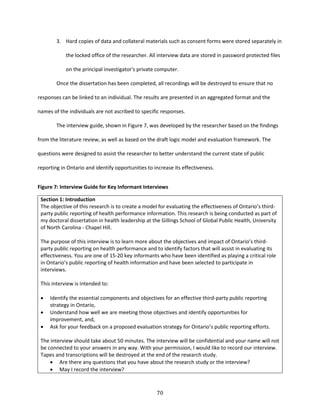
 Readmissions within 30 days for select Case Mix Groups
Between 2011/2012 and 2015/16, the following measures were added:
 Use of surgical safety checklists - publicly reported by HQO
 Use of physical restraints
 In-hospital mortality following major surgery
 Medication reconciliation at admission
Of the 17 measures included in the hospital QIPs, eight are publicly reported by HQO, the
MOHLTC, or CIHI, and these eight measures have shown improvement over time. All eight of these
measures were also publicly-reported prior to the introduction of the hospital QIPs. See Table 8
(excerpted from Appendix C) below which shows the hospital measures in the QIPs, comparing the
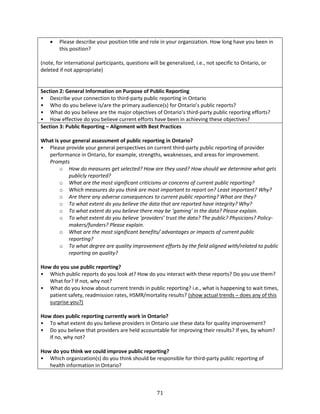
timing for the public reporting and introduction of the measure into the QIPs. For the two QIPs
89
measures reported by the Ministry, both are related to ER wait times and were thus also part of the
priority wait times strategy identified in the previous section.
Results of the analysis show that i) all of the QIP measures are showing improvement, ii) all of
the hospital safety measures publicly reported by HQO, even those that are not part of the QIPs (with
one exception), are showing improvement, iii) where hospital QIP measures are publicly reported,
improved performance started prior to the implementation of hospital QIPs except for Clostridium
difficile rates. Results for C. difficile rates showed improvement in 2008/09, then worsened, then started
improving again in 2012/13, the year after the introduction of QIPs. The researcher additionally notes
that reported use of surgical safety checklists improved significantly in 2010/11, the year prior to the
introduction of QIPs. Although improved performance on both C. difficile rates and use of surgical safety
checklists may be related to the introduction of QIPs, given the performance of the QIP metrics over
time, it was not possible for the researcher to draw any general conclusions about the potential impact
of the hospital QIPs on publicly-reported performance results for hospitals. However, the researcher
was able to confirm that improvements in all the QIP measures have been sustained over time.
90
Table 8: Data Set: Comparison of Hospital Patient Safety Measures Reported by HQO and QIP
Measures (excerpt from Appendix C)
Notes:
 Arrows under ‘Preferred Trend’ column indicate direction of trend line required to achieve improved results.
 Arrows under ‘Actual Trend’ column indicate actual direction of trend line.
o Black arrows indicate that the actual trend is the same as the preferred trend and therefore results have
improved.
o Red arrows indicate that the actual trend is opposite to the preferred trend and therefore results are
worsening
 Reporting period is for public reported data and as applicable, reporting period for QIP and Priority Wait Times
measures (in green)
Measure Preferred
Trend
Actual
Trend
Reporting Period
Clostridium difficile infection rates ↓ ↓ Reported 2008-2014
Hospital QIP measure starting 2011/12
Methicillin resistant Staphylococcus
aureus (MRSA) infection rates
↓ ↓ Reported 2008-2014
No change 2008-2011
Vancomycin resistant Enterococcus
infection rates
↓ ↑ Reported 2008-2014
Central line-associated primary
bloodstream infection
↓ ↓ Reported 2009-2014
Hospital QIP measure starting 2011/12
Ventilator-associated pneumonia ↓ ↓ Reported 2009-2014
Hospital QIP measure starting 2011/12
Surgical site infection prevention ↑ ↑ Reported 2009-2014
Plateaued in 2012
Hand hygiene compliance ↑ ↑ Reported 2009-2014
Hospital QIP measure starting 2011/12
Surgical safety checklist compliance ↑ ↑ Reported 2010-2014
Plateaued in 2011
Hospital QIP measure starting 2012/13
Hospital Standardized Mortality
Ratios (reported by HQO, data
source CIHI)
↓ ↓ Reported 2009-2014
Hospital QIP measure starting 2011/12
Emergency Department wait high
acuity – target 8 hours
(reported by Ministry)
↓ ↓ Reported 2008-2014
Decreasing, but above target
Hospital QIP measure starting 2011/12
Ministry Priority Wait Times Measure
starting 2005
Emergency Department wait low
acuity – target 4 hours
(reported by Ministry)
↓ ↓ Reported 2008-2014
Hospital QIP measure starting 2011/12
Ministry Priority Wait times measure
starting 2005
91
Impact of Organizational-Level Reporting
Evidence from the literature from other jurisdictions indicates that there is greater likelihood of
impact from third-party public reporting of quality measures at an individual institution-level or
physician-level because of the greater potential to inflict reputational damage (Bevan, 2010). Thus, as
part of the quantitative analysis, the researcher initiated a comparison of third-party reporting that is
presented at an individual organization-level versus at an aggregate level to determine if the level of
reporting increases the likelihood of improvement.
 CIHI, HQO and MOHLTC provide publicly reported data at both the organization-level and
aggregate level. Of the eight hospital patient safety measures that are included in HQO’s public
reports, only one is not showing improvement. Four of these measures are also included in
hospital QIPs. CIHI provides comparative reporting for hospitals on approximately a dozen
measures related to quality access/wait times, hospital patient safety, and hospital readmission
rates. Several of these measures, including Emergency Department wait times, hospital
readmissions, and hospital standardized mortality ratios, are also included in hospital QIPs.
 CCO provides publicly reports for some hospitals, where applicable in the Cancer System Quality
Index; however only some of the measures are reported at an individual regional cancer center
level. In addition, as reported previously, CCO has an extensive accountability system that
includes targeted funding, accountability agreements, private reporting, and other activities that
would likely impact performance by individual hospitals. It appears that CCO uses public
reporting in combination with other accountability activities as a means to drive performance
improvement, but does not appear to rely on public reporting alone as a quality improvement
tool.
 For the Ministry wait times measures, as shown in Table 6, most of the publicly reported wait
times measures are showing no improvement or worsening performance over time.
92
Given the above analysis, combined with the impact of external forces such as QIPs and the
priority wait times strategy, the researcher found that it was difficult to form any conclusions about a
possible correlation between organization-level reporting and publicly reported performance results at a
provincial level, except to note that where data were publicly reported and were also combined with
other accountability strategies, they showed a greater likelihood of sustained improvement.
International Comparison
The researcher completed one final analysis with the goal of providing context to Ontario’s
performance. While most international reports are intended to compare results across countries, CIHI
has started reporting comparative results at both national and provincial levels thus allowing the
researcher to compare Ontario’s results to both the Canadian average and with international results.
The purpose of this comparative analysis was not to provide an in-depth comparison of Ontario’s
performance relative to other jurisdictions, but simply to provide some additional context to the
quantitative results. Using CIHI’s interactive, publicly-reported tool for comparing health system
performance across OECD countries21
, the researcher was able to compare Ontario’s performance with
an average of OECD countries. In addition to measures of population health, primary care, and social
determinants of health, the CIHI website included 20 OECD measures for hospitals across three relevant
domains – patient safety, quality of care, and access to care. The comparative results are summarized in
Table 9.
21
https://www.cihi.ca/en/health-system-performance/performance-reporting/international/oecd-interactive-
tool-access-to-care (accessed January 31, 2016)
93
Table 9: Comparative Results - Ontario vs OECD Average
Category Measure Ontario’s Performance
Compared to OECD Average
(+ = better than average,
- = worse than average)
Patient Safety
Foreign object left in (after surgery)
-
Post-Operative Pulmonary Embolism
– Hip and Knee Surgery
-
Post-Operative Deep Vein
Thrombosis - Hip and Knee Surgery
+
Post-Operative Sepsis – Abdominal
Surgery
+
Obstetrical Trauma (related to an
instrument)
-
Obstetrical Trauma (not-related to an
instrument)
-
Quality of Care
Breast Cancer Screening +
Breast Cancer Survival +
Breast Cancer Mortality
-
Cervical Cancer Screening +
Cervical Cancer Survival +
Cervical Cancer Mortality +
Colorectal Cancer Survival +
Colorectal Cancer Mortality +
30-day In-Hospital Mortality – Acute
Myocardial Infarct
+
30-day In-Hospital Mortality –
Ischemic Stroke
-
Access to Care
Wait Time: Cataract Surgery +
Wait Time: Hip Replacement Surgery +
Wait Time: Knee Replacement
Surgery
+
Wait Time: Specialist
-
94
It is important to note that the number of countries included in the international OECD average
varied by indicator, ranging from as few as nine countries, to as many as 27. In addition, the countries
include both developed and developing nations, with significant variation in their overall health system
performance. This means that Ontario’s performance relative to the OECD average could vary
depending on which countries were included in the measurement. Despite this variable factor, the
researcher felt that the comparison provided useful context for Ontario’s performance on these three
domains of quality.
From the review of the results, the researcher found that Ontario:
 Performs above the OECD average on 13 (65%) of the 20 measures;
 Performs proportionately better on measures related to quality of care and access, as compared
to patient safety;
 Performs well in measures related to cancer treatment, with seven of eight measures showing
results better than the OECD average; and,
 Performs better than the OECD average in measures that are aligned with its cancer strategy
and wait times strategy (cataract, hip replacement, and knee replacement).
95
Summary of Qualitative Results
The purpose of the qualitative research was to learn more about the objectives and impact of
Ontario’s third-party public reporting on health performance and to identify factors that would assist in
evaluating its effectiveness. The researcher conducted key informant interviews with 17 individuals
representing different perspectives on public reporting. The researcher found that 17 interviews
provided a sufficient response population to achieve data saturation.
Responses were coded according to the themes used in the qualitative interview tool, per the
methodology described previously. Reports were then generated for each code using NVivo’s ‘node’
functionality. This enabled the researcher to systematically analyze and report on the information
collected from the key informant interviews. Analysis was conducted using the codes identified in Table
4. In order to be identified as a research finding, a response had to be mentioned by two or more
individuals or, if mentioned only once, had to have strong face validity.
Findings were prioritized based on the strength of evidence (for instance, mentioned by multiple
interviewees or issues having strong face validity) and were categorized and sequenced according to the
codes developed from the topics discussed in the interview tool. Potentially identifiable information
within the comments from interviewees was blanked out when included in the analysis, for example,
where an individual referenced his or her workplace.
The following is a high level summary of the more detailed findings found in the subsequent
sections:
 The audience for public reports in Ontario is primarily health care delivery organizations, rather
than the public, physicians or funders;
 There are no stated objectives for public reporting, although most respondents indicated that
accountability and transparency, rather than quality improvement, are the primary goals for
public reporting;
96
 Public reporting on its own does not currently drive quality improvement;
 There are ways to make public reporting more effective;
 Publicly reported measures are primarily selected by panels of experts or political/government
interests. Key informants indicated that greater transparency is needed in this process and
patients and the public need to be more engaged in identifying measures that are important to
them;
 There are no significant adverse consequences to public reporting, but there are concerns and
criticisms;
 Data quality is important, yet there are ongoing data quality issues for information that is
publicly reported;
 A more coordinated and systematic approach to public reporting is required, including
alignment with health system priorities;
 Public reporting should be centralized and HQO is ideally positioned to assume this
responsibility;
 Target setting is important, and there are both opportunities and challenges to setting
appropriate targets;
 Comparison of results to other jurisdictions is valuable, but there are challenges to doing this
effectively;
 There should be more public engagement in public reporting; and,
 Public reporting efforts should be evaluated.
The following sections summarize the findings from the interviews and also identify any
differences in responses between the groups of key informants: producers of publicly reported
data/funders, health system providers, and other stakeholders (patient advocates, media, researchers,
97
etc.) who are engaged with public reporting. A summary table of the key sub-themes from the
responses is provided at the end of each section. The summary tables are used to show alignment
between the sub-themes and the different groups of interviewees. Within the summary tables, ‘x’s are
used to denote where at least two individuals from the same interview group commented on a
particular sub-theme.
1. Audiences
Overall, the key informants identified that understanding the audience for public reporting is a
significant issue. Interviewees either identified a lack of clarity about who the audience is for current
public reporting or indicated that the intended audience (i.e., the public) was not the actual audience;
stakeholders categorized as “other”, such as media or patient advocates, were more likely to indicate
that the public is an intended audience. One interviewee, who works for an organization that produces
public reports, summed up this perspective by stating:
“So, in my experience, that is always the issue, that is always the root issue of every report that
we have ever done…I think the audience we are accountable to is the public but who actually
uses it is the field…when I worked at (name of organization), I didn’t actually know who the
audience was...I was just doing a report.” (comment from reporting agency)
Audiences were variously identified as system-users, providers, boards of directors, and policy-
makers, but it was noted that there is a variation in uptake of public reports by these different
audiences, and that there are also overlaps and sub-groups within these audiences, for example,
patients can be viewed as a sub-group of the public. In almost all cases, reporting agencies and providers
stated that while reporting agencies are accountable to the public as their audience, it is the
field/providers who are the true audience and who actually use the data. Additional sub-themes that
arose around the topic of ‘audience’ included lack of public interest, the media as an audience, and
general cynicism about the true audience and purpose of public reports. These additional themes are
described further below.
98
Representatives from all of the interviewed groups commented that the public is generally not
interested, but many offered further explanations that this apparent disinterest may result from a lack
of engagement of the public in the process and because reports are not presented in a way that is
meaningful to them.
“The cynical side of me would say that that for the most part, they (the public) are not interested
and probably they are not going to understand the detail of the data and that’s for the most part
if we’re not doing a good job of presenting it in a way they can understand it.” (comment from
reporting agency)
In addition, it is difficult for the public to find the information or to even become aware that it
exists. One health system provider raised the issue that even when the public does access public
reports, that access is not equitable to all members of the public.
“It’s also out there for a few advocates or the privileged, in terms of those who know enough to
go and look it up. So, as to my notion of public reporting is that we should aim at (getting) it to
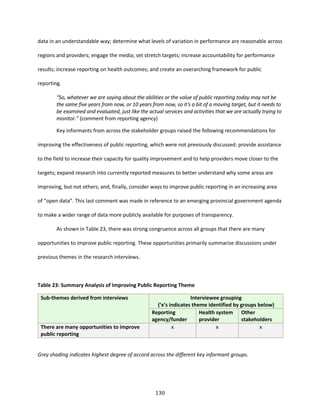
the public, which means that we need a number of vehicles so … that people don’t have to work
as hard to get it.” (comment from provider)
Producers of public reports and providers commented on the media as an audience, primarily
with the perspective that the media look to use the data for negative stories. Both of these interview
groups further noted that the media plays an important role as an interpreter for the public.
“We’re always worried about “okay, what is the media going to say once these things come
out?”….They’re the ones who then take that…accountability type of data that the average
person can’t understand and tries to turn it into usually a negative story. Not always, but they’re
trying to be that interpreter for the public, and so that’s a good role for them to play.” (comment
from a provider)
and
“They (the public) will take a hook when somebody like the CBC writes a report and puts it on the
front page and tells them why it matters to them, but I think that sort of general (reporting), like
the mandatory government-initiated reporting is really for system managers.” (comment from
reporting agency)
All interviewed groups indicated cynicism about the audiences and the intentions of public
reporting. Producers of the data were more likely to express concern that the government’s intention
99
was to be able to say they are increasing accountability and transparency to the public while knowing
that the public does not actually view the reports.
“I think public reporting has different intentions depending on how you are trying to do it. I think
there is an accountability aspect, so where governments and/or agencies feel this information
has to be available, that quite often it’s not in a usable form in any stretch of the imagination.”
(comment from reporting agency)
and
“I suspect it’s probably a lot of ‘I need to cover my (expletive)’ from the government point of
view.” (comment from reporting agency)
At least one provider expressed the view that the government used providers’ concerns about
reputational damage as a means to prompt improvement.
“The audience is health service providers. Mostly it is put out there to embarrass them or to
provide some information that the public will react or respond to.” (comment from provider)
Table 10 summarizes the sub-themes that emerged under the topic of audience. The strongest
area of congruence across all groups was related to cynicism about public reporting, including the
audience and related purpose for public reporting. Reporting agencies and health system users were
more likely to indicate that providers are the “real” audience for public reports and that the public is not
interested.
Table 10: Summary Analysis of Audience Theme
Sub-themes derived from interviews Interviewee grouping
(‘x’s indicates theme identified by groups below)
Reporting
agency/funder
Health system
provider
Other
stakeholders
Lack of clarity of who audience is x x -
Lack of public interest x x -
Role of media x x -
Cynicism about true purpose/audience
for public reporting
x x x
Grey shading indicates highest degree of accord across the different key informant groups.
100
2. Objectives of Public Reporting
Several interviewees indicated that the primary challenge related to the topic of objectives was
the lack of articulated goals for public reporting. It was further indicated that it would be important to
decide on the objectives and purpose, because the multiple audiences and objectives make it difficult to
effectively design and present public reports.
“I think that the premise that public reporting had a specific goal, I don't think is true”.
(comment from reporting agency)
Overall, the research participants indicated that they believe that the key objectives for public
reporting are to increase accountability and transparency, although one individual argued that it is
primarily accountability because having transparency would mean that the public actually understands
the information. Three individuals identified a trend towards a quality improvement focus, while others
explicitly stated that quality improvement was not a current objective. Additional sub-themes were that
public reporting could add more value if it was better aligned with health system priorities and/or if
there was a strategy or conceptual framework for public reporting in Ontario, and that there are
challenges in differentiating objectives for improvement and accountability.
The researcher notes that there is some alignment and overlap in the discussions of “audiences”
in the previous section and “objectives” for public reporting in this section. Comments from two
interviewees underscore the link between understanding the audiences and the objectives.
“The audience could be everybody, but it’s not often clear when it’s a government-run public
reporting system, whether it’s done for the generic goal of creating trust through transparency
or whether it’s also done to optimize the possibility for choice.” (comment from ‘other’
stakeholder)
and
“What are the ways in which you assess? Researchers would say we need as much info as
possible. Politicians would say we need to be as transparent as possible. Patients would say I
need to know what’s going on. What’s the right information and what’s the right reason behind
this?” (comment from provider)
101
Across different jurisdictions, public reporting is often done with the intention of driving
improved quality. As was discussed in the literature review, evidence supporting public reporting as a
driver of improved quality is mixed. Similarly, from the interviews, perspectives on whether or not the
purpose of public reporting is to improve quality were also mixed. Producers of the data were much
more likely than other groups to indicate that one of the objectives for public reporting is to improve
quality, but even among the producers of the data, there was disagreement on this as an objective.
Several interviewees indicated that we do not have the circumstances in place for public reporting to
drive improved quality.
“If you want to have improvement as a goal there, that kind of assumes you have a notion of a
pathway that through mobilizing public opinion you could change behavior of leadership in
hospitals and because of the public pressure they start changing something. And of course, we
have the literature from the UK about reputation damage and how it influences performance.
That is a different strategy than providing regular feedback to hospitals on a broader set of
indicators, because for public reporting you’re usually interested in outcomes and high level
notions and for your improvements, they are less actionable”. (comment from ‘other’
stakeholder)
and
“Now, the interesting discussion is how do you link performance, public reporting for
transparency and accountability to a performance improvement agenda and, more broadly, to a
performance management agenda?” (comment from reporting agency)
Only one person cited a specific example of where public reporting was established with an
objective to change provider behavior, but not necessarily performance. This reference was to the
establishment of ICES in the 1990s (described earlier in Table 1: Organizations Responsible for Third-
Party Reporting of Health Information in Ontario). This interviewee made reference to the lack of levers
for public reporting to drive improved quality that was also referenced by others.
“Back then, the idea was that just knowing the information would inform behavior change. (In
reference to ICES’ reporting of hysterectomy and Caesarean rates) The further you were from a
hospital, the more likely you were to have an extreme procedure. (Did) having those rates public
change behavior? Well it changed the public’s information and understanding of it…So it did
start to inform behavior change. Then, like now, the ability to force behavior change, the levers
didn’t exist and they still don’t exist. We still use the tools to manage performance and to
persuade, to encourage; transparency has a shaming quality as well. So I think the intent back
102
then was more about using the information on both sides. Inform the public so they can make
more informed choices and also inform physicians that what you’re doing is different.”
(comment from provider)
Despite the lack of consensus about using public reporting to drive improved quality, at least
three of the interviewees spoke about shifting to a quality improvement focus, using comparative data
(although not necessarily publicly-reported data) to assist with this.
“that's where I see things going in the next five years having more… either not directed or self-
organized networks of organizations and regional health authorities working together on similar
performance issues, trying to understand what are the drivers of performance and what they can
do to improve and building that on best evidence and data and really trying to compare one
another, with lots of rich contextual information.” (comment from reporting agency)
One interviewee, who works for an agency that produces public reports, referenced seeing
greater clarity in direction for quality improvement through the Ontario Minister of Health and Long-
Term Care’s recent Action Plan22
and mandate letters23
to the Ministry staff and agencies. This linked to
the sub-theme of having a strategy or conceptual framework for public reporting, in particular to help
define the purpose of public reporting. This sub-theme was particularly mentioned by individuals with
experience working with public reports.
“So you start with a conceptual framework to see if what I’m measuring is what I really want to
measure.” (comment from an ‘other stakeholder’)
and
“In designing this, for me it would be key to have a clear understanding up front about what is it
we are trying to accomplish, and who do we need to have the conversation with to make sure
that we have the information there. I think the weakness of some of the public reports has
always been that we just dump (in) indicators based on availability just because you have the
data available.” (comment from reporting agency)
22 In February 2015, the Ontario Minister of Health and Long-Term Care launched a ‘Patients First: Action Plan for Health Care”,
a blueprint for health system reform and priorities for Ontario.
23 Mandate letters are documents provided by a head of government, in this case the Premier of Ontario, to Ministers outlining
the key priorities for their respective Ministries.
103
The sub-theme on a strategy for public reporting also emerged in other topic areas, such as
“opportunities for improvement” and “alignment with priorities”. These are discussed in subsequent
sections.
Finally, both producers of public reports and providers spoke about confusion in the objectives
for public reporting related to improvement versus accountability; there were differing opinions as to
whether these should be separate objectives or not. This discussion was particularly important with
respect to circumstances in which measures and targets chosen by providers for their QIPs were then
placed by funders into accountability agreements. This was cited by both providers and producers of
public reports as a disincentive for providers to use stretch targets in their local reporting. One producer
of public reports felt that the solution to this was to make the objectives of public reporting clearer.
Table 11 summarizes the sub-themes that emerged under the topic of objectives. The strongest
area of congruence across all groups was related to accountability and transparency as the primary,
although not formally articulated, goals for public reporting.
Table 11: Summary Analysis of Objective Theme
Sub-themes derived from interviews Interviewee grouping
(‘x’s indicates theme identified by groups below)
Reporting
agency/funder
Health system
provider
Other
stakeholders
Lack of articulated goals for public
reporting
x x -
Accountability and transparency as goals x x X
Quality improvement goal x - -
Need for public reporting
strategy/alignment with priorities
x - X
There is confusion between improvement
and accountability as objectives for public
reporting
x x -
Grey shading indicates highest degree of accord across the different key informant groups.
104
3. Effectiveness of Public Reporting
Given that the key informants were interested in participating in this study because of its topic
on the effectiveness of public reporting, it is not surprising that all of the participating individuals had
extensive comments on the issue of effectiveness. Key informants had mixed perspectives on the value
and effectiveness of public reporting. For example, when asked about overall impressions on the
effectiveness of current public reporting efforts, one interviewee who works for an agency that
produces public reports indicated that, “I think we don’t really know is the first answer”.
The most common sub-themes that emerged were: public reporting on its own does not drive
improvement; public reporting is only effective if providers are held to account for their performance;
and that there are many ways to make public reporting more effective, with several interviewees
highlighting evaluation as a means to improve effectiveness.
During the interviews, after the key informants provided their initial perspectives on the
effectiveness of public reporting, the researcher shared the quantitative results of the trending analysis
and used that information to draw deeper commentary on where there had been improvement or lack
of improvement in public reporting, and to obtain feedback from interviewees on why they thought
some indicators showed improvement and others not.
The two most common sub-themes on the topic of effectiveness are related. The first is the sub-
theme that public reporting on its own is not sufficient to drive improvement. The second is that public
reporting can only be effective if there is an accountability mechanism that drives providers to improve
their performance. All of the interviewees spoke about one or both of these sub-themes, and both
producers of public reports and health system providers shared specific examples of where public
reporting performance had improved:
“The focus on hip and knees in QBPs (reference to provincial payment for quality-based
procedures for hip and knee replacement surgery)…two years ago we were going to set the
average length of stay in acute care at best practice of 4.4 days. Well, because we've been
105
focused on it already for the past few years, by December 2013, it was already down to 3.6, so if
we had actually set a price based on 4.4, we would have been way overpaying everybody.”
(comment from reporting agency)
or had not improved:
“I think ALC (alternate level of care) is a perfect example of that. ALC has not improved…it never
moves and as a system, I think these things all come back to accountability and leadership in
terms of where they go.” (comment from reporting agency)
Producers of public reports were much more likely than other groups to be critical of the lack of
accountability in the system for changing behaviors and driving providers to make improvements.
“The…problem is that we draw the line at performance reporting and we don’t go into the most
important element, which is performance management.” (comment from reporting agency)
The common point in the discussions was that there appears to be a positive correlation
between public reporting and the use of accountability mechanisms. At least four individuals, both
producers of public reports and other stakeholders, cited emergency department wait times as a
successful example of the combined impact of public reporting and providers being held accountable for
improvement.
“So that's just what that focus can do and to me, that's the value of the public reporting. If we
can get focused in the government to say again like they did with ER (emergency room), “Here's
what we're going to focus on. Here’s what we want people to put their time and effort into and
here's what we're going to fund as a government”, you can move things.” (comment from
reporting agency)
Two interviewees, both from agencies that produce public reports, indicated that there is too
much information that is publicly reported, making it hard for providers to understand what measures
they should pay attention to.
“Why would anybody do an initiative just because it’s on page 163 of (name of public report)?”.
(comment from reporting agency)
and
“There’s more and more stuff out there, but it’s not organized, it’s not centralized, and it’s
inconsistent.” (comment from reporting agency)
106
One individual commented that it’s not the public reports that drive improvement or motivate
providers that are truly interested in quality:
“I think no providers would be using these publicly reported, public domain kind of reports for
any kind of action. That said, I think many, many good providers are using lots of indicators to
monitor and improve their own organizational performance and many of those happen to be the
same, for obvious and non-obvious reasons, as the publicly reported indicators.” (comment from
reporting agency)
In addition, this same individual cited several examples of hospitals, long-term care homes, and
home care providers that are very sophisticated in their use of data to drive improvement. He further
noted that he did not believe there was a link between public reporting and improvement in these high-
performing organizations.
Two interviewees, one from an agency that produces public reports and one from the “other
stakeholder” group, spoke about the lack of effectiveness in reaching public audiences, noting the lack
of value for the public and the fact that it is unlikely to impact patient behavior. Both individuals
attributed this to the fact that what is publicly reported is not what is useful or meaningful for patients.
“It depends what's being measured. You know, readmissions, that's something that is
meaningful, wait times are meaningful, but is that conveyed to them and really does it impact
their care? It won't be meaningful unless it impacts them on a personal level or their family
members”. (comment from “other stakeholder”)
and
“If it is different audiences then you need to design differently and I think that the most beautiful
example is (the) wait times website. It's a horrible website for patients. Like, if I'm a patient it
doesn't tell me at all how long and where do I have to wait and which hospital should I go to. The
same with the patient safety one, it doesn't really help me as a patient and say, ‘Oh God, this is a
terrible hospital. If I go in that hospital, I have a risk of about 90% of being killed.’” (comment
from reporting agency)
All interviewees shared their perspectives on how public reporting can be made more effective,
suggesting the following changes: increase focus on critical areas of health system performance (primary
care was given as an example); ensure that measures are actionable for providers; add context to
reports; engage the media; align public reports with health system priorities; build a quality
107
improvement culture; and, ensure that providers are held accountable for improvement. Several
interviewees indicated the need to evaluate public reporting in order to better understand the degree to
which it is effective.
“This is the most un-research-informed comment to make, but I do feel that it is the right thing
to do. It’s just that we have to know how to do it most effectively and efficiently so that we are
getting the most bang for what we do.” (comment from reporting agency)
Table 12 summarizes the sub-themes that emerged under the topic of effectiveness. The
strongest areas of congruence across all groups were for the sub-themes ‘public reporting on its own
does not drive improvement’ and that ‘there are ways to make public reporting more effective’.
Table 12: Summary Analysis of Effectiveness Theme
Sub-themes derived from interviews Interviewee grouping
(‘x’s indicates theme identified by groups below)
Reporting
agency/funder
Health system
provider
Other
stakeholders
Public reporting on its own does not
drive improvement
x x x
Need to hold providers accountable x x -
There are ways to make public
reporting more effective
x x x
Grey shading indicates highest degree of accord across the different key informant groups.
4. Determining what gets reported
Key informants generally agreed that the theme of how publicly reported measures get selected
and by whom was important. The most consistent responses to the question related to how we
determine what gets public reported were “panels of experts” or “political/government interests”. The
government’s wait times strategy was cited as an example of how the government drives public
reporting. Respondents from all of the interview groups indicated that greater transparency in the
selection of measures is required and that the system needs to involve patients and/or the public
because much of what is currently public reported does not matter to them. Providers additionally
108
commented that the system is more likely to report on measures that are readily available versus
measures that are actually important.
“I think you bring patients and caregivers around the table and have that discussion. What is
meaningful, what would make a difference, what do you want to see measured? You are the
consumers of the care, of the services---with providers, because it's important, it’s got to work
for both. I'm not just all about the patient or all about the provider. I think there has to be a
balance to make it a partnership and see what resonates with both”. (comment from “other
stakeholder”)
All respondents from reporting agencies indicated that they have used expert panels to
determine what they should report; however, one interviewee from a reporting agency commented that
this did not necessarily indicate that there was scientific evidence underlying the selection process.
Providers were more likely to offer criticism about the selection of measures.
“Right now, measures get selected from what exists, just what happens to be there. They are not
necessarily relevant, not necessarily the best measure. They start with what’s available and
what’s available was first collected for a different purpose.” (comment from provider)
Providers were also more likely to comment on the role of government in selecting measures.
“So my recollection of the (name of indicator), there were a couple of factors that drove the
public reporting. I would say incenting the right behavior or improving performance and
informing patients were not at the top of the list. At the top of the list was ‘the public needs to
know how bad it is’, and that was a political pressure that was happening…But on the political
side there’s a lot of debate about it and a lack of understanding of the value of it.” (comment
from a provider)
Producers of public reports were more likely than other interview groups to indicate that
processes are changing and there is a trend towards greater transparency in the process for selecting
measures, as well as involvement by broader groups of stakeholders, including patients and the public. It
was recognized that more work needs to be done in this area. Where producers of public reports had
engaged patients or the broader community, they indicated that it had an impact on how they thought
about public reporting, but did not actually state that the reporting had changed as a result.
“(I) do think of that citizens’ panel thing that I had when they sat and talked about the patient
experience ... It actually did affect the way I think about it and think that it's not just what
percentage of people die, what percentage of people get an infection, what percentage of
people…but it should also be what kind of experience do patients get? Do they feel like they’re
109
treated with dignity? And I think that should be part of public reporting and I think a lot of
people in the system don't think that that's that important.” (comment from reporting agency)
Providers and other stakeholders were more likely to indicate that what is publicly reported is
not necessarily what matters most to people. In addition, providers and other stakeholders were more
likely to offer criticism about the utility of the measures that are reported, citing hospital-standardized
mortality ratios, hand-washing rates, ventilator-assisted pneumonia rates, and surgical-safety checklists
as specific examples of measures that are either not actionable, not reliable, or should no longer be
publicly reported because the performance is consistently high. It was noted that there needs to be a
process to stop reporting things that do not add value.
Table 13 summarizes the sub-themes that emerged under the topic of determining what gets
reported. The strongest areas of congruence across all groups were that expert panels and government
interests/priorities drive current public reporting measures, that there is a need for greater
transparency in how measures are chosen, and that patients and the public should be involved in the
selection of measures for public reporting.
Table 13: Summary Analysis of Determining-what-gets-reported Theme
Sub-Themes derived from interviews Interviewee grouping
(‘x’s indicates theme identified by groups below)
Reporting
agency/funder
Health system
provider
Other
stakeholders
Panels of experts or political/government
interests primarily determine what gets
reported
x x x
Greater transparency is needed x x x
Increasing transparency and involvement of
broader stakeholders is starting
x - -
Patients and the public need to be involved
in identifying measures that are important
to them
x x x
Data that are readily available are most
often what gets reported
- x -
Grey shading indicates highest degree of accord across the different key informant groups.
110
5. Adverse Consequences and Criticisms
No significant adverse consequences were identified by any interviewee; however all groups of
interviewees identified potential areas of criticism or concern related to public reporting. There was
limited overlap in concerns expressed by the different interview groups. Interestingly, the largest
number of criticisms and concerns were voiced by organizations that produce public reports, and
included: gaming of measures, particularly where they are tied to compensation or funding (for
example, QIPs and Quality-Based Procedures); that the large number of measures results in a lack of
focus; lack of appropriate case mix adjustments; questions about the return on investment for the
significant effort associated with public reporting; negative attention from media and politicians,
including providers being penalized for honesty and transparency; lack of political will and/or holding to
account; and poor data quality. The following are sample comments that reflect how producers of public
reports view these issues:
“Physicians will always say that my patient is sicker etc,. and you can't adequately adjust.
They're very afraid, I think if they are not looking good and doctors still are a pretty powerful
group in the system.”(comment from reporting agency)
and
“You know every government says they want to measure and report until they look at what's
going to be measured and reported and then they go like “Oh, my God, it's not the greatest
system in the world and the (political) opposition is just going to go nuts on this one”. So I don't
think again it's a reason not to report.” (comment from reporting agency)
Other stakeholders cited a few additional concerns, including lack of completeness of public
reporting, i.e., the inability to provide reports on important areas for which no data are available;
presentation of reports and lack of context; the health system’s fear of having to change practice
(hospitals and physicians); and lack of organization and centralization of public reporting. Similar to
agencies that produce public reports, the other stakeholders also indicated concerns about data quality
and gaming by providers, as shown by the following comments:
111
“To be clear, I’m in favor of public reporting and nothing should be hidden. But my main worry
lies in the correct interpretation of the data---and that is a challenge in how you present them---
but also having sufficient context knowledge to make sense of it. If I just aggregate all the
information in a compound and I produce a list of surgeons and say these ones are red, yellow
and green (quality rating), then I think you do them an injustice. Because then the inference is
this is a good surgeon, this is a bad surgeon. Well, that’s a very big thing to say. Is that really
true?” (comment from ‘other stakeholder’)
and
“I'm sure you can identify certain data elements where there's a potential for gaming and that's
why you've got to select your indicators in a way that suggests that you don't include those kind
of indicators in public reporting, like, for example, the handwashing. (The) hospital is doing an
audit of an area and tells people in advance “we’re going to be auditing you tomorrow about
your handwashing” and then why would you accept handwashing as a good indicator? And
that's exactly what's going on in this province.” (comment from ‘other stakeholder’)
Providers were less likely to voice concerns, but two potential risks that providers specifically
mentioned were that public reporting may drive negative behaviors and fear of negative media
attention.
“Public reporting on hip and knee has been a fascinating kind of journey driving all kinds of
bizarre performance behaviors---very little of it improving wait times. And nobody really
understanding what’s behind it. The majority of delays in hip and knee have to do with physician
preference and (patients preferring to spend) winters in Florida.” (comment from provider)
Several producers of public reports commented that the potential for adverse consequences
should not be a reason for not doing public reporting and cited examples of how to mitigate risks,
including close monitoring of performance, using coding standards, and removing measures that can be
more easily gamed. Handwashing rates were cited by several interviewees as a specific example of
measures that are gamed as they are self-reported by providers and cannot be validated by reporting
agencies. Table 14 summarizes the sub-themes that emerged under the topic of adverse consequences.
The strongest areas of congruence across all groups were that there are no significant adverse
consequences related to public reporting, but there are multiple concerns and criticisms. In general, the
concerns and criticisms varied by interview group.
112
Table 14: Summary Analysis of Adverse Consequences Theme
Sub-Themes derived from interviews Interviewee grouping
(‘x’s indicates theme identified by groups below)
Reporting
agency/funder
Health system
provider
Other
stakeholders
There are no significant adverse
consequences to public reporting
x x x
There are potential areas of concern or
criticism (multiple examples cited)
x x x
It is possible to mitigate the risks x - -
Grey shading indicates highest degree of accord across the different key informant groups.
6. Data Quality
On the theme of data quality, there was general consensus by all interview groups that
stakeholders must be able to trust the information. One interviewee from an agency responsible for
public reporting stated that he believes there is a correlation between trust in the data and the
desirability of the outcome; in other words, providers were more likely to criticize the data quality and
methods when the results were not favorable to them, particularly in situations where it impacts their
funding. Several producers of public reports also expressed frustration about the ongoing dialogue on
data quality, for example:
So I've been now for 10 years in (place name) and I still have the same discussions about the same
type of indicators and the same data, and every time the discussion ends with “we need better
data”. YES, WE NEED BETTER DATA!” (comment from reporting agency)
Similar to the discussions on the theme of adverse consequences, data quality was
acknowledged as an issue, but it was also noted that poor data quality should not be a barrier to public
reporting. Examples of data quality issues that were specifically mentioned included: incomplete data
sets and lack of available data in critical areas; quality of the underlying databases and variability in data
integrity; gaming of results, particularly with respect to self-reported measures, such as hand-washing;
delays in availability of data; variation in data rigour across different reporting agencies; inconsistency in
definitions across reporting agencies; and lack of appropriate risk adjustments.
113
Producers of public reports were more likely to provide specific examples of data integrity issues
based on their own experiences with the data. The following comments were provided from individuals
working for different reporting agencies:
“I think it depends on the data source, so obviously I think Ontario has very disconnected data
sources, very siloed, very sector-based data sources, and I think that’s just the legacy of the
system we have. But each data source, depending on its owner, has different data integrity and
data quality and I think certainly the more we use it for funding, the more important data quality
becomes.” (comment from reporting agency)
and
“So the data is poor, it's totally scattered; we’re mixing indicators for QI (quality improvement)
(with) indicators for public reporting. We have inconsistent use of definitions. So, readmission 28
days, readmission 30 days, readmission all cause, readmission for select CMGs (case mix groups)
so we are inconsistent in the definitions.” (comment from reporting agency)
Other stakeholders, such as media or patient advocates, were more likely to express cynicism
about the integrity of the reports for the public.
“I think, in Ontario, they report in such a way, they put the best spin on it they can. They are
putting numbers out there, but they are putting out the best possible numbers because there are
many different ways to report emergency room wait times, and many different ways to report
hospital infection rates and so they are making it look as good as they can…” (comment from
“other stakeholder”)
Among providers, it was particularly noted that physicians tend to be the most skeptical about
data integrity, particularly with respect to case mix adjustments.
All interviewees from agencies responsible for public reporting commented on mitigation
strategies to address data quality issues and how potential data integrity issues were dealt with by their
respective organizations. Two of these interviewees specifically commented that trends and variations
are the most critical aspect, as opposed to specific performance results; one of these individuals stated,
“I pay a lot of attention to something very specific that I call signal versus noise.”
Examples of mitigation strategies used by reporting agencies include:
 having dedicated analysts who work with providers, for example, to understand and
apply coding standards;
114
 using validity checks; and
 paying increased attention to variation in data and trends over time.
One provider mentioned extending the use of electronic health records and electronic medical
records, as well as increasing linkages between data sets as opportunities to further improve data
quality in the future.
Table 15 summarizes the sub-themes that emerged under the topic of data quality. The
strongest areas of congruence across all groups were that data quality is important---and increasingly
important where funding is at risk---and that there are data quality issues. Producers of public reports
were more likely both to offer examples of data quality issues and to identify opportunities to mitigate
or improve data quality.
Table 15: Summary Analysis of Data Quality Theme
Sub-themes derived from interviews Interviewee grouping
(‘x’s indicates theme identified by groups below)
Reporting
agency/funder
Health system
provider
Other
stakeholders
Data quality is important x x X
There are data quality issues for information
that is publicly reported
x x X
It is possible to mitigate/improve data
quality
x - -
Grey shading indicates highest degree of accord across the different key informant groups.
7. Alignment with Priorities
Under this theme, the researcher asked interviewees about the degree to which they believe
that public reporting is aligned with health system priorities. Responses on this topic were more likely to
come from producers of public reports and providers than other stakeholders, a group from which only
one individual commented. Key informants generally responded with feedback about the lack of
alignment between health system priorities and public reporting. Several interviewees spoke about the
115
significant number of measures that are publicly reported and one referred to the situation as “indicator
chaos”. There was further consensus on the need for a conceptual framework and/or a more
coordinated performance measurement approach for the province that would help providers
understand where to focus. One interviewee from an agency that produces public reports made the
following remark:
“We have too much, we’re not using it. It's asking too much of the system and as you know when
you ask them to focus on 40 different things, you can't. It’s not possible.” (comment from
reporting agency)
One individual from a provider organization added that it is not just public reporting that should
be aligned to the system priorities, but all of the accountability mechanisms, including quality-based
procedures, quality improvement plans, and accountability agreements between providers and the
LHINs.
Two individuals, both of whom have significant health leadership experience, spoke extensively
about the fact that if something is clearly a government priority and there is clear organizational
accountability for improvement, then there will be improvement in performance results. One of these
interviewees provided examples of indicators that are reported, but for which there is no clear
accountability for improvement, including diabetes, infant mortality, and smoking cessation.
“I mean there are some things organizations can do on their own, but there are other things that
are beyond individual organizations’ capability to do on their own and therefore those kind of
indicators tend to just lie fallow...I'll give you a couple of examples. The indicators around
diabetes…weren't really improving all that much in this province because there was no
organization that had direct accountability for doing anything about it.”
Table 16 summarizes the sub-themes that emerged under the topic of alignment with priorities.
The strongest area of congruence across all groups (noting that only one person in the other stakeholder
group commented on this section) was that current public reporting efforts are not aligned with health
system priorities. Among the producers of public reports and providers, there was consensus that the
large number of measures makes it difficult to understand where the health system should be focused
116
and that a more coordinated approach is needed. The Minister’s Action Plan, a recently announced set
of priorities for Ontario’s health system, was recommended as a place to start for the system to align
priorities and public reporting on health system performance.
Table 16: Summary Analysis of Alignment with Priorities Theme
Sub-themes derived from interviews Interviewee grouping
(‘x’s indicates theme identified by groups below)
Reporting
agency/funder
Health system
provider
Other
stakeholders
Public reporting is not aligned with health
system priorities
x x x
There are too many reported measures,
resulting in a lack of focus
x x -
A more coordinated approach is required x x -
Grey shading indicates highest degree of accord across the different key informant groups.
8. Alignment of Incentives
Under this theme, the researcher asked key informants about the degree to which they believe
there is alignment of incentives, such as salary compensation and organizational funding, with
performance on publicly-reported measures. Feedback from interviewees generally centered around
three viewpoints; incentives are not aligned, there are challenges to aligning incentives appropriately,
and there is a lack of accountability in the system.
Both reporting agencies and providers gave feedback as to why they felt that the current pay-
for-performance24
approach for executives does not work. This was discussed in reference to Ontario’s
Excellent Care for All Act (2010), which, among other quality improvement strategies, links hospital
executive compensation to performance on quality measures. Reasons given as to why the current
incentive system does not work included: lack of control by hospital executives over physician
24 Pay-for-performance is a compensation strategy in which total salary is commensurate with achievement of performance
targets.
117
performance on quality; legislated public sector salary freezes, including a comment from one individual
that the public sector compensation framework in Ontario needs to be over-hauled; and the potential
for gaming or choosing targets that are easier to meet when the targets are tied to salary compensation
in hospitals.
“It’s a little bit naïve impression that the hospital executive runs the hospital...they (are) only one
part of the hospital. Still think about getting the clinician on board…It's great as a first step, but I
think ultimately we have to have (an) all physician-wide approach or system that says everybody
has skin in the game. I think that is where you get more effects than just picking one group or
one part of the chain. No matter how helpful hospital CEOs are, there is a limitation of power
also because physicians…are independent.” (comment from reporting agency)
Also on the topic of individual pay-for-performance, one interviewee gave an additional
example of how incentives were misjudged when the province invested in primary care doctors to
increase enrollment, but there was no improvement in the percentage of patients who can see their
primary care doctor in 24 hours, which was one of the MOHLTC’s intended outcomes for the additional
investment in physician compensation over the last five years.
Producers of public reports spoke about other types of incentives, giving examples such as
organizational funding tied to quality-based procedures and the work by CCO on funding agreements
tied to performance on the cancer system quality index. The cancer system quality index was
established in 2010 by the Cancer Quality Council of Ontario, an arm’s length advisory council to CCO
that provides advice to both CCO and the MOHLTC to support their efforts to improve the quality of
cancer care in Ontario. The success of CCO’s accountability initiatives were offered by several
interviewees as an example of where incentives have resulted in improved performance at an
organizational and system level.
Three interviewees gave examples from other countries, including the US and the UK, and the
circumstances in which incentives and penalties have been successful in improving performance in those
jurisdictions. The impact of poor performance in a competitive market was cited as a powerful motive to
improve, primarily due to loss of patient volumes due to reputational damage. The implication of this
118
discussion was that competition is not a strong incentive for performance improvement in the Ontario
system as there is little competition for patient volumes.
Other stakeholders provided a greater degree of feedback about the current lack of
accountability to funders, i.e., in terms of penalties or incentives, in the system for performance.
“How do you hold them accountable? How do you say that they're accountable? Punishment?
How do you do that? It’s got to be a positive reinforcement so that they're going to be
encouraged to do it, but who is out there monitoring it?” (comment from ‘other stakeholder’)
Additional comments on this theme, primarily from reporting agencies, included: the system
needs to also reward “good failures” and good attempts that are not successful; there needs to be good
policy work that removes barriers to progress and that does not add incentives without first knowing
how they would work in a complex environment; and the government already has the right
mechanisms/levers, but is just not using them properly.
Table 17 summarizes the sub-themes that emerged under the topic of alignment with incentives.
There was not congruence across all groups on the sub-themes for this topic.
Table 17: Summary Analysis of Alignment with Incentives Theme
Sub-themes derived from interviews Interviewee grouping
(‘x’s indicates theme identified by groups below)
Reporting
agency/funder
Health system
provider
Other
stakeholders
There is not alignment between incentives
and performance
x x -
Appropriate alignment of incentives is
challenging
x x -
Providers are not held to account for poor
performance
- x x
119
9. Determining who should be responsible for public reporting
As the researcher identified in the Background section, several organizations in Ontario have a
government mandate for producing third-party public reports. As part of the interview, the researcher
asked interviewees who should be responsible for public reporting. There was general agreement across
all interview groups that centralizing accountability and responsibility within one organization would be
advantageous, by providing the potential to increase alignment of reporting, promote best practice
standards, and improve access to publicly available data. There was further agreement that public
reporting should be the responsibility of a third-party organization, i.e., independent of both
government and providers.
HQO was identified by interviewees from all groups as the organization that is best-positioned
to lead public reporting efforts in the province because of its ability to support the health system in
driving improvement, including creating an inventory of best practices, benchmarking, analytics, and
capacity building.
“It should be Health Quality Ontario. I mean that's why they were created. And also listening to
the current deputy (minister), he really sees that as a legitimate role for Health Quality Ontario.
And it gets confusing because the role of Cancer Care Ontario---and certainly they’ve played a
very strong role in cancer---but then they got asked to do the broader role. But I think it doesn't
really matter who does the operations, the stuff behind the scenes. The important thing is the
public understanding where to go to get the information that they need and also who is
providing the leadership here. And I think that should be Health Quality Ontario.” (comment
from “other stakeholder”)
At least two of the interviewees commented on the role of CCO, noting that CCO has an
additional advantage of having the ability to exert greater pressure for performance improvement
through accountability agreements and funding arrangements, which HQO does not have. This relates to
the evidence from the literature, as well as previously described feedback from interviewees, that public
reporting on its own is not sufficient to drive improvement. These findings suggest that HQO will need to
have mechanisms in place to hold the government and providers accountable for quality improvement.
120
Table 18 summarizes the sub-themes that emerged under the topic of determining who should
be responsible for public reporting. There was strong congruence across all groups that public reporting
should be centralized with a third-party reporting agency and that agency should be HQO.
Table 18: Summary Analysis of Determining Who Should be Responsible for Public Reporting Theme
Sub-themes derived from interviews Interviewee grouping
(‘x’s indicates theme identified by groups below)
Reporting
agency/funder
Health system
provider
Other
stakeholders
Public reporting in Ontario should be
centralized
x x x
Health Quality Ontario is ideally positioned
to play that role
x x x
Grey shading indicates highest degree of accord across the different key informant groups.
10. Target Setting
The researcher questioned key informants regarding their perspectives on setting targets for
publicly reported measures, including: whether Ontario should set performance improvement targets;
who should set targets; how targets should be set; and how providers should be compared, i.e., to each
other, to standards, to an average/mean, or to their previous performance. Feedback from interviewees
was very similar to the feedback on incentives for improvement and centred on the following sub-
themes: targets are important, there are challenges to setting targets appropriately, and there is a lack
of accountability in the system for achieving targets. Additionally, several interviewees provided
recommendations for more effective ways to develop and use targets.
No key informant commented that targets are not appropriate for public reporting. While
generally interviewees commented on the value of targets, at least one third of the interviewees shared
the perspective that setting targets is, in fact, essential to driving improvement. All interviewees
121
commented on the challenges of setting targets, with the cited challenges including: caution on the
potential for interrelationships in measures, in which setting a target in one area could have an
unintended negative impact in another area; setting targets only where they add value; setting targets
based on evidence; differentiating “stretch” targets from “hard” targets; and communicating the
rationale for chosen targets. This latter comment was made in reference to the difficulty for
governments in communicating the difference between realistic short-term targets and longer-term
aspirational targets to a public audience.
The following are sample comments on the challenges of setting targets and were provided by
two interviewees from agencies that produce public reports.
“One of the things that has driven me absolutely bananas is people suggesting standard 5%,
10% improvement on indicators, and obviously, depending on the indicator sensitivity, that may
or may not be possible, so one of the things that we were talking about was, sure for hand-
hygiene, if you’re at 78% you can move it, but one of the things we know that for patient
experience, if you moved it 1% or 2%, that's amazing, that’s a lot. You’re not going to see a 5%
improvement in patient experience.” (comment from reporting agency)
and
“…to think about what are the unintended consequences of setting targets and there’s noise
about that---and the wait times literature about when we did all the hips and knees---maybe we
cannibalized all the ankles (negatively impacted wait times for ankle surgery). ” (comment from
reporting agency)
Two providers specifically commented on the cost and resource implications of trying to reach
targets.
“If there is a value that something happens at the 10 day mark versus the 30 day mark, then a
target to improve performance is a valuable thing. But if it doesn’t matter, should we be thinking
sometimes the other way, such as how much is it costing you to get services on day four and is
that reasonable? And could we redistribute these funds to where there are more challenges?”
(comment from provider)
Interviewees from all groups provided recommendations for improving the target setting
process, including: engaging patients in setting targets; having a transparent process; balancing stretch
and realistic targets; acknowledging providers that show improvement, rather than focusing only on
122
achieving targets; using evidence, benchmarking, and international comparators; and understanding
variation and the impact of regional issues on performance before setting targets.
“The best, of course, is when you use empirical evidence to see what the benchmark situation is…
So a target should be realistic; it should be empirically evident. There should be a benchmark
evident that it’s already been reached. If that’s not the case, you don’t really know.” (comment
from an “other stakeholder”)
and
“To go back to the example of access to primary care to GP (general practitioner) within 48
hours, you know we are the worst in the world and we don't have any jurisdiction that is doing
better. If I use this criteria of top 25%, I’m going to have a couple of jurisdictions that would be
looking good and would be considered as good performers when really there is no good
performer in this country. So I think the more sound targets we can develop based on clinical
benchmarks and clear expectations derived from engagement with, frankly, the public and
patients, I think we would be better off.” (comment from reporting agency)
Finally, interviewees from the other stakeholder group were more likely to comment on the
need for greater accountability for providers to achieve, or at least move towards, targets.
“I think they're a good thing because that’s something to aspire towards, so it’s a positive and if
you are looking at your own figures, and you are like ‘Oh, wow!’. I would hope every provider
internally would reflect at some point on ‘where do I measure up, and hopefully I'm above the
norm’. I think everyone would want to aspire to that, but honestly they’re so busy and who is
going to hold them accountable?” (comment from ‘other stakeholder’)
Table 19 summarizes the sub-themes that emerged under the topic of target-setting. The
strongest areas of congruence across all groups were that targets are important, that there are
challenges to setting appropriate targets, and that there are opportunities to improve how targets are
set in Ontario.
123
Table 19: Summary Analysis of Setting Targets Theme
Sub-themes derived from interviews Interviewee grouping
(‘x’s indicates theme identified by groups below)
Reporting
agency/funder
Health system
provider
Other
stakeholders
Targets are important x x x
There are challenges to setting appropriate
targets
x x x
Lack of accountability for achieving targets - - x
There are opportunities to improve target
setting
x x x
Grey shading indicates highest degree of accord across the different key informant groups.
11. Using Comparative Data in Public Reporting
Evidence from the literature review indicates that benchmarking and using appropriate
comparisons can help make public reporting more effective. Interviewees were asked for their
perspectives on how well Ontario uses comparative information for its public reporting. All interviewees
indicated that using comparative information is helpful to understand how Ontario’s health system is
performing. Interviewees cited examples of how comparisons are used both within Ontario and in
comparing Ontario with other jurisdictions.
Producers of public reports were more likely than other interviewees to discuss the use of
international comparisons. Their perspectives on the value of international comparisons were mixed,
with several citing the challenges of “apples to apples” situations in these types of comparisons.
“We know what the challenges are with the data itself…there’s small sample sizes in a lot of the
countries, low response rates, and we’re measuring statistical significance and we’re not trying
to do this, but we’re trying to be completely methodologically sound, but at the same time, you
put some of these labels around statistical significance. I don't know if the public will understand
that or not, but some of the sector will and they may attach greater portents to those findings
than maybe they deserve.” (comment from reporting agency)
Two key informants spoke about the utility of using international benchmarks in situations in
which Ontario is already a high performer among the Canadian provinces. These comments suggest that
124
looking at different comparative data can help identify stretch targets or opportunities for
improvement.
“Ontario stacks up pretty well compared to the rest of the country. Maybe British Columbia would
be the only other province that I can think of that might look a bit better than we do on certain
indicators, but most of the provinces look worse than we do on most indicators. So that's why I say
you should look internationally to give yourself something to strive towards.” (comment from
“other stakeholder”)
The use of comparative data within Ontario was cited as a challenge by key informants across all
groups. In particular, lack of appropriate case-mix adjustments, differential application of indicator
definitions by providers, and difficulties with establishing peer-groupings were given as examples of
difficulties. Two interviewees provided examples of situations in which specific hospitals had been
negatively impacted by funding decisions based on comparative use of data among peer groupings,
which may indicate the need to review peer-grouping methodology.
Table 20 summarizes the sub-themes that emerged under the topic of using comparative data in
public reporting. Both comparisons within Ontario and beyond Ontario were discussed by interviewees.
The strongest areas of congruence across all groups were that comparative data is helpful for public
reporting and, in particular, comparisons across Ontario, but the methodology for comparison needs
improvement.
Table 20: Summary Analysis of Using Comparative Data in Public Reporting Theme
Sub-themes derived from interviews Interviewee grouping
(‘x’s indicates theme identified by groups below)
Reporting
agency/funder
Health system
provider
Other
stakeholders
Comparative information is helpful for public
reporting
x x X
International comparisons are helpful, but
should be used with caution
x - -
Comparisons within Ontario are helpful, but
there are challenges with the methodology
x x X
Grey shading indicates highest degree of accord across the different key informant groups.
125
12. Stakeholder Engagement
Interviewees were asked about the importance of engaging stakeholders in the public reporting
process. This topic was aligned to evidence from the literature indicating that involvement of both
providers and the public can make public reporting efforts more effective. There was consensus across
all interviewees that both of these stakeholder groups need to be engaged more than they currently are
in Ontario; however, there was much more focus on the need to involve patients and the public.
Producers of public reports and providers were more likely to comment on the role of providers
in public reporting. Whereas providers felt more strongly about the engagement of providers, producers
of public reports had more mixed perspectives.
“Why I think it is so important to have, to develop these kind of things collaboratively with the key
stakeholders because you don't want to have, to be in a position where you put indicators out
there and a physician tells you the data is wrong.” (comment from reporting agency)
and
“(Providers are) not going to pick tough areas, and so I don't think they should play a big role
because you will end up also with what happened on the early hospital report is you had lots of
clinicians in there narrowing down to areas of performance where the incident rate was like
.01%. It almost never happened and they will pick things like that, right, where they know they
are going to look good.” (comment from reporting agency)
There were no key informants who expressed the opinion that higher engagement of the public
and patients was not important. Patients and the public as stakeholders were used interchangeably by
interviewees. Key informants spoke about the opportunities and challenges to public and patient
engagement in developing public reports, with comments including: patients/public do not access public
reports; the public needs to inform government what is important to them in public reporting and
identify areas for improvement; patients need to provide input into targets, such as wait times, in order
to make the reports meaningful to the people who are impacted by the measures; there is no single
entity that speaks on behalf of patients; and engagement has to be “real” not tokenism. Citizen panels
and family advisory committees were identified as current methods of engagement by providers and
126
producers of public reports. One provider mentioned the potential for disparities related to equity and
access to information, noting that the way the system currently engages patients/public does not go far
enough:
“I think it’s ok to always start with the engaged and educated setting the first of the indicators,
because that’s a place to start. The mistake we make, though, is once we have done that, we say
we have engaged, but what we have missed is all the people (for whom) English is not their first
language. They are not educated enough to come to those meetings, but they’re still part of the
public, so they still need to be engaged.” (comment from provider)
Additional comments on this sub-theme included opportunities to expand engagement. Two
individuals commented that the system should be paying more attention to the rising relevance of social
media for public reporting. One of these interviewees commented that much of the current literature
evidence on public engagement and patient behavior pre-dates social media sites such as ‘Yelp’, noting
that researchers and producers of public reports have the opportunity to explore social media as a way
to both engage and inform the public. Another interviewee commented on the potential value of public
polling to systematically obtain public input, as well as to evaluate the effectiveness of public reporting
in raising public awareness.
Table 21 summarizes the sub-themes that emerged under the topic of stakeholder engagement.
The strongest areas of congruence across all groups were that public/patient engagement is important
for a number of different reasons, but that there are challenges to effective engagement.
127
Table 21: Summary Analysis of Stakeholder Engagement Theme
Sub-themes derived from interviews Interviewee grouping
(‘x’s indicates theme identified by groups below)
Reporting
agency/funder
Health system
provider
Other
stakeholders
Providers need to be engaged in developing
public reports
x x -
Patients/public need to be engaged in
developing public reports
x x x
There are both opportunities and challenges
to engaging the public/providers
x x x
Grey shading indicates highest degree of accord across the different key informant groups.
13. Evaluating Public Reporting
The researcher asked key informants two questions related to evaluation: the first was about
the degree to which Ontario’s public reporting efforts have been evaluated and the second was about
interviewees’ advice for how Ontario’s public reporting efforts should be evaluated. Generally,
producers of public reports were more likely than other interviewees to respond to the first question,
whereas all interviewee groups responded to the second question.
Several producers of public reports provided examples of public reporting evaluations. These
examples were all in reference to evaluations of specific public reporting projects that had been or were
undergoing evaluation, as opposed to evaluations by the government of its overall public reporting
efforts. Examples of named evaluations included: the Access to Care project led by CCO to support the
government’s wait time and emergency room/alternate level of care strategies; an ongoing research
study on the impact of public reporting in long-term care; two research studies, one on the use of
cardiac scorecards (Tu and Cameron, 2003), and the other on public reporting related to hospital-
acquired infections (Daneman et al., 2012), both of which were previously referenced in this
dissertation’s Background section; and a conceptual framework for evaluating the impact of CIHI’s public
128
reporting. Overall, interviewees agreed that more evaluation is needed.
“I like that idea (of evaluation) because I don’t think we do (it). We put them out and then we put
out more and more measures, and more and more measures, so one of the things that I’m
actually doing in (name of role) is a measurement strategy that ties to our strategy and our
reporting means, but actually evaluates what are we measuring and why are we measuring it,
and what are we putting out to actually potentially, not only reduce the number of measures
we’re creating, but actually looking at reducing the number of data we collect.” (comment from
reporting agency)
Interviewees across different groups provided recommendations for evaluation, including how
public reporting should be evaluated and what should be addressed in the evaluation process. One
interviewee from a reporting agency summed up her perspective on evaluation as follows:
“What we are looking for here is more meaningful reporting, using better quality data with
better ties to accountability.” (comment from reporting agency)
Interviewees made the following recommendations for conducting evaluations: identify ways to
make public reporting more effective and efficient; ask providers, physicians, and the public about the
effectiveness of public reporting; evaluate it in a ‘practical’ way, understanding that no evaluation may
meet the needs of all stakeholders; and ask how people access and use the public reports, and whether
they impacted decision-making or behavior. The following is a sample comment from an interviewee
from the “other stakeholder” group.
“I know the numbers are being tallied, but what's being done with them to effect change? That's
the only way to know if they’re effective. It's great to collect numbers, but they’re useless unless
they're being used to impact the system and transform it. And what’s being done to use these
numbers and then to measure it again, and what we put in the measures and put in place, is that
actually impacting that number and the trend, the trend line?” (comment from ‘other
stakeholder’)
Finally, one interviewee questioned the value of conducting an evaluation of public reporting,
challenging the notion that the government would make changes to public reporting based on the
findings.
“What if we did? What if we evaluated the wait times and we found there was no value in a
specific time, but instead it’s person-specific, and took this to government and we found there
was actually harm? Would the government back down? I don’t think so. Unless we proved it was
129
killing people. No government is going to be less inclined, to be less transparent, than they
already are.” (comment from provider)
Table 22 summarizes the sub-themes that emerged under the topic of evaluating public
reporting. The strongest area of congruence across all groups was that public reporting in Ontario needs
to be evaluated. Interviewees across all groups provided recommendations for how to approach an
evaluation process.
Table 22: Summary Analysis of Evaluating Public Reporting Theme
Sub-themes derived from interviews Interviewee grouping
(‘x’s indicates theme identified by groups below)
Reporting
agency/funder
Health system
provider
Other
stakeholders
Some aspects of public reporting have been
evaluated
x - -
More evaluation is needed x x x
Grey shading indicates highest degree of accord across the different key informant groups.
14. Improving Public Reporting
The theme of improvement was the final topic for the interviews and resulted in responses that
both reflected and summarized earlier discussions related to other themes, such as objectives,
effectiveness, and concerns about/adverse consequences of public reporting. In general, whereas key
informants expressed concerns about current public reporting efforts, the consensus was that it was
valuable and that there are many opportunities to make public reporting more effective.
All interviewees provided recommendations for improving public reporting efforts and, as
stated above, these tended to reflect and summarize earlier discussions. The following
recommendations were made: increase patient/public engagement; evaluate current public reporting
efforts; improve data quality; reduce time lags for reporting; identify gaps in reporting and developing
new measures; engage providers and physicians; centralize access to public reporting; reduce the
number of indicators and align them with priorities, such as primary care; add context and present the
130
data in an understandable way; determine what levels of variation in performance are reasonable across
regions and providers; engage the media; set stretch targets; increase accountability for performance
results; increase reporting on health outcomes; and create an overarching framework for public
reporting.
“So, whatever we are saying about the abilities or the value of public reporting today may not be
the same five years from now, or 10 years from now, so it's a bit of a moving target, but it needs to
be examined and evaluated, just like the actual services and activities that we are actually trying to
monitor.” (comment from reporting agency)
Key informants from across the stakeholder groups raised the following recommendations for
improving the effectiveness of public reporting, which were not previously discussed: provide assistance
to the field to increase their capacity for quality improvement and to help providers move closer to the
targets; expand research into currently reported measures to better understand why some areas are
improving, but not others; and, finally, consider ways to improve public reporting in an increasing area
of “open data”. This last comment was made in reference to an emerging provincial government agenda
to make a wider range of data more publicly available for purposes of transparency.
As shown in Table 23, there was strong congruence across all groups that there are many
opportunities to improve public reporting. These opportunities primarily summarize discussions under
previous themes in the research interviews.
Table 23: Summary Analysis of Improving Public Reporting Theme
Sub-themes derived from interviews Interviewee grouping
(‘x’s indicates theme identified by groups below)
Reporting
agency/funder
Health system
provider
Other
stakeholders
There are many opportunities to improve
public reporting
x x x
Grey shading indicates highest degree of accord across the different key informant groups.
131
CHAPTER 5: SUMMARY OF FINDINGS AND DISCUSSION
In order to address the research question “How can we evaluate and enhance the effectiveness
of third-party reporting on quality improvement for health care in the province of Ontario, Canada”, this
study used an explanatory sequential mixed-methods design based on the following two sub-questions:
1. What do we know about the value of public reporting?
2. What do we know about how to improve the effectiveness of public reporting?
Question 1 formed the basis of the quantitative portion of the study, which focused on assessing
the results of existing public reporting efforts. This included reviewing a sample set of publicly reported
measures for hospitals and CCACs to determine the degree to which there may, or may not be, a
positive association between public reporting of results and improved quality. Question 2 formed the
basis of the qualitative portion of the study, which used key informant interviews to learn more about
the objectives and effectiveness of third-party public reporting on health system performance and to
identify opportunities to improve it.
The quantitative and qualitative portions of the research were conducted sequentially; the
quantitative analysis was conducted first. The researcher found that the quantitative analysis informed
the development of specific questions in the qualitative research, and the qualitative portion of the
research was helpful in interpreting the earlier quantitative results; in particular, by helping the
researcher to understand why publicly reported measures are or are not improving over time.
Furthermore, the researcher was able to use evidence from the qualitative interviews to draw
conclusions about how to make public reporting more effective. The following sections summarize the
research findings and provide recommendations for improving Ontario’s public reporting efforts.
132
Quantitative findings
In Chapter 3: Research Methodology, the researcher created a predictive framework based on
the literature evidence to attempt to anticipate the results of an analysis of publicly reported
performance measures. The following key points summarize the framework:
1. If the literature on causal pathways (Berwick et al., 2003; Contrandriopolous et al., 2014)
holds true, one would predict that generally, publicly reported performance of health care
organizations should improve over time in response to the reputational threat posed by
public reporting. The degree to which there is improvement across all measures may be
limited by improvement capacity and span of control.
2. In contrast, if the general literature on public reporting holds true, then one would predict
that publicly reported measures would show more mixed results over time (see Figure 4).
Some measures will improve; others will show no change in performance or show declining
performance. The degree to which we see change in performance results may be due to
other factors, rather than due to public reporting alone.
By conducting a linear trend analysis of 262 publicly reported measures for hospitals and CCACs
from five datasets, the researcher found that slightly less than one-third of these publicly reported
measures are showing improvement, while the remaining measures are showing no change (53%) or
worsening performance (15%) over time.
When measures were analyzed by category, the researcher found the following results:
1) Nine categories of measures are showing improvement. These include measures related to:
mortality rates, potentially avoidable hospital days, hospital wait times for hip fracture
treatment (reported by CIHI), hospital patient safety, wait times for emergency departments,
133
wait times for cancer surgery (reported by MOHLTC), wait times for cancer surgery (reported by
CCO), wait times for diagnostic imaging, and appropriate cancer treatment.
2) Twenty-three categories of measures showed no change or worsening performance. In other
words, the majority of categories of measures showed no improvement in performance over
time.
3) When analyzing publicly reported measures in accordance with HQO’s six dimensions of quality,
the researcher found that Ontario’s publicly reported measures are significantly weighted (70%)
to measures of timely access, primarily surgical wait times. Measures related to effectiveness of
care and patient safety represent 20% and 9% of public reported measures respectively. There
are only two publicly-reported measures related to patient-centered care, and no measures for
efficiency or equity.
4) The categories of measures are not weighted by relative importance or priority. This is related to
the findings in the qualitative research that there is no existing strategic framework for health
care quality improvement and there is a lack of alignment between health system priorities and
public reporting, which could otherwise be useful in identifying whether some categories of
measures should be more heavily weighted than others in this type of analysis of results.
The researcher considered the impact of other factors in combination with public reporting,
including external factors such as policy priorities that utilize public reporting as one component of an
improvement strategy. The researcher analyzed the Government of Ontario’s wait times strategy and
the introduction of mandatory hospital QIPs to explore the impact of these factors. The results showed
that, while less than one-third of the measures that are publicly reported for hospitals and CCACs
showed improvement over time, by contrast there was improvement in all eight measures that were
reported in both hospital QIPs and publicly-reported by HQO, and improvement in six of the eight
134
measures that were both part of the original wait times strategy and publicly-reported by the MOHLTC.
Thus, there appears to be a positive correlation between the Government of Ontario’s priority wait
times strategy and the performance of these measures in public reporting, as compared to other wait
times that are publicly reported, but that were not part of the initial priority measures. Furthermore, by
analyzing the performance trends, the researcher confirmed that improvements in priority wait times
have been sustained over time, except in two areas, namely, the wait times for cardiac surgery and
cataract surgery.
It was not possible to draw any specific conclusions about the potential impact of hospital QIPs
on publicly-reported performance results for hospitals, primarily because these measures were already
publicly reported and showing improvement prior to the introduction of QIPs. Two of the QIP measures
were also part of the priority wait times strategy. There were, however, two QIP measures that showed
improvement in the years proximal to the introduction of QIPs, including the use of surgical safety and
C. difficile rates. The researcher notes that it is possible that there is a correlation between the
introduction of QIPs and performance on these two measures, but further research is required to
confirm the correlation and causation. Similar to the priority wait times measures, the researcher was
able to determine that improvements in the QIP measures have been sustained over time.
Finally, through a simple comparative analysis for a limited number (20) of health care quality
measures for OECD countries, the researcher found that Ontario performs better than the OECD
average in areas related to quality of care and access. In particular, Ontario performs better than the
OECD average in measures that are linked to accountability mechanisms for CCO’s cancer care strategy
and the MOHLTC’s wait times strategy. However, the researcher is cautious about these results as there
was significant variation in the number and type of OECD countries included in calculating the average
for each of the measures.
135
From the quantitative research findings the researcher concluded that public reporting on its
own may or may not contribute to improved performance, but that when it is combined with other
accountability strategies there is a greater likelihood of improvement and/or sustained improvement
over time. In other words, there is insufficient evidence that public reporting improves health care
quality; however, public reporting can be effective when bundled with other improvement mechanisms.
Given the predictive framework outlined at the beginning of this section, and earlier introduced
in Chapter 3, the researcher found no evidence to support the causal link between fear of reputational
damage and improved performance on publicly-reported measures in the Ontario context. The
researcher did find support for the evidence from the general literature indicating limited, mixed, or
inconclusive impact of public reporting on improving quality of care (Ketelaar et al., 2011; Berger et al.,
2013; Shekelle et al. 2008; Fung et al., 2008; Totten et al., 2011). The quantitative findings suggest that
the link between public reporting and performance improvement is more complex than the causal
pathways indicate and that there are additional factors at play. The researcher notes that further
research is required to understand the relationship between public reporting and other accountability
mechanisms, and their combined impact on performance results.
Qualitative findings
For the qualitative component of the study, the researcher analyzed responses from 17 key
informants to a semi-structured interview that used 14 topics or themes related to public reporting. The
major findings from the interviews are summarized as follows:
1. Audiences – There is a lack of clarity on the audience(s) for publicly reported information. Although
the public is intended as an audience for public reporting, health care institutions are, in fact, the
primary users of publicly reported information. This reflects findings from the literature review that:
136
a. the public generally does not access or use public reporting.
b. the strongest evidence for the impact of public reporting is on individual health care
organizations, in particular demonstrating increased focus on quality improvement,
improved processes of care and positive changes in behaviors.
While both the government and agencies responsible for third-party public-reporting in Ontario
continue in their attempts to reach public audiences, changes are required in reporting approaches
to increase public interest. There is evidence from the literature that shows consumer usage
improves with better report design and engagement of consumers.
2. Objectives – There are no articulated goals for public reporting in Ontario; however, the research
findings indicate that accountability and transparency are seen as the primary, although unstated,
objectives. While some key informants indicated that quality improvement could be a goal for public
reporting, there needs to be additional factors in place to make this possible. There is some debate
regarding the use of publicly reported measures for the dual purposes of accountability and quality
improvement, however there was agreement that this could be resolved with greater clarity about
the objectives for public reporting.
3. Effectiveness – The effectiveness of current public reporting efforts is unknown. One of the key
reasons cited for lack of effectiveness is that too many indicators are currently publicly reported,
making it difficult to understand where the health system should focus its improvement efforts. In
addition, key informants observed that although current public reporting efforts on their own are
insufficient to drive improvement, there are many ways to make them more effective. Increasing
the alignment of public reporting with health system priorities, holding providers accountable for
performance, improving the utility of reports, and evaluation of public reporting efforts were cited
as opportunities to improve effectiveness of public reporting.
137
4. Determining what gets reported – Key informants noted that how publicly reported measures get
selected and by whom is important. Currently, “panels of experts” and “political/government
interests” are seen as the primary means by which measures are chosen for public reporting, and it
was indicated that there is a need for greater transparency in the process. In particular, key
informants recommended that patients and the public be engaged in the selection of measures and
design of reports. Finally, there needs to be a process to stop reporting things that do not add value.
5. Adverse consequences and criticisms – There are no significant adverse consequences related to
public reporting in Ontario, although there are many criticisms about how public reporting is
currently performed. However, these criticisms were not considered to be a significant enough
reason to not conduct public reporting. The overall feedback on areas of criticism or concern from
the interviewees mirrored the findings from the overview of the literature on the topic of adverse
consequences and criticisms. Criticisms and concerns included, but were not limited to: gaming of
measures, particularly where they are tied to compensation or funding (for example QIPs and
Quality-Based Procedures); too many reported measures; negative media attention; lack of political
will and/or accountability for performance; and, poor data quality.
6. Data Quality – The quality of the data is an important contributor to trust in publicly reported
performance results. Similar to the discussions on the theme of adverse consequences, data quality
was acknowledged as an issue, but it was also noted that poor quality data should not be a barrier
to public reporting, as there are ways to mitigate the issues. Examples of data quality issues that
were cited included: incomplete data sets and lack of available data in critical areas; quality of the
underlying databases and variability in data integrity; reliability of self-reported measures such as
hand-washing; timeliness of data; and, lack of appropriate risk adjustments.
138
7. Alignment with priorities – There is a lack of alignment between health system priorities and public
reporting. This appears to be a critical gap because the findings of this study point to a correlation
between initiatives that are government priorities, with clear organizational accountability for
improvement, and improvement in performance results. Given the significant number of measures
that are publicly reported, the research findings indicate that the province needs a strategy or
conceptual framework that would lead to more coordinated performance measurement approach
for the province, and that would help providers understand where to focus their efforts.
8. Alignment of Incentives – There is currently a lack of alignment of incentives, such as salary
compensation and organizational funding, with performance on publicly-reported measures. This is
also a reflection of the overall lack of accountability for performance in the Ontario system. The
current pay-for-performance approach for executives in Ontario is generally seen as not working, in
part because factors, such as public sector salary freezes, have diminished the effectiveness of pay-
for-performance incentives. The research findings indicate that the provincial government should
re-evaluate its incentive-based strategy, including pay-for-performance. Additional areas for further
review included: rewarding “good failures and attempts” that may not be successful; better policy
that removes barriers to progress and does not add incentives without knowing how they would
work in a complex environment; and for the government to make better use of the
mechanisms/levers that are already in place, but that are under-utilized.
9. Determining who should be responsible for public reporting – There are significant advantages to
centralizing accountability and responsibility within one organization, versus across multiple
organizations. The centralized organization should be independent of both government and
providers. HQO was identified by most key informants as the third-party organization that is best-
positioned to lead public reporting efforts in the province; however, additional mechanisms will be
required to hold the government and providers accountable for improving performance.
139
10. Target setting - Targets are essential for driving quality improvement, but there are challenges to
setting targets appropriately and there must be accountability in the system for achieving targets.
Challenges related to setting targets include: caution on the potential for interrelationships in
measures, in which setting a target in one area has an unintended negative impact in another area;
setting targets only where they add value; differentiating “stretch” targets from “hard” targets; and
communicating the rationale for targets. There are more effective ways to develop and use targets
than are currently being used in Ontario including, but not limited to: engaging patients in setting
targets; having a transparent process; acknowledging improved performance, not just achievement
of targets; using evidence, benchmarking and international comparators; and understanding
contributors to regional variation in performance before setting targets.
11. Using comparative data – The use of comparative data, both comparisons within Ontario and
between Ontario and other jurisdictions, is helpful for understanding how Ontario’s health system is
performing. Using international comparisons can help Ontario set higher benchmarks, as opposed to
limiting comparisons to other provinces. Using OECD reports on primary care access was given as a
specific example of where higher benchmarks have illustrated the potential for much more
significant improvement, as compared to provincial benchmarking. Both types of comparators,
within Ontario and outside Ontario, can be challenging, with lack of appropriate case-mix
adjustments, differential application of indicator definitions by providers, and difficulties with
establishing peer-groupings given as examples.
12. Stakeholder engagement – The research findings validate evidence from the literature that the
public does not access or use publicly reported data on health care quality and that public reporting
agencies need to engage the public in designing reports and selecting measures that are meaningful
to them. Citizen panels and family advisory committees were identified as common methods of
engagement employed by reporting agencies. Social media was cited as an opportunity to raise
140
awareness and engagement of stakeholders.
13. Evaluating public reporting – Although there have been some instances where specific public
reporting strategies have been evaluated, overall it was indicated that more evaluation is needed to
improve the effectiveness of public reporting. Recommendations for conducting evaluation
included: engaging stakeholders in the evaluation process; asking how people access and use the
information that is publicly reported, and assessing whether it impacted decision-making or
behavior.
14. Improving public reporting – Recommended improvements to public reporting reflected and
summarized earlier discussions related to themes, such as objectives, effectiveness, and concerns
about public reporting. Areas for improvement reflect evidence from the literature review,
including: increasing patient/public engagement; evaluating current public reporting efforts;
improving data quality; reducing time lags for reporting; identifying gaps in reporting and developing
new measures; engaging providers and physicians; centralizing access to public reporting; reducing
the number of indicators and aligning them with priorities; adding context and presenting the data
in an understandable way; understanding reasonable variations in performance across regions and
providers; engaging the media; setting stretch targets; increasing accountability for performance
results; increasing reporting on health outcomes; and, creating an overarching strategy or
framework for public reporting. Also, there were suggestions made for the Ontario context, which
may or may not have applicability to other jurisdictions, including: having an organization, such as
HQO, provide assistance to the field to increase their capacity for quality improvement to help
providers move closer to the targets; expanding research into currently reported measures to better
understand why some areas are improving and not others; and, finally, considering ways to improve
prove public reporting in an increasing era of “open data”. This last point is important since it
appears that improvements to public reporting require focusing on fewer, more critical measures,
141
therefore the government must consider how this approach to public reporting fits in the context of
a provincial agenda for increased data transparency.
As expected, the qualitative findings assisted the researcher to interpret the earlier quantitative
results; in particular, by helping explain why publicly reported measures are or are not improving over
time. Reasons for the overall lack of performance improvement cited in the qualitative analysis included
factors such as the lack of focus (too many measures), lack of alignment to system priorities (lack of a
conceptual or strategic framework), lack of ability to use publicly reported data for improvement
purposes (not timely, not sufficiently detailed), and lack of accountability mechanisms and appropriate
performance incentives. The findings also validated the earlier quantitative findings that there is not
sufficient evidence that public reporting improves health care quality; however, public reporting can be
effective when bundled with policy or accountability mechanisms.
The combined findings from this mixed-methods study led to a final conclusion by the
researcher that, although there are many concerns about current public reporting efforts in Ontario,
public reporting has value, and there are many opportunities to make it more effective as a quality
improvement tool. While public reporting may not directly result in improved health system
performance, it can work successfully when combined with other extrinsic motivators to create a culture
of systemic improvement. This further suggests that, at least in the Ontario context, health care
organizations need a reason to pay attention to publicly reported performance measures.
Based on a consolidation of the evidence from the literature review, quantitative research, and
qualitative research, the researcher has developed a set of recommendations for improving public
reporting efforts in Ontario as described in Chapter 6: Recommendations, Policy Implications and Plan
for Change. In the next two sections, the researcher provides the finalized conceptual model, including
logic model and evaluation framework, which has been updated based on the research.
142
Revised Conceptual Model
The research informed the further development of the conceptual framework, including both
the logic model and evaluation framework, which have been updated to reflect the findings from the
research. The researcher proposes this conceptual framework for use in a summative evaluation of
Ontario’s public reporting efforts, with the logic model representing the theory of change for how public
reporting could lead to improved quality of care and the evaluation framework representing the basis
for a tool to assess Ontario’s public reporting efforts and identify areas for improvement.
In addition to using the research findings to update the conceptual framework, after the
researcher had drafted the original logic model and completed the research, the researcher became
aware of the existence of another published logic model and framework for public reporting available on
the website of the Office of the Assistant Secretary for Planning and Evaluation at the US Department of
Health and Human Services (Tu and Lauer, 2008). The Tu and Lauer Logic Model was designed to provide
a comprehensive list of the activities necessary to achieve two goals: i) increased accountability by
health care providers and ii) maintain or stimulate improvements in quality of care. It focuses on two
primary target audiences: consumers and providers. Table 24 outlines the similarities and differences
between the researcher’s own (Wojtak) Logic Model as presented earlier in Figure 5 and the Tu and
Lauer Logic Model. Underlined statements represent concepts that are unique to either the Tu and
Lauer Logic Model or the researcher’s own Logic Model. Analysis of these unique concepts was helpful
in identifying potential gaps across the two Logic Models.
143
Table 24: Comparative Analysis of Two Logic Models for Public Reporting
Logic Model
Components
Wojtak Draft Logic Model (Figure 5) Tu and Lauer Logic Model
Inputs  Strategy and accountability for health
system quality improvement
 Coordinated infrastructure for
reporting
 Engagement of key audiences in public
reporting
 Criteria to evaluate public reporting
 Raw quality data
 Funds for planning, implementation,
maintenance and monitoring of
quality reporting
 Formative evaluation, defining
objectives of quality transparency
initiative
Activities  Selection of measures and incentives
aligned with strategy
 Clarity of roles, responsibilities and
plan for public reporting across lead
organizations
 Needs assessment for audiences and
inclusion of measures that are useful
to them
 Evaluation process for publicly
reported measures
 Develop or select measures that
accurately and appropriately measure
quality of care
 Institute practices to ensure data are
collected and reported accurately and
allow comparison across providers
 Present quality data that are credible,
meaningful and easy to access,
understand and navigate
Outputs/
Outcomes
 Expected standards for performance
are established
 Measures and accountabilities are
rationalized
 Increased attention on publicly
reported measures
 Understanding of effectiveness of each
measure
 Target audiences are made aware of
quality transparency initiative
 Target audiences visit quality
transparency web site; providers view
more detailed quality data
 Providers become more aware of
their own quality ratings relative to
their peers
 Providers become more aware of
quality ratings for other providers
with whom they interact
 Consumers become more aware of
quality differences across providers
 Demonstrated change in performance
 System is focused on a core set of
priority measures
 Local providers invest in capacity to
improve quality and performance
 Measurement strategy evolves in line
with strategy
 Referral patterns shift to higher-
performing providers; hospitals align
with higher quality physicians
 Consumers choose higher-performing
providers, shifting market share of
providers
 In response to the effect of the
ratings on their public and
professional reputations and shifts in
market share, providers develop
quality improvement initiatives
144
Logic Model
Components
Wojtak Draft Logic Model (Figure 5) Tu and Lauer Logic Model
 Evidence of improved quality of care
through public reporting of health
system performance measures
 Improved patient care and ultimately,
better clinical outcomes
Environmental
Factors
 Policy levers
 Pay-for-Performance
 Accreditation
 Improvements in Data Quality
 Provider-based QIPs
 Market characteristics
 Characteristics of the health care
system and providers
 Factors affecting consumers’ ability
and incentive/willingness to shop
Barriers N/A  It is difficult to measure quality of
care
 It is difficult to collect and report data
quality that are accurate, complete
and comparable across providers
 Consumers/providers unlikely to use
quality data unless data are credible,
meaningful, easy to access, navigate
and understand
There are many similarities across the two logic models, including concepts related to the need
for evaluation, process for selection and reporting of measures, the impact of attention on the results,
and a longer term outcome or output of better quality care. One of the key differences in the Tu and
Lauer model relates to the impact of market forces on market share, including consumers’ awareness of
results and factors affecting their ability to choose higher quality providers. This is an important
difference in the two models in that the literature evidence indicates that the potential impact of
reputational damage is higher in competitive markets, like the US (Totten et al., 2012) and, as confirmed
in the researcher’s mixed-methods findings, has almost no impact in a market like Ontario. The Tu and
Lauer model also includes a section on ‘barriers’, which was not present in the researcher’s draft logic
model. In comparison, the researcher’s own model has elements that are more aligned to the Ontario
context including references to the need to align public reporting with a provincial strategy for quality
improvement, rationalizing measures, creating a centralized/coordinated infrastructure for reporting,
and identifying more specific environmental factors. In the end, the researcher found more similarities
145
than differences in the two models and was able to use the Tu and Lauer model to help finalize a logic
model for Ontario’s public reporting as described in the following paragraphs.
The researcher’s final version of the logic model is presented in Figure 9. Changes to the logic
model included adding a new section on barriers to public reporting in Ontario, adapted from the Tu and
Lauer Logic Model, and adding two inputs (raw quality data and funding for a public reporting
infrastructure) from the Tu and Lauer Logic Model that the researcher found to be relevant to the
Ontario context. Other components of the Tu and Lauer Logic Model, including the concepts related to
market forces, were found to be less relevant to the Ontario context in the researcher’s findings and
were thus not added to the final version. Based on the qualitative research findings, the researcher
made the following additional changes to the Logic Model (all changes appear in ‘red’ font in Figure 9):
 ‘Tailored reporting for different audiences’ was added as an area of activity based on the
research findings indicating that, while the public is identified as an audience, the public does
not access current public reports because information is not presented in a way that is useful to
them. This was seen as an area of opportunity.
 ‘Centralized coordination of public reporting’ was added as an area of activity based on the
research findings indicating that lack of coordination of across multiple reporting bodies is a
concern in Ontario. The concept of coordination was further expanded to the short-term
outputs, including the opportunity to rationalize reporting, centralize efforts and standardize
the definition of measures.
 The qualitative results included a strong theme related to lack of accountability for performance
results in Ontario; therefore this was added as an output.
 Finally, a section on capacity building for quality improvement, which was identified by key
informants as a supportive role for HQO, was also added to the outputs.
146
Figure 9: Final Proposed Logic Model for Public Reporting in Ontario to Drive Improved Quality of Care
(Note, additions or revisions to the original Logic Model appear in red font in Figure 9)
Similar to the process for finalizing the Logic Model, the researcher made revisions to the
evaluation framework based on the research findings. Additions to the evaluation framework underlined
in Figure 10 include: support for health care organizations and providers to establish stretch targets for
measures aimed at quality improvement; a transparent process for determining measures and targets;
adding physicians as a key stakeholder group to be engaged in the development of measures and
147
reports that are meaningful to them; and, finally, that the costs associated with public reporting are
determined to be reasonable. These revisions were made primarily based on feedback from the key
informant interviews, and with input from the researcher’s advisory committee.
148
Figure 10: Final Proposed Evaluation Framework for Public Reporting
Evaluation Framework for Third-Party Public Reporting of Health Care Performance
(in Ontario)
What do we know about how (what conditions are needed) to improve the effectiveness of public
reporting in Ontario?
A core set of
metrics are
aligned with
strategic
goals for
health system
quality
improvement
and
additional
influencing
factors
• Strategic goals for health system quality improvement are established.
• Objectives for public reporting and intended audiences for reports are established
• Measures are aligned with strategic goals for health system quality improvement, as
well as with additional influencing factors, such as policy levers, accreditation, pay-
for-performance, and other incentives.
• There are consequences for poor performance and/or incentives for high
performance, or, at a minimum, it should be evident that incentives are not
‘misaligned’ with quality.
• Indicators measure what they are intended to measure.
• Measures are focused and relevant to providers, with the same indicator definitions
used across the system.
• Measures are perceived as fair for comparisons.
• Measures can be reasonably attributed.
• Quality improvement measures and accountability measures are categorized
separately – health care organizations and providers are supported to establish
stretch targets for measures that are primarily for quality improvement, rather than
accountability.
• Measures reflect a balance of structural, outcome, and process measures.
• Data are verifiable, have integrity, are adjusted for case mix, and opportunities for
inaccurate reporting (“gaming”) are minimized.
• There are targets for improving performance, but targets are also used sparingly in
order to minimize the adverse impacts of too much focus on targets.
• Decisions are made as to the appropriate approach for creating targets or
benchmarking based on evidence and strategic goals – i.e., determining whether
providers are compared against expected standards of performance, against each
other, or against an average or target performance.
• The process for determining measures and targets is transparent to providers and
the public.
• There is clarity about which measures providers will be held accountable for
improving, and providers are held accountable for the results by funders and/or
policy-makers.
• System and provider performance are taken into account in developing and
evaluating strategy and policy.
• The potential for adverse consequences is minimized through the use of balancing
measures and other strategies.
There is a
coordinated
system-level
infrastructure
for reporting
• There is clarity of roles for public reporting, including differentiating measures for the
purposes of accountability and quality measures.
• A system-level strategy for public reporting is implemented that coordinates across
the different organizations responsible for public reporting.
• Results are regularly reported.
• Public reporting efforts are evaluated regularly to ensure that measures continue to
add value.
149
Evaluation Framework for Third-Party Public Reporting of Health Care Performance
(in Ontario)
What do we know about how (what conditions are needed) to improve the effectiveness of public
reporting in Ontario?
• A process to develop new measures is implemented so that there is the capacity to
measure quality as the system evolves
• How performance is measured changes as the health care system evolves.
• Reporting includes a combination of public and private reporting to encourage a
culture of improvement and a “safe” place to test the development of new
measures, as well as a testing period.
Key
stakeholders
(providers,
public) are
engaged in
public
reporting
efforts
• Measures are useful to providers and the public in assessing the quality of health
care and the performance of the system.
• Providers are engaged in the development of public reporting measures and of
reports to ensure that they can use the measures to improve their quality.
• The public is engaged in the development of measures and reports that are
meaningful to them.
• Physicians are engaged in the development of measures and reports that are
meaningful to them.
• The measures are sensitive to improvement actions taken by providers.
• Results are timely and available regularly to providers to support quality
improvement activities.
• Providers have the internal culture, resources, leadership, and capacity to support
quality improvement.
• Where providers do not have the capacity for quality improvement, there is external
support available (e.g., by funders or organizations mandated to do so, such as
Health Quality Ontario).
There are
ongoing
processes to
evaluate the
impact and
effectiveness
of public
reporting
• Key stakeholders are engaged to establish criteria by which to evaluate the impact
and effectiveness of public reporting efforts.
• An evaluation framework is established and applied for all public reporting.
• The results of all publicly reported measures are trended over time to identify
whether there is movement in the appropriate direction. If no change is evident,
there is an assessment process to understand why and what actions need to be taken
as a result.
• The evaluation framework supports recommendations for changes to metrics over
time – i.e., measurement evolves in line with the strategy for health system
improvement.
• The evaluation process is transparent to health care providers and the public.
• The costs associated with public reporting are determined to be reasonable – both
the costs to the reporting agencies and the costs to the health care organizations and
providers who collect the data.
150
The researcher recommends the use of this evaluation framework as a potential checklist,
maturity model, or scorecard, which public reporting agencies can use to assess their current public
reporting efforts against best practices from the literature. Testing of this framework was beyond the
scope of this dissertation, but is recommended as an area for further research.
151
CHAPTER 6: RECOMMENDATIONS, POLICY IMPLICATIONS AND PLAN FOR CHANGE
This research has implications for the roles of health care organizations, agencies responsible for
public reporting, and the government/funders of health care in Ontario. In particular, given that third-
party public reporting is driven by government/funders of health care and by the agencies responsible
for public reporting, the plan for change is intended to help them assess the current impact of public
reporting efforts and to inform a strategy for public reporting going forward. Research findings and
recommendations may be applicable to Canada as a whole and to other countries that have nationalized
health care or any large-scale health system.
While there is ample evidence from the literature for best practices in public reporting, the
ability to effect any change in Ontario’s approach to public reporting is contingent upon understanding
and appreciating the unique culture of Ontario’s health system, as well as its governance and strategy.
Given the importance of culture in successful change models, any approach to change in current
practice must consider how to apply best practices for public reporting in a way that will enable the
highest opportunity for success within the environment.
The researcher has used the reviews of the literature and findings from the quantitative and
qualitative research to inform the following recommendations for improving public reporting. The
Evaluation Framework (Figure 10) has been used to frame the areas of recommendation. In most cases,
the recommendations are generalizable to other jurisdictions, where there are specific nuances for the
Ontario context they are noted under each recommendation.
152
Recommendations
Evaluation
Framework
Theme
A core set of metrics for public reporting are aligned with strategic goals for health
system quality improvement
Related Recommendations:
1. The MOHLTC and HQO should align efforts to create a strategic framework for health care
quality improvement, with clear objectives for public reporting aligned with priority areas for
improvement. In the Ontario context, the researcher recommends that the MOHLTC and HQO
establish an overarching strategy for health care quality improvement, clarify objectives for
public reporting, and ensure alignment of reporting to those objectives. The purpose of such a
strategic framework would be to focus providers and align improvement efforts across the
health system to the areas of highest priority. The Minister’s Patients First: Action Plan for
Ontario is identified as a practical starting point for creating a government strategy for quality
improvement and aligning public reporting efforts with the Action Plan’s priorities. In addition in
fall 2015, HQO published a proposed framework for quality improvement called ‘Quality
Matters: Realizing Excellent Care for All‘25
, which recommends a provincial framework for
health care quality and includes six dimensions of quality aligned with those of the Institute of
Medicine in the United States. HQO has established a System Quality Advisory Committee to
assist with developing a provincial action plan for quality improvement. The researcher
acknowledges these efforts by the MOHLTC and HQO as important steps towards focusing
Ontario’s quality efforts, including public reporting (and other quality improvement activities
such as QIPs and quality-based procedures), and recommends that the MOHLTC and HQO
25
http://www.hqontario.ca/portals/0/Documents/pr/realizing-excellent-care-for-all-en.pdf
153
identify ways to align or achieve congruence in the quality priorities, noting that HQO’s quality
priorities will likely take a much longer term view. In keeping with recommendation 7, the
MOHLTC and HQO should also rationalize the number of publicly reported measures to focus
improve efforts, and align a smaller number of priority measures with accountability
mechanisms in order to achieve improved health system performance.
2. The MOHLTC should combine public reporting with other evidence-informed accountability
mechanisms to drive improved health system performance. Evidence from the literature
review validated with findings from this research study indicates that public reporting on its own
is not sufficient to improve health system performance; however, where public reporting is
combined with other accountability mechanisms, such as policy, funding and accountability
arrangements, there is greater likelihood for improved performance results and/or sustained
improvement over time. In the Ontario context, the researcher recommends analyzing the
success of the wait times strategy and the cancer care strategy to understand the nature of the
causal pathways linking accountability with performance improvement and using those
learnings to drive greater performance in other health system priority areas.
3. The MOHLTC and HQO should review alignment of accountability mechanisms with quality
improvement priorities and clarify their roles in the process. While the review of Quality
Improvement Plans (QIPs), quality-based procedures, the wait times strategy and other
performance improvement activities was not the primary focus of this research, the researcher
determined that a lack of alignment across multiple improvement strategies, including public
reporting, is contributing to a lack of understanding by health care organizations about
improvement priorities. The research findings also indicate confusion between the uses of
154
measures for quality improvement versus accountability, which is attributed to unclear
objectives and responsibilities for the different reporting frameworks.
The researcher recommends that the MOHLTC clarify roles and responsibilities between itself
and HQO. HQO should have responsibility for leading the quality improvement strategy,
including public reporting, identifying gaps in performance, establishing an approach to target
setting, and building improvement capacity. The MOHLTC should take responsibility for ensuring
that the policy framework and accountability mechanisms are in place to deliver on a quality
improvement agenda. As part of its role, the MOHLTC must consider how to use its levers, such
as CCO and LHINs, to strengthen accountability for building a systemic culture of quality
improvement as identified in the logic model for public reporting in Figure 9.
4. The Ministry and HQO should include an evidence-informed approach to establishing
benchmarks and targets; and the MOHLTC should establish mechanisms to hold health care
organizations and providers accountable for improving performance.
Evidence from the literature validated by findings from this research study indicates that cross-
jurisdictional comparisons and targets can be valuable but should be applied with caution. The
researcher recommends that the MOHLTC and LHINs use external advisors, including from HQO
and CCO, in establishing benchmarks and targets for quality improvement and engaging public
stakeholders in this process. As an example, the researcher recommends that the standard
target of 182 days for all surgical wait times be revisited by the MOHLTC as in many cases
current performance is either well above or well below the target. It appears the standard target
has not been adjusted since the wait times strategy was launched.
155
Holding health care organizations accountable for their performance was one of the most
commonly cited opportunities to improve the effectiveness of public reporting; i.e. where there
is an accountability mechanism (such as for quality-based procedures or in the CCO
accountability framework) there is greater likelihood of improved performance. This was
supported by the evidence from the quantitative results, which showed a correlation between
publicly reported measures supported by accountability mechanisms, and improved
performance and/or sustained improvement over time. In fall 2015, the MOHLTC announced
plans to enhance the role that LHINs play provincially in accountability and performance of the
health system at a local level. The findings from this research support the government’s move to
increase oversight and accountability for performance improvement.
5. The MOHLTC should revisit its approach for setting incentives for performance. Evidence from
the literature validated by findings from this research study indicates that performance
incentives can be valuable but should be applied with caution. In the Ontario context, a review
of executive pay-for-performance incentives is recommended. This is based on the research
findings which indicate that the current individual-based pay-for-performance system, which
includes hospital executive team pay tied to performance and investments in primary care
doctors to increase patient enrollments and timely access, has not been effective in achieving
results. Examples of concerns with current individualized incentives include legislated public
sector salary freezes, the need for a new public sector compensation framework, and the
potential for gaming or choosing targets that are easier to meet. The researcher recommends
that the MOHLTC revisit its incentive strategy to identify better opportunities to drive health
system performance.
156
6. Shift the proportionate focus of publicly-reported quality measures from measures of access
to other dimensions of quality. Through the researcher’s assessment of trends in results for 262
publicly reported measures, it was determined that 70% of the measures relate to access,
primarily wait times for surgeries. In order to provide a more comprehensive picture of
Ontario’s performance on health care quality, the MOHLTC and HQO should expand their efforts
to develop and report on measures in other dimensions of quality, in particular patient
experience, equity and efficiency.
Evaluation
Framework
Theme
There is a coordinated system-level infrastructure for reporting
Related Recommendations:
7. Focus and centralize provincial public reporting efforts with HQO. Evidence from the research
study indicates that a proliferation of measures and lack of coordination across public reporting
efforts is creating confusion among providers as to where to focus their quality improvement
efforts. In the Ontario context, the provincial strategic framework for quality improvement
identified in recommendation 1 should have an explicit objective to reduce or rationalize the
number of publicly reported measures, identify priority measures, harmonize measures and
definitions across competing data sets, as well as modify or eliminate specific publicly-reported
performance measures that are found to have lower value or that may be having negative
impacts. The government should designate HQO as the lead agency for public reporting on
health system performance in Ontario, utilizing its expertise in quality improvement to advance
the capacity of health system providers to use performance data for improvement purposes.
Other reporting agencies, including CCO, should work with the MOHLTC to revisit their
157
mandates for public reporting. CIHI is excluded from this recommendation as it has a national
versus provincial reporting mandate, which is useful for provincial comparisons. Centralizing
responsibility for public reporting with a ‘most responsible lead agency’ such as HQO, has the
potential to reach more audiences by simplifying access and advancing opportunities to engage
the public, design more accessible reporting, harmonize measures and definitions, and align
support for quality improvement. In addition to public reporting, HQO should work with CIHI,
ICES, and CCO to expand private reporting to support access to more sophisticated reporting
that can be used by providers for improvement and benchmarking. This latter point is in keeping
with comments from key informants that there are limitations to public reports, including lack
of detail that makes it difficult for providers to use the data for improvement purposes.
8. Evaluate and update the wait times strategy and review the purpose and utility of the
MOHLTC wait times website. As related to the recommendation above, there has been a
proliferation of publicly reported measures for wait times, particularly surgical wait times,
related to the MOHLTC wait times strategy. The researcher recommends that the wait times
strategy be reviewed to determine whether continuing the current approach is still appropriate
and relevant given more recent MOHLTC priorities. This includes reviewing the MOHLTC website
to determine its purpose, audience(s) and utility. Potential purposes for public reporting of wait
times include transparency, accountability, promoting patient choice, demonstrating progress
toward MOHLTC priorities, and quality improvement. As with other publicly reported
information, how the wait times information is presented should be determined based on its
identified purpose and audience(s). For example, whereas there is some indication from key
informants in the research that the MOHLTC wait times website was intended for, and could be
helpful in directing a patient to choose providers with shorter wait times, the website is not set
158
up in a user-friendly format and an evaluation process is needed to determine the degree to
which it is used (and could be used) by patients for this purpose. Furthermore, an evaluation
would be helpful in determining whether the wait times website should continue to be hosted
by the MOHLTC. If HQO is identified as having centralized responsibility for public reporting, one
option may include transitioning a scaled down version of wait times reporting to HQO for
public reporting, aligned with accountability mechanisms such as QIPs.
Evaluation
Framework
Theme
Key stakeholders (providers, public) are engaged in public reporting efforts
9. The government should require that all reporting agencies engage stakeholders in public
reporting efforts. All public reporting efforts should include public engagement as an explicit
component of the work. The review of the literature provided many examples for improving
public reports to increase their accessibility and utility to a public audience. The MOHLTC and
reporting agencies should use transparent processes for selecting and developing measures and
targets, including engaging the public and/or patients in designing reports and reporting sites as
well as establishing measures and targets for public reporting. In fall 2015, Ontario took a first
step in this direction by mandating that hospitals engage patients in the development of their
QIPs, including selection of measures and quality improvement targets.
10. The government and reporting agencies must build capacity in the system for quality
improvement. Evidence from the literature indicates that the strongest evidence for the impact
of public reporting is on providers, including increased focus on quality improvement efforts,
improved processes of care and positive changes in behaviors (see Figure 4). However, not all
providers have the same internal capacity for improvement. Where there is evidence for lack of
159
capacity, reporting agencies should provide assistance to providers including interpretation of
performance results, establishing benchmarks and targets, delivery of quality improvement
training, and application of process improvement methodology. In the Ontario context, HQO is
ideally positioned and has the expertise to support providers to build internal capacity for
quality improvement. The researcher also acknowledges that the MOHLTC’s recently launched a
data quality strategy, including provider education and assessment tools, as a means to raise
awareness and improve the quality of reported data. The researcher recommends that the data
quality strategy be reviewed within the context of recommendation 1; the data quality work
should be included in an overarching strategy for health care quality improvement and
responsibility for the activity should be revisited.
Evaluation
Framework
Theme
There are ongoing processes to evaluate the impact and effectiveness of public
reporting
11. Evaluate public reporting efforts to determine the impact and effectiveness of public
reporting. Using the output of recommendation 1, a strategic framework for health care quality
improvement, the researcher recommends that all public reporting agencies conduct ongoing
evaluation of public reporting efforts to determine if they are meeting stated objectives and to
support the evolution of public reporting as priorities change and new measures are developed.
The researcher recommends the use of the evaluation framework presented in Figure 10
adapted as a checklist, maturity model, or scorecard which public reporting agencies can use to
assess their current public reporting efforts against evidence-based best practices.
12. Conduct further research to increase the effectiveness of public reporting. During the
implementation of this study, the researcher identified several areas for further research
160
including exploration of the following areas:
 Assessment of accountability mechanisms and the causal pathways in which publicly
reported measures are showing improvement, such as through the cancer care strategy or
priority wait times strategy.
 Development of stronger accountability mechanisms in the system to help drive
performance improvement. This should include an assessment of where current
accountability structures, such as pay-for-performance, have and have not been successful
in Ontario, learn from other jurisdictions that have been successful with accountability
mechanisms, and apply best practices through LHINs and the MOHLTC. The Government of
Ontario has an emerging strategy for health system transformation that could strengthen
the role of the LHINs in assuming a greater role in accountability for health system
performance at a regional level based on this additional research.
 Adapt and test the implementation of the evaluation framework presented in Figure 10 for
public reporting agencies to assess their current public reporting efforts against evidence-
based best practices.
161
Plan for Change
In revisiting the research question for this study ‘How can we evaluate and enhance the impact
of third-party public reporting on quality improvement for health care in the province of Ontario?’ the
researcher has used an adapted version of Kotter’s Change Model (Kotter and Cohen, 2002) to a create
plan for change. The researcher recognizes that there are complex factors at play in a policy
environment, including institutions and interests, which impact the timing and circumstances in which
change can occur. A recent series of articles in a Canadian health care policy journal also highlighted the
challenges of accountability in health care systems, in particular noting that in the Ontario landscape
“accountability is still in its infancy – not because providers or organizations do not want to be
accountable or that governing bodies do not want to make them accountable, but because identifying
the right targets and establishing the right mechanisms to account for the utilization of healthcare
resources is a complex task” (Denis, 2014). Given the findings from the research, the researcher
acknowledges that creating a new approach to public reporting in Ontario is not a simple or easy task.
The situation is complicated by the fact that the MOHLTC is currently embroiled in significant health
system restructuring efforts in which public reporting may not be its priority. Despite the Ministry’s
current focus, the agencies responsible for public reporting are actively engaged in improvement
strategies for reporting. The researcher’s plan for change centers on a knowledge translation approach
that capitalizes on an environment that is ripe for improvement. The researcher will primarily work with
the public reporting agencies to promote the use of the study findings for informing new approaches to
public reporting, while ensuring that the MOHLTC is informed of the study results and implications.
162
The following are the key components of the researcher’s approach to informing change:
1) Creating the climate for change –Catalyzing existing opportunities is a key leadership approach
that helps propel change. The researcher has already engaged in discussions with a range of
health care leaders who have reacted positively to the dissertation topic and expressed interest
in this work. There is already recognition in the system that current public reporting efforts have
not been evaluated and therefore it is not known to what degree they are effective in achieving
their (unstated) objectives related to increasing transparency, accountability, and potentially
quality improvement; yet there is a growing pressure to expand public reporting. The researcher
will capitalize on the current climate for change through discussions with health system leaders
and policy-makers on using this research to make improvements in public reporting. The
researcher will submit the results for publication to relevant health policy journals in Canada, as
well as submit abstracts for key conferences, including the Ontario Hospital Association Annual
Conference. In addition, the researcher will start posting discussions to relevant health care
blogs and discussion boards to generate further interest in the topic.
2) Engaging and enabling the whole system – Optimizing stakeholder relationships is a key
leadership approach that helps in building a coalition. The researcher is making use of
connections with leaders across the health system to build momentum for change efforts.
Results of this study will be shared with representatives of the Ontario MOHLTC, LHINs (regional
health networks responsible for local planning and funding of health services), leaders of HQO,
CIHI, CCO and other organizations responsible for third-party public reporting of health care
performance data, as well as with key informants and organizations that are involved in public
reporting. The researcher is already engaged with several leaders across these various
organizations related to improvement efforts for public reporting. Many of these leaders
participated as key informants or advisors in this study, and the researcher plans to engage
163
them further in testing and applying the evaluation framework for public reporting within their
organizations. As a next step in this process, the researcher will develop a two-page briefing
note that summarizes the findings and recommendations from the research to share broadly
across health system leadership.
3) Implementing and sustaining change – Having a compelling vision for change and building
momentum are key leadership approaches that help in sustaining change efforts. The MOHLTC
recently released an Action Plan for Ontario’s Health System. This is a first step in clarifying
health system priorities and aligning public reporting efforts to help providers and other
stakeholders focus on the most critical measures for driving achievement of the health system
priorities. In addition, HQO has published a strategic plan for public reporting and performance
measurement that identifies evaluation of performance reporting as a component of the
strategy. HQO has also proposed a provincial framework for quality improvement and has
established a System Quality Advisory Committee to assist with developing a provincial action
plan for quality improvement. The current environment is poised for further improvements to
public reporting efforts. The researcher will continue to play a leadership role in advancing
efforts to improve public reporting in the health care system, including advocating for further
refinement to the reporting agenda, as well as continuing to conduct research and publish in the
area of public reporting.
164
APPENDIX A: DEFINITIONS USED IN THIS DOCUMENT
For the purposes of this dissertation proposal, the following definitions apply:
Aggregate-level reporting – Consolidated reports sourced from multiple providers in a given jurisdiction.
These type of reports may allow for comparison between jurisdictions, but do not allow for comparison
between individual entities or providers (such as physicians).
Case Mix - The type or mix of patients treated by a hospital, physician, or other health care provider or
agency.
Consumers – Patients, patient representatives, or other users of health care services.
Effective/Effectiveness - In the context of “how do we improve the effectiveness of public reporting?”,
effectiveness is defined in terms of whether we can increase the positive influence that public reporting
has on improving quality of care.
Excellent Care for All Act (2010) – An Act of Ontario’s provincial parliament passed in 2010 that provides
a legislative framework for quality improvement in Ontario’s health care system. Starting with hospitals,
the Act requires that health care organizations to establish quality improvement plans and quality
committees to monitor and report on the quality of their services. They must also report on patient
safety indicators at the organizational and board levels, along with other quality initiatives. The Act gives
the government the ability to extend these obligations to other publicly funded provider organizations
(beyond hospitals) through regulations (The Change Foundation, 2013).
Funders– Organizations that provide funding to support or purchase health care delivery, including
government, government agencies, and health insurance plans.
Gaming – The ability of providers to influence or change the accuracy of performance data or reporting
rates in order to improve their standing in public reports.
Government – Refers to different levels of government, including national/federal levels and/or
local/regional (such as for a province, state or county).
165
Institution-level reporting – Reporting that shows results at the level of individual organizations, entities
or groups of providers, such as an individual hospital, health care provider agency, or clinic.
Local Health Integration Networks (LHINs) – Regional planning and funding bodies of the Ontario
Ministry of Health and Long-Term Care. The 14 LHINs in Ontario, covering every region of the province,
are responsible for local planning and funding decisions related to hospitals, home care, long-term care,
community health centres, community support services, mental health and addictions services, and
some primary health care groups.
Physician(s) – The literature on public reporting makes a distinction between ‘providers’ and
‘physicians’. Although physicians are often included as health care providers in other circumstances, for
the purposes of this paper, the researcher uses the same differentiation as the literature evidence and
identifies physicians as being solo-practice, specialists, group practices, including clinics, responsible for
the provision of direct care to a group of patients. Providers are defined separately below.
Plan for change – Refers to the section of the dissertation that outlines how the research will be used to
inform and influence policy and decision-making at a system level.
Policy-makers – Defined as those legislatively responsible for determining government policy, including
political or government bureaucracy leadership. Note that, in some jurisdictions, funders and policy-
makers may represent the same entity.
Private Reporting – Private reporting is information that is not accessible to the public and may only be
available to contributing providers, researchers, government/policy-makers, funders, or other parties on
a limited-access basis.
Provider(s) – The literature on public reporting makes a distinction between ‘providers’ and ‘physicians’.
Although the term provider(s) is generally used in the broadest sense to encompass all health care
providers, for the purposes of this paper, the researcher uses the same differentiation as the literature
evidence and identifies providers as institutional or organizational entities, including hospitals, long-
166
term care homes, and home care agencies that are responsible for the provision of direct care to a
group of patients. Physicians are excluded from this definition and are defined separately above.
Public Reporting/Reports – “Public reporting is data, publicly available or available to a broad audience
free of charge or at a nominal cost, about a health care structure, process, or outcome at any provider
level (individual clinician, group, or organizations [e.g., hospitals, nursing facilities]) or at the health plan
level” (Totten et al., 2012). Public reports are standardized ways to present measures of quality of care
and facilitate comparison of performance over time, among providers, and against defined standards of
good practice (Marshall et al., 2000). Public reports are often produced in the form of “report cards,”
“provider profiles”, “consumer reports”, “league tables”, “dashboards”, or “quality reports” (among
other titles) and generally include a combination of structural quality measures (such as number of
specialists, qualifications), process measures (such as preventative screening rates), and outcome
measures (such as in-patient mortality, patient satisfaction) (Marshall et al., 2000). For the purposes of
this paper, other types of measures, such as financial, are excluded from this research on public
reporting. Public reporting can be either in the form of reports that are made publicly available or
reporting specifically designed with the public in mind; however, for the purposes of this research, the
researcher has focused on reports that are made publicly available.
Purchasers/funders – The bodies that purchase health care services on behalf of patients and generally
drive public reporting efforts. In jurisdictions with private health care funding, these bodies may be
employer health plans or insurance companies. In jurisdictions with publicly-funded or universal health
coverage, these bodies are generally associated with government.
Quality – Throughout this paper the term quality, as used in the phrase “public reporting on quality”,
references measures that are used to assess or quantify health care outcomes, access to care, patient
safety, patient experience, and other processes or systems associated with the capacity or ability to
provide quality health care. Quality measures generally include a combination of structural quality
167
measures (such as number of specialists, number of beds), process measures (such as preventative
screening rates), and outcome measures (such as in-patient mortality, patient satisfaction). Other types
of performance measures, such as financial measures, are excluded from this research.
Quality Improvement Plans (QIPs) – Annual planning documents that are publicly reported by providers
as a requirement under Ontario’s Excellent Care for All Act (2010). The plans include annual quality
improvement goals and performance measures with improvement targets. The performance measures
are chosen by each provider organization from a set list of approved measures, and targets are set
locally by each provider. For hospitals, executive compensation is tied to the achievement of annual
performance targets.
Self-reported information – Performance information that individual providers or organizations report
to the public via websites or written materials, including, but not limited to, balanced scorecards,
dashboards, survey results, annual reports, and/or Quality Improvement Plans.
Team-based primary care models – Groups of primary care practitioners in Ontario who work
cooperatively, including family health teams, community health centres, nurse-practitioner-led clinics,
and aboriginal health centers. Differentiated from solo-practice family physicians or solo primary care
practitioners.
Third-party reporting – Reporting presented by organizations that are independent of the source of the
data collection, including being independent from delivery and funding of health care services. In this
case, organizations such as the CIHI, HQO, the Institute for Clinical Evaluative Sciences, and the Ontario
Ministry of Health and Long-Term Care publicly report on information produced by health care
providers, such as hospitals, but do not themselves collect the data that are reported in various
measures.
Value – In the context of “what do we know about the value of public reporting?”, value is defined in
terms of whether public reporting produces desirable effects in the form of higher quality of care
168
Voluntary public reporting – Reporting that is voluntarily presented by providers to the public or
presented by third-party reporting agencies, in which providers voluntarily participate. Reports may be
accessible to the public in different forms, including, but not limited to, report cards posted on websites
or paper-based reports that are printed and released publicly.
169
APPENDIX B: TIMELINE OF KEY PUBLIC REPORTING MILESTONES IN ONTARIO – 1994-2015
1994 – First edition of Institute for Clinical and Evaluative Sciences (ICES) practice atlas, a compilation of
health indicators, processes of care, utilization patterns and resource consequences to enable
improvements in health care delivery.
1998 – First Maclean’s Health Report published in collaboration with Canadian Institute for Health
Information (CIHI) and Statistics Canada.
1998 – First aggregated report on acute hospital performance by Hospital Report Research Collaborative
(HRRC) at the University of Toronto, in partnership with the Ontario Hospital Association (OHA).
1999 – First public report on performance of individual acute care hospitals in Ontario, as well as at an
aggregated level by the Hospital Report Research Collaborative.
2000 – Ministry of Health begins to co-sponsor Hospital Reports with OHA.
2001 – Hospital Report adds complex continuing care and emergency department care to its reports on
acute care.
2002 – Cancer Quality Council of Ontario established; mandate includes public reporting on
performance of the cancer care system. The Council establishes a publicly reported cancer services
quality index.
2002 (to 2007) Hospital Report (acute care) developed by the HRRC and produced by CIHI.
2003 – Hospital Report adds hospital-based rehabilitation to its roster of reports, which now include
acute care, complex continuing care, and emergency department care.
2004 – Hospital Report adds hospital-based mental health as an area of reporting.
2004 – Ministry of Health introduces wait times strategy, establishes the Ontario Health Quality Council
(OHQC) as a vehicle for public reporting of performance, and creates several health results teams with
mandates to drive performance improvement.26
2005 – Ministry of Health launches its Wait Time Strategy website and begins publicly reporting wait
times for five key services.
2006 – OHQC launches its First Yearly Report on health care performance.
2007 – Funding for production of Hospital Report is ended by the Ministry of Health, although funding
for related research continues until 2012. Responsibility for public reporting of hospital performance is
transferred to OHQC. Hospital Report in its previous format is discontinued.
26http://news.ontario.ca/mohltc/en/2010/06/ontarios-wait-time-strategy.html
170
2007 – OHQC launches the first Q-Monitor report on the quality and performance of Ontario’s health
system.
2007 – Ontario becomes the first province in Canada to publicly report paediatric wait times.
2008 – Ministry of Health begins reporting hospital patient safety measures, including hospital infection
rates and hospital-standardized mortality. Hand hygiene compliance was added in 2009 and use of
surgical-safety checklists in 2010.
2008 – Ministry of Health expands public reporting on wait times to include general surgeries and
additional orthopaedic and ophthalmologic surgeries.
2009 –HQO launches public reporting on long-term care with comparative information about long-term
care homes. Participation by long-term care homes is voluntary.
2009 – Ministry of Health expands public reporting on wait times to include emergency departments.
2009 – The Fraser Institute launches its own report on Ontario’s hospitals.
2009 – The OHA launches ‘myhospitalcare.ca’, a public reporting site on Ontario’s hospitals
(responsibility is eventually transitioned to HQO).
2010 – Excellent Care for All Act passed requiring health care providers, hospitals, and primary care
groups to publish Quality Improvement Plans with performance metrics and targets.
2010 – HQO launches public reporting on home care with comparative information about home care
services provided by Ontario’s 14 CCACs.
2011 – CIHI launches its first pan-Canadian Hospital Performance Report.
2012 – The Ministry of Health and Long-Term Care transfers responsibility for reporting on hospital
patient safety measures to HQO.
2012 – Release of first hospital QIPs.
2012 – CIHI launches its on-line hospital reporting project (CHRP).
2013 – Release of first primary care QIPs.
2013 – Canadian Broadcasting Corporation (CBC) episode of “the fifth estate” launches a national report
on hospital performance based on data collected from hospitals by CIHI.
2014 – Release of first CCAC QIPs.
2014 – HQO launches reporting of home care wait times.
2014 – HQO launches a new annual report called “Measuring Up”, which provides an overview of health
system performance in Ontario based on measures that HQO publicly reports.
171
APPENDIX C: ANALYSIS OF PUBLICLY REPORTED MEASURES
Notes:
 Arrows under ‘Preferred Trend’ column indicate direction of trend line required to achieve improved
results. A ‘?’ in this column denotes where the purpose of the measure or preferred directionality of
the trend is unclear.
 Arrows under ‘Actual Trend’ column indicate actual direction of trend line.
o Black arrows indicate that the actual trend is the same as the preferred trend and therefore
results are improved.
o Red arrows indicate that the actual trend is opposite to the preferred trend and therefore
results are worsening
o A red ‘0’ indicates that performance is not changing
Data Set: CIHI Hospital Reporting
Measure Preferred
Trend
Actual
Trend
Notes
Mortality Rates
30-Day Acute Myocardial Infarction In-
hospital Mortality
↓ ↓ Reported 1998-2011
30-Day Stroke In-hospital Mortality ↓ ↓ Reported 1998-2012
Mortality From Preventable Causes ↓ ↓ Reported 2007-2010
Mortality From Preventable Causes –
Potential Years of Life Lost (PYLL)
↓ ↓ Reported 2007-2010
Mortality From Treatable Causes ↓ ↓ Reported 2007-2010
Mortality From Treatable Causes PYLL ↓ ↓ Reported 2007-2010
Potentially Avoidable Mortality ↓ ↓ Reported 2007-2010
Potentially Avoidable Mortality PYLL ↓ ↓ Reported 2007-2010
Premature Mortality ↓ ↓ Reported 2007-2010
Premature Mortality PYLL ↓ ↓ Reported 2007-2010
Hospital Standardized Mortality Ratio
(HSMR)
↓ ↓ Reported 2007-2012
Hospital QIP measure
2011/12 – present
172
Measure Preferred
Trend
Actual
Trend
Notes
Hospital Readmission Rates
30-Day Acute Myocardial Infarction
Readmission
↓ ↓ Reported 2007-2011
30-Day Readmission for Medical ↓ ↑ Reported 2010-2012
30-Day Readmission for Mental illness ↓ 0 Reported 2009-2012
30-Day Readmission for Surgical ↓ ↑ Reported 2010-2012
30-Day Readmission—Patients Age 19 and
Younger
↓ 0 Reported 2010-2012
Acute Myocardial Infarction Readmission ↓ ↓ Reported 1998-2009
Asthma Readmission ↓ ↓ Reported 1998-2008
Potentially Avoidable Hospital Days
Ambulatory Care Sensitive Conditions (2006
Revision)
↓ ↓ Reported 2001-2012
Starting to plateau
2010-2012
Ambulatory Care Sensitive Conditions
Hospitalization
↓ ↓ Reported 2001-2012
Mental Illness Patient Days ↓ ↑ Reported 2009-2011
Mental Illness Hospitalization ↓ ↑ Reported 2009-2011
Hip Fracture Hospitalization ↓ ↓ Reported 1999-2006
Hospitalized Acute Myocardial Infarction
Event
↓ ↓ Reported 2007-2012
Hospitalized Hip Fracture Event ↓ ↓ Reported 2007-2012
Plateaued 2011-2012
Hospitalized Stroke Event ↓ ↓ Reported 2007-2012
Injury Hospitalization ↓ ↓ Reported 1999-2012
Plateaued 2009-2012
Pneumonia and Influenza Hospitalization ↓ ↓ Reported 1999-2001
Self-injury Hospitalization ↓ 0 Reported 2009-2012
173
Measure Preferred
Trend
Actual
Trend
Notes
Evidence-Based Practice
Low-risk Caesarean Section ↓ ↑ Reported 2010-2012
Cardiac Revascularization ? 0 Reported 2006-2011
Increase 2007-2009
Decrease 2009-2011
Coronary Artery Bypass Graft (CABG) ↓ ↓ Reported 1999-2011
Total Hip Replacement ? ↑
Breastfeeding Initiation ↑ 0 Reported 2006-2012
Hip Replacement - Patients Age 20 and Older ? ↑ Reported 2001-2011
Plateaued 2009-2012
Immunization (Flu) Seniors ↑ ↓ Reported 2006-2013
Percutaneous Coronary Intervention ? 0 Reported 2003-2011
Knee Replacement - Patients age 20 and
older
? ↑ Reported 2001-2011
Plateaued 2007-2011
Patient Safety
In-hospital Hip Fracture ↓ O Reported 2001-2008
No change 2001-2008
Appropriate Access to Care
Specialist Physicians ? ↑ Reported 1999-2011
Decreased 2000-2006
Increased 2006-2011
General/Family Physicians ? ↑ Reported 1999-2011
Increased since 2006
Wait times
Wait Time for Hip Fracture Surgery
(Proportion with Surgery Within 48 hours)
↑ ↑ Reported 2009-2012
Wait time for hip fracture surgery -
same/next day
↓ ↓ Reported 2005-2010
Proportioned served in
given time?
Wait time for hip fracture surgery -
same/next day/day after
? ↑ Reported 2005-2010
174
Data set: Health Quality Ontario (HQO)
Home Care Measures:
Measure Preferred
Trend
Actual
Trend
Notes
Wait times
Wait times for first home care visit following
referral from hospital (90th percentile)
↓ 0 Reported 2007-2012
Wait times for first home care visit following
referral from community (90th percentile)
↓ ↓ Reported 2007-2012
Quality of Care
New incidence of bladder incontinence ↓ ↑ Reported 2010-2012
Percentage of clients with a new or existing
communication problem that did not
improve since their previous assessment
↓ ↑ Reported 2010-2012
Unplanned emergency department visits
within 30 days post discharge from hospital
to home
↓ 0 Reported 2007-2012
Hospital readmissions within 30 days post
discharge from hospital to home
↓ 0 Reported 2007-2012
Percentage of clients placed in long-term
care ‘prematurely’
↓ ↓ Reported 2010-2012
Percentage of home care clients who have
not received influenza vaccination in the past
two years
↓ ↑ Reported 2010-2012
Patient Safety
Percentage of clients reporting a fall within
the previous 90 days
↓ ↑ Reported 2010-2012
New incidence of pressure ulcers ↓ 0 Reported 2010-2012
175
Data Set: HQO Hospital Patient Safety Measures
Measure Preferred
Trend
Actual
Trend
Notes
Clostridium difficile infection rates ↓ ↓ Reported 2008-2014
Hospital QIP measures
2011/12 - present
Methicillin Resistant Staphylococcus aureus
infection rates
↓ ↓ Reported 2008-2014
Vancomycin Resistant Enterococcus infection
rates
↓ ↑ Reported 2008-2014
Central Line-Associated Primary Bloodstream
Infection
↓ ↓ Reported 2009-2014
Hospital QIP measure
2011/12 – present
Ventilator-Associated Pneumonia ↓ ↓ Reported 2009-2014
Hospital QIP measure
2011/12 – present
Surgical Site Infection Prevention ↑ ↑ Reported 2009-2014
Hand Hygiene Compliance ↑ ↑ Reported 2009-2014
Hospital QIP measure
2011/12 – present
Surgical Safety Checklist Compliance ↑ ↑ Reported 2010-2014
Plateaued in 2011
Hospital QIP measure
2012/13 – present
Hospital Standardized Mortality Ratio Reported by CIHI
176
Ontario Hospital Wait times
The Ontario Ministry of Health and Long-Term Care publicly reports the following twenty-five
performance measures on wait times for emergency rooms, adult surgeries, paediatric surgeries,
and diagnostic scans:
Emergency Room Wait Times (hours)
Measure Preferred
Trend
Actual
Trend
Notes
Emergency Room Wait High Acuity – Target 8
hours
↓ ↓ Reported 2008-2014
Decreasing, but above
target
Hospital QIP measure
2011/12 – present
Ministry Priority Wait
Times Measure
Emergency Room Wait Low Acuity – Target 4
hours
↓ ↓ Reported 2008-2014
Hospital QIP measure
2011/12 – present
Ministry Priority Wait
times measure
Cancer Surgery Wait Times (90th Percentile – Target 82 Days)
Measure Preferred
Trend
Actual
Trend
Notes
Bone, Muscle and Joint Cancer ↓ 0 Reported 2007-2014
Reporting avg waits at about half of
the target of 82 since the beginning
Ministry Priority Wait Times Measure
Breast Cancer ↓ 0 Reported 2007-2014
Reporting avg waits at about half of
the target of 82 since the beginning
Ministry Priority Wait Times Measure
Gynaecological Cancers ↓ ↓ Reported 2007-2014
Below target since the beginning
Ministry Priority Wait Times Measure
Eye Cancer ↓ 0 Reported 2007-2014
Ministry Priority Wait Times Measure
177
Measure Preferred
Trend
Actual
Trend
Notes
Gastrointestinal Cancers ↓ ↓ Reported 2007-2014
Below target since the beginning
Ministry Priority Wait Times Measure
Genitourinary Cancers ↓ ↓ Reported 2007-2014
Below target since the beginning
Ministry Priority Wait Times Measure
Head and Neck Cancers ↓ ↓ Reported 2007-2014
Ministry Priority Wait Times Measure
Liver and Pancreatic Cancers ↓ ↓ Reported 2007-2014
Below target since the beginning
Ministry Priority Wait Times Measure
Lung Cancers ↓ ↓ (slight) Reported 2007-2014
Below target since the beginning
Ministry Priority Wait Times Measure
Neurological Cancers ↓ ↓ Reported 2007-2014
Below target since the beginning
Ministry Priority Wait Times Measure
Prostate Cancers ↓ 0 Reported 2007-2014
Generally worse than target since the
beginning
Ministry Priority Wait Times Measure
Thyroid and Endocrine Cancers ↓ ↓ Reported 2007-2014
Ministry Priority Wait Times Measure
Cardiac Wait Times (90th Percentile)
Measure Preferred
Trend
Actual
Trend
Notes
Angiography (No target) ↓ 0 Reported 2007-2014
Initial decrease, then plateau
Ministry Priority Wait Times Measure
Angioplasty (No target) ↓ 0 Reported 2007-2014
Initial decrease, then plateau
Ministry Priority Wait Times Measure
CABG (Target 182 Days) ↓ 0 Reported 2007-2014
Below target since the beginning
Ministry Priority Wait Times Measure
178
General Surgery Wait Times (90th Percentile) – Target 182 Days
Measure Preferred
Trend
Actual
Trend
Notes
Anorectal Surgery ↓ 0 Reported 2008-2014
Below target since the beginning
Appendix Surgery ↓ 0 Reported 2008-2014
Below target since the beginning
Bariatric Surgery ↓ 0 Reported 2008-2014
Decrease in first 2 years, plateau in
year 3, then increase and plateau
again last 2 years
Benign Breast Disease Surgery ↓ ↓ Reported 2008-2014
Decrease in first year, then plateau
Gallbladder Surgery ↓ 0 Reported 2008-2014
Below target since the beginning
Digestive System Surgery ↓ 0 Reported 2008-2014
Below target since the beginning
Endocrine Disease Surgery ↓ 0 Reported 2008-2014
Below target since the beginning
Esophageal Disease Surgery ↓ 0 Reported 2008-2014
Below target since the beginning
Gastrophageal Reflux Disease
Surgery
↓ 0 Reported 2008-2014
Decrease in first year, then plateau
Genitourinary Surgery ↓ ↑ Reported 2013-2014
Hernia – Abdominal Wall Surgery ↓ 0 Reported 2008-2014
Below target since the beginning
Hernia – Groin Surgery ↓ 0 Reported 2008-2014
Below target since the beginning
Hernia Surgery ↓ 0 Reported 2013-2014
Below target since the beginning
Lymphatic System Surgery ↓ 0 Reported 2008-2014
Below target since the beginning
Peritoneal Disease Surgery ↓ 0 Reported 2008-2014
Below target since the beginning
Skin and Structures Surgery ↓ 0 Reported 2008-2014
Below target since the beginning
Spleen Surgery ↓ 0 Reported 2008-2014
Below target since the beginning
Varicose Vein Surgery ↓ ↓ Reported 2008-2014
Below target only in last 2 years
179
Gynaecologic Surgery Wait Times (90th Percentile) – Target 182 Days
Measure Preferred
Trend
Actual
Trend
Notes
Benign Cervical Surgery ↓ ↑ Reported 2009-2014
Below target since the beginning
Benign Ovarian Surgery ↓ ↑ Reported 2009-2014
Below target since the beginning
Benign Uterine Surgery (excluding
prolapse) Hysterectomy
(laparoscopic or vaginal)
↓ 0 Reported 2013-2014
Benign Uterine Surgery (excluding
prolapse)
↓ ↑ Reported 2009-2014
Below target since the beginning
Benign Uterine Surgery (excluding
prolapse) Hysterectomy
(laparotomy)
↓ 0 Reported 2009-2014
Below target since the beginning
Benign Uterine Surgery (excluding
prolapse) Hysterectomy
Endometrial Ablation
↓ ↑ Reported 2009-2014
Below target since the beginning
Benign Vulva/Vaginal Surgery
(excluding prolapse)
↓ 0 Reported 2009-2014
Below target since the beginning
Bladder Surgery ↓ ↓ Reported 2009-2014
Bladder Surgery for Urinary
Incontinence
↓ ↓ Reported 2009-2014
Combination Prolapse and Urinary
Incontinence Surgery
↓ 0 Reported 2013-2014
Fallopian Tube Surgery ↓ ↑ Reported 2009-2014
Below target since the beginning
Prolapse Surgery including
hysterectomy/repairs
↓ ↓ Reported 2008-2014
Neurosurgery Wait Times (90th Percentile) – Target 182 Days
Measure Preferred
Trend
Actual
Trend
Notes
Benign Tumour Removal ↓ ↑ Reported 2009-2014
Below target since the beginning
Cerebrovascular Surgery ↓ 0 Reported 2009-2014
Below target since the beginning
Cerebrovascular Surgery – Carotid
Endarterectomy
↓ 0 Reported 2009-2014
Congenital Disease Surgery ↓ 0 Reported 2009-2014
Below target since the beginning
Congenital Disease Surgery – CSF
Diversionary Procedures for
Hydrocephalus
↓ 0 Reported 2009-2014
Below target since the beginning
180
Measure Preferred
Trend
Actual
Trend
Notes
Cranial Nerve Surgery - Carotid
Endarterectomy
↓ 0 Reported 2009-2014
Below target since the beginning
Cranioplasty ↓ 0 Reported 2009-2014
Epilepsy/Functional Surgery ↓ ↓ Reported 2009-2014
Head Trauma Surgery ↓ ↓ Reported 2009-2014
Peripheral Nerve Surgery ↓ ↑ Reported 2009-2014
Spinal Surgery ↓ ↑ Reported 2009-2014
Spinal Surgery – Anterior Cervical
Discectomy
↓ 0 Reported 2009-2014
Spinal Surgery – Lumbar
Laminectomy/Discectomy
↓ ↑ Reported 2009-2014
Ophthalmic Surgery (Eye Surgery) Wait Times (90th Percentile) – Target 182 Days
Measure Preferred
Trend
Actual
Trend
Notes
Cataract Surgery ↓ 0 Reported 2005-2014
Significant decrease in first 2 years,
then gradual increase
Ministry Priority Wait Times Measure
Combination Cataract and Other
Procedures
↓ 0 Reported 2009-2014
Cornea Transplant ↓ ↓ Reported 2009-2014
Cornea Other Surgery ↓ 0 Reported 2009-2014
Glaucoma – Filter/Seton Surgery ↓ 0 Reported 2009-2014
Below target since the beginning
Glaucoma – Other Surgery ↓ ↓ Reported 2009-2014
Decrease at start then plateau
Below target since the beginning
Ocular Trauma Surgery ↓ 0 Reported 2009-2014
Ophthalmic Plastics Surgery ↓ ↑ Reported 2009-2014
Orbital Surgery ↓ 0 Reported 2009-2014
Retina Other Surgery ↓ 0 Reported 2009-2014
Below target since the beginning
Retina Vitrectomy Surgery ↓ 0 Reported 2009-2014
Below target since the beginning
Strabismus Surgery ↓ ↑ Reported 2009-2014
181
Oral and Maxillofacial Surgery and Dentistry Wait Times (90th Percentile) – Target 182 Days
Measure Preferred
Trend
Actual
Trend
Notes
Congenital/Developmental/Acquired
Disorders Surgery
↓ 0 Reported 2009-2014
Dental/Periodontal/Dento-Alveolar
Procedures Surgery
↓ 0 Reported 2009-2014
Dental/Periodontal/Dento-Alveolar
Procedures - Dentistry for Persons with
Disabilities Surgery
↓ ↓ Reported 2009-2014
Fractures/Trauma Surgery ↓ 0 Reported 2009-2014
Fractures/Trauma - Mandibular Fracture
Repair Surgery
↓ 0 Reported 2009-2014
Below target since the
beginning
Implants Surgery ↓ 0 Reported 2009-2014
Malocclusion Surgery ↓ ↓ Reported 2009-2014
Management of Infections Surgery ↓ ↓ Reported 2009-2014
Non-malignant Lesion Removal ↓ ↓ Reported 2009-2014
Reconstructive Surgery ↓ 0 Reported 2009-2014
Temporomandibular Joint Surgery ↓ 0 Reported 2009-2014
Worse than target since the
beginning
Temporomandibular Joint Surgery - TMJ
Prosthetic Reconstruction
↓ 0 Reported 2009-2014
Orthopaedic Surgery (Bone/Spine) Wait Times (90th Percentile) – Target 182 Days
Measure Preferred
Trend
Actual
Trend
Notes
Ankle Surgery ↓ 0 Reported 2009-2014
Arm (Humerus) Surgery ↓ 0 Reported 2009-2014
Elbow Surgery ↓ 0 Reported 2009-2014
Worse than target since the
beginning
Femur Surgery ↓ 0 Reported 2009-2014
Foot Surgery ↓ 0 Reported 2009-2014
Worse than target since the
beginning
Foot (Forefoot) Surgery ↓ 0 Reported 2009-2014
Forearm (Radius) Surgery ↓ 0 Reported 2009-2014
Forearm (Ulna) Surgery ↓ 0 Reported 2009-2014
Hand Surgery ↓ 0 Reported 2009-2014
Hip Surgery ↓ ↑ Reported 2009-2014
182
Measure Preferred
Trend
Actual
Trend
Notes
Hip Replacement Surgery ↓ ↓ Reported 2005-2014
Decrease in first 2 years, then
plateau
Ministry Priority Wait Times
Measure
Knee Surgery ↓ ↑ Reported 2009-2014
Knee Arthroscopy ↓ 0 Reported 2009-2014
Knee Replacement Surgery ↓ ↓ Reported 2005-2014
Decrease in first 3 years, then
plateau
Ministry Priority Wait Times
Measure
Pelvis Surgery ↓ ↓ Reported 2009-2014
Shoulder Surgery ↓ 0 Reported 2009-2014
Worse than target since the
beginning
Spine Surgery ↓ ↑ Reported 2009-2014
Spine – Anterior Cervical Discectomy +/-
Fusion Surgery
↓ 0 Reported 2009-2014
Spine - Lumbar Laminectomy/Discectomy
Surgery
↓ ↑ Reported 2009-2014
Tibia Surgery ↓ ↑ Reported 2009-2014
Wrist Surgery ↓ ↑ Reported 2009-2014
Better than target since the
beginning
Otolaryngic Surgery Wait Times (90th Percentile) – Target 182 Days
Measure Preferred
Trend
Actual
Trend
Notes
Benign Oral Cavity Surgery ↓ ↑ Reported 2009-2014
Benign Salivary Gland Surgery ↓ 0 Reported 2009-2014
Ear Surgery ↓ ↑ Reported 2009-2014
Ear Tympanostomy Tube Surgery ↓ 0 Reported 2009-2014
Esophageal Surgery ↓ 0 Reported 2009-2014
Neck Surgery ↓ 0 Reported 2009-2014
Parathyroid Surgery ↓ 0 Reported 2009-2014
Sino-nasal Surgery ↓ 0 Reported 2009-2014
Sino-nasal Sinus Surgery ↓ 0 Reported 2009-2014
Thyroid Surgery ↓ 0 Reported 2009-2014
Upper Airway Surgery ↓ 0 Reported 2005-2014
Decrease in first 2 years, then
plateau
Tracheobronchial Tree Surgery ↓ 0 Reported 2009-2014
183
Plastic and Reconstructive Surgery (90th Percentile) – Target 182 Days
Measure Preferred
Trend
Actual
Trend
Notes
Aesthetic Surgery ↓ 0 Reported 2009-2014
Below target since the beginning
Benign Tumour Surgery ↓ 0 Reported 2009-2014
Below target since the beginning
Breast Reconstructive Surgery ↓ 0 Reported 2009-2014
Above target since the beginning
Breast Reconstructive Surgery –
Delayed Breast Cancer
Reconstruction
↓ ↑ Reported 2009-2014
Generally above target since the
beginning
Burn Surgery ↓ 0 Reported 2009-2014
Generally below target since the
beginning with some outlier spikes
above
Chest/Trunk/Abdominal Surgery ↓ 0 Reported 2013-2014
Craniofacial Surgery ↓ 0 Reported 2009-2014
Below target since the beginning
Head and Neck Reconstructive
Surgery
↓ ↑ Reported 2009-2014
Below target since the beginning
Lower Extremity Reconstructive
Surgery
↓ 0 Reported 2009-2014
Below target since the beginning
Peripheral Nerve Surgery ↓ 0 Reported 2009-2014
Decrease in last 2 years
Peripheral Nerve Surgery –
Delayed Traumatic Peripheral
Nerve
↓ ↓ Reported 2009-2014
Below target since the beginning
Post-Bariatric Soft Tissue
Reconstructive Surgery
↓ 0 Reported 2013-2014
Upper Extremity Reconstructive
Surgery – Delayed Traumatic
Peripheral Nerve
↓ 0 Reported 2009-2014
Upper Extremity Reconstructive
Surgery – Palmar Fasciectomy
↓ 0 Reported 2009-2014
Below target since the beginning
184
Thoracic Surgery (90th Percentile) – Target 182 Days
Measure Preferred
Trend
Actual
Trend
Notes
Benign Chest Wall Surgery ↓ 0 Reported 2009-2014
Below target since the beginning
Benign Esophageal/Diaphragm
Surgery
↓ 0 Reported 2009-2014
Increase 2009-2011, Decrease 2012-
2013
Benign Lung/Pleural Surgery ↓ 0 Reported 2009-2014
Above target since the beginning
Benign Esophageal/Diaphragm
Surgery- Gastroesophageal Reflux
Disease
↓ 0 Reported 2009-2014
Increase 2009-2012, Decrease 2012-
2013
Benign Lung/Pleural Surgery –
Pleural Procedures
↓ 0 Reported 2009-2014
Below target since the beginning
Benign Mediastinal Surgery ↓ 0 Reported 2009-2014
Benign Lung/Pleural Surgery –
Wedge Resection
↓ 0 Reported 2009-2014
Below target since the beginning
Benign Trachea/Bronchial Surgery ↓ 0 Reported 2009-2014
Below target since the beginning
Urologic Surgery (90th Percentile) – Target 182 Days
Measure Preferred
Trend
Actual
Trend
Notes
Benign Bladder Surgery ↓ 0 Reported 2009-2014
Below target since the beginning
Benign Bladder Surgery – Surgery
for Urinary Incontinence
↓ 0 Reported 2009-2014
Below target since the beginning
Benign Prostate Surgery ↓ ↑ Reported 2009-2014
Below target since the beginning
Benign Prostate Surgery – Partial
Excision of Prostate
↓ ↑ Reported 2009-2014
Below target since the beginning
Benign Testes Surgery ↓ 0 Reported 2009-2014
Below target since the beginning
Epididymis Surgery ↓ ↓ Reported 2009-2014
Kidney/Renal/Pelvis Surgery ↓ 0 Reported 2009-2014
Below target since the beginning
Kidney/Renal/Pelvis Surgery –
Removal/Destruction Calculi
Surgery (Extracorporeal shock
wave lithotripsy)
↓ ↑ Reported 2013-2014
Below target since the beginning
Kidney/Renal/Pelvis Surgery –
Removal/Destruction Calculi
Surgery (non- Extracorporeal
shock wave lithotripsy)
↓ 0 Reported 2013-2014
Below target since the beginning
185
Measure Preferred
Trend
Actual
Trend
Notes
Penile Surgery ↓ 0 Reported 2009-2014
Seminal Vesicle Surgery ↓ 0 Reported 2009-2014
Spermatic Cord Surgery ↓ 0 Reported 2009-2014
Tunica Vaginalis Surgery ↓ 0 Reported 2009-2014
Below target since the beginning
Urethra Surgery ↓ 0 Reported 2009-2014
Below target since the beginning
Vas Deferens Surgery ↓ 0 Reported 2009-2014
Below target since the beginning
Vascular Surgery (90th Percentile) – Target 182 Days
Measure Preferred
Trend
Actual
Trend
Notes
Amputation Surgery ↓ 0 Reported 2013-2014
Below target since the beginning
Aneurysm Repair Surgery ↓ 0 Reported 2009-2014
Below target since the beginning
Aneurysm Repair – Abdominal
Aortic Aneurysm Surgery
↓ ↓ Reported 2009-2014
Below target since the beginning
Arterial Bypass Surgery ↓ 0 Reported 2009-2014
Below target since the beginning
Arterial Bypass Surgery – Femoral
Popliteal/Tibial Bypass Surgery
↓ ↓ Reported 2009-2014
Below target since the beginning
Arterial Surgery (Non-Bypass) ↓ 0 Reported 2009-2014
Arterial Surgery (non-bypass)
Carotid Endarterectomy
↓ 0 Reported 2009-2014
Arteriovenous Surgery for Dialysis ↓ 0 Reported 2013-2014
Thoraco-Abdominal Surgery ↓ 0 Reported 2009-2014
Venous Surgery ↓ 0 Reported 2009-2014
Diagnostic Imaging (90th Percentile) – Target 28 Days
Measure Preferred
Trend
Actual
Trend
Notes
CT Scan ↓ ↓ Reported 2005-2014
Significant decline 2005-2010,
plateaued slightly above target 2010
Ministry Priority Wait Times Measure
MRI ↓ ↓ Reported 2005-2014
Significantly above target since the
beginning
Ministry Priority Wait Times Measure
186
Paediatric Surgery (90th Percentile) – Target 182 Days
Measure Preferred
Trend
Actual
Trend
Notes
Cardiovascular Surgery ↓ 0 Reported 2009-2014
Below target since the beginning
Dental/Oral/Maxillofacial Surgery ↓ 0 Reported 2009-2014
General Surgery ↓ ↑ Reported 2009-2014
Below target since the beginning
Gynaecologic Surgery ↓ 0 Reported 2009-2014
Below target since the beginning
Neurosurgery ↓ 0 Reported 2009-2014
Below target since the beginning
Ophthalmic Surgery ↓ 0 Reported 2009-2014
Generally above target since the
beginning
Orthopaedic Surgery ↓ ↑ Reported 2009-2014
Generally above target since the
beginning
Otolaryngic Surgery ↓ ↑ Reported 2009-2014
Below target since the beginning
Plastic and Reconstructive Surgery ↓ 0 Reported 2009-2014
Slight decrease in last 2 years
Urologic Surgery ↓ ↑ Reported 2009-2014
Generally above target since the
beginning
Cancer Quality Council of Ontario – Cancer System Quality Index (note only hospital or CCAC-
related measures included)
Safety
Measure Preferred
Trend
Actual
Trend
Notes
Colonoscopy Perforation Rate ↓ 0 Reported 2009-2012
187
Valid Reporting of Cancer Staging
Measure Preferred
Trend
Actual
Trend
Notes
Reporting of Cancer Stage ↑ 0 Reported 2009-2011
Below CCO Aim of 90%
Turnaround Time for Pathology ↑ 0 Reported by month for 2013/14
At target
Point in Time Wait for PET/CT
Scans
↓
(median)
0 Reported 2010-2013
Cancer Treatment
Measure Preferred
Trend
Actual
Trend
Notes
Use of Best-Practice Drug Ordering
Technology
↑ ↑ Reported 2004-2012
Approaching CCO Target for 2015 of
90%
Turnaround Time for Pathology ↑ 0 Reported by month for 2013/14
At target
Multidisciplinary Cancer
Conferences
↑ ↑ Reported 2011-2013
Achieved CCO target of 65%
Treating non-small cell lung cancer
according to guidelines
↑ 0 Reported 2010-2012
Radiation Utilization ↑ ↑ Reported 2010-2013
Intensity Modulated Radiation
Therapy
↑ ↑ Reported 2011-2013
Cancer Surgery Wait times
Measure Preferred
Trend
Actual
Trend
Notes
Wait times for cancer surgery seen
within target
↑ ↑ Reported 2011-2013
Approaching CCO Target of 90%
Ministry Priority Wait Times Measure
Wait times for breast cancer
surgery seen within target
↑ ↑ Reported 2008-2013
Approaching CCO Target of 90%
Ministry Priority Wait Times Measure
Wait times for gyne cancer surgery
seen within target
↑ ↑ Reported 2008-2013
Approaching CCO Target of 90%
Ministry Priority Wait Times Measure
188
Patient Experience
Measure Preferred
Trend
Actual
Trend
Notes
Patient Experience for outpatient ↑ 0 Reported 2009-2013
Patient Experience for oncology
provider
↑ 0 Reported 2009-2013
Symptom Assessment and Management
Measure Preferred
Trend
Actual
Trend
Notes
Screening Rates for Symptom
Severity (at least once per month)
↑ ↑ Reported 2011-2013
Below CCO target for 2014 of 70%
Screening Rates for Symptom
Severity for Breast Cancer
↑ ↑ Reported 2011-2013
Below CCO target for 2014 of 70%
Screening Rates for Symptom
Severity for Cervical Cancer
↑ ↑ Reported 2011-2013
Wait time between diagnosis and
adjuvant chemo Breast Cancer
↑ 0 Reported 2009-2011
Wait time between diagnosis and
adjuvant chemo Colon Cancer
↑ 0 Reported 2009-2011
Wait time between diagnosis and
adjuvant chemo Lung Cancer
↑ ↓ Reported 2009-2011
Wait time for surgery to chemo %
within 60 days
↑ 0 Reported 2009-2011
Radiation Equipment Utilization ↑ 0 Reported 2011- 2013
189
APPENDIX D: SUMMARY OF EXCLUDED STUDIES
Study Citation Rationale for Exclusion
Chien A, Chin M et al. Pay for Performance, public
Reporting, and Racial Disparities in Health Care:
How are Programs being Designed? Med Care Res
and Review Supplement 2007; 64(5): 283S-304S
The study included two systematic reviews, only
one of which was on the impact of public
reporting. The systematic review on public
reporting included only one article, which is
included in other systematic reviews.
Emmert M, Hessemer S et al. Do German hospital
report cards have the potential to improve the
quality of care? Health Policy 2014;118: 386-395
Study was a systematic internet search of
hospital report cards versus a systematic review
of the literature.
Freeman T. Using performance indicators to
improve health care quality in the public sector; a
review of the literature. Health Services
Management Research 2002; 15:126
Not a systematic review. Review focuses on
variation in uses of performance reporting for
accountability and quality improvement rather
than on the value or impact of public reporting.
Marjoua Y, Butler C, Bozic K. Public Reporting of
Cost and Quality Information in Orthopaedics. Clin.
Orthop. Relat Res 2012; 470: 1017-1026
Review focused on breadth and limitations of
public reporting in orthopaedic surgical care
versus on the value or impact of public
reporting.
McKibben L, Fowler G et al. Ensuring rational
public reporting systems for health care-
associated infections: Systematic literature review
and evaluation recommendations. Am J Infect
Control 2006; 34:142-9
Excluded due to poor quality rating for
systematic review methodology using AMSTAR
rating.
Parker C, Schwamm LH et al. Stroke Quality
Metrics: Systematic Reviews of the Relationships
to Patient-Centered outcomes and Impact of
Public Reporting. Stroke 2012; 43:155-162.
The study included two systematic reviews, only
one of which was on the impact of public
reporting. The systematic review on public
reporting was limited to two studies, one of
which is included in other systematic reviews.
Sousa P, Bazeley M, et al. The use of national
registries data in three European countries in
order to improve health care quality. International
Journal of Quality Assurance; 19(7):551-560.
Not a systematic review of the literature.
Van der Veer SN. Systematic quality improvement
in health care: clinical performance measurement
and registry-based feedback. Dissertation 2012
ISBN 978-90-9026741-8
Not peer-reviewed published literature.
Van der Veer SN et al. Improving quality of care. A
systematic review on how medical registries
provide information feedback to health care
providers. Int J of Med Informatics 2010(79): 305-
323
Not specific to public reporting.
190
APPENDIX E: AMSTAR CHECKLIST
1. Was an ‘a priori’ design provided?
The research question and inclusion criteria should be established
before the conduct of the review.
□ Yes
□ No
□ Can’t answer
□ Not applicable
2. Was there duplicate study selection and data extraction?
There should be at least two independent data extractors and a
consensus procedure for disagreements should be in place.
□ Yes
□ No
□ Can’t answer
□ Not applicable
3. Was a comprehensive literature search performed?
At least two electronic sources should be searched. The report must
include years and databases used (e.g. Central, EMBASE, and
MEDLINE). Key words and/or MESH terms must be stated and where
feasible the search strategy should be provided. All searches should be
supplemented by consulting current contents, reviews, textbooks,
specialized registers, or experts in the particular field of study, and by
reviewing the references in the studies found.
□ Yes
□ No
□ Can’t answer
□ Not applicable
4. Was the status of publication (i.e. grey literature) used as an
inclusion criterion?
The authors should state that they searched for reports regardless of
their publication type. The authors should state whether or not they
excluded any reports (from the systematic review), based on their
publication status, language etc.
□ Yes
□ No
□ Can’t answer
□ Not applicable
5. Was a list of studies (included and excluded) provided?
A list of included and excluded studies should be provided.
□ Yes
□ No
□ Can’t answer
□ Not applicable
6. Were the characteristics of the included studies provided?
In an aggregated form such as a table, data from the original studies
should be provided on the participants, interventions and outcomes.
The ranges of characteristics in all the studies analyzed e.g. age, race,
sex, relevant socioeconomic data, disease status, duration, severity, or
other diseases should be reported.
□ Yes
□ No
□ Can’t answer
□ Not applicable
191
7. Was the scientific quality of the included studies assessed and
documented?
‘A priori’ methods of assessment should be provided (e.g., for
effectiveness studies if the author(s) chose to include only randomized,
double-blind, placebo controlled studies, or allocation concealment as
inclusion criteria); for other types of studies alternative items will be
relevant.
□ Yes
□ No
□ Can’t answer
□ Not applicable
8. Was the scientific quality of the included studies used
appropriately in formulating conclusions?
The results of the methodological rigor and scientific quality should be
considered in the analysis and the conclusions of the review, and
explicitly stated in formulating recommendations.
□ Yes
□ No
□ Can’t answer
□ Not applicable
9. Were the methods used to combine the findings of studies
appropriate?
For the pooled results, a test should be done to ensure the studies
were combinable, to assess their homogeneity (i.e. Chi-squared test for
homogeneity, I²). If heterogeneity exists a random effects model
should be used and/or the clinical appropriateness of combining should
be taken into consideration (i.e. is it sensible to combine?).
□ Yes
□ No
□ Can’t answer
□ Not
applicable
10. Was the likelihood of publication bias assessed?
An assessment of publication bias should include a combination of
graphical aids (e.g., funnel plot, other available tests) and/or statistical
tests (e.g., Egger regression test).
□ Yes
□ No
□ Can’t answer
□ Not applicable
11. Was the conflict of interest stated?
Potential sources of support should be clearly acknowledged in both
the systematic review and the included studies.
□ Yes
□ No
□ Can’t answer
□ Not applicable
192
APPENDIX F: LIST OF STUDIES INCLUDED IN EACH SYSTEMATIC REVIEW
Systematic Review
List of included
studies (by first
author)
Marshall
et al.
(2000)
Schauffler
and
Mordavsky
(2001)
Fung et
al.
(2008)
Shekelle
et al.
(2008)
Faber et
al. (2009)
Ketalaar
et al.
(2011)
Totten et
al. (2011)
Totten et
al. (2012)
Berger
et al.
(2013)
Lemire
et al.
(2013)
Vladeck 1988 X X X Specific
list of
included
studies
not
identifie
d by
authors
Gross 1989 X
Hibbard 1989 X
Berwick 1990 X X
Dzuiban 1994 X X X X
Hannan 1994a X X X X
Hannan 1994b X X X X X
US GAO 1994 X
Foreman 1995 X
Hannan 1995 X X X
Gibbs 1996 X X
Hibbard 1996 X X X X
Isaacs 1996 X
Jewett 1996 X X X
Luce 1996 X X X X
Omoigui 1996 X X X
Sainfort 1996 X
Schauffler 1996 X
192
193
Systematic Review
List of included
studies (by first
author)
Marshall
et al.
(2000)
Schauffler
and
Mordavsky
(2001)
Fung et
al.
(2008)
Shekelle
et al.
(2008)
Faber et
al. (2009)
Ketalaar
et al.
(2011)
Totten et
al. (2011)
Totten et
al. (2012)
Berger
et al.
(2013)
Lemire
et al.
(2013)
Schneider 1996 X X X X X
Wakefield 1996 X
Evans 1997 X
Gabel 1997 X
Ghali 1997 X X X
Hannan 1997 X X X
Hibbard 1997a X X
Hibbard 1997b X X X
Longo 1997 X X X X X
Mennemeyer
1997
X X X X X X
Robinson 1997 X X
Rosenthal 1997 X X X X
Tumlinson 1997 X
Bentley 1998 X X X X X
Chernew 1998 X X
Gabel 1998 X X
Hibbard 1998 X
Knutson 1998 X X X X
193
194
Systematic Review
List of included
studies (by first
author)
Marshall
et al.
(2000)
Schauffler
and
Mordavsky
(2001)
Fung et
al.
(2008)
Shekelle
et al.
(2008)
Faber et
al. (2009)
Ketalaar
et al.
(2011)
Totten et
al. (2011)
Totten et
al. (2012)
Berger
et al.
(2013)
Lemire
et al.
(2013)
Maxwell 1998a X
Maxwell 1998b X
Mukamel 1998 X X X X X X
Peterson 1998 X X X X
Rainwater 1998 X X X X X
Rosenthal 1998 X X X
Scanlon 1998 X
Schneider 1998 X X X
Stange 1998 X
Booske 1998 X
Veroff 1998 X
Vladeck 1998 X X X X
Burack 1999 X X X
Caron 1999 X
Pettijohn 1999 X
Romano 1999 X X
Rosenthal 1999 X
Scanlon 1999 X X
Schauffler 1999 X
194
195
Systematic Review
List of included
studies (by first
author)
Marshall
et al.
(2000)
Schauffler
and
Mordavsky
(2001)
Fung et
al.
(2008)
Shekelle
et al.
(2008)
Faber et
al. (2009)
Ketalaar
et al.
(2011)
Totten et
al. (2011)
Totten et
al. (2012)
Berger
et al.
(2013)
Lemire
et al.
(2013)
Fowles 2000 X
Guadagnoli 2000 X
Hibbard 2000 X X X
Mukamel 2000 X X X X
Sorokin 2000 X
Spranca 2000 X X X X X
Bost 2001 X X X
Fox 2001 X
Goldstein 2001 X
Harris-Kojetin
2001a
X
Harris-Kojetin
2001b
X
Hibbard 2001 X X
Lied 2001 X
Mannion 2001 X
Marquis 2001 X
McCormack 2001 X
Scanlon 2001 X
Schoenbaum 2001 X X
195
196
Systematic Review
List of included
studies (by first
author)
Marshall
et al.
(2000)
Schauffler
and
Mordavsky
(2001)
Fung et
al.
(2008)
Shekelle
et al.
(2008)
Faber et
al. (2009)
Ketalaar
et al.
(2011)
Totten et
al. (2011)
Totten et
al. (2012)
Berger
et al.
(2013)
Lemire
et al.
(2013)
Schultz 2001 X
Smith 2001 X
Baker 2002 X X X
Beaulieu 2002 X X X X
Braun 2002 X
Chassin 2002 X X X X X
Clough 2002 X X X
Farley 2002a X X X X X X
Farley 2002b X X X X X X
Farley Short 2002 X
Harris 2002a X X X X X
Harris 2002b X
Hibbard 2002a X X X
Hibbard 2002b X X X
Marshall 2002 X
McCormick 2002 X X
Mukamel 2002 X X X
O’Day 2002 X
Pham 2002 X
196
197
Systematic Review
List of included
studies (by first
author)
Marshall
et al.
(2000)
Schauffler
and
Mordavsky
(2001)
Fung et
al.
(2008)
Shekelle
et al.
(2008)
Faber et
al. (2009)
Ketalaar
et al.
(2011)
Totten et
al. (2011)
Totten et
al. (2012)
Berger
et al.
(2013)
Lemire
et al.
(2013)
Scanlon 2002 X X X X
Uhrig 2002 X X X
Wedig 2002 X X X X
Baker 2003 X X X X
Dranove 2003 X X X X
Ginsburg 2003 X
Hannan 2003 X
Hibbard 2003 X X X
Longo 2003 X
Magee 2003 X
Mannion 2003 X X
Mehotra 2003 X
Rainwater 2003 X
Tu 2003 X X X
Bensimon 2004 X
Caron 2004 X
Cheng 2004 X
Chernew 2004 X
Cutler 2004 X X X
197
198
Systematic Review
List of included
studies (by first
author)
Marshall
et al.
(2000)
Schauffler
and
Mordavsky
(2001)
Fung et
al.
(2008)
Shekelle
et al.
(2008)
Faber et
al. (2009)
Ketalaar
et al.
(2011)
Totten et
al. (2011)
Totten et
al. (2012)
Berger
et al.
(2013)
Lemire
et al.
(2013)
Mannion 2004 X
Mukamel 2004 X X X
Romano 2004 X X X X X
Tae-Seale 2004 X
Dafny 2005 X
Castle 2005 X
Fung 2005 X
Hibbard 2005 X X X X
Mannion 2005 X X X
Moscucci 2005 X X X X
Narins 2005 X X X
Rainwater 2005 X
Richard 2005 X X
Schwartz 2005 X
Sofaer 2005 X
Werner 2005 X X X
Zinn 2005 X
Abraham 2006 X
Barr 2006 X
198
199
Systematic Review
List of included
studies (by first
author)
Marshall
et al.
(2000)
Schauffler
and
Mordavsky
(2001)
Fung et
al.
(2008)
Shekelle
et al.
(2008)
Faber et
al. (2009)
Ketalaar
et al.
(2011)
Totten et
al. (2011)
Totten et
al. (2012)
Berger
et al.
(2013)
Lemire
et al.
(2013)
Carey 2006 X X
Guru 2006 X X
Howard 2006 X
Jha 2006 X X X X X
Jin 2006 X X X X
Laschober 2006 X
Marshall 2006 X
Pham 2006 X
Putnam 2006 X
Shabino 2006 X
Stevenson 2006 X
Uhrig 2006 X X X
Bardenheier 2007 X
Bridgewater 2007 X
Casalino 2007 X
Castle 2007 X
Fanjiang 2007 X
Geraedts 2007 X
Gerteis 2007 X
199
200
Systematic Review
List of included
studies (by first
author)
Marshall
et al.
(2000)
Schauffler
and
Mordavsky
(2001)
Fung et
al.
(2008)
Shekelle
et al.
(2008)
Faber et
al. (2009)
Ketalaar
et al.
(2011)
Totten et
al. (2011)
Totten et
al. (2012)
Berger
et al.
(2013)
Lemire
et al.
(2013)
Haberman 2007 X
Hibbard 2007 X
Laschober 2007 X
Mukamel 2007 X
Palsbo 2007 X
Peters 2007 X X X
Rosenthal 2007 X
Spranca 2007 X
Teleki 2007 X
Apolito 2008 X
Barr 2008 X
Castle 2008 X
Dafny 2008 X
Dixon 2008 X
Dranove 2008 X
Glance 2008 X
Hollenbeak 2008 X X
Khang 2008 X
Mukamel 2008 X
200
201
Systematic Review
List of included
studies (by first
author)
Marshall
et al.
(2000)
Schauffler
and
Mordavsky
(2001)
Fung et
al.
(2008)
Shekelle
et al.
(2008)
Faber et
al. (2009)
Ketalaar
et al.
(2011)
Totten et
al. (2011)
Totten et
al. (2012)
Berger
et al.
(2013)
Lemire
et al.
(2013)
Reeves 2008 X
Sarfaty 2008 X
Wubker 2008 X
Zinn 2008 X
Bundorf 2009 X
Castle 2009 X
Damman 2009 X
Friedberg 2009 X X
Guru 2009 X
Hendriks 2009 X X
Kang 2009 X
Liu 2009 X
Mazor 2009a X X
Mazor 2009b X X
Merle 2009 X
Mukamel 2009 X
Peters 2009 X
Pope 2009 X
201
202
Systematic Review
List of included
studies (by first
author)
Marshall
et al.
(2000)
Schauffler
and
Mordavsky
(2001)
Fung et
al.
(2008)
Shekelle
et al.
(2008)
Faber et
al. (2009)
Ketalaar
et al.
(2011)
Totten et
al. (2011)
Totten et
al. (2012)
Berger
et al.
(2013)
Lemire
et al.
(2013)
Ranganathan
2009
X
Ryan 2009 X
Stein 2009 X
Tu 2009 X X
Werner 2009a X
Werner 2009b X X
Aryankhesal 2010 X
Cai 2010 X
Castle 2010 X
Chen 2010 X
Dijs-Elsinga 2010 X
Elliott 2010 X X
Epstein 2010 X
Fasolo 2010 X
Jang 2010a X
Jung 2010a X
Jung 2010b X X
Li 2010 X
202
203
Systematic Review
List of included
studies (by first
author)
Marshall
et al.
(2000)
Schauffler
and
Mordavsky
(2001)
Fung et
al.
(2008)
Shekelle
et al.
(2008)
Faber et
al. (2009)
Ketalaar
et al.
(2011)
Totten et
al. (2011)
Totten et
al. (2012)
Berger
et al.
(2013)
Lemire
et al.
(2013)
Mukamel 2010 X
Werner 2010a X X
Werner 2010b X X
Van Nie 2010 X
Zinn 2010 X
Abraham 2011 X
Cai 2011 X
De Groot 2011 X
Donelan 2011 X
Friedberg 2011 X
Gaudet 2011 X
Grabowski 2011 X
Jang 2011 X
Maytham 2011 X
Park 2011a X
Park 2011b X
Romano 2011 X X
Wang 2011 X
Werner 2011 X
203
204
Systematic Review
List of included
studies (by first
author)
Marshall
et al.
(2000)
Schauffler
and
Mordavsky
(2001)
Fung et
al.
(2008)
Shekelle
et al.
(2008)
Faber et
al. (2009)
Ketalaar
et al.
(2011)
Totten et
al. (2011)
Totten et
al. (2012)
Berger
et al.
(2013)
Lemire
et al.
(2013)
Clement 2012 X
Feng Lu 2012 X
Jha 2012 X
Joynt 2012 X
Konetzka 2012 X
Renzi 2012 X
Ryan 2012 X
Snowden 2012 X
Werner 2012 X X
204
205
APPENDIX G: METHODOLOGICAL QUALITY OF SYSTEMATIC REVIEWS USING AMSTAR RATINGS
Systematic Review AMSTAR Quality Score Included in final review Y/N
Ketelaar et al. (2011) 1. Yes
2. Yes
3. Yes
4. Yes
5. Yes
6. Yes
7. Yes
8. Yes
9. Yes
10. Yes
11. Yes
11/11
(very good)
Y
Marshall et al. (2000) 1. No
2. Can’t answer
3. Yes
4. Yes
5. No
6. Yes
7. No
8. No
9. No
10. No
11. No
3/11
(fair)
Y
Berger et al. (2013) 1. Yes
2. Yes
3. Yes
4. Yes
5. No
6. Yes
7. Yes
9/11
(very good)
Y
205
206
Systematic Review AMSTAR Quality Score Included in final review Y/N
8. Yes
9. Yes
10. No
11. Yes
Schauffler and Mordavsky
(2001)
1. Can’t answer
2. Can’t answer
3. Yes
4. Yes
5. No
6. Yes
7. No
8. No
9. No
10. No
11. No
3/11
(fair)
Y
Shekelle et al. (2008) 1. Yes
2. Yes
3. Yes
4. Yes
5. No
6. Yes
7. No
8. No
9. Yes
10. No
11. No
6/11
(good)
Y
Lemire et al. (2013) 1. Can’t answer
2. Yes
3. Yes
4. Yes
5. No
6. No
7. No
5/11
(fair)
Y
206
207
Systematic Review AMSTAR Quality Score Included in final review Y/N
8. Yes
9. Yes
10. No
11. No
Fung et al. (2008) 1. Yes
2. Yes
3. Yes
4. Yes
5. Can’t answer
6. Yes
7. Yes
8. Yes
9. Yes
10. Can’t answer
11. Can’t answer
8/11
(good)
Y
Totten et al. (2012) 1. Yes
2. Yes
3. Yes
4. Yes
5. Yes
6. Yes
7. Yes
8. Yes
9. Yes
10. Yes
11. Yes
11/11
(very good)
Y
Faber et al. (2009) 1. Yes
2. Yes
3. Yes
4. Yes
5. No
6. Yes
7. Yes
8/11
(good)
Y
207
208
Systematic Review AMSTAR Quality Score Included in final review Y/N
8. Yes
9. Yes
10. No
11. No
McKibben et al. (2006) 1. Yes
2. Can’t answer
3. Can’t answer
4. Can’t answer
5. No
6. Can’t answer
7. Can’t answer
8. No
9. No
10. No
11. No
1/11
(poor)
N
Totten et al. (2011) 1. Yes
2. Yes
3. Yes
4. Yes
5. No
6. Yes
7. Yes
8. Yes
9. Yes
10. Can’t answer
11. No
8/11
(good)
Y
208
209
APPENDIX H: RECRUITMENT LETTER FOR KEY INFORMANTS
[Date]
Dear [insert name],
I am writing to request your participation in a study I am undertaking on evaluating the effectiveness of
Ontario’s public reporting strategy for health performance measures. In addition to my role at the
Toronto Central CCAC, I am also a doctoral candidate at the University of North Carolina in the Gillings
School of Global Public Health. I will be interviewing key informants with expertise in public reporting as
part of my doctoral research. Your participation in the study would involve discussing your opinions on
the goals, effectiveness, challenges and opportunities to improve Ontario’s public reporting efforts. The
interview would take place at a time and location convenient for you and will last about 45-60 minutes.
Background
Over the last few years in Ontario, there has been a significant increase in public reporting of health
information, including a growing body of reports on health system performance and a range of report
cards for hospitals and other providers. The capacity to evaluate and report on quality is widely
regarded as a critical foundation for system-wide improvement of health care delivery and patient
outcomes.
Given that there is every indication that expectations for greater transparency and reporting of health
information will continue to increase, it is important for us to understand how to make public reporting
more effective. Evidence from the literature shows that evaluation of public reporting systems is
insufficient and evaluation of the impact of public reports has not kept pace with the development of
reporting systems.
The purpose of this study is to learn more about the objectives and impact of Ontario’s third-party
public reporting on health performance and to identify factors that will assist in evaluating its
effectiveness. The goal is to produce information on improving the effectiveness of public reporting that
will be helpful to policy-makers and organizations responsible for public reporting of health information.
Disclosure and Protection of Your Privacy
The interview will be completely confidential, and your name will not be connected to your responses in
any way. Any information that you provide will be aggregated with that of other participants.
Information from the interview will be stored in a secure location and destroyed upon completion of
this study. In order to establish credibility of the study I would like to list the names of participants in
the final report, however your decision to be listed is voluntary.
210
Thank you for considering participation in this study. Please confirm if you are willing to participate and
I will follow up regarding your availability. Please contact me at anne.wojtak@toronto.ccac-ont.ca or
416-217-3810 if you have any questions.
Sincerely,
Anne Wojtak
211
APPENDIX I: CONSENT FORM
Consent to participate in a research study
University of North Carolina – Chapel Hill
IRB Study #
Consent Form Version Date: April 27, 2014
Title of study: Evaluation of Public Reporting in Ontario
Principal Investigator: Anne Wojtak
UNC-Chapel Hill Department: Department of Health Policy and Management
UNC-Chapel Hill Phone Number: 1-919-966-9756
Faculty Advisor: Suzanne Babich, DrPH
Funding Source and/or Sponsor: None
Study Contact Telephone Number: 416-778-9832
Study Contact email: wojtak@live.unc.edu
What are some general things you should know about research studies?
You are being asked to take part in a research study. To join the study is voluntary.
You may refuse to join, or you may withdraw your consent to be in the study, for any reason, at any
time, without penalty.
Research studies are designed to obtain new knowledge. This new information may help people in the
future. You may not receive any direct benefit from being in the research study. There also may be risks
to being in research studies.
Details about this study are discussed below. It is important that you understand this information so
that you can make an informed choice about being in this research study. You will be given a copy of
this consent form. You should ask the researcher named above, or staff members, any questions you
have about this study at any time.
212
What is the purpose of this study?
The purpose of this study is to learn more about the objectives and impact of Ontario’s third-party
public reporting on health performance and to identify factors that will assist in evaluating its
effectiveness.
How many people will be interviewed for this study?
If you decide to be interviewed for this study, you will be one of 14 key informants who have been
identified as playing a critical role in Ontario’s public reporting of health information and have been
invited to participate in an interview.
How long will your part in this study last?
If you decide to be interviewed for this study, you will be asked to meet in-person or by telephone for a
45-60 minute interview. If you agree, you may also be contacted by e-mail or telephone to address
follow up questions or clarifications if needed.
What will happen if you take part in the study?
 You will participate in a 45-60 minute interview. This is a one-time event, although the researcher
may contact you again for clarification of comments made during the interview.
 The interview will be conducted in-person or over the telephone at your convenience.
 The interview will be audio recorded with your permission. You may refuse to answer any question,
and you may ask to have the audio recorder turned off at any time.
What are the possible benefits from being in this study?
You may benefit from this study by discovering options for evaluating Ontario’s public reporting efforts
and opportunities for improvement. The final report from the study will be shared with all participants.
It is anticipated that the study will generate information that will be useful to policy-makers,
organizations that lead public reporting efforts, and health care organizations whose information is
publicly-reported.
What are the possible risks or discomforts involved from being in this study?
This study is of minimal risk to participants. You will not be pressured to disclose any information that
you feel could potentially bring harm to yourself. As with any activity that involves collection of
information from individuals, there is a risk of breach of privacy or confidentiality of information. This
risk will be minimized by strict adherence to procedures for protecting privacy.
213
How will your privacy be protected?
The following measures are in place to protect your privacy:
 Your name will not be connected to your responses in any way. Any information that you
provide will be released only as group summaries.
 The principal investigator listed on the first page of this form is the only person who will have
access to information that links individual participants to the responses from their interviews.
Identifying information will be securely stored in a separate location from the information that
you provide during the interview.
 Audio recordings, transcripts, and notes will be encrypted and stored on a password-protected
computer in a secure location. All data will be destroyed upon completion of the study.
Although every effort will be made to keep research records private, there may be times when federal
or state law requires the disclosure of such records, including personal information. This is very unlikely,
but if disclosure is ever required, UNC-Chapel Hill will take steps allowable by law to protect the privacy
of personal information. In some cases, your information in this research study could be reviewed by
representatives of the University, research sponsors, or government agencies for purposes such as
quality control or safety.
To contribute to the credibility of this study, the researcher would like to list names and affiliations of
participants in the final report. Your name will not be linked in any way to your responses. Consenting
to having your name listed in the report is completely voluntary, and you may choose to remain
anonymous.
Do you agree to have your name listed in the report?
______ YES, it is OK to list my name in the report.
______ NO, do not list my name in the report.
In order to ensure accurate recording of your responses, the researcher would like to audio record the
interview.
Do you consent to have the researcher audio record the interview?
______ YES, it is OK to audio record the interview.
______ NO, it is not OK to audio record the interview.
214
Will you receive any compensation for being in this study?
You will not receive compensation for taking part in this study. However, all participants will receive a
copy of the final report.
Will it cost you anything to be in this study?
Other than your time, there will be no costs for participating in the study.
What if you have questions about this study?
You have the right to ask, and have answered, any questions you may have about this study. If you have
questions, or concerns, you should contact the researcher listed on the first page of this form.
What if you have questions about your rights as a research participant?
All research with human volunteers is reviewed by a committee that works to protect your rights and
welfare. If you have questions or concerns about your rights as a research participant you may contact,
anonymously if you wish, the Institutional Review Board at 001-919-966-3113 or by email to
IRB_subjects@unc.edu.
Title of study: Evaluating the impact of third-party public reporting on quality improvement for health
care in Ontario
Principal Investigator: Anne Wojtak
Participant’s Agreement:
I have read the information provided above. I have asked all the questions I have at this time. I
voluntarily agree to participate in this research study.
___________________________ ________________________ _______________________
Signature of research participant Print Name Date
___________________________ ________________________ _______________________
Signature of Researcher Print Name Date
215
APPENDIX J: LIST OF KEY INFORMANTS
Category Individual Agency
Producers of Public Reports Rebecca Comrie
Jeremy Veillard
Walter Wodchis
Mark Dobrow
Joshua Tepper
Andreas Laupacis
Bob Bell
Jillian Paul
Thomas Custers
CCO
CIHI
ICES
HQO
HQO
HQO/ICES
Ministry
Ministry
Ministry
Providers Lou Reidel
Camille Orridge
Catherine Brown
OHA
LHINs
Ontario Association of CCACs
Other Stakeholders
Patient/consumer advocate
Media
International Expert
Thought leader
Jill Adolphe
Anita Elash
Niek Klazinga
Alex Bottle
Tom Closson
Patient Advocate
Fifth Estate – CBC
OECD
Dr. Foster (UK)
Consultant (Past President of
OHA, former Hospital CEO)
216
REFERENCES
Abbott JG. Increasing accountability to drive improvement. Healthc Manage Forum. 2012;25(4):174-80.
Alexander JA, Maeng D, Casalino LP, Rittenhouse D. Use of care management practices in small- and
medium-sized physician groups: do public reporting of physician quality and financial incentives matter?
Health Serv Res. 2013;48(2 Pt 1):376-97.
Auras S, de Cruppe W, Blum K, Geraedts M. Mandatory quality reports in Germany from the hospitals'
point of view: a cross-sectional observational study. BMC Health Serv Res. 2012;12:378.
Baker DW, Qaseem A, Reynolds PP, Gardner LA, Schneider EC. Design and use of performance measures
to decrease low-value services and achieve cost-conscious care. Ann Intern Med. 2013;158(1):55-59.
Barr JK, Boni CE, Kochurka KA, et al. Public reporting of hospital patient satisfaction: the Rhode Island
experience. Health Care Financ Rev. 2002 Summer;23(4):51-70.
Barr JK, Giannotti TE, Sofaer S, Duquette CE, Waters WJ, Petrillo MK. Using public reports of patient
satisfaction for hospital quality improvement. Health Serv Res. 2006;41(3p1):663-682.
Berger ZD, Joy SM, Hutfless S, Bridges JFP. Can public reporting impact patient outcomes and
disparities? A systematic review. Patient Educ Couns. 2013;93(3):480-487.
Berwick D, James B, Coye M. Connections between quality measurement and improvement. Med Care.
2003;41(1 Suppl):I30-I38.
Bevan G. Performance measurement of "knights" and "knaves": Differences in approaches and impacts
in British countries after devolution. J Comp Policy Anal. 2010;12(1-2):33-56.
Bevan G, Hood C. What's measured is what matters: Targets and gaming in the English public health care
system. Public Adm. 2006;84(3):517-538.
Bevan G, Spiegelhalter D. Report on Ontario Health Report Card Collaboration (June 2006) (Copy
provided by G. Pink)
Brown A, Baker GB, Closson T, Sullivan T. The journey toward high performance and excellent quality.
Healthc Q. 2012;15(Special Edition):6-9.
Brown AD, Bhimani H, MacLeod H. Making performance reports work. Healthc Pap. 2005;6(2):8-22.
Canadian Broadcasting Corporation (CBC). Special report. “Rate My Hospital”: a “fifth estate”
investigation. http://www.cbc.ca/news/health/features/ratemyhospital/. Updated Published April 11,
2013. Accessed July 26, 2013.
Cancer Care Ontario website, accessed May 7, 2014 from https://www.cancercare.on.ca/about/who/
217
Carey JS, Danielsen B, Junod FL, Rossiter SJ, Stabile BE. The California cardiac surgery and intervention
project: evolution of a public reporting program. Am Surg. 2006;72(10):978-83.
Castle NG, Engberg J, Liu D. Have nursing home compare quality measure scores changed over time in
response to competition? Qual Saf Health Care. 2007;16(3):185-191.
Chen LM, Orav EJ, Epstein AM. Public reporting on risk-adjusted mortality after percutaneous coronary
interventions in New York state: forecasting ability and impact on market share and physicians' decisions
to discontinue practice. Circ Cardiovasc Qual Outcomes. 2012;5(1):70-75.
CIHI (Canadian Institute for Health Information) website. Accessed July 29, 2013 from
https://secure.cihi.ca/free_products/StrategicPlan2012_2017_en.pdf
Clement JP, Bazzoli GJ, Zhao M. Nursing home price and quality responses to publicly reported quality
information. Health Serv Res. 2012;47(1):86-105.
Clough J, Engler D, Snow R, Canuto P. Lack of relationship between the Cleveland health quality choice
project and decreased inpatient mortality in Cleveland. Am J Med Qual. 2002;17(2):47-55.
Coles J. Public disclosure of health care performance reports: a response from the UK. Int J Qual Health
Care. 1999;11(2):104-105.
Contandriopoulos A-P, Champagne F, Denis J-L, Avargues M-C., L’évaluation dans le domaine de la santé:
concepts et méthodes (Evaluation in the health sector: a conceptual framework). Rev. Epidèm. E Santé
Publ. 2000;48:517-539.
Contandriopoulos D, Champagne F, Denis JL. The multiple causal pathways between performance
measures’ use and effects. Med Care Res Rev. 2014;71(1):3-20.
Cresswell JW. Research Design: Qualitative, Quantitative and Mixed Methods Approaches, Fourth
Edition. Sage Publications 2014. Chapters 9 and 10.
Daneman N, Stukel TA, Ma X, Vermeulen M, Guttmann A. Reduction in Clostridium difficile infection
rates after mandatory hospital public reporting: findings from a longitudinal cohort study in Canada.
PLoS Med. 2012;9(7):e1001268.
Davies HT. Public release of performance data and quality improvement: internal responses to external
data by US health care providers. Qual Health Care. 2001;10(2):104-110.
Davies HT, Washington AE, Bindman AB. Health care report cards: implications for vulnerable patient
groups and the organizations providing them care. J Health Polit Policy Law. 2002;27(3):379-400.
Dehmer GJ, Drozda JP, Brindis RG, et al. Public reporting of clinical quality data: an update for
cardiovascular specialists. J Am Coll Cardiol. 2014;63(13):1239-1245.
Denis JL. Accountability in Healthcare Organizations and Systems. Healthcare Policy, 10(SP) September
2014: 8-11.
218
Dranove D, Kessler D, McClellan M, Satterthwaite M. Is more information better? The effects of “report
cards” on health care providers. (Working Paper No. 8697). Cambridge, Mass: National Bureau of
Economic Research. January 2002;8697.
El Turabi A, Hallsworth M, Ling T, Grant J. A novel performance monitoring framework for health
research systems: experiences of the National Institute for Health Research in England. Health Res Policy
Syst. 2011;9:13.
Elliott MN, Lehrman WG, Goldstein EH, et al. Hospital survey shows improvements in patient
experience. Health Aff. 2010;29(11):2061-2067.
Faber M, Bosch M, Wollersheim H, Leatherman S, Grol R. Public reporting in health care: how do
consumers use quality-of-care information? A systematic review. Med Care. 2009;47(1):1-8.
Farmer SA, Black B, Bonow R.O. Tension between quality measurement, public quality reporting, and
pay for performance. JAMA. 2013;309(4):349-350.
Fooks C, Maslove L. Rhetoric, fallacy or dream?: Examining the accountability of Canadian health care to
citizens. Healthcare Accountability Papers – No. 1. Canadian Policy Research Networks Ottawa; 2004.
http://cprn.org/documents/27403_en.pdf
Friedberg MW, Damberg CL. A five-point checklist to help performance reports incentivize improvement
and effectively guide patients. Health Aff (Millwood). 2012;31(3):612-618.
Friedberg MW, Mehrotra A, Linder JA. Reporting hospitals’ antibiotic timing in pneumonia: adverse
consequences for patients? Am J Manag Care. 2009;15(2):137.
Fung CH, Lim Y, Mattke S, Damberg C, Shekelle PG. Systematic review: the evidence that publishing
patient care performance data improves quality of care. Ann Intern Med. 2008;148(2):111-123.
Glickman SW, Schulman KA. The mis-measure of physician performance. Am J Manag Care.
2013;19(10):782-785.
Grabowski DC, Town RJ. Does information matter? Competition, quality, and the impact of nursing
home report cards. Health Serv Res. 2011;46(6pt1):1698-1719.
Grant MJ, Booth A. A typology of reviews: an analysis of 14 review types and associated methodologies.
Health Info Libr Jour. 2009;26:91–108.
Greene J, Hall J. The comparability of emergency department waiting time performance data. Med J
Aust. 2012;197(6):345.
Gruneir A, Anderson GM, Rochon PA, Bronskill S. Transitions in long-term care and potential implications
for quality reporting in Ontario, Canada. J Am Med Dir Assoc. 2010;11(9):629-635.
Guru V, Fremes SE, Naylor CD, et al. Public versus private institutional performance reporting: what is
mandatory for quality improvement? Am Heart J. 2006;152(3):573-578.
219
Guru V, Naylor CD, Fremes SE, Teoh K, Tu JV. Publicly reported provider outcomes: the concerns of
cardiac surgeons in a single-payer system. Can J Cardiol. 2009 Jan;25(1):33-8.
Hafner JM, Williams SC, Koss RG, Tschurtz BA, Schmaltz SP, Loeb JM. The perceived impact of public
reporting hospital performance data: interviews with hospital staff. Int J Qual Health Care.
2011;23(6):697-704.
Hamblin R. Publishing 'quality' measures: how it works and when it does not? Int J Qual Health Care.
2007;19(4):183-186.
Health Council of Canada. Measuring and reporting on health system performance in Canada:
Opportunities for improvement. May 2012.
Hendriks M, Spreeuwenberg P, Rademakers J, Delnoij DMJ. Dutch healthcare reform: did it result in
performance improvement of health plans? A comparison of consumer experiences over time. BMC
Health Serv Res. 2009;9:167.
Hibbard JH. What can we say about the impact of public reporting? Inconsistent execution yields
variable results. Ann Intern Med. 2008;148(2):160-161.
Hibbard JH, Slovic P, Peters E, Finucane ML. Strategies for reporting health plan performance
information to consumers: evidence from controlled studies. Health Serv Res. 2002 Apr;37(2):291-313.
Hibbard JH, Stockard J, Tusler M. Does publicizing hospital performance stimulate quality improvement
efforts? Health Aff (Millwood). 2003;22(2):84-94.
Hibbard JH, Stockard J, Tusler M. It isn't just about choice: the potential of a public performance report
to affect the public image of hospitals. Med Care Res Rev. 2005;62(3):358-371.
Higgins A, Veselovskiy G, McKown L. Provider performance measures in private and public programs:
achieving meaningful alignment with flexibility to innovate. Health Aff (Millwood). 2013;32(8):1453-
1461.
Hofer TP, Hayward RA, Greenfield S, Wagner EH, Kaplan SH, Manning WG. The unreliability of individual
physician report cards for assessing the costs and quality of care of a chronic disease. JAMA.
1999;281(22):2098-2105.
Hollenbeak CS, Gorton CP, Tabak YP, Jones JL, Milstein A, Johannes RS. Reductions in mortality
associated with intensive public reporting of hospital outcomes. Am J Med Quality. 2008;23(4):279-286.
HQO (Health Quality Ontario) website. Accessed July 29, 2013.
http://www.hqontario.ca/portals/0/Documents/about/hqo-strategic-plan-2012-en.pdf
Institute for Clinical and Evaluative Sciences (ICES) website. Accessed July 29, 2013.
http://www.ices.on.ca/webpage.cfm?site_id=1&org_id=26&morg_id=0&gsec_id=5314&item_id=5315
220
Jha AK, Epstein AM. The predictive accuracy of the New York state coronary artery bypass surgery
report-card system. Health Aff. 2006;25(3):844-855.
Jha AK, Orav EJ, Epstein AM. Public reporting of discharge planning and rates of readmissions. N Engl J
Med. 2009;361(27):2637-2645.
Joynt KE, Blumenthal DM, Orav EJ, Resnic FS, Jha AK. Association of public reporting for percutaneous
coronary intervention with utilization and outcomes among medicare beneficiaries with acute
myocardial infarction. JAMA. 2012;308(14):1460-1468.
Kaplan R, Norton D. The balanced scorecard - measures that drive performance. Harv Bus Rev.
1992;70(1):71-79.
Ketelaar NA, Faber MJ, Flottorp S, Rygh LH, Deane KH, Eccles MP. Public release of performance data in
changing the behavior of healthcare consumers, professionals or organisations. Cochrane Database Syst
Rev. 2011 Nov 9;(11):CD004538.
Klazinga N, Fischer C, ten Asbroek A. Health services research related to performance indicators and
benchmarking in Europe. J Health Serv Res Policy. 2011;16 Suppl 2:38-47.
Klein AA, Nashef SA. Perception and reporting of cardiac surgical performance. Semin Cardiothorac Vasc
Anesth. 2008 Sep;12(3):184-90.
Konetzka RT, Brauner DJ, Shega J, Werner RM. The effects of public reporting on physical restraints and
antipsychotic use in nursing home residents with severe cognitive impairment. J Am Geriatr Soc.
2014;62(3):454-61.
Kotter JP, Cohen DS. The heart of change: real-life stories of how people change their organizations.
Harvard Business Press; 2002.
Lamb GC, Smith MA, Weeks WB, Queram C. Publicly reported quality-of-care measures influenced
Wisconsin physician groups to improve performance. Health Aff (Millwood). 2013;32(3):536-543.
Lanier DC, Roland M, Burstin H, Knottnerus JA. Doctor performance and public accountability. The
Lancet. 2003;362(9393):1404-1408.
Leatherman S, McCarthy D. Public disclosure of health care performance reports: experience, evidence
and issues for policy. Inter J Qual Health Care. 1999;11(2):93-98.
Lemire M, Demers-Payette O, Jefferson-Falardeau J. Dissemination of performance information and
continuous improvement: a narrative systematic review. J Health Organ Manag. 2013;27(4):449-478.
Li Z, Carlisle DM, Marcin JP, et al. Impact of public reporting on access to coronary artery bypass surgery:
the California outcomes reporting program. Ann Thorac Surg. 2010;89(4):1131-1138.
Lindenauer PK, Remus D, Roman S, et al. Public reporting and pay for performance in hospital quality
improvement. N Engl J Med. 2007;356(5):486-496.
221
Linkin DR, Fishman NO, Shea JA, Yang W, Cary MS, Lautenbach E. Public reporting of hospital-acquired
infections is not associated with improved processes or outcomes. Infect Control Hosp Epidemiol.
2013;34(8):844-846.
Lucet JC, Parneix P, Grandbastien B, Berthelot P. Should public reporting be made for performance
indicators on healthcare-associated infections? French Society for Hospital Hygiene (SF2H), Med Mal
Infect. 2013;43(3):108-113.
Mannion R, Davies HT. Reporting health care performance: learning from the past, prospects for the
future. J Eval Clin Pract. 2002;8(2):215-28.
Mannion R, Goddard M. Public disclosure of comparative clinical performance data: lessons from the
scottish experience. J Eval Clin Pract. 2003 May;9(2):277-86.
Marshall M, Romano P. Impact of reporting hospital performance. Qual Saf Health Care. 2005;14(2):77-
78.
Marshall MN, Romano PS, Davies HT. How do we maximize the impact of the public reporting of quality
of care? Inter J Qual Health Care. 2004;16(Suppl 1):I57-I63.
Marshall MN, Shekelle PG, Brook RH, Leatherman S. Use of performance data to change physician
behavior. JAMA. 2000a;284(9):1079.
Marshall M, Shekelle P, Davies H, Smith P. Public reporting on quality in the United States and the
United Kingdom. Health Aff (Millwood). 2003;22(3):134-148.
Marshall MN, Shekelle PG, Leatherman S, Brook RH. Public disclosure of performance data: learning
from the US experience. Qual Health Care. 2000b;9(1):53-57.
Marshall M, Shekelle P, Leatherman S, Brook R. The public release of performance data – what do we
expect to gain? A review of the evidence. JAMA. 2000c;283(14):1866-1874.
McCrum ML, Joynt KE, Orav EJ, Gawande AA, Jha AK. Mortality for publicly reported conditions and
overall hospital mortality rates. JAMA Intern Med. 2013;173(14):1351-1357.
McKibben L, Fowler G, Horan T, Brennan P. Ensuring rational public reporting systems for health care –
associated infections: systematic literature review and evaluation recommendations. Am J Infect
Control. 2006;34(3):142-149.
McLean TR. The impact of provider-specific report cards on coronary artery bypass graft volume. Am
Heart Hosp J. 2010 Summer;8(1):14-8.
Mcloughlin V, Leatherman S, Fletcher M, Owen JW. Improving performance using indicators. Recent
experiences in the United States, the United Kingdom, and Australia. Inter J Qual Health Care.
2001;13(6):455-462.
McMurtry RY. Public reporting makes accountability possible. Healthc Pap. 2005;6(2):57-61.
222
Meddings JA, Reichert H, Hofer T, McMahon LF. Hospital report cards for hospital-acquired pressure
ulcers: how good are the grades? Ann Intern Med. 2013;159(8):505-513.
Meltzer DO, Chung JW. The population value of quality indicator reporting: a framework for prioritizing
health care performance measures. Health Aff (Millwood). 2014;33(1):132-139.
Miller T, Leatherman S. The National Quality Forum: a 'me-too' or a breakthrough in quality
measurement and reporting? Health Aff (Millwood). 1999;18(6):233-237.
Moher D, Liberati A, Tetzlaff J, Altman DG, The PRISMA Group. Preferred Reporting Items for Systematic
Reviews and Meta-Analyses: The PRISMA Statement. PLoS Med. 2009;6(7):e1000097.
doi:10.1371/journal.pmed.1000097
Morris K, Zelmer J. Public reporting of performance measures in health care. Canadian Policy Research
Networks; 2005.
Moscucci M, Eagle KA, Share D, et al. Public reporting and case selection for percutaneous coronary
interventions: an analysis from two large multicenter percutaneous coronary intervention databases. J
Am Coll Cardiol. 2005 Jun 7;45(11):1759-65.
Muller MP, Detsky AS. Public reporting of hospital hand hygiene compliance – helpful or harmful? JAMA.
2010 Sep 8;304(10):1116-7.
Natale JE, Joseph JG, Honomichl RD, Bazanni LG, Kagawa KJ, Marcin JP. Benchmarking, public reporting,
and pay-for-performance: a mixed-methods survey of California pediatric intensive care unit medical
directors. Pediatr Crit Care Med. 2011;12(6):e225-32
National Health Information Council. Health Information for Canada, 1991: A Report by the National
Task Force on Health Information. 1991
Ontario Ministry of Health and Long-Term Care: Hospital Reports. Accessed, July 26, 2014.
http://www.health.gov.on.ca.libproxy.lib.unc.edu/english/providers/pub/pub_menus/pub_hospital_rep
orts.html
Ontario Ministry of Health and Long-Term Care: Quality Improvement Plans, (2013). Accessed July 30,
2014. http://www.health.gov.on.ca/en/pro/programs/ecfa/legislation/quality_improve.aspx
Ontario Ministry of Health and Long-Term Care: The Excellent Care for All Act (2010). Accessed July 30,
2014. http://www.health.gov.on.ca/en/pro/programs/ecfa/legislation/act.aspx
Ontario Ministry of Health and Long-Term Care: Wait Times Website: Accessed July 2015
http://www.health.gov.on.ca/en/public/programs/waittimes/
Papadimitriou C, Magasi S, DeMark H, et al. Eliciting patient and caregiver perspectives to improve the
public reporting of rehabilitation quality measures. Rehabil Nurs. 2013;38(1):24-31.
223
Peterson ED, DeLong ER, Jollis JG, Muhlbaier LH, Mark DB. The effects of New York’s bypass surgery
provider profiling on access to care and patient outcomes in the elderly. J Am Coll Cardiol.
1998;32(4):993-999.
Pink GH, Freedman TJ, The Toronto Academic Health Science Council Management Practice Atlas. Hosp.
Q. Spring 1998;1(3):26-34.
Pink GH, McKillop I, Schraa EG, Preyra C, Montgomery C, Baker GR. Creating a balanced scorecard for a
hospital system. J Health Care Finance. 2001;27(3):1-20.
Powell AE, Davies HT, Thomson RG. Using routine comparative data to assess the quality of health care:
understanding and avoiding common pitfalls. Qual Saf Health Care. 2003;12(2):122-128.
Rambur B, Vallett C, Cohen JA, Tarule JM. Metric-driven harm: an exploration of unintended
consequences of performance measurement. Appl Nursing Res. 2013;26(4):269-272.
Reineck LA, Pike F, Le TQ, Cicero BD, Iwashyna TJ, Kahn JM. Hospital factors associated with discharge
bias in ICU performance measurement. Crit Care Med. 2014;42(5):1055-1064.
Renzi C, Sorge C, Fusco D, Agabiti N, Davoli M, Perucci CA. Reporting of quality indicators and
improvement in hospital performance: the P.Re.Val.E. Regional Outcome Evaluation Program. Health
Serv Res. 2012 Oct;47(5):1880-901.
Rexe K, Vigneault S, Thornhill J. Public reporting: One piece of the quality improvement puzzle. Healthc
Q. 2008;11(1):18-9.
Rinke ML, Bundy DG, Abdullah F, Colantuoni E, Zhang Y, Miller MR. State-mandated hospital infection
reporting is not associated with decreased pediatric health care-associated infections. J Patient Saf.
2015. 11(3):123-34.
Robinowitz DL, Dudley RA. Public reporting of provider performance: can its impact be made greater? -
Annu Rev Public Health. 2006;27:517-36.
Rodrigues R, Trigg L, Schmidt AE, Leichsenring K. The public gets what the public wants: experiences of
public reporting in long-term care in Europe. Health Policy. 2014;116(1):84-94.
Romano PS, Marcin JP, Dai JJ, et al. Impact of public reporting of coronary artery bypass graft surgery
performance data on market share, mortality, and patient selection. Med Care. 2011 Dec;49(12):1118-
25.
Romano PS, Zhou H. Do well-publicized risk-adjusted outcomes reports affect hospital volume? Med
Care. 2004;42(4):367-377.
Rosenstein AH. Use of performance data to change physician behavior. JAMA. 2000;284(9):1079-1079.
Ryan AM, Nallamothu BK, Dimick JB. Medicare’s public reporting initiative on hospital quality had
modest or no impact on mortality from three key conditions. Health Aff (Millwood). 2012;31(3):585-592.
224
Schauffler HH, Mordavsky JK. Consumer reports in health care: do they make a difference? Annu Rev
Public Health. 2001;22(1):69-89.
Schlesinger M, Kanouse DE, Martino SC, Shaller D, Rybowski L. Complexity, public reporting, and choice
of doctors: a look inside the blackest box of consumer behavior. Med Care Res Rev. 2013.
Schneider E, Lieberman T. Publicly disclosed information about the quality of health care: response of
the US public. Qual Health Care. 2001;10(2):96-103.
Shaller D, Kanouse DE, M, Schlesinger M. Context-based strategies for engaging consumers with public
reports about health care providers. Med Care Res Rev. 2014;71(5 Suppl):17S-37S.
Shea BJ, Hamel C, Wells GA, Bouter LM, Kristjansson E, Grimshaw J, Henry DA, Boers M. AMSTAR is a
reliable and valid measurement tool to assess the methodological quality of systematic reviews. J Clin
Epidemiol. 2009 Oct; 62(10):1013-20.
Shekelle PG, Lim YW, Mattke S, Damberg C: Does public release of performance results improve quality
of care? A systematic review. London. [http:/www.health.org.uk/publications/does-public-release-of-
performance-results-improve-quality-of-care] The Health Foundation 2008
Sherman KL, Gordon EJ, Mahvi DM, et al. Surgeons' perceptions of public reporting of hospital and
individual surgeon quality. Med Care. 2013;51(12):1069-1075.
Smith R. Is the NHS getting better or worse? We need better data to answer the question. BMJ.
2003;327(7426):1239.
Smith V, Devane D, Begley CM, Clarke M. Methodology in conducting a systematic review of systematic
reviews of healthcare interventions. BMC Med Res Methodol. 2011;11(1):15.
Specchia ML, Veneziano MA, Cadeddu C, Ferriero AM, Capizzi S, Ricciardi W. Peer pressure and public
reporting within healthcare setting: improving accountability and health care quality in hospitals. Ig
Sanita Pubbl. 2012;68(6):771-780.
Suchy K. A lack of standardization: the basis for the ethical issues surrounding quality and performance
reports. J Healthc Manag. 2010 Jul-Aug;55(4):241-51.
State of New South Wales. Special Commission of Inquiry. Final Report of the Special Commission of
Inquiry: Acute Care in NSW Public Hospitals – Volume 2. New South Wales; 2008.
Tehrani DM, Russell D, Brown J, et al. Discord among performance measures for central line–associated
bloodstream infection. Infect Control Hosp Epidemiol. 2013;34(2):176-183.
The Change Foundation. Healthcare reform in the NHS England: More lessons for Ontario. March 2013.
Totten AM, Miake-Lye IM, Vaiana ME, Beroes JM, Shekelle PG. Public presentation of health system or
facility data about Quality and Safety: A systematic review. VA-ESP Project #05-226; 2011
225
Totten AM, Wagner J, Tiwari A, O'Haire C, Griffin J, Walker M. Closing the quality gap: revisiting the state
of the science (vol. 5: public reporting as a quality improvement strategy). Evid Rep Technol Assess (Full
Rep). 2012 Jul;(208.5):1-645.
Tu HT, Lauer JR. A Framework for Evaluating Quality Transparency Initiatives in Health Care. Prepared
for the Office of the Assistant Secretary for Planning and Evaluation, US Department of Health and
Human Services: 2008.
Tu JV, Cameron C. Impact of an acute myocardial infarction report card in Ontario, Canada. Int J Qual
Health Care. 2003 Apr;15(2):131-7.
Tu JV, Donovan LR, Lee DS, et al. Effectiveness of public report cards for improving the quality of cardiac
care. JAMA. 2009;302(21):2330-2337.
United Kingdom. The Mid-Staffordshire NHS Foundation Trust Public Inquiry. London, 2013. Accessed
May 31, 2014.
http://www.midstaffspublicinquiry.com/sites/default/files/report/Executive%20summary.pdf
van den Berg MJ, Kringos DS, Marks LK, Klazinga NS. The Dutch health care performance report: seven
years of health care performance assessment in the Netherlands. Health Res Policy Syst. 2014;12:1.
van den Heuvel J, Niemeijer GC, Does RJ. Measuring healthcare quality: the challenges. Int J Health Care
Qual Assur. 2013;26(3):269-278.
Veillard J, Huynh T, Ardal S, Kadandale S, Klazinga NS, Brown AD. Making health system performance
measurement useful to policy makers: aligning strategies, measurement and local health system
accountability in Ontario. Healthc Policy. 2010 Feb;5(3):49-65.
Wachter RM, Flanders SA, Fee C, Pronovost PJ. Public reporting of antibiotic timing in patients with
pneumonia: lessons from a flawed performance measure. Ann Intern Med. 2008;149(1):29-32.
Walker K, Neuburger J, Groene O, Cromwell DA, van der Meulen J. Public reporting of surgeon
outcomes: low numbers of procedures lead to false complacency. The Lancet. 2013;382(9905):1674-
1677.
Wallace J, Teare GF, Verrall T, Chan B. Public Reporting on the Quality of Healthcare: Emerging Evidence
on Promising Practices for Effective Reporting. Research Report funded by the Canadian Health Services
Research Foundation and the Ontario Health Quality Council. 2007.
Werner R, Stuart E, Polsky D. Public reporting drove quality gains at nursing homes. Health Aff
(Millwood). 2010;29(9):1706-1713.
Werner RM, Asch DA. The unintended consequences of publicly reporting quality information. JAMA.
2005;293(10):1239-1244.
Werner RM, Bradlow ET. Public reporting on hospital process improvements is linked to better patient
outcomes. Health Aff (Millwood). 2010 Jul;29(7):1319-24.
226
Werner RM, Konetzka RT, Kruse GB. Impact of public reporting on unreported quality of care. Health
Serv Res. 2009 Apr;44(2 Pt 1):379-98.
Werner RM, Norton EC, Konetzka RT, Polsky D. Do consumers respond to publicly reported quality
information? Evidence from nursing homes. J Health Econ. 2012;31(1):50-61.
Wodchis WP. Taking the pulse of Ontario: performance evaluation as a driver for change. Presented at
Health Quality Transformation 2012 Conference, Sponsored by Health Quality Ontario; October 22, 2012,
Toronto, Ontario.

dissertation 0316 final AW

  • 1.
    i HOW CAN WEEVALUATE AND ENHANCE THE IMPACT OF THIRD-PARTY PUBLIC REPORTING ON QUALITY IMPROVEMENT FOR HEALTH CARE IN THE PROVINCE OF ONTARIO, CANADA? Anne C. Wojtak A dissertation submitted to the faculty at the University of North Carolina at Chapel Hill in partial fulfillment of the requirements for the degree of Doctor of Public Health in the Department of Health Policy and Management in the Gillings School of Global Public Health. Chapel Hill 2016 Approved by: Suzanne Babich Adalsteinn Brown Sheila Leatherman George Pink Thomas Ricketts
  • 2.
    ii © 2016 Anne C.Wojtak ALL RIGHTS RESERVED
  • 3.
    iii ABSTRACT Anne C. Wojtak:How Can We Evaluate And Enhance The Impact Of Third-Party Public Reporting On Quality Improvement For Health Care In The Province of Ontario? (Under the direction of Suzanne Babich) Mandated public reporting on health care performance at the level of individual health care institutions and providers has been in place in most Western countries for at least three decades. The capacity to evaluate and report on quality of care is widely regarded as critical for system-wide improvement of health care delivery and patient health outcomes. However, evidence from the literature indicates that evaluation of the effectiveness of public reporting is scant. The purpose of this research is to propose an approach to evaluate the impact of third-party1 public reporting on improving quality of health care in the province of Ontario, Canada. Canada has a universal health care system and similar to other Canadian provinces, Ontario’s provincial government is responsible for publicly-funded health care. Public reports in Ontario come in various formats and are used for multiple purposes, including for promoting accountability, transparency, quality improvement, consumer choice, and research. The array of uses for public reporting makes it challenging to understand its impact. Starting with the research question ‘How can we evaluate and enhance the impact of third-party public reporting on quality improvement for health care’, the researcher used an explanatory sequential mixed-methods design to assess the current state of public reporting in Ontario and identify opportunities to improve its effectiveness for quality improvement. Through analysis of provincial-level 1 Third-party refers to an organization responsible for public reporting that is independent from data collection, service delivery or funding of health care services.
  • 4.
    iv publicly-reported measures, theresearcher found that performance results are improving for about one-third of the measures; however, where public reporting is combined with other accountability mechanisms, such as funding agreements or legislation, there is greater indication of improvement and/or sustained improvement over time. The researcher concluded that there is insufficient evidence that public reporting improves health care quality; however, public reporting can be effective when bundled with other improvement mechanisms. The researcher identified a number of opportunities to improve the effectiveness of public reporting in Ontario based on literature evidence and the research findings. The findings may be applicable to Canada as a whole and to other countries that have nationalized health care or any large-scale health system.
  • 5.
    v For my mother,forever in my heart. And for Denis, who provided me with endless support and encouragement, and kept me well-fed throughout.
  • 6.
    vi ACKNOWLEDGEMENTS There are manypeople to whom I owe a great deal of thanks for their support and advice throughout my research and in the writing of this dissertation. I feel honored to have had the chance to work with advisory committee members who are experts in this area of research and I thank them profusely for their contributions and guidance. My family and friends, the amazing faculty in the UNC DrPH program, and my current and former colleagues at the Toronto Central Community Care Access Centre (notably Stacey Daub and Camille Orridge) provided me with lots of encouragement along the way. In particular I would like to acknowledge my mother, who embedded in her children the value of education. I would also like to recognize the many people who agreed to participate in and support my research, especially the team at Health Quality Ontario, who were incredibly helpful to me. The DrPH program gave me the opportunity to get to know a truly inspiring group of individuals - my Cohort 8 colleagues. They are the ones who made an already great experience even better. Finally, I would like to especially acknowledge my husband, Denis. For almost three and a half years during this program, he provided daily support and encouragement as I studied, researched, analyzed, and wrote feverishly. It is to him that I dedicate the ‘D’ in my ‘DrPH’.
  • 7.
    vii TABLE OF CONTENTS LISTOF TABLES............................................................................................................................................................................x LIST OF FIGURES.......................................................................................................................................................................xii LIST OF ABBREVIATIONS.......................................................................................................................................................xiii CHAPTER 1: INTRODUCTION.................................................................................................................................................. 1 Statement of the Issue..........................................................................................................................1 Significance of the Research .................................................................................................................8 Background: Introduction to Public Reporting in Ontario ....................................................................9 Research Question ..............................................................................................................................16 CHAPTER 2: LITERATURE REVIEW ......................................................................................................................................18 Introduction to the Literature Review Methods.................................................................................18 Overview of the Literature..................................................................................................................20 Specific Findings from the Overview of the Literature ...........................................................21 Discussion of the Overview of the Literature..........................................................................29 Review of Systematic Reviews ............................................................................................................31 Sources and Search Strategy...................................................................................................31 Inclusion criteria......................................................................................................................32 Review Results.........................................................................................................................33 Excluded Studies......................................................................................................................33 Results .....................................................................................................................................35 Discussion and Implications for Further Research..................................................................52 Limitations of this study ..........................................................................................................53 CHAPTER 3: RESEARCH METHODOLOGY .........................................................................................................................55 Conceptual Framework for the Research ...........................................................................................55 Logic Model .............................................................................................................................56 The Evaluation Framework......................................................................................................58 Overview of Research Methods..........................................................................................................61
  • 8.
    viii Quantitative Research: Whatdo we know about the value of public reporting in Ontario? – Assessing the results of existing public reporting efforts.....................................................62 Qualitative Research: What do we know about how to improve the effectiveness of public reporting in Ontario? – Interviews with key informants.........................................................67 IRB Approval........................................................................................................................................73 Research Delimitations .......................................................................................................................74 Research Limitations...........................................................................................................................74 CHAPTER 4: RESEARCH RESULTS ........................................................................................................................................76 Summary of Quantitative Results .......................................................................................................76 General Results........................................................................................................................79 Category Results......................................................................................................................79 Impact of External Factors.......................................................................................................86 Summary of Qualitative Results..........................................................................................................95 1. Audiences ................................................................................................................................97 2. Objectives of Public Reporting ..............................................................................................100 3. Effectiveness of Public Reporting..........................................................................................104 4. Determining what gets reported...........................................................................................107 5. Adverse Consequences and Criticisms..................................................................................110 6. Data Quality...........................................................................................................................112 7. Alignment with Priorities.......................................................................................................114 8. Alignment of Incentives.........................................................................................................116 9. Determining who should be responsible for public reporting..............................................119 10. Target Setting........................................................................................................................120 11. Using Comparative Data in Public Reporting ........................................................................123 12. Stakeholder Engagement ......................................................................................................125 13. Evaluating Public Reporting...................................................................................................127 14. Improving Public Reporting...................................................................................................129 CHAPTER 5: SUMMARY OF FINDINGS AND DISCUSSION.........................................................................................131 CHAPTER 6: RECOMMENDATIONS, POLICY IMPLICATIONS AND PLAN FOR CHANGE...................................151 Recommendations ............................................................................................................................152 Plan for Change.................................................................................................................................161 APPENDIX A: DEFINITIONS USED IN THIS DOCUMENT.............................................................................................164
  • 9.
    ix APPENDIX B: TIMELINEOF KEY PUBLIC REPORTING MILESTONES IN ONTARIO – 1994-2015 ....................169 APPENDIX C: ANALYSIS OF PUBLICLY REPORTED MEASURES ................................................................................171 APPENDIX D: SUMMARY OF EXCLUDED STUDIES......................................................................................................189 APPENDIX E: AMSTAR CHECKLIST ...................................................................................................................................190 APPENDIX F: LIST OF STUDIES INCLUDED IN EACH SYSTEMATIC REVIEW .........................................................192 APPENDIX G: METHODOLOGICAL QUALITY OF SYSTEMATIC REVIEWS USING AMSTAR RATINGS............205 APPENDIX H: RECRUITMENT LETTER FOR KEY INFORMANTS................................................................................209 APPENDIX I: CONSENT FORM...........................................................................................................................................211 APPENDIX J: LIST OF KEY INFORMANTS ........................................................................................................................215 REFERENCES….......................................................................................................................................................................216
  • 10.
    x LIST OF TABLES Table1: Organizations Responsible for Third-Party Reporting of Health Information in Ontario................12 Table 2: Descriptive Table of Systematic Reviews........................................................................................................40 Table 3: Summary of Findings from each Systematic Review...................................................................................45 Table 4: Coding for Qualitative Analysis ..........................................................................................................................73 Table 5: Sample Data Set – 90th percentile wait time for knee replacement surgery ......................................77 Table 6: Analysis of Measures by Category.....................................................................................................................80 Table 7: Publicly Reported Measures Categorized by HQO's Attributes of Quality...........................................83 Table 8: Data Set: Comparison of Hospital Patient Safety Measures.....................................................................90 Table 9: Comparative Results - Ontario vs OECD Average.........................................................................................93 Table 10: Summary Analysis of Audience Theme.........................................................................................................99 Table 11: Summary Analysis of Objective Theme......................................................................................................103 Table 12: Summary Analysis of Effectiveness Theme...............................................................................................107 Table 13: Summary Analysis of Determining-what-gets-reported Theme........................................................109 Table 14: Summary Analysis of Adverse Consequences Theme ...........................................................................112 Table 15: Summary Analysis of Data Quality Theme................................................................................................114 Table 16: Summary Analysis of Alignment with Priorities Theme........................................................................116 Table 17: Summary Analysis of Alignment with Incentives Theme .....................................................................118 Table 18: Summary Analysis of Determining Who Should be Responsible Theme ........................................120 Table 19: Summary Analysis of Setting Targets Theme...........................................................................................123 Table 20: Summary Analysis of Using Comparative Data in Public Reporting Theme...................................124 Table 21: Summary Analysis of Stakeholder Engagement Theme .......................................................................127 Table 22: Summary Analysis of Evaluating Public Reporting Theme...................................................................129 Table 23: Summary Analysis of Improving Public Reporting Theme ...................................................................130
  • 11.
    xi Table 24: ComparativeAnalysis of Two Logic Models for Public Reporting .....................................................143
  • 12.
    xii LIST OF FIGURES Figure1: Overview of Research Plan.................................................................................................................................19 Figure 2: Recommendations for Improving the Effectiveness of Public Reporting ...........................................28 Figure 3: Flowchart for Study Selection...........................................................................................................................34 Figure 4: Summary of Literature Review Findings........................................................................................................53 Figure 5: Logic Model.............................................................................................................................................................57 Figure 6: Evaluation Framework.........................................................................................................................................59 Figure 7: Interview Guide for Key Informant Interviews............................................................................................70 Figure 8: Sample Display of Data........................................................................................................................................78 Figure 9: Final Proposed Logic Model for Public Reporting in Ontario...............................................................146 Figure 10: Final Proposed Evaluation Framework for Public Reporting.............................................................148
  • 13.
    xiii LIST OF ABBREVIATIONS CABGCoronary artery bypass grafting CCAC Community Care Access Centre CCO Cancer Care Ontario CHF Congestive heart failure CIHI Canadian Institute for Health Information ER/ED Emergency Room/Emergency Department HQO Health Quality Ontario ICES Institute for Clinical and Evaluative Sciences LHIN Local Health Integration Network MI Myocardial infarct MOHLTC (Ontario) Ministry of Health and Long-Term Care OECD Organization for Economic Cooperation and Development OHA Ontario Hospital Association QBP Quality-Based Procedure QIP Quality Improvement Plan
  • 14.
    1 CHAPTER 1: INTRODUCTION Statementof the Issue Over the last few decades in Canada, mirroring global trends, there has been a significant increase in public reporting of health system performance and quality of care information at the level of individual institutions and health care providers. The more recent trends for reporting on health systems build on a long history of government and third-party public reporting of economic, social, and public health information. The available public information on health system performance includes a growing body of reports and a range of report cards for health care systems, hospitals, long-term care homes, home care agencies, community agencies, specialists, and primary care practices, among others. Performance metrics for quality of care include measures of access (e.g. surgical wait times), patient safety (e.g. rates of hospital-acquired infections), patient experience (e.g. experience with hospital discharge planning), and health outcomes (e.g. preventable mortality). Public reports are shifting attention to accountability for quality of care and are introducing benchmarking, ranking, and other types of comparisons (Brown et al., 2012). Despite the abundance of publicly available information about health care performance, public reporting has been controversial. Criticisms of public reporting include the potential for adverse consequences from excessive focus on measures and targets, as well as concerns related to data quality and integrity, inappropriate comparisons or benchmarks, lack of application of evidence-based practices, attribution issues, and deficiencies in actionability of results. However, there is increasing consensus that we will continue to see ever greater volumes of publicly-disseminated information
  • 15.
    2 (Marshall et al.,2004). In recent years, voices of opposition have faded, replaced with more thoughtful dialogue on how best to publish information in a way that engages the various audiences, maximizes the benefits of public disclosure, and minimizes the potential for adverse consequences (Marshall and Romano, 2005). In other words, now the most important question to ask about public reporting is not whether it should be done but, rather, how it can be done more effectively (Wallace et al., 2007). For the purposes of this paper, the definition used for public reporting comes from Totten et al. (2012), “Public reporting is data, publicly available or available to a broad audience free of charge or at a nominal cost, about a health care structure, process, or outcome at any provider level (individual clinician, group, or organizations [e.g., hospitals, nursing facilities]) or at the health plan level” (Totten et al., 2012). Additional definitions used in this dissertation are included in Appendix A. Public reports are standardized ways within a reporting organization or at an aggregated health system-level to present measures of the quality of health care and facilitate comparison of performance over time, among providers, and against defined standards of good practice (Marshall et al., 2000). Public reports are often produced in the form of “report cards,” “performance reports”, “consumer reports”, “dashboards”, or “quality reports”, among other titles, and generally include a combination of structural quality measures, such as number of specialists or number of beds; process measures, such as preventative screening rates; and outcome measures, such as in-patient mortality or patient satisfaction (Marshall et al., 2000). Public reporting of health information for this level of assessment is not a new concept. Early forays into public reporting in the U.S. began in the 1980s and report cards (also known as ‘league tables’) have been available in the U.K. for several decades (Marshall et al., 2003). The rationale for public reporting, like the process of public reporting itself, has evolved. Originally, stimulus for the publication of performance information primarily came from government and from the ideological belief that this would make public services more accountable for the outcome(s) they deliver, as well as to
  • 16.
    3 reduce unacceptable geographical,institutional, or provider-level variations within centrally managed or centrally financed services (Coles, 1999). Over time, we have seen the emergence of other types of third-party reporting by both public and private institutions, including the generation of reporting for commercial purposes, such as selling consulting services. More recently, the need for governments to restore or improve public confidence has become an important driver of public reporting efforts, as identified in reports stemming from public inquiries into critical deficiencies in quality (State of New South Wales, 2008; UK report, 2013). In addition, the capacity to evaluate and report on quality is now widely regarded as a critical foundation for system-wide improvement of health care delivery and patient health outcomes, as well as for achieving higher value for health care funding and accountability. Reliable, comparative data on quality are needed for multiple purposes and audiences: to enable and motivate providers to improve the quality of care by tracking their performance against national and regional benchmarks, to facilitate competition on quality, to promote consumer choice, to inform government policies for improving health care quality, as a means to facilitate regulation and public accountability, to better understand value for money in health care spending, and to provide access to data for clinical research (Miller and Leatherman, 1999; Marshall et al., 2000; Mannion and Goddard, 2003). “Done well, public reporting can draw the attention of clinicians to areas of deficiencies and motivate positive change” (Brown et al., 2012). Done poorly, there are concerns that public reporting efforts can lead to lower quality care; have unintended negative consequences, including refusal to treat patients who are higher risk or who are less compliant with treatment directives; provide higher or lower levels of care than is needed in order to achieve performance targets; divert resources from more critical concerns; and provide an inaccurate and incomplete picture of provider performance (Davies et al., 2002; Dranove et al., 2002; Farmer et al., 2013; Konetzka, 2014; Muller and Detsky, 2010; Wachter et al., 2008; Werner and Asch, 2005).
  • 17.
    4 While public reportingcan be controversial, and the criticisms will be explored later in this paper, it does receive attention from institutional and organizational health care providers2 , but less so from physicians, purchasers/funders, policy-makers, and the public, with a few exceptions (Mannion and Davies, 2002; Rexe et al., 2008; Totten, 2012). A 2013 report entitled ‘Rate My Hospital’, which both ranked Canadian hospitals based on selected measures and allowed the public to rate their own experience, received particular attention (CBC website, 2013); however, from the studies assessed herein, evidence from the literature indicates that the public generally does not access or use publicly reported health performance information (Faber et al., 2009; Clough et al., 2002; Marshall et al., 2000). This lack of usage by the public is one of the primary reasons that many reporting organizations are making efforts to improve reporting and make it more useful and accessible for a public audience. The Ontario Context Ontario is the most populous of Canada’s ten provinces and three territories, with over 13 million residents representing almost 40% of Canada’s population. Canada has a universal, publicly- funded health system that provides coverage for medically-necessary primary care, hospital-based care and other services. Although roles and responsibilities for health care are shared between the federal and provincial-territorial governments, funding and delivery of health care is generally the responsibility of each provincial and territorial government. Approximately 70% of health care in Canada is publicly- funded, with the remaining 30% covered through private insurance, employment benefits, or private financing. Canada spends approximately $219 Billion or 11% of its GDP on health care. Ontario spends $50 Billion or 42% of its total budget on health care. Most hospitals are independent non-profit 2The literature on public reporting makes a distinction between ‘institutional providers’ and ‘physicians’. Although physicians are included as health care providers in other circumstances, for the purposes of this paper, the researcher uses the same differentiation as the literature evidence and identifies institutional or organizational providers, including hospitals, long-term care homes, and home care agencies from physicians. Herein, physicians are defined separately as solo-practitioners, specialists, or physician group practices, including clinics.
  • 18.
    5 corporations funded throughglobal budgets and governed by volunteer Boards of Directors. Physicians operate as independent practitioners or in group practices and are remunerated through provincial insurance plans primarily through fee-for-service payments, although other types of funding arrangements such as capitation and salaried options are also available. From a public reporting perspective, most data collection for hospitals and primary care is through administrative and billing systems, although other forms of data collection are increasing. In Ontario, one of the earliest initiatives related to public reporting at an individual health care organization level was the publication of the first ‘Hospital Report’ in 1999, through a collaborative effort between the University of Toronto, the Ontario Ministry of Health and Long-Term Care (MOHLTC), and the Ontario Hospital Association (OHA) (Pink et al., 2001). Since the early days of ‘Hospital Report’, public reporting has increased substantially in Ontario and now includes expanded measures of hospital performance, as well as indicators related to home care and long-term care. There is little information yet on primary care or other physician care that is publicly reported at an individual clinician or physician level; however, this is changing with the planned publication of new performance goals and indicators for teams of primary care practitioners. Public reporting is currently decentralized across multiple organizations and there are significant opportunities to bring the reports together, align them with an overarching strategy, and present a comprehensive picture of the performance of Ontario’s health system (Wodchis, 2012). Ontario has the opportunity to learn from other jurisdictions regarding their experiences with performance frameworks and public reporting strategies. National strategies for health that include improvement in both the population’s health and the health care system have been developed in the U.K. and Australia, as well as other countries. The U.K. has created successive national performance frameworks with goals that describe health outcomes and clinically relevant outcome measures. In Australia, the approach has been to develop national strategic plans for health and health system
  • 19.
    6 reform that arealigned and contain specific policy goals, performance measures, and targets. Both initiatives are intended to improve accountability (Health Council of Canada, 2012). The U.S. has one of the longest and most expansive modern histories for public reporting of health care information, starting in the 1980s with the publication of hospital mortality data by the Health Care Financing Administration, as well as experiments with cardiac care report cards in a few states, such as New York and Pennsylvania in the early 1990s (Totten et al., 2012). Given that Ontario has the largest provincial health system in Canada, these other jurisdictions provide Ontario with comparative examples of reporting frameworks in large health care systems. Focus of Research For the purposes of this dissertation, the researcher has focused on the impact of third-party public reporting of quality measures at the individual organization or provider level. The scope of this research therefore makes a distinction between: 1) third-party reporting by organizations that are independent from data collection, service delivery, or funding of health services versus information that is self-reported by health care institutions or other providers, 2) publicly available3 comparative information versus privately-disseminated comparative information that is only available to contributing institutions or providers, 3) quality measures, for example, those focused on access to care, patient safety, outcomes, or patient experience, versus other types of measures, such as human resources or financial status, and 3The researcher recognizes that there is a further delineation in defining public reporting with respect to information that is made available to the public, such as information available on open-access websites, versus structured reports that are specifically designed for a public audience, such as annual reports to the public. For the purposes of this dissertation, the researcher is primarily focused on information that is made available to the public.
  • 20.
    7 4) institutional orprovider level (i.e., reports from an individual hospital, agency, or physician) versus aggregate level reporting (consolidated reports sourced from multiple organizations, providers or physicians in a given jurisdiction). Distinguishing between types of reporting is critical for this research, in part because scoping the research is necessary for reasons of practicality, but also because analysis of performance measurement and ranking systems in different jurisdictions suggests that, for a system of performance measurement to have an impact, “it needs to have the potential to inflict reputational damage by producing information that is reliable, robust to criticism from the providers being assessed, understood in broad terms by the public, published, and then widely disseminated” (Bevan, 2010). The focus on third-party reporting reflects an increasing trend in Canada towards a reporting body that is somewhat independent of government or service providers (Fooks and Maslove, 2004; Wallace et al., 2007). “The increased transparency from public reporting is expected to motivate providers to improve quality either to capture consumer demand or to enhance provider reputation” (Berwick et al., 2003). The evidence in favour of public versus private reporting of performance results is supported by a study by Hibbard and colleagues, in which the researchers randomly assigned hospitals in Wisconsin to receive publicly reported quality information, privately reported quality information, or no quality information (Hibbard et al., 2003). The investigators found that the hospitals that had their quality information released publicly engaged in a higher number of quality improvement activities compared with the other hospitals. These findings indicate that “publicly releasing information has a stimulus effect over and above its managerial informative value” (Contandriopoulos et al., 2014). Finally, the focus on quality, rather than other types of measures, is due to the researcher’s interest in better understanding how to drive higher quality of care in Ontario’s health system. Given that evaluation of
  • 21.
    8 public reporting systemsis generally lacking, there is significant opportunity through this research to understand whether public reporting is effective in achieving such objectives. Significance of the Research From the studies assessed herein, the literature shows that while concerns about the value of public reporting remain, demand for public reporting is increasing. Studies also indicate that “rigorous evaluation of many major public reporting systems is lacking” (Fung et al., 2008) and evaluation of the impact of report cards has not kept pace with the development of reporting systems (Marshall et al., 2000). Public reporting has been advocated as a mechanism to regulate providers of care, ensure accountability, provide information to different audiences, improve quality, promote patient choice, improve value and sustainability of health care investments, and encourage cost control. These diverse aims have made it difficult to identify evaluation criteria that can be used to assess its impact (Marshall et al., 2000). Additional research is required to understand the effectiveness of public reporting, and ultimately, how we can make it more effective. Marshall and colleagues (Marshall et al., 2000) have advocated that public reporting be evaluated just like any new medical technology; it has risks and benefits and must be evaluated for evidence of its impact. What we learn from the literature is that there are considerable risks and opportunity costs related to public reporting. There is the potential for risks and damages to providers and patients from inadequate or poor quality reporting, and there is also the potential for an over-focus on measures and targets to distract policy-makers, funders, and health care providers from investing time and energy where it would make the most difference. However, there are also significant opportunities presented by high quality reporting. Given this context, it is critical that we consider the need to formally evaluate Ontario’s public reporting efforts. This leads us to the research question for this dissertation:
  • 22.
    9 “How can weevaluate and enhance the impact of third-party public reporting on quality improvement for health care in Ontario, Canada?” The purpose of this dissertation is to identify a conceptual framework for evaluating the effectiveness of existing public reporting for improving health care quality, to assess the current state of public reporting, and then to develop a plan for change for that uses the study findings to identify opportunities to improve the effectiveness of public reporting, and ultimately to use public reporting as a means to improve quality of health care. Background: Introduction to Public Reporting in Ontario A comprehensive timeline of key milestones for public reporting of Ontario’s health system performance is included in Appendix B; this section includes selected summary information. In 1994, the Institute for Clinical and Evaluative Sciences published the first edition of its practice atlas4 , which is a compilation of health indicators, processes of care, utilization patterns, and resource consequences to enable improvements in health care delivery in Ontario. In 1997, hospitals in Ontario, supported by the Ontario Hospital Association (OHA), elected to participate in the development of a comprehensive, system-wide report on hospital performance to be released publicly in a format adapted from Kaplan and Norton’s Balanced Scorecard framework (Kaplan and Norton, 1992). The OHA recognized the value of having a third-party, arms-length research team develop the report in order to add credibility to the results. Indicators of performance were developed in four areas: clinical utilization and outcomes, patient satisfaction, system integration and change, and financial performance and condition. In November 1998, the research team, known as the Hospital Report Research Collaborative, published the first aggregated report on acute care hospital performance, followed in 1999 by the first public reporting 4 http://www.ices.on.ca/Publications/Atlases-and-Reports?year=1994&page=1
  • 23.
    10 on the performanceof specific hospital organizations in Ontario, as well as performance at an aggregate level (Pink et al., 2001). From 2000-2007, the Ontario Ministry of Health and Long-Term Care (MOHLTC) co-sponsored the Hospital Reports with the OHA and, in 2003, the Canadian Institute for Health Information (CIHI) was asked to publish the reports. The Hospital Reports were produced annually and were intended to support efforts to enhance the quality of hospital services by allowing the hospitals to compare their performance with their peers and to identify areas of strength and/or areas for improvement (MOHLTC website, 2013). In 2007, responsibility for public reporting of hospital performance was transferred to the Ontario Health Quality Council, now part of Health Quality Ontario, which had just been established by the provincial government with a specific mandate to improve health system quality. Although the provincial government continued some of the research-related funding for a subsequent period, Hospital Report was no longer published after the Ontario Health Quality Council began focusing on provincial-level reporting (A. Brown personal communication, January 31, 2016). However, hospital-level performance data are publicly available through several sources including CIHI, Health Quality Ontario HQO), Cancer Care Ontario (CCO), and the MOHLTC. While early forays into public reporting by Ontario’s hospitals were voluntary, over time the public reporting landscape in Ontario has evolved to include an ever greater focus on public reporting and strategies for performance improvement. Starting in 2004, the focus on the performance of the Ontario’s health care system changed in a number of ways: the government launched a strategy that included targeted initiatives to reduce wait times and strengthen primary care; it created regional health networks, called Local Health Integration Networks (LHINs) to devolve substantial managerial authority to the local level for improving integration and efficiency across the health system; it created an organization with a specific mandate for public reporting of health system performance by establishing
  • 24.
    11 the Ontario HealthQuality Council, now part of HQO; and finally, it created several ‘Health Results Teams’ to drive performance improvement (Veillard et al., 2010). More recently, the Government of Ontario passed new legislation designed to increase provider-level accountability for quality of health care, known as The Excellent Care for All Act (2010). This legislation requires health care providers to comply with directives intended to improve the quality of care they provide, including: establishing quality committees; annually publishing quality improvement plans with performance measures and improvement targets; linking hospital executive compensation to the achievement of performance improvement targets; and implementing patient, caregiver, and staff satisfaction surveys (MOHLTC website, 2013). Although the Government of Ontario has not undertaken an evaluation of its overall public reporting efforts, some aspects of performance reporting have been evaluated, including an evaluation and recommendations for the Hospital Report Research Collaborative on their hospital reports (Bevan and Spiegelhalter, 2006), an early study on benchmarking data used by academic teaching hospitals in Toronto (Pink and Freedman, 1998), a study on the impact of public reporting of hospital-acquired infection rates (Daneman et al., 2012), as well as an assessment of cardiac scorecards (Tu and Cameron, 2003). These evaluations and research studies identified improvements to public reports, including identifying ways to reduce variation in data production and collection, improving data quality, developing methods of aggregation and presentation for different audiences, improving data visualization and graphical presentations, expanding use of measures for health care equity across populations, trending over time, and enhancing dissemination of the information. These evaluations were helpful for improving the usefulness, accuracy, and reach of the reporting; however, only two of the studies, the one by Daneman and colleagues (Daneman et al., 2012) and the one by Tu and Cameron (Tu and Cameron, 2003), evaluated the effectiveness of the reporting or its impact on quality improvement.
  • 25.
    12 Responsibility for publicreporting of health system performance information is currently distributed across several third-party government-funded organizations in Ontario. Table 1 describes the organizations5 responsible for provider-level public reporting on health system indicators and the types of reporting they provide. Each of these organizations will have an important role in supporting the researcher’s ‘Plan for Change’ as described later in this document. In addition to the organizations listed in Table 1, there are other third-party organizations that produce reports and analyses on health system performance. These additional organizations include the Cardiac Care Network, Ontario Stroke Network, Critical Care Network, and BORN (Better Outcomes Registry and Network), among others. For the purposes of this study, only organizations that have a specific mandate for public reporting, are funded to provide public reporting, and make data available, versus primarily focusing on structured published reports, were included in the research. Table 1: Organizations Responsible for Third-Party Reporting of Health Information in Ontario Organization Organizational History and Mandate Summary of Publicly-Reported Measures Canadian Institute for Health Information (CIHI) CIHI was established in 1994 following a recommendation in the report “Health Information for Canada, 1991: A Report by the National Task Force on Health Information” that recommended creating a national health information coordinating council and an independent institute for health information (National Health Information Council, 1991). With a Board of Directors that includes representation from Federal, Provincial, and Territorial Health Ministries, CIHI has a mandate to coordinate the collection and reporting of high-quality, relevant and timely CIHI publicly reports on health system performance at both the aggregate and institutional levels. At the provider level, CIHI reports on a range of measures by hospital including mortality rates, hospital readmission rates, Caesarean section rates, and patient safety measures. 5 While other organizations, such as private institutes, mainstream media, and social media, may also produce public reports at a provider level for the purposes of rating providers or other activities that may be ‘reputational’ in nature (e.g. “Rate my Doctor” websites), this research will only focus on public reporting from third-party organizations that receive funding from the government and that have a government-supported mandate to provide public reporting on health system performance. This differentiation is important in considering the policy-level applications of a public reporting strategy and evaluation framework for public reporting.
  • 26.
    13 Organization Organizational Historyand Mandate Summary of Publicly-Reported Measures data and information on health services in Canada. This includes the development of standards and methodologies, the creation and maintenance of databases with reliable and comparable data, and the promotion of improved understanding and use of health information (CIHI website, 2013). Cancer Care Ontario (CCO) CCO was founded in 1943 as the Ontario Cancer Treatment and Research Foundation, through the Ontario Cancer Act (1943) (CCO website, 2013). CCO is an operational service agency of the provincial government and is responsible for quality and continuous improvement in disease prevention and screening, the delivery of care and the patient experience, for cancer, chronic kidney disease, as well as access to care for key health services. Its role includes establishing care guidelines and standards, and tracking performance targets to ensure system-wide improvements in cancer, chronic kidney disease, and access to care (CCO website, 2013). CCO works in partnership with the Cancer Quality Council to produce the Cancer System Quality Index, a web- based report that tracks outcomes in cancer care. CCO also manages the wait times information system that is used to provide public reports on the Ministry of Health and Long-Term Care website. Health Quality Ontario (HQO) HQO is an independent government agency, created under the Commitment to the Future of Medicare Act (2005). (HQO website, 2013) In June 2008, the Ontario government tasked HQO with measuring and reporting to the public on the quality of long-term care and resident satisfaction, and, in December 2008, with measuring and reporting to the public on the quality of home care services and client satisfaction with these services. In 2010, the province of Ontario passed The Excellent Care for All Act, expanding HQO’s role and mandate. HQO is an arm’s length agency of the Government of Ontario with a mandate to evaluate the effectiveness of new health care technologies and services, report to the public on the quality of the health care system, support quality improvement activities, and make evidence-based recommendations on health care funding (HQO website, 2013). HQO provides public reports on the performance of hospitals, home care, and long-term care. Hospital reporting focuses on patient safety indicators such as hospital-acquired infections, hand-hygiene compliance, inpatient mortality rates, and surgical safety checklist compliance. Home care reporting includes a range of performance indicators such as wait times, patient experience survey results, and clinical outcome measures. Long-term care reporting includes measures related to patient falls, incontinence, pressure ulcers, and the use of restraints. HQO is working on a strategy for publicly reporting at the level of primary care providers, but at the time of writing, performance measures for primary care providers were not publicly available.
  • 27.
    14 Organization Organizational Historyand Mandate Summary of Publicly-Reported Measures The Institute for Clinical Evaluative Sciences (ICES) ICES was established in 1992, with sponsorship from the Ontario Ministry of Health and the Ontario Medical Association, as an independent, non-profit research organization that evaluates health care services and delivery to meet the changing needs of the people of Ontario. ICES research provides insight on a broad range of topics and issues, including population health, health system performance, primary care, drug safety and effectiveness, diagnostic services and chronic diseases, such as cancer, kidney disease, cardiovascular disease and diabetes (ICES website, 2013). ICES is primarily a research organization, versus a reporting organization, and as result does not produce an ongoing cycle of public reporting of health performance information, but rather provides special reports on specific topics, such as its recent reports on stroke care, care for seniors, and diabetes care, with a combination of aggregated and institution-level results. Ontario Ministry of Health and Long-Term Care (MOHLTC) Ontario’s MOHLTC is responsible for planning, funding and delivery of publicly funded health services including hospitals, primary care, home and community care, pharmaceuticals, long-term care, assistive devices, attendant care, and other health services. Following the implementation of a provincial wait times strategy in 2004, the government made public commitments to reduce wait times for five priority acute care services. In 2005, MOHLTC introduced public reporting and now reports average wait times for Emergency Department Care, diagnostic imaging, cancer care, and surgical wait times on its website. These reports are developed and managed on behalf of the MOHLTC by CCO. Public reporting of additional hospital service wait times has been expanded over time. More recently, in early 2013, the government committed to reducing wait times for access to publicly funded home care services and subsequently introduced public reports on wait times for home care, in the fall of 2014. Each of these organizations provides public reporting of health information independently; however, there is some overlap between mandates and reporting. Examples of the inter-relationships between these organizations include:  The Ontario MOHLTC provides funding to, and has accountability agreements with, CIHI, CCO,
  • 28.
    15 HQO and ICES. CCO develops and manages the provincial hospital wait times information reporting system, the results of which are publicly reported by MOHLTC.  HQO does not collect or produce its own data, but instead publicly reports information produced by CIHI, ICES, MOHLTC and others, including quality measures related to hospital patient safety, home care, and long-term care.  Both CIHI and HQO utilize information from the same standardized assessment tools (called RAI- HC) for public reporting on home care and long-term care.  CIHI publicly reports some of the same information that it provides to HQO including hospital standardized mortality ratios. As shown by the examples above and the list of publicly reported measures shown in Appendix C, there is some overlap between the reporting by these different organizations. This highlights the potential opportunity to use evaluation methods to increase strategic alignment of public reporting in Ontario. In addition to the public-reporting efforts by the third-party organizations identified in Table 1, there is one other important type of public reporting, known as Quality Improvement Plans, that is described here. In accordance with Ontario’s Excellent Care for All Act (2010), which was legislation designed to improve the quality of health care services in the province, hospitals are required to publicly post organizational Quality Improvement Plans (QIPs) that outline annual quality improvement goals and performance measures with improvement targets. The requirement for posting QIPs has since been expanded to team-based primary care models, Community Care Access Centres (CCACs), and Long-Term Care Homes. Although improvement on QIP measures is not a legislated requirement, for hospitals in Ontario, Executive Team compensation is tied to achievement of these performance targets. Measures
  • 29.
    16 and targets areselected by organizations based on a standard framework and from a choice of measures approved by the MOHLTC. Hospital QIPs include measures related to patient safety, wait times, and patient satisfaction survey results (MOHLTC website, 2013). These plans are posted locally by each health care organization and HQO produces an annual summary of the results at both the provincial and organizational-level. The QIPs are referenced here although they are reports produced by the health providers themselves, rather than by independent third-party organizations. They have relevance to this research because many of their measures are also publicly reported by third-party organizations and the potential influence of the QIP measures on third-party public reporting results is assessed as part of the quantitative research. Research Question Public reporting has been promoted as a means to regulate health care providers, ensure accountability and transparency, improve quality of care, and encourage cost control (Marshall et al., 2000). While the researcher acknowledges that there are several potential aims for public reporting in Ontario, the researcher has chosen to focus this study on public reporting as a potential means to improve health system quality. This is due to the increasing focus of Ontario’s efforts to improve quality of care particularly following the enactment of specific legislation in the form of The Excellent Care for All Act (2010). In spite of increasing public reporting of health performance information, to date, there is no evidence that the Ontario government has assessed or evaluated the effectiveness or impact6 of its overall efforts for public reporting of health system performance measures, although there have been evaluations of a small number of individual activities related to public reporting. 6 By ‘effectiveness or impact’ the researcher means whether or not the fact that performance measures are publicly-reported has made a difference to the results.
  • 30.
    17 Given that Ontariohas not formally evaluated its public reporting efforts, the researcher conducted a review of the literature to help answer the following sub-questions: “What do we know about the value of public reporting7 ?” “What do we know about how to improve the effectiveness of public reporting?” The results of the literature review were then used by the researcher to help build the methodology for answering the dissertation question: “How can we evaluate and enhance the impact of third-party public reporting on quality improvement for health care in the province of Ontario, Canada?” These three questions form the thread of research in this dissertation that follows through the literature review, conceptual model, research methods, results, discussion, and ultimately the plan for change. 7 By ‘value of public reporting’ the researcher means the relative importance of public reporting as a quality improvement strategy.
  • 31.
    18 CHAPTER 2: LITERATUREREVIEW Introduction to the Literature Review Methods In order to begin to answer the dissertation question, the researcher completed a staged approach to the literature. This staged approach is described as follows: i) The researcher initiated a literature review based on the first sub-question “What do we know about the value of public reporting?”. The purpose of the review was to identify what could be understood from the literature about public reporting and its value in terms of whether it produces desirable effects in the form of higher quality care. ii) As the literature review progressed, it became apparent that as experience with public reporting increased over time, the focus in the literature shifted from understanding the value of public reporting to figuring out how to make it more effective. This then led the researcher to add a second sub-question to the literature review “What do we know about how to improve the effectiveness of public reporting?” iii) As the researcher continued with the literature review process, it became further apparent that the sheer volume of individual studies available on the topic of public reporting made a systematic review of the literature prohibitive in terms of time. To make the process more manageable, the researcher opted to separate the literature review into two types of reviews. The first review, based on the questions described in
  • 32.
    19 (i) and (ii)above, is described as an overview8 of the literature, and its purpose was to assist the researcher in understanding the general findings from the literature on this topic. Given the extent of the literature, the researcher decided to undertake a second, more systematic review of the literature that focused exclusively on a review of systematic reviews on the topic of public reporting. This purpose of the second, and more systematic, review was primarily to validate and refine the findings from the first review. Details of the two reviews (the overview of the literature and the review of systematic reviews) are described in more detail in the following sections. Both of the reviews were useful in developing and refining the conceptual framework for the research approach, including a logic model and evaluation framework for public reporting. Figure 1 depicts the flow of the research stemming from the research questions and literature review process. Figure 1: Overview of Research Plan 8The term ‘overview’ of the literature is based on the definition by M.J. Grant and A. Booth (Grant and Booth, 2009).
  • 33.
    20 Overview of theLiterature This initial stage of the literature review was designed to 1) identify individual studies that demonstrated why public reporting is important or effective in helping improve the quality or performance of the health care system, 2) understand the criticisms and potential for negative impacts, and, 3) identify best practices and how to increase its effectiveness. No specific hypothesis was generated prior to developing the research questions. PubMed was the primary electronic research database used to identify relevant literature for the initial literature review of this topic. The literature review was conducted in PubMed using the following MeSH terms in a Boolean formula ‘public reporting’, ‘health care’, ‘outcome’, ‘performance’, and ‘evaluation’. These terms were identified from an article by Wallace and colleagues on public reporting (Wallace et al., 2007), which was particularly relevant to this research. The literature review, based on the key word search in PubMed for titles and abstracts with these Boolean search terms, resulted in over 25,000 titles. The author reviewed the first 2,000 titles and selected 133 based on the following categories:  Studies that provided empirical evidence of the value of public reporting.  Studies that provided empirical evidence of non-value or negative impact of public reporting.  Articles or reports that focused on improving the effectiveness of public reporting. The overview of the literature enabled the researcher to identify four different audiences for public reporting as referenced in the following sections. These audiences are defined by the researcher below, as well as in Appendix A: 1) Consumers – defined as patients and patient representatives. 2) Funders – defined as organizations that provide funding to support or purchase health care delivery including government, government agencies, and health insurance plans. In many
  • 34.
    21 jurisdictions, funders arealso policy-makers, those legislatively responsible for determining government policy including political or government bureaucracy leadership. In the literature, where there is evidence for differences between funders and policy-makers, these are noted by the researcher; otherwise, they have been included in the same group. 3) Physicians – defined as solo-practitioners, specialists, physician group practices, including clinics. 4) Institutional Providers – defined as institutional or organizational entities including hospitals, long-term care homes, and home care agencies that are responsible for the provision of direct care to a group of patients. The following four key themes were identified from the literature overview: 1) Public reporting appears to have a positive impact on the behavior of institutional providers, but has less impact on consumers, physicians, and funders. 2) Public reporting shows mixed impact on outcomes and performance. 3) There is no conclusive evidence in the literature that links public reporting to adverse consequences. 4) There is significant opportunity to improve the effectiveness of public reporting and there are many examples and recommendations provided in the literature. Each of these themes is explored in more detail in the next section. Specific Findings from the Overview of the Literature: 1. Public reporting can have a positive impact on the behavior of institutional providers, but has less influence on the behavior of consumers, physicians, and funders. Impact on Institutional Providers – Several studies showed that both hospitals and long-term care homes increased their focus on quality improvement efforts either following, or in relation to, the
  • 35.
    22 release of publicinformation about their performance. Changes in organizational behavior included increased use of best practices (Joynt et al., 2012; Renzi et al., 2012; Tu and Cameron, 2003); targeting new quality improvement initiatives (Barr et al., 2006); reduced use of poor practices (Clement et al., 2012); and increased attention on quality and performance improvement activities, which could include changes in organizational priorities, increased attention from senior management, and increased motivation and energy to improve (Davies, 2001; Fung et al., 2008; Hafner et al., 2011; Hibbard, 2003; Mannion and Goddard, 2003; Marshall et al., 2000; Werner and Bradlow, 2010; Werner et al., 2010). In addition, there is some evidence that public reporting is associated with greater change in lower-performing providers, as opposed to higher-performing ones (Hendriks et al., 2009; Jha and Epstein, 2006). Impact on Consumers – Evidence for impact on consumer behavior was less compelling. Several studies showed no impact of public reporting on consumer choice (Chen et al., 2012; Grabowski and Town, 2011; Jha and Epstein, 2006; Schlesinger et al., 2013; Shaller et al., 2013). Other studies found some evidence of the impact of public reporting on consumer behavior, with a small increase in volumes of patients at higher-performing institutions following the public release of performance results (Castle et al., 2007; Rodrigues et al., 2014; Romano and Zhou, 2004; Romano et al., 2011; Werner et al., 2010; Werner et al., 2012), although several of these studies were cautious about their results due to limited data and there were indications that any positive impact did not persist over time. Impact on Physicians – A few studies were found to show a positive impact related to public reporting on physician behavior in physician groups (Alexander et al., 2013; Lamb et al., 2013), and in the behavior of cardiac surgeons related to publication of rates and outcomes of coronary artery bypass grafting (CABG) and percutaneous coronary intervention procedures (Carey et al., 2006). Other studies showed no link between physician quality improvement, or physician behaviors, and
  • 36.
    23 public reporting (Chenet al., 2012; Lanier et al., 2003). Evidence from the literature indicates that physicians are skeptical of public report cards citing concerns about intent, accuracy, the ability to attribute results to the actions of individual physicians, and relevance (Dehmer et al., 2014; Glickman and Schulman, 2013; Marshall et al., 2000; Natale et al., 2011; Rosenstein, 2000; Sherman et al., 2013). The implications of these findings are that physicians are less likely to change behaviors as a result of public reporting. Impact on Funders – Although studies in the U.S. and U.K. showed growing evidence of the use of public reporting results by policy-makers and funders (Baker et al., 2013; Higgins et al., 2013; Lindenauer et al., 2007), this does not appear to be the case in Canada. Studies reviewed evidence for changes in behaviour of funders, including selection of higher performing providers, avoiding or delisting lower-performing providers, or changing volumes or funding-levels related to performance of health care providers. Earlier studies showed that health plan purchasers gave only minimal consideration to publicly-reported quality when selecting providers (Totten et al., 2012). However, the situation of funders is now changing in the U.S. with the implementation of the Affordable Care Act (2010) that provides incentives for organizations to improve quality and performance through Medicaid funding. The ‘star’ rating system in the U.K. is perhaps one of the best known examples of government use of performance information to both incent high performance and punish poor performance among hospitals (Bevan and Hood, 2006). Canadian researchers noted that governments in Canada need to be more strategic in their approach to health care and ensure greater accountability for the performance of their health systems (Abbott, 2012), and that there needs to be greater accountability and consequences for poor performance (Fooks and Maslove, 2004).
  • 37.
    24 2. Public reportingshows mixed impact on outcomes and performance. Several studies that found positive changes in performance results, or in health outcomes related to public reporting, included improved patient satisfaction/experience scores (Barr et al., 2002; Elliott et al., 2010); reduced wait times for clinical care, including emergency department, inpatient and outpatient care (Bevan, 2010); improved post-cardiac surgery outcomes and cardiac care (Carey et al., 2006; McLean, 2010); reduced hospital-acquired infection rates (Daneman et al., 2012); improved access to treatment (Renzi et al., 2014); and reduced rates for inpatient mortality (Hollenbeak, 2008; McCrum et al., 2013). While these studies identified a positive impact related to public reporting, either through increased attention to quality improvement efforts, improved outcomes, or both, in general researchers were cautious about identifying a direct causal pathway but instead focused on a general association between public reporting and positive impacts. Concerns about attribution were particularly noted when no comparative group was available (Elliott et al., 2010) or when other factors, such as pre-existing trends, may have contributed to positive outcomes (Ryan et al., 2012). Multiple studies showed no impact from public reporting on health outcomes or on the behavior of institutional providers, physicians, consumers, policy-makers or funders. Research evidence on health outcomes found no association between public reporting and changes in:  hospital mortality rates (Clough et al., 2002; Joynt et al., 2012; Ryan et al., 2012),  avoidable hospital readmissions (Jha et al., 2009),  infection rates (Linkin et al., 2013; Rinke et al., 2014),  consumer behavior related to their choice of health care providers (Clough et al., 2002; Faber et al., 2009; Grabowski and Town, 2011; Jha and Epstein, 2006; Ketalaar et al., 2011; Marshall et al., 2003; Marshall et al., 2000; Rodrigues et al., 2014; Romano and
  • 38.
    25 Zhou, 2004; Schaufflerand Mordavsky, 2001; Schneider and Lieberman, 2001; Werner et al., 2012),  institutional provider behavior (Ketalaar et al., 2011; Tu et al., 2009),  physician behavior (Chen et al., 2012; Fung et al., 2008; Lanier et al., 2003; Marshall et al., 2000; Rosenstein, 2000), or  behaviors of funders or policy-makers, including no increased focus on accountability (Abbott, 2012; Fooks and Maslove, 2004; Mannion and Goddard, 2003; Marshall et al., 2000). One Canadian study showed that outcomes improved sharply after performance results were confidentially disclosed at an institutional level, but when the results were later publicly reported, there was no discernible impact on performance indicating that in some cases, the confidential disclosure of outcomes was sufficient to accelerate quality improvement in a public system with little competition for patients between hospitals (Guru et al., 2006). 3) There is no conclusive evidence in the literature that links public reporting to adverse consequences. While there is evidence supporting the value of public reporting, the literature also identified some evidence of the lack of value or effectiveness of public reporting, and raised the possibility for adverse consequences. Concerns raised in the literature included 1) questions about the potential for inappropriate diversion of resources to public reporting, 2) attention drawn to what is publicly reported and not necessarily to what is most important, 3) questions about data quality and validity, 4) questions about the ability to attribute outcomes to providers, 5) lack of adjustment for changes in case mix, 6) “gaming” of data by providers, 7) lagging data, and 8) the potential for perverse incentives (Bevan, 2010; Coles, 1999; Davies, 2001; Dranove et al., 2002; Farmer et al., 2013; Gruenir et al., 2010; Guru et al., 2009; McLoughlin et al., 2001; Miller and Leatherman, 1999).
  • 39.
    26 The most significantconcern about public reporting was the potential for adverse and unintended consequences related to the publishing of performance data, in particular, the potential for public reports to create perverse incentives that might reduce quality or harm patients, including: not treating marginalized patients who tend to have lower compliance with treatment directives (Davies et al., 2002), avoiding patients who are sicker and therefore likely to have poorer outcomes (Dranove et al., 2002; Fung et al., 2008; Guru et al., 2009; Hofer et al., 1999; Mosucci et al. 2005), or over/under treating patients in order to achieve performance targets (Konetzka et al., 2014; Rambur et al., 2013; Wachter et al., 2008; Werner and Asch, 2005). In addition, there is the potential for providers to impact the accuracy of reporting rates (“gaming”) in order to improve their standing in public reports (Bevan and Hood, 2006; Farmer et al., 2013; Guru et al., 2009; Hamblin, 2007; McLoughlin et al., 2001; Muller and Detsky, 2010). Friedberg and colleagues (Friedberg et al., 2009) explored concerns that public reporting was associated with the over-diagnosis of pneumonia, excessive antibiotic use, and the inappropriate prioritization of patients with respiratory symptoms. These concerns were related to previous studies showing that payment systems increased inappropriate use of antibiotics (Wachter et al., 2008). Results of the analysis showed no difference in provider practice patterns related to public reporting (Freidberg et al., 2009). A study on the effects of bypass surgery in New York, with regard to access to care and patient outcomes in the elderly, showed no evidence that elderly high risk patients were being denied access to surgery due to their increased likelihood of poor outcomes. In fact, this same study showed a link between public reporting and significantly improved outcomes as compared to the national average (Peterson et al., 1998). Another study on post-acute care found that both unreported and reported care improved following the launch of public reporting. The findings were more consistent with the hypothesis that the positive effect of public reporting influences other important but unreported areas of care, and were less consistent with the
  • 40.
    27 hypothesis that measuringand reporting quality in some areas crowds out quality in other areas (Werner et al., 2009). In the end, the researcher found no conclusive evidence in the literature that linked public reporting to adverse consequences. 4) Recommendations for improving the effectiveness of public reporting. Not surprisingly, recommendations for improvements to public reporting are also a reflection of the strengths and criticisms. It appears that substantial improvements in public reporting are required in order for it to be effective in influencing consumer behavior (Hibbard, 2008; Hibbard et al., 2002; Hibbard and Peters, 2003; Mannion and Goddard, 2003; van den Heuvel et al., 2013). One study noted a change in consumer views after the release of a report on hospital performance that was made easy to understand and widely available (Hibbard et al., 2005). Multiple researchers provide recommendations for improving the effectiveness of public reporting, as listed in Figure 2.
  • 41.
    28 Figure 2: Recommendationsfor Improving the Effectiveness of Public Reporting  Adjusting for case mix  Aligning measures with stakeholders’ needs  Assessing the impact of public reporting on disadvantaged groups  Comparing performance against standards rather than comparing providers to each other  Creating a culture and environment within organizations that enables the appropriate use of performance information  Creating clear objectives for public reporting  Engaging the public  Evaluating public reporting efforts  Increasing accountability for results  Improving measures and data quality  Improving motivation of providers to make improvements  Introducing test periods  Placing greater emphasis on outcome rather than process measures  Prioritizing measures  Reducing the potential for “gaming” of results by providers  Reducing potential for perverse incentives  Understanding factors that impact patient choice  Using appropriate performance incentives  Using standardized measures. (Auras et al., 2012; Berger et al., 2013; Berwick et al., 2003; Bevan, 2010; Davies et al., 2002; Dranove et al., 2002; El Turabi et al., 2007; Fooks and Maslove, 2004; Friedberg and Damberg 2012; Greene and Hall, 2012; Hibbard, 2008; Hibbard et al., 2002; Hibbard et al, 2003; Klazinga et al., 2011; Klein and Nashef, 2008; Lucet et al., 2013; Mannion and Goddard, 2003; Marshall et al., 2004; Marshall et al., 2000; McLoughlin et al. 2001; Meddings et al., 2013; Meltzer and Chung, 2014’ Morris and Zelmer, 2005; Papadimitriou et al., 2013; Powell et al., 2003; Reineck et al., 2014; Robinowitz and Dudley, 2006; Rodrigues et al., 2014; Smith, 2003; Specchia et al., 2012; Tehrani et al., 2013; Wallace et al., 2007; Walker et al., 2013) A few articles recommended checklists or frameworks for improving the effectiveness of public reporting (Friedberg and Damberg, 2012; Hibbard, 2008; McKibben et al., 2006; McMurtry, 2005; Miller and Leatherman, 1999) (Morris and Zelmer, 2005; Suchy, 2010; van den Berg, 2014; van den Heuvel et al., 2013). One of the most often cited recommendations for improving the effectiveness of public reporting was to evaluate its impact, noting that rigorous evaluation of public reporting efforts is generally lacking (Brown et al., 2005; Friedberg and Damberg, 2012; Fung et al., 2008; Marshall et al., 2000; McKibben et al., 2006; Werner et al., 2012).
  • 42.
    29 Discussion of theOverview of the Literature The purpose of this overview of the literature was to understand generally what the literature reveals about the value of third-party public reporting for quality improvement and improved health outcomes, as well as to identify opportunities to improve the effectiveness of public reporting. This review was also intended to help identify what Ontario could learn from other jurisdictions, to inform an approach to evaluating Ontario’s existing public reporting efforts, and to identify potential opportunities to improve its effectiveness for improving health system quality. The literature review was useful in understanding the benefits and challenges of public reporting; however, the evidence supporting its value in improving quality of care was mixed. The researcher’s conclusion from this review was that, although evidence for the value of public reporting is mixed and it remains controversial, on balance it appears to have more benefit than harm. It also seems likely that increasing societal trends for greater transparency will mean that public reporting efforts will continue to grow and will remain as an important means to increase the accountability of health providers and as a contributing factor to improving health system quality. The researcher further found that while the literature identifies lower levels of impact and/or sometimes mixed impact of public reporting on behaviors of consumers, physicians, policy-makers, and funders, the same is not true of health care organizations. Of all the research on the impact of public reporting, the strongest evidence is for use of the data as a catalyst to stimulate and promote internal quality improvement efforts at the level of the organizational provider. Marshall et al. urged a more targeted approach to public reporting based on evidence, stating that “it is critical to articulate the purpose for public disclosure and the development of an evidence base to guide its implementation to ensure that disclosure is conducted in a way that will maximize the potential benefits and reduce the associated risks” (Marshall et al., 2000). The researcher finds that the literature review supports the
  • 43.
    30 rationale for focusingpublic reporting efforts on providers as a means to improve quality of care, which then informs the research methodology for this dissertation. Although this initial overview was helpful in providing a broad summation of the literature as described in this discussion, it was evident that the large body of literature required a more systematic approach to a literature review. In addition, the researcher concluded from a review of the MeSH terms in the literature that using only five search terms (‘public reporting’, ‘health care’, ‘outcome’, ‘performance’, and ‘evaluation’) was not sufficiently inclusive for this topic. The researcher therefore opted to conduct a second more systematic literature review, as described in the next section. The final contribution of the overview of the literature was to assist the researcher with the identification of the key categories in the literature as the basis for an analytic framework for the large body of literature that is available on this topic. Different studies touched on some or all of the following themes: 1) Impact on consumers 2) Impact on organizational or institutional providers 3) Impact on physicians 4) Impact on funders/policy-makers 5) Impact on quality of care outcomes 6) Potential for negative/adverse consequences 7) Opportunities to improve public reporting The researcher then used these themes to help support analysis of a more systematic review of the literature, as described in the next section and summarized in Tables 2 and 3.
  • 44.
    31 Review of SystematicReviews As a second stage in the literature review process, the researcher conducted what is described in the literature as a systematized review9 of systematic reviews on the topic, using the methodology described by Smith et al. for identifying and appraising systematic reviews (Smith et al., 2011). The purpose of such a “review of reviews” is to describe their quality, summarize and compare their conclusions, and discuss the strength of these conclusions so that the best evidence is made available (Smith et al. 2011). In this case, the additional purpose for the review was to validate the findings from the earlier overview of the literature. In this two stage review of the literature, no other such review of systematic reviews on the topic of public reporting of health performance information was found. As such, the author believes that this review will be a valuable contribution to existing literature on the topic of public reporting by providing a summary of the systematic reviews in a single source document. Sources and Search Strategy The search strategy for a review of systematic reviews differs from a review of individual studies in that a review of systematic reviews can be targeted to databases specific to systematic reviews, such as the Cochrane Database of Systematic Reviews, whereas for a review of individual studies, the search should be as wide as possible to maximize the likelihood of capturing all relevant data and minimizing the effects of reporting biases (Smith et al., 2011). In keeping with this approach, the author limited the 9The term ‘systematized review’ of the literature is based on the description from M.J. Grant and A. Booth (Grant and Booth, 2009). As described in Grant and Booth’s description of a systematized review, the researcher conducted a review that includes elements of a systematic review process, but lacks all the requirements and resources involved in a full systematic review, including independent review from a second researcher. As such, the researcher has referred to this review as a ‘systematized review of systematic reviews’ as opposed to a ‘systematic review of systematic reviews’ to indicate that this was not a strictly systematic review process.
  • 45.
    32 search to twodatabases i) the Cochrane Database of Systematic Reviews and ii) PubMed, which was the primary search database for the researcher’s earlier review of individual studies. In order to provide a comprehensive search of articles related to this topic, the author identified fourteen related terms for public reporting from MeSH [mh] terms used in the articles obtained from the first search. With the assistance of a librarian at the University of North Carolina Health Sciences Library, the researcher created a search string for a title and abstract [tiab] search, including all of the fourteen related terms for public reporting as shown below: "systematic review"[tiab] OR “systematic reviews”[tiab] OR "literature review"[tiab] OR “review of the literature”[tiab]) AND "truth disclosure"[mh] OR "public release"[tiab] OR "public disclosure"[tiab] OR "public reporting"[tiab] OR "publicly reported"[tiab] OR “performance report”[tiab] OR “performance reports” [tiab] OR “performance reporting”[tiab] OR “performance indicator”[tiab] OR “performance indicators”[tiab] OR “performance measure”[tiab] OR “performance data”[tiab] OR “report cards”[tiab] OR “medical registries”[tiab] Inclusion criteria The following criteria were used to identify articles for inclusion in the review:  English language and,  systematic reviews that: o focus on public reporting as opposed to performance reporting that is not made public, as well as that provide comparisons of public reporting with other types of reporting, and, o (building on the preliminary overview of the literature) include articles with empirical evidence on the value, non-value, or negative impact of public reporting on consumer choice, physician behavior, provider behavior, purchaser/funder behavior, adverse consequences, or quality of care/outcomes, as well as that identify ways to improve the effectiveness of public reporting and,
  • 46.
    33 o include atleast three articles (i.e., reviews covering only one or two articles were less suitable for comparative purposes) and, o meet the criteria for being systematic reviews of the literature and, o have been peer-reviewed. Review Results Using the search methods described previously, the author identified 10 articles for inclusion in the final review. The following section describes the methods used to select these articles. Figure 3 outlines the flowchart for study selection. Step 1: Search terms in PubMed yielded 257 articles Search terms in Cochrane Database yielded 144 articles Three (3) additional articles were identified from the earlier literature review Step 2: Duplicates were removed Step 3: Title and abstract review yielded 19 articles for full article review. Step 4: Using a combination of the inclusion criteria and evaluation criteria, the author eliminated nine articles. A description of the excluded articles and the reason for exclusion is included in Appendix D. The final synthesis included 10 articles. Excluded Studies Nine studies were excluded from the study selection after full text review. A list of the excluded studies and rationale for exclusion are included in Appendix D.
  • 47.
    34 Figure 3: Flowchartfor Study Selection (adapted from Moher et al., 2009) Records identified through database searching (n = 401) ScreeningIncludedEligibilityIdentification Additional records identified through other sources (n = 3) Records excluded based on title/abstract review (n = 18) Full-text articles assessed for eligibility (n = 19) Full-text articles excluded, with reasons (n = 9) Studies included in final synthesis (n = 10) After duplicates removed, number of records screened using title/abstract (n = 37)
  • 48.
    35 Quality Assessment ofReviews As observed by Smith et al. (Smith et al., 2011), in conducting a review of systematic reviews, it is necessary to determine the quality of the reviews for inclusion in the final review of the literature. The researcher reviewed both PRISMA (Moher et al., 2009) and AMSTAR (Shea et al., 2009) to determine which tool to use to assess the methodological quality of the systematic reviews. AMSTAR was selected as the preferred tool, based on the review by Smith et al. identifying AMSTAR as the only validated tool for assessing the methodological quality of systematic reviews (Smith et al., 2011). A copy of the AMSTAR tool, including the criteria for assessing quality of systematic reviews, is found in Appendix E. Articles that met all of the inclusion criteria were then assessed for their methodological quality as systematic reviews using the AMSTAR tool. The AMSTAR tool uses eleven items in a checklist format that includes assessment of study design, literature review methodology, description of articles reviewed, quality review methods, as well as statements of bias and conflict of interest. Using the AMSTAR tool, each article was assessed item by item and scored as ‘yes’, ‘no’ or ‘can’t assess’ in terms of having met the quality criteria. The final quality ratings were characterized as “very good” (articles that had a quality rating of 9-11), “good” (articles that had a quality rating of 6-8), “fair” (articles that had a quality rating of 3-5), or “poor” (articles that had a quality rating of 0-2). Articles with a rating of “poor” were excluded from the final review. Results The ten systematic reviews that met the inclusion and quality criteria were then analyzed and details of the reviews were placed into summary tables. Appendix F lists the studies included in each of the systematic reviews and was used to identify duplications in the review of specific studies. Table 2 is a summary table that describes the scope of each of the systematic reviews. Table 3 provides a summary of the conclusions of each systematic review. Of the ten studies included in the final review, nine of the
  • 49.
    36 studies used astandard approach to their systematic reviews and one (Lemire et al., 2013) used a narrative synthesis approach to describe the underlying processes of the interventions. Timelines for the reviews and assessment of duplications: The review by Lemire et al. did not include a list of articles and is therefore excluded from this section of the analysis. The reviews covered almost 25 years of literature from 1988 to 2012. The nine reviews (excluding Lemire et al., 2013) included a total of 232 individual studies, of which 142 (61%) were included in only one review; the remaining articles were included in at least two of the systematic reviews. This repeated use of studies was expected given that there was overlap in both the publication years included in the reviews and in the purpose of the reviews. The review by Totten et al. included the most comprehensive list of articles of all of the reviews (Totten et al., 2012), with a total of 198 studies, both quantitative and qualitative in nature. Predictably, this review had the most comprehensive list of search databases and included several studies not used in any of the other reviews. The remaining systematic reviews included between four and 55 studies. The repeated use of almost 40% of the studies across the nine reviews increased the likelihood of overlap in the findings. Use of quality ratings: The AMSTAR tool was used to rate the quality of each review. In addition to assisting with the selection of articles for inclusion, i.e., studies with scores of 2 or less were excluded from the final review, the AMSTAR grading criteria were also used to rank studies on whether they should carry great (rating of 9-11 “very good”), moderate (rating of 6-8 “good”) or little (rating of 3-5 “fair”) weight when considering the strength of evidence. For the included studies rated using AMSTAR, three (Ketelaar et al., 2011; Berger et al., 2013; Totten et al., 2012) were rated as “very good”, four (Shekelle et al., 2008; Fung et al., 2008; Faber et al., 2008; Totten et al. 2011) were rated as “good”, and the remaining three (Marshall et al., 2000; Schauffler and Mordavsky, 2001; Lemire et al., 2013) were rated as “fair”. Details of the ratings are provided in Appendix G.
  • 50.
    37 Aim/Purpose of reviews:Given that all of the reviews were designed to assess the impact of public reporting, it is expected that there would be a degree of overlap in the stated aim/purpose of the reviews. In most cases, the reviews stated more than one purpose. Six of the ten reviews assessed the impact of public reporting on the behavior of different stakeholder groups, including consumers, physicians, and providers, as well as the impact on quality improvement or improvement in performance outcomes. Four of the six identified the impact on consumer choice as a particular focus. Two of the reviews identified the impact of public reporting on improving quality as a stated purpose. Finally, three separate reviews specifically identified improving the effectiveness of public reporting, identifying potential unintended consequences, and identifying the causal pathways by which public reporting may improve performance as a stated aim(s). Types of studies included: The types of studies included by the reviews were wide-ranging, including both quantitative and qualitative studies as shown in Table 2. Given this heterogeneity, it was not possible for the researcher to further pool or synthesize the results beyond the general results described at the end of this section. Settings: All of the systematic reviews included the US as a geographic location for the individual studies they included; three of these only included studies from the US. Other countries included in the studies were the UK, Canada, Netherlands, Italy, and “other” (not identified). This is important to note since, of this list of countries, the US has the most competitive market for health care and is therefore more subject to market forces that can be brought to bear by the availability of public information about provider performance. Comparison of Results: The results were analyzed using the categories identified from the initial overview of the literature. Greater emphasis on the evidence was placed on the reviews that were rated higher using the AMSTAR rating system.
  • 51.
    38 1) Impact onconsumers: The reviews found no, limited10 , or mixed impact of public reporting on consumer behavior (Faber et al., 2009; Fung et al., 2008; Marshall et al., 2000; Schauffler and Mordavsky, 2001; Totten et al., 2011; Totten et al., 2012). Where there was a positive impact, the impact was limited and not generalizable (Berger et al., 2013), or did not persist (Ketalaar et al., 2011; Shekelle et al., 2008). 2) Impact on institutional providers: The most compelling evidence for the impact of public reporting indicates that it stimulates quality improvement activities in hospitals (Ketalaar et al., 2011; Schauffler and Mordavsky, 2001; Shekelle et al., 2008 ; Totten et al., 2011; Totten et al., 2012) and long-term care homes (Berger et al., 2013; Totten et al., 2012). This was particularly evident in competitive markets such as the US (Marshall et al., 2000). 3) Impact on physicians: Evidence for the impact of public reporting on physician behavior was mixed. Two of the reviews found no evidence of impact on physician behavior (Marshall et al., 2000; Schauffler and Mordavsky, 2001). However, more recent reviews indicated that where surgeon-specific data were made public, surgeons performing in the bottom quartile were more likely to leave their practice (Shekelle et al., 2008; Totten et al., 2012). Other than this specific impact, no other impacts on physician behavior were found. 4) Impact on funders/policy-makers: There was limited assessment of the impact of public reporting on the behavior of funders/policy-makers. Where there was some positive impact, evidence shows there was only minimal consideration given to publicly reported information. 10 In the summary of the literature review findings, the terms ‘limited, minimal/modest, mixed and inconclusive’ are used throughout. Although used frequently in the literature, these terms were generally not defined in the systematic reviews; however, for consistency of comparison across the literature reviews the researcher interpreted these terms as follows: ‘limited’ or ‘minimal/modest’ findings meant that there was some evidence of interpretable results, but that the quality or quantity of evidence was weak or, in some cases, results were short- lived. The term ‘mixed’ was interpreted to mean that a combination of results was found, but no result dominated. Finally, the term ‘inconclusive’ was interpreted as meaning the quality or quantity of results was insufficient to produce interpretable results.
  • 52.
    39 This was specificto employer selection of health plans in the US (Schauffler and Mordavsky, 2001; Totten et al., 2012). 5) Impact on quality of care outcomes: The reviews found limited, mixed, or inconclusive impact of public reporting on improving quality of care outcomes (Ketelaar et al., 2011; Berger et al., 2013; Shekelle et al. 2008; Fung et al., 2008; Totten et al., 2011). Where there was a small indication of positive impact, it was for measures related to cardiac care (Ketelaar et al., 2011; Marshall et al., 2000); patient satisfaction (Marshall et al., 2000), Caesarean delivery rates (Marshall et al., 2000), and mortality rates (Totten et al., 2012). Results were not uniformly consistent and there were questions raised about the appropriateness of comparisons. 6) Potential for negative/adverse consequences: Evidence for negative or unintended consequences related to public reporting was minimal at best, and only two of the reviews assessed this theme related to public reporting. One review found inconclusive evidence of adverse consequences of public reporting on case mix, with some indication of a propensity in New York State providers for avoiding higher-risk cardiac cases (Fung et al., 2008). The other review generally found greater evidence for “no harm” than for harm, but with some evidence that public reporting can create adverse incentives that lead to unintended negative behavior by providers in long-term care (Totten et al., 2012). 7) Opportunities to improve public reporting: Several studies reviewed the evidence for improving the effectiveness of public reporting. While there was limited quantitative evidence for improvement, qualitative evidence pointed to improvement opportunities related to design and dissemination of public reporting systems (Fung et al., 2008; Totten et al., 2011; Lemire et al., 2013; Totten et al., 2012). Research evidence cites the need for more evaluation of existing reporting systems as an opportunity to improve the effectiveness of existing public reporting (Fung et al., 2008).
  • 53.
    40 Table 2: DescriptiveTable of Systematic Reviews Authors, Year Aim/Purpose of Systematic Review Search Databases Types of Studies Included No. of Studies Included Review Dates Summary of Results Geographic Location11 of Studies Included Marshall et al. (2000) To summarize the empirical evidence concerning public disclosure of performance data, relate the results to the potential gains, and identify areas requiring further research. MEDLINE EMBASE Descriptive Observational Quasi- experimental Randomized Control Trials 26 January 1986 – October 1999 There is some evidence that provider organizations are more responsive to publicly reported performance data than consumers, purchasers, or individual physicians. The most promising area for further research is the use of data as a catalyst to stimulate and promote internal quality improvement mechanisms by provider organizations. US studies only Schauffler and Mordavsky (2001) To evaluate the evidence on the impact of consumer report cards on the behavior of consumers, providers, and purchasers. Medline Healthstar Empirical studies 32 1995 – 2000 The evidence indicates that consumer report cards do not make a difference in decision making, improvement, quality or competition. US studies only Fung et al. (2008) To synthesize the evidence for using publicly reported performance data Web of Science MEDLINE EconLit Observational cohort Analysis of time trend 45 January 1999 – March 2006 Evidence is scant, particularly about individual provider and practices. Rigorous evaluation of 43 US studies 1 Canadian study 1 UK study 11The author included geographic location of the studies as the earlier review of individual studies indicated some potential bias in the findings when studies were primarily limited to a single country (the US). 40
  • 54.
    41 Authors, Year Aim/Purpose of Systematic Review Search DatabasesTypes of Studies Included No. of Studies Included Review Dates Summary of Results Geographic Location11 of Studies Included to 1) stimulate quality improvement activity, affect selection of providers, and improve clinical outcomes, and 2) to assess the evidence for unintended consequences. Wilson Business Periodicals (1999 – 2006) Independent review of articles (1986 – 1999) identified in a previous systematic review. Time series Case series Case study Survey (descriptive) Controlled Trial Interviews major public reporting systems is lacking. Evidence suggests that publicly releasing performance data stimulates quality improvement activity at the hospital level. The effect of public reporting on effectiveness, safety, and patient-centeredness is uncertain. Shekelle et al. (2008) To assess the hypothesis that public reporting can improve performance (effectiveness of care, patient safety, and patient- centeredness) through two pathways (selection and change), which are interconnected by a provider’s motivation to maintain or increase market share. Web of Science MEDLINE EconLit Wilson Business Periodicals Abstracts Time series Observational Survey Descriptive Case studies Cross sectional RCT Experimental Controlled Trial Interviews 50 1986; January 1999 – March 2006 Plus additional articles sourced from Marshall et al. (2000) The evidence provides additional support for the conclusion that the public release of performance stimulates change at the hospital level. US and UK studies 41
  • 55.
    42 Authors, Year Aim/Purpose of Systematic Review Search DatabasesTypes of Studies Included No. of Studies Included Review Dates Summary of Results Geographic Location11 of Studies Included Faber et al. (2009) To study the effectiveness of public reporting on consumers’ choice. PubMed Cochrane Clinical Trial EPOC Databases Randomized Controlled Trial Controlled Before-After Interrupted Time Series 14 January 1990 – January 2008 There is limited evidence about the effectiveness of quality information on consumer choice. US studies only Ketelaar et al. (2011) To determine the effectiveness of the public release of performance data in changing the behavior of health care consumers, professionals, and organizations. Cochrane Central Register of Controlled Trials (CENTRAL) Cochrane Effective Practice and Organization of Care (EPOC) Trials Register MEDLINE Ovid CINAHL PsychINFO Ovid DARE RCTs Quasi- randomized trials Interrupted time series Controlled before-after studies 4 Up to 2011 In a limited number of studies (4), the publication of performance data has been associated with a slight positive impact on consumer behavior. However, these effects did not persist longer than two months after each public release. No consistent evidence that the public release of performance data changes consumer behavior or improves care. 3 US studies 1 Canadian study Totten et al. (2011) To summarize current research about patients’ and families’ use of performance data and how the presentation and distribution could be designed to maximize their use Web of Science Google (Not stated) 55 Up to 2011 Five new studies concluded that public reporting has a positive impact on quality or safety outcomes; however, the effect was small. The evidence is consistent that most consumers do not know about, or make little use of, publicly available US and Canada 42
  • 56.
    43 Authors, Year Aim/Purpose of Systematic Review Search DatabasesTypes of Studies Included No. of Studies Included Review Dates Summary of Results Geographic Location11 of Studies Included by veterans and family members. performance data for choice. Totten et al. (2012) To evaluate the effectiveness of public reporting of health care quality information as a quality improvement strategy, including: improvements in health care delivery and patient outcomes, effects on the behavior of patients or health care providers, and whether the characteristics of public reports and context affect their impact. MEDLINE Embase EconLit PsychINFO Business Source Premier CINAHL PAIS Cochrane Database EPOC CARE NHS EED HEED NYAM Grey Literature Report Database Other sources (experts, reference lists, and grey literature) All types (including quantitative and qualitative) 198 1980 – 2011 The strength of the evidence available to assess the impact of public reporting was moderate. Public reporting is more likely to be associated with changes in health care provider behaviors than with selection of health services providers by patients or families. Quality measures that are publicly reported improve over time. There is limited or no evidence showing potential for adverse effects of public reporting. US and other countries Berger et al. (2013) To synthesize evidence assessing the impact that public reporting has on patient outcomes and disparities. PubMed Scopus PsychINFO Sociological Abstracts Social Science Citation Index (Web of Science) EconLIt Anthropology PLUS Studies of any design with original data addressing the effects of public reporting on measures of morbidity, mortality, or patient- 25 2002 – 2012 The evidence supporting the effect of public reporting on outcomes is mixed and of low quality in general, with consistent evidence of a positive effect of public reporting in nursing homes. The evidence for the effect of public reporting on disparities is minimal. 23 US studies 1 Dutch study 1 Italian study 43
  • 57.
    44 Authors, Year Aim/Purpose of Systematic Review Search DatabasesTypes of Studies Included No. of Studies Included Review Dates Summary of Results Geographic Location11 of Studies Included reported outcomes. Lemire et al. (2013) To highlight the factors associated with dissemination of performance information that generate and support continuous improvement in health organizations. EMBASE Web of Science Current Contents MEDLINE Empirical and theoretical research 114 1980 – 2010 Dissemination is insufficient to produce improvement initiatives. Successful dissemination depends on various factors. US, Canada, UK, other 44
  • 58.
    45 Table 3: Summaryof Findings from each Systematic Review Study Impact on Consumer Behavior Impact on Physician Behavior Impact on Institutional Provider Behavior Impact on Purchaser Behavior Impact on Quality of Care Outcomes Potential for Negative Effects Improving Effectiveness of Public Reporting Marshall et al. (2000) A review of eight studies identified no evidence that individual consumers appear to search out, understand, or use the currently available information to any significant extent. A review of two studies found that physicians are skeptical of publicly reported data and consider it to be of minimal use. A review of eight studies found that publication of performance data results in provider behavior change that contributes to observed improvement in both the processes and outcomes of care. For example, hospitals in competitive markets were twice as likely to implement changes as those with monopolies. A review of two studies found no evidence that group purchasers appear to search out, understand, or use the currently available information to any significant extent. A review of four studies found that clinical outcome indicators improved after publication, including patient satisfaction, CABG mortality rates, and caesarean delivery rates. - - Schauffler and Mordavsky (2001) A review of eight studies found that the evidence on the impact of providing consumers with information on health care quality using report cards is limited, largely negative, and often A review of four studies found evidence suggesting that physicians do not value or use the reports, and that the reports had not affected their referral practices. A review of seven studies found evidence showing that public ratings of quality have little effect on hospital occupancy rates, market share, operational governance, or changes. Hospitals were found to One study found that employers did not use quality information to make decisions about which health plans to purchase for their employees; however, there was some - - - 45
  • 59.
    46 Study Impact on Consumer Behavior Impacton Physician Behavior Impact on Institutional Provider Behavior Impact on Purchaser Behavior Impact on Quality of Care Outcomes Potential for Negative Effects Improving Effectiveness of Public Reporting contradictory. Research suggests that consumers have limited knowledge or understanding of measures of quality. have made some changes related to the type of services they offered. evidence that employers have begun to use information about quality to improve the quality of care in their health plans, by tying payment to improvements in performance. Fung et al. (2008) A review of eight studies found mixed conclusions about the effects of public reporting on selection of health plans by consumers, some indication that it impacted consumers’ selection of surgeons, and no impact on selection of hospitals. A few studies showed a small increase in consumer selection of plans with higher quality Found no published studies of the effect of publicly reporting performance data on quality improvement activity among physicians or physician groups. A review of seven studies found some support for the conclusion that public reporting stimulates hospital quality improvement activity, although studies were mostly descriptive in nature and lacking empirical evidence. - Synthesis of eleven studies suggested that public reporting stimulates quality improvement activity in hospitals. Studies included comparing hospitals that were subject to public reporting versus no reporting or confidential reporting. Evidence for linking publicly released A review of six studies found inconclusive evidence of adverse consequences of public reporting on case mix, with some indication of a propensity in New York State providers for avoiding higher-risk cardiac cases potentially as a result of publicly The authors recommend three areas for future research: i) more evaluation of existing reporting systems, ii) studies on the effect of report design and implement- ation on the report’s impact, and iii) empirical study of the causal 46
  • 60.
    47 Study Impact on Consumer Behavior Impacton Physician Behavior Impact on Institutional Provider Behavior Impact on Purchaser Behavior Impact on Quality of Care Outcomes Potential for Negative Effects Improving Effectiveness of Public Reporting ratings or avoidance of health plans with lower quality ratings. performance results to improved outcomes was mixed. reported metrics. pathways through which public reporting influences quality of care. Shekelle et al. (2008) A review of ten studies found some evidence that providing consumers with information on health plan quality may affect their selection of health plans; in particular employees tended to avoid plans with below-average ratings, but were not strongly attracted to higher-rated plans. A review of ten studies found limited evidence of an effect on choice of hospitals; only one study found a decrease in volume for high- mortality outliers Two studies found evidence that surgeons performing in the bottom quartile had a higher likelihood of leaving their practice. No other published studies on the effect of public reporting on physician behavior were found. A review of eleven studies found some evidence that publicly releasing performance data drives higher activity in hospitals related to quality improvement, including improving surgery programs, obstetrical care, monitoring clinicians’ performance, and other process improvements. Three studies found no impact. - A review of eighteen studies found that evidence for effectiveness of public reporting systems to improve health care performance is inconclusive. - - 47
  • 61.
    48 Study Impact on Consumer Behavior Impacton Physician Behavior Impact on Institutional Provider Behavior Impact on Purchaser Behavior Impact on Quality of Care Outcomes Potential for Negative Effects Improving Effectiveness of Public Reporting but the effect lasted only two months. Finally, a review of seven articles examining the impact of public reporting on consumers’ choice of physicians found mixed results. Faber et al. (2009) Based on a review of fourteen studies, the authors used four stages of engagement by consumers to assess the impact of public reporting on choice, including patients’:  awareness of the information  ability to understand the information  attitudes toward the data - - - - - - 48
  • 62.
    49 Study Impact on Consumer Behavior Impacton Physician Behavior Impact on Institutional Provider Behavior Impact on Purchaser Behavior Impact on Quality of Care Outcomes Potential for Negative Effects Improving Effectiveness of Public Reporting  behavior based on the data. The study concluded that the current state of public reporting has limited power to attract the attention of consumers and modify their behavior. Ketelaar et al. (2011) Two of three studies showed no impact of public release of information on health plan choice by consumers. One study found a small positive effective on patient volumes for two hospital procedures (CABG and lumbar discectomy), but these effects did not persist. No effect on patient volumes for a third hospital procedure - One study found that more quality improvement activities were initiated as a result of data reported on the three procedures included in the study (CABG, lumbar discectomy and MI). - One study found no effects for the composite process-of-care indicators for two conditions, but there were some improvements in the individual indicators for acute MI and Congestive Heart Failure (CHF) and in acute MI mortality rates. - - 49
  • 63.
    50 Study Impact on Consumer Behavior Impacton Physician Behavior Impact on Institutional Provider Behavior Impact on Purchaser Behavior Impact on Quality of Care Outcomes Potential for Negative Effects Improving Effectiveness of Public Reporting (acute Myocardial Infarct - MI) was found. Totten et al. (2011) A review of thirty- three studies found mixed conclusions, most studies found the use of publicly available data by consumers to be modest at best. - A review of thirteen studies found some evidence that public reporting stimulates quality improvement activities in hospitals. - A review of twenty-one studies found empirical evidence that public reporting has a positive impact on quality or safety outcomes, but the effect was small. - A review of six studies provided a summary of the evidence for how to best produce and disseminate public reports. Berger et al. (2013) Two studies were associated with a positive effect on choice. However, the two studies were in different settings (hospital, nursing home) making it difficult to generalize conclusions about the effect on choice to all settings. - - - A review of twenty-five studies found that evidence supporting the effect of public reporting on outcomes is mixed, and of low quality in general, with consistent evidence of a positive effect of public reporting in the nursing home setting. - - 50
  • 64.
    51 Study Impact on Consumer Behavior Impacton Physician Behavior Impact on Institutional Provider Behavior Impact on Purchaser Behavior Impact on Quality of Care Outcomes Potential for Negative Effects Improving Effectiveness of Public Reporting The evidence to judge the effect of public reporting on disparities is minimal. Lemire et al. (2013) - - - - - - A review of 114 articles yielded numerous examples to make dissemination of performance information more effective for organizational users. 51
  • 65.
    52 Discussion and Implicationsfor Further Research The findings from this systematized review of systematic reviews were consistent with the findings of the earlier overview of the literature and thus the researcher was successful in using the second review to validate the findings from the first review. The summarized findings from the two reviews are in Figure 4. The strongest evidence for the value of public reporting is that it stimulates quality improvement activity among providers. It is additionally important for this research that the literature evidence commonly indicates a gap in evaluation, in that only a relatively small number of reporting systems have been evaluated and yet evaluation of public reporting is identified as being critical for improving the effectiveness of public reporting. Although the evidence shows a positive association between public reporting and quality improvement by health providers, further research is required to better understand the causal pathway between the two. A recent article by Contandriopoulos and colleauges offered multiple potential causal pathways linking public reporting and quality improvement, and noted that the relationship between the two is very complex (Contandriopoulos et al., 2014). Evaluation of public reporting efforts is, therefore, an essential step in understanding and improving health care quality through public reporting. This discussion leads us back to the purpose of this dissertation, which is to identify a conceptual framework for evaluating the effectiveness of existing third-party public reporting for health performance information – focusing primarily on the role of, and impact on, health care organizations – and then to develop a plan for change, using the conceptual framework to assess the current state of public reporting and identify opportunities to improve its effectiveness. These are potentially important areas of exploration in informing a plan for change to increase the effectiveness of health care public reporting in Ontario.
  • 66.
    53 Figure 4: Summaryof Literature Review Findings Limitations of this study The researcher acknowledges that due to the significant body of literature on the topic of public reporting, the first stage of the search process, the overview of the literature, was not a strictly systematic review of the literature. As a result, this initial review may have missed additional evidence for or against public reporting. In addition, due to the large number of articles found, i.e., over 24,000 titles found for the various search terms, the researcher limited the search to the first 2,000 titles for some of the search terms. Although searching was discontinued after obtaining 2,000 titles, because no
  • 67.
    54 new titles werebeing found, continued searching of the entire set of results may have resulted in other relevant titles. The researcher also notes that using expanded search terms such as “performance measurement”, “results reporting”, and “quality reporting” may have achieved additional results, but due to the large number of articles already included, the researcher did not add additional search terms. It is possible that by using additional search techniques or databases, other relevant articles may have been found. It is for these reasons that a second, more systematic review of the literature was conducted in the form of a review of systematic reviews on the topic of public reporting. With respect to this second stage of the literature review, the systemized review of systematic reviews, the researcher recognizes formal systematic reviews require validation from a second researcher. Given that this literature review was undertaken by a single researcher, there are potential limitations that may have impacted the total number of reviews found in the literature search, the assessment of quality using the AMSTAR rating system, and the identification of themes and findings.
  • 68.
    55 CHAPTER 3: RESEARCHMETHODOLOGY Conceptual Framework for the Research As noted in the earlier sections, Ontario lacks an assessment of the impact of current public reporting efforts that would help guide a future strategy for third-party public reporting of health system performance measures across the province. There has been no formal evaluation of the overall effectiveness of public reporting in Ontario and no framework for improving it, although there has been research evaluating the effectiveness of some aspects of public reporting in Ontario (Bevan and Spiegelhalter, 2006; Daneman et al., 2012; Pink and Freedman, 1998; Tu and Cameron, 2003). Thus, while public reporting can be useful in driving change and improving quality, in order to increase the overall effectiveness of Ontario’s health care public reporting, there needs to be an evaluation of public reporting initiatives, an understanding from the literature of what constitutes best practices for public reporting, and a gap analysis to identify opportunities for Ontario to achieve greater value from its investment in public reporting. It must also be noted that there is no evidence showing that public reporting alone will improve quality of care or performance results (Lemire et al., 2013). Public reporting can be one contributing factor to improving quality of care, but evidence does not support that it is sufficient on its own to drive quality improvement. Based on the findings from the literature reviews, the researcher created a draft logic model (Figure 5) and an evaluation framework (Figure 6) to describe what is required for the development of a more effective public reporting approach for Ontario. Together, the logic model and evaluation framework make up the conceptual framework used by the researcher to consider a revised approach to public reporting in Ontario.
  • 69.
    56 Logic Model In designingthe logic model, the researcher reviewed and analyzed similar conceptual models for public reporting, including conceptual models by Marshall and colleagues (Marshall et al., 2000) and by Contandriopoulos and colleagues (Contandriopoulos et al., 2000), an analytic framework by Totten et and colleagues (Totten et al., 2012), as well as a hybridized logic model and conceptual model for defining performance indicators that are aligned to the strategic aims of a health research system (El Turabi et al., 2011). In reviewing the other models from the literature, the researcher found that they are useful for clarifying how public reporting works at a high level, for example, who the primary users are or what questions should be asked in developing a public reporting model, but the researcher felt that the models lacked sufficient detail to assist in understanding the factors that are needed in developing an effective model for public reporting to improve quality of care. Given this apparent gap in public reporting models, the researcher designed a logic model (Figure 5) for public reporting, with the intent to later refine it with input from qualitative interviews with experts in the field of public reporting in Ontario. The logic model depicts the optimized (as opposed to current) state assessment of public reporting efforts in Ontario, along with four key inputs needed to achieve a long-term output (goal) to have evidence of improved quality of care through public reporting of health performance measures. The inputs and areas of activity that are required to improve the effectiveness of public reporting are based on the evidence amassed through the literature review. The logic model also demonstrates that public reporting is one input to quality improvement and that there are other contextual factors that contribute to building a systemic culture of quality improvement. Ultimately, the logic model represents a theory of change for how public reporting could lead to improved quality of care as an output of a performance improvement strategy.
  • 70.
    57 Figure 5: LogicModel After the researcher had drafted the logic model and completed the research, the researcher became aware of the existence of another published logic model and framework for public reporting available on the website of the Office of the Assistant Secretary for Planning and Evaluation at the US Department of Health and Human Services (Tu and Lauer, 2008). Elements of this other logic model and framework, along with findings from this research study, were used to help refine the final version of the researcher’s conceptual framework found later in this paper. The changes and final version of the researcher’s logic model are described in the Discussion section of the dissertation.
  • 71.
    58 The Evaluation Framework Basedon identified best practices in the literature for effective public reporting, the researcher expanded on the key elements of the Logic Model to design a detailed evaluation framework for public reporting in Ontario. While several studies from the literature identified brief checklists or other frameworks for improving the effectiveness of public reporting (Friedberg and Damberg, 2012; Hibbard, 2008; McKibben et al., 2006; McMurtry, 2005; Miller and Leatherman, 1999; Morris and Zelmer, 2005; Suchy, 2010; van den Berg, 2014; van den Heuvel et al., 2013), the researcher found them lacking in sufficient detail to be useful in identifying specific opportunities for improvement when designing or evaluating a public reporting system. A first draft of the evaluation framework is included in Figure 6. The evaluation framework is designed to answer the question “What do we know about how to improve the effectiveness of public reporting in Ontario?” (or alternatively framed as “what conditions are needed to improve the effectiveness of public reporting in Ontario?”). The Evaluation Framework was subsequently validated through key informant interviews with health care leaders who have responsibility for and/or expert knowledge of public reporting in Ontario, as described in the next section. The changes and final version of the evaluation framework are described in the Discussion section of the dissertation. It is important to note that, similar to the logic model, the evaluation framework represents an “optimized” versus “current” state perspective on public reporting. The evaluation framework, in its final iteration, may be used by policy leaders and decision-makers to identify gaps in public reporting and areas for improvement, including adapting it for use as a checklist, scorecard, or maturity model to assess opportunities for designing or improving a public reporting system.
  • 72.
    59 Figure 6: EvaluationFramework Evaluation Framework for Third-Party Public Reporting of Health Care Performance (in Ontario) What do we know about how (what conditions are needed) to improve the effectiveness of public reporting in Ontario? A core set of metrics are aligned with strategic goals for health system quality improvement and additional influencing factors • Strategic goals for health system quality improvement are established. • Objectives for public reporting and intended audiences for reports are established. • Measures are aligned with strategic goals for health system quality improvement, as well as with additional influencing factors such as policy levers, accreditation, pay-for-performance and other incentives. • There are consequences for poor performance and/or incentives for high performance, or, at a minimum, it should be evident that incentives are not ‘misaligned’ with quality. • Indicators measure what they are intended to measure. • Measures are focused and relevant to providers, with the same indicator definitions used across the system. • Measures are perceived as fair for comparisons. • Measures can be reasonably attributed. • Quality improvement measures and accountability measures are categorized separately. • Measures reflect a balance of structural, outcome, and process measures. • Data are verifiable, have integrity, are adjusted for case mix, and opportunities for inaccurate reporting (“gaming”) are minimized. • There are targets for improving performance, but targets are also used sparingly in order to minimize the adverse impacts of too much focus on targets. • Decisions are made as to the appropriate approach for creating targets or benchmarking based on evidence and strategic goals, i.e., determining whether providers are compared against expected standards of performance, against each other, or against an average or target performance. • There is clarity about which measures providers will be held accountable for improving, and providers are held accountable for the results by funders and/or policy-makers. • System and provider performance are taken into account in developing and evaluating strategy and policy. • The potential for adverse consequences is minimized through the use of balancing measures and other strategies. There is a coordinated system-level infrastructure for reporting • There is clarity of roles for public reporting, including differentiating measures for the purposes of accountability and quality measures. • A system-level strategy for public reporting is implemented that coordinates across the different organizations responsible for public reporting. • Results are regularly reported. • Public reporting efforts are evaluated regularly to ensure that measures continue to add value. • A process to develop new measures is implemented so that there is the capacity to measure quality as the system evolves. • How performance is measured changes as the health care system evolves.
  • 73.
    60 Evaluation Framework forThird-Party Public Reporting of Health Care Performance (in Ontario) What do we know about how (what conditions are needed) to improve the effectiveness of public reporting in Ontario? • Reporting includes a combination of public and private reporting to encourage a culture of improvement and a ‘safe’ place to test the development of new measures, as well as a testing period. Key stakeholders (providers, public) are engaged in public reporting efforts • Measures are useful to providers and the public in assessing the quality of health care and the performance of the system. • Providers are engaged in the development of public reporting measures and of reports to ensure that they can use the measures to improve quality of care. • The public is engaged in the development of measures and reports that are meaningful to them. • The measures are sensitive to improvement actions taken by providers. • Results are timely and available regularly to providers to support quality improvement activities. • Providers have the internal culture, resources, leadership, and capacity to support quality improvement. • Where providers do not have the capacity for quality improvement, there is external support available (e.g. by funders or organizations mandated to do so such as Health Quality Ontario). There are ongoing processes to evaluate the impact and effectiveness of public reporting • Key stakeholders are engaged to establish criteria by which to evaluate the impact and effectiveness of public reporting efforts. • An evaluation framework is established and applied for all public reporting. • The results of all publicly reported measures are trended over time to identify whether there is movement in the appropriate direction. If no change is evident, there is an assessment process to understand why and what actions need to be taken as a result. • The evaluation framework supports recommendations for changes to metrics over time, i.e., measurement evolves in line with the strategy for health system improvement. • The evaluation process is transparent to providers and the public.
  • 74.
    61 Overview of ResearchMethods The research question for this dissertation is “How can we evaluate and enhance the impact of third-party public reporting on quality improvement for health care in the province of Ontario, Canada?”. In reviewing the literature evidence, the researcher noted that because there is not strong evidence related to evaluation of public reporting systems, the literature review was expanded to focus on two more basic but related sub-questions “What do we know about the value of public reporting?” and “What do we know about how to improve the effectiveness of public reporting?”. As described earlier in Figure 1, these two sub-questions also helped frame the quantitative and qualitative components of the research. The two sub-questions were used by the researcher to frame the two different components of the research plan, which is based on a mixed methods approach. The first question, “What do we know about the value of public reporting?”, was used to frame the quantitative component of the research plan. The second question, “What do we know about how to improve the effectiveness of public reporting?”, was used to frame the qualitative component of the research plan. An explanatory sequential mixed methods design (Cresswell, 2014), which involves collecting and analyzing quantitative and qualitative data in two consecutive phases within one study, was chosen by the researcher. This design enabled the researcher to use the quantitative research to inform questions in the subsequent qualitative research, as well as use the qualitative results to further explain findings from the earlier quantitative research. The following sections explain the quantitative and qualitative aspects of the research in further detail.
  • 75.
    62 Quantitative Research: Whatdo we know about the value of public reporting in Ontario? – Assessing the results of existing public reporting efforts. The most important question for evaluating public reporting is to understand whether or not performance on the actual measures of quality is improving, at least in part because they are publicly reported (Wallace et al., 2007). The most often cited framework for understanding the causal relationship between publicly-reported performance measurement and performance improvement is the one proposed by Berwick and colleagues (Berwick et al., 2003). This framework includes two potential casual pathways through which health system quality improves after performance results are made public, generally related to the impact of reputational damage; the first pathway called ‘selection’ involves consumers making decisions about their choice of health care providers based on publicly available performance results thus placing pressure on providers to improve their performance or lose market share. The second pathway called ‘change’ is based on the concept that lower performing providers will improve or be eliminated from the market thus improving overall performance of the system. Additional research by Contandriopoulos and colleagues further delineated the ‘change’ pathway into three separate pathways; the first change pathway relates to top-down improvements made by managers of health care organizations in response to publicly-reported performance; the second change pathway relates to improvements made by organizations due to external pressures, including pressure by funders; and, the third change pathway relates to improvements made by organizations due to internal pressure, including from different levels of stakeholders within an organization such as clinicians, trustees, and administrators(Contandriopoulos et al., 2014). If one or a combination of different causal pathways acts to promote improvement efforts in health care organizations, it would be expected that publicly reported performance results would generally improve over time, particularly for measures with change mechanisms that are within the
  • 76.
    63 span of controlof health care organizations or providers12 ; but likely not in all cases and not for all measures, unless the system has unlimited resources to focus on improvement efforts. In contrast, from the two literature reviews completed by the researcher, there was inconclusive evidence that quality of care improves when information is publicly reported. Given these differing perspectives, the researcher created a predictive framework to attempt to understand what might result from an analysis of publicly- reported results. The following key points summarize the framework: 1. If the literature on causal pathways (Berwick et al., 2003; Contrandriopolous et al., 2014) holds true, one would predict that generally, publicly reported performance of health care organizations should improve over time in response to the reputational threat posed by public reporting. The degree to which there is improvement across all measures may be limited by improvement capacity and span of control. 2. If the general literature on public reporting holds true, then one would predict that publicly reported measures would show more mixed results over time (see Figure 4). Some measures will improve; others will show no change in performance or show declining performance. The degree to which we see change in performance results may be due to other factors, rather than due to public reporting alone. To address the question on the value of public reporting and to understand the degree to which we can predict performance results as outlined above, the researcher completed a quantitative analysis of currently reported measures available to the public to understand whether or not there have been changes in performance that may be associated with public reporting of these measures, as well as which types of measures are more likely to show improvement and why. The ability to answer this 12 For example, a hospital would likely have more control over surgical wait times than readmission rates, where the latter may be dependent on availability of alternate health care services outside of the hospital.
  • 77.
    64 question is linkedto the researcher’s findings and policy recommendations. If there is not a positive (and logical) relationship between current public reporting efforts and improvement in health provider performance, this information will provide evidence for the need to evaluate the approach to and/or goals for public reporting. If there is evidence indicating a positive relationship between aspects of current public reporting efforts and improvement in health provider performance, this information will be useful in supporting evidence of a potential causal link between public reporting and improvement in performance, and/or evidence that some aspects of public reporting show more value or effectiveness than others. These results may be used to justify further evaluation efforts through the plan for change to: understand the strength and nature of the causal link; identify which types of publicly reported measures are more valuable or effective for quality improvement, and/or; identify opportunities to improve the effectiveness of public reporting. As shown in the logic model in Figure 5, there are additional contextual factors, such as policy changes and accreditation practices, which influence quality improvement; however, the degree to which these additional variables have impacted the results of publicly reported health care information is not always known. Through the quantitative analysis, the researcher identified where selected external factors, such as specific policy changes (i.e., the implementation of the provincial wait times strategy or introduction of mandatory hospital QIPs), introduced at defined times may have impacted reporting results. As indicated in the Background section, while there are multiple organizations that make health system performance reports available to the public in Ontario, the researcher has focused on five secondary datasets to determine the extent to which public reporting results for health performance measures have improved, or not improved, over time. The five datasets include i) Ontario hospital performance measures reported by CIHI, ii) wait time measures reported by the MOHLTC, iii) hospital quality and safety measures reported by HQO, iv) CCAC home care performance measures reported by
  • 78.
    65 HQO, and v)the Cancer System Quality Index reported by CCO. In total, these five data sets include public reporting for just over 280 health system performance measures, as shown in Table 6 and Appendix C. Whereas other organizations, such as long-term care homes, are included in public reporting, the researcher opted to limit the scope of the evaluation to reporting for hospitals and home care (as provided by CCACs). Hospitals are in scope because they have the most robust data set, in terms of largest number of indicators and longest period of historical data, for public reporting. CCACs are in scope given that the researcher works in a CCAC and plays a leadership role in public reporting efforts for home care; as a result there is greater opportunity for the researcher to influence the advancement of public reporting efforts in that sector. Sectors that are out-of-scope include long-term care, primary care, and community support services. The decision to limit the scope to two sectors was made by the researcher for reasons of practicality; having too many sectors included in the evaluation would make the project too large to be completed within the dissertation time period. It is the researcher’s intent, once the conceptual framework has been finalized, to promote the use of the framework for the evaluation of all public reporting efforts in the province. Before conducting the analysis, the publicly reported measures were each assessed to determine whether or not there was a sufficient period of reported data to show a change over time. Measures were excluded if they did not have a minimum of three data points. Where measures had at least the minimum number of data points and graphs were not already available, the data were then graphed in MS Excel, and analyzed using linear trend analysis. Trend lines were established using the trendline function in MS Excel. The slope of the trend line was used to determine whether the trend was increasing, decreasing, or had no change. The linear trend analysis was also validated by a second researcher, who was from HQO. Where there was discrepancy in the interpretation by the primary and
  • 79.
    66 secondary researcher, thetwo researchers reviewed the analysis together to reach consensus. The results were then categorized as follows: 1) Measures that show decline in performance over time. 2) Measures that show no change over time. 3) Measures that show improvement in performance over time. 4) Measures where an assessment of performance was not possible, primarily because the purpose of the measure or preferred directionality of the trend was unclear. For reasons of practicality, data were analyzed at an aggregated (provincial) versus individual organization-level to assess whether or not there has been improvement in results over time. Given this situation, the researcher chose to additionally test a hypothesis that if public reporting has a positive impact on organizational performance, then public reporting at an organizational-level should lead to positive change in the aggregated results at the provincial-level. This researcher attempted to test this hypothesis by assessing if there was any difference in the aggregated results for measures that were also reported at the level of an individual hospital or CCAC, versus measures that were not reported at a an individual organization-level. Results of the quantitative analysis were presented graphically and then the trends were summarized in an overall “report card” in Appendix C. Results were also shared with the key informants as part of the qualitative component of the research, as described in the next section. The researcher further evaluated whether there were specific patterns in categories of measures, such as wait times or patient safety measures, to understand if certain types of measures are more likely to show decline, no change, or improvement over time. The researcher also assessed whether significant external factors, such as policy changes (i.e., the implementation of the provincial wait times strategy or the implementation of mandatory QIPs for hospitals) introduced at defined times, may have impacted
  • 80.
    67 performance of specificmeasures. Finally, the researcher completed a limited assessment of Ontario’s results as compared to other jurisdictions to provide some context for Ontario’s performance. The potential for additional influencing factors, such as improvements in data quality, accreditation, and other issues that may impact results, but for which there is no identifiable time-specific impact, are acknowledged in the Logic Model as potentially having impact; however, these were not assessed as part of the research study. Qualitative Research: What do we know about how to improve the effectiveness of public reporting in Ontario? – Interviews with key informants To address this question, the researcher applied qualitative methods involving key informant interviews with health care leaders and others who have responsibility for and/or expert knowledge of public reporting in Ontario. The purpose of the key informant interviews was to 1) learn more about the objectives and impact of Ontario’s third-party public reporting on health performance, 2) identify factors that would assist in evaluating the effectiveness of third-party public reporting, and 3) validate the conceptual framework. The answer to this question is also linked to the researcher’s findings and policy recommendations. The qualitative research portion of the dissertation was accomplished via one-on-one interviews with 17 individuals representing a cross-section of stakeholders in the public reporting landscape, including senior leaders who represent organizations responsible for public reporting and/or who are experts from Ontario and other jurisdictions on the topic of public reporting, as well as other stakeholders who are engaged with public reporting efforts. The researcher placed key informants into three different categories of stakeholders: producers of publicly reported data, including the MOHLTC and CCO, which are also funding agencies; providers (i.e., representing organizations accountable for the delivery of health care); and other stakeholders, including patients, media, and others who use publicly
  • 81.
    68 reported data. Interviewswere conducted using a standardized interview tool and set of questions, and were recorded with the permission of the interviewees. Key informants include representatives from the following organizations/groups, which were clustered according to the three major stakeholder categories: Category 1: Producers of publicly reported data  Canadian Institute for Health Information (CIHI)  Cancer Care Ontario (CCO)  Health Quality Ontario (HQO)  Institute for Clinical and Evaluative Sciences (ICES)  Ontario Ministry of Health and Long-Term Care (MOHLTC) representing different branches, including policy, accountability, and health system quality Category 2: Health system providers  Ontario Association of CCACs (representing 14 CCACs)  Ontario Hospital Association (representing 155 hospital corporations)  Local Health Integration Networks (representing 14 LHINs)13 Category 3: Other stakeholders  Patients/Patient advocates  Thought-leaders – with representatives from Ontario, UK, and the Netherlands  Media 13While LHINs do not actually deliver health care services, they are accountable for the delivery of health care in their regions.
  • 82.
    69 The key informantswere selected for two reasons: the first is for their first-hand knowledge of public reporting efforts and its impact, and the second was to increase the likelihood that the researcher could involve them, as key influencers in Ontario, in the plan for change resulting from this research. An interview guide was first developed by the researcher and then tested with a volunteer, who is a program evaluation researcher at the University of Toronto, prior to use in the field. Potential subjects were contacted by email to request their participation in the key informant interviews, and were also provided with a brief description of the study using a standardized script in English. A copy of the email letter is included in Appendix H. When participants agreed to be interviewed, an appointment was scheduled at a time convenient to them. The meetings were conducted face-to-face, with the exception of two interviews conducted via telephone, and all sessions were recorded with the participants’ permission. At the time of the interview, the researcher orally reviewed the consent form (shown in Appendix I) with the participants and asked them to sign the form. Study participants were interviewed in English and were invited to ask questions about the study. All study procedures were described so that the participants were fully informed of their requirements while in the study. During the consent process, the participants were reminded that they were free to participate in the study or not, they were not obligated to answer any particular question, and were informed that information they provided through interviews would not be ascribed to them. No participant refused to be enrolled in the study and no participant declined to answer any of the questions. All participants agreed to be identified as having participated in the research. A list of participants can be found in Appendix J. Privacy risks and confidentiality were addressed as follows: 1. All interviews were conducted in locations of the participants’ choosing or via telephone. 2. Identification numbers, rather than names, were used on research materials to identify participants.
  • 83.
    70 3. Hard copiesof data and collateral materials such as consent forms were stored separately in the locked office of the researcher. All interview data are stored in password protected files on the principal investigator's private computer. Once the dissertation has been completed, all recordings will be destroyed to ensure that no responses can be linked to an individual. The results are presented in an aggregated format and the names of the individuals are not ascribed to specific responses. The interview guide, shown in Figure 7, was developed by the researcher based on the findings from the literature review, as well as based on the draft logic model and evaluation framework. The questions were designed to assist the researcher to better understand the current state of public reporting in Ontario and identify opportunities to increase its effectiveness. Figure 7: Interview Guide for Key Informant Interviews Section 1: Introduction The objective of this research is to create a model for evaluating the effectiveness of Ontario’s third- party public reporting of health performance information. This research is being conducted as part of my doctoral dissertation in health leadership at the Gillings School of Global Public Health, University of North Carolina - Chapel Hill. The purpose of this interview is to learn more about the objectives and impact of Ontario’s third- party public reporting on health performance and to identify factors that will assist in evaluating its effectiveness. You are one of 15-20 key informants who have been identified as playing a critical role in Ontario’s public reporting of health information and have been selected to participate in interviews. This interview is intended to:  Identify the essential components and objectives for an effective third-party public reporting strategy in Ontario,  Understand how well we are meeting those objectives and identify opportunities for improvement, and,  Ask for your feedback on a proposed evaluation strategy for Ontario’s public reporting efforts. The interview should take about 50 minutes. The interview will be confidential and your name will not be connected to your answers in any way. With your permission, I would like to record our interview. Tapes and transcriptions will be destroyed at the end of the research study.  Are there any questions that you have about the research study or the interview?  May I record the interview?
  • 84.
    71  Please describeyour position title and role in your organization. How long have you been in this position? (note, for international participants, questions will be generalized, i.e., not specific to Ontario, or deleted if not appropriate) Section 2: General Information on Purpose of Public Reporting • Describe your connection to third-party public reporting in Ontario • Who do you believe is/are the primary audience(s) for Ontario’s public reports? • What do you believe are the major objectives of Ontario’s third-party public reporting efforts? • How effective do you believe current efforts have been in achieving these objectives? Section 3: Public Reporting – Alignment with Best Practices What is your general assessment of public reporting in Ontario? • Please provide your general perspectives on current third-party public reporting of provider performance in Ontario, for example, strengths, weaknesses, and areas for improvement. Prompts o How do measures get selected? How are they used? How should we determine what gets publicly reported? o What are the most significant criticisms or concerns of current public reporting? o Which measures do you think are most important to report on? Least important? Why? o Are there any adverse consequences to current public reporting? What are they? o To what extent do you believe the data that are reported have integrity? Why? o To what extent do you believe there may be ‘gaming’ in the data? Please explain. o To what extent do you believe ‘providers’ trust the data? The public? Physicians? Policy- makers/funders? Please explain. o What are the most significant benefits/ advantages or impacts of current public reporting? o To what degree are quality improvement efforts by the field aligned with/related to public reporting on quality? How do you use public reporting? • Which public reports do you look at? How do you interact with these reports? Do you use them? What for? If not, why not? • What do you know about current trends in public reporting? i.e., what is happening to wait times, patient safety, readmission rates, HSMR/mortality results? (show actual trends – does any of this surprise you?) How does public reporting currently work in Ontario? • To what extent do you believe providers in Ontario use these data for quality improvement? • Do you believe that providers are held accountable for improving their results? If yes, by whom? If no, why not? How do you think we could improve public reporting? • Which organization(s) do you think should be responsible for third-party public reporting of health information in Ontario?
  • 85.
    72 • Do youthink we should set performance improvement targets? Who do you think should set targets? Do you think there should be pay-for-performance incentives/penalties? Do they work? • How should providers be compared? (to each other, to standards, to average/mean, to their previous performance)? • Should we use and report indicators related to quality differently from indicators for accountability? If so, how should each be managed? • To what extent do you believe health care providers are engaged in public reporting? Do you think this important? Why or why not? • To what extent do you believe the public is engaged in public reporting? Do you think this is important? Why or why not? • To what degree have Ontario’s public reporting efforts been evaluated? How do you think we should evaluate Ontario’s public reporting efforts? • What would make a plan for improving Ontario’s public reporting efforts successful? Section 4: Conclusions and Wrap-Up Is there anything that we did not discuss that you think is relevant/important for public reporting in Ontario? What else should I be thinking about? Is there anyone else you would recommend I speak with? Thank you very much for your participation. If you are interested, I would be pleased to share the results of my research when the final report has been approved by UNC. Interviews were transcribed verbatim and verified against the audio recording to ensure that all thoughts and opinions were included in the analysis. The researcher then conducted a content analysis, which involved identifying themes within the pre-determined categories used in the interview guide. The set of codes or themes in Table 4 was developed by the researcher based on the questions in the interview guide and follows the same order as discussed in the interviews. This set of codes was used as a codebook following the methods described by Cresswell in his book on research design (Cresswell, 2014). These themes were then used to code the interview results using the software program NVivo.
  • 86.
    73 Table 4: Codingfor Qualitative Analysis Code/Theme Explanation of code Audiences Identifying the populations/categories of stakeholders who are the intended recipients/users of publicly reported information Objective/Purpose of public reporting The goal or rationale for developing and disseminating public reports on health system and provider performance Effectiveness of current public reporting The degree to which public reporting is meeting the intended objectives Determining what gets reported Understanding the process for selecting measures for public reporting and who selects them Adverse consequences/ criticisms of public reporting Identifying any areas of concern or potential negative effects of public reporting Data quality The degree to which the data that are reported have integrity and are trusted by the reporting agencies and audience(s) Alignment with priorities How well current publicly reported measures reflect stated priorities for health system performance Alignment with incentives The degree to which there is or is not alignment between incentives for performance and publicly reported measures and targets Determining who should be responsible for public reporting Understanding whether it is important to have centralized reporting, and which agency(ies) should be responsible for public reporting Setting targets Understanding the process for selecting targets for public reporting, and who selects them Comparisons Assessing the degree to which comparative data are used in public reporting efforts in Ontario, including comparisons within Ontario and with other jurisdictions Public/stakeholder engagement in public reporting Understanding how well stakeholders are currently engaged and perspectives on ideally who should be engaged in public reporting and how they should be engaged Evaluating public reporting Identifying what key informants know about existing evaluation efforts for public reporting and what they would consider as important to be included in an evaluation process Opportunities for improvement Identifying how public reporting efforts in Ontario could be improved IRB Approval Ethics approval for the research study was obtained through the Institutional Review Board at the University of North Carolina at Chapel Hill.
  • 87.
    74 Research Delimitations Although theresults of this study may have implications for other jurisdictions that publicly report health system performance information, the geographic scope of this study is the province of Ontario in Canada. The quantitative and qualitative analyses have been delimited as follows:  Number of data sources: The quantitative analysis used secondary datasets from five data sources, including publicly reported information from CIHI, the MOHLTC, HQO, and CCO. Two of the datasets were from HQO.  Number of health care sectors: The analyses are limited to two sectors – hospitals and home care (as provided by CCACs).  Number of data points: Only measures with a minimum of three data points were included in the quantitative analysis.  Number of key informants: The qualitative analysis was limited to interviews with senior leaders who represent organizations responsible for public reporting and/or who are recognized experts on the topic of public reporting, as well as other stakeholders engaged with public reporting. Research Limitations The researcher acknowledges there are limitations to the quantitative analysis, such as the quality of the data and consistency in coding. It is expected that health care providers that participate in public reporting and agencies responsible for public reporting are engaged in ongoing activities related to improving data quality. Changes in data quality and improvements in coding consistency during the period of measurement may impact results. In addition, the period for selection and analysis of publicly reported data was November 2014 to April 2015; reporting agencies continue to make changes to their
  • 88.
    75 websites and publiclyreported measures may have been changed or updated since that time. Any changes made since that time have not been included in this analysis. As with other forms of qualitative research, the researcher acknowledges there are limitations to this approach, such as the fact that the perspectives provided by interviewees on public reporting are not generalizable to other stakeholders.
  • 89.
    76 CHAPTER 4: RESEARCHRESULTS The results of this study are presented in a variety of formats including tables, graphs, and narrative text. This section summarizes the results from both the quantitative and qualitative components of the research. Summary of Quantitative Results The purpose of the quantitative research was to determine the degree to which there may, or may not be, a positive relationship between public reporting of results and improved outcomes for currently reported health care quality measures in Ontario. Five secondary datasets were examined to determine the extent to which publicly reported results for health performance measures have improved, or not improved, over time. In total, from these five data sets the researcher included public reporting for 26214 health system performance measures, as shown in Appendix C. Only those measures that had a minimum of three data points and that were related to either hospitals or CCAC performance were included in the analysis. Each measure was analyzed by plotting and analyzing the linear trend to determine whether results are improving, declining, or showing no change in performance over time. An example for one measure (90th percentile wait time for knee replacement surgery) from the Ministry of Health Wait Times public website (Ontario Ministry website, 2015) is shown in Table 5 and the same data are also plotted in Figure 8 to display the linear trend. For quality improvement to be evident in the results for 14These five datasets include more than 300 measures that are publicly-reported. Only 262 of these measures are specific to hospital or CCAC performance. For example, CCO reports a number of cancer screening measures that are related to primary care and which were excluded from this analysis.
  • 90.
    77 the sample measurefor wait times for knee replacement surgery, the results should show a decreasing trend over time (denoted by ‘Preferred Trend’ ↓). The actual results show that to be the case (denoted by ‘Actual Trend’ ↓) and, therefore, the trend analysis for this measure indicates that quality is improving. Table 5: Sample Data Set – 90th percentile wait time for knee replacement surgery (target is 182 days) Reporting Period Aug - Sep 2005 Oct - Nov 2005 Dec - Jan 2006 Feb - Mar 2006 Apr - May 2006 Jun - Jul 2006 Aug - Sep 2006 Oct - Nov 2006 Dec - Jan 2006 Feb - Mar 2006 Q1 2007 Q2 2007 Q3 2007 Q4 2007 Q1 2008 90th percentile wait time, in days 440 431 422 395 408 388 353 355 307 321 321 293 267 249 230 Reporting Period Q2 2008 Q3 2008 Q4 2008 Q1 2009 Q2 2009 Q3 2009 Q4 2009 Q1 2010 Q2 2010 Q3 2010 Q4 2010 Q1 2011 Q2 2011 Q3 2011 90th percentile wait time, in days 212 198 183 191 177 180 176 183 201 202 199 224 220 223 Reporting Period Q4 2011 Q1 2012 Q2 2012 Q3 2012 Q4 2012 Q1 2013 Q2 2013 Q3 2013 Q4 2013 Q1 2014 Q2 2014 90th percentile wait time, in days 228 227 225 230 246 214 222 218 211 207 212
  • 91.
    78 Figure 8: SampleDisplay of Data - Linear Trend in 90th Percentile Wait Time for Knee Replacement Surgery The analysis process described above was carried out for each of the 262 measures in the five identified datasets. The graphs and trend analyses for all the analyzed measures are available as a separate document. A summary scorecard of the measures was then created by the researcher and is included in Appendix C. The summary of the measure results in Appendix C was used as the basis of the researcher’s analysis of trend results to respond to the following research questions: - General Results: Overall, what do we know about publicly-reported measures – do we see performance improving, showing no change, or worsening over time? - Category Results: Are there certain categories of measures that are showing improvement, no change over time, or worsening? - Impact from External Forces: Where do we see a potential impact on results related to external forces, such as major policy changes, media attention, pay-for-performance, or other incentives for improvement? (i.e. is it possible to differentiate the impact of public reporting from other 0 50 100 150 200 250 300 350 400 450 500 BaselineAug-Sep05 Feb-Mar06 Aug-Sep06 Feb-Mar06 Q307 Q208 Q109 Q409 Q310 Q211 Q112 Q412 Q313 Q214 Knee Replacement Surgery (90th Percentile Wait time - Days) Target Linear (Knee Replacement Surgery (90th Percentile Wait time - Days)) Preferred Trend ↓ Actual Trend ↓
  • 92.
    79 factors influencing performanceor to see a relationship between public reporting and other external forces?) - Impact of Organizational-Level Reporting: Does reporting at an individual organization-level increase the likelihood of improvement at an aggregate (provincial) level? - International Comparison: How do Ontario’s results compare to other jurisdictions? General Results For the 26215 measures analyzed from the five datasets and summarized in Appendix C, the researcher found the following results:  77 measures (29%) showed improvement over time (i.e., where the actual trend followed the same direction as the preferred trend).  138 measures (53%) showed no change over time.  39 measures (15%) showed worsening performance over time (i.e., where the actual trend was in the opposite direction to the preferred trend).  Eight measures (3%) were excluded from the analysis, as indicated by a (?) in the preferred trend column in Appendix C, because the preferred trend was not apparent to the researcher and no explanation or context was provided by the source. Category Results Table 6 displays the results of the analysis of measures by category and sub-categories of measures from the source datasets. Sub-categories of measures are italicized below their related category. Note for some of measures reported by CIHI, the categories were more apparent, for example 15Data were obtained by the researcher between November 2014 and April 2015. The number and types of measures may have changed since that time.
  • 93.
    80 all measures relatedto mortality were grouped by the researcher under the category ‘mortality rates’. In other cases, categorization of measures was less obvious and the researcher categorized measures through a process based on ‘best fit’ as determined by the researcher. For the other data sources, HQO, CCO, and MOHLTC, the categorizations were pre-determined by the reporting agencies. The categories and their related measures are shown in Appendix C. Table 6: Analysis of Measures by Category Measure Category / Sub- Category Source Number of Measures Included Trend Direction Positive No Change Negative Could not assess Mortality Rates CIHI 11 11 0 0 0 Hospital Readmission Rates CIHI 7 3 2 2 0 Potentially Avoidable Hospital Days CIHI 11 8 1 2 0 Use of Evidence-Based Practice CIHI 9 1 1 2 5 Patient Safety CIHI 1 0 1 0 0 Appropriate Access to Care CIHI 2 0 0 0 2 Hospital Wait Times (hip fracture) CIHI 3 2 0 0 1 Home Care Home Care Wait times HQO 2 1 1 0 0 Home Care Quality of Care HQO 6 1 2 3 0 Home Care Patient Safety HQO 2 0 1 1 0 Hospital Patient Safety HQO 8 7 1 0 0 Hospital Wait Times Emergency Department Ministry 2 2 0 0 0 Cancer Surgery Ministry 12 8 4 0 0 Cardiac Surgery Ministry 3 0 3 0 0 General Surgery Ministry 18 2 15 1 0 Gynaecologic Surgery Ministry 12 3 4 5 0 Neurosurgery Ministry 13 2 7 4 0 Ophthalmic Surgery Ministry 12 2 8 2 0
  • 94.
    81 Measure Category /Sub- Category Source Number of Measures Included Trend Direction Positive No Change Negative Could not assess Oral and Maxillofacial Surgery and Dentistry Ministry 12 4 8 0 0 Orthopaedic Surgery (Bone/Spine) Ministry 21 3 12 6 0 Otolaryngic Surgery Ministry 12 0 10 2 0 Plastic and Reconstructive Surgery Ministry 14 1 11 2 0 Thoracic Surgery Ministry 8 0 8 0 0 Urologic Surgery Ministry 15 1 11 3 0 Vascular Surgery Ministry 10 2 8 0 0 Diagnostic Imaging Ministry 2 2 0 0 0 Pediatric Surgery Ministry 10 0 6 4 0 Cancer Care Cancer System – Safety CCO 1 0 1 0 0 Valid Reporting of Cancer Staging CCO 3 0 3 0 0 Appropriate Cancer Treatment CCO 6 4 2 0 0 Cancer Surgery Wait Times CCO 3 3 0 0 0 Patient Experience CCO 2 0 2 0 0 Symptom Assessment and Management CCO 8 4 4 0 0 End of Life Care CCO 1 0 1 0 0 TOTALS 262 77 138 39 8 From Table 6, of the 34 categories and sub-categories of measures analyzed from the five datasets and summarized in Appendix C, the researcher found the following results: - There was improvement in nine categories/sub-categories (i.e., greater proportion of measures showing a positive trend rather than either a negative trend or no change) over time: mortality rates, potentially avoidable hospital days, hospital wait times for hip fracture treatment (reported by CIHI), hospital patient safety, wait times for emergency departments, wait times
  • 95.
    82 for cancer surgery(reported by MOHLTC), wait times for cancer surgery (reported by CCO), wait times for diagnostic imaging, and appropriate cancer treatment. - There was primarily no change in 17 categories/sub-categories (i.e. greater proportion of measures showing no change rather than a positive or negative trend) over time: patient safety (in-hospital hip fractures reported by CIHI), cardiac surgery, general surgery, neurosurgery, ophthalmic surgery, oral and maxillofacial surgery and dentistry, orthopaedic surgery, otolaryngic surgery, plastic and reconstructive surgery, thoracic surgery, urologic surgery, vascular surgery, paediatric surgery, cancer system – safety, valid reporting of cancer staging, cancer patient experience, and end-of-life care. - There were no categories in which there was primarily worsening performance. - There were two categories in which the researcher was unable to assess the trends: use of evidence-based practice and appropriate access to care (both reported by CIHI), which included measures in which the preferred trend was unclear to researcher and no explanation was provided by the data source. - There were six categories/sub-categories for which there was no clear trend in the results. These were: hospital readmission rates, home care wait times, home care quality of care, home care patient safety, gynaecologic surgery, and cancer system assessment and management. The researcher additionally found through this analysis that Ontario’s surgical wait times have a standard target of 182 days, regardless of baseline or current performance. In many cases, current performance is either well above or well below the target. It appears the standard target has not been adjusted since the wait times strategy was launched. Table 6 displayed the results of the analysis of measures by category and sub-categories of measures as generally defined by the source datasets. To complement this analysis, the researcher
  • 96.
    83 completed a secondcategorization. As the purpose of this research is to assess the impact of public reporting on quality improvement, the researcher took the categories/sub-categories of measures and applied the six dimensions of quality as defined in HQO’s 2015 report entitled Quality Matters: Realizing Excellent Care for All16 , which sets a vision and a proposed framework for a high quality health care system in Ontario. These six dimensions are:  Safe  Effective  Patient-centered  Efficient  Timely  Equitable Using these six dimensions of quality, the researcher re-categorized the 262 publicly-reported measures as shown in Table 7. Table 7: Publicly Reported Measures Categorized by HQO's Attributes of Quality HQO’s Dimensions of Quality Measurement Categories by Source Source Number of Measures Included Trend Direction Positive No Change Negative Could not assess Safe (N = 23) Mortality Rates CIHI 11 11 0 0 0 Patient Safety CIHI 1 0 1 0 0 Home Care Patient Safety HQO 2 0 1 1 0 Hospital Patient Safety HQO 8 7 1 0 0 Cancer System – Safety CCO 1 0 1 0 0 Effective (N = 53) Hospital Readmission Rates CIHI 7 3 2 2 0 16 http://www.hqontario.ca/Portals/0/documents/pr/quality-poster-en.pdf
  • 97.
    84 HQO’s Dimensions of Quality Measurement Categories by Source SourceNumber of Measures Included Trend Direction Positive No Change Negative Could not assess Potentially Avoidable Hospital Days CIHI 11 8 1 2 0 Use of Evidence- Based Practice CIHI 9 1 1 2 5 Appropriate Access to Care CIHI 2 0 0 0 2 Home Care Quality of Care HQO 6 1 2 3 0 Valid Reporting of Cancer Staging CCO 3 0 3 0 0 Appropriate Cancer Treatment CCO 6 4 2 0 0 End of Life Care CCO 1 0 1 0 0 Symptom Assessment and Management CCO 8 4 4 0 0 Patient- centered17 (N = 2) Patient Experience CCO 2 0 2 0 0 Efficient (N = 0) N/A 0 Timely (N = 184) Hospital Wait Times CIHI 3 2 0 0 1 Home Care Wait times HQO 2 1 1 0 0 Hospital Wait Times Emergency Department Ministry 2 2 0 0 0 Cancer Surgery Ministry 12 8 4 0 0 Cardiac Surgery Ministry 3 0 3 0 0 General Surgery Ministry 18 2 15 1 0 Gynaecologic Surgery Ministry 12 3 4 5 0 17 HQO publicly reports ‘home care patient experience’, however, only two years of data are publicly available and therefore the researcher excluded this measure. Only measures with a minimum of three data points were included in the analysis in order to establish a trend.
  • 98.
    85 HQO’s Dimensions of Quality Measurement Categories by Source SourceNumber of Measures Included Trend Direction Positive No Change Negative Could not assess Neurosurgery Ministry 13 2 7 4 0 Ophthalmic Surgery Ministry 12 2 8 2 0 Oral and Maxillofacial Surgery and Dentistry Ministry 12 4 8 0 0 Orthopaedic Surgery (Bone/Spine) Ministry 21 3 12 6 0 Otolaryngic Surgery Ministry 12 0 10 2 0 Plastic and Reconstructive Surgery Ministry 14 1 11 2 0 Thoracic Surgery Ministry 8 0 8 0 0 Urologic Surgery Ministry 15 1 11 3 0 Vascular Surgery Ministry 10 2 8 0 0 Diagnostic Imaging Ministry 2 2 0 0 0 Pediatric Surgery Ministry 10 0 6 4 0 Cancer Surgery Wait Times CCO 3 3 0 0 0 Equitable (N = 0) N/A 0 TOTALS 262 77 138 39 8 From the researcher’s re-categorization of 262 publicly reported measures according to HQO’s dimensions of quality, the researcher found the following results: - 70% (184 of 262) of publicly-reported measures relate to timely access to care, primarily wait times for surgeries.
  • 99.
    86 - 20% (53of 262) of publicly-reported measures relate to the effectiveness of care - 9% (23 of 262) of publicly-reported measures relate to patient-safety - There are only two publicly-reported measures (less than 1%) that related to patient-centered care. This does not including public reports for home care patient experience by HQO, which were excluded from this analysis because there was insufficient data to determine a trend. - There are no publicly-reported measures for efficiency or equity. The results of this analysis indicate that there is a substantial focus on publicly-reported measures related to access as related to the MOHLTC’s wait times strategy. There is significant opportunity and need to report a more balanced perspective of quality of care in Ontario by increasing the proportion of measures reflected by other dimensions of quality. Impact of External Factors As highlighted in the draft logic model in Figure 5, public reporting is one input to quality improvement. There are other contextual factors that contribute to building a systemic culture of quality improvement, as well as external forces that impact the outcome of performance measures. The effect of some of these factors is easier to assess than others. For example, improvements in data quality over time may have no impact, positive impact, or negative impact on performance results; however, in the absence of information about how data quality has improved, in what areas, and during what time frame, an assessment of the degree to which improvements in data quality impact public report results is beyond the scope of this dissertation. However, it was feasible within this dissertation to evaluate the potential impact from two contextual factors – the implementation of the provincial wait times strategy and the introduction of QIPs for hospitals. Both of these factors were described in the Background section with details about the findings below.
  • 100.
    87 Wait times –In 2004, the government of Ontario committed to improving access to designated priority health services by reducing wait times for cancer surgery, cardiac procedures, cataract surgery, hip replacement, knee replacement, and MRI and CT scans. The strategy subsequently added time spent in emergency rooms (ER)18 for a total of eight priority areas. The provincial strategy included a policy framework with additional designated funding, performance-based targets, hospital accountability agreements, and public reporting. Cancer surgery wait times are also included in the Cancer System Quality Index, which has a related set of hospital accountability agreements and designated funding. At a later point, the wait times strategy was expanded to include all types of surgeries. Based on the review of the publicly reported data, results have improved over time in six of the eight priority wait time areas, i.e., cancer surgery, hip replacement, knee replacement, MRI and CT scans and ER wait times. In contrast, cardiac surgery19 and cataract surgery20 wait times have not improved and, of the wait times for 159 other types of surgeries publicly reported by the Ministry of Health and Long-Term Care, only 22 (14%) show a positive trend. Based on these results, there appears to be a positive correlation between the priority wait times strategy and publicly reported results for these measures as compared to other wait times that are publicly reported, but were not part of the initial priority wait times strategy. However, it was not possible to ascertain a specific timeline for the potential impact of the wait times strategy on performance for the priority wait times measures because publicly-available data are not available prior to 2005 when the wait times strategy was implemented. Nevertheless, the researcher was able to confirm that improvements in priority wait times have been sustained over time, with the exception of cardiac and cataract surgeries, as noted above. 18http://www.health.gov.on.ca/en/public/programs/waittimes/strategy.aspx 19CIHI reports show an improvement in CABG rates for Ontario for the period 1999-2011, whereas the Ministry of Health reports no change in CABG performance for the period 2005-2014. In addition, the Ministry reports show no change in performance for angiography or angioplasty during 2007-2014. 20An initial drop in wait times for cataract surgery in the first two years has been followed by a gradual increase in wait times.
  • 101.
    88 Hospital Quality ImprovementPlans – The first hospital QIPs were released in 2011/2012. At that time, they included the following measures, some of which, as noted below, are also publicly reported:  Rates of infection for Clostridium difficile - publicly reported by HQO  Ventilator-associated pneumonia - publicly reported by HQO  Hand hygiene before patient contact - publicly reported by HQO  Central line blood stream infection - publicly reported by HQO  Pressure ulcers  Falls  HSMR - Hospital Standardized Mortality Ratios - publicly reported by CIHI  Total margin  ER wait times - admitted patients - publicly reported by Ministry of Health  ER wait times - complex patients - publicly reported by Ministry of Health  Patient satisfaction  % alternate level of care days (i.e., days spent in hospital by patients who no longer require acute levels of care and who are waiting for an ‘alternate’ care setting)  Readmissions within 30 days for select Case Mix Groups Between 2011/2012 and 2015/16, the following measures were added:  Use of surgical safety checklists - publicly reported by HQO  Use of physical restraints  In-hospital mortality following major surgery  Medication reconciliation at admission Of the 17 measures included in the hospital QIPs, eight are publicly reported by HQO, the MOHLTC, or CIHI, and these eight measures have shown improvement over time. All eight of these measures were also publicly-reported prior to the introduction of the hospital QIPs. See Table 8 (excerpted from Appendix C) below which shows the hospital measures in the QIPs, comparing the timing for the public reporting and introduction of the measure into the QIPs. For the two QIPs
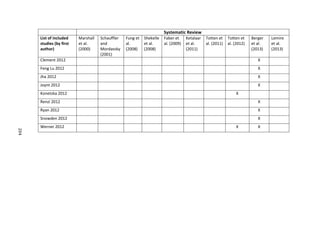
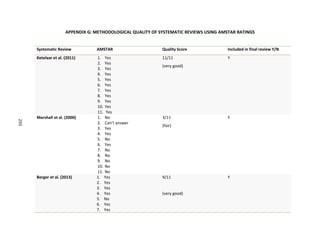
  • 102.
    89 measures reported bythe Ministry, both are related to ER wait times and were thus also part of the priority wait times strategy identified in the previous section. Results of the analysis show that i) all of the QIP measures are showing improvement, ii) all of the hospital safety measures publicly reported by HQO, even those that are not part of the QIPs (with one exception), are showing improvement, iii) where hospital QIP measures are publicly reported, improved performance started prior to the implementation of hospital QIPs except for Clostridium difficile rates. Results for C. difficile rates showed improvement in 2008/09, then worsened, then started improving again in 2012/13, the year after the introduction of QIPs. The researcher additionally notes that reported use of surgical safety checklists improved significantly in 2010/11, the year prior to the introduction of QIPs. Although improved performance on both C. difficile rates and use of surgical safety checklists may be related to the introduction of QIPs, given the performance of the QIP metrics over time, it was not possible for the researcher to draw any general conclusions about the potential impact of the hospital QIPs on publicly-reported performance results for hospitals. However, the researcher was able to confirm that improvements in all the QIP measures have been sustained over time.
  • 103.
    90 Table 8: DataSet: Comparison of Hospital Patient Safety Measures Reported by HQO and QIP Measures (excerpt from Appendix C) Notes:  Arrows under ‘Preferred Trend’ column indicate direction of trend line required to achieve improved results.  Arrows under ‘Actual Trend’ column indicate actual direction of trend line. o Black arrows indicate that the actual trend is the same as the preferred trend and therefore results have improved. o Red arrows indicate that the actual trend is opposite to the preferred trend and therefore results are worsening  Reporting period is for public reported data and as applicable, reporting period for QIP and Priority Wait Times measures (in green) Measure Preferred Trend Actual Trend Reporting Period Clostridium difficile infection rates ↓ ↓ Reported 2008-2014 Hospital QIP measure starting 2011/12 Methicillin resistant Staphylococcus aureus (MRSA) infection rates ↓ ↓ Reported 2008-2014 No change 2008-2011 Vancomycin resistant Enterococcus infection rates ↓ ↑ Reported 2008-2014 Central line-associated primary bloodstream infection ↓ ↓ Reported 2009-2014 Hospital QIP measure starting 2011/12 Ventilator-associated pneumonia ↓ ↓ Reported 2009-2014 Hospital QIP measure starting 2011/12 Surgical site infection prevention ↑ ↑ Reported 2009-2014 Plateaued in 2012 Hand hygiene compliance ↑ ↑ Reported 2009-2014 Hospital QIP measure starting 2011/12 Surgical safety checklist compliance ↑ ↑ Reported 2010-2014 Plateaued in 2011 Hospital QIP measure starting 2012/13 Hospital Standardized Mortality Ratios (reported by HQO, data source CIHI) ↓ ↓ Reported 2009-2014 Hospital QIP measure starting 2011/12 Emergency Department wait high acuity – target 8 hours (reported by Ministry) ↓ ↓ Reported 2008-2014 Decreasing, but above target Hospital QIP measure starting 2011/12 Ministry Priority Wait Times Measure starting 2005 Emergency Department wait low acuity – target 4 hours (reported by Ministry) ↓ ↓ Reported 2008-2014 Hospital QIP measure starting 2011/12 Ministry Priority Wait times measure starting 2005
  • 104.
    91 Impact of Organizational-LevelReporting Evidence from the literature from other jurisdictions indicates that there is greater likelihood of impact from third-party public reporting of quality measures at an individual institution-level or physician-level because of the greater potential to inflict reputational damage (Bevan, 2010). Thus, as part of the quantitative analysis, the researcher initiated a comparison of third-party reporting that is presented at an individual organization-level versus at an aggregate level to determine if the level of reporting increases the likelihood of improvement.  CIHI, HQO and MOHLTC provide publicly reported data at both the organization-level and aggregate level. Of the eight hospital patient safety measures that are included in HQO’s public reports, only one is not showing improvement. Four of these measures are also included in hospital QIPs. CIHI provides comparative reporting for hospitals on approximately a dozen measures related to quality access/wait times, hospital patient safety, and hospital readmission rates. Several of these measures, including Emergency Department wait times, hospital readmissions, and hospital standardized mortality ratios, are also included in hospital QIPs.  CCO provides publicly reports for some hospitals, where applicable in the Cancer System Quality Index; however only some of the measures are reported at an individual regional cancer center level. In addition, as reported previously, CCO has an extensive accountability system that includes targeted funding, accountability agreements, private reporting, and other activities that would likely impact performance by individual hospitals. It appears that CCO uses public reporting in combination with other accountability activities as a means to drive performance improvement, but does not appear to rely on public reporting alone as a quality improvement tool.  For the Ministry wait times measures, as shown in Table 6, most of the publicly reported wait times measures are showing no improvement or worsening performance over time.
  • 105.
    92 Given the aboveanalysis, combined with the impact of external forces such as QIPs and the priority wait times strategy, the researcher found that it was difficult to form any conclusions about a possible correlation between organization-level reporting and publicly reported performance results at a provincial level, except to note that where data were publicly reported and were also combined with other accountability strategies, they showed a greater likelihood of sustained improvement. International Comparison The researcher completed one final analysis with the goal of providing context to Ontario’s performance. While most international reports are intended to compare results across countries, CIHI has started reporting comparative results at both national and provincial levels thus allowing the researcher to compare Ontario’s results to both the Canadian average and with international results. The purpose of this comparative analysis was not to provide an in-depth comparison of Ontario’s performance relative to other jurisdictions, but simply to provide some additional context to the quantitative results. Using CIHI’s interactive, publicly-reported tool for comparing health system performance across OECD countries21 , the researcher was able to compare Ontario’s performance with an average of OECD countries. In addition to measures of population health, primary care, and social determinants of health, the CIHI website included 20 OECD measures for hospitals across three relevant domains – patient safety, quality of care, and access to care. The comparative results are summarized in Table 9. 21 https://www.cihi.ca/en/health-system-performance/performance-reporting/international/oecd-interactive- tool-access-to-care (accessed January 31, 2016)
  • 106.
    93 Table 9: ComparativeResults - Ontario vs OECD Average Category Measure Ontario’s Performance Compared to OECD Average (+ = better than average, - = worse than average) Patient Safety Foreign object left in (after surgery) - Post-Operative Pulmonary Embolism – Hip and Knee Surgery - Post-Operative Deep Vein Thrombosis - Hip and Knee Surgery + Post-Operative Sepsis – Abdominal Surgery + Obstetrical Trauma (related to an instrument) - Obstetrical Trauma (not-related to an instrument) - Quality of Care Breast Cancer Screening + Breast Cancer Survival + Breast Cancer Mortality - Cervical Cancer Screening + Cervical Cancer Survival + Cervical Cancer Mortality + Colorectal Cancer Survival + Colorectal Cancer Mortality + 30-day In-Hospital Mortality – Acute Myocardial Infarct + 30-day In-Hospital Mortality – Ischemic Stroke - Access to Care Wait Time: Cataract Surgery + Wait Time: Hip Replacement Surgery + Wait Time: Knee Replacement Surgery + Wait Time: Specialist -
  • 107.
    94 It is importantto note that the number of countries included in the international OECD average varied by indicator, ranging from as few as nine countries, to as many as 27. In addition, the countries include both developed and developing nations, with significant variation in their overall health system performance. This means that Ontario’s performance relative to the OECD average could vary depending on which countries were included in the measurement. Despite this variable factor, the researcher felt that the comparison provided useful context for Ontario’s performance on these three domains of quality. From the review of the results, the researcher found that Ontario:  Performs above the OECD average on 13 (65%) of the 20 measures;  Performs proportionately better on measures related to quality of care and access, as compared to patient safety;  Performs well in measures related to cancer treatment, with seven of eight measures showing results better than the OECD average; and,  Performs better than the OECD average in measures that are aligned with its cancer strategy and wait times strategy (cataract, hip replacement, and knee replacement).
  • 108.
    95 Summary of QualitativeResults The purpose of the qualitative research was to learn more about the objectives and impact of Ontario’s third-party public reporting on health performance and to identify factors that would assist in evaluating its effectiveness. The researcher conducted key informant interviews with 17 individuals representing different perspectives on public reporting. The researcher found that 17 interviews provided a sufficient response population to achieve data saturation. Responses were coded according to the themes used in the qualitative interview tool, per the methodology described previously. Reports were then generated for each code using NVivo’s ‘node’ functionality. This enabled the researcher to systematically analyze and report on the information collected from the key informant interviews. Analysis was conducted using the codes identified in Table 4. In order to be identified as a research finding, a response had to be mentioned by two or more individuals or, if mentioned only once, had to have strong face validity. Findings were prioritized based on the strength of evidence (for instance, mentioned by multiple interviewees or issues having strong face validity) and were categorized and sequenced according to the codes developed from the topics discussed in the interview tool. Potentially identifiable information within the comments from interviewees was blanked out when included in the analysis, for example, where an individual referenced his or her workplace. The following is a high level summary of the more detailed findings found in the subsequent sections:  The audience for public reports in Ontario is primarily health care delivery organizations, rather than the public, physicians or funders;  There are no stated objectives for public reporting, although most respondents indicated that accountability and transparency, rather than quality improvement, are the primary goals for public reporting;
  • 109.
    96  Public reportingon its own does not currently drive quality improvement;  There are ways to make public reporting more effective;  Publicly reported measures are primarily selected by panels of experts or political/government interests. Key informants indicated that greater transparency is needed in this process and patients and the public need to be more engaged in identifying measures that are important to them;  There are no significant adverse consequences to public reporting, but there are concerns and criticisms;  Data quality is important, yet there are ongoing data quality issues for information that is publicly reported;  A more coordinated and systematic approach to public reporting is required, including alignment with health system priorities;  Public reporting should be centralized and HQO is ideally positioned to assume this responsibility;  Target setting is important, and there are both opportunities and challenges to setting appropriate targets;  Comparison of results to other jurisdictions is valuable, but there are challenges to doing this effectively;  There should be more public engagement in public reporting; and,  Public reporting efforts should be evaluated. The following sections summarize the findings from the interviews and also identify any differences in responses between the groups of key informants: producers of publicly reported data/funders, health system providers, and other stakeholders (patient advocates, media, researchers,
  • 110.
    97 etc.) who areengaged with public reporting. A summary table of the key sub-themes from the responses is provided at the end of each section. The summary tables are used to show alignment between the sub-themes and the different groups of interviewees. Within the summary tables, ‘x’s are used to denote where at least two individuals from the same interview group commented on a particular sub-theme. 1. Audiences Overall, the key informants identified that understanding the audience for public reporting is a significant issue. Interviewees either identified a lack of clarity about who the audience is for current public reporting or indicated that the intended audience (i.e., the public) was not the actual audience; stakeholders categorized as “other”, such as media or patient advocates, were more likely to indicate that the public is an intended audience. One interviewee, who works for an organization that produces public reports, summed up this perspective by stating: “So, in my experience, that is always the issue, that is always the root issue of every report that we have ever done…I think the audience we are accountable to is the public but who actually uses it is the field…when I worked at (name of organization), I didn’t actually know who the audience was...I was just doing a report.” (comment from reporting agency) Audiences were variously identified as system-users, providers, boards of directors, and policy- makers, but it was noted that there is a variation in uptake of public reports by these different audiences, and that there are also overlaps and sub-groups within these audiences, for example, patients can be viewed as a sub-group of the public. In almost all cases, reporting agencies and providers stated that while reporting agencies are accountable to the public as their audience, it is the field/providers who are the true audience and who actually use the data. Additional sub-themes that arose around the topic of ‘audience’ included lack of public interest, the media as an audience, and general cynicism about the true audience and purpose of public reports. These additional themes are described further below.
  • 111.
    98 Representatives from allof the interviewed groups commented that the public is generally not interested, but many offered further explanations that this apparent disinterest may result from a lack of engagement of the public in the process and because reports are not presented in a way that is meaningful to them. “The cynical side of me would say that that for the most part, they (the public) are not interested and probably they are not going to understand the detail of the data and that’s for the most part if we’re not doing a good job of presenting it in a way they can understand it.” (comment from reporting agency) In addition, it is difficult for the public to find the information or to even become aware that it exists. One health system provider raised the issue that even when the public does access public reports, that access is not equitable to all members of the public. “It’s also out there for a few advocates or the privileged, in terms of those who know enough to go and look it up. So, as to my notion of public reporting is that we should aim at (getting) it to the public, which means that we need a number of vehicles so … that people don’t have to work as hard to get it.” (comment from provider) Producers of public reports and providers commented on the media as an audience, primarily with the perspective that the media look to use the data for negative stories. Both of these interview groups further noted that the media plays an important role as an interpreter for the public. “We’re always worried about “okay, what is the media going to say once these things come out?”….They’re the ones who then take that…accountability type of data that the average person can’t understand and tries to turn it into usually a negative story. Not always, but they’re trying to be that interpreter for the public, and so that’s a good role for them to play.” (comment from a provider) and “They (the public) will take a hook when somebody like the CBC writes a report and puts it on the front page and tells them why it matters to them, but I think that sort of general (reporting), like the mandatory government-initiated reporting is really for system managers.” (comment from reporting agency) All interviewed groups indicated cynicism about the audiences and the intentions of public reporting. Producers of the data were more likely to express concern that the government’s intention
  • 112.
    99 was to beable to say they are increasing accountability and transparency to the public while knowing that the public does not actually view the reports. “I think public reporting has different intentions depending on how you are trying to do it. I think there is an accountability aspect, so where governments and/or agencies feel this information has to be available, that quite often it’s not in a usable form in any stretch of the imagination.” (comment from reporting agency) and “I suspect it’s probably a lot of ‘I need to cover my (expletive)’ from the government point of view.” (comment from reporting agency) At least one provider expressed the view that the government used providers’ concerns about reputational damage as a means to prompt improvement. “The audience is health service providers. Mostly it is put out there to embarrass them or to provide some information that the public will react or respond to.” (comment from provider) Table 10 summarizes the sub-themes that emerged under the topic of audience. The strongest area of congruence across all groups was related to cynicism about public reporting, including the audience and related purpose for public reporting. Reporting agencies and health system users were more likely to indicate that providers are the “real” audience for public reports and that the public is not interested. Table 10: Summary Analysis of Audience Theme Sub-themes derived from interviews Interviewee grouping (‘x’s indicates theme identified by groups below) Reporting agency/funder Health system provider Other stakeholders Lack of clarity of who audience is x x - Lack of public interest x x - Role of media x x - Cynicism about true purpose/audience for public reporting x x x Grey shading indicates highest degree of accord across the different key informant groups.
  • 113.
    100 2. Objectives ofPublic Reporting Several interviewees indicated that the primary challenge related to the topic of objectives was the lack of articulated goals for public reporting. It was further indicated that it would be important to decide on the objectives and purpose, because the multiple audiences and objectives make it difficult to effectively design and present public reports. “I think that the premise that public reporting had a specific goal, I don't think is true”. (comment from reporting agency) Overall, the research participants indicated that they believe that the key objectives for public reporting are to increase accountability and transparency, although one individual argued that it is primarily accountability because having transparency would mean that the public actually understands the information. Three individuals identified a trend towards a quality improvement focus, while others explicitly stated that quality improvement was not a current objective. Additional sub-themes were that public reporting could add more value if it was better aligned with health system priorities and/or if there was a strategy or conceptual framework for public reporting in Ontario, and that there are challenges in differentiating objectives for improvement and accountability. The researcher notes that there is some alignment and overlap in the discussions of “audiences” in the previous section and “objectives” for public reporting in this section. Comments from two interviewees underscore the link between understanding the audiences and the objectives. “The audience could be everybody, but it’s not often clear when it’s a government-run public reporting system, whether it’s done for the generic goal of creating trust through transparency or whether it’s also done to optimize the possibility for choice.” (comment from ‘other’ stakeholder) and “What are the ways in which you assess? Researchers would say we need as much info as possible. Politicians would say we need to be as transparent as possible. Patients would say I need to know what’s going on. What’s the right information and what’s the right reason behind this?” (comment from provider)
  • 114.
    101 Across different jurisdictions,public reporting is often done with the intention of driving improved quality. As was discussed in the literature review, evidence supporting public reporting as a driver of improved quality is mixed. Similarly, from the interviews, perspectives on whether or not the purpose of public reporting is to improve quality were also mixed. Producers of the data were much more likely than other groups to indicate that one of the objectives for public reporting is to improve quality, but even among the producers of the data, there was disagreement on this as an objective. Several interviewees indicated that we do not have the circumstances in place for public reporting to drive improved quality. “If you want to have improvement as a goal there, that kind of assumes you have a notion of a pathway that through mobilizing public opinion you could change behavior of leadership in hospitals and because of the public pressure they start changing something. And of course, we have the literature from the UK about reputation damage and how it influences performance. That is a different strategy than providing regular feedback to hospitals on a broader set of indicators, because for public reporting you’re usually interested in outcomes and high level notions and for your improvements, they are less actionable”. (comment from ‘other’ stakeholder) and “Now, the interesting discussion is how do you link performance, public reporting for transparency and accountability to a performance improvement agenda and, more broadly, to a performance management agenda?” (comment from reporting agency) Only one person cited a specific example of where public reporting was established with an objective to change provider behavior, but not necessarily performance. This reference was to the establishment of ICES in the 1990s (described earlier in Table 1: Organizations Responsible for Third- Party Reporting of Health Information in Ontario). This interviewee made reference to the lack of levers for public reporting to drive improved quality that was also referenced by others. “Back then, the idea was that just knowing the information would inform behavior change. (In reference to ICES’ reporting of hysterectomy and Caesarean rates) The further you were from a hospital, the more likely you were to have an extreme procedure. (Did) having those rates public change behavior? Well it changed the public’s information and understanding of it…So it did start to inform behavior change. Then, like now, the ability to force behavior change, the levers didn’t exist and they still don’t exist. We still use the tools to manage performance and to persuade, to encourage; transparency has a shaming quality as well. So I think the intent back
  • 115.
    102 then was moreabout using the information on both sides. Inform the public so they can make more informed choices and also inform physicians that what you’re doing is different.” (comment from provider) Despite the lack of consensus about using public reporting to drive improved quality, at least three of the interviewees spoke about shifting to a quality improvement focus, using comparative data (although not necessarily publicly-reported data) to assist with this. “that's where I see things going in the next five years having more… either not directed or self- organized networks of organizations and regional health authorities working together on similar performance issues, trying to understand what are the drivers of performance and what they can do to improve and building that on best evidence and data and really trying to compare one another, with lots of rich contextual information.” (comment from reporting agency) One interviewee, who works for an agency that produces public reports, referenced seeing greater clarity in direction for quality improvement through the Ontario Minister of Health and Long- Term Care’s recent Action Plan22 and mandate letters23 to the Ministry staff and agencies. This linked to the sub-theme of having a strategy or conceptual framework for public reporting, in particular to help define the purpose of public reporting. This sub-theme was particularly mentioned by individuals with experience working with public reports. “So you start with a conceptual framework to see if what I’m measuring is what I really want to measure.” (comment from an ‘other stakeholder’) and “In designing this, for me it would be key to have a clear understanding up front about what is it we are trying to accomplish, and who do we need to have the conversation with to make sure that we have the information there. I think the weakness of some of the public reports has always been that we just dump (in) indicators based on availability just because you have the data available.” (comment from reporting agency) 22 In February 2015, the Ontario Minister of Health and Long-Term Care launched a ‘Patients First: Action Plan for Health Care”, a blueprint for health system reform and priorities for Ontario. 23 Mandate letters are documents provided by a head of government, in this case the Premier of Ontario, to Ministers outlining the key priorities for their respective Ministries.
  • 116.
    103 The sub-theme ona strategy for public reporting also emerged in other topic areas, such as “opportunities for improvement” and “alignment with priorities”. These are discussed in subsequent sections. Finally, both producers of public reports and providers spoke about confusion in the objectives for public reporting related to improvement versus accountability; there were differing opinions as to whether these should be separate objectives or not. This discussion was particularly important with respect to circumstances in which measures and targets chosen by providers for their QIPs were then placed by funders into accountability agreements. This was cited by both providers and producers of public reports as a disincentive for providers to use stretch targets in their local reporting. One producer of public reports felt that the solution to this was to make the objectives of public reporting clearer. Table 11 summarizes the sub-themes that emerged under the topic of objectives. The strongest area of congruence across all groups was related to accountability and transparency as the primary, although not formally articulated, goals for public reporting. Table 11: Summary Analysis of Objective Theme Sub-themes derived from interviews Interviewee grouping (‘x’s indicates theme identified by groups below) Reporting agency/funder Health system provider Other stakeholders Lack of articulated goals for public reporting x x - Accountability and transparency as goals x x X Quality improvement goal x - - Need for public reporting strategy/alignment with priorities x - X There is confusion between improvement and accountability as objectives for public reporting x x - Grey shading indicates highest degree of accord across the different key informant groups.
  • 117.
    104 3. Effectiveness ofPublic Reporting Given that the key informants were interested in participating in this study because of its topic on the effectiveness of public reporting, it is not surprising that all of the participating individuals had extensive comments on the issue of effectiveness. Key informants had mixed perspectives on the value and effectiveness of public reporting. For example, when asked about overall impressions on the effectiveness of current public reporting efforts, one interviewee who works for an agency that produces public reports indicated that, “I think we don’t really know is the first answer”. The most common sub-themes that emerged were: public reporting on its own does not drive improvement; public reporting is only effective if providers are held to account for their performance; and that there are many ways to make public reporting more effective, with several interviewees highlighting evaluation as a means to improve effectiveness. During the interviews, after the key informants provided their initial perspectives on the effectiveness of public reporting, the researcher shared the quantitative results of the trending analysis and used that information to draw deeper commentary on where there had been improvement or lack of improvement in public reporting, and to obtain feedback from interviewees on why they thought some indicators showed improvement and others not. The two most common sub-themes on the topic of effectiveness are related. The first is the sub- theme that public reporting on its own is not sufficient to drive improvement. The second is that public reporting can only be effective if there is an accountability mechanism that drives providers to improve their performance. All of the interviewees spoke about one or both of these sub-themes, and both producers of public reports and health system providers shared specific examples of where public reporting performance had improved: “The focus on hip and knees in QBPs (reference to provincial payment for quality-based procedures for hip and knee replacement surgery)…two years ago we were going to set the average length of stay in acute care at best practice of 4.4 days. Well, because we've been
  • 118.
    105 focused on italready for the past few years, by December 2013, it was already down to 3.6, so if we had actually set a price based on 4.4, we would have been way overpaying everybody.” (comment from reporting agency) or had not improved: “I think ALC (alternate level of care) is a perfect example of that. ALC has not improved…it never moves and as a system, I think these things all come back to accountability and leadership in terms of where they go.” (comment from reporting agency) Producers of public reports were much more likely than other groups to be critical of the lack of accountability in the system for changing behaviors and driving providers to make improvements. “The…problem is that we draw the line at performance reporting and we don’t go into the most important element, which is performance management.” (comment from reporting agency) The common point in the discussions was that there appears to be a positive correlation between public reporting and the use of accountability mechanisms. At least four individuals, both producers of public reports and other stakeholders, cited emergency department wait times as a successful example of the combined impact of public reporting and providers being held accountable for improvement. “So that's just what that focus can do and to me, that's the value of the public reporting. If we can get focused in the government to say again like they did with ER (emergency room), “Here's what we're going to focus on. Here’s what we want people to put their time and effort into and here's what we're going to fund as a government”, you can move things.” (comment from reporting agency) Two interviewees, both from agencies that produce public reports, indicated that there is too much information that is publicly reported, making it hard for providers to understand what measures they should pay attention to. “Why would anybody do an initiative just because it’s on page 163 of (name of public report)?”. (comment from reporting agency) and “There’s more and more stuff out there, but it’s not organized, it’s not centralized, and it’s inconsistent.” (comment from reporting agency)
  • 119.
    106 One individual commentedthat it’s not the public reports that drive improvement or motivate providers that are truly interested in quality: “I think no providers would be using these publicly reported, public domain kind of reports for any kind of action. That said, I think many, many good providers are using lots of indicators to monitor and improve their own organizational performance and many of those happen to be the same, for obvious and non-obvious reasons, as the publicly reported indicators.” (comment from reporting agency) In addition, this same individual cited several examples of hospitals, long-term care homes, and home care providers that are very sophisticated in their use of data to drive improvement. He further noted that he did not believe there was a link between public reporting and improvement in these high- performing organizations. Two interviewees, one from an agency that produces public reports and one from the “other stakeholder” group, spoke about the lack of effectiveness in reaching public audiences, noting the lack of value for the public and the fact that it is unlikely to impact patient behavior. Both individuals attributed this to the fact that what is publicly reported is not what is useful or meaningful for patients. “It depends what's being measured. You know, readmissions, that's something that is meaningful, wait times are meaningful, but is that conveyed to them and really does it impact their care? It won't be meaningful unless it impacts them on a personal level or their family members”. (comment from “other stakeholder”) and “If it is different audiences then you need to design differently and I think that the most beautiful example is (the) wait times website. It's a horrible website for patients. Like, if I'm a patient it doesn't tell me at all how long and where do I have to wait and which hospital should I go to. The same with the patient safety one, it doesn't really help me as a patient and say, ‘Oh God, this is a terrible hospital. If I go in that hospital, I have a risk of about 90% of being killed.’” (comment from reporting agency) All interviewees shared their perspectives on how public reporting can be made more effective, suggesting the following changes: increase focus on critical areas of health system performance (primary care was given as an example); ensure that measures are actionable for providers; add context to reports; engage the media; align public reports with health system priorities; build a quality
  • 120.
    107 improvement culture; and,ensure that providers are held accountable for improvement. Several interviewees indicated the need to evaluate public reporting in order to better understand the degree to which it is effective. “This is the most un-research-informed comment to make, but I do feel that it is the right thing to do. It’s just that we have to know how to do it most effectively and efficiently so that we are getting the most bang for what we do.” (comment from reporting agency) Table 12 summarizes the sub-themes that emerged under the topic of effectiveness. The strongest areas of congruence across all groups were for the sub-themes ‘public reporting on its own does not drive improvement’ and that ‘there are ways to make public reporting more effective’. Table 12: Summary Analysis of Effectiveness Theme Sub-themes derived from interviews Interviewee grouping (‘x’s indicates theme identified by groups below) Reporting agency/funder Health system provider Other stakeholders Public reporting on its own does not drive improvement x x x Need to hold providers accountable x x - There are ways to make public reporting more effective x x x Grey shading indicates highest degree of accord across the different key informant groups. 4. Determining what gets reported Key informants generally agreed that the theme of how publicly reported measures get selected and by whom was important. The most consistent responses to the question related to how we determine what gets public reported were “panels of experts” or “political/government interests”. The government’s wait times strategy was cited as an example of how the government drives public reporting. Respondents from all of the interview groups indicated that greater transparency in the selection of measures is required and that the system needs to involve patients and/or the public because much of what is currently public reported does not matter to them. Providers additionally
  • 121.
    108 commented that thesystem is more likely to report on measures that are readily available versus measures that are actually important. “I think you bring patients and caregivers around the table and have that discussion. What is meaningful, what would make a difference, what do you want to see measured? You are the consumers of the care, of the services---with providers, because it's important, it’s got to work for both. I'm not just all about the patient or all about the provider. I think there has to be a balance to make it a partnership and see what resonates with both”. (comment from “other stakeholder”) All respondents from reporting agencies indicated that they have used expert panels to determine what they should report; however, one interviewee from a reporting agency commented that this did not necessarily indicate that there was scientific evidence underlying the selection process. Providers were more likely to offer criticism about the selection of measures. “Right now, measures get selected from what exists, just what happens to be there. They are not necessarily relevant, not necessarily the best measure. They start with what’s available and what’s available was first collected for a different purpose.” (comment from provider) Providers were also more likely to comment on the role of government in selecting measures. “So my recollection of the (name of indicator), there were a couple of factors that drove the public reporting. I would say incenting the right behavior or improving performance and informing patients were not at the top of the list. At the top of the list was ‘the public needs to know how bad it is’, and that was a political pressure that was happening…But on the political side there’s a lot of debate about it and a lack of understanding of the value of it.” (comment from a provider) Producers of public reports were more likely than other interview groups to indicate that processes are changing and there is a trend towards greater transparency in the process for selecting measures, as well as involvement by broader groups of stakeholders, including patients and the public. It was recognized that more work needs to be done in this area. Where producers of public reports had engaged patients or the broader community, they indicated that it had an impact on how they thought about public reporting, but did not actually state that the reporting had changed as a result. “(I) do think of that citizens’ panel thing that I had when they sat and talked about the patient experience ... It actually did affect the way I think about it and think that it's not just what percentage of people die, what percentage of people get an infection, what percentage of people…but it should also be what kind of experience do patients get? Do they feel like they’re
  • 122.
    109 treated with dignity?And I think that should be part of public reporting and I think a lot of people in the system don't think that that's that important.” (comment from reporting agency) Providers and other stakeholders were more likely to indicate that what is publicly reported is not necessarily what matters most to people. In addition, providers and other stakeholders were more likely to offer criticism about the utility of the measures that are reported, citing hospital-standardized mortality ratios, hand-washing rates, ventilator-assisted pneumonia rates, and surgical-safety checklists as specific examples of measures that are either not actionable, not reliable, or should no longer be publicly reported because the performance is consistently high. It was noted that there needs to be a process to stop reporting things that do not add value. Table 13 summarizes the sub-themes that emerged under the topic of determining what gets reported. The strongest areas of congruence across all groups were that expert panels and government interests/priorities drive current public reporting measures, that there is a need for greater transparency in how measures are chosen, and that patients and the public should be involved in the selection of measures for public reporting. Table 13: Summary Analysis of Determining-what-gets-reported Theme Sub-Themes derived from interviews Interviewee grouping (‘x’s indicates theme identified by groups below) Reporting agency/funder Health system provider Other stakeholders Panels of experts or political/government interests primarily determine what gets reported x x x Greater transparency is needed x x x Increasing transparency and involvement of broader stakeholders is starting x - - Patients and the public need to be involved in identifying measures that are important to them x x x Data that are readily available are most often what gets reported - x - Grey shading indicates highest degree of accord across the different key informant groups.
  • 123.
    110 5. Adverse Consequencesand Criticisms No significant adverse consequences were identified by any interviewee; however all groups of interviewees identified potential areas of criticism or concern related to public reporting. There was limited overlap in concerns expressed by the different interview groups. Interestingly, the largest number of criticisms and concerns were voiced by organizations that produce public reports, and included: gaming of measures, particularly where they are tied to compensation or funding (for example, QIPs and Quality-Based Procedures); that the large number of measures results in a lack of focus; lack of appropriate case mix adjustments; questions about the return on investment for the significant effort associated with public reporting; negative attention from media and politicians, including providers being penalized for honesty and transparency; lack of political will and/or holding to account; and poor data quality. The following are sample comments that reflect how producers of public reports view these issues: “Physicians will always say that my patient is sicker etc,. and you can't adequately adjust. They're very afraid, I think if they are not looking good and doctors still are a pretty powerful group in the system.”(comment from reporting agency) and “You know every government says they want to measure and report until they look at what's going to be measured and reported and then they go like “Oh, my God, it's not the greatest system in the world and the (political) opposition is just going to go nuts on this one”. So I don't think again it's a reason not to report.” (comment from reporting agency) Other stakeholders cited a few additional concerns, including lack of completeness of public reporting, i.e., the inability to provide reports on important areas for which no data are available; presentation of reports and lack of context; the health system’s fear of having to change practice (hospitals and physicians); and lack of organization and centralization of public reporting. Similar to agencies that produce public reports, the other stakeholders also indicated concerns about data quality and gaming by providers, as shown by the following comments:
  • 124.
    111 “To be clear,I’m in favor of public reporting and nothing should be hidden. But my main worry lies in the correct interpretation of the data---and that is a challenge in how you present them--- but also having sufficient context knowledge to make sense of it. If I just aggregate all the information in a compound and I produce a list of surgeons and say these ones are red, yellow and green (quality rating), then I think you do them an injustice. Because then the inference is this is a good surgeon, this is a bad surgeon. Well, that’s a very big thing to say. Is that really true?” (comment from ‘other stakeholder’) and “I'm sure you can identify certain data elements where there's a potential for gaming and that's why you've got to select your indicators in a way that suggests that you don't include those kind of indicators in public reporting, like, for example, the handwashing. (The) hospital is doing an audit of an area and tells people in advance “we’re going to be auditing you tomorrow about your handwashing” and then why would you accept handwashing as a good indicator? And that's exactly what's going on in this province.” (comment from ‘other stakeholder’) Providers were less likely to voice concerns, but two potential risks that providers specifically mentioned were that public reporting may drive negative behaviors and fear of negative media attention. “Public reporting on hip and knee has been a fascinating kind of journey driving all kinds of bizarre performance behaviors---very little of it improving wait times. And nobody really understanding what’s behind it. The majority of delays in hip and knee have to do with physician preference and (patients preferring to spend) winters in Florida.” (comment from provider) Several producers of public reports commented that the potential for adverse consequences should not be a reason for not doing public reporting and cited examples of how to mitigate risks, including close monitoring of performance, using coding standards, and removing measures that can be more easily gamed. Handwashing rates were cited by several interviewees as a specific example of measures that are gamed as they are self-reported by providers and cannot be validated by reporting agencies. Table 14 summarizes the sub-themes that emerged under the topic of adverse consequences. The strongest areas of congruence across all groups were that there are no significant adverse consequences related to public reporting, but there are multiple concerns and criticisms. In general, the concerns and criticisms varied by interview group.
  • 125.
    112 Table 14: SummaryAnalysis of Adverse Consequences Theme Sub-Themes derived from interviews Interviewee grouping (‘x’s indicates theme identified by groups below) Reporting agency/funder Health system provider Other stakeholders There are no significant adverse consequences to public reporting x x x There are potential areas of concern or criticism (multiple examples cited) x x x It is possible to mitigate the risks x - - Grey shading indicates highest degree of accord across the different key informant groups. 6. Data Quality On the theme of data quality, there was general consensus by all interview groups that stakeholders must be able to trust the information. One interviewee from an agency responsible for public reporting stated that he believes there is a correlation between trust in the data and the desirability of the outcome; in other words, providers were more likely to criticize the data quality and methods when the results were not favorable to them, particularly in situations where it impacts their funding. Several producers of public reports also expressed frustration about the ongoing dialogue on data quality, for example: So I've been now for 10 years in (place name) and I still have the same discussions about the same type of indicators and the same data, and every time the discussion ends with “we need better data”. YES, WE NEED BETTER DATA!” (comment from reporting agency) Similar to the discussions on the theme of adverse consequences, data quality was acknowledged as an issue, but it was also noted that poor data quality should not be a barrier to public reporting. Examples of data quality issues that were specifically mentioned included: incomplete data sets and lack of available data in critical areas; quality of the underlying databases and variability in data integrity; gaming of results, particularly with respect to self-reported measures, such as hand-washing; delays in availability of data; variation in data rigour across different reporting agencies; inconsistency in definitions across reporting agencies; and lack of appropriate risk adjustments.
  • 126.
    113 Producers of publicreports were more likely to provide specific examples of data integrity issues based on their own experiences with the data. The following comments were provided from individuals working for different reporting agencies: “I think it depends on the data source, so obviously I think Ontario has very disconnected data sources, very siloed, very sector-based data sources, and I think that’s just the legacy of the system we have. But each data source, depending on its owner, has different data integrity and data quality and I think certainly the more we use it for funding, the more important data quality becomes.” (comment from reporting agency) and “So the data is poor, it's totally scattered; we’re mixing indicators for QI (quality improvement) (with) indicators for public reporting. We have inconsistent use of definitions. So, readmission 28 days, readmission 30 days, readmission all cause, readmission for select CMGs (case mix groups) so we are inconsistent in the definitions.” (comment from reporting agency) Other stakeholders, such as media or patient advocates, were more likely to express cynicism about the integrity of the reports for the public. “I think, in Ontario, they report in such a way, they put the best spin on it they can. They are putting numbers out there, but they are putting out the best possible numbers because there are many different ways to report emergency room wait times, and many different ways to report hospital infection rates and so they are making it look as good as they can…” (comment from “other stakeholder”) Among providers, it was particularly noted that physicians tend to be the most skeptical about data integrity, particularly with respect to case mix adjustments. All interviewees from agencies responsible for public reporting commented on mitigation strategies to address data quality issues and how potential data integrity issues were dealt with by their respective organizations. Two of these interviewees specifically commented that trends and variations are the most critical aspect, as opposed to specific performance results; one of these individuals stated, “I pay a lot of attention to something very specific that I call signal versus noise.” Examples of mitigation strategies used by reporting agencies include:  having dedicated analysts who work with providers, for example, to understand and apply coding standards;
  • 127.
    114  using validitychecks; and  paying increased attention to variation in data and trends over time. One provider mentioned extending the use of electronic health records and electronic medical records, as well as increasing linkages between data sets as opportunities to further improve data quality in the future. Table 15 summarizes the sub-themes that emerged under the topic of data quality. The strongest areas of congruence across all groups were that data quality is important---and increasingly important where funding is at risk---and that there are data quality issues. Producers of public reports were more likely both to offer examples of data quality issues and to identify opportunities to mitigate or improve data quality. Table 15: Summary Analysis of Data Quality Theme Sub-themes derived from interviews Interviewee grouping (‘x’s indicates theme identified by groups below) Reporting agency/funder Health system provider Other stakeholders Data quality is important x x X There are data quality issues for information that is publicly reported x x X It is possible to mitigate/improve data quality x - - Grey shading indicates highest degree of accord across the different key informant groups. 7. Alignment with Priorities Under this theme, the researcher asked interviewees about the degree to which they believe that public reporting is aligned with health system priorities. Responses on this topic were more likely to come from producers of public reports and providers than other stakeholders, a group from which only one individual commented. Key informants generally responded with feedback about the lack of alignment between health system priorities and public reporting. Several interviewees spoke about the
  • 128.
    115 significant number ofmeasures that are publicly reported and one referred to the situation as “indicator chaos”. There was further consensus on the need for a conceptual framework and/or a more coordinated performance measurement approach for the province that would help providers understand where to focus. One interviewee from an agency that produces public reports made the following remark: “We have too much, we’re not using it. It's asking too much of the system and as you know when you ask them to focus on 40 different things, you can't. It’s not possible.” (comment from reporting agency) One individual from a provider organization added that it is not just public reporting that should be aligned to the system priorities, but all of the accountability mechanisms, including quality-based procedures, quality improvement plans, and accountability agreements between providers and the LHINs. Two individuals, both of whom have significant health leadership experience, spoke extensively about the fact that if something is clearly a government priority and there is clear organizational accountability for improvement, then there will be improvement in performance results. One of these interviewees provided examples of indicators that are reported, but for which there is no clear accountability for improvement, including diabetes, infant mortality, and smoking cessation. “I mean there are some things organizations can do on their own, but there are other things that are beyond individual organizations’ capability to do on their own and therefore those kind of indicators tend to just lie fallow...I'll give you a couple of examples. The indicators around diabetes…weren't really improving all that much in this province because there was no organization that had direct accountability for doing anything about it.” Table 16 summarizes the sub-themes that emerged under the topic of alignment with priorities. The strongest area of congruence across all groups (noting that only one person in the other stakeholder group commented on this section) was that current public reporting efforts are not aligned with health system priorities. Among the producers of public reports and providers, there was consensus that the large number of measures makes it difficult to understand where the health system should be focused
  • 129.
    116 and that amore coordinated approach is needed. The Minister’s Action Plan, a recently announced set of priorities for Ontario’s health system, was recommended as a place to start for the system to align priorities and public reporting on health system performance. Table 16: Summary Analysis of Alignment with Priorities Theme Sub-themes derived from interviews Interviewee grouping (‘x’s indicates theme identified by groups below) Reporting agency/funder Health system provider Other stakeholders Public reporting is not aligned with health system priorities x x x There are too many reported measures, resulting in a lack of focus x x - A more coordinated approach is required x x - Grey shading indicates highest degree of accord across the different key informant groups. 8. Alignment of Incentives Under this theme, the researcher asked key informants about the degree to which they believe there is alignment of incentives, such as salary compensation and organizational funding, with performance on publicly-reported measures. Feedback from interviewees generally centered around three viewpoints; incentives are not aligned, there are challenges to aligning incentives appropriately, and there is a lack of accountability in the system. Both reporting agencies and providers gave feedback as to why they felt that the current pay- for-performance24 approach for executives does not work. This was discussed in reference to Ontario’s Excellent Care for All Act (2010), which, among other quality improvement strategies, links hospital executive compensation to performance on quality measures. Reasons given as to why the current incentive system does not work included: lack of control by hospital executives over physician 24 Pay-for-performance is a compensation strategy in which total salary is commensurate with achievement of performance targets.
  • 130.
    117 performance on quality;legislated public sector salary freezes, including a comment from one individual that the public sector compensation framework in Ontario needs to be over-hauled; and the potential for gaming or choosing targets that are easier to meet when the targets are tied to salary compensation in hospitals. “It’s a little bit naïve impression that the hospital executive runs the hospital...they (are) only one part of the hospital. Still think about getting the clinician on board…It's great as a first step, but I think ultimately we have to have (an) all physician-wide approach or system that says everybody has skin in the game. I think that is where you get more effects than just picking one group or one part of the chain. No matter how helpful hospital CEOs are, there is a limitation of power also because physicians…are independent.” (comment from reporting agency) Also on the topic of individual pay-for-performance, one interviewee gave an additional example of how incentives were misjudged when the province invested in primary care doctors to increase enrollment, but there was no improvement in the percentage of patients who can see their primary care doctor in 24 hours, which was one of the MOHLTC’s intended outcomes for the additional investment in physician compensation over the last five years. Producers of public reports spoke about other types of incentives, giving examples such as organizational funding tied to quality-based procedures and the work by CCO on funding agreements tied to performance on the cancer system quality index. The cancer system quality index was established in 2010 by the Cancer Quality Council of Ontario, an arm’s length advisory council to CCO that provides advice to both CCO and the MOHLTC to support their efforts to improve the quality of cancer care in Ontario. The success of CCO’s accountability initiatives were offered by several interviewees as an example of where incentives have resulted in improved performance at an organizational and system level. Three interviewees gave examples from other countries, including the US and the UK, and the circumstances in which incentives and penalties have been successful in improving performance in those jurisdictions. The impact of poor performance in a competitive market was cited as a powerful motive to improve, primarily due to loss of patient volumes due to reputational damage. The implication of this
  • 131.
    118 discussion was thatcompetition is not a strong incentive for performance improvement in the Ontario system as there is little competition for patient volumes. Other stakeholders provided a greater degree of feedback about the current lack of accountability to funders, i.e., in terms of penalties or incentives, in the system for performance. “How do you hold them accountable? How do you say that they're accountable? Punishment? How do you do that? It’s got to be a positive reinforcement so that they're going to be encouraged to do it, but who is out there monitoring it?” (comment from ‘other stakeholder’) Additional comments on this theme, primarily from reporting agencies, included: the system needs to also reward “good failures” and good attempts that are not successful; there needs to be good policy work that removes barriers to progress and that does not add incentives without first knowing how they would work in a complex environment; and the government already has the right mechanisms/levers, but is just not using them properly. Table 17 summarizes the sub-themes that emerged under the topic of alignment with incentives. There was not congruence across all groups on the sub-themes for this topic. Table 17: Summary Analysis of Alignment with Incentives Theme Sub-themes derived from interviews Interviewee grouping (‘x’s indicates theme identified by groups below) Reporting agency/funder Health system provider Other stakeholders There is not alignment between incentives and performance x x - Appropriate alignment of incentives is challenging x x - Providers are not held to account for poor performance - x x
  • 132.
    119 9. Determining whoshould be responsible for public reporting As the researcher identified in the Background section, several organizations in Ontario have a government mandate for producing third-party public reports. As part of the interview, the researcher asked interviewees who should be responsible for public reporting. There was general agreement across all interview groups that centralizing accountability and responsibility within one organization would be advantageous, by providing the potential to increase alignment of reporting, promote best practice standards, and improve access to publicly available data. There was further agreement that public reporting should be the responsibility of a third-party organization, i.e., independent of both government and providers. HQO was identified by interviewees from all groups as the organization that is best-positioned to lead public reporting efforts in the province because of its ability to support the health system in driving improvement, including creating an inventory of best practices, benchmarking, analytics, and capacity building. “It should be Health Quality Ontario. I mean that's why they were created. And also listening to the current deputy (minister), he really sees that as a legitimate role for Health Quality Ontario. And it gets confusing because the role of Cancer Care Ontario---and certainly they’ve played a very strong role in cancer---but then they got asked to do the broader role. But I think it doesn't really matter who does the operations, the stuff behind the scenes. The important thing is the public understanding where to go to get the information that they need and also who is providing the leadership here. And I think that should be Health Quality Ontario.” (comment from “other stakeholder”) At least two of the interviewees commented on the role of CCO, noting that CCO has an additional advantage of having the ability to exert greater pressure for performance improvement through accountability agreements and funding arrangements, which HQO does not have. This relates to the evidence from the literature, as well as previously described feedback from interviewees, that public reporting on its own is not sufficient to drive improvement. These findings suggest that HQO will need to have mechanisms in place to hold the government and providers accountable for quality improvement.
  • 133.
    120 Table 18 summarizesthe sub-themes that emerged under the topic of determining who should be responsible for public reporting. There was strong congruence across all groups that public reporting should be centralized with a third-party reporting agency and that agency should be HQO. Table 18: Summary Analysis of Determining Who Should be Responsible for Public Reporting Theme Sub-themes derived from interviews Interviewee grouping (‘x’s indicates theme identified by groups below) Reporting agency/funder Health system provider Other stakeholders Public reporting in Ontario should be centralized x x x Health Quality Ontario is ideally positioned to play that role x x x Grey shading indicates highest degree of accord across the different key informant groups. 10. Target Setting The researcher questioned key informants regarding their perspectives on setting targets for publicly reported measures, including: whether Ontario should set performance improvement targets; who should set targets; how targets should be set; and how providers should be compared, i.e., to each other, to standards, to an average/mean, or to their previous performance. Feedback from interviewees was very similar to the feedback on incentives for improvement and centred on the following sub- themes: targets are important, there are challenges to setting targets appropriately, and there is a lack of accountability in the system for achieving targets. Additionally, several interviewees provided recommendations for more effective ways to develop and use targets. No key informant commented that targets are not appropriate for public reporting. While generally interviewees commented on the value of targets, at least one third of the interviewees shared the perspective that setting targets is, in fact, essential to driving improvement. All interviewees
  • 134.
    121 commented on thechallenges of setting targets, with the cited challenges including: caution on the potential for interrelationships in measures, in which setting a target in one area could have an unintended negative impact in another area; setting targets only where they add value; setting targets based on evidence; differentiating “stretch” targets from “hard” targets; and communicating the rationale for chosen targets. This latter comment was made in reference to the difficulty for governments in communicating the difference between realistic short-term targets and longer-term aspirational targets to a public audience. The following are sample comments on the challenges of setting targets and were provided by two interviewees from agencies that produce public reports. “One of the things that has driven me absolutely bananas is people suggesting standard 5%, 10% improvement on indicators, and obviously, depending on the indicator sensitivity, that may or may not be possible, so one of the things that we were talking about was, sure for hand- hygiene, if you’re at 78% you can move it, but one of the things we know that for patient experience, if you moved it 1% or 2%, that's amazing, that’s a lot. You’re not going to see a 5% improvement in patient experience.” (comment from reporting agency) and “…to think about what are the unintended consequences of setting targets and there’s noise about that---and the wait times literature about when we did all the hips and knees---maybe we cannibalized all the ankles (negatively impacted wait times for ankle surgery). ” (comment from reporting agency) Two providers specifically commented on the cost and resource implications of trying to reach targets. “If there is a value that something happens at the 10 day mark versus the 30 day mark, then a target to improve performance is a valuable thing. But if it doesn’t matter, should we be thinking sometimes the other way, such as how much is it costing you to get services on day four and is that reasonable? And could we redistribute these funds to where there are more challenges?” (comment from provider) Interviewees from all groups provided recommendations for improving the target setting process, including: engaging patients in setting targets; having a transparent process; balancing stretch and realistic targets; acknowledging providers that show improvement, rather than focusing only on
  • 135.
    122 achieving targets; usingevidence, benchmarking, and international comparators; and understanding variation and the impact of regional issues on performance before setting targets. “The best, of course, is when you use empirical evidence to see what the benchmark situation is… So a target should be realistic; it should be empirically evident. There should be a benchmark evident that it’s already been reached. If that’s not the case, you don’t really know.” (comment from an “other stakeholder”) and “To go back to the example of access to primary care to GP (general practitioner) within 48 hours, you know we are the worst in the world and we don't have any jurisdiction that is doing better. If I use this criteria of top 25%, I’m going to have a couple of jurisdictions that would be looking good and would be considered as good performers when really there is no good performer in this country. So I think the more sound targets we can develop based on clinical benchmarks and clear expectations derived from engagement with, frankly, the public and patients, I think we would be better off.” (comment from reporting agency) Finally, interviewees from the other stakeholder group were more likely to comment on the need for greater accountability for providers to achieve, or at least move towards, targets. “I think they're a good thing because that’s something to aspire towards, so it’s a positive and if you are looking at your own figures, and you are like ‘Oh, wow!’. I would hope every provider internally would reflect at some point on ‘where do I measure up, and hopefully I'm above the norm’. I think everyone would want to aspire to that, but honestly they’re so busy and who is going to hold them accountable?” (comment from ‘other stakeholder’) Table 19 summarizes the sub-themes that emerged under the topic of target-setting. The strongest areas of congruence across all groups were that targets are important, that there are challenges to setting appropriate targets, and that there are opportunities to improve how targets are set in Ontario.
  • 136.
    123 Table 19: SummaryAnalysis of Setting Targets Theme Sub-themes derived from interviews Interviewee grouping (‘x’s indicates theme identified by groups below) Reporting agency/funder Health system provider Other stakeholders Targets are important x x x There are challenges to setting appropriate targets x x x Lack of accountability for achieving targets - - x There are opportunities to improve target setting x x x Grey shading indicates highest degree of accord across the different key informant groups. 11. Using Comparative Data in Public Reporting Evidence from the literature review indicates that benchmarking and using appropriate comparisons can help make public reporting more effective. Interviewees were asked for their perspectives on how well Ontario uses comparative information for its public reporting. All interviewees indicated that using comparative information is helpful to understand how Ontario’s health system is performing. Interviewees cited examples of how comparisons are used both within Ontario and in comparing Ontario with other jurisdictions. Producers of public reports were more likely than other interviewees to discuss the use of international comparisons. Their perspectives on the value of international comparisons were mixed, with several citing the challenges of “apples to apples” situations in these types of comparisons. “We know what the challenges are with the data itself…there’s small sample sizes in a lot of the countries, low response rates, and we’re measuring statistical significance and we’re not trying to do this, but we’re trying to be completely methodologically sound, but at the same time, you put some of these labels around statistical significance. I don't know if the public will understand that or not, but some of the sector will and they may attach greater portents to those findings than maybe they deserve.” (comment from reporting agency) Two key informants spoke about the utility of using international benchmarks in situations in which Ontario is already a high performer among the Canadian provinces. These comments suggest that
  • 137.
    124 looking at differentcomparative data can help identify stretch targets or opportunities for improvement. “Ontario stacks up pretty well compared to the rest of the country. Maybe British Columbia would be the only other province that I can think of that might look a bit better than we do on certain indicators, but most of the provinces look worse than we do on most indicators. So that's why I say you should look internationally to give yourself something to strive towards.” (comment from “other stakeholder”) The use of comparative data within Ontario was cited as a challenge by key informants across all groups. In particular, lack of appropriate case-mix adjustments, differential application of indicator definitions by providers, and difficulties with establishing peer-groupings were given as examples of difficulties. Two interviewees provided examples of situations in which specific hospitals had been negatively impacted by funding decisions based on comparative use of data among peer groupings, which may indicate the need to review peer-grouping methodology. Table 20 summarizes the sub-themes that emerged under the topic of using comparative data in public reporting. Both comparisons within Ontario and beyond Ontario were discussed by interviewees. The strongest areas of congruence across all groups were that comparative data is helpful for public reporting and, in particular, comparisons across Ontario, but the methodology for comparison needs improvement. Table 20: Summary Analysis of Using Comparative Data in Public Reporting Theme Sub-themes derived from interviews Interviewee grouping (‘x’s indicates theme identified by groups below) Reporting agency/funder Health system provider Other stakeholders Comparative information is helpful for public reporting x x X International comparisons are helpful, but should be used with caution x - - Comparisons within Ontario are helpful, but there are challenges with the methodology x x X Grey shading indicates highest degree of accord across the different key informant groups.
  • 138.
    125 12. Stakeholder Engagement Intervieweeswere asked about the importance of engaging stakeholders in the public reporting process. This topic was aligned to evidence from the literature indicating that involvement of both providers and the public can make public reporting efforts more effective. There was consensus across all interviewees that both of these stakeholder groups need to be engaged more than they currently are in Ontario; however, there was much more focus on the need to involve patients and the public. Producers of public reports and providers were more likely to comment on the role of providers in public reporting. Whereas providers felt more strongly about the engagement of providers, producers of public reports had more mixed perspectives. “Why I think it is so important to have, to develop these kind of things collaboratively with the key stakeholders because you don't want to have, to be in a position where you put indicators out there and a physician tells you the data is wrong.” (comment from reporting agency) and “(Providers are) not going to pick tough areas, and so I don't think they should play a big role because you will end up also with what happened on the early hospital report is you had lots of clinicians in there narrowing down to areas of performance where the incident rate was like .01%. It almost never happened and they will pick things like that, right, where they know they are going to look good.” (comment from reporting agency) There were no key informants who expressed the opinion that higher engagement of the public and patients was not important. Patients and the public as stakeholders were used interchangeably by interviewees. Key informants spoke about the opportunities and challenges to public and patient engagement in developing public reports, with comments including: patients/public do not access public reports; the public needs to inform government what is important to them in public reporting and identify areas for improvement; patients need to provide input into targets, such as wait times, in order to make the reports meaningful to the people who are impacted by the measures; there is no single entity that speaks on behalf of patients; and engagement has to be “real” not tokenism. Citizen panels and family advisory committees were identified as current methods of engagement by providers and
  • 139.
    126 producers of publicreports. One provider mentioned the potential for disparities related to equity and access to information, noting that the way the system currently engages patients/public does not go far enough: “I think it’s ok to always start with the engaged and educated setting the first of the indicators, because that’s a place to start. The mistake we make, though, is once we have done that, we say we have engaged, but what we have missed is all the people (for whom) English is not their first language. They are not educated enough to come to those meetings, but they’re still part of the public, so they still need to be engaged.” (comment from provider) Additional comments on this sub-theme included opportunities to expand engagement. Two individuals commented that the system should be paying more attention to the rising relevance of social media for public reporting. One of these interviewees commented that much of the current literature evidence on public engagement and patient behavior pre-dates social media sites such as ‘Yelp’, noting that researchers and producers of public reports have the opportunity to explore social media as a way to both engage and inform the public. Another interviewee commented on the potential value of public polling to systematically obtain public input, as well as to evaluate the effectiveness of public reporting in raising public awareness. Table 21 summarizes the sub-themes that emerged under the topic of stakeholder engagement. The strongest areas of congruence across all groups were that public/patient engagement is important for a number of different reasons, but that there are challenges to effective engagement.
  • 140.
    127 Table 21: SummaryAnalysis of Stakeholder Engagement Theme Sub-themes derived from interviews Interviewee grouping (‘x’s indicates theme identified by groups below) Reporting agency/funder Health system provider Other stakeholders Providers need to be engaged in developing public reports x x - Patients/public need to be engaged in developing public reports x x x There are both opportunities and challenges to engaging the public/providers x x x Grey shading indicates highest degree of accord across the different key informant groups. 13. Evaluating Public Reporting The researcher asked key informants two questions related to evaluation: the first was about the degree to which Ontario’s public reporting efforts have been evaluated and the second was about interviewees’ advice for how Ontario’s public reporting efforts should be evaluated. Generally, producers of public reports were more likely than other interviewees to respond to the first question, whereas all interviewee groups responded to the second question. Several producers of public reports provided examples of public reporting evaluations. These examples were all in reference to evaluations of specific public reporting projects that had been or were undergoing evaluation, as opposed to evaluations by the government of its overall public reporting efforts. Examples of named evaluations included: the Access to Care project led by CCO to support the government’s wait time and emergency room/alternate level of care strategies; an ongoing research study on the impact of public reporting in long-term care; two research studies, one on the use of cardiac scorecards (Tu and Cameron, 2003), and the other on public reporting related to hospital- acquired infections (Daneman et al., 2012), both of which were previously referenced in this dissertation’s Background section; and a conceptual framework for evaluating the impact of CIHI’s public
  • 141.
    128 reporting. Overall, intervieweesagreed that more evaluation is needed. “I like that idea (of evaluation) because I don’t think we do (it). We put them out and then we put out more and more measures, and more and more measures, so one of the things that I’m actually doing in (name of role) is a measurement strategy that ties to our strategy and our reporting means, but actually evaluates what are we measuring and why are we measuring it, and what are we putting out to actually potentially, not only reduce the number of measures we’re creating, but actually looking at reducing the number of data we collect.” (comment from reporting agency) Interviewees across different groups provided recommendations for evaluation, including how public reporting should be evaluated and what should be addressed in the evaluation process. One interviewee from a reporting agency summed up her perspective on evaluation as follows: “What we are looking for here is more meaningful reporting, using better quality data with better ties to accountability.” (comment from reporting agency) Interviewees made the following recommendations for conducting evaluations: identify ways to make public reporting more effective and efficient; ask providers, physicians, and the public about the effectiveness of public reporting; evaluate it in a ‘practical’ way, understanding that no evaluation may meet the needs of all stakeholders; and ask how people access and use the public reports, and whether they impacted decision-making or behavior. The following is a sample comment from an interviewee from the “other stakeholder” group. “I know the numbers are being tallied, but what's being done with them to effect change? That's the only way to know if they’re effective. It's great to collect numbers, but they’re useless unless they're being used to impact the system and transform it. And what’s being done to use these numbers and then to measure it again, and what we put in the measures and put in place, is that actually impacting that number and the trend, the trend line?” (comment from ‘other stakeholder’) Finally, one interviewee questioned the value of conducting an evaluation of public reporting, challenging the notion that the government would make changes to public reporting based on the findings. “What if we did? What if we evaluated the wait times and we found there was no value in a specific time, but instead it’s person-specific, and took this to government and we found there was actually harm? Would the government back down? I don’t think so. Unless we proved it was
  • 142.
    129 killing people. Nogovernment is going to be less inclined, to be less transparent, than they already are.” (comment from provider) Table 22 summarizes the sub-themes that emerged under the topic of evaluating public reporting. The strongest area of congruence across all groups was that public reporting in Ontario needs to be evaluated. Interviewees across all groups provided recommendations for how to approach an evaluation process. Table 22: Summary Analysis of Evaluating Public Reporting Theme Sub-themes derived from interviews Interviewee grouping (‘x’s indicates theme identified by groups below) Reporting agency/funder Health system provider Other stakeholders Some aspects of public reporting have been evaluated x - - More evaluation is needed x x x Grey shading indicates highest degree of accord across the different key informant groups. 14. Improving Public Reporting The theme of improvement was the final topic for the interviews and resulted in responses that both reflected and summarized earlier discussions related to other themes, such as objectives, effectiveness, and concerns about/adverse consequences of public reporting. In general, whereas key informants expressed concerns about current public reporting efforts, the consensus was that it was valuable and that there are many opportunities to make public reporting more effective. All interviewees provided recommendations for improving public reporting efforts and, as stated above, these tended to reflect and summarize earlier discussions. The following recommendations were made: increase patient/public engagement; evaluate current public reporting efforts; improve data quality; reduce time lags for reporting; identify gaps in reporting and developing new measures; engage providers and physicians; centralize access to public reporting; reduce the number of indicators and align them with priorities, such as primary care; add context and present the
  • 143.
    130 data in anunderstandable way; determine what levels of variation in performance are reasonable across regions and providers; engage the media; set stretch targets; increase accountability for performance results; increase reporting on health outcomes; and create an overarching framework for public reporting. “So, whatever we are saying about the abilities or the value of public reporting today may not be the same five years from now, or 10 years from now, so it's a bit of a moving target, but it needs to be examined and evaluated, just like the actual services and activities that we are actually trying to monitor.” (comment from reporting agency) Key informants from across the stakeholder groups raised the following recommendations for improving the effectiveness of public reporting, which were not previously discussed: provide assistance to the field to increase their capacity for quality improvement and to help providers move closer to the targets; expand research into currently reported measures to better understand why some areas are improving, but not others; and, finally, consider ways to improve public reporting in an increasing area of “open data”. This last comment was made in reference to an emerging provincial government agenda to make a wider range of data more publicly available for purposes of transparency. As shown in Table 23, there was strong congruence across all groups that there are many opportunities to improve public reporting. These opportunities primarily summarize discussions under previous themes in the research interviews. Table 23: Summary Analysis of Improving Public Reporting Theme Sub-themes derived from interviews Interviewee grouping (‘x’s indicates theme identified by groups below) Reporting agency/funder Health system provider Other stakeholders There are many opportunities to improve public reporting x x x Grey shading indicates highest degree of accord across the different key informant groups.
  • 144.
    131 CHAPTER 5: SUMMARYOF FINDINGS AND DISCUSSION In order to address the research question “How can we evaluate and enhance the effectiveness of third-party reporting on quality improvement for health care in the province of Ontario, Canada”, this study used an explanatory sequential mixed-methods design based on the following two sub-questions: 1. What do we know about the value of public reporting? 2. What do we know about how to improve the effectiveness of public reporting? Question 1 formed the basis of the quantitative portion of the study, which focused on assessing the results of existing public reporting efforts. This included reviewing a sample set of publicly reported measures for hospitals and CCACs to determine the degree to which there may, or may not be, a positive association between public reporting of results and improved quality. Question 2 formed the basis of the qualitative portion of the study, which used key informant interviews to learn more about the objectives and effectiveness of third-party public reporting on health system performance and to identify opportunities to improve it. The quantitative and qualitative portions of the research were conducted sequentially; the quantitative analysis was conducted first. The researcher found that the quantitative analysis informed the development of specific questions in the qualitative research, and the qualitative portion of the research was helpful in interpreting the earlier quantitative results; in particular, by helping the researcher to understand why publicly reported measures are or are not improving over time. Furthermore, the researcher was able to use evidence from the qualitative interviews to draw conclusions about how to make public reporting more effective. The following sections summarize the research findings and provide recommendations for improving Ontario’s public reporting efforts.
  • 145.
    132 Quantitative findings In Chapter3: Research Methodology, the researcher created a predictive framework based on the literature evidence to attempt to anticipate the results of an analysis of publicly reported performance measures. The following key points summarize the framework: 1. If the literature on causal pathways (Berwick et al., 2003; Contrandriopolous et al., 2014) holds true, one would predict that generally, publicly reported performance of health care organizations should improve over time in response to the reputational threat posed by public reporting. The degree to which there is improvement across all measures may be limited by improvement capacity and span of control. 2. In contrast, if the general literature on public reporting holds true, then one would predict that publicly reported measures would show more mixed results over time (see Figure 4). Some measures will improve; others will show no change in performance or show declining performance. The degree to which we see change in performance results may be due to other factors, rather than due to public reporting alone. By conducting a linear trend analysis of 262 publicly reported measures for hospitals and CCACs from five datasets, the researcher found that slightly less than one-third of these publicly reported measures are showing improvement, while the remaining measures are showing no change (53%) or worsening performance (15%) over time. When measures were analyzed by category, the researcher found the following results: 1) Nine categories of measures are showing improvement. These include measures related to: mortality rates, potentially avoidable hospital days, hospital wait times for hip fracture treatment (reported by CIHI), hospital patient safety, wait times for emergency departments,
  • 146.
    133 wait times forcancer surgery (reported by MOHLTC), wait times for cancer surgery (reported by CCO), wait times for diagnostic imaging, and appropriate cancer treatment. 2) Twenty-three categories of measures showed no change or worsening performance. In other words, the majority of categories of measures showed no improvement in performance over time. 3) When analyzing publicly reported measures in accordance with HQO’s six dimensions of quality, the researcher found that Ontario’s publicly reported measures are significantly weighted (70%) to measures of timely access, primarily surgical wait times. Measures related to effectiveness of care and patient safety represent 20% and 9% of public reported measures respectively. There are only two publicly-reported measures related to patient-centered care, and no measures for efficiency or equity. 4) The categories of measures are not weighted by relative importance or priority. This is related to the findings in the qualitative research that there is no existing strategic framework for health care quality improvement and there is a lack of alignment between health system priorities and public reporting, which could otherwise be useful in identifying whether some categories of measures should be more heavily weighted than others in this type of analysis of results. The researcher considered the impact of other factors in combination with public reporting, including external factors such as policy priorities that utilize public reporting as one component of an improvement strategy. The researcher analyzed the Government of Ontario’s wait times strategy and the introduction of mandatory hospital QIPs to explore the impact of these factors. The results showed that, while less than one-third of the measures that are publicly reported for hospitals and CCACs showed improvement over time, by contrast there was improvement in all eight measures that were reported in both hospital QIPs and publicly-reported by HQO, and improvement in six of the eight
  • 147.
    134 measures that wereboth part of the original wait times strategy and publicly-reported by the MOHLTC. Thus, there appears to be a positive correlation between the Government of Ontario’s priority wait times strategy and the performance of these measures in public reporting, as compared to other wait times that are publicly reported, but that were not part of the initial priority measures. Furthermore, by analyzing the performance trends, the researcher confirmed that improvements in priority wait times have been sustained over time, except in two areas, namely, the wait times for cardiac surgery and cataract surgery. It was not possible to draw any specific conclusions about the potential impact of hospital QIPs on publicly-reported performance results for hospitals, primarily because these measures were already publicly reported and showing improvement prior to the introduction of QIPs. Two of the QIP measures were also part of the priority wait times strategy. There were, however, two QIP measures that showed improvement in the years proximal to the introduction of QIPs, including the use of surgical safety and C. difficile rates. The researcher notes that it is possible that there is a correlation between the introduction of QIPs and performance on these two measures, but further research is required to confirm the correlation and causation. Similar to the priority wait times measures, the researcher was able to determine that improvements in the QIP measures have been sustained over time. Finally, through a simple comparative analysis for a limited number (20) of health care quality measures for OECD countries, the researcher found that Ontario performs better than the OECD average in areas related to quality of care and access. In particular, Ontario performs better than the OECD average in measures that are linked to accountability mechanisms for CCO’s cancer care strategy and the MOHLTC’s wait times strategy. However, the researcher is cautious about these results as there was significant variation in the number and type of OECD countries included in calculating the average for each of the measures.
  • 148.
    135 From the quantitativeresearch findings the researcher concluded that public reporting on its own may or may not contribute to improved performance, but that when it is combined with other accountability strategies there is a greater likelihood of improvement and/or sustained improvement over time. In other words, there is insufficient evidence that public reporting improves health care quality; however, public reporting can be effective when bundled with other improvement mechanisms. Given the predictive framework outlined at the beginning of this section, and earlier introduced in Chapter 3, the researcher found no evidence to support the causal link between fear of reputational damage and improved performance on publicly-reported measures in the Ontario context. The researcher did find support for the evidence from the general literature indicating limited, mixed, or inconclusive impact of public reporting on improving quality of care (Ketelaar et al., 2011; Berger et al., 2013; Shekelle et al. 2008; Fung et al., 2008; Totten et al., 2011). The quantitative findings suggest that the link between public reporting and performance improvement is more complex than the causal pathways indicate and that there are additional factors at play. The researcher notes that further research is required to understand the relationship between public reporting and other accountability mechanisms, and their combined impact on performance results. Qualitative findings For the qualitative component of the study, the researcher analyzed responses from 17 key informants to a semi-structured interview that used 14 topics or themes related to public reporting. The major findings from the interviews are summarized as follows: 1. Audiences – There is a lack of clarity on the audience(s) for publicly reported information. Although the public is intended as an audience for public reporting, health care institutions are, in fact, the primary users of publicly reported information. This reflects findings from the literature review that:
  • 149.
    136 a. the publicgenerally does not access or use public reporting. b. the strongest evidence for the impact of public reporting is on individual health care organizations, in particular demonstrating increased focus on quality improvement, improved processes of care and positive changes in behaviors. While both the government and agencies responsible for third-party public-reporting in Ontario continue in their attempts to reach public audiences, changes are required in reporting approaches to increase public interest. There is evidence from the literature that shows consumer usage improves with better report design and engagement of consumers. 2. Objectives – There are no articulated goals for public reporting in Ontario; however, the research findings indicate that accountability and transparency are seen as the primary, although unstated, objectives. While some key informants indicated that quality improvement could be a goal for public reporting, there needs to be additional factors in place to make this possible. There is some debate regarding the use of publicly reported measures for the dual purposes of accountability and quality improvement, however there was agreement that this could be resolved with greater clarity about the objectives for public reporting. 3. Effectiveness – The effectiveness of current public reporting efforts is unknown. One of the key reasons cited for lack of effectiveness is that too many indicators are currently publicly reported, making it difficult to understand where the health system should focus its improvement efforts. In addition, key informants observed that although current public reporting efforts on their own are insufficient to drive improvement, there are many ways to make them more effective. Increasing the alignment of public reporting with health system priorities, holding providers accountable for performance, improving the utility of reports, and evaluation of public reporting efforts were cited as opportunities to improve effectiveness of public reporting.
  • 150.
    137 4. Determining whatgets reported – Key informants noted that how publicly reported measures get selected and by whom is important. Currently, “panels of experts” and “political/government interests” are seen as the primary means by which measures are chosen for public reporting, and it was indicated that there is a need for greater transparency in the process. In particular, key informants recommended that patients and the public be engaged in the selection of measures and design of reports. Finally, there needs to be a process to stop reporting things that do not add value. 5. Adverse consequences and criticisms – There are no significant adverse consequences related to public reporting in Ontario, although there are many criticisms about how public reporting is currently performed. However, these criticisms were not considered to be a significant enough reason to not conduct public reporting. The overall feedback on areas of criticism or concern from the interviewees mirrored the findings from the overview of the literature on the topic of adverse consequences and criticisms. Criticisms and concerns included, but were not limited to: gaming of measures, particularly where they are tied to compensation or funding (for example QIPs and Quality-Based Procedures); too many reported measures; negative media attention; lack of political will and/or accountability for performance; and, poor data quality. 6. Data Quality – The quality of the data is an important contributor to trust in publicly reported performance results. Similar to the discussions on the theme of adverse consequences, data quality was acknowledged as an issue, but it was also noted that poor quality data should not be a barrier to public reporting, as there are ways to mitigate the issues. Examples of data quality issues that were cited included: incomplete data sets and lack of available data in critical areas; quality of the underlying databases and variability in data integrity; reliability of self-reported measures such as hand-washing; timeliness of data; and, lack of appropriate risk adjustments.
  • 151.
    138 7. Alignment withpriorities – There is a lack of alignment between health system priorities and public reporting. This appears to be a critical gap because the findings of this study point to a correlation between initiatives that are government priorities, with clear organizational accountability for improvement, and improvement in performance results. Given the significant number of measures that are publicly reported, the research findings indicate that the province needs a strategy or conceptual framework that would lead to more coordinated performance measurement approach for the province, and that would help providers understand where to focus their efforts. 8. Alignment of Incentives – There is currently a lack of alignment of incentives, such as salary compensation and organizational funding, with performance on publicly-reported measures. This is also a reflection of the overall lack of accountability for performance in the Ontario system. The current pay-for-performance approach for executives in Ontario is generally seen as not working, in part because factors, such as public sector salary freezes, have diminished the effectiveness of pay- for-performance incentives. The research findings indicate that the provincial government should re-evaluate its incentive-based strategy, including pay-for-performance. Additional areas for further review included: rewarding “good failures and attempts” that may not be successful; better policy that removes barriers to progress and does not add incentives without knowing how they would work in a complex environment; and for the government to make better use of the mechanisms/levers that are already in place, but that are under-utilized. 9. Determining who should be responsible for public reporting – There are significant advantages to centralizing accountability and responsibility within one organization, versus across multiple organizations. The centralized organization should be independent of both government and providers. HQO was identified by most key informants as the third-party organization that is best- positioned to lead public reporting efforts in the province; however, additional mechanisms will be required to hold the government and providers accountable for improving performance.
  • 152.
    139 10. Target setting- Targets are essential for driving quality improvement, but there are challenges to setting targets appropriately and there must be accountability in the system for achieving targets. Challenges related to setting targets include: caution on the potential for interrelationships in measures, in which setting a target in one area has an unintended negative impact in another area; setting targets only where they add value; differentiating “stretch” targets from “hard” targets; and communicating the rationale for targets. There are more effective ways to develop and use targets than are currently being used in Ontario including, but not limited to: engaging patients in setting targets; having a transparent process; acknowledging improved performance, not just achievement of targets; using evidence, benchmarking and international comparators; and understanding contributors to regional variation in performance before setting targets. 11. Using comparative data – The use of comparative data, both comparisons within Ontario and between Ontario and other jurisdictions, is helpful for understanding how Ontario’s health system is performing. Using international comparisons can help Ontario set higher benchmarks, as opposed to limiting comparisons to other provinces. Using OECD reports on primary care access was given as a specific example of where higher benchmarks have illustrated the potential for much more significant improvement, as compared to provincial benchmarking. Both types of comparators, within Ontario and outside Ontario, can be challenging, with lack of appropriate case-mix adjustments, differential application of indicator definitions by providers, and difficulties with establishing peer-groupings given as examples. 12. Stakeholder engagement – The research findings validate evidence from the literature that the public does not access or use publicly reported data on health care quality and that public reporting agencies need to engage the public in designing reports and selecting measures that are meaningful to them. Citizen panels and family advisory committees were identified as common methods of engagement employed by reporting agencies. Social media was cited as an opportunity to raise
  • 153.
    140 awareness and engagementof stakeholders. 13. Evaluating public reporting – Although there have been some instances where specific public reporting strategies have been evaluated, overall it was indicated that more evaluation is needed to improve the effectiveness of public reporting. Recommendations for conducting evaluation included: engaging stakeholders in the evaluation process; asking how people access and use the information that is publicly reported, and assessing whether it impacted decision-making or behavior. 14. Improving public reporting – Recommended improvements to public reporting reflected and summarized earlier discussions related to themes, such as objectives, effectiveness, and concerns about public reporting. Areas for improvement reflect evidence from the literature review, including: increasing patient/public engagement; evaluating current public reporting efforts; improving data quality; reducing time lags for reporting; identifying gaps in reporting and developing new measures; engaging providers and physicians; centralizing access to public reporting; reducing the number of indicators and aligning them with priorities; adding context and presenting the data in an understandable way; understanding reasonable variations in performance across regions and providers; engaging the media; setting stretch targets; increasing accountability for performance results; increasing reporting on health outcomes; and, creating an overarching strategy or framework for public reporting. Also, there were suggestions made for the Ontario context, which may or may not have applicability to other jurisdictions, including: having an organization, such as HQO, provide assistance to the field to increase their capacity for quality improvement to help providers move closer to the targets; expanding research into currently reported measures to better understand why some areas are improving and not others; and, finally, considering ways to improve prove public reporting in an increasing era of “open data”. This last point is important since it appears that improvements to public reporting require focusing on fewer, more critical measures,
  • 154.
    141 therefore the governmentmust consider how this approach to public reporting fits in the context of a provincial agenda for increased data transparency. As expected, the qualitative findings assisted the researcher to interpret the earlier quantitative results; in particular, by helping explain why publicly reported measures are or are not improving over time. Reasons for the overall lack of performance improvement cited in the qualitative analysis included factors such as the lack of focus (too many measures), lack of alignment to system priorities (lack of a conceptual or strategic framework), lack of ability to use publicly reported data for improvement purposes (not timely, not sufficiently detailed), and lack of accountability mechanisms and appropriate performance incentives. The findings also validated the earlier quantitative findings that there is not sufficient evidence that public reporting improves health care quality; however, public reporting can be effective when bundled with policy or accountability mechanisms. The combined findings from this mixed-methods study led to a final conclusion by the researcher that, although there are many concerns about current public reporting efforts in Ontario, public reporting has value, and there are many opportunities to make it more effective as a quality improvement tool. While public reporting may not directly result in improved health system performance, it can work successfully when combined with other extrinsic motivators to create a culture of systemic improvement. This further suggests that, at least in the Ontario context, health care organizations need a reason to pay attention to publicly reported performance measures. Based on a consolidation of the evidence from the literature review, quantitative research, and qualitative research, the researcher has developed a set of recommendations for improving public reporting efforts in Ontario as described in Chapter 6: Recommendations, Policy Implications and Plan for Change. In the next two sections, the researcher provides the finalized conceptual model, including logic model and evaluation framework, which has been updated based on the research.
  • 155.
    142 Revised Conceptual Model Theresearch informed the further development of the conceptual framework, including both the logic model and evaluation framework, which have been updated to reflect the findings from the research. The researcher proposes this conceptual framework for use in a summative evaluation of Ontario’s public reporting efforts, with the logic model representing the theory of change for how public reporting could lead to improved quality of care and the evaluation framework representing the basis for a tool to assess Ontario’s public reporting efforts and identify areas for improvement. In addition to using the research findings to update the conceptual framework, after the researcher had drafted the original logic model and completed the research, the researcher became aware of the existence of another published logic model and framework for public reporting available on the website of the Office of the Assistant Secretary for Planning and Evaluation at the US Department of Health and Human Services (Tu and Lauer, 2008). The Tu and Lauer Logic Model was designed to provide a comprehensive list of the activities necessary to achieve two goals: i) increased accountability by health care providers and ii) maintain or stimulate improvements in quality of care. It focuses on two primary target audiences: consumers and providers. Table 24 outlines the similarities and differences between the researcher’s own (Wojtak) Logic Model as presented earlier in Figure 5 and the Tu and Lauer Logic Model. Underlined statements represent concepts that are unique to either the Tu and Lauer Logic Model or the researcher’s own Logic Model. Analysis of these unique concepts was helpful in identifying potential gaps across the two Logic Models.
  • 156.
    143 Table 24: ComparativeAnalysis of Two Logic Models for Public Reporting Logic Model Components Wojtak Draft Logic Model (Figure 5) Tu and Lauer Logic Model Inputs  Strategy and accountability for health system quality improvement  Coordinated infrastructure for reporting  Engagement of key audiences in public reporting  Criteria to evaluate public reporting  Raw quality data  Funds for planning, implementation, maintenance and monitoring of quality reporting  Formative evaluation, defining objectives of quality transparency initiative Activities  Selection of measures and incentives aligned with strategy  Clarity of roles, responsibilities and plan for public reporting across lead organizations  Needs assessment for audiences and inclusion of measures that are useful to them  Evaluation process for publicly reported measures  Develop or select measures that accurately and appropriately measure quality of care  Institute practices to ensure data are collected and reported accurately and allow comparison across providers  Present quality data that are credible, meaningful and easy to access, understand and navigate Outputs/ Outcomes  Expected standards for performance are established  Measures and accountabilities are rationalized  Increased attention on publicly reported measures  Understanding of effectiveness of each measure  Target audiences are made aware of quality transparency initiative  Target audiences visit quality transparency web site; providers view more detailed quality data  Providers become more aware of their own quality ratings relative to their peers  Providers become more aware of quality ratings for other providers with whom they interact  Consumers become more aware of quality differences across providers  Demonstrated change in performance  System is focused on a core set of priority measures  Local providers invest in capacity to improve quality and performance  Measurement strategy evolves in line with strategy  Referral patterns shift to higher- performing providers; hospitals align with higher quality physicians  Consumers choose higher-performing providers, shifting market share of providers  In response to the effect of the ratings on their public and professional reputations and shifts in market share, providers develop quality improvement initiatives
  • 157.
    144 Logic Model Components Wojtak DraftLogic Model (Figure 5) Tu and Lauer Logic Model  Evidence of improved quality of care through public reporting of health system performance measures  Improved patient care and ultimately, better clinical outcomes Environmental Factors  Policy levers  Pay-for-Performance  Accreditation  Improvements in Data Quality  Provider-based QIPs  Market characteristics  Characteristics of the health care system and providers  Factors affecting consumers’ ability and incentive/willingness to shop Barriers N/A  It is difficult to measure quality of care  It is difficult to collect and report data quality that are accurate, complete and comparable across providers  Consumers/providers unlikely to use quality data unless data are credible, meaningful, easy to access, navigate and understand There are many similarities across the two logic models, including concepts related to the need for evaluation, process for selection and reporting of measures, the impact of attention on the results, and a longer term outcome or output of better quality care. One of the key differences in the Tu and Lauer model relates to the impact of market forces on market share, including consumers’ awareness of results and factors affecting their ability to choose higher quality providers. This is an important difference in the two models in that the literature evidence indicates that the potential impact of reputational damage is higher in competitive markets, like the US (Totten et al., 2012) and, as confirmed in the researcher’s mixed-methods findings, has almost no impact in a market like Ontario. The Tu and Lauer model also includes a section on ‘barriers’, which was not present in the researcher’s draft logic model. In comparison, the researcher’s own model has elements that are more aligned to the Ontario context including references to the need to align public reporting with a provincial strategy for quality improvement, rationalizing measures, creating a centralized/coordinated infrastructure for reporting, and identifying more specific environmental factors. In the end, the researcher found more similarities
  • 158.
    145 than differences inthe two models and was able to use the Tu and Lauer model to help finalize a logic model for Ontario’s public reporting as described in the following paragraphs. The researcher’s final version of the logic model is presented in Figure 9. Changes to the logic model included adding a new section on barriers to public reporting in Ontario, adapted from the Tu and Lauer Logic Model, and adding two inputs (raw quality data and funding for a public reporting infrastructure) from the Tu and Lauer Logic Model that the researcher found to be relevant to the Ontario context. Other components of the Tu and Lauer Logic Model, including the concepts related to market forces, were found to be less relevant to the Ontario context in the researcher’s findings and were thus not added to the final version. Based on the qualitative research findings, the researcher made the following additional changes to the Logic Model (all changes appear in ‘red’ font in Figure 9):  ‘Tailored reporting for different audiences’ was added as an area of activity based on the research findings indicating that, while the public is identified as an audience, the public does not access current public reports because information is not presented in a way that is useful to them. This was seen as an area of opportunity.  ‘Centralized coordination of public reporting’ was added as an area of activity based on the research findings indicating that lack of coordination of across multiple reporting bodies is a concern in Ontario. The concept of coordination was further expanded to the short-term outputs, including the opportunity to rationalize reporting, centralize efforts and standardize the definition of measures.  The qualitative results included a strong theme related to lack of accountability for performance results in Ontario; therefore this was added as an output.  Finally, a section on capacity building for quality improvement, which was identified by key informants as a supportive role for HQO, was also added to the outputs.
  • 159.
    146 Figure 9: FinalProposed Logic Model for Public Reporting in Ontario to Drive Improved Quality of Care (Note, additions or revisions to the original Logic Model appear in red font in Figure 9) Similar to the process for finalizing the Logic Model, the researcher made revisions to the evaluation framework based on the research findings. Additions to the evaluation framework underlined in Figure 10 include: support for health care organizations and providers to establish stretch targets for measures aimed at quality improvement; a transparent process for determining measures and targets; adding physicians as a key stakeholder group to be engaged in the development of measures and
  • 160.
    147 reports that aremeaningful to them; and, finally, that the costs associated with public reporting are determined to be reasonable. These revisions were made primarily based on feedback from the key informant interviews, and with input from the researcher’s advisory committee.
  • 161.
    148 Figure 10: FinalProposed Evaluation Framework for Public Reporting Evaluation Framework for Third-Party Public Reporting of Health Care Performance (in Ontario) What do we know about how (what conditions are needed) to improve the effectiveness of public reporting in Ontario? A core set of metrics are aligned with strategic goals for health system quality improvement and additional influencing factors • Strategic goals for health system quality improvement are established. • Objectives for public reporting and intended audiences for reports are established • Measures are aligned with strategic goals for health system quality improvement, as well as with additional influencing factors, such as policy levers, accreditation, pay- for-performance, and other incentives. • There are consequences for poor performance and/or incentives for high performance, or, at a minimum, it should be evident that incentives are not ‘misaligned’ with quality. • Indicators measure what they are intended to measure. • Measures are focused and relevant to providers, with the same indicator definitions used across the system. • Measures are perceived as fair for comparisons. • Measures can be reasonably attributed. • Quality improvement measures and accountability measures are categorized separately – health care organizations and providers are supported to establish stretch targets for measures that are primarily for quality improvement, rather than accountability. • Measures reflect a balance of structural, outcome, and process measures. • Data are verifiable, have integrity, are adjusted for case mix, and opportunities for inaccurate reporting (“gaming”) are minimized. • There are targets for improving performance, but targets are also used sparingly in order to minimize the adverse impacts of too much focus on targets. • Decisions are made as to the appropriate approach for creating targets or benchmarking based on evidence and strategic goals – i.e., determining whether providers are compared against expected standards of performance, against each other, or against an average or target performance. • The process for determining measures and targets is transparent to providers and the public. • There is clarity about which measures providers will be held accountable for improving, and providers are held accountable for the results by funders and/or policy-makers. • System and provider performance are taken into account in developing and evaluating strategy and policy. • The potential for adverse consequences is minimized through the use of balancing measures and other strategies. There is a coordinated system-level infrastructure for reporting • There is clarity of roles for public reporting, including differentiating measures for the purposes of accountability and quality measures. • A system-level strategy for public reporting is implemented that coordinates across the different organizations responsible for public reporting. • Results are regularly reported. • Public reporting efforts are evaluated regularly to ensure that measures continue to add value.
  • 162.
    149 Evaluation Framework forThird-Party Public Reporting of Health Care Performance (in Ontario) What do we know about how (what conditions are needed) to improve the effectiveness of public reporting in Ontario? • A process to develop new measures is implemented so that there is the capacity to measure quality as the system evolves • How performance is measured changes as the health care system evolves. • Reporting includes a combination of public and private reporting to encourage a culture of improvement and a “safe” place to test the development of new measures, as well as a testing period. Key stakeholders (providers, public) are engaged in public reporting efforts • Measures are useful to providers and the public in assessing the quality of health care and the performance of the system. • Providers are engaged in the development of public reporting measures and of reports to ensure that they can use the measures to improve their quality. • The public is engaged in the development of measures and reports that are meaningful to them. • Physicians are engaged in the development of measures and reports that are meaningful to them. • The measures are sensitive to improvement actions taken by providers. • Results are timely and available regularly to providers to support quality improvement activities. • Providers have the internal culture, resources, leadership, and capacity to support quality improvement. • Where providers do not have the capacity for quality improvement, there is external support available (e.g., by funders or organizations mandated to do so, such as Health Quality Ontario). There are ongoing processes to evaluate the impact and effectiveness of public reporting • Key stakeholders are engaged to establish criteria by which to evaluate the impact and effectiveness of public reporting efforts. • An evaluation framework is established and applied for all public reporting. • The results of all publicly reported measures are trended over time to identify whether there is movement in the appropriate direction. If no change is evident, there is an assessment process to understand why and what actions need to be taken as a result. • The evaluation framework supports recommendations for changes to metrics over time – i.e., measurement evolves in line with the strategy for health system improvement. • The evaluation process is transparent to health care providers and the public. • The costs associated with public reporting are determined to be reasonable – both the costs to the reporting agencies and the costs to the health care organizations and providers who collect the data.
  • 163.
    150 The researcher recommendsthe use of this evaluation framework as a potential checklist, maturity model, or scorecard, which public reporting agencies can use to assess their current public reporting efforts against best practices from the literature. Testing of this framework was beyond the scope of this dissertation, but is recommended as an area for further research.
  • 164.
    151 CHAPTER 6: RECOMMENDATIONS,POLICY IMPLICATIONS AND PLAN FOR CHANGE This research has implications for the roles of health care organizations, agencies responsible for public reporting, and the government/funders of health care in Ontario. In particular, given that third- party public reporting is driven by government/funders of health care and by the agencies responsible for public reporting, the plan for change is intended to help them assess the current impact of public reporting efforts and to inform a strategy for public reporting going forward. Research findings and recommendations may be applicable to Canada as a whole and to other countries that have nationalized health care or any large-scale health system. While there is ample evidence from the literature for best practices in public reporting, the ability to effect any change in Ontario’s approach to public reporting is contingent upon understanding and appreciating the unique culture of Ontario’s health system, as well as its governance and strategy. Given the importance of culture in successful change models, any approach to change in current practice must consider how to apply best practices for public reporting in a way that will enable the highest opportunity for success within the environment. The researcher has used the reviews of the literature and findings from the quantitative and qualitative research to inform the following recommendations for improving public reporting. The Evaluation Framework (Figure 10) has been used to frame the areas of recommendation. In most cases, the recommendations are generalizable to other jurisdictions, where there are specific nuances for the Ontario context they are noted under each recommendation.
  • 165.
    152 Recommendations Evaluation Framework Theme A core setof metrics for public reporting are aligned with strategic goals for health system quality improvement Related Recommendations: 1. The MOHLTC and HQO should align efforts to create a strategic framework for health care quality improvement, with clear objectives for public reporting aligned with priority areas for improvement. In the Ontario context, the researcher recommends that the MOHLTC and HQO establish an overarching strategy for health care quality improvement, clarify objectives for public reporting, and ensure alignment of reporting to those objectives. The purpose of such a strategic framework would be to focus providers and align improvement efforts across the health system to the areas of highest priority. The Minister’s Patients First: Action Plan for Ontario is identified as a practical starting point for creating a government strategy for quality improvement and aligning public reporting efforts with the Action Plan’s priorities. In addition in fall 2015, HQO published a proposed framework for quality improvement called ‘Quality Matters: Realizing Excellent Care for All‘25 , which recommends a provincial framework for health care quality and includes six dimensions of quality aligned with those of the Institute of Medicine in the United States. HQO has established a System Quality Advisory Committee to assist with developing a provincial action plan for quality improvement. The researcher acknowledges these efforts by the MOHLTC and HQO as important steps towards focusing Ontario’s quality efforts, including public reporting (and other quality improvement activities such as QIPs and quality-based procedures), and recommends that the MOHLTC and HQO 25 http://www.hqontario.ca/portals/0/Documents/pr/realizing-excellent-care-for-all-en.pdf
  • 166.
    153 identify ways toalign or achieve congruence in the quality priorities, noting that HQO’s quality priorities will likely take a much longer term view. In keeping with recommendation 7, the MOHLTC and HQO should also rationalize the number of publicly reported measures to focus improve efforts, and align a smaller number of priority measures with accountability mechanisms in order to achieve improved health system performance. 2. The MOHLTC should combine public reporting with other evidence-informed accountability mechanisms to drive improved health system performance. Evidence from the literature review validated with findings from this research study indicates that public reporting on its own is not sufficient to improve health system performance; however, where public reporting is combined with other accountability mechanisms, such as policy, funding and accountability arrangements, there is greater likelihood for improved performance results and/or sustained improvement over time. In the Ontario context, the researcher recommends analyzing the success of the wait times strategy and the cancer care strategy to understand the nature of the causal pathways linking accountability with performance improvement and using those learnings to drive greater performance in other health system priority areas. 3. The MOHLTC and HQO should review alignment of accountability mechanisms with quality improvement priorities and clarify their roles in the process. While the review of Quality Improvement Plans (QIPs), quality-based procedures, the wait times strategy and other performance improvement activities was not the primary focus of this research, the researcher determined that a lack of alignment across multiple improvement strategies, including public reporting, is contributing to a lack of understanding by health care organizations about improvement priorities. The research findings also indicate confusion between the uses of
  • 167.
    154 measures for qualityimprovement versus accountability, which is attributed to unclear objectives and responsibilities for the different reporting frameworks. The researcher recommends that the MOHLTC clarify roles and responsibilities between itself and HQO. HQO should have responsibility for leading the quality improvement strategy, including public reporting, identifying gaps in performance, establishing an approach to target setting, and building improvement capacity. The MOHLTC should take responsibility for ensuring that the policy framework and accountability mechanisms are in place to deliver on a quality improvement agenda. As part of its role, the MOHLTC must consider how to use its levers, such as CCO and LHINs, to strengthen accountability for building a systemic culture of quality improvement as identified in the logic model for public reporting in Figure 9. 4. The Ministry and HQO should include an evidence-informed approach to establishing benchmarks and targets; and the MOHLTC should establish mechanisms to hold health care organizations and providers accountable for improving performance. Evidence from the literature validated by findings from this research study indicates that cross- jurisdictional comparisons and targets can be valuable but should be applied with caution. The researcher recommends that the MOHLTC and LHINs use external advisors, including from HQO and CCO, in establishing benchmarks and targets for quality improvement and engaging public stakeholders in this process. As an example, the researcher recommends that the standard target of 182 days for all surgical wait times be revisited by the MOHLTC as in many cases current performance is either well above or well below the target. It appears the standard target has not been adjusted since the wait times strategy was launched.
  • 168.
    155 Holding health careorganizations accountable for their performance was one of the most commonly cited opportunities to improve the effectiveness of public reporting; i.e. where there is an accountability mechanism (such as for quality-based procedures or in the CCO accountability framework) there is greater likelihood of improved performance. This was supported by the evidence from the quantitative results, which showed a correlation between publicly reported measures supported by accountability mechanisms, and improved performance and/or sustained improvement over time. In fall 2015, the MOHLTC announced plans to enhance the role that LHINs play provincially in accountability and performance of the health system at a local level. The findings from this research support the government’s move to increase oversight and accountability for performance improvement. 5. The MOHLTC should revisit its approach for setting incentives for performance. Evidence from the literature validated by findings from this research study indicates that performance incentives can be valuable but should be applied with caution. In the Ontario context, a review of executive pay-for-performance incentives is recommended. This is based on the research findings which indicate that the current individual-based pay-for-performance system, which includes hospital executive team pay tied to performance and investments in primary care doctors to increase patient enrollments and timely access, has not been effective in achieving results. Examples of concerns with current individualized incentives include legislated public sector salary freezes, the need for a new public sector compensation framework, and the potential for gaming or choosing targets that are easier to meet. The researcher recommends that the MOHLTC revisit its incentive strategy to identify better opportunities to drive health system performance.
  • 169.
    156 6. Shift theproportionate focus of publicly-reported quality measures from measures of access to other dimensions of quality. Through the researcher’s assessment of trends in results for 262 publicly reported measures, it was determined that 70% of the measures relate to access, primarily wait times for surgeries. In order to provide a more comprehensive picture of Ontario’s performance on health care quality, the MOHLTC and HQO should expand their efforts to develop and report on measures in other dimensions of quality, in particular patient experience, equity and efficiency. Evaluation Framework Theme There is a coordinated system-level infrastructure for reporting Related Recommendations: 7. Focus and centralize provincial public reporting efforts with HQO. Evidence from the research study indicates that a proliferation of measures and lack of coordination across public reporting efforts is creating confusion among providers as to where to focus their quality improvement efforts. In the Ontario context, the provincial strategic framework for quality improvement identified in recommendation 1 should have an explicit objective to reduce or rationalize the number of publicly reported measures, identify priority measures, harmonize measures and definitions across competing data sets, as well as modify or eliminate specific publicly-reported performance measures that are found to have lower value or that may be having negative impacts. The government should designate HQO as the lead agency for public reporting on health system performance in Ontario, utilizing its expertise in quality improvement to advance the capacity of health system providers to use performance data for improvement purposes. Other reporting agencies, including CCO, should work with the MOHLTC to revisit their
  • 170.
    157 mandates for publicreporting. CIHI is excluded from this recommendation as it has a national versus provincial reporting mandate, which is useful for provincial comparisons. Centralizing responsibility for public reporting with a ‘most responsible lead agency’ such as HQO, has the potential to reach more audiences by simplifying access and advancing opportunities to engage the public, design more accessible reporting, harmonize measures and definitions, and align support for quality improvement. In addition to public reporting, HQO should work with CIHI, ICES, and CCO to expand private reporting to support access to more sophisticated reporting that can be used by providers for improvement and benchmarking. This latter point is in keeping with comments from key informants that there are limitations to public reports, including lack of detail that makes it difficult for providers to use the data for improvement purposes. 8. Evaluate and update the wait times strategy and review the purpose and utility of the MOHLTC wait times website. As related to the recommendation above, there has been a proliferation of publicly reported measures for wait times, particularly surgical wait times, related to the MOHLTC wait times strategy. The researcher recommends that the wait times strategy be reviewed to determine whether continuing the current approach is still appropriate and relevant given more recent MOHLTC priorities. This includes reviewing the MOHLTC website to determine its purpose, audience(s) and utility. Potential purposes for public reporting of wait times include transparency, accountability, promoting patient choice, demonstrating progress toward MOHLTC priorities, and quality improvement. As with other publicly reported information, how the wait times information is presented should be determined based on its identified purpose and audience(s). For example, whereas there is some indication from key informants in the research that the MOHLTC wait times website was intended for, and could be helpful in directing a patient to choose providers with shorter wait times, the website is not set
  • 171.
    158 up in auser-friendly format and an evaluation process is needed to determine the degree to which it is used (and could be used) by patients for this purpose. Furthermore, an evaluation would be helpful in determining whether the wait times website should continue to be hosted by the MOHLTC. If HQO is identified as having centralized responsibility for public reporting, one option may include transitioning a scaled down version of wait times reporting to HQO for public reporting, aligned with accountability mechanisms such as QIPs. Evaluation Framework Theme Key stakeholders (providers, public) are engaged in public reporting efforts 9. The government should require that all reporting agencies engage stakeholders in public reporting efforts. All public reporting efforts should include public engagement as an explicit component of the work. The review of the literature provided many examples for improving public reports to increase their accessibility and utility to a public audience. The MOHLTC and reporting agencies should use transparent processes for selecting and developing measures and targets, including engaging the public and/or patients in designing reports and reporting sites as well as establishing measures and targets for public reporting. In fall 2015, Ontario took a first step in this direction by mandating that hospitals engage patients in the development of their QIPs, including selection of measures and quality improvement targets. 10. The government and reporting agencies must build capacity in the system for quality improvement. Evidence from the literature indicates that the strongest evidence for the impact of public reporting is on providers, including increased focus on quality improvement efforts, improved processes of care and positive changes in behaviors (see Figure 4). However, not all providers have the same internal capacity for improvement. Where there is evidence for lack of
  • 172.
    159 capacity, reporting agenciesshould provide assistance to providers including interpretation of performance results, establishing benchmarks and targets, delivery of quality improvement training, and application of process improvement methodology. In the Ontario context, HQO is ideally positioned and has the expertise to support providers to build internal capacity for quality improvement. The researcher also acknowledges that the MOHLTC’s recently launched a data quality strategy, including provider education and assessment tools, as a means to raise awareness and improve the quality of reported data. The researcher recommends that the data quality strategy be reviewed within the context of recommendation 1; the data quality work should be included in an overarching strategy for health care quality improvement and responsibility for the activity should be revisited. Evaluation Framework Theme There are ongoing processes to evaluate the impact and effectiveness of public reporting 11. Evaluate public reporting efforts to determine the impact and effectiveness of public reporting. Using the output of recommendation 1, a strategic framework for health care quality improvement, the researcher recommends that all public reporting agencies conduct ongoing evaluation of public reporting efforts to determine if they are meeting stated objectives and to support the evolution of public reporting as priorities change and new measures are developed. The researcher recommends the use of the evaluation framework presented in Figure 10 adapted as a checklist, maturity model, or scorecard which public reporting agencies can use to assess their current public reporting efforts against evidence-based best practices. 12. Conduct further research to increase the effectiveness of public reporting. During the implementation of this study, the researcher identified several areas for further research
  • 173.
    160 including exploration ofthe following areas:  Assessment of accountability mechanisms and the causal pathways in which publicly reported measures are showing improvement, such as through the cancer care strategy or priority wait times strategy.  Development of stronger accountability mechanisms in the system to help drive performance improvement. This should include an assessment of where current accountability structures, such as pay-for-performance, have and have not been successful in Ontario, learn from other jurisdictions that have been successful with accountability mechanisms, and apply best practices through LHINs and the MOHLTC. The Government of Ontario has an emerging strategy for health system transformation that could strengthen the role of the LHINs in assuming a greater role in accountability for health system performance at a regional level based on this additional research.  Adapt and test the implementation of the evaluation framework presented in Figure 10 for public reporting agencies to assess their current public reporting efforts against evidence- based best practices.
  • 174.
    161 Plan for Change Inrevisiting the research question for this study ‘How can we evaluate and enhance the impact of third-party public reporting on quality improvement for health care in the province of Ontario?’ the researcher has used an adapted version of Kotter’s Change Model (Kotter and Cohen, 2002) to a create plan for change. The researcher recognizes that there are complex factors at play in a policy environment, including institutions and interests, which impact the timing and circumstances in which change can occur. A recent series of articles in a Canadian health care policy journal also highlighted the challenges of accountability in health care systems, in particular noting that in the Ontario landscape “accountability is still in its infancy – not because providers or organizations do not want to be accountable or that governing bodies do not want to make them accountable, but because identifying the right targets and establishing the right mechanisms to account for the utilization of healthcare resources is a complex task” (Denis, 2014). Given the findings from the research, the researcher acknowledges that creating a new approach to public reporting in Ontario is not a simple or easy task. The situation is complicated by the fact that the MOHLTC is currently embroiled in significant health system restructuring efforts in which public reporting may not be its priority. Despite the Ministry’s current focus, the agencies responsible for public reporting are actively engaged in improvement strategies for reporting. The researcher’s plan for change centers on a knowledge translation approach that capitalizes on an environment that is ripe for improvement. The researcher will primarily work with the public reporting agencies to promote the use of the study findings for informing new approaches to public reporting, while ensuring that the MOHLTC is informed of the study results and implications.
  • 175.
    162 The following arethe key components of the researcher’s approach to informing change: 1) Creating the climate for change –Catalyzing existing opportunities is a key leadership approach that helps propel change. The researcher has already engaged in discussions with a range of health care leaders who have reacted positively to the dissertation topic and expressed interest in this work. There is already recognition in the system that current public reporting efforts have not been evaluated and therefore it is not known to what degree they are effective in achieving their (unstated) objectives related to increasing transparency, accountability, and potentially quality improvement; yet there is a growing pressure to expand public reporting. The researcher will capitalize on the current climate for change through discussions with health system leaders and policy-makers on using this research to make improvements in public reporting. The researcher will submit the results for publication to relevant health policy journals in Canada, as well as submit abstracts for key conferences, including the Ontario Hospital Association Annual Conference. In addition, the researcher will start posting discussions to relevant health care blogs and discussion boards to generate further interest in the topic. 2) Engaging and enabling the whole system – Optimizing stakeholder relationships is a key leadership approach that helps in building a coalition. The researcher is making use of connections with leaders across the health system to build momentum for change efforts. Results of this study will be shared with representatives of the Ontario MOHLTC, LHINs (regional health networks responsible for local planning and funding of health services), leaders of HQO, CIHI, CCO and other organizations responsible for third-party public reporting of health care performance data, as well as with key informants and organizations that are involved in public reporting. The researcher is already engaged with several leaders across these various organizations related to improvement efforts for public reporting. Many of these leaders participated as key informants or advisors in this study, and the researcher plans to engage
  • 176.
    163 them further intesting and applying the evaluation framework for public reporting within their organizations. As a next step in this process, the researcher will develop a two-page briefing note that summarizes the findings and recommendations from the research to share broadly across health system leadership. 3) Implementing and sustaining change – Having a compelling vision for change and building momentum are key leadership approaches that help in sustaining change efforts. The MOHLTC recently released an Action Plan for Ontario’s Health System. This is a first step in clarifying health system priorities and aligning public reporting efforts to help providers and other stakeholders focus on the most critical measures for driving achievement of the health system priorities. In addition, HQO has published a strategic plan for public reporting and performance measurement that identifies evaluation of performance reporting as a component of the strategy. HQO has also proposed a provincial framework for quality improvement and has established a System Quality Advisory Committee to assist with developing a provincial action plan for quality improvement. The current environment is poised for further improvements to public reporting efforts. The researcher will continue to play a leadership role in advancing efforts to improve public reporting in the health care system, including advocating for further refinement to the reporting agenda, as well as continuing to conduct research and publish in the area of public reporting.
  • 177.
    164 APPENDIX A: DEFINITIONSUSED IN THIS DOCUMENT For the purposes of this dissertation proposal, the following definitions apply: Aggregate-level reporting – Consolidated reports sourced from multiple providers in a given jurisdiction. These type of reports may allow for comparison between jurisdictions, but do not allow for comparison between individual entities or providers (such as physicians). Case Mix - The type or mix of patients treated by a hospital, physician, or other health care provider or agency. Consumers – Patients, patient representatives, or other users of health care services. Effective/Effectiveness - In the context of “how do we improve the effectiveness of public reporting?”, effectiveness is defined in terms of whether we can increase the positive influence that public reporting has on improving quality of care. Excellent Care for All Act (2010) – An Act of Ontario’s provincial parliament passed in 2010 that provides a legislative framework for quality improvement in Ontario’s health care system. Starting with hospitals, the Act requires that health care organizations to establish quality improvement plans and quality committees to monitor and report on the quality of their services. They must also report on patient safety indicators at the organizational and board levels, along with other quality initiatives. The Act gives the government the ability to extend these obligations to other publicly funded provider organizations (beyond hospitals) through regulations (The Change Foundation, 2013). Funders– Organizations that provide funding to support or purchase health care delivery, including government, government agencies, and health insurance plans. Gaming – The ability of providers to influence or change the accuracy of performance data or reporting rates in order to improve their standing in public reports. Government – Refers to different levels of government, including national/federal levels and/or local/regional (such as for a province, state or county).
  • 178.
    165 Institution-level reporting –Reporting that shows results at the level of individual organizations, entities or groups of providers, such as an individual hospital, health care provider agency, or clinic. Local Health Integration Networks (LHINs) – Regional planning and funding bodies of the Ontario Ministry of Health and Long-Term Care. The 14 LHINs in Ontario, covering every region of the province, are responsible for local planning and funding decisions related to hospitals, home care, long-term care, community health centres, community support services, mental health and addictions services, and some primary health care groups. Physician(s) – The literature on public reporting makes a distinction between ‘providers’ and ‘physicians’. Although physicians are often included as health care providers in other circumstances, for the purposes of this paper, the researcher uses the same differentiation as the literature evidence and identifies physicians as being solo-practice, specialists, group practices, including clinics, responsible for the provision of direct care to a group of patients. Providers are defined separately below. Plan for change – Refers to the section of the dissertation that outlines how the research will be used to inform and influence policy and decision-making at a system level. Policy-makers – Defined as those legislatively responsible for determining government policy, including political or government bureaucracy leadership. Note that, in some jurisdictions, funders and policy- makers may represent the same entity. Private Reporting – Private reporting is information that is not accessible to the public and may only be available to contributing providers, researchers, government/policy-makers, funders, or other parties on a limited-access basis. Provider(s) – The literature on public reporting makes a distinction between ‘providers’ and ‘physicians’. Although the term provider(s) is generally used in the broadest sense to encompass all health care providers, for the purposes of this paper, the researcher uses the same differentiation as the literature evidence and identifies providers as institutional or organizational entities, including hospitals, long-
  • 179.
    166 term care homes,and home care agencies that are responsible for the provision of direct care to a group of patients. Physicians are excluded from this definition and are defined separately above. Public Reporting/Reports – “Public reporting is data, publicly available or available to a broad audience free of charge or at a nominal cost, about a health care structure, process, or outcome at any provider level (individual clinician, group, or organizations [e.g., hospitals, nursing facilities]) or at the health plan level” (Totten et al., 2012). Public reports are standardized ways to present measures of quality of care and facilitate comparison of performance over time, among providers, and against defined standards of good practice (Marshall et al., 2000). Public reports are often produced in the form of “report cards,” “provider profiles”, “consumer reports”, “league tables”, “dashboards”, or “quality reports” (among other titles) and generally include a combination of structural quality measures (such as number of specialists, qualifications), process measures (such as preventative screening rates), and outcome measures (such as in-patient mortality, patient satisfaction) (Marshall et al., 2000). For the purposes of this paper, other types of measures, such as financial, are excluded from this research on public reporting. Public reporting can be either in the form of reports that are made publicly available or reporting specifically designed with the public in mind; however, for the purposes of this research, the researcher has focused on reports that are made publicly available. Purchasers/funders – The bodies that purchase health care services on behalf of patients and generally drive public reporting efforts. In jurisdictions with private health care funding, these bodies may be employer health plans or insurance companies. In jurisdictions with publicly-funded or universal health coverage, these bodies are generally associated with government. Quality – Throughout this paper the term quality, as used in the phrase “public reporting on quality”, references measures that are used to assess or quantify health care outcomes, access to care, patient safety, patient experience, and other processes or systems associated with the capacity or ability to provide quality health care. Quality measures generally include a combination of structural quality
  • 180.
    167 measures (such asnumber of specialists, number of beds), process measures (such as preventative screening rates), and outcome measures (such as in-patient mortality, patient satisfaction). Other types of performance measures, such as financial measures, are excluded from this research. Quality Improvement Plans (QIPs) – Annual planning documents that are publicly reported by providers as a requirement under Ontario’s Excellent Care for All Act (2010). The plans include annual quality improvement goals and performance measures with improvement targets. The performance measures are chosen by each provider organization from a set list of approved measures, and targets are set locally by each provider. For hospitals, executive compensation is tied to the achievement of annual performance targets. Self-reported information – Performance information that individual providers or organizations report to the public via websites or written materials, including, but not limited to, balanced scorecards, dashboards, survey results, annual reports, and/or Quality Improvement Plans. Team-based primary care models – Groups of primary care practitioners in Ontario who work cooperatively, including family health teams, community health centres, nurse-practitioner-led clinics, and aboriginal health centers. Differentiated from solo-practice family physicians or solo primary care practitioners. Third-party reporting – Reporting presented by organizations that are independent of the source of the data collection, including being independent from delivery and funding of health care services. In this case, organizations such as the CIHI, HQO, the Institute for Clinical Evaluative Sciences, and the Ontario Ministry of Health and Long-Term Care publicly report on information produced by health care providers, such as hospitals, but do not themselves collect the data that are reported in various measures. Value – In the context of “what do we know about the value of public reporting?”, value is defined in terms of whether public reporting produces desirable effects in the form of higher quality of care
  • 181.
    168 Voluntary public reporting– Reporting that is voluntarily presented by providers to the public or presented by third-party reporting agencies, in which providers voluntarily participate. Reports may be accessible to the public in different forms, including, but not limited to, report cards posted on websites or paper-based reports that are printed and released publicly.
  • 182.
    169 APPENDIX B: TIMELINEOF KEY PUBLIC REPORTING MILESTONES IN ONTARIO – 1994-2015 1994 – First edition of Institute for Clinical and Evaluative Sciences (ICES) practice atlas, a compilation of health indicators, processes of care, utilization patterns and resource consequences to enable improvements in health care delivery. 1998 – First Maclean’s Health Report published in collaboration with Canadian Institute for Health Information (CIHI) and Statistics Canada. 1998 – First aggregated report on acute hospital performance by Hospital Report Research Collaborative (HRRC) at the University of Toronto, in partnership with the Ontario Hospital Association (OHA). 1999 – First public report on performance of individual acute care hospitals in Ontario, as well as at an aggregated level by the Hospital Report Research Collaborative. 2000 – Ministry of Health begins to co-sponsor Hospital Reports with OHA. 2001 – Hospital Report adds complex continuing care and emergency department care to its reports on acute care. 2002 – Cancer Quality Council of Ontario established; mandate includes public reporting on performance of the cancer care system. The Council establishes a publicly reported cancer services quality index. 2002 (to 2007) Hospital Report (acute care) developed by the HRRC and produced by CIHI. 2003 – Hospital Report adds hospital-based rehabilitation to its roster of reports, which now include acute care, complex continuing care, and emergency department care. 2004 – Hospital Report adds hospital-based mental health as an area of reporting. 2004 – Ministry of Health introduces wait times strategy, establishes the Ontario Health Quality Council (OHQC) as a vehicle for public reporting of performance, and creates several health results teams with mandates to drive performance improvement.26 2005 – Ministry of Health launches its Wait Time Strategy website and begins publicly reporting wait times for five key services. 2006 – OHQC launches its First Yearly Report on health care performance. 2007 – Funding for production of Hospital Report is ended by the Ministry of Health, although funding for related research continues until 2012. Responsibility for public reporting of hospital performance is transferred to OHQC. Hospital Report in its previous format is discontinued. 26http://news.ontario.ca/mohltc/en/2010/06/ontarios-wait-time-strategy.html
  • 183.
    170 2007 – OHQClaunches the first Q-Monitor report on the quality and performance of Ontario’s health system. 2007 – Ontario becomes the first province in Canada to publicly report paediatric wait times. 2008 – Ministry of Health begins reporting hospital patient safety measures, including hospital infection rates and hospital-standardized mortality. Hand hygiene compliance was added in 2009 and use of surgical-safety checklists in 2010. 2008 – Ministry of Health expands public reporting on wait times to include general surgeries and additional orthopaedic and ophthalmologic surgeries. 2009 –HQO launches public reporting on long-term care with comparative information about long-term care homes. Participation by long-term care homes is voluntary. 2009 – Ministry of Health expands public reporting on wait times to include emergency departments. 2009 – The Fraser Institute launches its own report on Ontario’s hospitals. 2009 – The OHA launches ‘myhospitalcare.ca’, a public reporting site on Ontario’s hospitals (responsibility is eventually transitioned to HQO). 2010 – Excellent Care for All Act passed requiring health care providers, hospitals, and primary care groups to publish Quality Improvement Plans with performance metrics and targets. 2010 – HQO launches public reporting on home care with comparative information about home care services provided by Ontario’s 14 CCACs. 2011 – CIHI launches its first pan-Canadian Hospital Performance Report. 2012 – The Ministry of Health and Long-Term Care transfers responsibility for reporting on hospital patient safety measures to HQO. 2012 – Release of first hospital QIPs. 2012 – CIHI launches its on-line hospital reporting project (CHRP). 2013 – Release of first primary care QIPs. 2013 – Canadian Broadcasting Corporation (CBC) episode of “the fifth estate” launches a national report on hospital performance based on data collected from hospitals by CIHI. 2014 – Release of first CCAC QIPs. 2014 – HQO launches reporting of home care wait times. 2014 – HQO launches a new annual report called “Measuring Up”, which provides an overview of health system performance in Ontario based on measures that HQO publicly reports.
  • 184.
    171 APPENDIX C: ANALYSISOF PUBLICLY REPORTED MEASURES Notes:  Arrows under ‘Preferred Trend’ column indicate direction of trend line required to achieve improved results. A ‘?’ in this column denotes where the purpose of the measure or preferred directionality of the trend is unclear.  Arrows under ‘Actual Trend’ column indicate actual direction of trend line. o Black arrows indicate that the actual trend is the same as the preferred trend and therefore results are improved. o Red arrows indicate that the actual trend is opposite to the preferred trend and therefore results are worsening o A red ‘0’ indicates that performance is not changing Data Set: CIHI Hospital Reporting Measure Preferred Trend Actual Trend Notes Mortality Rates 30-Day Acute Myocardial Infarction In- hospital Mortality ↓ ↓ Reported 1998-2011 30-Day Stroke In-hospital Mortality ↓ ↓ Reported 1998-2012 Mortality From Preventable Causes ↓ ↓ Reported 2007-2010 Mortality From Preventable Causes – Potential Years of Life Lost (PYLL) ↓ ↓ Reported 2007-2010 Mortality From Treatable Causes ↓ ↓ Reported 2007-2010 Mortality From Treatable Causes PYLL ↓ ↓ Reported 2007-2010 Potentially Avoidable Mortality ↓ ↓ Reported 2007-2010 Potentially Avoidable Mortality PYLL ↓ ↓ Reported 2007-2010 Premature Mortality ↓ ↓ Reported 2007-2010 Premature Mortality PYLL ↓ ↓ Reported 2007-2010 Hospital Standardized Mortality Ratio (HSMR) ↓ ↓ Reported 2007-2012 Hospital QIP measure 2011/12 – present
  • 185.
    172 Measure Preferred Trend Actual Trend Notes Hospital ReadmissionRates 30-Day Acute Myocardial Infarction Readmission ↓ ↓ Reported 2007-2011 30-Day Readmission for Medical ↓ ↑ Reported 2010-2012 30-Day Readmission for Mental illness ↓ 0 Reported 2009-2012 30-Day Readmission for Surgical ↓ ↑ Reported 2010-2012 30-Day Readmission—Patients Age 19 and Younger ↓ 0 Reported 2010-2012 Acute Myocardial Infarction Readmission ↓ ↓ Reported 1998-2009 Asthma Readmission ↓ ↓ Reported 1998-2008 Potentially Avoidable Hospital Days Ambulatory Care Sensitive Conditions (2006 Revision) ↓ ↓ Reported 2001-2012 Starting to plateau 2010-2012 Ambulatory Care Sensitive Conditions Hospitalization ↓ ↓ Reported 2001-2012 Mental Illness Patient Days ↓ ↑ Reported 2009-2011 Mental Illness Hospitalization ↓ ↑ Reported 2009-2011 Hip Fracture Hospitalization ↓ ↓ Reported 1999-2006 Hospitalized Acute Myocardial Infarction Event ↓ ↓ Reported 2007-2012 Hospitalized Hip Fracture Event ↓ ↓ Reported 2007-2012 Plateaued 2011-2012 Hospitalized Stroke Event ↓ ↓ Reported 2007-2012 Injury Hospitalization ↓ ↓ Reported 1999-2012 Plateaued 2009-2012 Pneumonia and Influenza Hospitalization ↓ ↓ Reported 1999-2001 Self-injury Hospitalization ↓ 0 Reported 2009-2012
  • 186.
    173 Measure Preferred Trend Actual Trend Notes Evidence-Based Practice Low-riskCaesarean Section ↓ ↑ Reported 2010-2012 Cardiac Revascularization ? 0 Reported 2006-2011 Increase 2007-2009 Decrease 2009-2011 Coronary Artery Bypass Graft (CABG) ↓ ↓ Reported 1999-2011 Total Hip Replacement ? ↑ Breastfeeding Initiation ↑ 0 Reported 2006-2012 Hip Replacement - Patients Age 20 and Older ? ↑ Reported 2001-2011 Plateaued 2009-2012 Immunization (Flu) Seniors ↑ ↓ Reported 2006-2013 Percutaneous Coronary Intervention ? 0 Reported 2003-2011 Knee Replacement - Patients age 20 and older ? ↑ Reported 2001-2011 Plateaued 2007-2011 Patient Safety In-hospital Hip Fracture ↓ O Reported 2001-2008 No change 2001-2008 Appropriate Access to Care Specialist Physicians ? ↑ Reported 1999-2011 Decreased 2000-2006 Increased 2006-2011 General/Family Physicians ? ↑ Reported 1999-2011 Increased since 2006 Wait times Wait Time for Hip Fracture Surgery (Proportion with Surgery Within 48 hours) ↑ ↑ Reported 2009-2012 Wait time for hip fracture surgery - same/next day ↓ ↓ Reported 2005-2010 Proportioned served in given time? Wait time for hip fracture surgery - same/next day/day after ? ↑ Reported 2005-2010
  • 187.
    174 Data set: HealthQuality Ontario (HQO) Home Care Measures: Measure Preferred Trend Actual Trend Notes Wait times Wait times for first home care visit following referral from hospital (90th percentile) ↓ 0 Reported 2007-2012 Wait times for first home care visit following referral from community (90th percentile) ↓ ↓ Reported 2007-2012 Quality of Care New incidence of bladder incontinence ↓ ↑ Reported 2010-2012 Percentage of clients with a new or existing communication problem that did not improve since their previous assessment ↓ ↑ Reported 2010-2012 Unplanned emergency department visits within 30 days post discharge from hospital to home ↓ 0 Reported 2007-2012 Hospital readmissions within 30 days post discharge from hospital to home ↓ 0 Reported 2007-2012 Percentage of clients placed in long-term care ‘prematurely’ ↓ ↓ Reported 2010-2012 Percentage of home care clients who have not received influenza vaccination in the past two years ↓ ↑ Reported 2010-2012 Patient Safety Percentage of clients reporting a fall within the previous 90 days ↓ ↑ Reported 2010-2012 New incidence of pressure ulcers ↓ 0 Reported 2010-2012
  • 188.
    175 Data Set: HQOHospital Patient Safety Measures Measure Preferred Trend Actual Trend Notes Clostridium difficile infection rates ↓ ↓ Reported 2008-2014 Hospital QIP measures 2011/12 - present Methicillin Resistant Staphylococcus aureus infection rates ↓ ↓ Reported 2008-2014 Vancomycin Resistant Enterococcus infection rates ↓ ↑ Reported 2008-2014 Central Line-Associated Primary Bloodstream Infection ↓ ↓ Reported 2009-2014 Hospital QIP measure 2011/12 – present Ventilator-Associated Pneumonia ↓ ↓ Reported 2009-2014 Hospital QIP measure 2011/12 – present Surgical Site Infection Prevention ↑ ↑ Reported 2009-2014 Hand Hygiene Compliance ↑ ↑ Reported 2009-2014 Hospital QIP measure 2011/12 – present Surgical Safety Checklist Compliance ↑ ↑ Reported 2010-2014 Plateaued in 2011 Hospital QIP measure 2012/13 – present Hospital Standardized Mortality Ratio Reported by CIHI
  • 189.
    176 Ontario Hospital Waittimes The Ontario Ministry of Health and Long-Term Care publicly reports the following twenty-five performance measures on wait times for emergency rooms, adult surgeries, paediatric surgeries, and diagnostic scans: Emergency Room Wait Times (hours) Measure Preferred Trend Actual Trend Notes Emergency Room Wait High Acuity – Target 8 hours ↓ ↓ Reported 2008-2014 Decreasing, but above target Hospital QIP measure 2011/12 – present Ministry Priority Wait Times Measure Emergency Room Wait Low Acuity – Target 4 hours ↓ ↓ Reported 2008-2014 Hospital QIP measure 2011/12 – present Ministry Priority Wait times measure Cancer Surgery Wait Times (90th Percentile – Target 82 Days) Measure Preferred Trend Actual Trend Notes Bone, Muscle and Joint Cancer ↓ 0 Reported 2007-2014 Reporting avg waits at about half of the target of 82 since the beginning Ministry Priority Wait Times Measure Breast Cancer ↓ 0 Reported 2007-2014 Reporting avg waits at about half of the target of 82 since the beginning Ministry Priority Wait Times Measure Gynaecological Cancers ↓ ↓ Reported 2007-2014 Below target since the beginning Ministry Priority Wait Times Measure Eye Cancer ↓ 0 Reported 2007-2014 Ministry Priority Wait Times Measure
  • 190.
    177 Measure Preferred Trend Actual Trend Notes Gastrointestinal Cancers↓ ↓ Reported 2007-2014 Below target since the beginning Ministry Priority Wait Times Measure Genitourinary Cancers ↓ ↓ Reported 2007-2014 Below target since the beginning Ministry Priority Wait Times Measure Head and Neck Cancers ↓ ↓ Reported 2007-2014 Ministry Priority Wait Times Measure Liver and Pancreatic Cancers ↓ ↓ Reported 2007-2014 Below target since the beginning Ministry Priority Wait Times Measure Lung Cancers ↓ ↓ (slight) Reported 2007-2014 Below target since the beginning Ministry Priority Wait Times Measure Neurological Cancers ↓ ↓ Reported 2007-2014 Below target since the beginning Ministry Priority Wait Times Measure Prostate Cancers ↓ 0 Reported 2007-2014 Generally worse than target since the beginning Ministry Priority Wait Times Measure Thyroid and Endocrine Cancers ↓ ↓ Reported 2007-2014 Ministry Priority Wait Times Measure Cardiac Wait Times (90th Percentile) Measure Preferred Trend Actual Trend Notes Angiography (No target) ↓ 0 Reported 2007-2014 Initial decrease, then plateau Ministry Priority Wait Times Measure Angioplasty (No target) ↓ 0 Reported 2007-2014 Initial decrease, then plateau Ministry Priority Wait Times Measure CABG (Target 182 Days) ↓ 0 Reported 2007-2014 Below target since the beginning Ministry Priority Wait Times Measure
  • 191.
    178 General Surgery WaitTimes (90th Percentile) – Target 182 Days Measure Preferred Trend Actual Trend Notes Anorectal Surgery ↓ 0 Reported 2008-2014 Below target since the beginning Appendix Surgery ↓ 0 Reported 2008-2014 Below target since the beginning Bariatric Surgery ↓ 0 Reported 2008-2014 Decrease in first 2 years, plateau in year 3, then increase and plateau again last 2 years Benign Breast Disease Surgery ↓ ↓ Reported 2008-2014 Decrease in first year, then plateau Gallbladder Surgery ↓ 0 Reported 2008-2014 Below target since the beginning Digestive System Surgery ↓ 0 Reported 2008-2014 Below target since the beginning Endocrine Disease Surgery ↓ 0 Reported 2008-2014 Below target since the beginning Esophageal Disease Surgery ↓ 0 Reported 2008-2014 Below target since the beginning Gastrophageal Reflux Disease Surgery ↓ 0 Reported 2008-2014 Decrease in first year, then plateau Genitourinary Surgery ↓ ↑ Reported 2013-2014 Hernia – Abdominal Wall Surgery ↓ 0 Reported 2008-2014 Below target since the beginning Hernia – Groin Surgery ↓ 0 Reported 2008-2014 Below target since the beginning Hernia Surgery ↓ 0 Reported 2013-2014 Below target since the beginning Lymphatic System Surgery ↓ 0 Reported 2008-2014 Below target since the beginning Peritoneal Disease Surgery ↓ 0 Reported 2008-2014 Below target since the beginning Skin and Structures Surgery ↓ 0 Reported 2008-2014 Below target since the beginning Spleen Surgery ↓ 0 Reported 2008-2014 Below target since the beginning Varicose Vein Surgery ↓ ↓ Reported 2008-2014 Below target only in last 2 years
  • 192.
    179 Gynaecologic Surgery WaitTimes (90th Percentile) – Target 182 Days Measure Preferred Trend Actual Trend Notes Benign Cervical Surgery ↓ ↑ Reported 2009-2014 Below target since the beginning Benign Ovarian Surgery ↓ ↑ Reported 2009-2014 Below target since the beginning Benign Uterine Surgery (excluding prolapse) Hysterectomy (laparoscopic or vaginal) ↓ 0 Reported 2013-2014 Benign Uterine Surgery (excluding prolapse) ↓ ↑ Reported 2009-2014 Below target since the beginning Benign Uterine Surgery (excluding prolapse) Hysterectomy (laparotomy) ↓ 0 Reported 2009-2014 Below target since the beginning Benign Uterine Surgery (excluding prolapse) Hysterectomy Endometrial Ablation ↓ ↑ Reported 2009-2014 Below target since the beginning Benign Vulva/Vaginal Surgery (excluding prolapse) ↓ 0 Reported 2009-2014 Below target since the beginning Bladder Surgery ↓ ↓ Reported 2009-2014 Bladder Surgery for Urinary Incontinence ↓ ↓ Reported 2009-2014 Combination Prolapse and Urinary Incontinence Surgery ↓ 0 Reported 2013-2014 Fallopian Tube Surgery ↓ ↑ Reported 2009-2014 Below target since the beginning Prolapse Surgery including hysterectomy/repairs ↓ ↓ Reported 2008-2014 Neurosurgery Wait Times (90th Percentile) – Target 182 Days Measure Preferred Trend Actual Trend Notes Benign Tumour Removal ↓ ↑ Reported 2009-2014 Below target since the beginning Cerebrovascular Surgery ↓ 0 Reported 2009-2014 Below target since the beginning Cerebrovascular Surgery – Carotid Endarterectomy ↓ 0 Reported 2009-2014 Congenital Disease Surgery ↓ 0 Reported 2009-2014 Below target since the beginning Congenital Disease Surgery – CSF Diversionary Procedures for Hydrocephalus ↓ 0 Reported 2009-2014 Below target since the beginning
  • 193.
    180 Measure Preferred Trend Actual Trend Notes Cranial NerveSurgery - Carotid Endarterectomy ↓ 0 Reported 2009-2014 Below target since the beginning Cranioplasty ↓ 0 Reported 2009-2014 Epilepsy/Functional Surgery ↓ ↓ Reported 2009-2014 Head Trauma Surgery ↓ ↓ Reported 2009-2014 Peripheral Nerve Surgery ↓ ↑ Reported 2009-2014 Spinal Surgery ↓ ↑ Reported 2009-2014 Spinal Surgery – Anterior Cervical Discectomy ↓ 0 Reported 2009-2014 Spinal Surgery – Lumbar Laminectomy/Discectomy ↓ ↑ Reported 2009-2014 Ophthalmic Surgery (Eye Surgery) Wait Times (90th Percentile) – Target 182 Days Measure Preferred Trend Actual Trend Notes Cataract Surgery ↓ 0 Reported 2005-2014 Significant decrease in first 2 years, then gradual increase Ministry Priority Wait Times Measure Combination Cataract and Other Procedures ↓ 0 Reported 2009-2014 Cornea Transplant ↓ ↓ Reported 2009-2014 Cornea Other Surgery ↓ 0 Reported 2009-2014 Glaucoma – Filter/Seton Surgery ↓ 0 Reported 2009-2014 Below target since the beginning Glaucoma – Other Surgery ↓ ↓ Reported 2009-2014 Decrease at start then plateau Below target since the beginning Ocular Trauma Surgery ↓ 0 Reported 2009-2014 Ophthalmic Plastics Surgery ↓ ↑ Reported 2009-2014 Orbital Surgery ↓ 0 Reported 2009-2014 Retina Other Surgery ↓ 0 Reported 2009-2014 Below target since the beginning Retina Vitrectomy Surgery ↓ 0 Reported 2009-2014 Below target since the beginning Strabismus Surgery ↓ ↑ Reported 2009-2014
  • 194.
    181 Oral and MaxillofacialSurgery and Dentistry Wait Times (90th Percentile) – Target 182 Days Measure Preferred Trend Actual Trend Notes Congenital/Developmental/Acquired Disorders Surgery ↓ 0 Reported 2009-2014 Dental/Periodontal/Dento-Alveolar Procedures Surgery ↓ 0 Reported 2009-2014 Dental/Periodontal/Dento-Alveolar Procedures - Dentistry for Persons with Disabilities Surgery ↓ ↓ Reported 2009-2014 Fractures/Trauma Surgery ↓ 0 Reported 2009-2014 Fractures/Trauma - Mandibular Fracture Repair Surgery ↓ 0 Reported 2009-2014 Below target since the beginning Implants Surgery ↓ 0 Reported 2009-2014 Malocclusion Surgery ↓ ↓ Reported 2009-2014 Management of Infections Surgery ↓ ↓ Reported 2009-2014 Non-malignant Lesion Removal ↓ ↓ Reported 2009-2014 Reconstructive Surgery ↓ 0 Reported 2009-2014 Temporomandibular Joint Surgery ↓ 0 Reported 2009-2014 Worse than target since the beginning Temporomandibular Joint Surgery - TMJ Prosthetic Reconstruction ↓ 0 Reported 2009-2014 Orthopaedic Surgery (Bone/Spine) Wait Times (90th Percentile) – Target 182 Days Measure Preferred Trend Actual Trend Notes Ankle Surgery ↓ 0 Reported 2009-2014 Arm (Humerus) Surgery ↓ 0 Reported 2009-2014 Elbow Surgery ↓ 0 Reported 2009-2014 Worse than target since the beginning Femur Surgery ↓ 0 Reported 2009-2014 Foot Surgery ↓ 0 Reported 2009-2014 Worse than target since the beginning Foot (Forefoot) Surgery ↓ 0 Reported 2009-2014 Forearm (Radius) Surgery ↓ 0 Reported 2009-2014 Forearm (Ulna) Surgery ↓ 0 Reported 2009-2014 Hand Surgery ↓ 0 Reported 2009-2014 Hip Surgery ↓ ↑ Reported 2009-2014
  • 195.
    182 Measure Preferred Trend Actual Trend Notes Hip ReplacementSurgery ↓ ↓ Reported 2005-2014 Decrease in first 2 years, then plateau Ministry Priority Wait Times Measure Knee Surgery ↓ ↑ Reported 2009-2014 Knee Arthroscopy ↓ 0 Reported 2009-2014 Knee Replacement Surgery ↓ ↓ Reported 2005-2014 Decrease in first 3 years, then plateau Ministry Priority Wait Times Measure Pelvis Surgery ↓ ↓ Reported 2009-2014 Shoulder Surgery ↓ 0 Reported 2009-2014 Worse than target since the beginning Spine Surgery ↓ ↑ Reported 2009-2014 Spine – Anterior Cervical Discectomy +/- Fusion Surgery ↓ 0 Reported 2009-2014 Spine - Lumbar Laminectomy/Discectomy Surgery ↓ ↑ Reported 2009-2014 Tibia Surgery ↓ ↑ Reported 2009-2014 Wrist Surgery ↓ ↑ Reported 2009-2014 Better than target since the beginning Otolaryngic Surgery Wait Times (90th Percentile) – Target 182 Days Measure Preferred Trend Actual Trend Notes Benign Oral Cavity Surgery ↓ ↑ Reported 2009-2014 Benign Salivary Gland Surgery ↓ 0 Reported 2009-2014 Ear Surgery ↓ ↑ Reported 2009-2014 Ear Tympanostomy Tube Surgery ↓ 0 Reported 2009-2014 Esophageal Surgery ↓ 0 Reported 2009-2014 Neck Surgery ↓ 0 Reported 2009-2014 Parathyroid Surgery ↓ 0 Reported 2009-2014 Sino-nasal Surgery ↓ 0 Reported 2009-2014 Sino-nasal Sinus Surgery ↓ 0 Reported 2009-2014 Thyroid Surgery ↓ 0 Reported 2009-2014 Upper Airway Surgery ↓ 0 Reported 2005-2014 Decrease in first 2 years, then plateau Tracheobronchial Tree Surgery ↓ 0 Reported 2009-2014
  • 196.
    183 Plastic and ReconstructiveSurgery (90th Percentile) – Target 182 Days Measure Preferred Trend Actual Trend Notes Aesthetic Surgery ↓ 0 Reported 2009-2014 Below target since the beginning Benign Tumour Surgery ↓ 0 Reported 2009-2014 Below target since the beginning Breast Reconstructive Surgery ↓ 0 Reported 2009-2014 Above target since the beginning Breast Reconstructive Surgery – Delayed Breast Cancer Reconstruction ↓ ↑ Reported 2009-2014 Generally above target since the beginning Burn Surgery ↓ 0 Reported 2009-2014 Generally below target since the beginning with some outlier spikes above Chest/Trunk/Abdominal Surgery ↓ 0 Reported 2013-2014 Craniofacial Surgery ↓ 0 Reported 2009-2014 Below target since the beginning Head and Neck Reconstructive Surgery ↓ ↑ Reported 2009-2014 Below target since the beginning Lower Extremity Reconstructive Surgery ↓ 0 Reported 2009-2014 Below target since the beginning Peripheral Nerve Surgery ↓ 0 Reported 2009-2014 Decrease in last 2 years Peripheral Nerve Surgery – Delayed Traumatic Peripheral Nerve ↓ ↓ Reported 2009-2014 Below target since the beginning Post-Bariatric Soft Tissue Reconstructive Surgery ↓ 0 Reported 2013-2014 Upper Extremity Reconstructive Surgery – Delayed Traumatic Peripheral Nerve ↓ 0 Reported 2009-2014 Upper Extremity Reconstructive Surgery – Palmar Fasciectomy ↓ 0 Reported 2009-2014 Below target since the beginning
  • 197.
    184 Thoracic Surgery (90thPercentile) – Target 182 Days Measure Preferred Trend Actual Trend Notes Benign Chest Wall Surgery ↓ 0 Reported 2009-2014 Below target since the beginning Benign Esophageal/Diaphragm Surgery ↓ 0 Reported 2009-2014 Increase 2009-2011, Decrease 2012- 2013 Benign Lung/Pleural Surgery ↓ 0 Reported 2009-2014 Above target since the beginning Benign Esophageal/Diaphragm Surgery- Gastroesophageal Reflux Disease ↓ 0 Reported 2009-2014 Increase 2009-2012, Decrease 2012- 2013 Benign Lung/Pleural Surgery – Pleural Procedures ↓ 0 Reported 2009-2014 Below target since the beginning Benign Mediastinal Surgery ↓ 0 Reported 2009-2014 Benign Lung/Pleural Surgery – Wedge Resection ↓ 0 Reported 2009-2014 Below target since the beginning Benign Trachea/Bronchial Surgery ↓ 0 Reported 2009-2014 Below target since the beginning Urologic Surgery (90th Percentile) – Target 182 Days Measure Preferred Trend Actual Trend Notes Benign Bladder Surgery ↓ 0 Reported 2009-2014 Below target since the beginning Benign Bladder Surgery – Surgery for Urinary Incontinence ↓ 0 Reported 2009-2014 Below target since the beginning Benign Prostate Surgery ↓ ↑ Reported 2009-2014 Below target since the beginning Benign Prostate Surgery – Partial Excision of Prostate ↓ ↑ Reported 2009-2014 Below target since the beginning Benign Testes Surgery ↓ 0 Reported 2009-2014 Below target since the beginning Epididymis Surgery ↓ ↓ Reported 2009-2014 Kidney/Renal/Pelvis Surgery ↓ 0 Reported 2009-2014 Below target since the beginning Kidney/Renal/Pelvis Surgery – Removal/Destruction Calculi Surgery (Extracorporeal shock wave lithotripsy) ↓ ↑ Reported 2013-2014 Below target since the beginning Kidney/Renal/Pelvis Surgery – Removal/Destruction Calculi Surgery (non- Extracorporeal shock wave lithotripsy) ↓ 0 Reported 2013-2014 Below target since the beginning
  • 198.
    185 Measure Preferred Trend Actual Trend Notes Penile Surgery↓ 0 Reported 2009-2014 Seminal Vesicle Surgery ↓ 0 Reported 2009-2014 Spermatic Cord Surgery ↓ 0 Reported 2009-2014 Tunica Vaginalis Surgery ↓ 0 Reported 2009-2014 Below target since the beginning Urethra Surgery ↓ 0 Reported 2009-2014 Below target since the beginning Vas Deferens Surgery ↓ 0 Reported 2009-2014 Below target since the beginning Vascular Surgery (90th Percentile) – Target 182 Days Measure Preferred Trend Actual Trend Notes Amputation Surgery ↓ 0 Reported 2013-2014 Below target since the beginning Aneurysm Repair Surgery ↓ 0 Reported 2009-2014 Below target since the beginning Aneurysm Repair – Abdominal Aortic Aneurysm Surgery ↓ ↓ Reported 2009-2014 Below target since the beginning Arterial Bypass Surgery ↓ 0 Reported 2009-2014 Below target since the beginning Arterial Bypass Surgery – Femoral Popliteal/Tibial Bypass Surgery ↓ ↓ Reported 2009-2014 Below target since the beginning Arterial Surgery (Non-Bypass) ↓ 0 Reported 2009-2014 Arterial Surgery (non-bypass) Carotid Endarterectomy ↓ 0 Reported 2009-2014 Arteriovenous Surgery for Dialysis ↓ 0 Reported 2013-2014 Thoraco-Abdominal Surgery ↓ 0 Reported 2009-2014 Venous Surgery ↓ 0 Reported 2009-2014 Diagnostic Imaging (90th Percentile) – Target 28 Days Measure Preferred Trend Actual Trend Notes CT Scan ↓ ↓ Reported 2005-2014 Significant decline 2005-2010, plateaued slightly above target 2010 Ministry Priority Wait Times Measure MRI ↓ ↓ Reported 2005-2014 Significantly above target since the beginning Ministry Priority Wait Times Measure
  • 199.
    186 Paediatric Surgery (90thPercentile) – Target 182 Days Measure Preferred Trend Actual Trend Notes Cardiovascular Surgery ↓ 0 Reported 2009-2014 Below target since the beginning Dental/Oral/Maxillofacial Surgery ↓ 0 Reported 2009-2014 General Surgery ↓ ↑ Reported 2009-2014 Below target since the beginning Gynaecologic Surgery ↓ 0 Reported 2009-2014 Below target since the beginning Neurosurgery ↓ 0 Reported 2009-2014 Below target since the beginning Ophthalmic Surgery ↓ 0 Reported 2009-2014 Generally above target since the beginning Orthopaedic Surgery ↓ ↑ Reported 2009-2014 Generally above target since the beginning Otolaryngic Surgery ↓ ↑ Reported 2009-2014 Below target since the beginning Plastic and Reconstructive Surgery ↓ 0 Reported 2009-2014 Slight decrease in last 2 years Urologic Surgery ↓ ↑ Reported 2009-2014 Generally above target since the beginning Cancer Quality Council of Ontario – Cancer System Quality Index (note only hospital or CCAC- related measures included) Safety Measure Preferred Trend Actual Trend Notes Colonoscopy Perforation Rate ↓ 0 Reported 2009-2012
  • 200.
    187 Valid Reporting ofCancer Staging Measure Preferred Trend Actual Trend Notes Reporting of Cancer Stage ↑ 0 Reported 2009-2011 Below CCO Aim of 90% Turnaround Time for Pathology ↑ 0 Reported by month for 2013/14 At target Point in Time Wait for PET/CT Scans ↓ (median) 0 Reported 2010-2013 Cancer Treatment Measure Preferred Trend Actual Trend Notes Use of Best-Practice Drug Ordering Technology ↑ ↑ Reported 2004-2012 Approaching CCO Target for 2015 of 90% Turnaround Time for Pathology ↑ 0 Reported by month for 2013/14 At target Multidisciplinary Cancer Conferences ↑ ↑ Reported 2011-2013 Achieved CCO target of 65% Treating non-small cell lung cancer according to guidelines ↑ 0 Reported 2010-2012 Radiation Utilization ↑ ↑ Reported 2010-2013 Intensity Modulated Radiation Therapy ↑ ↑ Reported 2011-2013 Cancer Surgery Wait times Measure Preferred Trend Actual Trend Notes Wait times for cancer surgery seen within target ↑ ↑ Reported 2011-2013 Approaching CCO Target of 90% Ministry Priority Wait Times Measure Wait times for breast cancer surgery seen within target ↑ ↑ Reported 2008-2013 Approaching CCO Target of 90% Ministry Priority Wait Times Measure Wait times for gyne cancer surgery seen within target ↑ ↑ Reported 2008-2013 Approaching CCO Target of 90% Ministry Priority Wait Times Measure
  • 201.
    188 Patient Experience Measure Preferred Trend Actual Trend Notes PatientExperience for outpatient ↑ 0 Reported 2009-2013 Patient Experience for oncology provider ↑ 0 Reported 2009-2013 Symptom Assessment and Management Measure Preferred Trend Actual Trend Notes Screening Rates for Symptom Severity (at least once per month) ↑ ↑ Reported 2011-2013 Below CCO target for 2014 of 70% Screening Rates for Symptom Severity for Breast Cancer ↑ ↑ Reported 2011-2013 Below CCO target for 2014 of 70% Screening Rates for Symptom Severity for Cervical Cancer ↑ ↑ Reported 2011-2013 Wait time between diagnosis and adjuvant chemo Breast Cancer ↑ 0 Reported 2009-2011 Wait time between diagnosis and adjuvant chemo Colon Cancer ↑ 0 Reported 2009-2011 Wait time between diagnosis and adjuvant chemo Lung Cancer ↑ ↓ Reported 2009-2011 Wait time for surgery to chemo % within 60 days ↑ 0 Reported 2009-2011 Radiation Equipment Utilization ↑ 0 Reported 2011- 2013
  • 202.
    189 APPENDIX D: SUMMARYOF EXCLUDED STUDIES Study Citation Rationale for Exclusion Chien A, Chin M et al. Pay for Performance, public Reporting, and Racial Disparities in Health Care: How are Programs being Designed? Med Care Res and Review Supplement 2007; 64(5): 283S-304S The study included two systematic reviews, only one of which was on the impact of public reporting. The systematic review on public reporting included only one article, which is included in other systematic reviews. Emmert M, Hessemer S et al. Do German hospital report cards have the potential to improve the quality of care? Health Policy 2014;118: 386-395 Study was a systematic internet search of hospital report cards versus a systematic review of the literature. Freeman T. Using performance indicators to improve health care quality in the public sector; a review of the literature. Health Services Management Research 2002; 15:126 Not a systematic review. Review focuses on variation in uses of performance reporting for accountability and quality improvement rather than on the value or impact of public reporting. Marjoua Y, Butler C, Bozic K. Public Reporting of Cost and Quality Information in Orthopaedics. Clin. Orthop. Relat Res 2012; 470: 1017-1026 Review focused on breadth and limitations of public reporting in orthopaedic surgical care versus on the value or impact of public reporting. McKibben L, Fowler G et al. Ensuring rational public reporting systems for health care- associated infections: Systematic literature review and evaluation recommendations. Am J Infect Control 2006; 34:142-9 Excluded due to poor quality rating for systematic review methodology using AMSTAR rating. Parker C, Schwamm LH et al. Stroke Quality Metrics: Systematic Reviews of the Relationships to Patient-Centered outcomes and Impact of Public Reporting. Stroke 2012; 43:155-162. The study included two systematic reviews, only one of which was on the impact of public reporting. The systematic review on public reporting was limited to two studies, one of which is included in other systematic reviews. Sousa P, Bazeley M, et al. The use of national registries data in three European countries in order to improve health care quality. International Journal of Quality Assurance; 19(7):551-560. Not a systematic review of the literature. Van der Veer SN. Systematic quality improvement in health care: clinical performance measurement and registry-based feedback. Dissertation 2012 ISBN 978-90-9026741-8 Not peer-reviewed published literature. Van der Veer SN et al. Improving quality of care. A systematic review on how medical registries provide information feedback to health care providers. Int J of Med Informatics 2010(79): 305- 323 Not specific to public reporting.
  • 203.
    190 APPENDIX E: AMSTARCHECKLIST 1. Was an ‘a priori’ design provided? The research question and inclusion criteria should be established before the conduct of the review. □ Yes □ No □ Can’t answer □ Not applicable 2. Was there duplicate study selection and data extraction? There should be at least two independent data extractors and a consensus procedure for disagreements should be in place. □ Yes □ No □ Can’t answer □ Not applicable 3. Was a comprehensive literature search performed? At least two electronic sources should be searched. The report must include years and databases used (e.g. Central, EMBASE, and MEDLINE). Key words and/or MESH terms must be stated and where feasible the search strategy should be provided. All searches should be supplemented by consulting current contents, reviews, textbooks, specialized registers, or experts in the particular field of study, and by reviewing the references in the studies found. □ Yes □ No □ Can’t answer □ Not applicable 4. Was the status of publication (i.e. grey literature) used as an inclusion criterion? The authors should state that they searched for reports regardless of their publication type. The authors should state whether or not they excluded any reports (from the systematic review), based on their publication status, language etc. □ Yes □ No □ Can’t answer □ Not applicable 5. Was a list of studies (included and excluded) provided? A list of included and excluded studies should be provided. □ Yes □ No □ Can’t answer □ Not applicable 6. Were the characteristics of the included studies provided? In an aggregated form such as a table, data from the original studies should be provided on the participants, interventions and outcomes. The ranges of characteristics in all the studies analyzed e.g. age, race, sex, relevant socioeconomic data, disease status, duration, severity, or other diseases should be reported. □ Yes □ No □ Can’t answer □ Not applicable
  • 204.
    191 7. Was thescientific quality of the included studies assessed and documented? ‘A priori’ methods of assessment should be provided (e.g., for effectiveness studies if the author(s) chose to include only randomized, double-blind, placebo controlled studies, or allocation concealment as inclusion criteria); for other types of studies alternative items will be relevant. □ Yes □ No □ Can’t answer □ Not applicable 8. Was the scientific quality of the included studies used appropriately in formulating conclusions? The results of the methodological rigor and scientific quality should be considered in the analysis and the conclusions of the review, and explicitly stated in formulating recommendations. □ Yes □ No □ Can’t answer □ Not applicable 9. Were the methods used to combine the findings of studies appropriate? For the pooled results, a test should be done to ensure the studies were combinable, to assess their homogeneity (i.e. Chi-squared test for homogeneity, I²). If heterogeneity exists a random effects model should be used and/or the clinical appropriateness of combining should be taken into consideration (i.e. is it sensible to combine?). □ Yes □ No □ Can’t answer □ Not applicable 10. Was the likelihood of publication bias assessed? An assessment of publication bias should include a combination of graphical aids (e.g., funnel plot, other available tests) and/or statistical tests (e.g., Egger regression test). □ Yes □ No □ Can’t answer □ Not applicable 11. Was the conflict of interest stated? Potential sources of support should be clearly acknowledged in both the systematic review and the included studies. □ Yes □ No □ Can’t answer □ Not applicable
  • 205.
    192 APPENDIX F: LISTOF STUDIES INCLUDED IN EACH SYSTEMATIC REVIEW Systematic Review List of included studies (by first author) Marshall et al. (2000) Schauffler and Mordavsky (2001) Fung et al. (2008) Shekelle et al. (2008) Faber et al. (2009) Ketalaar et al. (2011) Totten et al. (2011) Totten et al. (2012) Berger et al. (2013) Lemire et al. (2013) Vladeck 1988 X X X Specific list of included studies not identifie d by authors Gross 1989 X Hibbard 1989 X Berwick 1990 X X Dzuiban 1994 X X X X Hannan 1994a X X X X Hannan 1994b X X X X X US GAO 1994 X Foreman 1995 X Hannan 1995 X X X Gibbs 1996 X X Hibbard 1996 X X X X Isaacs 1996 X Jewett 1996 X X X Luce 1996 X X X X Omoigui 1996 X X X Sainfort 1996 X Schauffler 1996 X 192
  • 206.
    193 Systematic Review List ofincluded studies (by first author) Marshall et al. (2000) Schauffler and Mordavsky (2001) Fung et al. (2008) Shekelle et al. (2008) Faber et al. (2009) Ketalaar et al. (2011) Totten et al. (2011) Totten et al. (2012) Berger et al. (2013) Lemire et al. (2013) Schneider 1996 X X X X X Wakefield 1996 X Evans 1997 X Gabel 1997 X Ghali 1997 X X X Hannan 1997 X X X Hibbard 1997a X X Hibbard 1997b X X X Longo 1997 X X X X X Mennemeyer 1997 X X X X X X Robinson 1997 X X Rosenthal 1997 X X X X Tumlinson 1997 X Bentley 1998 X X X X X Chernew 1998 X X Gabel 1998 X X Hibbard 1998 X Knutson 1998 X X X X 193
  • 207.
    194 Systematic Review List ofincluded studies (by first author) Marshall et al. (2000) Schauffler and Mordavsky (2001) Fung et al. (2008) Shekelle et al. (2008) Faber et al. (2009) Ketalaar et al. (2011) Totten et al. (2011) Totten et al. (2012) Berger et al. (2013) Lemire et al. (2013) Maxwell 1998a X Maxwell 1998b X Mukamel 1998 X X X X X X Peterson 1998 X X X X Rainwater 1998 X X X X X Rosenthal 1998 X X X Scanlon 1998 X Schneider 1998 X X X Stange 1998 X Booske 1998 X Veroff 1998 X Vladeck 1998 X X X X Burack 1999 X X X Caron 1999 X Pettijohn 1999 X Romano 1999 X X Rosenthal 1999 X Scanlon 1999 X X Schauffler 1999 X 194
  • 208.
    195 Systematic Review List ofincluded studies (by first author) Marshall et al. (2000) Schauffler and Mordavsky (2001) Fung et al. (2008) Shekelle et al. (2008) Faber et al. (2009) Ketalaar et al. (2011) Totten et al. (2011) Totten et al. (2012) Berger et al. (2013) Lemire et al. (2013) Fowles 2000 X Guadagnoli 2000 X Hibbard 2000 X X X Mukamel 2000 X X X X Sorokin 2000 X Spranca 2000 X X X X X Bost 2001 X X X Fox 2001 X Goldstein 2001 X Harris-Kojetin 2001a X Harris-Kojetin 2001b X Hibbard 2001 X X Lied 2001 X Mannion 2001 X Marquis 2001 X McCormack 2001 X Scanlon 2001 X Schoenbaum 2001 X X 195
  • 209.
    196 Systematic Review List ofincluded studies (by first author) Marshall et al. (2000) Schauffler and Mordavsky (2001) Fung et al. (2008) Shekelle et al. (2008) Faber et al. (2009) Ketalaar et al. (2011) Totten et al. (2011) Totten et al. (2012) Berger et al. (2013) Lemire et al. (2013) Schultz 2001 X Smith 2001 X Baker 2002 X X X Beaulieu 2002 X X X X Braun 2002 X Chassin 2002 X X X X X Clough 2002 X X X Farley 2002a X X X X X X Farley 2002b X X X X X X Farley Short 2002 X Harris 2002a X X X X X Harris 2002b X Hibbard 2002a X X X Hibbard 2002b X X X Marshall 2002 X McCormick 2002 X X Mukamel 2002 X X X O’Day 2002 X Pham 2002 X 196
  • 210.
    197 Systematic Review List ofincluded studies (by first author) Marshall et al. (2000) Schauffler and Mordavsky (2001) Fung et al. (2008) Shekelle et al. (2008) Faber et al. (2009) Ketalaar et al. (2011) Totten et al. (2011) Totten et al. (2012) Berger et al. (2013) Lemire et al. (2013) Scanlon 2002 X X X X Uhrig 2002 X X X Wedig 2002 X X X X Baker 2003 X X X X Dranove 2003 X X X X Ginsburg 2003 X Hannan 2003 X Hibbard 2003 X X X Longo 2003 X Magee 2003 X Mannion 2003 X X Mehotra 2003 X Rainwater 2003 X Tu 2003 X X X Bensimon 2004 X Caron 2004 X Cheng 2004 X Chernew 2004 X Cutler 2004 X X X 197
  • 211.
    198 Systematic Review List ofincluded studies (by first author) Marshall et al. (2000) Schauffler and Mordavsky (2001) Fung et al. (2008) Shekelle et al. (2008) Faber et al. (2009) Ketalaar et al. (2011) Totten et al. (2011) Totten et al. (2012) Berger et al. (2013) Lemire et al. (2013) Mannion 2004 X Mukamel 2004 X X X Romano 2004 X X X X X Tae-Seale 2004 X Dafny 2005 X Castle 2005 X Fung 2005 X Hibbard 2005 X X X X Mannion 2005 X X X Moscucci 2005 X X X X Narins 2005 X X X Rainwater 2005 X Richard 2005 X X Schwartz 2005 X Sofaer 2005 X Werner 2005 X X X Zinn 2005 X Abraham 2006 X Barr 2006 X 198
  • 212.
    199 Systematic Review List ofincluded studies (by first author) Marshall et al. (2000) Schauffler and Mordavsky (2001) Fung et al. (2008) Shekelle et al. (2008) Faber et al. (2009) Ketalaar et al. (2011) Totten et al. (2011) Totten et al. (2012) Berger et al. (2013) Lemire et al. (2013) Carey 2006 X X Guru 2006 X X Howard 2006 X Jha 2006 X X X X X Jin 2006 X X X X Laschober 2006 X Marshall 2006 X Pham 2006 X Putnam 2006 X Shabino 2006 X Stevenson 2006 X Uhrig 2006 X X X Bardenheier 2007 X Bridgewater 2007 X Casalino 2007 X Castle 2007 X Fanjiang 2007 X Geraedts 2007 X Gerteis 2007 X 199
  • 213.
    200 Systematic Review List ofincluded studies (by first author) Marshall et al. (2000) Schauffler and Mordavsky (2001) Fung et al. (2008) Shekelle et al. (2008) Faber et al. (2009) Ketalaar et al. (2011) Totten et al. (2011) Totten et al. (2012) Berger et al. (2013) Lemire et al. (2013) Haberman 2007 X Hibbard 2007 X Laschober 2007 X Mukamel 2007 X Palsbo 2007 X Peters 2007 X X X Rosenthal 2007 X Spranca 2007 X Teleki 2007 X Apolito 2008 X Barr 2008 X Castle 2008 X Dafny 2008 X Dixon 2008 X Dranove 2008 X Glance 2008 X Hollenbeak 2008 X X Khang 2008 X Mukamel 2008 X 200
  • 214.
    201 Systematic Review List ofincluded studies (by first author) Marshall et al. (2000) Schauffler and Mordavsky (2001) Fung et al. (2008) Shekelle et al. (2008) Faber et al. (2009) Ketalaar et al. (2011) Totten et al. (2011) Totten et al. (2012) Berger et al. (2013) Lemire et al. (2013) Reeves 2008 X Sarfaty 2008 X Wubker 2008 X Zinn 2008 X Bundorf 2009 X Castle 2009 X Damman 2009 X Friedberg 2009 X X Guru 2009 X Hendriks 2009 X X Kang 2009 X Liu 2009 X Mazor 2009a X X Mazor 2009b X X Merle 2009 X Mukamel 2009 X Peters 2009 X Pope 2009 X 201
  • 215.
    202 Systematic Review List ofincluded studies (by first author) Marshall et al. (2000) Schauffler and Mordavsky (2001) Fung et al. (2008) Shekelle et al. (2008) Faber et al. (2009) Ketalaar et al. (2011) Totten et al. (2011) Totten et al. (2012) Berger et al. (2013) Lemire et al. (2013) Ranganathan 2009 X Ryan 2009 X Stein 2009 X Tu 2009 X X Werner 2009a X Werner 2009b X X Aryankhesal 2010 X Cai 2010 X Castle 2010 X Chen 2010 X Dijs-Elsinga 2010 X Elliott 2010 X X Epstein 2010 X Fasolo 2010 X Jang 2010a X Jung 2010a X Jung 2010b X X Li 2010 X 202
  • 216.
    203 Systematic Review List ofincluded studies (by first author) Marshall et al. (2000) Schauffler and Mordavsky (2001) Fung et al. (2008) Shekelle et al. (2008) Faber et al. (2009) Ketalaar et al. (2011) Totten et al. (2011) Totten et al. (2012) Berger et al. (2013) Lemire et al. (2013) Mukamel 2010 X Werner 2010a X X Werner 2010b X X Van Nie 2010 X Zinn 2010 X Abraham 2011 X Cai 2011 X De Groot 2011 X Donelan 2011 X Friedberg 2011 X Gaudet 2011 X Grabowski 2011 X Jang 2011 X Maytham 2011 X Park 2011a X Park 2011b X Romano 2011 X X Wang 2011 X Werner 2011 X 203
  • 217.
    204 Systematic Review List ofincluded studies (by first author) Marshall et al. (2000) Schauffler and Mordavsky (2001) Fung et al. (2008) Shekelle et al. (2008) Faber et al. (2009) Ketalaar et al. (2011) Totten et al. (2011) Totten et al. (2012) Berger et al. (2013) Lemire et al. (2013) Clement 2012 X Feng Lu 2012 X Jha 2012 X Joynt 2012 X Konetzka 2012 X Renzi 2012 X Ryan 2012 X Snowden 2012 X Werner 2012 X X 204
  • 218.
    205 APPENDIX G: METHODOLOGICALQUALITY OF SYSTEMATIC REVIEWS USING AMSTAR RATINGS Systematic Review AMSTAR Quality Score Included in final review Y/N Ketelaar et al. (2011) 1. Yes 2. Yes 3. Yes 4. Yes 5. Yes 6. Yes 7. Yes 8. Yes 9. Yes 10. Yes 11. Yes 11/11 (very good) Y Marshall et al. (2000) 1. No 2. Can’t answer 3. Yes 4. Yes 5. No 6. Yes 7. No 8. No 9. No 10. No 11. No 3/11 (fair) Y Berger et al. (2013) 1. Yes 2. Yes 3. Yes 4. Yes 5. No 6. Yes 7. Yes 9/11 (very good) Y 205
  • 219.
    206 Systematic Review AMSTARQuality Score Included in final review Y/N 8. Yes 9. Yes 10. No 11. Yes Schauffler and Mordavsky (2001) 1. Can’t answer 2. Can’t answer 3. Yes 4. Yes 5. No 6. Yes 7. No 8. No 9. No 10. No 11. No 3/11 (fair) Y Shekelle et al. (2008) 1. Yes 2. Yes 3. Yes 4. Yes 5. No 6. Yes 7. No 8. No 9. Yes 10. No 11. No 6/11 (good) Y Lemire et al. (2013) 1. Can’t answer 2. Yes 3. Yes 4. Yes 5. No 6. No 7. No 5/11 (fair) Y 206
  • 220.
    207 Systematic Review AMSTARQuality Score Included in final review Y/N 8. Yes 9. Yes 10. No 11. No Fung et al. (2008) 1. Yes 2. Yes 3. Yes 4. Yes 5. Can’t answer 6. Yes 7. Yes 8. Yes 9. Yes 10. Can’t answer 11. Can’t answer 8/11 (good) Y Totten et al. (2012) 1. Yes 2. Yes 3. Yes 4. Yes 5. Yes 6. Yes 7. Yes 8. Yes 9. Yes 10. Yes 11. Yes 11/11 (very good) Y Faber et al. (2009) 1. Yes 2. Yes 3. Yes 4. Yes 5. No 6. Yes 7. Yes 8/11 (good) Y 207
  • 221.
    208 Systematic Review AMSTARQuality Score Included in final review Y/N 8. Yes 9. Yes 10. No 11. No McKibben et al. (2006) 1. Yes 2. Can’t answer 3. Can’t answer 4. Can’t answer 5. No 6. Can’t answer 7. Can’t answer 8. No 9. No 10. No 11. No 1/11 (poor) N Totten et al. (2011) 1. Yes 2. Yes 3. Yes 4. Yes 5. No 6. Yes 7. Yes 8. Yes 9. Yes 10. Can’t answer 11. No 8/11 (good) Y 208
  • 222.
    209 APPENDIX H: RECRUITMENTLETTER FOR KEY INFORMANTS [Date] Dear [insert name], I am writing to request your participation in a study I am undertaking on evaluating the effectiveness of Ontario’s public reporting strategy for health performance measures. In addition to my role at the Toronto Central CCAC, I am also a doctoral candidate at the University of North Carolina in the Gillings School of Global Public Health. I will be interviewing key informants with expertise in public reporting as part of my doctoral research. Your participation in the study would involve discussing your opinions on the goals, effectiveness, challenges and opportunities to improve Ontario’s public reporting efforts. The interview would take place at a time and location convenient for you and will last about 45-60 minutes. Background Over the last few years in Ontario, there has been a significant increase in public reporting of health information, including a growing body of reports on health system performance and a range of report cards for hospitals and other providers. The capacity to evaluate and report on quality is widely regarded as a critical foundation for system-wide improvement of health care delivery and patient outcomes. Given that there is every indication that expectations for greater transparency and reporting of health information will continue to increase, it is important for us to understand how to make public reporting more effective. Evidence from the literature shows that evaluation of public reporting systems is insufficient and evaluation of the impact of public reports has not kept pace with the development of reporting systems. The purpose of this study is to learn more about the objectives and impact of Ontario’s third-party public reporting on health performance and to identify factors that will assist in evaluating its effectiveness. The goal is to produce information on improving the effectiveness of public reporting that will be helpful to policy-makers and organizations responsible for public reporting of health information. Disclosure and Protection of Your Privacy The interview will be completely confidential, and your name will not be connected to your responses in any way. Any information that you provide will be aggregated with that of other participants. Information from the interview will be stored in a secure location and destroyed upon completion of this study. In order to establish credibility of the study I would like to list the names of participants in the final report, however your decision to be listed is voluntary.
  • 223.
    210 Thank you forconsidering participation in this study. Please confirm if you are willing to participate and I will follow up regarding your availability. Please contact me at anne.wojtak@toronto.ccac-ont.ca or 416-217-3810 if you have any questions. Sincerely, Anne Wojtak
  • 224.
    211 APPENDIX I: CONSENTFORM Consent to participate in a research study University of North Carolina – Chapel Hill IRB Study # Consent Form Version Date: April 27, 2014 Title of study: Evaluation of Public Reporting in Ontario Principal Investigator: Anne Wojtak UNC-Chapel Hill Department: Department of Health Policy and Management UNC-Chapel Hill Phone Number: 1-919-966-9756 Faculty Advisor: Suzanne Babich, DrPH Funding Source and/or Sponsor: None Study Contact Telephone Number: 416-778-9832 Study Contact email: wojtak@live.unc.edu What are some general things you should know about research studies? You are being asked to take part in a research study. To join the study is voluntary. You may refuse to join, or you may withdraw your consent to be in the study, for any reason, at any time, without penalty. Research studies are designed to obtain new knowledge. This new information may help people in the future. You may not receive any direct benefit from being in the research study. There also may be risks to being in research studies. Details about this study are discussed below. It is important that you understand this information so that you can make an informed choice about being in this research study. You will be given a copy of this consent form. You should ask the researcher named above, or staff members, any questions you have about this study at any time.
  • 225.
    212 What is thepurpose of this study? The purpose of this study is to learn more about the objectives and impact of Ontario’s third-party public reporting on health performance and to identify factors that will assist in evaluating its effectiveness. How many people will be interviewed for this study? If you decide to be interviewed for this study, you will be one of 14 key informants who have been identified as playing a critical role in Ontario’s public reporting of health information and have been invited to participate in an interview. How long will your part in this study last? If you decide to be interviewed for this study, you will be asked to meet in-person or by telephone for a 45-60 minute interview. If you agree, you may also be contacted by e-mail or telephone to address follow up questions or clarifications if needed. What will happen if you take part in the study?  You will participate in a 45-60 minute interview. This is a one-time event, although the researcher may contact you again for clarification of comments made during the interview.  The interview will be conducted in-person or over the telephone at your convenience.  The interview will be audio recorded with your permission. You may refuse to answer any question, and you may ask to have the audio recorder turned off at any time. What are the possible benefits from being in this study? You may benefit from this study by discovering options for evaluating Ontario’s public reporting efforts and opportunities for improvement. The final report from the study will be shared with all participants. It is anticipated that the study will generate information that will be useful to policy-makers, organizations that lead public reporting efforts, and health care organizations whose information is publicly-reported. What are the possible risks or discomforts involved from being in this study? This study is of minimal risk to participants. You will not be pressured to disclose any information that you feel could potentially bring harm to yourself. As with any activity that involves collection of information from individuals, there is a risk of breach of privacy or confidentiality of information. This risk will be minimized by strict adherence to procedures for protecting privacy.
  • 226.
    213 How will yourprivacy be protected? The following measures are in place to protect your privacy:  Your name will not be connected to your responses in any way. Any information that you provide will be released only as group summaries.  The principal investigator listed on the first page of this form is the only person who will have access to information that links individual participants to the responses from their interviews. Identifying information will be securely stored in a separate location from the information that you provide during the interview.  Audio recordings, transcripts, and notes will be encrypted and stored on a password-protected computer in a secure location. All data will be destroyed upon completion of the study. Although every effort will be made to keep research records private, there may be times when federal or state law requires the disclosure of such records, including personal information. This is very unlikely, but if disclosure is ever required, UNC-Chapel Hill will take steps allowable by law to protect the privacy of personal information. In some cases, your information in this research study could be reviewed by representatives of the University, research sponsors, or government agencies for purposes such as quality control or safety. To contribute to the credibility of this study, the researcher would like to list names and affiliations of participants in the final report. Your name will not be linked in any way to your responses. Consenting to having your name listed in the report is completely voluntary, and you may choose to remain anonymous. Do you agree to have your name listed in the report? ______ YES, it is OK to list my name in the report. ______ NO, do not list my name in the report. In order to ensure accurate recording of your responses, the researcher would like to audio record the interview. Do you consent to have the researcher audio record the interview? ______ YES, it is OK to audio record the interview. ______ NO, it is not OK to audio record the interview.
  • 227.
    214 Will you receiveany compensation for being in this study? You will not receive compensation for taking part in this study. However, all participants will receive a copy of the final report. Will it cost you anything to be in this study? Other than your time, there will be no costs for participating in the study. What if you have questions about this study? You have the right to ask, and have answered, any questions you may have about this study. If you have questions, or concerns, you should contact the researcher listed on the first page of this form. What if you have questions about your rights as a research participant? All research with human volunteers is reviewed by a committee that works to protect your rights and welfare. If you have questions or concerns about your rights as a research participant you may contact, anonymously if you wish, the Institutional Review Board at 001-919-966-3113 or by email to IRB_subjects@unc.edu. Title of study: Evaluating the impact of third-party public reporting on quality improvement for health care in Ontario Principal Investigator: Anne Wojtak Participant’s Agreement: I have read the information provided above. I have asked all the questions I have at this time. I voluntarily agree to participate in this research study. ___________________________ ________________________ _______________________ Signature of research participant Print Name Date ___________________________ ________________________ _______________________ Signature of Researcher Print Name Date
  • 228.
    215 APPENDIX J: LISTOF KEY INFORMANTS Category Individual Agency Producers of Public Reports Rebecca Comrie Jeremy Veillard Walter Wodchis Mark Dobrow Joshua Tepper Andreas Laupacis Bob Bell Jillian Paul Thomas Custers CCO CIHI ICES HQO HQO HQO/ICES Ministry Ministry Ministry Providers Lou Reidel Camille Orridge Catherine Brown OHA LHINs Ontario Association of CCACs Other Stakeholders Patient/consumer advocate Media International Expert International Expert Thought leader Jill Adolphe Anita Elash Niek Klazinga Alex Bottle Tom Closson Patient Advocate Fifth Estate – CBC OECD Dr. Foster (UK) Consultant (Past President of OHA, former Hospital CEO)
  • 229.
    216 REFERENCES Abbott JG. Increasingaccountability to drive improvement. Healthc Manage Forum. 2012;25(4):174-80. Alexander JA, Maeng D, Casalino LP, Rittenhouse D. Use of care management practices in small- and medium-sized physician groups: do public reporting of physician quality and financial incentives matter? Health Serv Res. 2013;48(2 Pt 1):376-97. Auras S, de Cruppe W, Blum K, Geraedts M. Mandatory quality reports in Germany from the hospitals' point of view: a cross-sectional observational study. BMC Health Serv Res. 2012;12:378. Baker DW, Qaseem A, Reynolds PP, Gardner LA, Schneider EC. Design and use of performance measures to decrease low-value services and achieve cost-conscious care. Ann Intern Med. 2013;158(1):55-59. Barr JK, Boni CE, Kochurka KA, et al. Public reporting of hospital patient satisfaction: the Rhode Island experience. Health Care Financ Rev. 2002 Summer;23(4):51-70. Barr JK, Giannotti TE, Sofaer S, Duquette CE, Waters WJ, Petrillo MK. Using public reports of patient satisfaction for hospital quality improvement. Health Serv Res. 2006;41(3p1):663-682. Berger ZD, Joy SM, Hutfless S, Bridges JFP. Can public reporting impact patient outcomes and disparities? A systematic review. Patient Educ Couns. 2013;93(3):480-487. Berwick D, James B, Coye M. Connections between quality measurement and improvement. Med Care. 2003;41(1 Suppl):I30-I38. Bevan G. Performance measurement of "knights" and "knaves": Differences in approaches and impacts in British countries after devolution. J Comp Policy Anal. 2010;12(1-2):33-56. Bevan G, Hood C. What's measured is what matters: Targets and gaming in the English public health care system. Public Adm. 2006;84(3):517-538. Bevan G, Spiegelhalter D. Report on Ontario Health Report Card Collaboration (June 2006) (Copy provided by G. Pink) Brown A, Baker GB, Closson T, Sullivan T. The journey toward high performance and excellent quality. Healthc Q. 2012;15(Special Edition):6-9. Brown AD, Bhimani H, MacLeod H. Making performance reports work. Healthc Pap. 2005;6(2):8-22. Canadian Broadcasting Corporation (CBC). Special report. “Rate My Hospital”: a “fifth estate” investigation. http://www.cbc.ca/news/health/features/ratemyhospital/. Updated Published April 11, 2013. Accessed July 26, 2013. Cancer Care Ontario website, accessed May 7, 2014 from https://www.cancercare.on.ca/about/who/
  • 230.
    217 Carey JS, DanielsenB, Junod FL, Rossiter SJ, Stabile BE. The California cardiac surgery and intervention project: evolution of a public reporting program. Am Surg. 2006;72(10):978-83. Castle NG, Engberg J, Liu D. Have nursing home compare quality measure scores changed over time in response to competition? Qual Saf Health Care. 2007;16(3):185-191. Chen LM, Orav EJ, Epstein AM. Public reporting on risk-adjusted mortality after percutaneous coronary interventions in New York state: forecasting ability and impact on market share and physicians' decisions to discontinue practice. Circ Cardiovasc Qual Outcomes. 2012;5(1):70-75. CIHI (Canadian Institute for Health Information) website. Accessed July 29, 2013 from https://secure.cihi.ca/free_products/StrategicPlan2012_2017_en.pdf Clement JP, Bazzoli GJ, Zhao M. Nursing home price and quality responses to publicly reported quality information. Health Serv Res. 2012;47(1):86-105. Clough J, Engler D, Snow R, Canuto P. Lack of relationship between the Cleveland health quality choice project and decreased inpatient mortality in Cleveland. Am J Med Qual. 2002;17(2):47-55. Coles J. Public disclosure of health care performance reports: a response from the UK. Int J Qual Health Care. 1999;11(2):104-105. Contandriopoulos A-P, Champagne F, Denis J-L, Avargues M-C., L’évaluation dans le domaine de la santé: concepts et méthodes (Evaluation in the health sector: a conceptual framework). Rev. Epidèm. E Santé Publ. 2000;48:517-539. Contandriopoulos D, Champagne F, Denis JL. The multiple causal pathways between performance measures’ use and effects. Med Care Res Rev. 2014;71(1):3-20. Cresswell JW. Research Design: Qualitative, Quantitative and Mixed Methods Approaches, Fourth Edition. Sage Publications 2014. Chapters 9 and 10. Daneman N, Stukel TA, Ma X, Vermeulen M, Guttmann A. Reduction in Clostridium difficile infection rates after mandatory hospital public reporting: findings from a longitudinal cohort study in Canada. PLoS Med. 2012;9(7):e1001268. Davies HT. Public release of performance data and quality improvement: internal responses to external data by US health care providers. Qual Health Care. 2001;10(2):104-110. Davies HT, Washington AE, Bindman AB. Health care report cards: implications for vulnerable patient groups and the organizations providing them care. J Health Polit Policy Law. 2002;27(3):379-400. Dehmer GJ, Drozda JP, Brindis RG, et al. Public reporting of clinical quality data: an update for cardiovascular specialists. J Am Coll Cardiol. 2014;63(13):1239-1245. Denis JL. Accountability in Healthcare Organizations and Systems. Healthcare Policy, 10(SP) September 2014: 8-11.
  • 231.
    218 Dranove D, KesslerD, McClellan M, Satterthwaite M. Is more information better? The effects of “report cards” on health care providers. (Working Paper No. 8697). Cambridge, Mass: National Bureau of Economic Research. January 2002;8697. El Turabi A, Hallsworth M, Ling T, Grant J. A novel performance monitoring framework for health research systems: experiences of the National Institute for Health Research in England. Health Res Policy Syst. 2011;9:13. Elliott MN, Lehrman WG, Goldstein EH, et al. Hospital survey shows improvements in patient experience. Health Aff. 2010;29(11):2061-2067. Faber M, Bosch M, Wollersheim H, Leatherman S, Grol R. Public reporting in health care: how do consumers use quality-of-care information? A systematic review. Med Care. 2009;47(1):1-8. Farmer SA, Black B, Bonow R.O. Tension between quality measurement, public quality reporting, and pay for performance. JAMA. 2013;309(4):349-350. Fooks C, Maslove L. Rhetoric, fallacy or dream?: Examining the accountability of Canadian health care to citizens. Healthcare Accountability Papers – No. 1. Canadian Policy Research Networks Ottawa; 2004. http://cprn.org/documents/27403_en.pdf Friedberg MW, Damberg CL. A five-point checklist to help performance reports incentivize improvement and effectively guide patients. Health Aff (Millwood). 2012;31(3):612-618. Friedberg MW, Mehrotra A, Linder JA. Reporting hospitals’ antibiotic timing in pneumonia: adverse consequences for patients? Am J Manag Care. 2009;15(2):137. Fung CH, Lim Y, Mattke S, Damberg C, Shekelle PG. Systematic review: the evidence that publishing patient care performance data improves quality of care. Ann Intern Med. 2008;148(2):111-123. Glickman SW, Schulman KA. The mis-measure of physician performance. Am J Manag Care. 2013;19(10):782-785. Grabowski DC, Town RJ. Does information matter? Competition, quality, and the impact of nursing home report cards. Health Serv Res. 2011;46(6pt1):1698-1719. Grant MJ, Booth A. A typology of reviews: an analysis of 14 review types and associated methodologies. Health Info Libr Jour. 2009;26:91–108. Greene J, Hall J. The comparability of emergency department waiting time performance data. Med J Aust. 2012;197(6):345. Gruneir A, Anderson GM, Rochon PA, Bronskill S. Transitions in long-term care and potential implications for quality reporting in Ontario, Canada. J Am Med Dir Assoc. 2010;11(9):629-635. Guru V, Fremes SE, Naylor CD, et al. Public versus private institutional performance reporting: what is mandatory for quality improvement? Am Heart J. 2006;152(3):573-578.
  • 232.
    219 Guru V, NaylorCD, Fremes SE, Teoh K, Tu JV. Publicly reported provider outcomes: the concerns of cardiac surgeons in a single-payer system. Can J Cardiol. 2009 Jan;25(1):33-8. Hafner JM, Williams SC, Koss RG, Tschurtz BA, Schmaltz SP, Loeb JM. The perceived impact of public reporting hospital performance data: interviews with hospital staff. Int J Qual Health Care. 2011;23(6):697-704. Hamblin R. Publishing 'quality' measures: how it works and when it does not? Int J Qual Health Care. 2007;19(4):183-186. Health Council of Canada. Measuring and reporting on health system performance in Canada: Opportunities for improvement. May 2012. Hendriks M, Spreeuwenberg P, Rademakers J, Delnoij DMJ. Dutch healthcare reform: did it result in performance improvement of health plans? A comparison of consumer experiences over time. BMC Health Serv Res. 2009;9:167. Hibbard JH. What can we say about the impact of public reporting? Inconsistent execution yields variable results. Ann Intern Med. 2008;148(2):160-161. Hibbard JH, Slovic P, Peters E, Finucane ML. Strategies for reporting health plan performance information to consumers: evidence from controlled studies. Health Serv Res. 2002 Apr;37(2):291-313. Hibbard JH, Stockard J, Tusler M. Does publicizing hospital performance stimulate quality improvement efforts? Health Aff (Millwood). 2003;22(2):84-94. Hibbard JH, Stockard J, Tusler M. It isn't just about choice: the potential of a public performance report to affect the public image of hospitals. Med Care Res Rev. 2005;62(3):358-371. Higgins A, Veselovskiy G, McKown L. Provider performance measures in private and public programs: achieving meaningful alignment with flexibility to innovate. Health Aff (Millwood). 2013;32(8):1453- 1461. Hofer TP, Hayward RA, Greenfield S, Wagner EH, Kaplan SH, Manning WG. The unreliability of individual physician report cards for assessing the costs and quality of care of a chronic disease. JAMA. 1999;281(22):2098-2105. Hollenbeak CS, Gorton CP, Tabak YP, Jones JL, Milstein A, Johannes RS. Reductions in mortality associated with intensive public reporting of hospital outcomes. Am J Med Quality. 2008;23(4):279-286. HQO (Health Quality Ontario) website. Accessed July 29, 2013. http://www.hqontario.ca/portals/0/Documents/about/hqo-strategic-plan-2012-en.pdf Institute for Clinical and Evaluative Sciences (ICES) website. Accessed July 29, 2013. http://www.ices.on.ca/webpage.cfm?site_id=1&org_id=26&morg_id=0&gsec_id=5314&item_id=5315
  • 233.
    220 Jha AK, EpsteinAM. The predictive accuracy of the New York state coronary artery bypass surgery report-card system. Health Aff. 2006;25(3):844-855. Jha AK, Orav EJ, Epstein AM. Public reporting of discharge planning and rates of readmissions. N Engl J Med. 2009;361(27):2637-2645. Joynt KE, Blumenthal DM, Orav EJ, Resnic FS, Jha AK. Association of public reporting for percutaneous coronary intervention with utilization and outcomes among medicare beneficiaries with acute myocardial infarction. JAMA. 2012;308(14):1460-1468. Kaplan R, Norton D. The balanced scorecard - measures that drive performance. Harv Bus Rev. 1992;70(1):71-79. Ketelaar NA, Faber MJ, Flottorp S, Rygh LH, Deane KH, Eccles MP. Public release of performance data in changing the behavior of healthcare consumers, professionals or organisations. Cochrane Database Syst Rev. 2011 Nov 9;(11):CD004538. Klazinga N, Fischer C, ten Asbroek A. Health services research related to performance indicators and benchmarking in Europe. J Health Serv Res Policy. 2011;16 Suppl 2:38-47. Klein AA, Nashef SA. Perception and reporting of cardiac surgical performance. Semin Cardiothorac Vasc Anesth. 2008 Sep;12(3):184-90. Konetzka RT, Brauner DJ, Shega J, Werner RM. The effects of public reporting on physical restraints and antipsychotic use in nursing home residents with severe cognitive impairment. J Am Geriatr Soc. 2014;62(3):454-61. Kotter JP, Cohen DS. The heart of change: real-life stories of how people change their organizations. Harvard Business Press; 2002. Lamb GC, Smith MA, Weeks WB, Queram C. Publicly reported quality-of-care measures influenced Wisconsin physician groups to improve performance. Health Aff (Millwood). 2013;32(3):536-543. Lanier DC, Roland M, Burstin H, Knottnerus JA. Doctor performance and public accountability. The Lancet. 2003;362(9393):1404-1408. Leatherman S, McCarthy D. Public disclosure of health care performance reports: experience, evidence and issues for policy. Inter J Qual Health Care. 1999;11(2):93-98. Lemire M, Demers-Payette O, Jefferson-Falardeau J. Dissemination of performance information and continuous improvement: a narrative systematic review. J Health Organ Manag. 2013;27(4):449-478. Li Z, Carlisle DM, Marcin JP, et al. Impact of public reporting on access to coronary artery bypass surgery: the California outcomes reporting program. Ann Thorac Surg. 2010;89(4):1131-1138. Lindenauer PK, Remus D, Roman S, et al. Public reporting and pay for performance in hospital quality improvement. N Engl J Med. 2007;356(5):486-496.
  • 234.
    221 Linkin DR, FishmanNO, Shea JA, Yang W, Cary MS, Lautenbach E. Public reporting of hospital-acquired infections is not associated with improved processes or outcomes. Infect Control Hosp Epidemiol. 2013;34(8):844-846. Lucet JC, Parneix P, Grandbastien B, Berthelot P. Should public reporting be made for performance indicators on healthcare-associated infections? French Society for Hospital Hygiene (SF2H), Med Mal Infect. 2013;43(3):108-113. Mannion R, Davies HT. Reporting health care performance: learning from the past, prospects for the future. J Eval Clin Pract. 2002;8(2):215-28. Mannion R, Goddard M. Public disclosure of comparative clinical performance data: lessons from the scottish experience. J Eval Clin Pract. 2003 May;9(2):277-86. Marshall M, Romano P. Impact of reporting hospital performance. Qual Saf Health Care. 2005;14(2):77- 78. Marshall MN, Romano PS, Davies HT. How do we maximize the impact of the public reporting of quality of care? Inter J Qual Health Care. 2004;16(Suppl 1):I57-I63. Marshall MN, Shekelle PG, Brook RH, Leatherman S. Use of performance data to change physician behavior. JAMA. 2000a;284(9):1079. Marshall M, Shekelle P, Davies H, Smith P. Public reporting on quality in the United States and the United Kingdom. Health Aff (Millwood). 2003;22(3):134-148. Marshall MN, Shekelle PG, Leatherman S, Brook RH. Public disclosure of performance data: learning from the US experience. Qual Health Care. 2000b;9(1):53-57. Marshall M, Shekelle P, Leatherman S, Brook R. The public release of performance data – what do we expect to gain? A review of the evidence. JAMA. 2000c;283(14):1866-1874. McCrum ML, Joynt KE, Orav EJ, Gawande AA, Jha AK. Mortality for publicly reported conditions and overall hospital mortality rates. JAMA Intern Med. 2013;173(14):1351-1357. McKibben L, Fowler G, Horan T, Brennan P. Ensuring rational public reporting systems for health care – associated infections: systematic literature review and evaluation recommendations. Am J Infect Control. 2006;34(3):142-149. McLean TR. The impact of provider-specific report cards on coronary artery bypass graft volume. Am Heart Hosp J. 2010 Summer;8(1):14-8. Mcloughlin V, Leatherman S, Fletcher M, Owen JW. Improving performance using indicators. Recent experiences in the United States, the United Kingdom, and Australia. Inter J Qual Health Care. 2001;13(6):455-462. McMurtry RY. Public reporting makes accountability possible. Healthc Pap. 2005;6(2):57-61.
  • 235.
    222 Meddings JA, ReichertH, Hofer T, McMahon LF. Hospital report cards for hospital-acquired pressure ulcers: how good are the grades? Ann Intern Med. 2013;159(8):505-513. Meltzer DO, Chung JW. The population value of quality indicator reporting: a framework for prioritizing health care performance measures. Health Aff (Millwood). 2014;33(1):132-139. Miller T, Leatherman S. The National Quality Forum: a 'me-too' or a breakthrough in quality measurement and reporting? Health Aff (Millwood). 1999;18(6):233-237. Moher D, Liberati A, Tetzlaff J, Altman DG, The PRISMA Group. Preferred Reporting Items for Systematic Reviews and Meta-Analyses: The PRISMA Statement. PLoS Med. 2009;6(7):e1000097. doi:10.1371/journal.pmed.1000097 Morris K, Zelmer J. Public reporting of performance measures in health care. Canadian Policy Research Networks; 2005. Moscucci M, Eagle KA, Share D, et al. Public reporting and case selection for percutaneous coronary interventions: an analysis from two large multicenter percutaneous coronary intervention databases. J Am Coll Cardiol. 2005 Jun 7;45(11):1759-65. Muller MP, Detsky AS. Public reporting of hospital hand hygiene compliance – helpful or harmful? JAMA. 2010 Sep 8;304(10):1116-7. Natale JE, Joseph JG, Honomichl RD, Bazanni LG, Kagawa KJ, Marcin JP. Benchmarking, public reporting, and pay-for-performance: a mixed-methods survey of California pediatric intensive care unit medical directors. Pediatr Crit Care Med. 2011;12(6):e225-32 National Health Information Council. Health Information for Canada, 1991: A Report by the National Task Force on Health Information. 1991 Ontario Ministry of Health and Long-Term Care: Hospital Reports. Accessed, July 26, 2014. http://www.health.gov.on.ca.libproxy.lib.unc.edu/english/providers/pub/pub_menus/pub_hospital_rep orts.html Ontario Ministry of Health and Long-Term Care: Quality Improvement Plans, (2013). Accessed July 30, 2014. http://www.health.gov.on.ca/en/pro/programs/ecfa/legislation/quality_improve.aspx Ontario Ministry of Health and Long-Term Care: The Excellent Care for All Act (2010). Accessed July 30, 2014. http://www.health.gov.on.ca/en/pro/programs/ecfa/legislation/act.aspx Ontario Ministry of Health and Long-Term Care: Wait Times Website: Accessed July 2015 http://www.health.gov.on.ca/en/public/programs/waittimes/ Papadimitriou C, Magasi S, DeMark H, et al. Eliciting patient and caregiver perspectives to improve the public reporting of rehabilitation quality measures. Rehabil Nurs. 2013;38(1):24-31.
  • 236.
    223 Peterson ED, DeLongER, Jollis JG, Muhlbaier LH, Mark DB. The effects of New York’s bypass surgery provider profiling on access to care and patient outcomes in the elderly. J Am Coll Cardiol. 1998;32(4):993-999. Pink GH, Freedman TJ, The Toronto Academic Health Science Council Management Practice Atlas. Hosp. Q. Spring 1998;1(3):26-34. Pink GH, McKillop I, Schraa EG, Preyra C, Montgomery C, Baker GR. Creating a balanced scorecard for a hospital system. J Health Care Finance. 2001;27(3):1-20. Powell AE, Davies HT, Thomson RG. Using routine comparative data to assess the quality of health care: understanding and avoiding common pitfalls. Qual Saf Health Care. 2003;12(2):122-128. Rambur B, Vallett C, Cohen JA, Tarule JM. Metric-driven harm: an exploration of unintended consequences of performance measurement. Appl Nursing Res. 2013;26(4):269-272. Reineck LA, Pike F, Le TQ, Cicero BD, Iwashyna TJ, Kahn JM. Hospital factors associated with discharge bias in ICU performance measurement. Crit Care Med. 2014;42(5):1055-1064. Renzi C, Sorge C, Fusco D, Agabiti N, Davoli M, Perucci CA. Reporting of quality indicators and improvement in hospital performance: the P.Re.Val.E. Regional Outcome Evaluation Program. Health Serv Res. 2012 Oct;47(5):1880-901. Rexe K, Vigneault S, Thornhill J. Public reporting: One piece of the quality improvement puzzle. Healthc Q. 2008;11(1):18-9. Rinke ML, Bundy DG, Abdullah F, Colantuoni E, Zhang Y, Miller MR. State-mandated hospital infection reporting is not associated with decreased pediatric health care-associated infections. J Patient Saf. 2015. 11(3):123-34. Robinowitz DL, Dudley RA. Public reporting of provider performance: can its impact be made greater? - Annu Rev Public Health. 2006;27:517-36. Rodrigues R, Trigg L, Schmidt AE, Leichsenring K. The public gets what the public wants: experiences of public reporting in long-term care in Europe. Health Policy. 2014;116(1):84-94. Romano PS, Marcin JP, Dai JJ, et al. Impact of public reporting of coronary artery bypass graft surgery performance data on market share, mortality, and patient selection. Med Care. 2011 Dec;49(12):1118- 25. Romano PS, Zhou H. Do well-publicized risk-adjusted outcomes reports affect hospital volume? Med Care. 2004;42(4):367-377. Rosenstein AH. Use of performance data to change physician behavior. JAMA. 2000;284(9):1079-1079. Ryan AM, Nallamothu BK, Dimick JB. Medicare’s public reporting initiative on hospital quality had modest or no impact on mortality from three key conditions. Health Aff (Millwood). 2012;31(3):585-592.
  • 237.
    224 Schauffler HH, MordavskyJK. Consumer reports in health care: do they make a difference? Annu Rev Public Health. 2001;22(1):69-89. Schlesinger M, Kanouse DE, Martino SC, Shaller D, Rybowski L. Complexity, public reporting, and choice of doctors: a look inside the blackest box of consumer behavior. Med Care Res Rev. 2013. Schneider E, Lieberman T. Publicly disclosed information about the quality of health care: response of the US public. Qual Health Care. 2001;10(2):96-103. Shaller D, Kanouse DE, M, Schlesinger M. Context-based strategies for engaging consumers with public reports about health care providers. Med Care Res Rev. 2014;71(5 Suppl):17S-37S. Shea BJ, Hamel C, Wells GA, Bouter LM, Kristjansson E, Grimshaw J, Henry DA, Boers M. AMSTAR is a reliable and valid measurement tool to assess the methodological quality of systematic reviews. J Clin Epidemiol. 2009 Oct; 62(10):1013-20. Shekelle PG, Lim YW, Mattke S, Damberg C: Does public release of performance results improve quality of care? A systematic review. London. [http:/www.health.org.uk/publications/does-public-release-of- performance-results-improve-quality-of-care] The Health Foundation 2008 Sherman KL, Gordon EJ, Mahvi DM, et al. Surgeons' perceptions of public reporting of hospital and individual surgeon quality. Med Care. 2013;51(12):1069-1075. Smith R. Is the NHS getting better or worse? We need better data to answer the question. BMJ. 2003;327(7426):1239. Smith V, Devane D, Begley CM, Clarke M. Methodology in conducting a systematic review of systematic reviews of healthcare interventions. BMC Med Res Methodol. 2011;11(1):15. Specchia ML, Veneziano MA, Cadeddu C, Ferriero AM, Capizzi S, Ricciardi W. Peer pressure and public reporting within healthcare setting: improving accountability and health care quality in hospitals. Ig Sanita Pubbl. 2012;68(6):771-780. Suchy K. A lack of standardization: the basis for the ethical issues surrounding quality and performance reports. J Healthc Manag. 2010 Jul-Aug;55(4):241-51. State of New South Wales. Special Commission of Inquiry. Final Report of the Special Commission of Inquiry: Acute Care in NSW Public Hospitals – Volume 2. New South Wales; 2008. Tehrani DM, Russell D, Brown J, et al. Discord among performance measures for central line–associated bloodstream infection. Infect Control Hosp Epidemiol. 2013;34(2):176-183. The Change Foundation. Healthcare reform in the NHS England: More lessons for Ontario. March 2013. Totten AM, Miake-Lye IM, Vaiana ME, Beroes JM, Shekelle PG. Public presentation of health system or facility data about Quality and Safety: A systematic review. VA-ESP Project #05-226; 2011
  • 238.
    225 Totten AM, WagnerJ, Tiwari A, O'Haire C, Griffin J, Walker M. Closing the quality gap: revisiting the state of the science (vol. 5: public reporting as a quality improvement strategy). Evid Rep Technol Assess (Full Rep). 2012 Jul;(208.5):1-645. Tu HT, Lauer JR. A Framework for Evaluating Quality Transparency Initiatives in Health Care. Prepared for the Office of the Assistant Secretary for Planning and Evaluation, US Department of Health and Human Services: 2008. Tu JV, Cameron C. Impact of an acute myocardial infarction report card in Ontario, Canada. Int J Qual Health Care. 2003 Apr;15(2):131-7. Tu JV, Donovan LR, Lee DS, et al. Effectiveness of public report cards for improving the quality of cardiac care. JAMA. 2009;302(21):2330-2337. United Kingdom. The Mid-Staffordshire NHS Foundation Trust Public Inquiry. London, 2013. Accessed May 31, 2014. http://www.midstaffspublicinquiry.com/sites/default/files/report/Executive%20summary.pdf van den Berg MJ, Kringos DS, Marks LK, Klazinga NS. The Dutch health care performance report: seven years of health care performance assessment in the Netherlands. Health Res Policy Syst. 2014;12:1. van den Heuvel J, Niemeijer GC, Does RJ. Measuring healthcare quality: the challenges. Int J Health Care Qual Assur. 2013;26(3):269-278. Veillard J, Huynh T, Ardal S, Kadandale S, Klazinga NS, Brown AD. Making health system performance measurement useful to policy makers: aligning strategies, measurement and local health system accountability in Ontario. Healthc Policy. 2010 Feb;5(3):49-65. Wachter RM, Flanders SA, Fee C, Pronovost PJ. Public reporting of antibiotic timing in patients with pneumonia: lessons from a flawed performance measure. Ann Intern Med. 2008;149(1):29-32. Walker K, Neuburger J, Groene O, Cromwell DA, van der Meulen J. Public reporting of surgeon outcomes: low numbers of procedures lead to false complacency. The Lancet. 2013;382(9905):1674- 1677. Wallace J, Teare GF, Verrall T, Chan B. Public Reporting on the Quality of Healthcare: Emerging Evidence on Promising Practices for Effective Reporting. Research Report funded by the Canadian Health Services Research Foundation and the Ontario Health Quality Council. 2007. Werner R, Stuart E, Polsky D. Public reporting drove quality gains at nursing homes. Health Aff (Millwood). 2010;29(9):1706-1713. Werner RM, Asch DA. The unintended consequences of publicly reporting quality information. JAMA. 2005;293(10):1239-1244. Werner RM, Bradlow ET. Public reporting on hospital process improvements is linked to better patient outcomes. Health Aff (Millwood). 2010 Jul;29(7):1319-24.
  • 239.
    226 Werner RM, KonetzkaRT, Kruse GB. Impact of public reporting on unreported quality of care. Health Serv Res. 2009 Apr;44(2 Pt 1):379-98. Werner RM, Norton EC, Konetzka RT, Polsky D. Do consumers respond to publicly reported quality information? Evidence from nursing homes. J Health Econ. 2012;31(1):50-61. Wodchis WP. Taking the pulse of Ontario: performance evaluation as a driver for change. Presented at Health Quality Transformation 2012 Conference, Sponsored by Health Quality Ontario; October 22, 2012, Toronto, Ontario.