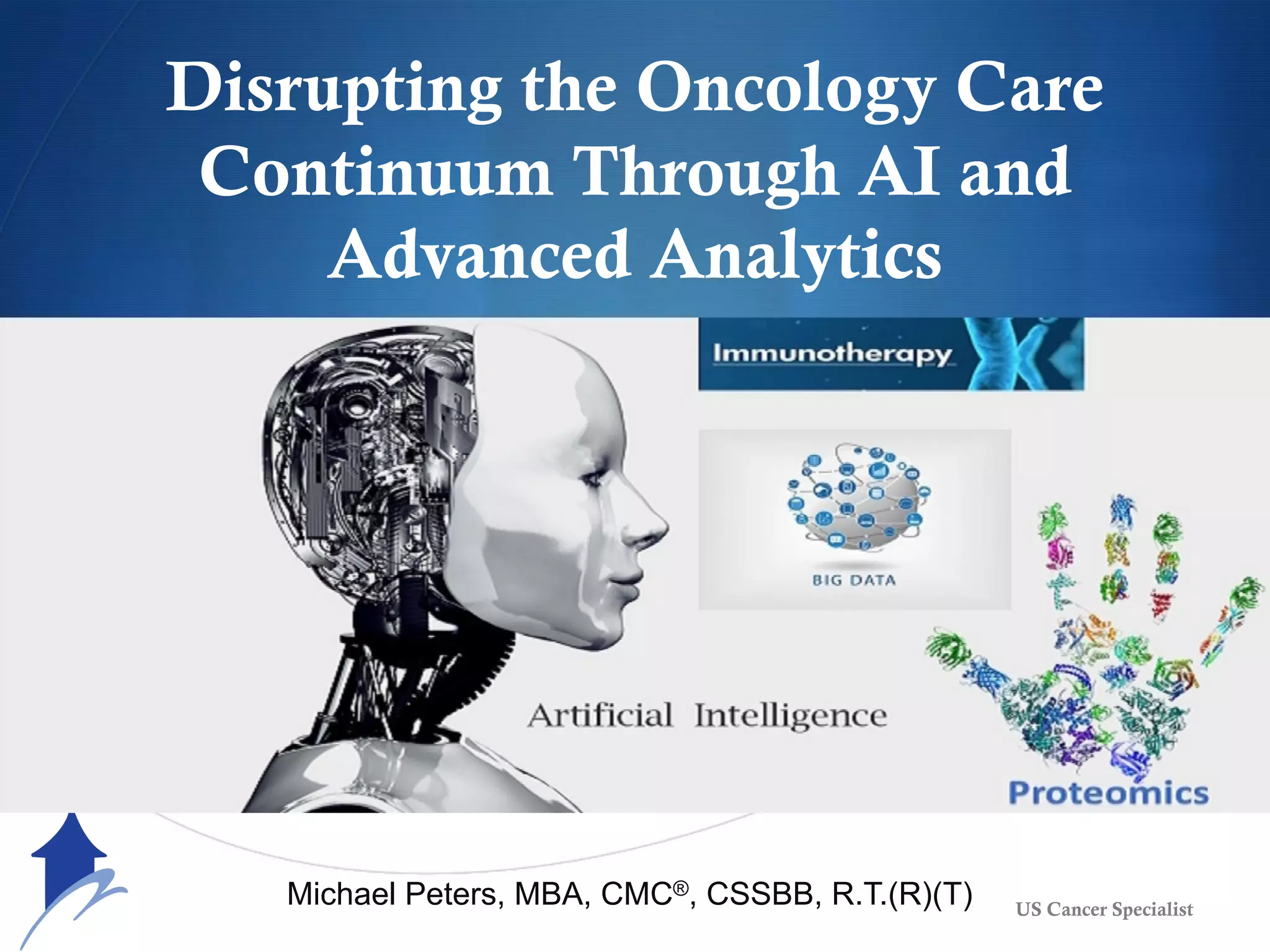


Disrupting the Oncology Care
Continuum Through AI and
Advanced Analytics
US Cancer Specialist
Michael Peters, MBA, CMC®, CSSBB, R.T.(R)(T)
US Cancer Specialist2
Disclosure: No Conflict of Interest
With respect to the following presentation, there has been
no relevant (direct or indirect) financial relationship
between the party listed above (and/or spouse/partner)
and any for-profit company in the past 24 months which
could be considered a conflict of interest.
Disclosure
US Cancer Specialist3
Agenda
• Defining AI, Advanced Analytics, Clinical Decision
Support
• The Analytic Paradigm shift in Oncology
• Technology Benefits & Limitations
• Financial Considerations and Implications
• Social Resistance to Technology Change
• Ethical and Regulatory Obstacles to Care
• Conclusion
AI and
Advanced Analytics
US Cancer Specialist1
US Cancer Specialist5
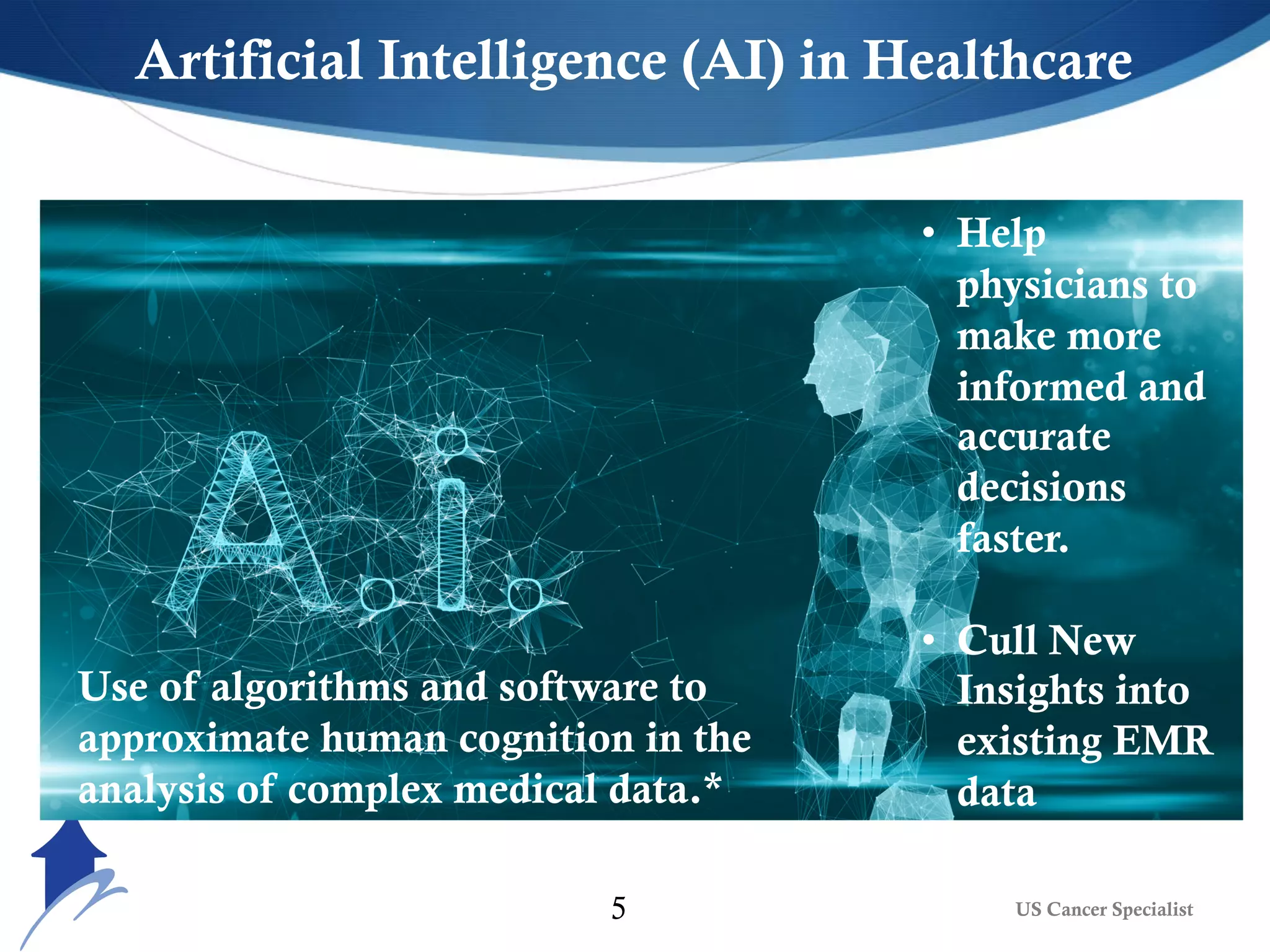
• Help
physicians to
make more
informed and
accurate
decisions
faster.
• Cull New
Insights into
existing EMR
data
Use of algorithms and software to
approximate human cognition in the
analysis of complex medical data.*
Artificial Intelligence (AI) in Healthcare
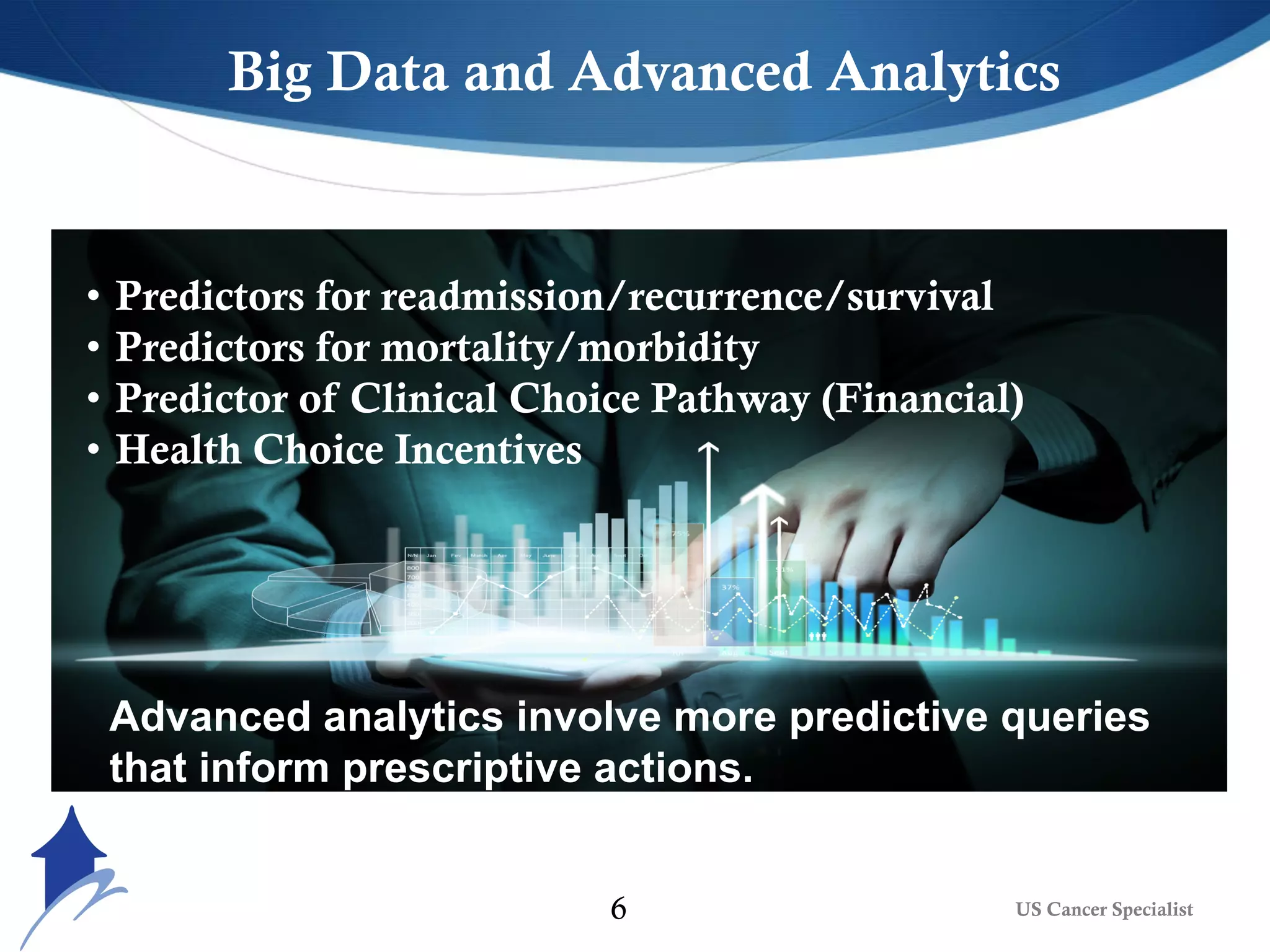
• Predictors for readmission/recurrence/survival
• Predictors for mortality/morbidity
• Predictor of Clinical Choice Pathway (Financial)
• Health Choice Incentives
Advanced analytics involve more predictive queries
that inform prescriptive actions.
Big Data and Advanced Analytics
US Cancer Specialist6
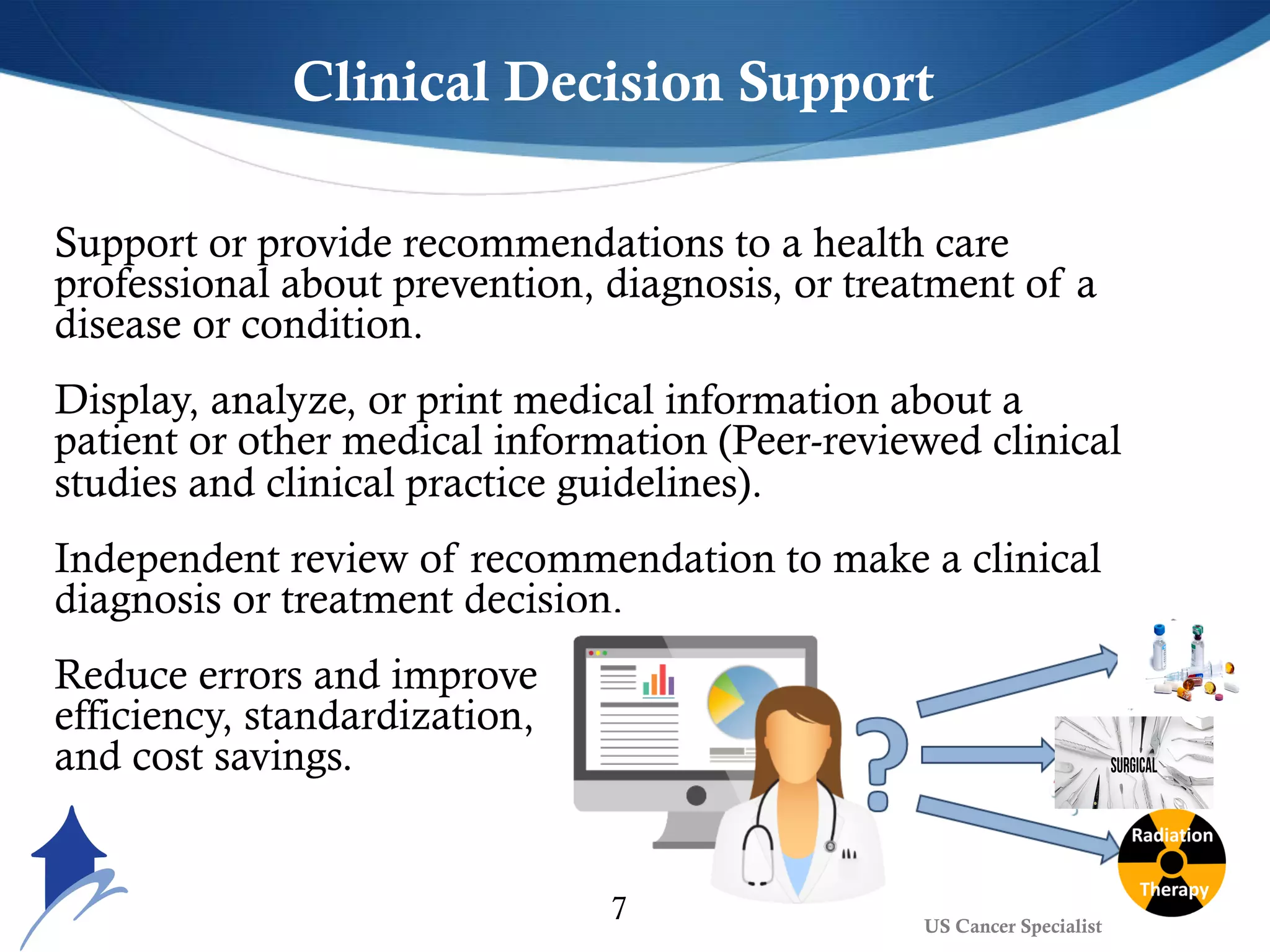
Clinical Decision Support
Support or provide recommendations to a health care
professional about prevention, diagnosis, or treatment of a
disease or condition.
Display, analyze, or print medical information about a
patient or other medical information (Peer-reviewed clinical
studies and clinical practice guidelines).
Independent review of recommendation to make a clinical
diagnosis or treatment decision.
Reduce errors and improve
efficiency, standardization,
and cost savings.
7 US Cancer Specialist
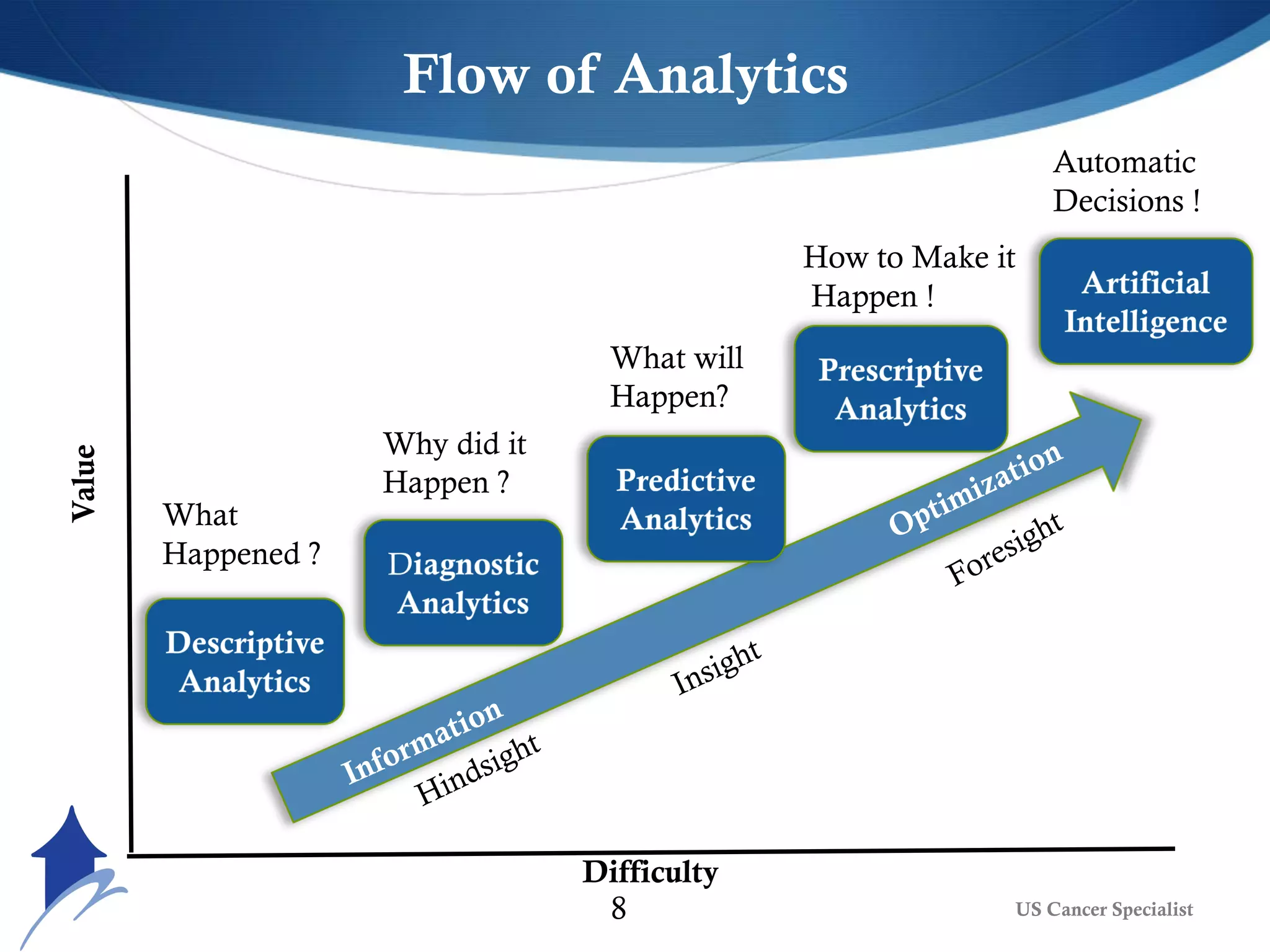
Information
Optimization
Foresight
Insight
Hindsight
Difficulty
Value Flow of Analytics
What
Happened ?
Why did it
Happen ?
What will
Happen?
How to Make it
Happen !
US Cancer Specialist8
Automatic
Decisions !
The Analytic Paradigm
shift in Oncology
US Cancer Specialist9
US Cancer Specialist10
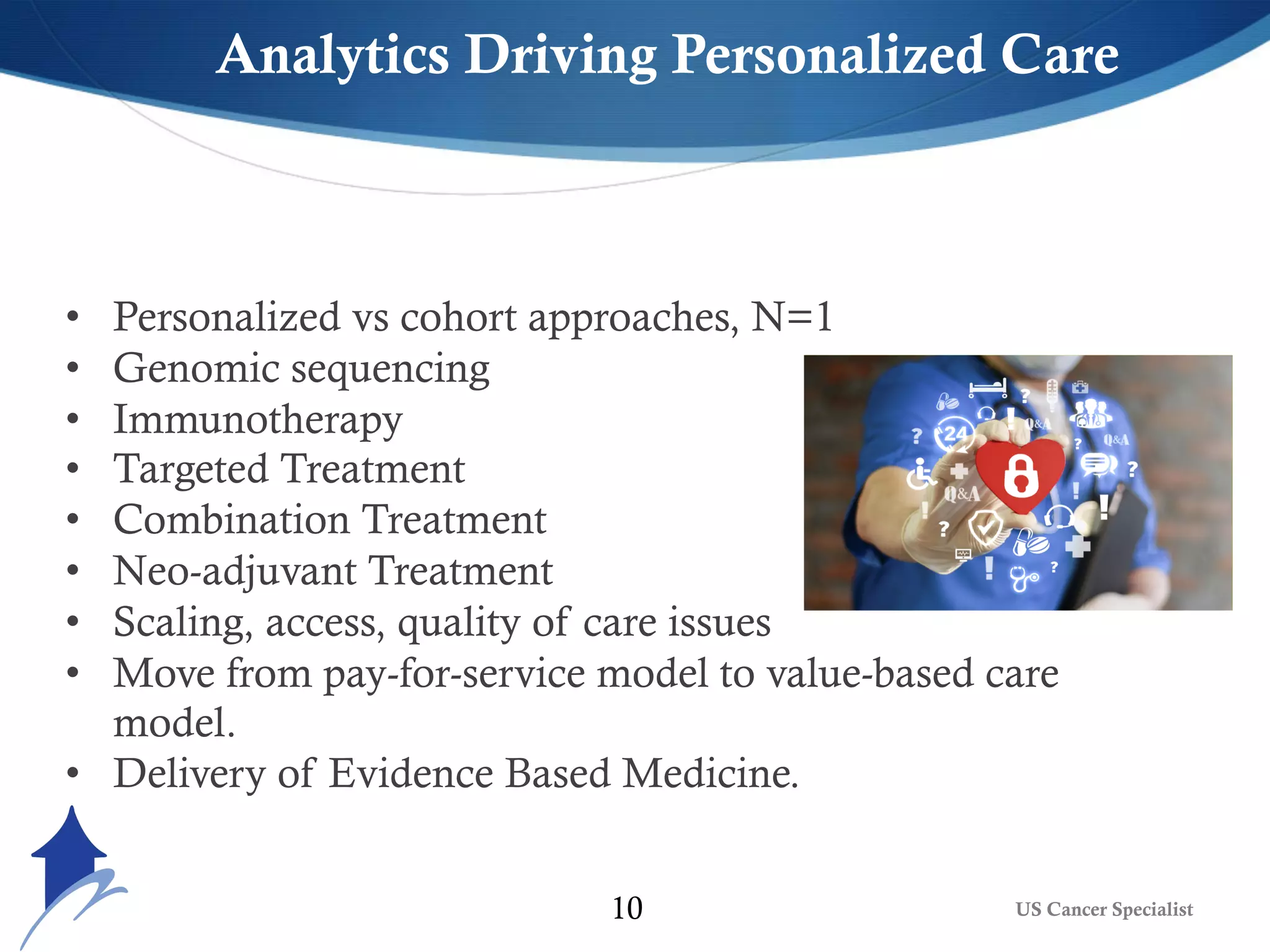
• Personalized vs cohort approaches, N=1
• Genomic sequencing
• Immunotherapy
• Targeted Treatment
• Combination Treatment
• Neo-adjuvant Treatment
• Scaling, access, quality of care issues
• Move from pay-for-service model to value-based care
model.
• Delivery of Evidence Based Medicine.
Analytics Driving Personalized Care
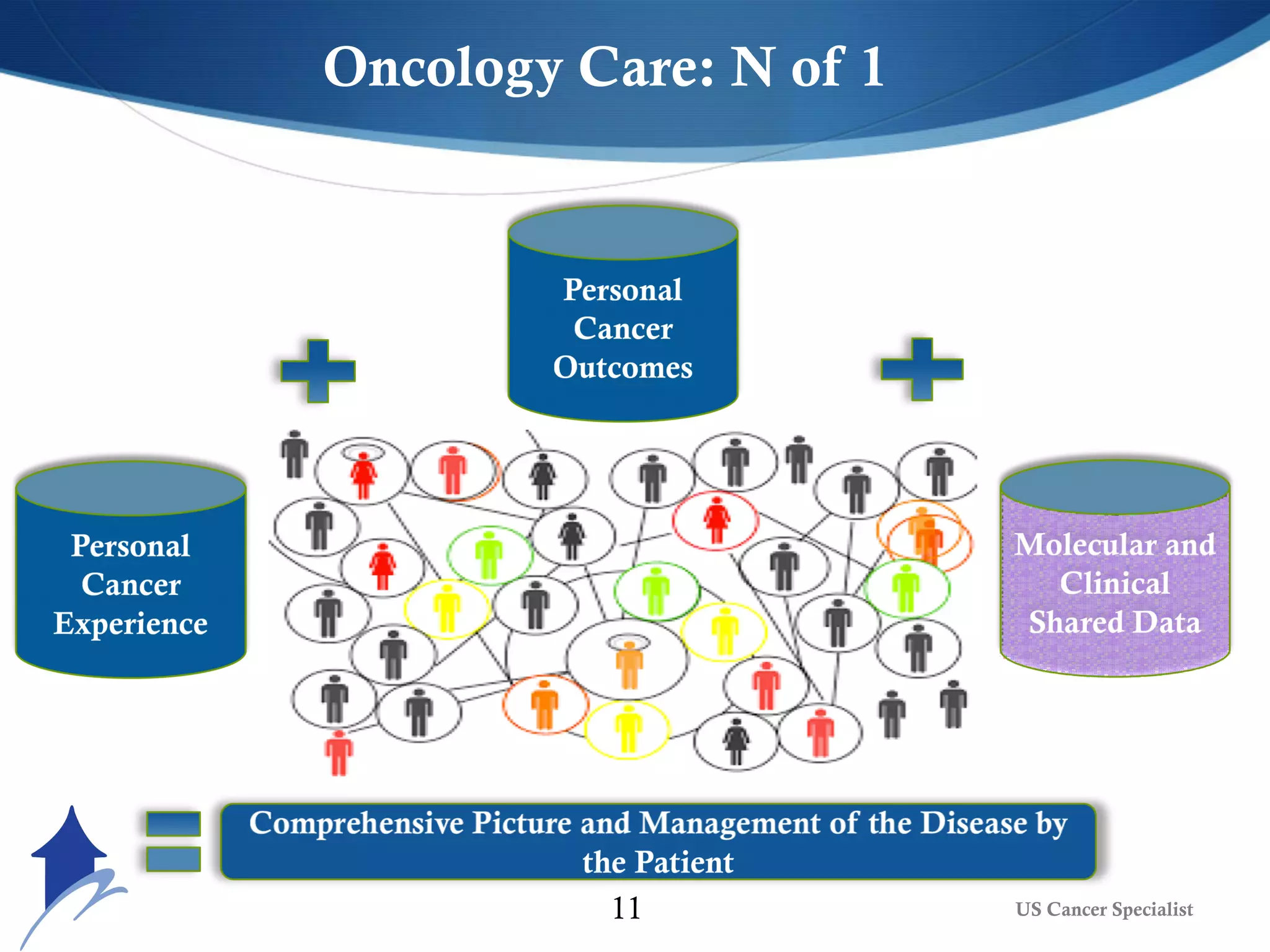
Oncology Care: N of 1
US Cancer Specialist11
US Cancer Specialist12
Radiation Oncology “AI” Today
Pre-Loaded Treatment Planning Models
• Utilization of other Leading Institution Protocols
Ability to build/adapt to one’s own Standard of Care Models
• Facility preferences based on outcomes
Automated Contouring/Segmentation
• Improving Efficiency especially in OARs
Surface Guided Laser Alignment Systems
• Improves treatment accuracy
US Cancer Specialist13
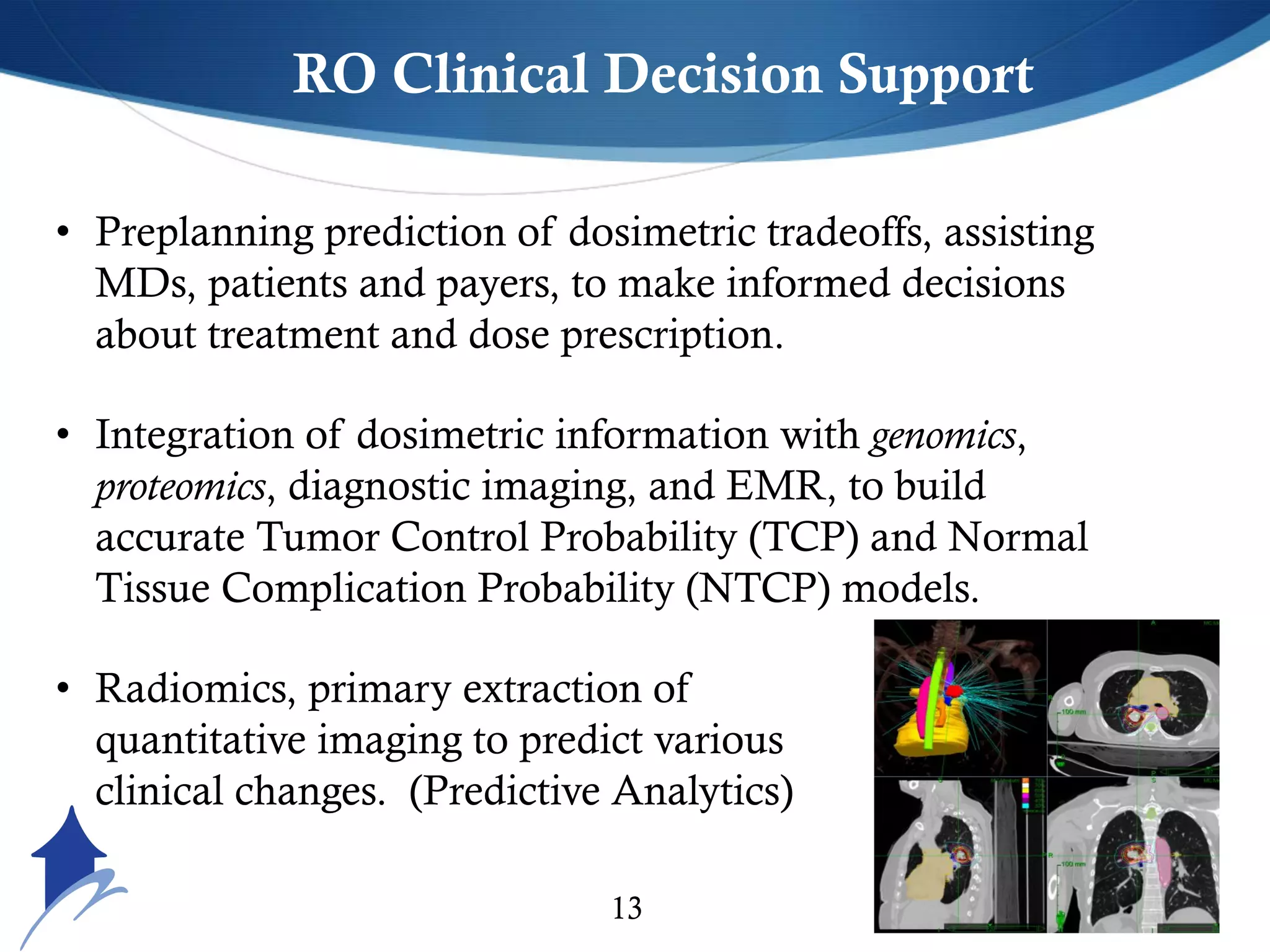
RO Clinical Decision Support
• Preplanning prediction of dosimetric tradeoffs, assisting
MDs, patients and payers, to make informed decisions
about treatment and dose prescription.
• Integration of dosimetric information with genomics,
proteomics, diagnostic imaging, and EMR, to build
accurate Tumor Control Probability (TCP) and Normal
Tissue Complication Probability (NTCP) models.
• Radiomics, primary extraction of
quantitative imaging to predict various
clinical changes. (Predictive Analytics)
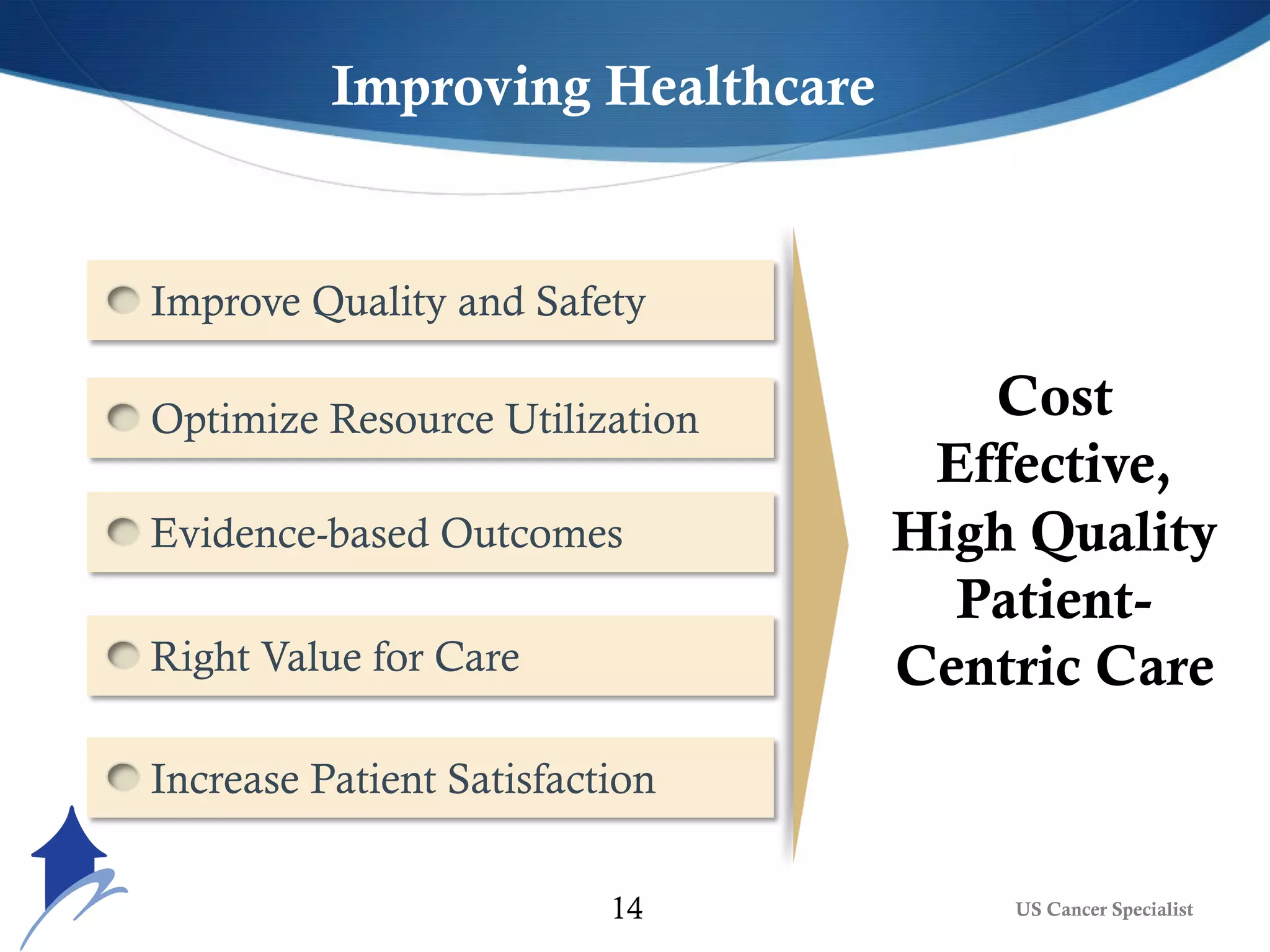
Improving Healthcare
Improve Quality and Safety
Optimize Resource Utilization
Evidence-based Outcomes
Right Value for Care
Increase Patient Satisfaction
Cost
Effective,
High Quality
Patient-
Centric Care
US Cancer Specialist14
Technology Benefits and
Limitations
US Cancer Specialist15
US Cancer Specialist16
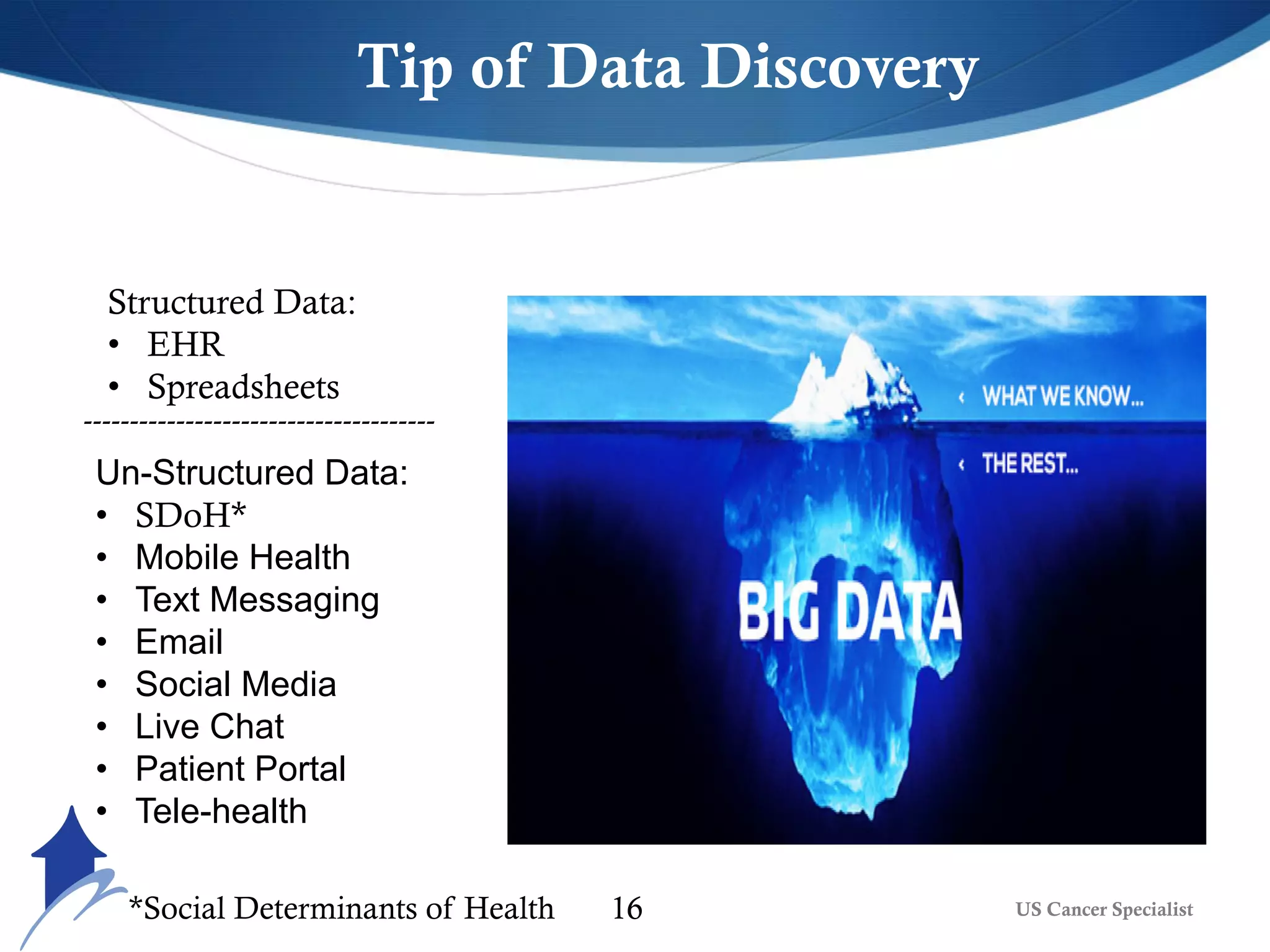
Structured Data:
• EHR
• Spreadsheets
Un-Structured Data:
• SDoH*
• Mobile Health
• Text Messaging
• Email
• Social Media
• Live Chat
• Patient Portal
• Tele-health
--------------------------------------
Tip of Data Discovery
*Social Determinants of Health
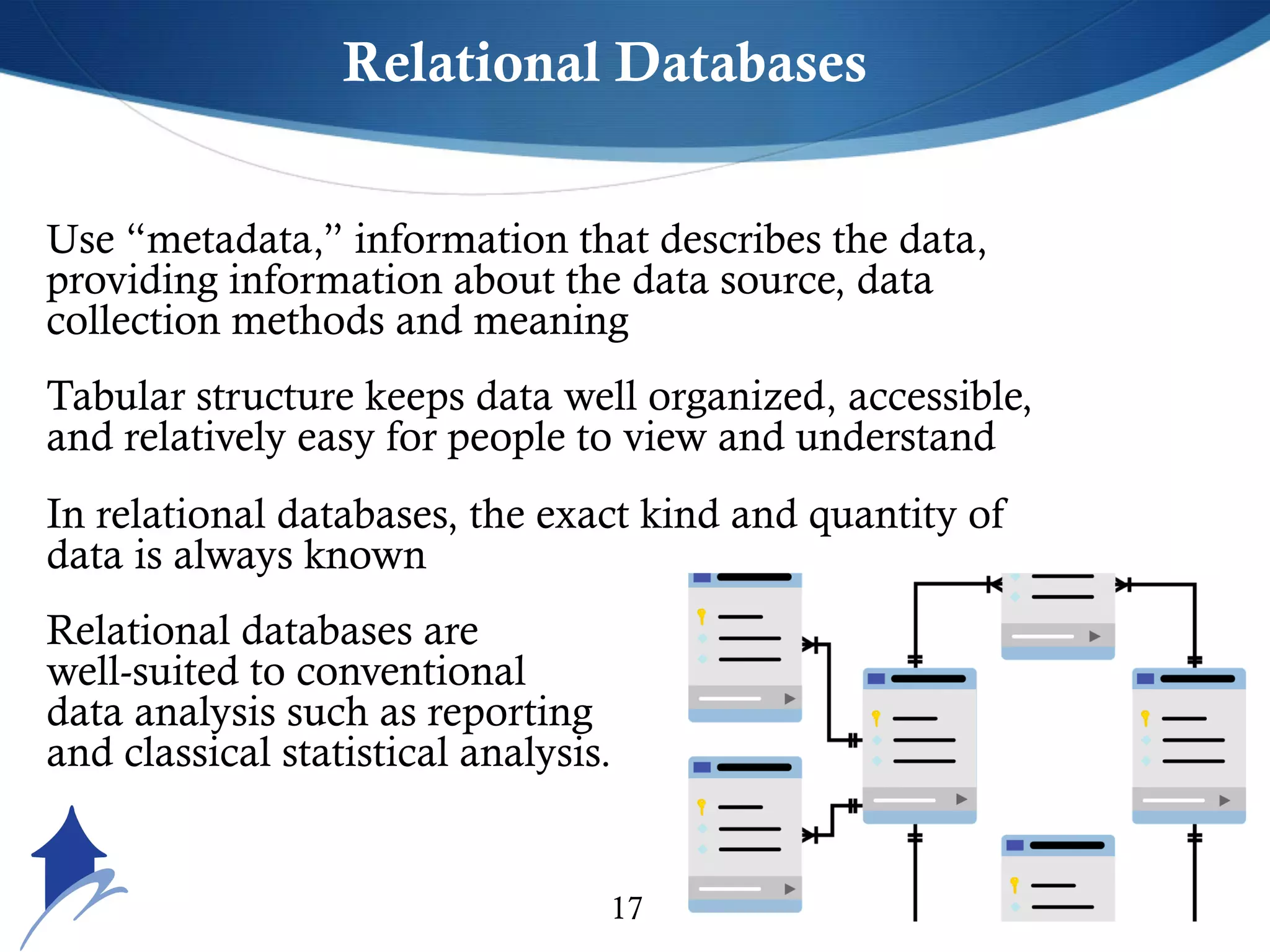
Relational Databases
Use “metadata,” information that describes the data,
providing information about the data source, data
collection methods and meaning
Tabular structure keeps data well organized, accessible,
and relatively easy for people to view and understand
In relational databases, the exact kind and quantity of
data is always known
Relational databases are
well-suited to conventional
data analysis such as reporting
and classical statistical analysis.
17
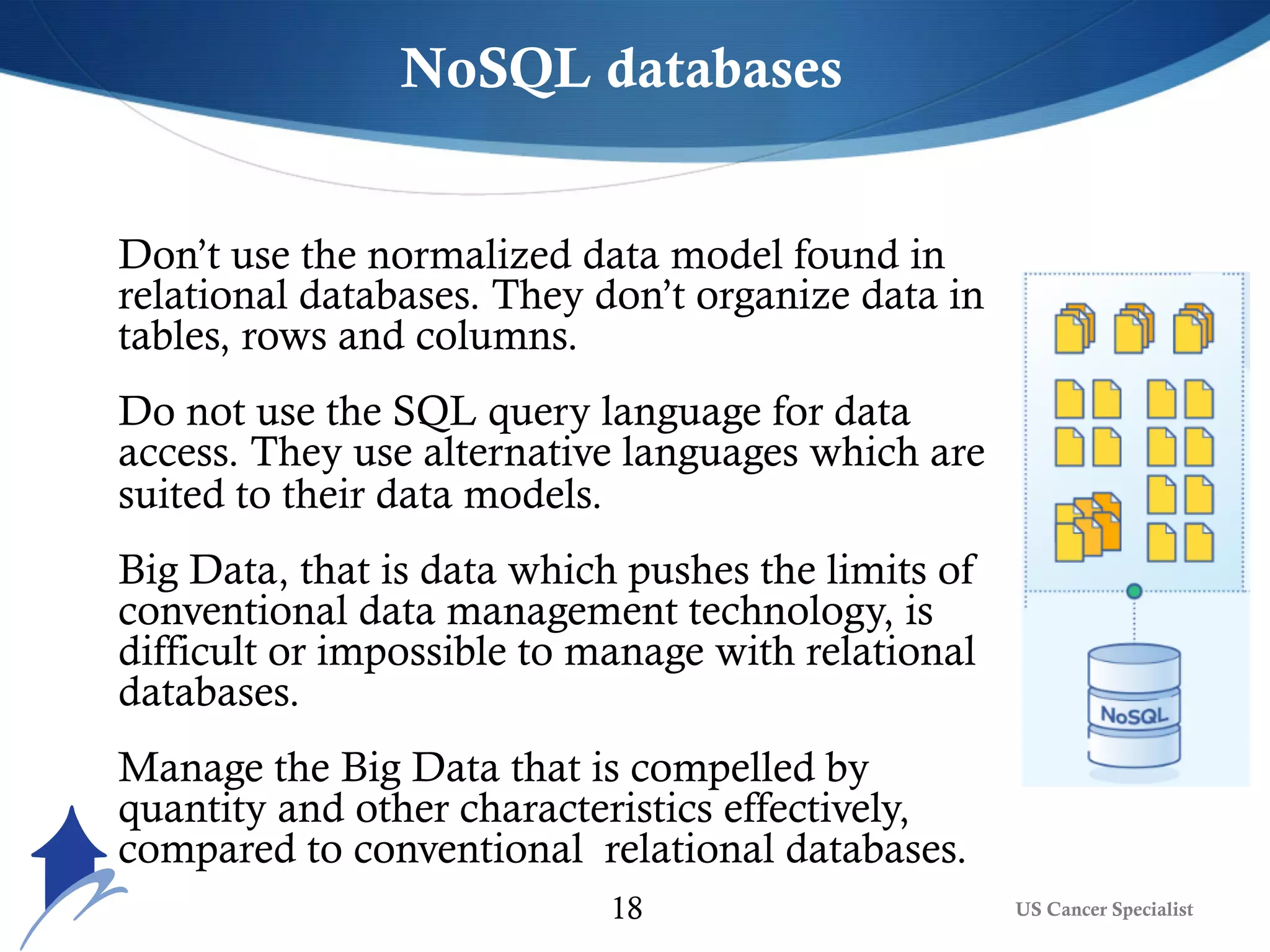
Don’t use the normalized data model found in
relational databases. They don’t organize data in
tables, rows and columns.
Do not use the SQL query language for data
access. They use alternative languages which are
suited to their data models.
Big Data, that is data which pushes the limits of
conventional data management technology, is
difficult or impossible to manage with relational
databases.
Manage the Big Data that is compelled by
quantity and other characteristics effectively,
compared to conventional relational databases.
NoSQL databases
US Cancer Specialist18
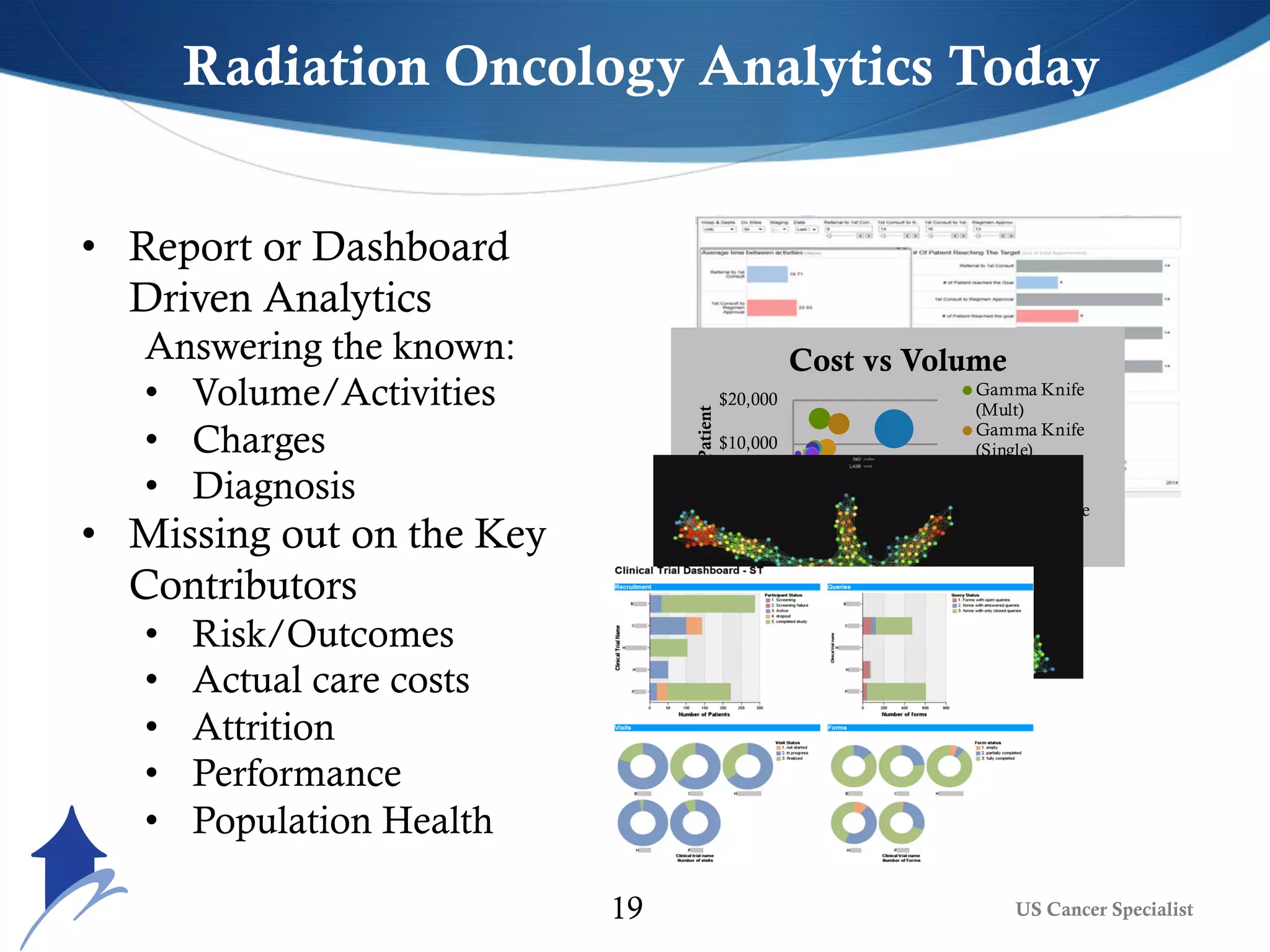
• Report or Dashboard
Driven Analytics
Answering the known:
• Volume/Activities
• Charges
• Diagnosis
• Missing out on the Key
Contributors
• Risk/Outcomes
• Actual care costs
• Attrition
• Performance
• Population Health
$0
$10,000
$20,000
0 20 40 60
CostperPatient
Patient Volume
Cost vs Volume
Gamma Knife
(Mult)
Gamma Knife
(Single)
IMRT
Head/Neck
IMRT Prostate
Radiation Oncology Analytics Today
US Cancer Specialist19
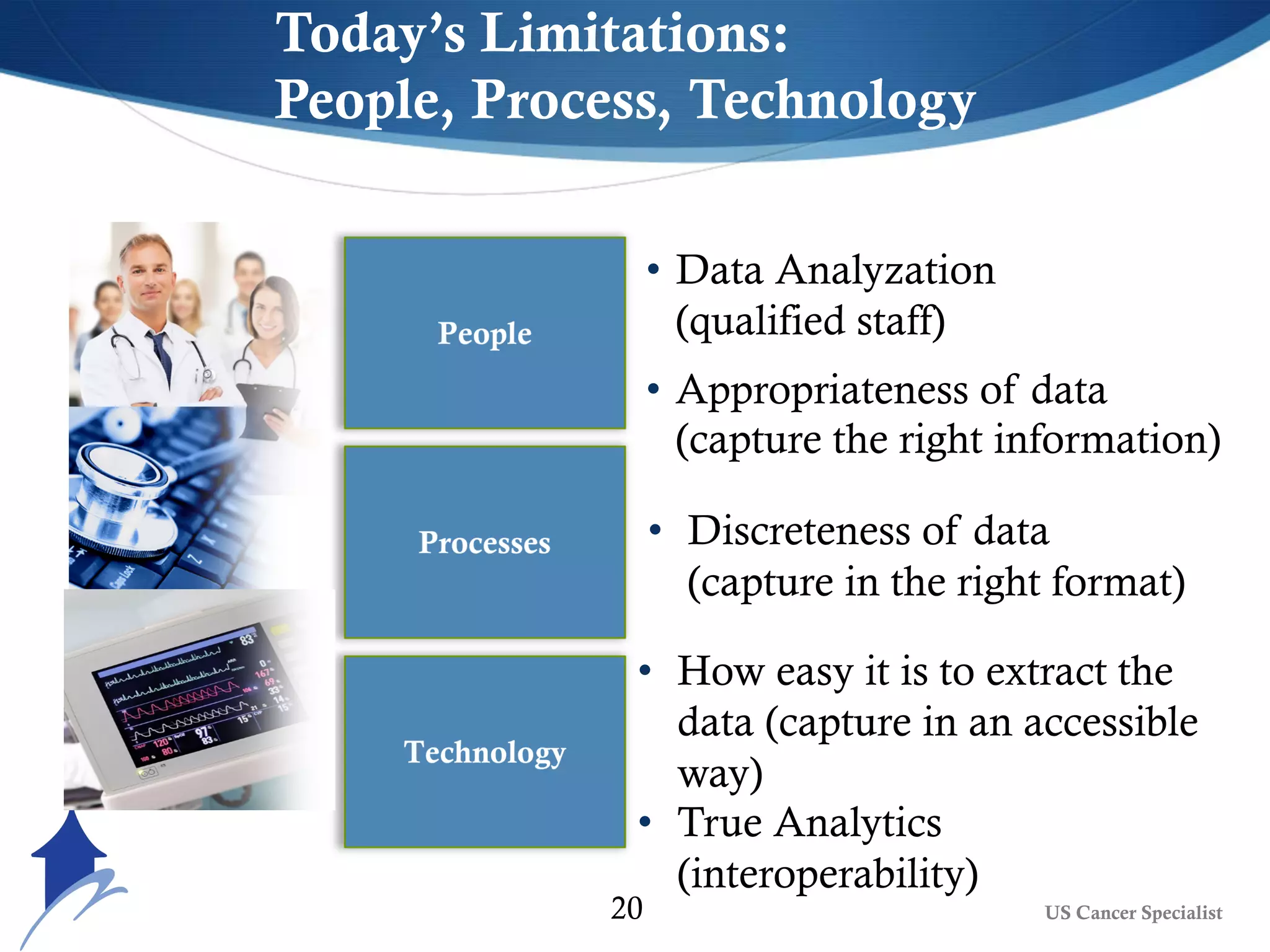
• Data Analyzation
(qualified staff)
• Appropriateness of data
(capture the right information)
Today’s Limitations:
People, Process, Technology
• Discreteness of data
(capture in the right format)
• How easy it is to extract the
data (capture in an accessible
way)
• True Analytics
(interoperability)
US Cancer Specialist20
Financial
Considerations and
Implications
US Cancer Specialist21
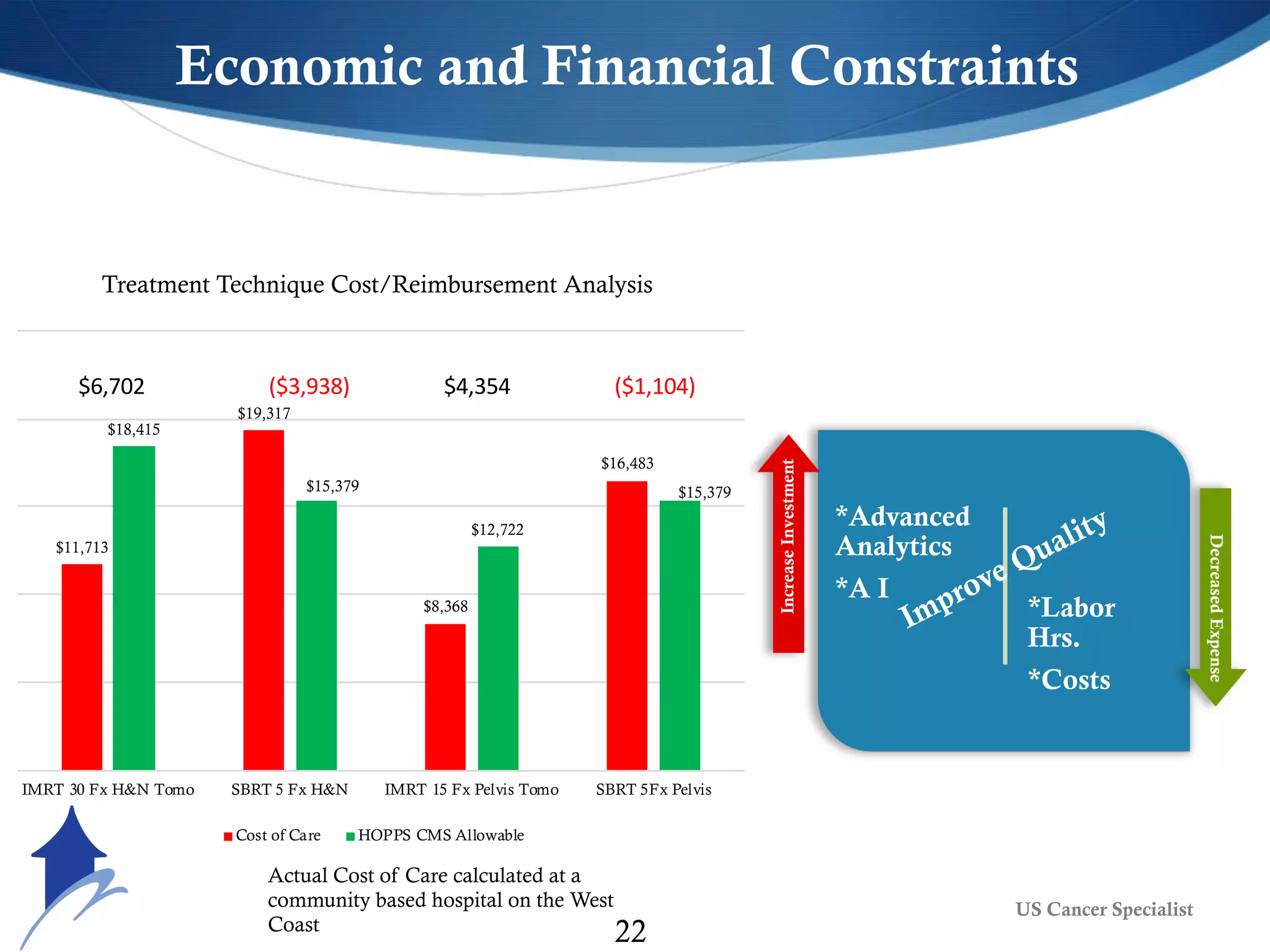
($3,938) $4,354 ($1,104)$6,702
*Advanced
Analytics
*A I
*Labor
Hrs.
*Costs
Economic and Financial Constraints
Improve Quality
$11,713
$19,317
$8,368
$16,483
$18,415
$15,379
$12,722
$15,379
IMRT 30 Fx H&N Tomo SBRT 5 Fx H&N IMRT 15 Fx Pelvis Tomo SBRT 5Fx Pelvis
Treatment Technique Cost/Reimbursement Analysis
Cost of Care HOPPS CMS Allowable
22
Actual Cost of Care calculated at a
community based hospital on the West
Coast
US Cancer Specialist
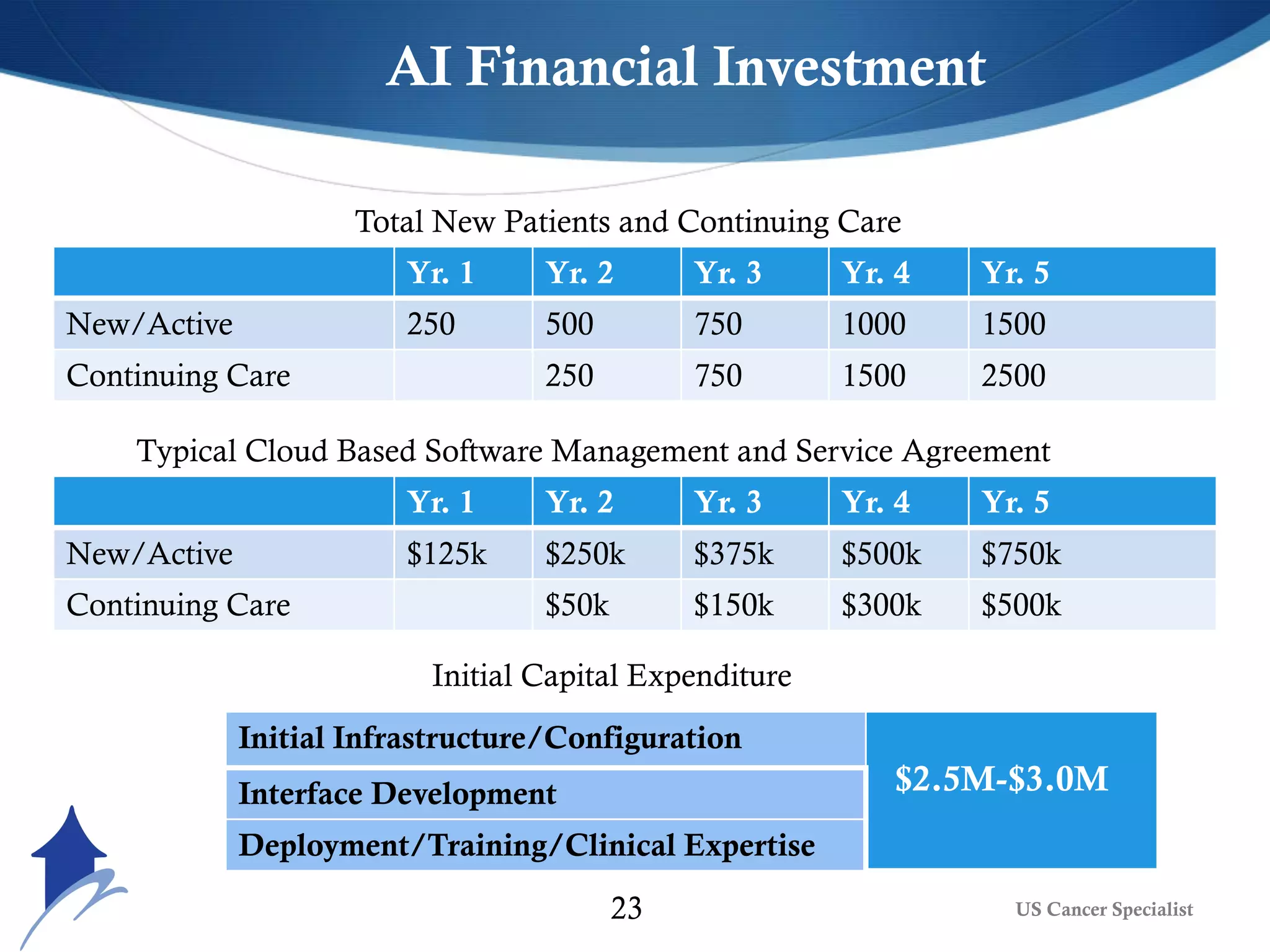
US Cancer Specialist23
Yr. 1 Yr. 2 Yr. 3 Yr. 4 Yr. 5
New/Active 250 500 750 1000 1500
Continuing Care 250 750 1500 2500
Yr. 1 Yr. 2 Yr. 3 Yr. 4 Yr. 5
New/Active $125k $250k $375k $500k $750k
Continuing Care $50k $150k $300k $500k
Typical Cloud Based Software Management and Service Agreement
Total New Patients and Continuing Care
Initial Capital Expenditure
Initial Infrastructure/Configuration
$2.5M-$3.0MInterface Development
Deployment/Training/Clinical Expertise
AI Financial Investment
US Cancer Specialist24
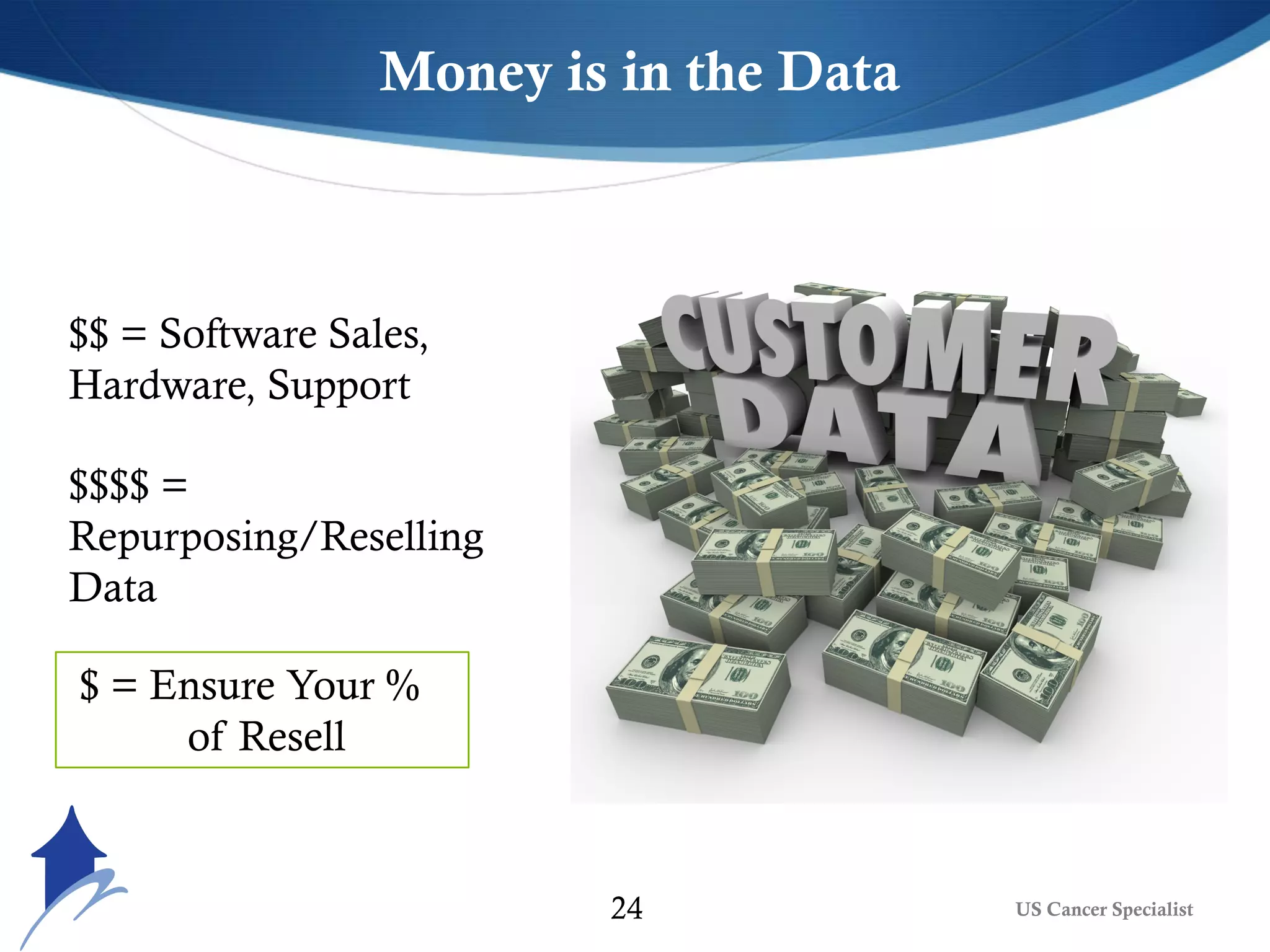
Money is in the Data
$$ = Software Sales,
Hardware, Support
$$$$ =
Repurposing/Reselling
Data
$ = Ensure Your %
of Resell
Ethical and Regulatory
Obstacles
25 US Cancer Specialist
Ethical and Regulatory Obstacles
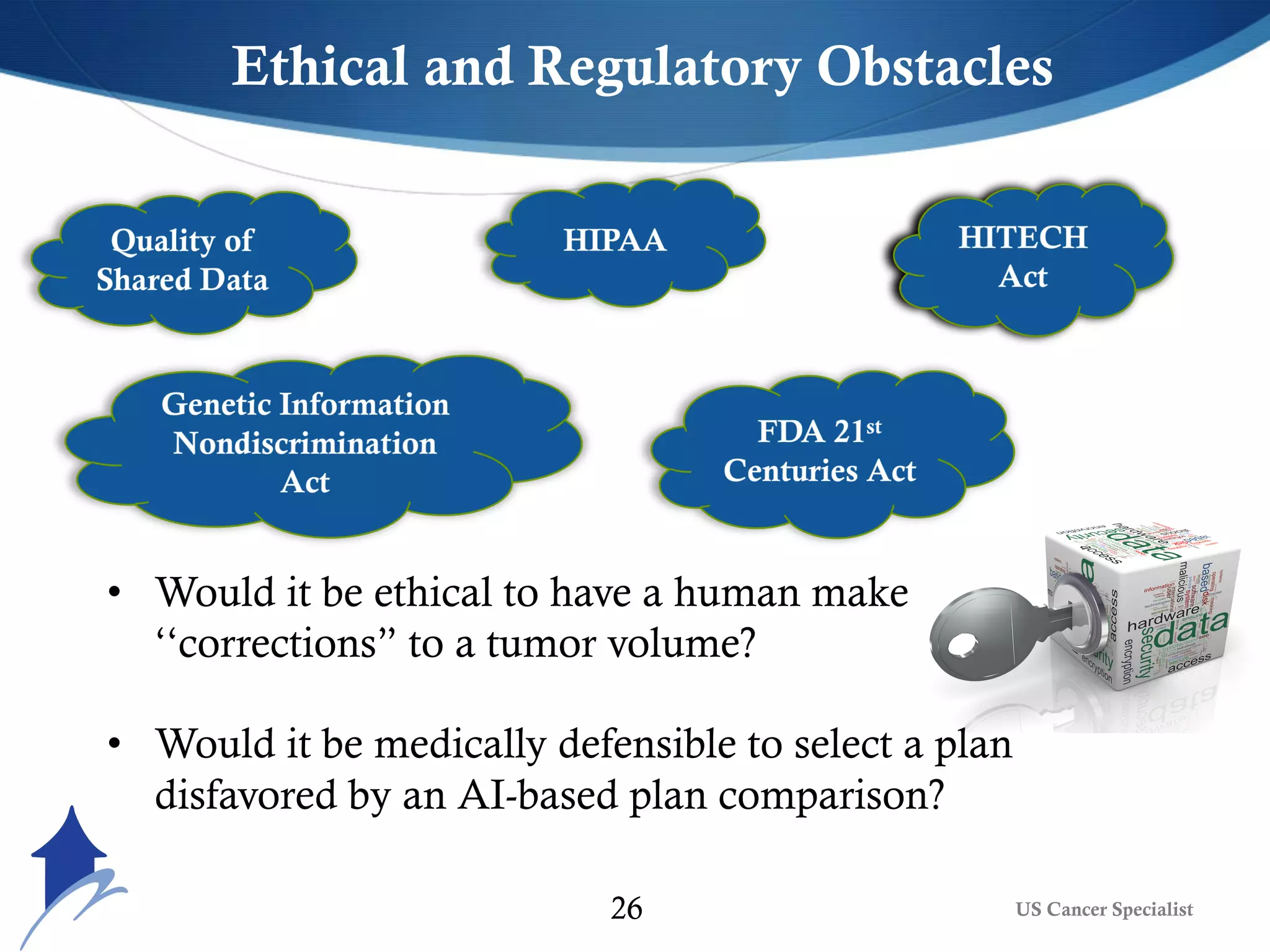
• Would it be ethical to have a human make
‘‘corrections” to a tumor volume?
• Would it be medically defensible to select a plan
disfavored by an AI-based plan comparison?
26 US Cancer Specialist
Social Resistance to
Technology Change
US Cancer Specialist27
US Cancer Specialist28
• Privacy
• Transparency & Equality
• Economic impacts
• Governance & accountability
• Managing AI risk
• AI morality & values
• Changing Healthcare Paradigm
Social Resistance to Change
Public Good vs Patient Privacy
US Cancer Specialist29
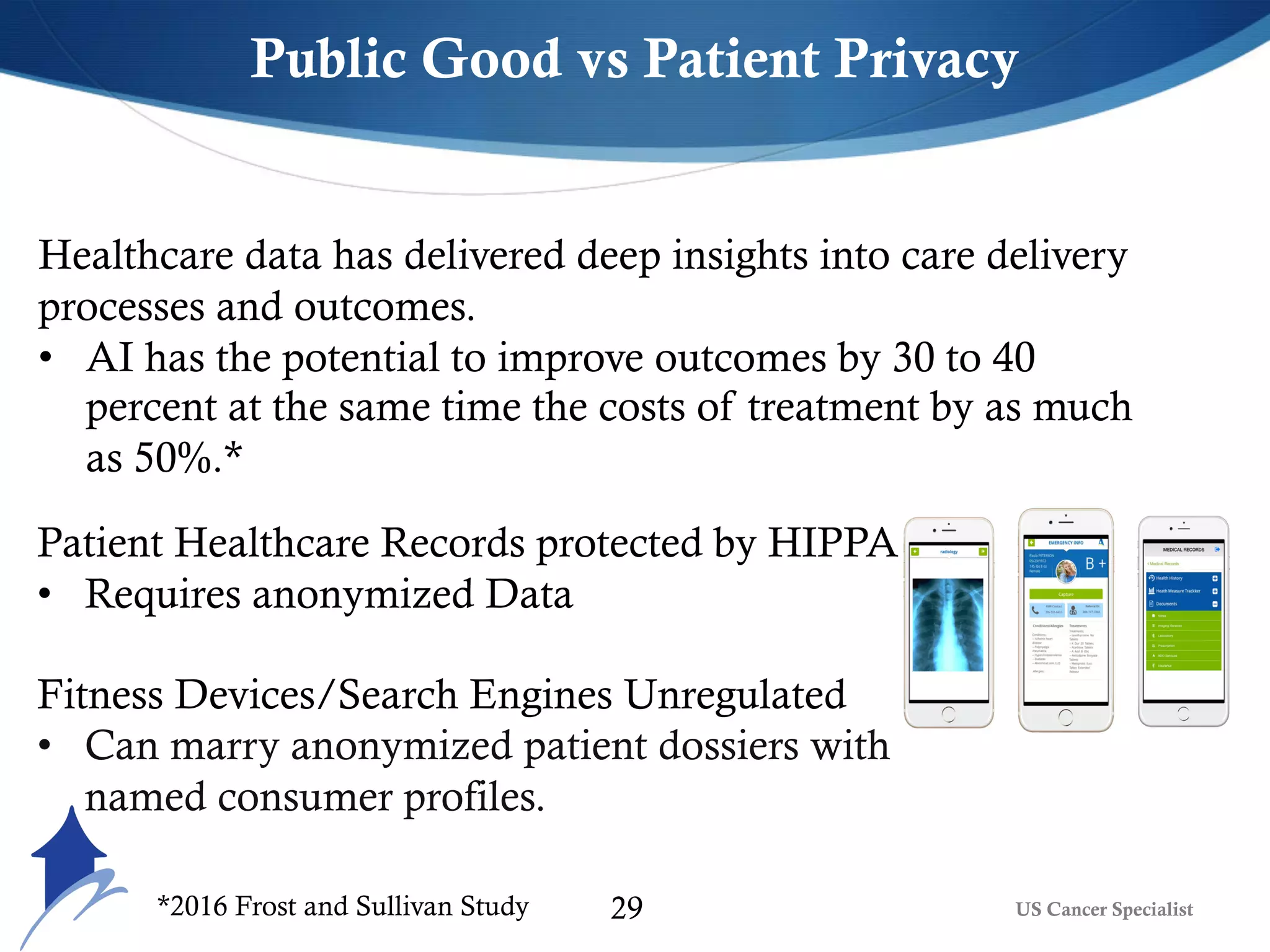
Patient Healthcare Records protected by HIPPA
• Requires anonymized Data
Fitness Devices/Search Engines Unregulated
• Can marry anonymized patient dossiers with
named consumer profiles.
Healthcare data has delivered deep insights into care delivery
processes and outcomes.
• AI has the potential to improve outcomes by 30 to 40
percent at the same time the costs of treatment by as much
as 50%.*
*2016 Frost and Sullivan Study
US Cancer Specialist30
• Precision Genomic and Proteomic Radiation Therapy
• Integration of clinically relevant data from multiple
sources (e.g. EHR, imaging data) to further tailor online
adaptive planning.
• Standardized processes and data structures amongst
institutions for comparative treatment analysis.
Radiation Oncology “AI” Future
Conclusion
32 US Cancer Specialist
US Cancer Specialist32
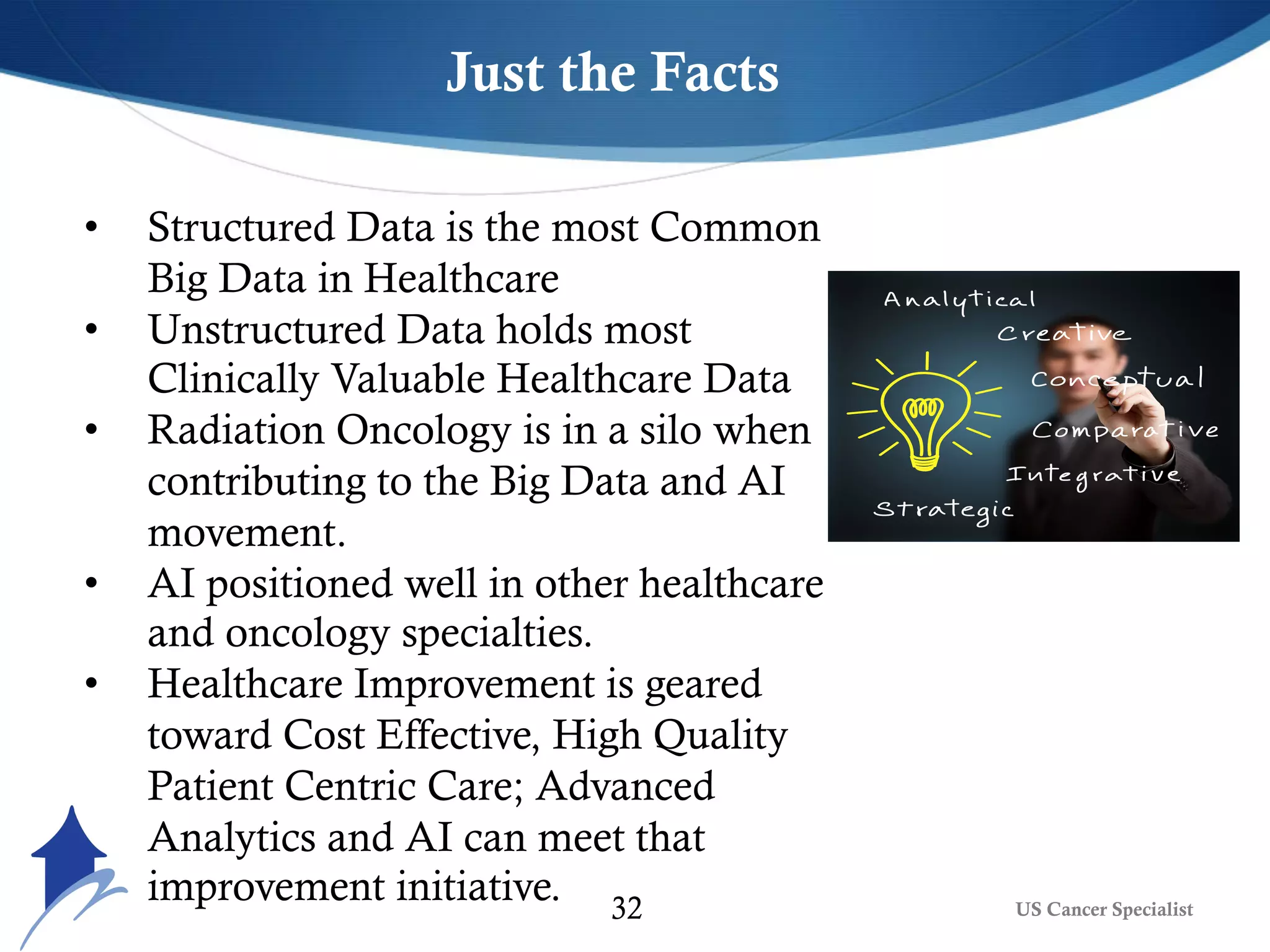
Just the Facts
• Structured Data is the most Common
Big Data in Healthcare
• Unstructured Data holds most
Clinically Valuable Healthcare Data
• Radiation Oncology is in a silo when
contributing to the Big Data and AI
movement.
• AI positioned well in other healthcare
and oncology specialties.
• Healthcare Improvement is geared
toward Cost Effective, High Quality
Patient Centric Care; Advanced
Analytics and AI can meet that
improvement initiative.
US Cancer Specialist33
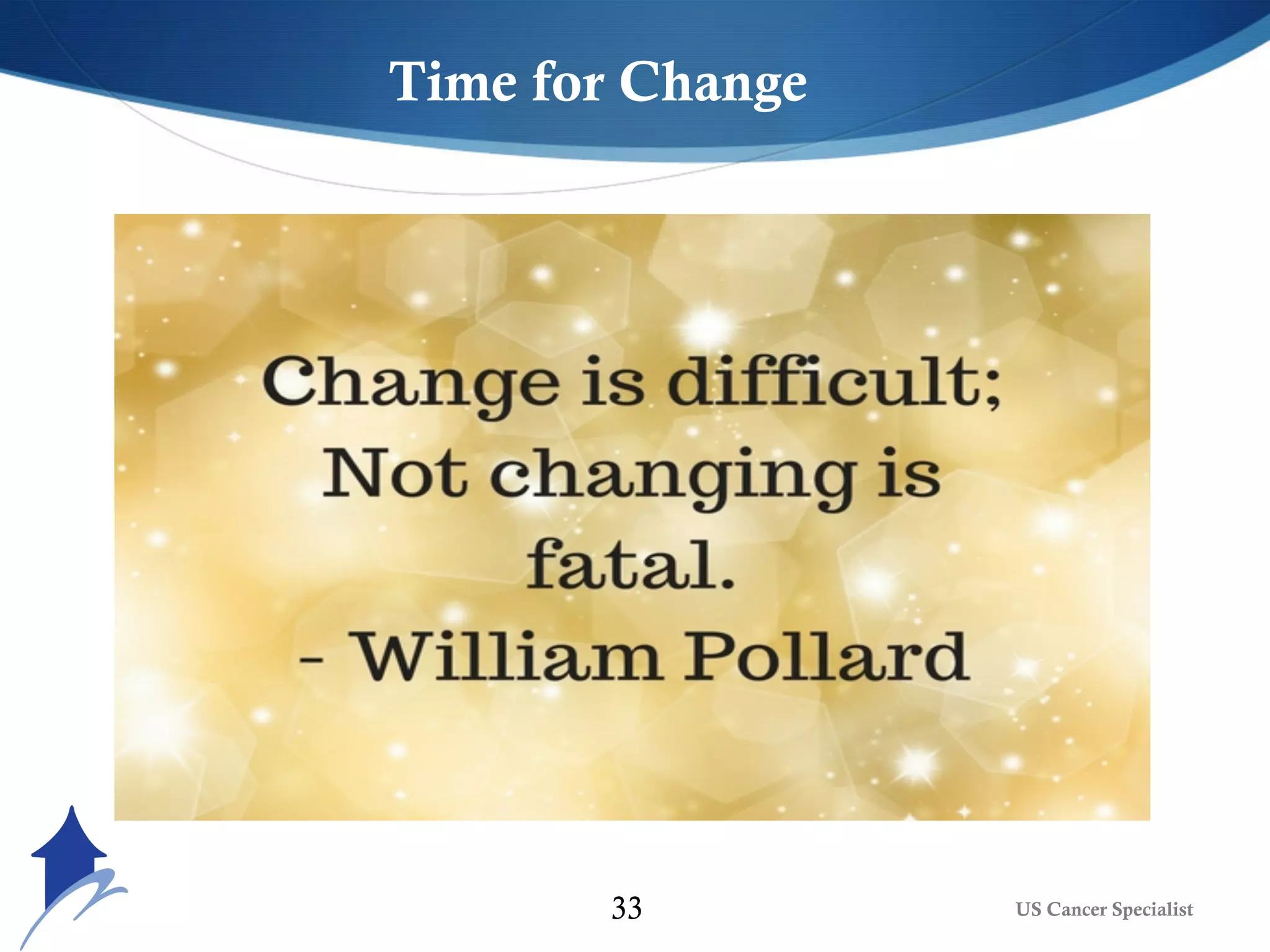
Time for Change
US Cancer Specialist34
Thank You!
Email: mpeters@uscancerspecialists.com
Cell: 727-487-2840
Web: uscancerspecialists.com

Disrupting the Oncology Care Continuum through AI and Advanced Analytics

  • 1.
    Disrupting the OncologyCare Continuum Through AI and Advanced Analytics US Cancer Specialist Michael Peters, MBA, CMC®, CSSBB, R.T.(R)(T)
  • 2.
    US Cancer Specialist2 Disclosure:No Conflict of Interest With respect to the following presentation, there has been no relevant (direct or indirect) financial relationship between the party listed above (and/or spouse/partner) and any for-profit company in the past 24 months which could be considered a conflict of interest. Disclosure
  • 3.
    US Cancer Specialist3 Agenda •Defining AI, Advanced Analytics, Clinical Decision Support • The Analytic Paradigm shift in Oncology • Technology Benefits & Limitations • Financial Considerations and Implications • Social Resistance to Technology Change • Ethical and Regulatory Obstacles to Care • Conclusion
  • 4.
    AI and Advanced Analytics USCancer Specialist1
  • 5.
    US Cancer Specialist5 •Help physicians to make more informed and accurate decisions faster. • Cull New Insights into existing EMR data Use of algorithms and software to approximate human cognition in the analysis of complex medical data.* Artificial Intelligence (AI) in Healthcare
  • 6.
    • Predictors forreadmission/recurrence/survival • Predictors for mortality/morbidity • Predictor of Clinical Choice Pathway (Financial) • Health Choice Incentives Advanced analytics involve more predictive queries that inform prescriptive actions. Big Data and Advanced Analytics US Cancer Specialist6
  • 7.
    Clinical Decision Support Supportor provide recommendations to a health care professional about prevention, diagnosis, or treatment of a disease or condition. Display, analyze, or print medical information about a patient or other medical information (Peer-reviewed clinical studies and clinical practice guidelines). Independent review of recommendation to make a clinical diagnosis or treatment decision. Reduce errors and improve efficiency, standardization, and cost savings. 7 US Cancer Specialist
  • 8.
    Information Optimization Foresight Insight Hindsight Difficulty Value Flow ofAnalytics What Happened ? Why did it Happen ? What will Happen? How to Make it Happen ! US Cancer Specialist8 Automatic Decisions !
  • 9.
    The Analytic Paradigm shiftin Oncology US Cancer Specialist9
  • 10.
    US Cancer Specialist10 •Personalized vs cohort approaches, N=1 • Genomic sequencing • Immunotherapy • Targeted Treatment • Combination Treatment • Neo-adjuvant Treatment • Scaling, access, quality of care issues • Move from pay-for-service model to value-based care model. • Delivery of Evidence Based Medicine. Analytics Driving Personalized Care
  • 11.
    Oncology Care: Nof 1 US Cancer Specialist11
  • 12.
    US Cancer Specialist12 RadiationOncology “AI” Today Pre-Loaded Treatment Planning Models • Utilization of other Leading Institution Protocols Ability to build/adapt to one’s own Standard of Care Models • Facility preferences based on outcomes Automated Contouring/Segmentation • Improving Efficiency especially in OARs Surface Guided Laser Alignment Systems • Improves treatment accuracy
  • 13.
    US Cancer Specialist13 ROClinical Decision Support • Preplanning prediction of dosimetric tradeoffs, assisting MDs, patients and payers, to make informed decisions about treatment and dose prescription. • Integration of dosimetric information with genomics, proteomics, diagnostic imaging, and EMR, to build accurate Tumor Control Probability (TCP) and Normal Tissue Complication Probability (NTCP) models. • Radiomics, primary extraction of quantitative imaging to predict various clinical changes. (Predictive Analytics)
  • 14.
    Improving Healthcare Improve Qualityand Safety Optimize Resource Utilization Evidence-based Outcomes Right Value for Care Increase Patient Satisfaction Cost Effective, High Quality Patient- Centric Care US Cancer Specialist14
  • 15.
  • 16.
    US Cancer Specialist16 StructuredData: • EHR • Spreadsheets Un-Structured Data: • SDoH* • Mobile Health • Text Messaging • Email • Social Media • Live Chat • Patient Portal • Tele-health -------------------------------------- Tip of Data Discovery *Social Determinants of Health
  • 17.
    Relational Databases Use “metadata,”information that describes the data, providing information about the data source, data collection methods and meaning Tabular structure keeps data well organized, accessible, and relatively easy for people to view and understand In relational databases, the exact kind and quantity of data is always known Relational databases are well-suited to conventional data analysis such as reporting and classical statistical analysis. 17
  • 18.
    Don’t use thenormalized data model found in relational databases. They don’t organize data in tables, rows and columns. Do not use the SQL query language for data access. They use alternative languages which are suited to their data models. Big Data, that is data which pushes the limits of conventional data management technology, is difficult or impossible to manage with relational databases. Manage the Big Data that is compelled by quantity and other characteristics effectively, compared to conventional relational databases. NoSQL databases US Cancer Specialist18
  • 19.
    • Report orDashboard Driven Analytics Answering the known: • Volume/Activities • Charges • Diagnosis • Missing out on the Key Contributors • Risk/Outcomes • Actual care costs • Attrition • Performance • Population Health $0 $10,000 $20,000 0 20 40 60 CostperPatient Patient Volume Cost vs Volume Gamma Knife (Mult) Gamma Knife (Single) IMRT Head/Neck IMRT Prostate Radiation Oncology Analytics Today US Cancer Specialist19
  • 20.
    • Data Analyzation (qualifiedstaff) • Appropriateness of data (capture the right information) Today’s Limitations: People, Process, Technology • Discreteness of data (capture in the right format) • How easy it is to extract the data (capture in an accessible way) • True Analytics (interoperability) US Cancer Specialist20
  • 21.
  • 22.
    ($3,938) $4,354 ($1,104)$6,702 *Advanced Analytics *AI *Labor Hrs. *Costs Economic and Financial Constraints Improve Quality $11,713 $19,317 $8,368 $16,483 $18,415 $15,379 $12,722 $15,379 IMRT 30 Fx H&N Tomo SBRT 5 Fx H&N IMRT 15 Fx Pelvis Tomo SBRT 5Fx Pelvis Treatment Technique Cost/Reimbursement Analysis Cost of Care HOPPS CMS Allowable 22 Actual Cost of Care calculated at a community based hospital on the West Coast US Cancer Specialist
  • 23.
    US Cancer Specialist23 Yr.1 Yr. 2 Yr. 3 Yr. 4 Yr. 5 New/Active 250 500 750 1000 1500 Continuing Care 250 750 1500 2500 Yr. 1 Yr. 2 Yr. 3 Yr. 4 Yr. 5 New/Active $125k $250k $375k $500k $750k Continuing Care $50k $150k $300k $500k Typical Cloud Based Software Management and Service Agreement Total New Patients and Continuing Care Initial Capital Expenditure Initial Infrastructure/Configuration $2.5M-$3.0MInterface Development Deployment/Training/Clinical Expertise AI Financial Investment
  • 24.
    US Cancer Specialist24 Moneyis in the Data $$ = Software Sales, Hardware, Support $$$$ = Repurposing/Reselling Data $ = Ensure Your % of Resell
  • 25.
  • 26.
    Ethical and RegulatoryObstacles • Would it be ethical to have a human make ‘‘corrections” to a tumor volume? • Would it be medically defensible to select a plan disfavored by an AI-based plan comparison? 26 US Cancer Specialist
  • 27.
    Social Resistance to TechnologyChange US Cancer Specialist27
  • 28.
    US Cancer Specialist28 •Privacy • Transparency & Equality • Economic impacts • Governance & accountability • Managing AI risk • AI morality & values • Changing Healthcare Paradigm Social Resistance to Change
  • 29.
    Public Good vsPatient Privacy US Cancer Specialist29 Patient Healthcare Records protected by HIPPA • Requires anonymized Data Fitness Devices/Search Engines Unregulated • Can marry anonymized patient dossiers with named consumer profiles. Healthcare data has delivered deep insights into care delivery processes and outcomes. • AI has the potential to improve outcomes by 30 to 40 percent at the same time the costs of treatment by as much as 50%.* *2016 Frost and Sullivan Study
  • 30.
    US Cancer Specialist30 •Precision Genomic and Proteomic Radiation Therapy • Integration of clinically relevant data from multiple sources (e.g. EHR, imaging data) to further tailor online adaptive planning. • Standardized processes and data structures amongst institutions for comparative treatment analysis. Radiation Oncology “AI” Future
  • 31.
  • 32.
    US Cancer Specialist32 Justthe Facts • Structured Data is the most Common Big Data in Healthcare • Unstructured Data holds most Clinically Valuable Healthcare Data • Radiation Oncology is in a silo when contributing to the Big Data and AI movement. • AI positioned well in other healthcare and oncology specialties. • Healthcare Improvement is geared toward Cost Effective, High Quality Patient Centric Care; Advanced Analytics and AI can meet that improvement initiative.
  • 33.
  • 34.
    US Cancer Specialist34 ThankYou! Email: mpeters@uscancerspecialists.com Cell: 727-487-2840 Web: uscancerspecialists.com