MECHANISM
Dispute settlement
Introduction
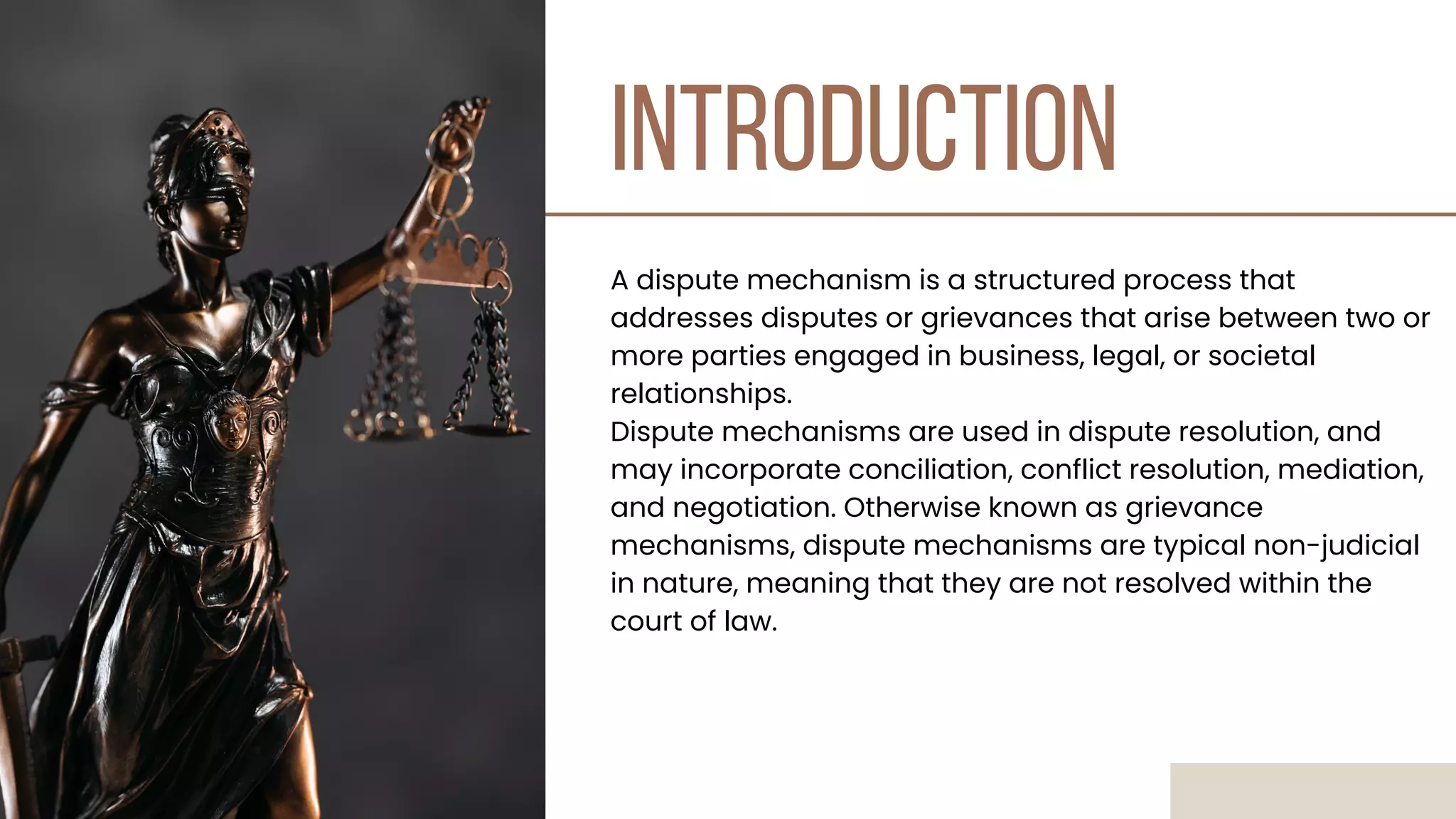
A dispute mechanism is a structured process that
addresses disputes or grievances that arise between two or
more parties engaged in business, legal, or societal
relationships.
Dispute mechanisms are used in dispute resolution, and
may incorporate conciliation, conflict resolution, mediation,
and negotiation. Otherwise known as grievance
mechanisms, dispute mechanisms are typical non-judicial
in nature, meaning that they are not resolved within the
court of law.
Characteristics of Dispute Settlement
Mechanism
Legitimate
Accessible
Predictable
Equitable
Rights- compatible
Transparent
1.
2.
3.
4.
5.
6.
Dispute
Settlement
Mechanism in
India
Dispute resolution in India may
be through courts, specialised
tribunals (such as those for
recovery of debt by banks or
company disputes, among
others) or alternative dispute
resolution (ADR) mechanisms
that include arbitration,
mediation and conciliation.
Alternative Dispute Resolution (ADR)
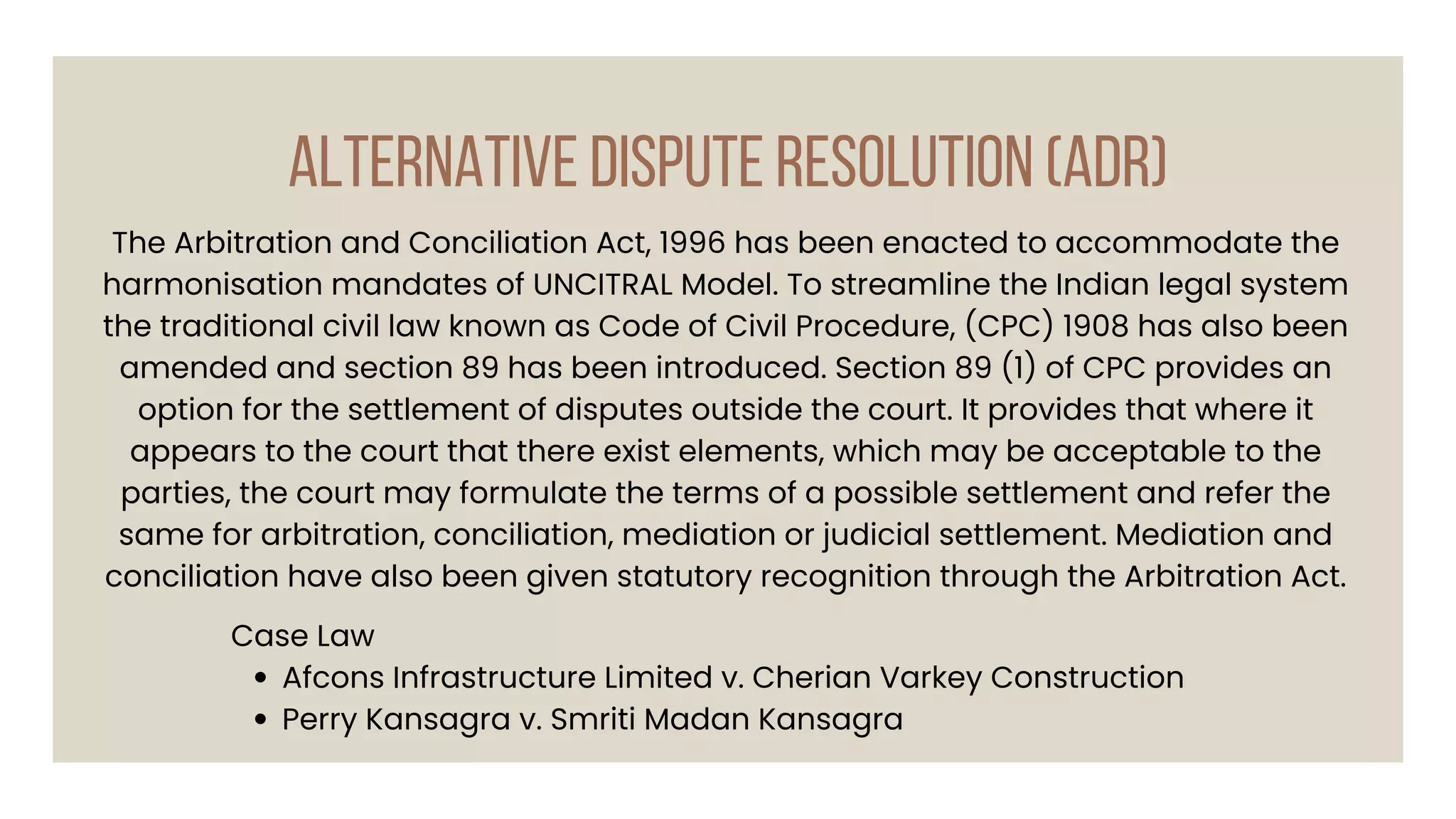
The Arbitration and Conciliation Act, 1996 has been enacted to accommodate the
harmonisation mandates of UNCITRAL Model. To streamline the Indian legal system
the traditional civil law known as Code of Civil Procedure, (CPC) 1908 has also been
amended and section 89 has been introduced. Section 89 (1) of CPC provides an
option for the settlement of disputes outside the court. It provides that where it
appears to the court that there exist elements, which may be acceptable to the
parties, the court may formulate the terms of a possible settlement and refer the
same for arbitration, conciliation, mediation or judicial settlement. Mediation and
conciliation have also been given statutory recognition through the Arbitration Act.
Afcons Infrastructure Limited v. Cherian Varkey Construction
Perry Kansagra v. Smriti Madan Kansagra
Case Law
Alternatives to
litigation
Arbitration
Mediation
Other forms of
alternative dispute
resolution
1.
2.
3.
Apart from the Arbitration Act, the Supreme Court of India in Salem Bar Association v.
Union of India (8) recommended the adoption of arbitral rules that were formulated by the
Jagannadha Rao Committee. The rules provide for the procedure according to which
referral to ADR mechanisms under Section 89 of the CPC can take place, including the
stage at which the referral can take place. The arbitration framework, however, has been
outlined in the central Arbitration Act, which provides for various matters such as the
interpretation of the arbitration agreement, interim measures that can be taken,
appointment and termination of arbitrators, place and procedure for the arbitration and
grounds for challenges and, the setup of an Arbitration Council in 2019.
Arbitration
India is also party to the three main international conventions that govern
international arbitrations in different territories and that have been consolidated
under the Arbitration Act:
• The Geneva Protocol on Arbitration Clauses of 1923;
• The Convention on the Execution of Foreign Awards 1923; and
• The Recognition and Enforcement of Foreign Arbitral Awards 1958 (New York
Convention).
Arbitration
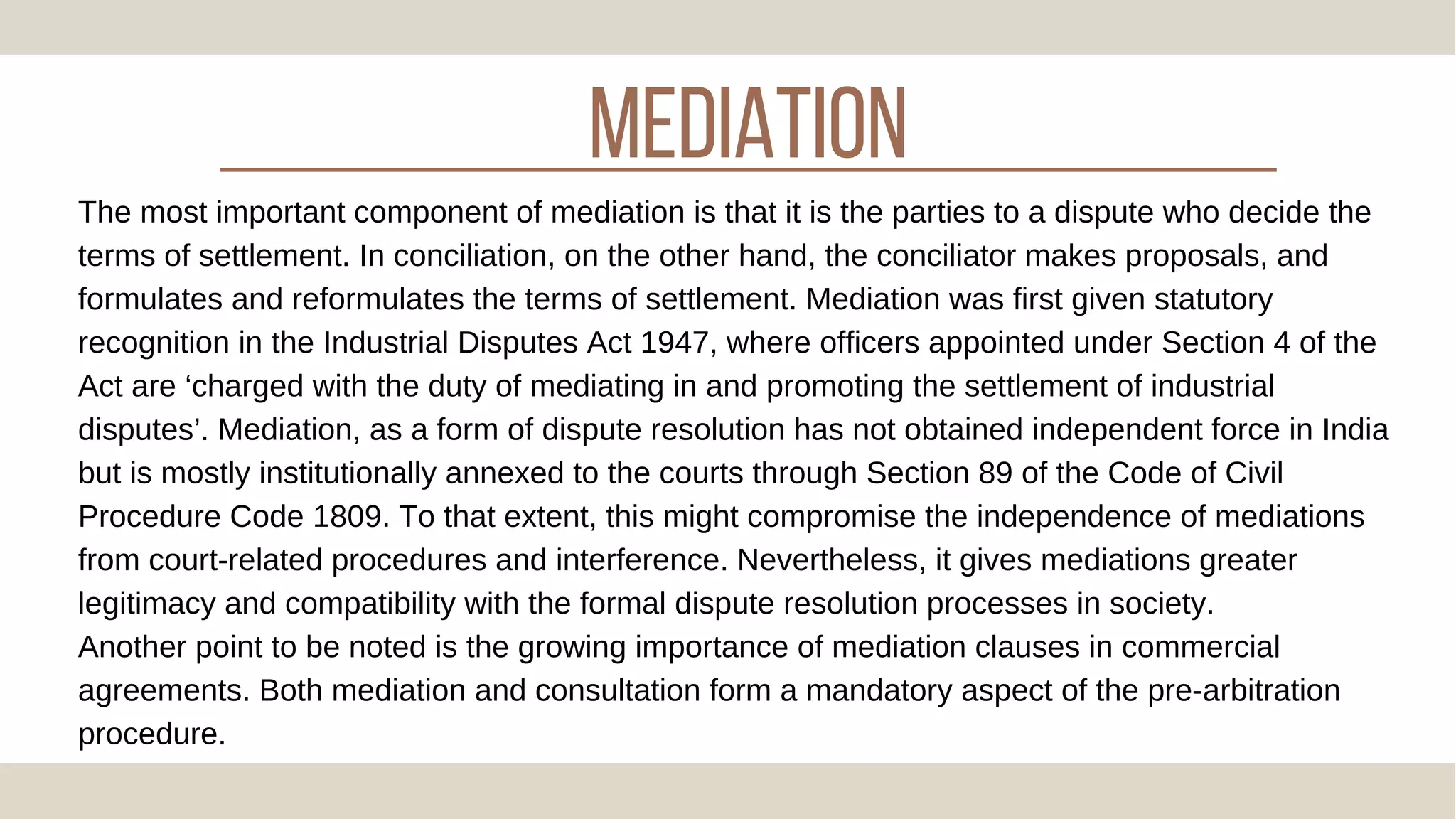
The most important component of mediation is that it is the parties to a dispute who decide the
terms of settlement. In conciliation, on the other hand, the conciliator makes proposals, and
formulates and reformulates the terms of settlement. Mediation was first given statutory
recognition in the Industrial Disputes Act 1947, where officers appointed under Section 4 of the
Act are ‘charged with the duty of mediating in and promoting the settlement of industrial
disputes’. Mediation, as a form of dispute resolution has not obtained independent force in India
but is mostly institutionally annexed to the courts through Section 89 of the Code of Civil
Procedure Code 1809. To that extent, this might compromise the independence of mediations
from court-related procedures and interference. Nevertheless, it gives mediations greater
legitimacy and compatibility with the formal dispute resolution processes in society.
Another point to be noted is the growing importance of mediation clauses in commercial
agreements. Both mediation and consultation form a mandatory aspect of the pre-arbitration
procedure.
Mediation
Conciliation has been inserted in Part III of the Arbitration Act and is less formal
than arbitration, but more formal than mediation. To the extent that it requires only
mutually consenting parties and not a formal written document executed to be able
to conciliate, it proves an easier form of dispute resolution. The parties can appoint
up to three conciliators. An important requirement of conciliation proceedings is the
independence and impartiality of the conciliator and the attempt to ensure the
appointment of a conciliator not having the nationality of either of the parties.
Other forms of alternative dispute
resolution
Conclusion
In India, the judge-to-population ratio is not adequate to meet
the huge volume of litigation, effectively adding to the delay in
redressal. This phenomenon is often referred to as the 'docket
explosion'. Considering the extensive legal framework and
significant backlog of litigation, Indian arbitration has made
strong attempts to bring about a dynamic change. However, the
recent amendments are expected to reduce many difficulties
with regard to timing, cost, finality of awards and interim reliefs
faced by both foreign and Indian parties wishing to arbitrate in
India.
Thankyou

dispute settlement mechanism.pdf

  • 1.
  • 2.
    Introduction A dispute mechanismis a structured process that addresses disputes or grievances that arise between two or more parties engaged in business, legal, or societal relationships. Dispute mechanisms are used in dispute resolution, and may incorporate conciliation, conflict resolution, mediation, and negotiation. Otherwise known as grievance mechanisms, dispute mechanisms are typical non-judicial in nature, meaning that they are not resolved within the court of law.
  • 3.
    Characteristics of DisputeSettlement Mechanism Legitimate Accessible Predictable Equitable Rights- compatible Transparent 1. 2. 3. 4. 5. 6.
  • 4.
    Dispute Settlement Mechanism in India Dispute resolutionin India may be through courts, specialised tribunals (such as those for recovery of debt by banks or company disputes, among others) or alternative dispute resolution (ADR) mechanisms that include arbitration, mediation and conciliation.
  • 5.
    Alternative Dispute Resolution(ADR) The Arbitration and Conciliation Act, 1996 has been enacted to accommodate the harmonisation mandates of UNCITRAL Model. To streamline the Indian legal system the traditional civil law known as Code of Civil Procedure, (CPC) 1908 has also been amended and section 89 has been introduced. Section 89 (1) of CPC provides an option for the settlement of disputes outside the court. It provides that where it appears to the court that there exist elements, which may be acceptable to the parties, the court may formulate the terms of a possible settlement and refer the same for arbitration, conciliation, mediation or judicial settlement. Mediation and conciliation have also been given statutory recognition through the Arbitration Act. Afcons Infrastructure Limited v. Cherian Varkey Construction Perry Kansagra v. Smriti Madan Kansagra Case Law
  • 6.
    Alternatives to litigation Arbitration Mediation Other formsof alternative dispute resolution 1. 2. 3.
  • 7.
    Apart from theArbitration Act, the Supreme Court of India in Salem Bar Association v. Union of India (8) recommended the adoption of arbitral rules that were formulated by the Jagannadha Rao Committee. The rules provide for the procedure according to which referral to ADR mechanisms under Section 89 of the CPC can take place, including the stage at which the referral can take place. The arbitration framework, however, has been outlined in the central Arbitration Act, which provides for various matters such as the interpretation of the arbitration agreement, interim measures that can be taken, appointment and termination of arbitrators, place and procedure for the arbitration and grounds for challenges and, the setup of an Arbitration Council in 2019. Arbitration
  • 8.
    India is alsoparty to the three main international conventions that govern international arbitrations in different territories and that have been consolidated under the Arbitration Act: • The Geneva Protocol on Arbitration Clauses of 1923; • The Convention on the Execution of Foreign Awards 1923; and • The Recognition and Enforcement of Foreign Arbitral Awards 1958 (New York Convention). Arbitration
  • 9.
    The most importantcomponent of mediation is that it is the parties to a dispute who decide the terms of settlement. In conciliation, on the other hand, the conciliator makes proposals, and formulates and reformulates the terms of settlement. Mediation was first given statutory recognition in the Industrial Disputes Act 1947, where officers appointed under Section 4 of the Act are ‘charged with the duty of mediating in and promoting the settlement of industrial disputes’. Mediation, as a form of dispute resolution has not obtained independent force in India but is mostly institutionally annexed to the courts through Section 89 of the Code of Civil Procedure Code 1809. To that extent, this might compromise the independence of mediations from court-related procedures and interference. Nevertheless, it gives mediations greater legitimacy and compatibility with the formal dispute resolution processes in society. Another point to be noted is the growing importance of mediation clauses in commercial agreements. Both mediation and consultation form a mandatory aspect of the pre-arbitration procedure. Mediation
  • 10.
    Conciliation has beeninserted in Part III of the Arbitration Act and is less formal than arbitration, but more formal than mediation. To the extent that it requires only mutually consenting parties and not a formal written document executed to be able to conciliate, it proves an easier form of dispute resolution. The parties can appoint up to three conciliators. An important requirement of conciliation proceedings is the independence and impartiality of the conciliator and the attempt to ensure the appointment of a conciliator not having the nationality of either of the parties. Other forms of alternative dispute resolution
  • 11.
    Conclusion In India, thejudge-to-population ratio is not adequate to meet the huge volume of litigation, effectively adding to the delay in redressal. This phenomenon is often referred to as the 'docket explosion'. Considering the extensive legal framework and significant backlog of litigation, Indian arbitration has made strong attempts to bring about a dynamic change. However, the recent amendments are expected to reduce many difficulties with regard to timing, cost, finality of awards and interim reliefs faced by both foreign and Indian parties wishing to arbitrate in India.
  • 12.