Disparagement against generics:
overview of the French decisional
practice
Frédéric Paillusson
Case handler
French Competition Authority
OECD Workshop – 26 February 2019
The views and opinions expressed in this presentation are those of the author and do not necessarily reflect the official position of the French
Competition Authority
A specific French context
Registration of generics in the ANSM Generics Directory (“Repertoire des
Groupes Generiques”)
 The originator and its generics are registered within the same group
Legislation promoting generics development in France
 Retail pharmacists can substitute the originator by its generics
Originator's
patent expiry
Generics
MA
procedure
Registration
in the
Generics
Directory
Substitution
allowed
A specific French context
 A “fertile ground” for generics disparagement in France
 Relative latecomer to the use of generics compared to other EU countries
 Patients in France prefer patented drugs and have been traditionally reluctant to use generics
 In 2017, generic drugs accounted for just 30% of the French pharma market in terms of volume and
19% in value.
 Rigidity to change among doctors and pharmacists
 Lack of knowledge of the MA procedures and the regulatory framework for substitution
 Primarily concerned with ensuring their patients’ safety and to prevent risks of civil or criminal action
against them
What is disparagement ?
 Decisional practice shaped by Plavix® (13-D-11), Subutex® (13-D-21), and
Durogesic® (17-D-25) decisions
 Legal standard followed by the FCA
 The communication aims at “publicly discrediting” the competing generics by
providing information in a “incomplete, ambiguous or misleading” way, “such
as to raise an objective doubt about the qualities of competing generic
specialties or the risks associated with generic substitution”
 Dominant company cannot create illegitimate doubt as to the efficiency and
safety of competing generics in order to discredit them in the eyes of health
professionals
 The effects
 The communication had potential or actual effects on the market
 How did the case teams proceed ?
 Investigations started following formal complaints
 Cases based on body of consistent evidence
 Abuse of dominance cases
 Typology of originators’ strategies vis à vis generics:
 Delay the arrival of generics : Durogesic case
 Limit the penetration of generics : Subutex, Plavix and Durogesic cases
 Launch of its own generic products: Plavix case
What is disparagement ?
The Plavix case: key facts
Decision n° 10-D-16
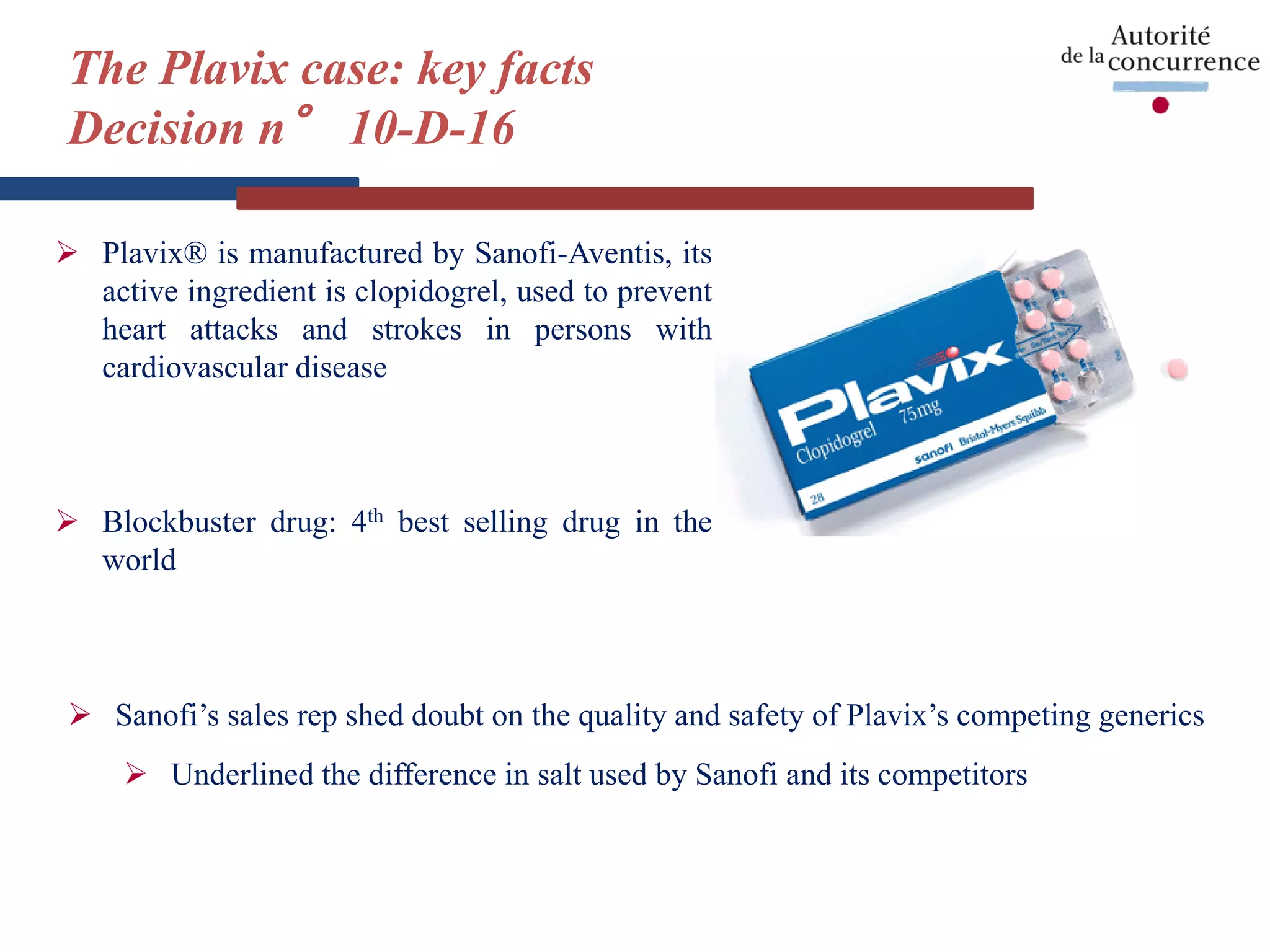
 Plavix® is manufactured by Sanofi-Aventis, its
active ingredient is clopidogrel, used to prevent
heart attacks and strokes in persons with
cardiovascular disease
 Blockbuster drug: 4th best selling drug in the
world
 Sanofi’s sales rep shed doubt on the quality and safety of Plavix’s competing generics
 Underlined the difference in salt used by Sanofi and its competitors
The Plavix case: key facts
 Comprehensive communication strategy aimed at influencing doctors and
pharmacists, key stages of the generic substitution process :
 Doctors: by convincing them to indicate “no substitution” on their prescriptions ;
 Pharmacists: encouraged to substitute Plavix only by Sanofi’s own generic, Clopidogrel
Winthrop®
 Sanction
 Sanofi-Aventis was fined €40.6 million for abuse of dominance
The Subutex case: key facts
Decision n°13-D-21
 Subutex® (buprenorphine) is manufactured by
Reckitt Benckiser and prescribed for the
treatment of opioid addiction, particularly heroin
 The case originated in a complaint by generic
manufacturer, Arrow Laboratory
 “French plan against generics”: plan conceived by Schering Plough and Reckitt
Benckiser
 (i) Important discounts on Subutex granted to retail pharmacists to inundate their shelves ;
 (ii) Disparagement campaign against generic competitors directed to doctors and pharmacists ;
 Implementation by Schering Plough
 Schering Plough’s sales rep were asked to “instill certain doubts” regarding
generic substitution by:
 Questioning the generics’ bioequivalence with Subutex ;
 Highlighting differences related to appearance, dissolution and excipients between Subutex
and its generics ;
 Highlighting risks for the patients (risk of misuse, psychiatric instability) and an increased risk
of trafficking;

 Sanctions
 €15,3 million fine imposed on Schering-Plough for abuse of dominance
 €414 000 fine imposed on Schering-Plough and €318 000 fine imposed for
anticompetitive agreement
The Subutex case: key facts
The Durogesic case: key facts
Decision n° 17-D-25
 Durogesic is a transdermal patch marketed by
Janssen-Cilag
 The active ingredient, fentanyl, is a very
powerful pain-killer prescribed in cases of
severe pain
 Two practices led to the FCA’s prohibition decision
1. Repeated interventions before the French Medicine Agency
2. Disparagement campaign against the competing generics targeting doctors and pharmacists
1. Repeated interventions to convince the French Medicines Agency
(“AFSSAPS”) to refuse national generic MA
 French medicine was bound to deliver a national generic MA for the competing
specialities
 Janssen questioned the generic quality of Durogesic's competing specialties, in
particular by
 Contesting the bioequivalence of generics vis à vis Durogesic®
 Alleging differences in the qualitative and quantitative composition of the active ingredient
 Claiming that substituting Durogesic® could entail risks for certain patients or causing pain relapse
 Interventions led to create a regulatory obstacle against the generics
The Durogesic case: key facts
2. Disparagement campaign against generics
Janssen delivered messages shedding doubt on the efficiency and safety of Durogesic
generics
These messages were disseminated through various forms of communication
 Medical newsletter, visits of medical sales reps to doctors and pharmacists
 Specific actions directed to retail pharmacists (such as phone calls, ‘pop-up’ads in dispensing
software, etc.)
 12,800 pharmacies contacted (roughly half of the French retail pharmacies) and 12 000 doctors
Sanction : €25 millions for abuse of dominant position
The Durogesic case: key facts
The challenges of investigating
disparagement cases
 Difficulty to detect these behaviours without formal complaint
and/or raids
 Internal documents are key (i.e. business strategy, internal meetings,
etc.)
 Parties tend to contest the Authority’s competence to intervene
 The Durogesic® case
 Where to draw the line between promotional / lobbying efforts
and anticompetitive practices ?
 Particular responsibility of dominant company
 What are the limits of this particular decisional practice
 Disparagement in the context of scientific uncertainty
 Impact of these decisions on compliance and deterrence
The challenges of investigating
disparagement cases
Thank you for your attention !

Disparagement against generics

  • 1.
    Disparagement against generics: overviewof the French decisional practice Frédéric Paillusson Case handler French Competition Authority OECD Workshop – 26 February 2019 The views and opinions expressed in this presentation are those of the author and do not necessarily reflect the official position of the French Competition Authority
  • 2.
    A specific Frenchcontext Registration of generics in the ANSM Generics Directory (“Repertoire des Groupes Generiques”)  The originator and its generics are registered within the same group Legislation promoting generics development in France  Retail pharmacists can substitute the originator by its generics Originator's patent expiry Generics MA procedure Registration in the Generics Directory Substitution allowed
  • 3.
    A specific Frenchcontext  A “fertile ground” for generics disparagement in France  Relative latecomer to the use of generics compared to other EU countries  Patients in France prefer patented drugs and have been traditionally reluctant to use generics  In 2017, generic drugs accounted for just 30% of the French pharma market in terms of volume and 19% in value.  Rigidity to change among doctors and pharmacists  Lack of knowledge of the MA procedures and the regulatory framework for substitution  Primarily concerned with ensuring their patients’ safety and to prevent risks of civil or criminal action against them
  • 4.
    What is disparagement?  Decisional practice shaped by Plavix® (13-D-11), Subutex® (13-D-21), and Durogesic® (17-D-25) decisions  Legal standard followed by the FCA  The communication aims at “publicly discrediting” the competing generics by providing information in a “incomplete, ambiguous or misleading” way, “such as to raise an objective doubt about the qualities of competing generic specialties or the risks associated with generic substitution”  Dominant company cannot create illegitimate doubt as to the efficiency and safety of competing generics in order to discredit them in the eyes of health professionals  The effects  The communication had potential or actual effects on the market
  • 5.
     How didthe case teams proceed ?  Investigations started following formal complaints  Cases based on body of consistent evidence  Abuse of dominance cases  Typology of originators’ strategies vis à vis generics:  Delay the arrival of generics : Durogesic case  Limit the penetration of generics : Subutex, Plavix and Durogesic cases  Launch of its own generic products: Plavix case What is disparagement ?
  • 6.
    The Plavix case:key facts Decision n° 10-D-16  Plavix® is manufactured by Sanofi-Aventis, its active ingredient is clopidogrel, used to prevent heart attacks and strokes in persons with cardiovascular disease  Blockbuster drug: 4th best selling drug in the world  Sanofi’s sales rep shed doubt on the quality and safety of Plavix’s competing generics  Underlined the difference in salt used by Sanofi and its competitors
  • 7.
    The Plavix case:key facts  Comprehensive communication strategy aimed at influencing doctors and pharmacists, key stages of the generic substitution process :  Doctors: by convincing them to indicate “no substitution” on their prescriptions ;  Pharmacists: encouraged to substitute Plavix only by Sanofi’s own generic, Clopidogrel Winthrop®  Sanction  Sanofi-Aventis was fined €40.6 million for abuse of dominance
  • 8.
    The Subutex case:key facts Decision n°13-D-21  Subutex® (buprenorphine) is manufactured by Reckitt Benckiser and prescribed for the treatment of opioid addiction, particularly heroin  The case originated in a complaint by generic manufacturer, Arrow Laboratory  “French plan against generics”: plan conceived by Schering Plough and Reckitt Benckiser  (i) Important discounts on Subutex granted to retail pharmacists to inundate their shelves ;  (ii) Disparagement campaign against generic competitors directed to doctors and pharmacists ;  Implementation by Schering Plough
  • 9.
     Schering Plough’ssales rep were asked to “instill certain doubts” regarding generic substitution by:  Questioning the generics’ bioequivalence with Subutex ;  Highlighting differences related to appearance, dissolution and excipients between Subutex and its generics ;  Highlighting risks for the patients (risk of misuse, psychiatric instability) and an increased risk of trafficking;   Sanctions  €15,3 million fine imposed on Schering-Plough for abuse of dominance  €414 000 fine imposed on Schering-Plough and €318 000 fine imposed for anticompetitive agreement The Subutex case: key facts
  • 10.
    The Durogesic case:key facts Decision n° 17-D-25  Durogesic is a transdermal patch marketed by Janssen-Cilag  The active ingredient, fentanyl, is a very powerful pain-killer prescribed in cases of severe pain  Two practices led to the FCA’s prohibition decision 1. Repeated interventions before the French Medicine Agency 2. Disparagement campaign against the competing generics targeting doctors and pharmacists
  • 11.
    1. Repeated interventionsto convince the French Medicines Agency (“AFSSAPS”) to refuse national generic MA  French medicine was bound to deliver a national generic MA for the competing specialities  Janssen questioned the generic quality of Durogesic's competing specialties, in particular by  Contesting the bioequivalence of generics vis à vis Durogesic®  Alleging differences in the qualitative and quantitative composition of the active ingredient  Claiming that substituting Durogesic® could entail risks for certain patients or causing pain relapse  Interventions led to create a regulatory obstacle against the generics The Durogesic case: key facts
  • 12.
    2. Disparagement campaignagainst generics Janssen delivered messages shedding doubt on the efficiency and safety of Durogesic generics These messages were disseminated through various forms of communication  Medical newsletter, visits of medical sales reps to doctors and pharmacists  Specific actions directed to retail pharmacists (such as phone calls, ‘pop-up’ads in dispensing software, etc.)  12,800 pharmacies contacted (roughly half of the French retail pharmacies) and 12 000 doctors Sanction : €25 millions for abuse of dominant position The Durogesic case: key facts
  • 13.
    The challenges ofinvestigating disparagement cases  Difficulty to detect these behaviours without formal complaint and/or raids  Internal documents are key (i.e. business strategy, internal meetings, etc.)  Parties tend to contest the Authority’s competence to intervene  The Durogesic® case
  • 14.
     Where todraw the line between promotional / lobbying efforts and anticompetitive practices ?  Particular responsibility of dominant company  What are the limits of this particular decisional practice  Disparagement in the context of scientific uncertainty  Impact of these decisions on compliance and deterrence The challenges of investigating disparagement cases
  • 15.
    Thank you foryour attention !