E VALUATING WHOLESALE AND RETAIL MERGERS IN
PHARMACEUTICALS
Farasat A.S. Bokhari

Franco Mariuzzo

ESRC Centre for Competition Policy
School of Economics
University of East Anglia

f.bokhari@uea.ac.uk
f.mariuzzo@uea.ac.uk
http://www.uea.ac.uk/economics

OECD’s 13th Global Forum on Competition
for “Competition Issues in the Distribution of Pharmaceuticals”
Paris, France
February 27-28, 2014
M OTIVATION
E VALUATING M ERGERS FOR D IFFERENTIATED P RODUCTS
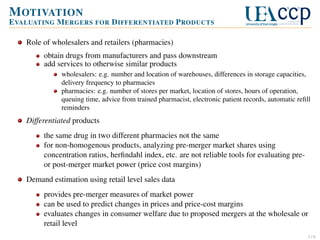
Role of wholesalers and retailers (pharmacies)
Differentiated products
Demand estimation using retail level sales data

1/6
M OTIVATION
E VALUATING M ERGERS FOR D IFFERENTIATED P RODUCTS
Role of wholesalers and retailers (pharmacies)
obtain drugs from manufacturers and pass downstream
add services to otherwise similar products
wholesalers: e.g. number and location of warehouses, differences in storage capacities,
delivery frequency to pharmacies
pharmacies: e.g. number of stores per market, location of stores, hours of operation,
queuing time, advice from trained pharmacist, electronic patient records, automatic refill
reminders

Differentiated products
Demand estimation using retail level sales data

1/6
M OTIVATION
E VALUATING M ERGERS FOR D IFFERENTIATED P RODUCTS
Role of wholesalers and retailers (pharmacies)
obtain drugs from manufacturers and pass downstream
add services to otherwise similar products
wholesalers: e.g. number and location of warehouses, differences in storage capacities,
delivery frequency to pharmacies
pharmacies: e.g. number of stores per market, location of stores, hours of operation,
queuing time, advice from trained pharmacist, electronic patient records, automatic refill
reminders

Differentiated products
the same drug in two different pharmacies not the same
for non-homogenous products, analyzing pre-merger market shares using
concentration ratios, herfindahl index, etc. are not reliable tools for evaluating preor post-merger market power (price cost margins)
Demand estimation using retail level sales data

1/6
M OTIVATION
E VALUATING M ERGERS FOR D IFFERENTIATED P RODUCTS
Role of wholesalers and retailers (pharmacies)
obtain drugs from manufacturers and pass downstream
add services to otherwise similar products
wholesalers: e.g. number and location of warehouses, differences in storage capacities,
delivery frequency to pharmacies
pharmacies: e.g. number of stores per market, location of stores, hours of operation,
queuing time, advice from trained pharmacist, electronic patient records, automatic refill
reminders

Differentiated products
the same drug in two different pharmacies not the same
for non-homogenous products, analyzing pre-merger market shares using
concentration ratios, herfindahl index, etc. are not reliable tools for evaluating preor post-merger market power (price cost margins)
Demand estimation using retail level sales data
provides pre-merger measures of market power
can be used to predict changes in prices and price-cost margins
evaluates changes in consumer welfare due to proposed mergers at the wholesale or
retail level
1/6
A S TYLIZED M ODEL
A ND H ORIZONTAL M ERGER P REDICTIONS
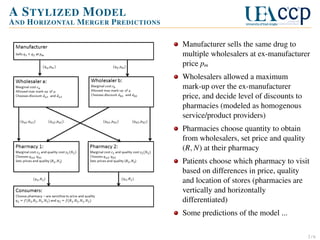
Manufacturer sells the same drug to
multiple wholesalers at ex-manufacturer
price pm
Wholesalers allowed a maximum
mark-up over the ex-manufacturer
price, and decide level of discounts to
pharmacies (modeled as homogenous
service/product providers)
Pharmacies choose quantity to obtain
from wholesalers, set price and quality
(R, N) at their pharmacy
Patients choose which pharmacy to visit
based on differences in price, quality
and location of stores (pharmacies are
vertically and horizontally
differentiated)
Some predictions of the model ...
2/6
A S TYLIZED M ODEL
A ND H ORIZONTAL M ERGER P REDICTIONS
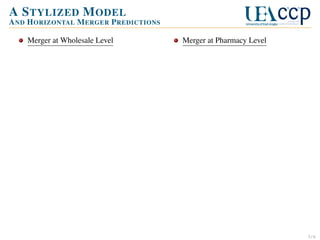
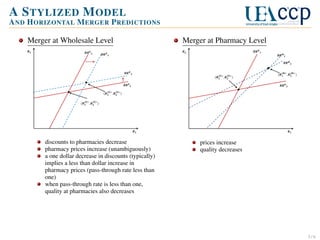
Merger at Wholesale Level

Merger at Pharmacy Level

3/6
A S TYLIZED M ODEL
A ND H ORIZONTAL M ERGER P REDICTIONS
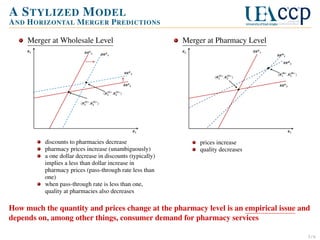
Merger at Wholesale Level

Merger at Pharmacy Level

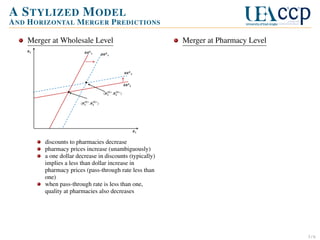
discounts to pharmacies decrease
pharmacy prices increase (unambiguously)
a one dollar decrease in discounts (typically)
implies a less than dollar increase in
pharmacy prices (pass-through rate less than
one)
when pass-through rate is less than one,
quality at pharmacies also decreases

3/6
A S TYLIZED M ODEL
A ND H ORIZONTAL M ERGER P REDICTIONS
Merger at Wholesale Level

discounts to pharmacies decrease
pharmacy prices increase (unambiguously)
a one dollar decrease in discounts (typically)
implies a less than dollar increase in
pharmacy prices (pass-through rate less than
one)
when pass-through rate is less than one,
quality at pharmacies also decreases

Merger at Pharmacy Level

prices increase
quality decreases

3/6
A S TYLIZED M ODEL
A ND H ORIZONTAL M ERGER P REDICTIONS
Merger at Wholesale Level

discounts to pharmacies decrease
pharmacy prices increase (unambiguously)
a one dollar decrease in discounts (typically)
implies a less than dollar increase in
pharmacy prices (pass-through rate less than
one)
when pass-through rate is less than one,
quality at pharmacies also decreases

Merger at Pharmacy Level

prices increase
quality decreases

How much the quantity and prices change at the pharmacy level is an empirical issue and
depends on, among other things, consumer demand for pharmacy services
3/6
E MPIRICAL S TRATEGY
D EMAND E STIMATION AND M ERGER S IMULATIONS
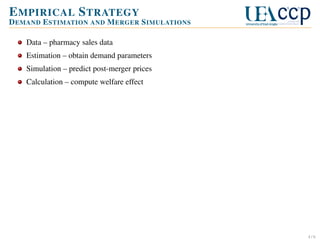
Data – pharmacy sales data
Estimation – obtain demand parameters
Simulation – predict post-merger prices
Calculation – compute welfare effect

4/6
E MPIRICAL S TRATEGY
D EMAND E STIMATION AND M ERGER S IMULATIONS
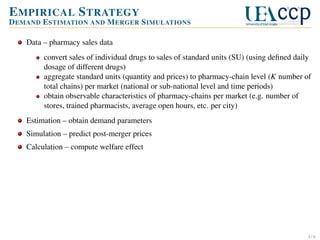
Data – pharmacy sales data
convert sales of individual drugs to sales of standard units (SU) (using defined daily
dosage of different drugs)
aggregate standard units (quantity and prices) to pharmacy-chain level (K number of
total chains) per market (national or sub-national level and time periods)
obtain observable characteristics of pharmacy-chains per market (e.g. number of
stores, trained pharmacists, average open hours, etc. per city)
Estimation – obtain demand parameters
Simulation – predict post-merger prices
Calculation – compute welfare effect

4/6
E MPIRICAL S TRATEGY
D EMAND E STIMATION AND M ERGER S IMULATIONS
Data – pharmacy sales data
Estimation – obtain demand parameters
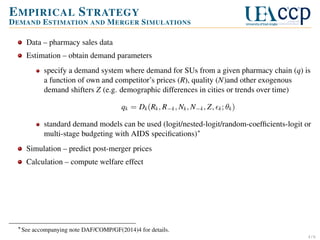
specify a demand system where demand for SUs from a given pharmacy chain (q) is
a function of own and competitor’s prices (R), quality (N)and other exogenous
demand shifters Z (e.g. demographic differences in cities or trends over time)
qk = Dk (Rk , R−k , Nk , N−k , Z, k ; θk )
standard demand models can be used (logit/nested-logit/random-coefficients-logit or
multi-stage budgeting with AIDS specifications)∗
Simulation – predict post-merger prices
Calculation – compute welfare effect

∗ See accompanying note DAF/COMP/GF(2014)4 for details.
4/6
E MPIRICAL S TRATEGY
D EMAND E STIMATION AND M ERGER S IMULATIONS
Data – pharmacy sales data
Estimation – obtain demand parameters
Simulation – predict post-merger prices
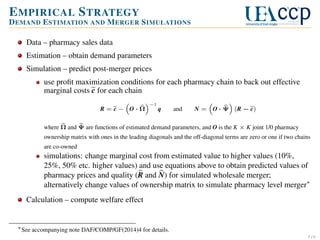
use profit maximization conditions for each pharmacy chain to back out effective
marginal costs c for each chain
R=c− O·Ω

−1

q

and

N=

O · Ψ (R − c)

where Ω and Ψ are functions of estimated demand parameters, and O is the K × K joint 1/0 pharmacy
ownership matrix with ones in the leading diagonals and the off-diagonal terms are zero or one if two chains
are co-owned

simulations: change marginal cost from estimated value to higher values (10%,
25%, 50% etc. higher values) and use equations above to obtain predicted values of
pharmacy prices and quality (R and N) for simulated wholesale merger;
alternatively change values of ownership matrix to simulate pharmacy level merger∗
Calculation – compute welfare effect

∗ See accompanying note DAF/COMP/GF(2014)4 for details.
5/6
E MPIRICAL S TRATEGY
D EMAND E STIMATION AND M ERGER S IMULATIONS
Data – pharmacy sales data
Estimation – obtain demand parameters
Simulation – predict post-merger prices
Calculation – compute welfare effect
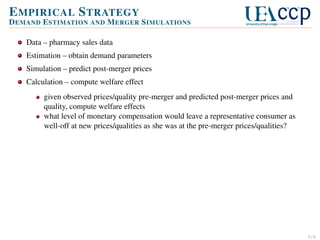
given observed prices/quality pre-merger and predicted post-merger prices and
quality, compute welfare effects
what level of monetary compensation would leave a representative consumer as
well-off at new prices/qualities as she was at the pre-merger prices/qualities?

5/6
E MPIRICAL S TRATEGY
D EMAND E STIMATION AND M ERGER S IMULATIONS
Data – pharmacy sales data
Estimation – obtain demand parameters
Simulation – predict post-merger prices
Calculation – compute welfare effect

5/6
TAKE AWAY M ESSAGE
H ORIZONTAL M ERGERS IN P HARMA
The final product that reaches a consumer via different routes is highly differentiated due
to the nature of services attached to these products (e.g., frequency of delivery by
wholesalers or advice by pharmacist and physical location of outlets)
Analyses based on pre-merger market shares alone do not provide good measures of
market power (price-cost margins)
Sales data of individual drugs is typically available, and can be aggregated up to sales at
pharmacy-chain level
Standard demand estimation methods and merger simulations from the empirical IO
literature can be adapted to (i) infer price-cost margins at the pharmacy level, (ii) back-out
effective marginal costs for the pharmacies, and (iii) predict changes in retail level prices
and quality due to a proposed merger
These (observed and predicted values) can be used to obtain measures of changes in
consumer welfare – which can then be compared to changes in profits to assess the overall
effect of a proposed merger

6/6

Competition and Pharmaceuticals - Farasat Bokhari - 2014 OECD Global Forum on Competition

  • 1.
    E VALUATING WHOLESALEAND RETAIL MERGERS IN PHARMACEUTICALS Farasat A.S. Bokhari Franco Mariuzzo ESRC Centre for Competition Policy School of Economics University of East Anglia f.bokhari@uea.ac.uk f.mariuzzo@uea.ac.uk http://www.uea.ac.uk/economics OECD’s 13th Global Forum on Competition for “Competition Issues in the Distribution of Pharmaceuticals” Paris, France February 27-28, 2014
  • 2.
    M OTIVATION E VALUATINGM ERGERS FOR D IFFERENTIATED P RODUCTS Role of wholesalers and retailers (pharmacies) Differentiated products Demand estimation using retail level sales data 1/6
  • 3.
    M OTIVATION E VALUATINGM ERGERS FOR D IFFERENTIATED P RODUCTS Role of wholesalers and retailers (pharmacies) obtain drugs from manufacturers and pass downstream add services to otherwise similar products wholesalers: e.g. number and location of warehouses, differences in storage capacities, delivery frequency to pharmacies pharmacies: e.g. number of stores per market, location of stores, hours of operation, queuing time, advice from trained pharmacist, electronic patient records, automatic refill reminders Differentiated products Demand estimation using retail level sales data 1/6
  • 4.
    M OTIVATION E VALUATINGM ERGERS FOR D IFFERENTIATED P RODUCTS Role of wholesalers and retailers (pharmacies) obtain drugs from manufacturers and pass downstream add services to otherwise similar products wholesalers: e.g. number and location of warehouses, differences in storage capacities, delivery frequency to pharmacies pharmacies: e.g. number of stores per market, location of stores, hours of operation, queuing time, advice from trained pharmacist, electronic patient records, automatic refill reminders Differentiated products the same drug in two different pharmacies not the same for non-homogenous products, analyzing pre-merger market shares using concentration ratios, herfindahl index, etc. are not reliable tools for evaluating preor post-merger market power (price cost margins) Demand estimation using retail level sales data 1/6
  • 5.
    M OTIVATION E VALUATINGM ERGERS FOR D IFFERENTIATED P RODUCTS Role of wholesalers and retailers (pharmacies) obtain drugs from manufacturers and pass downstream add services to otherwise similar products wholesalers: e.g. number and location of warehouses, differences in storage capacities, delivery frequency to pharmacies pharmacies: e.g. number of stores per market, location of stores, hours of operation, queuing time, advice from trained pharmacist, electronic patient records, automatic refill reminders Differentiated products the same drug in two different pharmacies not the same for non-homogenous products, analyzing pre-merger market shares using concentration ratios, herfindahl index, etc. are not reliable tools for evaluating preor post-merger market power (price cost margins) Demand estimation using retail level sales data provides pre-merger measures of market power can be used to predict changes in prices and price-cost margins evaluates changes in consumer welfare due to proposed mergers at the wholesale or retail level 1/6
  • 6.
    A S TYLIZEDM ODEL A ND H ORIZONTAL M ERGER P REDICTIONS Manufacturer sells the same drug to multiple wholesalers at ex-manufacturer price pm Wholesalers allowed a maximum mark-up over the ex-manufacturer price, and decide level of discounts to pharmacies (modeled as homogenous service/product providers) Pharmacies choose quantity to obtain from wholesalers, set price and quality (R, N) at their pharmacy Patients choose which pharmacy to visit based on differences in price, quality and location of stores (pharmacies are vertically and horizontally differentiated) Some predictions of the model ... 2/6
  • 7.
    A S TYLIZEDM ODEL A ND H ORIZONTAL M ERGER P REDICTIONS Merger at Wholesale Level Merger at Pharmacy Level 3/6
  • 8.
    A S TYLIZEDM ODEL A ND H ORIZONTAL M ERGER P REDICTIONS Merger at Wholesale Level Merger at Pharmacy Level discounts to pharmacies decrease pharmacy prices increase (unambiguously) a one dollar decrease in discounts (typically) implies a less than dollar increase in pharmacy prices (pass-through rate less than one) when pass-through rate is less than one, quality at pharmacies also decreases 3/6
  • 9.
    A S TYLIZEDM ODEL A ND H ORIZONTAL M ERGER P REDICTIONS Merger at Wholesale Level discounts to pharmacies decrease pharmacy prices increase (unambiguously) a one dollar decrease in discounts (typically) implies a less than dollar increase in pharmacy prices (pass-through rate less than one) when pass-through rate is less than one, quality at pharmacies also decreases Merger at Pharmacy Level prices increase quality decreases 3/6
  • 10.
    A S TYLIZEDM ODEL A ND H ORIZONTAL M ERGER P REDICTIONS Merger at Wholesale Level discounts to pharmacies decrease pharmacy prices increase (unambiguously) a one dollar decrease in discounts (typically) implies a less than dollar increase in pharmacy prices (pass-through rate less than one) when pass-through rate is less than one, quality at pharmacies also decreases Merger at Pharmacy Level prices increase quality decreases How much the quantity and prices change at the pharmacy level is an empirical issue and depends on, among other things, consumer demand for pharmacy services 3/6
  • 11.
    E MPIRICAL STRATEGY D EMAND E STIMATION AND M ERGER S IMULATIONS Data – pharmacy sales data Estimation – obtain demand parameters Simulation – predict post-merger prices Calculation – compute welfare effect 4/6
  • 12.
    E MPIRICAL STRATEGY D EMAND E STIMATION AND M ERGER S IMULATIONS Data – pharmacy sales data convert sales of individual drugs to sales of standard units (SU) (using defined daily dosage of different drugs) aggregate standard units (quantity and prices) to pharmacy-chain level (K number of total chains) per market (national or sub-national level and time periods) obtain observable characteristics of pharmacy-chains per market (e.g. number of stores, trained pharmacists, average open hours, etc. per city) Estimation – obtain demand parameters Simulation – predict post-merger prices Calculation – compute welfare effect 4/6
  • 13.
    E MPIRICAL STRATEGY D EMAND E STIMATION AND M ERGER S IMULATIONS Data – pharmacy sales data Estimation – obtain demand parameters specify a demand system where demand for SUs from a given pharmacy chain (q) is a function of own and competitor’s prices (R), quality (N)and other exogenous demand shifters Z (e.g. demographic differences in cities or trends over time) qk = Dk (Rk , R−k , Nk , N−k , Z, k ; θk ) standard demand models can be used (logit/nested-logit/random-coefficients-logit or multi-stage budgeting with AIDS specifications)∗ Simulation – predict post-merger prices Calculation – compute welfare effect ∗ See accompanying note DAF/COMP/GF(2014)4 for details. 4/6
  • 14.
    E MPIRICAL STRATEGY D EMAND E STIMATION AND M ERGER S IMULATIONS Data – pharmacy sales data Estimation – obtain demand parameters Simulation – predict post-merger prices use profit maximization conditions for each pharmacy chain to back out effective marginal costs c for each chain R=c− O·Ω −1 q and N= O · Ψ (R − c) where Ω and Ψ are functions of estimated demand parameters, and O is the K × K joint 1/0 pharmacy ownership matrix with ones in the leading diagonals and the off-diagonal terms are zero or one if two chains are co-owned simulations: change marginal cost from estimated value to higher values (10%, 25%, 50% etc. higher values) and use equations above to obtain predicted values of pharmacy prices and quality (R and N) for simulated wholesale merger; alternatively change values of ownership matrix to simulate pharmacy level merger∗ Calculation – compute welfare effect ∗ See accompanying note DAF/COMP/GF(2014)4 for details. 5/6
  • 15.
    E MPIRICAL STRATEGY D EMAND E STIMATION AND M ERGER S IMULATIONS Data – pharmacy sales data Estimation – obtain demand parameters Simulation – predict post-merger prices Calculation – compute welfare effect given observed prices/quality pre-merger and predicted post-merger prices and quality, compute welfare effects what level of monetary compensation would leave a representative consumer as well-off at new prices/qualities as she was at the pre-merger prices/qualities? 5/6
  • 16.
    E MPIRICAL STRATEGY D EMAND E STIMATION AND M ERGER S IMULATIONS Data – pharmacy sales data Estimation – obtain demand parameters Simulation – predict post-merger prices Calculation – compute welfare effect 5/6
  • 17.
    TAKE AWAY MESSAGE H ORIZONTAL M ERGERS IN P HARMA The final product that reaches a consumer via different routes is highly differentiated due to the nature of services attached to these products (e.g., frequency of delivery by wholesalers or advice by pharmacist and physical location of outlets) Analyses based on pre-merger market shares alone do not provide good measures of market power (price-cost margins) Sales data of individual drugs is typically available, and can be aggregated up to sales at pharmacy-chain level Standard demand estimation methods and merger simulations from the empirical IO literature can be adapted to (i) infer price-cost margins at the pharmacy level, (ii) back-out effective marginal costs for the pharmacies, and (iii) predict changes in retail level prices and quality due to a proposed merger These (observed and predicted values) can be used to obtain measures of changes in consumer welfare – which can then be compared to changes in profits to assess the overall effect of a proposed merger 6/6