EEllaassttiicc TTiissssuuee ddiissoorrddeerrss 
11 
BBYY 
MM..YYOOUUSSRRYY AABBDDEELL--MMAAWWLLAA
2 
EELLAASSTTIICC TTIISSSSUUEE 
• Elastic fibers are the principal components of 
connective tissue that impart resilience and 
elasticity to the skin. 
• Mature elastic fibers in the reticular dermis 
are composed of microfibrils (15% by weight, 
containing fibrillins and microfibrilassociated 
glycoproteins) that surround a core of 
amorphous elastin (85% by weight, a single 
polypeptide chain of 800 amino acids); 
• The immature fibers seen in children have a 
higher percentage of microfibrils (50% by 
weight)
3 
CCuuttaanneeoouuss eellaassttiinn 
• Cutaneous elastin and microfibrillar 
glycoproteins are synthesized primarily by 
fibroblasts. 
• Elastin is initially secreted as tropoelastin, 
which is crosslinked with and stabilized by 
desmosine to form elastin. A critical enzyme 
in this process is lysyl oxidase, a copper-dependent 
enzyme that deaminates lysine to 
form crosslinks in both elastic and collagen 
fibers.
4 
EEllaassttiinn MMeettaabboolliissmm 
• Elastin is metabolized by proteolytic enzymes, 
including serine-type elastases, which are 
secreted by neutrophils, macrophages, human 
fibroblasts, and other types of cells. 
• Elastic fibers are also degraded by matrix 
metalloproteinases (MMPs), of which there are 
at least 23 different enzymes secreted by a 
variety of types of cells. 
• The MMPs stromelysin, macrophage 
metalloproteinase (MMP-12), the gelatinases • 
(MMP- 2 and MMP-9), and matrilisin (MMP-7) 
are the most active against elastic fibers
5 
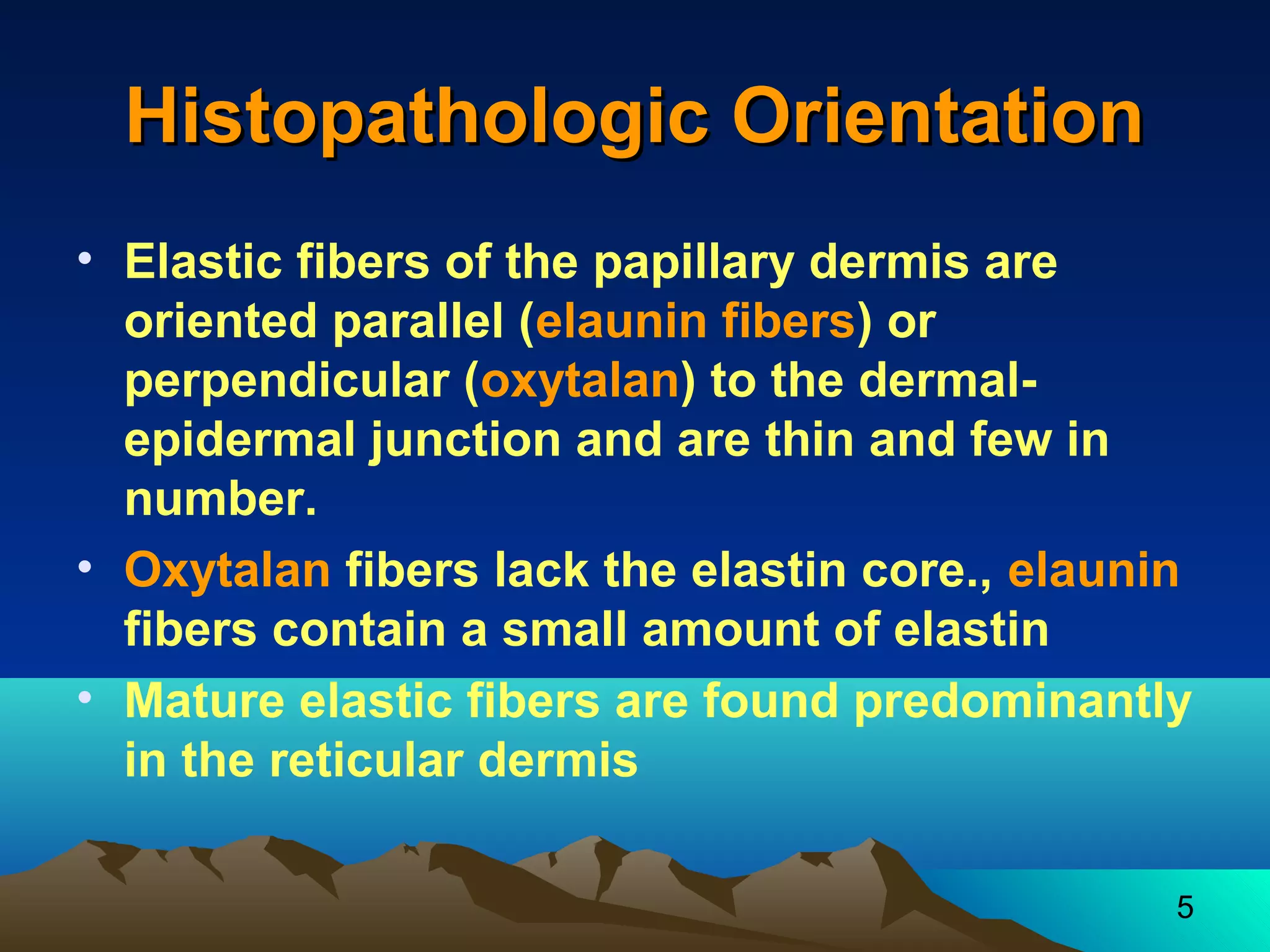
HHiissttooppaatthhoollooggiicc OOrriieennttaattiioonn 
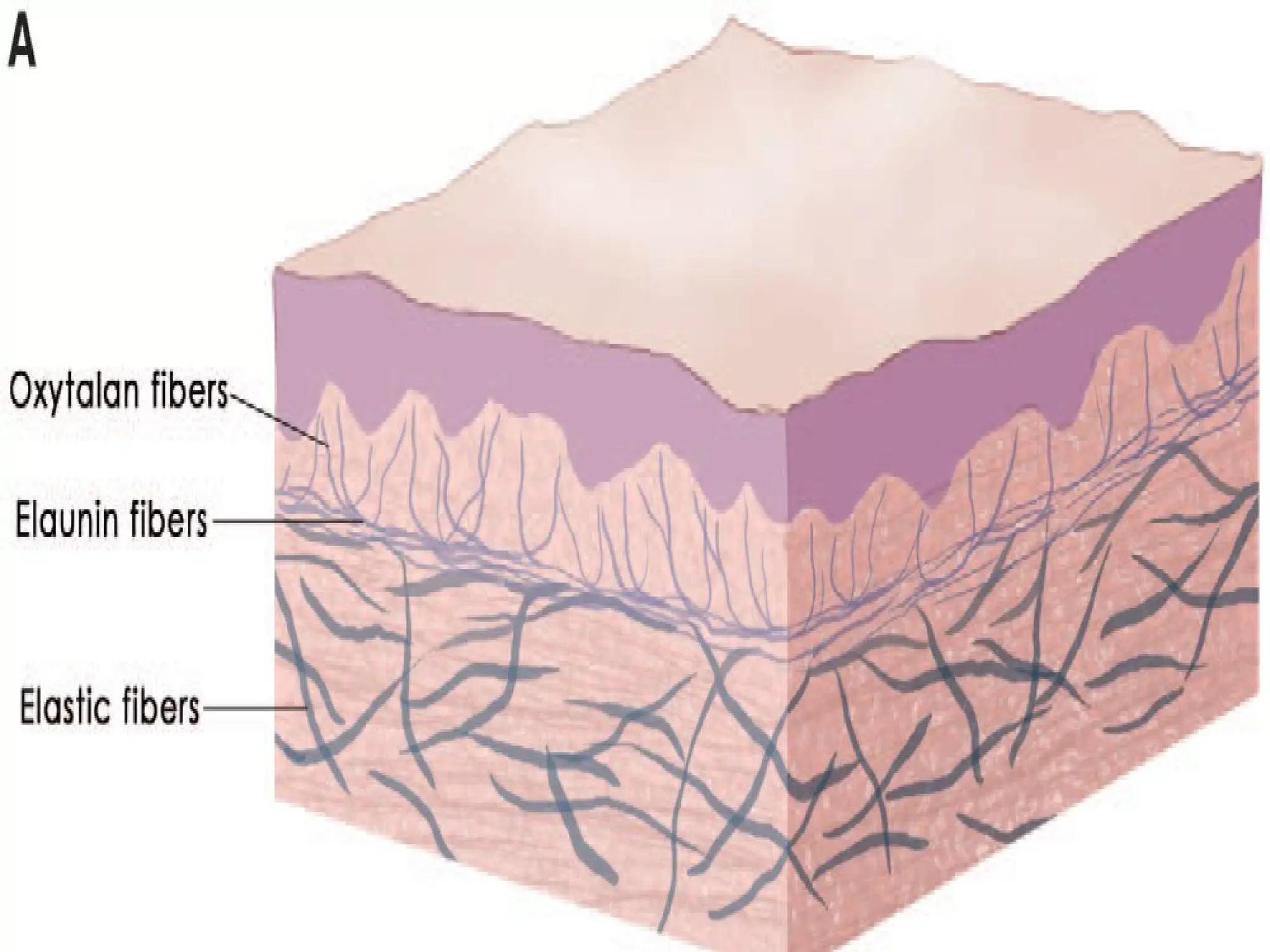
• Elastic fibers of the papillary dermis are 
oriented parallel (elaunin fibers) or 
perpendicular (oxytalan) to the dermal-epidermal 
junction and are thin and few in 
number. 
• Oxytalan fibers lack the elastin core., elaunin 
fibers contain a small amount of elastin 
• Mature elastic fibers are found predominantly 
in the reticular dermis
6
7 
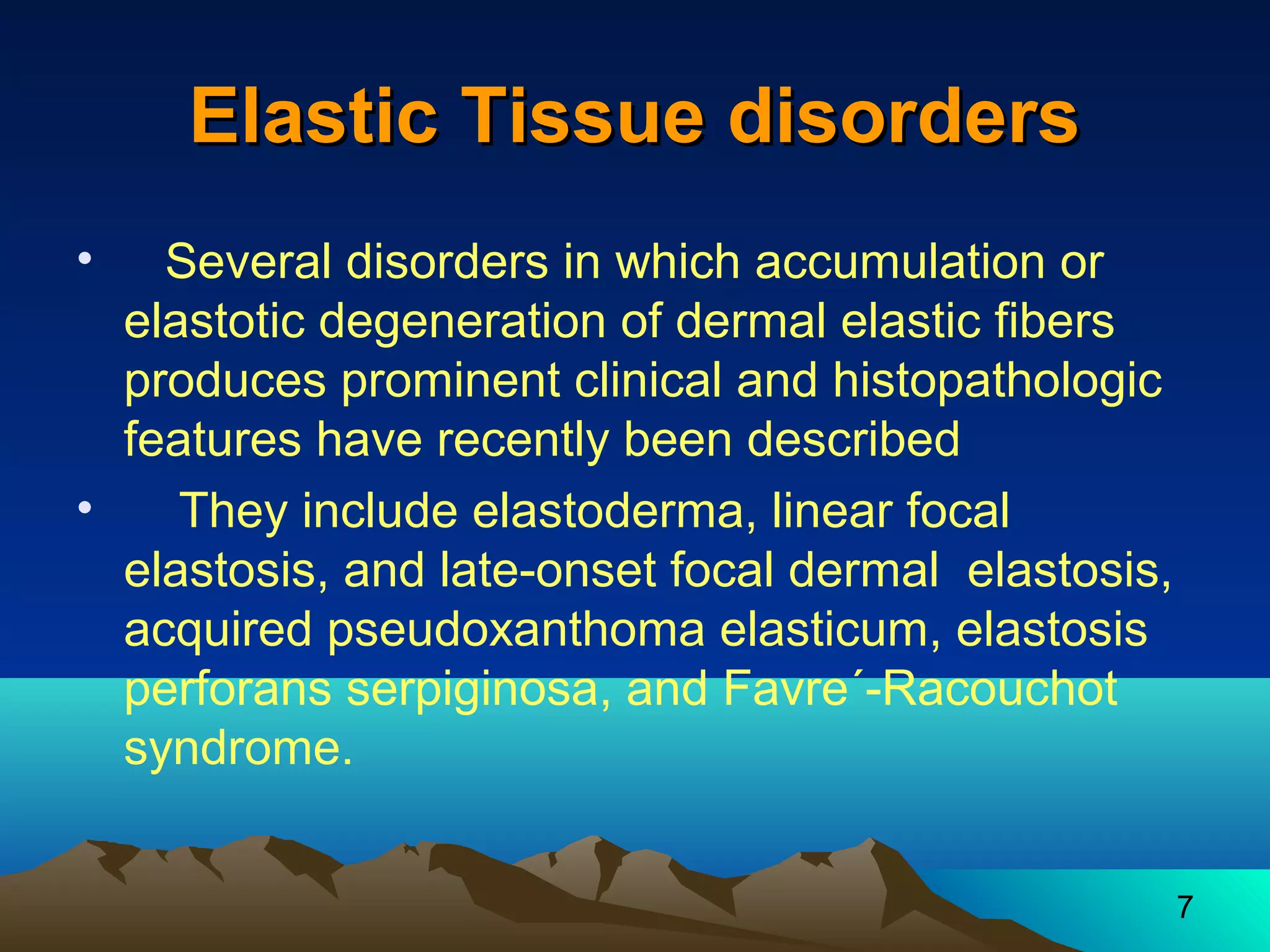
EEllaassttiicc TTiissssuuee ddiissoorrddeerrss 
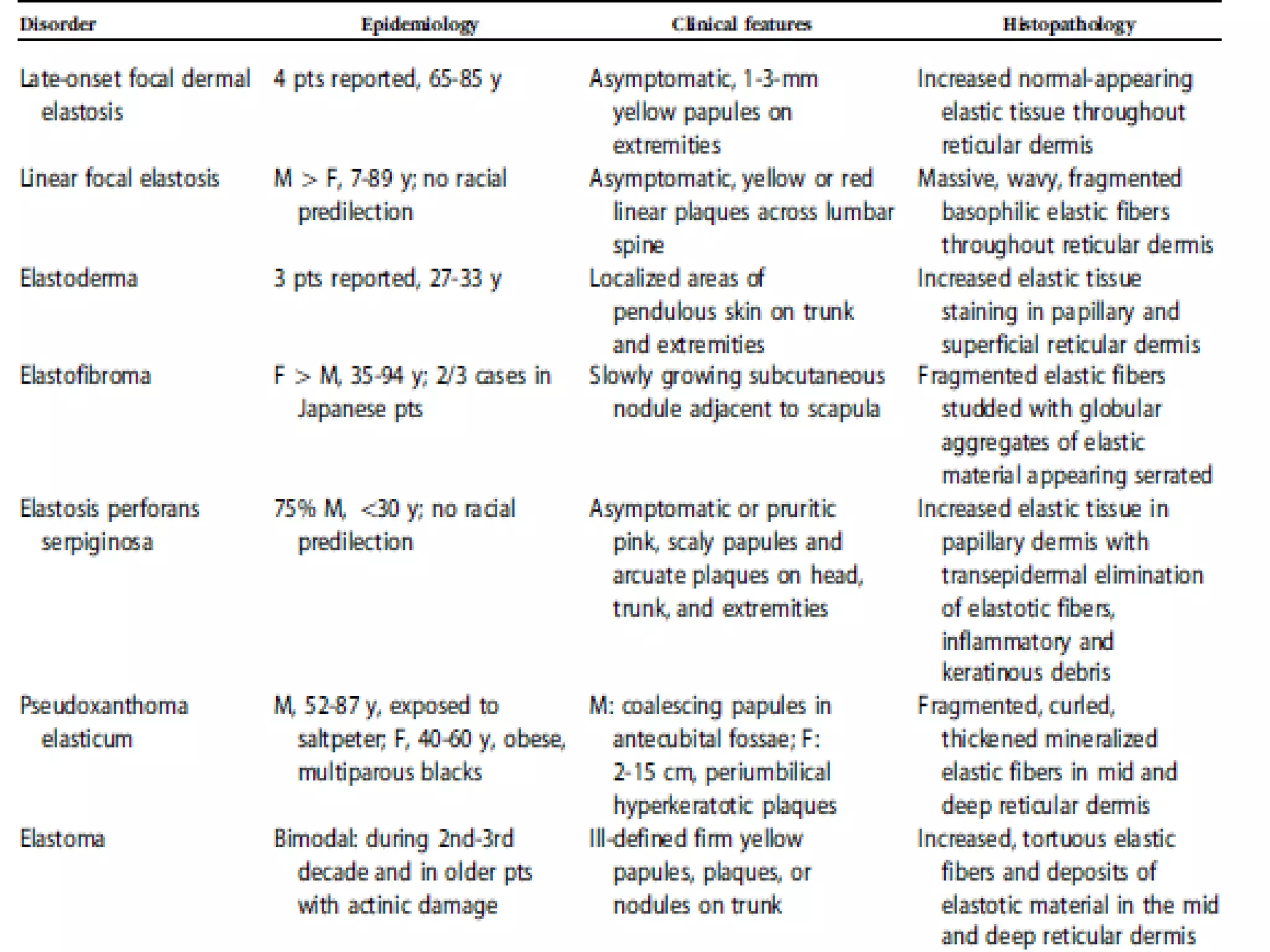
• Several disorders in which accumulation or 
elastotic degeneration of dermal elastic fibers 
produces prominent clinical and histopathologic 
features have recently been described 
• They include elastoderma, linear focal 
elastosis, and late-onset focal dermal elastosis, 
acquired pseudoxanthoma elasticum, elastosis 
perforans serpiginosa, and Favre´-Racouchot 
syndrome.
8
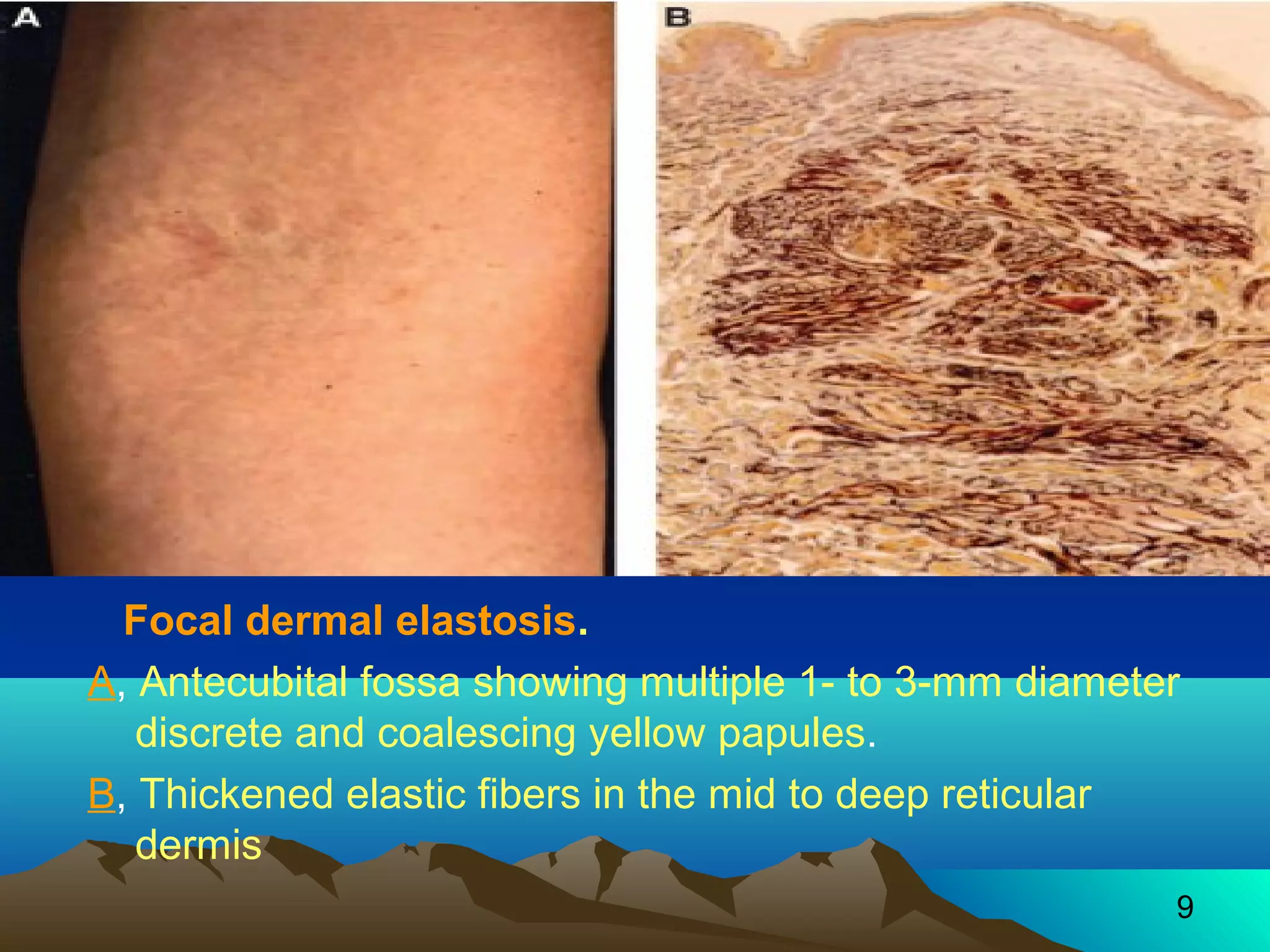
Focal dermal elastosis. 
A, Antecubital fossa showing multiple 1- to 3-mm diameter 
discrete and coalescing yellow papules. 
B, Thickened elastic fibers in the mid to deep reticular 
dermis 
9
10 
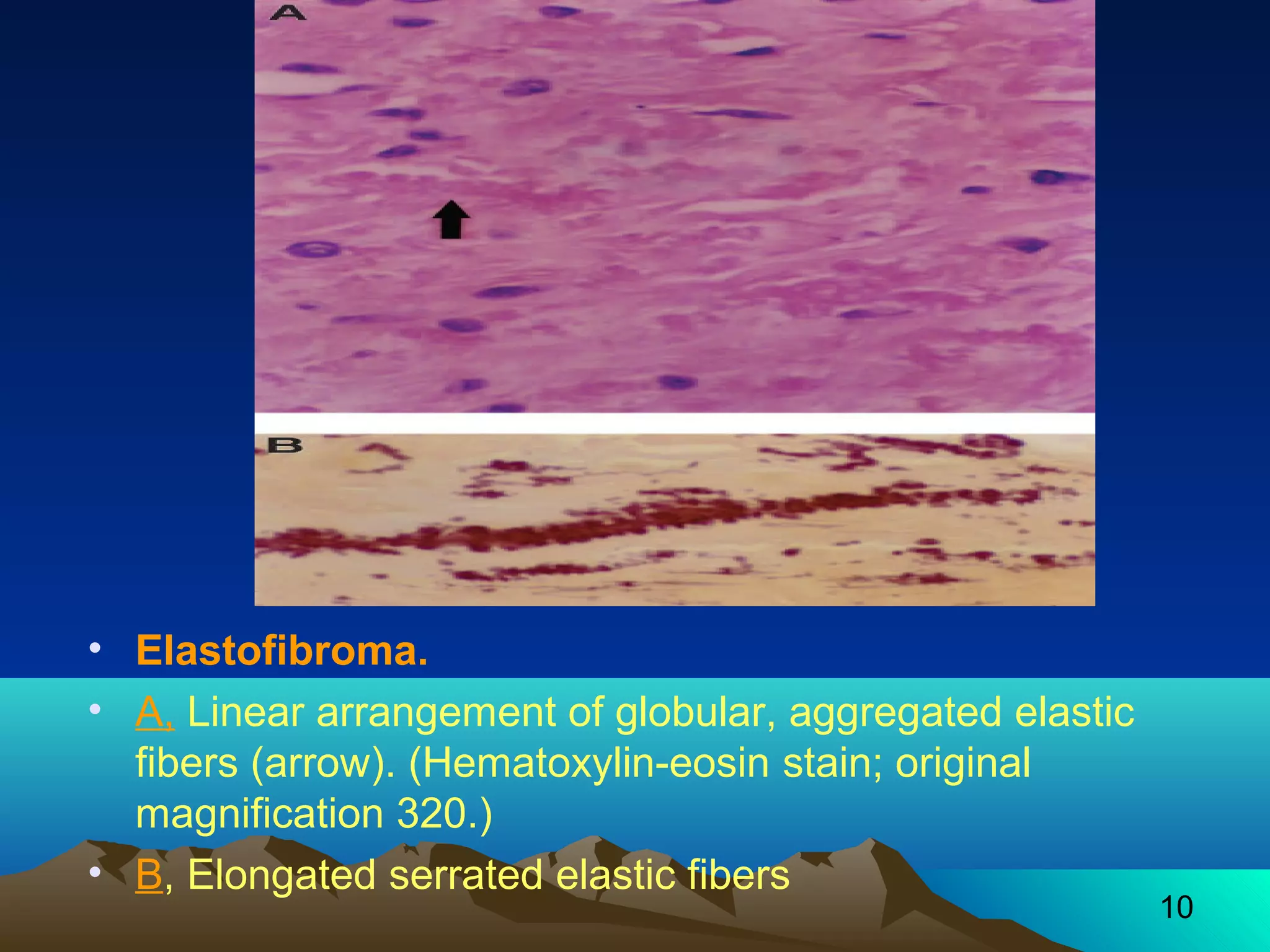
• Elastofibroma. 
• A, Linear arrangement of globular, aggregated elastic 
fibers (arrow). (Hematoxylin-eosin stain; original 
magnification 320.) 
• B, Elongated serrated elastic fibers
11
12
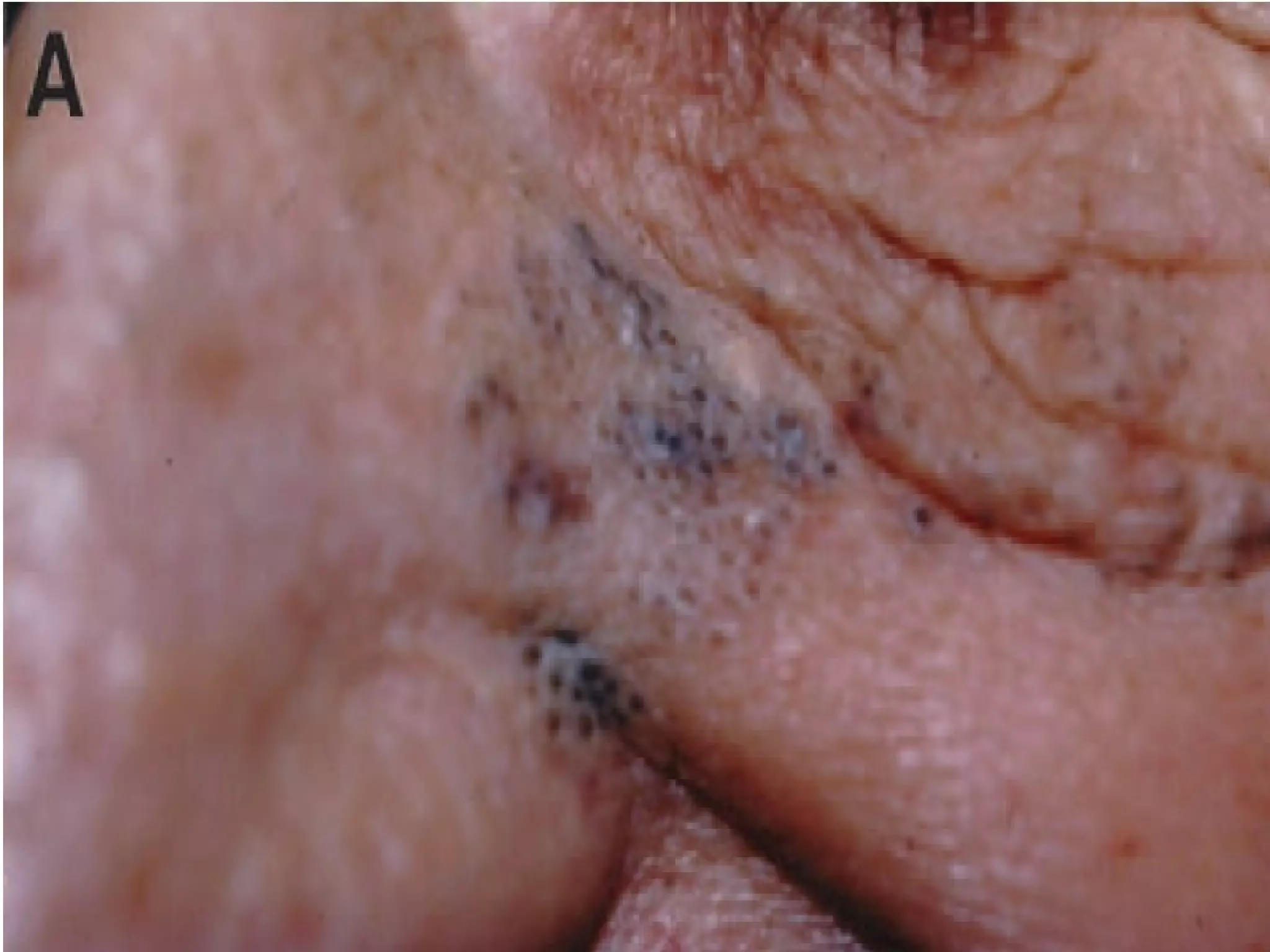
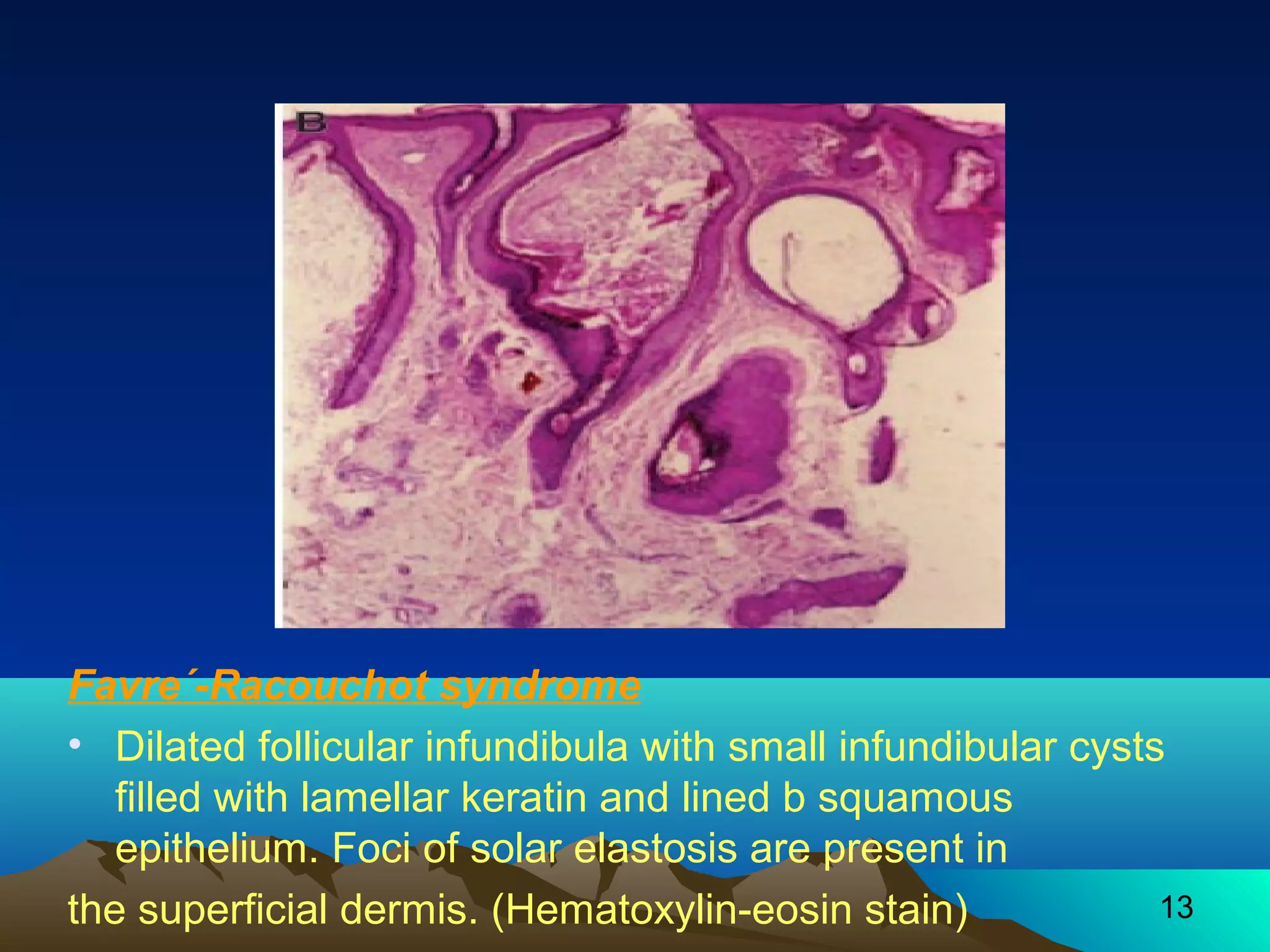
Favre´-Racouchot syndrome 
• Dilated follicular infundibula with small infundibular cysts 
filled with lamellar keratin and lined b squamous 
epithelium. Foci of solar elastosis are present in 
the superficial dermis. (Hematoxylin-eosin stain) 
13
14
15
16 
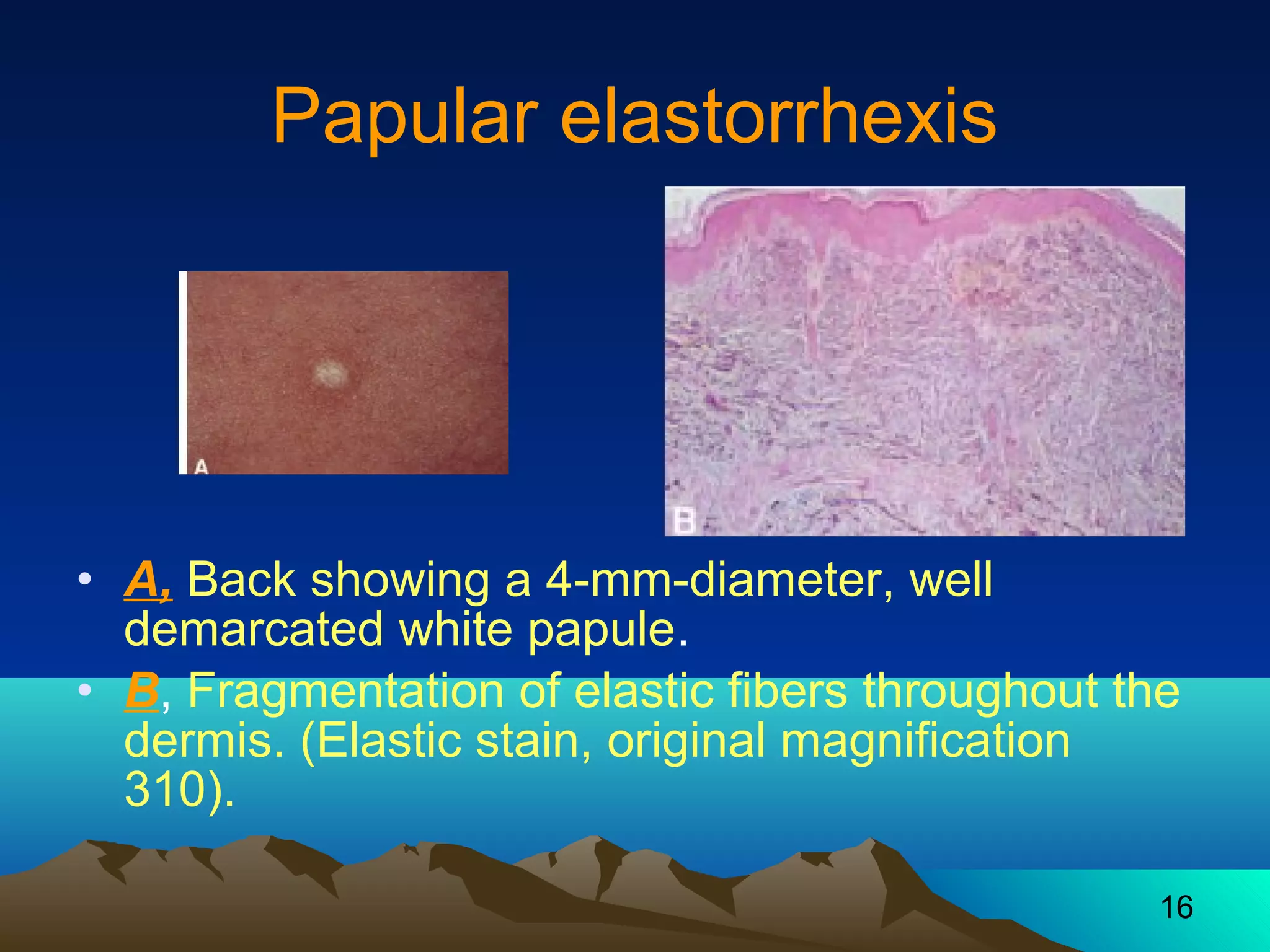
Papular elastorrhexis 
• A, Back showing a 4-mm-diameter, well 
demarcated white papule. 
• B, Fragmentation of elastic fibers throughout the 
dermis. (Elastic stain, original magnification 
310).
17 
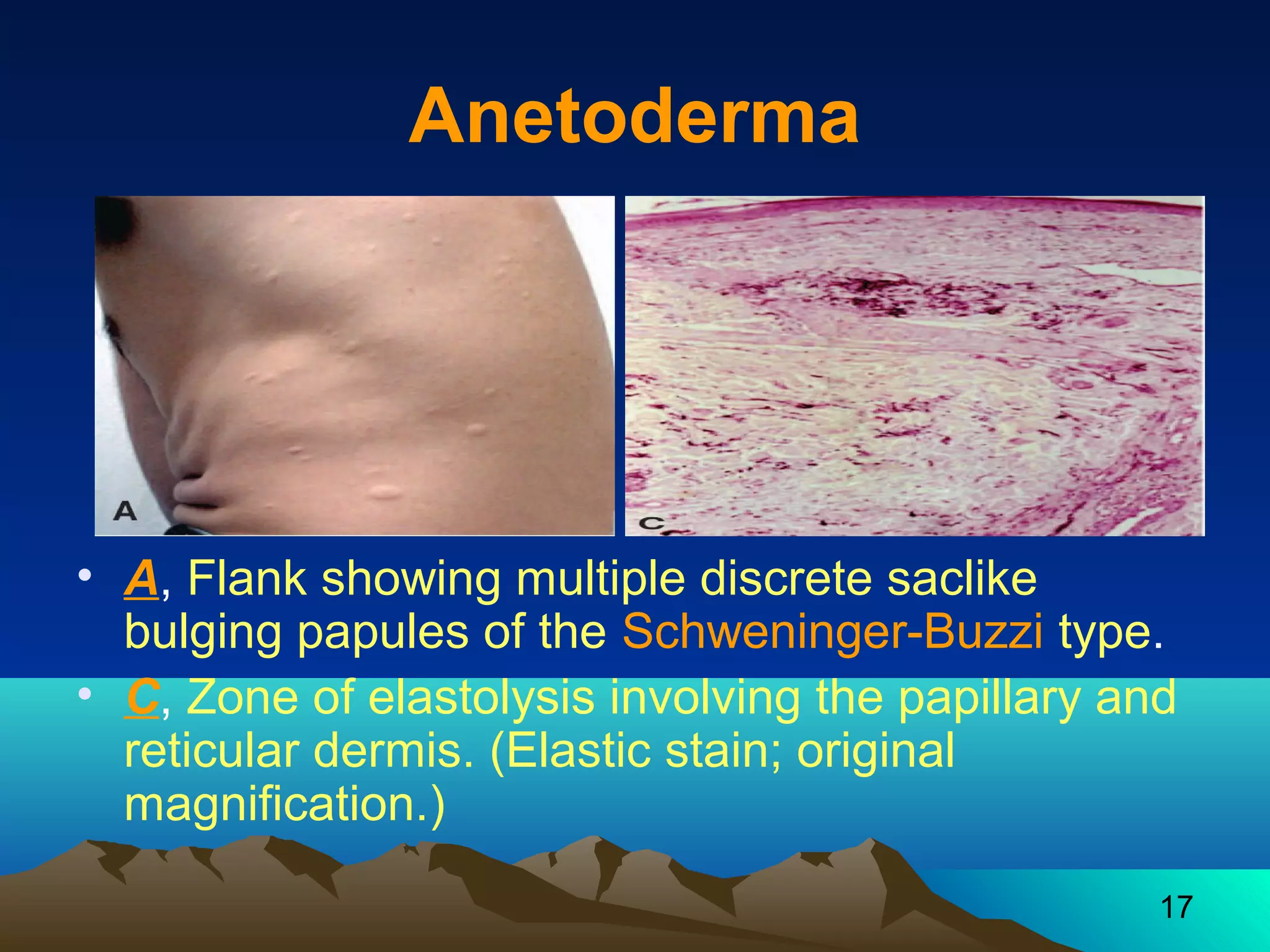
Anetoderma 
• A, Flank showing multiple discrete saclike 
bulging papules of the Schweninger-Buzzi type. 
• C, Zone of elastolysis involving the papillary and 
reticular dermis. (Elastic stain; original 
magnification.)
28 
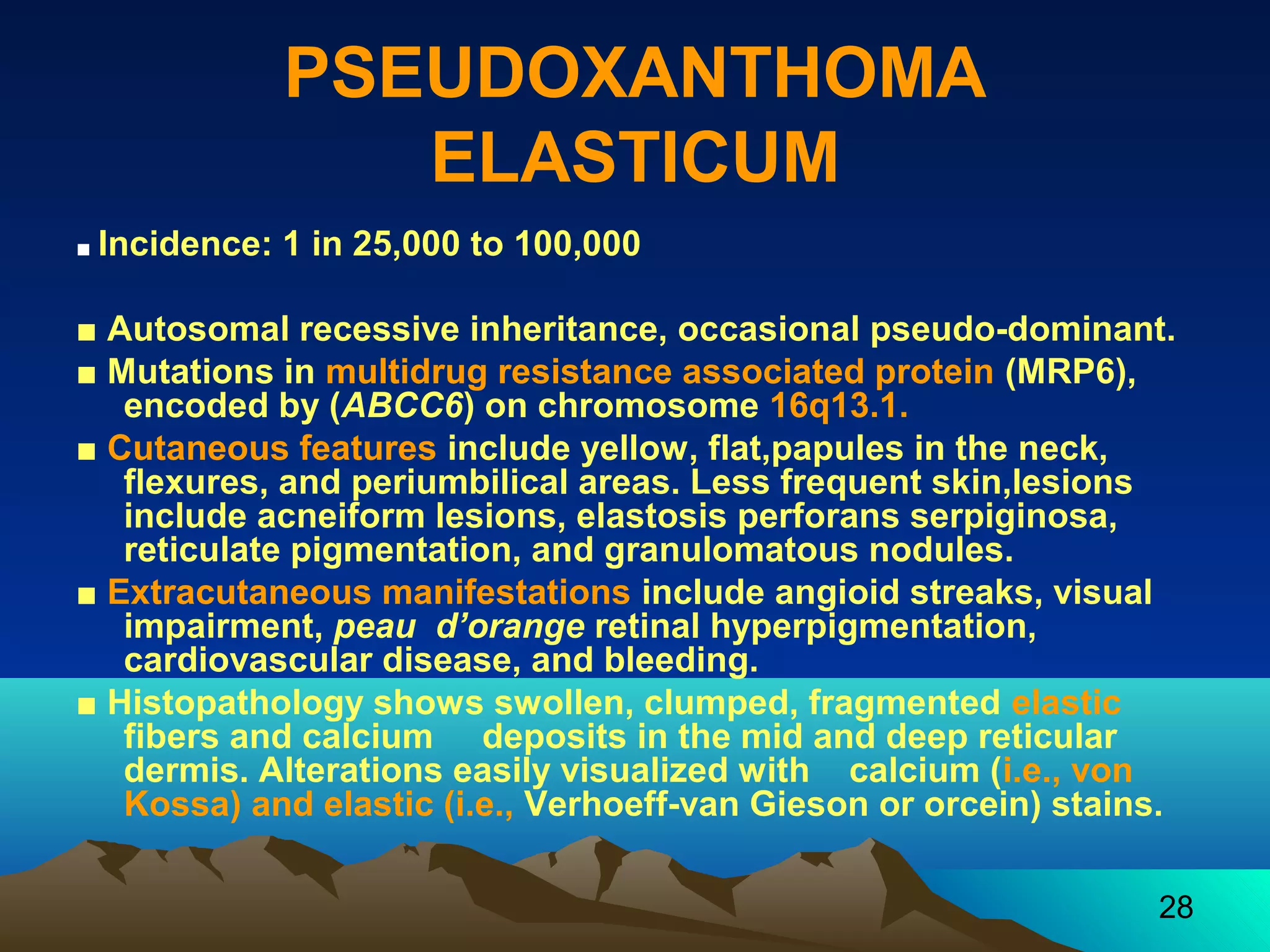
PSEUDOXANTHOMA 
ELASTICUM 
■ Incidence: 1 in 25,000 to 100,000 
■ Autosomal recessive inheritance, occasional pseudo-dominant. 
■ Mutations in multidrug resistance associated protein (MRP6), 
encoded by (ABCC6) on chromosome 16q13.1. 
■ Cutaneous features include yellow, flat,papules in the neck, 
flexures, and periumbilical areas. Less frequent skin,lesions 
include acneiform lesions, elastosis perforans serpiginosa, 
reticulate pigmentation, and granulomatous nodules. 
■ Extracutaneous manifestations include angioid streaks, visual 
impairment, peau d’orange retinal hyperpigmentation, 
cardiovascular disease, and bleeding. 
■ Histopathology shows swollen, clumped, fragmented elastic 
fibers and calcium deposits in the mid and deep reticular 
dermis. Alterations easily visualized with calcium (i.e., von 
Kossa) and elastic (i.e., Verhoeff-van Gieson or orcein) stains.
29 
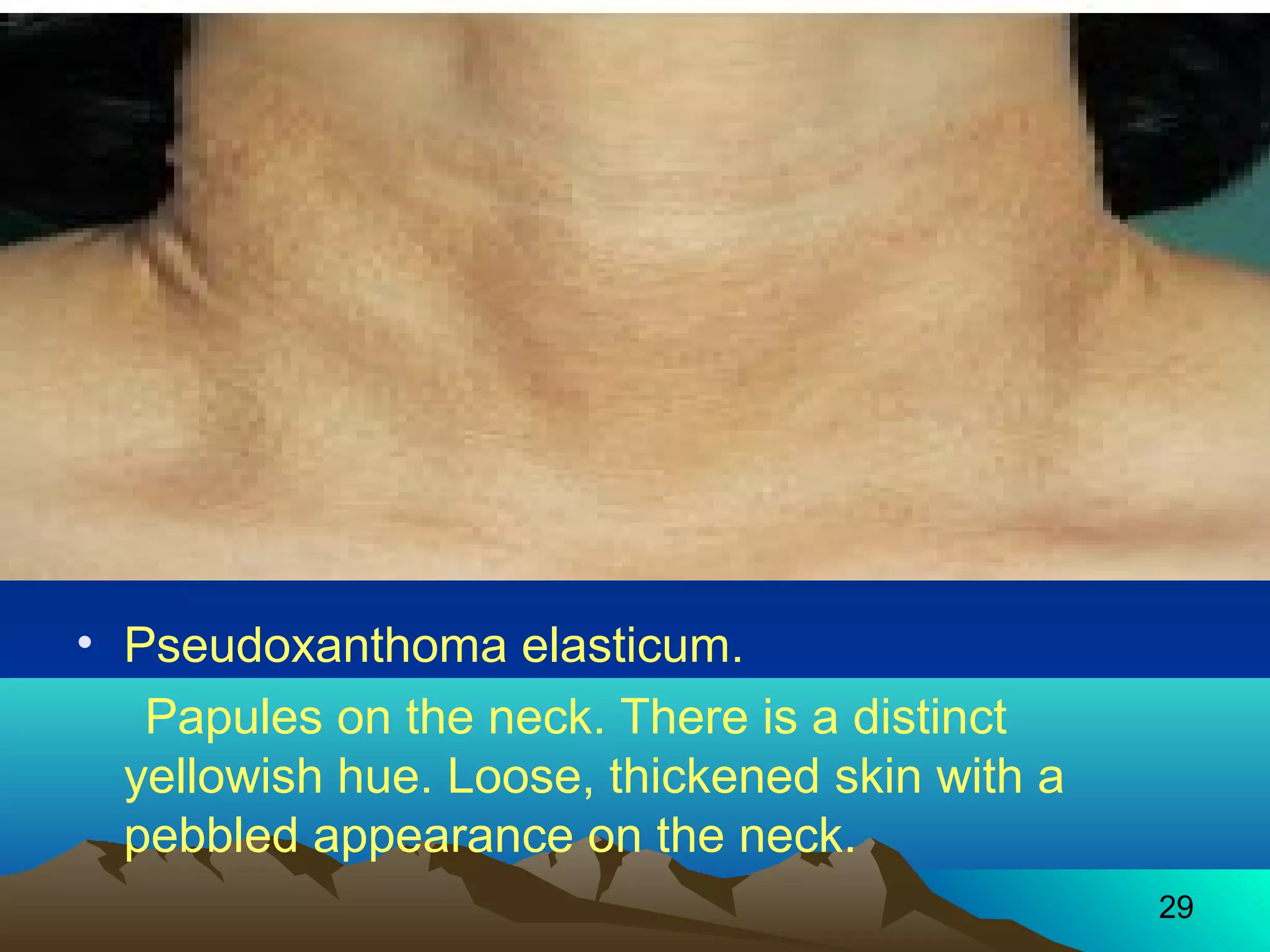
• Pseudoxanthoma elasticum. 
Papules on the neck. There is a distinct 
yellowish hue. Loose, thickened skin with a 
pebbled appearance on the neck.
30 
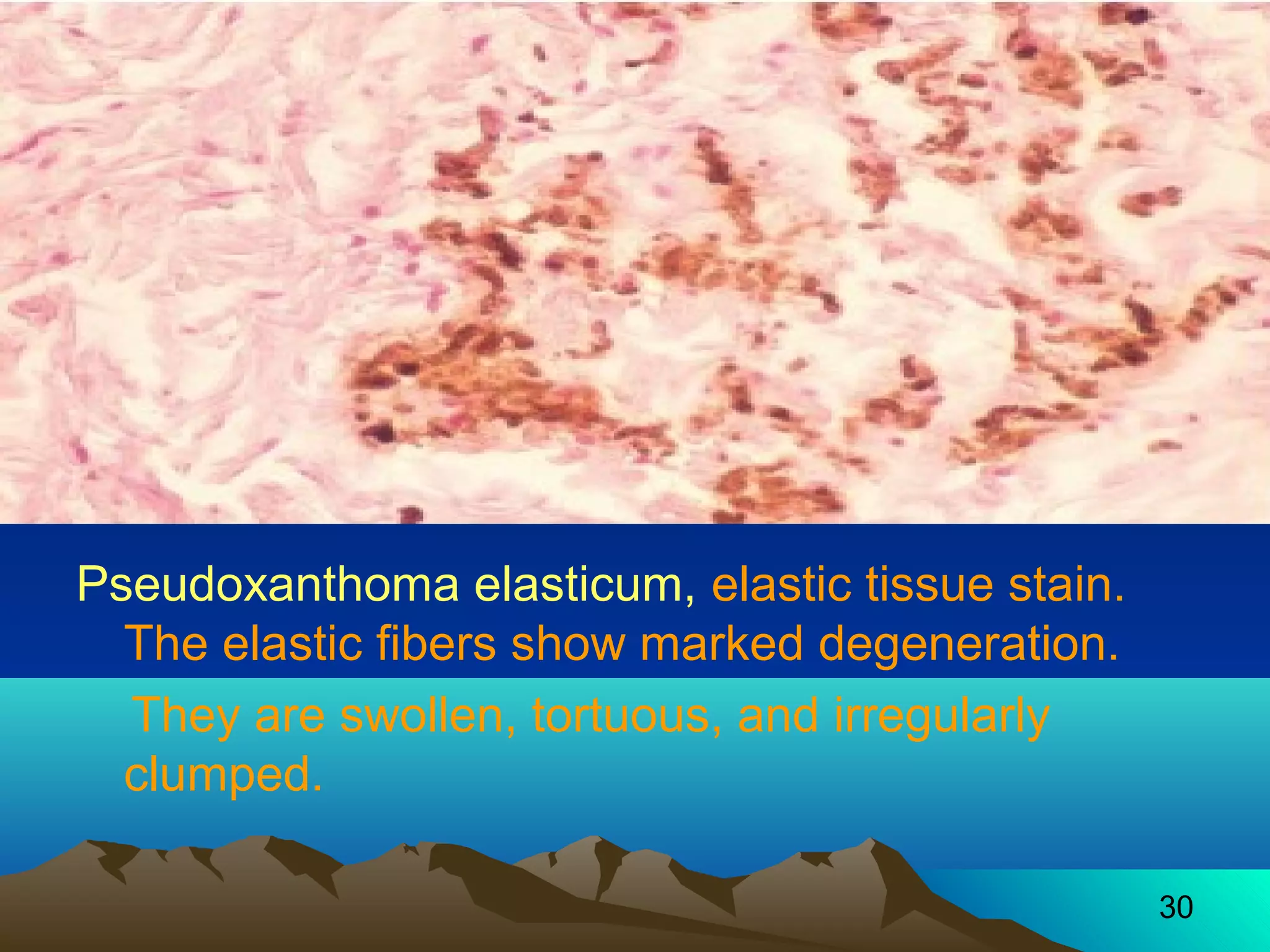
Pseudoxanthoma elasticum, elastic tissue stain. 
The elastic fibers show marked degeneration. 
They are swollen, tortuous, and irregularly 
clumped.
31
32
33 
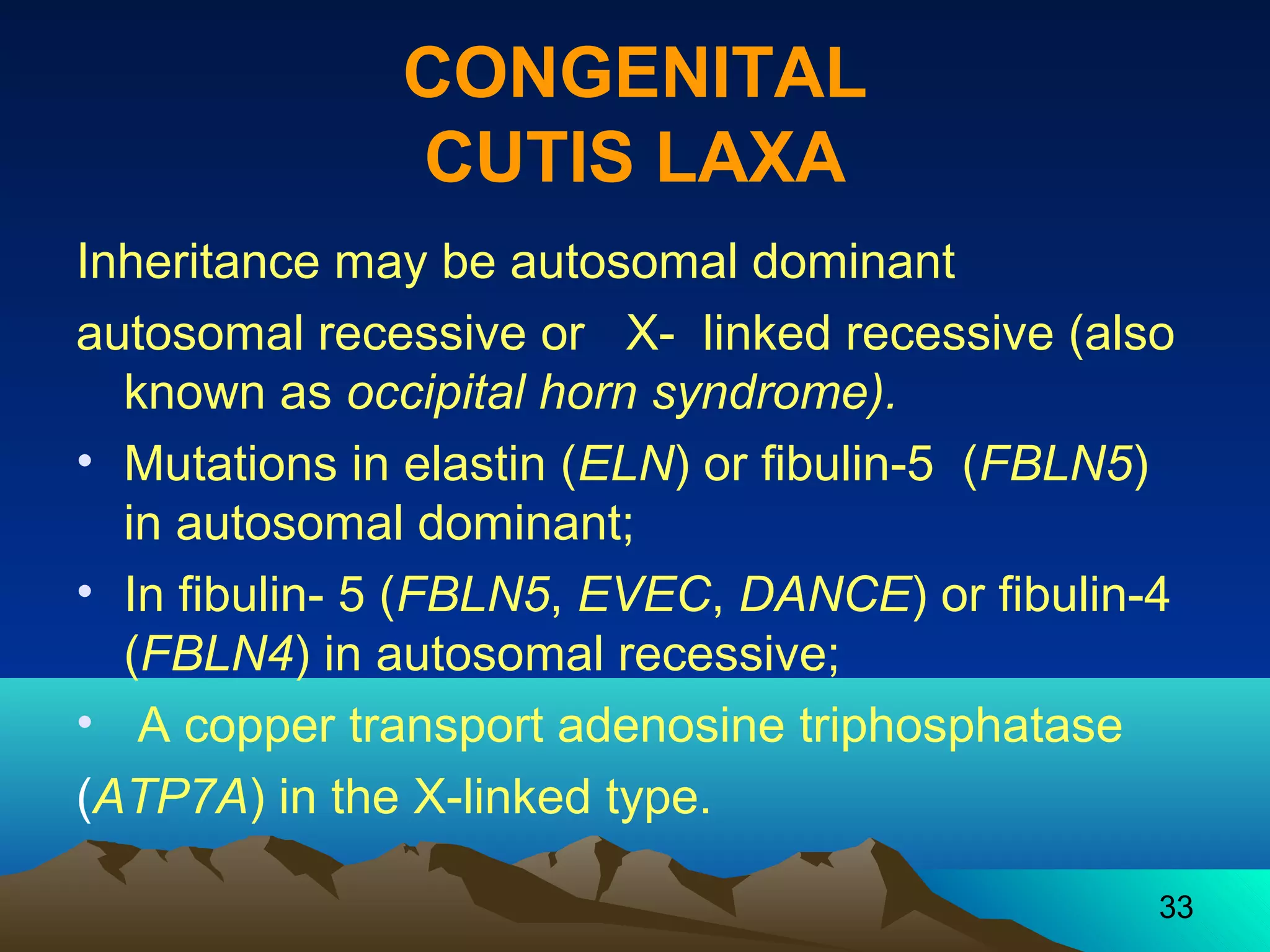
CONGENITAL 
CUTIS LAXA 
Inheritance may be autosomal dominant 
autosomal recessive or X- linked recessive (also 
known as occipital horn syndrome). 
• Mutations in elastin (ELN) or fibulin-5 (FBLN5) 
in autosomal dominant; 
• In fibulin- 5 (FBLN5, EVEC, DANCE) or fibulin-4 
(FBLN4) in autosomal recessive; 
• A copper transport adenosine triphosphatase 
(ATP7A) in the X-linked type.
34 
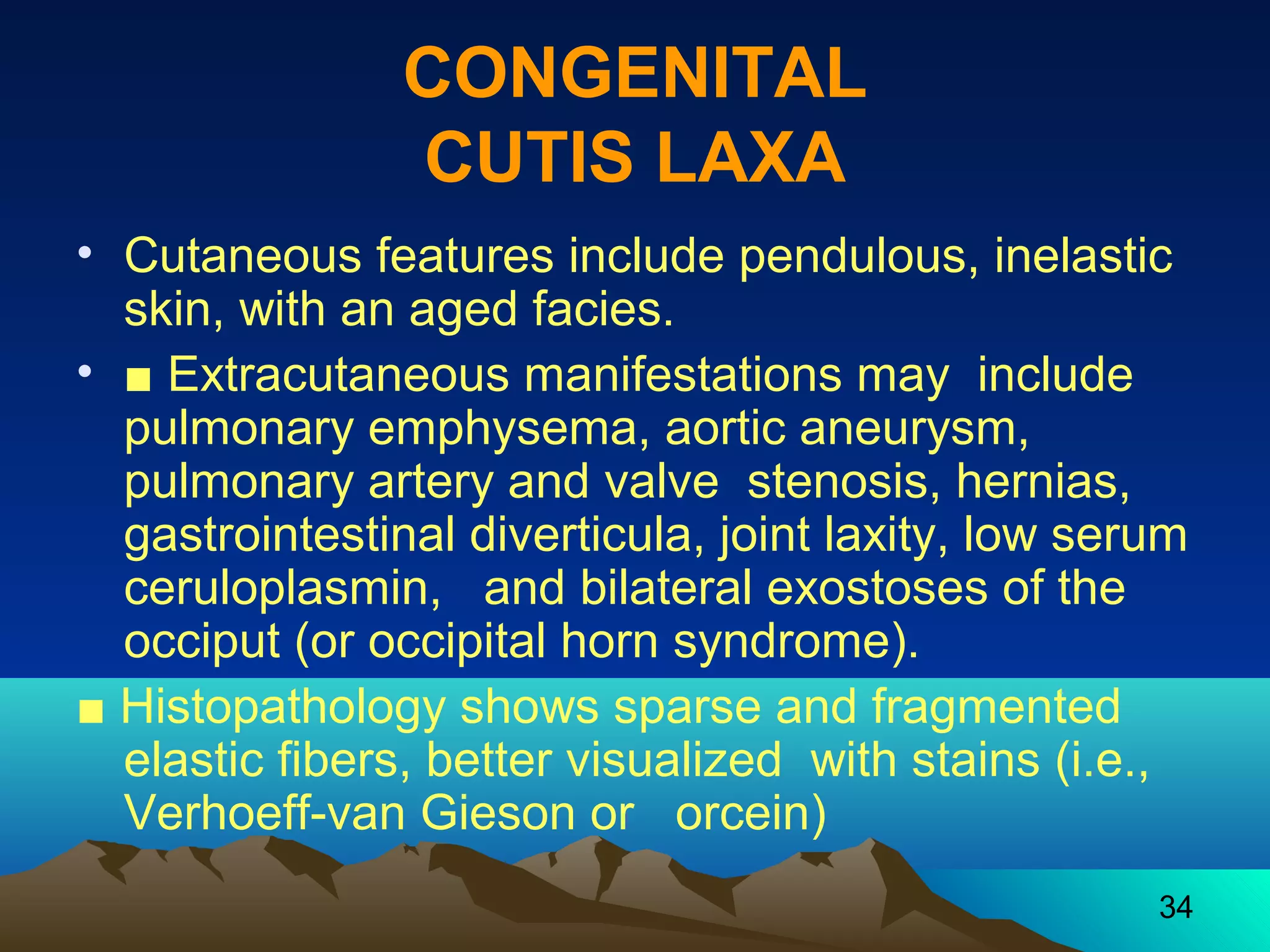
CONGENITAL 
CUTIS LAXA 
• Cutaneous features include pendulous, inelastic 
skin, with an aged facies. 
• ■ Extracutaneous manifestations may include 
pulmonary emphysema, aortic aneurysm, 
pulmonary artery and valve stenosis, hernias, 
gastrointestinal diverticula, joint laxity, low serum 
ceruloplasmin, and bilateral exostoses of the 
occiput (or occipital horn syndrome). 
■ Histopathology shows sparse and fragmented 
elastic fibers, better visualized with stains (i.e., 
Verhoeff-van Gieson or orcein)
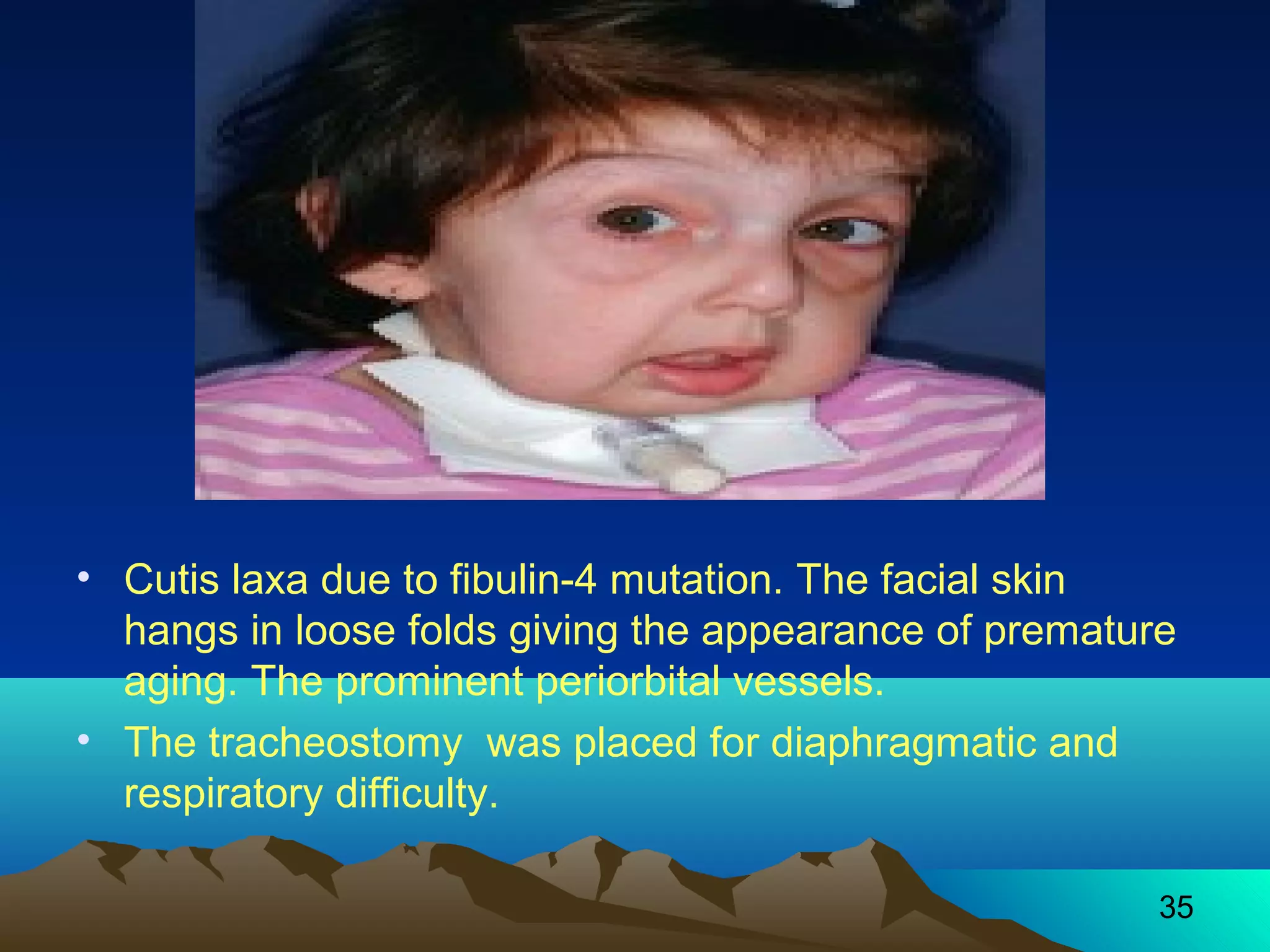
• Cutis laxa due to fibulin-4 mutation. The facial skin 
hangs in loose folds giving the appearance of premature 
aging. The prominent periorbital vessels. 
• The tracheostomy was placed for diaphragmatic and 
respiratory difficulty. 
35
36
37
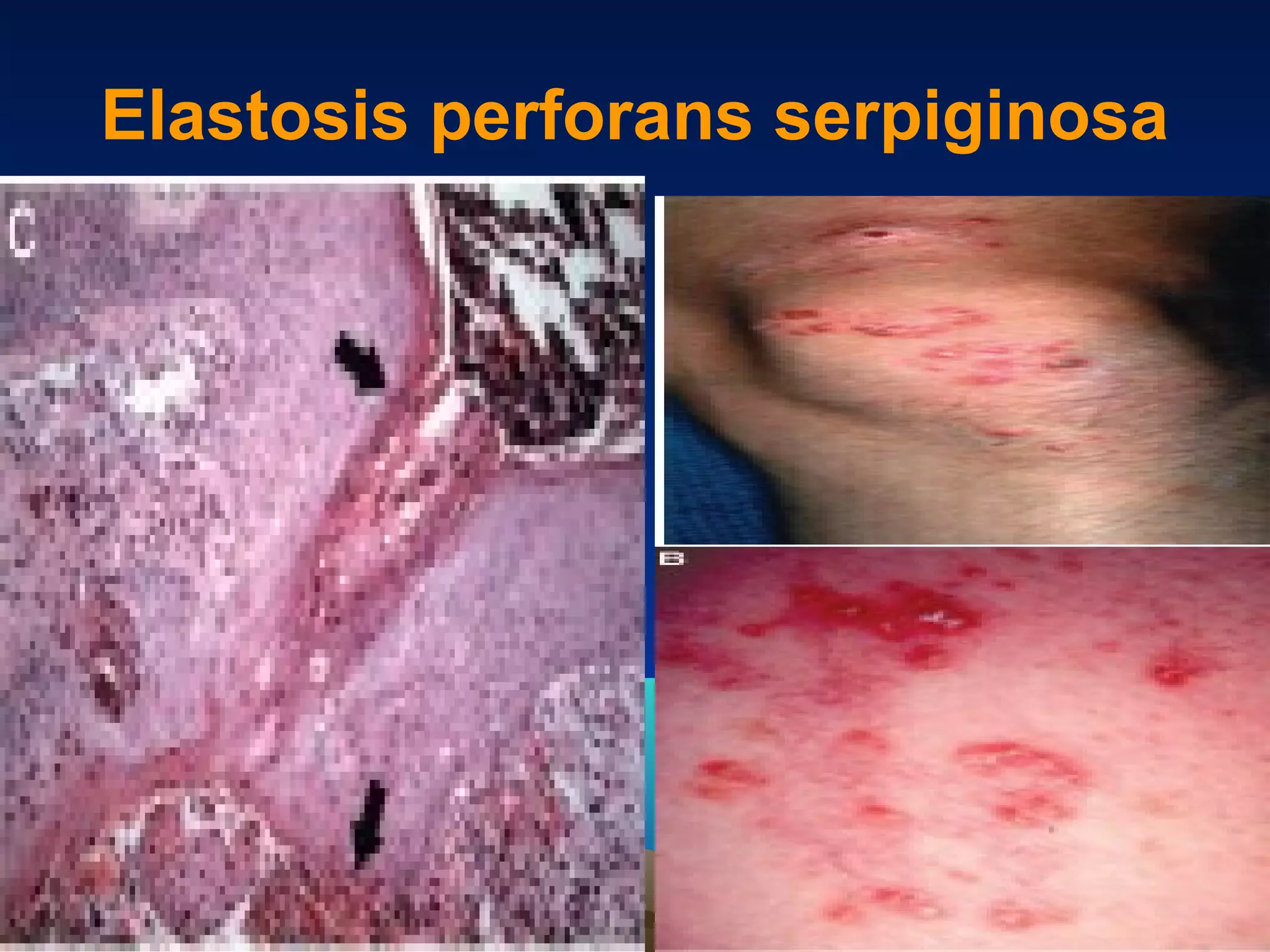
Elastosis perforans serpiginosa 
38
39 
ELASTOSIS PERFORANS 
((SERPIGINOSA(EEPPSS 
• Characterized by hyperkeratotic papules and 
plaques, transepidermal elimination of abnormal 
elastic fibers, and focal dermal elastosis 
• it has been postulated that focal irritation 
(biochemical or mechanical( in the dermis may 
induce formation of epidermal and follicular 
channels to extrude the irritating agent. 
• In many cases, the trigger for elastogenesis is 
unknown. 
• D-Penicillamine therapy for Wilson disease, 
cystinuria, and rheumatoid arthritis have been 
associated with one 
subtype of EPS.

Disordersofelastictissue 100405052552-phpapp01

  • 1.
    EEllaassttiicc TTiissssuuee ddiissoorrddeerrss 11 BBYY MM..YYOOUUSSRRYY AABBDDEELL--MMAAWWLLAA
  • 2.
    2 EELLAASSTTIICC TTIISSSSUUEE • Elastic fibers are the principal components of connective tissue that impart resilience and elasticity to the skin. • Mature elastic fibers in the reticular dermis are composed of microfibrils (15% by weight, containing fibrillins and microfibrilassociated glycoproteins) that surround a core of amorphous elastin (85% by weight, a single polypeptide chain of 800 amino acids); • The immature fibers seen in children have a higher percentage of microfibrils (50% by weight)
  • 3.
    3 CCuuttaanneeoouuss eellaassttiinn • Cutaneous elastin and microfibrillar glycoproteins are synthesized primarily by fibroblasts. • Elastin is initially secreted as tropoelastin, which is crosslinked with and stabilized by desmosine to form elastin. A critical enzyme in this process is lysyl oxidase, a copper-dependent enzyme that deaminates lysine to form crosslinks in both elastic and collagen fibers.
  • 4.
    4 EEllaassttiinn MMeettaabboolliissmm • Elastin is metabolized by proteolytic enzymes, including serine-type elastases, which are secreted by neutrophils, macrophages, human fibroblasts, and other types of cells. • Elastic fibers are also degraded by matrix metalloproteinases (MMPs), of which there are at least 23 different enzymes secreted by a variety of types of cells. • The MMPs stromelysin, macrophage metalloproteinase (MMP-12), the gelatinases • (MMP- 2 and MMP-9), and matrilisin (MMP-7) are the most active against elastic fibers
  • 5.
    5 HHiissttooppaatthhoollooggiicc OOrriieennttaattiioonn • Elastic fibers of the papillary dermis are oriented parallel (elaunin fibers) or perpendicular (oxytalan) to the dermal-epidermal junction and are thin and few in number. • Oxytalan fibers lack the elastin core., elaunin fibers contain a small amount of elastin • Mature elastic fibers are found predominantly in the reticular dermis
  • 6.
  • 7.
    7 EEllaassttiicc TTiissssuueeddiissoorrddeerrss • Several disorders in which accumulation or elastotic degeneration of dermal elastic fibers produces prominent clinical and histopathologic features have recently been described • They include elastoderma, linear focal elastosis, and late-onset focal dermal elastosis, acquired pseudoxanthoma elasticum, elastosis perforans serpiginosa, and Favre´-Racouchot syndrome.
  • 8.
  • 9.
    Focal dermal elastosis. A, Antecubital fossa showing multiple 1- to 3-mm diameter discrete and coalescing yellow papules. B, Thickened elastic fibers in the mid to deep reticular dermis 9
  • 10.
    10 • Elastofibroma. • A, Linear arrangement of globular, aggregated elastic fibers (arrow). (Hematoxylin-eosin stain; original magnification 320.) • B, Elongated serrated elastic fibers
  • 11.
  • 12.
  • 13.
    Favre´-Racouchot syndrome •Dilated follicular infundibula with small infundibular cysts filled with lamellar keratin and lined b squamous epithelium. Foci of solar elastosis are present in the superficial dermis. (Hematoxylin-eosin stain) 13
  • 14.
  • 15.
  • 16.
    16 Papular elastorrhexis • A, Back showing a 4-mm-diameter, well demarcated white papule. • B, Fragmentation of elastic fibers throughout the dermis. (Elastic stain, original magnification 310).
  • 17.
    17 Anetoderma •A, Flank showing multiple discrete saclike bulging papules of the Schweninger-Buzzi type. • C, Zone of elastolysis involving the papillary and reticular dermis. (Elastic stain; original magnification.)
  • 18.
    28 PSEUDOXANTHOMA ELASTICUM ■ Incidence: 1 in 25,000 to 100,000 ■ Autosomal recessive inheritance, occasional pseudo-dominant. ■ Mutations in multidrug resistance associated protein (MRP6), encoded by (ABCC6) on chromosome 16q13.1. ■ Cutaneous features include yellow, flat,papules in the neck, flexures, and periumbilical areas. Less frequent skin,lesions include acneiform lesions, elastosis perforans serpiginosa, reticulate pigmentation, and granulomatous nodules. ■ Extracutaneous manifestations include angioid streaks, visual impairment, peau d’orange retinal hyperpigmentation, cardiovascular disease, and bleeding. ■ Histopathology shows swollen, clumped, fragmented elastic fibers and calcium deposits in the mid and deep reticular dermis. Alterations easily visualized with calcium (i.e., von Kossa) and elastic (i.e., Verhoeff-van Gieson or orcein) stains.
  • 19.
    29 • Pseudoxanthomaelasticum. Papules on the neck. There is a distinct yellowish hue. Loose, thickened skin with a pebbled appearance on the neck.
  • 20.
    30 Pseudoxanthoma elasticum,elastic tissue stain. The elastic fibers show marked degeneration. They are swollen, tortuous, and irregularly clumped.
  • 21.
  • 22.
  • 23.
    33 CONGENITAL CUTISLAXA Inheritance may be autosomal dominant autosomal recessive or X- linked recessive (also known as occipital horn syndrome). • Mutations in elastin (ELN) or fibulin-5 (FBLN5) in autosomal dominant; • In fibulin- 5 (FBLN5, EVEC, DANCE) or fibulin-4 (FBLN4) in autosomal recessive; • A copper transport adenosine triphosphatase (ATP7A) in the X-linked type.
  • 24.
    34 CONGENITAL CUTISLAXA • Cutaneous features include pendulous, inelastic skin, with an aged facies. • ■ Extracutaneous manifestations may include pulmonary emphysema, aortic aneurysm, pulmonary artery and valve stenosis, hernias, gastrointestinal diverticula, joint laxity, low serum ceruloplasmin, and bilateral exostoses of the occiput (or occipital horn syndrome). ■ Histopathology shows sparse and fragmented elastic fibers, better visualized with stains (i.e., Verhoeff-van Gieson or orcein)
  • 25.
    • Cutis laxadue to fibulin-4 mutation. The facial skin hangs in loose folds giving the appearance of premature aging. The prominent periorbital vessels. • The tracheostomy was placed for diaphragmatic and respiratory difficulty. 35
  • 26.
  • 27.
  • 28.
  • 29.
    39 ELASTOSIS PERFORANS ((SERPIGINOSA(EEPPSS • Characterized by hyperkeratotic papules and plaques, transepidermal elimination of abnormal elastic fibers, and focal dermal elastosis • it has been postulated that focal irritation (biochemical or mechanical( in the dermis may induce formation of epidermal and follicular channels to extrude the irritating agent. • In many cases, the trigger for elastogenesis is unknown. • D-Penicillamine therapy for Wilson disease, cystinuria, and rheumatoid arthritis have been associated with one subtype of EPS.