Diseases
Diseases
of the
of the
RespiRatoR
RespiRatoR
y system
y system
Major Determinants of Disease
• Diseases of one lung compartment tend to affect the
others
• The lungs are open to the environment, exposing them
to infectious agents, allergens, irritants, & carcinogens
• Most lung disease is caused by inhalation of material;
the most common exception is autoimmune lung disease
• Lost pulmonary membrane is not recoverable
• Smoking is a major cause of lung disease
• The heart & lungs are a functional unit; lung disease
usually affects the heart; & heart disease usually affects
the lungs
UppeR RespiRatoRy
UppeR RespiRatoRy
infections
infections
• Allergic rhinitis
– “hay fever”
– nasal mucosal edema
– nasal discharge
– sneezing
– allergic conjunctivitis
• “Colds”
– transmitted through respiratory droplets
– clear nasal discharge
– low grade fever
– if nasal discharge becomes colorful, it is an indication of secondary bacterial
infection
• Acute pharyngitis
– “sore throat”
– usually viral
– bacterial infections more serious
– red, swollen tonsils
caRcinoma of the
caRcinoma of the
LaRynx
LaRynx
• Common
• Mostly in male smokers
over 40
• Alcohol abuse
increases the risk
• Presents with
– hoarseness
– pain
– cough
– dysphagia
– hemoptysis
ateLectasis
ateLectasis
• Collapse of a lung or part of
a lung
• Resorption
– bronchial obstruction
– air below obstruction
completely absorbed
– obstructions are
• mucous plug
• asthma
• bronchitis
• tumors
• Compression
– pressure exerted from
pleural space or upward
pressure on diaphragm
• Contraction
– scars cause constriction &
collapse
– TB
asthma
asthma
• Chronic inflammatory disease of small bronchi &
bronchioles
• Triggered by inhaled irritants & classified by irritant
• Allergic
• Occupational
• Exercise-induced
• Infectious
• Others
– drug reactions
– emotional stress
– severe air pollution
• Hyperplastic mucous glands in bronchi, hypertrophied
smooth muscle, edema, & marked inflammation
chRonic obstRUctive
chRonic obstRUctive
pULmonaRy Disease (copD)
• Related diseases
• Chronic bronchial
outflow obstruction
• Overlapping features
emphysema
emphysema
• Destruction of
alveolar walls,
alveoli merge to
form large air
spaces
• Loss of surface
area affects
diffusion
• 90% of cases
are smokers
chRonic bRonchitis
chRonic bRonchitis
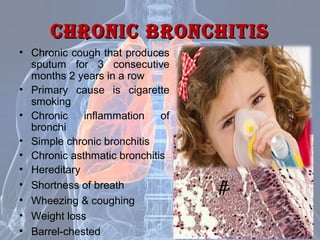
• Chronic cough that produces
sputum for 3 consecutive
months 2 years in a row
• Primary cause is cigarette
smoking
• Chronic inflammation of
bronchi
• Simple chronic bronchitis
• Chronic asthmatic bronchitis
• Hereditary
• Shortness of breath
• Wheezing & coughing
• Weight loss
• Barrel-chested
• Cigarette smoke
irritates lung &
causes inflammation
• Inflammatory cells
release digestive
enzymes
• These enzymes
normally inhibited by
alpha-1 antitrypsin
• AAT inhibited by
smoke & so enzymes
digest lung tissue
Bronchiectasis
Bronchiectasis
• Marked, permanent dilation of small bronchi
• Destruction of smooth muscle & elastic
supporting tissue
• Must have obstruction & infection
– obstruction causes mucus retention
– infection damages bronchial walls which causes
excess mucus production
• Not a primary condition
• Typically involves lower lobes
• Persistent cough
restrictive Lung
restrictive Lung
Disease
Disease
• Chronic inflammation
making lungs stiff &
inelastic
• Affects diffusion
• Scar tissue accumulates
in the interstitium
• Mostly cause is unknown
• Equal decline in FEV1 &
FVC
• Usually presents with
shortness of breath
• Can lead to pulmonary
HTN
interstitiaL FiBrosis
without granuLomatous
inFLammation
inFLammation
• Usually middle-aged
men at time of
diagnosis
• Shortness of breath;
may progress to cor
pulmonale, hypoxia
• Pneumoconioses
– black lung disease
– silicosis
• most common
chronic occupational
disease
– asbestosis
• mesothelioma
interstitiaL FiBrosis with
granuLomatous
granuLomatous
inFLammation
inFLammation
• Sarcoidosis
– cause unknown
– affects many
tissues but
mostly lungs
– present with
shortness of
breath, cough,
chest pain,
hemoptysis
PuLmonary eDema
PuLmonary eDema
• Fluid in alveoli
• Increased BP in lung
– normal is 25/8 mmHg
with average at 15 mmHg
• Microvascular injury
– due to
• toxic fumes
• hot gases
• septicemia
• IV drug abuse
• Main symptom is SOB
PuLmonary
PuLmonary
thromBoemBoLism
thromBoemBoLism
• About 50,000 deaths annually
• Mostly from DVT
• Inflammation predisposes you
to it
• Promoted by
– CHF
– pregnancy
– birth control pills
– prolonged bed rest
– metastatic cancer
– genetics
• Most associated with no
symptoms but some
– cause lung infarcts
– chest pain & dyspnea
– death
PuLmonary
PuLmonary
hyPertension
hyPertension
• Sustained systolic pressure over
30 mmHg or average in excess of
25 mmHg
• Vicious cycle
• Most common cause is increased
pulmonary vascular resistance
• Usually secondary to
– COPD
– heart disease
– collagen vascular diseases
– recurrent pulmonary
thromboemboli
• With R heart failure is cor
pulmonale
• Thickening of arteriolar walls
• SOB
– chest pain
– fatigue
aDuLt resPiratory
aDuLt resPiratory
Distress synDrome
Distress synDrome
• ARDS
• Alveolar or pulmonary capillary
damage
• Pathogenesis
– injury to endothelium or alveoli
– neutrophils infiltrate
– protein-rich fluid exudes into alveolar
space
– SOB occurs with rapid breathing which
dries the fluid into a thick membrane
– stiffens lungs
– limits airflow & interferes with diffusion
– hypoxia
• 50% fatality
• Causes
– sepsis
– smoke inhalation
– near drowning
– O2 toxicity
– burns
– DIC
– fat embolism
– endotoxic shock
Pneumonia
Pneumonia
• Inflammation of the
lungs
• Usually caused by
bacteria
• 80,000 deaths/yr
• Alveolar pneumonia
– usually acute
– fill with inflammatory
exudate
– most common
• Bronchopneumonia
– patchy inflammation
– involves alveoli of more
than 1 lobe
– usually in basilar parts
• Lobar pneumonia
– consolidation of an
entire lobe
– almost always caused
by S. pneumoniae
InterstItIal PneumonIa
• Inflammation
in septa
• Diffuse &
bilateral
• Usually viral
• Etiology
– mostly bacterial
• S. pneumoniae
• Haemophilus
influenzae
• Staph
• E. coli
• Pseudomonas
• Pathogenesis
– inhalation of droplets,
aspiration of gastric
contents, blood-borne
spread
– those susceptible
include
• immune deficiency
• decreased cough reflex
• impaired cilia
• accumulated secretions
• pulmonary congestion
• Community-acquired
– acute pneumonia
– bronchopneumonia
– lobar pneumonia
– Legionnaire’s disease
– atypical pneumonia
• Mycoplasma
• Nosocomial
– Commonly S. aureus &
E.coli
– Seen in
• People with severe
disease
• Prolonged antibiotic
therapy
• People with internal
mechanical devices
• Aspiration
– Inflammatory reaction due
to corrosive effects
– Those who are comatose
or those with a stroke
– Hi mortality rate
• Seen mostly in the young & the elderly
• Hypoxia & death
• Bacterial
– high fever & chills
– purulent sputum
– increased neutrophils
– cough
– SOB
• Interstitial
– less severe
– increased lymphocytes
– cough
– SOB
lung abscess
lung abscess
• Purulent inflammation
with tissue necrosis &
liquefaction
• Usually have several
types of bacteria with
anaerobic
• Most commonly due to
aspiration of gastric
contents
• Foul-smelling sputum
tuberculosIs
tuberculosIs
• Mycobacterium tuberculosis
• Chronic granulomatous inflammation with
caseous necrosis
Pathogenesis
• Affects about 2 billion worldwide
• Kills about 2 million/yr
• 2nd
only to AIDS
• Associated with poverty, crowding,
malnourishment, & chronic disease
• PPD
• Low-grade fever
• Night sweats
• Malaise
• Weight loss anorexia
Mycoses
• Histoplasmosis
• Coccidiomycosis
• Cryptococcus
Lung neopLasms
Lung neopLasms
• Mostly due to metastasis
• Bronchogenic carcinoma is the most
common
– most common of all cancers
– #1 cancer death
– about 90% are cigarette smokers
Bronchogenic Carcinoma
• Mostly caused by cigarettes
– Direct relationship between incidence of cancer &
number of cigarettes smoked
– Direct relationship between precancerous changes in
bronchial mucosa & number of cigarettes smoked
• Small cell carcinoma
– 20% of cases
– arise from specialized
neuroendocrine cells of the
bronchus
– strongest relationship to
cigarettes
– aggressively malignant
• Squamous cell carcinoma
– 30% of cases
– bronchial epithelium that
has undergone metaplasia
– arises centrally
– most common in men who
smoke
– grows slower so better
prognosis
• Adenocarcinomas
– 30% of cases
– most well-differentiated
– somewhat better prognosis
– more peripheral in smaller
bronchi
– less associated with
smoking
• Large cell carcinoma
– 15% of cases
– poor prognosis
– metastasizes early
Bronchial Carcinoid Tumor
• 5% of lung cancers
• Arise from bronchial neuroendocrine cells
• Much less aggressive
• Grows slow
pneumothorax
pneumothorax
• Air in pleural space
• Causes atelectasis
• May occur spontaneously
• More frequent in people with emphysema who
have large blebs near pleura
• Traumatic penetration
• Can be fatal
• Tension pneumothorax
– air in but not out
pLeuraL effusion
pLeuraL effusion
• Fluid in pleural space
• Transudate from CHF most common
• If blood, called hemothorax
pLeuritis
• Inflammation
• Pleurisy with each breath
• Mostly caused by pneumonia

diseasesoftherespiratorysystem-140314014247-phpapp01.pdf

  • 1.
  • 3.
    Major Determinants ofDisease • Diseases of one lung compartment tend to affect the others • The lungs are open to the environment, exposing them to infectious agents, allergens, irritants, & carcinogens • Most lung disease is caused by inhalation of material; the most common exception is autoimmune lung disease • Lost pulmonary membrane is not recoverable • Smoking is a major cause of lung disease • The heart & lungs are a functional unit; lung disease usually affects the heart; & heart disease usually affects the lungs
  • 4.
    UppeR RespiRatoRy UppeR RespiRatoRy infections infections •Allergic rhinitis – “hay fever” – nasal mucosal edema – nasal discharge – sneezing – allergic conjunctivitis • “Colds” – transmitted through respiratory droplets – clear nasal discharge – low grade fever – if nasal discharge becomes colorful, it is an indication of secondary bacterial infection • Acute pharyngitis – “sore throat” – usually viral – bacterial infections more serious – red, swollen tonsils
  • 5.
    caRcinoma of the caRcinomaof the LaRynx LaRynx • Common • Mostly in male smokers over 40 • Alcohol abuse increases the risk • Presents with – hoarseness – pain – cough – dysphagia – hemoptysis
  • 6.
    ateLectasis ateLectasis • Collapse ofa lung or part of a lung • Resorption – bronchial obstruction – air below obstruction completely absorbed – obstructions are • mucous plug • asthma • bronchitis • tumors • Compression – pressure exerted from pleural space or upward pressure on diaphragm • Contraction – scars cause constriction & collapse – TB
  • 7.
    asthma asthma • Chronic inflammatorydisease of small bronchi & bronchioles • Triggered by inhaled irritants & classified by irritant • Allergic • Occupational • Exercise-induced • Infectious • Others – drug reactions – emotional stress – severe air pollution • Hyperplastic mucous glands in bronchi, hypertrophied smooth muscle, edema, & marked inflammation
  • 8.
    chRonic obstRUctive chRonic obstRUctive pULmonaRyDisease (copD) pULmonaRy Disease (copD) • Related diseases • Chronic bronchial outflow obstruction • Overlapping features
  • 10.
    emphysema emphysema • Destruction of alveolarwalls, alveoli merge to form large air spaces • Loss of surface area affects diffusion • 90% of cases are smokers
  • 11.
    chRonic bRonchitis chRonic bRonchitis •Chronic cough that produces sputum for 3 consecutive months 2 years in a row • Primary cause is cigarette smoking • Chronic inflammation of bronchi • Simple chronic bronchitis • Chronic asthmatic bronchitis • Hereditary • Shortness of breath • Wheezing & coughing • Weight loss • Barrel-chested
  • 12.
    • Cigarette smoke irritateslung & causes inflammation • Inflammatory cells release digestive enzymes • These enzymes normally inhibited by alpha-1 antitrypsin • AAT inhibited by smoke & so enzymes digest lung tissue
  • 13.
    Bronchiectasis Bronchiectasis • Marked, permanentdilation of small bronchi • Destruction of smooth muscle & elastic supporting tissue • Must have obstruction & infection – obstruction causes mucus retention – infection damages bronchial walls which causes excess mucus production • Not a primary condition • Typically involves lower lobes • Persistent cough
  • 14.
    restrictive Lung restrictive Lung Disease Disease •Chronic inflammation making lungs stiff & inelastic • Affects diffusion • Scar tissue accumulates in the interstitium • Mostly cause is unknown • Equal decline in FEV1 & FVC • Usually presents with shortness of breath • Can lead to pulmonary HTN
  • 15.
    interstitiaL FiBrosis interstitiaL FiBrosis withoutgranuLomatous without granuLomatous inFLammation inFLammation • Usually middle-aged men at time of diagnosis • Shortness of breath; may progress to cor pulmonale, hypoxia • Pneumoconioses – black lung disease – silicosis • most common chronic occupational disease – asbestosis • mesothelioma
  • 16.
    interstitiaL FiBrosis with interstitiaLFiBrosis with granuLomatous granuLomatous inFLammation inFLammation • Sarcoidosis – cause unknown – affects many tissues but mostly lungs – present with shortness of breath, cough, chest pain, hemoptysis
  • 17.
    PuLmonary eDema PuLmonary eDema •Fluid in alveoli • Increased BP in lung – normal is 25/8 mmHg with average at 15 mmHg • Microvascular injury – due to • toxic fumes • hot gases • septicemia • IV drug abuse • Main symptom is SOB
  • 18.
    PuLmonary PuLmonary thromBoemBoLism thromBoemBoLism • About 50,000deaths annually • Mostly from DVT • Inflammation predisposes you to it • Promoted by – CHF – pregnancy – birth control pills – prolonged bed rest – metastatic cancer – genetics • Most associated with no symptoms but some – cause lung infarcts – chest pain & dyspnea – death
  • 19.
    PuLmonary PuLmonary hyPertension hyPertension • Sustained systolicpressure over 30 mmHg or average in excess of 25 mmHg • Vicious cycle • Most common cause is increased pulmonary vascular resistance • Usually secondary to – COPD – heart disease – collagen vascular diseases – recurrent pulmonary thromboemboli • With R heart failure is cor pulmonale • Thickening of arteriolar walls • SOB – chest pain – fatigue
  • 20.
    aDuLt resPiratory aDuLt resPiratory DistresssynDrome Distress synDrome • ARDS • Alveolar or pulmonary capillary damage • Pathogenesis – injury to endothelium or alveoli – neutrophils infiltrate – protein-rich fluid exudes into alveolar space – SOB occurs with rapid breathing which dries the fluid into a thick membrane – stiffens lungs – limits airflow & interferes with diffusion – hypoxia • 50% fatality • Causes – sepsis – smoke inhalation – near drowning – O2 toxicity – burns – DIC – fat embolism – endotoxic shock
  • 21.
    Pneumonia Pneumonia • Inflammation ofthe lungs • Usually caused by bacteria • 80,000 deaths/yr • Alveolar pneumonia – usually acute – fill with inflammatory exudate – most common
  • 22.
    • Bronchopneumonia – patchyinflammation – involves alveoli of more than 1 lobe – usually in basilar parts • Lobar pneumonia – consolidation of an entire lobe – almost always caused by S. pneumoniae
  • 23.
    InterstItIal PneumonIa InterstItIal PneumonIa •Inflammation in septa • Diffuse & bilateral • Usually viral
  • 24.
    • Etiology – mostlybacterial • S. pneumoniae • Haemophilus influenzae • Staph • E. coli • Pseudomonas • Pathogenesis – inhalation of droplets, aspiration of gastric contents, blood-borne spread – those susceptible include • immune deficiency • decreased cough reflex • impaired cilia • accumulated secretions • pulmonary congestion
  • 25.
    • Community-acquired – acutepneumonia – bronchopneumonia – lobar pneumonia – Legionnaire’s disease – atypical pneumonia • Mycoplasma • Nosocomial – Commonly S. aureus & E.coli – Seen in • People with severe disease • Prolonged antibiotic therapy • People with internal mechanical devices • Aspiration – Inflammatory reaction due to corrosive effects – Those who are comatose or those with a stroke – Hi mortality rate
  • 26.
    • Seen mostlyin the young & the elderly • Hypoxia & death • Bacterial – high fever & chills – purulent sputum – increased neutrophils – cough – SOB • Interstitial – less severe – increased lymphocytes – cough – SOB
  • 27.
    lung abscess lung abscess •Purulent inflammation with tissue necrosis & liquefaction • Usually have several types of bacteria with anaerobic • Most commonly due to aspiration of gastric contents • Foul-smelling sputum
  • 28.
    tuberculosIs tuberculosIs • Mycobacterium tuberculosis •Chronic granulomatous inflammation with caseous necrosis
  • 29.
  • 32.
    • Affects about2 billion worldwide • Kills about 2 million/yr • 2nd only to AIDS • Associated with poverty, crowding, malnourishment, & chronic disease • PPD
  • 33.
    • Low-grade fever •Night sweats • Malaise • Weight loss anorexia
  • 34.
  • 36.
    Lung neopLasms Lung neopLasms •Mostly due to metastasis • Bronchogenic carcinoma is the most common – most common of all cancers – #1 cancer death – about 90% are cigarette smokers
  • 37.
    Bronchogenic Carcinoma Bronchogenic Carcinoma •Mostly caused by cigarettes – Direct relationship between incidence of cancer & number of cigarettes smoked – Direct relationship between precancerous changes in bronchial mucosa & number of cigarettes smoked
  • 39.
    • Small cellcarcinoma – 20% of cases – arise from specialized neuroendocrine cells of the bronchus – strongest relationship to cigarettes – aggressively malignant • Squamous cell carcinoma – 30% of cases – bronchial epithelium that has undergone metaplasia – arises centrally – most common in men who smoke – grows slower so better prognosis • Adenocarcinomas – 30% of cases – most well-differentiated – somewhat better prognosis – more peripheral in smaller bronchi – less associated with smoking • Large cell carcinoma – 15% of cases – poor prognosis – metastasizes early
  • 40.
    Bronchial Carcinoid Tumor •5% of lung cancers • Arise from bronchial neuroendocrine cells • Much less aggressive • Grows slow
  • 41.
    pneumothorax pneumothorax • Air inpleural space • Causes atelectasis • May occur spontaneously • More frequent in people with emphysema who have large blebs near pleura • Traumatic penetration • Can be fatal • Tension pneumothorax – air in but not out
  • 42.
    pLeuraL effusion pLeuraL effusion •Fluid in pleural space • Transudate from CHF most common • If blood, called hemothorax
  • 43.
    pLeuritis • Inflammation • Pleurisywith each breath • Mostly caused by pneumonia