Presented by:
Miss Vista Megaruni
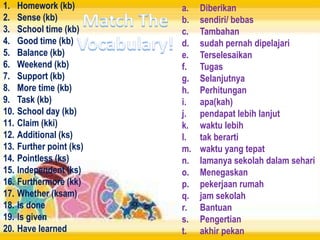
1. Homework (kb)
2. Sense (kb)
3. School time (kb)
4. Good time (kb)
5. Balance (kb)
6. Weekend (kb)
7. Support (kb)
8. More time (kb)
9. Task (kb)
10. School day (kb)
11. Claim (kki)
12. Additional (ks)
13. Further point (ks)
14. Pointless (ks)
15. Independent (ks)
16. Furthermore (kk)
17. Whether (ksam)
18. Is done
19. Is given
20. Have learned

a.
b.
c.
d.
e.
f.
g.
h.
i.
j.
k.
l.
m.
n.
o.
p.
q.
r.
s.
t.

Diberikan
sendiri/ bebas
Tambahan
sudah pernah dipelajari
Terselesaikan
Tugas
Selanjutnya
Perhitungan
apa(kah)
pendapat lebih lanjut
waktu lebih
tak berarti
waktu yang tepat
lamanya sekolah dalam sehari
Menegaskan
pekerjaan rumah
jam sekolah
Bantuan
Pengertian
akhir pekan
1.
2.
3.
4.
5.
6.
7.
8.
9.
10.
11.
12.
13.
14.
15.
16.
17.
18.
19.
20.

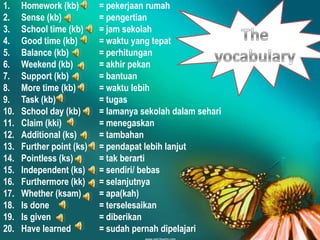
Homework (kb)
Sense (kb)
School time (kb)
Good time (kb)
Balance (kb)
Weekend (kb)
Support (kb)
More time (kb)
Task (kb)
School day (kb)
Claim (kki)
Additional (ks)
Further point (ks)
Pointless (ks)
Independent (ks)
Furthermore (kk)
Whether (ksam)
Is done
Is given
Have learned

= pekerjaan rumah
= pengertian
= jam sekolah
= waktu yang tepat
= perhitungan
= akhir pekan
= bantuan
= waktu lebih
= tugas
= lamanya sekolah dalam sehari
= menegaskan
= tambahan
= pendapat lebih lanjut
= tak berarti
= sendiri/ bebas
= selanjutnya
= apa(kah)
= terselesaikan
= diberikan
= sudah pernah dipelajari
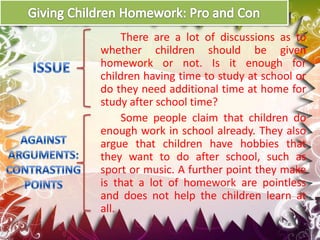
There are a lot of discussions as to
whether children should be given
homework or not. Is it enough for
children having time to study at school or
do they need additional time at home for
study after school time?
Some people claim that children do
enough work in school already. They also
argue that children have hobbies that
they want to do after school, such as
sport or music. A further point they make
is that a lot of homework are pointless
and does not help the children learn at
all.
However, there are also strong
arguments against this point of
view. Parents and teachers argue
that it is important to find out
whether children can work on their
own without the support from the
teacher. They say that the evening
is a good time for children to sit
down and think about what they
have learned in school.
Furthermore they claim that the
school day is too short to get
anything done. It makes sense to
send home tasks like independent
reading or further writing task
which does not need the teacher’s
support.
I think, on balance, that
some homework is good
idea but that should only
given at the weekend when
children have more time.
Answer the questions with the correct answer!
1. What is the topic of the text?
2. What is the purpose of the text?
3. Which paragraph shows “pro” to the issue?
4. Which paragraph shows “contra” to the issue?
5. What is the argument of the writer about the
issue?
Discussion (ujian)

Discussion (ujian)

  • 2.
  • 3.
    1. Homework (kb) 2.Sense (kb) 3. School time (kb) 4. Good time (kb) 5. Balance (kb) 6. Weekend (kb) 7. Support (kb) 8. More time (kb) 9. Task (kb) 10. School day (kb) 11. Claim (kki) 12. Additional (ks) 13. Further point (ks) 14. Pointless (ks) 15. Independent (ks) 16. Furthermore (kk) 17. Whether (ksam) 18. Is done 19. Is given 20. Have learned a. b. c. d. e. f. g. h. i. j. k. l. m. n. o. p. q. r. s. t. Diberikan sendiri/ bebas Tambahan sudah pernah dipelajari Terselesaikan Tugas Selanjutnya Perhitungan apa(kah) pendapat lebih lanjut waktu lebih tak berarti waktu yang tepat lamanya sekolah dalam sehari Menegaskan pekerjaan rumah jam sekolah Bantuan Pengertian akhir pekan
  • 4.
    1. 2. 3. 4. 5. 6. 7. 8. 9. 10. 11. 12. 13. 14. 15. 16. 17. 18. 19. 20. Homework (kb) Sense (kb) Schooltime (kb) Good time (kb) Balance (kb) Weekend (kb) Support (kb) More time (kb) Task (kb) School day (kb) Claim (kki) Additional (ks) Further point (ks) Pointless (ks) Independent (ks) Furthermore (kk) Whether (ksam) Is done Is given Have learned = pekerjaan rumah = pengertian = jam sekolah = waktu yang tepat = perhitungan = akhir pekan = bantuan = waktu lebih = tugas = lamanya sekolah dalam sehari = menegaskan = tambahan = pendapat lebih lanjut = tak berarti = sendiri/ bebas = selanjutnya = apa(kah) = terselesaikan = diberikan = sudah pernah dipelajari
  • 5.
    There are alot of discussions as to whether children should be given homework or not. Is it enough for children having time to study at school or do they need additional time at home for study after school time? Some people claim that children do enough work in school already. They also argue that children have hobbies that they want to do after school, such as sport or music. A further point they make is that a lot of homework are pointless and does not help the children learn at all.
  • 6.
    However, there arealso strong arguments against this point of view. Parents and teachers argue that it is important to find out whether children can work on their own without the support from the teacher. They say that the evening is a good time for children to sit down and think about what they have learned in school. Furthermore they claim that the school day is too short to get anything done. It makes sense to send home tasks like independent reading or further writing task which does not need the teacher’s support.
  • 7.
    I think, onbalance, that some homework is good idea but that should only given at the weekend when children have more time.
  • 8.
    Answer the questionswith the correct answer! 1. What is the topic of the text? 2. What is the purpose of the text? 3. Which paragraph shows “pro” to the issue? 4. Which paragraph shows “contra” to the issue? 5. What is the argument of the writer about the issue?