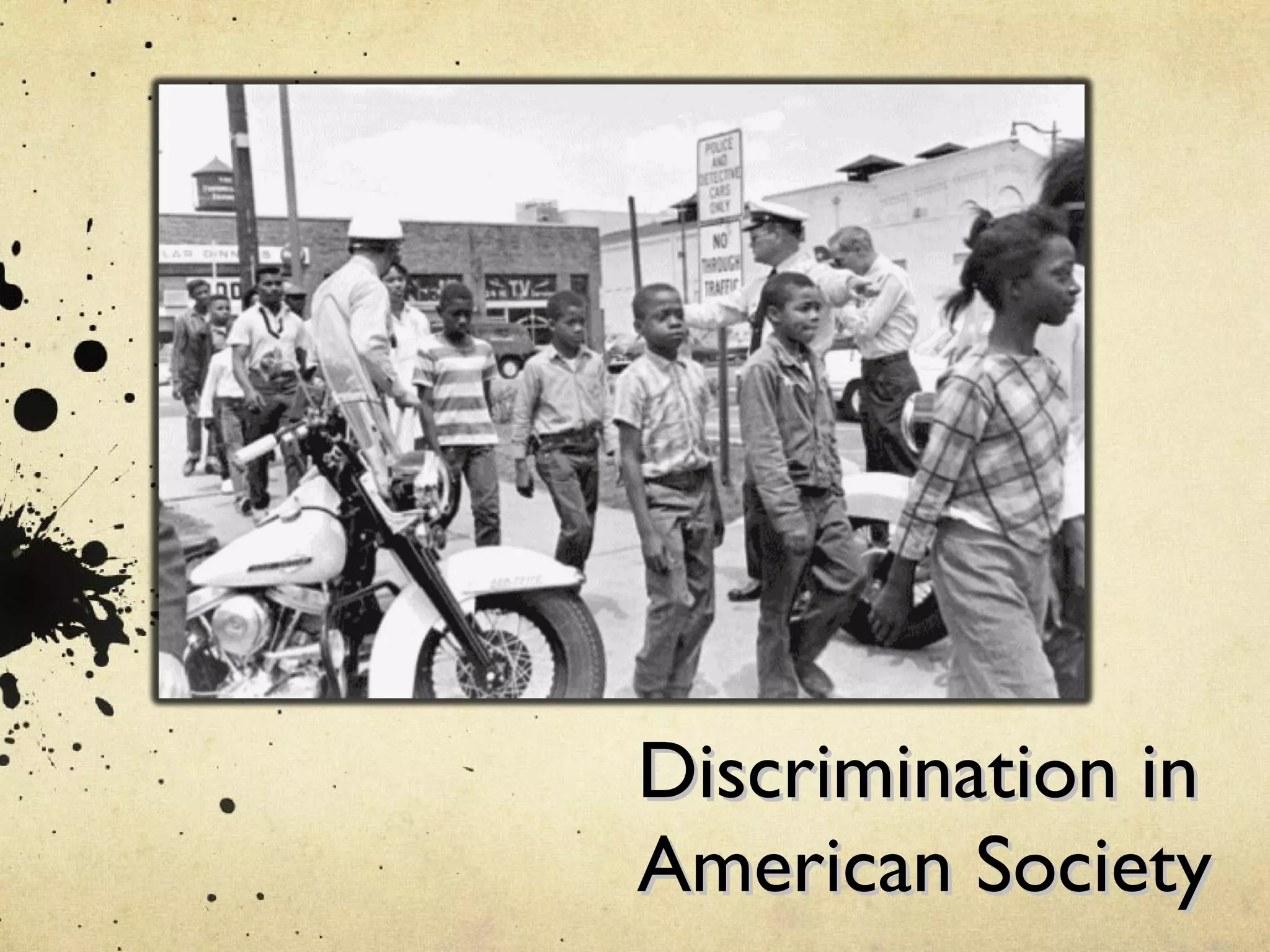



Discrimination in American Society
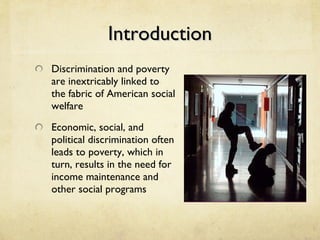
Introduction Discrimination and poverty are inextricably linked to the fabric of American social welfare Economic, social, and political discrimination often leads to poverty, which in turn, results in the need for income maintenance and other social programs
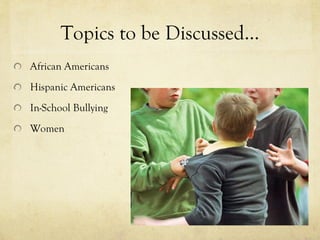
Topics to be Discussed… African Americans Hispanic Americans  In-School Bullying Women
UNICEF, “Adolescents: Beyond the Stereotypes”
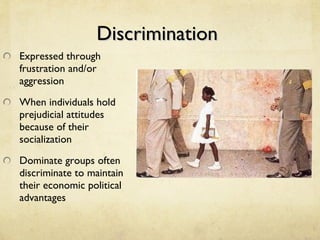
Discrimination  Expressed through frustration and/or aggression When individuals hold prejudicial attitudes because of their socialization Dominate groups often discriminate to maintain their economic political advantages
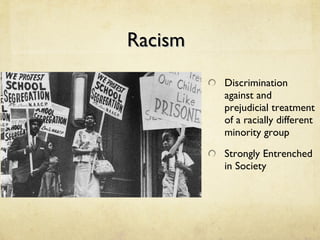
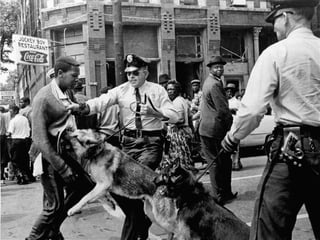
Racism Discrimination against and prejudicial treatment of a racially different minority group Strongly Entrenched in Society
African Americans  Poverty - 8.9 million or 23.9% live below the poverty rate (compared to 8% of whites) Family Structure – 48% married couples, 43% single female-headed households, 9% men only.  36% of children reside with both parents  African American Businesses – grew by 46% in the late 80s and early 90s. Only 1% of total business receipts were to black-owned businesses.
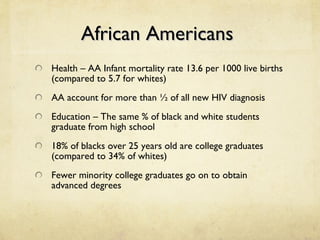
African Americans  Health – AA Infant mortality rate 13.6 per 1000 live births (compared to 5.7 for whites) AA account for more than ½ of all new HIV diagnosis Education – The same % of black and white students graduate from high school 18% of blacks over 25 years old are college graduates (compared to 34% of whites) Fewer minority college graduates go on to obtain advanced degrees
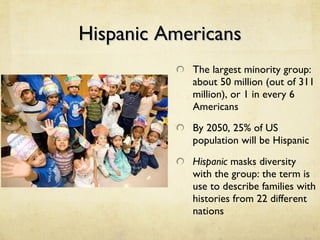
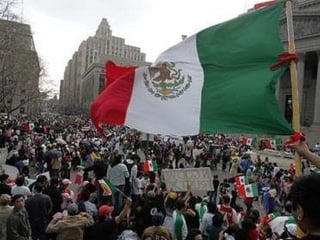
Hispanic Americans The largest minority group: about 50 million (out of 311 million), or 1 in every 6 Americans By 2050, 25% of US population will be Hispanic Hispanic  masks diversity with the group: the term is use to describe families with histories from 22 different nations
Hispanic Americans This Hispanic poverty rate surpasses the black poverty rate (22%) Hispanic children represent 18% of all US children but make up 30% of all children living in poverty
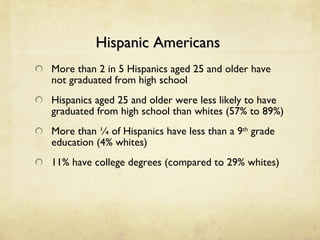
Hispanic Americans  More than 2 in 5 Hispanics aged 25 and older have not graduated from high school Hispanics aged 25 and older were less likely to have graduated from high school than whites (57% to 89%) More than ¼ of Hispanics have less than a 9 th  grade education (4% whites) 11% have college degrees (compared to 29% whites)
In-School Bullying Everyone has a story to tell Everyone has felt different What do we remember from 30 years ago that has made a lasting impression in school environment? Students are experiencing and living NOW!  What lessons will they remember from our time 30 years from now?
“ Stole” Kelly Rowland
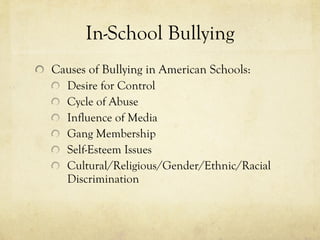
In-School Bullying Causes of Bullying in American Schools: Desire for Control Cycle of Abuse Influence of Media Gang Membership Self-Esteem Issues Cultural/Religious/Gender/Ethnic/Racial Discrimination
 
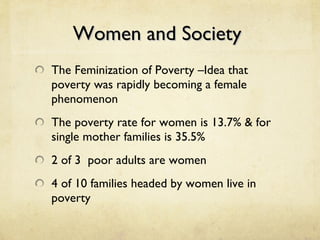
Women and Society  The Feminization of Poverty –Idea that poverty was rapidly becoming a female phenomenon The poverty rate for women is 13.7% & for single mother families is 35.5% 2 of 3  poor adults are women 4 of 10 families headed by women live in poverty
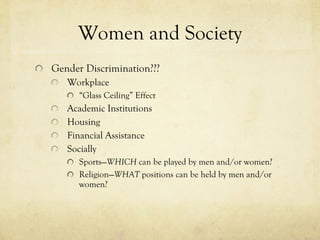
Women and Society Gender Discrimination??? Workplace “ Glass Ceiling” Effect Academic Institutions Housing Financial Assistance Socially Sports— WHICH  can be played by men and/or women? Religion— WHAT  positions can be held by men and/or women?
Women and Society  Violence against Women Act (VAWA) Comprehensive approach to domestic violence and sexual assault Designed to improve response of police, prosecutors and judges Force sex offenders to pay restitution to victims Grants for graining in domestic abuse, battered women’s shelters, hotlines etc.

Discrimination in american society

  • 1.
  • 2.
    Introduction Discrimination andpoverty are inextricably linked to the fabric of American social welfare Economic, social, and political discrimination often leads to poverty, which in turn, results in the need for income maintenance and other social programs
  • 3.
    Topics to beDiscussed… African Americans Hispanic Americans In-School Bullying Women
  • 4.
  • 5.
    Discrimination Expressedthrough frustration and/or aggression When individuals hold prejudicial attitudes because of their socialization Dominate groups often discriminate to maintain their economic political advantages
  • 6.
    Racism Discrimination againstand prejudicial treatment of a racially different minority group Strongly Entrenched in Society
  • 7.
    African Americans Poverty - 8.9 million or 23.9% live below the poverty rate (compared to 8% of whites) Family Structure – 48% married couples, 43% single female-headed households, 9% men only. 36% of children reside with both parents African American Businesses – grew by 46% in the late 80s and early 90s. Only 1% of total business receipts were to black-owned businesses.
  • 8.
    African Americans Health – AA Infant mortality rate 13.6 per 1000 live births (compared to 5.7 for whites) AA account for more than ½ of all new HIV diagnosis Education – The same % of black and white students graduate from high school 18% of blacks over 25 years old are college graduates (compared to 34% of whites) Fewer minority college graduates go on to obtain advanced degrees
  • 9.
    Hispanic Americans Thelargest minority group: about 50 million (out of 311 million), or 1 in every 6 Americans By 2050, 25% of US population will be Hispanic Hispanic masks diversity with the group: the term is use to describe families with histories from 22 different nations
  • 10.
    Hispanic Americans ThisHispanic poverty rate surpasses the black poverty rate (22%) Hispanic children represent 18% of all US children but make up 30% of all children living in poverty
  • 11.
    Hispanic Americans More than 2 in 5 Hispanics aged 25 and older have not graduated from high school Hispanics aged 25 and older were less likely to have graduated from high school than whites (57% to 89%) More than ¼ of Hispanics have less than a 9 th grade education (4% whites) 11% have college degrees (compared to 29% whites)
  • 12.
    In-School Bullying Everyonehas a story to tell Everyone has felt different What do we remember from 30 years ago that has made a lasting impression in school environment? Students are experiencing and living NOW! What lessons will they remember from our time 30 years from now?
  • 13.
  • 14.
    In-School Bullying Causesof Bullying in American Schools: Desire for Control Cycle of Abuse Influence of Media Gang Membership Self-Esteem Issues Cultural/Religious/Gender/Ethnic/Racial Discrimination
  • 15.
  • 16.
    Women and Society The Feminization of Poverty –Idea that poverty was rapidly becoming a female phenomenon The poverty rate for women is 13.7% & for single mother families is 35.5% 2 of 3 poor adults are women 4 of 10 families headed by women live in poverty
  • 17.
    Women and SocietyGender Discrimination??? Workplace “ Glass Ceiling” Effect Academic Institutions Housing Financial Assistance Socially Sports— WHICH can be played by men and/or women? Religion— WHAT positions can be held by men and/or women?
  • 18.
    Women and Society Violence against Women Act (VAWA) Comprehensive approach to domestic violence and sexual assault Designed to improve response of police, prosecutors and judges Force sex offenders to pay restitution to victims Grants for graining in domestic abuse, battered women’s shelters, hotlines etc.