Boolean
Algebra
‘Karnaugh Maps’
- 2,3 Variables
Study With Barkha
The World Of Computer Science
Description of Kmaps
and Terminology
• A Kmap is a matrix consisting of rows and
columns that represent the output values of a
Boolean function.
• The output values placed in each cell are
derived from the minterms of a Boolean
function.
• A minterm is a product term that contains all of
the function’s variables exactly once, either
complemented or not complemented.
3
• For example, the minterms for a function having
the inputs x and y are:
• Its minterms are:
Description of Kmaps and Terminology
4
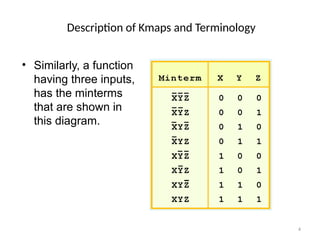
• Similarly, a function
having three inputs,
has the minterms
that are shown in
this diagram.
Description of Kmaps and Terminology
5
• A Kmap has a cell for each
minterm.
• This means that it has a cell
for each line for the truth table
of a function.
• The truth table for the function
F(x,y) = xy is shown at the
right along with its
corresponding Kmap.
Description of Kmaps and Terminology
6
• As another example, we
give the truth table and
KMap for the function,
F(x,y) = x + y at the right.
• This function is equivalent
to the OR of all of the
minterms that have a
value of 1. Thus:
Description of Kmaps and Terminology
7
Kmap Simplification for Two
Variables
• Of course, the minterm function that we derived
from our Kmap was not in simplest terms.
– That’s what we started with in this example.
• We can, however, reduce our complicated
expression to its simplest terms by finding adjacent
1s in the Kmap that can be collected into groups
that are powers of two.
• In our example, we have two
such groups.
– Can you find them?
8
• The best way of selecting two groups of 1s
form our simple Kmap is shown below.
• We see that both groups are powers of two
and that the groups overlap.
• The next slide gives guidance for selecting
Kmap groups.
Kmap Simplification for Two
Variables
9
The rules of Kmap simplification are:
• Groupings can contain only 1s; no 0s.
• Groups can be formed only at right angles;
diagonal groups are not allowed.
• The number of 1s in a group must be a power
of 2 – even if it contains a single 1.
• The groups must be made as large as possible.
• Groups can overlap and wrap around the sides
of the Kmap.
Kmap Simplification for Two
Variables
10
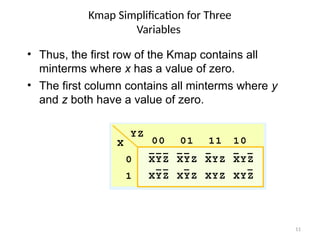
• A Kmap for three variables is constructed as
shown in the diagram below.
• We have placed each minterm in the cell that will
hold its value.
– Notice that the values for the yz combination at the top
of the matrix form a pattern that is not a normal binary
sequence.
Kmap Simplification for Three
Variables
11
• Thus, the first row of the Kmap contains all
minterms where x has a value of zero.
• The first column contains all minterms where y
and z both have a value of zero.
Kmap Simplification for Three
Variables
12
• Consider the function:
• Its Kmap is given below.
– What is the largest group of 1s that is a power of
2?
Kmap Simplification for Three
Variables
13
• This grouping tells us that changes in the variables
x and y have no influence upon the value of the
function: They are irrelevant.
• This means that the function,
reduces to F(x) = z.
You could verify
this reduction
with identities or
a truth table.
Kmap Simplification for Three
Variables
Boolean
Algebra
‘Karnaugh Maps’
-3,4 Variables
Study With Barkha
The World Of Computer Science
16
• In this Kmap, we see an example of a group that
wraps around the sides of a Kmap.
• This group tells us that the values of x and y are not
relevant to the term of the function that is
encompassed by the group.
– What does this tell us about this term of the function?
What about the
green group in
the top row?
Kmap Simplification for Three
Variables
17
• The green group in the top row tells us that only the
value of x is significant in that group.
• We see that it is complemented in that row, so the
other term of the reduced function is .
• Our reduced function is:
Recall that we had
six minterms in our
original function!
Kmap Simplification for Three
Variables
18
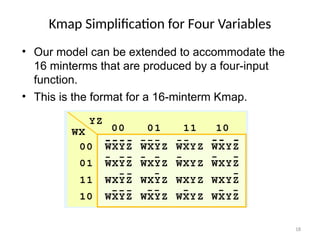
• Our model can be extended to accommodate the
16 minterms that are produced by a four-input
function.
• This is the format for a 16-minterm Kmap.
Kmap Simplification for Four Variables
19
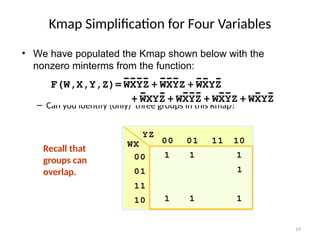
• We have populated the Kmap shown below with the
nonzero minterms from the function:
– Can you identify (only) three groups in this Kmap?
Recall that
groups can
overlap.
Kmap Simplification for Four Variables
20
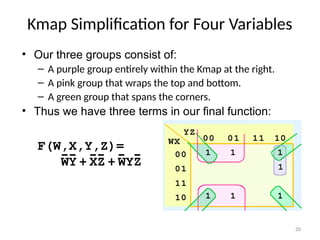
• Our three groups consist of:
– A purple group entirely within the Kmap at the right.
– A pink group that wraps the top and bottom.
– A green group that spans the corners.
• Thus we have three terms in our final function:
Kmap Simplification for Four Variables
21
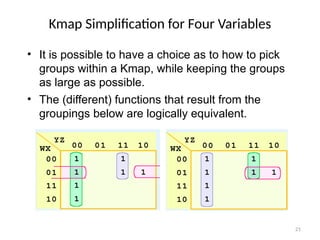
• It is possible to have a choice as to how to pick
groups within a Kmap, while keeping the groups
as large as possible.
• The (different) functions that result from the
groupings below are logically equivalent.
Kmap Simplification for Four Variables
22
Don’t Care Conditions
• Real circuits don’t always need to have an output
defined for every possible input.
– For example, some calculator displays consist of 7-
segment LEDs. These LEDs can display 27
-1 patterns,
but only ten of them are useful.
• If a circuit is designed so that a particular set of
inputs can never happen, we call this set of inputs
a don’t care condition.
• They are very helpful to us in Kmap circuit
simplification.
23
• In a Kmap, a don’t care condition is identified by
an X in the cell of the minterm(s) for the don’t care
inputs, as shown below.
• In performing the simplification, we are free to
include or ignore the X’s when creating our
groups.
Don’t Care Conditions
24
• In one grouping in the Kmap below, we have the
function:
Don’t Care Conditions
25
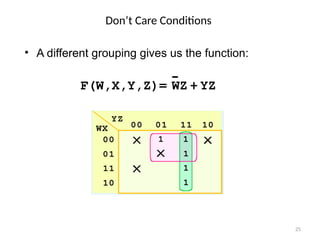
• A different grouping gives us the function:
Don’t Care Conditions
26
• The truth table of:
differs from the truth table of:
• However, the values for which they differ, are the
inputs for which we have don’t care conditions.
Don’t Care Conditions
27
• Kmaps provide an easy graphical method of
simplifying Boolean expressions.
• A Kmap is a matrix consisting of the outputs of
the minterms of a Boolean function.
• In this section, we have discussed 2- 3- and 4-
input Kmaps. This method can be extended to
any number of inputs through the use of multiple
tables.
Conclusion
28
Recapping the rules of Kmap simplification:
• Groupings can contain only 1s; no 0s.
• Groups can be formed only at right angles;
diagonal groups are not allowed.
• The number of 1s in a group must be a power of
2 – even if it contains a single 1.
• The groups must be made as large as possible.
• Groups can overlap and wrap around the sides
of the Kmap.
• Use don’t care conditions when you can.
Conclusion
Discrete Mathmatics, Boolean Algebra, K-Map

Discrete Mathmatics, Boolean Algebra, K-Map

  • 1.
    Boolean Algebra ‘Karnaugh Maps’ - 2,3Variables Study With Barkha The World Of Computer Science
  • 2.
    Description of Kmaps andTerminology • A Kmap is a matrix consisting of rows and columns that represent the output values of a Boolean function. • The output values placed in each cell are derived from the minterms of a Boolean function. • A minterm is a product term that contains all of the function’s variables exactly once, either complemented or not complemented.
  • 3.
    3 • For example,the minterms for a function having the inputs x and y are: • Its minterms are: Description of Kmaps and Terminology
  • 4.
    4 • Similarly, afunction having three inputs, has the minterms that are shown in this diagram. Description of Kmaps and Terminology
  • 5.
    5 • A Kmaphas a cell for each minterm. • This means that it has a cell for each line for the truth table of a function. • The truth table for the function F(x,y) = xy is shown at the right along with its corresponding Kmap. Description of Kmaps and Terminology
  • 6.
    6 • As anotherexample, we give the truth table and KMap for the function, F(x,y) = x + y at the right. • This function is equivalent to the OR of all of the minterms that have a value of 1. Thus: Description of Kmaps and Terminology
  • 7.
    7 Kmap Simplification forTwo Variables • Of course, the minterm function that we derived from our Kmap was not in simplest terms. – That’s what we started with in this example. • We can, however, reduce our complicated expression to its simplest terms by finding adjacent 1s in the Kmap that can be collected into groups that are powers of two. • In our example, we have two such groups. – Can you find them?
  • 8.
    8 • The bestway of selecting two groups of 1s form our simple Kmap is shown below. • We see that both groups are powers of two and that the groups overlap. • The next slide gives guidance for selecting Kmap groups. Kmap Simplification for Two Variables
  • 9.
    9 The rules ofKmap simplification are: • Groupings can contain only 1s; no 0s. • Groups can be formed only at right angles; diagonal groups are not allowed. • The number of 1s in a group must be a power of 2 – even if it contains a single 1. • The groups must be made as large as possible. • Groups can overlap and wrap around the sides of the Kmap. Kmap Simplification for Two Variables
  • 10.
    10 • A Kmapfor three variables is constructed as shown in the diagram below. • We have placed each minterm in the cell that will hold its value. – Notice that the values for the yz combination at the top of the matrix form a pattern that is not a normal binary sequence. Kmap Simplification for Three Variables
  • 11.
    11 • Thus, thefirst row of the Kmap contains all minterms where x has a value of zero. • The first column contains all minterms where y and z both have a value of zero. Kmap Simplification for Three Variables
  • 12.
    12 • Consider thefunction: • Its Kmap is given below. – What is the largest group of 1s that is a power of 2? Kmap Simplification for Three Variables
  • 13.
    13 • This groupingtells us that changes in the variables x and y have no influence upon the value of the function: They are irrelevant. • This means that the function, reduces to F(x) = z. You could verify this reduction with identities or a truth table. Kmap Simplification for Three Variables
  • 15.
    Boolean Algebra ‘Karnaugh Maps’ -3,4 Variables StudyWith Barkha The World Of Computer Science
  • 16.
    16 • In thisKmap, we see an example of a group that wraps around the sides of a Kmap. • This group tells us that the values of x and y are not relevant to the term of the function that is encompassed by the group. – What does this tell us about this term of the function? What about the green group in the top row? Kmap Simplification for Three Variables
  • 17.
    17 • The greengroup in the top row tells us that only the value of x is significant in that group. • We see that it is complemented in that row, so the other term of the reduced function is . • Our reduced function is: Recall that we had six minterms in our original function! Kmap Simplification for Three Variables
  • 18.
    18 • Our modelcan be extended to accommodate the 16 minterms that are produced by a four-input function. • This is the format for a 16-minterm Kmap. Kmap Simplification for Four Variables
  • 19.
    19 • We havepopulated the Kmap shown below with the nonzero minterms from the function: – Can you identify (only) three groups in this Kmap? Recall that groups can overlap. Kmap Simplification for Four Variables
  • 20.
    20 • Our threegroups consist of: – A purple group entirely within the Kmap at the right. – A pink group that wraps the top and bottom. – A green group that spans the corners. • Thus we have three terms in our final function: Kmap Simplification for Four Variables
  • 21.
    21 • It ispossible to have a choice as to how to pick groups within a Kmap, while keeping the groups as large as possible. • The (different) functions that result from the groupings below are logically equivalent. Kmap Simplification for Four Variables
  • 22.
    22 Don’t Care Conditions •Real circuits don’t always need to have an output defined for every possible input. – For example, some calculator displays consist of 7- segment LEDs. These LEDs can display 27 -1 patterns, but only ten of them are useful. • If a circuit is designed so that a particular set of inputs can never happen, we call this set of inputs a don’t care condition. • They are very helpful to us in Kmap circuit simplification.
  • 23.
    23 • In aKmap, a don’t care condition is identified by an X in the cell of the minterm(s) for the don’t care inputs, as shown below. • In performing the simplification, we are free to include or ignore the X’s when creating our groups. Don’t Care Conditions
  • 24.
    24 • In onegrouping in the Kmap below, we have the function: Don’t Care Conditions
  • 25.
    25 • A differentgrouping gives us the function: Don’t Care Conditions
  • 26.
    26 • The truthtable of: differs from the truth table of: • However, the values for which they differ, are the inputs for which we have don’t care conditions. Don’t Care Conditions
  • 27.
    27 • Kmaps providean easy graphical method of simplifying Boolean expressions. • A Kmap is a matrix consisting of the outputs of the minterms of a Boolean function. • In this section, we have discussed 2- 3- and 4- input Kmaps. This method can be extended to any number of inputs through the use of multiple tables. Conclusion
  • 28.
    28 Recapping the rulesof Kmap simplification: • Groupings can contain only 1s; no 0s. • Groups can be formed only at right angles; diagonal groups are not allowed. • The number of 1s in a group must be a power of 2 – even if it contains a single 1. • The groups must be made as large as possible. • Groups can overlap and wrap around the sides of the Kmap. • Use don’t care conditions when you can. Conclusion