Discrete Compounding and
payment
BY. YOSUF HASAN ALDRAZ
Contents
 Introduction
 Single payment
 Annual uniform payment
 Uniform Gradient payment
 Examples
Introduction
 Discrete compounding refers to the
method by which interest is calculated
and added to the principal at certain
set points in time ,For example,
interest may be compounded weekly,
monthly, or yearly .
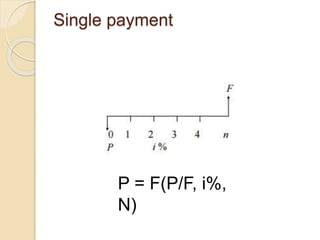
Single payment
P = F(P/F, i%,
N)
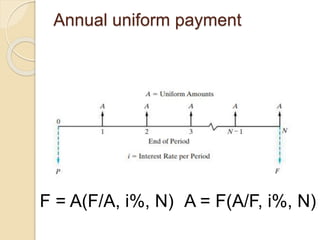
Annual uniform payment
F = A(F/A, i%, N) A = F(A/F, i%, N)
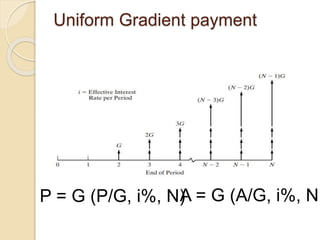
Uniform Gradient payment
P = G (P/G, i%, N)
A = G (A/G, i%, N)
Example 1 :-
 You borrow $15,000 from your credit
union to purchase a used car. The
interest rate on your loan is 0.25% per
month∗ and you will make a total of 36
monthly payments. What is your
monthly payment?
solution
Example 2 :-
 When you take your first job, you decide
to start saving right away for your
retirement. You put $5,000 per year into
the company’s 401(k) plan, which
averages 8% interest per year. Five
years later, you move to another job and
start a new 401(k) plan. You never get
around to merging the funds in the two
plans. If the first plan continued to earn
interest at the rate of 8% per year for 35
years after you stopped making
contributions, how much is the account
worth?
solution
Thank you

Discrete Compounding and payment.pptx

  • 1.
  • 2.
    Contents  Introduction  Singlepayment  Annual uniform payment  Uniform Gradient payment  Examples
  • 3.
    Introduction  Discrete compoundingrefers to the method by which interest is calculated and added to the principal at certain set points in time ,For example, interest may be compounded weekly, monthly, or yearly .
  • 4.
    Single payment P =F(P/F, i%, N)
  • 5.
    Annual uniform payment F= A(F/A, i%, N) A = F(A/F, i%, N)
  • 6.
    Uniform Gradient payment P= G (P/G, i%, N) A = G (A/G, i%, N)
  • 7.
    Example 1 :- You borrow $15,000 from your credit union to purchase a used car. The interest rate on your loan is 0.25% per month∗ and you will make a total of 36 monthly payments. What is your monthly payment?
  • 8.
  • 9.
    Example 2 :- When you take your first job, you decide to start saving right away for your retirement. You put $5,000 per year into the company’s 401(k) plan, which averages 8% interest per year. Five years later, you move to another job and start a new 401(k) plan. You never get around to merging the funds in the two plans. If the first plan continued to earn interest at the rate of 8% per year for 35 years after you stopped making contributions, how much is the account worth?
  • 10.
  • 11.