Draft version April 25, 2016
Preprint typeset using LATEX style AASTeX6 v. 1.0
DISCOVERY OF A MAKEMAKEAN MOON
Alex H. Parker1
and Marc W. Buie
Southwest Research Institute
1050 Walnut St., Suite 300
Boulder, CO 80302, USA
Will M. Grundy
Lowell Observatory, Flagsta↵, AZ, USA.
Keith S. Noll
NASA Goddard Space Flight Center, Greenbelt, MD, USA.
1
aparker@boulder.swri.edu
ABSTRACT
We describe the discovery of a satellite in orbit about the dwarf planet (136472) Makemake. This
satellite, provisionally designated S/2015 (136472) 1, was detected in imaging data collected with the
Hubble Space Telescope’s Wide Field Camera 3 on UTC April 27, 2015 at 7.80±0.04 magnitudes
fainter than Makemake. It likely evaded detection in previous satellite searches due to a nearly edge-
on orbital configuration, placing it deep within the glare of Makemake during a substantial fraction
of its orbital period. This configuration would place Makemake and its satellite near a mutual event
season. Insu cient orbital motion was detected to make a detailed characterization of its orbital
properties, prohibiting a measurement of the system mass with the discovery data alone. Preliminary
analysis indicates that if the orbit is circular, its orbital period must be longer than 12.4 days, and
must have a semi-major axis &21,000 km. We find that the properties of Makemake’s moon suggest
that the majority of the dark material detected in the system by thermal observations may not reside
on the surface of Makemake, but may instead be attributable to S/2015 (136472) 1 having a uniform
dark surface. This “dark moon hypothesis” can be directly tested with future JWST observations.
We discuss the implications of this discovery for the spin state, figure, and thermal properties of
Makemake and the apparent ubiquity of trans-Neptunian dwarf planet satellites.
Keywords: Kuiper belt objects: individual (Makemake) — planets and satellites: detection
1. INTRODUCTION
Makemake is the second-brightest known trans-
Neptunian Object (behind only Pluto) and the largest
known classical Kuiper Belt Object (KBO). It has the
most methane-dominated spectrum of any known TNO
(Licandro et al. 2006; Brown et al. 2007; Tegler et al.
2008), a very high visible albedo (Lim et al. 2010), a
well-defined radius derived from stellar occultations (Or-
tiz et al. 2012; Brown 2013), a well-measured (albeit very
small-amplitude) lightcurve that pins its rotational pe-
riod to 7.771 hours (Heinze & de Lahunta 2009), and
polarization properties very similar to Pluto and Eris,
but distinct from smaller KBOs (Belskaya et al. 2012).
However, despite this wealth of information, the lack
of a known satellite has prohibited the measurement of
Makemake’s mass and density.
We report the discovery and preliminary characteriza-
tion of a Makemakean moon in Hubble Space Telescope
(HST) Wide-Field Camera 3 (WFC3) imagery. While
the satellite’s orbital properties are only marginally con-
strained from the discovery data alone, its existence will
permit future precise measurement of Makemake’s mass
and density given su cient follow-up observations. In
the following sections, we describe the discovery circum-
stances of S/2015 (136472) 1, its photometric properties,
and preliminary characterization of its orbital proper-
ties. We demonstrate that this moon could account for
some or all of the dark material detected in the Make-
make system with thermal observations, and discuss po-
2
UTC April 27 13:49:04 UTC April 27 14:03:50 UTC April 27 14:18:36 UTC April 27 15:19:38 UTC April 27 15:34:24 UTC April 27 15:49:10
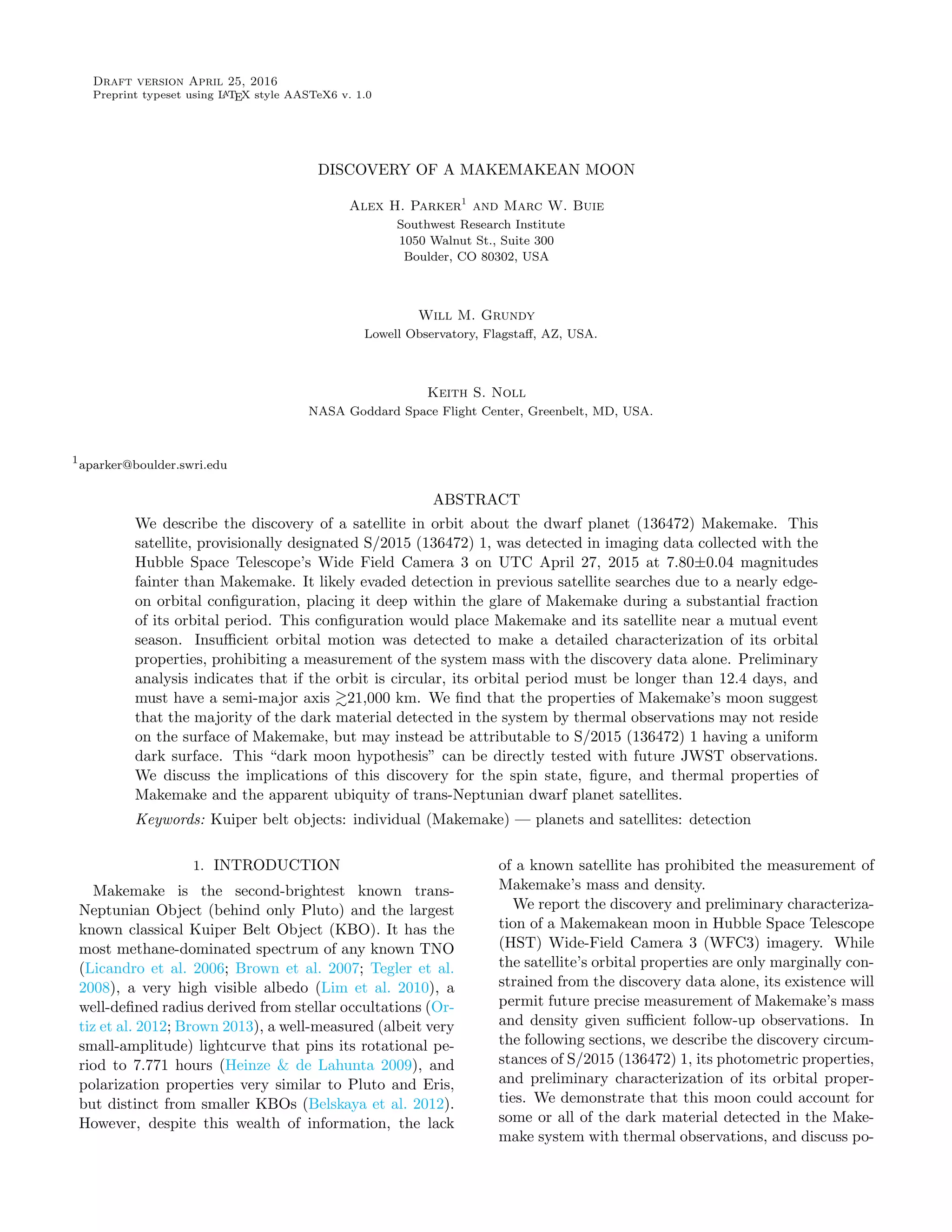
Figure 1. All six 725-second images from visit 1, collected over two subsequent HST orbits. The satellite is clearly visible to the
North and West of Makemake in every frame. Images have not been cleaned for cosmic rays or otherwise cosmetically enhanced.
Black bar is 100
. Ecliptic North is up, Ecliptic East is left. Observation start times are labeled on each image. Over the time
spanned by these images, Makemake moved 400
.22 with respect to background sources.
tential future avenues of research enabled by this satel-
lite. We argue that Makemake is likely currently viewed
equator-on and derive implications for its figure and
thermal properties. We conclude with a discussion of
the properties of dwarf planet satellites.
2. DISCOVERY CIRCUMSTANCES
As part of the HST GO program 13668, Makemake
was imaged with WFC3 in the broad F350LP filter over
the course of two visits of two back-to-back orbits each.
These visits were separated by approximately two days.
Each visit was bracketed by single 12-second images in
which Makemake does not saturate; the remainder of
each visit was filled with six 725 second exposures in
which Makemake saturates. These observations were de-
signed to enable the detection of satellites fainter than
could have been found in previous satellite search pro-
grams.
Visit 1 was on April 27, 2015, from UTC 13:46:36
to 16:03:58, and Visit 2 on April 29, 2015, from UTC
18:17:46 to 20:35:03. In all six 725 second images col-
lected in Visit 1, a faint source is visible 000
.57 from
Makemake; see Figure 1. Over the 132-minute duration
spanned by these observations, Makemake moved 400
.22
with respect to background sources (more than 60 times
the F350LP point-spread function FWHM); the fainter
source was precisely co-moving with Makemake over this
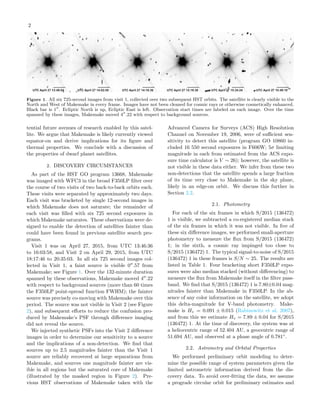
period. The source was not visible in Visit 2 (see Figure
2), and subsequent e↵orts to reduce the confusion pro-
duced by Makemake’s PSF through di↵erence imaging
did not reveal the source.
We injected synthetic PSFs into the Visit 2 di↵erence
images in order to determine our sensitivity to a source
and the implications of a non-detection. We find that
sources up to 2.5 magnitudes fainter than the Visit 1
source are reliably recovered at large separations from
Makemake, and sources one magnitude fainter are vis-
ible in all regions but the saturated core of Makemake
(illustrated by the masked region in Figure 2). Pre-
vious HST observations of Makemake taken with the
Advanced Camera for Surveys (ACS) High Resolution
Channel on November 19, 2006, were of su cient sen-
sitivity to detect this satellite (program GO 10860 in-
cluded 16 550 second exposures in F606W; 5 limiting
magnitude in each from estimated from the ACS expo-
sure time calculator is V ⇠ 26); however, the satellite is
not visible in these data either. We infer from these two
non-detections that the satellite spends a large fraction
of its time very close to Makemake in the sky plane,
likely in an edge-on orbit. We discuss this further in
Section 2.2.
2.1. Photometry
For each of the six frames in which S/2015 (136472)
1 is visible, we subtracted a co-registered median stack
of the six frames in which it was not visible. In five of
these six di↵erence images, we performed small-aperture
photometry to measure the flux from S/2015 (136472)
1; in the sixth, a cosmic ray impinged too close to
S/2015 (136472) 1. The typical signal-to-noise of S/2015
(136472) 1 in these frames is S/N ⇠ 25. The results are
listed in Table 1. Four bracketing short F350LP expo-
sures were also median stacked (without di↵erencing) to
measure the flux from Makemake itself in the filter pass-
band. We find that S/2015 (136472) 1 is 7.80±0.04 mag-
nitudes fainter than Makemake in F350LP. In the ab-
sence of any color information on the satellite, we adopt
this delta-magnitude for V-band photometry. Make-
make is Hv = 0.091 ± 0.015 (Rabinowitz et al. 2007),
and from this we estimate Hv = 7.89 ± 0.04 for S/2015
(136472) 1. At the time of discovery, the system was at
a heliocentric range of 52.404 AU, a geocentric range of
51.694 AU, and observed at a phase angle of 0.781 .
2.2. Astrometry and Orbital Properties
We performed preliminary orbit modeling to deter-
mine the possible range of system parameters given the
limited astrometric information derived from the dis-
covery data. To avoid over-fitting the data, we assume
a prograde circular orbit for preliminary estimates and
3
N N
UTC April 27 2015
UTC April 29 2015
Figure 2. Left panels: Co-registered stack of all visit 1 images (top) and visit 2 images (bottom). Images are displayed in their
original array coordinates with identical stretch to best compare PSF structure. Right: WCS-rotated stack of visit 1 images
with co-registered visit 2 images subtracted, showing S/2015 (136472) 1. Stack is 33rd percentile of six input images. Arrows
indicate 100
in Ecliptic North and East for each visit; white for visit 1 and green for visit 2. Green trace indicates masked region
where S/2015 (136472) 1 would not have been recoverable in visit 2 as determined by injecting synthetic sources. White cross
indicates centroid of Makemake.
adopt a simple pass-fail criterion: if, given a set of orbit
parameters, the predicted positions of S/2015 (136472)
1 at the times with measured astrometry (Table 1) are
within 000
.016 (twice the estimated raw astrometric un-
certainty of 000
.008, given S/N ⇠ 25, the dithering pre-
cision of HST, and the undersampled WFC3 PSF) from
the measured locations at those times, and the predicted
positions of S/2015 (136472) 1 at the times when it was
not detected fall within the masked region in Figure 2,
then an orbit is accepted as plausible given the discov-
ery data alone. We densely sampled a large volume of
orbital parameter space and determined the maximum
plausible range of each orbital parameter of interest un-
der the stated assumptions above.
We sampled bulk density for Makemake over the range
1.4 g cm 3
 ⇢  3.2 g cm 3
(Brown 2013), and find
that the S/2015 (136472) 1 discovery observations alone
do not further constrain Makemake’s density. Given
this range of densities, semi-major axes in 21,100 km
. a . 300,000 km, inertial orbital periods in 12.4 days
. ⌧ . 660 days, and prograde Ecliptic inclinations in
63 . iE . 87 are acceptable (the mutual inclination
of the system is 46 . iM . 78 , and the inclination
with respect to the sky plane is 83 . iS . 105 ; the
retrograde mirror solutions to all of these ranges is also
acceptable).
Given the existence of previous HST satellite search
data of su cient depth to detect S/2015 (136472) 1, we
consider the largest semi-major axis solutions unlikely
due to the fact that these orbital configurations place
S/2015 (136472) 1 at large separations from Makemake
for the majority of the time; with a=100,000 km, S/2015
(136472) 1 spends ⇠90% of the time at detectable sep-
arations, whereas with the minimum allowable circular
semi-major axis of 21,000 km, S/2015 (136472) 1 spends
only ⇠50% of the time at detectable separations. On the
other hand, semi-major axes in excess of 100,000 km are
known to exist for much less massive binary Kuiper Belt
Objects (eg., 2001 QW322, Parker et al. 2011). The
largest semi-major axis solutions are found for the high-
est adopted Makemake density, and these solutions are
at ⇠50% of the Makemake Hill radius for this density.
Given the equations in Noll et al. (2008), if the orbit of
S/2015 (136472) 1 has a semi-major axis near its lower
limit and the components both have ⇢ = 2 g cm 3, the
orbital circularization timescale for a D=175 km satel-
lite is approximately 60 Myr, while if the semi-major
axis is twice this lower limit, the orbital circularization
timescale increases to longer than the age of the solar
system, ⇠ 6 Gyr. Thus, if S/2015 (136472) 1 is in an
orbit with semi-major axis consistent with its discovery
separation, its orbit is very likely circular; if the semi-
major axis is much larger, eccentric orbits become more
plausible.
4
3. DISCUSSION
3.1. Possibility of serendipitous alignment of an
unbound TNO
Given the limited amount of orbital motion about
Makemake observed for S/2015 (136472) 1, we must con-
sider the possibility that the detection is a false positive
arising from another TNO serendipitously crossing the
same line of sight as Makemake. We can strongly rule
out this scenario with the following simple analysis. At
the time of the discovery observations, Makemake was at
a heliocentric Ecliptic latitude of ⇠ 28.5 and a heliocen-
tric range of ⇠52 AU. Since the parallax produced over
the width of HST’s orbit will vary by nearly a full UVIS
WFC3 pixel for objects within ⇠5 AU of 52 AU, we
cap the heliocentric range of potential coincident TNOs
to 47—57 AU. Using the Canada France Ecliptic Plane
Survey L7 synthetic model of the Kuiper Belt (Petit et
al. 2011), we find that the typical sky density of Hv 
7.8 TNOs with 28   29 and 47  R  57 is ⇠ 0.1
deg 2
. Given three relatively distinct epochs (count-
ing HST observations from program 10860 collected in
November 2006 which did not detect the satellite) of ob-
servations capable of detecting S/2015 (136472) 1, the
odds of a similarly-bright or brighter TNO at a simi-
lar heliocentric distance falling within an arcsecond of
Makemake in one or more epoch is less than one in 107
.
3.2. Dark Moon Hypothesis
Thermal observations of Makemake collected by the
Spitzer (Stansberry et al. 2008) and Herschel (Lim et
al. 2010) space telescopes revealed that there were at
least two distinct surfaces contributing to the spectral
energy distribution; the majority of the emitting sur-
face must be very bright, but a small component must
be very dark. It was argued that the presence of distinct
dark terrains on the surface of Makemake was at odds
with Makemake’s very small lightcurve amplitude un-
less Makemake is in a pole-on viewing geometry (Brown
2013).
Given the discovery of S/2015 (136472) 1, we recon-
sider these thermal observations under the hypothesis
that some or all of the dark material in the system does
not reside on the surface of a modestly mottled Make-
make, but rather covers the entire surface of a uniformly
dark S/2015 (136472) 1. Lim et al. (2010) require
a dark surface area with equivalent diameter 310 km
< D < 380 km, with geometric albedo 0.02 < pv < 0.12.
For pv = 0.02, the estimated H-magnitude of S/2015
(136472) 1 corresponds to a diameter of ⇠250 km, too
small to account for all of the dark material, but su -
cient to account for a large fraction of it. This would
reduce the preference for a pole-on orientation for Make-
make’s rotation. A very dark surface might suggest an
origin distinct from other dwarf planet satellites, per-
haps indicating that the satellite is a captured, formerly-
unbound TNO. Alternatively, a dark satellite surface
may be the result of past epochs of interactions with an
escaping Makemake atmosphere.
As a simple check, we use NEATM (Harris 1998)
to model the thermal flux from the system with the
occultation-updated diameter of 1430 km for Makemake
and three di↵erent surfaces for S/2015 (136472) 1, and
compare them against previous thermal observations of
the system. Makemake’s surface is modeled with a uni-
form geometric albedo of 0.82, and a beaming parameter
of ⌘ = 1.9. The three models of S/2015 (136472) 1 in-
clude (a) a model with Salacia-like 4% geometric albedo,
but an exceptionally low beaming parameter of ⌘ = 0.25,
(b) a model with a low 2% geometric albedo, but a
beaming parameter in-family with the results of Lim et
al. (2010), ⌘ = 0.4, and (c) a model with a 4% geomet-
ric albedo and a beaming parameter ⌘ = 0.4, but with
an absolute magnitude 0.5 magnitudes brighter than ob-
served for S/2015 (136472) 1, capturing the possibility
that S/2015 (136472) 1 has a substantial lightcurve. The
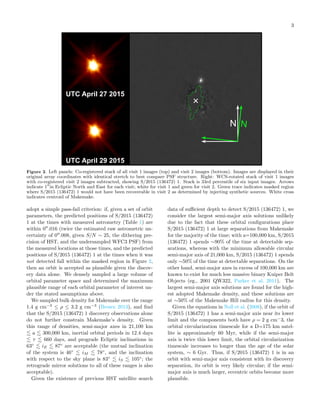
results are illustrated in Figure 3. These three models
all produce between 60%—80% of the measured 24µm
spectral flux density from the system.
3.3. Future Observations
Follow-up observations of S/2015 (136472) 1 will per-
mit the measurement of Makemake’s mass and density.
Since we cannot yet predict the future position of S/2015
(136472) 1 with respect to Makemake, it is likely that
any recovery e↵orts will be hampered by an initial pe-
riod in which S/2015 (136472) 1 is lost in a large frac-
tion of observations before the orbit can be su ciently
well modeled and the recovery rate increased. With suf-
ficient recovery observations, the system mass will be
measured. Given a nominal geometric albedo of 4%,
S/2015 (136472) 1 would have a diameter of 175 km
and for equal densities would contribute . 0.2% of the
system mass; thus, the system mass will be dominated
by Makemake.
Because of the nearly edge-on configuration of the or-
bit, there is the potential for a near-future epoch of mu-
tual events between S/2015 (136472) 1 and Makemake.
As with the mutual events between Pluto and Charon
in the late 1980s (e.g., Buie et al. 1992; Young et al.
2001), such a configuration could enable detailed inves-
tigations of the system and the surface properties of the
two components.
Future observations with JWST can test the dark
moon hypothesis; Parker et al. (2011) highlight that
JWST could characterize the anomalous thermal excess
of Makemake in detail. Figure 3 illustrates the 10,000
second 10 MIRI detection limits in its five longest-
5
Figure 3. Models of thermal emission from Makemake and
S/2015 (136472) 1 compared to observations from Herschel
(Lim et al. 2010) and Spitzer (Stansberry et al. 2008). Black
points: observed data, corrected to common geometry of the
later Herschel observations, with one- and two- error ranges
illustrated. Black dotted line: Model Makemake thermal
emission, with D=1430km, ⌘ = 1.9, and pv=0.82. Dashed
colored lines illustrate three models of S/2015 (136472) 1
thermal emission, and solid colored lines illustrate sum of
Makemake and S/2015 (136472) 1 model emission. None of
the selected models fully reproduce the measured 24µm flux
density measured by Spitzer; either a more extreme surface
for S/2015 (136472) 1 is required, or the surface of S/2015
(136472) 1 is not the only dark material in the system. Gray
arrows illustrate the JWST MIRI 10,000 second 10 detec-
tion limits for 12.8µm, 15µm, 18µm, 21µm, and 25.5µm fil-
ters.
wavelength wide filters. At 15µm, Makemake and all
three S/2015 (136472) 1 model surfaces produce de-
tectable spectral flux density, and at this wavelength
the spatial resolution of JWST is comparable to the
discovery separation of Makemake and S/2015 (136472)
1. Resolved JWST observations in this and the two
adjacent filters would enable direct determination of
the fraction of the system’s dark material that is at-
tributable to the surface of S/2015 (136472) 1. How-
ever, the success of such observations relies upon the
ability to predict the sky-plane separation of Makemake
and S/2015 (136472) 1, requiring that near-term obser-
vations of S/2015 (136472) 1 be conducted to accurately
measure its orbital properties.
3.4. The Figure, Obliquity, and Thermal State of
Makemake
Makemake’s high rate of rotation makes its equilib-
rium figure a Maclaurin spheroid (Ortiz et al. 2012).
Given even a small flattening, Makemake’s J2 would
likely drive the system to a low obliquity between the
satellite’s orbit and the spin pole of Makemake (e.g.,
Porter & Grundy 2012). We note that the projected
long axis of Makemake measured by (Ortiz et al. 2012)
runs nearly North-South, which is consistent with our
determination of the orientation of the orbit plane of
S/2015 (136472) 1 — and thus consistent with a low
mutual obliquity. If the spin pole of Makemake and
the orbit plane of S/2015 (136472) 1 are aligned, we
are viewing Makemake nearly equator-on, and the sky-
plane elliptical fit presented in Ortiz et al. (2012) likely
reflects the true axial ratio of Makemake, implying a
flattening of ⇠15%. If the dark moon hypothesis is
correct, then edge-on rotation for Makemake is not
at odds with its low-amplitude lightcurve, and a low-
amplitude lightcurve in this configuration also implies a
rotationally-symmetric, close-to-equilibrium figure.
Additionally, if the spin pole of Makemake and the
orbit plane of S/2015 (136472) 1 are aligned, Makemake
has a very high obliquity with respect to its heliocen-
tric orbit (46 — 78 ). A current edge-on configuration
places Makemake near equinox, and if so, we estimate its
thermal parameter ⇥ (Spencer 1990) to be ⇠ 70 (given a
Pluto-like thermal inertia of 20 J m 2
s 0.5
K 1
, Lellouch
et al. 2011), placing it solidly in the regime in which fast
rotator approximations apply. Given this high obliq-
uity, however, as Makemake continues around its orbit,
it will e↵ectively transition into a slow rotator state
at its solstices. Makemake is currently near aphelion,
so this potential transition from fast- to slow-rotator is
also currently synched with its heliocentric distance ex-
trema. This could lead to fascinating seasonal evolution
on Makemake’s volatile-dominated surface.
3.5. The Satellites of Dwarf Planets
With the discovery of S/2015 (136472) 1, all four of
the currently-designated trans-Neptunian dwarf planets
(Pluto, Eris, Makemake, and Haumea) are known to
host one or more satellites. The fact that Makemake’s
satellite went unseen despite previous satellite searches
suggests that other very large trans-Neptunian objects
that have already been subject to satellite searches (such
as Sedna and (225088) 2007 OR10) may yet host hidden
moons. While Brown (2013) argued that the lack of a
satellite for Makemake suggested that it had escaped a
past giant impact, the discovery of S/2015 (136472) 1
suggests that unless it resulted from the capture of a
previously-unbound TNO, it too was subjected to a gi-
ant impact and its density will likely reflect that (Stew-
art & Leinhardt 2012). The apparent ubiquity of trans-
Neptunian dwarf planet satellites further supports the
idea that giant collisions are a near-universal fixture in
the histories of these distant worlds.
4. ACKNOWLEDGEMENTS
The authors would like to thank Simon Porter, John
Spencer, and Leslie Young for helpful discussion on the
tidal and thermal properties of minor planets and for
constructive comments on drafts of this manuscript.
6
Table 1. S/2015 (136472) 1 discovery astrometry and photometry.
JDmid maga b c
R.A.d
Dece
2457140.07994 25.21 -000
.136 000
.556 000
.125 000
.558
2457140.10045 25.06 -000
.135 000
.560 000
.127 000
.561
2457140.14283 25.19 -000
.138 000
.555 000
.123 000
.558
2457140.15309 25.27 -000
.140 000
.553 000
.120 000
.558
2457140.16334 25.12 -000
.136 000
.554 000
.124 000
.557
aAB-mag in HST WFC3 UVIS F350LP filter. Mean Makemake
F350LP magnitude in four 12 second exposures: 17.39.
b Sky-plane o↵set in Ecliptic Longitude, secondary to primary; =
( 2 1) ⇥ cos( 1).
c Sky-plane o↵set in Ecliptic Latitude, secondary to primary; =
2 1.
dSky-plane o↵set in J2000 R.A., secondary to primary;
R.A.=(R.A.2 R.A.1) ⇥ cos(Dec1).
eSky-plane o↵set in J2000 Dec, secondary to primary;
Dec=Dec2 Dec1.
REFERENCES
Belskaya, I. N., Bagnulo, S., Stinson, A., et al. 2012, A&A, 547,
A101
Brown, M. E., Barkume, K. M., Blake, G. A., et al. 2007, AJ,
133, 284
Brown, M. E. 2013, ApJL, 767, L7
Buie, M. W., Tholen, D. J., & Horne, K. 1992, Icarus, 97, 211
Harris, A. W. 1998, Icarus, 131, 291
Lellouch, E., Stansberry, J., Emery, J., Grundy, W., &
Cruikshank, D. P. 2011, Icarus, 214, 701
Heinze, A. N., & de Lahunta, D. 2009, AJ, 138, 428
Licandro, J., Pinilla-Alonso, N., Pedani, M., et al. 2006, A&A,
445, L35
Lim, T. L., Stansberry, J., M¨uller, T. G., et al. 2010, A&A, 518,
L148
Noll, K. S., Grundy, W. M., Chiang, E. I., Margot, J.-L., &
Kern, S. D. 2008, The Solar System Beyond Neptune, 345
Ortiz, J. L., Sicardy, B., Braga-Ribas, F., et al. 2012, Nature,
491, 566
Parker, A. H., Kavelaars, J. J., Petit, J.-M., et al. 2011, ApJ,
743, 1
Parker, A., Pinilla-Alonso, N., Santos-Sanz, P., et al. 2016,
PASP, 128, 018010
Porter, S. B., & Grundy, W. M. 2012, Icarus, 220, 947
Rabinowitz, D. L., Schaefer, B. E., & Tourtellotte, S. W. 2007,
AJ, 133, 26
Petit, J.-M., Kavelaars, J. J., Gladman, B. J., et al. 2011, AJ,
142, 131
Spencer, J. R. 1990, Icarus, 83, 27
Stansberry, J., Grundy, W., Brown, M., et al. 2008, The Solar
System Beyond Neptune, 161
Stewart, S. T., & Leinhardt, Z. M. 2012, ApJ, 751, 32
Tegler, S. C., Grundy, W. M., Vilas, F., et al. 2008, Icarus, 195,
844
Young, E. F., Binzel, R. P., & Crane, K. 2001, AJ, 121, 552

Discovery of a_makemakean_moon

  • 1.
    Draft version April25, 2016 Preprint typeset using LATEX style AASTeX6 v. 1.0 DISCOVERY OF A MAKEMAKEAN MOON Alex H. Parker1 and Marc W. Buie Southwest Research Institute 1050 Walnut St., Suite 300 Boulder, CO 80302, USA Will M. Grundy Lowell Observatory, Flagsta↵, AZ, USA. Keith S. Noll NASA Goddard Space Flight Center, Greenbelt, MD, USA. 1 aparker@boulder.swri.edu ABSTRACT We describe the discovery of a satellite in orbit about the dwarf planet (136472) Makemake. This satellite, provisionally designated S/2015 (136472) 1, was detected in imaging data collected with the Hubble Space Telescope’s Wide Field Camera 3 on UTC April 27, 2015 at 7.80±0.04 magnitudes fainter than Makemake. It likely evaded detection in previous satellite searches due to a nearly edge- on orbital configuration, placing it deep within the glare of Makemake during a substantial fraction of its orbital period. This configuration would place Makemake and its satellite near a mutual event season. Insu cient orbital motion was detected to make a detailed characterization of its orbital properties, prohibiting a measurement of the system mass with the discovery data alone. Preliminary analysis indicates that if the orbit is circular, its orbital period must be longer than 12.4 days, and must have a semi-major axis &21,000 km. We find that the properties of Makemake’s moon suggest that the majority of the dark material detected in the system by thermal observations may not reside on the surface of Makemake, but may instead be attributable to S/2015 (136472) 1 having a uniform dark surface. This “dark moon hypothesis” can be directly tested with future JWST observations. We discuss the implications of this discovery for the spin state, figure, and thermal properties of Makemake and the apparent ubiquity of trans-Neptunian dwarf planet satellites. Keywords: Kuiper belt objects: individual (Makemake) — planets and satellites: detection 1. INTRODUCTION Makemake is the second-brightest known trans- Neptunian Object (behind only Pluto) and the largest known classical Kuiper Belt Object (KBO). It has the most methane-dominated spectrum of any known TNO (Licandro et al. 2006; Brown et al. 2007; Tegler et al. 2008), a very high visible albedo (Lim et al. 2010), a well-defined radius derived from stellar occultations (Or- tiz et al. 2012; Brown 2013), a well-measured (albeit very small-amplitude) lightcurve that pins its rotational pe- riod to 7.771 hours (Heinze & de Lahunta 2009), and polarization properties very similar to Pluto and Eris, but distinct from smaller KBOs (Belskaya et al. 2012). However, despite this wealth of information, the lack of a known satellite has prohibited the measurement of Makemake’s mass and density. We report the discovery and preliminary characteriza- tion of a Makemakean moon in Hubble Space Telescope (HST) Wide-Field Camera 3 (WFC3) imagery. While the satellite’s orbital properties are only marginally con- strained from the discovery data alone, its existence will permit future precise measurement of Makemake’s mass and density given su cient follow-up observations. In the following sections, we describe the discovery circum- stances of S/2015 (136472) 1, its photometric properties, and preliminary characterization of its orbital proper- ties. We demonstrate that this moon could account for some or all of the dark material detected in the Make- make system with thermal observations, and discuss po-
  • 2.
    2 UTC April 2713:49:04 UTC April 27 14:03:50 UTC April 27 14:18:36 UTC April 27 15:19:38 UTC April 27 15:34:24 UTC April 27 15:49:10 Figure 1. All six 725-second images from visit 1, collected over two subsequent HST orbits. The satellite is clearly visible to the North and West of Makemake in every frame. Images have not been cleaned for cosmic rays or otherwise cosmetically enhanced. Black bar is 100 . Ecliptic North is up, Ecliptic East is left. Observation start times are labeled on each image. Over the time spanned by these images, Makemake moved 400 .22 with respect to background sources. tential future avenues of research enabled by this satel- lite. We argue that Makemake is likely currently viewed equator-on and derive implications for its figure and thermal properties. We conclude with a discussion of the properties of dwarf planet satellites. 2. DISCOVERY CIRCUMSTANCES As part of the HST GO program 13668, Makemake was imaged with WFC3 in the broad F350LP filter over the course of two visits of two back-to-back orbits each. These visits were separated by approximately two days. Each visit was bracketed by single 12-second images in which Makemake does not saturate; the remainder of each visit was filled with six 725 second exposures in which Makemake saturates. These observations were de- signed to enable the detection of satellites fainter than could have been found in previous satellite search pro- grams. Visit 1 was on April 27, 2015, from UTC 13:46:36 to 16:03:58, and Visit 2 on April 29, 2015, from UTC 18:17:46 to 20:35:03. In all six 725 second images col- lected in Visit 1, a faint source is visible 000 .57 from Makemake; see Figure 1. Over the 132-minute duration spanned by these observations, Makemake moved 400 .22 with respect to background sources (more than 60 times the F350LP point-spread function FWHM); the fainter source was precisely co-moving with Makemake over this period. The source was not visible in Visit 2 (see Figure 2), and subsequent e↵orts to reduce the confusion pro- duced by Makemake’s PSF through di↵erence imaging did not reveal the source. We injected synthetic PSFs into the Visit 2 di↵erence images in order to determine our sensitivity to a source and the implications of a non-detection. We find that sources up to 2.5 magnitudes fainter than the Visit 1 source are reliably recovered at large separations from Makemake, and sources one magnitude fainter are vis- ible in all regions but the saturated core of Makemake (illustrated by the masked region in Figure 2). Pre- vious HST observations of Makemake taken with the Advanced Camera for Surveys (ACS) High Resolution Channel on November 19, 2006, were of su cient sen- sitivity to detect this satellite (program GO 10860 in- cluded 16 550 second exposures in F606W; 5 limiting magnitude in each from estimated from the ACS expo- sure time calculator is V ⇠ 26); however, the satellite is not visible in these data either. We infer from these two non-detections that the satellite spends a large fraction of its time very close to Makemake in the sky plane, likely in an edge-on orbit. We discuss this further in Section 2.2. 2.1. Photometry For each of the six frames in which S/2015 (136472) 1 is visible, we subtracted a co-registered median stack of the six frames in which it was not visible. In five of these six di↵erence images, we performed small-aperture photometry to measure the flux from S/2015 (136472) 1; in the sixth, a cosmic ray impinged too close to S/2015 (136472) 1. The typical signal-to-noise of S/2015 (136472) 1 in these frames is S/N ⇠ 25. The results are listed in Table 1. Four bracketing short F350LP expo- sures were also median stacked (without di↵erencing) to measure the flux from Makemake itself in the filter pass- band. We find that S/2015 (136472) 1 is 7.80±0.04 mag- nitudes fainter than Makemake in F350LP. In the ab- sence of any color information on the satellite, we adopt this delta-magnitude for V-band photometry. Make- make is Hv = 0.091 ± 0.015 (Rabinowitz et al. 2007), and from this we estimate Hv = 7.89 ± 0.04 for S/2015 (136472) 1. At the time of discovery, the system was at a heliocentric range of 52.404 AU, a geocentric range of 51.694 AU, and observed at a phase angle of 0.781 . 2.2. Astrometry and Orbital Properties We performed preliminary orbit modeling to deter- mine the possible range of system parameters given the limited astrometric information derived from the dis- covery data. To avoid over-fitting the data, we assume a prograde circular orbit for preliminary estimates and
  • 3.
    3 N N UTC April27 2015 UTC April 29 2015 Figure 2. Left panels: Co-registered stack of all visit 1 images (top) and visit 2 images (bottom). Images are displayed in their original array coordinates with identical stretch to best compare PSF structure. Right: WCS-rotated stack of visit 1 images with co-registered visit 2 images subtracted, showing S/2015 (136472) 1. Stack is 33rd percentile of six input images. Arrows indicate 100 in Ecliptic North and East for each visit; white for visit 1 and green for visit 2. Green trace indicates masked region where S/2015 (136472) 1 would not have been recoverable in visit 2 as determined by injecting synthetic sources. White cross indicates centroid of Makemake. adopt a simple pass-fail criterion: if, given a set of orbit parameters, the predicted positions of S/2015 (136472) 1 at the times with measured astrometry (Table 1) are within 000 .016 (twice the estimated raw astrometric un- certainty of 000 .008, given S/N ⇠ 25, the dithering pre- cision of HST, and the undersampled WFC3 PSF) from the measured locations at those times, and the predicted positions of S/2015 (136472) 1 at the times when it was not detected fall within the masked region in Figure 2, then an orbit is accepted as plausible given the discov- ery data alone. We densely sampled a large volume of orbital parameter space and determined the maximum plausible range of each orbital parameter of interest un- der the stated assumptions above. We sampled bulk density for Makemake over the range 1.4 g cm 3  ⇢  3.2 g cm 3 (Brown 2013), and find that the S/2015 (136472) 1 discovery observations alone do not further constrain Makemake’s density. Given this range of densities, semi-major axes in 21,100 km . a . 300,000 km, inertial orbital periods in 12.4 days . ⌧ . 660 days, and prograde Ecliptic inclinations in 63 . iE . 87 are acceptable (the mutual inclination of the system is 46 . iM . 78 , and the inclination with respect to the sky plane is 83 . iS . 105 ; the retrograde mirror solutions to all of these ranges is also acceptable). Given the existence of previous HST satellite search data of su cient depth to detect S/2015 (136472) 1, we consider the largest semi-major axis solutions unlikely due to the fact that these orbital configurations place S/2015 (136472) 1 at large separations from Makemake for the majority of the time; with a=100,000 km, S/2015 (136472) 1 spends ⇠90% of the time at detectable sep- arations, whereas with the minimum allowable circular semi-major axis of 21,000 km, S/2015 (136472) 1 spends only ⇠50% of the time at detectable separations. On the other hand, semi-major axes in excess of 100,000 km are known to exist for much less massive binary Kuiper Belt Objects (eg., 2001 QW322, Parker et al. 2011). The largest semi-major axis solutions are found for the high- est adopted Makemake density, and these solutions are at ⇠50% of the Makemake Hill radius for this density. Given the equations in Noll et al. (2008), if the orbit of S/2015 (136472) 1 has a semi-major axis near its lower limit and the components both have ⇢ = 2 g cm 3, the orbital circularization timescale for a D=175 km satel- lite is approximately 60 Myr, while if the semi-major axis is twice this lower limit, the orbital circularization timescale increases to longer than the age of the solar system, ⇠ 6 Gyr. Thus, if S/2015 (136472) 1 is in an orbit with semi-major axis consistent with its discovery separation, its orbit is very likely circular; if the semi- major axis is much larger, eccentric orbits become more plausible.
  • 4.
    4 3. DISCUSSION 3.1. Possibilityof serendipitous alignment of an unbound TNO Given the limited amount of orbital motion about Makemake observed for S/2015 (136472) 1, we must con- sider the possibility that the detection is a false positive arising from another TNO serendipitously crossing the same line of sight as Makemake. We can strongly rule out this scenario with the following simple analysis. At the time of the discovery observations, Makemake was at a heliocentric Ecliptic latitude of ⇠ 28.5 and a heliocen- tric range of ⇠52 AU. Since the parallax produced over the width of HST’s orbit will vary by nearly a full UVIS WFC3 pixel for objects within ⇠5 AU of 52 AU, we cap the heliocentric range of potential coincident TNOs to 47—57 AU. Using the Canada France Ecliptic Plane Survey L7 synthetic model of the Kuiper Belt (Petit et al. 2011), we find that the typical sky density of Hv  7.8 TNOs with 28   29 and 47  R  57 is ⇠ 0.1 deg 2 . Given three relatively distinct epochs (count- ing HST observations from program 10860 collected in November 2006 which did not detect the satellite) of ob- servations capable of detecting S/2015 (136472) 1, the odds of a similarly-bright or brighter TNO at a simi- lar heliocentric distance falling within an arcsecond of Makemake in one or more epoch is less than one in 107 . 3.2. Dark Moon Hypothesis Thermal observations of Makemake collected by the Spitzer (Stansberry et al. 2008) and Herschel (Lim et al. 2010) space telescopes revealed that there were at least two distinct surfaces contributing to the spectral energy distribution; the majority of the emitting sur- face must be very bright, but a small component must be very dark. It was argued that the presence of distinct dark terrains on the surface of Makemake was at odds with Makemake’s very small lightcurve amplitude un- less Makemake is in a pole-on viewing geometry (Brown 2013). Given the discovery of S/2015 (136472) 1, we recon- sider these thermal observations under the hypothesis that some or all of the dark material in the system does not reside on the surface of a modestly mottled Make- make, but rather covers the entire surface of a uniformly dark S/2015 (136472) 1. Lim et al. (2010) require a dark surface area with equivalent diameter 310 km < D < 380 km, with geometric albedo 0.02 < pv < 0.12. For pv = 0.02, the estimated H-magnitude of S/2015 (136472) 1 corresponds to a diameter of ⇠250 km, too small to account for all of the dark material, but su - cient to account for a large fraction of it. This would reduce the preference for a pole-on orientation for Make- make’s rotation. A very dark surface might suggest an origin distinct from other dwarf planet satellites, per- haps indicating that the satellite is a captured, formerly- unbound TNO. Alternatively, a dark satellite surface may be the result of past epochs of interactions with an escaping Makemake atmosphere. As a simple check, we use NEATM (Harris 1998) to model the thermal flux from the system with the occultation-updated diameter of 1430 km for Makemake and three di↵erent surfaces for S/2015 (136472) 1, and compare them against previous thermal observations of the system. Makemake’s surface is modeled with a uni- form geometric albedo of 0.82, and a beaming parameter of ⌘ = 1.9. The three models of S/2015 (136472) 1 in- clude (a) a model with Salacia-like 4% geometric albedo, but an exceptionally low beaming parameter of ⌘ = 0.25, (b) a model with a low 2% geometric albedo, but a beaming parameter in-family with the results of Lim et al. (2010), ⌘ = 0.4, and (c) a model with a 4% geomet- ric albedo and a beaming parameter ⌘ = 0.4, but with an absolute magnitude 0.5 magnitudes brighter than ob- served for S/2015 (136472) 1, capturing the possibility that S/2015 (136472) 1 has a substantial lightcurve. The results are illustrated in Figure 3. These three models all produce between 60%—80% of the measured 24µm spectral flux density from the system. 3.3. Future Observations Follow-up observations of S/2015 (136472) 1 will per- mit the measurement of Makemake’s mass and density. Since we cannot yet predict the future position of S/2015 (136472) 1 with respect to Makemake, it is likely that any recovery e↵orts will be hampered by an initial pe- riod in which S/2015 (136472) 1 is lost in a large frac- tion of observations before the orbit can be su ciently well modeled and the recovery rate increased. With suf- ficient recovery observations, the system mass will be measured. Given a nominal geometric albedo of 4%, S/2015 (136472) 1 would have a diameter of 175 km and for equal densities would contribute . 0.2% of the system mass; thus, the system mass will be dominated by Makemake. Because of the nearly edge-on configuration of the or- bit, there is the potential for a near-future epoch of mu- tual events between S/2015 (136472) 1 and Makemake. As with the mutual events between Pluto and Charon in the late 1980s (e.g., Buie et al. 1992; Young et al. 2001), such a configuration could enable detailed inves- tigations of the system and the surface properties of the two components. Future observations with JWST can test the dark moon hypothesis; Parker et al. (2011) highlight that JWST could characterize the anomalous thermal excess of Makemake in detail. Figure 3 illustrates the 10,000 second 10 MIRI detection limits in its five longest-
  • 5.
    5 Figure 3. Modelsof thermal emission from Makemake and S/2015 (136472) 1 compared to observations from Herschel (Lim et al. 2010) and Spitzer (Stansberry et al. 2008). Black points: observed data, corrected to common geometry of the later Herschel observations, with one- and two- error ranges illustrated. Black dotted line: Model Makemake thermal emission, with D=1430km, ⌘ = 1.9, and pv=0.82. Dashed colored lines illustrate three models of S/2015 (136472) 1 thermal emission, and solid colored lines illustrate sum of Makemake and S/2015 (136472) 1 model emission. None of the selected models fully reproduce the measured 24µm flux density measured by Spitzer; either a more extreme surface for S/2015 (136472) 1 is required, or the surface of S/2015 (136472) 1 is not the only dark material in the system. Gray arrows illustrate the JWST MIRI 10,000 second 10 detec- tion limits for 12.8µm, 15µm, 18µm, 21µm, and 25.5µm fil- ters. wavelength wide filters. At 15µm, Makemake and all three S/2015 (136472) 1 model surfaces produce de- tectable spectral flux density, and at this wavelength the spatial resolution of JWST is comparable to the discovery separation of Makemake and S/2015 (136472) 1. Resolved JWST observations in this and the two adjacent filters would enable direct determination of the fraction of the system’s dark material that is at- tributable to the surface of S/2015 (136472) 1. How- ever, the success of such observations relies upon the ability to predict the sky-plane separation of Makemake and S/2015 (136472) 1, requiring that near-term obser- vations of S/2015 (136472) 1 be conducted to accurately measure its orbital properties. 3.4. The Figure, Obliquity, and Thermal State of Makemake Makemake’s high rate of rotation makes its equilib- rium figure a Maclaurin spheroid (Ortiz et al. 2012). Given even a small flattening, Makemake’s J2 would likely drive the system to a low obliquity between the satellite’s orbit and the spin pole of Makemake (e.g., Porter & Grundy 2012). We note that the projected long axis of Makemake measured by (Ortiz et al. 2012) runs nearly North-South, which is consistent with our determination of the orientation of the orbit plane of S/2015 (136472) 1 — and thus consistent with a low mutual obliquity. If the spin pole of Makemake and the orbit plane of S/2015 (136472) 1 are aligned, we are viewing Makemake nearly equator-on, and the sky- plane elliptical fit presented in Ortiz et al. (2012) likely reflects the true axial ratio of Makemake, implying a flattening of ⇠15%. If the dark moon hypothesis is correct, then edge-on rotation for Makemake is not at odds with its low-amplitude lightcurve, and a low- amplitude lightcurve in this configuration also implies a rotationally-symmetric, close-to-equilibrium figure. Additionally, if the spin pole of Makemake and the orbit plane of S/2015 (136472) 1 are aligned, Makemake has a very high obliquity with respect to its heliocen- tric orbit (46 — 78 ). A current edge-on configuration places Makemake near equinox, and if so, we estimate its thermal parameter ⇥ (Spencer 1990) to be ⇠ 70 (given a Pluto-like thermal inertia of 20 J m 2 s 0.5 K 1 , Lellouch et al. 2011), placing it solidly in the regime in which fast rotator approximations apply. Given this high obliq- uity, however, as Makemake continues around its orbit, it will e↵ectively transition into a slow rotator state at its solstices. Makemake is currently near aphelion, so this potential transition from fast- to slow-rotator is also currently synched with its heliocentric distance ex- trema. This could lead to fascinating seasonal evolution on Makemake’s volatile-dominated surface. 3.5. The Satellites of Dwarf Planets With the discovery of S/2015 (136472) 1, all four of the currently-designated trans-Neptunian dwarf planets (Pluto, Eris, Makemake, and Haumea) are known to host one or more satellites. The fact that Makemake’s satellite went unseen despite previous satellite searches suggests that other very large trans-Neptunian objects that have already been subject to satellite searches (such as Sedna and (225088) 2007 OR10) may yet host hidden moons. While Brown (2013) argued that the lack of a satellite for Makemake suggested that it had escaped a past giant impact, the discovery of S/2015 (136472) 1 suggests that unless it resulted from the capture of a previously-unbound TNO, it too was subjected to a gi- ant impact and its density will likely reflect that (Stew- art & Leinhardt 2012). The apparent ubiquity of trans- Neptunian dwarf planet satellites further supports the idea that giant collisions are a near-universal fixture in the histories of these distant worlds. 4. ACKNOWLEDGEMENTS The authors would like to thank Simon Porter, John Spencer, and Leslie Young for helpful discussion on the tidal and thermal properties of minor planets and for constructive comments on drafts of this manuscript.
  • 6.
    6 Table 1. S/2015(136472) 1 discovery astrometry and photometry. JDmid maga b c R.A.d Dece 2457140.07994 25.21 -000 .136 000 .556 000 .125 000 .558 2457140.10045 25.06 -000 .135 000 .560 000 .127 000 .561 2457140.14283 25.19 -000 .138 000 .555 000 .123 000 .558 2457140.15309 25.27 -000 .140 000 .553 000 .120 000 .558 2457140.16334 25.12 -000 .136 000 .554 000 .124 000 .557 aAB-mag in HST WFC3 UVIS F350LP filter. Mean Makemake F350LP magnitude in four 12 second exposures: 17.39. b Sky-plane o↵set in Ecliptic Longitude, secondary to primary; = ( 2 1) ⇥ cos( 1). c Sky-plane o↵set in Ecliptic Latitude, secondary to primary; = 2 1. dSky-plane o↵set in J2000 R.A., secondary to primary; R.A.=(R.A.2 R.A.1) ⇥ cos(Dec1). eSky-plane o↵set in J2000 Dec, secondary to primary; Dec=Dec2 Dec1. REFERENCES Belskaya, I. N., Bagnulo, S., Stinson, A., et al. 2012, A&A, 547, A101 Brown, M. E., Barkume, K. M., Blake, G. A., et al. 2007, AJ, 133, 284 Brown, M. E. 2013, ApJL, 767, L7 Buie, M. W., Tholen, D. J., & Horne, K. 1992, Icarus, 97, 211 Harris, A. W. 1998, Icarus, 131, 291 Lellouch, E., Stansberry, J., Emery, J., Grundy, W., & Cruikshank, D. P. 2011, Icarus, 214, 701 Heinze, A. N., & de Lahunta, D. 2009, AJ, 138, 428 Licandro, J., Pinilla-Alonso, N., Pedani, M., et al. 2006, A&A, 445, L35 Lim, T. L., Stansberry, J., M¨uller, T. G., et al. 2010, A&A, 518, L148 Noll, K. S., Grundy, W. M., Chiang, E. I., Margot, J.-L., & Kern, S. D. 2008, The Solar System Beyond Neptune, 345 Ortiz, J. L., Sicardy, B., Braga-Ribas, F., et al. 2012, Nature, 491, 566 Parker, A. H., Kavelaars, J. J., Petit, J.-M., et al. 2011, ApJ, 743, 1 Parker, A., Pinilla-Alonso, N., Santos-Sanz, P., et al. 2016, PASP, 128, 018010 Porter, S. B., & Grundy, W. M. 2012, Icarus, 220, 947 Rabinowitz, D. L., Schaefer, B. E., & Tourtellotte, S. W. 2007, AJ, 133, 26 Petit, J.-M., Kavelaars, J. J., Gladman, B. J., et al. 2011, AJ, 142, 131 Spencer, J. R. 1990, Icarus, 83, 27 Stansberry, J., Grundy, W., Brown, M., et al. 2008, The Solar System Beyond Neptune, 161 Stewart, S. T., & Leinhardt, Z. M. 2012, ApJ, 751, 32 Tegler, S. C., Grundy, W. M., Vilas, F., et al. 2008, Icarus, 195, 844 Young, E. F., Binzel, R. P., & Crane, K. 2001, AJ, 121, 552