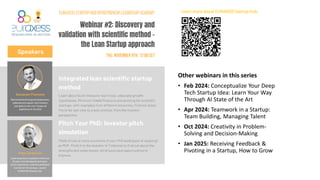
Other webinars in this series
• Feb 2024: Conceptualize Your Deep
Tech Startup Idea: Learn Your Way
Through AI State of the Art
• Apr 2024: Teamwork in a Startup:
Team Building, Managing Talent
• Oct 2024: Creativity in Problem-
Solving and Decision-Making
• Jan 2025: Receiving Feedback &
Pivoting in a Startup, How to Grow
Learn more about EURAXESS Startup Hub
Discovery and validation with
scientific method
The Lean Scientific
Startup approach
dr Milan Zdravković, EURAXESS Startup Hub
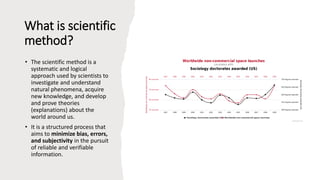
What is scientific
method?
• The scientific method is a
systematic and logical
approach used by scientists to
investigate and understand
natural phenomena, acquire
new knowledge, and develop
and prove theories
(explanations) about the
world around us.
• It is a structured process that
aims to minimize bias, errors,
and subjectivity in the pursuit
of reliable and verifiable
information.
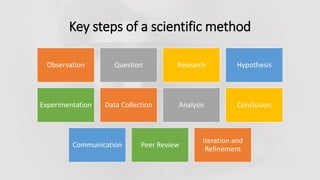
Key steps of a scientific method
Observation Question Research Hypothesis
Experimentation Data Collection Analysis Conclusion
Communication Peer Review
Iteration and
Refinement
Hypotheses and variables - examples
“Machine learning model trained with
historical market data and news sentiment
can predict short-term stock price
movements more accurately than traditional
technical indicators.”
Independent variable (the ones that scientist change during
the experiment): ML model, training data period, selection
of news sources, method for sentiment classification
Dependent variable (the ones that are being changed and
measured): improvement of accuracy over traditional
technical indicators
Control variables: choice of technical indicators, accuracy
metrics
“Inhibiting a specific enzyme identified in a
disease pathway will lead to a reduction in
disease symptoms in vitro and in vivo.”
Independent variable: dosage and concentration of the
inhibitor
Dependent variable: reducing disease symptoms
Control variables: conditions and duration of the
experiment, the methods used to measure disease
symptoms
Let’s now get moving off science (are we
moving off really?)
Scientific method is
focused on problem
solving.
But solving problems does not
necessary saves the world.
Solution needs to be adopted by the
relevant community in order to have
an impact.
Who benefits from
confirming the scientific
hypotheses?
Individuals (investors, traders,
patients) and society at large.
Companies who transform the
scientific result into innovative
product or service.
From problem-focused
to beneficiary-focused
hypotheses:
The Value Hypothesis addresses the
question of whether a product or
service delivers value to potential
customers.
The Growth Hypothesis addresses the
question of how the startup will
acquire and retain customers at scale.
Examples
of
value
hypotheses
for
scientific
startups
Biotech Startup: "Our drug
discovery platform will reduce the
time required for identifying
potential drug candidates by at
least 50%, leading to a 30%
increase in R&D efficiency for
biopharmaceutical companies."
Health Tech Startup: "Our AI-
powered diagnostic tool will
increase the accuracy of early
disease detection by 20%,
resulting in a 15% reduction in
patient treatment costs and a 25%
improvement in patient
outcomes."
Agricultural Tech Startup: "Our
precision agriculture solution will
optimize water and nutrient
usage, leading to a 15% increase
in crop yields and a 30% reduction
in resource consumption for
farmers."
Energy Tech Startup: "Our
predictive maintenance solution
will reduce unplanned equipment
downtime by 40%, resulting in a
25% decrease in maintenance
costs and a 20% increase in
equipment efficiency for energy
companies."
Environmental Startup: "Our real-
time pollution monitoring
technology will reduce general
population response times to
pollution events by 50%, leading
to a 15% decrease in pollution-
related health issues and a 20%
improvement in air quality."
Materials Science Startup: "Our
advanced material will offer a
30% improvement in strength-to-
weight ratios compared to
traditional materials, leading to a
10% increase in product lifespan
and a 15% reduction in
maintenance costs for
manufacturers."
Examples
of
growth
hypotheses
for
scientific
startups
Biotech Startup: "By the end of
the year, we aim to increase our
partnerships with
biopharmaceutical companies by
50%, resulting in a 30% growth in
revenue from collaborative
research projects."
Health Tech Startup: "Within six
months, we expect to expand our
user base by 100%, resulting in a
40% increase in monthly
subscription revenue for our AI-
powered telehealth platform."
Agricultural Tech Startup: "Over
the next year, we plan to onboard
200 new farms onto our precision
agriculture platform, leading to a
60% growth in our annual
recurring revenue."
Energy Tech Startup: "Within nine
months, we aim to secure
contracts with five major energy
companies, driving a 50% increase
in our sales pipeline and a
projected 35% growth in
revenue."
Environmental Startup: "Over the
next quarter, we anticipate
expanding our real-time pollution
monitoring technology to three
new cities, resulting in a 40%
increase in the number of
monitoring units deployed."
Materials Science Startup: "By
the end of the fiscal year, we
project to have our advanced
material integrated into products
by 10 new manufacturers,
contributing to a 25% increase in
material sales."
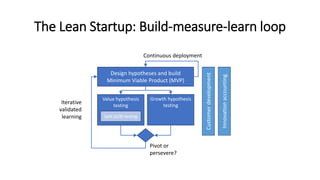
Value hypothesis
testing
Growth hypothesis
testing
The Lean Startup: Build-measure-learn loop
Design hypotheses and build
Minimum Viable Product (MVP)
Continuous deployment
Split (A/B) testing
Pivot or
persevere?
Iterative
validated
learning
Innovation
accounting
Customer
development
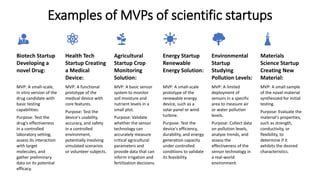
Examples of MVPs of scientific startups
Biotech Startup
Developing a
novel Drug:
MVP: A small-scale,
in vitro version of the
drug candidate with
basic testing
capabilities.
Purpose: Test the
drug's effectiveness
in a controlled
laboratory setting,
assess its interaction
with target
molecules, and
gather preliminary
data on its potential
efficacy.
Health Tech
Startup Creating
a Medical
Device:
MVP: A functional
prototype of the
medical device with
core features.
Purpose: Test the
device's usability,
accuracy, and safety
in a controlled
environment,
potentially involving
simulated scenarios
or volunteer subjects.
Agricultural
Startup Crop
Monitoring
Solution:
MVP: A basic sensor
system to monitor
soil moisture and
nutrient levels in a
small plot.
Purpose: Validate
whether the sensor
technology can
accurately measure
critical agricultural
parameters and
provide data that can
inform irrigation and
fertilization decisions.
Energy Startup
Renewable
Energy Solution:
MVP: A small-scale
prototype of the
renewable energy
device, such as a
solar panel or wind
turbine.
Purpose: Test the
device's efficiency,
durability, and energy
generation capacity
under controlled
conditions to validate
its feasibility.
Environmental
Startup
Studying
Pollution Levels:
MVP: A limited
deployment of
sensors in a specific
area to measure air
or water pollution
levels.
Purpose: Collect data
on pollution levels,
analyze trends, and
assess the
effectiveness of the
sensor technology in
a real-world
environment.
Materials
Science Startup
Creating New
Material:
MVP: A small sample
of the novel material
synthesized for initial
testing.
Purpose: Evaluate the
material's properties,
such as strength,
conductivity, or
flexibility, to
determine if it
exhibits the desired
characteristics.
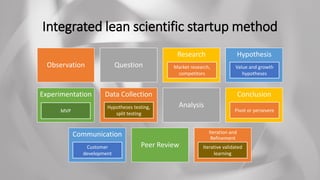
Integrated lean scientific startup method
Observation Question
Research Hypothesis
Experimentation Data Collection
Analysis
Conclusion
Communication
Peer Review
Iteration and
Refinement
Market research,
competitors
Value and growth
hypotheses
MVP Pivot or persevere
Hypotheses testing,
split testing
Customer
development
Iterative validated
learning
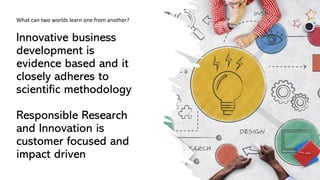
Innovative business
development is
evidence based and it
closely adheres to
scientific methodology
Responsible Research
and Innovation is
customer focused and
impact driven
What can two worlds learn one from another?

Discovery and validation with scientific method - the Lean Startup approach

  • 1.
    Other webinars inthis series • Feb 2024: Conceptualize Your Deep Tech Startup Idea: Learn Your Way Through AI State of the Art • Apr 2024: Teamwork in a Startup: Team Building, Managing Talent • Oct 2024: Creativity in Problem- Solving and Decision-Making • Jan 2025: Receiving Feedback & Pivoting in a Startup, How to Grow Learn more about EURAXESS Startup Hub
  • 2.
    Discovery and validationwith scientific method The Lean Scientific Startup approach dr Milan Zdravković, EURAXESS Startup Hub
  • 3.
    What is scientific method? •The scientific method is a systematic and logical approach used by scientists to investigate and understand natural phenomena, acquire new knowledge, and develop and prove theories (explanations) about the world around us. • It is a structured process that aims to minimize bias, errors, and subjectivity in the pursuit of reliable and verifiable information.
  • 4.
    Key steps ofa scientific method Observation Question Research Hypothesis Experimentation Data Collection Analysis Conclusion Communication Peer Review Iteration and Refinement
  • 5.
    Hypotheses and variables- examples “Machine learning model trained with historical market data and news sentiment can predict short-term stock price movements more accurately than traditional technical indicators.” Independent variable (the ones that scientist change during the experiment): ML model, training data period, selection of news sources, method for sentiment classification Dependent variable (the ones that are being changed and measured): improvement of accuracy over traditional technical indicators Control variables: choice of technical indicators, accuracy metrics “Inhibiting a specific enzyme identified in a disease pathway will lead to a reduction in disease symptoms in vitro and in vivo.” Independent variable: dosage and concentration of the inhibitor Dependent variable: reducing disease symptoms Control variables: conditions and duration of the experiment, the methods used to measure disease symptoms
  • 6.
    Let’s now getmoving off science (are we moving off really?) Scientific method is focused on problem solving. But solving problems does not necessary saves the world. Solution needs to be adopted by the relevant community in order to have an impact. Who benefits from confirming the scientific hypotheses? Individuals (investors, traders, patients) and society at large. Companies who transform the scientific result into innovative product or service. From problem-focused to beneficiary-focused hypotheses: The Value Hypothesis addresses the question of whether a product or service delivers value to potential customers. The Growth Hypothesis addresses the question of how the startup will acquire and retain customers at scale.
  • 7.
    Examples of value hypotheses for scientific startups Biotech Startup: "Ourdrug discovery platform will reduce the time required for identifying potential drug candidates by at least 50%, leading to a 30% increase in R&D efficiency for biopharmaceutical companies." Health Tech Startup: "Our AI- powered diagnostic tool will increase the accuracy of early disease detection by 20%, resulting in a 15% reduction in patient treatment costs and a 25% improvement in patient outcomes." Agricultural Tech Startup: "Our precision agriculture solution will optimize water and nutrient usage, leading to a 15% increase in crop yields and a 30% reduction in resource consumption for farmers." Energy Tech Startup: "Our predictive maintenance solution will reduce unplanned equipment downtime by 40%, resulting in a 25% decrease in maintenance costs and a 20% increase in equipment efficiency for energy companies." Environmental Startup: "Our real- time pollution monitoring technology will reduce general population response times to pollution events by 50%, leading to a 15% decrease in pollution- related health issues and a 20% improvement in air quality." Materials Science Startup: "Our advanced material will offer a 30% improvement in strength-to- weight ratios compared to traditional materials, leading to a 10% increase in product lifespan and a 15% reduction in maintenance costs for manufacturers."
  • 8.
    Examples of growth hypotheses for scientific startups Biotech Startup: "Bythe end of the year, we aim to increase our partnerships with biopharmaceutical companies by 50%, resulting in a 30% growth in revenue from collaborative research projects." Health Tech Startup: "Within six months, we expect to expand our user base by 100%, resulting in a 40% increase in monthly subscription revenue for our AI- powered telehealth platform." Agricultural Tech Startup: "Over the next year, we plan to onboard 200 new farms onto our precision agriculture platform, leading to a 60% growth in our annual recurring revenue." Energy Tech Startup: "Within nine months, we aim to secure contracts with five major energy companies, driving a 50% increase in our sales pipeline and a projected 35% growth in revenue." Environmental Startup: "Over the next quarter, we anticipate expanding our real-time pollution monitoring technology to three new cities, resulting in a 40% increase in the number of monitoring units deployed." Materials Science Startup: "By the end of the fiscal year, we project to have our advanced material integrated into products by 10 new manufacturers, contributing to a 25% increase in material sales."
  • 9.
    Value hypothesis testing Growth hypothesis testing TheLean Startup: Build-measure-learn loop Design hypotheses and build Minimum Viable Product (MVP) Continuous deployment Split (A/B) testing Pivot or persevere? Iterative validated learning Innovation accounting Customer development
  • 10.
    Examples of MVPsof scientific startups Biotech Startup Developing a novel Drug: MVP: A small-scale, in vitro version of the drug candidate with basic testing capabilities. Purpose: Test the drug's effectiveness in a controlled laboratory setting, assess its interaction with target molecules, and gather preliminary data on its potential efficacy. Health Tech Startup Creating a Medical Device: MVP: A functional prototype of the medical device with core features. Purpose: Test the device's usability, accuracy, and safety in a controlled environment, potentially involving simulated scenarios or volunteer subjects. Agricultural Startup Crop Monitoring Solution: MVP: A basic sensor system to monitor soil moisture and nutrient levels in a small plot. Purpose: Validate whether the sensor technology can accurately measure critical agricultural parameters and provide data that can inform irrigation and fertilization decisions. Energy Startup Renewable Energy Solution: MVP: A small-scale prototype of the renewable energy device, such as a solar panel or wind turbine. Purpose: Test the device's efficiency, durability, and energy generation capacity under controlled conditions to validate its feasibility. Environmental Startup Studying Pollution Levels: MVP: A limited deployment of sensors in a specific area to measure air or water pollution levels. Purpose: Collect data on pollution levels, analyze trends, and assess the effectiveness of the sensor technology in a real-world environment. Materials Science Startup Creating New Material: MVP: A small sample of the novel material synthesized for initial testing. Purpose: Evaluate the material's properties, such as strength, conductivity, or flexibility, to determine if it exhibits the desired characteristics.
  • 11.
    Integrated lean scientificstartup method Observation Question Research Hypothesis Experimentation Data Collection Analysis Conclusion Communication Peer Review Iteration and Refinement Market research, competitors Value and growth hypotheses MVP Pivot or persevere Hypotheses testing, split testing Customer development Iterative validated learning
  • 12.
    Innovative business development is evidencebased and it closely adheres to scientific methodology Responsible Research and Innovation is customer focused and impact driven What can two worlds learn one from another?