Integrating Mindfulness into
Social and Emotional Learning
March 31, 2016
Jen Dirga, Nancy MacKay, Jim Strouse (c) 2016 Open Circle
Acknowledgements
K-5 Teachers and Students
Supported by a grant from the
Harold Benenson Memorial Research
Fund, Wellesley Center for Women
2
(c) 2016 Open Circle
Mindfulness
“Paying attention,
on purpose in the
present moment,
non-judgmentally”
Jon Kabat-Zinn
Mindfulness for Beginners, 2012
3
(c) 2016 Open Circle
Activity:
3 Minute Breathing
• Awareness (1 minute)
• Gathering (1 minute)
• Expanding (1 minute)
Adapted from Segal, Williams and Teasdale, 2002
4
(c) 2016 Open Circle
Background
Educators
• Self-awareness through reflection
• Self-management through calm breathing
Students
• Skills and practices taught through lessons
• Self-awareness
• Self-management
• Social awareness
• Relationship skills
• Responsible decision making
Open Circle Class Meeting structured to foster
empathy and compassion
5
(c) 2016 Open Circle
2012 Collaboration
Weaving Strong Connections in Learning, Reflection
and Mindfulness
• Introduce reflective and mindfulness practices
• Encourage sharing and leveraging these practices
to enhance working conditions
• Enhance capacity to implement SEL with students
• Develop and pilot lessons and activities
6
(c) 2016 Open Circle
Collaboration Results
Significant increases for participating
educators in the following areas:
• Emotional Self-Awareness
• Optimism
• Inspirational Leadership Related to SEL
• Influence (Communication and Advocacy)
• Situation Analysis (Identify, Assess, Reframe)
7
(c) 2016 Open Circle
2014-2015 Pilot
Mindfulness Training Cohort
Integration of mindfulness practices and
activities into Open Circle teacher training
Piloted Practices & Activities
Mindfulness practices and activities to pilot
for themselves and with students
8
(c) 2016 Open Circle
Mindfulness Practices
in Open Circle Training
3-Minute Breathing Space
Body Scan
Calm Breathing
Chair Yoga
Discoveries Worksheet
Feelings Check-in
Journal Writing
Listening for Strengths
Listening to the World
Around You
9
Mindful Eating
Partner Reflection
Pause Button
Problem-Solving
Guided Imagery
Reflective Questions
Walking Meditation
What Color are Your
Feelings?
(c) 2016 Open Circle
Some Lessons Already
Addressed Mindfulness
• Being Calm
• Listening Skills
• Recognizing and Naming
Your Feelings
• Body Language
• Getting Calm When You
Feel Upset
• Positive Self-Talk
10
(c) 2016 Open Circle
Infusing Mindfulness in the
Open Circle Curriculum
Lessons: Enhanced with more mindfulness content
Practices and Activities: An activities section
dedicated to mindfulness
Children’s Literature: A section highlighting specific
children’s books with mindfulness themes
Vocabulary: Reflection vocabulary was threaded
throughout all lessons and at the end of each unit, as
well as, with the community building activities
11
(c) 2016 Open Circle
Enhanced Lessons –
An Example
12
(c) 2016 Open Circle
13
(c) 2016 Open Circle
Reflection & Partner Share
14
Think about something you have worked on this
week related to your job responsibilities (either
by yourself or involving others)
Reflect on that experience and ask yourself:
1. What went well? What influenced that?
2. What was challenging? Why?
With a partner, briefly share your reflection.
(c) 2016 Open Circle
Mindfulness Training
Cohort
15
October 2014 - April 2015
• 27 teacher cohort participated in Open Circle training with
mindfulness introduced as a key focus areas and threaded
through all 4 days.
• Teachers experienced a number of mindfulness practices
and activities and were encouraged to introduce these
activities with their students.
• Teachers provided feedback through:
– Paper evaluations at the end of training days on use of
mindfulness practices for themselves and with their
students
– 3 surveys sent via SurveyMonkey to gather data on
effective mindfulness practices used and reported
outcomes (February, April, June 2015)
(c) 2016 Open Circle
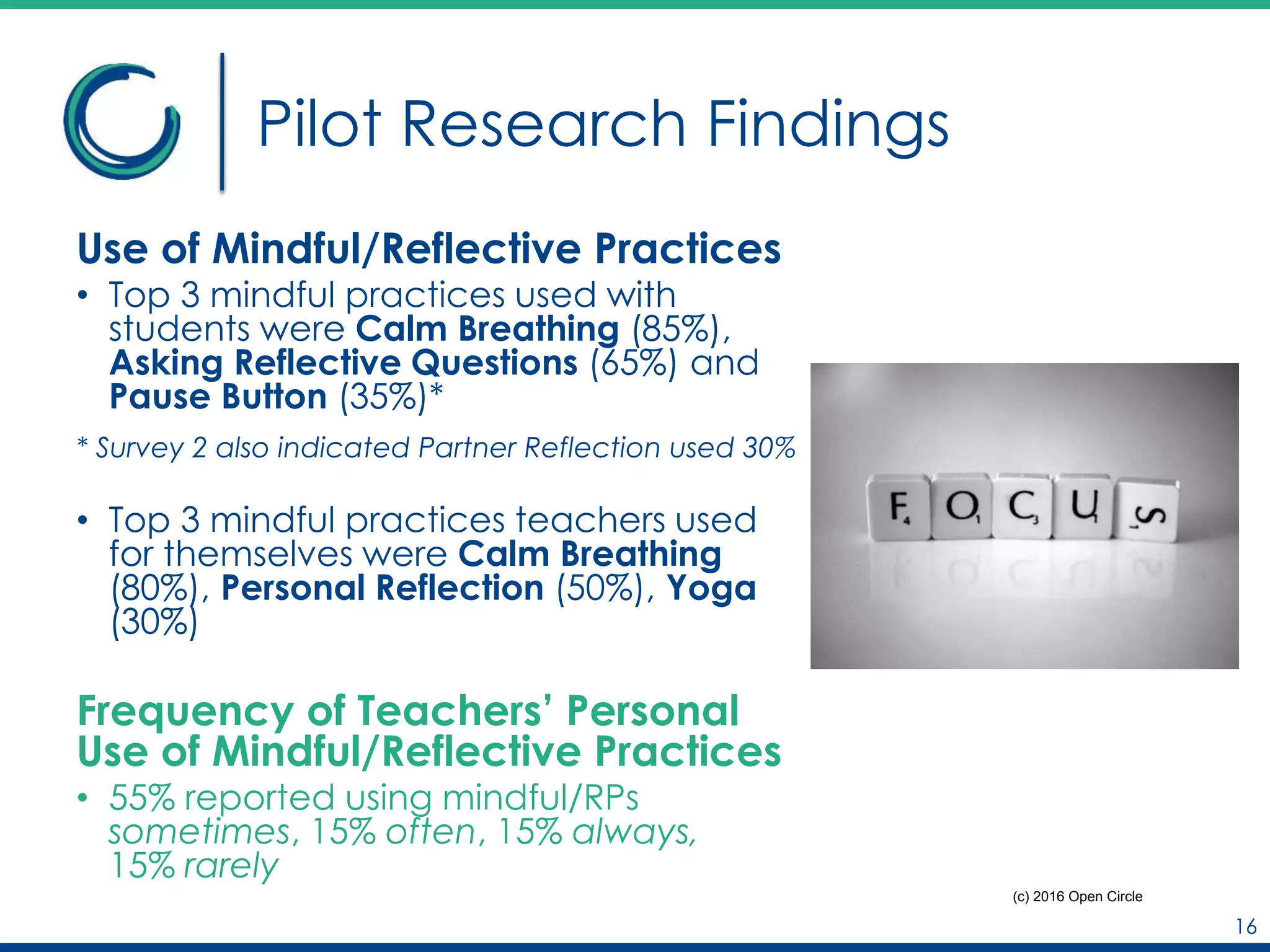
Pilot Research Findings
Use of Mindful/Reflective Practices
• Top 3 mindful practices used with
students were Calm Breathing (85%),
Asking Reflective Questions (65%) and
Pause Button (35%)*
* Survey 2 also indicated Partner Reflection used 30%
• Top 3 mindful practices teachers used
for themselves were Calm Breathing
(80%), Personal Reflection (50%), Yoga
(30%)
Frequency of Teachers’ Personal
Use of Mindful/Reflective Practices
• 55% reported using mindful/RPs
sometimes, 15% often, 15% always,
15% rarely
16
(c) 2016 Open Circle
Qualitative Feedback
Teachers’ Reflections on Students
• Students are calmer and can process better; appear more
focused
• Students love it when we say we are going to practice a
mindful activity
• They notice their surroundings more
• Enhances student concentration and moods; students
seem to get along better
• Some parents using strategies at home with family members
• Students are more reflective
• Students are able to calm themselves on their own
17
(c) 2016 Open Circle
Qualitative Feedback
Teachers’ Reflections on
Themselves
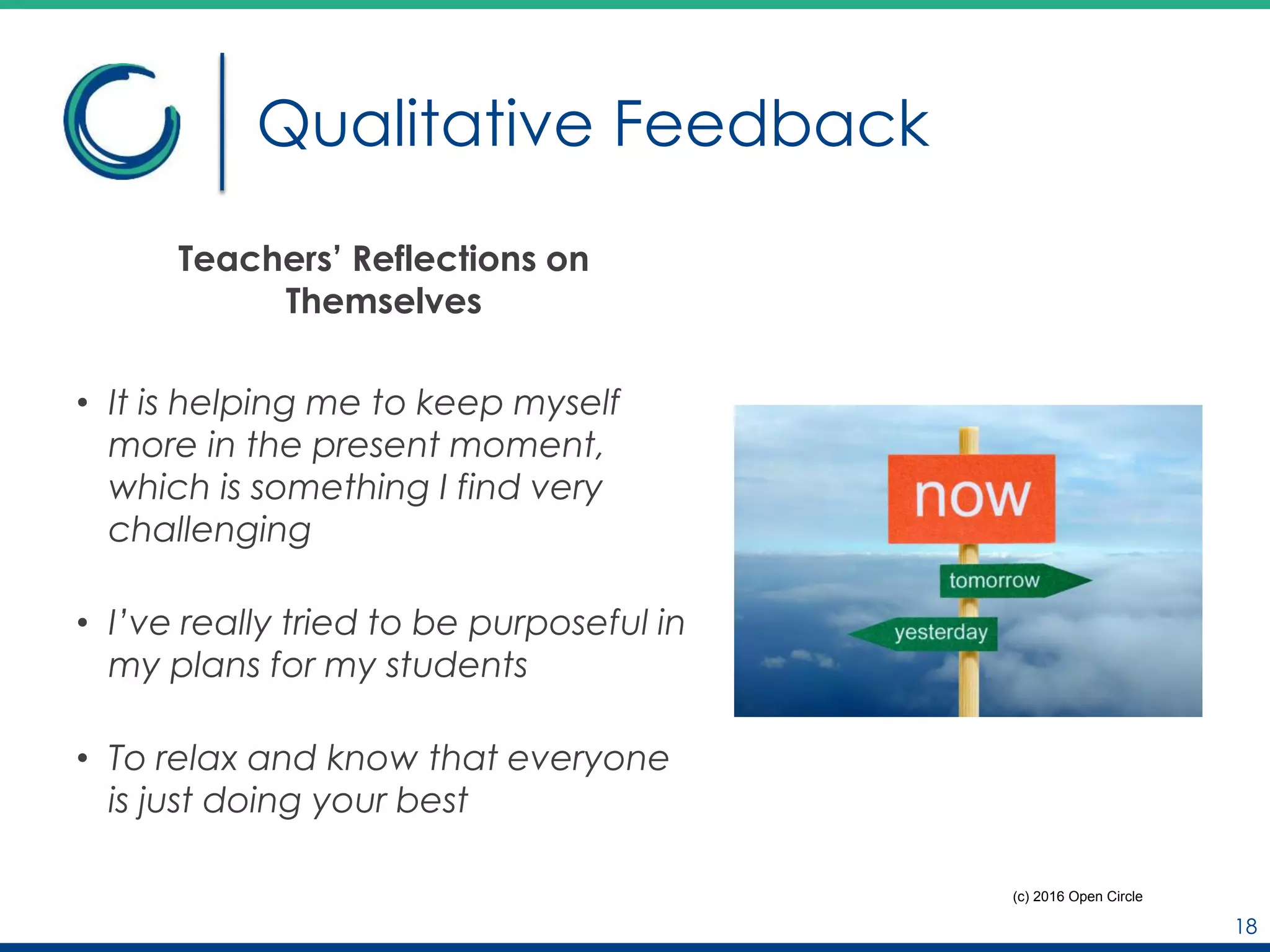
• It is helping me to keep myself
more in the present moment,
which is something I find very
challenging
• I’ve really tried to be purposeful in
my plans for my students
• To relax and know that everyone
is just doing your best
18
(c) 2016 Open Circle
Next Steps
• Integrate mindfulness pilot design into
standard Open Circle teacher training
design going forward
• Connecting mindfulness to new
gratitude pilot project
• Open Circle staff continuing to practice
mindfulness and sharing reflections on
their experiences
19
(c) 2016 Open Circle
Guiding Questions for Further
Research
• How aligned are theoretical frameworks of SEL and mindful
awareness/contemplative practice?
• Might greater alignment enhance the work in each field?
• What are the key components of approaches in each field
and how are they similar or different?
• What are common definitions or indicators of high quality
implementation?
• What are the standards for research?
• What do we know from research about the readiness of
programs for broad dissemination?
20
(c) 2016 Open Circle
21
(c) 2016 Open Circle
Thank You!
open-circle.org
info@open-circle.org
(781) 283-3277
22
(c) 2016 Open Circle

Mindfulness for students

  • 1.
    Integrating Mindfulness into Socialand Emotional Learning March 31, 2016 Jen Dirga, Nancy MacKay, Jim Strouse (c) 2016 Open Circle
  • 2.
    Acknowledgements K-5 Teachers andStudents Supported by a grant from the Harold Benenson Memorial Research Fund, Wellesley Center for Women 2 (c) 2016 Open Circle
  • 3.
    Mindfulness “Paying attention, on purposein the present moment, non-judgmentally” Jon Kabat-Zinn Mindfulness for Beginners, 2012 3 (c) 2016 Open Circle
  • 4.
    Activity: 3 Minute Breathing •Awareness (1 minute) • Gathering (1 minute) • Expanding (1 minute) Adapted from Segal, Williams and Teasdale, 2002 4 (c) 2016 Open Circle
  • 5.
    Background Educators • Self-awareness throughreflection • Self-management through calm breathing Students • Skills and practices taught through lessons • Self-awareness • Self-management • Social awareness • Relationship skills • Responsible decision making Open Circle Class Meeting structured to foster empathy and compassion 5 (c) 2016 Open Circle
  • 6.
    2012 Collaboration Weaving StrongConnections in Learning, Reflection and Mindfulness • Introduce reflective and mindfulness practices • Encourage sharing and leveraging these practices to enhance working conditions • Enhance capacity to implement SEL with students • Develop and pilot lessons and activities 6 (c) 2016 Open Circle
  • 7.
    Collaboration Results Significant increasesfor participating educators in the following areas: • Emotional Self-Awareness • Optimism • Inspirational Leadership Related to SEL • Influence (Communication and Advocacy) • Situation Analysis (Identify, Assess, Reframe) 7 (c) 2016 Open Circle
  • 8.
    2014-2015 Pilot Mindfulness TrainingCohort Integration of mindfulness practices and activities into Open Circle teacher training Piloted Practices & Activities Mindfulness practices and activities to pilot for themselves and with students 8 (c) 2016 Open Circle
  • 9.
    Mindfulness Practices in OpenCircle Training 3-Minute Breathing Space Body Scan Calm Breathing Chair Yoga Discoveries Worksheet Feelings Check-in Journal Writing Listening for Strengths Listening to the World Around You 9 Mindful Eating Partner Reflection Pause Button Problem-Solving Guided Imagery Reflective Questions Walking Meditation What Color are Your Feelings? (c) 2016 Open Circle
  • 10.
    Some Lessons Already AddressedMindfulness • Being Calm • Listening Skills • Recognizing and Naming Your Feelings • Body Language • Getting Calm When You Feel Upset • Positive Self-Talk 10 (c) 2016 Open Circle
  • 11.
    Infusing Mindfulness inthe Open Circle Curriculum Lessons: Enhanced with more mindfulness content Practices and Activities: An activities section dedicated to mindfulness Children’s Literature: A section highlighting specific children’s books with mindfulness themes Vocabulary: Reflection vocabulary was threaded throughout all lessons and at the end of each unit, as well as, with the community building activities 11 (c) 2016 Open Circle
  • 12.
    Enhanced Lessons – AnExample 12 (c) 2016 Open Circle
  • 13.
  • 14.
    Reflection & PartnerShare 14 Think about something you have worked on this week related to your job responsibilities (either by yourself or involving others) Reflect on that experience and ask yourself: 1. What went well? What influenced that? 2. What was challenging? Why? With a partner, briefly share your reflection. (c) 2016 Open Circle
  • 15.
    Mindfulness Training Cohort 15 October 2014- April 2015 • 27 teacher cohort participated in Open Circle training with mindfulness introduced as a key focus areas and threaded through all 4 days. • Teachers experienced a number of mindfulness practices and activities and were encouraged to introduce these activities with their students. • Teachers provided feedback through: – Paper evaluations at the end of training days on use of mindfulness practices for themselves and with their students – 3 surveys sent via SurveyMonkey to gather data on effective mindfulness practices used and reported outcomes (February, April, June 2015) (c) 2016 Open Circle
  • 16.
    Pilot Research Findings Useof Mindful/Reflective Practices • Top 3 mindful practices used with students were Calm Breathing (85%), Asking Reflective Questions (65%) and Pause Button (35%)* * Survey 2 also indicated Partner Reflection used 30% • Top 3 mindful practices teachers used for themselves were Calm Breathing (80%), Personal Reflection (50%), Yoga (30%) Frequency of Teachers’ Personal Use of Mindful/Reflective Practices • 55% reported using mindful/RPs sometimes, 15% often, 15% always, 15% rarely 16 (c) 2016 Open Circle
  • 17.
    Qualitative Feedback Teachers’ Reflectionson Students • Students are calmer and can process better; appear more focused • Students love it when we say we are going to practice a mindful activity • They notice their surroundings more • Enhances student concentration and moods; students seem to get along better • Some parents using strategies at home with family members • Students are more reflective • Students are able to calm themselves on their own 17 (c) 2016 Open Circle
  • 18.
    Qualitative Feedback Teachers’ Reflectionson Themselves • It is helping me to keep myself more in the present moment, which is something I find very challenging • I’ve really tried to be purposeful in my plans for my students • To relax and know that everyone is just doing your best 18 (c) 2016 Open Circle
  • 19.
    Next Steps • Integratemindfulness pilot design into standard Open Circle teacher training design going forward • Connecting mindfulness to new gratitude pilot project • Open Circle staff continuing to practice mindfulness and sharing reflections on their experiences 19 (c) 2016 Open Circle
  • 20.
    Guiding Questions forFurther Research • How aligned are theoretical frameworks of SEL and mindful awareness/contemplative practice? • Might greater alignment enhance the work in each field? • What are the key components of approaches in each field and how are they similar or different? • What are common definitions or indicators of high quality implementation? • What are the standards for research? • What do we know from research about the readiness of programs for broad dissemination? 20 (c) 2016 Open Circle
  • 21.
  • 22.