Faculty of tourismand hotel Helwan university
           Grade one :English tourism section
                   DR:Mona Raafat
          Research about :      Tutankhamun

 Names : [ Ahmed Emad _Karim Adel_Mohamed Ezz_Moustafa ]


Tutankhamun - The Boy King
                    Updated: 4 October 2008


                                 When Howard Carter and Lord
                                 Caernarfon opened up the Tomb
                                 of Tutankhamun, they opened up
                                 the beginnings of a mystery that is
                                 still not 100% resolved today. But
                                 scientists have at least identified
                                 the cause of the Curse of
                                 Tutankhamun's deaths. Bacteria
                                 growing on the bodies of the
                                 mummies, when touched, were
                                 extremely poisonous, and caused
                                 the deaths of recipients with
                                 pneumonia like symptoms. This
                                 bacteria, when heated, reactivated
                                 and began to multiply again after
                                 3000 odd years entombed. This
                                 bacteria was also coating the
                                 objects inside the tomb. The big
                                 question is - Did the Egyptians,
                                 who had a massive knowledge of
                                 plants that could heal and plants
  Death Mask of Pharaoh          that could kill, deliberately coat the
      Tutankhamun                artefacts, knowing it would activate
in the future? Hence the reason for
                                         the Curse Warnings. Or are these
                                         curse warnings lost in translation -
                                         are they really Biological Warning
                                         Notices? Well, stranger things
                                         happen!
In Poland a Kings grave was opened up by 14 scientists. It had been
sealed for 500 years. Inside they found a sword, sceptre and a
crown. These they handled without protective clothing, as well as
touching the mummy. Pope John, then Cardinal, resealed the
tomb. Soon 12 of the 14 scientists were dead. Stories of a curse
rebounded around Poland. The "truth" was exactly the same as in Egypt
- the same bacteria was found on the body of the dead King.
Tutankhamun's body had started decomposition BEFORE mummification.
During investigations into the finding of a complete mummy in Egypt,
scientists found exactly the same bacteria on the body, concentrated
around the ears. These scientists wore masks and gloves and nothing
happened to any of them! What this does not explain are the
"coincidences" surrounding the death of Lord Caernarfon in Cairo. At the
same time of his death, all the lights of Cairo went out. Not unusual you
may say - but consider this, Cairo is split into four electrical districts, N S
E and W. None of which are connected in any way, or where not at the
time. But all 4 districts were shorted out at exactly the same
instant! Also, back home in England, on Lord Caernarfon's estate, the
family dog, at precisely the same time, sat up, howled into the night air,
frothed at the mouth, and fell over completely dead! Bacteria or not, still
it makes you wonder..................

Tutankhamun lived over 3,300 years ago in 18 dynasy during the period
known as the New Kingdom. For two centuries, Egypt had ruled as a
world superpower, while its Royal family lived the opulent lifestyle. The
powerful priesthood of the god Amun had controlled vast temples and
estates. All that changed during the reign of Amenhotep IV when he
renounced the multitude of gods worshipped by the Egyptians and
abolished the priesthood of Amun. Amenhotep established a new order to
worship the sun god Aten and changed his own name to Akhenaten,
meaning "servant of the Aten." A new capital was established well to the
north of Thebes (modern Luxor) the home of the main temples of Amun.
His new city was named Akhetaten, meaning "Horizon of the Aten."
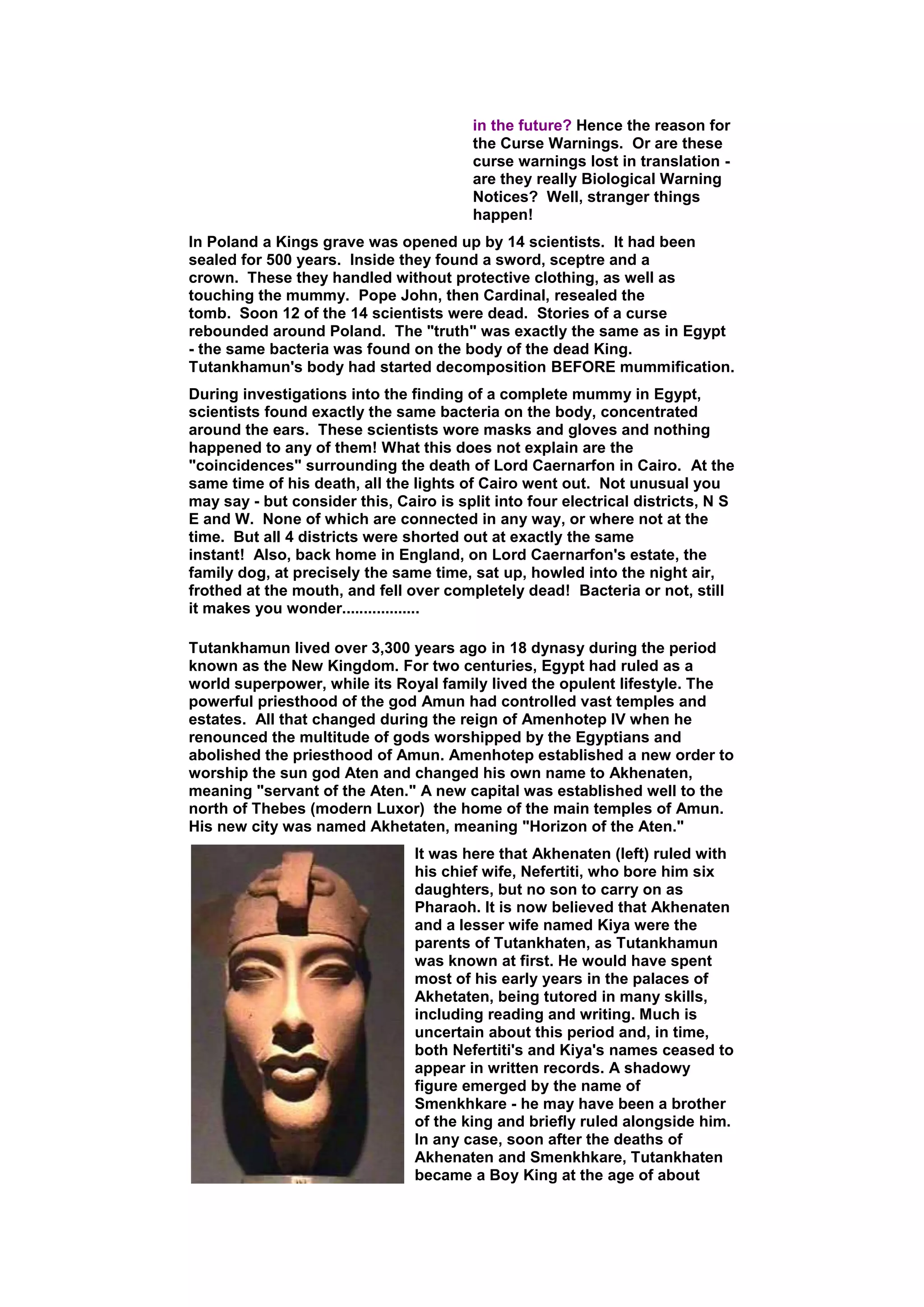
                                It was here that Akhenaten (left) ruled with
                                his chief wife, Nefertiti, who bore him six
                                daughters, but no son to carry on as
                                Pharaoh. It is now believed that Akhenaten
                                and a lesser wife named Kiya were the
                                parents of Tutankhaten, as Tutankhamun
                                was known at first. He would have spent
                                most of his early years in the palaces of
                                Akhetaten, being tutored in many skills,
                                including reading and writing. Much is
                                uncertain about this period and, in time,
                                both Nefertiti's and Kiya's names ceased to
                                appear in written records. A shadowy
                                figure emerged by the name of
                                Smenkhkare - he may have been a brother
                                of the king and briefly ruled alongside him.
                                In any case, soon after the deaths of
                                Akhenaten and Smenkhkare, Tutankhaten
                                became a Boy King at the age of about
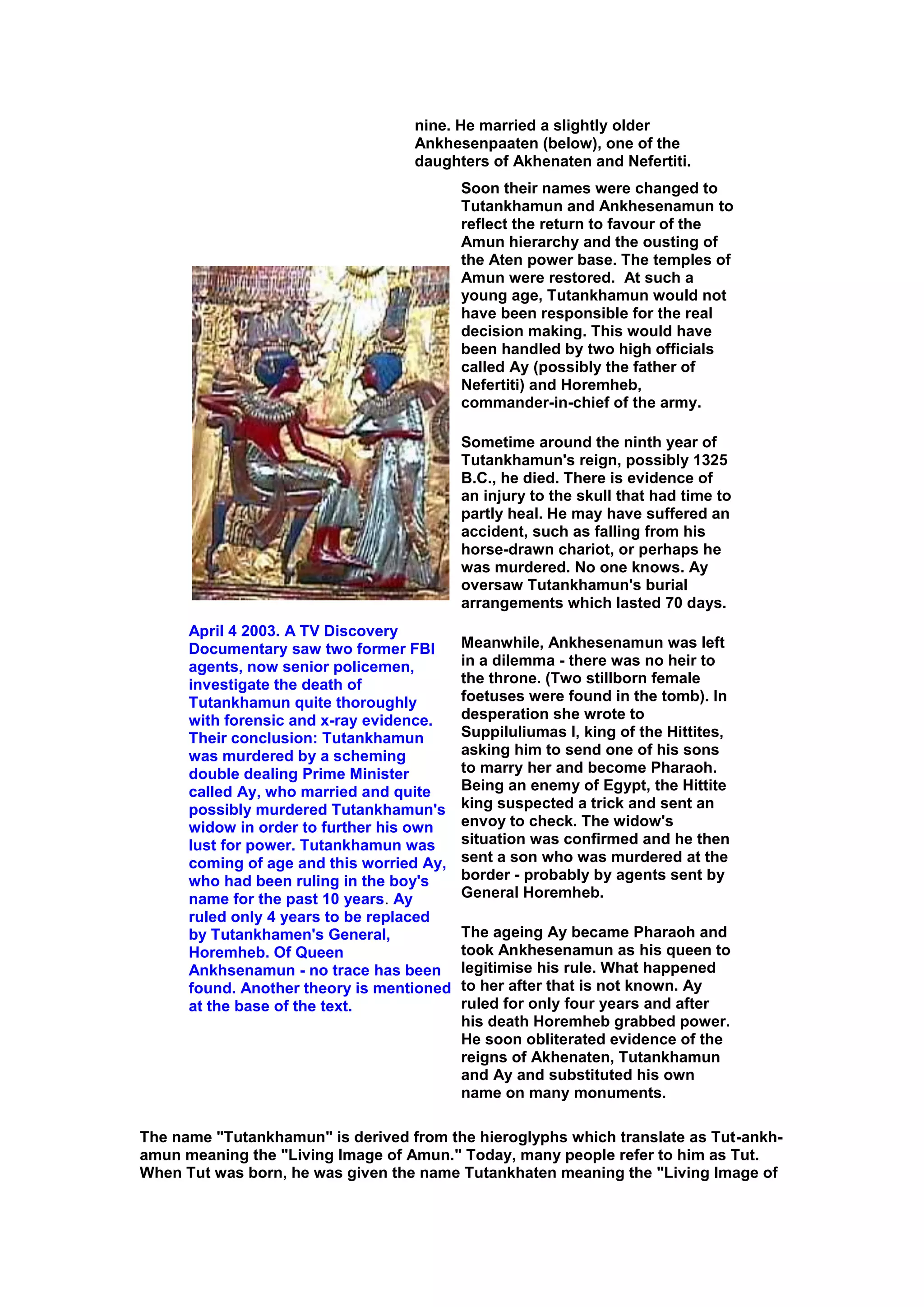
nine. He married a slightly older
                                   Ankhesenpaaten (below), one of the
                                   daughters of Akhenaten and Nefertiti.
                                           Soon their names were changed to
                                           Tutankhamun and Ankhesenamun to
                                           reflect the return to favour of the
                                           Amun hierarchy and the ousting of
                                           the Aten power base. The temples of
                                           Amun were restored. At such a
                                           young age, Tutankhamun would not
                                           have been responsible for the real
                                           decision making. This would have
                                           been handled by two high officials
                                           called Ay (possibly the father of
                                           Nefertiti) and Horemheb,
                                           commander-in-chief of the army.

                                           Sometime around the ninth year of
                                           Tutankhamun's reign, possibly 1325
                                           B.C., he died. There is evidence of
                                           an injury to the skull that had time to
                                           partly heal. He may have suffered an
                                           accident, such as falling from his
                                           horse-drawn chariot, or perhaps he
                                           was murdered. No one knows. Ay
                                           oversaw Tutankhamun's burial
                                           arrangements which lasted 70 days.
      April 4 2003. A TV Discovery
      Documentary saw two former FBI       Meanwhile, Ankhesenamun was left
      agents, now senior policemen,        in a dilemma - there was no heir to
      investigate the death of             the throne. (Two stillborn female
      Tutankhamun quite thoroughly         foetuses were found in the tomb). In
      with forensic and x-ray evidence.    desperation she wrote to
      Their conclusion: Tutankhamun        Suppiluliumas I, king of the Hittites,
      was murdered by a scheming           asking him to send one of his sons
      double dealing Prime Minister        to marry her and become Pharaoh.
      called Ay, who married and quite     Being an enemy of Egypt, the Hittite
      possibly murdered Tutankhamun's      king suspected a trick and sent an
      widow in order to further his own    envoy to check. The widow's
      lust for power. Tutankhamun was      situation was confirmed and he then
      coming of age and this worried Ay,   sent a son who was murdered at the
      who had been ruling in the boy's     border - probably by agents sent by
      name for the past 10 years. Ay       General Horemheb.
      ruled only 4 years to be replaced
      by Tutankhamen's General,            The ageing Ay became Pharaoh and
      Horemheb. Of Queen                   took Ankhesenamun as his queen to
      Ankhsenamun - no trace has been      legitimise his rule. What happened
      found. Another theory is mentioned   to her after that is not known. Ay
      at the base of the text.             ruled for only four years and after
                                           his death Horemheb grabbed power.
                                           He soon obliterated evidence of the
                                           reigns of Akhenaten, Tutankhamun
                                           and Ay and substituted his own
                                           name on many monuments.

The name "Tutankhamun" is derived from the hieroglyphs which translate as Tut-ankh-
amun meaning the "Living Image of Amun." Today, many people refer to him as Tut.
When Tut was born, he was given the name Tutankhaten meaning the "Living Image of
the Aten" the Aten was the single god worshipped during the rule Akhenaten, the
heretic king who is believed to have been the father of Tutankhamun. Not long after
Tutankhaten became Pharaoh, there was a restoration of the previously deposed state
god Amun and Tut's name was changed to Tutankhamun. These days, Tut's name is
found with differing spellings, including Tutankhamun, Tutankhamen and
Tutankhamon. In reality, we cannot be sure how the ancient Egyptians pronounced the
name as they did not write vowels. (Some hieroglyphs are transliterated as vowels,
since they are weak consonants). Egyptologists add vowels to assist in
communicating information.

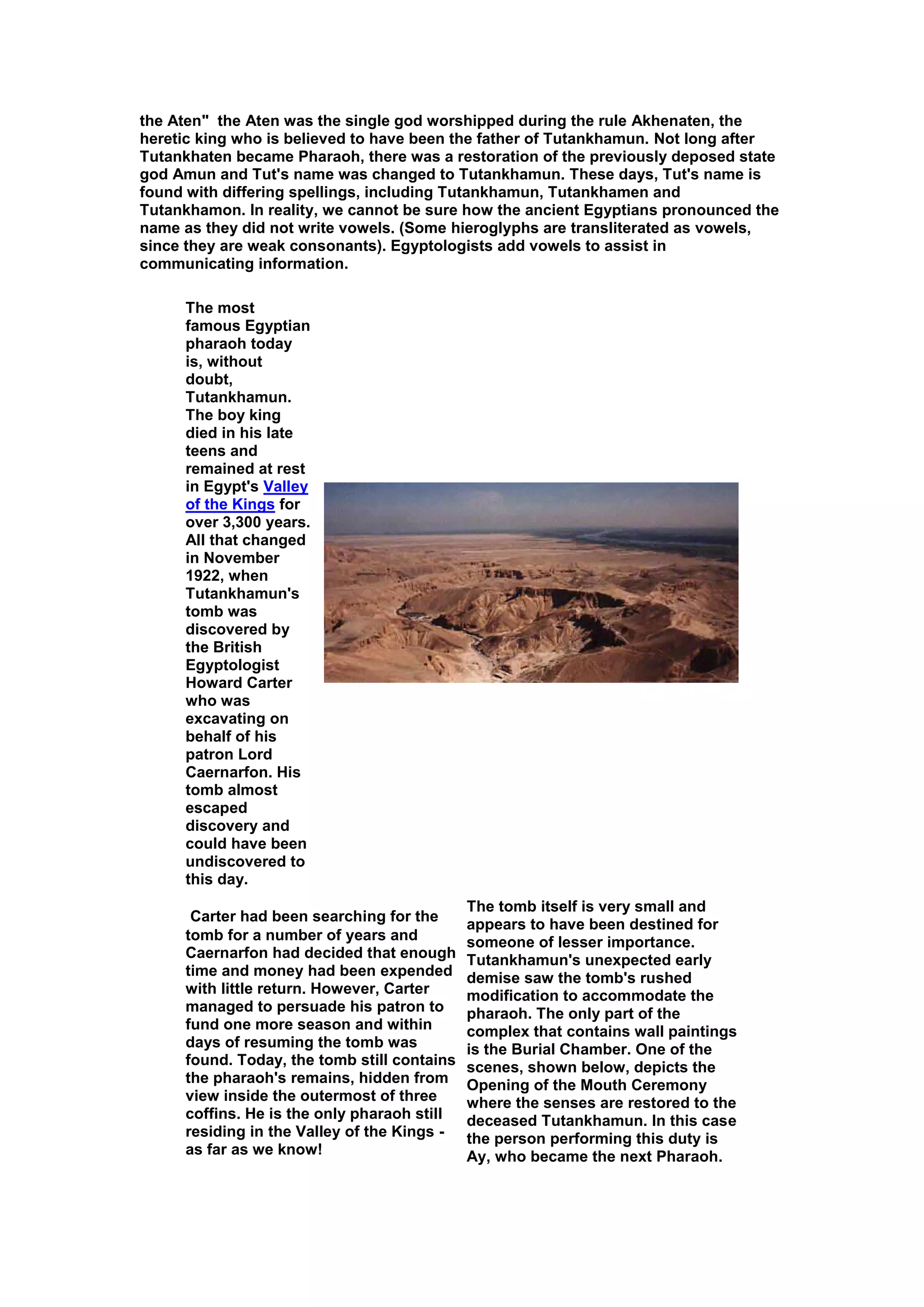
     The most
     famous Egyptian
     pharaoh today
     is, without
     doubt,
     Tutankhamun.
     The boy king
     died in his late
     teens and
     remained at rest
     in Egypt's Valley
     of the Kings for
     over 3,300 years.
     All that changed
     in November
     1922, when
     Tutankhamun's
     tomb was
     discovered by
     the British
     Egyptologist
     Howard Carter
     who was
     excavating on
     behalf of his
     patron Lord
     Caernarfon. His
     tomb almost
     escaped
     discovery and
     could have been
     undiscovered to
     this day.
                                             The tomb itself is very small and
      Carter had been searching for the
                                             appears to have been destined for
     tomb for a number of years and          someone of lesser importance.
     Caernarfon had decided that enough      Tutankhamun's unexpected early
     time and money had been expended        demise saw the tomb's rushed
     with little return. However, Carter     modification to accommodate the
     managed to persuade his patron to       pharaoh. The only part of the
     fund one more season and within         complex that contains wall paintings
     days of resuming the tomb was           is the Burial Chamber. One of the
     found. Today, the tomb still contains   scenes, shown below, depicts the
     the pharaoh's remains, hidden from      Opening of the Mouth Ceremony
     view inside the outermost of three      where the senses are restored to the
     coffins. He is the only pharaoh still   deceased Tutankhamun. In this case
     residing in the Valley of the Kings -   the person performing this duty is
     as far as we know!                      Ay, who became the next Pharaoh.
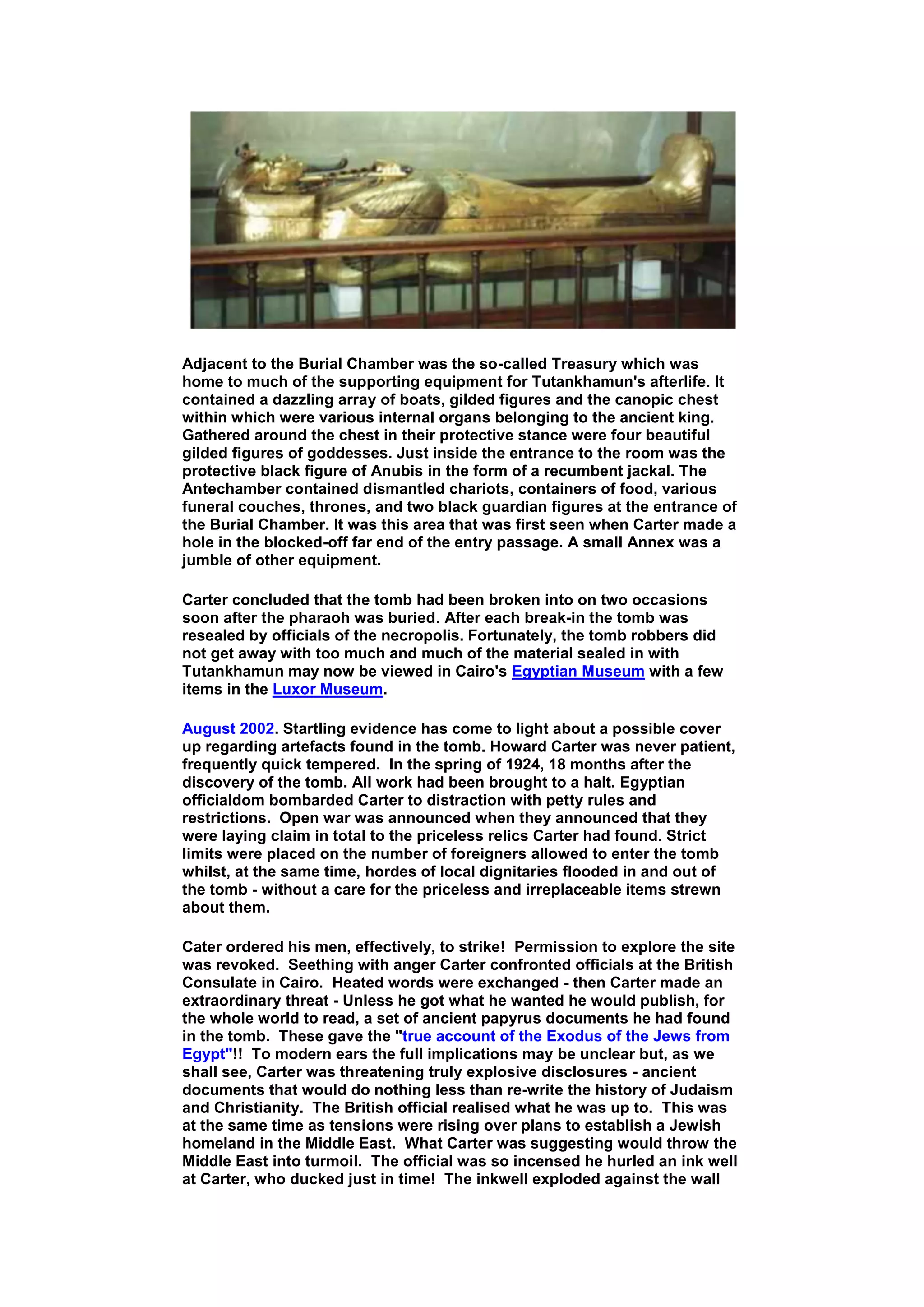
It contained four gilded shrines nested one inside the other. The innermost of these
covered a stone sarcophagus. Inside that were three coffins - the innermost being
made of 110 kilograms of solid gold. Inside that lay the pharaoh himself wearing the
famous gold mask.
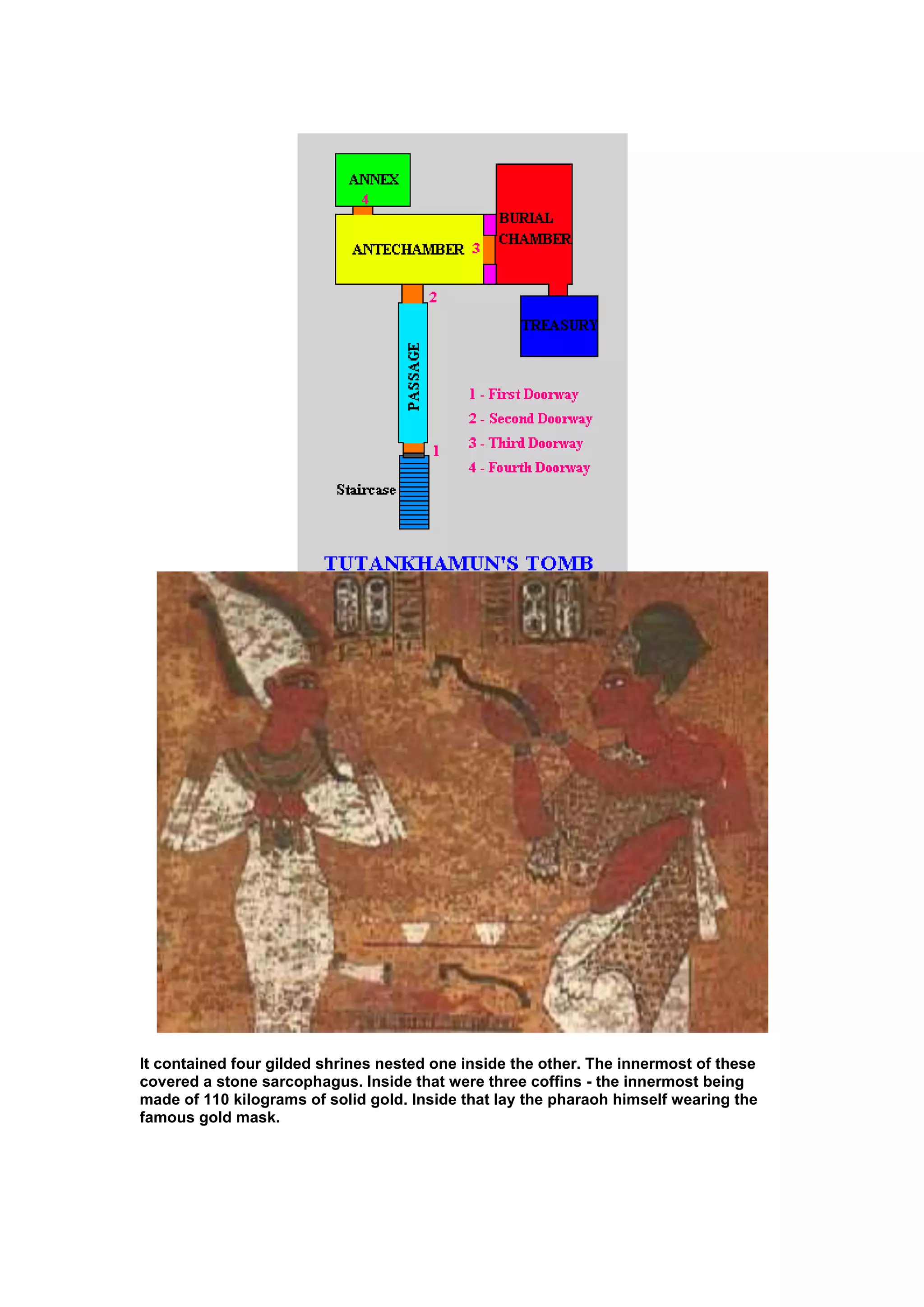
Adjacent to the Burial Chamber was the so-called Treasury which was
home to much of the supporting equipment for Tutankhamun's afterlife. It
contained a dazzling array of boats, gilded figures and the canopic chest
within which were various internal organs belonging to the ancient king.
Gathered around the chest in their protective stance were four beautiful
gilded figures of goddesses. Just inside the entrance to the room was the
protective black figure of Anubis in the form of a recumbent jackal. The
Antechamber contained dismantled chariots, containers of food, various
funeral couches, thrones, and two black guardian figures at the entrance of
the Burial Chamber. It was this area that was first seen when Carter made a
hole in the blocked-off far end of the entry passage. A small Annex was a
jumble of other equipment.

Carter concluded that the tomb had been broken into on two occasions
soon after the pharaoh was buried. After each break-in the tomb was
resealed by officials of the necropolis. Fortunately, the tomb robbers did
not get away with too much and much of the material sealed in with
Tutankhamun may now be viewed in Cairo's Egyptian Museum with a few
items in the Luxor Museum.

August 2002. Startling evidence has come to light about a possible cover
up regarding artefacts found in the tomb. Howard Carter was never patient,
frequently quick tempered. In the spring of 1924, 18 months after the
discovery of the tomb. All work had been brought to a halt. Egyptian
officialdom bombarded Carter to distraction with petty rules and
restrictions. Open war was announced when they announced that they
were laying claim in total to the priceless relics Carter had found. Strict
limits were placed on the number of foreigners allowed to enter the tomb
whilst, at the same time, hordes of local dignitaries flooded in and out of
the tomb - without a care for the priceless and irreplaceable items strewn
about them.

Cater ordered his men, effectively, to strike! Permission to explore the site
was revoked. Seething with anger Carter confronted officials at the British
Consulate in Cairo. Heated words were exchanged - then Carter made an
extraordinary threat - Unless he got what he wanted he would publish, for
the whole world to read, a set of ancient papyrus documents he had found
in the tomb. These gave the "true account of the Exodus of the Jews from
Egypt"!! To modern ears the full implications may be unclear but, as we
shall see, Carter was threatening truly explosive disclosures - ancient
documents that would do nothing less than re-write the history of Judaism
and Christianity. The British official realised what he was up to. This was
at the same time as tensions were rising over plans to establish a Jewish
homeland in the Middle East. What Carter was suggesting would throw the
Middle East into turmoil. The official was so incensed he hurled an ink well
at Carter, who ducked just in time! The inkwell exploded against the wall
so much so that the room had to be redecorated!

Carter suddenly found that he had vigorous support from the British in his
fight to regain control. He was soon placed back in charge and continued
his work for another 7 years. In return for this he never mentioned the
documents again. History deemed that Carter's threat was an idle one - but
it was no invention, and the secrets he may have stumbled upon
completely overturn key elements of the Bible. The implications are
enormous - forcing us to ask whether the person we call Moses was in fact
a renegade Egyptian priest and whether Christianity has its roots begun by
a religious revolution begun by a heretical pharaoh.

The contents of these papyrus documents are so contentious that if they
had been made public, may well have changed the course of the 20th
Century completely. The missing papyri have been the subject of
speculation ever since his tomb was opened. Lord Caernarfon mentioned
their discovery in 2 letters to friends. A report in The Times also mentioned
their existence. The author was extremely close to Carter having exclusive
rights to the story unfolding. Carter cabled a distinguished philologist, Sir
Alan Gardiner, asking for his help in translating the contents. He
expressed "particular interest" in the papyri and suggested that they may
throw some light on religion in the times of the boy king.

It is odd that, later, the official story changed and everyone began insisting
that these documents never existed!! Carter alleged that the find was in
fact "loin cloths" - the boy kings "underwear"!! And that poor light made
for the misunderstanding. Amusing it may be but can we believe it? Too
many people saw these documents for themselves before they
"disappeared". And an astounding "blunder" for someone of Carter's
standing. Lord Caernarfon himself states that, on their first entry into the
room, it was fully illuminated by electric light. Someone is clearly lying
through their teeth?

Looking a little closer at this discovery, the official version has Carter
uncovering a secret sunken staircase in the Valley of the Kings. Then
penetrating a doorway sealed with the jackal emblem of Egyptian royalty,
then clearing a rubble strewn corridor leading to another doorway. Making
a small hole, he peers through this doorway to reveal strange animals,
statues and gold, everywhere the glint of gold. With him were Lord
Caernarfon and his daughter Lady Evelyn. They both take their turn to look
and that is all they did. Requiring permission to remove the door and enter,
then reseal the hole, the next day, November 27th 1922, to open in front of
onlooking officials. This sounds all very right and correct but it is not what
happened!

Curiosity got the better of Carter and his associates - they entered the ante
room on first discovery and THEN resealed the hole. To play act the
"official opening" the next day. There is also undisputable evidence that
this party breached the doorway of another ante room the same day and
entered the Kings burial chamber. This was 3 months before the "official
opening" of the burial chamber. He concealed the hole that he had made by
erecting a wooden platform over the floor level hole he had crawled
through. Who revealed all this? The Lady Evelyn to another member of her
family. This was then recorded in his diary and gave a description of how
Carter, in front of dignitaries, was "nervous, poor old fellow, like a naughty
schoolboy, fearing that his hole would be discovered". He also had a copy
made of the royal seal which covered the door, to replace the one removed
upon his illicit entry.

He passed off the fake as the work of grave robbers, repairs done by the
ancient Egyptians themselves. Such evidence alone should make us
wonder if Carter and Carnarfon pocketed a sizable amount themselves
before resealing the doorway. This apparently DID happen. Treasures later
revealed in their personal collections leave us in no doubt. The tomb WAS
robbed, but very soon after sealing it up. Tutankhamun's Finance Minister
had it repaired and he personally destroyed all records of the tomb's
whereabouts which quite probably accounts for its undisturbed state for so
long. I wonder if the priests of Amun had anything to do with the robbery?
Outside the Palace, they were the richest people in the land.

So what did the missing papyrus contain that made them so dangerous if
revealed? Their apparent subject matter, The Exodus, is one of the most
important stories of the bible. According to the bible, the Hebrews arrived
in Egypt from Canaan. Their leader in Egypt was Joseph who had been sold
into slavery by his brothers, only to become a power in the court due to his
ability to interpret dreams. However, the Jews multiplied so swiftly the
Egyptians saw them as a threat and forced them into slavery. All male
children were ordered to be slain in order to keep their population down but
one child escaped. His name was Moses, brought up as an Egyptian and
became a mighty general in the Pharaoh's army before fleeing after
murdering an Egyptian who had beaten up a Jew.

For 40 years he lived in the wilderness where "god" appeared to him as a
burning bush, charging him to lead the people out of Egypt "unto a land
flowing with milk and honey". Moses demanded the release of his people
on his return to Egypt and when this was refused, devastating plagues
were brought down on the country until the Pharaoh relented, allowing
them to leave. Thus - The Exodus. This is how it happened according to the
bible. By the time that Carter threatened to reveal the documents, orthodox
thinking was already beginning to question this version. Arthur Weigall, a
leading Egyptologist, was an expert on Tuktankhamun's half brother and
predecessor Akhenaten. He was one of those who questioned the biblical
"Exodus".

Akhenaten was the husband of the beautiful Queen Nefertiti. He was
famous for having broken away from the traditional multi-god society that
had been practised for about 2000 years and installed a single God - the
"Aten" an all powerful force symbolised by the heat of the suns rays. This
lasted only about 12 years before Tutankhamun gained the throne and the
old order was gradually restored. Arthur Weigall uncovered remarkable
similarities between Psalm 104 and an "ode" to Ra, composed by
Akhenaten himself. In his opinion, Psalm 104 was a copy of the ode itself.
Indeed, the ode was written before Moses allegedly wrote Psalm 104. He
also argued that it was during the reign of Tutankhamun that the Exodus
actually took place. 20 years later Sigmund Freud would express the same
theory in two major papers. Evidence to back this also comes from the
hebrew word for Lord - Adonai or Adon, becomes Aten, the name of the
sun, when written in Egyptian. These were set out by Arthur Weigall in a
book published a few months before Carter's declaration before the
Consulate. Carter did read it, but the men were such bitter rivals that
Carter may have paid no heed to these theories. But Carter was convinced
that the exodus took place BEFORE the closure of the boy kings tomb,
otherwise how could he claim that the documents revealed the true story of
the Exodus. Weigall's theory also fits the likely facts about the collapse of
Akhenaten's religious revolution. It is known that these priests and
converts did not simply disappear when the boy king took the throne, they
became social lepers and outcasts. This is relevant in that a story not
unlike The Exodus, the ancient Egyptian Manetho, writing about 250BC,
recorded how one pharaoh had expelled "lepers" and "impure people" from
Egypt. These so called lepers included some of the learned priests; one of
whom, Osarsiph, ordered the people not to follow the Egyptian gods and to
follow their own laws instead.

Later, according to Manetho, Osarsiph changed his name - to
Moses. Rather than being anti semetic, Manetho was referring to these
"lepers" as being - in the eyes of the opponent - holding with heretical
beliefs. Other writers describe a king, in order to placate his people,
expelling the "unclean" by being forced out of Egypt - led by an Egyptian!
Evidence shows that, during the reign of Tutankhamun, northern Egypt was
in the grip of a plague. It decimated the population and lasted about 20 - 30
years. It is quite plausible to see stories about the killing of Egypt's
firstborn on the night of the Passover as having its roots in this plague.
The people would naturally look for someone to blame, their former King
being particularly handy. To cleanse the land of his pollution they swept
the land of undesirables, along with any other suspicious looking
foreigners and settlers. Having received a warning, these people would
have took it upon themselves to leave forthwith.

If this was the story as told in Carter's papyrus, it would have been easy to
throw the Middle East into turmoil. In the 20s, the local politics were as
tangled as they are today - with the rights of a Jewish homeland at the
middle of the turmoil. Arab opinion was outraged, with riots in Jerusalem
and Jaffa. The whole area was rife for bloody battle and a tinderbox. In
these circumstances, Carter's threat to reveal the truth could hardly have
been more inflammatory. The whole basis of the Zionist claim rested upon
the story of the Exodus and opponents of the Zionist state would have
jumped upon this and seized any hint that it was flawed. After all, if Moses
and his followers were renegade Egyptians, together with this selection of
outcast foreigners - what special claim could they possibly have to a
"homeland" - Israel. Carter was in a position to cause the Zionists serious,
possibly irrevocable, harm. No wonder the British wholeheartedly threw
themselves behind Carter's claims to be reinstated at the site. What
happened to the papyri? Did Carter destroy them or leave them hidden
deep in some Cairo Museum? Are they lying in a draw, hidden beneath
some relatively insignificant papyri? By the evidence of Lord Caernarfon's
own letters, it is clearly apparent that he was privy to the existence of the
papyri, was he also aware of their contents. Some have blamed his
untimely death on the Curse - but the truth may be even stranger? Now, in
2007, we have a glut of so called "conspiracy theories" on everything from
Adam & Eve to the source of the bullet that killed X, Y or Z. I am not one of
these people who delight in so called conspiracy theories, I just think that
what we are told is not always the truth. Tutankhamun was killed, yes,
posssibly by Ay. But an equally practical theory places Tutankhamun's
death as the result of a chariot accident. We will never really KNOW, will
we? Items are found in tombs that could throw modern beliefs into turmoil
so are hidden away, either by Archaeologists who do not want their own
beliefs questioned or by religious people who do not want the "good life" to
be terminated.
M

M

  • 1.
    Faculty of tourismandhotel Helwan university Grade one :English tourism section DR:Mona Raafat Research about : Tutankhamun Names : [ Ahmed Emad _Karim Adel_Mohamed Ezz_Moustafa ] Tutankhamun - The Boy King Updated: 4 October 2008 When Howard Carter and Lord Caernarfon opened up the Tomb of Tutankhamun, they opened up the beginnings of a mystery that is still not 100% resolved today. But scientists have at least identified the cause of the Curse of Tutankhamun's deaths. Bacteria growing on the bodies of the mummies, when touched, were extremely poisonous, and caused the deaths of recipients with pneumonia like symptoms. This bacteria, when heated, reactivated and began to multiply again after 3000 odd years entombed. This bacteria was also coating the objects inside the tomb. The big question is - Did the Egyptians, who had a massive knowledge of plants that could heal and plants Death Mask of Pharaoh that could kill, deliberately coat the Tutankhamun artefacts, knowing it would activate
  • 2.
    in the future?Hence the reason for the Curse Warnings. Or are these curse warnings lost in translation - are they really Biological Warning Notices? Well, stranger things happen! In Poland a Kings grave was opened up by 14 scientists. It had been sealed for 500 years. Inside they found a sword, sceptre and a crown. These they handled without protective clothing, as well as touching the mummy. Pope John, then Cardinal, resealed the tomb. Soon 12 of the 14 scientists were dead. Stories of a curse rebounded around Poland. The "truth" was exactly the same as in Egypt - the same bacteria was found on the body of the dead King. Tutankhamun's body had started decomposition BEFORE mummification. During investigations into the finding of a complete mummy in Egypt, scientists found exactly the same bacteria on the body, concentrated around the ears. These scientists wore masks and gloves and nothing happened to any of them! What this does not explain are the "coincidences" surrounding the death of Lord Caernarfon in Cairo. At the same time of his death, all the lights of Cairo went out. Not unusual you may say - but consider this, Cairo is split into four electrical districts, N S E and W. None of which are connected in any way, or where not at the time. But all 4 districts were shorted out at exactly the same instant! Also, back home in England, on Lord Caernarfon's estate, the family dog, at precisely the same time, sat up, howled into the night air, frothed at the mouth, and fell over completely dead! Bacteria or not, still it makes you wonder.................. Tutankhamun lived over 3,300 years ago in 18 dynasy during the period known as the New Kingdom. For two centuries, Egypt had ruled as a world superpower, while its Royal family lived the opulent lifestyle. The powerful priesthood of the god Amun had controlled vast temples and estates. All that changed during the reign of Amenhotep IV when he renounced the multitude of gods worshipped by the Egyptians and abolished the priesthood of Amun. Amenhotep established a new order to worship the sun god Aten and changed his own name to Akhenaten, meaning "servant of the Aten." A new capital was established well to the north of Thebes (modern Luxor) the home of the main temples of Amun. His new city was named Akhetaten, meaning "Horizon of the Aten." It was here that Akhenaten (left) ruled with his chief wife, Nefertiti, who bore him six daughters, but no son to carry on as Pharaoh. It is now believed that Akhenaten and a lesser wife named Kiya were the parents of Tutankhaten, as Tutankhamun was known at first. He would have spent most of his early years in the palaces of Akhetaten, being tutored in many skills, including reading and writing. Much is uncertain about this period and, in time, both Nefertiti's and Kiya's names ceased to appear in written records. A shadowy figure emerged by the name of Smenkhkare - he may have been a brother of the king and briefly ruled alongside him. In any case, soon after the deaths of Akhenaten and Smenkhkare, Tutankhaten became a Boy King at the age of about
  • 3.
    nine. He marrieda slightly older Ankhesenpaaten (below), one of the daughters of Akhenaten and Nefertiti. Soon their names were changed to Tutankhamun and Ankhesenamun to reflect the return to favour of the Amun hierarchy and the ousting of the Aten power base. The temples of Amun were restored. At such a young age, Tutankhamun would not have been responsible for the real decision making. This would have been handled by two high officials called Ay (possibly the father of Nefertiti) and Horemheb, commander-in-chief of the army. Sometime around the ninth year of Tutankhamun's reign, possibly 1325 B.C., he died. There is evidence of an injury to the skull that had time to partly heal. He may have suffered an accident, such as falling from his horse-drawn chariot, or perhaps he was murdered. No one knows. Ay oversaw Tutankhamun's burial arrangements which lasted 70 days. April 4 2003. A TV Discovery Documentary saw two former FBI Meanwhile, Ankhesenamun was left agents, now senior policemen, in a dilemma - there was no heir to investigate the death of the throne. (Two stillborn female Tutankhamun quite thoroughly foetuses were found in the tomb). In with forensic and x-ray evidence. desperation she wrote to Their conclusion: Tutankhamun Suppiluliumas I, king of the Hittites, was murdered by a scheming asking him to send one of his sons double dealing Prime Minister to marry her and become Pharaoh. called Ay, who married and quite Being an enemy of Egypt, the Hittite possibly murdered Tutankhamun's king suspected a trick and sent an widow in order to further his own envoy to check. The widow's lust for power. Tutankhamun was situation was confirmed and he then coming of age and this worried Ay, sent a son who was murdered at the who had been ruling in the boy's border - probably by agents sent by name for the past 10 years. Ay General Horemheb. ruled only 4 years to be replaced by Tutankhamen's General, The ageing Ay became Pharaoh and Horemheb. Of Queen took Ankhesenamun as his queen to Ankhsenamun - no trace has been legitimise his rule. What happened found. Another theory is mentioned to her after that is not known. Ay at the base of the text. ruled for only four years and after his death Horemheb grabbed power. He soon obliterated evidence of the reigns of Akhenaten, Tutankhamun and Ay and substituted his own name on many monuments. The name "Tutankhamun" is derived from the hieroglyphs which translate as Tut-ankh- amun meaning the "Living Image of Amun." Today, many people refer to him as Tut. When Tut was born, he was given the name Tutankhaten meaning the "Living Image of
  • 4.
    the Aten" theAten was the single god worshipped during the rule Akhenaten, the heretic king who is believed to have been the father of Tutankhamun. Not long after Tutankhaten became Pharaoh, there was a restoration of the previously deposed state god Amun and Tut's name was changed to Tutankhamun. These days, Tut's name is found with differing spellings, including Tutankhamun, Tutankhamen and Tutankhamon. In reality, we cannot be sure how the ancient Egyptians pronounced the name as they did not write vowels. (Some hieroglyphs are transliterated as vowels, since they are weak consonants). Egyptologists add vowels to assist in communicating information. The most famous Egyptian pharaoh today is, without doubt, Tutankhamun. The boy king died in his late teens and remained at rest in Egypt's Valley of the Kings for over 3,300 years. All that changed in November 1922, when Tutankhamun's tomb was discovered by the British Egyptologist Howard Carter who was excavating on behalf of his patron Lord Caernarfon. His tomb almost escaped discovery and could have been undiscovered to this day. The tomb itself is very small and Carter had been searching for the appears to have been destined for tomb for a number of years and someone of lesser importance. Caernarfon had decided that enough Tutankhamun's unexpected early time and money had been expended demise saw the tomb's rushed with little return. However, Carter modification to accommodate the managed to persuade his patron to pharaoh. The only part of the fund one more season and within complex that contains wall paintings days of resuming the tomb was is the Burial Chamber. One of the found. Today, the tomb still contains scenes, shown below, depicts the the pharaoh's remains, hidden from Opening of the Mouth Ceremony view inside the outermost of three where the senses are restored to the coffins. He is the only pharaoh still deceased Tutankhamun. In this case residing in the Valley of the Kings - the person performing this duty is as far as we know! Ay, who became the next Pharaoh.
  • 5.
    It contained fourgilded shrines nested one inside the other. The innermost of these covered a stone sarcophagus. Inside that were three coffins - the innermost being made of 110 kilograms of solid gold. Inside that lay the pharaoh himself wearing the famous gold mask.
  • 6.
    Adjacent to theBurial Chamber was the so-called Treasury which was home to much of the supporting equipment for Tutankhamun's afterlife. It contained a dazzling array of boats, gilded figures and the canopic chest within which were various internal organs belonging to the ancient king. Gathered around the chest in their protective stance were four beautiful gilded figures of goddesses. Just inside the entrance to the room was the protective black figure of Anubis in the form of a recumbent jackal. The Antechamber contained dismantled chariots, containers of food, various funeral couches, thrones, and two black guardian figures at the entrance of the Burial Chamber. It was this area that was first seen when Carter made a hole in the blocked-off far end of the entry passage. A small Annex was a jumble of other equipment. Carter concluded that the tomb had been broken into on two occasions soon after the pharaoh was buried. After each break-in the tomb was resealed by officials of the necropolis. Fortunately, the tomb robbers did not get away with too much and much of the material sealed in with Tutankhamun may now be viewed in Cairo's Egyptian Museum with a few items in the Luxor Museum. August 2002. Startling evidence has come to light about a possible cover up regarding artefacts found in the tomb. Howard Carter was never patient, frequently quick tempered. In the spring of 1924, 18 months after the discovery of the tomb. All work had been brought to a halt. Egyptian officialdom bombarded Carter to distraction with petty rules and restrictions. Open war was announced when they announced that they were laying claim in total to the priceless relics Carter had found. Strict limits were placed on the number of foreigners allowed to enter the tomb whilst, at the same time, hordes of local dignitaries flooded in and out of the tomb - without a care for the priceless and irreplaceable items strewn about them. Cater ordered his men, effectively, to strike! Permission to explore the site was revoked. Seething with anger Carter confronted officials at the British Consulate in Cairo. Heated words were exchanged - then Carter made an extraordinary threat - Unless he got what he wanted he would publish, for the whole world to read, a set of ancient papyrus documents he had found in the tomb. These gave the "true account of the Exodus of the Jews from Egypt"!! To modern ears the full implications may be unclear but, as we shall see, Carter was threatening truly explosive disclosures - ancient documents that would do nothing less than re-write the history of Judaism and Christianity. The British official realised what he was up to. This was at the same time as tensions were rising over plans to establish a Jewish homeland in the Middle East. What Carter was suggesting would throw the Middle East into turmoil. The official was so incensed he hurled an ink well at Carter, who ducked just in time! The inkwell exploded against the wall
  • 7.
    so much sothat the room had to be redecorated! Carter suddenly found that he had vigorous support from the British in his fight to regain control. He was soon placed back in charge and continued his work for another 7 years. In return for this he never mentioned the documents again. History deemed that Carter's threat was an idle one - but it was no invention, and the secrets he may have stumbled upon completely overturn key elements of the Bible. The implications are enormous - forcing us to ask whether the person we call Moses was in fact a renegade Egyptian priest and whether Christianity has its roots begun by a religious revolution begun by a heretical pharaoh. The contents of these papyrus documents are so contentious that if they had been made public, may well have changed the course of the 20th Century completely. The missing papyri have been the subject of speculation ever since his tomb was opened. Lord Caernarfon mentioned their discovery in 2 letters to friends. A report in The Times also mentioned their existence. The author was extremely close to Carter having exclusive rights to the story unfolding. Carter cabled a distinguished philologist, Sir Alan Gardiner, asking for his help in translating the contents. He expressed "particular interest" in the papyri and suggested that they may throw some light on religion in the times of the boy king. It is odd that, later, the official story changed and everyone began insisting that these documents never existed!! Carter alleged that the find was in fact "loin cloths" - the boy kings "underwear"!! And that poor light made for the misunderstanding. Amusing it may be but can we believe it? Too many people saw these documents for themselves before they "disappeared". And an astounding "blunder" for someone of Carter's standing. Lord Caernarfon himself states that, on their first entry into the room, it was fully illuminated by electric light. Someone is clearly lying through their teeth? Looking a little closer at this discovery, the official version has Carter uncovering a secret sunken staircase in the Valley of the Kings. Then penetrating a doorway sealed with the jackal emblem of Egyptian royalty, then clearing a rubble strewn corridor leading to another doorway. Making a small hole, he peers through this doorway to reveal strange animals, statues and gold, everywhere the glint of gold. With him were Lord Caernarfon and his daughter Lady Evelyn. They both take their turn to look and that is all they did. Requiring permission to remove the door and enter, then reseal the hole, the next day, November 27th 1922, to open in front of onlooking officials. This sounds all very right and correct but it is not what happened! Curiosity got the better of Carter and his associates - they entered the ante room on first discovery and THEN resealed the hole. To play act the "official opening" the next day. There is also undisputable evidence that this party breached the doorway of another ante room the same day and entered the Kings burial chamber. This was 3 months before the "official opening" of the burial chamber. He concealed the hole that he had made by erecting a wooden platform over the floor level hole he had crawled through. Who revealed all this? The Lady Evelyn to another member of her family. This was then recorded in his diary and gave a description of how Carter, in front of dignitaries, was "nervous, poor old fellow, like a naughty schoolboy, fearing that his hole would be discovered". He also had a copy made of the royal seal which covered the door, to replace the one removed
  • 8.
    upon his illicitentry. He passed off the fake as the work of grave robbers, repairs done by the ancient Egyptians themselves. Such evidence alone should make us wonder if Carter and Carnarfon pocketed a sizable amount themselves before resealing the doorway. This apparently DID happen. Treasures later revealed in their personal collections leave us in no doubt. The tomb WAS robbed, but very soon after sealing it up. Tutankhamun's Finance Minister had it repaired and he personally destroyed all records of the tomb's whereabouts which quite probably accounts for its undisturbed state for so long. I wonder if the priests of Amun had anything to do with the robbery? Outside the Palace, they were the richest people in the land. So what did the missing papyrus contain that made them so dangerous if revealed? Their apparent subject matter, The Exodus, is one of the most important stories of the bible. According to the bible, the Hebrews arrived in Egypt from Canaan. Their leader in Egypt was Joseph who had been sold into slavery by his brothers, only to become a power in the court due to his ability to interpret dreams. However, the Jews multiplied so swiftly the Egyptians saw them as a threat and forced them into slavery. All male children were ordered to be slain in order to keep their population down but one child escaped. His name was Moses, brought up as an Egyptian and became a mighty general in the Pharaoh's army before fleeing after murdering an Egyptian who had beaten up a Jew. For 40 years he lived in the wilderness where "god" appeared to him as a burning bush, charging him to lead the people out of Egypt "unto a land flowing with milk and honey". Moses demanded the release of his people on his return to Egypt and when this was refused, devastating plagues were brought down on the country until the Pharaoh relented, allowing them to leave. Thus - The Exodus. This is how it happened according to the bible. By the time that Carter threatened to reveal the documents, orthodox thinking was already beginning to question this version. Arthur Weigall, a leading Egyptologist, was an expert on Tuktankhamun's half brother and predecessor Akhenaten. He was one of those who questioned the biblical "Exodus". Akhenaten was the husband of the beautiful Queen Nefertiti. He was famous for having broken away from the traditional multi-god society that had been practised for about 2000 years and installed a single God - the "Aten" an all powerful force symbolised by the heat of the suns rays. This lasted only about 12 years before Tutankhamun gained the throne and the old order was gradually restored. Arthur Weigall uncovered remarkable similarities between Psalm 104 and an "ode" to Ra, composed by Akhenaten himself. In his opinion, Psalm 104 was a copy of the ode itself. Indeed, the ode was written before Moses allegedly wrote Psalm 104. He also argued that it was during the reign of Tutankhamun that the Exodus actually took place. 20 years later Sigmund Freud would express the same theory in two major papers. Evidence to back this also comes from the hebrew word for Lord - Adonai or Adon, becomes Aten, the name of the sun, when written in Egyptian. These were set out by Arthur Weigall in a book published a few months before Carter's declaration before the Consulate. Carter did read it, but the men were such bitter rivals that Carter may have paid no heed to these theories. But Carter was convinced that the exodus took place BEFORE the closure of the boy kings tomb, otherwise how could he claim that the documents revealed the true story of the Exodus. Weigall's theory also fits the likely facts about the collapse of Akhenaten's religious revolution. It is known that these priests and converts did not simply disappear when the boy king took the throne, they
  • 9.
    became social lepersand outcasts. This is relevant in that a story not unlike The Exodus, the ancient Egyptian Manetho, writing about 250BC, recorded how one pharaoh had expelled "lepers" and "impure people" from Egypt. These so called lepers included some of the learned priests; one of whom, Osarsiph, ordered the people not to follow the Egyptian gods and to follow their own laws instead. Later, according to Manetho, Osarsiph changed his name - to Moses. Rather than being anti semetic, Manetho was referring to these "lepers" as being - in the eyes of the opponent - holding with heretical beliefs. Other writers describe a king, in order to placate his people, expelling the "unclean" by being forced out of Egypt - led by an Egyptian! Evidence shows that, during the reign of Tutankhamun, northern Egypt was in the grip of a plague. It decimated the population and lasted about 20 - 30 years. It is quite plausible to see stories about the killing of Egypt's firstborn on the night of the Passover as having its roots in this plague. The people would naturally look for someone to blame, their former King being particularly handy. To cleanse the land of his pollution they swept the land of undesirables, along with any other suspicious looking foreigners and settlers. Having received a warning, these people would have took it upon themselves to leave forthwith. If this was the story as told in Carter's papyrus, it would have been easy to throw the Middle East into turmoil. In the 20s, the local politics were as tangled as they are today - with the rights of a Jewish homeland at the middle of the turmoil. Arab opinion was outraged, with riots in Jerusalem and Jaffa. The whole area was rife for bloody battle and a tinderbox. In these circumstances, Carter's threat to reveal the truth could hardly have been more inflammatory. The whole basis of the Zionist claim rested upon the story of the Exodus and opponents of the Zionist state would have jumped upon this and seized any hint that it was flawed. After all, if Moses and his followers were renegade Egyptians, together with this selection of outcast foreigners - what special claim could they possibly have to a "homeland" - Israel. Carter was in a position to cause the Zionists serious, possibly irrevocable, harm. No wonder the British wholeheartedly threw themselves behind Carter's claims to be reinstated at the site. What happened to the papyri? Did Carter destroy them or leave them hidden deep in some Cairo Museum? Are they lying in a draw, hidden beneath some relatively insignificant papyri? By the evidence of Lord Caernarfon's own letters, it is clearly apparent that he was privy to the existence of the papyri, was he also aware of their contents. Some have blamed his untimely death on the Curse - but the truth may be even stranger? Now, in 2007, we have a glut of so called "conspiracy theories" on everything from Adam & Eve to the source of the bullet that killed X, Y or Z. I am not one of these people who delight in so called conspiracy theories, I just think that what we are told is not always the truth. Tutankhamun was killed, yes, posssibly by Ay. But an equally practical theory places Tutankhamun's death as the result of a chariot accident. We will never really KNOW, will we? Items are found in tombs that could throw modern beliefs into turmoil so are hidden away, either by Archaeologists who do not want their own beliefs questioned or by religious people who do not want the "good life" to be terminated.