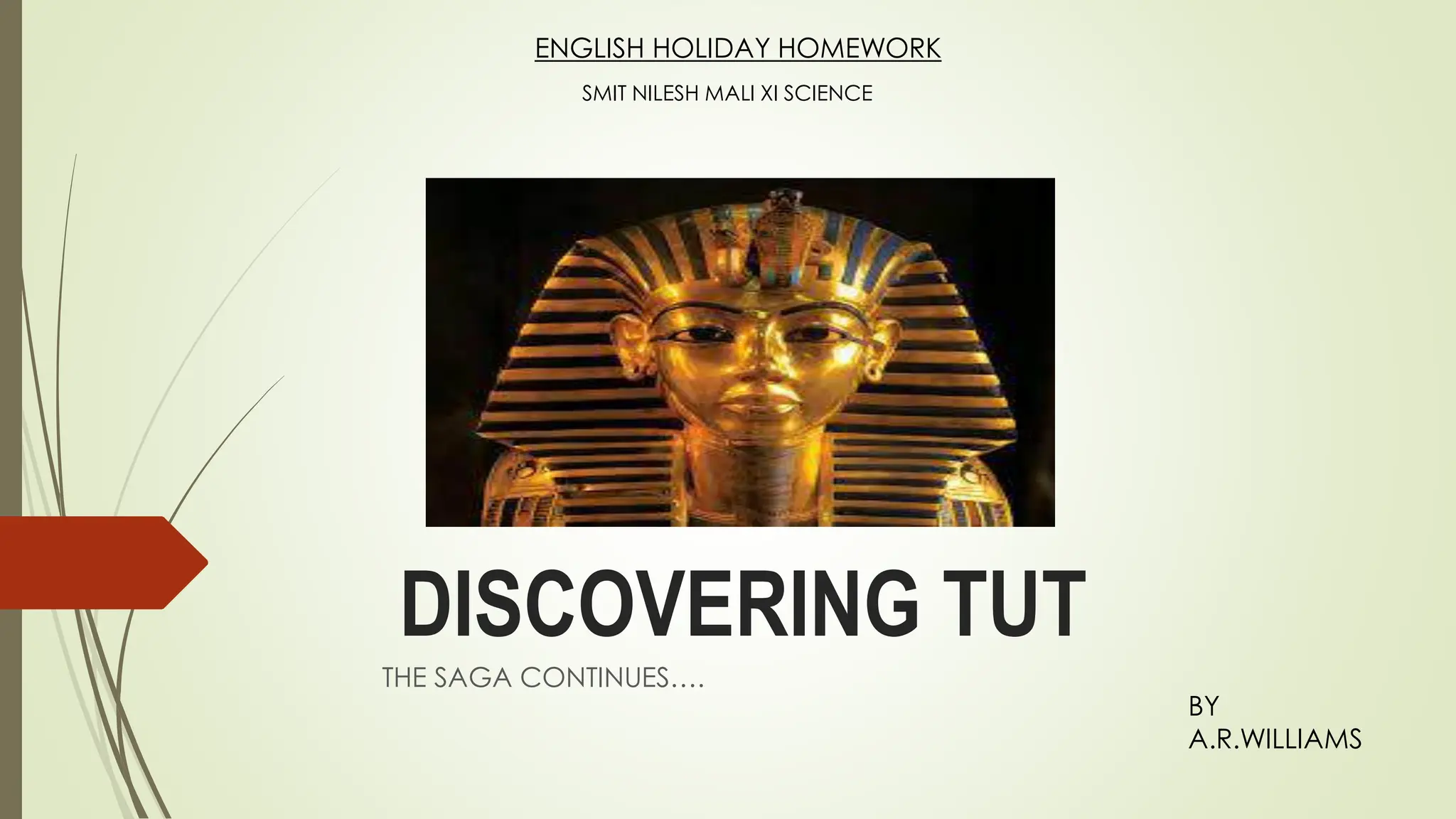
DISCOVERING TUT
THE SAGA CONTINUES….
BY
A.R.WILLIAMS
ENGLISH HOLIDAY HOMEWORK
SMIT NILESH MALI XI SCIENCE
OVERVIEW
 This is a living example of technology advancement. We accepted
things and events attributing their cause to nature and her earth.
However, advancement could give us a different picture. This way, it
has become a habit with us to accept everything that history states
and dictates. on the process the modern world has found ways to
offer a different view on it. In other words, the modern world has turn
impossibilities to possibilities.
SUMMARY
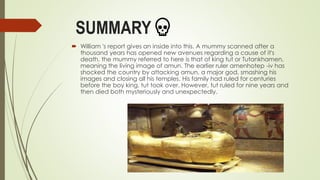
 William 's report gives an inside into this. A mummy scanned after a
thousand years has opened new avenues regarding a cause of it's
death. the mummy referred to here is that of king tut or Tutankhamen,
meaning the living image of amun. The earlier ruler amenhotep -iv has
shocked the country by attacking amun, a major god, smashing his
images and closing all his temples. His family had ruled for centuries
before the boy king, tut took over. However, tut ruled for nine years and
then died both mysteriously and unexpectedly.
ABOUT THE AUTHOR – A.R.WILLIAMS
 A.R WILLIAMS LIVES IN VIRGINIA BEACH, VA. SHE DEVELOPED A LOVE FOR
READING AT A VERY YOUNG AGE AND IN THE FOUTH GRADE, WHEN AN
ASSIGNMENT TO WRITE THEIR OWN WORKS OF FICTION WAS GIVEN, IT
OCCURRED TO HER THAT SHE TOO COULD HAVE THE ABILITY TO CRAFT TALES
FOR OTHER TO ENJOY. ALTHOUGH A.R DID NOT PURSUE THIS DESIRE RIGHT
AWAY, SHE CONTINUED TO HAVE A VARACIOUS APPETITE FOR READING THE
AMAZING COMIC OF SPIDERMAN.
 DURING A MEMBERSHIP IN A BOOK CLUB, A.R DISCOVERED THAT
THERE WERE BOOKS DEDICATED TO TEACHING AMATEUR WRITTERS
MORE ABOUT THE CRAFT OF WRITING. SHE SNATCHED UP A TWIN
PACK WRITTEN BY PHYLLIS A. WHITNEY. SOON AFTER SHE SCOURED
AND SLOWLY LEARNING DIFFERENT FACTS OF WHAT IT TOOK TO BE
WRITTER. SHE STARTED PUTTING THAT KNOWLEDGE TO TEST CRAFTING
STORIES OF THE IMAGINATION IN SCIENCE FICTION AND FANTASY
GENRES.
TUTANKHANUM
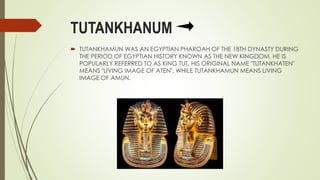
 TUTANKHAMUN WAS AN EGYPTIAN PHAROAH OF THE 18TH DYNASTY DURING
THE PERIOD OF EGYPTIAN HISTORY KNOWN AS THE NEW KINGDOM. HE IS
POPULARLY REFERRED TO AS KING TUT, HIS ORIGINAL NAME "TUTANKHATEN"
MEANS "LIVING IMAGE OF ATEN", WHILE TUTANKHAMUN MEANS LIVING
IMAGE OF AMUN.
Who Was King Tut?
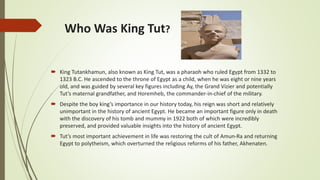
 King Tutankhamun, also known as King Tut, was a pharaoh who ruled Egypt from 1332 to
1323 B.C. He ascended to the throne of Egypt as a child, when he was eight or nine years
old, and was guided by several key figures including Ay, the Grand Vizier and potentially
Tut’s maternal grandfather, and Horemheb, the commander-in-chief of the military.
 Despite the boy king’s importance in our history today, his reign was short and relatively
unimportant in the history of ancient Egypt. He became an important figure only in death
with the discovery of his tomb and mummy in 1922 both of which were incredibly
preserved, and provided valuable insights into the history of ancient Egypt.
 Tut’s most important achievement in life was restoring the cult of Amun-Ra and returning
Egypt to polytheism, which overturned the religious reforms of his father, Akhenaten.
KING TUT’S TOMB
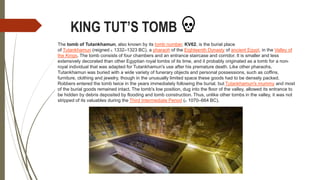
The tomb of Tutankhamun, also known by its tomb number, KV62, is the burial place
of Tutankhamun (reigned c. 1332–1323 BC), a pharaoh of the Eighteenth Dynasty of ancient Egypt, in the Valley of
the Kings. The tomb consists of four chambers and an entrance staircase and corridor. It is smaller and less
extensively decorated than other Egyptian royal tombs of its time, and it probably originated as a tomb for a non-
royal individual that was adapted for Tutankhamun's use after his premature death. Like other pharaohs,
Tutankhamun was buried with a wide variety of funerary objects and personal possessions, such as coffins,
furniture, clothing and jewelry, though in the unusually limited space these goods had to be densely packed.
Robbers entered the tomb twice in the years immediately following the burial, but Tutankhamun's mummy and most
of the burial goods remained intact. The tomb's low position, dug into the floor of the valley, allowed its entrance to
be hidden by debris deposited by flooding and tomb construction. Thus, unlike other tombs in the valley, it was not
stripped of its valuables during the Third Intermediate Period (c. 1070–664 BC).
Who Discovered King Tut’s Tomb?
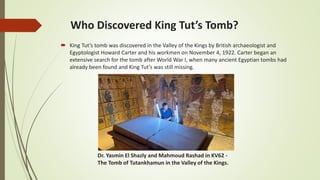
 King Tut’s tomb was discovered in the Valley of the Kings by British archaeologist and
Egyptologist Howard Carter and his workmen on November 4, 1922. Carter began an
extensive search for the tomb after World War I, when many ancient Egyptian tombs had
already been found and King Tut’s was still missing.
Dr. Yasmin El Shazly and Mahmoud Rashad in KV62 -
The Tomb of Tutankhamun in the Valley of the Kings.
 King Tut died at age 18 or 19 around 1324 B.C, but there are many theories surrounding
how he died. There is a small bone fragment on the inside of his skull that intially led
some historians to believe that King Tut was murdered by a blow to the back of his head.
But, this damage could have also been caused during the mummification process or while
his mummy was being excavated, and most experts agree that he was not murdered.
 One of the most compelling points of evidence surrounding King Tut’s death is the
presence of a fracture at his kneecap, which doesn’t have any signs of healing, indicating
it happened shortly before his death. Chariots were discovered in King Tut’s tomb, and
this type of injury could have been sustained from a high velocity fall from a chariot,
although this theory has not been confirmed.
 Another theory around King Tut’s death involves the presence of a form of malaria
discovered in his mummy. The malaria could have been the cause, or contributed to his
death. It is likely that his death was a combination of these factors.
How Did King Tut Die?
SMIT NILESH MALI XI SCIENCE
Hello Smit , I
just came
here to visit
your ppt
Its nice
brother !!
Disclaimer
This last slide is only made for fun/entertainment purpose.
1
2
3
4
5

DISCOVERING TUT by Smit mali-compressed.pdf

  • 1.
    DISCOVERING TUT THE SAGACONTINUES…. BY A.R.WILLIAMS ENGLISH HOLIDAY HOMEWORK SMIT NILESH MALI XI SCIENCE
  • 2.
    OVERVIEW  This isa living example of technology advancement. We accepted things and events attributing their cause to nature and her earth. However, advancement could give us a different picture. This way, it has become a habit with us to accept everything that history states and dictates. on the process the modern world has found ways to offer a different view on it. In other words, the modern world has turn impossibilities to possibilities.
  • 3.
    SUMMARY  William 'sreport gives an inside into this. A mummy scanned after a thousand years has opened new avenues regarding a cause of it's death. the mummy referred to here is that of king tut or Tutankhamen, meaning the living image of amun. The earlier ruler amenhotep -iv has shocked the country by attacking amun, a major god, smashing his images and closing all his temples. His family had ruled for centuries before the boy king, tut took over. However, tut ruled for nine years and then died both mysteriously and unexpectedly.
  • 4.
    ABOUT THE AUTHOR– A.R.WILLIAMS  A.R WILLIAMS LIVES IN VIRGINIA BEACH, VA. SHE DEVELOPED A LOVE FOR READING AT A VERY YOUNG AGE AND IN THE FOUTH GRADE, WHEN AN ASSIGNMENT TO WRITE THEIR OWN WORKS OF FICTION WAS GIVEN, IT OCCURRED TO HER THAT SHE TOO COULD HAVE THE ABILITY TO CRAFT TALES FOR OTHER TO ENJOY. ALTHOUGH A.R DID NOT PURSUE THIS DESIRE RIGHT AWAY, SHE CONTINUED TO HAVE A VARACIOUS APPETITE FOR READING THE AMAZING COMIC OF SPIDERMAN.
  • 5.
     DURING AMEMBERSHIP IN A BOOK CLUB, A.R DISCOVERED THAT THERE WERE BOOKS DEDICATED TO TEACHING AMATEUR WRITTERS MORE ABOUT THE CRAFT OF WRITING. SHE SNATCHED UP A TWIN PACK WRITTEN BY PHYLLIS A. WHITNEY. SOON AFTER SHE SCOURED AND SLOWLY LEARNING DIFFERENT FACTS OF WHAT IT TOOK TO BE WRITTER. SHE STARTED PUTTING THAT KNOWLEDGE TO TEST CRAFTING STORIES OF THE IMAGINATION IN SCIENCE FICTION AND FANTASY GENRES.
  • 6.
    TUTANKHANUM  TUTANKHAMUN WASAN EGYPTIAN PHAROAH OF THE 18TH DYNASTY DURING THE PERIOD OF EGYPTIAN HISTORY KNOWN AS THE NEW KINGDOM. HE IS POPULARLY REFERRED TO AS KING TUT, HIS ORIGINAL NAME "TUTANKHATEN" MEANS "LIVING IMAGE OF ATEN", WHILE TUTANKHAMUN MEANS LIVING IMAGE OF AMUN.
  • 7.
    Who Was KingTut?  King Tutankhamun, also known as King Tut, was a pharaoh who ruled Egypt from 1332 to 1323 B.C. He ascended to the throne of Egypt as a child, when he was eight or nine years old, and was guided by several key figures including Ay, the Grand Vizier and potentially Tut’s maternal grandfather, and Horemheb, the commander-in-chief of the military.  Despite the boy king’s importance in our history today, his reign was short and relatively unimportant in the history of ancient Egypt. He became an important figure only in death with the discovery of his tomb and mummy in 1922 both of which were incredibly preserved, and provided valuable insights into the history of ancient Egypt.  Tut’s most important achievement in life was restoring the cult of Amun-Ra and returning Egypt to polytheism, which overturned the religious reforms of his father, Akhenaten.
  • 8.
    KING TUT’S TOMB Thetomb of Tutankhamun, also known by its tomb number, KV62, is the burial place of Tutankhamun (reigned c. 1332–1323 BC), a pharaoh of the Eighteenth Dynasty of ancient Egypt, in the Valley of the Kings. The tomb consists of four chambers and an entrance staircase and corridor. It is smaller and less extensively decorated than other Egyptian royal tombs of its time, and it probably originated as a tomb for a non- royal individual that was adapted for Tutankhamun's use after his premature death. Like other pharaohs, Tutankhamun was buried with a wide variety of funerary objects and personal possessions, such as coffins, furniture, clothing and jewelry, though in the unusually limited space these goods had to be densely packed. Robbers entered the tomb twice in the years immediately following the burial, but Tutankhamun's mummy and most of the burial goods remained intact. The tomb's low position, dug into the floor of the valley, allowed its entrance to be hidden by debris deposited by flooding and tomb construction. Thus, unlike other tombs in the valley, it was not stripped of its valuables during the Third Intermediate Period (c. 1070–664 BC).
  • 9.
    Who Discovered KingTut’s Tomb?  King Tut’s tomb was discovered in the Valley of the Kings by British archaeologist and Egyptologist Howard Carter and his workmen on November 4, 1922. Carter began an extensive search for the tomb after World War I, when many ancient Egyptian tombs had already been found and King Tut’s was still missing. Dr. Yasmin El Shazly and Mahmoud Rashad in KV62 - The Tomb of Tutankhamun in the Valley of the Kings.
  • 10.
     King Tutdied at age 18 or 19 around 1324 B.C, but there are many theories surrounding how he died. There is a small bone fragment on the inside of his skull that intially led some historians to believe that King Tut was murdered by a blow to the back of his head. But, this damage could have also been caused during the mummification process or while his mummy was being excavated, and most experts agree that he was not murdered.  One of the most compelling points of evidence surrounding King Tut’s death is the presence of a fracture at his kneecap, which doesn’t have any signs of healing, indicating it happened shortly before his death. Chariots were discovered in King Tut’s tomb, and this type of injury could have been sustained from a high velocity fall from a chariot, although this theory has not been confirmed.  Another theory around King Tut’s death involves the presence of a form of malaria discovered in his mummy. The malaria could have been the cause, or contributed to his death. It is likely that his death was a combination of these factors. How Did King Tut Die?
  • 11.
    SMIT NILESH MALIXI SCIENCE
  • 12.
    Hello Smit ,I just came here to visit your ppt Its nice brother !! Disclaimer This last slide is only made for fun/entertainment purpose. 1 2 3 4 5