
Discourse Ability
By :
Zahra Aamir.
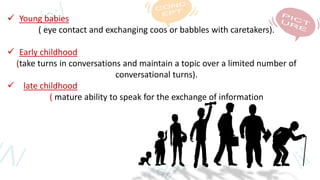
 Young babies
( eye contact and exchanging coos or babbles with caretakers).
 Early childhood
(take turns in conversations and maintain a topic over a limited number of
conversational turns).
 late childhood
( mature ability to speak for the exchange of information
Brown and Yule (1983) distinguish between
Interactional discourse which serves primarily a social function.
Transactional discourse, in which communicating information is the
main purpose.
Important of Transactional Discourse
Evaluate communication needs of the person we are speaking to
Ability that develops during
late childhood.
Example
of
ability
Child’s use of pronouns.
Successful communication
Late childhood produce pronouns whose referents are ambiguous.
“Once upon a time there was a little pig that was called Tom and
another, Carlos. One day he invited him to his house. After they
sat on the rug to chat … after he invited him to his room, and they
drew. He also showed him many toys that he had”.
Interface phenomenon
use of pronouns
syntactic devices ( pronouns) serve a non-linguistic goal ( communication).
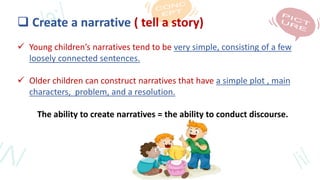
 Create a narrative ( tell a story)
 Young children’s narratives tend to be very simple, consisting of a few
loosely connected sentences.
 Older children can construct narratives that have a simple plot , main
characters, problem, and a resolution.
The ability to create narratives = the ability to conduct discourse.
Discourse ability.pptx

Discourse ability.pptx

  • 1.
  • 2.
     Young babies (eye contact and exchanging coos or babbles with caretakers).  Early childhood (take turns in conversations and maintain a topic over a limited number of conversational turns).  late childhood ( mature ability to speak for the exchange of information
  • 3.
    Brown and Yule(1983) distinguish between Interactional discourse which serves primarily a social function. Transactional discourse, in which communicating information is the main purpose.
  • 4.
    Important of TransactionalDiscourse Evaluate communication needs of the person we are speaking to Ability that develops during late childhood.
  • 5.
    Example of ability Child’s use ofpronouns. Successful communication Late childhood produce pronouns whose referents are ambiguous.
  • 6.
    “Once upon atime there was a little pig that was called Tom and another, Carlos. One day he invited him to his house. After they sat on the rug to chat … after he invited him to his room, and they drew. He also showed him many toys that he had”.
  • 7.
    Interface phenomenon use ofpronouns syntactic devices ( pronouns) serve a non-linguistic goal ( communication).
  • 8.
     Create anarrative ( tell a story)  Young children’s narratives tend to be very simple, consisting of a few loosely connected sentences.  Older children can construct narratives that have a simple plot , main characters, problem, and a resolution. The ability to create narratives = the ability to conduct discourse.