Essential newborn care
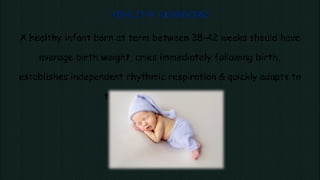
HEALTHY NEWBORN
A healthy infant born at term between 38-42 weeks should have
average birth weight, cries immediately following birth,
establishes independent rhythmic respiration & quickly adapts to
the changed environment.
ESSENTIAL CARE OF NEWBORN
Essential care of Newborn refers to the basic
and critical care practices provided to all
newborns immediately after birth and during
neonatal period (first 28 days of life), regardless
of place of delivery
Goals
• Ensure a smooth transition to extrauterine life
• Prevent newborn mortality and morbidity
• Promote exclusive breast feeding
• Maintain normal body temperature
• Prevent infection
• Early identification and management of complications
• Promote bonding and emotional wellbeing
Immediate care of newborn
• Care given within the first few minutes to one hour
after birth
• Main focus is to ensure the newborn transitions
safely from intrauterine to extra uterine life
• Essential newborn care includes immediate care plus
routine care
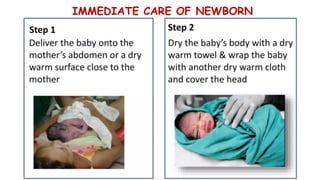
IMMEDIATE CARE OF NEWBORN
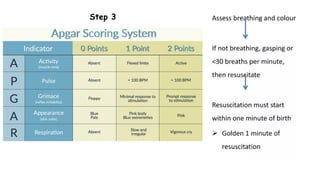
Step 3
IMMEDIATE CARE OF NEWBORN
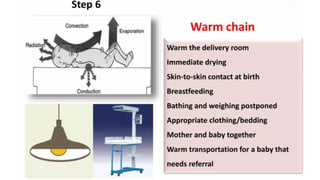
 Maintenance of temperature
 Establishment of open airway & circulation
 Identification of newborn
 Vitamin K injection
 Initiation of breastfeeding.
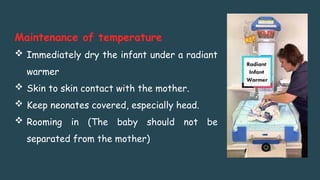
Maintenance of temperature
 Immediately dry the infant under a radiant
warmer
 Skin to skin contact with the mother.
 Keep neonates covered, especially head.
 Rooming in (The baby should not be
separated from the mother)
Establishment of open airway
 (Majority of babies cry at birth & take spontaneous
Respiration)
 When the head is delivered birth attendant immediately
suction the secretions, wipe mucus from face and mouth
and nose.
 Suction the mouth and nose by using bulb syringe
 Keep head slightly lower than the body
 Position the Baby on their backs or tilted to the side, but
not on their stomachs.
APGAR SCORING
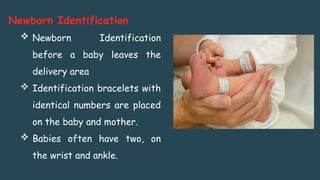
Newborn Identification
 Newborn Identification
before a baby leaves the
delivery area
 Identification bracelets with
identical numbers are placed
on the baby and mother.
 Babies often have two, on
the wrist and ankle.
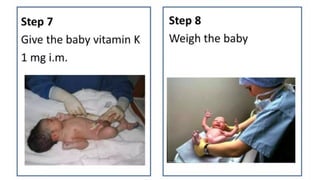
Vitamin K Prevent neonatal hemorrhage during first few days of
life before infant is able to produce Vitamin K administration:
Term infants (1mg) - IM
Preterm infants (0.5mg) – IM
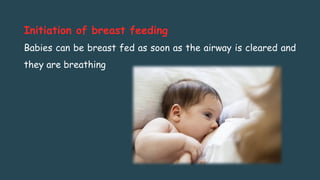
Initiation of breast feeding
Babies can be breast fed as soon as the airway is cleared and
they are breathing
DAILY ROUTINE CARE OF NEONATES
 Warmth
 Breastfeeding
 Skin care & baby bath
 Care of umbilical cord
 Care of the eyes
 Clothing of the baby
 Observation
 Immunization and follow up
 Taking anthropometric measurements
Warmth
• Warmth is provided by keeping the baby dry & wrapping the
baby with adequate clothing in two layers, ensuring head &
extremities are well covered.
• Baby should be kept by the side
of the Mother.
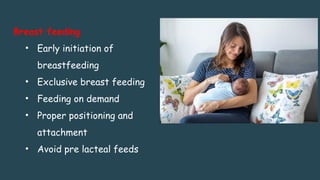
Breast feeding
• Early initiation of
breastfeeding
• Exclusive breast feeding
• Feeding on demand
• Proper positioning and
attachment
• Avoid pre lacteal feeds
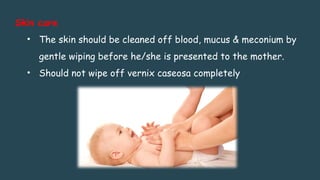
Skin care
• The skin should be cleaned off blood, mucus & meconium by
gentle wiping before he/she is presented to the mother.
• Should not wipe off vernix caseosa completely
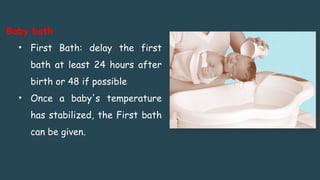
Baby bath
• First Bath: delay the first
bath at least 24 hours after
birth or 48 if possible
• Once a baby's temperature
has stabilized, the First bath
can be given.
Cord blood collection
Make sure cord blood is collected for analysis and sent to
laboratory for checking of: Rh Blood type, Hematocrit &
possible cord blood gases, TFT.
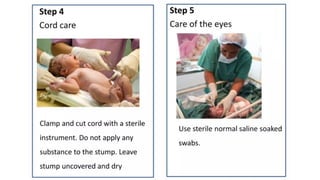
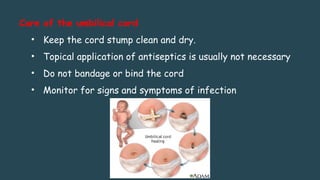
Care of the umbilical cord
• Keep the cord stump clean and dry.
• Topical application of antiseptics is usually not necessary
• Do not bandage or bind the cord
• Monitor for signs and symptoms of infection
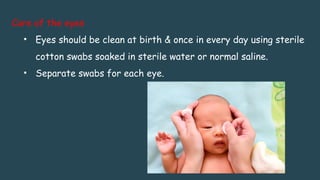
Care of the eyes
• Eyes should be clean at birth & once in every day using sterile
cotton swabs soaked in sterile water or normal saline.
• Separate swabs for each eye.
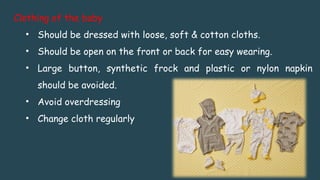
Clothing of the baby
• Should be dressed with loose, soft & cotton cloths.
• Should be open on the front or back for easy wearing.
• Large button, synthetic frock and plastic or nylon napkin
should be avoided.
• Avoid overdressing
• Change cloth regularly
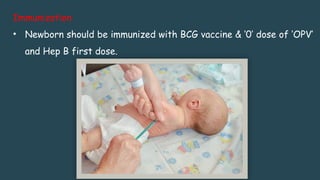
Immunization
• Newborn should be immunized with BCG vaccine & ‘0’ dose of ‘OPV’
and Hep B first dose.
Observation
• General appearance
• Breathing
• Temperature
• Feeding
• Elimination
• Cord stump
• Eyes
• Jaundice
• weight
Anthropometric measurement
• Measure weight
• Length
• Head circumference
• Chest circumference
Weight:
• The average daily weight gain for healthy term babies is
about 30gm/day in the first month of life
• It is about 20gm/day in second month
• 10gm per day afterwards during the first year of life.
Length:
• From top of head to the heel with the leg fully extended
• Average range: 18-22 inches (46-56 cm)
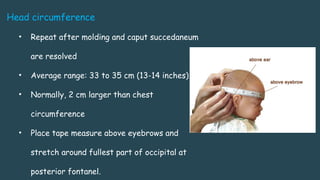
Head circumference
• Repeat after molding and caput succedaneum
are resolved
• Average range: 33 to 35 cm (13-14 inches)
• Normally, 2 cm larger than chest
circumference
• Place tape measure above eyebrows and
stretch around fullest part of occipital at
posterior fontanel.
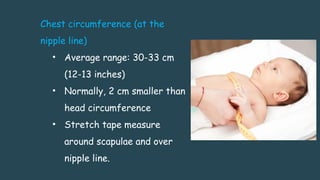
Chest circumference (at the
nipple line)
• Average range: 30-33 cm
(12-13 inches)
• Normally, 2 cm smaller than
head circumference
• Stretch tape measure
around scapulae and over
nipple line.
Follow up & Advice:
Each infant should be followed up, at least once every month
for first 3 months & subsequently 3-month interval till one
year of age.
Nursing Diagnoses:
• Risk for ineffective airway clearance related to nasal and
oral secretions from delivery.
• Risk for ineffective thermoregulation related to
environment and immature ability for adaptation. •
• Risk for injury related to immature defenses of the
newborn.
• Risk for infection related to immature immune system

Essential newborn care.pptxaaaaaaaaaaaaa

  • 1.
  • 2.
    HEALTHY NEWBORN A healthyinfant born at term between 38-42 weeks should have average birth weight, cries immediately following birth, establishes independent rhythmic respiration & quickly adapts to the changed environment.
  • 3.
    ESSENTIAL CARE OFNEWBORN Essential care of Newborn refers to the basic and critical care practices provided to all newborns immediately after birth and during neonatal period (first 28 days of life), regardless of place of delivery
  • 4.
    Goals • Ensure asmooth transition to extrauterine life • Prevent newborn mortality and morbidity • Promote exclusive breast feeding • Maintain normal body temperature • Prevent infection • Early identification and management of complications • Promote bonding and emotional wellbeing
  • 5.
    Immediate care ofnewborn • Care given within the first few minutes to one hour after birth • Main focus is to ensure the newborn transitions safely from intrauterine to extra uterine life • Essential newborn care includes immediate care plus routine care
  • 6.
  • 7.
  • 11.
    IMMEDIATE CARE OFNEWBORN  Maintenance of temperature  Establishment of open airway & circulation  Identification of newborn  Vitamin K injection  Initiation of breastfeeding.
  • 12.
    Maintenance of temperature Immediately dry the infant under a radiant warmer  Skin to skin contact with the mother.  Keep neonates covered, especially head.  Rooming in (The baby should not be separated from the mother)
  • 13.
    Establishment of openairway  (Majority of babies cry at birth & take spontaneous Respiration)  When the head is delivered birth attendant immediately suction the secretions, wipe mucus from face and mouth and nose.  Suction the mouth and nose by using bulb syringe  Keep head slightly lower than the body  Position the Baby on their backs or tilted to the side, but not on their stomachs.
  • 14.
  • 16.
    Newborn Identification  NewbornIdentification before a baby leaves the delivery area  Identification bracelets with identical numbers are placed on the baby and mother.  Babies often have two, on the wrist and ankle.
  • 17.
    Vitamin K Preventneonatal hemorrhage during first few days of life before infant is able to produce Vitamin K administration: Term infants (1mg) - IM Preterm infants (0.5mg) – IM
  • 18.
    Initiation of breastfeeding Babies can be breast fed as soon as the airway is cleared and they are breathing
  • 19.
    DAILY ROUTINE CAREOF NEONATES  Warmth  Breastfeeding  Skin care & baby bath  Care of umbilical cord  Care of the eyes  Clothing of the baby  Observation  Immunization and follow up  Taking anthropometric measurements
  • 20.
    Warmth • Warmth isprovided by keeping the baby dry & wrapping the baby with adequate clothing in two layers, ensuring head & extremities are well covered. • Baby should be kept by the side of the Mother.
  • 21.
    Breast feeding • Earlyinitiation of breastfeeding • Exclusive breast feeding • Feeding on demand • Proper positioning and attachment • Avoid pre lacteal feeds
  • 22.
    Skin care • Theskin should be cleaned off blood, mucus & meconium by gentle wiping before he/she is presented to the mother. • Should not wipe off vernix caseosa completely
  • 23.
    Baby bath • FirstBath: delay the first bath at least 24 hours after birth or 48 if possible • Once a baby's temperature has stabilized, the First bath can be given.
  • 24.
    Cord blood collection Makesure cord blood is collected for analysis and sent to laboratory for checking of: Rh Blood type, Hematocrit & possible cord blood gases, TFT.
  • 25.
    Care of theumbilical cord • Keep the cord stump clean and dry. • Topical application of antiseptics is usually not necessary • Do not bandage or bind the cord • Monitor for signs and symptoms of infection
  • 26.
    Care of theeyes • Eyes should be clean at birth & once in every day using sterile cotton swabs soaked in sterile water or normal saline. • Separate swabs for each eye.
  • 27.
    Clothing of thebaby • Should be dressed with loose, soft & cotton cloths. • Should be open on the front or back for easy wearing. • Large button, synthetic frock and plastic or nylon napkin should be avoided. • Avoid overdressing • Change cloth regularly
  • 28.
    Immunization • Newborn shouldbe immunized with BCG vaccine & ‘0’ dose of ‘OPV’ and Hep B first dose.
  • 29.
    Observation • General appearance •Breathing • Temperature • Feeding • Elimination • Cord stump • Eyes • Jaundice • weight
  • 30.
    Anthropometric measurement • Measureweight • Length • Head circumference • Chest circumference
  • 31.
    Weight: • The averagedaily weight gain for healthy term babies is about 30gm/day in the first month of life • It is about 20gm/day in second month • 10gm per day afterwards during the first year of life. Length: • From top of head to the heel with the leg fully extended • Average range: 18-22 inches (46-56 cm)
  • 32.
    Head circumference • Repeatafter molding and caput succedaneum are resolved • Average range: 33 to 35 cm (13-14 inches) • Normally, 2 cm larger than chest circumference • Place tape measure above eyebrows and stretch around fullest part of occipital at posterior fontanel.
  • 33.
    Chest circumference (atthe nipple line) • Average range: 30-33 cm (12-13 inches) • Normally, 2 cm smaller than head circumference • Stretch tape measure around scapulae and over nipple line.
  • 34.
    Follow up &Advice: Each infant should be followed up, at least once every month for first 3 months & subsequently 3-month interval till one year of age.
  • 35.
    Nursing Diagnoses: • Riskfor ineffective airway clearance related to nasal and oral secretions from delivery. • Risk for ineffective thermoregulation related to environment and immature ability for adaptation. • • Risk for injury related to immature defenses of the newborn. • Risk for infection related to immature immune system