CAPACITY BUILDING IN DISASTER MANAGEMENT
WAY FORWARD
DR.ARASU SUNDARAM
HoD/ Programme Director
Disaster management Cell
Anna Institute of Management -State ATI
Chennai
arasus1@gmail.com
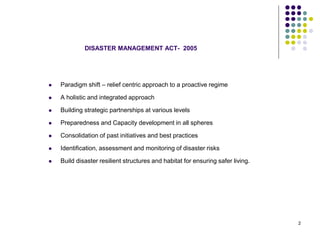
DISASTER MANAGEMENT ACT- 2005
 Paradigm shift – relief centric approach to a proactive regime
 A holistic and integrated approach
 Building strategic partnerships at various levels
 Preparedness and Capacity development in all spheres
 Consolidation of past initiatives and best practices
 Identification, assessment and monitoring of disaster risks
 Build disaster resilient structures and habitat for ensuring safer living.
2
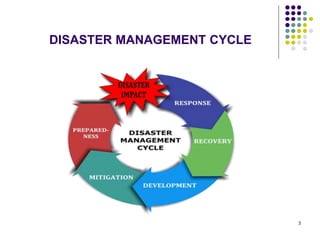
DISASTER MANAGEMENT CYCLE
3
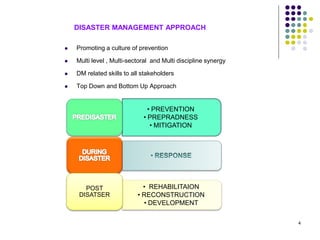
 Promoting a culture of prevention
 Multi level , Multi-sectoral and Multi discipline synergy
 DM related skills to all stakeholders
 Top Down and Bottom Up Approach
DISASTER MANAGEMENT APPROACH
• PREVENTION
• PREPRADNESS
• MITIGATION
• REHABILITAION
• RECONSTRUCTION
• DEVELOPMENT
POST
DISATSER
4
 Frequency and intensity of disasters and impacts - increase of risk
 Poverty , Population density and growth
 Urbanization and migration-More habitations in disaster prone areas
 Post disaster approach – adhoc basis - Relief oriented –reactive
 Resources allocated for immediate and post disaster activities
 Lack of education, awareness and capacity at all levels
 Single disaster approach rather multi disaster approach
 Lack of preparation and implantation of disaster management plans
 Lack of capacity - stakeholders like departments , First responder- communities, etc
 Inadequate database and early warning system
 Absence of HVRA studies
 Corporate sectors /Industries - Social responsibility- Lack of clarity in DM
 Lack of mainstreaming of DM activities
EXISTING SCENARIO
1
NEW TRAINING AND OTHER REQUIREMENTS IDENTIFIED
• Due to location – prone to more hazards - disasters
 Kumbakonam school tragedy( 2004 )- Training and Awareness - SDMP
 Tsunami Impact ( 2004 )- CRZ - Early Warning System - INCOIS - Training and
Awareness
 Thane Cyclone ( 2011) - impact- departments - Gap analysis- power and
communication failure- last mile connectivity- EOC’s - CDRR - SDRF
 Chennai Flood (2015 / 2016 )- impact - Training and Awareness -prevention/
preparedness
 Multi disaster construction practices- capacity building to engineers, architects , etc
 SDMP , SOP’s on Natural Disasters and HVRA studies in districts
 MHA industries – risk assessment studies- mock drill
 Infusion of Latest Technology - GIS and Remote Sensing in Data Management
 IEC material preparation and distribution
5
SCOPE OF DISASTER MANAGEMENT TRAINING PROGRAMMES
 Hazard specific - Natural and Man-made - training
 Multi sector and Multi level preparedness and prevention
 Emergency First Responders – specialised skill training
 Community based Disaster Risk Management and Risk Reduction
 Multi disaster construction practices
 GIS and Remote Sensing Technology based – Hands on training- HVRA analysis
 Need based disaster management training
 Sector specific Disaster Management Plan preparation
 Awareness , sensitisation and capacity building training
6
• Capacity of Disaster Management Cell/Centres -ATI’s
* Faculties , Staff and Infrastructure
* Capacity of in-house faculties
• Funding Mechanism- GOI-MHA-20014 – 14 Finance Commission- SDRF-
10 percent – CP of DM/ Training -Research Project
Institutional Capacity Development
7
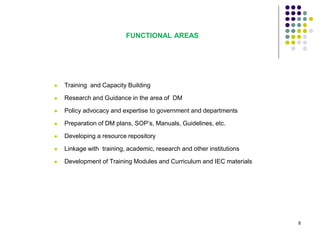
FUNCTIONAL AREAS
 Training and Capacity Building
 Research and Guidance in the area of DM
 Policy advocacy and expertise to government and departments
 Preparation of DM plans, SOP’s, Manuals, Guidelines, etc.
 Developing a resource repository
 Linkage with training, academic, research and other institutions
 Development of Training Modules and Curriculum and IEC materials
8
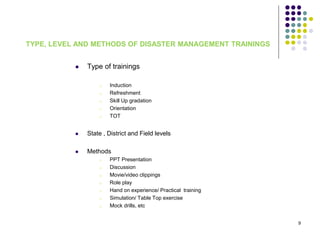
TYPE, LEVEL AND METHODS OF DISASTER MANAGEMENT TRAININGS
 Type of trainings
o Induction
o Refreshment
o Skill Up gradation
o Orientation
o TOT
 State , District and Field levels
 Methods
o PPT Presentation
o Discussion
o Movie/video clippings
o Role play
o Hand on experience/ Practical training
o Simulation/ Table Top exercise
o Mock drills, etc
9
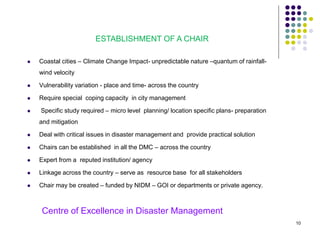
 Coastal cities – Climate Change Impact- unpredictable nature –quantum of rainfall-
wind velocity
 Vulnerability variation - place and time- across the country
 Require special coping capacity in city management
 Specific study required – micro level planning/ location specific plans- preparation
and mitigation
 Deal with critical issues in disaster management and provide practical solution
 Chairs can be established in all the DMC – across the country
 Expert from a reputed institution/ agency
 Linkage across the country – serve as resource base for all stakeholders
 Chair may be created – funded by NIDM – GOI or departments or private agency.
Centre of Excellence in Disaster Management
ESTABLISHMENT OF A CHAIR
10
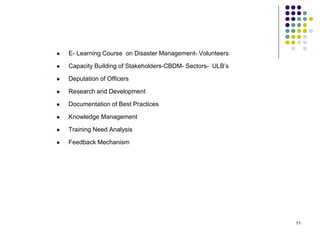
 E- Learning Course on Disaster Management- Volunteers
 Capacity Building of Stakeholders-CBDM- Sectors- ULB’s
 Deputation of Officers
 Research and Development
 Documentation of Best Practices
 Knowledge Management
 Training Need Analysis
 Feedback Mechanism
11
THANKS
13

Disaster Management India.ppt

  • 1.
    CAPACITY BUILDING INDISASTER MANAGEMENT WAY FORWARD DR.ARASU SUNDARAM HoD/ Programme Director Disaster management Cell Anna Institute of Management -State ATI Chennai arasus1@gmail.com
  • 2.
    DISASTER MANAGEMENT ACT-2005  Paradigm shift – relief centric approach to a proactive regime  A holistic and integrated approach  Building strategic partnerships at various levels  Preparedness and Capacity development in all spheres  Consolidation of past initiatives and best practices  Identification, assessment and monitoring of disaster risks  Build disaster resilient structures and habitat for ensuring safer living. 2
  • 3.
  • 4.
     Promoting aculture of prevention  Multi level , Multi-sectoral and Multi discipline synergy  DM related skills to all stakeholders  Top Down and Bottom Up Approach DISASTER MANAGEMENT APPROACH • PREVENTION • PREPRADNESS • MITIGATION • REHABILITAION • RECONSTRUCTION • DEVELOPMENT POST DISATSER 4
  • 5.
     Frequency andintensity of disasters and impacts - increase of risk  Poverty , Population density and growth  Urbanization and migration-More habitations in disaster prone areas  Post disaster approach – adhoc basis - Relief oriented –reactive  Resources allocated for immediate and post disaster activities  Lack of education, awareness and capacity at all levels  Single disaster approach rather multi disaster approach  Lack of preparation and implantation of disaster management plans  Lack of capacity - stakeholders like departments , First responder- communities, etc  Inadequate database and early warning system  Absence of HVRA studies  Corporate sectors /Industries - Social responsibility- Lack of clarity in DM  Lack of mainstreaming of DM activities EXISTING SCENARIO 1
  • 6.
    NEW TRAINING ANDOTHER REQUIREMENTS IDENTIFIED • Due to location – prone to more hazards - disasters  Kumbakonam school tragedy( 2004 )- Training and Awareness - SDMP  Tsunami Impact ( 2004 )- CRZ - Early Warning System - INCOIS - Training and Awareness  Thane Cyclone ( 2011) - impact- departments - Gap analysis- power and communication failure- last mile connectivity- EOC’s - CDRR - SDRF  Chennai Flood (2015 / 2016 )- impact - Training and Awareness -prevention/ preparedness  Multi disaster construction practices- capacity building to engineers, architects , etc  SDMP , SOP’s on Natural Disasters and HVRA studies in districts  MHA industries – risk assessment studies- mock drill  Infusion of Latest Technology - GIS and Remote Sensing in Data Management  IEC material preparation and distribution 5
  • 7.
    SCOPE OF DISASTERMANAGEMENT TRAINING PROGRAMMES  Hazard specific - Natural and Man-made - training  Multi sector and Multi level preparedness and prevention  Emergency First Responders – specialised skill training  Community based Disaster Risk Management and Risk Reduction  Multi disaster construction practices  GIS and Remote Sensing Technology based – Hands on training- HVRA analysis  Need based disaster management training  Sector specific Disaster Management Plan preparation  Awareness , sensitisation and capacity building training 6
  • 8.
    • Capacity ofDisaster Management Cell/Centres -ATI’s * Faculties , Staff and Infrastructure * Capacity of in-house faculties • Funding Mechanism- GOI-MHA-20014 – 14 Finance Commission- SDRF- 10 percent – CP of DM/ Training -Research Project Institutional Capacity Development 7
  • 9.
    FUNCTIONAL AREAS  Trainingand Capacity Building  Research and Guidance in the area of DM  Policy advocacy and expertise to government and departments  Preparation of DM plans, SOP’s, Manuals, Guidelines, etc.  Developing a resource repository  Linkage with training, academic, research and other institutions  Development of Training Modules and Curriculum and IEC materials 8
  • 10.
    TYPE, LEVEL ANDMETHODS OF DISASTER MANAGEMENT TRAININGS  Type of trainings o Induction o Refreshment o Skill Up gradation o Orientation o TOT  State , District and Field levels  Methods o PPT Presentation o Discussion o Movie/video clippings o Role play o Hand on experience/ Practical training o Simulation/ Table Top exercise o Mock drills, etc 9
  • 11.
     Coastal cities– Climate Change Impact- unpredictable nature –quantum of rainfall- wind velocity  Vulnerability variation - place and time- across the country  Require special coping capacity in city management  Specific study required – micro level planning/ location specific plans- preparation and mitigation  Deal with critical issues in disaster management and provide practical solution  Chairs can be established in all the DMC – across the country  Expert from a reputed institution/ agency  Linkage across the country – serve as resource base for all stakeholders  Chair may be created – funded by NIDM – GOI or departments or private agency. Centre of Excellence in Disaster Management ESTABLISHMENT OF A CHAIR 10
  • 12.
     E- LearningCourse on Disaster Management- Volunteers  Capacity Building of Stakeholders-CBDM- Sectors- ULB’s  Deputation of Officers  Research and Development  Documentation of Best Practices  Knowledge Management  Training Need Analysis  Feedback Mechanism 11
  • 13.