Exploring “Disabled”
Wilfred Owen
Submitted by”
Introduction
● "Disabled" is a poignant war poem
written by Wilfred Owen during World
War I.
● Published posthumously, Owen's work
vividly captures the physical and
emotional toll of war on an individual.
● Wilfred Owen, a renowned war poet,
drew inspiration from his first-hand
experiences as a soldier in the trenches
during World War I.
● His poems often reflect the harsh
realities of war and provide a critical
perspective on its impact.
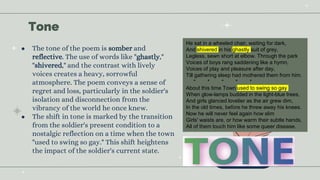
Tone
● The tone of the poem is somber and
reflective. The use of words like "ghastly,"
"shivered," and the contrast with lively
voices creates a heavy, sorrowful
atmosphere. The poem conveys a sense of
regret and loss, particularly in the soldier's
isolation and disconnection from the
vibrancy of the world he once knew.
● The shift in tone is marked by the transition
from the soldier's present condition to a
nostalgic reflection on a time when the town
"used to swing so gay." This shift heightens
the impact of the soldier's current state.
He sat in a wheeled chair, waiting for dark,
And shivered in his ghastly suit of grey,
Legless, sewn short at elbow. Through the park
Voices of boys rang saddening like a hymn,
Voices of play and pleasure after day,
Till gathering sleep had mothered them from him.
* * * * *
About this time Town used to swing so gay
When glow-lamps budded in the light-blue trees,
And girls glanced lovelier as the air grew dim,
In the old times, before he threw away his knees.
Now he will never feel again how slim
Girls' waists are, or how warm their subtle hands,
All of them touch him like some queer disease.
Mood
• The mood of the poem is somber, reflecting the
lasting impact of the soldier's physical and
emotional wounds and emphasizing the stark
contrast between his current state and the
vibrancy of the world he once knew. The
description of the soldier waiting for dark in a
wheeled chair emphasizes a sense of isolation and
desolation.
• The choice of words, such as "queer disease,"
adds an emotional layer to the mood, portraying
the soldier's perception of his condition as
something foreign and isolating. While the boys'
voices may carry joy and vitality, the soldier is
separated from this liveliness, left in a state of
solitude that deepens the overall sense of
isolation and melancholy.
He sat in a wheeled chair, waiting for dark,
And shivered in his ghastly suit of grey,
Legless, sewn short at elbow. Through the
park
Voices of boys rang saddening like a hymn,
Voices of play and pleasure after day,
Till gathering sleep had mothered them
from him.
* * * * *
About this time Town used to swing so gay
When glow-lamps budded in the light-blue
trees,
And girls glanced lovelier as the air grew
dim,
In the old times, before he threw away his
knees.
Now he will never feel again how slim
Girls' waists are, or how warm their subtle
hands,
All of them touch him like some queer
disease.
Structure
• The poem is structured in two distinct stanzas. The
first stanza focuses on the disabled soldier's
present condition, describing his physical state and
the surrounding environment. The second stanza
shifts to a reflection on the past.
• The repetition of the phrase "Voices of boys" in the
first stanza contributes to a rhythmic element,
highlighting the impact of the boys' voices on the
soldier's emotional state.
• In "Disabled," Owen's use of rhyme contributes to
the overall tone and impact of the poem,
enhancing the reader's engagement with the
poignant themes of war and its consequences.
He sat in a wheeled chair, waiting for dark,
And shivered in his ghastly suit of grey,
Legless, sewn short at elbow. Through the
park
Voices of boys rang saddening like a hymn,
Voices of play and pleasure after day,
Till gathering sleep had mothered them
from him.
* * * * *
About this time Town used to swing so gay
When glow-lamps budded in the light-blue
trees,
And girls glanced lovelier as the air grew
dim,
In the old times, before he threw away his
knees.
Now he will never feel again how slim
Girls' waists are, or how warm their subtle
hands,
All of them touch him like some queer
disease.
Theme
• One of the key themes of "Disabled" is the
aftermath of war. The crippled soldier becomes a
symbol for the physical and emotional toll that war
takes on individuals.
• The theme of isolation and alienation is prevalent,
especially in the depiction of the soldier waiting for
dark in a wheeled chair. The disconnect from the
vibrant voices of boys accentuates the profound
loneliness experienced by the protagonist.
• Nostalgia and loss is introduced in the second
stanza. The reminiscence of the town's past
joyous atmosphere intensifies the emotional
impact, emphasizing the irreversible loss
experienced by the disabled soldier.
He sat in a wheeled chair, waiting for dark,
And shivered in his ghastly suit of grey,
Legless, sewn short at elbow. Through the
park
Voices of boys rang saddening like a hymn,
Voices of play and pleasure after day,
Till gathering sleep had mothered them
from him.
* * * * *
About this time Town used to swing so gay
When glow-lamps budded in the light-blue
trees,
And girls glanced lovelier as the air grew
dim,
In the old times, before he threw away his
knees.
Now he will never feel again how slim
Girls' waists are, or how warm their subtle
hands,
All of them touch him like some queer
disease.
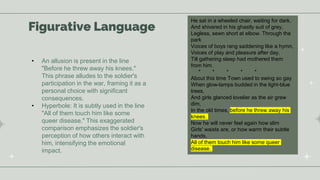
Figurative Language
• Metaphor: The phrase "shivered in his ghastly suit
of grey" metaphorically describes the soldier's
physical condition as both chilling and haunting.
• Simile: Simile is used in the line "Voices of boys
rang saddening like a hymn." The comparison of
boys' voices to a hymn through simile adds depth
to the emotional impact, emphasizing a
melancholic tone.
• Irony: There is a subtle irony in the soldier's
nostalgia for the "old times" when the town used to
"swing so gay." This irony lies in the contrast
between the joy of the past and the soldier's
current somber reality.
He sat in a wheeled chair, waiting for dark,
And shivered in his ghastly suit of grey,
Legless, sewn short at elbow. Through the
park
Voices of boys rang saddening like a hymn,
Voices of play and pleasure after day,
Till gathering sleep had mothered them
from him.
* * * * *
About this time Town used to swing so gay
When glow-lamps budded in the light-blue
trees,
And girls glanced lovelier as the air grew
dim,
In the old times, before he threw away his
knees.
Now he will never feel again how slim
Girls' waists are, or how warm their subtle
hands,
All of them touch him like some queer
disease.
Figurative Language
He sat in a wheeled chair, waiting for dark,
And shivered in his ghastly suit of grey,
Legless, sewn short at elbow. Through the
park
Voices of boys rang saddening like a hymn,
Voices of play and pleasure after day,
Till gathering sleep had mothered them
from him.
* * * * *
About this time Town used to swing so gay
When glow-lamps budded in the light-blue
trees,
And girls glanced lovelier as the air grew
dim,
In the old times, before he threw away his
knees.
Now he will never feel again how slim
Girls' waists are, or how warm their subtle
hands,
All of them touch him like some queer
disease.
• An allusion is present in the line
"Before he threw away his knees."
This phrase alludes to the soldier's
participation in the war, framing it as a
personal choice with significant
consequences.
• Hyperbole: It is subtly used in the line
"All of them touch him like some
queer disease." This exaggerated
comparison emphasizes the soldier's
perception of how others interact with
him, intensifying the emotional
impact.
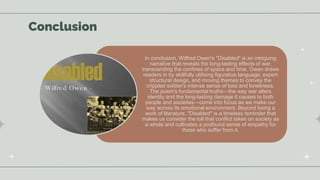
Conclusion
In conclusion, Wilfred Owen's "Disabled" is an intriguing
narrative that reveals the long-lasting effects of war,
transcending the confines of space and time. Owen draws
readers in by skillfully utilising figurative language, expert
structural design, and moving themes to convey the
crippled soldier's intense sense of loss and loneliness.
The poem's fundamental truths—the way war alters
identity and the long-lasting damage it causes to both
people and societies—come into focus as we make our
way across its emotional environment. Beyond being a
work of literature, "Disabled" is a timeless reminder that
makes us consider the toll that conflict takes on society as
a whole and cultivates a profound sense of empathy for
those who suffer from it.
Reflection
• What is enjoyable about the course?
Immersing myself in diverse narratives and exploring the intersection of medicine and
storytelling has been incredibly enjoyable. The course fosters a holistic perspective on patient
care and enhances my critical thinking and communication skills through interactive
discussions.
• Aspects of the course that were challenging/difficult?
It has been both intellectually and emotionally demanding to analyse intricate storylines and
navigate the subtle emotional undertones of particular scenarios. It takes a thorough
knowledge to integrate theoretical ideas with practical healthcare applications, which
challenges me to develop my cognitive and emotional skills in preparation for future career
responsibilities.
Final Reflection
• The impact of this course in the future role as a healthcare
professional- the insights gained to approach future career
differently.
This course has significantly influenced my perspective on the intersecting fields of
medicine and narrative, delivering essential insights that will influence my future job as a
healthcare professional. Understanding the impact of storytelling in patient experiences
has highlighted the necessity of empathy and effective communication in patient-
centered care delivery. The course has given me a more sophisticated approach to
understanding different points of view and has increased my awareness of the impact of
sickness on individuals. These ideas will surely help me as I advance in my profession to
approach patient contacts with greater awareness, promoting a more compassionate and
holistic healthcare practise.

Disabled by Wilfred Owen.pptx

  • 1.
  • 2.
    Introduction ● "Disabled" isa poignant war poem written by Wilfred Owen during World War I. ● Published posthumously, Owen's work vividly captures the physical and emotional toll of war on an individual. ● Wilfred Owen, a renowned war poet, drew inspiration from his first-hand experiences as a soldier in the trenches during World War I. ● His poems often reflect the harsh realities of war and provide a critical perspective on its impact.
  • 3.
    Tone ● The toneof the poem is somber and reflective. The use of words like "ghastly," "shivered," and the contrast with lively voices creates a heavy, sorrowful atmosphere. The poem conveys a sense of regret and loss, particularly in the soldier's isolation and disconnection from the vibrancy of the world he once knew. ● The shift in tone is marked by the transition from the soldier's present condition to a nostalgic reflection on a time when the town "used to swing so gay." This shift heightens the impact of the soldier's current state. He sat in a wheeled chair, waiting for dark, And shivered in his ghastly suit of grey, Legless, sewn short at elbow. Through the park Voices of boys rang saddening like a hymn, Voices of play and pleasure after day, Till gathering sleep had mothered them from him. * * * * * About this time Town used to swing so gay When glow-lamps budded in the light-blue trees, And girls glanced lovelier as the air grew dim, In the old times, before he threw away his knees. Now he will never feel again how slim Girls' waists are, or how warm their subtle hands, All of them touch him like some queer disease.
  • 4.
    Mood • The moodof the poem is somber, reflecting the lasting impact of the soldier's physical and emotional wounds and emphasizing the stark contrast between his current state and the vibrancy of the world he once knew. The description of the soldier waiting for dark in a wheeled chair emphasizes a sense of isolation and desolation. • The choice of words, such as "queer disease," adds an emotional layer to the mood, portraying the soldier's perception of his condition as something foreign and isolating. While the boys' voices may carry joy and vitality, the soldier is separated from this liveliness, left in a state of solitude that deepens the overall sense of isolation and melancholy. He sat in a wheeled chair, waiting for dark, And shivered in his ghastly suit of grey, Legless, sewn short at elbow. Through the park Voices of boys rang saddening like a hymn, Voices of play and pleasure after day, Till gathering sleep had mothered them from him. * * * * * About this time Town used to swing so gay When glow-lamps budded in the light-blue trees, And girls glanced lovelier as the air grew dim, In the old times, before he threw away his knees. Now he will never feel again how slim Girls' waists are, or how warm their subtle hands, All of them touch him like some queer disease.
  • 5.
    Structure • The poemis structured in two distinct stanzas. The first stanza focuses on the disabled soldier's present condition, describing his physical state and the surrounding environment. The second stanza shifts to a reflection on the past. • The repetition of the phrase "Voices of boys" in the first stanza contributes to a rhythmic element, highlighting the impact of the boys' voices on the soldier's emotional state. • In "Disabled," Owen's use of rhyme contributes to the overall tone and impact of the poem, enhancing the reader's engagement with the poignant themes of war and its consequences. He sat in a wheeled chair, waiting for dark, And shivered in his ghastly suit of grey, Legless, sewn short at elbow. Through the park Voices of boys rang saddening like a hymn, Voices of play and pleasure after day, Till gathering sleep had mothered them from him. * * * * * About this time Town used to swing so gay When glow-lamps budded in the light-blue trees, And girls glanced lovelier as the air grew dim, In the old times, before he threw away his knees. Now he will never feel again how slim Girls' waists are, or how warm their subtle hands, All of them touch him like some queer disease.
  • 6.
    Theme • One ofthe key themes of "Disabled" is the aftermath of war. The crippled soldier becomes a symbol for the physical and emotional toll that war takes on individuals. • The theme of isolation and alienation is prevalent, especially in the depiction of the soldier waiting for dark in a wheeled chair. The disconnect from the vibrant voices of boys accentuates the profound loneliness experienced by the protagonist. • Nostalgia and loss is introduced in the second stanza. The reminiscence of the town's past joyous atmosphere intensifies the emotional impact, emphasizing the irreversible loss experienced by the disabled soldier. He sat in a wheeled chair, waiting for dark, And shivered in his ghastly suit of grey, Legless, sewn short at elbow. Through the park Voices of boys rang saddening like a hymn, Voices of play and pleasure after day, Till gathering sleep had mothered them from him. * * * * * About this time Town used to swing so gay When glow-lamps budded in the light-blue trees, And girls glanced lovelier as the air grew dim, In the old times, before he threw away his knees. Now he will never feel again how slim Girls' waists are, or how warm their subtle hands, All of them touch him like some queer disease.
  • 7.
    Figurative Language • Metaphor:The phrase "shivered in his ghastly suit of grey" metaphorically describes the soldier's physical condition as both chilling and haunting. • Simile: Simile is used in the line "Voices of boys rang saddening like a hymn." The comparison of boys' voices to a hymn through simile adds depth to the emotional impact, emphasizing a melancholic tone. • Irony: There is a subtle irony in the soldier's nostalgia for the "old times" when the town used to "swing so gay." This irony lies in the contrast between the joy of the past and the soldier's current somber reality. He sat in a wheeled chair, waiting for dark, And shivered in his ghastly suit of grey, Legless, sewn short at elbow. Through the park Voices of boys rang saddening like a hymn, Voices of play and pleasure after day, Till gathering sleep had mothered them from him. * * * * * About this time Town used to swing so gay When glow-lamps budded in the light-blue trees, And girls glanced lovelier as the air grew dim, In the old times, before he threw away his knees. Now he will never feel again how slim Girls' waists are, or how warm their subtle hands, All of them touch him like some queer disease.
  • 8.
    Figurative Language He satin a wheeled chair, waiting for dark, And shivered in his ghastly suit of grey, Legless, sewn short at elbow. Through the park Voices of boys rang saddening like a hymn, Voices of play and pleasure after day, Till gathering sleep had mothered them from him. * * * * * About this time Town used to swing so gay When glow-lamps budded in the light-blue trees, And girls glanced lovelier as the air grew dim, In the old times, before he threw away his knees. Now he will never feel again how slim Girls' waists are, or how warm their subtle hands, All of them touch him like some queer disease. • An allusion is present in the line "Before he threw away his knees." This phrase alludes to the soldier's participation in the war, framing it as a personal choice with significant consequences. • Hyperbole: It is subtly used in the line "All of them touch him like some queer disease." This exaggerated comparison emphasizes the soldier's perception of how others interact with him, intensifying the emotional impact.
  • 9.
    Conclusion In conclusion, WilfredOwen's "Disabled" is an intriguing narrative that reveals the long-lasting effects of war, transcending the confines of space and time. Owen draws readers in by skillfully utilising figurative language, expert structural design, and moving themes to convey the crippled soldier's intense sense of loss and loneliness. The poem's fundamental truths—the way war alters identity and the long-lasting damage it causes to both people and societies—come into focus as we make our way across its emotional environment. Beyond being a work of literature, "Disabled" is a timeless reminder that makes us consider the toll that conflict takes on society as a whole and cultivates a profound sense of empathy for those who suffer from it.
  • 10.
    Reflection • What isenjoyable about the course? Immersing myself in diverse narratives and exploring the intersection of medicine and storytelling has been incredibly enjoyable. The course fosters a holistic perspective on patient care and enhances my critical thinking and communication skills through interactive discussions. • Aspects of the course that were challenging/difficult? It has been both intellectually and emotionally demanding to analyse intricate storylines and navigate the subtle emotional undertones of particular scenarios. It takes a thorough knowledge to integrate theoretical ideas with practical healthcare applications, which challenges me to develop my cognitive and emotional skills in preparation for future career responsibilities.
  • 11.
    Final Reflection • Theimpact of this course in the future role as a healthcare professional- the insights gained to approach future career differently. This course has significantly influenced my perspective on the intersecting fields of medicine and narrative, delivering essential insights that will influence my future job as a healthcare professional. Understanding the impact of storytelling in patient experiences has highlighted the necessity of empathy and effective communication in patient- centered care delivery. The course has given me a more sophisticated approach to understanding different points of view and has increased my awareness of the impact of sickness on individuals. These ideas will surely help me as I advance in my profession to approach patient contacts with greater awareness, promoting a more compassionate and holistic healthcare practise.