H4CKER
WORKSHOP
by Disa Johnson
AGENDAHistory of Technology
The Machine Age
The Information Age
Internet & Career Hacking
HISTORY OF TECHNOLOGY
● In Greece, as the development of systematic techniques for
making and doing things came into being over time,
technology meant a discourse on both applied and fine arts.
● When technology first appeared in 17th century English texts,
it was used to mean only a discussion of the applied arts. It
gradually came to designating the applied “arts” themselves.
● By the early 20th century, during the Machine Age, the term
technology embraced a growing range of means, processes,
and ideas in addition to tools and machines.
COMPUTING TECHNOLOGY
PROGRESSION
● 2700 BC: Sumerian Abacus
● 150 BC: Analog Computer (Antikythera Mechanism)
● Designed with gears to calculate astronomical positions
● Predicted lunar and solar eclipses
● 1624: Slide Rule Reigned Supreme Until 1974
● Multiplication, Division, Roots, Logarithms, Trigonometry
● Augmented special scales were used for Aviation & Finance
● 1974: Handheld Scientific Calculator
TURING COMPLETENESS IN THE
MACHINE AGE
● 1834: Babbage’s Analytical Engine
● 1936: Turing Machine
● 1937: Electromechanical Boolean-logic Multiplier
● Digital Computers, Computer Science
● 1948: Intelligent Machinery
● 1949: Manchester Mark 1, Stored-Program Computer
● EDSAC, EDVAC, BINAC Quickly Followed
● 1950: National Physical Laboratory’s Pilot ACE
“We are trying to build a machine to do
all kinds of different things simply by
programming rather than by the
addition of extra apparatus.
-Alan Turing 1947
DAWN OF THE INFORMATION AGE
● The Computer Age, The Digital Age
● Major Manufacturers Include: Rand, Bell, IBM
● Can Machines Think?
● Turing Test: If a computer, on the basis of written replies to
questions, could not be distinguished from a human
respondent, then it must be “thinking.”
● 1952: Grace Hopper Invents Compiler Program
● 1956: Direct Keyboard Input (Ended Punch Cards)
● 1957-1960: Programming Languages
● FORTRAN, MATH-MATIC, LISP, Hyperlink, Hypertext
THE INFORMATION AGE COMES OF
AGE
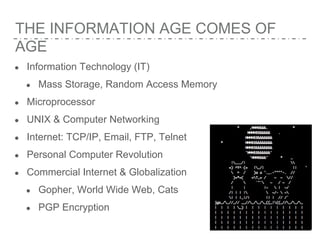
● Information Technology (IT)
● Mass Storage, Random Access Memory
● Microprocessor
● UNIX & Computer Networking
● Internet: TCP/IP, Email, FTP, Telnet
● Personal Computer Revolution
● Commercial Internet & Globalization
● Gopher, World Wide Web, Cats
● PGP Encryption
KNOWLEDGE
ECONOMY
● Creative Persons
● Graphic Designers
● Website Design
● User Experience (UX)
● Full-on Nerds
● Database Administrators
● System Admins
● DevOps
● Full-Stack Unicorns
● DIY All The Things!
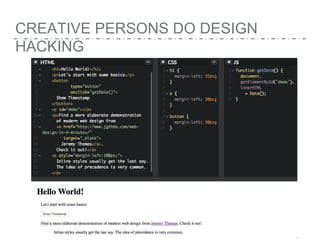
CREATIVE PERSONS DO DESIGN
HACKING
SYSTEM
ADMINISTRATIO
N
Let’s go use a command line
prompt.
@AIRDISA
Twitter, Github,
CodePen

Disa Johnson H4CKER WORKSHOP

  • 1.
  • 2.
    AGENDAHistory of Technology TheMachine Age The Information Age Internet & Career Hacking
  • 3.
    HISTORY OF TECHNOLOGY ●In Greece, as the development of systematic techniques for making and doing things came into being over time, technology meant a discourse on both applied and fine arts. ● When technology first appeared in 17th century English texts, it was used to mean only a discussion of the applied arts. It gradually came to designating the applied “arts” themselves. ● By the early 20th century, during the Machine Age, the term technology embraced a growing range of means, processes, and ideas in addition to tools and machines.
  • 4.
    COMPUTING TECHNOLOGY PROGRESSION ● 2700BC: Sumerian Abacus ● 150 BC: Analog Computer (Antikythera Mechanism) ● Designed with gears to calculate astronomical positions ● Predicted lunar and solar eclipses ● 1624: Slide Rule Reigned Supreme Until 1974 ● Multiplication, Division, Roots, Logarithms, Trigonometry ● Augmented special scales were used for Aviation & Finance ● 1974: Handheld Scientific Calculator
  • 5.
    TURING COMPLETENESS INTHE MACHINE AGE ● 1834: Babbage’s Analytical Engine ● 1936: Turing Machine ● 1937: Electromechanical Boolean-logic Multiplier ● Digital Computers, Computer Science ● 1948: Intelligent Machinery ● 1949: Manchester Mark 1, Stored-Program Computer ● EDSAC, EDVAC, BINAC Quickly Followed ● 1950: National Physical Laboratory’s Pilot ACE
  • 6.
    “We are tryingto build a machine to do all kinds of different things simply by programming rather than by the addition of extra apparatus. -Alan Turing 1947
  • 7.
    DAWN OF THEINFORMATION AGE ● The Computer Age, The Digital Age ● Major Manufacturers Include: Rand, Bell, IBM ● Can Machines Think? ● Turing Test: If a computer, on the basis of written replies to questions, could not be distinguished from a human respondent, then it must be “thinking.” ● 1952: Grace Hopper Invents Compiler Program ● 1956: Direct Keyboard Input (Ended Punch Cards) ● 1957-1960: Programming Languages ● FORTRAN, MATH-MATIC, LISP, Hyperlink, Hypertext
  • 8.
    THE INFORMATION AGECOMES OF AGE ● Information Technology (IT) ● Mass Storage, Random Access Memory ● Microprocessor ● UNIX & Computer Networking ● Internet: TCP/IP, Email, FTP, Telnet ● Personal Computer Revolution ● Commercial Internet & Globalization ● Gopher, World Wide Web, Cats ● PGP Encryption
  • 9.
    KNOWLEDGE ECONOMY ● Creative Persons ●Graphic Designers ● Website Design ● User Experience (UX) ● Full-on Nerds ● Database Administrators ● System Admins ● DevOps ● Full-Stack Unicorns ● DIY All The Things!
  • 10.
    CREATIVE PERSONS DODESIGN HACKING
  • 11.
  • 12.