PRESENTED TO - PRESENTED BY –
MOHAMMED SIDDIK
Directors -
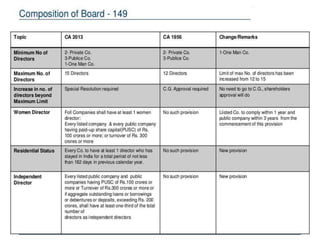
 1 . Woman Director –
“The category of companies which need to comply
with the requirement of having at least of one woman
director are as follows:” [section 149(1) of 2013 Act]
a) Every listed company, within one year from the
commencement of second proviso
b) Every other public company that has paid–up
share capital of one hundred crore rupees or
more, or a turnover of three hundred crore
rupees or more within three years from the
commencement of second proviso to sub-
section (1) of section 149
Number of directorship -
 The 2013 Act increases the limit for number of directorships that
can be held by an individual from 12 to 15 [section 149(1) of
2013 Act].3. One director to be resident in India
 A new requirement with respect to directors is
that at least one director to have stayed in India
for at least 182 days in the previous calendar year
[section 149(3) of 2013 Act]. This requirement
appears to be a departure from the focus given
in the 2013 Act towards use of electronic mode
such as use of video conferences for meetings
and electronic voting. With the increasing use of
electronic media, the need, for a director to be
resident in India for a minimum amount of time,
becomes redundant.
Independent directors -
 (i) Public companies having paid up share capital of
100 crore INR or more; or
 (ii) Public companies having turnover of 300 crore
INR or more
 (iii) Public companies which have, in aggregate,
outstanding loans or borrowings or debentures or
deposits, exceeding 200 crore INR
Code for independent director
 The 2013 Act includes Schedule IV ‘Code for
Independent Directors’ (Code) which broadly
prescribes the following for independent directors:
 Professional conduct
 Role and functions
 Duties
 Manner of appointment
 Reappointment
 Resignation or removal
 Holding separate meetings
 Evaluation mechanism
Liability of independent directors
 Only in respect of such acts of omission or
commission by a company which had occurred
with his knowledge, attributable through board
processes, with his consent or connivance or where
he had not acted diligently.”
 The section seeks to provide immunity from civil or
criminal action against independent directors in
certain cases. Further, in accordance with the
requirement of section 166 (2) of 2013 Act,
Appointment of an additional
director
 It is pertinent to note that, in order to discourage
inappropriate practices, the 2013 Act states that
any person who fails to get elected as a director in
the general meeting can no longer be appointed
as an additional director by the board of directors
[section 161 of 2013 Act].
Additional compliance
requirements for private
companies
 There are certain increased compliance requirements
mandated for private companies which, till now, were
mandated only for public companies and private
companies which are subsidiaries of public companies.
These include the following:
 Appointment of director to be voted individually
 Option to adopt principle of proportional
representation for appointment of directors
 Ineligibility on account of non-compliance with section
274(1)) (g) now extended for appointment or
reappointment as a director in a private limited
company also.
Director of company (Video)
videos

Directors of

  • 1.
    PRESENTED TO -PRESENTED BY – MOHAMMED SIDDIK
  • 3.
    Directors -  1. Woman Director – “The category of companies which need to comply with the requirement of having at least of one woman director are as follows:” [section 149(1) of 2013 Act] a) Every listed company, within one year from the commencement of second proviso b) Every other public company that has paid–up share capital of one hundred crore rupees or more, or a turnover of three hundred crore rupees or more within three years from the commencement of second proviso to sub- section (1) of section 149
  • 4.
    Number of directorship-  The 2013 Act increases the limit for number of directorships that can be held by an individual from 12 to 15 [section 149(1) of 2013 Act].3. One director to be resident in India  A new requirement with respect to directors is that at least one director to have stayed in India for at least 182 days in the previous calendar year [section 149(3) of 2013 Act]. This requirement appears to be a departure from the focus given in the 2013 Act towards use of electronic mode such as use of video conferences for meetings and electronic voting. With the increasing use of electronic media, the need, for a director to be resident in India for a minimum amount of time, becomes redundant.
  • 5.
    Independent directors - (i) Public companies having paid up share capital of 100 crore INR or more; or  (ii) Public companies having turnover of 300 crore INR or more  (iii) Public companies which have, in aggregate, outstanding loans or borrowings or debentures or deposits, exceeding 200 crore INR
  • 6.
    Code for independentdirector  The 2013 Act includes Schedule IV ‘Code for Independent Directors’ (Code) which broadly prescribes the following for independent directors:  Professional conduct  Role and functions  Duties  Manner of appointment  Reappointment  Resignation or removal  Holding separate meetings  Evaluation mechanism
  • 7.
    Liability of independentdirectors  Only in respect of such acts of omission or commission by a company which had occurred with his knowledge, attributable through board processes, with his consent or connivance or where he had not acted diligently.”  The section seeks to provide immunity from civil or criminal action against independent directors in certain cases. Further, in accordance with the requirement of section 166 (2) of 2013 Act,
  • 8.
    Appointment of anadditional director  It is pertinent to note that, in order to discourage inappropriate practices, the 2013 Act states that any person who fails to get elected as a director in the general meeting can no longer be appointed as an additional director by the board of directors [section 161 of 2013 Act].
  • 9.
    Additional compliance requirements forprivate companies  There are certain increased compliance requirements mandated for private companies which, till now, were mandated only for public companies and private companies which are subsidiaries of public companies. These include the following:  Appointment of director to be voted individually  Option to adopt principle of proportional representation for appointment of directors  Ineligibility on account of non-compliance with section 274(1)) (g) now extended for appointment or reappointment as a director in a private limited company also.
  • 10.
    Director of company(Video) videos