This Document gives the full details about Types of Director, when directors are appointed and reappointment, qualification and disqualification of directors, Retirement by rotation and resignation of directors
MEANING OF DIRECTORS
Directors are individuals appointed to the board of a company,
responsible for its overall management and direction.
They are entrusted with the responsibility of making strategic
decisions, ensuring compliance with legal and regulatory
requirements, and acting in the best interests of the company
and its stakeholders.
The Companies Act, 2013, defines a director as someone
appointed to the board, and the board collectively manages
the company's affairs.
3.
DEFINITION
According to theCompanies Act, 2013, a
"director" is defined as a director appointed to
the Board of a company. This means any
individual formally chosen to be part of the
company's governing body, the Board of
Directors, is considered a director under the
Act.
4.
NO. OF DIRECTORS
TheCompanies Act, 2013 ('Act') prescribes the minimum
and maximum number of directors in a company. The
minimum number of directors is as follows:
In the case of public limited companies - 3 directors
In the case of private limited companies - 2 directors
In the case of One-Person Companies - 1 director
The maximum number of directors a company can
have is 15 directors.
However, a company can appoint more directors by
passing a special resolution in its general meeting.
5.
TYPES OF DIRECTOR
1.Resident director
2. Independent director
3. Small shareholders directors
4. Women director
5. Additional director
6. Alternate director
7. Nominee director
8. Executive director
9. Non-executive director
10. Managing director
6.
1) Residential Director
As per the Act, every company needs to appoint a director who
has been in India and stayed for not less than 182 days in a
previous calendar year. Such a director will be a residential
director.
2) Independent Director
An independent director is a non-executive director without a
relationship with a company which might influence the
independence of his judgment. The tenure of the
independent directors is five consecutive years; however, they
shall be entitled to reappointment by passing a special resolution
with the disclosure in the Board’s report. Every listed public
company must have at least one-third of a total number of
directors as independent directors. Following unlisted public
companies need to appoint at the least two independent
directors
7.
3) Small ShareholdersDirectors
A listed company, could upon the notice of a minimum of
1000 small shareholders or 10% of the total number of the
small shareholder, whichever is lower, shall have a director
which would be elected by small shareholders.
4) Women Director
A company, whether be it a private company or a public
company, would be required to appoint a minimum of one
woman director in case it satisfies any of the following
criteria:
The company is a listed company and its securities are
listed on the stock exchange.
The paid-up capital of such a company is Rs.100 crore or
more with a turnover of Rs.300 crores or more.
8.
5) Additional Director
A person could be appointed as an additional
director and can occupy the post until the next
Annual General Meeting. In absence of the
AGM, such term would conclude on the date on
which such AGM should have been held.
6) Alternate Director
Alternate director refers to personnel appointed
by the Board, to fill in for a director who might
be absent from the country, for more than 3
months.
9.
7) Nominee Directors
Nominee directors could be appointed by a specific
class of shareholders, banks or lending financial
institutions, third parties through contracts, or by
the Union Government in case of mismanagement.
8) Executive Director
An executive director is the full-time working
director of the company. They look after the affairs
of the company and have a higher responsibility
towards the company. They need to be diligent and
careful in all their dealings.
10.
9) Non-executive Director
A non-executive director is a non-working director and is
not involved in the everyday working of the company.
They might participate in the planning or policy-making
process and challenge the executive directors to come
up with decisions that are in the best interest of the
company.
10) Managing Director
A managing director means a director entrusted with the
substantial powers of management of the company by
virtue of the articles of a company, agreement with the
company, resolution passed in the company general
meeting or by the board of directors.
11.
APPOINTMENT OF DIRECTORS
Appointment of First Director (sec 152)
Appointment of Director elected by small
shareholders (Sec 151)
Appointment of Additional Director, Alternate
Director and Nominee Director (Sec 161)
12.
1) APPOINTMENT OFFIRST DIRECTOR
1) When no provision is made in articles for
appointment of director, subscribers to
memorandum who are individuals shall be
deemed to be First Director
One person co –individual being member is first
director
In both case they can be director untill directors
are duly appointed as per provisions
13.
2) Directors areappointed by co., in general meeting
3) Directors with DIN are only appointed under sec (154)
4) If no DIN directors must apply for DIN with central govt under sec
153. Govt may issue equivalent identification number till
Individual obtaining DIN number.
5) Declaration that he is not disqualified to become a director under
this act
6) Appointed Director must give consent to hold office as director.
Consent have to be filed with registrar within 30 days of his
appointment
14.
7) In publicco., atleast 2/3rd
of directors must be
subject to retirement by rotation at every
annual general meeting.
Ex: if co., has 9 directors, at least 6 of them must
be subject to retirement by rotation, this means
every year 2-3 directors would retire and seek
re-election.
15.
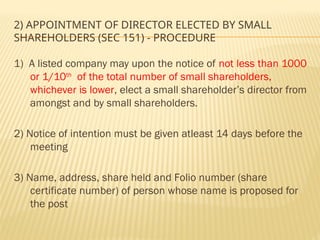
2) APPOINTMENT OFDIRECTOR ELECTED BY SMALL
SHAREHOLDERS (SEC 151) - PROCEDURE
1) A listed company may upon the notice of not less than 1000
or 1/10th
of the total number of small shareholders,
whichever is lower, elect a small shareholder’s director from
amongst and by small shareholders.
2) Notice of intention must be given atleast 14 days before the
meeting
3) Name, address, share held and Folio number (share
certificate number) of person whose name is proposed for
the post
16.
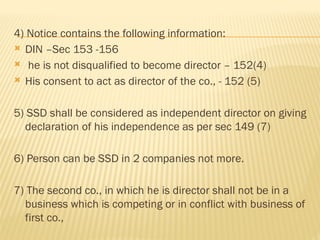
4) Notice containsthe following information:
DIN –Sec 153 -156
he is not disqualified to become director – 152(4)
His consent to act as director of the co., - 152 (5)
5) SSD shall be considered as independent director on giving
declaration of his independence as per sec 149 (7)
6) Person can be SSD in 2 companies not more.
7) The second co., in which he is director shall not be in a
business which is competing or in conflict with business of
first co.,
17.
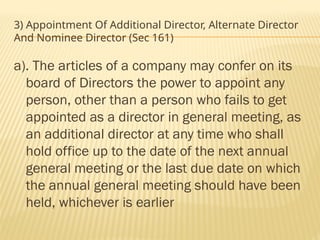
3) Appointment OfAdditional Director, Alternate Director
And Nominee Director (Sec 161)
a). The articles of a company may confer on its
board of Directors the power to appoint any
person, other than a person who fails to get
appointed as a director in general meeting, as
an additional director at any time who shall
hold office up to the date of the next annual
general meeting or the last due date on which
the annual general meeting should have been
held, whichever is earlier
18.
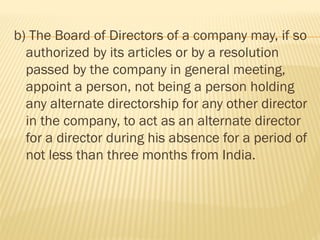
b) The Boardof Directors of a company may, if so
authorized by its articles or by a resolution
passed by the company in general meeting,
appoint a person, not being a person holding
any alternate directorship for any other director
in the company, to act as an alternate director
for a director during his absence for a period of
not less than three months from India.
19.
c) Subject tothe articles of a company, the Board may
appoint any person as a director nominated by any
institution in pursuance of the provision of any law for
the time being in force or of any agreement or by the
Central Government or state government by virtue of its
shareholding in a Government company
d) In case of public company, if the office of any director
appointed by the company in general meeting is
vacated before his term of office expires in the normal
course the resulting casual vacancy may, in default of
and subject to any regulations in the articles of the
company, be filled by the Board of Directors at a
meeting of the Board.
20.
REAPPOINTMENT OF DIRECTORS
Reappointment of directors refers to the
process of a company officially extending the
term of an existing director, allowing them to
continue serving on the board after their initial
term has expired.
This process is distinct from the initial
appointment of a director and typically involves
a formal vote or resolution by the shareholders
or a relevant governing body.
21.
REASON/ NEED FORREAPPOINTMENT
1. Continued Expertise and Experience:
Reappointing a director, particularly an ID, allows the company to
retain the valuable knowledge and experience they've gained over their
previous term.
2. Maintaining Stability and Continuity:
Reappointments ensure a smooth transition and avoid the disruption
that can come with frequent changes in board membership.
3. Compliance with Regulations:
Some jurisdictions, like India, have specific regulations regarding the
terms and reappointment of IDs, requiring special resolutions for
reappointment after an initial term, according to Lawrbit and
IndiaFilings.
4. Shareholder Scrutiny:
Reappointments are subject to shareholder approval, providing an
opportunity for shareholders to assess the director's performance and
suitability for continued service, says Virtual Company Secretary.
22.
KEY POINTS/PROCESS –REAPPOINTMENT OF DIRECTORS
Term of appointment – 5 years
Resolution – Special
Eligibility - Qualified
Due Diligence – Nomination & Remuneration committee
(NRC)
Shareholders Approval – 1st
April 2024
Procedure – Vacancy to be filled at meeting
Form DIR – 12 (appointment, resignation& any change in
Directors)
Form MGT- 14 – Resolutions and Agreements
Form MR - 1 – Reappointment of Key Managerial
personallers.
LEGAL QUALIFICATION OFDIRECTORS
1. Minimum Age:
Most countries require directors to be at least 18 years old. Some jurisdictions
may have a higher minimum age, while others might allow younger individuals
under specific conditions.
2. Citizenship and Residence:
Many countries demand that the director be a citizen or that he should have a
place of residence in the country where the company is going to be
incorporated. For instance, India requires that a minimum of one director of the
company must be a resident in India, but all the other directors can be foreign
nationals.
3. No Criminal Record:
All jurisdictions bar people convicted for certain crimes, especially for financial
crimes, frauds, or those that require moral turpitude from the position. This is
done to secure the integrity and trustworthiness of the company leadership.
25.
4. No Insolvency:
The directors are usually debarred if a person declares himself
insolvent or bankrupt. A person declared insolvent is not in a
situation of making proper financial decisions, it is believed.
5. Meets Regulatory Requirements:
There are some other extra-legal or regulatory standards demanded
by certain sectors where the directors are demanded to have some
special qualifications or licenses. For example, in the banking and
financial sector, a specific certification is required from any finance
regulatory body for its director.
6. Limit on the Number of Directorships:
Some countries put a limit on the number of companies a director
can be a part of simultaneously. For instance, in India, an individual
cannot be a director of more than 20 companies at a single time,
and for public companies, it is kept at 10.
26.
2. COMPETENCIES OFDIRECTORS
1. Strategic Thinking: Directors need to understand the company's
long-term vision and align their decisions with strategic goals.
They should be able to foresee market changes, competition, and
industry trends.
2. Financial insight: Ability to grasp financial statements, budget
management, and fiscal responsibility on the part of the director.
Successful directors often have a finance, accounting, or business
management background.
3. Corporate Governance Knowledge: The director needs to be
equipped with knowledge to understand the corporate governance
practices that determine the mechanisms, processes, and relations
by which corporations are controlled and directed. Such knowledge
encompasses laws, ethical responsibilities, and transparency.
27.
4. Risk Management:The directors should identify potential risks to the financial
and operational position of the company and must work to mitigate such risks.
They must be conversant with risk management frameworks.
5. Communication and Leadership: A good director is a good communicator and
negotiator. They should inspire trust, manage conflicts, and maintain productive
relationships with stakeholders, including shareholders, management, and
employees.
6. Moral Ethics: A director cannot compromise his integrity. Directors have to act
purely in terms of the interest of the company and not in the interest of
personal benefits. In addition, they need to avoid the conflict of interest.
7. Industry-Specific Knowledge: Depending on the type of company, there is also a
requirement to have technical knowledge in terms of the specific business a
director is managing. In this regard, a technology firm requires directors who
would know about emerging technologies, cyber security, and digital
transformation.
28.
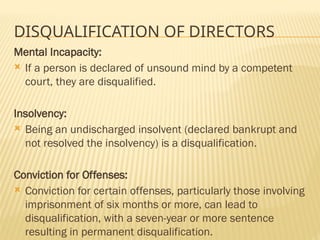
DISQUALIFICATION OF DIRECTORS
MentalIncapacity:
If a person is declared of unsound mind by a competent
court, they are disqualified.
Insolvency:
Being an undischarged insolvent (declared bankrupt and
not resolved the insolvency) is a disqualification.
Conviction for Offenses:
Conviction for certain offenses, particularly those involving
imprisonment of six months or more, can lead to
disqualification, with a seven-year or more sentence
resulting in permanent disqualification.
29.
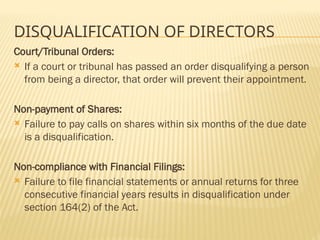
DISQUALIFICATION OF DIRECTORS
Court/TribunalOrders:
If a court or tribunal has passed an order disqualifying a person
from being a director, that order will prevent their appointment.
Non-payment of Shares:
Failure to pay calls on shares within six months of the due date
is a disqualification.
Non-compliance with Financial Filings:
Failure to file financial statements or annual returns for three
consecutive financial years results in disqualification under
section 164(2) of the Act.
30.
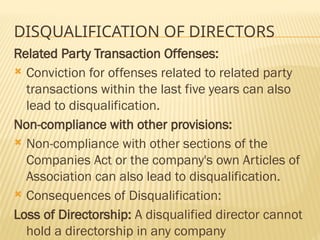
DISQUALIFICATION OF DIRECTORS
RelatedParty Transaction Offenses:
Conviction for offenses related to related party
transactions within the last five years can also
lead to disqualification.
Non-compliance with other provisions:
Non-compliance with other sections of the
Companies Act or the company's own Articles of
Association can also lead to disqualification.
Consequences of Disqualification:
Loss of Directorship: A disqualified director cannot
hold a directorship in any company
31.
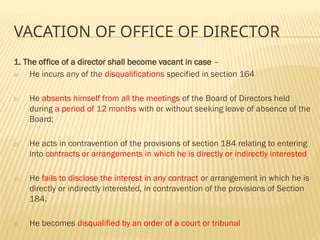
VACATION OF OFFICEOF DIRECTOR
1. The office of a director shall become vacant in case –
a) He incurs any of the disqualifications specified in section 164
b) He absents himself from all the meetings of the Board of Directors held
during a period of 12 months with or without seeking leave of absence of the
Board;
c) He acts in contravention of the provisions of section 184 relating to entering
into contracts or arrangements in which he is directly or indirectly interested
d) He fails to disclose the interest in any contract or arrangement in which he is
directly or indirectly interested, in contravention of the provisions of Section
184.
e) He becomes disqualified by an order of a court or tribunal
32.
e) He isconvicted by a court of any offense, whether
involving moral turpitude or otherwise and sentenced
in respect thereof to imprisonment for not less than 6
months.
f) He is removed in pursuance of the provisions of the act
g) He having been appointed a director by virtue of his
holding any office or other employment in the holding,
subsidiary or associate company, ceases to hold such
office or other employment in that company
33.
2) ifa person, functions as director even when he knows that the
office of director held by him has become vacant on account of any of
the disqualifications specified in sub-section 1, he shall be punishable
with imprisonment for a term which may extend to 1 year or with fine
which shall not be less than Rs. 1 lakh but which may extend to Rs. 5
lakh or with both.
3) where all the directors of a company vacate their office under any
of the disqualifications specified in sub-section (1), the promoter or in
his absence, the central government shall appoint the required
number of directors who shall hold office till the directors are
appointed by the company in the general meeting.
4) A private company may, by its articles, provide any other ground for
the vacation of the office of a director in addition to those specified in
sub-section (1).
34.
RETIREMENT OF DIRECTORS
Retirement by rotation is a process where some
directors of a company, typically one-third of the
non-independent directors, must retire at each
Annual General Meeting (AGM)
and are eligible for reappointment.
bringing in fresh perspectives while also allowing
for the retention of experienced directors.
35.
PROCESS OF RETIREMENTBY
ROTATION
1. Determining Directors Subject to Rotation
at least two-thirds of the total directors (excluding
independent and nominee directors) are subject to
retirement by rotation.
The specific number of directors retiring each year is
usually one-third of those liable to retire by rotation.
If the number of directors liable to retire isn't a
multiple of three, the nearest whole number to one-
third is used.
36.
2. IdentifyingDirectors for Retirement:
The directors who have been longest in office since
their last appointment typically retire first.
If multiple directors were appointed on the same day,
they may retire by mutual agreement or by drawing lots.
3. Reappointment at the AGM:
The retiring director(s) can be reappointed at the same
AGM, or the company can choose to appoint someone
else.
The decision to reappoint is usually made by a vote of
the shareholders.
37.
4. Flexibility andExceptions:
Private companies are not legally required to have
AGMs, and therefore retirement by rotation is not
mandatory.
The company's Articles of Association can specify
different rules for retirement by rotation.
Nominee directors and independent directors are
typically exempt from retirement by rotation.
38.
5. Purpose ofRetirement by Rotation:
It provides a mechanism for regular board refreshment and
ensures a mix of experience and new perspectives.
It allows shareholders to evaluate the performance of directors
and make decisions about their continued service.
It can be a way to introduce new talent and expertise to the
board.
In a public company, unless the Articles of Association state
otherwise, at least two-thirds of the directors must retire by
rotation. These directors are determined by seniority (longest in
office) unless they agree otherwise. Directors can also resign,
and must notify the company and potentially file specific forms
39.
6. Notification:
Adirector who wishes to resign must inform the company.
7. Filing Forms:
The company may be required to file specific forms (like Form DIR-12)
with the Registrar of Companies to record the resignation.
8. Liability:
A director remains liable for offenses committed during their tenure,
even after resignation.
9. Relevance:
Resignation can occur before the AGM and doesn't necessarily
coincide with the retirement by rotation schedule.
40.
CATEGORIES OF DIRECTORSWHO CANNOT RETIRE BY
ROTATION
a) Independent Directors: Independent directors
have been excluded from the provisions on
directors who can retire by rotation. According to
section 149 (13) stipulates that the provisions of
subsections (6) and 7 of section152 regarding the
departure of members of the board of directors by
rotation do not apply to the appointment of
independent members of the board of directors.
41.
b) Small ShareholderDirector: Under section 151
read with rule 7 of the Companies
(Appointment and Qualification of Directors)
Rules, 2014, sub-rule 5 expressly prohibits that
the appointment of such director is not liable to
retire by rotation.
42.
c) Nominee Directors:According to the Explanation to
section 149(7), a nominee director was treated as
a non-executive, non-independent director.. Due to
the paramount nature of the legislation regarding
the appointment of these directors, it can be
stated that they cannot be subject to retirement by
rotation. However, persons appointed as nominee
directors under agreements with companies may
be forced to retire by rotation.
43.
d) Additional Director:
Accordingto section 161, subject to the existence of
enabling provisions in the articles, the board may
appoint an additional director whose term of office
will last until the date of the next annual general
meeting at which his appointment is usually
regulated by the procedure. Therefore, an additional
director appointed by the board is not included in the
list of directors who can retire by rotation.
44.
e) Alternate Director:According to Section 161,
sub-section 2, the company’s board of directors
can appoint a substitute member who is
absent for not less than three months from
India if permitted by its articles of association
or by a resolution passed by the company in
general meeting, who is not a substitute
director for any other director in the company or
a substitute director in the same company.
45.
Formal Writtennotice:
A director's resignation involves a formal
written notice to the company's board of
directors, followed by filings with the Registrar
of Companies (ROC). The company must then
notify the ROC within 30 days of receiving the
resignation notice.
46.
RESIGNATION OF DIRECTORS
Adirector's resignation from a company is governed
by Section 168 of the Companies Act, 2013, and
involves specific procedures.
Process/ Procedure for resignation:
1. Resignation notice
2. Company’s action
3. Directors action
4. Date of resignation
47.
1. ResignationNotice:
A director intending to resign must submit a
written resignation letter to the company.
The letter should ideally include the effective
date of resignation.
While not mandatory, it's advisable to state the
reasons for resignation in the letter.
48.
2. Company's Action:
Upon receiving the resignation letter, the company should
hold a board meeting to acknowledge and record the
resignation.
A board resolution should be passed to accept the
resignation.
The company is then required to file Form DIR-12 with the
Registrar of Companies (ROC) within 30 days of the
resignation.
The company must also update its statutory registers (like the
Register of Directors).
49.
3. Director's Action:
The resigning director must file Form DIR-11 with the ROC within
30 days of the resignation.
This form should be accompanied by a copy of the resignation
letter and the reasons for resignation.
The director is liable for any offenses committed during their
tenure even after resignation.
4. Date of Resignation
The effective date of resignation is generally the date mentioned
in the resignation letter or the date the company receives the
notice, whichever is later.
Even after resignation, the director remains liable for any offenses
committed during their term.
If all directors resign simultaneously, the promoter or Central
Government may appoint interim directors until the company can
hold a general meeting to appoint new directors.







![Appointment_and_Qualification_of_Directors_OK[1] (5).pptx](https://cdn.slidesharecdn.com/ss_thumbnails/appointmentandqualificationofdirectorsok15-260118091941-0cac260b-thumbnail.jpg?width=640&height=640&fit=bounds)


