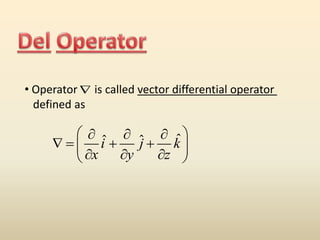
• Operator is called vector differential operator
defined as

ˆ
ˆ ˆ
i j k
x y z
 
  
   
 
  
 

( , , )
x y z

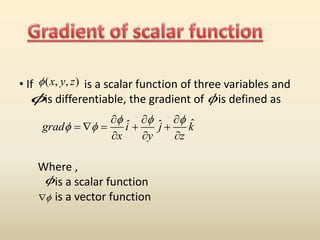
• If is a scalar function of three variables and
is differentiable, the gradient of is defined as

Where ,
is a scalar function
is a vector function
ˆ
ˆ ˆ
grad i j k
x y z
  
 
  
    
  



If ,determine at point P=(1,3,2).
solution
2 3 2 2
x yz xy z
   grad
     
2 3 2 2
3 2 2 2 3 2 2 2 2
3 2 2 2 3 2 2 2 2
2 , 2 , 3 2
,
ˆ
ˆ ˆ
ˆ
ˆ ˆ
2 2 3 2
(1,3,2)
ˆ
ˆ ˆ
84 32 72
x yz xy z
xyz y z x z xyz x yz xy z
x y z
Therefore
i j k
x y z
xyz y z i x z xyz j x yz xy z k
at
P
i j k

  
  


 
  
     
  
  
   
  
     

   
If A and B are two scalars ,then
1)
2)
( )
A B A B
     
( ) ( ) ( )
AB A B B A
    
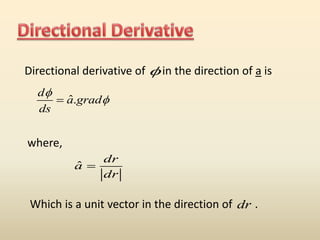
Directional derivative of in the direction of a is

ˆ.
d
a grad
ds



where,
Which is a unit vector in the direction of .
dr
ˆ
dr
a
dr

Compute the directional derivative of at the
point (1,2,-1) in the direction of the vector A=2i+3j-4k.
Solution
2 2 2
2
x z xy yz
   
Directional derivative of in the direction of a
Where,
And ,

ˆ.
d
a grad
ds



ˆ
ˆ ˆ
grad i j k
x y z
  
 
  
    
  
ˆ
A
a
A

2 2 2
2
x z xy yz
    Hence ,
     
2 2 2 ˆ
ˆ ˆ
2 2 4 2
(1,2, 1),
ˆ
ˆ ˆ
6 9 3
xz y i xy z j x yz k
At
i j k


      

   
Also given ,then
ˆ
ˆ ˆ
2 3 4
A i j k
  
 
 
2
2 2
2 3 4 29
,
1 ˆ
ˆ ˆ
ˆ 2 3 4
29
,
ˆ.
51
29
A
Therefore
A
a i j k
A
then
d
a grad
ds


    
   


If ,the divergence of A is
defined as
ˆ
ˆ ˆ
x y z
A i j k
a a a
  
 
.
ˆ ˆ
ˆ ˆ ˆ ˆ
.
.
x y z
y
x z
divA A
i j k i j k
x y z
x y z
a a a
a
a a
 
 
  
    
 
  
 

 
  
  
If , determine at point (1,2,3) .
solution
2 2 ˆ
ˆ ˆ
A x yi xyzj yz k
   divA
 
.
ˆ ˆ
ˆ ˆ ˆ ˆ
.
.
x y z
y
x z
divA A
i j k i j k
x y z
x y z
a a a
a
a a
 
 
  
    
 
  
 

 
  
  
2 2
divA xy xz yz
  
(1, 2,3)
2(1)(2) (1)(3) 2(2)(3)
13
at
divA
divA
  

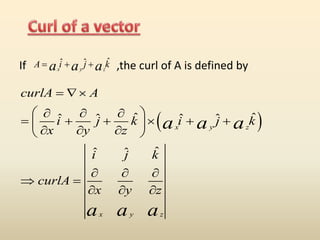
If ,the curl of A is defined by
ˆ
ˆ ˆ
x y z
A i j k
a a a
  
 
ˆ ˆ
ˆ ˆ ˆ ˆ
ˆ
ˆ ˆ
x y z
x y z
curlA A
i j k i j k
x y z
i j k
curlA
x y z
a a a
a a a
 
 
  
     
 
  
 
  
 
  
If ,determine curl A
at (1,3,-2).
solution
4 2 2 2 2 2 ˆ
ˆ ˆ
( ) ( )
A y x z i x y j x yzk
    
4 2 2 2 2 2
2 2 3
ˆ
ˆ ˆ
ˆ
ˆ
( 2 2 ) (2 4 )
(1,3, 2),
ˆ
ˆ ˆ
2 8 106
i j k
curlA A
x y z
y x z x y x yz
x zi xyz x z j x y k
At
curlA i j k
  
  
  
  
      

  

Directional Derivative.pdf

  • 2.
    • Operator iscalled vector differential operator defined as  ˆ ˆ ˆ i j k x y z                
  • 3.
     ( , ,) x y z  • If is a scalar function of three variables and is differentiable, the gradient of is defined as  Where , is a scalar function is a vector function ˆ ˆ ˆ grad i j k x y z                   
  • 4.
    If ,determine atpoint P=(1,3,2). solution 2 3 2 2 x yz xy z    grad       2 3 2 2 3 2 2 2 3 2 2 2 2 3 2 2 2 3 2 2 2 2 2 , 2 , 3 2 , ˆ ˆ ˆ ˆ ˆ ˆ 2 2 3 2 (1,3,2) ˆ ˆ ˆ 84 32 72 x yz xy z xyz y z x z xyz x yz xy z x y z Therefore i j k x y z xyz y z i x z xyz j x yz xy z k at P i j k                                            
  • 5.
    If A andB are two scalars ,then 1) 2) ( ) A B A B       ( ) ( ) ( ) AB A B B A     
  • 6.
    Directional derivative ofin the direction of a is  ˆ. d a grad ds    where, Which is a unit vector in the direction of . dr ˆ dr a dr 
  • 7.
    Compute the directionalderivative of at the point (1,2,-1) in the direction of the vector A=2i+3j-4k. Solution 2 2 2 2 x z xy yz     Directional derivative of in the direction of a Where, And ,  ˆ. d a grad ds    ˆ ˆ ˆ grad i j k x y z                 ˆ A a A  2 2 2 2 x z xy yz     Hence ,       2 2 2 ˆ ˆ ˆ 2 2 4 2 (1,2, 1), ˆ ˆ ˆ 6 9 3 xz y i xy z j x yz k At i j k              
  • 8.
    Also given ,then ˆ ˆˆ 2 3 4 A i j k        2 2 2 2 3 4 29 , 1 ˆ ˆ ˆ ˆ 2 3 4 29 , ˆ. 51 29 A Therefore A a i j k A then d a grad ds             
  • 9.
    If ,the divergenceof A is defined as ˆ ˆ ˆ x y z A i j k a a a      . ˆ ˆ ˆ ˆ ˆ ˆ . . x y z y x z divA A i j k i j k x y z x y z a a a a a a                            
  • 10.
    If , determineat point (1,2,3) . solution 2 2 ˆ ˆ ˆ A x yi xyzj yz k    divA   . ˆ ˆ ˆ ˆ ˆ ˆ . . x y z y x z divA A i j k i j k x y z x y z a a a a a a                             2 2 divA xy xz yz    (1, 2,3) 2(1)(2) (1)(3) 2(2)(3) 13 at divA divA    
  • 11.
    If ,the curlof A is defined by ˆ ˆ ˆ x y z A i j k a a a      ˆ ˆ ˆ ˆ ˆ ˆ ˆ ˆ ˆ x y z x y z curlA A i j k i j k x y z i j k curlA x y z a a a a a a                            
  • 12.
    If ,determine curlA at (1,3,-2). solution 4 2 2 2 2 2 ˆ ˆ ˆ ( ) ( ) A y x z i x y j x yzk      4 2 2 2 2 2 2 2 3 ˆ ˆ ˆ ˆ ˆ ( 2 2 ) (2 4 ) (1,3, 2), ˆ ˆ ˆ 2 8 106 i j k curlA A x y z y x z x y x yz x zi xyz x z j x y k At curlA i j k                       