DIPLOMAT
AMONG
WARRIORS
Br
ROBERT MURPHY
DOUBLEDAY & COMPANY, INC.
GARDEN CITY, NEW YORK
1964
Library of Congress
Catalog Card Number 64-11305
Copyright © 1964 by Robert Murphy
All Rights Reserved
Printed in the
United States of America
Acknowledgments:
To Ken McCormick, without whose genial inspiration this
book would not have been undertaken ; to Demaree and Dorothy Bess,
on whose talent, wisdom, and skill I drew so heavily ; to my cherished
colleagues in the American Foreign Service, in the Armed Services,
and in our Government; and to my dear wife, and our daughters,
Catherine, Rosemary, and Mildred Margaret, whose patient under-
standing and loyal sacrifices made my public career possible .
To Four Queens-a very good hand
PUBLISHER'S FOREWORD
For more than twenty years prior to 1940, Robert Murphy
pursued a conventional career in the Department of State, advancing
through grades from clerk to Counselor of Embassy at Paris. His years
of apprenticeship as a Foreign Service officer consisted of a mixture of
routine assignments and discipline and lots of hard work . But he also
had golden opportunities to observe the vast changes produced in
Europe by World War I, especially the budding Nazi movement which
he witnessed while living in Munich across the street from Hitler .
There was nothing sensational about this first half of Murphy's dip-
lomatic career and it could have ended that way, as the careers of most
Foreign Service officers do. But the nature of his work changed
abruptly after the defeat of France, when President Roosevelt sum-
moned him to the White House for a private conference which trans-
formed the conventional diplomat into the President's own personal
representative in French Africa .
Roosevelt's initial assignment, to assess the chances for bringing the
African empire of France into the war against the Nazis, expanded
into four extraordinary years, during which time Murphy made prep-
arations for the Allied landings in Africa-the first important American
combat operation of World War II . He also executed other special
duties, including negotiations of the agreement which attained a cer-
tain notoriety as "the Darlan Deal"; arrangements which brought
French West Africa into the war on the Allied side ; and the establish-
ment of a provisional French regime in Africa-all this accomplished
without any previous professional knowledge of the Dark Continent .
When American participation in the war extended beyond the Medi-
terranean, Murphy was transferred to Europe where he continued to
operate as Roosevelt's hand-picked agent, reporting directly to the
President and carrying out his orders with little regard for military or
diplomatic channels . As a result of Roosevelt's unconventional pro-
cedures, no written records were made of many significant events
during the war, and the official files were long incomplete and even
today suffer gaps.
Because the policies of the United States Government were of vital
concern to the entire postwar world, every decision made in Washing-
ton in the 194os was intensely scrutinized by press and public both at
home and in foreign countries . Frequently those who opposed Roo-
vi PUBLISHER'S FOREWORD
sevelt refrained from criticizing him personally, aiming their fire in-
stead at the State Department or at the President's representatives . In
Murphy's case, his unusual activities became part of his services as a
career diplomat, duties to be performed even if he himself considered
some of his government's policies doubtful or even wrong .
From the day Murphy first flew into Algiers, all his work required
close association with military men, American and foreign . As General
Eisenhower's political adviser in French Africa, Murphy was far too
busy with immediate problems to think about the long-range effects of
the cooperation he was improvising between diplomats and warriors,
but a pattern emerged-the "combined operation" of military plus
diplomacy-and this new type of cooperation became his chief preoc-
cupation from 1940 onward.
Because of his ability to get along with American, British and
French soldiers, sailors and airmen, his assignment in Africa led to
similar duties elsewhere-first during the invasion of Italy ; then in the
campaign for the final conquest of Germany ; afterwards in Berlin and
the American zone of occupation .
Those were the years when diplomats and warriors learned that
they would have to work together far more closely than they ever had
done in the past. Today every American Foreign Service officer has
become concerned, in one way or another, with military activities, and
American generals and admirals have had to include some measure of
diplomacy in their own plans. The creation of the North Atlantic Treaty
Organization (NATO) and forty-odd other security arrangements and
alliances became possible only through close coordination of military
and diplomatic negotiators.
This form of combined operation was strikingly apparent when
Murphy became the first postwar American Ambassador to Japan, and
then a negotiator in the Korean armistice agreement. Later, in his
work as Assistant Secretary of State for United Nations Affairs ; during
the landings of U . S. Marines in Lebanon in 1958; and during various
other crises in which he was a participant, the value of cooperation
between diplomats and military men was evident again and again.
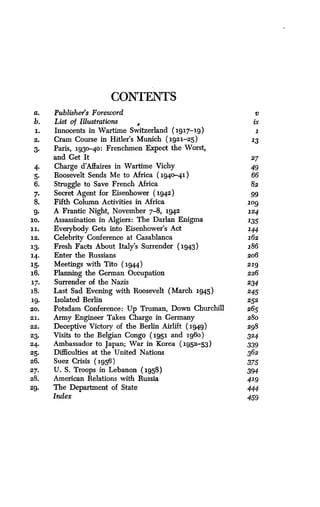
CONTENTS
a. Publisher's Foreword v
b. List o f Illustrations ix
1. Innocents in Wartime Switzerland (191719) 1
2. Cram Course in Hitler's Munich (1921-25) 13
3. Paris, 1930-40 : Frenchmen Expect the Worst,
and Get It 27
4. Charge d'Affaires in Wartime Vichy 49
5. Roosevelt Sends Me to Africa (1940-41) 66
6. Struggle to Save French Africa 82
7. Secret Agent for Eisenhower (1942) 99
8. Fifth Column Activities in Africa log
9. A Frantic Night, November 7-8, 1942 124
10. Assassination in Algiers : The Darlan Enigma 135
11. Everybody Gets into Eisenhower's Act 144
12. Celebrity Conference at Casablanca 162
13. Fresh Facts About Italy's Surrender (1943) 186
14. Enter the Russians 206
15. Meetings with Tito (1944) 219
16. Planning the German Occupation 226
17. Surrender of the Nazis 234
18. Last Sad Evening with Roosevelt (March 1945) 245
19. Isolated Berlin 252
20. Potsdam Conference : Up Truman, Down Churchill 265
21 . Army Engineer Takes Charge in Germany 280
22. Deceptive Victory of the Berlin Airlift (1949) 298
23. Visits to the Belgian Congo (1951 and 1960) 324
24. Ambassador to Japan; War in Korea (1952.-53) 339
25. Difficulties at the United Nations 362
26. Suez Crisis (195 6 ) 375
27. U. S. Troops in Lebanon (1958) 394
28. American Relations with Russia 419
29. The Department of State 444
Index 459
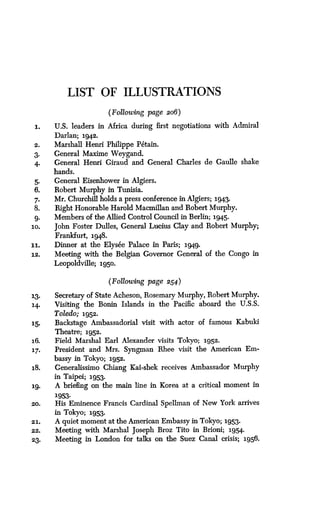
LIST OF ILLUSTRATIONS
(Following page 206 )
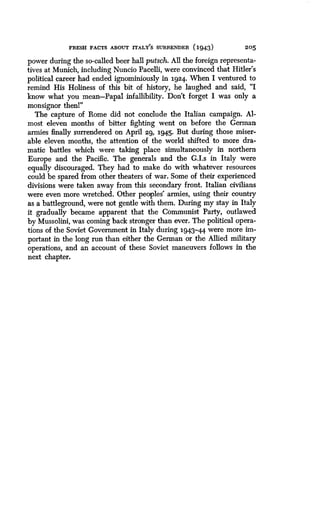
1.
	
U.S. leaders in Africa during first negotiations with Admiral
Darlan; 1942.
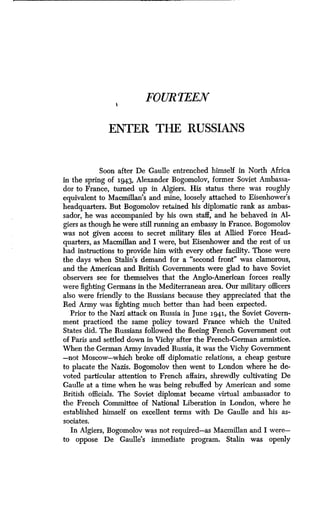
2.
	
Marshall Henri Philippe P6tain.
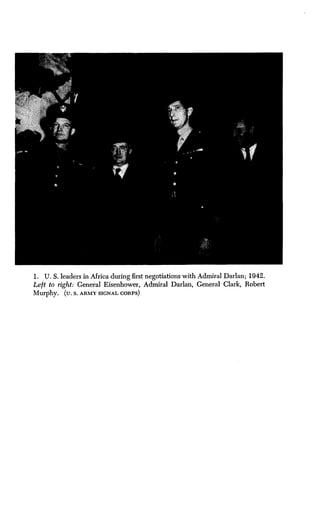
3.
	
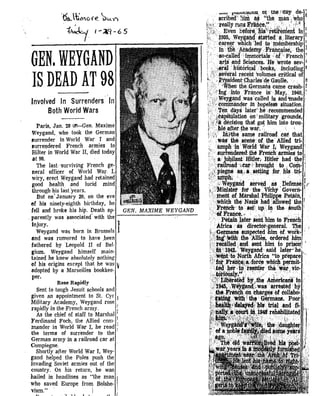
General Maxime Weygand.
4.
	
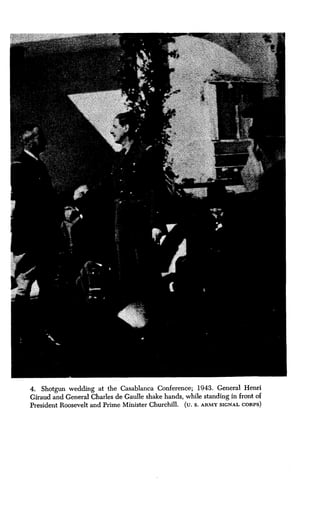
General Henri Giraud and General Charles de Gaulle shake
hands.
5.
	
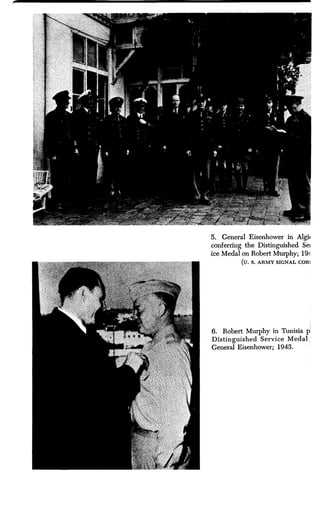
General Eisenhower in Algiers .
6.
	
Robert Murphy in Tunisia.
7.
	
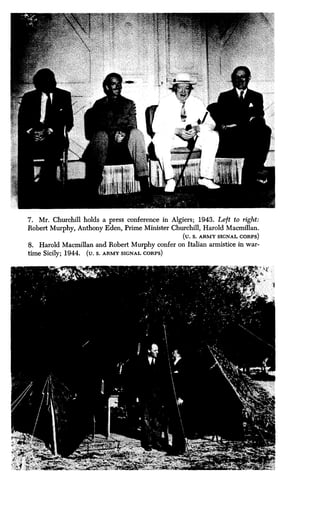
Mr. Churchill holds a press conference in Algiers; 1943.
8.
	
Right Honorable Harold Macmillan and Robert Murphy.
9.
	
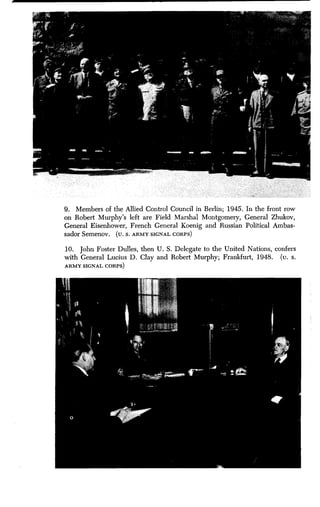
Members of the Allied Control Council in Berlin ; 1945.
10.
	
John Foster Dulles, General Lucius Clay and Robert Murphy;
Frankfurt, 1948 .
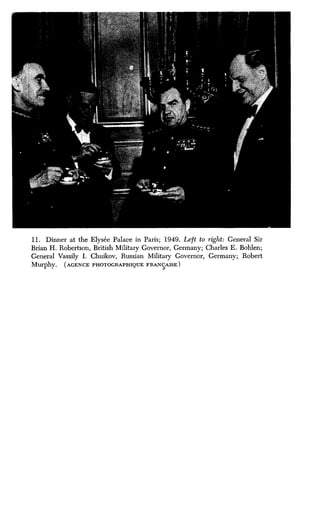
11.
	
Dinner at the Elys6e Palace in Paris ; 1949.
12.
	
Meeting with the Belgian Governor General of the Congo in
Leopoldville; 1950.
(Following page 254 )
13.
	
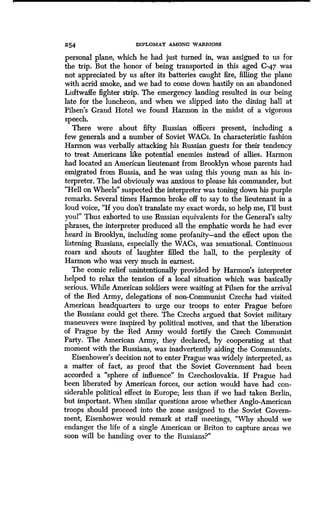
Secretary of State Acheson, Rosemary Murphy, Robert Murphy .
14.
	
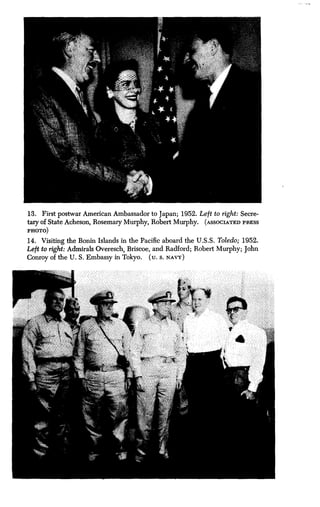
Visiting the Bonin Islands in the Pacific aboard the U .S.S.
Toledo; 1952.
15.
	
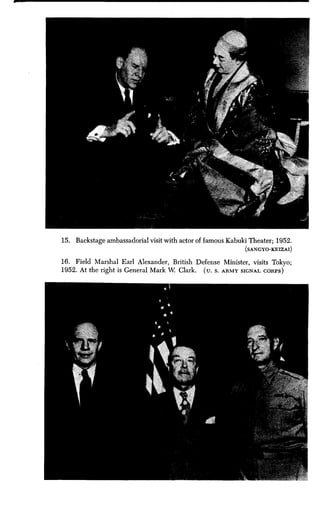
Backstage Ambassadorial visit with actor of famous Kabuki
Theatre; 1952.
16.
	
Field Marshal Earl Alexander visits Tokyo ; 1952.
17.
	
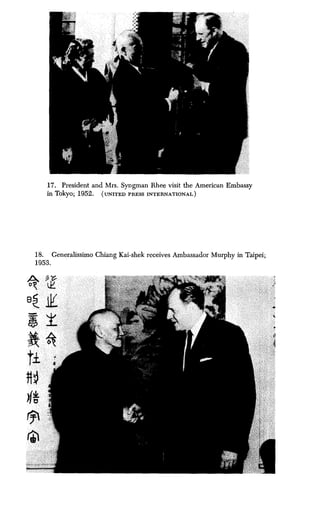
President and Mrs. Syngman Rhee visit the American Em-
bassy in Tokyo ; 1952..
18.
	
Generalissimo Chiang Kai-shek receives Ambassador 'Murphy
in Taipei; 1953.
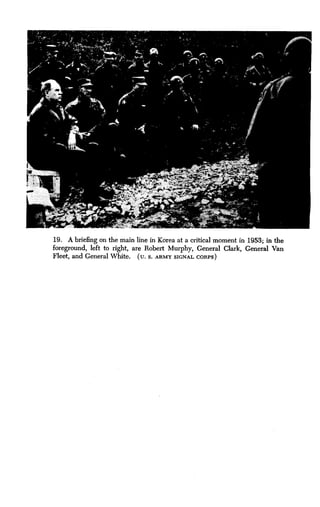
19.
	
A briefing on the main line in Korea at a critical moment in
1953.
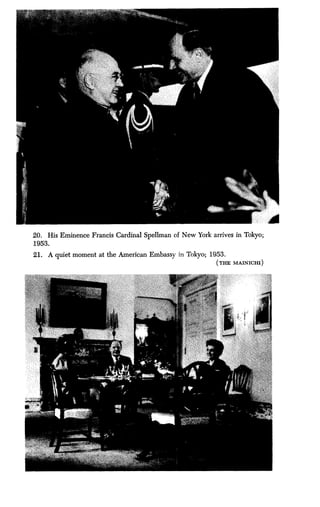
20.
	
His Eminence Francis Cardinal Spellman of New York arrives
in Tokyo; 1953.
21. A quiet moment at the American Embassy in Tokyo ; 1953.
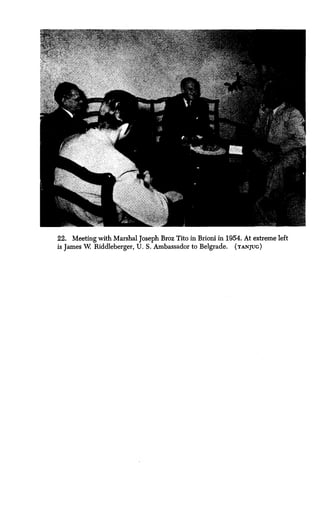
22. Meeting with Marshal Joseph Broz Tito in Brioni; 1954.
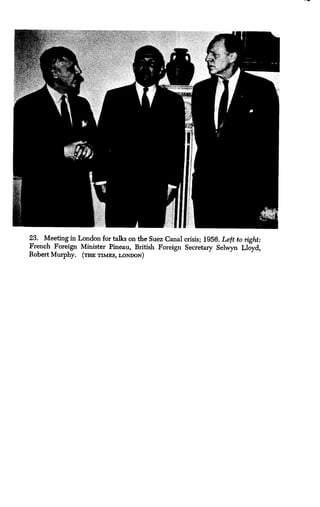
23.
	
Meeting in London for talks on the Suez Canal crisis; 1956.
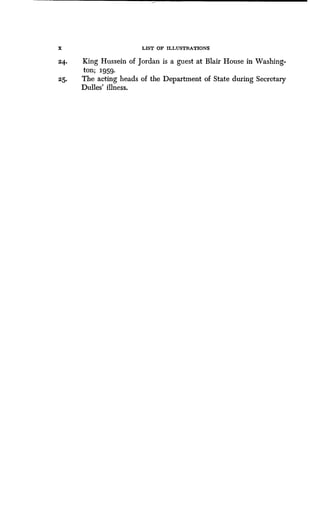
X LIST OF ILLUSTRATIONS
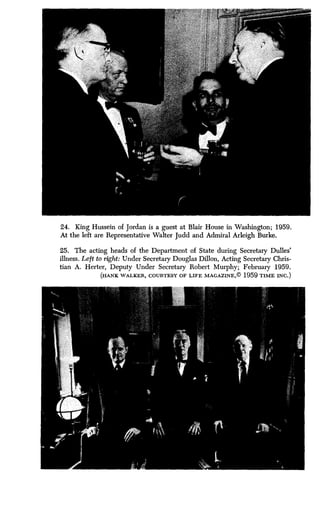
24.
	
King Hussein of Jordan is a guest at Blair House in Washing-
ton; 1959.
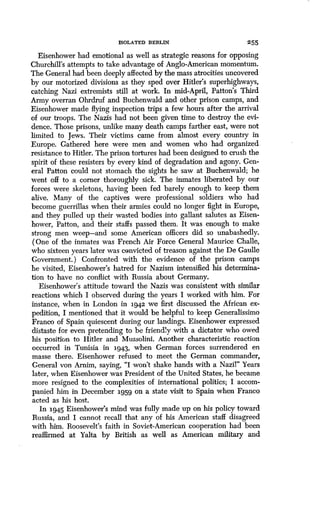
25.
	
The acting heads of the Department of State during Secretary
Dulles' illness.
ONE
INNOCENTS IN WARTIME
SWITZERLAND (1917-19)
This book is in the form of an autobiography, but because
I was for many years a professional diplomat-a career in which one's
private affairs are subordinated to international affairs-this is not so
much an account of my personal life as of my participation in the
foreign affairs of the United States . I did not deliberately plan to enter
the diplomatic service and it seems to me now, as I review the develop-
ment of American foreign relations during my lifetime, that our na-
tion's entanglement in world problems came about almost as hap-
hazardly as my own. The government which I first began to serve in
1917 controlled an isolated country, a country whose citizens were
embarking upon a World War to which they had given very little
thought. The government from which I retired in 1959 was a formida-
ble political and military complex which had accumulated responsibil-
ities all over the globe.
My work for the Department of State began on April 23, 1917,
just seventeen days after the United States entered World War I,
and I was rushed to Europe and tossed into international politics
before I had first-hand knowledge of any foreign country-indeed
with very little knowledge of any sort . Two years later, like most
Americans who had been hurried off to Europe during the war,
I returned home with every intention of staying home . But the war
had produced profound changes in my country . Whatever we Ameri-
cans might desire as individuals, the United States never could be the
same again after 1917 and, I discovered, neither could I .
There certainly was nothing in my family or educational background
to suggest a diplomatic career . Before I went to Washington in 1916
as a government clerk and law student, I had lived only in Milwaukee,
where I was born, October 28, 1894 . This Wisconsin city had the
justified reputation of being a stronghold of American isolationism,
partly because so many of its residents were immigrants or descend-
ants of men and women who had emigrated to get away from Europe's
2 DIPLOMAT AMONG WARRIORS
poverty, politics, and wars . My grandfather on my mother's side, Ber-
nard Schmitz, was a blacksmith who came as a youngster to Milwaukee
from Essen in the wave of emigration which followed the German
revolution of 1848 . Working long hours in a steel plant, he contracted
tuberculosis and died before I was born, leaving a widow and four
children. What I remember best about my maternal grandmother was
the German language spoken in her home and in the community
where she lived, some of which was transmitted to me in my child-
hood, a very useful legacy . My mother, Catherine Louise, was a gentle
person whose natural shyness was aggravated because her face had
been marred by smallpox . She was a devout Roman Catholic and had
need of the comfort of her religion because life for her never was easy .
My grandfather on my father's side, Francis Patrick Murphy, left
Ireland about 1850 to get enough to eat. He settled first in Brooklyn,
where he acquired a small saloon, but after a few years he sought his
fortune in Milwaukee, where his son and namesake was born . My
father quit school in the fourth grade. Like many others of those days
he thought education rather a waste of time . He tried his hand at many
occupations, including operating a saloon in partnership with a friend .
During long periods of unemployment, as in the depression of 1907,
my father took what odds jobs he could get, and my mother helped by
sewing. Nowadays when everybody is encouraged to go into debt for
everything, it may seem quaint that my parents took pride in the fact
that they never were in debt, although their margin of security at
one time was exactly twenty-five cents.
Although my father was not financially successful, he possessed
means for impressing his only son . For example, he enjoyed showing
how he could crack Brazil nuts with his teeth. He never had dental
care, but he still could crack nuts with his teeth at the age of sixty . He
had the reputation of never losing a fight, and of having "the kick of a
mule" in each fist. Like many Irishmen, my father sprinkled his speech
with vivid expressions; one of his favorite epithets was "You blue-nosed
Presbyterian s.o.b." That was a reminder, of course, of the ancient feud
between Catholics and Presbyterians in Ireland, although my father
had no religious prejudices whatever. It is curious how expressions
learned in childhood stay in our memories . Long after my father was
dead, when I was occupying the dignified position of Deputy Under
Secretary of State, I sat one morning in a staff conference presided
over by John Foster Dulles when the Secretary of State was having
some skin trouble on his nose and was using a salve which gave a
bluish tinge. As is well known, Dulles was an active Presbyterian lay-
man, and I could hardly refrain from laughing aloud as my father's
phrase suddenly recurred to me.
INNOCENTS IN WARTIME SWITZERLANn (1917-19)
	
3
It was assumed in our family that I could scarcely expect formal
education beyond grade school, and it was not easy to get even that
far. I attended parish schools when we could pay tuition, and at other
times I went to the public schools . When I was graduated from the
Gesu Parochial School in igog I took an examination for a scholarship
offered by Marquette University and its Preparatory Academy . A friend
of mine passed with the highest mark and got an eight-year scholar-
ship. I was a close second and was offered free tuition for four years
at the Academy. That was generous, but I already had four years
more schooling than my father, and I decided it was time to support
myself. Several of my relatives had quit school early, and they
were living useful lives . But a young Jesuit scholastic, William T .
Ratigan, a teacher at the Academy, changed what might have been
considered my natural destiny . Father Ratigan persuaded my parents
and me that it would be unwise not to take advantage of the scholar-
ship. I had to work nights to pay my expenses while in school, but I
managed to complete the four years in three .
In the summer of 1915, when I was twenty years old, I suffered an
accident which seemed at the time a major disaster . But one never
knows about such things until the whole story unfolds . I was working
that summer for a contracting company, and while I was in the con-
struction elevator the cable snapped and I plunged to the bottom of the
shaft, a distance of about three stories . My left foot was crushed with
a triple fracture of the ankle and heel bone whose effects I still notice .
I then learned the value of the newly enacted Wisconsin's Workmen's
Compensation Act, very advanced for that era, which supported me
through several painful months .
Being on crutches but drawing my compensation, I decided to make
use of the time by studying shorthand and typing at a business college .
At this school I learned about civil service examinations, which sug-
gested the possibility of getting a job in Washington which would en-
able me to study law at night. The man who inspired me to become a
lawyer was Senator Robert La Follette, Sr., founder of the Pro-
gressive Party in Wisconsin. "Old Bob," as he was known to everybody
in his state, was as much a hero to Milwaukee's Catholic boys as he
was to the Protestants . After several months in the business college
and a secretarial job in a lithographing firm, I qualified under civil
service as a stenographer-typist, and was offered a clerkship at one
thousand dollars a year in the office of the Third Assistant Postmaster
General. My father was not impressed . Said he: "That Third As-
sistant fellow must be pretty low down, something like the janitor ."
However, I discovered after starting work in Washington that the
Third Assistant Postmaster General, Alexander M . Dockery, formerly
4 DIPLOMAT AMONG WARRIORS
governor of Missouri, was sufficiently high up so that I did not get even
a glimpse of him during my first three months on that job .
Washington was still a pleasantly sleepy place when I made my
acquaintance with it in igi6. It did not begin to assume anything like
its present frantic appearance until after we entered World War I the
next year. To me, Washington seemed completely delightful; for the
first time I saw a clear road ahead to the practice of law, which by
then had become my firm ambition . A Milwaukee friend, a medical
student at George Washington University, recommended a boarding
house on Franklin Square kept by a southern lady we called Miss Rose.
For a tiny room to myself and all the food I could eat, I paid Miss Rose
a munificent five dollars a week. So I was more prosperous and happy
than I ever had been before . The University's night-school law course
was designed then, as it still is, for students who were working days for
the government . I was getting enough money from Uncle Sam to sup-
port myself, continue my law course, and send a little help to my par-
ents. I found congenial companions at the university, I enjoyed my
work, and the war-which still seemed very remote to me and to most
Americans-held no threat to my ambitions. However, in a very few
months the European War, as we called it then, was to change every-
thing in my modest program and everything in the United States .
Once the American people decided to get into that war, they went
in with a vengeance. The patriotic fervors of 1917 never have been
repeated in such extreme fashion . Especially in Washington, young
Americans were subjected to an almost hysterical wave of enthusiasm.
I was dismayed by the opposition to the war led by my boyhood hero,
Senator La Follette. Military service was out of the question for me
because of my injured foot, but one of my law student friends, Lyle
Alverson, who was supporting himself by working in the office of the
Secretary of State, told me, "If you really want to go to Europe, there
is great demand for young men to work overseas for the State De-
partment as stenographer-typists . You already have passed the only
civil service examinations required ."
That suggestion was all I needed . When I applied as Lyle proposed,
things moved more quickly than they have moved for me in Washing-
ton most times since. Within a week from the day my application went
in, I was on my way to Bern, Switzerland, on the first lap of my forty-
two years in the State Department.
I crossed the submarine-infested Atlantic Ocean together with sev-
eral hundred American civilians who had volunteered to work with
the French Army, mostly as ambulance drivers . Our ship was the
French Line's SS Chicago, a fairly old tub, and our voyage was
punctuated with frequent blackouts, boat drills, and other precautions
against U-boat warfare, which was then at its peak . Even though the
INNOCENTS IN WARTIME SWITZERLAND (1917-19)
	
5
submarine had been the immediate cause for the declaration of war
by the United States, the German General Staff, spearheaded by
Admiral von Tirpitz, was deliberately gambling that the unrestricted
use of the submarine could knock out Britain and France within three
months. So we innocents sailed blithely into an all-out submarine at-
tack which nearly accomplished its purpose . But Americans then, even
more than now, possessed what Homer Lea called "the valor of igno-
rance." I cannot recall a single American on that ship who even con-
sidered the possibility that our side might lose the war .
During my few days in Paris en route to Switzerland, I gained my
first appreciation of what war weariness means . Before we Americans
entered World War I, the European belligerents had already endured
three years of having their men slaughtered in the trenches . I never
have forgotten the faces of the people whom I saw on the streets of
Paris that spring-elderly soldiers, subdued workers, anxious women,
solemn children. Twenty-three years later, when I watched the Ger-
man army march into Paris, it was my recollection of those weary
people of 1917 which helped give me compassionate understanding of
the French tragedy .
The contrast in 1917 between war-saddened France and the brisk
neutrality of Switzerland was startling. Ever since Napoleonic times,
the Swiss have kept aloof from wars, a laudable achievement which
has been accomplished partly because a neutral country in the center
of Europe is useful to the belligerents . It has been remarked that if
Switzerland did not already exist, it would have had to be created .
The picturesque Swiss capital, Bern, high on its hill above the
winding Aare River, served many of the purposes during both World
Wars that the United Nations in New York does today . Bern pro-
vided a common meeting ground where representatives of hostile
powers rubbed shoulders in the arcades and taverns, where they not
only could spy on one another but also could arrange such humane
matters as exchange of wounded prisoners through the Swiss-directed
International Red Cross, and could even put out feelers for possible
peace negotiations . No assignment could have been more useful to me,
as introduction to the complexities of international affairs, than my two
war years in Switzerland, and the respect and affection which I de-
veloped then for the Swiss people have remained with me always.
Before World War I, the American Legation at Bern was so un-
important that it had been run, almost literally, by a man and a boy .
But the war brought a bureaucratic invasion, infinitesimal by today's
standards, but considered overwhelming then . I arrived in the first
wave and witnessed the mushroom growth of the legation staff. Those
Americans were pioneers in their way, experimenting hopefully with
primitive forms of intelligence, propaganda and economic warfare
6 DIPLOMAT AMONG WARRIORS
which now are standard features of government . Our early efforts were
sometimes laughable in their innocence, occasionally sinister in their
fanaticism, always extremely earnest .
The American minister, who had been given the congenial post at
Bern because he was a friend of President Wilson, was a monument
to the dignity of his office. He was a southern gentleman of the old
school, the editor and proprietor of a newspaper in Georgia, the
Savannah Press, and he wore striped pants, a Prince Albert coat and
a pince-nez. I was reminded of him when James F. Byrnes observed
in his book Speaking Frankly: "During my eighteen months as Secre-
tary of State [i945-471, I met only two Foreign Service representa-
tives wearing `striped pants,' and both of them were political ap-
pointees." The Honorable Pleasant Alexander Stovall, Envoy Extra-
ordinary and Minister Plenipotentiary, enjoyed wearing striped pants
and, thus attired, he would meet prisoner-of-war trains from Germany
and happily greet our returning doughboys . One day I overheard him
introducing himself to a young Marine: "I am the American minister ."
To which the young man respectfully replied, "Pleased to meet you,
Parson. I hope to study for the ministry myselfl" Stovall did indeed
resemble more than one kind of minister.
My first assignment in Switzerland was code clerk, and I thought I
was doing important work because I was entrusted with putting mes-
sages into secret cipher from my superiors in Bern to their superiors
in Washington . There were plenty of messages being cabled back and
forth, and I felt that I was on the inside of operations right from the
start. But after a few months I suffered my first disillusionment with
our Foreign Service organization when I learned that some of my
encoding and decoding probably had been wasted motion . The Ger-
mans rather disdainfully returned a State Department code book which
had been used by the American Consulate in Leipzig, thus hint-
ing broadly that they had keys to all our codes . The Germans were
way ahead of us in cryptography; it was child's play for the German
Black Chamber to break our simple book codes of that period . More-
over, most Americans had never even heard of security, and the Bern
legation certainly did not practice it. Foreign employees had the run
of the legation, and it would have been comparatively easy for some
of them to get hold of our code books .
The indifference of the Foreign Service to security was accom-
panied by open aversion to Washington's hastily improvised propa-
ganda agency, the Committee on Public Information, headed by
George Creel. Our professional staff did not welcome Creel's amateur
propagandists. The Committee sent to Bern an earnest and intelligent
lady, Mrs. Norman de R . Whitehouse, but she had no acquaintance
with any foreign language, no technical assistance or paraphernalia
INNOCENTS IN WARTIME SWITZERLAND (1917-19)
	
7
and only the sketchiest of instructions. Apparently she had been given
this assignment largely because of her reputation as a battler for votes
for women in New York. But that did not endear her to the Swiss who,
nearly half a century later, still have granted votes to women in only
a few localities.
I felt considerable sympathy for Mrs . Whitehouse, perhaps because
she got so little from anybody else . It was only when the war was al-
most over that she received from Washington masses of outdated
pamphlets which she valiantly undertook to distribute . The skeptical
Swiss, devoted to neutrality and mistrustful of all forms of propaganda,
believed that their own newspapers could supply them with all the
information they needed, undoctored by foreign governments . Recall-
ing now the cruel snubbing which this pioneer propagandist got, both
from the Swiss and from her fellow countrymen, I am sorry she is not
alive to be dazzled by the State Department's sponsorship of today's
elaborate worldwide information services, with their network of broad-
casting stations, transocean wireless and cable circuits, motion picture
and television studios, traveling symphony orchestras and jazz bands,
and thousands of civil servants occupying impressive buildings in
Washington and around the globe .
If the State Department was slow to value security and prop-
aganda, it was even less well organized in 1917 to appreciate intel-
ligence work. A shocking instance which came to my attention con-
cerned James C. McNally, the American consul general in Zurich,
Switzerland's financial and industrial center. McNally's daughter was
married to a German naval officer who had argued against the Berlin
decision to wage unrestricted submarine warfare, because he correctly
predicted that this would bring the United States into the war . Mc-
Nally's German son-in-law was so embittered that he decided to help
his wife's country, and through him NcNally was able to give the Allies
advance notice of at least two major German offensives . For this
achievement, General Pershing personally commended McNally .
But a retired American clergyman named Herbert Field, who was
living in Zurich then, observed that McNally was meeting a number of
Germans, and Field secretly reported to our government that the
American diplomat was "consorting with the enemy ." Due to the con-
fusion of war and lack of liaison among government agencies, this
ignorant accusation led to McNally's dismissal from the Foreign Service
and the loss of a most valuable source of intelligence . I became con-
vinced that McNally was loyal and had been scandalously mistreated .
Thus, at the outset of my career, I realized that any official accused of
disloyalty or indiscretion should be given the benefit of every doubt .
There are many occasions when "consorting with the enemy" is the
only means of obtaining essential information, as I myself learned
8 DIPLOMAT AMONG WARRIORS
during some awkward situations in World War II . More recently, in
our hot and cold wars, a number of Foreign Service officers have been
similarly accused. Experienced officers have endeavored to give such
cases careful consideration, but in spite of what any of us in the
Foreign Service could do, some Americans have been treated in recent
years as unfairly as McNally was in 1917 .
Incidentally, I have followed with interest the career of Herbert
Field's son, Noel, who entered the Foreign Service after World War I
and eventually defected to the Communists . He was last heard from
in Budapest, but defectors live in danger and apparently the Commu-
nists suspected Noel Field of being a double agent. At any rate, he
vanished. Perhaps some day we may learn what happened to this too-
bright young man who worked secretly for the Communist side in the
Spanish Civil War, using a League of Nations job as cover for his
activities.
The Foreign Service normally makes about the same distinctions
between its officers and clerical staff as the Army does between officers
and enlisted men, but in Switzerland during World War I conditions
were not normal. The customary crowds of tourists were absent, dip-
lomatic social functions were held to a minimum, and all members of
the American community were drawn together by the war. So, as a
young clerk, I became more intimate with officers in the legation than
would have been likely in peacetime, and in particular with the man
who soon became my immediate superior, an exceptionally able con-
sular officer named Alfred W . Donegan. As press officer, Done-
gan read and analyzed the German and Austrian publications which
were readily available in Switzerland. Since he understood the central
European scene thoroughly, he could glean inferences from his read-
ing which might escape less informed readers . Because I knew Ger-
man, he arranged to have me assigned to assist in his work.
Donegan was married to a hospitable Austrian lady, they had four
children, and soon I felt almost one of their family . Early in our ac-
quaintance, Donegan startled me by remarking that he and his wife
had not visited the United States for many years, simply because they
could not afford it . In those days, the starting salary of a career con-
sular officer was $i5oo a year, the maximum pay except in a few posts
was $4000, and perquisites were few and far between. Congress sup-
plied the State Department with no funds to pay traveling expenses
for family vacations at home, or even to pay moving expenses when
an officer was transferred from one post to another . "A promotion in
the Foreign Service can be an invitation to bankruptcy," Donegan
told me, "because a promotion often involves a transfer, and only men
with independent incomes can afford to move family and furniture
halfway around the world." Donegan said that when he was Consul at
INNOCENTS IN WARTIME SWITZERLAND (1917-19)
	
9
Magdeburg, Germany, he was desperately in debt and needed $loon
urgently. His vice consul was a close friend and they agreed that the
vice consul would apply to a local German bank for a loan . The
banker asked the young man what security he could offer . "No se-
curity," the junior diplomat replied, "but our consul will endorse my
note." The banker was impressed. "In that case, there is of course no
question," he said . Donegan concluded, "What the banker did not
know was that both of us were poor credit risks ."
Donegan's personal story had a happy ending, without aid from the
State Department. His one hobby was chess, which he played well
enough to participate with moderate success in European tournaments .
At one of these meets he became acquainted with a well-to-do Ameri-
can banker named Hallgarten, and later they became good friends
and played chess together. One day Hallgarten announced, "Donegan,
I drew up a new will today and named you in it ." Donegan ap-
preciated this kindly gesture, but as Hallgarten was only fifty years
old and apparently in excellent health, he soon forgot about it . How-
ever, less than a year later, while Hallgarten was in the Casino at
Monte Carlo, he dropped dead of a heart attack. To Donegan's
amazement, he learned that his friend had bequeathed to him a quar-
ter of a million dollars, a sum which made him the equivalent of a
millionaire in today's money. This did not result in Donegan's resigna-
tion from the Foreign Service. He continued to work until his retire-
ment several years later, his last post being Consul at Basel . Donegan
was a devoted servant of the American Government . He served when
he could ill afford to donate his services, and he continued to serve
when he could have afforded to quit.
But my observations in Bern did not tempt me to follow Donegan's
example. Much of the legation work seemed useless ; there were too
many instances of faithful service being unappreciated; officers were
hampered by Washington politics; everyone was underpaid. As Done-
gan explained to me, "Congressmen know they can't win votes by ap-
propriating big sums for the Department of State, so the Department
never will be able to pay top-notch men what they are worth . That's
why the Department was so poorly prepared to go into this war ." A
quarter of a century later, the Department was almost as poorly pre-
pared to go into World War II .
Yet our legation in Switzerland did have some very capable men
during the two years I was stationed there . The ranking career dip-
lomat, Hugh Wilson, possessed private means and could not be in-
timidated by anyone. The brilliant Third Secretary was Allen Dulles,
who became Director of our gigantic Central Intelligence Agency from
1953 to 1961. But in 1926, Dulles resigned from the Foreign Service
1 0 DIPLOMAT AMONG WARRIORS
in order to make money practicing law, until he felt he could afford
to serve his government again.
I decided that I would go back to Washington after the war and
proceed with my original plan of earning my living as a clerk until I
finished my law studies, and I was impatient for the day when I
could resume normal life . Yet I had to admit that in the meantime
I certainly was enduring no hardship at Bern . In truth, I never had
been so comfortable. I was boarding with a kindly German-Swiss
family, enjoying their delicious breakfasts of hot chocolate, fresh
rolls, cream cheese and cherry jam ; I had several pleasant friends in
addition to the congenial Donegans ; and I was much attracted by a
young lady, Mildred Taylor of Kansas City, Missouri, who was a sec-
retary at the Red Cross headquarters which the Americans had es-
tablished at Bern, and claimed to be a faster stenographer than I was .
One weekend I invited Mildred to go sight-seeing with me, and as
we rode up the Jungfrau on a shaking rack and pinion mountain train,
I said teasingly, "I bet you can't take dictation at one hundred twenty
words a minute on this trainl" She promptly bet ten dollars that she
could-and won the bet. But I won Mildred Taylor . She promised to
wait until I could qualify as a lawyer, and she has loyally shared
through the years the viscissitudes as well as the satisfactions inherent
in the Foreign Service .
Armistice Day 1918 came at last, and no one was more stirred by
the Allied victory than Minister Stovall . He invited several hundred
guests to celebrate at our legation, where he delivered a speech in
the finest southern oratorical style. As a climax, he paid a flowery
tribute to the courageous soldiers from his home state of Georgia who
had stormed and liberated the fortress city of Metz. A British diplomat,
Sir Robert L. Craigie, lost his aplomb at this point and his monocle fell
to the floor-because the actual circumstances were that Metz had been
evacuated by the Germans and our soldiers had strolled in without
firing a shot. But we all enjoyed Minister Stovall's hospitality, and Sir
Robert eventually married his charming daughter.
The improvised American bureaucracy at Bern disintegrated as soon
as the war was over, largely because most of the amateurs insisted on
going home quickly. However, I stayed long enough so that I was in
Paris when Woodrow Wilson arrived there to attend the Peace Con-
ference. I stood with the French crowds who gave the American mes-
siah a tumultuous welcome as he drove in an open carriage down the
Champs-Elysees. Not knowing then how many years of my life would
later be spent in Paris, I lingered on a few days, visiting the war
fronts, enjoying my first airplane excursion over the city, taking in as
many sights as I could, from the top of the Eiffel Tower to the base
INNOCENTS IN WARTIME SWITZERLAND (1917-19)
	
11
of Napoleon's tomb . Then I hurried back to Milwaukee to see my
mother and father and inform them of my engagement .
Two weeks later I was back in Washington, settled in a different
boarding house, working days for the Treasury Department instead
of the Third Assistant Postmaster General, and studying nights to finish
my interrupted law course . My boarding house and my government
job were not the only things changed after my return to Washington .
The capital represented much more power than before the war, and
this was heady wine to the men who dominated American affairs .
Wealth had piled up, but politics had not improved. The way was open
now for the arrival of Warren Harding and his cronies.
In less than two years, I finished law school and was admitted to the
bar of the District of Columbia . I was ready at last to pursue the life I
had planned, but while I was considering whether to accept an offer
from a good law firm, I happened to read in the Washington Star that
examinations were about to be held for openings in the Consular Serv-
ice. To this day I cannot honestly explain why I was tempted to take
those examinations. I said I was doing it merely from curiosity, to see
whether I could pass, that I had nothing to lose except a little time .
Yet I must have had a pretty good idea that, with the courses I had
taken in international law, and with the experience I had had in
government service in Washington and Bern, I would pass those tests;
that then I would be eligible to become a career Consular officer ;
that then I might spend the rest of my life in foreign lands . Like the
American nation itself, I had had a glimpse of wide horizons, a taste of
life abroad, and I no longer felt satisfied just to mind my own business
at home.
Anyway, my feet carried me to the examination rooms, and . after I
completed the written tests, an appointment was made for me to call
on an examiner who would give me the oral language test. I was
pleased to discover that I was acquainted with this examiner . He was
Hernando de Soto, who had been our consul general in Leipzig when
the United States entered the war. De Soto was married to a Russian
lady who spoke German more fluently than she did English, so hus-
band and wife had fallen into the habit of conversing with each other
in German. While the couple were being repatriated from Leipzig,
they were delayed for some weeks in Bern awaiting transportation to
the United States, and their habit of speaking German in public ex-
cited the suspicions of some Americans there, including Minister
Stovall. That ardent patriot believed that to speak the language of the
enemy in preference to English was disloyal in wartime . So the De
Sotos endured a very unpleasant month in Bern. Now, encountering
De Soto in Washington, I made tactful reference to that episode,
which inspired him to an impassioned statement of the whole affair,
12
	
DIPLOMAT AMONG WARRIORS
consuming most of the hour which had been allocated for my oral
examination. Having relieved his feelings to a sympathetic listener,
De Soto smiled benignly and assured me I would have no difficulty
passing that part of my examination . I suppose I already was practic-
ing diplomacy.
When I took my examinations late in 1920, the Foreign Service was
a tiny fraction of its size today and held few inducements for ambitious
young men, but during my lifetime it has been upgraded into a pro-
fession which can appeal to able young people. Just the other day I
returned to Washington as a member of the Board of the Foreign
Service Institute. I was informed that in one year recently, about ten
thousand men and women had taken examinations ; four thousand
of these had passed the written exams ; sixteen hundred got to the
oral finals; and about two hundred applicants were accepted. With
such keen interest, an excellent selection of junior officers is available
now for our State Department.
Shortly after my examination, I was offered a choice of three posts,
including vice consul at Zurich. I hastily went into conference with
Mildred. I explained to her that I had no intention of following a
permanent career in the Consular Service, but we liked Switzerland
and we agreed it would be instructive to spend a few more years in
Europe before I settled down to practice law in Washington . I took
the oath of office on February 28, 1921. and we were married on
March 3. I had agreed to attend a thirty-day training period for new
consular officers, and the director was understandably annoyed when
I immediately requested a ten-day leave of absence for my honey-
moon. To placate him, I said, "I'll take along a copy of the Consular
Regulations." The notion of a combined honeymoon and cram course
amused him and he made no further objections .
A month later I received travel orders to go to Zurich, not as a
bachelor clerk as on my previous journey to Switzerland, but as a
married man, a career officer in the Consular Service of the United
States Government, Vice Consul Class C, total annual emolument
$2500. A fellow law student took the job which had been offered to
me in a New York firm specializing in federal tax matters, and before
long he was making $40,000 a year. Yet, when I learned about this, I
did not envy him, for by that time I felt I had found my niche in life .
Two
CRAM COURSE IN HITLER'S
MUNICH (1921-25)
Six months after I became a consular officer, I was given by
rare good fortune one of the most enlightening assignments of my
diplomatic career. In November 1921 I was sent to Munich, Germany,
and remained there almost four years . Only now, as I look back, can I
fully appreciate how valuable those Munich years were to one. No-
where else in Europe in the 192os was the past, present, and future of
that turbulent continent more dramatically revealed . What I learned
in Munich about the behavior of victors and vanquished after the First
World War enabled me to anticipate much of the behavior of victors
and vanquished after the Second World War . These recollections be-
came my greatest asset when I was appointed adviser on German
affairs to General Eisenhower in September 1944 and later, during the
first four postwar years, chief representative in Germany for the State
Department.
When I arrived in Munich in 1921 a man whose name meant nothing
to me then, Adolph Hitler, had just begun to make that city the
spawning ground for his National Socialist movement . I met Hitler and
other members of the Nazi high command while they were still ob-
scure agitators . I also met Hitler's only famous collaborator of that
time, the bitter and frustrated General Erich Ludendorff, who had
been commander in chief on the western front when Germany sur-
rendered in 1918. I attended several of the earliest Nazi meetings to
make official reports to Washington . Like almost all foreign observers
in Munich then, I found it impossible to believe that the demagogue
Hitler, so unconvincing to me, would ever amount to much .
But at the same time I was learning what a dangerous situation the
First World War had created in Europe . That_ war undermined the
European system . built up through many generations, before __any
acceptable new system had been devised to replace it . From what I
saw, I developed great doubts about the wisdom of Woodrow Wilson
in brashly forcing the issue of self-determination? His sweeping ideas
14 DIPLOMAT AMONG WARRIORS
and superficial knowledge of the practical aspects of European life
helped promote European disintegration . Every other person I met in
Munich seemed to be involved in some kind of intrigue, because the
whole of Europe was in a state of flux. The German and Austro-
Hungarian empires had been replaced by shaky republics in which
most citizens had little confidence and which were viciously hated by
fanatical minorities. The chaotic condition of society was such that
there was genuine reason to fear that Bolshevism might take the same
advantage of confusion in Germany and Austria which it had taken
in Russia after the collapse of the Czarist empire . Above all, while I
was in Munich I watched the wildest runaway inflation in modern
history wipe out the savings of generations of Germany's and Austria's
most decent, substantial people, leaving millions of them in dazed
despair. That inflation, in my opinion, did more than any other single_
factor to make Hitlerism possible . Fortunately, the lessons it taught
were skillfully utilized to prevent repetition of inflation after World
War II, when a few courageous Americans resisted the shortsighted
attempts of other Americans to reduce Germany again to economic
chaos. Whatever stability exists in Europe today can be attributed, in
my opinion, to the superior knowledge of economics and financial
matters acquired between the world wars and applied in spite of
understandable hatreds which might have duplicated the disastrous
policies which followed World War I .
I was sent to Munich in 1921 with three other Consular Service
officers to reopen our consulate general, which had been closed in
1917 by the war. An experienced officer, William Dawson, was in
charge of our trio of very junior vice consuls, and he was as fine a
teacher as any budding diplomat could have. Dawson had the repu-
tation, which I can testify was thoroughly deserved, of a severe
taskmaster. I offered to resign at least three times during the eight
months I served under him, but he calmly ignored my offers and did
not abate in the slightest his determination that his three vice consuls
should not only do their work well, but also get into the habit of
self-education. He prided himself upon his own linguistic ability and
insisted that learning languages is largely a matter of application, not
some God-given talent like being an artistic virtuoso . He was equally
fluent in German, French and Spanish, and made it a rule that his
vice consuls should never use English in talking with him in his
office. I had to discuss everything with him in German, one of my
colleagues in Spanish, the third in French . In that way, Dawson kept
perfecting his own languages and obliged us to do the same .
But after only eight months in Munich, Dawson was promoted and
transferred, and since I was slightly senior to the other two vice con-
CRAM COURSE IN HITLER'S MUNICH (1921-25)
	
15
suls, I was instructed to take charge until a successor to Dawson ar-
rived. Probably I would have had a severe case of stage fright if I had
been told that, except for a brief interval, no successor would appear
for three years, during which time I would remain in Bavaria as chief
representative of the United States . Fortunately for my peace of mind,
I never knew from one day to another when I would be relieved. I
would like to flatter myself that I was left so long in this post because
of rare ability, but the evidence suggests that our Government did not
think it mattered much who represented it in Munich. It was an ex-
hilarating experience for me, as a young man, to be left so completely
on my own. Before long I began to think of the diplomatic service
as my permanent career rather than as a temporary adventure .
How eagerly we worked then, my fellow vice consuls and I ; with-
out their unstinted assistance I never could have held down that
assignment. From the moment the consulate general reopened we were
overwhelmed with work, usually spending twelve hours or more a day
in the offices . The Spanish Government had looked after American
interests in Germany during the war, and we found our inadequate
prewar office equipment in storage. The United States Government
owned no property in Munich, the city was crowded, and we had to
settle for offices in a building owned by a student fraternity. Then the
people poured in; it seemed to us that the whole of Bavaria wanted
to emigrate to the United States . Immigration was almost unrestricted
then and despite our limited facilities we soon were granting an aver-
age of four hundred visas per day . Our offices became frantically
busy with such matters as approving thousands of visas for emigrants,
issuing a large volume of American passports, making out consular
invoices, and preparing economic reports which we had to type our-
selves because the State Department could not afford to provide us
with sufficient clerical help . I remember that this routine called for
several hundred signatures dniky. It was lucky for me that I had gone
to business college, since I had to type all my own reports and corre-
spondence.
It was a welcome relief from these chores to transform ourselves
into political reporters for the benefit of the State Department, which
was listed in routine regulations as one of our duties . I am rather vain
about some of the political reports I made describing Hitler's earliest
raucous efforts ; when I looked them up recently in the National
Archives in Washington, they seemed reasonably perceptive. But while
we were sending in our reports so earnestly, we never knew whether
or not anybody in Washington read them. They were accepted in
total silence. Americans never have been more isolationist than they
were in the lgaos . During my Munich years I saw nothing to indicate
that the American Government or people were even mildly interested
DIPLOMAT AMONG WARRIORS
in the political developments which seemed so ominous and significant
to us on the spot. The only real American interest in Germany at that
time was concerned with money; a few Americans made fortunes out
of the German inflation; American promoters high-pressured unreal-
istic loans upon German communities and corporations, loans which
were defaulted later at the expense of American bondholders. Not once
did our State Department ask my opinion about any political event,
nor express concern over the developing Nazi movement . No comment
came from Washington when I sent an eyewitness report of the Hitler
group's attempt to overthrow the government of Bavaria in 1923, as
a first step toward the national dictatorship which they eventually
achieved. Our able ambassador to Germany, Alanson B . Houghton,
periodically summoned me to Berlin for conferences of regional repre-
sentatives, and listened thoughtfully to our reports of various local
situations, but that was the only attention our political investigations
received. Yet we were dealing with the origins of World War II .
This vast tide of emigration from Europe after World War I was
a symptom of the prevailing chaos . American critics of our immigra-
tion policy complained then that we were getting the riffraff of Eu-
rope, but that certainly was not true of Munich . Moreover, I do not
believe it was generally true. Unemployment was widespread and the
war had been bitterly disillusioning, particularly for young people. At
least 8o percent of our applicants were Bavarians, mostly young and
from solid middle-class or working-class families . Many of them were
craftsmen and most had some skills . They saw no future in Germany
or Europe, inflation was wiping out any savings they had made or
could make, and they fully intended to become permanent and serious
American citizens . I am sure that the great majority of them did so.
Probably it was true that our immigration laws were too lax and that
some undesirable persons slipped through . Our Munich applicants
were required to make out their own application forms and we did
not have the facilities to check them carefully . But I am confident that,
on balance, the great flood of immigrants from Europe after World
War I greatly benefited the United States. Later on the 1g2os,
Congress swung to intensive restrictions, until today the United States
has the most complicated system of immigration laws in the world .
My wife and I soon found a comfortable apartment and began
immediately to enjoy life in Munich. Many Americans never have
understood that Kaiser Wilhelm's Germany actually was a confeder-
ation of several more or less independent kingdoms and principalities .
Munich had served for centuries as the capital of Catholic kings, the
last dynasty being that of the popular and enlightened Wittelsbach
family. Munich was accustomed to its own court and diplomatic corps,
and its citizens had long prided themselves upon their hearty enjoy-
CRAM COURSE IN HITLER'S MUNICH (1921-25)
	
17
ment of food and drink, music, opera, and sports . Bavaria was not
occupied after World War I, as the Rhineland and Ruhr regions of
Germany were, and the Bavarians tried to preserve Munich's prewar
atmosphere through all postwar difficulties . The Bavarians had re-
tained their popular monarchy and a large degree of independence
under the Hohenzollern Kaisers, so they understandably were distrust-
ful of the Weimar Republic which had dethroned their good king along
with the bad Kaiser . Few Bavarians welcomed the Weimar Republic ;
most of them were thoroughly suspicious of it and especially of the
Social Democrats (socialists) who were the republic's principal pro-
ponents. In fact, as I soon learned, Bavarians did not expect the repub-
lic to endure long; they were impatiently anticipating the restoration
of some form of monarchy which would bring back their_ own Wittels-
LaA royalty. Meanwhile, they were behaving as if they were free to
apply an independent foreign policy, and they treated the consular
corps as if it were their prewar diplomatic corps.
After Dawson left Munich, I found myself in a peculiar position. I
represented one of the richest and most powerful countries on earth in
a place which European governments considered important enough to
deserve high-ranking diplomats . I carried locally the impressive title
of Acting Consul General, but actually I still was only a junior vice
consul, drawing a vice consul's pay of $2750 a year, with almost none
of the perquisites which provided my colleagues in the consular corps
with ample entertainment and other allowances. If we managed to
repay a few social obligations in Munich's active diplomatic society, it
was thanks only to the inflation which was ruinous to Germans but
temporarily helpful to those of us paid in dollars .
But we did feel seriously pinched, and when Senator Robert
La Follette, Sr.-my boyhood hero from my home state of Wisconsin
-came through Munich in 1922 on his way back from a visit to Russia,
my fellow vice consul, Albert Halstead, and I decided to try to per-
suade him to plead our case in Washington. Senator La Follette was
a member of two Senate committees which help to determine annually
the extent of appropriations for the State Department . Halstead's wife
was a Milwaukee girl, and we decided that the best way to get the
senator in a proper mood would be to take him, his wife and two sons
to an expensive Munich restaurant, the Walterspiel, which ordinarily
was far too lush for our purses, and there ply him with food and drink
before we made our pitch . Everything went off beautifully; the food
was beyond reproach; the conversation was lively, the atmosphere
soothing. After dinner, as the senator sat relaxed, Halstead and I,
according to plan, began to describe our money troubles . The senator
listened and we became more eloquent. But suddenly he looked
around at the luxurious surroundings, the well-dressed and richly fed
18 DIPLOMAT AMONG WARRIORS
crowd, and commented : "Well, you young fellows seem to be doing
not too badly for yourselves here." Too late we realized that our
carefully laid plan had been psychologically unsound . We should have
taken the La Follette family to the cheapest and least prepossessing
restaurant in town which, in fact, we had to patronize for some time to
make up for that La Follette feast.
However, we were getting experiences in Munich upon which one
cannot set a price. Thanks to my official position, I had a wide and
diverse acquaintance in that cultured community. Everybody in
Bavaria, from highest to lowest, was accessible to the official repre-
sentatives of the United States, and American visitors to Munich usu-
ally called at the consulate general. One American who slipped into
town so unostentatiously that we did not know of his presence for
several days was Thomas R. Marshall, former Vice President of the
United States. As soon as I learned of it, I called on him . Mr. Marshall,
charmingly informal, told me how he had stood in a queue to register
with the police, as was required of all ordinary tourists . I knew the
Munich police chief well, and immediately called on him and com-
plained with mock indignation, "Why did you keep the former Vice
President of the United States standing in line to register with the
police?" The chief was horrified to learn what had happened, and
exclaimed, "Why didn't he tell us who he is?" He immediately sent a
written apology to Mr . Marshall, addressing him in the formal German
phrase as "high-born." When I translated the apology to the Vice
President, he was delighted . "I shall have that letter framed and put
in the most conspicuous place in my office," he assured me . "That will
silence my congressional critics who have failed to appreciate ; that I
am `high-born'!"
We also had a number of friends among the group of Americans who
established their homes in Munich after the war . One of these was
James Loeb, of the great New York banking firm of Kuhn, Loeb &
Company, who after an illness retired to a country estate near Munich .
He came to see me one day at the consulate, where we had a pleas-
ant chat, and as he was leaving, he said, "If there is anything I
can do to help you, don't hesitate to call on me." Not long after that,
an American who was penniless came to our consulate for help . Our
government provided no funds for needy citizens, and not infre-
quently our consular and diplomatic officers advanced their own
money-which many of them could ill afford to spare-to help wander-
ing Americans in distress. This time I remembered Loeb's offer of
"help," so I telephoned to him and described the case . Loeb re-
sponded, "Of course I will give the man enough to return home,"
which he did. After that, Loeb made gifts and loans to a number of
indigent Americans whom I referred to him, and his intelligent gen-
CRAM COURSE IN HITLER'S MUNICH (1921-25)
	
19
erosity was a great help, not only to our citizens who found themselves
alone and in trouble in an alien land, but also to our consulate .
My colleagues in the Munich consular corps were exceptional
men in one way or another, and all were friendly and helpful to me.
They must have been astonished that the United States Government
was content to leave so junior a diplomat in the Munich post, but they
never treated me with anything but the kindest consideration. Today
even our youngest diplomats are better equipped than I was in the
1g2os, for they are given substantial preliminary training in essential
matters before being sent abroad .
The titular head of the Kunich consular corps was the Papal . Nuncio,
Monsignor.. .Eugemo Pacelli, who later became Pope Pius XII . The
Vatican always had maintained close relations with Bavaria, which
remained Catholic throughout the Reformation while many other Ger-
man communities were becoming Lutheran . Monsignor Paceli,
through_ his intimate knowledge of international politics, was one of
the first to recognize that the future of Europe depended largely upon
what happened in Germany . I had many enlightening conversations
with him in Munich, and two decades later I was to renew my as-
sociation with him after he became Pope, when I entered Rome with
American troops in 194.4 as President Roosevelt's personal representa-
tive. At that time someone sent me a clipping from a gossip column
which detected some kind of Popish plot in the State Department,
from the fact that I had been associated wih the Pope in Munich and
now turned up with so much influence in Rome. But it was an Episco-
palian, Franklin D. Roosevelt, who was responsible for my being in
Rome, and probably nobody in the State Department remembered in
1944 that I once had served in Munich with an Italian named Eugenio
Pacelli.
Another Munich colleague was William Seeds, the British consul
general, an Irishman of charm and quick intelligence. He was es-
pecially helpful in showing me how to write effective political reports,
something which my own government never taught me . He permitted
me to read some of his reports and analyses, which combined wit with
wisdom. Haniel von Haimhausen, the brilliant if cynical Minister to
Bavaria from the State of Prussia, provided some of my first intimate
glimpses into central European politics . Emile Dard, the French
representative with the rank of minister, was a diplomat of the old
school who had spent all his adult years in the Foreign Office . His one
object in life at that time was to promote the French policy of
"separatism." The idea was to persuade inhabitants of Bavaria and the
Rhineland, Germany's main Catholic regions, to assert their in-
dependence of Berlin and to constitute independent buffer states .
Many Bavarians sympathized with this general idea. Their current
20 DIPLOMAT AMONG WARRIORS
representative of the Wittelsbach royal family, Crown Prince
precht, was an honorable and distinguished man who looked every
inch a king. The French minister blew hard on every tiny flame which
he hoped might re-establish an independent monarchy in Bavaria and
thus make France feel more secure from German aggression.
Looking recently through my long-buried official reports from
Munich, I came across one dated March 17, 1.923, which described a
French conspiracy I had forgotten. The purpose was to set up a south-
ern German Catholic kingdom including Bavaria and the Rhineland
and parts of neighboring Austria, with the capital at Munich . Docu-
ments had been found which indicated that French army agents had
paid substantial sums to German and Austrian monarchists. So I in-
terviewed Minister Dard and then reported to Washington that Dard
had given me his "word of honor" that no money had been contrib-
uted through him to the intriguers, but he added that of course he had
no knowledge of what certain military agents might be doing under
instructions of Generals Degoutte and Weygand . Americans in those
days did not indulge in such devious operations, but things are differ-
ent today.
Dard told me frankly that the French Government had assigned
him to Munich in 1920 at the same time that General Weygand had
been dispatched to Poland to aid in the repulse of Bolshevism there .
Dard's instructions were that if the Bolsheviks overran northern Ger-
many, as seemed quite possible at the time, he should make every
effort to separate Bavaria from the rest of Germany . But he assured
me that after the Bolsheviks were defeated, his government had no
further interest in a separate Bavaria . My report to my government
concluded with a bit of diplomatic double-talk which I could not im-
prove upon today: "It is believed that Minister Dard, in protesting a
lack of further interest, did not strictly adhere to an entirely correct
portrayal of his present mission ." Which was an elaborate way of say-
ing that my distinguished French colleague probably was lying .
One man who was more helpful to me than any of my diplomatic
colleagues was a German employee of the American consulate general,
Paul Drey. When we reopened our Munich office in 1921 he was
working for the Spanish mission which had handled our affairs during
the war, and Dawson persuaded him to come to work for us . He was
in his late thirties then, a member of a distinguished Jewish family
which had lived in Bavaria four hundred years. He was respected
among Bavarians and could quickly arrange for me any interviews
I desired. His knowledge of local politics and personalities was ency-
clopedic, he was in every sense a cultured gentleman, and he soon
became my close friend . But Paul Drey unwittingly misled me about
one man and his group : Adolph Hitler . I recall the first Hitler meeting
CRAM COURSE IN =ER7S MUNICH (1921-25)
	
21
I attended with Paul; as we went out, he exclaimed : "How does this
Austrian upstart dare to tell us Germans what to do?" Paul and I later
attended many more Nazi rallies in order to report this violent political
phenomenon to the State Department . But when I asked Paul, "Do
you think these agitators will ever get far?" he answered firmly, "Of
course not! The German people are too intelligent to be taken in by
such scamps!"
The Bavarians were famous for their meticulous good manners, and
one day when Paul and I went into a tailor shop to order a suit, the
tailor was extremely rude. Impulsively I asked him : "Are you by
chance a member of the National Socialist German Workers' Party?"
He answered proudly: "Yes, I am a follower of Herr Hitler ." As we
left the shop, Paul said to me, "Did you notice what I did to show my
contempt for that Nazi?" I said, "No, Paul, I didn't notice. What did
you do?" He said triumphantly, "I did not tip my hat to him when we
left!" According to Bavarian custom, men who respect each other tip
hats, and by not tipping his hat Paul had subtly showed his contempt
for the Nazi tailor. I hope the tailor noticed the insult, which escaped
me.
Paul Drey paid dearly for his faith in the German people, among
whom he firmly numbered himself until the end . In 1938, thirteen
years after I left Munich, I read one morning in Paris that the Nazis
had burned down a synagogue in Munich, and I immediately ar-
ranged to fly to that city to persuade my friend Paul to leave Ger-
many, assuring him of employment with the State Department in a
safer place. He thanked me, but shook his head, saying, "No, this is a
temporary madness. Self-respecting Germans will not tolerate these
louts much longer." Paul's faith was greater than mine, and I could not
dissuade him.
I was one of the first American civilians to enter Munich after its
capture in 194.5, and immediately made inquiries about Paul Drey.
A leading Munich banker, August Bauch, told me that he had last
seen Paul in a work gang shoveling snow on a Munich street, and later
heard that he had been sent to the Dachau death camp . When I
visited Dachau shortly afterward and confirmed Paul's death there, I
was more stricken by the fate of my friend than by the certified
deaths in that horror chamber of 283,000 other victims .
Paul Drey runs all through my memories of Munich. I was with him
on the memorable morning of November 9, 1923, when Hitler staged
his first rebellion against the republic in the mistaken belief that
Bavarian monarchists would support a break away from Berlin at that
time. Paul and I arrived in the central square of Munich, the Odeons-
platz, just in time to see Hitler's storm troopers marching into the
square toward a contingent of the Bavarian police. Hitler's famous
22 DIPLOMAT AMONG WARRIORS
collaborator, General Ludendorff, had foolishly decided to join this
premature rebellion and was marching with Hitler at the head of the
armed rebels. That scene has been described in many books, and the
disparities in details show that reporting is not an exact science. Most
reports say that when the police opened fire, Hitler lost his nerve and
in order to save himself dropped to the ground with such force that
he broke a shoulder, while Ludendorff marched fearlessly on . Paul
and I were right there when the firing started, and we recognized
Hitler and Ludendorff, whom we had seen many times . Of course it
does not matter now, but for the record I can testify that both
Ludendorff and Hitler behaved in an identical manner, like the battle-
hardened soldiers they were. Both fell flat to escape the hail of bullets .
Ludendorff's body servant, marching at his side, was killed, as were
several of Hitler's cronies .
Paul and I had stayed up all the previous night reporting the
rapidly moving developments . The Nazi guerrillas had seized the
Bavarian Government offices, the banks, the City Hall, and of course
the telephone and telegraph offices . I was refused permission to send
a telegram in code to Washington, and indignantly demanded an in-
terview with Hitler himself. After hours of argument, I finally did get
in to see him at 3 A.M., only to be told rather mildly that I could not
send my telegram. My protest was only a formality by that time,
since I already had sent my colleague, Halstead, in a car to file the
telegram from Stuttgart. And later I learned that I had demanded
from Hitler rights which I did not possess.
Four months later I covered the trial of the conspirators, which I re-
ported to the State Department under date of March 10, 1924. As is
well known, Hitler was sentenced to five years in Landsberg Fortress,
a sentence which was suspended after he served eight months, during
which time he wrote Mein Kampf. Ludendorff was acquitted, and I
cited as an example of the "insolent bravado" of the defendants during
the trial that Ludendorff denounced his acquittal as an outrage since
his comrades had been found guilty, and shouted that the decision
was an insult to the uniforms worn by the judges in the court-martial .
My conclusion was not too bad : "While the putsch in November 1923
was a farcical failure, the nationalist movement behind it is by no
means extinguished in Bavaria . It has simply been delayed . . . . It is
contemplated that upon completion of his term Hitler, who is not a
citizen, will be expelled from the country. Further nationalist activity
on his part, for the present at least, appears to be excluded ." My dis-
posal of Hitler was not quite so cavalier as that of the British am-
bassador to Germany, Lord D'Abernon . His memoirs, An Ambassador
of Peace, did not consider Hitler worth more than a footnote, which
remarked that after Hitler's release from prison he "vanished into
CRAM COURSE IN HITLER'S MUNICH (1921-25)
	
23
oblivion"-which illustrates why wise diplomats think it prudent to
hedge in their judgment of men and events .
I did have one interview with Hitler early in 1923 in which, ac-
cording to my official report, his attitude was "cordial ." I had read
somewhere that the elder Henry Ford, who allegedly was financing an
anti-Semitic publication in Detroit, had also contributed money to
Hitler's Nazis, and I decided to ask Hitler whether the report was
true. He received me amiably the only occasion when he did so-
and explained that "unfortunately Mr. Ford's organization has so far
made no money contributions to our party." He added that the party's
funds were coming principally from "patriotic Germans living abroad,"
and I believe that in those days Hitler did have more financial sup-
porters abroad than in Germany.
Also about that time I had my first break in intelligence work, one
of the principal functions of a diplomat . This experience taught me,
early in my career, that it is not necessary always to become a "secret
agent" in order to gather important military secrets . Our naval attache
in Berlin wrote me that it was rumored that Bavarian factories were
turning out Diesel engines especially designed for Japanese sub-
marines, in violation of the terms of the Versailles Treaty . A short time
before, Paul Drey had introduced me to a young man named Diesel
who said he was planning to emigrate to the United States . I remem-
bered him well because it had not occurred to me that Diesel was the
name of a family as well as an engine ; this young man's father was
the inventor. I was told that he was an official in the Munich-Augsburg
Machine Company which made Diesel engines, and I decided to ask
him frankly about the report . He said it was quite true, and that he
did not like this kind of operation and would provide me with full
details. Soon he brought me copies of ledgers showing the quantities
and types of submarine engines being shipped to Japan labeled
"agricultural machinery." So I was congratulated for my "undercover
skill," and young Diesel went to the United States where he prospered .
Americans abroad call upon their consular officers to help them in
many surprising ways, but Munich is the only place where I felt bound
to serve as a second in a duel. One day a young American student
came into my office with a problem. He said someone had stepped on
someone's foot in a trolley car, and a German major who felt he had
been insulted had challenged the American student to a duel. The
officer had formally presented his card, saying he would have his sec-
ond call upon the American's second to arrange details . The young
man sought my advice and we agreed that this matter should be
treated unofficially. I could remember nothing in the regulations of the
State Department forbidding consuls to act as seconds in duels, but I
preferred not to submit the question to higher authority. The student
24 DIPLOMAT AMONG WARRIORS
explained that he knew nothing about dueling, was not a good shot,
and had never even handled a sword . So we studied his situation. I
told him that under German dueling rules he had the choice of weap-
ons, as the challenged party, and I asked if there was any kind of
weapon he did know how to use . To my delight, he replied that he
was an expert archer. Now I began to see daylight ahead and I agreed
to act as his second-in a strictly unofficial capacity .
The next day, at my invitation, the major's second called on me. I
informed him that we would be quite happy to have the duel occur at
a time and place of their choosing, but of course my principal would
assert his privilege of selecting the weapons . The major's second
solemnly agreed, and asked what the weapons would be . "Bows and
arrows," I replied blandly. My German visitor turned purple with
indignation, protesting that nobody ever fought a duel with bows and
arrows, weapons used only by savages and barbarians . I replied im-
perturbably that apparently he was unfamiliar with American dueling
practices, since bows and arrows were standard weapons in my coun-
try, having been used by the inhabitants of the North American con-
tinent for centuries. The type of German who challenges to duels
usually is deficient in a sense of humor, especially in matters regarding
duels, so it required several days of discussions before I had an op-
portunity to meet the challenger himself. When the major finally called
on me, he already had come to the conclusion that I had devised an
ingenious way to save his honor and my principal's skin . I invited all
concerned to the Hofbrau Haus where we engaged in a beer duel
which hurt nobody, and the German officer and the American student
became friends .
Possibly I have given Hitler a disproportionate amount of atten-
tion in this chapter because he became such an evil genius later .
Actually, in my Munich days he and his movement were considered
much less important than the one thing which affected every man,
woman, and child-inflation. German money, the mark, was losing its
value, gradually during my first year, then more swiftly, then in a rush
which destroyed its value altogether . Americans of the Confederacy
experienced similar runaway inflation after they lost the Civil War,
when their money became worthless . Their inflation had some of the
same psychological effects upon the people of our southern states as
the igig-24 inflation had upon the Germans, and some of the demoral-
izing effects still linger in both places .
Lord D'Abernon, the British ambassador to Germany from 1920-26,
was a financial expert and his description of German inflation is the
best I know. Day after day for years he wrote in his diary that the
German Government, by permitting its printing presses to turn out
paper money without limit, was heading straight for disaster. He
CRAM COURSE IN HITLER'S MUNICH (1921-25)
	
25
warned Germans, he warned Frenchmen, he warned Britons and
Americans, with little result . The French and Belgian governments
were interested only in collecting the reparations due them, and did
not care how much paper money the Germans printed . Some Germans,
headed by the multimillionaire steel king, Hugo Stinnes, favored in-
flation as a means of avoiding payment of reparations . Other Germans
discovered that they could get rich from inflation, so long as it was
held within limits . But some honest German officials and bankers, ac-
cording to D'Abernon, really believed they could keep the printing
presses running indefinitely without destroying the value of paper
money.
The prewar value of the German mark was twenty-five cents. When
I first went to Munich at the end of 1921, I already could get about
a hundred marks for a dollar . A year later I was getting about sixty-
five hundred marks for the dollar. Then, in January 1923, French
armies marched into Germany's richest industrial region, the Ruhr, and
the German Government decided to finance passive resistance to such
foreign military occupation. This was heartily approved by the Ruhr's
mine owners and mine workers . The government undertook to pay
wages to the resisting miners and subsidies to the resisting owners,
and for this purpose printed enormous additional amounts of paper
money. A month after the occupation of the Ruhr, I was getting more
than forty thousand marks for a dollar, and the bottom of the money
market began to drop out completely . By August a dollar was buying
millions, in September billions, in October trillions of marks . A sad
cartoon appeared in a Munich paper showing a little girl sitting be-
side two huge bundles of paper money, crying pitifully . A passerby
was saying: "Why are you crying, little girl?" She answered : "Someone
stole the leather straps, off my moneyl" I occasionally played a dollar
limit poker game for German marks . When we began that game, the
limit was one hundred marks ; in October 1923, one trillion marks . It
was quite a thrill to raise a trillion .
Finally, that month, the German Government virtually repudiated
its enormous public debt by introducing a new unit of value called
the rentenmark . The State redeemed at one million-millionth of the
prewar value all outstanding currency, all treasury bonds and notes,
and all saving deposits and mortgages. You could figure out the value
of what had been the most conservative securities in the country by
knocking off twelve zeros . This meant that every German who had
sacrificed and saved to provide for his old age and for his family was
ruined. Our sixty-five-year-old cook, Louisa, who for years as cook for
Mark Twain's daughter had thriftily accumulated German marks
equivalent to twenty thousand dollars, invested in State savings bank
deposits. She ended up penniless.
26 DIPLOMAT AMONG WARRIORS
As Lord D'Abernon pointed out, the only gainer was the State,
which was relieved of debts estimated at $50,000,000,000 . Once the full
circle had been completed, all classes of private creditors were wiped
out. By ironic justice, the heaviest losses were suffered by individuals
who had most favored inflation in earlier stages ; they had piled up
huge paper profits which, in the final crash, all vanished . The former
British Ambassador, writing his memoirs in 1929-31., was greatly im-
pressed by Germany's rapid recovery after the government halted its
printing presses and stabilized the mark . He noted with wonder that
the Germans had not lost their ingrained habits of thrift and hard
work, and began at once to save and invest in government securities
as they had done before. But D'Abernon was not such an expert in hu-
man psychology as he was in finance. He did not realize the immense
psychological and social damage which inflation had inflicted on Ger-
many's and Austria's most sober, useful people. He believed, at that
time, that Hitler could be dismissed in a footnote; he did not under-
stand that inflation, more than any other factor, had created a na-
tional state of mind which made Hitlerism possible .
THREE
PARIS, 1930-40: FRENCHMEN
EXPECT THE WORST, AND GET IT
Not all American diplomats have an opportunity to become
equally familiar with both Germany and France ; those who specialize
in one of these countries usually have only a casual acquaintance with
the other. In this respect, I was a fortunate exception . After my years
in Germany, I was privileged to serve in Paris continuously from
March 26, 1930 through June 30, 1940-one of the most turbulent dec-
ades in French history. During those ten years I watched in. Paris the
inexorable march of events which culminated in the outbreak . of World
War II on September 1, 1 939.
Our memories play curious tricks, and the person I recall most
vividly in Paris on that first day of war is not one of the several French
leaders I conferred with, but a French journalist now living quietly
in France, Madame Genevieve Tabouis . Early that September morn-
ing I went to see Ambassador William C . Bullitt, who was confined
to his official residence with a severe cold. The ambassador had asked
Carmel Offie, his indispensable personal assistant, and me to bring him
the most important of the stream of messages pouring into the em-
bassy, so that we could dispose of these and discuss the whirl of
events. We knew that British Prime Minister Neville Chamberlain
would broadcast a declaration of war at eleven o'clock, and we were
just tuning the radio to London when Mme . Tabouis unexpectedly was
ushered into the room . We all sat silent until the somber broadcast
ended. Mme. Tabouis was the first to speak . Her lively imagination
served her well in her profession, and now she gave it full rein, pic-
turing in graphic phrases her certainty that France was doomed .
Finally the ambassador, who privately shared her pessimism about
French preparedness, interrupted gently, "Surely things cannot be that
badl" And then he suggested that I drop Mme . Tabouis at her home
on my way back to the chancery, which I did. As we stood before
the door of her house on the spacious Boulevard Malesherbes, she
looked mournfully at the picturesque old buildings and exclaimed
28 DIPLOMAT AMONG WARRIORS
dramatically : "Tomorrow all this will be gonel Our lovely Paris will
exist no longerl" And she flung out her arms despairingly, as if she
already stood among ruins.
I remember this little scene because it expressed the prevailing
mood of the French people from the very outset of World War II .
The majority of French people I met, from highest official to youngest
messenger boy, exuded gloom . But there was one Frenchman whom
I encountered by chance that first week of the war whose unaffected
optimism set him apart from all others. This man later played an im-
portant part in American-French relations and in my own career .
Simultaneously with the declaration of war the French Government
ordered general mobilization, and I went one morning to a railway
station, the Gare du Nord, to watch some of the mass of conscripts
being shipped to the front . By coincidence I found myself standing
next to a tall, very erect French officer in uniform whom I recognized
as General Henri Giraud, a celebrated hero of World War I whom I
had met once at an embassy dinner . Giraud said he had come to
see how the mobilization was progressing and he was genuinely
enthusiastic about French prospects, declaring cheerfully, "This time
things will go better with us . On les aura!" There was little in the
scene before us to justify the General's optimism. The conscripts
slouched glumly through the station to their trains, without benefit of
waving flags or band music or cheering crowds . Many had absorbed
a good deal of alcohol which, under the circumstances, was under-
standable. While I knew that the French Army never had gone in for
the spit-and-polish smartness of the Germans, and that some French
soldiers even prided themselves on outward sloppiness, this spectacle
at the Gare du Nord could seem encouraging only to a man excep-
tionally buoyant.
That chance encounter at the Gare du Nord undoubtedly influenced
my thinking three years later, when suggestions came to me from sev-
eral sources that Giraud was the right Frenchman to work with us on
the American offensive in North Africa. By that time, in 1942, I
was acting under President Roosevelt's personal direction, and I re-
called how this French general had been almost uniquely hopeful on
that morning in 1939 when the future looked so bleak to most of his
countrymen. Giraud's sanguine disposition had impressed others who
knew him better than I did, including Winston Churchill and General
de Gaulle. In Giraud's case, unfortunately, an indomitable spirit was
not accompanied by other necessary qualities, and his personal story
ended more unhappily than that of his beloved France .
When World War II broke out I had been serving for three years
with Ambassador Bullitt, a brilliant man with profound knowledge of
PARIS, 1930-40
	
29
Europe and its history. He was convinced that the European conflict
would directly threaten the United States, so he felt that his own role
in the approaching tragedy was bound to be important . Bullitt was
most helpful during our close association, and as time rushed on,
some of his strong sense of destiny began to rub off a little on me, for
it did seem as if my lengthy apprenticeship in the Foreign Service
had been preparing me also to serve my country in this crisis . Soon
after I arrived in Switzerland in 3.917, I began to study French an
hour every day, and I kept up this study not only during my two
years in Bern but in all my later posts, until I could think as well as
talk in both German and French . Those years between world wars
were very valuable preparation . After leaving Munich in 1925, I spent
some months in Spain as consul at Seville, and then four years in Wash-
ington, where I performed the assorted chores of a departmental officer
and also managed to get an LL .M. degree by attending night law
classes at George Washington University.
Those were the days of the Calvin Coolidge administration and
Frank B. Kellogg and the Pact of Paris designed to outlaw war . Se-
vere economy measures drove down our national debt to nineteen bil-
lion dollars, our defense establishment was emasculated, and our
Foreign Service was threadbare. A few dedicated men, headed by
Assistant Secretary of State Wilbur J . Carr, fought the battle to pre-
serve the career Foreign Service from disintegration . It was an . inspira-
tion to work with Carr on a staggering task with pitifully inadequate
means. Fortunately, the United States was the beneficiary of the pro-
tection afforded by two oceans, and of the world law and order which
was maintained by the countries maligned now as "colonial." This
period represented the extreme of austerity . General Herbert M. Lord,
director of the budget bureau, in a talk to State Department personnel
urged the workers to respect government property and mentioned,
as an example of wastefulness, that he had observed one of our young
ladies using a government-owned paper clip to clean her ear. The
memory of those years remains in striking contrast to the dance of
billions during and after World War II .
In i93o, at the beginning of the Great Depression, I was transferred
to Paris. My transfer was an example of the personnel system in our
Foreign Service at that time. Assignments to Washington were limited
by law then to four years, and one day the Chief of Personnel,
Homer M. Byington, a charming man, came by my office and said
casually, "Murphy, your statutory time is about up on this assignment
and you are due to return to the field . If some one should ask whether
you would prefer Paris, Bremen, or Shanghai, what would you say?"
Rather blankly, I replied, "Homer, what would you say?" "That's all
I wanted to know," he said, and the next day I was transferred to
30 DIPLOMAT AMONG WARRIORS
Paris, actually not at all certain that I did not prefer exotic Shanghai,
or Bremen where I would have been in charge of my own show.
During the critical decade that I served in Paris, France endured
riots, strikes, street battles between warring political factions, Cagou-
lards, Communists, the Popular Front, the Spanish Civil War . France
was politically paralyzed as Hitler made his well-timed moves . Soon,
too, the worldwide financial depression hit France, adding its strain to
the Third Republic's unstable governments which changed thirty-
seven times while I was in Paris. The American community there,
numbering about thirty thousand residents, was seriously affected by
the depression. Our embassy staff took a 15 percent cut in salaries
plus cancellation of living allowances. One very lean month we were
paid no salaries at all. Officers like myself, with little private income
and growing families, had to do skillful juggling to keep out of debt,
but we knew we were better off than millions of our countrymen
hunting for jobs. In the midst of this period of penury, the Murphy
family spent two summer vacations in, of all places, Monte Carlo.
That Riviera resort connotes luxurious living and wild gambling, but
we selected it for our holidays because it offered at that time just
about the cheapest living in Europe for those who were content to en-
joy its sun and sea and beauty in a modest hotel. Monte Carlo was
the place where our three little daughters learned to swim .
My work in prewar Paris ran the gamut of consular activities to
diplomatic responsibilities-usually a good ten- or twelve-hour day. I
was executive officer of the embassy and later was designated counse-
lor by Ambassador Bullitt, who did not have the wholehearted sup-
port of the Department of State in that action . The busy Paris embassy
was in close contact with political trends in Europe as a whole . Bullitt
at times was in daily touch with our ambassadors, such as Joseph
Kennedy in London, Tony Biddle in Warsaw, and others in key
posts. He felt he had a tacit mandate from President Roosevelt to act
as his eyes and ears in Europe . Through Paris there always is a steady
flow of nationalities, an assortment of international conferences, and
all the various activities relating to this traditionally intellectual world
center. A large and active American colony and hundreds of thousands
of American visitors annually, many of whom descended on the em-
bassy for one reason or another, provided distractions from the job
of concentrating on French political, social, and economic develop-
ments, the primary reason we keep an embassy in Paris .
In the years leading to World War II, Bullitt drove his associates
in the embassy to maintain close and friendly relations with French
statesmen and other leaders . Thus we made invaluable contacts, rang-
ing from the extreme left of Maurice Thorez, Jacques Duclos and Mar-
cel Cachin, through Leon Blum, Vincent Auriol, Pierre Cot, Gaston
PAWS, 1930-40
	
31
Bergery, Edouard Herriot, Paul Reynaud, Edouard Daladier, Ca-
mille Chautemps, Yvon Delbos, Jules Jeanneney, Georges Bonnet,
Pierre Laval, Pierre-Etienne Flandin, Georges Mandel, Raymond
Patenotre, Albert Sarraut-even Marcel Deat and Colonel de la Roque .
Our purpose was to draw on every source and nuance of opinion to
obtain the best composite of a complex and shifting political scene
which affected not only the destiny of Europe but the fortunes and
lives of the American people.
When the Popular Front was organized by Leon Blum with Com-
munist collaboration, I was familiar with its leadership and recognized
its weaknesses. This acquaintance helped in reporting the rush of
events after the outbreak of the Spanish Civil War-that prelude to
World War II. A major function of a diplomat obviously is to keep
his government properly informed, and during the Spanish Civil War
this involved my making some startlingly contrasted acquaintances.
Sometimes I would meet General Franco's representative in Paris, and
an hour later the paymaster for the Abraham Lincoln Brigade which
was fighting against Franco in Spain. Franco's representative was a
career diplomat, Eduardo Propper de Callejon, who was being so
severely snubbed by Blum's Popular Front leaders that he felt grateful
for some attention. I sympathized with him and in turn he gave me
very accurate information, and he became even more helpful during
World War II.
I had a more specific purpose in cultivating the Communist pay-
master, a naturalized American who went by the name of Leeds . I
tried to persuade him to help me recover some of the four thousand
American passports of men fighting in Spain, which were being used
by Communist agents . Many of these passports had been obtained
fraudulently by individuals with the assistance of the American Com-
munist Party. A favorite method was to claim birth in San Francisco,
because the city birth records had been destroyed in the great
earthquake and fire. The applicant would make an affidavit of birth
in San Francisco, and his application would be supported by two affi-
davits, usually of members of the Communist Party . After his arrival
in Barcelona, the owner of the new passport would turn it in to head-
quarters of the Abraham Lincoln Brigade so it could be used by other
party members who needed a travel document for one illicit reason
or another. Leeds, whose real name was Amarillo, pretended to resent
this cynical misuse of American passports and agreed to help me.
Through information obtained, we traced two suitcases of these pass-
ports to a small hotel in Paris. The Police Judiciare cooperated and
raided the room where the suitcases were supposed to be . They had
been removed an hour before . Our abortive effort gave us a clue to the
32
	
DIPLOMAT AMONG WARRIORS
extent of Communist infiltration into the French Government appara-
tus, including the police .
Amarillo was an intelligent Sephardic Jew of Greek origin . I rather
liked him. He was remarkably frank with me, never pretending that
he was not an agent of the Communist International. He told me how,
when he first was assigned to the United States as a Communist or-
ganizer and later became business manager of the New York Daily
Worker, he picked the name of Leeds. He and three other Comintern
agents were in a New York cafe, discussing his American mission . He
was using the name of Amarillo then, which in Spanish means yellow.
One of his fellow Communists told him: "You can't use that name in
America because yellow is a repulsive color to American workers-
Yellow Legs are strikebreakers ." That day the "tin-plate king," Wil-
liam Leeds, had just married an aristocratic Greek lady, and the news-
papers lying on the table before them had his name in the head-
lines. One agent suggested, "Take the name of Leeds . That must be a
proper American name." And so he did.
No emissary from any land ever got closer to French political life
than Ambassador Bullitt, who had lived in France off and on since
boyhood, spoke the language as if it were his own, and had warm
friendships with men and women of all sorts . He had great influence
upon French policy, judged personalities shrewdly, and used ingenuity
in getting information and putting across his own ideas. Bullitt de-
serves great credit for bringing to his mission a dynamic imagination
coupled with knowledge of internal French affairs . If he erred, it was
on the side of yielding to a subjective approach, which carried him
inside the French Government to an unheard-of degree . An ambassa-
dor usually is well advised to remain close enough to local politicians
to enjoy their confidence but to be sufficiently aloof to ensure against
their assuming control of him. But this was an extraordinary situation
which called for unorthodox methods. Bullitt had the advantage of
access to intimate Cabinet information which was as important at this
time to President Roosevelt as it was dear to Bullitt's own instincts,
derived from his early career as a newsman. When war finally was
declared, he had a good general idea of what was likely to happen. He
was never an emotional interventionist but he was profoundly con-
cerned about the security of the United States in case of a French-
British defeat, which he feared . Bullitt was very critical of British
policy under the Baldwin and Chamberlain governments, for much
the same reasons that Churchill was . But Bullitt underestimated
Churchill, thinking of him as a has-been, which was the general
opinion at that time in England as well as in Europe .
Ambassador Bullitt's relationship with President Roosevelt was re-
markably intimate during his years in Russia and France. He often
PARIS, 1930-40
	
33
bypassed the Secretary of State and talked at length with the Presi-
dent by transatlantic telephone . The two men threshed out matters of
policy with no correspondence to record their discussions, particularly
during those first eight months of World War II which wrongly
became known as the "phony war ." That phrase is said to have origi-
nated with the Chairman of the United States Senate's Foreign Rela-
tions Committee. Whatever its origin, the expression proved con-
tagious and it was eagerly adopted by the American press and public
and even by many Englishmen and Frenchmen . Millions of people
everywhere were eager to believe that the war was "phony," but as
we know now from captured German documents, there was nothing
"phony" about World War II at any time . Hitler's government never
seriously considered offering peace terms tolerable to the Allied gov-
ernments, nor did most British or French statesmen believe, after
the failure of Munich, that a genuine peace with Hitler was possible .
For the American Embassy in Paris, those first months of the war
were intensely busy. Bullitt kept in touch daily, almost hourly, with
French leaders, both political and military . The Premiers of the two
French Governments which were successively in power that year,
and even the Commander in Chief of the French armed forces, fre-
quently called confidentially at odd hours of the day or night upon
our ambassador at his official residence on the Avenue d'Iena, a most
unusual procedure. Bullitt's well-publicized activities were deliberately
intended to make the Germans believe that the United States Govern-
ment was more belligerent than it actually was, in the hope of dis-
couraging an all-out German attack . Our Ambassador was willing to
face the accusations, which promptly came from many directions, that
he was a "warmonger" and an American representative who was more
devoted to the interests of France than those of his own country . I
remained closely in touch with this rapidly evolving situation and its
dramatis personae-French leaders in conflict with one another to a
degree which would have done justice to the times of the Caesars .
Bullitt also was accused, both in the United States and in France,
of exaggerating the help which Frenchmen could expect from the
United States . Some French leaders were convinced that the repeal
of the American Neutrality Act would give the Axis pause, for fear
of American entry in the war. But from the very outbreak of hostilities
up to the French collapse in i94o, Bullitt consistently warned French
statesmen and military officers that most Americans resolutely op-
posed our entry. He repeatedly warned them that Congress undoubt-
edly would not repeal the Neutrality Act, which gave the American
people a false sense of their ability to remain aloof from the conflict .
I visited the United States shortly before the outbreak of the war, full
of anxiety over its imminence and danger . Many of my American ac-
34 DIPLOMAT AMONG WARRIORS
quaintances chilled me with the bland assertion : "Let Europe settle
its own problems. This time we will stay out of it." The seductive as-
sumption that we had the power of choice accounted for the sense of
security amazingly possessed by most Americans at that time .
More than once during that dreary, blacked-out first winter of the
war, when everybody seemed waiting for an inevitable calamity,
prominent French men and women asked Bullitt if he did not think
France should seek a compromise peace with Germany because of the
Bolshevik menace. These French "appeasers" refused to believe that
the Hitler-Stalin pact could last long, and they esteemed Bullitt for
one thing only: his formidable criticism of the Soviet system, based
upon his experiences as the first American ambassador to the U .S.S.R.
Because his hostility to Communism was so well known, the Ameri-
can Ambassador could argue more persuasively than anybody else in
Paris that winter against suggestions that Europe could tolerate any
kind of peace which would leave Hitler dominant .
However, French Communists did everything they could to weaken
Bullitt's arguments . They were the most tightly knit political group
in France and they faithfully followed Moscow's lead in denouncing
French participation in the war . Until the Daladier Government
jailed them, the fifty Communist deputies in the French Chamber
openly fought every effort to speed up French military preparedness .
The Premier came more than once to our embassy with definite evi-
dence of outright Communist sabotage . Day after day Russian lead-
ers publicly encouraged their French supporters to agitate against
preparedness. But the most effective Communist contribution to Hitler
came through the trade unions. Modem armies depend upon tech-
nicians, and a large proportion of French technicians were mem-
bers of Communist-dominated trade unions . When these men were
conscripted, they were exposed all through that melancholy winter of
.1939-40 to Communist agitators denouncing war, while other agitators
insidiously worked among the distraught wives of these key army per-
sonnel. Nothing did more to break down the morale of French fighting
forces.
After the French collapse in 1940, a few American and French
journalists who had completely misjudged the relative strengths of the
French and German armies, thus misleading their readers, helped to
popularize the theory that a "Fascist fifth column" had been chiefly
responsible for the disastrous French defeat . I have been interested to
note in General de Gaulle's war memoirs that he does not even men-
tion the "fifth column" which these commentators so greatly exagger-
ated in 1940 and afterward . De Gaulle, writing after all the evidence
was available to him, including that of captured German documents,
concurs with what the American military attaches in Paris reported to
PARIS, 1930-40
	
35
our own government in 1940. The German blitzkrieg overpowered
French and British armies because of vastly superior military prepa-
rations and generalship . However, insofar as the spirit of defeatism
figured in the French catastrophe-and my own observations at the
time made me feel that this spirit was a considerable factor-French
and international Communists were much more responsible, .for-defeat-
ism than the relatively few so-called fascists. American Communists
also were doing everything possible then to discourage our own mili-
tary preparedness and to oppose any assistance to France and Britain .
The Russian people later paid a terrible price in human suffering, due
partly to Stalin's misguided and cynical policy .
In February 194o, Bullitt decided to make a hurried visit to Wash-
ington in hope of speeding up deliveries to France of the big guns
and especially the fighting planes desperately needed . As De Gaulle
has pointed out in his memoirs, French senior military officers
even at that late date showed amazingly little concern about Nazi
tanks which were so soon to destroy their forces . There was not
much more that President Roosevelt could do about plane deliveries
than he already had done, but Bullitt hoped to win support from some
influential members of Congress. I was left in charge of the Paris em-
bassy, and almost immediately after the Ambassador departed I re-
ceived a message from Washington which greatly disturbed me, an-
nouncing that Sumner Welles, Under Secretary of State, was visiting
the three belligerent countries and Italy on a peace mission . That an-
nouncement worried me because I knew that Bullitt had not been
consulted about this abrupt move, and that his pride would be
wounded. I knew that the Ambassador felt he had an understanding
with President Roosevelt which made him the principal White House
adviser on European affairs, while Welles, similarly close to the Pres-
ident, was the principal adviser for other areas . Secretary of State
Cordell Hull had become more or less resigned to this abnormal situa-
tion, as his memoirs make clear.
When Roosevelt sent Welles to Europe without even informing Bul-
litt, the latter understandably concluded that Welles had violated an
agreed division of functions, and a bitterness developed which, in my
opinion, was a severe blow to American wartime policy-making . These
two men were among the State Department's most brilliant and ex-
perienced representatives at that time, and their influence upon the
President was great. Being independently wealthy, they could afford
to and did participate vigorously in party politics ; both had cam-
paigned for Roosevelt in 1982 and afterward. But their misunder-
standing aroused so much ill feeling that both men eventually were
sidelined at a critical moment in American history . I shall always regret
that efforts to resolve their private differences were unsuccessful . I am
36 DIPLOMAT AMONG WARRIORS
convinced that if the President had kept the ardent support of these
two positive personalities during his last two years, when his health de-
clined so disastrously, American postwar policies would have been
shaped much more realistically . Bullitt in particular possessed a cool,
clear awareness of Russian aims which might have proved invaluable
to Roosevelt at Teheran and Yalta, and later to President Truman at
the Potsdam Conference .
Welles has described his 3.940 peace mission in his book The Time
for Decision, published in 1944. Because that book appeared in war-
time, while several of the French leaders he had met were in German
prisons, his account of his talks with them is necessarily reticent . But
I accompanied him on all his official visits in France and possess a
"memo to myself" written at the time which reinforces Welles' sym-
pathetic impressions of how lamentably inept and unrealistic were the
men governing France just before the German blitzkrieg hit them . Our
Paris embassy staff then included exceptionally able officers, such as
H. Freeman Matthews, Maynard Barnes and Douglas MacArthur II .
We did everything possible to make sure that Welles took back a clear
picture of the French situation. Welles had been in Paris when World
War I broke out, and he was shocked by the contrast between 1914
and 194o. As he noted, "One could almost sense in every house the
feeling of sullen apathy which marked most of the faces that one
passed in the nearly deserted streets . There was a sensation of general
waiting : of an expectation of some dire calamity ."
Having been in Paris for ten continuous years, I assured Welles
that Paris had been like that, not only since World War II broke out,
but for years before then. When Welles and I called upon the aging
last President of the Third Republic, Albert Lebrun, the old gentle-
man talked at some length about the rise of Nazi Germany . I asked
him only one question : "Mr. President, do you believe that the French
Government could have upset Hitler's plans if it had opposed by force
his illegal occupation of the Rhineland in 1936?" This distinguished
Frenchman, who kept telling us that he had modeled his career upon
that of Georges Clemenceau, the French 'Winston Churchill" of World
War I, slowly nodded in agreement, then added sadly, "But we were
just too tired." As Welles and I went the rounds among government
leaders, everybody seemed "just too tired," and we could discern no-
body able or willing to replace these weary politicians in the terrible
test they were to face in only a few more weeks . These French leaders
seemed to have lost their talent for logical thought . For example, the
President of the Senate, Jules Jeanneney, after pointing out how hope-
lessly weak he believed France to be, added solemnly that members
of the Senate unanimously favored continuation of the war until Ger-
many had been "taught a lesson such as to make it impossible for her
PARIS, 1930-40
	
37
ever again to bring about a European conflagration ." But he did not
suggest who could teach that lesson .
Probably Welles' most disillusioning experience in Paris was what
happened after he called upon Leon Blum, who had been living qui-
etly in retirement since the collapse of his Popular Front shortly before
the outbreak of war. We visited Blum in his small apartment on the
Quai de Bourbon, across from Notre Dame Cathedral. When Paris
newspapers reported our visit, almost three thousand letters of protest
were sent to Welles by French men and women . Most of them were
written in insulting terms, condemning President Roosevelt's personal
representative for thus honoring a Jew . Welles commented that this
incident made him realize "how widely the poison engendered by the
Nazis had already seeped into western Europe ." I mention this episode
because the Vichy Government subsequently was accused of foisting
anti-Semitism upon a reluctant French people . Unfortunately, as
Welles' experience demonstrated, anti-Semitism was prevalent in
France before the Vichy epoch . On the other hand, some members of
the Vichy Government consistently resisted efforts of the German
Nazis and their French sympathizers to impose anti-Jewish decrees in
France. As for the sentiment against Leon Blum, it was due also partly
to the fact that his government had neglected rearmament, which
embittered many military officers and their supporters.
Recently, in looking over the list of French leaders whom Welles
and I interviewed in March 1940, I was struck by how the war
variously affected these men. For one reason or another almost all
these Frenchmen in the government at that historical moment were
destined to be passive during the war . Some were imprisoned, first by
their own countrymen and then by the Germans . The vigorous and
courageous Minister of the Interior, Georges Mandel, was murdered
by Frenchmen in the Forest of Fontainebleau in July 1944. A ma-
jority of the Third Republic's political leaders and members of the
legislature did endorse the authoritarian state set up at Vichy a few
weeks after the armistice, but most of them soon decided to hold
aloof both from the Vichy Government and from De Gaulle's unofficial
organization in London . The Third Republic and the men governing
it during its downfall never did recover from defeat ; they were
equally unsuccessful with the Fourth Republic after the war .
In my 1940 notes I find a copy of a petition which was brought to
me during Welles' visit to Paris, summarizing the views of several for-
mer French premiers and foreign ministers . This petition urged that
Ambassador Bullitt should not return to Paris unless he could persuade
President Roosevelt to side openly with the Allies and grant imme-
diately important credits to France to carry on the war . Otherwise,
the petitioners argued, the Welles' visit would appear to repudiate the
38
	
DIPLOMAT AMONG WARRIORS
Ambassador. If, as the visit seemed to indicate, Roosevelt was taking
the initiative toward encouraging a compromise peace-which could
only be regarded as defeat for the Allies-then American policy would
be the reverse of that advocated by Bullitt . But the truth was that
Roosevelt, like many other Presidents before and since, probably was
using foreign policy for domestic political purposes on this occasion .
With a campaign for re-election coming up, he could see the advan-
tage of making American voters believe that he was not overlooking
any possibility of preventing all-out war .
My notes also remind me that Joseph Kennedy, then American am-
bassador to Great Britain, arrived in Paris from Switzerland on the
same train with Welles . I jotted .down without comment: "I enjoyed
a half hour with Ambassador Kennedy who told me of his bad health,
his discontent over returning to London, his belief that everything he
could do there could just as well be done by a $5o-a-month clerk,
that he wanted to quit but didn't see how he gracefully could before
the elections . He said the United States would be crazy to go into the
war, and that he didn't mind telling the British that they were kidding
themselves if they believed otherwise."
Just as the first soft blandishments of spring were beginning to be-
guile Parisians, Bullitt returned from Washington to witness the
"phony war" swiftly transform itself into the blitzkrieg. The war
in Finland and the German occupation of Denmark and Norway
had revived hopes of some French and British leaders that it still was
possible to avoid making France a battleground. This form of wishful
thinking prevailed right up to the blitzkrieg itself. On the actual eve
of the Battle of France, on May g, Bullitt gave a dinner party in honor
of the current French Premier, Paul Reynaud. Among his guests were
Raoul Dautry, Minister of Armament; Pierre Fournier, Governor of
the Bank of France; British Air Vice-Marshal Barratt, commander of
the tiny British air force in France; Vincent Sheean, the author; and
Dorothy Thompson, the American journalist . Although the German at-
tack on the Lowlands would begin in a few hours, none of us knew
that, and a lively argument developed at the dinner table about
whether the Germans would attack some time in i94o or defer such
action until 1941 . Dautry stated his positive conviction that there
would be no attempt to invade France that year ; he told us that the
entire French armament program was based on the assumption that
the attack would not come for another year . The Germans, he asserted,
were in need of time more than the French and British . Fournier,
the banker, listened to Dautry's exposition with growing impa-
tience. "If that is your theory," he interrupted, "then we are in greater
danger than I suspected . The German attack could happen at any
minute now and might well come in a matter of days ." Our group
PARTS, 1930-40
	
39
listened in amazement to this sharp disagreement between influential
members of the government. When the dinner ended at the customary
diplomatic hour of eleven, a few of us, including Air Vice-Marshal
Harris, accepted an invitation from Miss Thompson to continue the
discussion in her apartment in the Hotel Meurice, where we talked
until long past midnight. The British airman got back to his head-
quarters at Compiegne near Paris barely in time to be informed that
the German attack had started.
Details of the days which followed are rather blurred in my memory,
partly because all of us got so little sleep. Never before or since, I
am sure, has one battle so stunned the entire- world . The invasion of
the Netherlands began at three o'clock on the morning of May 1o and
only five days later Premier Reynaud cried into Winston Churchill's
bedside telephone in England : "We are defeatedl"
On May 14 the French Foreign Office notified us that it had begun
to burn its records and advised the American and other embassies
to do the same . Burning records is a tedious job. We had a modern
chancery and a good furnace, which made our task easier, but the
British Embassy, purcha_ced by the Duke of Wellington in 1815, still
retained its primitive heating equipment. The British also had a tre-
mendous accumulation of confidential documents . My colleague in the
British Embassy, Harold Mack, told me a little story about Winston
Churchill at that time. The Prime Minister had responded to Rey-
naud's frantic appeal by flying to Paris on May 16, sleeping that
night at his embassy. The circumstances must be remembered : Hol-
land had fallen, Belgium was about to fall, British and French armies
were virtually ripped to shreds, so Churchill had many overwhelming
things to think about. But the next morning he summoned Mack to
his bedroom and pointed out of his window to the superb embassy
lawn which had been lovingly cultivated for generations. Now it had
great scorched spots where the archives had been burned. "What is
going on here?" the Prime Minister demanded, and Mack reluctantly
informed him of the loss of many precious documents, realizing as he
spoke that Churchill, as an historian, would be shocked. But the Prime
Minister, saying nothing about the documents, grumbled : "Was it nec-
essary also to mutilate this magnificent lawn?"
I had to call at the Foreign Office shortly after its staff received an
order to evacuate . The courtyard at the Quai d'Orsay presented a
scene of wildest confusion. A large number of old Renault buses
had been requisitioned, and bundles of files were being flung from
office windows on the upper floors to the courtyard for loading . Others
were being burned. For months afterward, whenever I took up var-
ious matters with the Foreign Office and later in Vichy, officials
40 DIPLOMAT AMONG WARRIORS
seemed helpless. Nobody could find anything in the files, and how
can a government department function without files?
Our own embassy's primary concern was with American citizens,
and Americans flooded in on us from the conquered countries to the
north, then from many parts of France . One morning at four o'clock,
Bill Crampton, manager for France of the Standard Oil Company of
New Jersey, telephoned to inform me that he had just received an
irrevocable order from the French General Staff to destroy the enor-
mous stocks of petroleum in the Paris area . He said he wanted to touch
base with the embassy before blowing up the oil accumulated at great
expense over many months. I told him to go ahead, since everybody
agreed that Paris was about to be occupied . For days thereafter the
city was covered with heavy black smoke, which provided a kind of
Dante's Inferno background for the pitiful refugees from several coun-
tries who flowed in and through and out of Paris, most of them not
knowing where they were going . Fourteen million French men,
women, and children fled on foot and in anything with wheels from
the north to southern France . We in the embassy felt more sympathy
for these victims than we did for a considerable number of Americans
who became panic-stricken at the last minute and behaved as if they
were particular targets of the Nazis . They had much less reason than
any Frenchman to become alarmed, since we were not at war . Al-
though none of us in Paris could know it then, the United States
would continue to stay officially out of the war for another year and
a half.
Now the time had come when Ambassador Bullitt must decide
what he himself should do. The French Government was leaving
Paris, first to pause briefly in Tours, then moving to Bordeaux . Other
ambassadors decided to follow the fleeing government, but Bullitt,
after much soul-searching, decided to remain in Paris . He felt that he
had an American tradition to uphold, since American ambassadors had
stayed in the capital in 187o and in 1916 when emissaries of other
nations had followed the fugitive French government. He sent an ad-
vance embassy group to accompany the government, headed by In-
terim Ambassador Anthony Drexel Biddle and H. Freeman Matthews,
and kept me and several secretaries, together with his military and
naval attaches, with him in Paris.
Personally, I agreed with the Ambassador's decision, but Secre-
tary of State Hull and General de Gaulle, among others, have severely
criticized Bullitt for remaining in Paris. Hull wrote in his memoirs :
"This decision, in my opinion, was unfortunate . It deprived Bullitt of
all contact with the French Government during the crucial week be-
tween June 1o, when it left Paris, and June 17, when it asked for an
armistice. Had Bullitt, with his unequaled contacts with the leaders
PARIS, 1930-40
	
41
of the French Government, been able to represent us during those
historic days, it is possible, if not probable, that that Government
would have taken the fleet, gone to North Africa, and continued the
fight from there." De Gaulle makes much the same comment in his
own memoirs.
This raises one of the most interesting hypothetical questions about
World War II : What would have happened if the remnants of the
French Government had retreated to North Africa in June 194o, and
then continued to fight from there? How would the Germans have re-
sponded to such a move? The question still fascinates me because my
own wartime experiences were so intimately concerned with French
North Africa, the place where Americans first fought in the European
Theater and where General Eisenhower first made his reputation .
Nowadays, whenever I return to Paris, I reflect with satisfaction
upon one contribution which Bullitt and his staff were able to make
in 194o by remaining in the city . That Paris survives in all its glory
today seems a miracle when I recall how we in the embassy assumed
that the capital would be ground to rubble when the German armies
were approaching, and Reynaud proclaimed that the French would
fight from street to street and house to house. Churchill and De Gaulle
both record in their memoirs that they urged such suicidal resistance .
It was only at the very last moment that Reynaud asked the Ameri-
can Embassy's intervention in making Paris an open city. Bullitt was
in constant touch with the French Premier and doubtless had some
influence in his decision. By prompt and vigorous negotiations, con-
ducted in association with the Swiss Minister in Paris and the Ameri-
can Legation in Switzerland, an agreement was concluded with the
Germans that Paris would be undefended, and thus would not become
a battleground .
Most military experts now agree that a destructive battle in the
streets of Paris would have been merely a delaying action of a few
days which could not have affected appreciably the course of the war .
Churchill has stated frankly that his major objective in 194o and 1941
was to involve the United States in the war, since he did not see how
a British victory could be possible otherwise . I suspect that he felt,
consciously or subconsciously, that the brutal destruction of Paris, the
city so many Americans love, with inevitable bombings, conflagrations,
and disappearance of celebrated monuments, might so outrage the
American people that we would be precipitated into the conflict, or
at least moved closer toward declaring war against Nazi Germany .
However, Churchill admits in his memoirs that he underestimated
how widespread, in 194o, was American resistance to entering the
war. Bullitt and his staff never had any illusions about that, and we
could see no good reason why Paris should be uselessly sacrificed .
42 DIPLOMAT AMONG WARRIORS
There never has been anything like the eerie atmosphere in Paris
during the two days between the departure of the French Govern-
ment and the arrival of the German troops . One day the vast metrop-
olis was more active than ever, as its agitated population and refugees
churned around not knowing what to do . Then they were gone, many
of them to their death on congested highways . The Paris from which
they fled was left almost empty. On June 13, the day before German
troops reached the center of the city, I went at noon from our embassy
into the adjoining Place de la Concorde and looked up the broad
expanse of the Champs-Elysees toward the Arc de Triomphe . As
every visitor to Paris knows, this is one of the world's greatest traffic
hazards. But now the only living creatures in sight were three aban-
doned dogs cavorting beneath the large French flags which still hung
at each corner of the great concourse.
That midnight, six hours before the first troops arrived at the Place
de la Concorde, I decided to take a walk with Commander (later Vice
Admiral) Roscoe Hillenkoetter, our naval attache . It had been a long,
hectic, hot day, and our embassy staff was sleeping that night in the
chancery. As we came out of the guarded embassy door, we were con-
fronted by the Grand Rabbin of Paris, his wife and two friends, all
French nationals. The Grand Rabbin was the greatly respected leader
of the Jewish community of Paris, and he had courageously decided
to remain there, regardless of what might happen to him . But after
the departure of the French Government, the Grand Rabbin changed
his mind at the last moment-for very understandable reasons. He
asked us if we could not provide seats for him and his little group in
our embassy automobiles which were going to Bordeaux. I had to in-
form him that Paris already was surrounded by German armored
divisions and that most of our staff had departed for Bordeaux long
before. But in order to convince him that I was not misinformed, I
summoned one of the few remaining automobiles and instructed the
chauffeur to drive his party to the outskirts of Paris, where the Ger-
mans turned them back, as I was almost certain they would do. I
never saw the Grand Rabbin again but learned afterwards that he
died in Paris. As Hillenkoetter and I walked along the ghostly boule-
vards that sultry night, not a cafe was open, no lights showed any-
where, we met no one . The few people who remained in the city were
buttoned up in their shuttered homes . From the direction of Melun
came occasional flashes of artillery fire .
The first German troops appeared at dawn on June 14, undisturbed
by a single untoward incident . They were disciplined men, carefully
selected to carry out the predetermined German policy of "correct-
ness." About ten o'clock that morning little detachments of German
soldiers were assigned to escort men of the fire department-just about
PARIS, 1930-40
	
43
the only Frenchmen who had remained to protect Paris-on a tour of
the boulevards, hauling down the Tricolor and raising the Swastika .
An especially large Nazi flag was hoisted at the Arc de Triomphe,
where the everlasting flame continued to flicker over the Tomb of the
Unknown Soldier.
We had been informed that the German Provisional military gov-
ernor, General von Studnitz, intended to make his headquarters at
the Crillon Hotel, directly opposite the American Embassy. Ambassa-
dor Bullitt instructed me and our military and naval attaches to pay
a formal call upon the general as soon as he appeared to be settled, so
when the Swastika rose above the Crillon, we decided the moment had
arrived for us to make our call. We were to obtain as much information
as we could, ascertain the German attitude vis-a-vis the French Gov-
ernment and population, and in accordance with our promise to Prime
Minister Reynaud, see whether we could be helpful . The three of us
left the embassy together, and as we stood on the sidewalk waiting for
a military convoy to pass so we could cross the street, one car detached
itself from the procession and drew up beside us. A uniformed German
lieutenant stepped out and said to us in English, "You are Americans,
aren't you?" We nodded . He explained that he had lived several years
in the United States, and then went on, "Can you tell us where we
might find a suitable hotel here?" The question was so unexpected and
so incongruous that we all laughed . Then one of us said, "The whole
city seems to be in your possession . It has hundreds of empty hotels.
Take your pick."
The lieutenant hesitated a moment, saluted, and returned to his
automobile. We continued, with some misgivings, and entered the
Crillon lobby. There, pacing up and down, obviously agitated, was a
French police commissioner whom I knew . I asked him how things
were going. He exclaimed, "Oh, you can't imagine what happenedl"
I noticed that he was perspiring freely. When "they" arrived, he told
me, the German colonel had summoned him, handed him a Swastika
flag, and said: "Open that hotel. It will be our headquarters. Take
down the French flag from the roof, and replace it with this German
flag." But the hotel was locked and empty, the steel shutters on the
windows were closed . "We tried to get in and then we tried to get a
locksmith," the police commissioner continued. "Precious time went by .
Then the colonel summoned me again and said : `If that hotel is not
open in fifteen minutes and the French flag is not down, we will
shoot it down and shoot you, tool"' Fortunately, a locksmith was found
in the nick of time, but sweating it out was hard on the police com-
missaire. "Comme 1ai transpire!" he said dejectedly.
We then made our way to the Prince of Wales suite of the hotel,
where we were informed the General could be found . Standing at the
44
	
DIPLOMAT AMONG WARRIORS
door of the suite was a German colonel who exclaimed : "Murphy!
What are you doing here?" I looked at him in astonishment; his face
was vaguely familiar. "I am Colonel Weber," he announced, and then
I remembered that he was a Bavarian army officer whom I had
known fifteen years before when I was vice consul at Munich. He was
the General's aide, and now he welcomed us as if we all were old
friends, ushering us immediately into the drawing room where the
general was talking with a dozen staff officers . We had expected to
spend only a few formal minutes with the general, but he had previ-
ously ordered champagne from the Crillon's excellent cellars and was
in a mood to answer all the questions of our military and naval atta-
ches. The only information we had about the progress of the war was
what we had heard from western and Berlin radio broadcasts, which
necessarily were confusing . General von Studnitz, who had served as
German military attache in Poland, said he appreciated it was the
duty of attaches to gather intelligence for their governments and he
was quite willing to inform us fully and frankly .
After listening to the General's clear and concise summary of the
military campaign to date, I asked him what would happen next . With
complete confidence, he replied that mopping up operations in France
would not require more than another ten days, after which prepara-
tions would begin for crossing the channel to England . He confirmed
our information that the British, after evacuating France, did not have
a single division intact and that they had been forced to abandon most
of their heavy equipment . Therefore, he concluded, further resistance
was impossible . Our naval attache inquired how the Germans were
going to get across the English Channel, but von Studnitz brushed
aside this question with the comment that plans were all made and he
repeated that, since the British had nothing left, the war would be
over by the end of July, six weeks hence .
As we walked back across the street to our Embassy, reviewing that
conversation, we agreed that the General was expressing his honest
convictions, and none of us was at all sure that he might not be right .
Bullitt had said that he would have no contacts with the occupying
forces, but after we told him that von Studnitz had offered to call upon
him to repay our courtesy call, and that he seemed disposed to talk
freely about Nazi plans, the Ambassador agreed to receive him the
next day. The Germans were so confident in June 3.940 that the war
was almost over, that their military headquarters and embassy in Paris
assisted us to obtain exit permits, not only for Americans who wanted
to leave the occupied zone, but even for hundreds of French people
and a few English ones .
Our chancery in Paris is enclosed by a very high metal grille, which
we kept locked during those days . Included in a particularly loyal and
PARIS, 1930-40
	
45
capable staff, both French and American, we had at that time a pic-
turesque colored doorman, George Washington Mitchell of North Car-
olina, who remained faithfully on the job guarding our building . He
had come to Europe originally with a Buffalo Bill show which had
gone broke. He had played the part of an Indian and he may have had
a little Cherokee blood; he was an excellent horseman. Our consul gen-
eral in Marseilles, Robert P. Skinner, had provided him with a job as
messenger in our consulate many years before, and later he had fol-
lowed Skinner to a number of posts, ending in Paris. Although George
was practically illiterate, he had learned in the course of his travels to
speak German; in fact, he had been married, so he said, to a German
girl in Hamburg. On the day the Germans arrived in Paris, I gave
George strict instructions not to admit any uniformed Germans to our
premises, but as I looked out my office window that first morning, I
saw to my dismay that George was assisting two German soldiers to
climb over the embassy grille. They were running a telephone wire
across our courtyard to the Crillon Hotel . When George came inside
our building again, I was waiting to scold him, but I had scarcely be-
gun to ask why he disobeyed my order, when he explained earnestly,
"Why, Mr. Murphy, they's from Hamburgl They know people I know
in Hamburg. They's very nice fellasl" It was no use trying to explain
to George that we regarded these "very nice fellas" as unwelcome .
Several years later, in 1949, I was in Paris on diplomatic business with
Secretary of State Dean Acheson and was told that George Washing-
ton Mitchell was dying. Secretary Acheson and I visited him in the
hospital to bid farewell to this faithful servant of the American Gov-
ernment.
Ambassador Bullitt prolonged his stay in German-occupied Paris a
little beyond what he had originally planned because the Germans
were so unexpectedly communicative about their accomplishments
and intentions. We also knew that the French Government, en route
from Bordeaux to Vichy, was in a state of utter confusion . It seemed
advisable to give it time to assemble itself . The Germans were not
only willing but eager to talk, and our military and naval attaches
easily arranged meetings with high-ranking German officers, some of
whom they had known as attaches in Paris before the war. The in-
formation thus obtained was transmitted to Washington immediately
after we left Paris and thence relayed to London . Paris proved to be
one of the best, if not the best, of intelligence centers of Europe at
that moment.
My own chief contact during those three weeks was Ernst Achen-
bach, who was in charge of the reopened German Embassy pending
the arrival of the new ambassador, Otto Abetz . Herr Achenbach's
wife was American, a native of California. He was a protege of
46 DIPLOMAT AMONG WARRIORS
Abetz who, as we know from captured German documents, really
believed and sold Hitler the idea that France, if treated consider-
ately, might quickly accept a subordinate place in Hitler's "new
order." It was the same idea which French Premier Pierre Laval
wholeheartedly shared-so wholeheartedly, in fact, that Laval even-
tually was executed as a traitor . In the crazy upside-down state of
affairs prevailing during those weeks, it did not seem very odd that
Hitler's principal diplomatic representative in Paris should be a pro-
fessed Francophile, married to an equally Francophile American.
Achenbach was useful to the American Embassy in many ways and
helped us to settle our affairs properly and to depart from the occupied
zone when the time came.
I was amazed in those first occupation days to discover how thor-
oughly the Germans had prepared for every phase of military govern-
ment. It became apparent that they had drafted comprehensive
blueprints long in advance to suit whatever conditions they might en-
counter in conquered countries . Years later, after the war, I glanced
through those plans in captured documents, and noted that they were
even more comprehensive than we had realized. I reflected ruefully
that the United States Government might have practiced to advantage
some of that German foresight . In our own early ventures in military
government, Washington's neglect of this phase of waging war cre-
ated unnecessary difficulties for General Eisenhower, and especially
for me as his political adviser.
Before leaving for Vichy we received an inquiry relayed from Wash-
ington via Berlin that New York banks which had branches in Paris
were anxiously requesting advice regarding the future of their Paris
establishments. Accordingly I went to the Bank of France building
to call upon the former president of the Bank of Danzig, who was
installed now as the Commissioner of Finance in France. He received
me politely and listened to my inquiry . He was well informed
concerning the financial picture in Paris, and after a few comments
he smiled quizzically and said : "You know, when we Germans ar-
rived here the other day we found 137 [I am not certain that I re-
member the number accurately] banks in the city of Paris . We think
that is too many." He paused, and then said mildly: "Does that answer
your question?"
Although Hitler's war machine usually operated with inhuman im-
personality, individual sentiments sometimes intervened. Just before
Paris was occupied, the American Embassy was notified that a large
consignment of food and cigarettes for our staff had arrived from the
United States and was in the central customs house . In the rush of
events we were too busy to collect our shipment, so that it was still
there when the Germans took over . When the new administrators in-
PARIS, 1930-40
	
47
quired about this shipment, the French customs inspector explained
that it was American diplomatic property, belonging to the embassy .
The inspector told us later what happened then . A German colonel,
noting that the cases were addressed to Ambassador Bullitt, in con-
formity with regulations, exclaimed : "So these are Bullitt's cigarettes)
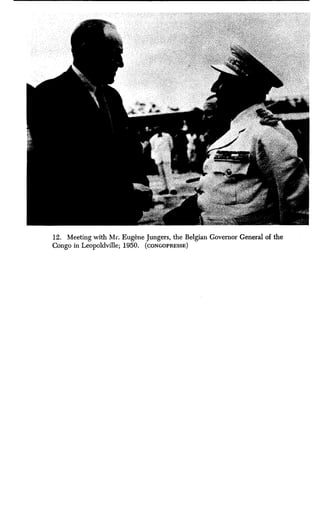
Well, he won't get them . I used to live in Philadelphia and I never did
like Bullitt. Take them away." And that was one shipment which our
Embassy did not receive.
One of the last services I was able to render the French adminis-
tration of Paris was to rescue the French police official who was in
charge of individual political records, the equivalent of our F .B.I. rec-
ords, which the Paris police kept in as complete detail then as we
do now. When the French government evacuated Paris, only two
skeleton staffs were left behind, one from the Prefecture of Police and
the other from the Prefecture of the Seine. The first dealt with policing
and public security; the second with public utilities and food supply .
Both performed marvels, and it was understood that our Embassy
would act with them in matters concerning the open city agreement
which we had helped to negotiate.
One of the first moves made by the German High Command was to
send a detachment to commandeer these elaborate police records.
Entering the office of M. Jacques-Simon, Director of Police Intelli-
gence, the Germans demanded access to his files, which would have
provided them with detailed information about all their potential
enemies in France. Actually the French, working day and night,
had removed these confidential archives from Paris, taking them
on a river barge as far south as Roanne, where the barge was sunk
deliberately when the German Army threatened to overtake it. The
French refloated it later, before the sodden papers dissolved. The
less important files had been burned and the Germans found in the
Prefecture's furnaces smoldering evidence of this technical violation
of the open city agreement which provided that everything would be
preserved intact. Jacques-Simon was arrested and an angry Ger-
man officer declared that he would be executed promptly. The Prefect
of Police, M. Langeron, telephoned to beg me to intercede on behalf
of his chief subordinate, and I wasted no time in taking up the matter
with the amiable Herr Achenbach . He really went to a great deal of
trouble to find out where Jacques-Simon was and finally traced him
to St. Cloud, awaiting summary trial. Jacques-Simon has written
that I saved his life, and perhaps he is right . He was technically guilty
and his German captors, without failing to be "correct," could have
shot him.
During those last three weeks of June 1940, government policy-
makers all over the world were just beginning to realize what profound
48 DIPLOMAT AMONG WARRIORS
changes had been wrought by the blitzkrieg . Never before had the
balance of power in Europe been shifted so completely in so short a
time. Except in England, where Churchill's government had direct
and immediate threats to face, international policy-making during
those three weeks was virtually suspended. Bullitt, upon whose advice
Roosevelt had depended for years, devoted hours of intense thought
every day trying to figure out how the American Government should
proceed next . Bullitt was inclined to believe that he could be useful
no longer in a Europe dominated by Hitler's Germany, since he had
made his personal detestation of Hitler and everything he represented
unmistakably clear . So he tentatively decided that after leaving Paris
he would propose to President Roosevelt and Secretary of State Hull
that he should return to Washington after presenting himself briefly
to whatever French administration survived to govern the fraction of
France which the Germans had agreed not to occupy . I cannot recall
that it ever occurred to any of us that our government had any alter-
native other than to maintain relations with whatever French Govern-
ment was established in France.
When we were notified that French leaders had chosen for their
temporary capital the resort city of Vichy, we wondered whether this
was a bit of Gallic humor. It seemed wryly appropriate that the
government of defeated France should choose a place hitherto cele-
brated only for its rather disagreeable medicinal waters used to treat
unpleasant but not necessarily fatal diseases . Actually, Vichy had been
selected because it had so much room in its hotels, casinos, and villas .
On the morning of June 30, Ambassador Bullitt left Paris by motor
caravan for Vichy, accompanied by Carmel Offie, his military and
naval attaches, and me. It was understood that in a few days I prob-
ably would be left in temporary charge of our embassy, accredited to
the government which soon became known as Vichy France. The
weather was fine on June 30, 1940 and we traveled at a moderate
speed, although the journey could have been made in six hours over
the almost empty roads. Once across the line of demarcation be-
tween the Occupied and Unoccupied zones, we stopped for a picnic
lunch in a shaded grove near the highway, in a setting which could
not have been more peaceful. None of us could know then that
France was destined to serve as a battleground for almost five more
years.
FOUR
CHARGE D'AFFAIRES
IN WARTIME VICHY
Not long ago I had occasion to drive again through the
once-famous health resort of Vichy which figured so spectacularly in
French-American relations during World War II . Vichy, my friends
inform me, has never regained since the war its previous popularity,
either with Frenchmen or Americans. Bernard Baruch once told me
that he had been an ardent booster of Vichy between the world wars
and had helped set the fashion for Americans to take the "cure"
there. No doubt the medicinal repute of Vichy water is as esteemed
as ever, but Vichy's popularity seems to have been affected by the un-
happy political notoriety which this spa acquired during the years of
Nazi domination of Europe, when Vichy was headlined in the blazing
controversies of world politics . To many Americans, Vichy still carries
the connotation of Fascist, pro-Nazi, collaboration, anti-Semitism, total-
itarian, treachery. But to me, who watched the dazed French Govern-
ment trying to pull itself together during that anguished summer of
1940, Vichy suggests mostly an assortment of bewildered Frenchmen
staggering under catastrophic military defeat . In the beginning, at any
rate, most of the French politicians were groping their way toward
possible solutions of their immediate problems, wondering how they
could ever manage to live with the Nazi war machine which so sud-
denly had blasted its path through the entire continent .
Before Ambassador Bullitt and his little group of aides started out
for Vichy that sunny June 30, 1940, the Paris police informed him that
German agents had proposed to French gangsters that they assassi-
nate him during his unprotected journey. The idea was that German
propagandists could then proclaim that indignant Frenchmen had
revenged themselves upon a man who had lured their government
into a disastrous war. But Bullitt laughed off this alleged plot, saying,
"Can't you see that the Germans believe the war is over? Why would
they bother now to get rid of a mere ambassador?" However, Bullitt
himself lent a little spice of danger to our departure from Occupied
50 DIPLOMAT AMONG WARRIORS
France by including in our group a British couple who were subject
to internment, Mr. and Mrs. Francis Gilroy. Philadelphia-born Mrs.
Gilroy was a hometown friend of the Ambassador, and he said that
with so many irregular things happening, he saw no harm in adding
one more irregularity. So he smuggled out his British friends by hav-
ing American passports issued to them, and Gilroy did his best to be-
have like an American when we came to the line dividing Occupied
and Unoccupied France . All of us were relieved when the German
inspector handed back the Gilroys' fresh American passports without
comment.
During those momentous three weeks in Paris we had been com-
pletely cut off from communication with Washington, except for an oc-
casional rare message via Berlin . We had burned our codes and the
Germans notified us that, because of military exigencies, our open
cablegrams would have to be routed through Berlin and be subject to
indefinite delay. They did not exaggerate. We left Paris knowing only
what we had picked up from radio broadcasts, plus what the Ger-
mans themselves had told us about the last tumultous days of the Bat-
tle of France. In order to inform himself fully before making his pres-
ence known at Vichy, Bullitt had reserved rooms in a small hotel
in the nearby hamlet of La Bourboule for his own party and for the
members of his staff, headed by Ambassador Biddle and "Doe" Mat-
thews, who had been assigned to stay with the itinerant French
Government after it left Paris .
We sat up most of that first night in La Bourboule while Biddle
and his associates gave us a thorough briefing . They had man-
aged with great difficulty to keep in constant touch with the distraught
French Government as it paused briefly in Tours and then went on
to Bordeaux where the armistice was arranged. The confusion, they
told us, had been wild beyond description, with cabinet ministers,
bureaucrats, soldiers, and hundreds of thousands of terrified refugees
of many nationalities jamming the highways southward . The harassed
French Premier, Paul Reynaud, often out of touch with Army Head-
quarters, only belatedly received news of one military disaster after
another. Our own diplomats, like everybody else in and around the
government, had gotten very little sleep because meetings of the war
council were held any time of the day or night. These chaotic condi-
tions made it impossible for the French Government to give calm con-
sideration to decisions of the most vital importance. Our colleagues
told us how Churchill and his aides flew over from London in an
effort to persuade the disintegrating Reynaud Government to seek
refuge in French Africa, or any place beyond German reach, and
continue the war.
CHARGE DAFFAIRES IN WARTIME VICHY 51
As Bullitt listened to this melancholy report of his staff, he was more
than ever convinced that he had been right to remain in Paris, where
he was at least able to help save that city from destruction . In fact, it
was only Bullitt's strong sense of duty which brought him back to
France at all after his February trip to Washington before the blitz-
krieg. He had discovered then that the same American politicians who
blustered and postured about the evils of Hitlerism hastily backed
away when specific military measures were proposed . The Ambassador
told us, after he returned to Paris, that he had come back only because
he would be accused of letting France down if he did not, and thus
would embarrass the Roosevelt administration . He knew all too well
that in any critical situation, French leaders would inevitably demand
more help from the United States than they could possibly get . No-
body had been more emphatic than Bullitt in warning Reynaud and
other French ministers that there was not the slightest chance that the
United States would declare war in 1940, unless attacked . He had
constantly explained that only Congress could declare war, and that
American sentiment in and out of Congress was overwhelmingly op-
posed then to entering the war . The situation which had developed
in Tours and Bordeaux was very much what Bullitt had feared, and
he now expressed thankfulness that he had been spared the ordeal
of explaining for the last time to distracted French ministers the facts
of American political life . He congratulated Biddle for handling the
nightmare situation at Bordeaux as well as anybody could have done .
Ambassador Biddle went on to tell us that Washington, judging by
the torrent of instructions he had received, was worried chiefly about
the French fleet, a real cause for worry . Biddle said he had been
authorized to promise almost anything-short of involving the United
States directly in the war-which would take the French fleet beyond
any possible German control. But the best our diplomats had been
able to achieve was to exact from responsible members of the incom-
ing Petain Government the promise that they never would permit
the Germans to seize their fleet . And history records that despite anx-
ious years and many vicissitudes, that promise was kept.
In La Bourboule that evening we also heard the details of a per-
sonal scandal which had attracted wide attention even in the midst
of universal catastrophe . I mention it here only because, as I was to
discover later in Vichy, it had more political significance than his-
torians usually have attached to it . Premier Reynaud, upon whom the
fate of France chiefly rested during the final months of the Third
Republic, had lived for years with Mme . Helene des Portes, a former
friend of his wife. The Premier and Mme. des Portes often were seen
gaily cycling together in the Bois de Boulogne, and when M . and
Mme. Paul Reynaud were invited to dine at the American Embassy,
52 DIPLOMAT AMONG WARRIORS
there always was a question which lady would attend . At one dinner
both arrived, providing a neat protocol problem . Mme. des Portes
was an exceptionally determined Frenchwoman, and her frenzied
political activity and her doubts about the war were the gossip of
Paris. Even after war broke out, she persistently urged Reynaud
and his ministers to negotiate peace with Hitler's Germany .
When Reynaud finally decided to resign rather than accept an
armistice, he relinquished the government to his vice premier, Marshal
Henri Philippe Petain, hero of World War I. At the same time, the
Petain Government approved Reynaud's request to appoint him am-
bassador to Washington. This was believed to be Mme . des Portes' ob-
jective, and she certainly planned to accompany Reynaud. But Des-
tiny intervened. As Reynaud and Mme. des Portes were riding together
near the Spanish frontier in an automobile loaded with baggage, their
car stopped too abruptly and the luggage toppled over on the occu-
pants. Mme. des Portes, who was driving, lost control of the car which
left the road and hit a tree, killing her and injuring Reynaud so badly
that he was unable to travel. The Premier, who had been among the
most effective of the Third Republic's statesmen, was thus immobi-
lized, and a few months later he, Leon Blum, and other prewar
Premiers were imprisoned by the Germans for the duration of the war.
What appeared to be irregular personal behavior, occurring in the
midst of national tragedy, affected the reputation of Reynaud and
indirectly involved General de Gaulle, because Reynaud had been
virtually the only influential political supporter of the then obscure
colonel. De Gaulle's emphasis upon the importance of mechanical war-
fare, in his book L'Armke de Metier, had greatly impressed Reynaud,
and perhaps it is for this reason that no mention of the Reynaud scan-
dal appears in the De Gaulle memoirs. But the incident had a pro-
found effect in 3-94,0 upon those Frenchmen, like Marshal Petain, who
had contended for years that the Third Republic's politicians were not
merely weak but were morally rotten. When Petain was French
ambassador in Madrid in 3-939, some of his friends visited him in
an effort to persuade him to return to Paris for the purpose of ar-
resting the deterioration of the Daladier Government. The Marshal
was reported to have said, "What would I do in Paris? I have no mis-
tressl" It was notorious that some of the ladies who were intimate with
members of the French Government were ambitious to play political
roles, and their salons were active in the tradition of Mme. de Stael.
Both Nazi and Soviet espionage found this source of seepage of secret
information most useful and, for that matter, so did our own Embassy .
Petain was one of many patriotic Frenchmen who had come to
believe that only an authoritarian regime could cleanse the corrup-
tion in French public and private life. Such ideas fitted nicely, of
CHARGE D'AFFAIRES IN WARTIME VICHY 53
course, into Hitler's proclaimed "new order" for Europe, and into the
plans of those Frenchmen who were ready to concede that Germany
had won the war in I94o, and that France could obtain a favored po-
sition in the "new order" only if Frenchmen promptly seized the op-
portunity to get in on the ground floor . Those were the ideas which
American diplomats, among others in Vichy, had to combat.
After learning from Biddle and his associates how matters had stood
in Bordeaux, Ambassador Bullitt concluded that it would be better not
to present himself in Vichy officially at all. Instead, he decided to re-
main at La Bourboule for a few days to have informal talks with the
Government's principal members, and then proceed to Washington,
leaving me in charge of our Embassy. With America's national holi-
day so near at hand, Bullitt said that if he refrained from moving per-
sonally into the Villa Ica, the property of Mrs. Jay Gould which was
assigned to us in Vichy, we could avoid holding our traditional
Fourth of July reception under distressing circumstances . But, before
departing for Washington, Bullitt took pains to reassure himself con-
cerning the French fleet . He had a long talk with Admiral Darlan,
Minister of Marine, and the following day he conferred with Marshal
Petain and others. His report of these conversations, dated July I,
is described by William L . Langer, Coolidge Professor of History
at Harvard, as "one of the most remarkable and revealing documents
in the entire annals of this great war."
Thus it came about that I was officially in charge of our embassy on
July 3, I94o-one of the most unfortunate dates in the long history of
Anglo-French relations. On that July day the Churchill Government,
desperately anxious about possible German capture of the French
fleet, decided that it must at any cost get control of all units of the
French fleet within British reach . The British Navy therefore boarded
and took over French warships in British ports and in Egypt, with only
token resistance. But at Mers el-Kebir, the port of Oran in western
Algeria, the French commanding admiral, Marcel-Bruno Gensoul, re-
fused after several hours' parley to accept the British ultimatum to
proceed to some British or neutral port, safe from the Germans . Act-
ing under irrevocable orders from Churchill's war cabinet, the British
Mediterranean Fleet thereupon destroyed or crippled many French
warships, killing or wounding about two thousand French sailors.
I learned of this British attack only a few hours after it happened,
when French Foreign Minister Paul Baudouin called me to the Foreign
Office in Vichy to inform me that his government was breaking off
diplomatic relations with the British Government . This meant that all
British consular officers would be obliged to depart from French Africa,
and Baudouin knew that this in turn would be followed by a naval
blockade imposed by Britain against France and French overseas
54 DIPLOMAT AMONG WARRIORS
possessions. Baudouin was so angry and humiliated that he even
hinted the French Navy might cooperate with the Germans . But as I
listened carefully to his outburst, I decided I would be justified in
reporting to Washington that the Petain Government probably would
not declare war against its recent ally and would keep its pledge to us
about the fleet .
In his memoirs, Churchill makes out the best possible case for the
British action at Mers el-Kebir, showing that he was more determined
than anybody else to use force against what he considered an im-
minent menace . But it is my own feeling, based upon the reaction
which I witnessed in Vichy then, that General de Gaulle, in his mem-
oirs, more accurately estimated what he calls this "lamentable event."
After examining the evidence presented in the Churchill account, to-
gether with all the postwar revelations in France, De Gaulle concludes,
as I did at the time, that the British attack was unnecessary and cost
much more than it gained. Perhaps this was the most serious British
mistake of the war, because it simultaneously undermined the in-
fluence of the pro-British moderates in Vichy and of De Gaulle in
London.
Indeed, one of the chief victims of the British naval attack was
De Gaulle, whose campaign to organize French resistance from
London was thus abruptly checked before it had fairly started . Repre-
sentative French politicians and officers who were preparing to go to
England to join him were so outraged that they gave up the attempt.
History, of course, has proved that De Gaulle was the most forceful
French personality of his generation, but in that chaotic spring and
summer of ig4o, the General presented an obscure and somewhat
dubious aspect to many of his most earnest anti-Nazi countrymen, as
well as to nearly all the foreign diplomats who came to Vichy . Many
of De Gaulle's compatriots wrongly regarded him as a British vassal.
We who were in the American Embassy in German-occupied Paris
on June 18, had listened there to the French General's stirring appeal
for continued resistance, and had been moved by it. But we asked
each other: "How has this man suddenly become so important?" Un-
til that hour, I cannot remember ever having heard De Gaulle's name.
It was not until we arrived at Vichy that I learned the details of how
he had been brought into the government by his sponsor, Premier
Reynaud, only after the blitzkrieg started, and only then was pro-
moted from colonel to brigadier-general. It was understandable why
many politicians distrusted him . In the same book in which he had
courageously jeopardized his army career by criticizing the High Com-
mand's neglect of tanks, he also had recorded his grave doubts about
parliamentary democracy. In the parlance of those days, he had been
denounced as a Fascist.
CHARGE DAFFAIRES IN WARTIME VICHY 55
But, as I recall it, there was no widespread hostility in Vichy toward
De Gaulle until that British naval attack on July 3 . Five days later,
the General made a speech, broadcast by the London radio, which
was misinterpreted by angry Frenchmen as an attempt to justify the
British. A careful reading of that speech shows that De Gaulle made
no apology for the action of the British Government, which he de-
plored as unnecessary . He merely urged that the ghastly blunder
should not be allowed to interfere with the war against Germany .
The self-exiled officer was presenting in London precisely the same
arguments I was using in my talks with Marshal Fetain and other
Frenchmen in Vichy. But it was not easy during those weeks im-
mediately following Mers el-Kebir to induce Frenchmen to discuss the
affair calmly. French naval officers bitterly told me that the British
always had been jealous of the French Navy, always were looking
for a chance at international conferences to weaken it, and now had
seized the moment when France was knocked out by Hitler's Ger-
many to destroy a large part of the helpless French fleet. The effect
on French naval officers in North Africa was catastrophic and caused
us endless difficulties there later . When copies of London newspapers
belatedly reached Vichy, French indignation turned into fury. English
papers, no doubt to bolster morale at home, featured the seizure and
widespread destruction of the French fleet as if it had been a great
British naval victory.
During those days there was real danger that outraged French poli-
ticians might commit themselves completely to an alliance with Berlin .
In this precarious situation my personal inclinations were wholly in
accord with the instructions I received from Washington, and I like to
believe that American policy at that moment helped considerably to
save the French Government from a disastrous move . I could say to
French officials with complete truth that the American Government
had no prior knowledge of the British naval attack, and deplored it .
But I also was authorized to say that our interests and sympathies in
the war were entirely on the side of Britain . Our relations with France
would depend therefore upon whether any further concessions were
made to the Nazi Government.
At that crucial moment German victories seemed so complete that
millions of Europeans thought that Germany already had won the war,
and many Americans agreed . Allied propaganda and our own wishful
thinking had led us to believe that France and Britain were more than
a match for Germany, so the Allied collapse found Americans as un-
prepared psychologically as we were militarily . Hitler's triumphs
posed a fundamental question for Washington's top policy-makers :
Should the United States remain passive in the wake of the Allied
debacle, or should we oppose the peace overtures which Berlin was
56
	
DIPLOMAT AMONG WARRIORS
offering to the distracted peoples of western Europe? The Nazi con-
quests had shattered the balance of power in Europe and were com-
pelling us to choose between a Nazi victory and American interven-
tion.
This question was decided in Washington behind closed doors, and
the secrecy which cloaked the discussions still obscures the events of
that period. Only a few months earlier, Congress had passed the Neu-
trality Act, designed to prevent American participation in Europe's
war, and that legislation was so effectively drafted that it blocked any
military intervention regardless of the alteration which had since oc-
curred in the European balance of power . Instructions to our embassy
in Vichy were classified as top secret, not only to conceal Washington's
plans from the Germans but also from the American public . There
was no doubt that most Americans sympathized with England and
France and hated and feared the Nazis, but there was a great deal
of doubt about American willingness to risk war against Hitler . That
year of igq,o was a presidential election year and Roosevelt, as an
astute politician, could never forget that any move which the voters
might consider too warlike would jeopardize his chances for re-elec-
tion, already uncertain because he was breaking precedent by seeking
a third term.
The secret directives which we in Vichy received from Washington
expressed the opinion that France offered the most promising oppor-
tunities for anti-Nazi activities by Americans, and we were informed
that our government intended to make vigorous attempts to prevent
Europeans from concluding peace settlements with Hitler, since any
peace settlement would consolidate the Nazi triumphs . It thus became
the chief mission of our embassy staff to persuade French statesmen
that Germany had not yet won the war, and that France would profit
by refusing to make any concessions to Germany beyond what already
had been made in the armistice agreement. Our Embassy was author-
ized to offer American support to French leaders by every means per-
missible under the Neutrality Act, so long as the French Government
avoided making a peace settlement with Germany . The Allied collapse
had been so complete that the Germans did not press for a final agree-
ment. They expected London would surrender very soon, and mean-
while they were satisfied with the armistice which they had concluded
with France .
In those first weeks at Vichy, I think most of us felt as if we had
been knocked on the head and were slowly recovering our senses . His-
tory has rarely, if ever, moved with such dizzy speed as in that sum-
mer, and it seemed almost impossible to readjust our thoughts to a
Europe dominated by one man, as in the Napoleonic era more than
a century before. In this new Alice-in-Wonderland atmosphere, Vichy
CHARGE D'AFFAIRES IN WARTIME VICHY 57
seemed an appropriate capital for that portion of France, one-third of
the country, which the German armistice permitted Frenchmen still to
govern. Offices were located in gambling casinos, music halls, and
tourist hotels designed to lighten the hours of health-seekers . The
Hotel du Parc, long popular with fashionable invalids, became the
seat of government . All of us felt absurdly isolated in this inbred com-
munity, making our diplomatic rounds in this artificial, gaudy, impro-
vised political center which nobody expected to serve this purpose for
long.
Normally, Vichy had about thirty thousand permanent residents,
and during its peak tourist season it could accommodate one hundred
thousand. Now it was called upon to house in one way or another
some 130,000 persons, including an excessive proportion who regarded
themselves as V .I.P.s. It amazed me, as we moved into Vichy, to ob-
serve how smoothly, in the midst of national chaos, the protocol officer
of the French Foreign Office, kindly M . Loze, arranged accommoda-
tions for the bedraggled members of the diplomatic corps straggling in
from Bordeaux. I was impressed, as I had been in Paris after the gov-
ernment's departure, by the indestructibility of the French civil serv-
ice, whose organization dates from Napoleon's reign . We in the Ameri-
can Embassy had sometimes been irritated by the arrogance of French
functionaries, cigarette butt in mouth, but in this crisis they behaved
superbly . These civil servants actually had administered France dur-
ing the increasingly frequent periods when the politicians were in-
dulging in their game of political musical chairs and now, while whole
European nations, including France, were being bowled over like
tenpins, French government employees stayed on their jobs as a mat-
ter of course . Some of these faithful officeholders in Vichy paid dearly
for performing what they conceived to be their duty . They discovered,
too late, that France was involved in a curious kind of civil war from
which even the bureaucracy could not remain aloof .
Very few observers in Europe that summer could feel any confidence
that Britain would be able to hold out against Germany, and Britain
was the only remaining obstacle to German conquest of Europe-or so
it seemed then. However, we in the American Embassy had scant
leisure to indulge in theoretical worries about the future of Europe ;
our greatly reduced staff was working far into the night and was not
standing on ceremony. I found myself performing some of the same
clerical work I had done at the outset of my career, and so did other
members of the fine staff which Ambassador Bullitt had assembled .
Having met and survived the greatest crisis, the British naval attack,
in our first days at Vichy, we began to breathe easier . Now all of us
undertook to "sell" the American Government's line to French ministers
of assorted beliefs . I personally concentrated upon Marshal Petain
58 DIPLOMAT AMONG WARRIORS
who now had the new title of Chief of State, and his Vice Premier,
Pierre Laval. These two men bore the responsibility for arranging the
armistice. The old soldier and the suave lawyer-politician had almost
nothing in common except their conviction that Germany had won the
war and that Frenchmen must somehow adapt themselves to this fact .
In my first conversation with Petain at Vichy, I expressed con-
fidence in eventual Allied victory . The Marshal was then eighty-
four years old and in his eyes I was only a young diplomat substituting
for an ambassador, so he smiled at me indulgently. Then, in his cool,
clear, rather formal French, he said that continuance of the war would
have been insanity, and that France would have been completely de-
stroyed, since neither France nor Britain should have gone into a war
for which they were wholly unprepared . With some emotion he de-
clared that France could not afford again to have a million of its sons
killed. In later conversations he brought up the subject of De Gaulle
who, he said, he had favored as a junior officer on his staff, adding
bitterly, "He was a viper I clutched to my bosoml" The old Marshal
seemed more irritated, in those early Vichy days, by memories of De
Gaulle's temerity in questioning the Marshal's military competence
than he was by De Gaulle's denunciation of the armistice . Each time
that I talked with Petain he expressed in some way his friendly feeling
for the United States, implying that it was only his affection for our
country that made him tolerate my rather unwelcome arguments .
Pierre Laval, who was destined to be executed as a traitor after a
summary trial by a special French postwar commission, was by all
odds the shrewdest, most forceful personality in Vichy, and I studied
him earnestly in the several talks I had with him . We in the Embassy
believed that he, more than any other man, would determine how far
French-German collaboration would extend. Of course I had met Laval
before in Paris, since he had been prominent in French politics during
all of my decade in the capital, but he never had occasion to pay at-
tention to me, as he did in Vichy. This ruthlessly ambitious politician
possessed a plan for action from the very beginning in Vichy, as most
other members of the government did not, and he cultivated me-as
the ranking American representative-because the United States
figured in his plan .
Vichy was an ideal setting for Laval because this was his native
region. In nearby Chateldon, his hometown, Laval had a luxurious
chateau which he had bought with some of the fortune he had made
as a lawyer and politician . The chateau was the pride of the village,
and one aspect of this many-sided self-made man was revealed when
he invited me there for lunch. Explaining how he had taken pains to
restore the chateau to its original form, Laval took me out on his
private hill overlooking a beautiful valley, and told me I was seeing
CHARGE DAFFAIRES IN WARTIME VICHY 59
the place where a battle had been fought in the days when Jeanne
d'Arc was saving France from the rapacious British . Then he led me
into the great drawing room, one wall of which was covered with an
enormous oil painting, showing British soldiers storming this very hill
and being repulsed by French defenders . Laval described that French
victory of four centuries ago as though it had happened yesterday.
Obviously, he had staged for my benefit this little lesson in Anglo-
French historical conflicts and then, it seemed to me, had let his emo-
tions run away with him. I asked why he personally was so bitter about
the British who, after all, had been allies of France throughout history
as many times as they had been rivals . Talking very rapidly, he re-
counted a litany of incidents-financial, political, military-in which the
British during his own career had thwarted France and him as Premier
and Foreign Minister. During World War I, he declared, the British
had let France bear the brunt of the bloodletting, so that France had
lost 1,500,000 killed, from which loss the nation never had recovered .
This time the British had tried the same trick again, he cried, but this
time the British and not the French would pay for the war . Through-
out his several conversations with me, there ran a curious thread of
chauvinism, a fierce, earthy sort of patriotism .
I discovered early in my talks with Laval that he was astonishingly
ignorant about Germany and the Germans . He expressed a naive con-
tempt for them which the circumstances hardly seemed to justify . I
never saw any evidence that he really sympathized with the Nazis,
despite his collaboration with them . What he did show was supreme
confidence in his own ability to outsmart the Germans . The future,
as he pictured it that summer of 1940, was perfectly clear. Within
a few weeks, or months at the latest, the British would have to sue
for peace. Meanwhile, the foolishly stubborn British were providing
him, Laval, a crystal opportunity to negotiate for France that no . 2
role in the New Europe. If I had any influence at all upon Laval, it
was to make him feel that perhaps he underestimated Nazi ruthlessness
and the extent of Hitlerian ambitions .
But I certainly failed to impress Laval with my intimations that the
United States might eventually intervene again in Europe . He replied,
with a shrug and a smile, that the future of Europe would be settled
long before Americans could even make up their minds what to do .
Whatever may be said about Laval's political judgment on this point,
he certainly was not unfriendly to the United States . Laval was de-
voted to his family and this devotion seemed to be fully reciprocated
by his wife and his intelligent daughter, Jose . The latter and her hus-
band, Rene de Chambrun, who enjoys American citizenship under the
laws of the State of Maryland as a direct descendant of the Marquis
de Lafayette, played an active part in Laval's political career . Im-
6o DIPLOMAT AMONG WARRIORS
mediately after Dunkirk, Rene de Chambrun traveled to Washington
to make a personal report on the French disaster to President Roo-
sevelt, later incorporating his thoughts and experiences in a book I Saw
France Fall; Will She Rise Again? It seemed to me in Vichy that Laval
relied considerably on De Chambrun's knowledge of the United States,
hoping that some form of negotiations would involve the American
Government in an eventual European settlement .
Meanwhile, on the other side of the earth, in the Far East, the
Japanese began to take advantage of the weakness of France by start-
ing tentative moves in French Indochina . These Japanese maneuvers
naturally alarmed Washington, and I was instructed to make one "rep-
resentation" after another to the French Government in Vichy about
Japanese demands. The foreign minister, Paul Baudouin, had been
general manager of the Bank of Indochina, and was married to an
Indochinese lady. He understood fully the significance of events there,
but he also understood that his government was in a position to do
little if anything to check the Japanese . He referred me to the Premier,
and I went to see Laval, who was not an Asian specialist but who was
equally noncommittal about Indochina . Laval even suggested, with a
sly smile, that the Japanese had not menaced Indochina until the
British fleet had put the French fleet temporarily out of commission .
On one of these occasions while we were conversing, Laval's chef de
cabinet, Fernand de Brinon (who also was executed after the war), in-
terrupted to say that the German ambassador in Paris was on the tele-
phone asking to speak with the Premier . I rose to leave, but Laval
motioned me to an extension telephone near his desk, saying, "Listen
to our conversation." I expected to hear the voice of Ambassador Otto
Abetz, but instead it was his second in command, my acquaintance
Achenbach. It developed that Laval had sent the German Em-
bassy in Paris a list of about ten concessions he hoped the Germans
would make to fortify his own position. His requests included general
release of French prisoners of war, who then numbered some 1,850,000;
evacuation of enough occupied territory to permit the French Govern-
ment to return to Paris ; and provision for feeding the French people
better.
Speaking in French, Achenbach was very businesslike. He took up
Laval's requests one by one, in order, reading the Premier's own words,
and then replying either "No" or "Yes." Every major request was fol-
lowed by "No." Only two minor concessions were granted. But after
Achenbach hung up, Laval turned to me with a satisfied air and said,
"I just wanted you to see how well things are going between us and the
Germans." I thought at first that he must be speaking sarcastically, but
he was quite in earnest. During the two and a half months I remained
in Vichy, before I was recalled to Washington for my assignment to
CHARGE D'AFFAIRES IN WARTIME VICHY
	
6i
Africa, I talked several other times with Laval about the Germans, but
he did not show any reduction of self-confidence. Adroit lawyer that he
was, he apparently had sold himself on his case and was determined
to prosecute it to the limit-which he certainly did. The limit for him
was ignominious death.
Into our improvised embassy during the first week in July came
many members of the French Senate and Chamber of Deputies,
politicians of all parties except the Communists, seeking encourage-
ment about the immediate intentions of the United States . I felt a great
deal of sympathy for the appalling predicament in which these French
legislators found themselves. They were being convened to sit jointly
as a Constituent Assembly for the purpose of abolishing the Third
Republic, established in 1875, and replacing it with an authoritarian
regime headed by Marshal Petain as Chief of State . Pierre Laval was
running this show . He produced a Constitutional Law, very brief and
broad, which assigned to the Chief of State powers equivalent to those
of an absolute monarch . The legislators were told that if they did not
make this change promptly, the Germans probably would occupy the
rest of France and could not be expected to evacuate Paris or release
the prisoners of war. Moreover, if Britain fell, or sought a negotiated
peace as many Europeans expected, then France would miss the op-
portunity to assure for herself a high place in Germany's "new order ."
That was an effective argument among men who were miserably aware
of their own defeat and of the formidable task confronting them to re-
store some kind of order in chaotic France .
Some of the legislators with whom I talked were virtually in a state
of shock. Their humiliation and despair were so deep that they suffered
paralysis of will. Yet there also was courageous opposition and sharp
debate concerning Laval's Constitutional Law, about which we were in-
formed promptly even when the Assembly sessions were secret . Al-
though open opposition was personally dangerous, as was soon proven
by the arrest and trial of leading opponents, eighty senators and dep-
uties voted against the Constitutional Law, and an even larger num-
ber abstained from voting at all . But 569 legislators, more than the
required two-thirds of the 850, did approve the Constitutional Law as
presented, and thereby formally legitimized the new regime . These
men had been freely elected as representatives of the French people
before the German defeat . But in July i94o, they no longer were act-
ing in freedom . Hitler's war machine held France in an iron grip.
I remember one very human incident on the day, July io, when the
Constituent Assembly was taking its decisive vote . I was lunching with
the former Minister of Aviation, Guy La Chambre, and his wife, and at
a nearby table sat M. and Mme. Paul Reynaud, he swathed in band-
ages after his close call with death on the highway, but grimly de-
62 DIPLOMAT AMONG WARRIORS
termined to participate in the historic parliamentary session which
would make Petain the Chief of the French State . Everyone was
somber and dispirited-except Mme. Reynaud, who came over to
our table and recounted to Mme. La Chambre the pungent details of
the highway accident which took the life of her husband's mistress . As
she rose to rejoin M. Reynaud, she exclaimed with some emotion,
"And now, cherie, for my revengel"
Indicative of how precarious was the position of French politicians
then, Guy La Chambre was one of those arrested soon afterward and
put on trial for treason. He and his wife were among our embassy's
close French friends, and after she visited him in prison she came to
my office one day and threw a sealed envelope upon my desk, crying:
"Open it and see what it containsl" When I did so, a mass of dead
bedbugs poured out. "I caught those in my husband's cell," she told
me. "That is how they are treating himl" In such cases, I was author-
ized to do nothing more than ask informal questions, but I was greatly
pleased when Guy La Chambre was one of the ministers soon re-
leased.
During that summer in Vichy I saw very little of the two French-
men who later were to make me a controversial public figure for the
first time in my life. These two were Admiral Jean Darlan, then Minis-
ter of Marine, and General Maxime Weygand, then Minister of Na-
tional Defense. Our naval and military attaches undertook to keep in
contact with these two officers, and I left that business to them. Thus
I had met Darlan only casually once or twice and had no formal
conferences with him until he confronted me in Algiers, more than
two years later, with the most difficult decision I ever have been com-
pelled to make.
Darlan was a political admiral who had struggled for decades
to pry money out of French parliaments and had succeeded in
making the French fleet more powerful than at any time in its history .
His influence with naval officers was so great that he could have taken
the fleet abroad if he had chosen to repudiate the armistice, as Gen-
eral de Gaulle did . But he believed that Britain was defeated and that
France must negotiate with triumphant Germany . However, he did
solemnly promise both his British allies and the American Govern-
ment that he never would permit the fleet to come under German
control. So when the British Navy attacked French warships at Mers
el-Kebir, Darlan was more outraged than anybody else, and his re-
sentment surpassed all reasonable bounds . As he saw it, the Brit-
ish not only had partially wrecked the fleet he had done so much to
create, but also had flaunted his honor by doubting his pledges . At
that moment he would have thrown in his lot with Hitler if he had
not been even more anti-Nazi than he was anti-British. Our attaches
CHARGE D'AFFAIRES IN WARTIME VICHY
	
63
used every persuasion on Darlan to prevent his anger from running
away with him, and soon he agreed to renew his pledge to the Ameri-
can Government to keep out of German control what was left of the
French fleet .
General Weygand, World War I hero revered almost as much as
Marshal Petain, had been recalled from retirement in 1939 at the age
of seventy-two to command the French forces in the Levant, and
then dramatically in May 1940, to become supreme commander of the
French and British armies in the Battle of France, after it already was
apparent the battle was lost . He recommended to the French Com-
mand in June 1940 that an armistice was mandatory, and later agreed
to serve briefly as Minister of National Defense in the Petain Govern-
ment. But, unlike Petain and Darlan, Weygand had no political
ambitions, and soon he asked to be relieved of his cabinet post and to
be sent to North Africa in command of French forces there . It was
the General's shift to Africa which inspired President Roosevelt to
entrust me with my African mission .
The State Department did not explain why it was recalling me to
Washington in September 1940, and I hoped this was a good omen for
the project which most interested me then: how to prevent starvation
among the French people during the approaching winter . Richard F.
Allen, European director of the American Red Cross, had been gather-
ing information for us, and the report we sent to the Department in
September painted a graphic picture. Into the one-third of France for
which the Vichy Government was responsible, twenty million people
had been crammed, six million of them refugees . The French fugitives
from the north were mostly old people and women and children whose
husbands and fathers were still prisoners of war. They had fled in
frantic multitudes, mingling with victims from the Benelux countries
who had brought little or nothing with them . They had scrambled into
a region already thickly populated with earlier escapees-anti-Franco
Spaniards, anti-Nazis and Jews from Germany, Austria, Poland and
Czechoslovakia. France, even then, was the safest sanctuary for dis-
placed persons. Most of these unfortunates had endured the anguish
of separation from home and family and were living in congested, un-
sanitary quarters, facing a winter without fuel, warm clothing, proper
food or jobs. Military operations had reduced the 1940 harvest to a
third of normal and the Germans still held as prisoners hundreds of
thousands of farmers. Railroads had stopped running for lack of fuel,
as had truck and bus transportation.
One obstacle stood in the way of Americans rushing food and cloth-
ing to famished France : the British blockade . Churchill's government,
believing a blockade of Europe to be Britain's only offensive weapon
in 1940, was determined to enforce it relentlessly . This blockade had
64 DIPLOMAT AMONG WARRIORS
even cut off much of the normal large food shipments from France's
overseas empire. While I expressed sympathy with Britain's objections
to unrestricted importation of food and clothing to the continent
dominated by Hitler, I earnestly recommended some relaxations in the
blockade. I proposed that Allen head a control commission similar to
the commission I had observed operating from Switzerland during
World War I. There was no question of charity ; the French Govern-
ment had sent gold and other assets to the United States ample to pay
for its urgent needs of food and fuel . Our Red Cross survey showed
that a mere sixty thousand tons of automotive gasoline would start
traffic moving again, and Allen had persuaded the German Armistice.
Commission to exert no claim on relief stocks purchased abroad .
My report pointed out that "abandonment of the French popula-
tion by their ally Britain and their oldest friend the United States
would compel the French to consider making new friends . If the win-
ter is severe [it turned out to be the coldest in ninety years], and the
situation desperate, they will turn to Germany or anywhere . . . . Who-
ever wins the war, the United States will be blamed if callous
indifference to French needs persists ." My report concluded : "I am
convinced that relaxation of the present British blockade to permit
minimum food imports has no bearing of any importance in the pres-
ent military situation."
But when I arrived in Washington I had to work hard to arouse any
interest in French relief. By that time the terrible Nazi air raids on
London had begun and the Battle of Britain overshadowed every
other foreign interest . And, of course, even the Battle of Britain had to
take second place in Washington's interest in the Roosevelt-Willkie
election campaign . I confess that I was not proud of a few of my
countrymen in Washington in 1940 . Many of our politicians were even
more insistent upon a total blockade of Europe than was the be-
leaguered British Government . And in that presidential election year,
although not one important public official advocated military participa-
tion in the war by the United States, many Americans were brutally
critical of defeated France. Roosevelt's Secretary of the Interior,
Harold Ickes, noted in his diary at that time : "It is ghastly to think
of the suffering that is ahead of Europe. Literally millions will die
of starvation. . . . But we ought not to send a pound of flour to any
country that is controlled by Germany." It was a bad time for those of
us who knew France and could not contemplate the starvation of our
friends with such detachment . British statesmen, despite their own
precarious situation, soon took measures on their own initiative to
relax the food blockade .
That summer of 1940 created what eventually came to be known as
our "Vichy policy." During the next, two years our relations with the
CHARGE D'AFFAIRES IN WARTIME VICHY
	
65
French Government aroused as many controversies among Americans
as any of our wartime tactics . Secretary Hull, in particular, was sub-
jected by some American commentators to much unfair criticism and
this made him very unhappy . So he decided, even before the war
ended, to commission Professor Langer to prepare an independent
account of American relations with the Vichy Government from
June 1940, to the time when our troops landed in French North
Africa in November 1942. Langer was given access to secret files
in the Department of State and in the Pentagon, and he produced an
admirable volume. Unfortunately, however, the Harvard professor
did not have access to the White House papers essential to complete
the story. President Roosevelt's deep personal interest in French Africa
induced him to bypass both the State Department and our military
establishment, as Secretary of War Henry L . Stimson has disclosed in
his memoirs.
When Langer's book appeared in 1947 it bore the title Our Vichy
Gamble, which helped perpetuate an impression that American
policy involved a choice among alternatives. Our embassy was not
conscious then of having any choice, which also was true of the Cana-
dians, Russians, Chinese, and all other governments represented at
Vichy. We found ourselves there in the summer of 1940 because our
diplomats had automatically followed the French Government to Vichy
just as they had followed it at first to Tours and then to Bordeaux . No-
body, including Churchill, questioned the legality of the French Gov-
ernment which finally settled in Vichy, and negotiations between this
government and London were broken off only after the British naval
attack provoked the Vichy administration into severing diplomatic re-
lations. Although the British Ambassador decided not to go to Vichy,
after the armistice at Bordeaux, the Canadian Minister, Pierre Dupuy,
continued the trek as a matter of course . The Canadian Government,
a member of the British Commonwealth at war against Germany,
looked after its own and Great Britain's interests at Vichy right up to
the landings in North Africa . Our relations with Vichy, with which I
was intimately associated from beginning to end, never were a "gam-
ble." At all times we had much to win and we never risked a sub-
stantial loss. It was not until 1943 that General de Gaulle presented a
clear-cut alternative to the Vichy Government .
FIVE
ROOSEVELT SENDS ME
TO AFRICA (1940-41)
For almost four years, beginning in September 1940, the
French empire in Africa was the be-all and end-all of my existence.
Those years provided me with more adventurous assignments than
many diplomats achieve in a lifetime, but there were occasions when
I would gladly have traded my adventures for a nice placid job in
Sweden or Switzerland. The American invasion of Africa created
grave controversies among all the governments concerned, and not in-
frequently I found myself caught in the middle of those controversies .
Nowadays Africa is so much in the news that it is difficult to remem-
ber how utterly unknown that vast continent was only twenty years
ago. Today every quarter of Africa-north, south, east and west-re-
ceives our serious attention; the United Nations struggles for months
on end with African problems; swarms of reporters roam the con-
tinent to record the transformation of former European colonies into in-
fant nations. But during my ten years in Paris before the outbreak of
World War II, my colleagues in the American Embassy and I paid al-
most no attention to France's huge African empire, and our French
friends seemed almost equally indifferent to their lands across the
Mediterranean .
It never occurred to me to visit French Africa and I heard little
discussion of international developments there until, soon after the
defeat of France, Commander Hillenkoetter, naval attache of the U . S.
Embassy, returned to Vichy following a quick trip to Morocco and
Algeria. Hillenkoetter was agreeably surprised and encouraged by
what he observed during his brief excursion. Contrary to rumors which
were being broadcast from London, he found that the Nazis had left
French Africa almost completely to its own devices . He said only a few
German consuls and Italian members of the Armistice Commission
were in evidence, while Frenchmen were administering the territories
practically the same as before the war . Furthermore, said our naval
attache, the military establishment was far stronger than he had ex-
ROOSEVELT SENDS ME TO AFRICA (1940-41)
	
67
pected, with about 125,000 combat-trained men on active service and
about 200,000 more in reserve. Hillenkoetter added that these ex-
perienced army, navy and air force officers and men had not lost their
traditional French fighting spirit. They had accepted the German ar-
mistice and had sworn allegiance to the Main Government, but they
were confident they could protect and control their African empire de-
spite the collapse of the mother country . "The atmosphere over there
is not comparable to the confusion in Vichy," Hillenkoetter told us . "If
France is going to fight again anywhere in this war, I believe North
Africa will be the place." He impressed us all with his hopefulness,
which was reflected in the reports our Vichy Embassy sent to Wash-
ington. However, these reports elicited no comment from the Depart-
ment of State, and we did not know whether they were arousing any
interest.
Then, suddenly, I received a cablegram ordering me to proceed to
Washington at once . That was a chaotic period in Europe, transatlantic
communications were erratic, and when I received this summons to
return home, without any explanation why, I assumed that the De-
partment wanted from me a firsthand account of conditions at Vichy .
But when I called on Under Secretary of State Sumner Welles, he
told me that our reports on French Africa had been brought to the at-
tention of President Roosevelt, that he had read them carefully, and
that I had been summoned at the President's request . Welles arranged
for me to go to the White House almost immediately .
There is no official record, so far as I know, of that hour-long con-
versation which opened very informally . The first time I ever had met
Roosevelt was at Hyde Park in 1920 when as a guest of James A.
Farley, who later became Postmaster General, I stood with a group
on the lawn and listened to Roosevelt deliver his front porch speech
accepting the nomination for the vice presidency. That was before
Roosevelt was stricken with polio, and I was impressed that day with
his magnificent physical form. He was, as the Irish would say, a fine
figure of a man. Now, twenty years later, when Welles presented me
to the President, I remarked that I already had been introduced on the
occasion of the Hyde Park speech. Roosevelt commented genially that
I must have been in short pants then, and after a few other casual
words the President disclosed why he had summoned me .
When the French-German armistice had been signed the preceding
June, Hitler had agreed that about one-third of continental France
and all of its African empire would be granted a semi-independent
status and would not be occupied by German troops . This situation
intrigued Roosevelt, who believed that North Africa was the most
likely place where French troops might be brought back into the
68 DIPLOMAT AMONG WARRIORS
war against Nazi Germany. Spread out on his desk was a large map
showing all of French North and West Africa, and the President
told me that he had given much thought about how to help French
officers who were operating in the relatively independent conditions
prevailing in Africa. The President then said that he wanted me to
return to Vichy and work unostentatiously to get permission to make
a thorough inspection tour of French Africa and to report my findings
to him. The French African policy of the United States Government
thus became the President's personal policy . He initiated it, he kept
it going, and he resisted pressures against it, until in the autumn of
1942 French North Africa became the first major battleground where
Americans fought Germans.
One reason why the President hoped for anti-Nazi action in French
Africa was because General Maxime Weygand had recently been ap-
pointed Delegate General there, a position newly created by the
Vichy Government to give Weygand supreme authority in Africa .
Roosevelt could not believe that this honorable old soldier would
tolerate indefinitely French subservience to Germany, even though
Weygand had conceded the defeat of France and had helped to
negotiate the armistice. Weygand had been Chief of Staff to Marshal
Foch in World War I, and Roosevelt was impressed with the fact
that Foch then had been the Supreme Allied Commander. Weygand
thus had worked with British and American as well as French troops
and was accustomed to thinking in terms of coalitions .
It was obvious that the President had been briefed not only about
conditions in French Africa but also about my previous work in the
State Department. He knew I had served several years in Germany
and a decade in France, so that I was familiar with the languages,
politics, and personalities of both these countries . Roosevelt also knew
I was a Roman Catholic, and he said frankly that was one of the
reasons he had chosen me to investigate French Africa and to help
maintain our relations with the French Government in Vichy . During
the American election campaign in 196o, there was lively public dis-
cussion about whether our President might be politically influenced
by his religion, but I cannot imagine any Roman Catholic President
ever being as fascinated as was Roosevelt with the thought of the
Church in world politics. Roosevelt had established informal diplomatic
relations with the Vatican in 1939, for the first time in American
history, and had appointed a prominent Protestant industri alist, Myron
C . Taylor, as his envoy. The President seemed to have exaggerated
ideas of the bond existing between Catholics because of their religion .
In urging me to become as intimate as possible with General Weygand,
who like many other Frenchmen is a Roman Catholic, Roosevelt said
with a wink, "You might even go to church with Weygandl" That
ROOSEVELT SENDS ME TO AFRICA (194o-41)
	
6g
suggestion conjured a more amusing picture to me than it apparently
did to the President .
From his lifelong interest in naval affairs, Roosevelt was particularly
concerned about the fate of the French fleet, and he discussed with
me various means by which it might be kept out of German control .
The President was in the midst of his campaign for a precedent-break-
ing third term, and had no illusions about the widespread determi-
nation of the American people to keep out of the war in Europe . He
remarked that naval rearmament was the only form of preparedness
politically possible. "American mothers don't want their boys to be
soldiers," he said, "so nothing really big can be done at present about
expanding the Army. But the Navy is another matter ; American
mothers don't seem to mind their boys becoming sailors."
Roosevelt expressed much interest when I related a conversation
I had had in Vichy with the Spanish ambassador there, Senor Don
Jose Felix Lequerica, who later became ambassador to Washington
and Spanish delegate to the United Nations in New York. After the
German armies swept across France in June 1940, they found them-
selves poised with ten powerful divisions on the Spanish frontier . Many
observers assumed they would immediately push on through Spain
to capture Gibraltar, and perhaps spill over into North Africa which,
nine miles away, is visible on a clear day . Nothing seemed to stand
in the way of such an operation, for Gibraltar at that time was
practically an empty shell. The Spanish chief of state, Generalissimo
Francisco Franco, was indebted to Hitler for military support during
the Spanish Civil War and was widely though inaccurately regarded
as an outright ally of Hitler .
But when the French armistice went into effect on June 25, the
German divisions gradually were pulled back from the Spanish frontier
and from all of unoccupied France . Lequerica said that he had acted
as an intermediary in the French-German armistice, and that Franco
had dissuaded Hitler from moving through Spain to overrun Gibraltar,
which I believe some members of the German General Staff were
urging. Hitler had a blind spot concerning the Mediterranean . I re-
ported to Roosevelt that Lequerica told me : "If the Germans had
been aggressive, Spain would not have resisted them . We had nothing
with which to resist ten German divisions, but we kept them out
by diplomacy." My report of that conversation may have had some
influence on Roosevelt's subsequent wartime policy toward Spain.
Although the President discussed every pertinent topic with me
during our unhurried conversation, and even touched upon several
incidental matters, he barely mentioned Charles de Gaulle . Only a
few months had elapsed since the General had broadcast from London
his historic denunciation of the French-German armistice, but
70
	
DIPLOMAT AMONG WARRIORS
Roosevelt apparently had already decided that he need not consider
him a major factor in French affairs . The President's only reference
to him was to say that the ill-fated attempt to capture Dakar con-
firmed his poor opinion of De Gaulle's judgment .
As Roosevelt concluded his suggestions for my African assignment,
he said casually, "If you learn anything in Africa of special interest,
send it to me. Don't bother going through State Department channels ."
Later I asked Welles if the, President really meant for me to com-
municate directly with the White House . "That is the way he often
operates," Welles assured me . Thus I became one of President Roose-
velt's "personal representatives," assigned to carry out secret missions
under his orders during World War II. Roosevelt delighted in ignoring
departmental procedures in this way, preferring to work informally
through men chosen by him and responsible directly to him . This
sometimes compelled me to bypass my superiors in the Department
of State, contrary to twenty years of disciplined training . Embarrassing
as that was, it was a situation which had to be accepted as one of the
occupational hazards of Roosevelt's special assignments . And there al-
ways was the consolation that the President, though he might let one
down in a public utterance, gave very stanch support in private .
Before leaving Washington on my exploratory expedition, I tried
to find out what I could about Africa by reading the secret files of
our government departments, but I unearthed very little useful in-
formation from official archives . Up to that moment in i94o, the
American Government had not rated Africa high on its list of vital
interests, and our military and naval attaches had given it only casual
attention. Our country had not participated during the nineteenth and
early twentieth centuries in Europe's rough and dangerous scramble
for African colonies, and the United States had shown virtually no
concern after the First World War in the redistribution of the African
colonies previously held by Germany. My preliminary information,
therefore, came mostly from documents assembled in France, Britain,
Italy, and Germany, many of which had not been translated into
English.
Late in November I returned to Vichy for the purpose of obtaining
the permits necessary for my African tour. I had intended to remain
in Vichy only a few days, but I was delayed there almost a month
by a major crisis which developed within the Petain Government.
The associates of the old Marshal split among themselves on the
issue whether or not to make further concessions to their German
conquerors. The group led by Pierre Laval was gambling everything
upon a German victory, so they became unabashed collaborators.
But most of Petain's other ministers disagreed with Laval, although
it was difficult for them to see just how Britain singlehandedly could
ROOSEVELT SENDS ME TO AFRICA (1940-41)
	
71
overcome German domination of the continent. However, as months
went by after the French-German armistice, the anti-Laval faction
began to suspect that maybe Britain would not be compelled to sue
for peace, and that it would be expedient to cooperate with the
Germans as little as possible. In any case, many of Petain's associates
detested Laval's personality as much as his policy. One of the most
effective of these opponents of Laval was Marcel Peyrouton, Minister
of the Interior, who helped to organize the coup d'etat in December
194o which temporarily overthrew Laval.
I first became acquainted with Peyrouton during that critical
December in Vichy. I was interested in meeting him just then because
I thought that, as a former Resident General of Tunisia, he could
fill in some of the immense gaps in my knowledge of that French
colony which I was about to visit . But when he invited me to dine
alone with him one evening, he was less concerned with the problems
of Tunisia than with the presence of Laval right there in Vichy. He
related in confidence that he was planning to use the Brigade Mobile-
the crack central police then under his control-in a maneuver to
oust Laval from power. There was a rumor that the Germans had
wind of this plot, would try to prevent it, and that there might be
fighting in Vichy. As I listened to Peyrouton's recital of his conspiracy,
it seemed to me that he was a courageous man trying to foil the
Nazis and that he therefore was serving American as well as French
purposes. Two years later, after our troop landings in Algeria, my
knowledge of Peyrouton, based on this observation of him in Vichy
in 1940, caused me to concur in his appointment as Governor General
of Algeria, an appointment which promptly aroused worldwide con-
troversy. Some imaginative but not well-informed Allied journalists
depicted me as an American Machiavelli who had conspired with
Peyrouton during those Vichy days and who had worked with him
behind the scenes ever since . But such reports gave me and the
State Department altogether too much credit for guile . The fact is
that no Americans participated in French factional intrigues at Vichy .
We played no concealed part in Laval's overthrow there in 1940,
although we did emphasize in all our talks with Petain's ministers,
including Laval himself, that the American Government was con-
vinced that its interests demanded the defeat of Nazi Germany . But
that was merely repeating what Roosevelt was stating publicly time
and again.
Five days after Laval's overthrow, permission was granted for me
to tour French Africa . The man most helpful at this point was Charles
Rochat, Secretary General of the Foreign Office, a career civil servant
like myself. He not only obtained my permits, which had been held
up by the Laval group, but he accomplished this so as not to arouse
72 DIPLOMAT AMONG WARRIORS
German or Italian opposition, which was quite a trick. Charles Rochat
did not figure again in my African adventures, but I should like here
to give him credit for his services to the Allied cause. He was one of
many French patriots who chose to remain in France through the
war rather than seek refuge abroad. They believed it their duty to
stay at their posts in France, even though this involved contact with
the Germans. But sentiment ran against such men after the liberation.
Charles Rochat, who declined opportunities to live abroad during
the dangerous years, was compelled to go into exile after hostilities
ended, until wartime animosities faded .
A few hours after leaving Vichy on December 18, my Air France
seaplane touched down in the harbor of Algiers, which later became
familiar to hundreds of thousands of Americans in uniform. The State
Department had estimated that my exploratory trip would require
three months but I completed it in three weeks . I had not realized
that the President wanted me to go slowly so I could make more
detailed observations of possible military significance . The French air
line did an amazingly good job with the few outmoded trimotor
Dewoitine transport planes it still possessed, enabling me to execute
this itinerary:
December i8-Arrived at Algiers .
3.9-Departed for Dakar in West Africa, two days en
route. (No flying at night.)
2o-Arrived at Dakar. Remained for several days for
talks with Frenchmen who were governing the Africa
empire.
25-Arrived at Gao in French Sudan .
26-Returned to Algiers .
27-Arrived at Tunis for consultation with Resident Gen-
eral of Tunisia .
29-Returned to Algiers, en route to Morocco.
3o-31-Casablanca, Rabat, Tangiers, Spanish Morocco .
January
	
i-Returned to Algiers, pausing en route at Mers el-
Kebir.
5-Departed for Lisbon.
It would have been impossible, of course, to fulfill this schedule
if my appointments with French administrators had not been carefully
arranged in advance, and if these military and civilian officials had
not agreed before my arrival to trust the United States Government
implicitly and to give me a great deal of confidential information
without delay. Many of these details had been attended to by an
old friend of mine, Felix Cole, the American consul general at Algiers,
a specialist in Russian and eastern European matters and now well
ROOSEVELT SENDS ME TO AFRICA (1940-41)
	
73
informed on Algerian affairs . The State Department had notified Cole
that I was coming on behalf of President Roosevelt, and he made
preliminary approaches to Delegate General Weygand in such a tactful
manner that my mission got off to an excellent start. Francois de
Rose, a young French diplomat on Weygand's staff, made the
arrangements possible. Without French cooperation throughout the
following two years, it would have been utterly unrealistic for any
foreign representative to function successfully in that abnormal
situation, under the watchful eyes of the Axis armistice commission .
As has been mentioned in a previous chapter, General Weygand,
then seventy-two years old and weighed down with the responsi-
bilities and honors of his five stars, had been pulled out of well-earned
retirement when the French and British were on the verge of total
defeat. After the armistice, he had reluctantly agreed to serve tem-
porarily as Minister of National Defense while Marshal Petain's
government was being set up in Vichy, but he soon persuaded the
Marshal to create a new post for him as Delegate General of French
Africa, which enabled him to get away from Vichy's political intrigues .
Weygand's new appointment was announced on September 9 and im-
mediately aroused the interest of Roosevelt. As the President explained
to me when I saw him in Washington, he wanted to know the extent
of Weygand's real authority in Africa, what did the old soldier have in
mind for the future, and what could the United States do to en-
courage him?
When I arrived in Algiers, Weygand was in Dakar on an inspection
trip, and I decided to begin my African tour by going first to Dakar
to pay my respects to the General. My talks with him there initiated
the French-American economic agreement which became known as
the Murphy-Weygand Accord. This was based on the assumption
that French Africa could retain its relatively independent status if
it received moderate economic support from the United States . Wey-
gand and his associates admitted that their position was very pre-
carious, because they feared that the Germans would attempt to
occupy these possessions in the spring of i941, but the French forces
in Africa were determined to resist such an attack and they believed
they could do so successfully. The General had more than one hun-
dred thousand trained soldiers, airmen, and sailors under his command,
with a potential reserve of two hundred thousand more, but they could
not even plan an offensive for lack of equipment . Weygand had in-
fused new life and hope into the military group, reorganized it, made
new plans, and carefully hoarded the meager supplies of ammunition
and equipment. Many French officers were confident that they could
defend at least some of the area indefinitely if the United States
would supply them with the necessary equipment, petroleum, and
74 DIPLOMAT AMONG WARRIORS
other supplies, plus enough consumer goods to satisfy the restive
native populations . These of course vastly outnumbered the European
residents.
Weygand and his chief subordinates differed greatly in experience
and in temperament. I had extended talks with all the highest officials,
sometimes in Weygand's presence, sometimes alone . Of the top men in
the French administration, two were five-star generals, several were
admirals, and others were high-ranking civilian governors and admin-
istrators. Many of these administrators encouraged me to talk sepa-
rately with their own subordinates in Algeria, Morocco, West Africa
and Tunisia. Little information was withheld from me . For example,
there was much interest in what had happened to the important ship-
ments of gold which had been sent to Africa from the Bank of France
just before the Germans entered Paris. I had worked in Paris on this
gold transfer with Jacques Rueff, Vice Governor of the bank, and a
cruiser had been provided by the United States to ship part of the
gold from Bordeaux to Dakar. I was told exactly where it was : in a
fortress at Kayes in the French Sudan, almost four hundred miles east
of Dakar. There were about fifteen hundred tons of French gold, two
hundred tons of Belgian gold and fifty-four tons of Polish gold . I was
told frankly that, at German insistence, some of the Belgian and Polish
gold was being flown back to Paris, as the armistice terms apparently
stipulated. I greatly admired the skill with which Maurice Couve de
Murville and Paul Leroy Beaulieu conducted for Vichy the negotia-
tions with the Germans at Wiesbaden on French German financial
questions. There naturally was some doubt about the eventual fate of
the French gold, but we were given the same assurances about this
as we were about the French fleet-that the Germans never would get
control of it. And they never did .
General Weygand and his associates were straightforward, giving
me not only the material facts of their situation, but also confiding
their sentiments and intentions . It was not their fault that misunder-
standings developed later. My talks with these Frenchmen convinced
me that there was no disagreement among them on basic policies . All
of them noted with approval my emphatic assertions that the American
Government intended to support the British by all means "short of
war," and that we therefore supported in principle the British block-
ade, which then was one of London's few effective weapons . But
Weygand himself intimated that it was high time for the United
States to produce its own independent and definite American policy,
since we were not at war and Britain was . He continually said he
hoped and was ready to believe that Hitler would be defeated, but he
asked: Where are the divisions coming from? Will the United States
provide them? In 1940, nobody could say .
ROOSEVELT SENDS ME TO AFRICA (1940-41)
	
75
The old French soldier, accustomed to taking the long view, pointed
out that the British Empire could never be the same again, regardless
of the outcome of the war, and that the world power it had held
would pass to the United States . As evidence of Britain's declining
power, he cited our trade of old destroyers for British air and naval
bases in the Western Hemisphere . I was somewhat disconcerted when
the General congratulated Washington for driving such a sharp bar-
gain, declaring that in Britain's more glorious days, she never would
have given so much for so little . I had not thought of this transaction
in that light.
Although the ostensible reason for beginning my African inspection
at Dakar was to pay my respects to Weygand, who was there at
that moment, there was another important reason for my visiting Dakar
immediately. Dakar was the largest French naval base on the west
coast of Africa, and it was feared that the Germans would try to
establish themselves and a submarine base there . Several times it had
been erroneously reported that they already had done so . If they were
to capture that base, German submarines would menace American
and Allied shipping . The American Government had closed our con-
sulate at Dakar before the war in order to save money, but Roosevelt
had instructed the State Department to reopen it, and an American
consul, Thomas Wasson, later killed in Jerusalem by a stray bullet,
arrived there on September 15, 1940, just one week before the Battle
of Dakar occurred . Thus the President and the State Department re-
ceived an excellent eyewitness account from our own representative .
To the surprise of the outside world, the attack on Dakar was made
not by Germans but by French and British forces led by Charles de
Gaulle. The leader who had denounced the armistice had not yet been
able to inspire more than a small scattering of Frenchmen, in and out
of France, to join him, but De Gaulle thought he detected in the heart
of Africa an opportunity to demonstrate that many Frenchmen wanted
to follow his leadership . The Negro Premier of the Chad, an ob-
scure French colony in Equatorial Africa, announced allegiance to De
Gaulle, thus providing encouragement at a moment when the General
badly needed it. Unfortunately, however, this unexpected recruit
caused De Gaulle to overestimate his personal following in other
sections of the African empire. The exiled leader in his patriotic fervor
conceived the idea that with the help of the British Navy and a hand-
ful of French followers, he could rally all the French possessions be-
low the Sahara Desert including the naval base at Dakar . He pre-
vailed on Prime Minister Churchill to support a British-De Gaulle
expeditionary force which was organized in the hope that it would be
able to occupy Dakar by a combination of persuasion and force . The
76 DIPLOMAT AMONG WARRIORS
idea was that after a face-saving show of defending the port, the
Frenchmen at Dakar would gladly join the De Gaulle movement.
The result was a bitter disappointment . After a few days of con-
fused fighting, the expedition withdrew ignominiously, and the manner
of the defeat was more serious than the defeat itself . From the re-
ports which Roosevelt received from our consul inside the naval base,
and from Churchill who reported what happened outside, Roosevelt-
who never had liked the Dakar operation-concluded that De Gaulle
had started what amounted to a French civil war, putting his own
ambitions above French and Allied interests . Roosevelt never lost the
distrust of De Gaulle's judgment and discretion which he formed then,
and this distrust was a major factor in French-American relations right
up to the President's death in 194.5. As for security, he regarded the
De Gaulle headquarters in London as a leaky sieve, not to be trusted
with secret military information.
When I arrived at Dakar three months after the battle, I was
astonished at the attitude of Pierre Boisson, High Commissioner at
Dakar, who told me that he was pro-British despite the recent
British battering of the French naval base . Boisson who had lost a leg
while fighting against the Germans in World War I, said he hoped
and prayed for British victory now, and he thought that the British
would realize before long that Frenchmen in Africa wanted them to
win and could be of great assistance to them . He went on to relate
that there was a moment after the attacks on Dakar and Mers el-
Kebir-to say nothing of the Dunkirk disaster-when French officers,
"goaded to desperation by the distress and humiliation of it all," were
on the point of war against the British . Boisson added that he was sure
the American Government, ". . . on reflection, will see in the self-
control exercised by the French a basic sympathy with the British
cause."
Boisson blamed only De Gaulle for what had happened at Dakar,
and he described indignantly how De Gaulle, completely misjudging
the situation, had sent a staff officer, De Bois Lambert, ashore to
induce Boisson's junior officers to revolt . He said this clumsy and
amateur effort at subversion between Frenchmen was contemptible,
and he regretted that the De Gaulle emissary had not been shot .
Boisson never forgave De Gaulle for his attack on Frenchmen and
his reckless attempt to seize the naval base b y force and guile.
Boisson was convinced that if De Gaulle had succeeded, the German
High Command would have been obliged to occupy ports in French
North Africa and perhaps Gibraltar . I never really understood why they
did not. But in December 1940, when I stood on the dock in the
harbor of Dakar, gazing past a huge mountain of peanuts (Senegal
was a prime source of edible oil for Europe) at the beautiful French
ROOSEVELT SENDS ME TO AFRICA (1940-41)
	
77
warship Richelieu, badly damaged by the British, I could better under-
stand Boisson's partiotic sense of outrage. De Gaulle, for his part,
cherished everlasting enmity against Boisson for so easily repulsing
his attack on Dakar. Boisson became the daily target of a vitriolic
barrage of personal invective leveled at him by the De Gaulle radio
out of Brazzaville. De Gaulle eventually revenged himself and Boisson
paid dearly for defying him .
After the Battle of Dakar, Churchill publicly assumed personal re-
sponsibility for the fiasco and reasserted his support of the De Gaulle
movement, but I learned during my travels that the British Prime
Minister apparently lost confidence in De Gaulle after Dakar and
tried to inveigle Weygand to replace him as a leader of the French
resistance forces. When I arrived at Algiers in December, Weygand's
political adviser, Count de Rose, lost no time in informing me that the
General had just received a personal letter from Churchill, urg-
ing him to break away from the Vichy Government and to put
himself at the head of a dissident government in Africa, with
guarantees of British support . Churchill declared that the French fleet
and the entire African empire would follow Weygand in such a move,
which then would bring about the early collapse of Italy, shatter the
Axis, and demoralize Germany. Count de Rose went on to tell me
that Weygand forwarded the Prime Minister's extraordinary message
to Petain at Vichy, who replied that he also had recently received
a letter from Churchill, but that Petain's letter contained no intima-
tion of the proposal made to Weygand . Weygand told De Rose
that he considered such furtive maneuvers behind Petain's back as a
reflection on both Churchill's intelligence and honor, and he added:
"This confirms my distrust of Churchill's judgment . During the Battle
of France, he flew over from London and told us he was waiting
for a miracle to save the situation. I am a good Catholic, but in
military matters I prefer not to depend upon miracles ."
The Frenchmen with whom I conferred in Africa believed that
Churchill and De Gaulle had been inexcusably rash in their attempt
to capture Daker. Boisson suggested that I talk separately with his
staff section chiefs, and everyone showed sympathy with the British
cause, coupled with admiration for British courage, but much as these
men wished to see Britain win the war, they felt that French Africa
was their sole remaining trump and that it must be played only on a
well-timed, carefully planned basis. A premature move could easily
lead to German blockade of the western Mediterranean . They were
recovering from the fury and grief engendered by the attack on their
naval base, but they were making every preparation to defend Dakar
against any future assault, although they said they believed the British
78
	
DIPLOMAT AMONG WARRIORS
would not try again. Nevertheless, their slogan for the moment was
resistance to aggression by any foreign power, including Britain .
The chief anxiety at Weygand's headquarters, while I was there,
were repeated radio announcements from London that Weygand was
planning independent action in Africa. Both the British and American
press were depicting the old Frenchman as a David preparing to slay
the German Goliath. The General and his staff were determined that
their territory should not be made a battleground prematurely, and
they found it difficult to believe that this was not a deliberate attempt
to sabotage their efforts to strengthen North African defenses . Some
even speculated that this might be a subtle De Gaulle scheme to un-
dermine Weygand's position and force his departure under Axis pres-
sure, which later did occur . As Weygand's associates explained to me,
the foundations must be carefully laid, the native population groomed,
and an intelligent program arranged before they could fight . First of
all, they felt an economic basis must be established which would make
the Arabs and Berbers more disposed than they then were to engage
in hostilities . Weygand said to me: "There are so many ways in which
we could help the British if, for once, they could learn something of
subtlety and did not feel that everything must be shouted from the
rooftops." I reported to the State Department : "German suspicion is
at a ,high peak, and this ill-advised publicity is a terrible headache for
Weygand. He never knows at what moment the Germans may force
him out."
When I arrived in Casablanca early in January, I was dismayed
an hour after arrival to receive a telephone call from a German career
diplomat, Theodore Auer, whom I had known before the war when
he was counselor of the German Embassy in Paris . He wanted to see
me urgently, but I did not reciprocate this desire . I had rather liked
Auer in Paris, but I did not want him poking into my affairs . However,
the French authorities said it might be useful to meet Auer because,
since his recent appointment as consul general in Casablanca, it was
rumored that he was forerunner of a German group which was to re-
place the Italians who had been allowed to staff the Armistice Com-
mission in Morocco, to see that the armistice terms were being ob-
served. When we did get together for a drink at my hotel, I regretted
that I had not seen Auer sooner and oftener because he proved as
eager to talk as General von Studnitz had been during his first day in
Paris.
Auer came to the point at once: What was I doing in Africa? I ex-
plained fulsomely that our consular establishments had not been in-
spected for a long time and that, as he knew, we were a nation of
businessmen. We thought that French Africa might offer openings
under present circumstances for the sale of American goods . He lis-
ROOSEVELT SENDS ME TO AFRICA (1940-4.1)
	
79
tened to this rigamarole patiently, but I could see that he did not be-
lieve a word of it. When I finished, I asked him in turn what he was
doing in Casablanca. He said: "Murphy, I will be more honest with
you than you were with me. I came here for one purpose only, to con-
vince that prize ass in Berlin, our Fuehrer, of the importance of the
Mediterranean and of Morocco in particular . Herr Hitler does not seem
aware that this area exists . He always looks in every direction except
south." He then told me that he had persuaded the Nazi Foreign
Office to replace the Italians on the Armistice Commission and soon
would have enough Germans here to do that job properly. But he said
he could not seem to stir up much real interest in Berlin . Notwithstand-
ing Auer's geniality and the highballs, my spirits sank . The last thing
we wanted was active Berlin interest in the western Mediterranean .
Auer's remarks were of importance to me because Weygand and his
associates were anticipating a German attack in the spring of 1941,
and all of their proposals for American cooperation were based on that
assumption. Since the Germans were such faithful record-keepers all
through the war, the history of their conduct of the war is an open
book now. Their records disclose that some of Hitler's leading gen-
erals, notably Goering and Guderian, supported men like Auer who
tried, but failed, to persuade Hitler to push on through Spain into
Gibraltar and thence across the nine-mile channel into Africa imme-
diately after the collapse of France, while Frenchmen still were in a
state of shock . But Hitler-unlike Roosevelt, Churchill, De Gaulle and
Weygand-was not Africa-minded . And already, in December 1940,
while I was talking with Auer, Hitler had given orders to prepare for
an attack on Russia the following spring . That Russian project nat-
urally took precedence over all lesser plans, including those for the
Mediterranean . But neither Auer nor I had been informed of Hitler's
grand scheme for an invasion of Russia, and Auer blithely went ahead
building up his German staff in Morocco, which had more than a hun-
dred members when the Allied troops landed two years later. Auer
himself barely escaped a trap we had set to capture him, and it might
have fared better for him if he had not . He and his group failed to
give Berlin any warning of the Allied troop landings in November
1942, and such gross incompetence was not lightly forgiven by the
Auswaertiges Amt. He was cashiered by Ribbentrop and captured by
the Russians in Berlin . I respected him as an intelligent diplomat .
All my life I had heard so much about the British Intelligence Serv-
ice that I kept an eye out during this tour for British agents who might
help me. But if there were any such agents, they kept themselves well
concealed. I did encounter in Rabat, French headquarters for Morocco,
one Frenchman who might be described as a British agent, but there
was nothing secret about his activities . He was Emmanuel Monick,
8o DIPLOMAT AMONG WABBIOBS
Secretary General to the Resident General, and he was an undisguised
Anglophile who was negotiating with the British Board of Economic
Warfare in an endeavor to get shipments into Morocco through the
British blockade. He was particularly eager to buy such things as sugar,
tea, and cotton textiles for the dissatisfied Arabs and Berbers . But when
I met him, he was beginning to despair of persuading his British
friends to adopt a consistent African policy . Some British officials, he
said, apparently aimed at the decomposition of French Africa, thus
playing directly into Axis hands, while others wanted to help build up
a French Africa which, in a decisive moment, might be of vital im-
portance in the outcome of the European war . The British never did
resolve this conflict between the objectives of different governmental
agencies, and our official agencies in Washington tried to outdo the
British in fighting against each other. In this sense these bureaucratic
quarrels created more troubles for me later than the Germans did .
On Christmas Day, when I was homesick for my family in Washing-
ton, I found myself in Gao, deep in the Sudan, where I had flown
to get a glimpse of conditions in French West Africa . The Resi-
dent General, in lieu of a Christmas dinner, invited me to his an-
nual feast for about twenty sheiks, Negro Moslems all at least six feet
tall. I sat next to one giant, decked out in a brilliant green silk jelaba,
who spoke reasonably good French, and I told him I had been reading
a French translation of the Koran on my plane trips to get some idea of
Islam and Moslem thought. To make conversation, I said jestingly that
we Americans were impressed by Mohammed's encouragement of
multiple wives, because we found that even one wife could present
many problems. The chief could not believe that I would joke about
such a serious subject. He explained solemnly that he never had the
slightest difficulty with his four wives, since he kept them in separate
villages about fifty kilometers apart. It seemed to me that the French
administrators here, and everywhere else I traveled, retained surpris-
ingly firm control of their African colonies, despite defeat and chaos
in France. Without such control, the Allied landings would have been
impossible.
Those three weeks in French Africa made a tremendous impression
upon me. I was fascinated by the immensity of the French possessions,
their vast potentialities in war or peace, and their complicated prob-
lems apparently so well handled by the French military and bureauc-
racies. Above all, I was delighted to meet Frenchmen who were
strongly anti-Nazi, who were much more pro-British than I had anti-
cipated, and who acted as if they really would fight for their inde-
pendence in their African empire . It seemed to me that the least we
Americans could do was to give these Frenchmen the modest eco-
nomic support they required. If the United States later entered the
ROOSEVELT SENDS ME TO AFRICA (194o-41)
	
81
war, the French military establishment in Africa and the area's stra-
tegic importance could be of immense value . General Weygand had
agreed to accept American supervision of everything we might sup-
ply, to make sure that nothing fell into German hands .
On January 17, 1941, less than a month from the day I departed
from Vichy, I cabled from Lisbon, Portugal, the official report of my
preliminary survey of French Africa . I had brought with me from
Algiers my first draft of the economic agreement which Weygand had
approved, and I wholeheartedly recommended its acceptance . I was
more enthusiastic about this project than any other with which I had
been associated since the beginning of the war . My original report,
now in the files of the State Department, bears this notation : "I have
read this with great interest," signed FDR . Later I was told that
President Roosevelt used this survey as the basis for his African policy .
SIX
STRUGGLE TO SAVE FRENCH AFRICA
During the twenty months prior to September 4, 1942-
when President Roosevelt personally informed me of his decision to
invade the Dark Continent-the African agreement which I negoti-
ated with General Weygand passed through a bewildering variety of
hopes and frustrations . The project was tentatively accepted; then it
encountered objections ; it was approved; it was thwarted; it was on; it
was off-until I felt like a jack-in-the-box popping up and down in
Africa at the whim of every pencil-pusher in Washington. As some-
times happens in the Foreign Service, these experiences produced in
our little group in French Africa an acute case of "localitis," meaning
that the local situation seemed to us the most important in the world,
and we could not understand why so few outsiders failed to recognize
its earth-shaking importance .
Although we knew in a general way about the tremendous events
which were occurring all over the globe during those twenty months,
we were isolated in Africa so much of the time that we could not
adequately appreciate how the policy-makers in Washington were
obliged to dovetail the African project with dramatic developments
elsewhere. The Battle of Britain was fought to a finish in the skies
over England. On Sunday, June 22, 1.941, German armored divisions
fatefully lumbered into Russia . On another Sunday six months later,
Japanese bombers propelled Americans into global warfare . All of these
events affected Africa, in ways not always apparent at our distance, so
that Washington's behavior toward us was not as capricious as it some-
times seemed.
The essence of the Murphy-Weygand Accord was that French
officials should be permitted to use French funds, then frozen in banks
in the United States, to buy a limited amount of non-strategic Ameri-
can goods acutely needed in French North Africa ; and be permitted to
ship such cargo through the British naval blockade which was enforced
after the rupture of Anglo-French diplomatic relations in July 1.940 .
STRUGGLE TO SAVE FRENCH AFRICA
	
83
The Weygand group beseeched me to try to obtain supplies immedi-
ately because they believed the Germans were planning to occupy
French North Africa early in the summer of 1941, and consumer goods
were urgently required as an incentive to Arab cooperation in de-
fense of this area . But the American Government, itself not yet at
war, lacked a wartime sense of urgency, and the State Department
noncommittally instructed me to wait in Lisbon for a decision about
French Africa. Three weeks later I received a coded cablegram signed
Hull. This directive from the Secretary of State read : "You are in-
structed to return for a final visit to North Africa before proceeding to
Vichy to report, previous to your return to the United States . You may
state to Weygand that the United States Government is prepared in
principle to proceed with the matter of extending economic coopera-
tion to the North African territories ."
During the following four years, when North Africa served as my
headquarters and I flew in and out again and again, I often had oc-
casion to remember wryly those instructions "to return for a final visit."
But on that February day in 1941 when I received this message in Lis-
bon, I thought only that our African project was starting off now
with American approval, and I hastened to carry the glad tidings to
Weygand. But when I arrived in Algiers, my friends there greeted me
with disquieting news : radio broadcasts from London and New York
were reporting that hundreds of Germans were swarming into
Morocco, many of them disguised as tourists, and the presumption was
that they were about to take over the French administration .
This was the first of an elaborate series of similar false reports which
disturbed and delayed our African supply plans during the next five
months. On February 19 the British Ambassador in Washington, Lord
Halifax, called upon Under Secretary of State Sumner Welles to urge
that negotiations with Weygand be suspended indefinitely . The Am-
bassador accepted as a fact a wildly incorrect report from the British
Consul General in Tangier that a German delegation, including spe-
cialists in preparing airfields and submarine bases, had taken over the
French Air Force in Morocco .
On March 14, even my experienced friend Felix Cole, American
Consul General in Algiers, became the victim of rumormongers, and
cabled to Washington: "All reports here indicate massive German in-
filtration Morocco, maximum six thousand, with eight hundred officers
and men at Casablanca ." He followed this up on March 23. with re-
ports that the Germans had been given submarine bases in Casablanca
and Tangier, plus three major air bases. Then, in mid-May, the British
Embassy in Lisbon reported "from a reliable source" that some sixty
thousand German troops were massed in Spain, poised for an imminent
attack on Gibraltar and Morocco .
84 DIPLOMAT AMONG WARRIORS
These false rumors and reports were received with peculiar eager-
ness by officials of both the American and British Boards of Economic
Warfare. The group in Washington seemed ready to believe almost
any story about Axis influence and control in French Africa . At the
same time they viewed my reports, and reports from American consu-
lar officers who were on the spot, with the gravest suspicion . At times
they seemed to believe we were Nazi agents and that their own knowl-
edge, far removed from the scene, was somehow more dependable.
Each time "authentic information" of German infiltration, German at-
tacks, and German conquests reached Washington, it became my im-
mediate business to drop everything else and investigate these rumors .
Thus, although I had flown from Lisbon for the purpose of continuing
negotiations with Weygand at Algiers, I had to postpone calling on
the General while I went to Morocco to hunt for the Germans alleg-
edly disguised as tourists.
Arriving at Rabat, French headquarters in Morocco, I was received
immediately by the Resident General, five-starred Auguste Nogues,
who told me that one lone German had appeared in Morocco with a
tourist visa, which had been issued at Paris . Nogues had promptly
shipped the visitor back and had ordered that similar visas should be
rejected. The General assured me that the only newly arrived Ger-
mans in the region were fifty-three additions to the Armistice Com-
mission, and that most of these were clerks and noncommissioned
soldiers. To show how good French Intelligence was, Nogues pre-
sented me with a complete list of these recent German arrivals, with
remarkably detailed descriptions of the background, habits, and char-
acteristics of each individual. Nogues said that the German Consul
General in Casablanca, Theodore Auer, had not attempted any real in-
terference with French control of Morocco, and this was confirmed by
American Consul General Gould in Casablanca .
Every time a new German rumor blew through the Mediterranean,
investigation disclosed it to be as exaggerated as the tourist tale . Re-
garding the British report from Tangier, a trustworthy informant in
the French Foreign Office told us that the Germans had not even re-
quested French African bases and certainly had not been granted
any. When I flew to Madrid in May to check the report that sixty
thousand German soldiers were massed in Spain, the British Ambas-
sador there, Sir Samuel Hoare, explained that his compatriots in Lisbon
had fallen for baseless rumors and that there were practically no Ger-
man troops in Spain, which proved correct. These and similar fabrica-
tions which chewed up my time and plagued my work all through the
first half of 1941, ceased abruptly on June 22 when a startled world
learned that the Nazis were invading, not Morocco, but Soviet Russia .
STRUGGLE TO SAVE FRENCH AFRICA
	
85
Nazi agents had planted those cover stories about German plots and
German troops to distract attention from Germany's approaching attack
on Russia, and their psychological warriors certainly did a good job in
getting Washington agitated about Axis penetration of North Africa .
As I listened on the radio, that pleasant Sunday morning in Algiers,
to Hitler's strident voice announcing from Berlin the attack on the
Soviet Union, there came to me a vivid recollection of that same voice
which Paul Drey and I had heard twenty years before at so many
political rallies in Munich. "Never again," Hitler had shouted, "will
Germany fight a war on two frontsl"
When General Weygand was informed that the Nazis were on their
way to Moscow, he telephoned me urgently to come to his residence .
I found him minus his usual composure and in a state of exhilaration .
He said without further ado: "When we discussed the war and you
expressed your belief that Britain would win in the end, I asked you
where the divisions would come from. Now I know where they will
come from-Russia. Germany has lost the warl" But Weygand's opin-
ion was not shared by other French military men in North Africa,
especially some high-ranking naval officers . One admiral offered me a
bet which I accepted that Germany would defeat the Soviet Union in
two months. This reflected a widely held French belief that since Ger-
many had been able to defeat France in thirty days of combat, the
Nazis certainly could quickly crush a backward country like Russia.
Perhaps Weygand's attitude, which of course I reported to Wash-
ington immediately, influenced a move made a month later by
Roosevelt. On July 17 I received in cipher a top secret personal mes-
sage from the President to be transmitted orally to the French Gen-
eral. Roosevelt tentatively suggested military assistance for French
Africa at some future date, from a pool of fighter planes then being
flown to British colonies in west Africa . I was instructed not to make
written notes of any kind in conveying this message . This was al-
most five months before Pearl Harbor, and the President naturally
did not want any specific warlike propositions made public . When I
carried this oral message to Weygand, he expressed keen interest and
requested me to repeat it so he could fix it correctly in his mind. Then
he asked if this meant the United States would become a belligerent .
I replied that, in a sense, we already were that. Weygand reflected for
a moment and then said he had hoped the United States might re-
main aloof in order to exercise its enormous power as arbiter . But now
he could see that matters were developing in a different direction. My
report to Roosevelt concluded : "That fact did not appear to distress
him..
But while the President was hinting at American fighter planes for
86 DIPLOMAT AMONG WARRIORS
Weygand and his associates, the French in Africa actually were re-
ceiving no military aid at all and only a few driblets of economic
aid. The Murphy-Weygand Accord had been approved in principle
early in February and had been formally ratified at Vichy on March
io, yet in late June the agreement still was dormant. One cause
for delays and postponements was the false threats of a German in-
vasion of Morocco, but the trouble which emanated from Berlin was
insignificant compared to the trouble our plan encountered in London .
To begin with, Churchill had no confidence in the French leaders
who had accepted an armistice with Germany. In a wartime speech to
the Canadian Parliament, Churchill said : "It was their duty [in 1940]
to go to North Africa, where they would have been at the head of the
French Empire. In Africa, with our aid, they would have had over-
whelming sea power. They would have had the recognition of the
United States, and the use of all the gold they had lodged beyond
the seas. . . . But their generals misled them ."
Most British officials shared the Prime Minister's distrust of French
generals, and the British Board of Economic Warfare was particularly
opposed to sending any American consumer goods to North Africa .
The British felt that Africa was the place where the French Govern-
ment should still be defying the Nazis, as Churchill and his people
were doing in the British Isles . But this comparison never made sense
to me. The idea that the demoralized French in 1940 could make any
sort of substantial stand in Africa was surely an illusion. Had the
French Government tried to establish itself there, the Germans un-
questionably would have moved through Spain and seized Gibraltar .
The Nazis then could have sealed off the Mediterranean at its western
end, thus making the British position extremely precarious . The failure
of the Germans to do so when they had the power in June 1940 will go
down in military history as one of the great errors of the war .
In addition to the attitude of their Prime Minister, there were two
more reasons why influential Britons objected to cooperating in 1941
with the administration in North Africa . One group in Churchill's
cabinet contended that the French regime in Africa was pro-German,
else the Nazis surely would not allow these Frenchmen to maintain
their virtually independent administration. North Africa was in the
enemy camp, this group argued, and it should be sabotaged rather
than aided. Another group in London conceded that the French in
Africa might be anti-Nazi, but declared that if such were the case it
was the duty of these allies to stage an immediate offensive against the
Germans. The British Isles were in desperate danger and British
troops fighting in the Libyan Desert urgently needed a diversion in
their area. If the French forces in Africa were ever to be useful in this
war, the time for them to fight was now, not in the sweet by and by .
STRUGGLE TO SAVE FRENCH AFRICA
	
87
I gave very serious consideration to these British objections before
I recommended to Washington that the United States should cooper-
ate with the French leaders in Africa . While I sympathized with the
British views, I was convinced that Weygand's plan would be best for
Britain as well as for the United States and France . From what I had
seen and heard in Africa, I was persuaded that the great strategic area
of the western Mediterranean might easily be lost if the Allies opened
a premature offensive. Weygand's military experts had demonstrated
to my satisfaction that the British could no more provide adequate
military support for the French African empire in i941 than they had
been able to provide for the French homeland in ig4o . It was es-
sential that the French military establishment be reinforced with some
supplies, and that the loyalty of the Arab population be strengthened
with some desperately needed civilian goods, before active warfare
would be a good risk.
The three weeks I spent marking time in Lisbon at the beginning of
1941, waiting for a decision on my preliminary report, was consumed
by Washington-London conversations concerning these British objec-
tions. And the cablegram which Secretary of State Hull dispatched,
instructing me to go to North Africa for a final visit, added that the
British had agreed to permit American supplies to be shipped through
the British blockade only under certain conditions . The first of these
conditions was that American observers must inspect French African
ports and railways to make sure that none of the imports from the
United States went to the Germans . On this point all of us-French,
American and British-were in complete agreement. But the British
also stipulated that British observers should work alongside our Ameri-
can observers in Morocco . This secondary condition was wholly un-
realistic. It took no account of the fundamental fact that Britain was
formally at war against Germany while the United States then was
not. I felt sure that neither Weygand's group nor the Germans would
tolerate this condition . The French assumed that an agreement could
be negotiated without overt German opposition only because the
United States was technically neutral. So this British inspection stipula-
tion was omitted from the Murphy-Weygand Accord .
After signing this Accord, I departed for Washington where I
learned immediately upon my arrival that the British Ambassador
had already called upon the• State Department to repeat that His
Majesty's Government could not approve an agreement to ship sup-
plies to French Africa which were to be inspected there only by
Americans. Furthermore, London's consent to clear such shipments
through the blockade would depend now on two additional demands .
First, British consuls must be permitted to return to French Africa
and reopen their offices there. Second, the portions of the French fleet
88
	
DIPLOMAT AMONG WARRIORS
which still remained anchored in France must be removed to ports be-
yond German control. In my conversations with Lord Halifax, he mani-
fested the greatest doubts about the possibility of cooperation with the
French in North Africa, and he gave me no encouragement or support.
Fortunately, however, our side gained an invaluable British ally,
David Eccles, who deserves more credit for his war efforts than he has
received. Eccles, who went into Parliament after the war and has been
a minister in a number of Conservative cabinets, is a remarkable econ-
omist who understood how to make effective use of economic con-
cessions, which was the most formidable weapon that Britain had in
i94o-4i. He arrived in Washington about the same time I did, and
soon he succeeded in reversing the attitude of the British Embassy and
swung its support to our African venture.
On April 24, Under Secretary Welles summoned several of us who
were involved in the Accord and announced that it was definitely
decided to go ahead now with the much-delayed agreement . I was as-
signed to Algiers as a sort of High Commissioner for French Africa,
although I still was listed simply as Counselor of Embassy to France .
It would be my job to maintain contacts, especially with Weygand ; to
supervise our inspectors and our consular officers ; and to report de-
velopments to the State Department. This was an executive assign-
ment I had neither sought nor expected . Welles then called in David
Eccles, who was waiting in an adjoining room, told him of the Ameri-
can decision, and asked for comments . Eccles explained that sentiment
in London had changed and that the British Government probably
would agree now to include even Dakar in our cooperation sphere, an
idea which would have been hooted down a few weeks earlier .
Everything seemed clear at long last . I made various preparations
in Washington and then flew back to Africa-only to learn there that
our hard-won Accord had been suspended before it went into opera-
tion. The hitch this time was a message from Secretary Hull dated
May i6 which declared : "Pending clarification of the situation, all
activities in behalf of France and French North Africa are at a stand-
still." The Secretary's sudden order was the result of that false report
from the British Embassy in Lisbon that sixty thousand German sol-
diers were massed in Spain . My French friends implied that this latest
breakdown in our aid program was another British device for pre-
venting American supplies from reaching Africa. Even Emmanuel
Monick, Secretary to the Resident General at Rabat, who was so pro-
British that I nicknamed him The Anglophile, greeted me with the
sarcastic question: "Are you Americans ever going to have an African
policy of your own, or do you intend to keep on letting London make
your policy?" Since my previous visit to Rabat, the British had suf-
fered serious defeats in Yugoslavia, Greece, Crete and Libya, and
STRUGGLE TO SAVE FRENCH AFRICA 89
Monick went on to say : "When you were here in January, the British
had prestige. Now they have none. The question before Frenchmen
today is : What is the United States going to do? If the United States
does intend to act, what is the timetable?"
I could not give Monick any specific encouragement under the cir-
cumstances, but I notified the Department of State that my latest in-
vestigations on the spot reaffirmed the soundness of the arrangement
we had previously agreed upon. I cabled: "It is my opinion that we
should go forward boldly with the plan of economic cooperation, es-
tablishing our control organization and using it to the best advantage ."
During the next few disturbing weeks, the Accord was restored, then
halted again, and then restored once more .
Several of the hindrances to sending American equipment to Africa
originated in Washington . For example, on one occasion after we had
laboriously compiled a list of supplies desperately needed to keep the
African administration afloat, and had won grudging approval from
both the American and British economic warfare agencies, Secretary of
the Treasury Henry Morgenthau abruptly canceled the release of
seven million dollars in French funds earmarked to pay for these pur-
chases. This cancellation occurred without warning or explanation, and
interferences of this sort were not infrequent. They were one of the
hazards of working in the too loosely administered Roosevelt regime .
Another stumbling block was the problem of rounding up suitable
Americans to inspect ship cargoes . It was by no means sheer perversity
which caused the British to demand that their nationals should work
side by side with American inspectors . The British had a good many
men who had made careers in Africa, who could speak Arabic, who
understood the customs of native populations, and who were experi-
enced in shipping. Such Britons could be relied upon to supervise
cargo arrivals and to make certain that they would not slip by devious
routes into German hands. The United States, on the contrary, had
few citizens who had even visited Africa, and we found it very difficult
torecruit men for the peculiar work we were arranging .
Because, although the only job stipulated in the Accord for these
men was to supervise the shipments, it was understood by everybody
concerned-from Petain and Weygand down-that these Americans
really would be intelligence agents . A few farsighted men in Washing-
ton had become aware of how little we knew about what was going on
in Africa. They saw the need for dependable American observers, in-
stead of having to rely entirely upon our French colleagues . We had
American consulates in five French African cities, staffed by about a
dozen officers altogether, but these State Department officials had
been trained only for the duties normally associated with their work .
It was decided, therefore, that we now must appoint a dozen ob-
go DIPLOMAT AMONG WARRIORS
servers, whom we would call vice consuls, and that this special group
would work under my personal direction .
To demonstrate his confidence in the United States Government,
General Weygand made an unprecedented concession: our consular
staffs, including the twelve new "vice consuls," would be permitted to
use secret codes and to employ couriers carrying locked pouches, a
privilege usually restricted to diplomatic missions and not extended in
wartime to consular offices in French North Africa. This secret under-
standing, noted on the margin of the agreement which Weygand and
I initialed, became the basis of one of the most effective intelligence
operations of the war, for it provided that Americans not only could
watch what transpired in French Africa, but also could get out un-
censored confidential reports to our Government.
But how to find competent American observers? Assistant Secretary
of State Adolf Berle was put in charge of selecting this staff, and he
admitted at once that our limited number of regular Foreign Service
vice consuls could not provide the specialized personnel called for by
this project, involving as it did a certain amount of irregular activity
and danger. It occurred to him that what was needed were experi-
enced Army and Navy officers, brave, patriotic, disciplined men who
could appreciate objects and events of military significance . So he
consulted with the chiefs of Army and Navy Intelligence to persuade
them to assign resourceful specialists for work in Africa . This was my
first experience in dealing with the heads of our military Intelligence
in Washington. With all due respect to these dedicated officers, and
with the benefit of subsequent experience which all of us have en-
joyed since then, it must be confessed that our Intelligence organiza-
tion in 1940 was primitive and inadequate. It was timid, parochial, and
operating strictly in the tradition of the Spanish-American War . To the
chiefs of the Army and Navy Intelligence groups, North Africa seemed
something new, almost another planet. We had traditionally depended
on handouts from the British and French services for information about
the Mediterranean and North Africa area. We had absolutely no per-
sonnel qualified in Arabic . The only commodity our military Intelli-
gence organization seemed to have in abundance was time. Months of
delay and inaction was the rule.
Our military services were reluctant to associate themselves with
a State Department enterprise, but after considerable discussion, the
chiefs of Intelligence at length agreed to assign to Africa several re-
serve officers, commissioned as vice consuls, and to pay their salaries-
providing the State Department would pay their other expenses . The
men thus selected all had some experience in France and knowledge of
the French language-businessmen, engineers, lawyers who held re-
serve commissions in the Army or Navy . Then somebody pointed out
STRUGGLE TO SAVE FRENCH AFRICA 91
that commissioned officers, if they performed civilian functions while
on active duty, could be shot as spies if war broke out . So some of the
officers who had been selected were discharged . So now they were
civilians-and who would pay them? The services were operating on
a financial shoestring . It finally was decided to pay them from the
President's emergency funds .
After my decades in government service, I should have known that
matters cannot be rushed when several agencies are confronted with
an unprecedented situation, but I did plead that at least two of these
"vice consuls" should be transported to Africa by air, in order to
get things started as quickly as possible. However, they all crossed the
Atlantic by ship to save a few dollars, and the first batch did not
arrive in Algiers until June lo. The Germans stationed in French
Africa soon became aware, of course, of the presence of our new
"vice consuls," and a confidential report concerning them was dis-
patched to Berlin . The French police in Morocco gave me a copy
of this report which said in part : "The vice consuls whom Murphy di-
rects represent a perfect picture of the mixture of races and charac-
teristics in that wild conglomeration called the United States of
America. We can only congratulate ourselves on the selection of this
group of enemy agents who will give us no trouble. In view of the
fact that they are totally lacking in method, organization and disci-
pline, the danger presented by their arrival in North Africa may be
considered as nil. It would be merely a waste of paper to describe their
personal idiosyncrasies and characteristics ."
This unkind report was a gross exaggeration, but it was true that 4
the Departments of State, War and Navy had failed to produce a
single American familiar with the Arabic language or with conditions
in Moslem communities. With one exception, Ted Colbert, -a graduate
of` IfieNaval Academy who had represented Pratt & Whitney in
Europe before the war, our little group had no expert knowledge
of shipping, so important to our project . As I reported to Washington:
"One or two of us, with luck, might be able to distinguish a battleship
from a submarine on a particularly clear day ."
However, very soon after our "vice consuls" settled down to work, we
were aided by the attention of General William J . ("Wild Bill") Don-
ovan, Medal of Honor hero of Rainbow Division World War I fame.
Donovan had induced President Roosevelt to turn him loose in French
Africa, among other places, with plenty of money to create the kind of
spy-subversive secret service long employed by European powers but
previously scorned by Americans. The American Army and Navy had
consistently down-graded their Intelligence sections, and Donovan pro-
posed now to fill the gaps . We surely were glad to welcome his
representatives, being ourselves rank amateurs in the Intelligence field .
1W
92 DIPLOMAT AMONG WARRIORS
But even my limited experience in Africa won me the reputation in
Washington of an Intelligence specialist .
The Donovan organization made important contributions to our
enterprise, but one of its ventures almost pushed a bull into our
china shop. For generations, the French in Africa had jealously
guarded their empire from any outsiders who might be disposed
to meddle with the native populations . Knowing this, I had repeatedly
assured the Weygand group that the only interest of the American
Government in Africa was strategic, and that we considered relations
between France and the African peoples in French Africa to be
purely an affair between them . However, during our delicate waiting
period, Arabs made overtures to us a number of times. On one oc-
casion they approached an American consular officer in Tunisia with
an offer to replace-for a reasonable price-the pro-German Bey with
a pro-Allied one. The well-meaning but misguided American official
passed on this proposition to Donovan, who promptly set aside fifty
thousand dollars to bring off this coup.
Fortunately, the General placed the matter in the hands of his chief
representative in Africa, Colonel William A. Eddy, who had grown up
in the Middle East and was fluent in Arabic. This Marine officer,
partly disabled by World War I wounds, was stationed in Tangier as
the American naval attache, and he was invaluable throughout the
various stages of the African operation . Eddy was always meticulous in
coordinating his activities with mine, and no American knew more
about Arabs or about power politics in Africa . He was one of a kind,
unique; we could have used a hundred like him . When he informed
me about the proposal to "purchase" a pro-Allied native ruler, I was as
much shocked by mention of the amount of money as I was by the
project itself. Nothing would have enraged our French colleagues
more than this kind of monkey business, or been more ruinous to our
chances of obtaining the support of French military forces . As for
fifty thousand dollars! Our whole operation in Africaa had not cost
that much over a period of many months .
Another American who performed invaluable services during the
long preparatory period before the landing of Allied troops in Africa
was our new ambassador to France, Admiral William D . Leahy, who
succeeded Bullitt in this post. I first met Leahy when I went to Vichy
for the ratification there of the Murphy-Weygand Accord . I did not
know it then, but that was my last visit to wartime Vichy, although I
continued to be listed as Counselor of Embassy there . The main rea-
son it never became necessary for me to return to Vichy was because
Leahy and I worked harmoniously together from the day we met. The
Ambassador entrusted to me the African end of our project, while he
handled the multiple complications at Vichy. I was to enjoy similar
STRUGGLE TO SAVE FRENCH AFRICA 93
friendly cooperation with Leahy through all the war years, since he
later became Roosevelt's personal chief of staff, where he was largely
instrumental in directing Roosevelt's very personal conduct of the war .
The President named Leahy as Ambassador to Vichy in the hope
that this retired officer, who had held the highest positions in our
Navy and was then serving as Governor of Puerto Rico, might be able
to get closer to Marshal Petain than any civilian diplomat could .
Roosevelt's hopes were justified, and the Admiral exercised great in-
fluence at Vichy for eighteen months . He told everybody there that he
was no diplomat and that he knew very little about European politics,
but that he did know something about military matters and that these
were of major concern in wartime. He was keenly interested from the
outset in the African project, and during our first meeting he put me
through a detailed and critical examination. After that, he supported
my efforts at every stage. For instance, during the late summer of
1.94.1, the American and British press waged an intensive campaign
against the relations of the United States with France . Reports were
published that French Africa was being staffed with "1.oo% collabo-
rators," that Dakar was being heavily reinforced "under German in-
itiative," and that American supplies sent to Africa were getting into
German hands. On September 1.8 Secretary Hull cabled to Leahy and
me asking for our opinions of these press reports . The Ambassador
fully supported my own detailed refutations of these false reports,
and recommended continuance of our relations with both Vichy and
Africa.
The most important anxiety which Leahy and I shared for a year
was the fate of General Weygand, whom the Nazis were deter-
mined to force out of Africa because they were well aware that
he was no friend of theirs. The Nazis continually brought pressure
on eighty-five-year-old Marshal Petain to recall Weygand-and they
could exert enormous pressure because two-thirds of France was under
their control and 1,500,ooo Frenchmen were their prisoners of war.
At length, on November 18, 1941, Petain informed Leahy in Vichy that
the Nazis had threatened to occupy all of France and to let the French
population starve while the German Army lived off the land, unless
the Marshal removed Weygand from Africa . On the same November
day, Weygand at Algiers gave me the same information. The General
also gave me a copy of a memorandum which he had written and
which he said he intended to read personally to Petain and his asso-
ciates. This turned out to be his political testament, and is therefore of
particular interest :
"I moved to Africa when Britain had proved ability to survive air
attacks. This immensely increased the potential importance of French
Africa. France possessed a trump essential in the general diplomatic
94 DIPLOMAT AMONG WARRIORS
situation. At the beginning of the present year [1941] the United States
offered us an economic accord which has not given all results hoped
for, because of British and German opposition . But from the political
standpoint, this accord offered an important advantage. France,
thanks to its empire, remained the only European power retaining its
economic relations with the United States . . . . Thus, in addition to
the duty as I understood it, of protecting the empire against the
conqueror, there was added a further possibility, that of maintaining
cordial economic and political contact with a power which, in any
event, will be one of the arbiters of the situation at the end of the
war. The evolution of the situation in 1941 only confirms the growing
importance of French Africa. . . . Opening Africa to Germany means
in the last analysis giving to Germany a unique opportunity to continue
the war for ten years, and to impose her will upon France without the
possibility of any reaction ."
As he handed me this declaration of faith in Africa's importance,
the old soldier urged me to impress upon the American Government
that American-French collaboration in Africa did not depend upon
one man, but upon the vast organization which had been fortified
since 1940, and would remain .
That was General Weygand's last public act ; he had always held
himself aloof from politics, and now he disassociated himself per-
manently from military affairs . He retired to a small estate in the
south of France, where he was visited after Pearl Harbor by a repre-
sentative of President Roosevelt, Douglas MacArthur II, who offered
him complete American support if he would head a separatist move-
ment in Africa. The general politely said "No," and gave the same
answer to renewed approaches after the Allied landings . He refused
to flee when the Germans occupied all of France, and so finally
became a prisoner of war, since the Germans did not trust him . He
worked on his memoirs in a German prison, and after the war con-
tinued in Paris a lifetime of dedication to his country .
Ambassador Leahy was even more upset than I was by Wey-
gand's recall, and his first reaction was that the American string
in Vichy had played out. He cabled Washington recommending that
the Government should recall both him and me "for consultation,"
suspend the African Accord, and give maximum publicity to these
moves and the reasons for them. But I could not concede defeat so
readily, and my own cablegram to Washington recommended: "All
here urge it would be folly for the United States to abandon the
field at a moment when its influence is demonstrated and can become
indispensable. If we make Weygand an issue, it will support the
German argument that Weygand was negotiating over Vichy's head .
My contacts say the setup is virtually unchanged except for Weygand
STRUGGLE TO SAVE FRENCH AFRICA 95
personally. Men with whom I have worked for a year still are on the
job, and say Weygand's removal will calm Nazi apprehensions regard-
ing French Africa and give us a breathing spell . I urge that we inten-
sify rather than abandon the supply program. May I recommend that
before a final decision on policy is taken that a brief period be
allowed in which to gather all essential facts ."
However, two hours before my cablegram was received by the
State Department, it was publicly announced that the United States
Government had suspended its program in French Africa . For several
nights I did not get much sleep, turning over in my mind new argu-
ments for resuming the Accord . One such argument came to me se-
cretly in a handwritten message from General Weygand himself . This
read: "Continue I beg of you to favor the supply program. As the
Marshal told Admiral Leahy, nothing is changed in French policy by
my departure. My messenger will tell you how much I count on the
maintenance between our two countries of the union necessary for the
near future of the world." Forwarding this message to the State De-
partment, I also pointed out that if we gave up the Accord we were
unnecessarily depriving ourselves of the great advantage of diplomatic
courier service, use of cipher messages, and the presence of our own
trained observers in this strategic area . In still another cablegram to
the Department, I said : "By retaining our present position intact we
risk nothing, making the Germans take the initiative in breaking the
Accord. In any case, during nine months of the Accord, little came
of it in goods. Only 7 percent of authorized quotas were delivered.
If more had been done, stronger public reaction might be expected
now." Leahy, after his first moments of discouragement at Vichy, re-
considered his early recommendation and now reinforced my argu-
ments with his own .
During my year in Africa, I had become intimate not only with
Weygand himself but with his principal associates in the Algiers
headquarters. And I had come to understand that, much as I admired
the general personally, the African hierarchy was not just one man
upon whom we should pin our hopes . I had grown to trust some of
Weygand's associates as much as I did him and, with Leahy's support,
I eventually was able to persuade Washington that we could deal
with many Frenchmen remaining in Africa on the same basis as we
had dealt with the General himself . But the main thing which saved
the Accord from extinction, after the downfall of Weygand, was not
so much our reasoned arguments as the Japanese attack three weeks
later on Pearl Harbor.
I was dining in Algiers at the home of my French friend Count
de Rose when the radio announced the Japanese bombings in Hawaii .
Everyone turned to me as the only American present . I certainly
g6 DIPLOMAT AMONG WARRIORS
underestimated both the power of the Japanese and their willingness
to take risks, for I told the dinner guests that I could hardly believe the
Japanese would be so reckless. But, I added, if the news should
prove to be true, it would solve the principal problem which weighed
on President Roosevelt: How would the United States enter the war?
The next day, as I listened on the radio to Hitler's speech before
high Nazi party members in Berlin, with his heavy sarcasm and
contemptuous jibes at the poor benighted American Government, I
could feel only relief that the chips were down at last, and Americans
no longer need pretend to be neutral.
On December 22, Prime Minister Churchill arrived in Washington
to discuss war strategy with President Roosevelt. Although Japan had
made the Pacific a major battleground now, and America's entry into
the war against Hitler had opened up innumerable possibilities, that
pre-Christmas conference in the White House was devoted almost
exclusively to French North Africa . Churchill and Roosevelt wanted
to send their first expeditionary force to this area, and they wanted
to make this move at the earliest possible moment . Only Japan's
spectacular victories in the Pacific and further German conquests in
Russia and in the eastern Mediterranean area compelled postponement
of the African expedition.
Secretary Hull and Under-Secretary Welles attended that White
House conference, and on the following day they sent me some cau-
tious encouragement. They cabled that our on-again, off-again Accord
was being revived . Two small French ships, then waiting in New York
Harbor, were being permitted to sail with a selected cargo, provided
that two similar ships at Casablanca would simultaneously return
to the United States. This had been our agreed arrangement from
the beginning. But even though we now were openly at war, I was
informed that "no movements of tankers or petroleum products are
contemplated at this time." Those of us waiting in North Africa
persisted in our belief that this region would become extremely
important in the war, but it looked as though we still had an uphill
struggle against the doubters . And so it proved to be, right up to
the arrival of the Allied Expeditionary Force nearly a year later .
The last threat to our African project occurred in April 1942 when
Pierre Laval, with the help of a German ultimatum, maneuvered his
way back into power at Vichy . Once more Laval became Vice Chief
of State, and this time Foreign Minister and Interior Minister in
control of the police, as well . There was no doubt whatever about
Laval's stubborn determination and his belief that he could outwit the
Germans, even with both the United States and Russia now fighting
the Nazis. So it was only to be expected that Washington would
again suspend the African Accord, as it did . We had to dig out all
STRUGGLE TO SAVE FRENCH AFRICA 97
the well-worn arguments that French Africa and Vichy were two
separate entities, only loosely associated, and this time Ambassador
Leahy was firmly on our side. So was "Wild Bill" Donovan, because
our amateur spies had learned enough by now to become really
effective. The British Intelligence Service also praised our efforts, and
the American Joint Intelligence Committee in Washington warned
that if our group were withdrawn from Africa "there would be virtually
a blackout of an entire and crucial region." So the Accord was resumed
once more, although every small shipment involved inter-agency argu-
ments, reductions and delays until the Allied Expeditionary Force
actually landed .
One of the useful results of the months I lived in Africa, traveling
constantly and talking with Frenchmen who had lived there for
decades, was my growing awareness of what complicated human
problems this French African empire had mastered . Inside this far-
flung domain there were almost as many administrative and ethnic di-
visions as in Europe. Morocco and Tunisia were French protector-
ates, whose Arab rulers had considerable independence ; one of my
duties was to maintain friendly personal contacts with these influential
Arabs, without offending the French. Algeria's miscellaneous Moslem
tribes and mixed urban population had been illogically incorporated
in European France. The Arab, Berber and Negro inhabitants of
French Africa outnumbered Europeans ten to twenty times and in-
cluded hundreds of tribes, many famous for their fighting qualities.
The one bond which held most of them together was Islam, a religion
foreign to the French administrators .
Moreover, the Europeans who dwelt in wartime French Africa were
an incredible medley. Living conditions along the southern shores
of the Mediterranean were attractive compared with the hardships
in war-torn Europe, and every ship crossing from the Continent
brought refugees seeking escape from cold, semi-starvation, German
military rule, and Nazi persecution . It was estimated that at least
two hundred thousand Europeans had come to French North Africa
since the outbreak of war, some of them very rich, many very poor .
Bankers and businessmen were clandestinely transferring their money
and investments to Africa to avoid inflation or confiscation; paupers
found shelter in rude, makeshift camps . Scattered among these fugitives
were hundreds, perhaps thousands, of restless and even dangerous
men and women, most of them anti-Nazi, but also anti many other
things. In Africa's camps or living underground in its cities were
Communists, Spanish Loyalists, refugee European Jews, also twenty-
five hundred Poles who had fled from their homeland in 1939, first
to France itself and then to Africa .
The more I learned, the more I realized what a potentially explosive
98 DIPLOMAT AMONG WARRIORS
area this was, and the more I was impressed by the skill with which
French administrators had retained control over these diverse and
often hostile communities, even during years of French defeat and
occupation. What would these mixed-up people do if French Africa
should become a battleground? The answer, it seemed to me, was
that only French administrators already familiar with the complexities
of these variegated local situations could possibly maintain the order
in French Africa which an Allied Expeditionary Force would require .
This was a point which I particularly stressed when the time came
for me to discuss the African expedition with its planners in Wash-
ington and London.
SEVEN
SECRET AGENT FOR
EISENHOWER (1942)
When I returned to Washington on August 31, 1-942, I dis-
covered a remarkable change in the American capital's attitude toward
French Africa. During the many months I had been immured in Al-
geria, Morocco and Tunisia, those French territories seemed to rank
near the bottom of Washington's priority list. Now they suddenly had
risen to the top. I did not learn just why until President Roosevelt
asked me to come to Hyde Park a few days after my return, so that he
could "brief" me himself. Meanwhile I had my first round of talks
with war strategists in the State and War Departments, including
Secretary of State Cordell Hull; Under Secretary of State Sumner
Welles; Secretary of War Henry L . Stimson; General George C . Mar-
shall, Chief of Staff of the Army ; Admiral Ernest J . King, Chief
of Naval Operations ; and Admiral Leahy, who by then was the Pres-
ident's personal Chief of Staff.
One of the first who asked me to come to see him was Stimson,
who told me the War Department had been closely following develop-
ments in Africa, but that he deplored the loose talk in Washington
regarding our possible plans there . A columnist had just published
in a Washington newspaper bits and pieces about the expedition
project. All planners believed that if the North African operation was
to succeed, and especially if heavy casualties were to be avoided,
surprise was imperative . I heartily agreed, and added that I even felt
uncomfortable about coming to his office because of undesirable pub-
licity if the press became aware of it . The Secretary said he had over-
looked this possibility when he asked me to call, and he immediately
instructed a staff officer to eliminate any record of my visit. A little
later when General Marshall joined our conversation, Stimson re-
quested him to arrange my exit by a side door .
Stimson and Marshall did not conceal their misgivings about the
African venture which was being planned, or their disappointment
that their own project for an early cross-channel invasion of Europe
10 0
	
DIPLOMAT AMONG WARRIORS
had been indefinitely postponed. The strategy they favored was to
attack the Germans directly on the continent, and at first the British
had reluctantly accepted this American proposal . But early in July,
Churchill-acting on the unanimous advice of his military commanders
-flatly refused to participate in a cross-channel attack in 1942 . The
Allied raid, code name Operation Jubilee, in August 1942, across the
English Channel on Dieppe, was made as a test, a so-called "dry run,"
principally by 5000 men of the Canadian 2d Division . It was a dis-
aster costing about 3500 casualties. It convinced the British and many
Americans that the Nazi coastal defenses were too powerful at that
time for Allied strength . While the cost in brave men was high, per-
haps as Lord Louis Mountbatten has said, the experience saved many
lives on D-Day two years later. Since an invasion of this nature
could be launched only from the British Isles, Churchill's refusal
brought to a halt for the time being all such schemes .
Roosevelt thereupon revived his own plan for Allied landings in
Africa, which he and Churchill had approved immediately after Pearl
Harbor. The President had promised Stalin that Americans would be
fighting Germans before the end of 1942, and French Africa now
seemed the only practical place to open the "second front" which
the Russians were demanding. So an African expeditionary force was
hastily organized, although the American high command was far from
enthusiastic about it. The decision to go to Africa was made on July 22,
and Commander Harry C. Butcher, General Eisenhower's personal
aide and wartime confidant, noted in his diary : "Ike thought that
July 22, 1942, could well go down as the `blackest day in history,'
particularly if Russia is defeated in the big Boche drive now so alarm-
ingly under way."
In the course of my talk with Stimson, I mentioned that French
officers who wanted to fight again were thinking of battles in France
itself rather than in the French empire, and talked of being ready to
cooperate with American forces in Europe by the spring of 1943.
That remark seemed to interest the Secretary more than anything I
said about Africa. He commented that a direct assault on Europe in
1943 seemed much wiser than some kind of second front to meet pop-
ular clamor. In his memoirs written after the war, Stimson indi-
cated that even then he still believed the African expedition had been
an unnecessary diversion from proper strategy.
General Marshall's lack of enthusiasm for the African project was
also apparent during our first talk . He heavily discounted the idea I
had been working on so earnestly for nearly two years-getting im-
portant help from French collaborators. In a memorandum I prepared
at the time for Welles, I wrote : "Marshall seemed to favor a straight-
SECRET AGENT FOR EISENHOWER (1942)
	
101
out American attack on French Africa in sufficient force to ensure its
success." The general repeated several times his concern about the
danger of confiding our plans to Frenchmen . His attitude in this mat-
ter never did change and it influenced our relations with French asso-
ciates before and during the landings. There were a considerable num-
ber of French military and civil administrators whom I trusted by that
time, but my instructions discouraged me from confiding our plans to
any of them until the last moment, which led to serious misunderstand-
ings.
When I met Admiral Leahy for the first time since we had worked
together in France, he greeted me with the words, "Well, maybe you
and I didn't waste our time cultivating those people in Vichyl" He
said he would take me to see the President in the White House soon,
but two days later, on September 4, word came that an Air Force plane
was waiting to take me quietly and unescorted to Hyde Park . The
President received me in the library, accompanied by Harry Hopkins,
both men tieless and in their shirt sleeves. Hopkins spoke very little
during the hours we spent together that hot afternoon ; Roosevelt did
most of the talking.
The President obviously was delighted that the African enterprise
finally was under way . Although I do not underestimate Churchill's
persistent influence, Roosevelt had been more responsible for the
adoption of the African venture than anyone else, and despite his in-
numerable preoccupations elsewhere, he had found time to read our
reports about Africa. The North African expedition appealed to his
sense of adventure, especially as it involved a major naval operation .
The President was keenly aware of the delicate situation which would
be created by sending American troops into the territory of a profess-
edly neutral government with which we had amicable relations . In
view of our declared principles, it would be difficult to establish a case
for landings in French Africa without the formal consent of the Vichy
Government. And, lacking such approval from Marshal Petain's ad-
ministration, we must anticipate that a military invasion would be
forcibly resisted by some French commanders who had sworn alle-
giance to the marshal. There were only two possible ways to conquer
this inevitable French resistance-by transporting overseas Allied
troops and equipment vastly superior to the French fighting forces al-
ready stationed in Africa ; or by diplomatic maneuvers to persuade the
French commanders that victory over Germany would result from
cooperating with the American expedition, and that allegiance to
France was more important than allegiance to Petain.
During our conversation, the President repeated what he had told
me in the White House nearly two years before, when he assigned me
to an inspection tour of French Africa. He declared that his wartime
1 02 DIPLOMAT AMONG WARRIORS
policy vis-a-vis the French was to refrain from the recognition of any
one person or group as the Government of France, until a liberated
French population could freely choose their own government . To me
he said, very solemnly and firmly, "You will restrict your dealings to
French officials on the local level, prefects, and the military. I will
not help anyone impose a Government on the French people ." This
remained his credo and it governed my relations with the French be-
fore and after the Allied landings .
Of course, this was in direct conflict with General de Gaulle's phi-
losophy-or, I should say, his passionate conviction . Some influential
American commentators, led by Walter Lippmann, had for two years
put pressure upon the President and the State Department to recog-
nize the De Gaulle movement as representing the people of France .
Our relations with the French Government at Vichy had been under
continuous fire by these journalists . But Roosevelt and Churchill
agreed that De Gaulle should not even be informed in advance about
the expedition to Africa . There had been grave breaches of security in
De Gaulle's headquarters in London on other matters-for example,
the Anglo-De Gaulle attack on Dakar-and Roosevelt and Churchill
believed the men around De Gaulle could not be trusted to keep
secrets. Moreover, Roosevelt and Churchill believed that if De Gaulle
participated in the African venture, the presence of his men would
produce fighting between Frenchmen, as had occurred not only when
De Gaulle forces attempted to capture Dakar, but also during a small
similar expedition to Syria. Opposition to De Gaulle was particularly
virulent at this time among French naval and air officers in French
Africa.
After describing our new invasion plans, which had taken final
shape only that week, the President said, "Don't tell anybody in the
State Department about this. That place is a sievel" When I men-
tioned that this might put me in an awkward position with Secretary
Hull, Roosevelt replied, "Don't worry about Cordell . I will take care
of him; I'll tell him our plans a day or so before the landings." This
impressed me because I always had believed, and I think not too in-
accurately, that more leaks emanated in those days from the White
House than from the State Department .
Having been thus instructed by the Commander in Chief himself,
I resumed my rounds of conferences and met all the expedition's major
planners. Marshall decided I should make a secret visit to Eisen-
hower's headquarters in London, despite the danger of being recog-
nized there. The General said, "We'll disguise you in a lieutenant
colonel's uniform . Nobody ever pays any attention to a lieutenant
colonel." So I was given accreditation as "Lieutenant Colonel Mac-
Gowan." To make the disguise complete, it was decided that a pass-
SECRET AGENT FOR EISENHOWER (1942)
	
103
port in this assumed name would be desirable, and Secretary Hull and
Assistant Secretary Howland Shaw ordered that this be issued . But my
dear friend Mrs. Ruth Shipley, chief of the Passport Division of the
State Department, who was vigorously independent, refused to dis-
regard regulations even at the Secretary's behest. "It's never been done
and never will be while I am here," she declared . So the Secretary
and Assistant Secretary meekly backed down, and I made the round
trip to London by special military arrangements with no passport at
all.
I traveled to London on September 15-16 on one of the warplanes
being delivered by Ferry Command, and during our stop at Prestwick,
Scotland, I was startled to hear a familiar voice shouting, "Why, Bobl
What are you doing here?" It was our "Vice Consul" Don Coster, from
Africa. The bewildered man suddenly found himself being rushed off
under arrest, and he was kept incommunicado until after the landings .
My old colleague Julius Holmes, formerly in the Foreign Service and
then a colonel on Eisenhower's staff, ordered the arrest. Coster's inno-
cent error was that he almost betrayed my presence in England,
which was supposed to be top secret. Fortunately, there were thou-
sands of Bobs in the Army, some of them doubtless lieutenant colonels,
so no harm was done. Escorted by Holmes to a military airport near
London, I was driven by car to Eisenhower's hideout in the country,
Telegraph Cottage, where I spent a day and a night in almost con-
tinuous conferences with the General and his planners .
I was pleased to learn that the General's political advisers in Lon-
don included experienced diplomats who knew France well . But even
these capable men had no first-hand knowledge of Africa . I was the
only person at that London conference with prolonged experience in
Africa itself, and from questions asked I could see that Eisenhower
and some of his officers had mental pictures of primitive country,
collections of mud huts set deep in jungles . I assured them that French
North Africa was more like California than a tropical wilderness,
and I described briefly the creature comforts of Algiers and Casa-
blanca. Eisenhower then prudently inquired whether winter under-
wear would be necessary, and I told him it was, especially on the high
plateau in eastern Algeria. Thousands of American soldiers appre-
ciated that the following winter.
During those hurried hours in London and hurried days in the
Pentagon, I became aware of my own appalling ignorance of military
matters. Here I was participating as a key figure in the initial impor-
tant American offensive of World War II, and I did not know the
first principles of military science. My interests always had been po-
litical and my professional training was in diplomacy . But I took com-
fort in the knowledge that the expedition to French Africa would re-
104
	
DIPLOMAT AMONG WARRIORS
quire political as well as military strategy . I was relieved to find that
although Eisenhower had been as displeased as Marshall about the
shift in operational plans, he did not share Marshall's indifference to
help from Frenchmen in Africa . In an astute analysis made at the time,
Eisenhower wrote that the African expedition was too risky to justify
on purely military grounds . Its success would depend, he observed,
upon such political factors as correct estimates of French and Spanish
reactions to our landings . Butcher wrote in his diary : "Ike feels we
are sailing a dangerous political sea, and this particular sea is one in
which military skill and ability can do little in charting a safe course ."
Eisenhower and many of his brother officials had the benefit
of previous instruction in political problems, such as the excellent
course given at the Army War College and other military schools, but
I had had no equivalent training in military matters. Nowadays we
try to teach our professional diplomats a great deal about military af-
fairs, and we try also to teach our professional soldiers more about
world politics and diplomacy . In 1942, American soldiers and diplo-
mats alike had to contend with large areas of ignorance . That African
venture probably was more unpalatable to Eisenhower than any
other assignment in his distinguished career . The General disliked
almost everything about the expedition : its diversion from the central
campaign in Europe; its obvious military risks in a vast, untried terri-
tory; its dependence upon local forces who were doubtful at best and
perhaps treacherous; its bewildering complexities involving deadly
quarrels among French factions, and Spanish, Italian, Arab, Berber,
German and Russian politics . Eisenhower listened with a kind of
horrified intentness to my description of the possible complications .
Perhaps some of the things I said were as incomprehensible to
him as military mapping and logistics would have been to me . The
General seemed to sense that this first campaign would present him
with problems running the entire geopolitical gamut-as it certainly
did. And in those days Eisenhower, in accordance with American
military tradition, still preferred to regard himself as a soldier who
paid attention to politics only when military operations were affected .
During our marathon conversation, most of the time with a dozen
other American and British military and civilian planners, we covered
all the points about Africa which had been bothering me. I explained
how seriously French officers cherished their oath of fidelity to Mar-
shal Petain, and how they feared that Americans would underestimate
the strength needed to establish themselves in Africa . I explained that
these factors indicated we might encounter French resistance in sev-
eral places. Eisenhower shared Marshall's doubts about entrusting
our plans to Frenchmen, so it was agreed that I should withhold the
date of the Allied landings, November 8, 1942, from even our closest
SECRET AGENT FOR EISENHOWER (1942)
	
105
colleagues, and that I should wait until the last possible moment be-
fore disclosing the actual date of arrival of the forces, giving a maxi-
mum of four days' notice. I did emphasize that our French colleagues
were at least as eager as we were to save North Africa from the
Axis . But American and British war planners were unanimous in their
insistence that surprise was of the essence. With the miserable com-
munications existing in the two thousand-odd miles of territory from
Tunis to Casablanca, four days' notice was fantastically inadequate
for any coordination with our French friends . Iit fact we lost the
friendship of some of them who were indignant over the method used .
Back again in Washington after my London trip, I endured several
frustrating weeks. Knowing how desperately short of consumer and
incentive goods the population of French North Africa was by that
time, we wanted to send substantial supplies to Casablanca in four
cargo vessels in advance of the landings . Shipments of almost every-
thing would be useful for the approaching campaign . For example, na-
tive stevedores could hardly be induced to work overtime unloading
our ships, except by an array of simple but tempting goods they
wanted for themselves and their families. But only a few Americans
shared the tight secret of our assault plans, which were not revealed
to the staff of the Board of Economic Warfare. So I had to argue with
a group of dedicated but hostile economic warriors in Washington who
bad no sense of urgency and viewed my frantic appeals with increas-
ing suspicion. I recall in particular one cock-sure young lawyer who
practically accused me of being a Nazi sympathizer and grilled me
for two precious hours . "How can you prove, Mr . Murphy, that these
cotton textiles you say are for the Arabs will not be seized to make
uniforms for Rommel's troops in Libya?" inquired this representative of
the Board of Economic Warfare . In desperation I appealed several
times for help to Admiral Leahy, who personally tackled the obstruc-
tors with all the prestige of the White House behind him, but with-
out success. Finally I went to Roosevelt himself and he gave me
an order in his own handwriting authorizing the immediate dispatch
of two French freighters whose sailings had been delayed by picayune
objections to some items in their cargoes. One example was tobacco,
which was challenged on the ground that it might give "aid and com-
fort" to Nazis if it fell into their hands . But even the President's hand-
written order was ignored by the Board of Economic Warfare . The
ships were not released in time to arrive before our Armed Forces did,
and the urgently needed supplies did not get there for many weeks .
Meanwhile, at my own request, the President's office prepared a
directive for my protection, placing on record my secret temporary
separation from the State Department and my assignment to the Presi-
dent. This unusual document instructed me to work in close coopera-
lob
	
DIPLOMAT AMONG WARRIORS
tion with Eisenhower, first as "personal representative of the Presi-
dent" prior to the arrival of military forces in French North Africa ;
and thereafter as "the Operating Executive Head of the Civil Affairs
Section and Adviser for Civil Affairs under General Eisenhower ." Thus
to my surprise I became the first civilian in American history to serve
on the inner staff of a military commander's headquarters in a war
theater, with access to all military information. Marshall and Eisen-
hower were disturbed by this irregular situation and they made a
mild effort to get me into uniform, inside the regular "chain of com-
mand." But I had acquired enough experience at French military head-
quarters in Africa to observe the advantages of preserving civilian
status, and I managed to retain civilian status in all the military head-
quarters to which I was attached during and after the war . Harold
Macmillan, who became my opposite number as British Political Ad-
viser, ascribed equal importance to his civilian status .
The presidential directive relieved me of responsibility to the
State Department for the time being, and instructed me to establish
communications directly with the President and with Eisenhower
"through channels as General Eisenhower and you may arrange ." As
a result, the Department of State failed to see some important com-
munications during several months of 1942 and 1943, and even today
some of my reports are not in the department's files . This was mani-
festly wrong and an indication of a certain weakness in the civilian
side of the government. The British Foreign Office had ready access
to Macmillan's messages . The presidential directive spelled out the ra-
tionale under which American troops would move into Africa, giving
the exact words used by me to explain our conduct to our French col-
leagues:
"Information having been received from a reliable source that the
Germans and Italians are planning an intervention in French North
Africa, the United States contemplates sending at an early date a suffi-
cient number of American troops to land in that area with the purpose
of preventing occupation by the Axis, and of preserving the French
sovereignty in Algeria, and the French administrations in Morocco and
Tunisia. No change in the existing French civil administrations is con-
templated by the United States . Any resistance to the American land-
ing will of course be put down by force of arms . The American forces
will hope for and will welcome French assistance .
"The American forces will provide equipment as rapidly as possible
for those French troops who join in denying access to French North
Africa to our common enemies. . . . The American Government will
guarantee salaries and allowances, death benefits and pensions of
those French and other military, naval and civilian officials who join
with the American expeditionary forces . The proposed expedition will
SECRET AGENT FOR EISENHOWER (1942)
	
107
be American, under American command, and it will not include any
of the forces of General de Gaulle ."
Clearly this directive involved a certain amount of deception of our
French colleagues . It gave the impression that the expedition would
be wholly American, whereas the planners were well aware that they
must depend to a large extent upon British armed forces . At that stage
of the war, our troops generally were without combat experience,
green and untried . American commitments in the Pacific war made it
impossible for the United States to mount the African expedition
single-handedly. But my directive did not permit me to explain that
situation to Frenchmen . My instructions were precise on this point . I
was to describe the expedition as American, not Anglo-American, and
to take only partly into my confidence "those French nationals whom
you consider reliable." The directive imposed heavy responsibilities
upon my judgment, but it also restricted me to specific limits . It con-
cluded: "After the necessary preparation is made by French patriots in
French North Africa, which should be accomplished with the utmost
expedition, at least twenty-four hours' notice will be given to our
friends of the time of the landings, and in your discretion of the ap-
proximate places." The directive was dated September 22, 1942, almost
seven weeks before the landings.
With time running out, I naturally was eager to return to Africa,
but was unable to get away from Washington until the first week in
October. During a final session with Marshall he asked if I needed
anything immediately. Much on my mind was the problem of how
to assure dependable clandestine communications with Eisenhower,
so I suggested that I might take back with me some small, light-
weight radio transmitters like one which the Polish underground
in Algiers had obtained somehow, and which our group in Africa
had tested successfully. Upon inquiry, Marshall was informed that
the only transmitters and receivers available to the Army Signal
Corps were much too heavy for me to transport by air to Africa . For-
tunately I happened to be having lunch that day with General "Wild
Bill" Donovan, and mentioned the Polish transmitter . The general said,
"You may be in luck. Only this morning we received some lightweight
radio equipment. Let's go have a look at it ." The sets were just what
I needed, and when I flew back I carried five of these "top secret"
transmitters and receivers in ten sealed diplomatic pouches . But I for-
got to obtain from the State Department a certificate appointing me
an official courier, so when I arrived in Lisbon in the middle of the
night, Portuguese customs officials insisted that they must examine the
contents of my pouches . In this emergency an old friend in the Ameri-
can Legation at Lisbon, Consul General Samuel "Pat" Wiley, came
to the rescue. He spoke Portuguese well and was regarded as a
.OH
	
DIPLOMAT AMONG WARRIORS
friend of Portugal, so he was able to persuade the conscientious cus-
toms inspector to pass my bags at 5 A.M . in time for me to catch a
seven o'clock plane for Tangier. Those transmitters were immensely
useful to us. One of them was installed in the attic of the Casablanca
consulate general, and this disturbed one of our senior consular officers
who thought it might be contrary to regulations . He said to me rather
dejectedly, "Murphy, I hope you know what you are doing . But I
should like to make clear that I disapprove of espionage ."
EIGHT
FIFTH COLUMN ACTIVITIES
IN AFRICA
Getting back to Algiers in mid-October 1942, three weeks
before the Allied military operation, I had to present a nonchalant ap-
pearance, going daily to my office and about my routine affairs as if
nothing were happening, while urgently looking for French assistance
in every direction . By that time we had secret sympathizers in every
military headquarters, in various governmental and police establish-
ments, the youth organization, and a tight little group of ardent civil-
ians. But most of the civilians in French Africa were complacently
neutraL Far from wanting to be liberated, they just wanted to be left
alone. Many believed it was too late and that French Africa should
stay out of the war. Some were malting more money than ever before,
and this was particularly true of certain European landowners, the
wealthiest and most influential group . The demand for agricultural
products was enormous, and governments at war were bidding ex-
travagantly against each other for foodstuffs. To a lesser degree, city
merchants also were enjoying an abnormal prosperity through black
market dealings of various sorts . This was true of Arabs and Berbers
as well as European residents . Pearl Harbor revived the hopes of ag-
gressive French patriots, but they were a small minority .
My own description of the evolution of the French "fifth column"
in Africa is recorded in a series of confidential letters which I ad-
dressed to Under Secretary Welles, who was the State Department's
liaison man with President Roosevelt in this matter . Two of my ear-
liest reports to Welles are dated on Pearl Harbor day, December 7,
1941. Almost every day for the next eleven months fresh offers of help
were presented for our consideration . Some were sensible, others
wildly impractical. My reports emphasized how extraordinarily mixed
were the motives of these Frenchmen. A few of them were royalists
who hoped to restore the Count of Paris as king . Many supported dif-
ferent versions of a reformed republic, as did General de Gaulle . A
considerable number frankly advocated the type of authoritarian re-
1 10 DIPLOMAT AMONG WARRIORS
gime established by the Petain-Laval Government . The one common
bond among these Frenchmen was their desire to defeat Germany and
Italy and to liberate France, and this desire also was their only com-
mon bond with the United States.
Our French friends plotted with us for almost a year, patiently en-
during Washington's in-again, out-again hesitations . In Algiers, some
five hundred French conspirators were loosely organized around a
nucleus which called itself the Group of Five . This was the point of
contact of the Algiers resistance underground to which I gave support.
Similar underground fighters were recruited secretly in Morocco and
Tunisia and throughout Algeria . There also was a small undercover
De Gaulle group in Algiers, headed by Rene Capitant, editor of the
clandestine newspaper Combat. Some of the Frenchmen in the Group
of Five did not trust the De Gaullists because of their urge to propa-
gandize under Capitant's direction . They also felt that the De Gaul-
lists talked too much and that their security was bad . So while there
was no open hostility between the two groups, there was lack of con-
fidence. General de Gaulle told me a few months later that I had
failed to appreciate the extent of his popular support in North Africa .
But in 1942 we Americans were interested not so much in the ques-
tion of eventual popular support as we were in the control then of the
French military establishment of 125,ooo trained and experienced
Army, Navy and Air Force personnel, plus about 20o,00o reservists,
many of whom were Arabs who did not care a rap about De Gaulle .
The French Navy and Air Force officers were predominantly hostile
to De Gaulle then, and so were a good many Army officers .
All through 1942, the activities of the Group of Five became in-
creasingly conspiratorial, as we resorted perforce to methods of the
underground. The game we played became ever more dangerous, as
a small minority of pro-Nazi Frenchmen became increasingly alarmed
about their own future. French informers and Axis representatives
were ubiquitous. Some of our helpers, detected before the invasion,
were summarily shot . Never before had Americans been confronted
with a situation like this, and we had to play it by ear . Because of the
great distances and limited communications, coordination among our
scattered groups was woefully inadequate . Naturally we tried to enlist
the most powerful Frenchmen we could, in the hope that when our
troops arrived these key figures might sabotage the Vichy extremists.
When we were thwarted by highly placed officials who wanted to
keep Africa aloof from the war, subordinates often were ready to plot
against their commanding officers. For instance, suggestions were
made to junior army officers to countermand orders of their superiors,
and many of them did.
FIFTH COLUMN ACTIVITIES IN AFRICA
	
111
It was not always easy for Americans to work with disparate French
personalities, whose volatile temperaments were enhanced by their
feelings of defeat, humiliation, pride, and exile, but we could have
done nothing without their generous assistance . The French helpers
whom I remember most appreciatively were the unassuming patriots
who sought no political or personal advantage. An example was Roger
de Sinety, who lived with his family in a beautiful suburban estate,
the Bordj el-Ahmin, outside Algiers . Isolated, it was a remarkable
vantage point. Two days before the landings I went to these good
friends and said I could not tell them why, but we wanted to take
over their property for reasons they could perhaps divine . They
asked no questions and moved the next day with their several small
children. In Bordj el-Ahmin we installed our Algiers clandestine radio
equipment and staff with perfect security . After the landings, the
property became the headquarters of our OSS in Algiers, and it was
not until long months later that the De Sinety family was able to re-
cover its home, in very badly used condition. I regret that I cannot give
detailed credit here to all the other French and American patriots who
made possible the success of the Anglo-American expedition, but an
account of their magnificent services in the African underground
would require a book in itself. It was an inspiration to work with these
men.
After General Weygand was recalled in November 1941 at German
insistence, French Africa had no over-all commander because the po-
sition which had been specially created for Weygand was abolished
when he departed. Admiral Raymond Fenard was given the title
of Delegate General, and he took over part of Weygand's functions
and occupied the same quarters, but he had no military command
authority. We Americans were compelled, therefore, to investigate
the capabilities and sound out the sentiments of numerous French
Army and Navy officers to try to ascertain which ones probably
would oppose our invasion, which might assist us, and which could
go either way. When I came back from Washington in October 1942,
one of the most important men whom I hoped against hope to bring
to our side was the five-star Resident General of Morocco, Auguste
Nogues, and I decided to make a final attempt to enlist him in our
enterprise. Hitherto he had been warily friendly but always had
refused to budge from the proclaimed policy that French Africa
would be defended from attacks from any source whatever, Nazi or
Allied. When this capable and intelligent officer and administrator
decided to support the French-German armistice, after three days of
struggle with his conscience in June 1940, the die was cast so far as
he was concerned. I knew that this shrewd soldier, with several dec-
ades of experience in Morocco, familiar with all the intricate problems
1 12 DIPLOMAT AMONG WARRIORS
of the region, would be of incalculable assistance if only he would
change his mind.
Nogues received me in his Rabat headquarters politely as usual,
invited me to dinner, and after dinner gave me an opportunity to
speak with him privately. I described as graphically as I could what
an enormous war capacity the United States was developing, sufficient
to supply all our global fronts. Then I delicately asked if, by any
chance, the United States should reach a position where it could send
half a million men to North Africa, fully equipped with planes, tanks,
guns, warships, and all the rest, the General might not be interested.
His reaction was explosive. "Do not try thatl" he cried. "If you do,
I will meet you with all the firepower I possess. It is too late for
France to participate in this war now. We will do better to stay out.
If Morocco becomes a battleground, it will be lost to France!" I re-
luctantly concluded we must eliminate Nogues from our schemes, and
I reported his attitude to Washington and London and to our French
associates in Algiers .
The over-all French command along the entire coast of North
Africa was in the hands of the Navy, and Admiral Michelier-who
later was responsible for much of our trouble-was violently op-
posed to American intervention. Unable to enlist the cooperation of
Nogues or Michelier, we turned to General Emile-Marie Bethouart
as the best alternative, and induced him to join our cause . Bethou-
art was only the divisional commander at Casablanca, but he bravely
undertook to immobilize Nogues, his superior officer, on the night
of the Allied landings . Bethouart, an honorable officer in the best
French tradition, unfortunately did not prove adept in the unfamiliar
role of a conspirator, and when the crucial hour struck-with inade-
quate notice-he let Nogues evade him and organize resistance, as
Nogues had warned us he would do. I always have regretted and
blamed myself for my failure to persuade Nogues to support the Al-
lied invasion. Perhaps if I had been authorized to give him a more
detailed description of our plans, he might have been more amenable.
But I doubt it. In fact, if he had known more about it, Nogues
might have considered our project irresponsibly reckless, as many
American officers did, and might have communicated the whole plan
to Vichy. And events since the war have demonstrated that his anxiety
about French colonial relations was well founded, because the fight-
ing in French Africa did indeed stimulate the movement for inde-
pendence, not only in Morocco but in Tunisia and Algeria .
Nogues presented a serious problem, because he was powerful-and
he was against our intervention . But a much more perilous problem
was presented by Admiral Darlan, because Darlan had greater power
than Nogues-and we did not know how he would fit into our plans .
FIFTH COLUMN ACTIVITIES IN AFRICA 1 13
Jean Charles Francois Darlan, a five-star admiral, had clung to his
post of Commander in Chief not only of the Navy but of all French
forces-naval, army and air. Darlan had been an Anglophobe through
most of his naval career and was a bitter enemy of Britain's protege,
General de Gaulle. Darlan told me that his distrust of perfidious
Albion dated from the Naval Conference of 1922 and its famous 5-
5-3 ratio of naval power. Britain, he said, always feared and opposed
a powerful French Navy. Darlan had resigned himself in 194o to a
Nazi victory and acted accordingly. British and American newspapers
and propaganda agencies had vilified him for almost two years as the
blackest of opportunists . And now this Admiral Darlan was secretly
sending word to me that he was willing to participate in joint French-
American military operations .
Darlan's proposal did not come as any bolt from the blue; he had
been making discreet overtures to us for thirteen months. I had known
this controversial naval officer for several years, but our early meet-
ings had been casual. It used to be said in Paris and Vichy that Dar-
Ian's strategy was more clever in the realm of politics than on the high
seas, but the Admiral certainly held the respect and admiration of .
most French Navy men. It was Darlan who had wangled appropria-
tions to modernize and expand the French fleets, and it was Darlan
who had induced the Nazis to release sixty thousand French sailors
who were prisoners of war. It was inevitable that Marshal Petain
should appoint Darlan as Minister of Marine at the time of the armi-
stice.
But when I returned briefly to Vichy in March 1941, I found myself
conferring with the Admiral not as a Navy man but as "heir apparent"
to the old Marshal himself . Darlan had succeeded in ousting his
political rival, Pierre Laval, and had become Vice President of the
State Council. Admiral Leahy was the American Ambassador at Vichy
then, and Leahy has recorded in his memoirs : "As one sailor to an-
other, we talked shop easily." Notwithstanding his professional bond,
Ambassador Leahy told me that he regarded the Frenchman as am-
bitious and dangerous. "It was impossible for me to put any confidence
in him," Leahy wrote in his book I Was There. "Darlan was a com-
plete opportunist . He endeavored to walk a tightrope between the
warring powers . . . . But he once told me that if the Allies appeared
with sufficient force in North Africa to be successful against the Nazis,
he would not oppose us ."
On April 14, 1942, when Laval returned to power, Leahy decided
that his own usefulness in Vichy had come to an end. The Am-
bassador would have returned to Washington immediately, but his
wife was fatally ill and could not be moved . She died on April 21
and Leahy left for home on May 1. As he has recorded : "My final
1 14 DIPLOMAT AMONG WARRIORS
call was on Darlan in his Hotel du Parc office. He endeavored to put
a good face on his changed status, emphasizing that he had full com-
mand of the national defense directly under Marshal Petain . Once
again he pledged that the French fleet would not be used against the
U.S. Darlan also said that he personally wished to maintain the exist-
ing friendly relations with America and, with equal emphasis, that
he did not wish to have any friendly relations with Great Britain ."
After Leahy's departure, Darlan transferred his overtures to me
through his agent in Algiers, Admiral Fenard. Darlan was not without
a sense of humor. In speaking of Fenard, he once said that Fenard
was the kind of naval officer who was not popular because he would
give an order to have something done on the hour, and then five
minutes before the hour inquire why the order was not executed.
Fenard's first direct approach to me came on May 6, after he returned
from consultations at Vichy with the deposed Darlan . Fenard pointed
out the unpublicized fact that Darlan still retained top authority over
the entire African military establishment. He went on to propose that
henceforth the United States should regard French Africa as a sepa-
rate unit which could and would resume hostilities against the Axis at
the proper time-"but only when the Americans are able to provide
the material which will make such action effective." Darlan was wary
lest the Americans blunder into Africa before we had sufficient
strength to outmatch the Germans there. The hit-and-run Anglo-De
Gaulle fiasco at Dakar had not been forgotten, and it was feared that
any similar abortive raid would provoke German occupation of North
Africa, France's last high trump .
Throughout the next six months, up to the very last week before the
Allied forces landed in Africa, Fenard kept in close touch with me,
as did also Alain Darlan, the Admiral's young naval officer son, who
seemed ardently pro-Allies . I reported to Washington that these two
men begged us to believe that despite the necessity of keeping up
deceptive appearances at Vichy, Darlan was convinced now of ulti-
mate Allied victory and therefore was determined to defend both the
fleet and French Africa against Nazi seizure . In this connection, Darlan
proposed that French ships and soldiers should be assigned some
place in the Allied military plans for Africa and for France itself.
Fenard and Alain urged that Americans should be more understand-
ing about Vichy's minor concessions to the Germans, so long as major
demands were resisted. When I suggested that Americans would have
more faith in Darlan's intentions if he had taken Ambassador Leahy
into his confidence before "minor concessions" had been made, Alain
explained that his father did not believe Americans could keep secrets .
If Darlan talked to Germans, Alain said, he could be sure that nothing
would leak out later in Berlin. The reverse was true in Washington,
FIFTH COLUMN ACTIVITIES IN AFRICA
	
115
Alain declared. While I let his remark pass without comment, I had
to admit to myself that there was some truth in it. I had been em-
barrassed when some of my own confidential reports got into news-
papers and broadcasts . When we sent secret telegrams to Washington,
it was a standard joke to ask : "How soon will this one be broadcast
by the BBC out of London?"
No response whatever came from Washington to my reports of Dar-
lan's overtures in the spring and summer of 1942. It was only when
planning started in earnest for the African expedition that the "Darlan
problem" began to be seriously considered in London and Washington.
So far as I know, it was first discussed by Eisenhower's Anglo-
American staff during my visit to London in September. The expedi-
tion's planners were acutely conscious that their undertaking was ex-
tremely precarious and needed all the help it could get. And both
Churchill and Roosevelt always kept their eyes fixed upon French
warships, which were under Darlan's control.
During the nineteen months preceding the invasion, I had no per-
sonal meeting or correspondence of any kind with Darlan. Although
the French Admiral and I were in Algiers at the same time on a few
occasions, Darlan deliberately avoided meeting me personally. His son
explained that any such meeting would be imprudent because German
spies noted everybody who approached me. So on the night of Novem-
ber 7-8, while Allied troops were disembarking on the beaches of
North Africa, the participation of Darlan in this campaign was still iii
doubt. There were two main reasons why no understanding with him
had been reached up to the twelfth hour. For one thing, none of the
Allies really trusted Darlan, especially in view of his intense dislike of
the British. The second reason was that a firm agreement had been
made two weeks before the landings to include General Henri Giraud
in the Allied strategy, and it was thought impossible on such short
notice to induce the two Frenchmen to, accept joint operations .
The American purpose in working first with Weygand and then,
after he was cashiered by Vichy, hitting almost in desperation on
Giraud, was that we needed a well-known military leader who would
be satisfied to fight the war and postpone political decisions for post-
war France. The suggestion that Giraud might be the heroic General to
inspire French support in Africa had been broached to us from several
directions. This extraordinary old soldier had a brilliant service record
as a young officer in North Africa. He knew the country well and he
knew Arabs well and was generally respected by them . Giraud was
somewhat of a specialist in escape . In World War I, as a wounded
captain, he escaped from a German military hospital. In 194o, during
the Battle of France, he again became a prisoner of war, but in the
spring of 1942 escaped from the German fortress of Konigstein on the
1 16 DIPLOMAT AMONG WARRIORS
Elbe in Saxony. The Nazis had agreed under the armistice terms to
respect Unoccupied France as a sanctuary, and the indomitable war-
rior went straight to Vichy to report to Marshal P6tain . Churchill and
De Gaulle both spoke on the British radio to praise Giraud's feat,
describing him as a splendid French patriot . As for myself, I recalled
Giraud's optimism the first week of the war when I encountered him at
the dismal railway station in Paris . I felt that he possessed at least the
right temperament to lead Frenchmen from the Slough of Despond.
Giraud's position was unique in other respects. Having escaped by
his own efforts, skillfully aided by French Army Intelligence, he was
under no obligation whatever to the Nazis . Some French military lead-
ers holding African commands had been released by their captors on
the proviso that they would not take up arms against the Germans dur-
ing the period of the Armistice. This stipulation was a part of the
Franco-German Armistice, and the paroled French officers had no
doubt had representations made on their behalf through the Armistice
Commission at Wiesbaden. Giraud had made no promise, nor had he
sworn allegiance to Marshal P6tain. So he was free to set about organ-
izing French resistance against the Germans, preparing for the day he
confidently anticipated when American forces would arrive .
We had no problem getting into confidential communication with
Giraud because one of our boldest French colleagues, Jacques Lemai-
gre-Dubreuil, was available to sound out the hero of the hour, who
was then living under cover in the south of France . Lemaigre-Dubreuil
was a wealthy, aggressive industrial promoter. Through his wife's fam-
ily, he had acquired a great deal of the peanut oil industry both in
France and in French Africa-of prime economic importance during
Europe's shortage of fats-and his business interests gave him an ex-
cuse for maintaining immensely useful high-level contacts . He had
ready access to top people like Laval in Vichy and German and
French authorities in Paris. Freedom of movement, which required
French and German permits for everything, constituted a serious prac-
tical problem in our underground operations . Communications were
exceedingly tight and difficult . Lemaigre-Dubreuil exploited his ad-
vantages with hardy courage.
My acquaintance with Lemaigre-Dubreuil dated from my early
days in Algiers in iggo, when in our first private talk he assured me
he would do anything he could to bring about the defeat of Germany.
He told me that he had arranged a carefully concocted police record
of himself which indicated that be had been a pro-Nazi collaborator
long before the war, and that he had placed this false record in files
available to the Germans. By this means, he explained, he had ob-
tained permits to travel wherever he had business interests, in Occu-
pied France, Vichy France, and both West and North Africa. After
such trips he would give me an account of his conversations, which
FIFTH COLUMN ACTIVITIES IN AFRICA
	
117
provided invaluable information. He warned me that some French
big businessmen believed that their interest would best be served by
a German victory, because they thought that a British victory would
result in the bolshevization of Europe . He said he opposed such ideas
but that he had to pretend to agree with them. Lemaigre-Dubreuil's
melodramatic tale was pretty hard to believe but I passed it on to
Washington, sprinkling my report liberally with salt.
As time passed and the magnate continued to bring me information
about relations between French industrialists and the Germans which
proved correct, my confidence in him grew. We tested him out in
various ways and became convinced of his trustworthiness . Certainly
nobody else could have provided the kind of support he gave to our
African project for two years ; nobody else combined his important
contacts with his inspired daring. For our purposes he was a perfect
intermediary as he continuously traveled the lengthy route from Dakar,
where he owned one huge peanut oil plant, to Dunkirk, in Occupied
France opposite the coast of England, where he owned another . He
was falsely accused by Pertinax, the celebrated French journalist, of
being a Nazi collaborator who was profiting by his perfidy, amassing
a huge fortune as a "king of petroleum ." Actually, he was in the pea-
nut oil business, and after the war he successfully sued Pertinax for
libel on account of the false charges . Lemaigre-Dubreuil, his charming
wife and two fine children, all anti-Nazi and eager for the French to
resume combat, were a source of inspiration and comfort to me .
Lemaigre-Dubreuil soon reported to us that he had talked alone
with Giraud and learned that the General was planning for the day
when American troops would land in France . It required several other
clandestine meetings with Giraud before the General would agree to
participate in a campaign in Africa. He assented only on condition
that the expedition would be an American operation only, that the
Americans would land simultaneously somewhere in France, and that
he or another French officer would be placed in over-all command
of American as well as French troops who fought anywhere on French
soil. During my September visit to Eisenhower's headquarters in Lon-
don, I explained that Giraud was not likely to come out of France
unless promised that the command in North Africa would be French .
This was not personal ambition, which Giraud never had, but a mat-
ter of guaranteeing French sovereignty and of demonstrating to the
Arabs and Berbers American acceptance of it . Eisenhower replied
that the question of command must wait ; it could not be settled at
that time. The matter was still unsettled when I finally informed Gi-
raud of the approximate date of the invasion, only a few days before
the Anglo-American troops actually arrived .
Soon after we began negotiations with him, Giraud named General
Charles Emmanuel Mast to represent him in Algiers. Mast was dep-
1 18 DIPLOMAT AMONG WARRIORS
uty commander of the XIX Army Corps stationed in Algeria, and
he was the first French general officer to commit himself decisively to
the support of our expedition . Mast had been a military attache in
Tokyo and he possessed an unusually broad grasp of world politics .
Thus, on my return to Algiers from Washington on October 16, I was
confronted on the one hand by General Mast, representing Giraud ;
and on the other hand by Admiral Fenard, representing Darlan. Both
officers sensed that some kind of decision must have been made about
a campaign in Africa, and both made new and encouraging overtures
to me. By that time I was reporting on such matters only to the White
House and to Eisenhower, as instructed by Roosevelt . On October 17,
I sent several messages about these new overtures, and on the same
day Admiral Leahy, acting for the President, sent me a cablegram
authorizing me to initiate any arrangement with Darlan which, in my
judgment, might assist the military operations.
Upon receiving my messages, Eisenhower devised a formula which
he hoped might induce Giraud and Darlan to work as a team, dividing
the top French command between them . This formula was discussed
by military and political planners in both London and Washington
and was unofficially approved . Churchill was particularly enthusiastic
about the possibility of Darlan's participation . As Eisenhower notes in
his book Crusade in Europe: "Just before I left England, Churchill
had earnestly remarked, `If I could meet Darlan, much as I hate him,
I would cheerfully crawl on my hands and knees for a mile if by doing
so I could get him to bring that fleet of his into the circle of Allied
Forces.'" There was no thought in the minds of American war planners
that a "Darlan deal" would not be acceptable in Washington, although
none was attempted before the landings.
While I was not permitted to inform General Mast how soon mili-
tary operations were to commence, I was authorized to give him pos-
itive assurances of American support, and he urged that the time had
come now for staff talks between French and American officers. This
was a possibility I had discussed with Eisenhower in London, and
after an interchange of messages, the general asked me to arrange a
secret meeting somewhere along the Mediterranean coast to which
the Americans could come in a submarine . The intensive Vichy and
Axis policing of the area made this the only feasible means of access.
The place chosen was an isolated farmhouse owned by Henri Tessier,
one of our French associates, near the town of Cherchell, about sev-
enty-five miles west of Algiers. There a French group headed by Mast
met an American group headed by Eisenhower's deputy commander,
General Mark Clark. The American group included two officers who
afterward gained military renown : General Lyman Lemnitzer, who
became Chairman of the Joint Chiefs of Staff; and Captain (later
FIFTH COLUMN ACTIVITIES IN AFRICA
	
119
Admiral) Jerauld Wright, recently retired as chief naval commander
of NATO and of U.S. forces in the Atlantic .
That meeting at Cherchell was one of the oddest conferences of
the war, because the French participants in those staff talks were ig-
norant of the essential details of the Allied plans . Both Clark and I
were under instructions to avoid giving the French conferees specific
information about the timing of the expedition or the exact locations
selected for troop landings. So these discussions inevitably misled our
French associates, who assumed they had months in which to prepare
for African D-Day, whereas we Americans knew they had only six-
teen days. In fact, the first slow convoys of the expedition already
were starting from the United States as we talked. Because of
the secrecy imposed upon the American negotiators, the Cherchell
meeting failed to clarify the status of French commanders either in
military or political affairs. For example, Giraud's representatives re-
quested from Clark positive assurances that Giraud would have over-
all command of the Allied forces, American as well as French. Clark
explained that this was impractical during the preliminary operations,
but he agreed that Giraud would be given over-all command "as soon
as possible"-a purposely vague phrase . The question of Darlan's par-
ticipation also was discussed at Cherchell. Clark outlined the Giraud-
Darlan formula devised by Eisenhower, but Mast objected vigorously
to the inclusion of Darlan. He declared that the Admiral was belatedly
trying to climb on the Allied bandwagon, and that the Allies did not
need him because Giraud could swing the support of the African Army
and Air Force, and the Navy would soon fall in line . So the conference
at Cherchell left Darlan's status unresolved .
A few days after the invasion, Clark gave a picturesque account of
the Cherchell meeting to war correspondents attached to Eisenhower's
temporary headquarters in Gibraltar. Since wartime security made it
advisable to conceal the serious complications which had arisen at
Cherchell, Clark diverted attention from the political aspects by de-
scribing some comical aspects of the venture. At one point the local
police had burst in upon us, forcing the American visitors to hide in
a wine cellar, while I posed as a somewhat inebriated member of a
raucous social gathering. Fortunately the police were not looking for
military conspirators but for smugglers . They had been tipped off by
our host's Arab servants, who suspected that smugglers were involved
in the unusual activities around the remote farmhouse, and hoped to
collect the generous rewards for information leading to seizure of
smuggled goods. This incident made lively newspaper copy, a wel-
come diversion from the war's somber happenings, and Clark further
embellished his tale by relating how he lost his pants while getting
back into the submarine . But the amusing manner in which Clark
12 0 DIPLOMAT AMONG WARRIORS
described the dangerous French-American meetings added uninten-
tionally to the British-American public's downgrading of the impor-
tance-actually the vital necessity-of French assistance to our precar-
ious expedition. Few Britons or Americans appreciated at the time of
the invasion, or in the months which followed, how serious prolonged
French resistance would have been to the Allied operations . Support
from the French military and political administrations in Africa was
even more essential to the campaign's success during the months fol-
lowing the invasion than it was on African D-Day.
The Cherchell talks ended on October 23, leaving me just two weeks
to complete my share of preparations for arrival of the troops . Le-
maigre-Dubreuil flew off immediately to the south of France to report
latest developments to Giraud, and on October 27 he brought back
a disturbing letter from the General, who wanted an agreement in
writing that he would be placed in charge of the "Interallied Com-
mand" forty-eight hours after the expedition's arrival. Giraud also
wanted assurance of Allied intervention in France itself very soon after
the African operations began . He proved quite innocent of the short-
age of Allied maritime shipping, that terrible bottleneck affecting
most American military efforts . Obviously Giraud's conception of the
imminent campaign differed sharply from the American-British plans,
as did the conception of many French officers, and the question was
how to reconcile these differences promptly, while still observing se-
curity regulations. It seemed to me that we would have to give the
Giraud group more specific information about our plans, and on Oc-
tober z8--my forty-eighth birthday-I requested and received permis-
sion from Eisenhower to inform Mast that the expedition would arrive
"early in November." Mast's reception of this news was far more agi-
tated than I had expected; for a time there seemed some danger that
in his excitement he might give away the whole show. He was dis-
tressed by American lack of confidence in their French allies, and by
what he described as a form of political blackmail so far as he and
his fellow conspirators were concerned. However, he regained control
of his emotions, and we arranged to send word to Giraud.
On November i an alarming letter came from the general, declaring
it was absolutely impossible for him to leave France before November
20. He seemed so positive about this that, after a prolonged unhappy
discussion with Mast, I sent a message to President Roosevelt late
that day recommending that the expedition be delayed for two weeks.
My message concluded : "I am convinced that the invasion of North
Africa without favorable French High Command will be a catastrophe.
The delay of two weeks, unpleasant as it may be, involving technical
considerations of which I am ignorant, is insignificant compared with
FIFTH COLUMN ACTIVITIES IN AFRICA
	
121
the result involving serious opposition of the French Army to our
landing."
In the years since I sent that message I have learned enough about
military operations to realize how ridiculous it must have seemed then
to Marshall and Eisenhower. The intricate movement of vast fleets
from the United States as well as England was already under way,
and a delay of even one day would upset the meticulous plans
which had been meshed into one master plan by hundreds of staff
officers of all branches of the armed forces of both Allied powers .
Eisenhower cabled to Marshall : "It is inconceivable that Murphy can
recommend such a delay with his intimate knowledge of the opera-
tion and the present location of troops and convoys afloat ." What
Eisenhower did not know was that I never had had any military
training, that I lacked even the elementary instruction in strategy and
tactics which is required today of all Foreign Service officers, and that
I had no "intimate knowledge" whatever of the North African expedi-
tion. Everybody assumed that somebody else had "briefed" me thor-
oughly, but nobody had . Eisenhower's message added : "It is likewise
inconceivable to me that our mere failure to concede such demands
as have been made would result in having the French North African
Army meet us with serious opposition. Recommend the President ad-
vise Murphy immediately that his suggested action is utterly impos-
sible in view of present advanced state of operation and that we will
proceed to execute this operation with more determination than ever ."
The reply to my desperate recommendation came to me not from
Eisenhower but from Leahy in Washington, who cabled on November
2 : "The decision of the President is that the operation will be carried
out as now planned and that you will do your utmost to secure the
understanding and cooperation of the French officials with whom you
are now in contact." This presidential directive clearly left it up to
me to deal with our French allies in whatever ways I thought best. So
late that same day Lemaigre-Dubreuil flew again to the south of
France, carrying my assurances couched in ambiguous phrases that
everything could be arranged to Giraud's satisfaction . In that final
frenzied week I was the only American in contact with Giraud, and
it was my responsibility to decide how much to tell him . While I com-
pletely trusted this French patriot's good faith, I had been warned
so frequently against possible leaks that I felt I could not tell him
everything without endangering our expedition .
My final letter to Giraud emphasized two points . First: "The Govern-
ment of the United States considers the French nation as an ally,
and will treat it as such." Second: "So far as the command is con-
cerned, the Government of the United States has no thought or desire
122
	
DIPLOMAT AMONG WARRIORS
but to put the military command of the region in the hands of the
French as soon as possible. However, during those phases of the
operation that involve the landing, establishing the security of French
North Africa and providing the necessary bases, it is considered essen-
tial that the American command organization which has been set up
with so much effort and difficulty for this special operation should re-
main unchanged ." This was the most direct reply I dared to make
to Giraud's insistence that he become commander of American as
well as French forces forty-eight hours after the invasion started . I
said nothing about the British troops in the expedition or of the
decision not to make simultaneous landings in France . These omissions
misled the General and his group, but under the circumstances I felt
that I could not be more explicit.
Our irreplaceable intermediary, Lemaigre-Dubreuil, returned
quickly, reporting that Giraud had greeted him with an "avalanche
of reproaches" because of the short notice . The General declared that
the underground network in France was so far advanced that it
needed his constant attention now. However, he finally consented to
come td Algiers a day or two before the invasion so he would be
on the spot when the Americans began to land .
During the final pre-invasion fortnight I followed my orders to
communicate directly with the White House and with Eisenhower
through military channels . The British had better communications
than we did in the Mediterranean, and the British Navy picked up
and forwarded to London many of my radio messages. The State De-
partment, which I still formally represented, did not receive my most
significant reports until some time afterward . For instance, the State
Department asked me on March io, 1943-four months after the in-
vasion-to forward my last-minute correspondence with Giraud, which
Secretary of State Hull and his Washington staff had not seen even
at that late date. Roosevelt's decision to draft me for work under
his personal direction, and his determination not to confide in
Secretary Hull so far as Africa was concerned, had one unfortunate
consequence . At the first news of the invasion, on November 8, before
Hull really knew what was happening, the Secretary called a press
conference and claimed a large measure of credit for the State De-
partment. Hull's impulsive action was understandable . For years he
had been unfairly criticized for his "Vichy policy," which in fact was
Roosevelt's personal policy, and which the President often shaped
without consulting his Secretary of State. Now, when our relations
with the Vichy Government seemed to be paying off, Hull was dis-
posed to exult at the discomfiture of his journalistic and other critics.
If he had been informed of the actual circumstances in Algiers on
the day he held his press conference, the Secretary would have
FIFTH COLUMN ACTIVITIES IN AFRICA
	
1 2 3
been more prudent in his remarks, for his critics soon would acquire
an abundance of new ammunition to use against him .
When the fateful day of November 7 arrived, I endeavored to
maintain my pose of outward calm, remaining in my Algiers office until
early evening. We had set up assembly points in nearby apartments
to avoid any abnormal activity around the American consulate general,
and our American staff checked and rechecked in secret stations the
pre-invasion assignments of our own men and their French associates
in Algeria, Morocco, and Tunisia. As usual, I received a number of
uninvited and unexpected callers at my office . Among my visitors
that day was Ferhat Abbas, already then the most ardent Algerian
Arab nationalist. He had approached me before once or twice to
discuss Algerian independence, and now he had, learned that I had
recently returned from Washington and he wanted to inquire what
was the American Government's latest attitude toward an autonomous
Algeria? I repeated what I had told him before, that Americans were
generally sympathetic to all desires for independence but that our
present purposes in Africa, as everywhere else, were concentrated
upon defeating the Nazis . We earnestly hoped, I added, that all our
friends would join us in winning the war . Abbas gave me the
impression then of being a moderate and reasonable man, and his
organization made no difficulties for our military operations later when
he might have hampered us seriously. I was disappointed after the
war when Abbas, as head of the exiled Algerian Provisional Govern-
ment, became involved in one of the longest and most unhappy wars
in French history .
Another visitor late that afternoon, when the arrival of our forces
was only a few hours distant, was an old acquaintance of mine from
Paris and Vichy, former Premier and Foreign Minister Pierre-Etienne
Flandin. He was very excited about unfounded rumors of a threatened
Axis invasion of Tunisia, and dropped in to warn me. "If you Americans
do not come here in full force within a month," he cried, "it will
be too late!" It was with some difficulty that I restrained myself from
giving any hint to the veteran statesman of the imminent Allied
arrival.
Among last callers that afternoon were three charming and friendly
French ladies, volunteer members of an Army ambulance unit which
had come to Algiers from France soon after the armistice in 1940 and
had done excellent work for more than two years . But now, they
informed me, things were so quiet here that they were becoming bored
and were thinking of returning to France where they might find
more useful work to do. They asked my advice about this, and I
pretended to consider their problem thoughtfully . Finally I suggested,
"Perhaps it would be a good idea for you ladies to come back again
in a few days. I'll think the matter over in the meantime ."
NINE
A FRANTIC NIGHT,
NOVEMBER 7-8, 1942
African D-Day, November 8, 1942, arrived at last. From
England and from the United States great convoys of eight hundred
ships, carrying iio,ooo Americans and Britons, were converging upon
a score of landing beaches strung along twelve hundred miles of
Atlantic and Mediterranean coasts. The time had come to test our
two years of hopeful soundings and schemings . From a military stand-
point, Operation Torch was a partial bluff. Allied war planners had
estimated that at least half a million men were needed for this
operation, and the United States and Britain could spare less than
a fourth that number for Africa because of other commitments all
over the globe.
No campaign of World War II depended upon so many intangible
factors. If Franco should decide to intervene, because of Spanish
interests in Morocco and alleged sympathy with Hitler and Mussolini,
Spanish troops might easily overwhelm the less than invincible
Rock of Gibraltar which Eisenhower had boldly chosen as his tem-
porary headquarters. I was convinced that Franco had no intention
of intervening in French Africa, but there was grave suspicion and
doubt in the Pentagon. Nor was it certain how the Germans might
react, whether their own invasions of Libya and Russia had left
them with reserves sufficient to defeat us in French Africa . But the
most dangerous intangible was what the French themselves might do .
Time and again Marshal Petain and French military officers had
proclaimed that they would resist any invasion attempt from any
source whatever. If French armed forces should resist us strongly,
our risky operations would be jeopardized, and the Spaniards and
Germans and Italians might be encouraged to leap into the battle
while it hung in balance. Thus the French had it in their power to be
of immense help or hindrance to our expedition . It is my belief that
our French sympathizers could have eliminated nearly all resistance
to the invasion if we had given them sufficient advance notice to pre-
A FRANTIC NIGHT, NOVEMBER 7-8, 1942
	
125
pare for our landings. But we were allowed a maximum of four
days! The Combined Chiefs of Staff and the Anglo-American planners
believed it more important to safeguard the element of surprise than
to inform our French associates .
Eisenhower's skeleton staff had flown into Gibraltar just thirty-
six hours before D-Day. From his command post in caves dug
deep inside the great rock, Eisenhower would receive reports of the
far-flung operations and shape his strategy accordingly . I was to keep
in communication with Gibraltar by clandestine radio. Our local plans,
as finally fixed, provided that Giraud would arrive in Algiers the day
before the landings, and that British submarines would deliver
twenty tons of modem small arms, walkie-talkies, and similar equip-
ment for French underground fighters whom we had recruited . Colonel
Van Hecke, the leader of thirty thousand trained members of the
youth organization, Chantiers de la Jeunesse, was one of the very
few Frenchmen to whom I gave the maximum four days' notice .
Like General Mast and the others, he complained that four days was
totally inadequate to provide really effective French assistance, but
my instructions on this point were strict.
Millions of Americans who have served in our armed forces are
more familiar now with military operations than I was then . These
millions know that it was too much to expect that such a tremendous
and complicated enterprise as the African military expedition would go
strictly according to plan . Even so, an excessive number of major mis-
haps disrupted our military and political schemes during the critical
twenty-four hours before the expedition was established in Algiers,
the controlling center for the whole of French Africa.
For instance, Roosevelt himself had informed me that the expedition
would seek to land about five thousand men in Tunisia in the first
wave, and our resistance leaders were alerted on that basis. But there
was a last-minute cancellation without notice to me. Postwar reports
show that the Allied Chiefs of Staff found that the necessary shipping
for this risky operation was not available . Since we in Algiers were
given no warning of the change in plans, our friends in Tunisia
naturally believed they had been deliberately deceived by us .
Then General Giraud, whom we had selected to be the top-ranking
Frenchman on the spot, did not arrive when expected . I sent repeated
radio queries asking: "Where is Giraud?" I received the surprising
reply that he was at Gibraltar and would arrive "shortly ." I could
not understand why Giraud had not come directly to Algiers, as
planned. Later I learned that he had gone to Gibraltar at the sug-
gestion of two wise and experienced diplomats, H. Freeman Matthews,
my successor in the American Embassy at Vichy, and Harold Mack
126
	
DIPLOMAT AMONG WARRIORS
of the British Foreign Office, who were accompanying Eisenhower
as political advisers on the French African venture . They knew
from copies of my correspondence with Giraud that the French-
man expected to assume command of Americans as well as French
troops almost immediately after the landings, and that he held other
misconceptions about Anglo-American plans . The political advisers
felt that these matters should be clarified before Giraud moved
into Africa, so they proposed to Eisenhower that he talk with Giraud
before the landings . Although there were excellent reasons for this
decision to set the record straight with Giraud, the last-minute stop-
over at Gibraltar seriously upset our local plans at Algiers, which were
predicated upon Giraud's presence before the start of the invasion .
Giraud was accorded so little advance notice that he could be evac-
uated from his hideaway in southern France only by submarine . The
French general insisted that it must be an American submarine . There
was none in the Mediterranean . So Captain Jerauld Wright was
placed in technical command of a small British submarine to make it
"American." This is said to be the first time an American naval officer
commanded a British naval vessel in wartime . When Giraud arrived
at Gibraltar and Eisenhower informed him just what his status would
be, Giraud promptly announced that he would withdraw from par-
ticipation. He argued-correctly, as matters turned out-that his posi-
tion would be gravely compromised with other French generals if he
agreed to subordinate French troops to Americans in a campaign on
French territory. He would have been even more balky if he had been
told that the expedition included as many British as American sol-
diers, a fact withheld from all our French associates before the in-
vasion. Giraud yielded only after two days of round-the-clock per-
suasion at Gibraltar, and by the time he arrived in Algiers thirty-six
hours after the landings, the political situation had drastically changed.
His absence on that night of November 7-8 compelled hasty improvisa-
tions in our local operations which affected the whole of French North
Africa and of France itself .
Not only was Giraud absent on that critical night, but our under-
ground fighters never did receive the weapons which had been prom-
ised through OSS channels. Colonel Eddy, our brilliant naval at-
tache in Tangier, had assurances from the OSS and the British SOE
that deliveries would be made on isolated beaches at night in plenty
of time. So it was maddening to us all when night after night, despite
messages that deliveries would be made at specific points, the French-
men dispatched to receive the precious equipment were disappointed.
Both Eddy and I were later convinced that the British SOE let us
down because they had no confidence in our judgment or our French
underground. As a result, most of our French supporters in Algiers
A FRANTIC NIGHT, NOVEMBER 7-8, 1942
	
127
and at other military centers along the coasts had to depend on a
weird collection of inadequate weapons, and their military capabili-
ties were largely symbolic.
But the Allied expedition was inexorably approaching the African
shores and would not wait for us to repair our disrupted plans .
During the last daylight hours of November 7, many in Algiers learned
of a huge Allied convoy steaming majestically through the Mediter-
ranean, said to be bound for Malta, which was in dire need of supplies .
Only a few possessing our secret even suspected that these ships
would soon turn sharply toward Algiers and unload their military
cargo.
Shortly before midnight our clandestine radio received the agreed
code message from London that the Torch landings were beginning .
The BBC broadcast was in French : "Alto, Robert. Franklin arrive."
So, two hours before armed American forces were supposed to enter
Algiers, I signaled full speed ahead for our local operation . Our re-
sistance groups began to seize key points in Algiers, taking over quietly
and with little opposition . They soon controlled the city's police and
power stations, military headquarters, communication and transport
centers. They placed patrols inconspicuously around military points,
to be seized as the Americans appeared . The hope was to capture
Algiers without firing a shot. Being assured that plans were going
smoothly thus far, I proceeded to call upon General Alphonse Juin,
the ranking Army officer at the moment in the whole of French Africa .
His title under the Vichy Government was Commander in Chief of
Ground Forces, and he lived in the suburb of el-Biar at the official
residence formerly occupied by Weygand . I had intended to have
Giraud accompany me on this call, and was worried about that gen-
eral's failure to arrive.
In Churchill's war memoirs, he states that the Allies had a prior
understanding with Juin and that he directed the underground in
Algiers. That is an error. We had no prior understanding of any kind
with this important commander, although he never concealed from us
his hatred of Nazis and Fascists . Juin had been considered as a possi-
ble no. i Frenchman in the African campaign but he had been ruled
out because he had given his word of honor, when released from a
Nazi prison, not to fight against Germans again in World War II . Al-
though I believed he would consider this pledge invalid because made
under duress, it would have been too dangerous to count upon that .
Juin might have felt obliged to inform Vichy of anything we told him .
When I reached Juin's residence, the Villa des Oliviers, he was
sound asleep and the place was guarded by tall Senegalese soldiers .
After some difficulty I was admitted and persuaded a servant to wake
the general. He came to the drawing room in pink-striped pajamas,
128
	
DIPLOMAT AMONG WARRIORS
tousled and sleepy, but my news snapped him wide awake . I told
him, as calmly as I could, that an American expeditionary force of
half a million men was about to land all along the coasts of French
North Africa. According to my instructions, I multiplied the size of
the expedition and made no mention of its British components . I ex-
plained : "I wish to tell you about this in advance, because our talks
over the years have convinced me that you desire above all else to see
the liberation of France, which can come about only through coopera-
tion with the United States."
Juin was startled and shocked . He ejaculated, "Whatl You mean
that the convoys yesterday in the Mediterranean are not going to
Malta but will land here?" When I nodded, he said, "But you told me
only a week ago that the United States would not attack usl" I replied
that the American expeditionary force was not coming to attack the
French, but was coming at French invitation to cooperate in the lib-
eration of France. Juin asked, "Who gave this invitation?" When I
said, "General Giraud," he asked whether Giraud was in Algiers . I
said we expected him momentarily. Juin began to walk agitatedly up
and down, stopping now and then to express vehement regrets that
he had not been consulted sooner . But he did not question my ex-
planation that Giraud's freedom from pledges to the Germans and to
Vichy had predisposed Americans in his favor. I added earnestly
that, having heard Juin express his sentiments so often, we had been
confident of his support when the time came. After a few more
minutes of floor-pacing and thinking out loud, Juin said, "If the matter
were entirely in my hands, I would be with you . But, as you know,
Darlan is in Algiers. He outranks me and no matter what decision I
might make, Darlan could immediately overrule it ." Without any hesi-
tation I replied, "Very well, let us talk with Darlan."
The melodramatic role played in the African campaign by Admiral
Darlan provoked one of the bitterest controversies of the war . For
more than two years Darlan had been broadcasting anti-British and
anti-De Gaulle statements from Vichy, and apparently collaborating
closely with the Nazis. British and De Gaulle propagandists naturally
did everything possible to discredit him . So when an arrangement was
made with Darlan in Algiers, protests in the United States and Great
Britain became so intense that they distracted attention from the bril-
liant military achievements of the campaign, and threatened to affect
seriously the reputations of those responsible for making the agreement
with Darlan, including Eisenhower . If Eisenhower had not displayed
the same aptitude for handling political emergencies as he did for
meeting military emergencies, his African campaign might have failed
disastrously. In that case, Dwight D. Eisenhower's place in history
A FRANTIC NIGHT, NOVEMBER 7-8, 1942
	
129
would be very different, because somebody else would have become
Supreme Commander in Europe .
But that night at Juin's residence, I entertained no doubts whatever
about bringing Darlan into our enterprise, because my authorization
in this matter had come from Roosevelt himself in the cablegram
sent October 17 by Leahy, directing me to initiate any arrangement
with Darlan which in my judgment might assist the military oper-
ations. So at the very hour when our invasion forces were beginning
to disembark, I asked Juin to telephone the Admiral. Among the
several dramatic features of the "Darlan deal," not the least was
the circumstance that the Admiral happened to be in Algiers that
night. He had arrived unexpectedly because his son, Alain, who had
talked with me on behalf of his father, had been stricken with in-
fantile paralysis. Darlan was staying at the home of his representative
in Algiers, Admiral Fenard, and Juin immediately got him on the tele-
phone. Juin informed Darlan that I had just arrived with a most ur-
gent message for him, and Juin offered to go with me to Darlan . But
the latter said he would come to Juin's residence, and arrived with
Fenard in less than twenty minutes.
Meeting Darlan again for the first time in nineteen months, I told
him the news in the fewest possible words . His first reaction was to
turn purple, exclaiming, "I have known for a long time that the British
are stupid, but I always believed Americans were more intelligent . Ap-
parently you have the same genius as the British for making massive
blundersl" He went on to say that if the Americans had waited even
a few weeks, we could have received effective French cooperation in
a program of simultaneous military operations in France itself as well
as in Africa . Now that the Americans had made a premature unilateral
attack, he asked angrily, what would happen to France?
For at least fifteen minutes Darlan paced the floor of the long
room, puffing vigorously on his pipe, and I paced right along beside
him, adjusting my stride to fit the steps of this exceptionally short
naval officer. I employed every argument I could conceive to persuade
Darlan of his unique opportunity to strike an effective blow now for
the liberation of France . His behavior left no doubt in my mind that
our action had come as a complete and disagreeable surprise to him,
and that he was wondering how much of my story to believe . Among
other arguments advanced, I reminded Darlan how in July 1941 he
had told Ambassador Leahy that if ever the United States would be
prepared to send a half million equipped American soldiers and sev-
eral thousand tanks and planes to Marseilles, to notify him and he
would be ready to cooperate. "That moment has now arrivedl" I ex-
claimed with as much eloquence as I could, and with considerable
stretching of the facts. "It is your responsibility to arrange that no
130
	
DIPLOMAT AMONG WARRIORS
French blood will be shed by senseless resistance- to the American
landings already in progress ."
At the end of a half hour during which I did most of the talk-
ing while Darlan seemed to be following his own thoughts rather than
my words, he still was undecided, murmuring, "I have given my oath
to Petain and preserved allegiance to the Marshal for two years . I can-
not revoke that now. This premature action is not at all what we have
been hoping for." I asked then whether he would cooperate if Petain
authorized him to do so. Darlan considered my question for a few
moments, and finally said that of course he would cooperate if the
marshal approved. He called in Admiral Battet, his secretary, and
drafted a message while Juin and Fenard and I looked on, outlining
the situation and asking for a free hand in dealing with it.
The message written, we came next to the matter of dispatching it,
and this confronted us with a most embarrassing situation . Unknown
to me but intended for my protection, a group of forty volunteer un-
derground men commanded by a courageous youth in the uniform
of a French aspirant (there is no equivalent rank in our Army ; an
aspirant is one who is hoping to become a lieutenant) had surrounded
Juin's house and taken the regular guards into custody . So when
Juin, Darlan, Fenard, and Battet walked out the front door to the
graveled patio, expecting to send a naval message to admiralty
headquarters on the waterfront, we were stopped by the young
soldier and his colleagues, all elaborately armed with a miscellane-
ous assortment of weapons . Surprised, Juin demanded of the aspirant,
"Who are you?" Calmly the youth replied, "I have no information to
give you except to say that no one will be permitted to pass
except the representative from the American Consulate General."
Everyone turned to me and Juin asked, "Does this mean we are pris-
oners?" I truthfully replied that it looked that way, but that I was as
much surprised as they.
I then offered to have Vice Consul Pendar, who was waiting in an
automobile in the street, deliver the message to the admiralty. This
offer was reluctantly accepted and we returned to the house . My hosts
obviously still doubted that I had been unaware that Juin's residence
was surrounded, and they were disagreeably affected. There began a
miserably awkward period of waiting and pacing up and down . Not
much conversation. Later I learned that when Pendar delivered
the message to the French naval officer in charge of the port, the latter
became suspicious, checked with Darlan on the telephone, and then
took Pendar into custody for several hours . The message never was
acknowledged. The word which did go out to Vichy was that Darlan
and Juin were prisoners of Americans.
Meanwhile the hour of 2:3o A.M., when American troops were due
A FRANTIC NIGHT, NOVEMBER 7-8, 1942
	
131
to reach Algiers, had long passed. I had prolonged the talks with Dar-
Ian and Juin as much as I could, expecting every minute that the ar-
rival of armed Americans would lend force to my elocution, but the
hours dragged on to six o'clock and still no word came from the ex-
pedition. For many days I had gotten very little sleep, and I hazily
began to wonder if I had made the terrible mistake of starting things
a day early. Certainly something had gone wrong . While I was be-
coming more tense, Darlan became more relaxed, and we sat down
and had a dispassionate discussion of the possibilities before us now .
When I told him the entire story of how we had arranged matters
with Giraud, he shook his head, saying positively, "Giraud is not your
man. Politically he is a child. He is just a good divisional commander,
nothing more." Unfortunately, that analysis proved correct .
At 6:`30 A.M., four hours after American troops were due, we heard
excited voices outside and discovered that our underground helpers
had been overpowered by a group of state police, Gardes Mobiles.
Our friends had done more than had been asked of them, controlling
the city for hours beyond the time appointed for their relief. But
when daylight came, regular French Army headquarters discovered
the strange situation, and Juin's residence was one of the first places
they investigated. I went out into the garden just as fifty Gardes Mo-
biles equipped with submachine guns rushed the place. I was
brusquely taken into custody, with a tommy gun poked in my back,
and unceremoniously hustled together with Pendar into a small
pavilion which served as a guardhouse . It was guarded by Senegalese
soldiers and one of them, not doubting that we were to be shot,
offered me a Gitane cigarette. Admiral Fenard got me released some
minutes later. The Gardes Mobiles explained later that in the confu-
sion they had understood we were Germans .
General Juin's aide, Major d'Orange, came in swinging his heavy-
caliber Army pistol, swearing he would kill that cochon, Jean Rigault,
for his stupidity in plotting the seizure of Algiers. D'Orange and I had
been good friends, but he was understandably aggrieved to be caught
unawares by the Allied landings and he told me sternly that I was
under arrest. Darlan said he would accept responsibility for me . He
asked Fenard to stay with me in Juin's house while he and Juin drove
off to Fort L'Empereur, the military headquarters in Algiers . They
said they had grave doubts about my story, for which I did not blame
them. By that time I also was experiencing grave doubts, owing to
the non-appearance of American soldiers or any word from the "vice
consuls" posted on the assigned beaches to receive our troops and
guide them into the city. However, it was not long before Juin's head-
quarters informed Fenard by telephone that Americans were indeed
landing all along the Algerian and Moroccan coasts, and that our ex-
132
	
DIPLOMAT AMONG WARRIORS
pedition undoubtedly was a large one . I kept up a running argument
with Fenard to let me loose to find out what had gone wrong, but I
was not permitted to leave Juin's heavily guarded house until mid-
afternoon.
Darlan returned about three o'clock and requested me to establish
contact with Major General Charles W. Ryder, the Eastern Task
Force commanding general, who was said to be on a beach about ten
miles west of Algiers . Darlan provided a chauffeur-driven automobile
bearing both a French and a white flag for the drive through the ad-
vancing American forces. By that time there was a volume of brisk
small arms fire in front of the house. Before getting into the car I
made a quick reconnaissance down the street and saw a platoon of
American soldiers hugging the wall and firing as they advanced
in our direction. With the white flag prominently displayed on the
front fender of our car, we moved cautiously in their direction .
They stopped firing and waited . I came up to them, introduced my-
self, maintained a respectful distance as ordered by the young lieuten-
ant in command, and shouted an explanation of the circumstances .
The lieutenant asked me to repeat the story slowly . Then, apparently
convinced it was not a ruse, he allowed me to walk up to him. I asked
his name and he replied, "Lieutenant Gieser ." I could not help a smile
and the remark, "You are the best looking Gieser I have seen in a
long time!" That seemed to convince him I was a bona fide Ameri-
can. He detailed one of his men to accompany me and we drove down
to the landing beach without further incident .
The first person I met on the beach was Randolph Churchill in a
Ranger uniform. He seemed to know about me and said something to
the effect that the British diplomatic service could use a few like me .
I considered that quite a compliment . He took me to General Ryder,
whom I had never met . I explained quickly the situation at Algiers,
the decision of Darlan to ask for a local cease-fire, and said I was
ready to drive Ryder at once to French headquarters where the en-
tire staff awaited him. The General was short of vehicles and readily
accepted my offer of a lift. Then he paused and said, "But I must
send a message to Gibraltar and get into a fresh uniform." I expressed
the hope that he would hurry. He sat down on a rock to dictate the
message to an aide . It took him forever to dictate a paragraph . He
seemed dazed. He referred vaguely again to his need for a fresh
uniform. Sensing my impatience he said, "You will have to forgive
me. I haven't slept for a week." I knew then exactly how he felt be-
cause I also had not slept much for several days . I took him by the
arm gently but firmly and we were in the car and on our way to
Fort L'Empereur. Ryder was a delightful man and a fine soldier . He
told me that political matters were not his specialty, and that he
A FRANTIC NIGHT, NOVEMBER 7-8, 1942
	
133
hoped General Mark Clark would "buzz over fast from Gib" to take
charge of that work.
When we arrived at the fort we found about fifty French officers
standing rather formally in a large room with Darlan and Juin at the
head of a table covered with green baize. Just as we entered the room,
one of our American planes came over and dropped a stick of bombs
at what seemed a distance of perhaps a hundred yards . An ecstatic
smile spread over Ryder's face, and he stood still and exclaimed,
"How wonderful! This is the first time since World War I that I have
been under fire ." His pleasure was not shared by the French officers,
and a moment of icy silence followed. I presented General Juin and
talked fast. After a short discussion, both parties signed a preliminary
cease-fire which enabled orders to be issued immediately to stop the
shooting in the Algiers area.
As darkness fell on Algiers on November 8, the city's heterogeneous
population was remarkably placid . The day's events had given the
outward impression of brilliant planning, executed with precision.
Only a few hours after the first American and British troops hit
beaches near Algiers, two of the highest-ranking French officers in
Africa had personally arranged a local cease-fire, and this had been
imposed almost without incident. They also had tentatively promised
to arrange similar cease-fires throughout French Africa . To my em-
barrassment, several French acquaintances whom I encountered that
night offered their hearty congratulations. They did not suspect how
deceptive was this outward appearance of spectacular success, bow
badly some of our plans had misfired, how close Algiers had come to a
disastrous bombardment, and how unsettled the relationships were be-
tween disputing French factions .
One of the unscheduled events which occurred during the Algiers
landings was that a British destroyer carrying American soldiers at-
tempted to force its way into port-setting off explosions in gasoline
tanks, damaging other installations, causing unnecessary casualties-
and was then compelled to withdraw without unloading its troops.
Even more grave was the error in the landing operations of the Eastern
Task Force. Instead of disembarking at prearranged points where
American "vice consuls" and French underground members were
waiting to provide guides and assistance, Ryder's troops landed
on a beach four miles distant. It was this inaccuracy which caused
the agonizing thirteen-hour delay in the arrival of our troops in the
city. The British Navy, which was responsible for landing the entire
expeditionary force, explained that an error in navigation occurred in
the darkness. But the British Navy was so familiar with this Algerian
shore that many persons believed the landings were made on an
134 DIPLOMAT AMONG WARRIORS
undisclosed beach on purpose, to guard against possible treachery in
the French underground.
I was only too well aware, that night of November 8, of how po-
tentially explosive the situation still remained between Frenchmen
and Anglo-Americans throughout Africa. A dozen important matters
awaited decisions, and each urgent problem should get Eisenhower's
prior approval, if possible . But I discovered that the overburdened
radio facilities at Gibraltar had fallen hours behind in handling re-
ports and queries . Urgent dispatches were pouring into Eisenhower's
command post from London and Washington, from landing parties all
along the African shores, and from warships still at sea or engaged
in duels with French warships . This was my first experience with mili-
tary communications in combat, and I began to understand better how
errors could occur which would be inconceivable in a normal situation .
So I got no sleep that night, badly as I needed it. Having been com-
pelled by circumstances to assume exclusive responsibility for initiating
the "Darlan deal," I now was compelled by this communications delay
to continue making independent decisions throughout the night and
up to five o'clock on the afternoon of November g, when Eisenhower's
deputy commander, Mark Clark, finally flew into Algiers.
TEN
ASSASSINATION IN ALGIERS:
THE DARLAN ENIGMA
Mark Clark, it would seem, is one of those romantic gen-
erals destined to move always in an atmosphere of high drama . There
was nothing especially picturesque about the arrival in Algiers of any
of the other Torch commanders, so far as I know, but Clark arrived
in the midst of a German bombing raid with a Messerschmitt flaming
down dangerously close to his Flying Fortress . The General landed at
Maison Blanche, the airport which later became so familiar to hun-
dreds of thousands of Americans, and we drove into Algiers to the
orchestration of the city's first air raid. About twenty-five German and
Italian planes came over just at dusk and the British warships in the
bay let loose with all the antiaircraft guns they had, a spectacular
show which threw the Arab residents into a frenzy of excitement.
The people of Algiers learned afterwards to stay off the streets during
raids, but this attack caused a number of casualties, mostly from anti-
aircraft splinters.
I had arranged with Pierre Giauchain, owner of the St . George
Hotel, to reserve that beautiful establishment for Allied Force Head-
quarters, and as soon as Clark and I reached the privacy of his suite
there, I told him about my negotiations with Juin and Darlan . How
ironical it was, I remarked, that while Clark was arguing with Giraud
at Gibraltar, events in Algiers were already rendering obsolete his
Giraud agreement. Clark astonished me by the sharpness of his reac-
tion. "This really messes things upl" he exclaimed, and then informed
me what had happened at Gibraltar that very morning. He and Eisen-
hower, after their prolonged discussions with Giraud, had been so
pleased when the Frenchman finally agreed to serve with an Ameri-
can over-all command, that Eisenhower had broadcast an extremely
optimistic statement about the important position which Giraud would
hold. Eisenhower's statement had gone to great lengths in committing
the American Government to support Giraud. Now if the Frenchman
did not get a position near the top of the administration, both Eisen-
136
	
DIPLOMAT AMONG WARRIORS
bower and the American Government would look ridiculous. Clark ap-
preciated that his own reputation also was at stake, since he personally
had conducted most of the conversations with Giraud at Gibraltar .
"We've got to put Giraud back into this business right away," Clark
declared.
It had been planned at Gibraltar that Giraud and Clark would de-
part for Algiers simultaneously in separate planes on that morning of
November 9. But after Giraud's plane left the Rock, weather closed
in, delaying Clark's departure for five hours, so the French General
landed at the Blida airfield, forty miles from Algiers, unannounced
and unaccompanied by any Americans. When I was notified that
Giraud had at last arrived, I went to see him with some misgiving,
anticipating that he might reproach me for the misleading correspond-
ence I had exchanged with him while he was in France. But he lis-
tened quietly to my explanation that the safety of our expedition was
the only motive behind my ambiguity . Nor did he show undue agita-
tion when I told him that, while he was arguing at Gibraltar concern-
ing the exact status of his command, it had become necessary to bring
Darlan into the picture at Algiers . Giraud did not doubt Darlan's claim
that he, too, had been secretly preparing for joint French-American
action against the Germans, and Giraud evinced no surprise when I
told him that Darlan and Juin blamed him for "jumping the gun ."
Giraud had no desire to engage in any political controversy . His
only interest was to preserve French sovereignty and to make sure
that French commanders had an appropriately important share in
military operations conducted on French soil . On this subject all
French officers were in complete agreement, but when I tried to ex-
plain this to Clark, he was in no mood to listen during his first tense
hours in Algiers. Clark had little acquaintance with French politics
and could not understand the intricate play of French personalities and
the psychology arising out of France's defeat in 1940 . Clark wanted to
concentrate at that moment on military operations, yet his immediate
responsibility was the negotiation of an agreement with the French
authorities which was more political than military . What Clark wanted
was a prompt unconditional agreement to give our forces all the sup-
port which the French could provide. He felt that we were entitled to
at least that much because, after all, without us the French had no
salvation. He noted in his diary that night : "What a messl Why do
soldiers have to get mixed up in things like this when there is a war to
be fought? It's awfull"
After talking with me, Clark decided to put off until the following
morning his meeting with Darlan. Clark wanted first to explain the sit-
uation to Eisenhower by radio, and he announced that he was going to
ASSASSINATION IN ALGIERS: THE DARLAN ENIGMA
	
137
get a good night's sleep in the meantime, and advised me to do the
same. Clark kept with him throughout the war a devoted sergeant who
stood guard while the General slept and could be depended upon to
make sure his sleep would be interrupted only in case of dire neces-
sity.
Having no such guardian or sensible rule of life, I stayed up that
night of November 9, my fourth successive night with little sleep. I
conferred endlessly with our assorted French helpers, who were ex-
cited and worried about the unexpected turn of events . I had to soothe
them, while trying to piece together from radio reports a coherent ac-
count of what was happening. Darlan also stayed up the whole of that
night, in conferences and studying radio reports . These dispatches
which we picked out of the air were confusing and contradictory,
often garbled and frequently mixed with Nazi and other propaganda .
Darlan was hoping for some word from Marshal Petain before his
meeting with Clark, but no word came. I kept in touch with Darlan
throughout the night and became increasingly convinced that he
really would play ball with us if he could be sure that French sover-
eignty in Africa was clearly defined.
I knew that Darlan was confronted that night with difficult and
disagreeable decisions, and when I saw him again at the St . George
Hotel the following morning, he showed the strain and lack of sleep.
Describing that first meeting, in his book Calculated Risk, Mark
Clark observed that Darlan, "a little man with watery blue eyes and
petulant lips . . . seemed nervous and uncertain, obviously ill at
ease. . . . He shifted in his chair and his hands fumbled with the
papers on the table in front of him." Like me, and unlike Clark,
Darlan had failed to fortify himself with sleep .
After conferring with Darlan, I met the leaders of our underground
group who were instrumental in bringing Giraud to Algiers, and late
that evening of November to Clark and I met with Giraud alone in an
automobile where we could talk without being overheard. During the
previous thirty-odd hours, Giraud had been exposed to all the com-
plexities of the situation. He was a guest in the home of Lemaigre-
Dubreuil in an Arab quarter in Algiers, and there he talked with
many high-ranking French officials and learned, to his amazement,
that most of them considered him a dissident and refused to recog-
nize that he had any authority over them . Giraud sympathized with
the importance which most French military officers attached to
"legality," and told Clark and me that he was appalled by the com-
plexities of civil authority and wanted to be free to devote himself to
combat. To our surprise, and admittedly to our relief, he went on to
say that Darlan obviously was essential to the success of our enter-
prise, and that he would be content to serve under him. Giraud hoped
138
	
DIPLOMAT AMONG WARRIORS
that Darlan would agree to an arrangement by which the Admiral
would be a sort of High Commissioner while he, Giraud, would be-
come Commander in Chief of the French forces . Thus, without a word
of persuasion from Clark or me, Giraud provided what proved to be
an effective working formula for the early weeks of Operation Torch .
Developments in Algiers during the next few days demonstrated
that mere specialized knowledge can be a handicap under certain con-
ditions. Clark did not pretend to understand French politics, so he
found it easy to hold unwaveringly to an oversimplified view of French-
American relations, and to ride roughshod over all delaying tactics.
In Clark's reports to Eisenhower during his first days in Algiers, he
made frequent use of his private code word "YBSOB ." This stood for
"yellow-bellied son-of-bitch" and was applied at one time or another
to most of the French officers with whom Clark conferred . In his
opinion, any Frenchman who would not immediately and uncondition-
ally support the Anglo-American expedition deserved this appellation.
In like manner, Clark punctuated his French negotiations with fre-
quent table-thumpings and colorful epithets in English, a language
which most of the French officers understood to some extent. The
general believed that those tactics served him well, and perhaps he
was right. For instance, he might not have been able to threaten so
convincingly that unless French commanders composed their dif-
ferences straightaway, he would put them in jail and impose an Ameri-
can military government over French North Africa. That threat scared
me more than it did any Frenchman, because I was afraid that Clark
really might do it. I tried to imagine what would happen if Americans
undertook to fight Germans in North Africa and simultaneously to
govern twenty million assorted civilians in a vast territory, without
knowing any Arab dialects or even, in the case of most Americans, the
French language.
After one such session, I escorted Darlan to his car . Pausing at
the door, he said to me, "Could I ask a favor? Would you mind sug-
gesting to Major General Clark that I am a five-star admiral? He
should stop talking to me like a lieutenant junior grade ." I repeated
this to Clark, who took it in good spirit . Fortunately, most French
officers already were reconciled to fighting with Americans against
the Nazis, so Clark's bulldozer methods were suited to an occasion
when hesitation could have been fatal . The last obstacle to an agree-
ment with French officials was overcome when Nazi troops began to
pour into Unoccupied France, in violation of the 1940 armistice.
When Darlan consented on November 8 to give his personal ap-
proval to the local cease-fire, he and I both understood that we were
initiating what soon became known as the "Darlan deal ." The stakes
were very high: a cease-fire at once, not only in Algiers but throughout
ASSASSINATION IN ALGIERS : THE DARLAN ENIGMA 139
French Africa, and the beginning of a firm working agreement there
between Frenchmen and Anglo-Americans which would consolidate
our military position and assure availability of several hundred thou-
sand French-trained troops as soon as they could be equipped . No-
body else in Africa possessed Darlan's authority with the French mili-
tary and civil administrators, whose good will might make or break the
Allied campaign . For example, General Nogues in Morocco had out-
maneuvered our secret ally in his headquarters, General Bethouart, and
was directing resistance to the invasion, as he had warned me he
would do. Darlan was the only man in Africa who could persuade
Nogues to stop the fighting and so make Morocco safe for our troops
and their operations . Then, too, there was the tempting thought that
Darlan might have the power to remove the French fleet from Toulon
beyond reach of the Germans .
On November 12 Nogues flew to Algiers and he and members of
the Darlan and Giraud groups agreed to a formula for the French
command which was almost identical with the plan Eisenhower had
proposed in London three weeks before the landings . The Supreme
Command pledged itself not to disturb the French administrative
control of North Africa, nor Darlan's status as its highest-ranking
officer, and Giraud was accepted as over-all French military com-
mander. Apparently nobody in high Allied authority anticipated the
intensity of opposition to this "Darlan deal" in certain circles in the
United States and the United Kingdom . Clark, understandably proud
of the progress of his negotiations, held a press conference at the St .
George Hotel where he related a lively account of the proceedings.
Eisenhower was the first to feel the brunt of public reaction in a spate
of messages sent to him at Gibraltar, headed by inquiries from Roose-
velt and Churchill and continuing with reports from military chiefs de-
scribing public criticism, complaints, and cries of dismay . Right or
wrong, it was President Roosevelt's belief that French domestic politics
should be subordinated to winning the war, and this was the policy
under which we operated in 1941 and 1-942 . The Good Lord knows we
needed a military success in 1942 . We could not discuss this publicly
at the time, and the storm of charges that the United States was foist-
ing Darlan on postwar France had to go unanswered then . I regretted
these charges because they cast a temporary shadow on the first
major American success in World War II. Eisenhower had every
reason to believe that he was authorized to negotiate with Darlan or
any other French leader who might be useful to the expedition . Never-
theless, a less courageous man might have become alarmed by the
outcry. But Eisenhower unhesitatingly accepted responsibility for the
negotiations, approved the agreement, and decided to make a hasty
trip to Algiers on November 13 to confirm the "Darlan deal" on the
140 DIPLOMAT AMONG WARRIORS
spot. Meanwhile, he advised Clark to hold no more press conferences.
Arriving at Algiers by plane, Eisenhower listened carefully to my
detailed account of how various mishaps had combined to produce un-
foreseen but fortunate results, at least from the military viewpoint;
how the "Darlan deal" had been arranged; and how it had begun to
operate even before Clark's arrival. After meeting the group and shak-
ing hands with Darlan and Nogues and all the other officers, Eisen-
hower asked me to fly back with him to Gibraltar to help prepare
dispatches to the Allied governments to explain just what had hap-
pened, no simple matter. When the Eisenhower plane reached Gibral-
tar after dark on November 13, I was so groggy from lack of sleep that
I was dozing as we tried to land and so missed an unpleasant thrill .
The incident is best described in Eisenhower's own words: "We flew
around the Rock in complete blackness, making futile passes at the
field. I saw no way out of a bad predicament and still think the young
lieutenant pilot must have depended more upon a rabbit's foot than
upon his controls to accomplish the skillful landing that finally brought
us safely down."
There was a staff dinner that night in the official residence of the
Governor of Gibraltar, General Sir F . N. Mason-MacFarlane, where I
spoke my piece again, more or less by rote by this time . Then several
of us combined our information and experience to produce the first
drafts of the explanatory dispatch for Eisenhower, so important to his
personal career and to the fortunes of our enterprise. But, as he usually
did, Eisenhower rewrote the explanation in his individual style . In this
dispatch, the General committed himself irrevocably to the "Darlan
deal," knowing that he would stand or fall upon its acceptance or re-
jection by the Allied governments, and upon whether or not it worked
out as anticipated. He declared: "It is of the utmost importance that
no precipitate action be taken which will upset such equilibrium as
we have been able to establish." He expressed his confidence that
Darlan was trying to induce the French fleet to leave Toulon, and
added: "Even if he fails, it should be realized that he is not empty-
handed, so far as affairs in North Africa are concerned . Murphy, who
has done a grand job, will, as head of my Civil Affairs section, be very
close to Darlan."
I was indeed close to the enigmatic little French admiral during the
next six weeks, until he was assassinated in Algiers on Christmas Eve.
Probably I got to know him better than any other American ever did
and, strangely, I grew to like him. I was particularly impressed by how
cleverly Darlan safeguarded French national interests . Although he
was leading from weakness, knowing the hostility toward him in Britain
and the United States, no negotiator could have obtained more Allied
concessions for the benefit of France. While discussions in Algiers were
ASSASSINATION IN ALGIERS : THE DARLAN ENIGMA
	
14 1
still in a critical stage, Roosevelt was induced to make a statement de-
scribing arrangements with Darlan as a "temporary expedient," justi-
fied solely by the stress of battle. The Roosevelt statement was
interpreted by some French commanders as a partial repudiation of
assurances already given, and Darlan had to move fast to hold his sub-
ordinates in line. The agreement signed on November 23 provided
guarantees of French sovereignty in the African empire, and left un-
impaired French imperial controls over African populations . More-
over, Darlan exacted from Americans even more lavish pledges to re-
construct French armed forces than Clark had offered to Mast at
Cherchell.
Out of the military clauses in the Clark-Darlan agreement emerged
the massive American military aid program for France while World
War II was in progress. Under that program the United States
fully equipped and trained eight French divisions in North Africa,
partially outfitted and trained three more in France, supplied equip-
ment for nineteen air squadrons, and also extensively re-equipped the
French Navy. Under this wartime program the United States supplied
the French with fourteen hundred aircraft, thirty thousand machine
guns, three thousand artillery guns, five thousand tanks and self-pro-
pelled weapons, and fifty-one million rounds of ammunition. Whatever
Darlan's apparent failings during his Vichy period, he proved during
his last weeks that he was a French patriot .
While thus protecting the interests of France, Darlan also con-
tributed more to the Allied cause than most people knew at the time .
He invited me to listen on extension telephones to several of his con-
versations with French commanders during the first critical days of the
invasion, and to read some of his messages before he sent them . No one
but Darlan, I am sure, could at that time have induced Nogues to end
resistance in Morocco so quickly, or have persuaded General Pierre
Boisson, Governor General of French West Africa, to deliver that great
territory and the port of Dakar without the firing of a shot. This was
the port which had been of more concern to Roosevelt than any
other in Africa; he considered it the greatest potential threat to the
Americas. On long-distance telephone I listened to Darlan urge Ad-
miral Jean Esteva, then Governor General of Tunisia, to resist the
imminent invasion of German airborne troops . Darlan asked : "Esteva,
are you willing to become an American?" Esteva replied : "Yes, but
when are they coming?" He was referring to our pre-landing assurances
that American troops would disembark in Tunisia the first day of the
invasion, as had been originally planned . The change in Allied plans,
and Vichy's acquiescence to German demands, permitted the Germans
to occupy Tunisian airports and prolonged the fighting in Tunisia and
eastern Algeria for many frigid winter weeks .
142 DIPLOMAT AMONG WARRIORS
Darlan tried his utmost to persuade Admiral de la Borde to move
the French fleet out of Toulon to Algiers . Relations between Darlan
and De la Borde had been strained for some time . De la Borde's serv-
ice had been extended ; perhaps if he had retired earlier, another ad-
miral might have been more intelligent and more cooperative . In reply
to urgent pleas sent by Darlan, there came only the laconic and con-
temptuous one-word reply from De la Borde-"Merde"-which, po-
litely translated, conveys some of the meaning of General McAuliffe's
"Nuts" at the Battle of the Bulge. Darlan never even contemplated
revoking his standing order to the French fleet to scuttle rather than
capitulate to Nazi control . At the time of the 1940 armistice, and fre-
quently during the twenty-eight months thereafter, Darlan promised
that the fleet never would fall into Nazi hands . When the fleet at
Toulon was scuttled, the little admiral at least had the satisfaction of
knowing that his pledge had been honored .
Several times Darlan said to me, "Please tell your President that any
time he decides I am more of a liability than an asset to him, I will
gladly step down." He even offered to leave with us a signed resigna-
tion, undated, which could be put into effect whenever we desired .
"All I ask," he said, "is the privilege of visas and transportation to the
United States for myself and my wife ."
The reason Darlan wanted to go with his wife to the United States
was because their son Alain was at Warm Springs, Georgia, undergo-
ing treatment at the infantile paralysis clinic made famous by Roo-
sevelt. Infantile paralysis, in fact, figured rather importantly in the
"Darlan deal." It was responsible for Darlan's presence in Algiers at
the time of the invasion, and it influenced the emotions of both the
French Admiral and the American President . When I informed
Leahy by cablegram two days before the landings that Darlan had
arrived in Algiers because of his son's paralysis, Leahy promptly in-
formed Roosevelt. Describing this incident in his memoirs, Leahy
wrote: "The first thing that impressed Roosevelt was the nature of the
boy's illness. Roosevelt remembered his own illness and proposed that
we send a letter to Darlan. I replied I thought it would be a very nice
thing to do. Later Roosevelt sent Darlan's son to Warm Springs and
kept him there for a considerable time. Darlan was most grateful, and
it is my belief that this thoughtfulness on the part of the President
helped us in the critical situation that was developing." After Darlan's
assassination, his widow visited her son as a guest of the American
Government.
Twenty-four hours before Darlan was shot, I lunched with him and
a group of Allied naval officers headed by Admiral Sir Andrew Browne
Cunningham, Allied Naval Commander in Chief. During the luncheon,
Darlan proposed a toast to a British victory . Then, as we were leaving,
ASSASSINATION IN ALGIERS : THE DARLAN ENIGMA
	
143
Darlan asked me to come with him to his study, saying he wanted to
discuss a number of problems . But after we were alone, he pushed
aside the business communications on his desk and told me he had
been thinking of the current situation. "You know," he began, "there
are four plots in existence to assassinate me ." He went on in a detached
manner, "Suppose one of these plots is successful. What will you Amer-
icans do then?" Pulling a slip of paper from his pocket, he said he had
listed several names, speculating who might succeed him . The list in-
cluded De Gaulle. Darlan commented that if De Gaulle came then, we
would have trouble. It would be premature, he explained. Perhaps in
the spring of 1943 De Gaulle would be possible . As for Giraud, Darlan
repeated his opinion that Giraud was only a good divisional com-
mander, nothing more . There followed the names of some civilians-
Flandin, Herriot, Reynaud, and others whom I do not recall now . For
one reason or another, none of these men was available . Darlan seemed
sincerely disturbed over the prospect, but as though he were talking
about the death of someone else, not himself . Then he shrugged, drew
back the pile of business papers before him, and took them up item
by item.
The motive for the assassination of Darlan still remains a mystery.
The man who shot him, Bonnier de la Chapelle, was of a good Algiers
family and was a member of an insignificant group of youths who
wanted to restore the monarchy. Whoever influenced young De la
Chapelle to commit the murder, supplying him with the pistol and
apparently assuring him that he would be a national hero and would
be fully protected from harm, never has been identified . Darlan's per-
sonal assistant, Air Force General Jean-Marie-Joseph Bergeret, who
was completely loyal and devoted to Darlan, was responsible for
the security of Darlan's offices where the assassination took place,
and the ease with which De la Chapelle entered the premises was
a reflection on Bergeret's management. Bergeret summarily ordered
the assassin's execution the following day, thus extinguishing the
best source of information and opportunity to ascertain the facts .
Mark Clark and I reached the French military hospital a few min-
utes after Darlan died on the operating table. Many commentators in
the United States and England wrote that Darlan's death was a
fortunate break for the Anglo-Americans, relieving us of the intolerable
burdens of the "Darlan deal." That never was my feeling . President
Roosevelt knew he could have Darlan's resignation instantly if he re-
quested it. Clark and I, talking over matters in the hospital, agreed
that Darlan had contributed as much as any Frenchman to the success
of a highly speculative military and diplomatic venture .
ELEVEN
EVERYBODY GETS INTO
EISENHOWER'S ACT
During my first meeting in England with Eisenhower, two
months before the African expedition, I asked him how large his staff
in Algiers would be and how long he expected to stay there . I was
thinking of the housing and office space he would require . The general
told me he wanted to keep his staff as compact as possible and would
try to hold it to about two hundred members . He added that a city like
Algiers was not suitable for military headquarters, and that if the land-
ing was successful and "if we can hang on after arrival," he would like
to move eastward in about six weeks . As events turned out, Allied
Force Headquarters in Algiers mushroomed to over six thousand per-
sons, who remained in Algiers for twenty months, and Eisenhower him-
self stayed in that city for more than a year . This startling discrepancy
between estimates and results reflects no discredit upon the General.
He was calculating on an African campaign based on the plans of the
Combined (American and British) Chiefs of Staff, but that strategy
did not prevail for long.
As for myself, I naturally thought about my own staff in even more
modest terms than Eisenhower did about his . When President Roo-
sevelt authorized me to organize a civil affairs section within Allied
Force Headquarters, I was given only a few weeks' notice and no ad-
ditional expense money for this purpose. So I made no arrangements
to expand my group beyond the twelve "vice consuls" and the regular
American consular personnel who already were assigned to French
Africa. I thought that after the arrival of our expeditionary force, I
still would be concerned chiefly with Frenchmen as I had been
throughout the previous two years. Realizing how few Americans had
any firsthand knowledge of North Africa, it seemed obvious that we
must depend almost entirely upon French military and civil officials,
and that the work of the civil affairs section would be mostly to main-
tain liaison with these professional administrators. I could not have
been more wrong. From the day when General Mark Clark flew into
EVERYBODY GETS INTO EISENHOWER' S ACT
	
145
Algiers, bringing as an assistant, not a professional soldier but the
motion picture producer Darryl Zanuck, my chief preoccupations in
Africa concerned Americans . Being on duty in Algiers after November
8, 1942, seemed like the old days in Paris before the war, when both
visiting and resident Americans expected our embassy to give them
top priority over all other responsibilities.
I had supposed that the Americans we would have to worry about
in Africa would be mostly soldiers ; it never occurred to me that we
would be called upon in Algiers to deal with a continuous parade of
Very Important Persons-or those who thought they were . But I soon
became aware that almost every organization in the United States
wanted to participate in this first major American campaign of World
War II, and had drafted plans accordingly . Many of the newcomers
assumed that Americans, not Frenchmen, were entitled to decide how
French Africa should be administered while our soldiers were there .
That assumption was entirely contrary to arrangements we had made
with French officials before and during the landings, and it was con-
trary to promises which had been given with the full approval of
Roosevelt and Eisenhower. Nevertheless, hundreds of Americans, in-
cluding the President himself, yielded to impulses to interfere with the
formal agreements we had concluded with the French authorities .
Roosevelt never could quite make up his mind whether we had "oc-
cupied" or "liberated" French Africa. In a letter written to us on
January 2, 194.3, he declared :
"I feel very strongly that, in view of the fact that in North Africa we
have a military occupation, our C .G. has complete control of all
affairs, both civil and military . Our French friends must not be per-
mitted to forget this for a moment . In the same way they must not be
led to believe that we are going to recognize any one group or com-
mittee as representing the French Empire or the French Government .
The French people will be able to settle their own affairs when the
war ends with victory for us. Until that time, wherever our armies are
in occupation in former French territory, we will deal on a local basis
with local Frenchmen, and if these local officials will not cooperate,
they will have to be replaced."
Secretary of War Stimson likewise was inclined to regard French
Africa as subject to temporary American rule . He had been Governor
General of the Philippines in the 1920S, when those Pacific islands still
were administered by the War Department, and he had become famil-
iar there with the type of military government necessary in conquered
or dependent countries . When the United States became a belligerent
in World War II, Stimson was one of the first American officials who
appreciated the importance of special training for officers who were to
146 DIPLOMAT AMONG WARRIORS
administer conquered enemy territories, and he was influential in
creating a useful training center at Charlottesville, Virginia. But sud-
denly, with no advance notice, seventeen officers ranked as colonels
and lieutenant colonels reported to me in Algiers . They announced
that they had been instructed at Charlottesville how to administer
French North Africa, which apparently they had divided into seven-
teen regions. They were an admirable group of men, but totally mis-
informed as to the requirements of this situation . One or two spoke
French; none spoke Arabic . Eventually they were reassigned, under-
standably disappointed that Eisenhower was unwilling to permit seven-
teen inexperienced Americans to try their skills at governing Morocco,
Algeria, and Tunisia in the midst of a critical campaign against Ger-
man armored divisions .
Among the Americans who received considerable attention from me
during the early weeks in Algiers were the newspaper and radio
correspondents. During my career in Europe I had maintained cordial
relations with American foreign correspondents, and a few of my old
acquaintances accompanied our troops to Algiers. But most of the press
corps were novice war correspondents, unfamiliar with international
politics. Communication facilities were inadequate for several months,
and there was a feeling of frustration among these correspondents
which sometimes was reflected in their dispatches . Like all reporters,
they also feuded with the cautious military censors . In mid-December,
two correspondents whom I had known in Paris called upon me and
said they had come to say goodbye . They were returning to England,
they informed me, because now that a political censorship had been
imposed in Algiers, working conditions had become impossible for
them. "Political censorship?" I asked . "What political censorship? You
must be misinformed." The correspondents thought I was joking . Since
I was the political adviser at Allied Force Headquarters, they could
not believe that a political censorship had been imposed without my
concurrence, or even my knowledge .
Not until after their departure did I learn what had happened .
Eisenhower's Chief of Staff, General Walter Bedell Smith, told me
that the political censorship, restricting all local newspapers as well
as war correspondents, was a "command decision" by Eisenhower .
I said that in my opinion this was a mistake, but the political censor-
ship continued in effect for several more weeks, adding to the already
numerous complaints about alleged reactionary policies of Allied
Force Headquarters. The State Department in general, and I in partic-
ular, were blamed for this censorship about which we had not even
been consulted. In his memoirs, Eisenhower admits that the imposition
of the political censorship was an error, "even though from a good
motive." I still do not know who inspired this error.
EVERYBODY GETS INTO EISENHOWER'S ACT 147
Another group which dumfounded me was a delegation representing
Jewish-American soldiers, who called upon me one week after our ex-
pedition landed. Their spokesman declared : "We are informed that
you have been in Algiers for more than a year, yet you have done
nothing about the Jews herel Don't you think you have outlived your
usefulness in Africa and should get out fast?" These Americans never
had seen anything like the segregated Jewish quarters of Algiers and
Morocco, and they were so appalled by the wretched conditions
that they were in no mood to hear that this was French territory,
where I had had no authority whatever before the landings. My agi-
tated visitors did not know that the Jews of North Africa have lived
in separate quarters for centuries-as they still do today-and that
their standard of living is not appreciably higher than that of their
Arab neighbors . These American coreligionists were under the impres-
sion that the misery they now were glimpsing had resulted from Nazi
decrees which I should have nullified. I told them that I had visited
several synagogues prior to the arrival of the Allied expedition, in order
to express the sympathy of the American Government for the Jews,
and that one rabbi had shown his appreciation by presenting me with
a copy of the Torah.
I also tried to explain why it was essential to move very cautiously
in revoking Nazi decrees while the outcome of military operations in
Africa was still indecisive. German propagandists were agitating the
Arabs by broadcasting that the United States was controlled by Jews,
and if Americans won the war they would elevate Jews to supreme
power in North Africa . Great care was necessary if we were to prevent
racial uprisings which would be detrimental to the Allied military
campaign.
Nobody understood this precarious situation better than Major Paul
P. Warburg, a member of a distinguished Jewish banking family whom
Eisenhower detailed to my staff for some months to advise me on Jew-
ish affairs. When Secretary of the Treasury Henry Morgenthau, Jr .,
visited Algiers, Warburg-who was of invaluable assistance to me-did
his best to guide Morgenthau, and prudently recommended that he
avoid public meetings with the resident Jewish community, lest such
association appear to confirm Nazi propaganda . But when Morgenthau
asked my opinion on this matter, I told him that I felt it would be
more useful than harmful for him to confer with the Jewish leaders
in Algiers. "That's just what I wanted to hear," said Morgenthau .
"Will you arrange a meeting?" So I invited thirty prominent Jewish
residents, fifteen North Africans and fifteen French Metropolitans,
some of whom I knew personally . They met in the large reception
room of my residence, and it could be seen immediately that the
Europeans were not acquainted with the local inhabitants . The two
148 DIPLOMAT AMONG WARRIORS
groups moved to opposite sides of the room and were thus separated
when Morgenthau entered . To break the ice, Morgenthau proposed
that each guest describe his own personal experiences .
As one after another related tales of exile, petty discriminations,
and mounting fear because Nazi-like decrees were belatedly coming
to light in North Africa, Morgenthau became perplexed. For instance,
one of the leading North African Jews told how he had been forced
to sell half his interest in a profitable chain of motion picture theaters .
The Secretary inquired sympathetically, "And I suppose you never
received payment for this half?" The movie magnate replied, "Oh,
yes. I received seventy million francs, much less than the property
was worth. I have the money. Would you like to see it?" It was
obvious that Morgenthau had expected to hear lurid accounts of
physical torture and wanton destruction of Jewish property, such as
had taken place in Germany and some other countries under
Nazi domination. Finally a French Jewish banker and a distinguished
professor at the University of Algiers explained that their difficulty
lay in anxiety and the general humiliation suffered, and pointed out
that the most extreme anti-Semitic decrees had not been enforced
in North Africa where the French administration had been relatively
independent of Nazi pressure. Morgenthau returned to Washington
with an accurate conception of the situation, and he helped to correct
misunderstandings there.
In another matter, however, Morgenthau seriously disturbed the
French civil administration . The U. S. Treasury Department was con-
cerned with several French-American financial questions, and two
Treasury agents arrived in advance of the Secretary to initiate in-
vestigations in North Africa. During Morgenthau's first talk with me,
when he dined at my residence, he brought up the name of Maurice
Couve de Murville, a brilliant French civil servant. Couve de Murville
was doing excellent work on financial matters, actually a de facto
Minister of Finance attached to the French High Commissioner .
Morgenthau startled me by saying, "About this man Couve de Mur-
ville. I think we should get rid of him ."
"I'm sorry to hear that, Mr . Secretary," I replied, "because Couve
de Murville is a good friend of mine and, I believe, of the United
States."
Morgenthau shook his head. "No, he will have to go ."
Hoping to change his mind, I described how, just before the Ger-
man occupation of Paris in 1940, I had worked with Couve de Mur-
ville, then an official in the Ministry of Finance, of transport to a safe
place the French gold reserves. An American cruiser had carried to
French West Africa several hundred tons of the precious metal, which
later was stored in a central African fortress . I explained how Couve
EVERYBODY GETS INTO EISENHOWER'S ACT 149
de Murville had been largely responsible for keeping this gold out of
Nazi hands, preserving it for the people of France . When Morgenthau
still seemed doubtful, I suggested that he should at least have a talk
with Couve de Murville, who spoke excellent English, and he agreed .
I arranged a meeting in my office with Morgenthau, who was accom-
panied by Harry Dexter White, then Assistant to the Secretary of the
Treasury, and Couve de Murville . Morgenthau did most of the ques-
tioning and White said practically nothing . Much of the interrogation
concerned Couve de Murville's record as Vichy negotiator at Wies-
baden, where his skill prevented the Germans from obtaining many
of the financial concessions they sought . The conversation in my office
lasted almost two hours and I was confident at the end that our visitors
were as favorably impressed by Couve de Murville's superior qualities
as I was.
But that evening, at a dinner given by Eisenhower for the V .I.P.s
then in Algiers, the Secretary took me aside and declared : "I haven't
changed my mind about Couve de Murville . He must go." It proved
impossible to get this decision reversed in Washington, so we were
compelled to inform French headquarters that the man who probably
was their most effective civilian administrator in Algiers was unac-
ceptable to the American Government, and he was sidetracked . This
excursion by Morgenthau into the field of foreign policy was based
upon the assumption, very common among Americans in 1943, that
any Frenchman who had remained in France and served the Vichy
Government was thereby suspect. This notion was encouraged by Gen-
eral de Gaulle for his own propaganda purposes, but in practice
he did not hesitate to employ the services of distinguished "Vichyites ."
Shortly after Couve de Murville was dismissed as Secretary General of
the High Commissioner's headquarters, De Gaulle appointed him as
the French member of the Mediterranean Advisory Council, although
Couve de Murville never had pretended to be an ardent De Gaullist .
The British member of this Council was Harold Macmillan, who
later became Prime Minister, and I represented the United States .
Years later, in 1960, when De Gaulle paid a triumphal visit to America
as the President of France, he was accompanied by his Foreign
Minister-Maurice Couve de Murville.
Another Very Important Person who came to Algiers was Milton
S. Eisenhower, brother of the General, who arrived on December 11,
1942. Milton Eisenhower at that time was Associate Director of the Of-
fice of War Information, our wartime propaganda agency, and when
we learned that he was coming to Africa, Allied Force Headquarters
had an uneasy feeling that the purpose of his visit might be to bring
pressure on us to obtain the release of prisoners in French internment
camps, which the OWI then was urging. A statement written by the
150 DIPLOMAT AMONG WARRIORS
OWI for the President, which Roosevelt had released under his own
name eight days after our landings, had included this sentence : "I have
requested the liberation of all persons in North Africa who have been
imprisoned because they opposed the efforts of the Nazis to dominate
the world." That "request," which in the circumstances amounted to
an order, sounded harmless enough, and our first inclination was to
exert our influence to persuade the French authorities to release every-
one and to close the camps.
But French officials pointed out that the camps held nine thousand
persons, most of whom were destitute and had no place to go because
the Allied armies were making such heavy demands upon living
space in North Africa . Moreover, these nine thousand internees were
a very mixed lot, including dangerous fanatics and a good many
common criminals. They also included twenty-seven Communist
deputies, the equivalent of American congressmen, who had been
arrested by the French Government in 1939 because they denounced
the war as an "imperialist struggle" for which England was largely
responsible. These legislators had agitated and voted against every
war measure, and thus had played the Nazis game while the German-
Russian alliance was in effect .
In recommending that Roosevelt should arrange for the release
of Communist prisoners in French Africa, the OWI policy-makers were
influenced by one of their own chief functions at that time, which was
to emphasize that Soviet Russia was now "on our side ." Of course the
battles then raging in Russia were of great military importance to the
Allies, but the President's "request" arrived at a moment when we had
to do everything possible to maintain stability behind our expedition's
own combat front. So Allied Force Headquarters agreed that the
French authorities should proceed with caution in releasing prisoners .
So far as the Communists were concerned, they had not been impris-
oned because they "opposed the efforts of the Nazis to dominate the
world," but for precisely opposite reasons . But one poorly chosen OWI
representative in Algiers seemed to consider it his personal mission
to force the release of all Communists immediately .
I was preparing to explain this complicated situation to Milton
Eisenhower when he called upon me, but my visitor soon made it
clear that he had come to Algiers mainly because he was concerned
about his brother's reputation. General Eisenhower not only had
assumed responsibility for the hotly criticized "Darlan deal," but now
he was tolerating still more Frenchmen who had been prominent in
the Vichy Government. Milton Eisenhower told me that some news-
paper and radio commentators were even calling his brother a "Fas-
cist," and that unless drastic action were taken immediately, the
General's career might be irreparably damaged . "Heads must roll,
EVERYBODY GETS INTO EISENHOWER'S ACT
	
151
Murphyl" he exclaimed . "Heads must roll!" He wanted to know what
French leaders we were planning to get rid of, and when I asked
whom he considered objectionable, he mentioned the only name he
could remember at the moment, General Nogues, whose resistance to
the landings in Morocco had cost the lives of several hundred Ameri-
cans.
Milton Eisenhower was right in protesting the authority being
flaunted by Nogues, but he was mistaken if he thought that I, or
even General Eisenhower himself, could take drastic action in Morocco
immediately. The expeditionary forces in that area, almost exclusively
American, were under the command of Major General George S . Pat-
ton, Jr., and relations between that flamboyant warrior and Nogues
had become embarrassingly cordial. News reports had been published
in the United States about the extraordinary cooperation between
these generals who so recently had been fighting against each other,
and these dispatches aggravated sentiment against the way French
Africa was being administered. This was the first time, but by no
means the last, when Patton created a problem in public relations
for General Eisenhower. The Patton-Nogues story, as we finally
pieced it together, was as follows :
After three days of fighting in Morocco, with hundreds of casualties
on both sides, the Americans and French arranged a cease-fire just in
time to prevent the bombardment of Casablanca. Patton then invited
Nogues and members of his staff to the Anfa Hotel, Patton's head-
quarters, to attend a formal truce signing . Two American staff officers
who were present told me later what happened there . Patton slowly
read aloud to the assembled group a document labeled "Treaty C,"
which had been given to him by the War Department before he
left Washington, with instructions to apply it if the French opposed
our landings. This treaty, which I had not been consulted about,
ignored the special conditions prevailing in Morocco under the French
protectorate . If its surrender terms had been enforced, the treaty would
have virtually abolished the protectorate, thus infuriating all patriotic
Frenchmen and creating chaotic administrative conditions . Patton
was well aware how shocking this document would sound to the
French officers, so he read with deliberation and emphasis and then
paused for the anticipated effect. Then, looking at the mortified and
angry French officers, he dramatically tore "Treaty C" into small pieces,
declaring : "You and I fought side by side in the First World Warl
I am confident that we can work together now on a basis of mutual
trust."
In this fashion Patton, partly because of his supreme self-confidence
and partly by force of circumstances, took upon himself to become
an independent policy-maker in Morocco as well as the field com-
152
	
DIPLOMAT AMONG WARRIORS
mander. His action certainly was irregular and probably illegal, but
it won the full military cooperation of Nogues, who thereupon worked
so smoothly with Patton that the rapidly expanding American bases
in Morocco were secure, requiring merely token protection . Patton
thus was left free to reorganize his own troops for combat, for which
they soon would be badly needed.
As Patton viewed matters, Nogues behaved "correctly" at all times .
He gave the Americans fair warning in advance that he would resist
an invasion from any source ; he patriotically defended his territory
with all the forces he had; and now, having struck a bargain with
the Allies, he was cooperating with us completely. Nogues delivered
everything Patton requested for military purposes . He maintained
public order. He supplied ample native labor for handling the massive
supplies pouring into Moroccan ports, and safeguarded the transport
of these shipments to the front over hundreds of miles of Moroccan
narrow-gauge railways and rough roads . Above all, Nogues relieved
Patton's headquarters of the complications which American officers
lumped under the heading of "French politics," matters which they
had neither time nor inclination to investigate.
This state of affairs was so agreeable to the American commander
that he was not disposed to interfere in any manner with the French
administration. He was not even in a hurry to arrange the release of
General Bethouart and other pre-invasion American supporters, whom
Nogues had arrested as rebels. When news reached Washington and
London of Patton's indifference to the fate of Frenchmen who had
helped the Allies, and his amiability toward French officers who were
responsible for the death of American "liberators," public opinion was
outraged. But it required some weeks and considerable tact on the
part of Eisenhower to reduce the authority of Nogues .
One example of Patton's amiable attitude toward Nogues was not
publicly known at the time, but it created something of a problem
for me. The White House cabled that Roosevelt had not received
any answer to the message he had dispatched for delivery on D-Day
to the Sultan of Morocco, expressing hope for the Sultan's friendly
support of our expedition. Although the American Government did
not oppose the French protectorate in Morocco, it maintained un-
usually close relations with the Sultan's government . Morocco was the
only place in the world where, by agreement with the Sultan, the
United States still retained extraterritorial privileges . So the Sultan's
failure to reply to the President's letter was strange indeed, and I
sent "Vice Consul' Pendar to Casablanca and Rabat to investigate .
After some difficulty, he discovered that Roosevelt's message had been
pigeonholed because Nogues did not like its tone. Nogues feared that
EVERYBODY GETS INTO EISENHOWER'S ACT
under the circumstances it might encourage the Sultan to feel more
independent in his relations with the French .
When Pendar explained to Patton what h..•_ . < . . • and mad
him the Presi en s etter the eneral re messa e carefully and
commented: "I don't like it, either. Not enough mention of the French
in it." Patton'began to insert additions of his own, ignoring Pendar's
protest that nobody should change a President's message without the
President's consent. Patton replied impatiently that he would take
full responsibility in this matter . Pendar described the situation to me
by long-distance telephone. Only after some additional delay and
some prodding from Allied Force Headquarters did the American and
French generals, who were equally reluctant to do so, belatedly deliver
President Roosevelt's letter in its original wording to the Sultan .
Another American officer on Eisenhower's staff created a different
kind of situation for me to handle . This officer telephoned me that
the general sorely needed a day's rest, which he wanted to arrange
the coming Sunday. A pleasant place to get away from it all would
be a hunting lodge in the mountains near Algiers which Eisen-
hower had visited once or twice before . This lodge had been taken
over by a five-star French general, Georges Catroux, the former Gov-
ernor General of Indochina who had been an early supporter of De
Gaulle and had come to Algiers as De Gaulle's representative . Eisen-
hower's assistant inquired if I would mind asking Mme. Catroux if
the Supreme Commander could use the lodge on Sunday . I called
Mme. Catroux, a member of an aristocratic French family who was
active as supervisor of volunteer nurses, and she told me that her
husband was tired, too, and had planned to rest in the mountain
lodge that Sunday, but of course they would cancel their own plans
and feel honored to turn over the lodge to General Eisenhower .
Monday morning, having occasion to call upon Eisenhower on
other business, I remarked that I hoped he had enjoyed a good rest
Sunday. He looked at me as if I had made a joke in poor taste and
said, "I was at my desk here all day-if you call that a good rest!"
My suspicions aroused, I said nothing about the hunting lodge . A
little later Mme. Catroux phoned to inquire rather indignantly what
had happened to General Eisenhower? Her servants had informed
her that only an American officer and a young lady had come to the
lodge. I recognized that this was a situation which required di-
plomacy of sorts, so I made profuse apologies on behalf of Eisen-
hower. He had intended to come, I explained, and had sent one
of his officers and a WAC secretary in advance, but unexpected cir-
cumstances had arisen suddenly which made it impossible for him to
leave headquarters . He greatly appreciated Mme . Catroux's gracious
hospitality and deeply regretted that he had inconvenienced her. Mme.
153
154 DIPLOMAT AMONG WARRIORS
Catroux was mollified. I decided to say nothing to the general . He
had too many important things on his mind to be bothered about this
petty affair. As for the staff officer, I never said anything to him,
either. But the next time that Catroux's name came up during a
conference with Eisenhower, I gave the offender a good hard look .
He had not been especially cooperative with me before, but there-
after he became exceedingly so.
Another indignant lady-American this time-also required some
attention from me in an awkard complication which involved La
Saadia, a modernized Moorish palace in the Moroccan city of
Marrakesh. A New York banker had spent a fortune on this exotic
estate years before, but his widow had no intention of coming to
Africa in wartime so "Vice Consul" Pendar, who was acquainted
with her, arranged for the State Department to rent La Saadia for
a nominal price . Marrakesh, because of its ideal flying weather, became
a stopping point for most of our transatlantic planes after the invasion,
and we knew that the hotels there were bound to be overcrowded .
Besides providing accommodations for our Air Force, we also used
La Saadia for confidential meetings with both French and Arabs . I ,
am not sure how confidential these meetings actually were, because
our Secret Service people subsequently discovered a number of mi-
crophones hidden in several rooms, some of the equipment French,
some German. The head servant of La Saadia, Louis, was a Eurasian
who spoke French, English, German and Arabic, and under his
supervision the fabulous estate extended hospitality to hundreds of
American airmen and V.I.P.s. Louis later accompanied me to Europe,
but after he ran my house in Berlin a few months, I regretfully
had to part company with him because he became the proprietor of a
restaurant in Paris .
When Roosevelt came to the Casablanca Conference in January
1943, Churchill persuaded him to spend a day in Marrakesh on his
way home. The two men and their entourage drove the 158 miles
from Casablanca between lines of American troops who had been
ordered out by Generals Patton and Clark, as much to impress
the Moroccans as to safeguard the distinguished visitors . Meanwhile,
Pendar had been instructed to prepare La Saadia, which had six
master bedrooms each with its own sunken marble bath. The only
stipulation which had been made by the owner was that her own
bedroom, ornately furnished and containing her personal effects,
should not be used under any circumstances . However, when Mike
Reilly, the President's Secret Service chief, examined the four-acre
estate enclosed within high pink plaster walls, he decided that the
only bedroom with security which he considered adequate for the
EVERYBODY GETS INTO EISENHOWER'S ACT 155
President was this ground-floor bedroom of the owner, with its pri-
vate courtyard. So Roosevelt was installed there .
When news of the visit to Marrakesh was released after the Presi-
dent's safe return home, the mistress of La Saadia deduced from news-
paper accounts just what had occurred, and her annoyance was aggra-
vated because she was one of those "economic royalists" who never
would speak Roosevelt's name; to her, he was "That Man in the White
House." She wrote one furious letter after another to the State Depart-
ment, which sent copies of the correspondence to me for comment.
During my diplomatic career I sometimes have had to negotiate con-
cerning broken international treaties, but never have I endured more
protracted maneuvers than those which resulted from the alleged
breach of contract concerning the lady's bedroom. At one period she
threatened to sue for heavy damages . The affair still was unsettled
when I finally departed from Africa, and I had to leave it to the State
Department to convince her that no jury would award damages to a
lady merely because the President of the United States had slept
in her bed.
What with one thing and another, maybe I did earn the Dis-
tinguished Service Medal which General Eisenhower personally
pinned on my jacket on December 16. This decoration is rarely
awarded to a civilian and I always have felt deeply grateful for
this tribute from the Army . The citation which accompanied my award
stated: "To Robert D. Murphy, a Foreign Service Officer of the United
States and of the Department of State, while serving in a position of
great responsibility with the Army of the United States . He displayed
exceptionally outstanding qualities of leadership, courage, and sound
judgment, often under extremely hazardous circumstances . Additionally
he rendered outstanding and effective service by assisting in the
negotiations with French authorities in North Africa, by which hos-
tilities were ended. By command of General Eisenhower ."
This generous approval of my efforts was by no means unanimous
at Allied Force Headquarters in Algiers, where several of the staff
officers were disturbed by my novel status as a civilian assigned to
highest military headquarters. My Arab chauffer also was distressed
by this, because my car did not display the stars denoting high rank .
Since it was my policy to emphasize that I was not a soldier, I did
not place upon my Army automobile the stars of my assimilated rank,
which matched those of the commanding general . So my chauffeur
could not share the pleasures of military drivers who delighted to
speed through red lights and otherwise demonstrate their immunity
from civilian restrictions. What bothered the American officers, how-
ever, was not the matter of stars on my automobile but my access
to their military papers . I shared this privilege with a colleague from
156 DIPLOMAT AMONG WARRIORS
the British Foreign Office, whom British staff officers accepted un-
questioningly because foreign office participation at military head-
quarters is a long-established British practice . As political advisers,
we were permitted separate channels of communication, and we had
our own cryptographic sections and separate codes . One day an
American major general asked me : "Will you please tell me what
in hell the State Department has to do in an active theater of war?"
He was asking for information, so this, in effect, is what I told him :
"War is a projection of policy when other means fail. The State
Department is responsible to the rP esident for foreign policy . Our
prewar policy, under the personal direction of the President, was to
support the western Allies against the Nazi drive . The North African
theater played an active role in the period prior to the U .S. entry
into the war; its political trends were important to our policy-makers .
The State Department had direct responsibility in the preparatory
stage leading to the invasion . It was directly concerned in the political
decisions inevitably to be made during the military operations, and it
will have to deal with the postwar political effects of this campaign .
Furthermore, General Eisenhower needs someone to deal with French
officals and leaders on the civilian level . And that is why I am here."
As I have indicated in this chapter, my duty to keep in touch with
French officials and their problems was interrupted by many American
distractions after the arrival of the Allied expedition . Perhaps it was
my own fault that I permitted myself to get bogged down by these
miscellaneous matters, but the fact remains that I could not devote
as much time and thought to "French politics" as I should have done.
In particular, I still am haunted by two episodes where more attention
on my part might have prevented serious difficulties . The first case
involved an injustice to one of our faithful French friends, Yves Chatel,
whom I should have supported and did not. The other case involved
his successor, Marcel Peyrouton, whom I did support-without
adequate investigation .
My association with Yves Chatel began the day I arrived in Algiers
in December 194o. He was then Weygand's right-hand man in
Africa and he stayed on as Governor General after Weygand's recall.
In the secret message which Weygand sent me after his return to
France, he said that he was urging two key administrators to remain
on the job-Yves Chatel in Algiers and Pierre Boisson in Dakar . Chatel
told me that he remained only because the general urged him to.
For almost two years this distinguished French patriot vigorously sup-
ported French-American cooperation, despite numerous setbacks which
the preliminary negotiations suffered during that period. He and I
often played golf together on the little nine-hole course near Algiers,
a perfect place for security-proof discussions . Chatel never misled me,
EVERYBODY GETS INTO EISENHOWER'S ACT 157
either regarding material facts or mental attitudes . Nobody knew more
about the involved personal relationships both in Vichy and French
Africa, and no Frenchman wanted more earnestly to beat the Nazis .
I felt sure that Chatel would welcome a successful Allied expedition,
though he said on more than one occasion that he never would do
anything without the approval of Marshal Petain .
I was dismayed, therefore, when about a week before the invasion,
Chatel casually remarked that he was leaving on a routine trip to
Vichy. He knew so much about our plans that I could not suggest
that he postpone his trip or hurry back, because any such hint would
have disclosed to him that the invasion was imminent, and I was
under strict instructions to give no more than four days' advance
notice to any Frenchman. So Chatel happened to be in Vichy when
news of the landings broke, and I can imagine how embarrassed
and humiliated he must have felt . He was known in Vichy as my
friend; it was hard for anyone there not to believe that he was in
on the secret of the invasion. Yet he was not. He thus came under
the suspicion of Americans and Vichy Frenchmen simultaneously .
Chatel managed to fly back to Africa immediately, landing at
Constantine, two hundred miles east of Algiers, where he made an
emotional statement denouncing the Americans and reaffirming his
devotion to Petain. Unfortunately, he delivered, his tirade before he
had opportunity to hear Giraud's radio broadcast which appealed
to all patriots to support the expedition against the Germans.
It was Chatel's bad luck and mine that he let righteous indignation
get the better of him at the worst possible moment, while resistance
to the landings was still in a critical stage . He thus handicapped
himself at the outset, but nevertheless he returned to Algiers on
November 10, after Clark issued a sweeping statement that "all
[French] civil and military authorities will be maintained in their
present functions ." That statement automatically confirmed Chatel's
position as Governor General of Algeria, probably the most difficult
of all French African ;posts at that time. Every move by the Governor
General was scrutinized by high officials, French and Allied, who also
had headquarters in Algiers . Every move by the Governor General
was publicized by the large corps of British and American war cor-
respondents in that area .
It soon became apparent that it would be impossible for Governor
General Chatel and High Commissioner Darlan to work together,
because neither man could forget their differences since 1940. Chatel
had repeatedly criticized Darlan's concessions to the Nazis when the
admiral was the real power in the Petain government. Chatel was a
Weygand man, and Darlan and Weygand always had been in opposing
political camps . So Darlan made the most of Chatel's outburst at
158
	
DIPLOMAT AMONG WARRIORS
Constantine, and persuaded Eisenhower that Chatel should be re-
placed as Governor General of Algeria . I feel that Eisenhower was un-
just to Chatel under a misapprehension of some sort. It is unlikely
that he ever met him personally, because Eisenhower's contacts with
French civilian officials were almost always made through my office,
and even I never saw Chatel again after his unlucky departure for
Vichy a week before the invasion. Certainly Darlan was solely respon-
sible for Chatel's removal. Eisenhower was understandably disposed
to grant most of Darlan's requests after the Admiral did so much to
hold together the various complex administrations in Africa. I still
reproach myself for not having done more to defend Chatel at Allied
Force Headquarters. If I had argued his case more effectively, it
might have saved all of us the trouble which resulted from the ap-
pointment of his successor.
The selection of Marcel Peyrouton to succeed Chatel was made
by Darlan, who told me that Peyrouton was better qualified for the
job than anybody else available. Darlan's proposal raised no storm
warnings in my mind. I already have related how my only previous
acquaintance with Peyrouton was at Vichy in December i94o, when
he played a major part in overthrowing Pierre Laval, who wagered
the future of France on a German victory . Peyrouton's coup against
Laval succeeded so well that he had to flee from France to escape
Nazi vengeance. Darlan, who became Laval's successor, then arranged
for Peyrouton to be named as Vichy's ambassador to Argentina,
where he served inconspicuously for sixteen months until Laval
got back into power again, when Peyrouton immediately resigned .
From the American point of view, Peyrouton's record seemed better
than that of many other Vichy officials. So when Darlan asked whether
the American Government would facilitate Peyrouton's transportation
from Argentina to Algiers, since travel in wartime was under govern-
ment control, I passed Darlan's request on to Eisenhower, adding that
I saw no objections. It never occurred to me that the appointment of
Peyrouton would provoke almost as much indignation and controversy
in England and the United States, weeks after Darlan was dead, as
had been aroused by the "Darlan deal" itself.
There were two reasons why the appointment of Peyrouton blew a
hurricane of public protests into Allied Force Headquarters . For one
thing, he had been Minister of the Interior at Vichy, in charge of the
police, and the Vichy police had become a symbol of persecution to
their fellow Frenchmen. Even more calamitous was the circumstance
that during the two months in 1940 while Peyrouton was Minister of
the Interior, the Vichy Government promulgated its first decrees
against the Jews in France. As I have previously described, anti-
Semitism already was widespread in France during the period of the
EVERYBODY GETS INTO EISENHOWER'S ACT
	
159
"phony war," aggravated by the fact that some prominent Communists
were Jews, and that a Jewish Premier, Leon Blum, was blamed by
the French Armed Forces for their own military unpreparedness. But
Peyrouton's association with Vichy's earliest decrees against the Jews
was interpreted in the United States as evidence that Allied Force
Headquarters approved the appointment of an anti-Semitic Governor
General in Algeria.
Actually, the career of Peyrouton under Allied auspices was in no
way so adroitly planned as some of our critics assumed . When Darlan's
recommendation was relayed to Washington, the first thing which hap-
pened there was that Under Secretary Welles strongly advised against
the appointment, which he believed would create more controversy
than it was worth. Welles was shrewdly aware of public sentiment
and the power of propaganda, and his advice was sound . However,
a strained situation existed between Under Secretary Welles and
Secretary of State Hull. The latter was the superior officer, but Hull
knew that Roosevelt often dealt directly with Welles without even
informing the Secretary of State what was happening . Understandably,
Hull was inclined to belittle recommendations from Welles, and in
this case he ruled that since both Eisenhower and I had cabled asking
for travel facilities for Peyrouton, this request from Allied Force
Headquarters should certainly be granted. But, as I have explained,
this request really originated with Darlan, not with Eisenhower or me .
No public announcement of the appointment of Peyrouton was
made until his arrival in Algiers, and in the meantime Darlan was
assassinated. Efficient administrator that he was, one of Darlan's first
acts as High Commissioner of Algeria had been to devise a six-man
Imperial Council with power to elect a new High Commissioner if
that post became vacant. After the death of Darlan, Eisenhower
felt that he should use his influence to see that Giraud finally acquired
the status he had been promised at Gibraltar, and the result was
that Giraud was unanimously elected to succeed the little Admiral .
One of the first problems of Giraud's new administration was
that he was blamed, along with the State Department and me, for the
appointment of Peyrouton, whose belated arrival did not occur until
after Giraud became High Commissioner . As a matter of fact, I doubt
that Giraud was ever even consulted by Darlan concerning the new
Governor General whom Giraud inherited . Peyrouton's appointment
was announced on January 1g, 1943, while Roosevelt and Churchill
were attending the Casablanca Conference . The uproar was immedi-
ate, especially in England, where this selection of a former high Vichy
official incensed the supporters of General de Gaulle, who were de-
manding a top spot in Algiers for the De Gaulle group. Fortunately,
Eisenhower and I could take the matter up at once with Roosevelt
16o DIPLOMAT AMONG WARRIORS
personally at Casablanca, and he gave his approval to the new adminis-
tration in Algiers.
The other grave objection to Peyrouton, his alleged anti-Semitism,
was also inherited by Giraud, who attempted to ease the situation by
issuing a decree on March 14 which abolished the Nazi-inspired
laws in all districts under his jurisdiction . Giraud's decree restored
sequestered properties, restored civil rights, and removed various lesser
discriminations . Major Warburg, on Eisenhower's staff, acted as
the liaison officer in this matter, and the Grand Rabbi of Algiers,
Maurice Eisenbeth, endorsed every phase of Giraud's program. Far
from soothing public opinion in the United States, however, this de-
cree was seized upon as additional evidence of the anti-Semitism of
Giraud and Peyrouton. A full-page advertisement in the New York
Times of March 18, signed by Edouard de Rothschild as President
of the Central Consistory of French and Algerian Jews, proclaimed :
"French Jews born in Africa are now forced into economic and social
status below Arabs or Negroes of any part of the Empire. A monstrous
heresyl I protest with great grief and indignant energy ." The baron
also cabled me from New York expressing his indignation at this turn
of events .
The explanation for the dissatisfaction in the United States with
Giraud's efforts to make amends to the Jews in Algeria was that
Giraud's new decree failed to restore the Cremieux law of 1870,
which Vichy had abolished . This Cremieux law gave Algerian Jews
a special privilege not granted to -- fifoslems, the"rigltt- to automatic
French citizenship at birth. Moslem' native`s of Algeria coin ac ire
such citizenship only'by"formally applying for it and byre,,nounci
their religion.'Since the Jews of Algeria had been entithedautomatically
to French citizenship for seventy years, until Vichy rescinded this
right, it was difficult for most American Jews to comprehend why the
Cremieux law had not been restored by Giraud at the same time that
he nullified other Vichy decrees . Henry Torres, chairman of the French
Jewish Committee in New York, published a pamphlet in English
which declared : "Abrogation of the Cremieux decree is actually the
most unjust racial discrimination ever inflicted upon the French citizens
of Jewish faith who are natives of Algeria ."
What the Jewish people in the United States did not understand,
and Major Warburg and the Grand Rabbi understood very well in-
deed, was that to restore the Cremieux law required extremely del-
icate handling, in view of the passions which had smoldered for
generations among Algerian Christians as well as Moslems . The popu-
lation of Algeria was then divided approximately as follows : Jews,
140,000; Christians, 850,000; Moslems, six million. To infuriate nearly
seven million inhabitants in order to favor some 140,000 inhabitants
EVERYBODY GETS INTO EISENHOWER'S ACT
	
161
was simply more than Allied Force Headquarters felt capable of tack-
ling while the war against the Nazis was being waged . General de
Gaulle, when he took over administration of Algeria, also thought there
was more political turmoil than he could control without adding reli-
gious riots, and, until Algerian independence, the Cremieux decree of
1870 remained in abeyance.
After my retirement from the State Department, I served in New
York as the Roman Catholic co-chairman of the National Council of
Christians and Jews, an honor which I took seriously . I believe that
it is high time to eliminate ancient prejudices among all the religious
communities in the United States, and I am doing everything in my
power to further this objective. But in 194.3, like the Grand Rabbi of
Algiers and High Commissioner Giraud and Governor General Pey-
routon, I realized that the conditions in Africa were very different
from conditions in America .
TWEL VE
CELEBRITY CONFERENCE
AT CASABLANCA
When President Eisenhower vacated the White House in
January 1961, Harold Macmillan was Prime Minister of Great Britain
and Charles de Gaulle was President of France. I shall now relate what
occurred eighteen years earlier, in January 1943, when the destinies of
these three great men became entwined and when I worked in close
association with all of them . What happened then explains why Eisen-
hower spent almost as many months in Algiers as he had intended to
spend days, and why his staff rose to thousands of persons instead of
the few hundreds anticipated.
When the United States Government agreed to send an expedition
to Africa, the American plan was to conduct merely a brief campaign
to expel the Germans and Italians from that continent. American
military chiefs were under the impression that their British col-
leagues agreed that after the African campaign, they would without
delay invade Europe from bases in the British Isles . But the British
General Staff never did favor this American strategy. From the mo-
ment in the summer of 1942 when Roosevelt consented to dispatch
Americans to North Africa, British strategists began planning a whole
series of Mediterranean campaigns . The British were determined to in-
vade Hitler's Europe first from the south, and some of them even be-
lieved that with luck they might conquer Germany from Mediterranean
bases, thus avoiding altogether the dreaded cross-channel operations.
However, the British did not reveal their real intentions during
that summer of 1942 . In order to assure Anglo-American harmony while
planning the African expedition, they awaited a propitious moment to
resubmit their case. That moment arrived at a meeting of the Com-
bined Chiefs of Staff, together with President Roosevelt and Prime
Minister Churchill, at Casablanca, Morocco, in January 1943.
This meeting had been conceived originally as the first of the Big
Three conferences with the Russians . Immediately after the African
landings, Roosevelt and Churchill began to talk about sitting down
CFT,FBBTTY CONFERENCE AT CASABLANCA
	
163
somewhere with Stalin. Both were enthusiastic about the idea and sent
invitations to the Kremlin. But Stalin was busy directing battles in
Russia-and he also was suspicious . Declining the President's invitation
n courteous language, the Soviet generalissimo nevertheless added a
tart reminder : "Allow me to express my confidence that the promises
about the opening of the second front in Europe given by you, Mr .
President, and by Mr. Churchill in regard to 1942, and in any case in
regard to the spring of 1943, will be fulfilled ." This was not a propa-
ganda maneuver; Stalin's reminder was not made public at the time.
Obviously Stalin did not consider the African expedition a substitute
for the promised "second front ."
Roosevelt and Churchill realized that Stalin's attitude demanded
an immediate Anglo-American conference to decide the next war
moves, and as the problems seemed entirely military, Roosevelt sug-
gested North Africa for the meeting place since Eisenhower and
his staff were there. He wrote Churchill that he would bring "no
State Department people," only his military chiefs plus his personal
adviser, Harry Hopkins, and his Special Representative, W . Averell
Harriman. When Churchill suggested that Foreign Secretary Anthony
Eden be included, Roosevelt objected: "In view of Stalin's absence, I
think you and I need no foreign affairs people with us, for our work
will be essentially military." Churchill concurred, and that is how it
came about that neither the State Department nor the British Foreign
Office was represented at Casablanca .
However, after all arrangements for the conference had been com-
pleted, the assassination of Darlan suddenly made the French po-
litical situation an explosive issue. Churchill felt that under the
circumstances he, like Roosevelt, should have a personal representa-
tive at Allied Force Headquarters. Up to that time, the expedition had
been functioning under American agreements with Frenchmen, while
British connections with the French were restricted to the De Gaulle
group in London. Now the Prime Minister asked Roosevelt for per-
mission to appoint a personal representative in Algiers, and permis-
sion was granted. The man selected for this pioneering post was Harold
Macmillan, whose relationship with Churchill thus became similar to
my own with Roosevelt. It was no sinecure to serve as the personal
agents of these brilliant but unpredictable statesmen, whose national
and individual objectives sometimes were at cross-purposes, and Mac-
millan and I became involved in one controversial matter after an-
other. But we got along famously together, not only during our Medi-
terranean years but also in such postwar crises as the Suez fiasco of
1956 when we again worked together in a matter concerning Great
Britain, the United States, and some difficult Frenchmen .
164
	
DIPLOMAT AMONG WARRIORS
Macmillan's official title in Algiers was Minister Resident, so Presi-
dent Roosevelt elevated me to ministerial rank to match his status .
Macmillan was not a career diplomat, nor did he bring to Algiers any
exceptional knowledge of French or African affairs . What he did bring
was exceptional common sense and knowledge of British politics.
Churchill wrote Roosevelt that one reason he chose Macmillan was
because, like Churchill himself, he had an American mother. But no
American would suspect that ancestry. Macmillan-in dignity, voice,
manners, dress, and personality-was and still is almost the American
popular image of an English gentleman . He had been a member of
Parliament since 1924 . This is a part-time job, unlike being a member
of Congress, and Macmillan had devoted much of his time before
the war to his family's prosperous publishing business . When assigned
to Algiers, Macmillan was Parliamentary Under-Secretary of State for
Colonies and he often had been invited to sit with the War Cabinet,
the highest policy-making group in Britain . His political weight in
London was vastly greater than mine in Washington, but I cannot
recall a single instance when he invoked this to swing the balance
of opinion at Allied Force Headquarters .
Macmillan's assignment in Algiers required more delicate diplomacy
than mine did. He had to avoid the appearance of untoward influence,
not only upon military leaders, but upon Americans of every kind .
Churchill also was careful not to draw attention to his personal rep-
resentative . Even after the war was long over, Churchill listed Mac-
millan in the index of his war memoirs as "assistant to the American
political representative North Africa"-that is, me. According to one
story which circulated in Algiers during the war, Macmillan told his
British staff: "These Americans represent the new Roman Empire and
we Britons, like the Greeks of old, must teach them how to make it go ."
Whether or not he ever spoke such words during his service in Algiers,
he did indeed exercise greater influence upon Anglo-American affairs
in the Mediterranean than was generally recognized .
For one thing, Macmillan's government kept him better informed
than my government did me. More than once I learned first from
Macmillan and other British colleagues of decisions taken in Washing-
ton of vital importance to our joint enterprises . This was not a per-
sonal matter but a defect in Washington's coordination . The British
Foreign Office cabled duplicates of relevant reports to all its represent-
atives concerned. When I complained that I had to depend upon the
British to keep up to date with what was happening in Washington, the
reply came that the State Department could not afford the expensive
British procedure . That explanation sounded ironic, coming at a time
when the British Government was frankly bankrupt and was getting
billions in Lend-Lease from the United States . But the finances of the
CELEBRITY CONFERENCE AT CASABLANCA
	
165
State Department were subject to the discretion of congressional com-
mittees.
The Casablanca Conference was one of the most si cant meet-
ings of World War II, and a number of fundamental decisions were
made there which have affected American relations with Europe to
this day. But because of security regulations, the conference never was
adequately reported. The press did not even know it was being held
until the final two days, when correspondents were flown in . Then the
superficial features of the meeting were exaggerated, while some of
the basic decisions were ignored or misinterpreted. The setting of the
conference was too theatrical, too fantastic, to be regarded entirely
seriously. Roosevelt had insisted upon coming to this active war theater
despite the objections of the American Secret Service and Army,
which were responsible for safeguarding the formidable assembly of
high officials. The conference began only two months after the arrival
of American troops, when Morocco was known to be swarming with
German agents, and when Casablanca still was attacked occasionally
by German bombers. The Berlin radio delighted in reporting unpub-
licized events in Morocco an hour or so after they happened .
Since no place in Casablanca was really safe, the security agents
decided the visitors might as well be comfortable . The modem Anfa
Hotel, which had been used by the German Armistice Commission,
was made ready for the new guests, together with a group of nearby
elegant private villas conspicuously set in tropical gardens . A kind of
miniature country club suburb was thus created, but guarded more
tightly than any prison. The whole area was triply fenced in and pro-
tected day and night by an almost solid line of military police, who is-
sued new kinds of passes every few hours for those of us who had to
move in and out of the enclosure . For security reasons, almost all the
Moroccan servants were replaced by American and British soldiers .
Aside from these soldiers and the security agents, almost everybody
inside that luxurious prison was of the highest rank or influence in his
respective field.
The tone of the conference was set by President Roosevelt, who
repeatedly expressed his delight over this brief escape from Washing-
ton's around-the-clock politics. His mood was that of a schoolboy on
vacation, which accounted for his almost frivolous approach to some
of the difficult problems with which he dealt . Inside Casablanca's
toy Suburbia, with its languid climate and exotic atmosphere, two
world problems were discussed simultaneously . In one large banquet
room of the Anfa Hotel, American and British military chiefs debated
global war strategy. In Roosevelt's sumptuous villa, he and the British
Prime Minister debated French politics with Giraud, and later, in a
deliberately dramatized manner, with De Gaulle.
166 DIPLOMAT AMONG WARRIORS
When Roosevelt agreed to the appointment of Macmillan as
Churchill's personal representative, he made certain that Eisenhower
should have the last word about everything in Africa . The President
completely supported General Marshall's dictum that anything bear-
ing upon military operations must be controlled by the top commander
in a theater of war. So the British Prime Minister put in writing that
his agent would be as much subject to Eisenhower's orders as I was,
and that all French political questions must be referred to the General.
This arrangement was well intentioned, but it involved Eisenhower
more deeply than he liked in French politics . To advance their own
intrigues, French factions tried by every ruse and blandishment to
exploit Allied Headquarters, and both Roosevelt and Churchill were
constantly demanding that Eisenhower should give his personal atten-
tion to these relatively unimportant maneuvers . I heard Eisenhower
lament more than once that French, Italian, and other European
politics were consuming more of his time and thought than waging
the war.
When the Casablanca Conference assembled, the military campaign
in North Africa was reaching a crucial stage, and Eisenhower decided
he could not possibly spare more than a few hours with the Combined
Chiefs of Staff plus Roosevelt and Churchill, and he flew back to
Algiers from Casablanca the day following his arrival . I remember
the Supreme Commander coming into Roosevelt's bedroom where
Macmillan and I were having an early morning meeting with the
President while he was still in bed. Eisenhower gave a very smart
salute before leaving, and Macmillan whispered in my ear, "Isn't he
just like a Roman centurionl" As for the French political details at the
conference, the General simply loaded that diplomatic donkey work
on Macmillan and me. We took our orders every day, sometimes sev-
eral times a day, directly from our famous chiefs, Churchill and Roo-
sevelt, both of whom immensely enjoyed the political game at Casa-
blanca.
Of course I did not participate in any of the military discussions at
the conference, whose issues I was incompetent to judge, but the out-
come of the war strategy decisions had direct bearing upon my
political work. From my very first talks with Macmillan, he was re-
markably frank with me about British problems in the Mediterranean.
That great inland sea and the countries bordering upon it had loomed
importantly for centuries in the history of the British Empire . Macmil-
lan told me that Churchill's disaster at Gallipoli in World War I added
a personal factor to the Prime Minister's strategic planning now-he
deeply desired to justify in this war the Gallipoli campaign which had
failed under his previous sponsorship .
Ever since the outbreak of World War II, British forces had never
CELEBRITY CONFERENCE AT CASABLANCA
	
167
ceased fighting in the eastern Mediterranean . They had managed to
cling precariously to Egypt and the Suez Canal, to Malta and Gibral-
tar, taking enormous losses at sea while pushing convoys through to
beleaguered garrisons, even while the British people themselves were
enduring food shortages . To the British, the Mediterranean was an
essential link in their imperial system, and they were gravely con-
cerned about what would happen in this area after the war, as well as
during the war. So when they moved into French North Africa with
the Americans in November 1942, they arrived with an outlook alto-
gether different from ours . To nearly all American strategists, the
Mediterranean was a temporary battleground and little more . To our
Navy, the Japanese war in the Pacific was all-absorbing ; our Army
was intent upon an invasion of Europe from British bases . Our
military chiefs had almost unanimously opposed the African expedi-
tion in the first place. Now they wanted to pull out as quickly as
possible, return to England, and proceed there with preparations for
a massive cross-channel attack . To them, the French African campaign
was an unwelcome distraction from "getting on with the war ."
These divergent British and American war policies were blended
at the Casablanca Conference by a "compromise." Macmillan told me
something about how the new joint strategy was agreed upon ; I myself
observed some of the maneuvering ; I guessed some of the other details .
But it was not until the publication in 1957 of Turn of the Tide, based
on the diaries of Field Marshal Lord Alanbrooke, that my information
about what occurred at the conference was officially confirmed . A
diary of the Chief of the British Imperial General Staff reveals that
the British planned their debating campaign at Casablanca as skill-
fully as they planned their combat campaigns against the Axis . Alan-
brooke's diary records that Churchill, in a kickoff talk to the British
military chiefs just before the opening of the conference, instructed
them not to hurry the Americans or try to force agreement, but to
take plenty of time, the "dropping of water on stone ." The Prime
Minister said he would do the same with President Roosevelt . These
tactics worked perfectly.
According to Alanbrooke, the British anticipated that Marshall
would continue to argue at Casablanca that Mediterranean hostilities
were "diversions" from the main show, and that the American Chief of
Staff would be strongly supported by Harry Hopkins . So the British
devised what they called a compromise. They proposed that, after
Africa was cleared, Sicily should be occupied by an Anglo-American
force in order to assure a relatively safe shipping route through the
Mediterranean Sea . The Americans had not come prepared to debate
this proposition, but the British brought to Casablanca a six-thousand-
ton ship, converted into a reference library . It was crammed with all
168
	
DIPLOMAT AMONG WARRIORS
the essential files from the War Office and had a complete staff of file
clerks. The outcome of such thoughtful preparation was inevitable.
The "compromise" was adopted. It had been adroitly designed to per-
suade reluctant Americans to accept the strategy which kept them
fighting for more than two years in this traditional sphere of British
influence. Instead of the quick campaign which Eisenhower had ex-
pected to fight in Africa, he had to plan and direct several additional
campaigns on Mediterranean islands and in southern Europe. More
than a year passed before he could even get back to England to pre-
pare at last for the kind of invasion of Europe which he and other
Americans had wanted in the first place . But the American High
Command never changed its Mediterranean outlook . For the two
years we fought there, we were a reluctant tail to the British kite,
and thus failed to exploit several opportunities.
When the Combined Chiefs of Staff, supported by Churchill and
Roosevelt, thus substituted British Mediterranean strategy for the pre-
vious American plans, they automatically rendered obsolete the ideas
which had governed American war relations with Frenchmen up to
that time. The British, assuming that the Mediterranean campaign
would extend into Europe, tried to establish a strong central French
authority which could deal with matters affecting French long-range
interests. Americans were slow to recognize this need, partly because
our military strategists never ceased trying to detach themselves from
the Mediterranean, and partly because of Roosevelt'soosevelt's ideas about the
future of France.
CaasC alai nca affor ed my first opportunity to report in person to the
President since I initiated the "Darlan deal," and he commented
favorably upon our French negotiation. Then he added looking,mildly
reproachful, `But you, overdid, things a bit in one of , the, ysua
wrote to Giraud before the landings, pledging, the United XStates
Government to guarantee the return o rance of every part of her
empire. Your letter maymake trou e or me a ter t e war. at was
the first indication to me that 'Roosevelt was` plannm~ to encourage
extensive reductions in the French empire, but ititwas apparent at
Casablanca that this project was much on his mind . He discussed with
several people, including Eisenhower and me, the transfer of con-
trol of Dakar, Indochina, and other French possessions, and he did not
seem fully aware how abhorrent his attitude would be to all imperi-
alist-minded Frenchmen including De Gaulle and also those with
whom I had negotiated agreements .
No problem has been more disturbing to France than her overseas
empire. This has been an explosive issue for generations-as it still
is today-and patriotic Frenchmen have argued about every aspect of
this sensitive question . Roosevelt was in agreement with the opinion
CELEBRITY CONFERENCE AT CASABLANCA
	
169
of the greatest French statesman of World War I, Georges Clemen-
ceau, who wrote: "I have always been opposed to colonial ventures
for France, and always will be. We can never be good colonists, and
should not try. It was Bismarck who treacherously encouraged France
to embark on schemes for colonial expansion, knowing that they woul
weaken her. He it was who incited France to go into Tunisia. And it
was Napoleon, that evil genius of France, who plunged France into
adventures overseas and was responsible for the comparative weakee
of his country."
Roosevelt's intense personal interest in French affairs was not al-
ways helpful, as events at the Casablanca Conference demonstrated .
Having a thousand and one things on his mind, he simply did
not have time to follow through some of his personal decisions . He
forgot that he ever made some detailed agreements and usually there
was no record of them in any regular government department . Often
Harry Hopkins was the only witness to presidential decisions, even on
such technical matters as the exchange rate between dollars and
French African francs. The President discussed replacement of French
officials and changes in French laws in Africa as if these were matters
for Americans to decide. But when I asked whether American policy'
had changed, and if we now regarded our presence in French Africa
as a military occupation, Roosevelt replied there had been no change
in policy. The President's inconsistency, on this point remainedd an awk-
ward problem all through the Mediterranean campaigns,
It may not be altogether an oversimplification to say that Roosevelt
at Casablanca approached French politics in terms of two French gen-
erals : Henri Giraud and Charles de Gaulle. The President listened at-
tentively to my resume of what happened after the death of Dar-
Ian-how De Gaulle cabled Giraud on the very day of the murder,
proposing that the two of them meet on French soil to discuss a merger,
and how Giraud put off the requested meeting . One reason Giraud did
not want to talk then with De Gaulle was because he believed that
members of De Gaulle's London staff had connived with the assas-
sins. Another reason for postponing the get-together was Giraud's pre-
occupation with rearming French troops and sending them into battle .
When we introduced Giraud to Roosevelt, the French general com-
pletely confirmed what we had reported about his lack of interest in
politics. Giraud's attention wandered whenever Roosevelt raised
political questions, and he turned back the conversation as quickly as
possible to pleas for more American equipment for French troops.
Clearly, this fighting general was willing to accept any political ar-
rangement which respected French sovereignty over its empire and
left Giraud in command of the French forces .
At one of the informal meetings which were held in the President's
170
	
DIPLOMAT AMONG WARRIORS
bedroom first thing in the morning, Roosevelt referred to Giraud as a
rather simple-minded soldier and commented jocularly on my judg-
ment--or lack of judgment-in having picked him as the provisional
leader in French North Africa . I reminded the President of his ex-
pressed desire to treat with French authorities during the remainder
of the war on a local level only . That is, no individual was to be
recognized as representing the Government of France . Although
Giraud was totally disinterested in politics, he had an unblemished
name and an excellent reputation as a fighting general in Morocco who
knew that area. He also was part of the French underground in metro-
politan France. On his record, Giraud was an ideal selection to fill
Roosevelt's own prescription .
As for De Gaulle, it was apparent that Roosevelt had not al-
tered in the slightest the opinion which he expounded to me at Hyde
Park the previous September . The President still deplored what he
called De Gaulle's readiness, almost eagerness, to start civil wars, and
he told me that it was important as ever to prevent any disputes be-
tween Frenchmen which might interfere with military operations . He
could see for himself in Morocco how valuable it was to retain the sup-
port of the local French administrators, even though some of them still
proclaimed loyalty to the Petain regime. He could see that the success
of the military campaign depended upon how well these Frenchmen
maintained order in the vast territories through which our supplies
moved to the fighting fronts . Roosevelt was more convinced than
ever that he had been right in dealing with Vichy from 194.0 through
1942, and that he should continue to refuse to recognize De Gaulle or
anybody else as the sole governing authority for France until the
French people were free to make their own choice . Roosevelt never
abandoned that attitude, although it became increasingly difficult to
maintain.
British relations with De Gaulle were quite different, however . As
Macmillan explained to me in one of our private talks, the British
Government had invested a great deal of prestige and money-he
mentioned the sum of seventy million pounds-since it had backed this
French dark horse in the gloomiest days of 194o. Admitting that De
Gaulle was a "difficult person," Macmillan pointed out that the in-
domitable Frenchman nevertheless had shared British determination
to continue the fight against Nazi Germany when the odds against
British victory seemed tremendous . Macmillan declared that British
self-interest and prestige and honor all demanded that the British
Government should support De Gaulle's political aspirations . The
French leader was determined to push his own London Committee
into the African administration, and Macmillan said that the British
CELEBRITY CONFERENCE AT CASABLANCA
	
171
Government felt bound to support that objective insofar as it could
be satisfied without endangering military operations .
In December 1942, Eisenhower still hoped that the Germans in
Tunisia might be routed in short order, and that Giraud's French-
trained professional soldiers, most of them Moslems, might prove a
decisive factor . Darlan's assassination occurred at a critical moment
in the campaign, but De Gaulle's well-developed political instincts
made him feel that this was the moment to strike, and to strike with
all his force . He protested publicly as well as privately against the
delay in permitting him to go to North Africa, and this stimulated
another press uproar by his British and American supporters . These
tactics particularly annoyed Roosevelt, but public reaction showed him
that De Gaulle's aspirations could not be ignored . The urgent dip-
lomatic problem was how to include De Gaulle in the Algiers ad-
ministration without creating civil disorders which would disrupt the
military campaign . Macmillan and I accordingly were instructed to
make a satisfactory arrangement with the French Imperial Council
in Algiers before the opening of the Casablanca Conference.
The formula which we devised, and which was approved by Eisen-
hower, was to offer De Gaulle joint political leadership with Giraud
immediately, and to combine those members of the Imperial Council
who had assisted the Anglo-American expedition with members of
De Gaulle's London Committee, in an enlarged Algiers organization .
When we escorted Giraud to Casablanca to be presented to Roosevelt,
it was understood that De Gaulle would be invited to meet Giraud
there and that a French merger would be concluded with some
pomp. The prospects for such a settlement seemed hopeful because
De Gaulle on several occasions had spoken respectfully of Giraud ;
De Gaulle had proposed that they meet on French soil; and De
Gaulle had taken the initiative in suggesting a merger . Giraud deserved
the respect of De Gaulle ; he greatly outranked him, having earned
his fifth star before the war while De Gaulle was only a colonel .
In fact, rank was the only point on which Giraud insisted during
our preliminary discussions. He would not serve as a subordinate in
military matters to a two-star junior . If De Gaulle had been a civilian
official, this question of rank never would have arisen.
During Roosevelt's first three days at Casablanca, Churchill per-
suaded him to agree to the settlement which the French Imperial
Council and Eisenhower had approved . The Prime Minister and the
President proposed to confound critics of both British and American
policies by appearing at the conference as the benevolent sponsors of
a "shotgun marriage"-as Roosevelt put it-between two French factions
separated, according to their interpretation, only by the whims of two
temperamental French generals. The proposed new arrangement was
172
	
DIPLOMAT AMONG WARRIORS
much more favorable to De Gaulle than his previous status, and
Churchill naturally was very pleased. For one thing, the merger
promised to remove De Gaulle and his associates from the British
payroll, which had supported them for two and a half years since
the fall of France. The French exiles in London had no access to
French funds because part of the French gold reserve was frozen
in the United States and a larger part was held by Frenchmen in
Africa who opposed De Gaulle. The General himself was entirely
dependent upon the British for the airplanes in which he made his
wartime trips and even for his personal expenses.
So Churchill happily sent word to De Gaulle in London that he
had arranged an immediate meeting with Giraud at Casablanca to
conclude a merger. For security reasons, this first Churchill invitation
did not mention Roosevelt's presence in Africa . Experience had shown
that few if any secrets were safe in De Gaulle's London headquarters .
But then, to Churchill's intense mortification, De Gaulle rejected his
invitation, declaring that he and Giraud did not require a British
intermediary to bring them together to discuss purely French affairs .
At first Roosevelt was more amused than disturbed by this develop-
ment. All through the informal meetings and social gatherings at
Casablanca there was a great deal of joking about bringing together
the French "bride" and "groom," and the President rather enjoyed
Churchill's discomfiture. Roosevelt was confident that the Prime Min-
ister could get De Gaulle to Casablanca whenever he chose to exert
enough pressure.
That proved to be true, but the proud Frenchman kept the con-
ferees waiting several days, and before he finally arrived on January
22 there was some real doubt about whether he would appear at all .
So he focused everybody's attention upon himself and he did not over-
look this opportunity to make the most of the fact that Roosevelt and
Churchill needed his cooperation at that moment as much as he
needed theirs. For thirty-one months the British wartime propaganda
machine had built up De Gaulle as the symbol of French resistance,
and the Nazi-Vichy propagandists had done almost as much for
his reputation by denunciations of him. De Gaulle, despite his lack
of material resources, was well aware now of his symbolic value to
Roosevelt and Churchill, as well as to his own French cause .
The evening of the day De Gaulle arrived at Casablanca, just
before he and Roosevelt were to meet each other for the first time,
the President gave a dinner in honor of the Sultan of Morocco. This
affair was entirely Roosevelt's own idea . He had not forgotten the
reluctance of General Nogues to deliver his letter to the Sultan at
the time of the landings, and one of the first things the President
asked me to do was to arrange an intimate little dinner at his villa.
CELEBRITY CONFERENCE AT CASABLANCA
	
I73
The Sultan was accompanied by his eldest son, and the other guests
were Nogues-who was invited as the Sultan's Foreign Minister
under the French Protectorate-Churchill, Macmillan, Marshall, Pat-
ton, Hopkins, Elliott Roosevelt, and me . In deference to the Sultan's
Moslem code of behavior, no alcoholic beverages of any kind were
served before, during, or after the dinner . Perhaps it was this rare
abstinence which caused the British Prime Minister to be unnaturally
glum throughout the evening; or perhaps he remained silent because
he regarded the whole occasion as deliberately provocative .
The President bean ,the serious conversation by expressing sympathy
with colom~"`T'a aspirations for independence, and soon he was proposing
to t~Ie"`S`u'?r lrff atarrangements should be made after the war, for
American orocccaneconomic cooperation. Nogues;_- ho had devoted
his 'career to Trthfyfng "the French position in Morocco, could not
conceal his outraged feelings . Hopkins noticed his restlessness but
misunderstood why the Frenchman was perturbed . In an aside to me
after dinner, Hopkins observed that Nogues seemed to be uneasy
"because he knows we may throw him out any minute." I suggested
to Hopkins, "Perhaps the President's approaches to the Sultan also
aggravate Nogues' fears about American designs on the French empire .
From the point of view of any imperialist-including De Gaulle and
Churchill-the President's conversation with the Sultan could seem
subversive." With an impatient shrug, Hopkins changed the subject .
Of course, De Gaulle's informants told him about the President's
overtures to the Sultan, and this increased the General's distrust of
Roosevelt. Although it was De Gaulle, and not the Americans, who
eventually threw Nogues out of his position in Morocco, De Gaulle
saw eye to eye with Nogues on what De Gaulle has described as
Roosevelt's "insinuations" to the Sultan . De Gaulle recorded in his
memoirs that the Sultan remained loyal to France in spite of Roosevelt's
interference, and added : "It must be admitted that the influence of7t
Nogues, in this regard, had been happily exercised on the sovereign's
mind." When De Gaulle wrote this, he did not foresee that a postwar
French Government would imprison and exile the Sultan, and that
this sovereign later would lead, Morocco to the independence which
Roosevelt "insinuated" in 1943.
De Gaulle consented to appear at the Casablanca Conference only
because Churchill finally issued a flat ultimatum that if he did not
come, he would forfeit his position as Britain's chosen instrument.
The general flew to French Africa from London by grace of the
British Royal Air Force . No French guards welcomed him upon his
arrival at the airport, or en route to the enclosure, or within it . But
American soldiers were everywhere . Four villas had been assigned to
the "wedding party"-the two best for Roosevelt and Churchill, and
174 DIPLOMAT AMONG WARRIORS
two slightly smaller houses for Giraud and De Gaulle . The latter two
villas were almost identical, to suggest equality between the French
generals.
Roosevelt had commissioned me to introduce De Gaulle to his
pleasant villa and then accompany him across the street to meet
the President. I greeted the general politely and said, "It must be good
to be back again among your own people." De Gaulle replied
haughtily, "I never would have consented to stay in this house,
surrounded by American barbed wire and bayonets, if I had not been
informed that it is owned by a Dane, not by a Frenchman!" After
this inauspicious beginning, the general asked me to sit down and we
had half an hour's talk before going to the President .
I had given a good deal of thought to what I could say to De
Gaulle which might induce him to come to Algiers with a friendlier
attitude toward the United States. Now he seemed to be listening
carefully as I went on, "We all are happy that you are here . While
I would not presume to advise you about French and North African
politics, I feel I should say that it would be very helpful to everybody
concerned if you could come without making legalistic conditions . I
am certain that if you do, you will have complete control of the
French political situation within three months, because General Giraud
is interested solely in his military command and has no political
ambitions." De Gaulle smiled thinly and replied, "Political ambitions
~' can develop rapidly. For example, look at mel"
This unexpected expression of wry humor encouraged me, and I
went on to explain the policy of Roosevelt in regard to France . I said
that the President was determined to deal with Frenchmen only on
a local basis until the people of France could choose their own form
of government and their own leaders . I described how our relations
with the Vichy Government had arisen, how the President's one
idea from the beginning was to help the French people and keep
alive French hopes of resistance and eventual victory. De Gaulle
listened in silence . I did not know what impression I was making.
When it came time to go, he said abruptly, "I have come down here
a prisoner of my London Committee . I am not empowered to make
any binding decisions while in Casablanca." That was fair warning.
He never budged from that position despite every argument or device
which Churchill, Roosevelt, Macmillan, and the rest of us could con-
trive.
Churchill and Roosevelt had devoted much careful attention to pre-
paring the ceremonies at Casablanca which they hoped would solve
their French difficulties, at least for the time being . But De Gaulle,
having deliberately delayed his arrival until the last moment, made a
grand entrance and stole the show. This professional soldier, who never
CELEBRITY CONFERENCE AT CASABLANCA 175
had participated even in national politics before the war, now put on
such a sparkling performance in international power politics that he
took the star role away from the two greatest English-speaking poli-
ticians. On one occasion at a meeting in Roosevelt's villa, with several
of us present, Churchill, in a white fury over De Gaulle's stubborn-
ness, shook his finger in the General's face . In his inimitable French,
with his dentures clicking, Churchill exclaimed : "Mon General, it ne
faut pas obstacler [sic] la guerre!" (General, you just cannot place
obstacles in the way of winning the warl) De Gaulle, disregarding
the Prime Minister's outburst of temper, vehemently asserted that
he enjoyed the popular support of the citizens of French North Africa
and should not have been excluded from the Allied landings . De
Gaulle scorned the hostility against him of the French Armed Forces
in Africa, especially the Navy, whose top officers openly character-
ized him as a British stooge because of the British attack on the French
Navy at Mers el-Kebir in July 194o-when fourteen hundred French
sailors were killed-and the British-De Gaulle attack on Dakar two
months later . The United States had believed it could not afford to
ignore that hostility at the critical moment of the Allied landings .
From the point of view of De Gaulle, the entire Casablanca setup
was all wrong for a settlement between Frenchmen. He was offered
a formula which he considered the handiwork of Roosevelt, Churchill
and their agents. To accept it was to acknowledge before the world
that France no longer was a great power-which De Gaulle never
for one moment has admitted at any time in his life . Our plans were
designed to appeal to his desire to speed along the common victory,
but our elaborate preparations were wasted upon him . He came to
the conference firmly resolved to make no agreement, and throughout
his two days there he maintained the pose of a Frenchman righteously
indignant at the arrogant behavior of Anglo-American interlopers on
French soil, who had come there without his permission .
So the French merger which was supposed to provide the high-
light of the Casablanca communique was not consummated. However,
De Gaulle did agree to make a conciliatory gesture for the benefit
of the British and American correspondents and photographers who
had been flown in . (The French press was not invited .) De Gaulle
composed an innocuous statement declaring that he and Giraud had
met and exchanged views, and the two Generals solemnly shook
hands while Roosevelt and Churchill smilingly looked on . Then they
obligingly repeated this performance for the photographers . Oddly
enough, this staging of an artificial reconciliation misled Roosevelt and
Churchill almost as much as it misled the press representatives . When
pictures of the French handshake were released a few days later,
public agitation in England and the United States subsided tempo-
176
	
DIPLOMAT AMONG WARRIORS
rarily, and Roosevelt expressed confidence that the conference had
made a giant step toward solving "the French problem ."" The Presi-
dent persuaded himself that he had d7 De Gaulle- welt's
own word-and could continue_to_
w
manage him. This illusion that a
dcrenhsolution had been found as one of the most, unfortunate
consequences of the conference. The President held to this mistaken
view for several months .
As the conference was closing, Harry Hopkins remarked to me,
"It seems a pretty feeble effort for two great countries in 1943.
Hopkins was still lamenting the postponement of his favored knock-
out blow from Britain . But Casablanca was no feeble effort for the
British, who won American approval for their Mediterranean program,
both military and political. De Gaulle also got at least as much as he
expected at Casablanca. He persuaded Giraud to receive his rep-
resentatives immediately at Algiers, and that was the beginning of
the end for Giraud. Within less than five months, the political as-
cendancy of De Gaulle in French Africa was absolute, although Roose-
velt never did formally recognize it.
Meanwhile the Allies were completing their military campaign in
Tunisia. For me, that campaign to eliminate the Nazis from North
Africa was the culmination of years of effort. It marked a turning
point in the war-the first major Allied victory-the destruction of the
myth of Nazi invincibility . During the last days of the fighting, I
toured the Tunisian front in a jeep in the happy company of Colonels
Julius Holmes and Harvey Gerry . Along the way, we encountered
long convoys of Allied trucks laden with disarmed and subdued pris-
oners of war going to the prison cages at Mateur, usually with only
one brisk Allied sergeant in charge . In the final week alone of that
Tunisian drive, the Allies captured 240,000 prisoners, of whom 125,000
were Germans, including all the survivors of Rommel's famed Africa
Korps. Tunisia had been the testing ground of the American„ etroops,_
most of them green and untried, and of their ability to work .in.harness .
with the British'. The exhilarating results which I witnessed compen-
sated for all the tribulations since 1940 in the buildup of the African
venture.
Later I interviewed some of the German officers in the prison cages
to ascertain their political reactions . The refrain which ran through
most of their remarks was that we Americans would regret our military
intervention because the Nazis were the last bulwark against Bolshe-
vism, and that we would see Bolshevism spread over all of Europe and
eventually America . Indoctrination of those Nazi officers had been
thorough; even in defeat they entertained not the slightest doubt that
their cause was right .
On May 20, 1943, a Victory Parade and review of troops was held
CELEBRITY CONFERENCE AT CASABLANCA 177
in Tunis, and Macmillan and I were invited to participate in the
celebration. There we learned that the Bey of Tunis intended to be-
stow medals on the top Allied personnel-Eisenhower, Montgomery,
Alexander and many others, including Macmillan and me. Although
we appreciated the Bey's courtesy, neither Macmillan nor I could
accept his awards because the American and British governments do
not permit diplomats to receive such honors from a "foreign potentate ."
To avoid an awkward situation, Macmillan and I decided not to
attend the reception but to go directly to the airport after the parade .
We were on board our plane, ready to take off, when the Bey's pro-
tocol officer rushed up and tossed two parcels through the plane door,
one for Macmillan and one for me. Each parcel contained the collar
and insignia of the Tunisian Order of Nicham Iftikar ("Medal to be
Proud Of"), First Class. Wearing these rather gaudy decorations, we
played bridge on the plane returning to Algiers . Perhaps it was be-
cause I lost at bridge on that occasion that I never wore the medal
again.
The unproclaimed victory which De Gaulle won at the Casablanca
Conference was a great step forward in his plan to assure France the
largest possible share in Allied conquests, including full restoration
of the French Empire. The miscalculation which all of us at Casa-
blanca made about De Gaulle was our belief that winning the war had
top priority with him, as it did with us . But De Gaulle's memoirs
which he wrote after the war, during his long years of seclusion at his
country estate in France, show that his thoughts were two jumps ahead
of everybody else's . By 1943, with Russia fighting strongly against the
Nazis and with the United States moving into all-out global hostilities,
De Gaulle correctly calculated that Allied victory was certain, and that
France would share in that victory regardless of what French soldiers
accomplished or failed to do. This politically minded General decided
that it was his function to concentrate upon restoring France as a
great power, which he considered its rightful position. He sensed that
he could exact greater concessions for France in the midst of total
war than later, even though France then possessed less military and
economic power than in centuries.
When De Gaulle's three volumes of memoirs were published in
France during 1954.-56, I was astonished to see how much space he
devoted to me . This eminent Frenchman apparently believed that
I had more influence with Roosevelt than I actually did, and therefore
more effect upon French-American relations. Until I read De Gaulle's
memoirs, I did not realize that his conception of my character and
my importance was based largely upon the wartime fabrications of
the Nazi-subsidized newspapers in France. The Germans feared
Roosevelt's Vichy policy and were more eager than even De Gaulle to
178
	
DIPLOMAT AMONG WARRIORS
discredit it. Nazi propagandists worked diligently to blacken the
reputations of all members of the American Embassy at Vichy, from
Ambassador Leahy down . It was the Nazi press in Paris which first
depicted me as a conspirator who had associated with the wrong
kind of Frenchmen throughout my long residence in France, with
decadent aristocrats and rich schemers. The French exile press picked
up some details of this Nazi fiction, as did some English and even
American periodicals. Somewhere along the line, De Gaulle absorbed
this erroneous impression of my activities, and his memoirs show that
his mistrust of Roosevelt, and of me as Roosevelt's agent, never
abated.
Churchill and Roosevelt left Casablanca confident that they had
fitted De Gaulle into a subordinate place, whereas De Gaulle actually
set in motion there a series of events which soon would confound
and humiliate his French enemies in Africa, would give him absolute
control of French African administrations, and would cause persistent
worries for Eisenhower as long as he remained in the Mediterranean
-in fact, would have disturbing after-effects which Eisenhower would
have to consider right up to his retirement in ig6i. as President of the
United States.
But De Gaulle never could have moved so far so fast without
the help of another Frenchman, Jean MonneLwho in many respects
is more.. remarkable than De . Gaull ..himself. It can be plausibly
argued that Monnet has been the most influential man in France of
his generation, and healso has-exerted-a" major influence upon the
a airsofthe United States, Great Britain, and other countries. He is
the kind of international figure who avoids publicity preferring to
remain in the background no matter how much power he is wielding .
It is characteristic of Monnet that he never has claimed credit for his
part in De Gaulle's elevation to power in Algiers in June 1943.
It was Roosevelt who first suggested to me at Casablanca that
Monnet might be useful in Algiers . I had known Monnet in Paris . He
is a member of an old Cognac family, a wealthy private banker who
earned a formidable reputation helping to finance France during
World War I, then served between the wars as First Deputy Secre-
tary-General of the League of Nations . In 1940 he was in London di-
recting the financing of France in World War II, when his country's
Army suddenly collapsed . But Monnet did not join the De Gaulle
movement, or publicly endorse De Gaulle's defiance of the armistice.
Instead, Monnet went to Washington as a member of the British Sup-
ply Council, by personal appointment of Churchill . Thus Monnet had
no formal ties in 1943 with any French faction, and he had won the
confidence of many influential Americans, including Harry Hopkins .
It was Hopkins who proposed to Roosevelt at Casablanca that Mon-
CELEBRITY CONFERENCE AT CASABLANCA 179
net should be appointed political adviser to Giraud . Time and again
the President had completely ignored the State Department in more
important African matters than this seemed to be, but now he cabled
Secretary Hull asking for advice about appointing Monnet . Hull re-
plied that Monnet seemed to be more closely linked with De Gaulle
than appeared on the surface, and Roosevelt let the matter drop . But
after returning to Washington, Hopkins again urged the appointment,
and in February Monnet appeared in Algiers with letters from Hop
kins to Eisenhower and to me, saying that the President wanted him
to have every help we could give him. I received no word from Hull` I
about this development, and Jean Monnet is not even mentioned in
Hull's voluminous memoirs. For that matter, Monnet also is not men-
tioned in Eisenhower's African recollections, nor in the detailed diary
of Eisenhower's personal aide, Harry Butcher . This is a tribute to Mon-)
net's genius for self-effacement.
j
In Monnet's hst'faTk with me, he frankly stated that he had come
to Algiers not so much to serve Giraud as to seek a solution which
would create unity among all French factions . This was what all of us
were eager to accomplish, but months passed before we learned that
Monnet's idea of French unity challenged Roosevelt's conception .
Monnet found a quiet villa for himself on the outskirts of Algiers and
spent long weekends there in private negotiations or, as he told us,
ust thinking. I assigned my deputy, Samuel Reber, to give him what-
ever assistance he required, and Eisenhower asked his Chief of Staff,
General Smith, to do the same . Smith assigned to Monnet a French-
speaking American sergeant who was even more impressed with the
Frenchman than were the rest of us. Unfortunately for the sergeant,
he misinterpreted Smith's orders and showed Monnet top-secret mil-
itary files. The day when the irascible Chief of Staff discovered this,
he could be heard all through the St. George Hotel headquarters
shouting: "Take this blankety-blank fool out and shoot him right now!"
But French-speaking men were scarce in our Army, so the well-mean-
ing soldier was retained on the job, though he became a corporal .
All through that spring of 1943, as Americans, Britons, Frenchmen,
and Arabs fought and died in the concluding battles against Germans
in Africa, a political civil war was being waged simultaneously around
Algiers. Thousands of De Gaulle supporters drifted in from several
directions, some arriving from other French African colonies, some
coming from England and France, some from Montgomery's British
Eighth Army in Egypt. After operating on a shoestring for so long, De
Gaulle somehow had acquired ample funds which now enabled him
to-offer 'h ome aq ' m uce French officers and civil
servants to throw in their lot with him . These offers were tempting to
the underpaid Frenchmen in Africa. Such recruiting dangerously
18 0
	
DIPLOMAT AMONG WARRIORS
weakened French fighting morale, but De Gaulle was playing for
higher stakes than a subordinate role in Allied military campaigns.
His purpose, as he repeatedly stated, was to organize around himself
a central French authority, recognized as such, qualified to bargain
on even terms with Great Britain and the United States.
Soon after the arrival of Monnet, high-level negotiations started be-
tween representatives of De Gaulle and Giraud . As Giraud's adviser,
Monnet always attended these sessions and he summarized their re-
sults for Macmillan and me. Since he was entitled to participate in
these French negotiations, and we were not, this arrangement seemed
excellent. We assumed that we were being informed of all important
developments. Monnet did not conceal from us his impatience with
Giraud's political ineptitude . He exclaimed : "When the general looks
at you with those eyes of a porcelain cat, he comprehends nothing!"
But Monnet worked skillfully to win Giraud's confidence and soon
succeeded.
As the battles in Africa drew to a close in May, it became apparent
that De Gaulle and Giraud were near agreement . Being advised of
this, Prime Minister Churchill and Foreign Secretary Eden arrived in
Algiers to celebrate the "marriage" which had been a major British
objective, so long delayed . On June 3 it was announced that De Gaulle
had accepted a formula which seemed almost identical with the one
we had proposed at Casablanca five months earlier . Giraud and De
Gaulle were to become joint chairmen of a seven-man French Com-
mittee of National Liberation which would replace the Imperial
Council. Monnet was to be a member of this committee, as Giraud's
chief political representative . The next day, June 4, the British group
entertained the French committee members at a "victory lunch" to
which no Americans were invited. It seemed fitting that the British
should celebrate the smooth interposition of their protege into the Al-
giers administration, and Macmillan told me that everything went off
well at the luncheon except that De Gaulle was even more reserved
than usual.
Three days later the skies fell. Navy Commander Viret, the genial
aide of Giraud, telephoned me about six o'clock in the morning and
asked urgently if I would please come right away to French Head-
quarters. I was not unaccustomed to early morning calls because Gi-
raud normally began his day at 4 :30 A.M . His favorite quip was that
the difference between generals and diplomats was that the former
arose very early to do nothing, nothing, all day ; while the latter arose
very late for the same purpose . So I went to Giraud's office immedi-
ately, where the conscientious Viret showed me several decrees which
Giraud, after weeks of negotiations with Monnet, had signed during
the night in his capacity as Chairman of the French Imperial Council,
CELEBRITY CONFERENCE AT CASABLANCA
	
181
the de facto governing body in French Africa . Glancing hastily
through the pile of documents, I saw that Giraud had practically
signed away all his powers to De Gaulle . I asked the Commander:
"Does General Giraud know what he has done?" Viret shrugged wea-
rily.
I went in to see Giraud and explained the effect of the decrees .
Giraud cried in obvious astonishment : "But I never was told that!"
He read the decrees carefully, as though for fhe first time. Them after
a moment's reflection he too shrugged his shoulders, saying that he
had been informed that these matters were purely internal French
affairs which required no prior consultation with Americans or Britons .
This did not seem to displease Giraud, a fighting soldier, who was
under the impression that he would retain control of French military
forces in any event, an authority which he cherished much more than
political strength. In taking leave of Giraud that morning, I told him
as sympathetically as I could that he had signed himself out of power.
Soon after De Gaulle took over, Giraud was relieved of his command.
Returning to my office, I telephoned Macmillan and described what
had happened. We then asked Monnet to join us, and related to him
the circumstances as we saw them, pointing out that the three of us
had worked rather closely for several months during which we had
given him our confidence. Monnet was non-commital and in effect
told us that he really had no information to impart regarding French
internal affairs. He referred to the fact that Rene Massigli, a career
diplomat, was handling Foreign Affairs in the French Imperial Coun-
cil. Monnet thus politely declared French independence.
Events in Algiers moved swiftly after Giraud signed away his au-
thority, and De Gaulle's mastery of French internal politics became
virtually absolute. He quickly formed what was still called a Com-
mittee but actually was a de facto French Government with a cabinet
of De Gaulle's choosing, including Massigli as Foreign Minister. This
skillful maneuver was not made public, and Roosevelt with many
burdens pressing upon him perhaps did not fully comprehend the im-
portant role of Monnet in the transition in Algiers from Giraud to De
Gaulle. I never discussed the matter with the President . It was a deli-
cate subject,, since Roosevelt himself, through Harl _-Hopkins,bad -
provided_1tees which gave Monnet almost thestatus of a personal
envoy of the President_ in_ French Africa. It was this authority which
led to the establishment of De Gaulle as a challenge to Roosevelt's
own attitude toward the French Empire . Understandably, this politi-
cal triumph increased immeasurably Roosevelt's distrust of De Gaulle's
organization, and it helps to explain the President's subsequent refusal
to recognize De Gaulle's Committee as the Government of France
long after it was firmly established . Contrary to the then vehement
182
	
DIPLOMAT AMONG WARRIORS
Gaullist opposition to relinquishing an inch of territory anywhere,
Roosevelt never doubted during those war days that the French Em-
pire was visibly withering on the vine.
Monnet never impressed me as Gaullist in the usual sense . At times
he was almost as critical of De Gaulle as of Giraud. I believe that
France has always come first with Monnet, above personalities . His
adroitness in international politics has been at the service of his coun-
try for half a century, but never more impressively than at Algiers.
Having accomplished what Roosevelt did not want to see accom-
plished, Monnet returned to Washington later that same year with
apparently undiminished influence on the Roosevelt administration .
When Lend-Lease ended, it was Monnet who negotiated a loan to
take up the slack in France-a $65o,ooo,ooo loan which greeted Gen-
eral de Gaulle when he made a state visit to President Truman after
the end of the war. Since then Monnet has done much to ensure that
American funds were available to stimulate the French and European
economy. Having observed him operate at close quarters in Algiers, I
have followed with profound appreciation his subsequent maneuvers
in the development of his design for Europe .
In Algiers, too, I formed an opinion of De Gaulle as an ardent
French patriot, but I never regarded him as a close friend of my
country. I did not find that he then was a great admirer of American
military or political sagacity. He knew little of the United States or of
Americans, and it seemed to me that he was cynical in his appraisal
of how the United States could be "played" vis-a-vis the Soviet Union
and Europe for the benefit of France . In his references to Britons
and Americans, De Gaulle termed them "the Anglo-Saxons" which,
curiously enough, was Hitler's terminology .
One of the first actions taken by De Gaulle's reorganized commit-
tee was to accept the resignation of Marcel Peyrouton and to dismiss
from office Pierre Boisson, the Governors General of Algeria and
French West Africa, respectively . Later De Gaulle ordered that they
be brought to trial for alleged collaboration with the Nazis. Both of
these Frenchmen had been given assurances of Allied protection, by
Churchill in person and by Roosevelt in writing . When their arrest was
announced on June 11, 1943, Roosevelt cabled : "Please inform the
French Committee as follows : `In view of the assistance given to the
Allied armies during the campaign in Africa, you are directed to take
no action against Peyrouton and Boisson at the present time ."' Eisen-
hower asked me to convey this message orally to De Gaulle, which I
did the same evening-in more diplomatic language.
I found De Gaulle in an unexpectedly amiable state of mind . He
talked for half an hour on the need for better understanding with the
United States. He declared that he had been fully aware, from the
CELEBRITY CONFERENCE AT CASABLANCA
	
183
day in June 1940 when he denounced the armistice with Germany,
that the outcome of the war and the future of France would depend
upon what America did. He said that Americans should be better
able to understand the aspirations of the "new France" than Britons.
When I assured him that American and British policies toward France
were now almost identical, he looked skeptical. He referred repeat-
edly to Boisson, whose case particularly troubled Roosevelt because,
as I explained to De Gaulle, this Governor General of French West
Africa had peacefully transferred to the Allies the great port of Da-
kar, which had been a grave source of worry to the President lest it
fall into German hands.
But De Gaulle had his own reasons for also considering Boisson a
special case. As Governor of Dakar in 194o, Boisson had humiliated
De Gaulle in the eyes of the world by the embarrassing ease with
which he drove off De Gaulle's abortive attempt to capture Dakar .
De Gaulle told me that if he retained Boisson in office, or failed to
punish him, his own authority would be undermined before his Com-
mittee of National Liberation was soundly established . When I pointed
out that the committee, and not De Gaulle personally, would pre-
sumably decide such matters, De Gaulle agreed. But he added that
he could not remain a member of any committee which would brook
interference by a foreign power in any purely French matter . I tried
to convince him that, because of the war, French, American and
British affairs were now inextricably mixed in French Africa, and
therefore could not be treated simply as national affairs, but he re-
mained obdurate.
During that summer and autumn of 1943, while the collapse of
Italy diverted Anglo-American attention from French to Italian af-
fairs, I had to endure many frustrating experiences. The bases in
Africa became more valuable than ever when Sicily was conquered
in thirty-eight days and the chaos of southern Europe opened many
tempting prospects to Allied Force Headquarters . Macmillan and I
were involved in Italian affairs from the moment Mussolini was over-
thrown, but French affairs also continued to occupy us until October.
A few French generals were more interested in combat than in pol-
itics, and prepared troops to fight in Italy, but De Gaulle's interest
remained almost exclusively political.
It was painful for me, during those months, to watch Frenchmen
who had helped my early efforts and the Anglo-American expedition
being pushed inexorably out of all key posts . Some of the most promi-
nent among our friends were imprisoned and maltreated. Mme. Bois-
son called one day, just after a tiring trip by bicycle, her only means
of transport to visit her husband in his cramped prison cell . She told
me that he had been refused even a comfortable chair, despite the
184 DIPLOMAT AMONG WARRIORS
fact that one of his legs had been amputated due to battle injuries
in World War I. She came to me only to ask for a replacement for
his hearing aid, which I obtained for her . But she asked me not to
intercede again on her husband's behalf, because she said that would
only make his imprisonment more unpleasant.
After Roosevelt's cabled request for protection of Peyrouton and
Boisson was spurned by De Gaulle, the President and Eisenhower
had little or no success in helping Frenchmen who had incurred
De Gaulle's displeasure. Soon they quit trying. The war was mak-
ing too many other urgent demands on the attention of Americans .
Besides, Washington officials were "sick and tired of French politics ."
But Churchill refused to keep quiet about Boisson and Peyrouton,
with whom he had lunched and to whom he had given personal
assurances of protection. He persisted in sending messages to his
erstwhile protege, De Gaulle, but the only thing Churchill was able
to accomplish was to arrange for these two Frenchmen to be trans-
ferred to a more agreeable prison until the war ended.
To me, the most unfortunate case was that of courageous old Gen-
eral Giraud, who in careless innocence had handed over all his high
cards. He was deprived of one honor and position after another until,
on the great D-Day in Europe-to which he had looked forward with
such patriotic earnestness-he was isolated in a country house in Al-
geria, permitted no place whatever in the Armed Forces of France .
Adding injury to insult, an Algerian soldier hiding in a hedge fired a
rifle at Giraud one evening when he was strolling in the garden with
his daughter. The bullet perforated Giraud's jaw but did not kill him .
An investigation by the Gaullist authorities failed to disclose who
was responsible for the attempted assassination . When Darlan was
murdered, Giraud suspected that extremists in the De Gaulle move-
ment had plotted to get rid of him, and now Giraud believed that
these same fanatics had instigated the assault against himself .
By July of 1943, De Gaulle's committee had every appurtenance of a
full-fledged government, and all of us in Algiers accepted the inevita-
ble. De Gaulle's campaign had been adroitly planned and it had
achieved all of its objectives except one-formal Anglo-American rec-
ognition as the Government of France . In the middle of the month,
Macmillan recommended to Eisenhower that he deal with the French
committee as such, rather than with individuals, thus making discus-
sions impersonal. I saw no objection, but when Roosevelt received
word of this recommendation, he cabled Eisenhower in vigorous lan-
guage, forbidding even such implied recognition . Churchill neverthe-
less decided to recognize for all practical purposes the French Com-
mittee of National Liberation as the Government of France, and he
attempted at the Quebec Conference in August to persuade Roose-
CELEBRITY CONFERENCE AT CASABLANCA
	
185
velt to do likewise. The President finally yielded somewhat on this
point and agreed to assign an American representative, with the rank
of ambassador, to work with the committee .
I felt that my mission had been accomplished, that the time had
come to terminate my four-year preoccupation with French affairs in
Africa, and I requested the President to relieve me . He agreed, but
asked me to serve next as his personal representative in Italian affairs .
When I told Macmillan what had happened, he said that he had made
the same request to Churchill and had been given an Italian assign-
ment similar to mine. So I had the pleasure of working with Macmillan
for several additional months at Allied Force Headquarters on the Ad-
visory Council for Italian and Balkan Affairs.
I am indebted to John Lardner, war correspondent for Newsweek
at Eisenhower's headquarters in Algiers, for a concise summary of the
work which Macmillan and I did in French Africa on behalf of
our governments. Lardner wrote : "There are career diplomats all over
the world. They begin as neat, tactful, well-spoken young men and
usually nothing exceptional happens to them. Bob Murphy and Harold
Macmillan, however, were asked to make history and, as part of their
official duties, they did so."
THIRTEEN
FRESH FACTS ABOUT ITALY'S
SURRENDER (1943)
The Allied conquest of Sicily, Operation Husky, began
July 9, 194,3, and was completed in thirty-eight days. But midway
through the campaign, "politics" demanded the attention of General
Eisenhower and his staff once again. On Sunday evening, July 25, the
Rome radio announced that the Fascist dictator, Benito Mussolini, had
been divested of power and that King Victor Emmanuel III had re-
sumed control of his realm, including command of all Armed Forces .
Eisenhower was disposed to take immediate advantage of this internal
dissension in Rome and summoned his staff to discuss the situation .
The General said that the new regime in Italy probably was anti-Nazi
and that its policies might affect not only the Sicilian campaign but
even the war in the rest of Europe. He proposed, therefore, that a
message be broadcast at once to encourage the King's Government .
But Macmillan and I pointed out that Allied Force Headquarters
lacked authority to initiate a political maneuver. If the General
wanted to broadcast such a message, the matter should be referred
first to Washington and London. The Supreme Commander replied
rather wearily that in the old days, before rapid communications, gen-
erals were free to do whatever they thought best ; nowadays an op-
portunity could be lost while officers argued back and forth.
None of us at that staff meeting cared to mention, even among our-
selves, that Italy had no monopoly on internal dissension . The Anglo-
American alliance also suffered from internal dissension and this dis-
pute now prevented exploitation of the upheaval in Italy . As the
Casablanca Conference had demonstrated, the United States and Brit-
ain supported two different military strategies . The British wanted to
throw nearly all available resources into Mediterranean operations,
while Americans were determined to fight only a limited war in that
area, conserving most resources for the scheduled invasion of north-
ern France. This dispute resulted from an honest difference of opin-
ion, but the arguments had persisted so long that Americans had be-
FRESH FACTS ABOUT rrALY'S SURRENDER (1943)
	
X87
come distrustful of British strategic intentions . The disagreement
among the Allies was concealed, of course, since knowledge of it
would have been invaluable to the Germans, and the American and
British public never were aware of it . But the tragic effect of this
American lack of confidence in British proposals was that the Allies
were unable, at the critical moment of Mussolini's downfall, to make
the quick decisive moves which might have achieved spectacular suc-
cess and reduced to a minimum the cruel warfare in Italy .
As we at Allied Force Headquarters well knew from previous dis-
cussions, the British were hoping that a quick success in Sicily, fol-
lowed by a Fascist collapse, would induce the Americans to assign
men and supplies for an accelerated drive into Italy and the Bal-
kans. Churchill's interest in this strategy was much deeper than a mere
desire to compensate for his responsibility in the Gallipoli fiasco of
World War I, and although I knew nothing about the military aspects
of the British proposal, I did recommend the political advantages
which might result if our forces could gain northern Italy and con-
ceivably Budapest . The collapse of the Fascist government had now
occurred exactly as British strategists had predicted .
On the very day while we were discussing what could be done to
take advantage of the new circumstances in Rome, Secretary of War
Stimson arrived in Algiers. His brief tour had been arranged earlier
and the Secretary had spent a week in London, while en route
from Washington, as the guest of Churchill . The Prime Minister had
assembled a group of high strategy planners to try to persuade the
influential American visitor that the Allies could not afford to ignore
the opportunities in the Mediterranean area . Far from being im-
pressed by this British sales talk, Stimson had become alarmed . Dis-
cussing this with Eisenhower and his staff, Stimson stressed that
Americans had yielded to the British in 194.2 by agreeing to the African
expedition; again at the Casablanca Conference by accepting the plan
for an attack on Sicily; and a third time by consenting to follow up
the conquest of Sicily with a limited invasion of southern Italy to
make use of airfields there . Now, he said, the British were pressing
for still further assaults in Italy. The news about the downfall of
Mussolini did not alter Stimson's convictions in the slightest. The
time had come, he insisted, to stand firm against any more British
schemes in the Mediterranean. The Secretary informed Eisenhower
that, while in London, he had talked by transatlantic telephone with
General Marshall, who agreed with him .
While Stimson was in Algiers, the Combined Chiefs of Staff were
in Quebec, Canada, for another of their periodic meetings to discuss
global warfare. Roosevelt and Churchill joined them there later . It
188 DIPLOMAT AMONG WARRIORS
was from Quebec on August 12, a few days after Stimson's departure
for home, that Marshall cabled that Eisenhower's orders remained
unchanged despite the events in Rome . Roosevelt had decided to hold
the British to their agreement not to divert to the Mediterranean any
resources earmarked for the invasion of northern France . Accordingly,
Eisenhower never did have the formidable expeditionary force which
was generally supposed available for use in Italy . That is why the
capture of Rome, hopefully expected in the autumn of 1943, was de-
layed until June 1944.
The Italians made tentative peace overtures by first approaching
British diplomats at Lisbon on August 3 and then at Tangiers on
August 9. These unofficial spokesmen for the new government at Rome
confirmed reports that King Victor Emmanuel had taken the initiative
in arranging the arrest of Mussolini, and that the King had induced
Marshal Pietro Badoglio to become Prime Minister. Badoglio was
Italy's ranking soldier at the beginning of the war, and now his politi-
cal prestige was even higher because he had been rudely dismissed
by Mussolini as Chief of General Staff at the end of i94o .
The British diplomats in Lisbon and Tangiers had no authority to
do anything except report to their Foreign Office the first Italian
peace feelers, which mentioned no precise proposals. But on August 15
a fully accredited Italian envoy reached Madrid and informed the
British ambassador there, Sir Samuel Hoare, that he had come by or-
der of King Victor Emmanuel to make a specific and impressive pro-
posal. This envoy, General Giuseppe Castellano was, like Badoglio,
a high-ranking professional soldier who had served in the Italian Army
long before the Fascist regime . When Castellano's overtures were re-
layed to Quebec, Eisenhower was instructed to send one American
and one British staff officer to talk with the Italian general . The meet-
ing was confined strictly to military channels, lest Roosevelt and
Churchill be charged with "making a deal with Fascists." General
Walter Bedell Smith, Eisenhower's Chief of Staff, and Brigadier
K. W. D. Strong, the British Chief of Intelligence at Allied Head-
quarters in North Africa, flew to Lisbon under fictitious names and in
civilian clothes.
The proposition which Castellano offered was far more sweeping
than the Allies had anticipated. The Italian envoy offered a complete_.
'about-face from the Italian-German Axis, replacing this with an Italian
alliance with the Anglo-American forces against Germany . General
Smith and Brigadier General Strong were not empowered to negotiate
on such broad terms, which went far beyond "unconditional surrender ."
They could only fly back to Algiers for further instructions, while
Castellano returned to Rome at great personal risk to report to the
King and Badoglio.
FRESH FACTS ABOUT ITALY'S SURRENDER (1943)
	
189
Shortly after Smith and Strong returned from Lisbon, the King's
Government sent to Algiers another Italian staff general, Giacomo
Zanussi, accompanied by his aide, Lancia de Trabia, with another
startling proposal. General Smith was in charge of the negotiations
and invited Macmillan and me, as political advisers to Allied Force
Headquarters and in our capacities as personal representatives of
Churchill and Roosevelt, to participate in the conversations. This was
my first direct participation in Italian affairs . When the attack on
Sicily was originally planned, I had been rather brusquely informed
by the State Department that my services would not be required in
connection with the occupation of that island, because the Depart-
ments of State and War had coordinated their own plans for military
government of conquered Italian territories . But the officers at Eisen-
hower's headquarters had gradually become accustomed to the pres-
ence of Macmillan and me at their conferences . These campaign plan-
ners tolerated us partly because we tried to prevent European politics
from interfering with their military operations . "If you can restrain the
politicians," they said, "we soldiers can win the war." So when the
meeting was set up to negotiate an Italian cease-fire, Macmillan and
I went along.
What Zanussi proposed was that the Allies should land airborne
troops on three airfields near Rome. The Italian general told us there
were only about one and one-half German divisions in the vicinity,
and they were about two hours' distance from the city . If the Allies
would land at least one division of paratroops on the Rome airfields,
the Italians would support the operation with six well-equipped di-
visions. These seven divisions, Zanussi asserted, could easily stand off
the German forces in the area and also render untenable the position
of three German divisions in the Naples area. If the Allies moved
boldly and quickly, they could capture Rome and also rally to the
Allied side a substantial part of the Italian Armed Forces .
Zanussi was the first Italian envoy whom I met and he was an elo-
quent advocate . Macmillan and I were enthusiastic about his scheme
for military cooperation. At that stage of the war, and in light of the
severely limited Allied resources, it seemed to offer advantages not
only of a military nature but also for the future political evolution of
Italy and the Balkans. Many of Eisenhower's staff planners, especially
the British, believed the venture was feasible if the Italians were seri-
ous. There followed numerous interchanges of messages between Lon-
don, Washington and Quebec, and it was agreed that a meeting to
discuss Italian surrender terms should be held immediately in Sicily
with Badoglio's emissaries.
Formal surrender negotiations were begun on August 3 1, 1943, in
an Army camp hidden in an olive grove not far from Palermo, near
190
	
DIPLOMAT AMONG WARRIORS
the headquarters of General Sir Harold Alexander, the British Com-
mander in Chief in Sicily. In the opinion of many of his American
associates, Alexander then was the ablest of British generals in the
Mediterranean theater of war. I am still of that opinion. At a small
private dinner at his headquarters, he explained to General Smith,
Macmillan, and me the problems involved in the approaching cam-
paign which he had planned and would direct against the Nazi forces
entrenched in Italy . His description was brilliant-and hair-raising .
The operation, he told us, was a dangerous gamble because such
inadequate Allied forces had been allocated to it . The Germans al-
ready had some nineteen divisions in Italy, built up during the month
since Mussolini's overthrow. The Italians had sixteen divisions, who
might jump either way. But Alexander said he would have only from
three to five Anglo-American divisions for our initial landings, to a
maximum buildup of eight divisions over the following two weeks .
So Italian cooperation must somehow be obtained immediately . With-
out aggressive assistance from the Italian Government and Armed
Forces, the operations were almost certain to fail or, at best, prove
excessively costly for minimal gains . Alexander declared he would be
willing to risk his reputation and, if necessary, retire from the Army,
should his government disapprove his insistence on immediate signa-
ture by the Italians of the armistice terms, and Allied acceptance of
Italian military cooperation. Alexander and Macmillan both were pro-
foundly disturbed by the possible consequences upon Great Britain of
an Allied repulse in Italy . They dwelt upon the fatigue of the British
people and British soldiers, many of whom had been separated from
their families for more than three years. Some Englishmen, they said,
were beginning to believe the Allies should seek a compromise peace .
Just before we left Algiers for Sicily, Eisenhower had received
from Churchill and Roosevelt two sets of surrender terms, one
called the "short term," the second the "long term ." The text of the
former dealt exclusively with military affairs, providing for "uncondi-
tional surrender" by the Italians . The "long term" documents contained
detailed political, economic, and financial provisions, putting complete
control of every aspect of Italian affairs into Allied hands indefinitely.
It imposed the harshest kind of peace upon Italy. According to in-
structions from the British and American Governments, Eisenhower's
negotiators were not to show the "long term" text to the Italian envoys
until the latter signed the "short term" unconditional surrender .
Apparently it was feared that if the Italians knew what they were let-
ting themselves in for, they might refuse to go through with the deal.
Allied instructions also forbade making the "long term" documents
public under any circumstances . Eisenhower was not happy about
this. He grumbled that it was a "crooked deal," and said that these
FRESH FACTS ABOUT rrALY'S SURRENDER (1943)
	
191
secret documents would not be published even ten years after the
end of the war. He underestimated the durability of this particular
secret; the "long term" Italian surrender documents never have been
published to this day .
As a matter of fact, some of the most onerous clauses became obso-
lete almost immediately . They were based upon the assumption that
the Italians could retain control of their own country, whereas even
before the Anglo-American negotiators met the Italian envoys in the
Sicilian olive grove, the Germans already controlled most of Italy, for
all effective purposes. Hitler had wasted no time after the overthrow
of Mussolini. Captured German documents show that he compre-
hended immediately the full significance of the Rome coup, and se-
cretly assigned one of his most skillful soldiers, Field Marshal Erwin
Rommel, to take charge of Italian affairs. Rommel promptly seized
control of the Alpine passes which, if they had been blown up with
the explosives which the Italians had in readiness, would have pre-
vented German reinforcements from reaching their forces in Italy, and
would have cut off the Germans' main supply source. Instead, as
Alexander learned, the Germans had sent to Italy enough German
divisions to hold it indefinitely, and were imposing a tight grip on
the entire peninsula .
The Italians who met with the Allied representatives in Sicily were
all professional Army officers and diplomats . Zanussi accompanied our
Allied group which flew in from Algiers ; Castellano and his associates
arrived by plane directly from Rome . It soon became evident that the
Italians were less concerned about our surrender terms than they
were about the German threat to their country. "Are you strong
enough to protect us from the Germans?" they kept asking . As I wrote
to President Roosevelt : "It is a nice balance in their minds whether
we or the Germans will work the most damage in Italy . They are be-
tween the hammer and the anvil ." The Italians insisted at first that
they would not sign any agreement unless the Allies would guarantee
to land some troops north of Rome . If we restricted our landings to
south Italy, they declared, the Germans surely would occupy Rome
and everything north of there, with slaughter, pillage, and destruc-
tion too terrible to contemplate .
No Italians suspected that the Americans and British had already
decided to reduce their Mediterranean operations to a minor sideshow
while they concentrated on preparations for invading France across
the English Channel. Of course the Allies had no intention of confid-
ing that we lacked sufficient forces to invade northern Italy . How-
ever, Smith did mention favorably Zanussi's proposal that we should
land airborne troops on airfields around Rome . The Italians responded
eagerly, saying that they could guarantee to overcome any German or
192
	
DIPLOMAT AMONG WARRIORS
Fascist opposition to such landings in the Rome area. The fate of the
Italian fleet also was a major Allied interest ; most of it was later de-
livered safely into Allied control . In this maneuver the Italians were
more determined and skillful than the French had been, but this did
them little good in the end. Among other things, the Russians de-
manded and got a substantial part of the Italian fleet .
After the war there was a general impression that the Soviet Union
had acquired one-third of the Italian fleet, but this report was the re-
sult of an incorrect announcement which Roosevelt gave to the press
on March 3, 1944. He said on that occasion that Italian warships were
ready to be sent to the Russian Navy and that discussions were under
way to transfer about one-third of Italy's ships to Russia . Churchill,
learning of this, sent Roosevelt a rocket pointing out that the Russians
had not even asked for that much. What the Russians had requested
was:
1 battleship (out of 5 )
1 cruiser (out of 6)
8 destroyers (out of ILO)
4 submarines (out of 22)
40,000 tons of merchant shipping
The British had agreed to this, as had we; Roosevelt had modified
it in the grand manner.
After the military discussions, Macmillan and I conversed briefly
with the leaders of the Italian delegation . We impressed upon them
that this was their last chance, valuable only if seized quickly . We
pointed out that if no surrender agreement eventuated here and now,
three results were indicated : King Victor Emmanuel would lose all
consideration; the Allies would be obliged, as a war measure, to incite
anarchy throughout Italy; we also would be obliged to bomb all Italian
cities, including Rome . The Italian envoys had seen in the rubble of
Sicilian towns what all-out bombing could do . At five o'clock on that
afternoon of August 31, the Italian group flew back to Rome with our
ultimatum that if the King's Government did not accept the Allied
terms by midnight the following day, Rome would be bombed .
As soon as the Italians departed, Allied staff officers flew to Eisen-
hower's Tunisian headquarters to urge that an Allied airborne division
be dropped in the Rome area on September 8, at the same time that
Allied troops were to land at Salerno, near Naples . The next morning,
Eisenhower approved this recommendation, and word of this was sent
by radio to the Italian envoys, who were back in Rome now. This
message sounded like a firm Allied commitment, and a reply came
promptly that the envoys would return to Sicily the next day, Septem-
ber z.
FRESH FACTS ABOUT ITALY'S SURRENDER (1943)
	
193
But when the Italians arrived at the rendezvous in the olive grove,
they incensed all of us by confessing that the King's Government had
not empowered them to sign any surrender terms, short or long, prior
to the Allied landings, which they understood were imminent . This
seemed like procrastination and bargaining, and Smith, Macmillan,
and I went into conference with Alexander. We agreed that the British
General should pay a formal call on the Italians, whom he never
had met, and he decided to make the occasion impressive . Donning
his full-dress uniform, with decorations and shiny boots, Alexander
assembled his aides . At this point, an incongruous circumstance
threatened to mar the formality of the hastily improvised ceremony .
A large tent for the Italian delegation had been reserved in the
center of the extensive encampment, and the General's own tent
was pitched at the rear, just inside the volcanic rock wall which sur-
rounded the camp and the olive trees. It was discovered that the Al-
lied officers could drive into the main gateway of the enclosure only
by first climbing out over the wall and then getting into their jeep .
Otherwise, Alexander and his staff would have to make an unimpres-
sive approach from the rear . The General and his beribboned staff
climbed over the wall, brushed the dust from their uniforms, and drove
through the front entrance with great eclat.
Presentations were made and Alexander greeted the Italians cor-
dially but with a certain reserve. He said he was happy to understand
that they had returned from Rome prepared to sign the armistice . With
voluble protestations they regretted they could not . Thereupon the
General staged a magnificent bit of histrionics, declaring that our pa-
tience was at an end and that we doubted their good faith. With
every appearance of cold fury, Alexander announced that if the Ital-
ians failed to sign within twenty-four hours, the Allies would be
obliged to bomb Rome . His motive was to convince the delegation that
the Allies could and would do more damage to Italy than the Germans.
Alexander's performance was impressive because it was by no means
just an act. He told us that he was prepared to employ any ruse or
subterfuge which might be required to compel the Italians to sign im-
mediately, because he believed that the outcome of the war itself was
at issue. And he instructed us that the envoys should under no cir-
cumstances be permitted to depart until they signed . We decided
that the best means of impressing the Italians with our displeasure
was to leave them pretty much to themselves for the rest of the day.
That same afternoon we were greatly relieved to receive word that
Roosevelt and Churchill agreed that the Italian negotiations should
be guided by military considerations only . In other words, our hands
were not to be tied by arbitrary formulas which might prevent us from
dealing with Italians who had been members of the Fascist party.
194 DIPLOMAT AMONG WARRIORS
After twenty-one years of Fascist dictatorship, every Italian of conse-
quence who had remained in Italy was tarred in some way or other
with the Fascist brush . Any restrictions in negotiating with these men
would have blocked obtaining effective Italian assistance in the mili-
tary campaign against the Nazis . Allied Force Headquarters was con-
fronted in Italy with the same kind of dilemma we already had eIi-
countered in French Africa ; Anglo-American critics who had cried out
against dealing with "Vichyites" in Africa now objected even more
sharply to negotiating with Fascists in Italy .
Radio communications with Rome were erratic, and it was not until
the afternoon of September 3 that the Italian envoys waiting in Sicily
received the necessary instructions from their government to sign the
surrender. Authenticity was verified by a wireless message from the
British Minister accredited to the Vatican, and it was agreed that Al-
lied Force Headquarters and the Rome Government would simultane-
ously broadcast their acceptance of the armistice a few hours before
the time fixed for the Allied invasion at Salerno . Late in the after-
noon, Eisenhower flew in from Tunis for the signing of the "short
term" papers. He still was unhappy about this procedure and stayed
only a few minutes, entrusting to his Chief of Staff the unpleasant task
of handing the Italians the merciless "long term" documents . A cover-
ing letter made it clear that these stern provisions had come into effect
automatically with the signing of the "unconditional surrender ." When
Castellano glanced through the lengthy secret conditions, he did not
conceal his shocked surprise . He decided on his own responsibility to
withhold the contents of the document from the King and Badoglio
until they publicly committed themselves to the armistice .
The Italians were not informed where the Allied invasions would
take place, but they flew back with a definite impression that the Al-
lies would use airborne troops in a cooperative effort with the Italian
Army to seize and hold Rome. However, when the Allied negotiators
returned to Eisenhower's headquarters near Tunis, we discovered
that the commanders of the American 82nd Airborne Division, Gen-
eral Matthew B . Ridgway and his deputy, General Maxwell D . Tay-
lor, were skeptical about this venture . Ridgway was understandably
averse to a gamble which might result in the loss of the entire division.
But Macmillan and I argued that failure to go through with the
operation would destroy whatever chance there was of organized Ital-
ian military cooperation and especially of the six divisions they had
promised. It also would look like bad faith on our part . Ridgway finally
growled that he would agree only if the two double-damned political
advisers went to the Rome landings in the first place . Macmillan and
I had not thought about this but suddenly the suggestion seemed ex-
actly right. "It's a deal," we told Ridgway .
FRESH FACTS ABOUT ITALY'S SURRENDER (1943)
	
195
When the Rome airborne landings were discussed a little later at
a staff meeting in Tunis headquarters, Eisenhower approved the ven-
ture, which was supported by a majority of his staff . To prepare the
way, Taylor had been given the dangerous assignment of going to
Rome with portable sending and receiving radio equipment . The trip
was made by an Italian frigate which picked up the General on the Is-
land of Ischia and took him to the port of Gaeta, where he was put
into an Italian Red Cross ambulance and sent to the home of an
Italian admiral . As soon as the project was definitely approved, Mac-
millan and I informed Eisenhower that, by agreement with Ridgway,
political advisers would be in the lead plane . The General replied,
"That's good . Send some of your men who really know their way
around." Macmillan explained that we were not planning to send
anybody; we intended to go ourselves . Eisenhower looked at us for
a moment, and then said dryly, "Well, all right . There's nothing in
the regulations which says diplomats are not expendable ."
Macmillan and I made eager preparations to embark upon this as-
signment which we believed offered incalculable political advantages .
But at the very last moment, when we were all set to go, Taylor sent
a radio message from Rome that the Italians had withdrawn their
support. His information was that additional German armored units
had moved into the Rome area, making it impossible for the Italians
to control the airfields . Of course Taylor thought his information was
correct, but later the Italian Army chiefs who had conferred with us
in Sicily denied they had withdrawn support. It always has been my
feeling that our airborne commanders had set their minds against this
expedition from the start for standard military reasons and because
nobody trusted Italians . Moreover, the 82nd Airborne Division was
an important feature of the Salerno assault plans and the commander
of that invasion, Mark Clark, counted upon using those paratroops.
Ridgway and Taylor are, I believe and hope, good friends of mine .
These two great soldiers later achieved two of the finest records in
American military annals . Each served, among other things, as the
Army's Chief of Staff. But I still feel that on this occasion their judg-
ment should not have prevailed and that the Rome landings should
have taken place . Alexander when he talked so earnestly with us con-
cerning his need for help from the Italians, calculated that he might
capture Rome at the latest by mid-October . Actually, the Allies did
not reach Rome until June 4 of the following year, and the intervening
eight months were immeasurably costly to Allied soldiers in Italy as
well as to the Italians. But who am I to question the judgment of
two of our greatest soldiers? I dare to do so only because I remember
how. often some of my soldier friends have expounded their opinions
about political and diplomatic questions.
196 DIPLOMAT AMONG WARRIORS
Nowadays nobody commemorates the date of September 8, 1943,
but this was an eventful day in the history of World War II and in the
history of Italy. Four outstanding events occurred on that day : Allied
troops made their first assault on the Italian mainland, at Salerno . The
armistice between Italy and the Allies was publicly announced. Ger-
mans seized control in Rome. And Victor Emmanuel was forced to
flee from The Eternal City, never again to return as King .
It is said that the most dangerous situation a soldier ever encounters
is when he attempts to surrender, because at such times he is menaced
by his own side as well as by the enemy. On September 8, 1943, the
entire Italian nation was faced with this perilous predicament . The
last-minute decision of the Allies not to land near Rome threw the
Italian forces there into complete confusion. The Italian negotiators
had assumed and hoped the Allies would employ at least fifteen divi-
sions in that invasion, and would land north of Rome, perhaps at
Genoa, instead of farther south, near Naples . Field Marshal Rommel,
Hitler's great general, reached the same conclusion. He noted in his
diary that he was surprised and relieved when the Allies displayed
what seemed to him inexcusable caution. Of course he did not know
the limitations imposed upon Eisenhower .
But the Italians had agreed to broadcast an announcement of the
armistice with or without landings in Rome, and although the King's
associates pleaded for postponement, Eisenhower held them to their
pledged word. At the agreed time, 6 :3o P.M., two hours before the
start of the invasion of Salerno, Algiers broadcast the armistice terms.
The Italian negotiators kept their promise but showed their confusion
by hesitating almost two hours after Allied Force Headquarters had
broken the news. The King and Badoglio were thus put in danger of
capture and had to flee out of German reach, risking travel through
German lines by automobile from Rome to Pescara on the Adriatic,
where they embarked on an Italian cruiser for Brindisi. They were
accompanied by only a small group of generals and courtiers . The
King told me later that to avoid suspicion on departure, he took no
baggage whatever; he had nothing but the uniform he wore. Most
members of the King's Government remained in Rome, either by their
own choice or through ignorance of what was happening . Immediately
after the Algiers radio announced the Italian surrender, German ar-
mored cars moved into key positions in Rome, and German units
disarmed the Italian divisions stationed in and around the city . The
Italians as a matter of policy put up virtually no resistance, and the
Germans took over Rome without serious opposition. The next day
the Germans began to bring into Italy several more divisions, moving
some far to the south of the capital.
As soon as Allied Force Headquarters learned that the King and
FRESH FACTS ABOUT ITALY'S SURRENDER (1943)
	
197
Badoglio had escaped and reached Brindisi, Eisenhower decided to
send an exploratory diplomatic mission there . All communications with
Rome were cut off now, and none of us knew what the Germans were
doing or whether Italy possessed a coherent government capable of
enforcing the surrender terms . The Governor of Gibraltar, Major-
General P. A. Mason Macfarlane, was named head of the mission and
Macmillan and I were instructed to accompany him, remaining dis-
creetly in the background, available to the British General for advice
on political questions which might arise. When Macfarlane flew in
from Gibraltar, he was just recovering from an attack of jaundice,
which reduced further his conspicuous lack of enthusiasm for this as-
signment. His contempt for Italians was even more bitter than that of
most other British officers at that time. Mussolini's disastrous policies
had deprived the Italian people of almost everybody's sympathy . Our
French and British associates hated the Nazis, but they despised
Italians. Macfarlane expressed disbelief that Italians could contrib-
ute anything to the Allied war effort, and he said Badoglio was a
"has-been" who never had been an effective soldier even in his prime .
Macmillan and I tried to modify his misgivings by telling him that
Alexander said he must have Italian cooperation in order to prevent
an Anglo-American catastrophe, but Macfarlane remained skeptical .
Macfarlane, for whom we had great affection, was one of Britain's
best intelligence officers, with a broad knowledge of European affairs,
but his attitude toward Italians in 1943 was jaundiced in more senses
than one.
On our way to Brindisi our plane touched down at a badly battered
airfield near Taranto, the great Italian naval base which had just been
captured by British forces . We were surrounded immediately by a
swarm of genial Italian soldiers, sailors, and aviators, who did not
know whether they were still at war or whose side they were on . "Is
the war over for Italy?" they asked excitedly . "Will the Germans rec-
ognize the armistice?" The word "armistice," broadcast from Algiers
and Rome, meant to them the end of fighting . We were not at all
sure then just what it did mean. We were kept busy for three hours
answering their questions, while we waited for the Italians to locate a
small automobile for us. Obviously these men wanted to be on the
Allied side, or at least out of the German alliance . Macfarlane mut-
tered, "The bloody bastards tried for years to do us in, and now look
at theml"
Early the next morning, September 12, we set off for Brindisi, an
ancient city which has served as a naval port for Romans since the
third century B.C. We found the new government located in gloomy
Admiralty headquarters near the waterfront, while the King occupied
another Admiralty building close by. In the adjacent harbor the six-
I98 DIPLOMAT AMONG WARRIORS
thousand-ton cruiser which had brought the party to Brindisi was kept
under full steam in case German raiders got wind of the King's where-
abouts. The King-Badoglio Government, consisting of a grab-bag as-
sortment of military officers, diplomats, and members of the King's
palace staff, was far from impressive. But Victor Emmanuel provided
a nucleus for a legal government, which no other Italian did just then,
and Macmillan and I thought that this little retinue gathered loyally
around their monarch might be the only kind of Italian Government
which could serve Anglo-American military purposes at this moment .
We were disappointed to observe that Macfarlane almost ignored the
King. The general explained to us afterward that the seventy-three-
year-old ruler looked "gaga" to him . But it seemed to us that the King
had taken considerable initiative in forcing Mussolini out, and later in
escaping from Rome when Allied protection failed to arrive . Victor
Emmanuel had shown a great deal more enterprise and anti-Nazi
spirit than most of the ministers in his post-Mussolini administration.
Later in the day Macmillan and I talked privately with Badoglio.
We strongly emphasized that his new government was starting with
enormous handicaps. The Anglo-American press was describing the
King as a Fascist-minded opportunist who abandoned Fascism only
when it was beaten, and whose sole interest now was in clinging to
his shaky throne. We also informed Badoglio that the Allied press was
rehashing old reports of Italian atrocities in the Ethiopian campaign .
The seventy-one-year-old Badoglio reminded me of General Giraud
in his complete indifference to political issues. Solemnly he told us that
he had agreed to organize a non-Fascist government for one reason
only-his King commanded it and he always obeyed his King .
Before leaving Brindisi, Macmillan and I arranged to have a talk
with Victor Emmanuel without the discouraging presence of Mac-
farlane. The King, describing how hastily he had been compelled to
escape from Rome, mentioned that he and the Queen had rushed off
without any of their personal possessions. I inquired politely if I could
be of any assistance. After a hesitant pause, he said : "The Queen has
been unable to get any fresh eggs . Is it possible that we could somehow
get a dozen eggs?" That was all he asked of us, so with a dozen eggs
we sealed our concord with the thousand-year-old House of Savoy .
Our exploratory mission to Brindisi was followed on September 29
by a formal meeting of Eisenhower with Badoglio on board the British
battleship Nelson in Valetta Harbor on the island of Malta, amidst
the ruins left by Italian bombs . The main purpose of this Malta Con-
ference was the formal signing of the "long term" surrender document.
The entire Italian delegation, including most of the ranking men with
whom we had dealt up to that point, flew into Malta in the same
big plane. The pilot made a clumsy landing and the plane bounced an
FRESH FACTS ABOUT ITALY'S SURRENDER (1943)
	
199
amazing distance above the ground . "There go all our signatoriesl"
one American officer shouted in horror-but the plane descended, mi-
raculously in one piece, and no one was hurt.
As soon as the discussions started, it became apparent that Italian
plans were based upon the assumption that the Allies would capture
Rome in the very near future. The Italians believed that available
Allied forces were much greater than they actually were, and they
recommended several likely places for additional invasions . Nobody
corrected their illusions. On the other hand, almost every proposal
made by Eisenhower was countered by Badoglio with the suggestion
that it be postponed until Rome was reached . He said the King's
decisions could be announced more impressively from Rome, where
power had been established for so many centuries . Eisenhower prob-
ably would have pressed more urgently for Badoglio to broaden the
base of his government and declare war on Germany immediately,
if the Supreme Commander likewise had not believed that the cap-
ture of Rome was imminent . Almost everybody in Algiers thought
that the Germans, for military reasons, would withdraw to a line
north of Rome, which would permit the new Italian Government and
the Allies to establish themselves in the old capital . As Rommel's
diary reveals, he himself advised such withdrawal of German troops .
But Hitler sensed the political importance of Rome and he ordered
his soldiers to hold the city, which they did for eight more long
months.
It was at the Malta Conference that Count Carlo Sforza's name was
first brought into the Italian negotiations. Sforza was regarded as
the most distinguished politician among the anti-Fascist Italians . He
had been Minister for Foreign Affairs and Ambassador to France
in the years just before Mussolini seized power . When the Fascists
marched on Rome, Sforza immediately resigned his post in Paris and
began his fight against Fascism which was to continue unceasingly
for more than a score of years . During much of that time, the Count
lived in the United States, where he made many influential friends,
including Secretary Hull. He also made a formidable enemy, Prime
Minister Churchill.
It is doubtful that Eisenhower had any personal knowledge of
Sforza's background when, according to instructions, he informed Ba-
doglio at Malta that the American Government wanted the Count
to visit Brindisi in the near future to meet members of the new Italian
Government. Badoglio replied that he remembered Sforza well, hav-
ing attended international conferences with him after World War I .
He added, however, that the King could scarcely be expected to re-
ceive Sforza, since the Count only recently had publicly demanded
Victor Emmanuel's abdication . Eisenhower listened somewhat impa-
2 0 0
	
DIPLOMAT AMONG WARRIORS
tiently, and then declared that the American Government's interest in
Sforza's return to Italy had been expressed so emphatically that the
King's attitude to the celebrated anti-Fascist might be decisive in such
matters as whether Italy should be regarded as a beaten enemy or
as a cobelligerent against Germany . Badoglio repeated that only the
King could decide such questions, but he said he would advise the
King to receive Sforza, since the American Government wished it.
As the conference concluded, Eisenhower told Badoglio that he
would instruct his own staff to say nothing to the press about Sforza
or the signing of any documents, and that he hoped Badoglio would
adopt a similar policy. Badoglio replied that he had just as much
affection for the press as he had for Fascists . We all laughed, and
Eisenhower commented that Badoglio's opinion seemed to be shared
by everyone in the room. As a matter of fact, Eisenhower usually
got along amicably with the press, but he already had discovered that
his negotiations with an Italian Government headed by King Victor
Emmanuel and including many former Fascists was being denounced
by American and British commentators as vehemently as the "Darlan
deal" had been.
A few days after the Malta Conference, Sforza arrived in Algiers
en route to his homeland, which he had not seen for twenty-one
years. The voluble Italian was sponsoring a compromise plan which
would retain the historic House of Savoy but demanded the ab-
dication of Victor Emmanuel III and his son, Prince Humbert.
Sforza believed that the King and the Crown Prince had been inex-
cusably chummy with Mussolini and other leading Fascists, and he
proposed a regency on behalf of the King's ten-year-old grandson, who
was then in school in Switzerland . Sforza recommended that the re-
gency be headed by Badoglio. This plan was supported by Secretary
Hull, but was opposed by Churchill who even attempted to prevent
Sforza's return to Italy. Knowing what a precarious military campaign
was in prospect there, the British Prime Minister believed that pol-
itics in Italy should be postponed indefinitely . Sforza's argument was
that even the Allied military cause would be served by dumping the
discredited King immediately and giving Italians a taste of party pol-
itics, almost forgotten.
When Churchill was informed that Washington had granted Sforza
facilities to return to Italy, the Prime Minister invited the Count to
stop in London on his way to Algiers to have lunch with him. But
this meeting only exacerbated the antagonism between these two
statesmen who differed profoundly on policies and also irritated each
other personally. After conferring with Sforza, Churchill sent a memo
to Allied Force Headquarters which said in part : "I have made plain
to him that he is now going into Ike's zone, and that anything he said
FRESH FACTS ABOUT ITALY'S SURRENDER (1943)
	
201
which was not helpful might result in his being sent out of it . He
struck me as a foolish and played-out old man, incapable of facing,
let alone riding, the storm." When this memo was passed around for
comment, I wrote: "The P. M.'s description of Sforza as `a foolish and
played-out old man' is harsh . The difficulty is that both of them wish
to do all the talking." Thanks largely to Churchill's support, Victor
Emmanuel managed to stay on his throne for several months more, de-
spite all the maneuvers which Sforza could contrive . The monarch
produced one excuse after another for delay, usually by insisting that
Rome was the place to decide the future of Italy . Victor Emmanuel
was a far more clever political operator than most people gave him
credit for, and he overlooked no device to defer his fate.
On October i2, the King's Government reluctantly declared war
against Germany, thus acquiring for Italy the status of cobelligerent
with the Allies . However, the Americans and British reserved the
right to retain military government wherever they considered such
administration necessary . This resulted in great confusion, infinitely
more than in French North Africa where local administrations func-
tioned much better than military government did in Italy . But this
was not entirely a matter of government organization. The fighting in
Italy was more devastating than it had been in North Africa; air raids
and German demolitions were much worse . During that winter of
1943-44 the Italian people witnessed the destruction of their beautiful
country in one of the cruelest military campaigns that age-long battle-
ground has ever suffered . The Germans and the Allies jockeyed for
position with small regard for the civilian population . The military
stakes were too high for either side to afford much human kindness .
During October, Allied Force Headquarters established its Italian
base at Caserta, near Naples, and Macmillan and I-together with
Couve de Murville and Alexander Bogomolov, the French and Rus-
sian members of the Advisory Council for Italian and Balkan Affairs
-began to spend much of our time there . Until Rome was occupied,
Caserta and Naples were the center for Italian politics as well as
Allied activities. After the Italian Government was moved from
Brindisi early in 1944, we persuaded Victor Emmanuel and the
Queen to reside in the Villa Sangro near Ravello. But the monarch
and his wife enjoyed salt-water fishing, and they kept pressing for
permission to occupy their villa on the Bay of Naples . This royal abode
adjoined the historic mansion once occupied by Lady Hamilton, mis-
tress of England's most famous sailor, Lord Nelson, which was being
used by the British Navy as a guest house for visitors who required
special protection. When King George VI came to Naples that winter,
the waters surrounding the Hamilton mansion were cleared of all
traffic. But one morning a British naval lieutenant on patrol in a speed-
202 DIPLOMAT AMONG WARRIORS
boat observed a shabbily dressed elderly couple fishing placidly di-
rectly under the windows of King George's suite. The young officer
pulled up alongside and motioned for them to leave, but the old
lady stood up in the boat and declared imperiously in English: "This
is the King and I am the Queenl" She opened her handbag, took out
a calling card, and held it toward him . No one had been informed
that Victor Emmanuel had come to Naples, and the British lieutenant
decided to obey his own orders. "It doesn't matter who you are," he
shouted. "Nobody can fish here now. Go awayl" A few hours later
Allied Force Headquarters received from the Imperial Household a
formal protest against discourtesies shown to their majesties .
So long as Victor Emmanuel clung to his regal status, he was an in-
evitable target for Italian political parties and also for all the critics of
Allied policies. A day rarely passed without fresh demands for his
abdication, and by the spring of 1944 the King of Italy had become a
lively issue even in American politics . Roosevelt was up for re-election
that year and the status of Victor Emmanuel was troubling American
voters of Italian descent. The President summoned me to Washington
for consultation early in April and told me that he had consented to
the King's retention longer than he believed wise, because Churchill
felt so strongly about this matter, but now an abdication must some-
how be arranged. He left it up to me to figure out how this could be
accomplished, if possible without angering Churchill .
I flew back to Naples where I found Sforza waiting to talk with
me. The Count had achieved his objective of reviving party politics
in his homeland, but the game was not being played at all as he had
anticipated. Italian Communists were making tremendous progress, he
informed me, and were being openly supported by Soviet Russia.
Sforza blamed Churchill as much as the Russians for Communist gains
in Italy. He declared that the Prime Minister's "blind and stubborn
adherence" to the notion of supporting the King and his weak
Badoglio Government was playing directly into Russian hands . Sforza
went on to say that his countrymen had an instinct for smelling out
success, and too many of them were concluding now that the Com-
munists were to be the winners in Italy. He described long queues
which he had seen of applicants for membership in the Communist
Party, which he said included a growing proportion of business execu-
tives and professional men .
I lost no time in telling Macmillan about my instructions from
Roosevelt to force the abdication of the King, and I also told him that
Sforza believed retention of the King was aiding the Communist
Party in Italy . Macmillan saw the point, saying, "It is a matter of do-
mestic politics for you Americans, as well as international politics ." He
and I decided to deliver the President's personal message to the King
FRESH FACTS ABOUT rrALY'S SURRENDER (1943)
	
203
without any fresh correspondence with London, and Macmillan
agreed to accompany me to add dignity to the occasion . The tiny
King, who had been advised in advance of the purpose of our call, re-
ceived us while standing before a very large wall map of Italy . I ex-
plained the President's position as tactfully as I could, but the King's
emotions suddenly overcame him . He continued to stand very erect
and dignified, but his chin quivered and tears came into his pale blue
eyes as he spoke with pride of the thousand-year history of the House
of Savoy. He said mournfully : "A republican form of government is
not suited to the Italian people . They are not prepared for it either
temperamentally or historically . In a republic every Italian would in-
sist upon being President, and the result would be chaos. The only
people who would profit would be the Communists ."
We listened respectfully, but I did not modify the virtual ultimatum
I brought from the President . The King finally agreed-or so Macmillan
and I thought-that his councilors would work with members of our
staffs to produce a proclamation of his immediate abdication in favor
of his son. But we reckoned without Victor Emmanuel's tenacity . After
twenty-four hours of around-the-clock conversations, a text finally
emerged beyond which the King refused to budge . Instead of an-
nouncing his immediate abdication, his proclamation concluded: "I
have decided to withdraw from public affairs by appointing my son,
the Prince of Piedmont, Lieutenant General of the Realm . This ap-
pointment will become effective by the formal transfer of powers on
the day on which the Allied troops enter Rome. This decision, which
I firmly believe furthers national unity, is final and irrevocable ."
Well, that was not exactly what President Roosevelt had stipulated .
The King had concocted a formula intended to postpone his abdica-
tion for several more weeks, and Macmillan and I felt we would have
to accept this formula . For one thing, Macmillan had supported me
further than he really should have done in view of the attitude of his
Prime Minister. Moreover, the King's position had suddenly been
strengthened by unexpected support from an astonishing source . The
Soviet Government, without consulting or even notifying its Big Three
"partners"-the United States, Britain, and France-had formally rec-
ognized the King-Badoglio Government and offered to exchange
ambassadors . This was a sample of Soviet tactics which later were to
become all too familiar. Victor Emmanuel thus engineered one more
little triumph, but it was his final one .
The King retained his power during April and May, as the Allies
slowly battered their way through Italy along the route which
Churchill had hopefully called the "soft underbelly of Europe." Allied
hesitations and Hitler's swift intervention had combined to thwart
Alexander's plans . As the general had foreseen, his undermanned Al-
204
	
DIPLOMAT AMONG WARRIORS
lied expedition bogged down for lack of effective help from Italians .
Most Italian troops were cut off and disarmed in their own country
by their former Axis partners. All through Albania, Yugoslavia, Greece,
and Mediterranean islands, Italian soldiers interpreted the armistice
as an end of fighting for them . So instead of taking Rome in mid-
October, as Alexander had believed feasible, Allied troops under Mark
Clark did not reach the capital until June 4, 1944-just thirty-six hours
before D-Day in Normandy.
When the moment finally came to enter Rome in triumph, Victor
Emmanuel to his intense disappointment was not among those pres-
ent. The political pot was boiling fiercely in Rome, where anti-Fascists
who had been fighting underground for years now expressed their po-
litical sentiments with violence . Allied security agents declared they
could not assure Victor Emmanuel's safety if he entered Rome before
the situation calmed. The Allied Command decided it had troubles
enough in Italy without risking a royal assassination, so the old ruler
was not permitted to return to the capital to formalize his abdi-
cation, which had been proclaimed a few weeks before . The exuberant
Roman crowds did not seem to notice his absence.
Members of the Allied Advisory Council flew into Rome on June
6, and one of my first assignments was to carry a personal message
of good will from President Roosevelt to Pope Pius XII . It was a de-
light to meet again this great and good man who had been so help-
ful to me two decades earlier, when he was Papal Nuncio in Munich
and I was a vice consul. The war had severely tested the diplomatic
ability of the Pope, who had to steer a tortuous course among many
possible pitfalls for the Vatican state and for the Roman Catholic
Church. His Holiness had met the test, and was grateful that Vatican
City and Rome had been preserved from destruction . He told me that
he was trying to express his gratitude by meeting and talking with as
many American and British soldiers as possible, regardless of their
religion. But he said he was puzzled by the behavior of the soldiers
he received. When he appeared before them and spoke to them in
English, they remained completely silent. This seemed strange to the
Pope because Italians and other Europeans always greeted him with
enthusiasm, often clapping bands boisterously . He asked me whether
he was failing for some unknown reason to communicate with these
English-speaking soldiers . I explained that our men, by their silence,
were showing their respect, even awe. His Holiness seemed much
relieved, and he repeated several times at our subsequent meetings
that one of his greatest joys had been seeing these thousands of
young Americans and Britons .
During my reunion with the Pope, His Holiness took a few minutes
to reminisce about the events in Germany when Hitler failed to seize
FRESH FACTS ABOUT ITALY'S SURRENDER (1943)
	
205
power during the so-called beer hall putsch. All the foreign representa-
tives at Munich, including Nuncio Pacelli, were convinced that Hitler's
political career had ended ignominiously in 1924. When I ventured to
remind His Holiness of this bit of history, he laughed and said, "I
know what you mean-Papal infallibility . Don't forget I was only a
monsignor thenl"
The capture of Rome did not conclude the Italian campaign . Al-
most eleven months of bitter fighting went on before the German
armies finally surrendered on April 29, 1945. But during those miser-
able eleven months, the attention of the world shifted to more dra-
matic battles which were taking place simultaneously in northern
Europe and the Pacific. The generals and the G.Ls in Italy were
equally discouraged. They had to make do with whatever resources
could be spared from other theaters of war . Some of their experienced
divisions were taken away from this secondary front . Italian civilians
were even more wretched . Other peoples' armies, using their country
as a battleground, were not gentle with them. During my stay in Italy
it gradually became apparent that the Communist Party, outlawed
by Mussolini, was coming back stronger than ever . The political opera-
tions of the Soviet Government in Italy during 1943-44 were more im-
portant in the long run than either the German or the Allied military
operations, and an account of these Soviet maneuvers follows in the
next chapter.
FOURTEEN
ENTER THE RUSSIANS
Soon after De Gaulle entrenched himself in North Africa
in the spring of 1943, Alexander Bogomolov, former Soviet Ambassa-
dor to France, turned up in Algiers . His status there was roughly
equivalent to Macmillan's and mine, loosely attached to Eisenhower's
headquarters. But Bogomolov retained his diplomatic rank as ambas-
sador, he was accompanied by his own staff, and he behaved in Al-
giers as though he were still running an embassy in France. Bogomolov
was not given access to secret military files at Allied Force Head-
quarters, as Macmillan and I were, but Eisenhower and the rest of us
had instructions to provide him with every other facility . Those were
the days when Stalin's demand for a "second front" was clamorous,
and the American and British Governments were glad to have Soviet
observers see for themselves that the Anglo-American forces really
were fighting Germans in the Mediterranean area . Our military officers
also were friendly to the Russians because they appreciated that the
Red Army was fighting much better than had been expected.
Prior to the Nazi attack on Russia in June 1941, the Soviet Govern-
ment practiced the same policy toward France which the United
States did. The Russians followed the fleeing French Government out
of Paris and settled down in Vichy after the French-German armistice .
When the German Army invaded Russia, it was the Vichy Government
-not Moscow-which broke off diplomatic relations, a cheap gesture
to placate the Nazis . Bogomolov then went to London where he de-
voted particular attention to French affairs, shrewdly cultivating De
Gaulle at a time when he was being rebuffed by American and some
British officials . The Soviet diplomat became virtual ambassador to
the French Committee of National Liberation in London, where he
established himself on excellent terms with De Gaulle and his as-
sociates.
In Algiers, Bogomolov was not required-as Macmillan and I were-
to oppose De Gaulle's immediate program. Stalin was openly
1 . U. S. leaders in Africa during first negotiations with Admiral Darlan; 1942.
Left to right : General Eisenhower, Admiral Darlan, General Clark, Robert
Murphy. (U . S . ARMY SIGNAL CORPS
2. Marshal Henri Philippe Petain,
Chief of the French State at Vichy .
3. General Maxime Weygand, Dele-
gate General in French Africa; 1942.
4. Shotgun wedding at the Casablanca Conference ; 1943. General Henri
Giraud and General Charles de Gaulle shake hands, while standing in front of
President Roosevelt and Prime Minister Churchill . (u. S. ARMY SIGNAL CORPS)
5. General Eisenhower in Algif
conferring the Distinguished Sei
ice Medal on Robert Murphy; 194
(U. S . ARMY SIGNAL CORI
6. Robert Murphy in Tunisia p
Distinguished Service Medal,
General Eisenhower; 1943.
7. Mr. Churchill holds a press conference in Algiers ; 1943. Left to right :
Robert Murphy, Anthony Eden, Prime Minister Churchill, Harold Macmillan .
(U . S . ARMY SIGNAL CORPS)
8. Harold Macmillan and Robert Murphy confer on Italian armistice in war-
time Sicily ; 1944. (U . S. ARMY SIGNAL CORPS)
9. Members of the Allied Control Council in Berlin ; 1945. In the front row
on Robert Murphy's left are Field Marshal Montgomery, General Zhukov,
General Eisenhower, French General Koenig and Russian Political Ambas-
sador Semenov . (u. S . ARMY SIGNAL CORPS)
10. John Foster Dulles, then U . S. Delegate to the United Nations, confers
with General Lucius D . Clay and Robert Murphy ; Frankfurt, 1948. (u. s.
ARMY SIGNAL CORPS)
11. Dinner at the Elysee Palace in Paris ; 1949. Left to right: General Sir
Brian H . Robertson, British Military Governor, Germany ; Charles E. Bohlen;
General Vassily I. Chuikov, Russian Military Governor, Germany; Robert
Murphy. (AGENCE PHOTOGRAPHIQUE FRANyAISE
12. Meeting with Mr. Eugene Jungers, the Belgian Governor General of the
Congo in Leopoldville; 1950. (CONGOPRESSE)
ENTER THE RUSSIANS
	
207
expressing his contempt for Frenchmen as "quitters" in the war, but
Bogomolov was not required to transmit these sentiments . Instead, he
lavished upon De Gaulle the formalities customarily accorded to a
Chief of State. These courtesies cost nothing and paid off handsomely .
Bogomolov's French acquaintances kept him informed about the con-
troversies in which De Gaulle was incessantly involved with Churchill
and with Roosevelt, and the Russian envoy sometimes amused him-
self by telling us about French maneuvers which he learned before we
did. Bogomolov deserves a major share of credit for De Gaulle's tol-
erance toward-sometimes practically an alliance with-French Com-
munists in Algiers and later in France in 1944-45.
The Soviet Government could not have chosen for its purposes in
Algiers a better man than Bogomolov . He was a career diplomat,
more like a nineteenth-century ambassador than what might be ex-
pected of the representative of a Communist state. His background
and education were much less "proletarian" than my own. He had been
schooled before the Russian Revolution and his learning was wide
and elegant. It interested me to see that Bogomolov was supervising
solid diplomatic training for the young Russians working under him,
the same attention I had the good fortune to receive from some of my
superiors in the Foreign Service .
Bogomolov missed no tricks for the Soviet Government which he
faithfully served, but he also was well liked by his colleagues in
Algiers, and he was so approachable that soon everybody around
Allied Force Headquarters was calling him "Bogo." He was hard
working, well informed, had a sense of humor, and suffered from
ulcers-the occupational disease of professional diplomats . On sev-
eral occasions "Bogo" insisted to me that he was NOT a member of the
Communist Party. I don't know why he thought this would impress me ;
it really did not matter. Herve Alphand, who later became French
Ambassador at Washington, was one of De Gaulle's associates in North
Africa, and sometimes Alphand would good-naturedly amuse us by
enacting the scene of the Soviet diplomat's arrival in Algiers . Bogo-
molov's ulcer was hurting him; nobody met him at the Maison Blanche
airport; the only room he could get in the Hotel Aletti had a window
broken by bombing; the weather was cold and the food was terrible
for the ulcer. Alphand, mimicking a Russian accent, would imitate
Bogomolov's indignation at the treatment he received, threatening
every minute to telegraph to Moscow . The episode had a happy con-
clusion-"Bogo" ended up by getting one of the most pretentious villas
in Algiers as his official residence.
Bogomolov's conversation was sprinkled with quotations from his
favorite philosopher, Friedrich Wilhelm Nietzsche . He would declaim,
"Listen to a wise German's estimate of his countrymen . Nietzsche
2o8 DIPLOMAT AMONG WARRIORS
wrote : The Germans are like women . You can scarcely ever fathom
their depths-they haven't anyl" Bogomolov would pause for the ap-
preciative laugh, and then continue, "Or listen to Nietzsche again : I
believe only in French culture and regard everything else in Europe
which calls itself culture as a misunderstanding . Wherever Germany
extends her sway, she ruins culture ." We could well imagine how such
quotations might assuage De Gaulle's ruffled feelings . The Soviet
Ambassador also used Nietzsche-isms to tease his wife, a self-pro-
claimed "new Soviet woman," who proudly informed acquaintances
that she was a graduate engineer . Her husband would infuriate
her by quoting Nietzsche: "God created woman, and from that
moment boredom ceased. But many other things ceased as well.
Woman was God's second mistake ." Somebody gave Mrs. Bogomolov
a nickname which stuck; we all knew her as "Operative Number
Forty-six."
Bogomolov originally was assigned to Allied Force Headquarters
to represent his country in relations with the French . But, as with
Macmillan and me, his duties were extended to Italy after he became
a member of the Allied Advisory Council on Italian and Balkan Af-
fairs. This council was created in Moscow in October 1943 when the
Foreign Ministers of the Big Three-the United States, the Soviet
Union, and Great Britain-conferred there . The American represent-
ative at this meeting was Secretary of State Hull, who insisted on
making this arduous wartime journey in person although he was then
seventy-two years old, in very poor health, and had never before flown
in an airplane. Upon his doctor's advice, Hull traveled the transat-
lantic portion of his voyage on a cruiser, and I met the warship at
Casablanca and rode with the Secretary on his plane to Algiers .
I was astonished to discover how emotional Hull was about the con-
ference he was about to attend . He expressed confidence that it would
be an epochal event . I had not thought about it in that light, consider-
ing it merely a preparatory discussion, but Hull was almost mystical
in his approach. The veteran Tennessee politician had become fas-
cinated with the possibilities of establishing close, friendly relations
with Soviet Russia. During Hull's eleven years as Secretary of State,
his attitude on many matters was misjudged by the Washington
press corps, especially his attitude toward Russia . Hull often was
depicted as the most anti-Soviet member of the Roosevelt cab-
inet, whereas he was virtually co-creator with the President of the
"Grand Design" for the postwar world, a plan which assumed that the
United States and Soviet Russia could become partners in peace be-
cause circumstances had made them partners in war.
Cordell Hull's personal enthusiasm for this idea enhanced the exag-
gerated outburst of public optimism which greeted the results of the
ENTER iiia RUSSIANS
	
209
1943 Moscow Conference . The aged Secretary, almost at the end of
his career, was given a tumultuous ovation when he returned to Wash-
ington, and he became the first Secretary of State in history to be
invited to address a joint session of Congress . The utopian tone of
his speech is indicated in one sentence: "There will no longer be
need for spheres of influence, for alliances, for balance of power, or
any other of the special arrangements through which, in the unhappy
past, the nations strove to safeguard their security or to promote their
interests." It was a noble dream, but this extravagant confidence in a
lasting Soviet-American partnership, this climate of opinion, did not
make it easy for us who had to pioneer the Allied Advisory Council
in Italy.
The significance of that organization-the first attempt at a co-
operative venture of the Big Three-was not appreciated for many
months. The council was intended to provide "guidance" for whatever
Italian Government would succeed Fascism; as matters turned out,
the council opened the Italian door to Communism . When the Amer-
ican and British Governments welcomed Bogomolov in Algiers, they
tacitly acknowledged the Soviet Government's joint interest in Med-
iterranean affairs. When Bogomolov accompanied Macmillan and me
into Italy, the English-speaking governments in effect shared with the
Soviet Government sponsorship of the revived Italian Communist
Party. On Bogomolov's arrival in Italy, Mark Clark even had a little
ceremony to bestow a decoration on the Russian envoy .
The purpose of the Moscow meeting of Foreign Ministers, in addi-
tion to preparing for the administration of conquered countries after
the war, was to make preliminary arrangements for an immediate
conference in Tehran, Iran, between Roosevelt, Churchill, and Sta-
lin. Churchill already had journeyed to Moscow on two occasions to
confer with Stalin, but this was to be the first meeting of Roosevelt
with the Soviet dictator . The day after Hull's triumphant return to
Washington, Roosevelt departed for Tehran, stopping en route at
Eisenhower's headquarters near Tunis, where I met him. Roosevelt
showed the same delight at getting away from Washington that he
had displayed at the Casablanca Conference nine months before, but
now he was even more buoyant at the prospect of talking with Stalin
personally, a meeting he had been trying to arrange ever since Pearl
Harbor. Roosevelt gave me the impression that Soviet-American part-
nership had become as much an article of faith to him, in his own
more sophisticated fashion, as it was to Secretary Hull. The latter's
exuberant reports of Stalin's responsiveness naturally raised the Pres-
ident's own hopes .
During my discussion of French and Italian affairs with Roosevelt,
it soon became apparent that he had not been told, or had forgotten,
2 10
	
DIPLOMAT AMONG WARRIORS
that the French Committee of National Liberation had been invited
to participate in the Italian Advisory Council . The President did not
welcome this news, commenting tartly that De Gaulle would be sure
to find some means of complicating the already too complex Italian
political picture. I explained that the Foreign Ministers had agreed
at their meeting in Moscow that France should be a full member of
the council, and I added that Bogomolov had been the first to inform
De Gaulle of this decision, doubtless receiving credit thereby for ini-
tiating the idea. When I went on to say that the Russians now were
treating the French Committee as the Government of France, Roose-
velt was plainly irritated and abruptly changed the subject .
It had been arranged that before proceeding to Tehran, Roosevelt
would stop for a few days at Cairo where he would meet Generalis-
simo Chiang Kai-shek of China to discuss the war in the Pacific against
Japan. The President asked me to accompany him to Cairo because
the Russians were sending an unofficial observer there, Andrei Vishin-
sky, Vice Minister of Foreign Affairs, who later would be coming to
Algiers and Italy. Roosevelt and Hull were largely responsible for the
presence of Vishinsky at Cairo. They had urged the Soviet Govern-
ment to participate in this conference, but Russia had not yet declared
war against Japan and believed it would be impolitic to join in strat-
egy talks which included Chiang Kai-shek. For this reason Vishinsky
did not attend any formal sessions of the conference, and even his
presence in Cairo was kept secret.
However, Roosevelt told me that he wanted Vishinsky to be kept
fully informed about what transpired . The President's plan for dealing
with the Soviet Government was first demonstrated to me at Cairo .
It was to make the Russians feel that Americans trusted them implicitly
and valued Soviet-American cooperation in war and peace above any
other prospective alliance . The President was very pleased that Stalin
had sent Vishinsky to Cairo, because he knew that Vishinsky was one
of Stalin's most intimate "personal representatives," whose reports
would assuredly go straight to the Soviet dictator .
At this preliminary conference in Cairo, Churchill tried for the last
time to persuade Roosevelt to expand the fighting in Mediterranean
areas. Several American strategists, including Eisenhower, were more
favorably disposed to this British plan now than they had been at the
Casablanca Conference nine months earlier . The British once more
made elaborate preparations to present their case effectively, and
Churchill was hopeful that an Anglo-American program could be fully
agreed upon before meeting Stalin at Tehran . But Roosevelt
thwarted Churchill's scheme by keeping the Cairo discussions almost
entirely on Far Eastern matters. The President obviously had made
up his mind to go to his first meeting with Stalin unhampered by any
ENTER THE RUSSIANS
	
2 1 1
additional commitments in the Mediterranean, and without releasing
the British from their own commitments to invade northern France .
Thus when Roosevelt, Churchill, and Stalin assembled at Tehran
they were confronted with an amazing situation . Because American
and British leaders disagreed upon strategy, they left it to the Soviet
dictator, in effect, to decide how the English-speaking nations should
fight the remaining eighteen months of the war in Europe . When
Stalin cast his vote for all-out invasion of France, American strategists
gained their objective and Churchill's Mediterranean aspirations
faded. From that time on, fighting in the Mediterranean area stayed
far down on priority lists, and the Italian campaign in particular be-
came a slow, sad, frustrating affair .
Few Americans understood that the issues at stake at the Tehran')
Conference were not only military but were geopolitical . Stalin's ascen-
dancy at Tehran was due less to Bolshevik cleverness than to two
Washington policies . The first of these American policies was estab-
lished soon after Pearl Harbor, when Roosevelt agreed with Gen-
eral Marshall that international political considerations should defer to
military requirements so long as the war lasted . The second policy,
emerging in 1943, was that everything possible must be done to win
the confidence of Stalin and his associates . These two policies tipped
the ideological balance toward Soviet Russia.
When Roosevelt and Churchill departed for Tehran, I was left in
Cairo with instructions to escort the Russian envoy, Vishinsky, and his
party of ten on a tour of Allied-held portions of Italy . I was somewhat
dubious when the President first informed me of this assignment,
because Vishinsky was notorious as the State Prosecutor who had sent
to death many pioneer Bolsheviks whom Stalin accused of treason.
Vishinsky's reputation led me to expect a steely eyed, ice-cold in-
dividual, but he proved as approachable in private relations as
Bogomolov. His public career seemed to have nothing to do with
Vishinsky personally. His manner was a Bolshevik device, put on and
off like robes of office. Americans later were to become familiar with
Vishinsky's public personality during his television appearances while
he was Soviet Foreign Minister and chief of the Soviet delegation to
the United Nations . In those UN debates, I suspect that Vishinsky
derived sardonic pleasure by playing the villain for American audi-
ences. Actually, his strong point was not international conferences,
which are mostly talk, but undercover maneuvers. In Italy, during
a period of five months in 1943-44 I watched with fascination his
manipulations which laid the foundation for Soviet policy in western
Europe. During that same period, Vishinsky simultaneously organized
several satellite governments in eastern Europe so effectively that
they remained intact through years of postwar strains.
2 12
	
DIPLOMAT AMONG WARRIORS
Vishinsky and his group flew from Cairo to Algiers, the first stop
on our tour, in a much-worn American Douglas plane, a C-47, obtained
under Lend-Lease. They insisted on using this plane, and I under-
stood why when, at Eisenhower's suggestion, I offered to facilitate
their communications with Moscow . Vishinsky declined politely, ex-
plaining that his plane carried complete radio sending and receiving
apparatus. The plane made them self-sufficent in other respects, too,
producing an inexhaustible supply of caviar and vodka . While in
Algiers, Vishinsky stayed in Bogomolov's villa. He paid all the proper
formal calls, showing particular deference to De Gaulle and the French
Committee, whose influence in Italian affairs he encouraged from the
outset.
En route to Italy, Vishinsky and I stopped in Sicily for supper at
an American Army mess. The Russian was in an affable mood and
asked many questions about our operations, including remarks about
the G.I. rations we were eating. To make conversation, I asked
whether the Russians were using similar canned food rations for their
troops on the eastern front. Vishinsky flushed and replied rather angrily
that the Red Army supplied no canned foods. Surprised, I asked:
"How, then, are the soldiers fed?" Vishinsky answered curtly that
Russian soldiers were given flour and potatoes; for the rest they lived
on the country. Although it had been far from my intention to draw
unfavorable comparisons, it was evident that Vishinsky was embar-
rassed. The fact that the Russians were fighting so well on such meager
resources seemed to give him no satisfaction. In the years since then,
I have had similar experiences with other Soviet officials ; they are
supersensitive to any suggestion of lack of material things . They never
took pride, as the British did, in austerity endured for patriotic reasons .
Vishinsky's party included five Red Army officers, two of them gen-
erals, and these military men were flown promptly to General Clark's
headquarters in Italy. From this point they were taken on a front-
line tour which enabled them to observe the type of warfare-desperate
struggles for lofty mountain peaks-which had delayed the advance
on Rome and would continue to do so for another seven months .
Meanwhile I showed Vishinsky where we intended to establish the
Allied Advisory Council, in a section of the huge air training school
which the Fascists had built at Caserta, which was being converted
into Allied Force Headquarters to supplement Algiers . The Germans
controlled Rome and points north, the most prosperous two-thirds of
Italy. The Allies held Naples and the impoverished southern third
of the country, where food had to be imported to feed the people .
And the Italian Government had to be content with Brindisi, where
it was completely out of touch with Allied headquarters and also with
the population it was presumably governing .
ENTER THE RUSSIANS
	
2 13
When I took Vishinsky to Brindisi to meet Badoglio, he saw for
himself that this was a government in name only . The Russian was
wryly amused by the wary manner in which he was greeted by
Badoglio and his staff. For more than two decades the public state-
ments of these Italians had automatically included denunciations of
Soviet Communism and all its works . Now the Soviet Government,
although it was sending no combat troops into Italy, had arrived
officially as one of Italy's conquerors, sponsored by the Government
of the United States. When I asked Vishinsky whether he cared to
call upon King Victor Emmanuel, he went into a huddle with his
associates and after an hour told me that he would let me know the
following day. He evidently felt that he should consult Moscow before
deciding this point . Our staff at Allied headquarters had thought the
Russians would be without communications equipment when they
arrived in Italy, but they had immediately unloaded the wireless
apparatus from their plane and installed it in the fine residence which
was requistioned for Bogomolov outside Naples . So the day after I
asked Vishinsky whether he wanted to meet the King of Italy,  he
had his reply ready. "In our country we do not have much use for
kings," he said smilingly. "Is it not the same with Americans?" But
Vishinsky later proved willing to make expedient use of Victor
Emmanuel.
As the days passed, my relations with Vishinsky became so relaxed
and he seemed so willing to discuss any subject, that I brashly asked
him how so many veteran Bolsheviks had been induced to confess
conspiracy against Stalin during the famous "purge" trials of the 193os,
in which Vishinsky had been the Chief Prosecutor. He smiled broadly
at the question, quite unembarrassed, and replied, "Oh, I know what
you have in mind. You are thinking of those wonder drugs dreamed
up by sensational bourgeois journalists . There was no need for any-
thing like that . It was simply a matter of careful collection of the
evidence, like weaving a fine tapestry . It took patience and tenacity-
only that." The answer did not satisfy me, but since we were on a
diplomatic mission it seemed advisable not to continue this line of
inquiry.
While touring with Vishinsky, I tried to look at Italy through his
eyes. Italians were suffering severely from the war, but not so severely
as the Russians . His lack of pity was understandable . What interested
him most was how the King and his associates had almost succeeded
in getting out of the war cheaply . The King's group believed they had
timed their offer to change sides in July so as to obtain maximum
benefits for their country-and for themselves . They were bitterly dis-
appointed when they discovered that they had been tricked, in some
respects, into a costly surrender . Vishinsky's survey of Italy evidently
214 DIPLOMAT AMONG WARRIORS
convinced him that this former Fascist stronghold offered promising
possibilities to Moscow. Once more, Anglo-American disagreements
favored Soviet objectives. Each of the English-speaking governments
was inclined to impose its own image upon the country which had
created Fascism. The British, especially Churchill, wanted Italy to
revert to a British-type monarchy, retaining the royal House of Savoy .
Americans favored an American-style federal republic . And the Rus-
sians? They also were thinking of imposing their own image-Com-
munism-but this was a ticklish matter and Vishinsky handled it with,
cautious astuteness.
During his first tour, Vishinsky's only mention of Italian Commu-
nists was that they seemed to be waging effective guerrilla warfare
in the north behind the German lines-which was true . Later Vishinsky
and Bogomolov diplomatically avoided becoming involved in some
basic decisions which affected Russian interests . For example, Eisen-
hower decided for military reasons to forbid freedom of speech and
press and activity by Italian political parties . But when this decision
was criticized in England and America, Macmillan and I were be-
latedly consulted and we recommended that, in contrast to Fascist
practice, political parties and the press be permitted reasonable lib-
erties. Eisenhower then reversed his original decision, but it is de-
batable whether this reversal was prudent . Because the political party
which benefited most from the liberal ruling was the Communist.
Perhaps we should have given more weight to the fact that the
Communist Party had come very close to power in Italy after World
War I, and might repeat that performance after World War II if given
a good head start-which turned out to be the case. But it would have
been difficult, if not impossible, to suppress the 1943 Communist re-
vival in Italy because of the war's incongruous alliances, and the eager-
ness in Washington to support Soviet-American cooperation .
As the attack on Rome stalled during the winter of 1943-44, Anglo-
American Intelligence agents repeatedly confirmed that the best-
organized and most active and daring guerrilla fighters were Commu-
nists and their sympathizers . Allied Force Headquarters naturally
wanted to encourage Italian resistance in the German-occupied portions
of Italy, so more equipment and money were allocated to Communist
guerrillas than to any other resistance group . It was only after this
arrangement had gone into effect that Bogomolov one day casually
suggested the return to Italy of the world-famous Italian Communist,
Palmiro Togliatti, who had made his base in Russia for seventeen
years. Togliatti was the Italian member of the executive committee
of the Communist International, and Mussolini had put a huge price
on his head. Bogomolov told us that Togliatti had some interesting
ideas about extending underground support for the Allied armies .
ENTER THE RUSSIANS
	
215
Eisenhower by this time had departed for England to prepare for
the long-awaited invasion of France, and he was succeeded in the
Mediterranean area by British General Sir Henry Maitland Wilson,
who approved the return of Togliatti to Italy in January 3-944 to en-
courage Communist underground fighters . The American Government
welcomed this decision because it fitted in with the Roosevelt-Hull
idea that Italy, the first enemy country to surrender, provided the
first real testing ground of Big Three cooperation . My instructions
from Washington were to give Togliatti the same courtesy and atten-
tion accorded to other Italian party leaders . Togliatti was not at all
the popular image of a Communist chieftain. He had the manners
and vocabulary of a professor of philosophy, and was such a gifted
orator that he could hold any Italian audience spellbound . He behaved
with such circumspection during his first months in Italy that he won
the respect-almost the trust-even of anti-Communists like Badoglio .
That naive old Field Marshal told me wonderingly, after he had dick-
ered for weeks with assorted politicians about forming a coalition
government, that Togliatti had been the most helpful of the lot . The
Communist from Moscow had resolved several arguments by repeat-
ing "The war always comes first!"
For a short time the Soviet and American Governments jointly
made this slogan their guiding principle in Italy. It served Soviet
purposes as well as our own to support a common Italian policy
temporarily, but some Americans mistakenly assumed that this Soviet
accommodation would be extended into permanent cooperation .
Neither the Russians nor Togliatti can fairly be charged with mis-
leading us on this point. Americans were entirely willing to deceive
themselves. During his years in exile, Togliatti had been one of the
most forthright advocates of international Communism . He had pro-
claimed in exhaustive detail his plans for promoting Communism in
his own country. So far as I know, nobody ever asked Togliatti to
renounce or even moderate his well-known opinions before the
Allied Supreme Commander in the Mediterranean gave him per-
mission to return to Italy .
As a matter of fact, Togliatti did have some practical ideas about
guerrilla warfare, having studied the subject in Russia, and he soon
was communicating with the Communist resistance behind the German
lines. This made him useful at Allied Force Headquarters where he
worked with American and British staff officers . He also was an agree-
able dinner guest, so he sometimes was invited to lend a piquant
touch to gatherings in honor of touring V .I.P.s who found Italy even
more attractive than Algiers . At one luncheon given by American
Ambassador Alexander C. Kirk, I casually asked Togliatti whether
he was glad to be back in his own country after his long absence
z16 DIPLOMAT AMONG WARRIORS
in Moscow. His reply was fervent : "More than happyl A lifetime will
not be long enough to get Russia's intense cold out of my Italian
bones. And I shall never forget the smell of cabbage!" Allied support
of the Communist guerrillas, and our small courtesies to Togliatti,
helped to make Communism respectable again in Italy, where it had
been outlawed for more than two decades .
Another factor which aided the Communist cause in Italy was
Churchill's intense dislike for Count Sforza, who also had lived in
exile during Mussolini's regime but for quite different reasons than
Togliatti. The personal antagonism of the British Prime Minister was
responsible for preventing Sforza from becoming Premier in the first
six-party Italian coalition at Naples, and later from becoming Foreign
Minister at Rome. Twice after the Italian Government's return to
Rome, the coalition parties offered the Foreign Ministry to Sforza,
and twice the British Government used its veto powers to block the
appointment . This widely publicized antagonism between Churchill
and Sforza was exploited by Russian and Italian Communists who
must have been delighted by this personal feud between two of Com-
munism's implacable foes .
Togliatti had been in Italy more than three months before he had
occasion to come to my office in April 1944. Prior to that visit, my
meetings with him had been casual and had not gone beyond a
polite exchange of greetings. He said he was calling upon me to ask
my opinion about how Italians could be more helpful to the Allied
campaign in their country. He said many Italians were eager to fight
the Nazis but lacked the means to do so . In this roundabout manner,
Togliatti finally got to the purpose of his call, which was to urge
the United States to rearm ten Italian divisions . Vishinsky already
had made this proposal to me several weeks earlier, and I knew that
the Russian was telling Italians that he hoped to get American
support for this scheme . Now Togliatti was taking up the campaign.
I lightly pointed out that his Russian friends surely had explained
to him that Americans could not spare arms and equipment for ten
Italian divisions because we were preparing the "second front" which
the Soviet Government was insisting upon . I could not know whether
Togliatti was just making a demagogic gesture for Italian consump-
tion, or whether he really hoped the United States might modernize
enough Italian divisions to serve as the power nucleus of a Com-
munist state after the war.
According to press regulations drawn up by the Allies, Italian com-
mentators were not permitted to criticize any of the Allied powers,
including Soviet Russia. But one day, while we were preparing
at Caserta for our long-deferred entry into Rome, Bogomolov com-
plained to me that a pamphlet had been published by a Roman
ENTER THE RUSSIANS
	
2 17
Catholic archbishop in southern Italy which violated this rule . Upon
reading the pamphlet, I noted that it exposed the tactics of the Italian
Communist Party but did not mention the Soviet Government . I re-
minded Bogomolov that the Catholic hierarchy was directed by the
Vatican, not by the Italian Government, and I inquired whether Mos-
cow had made any effort to approach the Vatican which, as he well
knew, was a separate and neutral state with its own diplomatic repre-
sentatives. Bogomolov did not pursue the subject but I sensed that he
was mulling it over .
On June 6, two days after Allied troops entered Rome, Bogomolov
and I arrived in the city at the same time and both of us were
quartered in the Grand Hotel . Learning that I was to have an au-
dience with Pope Pius XII, Bogomolov said to me confidentially, "You
know, I am not satisfied with the state of relations between the
Soviet Union and the Vatican. How do you think they could be
improved?" To this artful question, I replied, "Well, how about ne-
gotiating a concordat? That is one of the standard procedures ."
Establishing a concordat is the Vatican's method of maintaining re-
lations with many countries, and Bogomolov said, "Oh, that might be
a good ideal I also would like very much to visit the Vatican.
Do you suppose that could be arranged?" During my audience with
the Pope, I mentioned this conversation with the Soviet envoy . His
Holiness commented thoughtfully, "That can wait . I want deeds, not
words. Where are the churches, where are the priests in the Soviet
Union?"
Ever since Pearl Harbor, Roosevelt had tried to persuade Stalin to
give some indication, for wartime propaganda purposes, that the Soviet
Government was becoming less hostile to organized religions . But His
Holiness told me that the Vatican's own intelligence reports showed
that the Soviet official attitude to all religious organizations was basi-
cally unchanged. Probably Bogomolov's purpose in discussing the mat-
ter with me was that he hoped to be received in audience by the
Pope, merely for the effect such a meeting would have upon Italian
public opinion. For it had become clear by that time that the most
formidable factors in the Italian political struggle were the Communists
and the party which had been organized by Roman Catholics, the
Christian Democrats.
The entrance of the Soviet Government into Italian politics, with
the open approval of the American and British Governments, had re-
percussions beyond Italy's borders . When the time came to conclude
postwar settlements in Europe, political maneuvers of the Italian
Communists distracted attention on several critical occasions from
Russian activities in the Balkans, eastern Europe, and Germany . The
Soviet Government, by helping to establish a vigorous Communist
2 1 8
	
DIPLOMAT AMONG WARRIORS
Party in Italy during the war, often was able to put the Allies on the
defensive in postwar negotiations elsewhere . Vishinsky and his fellow
operators achieved maximum results at minimum cost . The Commu-
nist base in Italy, unlike those in eastern Europe, never required any
Red Army garrison to hold it and keep it in line.
FIFTEEN
MEETINGS WITH TITO (1944)
As every Foreign Service officer knows, there are times
when our government seems to lose interest in certain portions of the
globe. The blank spot, after the capture of Rome, was Italy and the
Balkans. I felt that many happenings in this area merited attention
by the American Government, but Washington policy-makers did not
share my view. The American Joint Chiefs of Staff had decided to
make the Italian front a mere holding operation and, after the abdica-
tion of King Victor Emmanuel, Roosevelt showed little further con-
cern about Italian politics . The President's attention was diverted by
military campaigns in Europe, war in the Pacific, postwar plans for
Germany, and his own vision of a United Nations based upon Soviet-
American cooperation. Day after day I cabled reports and suggestions
to the State Department which often did not even elicit comment .
This apparent indifference in Washington was in striking contrast to
the attitude of Churchill and Vishinsky, who continued to take active
personal interest in the fate of Italy . Vishinsky maintained close touch
with the Italian Communists, and Churchill flew to Italy several times
despite manifold other matters demanding his attention . Inasmuch as
the British had definite plans for Italy-political, economic, financial
-and Americans seemed willing to trail along, the British practically
took over the administration of the country, challenged only by the
Communists .
Left largely to my own devices without guidance from Washing-
ton, I utilized my opportunity to observe the activities of Italy's eastern
neighbor Yugoslavia, which showed indications of becoming a very
important postwar country . If Yugoslavia should swing into the Soviet
sphere of influence, the impact would be immense upon all of eastern
and southern Europe. The rugged people of this mountain country
had dared to defy Hitler at the height of his conquests in the spring of
1941, thereby delaying the Nazi attack upon Russia for a few decisive
weeks. The Germans destroyed the Yugoslav Army in a few days, but
2 2 0
	
DIPLOMAT AMONG WARRIORS
defiant remnants retreated into the mountains and organized effec-
tive resistance there. British and American propagandists made a hero
of one guerrilla leader, General Draja Mihailovi6, a professional
Army officer and monarchist.
But in July 1943, Churchill ordered a small British mission to be
parachuted into the mobile headquarters of another guerrilla leader
who also was fighting the Nazis, and who seemed simultaneously to be
engaged in a civil war against Mihailovic& The name of this warrior
was Josip Broz, but he called himself Tito. One American air force
officer, Major "Slim" Farish, was attached to the British parachute
mission, and his optimistic reports soon began to reach Eisenhow-
er's headquarters. When the Italian King proclaimed an armistice, Tito
strengthened himself by disarming six Italian divisions stationed in his
territory, using their equipment for his own guerrillas . He also re-
cruited enough Italians to form about two new divisions for himself.
The only disturbing report we received about Tito was that he was a
Communist who had been trained in Russia .
When I accompanied Roosevelt to the Cairo Conference, I at-
tempted to explain to the President the situation existing between
Tito and Mihailovi6, in the hope of getting some definite policy
directive. But Roosevelt was not interested . "We should build a wall
around those two fellows and let them fight it out," he said, not al-
together in jest. "Then we could do business with the winner ." Neither
then nor later did Roosevelt ever have any consistent policy toward
Yugoslavia.
One reason why I was dubious about recommending that the
United States should assist Tito was because it was so obvious that
Vishinsky considered Tito to be Moscow's man. In view of Washing-
ton's conciliatory attitude toward the Soviet Union at that time, Vishin-
sky could hardly be blamed for making the most outrageous sugges-
tions. With a disingenuous air of camaraderie, Vishinsky asked me one
day whether the Americans could not send a few cargo ships to the
Russian port of Odessa to transport some supplies to Tito . This would
have involved trans-shipment of Lend-Lease goods which the Ameri-
can Government already had sent free of charge to Russia, and the
only purpose in moving such goods again would be to give Moscow
credit for helping Tito. I tried to treat Vishinsky's request as a joke,
saying that the longest way 'round is not the shortest way home, but
when he persisted, I referred his request to Washington with the rec-
ommendation that it be disapproved. I was by no means sure what
the reply might be, but Washington upheld my objections .
After Allied headquarters were transferred from Algiers to Caserta,
General "Wild Bill" Donovan, head of the American Office of Strategic
MEETINGS WITH TITO (1944)
	
221
Services (OSS), spent much time in Italy . He occupied an imposing
villa owned by Mrs . Harrison Williams, on the island of Capri in the
Bay of Naples, where he received reports from OSS agents in Yugo-
slavia. Some of these reports were forwarded directly to the President,
but Donovan was no more successful than I in stirring up any interest
in Yugoslavian operations.
However, one report which Donovan received caused me to recon-
sider my own appraisal of Tito. The OSS agent who wrote this dis-
passionate report was Major Richard Weil, Jr ., a New York lawyer in
civilian life . Weil had been parachuted into Yugoslavia and had spent
a month there making a detailed survey of Tito's organization . Tito
made him welcome in the hope of getting American supplies, and on
April 4, 1944, Weil wrote : "In spite of his known affiliation with
Russian Communism, most of the population seem to regard him first
as a patriot and the liberator of his country and secondarily as a Com-
munist. . . . For whatever it may be worth, my own guess is that if
he is convinced that there is a clearcut choice between the two, on any
issue, his country will come first ." That was a remarkably shrewd guess.
Four years later, in 1948, Stalin confronted Tito with just that choice,
and the Yugoslav Communist demonstrated that his country did rank
first with him.
In the summer of 1944, Tito was forced to leave his mountain ter-
ritory because the Germans almost captured him and his chief as-
sociates . The Yugoslav Partisans then set up new headquarters on the
Adriatic island of Vis. Meanwhile, Churchill became increasingly
enthusiastic about Tito and urged General Wilson, who had succeeded
Eisenhower as Supreme Commander in the Mediterranean, to arrange
staff talks with Tito "as one Commander in Chief to another ."
After considerable correspondence, Tita agreed to meet Wilson in
Caserta on July 12, but on July 11 word was received from Vis that
he had decided not to come . We suspected that a Russian military
mission, which flew into Tito's headquarters some months after the
British parachutists, persuaded Tito that he should not entrust himself
in British-controlled territory. However, in a few weeks he changed
his mind and did fly to Caserta early in August . Wilson put him up at
a guest house near the Supreme Commander's official villa, and I was
invited on the day of his arrival to a small luncheon party in his honor .
Although it was a scorchingly hot day, Tito wore a woolen uniform
of his own design with a dazzling display of red facing and gold braid,
with a tight collar reaching to his chin . His retinue was magnificent.
Tito had requested permission to bring with him sixteen personal
bodyguards but he actually brought only twelve, and now three of
these formidable Partisans followed Tito closely into Wilson's re-
ception room and stationed themselves in corners with submachine
22 2 DIPLOMAT AMONG WARRIORS
guns trained upon the British host . The party also included a statu-
esque girl dressed in Partisan uniform. This was the celebrated Olga
Ninchich, daughter of an ultraconservative minister in the prewar
Royal Yugoslavian Government. She had been educated in an English
finishing school and had returned home to join the Communists whom
her father hated. She had served Tito for two years as a secretary and
interpreter, enduring all the perils and hardships of guerrilla warfare .
Finally, among his close companions, Tito was accompanied by Tigger,
an unusually large Belgian sheepdog who had been trained for war
duty and captured from the Germans .
Another picturesque addition to Tito's party was his British adviser,
Brigadier Fitzroy Maclean, a lanky Scotsman wearing rather dirty
kilts, who had done much to promote the cause of the Partisans . When
the war broke out, Maclean was a career diplomat attached to the
British Embassy in Moscow . The Foreign Office refused to release him
for military service but he conceived the original idea of escaping
from diplomacy by getting himself elected to Parliament . Thus freed
from obligation to serve the Foreign Office, Maclean joined the Army
immediately and participated in a number of daring irregular military
operations in the Middle East and Africa before being dropped into
Tito's territory.
The room where we lunched was rather small and stuffy, but two
of the bodyguards pushed in and took corner stations with tommy
guns ready for action . Tigger also clung close to Tito, lying at his feet
under the table . General Wilson's waiters were Italians, uneasily aware
that the Yugoslavs had excellent reason to hate Italians since Mussolini
invaded their country. The atmosphere proved too nerve-wracking for
one waiter, who dropped a plate of beans with a loud crash. The body-
guards leaped to attention, the war dog bounded out from under the
table-and Wilson and Tito roared with laughter. The luncheon ended
in an atmosphere of cordiality .
Tito spoke almost no English, but I guessed correctly that he was
fluent in German. He had learned German while serving in the Austro-
Hungarian army during World War I . We got along well together and
he accepted an invitation to dine with me that same evening . I was
occupying a requisitioned house called the Villa Lauro, a magnificent
medieval structure on the Bay of Naples. The property stood in the
midst of a private park which contained a curious plaything built to
resemble a small chapel, the creation of a Greek former owner who
liked practical jokes . The structure had four steps leading to its en-
trance, and when pressure was applied to the top step the double doors
flew open and a life-sized dummy of a Dominican monk swung within
inches of the visitor's nose. I called this tricky apparatus my ice-
breaker, and it amused Tito as much as it had other guests.
MEETINGS WITH TITO (1944)
	
223
The evening was almost as hot as the afternoon had been, but Tito
again wore his heavy uniform. He brought along two of his body-
guards, the charming Olga, and the watchful sheep dog. Tito said he
had spent a pleasant afternoon touring Naples and calling at the villa
occupied by Donovan on Capri. Tito's confidence obviously was ex-
panding. I told him that our dinner was unofficial and that it was our
custom on such informal occasions to make ourselves comfortable by
removing our coats, because of the heat, and I asked his permission
to do so. "Ist das erlaubt?" (Is that permitted?) he asked, and he un-
hooked his high collar and took off his coat. When dinner was an-
nounced, I told him that his bodyguards could be served in a small
room opening into our dining room, where they could relax and eat
in peace, if he had no objections. He agreed and began talking much
more freely than at luncheon, laconically describing some of his hair-
breadth escapes from the Nazis. As he was taking his departure, Tito
unexpectedly invited me to visit his headquarters on Vis, and I
promptly accepted.
Before Tito left Caserta to return to Vis, Churchill decided that he
must meet this enigmatic figure. The Prime Minister was anxious to
merge the Royal Yugoslavian Government-in-Exile, set up in London
in 1941, with the Provisional Government which Tito had organized .
So Churchill flew from London to Naples for a tete-a-tete with the
famous guerrilla fighter, and Macmillan told me that the two men
thoroughly enjoyed each other. But Tito took no chances even with the
British Prime Minister; he was again accompanied by his bodyguards
and the dog Tigger.
My visit to Vis provided a lively conclusion to my five years' war-
time service in the Mediterranean. On August 14 the State Depart-
ment informed me that I was being transferred to Supreme Allied
Headquarters in France as Eisenhower's political adviser on German
affairs. I was glad to be released from the frustrating duty of marking
time in Italy, but I asked and was granted permission to accept Tito's
invitation before departing . The American Government did not want
to give even the appearance of official relations with Tito and his
Provisional Government, so I was instructed to make this a personal
visit and to go unaccompanied by anyone on my staff ; but a B-26 plane
was assigned for my trip . The plane developed engine trouble im-
mediately and returned to Ciampino airport, where I climbed into
another B-26. But the engine of this second plane faltered over Foggia
airport and we were lucky to get down. I had to telephone to Naples
for a third plane, and I feared that my flight was jinxed when the
officer in charge at Foggia told me that the exchange number there was
"Oil Can Thirteen ." However, the third B-26 delivered me to Vis-two
hours late. Vis is a rocky island with a double row, of parallel low
224 DIPLOMAT AMONG WARRIORS
hills, and the valley in between provided the site for a small airstrip.
The island was well defended by a brigade of Partisans and some
British Commandos, and was given air and naval support by Allied
Force Headquarters .
Tito had politely delayed his luncheon party and was waiting at a
pleasant terrace restaurant in the lovely harbor of Komisa, a fishing
village at the end of the island. This was my first meeting with Tito's
close associates, some of whom still are in his government today . The
Russian inspiration of the Partisans was evident . Several of the men
were Communists who, like Tito himself, had been trained in Russia.
Uniforms were Russian-style, and about half the guests were members
of the Red Army mission. Their manner was cordial, but our con-
versation did not get beyond the usual toasts and small talk . After
lunch we reviewed the Partisan brigade, with its women soldiers . The
record of this brigade proved that both sexes were capable of sharp
fighting, and they looked it . Tito then invited me for a ride on a small
yacht anchored near his house. I was told that Tito had lived in caves
for so long that he preferred them to houses, and that he had a cave on
Vis where he often slept . But he did not invite me to inspect his cave.
Aboard the yacht, Tito explained that he never discussed political
matters except in the presence of one or more members of his Na-
tional Committee, but that he had arranged a little meeting for me
without the presence of any Russians . Tito was quite frank with me,
and I believe with everybody, about his belief in Communism and
his devotion to Soviet Russia . But I got the impression, as Major Weil
had, that Tito was more a national patriot than an international Com-
munist. In talks with him and his staff that day, he appraised his Rus-
sian allies objectively . When I explained how enormous America's war
production had become, but that it had to be divided many ways, Tito
said he knew most of his outside support could come only from Amer-
ica, not from hard-pressed Russia . He dryly mentioned that the Russian
pilot who had "rescued" him, when Tito left his mountain headquarters
to go to Vis, was flying an American plane from an American-con-
trolled airfield in Italy according to arrangements set up by British
officers. This encouraged me to tell him how Vishinsky had requested
the loan of American cargo ships to sail under the Soviet flag to bring
American Lend-Lease supplies from Russia . Tito and several of his
associates smiled broadly. I did not discuss any definite political mat-
ters with Tito because the American Government still had no Yugo-
slav policy and I had been instructed, in effect, not to talk with him
concerning his future intentions . After pleasant farewells I took my
departure before dark, doubting that I ever would see Tito again. He
had many hazards before him .
But as matters worked out between his country and mine, my as-
MEETINGS WITH TITO ( 1944) 2 2 5
sociation •with Tito did not end that summer day. Years later, in Sep-
tember 1954 and again in September 1955, I returned to Yugoslavia to
discuss controversial territorial, military, and economic matters, and on
both occasions Tito warmly welcomed the first American who had ac-
cepted his hospitality on the island of Vis, and our negotiations were
concluded in friendly fashion.
SIX`1 LEN
PLANNING THE
GERMAN OCCUPATION
When I flew into Washington from Italy on September
4, 1944, to be briefed on my new assignment as Eisenhower's political
adviser on German affairs, I was quite out of touch with Allied prep-
arations for dealing with postwar Germany . That problem had not
been among our responsibilities in the Mediterranean area . But I was
aware that an Anglo-American-Russian agency, called the European
Advisory Commission, had been at work in London all through 1944
trying to decide how to administer Germany, and I assumed that at
this late date a detailed occupation plan must be in readiness . Paris
had been liberated on August 25, Allied armies were advancing from
the west, Russian armies were closing in from the east, and the sur-
render of Germany appeared imminent.
To my astonishment, I learned in Washington that no American
plan was ready yet because President Roosevelt had not made known
his own views, and three departments of the government were wran-
gling among themselves about postwar Germany . The State Depart-
ment had drawn up its plans under the expert direction of two of my
best friends in the Foreign Service, H . Freeman Matthews and James
W. Riddleberger. The War Department had developed other plans
under the skilled supervision of Secretary Stimson and Assistant Secre-
tary John J. McCloy. And the Treasury Department had produced a
third program which became known as the Morgenthau Plan, named
for the Secretary of the Treasury who sponsored it . Although the oc-
cupation policies of the State and War Departments disagreed in de-
tails, they were essentially similar, and Secretaries Stimson and Hull
were willing to merge them. But the Morgenthau Plan was based on
a drastically different conception-the proposition that Germany should
be transformed from an industrial to an argricultural economy. It was
the contention of the Treasury Department that the world could pro-
tect itself against a revival of militarism in Germany only by depriving
PLANNING THE GERMAN OCCUPATION
	
227
that country of its heavy industry and by shutting down its coal and
iron mines.
These policy disputes encompassed much more than the fate of
Germany alone; the future of the entire continent of Europe was in-
volved. Hull and Stimson and Morgenthau were in agreement that the
Germans must be made to pay for Nazi crimes, and no one in Washing-
ton was recommending any "soft" occupation. But opponents of the
Morgenthau Plan believed that the postwar reconstruction of all
Europe depended on utilizing Germany's resources and skilled work-
men, and they were aghast when the President became so impressed
with the Treasury Department's proposal that he wrote on a prelimi-
nary draft of it: "0. K. FDR." Stimson soon persuaded Roosevelt to
withdraw his unqualified approval of the Morgenthau Plan, and a Joint
Committee representing the White House and the three departments
tried to reach a compromise which would satisfy the President.
During the two weeks I spent in Washington preparing for my new
post, I was given so many different versions of Roosevelt's ideas on
Germany that I became very anxious to hear what the President him-
self had to say on this subject. I was more than usually pleased, there-
fore, when I received a message from the White House that Roosevelt
wanted to see me. But in our conversation, the President did not
even mention any disagreements on occupation policy, and since he
did not bring up the subject, I did not feel free to question him .
In any case, Roosevelt monopolized the conversation, as he usually
did when some matter particulary interested him . His topic that day
was the future of Soviet-American relations . He declared we must ar-
range the German occupation in a manner which would convince the
Russians that Americans really desired to cooperate with them . The
President told me that he expected to talk soon with Stalin and Church
ill in a second Big Three conference, and that he was confident that
a permanent Soviet-American understanding could be reached. He
urged me to bear in mind that our primary postwar objective was
Soviet-American cooperation-without which world peace would be
impossible-and that Germany would be the proving ground for such
cooperation. That was my parting word from the President before I re-
turned to Europe, and I considered it the equivalent of an oral direc-
tive.
Not until several weeks later did the President explain to Secretary
Hull why he was determined not to be stampeded into a decision about
postwar Germany. In a memorandum to Hull dated October 20, Roose-
velt wrote:
"It is all very well for us to make all kinds of preparations for the
treatment of Germany, but there are some matters in regard to such
treatment that lead me to believe that speed on these matters is not
228
	
DIPLOMAT AMONG WARRIORS
an essential at the present moment. It may be in a week, or it may be
in a month, or it may be several months hence. I dislike making de-
tailed plans for a country which we do not yet occupy ." The Presi-
dent added this comment about the European Advisory Commission
which was then working in London : "We must emphasize the fact that
the European Advisory Commission is `advisory,' and that you and I are
not bound by this advice. This is something which is sometimes over-
looked, and if they do not remember that word `advisory' they may go
ahead and execute some of the advice which, when the time comes,
we may not like at all." His memo to Hull concluded : "In view of the
fact that we have not occupied Germany, I cannot agree at this mo-
ment as to what kind of a Germany we want in every detail.""
When I reported to Eisenhower at his Versailles headquarters
near Paris, meeting him for the first time in nine months, I learned
that the Supreme Allied Commander was not paying much attention
to what would happen in postwar Germany . He rightly believed
that this was not his responsibility . The General was burdened
with the stupendous task of directing the military campaign which was
swiftly moving toward its end, and he could spare little thought for
non-military problems . However, he did tell me that he had made one
suggestion which both Washington and London turned down . He had ,,,
proposed retaining the administrative machinery of SHAEF (Supreme
Headquarters, Allied Expeditionary Force) for some time after the
surrender. Eisenhower was justifiably proud of the way Britons and I
Americans had learned to work together in his various headquarters,
and he thought that if the Anglo-American staffs could be used in
joint administration of the American and British occupation zones, the
Russians might be induced to come into a unified organization . But
Moscow's reaction to this suggestion was emphatically negative . The
Russians apparently suspected a scheme to perpetuate an Anglo-
American combination against them. Since the help of Moscow was
then being sought in the war against Japan, the Anglo-American
military chiefs did not want to antagonize the Russians, and Eisen-
hower's sensible idea was shelved.
The General told me, during our first talk in France, that he was
entirely in favor of the decision which had been tentatively made in
Washington that a civilian High Commissioner should head our mili-
tary government in Germany. Eisenhower said that civilian supremacy
was the American tradition, respected by all professional soldiers, and
he cited some of his experiences in the Philippines as evidence that the
American Armed Forces were not an appropriate instrument for ad-
ministering conquered territories . He believed the Army should serve
merely as a garrison, not a government, and he suggested that garrisons
of all the occupying powers might even be housed in a special military
PLANNING THE GERMAN OCCUPATION
	
2 2 9
district. Eisenhower assured me he would do everything possible to
urge civilian responsibility for the American share of the occupation,
and remarked that he would seek to arrange matters so the Army could
transfer authority at the top within a matter of weeks after Germany's
surrender. Speaking of the occupation, he exclaimed, "Thank the Lord
that will not be my jobl" And he added with a grin, "They'll probably
wish a good part of it off on youl"
Despite Eisenhower's conviction that military commanders should
not usurp civilian functions, he and his staff were required during the
final months of the war to make a number of political decisions which
have had lasting international consequences. These decisions were im-
posed upon the Supreme Commander because the civilians respon-
sible for American foreign policy-the President and the Secretary of
State-did not choose to assert their authority. The most important
example was the decision not to try to capture Berlin, a decision of
such international significance that no Army chief should have been
required to make it. When the time came to decide about Berlin, the
entire responsibility was placed upon General Marshall, as Chief of
Staff, and General Eisenhower, as Theater Commander . Both of these
Army officers accepted this responsibility without complaint, then or
afterward, but it was inevitable that they would regard Berlin from
the military point of view.
As a matter of war strategy, the Eisenhower-Marshall decision
was irreproachable, being based on careful consideration for saving I
the lives of American soldiers. According to SHAEF estimates, it
would have cost from ten thousand to a hundred thousand American
casualties to capture the German capital and the area surrounding it .
These estimates proved wildly wrong, but that is beside the point .
Eisenhower reasoned that, since Berlin lay deep inside the agreed
Russian occupation zone, SHAEF forces would be obligated to evacu- i,
ate the metropolitan district almost as soon as they could capture it,
turning it over to Russian control. So the Anglo-American troops
were directed toward Leipzig and the Red Army was left to seiz
Berlin-with results which none of us foresaw .
A number of other decisions of great political importance were left
entirely to the judgment of Supreme Allied Headquarters during those
final months of the war. In order to concentrate upon military op-
erations, Eisenhower depended upon his Chief of Staff, General Smith,
to see that he was not distracted by what seemed unnecessary inter-
ruptions. In later years Smith served with distinction as Ambassa-
dor to the U.S.S.R., Director of the Central Intelligence Agency,
and as Under Secretary of State . But in 1944-45 Smith would
have been the first to admit that he then lacked detailed knowledge
of European affairs, and that political aspects of many events were
230
	
DIPLOMAT AMONG WARRIORS
downgraded or disregarded at SHAEF. In retrospect, I feel that I
might have done more to correct that situation . As the President's
personal representative, I could request direct access to the Supreme
Commander whenever I desired, but I used the privilege sparingly
because I knew that both Eisenhower and Smith preferred it that
way, and I considered myself a civilian guest in their military head-
quarters.
Having learned in Washington that American plans for Germany
were still indefinite, and having learned from Eisenhower that the
Army hoped to be relieved of top responsibility soon after the surren-
der, I flew to London to find out what progress the European Advisory
Commission was making with its occupation plans . The State De-
partment had instructed John G. Winant, our Ambassador to Great
Britain who was serving also as the American member of the EAC,
to cooperate with me as Eisenhower's political adviser, and the Am-
bassador provided me with an office in the embassy where I could
study the EAC secret files and consult with our men who were working
on this project. They were an exceptionally competent group of
Foreign Service officers and academic experts, but they were a har-
assed group because their discussions had been difficult and frustrating.
Just before I arrived in London, the EAC on September 12, 1 944,
had finally concluded a draft for an occupation program . This draft
was the culmination of nine months of laborious negotiations, during
which the EAC negotiators sometimes had despaired of ever reaching
agreement. The Russian member, Ambassador F. T. Gusev, had to
refer even minor questions back to his government, and sometimes
Moscow did not reply for weeks or months . Stalin was directing the
military campaigns of the Red Army, as well as supervising political,
settlements in the portions of eastern Europe already overrun, and
he was in no hurry to make binding agreements concerning Germany's
future.
Roosevelt and Churchill proved even more difficult . After the
commission members agreed that each of the Big Three nations would
occupy a separate zone in Germany (France was not included),
and after the boundaries of the Russian zone had been accepted
by all three governments, the President and the Prime Minister still
could not agree which areas the Americans and Britons would occupy.
Both statesmen wanted the port of Hamburg and control of the Ruhr,
Germany's richest industrial region . So the draft agreement of
September 12 delimited two western zones but postponed decision
about which western government would occupy which zone . It was
not until late in the autumn that Roosevelt yielded on this point,
giving Churchill the northwestern area he desired .
The draft agreement also stipulated that Berlin would become the
PLANNING THE GERMAN OCCUPATION
	
2 3 1
administrative center for the three occupying powers-for the United
States and Great Britain as well as Russia. But when I examined
the approved occupation map, I observed that Berlin was more than
a hundred miles inside the Russian zone and no provision had
been made for the Anglo-American powers to reach the city . James
Riddleberger, while studying this map, had also taken cognizance
of this omission and he proposed that the occupation zones should
converge upon Berlin like slices of pie, thus providing each zone with
its own frontage in the capital city . Nothing ever came of this in-
genious suggestion, however, and some time later I asked Riddleberger
what had happened. He explained that he had been adamantly op-
posed to putting the American sector one hundred miles behind the
Soviet lines in Berlin, but that Winant had been equally vigorous in de-
fending the plan. They "had a head-on clash," but of course the
Ambassador was in a much more influential position than the career
officer. Riddleberger told me: "Winant accused me of not having
any faith in Soviet intentions and I replied that on this he was exactly
right. In an effort to find some way out, I then suggested that the
three zones should converge upon Berlin as the center of a pie, but
this idea got nowhere because Winant was very much opposed to it ."
Although I was not responsible for any decision of the EAC, this
lack of a precise agreement about entrance to Berlin disturbed me .
The geography of access corridors had been defined, but not the
right to use them . Our right to be in Berlin was based, of course,
on the right of conquest-tlle unconditional surrender of Nazi
Germany-and not on any agreement or lack of agreement with the
Soviet Government, but I felt that our access through the Russian
zone should not be taken for granted merely as a derivative right .
It seemed to me that this important point should be spelled out in
the EAC agreement. I mentioned my concern to some of Winant's
assistants on the commission, but they replied, "Yes, that worried us,
too. But the ambassador does not wish to press the matter now ."
This subject was very much on my mind when the ranking American
naval officer in London, Admiral Harold R . Stark, invited me to lunch-
eon with Winant in the Admiral's apartment in Grosvenor Square .
There were only the three of us, and Winant talked for two hours about
his difficulties with the EAC . Finally I ventured to say that I thought
a serious effort should be made to define the right of access from the
American and British zones to Berlin . I told Winant that judging by
my experiences with the Russians in Italy, they were sharp bargainers
who expected other people to be the same . To my surprise, Winant
exclaimed vehemently, "You have no right to come along at this
late date and make such a proposal just after we have agreed upon
a draft!" Winant went on to say that the September 12 agreement
232
	
DIPLOMAT AMONG WARRIORS
had become possible only because he had established close personal
relationship with Ambassador Gusev, after months of patient effort,
and had gained the Soviet envoy's confidence . In Winant's opinion,
if we now belatedly raised the access question, this might upset the
hard-won draft agreement and make further settlements impossible .
Winant argued that our right of free access to Berlin was implicit
in our right to be there . The Russians, he declared, were inclined
to suspect our motives anyway, and if we insisted on this technicality,
we would intensify their distrust. He would not do it .
Ambassador Winant's deputy on the EAC was Professor Philip E.
Mosely of Columbia University,- a distinguished specialist on Russian
affairs. Several years after the war and after Winant's death, Mosely
and I met in New York and compared our information about Winant's
grave responsibility for the personal diplomacy which he exercised
in the Advisory Commission negotiations. Winant, a highly sensitive
man of many tensions, joined the Roosevelt administration in 1935,
after three terms as Republican Governor of New Hampshire .
By 1941, when he was appointed Ambassador to the United Kingdom,
Winant was so intimate with Roosevelt that he had authority in Lon-
don to use the U.S. naval code to communicate directly with the White
House. The Ambassador thus was in a position to bypass the State
Department to which he was officially attached, and to develop policies
of his own which were likewise independent of the War Department,
which also had vital interest in his negotiations. Mosely told me that
Winant never consulted the State Department on the subject of access
to Berlin. A thorough check of the 1944 files has shown that Winant
never communicated in writing with either the State or War Depart-
ments on this problem, but Mosely recalled that the ambassador did
mention once that he had talked with somebody in the War Depart-
ment who assured Winant that there was no military necessity for an
access stipulation in the EAC agreement, that the Berlin question
could be settled later .
When Winant so sharply objected to reopening the access question,
I felt it would serve no useful purpose to appeal to higher authority
in Washington. The President himself, in his recent talk with me, had
emphasized that he thought the most important thing was to persuade
the Russians to trust us, a sentiment which apparently motivated
Winant's negotiations. As for Eisenhower, I knew that the Supreme
Commander would prefer not to become involved in a controversy
more likely to hinder than speed the conduct of the war . I did mention
to the General and his principal staff officers my concern about the
undefined arrangements for Berlin, but their minds were on more
immediate problems . During those final months of the war, Eisenhower
consistently differentiated between decisions which had to be made
PLANNING THE GERMAN OCCUPATION 233
before the surrender-which he regarded as military matters which
directly concerned him-and decisions which were to go into effect
after the surrender-primarily political and diplomatic business .
So the matter of a defined right of access to Berlin was left hang-
ing-and it is still hanging today. In retrospect the danger appears
obvious, and it would seem that all of us who were in a position to
do something, and who failed to act, were culpable . Unlike the sit-
uation in Poland, for example, where all-out war might have exploded
if Americans had attempted to enforce the Yalta agreement, the
United States possessed adequate military power in Germany, during
the early postwar days, to compel an understanding with the Russians .
There can be no doubt that the deliberate decision not to seek a
specific understanding on the Berlin access question had a disastrous
aftermath. But at the time, many wise men did not so view the prob-
lem. Winant's idealistic notions about Soviet-American relations were
matched by Roosevelt's confidence, frequently expressed in his phrase,
"I can handle Stalin ." After the war other occasions arose, as the
months and years passed, when the Berlin issue might have been
settled under conditions more favorable to the United States than
were ever to occur again. Two such opportunities came at the begin-
ning and at the end of the Berlin Blockade in 1948-49. But the fate-
ful decision about Berlin, made in London in September 1944, was a
personal decision based upon the all-too-prevalent American theory
that individual friendships can determine national policy . Soviet
policymakers and diplomats never operate on that theory.
SEVENTEEN
SURRENDER OF THE NAZIS
After the liberation of Paris on August 25, 1944, some of
Eisenhower's staff went with the General to France, while others re-
mained in England. My work required close contact with officers in
both places, and during that long hard winter of 194.4-45 I made
frequent trips back and forth. SHAEF was installed at Versailles amidst
summer palaces of former French kings and ancient mansions of
court nobility . Versailles, twelve miles from Paris, was where the
conquering German Army established its headquarters in 1870-71 and
where the peace treaty of World War I was signed in 1919 . Now
this historic suburb was providing offices and billets for Eisenhower
and his staff . Supreme Headquarters were in the former Grand Trianon
Palace, and Eisenhower lived in a pleasant modern villa not far
from the Petit Trianon, the exquisite make-believe cottage of Marie
Antoinette. My residence was a requisitioned house nearby on the
Avenue de Paris. The Hotel Raphael in Paris was also requisitioned
for the Supreme Commander's staff, and a suite there was assigned
to me for use in the city.
Because of De Gaulle's attitude toward me as Roosevelt's agent,
I had stipulated that I should not serve as Eisenhower's adviser on
French affairs, but of course I was still deeply interested in the
country where I had lived so long . Many of my French acquaintances
had never left France during the difficult and dangerous years of the
Nazi occupation, and they were extravagantly exuberant during the
first weeks of the Paris victory celebrations . But as the war continued
to drag on, they experienced an inevitable letdown . Almost every
family had members who still were in German prison camps or endur-
ing forced labor in German factories . Food in Paris was scarce, fuel
almost nonexistent, and fear of the Nazis was succeeded by fear of
vengeful Frenchmen . Members of the resistance movements had kept
their own political differences in abeyance while they were working
underground against the Nazis, but after the departure of the Germans
SURRENDER OF THE NAZIS 235
some of the groups began to fight each other . These former guerrillas
ranged politically from extreme left to extreme right, and the
war years had provided them with many grievances, many suspicions
of treachery, many accusations of collaboration with the Nazis.
It was not surprising that some groups, particularly the Communists,
took advantage of the unsettled times to eliminate their enemies and
rivals. France was swarming that winter with millions of Allied soldiers
wearing the uniforms of a dozen countries, so disguise was easy . Sum-
mary justice was dispensed in thousands of cases, some never made
public.
Several French friends appealed to me for protection. Among these
friends was Gaston Henry-Haye, former French Ambassador to Wash-
ington, who came to the Hotel Raphael one midnight in fear of his
life. I first met Henry-Haye before the war when he was Mayor of
Versailles. While the German Army was entering Paris and many
neighboring French mayors were fleeing in panic, Henry-Haye per-
suaded the people of Versailles not to join the headlong exodus, and
thus saved many of them from accidents and death on the jammed
highways. His calm courage at that time made a favorable impression
upon Ambassador Bullitt and other members of the American Embassy
in Paris, and we were pleased when the Vichy Government appointed
Henry-Haye as Ambassador to the United States. In Washington, I
found the new Ambassador helpful in my efforts to obtain American
food and medicines for the people of Unoccupied France, especially
the children.
Later he also was of assistance in our efforts to get civilian supplies
to North Africa, until the Vichy Government severed diplomatic
relations with the United States when our troops landed in Africa .
The following day, according to protocol, Henry-Haye was presented
with passports for himself and his staff. When the Ambassador said
he preferred to remain in the United States until France was free,
he was astonished and chagrined to have the American Government
intern him as an "enemy alien." The Ambassador had a hot temper
which he did not always control perfectly, and he was not popular
with everyone in Washington. After the liberation of Paris, Henry-
Haye returned to France, assuming rather naively that he could
resume his status as a government official, as many other Vichy
officials had done in the De Gaulle administration. Instead, Henry-
Haye became a fugitive in his own country, under sentence of death
by two resistance groups . He told me that for weeks he had not dared
to sleep two consecutive nights in the same room, and he asked me
to help him go abroad until conditions became normal in France .
But I convinced him that to leave then would imply admittance
236
	
DIPLOMAT AMONG WARRIORS
of guilt. He accepted my advice and continued his hideaway exist-
ence through that turbulent winter .
The French Provisional Government which De Gaulle had formed
at Algiers in 3.943 was not officially recognized by any of the Big
Three until it established itself in Paris in October 3.944. President
Roosevelt persisted in his conviction that the French people should
be given an opportunity to elect an administration of their own
choosing, but when the Germans continued to hold out and it became
apparent that elections would have to be postponed indefinitely,
Roosevelt reluctantly agreed to join London and Moscow in granting
diplomatic recognition to the "united front" government which De
Gaulle had created. In forming his coalition, De Gaulle included mem-
bers of the Communist Party as ministers in his cabinet . The French
Communists were better organized than any of the prewar political
parties, and De Gaulle felt bound to make concessions to them in
order to avoid a showdown which he might not have won just then .
In December I was asked to arrange a dinner conference in Ver-
sailles between French and American financial experts, including De
Gaulle's Minister of Finance, Rene Pleven, the French economist
Charles Rist, and the Americans John J . McCloy and Lewis W.
Douglas. The disordered French financial situation troubled a num-
ber of Washington agencies which were trying to help the French
Government, and the American visitors were impressed when Pleven
described to them his proposals for currency reforms . One of Pleven's
schemes was an ingenious device similar to drastic measures already
enforced in Belgium and the Netherlands . The Minister of Finance
explained that French collaborators and black marketeers were
hoarding their money largely in five-thousand-franc notes, and he
proposed withdrawing these notes from circulation with no advance
notice. New franc notes would be printed but in order to exchange
canceled notes for the new issue, holders of the old money would
be required to explain how they had acquired it . Pleven said immense
sums of illegal profits could thus be wiped out and French currency
stabilized. But months went by and the Pleven scheme was not put
into effect.
When I discreetly made inquiries among my friends in the French
Government, they admitted that Communist ministers had side-
tracked the project. During the chaotic weeks just before and after
the liberation, the French Communist Party had seized and stockpiled
huge quantities of currency, especially five-thousand-franc notes,
which they had removed from French banks and other institutions .
By delaying the Pleven plan for more than a year, the Party was able to
exchange its hidden hoards for other assets, thereby accumulating funds
SURRENDER OF THE NAZIS 237
to support Communist activities for years to come . The delay was
equally helpful, of course, to black marketeers and collaborators.
De Gaulle's prestige among his own people rose throughout that
winter. Some Frenchmen who had regarded the General as a British
puppet, and who had not been thrilled by his celebrated repudiation
of the armistice with Germany, now became enthusiastic about him .
Their allegiance was won by De Gaulle's determination to restore
France as a Great Power and to relinquish nothing of the French
overseas empire . At the moment when French strength was at its
lowest point in modern history, I could see that the men of France-
and the women even more-were grateful to De Gaulle for bolstering
their sense of national pride. Most of my acquaintances in Paris com-
pletely disagreed with Roosevelt's theory that France would be better
off if the Republic did not try to hang on to its far-flung colonies
in Africa and Asia. It is ironic that, in later years, De Gaulle initiated
an empire-reducing program which resembled Roosevelt's recommen-
dations for France more than De Gaulle's wartime visions .
When I first reported to Eisenhower in September 1944, no pro-
vision had been made for France in any plans for the German occu-
pation. France was not even represented on the European Advisory
Commission, although it had been a member of the Italian Advisory
Commission from its beginning. France was admitted to the EAC
later that autumn, but no occupation zone in Germany was assigned
to France until February x945 when Stalin, Roosevelt, and Churchill
came together at Yalta in the Soviet Crimea for their second personal
conference. At that meeting Stalin was at first opposed to giving
France any part in the occupation of Germany. He argued that
Frenchmen had not fought long enough to earn that privilege, and
that Yugoslavia or Poland deserved such recognition more than France .
Stalin asserted that many woes of the Soviet Union occurred because
France surrendered so quickly to the Germans. He added that when
De Gaulle had visited him in Moscow the previous December, the
French General had shown a wholly unrealistic attitude in equating
vanquished France with the Big Three victors .
Roosevelt supported Stalin's contention, but the British "fought like
tigers for France," as Harry Hopkins expressed it in his notes. The
British did not attempt to change Stalin's mind but concentrated upon
Roosevelt, and after the Yalta Conference was more than half finished,
the President agreed that France should become a partner in both
the German and Austrian occupations. Roosevelt then arranged to have
a private meeting with Stalin to explain the reasons for his change
of heart. The President told Stalin that he had become convinced
that no settlement in Germany could be lasting unless France were
given a share in the occupation . Stalin replied that his own views
238
	
DIPLOMAT AMONG WARRIORS
about France remained unaltered, but that he no longer would oppose
French participation if Roosevelt considered it necessary. Thus it came
about that the final communique of the Yalta Conference announced
that the Big Three statesmen had agreed to accept France as a full
partner in the occupations .
Neither SHAEF in France nor the EAC in London had been given
any advance notice of this dramatic decision . Eisenhower was not
consulted about a French zone in Germany until he suddenly was
notified that France had one. The Supreme Commander had not paid
much attention to what was transpiring at Yalta ; his mind was on the
war, not on postwar settlements. The decision at Yalta necessitated
eleventh-hour rearrangements for independent French zones. Since
the Russians were not even asked to contribute any territory from
their allotted zones, the French areas had to be carved out of the
American and British zones-and most of them came from the Ameri-
can. Our officers at SHAEF were inclined to yield to the French as
much territory for occupation as they reasonably could . "For God's
sake, let's not have another row with De Gaulle" expressed the attitude .
The division of areas was made mostly by the military authorities,
who paid scant attention to Germany's previous administrative organ-
ization. The states of Baden and Wiirttemberg were each neatly sliced
in half. Knowing how difficult it always had been to reach agreement
with De Gaulle's Government about anything, I was appalled at the
prospect of trying to rush plans for these complicated territorial trans-
fers involving millions of people. In fact, it did prove impossible to
complete the transfers in time. Many details were still unsettled when
Germany surrendered in May.
The Yalta Conference also granted full membership to France in
the Allied Control Councils to be located in Berlin and Vienna . This
decision was made also against the position orginally taken by Stalin .
The Soviet dictator told Roosevelt that De Gaulle should be content
with the grant of French occupation zones and should not be given
authority in the Allied Control Councils equal to the Big Three . Stalin
commented that Frenchmen, smarting from the humiliation of defeat,
would be tempted to abuse their power merely to reassert their pride.
As our experience later showed, that was a percipient forecast .
The discussions at Yalta specified what would be done when the
war ended, but those discussions could not end the war. When Allied
troops had triumphantly entered Paris the previous August, everyone
thought that the fighting was practically over . Even Eisenhower
made a small bet that Germany would surrender before the end of
the year. But he lost the bet. The Germans fought desperately for
eight and a half months longer, including a frightening counterattack
in the Battle of the Bulge during Christmas week . About this time
SURRENDER OF THE NAZIS
	
239
it was discovered that the Germans were conducting an operation to
assassinate members of the top Allied command in France, including
Eisenhower, Bedell Smith, and others. The daring venture was being
directed by Lieutenant Colonel Otto Skorzeny, the Nazi special op-
erations chief whom Hitler had sent to Italy months before to rescue
Mussolini; about two hundred Germans dressed in American
uniforms and speaking French and English had been parachuted
back of our lines. When Allied Intelligence reported this, there was
considerable commotion around headquarters . Guards were doubled
on all lodgings and there was a lot of trigger-happy shooting with some
unnecessary casualties, including four unfortunate French officers in
a jeep who did not stop at sentry's orders and were killed. I spent
the night at Bedell Smith's quarters which were surrounded by a
large, wall-enclosed garden . Nine guards were on duty. In the middle
of the night we were awakened by a fusillade . With Smith leading in
pajamas and equipped with a carbine, we deployed into the garden
and began shooting right and left . The next morning a stray cat was
found in the garden riddled with bullets . However, most of the
Skorzeny operatives were captured shortly thereafter, and many
eventually were executed.
As the blackouts and troop movements and bombardments con-
tinued, and Germany still would not surrender, everybody stopped
making bets about when the war would end and went to the opposite
extreme of overestimating Nazi defenses . The favored rumor was that
diehard Nazi battalions were preparing enormous mountain redoubts
in central and southern Germany from which they could wage guerrilla
warfare for years. The principal redoubt area was supposed to be in
Bavaria. Anything seemed plausible that spring . The Germans already
had held out months longer than most experts believed possible, and
last-ditch fighting was encouraged by the American Government's in-
sistence upon unconditional surrender. At a SHAEF meeting which
I attended in Versailles, a British staff officer claimed to have infor-
mation that Roosevelt had weakened in his stand on unconditional
surrender, and some American officers there were nearly persuaded
in spite of my vigorous denials . Afterwards I got confirmation from
Washington that there had been no change in the President's attitude .
On this subject of unconditional surrender, my personal views
were in complete agreement with the President . I was at the Casa-
blanca Conference when Roosevelt first announced his policy in a
talk with war correspondents there . The President declared that the
Allies would demand the "unconditional surrender" of Germany, Italy
and Japan. Roosevelt used the phrase casually but it became astonish-
ingly popular. However, British officials never did like the idea . The
phrase had not been defined, and Macmillan, among others, thought
24 0 DIPLOMAT AMONG WARRIORS
it would be a stumbling block in peace negotiations . Eisenhower
was dubious but did not really oppose it. The point, as I saw it, was
that if conditions were to be negotiated, with whom were we to
negotiate? American public opinion was highly inflamed, and if we
attempted to make a deal with Nazi representatives, the reaction in
the United States can be imagined.
However, Nazi propagandists used the chilling phrase "unconditional
surrender" to great effect after details of the Morgenthau Plan leaked
out. The Nazi radio shouted day and night that Germans would
become starving peasants if they surrendered . Both the Soviet and
British Governments decided that the slogan was needlessly prolong-
ing the war, and Eisenhower agreed with them. Several of us on
his staff, Americans and Britons, drafted a number of declarations
suggesting various forms of "conditional unconditional surrender,"
similar to arrangements made for the Italians . But none of the propos-
als proved acceptable in Washington . The mighty war machine com-
manded by Eisenhower rolled on inexorably to meet the millions of
soldiers of the Red Army, and the Germans battled until the Nazi
regime literally fell apart. The German surrender was the only gen-
uinely unconditional surrender of World War II.
After Hitler's death was announced on May 1, everybody knew that
the end was a matter of days . Throughout Europe frantic German
commanders tried to negotiate mass surrenders to western armies in
order to escape avenging Russians, Poles, Yugoslavs, and Czechs. Ger-
man soldiers knew how brutally all Slav people had been treated, and
they had no reason to expect less harsh treatment if they fell into
Slav hands. If Eisenhower had desired, he might have accepted the
surrender of millions of Germans who had fought on the Russian front,
but he refused . He acted in harmony with Roosevelt's wishes, and
was determined to do nothing which might increase Russian distrust .
During the last weeks of the war Eisenhower moved his headquar-
ters to the ancient cathedral city of Reims, with its enormous cham-
pagne cellars which provided protection against air raids . And it was in
a little school house in this French town that the Germans surrendered
at 2:41 A.M . on May 7, 1945. The surrender ceremony was something
Eisenhower found distasteful and he decided not to participate in the
procedure, delegating the signing of the documents to his Chief of
Staff, General Smith . It was a very personal decision .
The precise text of Germany's unconditional surrender had been
discussed for months by experts in Washington, London, and Moscow .
The European Advisory Commission had written a number of drafts
and finally produced a set of terms which all the Big Three govern-
ments formally approved . These documents were sent to me late in
March and I turned them over to Smith, informing him that they were
SURRENDER OF IkU NAZIS 24 1
to be signed simultaneously by the Big Three and Germany and then
released to the press . The surrender ceremony at Reims was strictly
military, but as soon as the formalities ended, I had access to the texts .
It was then I discovered that a strange document-that is, strange to
me-had been used. General Smith, exhausted, had gone to bed, but I
telephoned him and asked what had happened to the EAC-approved
text. At first he could not recall having received any surrender papers
from me. "But don't you remember that big blue folder which I told
you were the terms approved by everybody?" I asked . The Chief of
Staff, now thoroughly awakened, jumped into his uniform and raced
back to headquarters. We found the big blue folder exactly where he
had filed it in his personal top-secret cabinet. Moments later an urgent
cablegram arrived from Washington saying that Moscow was protest-
ing that the surrender terms which had just been signed were not the
EAC agreement which had been endorsed by the Russians.
What had happened was that Smith, harassed by a thousand com-
plex matters of highest importance, had suffered a rare lapse of
memory and had been under the impression that the EAC never had
approved a surrender agreement. Accordingly, when the first message
came from General Montgomery's headquarters that the Germans
might be ready to surrender, Smith used his own discretion
and secretly ordered three officers to assemble surrender documents
based on miscellaneous reference material . The Russians had sent a
liaison officer to Eisenhower's headquarters, General Ivan Susloparov,
and when Smith asked him to certify the improvised documents, the
obliging Russian did so. Susloparov told us later that his government
never had informed him of any other terms, which doubtless was true,
but he was abruptly recalled to Moscow when he admitted that he
had certified the terms which Smith had hastily adapted .
The bungled affair was covered up immediately by an announce-
ment by SHAEF early in the morning that the documents which had
been signed in the middle of the night merely "formalized the sur-
render" and that "the official surrender" would be signed in Berlin on
May 9. SHAEF's announcement offered no adequate explanation for
this complicated arrangement, and the curiosity of many witnesses
then and of several historians since remained unsatisfied on this point .
One scholar, after a meticulous examination of all the official docu-
ments and personal records he could find, evolved an impressively
elaborate explanation, but he missed the key fact-Smith's lapse of
memory-which never was put in writing . As at Reims, Eisenhower
also declined to participate in the Berlin surrender ceremony, and he
delegated his British deputy commander, Air Chief Marshal Sir Arthur
W. Tedder, to represent Supreme Allied Headquarters .
It required almost two months to complete the extremely compli-
2 4 2 DIPLOMAT AMONG WARRIORS
cated surrender of the huge German armies and their auxiliaries . The
utmost care was necessary to prevent accidental conflicts between
Anglo-American and Soviet armies rushing toward each other across
Europe with enemy troops in between . Meanwhile, one major question
for Eisenhower's political advisers was whether or not any German
Government still existed. The surrender at Reims had been arranged
through Grand Admiral Karl Doenitz, who had been named Fuehrer
either by Hitler himself, just before the latter committed suicide, or by
Martin Bormann, Secretary of the Nazi Party. The surrender at Berlin
also had been signed by Germans accredited by Doenitz . All of the
Big Three governments had recognized the authority of the Grand
Admiral to make these surrender arrangements from his temporary
"capital" in Flensburg on the Danish frontier. But arguments broke out
a few days later in London and Washington concerning whether
Doenitz should be regarded as head of a government, and the problem
was referred to the Supreme Commander . Eisenhower instructed me
to proceed with Major General Lowell W. Rooks, one of his leading
staff officers since African days, to Flensburg in Schleswig-Holstein,
which now was in the British zone. Eisenhower believed Doenitz was
trying to make trouble between SHAEF and the Russians, and he told
us to investigate this situation .
Flying to Flensburg on May 17, we quickly went to work . The an-
cient port dating from the twelfth century had been badly battered,
but a Hamburg-American luxury liner in the harbor had escaped
serious damage and it served as comfortable billets for the numerous
British staff officers assembled there who welcomed Rooks and me .
We immediately met with Doenitz who, although he said his nomina-
tion to succeed Hitler had come as a complete surprise to him, had
already set up all the paraphernalia of a going government, with honor
guards around his headquarters, and a sizable civilian office staff in-
cluding women typists and file clerks. The most prominent member
of the "cabinet" which Doenitz had managed to get together was Dr .
Albert Speer, Hitler's chief economist, who had performed wonders
as the Nazi Minister of Munitions. Speer, on his own initiative, had
disobeyed Hitler's last mad orders to blow up every utility within
German control.
Doenitz received us ceremoniously and showed us two radiograms
he had received purporting to come from Martin Bormann, Hitler's
most trusted lieutenant in his last days . The first message stated that
Hitler had changed his political testament, substituting Doenitz for
Hermann Goering as his successor in case Hitler died . The second
radiogram announced that Hitler had committed suicide and that
Bormann had personally confirmed his death, so Doenitz now was the
Leader. Doenitz impressed me at first as being much like conventional
SURRENDER OF THE NAZIS 243
military officers I had met in other countries . He talked in almost the
same phrases as the Frenchmen who swore allegiance to Petain, and
the Italian Badoglio who was loyal to his King. The German Admiral
said he was merely trying to do his duty and to carry out orders from
the authority which he considered legitimate.
But after talking in this vein for a little while, Doenitz declared
solemnly that all Westerners, including the Germans, must work to-
gether now to prevent the Bolshevization of Europe . He related how
he had organized a radio campaign which had induced an estimated
million Germans to flee westward to escape the Russians . He boasted
that he had arranged to bring out the ablest Germans, particularly the
scientists, who could be most useful to the West. (A number of those
scientists are American citizens now .)
This attitude of Doenitz was precisely what Eisenhower had asked
us to watch for. It never occurred to the Admiral that Germany was to
be deprived of a national government and that his suggestion of a
provisional government, headed by himself under a Nazi mandate,
was incompatible with Allied objectives. There could be no doubt that
he was completely earnest in his expressed alarm about Bolshevization
of Europe, but he seemed totally unaware that the entire continent
hated and feared Germany more than Russia . We reported the cir-
cumstances to Eisenhower and to Washington, but investigators from
the U. S. Strategic Bombing Survey group, including Paul H . Nitze
and Henry C. Alexander, requested us not to disclose our recommenda-
tions for a day or two while they were obtaining information on the
results of Allied bombing . Speer's files contained much useful data,
and his women secretaries were well informed, eager to be helpful,
and willing to work hours overtime to assemble the desired informa-
tion.
While we were waiting for orders from Eisenhower, I learned to my
great surprise that the notorious Heinrich Himmler, chief of the dread
Gestapo, has been discovered near Flensburg by British Intelligence
officers and arrested. Of all the Nazis, I would have supposed that
Himmler, with his vast means and apparatus, would have been able
to escape to another continent, perhaps by submarine. But there he
was, at the end of the road, in Schleswig-Holstein . He was crudely
disguised and carried false identity papers . Shortly after his arrest, he
swallowed a cyanide capsule and died .
Word soon came from the Supreme Commander not to delay longer.
Our report about the conversations with Doenitz confirmed Eisen-
hower's suspicions that these Germans were trying to create a rift be-
tween Anglo-Americans and Russians . Doenitz, in his memoirs pub-
lished several years after the war, denied he ever had such intentions,
but his remarks at Flensburg could be interpreted only as an offer to
244 DIPLOMAT AMONG WARRIORS
join us in a crusade against the Bolsheviks . Inasmuch as Rooks and
I listened dead-pan to his proposal, the Admiral may have thought
we were favorably disposed toward it . At any rate, Doenitz and his
"cabinet" were stunned when we returned to inform them that the
Supreme Commander not only did not recognize their "government,"
but had issued orders to arrest everybody connected with it . British
military police made the arrests and, in the manner of soldiers from
time immemorial, they simultaneously "liberated" some souvenirs for
themselves. The German staff, including the helpful women secretaries
and clerks, were ordered by the MPs to hand over everything detach-
able, especially money and wrist watches.
Probably I was the only witness to both the first and the last big
failures of Adolph Hitler . The first was the "beer hall putsch" which I
watched in Munich. Most people believed then that Hitler's career
ended with that abortive attempt to seize power. A quarter of a
century later, at Flensburg, I observed Hitler's final failure to per-
petuate his Third Reich . After the arrest of Grand Admiral Doenitz
and his associates, not even a remnant remained of any German
government. The conquerors of the Nazis were in complete control
and the administration of Germany was their responsibility .
EIGHT LEN
LAST SAD EVENING WITH
ROOSEVELT (MARCH 1945)
Six weeks before the surrender of Germany, I was hur-
riedly summoned to Washington for urgent consulations . A last min-
ute change had been made in selecting the administrator for the
American occupation zone . An officer of the regular Army, Major Gen-
eral Lucius DuBignon Clay, was to become Eisenhower's Deputy Com-
mander in Chief for Military Government, to perform the functions
which had been intended for a civilian High Commissioner . It had
been expected that Assistant Secretary of War John J . McCloy, an
executive with wide business experience in Europe, would be ap-
pointed to this post. But now I was informed that it had been decided
not to have a High Commissioner in Germany, and that I was slated
to be the ranking civilian there, serving as political adviser to Clay as
well as to Eisenhower .
Since I never had met Clay and recalled hearing of him only
vaguely, I hastened to look up his official record . The Army's outline
was not very enlightening: Clay was a West Pointer, class of 193.8. He
had not been sent overseas in World War I, being kept at home
as instructor of engineering . Although promoted to captain late in
1918, his grade reverted to first lieutenant when peace came-and Clay
remained a first lieutenant for seventeen years . That was not unusual in
the period between World Wars, when military promotions came
only if someone retired or died. But even while an obscure officer,
Clay directed some great public projects, including a fifty-five million
dollar dam on the Red River in Texas . He also served in the Philip-
pines for a year as General MacArthur's Chief Engineer. By 194.1 Clay
had risen to full colonel . After the attack on Pearl Harbor, when men of
Clay's experience were desperately needed in Washington, he was
assigned there to help organize war production . His only overseas duty
came during three weeks in 194.4 when the flow of supplies to Eisen-
hower's advancing armies was threatened by delays in the French
port of Cherbourg . Clay speedily removed that bottleneck, to Eisen-
246 DIPLOMAT AMONG WARRIORS
bower's great relief, and then was sent back to Washington to make
sure that the Armed Forces got enough ammunition .
Clay obviously was an excellent engineer and administrator, but
there was nothing in his official record to suggest that he had the
political qualities or experience demanded by the post in Germany .
Since I would have to work very closely with him, I decided to call
upon him at the Office of War Mobilization and Reconversion where
he was Deputy Director. The General greeted me politely but with a
somewhat puzzled air, as if wondering why I had come, and his polite-
ness vanished when I congratulated him upon his German assignment .
He replied sharply that I must be mistaken, that he knew nothing
about such an appointment. According to my information, President
Roosevelt had personally-approved Clay's appointment to this key post,
and I could not imagine why the General was giving me such a curt
brush-off. After an awkward moment I apologized and left . Our
brief meeting did not forecast a particularly pleasant future re-
lationship.
It also was dismaying to learn the next day that the occupation
directive for Eisenhower was not ready yet. This directive, which was
to furnish a precise occupation program for military government, had
been revised again and again. Now it was being revised once more,
and I was told that it could hardly take final shape before the sur-
render. Meanwhile, nobody in SHAEF knew how many million Ger-
mans would be in the American zone, how long they would remain
under American control, or how we were supposed to govern them .
We did not even know what our zone would be, because De Gaulle's
Government was still dissatisfied with the area assigned to France .
I had been told shortly after my arrival in Washington that the
President wanted to talk with me, and I had been hoping he would
provide the guidance which I sorely needed . I was conscious of the
heavy responsibilities which my new assignment would impose, and
was eager to ascertain what Roosevelt wanted done in Germany . In
particular, I needed to know whether the President still regarded
Germany as the testing ground for Soviet-American cooperation, as he
had so earnestly impressed upon me in our conversation six months
before. Washington was full of rumors that Roosevelt had come close
to open quarrels with Stalin on several recent occasions, and it was
important for me to find out whether these disagreements-if they
really had occurred-affected the President's attitude toward postwar
settlements. But no word came to me from the White House although
the date for my return to Europe was almost at hand.
Then, suddenly, I received an invitation to dine with the President .
I was lunching with friends at the Army and Navy Club when I was
LAST SAD EVENING WITH ROOSEVELT (MARCH 1945) 247
called to the telephone to talk with John Boettiger, Roosevelt's son-
in-law. Boettiger said the President wanted me to come to dinner that
evening. Only members of the family and one house guest, the Cana-
dian Prime Minister Mackenzie King, would be present, and the Ca-
nadian visitor had to depart immediately after dinner . Boettiger said
this would give the President an opportunity to talk with me alone
about Germany. This was what I had been hoping for. Now I would
be able to get the authoritative version of our occupation policy, on
which the President would have the last word .
But when Roosevelt was wheeled into the second floor oval study
of the White House that evening his appearance was a terrible shock ;
he was a mere shadow of the buoyant man who had talked so con-
fidently to me the previous September . He was aware of how badly he
looked and mentioned that he had lost thirty-six pounds. But he mixed
martini cocktails in his usual jaunty manner, and neither Mrs . Roose-
velt nor the Boettigers gave any indication of anxiety about the Presi-
dent's health. Two conversations I had had with Edward Stettinius
flashed through my memory : Stettinius told me the previous summer
that Roosevelt's health was a matter of grave concern to his friends .
Some days he would seem utterly worn out; then he would bounce
back incredibly . Stettinius said that a few of Roosevelt's most trusted
supporters had made an agreement among themselves to call upon the
President in a body, to beg him not to run for a fourth term because he
was so near collapse. The next time I saw Stettinius was after the
election, and I asked him how Roosevelt had received the group's
suggestion. Rather shamefacedly Stettinius admitted that all of them
had lost nerve and nobody had mentioned the President's health to
him before the election. Now Roosevelt's physical decline was so ob-
vious that I was startled when he exclaimed, "Well, it's almost overt"
But he was referring to the war in Europe, not to his own life .
Conversation during the dinner was inconsequential, and the Ca-
nadian Prime Minister took his leave immediately after coffee was
served. The President then invited me to his study for our serious
discussion. But the man who sat across from me that night was unable
to discuss serious matters . He talked for an hour, but aimlessly. Roo-
sevelt scarcely mentioned the Russians ; the Germans were on his mind.
He reminisced about his visits to Germany during his student days,
and told how arrogant some Germans had been in their uniforms . He
said the important thing was to keep the Germans out of uniform be-
cause "the uniform does something bad to them, especially to the
young men."
I tried several times to draw the President out on urgent matters-
how the diverse interests of the occupying powers might be recon-
ciled; how the natural resources of a partitioned Germany might be
a48 DIPLOMAT AMONG WARRIORS
utilized; how he pictured the future of Europe . But Roosevelt was in
no condition that night to offer balanced judgments upon the great
questions of war and peace which had concerned him for so long . His
conversation illumined for me why the Army during this period was
making decisions which the civilian authority of our government nor-
mally would have made, such as the one relating to the capture of
Berlin. General Marshall bore the brunt of this responsibility and de-
serves enormous credit for loyally protecting the President while re-
maining as anonymous as he could under the circumstances . The situa-
tion demonstrated a weakness which exists in our government structure
despite our superb Constitution .
Shortly after my return to France I received word of the death of
President Roosevelt on April iz at Warm Springs, Georgia . His pass-
ing inspired sober reflections. I had been privileged to serve as the
President's personal representative through four and a half years of
the greatest war in history, and I was deeply grateful for the trust he
had shown in me. Roosevelt had profoundly affected my personal life
and my service to the State Department. The President never asked
me to do anything involving party politics . He was well aware that
although I started my career during the Democratic regime of Wood-
row Wilson, I served thereafter under three Republican Presidents
prior to Roosevelt's own administration. He understood, too, that I
would continue to serve Democrats and Republicans impartially
throughout the remainder of my career .
A few days after the President's death, I had my second encounter
with General Clay when the two of us met at SHAEF in Reims . The
General lost no time in explaining why he had been so abrupt when I
congratulated him upon his assignment to Germany. In his pleasant
Georgian drawl, Clay told me that I was the first to bring him the
unwelcome news. All through the war he had endeavored to get a
combat command to round out his military career, and Eisenhower
had promised he would achieve that ambition . When I called, Clay
was awaiting the coveted chance to lead a fighting division and he
fervently hoped my information was a mistake . A few minutes after I
left Clay's office, he received a telephone message from James F .
Byrnes confirming that the President had appointed him to military
government .
The substitution of the Army officer in place of a civilian High
Commissioner in Germany was arranged almost singlehandedly by
Byrnes. The influence of Byrnes upon Roosevelt was so great at
that time that Byrnes was popularly known around Washington as
the "Assistant President." This former senator from South Carolina
had relinquished his lifetime appointment as an Associate Justice of
the U. S. Supreme Court in order to undertake the responsibility of
LAST SAD EVENING WITH ROOSEVELT MARCH 1945)
	
249
adjusting the American economy to its fantastic wartime burdens . Dur-
ing the final winter of the war, Byrnes had insisted upon "borrowing"
Clay from the Army to become his deputy in the Office of War
Mobilization and Reconversion. It was Clay's performance in that com-
plex task which convinced Byrnes that his deputy should be the man
to take charge of the American occupation of Germany . Byrnes be-
lieved that our military government should be administered by an
Army officer, since it would have to depend so much upon garrison
forces, and Byrnes succeeded in persuading everybody concerned that
Clay was the officer for that job . Thus the civilian from South Carolina
was largely responsible for putting the American occupation of Ger-
many into the hands of a professional soldier-contrary to the advice
of Eisenhower and most other military chiefs .
Clay told me that he had not talked with anybody in the State
Department before leaving Washington ; nobody had suggested that
he do so. He had no idea how the occupation authority was to be
divided between the War and State Departments ; neither had I . Clay
had been rushed off to Europe without any information about Eisen-
hower's directive which was still in process of revision, or about any of
the international agreements concerning the occupation. As I tried to
explain the current status of the intricate four-power negotiations,
Clay's analytical mind perceived what difficulties lay ahead, and he
expressed complete agreement with Eisenhower's opinion that the
German occupation should become a civilian undertaking as soon as
possible. He would have been horrified that day if he had realized
that he was to serve four years in Germany as the man chiefly re-
sponsible for the administration of the American zone .
The first administrative problem which confronted Clay was to re-
shape a haphazard organization, called the American Group Control
Council, which had been laboring for months under the impression
that it was going to govern the American zone . The AGCC had been
set up in England to prepare for the occupation, and most of its mem-
bers were comfortably settled in headquarters at Kingston-on-Thames,
which had been vacated by Eisenhower when the Supreme Com-
mander moved to France. The council had a staff of a few civilians and
several hundred Army officers, and it had embarked with earnest en-
thusiasm upon its preparations, under command of Brigadier Gen-
eral Cornelius W. Wickersham, a well-known New York lawyer in
civilian life. To the surprise of everybody, it had been difficult for the
AGCC to find German-speaking Americans who could be assigned to
administrative posts in Germany. World War I had made unpopular
in the United States everything German, including the language . This
lack of American citizens who could speak German was a great handi-
cap to our occupation authorities from the outset .
250
	
DIPLOMAT AMONG WARRIORS
One of the first tasks undertaken by the AGCC was to compile a
manual for the guidance of American occupation officials. This policy
guide was patterned on a similar Army manual used in Germany after
the First World War, and it not only tolerated but encouraged friendly
relations between American soldiers and German civilians. Suddenly
word arrived from Washington that the new manual had aroused in-
dignation in the highest quarters and was to be scrapped almost
entirely. Secretary Hull sent me a copy of a long Roosevelt memoran-
dum on the subject. In the light of what happened later in Germany,
one part of the memorandum is interesting . Roosevelt wrote that the
AGCC manual "gives the impression that Germany is to be restored
just as much as the Netherlands or Belgium, and the people of
Germany brought back as quickly as possible to their prewar estate."
The President emphasized that this decidedly was not American pol-
icy. Another manual, prepared by a rival section in the Army, was
substituted for the AGCC compilation. The substitute forbade "frater-
nization" with the German people, banning personal relations of any
kind between American occupants and Germans. Some of the plan-
ners in the AGCC were dismayed . One West Point officer asked me,
"How the hell can soldiers be prevented from fraternizing with pretty
girls?" As a matter of record, they never werel
Clay put the American Group Control Council to more practical use
by promptly breaking up the top-heavy organization at Kingston-on-
Thames and sending most of its officers and civilians into portions of
Germany which already were occupied, thus giving the staff immediate
first-hand experience in the field. But other administrative problems
were not to be coped with so quickly . Eisenhower's directive for the
occupation finally arrived, and Clay and I were permitted to study the
top-secret document about ten days before the surrender. This direc-
tive, which later became notorious, was entitled JCS 1067, 6-7 . The
letters stood for joint Chiefs of Staff and the tag numerals signified that
this version combined the sixth and seventh drafts of this much re-
vised plan. The reason there had been so many revisions and such
long delays was because JCS Lo67, in its definitive form, combined
details from the original occupation programs of the State and War
Departments together with incongruous additions inspired by the
Morgenthau Plan.
To appraise JCS io67, Clay consulted two men on his hastily as-
sembled staff whose technical opinions he greatly respected . One of
these experts was Brigadier General William H. Draper, Jr., who
served as his economics adviser, and the other was Lewis W . Douglas,
who had been appointed his financial adviser . Draper had been an
investment banker in New York and a combat officer in the First
World War, and he remained active later in the Army Reserve . When
LAST SAD EVENING WITH ROOSEVELT (MARCH 1945)
	
251
World War II broke out, he went back to combat, becoming a regimen-
tal commander. His combined financial and military experience was
unusual, fitting him to play the role in the occupation which he later
performed. Douglas was a former congressman from Arizona and a
highly successful businessman, president of a great insurance company,
who served briefly as Roosevelt's first Director of the Budget. During
the war, Douglas worked in the War Shipping Administration.
Both of Clay's advisers were shocked by the detailed prohibitions
described in JCS 1o67 . Douglas exclaimed, "This thing was assembled
by economic idiotsl It makes no sense to forbid the most skilled workers
in Europe from producing as much as they can for a continent which is
desperately short of everythingl" Clay agreed, and he asked Douglas
to fly back to Washington at once to try to get the directive modified .
But Douglas returned to France dejected. The only change he had
been able to obtain was an ill-defined authority to exercise certain
financial controls if adjudged necessary to prevent inflation . I shared
quarters with Douglas during this period, and observed his gloom in-
crease the more he studied JCS 1067. He came to the conclusion that
the disputes in Washington had tied American occupation plans into
fatal bowknots, and before long he quietly resigned . Two years passed
before he resumed activity in European affairs as Ambassador in
London.
As for Clay, he was destined to become the most influential Ameri-
can in Europe during several crucial postwar years . His sponsor,
Byrnes, was Secretary of State from July 1945 to January 1947, and a
Byrnes-Clay partnership not only changed the American conception
of the German occupation, but affected the whole pattern of European
events. The politican Byrnes showed extraordinary perception when
he selected Clay, whose interest in European affairs was minimal in
1945, for a post which became so politically important . When Byrnes
induced President Roosevelt to appoint Clay instead of a civilian High
Commissioner, he told Roosevelt that "after dealing with officials of
all the government departments, I found no man more capable than
Clay, and no Army officer with as clear an understanding of the point
of view of the civilian ." My own years of association with Clay, which
began so unpromisingly when I first met him in Washington, confirm
this opinion. Nobody was more devoted to the Army than Clay, but
he deliberately organized a predominantly civilian administration in
Germany. Of all the Army officers I have worked with, none has
matched Clay's respect for the civilian viewpoint, none has revealed
more talent for true statesmanship .
NINETEEN
ISOLATED BERLIN
Not until June 5, 1945, did Eisenhower, Clay and I pay
our first visit to conquered Berlin. Almost a month had passed since
the surrender of Germany and the establishment of SHAEF at Frank-
furt, but all of us had been nearly overwhelmed with multiple new
activities. The Japanese war was reaching its peak, and redeployment
to the Pacific had top priority . Four hundred thousand soldiers were
being transported monthly from Eisenhower's command to the other
side of the earth, together with incredible amounts of war materiel.
The planning for this formidable operation in logistics was entrusted to
Clay.
A huge secondary task was informally called Operation Rescue . It
seemed to us that SHAEF was being asked to help save the entire pop-
ulation of Europe from starvation and disease . Hitler's fanatical resist-
ance had exhausted reserves of food, medicines, and other essentials,
and it devolved upon SHAEF to provide personnel and transport for
what must have been the most gigantic life-saving enterprise of all
time-the return of millions of "slave laborers" from German-occupied
Europe to their own countries ; the care of millions of starving dis-
placed persons, including Jews, who were too weak to move or had no
immediate place to go ; massive deliveries of necessities to all liberated
countries; provision of bare subsistence to about forty million Germans
in the western zones.
But SHAEF's most difficult problem that spring was to get its own
multi-million soldiers unscrambled and established in their designated
zones. It was generally understood at the Yalta Conference that all
Allied armies would push ahead as rapidly as possible, without regard
to zones, but nobody had suspected how swiftly American armies
could move. Now some of my British colleagues at SHAEF ruefully
admitted to me that they had overestimated the Red Army and under-
estimated American military capabilities . Americans had managed to
put seventy divisions into Europe before the war ended, four times
ISOLATED BERLIN 253
the number of effective motorized divisions which the British pro-
duced. British planners had not believed this possible, and they had
been equally mistaken about the Russian rate of advance . Most Britons
had been pleased when Stalin agreed to accept a Russian occupation
zone smaller than the territory which SHAEF expected the Red Army
to overrun. What the British had not sufficiently taken into account was
that most of the Red Army was not motorized, so that millions of its
men moved on foot or depended upon horse-drawn and even camel-
drawn vehicles.
Before the German surrender, American armies had penetrated the
Russian zone on a four-hundred-mile front to a depth in some places
of I2o miles. Churchill wanted our troops to stay there until the post-
war bargaining began. The British Prime Minister informed Eisen-
hower he was convinced that Stalin intended to grab every place
within reach of the Red Army, and he urged therefore that Anglo-
American armies should seize and hold for bargaining purposes as
much as possible of Germany and central Europe . As Supreme Com-
mander, Eisenhower represented the British Government as well as
his own, and he had to give due consideration to Churchill's argu-
ments. But Eisenhower was determined to do nothing which might
arouse Russian distrust, so he exercised the authority conferred upon
him by the Combined Chiefs of Staff to politely disregard Churchill's
pleas.
Western troops could have pushed much further than they did.
For example, Eisenhower ordered General Patton to halt his motorized
divisions almost within sight of Prague, the capital of Czechoslovakia,
because the Russian commander who was approaching that city re-
quested it. Patton also was ordered not to accept the proffered sur-
render of German armies which had been fighting on the eastern
front, because the Russians wanted to take this surrender of their
foes. As a result of these orders, disgruntled Americans were required
to halt their spectacular advance and await the arrival of the Red
Army. Czechoslovakia, unlike Germany, was not a conquered country
but had its own government which was recognized by all the victors .
It was a rather explosive situation, and Eisenhower dispatched
Lieutenant General Harold R. Bull and me to Prague late in May
to negotiate for the gradual withdrawal of American troops from this
area.
Patton's advance headquarters at Pilsen were under the command
of Major General Ernest N . Harmon, a colorful tank commander pop-
ularly known as "Hell on Wheels ." Harmon wired Bull and me to
stop off in Pilsen to attend a luncheon he was giving for the Soviet
High Command in the area, and Field Marshal Bernard Montgomery's
254 DIPLOMAT AMONG WARRIORS
personal plane, which he had just turned in, was assigned to us for
the trip. But the honor of being transported in this aged C-47 was
not appreciated by us after its batteries caught fire, filling the plane
with acrid smoke, and we had to come down hastily on an abandoned
Luftwaffe fighter strip. The emergency landing resulted in our being
late for the luncheon, and when we slipped into the dining hall at
Pilsen's Grand Hotel we found Harmon in the midst of a vigorous
speech.
There were about fifty Russian officers present, including a
few generals and a number of Soviet WACs . In characteristic fashion
Harmon was verbally attacking his Russian guests for their tendency
to treat Americans like potential enemies instead of allies . Harmon
had located an American lieutenant from Brooklyn whose parents had
emigrated from Russia, and he was using this young man as his in-
terpreter. The lad obviously was anxious to please his commander, but
"Hell on Wheels" suspected the interpreter was toning down his purple
remarks. Several times Harmon broke off to say to the lieutenant in a
loud voice, "If you don't translate my exact words, so help me, I'll bust
youl" Thus exhorted to use Russian equivalents for the General's salty
phrases, the interpreter produced all the emphatic words he had ever
heard in Brooklyn, including some profanity-and the effect upon the
listening Russians, especially the WACs, was sensational. Continuous
roars and shouts of laughter filled the hall, to the perplexity of
Harmon who was very much in earnest.
The comic relief unintentionally provided by Harmon's interpreter
helped to relax the tension of a local situation which was basically
serious. While American soldiers were waiting at Pilsen for the arrival
of the Red Army, delegations of non-Communist Czechs had visited
American headquarters to urge our troops to enter Prague before
the Russians could get there . The Czechs argued that Soviet military
maneuvers were inspired by political motives, and that the liberation
of Prague by the Red Army would fortify the Czech Communist
Party. The American Army, they declared, by cooperating at that
moment with the Russians, was inadvertently aiding the Communists .
Eisenhower's decision not to enter Prague was widely interpreted, as
a matter of fact, as proof that the Soviet Government had been
accorded a "sphere of influence" in Czechoslovakia . If Prague had
been liberated by American forces, our action would have . had con-
siderable political effect in Europe; less than if we had taken Berlin,
but important. When similar questions arose whether Anglo-American
troops should proceed into the zone assigned to the Soviet Govern-
ment, Eisenhower would remark at staff meetings, "Why should we
endanger the life of a single American or Briton to capture areas we
soon will be handing over to the Russians?"
13. First postwar American Ambassador to Japan ; 1952. Left to right : Secre-
tary of State Acheson, Rosemary Murphy, Robert Murphy . (ASSOCIATED PRESS
PHOTO)
14 . Visiting the Bonin Islands in the Pacific aboard the U .S.S. Toledo; 1952.
Left to right: Admirals Overesch, Briscoe, and Radford ; Robert Murphy; John
Conroy of the U . S. Embassy in Tokyo. (u. S. NAVY)
15. Backstage ambassadorial visit with actor of famous Kabuki Theater ; 1952.
(SANGYO-KEIZAI)
16. Field Marshal Earl Alexander, British Defense Minister, visits Tokyo ;
1952. At the right is General Mark W Clark. (u. S . ARMY SIGNAL CORPS)
17. President and Mrs . Syngman Rhee visit the American Embassy
in Tokyo; 1952 . (UNITED PRESS INTERNATIONAL)
18. Generalissimo Chiang Kai-shek receives Ambassador Murphy in Taipei ;
1953.
19 . A briefing on the main line in Korea at a critical moment in 1953 ; in the
foreground, left to right, are Robert Murphy, General Clark, General Van
Fleet, and General White . (U. S . ARMY SIGNAL CORPS
20. His Eminence Francis Cardinal Spellman of New York arrives in Tokyo ;
1953.
21. A quiet moment at the American Embassy in Tokyo ., 1953 .
(THE MAINICHI)
22. Meeting with Marshal Joseph Broz Tito in Brioni in 1954. At extreme left
is James W Riddleberger, U . S. Ambassador to Belgrade . (TANJUG)
23. Meeting in London for talks on the Suez Canal crisis ; 1956. Left to right:
French Foreign Minister Pineau, British Foreign Secretary Selwyn Lloyd,
Robert Murphy. (THE TIMES, LONDON
24. King Hussein of Jordan is a guest at Blair House in Washington ; 1959.
At the left are Representative Walter Judd and Admiral Arleigh Burke .
25. The acting heads of the Department of State during Secretary Dulles'
illness. Left to right: Under Secretary Douglas Dillon, Acting Secretary Chris-
tian A. Herter, Deputy Under Secretary Robert Murphy ; February 1959 .
(HANK WALKER, COURTESY OF LIFE MAGAZINE,© 1959 TIME INC .)
ISOLATED BERLIN 255
Eisenhower had emotional as well as strategic reasons for opposing
Churchill's attempts to take advantage of Anglo-American momentum .
The General had been deeply affected by the mass atrocities uncovered
by our motorized divisions as they sped over Hitler's superhighways,
catching Nazi extremists still at work. In mid-April, Patton's Third
Army overran Ohrdruf and Buchenwald and other prison camps, and
Eisenhower made flying inspection trips a few hours after the arrival
of our troops. The Nazis had not been given time to destroy the evi-
dence. Those prisons, unlike many death camps farther east, were not
limited to Jews. Their victims came from almost every country in
Europe. Gathered here were men and women who had organized
resistance to Hitler. The prison tortures had been designed to crush the
spirit of these resisters by every kind of degradation and agony . Gen-
eral Patton could not stomach the sights he saw at Buchenwald ; he
went off to a corner thoroughly sick. The inmates liberated by our
forces were skeletons, having been fed barely enough to keep them
alive. Many of the captives were professional soldiers who had
become guerrillas when their armies could no longer fight in Europe,
and they pulled up their wasted bodies into gallant salutes as Eisen-
hower, Patton, and their staffs passed them . It was enough to make
strong men weep-and some American officers did so unabashedly .
(One of the inmates was French Air Force General Maurice Challe,
who sixteen years later was convicted of treason against the De Gaulle
Government.) Confronted with the evidence of the prison camps
he visited, Eisenhower's hatred for Nazism intensified his determina-
tion to have no conflict with Russia about Germany.
Eisenhower's attitude toward the Nazis was consistent with similar
reactions which I observed during the years I worked with him . For
instance, when in London in 1942 we first discussed the African ex-
pedition, I mentioned that it would be helpful to keep Generalissimo
Franco of Spain quiescent during our landings. Eisenhower expressed
distaste for even pretending to be friendly with a dictator who owed
his position to Hitler and Mussolini . Another characteristic reaction
occurred in Tunisia in 1943, when German forces surrendered en
masse there. Eisenhower refused to meet the German commander,
General von Arnim, saying, "I won't shake hands with a Nazil" Years
later, when Eisenhower was President of the United States, he became
more resigned to the complexities of international politics ; I accom-
panied him in December 1959 on a state visit to Spain when Franco
acted as his host.
In 1945 Eisenhower's mind was fully made up on his policy toward
Russia, and I cannot recall that any of his American staff disagreed
with him. Roosevelt's faith in Soviet-American cooperation had been
reaffirmed at Yalta by British as well as American military and
256 DIPLOMAT AMONG WARRIORS
political chiefs, and President Truman during his first months in office
could hardly have reversed Roosevelt's policy even if he had so desired .
Actually the new President did not want to alter the Roosevelt
program then; he endeavored to do just what he believed Roosevelt
would have done under the circumstances . Accordingly, when it sud-
denly became necessary to prop up Roosevelt's policy toward Russia,
it was natural for Truman to seek help from one of Roosevelt's most
intimate advisers, Harry Hopkins . Being seriously ill, Hopkins had
resigned shortly before Roosevelt's death, but Truman induced him
to leave his sickbed to go to Moscow. Few men of this century have
exerted more influence upon American politics, domestic and foreign,
than Hopkins. Through his unique relationship with Roosevelt, this
social service worker became world famous ; he negotiated as an equal
with Stalin and Churchill . But none of his assignments for Roosevelt
had more far-reaching results than the only assignment he performed
for Truman, his mission to Moscow.
The immediate cause for Hopkins' mission was a threat to the
United Nations which almost shattered that institution before it could
be set in motion. The UN was an indispensable instrument in Roose-
velt's Grand Design for the postwar world . It was the agency intended
to assure Soviet-American cooperation . Roosevelt had persuaded Stalin
at Yalta that the UN should be established before the war ended .
Truman respected his predecessor's intentions, and he vigorously
pushed the organization of the UN . The Charter Conference assem-
bled at San Francisco on April 25, 1945, two weeks before the German
surrender. To millions of war-weary people everywhere, the appeal of
the UN was so great that two thousand accredited correspondents
covered the opening session, which received more newspaper and
radio attention than the war itself .
But soon after it started, the Charter Conference seemed hopelessly
deadlocked. The Soviet Government demanded voting procedures
which American delegates refused to accept. Furthermore, the be-
havior of the Russians in Poland and other eastern European countries
was arousing much resentment among delegates in San Francisco . It
looked as though Roosevelt's conception of the postwar world might
evaporate even before World War II ended . It was in these cir-
cumstances that several people in Washington suggested to President
Truman that Harry Hopkins had a better chance of reaching an under-
standing with Stalin than any other American . Truman acted upon
the suggestion and prevailed upon Hopkins to fly to Moscow . His
talks with Stalin lasted for eleven days in May and June .
At SHAEF, our first word from the Hopkins mission came on May
30. It was an enthusiastic message stating that Hopkins had persuaded
the Soviet dictator to make satisfactory compromises concerning the
ISOLATED BERLIN 257
administration of the UN and other disputed points. As a result Hop-
kins had been able to arrange for a meeting of Truman, Stalin and
Churchill, to begin about July 15 in the vicinity of Berlin. Hopkins
also sent word to Eisenhower that Stalin had appointed Marshal
Georgi K. Zhukov, the conqueror of Berlin, as the Soviet member
of the Allied Control Council, the supreme authority for the German
occupation. We interpreted this to mean that now we could get a
joint military government operating in Berlin without further delay .
We were all in a hopeful, almost a holiday mood as we set out from
Frankfurt for Berlin on the morning of June 5 . Clay and I took along
packed bags, expecting to spend several days in Berlin arranging for
American headquarters and garrison there. Because of Hopkins' opti-
mistic report on Stalin's attitude, we anticipated few difficulties.
The specific purpose of Eisenhower's first trip to Berlin was to
sign the Declaration on the Assumption of Supreme Authority in Ger-
many by the Allies, and to participate in the organizational meeting
of the Allied Control Council for Germany. As was his custom, Eisen-
hower had insisted that an exact time schedule be prepared in advance
and accepted by all concerned, including the Russians. The Supreme
Commander always was annoyed if an agreed schedule was not carried
out. We arrived in Berlin exactly on the dot, with plenty of time
to pay a brief formal call upon Marshal Zhukov at Russian head-
quarters precisely at noon . The afternoon was left open for lunch and
discussions with the Russians about how soon the Allied Control
Council could get to work in Berlin . The schedule called for Eisen-
hower to take off from the airport at six o'clock on his return to
Frankfurt.
We were welcomed at Templehof airport by Zhukov's deputy, Gen-
eral Vassily Sokolovsky, and an imposing Russian honor guard, and
after a depressing drive through the prostrate center of Berlin with
its wan population aimlessly shuffling about, we reached Zhukov's
headquarters in a suburb . The odor of death was everywhere . The
canals were choked with bodies and refuse. The subway had been
flooded by some mad last-minute order of the Nazis, and thousands
who had sought refuge in it had died. The Russian Commander in
Chief greeted Eisenhower with great cordiality, making a fine im-
pression. At the conclusion of the preliminary courtesies, the American
party was taken to a very comfortable house and the British party,
under Field Marshal Montgomery, to another house.
Eisenhower expected to wait only a few minutes before being es-
corted to a conference hall . But instead we were informed that lunch
would be served in the house assigned to us, and that the British
party would have lunch in their house . The schedule obviously was
not being followed, and Eisenhower became increasingly restive when
258 DIPLOMAT AMONG WARRIORS
the meal ended and still no explanation of the delay came from the
Russians. Finally Eisenhower asked me, "What's going on here? Do
you think these people are giving us a runaround?" I replied that I
could not see why they should, and I volunteered to ask Vinshinsky
about it. Eisenhower remembered our association with Vishinsky in
Africa and Italy where we had found him quite approachable .
Vishinsky received me at once and explained what had gone
wrong. One of the three proclamations we had come to sign con-
tained a clause pledging the Big Three to intern Japanese within their
respective jurisdictions . But the Russians were not yet at war against
Japan and therefore could not publicly agree to such cooperation .
That proclamation had been discussed and scrutinized for months
by specialists in Washington, London, and Moscow, and of course
every expert who examined the document should have noticed this
slip. But no one had. A minor Russian official discovered the clause
while taking a last look at the documents in Berlin . "But this is an
obvious error," I told Vishinsky . "I am sure that General Eisen-
hower will agree to eliminate the clause without reference to Wash-
ington or London." Vishinsky merely said, "We must await word from
the Soviet Government ." He seemed somewhat embarrassed, which
may have indicated why this complication had not been explained to
us sooner. Perhaps Vishinsky and Zhukov were influenced by what
had happened to the unfortunate General Susloparov, who had
innocently approved General Smith's surrender documents.
At any rate the Russians in Berlin were taking no chances and it
was midafternoon before word came from Moscow . The three Com-
manders in Chief then were assembled, the proclamations duly signed,
hundreds of photographs taken, and genial Marshal Zhukov, with
Vishinsky close beside him, informally convened the first meeting of
the Big Three military governors in Berlin . Eisenhower proposed that
an immediate start be made toward establishing the Allied Control
Council, explaining that he wanted to leave Clay and me in Berlin
for that purpose.
After consultation with Vishinsky, Zhukov politely rejected this
proposal. He said that each occupying power must withdraw its
troops into its own zone before interntional controls could operate .
This meant that the Russians were asking Americans to evacuate all
portions of the Russian zone which we still held in Thuringia, Saxony,
and Pomerania, without any quid pro quo . It became apparent even
at that first short parley that it was Vishinsky, a civilian, and not
Zhukov who was deciding matters with political implications, de-
cisions of a type which Eisenhower could and did make on his own
authority. Having watched Vishinsky's skillful maneuvers in Italy,
I had not been surprised to hear he was setting up Communist
ISOLATED BERLIN
	
259
regimes in eastern Europe, and now he clearly was pulling the strings
in Berlin. It was evident that Zhukov was not empowered to accept
Eisenhower's proposal for immediate entry into Berlin, and Eisen-
hower did not press the matter.
While the Commanders in Chief were conferring, a lavish assort-
ment of food and drink was spread out on long tables in adjoining
rooms by nice-looking Russian girls in uniform . It was evident that
this was preliminary to a Russian-style banquet, and that Zhukov
expected Eisenhower to delay his departure to participate in the cel-
ebration. Indications were that the feast would be a tremendous affair
for which the Russians had made enormous preparations, even im-
porting their best dancers, musicians, and entertainers. In the condi-
tions then prevailing in Berlin, this was spectacular . But Eisenhower
had not liked the whole procedure of the day and he insisted upon
returning to Frankfurt with his entire staff at the scheduled hour.
Zhukov, amazed and uncomprehending, could not believe at first that
Eisenhower was determined to leave . "I shall arrest you and make you
stayl" he exclaimed jovially . But Eisenhower remained only long
enough to drink the first toasts, explaining that he had not been in-
formed about the dinner and had made other arrangements . On the
way back to the airport, he graciously invited Zhukov to visit Allied
Headquarters. So, feeling rather deflated, we came back to Frankfurt
only a few hours after we had left . Eisenhower had an uneasy feeling
that he had been pushed around, despite Zhukov's flamboyant hospi-
tality and personal amiability, and the immediate outlook was con-
fused.
As we came to realize in time, the Russians obtained everything
they wanted at that first Eisenhower-Zhukov meeting . Another
month was to pass before we could negotiate permanent entry into
Berlin, and we did not manage to get the Allied Control Council
started until the Potsdam Conference was almost over. The procla-
mations which were released at the Eisenhower-Zhukov meeting
served Russian purposes admirably. They became the basis of a joint
occupation of Germany, and even today affect the relations between
Germany and the Berlin signatories.
Proclamation Number One dissolved the last vestiges of any na-
tional German government, entrusting supreme authority in Germany
to the Commanders in Chief of the victorious powers . Writing several
years later, in 1950, General Clay declared : "This was a fateful deci-
sion which can be fairly judged in its effect only by time and history ."
Today, in the 196os, time and history have not yet rendered a clear
judgment.
Proclamation Number Two stipulated that unanimous agreement
among the victorious powers must be reached in matters affecting
26o
	
DIPLOMAT AMONG WARRIORS
Germany as a whole; and that, in the absence of unanimous agree-
ment, each Commander in Chief would be supreme in his own zone.
In effect, this gave each occupying government an absolute veto, and
resulted in the division of Germany indefinitely between the zones of
the Eastern and Western conquerors .
Proclamation Number Three fixed the boundaries of the zones and
confirmed the London agreement that the city of Berlin should be
divided into sectors, each sector garrisoned by one occupying power .
That document, together with the London protocols of September i2
and November 14, 1944, remains today the chief legal basis for keep-
ing Western garrisons in Berlin.
Four days after our visit to Berlin, Harry Hopkins stopped in Frank-
furt on his return from Moscow to Washington . He was bubbling with
enthusiasm about his meetings with Stalin, and his confidence in So-
viet-American cooperation was impressive. Hopkins changed our per-
spective at SHAEF. Germany had seemed to us the most difficult
problem in Europe, but Hopkins made it clear that Germany was
pretty far down on Washington's priority list . He explained that no
disagreements about Germany had arisen in his talks with Stalin . The
future of Poland caused more concern, he said . The most important
result of the Hopkins mission to Moscow, I believe, was that he and
all the Americans with him thought it was a spectacular success . With
obvious sincerity Hopkins said to us in Frankfurt, "We can do business
with Stalinl He will cooperatel"
Hopkins dwelt upon the concessions which Stalin had made, and
his renewed faith in the Russians discredited Churchill's warnings
about Soviet intentions. Hopkins made the alarm of the British Prime
Minister seem exaggerated, even hysterical. Churchill during the war
had been almost as laudatory as Roosevelt himself about Hopkins'
judgment of men and events, and this fact gave added weight now to
Hopkins' discount of Churchill's warnings . Churchill attempted to in-
duce Hopkins to stop off in London before returning to Washington,
but Truman vetoed this request . What Hopkins told us in Frankfurt
was a preview of his report to Truman, who was still cautiously feeling
his way, and it was only natural that the new President should want to
hear Hopkins' report direct, without interpretations from Churchill .
Hopkins told us about the day he spent in Berlin on his way back
from Moscow, and how the Russians in Berlin had been almost em-
barrassingly hospitable, even permitting him to carry off some books
from Hitler's private library as souvenirs . He described how Vishinsky
had answered political questions addressed to Zhukov, and Hopkins
explained that no Russian military man, however high in rank, would
have authority in political affairs . Hopkins said that Stalin frankly told
him that Zhukov could decide only questions of military import . The
ISOLATED BERLIN 261
Soviet dictator seemed more determined than Americans to observe
the principle of military subordination to civilian authority . Hopkins
said Stalin always was thinking of how Napoleon had run away with
the French Revolution .
Eisenhower listened thoughtfully to this part of Hopkins' remarks .
All through the war, Marshall had insisted that American field com-
manders must have supreme over-all authority in their own war
theaters, and Roosevelt had supported this policy even when de-
cisions involved international affairs . Accustomed to so much authority
for so long, Eisenhower seemed a little startled when Hopkins pointed
out that all of the Commanders in Chief in the German occupation
would have less power than they had had in wartime . Hopkins cor-
rectly predicted that the British Foreign Office, not the military chiefs,
would hereafter largely determine British occupation policy . He
added, with a sly smile, that several governmental departments in
Washington would be sure to claim a loud voice in American occupa-
tion policy. Eisenhower glumly admitted that he already had abun-
dant evidence of that . When Eisenhower explained that he was de-
termined to pull back all American troops from the Russian zone as
soon as possible, Hopkins heartily approved. However, Hopkins lis-
tened carefully to my explanation of why we did not have written
specifications for corridors assuring access to Berlin . He agreed that
we should by all means insist upon definite undertakings, and he
promised to call this matter to the personal attention of both Truman
and Marshall as soon as he returned to Washington .
A memorandum in the Hopkins papers shows that he kept this
promise, and official documents show what happened then . On June
14, President Truman sent a message to Stalin requesting that in the
program for mutual transfer of Russian and American forces in Ger-
many and Austria, provision be included "of free access for U.S.
forces by air, road and rail to Berlin from Frankfurt and Bremen ." At
the same time Churchill sent a similar request to Moscow . Stalin's
replies to both men made no mention of access, and both Washington
and London apparently assumed that unrestricted access could be
taken for granted. On June 25 Marshall sent to Frankfurt the draft of
a proposed directive for troop transfers, with the comment : "It will
be noted that the proposed directive contains no action to obtain
transit rights to Berlin and Vienna on a combined basis. . . . In ac-
cordance with the President's message to Stalin [June fourteenth],
these should be arranged with Russian commanders concerned simul-
taneously with arrangements for other adjustments ." In other words,
Washington still regarded the access problem as merely a military de-
tail.
On June io Zhukov flew to Frankfurt to repay Eisenhower's cour-
262
	
DIPLOMAT AMONG WARRIORS
tesy call, and gracious compliments were again exchanged . The next
day Eisenhower departed for a month's leave . He made a grand tour
of victory celebrations, receiving tumultuous welcomes first in London
and Paris, then in Washington and other American cities . After ad-
dressing a joint session of Congress, Eisenhower began on June 25 a
quiet fortnight's golf-playing vacation at White Sulphur Springs,
West Virginia. He did not return to Germany until July io, a week
before the opening of the Potsdam Conference. In Eisenhower's ab-
sence during that month, Clay laid the foundations for American mil-
itary government in Germany; he became its chief architect .
Eisenhower was still on vacation when Clay, as his deputy, was
required to settle the final intricate details for the transfer to the
Russains of hundreds of square miles of American-occupied German
territory. To complete these arrangements, Clay flew back to Berlin on
June 29 to see Zhukov again, more than three weeks after their first
meeting. This was a conference between military commanders only,
and all of us regarded it in that light, so I did not accompany Clay .
The next morning, after his return from Frankfurt, Clay informed me
orally of his negotiations with Zhukov . I must confess that no alarm
bell rang in my mind when Clay mentioned that the question of ac-
cess to Berlin had been arranged only on a temporary basis . The
Americans and British asked for exclusive use of several railways and
highways, but Zhukov eloquently described his own transport diffi-
culties in moving millions of troops around . Americans had seen how
inadequate Russian motorized transport was compared with SHAEF's,
so Clay agreed to use only one railway and one highway to supply our
garrison in Berlin, as a makeshift until the situation settled down . The
British commander agreed to limit himself likewise .
Clay told me that since Zhukov was so reasonable about everything,
it seemed best to assume, as the American and British Governments
already had assumed, that all the occupying powers would have un-
restricted access to Berlin as soon as the zonal areas were completed .
It was agreed that modifications could be arranged later in the Allied
Control Council, but it occurred to me that the veto power of each of
the nations represented in the council would enable any single coun-
try to block agreements on any point, and I discussed this with Clay.
The General understood that there was a veto power, but in the glow
of that early honeymoon period this "technicality" seemed one of those
things that would fall into place . At any rate, Clay said this was the
best he could do . In my summary of Clay's oral report, which I sent
to the State Department on June 30, I expressed satisfaction with
Zhukov's acknowledgment that the movement to Berlin of men and
supplies-whether American, British, or French-would not be subject
to any kind of inspection or delay.
ISOLATED BERLIN 263
It is characteristic of Lucius Clay that he always has accepted full
responsibility for the failure to obtain written assurances of access to
Berlin while Americans still held control of a large part of the Russian
occupation zone. The truth is that all of us overlooked what ultimately
turned out to be the most dangerous factor in the Berlin situation-
the two and a half million Germans then residing in the American,
British and French sectors . Nobody foresaw that Zhukov, three
years later, would refuse to supply food for Berlin's own population,
and that the Western powers would become responsible for providing
food, coal and raw materials for German civilians as well as for our
own garrisons. When the Russian blockade was put into effect in 1948,
it was aimed primarily at the Germans in the Western sectors, not
at our garrisons. It was the Germans in Berlin who made us vulnerable
to a Russian squeeze play-and who still make us vulnerable today .
But I doubt that the Kremlin in 1945 even considered the possibility of
a blockade. I believe the Russians thought it would be just a matter
of time before the Western nations would lose interest and pull out
of the Berlin area . It seemed such an artificial position.
From the outset of our occupation proceedings in Germany, Clay
emphasized the civilian aspects of our administration. As a matter of
personal conviction as well as American policy, he deliberately
stressed my authority as our ranking civilian and treated me as a full
partner. Clay and I were determined to coordinate all State and War
Department activities, realizing that many potential sources of conflict
existed. In organizing my own offices in Germany, I had no precedents
to go by. Since the conquerors had abolished all German central ad-
ministration, each occupying power devised means of its own to fill the
vacuum. Members of my staff personally inspected local conditions
throughout our zone, and we created what amounted to a miniature
State Department type of organization to handle foreign affairs for
the twenty million Germans in the American zone . My office also was
responsible for American relations with the numerous countries which
soon would be sending diplomatic missions to Berlin, accredited to the
Allied Control Council.
Clay and I officially opened for business in Berlin on July 7, a few
days before Eisenhower's return from vacation . The Russians had
been generous in dividing the city with us . Our sector included a fair
share of comparatively undamaged buildings in which to house our
people; the Russians greeted us warmly whenever we met them ; they
put relatively few bureaucratic obstacles in our way, and during the
honeymoon those obstacles usually were removed if we appealed to
higher-ups. For several days American military government had only
two telephones connecting Berlin with Frankfurt headquarters . One
phone was in Clay's office, the other in mine, so everybody who
264
	
DIPLOMAT AMONG WARRIORS
needed to telephone paraded through our offices . As Clay wryly re-
marked, that was one way to keep in close touch with the operations
of our staffs .
Two months after their surrender, Berliners still were moving about
in a dazed condition. They had endured not only thousand-plane
raids for years but also weeks of Russian close-range artillery fire . In
addition to three million Germans in Berlin, thousands of displaced
persons were roaming around the shattered city . None of us could be
sure how these people might behave, whether their experiences had
made them apathetic, revengeful, or crazy . Nearly all of them were
existing on a fraction of the food considered essential for health. Hun-
dreds of thousands were seeking shelter in cave-like ruins, or in tiny
shacks which had been built in the suburbs for weekend vegetable
gardeners. Many whose homes had not been destroyed were being
expelled on short notice, with no place to go, in order to provide for
the incoming conquerors . Even those of us who got the best available
houses had to make major repairs before our quarters were livable .
The house assigned to me on Spechtstrasse in Dahlem had been occu-
pied for two months by Russian officers who, according to the old
housekeeper, disposed of the wine cellar of more than two thousand
bottles and amused themselves by shooting up the place every night .
Ceilings, walls and family portraits were full of holes . The Russians
especially enjoyed shooting at the crystal chandeliers. The housekeeper
told me that when the officers arrived they found a badly wounded
young German soldier on a divan and promptly shot him .
This was the setting which Stalin chose for his first meeting with
Truman and his last meeting with Churchill . Berlin also had been
Roosevelt's choice for the first postwar summit conference . When
Roosevelt bade goodbye to Stalin at Yalta, he said, "We will meet
again soon-in Berlinl" And, in a sense, Roosevelt was present at Pots-
dam. His Grand Design still strongly influenced all of us who had
worked closely with our wartime President, as we made hurried prep-
arations for the fateful conference of which Roosevelt had expected
so much.
TWENTY
POTSDAM CONFERENCE:
UP TRUMAN, DOWN CHURCHILL
When notice was sent to Eisenhower's headquarters at
Frankfurt that Berlin would be the site of the first major postwar
conference, the Russians were still holding exclusive control of that
city. We assumed therefore that the Soviet Government would be host
to all the delegates, as it had been at Yalta. However, Churchill had
other ideas. The British Prime Minister pointed out that if the Anglo-
Americans accepted Soviet hospitality in Berlin, this would imply that
the Russians had special rights there, whereas the Yalta agreement
specified equal rights for all the occupying powers. Churchill also
contended that it was Stalin's turn now to come to London or some
other Western city, inasmuch as Roosevelt and Churchill had jour-
neyed to Stalin's country to attend the previous conference . When this
matter was submitted to President Truman, he cast the deciding vote
in favor of Berlin, because that city had been favored by Roosevelt for
the first postwar conference .
But Truman agreed that Americans and Britons should go to Ber-
lin as independent delegations, not as guests of the Russians. So
Washington and London instructed their Military Governments to set
up separate compounds in the ruined German metropolis at some site
acceptable to the Russians. The location of this important conference
could hardly have been more unfortunate . We had to make prepara-
tions in a city where our authority existed only on paper, a city one
hundred miles distant from the American and British zones . We had
to negotiate for accommodations in Berlin for our visiting delegates
before we had made arrangements even to move our own Military
Government there. This rush order complicated all our other Berlin
negotiations and helped the Russians to bargain effectively-a situation
of which they took full advantage.
The conference instructions addressed to Eisenhower arrived on
June ii, the same day he was leaving Germany for a month's round
of victory celebrations in England, France, and the United States . The
266 DIPLOMAT AMONG WARRIORS
Supreme Commander assigned Major General Floyd L . Parks to direct
preparations for the American delegation and asked me to supervise
whatever political arrangements might be necessary. Those of us who
had attended previous V .I.P. conferences were not surprised to learn
the standards of comfort expected. The orders made clear that, even
amid the rubble of Berlin, our delegates required adequate offices
and living quarters and also ample space for entertaining . The Rus-
sians had set a pattern of lavish hospitality at Yalta, so our delegates
must be prepared to reciprocate with their own equivalents of caviar
and vodka, and they also must have their own cooks and valets, their
own security agents and guards, and their own protected communica-
tion lines to Washington and London . Conscious of the magnitude of
his assignment, General Parks felt we should get started immediately,
but the Soviet Government controlled the situation . Eleven days
elapsed before we could get permission even to send an exploratory
group from Frankfurt to examine the Berlin site proposed by the Rus-
sians. Frantic cables were exchanged between Frankfurt, Washington,
London, and Moscow without result. We were informed that Zhukov
had gone home for victory celebrations at the same time Eisenhower
did, that he would not return to Berlin until June 29, and that nothing
could be done in the meantime.
Not until an appeal was addressed directly to Stalin was permission
granted on June 22 for our advance American group to fly to Berlin .
This delay demonstrated again how different our circumstances would
have been if American or British troops had captured Berlin instead
of the Red Army. We would not have needed to negotiate about en-
tering the city; we would have been there. However, our advance
party was cordially welcomed by Colonel General Kruglov, Stalin's
personal Chief of Security, who had supervised arrangements for the
Yalta Conference. Despite the numerous cablegrams to Moscow,
Kruglov was still under the impression that the Russians would act as
hosts again and would provide everything needed for all three delega-
tions. Further cabled exchanges were required to straighten out this
point. Kruglov also had assumed that our delegations would be about
the same size as at previous conferences, but we broke the news to
him that this time we were bringing four or five times as many people .
Kruglov shrugged cheerfully and remarked that he would have to
throw a few thousand more Germans out of their homes .
We were well pleased with the site and conference hall proposed by
the Russians. They selected one of the most beautiful wooded sections
of Greater Berlin, along the shores of winding Lake Griebnitz, twelve
miles southwest of the capital's flattened center. The area included two
towns-Potsdam, once the summer seat of the Hohenzollern Kaisers ;
POTSDAM CONFERENCE : UP TRUMAN, DOWN CHURCHILL
	
267
and Babelsberg, which had been popular with the Nazi motion pic-
ture colony. There were enough comparatively undamaged buildings
in Babelsberg to lay out three adjoining large compounds . American
quarters were about three miles from the conference hall in Potsdam,
with the British and Russian quarters along the way. The building
selected by the Russians for the formal meetings was the Potsdam
summer palace of former Crown Prince Wilhelm, an imposing two-
story brownstone structure, surrounded by splendid gardens extending
to Lake Griebnitz . The palace, called the Cecilienhof, had been used
by Germans and later by Russians as a hospital during the war . The
original furnishings had disappeared, but our Russian escorts proudly
pointed out good-looking furniture which they told us had been rushed
from Moscow. The palace ballroom provided more than enough space
for plenary sessions, and separate suites were made ready for each of
the Big Three chiefs, plus additional consulting rooms for each dele-
gation.
Because the Potsdam Conference was regarded as an extension of
the Teheran and Yalta Conferences, and because the war against Japan
was still raging, Germany's three conquerors agreed to abide by the
same ground rules observed at previous meetings. These provided
maximum seclusion for the conferees and maximum secrecy for their
discussions. The Russians assigned thousands of green-capped frontier
guards to ensure that all the conference enclosures were tightly pro-
tected against intruders of any kind . The American and British com-
pounds were doubly protected by swarms of their own guards and
security agents . For the sake of convenience, the Anglo-American
negotiators agreed that Berlin would continue to operate on Moscow
time, as it had done since its capture by the Red Army . I recalled
how Paris under the Nazis had operated on Berlin time .
During our month of organizing the Potsdam Conference I learned
that Andrei Vishinsky was directly in charge of arrangements . He was
shrewd enough to utilize the preparations for the conference while
simultaneously negotiating other German issues . When the Russians
delayed our advance party for eleven days, they made it clear that
they expected all American troops to withdraw from the Russian zone
before the conference opened . President Truman's letter to Stalin
dated June 14, 1945 linked the withdrawal of our troops from the
Soviet zone to the question of our access to Berlin, but this was not
made a condition in any negotiation . By thus interweaving various
negotiations, the Russians won almost every controversial point . For
instance, to enable President Truman to communicate privately with
Washington, Americans had to install wireless relays and teleprinter
circuits across the hundred miles of Soviet territory which separated
Berlin from our zone. This project required weeks of around-the-clock
268
	
DIPLOMAT AMONG WARRIORS
labor, and the need to get started immediately put additional urgency
upon General Clay to conclude his other Berlin negotiations . The re-
sult was that all American troops were evacuated from the Soviet
zone with remarkable speed and efficiency, and Military Government
offices were opened in Berlin a few days before the conference con-
vened.
With separation of American and British forces thus completed,
SHAEF ceased to exist on July 14, 1945. Eisenhower lost his title of
Supreme Commander, Allied Expeditionary Force, and became re-
sponsible only for the American share of the German occupation . He
returned from his month's leave just in time to participate, rather sadly,
in the dissolution of SHAEF .
The following day President Truman flew into Berlin . The vast
"Forbidden City" which had been fenced off for the conference pos-
sessed even its own airport at Gatow, and it was there that we met
the presidential party, which arrived in three planes . As usual on such
occasions, there was a large group at the airport and little opportunity
to express more than perfunctory greetings . But Admiral Leahy caught
sight of me and shouted as he was driving off in Truman's limousine,
"Come and see me as soon as you canl I am staying with the Presi-
dent." That was a most welcome invitation, because I had lost my
own direct contact with the White House . From the moment of
Roosevelt's death, I no longer was anyone's "personal representative,"
but I knew that Leahy would bring my information up to date now .
Nobody was better informed than the Admiral about what had hap-
pened in Washington since Truman became President . Leahy had ac-
ceded to Truman's request that he remain at the White House as per-
sonal Chief of Staff to the President . That position had been created
for the Admiral by Roosevelt, who was an old personal friend, and
Leahy performed the same duties for Truman until 1949, a solid link
between the two administrations.
When the Admiral shouted his invitation at the airport, I took him
at his word and called upon him at the "Little White House" shortly
after his arrival there. The three-story, somewhat flamboyant mansion
assigned to the President was old-fashioned, with minimum plumbing,
but it was the most suitable which the American advance party had
found in Babelsberg. The house was secluded, set back in large at-
tractive gardens which fronted on the lake. The Russians told us that
its last occupant, head of the Nazi motion picture industry, was now
working in a "labor battalion" in Siberia. The President had invited
Byrnes, the new Secretary of State, and Leahy to stay with him in
his spacious billet, and they also had their offices there . Leahy was
ready for me when I called, and led me to his private suite for a con-
fidential talk.
POTSDAM CONFERENCE : UP TRUMAN, DOWN CHURCHILL
	
269
The Admiral was a forthright naval officer, more affected by personal
likes and dislikes than by partisan issues . He said to me at once,
"This new President is all right . He couldn't be more different from
Roosevelt, but he has the necessary qualities to make a good Presi-
dent and Commander in Chief." Leahy described how the President
had depended upon him, Byrnes and Hopkins to fill the enormous
gaps in Truman's information during his first weeks in office . Roosevelt
never had confided in Truman, not even after the latter was elected
Vice President, and it was only after Roosevelt's death that his suc-
cessor learned from Leahy and other "insiders" about many wartime
decisions . The Admiral was familiar with most of Roosevelt's secret
or tacit understandings with foreign statesmen, some of which never
were put on record.
Leahy told me that Truman was a quick learner and a tremendously
hard worker. He described how meticulously the new President had
prepared himself for Potsdam . As soon as the conference was sched-
uled, Truman asked the State Department and the Joint Chiefs of
Staff to prepare condensed information on all subjects which might
arise; and during the eight days crossing the Atlantic on a cruiser,
the President had gone over these papers with his well-selected ship-
board staff of experts. Leahy said, "He squeezed facts and opinions
out of us all day long ." He added that the President was more sys-
tematic than Roosevelt, and had considerably revived the morale of
long-neglected government departments, notably the Department of
State.
For the benefit of our Military Government staff, Leahy had
thoughtfully made a summary of Truman's private opinions on mat-
ters affecting Germany. The Admiral said that the President desired
to carry out the policies of his predecessor, and had intensively
studied the secret reports of Roosevelt's commitments and under-
standings. For example, at both of the previous conferences at Teh-
ran and Yalta, Roosevelt had accepted the principle that Germany
should be partitioned, and the Yalta conferees had approved exten-
sive annexations of German territory by both Russia and Poland.
Roosevelt had informally suggested a split into five pieces. Another
proposal favorably discussed was to separate Germany from its rich-
est industrial regions in the Rhineland, perhaps placing the Ruhr's
coal and iron mines and steel plants under international control . Leahy
said that Truman also was rather attracted by another idea which
Roosevelt and Churchill both favored-a southern confederation to in-
clude Austria and the German states of Bavaria, Baden, and Wiirttem-
berg, with Vienna as the confederation capital. In fact, Leahy com-
mented, the new President was favorably disposed, on the basis of
Roosevelt's ideas, toward any proposals which might be made at Pots-
270
	
DIPLOMAT AMONG WARRIORS
dam for partitioning Germany . Apparently the idealistic pronounce-
ments of the Atlantic Charter had not bothered either President .
I explained to Leahy that these various schemes for breaking up
Germany were worrying us in Military Government because one of
our main problems was how to prevent the occupation from becoming
an intolerable financial burden upon the American people . The situ-
ation, as we saw it, was that most European countries undoubtedly
had legitimate claims for damages against the Nazis, and desperately
needed immediate help, but that the war had been prolonged until
nearly all of Europe was in ruins and the accumulated capital of gen-
erations used up. Since almost every nation was bankrupt except the
United States, the American Government might be saddled now with
the entire cost of the German occupation, as well as huge repara-
tions for Nazi victims . The Admiral reassured me, "That danger is up-
permost in the President's mind, too . I have heard him say that the
American people foolishly made big loans to Germany after the First
World War, and the money was used to pay reparations . When the
loans were defaulted, Americans were left holding the bag. The Presi-
dent says he is determined not to let that happen again." I was re-
lieved to hear this. Like Truman himself, I failed to foresee how
insignificant those previous loans would seem, compared with the
billions of dollars the United States would soon be pouring into Ger-
many and the countries devastated by the Nazis .
On July 5, the day before the President's cruiser started for Europe,
it was announced in Washington that Morgenthau had resigned, and
I asked Leahy whether this sudden resignation of the Secretary of the
Treasury had any significance for our occupation plans. "It was very
significant," the Admiral replied. "Morgenthau wanted to come to Pots-
dam and threatened to resign if he was not made a member of our
delegation. Truman promptly accepted his resignation . While the
President was still a senator, he read in the newspapers about the
Morgenthau Plan and he didn't like it. He also felt that the Treasury
was exceeding its authority in presuming to make foreign policy . The
President has told us emphatically that Treasury proposals for the
treatment of Germany are out." However, that did not prove to be
quite the case. In the long process of compiling Eisenhower's direc-
tive for administering the American zone in Germany, various com-
promises had been accepted by the numerous planners in Washing-
ton. The spirit-and sometimes the letter-of the Morgenthau Plan was
reflected in many mandatory provisions of the top-secret directive
JCS 1o67, which haunted Military Government for several postwar
years.
At the end of our conversation, Leahy took me to the President's
study where I met Truman and Byrnes . The President was very in-
POTSDAM CONFERENCE : UP TRUMAN, DOWN CHURCHILL
	
2 7 1
terested to hear about conditions in Berlin, the attitude of the Russian
High Command, and the conduct of the Russian forces . He was es-
pecially interested in the extent of looting and black marketeering,
and the fact that many Russian soldiers were receiving months of back
pay in the form of German occupation currency. This money would
be worthless after the soldiers returned to the Soviet Union, so the
men were converting the paper into goods of all kinds, especially
watches. Thus, by printing occupation currency with engraving plates
provided by the U . S. Treasury, the Soviet Government was relieved
of the burden of paying its troops .
The Potsdam Conference opened formally on July 17, 1945, and
continued through August 2 . Although the two most famous men
then alive-Stalin and Churchill-personally attended the plenary ses-
sions, neither of these world celebrities attracted as much attention as
the recent senator from Missouri, Harry S . Truman, who was com-
pletely unknown outside his own country. Only eight months had
passed since Truman was elected Vice President of the United States ;
less than four months had gone by since the death of Roosevelt made
Truman the Chief Executive of his country and Commander in Chief
of all its Armed Forces. The tremendous authority of the presidency
was further extended by its wartime emergency powers, and everyone
at Potsdam was wondering what the newcomer would do . In one of
Truman's first public statements after becoming President he had
promised to fulfill all of Roosevelt's commitments, but this pledge
could be interpreted variously. It had been Churchill's practice, when
visiting wartime Washington, to seek out American senators who
were active in foreign policy matters, but Truman had been so little
concerned with foreign affairs that the British Prime Minister had
never bothered to meet him. Now the former senator was in a position
to help settle the grave disputes which had arisen between Churchill
and Stalin.
Potsdam's portentous drama was played out before a very small
audience. Only five members of each delegation were seated at the
central roundtable in Cecilienhof's ballroom, and one of these was the
interpreter. Behind the central table sat about twenty other members
of each delegation, specialists who came and went as different topics
were discussed. No journalists were admitted, to the chagrin of two
hundred Western correspondents who had made their way to Berlin
to report the proceedings. In accordance with security and secrecy
policies, reporters were barred not only from the conference sessions
but even from Potsdam and Babelsberg. Thus cut off from their care-
fully cultivated "informed sources," the correspondents had access to
no information except formal communiques and background talks with
cautious "official spokesmen ."
272
	
DIPLOMAT AMONG WARRIORS
President Truman had chosen Leahy, Byrnes and Joseph E. Davies,
a former American Ambassador to Moscow, as his three associates,
with Foreign Service officer Charles E . Bohlen as interpreter. Bohlen
was uniquely equipped for this assignment . He had been a member
of our embassy in Moscow for years, had met Stalin several times, and
was the only American who had been present at private conversations
between Stalin and Roosevelt at both Tehran and Yalta . Harry Hop-
kins had so much confidence in Bohlen that he had arranged for him
to be appointed State Department liaison officer at the White House
during the last months of the Roosevelt administration . Bohlen had
stayed on at the White House when Truman took over, another valu-
able link between administrations.
I was the only member of American Military Government attached
to our delegation at Potsdam . Eisenhower and Clay were most con-
cerned with the military conferences being held simultaneously in Ber-
lin that fortnight. All the American and British Chiefs of Staff were
on hand to confer with commanders of the Red Army about the war
in the Pacific, and to decide about Anglo-American military cooper-
ation around the globe . Eisenhower asked me to make daily reports
to him and Clay concerning the discussions at Potsdam which affected
Military Government.
Truman, being the only Chief of State present at the conference,
was invited to preside at the plenary sessions, as Roosevelt had done
at Yalta and Tehran . The new President presided with dignity and
competence, but at first he was somewhat ill at ease in the presence
of the fabulous Churchill and Stalin. He was under the great dis-
advantage of dealing with situations which were familiar to them but
strange to him. But after a few sessions it seemed that Truman and
Churchill were being drawn together as a result of Stalin's high-
handed demands . The Russians had obtained at the Yalta Conference
sweeping generalized benefits, and now they were insisting upon re-
taining those tentative concessions . One of the generalizations which
had been accepted by Roosevelt and Churchill "as a basis for discus-
sion" was a total of twenty billion dollars for German reparations, half
of this to go to Russia. The Soviet delegates at Potsdam interpreted
this to mean that Russia had been definitely promised ten billions,
much of which could come only from the Anglo-American zones . To
allow this interpretation would have meant inevitable American under-
writing of reparation payments.
Of course disputes of this magnitude could be settled only at the
highest level, but an Economic Subcommittee had the duty of prepar-
ing drafts on such questions for use at the plenary sessions. As in all
international conferences, the "donkey work" was done in subcom-
mittees, and because I was the only American member who would be
POTSDAM CONFERENCE : UP TRUMAN, DOWN CHURCHILL 273
staying on in Germany, I was assigned to the most controversial com-
mittee, the one dealing with reparations, permissible German produc-
tion, living standards and other economic matters . It was an arduous,
tedious business, and the Russians scored more points than we did
because they never were in a hurry . Most of my Anglo-American
colleagues and I were trying to perform four or five jobs simultaneously
during the conference. My Berlin office had been open only a few
days and needed constant attention . Eisenhower had several problems
with political aspects which required my consideration . And there
were numerous informal discussions to try to iron out disputed points
which the Big Three could not find time to discuss in detail .
Stalin's favorite economist, Eugene Varga, inadvertently presented
us with startling evidence of the type of bargaining which the Kremlin
apparently expected concerning Germany . Varga, who arrived two
days late for the conference, was assigned immediately to our Eco-
nomic Subcommittee while we were clarifying what was meant in the
Yalta agreements by the phrase "minimum needs of the German peo-
ple." We concluded that the expression indicated barely enough to
keep the Germans alive and working. To our astonishment, Varga then
produced much lower estimates of the food needs of the Soviet zone
than our own calculations. After a confused discussion we dis-
covered that Varga had not included the German states of Thuringia
and Saxony in his figuring . When asked to explain this omission, Varga
said, "American troops occupy those sections of the Soviet zone ." He
was informed that American forces had been evacuated from this and
all other Soviet areas before the conference convened, and that Rus-
sians were in full control of all the territory assigned them . Varga was
incredulous; he seemed to suspect we were jesting . It became trans-
parently clear that he had made his calculations upon the assumption
that Americans would remain for some time in those districts of the
Soviet zone which they had conquered. When Varga finally was con-
vinced that Americans had relinquished portions of the Soviet zone
without seeking any quid pro quo, he withdrew to revise his estimates .
If a man so close to Stalin expected Americans to exploit their con-
quests, it seems probable that Stalin himself had similar expectations .
On July 21, as Truman presided over the fourth day of plenary ses-
sions, we noticed a decided change in the President's manner . He
seemed much more sure of himself, more inclined to participate
vigorously in the discussions, to challenge some of Stalin's statements .
It was apparent that something had happened, and the consensus
among American delegates was that Stalin had overplayed his hand
and that Churchill was winning Truman over to the Prime Minister's
point of view . This seemed confirmed by a similar change in Church-
ill's manner. During earlier sessions, Churchill had disappointed his
274 DIPLOMAT AMONG WARRIORS
admirers by making a poor showing in some verbal exchanges with
Stalin. Sometimes he got facts and figures wrong, sometimes he pre-
sented illogical or unconvincing arguments at wearying length . The
President had been noticeably restless during some of the Prime Minis-
ter's more repetitious speeches. Stalin, however, although relentless in
argument with Churchill, had been surprisingly patient in listening to
him.
Everyone understood that Churchill was under tremendous strain
when he arrived in Potsdam. It was not only that he was seventy
years old and had led the British Empire through six exhausting
years of total war . Now, to cap the triumph over Germany, Churchill
had decided to challenge his political rivals at home, and a British
general election had been conducted on July 5 . Although this election
had taken place ten days before Churchill came to Berlin, nobody
knew the results yet and the suspense was becoming intolerable . This
extraordinary delay occurred because the vote-counting was being de-
ferred until July 25 so that soldier ballots from all points of the globe
could be included . It had not been at all necessary for Churchill to
burden himself with a domestic election campaign prior to the Pots-
dam Conference. By British rules, an election was due in 1945 but it
could have been postponed until October . But leaders of the Con-
servative Party had persuaded Churchill to hold the election that
summer. They told him he was at the height of his popularity and
was sure to win, and public opinion polls confirmed this wishful think-
ing. The Conservatives feared that the Japanese war might drag on
for another year and become increasingly unpopular with the British
people. In spite of Germany's surrender, there certainly was no de-
crease in the suicidal resistance of the Japanese . So Churchill decided
to hold the British general elections on July 5, and after attending nine
plenary sessions at Potsdam he returned home confidently to learn the
results of the vote-counting.
When Churchill returned to England on July 25 he carried with him
a secret which was literally earth-shaking-the secret that an atomic
bomb had been successfully exploded nine days before in a test in
New Mexico. Scarcely a dozen men at Potsdam had heard about this
new weapon, but the explosion had been hopefully awaited by Tru-
man and Churchill . The bomb was still untried when the President left
Washington, but the test was imminent, which was why Secretary
Stimson flew into Berlin at about the same time the President did .
Stimson's arrival had surprised me, since he was not listed as a member
of the Potsdam delegation, but I had supposed he wanted to make
himself available for consultation. As I learned later, the Secretary
of War actually had a much more specific reason. He wanted to
inform Truman personally about the final results of the atom bomb
POTSDAM CONFERENCE : UP TRUMAN, DOWN CHURCHILL
	
2'75
tests, whose development Stimson had directed for two years. The
New Mexico explosion took place on July i6, on the eve of the con-
ference opening, but Stimson received only a brief coded cablegram
then. It was not until four days later that an Army courier arrived
with vivid detailed accounts which showed how greatly the power of
the bomb exceeded expectations. It was this exhilarating report which
so changed the manner of Truman and Churchill . Like nearly every-
one else in the world, I knew nothing about this until August 6,
when atom bomb no. i was dropped on Hiroshima . By that time, the
Potsdam Conference was over and Truman was at sea on his way
home.
The full report on the test explosion was also read by Stimson per-
sonally to Churchill, who was entitled to be informed immediately be-
cause the bomb was a joint Anglo-American venture from its begin-
ning. Churchill has related how he was more determined than ever,
when he carried this secret to London, not to compromise basic issues
with Stalin at Potsdam. He expected on his return to the conference
also to have the increased prestige of political victory in Britain. The
very worst he had reason to anticipate was the possibility of a nar-
row defeat in the elections, in which case he still could properly re-
main in office long enough to finish his Potsdam program, and he has
recorded that this is what he intended to do . But Churchill's defeat
was not narrow; it was overwhelming. It could be interpreted only as
a repudiation of his postwar policies, and Churchill felt impelled to
resign at once. The wartime Prime Minister, by permitting himself
to become involved in politics at home that summer, forfeited his
opportunity to force a showdown with Stalin . Had Churchill delayed
the British elections until autumn, it would have made a tremendous
difference to his career, and perhaps to the world.
Churchill's unexpected defeat suspended the Potsdam Conference
in midair for two days while the surprised Labor Party victors formed
a government. Then the new Prime Minister, Clement Attlee, and
his Foreign Secretary, Ernest Bevin, returned to Berlin . Attlee had at-
tended the plenary sessions from the beginning of the conference, hav-
ing been invited by Churchill to serve as a full member of the British
delegation while awaiting the delayed election results, but the head
of the Labor Party had scarcely opened his mouth when Churchill was
present. Not knowing Attlee, I assumed his silence indicated tactful
respect, but when Attlee moved into Churchill's place during the final
Potsdam sessions, he remained almost as silent as before. Attlee was an
abnormally unassuming politician, and the last four plenary sessions
were anticlimactic. It may have been my imagination, but it seemed
to me that Stalin lost interest after the departure of his arch-rival .
Stalin was visibly suspicious of Bevin, the trade unionist, and there
276 DIPLOMAT AMONG WARRIORS
was a touch of condescension in the Soviet dictator's unvarying polite-
ness to Attlee, a contrast to his sharp interchanges with Churchill .
When the plenary sessions resumed after the British elections,
many observers commented admiringly upon how smoothly the transi-
tion had been made, with little or no perceptible effect upon British
foreign policy. But this outward appearance was misleading . The
negotiators of the Labor Party were moderate socialists who viewed
world problems differently than the Conservatives, and they were dis-
inclined to press issues which Churchill considered vital . Furthermore,
the new delegation was in a great hurry to return to England . The
election platform of the Labor Party had promised "a new way of life"
for the British people, and this prospect fascinated Attlee and his
associates at least as much as international affairs . Thus they permitted
the conference to adjourn with major issues unresolved or hastily com-
promised.
Years later when Churchill wrote his memoirs, he declared flatly :
"Frustration was the fate of the final conference of the Big Three ."
That undoubtedly was true for Churchill, and to a lesser extent for the
American delegates also . Among other matters which I found person-
ally frustrating was that the American Government made no official
transcript of the proceedings because overzealous security officers
ruled against admitting stenographers to plenary sessions . The Ameri-
can daily minutes were written by two advisers who did not know
shorthand and therefore could not record a verbatim report . Limited
in scope as their notes were, even this incomplete record was given to
nobody except the President and Secretary of State .
When I was informed that American stenographers were barred, I
immediately obtained permission for members of my Berlin staff
to take my place whenever subcommittee meetings prevented my own
attendance at plenary sessions . But Truman's military attache, Briga-
dier General Harry Vaughan, thwarted me . Vaughan was a Missouri
politician who had played a prominent part in Truman's election cam-
paigns for the Senate, and after the outbreak of war, Vaughan re-
joined the Army as a reserve officer . Although Potsdam was Vaughan's
first international conference, he somehow became a kind of stage
manager at Cecilienhof. He was convinced that whenever we in-
creased the number of American advisers at any session, the Russians
did the same, and he expounded this highly doubtful theory to
Secretary Byrnes when the latter's thoughts were centered on other
matters. Byrnes replied absently, "All right, cut down our delegation ."
As a result of that casual decision, American Military Government
never did get any American record of what occurred at Potsdam,
whose top-secret Protocol shaped our administration in Germany . The
POTSDAM CONFERENCE : UP TRUMAN, DOWN CHURCHILL
	
277
British Foreign Office came to our rescue ; it made a complete tran-
script, with copies to spare .
President Truman's most conspicuous frustration at Potsdam has
never been adequately recorded, so far as I know . Truman's favorite
project at that time was the internationalization of inland waterways
-rivers, canals, straits . During my first talk with Leahy at Babelsberg,
he told me that the President attached singular importance to this sub-
ject and was sponsoring a proposal about it . The only inland water-
way controversy of immediate interest to our Military Government
was the Danube River. Most boats on the Danube sought refuge from
the Red Army by moving to the river's upper waters which were con-
trolled by Anglo-Americans. The crews refused to return to Soviet
territory for fear that their boats would be seized . Revival of traffic on
the Danube was desperately needed because other means of transport
were badly damaged, so Eisenhower had recommended that regula-
tions of Danubian traffic should be placed on the Potsdam agenda .
But Truman's goals were more ambitious . The President wanted the
conferees to consider permanent internationalization of all inland
waterways, even the Panama and Suez Canals . He introduced his pro-
posal with a long statement at the plenary session on July 23, explain-
ing that the immediate issues were the Danube and Rhine rivers, the
Kiel Canal and the Bosporus . He declared that his study of history
convinced him that all major wars of the previous two centuries had
originated in the area from the Black Sea to the Baltic, and from the
eastern frontier of France to the western frontier of Russia . He said
he did not want to become engaged in another war over the Dar-
danelles or the Danube or the Rhine . It should be the business of this
conference and of the coming Peace Conference, he said, to remove
this source of conflict. The President mentioned how beneficial Ameri-
can rivers and canals had been in opening up the United States . He
said he wanted the Russians, British, and everybody else to have free
passage of goods and vessels along inland waterways to all the seas
of the world, and he had prepared a paper on this subject which he
now would circulate.
The earnestness of the President's speech was evident. Noting his
manner, Churchill expressed cordial support in general terms. But
Stalin replied merely that he would read the President's paper . At a
second session that same day Truman raised the question again, de-
claring that he hoped the conference would treat the Danube, the
Rhine and the Dardanelles as parts of the same question. Churchill
again agreed generally, but Stalin said, "Our ideas differ widely. Per-
haps we can pass over this point now ." However, Truman circulated
a second paper which he and his advisers had prepared. The next day
the President brought up the subject again, reiterating his keen per-
278 DIPLOMAT AMONG WARRIORS
sonal interest in it . Churchill again supported him but Soviet Foreign
Minister Molotov interjected a sardonic reference to British control of
the Suez Canal . Stalin cut short this interchange by saying, "We have
many more urgent problems before us. This one can be put off." On
July 25, Churchill's last day at the conference, Truman asked that
his proposal be referred to the three foreign ministers for possible
agreement, and that was how the matter stood when Churchill left
for London.
Everybody could see that the President was intensely interested in
this matter, more than many of us believed justified at that moment,
and Byrnes did his best to get some action on it. At his suggestion
the foreign ministers appointed a special committee to consider the
question, the American member being Foreign Service officer James
Riddleberger. He and the British representative prepared almost
identical drafts for reference to the foreign ministers, but they could
not induce the Soviet representative even to submit a statement. Mos-
cow evidently was determined to avoid debate on this subject . How-
ever, On July 31, with Attlee and Bevin now heading the British dele-
gation, the President again brought up his waterways proposal, making
another earnest presentation. He declared that European waterways
had been a hotbed for breeding wars throughout the history of the
continent, and he believed that proper control would contribute
greatly toward peace. Like Churchill before him, Attlee expressed
general agreement, but Stalin repeated that the topic needed special
study. At the President's request it was once again referred to the
foreign ministers for reconsideration.
At the August 1 plenary session, the conference began to consider
the final communique which soon would be made public . The Presi-
dent said he regretted that no agreement had been possible on control
of waterways, but he believed nevertheless that the communique
should mention that this subject had been discussed . Attlee agreed,
but Stalin objected . He said the communique already mentioned more
subjects than the public could easily digest, and no more should be
added. Truman then turned to Stalin and made a frank personal plea.
He said, "Marshal Stalin, I have accepted a number of compromises
during this conference to conform with your views, and I make a per-
sonal request now that you yield on this point . My request is that the
communique mention the fact that the waterways proposal has been
referred to the Council of Foreign Ministers which we have estab-
lished to prepare for peace settlements ." The President pointed out
that if the communique mentioned his proposal, that would give him
an opportunity to explain it to the American Congress in a message
which he planned to deliver after his return to Washington.
Stalin listened closely to the President's statement, which was ad-
POTSDAM CONFERENCE : UP TRUMAN, DOWN CHURCHILL 279
dressed directly to him, and apparently the Soviet dictator understood
most of the English words . Before the translation into Russian was
finished, he broke in abruptly with the familiar Russian negative,
"N yet!" Then, very deliberately, he repeated in English, "No. I say
nol" That was the only time I heard Stalin speak English at the con-
ference. Truman could not mistake the rebuff. His face flushed and
he turned to the American delegation and exclaimed, "I cannot under-
stand that manl" I happened to be sitting directly behind Truman
and Byrnes at the moment and overheard the President's further re-
marks to the Secretary of State . "Jimmy, do you realize that we have
been here seventeen whole days?" he asked . "Why, in seventeen days
you can decide anythingl" It was evident that the new President
would never enjoy playing the elaborate game of power politics which
so delighted Roosevelt . The proceedings at Potsdam made Truman
first uneasy, then impatient, and the final curious passage with Stalin
infuriated him. He wrote later that he left Berlin resolved never
again to participate personally in another similar meeting-and he
never did.
After Churchill's departure, the American delegates were as impa-
tient to return home as were the British . Truman was more concerned
with the possible effect of the atom bomb on the war in the Pacific
than with the squabbling aftermath of the war in Europe. Byrnes was
equally anxious to get back to Washington. He had taken over the
State Department only a few days before starting for Berlin, and had
not even met many of his chief subordinates . The only delegates who
showed no particular haste or desire for compromise were the Rus-
sians, whose government was not undergoing any change of admin-
istration. The imperturbable Stalin gave the impression of placid
willingness to spend months of his rather valuable time on the major
subjects under negotiation, in contrast to Truman who gave the im-
pression of having much more important things to do in Washington .
The Russians revealed at Berlin a more definite postwar policy than
the United States or Great Britain, and Stalin and his group either
obtained the settlements they sought, or managed to sweep ticklish
questions under the rug . Roosevelt had hoped that this meeting of
the Big Three would further advance his Grand Design for the post-
war world. But it was Churchill who had suggested the code name
for the Potsdam Conference : TERMINAL.
TWENTY-ONE
ARMY ENGINEER TAKES
CHARGE IN GERMANY
Great events piled upon each other during the fortnight
immediately following the Potsdam Conference. The first atom bomb
was dropped on Hiroshima four days after the conference ended. Two
days later, the Soviet Union declared war against Japan . Perhaps the
atom bomb hastened the Soviet declaration, but Stalin had promised
Roosevelt several months earlier that Russia would strike against Ja-
pan within three months of Germany's surrender . The three months
ended on August 8, the precise day that the Russians attacked. A sec-
ond bomb was dropped on Nagasaki the day after Moscow's declara-
tion of war, and the Tokyo Government surrendered on August 14,
1945. As a result of this bewildering rush of events, the Red Army
experienced only a week of desultory fighting before it became co-
victor in the Pacific with Americans and Britons who had fought the
Japanese for almost four years .
All of us working in Germany were caught by surprise when the
Japanese halted resistance so suddenly and so completely . Eisen-
hower and Clay had flown to Moscow on August 1o for a state visit
at the invitation of Stalin, and the arrival of the wartime Supreme
Commander of the Western Allies inspired a jubilant demonstration
the like of which never has been extended to any other American
in Russia, before or since . The crowds in the Moscow streets were gay
and friendly, Soviet Army officers heaped hospitality upon the famous
guest, and Stalin personally showed Eisenhower every courtesy . While
reviewing a spectacular parade in Red Square, Stalin amazed everyone
by inviting Eisenhower to stand beside him on Lenin's Tomb, a pub-
lic honor never previously accorded to any foreigner who was not a
supporter of Communism . On the last night of the state visit, at an
American Embassy party attended by Kremlin officials and Red Army
chiefs, announcement was made of the surrender of Japan, and Ameri-
cans and Russians joined in toasts to their shared victories in war and
ARMY ENGINEER TAKES CHARGE IN GERMANY
	
281
to their future cooperation in peace. Then Eisenhower and Clay flew
back to their problems in Frankfurt and Berlin.
With the abrupt cessation of hostilities, intense unrest developed
among American soldiers who still were in Europe. When the Nazis
surrendered in May, more than three million American soldiers were
on the continent. By August, through incredible feats of transporta-
tion, almost half of them had been sent either to the Pacific or to the
United States. But a million and a half were still in Europe when
Japan surrendered, and a deafening clamor arose to "bring the boys
home." President Roosevelt had repeatedly declared during the war
that it would not be necessary for American troops to remain abroad
very long or in large numbers after military victory had been achieved
over Germany and Japan. He believed that protection against future
German aggression could be entrusted to the troops of Russia, Brit-
ain, and other European nations which had fought the Nazis . Roose-
velt pictured the United Nations as a substitute for old-fashioned al-
liances, and the American Joint Chiefs of Staff unanimously approved
Roosevelt's military ideas for postwar Europe . All plans made in Wash-
ington assumed that America's chief contributions to Europe would
be twofold: first, massive temporary aid ; second, vigorous and per-
manent participation in the United Nations. When President Truman
took office, he also did not question this Roosevelt program for several
months.
Nowadays the bombing of Hiroshima is recalled chiefly because
it introduced the horrors of nuclear warfare, but in that summer
of 1945 the atom bomb was widely hailed as a peacemaker. The
immediate effect of the bomb was to terminate the Pacific War months
sooner than had been generally expected, and hundreds of thousands
of soldiers and their families felt that the new weapon may have
saved the lives of these fighting men . Most American soldiers believed
that they had done their duty and were entitled to prompt return to
civilian life . But ships and planes were needed for many purposes
besides ferrying Americans home, so the Army established a point sys-
tem by which soldiers with long and superior records were released
first.
This reluctance of most Americans to accept further service over-
seas created great administrative difficulties for our Military Govern-
ment in Germany. Because a brief occupation was taken so much for
granted, the only permanent staff originally available had to come
from our regular Army and from career employees of federal depart-
ments and agencies. These are the only Americans obligated in peace-
time to go wherever they are sent and to stay as long as ordered . But
our Military Government needed as many specialists on German affairs
as we could recruit. Eisenhower and Clay gradually assembled enough
2 8 2 DIPLOMAT AMONG WARRIORS
experts to provide them with the technical information they needed,
and my own staff of one hundred and forty Americans was made up
of the best I could obtain from inside and outside the Foreign Service .
The men from the State Department were required to advise and sup-
port our Military Government and also to make preparations for even-
tual restoration of German independence .
Our chief trouble in the beginning was that Military Government
was permitted to offer only one-year contracts, and we lost some of our
best volunteers because they could not be guaranteed longer tenure .
Many felt they could not afford such temporary work, that it be-
hooved them to hurry back to the United States to get permanent
civilian jobs before all the best ones were taken by ex-soldiers : Clay
managed to retain a few key officials only by personally promising
them two years' work in Germany, a guarantee which he had no
authority to make . The maximum salary at the outset for Military
Government employees was ten thousand dollars a year, and it hap-
pened that my salary as a Foreign Service Officer Class One was also
about ten thousand dollars at that time . I had been offered the post
of Minister to Portugal in 1944, which would have paid twenty thou-
sand dollars annually, and in 1947 I could have become Ambassador
to India at twenty-five thousand dollars, but I declined both offers
because I was intensely interested in Germany .
From the very beginning of the German occupation, geography
favored the Russians-as it still does today. Because Berlin was deep
inside the Soviet zone, the Russian military governor, Zhukov, was
able to establish his headquarters as soon as the capital city was cap-
tured, and also to establish the Russian political offices in Berlin . But
the American, British and French military governors were not per-
mitted to install their representatives in that city until two months
later, and by that time all Western occupants had settled down in their
own zones. Military governors could have moved to Berlin, but they
were reluctant to set up their headquarters surrounded by the Soviet
zone. Moreover, living conditions in Berlin also made it inadvisable to
bring numerous soldiers into that area. So Eisenhower remained in
Frankfurt.
However, the London agreement of 1944 specified that the head-
quarters of the four-power Military Government for Germany would
be in Berlin. That international agreement also specified that each
of the four military governors would have a civilian political adviser .
The U .S.S.R. appointed Ambassador Arkady Aleksandrovich Sobolev ;
the United Kingdom, Sir William Strang; the French, Jacques St . Har-
douin; and the United States appointed me. The result was that the
political advisers established their offices in Berlin ; the western mili-
tary governors journeyed back and forth about three times a month
ARMY ENGINEER TAKES CHARGE IN GERMANY
	
283
to attend meetings of the Allied Control Council ; and Eisenhower as-
signed his Deputy, General Clay, to remain in Berlin to direct the
American political and economic share of the occupation . In this fash-
ion, the military and political branches of the Western Military Govern-
ments developed in widely separated cities. Because the German
population never created the trouble for the garrison troops which had
been anticipated, military considerations soon became subordinate to
political and economic issues, and Berlin grew more important than
any of the scattered Army headquarters .
My four-year partnership with Lucius Clay did not really begin
until the war in the Pacific ended . Until then, much of Clay's time
was absorbed in arranging the transfer of combat troops to the Far
East. But after the surrender of Japan, Clay and I installed ourselves
in adjoining offices in Berlin in a rambling Nazi Air Force building
which had survived years of air raids . Our rooms were severely plain
and little was ever done to relieve their austerity. The official name
of our Berlin headquarters was Office of Military Government, United
States, a cumbersome designation which was promptly abbreviated to
OMGUS.
Early in our association, Clay and I decided to rate our major
problems in order of their importance by drawing up separate lists
which we then could compare. I asked my ablest assistants to help
with this project, and I believe Clay did the same. It is interesting
now to recall that in the beginning nobody considered Soviet-Ameri-
can relations as our greatest obstacle . The consensus was that our no .i
problem was DOCUMENTS . The American occupation was controlled
by two documents- Eisenhower's directive JCS 1067, which had been
concocted in Washington; and the Potsdam Protocol, signed by Stalin,
Truman and Attlee at Potsdam. The reason these documents pre-
sented overwhelming difficulties for Clay and me was because we were
prohibited by JCS 1o67 from doing some things which were absolutely
essential; we were commanded by the Potsdam Protocol to perform
the impossible; and because both of these directives were classified
secret, we could not refer publicly to them .
The first essential for administering the American zone in Germany
was to associate with Germans, but Americans were forbidden by
JCS io67 from having any personal relations with the people we had
defeated. Eisenhower found it easy to obey this instruction meticu-
lously. In fact, during his brief period as military governor, he usually
managed to avoid even official contacts with Germans by delegating
almost all negotiations to members of his staff . Eisenhower and
President Truman, in their aloof and distrustful attitude toward Ger-
mans, typified the sentiments of millions of Americans. During Tru-
man's eighteen days at Potsdam, while he was charting Germany's fu-
284 DIPLOMAT AMONG WARRIORS
ture, he did not ask to meet any anti-Nazi German statesmen, publicly
or privately, and almost everyone in the President's entourage fol-
lowed his example. The non-fraternization rule was also rigidly up-
held by the War and Navy Departments (which combined into the
Defense Department in 3L947), even to the extent of insisting that
separate toilets must be provided for Germans and Americans in Mili-
tary Government office buildings-a sort of Jim Crow feature. But
Clay's duties, as well as my own, necessitated associating with Ger-
mans even before we moved to Berlin . From the outset, our Army re-
quired extensive German assistance to maintain order in the cities and
villages we had so swiftly overrun . The conquered people obeyed even
our severest orders because they considered themselves fortunate to
be under Western protection. SHAEF's Civil Affairs section, organ-
ized as a division of the General Staff (G -5), found German cooper-
ation vastly more dependable than had been expected .
The second essential for administering our zone was to get things
running again-utilities, railroads, factories . But JCS 1067 prohibited
employment as executives or skilled workmen of any Germans who
had been more than nominal members of the Nazi party . And we were
promptly made aware that the great majority of executives and skilled
workmen in Germany had undeniably been Nazis . American Intelli-
gence agents, just after the surrender, were delighted to discover tons
of Nazi files which listed in detail the activities of every member.
The party files for Bavaria were captured almost intact . The Ger-
man passion for classifying and preserving records persisted to the
end. Those files did enable us to "denazify" the American zone with
remarkable thoroughness, but there were times when this achievement
did not seem an unmixed blessing .
As we got around to denazifying one enterprise after another, we
had to dismiss thousands of efficient workers because their records
placed them in categories which JCS io67 marked for automatic ex-
clusion from skilled employment. On the railways, for example, we
tried for months to operate largely with untrained German personnel
under the direction of the few skilled Americans available . It did
not make us any happier when we learned that many of the workers
whom we had been compelled to discharge found jobs immediately
in the Russian, French and British zones . One day Clay went out on a
limb and announced that thereafter we would employ minor ex-Nazis
in skilled jobs. The American Government never did cancel this JCS
1067 prohibition; it merely refrained from repudiating Clay's action.
Washington urged Clay and me to try to induce the other three
occupying powers to accept JCS 1o67 as a basis for uniform treatment
of Germans in all four zones, and we made a valiant attempt to do so .
But the Russians, British and French replied, in effect: "No thank
ARMY ENGINEER TAKES CHARGE IN GERMANY
	
285
you. You are welcome to your JCS io67 ." They all disliked the explicit
prohibitions in the American directive and all had devised methods
of their own for handling Germans. The Russians made it possible for
minor ex-Nazis to redeem themselves by joining the thinly disguised
German Communist Party. The French, after rounding up the lead-
ing Nazis in their zone, assumed that Germans are Germans and
should be treated alike. The British, after a halfhearted attempt to
keep in step with us, abandoned our regulations as impractical.
The third essential for administering our zone in Germany was to
make it self-supporting, so that the occupation would not become an
intolerable burden on the American taxpayer . But here again our at-
tempts were thwarted by JCS 1067, with its traces of the Morgenthau
Plan which threatened to delay Germany's economic recovery indefi-
nitely. The occupation directive forbade Germans in the American
zone from making more iron and steel than the minimum needed for
domestic consumption . The Russians and the French also insisted
that the total steel production for all Germany should be limited to a
maximum of three million tons annually . (It is close to thirty mil-
lion now.) Chemicals, automobiles, electric equipment, and machine
tools were similarly restricted to absolute minimums . Germany had
long depended on the manufacture and export of these and similar
products to provide foreign currency for necessary imports, but now
we were required to dismantle hundreds of German plants in our zone
and to turn the machinery over to the Russians as war reparations .
The admirable purpose in thus restricting German industrial produc-
tion was to make any sort of German military revival impossible, but it
also prevented economic recovery .
Our difficulties with the arbitrary restrictions of JCS Io67 were ag-
gravated by the fact that OMGUS could not publicly explain that it
was functioning under an explicit directive from Washington . The
treatment of Germans was a very controversial subject at that time
and every move by OMGUS was scrutinized by the oversized corps
of foreign journalists assigned to Germany . Our rulings were brought
to the attention of millions of interested persons in many countries,
and some of our actions were severely criticized. But it was not until
late in October 1945 that we were even permitted to admit that an
American directive existed. As soon as the War Department made this
fact public, Clay flew to Washington to try to get some of the JCS
io67 terms modified . Everyone he consulted, from President Truman
down, conceded that drastic modifications were in order, but discus-
sions about the proposed changes ran on and on and on because so
many different agencies were involved . It was not until two years
later, after Clay was promoted to succeed McNarney as military gov-
ernor, that a revised JCS io67 was officially approved and made public .
286 DIPLOMAT AMONG WARRIORS
In the meantime, OMGUS not only was shackled by its inflexible
directive from Washington, it also was burdened with international
duties assigned to it by the Potsdam Protocol . This secret agreement
specified that inasmuch as Germany had no government of its own,
"supreme authority" would be entrusted to the commanders of the
occupation forces, each military governor in his own zone, and "also
jointly in matters affecting Germany as a whole." The "joint deci-
sions" of these military governors were to be made at their meetings
in Berlin as members of the Allied Control Council . So far as Washing-
ton was concerned, this was intended to be only a temporary expedi-
ent because American troops were not expected to stay long in Ger-
many. But as matters turned out, "supreme authority" remained in the
hands of the commanders for the next four years, and an impossible
task was assigned to them-to "treat Germany as an economic unit ."
This order, according to American interpretation, meant arrange-
ments for nationwide operation of railroads, telegraph lines, postal
service and the like. But as early as the Control Council meeting on
September 22, 1945, the French representative, General Louis M.
Koeltz, sharply rejected an American proposal for a central transport
administration. Koeltz declared that railroads are a war potential and
that an organization which centralized their operations would be as
dangerous as a German General Staff . This French objection nipped
in the bud the American effort to organize a unified German railroad
system, because each of the military governors held veto power in the
Control Council which could be used to nullify any proposal . The Brit-
ish or Russian commanders could not have summarily dismissed our
railroad plan in this fashion because they, like Eisenhower, were
working under the Potsdam agreement to "treat Germany as an
economic unit ." But the French military governor possessed what
amounted to a double veto in the Control Council. He not only was
endowed with the same veto power as the other commanders, but
he also was free to veto the Potsdam Protocol itself, as the other
three were not. Thus when Truman, Stalin and Attlee instructed the
four military governors to "act jointly in matters affecting Germany as
a whole," they were commanding the impossible because they had put
the French Government in a position to prevent such united action .
This unique power of the French Government, which sometimes
proved more effective than the combined strength of the Big Three,
had emerged as a sort of by-product of a clash between De Gaulle
and Truman. While the Allies were fighting Germans in Italy, De
Gaulle attempted to make a few "corrections" in the French-Italian
frontier by annexing some bits of Italian territory . In order to ac-
complish this, De Gaulle dispatched an order to the French forces in
Italy which disregarded a battle order which had been issued by
ARMY ENGINEER TAKES CHARGE IN GERMANY
	
287
Eisenhower. Like the British and American soldiers at that time, the
American-equipped French troops were under the command of
SHAEF, but when the French general assigned to Italy received con-
tradictory orders there from Eisenhower and from De Gaulle, he
understandably chose to obey De Gaulle . This insubordination so out-
raged Truman that when De Gaulle subsequently requested to be in-
cluded in the Potsdam Conference, the President saw to it that his re-
quest was never even considered formally .
But instead of being crushed by this snub, De Gaulle utilized it
to bring about a diplomatic triumph . Since France was not represented
at Potsdam, its government did not sign the Protocol and therefore
France was not bound by its provisions . The Four-Power occupation
thus began with a disgruntled French Government in a position to
block all plans for Germany. During the next three years, French
officials freely exercised their unique veto . Several constructive Anglo-
American proposals were hamstrung by the French, and the re-
sult was that the Soviet Union consolidated its own European schemes .
It is ironic to reflect now that Stalin, who always deplored French
participation in the occupation of Germany, became the chief bene-
ficiary of early French policy there. Fortunately for our peace of mind,
OMGUS could not foresee all the difficulties which France would
make for us. But our staff encountered enough obstructions at the out-
set so that after listing our no. i problem as DOCUMENTS, we rated
FRANCE as our no. 2 problem.
Concerning our numerous other problems, ranging from catastro-
phes to nuisances, opinions at OMGUS varied. All of us were aware
that our relations with the Russians were often strained, but we did
not regard that as an insurmountable obstacle . Our thinking was gov-
erned by Roosevelt's mandate to get along with the Russians because
Germany, and especially Berlin, was to be the proof whether U.S. and
U.S.S.R. postwar cooperation would be possible . Eisenhower had sur-
mounted countless international misunderstandings when he was in
command at SHAEF, and he was confident that with friendliness and
tact we now could influence Soviet policy to our mutual advantage .
Moscow's enthusiastic welcome of the General made a very favorable
impression on him, and he felt that Americans and Russians should be
able to get along in Germany . In particular, he was convinced that
professional soldiers of all countries have much in common and that
he and Zhukov would understand one another .
During one of Eisenhower's first visits to Berlin, the General told
me that he was thinking of extending, through Zhukov, an informal
invitation to Red Army personnel to visit the American zone when-
ever they desired, without any red tape. "That will give them a chance
to get acquainted with our people and see how we run things," Eisen-
288 DIPLOMAT AMONG WARRIORS
bower said. "Don't you think the Russians would like that?" I replied
that in my associations with the Russians, they always seemed inclined
to become suspicious when offered something for nothing . I suggested
that Zhukov might be more receptive to a proposal for an exchange
of visits between zones. "Now, none of your State Department quid
pro quo's!" Eisenhower exclaimed impatiently . "What I have in mind
is a straightforward unconditional friendly invitation ." I said, "Well,
try it out and see what happens."
A day or two later Eisenhower extended the invitation to Zhukov
in my presence. There was an awkward pause, and then the Soviet
Marshal inquired, "How many of your men would you expect us to
admit to the Soviet zone?" Eisenhower replied, "I am not asking for
any visiting privileges there . What you do about your own zone is
your own business." Zhukov seemed genuinely embarrassed . Finally
he said, "In that case I must refer the matter to my Government ."
While Zhukov's reply was being translated, Eisenhower continued to
look straight at him, but out of the corner of his mouth he muttered
to me, "Okay. You win." Nothing more was heard about that offer
of hospitality.
A few weeks later Eisenhower attempted to make, through Zhukov,
an even friendlier gesture to Red Army personnel in Germany . Eisen-
hower, like President Truman, was amazed by the Soviet Govern-
ment's use of Allied occupation currency to pay the accumulated back
pay of Red Army soldiers in Germany . This paper money was not
negotiable in Russia so the troops had to spend it before going back
home. As the Soviet forces under Zhukov numbered some three mil-
lion troops then, this neat capitalistic device saved the Communist
government hundreds of millions of rubles at the expense of Russian
soldiers, many of whom had not been paid at all during the last three
years of the war. Upon inquiry, Eisenhower learned that the Red
Army had no real equivalent of the American Post Exchanges, so that
few Russian soldiers possessed even such trifles as cheap fountain
pens, and they were offering ridiculous prices for watches and other
items which were available at our PX at wholesale cost . Our G.I.s
could not be expected to ignore such an opportunity for quick profits,
and Eisenhower said to me, "This profiteering is no way to win
friends" He went on to explain that the PX could lay in enough stock
to provide limited supplies for the Soviet garrison in Berlin, and he
asked, "Wouldn't it be a good idea to offer the Red Army limited
shopping privileges at our PX?"
The General's suggestion reminded me of an incident which I re-
lated to him. I told him how a Soviet staff major appeared at our
Berlin office one morning seeking penicillin for a senior Russian com-
mander afflicted with syphilis . Penicillin was then the latest wonder
ARMY ENGINEER TAXES CHARGE IN GERMANY
	
289
drug and it was in very short supply . The major produced one hun-
dred thousand occupation marks, which he said he had been author-
ized to pay for the necessary dosage . That paper money, which the
Soviet Government had printed on its separate set of U . S. Treasury
plates, was the equivalent of ten thousand dollars in the occupation
currency then being used in Germany by Allied personnel. But when
we politely declined payment and handed over the penicillin as a
token of good will, the Soviet major was not at all pleased . Apparently
his pride was hurt. Eisenhower listened to this tale and commented
that he thought Zhukov would be more sensible. However, when
Eisenhower made his PX offer to Zhukov, the Soviet Marshal curtly
rejected the proposal . The Soviet Government had accepted many
billions of dollars worth of Lend-Lease supplies from the United
States, but Zhukov apparently considered Eisenhower's offer to be of
a different sort.
At the beginning of our work at OMGUS, neither Clay nor I had
any precedent to guide us in our assorted German, French, and Rus-
sian problems. We had to improvise as we went along . Clay's attitude
was that of a highly trained Army engineer whose experience in war
production had taught him what marvels can be performed by modern
technology. Although the General expected to spend only a few
months in Germany, until civilian agencies were ready to take over,
he tackled the job of organizing the American zone with the same
crisp efficiency that he had demonstrated the previous year at Cher-
bourg, when in three weeks he removed the bottlenecks which
clogged that French port.
When I was notified in Washington that Clay had been appointed
deputy military governor of our occupation zone, I was rather dis-
mayed to learn that he knew virtually nothing about Germany . But I
discovered in Berlin that Clay had much more valuable knowledge
than that. In addition to his technical skills, Clay had political know-
how. Information about Germany's history, its former financial and in-
dustrial ramifications, its prewar personalities and so forth, might
merely have cluttered the mind of a deputy military governor. The
war had so completely disarranged everything in Europe that many
past events were irrelevant . But the ability to interpret ambiguous
regulations, to avoid paper roadblocks, to persuade obstinate officials-
these universally useful political talents were bred in Clay's bones
and nurtured in his childhood. I gradually found out that Lucius Clay
is a member of one of the most renowned political families of the
South, a great-grandnephew of the statesman Henry Clay. The Gener-
al's father had been a senator from Georgia and the son had lived from
early boyhood in Washington's higher political atmosphere, even in-
cluding service as a page boy in the United States Senate .
290
	
DIPLOMAT AMONG WARRIORS
As an example of Clay's political sagacity, I recall an incident which
occurred in January 1948 when he and I were summoned to Washing-
ton to testify before a congressional committee on appropriations . One
evening we were invited to a dinner where Eisenhower also was a
guest and he asked us to drive back with him to his headquarters at
Fort Myer. Clay and I thought that the General wanted to talk more
about Germany, but his mind was full of another subject . Eisenhower
was nearing the end of his period as Army Chief of Staff, and he told
us that he had mailed a letter that day in reply to a publisher who
was urging him to become the Democratic candidate for the presi-
dency. Eisenhower said he never had spent so much time on a letter,
that he had drafted this one at least twenty-five times . Everybody
expected that year that Governor Thomas E . Dewey of New York was
sure to be elected, that the Democrats did not have a chance . When
Eisenhower read his letter to us, with comments, it was clear that he
was leaving sizable loopholes for a different response at a more favor-
able time. Eisenhower was not asking advice from Clay or me on
domestic politics; he just wanted to unburden himself to sympathetic
listeners who he knew could be trusted to keep their mouths shut .
After we left Eisenhower that night, Clay shrewdly pointed out that
Ike was a Republican, whether he realized it or not, and that if Dewey
failed to be elected, Ike was the logical candidate next time . Four
years later, Clay took the lead in pressing Eisenhower to run for Pres-
ident on the Republican ticket . Politics never tempted Lucius Clay to
abandon his own Army career, but his familiarity with the inner work-
ings of Washington was a prime asset in his German assignment,
proving at least as useful as any acquaintance with prewar Germany
might have been.
Although "supreme authority" in the American zone was wielded
first by Eisenhower and then by McNarney, both of them delegated
most political and economic matters to OMGUS, that is, to Clay . This
division of military and civil duties functioned well so long as Eisen-
hower remained in Frankfurt, but it suffered severe strains after Mc-
Narney took over. McNarney's combat record was impressive and his
handling of the American garrison was unexceptionable, but he
lacked the flair for politics which distinguished both Eisenhower and
Clay, and he seemed to take little interest in German political affairs .
So, after about six months of friction with Frankfurt, Clay wrote a
letter to McNarney in June 1946 stating that he intended to retire
from the Army. McNarney's reply did not indicate much regret at the
prospect, but by that time I was convinced that Clay was indispen-
sable. I knew that Clay would resent any interference from me in this
matter between Army officers, but I secretly sent word of the situation
to Secretary of State Byrnes. Without revealing his knowledge of the
ARMY ENGINEER TAKES CHARGE IN GERMANY
	
291
personal equation involved, Byrnes tactfully reassured Clay, thus
bridging that administrative rift for the time being.
My own status in the occupation hierarchy was more independent
of the Army than Clay's . I never was subject to the Army chain of
command, as I would have been in uniform . As representatives of the
State Department in Germany, my staff and I were directed only by
our own Department. My position was established by international
treaty, as was also the position of the Russian, British, and French
political advisers. But the other countries exercised a firmer control
of their military, through civilian agencies such as their Foreign Of-
fices, than did the Americans . During the first years of OMGUS, re-
sponsibility for the American occupation was shared by the State
Department and the Defense Department . It was a dangerously cum-
bersome arrangement and would never have functioned at all if the
representatives of State and Defense had not been able to establish
the closest accord .
Fortunately Clay and I enjoyed mutal confidence from the outset .
The General realized that my devotion to the State Department was
comparable to his loyalty to the Army and we respected each other's
views even when we did not accept them . We appreciated that our
knowledge and experiences were complementary and we tolerated
each other's defects and idiosyncrasies . Ours was the kind of give-and-
take relationship which all intergovernmental associations ought to
be, but frequently are not. Our harmonious partnership eliminated
disputes between State and Defense which might have become a
serious defect in the American occupation machinery . Clay and I
rarely had disagreements, but when they did occur we tried to settle
them ourselves without submission to Washington for prolonged dis-
cussions and negotiations, and they never came out in the open .
In his book Decision in Germany, published in 1950, Clay was kind
enough to say that he could not recall a single major issue upon which
he and I differed. But I can recall one which I, at least, considered an
important issue. It was my contention, which Clay accepted, that the
State Department, as the President's chief instrument for foreign af-
fairs, must be in a position to think and act independently . It was
therefore imperative, I maintained, that my staff and I should be
able to communicate in our own code with the State Department. I
pointed out that the British, French, and Soviet diplomatic officers in
Germany reported privately to their respective Foreign Offices, and
that the State Department's representatives must have the same priv-
ilege. But this business of our using a separate code distressed Clay
at times, as it had the American officers in Eisenhower's commands in
Africa and later in SHAEF. Even when I had access to military se-
crets in active theaters of war, I had insisted upon communicating
292
	
DIPLOMAT AMONG WARRIORS
in code with the State Department, but it had been a constant strug-
gle to maintain that privilege. Clay never did become fully reconciled
to independent reports from me, and especially from my staff, about
matters for which he was responsible.
As soon as Clay and I were settled in Berlin, we made a practice
of talking things over at least once a day when both of us were in the
city. One morning, after I thought our procedure was well estab-
lished, Clay walked into my office with a letter from an officer friend
on General MacArthur's staff in Tokyo . According to the letter, Mac-
Arthur also had challenged the State Department's code privilege,
and moreover had settled it in characteristic fashion . Since Mac-
Arthur's headquarters controlled all physical communications in Japan,
it so happened that code messages from representatives of the
State Department often "got lost" or were delayed . Clay told me that
he was uncomfortable about the separate code messages to Washing-
ton dispatched from my office in Berlin, and thought the practice
should be discontinued . I replied that in that case I would urgently
recommend closing down the Department of State office completely,
giving the military a free hand, and after a few hours I sent over to
Clay's office a draft telegram recommending that action. Later, over
a cup of coffee, we agreed to drop the matter . Our personal relations
once again enabled us to arrive at an amicable solution on the spot .
Despite all the handicaps imposed upon OMGUS, Americans nev-
ertheless managed in a short time to bring order out of chaos in our
zone. This is all the more remarkable when it is recalled that not one
of our top-ranking American officers could speak German . It is no
mean feat to govern a country whose language you do not know . But
the docility of the Germans and their eagerness to get back to work
were a great help to us, and so was the comparatively dispassionate
attitude of our people toward their recent enemies. Geography had
saved the United States from such Nazi atrocities as the massacres in
Russia, the aerial bombardments in Britain, and the imposition of
forced labor upon French men and women . Americans had relatively
few bitter memories and so could approach the reconstruction of our
zone in a businesslike manner. However, victorious armies inevitably
expect certain perquisites, and for some time our soldiers felt justified
in "liberating" anything they could transport . The disorder and de-
struction of war seem to change most men's attitude regarding private
ownership, so that the sanctity of personal property appears unimpor-
tant under the circumstances . But the Germans in our zone were
partly protected by Clay's deep feeling about what had occurred in
his own state of Georgia after the American Civil War. Clay dis-
couraged looting and did everything in his power to control the activ-
ARMY ENGINEER TAKES CHARGE IN GERMANY 293
ities of "carpetbaggers" intent upon making exorbitant profit out of
Germany's defeat.
Even some high-ranking Americans developed peculiar twists in
their attitude toward German possessions . I remember in particular
one officer whom I invited to dinner soon after I was settled in Berlin .
American troops in Germany were quartered in tents, Quonset huts,
and other barrack constructions, but German residences had been com-
mandeered for most of our officers and civilian staffs . I was lucky
enough to have assigned to me a pleasant but unpretentious house
with a small garden. Among the furnishings was an upholstered chair
which my officer guest found agreeably comfortable. After lounging in
it for an hour after dinner, he said to me, "The chairs in my house
are too stiff. I need this chair to put next to my reading lamp ." I
thought he was merely making conversation, so I smiled amiably .
But the next day his aide appeared at my residence, saying that his
superior had instructed him to collect the upholstered chair . I sent
the aide away empty-handed, with a verbal message for his chief
which probably was toned down before delivery . To be sure, the
requisitioned furniture in my official residence did not belong to me,
but neither did it belong to my appreciative guest.
Another startling idea about how to dispose of German property
was presented to me in the earliest occupation days . A very high-
ranking American officer came to my office to inform me privately
that the Army had just captured a huge cache of German gold bars .
Nobody knew how large the treasure was because the bars had not
yet been counted. "Do you see any objection to distributing some of
this gold among the Americans chiefly responsible for defeating
Germany?" my caller inquired. He explained that top British com-
manders in SHAEF expected to be rewarded with large cash bonuses,
in accordance with ancient British custom . "The American Government
has no such sensible tradition," my caller went on to say, "but can't
some of us quietly arrange our own bonuses?" I tried to laugh off
his proposal, but the officer was not joking . He dropped the idea
only when I convinced him that Eisenhower would be furious if he
learned that such a scheme had even been suggested . So far as I
know, all the gold bars we captured were turned over to the proper
Washington agencies .
A few OMGUS officers, when they found themselves holding powers
of life and death over Germans, could not resist the temptation to
play God. One day a senior American medical officer dropped into
my Berlin office and said he wanted to show me something if I
could spare an hour . We drove to an American internment camp
in the suburbs, where the occupants were "little Nazis" awaiting clas-
sification. These were former party members who had held insig-
294 DIPLOMAT AMONG WARRIORS
nificant jobs in the party organization, including even charwomen in
Nazi offices. It should be remembered that when U.S. forces moved
into Germany, their directives prescribed thirty-three automatic arrest
categories, mostly on account of membership, high or low, in a Nazi
organization, of which there were that many. The commandant of
the camp we were inspecting was a serious young American officer
who showed us around conscientiously. I was startled to see that
our prisoners were almost as weak and emaciated as those I had
observed in Nazi prison camps. The youthful commandant calmly
told us that he had deliberately kept the inmates on starvation diet,
explaining, "These Nazis are getting a dose of their own medicine ."
He so obviously believed that he was behaving correctly that we
did not discuss the matter with him . After we left, the medical director
asked me, "Does that camp represent American policy in Germany?"
I replied that of course it was contrary to our policy, and the situation
would be quickly corrected. When I described the camp's conditions
to Clay, he quietly transferred the grim young officer to a post for
which he was better suited . On another occasion we were informed
that a Nazi torture camp, equipped with devices to extort confessions,
was still operating under American auspices . A zealous American
Intelligence officer had found out how effectively Nazi devices per-
suaded Nazis to confess their own misdeeds, and he was chagrined
when ordered to close down this establishment.
Sometimes American officers ventured to openly question the wis-
dom of directives from Washington . Most prominent of these out-
spoken officers was General George S . Patton, who was appointed
military governor of Bavaria after the surrender. In two separate talks
which we had together, Patton asked whether I thought he had
fought his last battle . He inquired, with a gleam in his eye, whether
there was any chance of going on to Moscow, which he said he could
reach in thirty days, instead of waiting for the Russians to attack
the United States when we were weak and reduced to two divisions .
Patton expressed this opinion to me privately, but throughout his
career this brilliant commander could not desist from also making
controversial remarks publicly.
At one press conference in Bavaria, Patton asserted that Military
Government would get better results if it employed more former mem-
bers of the Nazi party in administrative jobs and as skilled workmen.
One of the correspondents, detecting an opening for a sensational
news story, asked a loaded question : "After all, General, didn't most
ordinary Nazis join their party in about the same way that Americans
become Republicans or Democrats?" The unsuspecting Patton replied,
"Yes, that's about it ." Within a few hours newspapers around the
world were reporting: "American General Says Nazis Are Just Like
ARMY ENGINEER TAKES CHARGE IN GERMANY 295
Republicans and Democrats!" The public was in no mood then to
believe that any kind of Nazis could be as innocuous as Republicans
and Democrats, and Eisenhower decided he could not again over-
look Patton's verbal indiscretions, as he had done several times during
the war. This decision was extremely difficult for Eisenhower because
Patton was not only a celebrated combat officer but also a personal
friend of long standing.
I happened to be in Bavaria when this incident occurred, and
Patton invited me to luncheon at his headquarters near Munich in
the large country home which formerly had belonged to Uxmann,
the publisher of Hitler's Mein Kampf. I arrived a little early and
talked with the General in his study while a Polish artist was painting
his portrait . Afterwards we had lunch and then went to his office
for a business conversation, where we were interrupted by Patton's
efficient WAC secretary who announced an urgent telephone call
from Frankfurt; General Smith, Eisenhower's Chief of Staff, was on
the line. There was no love lost between Smith and Patton, and the
latter suspected trouble . Pointing to the extension telephone, he said to
me, "Listen to what the lying SOB will say ." I did not know that
the decision had been taken to relieve Patton of his command until
I heard Smith performing his duty as tactfully as possible . Patton
vigorously pantomimed for my benefit his scornful reactions to Smith's
placatory remarks . Patton was transferred immediately to the Frank-
furt area to work on an historical assignment, where he maintained
a disciplined and for him unnatural public silence until his death
a few weeks later in a traffic accident.
One constructive feature of JCS io67 was its mandate to encourage
anti-Nazi political activity among Germans in the American zone .
Germany's unconditional surrender left Europe's largest country with-
out any government of its own, federal, state, or local . Germany
emerged from the war split up into six distinct pieces, the American,
British, Russian and French zones, and two huge areas annexed by
Russia and Poland . The American directive recommended that dem-
ocratic government should be stimulated first in local communities,
then expanded to wider areas . I was particularly hopeful about
Bavaria, where I had lived for almost four years in the i9zos, and
which was the only state which remained intact and entirely within
our zone. By encouraging proper procedures in Bavaria, we might set
a model for all Germany. So I traveled early and often to Munich,
the capital city.
One old acquaintance there whom I thoroughly trusted was Anton
Pfeiffer, who had been secretary of the anti-Nazi Bavarian People's
Party before the war. From captured German records, we knew
that Pfeiffer had been consistently anti-Nazi ever since . On one of
296 DIPLOMAT AMONG WARRIORS
my visits to Munich I invited Pfeiffer to dinner and he asked if he
might bring along another local politician, Fritz Schaeffer, whom
anti-Nazis in Bavaria had recently selected as their Deputy Minister-
President. The three of us had an agreeable discussion and I was
favorably impressed with Schaeffer. But early the next morning
Pfeiffer telephoned in great agitation to tell me that a message had
arrived from American headquarters in Frankfurt ordering the dis-
missal of Schaeffer on grounds that he was a pro-Nazi reactionary .
I had difficulty persuading my old friend that I was not responsible
for this action, that it was all news to me .
It was not until I returned to Berlin that I was able to find out
that Schaeffer's dismissal had been ordered in Frankfurt without con-
sulting Clay or the State Department . A subordinate Civil Affairs
officer, who had been recruited from the history department of an
American college, was convinced that Bavaria should be governed by
the Social Democrats, notwithstanding that this socialist party had
always been a small minority group in this predominantly Catholic
state. Schaeffer, as a leader of the People's Party, opposed the Social
Democrats, so the American professor considered him pro-Nazi and
prevailed upon Major General Clarence L. Adcock, chief of G-5,
to dismiss Schaeffer. The embarrassing mixup had the happy result,
however, of fortifying the status of OMGUS thereafter . General
Adcock was a friend of Clay's, a fellow Army engineer, and he
shared Clay's views that G-5 should not attempt to compete with
OMGUS or prescribe which of several anti-Nazi political parties should
be supported by the Germans. As for the dismissed politician,
Schaeffer, he became the first Finance Minister of the West German
Government in 1-949.
Eisenhower did not like Berlin and never stayed there longer than
necessary. He was conscientious about studying the questions which
arose and about making the considerable journey back and forth from
Frankfurt to attend the sessions of the four-power Control Council,
but his heart never was in the German occupation . His assignment
as military governor was an anticlimax to his war years, and he re-
gretted to see the separate zones become involved in wearisome ju-
risdictional disputes. Under the circumstances, Eisenhower was under-
standably happy to relinquish to his successors the administration of
the American zone in Germany and to take up his new post in Wash-
ington as Army Chief of Staff .
About a year after Eisenhower's departure, Clay decided once more
that he, too, wanted to get out of Germany . Clay and I were
summoned home for consultation in November 1-946, and Clay told
me that he intended to apply for retirement from the Army when he
reached Washington. But when we got there, Eisenhower informed
ARMY ENGINEER TARES CHARGE IN GERMANY 297
Clay privately that another post had been lined up for McNarney,
and that Clay could expect soon to become military governor, the
"supreme authority" for our zone in Germany. This prospect induced
Clay to remain in Berlin for two and a half more years-those
difficult and dangerous years which produced the Soviet blockade of
Berlin, the spectacular defeat of the blockade by the Western airlift,
and the swift advance of West Germany along the road to independ-
ence.
TWENTY-TWO
DECEPTIVE VICTORY OF THE
BERLIN AIRLIFT (1949)
This chapter describes one of the strangest episodes in the
foreign relations of the United States . It tells how the American people,
for the first time in their history, formed a virtual alliance with the
German people. The relationship prevailing today between Ameri-
cans and Germans would have been unthinkable during the war
against Nazi Germany. Yet the present German-American association
probably would have been impossible without that war.
The evolution of the West German state, and of American relations
to it, were a totally unforeseen result of the peacemaking after World
War II. All through that war there was continuous discussion in
Washington about the kind of peace which would come after the
defeat of the Nazis . The peace planners of the Roosevelt adminis-
tration, following the Presidents' lead, committed themselves to a re-
organization of Europe under the auspices of Soviet Russia, Great
Britain, and the United States . The planners assumed that the Big
Three would eventually agree on an imposed peace for Germany .
That was the prospect for Europe, foreshadowed by the Tehran and
Yalta Conferences during the war.
There has been much speculation over what Roosevelt might have
accomplished if he had lived to attend the third Big Three meet-
ing, the Potsdam Conference in 1945. It is my personal feeling that
Roosevelt's presence at Potsdam would have made little difference .
By that time the enormous gap between Soviet and American ideas
about Europe could no longer be ignored by any American President .
It was at Potsdam that I suddenly realized that a peace treaty for
Germany in the traditional sense might not be possible . This thought
came to me at one plenary session after I listened to Stalin's extraor-
dinarily frank revelations of his plans for eastern Europe . If the Big
Three could not agree upon a German settlement, then Germany
would become a permanent cause of conflict among the conquerors .
It was an ominous idea .
DECEPTIVE VICTORY OF THE BERLIN AIRLIFT (194.9)
	
299
However, the Potsdam Protocol made more concessions to our point
of view than might have been expected . American slogan-makers
wrote into the Protocol what they called the Four D's-Demilitari-
zation, Denazification, Decentralization and Democratization . These
mouth-filling words expressed lofty objectives, but lent themselves to
a wide range of interpretations . But the most important portions of
the agreement were not the propaganda features designed to attract
public attention . The chief practical value of the Protocol was the
agreement to treat Germany as an economic unit . I do not know
why Stalin personally approved that provision, since the Russians never
did apply it, but perhaps he anticipated the United States would
soon lose interest in Germany, so the agreement would not be
implemented. At any rate, the agreement did provide a basis for
constructive action in the Western occupation zones .
The world's yearning for peace influenced American policy from the
moment the war ended, and nobody worked more earnestly for this
than Secretary of State Byrnes. Like many Americans before and
since, Byrnes hoped that he could succeed with the Russians where
routine diplomacy might fail. Byrnes' negotiating skill in domestic
matters was a Washington legend . When President Truman made
Byrnes his Secretary of State, the Department presented him with
peace plans of considerable originality . One notable innovation was
the decision to conclude treaties first with the lesser enemies, post-
poning the German treaty . This arrangement was based on the theory
that peacemaking failures after the First World War resulted largely
from the misguided attempt to settle everything simultaneously at
the Versailles Conference in 1919 . The victorious powers undertook
there to resolve, in one all-inclusive assembly, every issue arising from
the war, including creation of a League of Nations . The negotiators
after World War II sought to avoid previous mistakes by dividing
the peacemaking into many portions . The first stage, well started
before the war ended, was to set up the United Nations as successor
to the League of Nations . Then, at Potsdam, it was agreed to postpone
consideration of a treaty for Germany until peace was concluded with
Italy, Hungary, Bulgaria and Romania . At that time Germany had
no central government of any kind, and some central government had
to be organized before negotiations could begin .
To direct the peacemaking, the Big Three at Potsdam established
a Council of Foreign Ministers with offices and staff at London. The
members of this council represented the same five governments which
were permanent members of the Security Council of the United
Nations-Russia, Britain, the United States, France and China . A few
weeks after Potsdam, when the excitement about the sudden ending
300 DIPLOMAT AMONG WARRIORS
of the Pacific War subsided, the council met in London to set the
stage for Peace Conference Number One . Secretary Byrnes asked
Clay and me to attend as consultants on German questions .
This meeting provided startling evidence of the disunity among Ger-
many's conquerors . The business before the council was relatively
simple: to fix a time and place for the preliminary conference, and to
decide which governments should participate in it . But agreement even
on this procedural question proved impossible. The Soviet Foreign
Minister, V. M. Molotov, insisted upon debarring France, on legalistic
grounds, from any share in negotiations with Bulgaria, Romania and
Hungary. Molotov argued that the French Government dropped out
of the war more than a year before those three countries became
belligerents. The British Foreign Secretary, Ernest Bevin, persuasively
urged that no mere technicality should debar the French from par-
ticipation in the discussions, and Secretary Byrnes agreed . When Molo-
tov would not yield, the council adjourned in confusion . Peacemaking
thus came to an abrupt halt before it even got started, and the
Russians seemed quite content with the impasse . Delayed peace-
making was an advantage to Moscow, enabling the Kremlin to con-
solidate its vast territorial acquisitions and spheres of influence in
eastern Europe and Asia.
After this head-on collision in London in September 1945, peace
negotiations marked time until Secretary Byrnes assumed the initiative
and flew to Moscow in December . Stopping off briefly in Berlin en
route to Russia, the Secretary told us how he had arranged this
meeting. While Byrnes was thinking about how to break the dip-
lomatic deadlock, Charles E . Bohlen, the State Department's Russian
expert, suggested that if the Council of Foreign Ministers would meet
in Moscow, Byrnes would have opportunity there to talk with Stalin,
who had intervened personally to break previous deadlocks . Byrnes
decided to cable directly to Molotov to ask if the Soviet Government
would invite the council to meet there. This was not conventional di-
plomacy; embassies normally put out feelers first . But Byrnes was
not a professional diplomat, and he was in a hurry . It had been agreed
at Potsdam that the council would meet at least every three months,
and the next council meeting was almost due . In order to sidetrack
the controversial French issue, Byrnes proposed that the Moscow
meeting be limited to the Big Three . Molotov promptly issued the
invitations, and Byrnes and the British Foreign Secretary flew to Mos-
cow, where they soon arranged to continue the peace talks .
However, that Moscow meeting got Byrnes into serious trouble with
Truman, who happened to be on vacation in Florida when the resump-
tion of peace negotiations was being improvised . When the results
DECEPTIVE VICTORY OF THE BERLIN AIRLIFT (1949)
	
303
ional attention . As we anticipated, the news reports empha-
Le status of German territories in the east, and this diverted
~s for amputations in the west.
gathering had particular significance because German officials
vited to Stuttgart to meet with Americans in a public place for
: time since the surrender. As an added gesture, Byrnes in-
in the first draft of his speech a pledge that the United States
:eep armed forces in Germany as long as any other occupant
rwever, Byrnes felt that this pledge of indefinite American
occupation might be going too far, and he deleted it. But
rsuaded the Secretary to reinsert it, saying, "We can't expect
mans to work all-out unless they have some assurance that
untry will survive. The pledge of American troops serves that
the very beginning, each of the occupying powers had dif-
leas about how Germany should be administered . The British
very soon after Potsdam that Germany probably was per-
y divided between East and West, and they proposed then
United States and France cooperate with them in the three
i zones. But the French Government was adamant in opposing
dam agreement to treat Germany as an economic unit . Several
?rench friends told me privately that they were in favor of
)nomic management of all occupation zones, and many French-
rking with us in Berlin were sympathetic . But they felt that
ve to reunify Germany was abhorrent to French voters . So
me the British or Americans suggested fresh ideas for nation-
mcies in Germany to operate railways, power grids, and the
French Government would invoke its unique veto to block
s. The Russians could sit back and let the French carry this
them.
hwarted in our endeavors to administer Germany efficiently,
is in military government began to consider a revised version
ommendation which Eisenhower had made . The Supreme
der had urged the retention of a SHAEF type of organization
the occupation problems . More than once while he was
,overnor of the American zone, the General ruefully remarked
fictional conflicts might have been avoided if this had been
ng similar lines, a plan now evolved for an economic merger
Zerican and British zones . Because of French intransigence,
ed the most hopeful immediate prospect, but in order not
ie door on French and Russian cooperation, we again urged
cur occupying powers join in an economic merger .
citation was broadcast by Byrnes just one year after the Pots-
erence, and the Secretary of State announced that only the
304
	
DIPLOMAT AMONG WARRIORS
British Government had indicated willingness to accept this 1
In Berlin, we were instructed to repeat the invitation at a m(
the Allied Control Council, and this was done . But Paris and
denounced our plan, and so it came about that the Potsdam 1
for administering Germany as an economic unit was applicabl(
two of the four occupation zones . The resulting America
merger-called Bizonia-was officially approved on July 30, I
I doubt whether anyone in Germany realized at that time
significance of Bizonia. Our staff at OMGUS was pleased i
arrangement because we thought it would make the Americ,,
of the occupation more efficient and less costly, but none of us
what a vital role Bizonia would have in Europe. Bizonia really
foundation for western Europe's most powerful state, West C
destined to make possible a vigorous non-Communist Europe,
the Soviet Government also failed to grasp immediately the
portance of Bizonia, because it was not until several months 1,
the Russians began their determined effort to obstruct this i
ministration in Germany .
Throughout i946 Allied peacemakers had to juggle several
once, with almost continuous meetings of one kind or anothe]
ropean capitals . Whenever matters affecting Germany came up
don, Paris or New York sessions, Clay and I were summon
Berlin as consultants to the Secretary of State, and we app(
frequently at these various meetings that members of Byrnes'
eluded us with themselves as "riders on the peace circuit ."
The lesser peace treaties were debated in Paris from Ju
October I5, 1946, and as things finally worked out, those sessi
stituted the only formal European Peace Conference of World
All the nations which had fought on the winning side of
were represented, and so were the four minor enemy countrii
Paris agreements were then referred for approval to the next
of the Council of Foreign Ministers, held in New York from II
4 to December ii. Byrnes presided at this council meeting,
Clay and I were summoned, and Byrnes almost singlehanded]
through acceptance when another deadlock threatened . But
the treaties were not effective until confirmed by the U . S. Si
the other governments. The Senate debated at length, especi,,
the Italian treaty, which did not satisfy some Italian-America
American confirmation did not come until June 5, 1947, r
two years after the Nazi surrender . Even this belated settlerr
not have been reached if the relatively simple claims aga
Hungary, Bulgaria and Romania had not been separated
massive German issues.
On January 20, 1947, six weeks after Byrnes finished his w
DECEPTIVE VICTORY OF THE BERLIN AIRLIFT (1949)
	
301
of these Big 'Three talks were announced, they won wide-spread public
approval, but it soon became known that Byrnes' conduct of this affair
had deeply disturbed the President . Truman thought that Byrnes had
"appeased" Stalin by yielding on some of the Soviet demands which
had been rejected at London, and also that the Secretary had made
several decisions without consulting the President .
There can be no doubt that Truman and Byrnes held different
views at that time concerning Roosevelt's Grand Design . FDR had
personally confided to Byrnes the task of following through with
the Russians, and the South Carolinian made a valiant attempt to
reconcile irreconcilable objectives. But Truman, although he had pub-
licly undertaken to honor all of FDR's commitments, never did feel
responsible for the Grand Design . Roosevelt had not even tried to
arouse Truman's enthusiasm for this concept when the latter was Vice
President. And at Potsdam, Truman's distrust of the Russians became
a very personal matter . Accordingly, soon after Byrnes returned from
Moscow, Washington correspondents printed stories (evidently in-
spired) that the President no longer retained his original confidence in
the judgment of his Secretary of State . But Byrnes stayed on the job
despite this semi-public expression of little confidence. Byrnes was
keenly aware that America's foreign affairs were more important than
ever before, and that the State Department needed firm guidance .
Part of the Grand Design was to overcome Russian distrust . of
the Western powers. With this in mind during his visit to Moscow,
Byrnes remarked to Stalin that Germany's principal conquerors could
feel more secure if they signed a long-term pact to keep the Germans
disarmed. The Secretary suggested a twenty-five-year treaty, and Stalin
replied, "If you propose such a pact, I will support it ." Following
up this informal talk, Byrnes formally proposed a treaty at a meeting
of the Council of Foreign Ministers in Paris in May 1946 . When
Molotov objected that twenty-five years was not long enough, Byrnes
offhandedly said, "Then make if forty!'-a proposal which, if accepted,
would have guaranteed German disarmament until 1986 . But instead
of supporting an agreement so advantageous from Moscow's viewpoint,
Molotov torpedoed it by insisting upon crippling amendments .
While this demilitarization proposal was being discussed, I ex-
plained to a staff meeting in Berlin how the Russian amendments
would undermine the pact. According to my notes on that talk, I
concluded : "The United States, I think, should adhere to its present
position and insist that the pact be kept simple and confined to its one
basic purpose-to keep Germany incapable of waging war ." The will-
ingness of Americans at that time to disarm Germany was apparent
in the attitude of my audience. No one present questioned my con-
clusion. A number of American staff officers were there, but not one
302 DIPLOMAT AMONG WARRIORS
of them pointed out that Germany should be considered a potential
military ally of the United States . A demilitarized Germany would
have created a vacuum in the center of Europe . It would have neutral-
ized what has since become western Europe's most important country
-the Federal Republic of Germany . It would have given Soviet Russia
much stronger influence in Germany than it possesses today. Why
did Stalin and his advisers, led by Molotov, miss this rare opportunity?
The evidence seems to indicate that they were greedy . They sought
not only to disarm Germany, but to render that country economically
impotent.
The Russians were not alone in trying to retard German economic
recovery. At that same meeting of the Council of Foreign Ministers in
May 1946, the French Government proposed that Germany's richest
industrial region, the Ruhr, should be detached and placed under in-
ternational control. During the war and even at the Potsdam Con-
ference, some Americans favored an internationalized Ruhr, but by
1946 this plan conflicted with the American program for making Ger-
many self-supporting. Our economists at OMGUS had marshaled im-
pressive statistics which proved that Germany could not possibly or-
ganize an industrial revival without the skilled workers and the coal
and iron of the Ruhr .
Yet, discussing this matter with Byrnes and his staff in Paris, we
agreed that Washington could not dismiss the French proposal sum-
marily. Nazi atrocities had been so monstrous, prolonged and exten-
sive, that fear of German recovery was deep throughout Europe . With
feeling against Germany so bitter, we realized that amputation of the
Rhur would have wide popular appeal and that we must proceed
carefully in order to keep this area in the German economy . The
American position was further embarrassed because two Presidents,
Roosevelt and Truman, at the Yalta and Potsdam Conferences, had
condoned absorption by Russia and Poland of vast German territories
in eastern Europe . Under these circumstances, the United States now
could scarcely reject outright France's proposal for equivalent amputa-
tions in the west.
After studying the problem from every angle, Byrnes' advisers came
up with an adroit scheme . Byrnes agreed to fly to Stuttgart, Germany,
in September to address a scheduled gathering of American military
government administrators. In his speech, the Secretary of State raised
doubts about the virtual annexations of territories which had taken
place in eastern Germany. Byrnes reminded everybody that permanent
Russian and Polish control of those areas had not yet been confirmed,
because the Potsdam Protocol provided that Germany's boundaries
would not be finally fixed until the peace treaty was signed. This
Stuttgart meeting, over which I presided at Clay's request, attracted
DECEPTIVE VICTORY OF THE BERLIN AIRLIFT (1949)
	
303
international attention . As we anticipated, the news reports empha-
sized the status of German territories in the east, and this diverted
pressures for amputations in the west .
This gathering had particular significance because German officials
were invited to Stuttgart to meet with Americans in a public place for
the first time since the surrender. As an added gesture, Byrnes in-
cluded in the first draft of his speech a pledge that the United States
would keep armed forces in Germany as long as any other occupant
did. However, Byrnes felt that this pledge of indefinite American
military occupation might be going too far, and he deleted it . But
Clay persuaded the Secretary to reinsert it, saying, "We can't expect
the Germans to work all-out unless they have some assurance that
their country will survive. The pledge of American troops serves that
purpose.
»
From the very beginning, each of the occupying powers had dif-
ferent ideas about how Germany should be administered. The British
decided very soon after Potsdam that Germany probably was per-
manently divided between East and West, and they proposed then
that the United States and France cooperate with them in the three
Western zones. But the French Government was adamant in opposing
the Potsdam agreement to treat Germany as an economic unit . Several
of my French friends told me privately that they were in favor of
joint economic management of all occupation zones, and many French-
men working with us in Berlin were sympathetic . But they felt that
any move to reunify Germany was abhorrent to French voters. So
every time the British or Americans suggested fresh ideas for nation-
wide agencies in Germany to operate railways, power grids, and the
like, the French Government would invoke its unique veto to block
our plans. The Russians could sit back and let the French carry this
ball for them.
Thus thwarted in our endeavors to administer Germany efficiently,
Americans in military government began to consider a revised version
of a recommendation which Eisenhower had made . The Supreme
Commander had urged the retention of a SHAEF type of organization
to handle the occupation problems . More than once while he was
military governor of the American zone, the General ruefully remarked
that jurisdictional conflicts might have been avoided if this had been
done. Along similar lines, a plan now evolved for an economic merger
of the American and British zones. Because of French intransigence,
this seemed the most hopeful immediate prospect, but in order not
to close the door on French and Russian cooperation, we again urged
that all four occupying powers join in an economic merger .
This invitation was broadcast by Byrnes just one year after the Pots-
dam Conference, and the Secretary of State announced that only the
304 DIPLOMAT AMONG WARRIORS
British Government had indicated willingness to accept this proposal .
In Berlin, we were instructed to repeat the invitation at a meeting of
the Allied Control Council, and this was done . But Paris and Moscow
denounced our plan, and so it came about that the Potsdam provision
for administering Germany as an economic unit was applicable in only
two of the four occupation zones. The resulting American-British
merger-called Bizonia-was officially approved on July 30, 1946 .
I doubt whether anyone in Germany realized at that time the full
significance of Bizonia. Our staff at OMGUS was pleased with the
arrangement because we thought it would make the American share
of the occupation more efficient and less costly, but none of us foresaw
what a vital role Bizonia would have in Europe . Bizonia really laid the
foundation for western Europe's most powerful state, West Germany,
destined to make possible a vigorous non-Communist Europe. I think
the Soviet Government also failed to grasp immediately the full im-
portance of Bizonia, because it was not until several months later that
the Russians began their determined effort to obstruct this new ad-
ministration in Germany.
Throughout 1946 Allied peacemakers had to juggle several balls at
once, with almost continuous meetings of one kind or another in Eu-
ropean capitals . Whenever matters affecting Germany came up at Lon-
don, Paris or New York sessions, Clay and I were summoned from
Berlin as consultants to the Secretary of State, and we appeared so
frequently at these various meetings that members of Byrnes' staff in-
cluded us with themselves as "riders on the peace circuit ."
The lesser peace treaties were debated in Paris from Jul y 29 to
October 15, 1946, and as things finally worked out, those sessions con-
stituted the only formal European Peace Conference of World War II.
All the nations which had fought on the winning side of the war
were represented, and so were the four minor enemy countries. These
Paris agreements were then referred for approval to the next meeting
of the Council of Foreign Ministers, held in New York from November
4 to December ii. Byrnes presided at this council meeting, to which
Clay and I were summoned, and Byrnes almost singlehandedly pushed
through acceptance when another deadlock threatened. But of course
the treaties were not effective until confirmed by the U . S. Senate and
the other governments . The Senate debated at length, especially about
the Italian treaty, which did not satisfy some Italian-American groups .
American confirmation did not come until June 5, 1947, more than
two years after the Nazi surrender . Even this belated settlement could
not have been reached if the relatively simple claims against Italy,
Hungary, Bulgaria and Romania had not been separated from the
massive German issues.
On January 20, 1947, six weeks after Byrnes finished his work on the
DECEPTIVE VICTORY OF THE BERLIN AIRLIFT (1949)
	
305
lesser peace treaties, he left his post as Secretary of State . Many months
earlier President Truman had secretly asked the wartime Chief of
Staff of the Army, General George Catlett Marshall, to become his
Secretary of State as soon as Byrnes completed the minor peace
treaties. All through 194,6, the President and Byrnes lacked the mutual
confidence which should prevail between the man in the White House
and his chief foreign affairs adviser . For'that reason, a change in the
State Depal trnent was advisable, but it came at a very difficult moment
for Marshall . For almost a decade, this five-star general had supervised
the construction of America's war machine and had directed its battle
campaigns around the world. The end of the war had not permitted
him to relax, for he had to preside then over the hasty demobilization
which he sadly described as "the disintegration of America's military
power." Next, at President Truman's request, Marshall undertook to
check the civil war between Generalissimo Chiang Kai-shek and the
Chinese Communists. Marshall's assignment in the Far East resulted
in many months of disappointments and frustrations . Nevertheless,
Truman persuaded the conscientious soldier to take charge of the
Department of State just as he was completing his China assignment.
The General took on this formidable new job after having been com-
pletely out of touch with European affairs for many months .
The appointment of Marshall as Secretary of State startled Wash-
ington, because American tradition has not favored naming a pro-
fessional soldier for the highest foreign policy post ; several Wash-
ington commentators deplored what they called the "military takeover."
General MacArthur already was exercising supreme authority in
Japan and Korea; General Mark Clark was the chief American rep-
resentative in Austria; General Clay was the key figure in Germany,
about to become military governor; General Smith was Ambassador to
Moscow; Admiral Alan G. Kirk was Ambassador to Belgium ; and now
General Marshall had become Secretary of State . Personally, I ap-
preciated why President Truman felt justified in placing so many
military men in important posts abroad. I knew how difficult it had
been to get support from Congress for the State Department, how few
qualified men our Foreign Service had, and how thin these good ones
were spread . Still, there was no denying that when Marshall flew to
Moscow a few days after assuming his post as Secretary of State,
he was inadequately prepared to direct negotiations for a German
peace treaty. The formal discussions opened on March 10, 1947, and
the new Secretary had to begin his duties in an important and con-
spicuous position, heading the large American delegation at the Soviet
capital.
This was not my first visit to Moscow . I had spent a fortnight there
less than a year before as a guest of the American ambassador. Mrs.
306 DIPLOMAT AMONG WARRIORS
Lucius Clay also was there then as a guest of Ambassador and Mrs .
Bedell Smith, and she and I tried to see every phase of Soviet life.
At that time the Russians banned tourists altogether and admitted very
few official guests or journalists . The people in Moscow were living
under postwar conditions not much better than conditions in Berlin,
but the Russians had won the war and were in better spirit than the
Germans. Everyone was extremely friendly to us wherever we went.
When I returned to Moscow to attend the discussions on the German
peace treaty, there seemed to be very little material improvement in
the city, at least on the surface. But on this trip I was not in Moscow
for sight-seeing. The staffs of all the delegations to the conference were
kept busy day and night-especially at night . It is an old Russian cus-
tom to work at night, and some of our subcommittee meetings did not
break up until dawn . Although the American delegation was rather
short on clerks and stenographers, we had plenty of V.I.P: s. In fact,
we had so many generals, ambassadors, and consultants that Am-
bassador Smith set up improvised desks in every cubbyhole of his of-
ficial residence.
As the conference got under way, Marshall performed under severe
handicaps. This probably was the only occasion when the General,
celebrated for his retentive memory, ever was in such an embarrassing
position. He had been rushed to Moscow before he had time to master
the details of European peacemaking, and it must have been galling
to his pride to lead debates in which it was evident to everybody that
he was unfamiliar with relevant facts . However, it is unlikely that any
Secretary of State could have accomplished more at the 1.947 Moscow
Conference, because by this time the cold war was being fought
openly. Truman's misgivings about the Russians had hardened into
certainties, as a result of Stalin's behavior, and the President was in
no mood to concede anything. The Soviet Government, for its part,
finally put its German cards on the table at the Moscow Conference,
leaving no doubt that Russia's goals were a direct threat to Anglo-
American objectives in Germany . The Russians frankly revealed their
confidence that they could thwart Western Plans for Germany's eco-
nomic recovery, and thereby could jeopardize rehabilitation of non-
Communist Europe.
The immediate focus of Soviet-Western conflict was Greece, where
civil war was raging between Greek pro- and anti-Communists .
Churchill, when he was Prime Minister, had secretly arranged with
Stalin that Greece should be included in a British sphere of influence,
but this agreement broke down when Moscow indirectly began to
help the Greek Communists. The Labor Government in London,
whose leaders had long urged reduction of imperial obligations, there-
DECEPTIVE VICTORY OF THE BERLIN AIRLIFT (1949)
	
307
upon announced that Britain could no longer afford to underwrite
Greek and Turkish anti-Communists .
This abdication inspired Truman's first major challenge to Commu-
nist expansion. On March 1.2, when the Moscow Conference was
getting started, the President asked Congress to take over, in effect,
British obligations in Greece and Turkey. After due deliberation,
Congress agreed to supply limited aid for three months-and that was
the beginning of the world-wide "mutual assistance" obligations which
are carried today by the United States .
The Moscow Conference lasted for almost six weeks, as long as
there was any chance of partial agreement, and the delegates patiently
plowed through all the questions at issue. Detailed papers on more
than thirty German problems had been prepared by Clay's staff
and mine in Berlin. The State Department had prepared other
detailed papers in Washington. John Foster Dulles, representing the
Republican party in our delegation, was assigned conspicuous tasks,
partly because of his ability but also because Washington wanted to
convey the impression that American foreign policy was bipartisan .
Specialists from Great Britain and France had likewise spared no
efforts to cover every German problem thoroughly . But the three West-
ern powers sometimes disagreed among themselves, and the Russians
invariably came up with objections, amendments, and counterpropos-
als. In a private talk with Marshall, Stalin cheerfully observed, "These
are only the first skirmishes of reconnaissance forces on the German
question."
But we could not view the outcome so placidly . The conference
was such a complete failure that we departed from Moscow in mid-
April with very sober thoughts indeed, aware that from now onward
all our economic plans for Germany would encounter relentless Soviet
opposition. We had not expected to reach full agreement on a German
peace treaty at this initial meeting, but neither did we suspect that an
all-inclusive German peace treaty would remain uncompleted up to
the time that this is written sixteen years later . It was the Moscow
Conference of 1.947, I believe, which really rang down the Iron
Curtain.
Soviet-American relations deteriorated rapidly after the abortive
Moscow Conference, and the cold war developed with bewildering
speed. Ever since Potsdam, President Truman had no faith in the use-
fulness of conferences, and Secretary Marshall felt the same way . In
a radio report delivered shortly after his return to Washington from
Moscow, Marshall said : "The patient is sinking while the doctors de-
liberate." It was this belief that Europe was in desperate need-and
might swallow Communism as a remedy for its critical condition-
308
	
DIPLOMAT AMONG WARRIORS
which resulted in the recovery program which became known as the
Marshall Plan.
The Moscow Conference has been called the "birthplace of the
Marshall Plan," but the program actually was not launched until June
5, 1947, when Marshall was awarded an honorary degree at Har-
vard University's commencement exercises. The Secretary of State
made a speech on that occasion inviting all European governments,
regardless of ideology, to join with the United States in restoring Eu-
rope's prosperity. Marshall announced Americans might be willing to
provide the necessary financing for a joint effort if European govern-
ments were prepared to cooperate . Of course this tremendous concept
was not tossed off as a casual suggestion . Ever since the war, hundreds
of specialists in many countries had been investigating the plight of
Europeans. The basic principles behind the Marshall Plan can be
traced back to many men, including Henry L . Stimson, John J . Me-
Cloy and Lewis Douglas, among the Americans, and a number of
farsighted Britons and Europeans .
The responses to Marshall's speech at Harvard were not quite as
spontaneous as they were made to seem. Thanks to diplomatic pre-
liminaries, the vast enterprise got under way so smoothly that rep-
resentatives of sixteen countries met in Paris from July iz to September
22 to consider the program. Foreign Minister Molotov flew to Paris to
represent Russia, and he could have embarrassed Washington if he
had expressed polite interest in the Plan. Congress might have balked
if asked at that time to appropriate money for the benefit of Com-
munist countries. But Molotov denounced the Plan as another form
of imperialism, and dramatically rejected the American offer not only
for Russia but for all the war-ravaged Soviet satellites. The western
European nations accepted the program, thus dividing Europe more
sharply than ever. I have always believed that the Russians committed
a major policy blunder at that meeting in Paris . Stalin and Molotov
would have shown great astuteness if they had agreed to participate
to some extent in the Marshall Plan, thereby obtaining American help
for the Soviet bloc, or at least deflating American enthusiasm for an,
aid program which included Russia.
A week after the Marshall Plan countries met at Paris, Truman
asked Congress for a special appropriation of half a billion dollars to
tide over those nations until the program could be approved . Congress
appropriated a somewhat smaller amount for this emergency period,
and by December 19 a comprehensive report was ready. The President
announced that the task of rehabilitation could be completed in four
years with an expenditure of seventeen billion dollars, and he asked
Congress to authorize that amount. After debating for three months,
Congress finally approved the recommendations of its own experts,
DECEPTIVE VICTORY OF THE BERLIN AIRLIFT (1949)
	
309
with unimportant cuts, and Truman signed the measure on April 3,
1948.
During the congressional debates on the Marshall Plan, relatively
little attention was paid to Germany. American and European experts
proposed a secondary status for the American and British occupation
zones, although Clay and I contended from the outset that Bizonia
was better prepared than any part of western Europe to use Marshall
Plan funds effectively. Germany's production had fallen much lower
than that of neighboring countries, and it was capable of rising
much faster. Clay and I believed that the very success of the Plan
itself might depend on prompt increase in German productivity. We
asked our economists in Berlin to devise measures to assure Bizonia an
adequate place in the Marshall Plan, and our staffs assembled a formi-
dable collection of statistics to bolster Bizonia's claims. One fact which
spoke loudly for us was that American taxpayers were heavily sub-
sidizing the German occupation, and were being asked to assume a
still larger share of the deficit. We were able to show that Bizonia could
quickly become self-supporting if it received adequate help, and might
even become the most important contributor to Europe's recovery .
The official name of the Marshall Plan became the European Re-
covery Program, and Congress established a wholly American agency,
the Economic Cooperation Administration, to dispense the funds .
However, the two top Americans named by the President to admin-
ister the program were less interested in Germany than Clay and I
were. One of these officials was W. Averell Harriman, who had be-
come Truman's principal adviser on foreign policy . Harriman, an
ardent supporter of President Roosevelt's New Deal, had executed
many important assignments for FDR. Before Pearl Harbor, Harriman
had been in charge of Lend-Lease missions to Britain and Russia .
For three years he had served as wartime Ambassador at Moscow,
and then he became Ambassador at London. After the war Harriman
became Truman's Secretary of Commerce, from which post he organ-
ized European aid until the President appointed him representative
in Paris of the Economic Cooperation Administration.
Paul G. Hoffman became administrator of the ECA with cabinet
rank. Hoffman had been president of the Studebaker Corporation and
was a Republican. His appointment was intended to win the support
of big businessmen for the Marshall Plan, and to assure that the Plan
would be administered without regard to party politics . Hoffman had
been a supersalesman and he undertook now to "sell" the Marshall
Plan both to Congress and to Europeans . He was impressed with the
technological advances which had been made in the United States
during the war, and his chief interest was that European industrialists
310
	
DIPLOMAT AMONG WARRIORS
should catch up with American "know-how ." They did that very soon
indeed.
A curious nonstop debate developed between the American ad-
ministrations in Paris and in Berlin. The issue was how much Mar-
shall Plan assistance should be given to the Western zones in Germany,
and upon what terms. Harriman thought that Clay exaggerated the
potential usefulness of Bizonia, and these two strong-minded men
tangled in many a spirited argument. As a professional diplomat, I was
supposed to suggest tactful compromises, but I felt as strongly on this
subject as Clay. The curious aspect of this debate was that no Germans
took part in it. It was agreed that the Western occupation zones should
participate in the European Recovery Program only through their
military governors . That arrangement proved a great deal more ad-
vantageous to the Germans than if they had represented their own
country at that time . Germans could be certain of a hostile reception
in any international gathering in 1947, and they were well content to
have Americans plead their case.
Clay and I knew that we risked being labeled pro-Nazi in pressing
for a larger German share of Marshall Plan funds-and we were . But
Clay was not a man to be intimidated by unfair labels, and I was
accustomed to criticism. In the end, Germany did receive substantial
aid, although merely a fraction of what was allocated even to Italy.
France got the largest share, with Britain second. The funds generally
were dispensed as outright grants, but help for Germany came in the
form of loans. As we had foreseen, Germany used very advantageously
the aid which it received, and its Marshall Plan participation did much
to revive the economy of Europe .
One great difficulty, however, was the inflated condition of Ger-
man currency, a problem then still unsolved. At the time of the
surrender, German finances had been utterly chaotic . The public
debt was enormous and there was no central government to manipu-
late it. The Nazis had issued paper money so lavishly that their paper
notes multiplied fourteen times during the war . The conquerors ar-
ranged to print special occupation currencies to meet their own ex-
penses and pay their troops, but this temporary currency was of no
help to the Germans ; they were not supposed to use it .
Aware of this grave situation, Clay had persuaded Joseph M. Dodge,
a prominent Detroit banker, to become his chief financial adviser in
1945, even before OMGUS was established in Berlin, and Dodge had
directed many surveying and planning groups in Germany . Early in
1946 Dodge assembled a commission of eminent Americans to study
German financial reorganization, and this commission accomplished
wonders in getting cooperation from Russian, British and French
consultants, assisted by German technicians . After ten weeks' study,
DECEPTIVE VICTORY OF ii BERLIN AIRLIFT (1949)
	
311
these international experts recommended that new currency be issued,
exchangeable for the old at one to ten; and that Germany's national
debt be canceled, with reduced amounts apportioned among separate
German states. The commission emphasized that these reforms should
be introduced quickly, because inflation already was a dangerous
threat.
Both Clay and I had strong personal feelings about inflation . I could
never forget my experiences in Munich in the 19zos, when runaway
inflation demoralized Germany's most useful citizens and launched the
Nazi movement. Clay remembered his family's stories about what
happened to them in Georgia after Confederate money became worth-
less. So Clay and I sent a continuous stream of reports to Washington
urging prompt action on the Dodge commission's recommendations .
We also brought up the subject at every conference we attended in
every world capital . But innumerable departments and agencies in
many countries were concerned with this matter, and delay was in-
evitable. Opposition was particularly strong in Paris and in Moscow .
During this waiting period, Americans and Britons in Berlin con-
ceived the idea that we might be able to bypass France and Russia
and introduce currency reforms in Bizonia alone . Jack Bennett, an
able fiscal expert, devised a detailed program. But we realized that
the Russians could make trouble if we issued new German banknotes
without Soviet co-operation, especially in Berlin . The German me-
tropolis had become an American showplace after Clay was appointed
military governor and made his principal headquarters there . Time
and again Clay and I reported to Washington that Western-backed
currency would inspire more confidence than Soviet-backed currency,
and that this would be particularly embarrassing to the Russians if two
currencies circulated in Berlin.
As the years passed we were becoming increasingly conscious of our
precarious position in Berlin, isolated deep within the Soviet zone,
but our access arrangements served fairly well until 1948 . The Western
powers had exclusive use of one railway, on which they operated
military trains; one main highway, reserved for convoys of personnel
and supplies; and three air corridors. The famous German network of
canals converged upon Berlin, and much heavy freight came by barge.
When the first hints of a blockade appeared, we re-examined the
precise status of all these transport arrangements. Our surveys re-
minded us that the only written agreement was the one made in
September 1945 concerning air corridors. If the Russians chose to ig-
nore verbal agreements, they could obstruct access to Berlin by land
and water routes. We sent fresh warnings of this ominous situation to
all the agencies concerned in Washington, London and Paris . We
asked the American and British Governments for specific directives as
312
	
DIPLOMAT AMONG WARRIORS
to whether Bizonia should proceed with financial reforms and thus
risk Soviet counteraction, and whether our troops should use force if
necessary to resist a Russian blockade of Berlin. This urgent query was
brought to the attention of our highest officials not merely once but
several times.
It became evident that Washington policy-makers differed on
this matter. A few Roosevelt disciples still clung to the wartime
President's hope that the United States could work harmoniously
with the Soviet Union . Some practical politicians felt that the currency
reforms might be an unwarranted provocation to the Russians ; that it
would be better to "let the Nazis stew in their own juice" than to an-
tagonize the Russians by assisting Germans . Many men in the Penta-
gon regarded Berlin as a purely military problem . According to their
reasoning, Berlin was "indefensible" because Russian ground forces
could overpower the city with ease .
German questions reached a climax when the Council of Foreign
Ministers met in London on November 23, 1947 for what turned out to
be its last session until 1949. The Ministers and their staffs had been
meeting dutifully ever since September 1945, and now they attempted
once more to reach some agreement on Germany. The council argued
acrimoniously for four weary weeks. No important agreement was
reached on any subject . Nothing specific was accomplished . Finally-
a few days before Christmas-Secretary Marshall proposed that the
council adjourn indefinitely, to Molotov's obvious surprise . Marshall's
decisive move suspended the Potsdam agreement for bringing the
Foreign Ministers together at least once every three months .
American and British officials in London were in no mood to enjoy a
gay Christmas that week, and immediately after the New Year holi-
days seven of us met privately at the American Embassy to discuss
"What next?" Our group consisted of Secretaries Marshall and Bevin;
Generals Clay and Sir Brian H . Robertson, the military governors of
the American and British zones ; Lewis Douglas, the American Ambas-
sador in London; Frank K. Roberts of the British Foreign Office, and
me. Clay and I urged that German currency reforms be started without
further delay, but Marshall and Bevin instructed us to make a final
attempt to obtain acceptance of the new currency by the Allied Con-
trol Council in Berlin. If that failed, the Secretaries approved our
plans to introduce the new banknotes in Bizonia . Clay then warned
Marshall and Bevin once more that the Russians might make trouble
for us in Berlin. Clay said he believed the use of force would not be
necessary, but he stressed again how important it was to have emer-
gency directives if need should arise . The Secretaries promised to
give careful consideration to this matter, and Clay and I returned to
Germany with this understanding.
DECEPTIVE VICTORY OF THE BERLIN AIRLIFT ( 1949
	
313
Meanwhile, rumors began to circulate in Germany that new bank-
notes were being printed in Leipzig, in the Russian zone. This was not
true, but the rumors gave Clay an idea which he put into effect when
he and I had occasion to make a quick trip to Washington . We ascer-
tained there that the Treasury Department was willing to print new
paper money for Germany, and that the plan met with the approval of
President Truman and Secretary Marshall . Tons of this money printed
in Washington were transported to Germany in great secrecy, to pre-
vent speculative profits, in a project called "Operation Bird Dog."
The record shows how reluctant our government was to issue this
new money without Russian cooperation . Currency reform proposals
were on the agenda of the Allied Control Council in Berlin for many
months before the council finally disintegrated on March zo, 1948,
when the Russians walked out. Only then was the decision taken to
circulate the new currency in Bizonia on June i . Just before that date,
the French Government suddenly and belatedly agreed to extend the
new money to the French zone. This caused a further delay to corre-
late three-power programs, but the new currency was put into circu-
lation in all three zones on June zo, 1948-two years and one month
after the Dodge commission declared that this reform was "urgent ."
The Russians certainly gave us plenty of warning about the Berlin
blockade. During the three months preceding the dissolution of the
Allied Control Council, Moscow began cautiously to test the deter-
mination of the Western powers to stay in Berlin . Soviet inspectors
sometimes would board military trains and insist upon their right
to examine passengers . When the Western train commanders reported
this, they were ordered to refuse inspection, and delays of several
hours resulted. These occasional interruptions did not seriously in-
convenience us, being little more than pinpricks, but they increased
the prevailing uneasiness. I attended a private dinner given for a
visiting British general where some American and British officers ar-
gued that the Western Military Governments should evacuate Berlin
before we were forced out . The guest of honor agreed, saying, "We
should pull out while we can still do so without too much loss of pres-
tige. In military terms, our exposed salient in Berlin doesn't make
sense." Several of us protested that our rights in Berlin were indisputa-
ble and that to surrender them as a military precaution would be
politically disastrous, but we seemed to be in a minority that evening .
A few days later I discussed this with a remarkable German politi-
cian, Ernst Reuter, upon whom I depended a great deal for informa-
tion and advice . Reuter was elected mayor of West Berlin in 1947 by
the majority political party there, the Social Democrats, but the Rus-
sians utilized their veto power in the Allied Control Council to prevent
him from taking office until the ACC itself was dissolved . The Russians
314 DIPLOMAT AMONG WARRIORS
had good reason for vetoing the selection of Reuter ; he was a for-
midable foe of the Soviet system, which he knew well from the
inside. Reuter had been a Communist at the time of the Russian
Revolution, and in the early years he was a close associate of Lenin
and held high positions in both the Russian and German Communist
Parties. But he was too independent a spirit to tolerate the increas-
ingly harsh Bolshevik creed, and early in the 192os he renounced
Communism, and for many years afterward fought in Germany against
both Communism and Nazism . After Hitler came to power Reuter es-
caped to Turkey, where he lived throughout the war, operating an
intelligence group to keep in close touch with developments in Russia
and Germany. When he returned to Berlin after the surrender, no-
body was better equipped to judge what was happening there .
When I told Reuter that some American and British officials believed
we should withdraw from Berlin because it was "indefensible," he
expressed the opinion that Moscow's blockade threats were a bluff .
A few days previously the Russian military governor, Marshal
Sokolovsky, had addressed a letter to General Clay informing him that
the highway to Berlin would be closed for repairs until further notice .
A wooden pole had been put across the road at Helmstedt, the
point where the highway from West to East Germany met, and that
wooden pole, guarded by only two Mongolian soldiers, represented
at that time the Berlin blockade . Reuter suggested it would be a
very simple matter to call Russia's bluff. The Western occupants
need only send a small combat force to Helmstedt and notify the
Russians that, as the highway was essential to our occupation of West
Berlin, we were moving in and taking over maintenance of the road
ourselves.
Reuter believed the Soviet Government would not risk a military
operation of even a minor nature until Russia could recover from
its war losses, which Reuter's information showed were much more
serious than generally realized . Reuter repeated to me graphic
stories he had heard from Russians about the appalling conditions
in their country as the war ended . The German-Russian campaigns
had been infinitely more brutal than those in the West . As Reuter
put it : "It was a death struggle between two equally relentless govern-
ments who waged war as one vast merciless atrocity . They imposed
sacrifices upon their own people far beyond anything Americans can
imagine." I agreed that the Russians were bluffing now, and I took
up Reuter's suggestion with Clay . Then I cabled to the State De-
partment recommending the action proposed at Helmstedt, and Clay
as I recall it cabled the same proposal to the Defense Department.
But Washington did not accept our recommendations-and the
Russians continued to test our will to maintain our position in Berlin.
DECEPTIVE VICTORY OF THE BERLIN AIRLIFT (1949)
	
315
On March 31, 1948, the Russians ordered that unless inspectors
were permitted to examine passengers and luggage, Western military
trains would be not merely delayed but would be turned back . An
order also was issued that no freight trains could leave Berlin without
a Soviet permit . To ascertain how far the Russians would go, Clay
dispatched a train full of soldiers . The test train was shunted onto
a siding for several days and had to return ignominiously . Clay in-
formed the joint Chiefs of Staff at Washington that his previous
optimism about avoiding force was diminishing and he urged that
decision be made at the highest level about whether to use force if
the blockade was extended . But no decision was taken.
The next Soviet move was to. stop all passenger trains departing
from Berlin. About this time, Americans in Berlin seemed to be the
only Westerners who were determined to stay there. French officials
repeated the familiar remark that not a single Frenchman would
vote to fight for Berlin . The British, believing that Berlin's geograph-
ical position makes the city indefensible, opposed an outright show-
down-as they often do today. The British and French Governments
began to reduce their garrisons and to evacuate women and children.
Clay, on the contrary, thought that the departure of soldiers' depend-
ents would arouse panic among the Germans, and he announced that
any American who asked permission to send his family home should
apply at the same time for his own transfer, which he could do with-
out prejudice . Most Americans chose to stay.
In April the Russians expelled from the Soviet zone the American
Signal Corps teams which had been stationed there since July 1945
to keep communications open. In May the Soviet Military Government
imposed impossibly complex documentation for Western freight ship-
ments to Berlin . In June civilian supply trains were held up on various
pretexts. Freight and mail cars were detached from trains and got
"lost." On June 18 the Russians stopped Western freight and pas-
senger cars at western borders of the Soviet zone, explaining that
these cars were "out of order."
On June 24, four days after the new German currency was put
into circulation, the full extent of the Soviet threat became clear
when all rail traffic between Berlin and the West was halted "due
to technical difficulties." The same excuse was offered for stopping
traffic on the autobahn and canals. This made the blockade complete.
Two and a half million Germans in West Berlin were now dependent
upon reserve stocks . They had enough food on hand to last thirty-
six days, coal for forty-five days. The Germans had built up these
reserves only with great difficulty because traffic facilities were in-
adequate. On June 24 electricity also was cut off by the Soviet-con-
trolled power stations which served West Berlin . The power stations
316
	
DIPLOMAT AMONG WARRIORS
located in the Allied sectors had capacity enough to provide German
homes and factories for only a few hours daily . The Soviet officials in
Berlin showed justified confidence in their squeeze play. They had
tested our will to insist upon access rights, and the three Western
powers had not been able to conceal their doubts and hesitations .
After prolonged exchanges of cablegrams and teletype conversations
between Berlin and Washington, Clay and I were summoned home
to present our views in person . We discovered immediately that
several extraneous factors were influencing the momentous decision.
For one thing, Truman was up for election in November and all
polls showed he was far behind Thomas Dewey. If the President
were to approve action in Berlin which the voters considered
reckless, his election chances would diminish still further. In spite of
his personal predicament, Truman was more disposed than his military
advisers to take chances. The Joint Chiefs of Staff were extremely
conscious of how inadequate our Armed Forces were, due to headlong
demobilization, and they considered our defense establishment much
too weak to enter into any contest against the Red Army.
Marshall, who had been a soldier all his life, was naturally inclined
to give more consideration to military factors than a civilian Secretary
of State might have done . Marshall told me that the joint Chiefs esti-
mated they would need eighteen months to prepare for what might
happen in Berlin if the Russians were challenged there . Truman re-
luctantly approved this opinion of the JCS, although he said that if the
JCS would put a paper before him ordering what Clay and I proposed,
he would sign it. Strangely enough nobody, either military or civilian,
mentioned that the United States Government in 1948 possessed a
growing stockpile of atomic bombs while Russia had none yet .
The final decision about Berlin was made on July 2o at a meeting
presided over by President Truman in the Cabinet Room of the White
House. From what I had heard from the Secretary of State and from
friends at the Pentagon, it was a foregone conclusion that no decision
would be taken affirming military action at Helmstedt, because of
determined opposition by the joint Chiefs of Staff. Whatever per-
suasive powers I possessed had been insufficient. The Grand Design
people and the military prevailed . During that last meeting, Secretary
Marshall gave me a fair chance by asking whether I wanted to add
anything to my' previous arguments, but in my discouragement I
declined.
There always is the question what a career official should do when
his government adopts a policy which he believes is a tragic mistake,
a policy which he cannot in good conscience support . Discussing this
subject in Berlin later with Henry Luce, the publisher, he told me
with some asperity that one of the defects of public service in the
DECEPTIVE VICTORY OF THE BERLIN AIRLIFT (1949)
	
317
United States is that very few officials resign from their jobs as a
matter of principle . In the early days of the Republic, he said, there
were many resignations on issues, and that is a healthy situation .
There is much truth in this view, but there is inconsistency in
modern American practice because of the career principle, and ordi-
narily I have little sympathy with a Foreign Service officer who resigns
because he disagrees with some policy. A professional diplomat under-
stands when he accepts government service that he is obedient to
official policy, no matter how repugnant a particular line may be to
him personally . It is the function of a career diplomat to carry out
his government's policy, a function which critics often do not under-
stand. If an official is not willing to abide by this principle, it would
be better for him not to enter the Foreign Service . In this respect,
a career diplomat's position is comparable to that of a regular Army
officer. Under the American system, officers and officials are free to
make their opinions known to their superiors-up to the point where
policy is definitely decided . After that everybody is expected to
support policy to the best of his ability .
But the Berlin blockade is the one occasion in my long career
where I feel I should have resigned in public protest against Wash-
ington's policy. My resignation almost certainly would not have
affected events, but if I had resigned I would feel better today
about my own part in that episode . I suffered anguish over this
decision of our government not to challenge the Russians when they
blockaded Berlin, and I still deeply regret that I was associated with
an action which caused Soviet leaders to downgrade United States
determination and capability, and led, I believe, to the subsequent
Communist provocation in Korea.
When Clay and I flew to Washington, we had hoped for per-
mission to try to break the blockade of ground access to Berlin .
But the National Security Council did not share our confidence that
the Russians were bluffing. With all ground routes thus ruled out,
Berlin could receive its supplies only by air . During the intermittent
traffic stoppages prior to the all-out blockade, we had discovered that
airplanes could bring in a surprising amount of essentials . The National
Security Council therefore decided that we should enforce only our
written agreements for use of specific air corridors . Those agreements
were down in black and white . That decision became the inspiration
for the fabulous Airlift, whose achievements astonished even the Air
Force. Our legal right to fly planes into Berlin was incontestable .
None of us in Berlin thought much about it when Marshal Zhukov
cheerfully signed the four-power pact in 194.5 providing for separate
air routes for the Western occupants . That agreement had been made
almost casually because it was so obvious that safety is imperative
318 DIPLOMAT AMONG WARRIORS
in air traffic. I often have wondered whether we could not at that
time have obtained the same kind of written agreement for our ground
corridors.
In Washington, Air Force chiefs were flabbergasted by Clay's con-
fidence that a city of two and a half million people could be supplied
wholly by air. The Chief of Staff, General Hoyt S . Vandenberg,
opposed the project because he correctly predicted that the Ber-
lin Airlift would require almost every military transport plane, leaving
us unequipped everywhere else in the world . But the Airlift was
accepted as a challenge by the Air Force commander in Europe,
General Curtis E. LeMay. Once the decision was made, the British
Government threw itself wholeheartedly into the Airlift . But they
had only a fraction of our air transport so Americans had to do most
of the flying. The French decided to stay in Berlin as long as the
others did, but they did not participate in the Airlift . Even the French
garrison and community in Berlin were supplied almost entirely by
American and British planes.
A few days after Clay and I returned to Berlin from Washington,
Clay telephoned to LeMay in Frankfurt . Clay asked: "Have you any
planes there that can carry coal?"
"Carry what?" asked LeMay.
"Coal," repeated Clay.
"We must have a bad phone connection," said LeMay. "It sounds
as if you are asking if we have planes for carrying coal ."
"Yes, that's what I said-coal."
Rallying quickly, LeMay said stoutly, "The Air Force can deliver
anything!"
The German people, who had been somewhat apathetic ever since
their defeat, came back to life during the Airlift . This was especially
true of Berliners. For the first time since the war, all their organizing
talents were brought into full play-and organizing genius was needed
in this unprecedented attempt to feed and maintain two and a
half million Germans in addition to the Western military and dip-
lomatic communities . Nearly every country in Europe had set up
its own diplomatic mission in Berlin, and most of the diplomats
stayed on.
The Potsdam Protocol prohibited Germans from flying planes
or serving as members of plane crews, but the Germans gave mar-
velous support on the ground . The American and British air forces
operated separate sections of the Airlift, each using the corridor
agreed to by the Russians in 1945, and during the early weeks the
plane loadings were supervised by American and British pilots to
make sure that the loads were balanced and secure . But before
long this part of the Airlift was entrusted almost entirely to the
DECEPTIVE VICTORY OF THE BERLIN AIRLIFT (1949)
	
319
Germans. In Berlin and elsewhere the Germans worked ten and
twelve hour days loading and unloading planes, and their super-
efficient methods permitted many more round trips daily than had
been estimated . Those Germans working on the ground at airports
included celebrated aircraft engineers, flying executives, and much-
decorated pilots. The Americans managed to fly even electric power
station equipment into Berlin, considered impossible .
The community spirit of Berlin businessmen and housewives also
revived, and they contrived ingenious schemes to keep going despite
shortages of everything. Germans in the Western sectors organized
to make the best of their tiny rations of heat, light, and the dehy-
drated foods which were being flown in . They dug out every hidden
lump of coal and stick of wood . They rationed themselves more tightly
than Military Government demanded . For several months that win-
ter each household was permitted electricity for only two hours
daily, and most of the cooking had to be done at that time. These
two hours occurred in the middle of the night in some residential
areas, but there were few complaints. The doubters wondered how
long Berliners would put up with severe privations, lack of electricity,
fuel, food, etc., in order to enable Western occupants to remain in
their city. But most of us who were there were certain that Berliners
would endure such hardships indefinitely, the alternative being Soviet
control.
Under Mayor Reuter, the municipality made a master plan of its
own. Resolution after resolution was passed by the city government
in support of the Airlift, and by early September Reuter decided a
big public demonstration would be desirable . Half a million Germans
turned out to pledge their support, the biggest mass meeting since
Hitler's biggest days. Luckily the blockade started in June, so Berlin
enjoyed fine weather during the first few months, but before long the
cruel winter of 1948-49 began to grip the city . The Russian authorities
in East Berlin published tempting offers of food and coal for West
Berliners, declaring that the Soviet Government did not want the
German people to suffer because of the imperialistic aims of the
Western powers, but only a few thousand Germans in the Western
sectors made application for the proffered nourishment and warmth .
One incongruous aspect of the Airlift epoch was the help which
black marketeers brought to Berlin . When the blockade went into
effect, the three Western powers canceled the controls on consumer
goods which previously had been enforced, and suddenly black
marketeers discovered innumerable ways to move desired goods into
the beleagured city, including many welcome items which Germans
had not seen for a decade. Anybody who had money could buy
almost anything. Thousands of Germans engaged in these merchandis-
320
	
DIPLOMAT AMONG WARRIORS
ing operations, obtaining much of their stuff from ration-free Swit-
zerland. Luxuries flowed in from the east, too-caviar and vodka,
Russian cigarettes and champagne . All this was accomplished by simply
demobilizing bureaucratic controls . The American community, which
had expected an austere existence during the blockade, found itself
deluged with luxuries at reasonable prices. As one of my aides re-
marked to me, "We are a capitalist oasis in a socialist desert!"
The end of my assignment to Germany came suddenly when I
was recalled to Washington by the new Secretary of State, Dean
Acheson, to serve there as Director of the Office of German and
Austrian Affairs. It was a snowy night in February 1949 when my
friends bade me farewell at Tempelhof, the airport in the American
sector of Berlin. The Airlift was at its spectacular peak, with four-
motor planes arriving every twenty minutes around the clock when
weather permitted-and even when it didn't . Powerful searchlights
turned night into day, and great snowshovels kept the airfield clear,
with snow banked high around its edges. The terminal building had
a solid glass front overlooking the landing field, and we watched
in fascination as the roaring planes came down, unloaded, and took
off again with minimum delay, while German citizens worked as team
members with American soldiers . As my plane started down the run-
way, I looked out at my friends who were standing in the snow waving
goodbye, and at the unloading crews who did not even glance at them.
Those German-American teams never wasted a moment.
When I reached Washington, I learned that top-secret negotiations
for ending the Berlin blockade had been going on for some time at
the United Nations in New York between the Soviet delegate there,
Jacob A. Malik, and Dr. Philip C. Jessup, who at this writing is a mem-
ber of the International Court of justice at The Hague . In .1949,
when he was negotiating with Malik, Jessup was a professor of inter-
national law at Columbia University, on leave to serve with the
American delegation to the United Nations . Stalin, in an interview
with an American correspondent at Moscow, had hinted that he might
be ready for some kind of settlement in Berlin, and Acheson had
asked Jessup to sound out Malik on this point very privately.
When I talked with the Columbia professor, his attitude reminded
me of Ambassador Winant's attitude in London five years earlier .
Like Winant, Jessup felt that he had achieved an exceptionally cordial
relationship with the Soviet diplomat, and he depended heavily upon
Malik's good will to reach an agreement on Berlin. I did not succeed
in convincing Jessup, any more than I had Winant, that Soviet ne-
gotiators cannot be influenced by personal friendships . At first Malik
proposed outrageous conditions, making acceptance impossible . But
after weeks of talk Malik receded from this extreme position, thus
DECEPTIVE VICTORY OF THE BERLIN AIRLIFT (1949)
	
321
giving the impression of substantial Soviet concessions . The Jessup-
Malik talks were kept so secret that I was not permitted to tell even
Clay about them when I made a quick trip to Germany that spring .
Clay was put in the embarrassing position of first hearing about the
negotiations from his British colleague in Berlin.
May 12, 1949 marked the end of the Berlin blockade, and I went
to Paris with Secretary Acheson to attend the first meeting of the
Council of Foreign Ministers since December 1947 . The Foreign Min-
isters agreed in principle upon a Berlin settlement, and then turned
over the details to delegations of experts . Professor Jessup was left
in charge of the American group. When the year-long blockade finally
was lifted, the American press and public hailed the outcome as a
great victory for the Western powers . The success of the Airlift pro-
vided a heady sense of triumph, but actually the Washington policy-
makers had limited themselves to an experiment which merely proved
that it was possible to keep alive a great modern city by the use of air
transport alone. Few observers seemed to realize that our decision to
depend exclusively upon the Airlift was a surrender of our hard-won
rights in Berlin, a surrender which has plagued us ever since . The
crucial point of the Berlin settlement was that the United States
Government failed to ensure its legitimate claims for surface-level
access to that city. During the entire period of the blockade the
Russians denied the Western powers the use of ground and water
routes to Berlin, and access was made no more secure by the terms
of the settlement than before the blockade.
Could the Western powers have obtained better terms from Stalin
in the Berlin settlement? In my view, the answer is "Yes!" Stalin was
getting nowhere in this skirmish and had intimated that he was dis-
posed to cut his losses . Stalin must have been both surprised and
pleased when the American negotiators permitted Moscow to retain
virtually all the controls which had made trouble for us in Berlin.
Years later the chief British delegate at that conference in Paris, Sir
Ivone A. Kirkpatrick, wrote: "The conference, which lasted a
month, brought the Berlin blockade to an end . Privately the Russians
admitted that they had gambled and lost, and the only thing to do
was to liquidate the adventure. For the rest, no progress was made
. . . There was disagreement over every aspect of future policy in
Germany."
The settlement of the Berlin blockade which we agreed upon with
Russia made our status in Germany even more precarious than be-
fore, because the Airlift tremendously increased our responsibility to
the Germans in West Berlin. Those people-women and children as
well as men-contributed remarkable support to the Airlift, accepting
minimum food and heat through a severe winter, resisting Soviet
322
	
DIPLOMAT AMONG WARRIORS
temptations, unloading our , planes hour after hour, day after day,
month after month. The behavior of the Berliners transformed their
relationship with Americans . During the blockade they became, for
all practical purposes, our allies .
By coincidence, the Berlin blockade was lifted on the same day that
two other prolonged negotiations in Germany were also concluded .
The French Government completed arrangements to merge the econ-
omy of its occupation zone with the economy, of the American and
British zones in an organization to be named Trizonia . At the same
time, the trizonal powers agreed upon an Occupation Statute for the
eventual establishment of a Federal Republic of Germany . This new
German nation soon became the most populous and important coun-
try in western Europe, but it was not until six years later, on May 5,
1955, that the United States, Britain and France removed their con-
trols, thus enabling West Germany to become truly independent .
The French Government was very reluctant to grant administrative
rights to West Germany. The first grudging French concession had
been to extend the Bizonia currency reforms to the French zone, but
Frenchmen opposed giving appreciable further authority to Germans,
even authority to tax their own people. And this at a time when
Washington was meeting heavy financial deficits in all the Western
zones. The negotiations concerning the West German state and Tri-
zonia were carried on through a tortuous series of parleys in which I
participated for eighteen months, negotiations made more dramatic
by the pressure of the Berlin blockade which naturally overshadowed
our talks in urgency and public attention . The French were influenced
somewhat by the blockade, but not much .
After completing his work on Trizonia and the plans for a revived
German Republic, Clay flew home to retire from the Army . I had
gone back to Berlin to participate in the final details of the negotia-
tions, and returned to New York with Clay to ride in a ticker-tape
parade. I was gratified, in that spring of 1949, that Americans had
supported a remarkably constructive program in Germany . Our Mili-
tary Government had stressed from the outset the constructive features
of its directives. Because Great Britain and France were virtually
bankrupt, only the United States possessed the capital and the initia-
tive to stimulate German recovery in those first years of the occupation.
It was good, too, that German-American relations during those forma-
tive years developed not entirely upon the negative basis of anti-
Sovietism, but upon the positive concept that the economic recovery
of Germany would help the economic recovery of Europe .
It had been decided in Washington that the successor to Clay in
Germany should be a civilian High Commissioner, not another Army
general, and it was a source of lively satisfaction to me to negotiate,
DECEPTIVE VICTORY OF THE BERLIN AIRLIFT (1949)
	
323
on behalf of the Department of State, the appointment of John J .
McCloy. I had had a great deal of contact with McCloy when he was
the Assistant Secretary and right hand of Secretary of War Stimson .
A brilliant lawyer, McCloy's practical approach and thorough under-
standing of American foreign policy were inspiring, whether in Wash-
ington or during his visits to the Mediterranean and Europe . McCloy
became president of the World Bank after the war, but when he re-
signed from that post it was particularly fitting for him to become our
first High Commissioner, especially in the light of McCloy's healthy
effect on American policy in Germany when proponents of the pasto-
ral theory were vocal and powerful in Washington .
Today, for better or worse, the German-American alliance has be-
come the key to the American military position in Europe . It seems
to me that Americans came out of their German experience as winners
on the whole, and the Russians as losers . Even the isolation of Berlin
has worked out more in our favor than the Kremlin's. The Russians
inadvertently gave us an outpost one hundred miles inside the Iron
Curtain, where the inadequacies of the Communist system show up
more conspicuously than anywhere else, in full view of everybody in
the world. Dangerous and explosive as the situation is in Berlin, due
partly to Western hesitations in the past-and sometimes still in the
present-I believe that the Berlin position is an invaluable asset, worth
whatever it may cost to hold it for the West .
TWENTY-THREE
VISITS TO THE BELGIAN CONGO
(1951 AND 1960)
It was a great relief to me, after years of concentrat-
ing upon the problems of Germany, to be accredited in Septem-
ber 3949 as American Ambassador to the King of the Belgians
and to live once more among free people who controlled their own
affairs. Following more than four years' occupation by the Nazis,
Belgium had made a remarkable recovery, due largely to free enter-
prise, the prompt elimination of government restrictions, and sound
financial practices which the Belgians adopted immediately after their
liberation in 3944. Naturally, Marshall Plan money and over a billion
dollars of American assistance to the Belgian military budget also
gave great impetus to Belgian recovery . This dynamic nation of less
than ten million inhabitants also devised practical means for cooper-
ating after the war with other independent countries of Europe . The
Belgians aspired, for one thing, to act as a catalyst between their
two great neighbors, France and Germany, whose wars had repeatedly
crushed them. By the time I arrived in the capital city, Brussels already
was headquarters for the economic union called Benelux (Belgium,
Netherlands, Luxemburg), which later expanded and embraced West
Germany, France and Italy to become what is today the powerful
Common Market.
Another reason why Belgium's prosperity revived quickly after the
war was because Belgian industralists planned in advance for the post-
war reconstruction of their enterprises. Even before the end of hos-
tilities, several Belgian corporations at their own expense sent tech-
nicians to the United States to investigate technological advances
made during the war. These visitors were cordially welcomed by
American corporations and little escaped their expert attention . So
when Marshall Plan aid became available, Belgian industrialists al-
ready knew how to utilize efficiently their share of the funds . How-
ever, in the broad sweep of its conscientious generosity, Paul Hoff-
man's Economic Cooperation Administration dispatched productivity
VISITS TO THE BELGIAN CONGO 1951 AND Ig6o)
	
325
teams to teach the Belgians how to increase production . The Marshall
Plan was at peak activity while I was in Belgium, and one corporation
executive there consulted me about how to work with his American
team. "Your men are very eager to be helpful," the puzzled industri-
alist told me, "and they explain that their services cost us nothing
because the United States Government is paying all expenses of their
group. But we really don't know what to do with theml Of course
we listen politely, and we show them anything they want to see, but is
there anything else we should do?"
Brussels also was a labor center of worldwide importance after the
war because it was selected as headquarters for the International Con-
federation of Free Trade Unions, an anti-Communist association es-
tablished to counteract the World Federation of Trade Unions, the out-
fit which had been set up by Moscow . A number of foreign labor or-
ganizations established officers of their own in Brussels, and meetings
of the International Confederation attracted representatives from all
non-Communist countries, including delegates from the AFL-CIO,
headed by Irving J. Brown, who gave me loyal cooperation . One time
while I was Ambassador, five directors of the confederation held a
special meeting in Brussels . Eric Kocher, the labor attache of our
embassy, had no difficulty obtaining complete details of this session
for our report to Washington, but to his astonishment he found that
seventeen other Americans, including photographers, had arrived to
cover this meeting of five individuals . The State Department agreed
with my urgent suggestion that this kind of performance was if any-
thing more harmful than our former practice of ignoring similar meet-
ings.
Just before I departed from Washington, after briefings by the State
Department and the excellent Belgian Ambassador, Baron Robert Sil-
vercruys, President Truman asked me to call at the White House. Many
European political irons were in the fire at that time, and I prepared
myself so I could discuss whatever might be on the President's mind .
However, I neglected to study the only subject which he wanted to
talk to me about at that moment. One of Truman's diplomatic nomina-
tions had been the appointment of Mrs . Perle Mesta, the celebrated
Washington hostess, to the newly created post of Minister to the Grand
Duchy of Luxemburg, a tiny country so closely associated with Bel-
gium that heretofore the American ambassador in Brussels had also
been accredited to Luxemburg. The President explained to me that
Mrs. Mesta was "a very wealthy woman" who had given much time
and money to public affairs . As everybody in Washington believed,
Truman had reason to be personally grateful to Mrs . Mesta because
she made a generous contribution to the Democratic Party in 1948
326
	
DIPLOMAT AMONG WARRIORS
when few people thought Truman had the slightest chance of being
elected. As a reward to Mrs. Mesta, a separate legation was set up in
the Grand Duchy and she became Madame Minister . The President
told me that the lady did not pretend to be familiar with the subtleties
of European politics, although she was well acquainted with many
European diplomats who had attended her lavish parties . "I want you
to do everything you can for Mrs . Mesta," the President instructed me.
That turned out to be a pleasant duty. The new Minister to Luxem-
burg frequently telephoned to me at Brussels, she was willing to take
advice, and as a matter of fact I learned a great deal from her. No
American envoy in any of the great capitals of the world attracted
more public attention those years than Minister Mesta in her pic-
turesque little legation which served admirably as a setting for the
parties she delighted to give. During her term of office quite a few
American V.I.P.s made it a point to include Luxemburg when they
toured Europe, and Mrs . Mesta also extended hospitality to hundreds
of our soldiers on leave from Germany.
Luxemburg officials regarded her appointment with mixed emotions,
but Prime Minister Joseph Bech told me that Madame Mesta had
helped to put Luxemburg on the map . "She and I are good friends,"
he said. "Of course, I don't talk with her any more about European
politics." Mrs. Mesta herself jested about her unfamiliarity with Euro-
pean geography and economics. She enjoyed meeting people of conse-
quence and mentioned to me that she would like to meet the Belgian
Foreign Minister, Paul-Henri Spaak, whom she referred to as "very
interesting." After dinner I asked Spaak if they had gotten along well.
He replied blandly, "We had a thorough discussion about the weather
and all such matters ."
But Mrs. Mesta did not treat her job lightly . She was a quick
learner and she knew what she wanted . One of the things she wanted
was suitable quarters for the American Legation in Luxemburg. While
I was working in Berlin, Washington confiscated the former German
Legation in Luxemburg as part of American war reparations . The
action was of doubtful wisdom because this picayune acquisition, like
the seizure by our Government of the German embassy in Washington,
supported in principle the more extensive seizures of the Russians and
other powers. When I became Director of the Office of German and
Austrian Affairs I vigorously opposed this feature of our reparations
policy, but by then our Government was committed . The old-fashioned
German Legation in Luxemburg required major renovations, and when
that uncomfortable building became Mrs . Mesta's official residence,
she consulted me about her problem . I told her that the State Depart-
ment had a Director of the Office of Foreign Buildings, my friend
Frederick Larkin, who was in Madrid at the moment . He was the man
VISITS TO THE BELGIAN CONGO (1951 AND 1960
	
327
who decided priorities . "I'll telephone him at once!" exclaimed Mrs .
Mesta, and she told me later what happened .
She informed the director about her difficulties and requested im-
mediate attention. Larkin replied rather casually that Luxemburg was
far down on the list and he could not possibly reach it for a couple
of months. "Oh," said Mrs. Mesta, "I hoped you would come tomor-
rowl" When Larkin politely said that was out of the question, Mrs.
Mesta said, "But I'm talking to President Truman on the telephone
this afternoon, and I know he would want you to come right away!"
Somehow the director arrived in two days, and eventually the Min-
ister's residence in Luxemburg was all plushed up by Jansen of Paris .
And Brussels also got a dividend because, under the spell of the Mesta
experience, Larkin returned to Belgium and approved a new embassy
building there.
When I arrived in Brussels, King Leopold III was still in exile in
Switzerland where he had been residing with his second wife, Princess
de Rethy, and his son Baudouin ever since released from Nazi custody
in Austria. Leopold III did not go home immediately when freed
from internment, because the Belgium Parliament opposed his return
to the throne . A regency government had been set up in September
1944 with the King's brother, Prince Charles, as Regent . So it was to
Prince Charles that I presented my letters of credence in the elaborate
manner established by Belgian protocol. I was driven from my embassy
residence in an ornate coach drawn by six horses, accompanied by a
cavalry escort, to the royal palace where I was graciously received by
the Regent. I liked Prince Charles, who could not have been more
helpful and understanding, and he always was cooperative and friendly
to the United States.
It was not until July 1950 that Leopold III finally decided to return
to Brussels, a decision which brought out an extraordinary public dis-
play for and against the King . The Prince Regent was excluded from
the palace; I had not appreciated the extent of personal hostility
between the two brothers . I witnessed fighting in the streets, listened
to violent speeches at mass meetings, and saw prominent patriots in-
cluding Paul-Henri Spaak leading demonstrations . There was a rush of
tension between the Walloons in the south and the Flemings in the
north. The reputedly phlegmatic but actually emotional Belgian people
trembled on the brink of civil war, and it was doubtful whether the
monarchy would survive or be replaced by a republic.
The chief grievance against the King was that he had allowed
himself to become a captive of the Nazis instead of escaping to lead
the provisional Belgian Government which maintained headquarters
in London during the war. But wiseacres in court circles told me that
Leopold III might have returned to his throne, despite his question-
328 DIPLOMAT AMONG WARRIORS
able war record, if only he had not married again while in exile . His
second wife was unacceptable to some Belgians, partly because of the
deep affection which the nation felt for her predecessor, the lovely
Swedish Princess Astrid who lost her life in an automobile accident in
1935; partly because the charming Princess de Rethy was a com-
moner. Fortunately, in this explosive situation, there existed a basis
for compromise in the person of Baudouin, the son of Princess Astrid,
who was devoted to his country, to his father, and to his stepmother .
Dowager Queen Elisabeth supported the cause of her young grandson,
and her views had considerable influence in the family councils . As
the widow of Albert I, the heroic King of the Belgians during World
War I, the Queen Mother was respected, and she also was held in
personal esteem for her devotion to music and other cultural pursuits .
Baudouin himself showed admirable character and courage, and sud-
denly the whole country united to uphold the Crown Prince and the
monarchy. Leopold III abdicated ; Baudouin became King on his
twenty-first birthday, September 7, i951 ; the former King and Princess
de Rethy conducted themselves with dignity; and gradually calm was
restored throughout the land.
Visits of interesting Americans are a pleasant feature of Embassy
routine. Brussels enjoyed many . Among them, Mrs. Eleanor Roosevelt
spent three energetic days as our guest, examining at first hand many
aspects of the Belgian situation, and working late in the night on
articles she was preparing. At a luncheon in her honor attended by
a variety of Belgian officials there was a spirited conversation on the
subject of the contrasts between American and Belgian life . Pierre
Wigny, then Minister of Colonies, provided Mrs. Roosevelt a useful
item for "My Day" with the jocular remark that he would not want to
live in the United States . Mrs. Roosevelt, surprised, asked him why .
The Minister, smilingly but with conviction it seemed to me, replied,
"Because it is nothing but a matriarchy!'
I was impressed with the significance to the Belgians of their colony
in the Congo, a region almost eighty times larger than Belgium itself.
When Nazi troops invaded Belgium, the Congo remained beyond
their reach and the mineral wealth of this African colony nourished the
Belgian Government-in-Exile in London all through the war . The re-
lationship between the United States and the famous Congo mining
corporation, Union Miniere du Haut-Katanga, controlled by the great
banking complex, Societe Generale, was very important . Union Miniere
aided the United States in creating the atom bomb several years be-
fore Soviet Russia produced this weapon.
During the war, the then chairman of Union Miniere, Sir Edgar
Sengier, learned authoritatively that the Germans were experimenting
with atomic devices for which immense quantities of uranium were
VISITS TO in-P, BELGIAN CONGO (1951 AND 1g6o)
	
329
required-much more uranium in those early experiments than now.
Katanga Province in the Belgian Congo was then the only known
source of an ample and readily accessible supply of this metal . Al-
though the United States Government had not yet undertaken its
A-bomb experiments, Sir Edgar decided in i94o that Washington
soon would be in urgent need of uranium. In great secrecy, he ar-
ranged shipment in steel drums of a thousand tons of ore from the
Congo to a New York warehouse. A year later, when American and
British scientists were frantically seeking uranium for their A-bomb
project, Sir Edgar amazed them by producing the ore in the ware-
house-the first consignment of a steady flow of uranium . It was erro-
neously reported that Union Miniere made excessive profits from this
deal, and the corporation might easily have done so because govern-
ments in wartime are willing to pay any price for essential materials.
But Sir Edgar supplied his uranium ore at very reasonable cost . He
was as eager as anyone to defeat the Nazis.
In 1951 the United States found itself waging war again, this time
in Korea. For years we had been able to import substantial amounts of
uranium ore from Katanga at prices below what was paid elsewhere,
but now Union Miniere justifiably felt it was entitled to a price in-
crease. This amounted to a number of million dollars annually, and I
was summoned home to participate in the negotiation. The appropri-
ate agencies in Washington thought we should approve the sum the
Belgians were asking, and so did I . But as a matter of negotiation I
felt that if we agreed at once to the entire increase, our friends might
regret they had not asked for more . So I suggested that we offer half
the amount requested . To my surprise, the Belgians promptly ac-
cepted the offer and both sides were quite happy . Critics often allege
that American diplomats are poor negotiators, and Will Rogers used
to say that the United States never lost a war nor won a conference,
but in this instance one of my colleagues in Washington computed
that the millions which my proposal saved for our government
amounted to much more than I would earn for my lifetime services,
and he told me I should consider myself a self-supporting diplomat .
Actually, I regarded myself as reasonably well paid ever since being
appointed Ambassador to Belgium-$2o,00o annually plus various
perquisites. Although I had held the title of Ambassador for many
years, I never before had received an Ambassador's salary . Several
times during the arduous days in Berlin, I did feel that my work war-
ranted more than the $13,500 salary of Career Minister which I re-
ceived during my last years in Germany, but this idea never seemed
to occur to anybody in the State Department. My own needs were
adequately provided for in Berlin, but my wife and three daughters in
Washington could have used more money . On my hurried trips home,
330 DIPLOMAT AMONG WARRIORS
I would almost decide to broach this matter to someone in the Depart-
ment, but everyone there was always engrossed in such momentous
affairs and discussing such vast expenditures that my personal finances
seemed too trivial to mention . Lucius Clay, while bearing full re-
sponsibility as military governor of the American occupation zone, also
never received more than the regular pay of a soldier of his rank,
comparable to mine as a diplomat. But when Clay and I left Germany
and John J. McCloy was appointed High Commissioner to perform the
political and diplomatic functions which we had shared, McCloy
was allotted more remuneration than both of us had received together.
And he earned it.
Probably my most interesting experience while Ambassador to Bel-
gium was an extensive tour of the Congo, accompanied by my wife
and daughter Mildred and several members of the embassy staff . I
wanted to see that Belgian colony in equatorial Africa, one-third as
large as the United States, where seventy-five thousand Europeans
were living among some twelve million Congolese tribesmen . My years
in French North Africa had shown me how dangerous conditions could
be where native races so greatly outnumbered European settlers . Over-
tures were made to me in Morocco, Algeria, and Tunisia by different
nationalist groups seeking independence from France, and my talks
with these men made me aware of the difficulties confronting all co-
lonial administrations. My little expedition to the Congo was encour-
aged by the Belgian Government, and an airplane and crew were
provided by the United States Air Force. The Pentagon welcomed
this opportunity to supplement its information about flying facilities
in the heart of Africa.
The Belgians in the Congo were proud of their achievements in
establishing a peaceful regime among tribes which had been feuding
for centuries and whose ancient loyalties were still strong, and the
European administrators were eager for us to inspect their operations .
We were invited to go anywhere we desired, and we covered much
territory in our plane. From the air we received an awesome impres-
sion of the vast extent of the colony's forests and grassy plains, the enor-
mous sweep of the great Congo River, and the thousands of primitive
villages. In this tropical region, men and women were hunted down
like animals in the eighteenth and nineteenth centuries, usually by
Arab traders, sometimes with the connivance of rival tribal chieftains,
and were shipped under miserable conditions to be sold as slaves in
the United States and elsewhere. The contrast now between the still
primitive villages in the bush and the modern cities of Leopoldville,
Stanleyville, and Elisabethville was startling-a jump from two
thousand years ago to the age of motor, radio, and air conditioning.
The Belgians were extending highways, electric power, and sanitation.
VISITS TO THE BELGIAN CONGO 1951 AND 1960
	
331
The Rockefeller Brothers were pioneering the first large American
enterprise in the colony, a textile combine. In Katanga, the paternalis-
tic policy of Union Miniere had created marvels of modern housing,
schools, and hospitals .
But the Congo, rich in mineral and other resources, required im-
mense capital outlays to develop, so everything could not be accom-
plished at once . The Belgian program for its colony provided for a slow
but steady risee in African standards of living . About half a million
children were enrolled in the Belgian school system, more than in
any other African colony, but schooling for the natives was limited for
the time being to elementary education, plus vocational training for
subordinate jobs in Belgian-controlled industries and plantations . Most
of the teaching was done under the direction of missionaries . There
were no medical, law, or engineering schools of university rank, but
some missionary institutions sent a few Congolese to Belgium and
France for higher education. Since French was the common language
of the Congo, almost none of the French-speaking African students
were sent to English or American schools. The colonial administration
did not encourage sending students abroad because Belgians believed
the time was not yet ripe for advanced education for Africans. One
government official said to me, "With most of the population still il-
literate, we think it best to lay solid foundations at lower scholastic
levels before undertaking higher education." The administrators were
convinced that their program was more suitable for Africans than the
British and French colonial system which provided college courses
for youths of superior intelligence, notwithstanding that very few ex-
ecutive positions were open to them . Several Belgians told me, "Our
system, unlike the British and French, avoids creating a discontented
group of men who cannot get work for which they think they are
qualified."
The segregated social order in the Congo seemed to have unanimous
support of the European residents, and general acceptance among
Africans. Quite a few Europeans remarked to me that their relations
with the Negroes were better than conditions in the United States . In-
termarriage was not permitted, and there was great economic disparity
between the races, but there were no segregated buses, and white
and colored customers sat side by side in open-air cafes . Belgian news-
papers occasionally published accounts of race clashes in America,
and one sympathetic Belgian lady said to me, "You Americans really
do not know how to cope with the color problem . You should in-
vestigate our methods in the Congo. We never have lynchings here
because the Belgians have created a relationship of mutual under-
standing and trust." There was so little disorder in the Congo that more
332 DIPLOMAT AMONG WARRIORS
than one European woman assured me she would not hesitate to travel
alone through any African community, even at night .
But I already had noted that in the Belgium homeland the Congo
"system" was viewed with considerable misgivings. The election vic-
tory in 1945 of the British Labor Party, with its policy of hastening
self-rule in the colonies, made a deep impression on Belgian industrial
workers. French colonial difficulties also alarmed the Belgians, who
dreaded lest they, too, get bogged down in guerrilla warfare to pro-
tect the vested interests of European colonizers and corporations . The
administration of the Congo had become a major issue in Belgium,
so explosive that no political party could ignore it. Everyone in Brus-
sels told me that the Congo must avoid violence if the administration
there hoped to retain the support of Belgian voters .
This aversion of the Belgians at home for maintaining ties with the
Congo dated back to the very beginning, when King Leopold II as-
sumed responsibility in the 188os for nine thousand square miles in
central Africa. The Belgian Parliament refused then to accept the
Congo as a colony, so the King organized a private consortium to ad-
minister the region. Leopold II invested a great part of his personal
fortune to develop mines and rubber and coffee plantations, and he
recruited Europeans to train native laborers by offering the alien set-
tlers permanent administrative jobs and grants of land . But Congo
tribesmen, unaccustomed to hard, steady work, proved indolent and
irresponsible, and some European supervisors inflicted severe punish-
ments to compel them to work. The treatment of these forced laborers
was so harsh in some instances that, even in the nineteenth century
when harsh treatment of colonial populations was generally taken for
granted, the labor situation in the Belgian Congo aroused protests all
over the world . The King's consortium also ran into financial difficul-
ties, and a year before the death of Leopold in 1go8, the Belgian
Government reluctantly became owner of his majority holdings, after
which conditions of the Africans rapidly improved .
By 1940, when the Nazis invaded Belgium, its Congo administration
was so firmly established that it continued to function smoothly
throughout the war, and when I toured the colony in 1951 it was cited
as a model for Africa. However, none of the Europeans I talked with
then, including missionaries of several denominations and nationalities,
believed that the tribesmen would be ready for self-government for
at least another generation . Therefore I was incredulous when, during
a visit of Princess de Rethy to Washington in 1959, a friend of mine in
her entourage told me that Congolese independence might be granted
at any moment. I knew, of course, that a political scuffle in Leopold-
ville in January had flared into a murderous riot in the capital city, but
VISITS TO THE BELGIAN CONGO (1951, Am lg6o)
	
333
I did not see how that two-day episode could produce sudden inde-
pendence for the Congo .
Eight years had passed since my visit to Africa, so I asked what
had happened there in the meantime. How many Congolese had been
prepared for administrative posts? "Almost none," I was told . "Then
it is not evident," I asked, "that at least five years will be required to
prepare a bare minimum of qualified African administrators?" The
Belgian official admitted that this was true, and added, "We hope that
Congolese leaders will see the wisdom of an interim period; a few do
understand this . But no matter what happens, Belgian voters will not
risk getting involved in an Algeria-type war. The prevailing feeling
in Belgium is that if the Congolese insist on premature independence,
we must give it to them. None of our political parties can ignore this
sentiment." Thus forewarned, I was not surprised when a few months
later a "roundtable" conference in Brussels agreed that the Belgian
Congo would become the independent Republic of the Congo on
June 30, 1g6o.
By that time I had retired from the State Department, but Presi-
dent Eisenhower asked me to head the American delegation selected
to attend the inaugural ceremonies, the other members being Clare
H. Timberlake, our Ambassador to the new Republic; William S. Paley,
board chairman of the Columbia Broadcasting System ; C. Vaughan
Ferguson, Jr., director of the State Department's Office of Middle and
South African affairs; and Thomas A. Cassilly, the Department's desk
officer for Congo affairs. By coincidence, the American group landed
at the modem airport at Leopoldville the same time the official party
from Brussels arrived, so I had opportunity to greet many old friends
immediately, including Premier Gaston Eyskens and several of his
principal ministers . The next day the King of the Belgians arrived,
attended by leading members of the Royal Household, and it was a
pleasure to participate in the enthusiastic reception accorded the young
monarch at the airport.
Conversing informally with Belgian officials, I found that their
mood was hopeful. Congolese politicians apparently had recognized
that they would require Belgian technical assistance, and hundreds of
experienced civil servants had expressed willingness to stay on under
an African regime . Directors of Union Miniere du Haut-Katanga told
me they had made satisfactory arrangements to assure continuance of
the corporation's multiple activities. As for the colonials-the business-
men, plantation owners, investors-I was informed that most of them
intended to remain in Africa, too . This was the only life many of them
had known, and this was a poor time to try to sell out. Moreover, they
sincerely believed they had treated their native workmen so much
334
	
DIPLOMAT AMONG WARRIORS
better than some other European colonizers had done that relations
would remain harmonious.
The Belgian Government did its best to make the Republic of the
Congo's debut impressive. The formal inaugural ceremonies were held
in the new Parliament hemicycle in a colorful yet dignified atmosphere .
Several hundred Congolese, some in tribal raiment, some in European
clothing, mingled with foreign ambassadors and other guests . King
Baudouin in a graceful speech turned over his authority to the new
independent state, and Congo President Kasavubu made a moderate
and conciliatory acknowledgment .
Then the Prime Minister, Patrice Lumumba, who had not been
scheduled to speak, rose unexpectedly to address the audience. I had
arranged the previous day to meet this thirty-year-old politician be-
cause it was apparent that he, more than any other individual, would
probably determine the course to be taken by the infant republic . He
made a good impression on me during that first meeting . Speaking
fluent French, he was vivacious and cordial and I thought intelligent .
I knew that Lumumba's schooling was about equivalent to that of
an American high school graduate, but self-made men with limited
formal education are in the American tradition. Perhaps this dark-
skinned young man would become the "Father of His Country." Fac-
ing his distinguished audience in the Parliament building, the stage
was set for him to become his republic's foremost statesman.
But to the consternation of all foreigners present, Lumumba chose
this solemn occasion to deliver an inflammatory and bitter recital of all
the wrongs, real and imaginary, committed in the past by Europeans
in the Congo, ignoring their constructive contributions . Contrary to my
initial impression of Lumumba's intelligence, his speech was not only
in poor taste but in poor judgment . The Prime Minister already had
victory in his pocket, yet he was insulting the Belgians to their face
while in the same breath pleading for their economic and financial co-
operation. Full of zeal, hostile to the Belgians, caring little for amenities
or accuracy, a new demagogue was making his appearance on the
world scene. His method had enabled him to fight his way to the power
he obviously craved, and the vociferous applause he received from
several hundred Congolese demonstrated that he understood native
politics.
Of course Lumumba's harangue destroyed the carefully planned at-
mosphere of friendly transition. At one point King Baudouin half-rose
from his chair, as if about to withdraw in protest . But his counselors
persuaded him to remain, although the veins in his forehead stood out
as indication of the violence of his feelings . Lumumba's demagoguery
left all of us subdued and thoughtful as we adjourned for the luncheon
and reception which followed for about two thousand people . When
VISITS TO THE BELGIAN CONGO (1951 Am 196o)
	
335
Lumumba rose to speak again, we steeled ourselves to expect the
worst. But to the general bewilderment, the unpredictable Prime Min-
ister launched into an extravagant eulogy of the Belgian role in the
Congo, of the numerous good works they had introduced, and ended
with the hope of future cooperation between the two countries . Con-
golese guests applauded this effusion almost as vigorously as they
had hailed his earlier denunciation . I remarked to Ambassador Timber-
lake that I did not envy him the task of reporting to the State De-
partment just what these two contradictory speeches signified . Belgian
ministers later explained to me that the second speech was the out-
come of a rather stern conversation they had with Lumumba in the
brief interval before lunch. One of these Belgian officials told me,
"Lumumba seemed genuinely astonished that his speech upset us . He
said he has been making the same speech for years ." '
Before returning to Washington I had another private conversation
with Lumumba. The rumor had spread after his inaugural tirade that
he was a Communist and that the Soviet representative at the cere-
mony had helped to write his speech . I ascertained that Lumumba's
knowledge of Communism was extremely vague, though his confusion
made him as useful for the Soviet Government's purposes as an out-
right agent. Obviously under great strain and fatigue, Lumumba ex-
tended himself to say friendly things about the United States, to plead
for understanding and assistance, and to make additional denuncia-
tions against the Belgians . I tried to describe the impartial and con-
structive attitude of the United States Government vis-a-vis the Con-
golese people, not concealing my esteem for our Belgian friends, and I
hoped my efforts made a good impression . I was certain that Lumumba
had but little notion of the huge problems of a practical nature which
lay before him. He seemed to believe that the Belgian administrative
structure would continue to function, that Belgian technicians would
operate the power plants and transport, and that funds would be pro-
vided somehow . If the Belgians failed to provide, then somebody else
would-perhaps the United Nations with American support, or the
Soviet Union.
The day following my long talk with Lumumba, I crossed the Congo
River from Leopoldville to Brazzaville, formerly the capital cities of
the Belgian Congo and the French Congo . These European-style cities
had been erected scarcely more than a stone's throw apart, facing each
other on opposite sides of the river, but their administrations had been
altogether different and this difference was revealed in the very ap-
pearance of the two capitals . The Belgian Government had been
paternalistic, and the up-to-date docks, efficient transportation, and
modern buildings of Leopoldville showed the conscientious care which
had gone into its management . The French Government had been
336
	
DIPLOMAT AMONG WARRIORS
content to leave control of its colony largely to the devices of the
dominant tribe in its region, and the people of France never invested
much effort or much money in Brazzaville . Yet the French Congo
had been granted independence several months before the creation
of the Belgian republic, and the transition to native self-government
had taken place very smoothly . There had been no rioting, no inter-
ruption of public services, no serious financial problems .
I wanted to find out how this transition had been accomplished, so
the American Charge d'Affaires in Brazzaville, Alan W . Lukens, ar-
ranged a luncheon for me where I could meet several Congolese
officials of the new government, and also meet the High Commissioner
and the Commander in Chief of the Congolese armed forces, French-
men who still retained their posts in the now independent African
republic. In talking with these men, it became clear to me that the
real rulers of the area were the Congolese chieftains, the tribal heads
who always had commanded the loyalty of the natives, who still
wielded authority in thousands of villages, and who would continue
to hold deep power regardless of newfangled voting, politics in Leo-
poldville and Brazzaville, and participation in the Assembly of the
United Nations.
The Belgian and the French administrators had maintained or-
der while they controlled their respective portions of the Congo area,
but tribal feuds reasserted themselves as soon as the colonies began
to prepare for independence . The transition from colonial rule to self-
government in the French and Belgian territories thus depended pri-
marily on how the Africans themselves settled their own differences.
The French were fortunate that a remarkable Congolese named Ful-
bert Youlou became the first President of their former colony . Youlou
prudently retained ties with France, including the employment of
essential French technicians, and he assisted in organizing the Union
of Central African Republics which loosely combined his new state
with two other former French colonies . Youlou understood how to
keep control of his government during the perilous transition period,
to the great advantage of his own people and also their French asso-
ciates. Patrice Lumumba, who might have exercised similar influence
across the Congo River, had a disorderly mind which was reflected
in his actions.
I was unable to meet Youlou personally when I visited Brazzaville,
because he happened to be out of the country then, but I had oppor-
tunity to talk with members of his government and also to discuss the
situation with a number of well-informed people in the capital . I
learned that the new President was a Roman Catholic priest who had
been suspended by his bishop, but who continued to use the title
"Abbe" and to wear a cassock . Church authorities, eager to do every-
VISITS TO THE BELGIAN CONGO (1951 AND 196o)
	
337
thing possible to prevent a crisis, remained silent on this matter. There
are two tribes in the region formerly known as the French Middle
Congo, and although Youlou's tribe is the smaller one, it is more war-
like. The President, who carried a gun in his cassock and was followed
by armed bodyguards, was, deeply involved in the tribal rivalries . I
was told that his followers organized aggressive elements (the de-
scription given me was "goon squads") who penetrated the larger
tribe and massacred about two hundred rivals who might have op-
posed the Abbe's aspirations .
When I returned to Washington, the State Department did not
ask me to make any recommendations concerning American policy
toward the former Belgian colony, merely to relate what I had ob-
served. But even while I was writing my report, conditions were
changing so rapidly that my observations became out-of-date almost
before they could be recorded . There never was any genuine sense
of nationalism in the Belgian Congo, and the impressively large native
government set up by the Republic was designed primarily to include
enough ministers to satisfy all the tribal rivalries . Even when these offi-
cials professed devotion to the regime, their real interest was in their
old resentments. With the disappearance of Belgian authority, there
immediately occurred a complete breakdown of central government,
of orderly employment, of responsible finance, of police discipline .
Colonial complacency of half a century was abruptly dissipated by
terrifying Congolese mass brutalities against the white population . The
Belgians became panic-stricken and departed pell-mell on every out-
going plane and ship. Patrice Lumumba was murdered. Katanga
Province seceded from the rest of the Republic .
When Youlou's government applied for admission to the United
Nations, all went smoothly. The political technique in the French
Congo was held to be "an internal matter ." But when rich Katanga
Province announced that it wanted to be an independent state all by
itself, with no responsibility for its poor relations in other parts of the
Congo, the United Nations decided that this was "an international
matter," and it immediately dispatched money, troops, and admin-
istrators to weld together its newest member. That costly United
Nations expedition to Leopoldville was financed largely by the United
States which already had committed itself to the policy of encouraging
the national aspirations of the people of Africa . It was felt in Wash-
ington that the former Belgian Congo could be a proper self-support-
ing state if it included Katanga Province, but that the infant Republic
would become a bankrupt derelict, susceptible to Soviet domination,
if deprived of Katanga. Moreover, there was strong suspicion that the
secession of Katanga was not a spontaneous action on the part of its
native inhabitants but a calculated move by Union Miniere to protect
338 DIPLOMAT AMONG WARRIORS
its great investments from the disastrous chaos which was shattering
the Leopoldville area. On United Nations Plaza in New York, the
Soviet-inspired word "mercenaries" was applied promiscuously to
nearly any Europeans who cooperated with the Katanga Government .
This was the period when the impact of the fledgling countries
was new and startling . There was intense concern on the part of some
American leaders to give immediate recognition to these newly
emerging African nations. This interest consisted in part of genuine
solicitude for their independence and welfare ; plus a desire to align
them on the side of the free world, or at least to keep them neutral ;
and perhaps also a notion at times that the Negro vote in the United
States might somehow be affected . This last motive was of interest to
the politician, of course, rather than to the career diplomat. When
Katanga tried to secede, I was asked by my friend George C . McGhee,
then chairman of the State Department's Policy Planning Council, to
support the United Nations policy of forcing unification in the Congo .
But I could not agree with this proposal because I did not believe
that forced unification would necessarily serve the interests of the
United States .
The American policy of supporting African nationalism is now firmly
established in the State Department . But Americans often apply their
own attitudes to societies which have developed under completely
different conditions and which still are basically tribal . For example,
preparations were made in August 1963 in Brazzaville to celebrate
the third anniversary of the independence of the former French
colony. Instead, an angry mob stormed the city prison while another
mob surrounded the presidential palace . Youlou, garbed in the
white cassock of his priesthood, descended the palace steps to ad-
dress the chanting demonstrators, but his appeal failed . Youlou
resigned from the presidency, and the Congolese Army took over
provisionally under its French commander . Youlou's resignation left
the country with no government and with little public confidence in
any administrators who might try to succeed him .
The dream of a Belgian empire in central Africa has vanished, but
the pioneer colonizers built a strong foundation there and Belgium
now has opportunity to exercise its genius for economic development
in the independent Congo . This new relationship may become
even more profitable and provide less headaches than the old. Re-
sponsibility for a primitive people sometimes is a thankless under-
taking. Now some of that responsibility has washed off on the American
taxpayer who, almost completely ignorant of African conditions, has
accepted heavy commitments and is being asked to contribute
more and more millions of dollars to support the military and eco-
nomic efforts of the United Nations in the vast stretches of the Congo.
TWENTY-FOUR
AMBASSADOR TO JAPAN ;
WAR IN KOREA (1952-53)
Suddenly in the spring of 1952 I was asked to become
our first postwar Ambassador to Japan. I was given only five days'
notice to wind up my affairs in Belgium before returning to Wash-
ington for intensive briefing about the Far East, which I had never
even visited. In fact, I had never even set eyes on the Pacific Ocean .
The task of cramming information into me, which was the respon-
sibility of the long-suffering Asian specialists in the State Department,
did not shrivel their sense of humor. It was not flattering to be told
by them that the reason I had been selected was because I was
an ignoramus about the Orient. The United States had just pushed
through a peace treaty with Japan, overriding Soviet objections, and
President Truman and Secretary of State Acheson wanted the
American ambassador to arrive in Tokyo without delay. But ambas-
sadors must be confirmed by the Senate, and developments in Asia
had aroused such partisan controversies that many senators were wary
of diplomats with Far Eastern experience . Secretary Acheson wryly
remarked that the Senate probably would confirm me speedily because
I never had occasion to express an opinion about Far Eastern issues .
The Senate did confirm my appointment promptly on April 18, 1952,
three days after the President signed the Japanese peace treaty .
My unsullied Far Eastern record was not the only reason I was
chosen for the Tokyo post . Acheson intimated that my long association
with military officers was another point in my favor, because in Japan
I once again would be a diplomat among warriors. The war against
Japan came to an end with the signing of the peace treaty, but the
war against Communist forces in Korea was going full blast when I
was assigned to Tokyo. For nearly seven years, while Japan was ruled
by American Military Government, thousands of our troops were
stationed in that country . Now Japan was beginning to govern itself
once more but thousands of American soldiers were still stationed
there because, under the terms of the Administrative Agreement,
340 DIPLOMAT AMONG WARRIORS
Japan had become a vital element in the Korean conflict. Thus,
while I was to be in charge of reestablishing normal diplomatic re-
lations between the United States and Japan, I was confronted at
the outset with a very abnormal military situation .
Before departing for Tokyo, I attended a session of the Senate
Foreign Relations Committee, and I also had a valued talk with Pres-
ident Truman, who was friendly and practical as always . But I felt
that I also should call upon General Douglas MacArthur, who had
commanded the Occupation Forces in Japan. MacArthur, although
aware that Truman was opposed to extending the Korean war, wanted
to pursue the Red Chinese across the Yalu River to their air depots
in Manchuria, and notwithstanding that MacArthur had been ordered
to make important announcements only through Washington, he openly
threatened Communist China with air and naval attacks. This policy
conflict between the General and his Commander in Chief could be
resolved in only one way: MacArthur was abruptly relieved of his
Far Eastern duties by the President on April 3.3., 1951. But MacArthur's
personality and his program for Japan had dominated that country
ever since its surrender in 3.945, and I hoped that conversation with
the General would give me needed insight concerning the problems I
was about to encounter. I had met MacArthur in Paris before the
war, when he was Chief of Staff of the Army, and he readily received
me now in his Waldorf Towers apartment in New York, which was
crowded with precious souvenirs of his illustrious career .
After a few minutes of amenities, including a reference to his
Milwaukee beginnings and mine, MacArthur began a distressing
recital of his wartime experience . His review revolved around
his sense of injustice against what he regarded as the prejudice of
"the Marshall cabal." He condemned our government's decision to
undertake the North African operation under the command of General
Eisenhower-whom he included as a member of the "cabal"-and de-
clared that the African strategy was an egregious blunder which
defeated his own plans in the Pacific . MacArthur ignored the ne-
cessity for the operation ; the part which Roosevelt, Churchill, and
Stalin had in making the decision ; the spectacular success of the
expedition; and, incidentally, that I had been a proponent of the
venture. It was all part of a Marshall-Eisenhower machination, he
said, to deprive him, MacArthur, of the shipping and logistical support
he needed in the Pacific. While I have grown accustomed to soldiers'
reactions about campaigns in which they participate, I was not pre-
pared for this astonishing outburst.
Finally there was opportunity to change the subject and I asked
MacArthur a question about Japan which was of great impor-
AMBASSADOR TO JAPAN 341
tance to my mission. That question concerned the amazing clause of
the Japanese constitution, ratified in May 1947, which prohibited
Japanese rearmament "forever ." The Korean war seemed to make it
imperative that the Japanese should rearm immediately, but their pol-
iticians were determined to avoid this issue . Most of the war-weary
world of 1947 praised Japan's pacificism, though some Americans com-
plained then that it was utopian, that no nation has ever completely
renounced military power as an instrument of national policy . Critics
pointed out that even the Swiss maintain conscription to protect their
famed neutrality, and that the disarmament clause left Japan incapa-
ble of self-defense and therefore invited aggression .
Two years later, after Chinese Communists seized control of the vast
Chinese mainland, Washington officials also began to question the
wisdom of a wholly demilitarized Japan, and when two hundred
thousand Chinese Communist "volunteers" crossed the border of
Manchuria on November 26, 1950, forcing the evacuation of ninety-
one thousand Korean civilians, MacArthur urged the Japanese to
prepare for self-defense. But the General never proposed any change
in the wording of the Japanese constitution, so now in 1952 I ventured
to ask his opinion of the anti-war clause. I had been informed that
this Article Nine of the constitution had been devised by MacArthur's
staff in Tokyo under the supervision of General Courtney Whitney,
in consultation with the Japanese, but I wanted an authoritative ex-
planation of the ironbound language of the clause, which was the
heart of the rearmament problem . MacArthur vehemently denied
that his military government staff had anything to do with Article
Nine, saying that the arms prohibition was entirely a Japanese affair,
the work mostly of Baron Kijuro Shidehara . Naturally, I accepted his
explanation, but later in Tokyo some doubts arose in my mind . For
in Japan I was told that at a luncheon there before the Korean war,
given by MacArthur for a group of visiting American publishers, the
General discussed American policy in Japan and declared that if ever
a monument were to be erected to him, it would be not for his victo-
ries, not for his successful occupation of Japan, but for Article Nine of
the Japanese Constitution!
Regardless of how one interprets this apparent contradiction be-
tween what MacArthur was reported to have said at the luncheon
and what he told me during the Korean war, there can be no doubt
that the Japanese people were generally pleased with the remarkable
innovation of pacificism . Whether disarmament was imposed upon
them by their foreign conquerors, or whether it was a device of their
own politicians, the Japanese still cherish it. Even today the electorate
refuses to approve constitutional amendments which would authorize
enough armed forces to rank Japan as a "great power ."
342 DIPLOMAT AMONG WARRIORS
Another startling postwar innovation in Japan was that the Em-
peror ceased to be divine and became a modern constitutional mon-
arch. During the war there had been prolonged discussion in Wash-
ington about the future status of the Emperor of Japan . Some of
Roosevelt's advisers urged that the descendant of the Sun Goddess
should be deposed, or even executed as a war criminal . But Joseph
Clark Grew, who was the American Ambassador in Tokyo at the time
of Pearl Harbor, recommended that when Japan surrendered, Em-
peror Hirohito should be required publicly to disclaim the myth of
his divine origin, and thereafter should use his immense personal in-
fluence to persuade his subjects that he could serve best as a limited
monarch, similar to the head of the British Empire.
It was to this new-style Emperor of Japan that I presented my
letters of credence in the Imperial Palace at Tokyo . The Emperor was
living in improvised quarters because part of the palace had been
destroyed by fire during the wartime bombing . I admired his order
that there should be no reconstruction of his quarters until new hous-
ing was provided for the people of Tokyo who had suffered so much .
The beginning of my presentation ceremony was extremely formal .
The Chief of the Imperial Household ushered me into the long Audi-
ence Chamber, where Hirohito was seated on a low dias at the far end
of the room, attended by a small retinue of court officials. Upon my
appearance, the Emperor arose and waited stiffly while my escort
and I moved silently across the chamber's vast expanse. This court
etiquette, based on ancient imperial custom, was observed until I
bowed politely and presented my credentials.
Hirohito and I then sat down together informally, as would never
have been permitted by palace protocol before the war, and had a
lively discussion on several topics of current interest. Hirohito seemed
relieved that he no longer was required to maintain the myth of divine
origin. On this day, and later on other occasions when I presented
prominent Americans who felt that a visit to Tokyo would not be
official unless they were received by the Emperor, I found that he
possessed a delightful sense of humor and innate modesty . These
qualities were reflected also in the attitude of the Empress and their
children. I like to think that Professor Shinzo Koizumi, the former
president of Keio University who was mentor to the Crown Prince
while I was in Japan, and Miss Elizabeth Vining, the American
Quaker who was appointed as the English-speaking tutor of the Prince,
contributed to this happy disposition of the imperial family.
A few days after making my official call on the Emperor, I found
time to inspect my official residence in the compound of the American
Embassy. I was accompanied by the head of the household staff,
Funayama-san, an impressively dignified Japanese butler who had
AMBASSADOR TO JAPAN
	
343
served Ambassador Grew before the war and had been re-engaged
by General MacArthur . While walking through the long room
designed for embassy receptions, I happened to notice an electric
push button on the massive table at the far end of the room and
asked the butler what was the purpose of this electric bell . He ex-
plained that soon after MacArthur's arrival in Tokyo, the General
ordered that the Emperor should call upon him-an unprecedented
reversal of protocol intended no doubt to demonstrate the reduced
status of the Emperor and the authority of the American Supreme
Commander. The butler went on to say that the General himself
planned the procedure for the imperial visitor, and that MacArthur re-
hearsed the impending ceremony . As arranged, the Supreme Com-
mander, attended by his military aides, was seated beside the great
table when the Emperor of Japan entered . The General then rose and
waited while the Emperor slowly walked the seventy-foot length of
the room. MacArthur invited the Emperor to be seated, and when
the audience was concluded the General pushed the electric bell
which signaled that the palace entourage should be ushered in and
the Emperor escorted to his limousine . Listening to this account of
how the Emperor called upon the General, I was struck by the similar-
ity of MacArthur's procedure to the ceremony I had just gone through
at the palace. It was obvious that MacArthur had modeled his own
"court etiquette" upon Japanese imperial custom, requiring Hirohito,
while paying his respects to the Supreme Commander, to behave in
much the same manner as I had been required to do when presented
to the Emperor.
From the very beginning of the occupation of Japan, Americans
dominated that country as we never had authority to do in Germany .
MacArthur did not have to consider the divergent views of the
British, nor did the French hold any two-edged veto over him .
As for the Russians, they had not earned the right to participate in
military government in Japan, and we excluded them as completely
as Moscow excluded us from the occupation of Bulgaria and Romania .
However, the Soviet Government was permitted to maintain a military
mission with diplomatic privileges in Tokyo, under Lieutenant Gen-
eral K. N. Derevyanko, the Soviet representative to the Supreme Com-
mander Allied Powers. Derevyanko also was the USSR member of the
Allied Council for Japan, and this enabled the Russians to exploit op-
portunities in political, social, and labor fields . Using the apparatus of
the revived Japanese Communist Party, the Russians distributed
cheap paperback translations of Communist publications, thus insur-
ing that the ideas of Marx, Hegel, Lenin and Stalin were read by
book-hungry students and intellectuals. In meeting hundreds of
youths throughout Japan, I discovered that they learned from these
344 DIPLOMAT AMONG WARRIORS
books about the industrial revolution in England a hundred years
ago, and that they thought capitalism in the United States existed
unchanged in the 1.950s-
The Russian mission, under cover of its diplomatic immunity and
the protection of an unwitting American military government, also
promoted Communist infiltration of Japanese trade unions, especially
the Teachers' Union. In their eagerness to encourage trade unions,
which were completely alien to Japanese tradition, American repre-
sentatives welcomed even extreme left-wing elements to expedite the
initial organizing. This led to many violent manifestations, including
spectacular scenes on May Day 1952, when thousands of snake-danc-
ers wound their way through the streets of Tokyo. The demonstrators
threw some American automobiles into the moat which surrounds the
Imperial Palace, and they stoned the American Embassy car in which
I was riding through the crowds . This incident brought a prompt
visit to the chancery by the Japanese Foreign Minister, Katsuo Oka-
zaki, which developed into a close personal relationship which has
lasted to the present. At this writing, he is the Japanese Ambassador
to the United Nations in New York .
Officials like Okazaki cooperated with Americans during the oc-
cupation. The Japanese, unlike the Germans, were permitted to retain
their own central government and their revered Emperor. Although
the Emperor had tremendous symbolic significance for the Japanese,
the actual administration of the country had been manipulated for
centuries by its elder statesmen, and American Military Government
did not have to cope with bothersome details because it could rely
upon experienced Japanese officials to carry out orders . While I was
in Tokyo, the Prime Minister was seventy-four-year-old Shigeru
Yoshida. His outlook was conservative and tradition was important to
him, but he had had extensive diplomatic experience in Europe,
including having been Ambassador in London, and he was familiar
with European problems . From my point of view, we got along well
together.
Like most professionals, Yoshida had not participated in politics
during his years in diplomacy . He had opposed the war and had
grimly "sat it out" in retirement until, a few weeks before the surren-
der, he risked his life by joining a small group of conspirators who
tried to persuade the Emperor to sue for peace . Japanese militarists
discovered the conspiracy and Yoshida was imprisoned in the closing
weeks of the war while one of his colleagues, Mamoru Shigemitsu,
served as Foreign Minister. Shigemitsu was a distinguished Japanese
patriot. While Consul General at Shanghai in the ig2os, he lost a leg
when struck by a bomb tossed by a Korean revolutionary, but this
amputation did not interfere with his diplomatic career . Shigemitsu
AMBASSADOR TO JAPAN
	
345
was Ambassador at Moscow and at London for several years, and it
was Shigemitsu who headed the Japanese delegation which surren-
dered to General MacArthur aboard the battleship U .S .S. Missouri.
Soon after that ceremony, Shigemitsu was arrested by American
Military Government, tried and convicted as a major war criminal .
Yoshida, having watched from the sidelines, became Foreign Minister
right away and Prime Minister a year later . Not being a politician,
Yoshida made little effort to win popularity with the Japanese elec-
torate. But he played all his cards right and his efficient administration
delighted MacArthur. Yoshida wisely decided that Japan was in no
position to resist most things the Americans really wanted, but he was
by no means a yes-man. He was friendly to the United States and he
knew when to yield.
Before I left Washington there were two views in our government
regarding the Bonin Islands, which had been part of the Japanese
Empire. The State Department wanted to return the Bonins to Japan
but the Defense Department wanted to retain control of the
islands. Seven thousand fishermen, who had lived on those islands
before the war, had been evacuated by the Japanese Navy during
hostilities and now were clamoring to go back home . It had been
my intention to attend to this matter without delay, but Admiral
Arthur W. Radford, Commander in Chief, Pacific, came to Tokyo
to dissuade me from relinquishing the Bonins . He told me the
Japanese had used the islands as one of their most important
submarine bases, and he insisted that Americans should hang on to
the Bonins until it became clear what was going to happen in eastern
Asia.
To demonstrate his point, Radford invited me to go by cruiser with
him and a group of his admirals on an inspection tour of the former
fishing area. We visited three of the islands and saw elaborate sub-
marine installations. Radford contended that since it was the Jap-
anese themselves who had expelled the inhabitants, Americans were
under no moral obligation to let them return, especially since most of
the displaced fishermen had found other jobs . My investigation con-
vinced me that Radford's views were right, and American control
of this valuable base is still intact. Our naval authorities, who have
charge of the administration of the Bonins, permitted about one
hundred and fifty Caucasian civilians to return to their former homes,
and these men were allowed to bring their Japanese wives, who are
the only Japanese in the islands . Concerning this Bonin controversy,
as with other issues, Yoshida's Government made many vigorous rep-
resentations to the American Embassy in Tokyo .
One day after Yoshida and I were well acquainted, he told me
about some of his early experiences with Americans . His first encoun-
346
	
DIPLOMAT AMONG WARRIORS
ter with our soldiers occurred when he and two other officials were
driving in an old rattletrap automobile from Tokyo to Yokohama to
call upon MacArthur. Suddenly they were hailed on the highway by
two doughboys, disheveled, unshaven, real combat soldiers, who
looked pretty tough under their helmets . Yoshida and his companions
were not sure whether it might not be a holdup, but they stopped .
The soldiers asked for a ride to Yokohama and perforce the Japanese
agreed, still very uneasy . After they had crowded into the small car,
the soldiers reached in their pockets and brought out, not weapons,
but chewing gum and chocolate bars . Japanese confidence returned
and all the men enjoyed an amiable trip to town. Yoshida said this
was for him the keynote of the American occupation of Japan, and he
never forgot the incident.
Another experience which Yoshida related had to do with his voy-
age in 1951 to San Francisco, where he went to sign the peace treaty .
Yoshida's travel schedule included a stopover in Honolulu, and he
resolved to avoid all mention of Pearl Harbor . But the aide of the
commanding admiral, who called to escort Yoshida to lunch,
remarked, "By the way, if you look over there, you can see Pearl Har-
bor." Yoshida said nothing . At the door of the admiral's residence,
Yoshida was welcomed by the naval executive officer, who said,
"From here we get an excellent view of Pearl Harbor ." A little later
the admiral himself mentioned Pearl Harbor, pointing from his lanai
to the U.S.S. Arizona, whose mast could still be seen rising from the
ocean where it had been sunk by the Japanese. At first Yoshida
thought this was a deliberate attempt to embarrass him, but finally he
realized that such conversation had become customary small talk with
all of the admiral's guests . Yoshida told me that he lost his inhibition
after that, and better appreciated American psychology .
For my part, I also had some difficulty making polite conversation
in Japan, but it was not the kind of difficulty I anticipated . Before the
war I sometimes had occasion to talk casually with Japanese whom
I met abroad at receptions and dinner parties, and those social talks
were seldom sparkling. Usually the Japanese guest would merely
smile courteously in response to my remarks and say softly, "Ah, so!"
Then it would be up to me to think up another topic to keep the
conversation going. Consequently I went to Japan under the impres-
sion that the Japanese people tend to be "inscrutable," but in Tokyo
I was quickly disabused of that idea . The most attractive feature of the
democracy which the Americans brought seemed to be "free speech,"
and I was deluged with torrents of it. Delegation after delegation,
desiring to make serious appeals or to expound propaganda, waited
upon me at the embassy and whenever I traveled around the country.
My difficulty was not to induce the Japanese to talk but to insert a
AMBASSADOR TO JAPAN 347
word myself. Especially articulate were the politicians, trade union
leaders, students and teachers . The latter were the most vocal critics
of American policy, and I spent many interesting hours listening
to them.
As in all foreign assignments, my duties were not limited to the
citizens of the country to which I was accredited, but also included
attentions to a variety of American visitors. Among the interesting
visitors to Japan while I was Ambassador was Mrs . Margaret Sanger,
President of the International Planned Parenthood Federation, who
arrived with a committee to advocate birth control. Mrs. Sanger had
come to Japan twice before, in 1922 and 1937, but in 1952 her work
seemed to elicit no more favorable notice than on her previous trips .
The population of Japan prior to the war was about seventy-two
million, and it was claimed then that this great number was more
then the small islands could support . Japanese militarists used this
population density as one excuse for conquering Manchuria and in-
vading China. Greater Tokyo now has the world's largest metropol-
itan population, over ten million, and the population of the islands is
more than ninety-four million, so a neat problem does exist .
The Korean war came as a godsend to the Japanese because it
enabled them to rebuild their shattered industries at maximum speed
in order to provide supplies and services required by American and
other United Nations troops. When the Republic of Korea was in-
vaded on June 25, 1950 by sixty thousand North Korean soldiers
spearheaded by a hundred Russian-built tanks, MacArthur dispatched
to the front all available combat troops then stationed in Japan . The
General was confident that the Japanese Government would furnish a
secure and orderly base, and the Japanese with amazing speed did
transform their islands into one huge supply depot, without which the
Korean war could not have been fought.
American troops in Korea at the time of the invasion comprised
only a very small constabulary force. Under an agreement with the
Soviet Union, the United States Government was entitled to occupy
Korea up to the thirty-eighth parallel, but there had been an economy
wave in Washington and it was calculated that withdrawal of Ameri-
can forces from South Korea would save millions of dollars . Besides,
due to rapid postwar demobilization, our military strength had dwin-
dled to almost nothing, not only in the Far East but all over the world .
In June 1950 the United States Army did not have manpower even to
maintain air strips in Alaska, to say nothing of ability to provide more
than a division or two in case of emergency in Europe . The Japanese
were not asked or permitted to recruit soldiers to help us, but Jap-
anese shipping and railroad experts worked in Korea with their own
well-trained crews under American and United Nations commands .
348 DIPLOMAT AMONG WARRIORS
This was top-secret, but the Allied forces would have had difficulty
remaining in Korea without this assistance from thousands of Jap-
anese specialists who were familiar with that country . As for the
Koreans themselves, they could do very little to defend their country .
Congress had been unwilling to appropriate any substantial sums to
equip the South Korean Army, and it lacked even adequate rifles .
On the other side, the Soviet Union and Communist China had seen
to it that North Korea was relatively well supplied with military
equipment.
When I arrived in Japan I enjoyed a brief reunion with General
Matthew Ridgway, a friend from the North Africa and SHAEF days .
This paratroop commander had checked the invasion of Chinese
Communists in Korea with the help of a brilliant landing by U . S. Ma-
rines at Inchon on September 15, and had performed the complicated
functions of Supreme Commander at Tokyo headquarters since the
recall of MacArthur. But Ridgway was getting ready to depart for
Europe, very thankful to be transferred because he did not like the
prospects in Korea. Ridgway was about to become Supreme Allied
Commander of NATO, succeeding Eisenhower, who had just resigned
to seek the Presidency . Less than a month after my own arrival in
Japan, Mark Clark flew in to succeed Ridgway, and I had a reunion
with another General I had known well in Africa . Once again Clark
and I found ourselves associated in military-political-diplomatic nego-
tiations as prickly as those with Frenchmen in Algiers . Again I heard
Clark protesting because he, "a plain soldier," had to spend his time
on "politics." But Clark understood very well why his Tokyo post was
more political than military. The command he was now assuming was
called the United Nations Command, and it was more complicated
than SHAEF had ever been.
This United Nations Command represented sixteen countries which
had undertaken to help resist the Communist attack on Korea . When
the invasion occurred, the U . N. Security Council demanded cessation
of hostilities and withdrawal of the North Korean forces back to the
thirty-eighth parallel, and two days later the Council asked United
Nations members to help enforce its demand. Although the United
States had very few of its soldiers in South Korea, they were being
attacked in an area where they had a right and a duty to be, and
President Truman immediately ordered General MacArthur to aid
South Korea. The Congress of the United States was not called upon
to declare war formally because Truman designated the expedition to
Korea as an international "police action," in which the United States
participated merely as a member of the UN. This "police action"
erupted so unexpectedly that it did not permit the prolonged consid-
eration which decisions of such importance usually receive in Wash-
AMBASSADOR TO JAPAN 349
ington. Although several members of the UN sent troops to Korea,
and other governments contributed non-military support, the Korean
war was primarily an American-Korean enterprise, and the staff
at Tokyo headquarters was predominantly American. When the
UN asked Truman to appoint a Supreme Commander of the interna-
tional forces, MacArthur was the logical choice .
The UN Command was thus organized to fight the first major
"United Nations War," the first major attempt by an international or-
ganization to establish peace by using force . This joint effort became
possible only because the Soviet delegation had walked out of a
United Nations Security Council meeting in New York six months
earlier, announcing that it would not return until Red China was ad-
mitted as a member. The Russians were still absent when the Com-
munists drove through the thirty-eighth parallel, and therefore were
unable to use their veto when the Security Council branded the North
Koreans as aggressors . If the Russians had stayed in the Security
Council, they could have blocked this action by using their veto . They
recognized their blunder and have never repeated that kind of walk-
out.
The situation in Korea was dominated by one overpowering indi-
vidual-seventy-seven-year-old Syngman Rhee, President of the Re-
public of Korea, a singleminded nationalist who, following the Japa-
nese annexation of his country in igio, had devoted his life to
re-establishing its independence . Rhee had every reason to support the
American-UN campaigns in Korea, but the old man's hatred of the
Japanese almost equaled his hatred of the Communist aggressors . Soon
after I arrived in Tokyo, the State Department directed me to go to
Korea to talk with Rhee. As Ambassador to Japan, my territory was
limited officially to the home islands to which the former empire was
now reduced, but the State Department had been trying for some
time to coordinate Korean policy with that of the United States
Government, and it hoped that I might be able to persuade Rhee to
cooperate in establishing a more harmonious atmosphere .
But my visit to Seoul was not a success ; Rhee wanted no harmony
with the Japanese . He was bitterly opposed to the presence of any
Japanese whatsoever in Korea, and on several occasions he had even
instructed his police to arrest some of the Japanese transportation ex-
perts who were working under the UN Command. Rhee also was
creating infinite difficulties by demanding special privileges for the
six hundred thousand Koreans who were living in Japan, and by re-
fusing to moderate or postpone Korean reparations claims against
Japan. Rhee also ordered Japanese fishermen not to come within
twenty-five miles of the Korean coasts . This limit had been set by
MacArthur in 1945 for purely strategic reasons and was called the
350
	
DIPLOMAT AMONG WARRIORS
MacArthur Line. Rhee renamed it the Rhee Line, applied it to fishing,
and ordered small Korean gunboats (formerly American vessels) to
capture what he called intruders . A few unarmed Japanese fishermen
were killed and hundreds were imprisoned . Rhee flatly refused to re-
lease them, listening in stolid silence to the American Ambassador to
Korea, John J . Muccio, who had served with me in Berlin, who urged
that such disputes should be arbitrated. Rhee was not impressed with
our argument that most of the United Nations fighting in Korea, no-
tably the United States, also had massive grievances against Japan, but
that we were subordinating them to the necessities of the Korean war .
One reason why Rhee was ill disposed to our point of view was
because he felt that a grave wrong had been committed against him
at the Cairo Conference in 1943 when President Roosevelt agreed
with Chiang Kai-shek and Churchill that Korea should become inde-
pendent "in due course." Rhee was angered by that indefinite phrase
"in due course," and insisted then and always that Korea's independ-
ence must be recognized immediately after the defeat of Japan . When
I talked with Rhee about this in the summer of 1952, no explanation of
Roosevelt's attitude was available, but the story was made public
a few years later. It then became known that Roosevelt discussed the
Korean question during a private talk with Stalin at the Yalta Con-
ference in 1945, and that the American interpreter, Charles E . Bohlen,
made a confidential memorandum of that conversation for the White
House files. According to this memorandum, Roosevelt told Stalin
that what he had in mind for Korea was trusteeship for about twenty-
five years. Roosevelt believed that since Japan had governed Korea for
decades, it would require a generation for the Koreans to learn how
to govern themselves again. Roosevelt said he would prefer a three-
power trusteeship limited to Russia, the United States, and China,
but he supposed the British would be offended if not included . Stalin
replied that he thought the trusteeship could be much shorter, prob-
ably no more than five years, and that Britain certainly should be in-
cluded.
This secret exchange of views was reported to President Truman
after Roosevelt's death, but despite the fact that Stalin and Chiang
Kai-shek still favored the plan which they had approved at Cairo, and
it was known that Rhee opposed any form of trusteeship, Truman
nevertheless gave his consent for Rhee to return to Korea. So Rhee,
after thirty-five years in exile, returned in triumph, to become Presi-
dent in 1948 of part of his country, South Korea, where he lost no
time in setting up a tough personal regime, committed to rule without
any interim trusteeship period . The stubborn nationalist made many
difficulties for the UN Command, but it is quite possible that without
his fighting qualities, all of Korea might be occupied by Comm»nists
AMBASSADOR TO JAPAN 351
today. There never was a doubt about his anti-Communism, and
when the North Koreans and Chinese "volunteers" staged their in-
vasion of South Korea, Rhee stood up in a very grim situation .
After my failure to mollify Rhee in his own country, Mark Clark and
I decided to try to bring the President of Korea and the Prime Minister
of Japan together in Tokyo, because orderly relations between their
countries were imperative to the conduct of the war. With great re-
luctance, Yoshida agreed that he would see Rhee if the Korean visited
Japan. Clark then invited Rhee to come to Tokyo as his personal
guest, and he put him up in the special guest house in the Supreme
Commander's own compound. It was arranged that Rhee and Yoshida
would meet at a luncheon which I would give in the American Em-
bassy. But when the luncheon day arrived, Yoshida sent his regrets at
the last moment and appointed Foreign Minister Okazaki to confer
with Rhee. Yoshida told me later that his personal dislike of Rhee was
so intense that he realized he could not conceal it even in a brief
meeting, and would therefore only make matters worse if he appeared
at the luncheon . So he had a diplomatic illness, which Rhee naturally
resented. Most Korean leaders were less inflexible than Rhee toward
the Japanese, and an administration without Rhee would have made
matters easier for American negotiators and commanders, who con-
tinuously had to walk a tightrope while fighting their dangerous war
in Korea.
Taiwan (Formosa) was another area which, like Korea, had once
belonged to the Japanese Empire but which presented difficult prob-
lems of its own now . Taiwan had been part of China until 1895, when
it was seized by Japan after the first Sino-Japanese war, and it was
this island one hundred miles off the coast of Fukien Province which
provided refuge for part of Generalissimo Chiang Kai-shek's army
when Communist rebels gained control of the Chinese mainland in
1949. One million Chinese civilians also found refuge in Taiwan at that
time. Chiang Kai-shek's government in the capital city of Taipei was
accepted by the United States as the same Republic of China which
we had officially recognized in 1928 when the Generalissimo first
established his administration at Nanking . Some time after I arrived
in Tokyo, there was opportunity to visit Taiwan where I engaged in
conversations with Chiang Kai-shek and discussed with Karl L .
Rankin, our well-informed Charge D'Affaires in Taipei, how the
situation there fitted in with war conditions in Japan and Korea .
Americans had become well aware of the risks involved in Taiwan and
its off-shore islands of Quemoy and Matsu .
I was agreeably surprised to learn that Chiang Kai-shek did not
have Syngman Rhee's emotional attitude against the Japanese, al-
though China had suffered as much as Korea had. Chiang had
352
	
DIPLOMAT AMONG WARRIORS
been a cadet at a military college in Japan, and he respected cer-
tain qualities in the character of the Japanese people . I had met the
Generalissimo and his gallant wife when they attended the Cairo
Conference in 1.943, and now I was pleased to become better ac-
quainted under more relaxed conditions . They were living in a spa-
cious Japanese-style residence which had been built in the suburbs of
Taipei by a Japanese industrialist, and I was invited to be the first oc-
cupant of their new guest house which Madame Chiang had de-
signed for the Generalissimo's garden . Madame Chiang's wealthy Chi-
nese Christian family, the Soongs of Shanghai, had educated her in
the United States where she was graduated from Wellesley, and she
acted as interpreter for her husband in more ways than one. He spoke
no English and trusted her to make his ideas clear to Americans . Her
translations, I was told, were seldom literal. It might be said that she
interpreted the spirit rather than the letter of what he said .
My talks with Chiang and members of his governmentVice Presi-
dent Chen, Foreign Minister George Yeh, and the military chiefs-
ranged over many of the strategic problems of the area, and of course
touched on Japan and the conflict in Korea . The Generalissimo ex-
pressed eagerness to be helpful in the fighting and would have been
glad to provide manpower. Throughout our talks there naturally was
an overtone of desire by the Chinese to return to mainland China-
the ultimate hope which buoyed them up-but Chiang and his associ-
ates spoke of this with restraint . They seemed to have no illusion that
invasion of the mainland could be a short and easy expedition, but
they were convinced that Communism in China was an experiment
which would fail. Meanwhile Chiang was utili7ang most of his military
appropriation to train troops for attack. I realized that he could
scarcely maintain the morale of his soldiers unless they had this in-
centive of anticipated return to the homeland. A son of the Generalis-
simo by his first marriage, Lieutenant General Chiang Ch'ing-kuo, was
in charge of security and was confident of the morale of the troops-
but they were not growing younger.
I felt that Americans should be understanding of Chiang's problem.
Taiwan is a naval base essential to the security of the free world, and
we do not have a surplus of assets in the Far East . An army of six
hundred thousand men on Taiwan, well-trained and well-equipped,
dedicated to overthrow the Communist regime on the mainland, is a
great restraining factor against aggressive action by Chinese Com-
munists. Furthermore, the very existence on Taiwan of a progressive
government is an important element in free world strength in Asia .
The Republic of China under President Chiang has demonstrated
that it can make significant progress in solving the basic problems of
less-developed Asian countries.
AMBASSADOR TO JAPAN 353
If the Chinese Nationalists should collapse, United States forces
would have the unenviable burden of holding their position . Some of
our European friends who do not always see eye to eye with the
United States on China policy would be alarmed indeed if Taiwan
were lost. Our critics are confident, of course, that the United States
will not permit that to happen . Yet they have been complacent about
the Red Chinese nibbling at the off-shore islands . After I returned to
Washington, the British Ambassador there told me : "Quemoy and
Matsu obviously are part of the mainland and belong to Red China ."
I asked him if the same reasoning applied to Hong Kong, and he
replied rather heatedly that that was different because Hong Kong is
a British Crown Colony!
There were other divergent views concerning our objectives in the
Far East. President Truman showed great political courage in resisting
the Communist attack, and our forces prevented the conquest of
Korea despite intervention of troops from Red China . Some officials
in Washington asserted that the Peiping regime would crack under the
strain if the United States would fight this Korean war to a finish . But
many Americans were reluctant to push the war to a definite victory,
and our United Nations allies also acted as a brake on that . idea. Our
allies had a voice in the settlement, and they did not want the situation
to develop into renewed civil war for the unification of China . Most
Europeans did not want to fight even for the unification of Korea,
being satisfied to accept the thirty-eighth parallel division which
existed before the outbreak of hostilities .
In May .1951 General Omar N. Bradley, then Chairman of the Joint
Chiefs of Staff, told the Senate Foreign Relations Committee: "Red
China is not the powerful nation seeking to dominate the world .
Frankly, in the opinion of the joint Chiefs, this strategy [fighting for a
united Korea] would involve us in the wrong war, at the wrong place,
at the wrong time, and with the wrong enemy." The five-star General
was considering the problem as a military situation: Korea's geographi-
cal position was almost as awkward for the American Army as Berlin's
position was-and as both places still are. Bradley's recommendation
of a compromise settlement made strong appeal because by this time
there were nearly 142,ooo American casualties and the fighting had
become a miserable, inconclusive, frustrating ordeal. Moreover, the
United States presidential election campaign was beginning to take
shape, and the Korean war was extremely unpopular with the Ameri-
can public. So negotiations were opened on July .1o, 1951 between
the United Nations Command and the Chinese-Korean Communists .
It was understood by everybody that we could not impose surrender
terms, so we were compelled to negotiate a truce under the indignity
of daily contumely and insults from our enemies .
354 DIPLOMAT AMONG WARRIORS
When the armistice talks started, Americans believed that the actual
fighting in Korea could be halted in a few days . In order not to com-
plicate matters, it was agreed that the negotiators of the United Na-
tions Command would all be military men . The theory was that po-
litical issues would be raised if civilian specialists were included, and
the parleys might drag on indefinitely . However, the representatives
from Peiping were aware that any settlement in Korea was bound to
have far-reaching political effects because the conflict itself was es-
sentially political . The Communists therefore assigned shrewd civilian
negotiators to bargain with our professional soldiers ; the Communists
were intent from the outset upon scoring maximum political points.
By the time Mark Clark and I arrived in Tokyo in the spring of 1952,
the Korean armistice discussions had spun out for almost a year. Clark
and I, both newcomers to the Far East, worked closely together . I ac-
companied the General on his visits to Syngman Rhee, on trips to dif-
ferent UN military headquarters, and on inspections along the Korean
battle lines. Clark showed me the enormous difficulties of waging war
in mountainous Korea, at the end of a supply and communications
line six thousand miles long, against an implacable enemy who always
could take sanctuary across the Yalu River in neighboring Man-
churia. Clark was convinced that the joint Chiefs had badly misjudged
this Korean situation when they started armistice parleys, and he be-
lieved we already had lost much ground by permitting the negotia-
tions to drag on so long. What Clark personally favored was immediate
resumption of a drive to unite Korea, for he was convinced that any
settlement which left Korea divided would amount to a grave Ameri-
can defeat. He was confident that we could obtain a decisive victory
without getting bogged down in guerrilla warfare on the Chinese
mainland. I shared his conviction that we either should fight to win
our objective, a united Korea, or we should liquidate on the best terms
we could get. The monthly attrition of thousands of American casual-
ties could not be justified by a stalemate position.
After making intensive on-the-spot studies, the new Supreme Com-
mander recommended to the joint Chiefs very much the same strategy
which MacArthur had proposed a year earlier, even including the use
of Chinese divisions from Taiwan . Chiang Kai-shek had offered Chi-
nese troop support to the UN Command as soon as the Korean war
broke out, and an American military mission to Taiwan reported that
at least two of Chiang's divisions were combat-ready . Clark said to
me, "These Chinese are eager to fight the Communists who beat
them in 1949. They have been training for this chance, with American
material support, and it is not fair to them or to our own soldiers to
keep them on the sidelines while Americans fight Chinese ." But this
recommendation had been rejected by Washington when MacArthur
AMBASSADOR TO JAPAN
	
`,355
proposed it, and it was rejected again when Clark revived it . The
White House, the Pentagon, and the State Department all declared
that Chiang's troops were not sufficient to swing the military balance,
and that their appearance in Korea would mean reviving the Chinese
civil war.
I agreed with Clark that although Russia and Red China were find-
ing it very convenient to use North Korea as their cat's-paw, the
Communists were anxious not to extend the war to the Chinese main-
land, and I believed we were being bluffed out of a well-earned vic-
tory in Korea, as I felt we had been in Berlin . The United States had
the military capacity to drive the Chinese "volunteers" back into Man-
churia, but for various reasons we were hobbling ourselves . We had
greatly superior air forces which could have been used to destroy the
sanctuaries across the Yalu from which the Chinese were operating
with impunity. We had naval strength, and the Chinese had practically
none. We had nuclear weapons, and the Chinese had none at all . If
the United States would use its power, our military estimates indicated
that we could win without any Taiwan troops, and it seemed to me
that if we accepted that prohibition, we might overcome the objec-
tions of our United Nations allies to resuming a drive for victory in
Korea. However, neither Clark nor I were policy-makers ; it was our
function only to execute as best we could the policy decided upon in
Washington. And, in the absence of a national determination to win,
the United States established precedent by being willing to accept a
stalemate.
During those dismal Korean hostilities, the Roman Catholic Arch-
bishop of New York honored me by staying at our embassy residence
in Tokyo while making Christmas visits to American troops. Korea
was the fourth battleground where I was associated with Francis
Cardinal Spellman in his travels as Military Vicar for the United
States. He had stayed at my residence in Algiers ; we had met again
in Italy; and I had been touched by his horrified reaction, during
actual combat in southern France, when he saw some of war's grue-
some results. It was at our meeting in North Africa, just after the Cardi-
nal had visited the Vatican, that I learned that His Eminence had
played semi-pro baseball as a young man . In reply to an indiscreet
question which I asked concerning rumored peace negotiations, Cardi-
nal Spellman said : "That was a fast one which I let go through my
legs." It was my great fortune, while accompanying the Cardinal, to be
in close contact with him during most of the twenty hours of activity
which he managed to squeeze into every twenty-four, and I could see
how this warm-hearted churchman had become such a dynamic force
for good.
The war in Korea was a very important issue as the presidential
356
	
DIPLOMAT AMONG WARRIORS
election approached its climax in the autumn of i952. An ingenious
speech-writer, Emmet John Hughes, induced Eisenhower to pledge
that if he were elected, he would make a personal trip to Korea . The
implication was that such a trip would produce a settlement. The
response of the public to this promise was so enthusiastic that poli-
ticians of the Democratic party put pressure on the Truman admini-
stration to sign a cease-fire prior to the election, in order to get credit
themselves for making peace. This unmistakable evidence of the war's
unpopularity among American citizens encouraged the Peiping nego-
tiators to hold out for wholly unacceptable terms . So the sporadic
fighting and the armistice wrangling dragged on past the election date
and into the new Eisenhower administration.
When Eisenhower became President, his inevitable choice for Sec-
retary of State was John Foster Dulles . This celebrated international
lawyer was for years the consultant on American foreign policy for the
Republican party, and he had cooperated with both the Roosevelt and
Truman administrations at many conferences and peace parleys . Dul-
les, under the supervision of Secretary of State Acheson, had been
the chief architect of the Japanese peace treaty and the Administra-
tive Agreement which governed the disposition of our armed forces in
and about Japan. I arrived in Washington to attend with Dulles the
session of the United States Senate which ratified that treaty . As a
former senator himself, Dulles had carefully paved the way for its
ratification. The expert handling by both sides of the intricate process
of moving the United States and Japan from war to friendly peace-
time association is one of the happier episodes of our history.
In hammering out the text of the treaty and the Administrative
Agreement, Dulles had been assisted by Dean Rusk and many others,
including John M. Allison, a veteran Foreign Service Officer who
speaks and reads Japanese . As a reward to Allison for his expert serv-
ices, the new Secretary of State offered him appointment as Ameri-
can Ambassador to Japan . An ambassadorial appointment usually lasts
about three years, and when I went to Japan I expected to remain
there that long. However, a change of Administration in Washington
usually entails many shifts of American Ambassadors, and the Eisen-
hower Administration was no exception in this respect . Dulles rec-
ommended Allison for the post and Eisenhower approved. Dulles
also cabled that he wanted me to "join his team" and offered me
assignment in Washington as Assistant Secretary of State for United
Nations Affairs . So we packed our personal effects; my wife and
daughter, Mildred, flew home ; I made the customary farewell calls;
Japanese officials and my diplomatic colleagues gave me the custom-
ary farewell parties ; and I went to bed one night expecting to fly
back to Washington the next day. Instead, I received a cablegram
asking me to stay on in Tokyo as General Clark's political adviser-
AMBASSADOR TO JAPAN 357
a familiar rolet-during the final stages of the Korean armistice negoti-
ations.
For the next four months, the Korean parleys claimed my full-time
attention. This was the fourth truce negotiation in which I partici-
pated. Always in the past, with the French in North Africa, with the
Italians and the Germans, we had victory as a base to stand on . This
time we did not have a victory or anything resembling one. The UN
Command started this last round of armistice talks knowing now what
had to be done. For almost two years, ever since Washington indicated
willingness to compromise, the Peiping regime had recklessly ex-
pended the lives of Chinese troops in the determination to kill and
wound as many UN soldiers as possible, thereby increasing the eager-
ness of UN governments to negotiate a cease-fire . When Eisenhower
flew to Korea soon after his election, thus fulfilling his campaign
pledge, he said his advisers had reached much the same conclusion
about Korea as the Truman administration had reached in the summer
of 1951. No all-out attempt would be made to expel the Red Chinese
from Korea. An armistice along the current battle lines would be ac-
ceptable. We were instructed to push hard for a settlement, and we
did so, although this was a bitter pill to swallow.
The Red Chinese battled with remarkable tenacity . The political
commissars attached to their units drove the men with savage disre-
gard, and the fortitude with which the "volunteers" endured inade-
quate food, cotton clothing in zero weather, and total lack of medical
care was incredible. They had been grossly underestimated. For ex-
ample, on one occasion General James A . Van Fleet, Commander of
United Nations Forces in Korea, asked authority to capture an ad-
vanced hill position in front of the main line . He estimated the opera-
tion might cost two hundred casualties, but about six thousand UN
soldiers were killed or wounded and the hill position never was cap-
tured. The horde of badly equipped Chinese soldiers could have been
forced to evacuate if the United States had been willing to utilize all
our resources, including atomic weapons . It was this kind of in-
determinate warfare which Clark and I felt must be stopped at
the earliest possible moment. Such local operations were costing
lives and also were giving the Red Chinese a distorted idea
of American striking power. But the UN Command had little
room for maneuver in its dealings with Peiping's representatives .
When your adversary is aware of your anxiety to conclude negoti-
ations, you are distinctly at a disadvantage, and that was the situation
at Panmunjom, the remote Korean village where the negotiators
were meeting.
At the beginning of the armistice talks in 1951, the first subject taken
up was the exchange of prisoners-of-war, which the UN negotiators
358 DIPLOMAT AMONG WARRIORS
thought would be a simple matter to arrange . They proposed that the
UN Command would give back the Chinese and Koreans we were
holding, and the Communists would release our captive soldiers . But
the Peiping regime anticipated that many Chinese who had surren-
dered, especially in large groups, would be unwilling to go back to
China, fearing court-martial. So the Red Chinese negotiators insisted
from the outset that all prisoners must be exchanged, regardless of
what the men themselves desired . Wanting to effect a truce as quickly
as possible, the UN Command did its utmost to persuade Chinese pris-
oners to return home . Assurances of immunity were circulated in all
of our prison camps, and a poll was taken of the Chinese prisoners on
April 10, 1952 in the hope that most of the men would express willing-
ness to go back. But to the dismany of the UN Command, sixteen
thousand of the twenty thousand Chinese prisoners voted against re-
patriation. When a poll of Korean prisoners was completed a few days
later, it showed that about half of the Koreans voted to go home, which
made the reflection upon the Peiping regime even more humiliating .
The Red Chinese denounced what they called American "brainwash-
ing," and by the time Clark and I undertook to wind up negotiations,
this prisoner exchange problem still remained the only real barrier to
an armistice, all other important issues having been virtually settled
by then.
In addition to humanitarian sentiment, there were two other rea-
sons why the UN Command could not forcibly exchange sixteen thou-
sand Chinese prisoners who refused to be handed over to the tender
mercies of the Communists. The United States Army had already had
an experience of that sort when thousands of Russian prisoners, who
had been captured by the Germans and then freed by American
forces, fought desperately against repatriation when Red Army units
came to get them. The Soviet soldiers who did not want to go home
barricaded themselves in camp dormitories, in schools, and even in
churches. Authorities in Washington feared that those painful scenes
in Germany might be repeated in Korea if the UN Command tried
to return Chinese prisoners without regard for their wishes. Moreover,
the UN Command had dropped a million leaflets over enemy lines at
the beginning of the war promising, in effect, political asylum to en-
emy soldiers who surrendered voluntarily . Hundreds of Chinese came
into our lines waving those leaflets over their heads . So Washington
laid down the policy that the UN Command should not return pris-
oners who resisted exchange . However, by the beginning of June
1953, the UN Command had about 1oo,000 Chinese and Korean
prisoners who were willing to be repatriated, and we proposed
to exchange this immense number for our men who had been captured
AMBASSADOR TO JAPAN
	
359
by the Communists, about thirteen thousand . The armistice at long
last seemed imminent.
But we were underestimating Syngman Rhee, who was as de-
termined to prevent an armistice as Washington was determined to
conclude one. Rhee foresaw dire consequences if the United States
permitted Chinese Communists to dominate North Korea while the
country remained divided at the thirty-eighth parallel. Rhee protested
passionately that the United States, as well as all Asian anti-Commu-
nists, would suffer a disastrous defeat unless Korea recovered its terri-
tory up to the borders of Manchuria. He insisted that it is Communist
tactics to penetrate countries by the armistice method, creating a di-
vided nation as prelude to complete conquest later . Believing this,
Rhee felt justified in taking extreme measures to disrupt our negoti-
ations. And he very nearly succeeded. The UN Command, all through
the war, entrusted control of most Korean captives to Rhee's adminis-
tration. Only his officials had the language and knowledge of Korean
customs necessary for this task. Now, during four days of 195,3, June
18-21, Rhee dramatically ordered several camps thrown open, and the
whereabouts of 27,16o Korean prisoners became a mystery . Those
camps had held prisoners who were ready for repatriation to North
Korea, where their families and homes were located . Rhee expected
his defiance would upset the truce negotiations, and for a few days
we thought he might have done so . But his flamboyant gesture had
not involved any Chinese prisoners, so the Peking representatives
finally agreed not to make the UN Command responsible for Koreans
who had vanished from Rhee's camps .
Some American officers, including General Van Fleet, openly sym-
pathized with Rhee's defiance because they shared his belief that the
war should not end until the Communists were driven out and Korea
was united. But most UN staff officers were sick and tired of this war,
which they were waging with one hand tied behind them . For two
long years Americans and Koreans and soldiers of other nationalities
had been fighting and dying with victory virtually ruled out, while
the Communists kept reminding us how costly this kind of fighting can
be. On July 13-14, just two weeks before the armistice, the Chinese
mounted their heaviest attack in two years, causing vast casualties on
both sides.
The Communist negotiators were aggressive and insolent right down
to the finish, but the American negotiators gritted their teeth and
obeyed instructions. Under the circumstances, Mark Clark deserves
great credit for restrained and intelligent handling of an assignment
as distasteful to him as it was to me. I never admired the General
more than when he carried out, in complete silence about his personal
feelings, the directive of an old friend, another Supreme Commander
360 DIPLOMAT AMONG WARRIORS
who was now President of the United States . The armistice was
signed on July 27, 1953. That ended my Far Eastern appointment and
I flew back to Washington before the prisoner exchange began on
August 5. The UN Command handed over 7o,ooo Koreans but only
5640 Chinese out of more than 2o,ooo. The Communists released
12,760 prisoners, of whom about 3500 were American and nearly
loon British. By the truce agreement, a political conference was to be
held within ninety days to arrange permanent peace terms, and talks
were held to discuss the agenda for that conference. But those prelim-
inary discussions broke up on December 12 when the chief of the UN
delegation, Arthur H. Dean, announced that no basis could be found
for agreement. A decade later, the "temporary" settlement which we
concluded is still the only settlement. Korea remains a country divided
roughly at the thirty-eighth parallel, the same geographic division
which prevailed before the attack by the Communists .
It is interesting to speculate what might have happened if, six
months before that attack, the Russians had not stalked out of the
United Nations meeting. Only by that fluke-the absence of the
Soviet delegate at a crucial moment-did the Security Council of the
UN approve the mobilization of armed force against the North Kore-
ans. What would have happened if the Russians had been present to
veto UN intervention and the United States had been left to face the
Korean responsibility alone? It is not difficult to imagine the reaction
which would have occurred throughout the Far East, especially in
Japan, Taiwan and the Philippines, if we had simply walked away and
allowed the small force of our military advisory mission in South Korea
to be annihilated. Viscount Cherwell, addressing the House of Lords in
London, asked rhetorically : "Does anyone believe that Americans
would have abandoned to massacre millions of Koreans who had put
their trust in the United States?" Yet it is unlikely that President Tru-
man would have gone into Korea alone, because many of his advisers
certainly would have considered such unilateral action unwise .
But if Truman had disregarded their advice, and the United States
had gone into Korea without international allies, we would have
played to win. The United Nations was a restraining influence. Some
members of the UN, who recognized the Peiping Government, acted
as go-betweens throughout the fighting period . For instance, when the
Communists were intolerably delaying truce negotiations, word was
passed to Peiping through Prime Minister Nehru of India that we
intended to put an end to the fighting by using A-bombs. Where-
upon other UN members told the Red Chinese, in effect : "We cannot
let this go all-outl We will restrain the Americans ." This was not in
any way treacherous. It was simply a different kind of thinking which
makes half-measures a constant objective of warfare and diplomacy .
AMBASSADOR TO JAPAN 361
General Clark certainly would have fought all-out if given authority,
and President Truman was temperamentally disposed that way .
However, the way the Korean war actually ended, it became possi-
ble to claim only that the United States-and the United Nations-
prevented Communist seizure of all Korea, and prevented an imme-
diate threat to Japan. It also became possible for Peiping propagan-
dists to claim a victory over Americans, and this they have done with
immense effect ever since.
TWENTY-FIVE
DIFFICULTIES AT THE
UNITED NATIONS
In addition to frequent trips to Korea, I had opportunity
while serving as Ambassador to Japan to visit other points in Asia,
including Taipei, Manila and Hong Kong. But I still was only feeling
my way around that part of the world when I was unexpectedly re-
called to Washington in 1953 . I would have liked at least another year
in the Orient, and for the first time in my career, I did not welcome
my new appointment. But years of discipline and old loyalty to Eisen-
hower prevailed, and I flew back home anticipating with pleasure my
first real vacation in eleven years .
Stopping first in Milwaukee to renew ties with family and old
friends, I was in my hotel exactly twenty-five minutes when a tele-
phone call came from Secretary of State Dulles in Washington . He ex-
pressed agreement in principle with the general theory of vacations
and said he understood mine was long overdue . But, he remarked,
that could be taken care of later. Right then he was faced with a
difficult problem in the Korean debate which was coming up in the
General Assembly of the United Nations in just ten days . There was
an immense amount of work to be done in preparation for that meet-
ing, and nobody else in the Department had my firsthand recent ex-
perience. So would I please proceed to Washington by the first avail-
able airplane? I remained in Milwaukee only that evening to attend a
dinner given by one of my classmates at Marquette Academy, Dr .
Arthur Raymond-and I never did collect that vacation . One of the
former law partners of Dulles told me later that even during his
busiest years in private practice in New York, Foster Dulles never
missed his month's holiday in August, usually on Duck Island. But
after Dulles became Secretary of State, he decided that vacations were
overrated, both for himself and for those who worked with him . He
once said to me that he thought occasional weekends did the trick
nicely.
The main reason I was reluctant to accept direction of United Na-
DIFFICULTIES AT THE UNITED NATIONS
	
363
tions Affairs in the State Department was because I was not enthusias-
tic about the UN. My reservations concerning that organization dated
back to the years between World Wars when I had a close-up view
in Europe of the original League of Nations. Supporters of the League
claimed that its failures occurred largely because the United States re-
jected Woodrow Wilson's idealism and refused to join the League.
But I shared the opinion of many thoughtful Europeans and Ameri-
cans that the very concept of the League was a delusion-it promised
more than it could possibly perform in a world of sovereign nations,
and thus misled millions of sincere people.
When the UN Charter was proclaimed, I was disappointed because
the UN seemed little more than a repetition of the old League. It
raised extravagant hopes without providing means to fulfill them . It
was true that the United States which spurned the League at its begin-
ning, and the Soviet Union which was not invited to join in igig, were
members of the UN now . But neither of these super-powers nor any
other government delegated any important sovereign authority to the
UN. It was deceptive to pretend that they had. Moreover, because
basic conflicts exist between the objectives of the Soviet Union and the
United States, the UN fell far short of the dream of the Roosevelt era.
Nevertheless, having begun with the Grand Design of cooperation,
many Americans still are unwilling to admit that there are basic con-
flicts. This refusal to recognize that the Soviet Union has no desire to
cooperate with Western nations has led to many forms of self-re-
proach, suspicion, and dissension among Americans and their allies .
The persistent devotion of Americans to the principle of collective
action may be partly explained by our desire to share with other na-
tions some of today's staggering burdens which no one country can
bear alone. But there are situations where the United States is too
eager to merge its identify and destiny with the United Nations . Our
associates at the UN, as well as our opponents, should know that on
issues which involve our own security, we Americans are capable of
going our own way. This requires, of course, not only national power
but also determination by our people to use it . The use of fear as an
element in foreign policy is abhorrent, but negotiation often is futile
with an opponent who has no respect for weakness. Billions of dollars
worth of equipment is worthless if Americans lack the will to use the
weapons they possess . The United States seems reluctant at times to
face up to a risk on our own national account, preferring to rely on a
collectivity which includes weak, inexperienced and selfish nations,
thus reducing the American position to the lowest common denomi-
nator in what one Frenchman has called "a tumultuous and scandalous
forum of discord."
364
	
DIPLOMAT AMONG WARRIORS
Personally, I never regarded the UN as a divine machine from
which happy solutions to our problems would miraculously flow . Nor
have I feared the consequences even if the UN should collapse utterly .
The other day a friend exclaimed : "That would be the end of every-
thing!" But it just wouldn't be the end of everything . I always have
tried to take a practical view of the UN organization as an apparatus
which is, or can be, useful to the United States in its diplomacy . This
also was the policy of Secretary Dulles, who was active from the out-
set in the wartime planning of the UN and its establishment at San
Francisco in 1.945. Dulles respected the UN but he also regarded it at
times as a receptacle where almost any thorny problem could be un-
loaded and stored away for a year or longer. Dulles occasionally liked
to operate in that manner, so he found the UN particularly convenient .
When somebody from Congress or another influential group would
complain to Dulles, saying, "Why haven't you done something about
this?" the Secretary of State could explain, "But the UN has the mat-
ter under advisement. They are handling this problem ."
When I flew into Washington in response to the urgent summons
from Secretary Dulles, I was surprised to see that I was to be in
charge of about one hundred and forty men and women . The new
office for UN Affairs had been in existence less than a decade, but al-
ready it had as many employees as the State Department's entire
Washington staff in earlier days . Furthermore, my assistants were all
busy, often frantically so, in an around-the-clock operation which went
on every day of the year. It was the duty of the staff to keep in touch
with everything affecting the relations of the United States with the
UN, which comprised some sixty countries at that time . Of course,
there has been rapid expansion of UN membership ever since, until
now the flags of more than one hundred nations hang at UN head-
quarters in New York. The UN may be required at any moment to
consider almost any military, political, economic, or social problem
anywhere on earth, under the seas, or in outer space . So the UN office
of the State Department is supposed to examine, at least superficially,
all the incredible deluge of documents, resolutions, surveys, com-
plaints, reports which pour in from the member-governments and
all branches of the UN organizations-the Secretary-Generals' Office,
the General Assembly, the Security Council, the Trusteeship Council,
the Economic and Social Council, and numerous special agencies . Ob-
viously a lot of people are needed merely to extract from this flood of
paper essential information for the President and his chief foreign
policy adviser, the Secretary of State.
It took no time at all for me to become aware that the morale of
my staff was low, and I was not surprised . For three years a Senate
subcommittee headed by Senator Joseph R. McCarthy had been in-
DIFFICULTIES AT THE UNWED NATIONS
	
365
vestigating alleged penetration of the State Department by Com-
munists and fellow travelers, and attention had been concentrated
particularly upon people assigned to the office of UN Affairs . Those
Senate hearings had aroused interest even in faraway Japan, because
McCarthy was endeavoring to show that American officials sympa-
thetic to Communism were partly responsible for Communist victories
in China. Japanese newspapers published reports of the McCarthy in-
quisition and I was distressed, while Ambassador to Japan, to observe
how newspaper readers there were getting the impression that the
State Department was riddled with disloyal employees . But even that
publicity in Japan did not prepare me for the attitude of Americans
at home. Having lived abroad for years, I was startled when an old
friend greeted me in Milwaukee with the question : "Bob, how can
you bring yourself to work in that nest of Commies and homosexuals
in the State Department?" I thought perhaps he was making a poor
joke but found he was entirely in earnest . As this friend had never
been near the State Department, I asked where he was getting his
information and he told me he read about it in the Chicago Tribune.
Several government agencies were investigating my office when I
took over direction of UN Affairs . A few doubtful staff members al-
ready had been dismissed, and I examined in detail the records of
individuals who still were considered suspect. It seemed to me that all
these men were loyal and competent, and I sympathized with their
resentment at having been made victims of clumsy security measures
which had opened the way for unjustifiable congressional and press
attacks. I decided that one reason why this situation had developed
was because a fundamental rule of the Foreign Service had been
ignored in the new office. This rule was that Foreign Service officers
should be rotated regularly. Sometimes a most capable officer, if left
too long at the same post, may acquire a wrong attitude which can
be rectified by transfer to a different environment. But ever since the
establishment of UN Affairs, a number of officers had been left unin-
terruptedly in certain positions where their specialized knowledge
was valuable. However, this was unfair to the men concerned, not
only because it tied them to work which tended to become monot-
onous, but more importantly because it left them open to charges
of being "internationalists"-a word which conveyed lack of patriot-
ism to a good many Americans. There was a feeling that some mem-
bers of the staff had become so imbued with UN ideas that they had
lost their American viewpoint. Rightly or wrongly, the dog had ac-
quired a doubtful name.
While the office of UN Affairs at the State Department in Wash-
ington was thus being half-smothered under a cloud of innuendo, the
American delegation at UN headquarters in New York was flourishing .
366 DIPLOMAT AMONG WARRIORS
Aware of Roosevelt's high hopes for the world orgsni7-ation, Truman
decided in 1945 to enhance the status of the American Ambassador to
the UN by informally ranking that official practically as a member of
the President's cabinet, and he appointed to that post Warren R .
Austin, a statesman of great dignity and charm who had been senator
from Vermont for fourteen years. This selection by the Democratic
President of a Republican Ambassador was indicative of the intention
to lift United States policy at the UN indisputably above domestic
politics.
Later, however, when the Ambassador to the UN was ranked for-
mally as a member of the cabinet, the Presidents who followed Tru-
man selected only members of their own party . Eisenhower named
Henry Cabot Lodge, Jr., former Republican senator from Massachu-
setts, as his choice for Ambassador of the UN and Kennedy named
Adlai Stevenson, the twice-defeated presidential candidate of the Dem-
ocrats, as his appointee. Ambassador Austin was by nature a peace-
maker; he disliked public controversy as much as he disliked personal
publicity. In the UN debates, he rarely raised his voice or used a harsh
word in response to strident Soviet propaganda against the United
States, and his replies to Russian oratorical attacks were usually made
only after careful preparation, thus enabling the Russians to gain the
headlines unimpeded .
But Cabot Lodge was not the Austin type . When he became Ameri-
can Ambassador at the UN, he decided that every Russian attack
should be countered sharply, and his method of immediately challeng-
ing Soviet misrepresentation had a salutary effect . His opponent at
times was Andrei Vishinsky, my former traveling companion in Italy,
who had become Soviet Foreign Minister and occasionally chief Rus-
sian delegate to the UN . When Lodge and Vishinsky exchanged verbal
blows, both contestants seemed to enjoy the match, and so did Ameri-
can radio and television audiences . Knowing that he was cast by
American viewers as the villain, Vishinsky played his role with relish .
Taunting "capitalist" governments had been standard procedure with
Bolshevik orators, and Vishinsky adapted this tactic to the UN forum
with considerable effectiveness. All UN speakers know that whenever
their views are broadcast, they are addressing an audience vastly
greater than the delegates assembled at UN headquarters, and they
plan their performances on the world stage as carefully as any actor .
Offstage, Vishinsky's manner usually changed. No matter how bitter
the official arguments had been, he would discuss the most controver-
sial issue good-humoredly in the delegates' private lounge . In contrast
to the public villain Vishinsky, the chief American delegate to the UN
was well equipped to play a heroic role . Cabot Lodge, over six feet
tall, youthful-looking and handsome, with a speaking voice well suited
DIFFICULTIES AT THE UNTTED NATIONS
	
367
to television, became during his first few months at the UN one of the
best-known personalities in American public life .
I quickly learned that I would have to practice a form of diplomacy
in my new post which I had not anticipated . During the Korean de-
bates, a resolution was proposed on which the vote promised to be
closely divided. There were discussions at the office of UN Affairs in
Washington about how the United States should vote, and after due
consideration we decided that the American vote should be 'Yes :' We
submitted our conclusion to Secretary Dulles and he approved it, so
instructions were sent to the United States mission in New York to vote
"Yes." But the next morning I was dismayed to read in the newspapers
that Lodge had voted "No." As soon as I could talk to him by long
distance telephone I said, "Apparently our instructions failed to reach
you." Lodge repeated, "Instructions? I am not bound by instructions
from the State Department. I am a member of the President's cabinet
and accept instructions only from him :' I knew that personal and of-
ficial relations between Lodge and the President were exceptionally
close. Lodge had been one of the original group which launched the
"Eisenhower for President" movement, and he had directed Eisen-
hower's contest for the Republican nomination in L95z against Sena-
tor Robert A. Taft. But no one had warned me that Lodge regarded
himself as independent of the State Department and I protested, "But
you also are head of an embassy, and our ambassadors accept instruc-
tions from the Secretary of State ." After a moment's pause, Lodge re-
plied, "I take note of the Department's opinions." I was flabbergasted.
As an Ambassador myself, I had acted under instructions for many
years. "This is a new situation to me," I said, "and I'll have to discuss
it with the Secretary." Lodge replied coolly, "Yes, do that. He will set
you straight." When I did report to Dulles, he listened carefully with-
out comment until I finished, and then said, "This is one of those awk-
ward situations which require special consideration . If it happens
again, just tell me and I'll take care of it."
My personal relations with Lodge were always agreeable. Once I
understood that the Secretary of State did not choose to challenge the
virtual autonomy which Lodge claimed for his embassy at the UN, I
realized it was not appropriate for me to do so . A word from Presi-
dent Eisenhower or a call from the Secretary of State personally were
accepted by Lodge in good grace, but there were explosions from time
to time if instructions, or even strong suggestions, were sent by the
State Department to the American mission at UN headquarters.
Lodge would tolerate no poaching on what he considered his own
preserve. He was as anxious as anybody to promote a consistent Ameri-
can foreign policy, but he interpreted his functions as much broader
than those of an ordinary ambassador . He believed that his position
368 DIPLOMAT AMONG WARRIORS
in New York entitled him to help formulate policy as wen as execute
it, and of course the State Department made every effort to have him
participate in policy making.
The missions of most of the great powers at the UN operate like
standard embassies, accepting instructions from their own Foreign
Offices. Recently, however, problems have arisen due to the entry of
many small, new countries . These are not always well organized and
the home governments often fail to send instructions to their repre-
sentatives in New York. The latter sometimes freewheel so it is diffi-
cult to determine whether they actually are representing the views of
their governments.
The American mission's assertion of independence from the State
Department continued through the eight years of the Eisenhower ad-
ministration. The political influence and exceptional ability of Ambas-
sador Lodge gradually transformed the American delegation at the
UN until, as the years passed, our mission behaved less like an embassy
than a second Foreign Office of the United States Government . The
staff in New York grew at a tremendous rate-it numbered well over
one hundred when I had dealings with it-and the range of its func-
tions expanded accordingly. No other government maintains such an
impressive bureaucracy to conduct its relations with the UN organi-
zation.
The public standing and cabinet rank of Lodge's successor, Adlai
Stevenson, gave him great power in the Kennedy administration. But
the existence of a two-headed Foreign Office is potentially dangerous
because it can seriously hamper coordination of foreign policy . A
conspicuous question of such coordination occurred in 196j, a few
months after President Kennedy's inauguration . Cuban patriots living
in exile crossed the small stretch of ocean which separated them from
their homeland, and attempted an armed invasion of their country .
The purpose of their daring expedition was to assist their countrymen
in Cuba to revolt against Fidel Castro, who by that time was flaunting
his affiliation with Soviet Russia .
But on the eve of the scheduled attack, the American Ambassador
at the UN publicly announced in New York that there would be no
United States military involvement in Cuba. Stevenson's statement
apparently was made under instructions from the State Department,
but also apparently in ignorance of military plans . Washington was
persuaded to deny the use of the few American planes which with a
great deal of luck might have enabled the weak Cuban invasion to
succeed, and the absence of which guaranteed failure . There were
various other factors in that Cuban affair, of course, and the confusion
distracted public attention from the lack of coordination between
American policy makers. President Kennedy accepted full responsi-
DIFFICULTIES AT THE UNITED NATIONS
	
369
bility, as he should, thereby choking off debate. The appointment of
Harlan Cleveland as head of the UN office at the State Department
suggests what probably is the most practical solution of the problem,
a competent official in Washington who has the confidence of our
Ambassador in New York.
The State Department and the United States mission to the UN
are by no means always in conflict . More often than not, the two dip-
lomatic groups see eye to eye on policies and usually on tactics, too.
However, the State Department's point of view has special angles
which sometimes are not appreciated by other departments . There was
no conflict between the State Department and the Pentagon on some
later phases of our Cuban policy, but those two branches of our govern-
ment disagreed on policy during another Cuban episode which oc-
curred before Castro seized power. At the time of this earlier episode,
Castro was still an outlaw with secret headquarters in Sierra Maestra,
and the question was whether the United States should use diplo-
macy or force to rescue thirty-one American Marines who had been
kidnapped by his guerrillas . The unarmed Marines were returning to
the Guant'anamo Naval Base, after spending the evening at a movie in
Guant&namo City, when their bus was stopped at a lonely spot and
surrounded by guerrillas armed with machine guns . Our men were
spirited to the mountains where they were hidden in separate small
groups. We learned later that the idea had been developed by Raul
Castro in the mistaken notion that this outrage would somehow per-
suade the United States to declare itself in favor of his brother's re-
bellion against Batista, who then ruled the island .
The kidnapping struck a sensitive nerve in the Pentagon which did
not like the trend in Cuba anyway . The increasing boldness of the
guerrillas seemed to be affecting American security in the Caribbean,
and the Navy recommended an immediate intervention in Cuba of
divisional size, with whatever naval support would be required to res-
cue the thirty-one Marines . Representatives of the State Department,
however, had all kinds of reasons for opposing the Navy project, and
there followed a series of meetings with representatives of the Penta-
gon, including a lengthy night session at the residence of Admiral
Arleigh A. Burke, Chief of Naval Operations . Together with Roy R.
Rubottom, Jr., Assistant Secretary of State for Inter-American Affairs,
and members of his staff, I represented the State Department at that
meeting.
While appreciating the Navy's justifiable indignation over the crude
provocation, the State Department had distinct aversion to American
military involvement in Cuba . We took the position that getting into
the island would not be difficult but that getting out would be inter-
minable. We reminded the military officers that the policy of the
370 DIPLOMAT AMONG WARRIORS
United States Government is to keep out of the territory of our Latin-
American neighbors . We recalled our obligations as members of the
Organization of American States. We explained that we were bound
by the Charter of the United Nations . Furthermore, we contended
that if the objective was to recover the Marines alive, this could be
accomplished by negotiation . If we intervened militarily, we might
with luck find their corpses . Beyond the rescue of the Marines, it was
the Navy's hope that American intervention would stabilize the situ-
ation in Cuba, although none of our military officers had confidence in
Batista. The Pentagon was aware that the Cuban dictator had failed
to subdue Castro's forces when they began activities as a mere hand-
ful of rebels, and our officers despised the incompetence and manifest
corruption of Batista's associates . In the end, the Navy agreed to let
the State Department try its hand at negotiation, and all the Marines
were recovered alive by the American Consul at Santiago de Cuba,
Park F. Wollam, who did a superb job as negotiator. But in retrospect
it is intriguing to speculate what would have happened if the United
States had intervened militarily .
The relationship of the United States Government with Batista's
regime is sometimes cited as evidence that the State Department
favors dictators. Batista in Cuba was a well-advertised dictator, and
notwithstanding that his administration supported our policy in the
UN and elsewhere, two or three American newspapers and congress-
men goaded the State Department at every opportunity for allegedly
favoring this dictator. But in my long years in the Department, I
never detected affection or preference by any member of the staff for
any dictator anywhere. Certainly our most determined opponents at
the United Nations-the Soviet Union and its satellites-are all dictator-
ships. What critics of the State Department are inclined to ignore is
that every Foreign Office, as a practical day-by-day matter, is obliged
to deal with governments in power . Even if the relationship is dis-
tasteful to the State Department, it has no choice . For one thing, when
an important topic is being debated in the UN, especially in the Se-
curity Council or General Assembly, it may be impossible to disregard
the value of the vote of a particular country. The opposition leaders
of that country, making agitated speeches back home, do not cast
votes at UN headquarters.
The complexity and the diplomacy involved in "getting out the vote'
at the UN can scarcely be imagined by anyone who has not toiled be-
hind the scenes . The UN is not only an international forum-the great-
est loudspeaker in the world-but it also is a center of information on
the attitudes and policies of every nation represented there . When-
ever an important resolution is under consideration, an enormous
amount of preparatory work is done by the Department of State and
DIFFICULTIES AT THE UNITED NATIONS 371
by the American mission at the UN . Many foreign governments must
be consulted, many must be supplied with facts, many must be ad-
vised on procedures.
By thus providing opportunity to other countries, whose self-inter-
ests coincide with ours, to harmonize their actions with our own, the
United States Government has seldom been defeated in any signifi-
cant political dispute in the U.N. This voting record has not been
achieved without constant vigilance, as the Guatemala incident of
3.954 illustrates. Guatemala was by no means the most troublesome of
the many problems with which I was involved during my final years
at the Department of State, but it is worth relating because it is typical
of our times. In the latter part of 3.953 I became aware of an unsatisfac-
tory trend of events in the normally friendly Central American Repub-
lic whose President was Jacobo Arbenz, a left-wing army officer. After
Arbenz took office in 1951, the Communist Party made rapid strides in
Guatemala, proclaiming that it was working for social reform and
against United States "imperialism ." The Party membership was of
standard pattern, comparatively small, perhaps three or four thousand,
with a carefully selected group of competent leaders, many of whom
made trips to Moscow . In May 1954, a Swedish cargo vessel, the M/V
Alfhem, arrived at Puerto Barrios, Guatemala, with two thousand tons
of arms listed in the manifest as "hardware and optical goods ." The
cargo actually consisted of fifteen thousand cases of rifles, _machine
guns and other military equipment, manufactured mostly in Czecho-
slovakia, and it was unloaded with great secrecy .
A group of Guatemalan anti-Communists were living in exile at that
time in neighboring countries, and on June 3.8 about two hundred of
these political exiles crossed the frontier to attack the followers of Ar-
benz, whom they believed had sold out to Soviet Russia. The invaders
were led by Colonel Carlos Castillo Armas, and they were joined in
Guatemala by some five hundred additional anti-Communists . The
danger was whether Guatemalan soldiers would obey orders from
President Arbenz to put down this revolt, but the Communists had
not been able to infiltrate the regular Army and the soldiers refused
to fight. Arbenz, after instituting a brief reign of terror, agreed to a
cease-fire on June 29 and he and eight hundred of his followers took
refuge in the Mexican Embassy .
Meanwhile, representatives of the Arbenz regime had lost no time
in making formal protest against the neighboring countries of Hon-
duras and Nicaragua, which were charged at the UN in New York
with pursuing a policy of hostility and aggression . The Guatemala
delegation made no direct accusation against the United States Gov-
ernment, though veiled hints were made against American individuals
and business corporations. However, the Soviet Union blatantly
372 DIPLOMAT AMONG WARRIORS
charged the United States Government with having prepared armed
intervention in Guatemala, and proposed in the Security Council that
a UN Commission of Inquiry should investigate the matter .
From our point of view, the situation had been deliberately fo-
mented by the Soviet Union as an agent of international Communism,
and John C. Dreier, American Ambassador to the Organization of
American States, made a brilliant expose of this Communist penetra-
tion in an address to the OAS on June 28. The apparatus, he ex-
plained, was classical : A national front had been set up; the local
government was permeated with Communists and their sympathizers;
the labor movement was controlled; the acute need for social reform
was exploited. Mass organizations were promoted-peace movements,
women's clubs, youth "democratic" alliances, student groups, writers'
and artists' clubs. Everything was done to appeal to young intellectuals
who had adopted European cultural standards . When the forces of
Castillo Armas captured the country, they found warehouses jammed
with Communist propaganda material sent directly from Moscow .
Arbenz, with the advice of the Russians, had been planning to arm
the "agrarian workers" and the "people"-the customary last step be-
fore setting up a "proletarian revolutionary dictatorship ."
In the hope of preventing establishment of a Soviet satellite in an
area so vital to the security of Latin America and to the United States
itself, the State Department naturally had watched this development
with the closest attention, under the direction of Henry F . Holland,
Assistant Secretary of State for Inter-American Affairs, and we had
given whatever assistance we legitimately could to Cast
Diplomat among warriors-robert_murphy-1964-497pgs-pol

Diplomat among warriors-robert_murphy-1964-497pgs-pol

  • 1.
    DIPLOMAT AMONG WARRIORS Br ROBERT MURPHY DOUBLEDAY &COMPANY, INC. GARDEN CITY, NEW YORK 1964
  • 2.
    Library of Congress CatalogCard Number 64-11305 Copyright © 1964 by Robert Murphy All Rights Reserved Printed in the United States of America
  • 3.
    Acknowledgments: To Ken McCormick,without whose genial inspiration this book would not have been undertaken ; to Demaree and Dorothy Bess, on whose talent, wisdom, and skill I drew so heavily ; to my cherished colleagues in the American Foreign Service, in the Armed Services, and in our Government; and to my dear wife, and our daughters, Catherine, Rosemary, and Mildred Margaret, whose patient under- standing and loyal sacrifices made my public career possible . To Four Queens-a very good hand
  • 4.
    PUBLISHER'S FOREWORD For morethan twenty years prior to 1940, Robert Murphy pursued a conventional career in the Department of State, advancing through grades from clerk to Counselor of Embassy at Paris. His years of apprenticeship as a Foreign Service officer consisted of a mixture of routine assignments and discipline and lots of hard work . But he also had golden opportunities to observe the vast changes produced in Europe by World War I, especially the budding Nazi movement which he witnessed while living in Munich across the street from Hitler . There was nothing sensational about this first half of Murphy's dip- lomatic career and it could have ended that way, as the careers of most Foreign Service officers do. But the nature of his work changed abruptly after the defeat of France, when President Roosevelt sum- moned him to the White House for a private conference which trans- formed the conventional diplomat into the President's own personal representative in French Africa . Roosevelt's initial assignment, to assess the chances for bringing the African empire of France into the war against the Nazis, expanded into four extraordinary years, during which time Murphy made prep- arations for the Allied landings in Africa-the first important American combat operation of World War II . He also executed other special duties, including negotiations of the agreement which attained a cer- tain notoriety as "the Darlan Deal"; arrangements which brought French West Africa into the war on the Allied side ; and the establish- ment of a provisional French regime in Africa-all this accomplished without any previous professional knowledge of the Dark Continent . When American participation in the war extended beyond the Medi- terranean, Murphy was transferred to Europe where he continued to operate as Roosevelt's hand-picked agent, reporting directly to the President and carrying out his orders with little regard for military or diplomatic channels . As a result of Roosevelt's unconventional pro- cedures, no written records were made of many significant events during the war, and the official files were long incomplete and even today suffer gaps. Because the policies of the United States Government were of vital concern to the entire postwar world, every decision made in Washing- ton in the 194os was intensely scrutinized by press and public both at home and in foreign countries . Frequently those who opposed Roo-
  • 5.
    vi PUBLISHER'S FOREWORD seveltrefrained from criticizing him personally, aiming their fire in- stead at the State Department or at the President's representatives . In Murphy's case, his unusual activities became part of his services as a career diplomat, duties to be performed even if he himself considered some of his government's policies doubtful or even wrong . From the day Murphy first flew into Algiers, all his work required close association with military men, American and foreign . As General Eisenhower's political adviser in French Africa, Murphy was far too busy with immediate problems to think about the long-range effects of the cooperation he was improvising between diplomats and warriors, but a pattern emerged-the "combined operation" of military plus diplomacy-and this new type of cooperation became his chief preoc- cupation from 1940 onward. Because of his ability to get along with American, British and French soldiers, sailors and airmen, his assignment in Africa led to similar duties elsewhere-first during the invasion of Italy ; then in the campaign for the final conquest of Germany ; afterwards in Berlin and the American zone of occupation . Those were the years when diplomats and warriors learned that they would have to work together far more closely than they ever had done in the past. Today every American Foreign Service officer has become concerned, in one way or another, with military activities, and American generals and admirals have had to include some measure of diplomacy in their own plans. The creation of the North Atlantic Treaty Organization (NATO) and forty-odd other security arrangements and alliances became possible only through close coordination of military and diplomatic negotiators. This form of combined operation was strikingly apparent when Murphy became the first postwar American Ambassador to Japan, and then a negotiator in the Korean armistice agreement. Later, in his work as Assistant Secretary of State for United Nations Affairs ; during the landings of U . S. Marines in Lebanon in 1958; and during various other crises in which he was a participant, the value of cooperation between diplomats and military men was evident again and again.
  • 6.
    CONTENTS a. Publisher's Forewordv b. List o f Illustrations ix 1. Innocents in Wartime Switzerland (191719) 1 2. Cram Course in Hitler's Munich (1921-25) 13 3. Paris, 1930-40 : Frenchmen Expect the Worst, and Get It 27 4. Charge d'Affaires in Wartime Vichy 49 5. Roosevelt Sends Me to Africa (1940-41) 66 6. Struggle to Save French Africa 82 7. Secret Agent for Eisenhower (1942) 99 8. Fifth Column Activities in Africa log 9. A Frantic Night, November 7-8, 1942 124 10. Assassination in Algiers : The Darlan Enigma 135 11. Everybody Gets into Eisenhower's Act 144 12. Celebrity Conference at Casablanca 162 13. Fresh Facts About Italy's Surrender (1943) 186 14. Enter the Russians 206 15. Meetings with Tito (1944) 219 16. Planning the German Occupation 226 17. Surrender of the Nazis 234 18. Last Sad Evening with Roosevelt (March 1945) 245 19. Isolated Berlin 252 20. Potsdam Conference : Up Truman, Down Churchill 265 21 . Army Engineer Takes Charge in Germany 280 22. Deceptive Victory of the Berlin Airlift (1949) 298 23. Visits to the Belgian Congo (1951 and 1960) 324 24. Ambassador to Japan; War in Korea (1952.-53) 339 25. Difficulties at the United Nations 362 26. Suez Crisis (195 6 ) 375 27. U. S. Troops in Lebanon (1958) 394 28. American Relations with Russia 419 29. The Department of State 444 Index 459
  • 7.
    LIST OF ILLUSTRATIONS (Followingpage 206 ) 1. U.S. leaders in Africa during first negotiations with Admiral Darlan; 1942. 2. Marshall Henri Philippe P6tain. 3. General Maxime Weygand. 4. General Henri Giraud and General Charles de Gaulle shake hands. 5. General Eisenhower in Algiers . 6. Robert Murphy in Tunisia. 7. Mr. Churchill holds a press conference in Algiers; 1943. 8. Right Honorable Harold Macmillan and Robert Murphy. 9. Members of the Allied Control Council in Berlin ; 1945. 10. John Foster Dulles, General Lucius Clay and Robert Murphy; Frankfurt, 1948 . 11. Dinner at the Elys6e Palace in Paris ; 1949. 12. Meeting with the Belgian Governor General of the Congo in Leopoldville; 1950. (Following page 254 ) 13. Secretary of State Acheson, Rosemary Murphy, Robert Murphy . 14. Visiting the Bonin Islands in the Pacific aboard the U .S.S. Toledo; 1952. 15. Backstage Ambassadorial visit with actor of famous Kabuki Theatre; 1952. 16. Field Marshal Earl Alexander visits Tokyo ; 1952. 17. President and Mrs. Syngman Rhee visit the American Em- bassy in Tokyo ; 1952.. 18. Generalissimo Chiang Kai-shek receives Ambassador 'Murphy in Taipei; 1953. 19. A briefing on the main line in Korea at a critical moment in 1953. 20. His Eminence Francis Cardinal Spellman of New York arrives in Tokyo; 1953. 21. A quiet moment at the American Embassy in Tokyo ; 1953. 22. Meeting with Marshal Joseph Broz Tito in Brioni; 1954. 23. Meeting in London for talks on the Suez Canal crisis; 1956.
  • 8.
    X LIST OFILLUSTRATIONS 24. King Hussein of Jordan is a guest at Blair House in Washing- ton; 1959. 25. The acting heads of the Department of State during Secretary Dulles' illness.
  • 9.
    ONE INNOCENTS IN WARTIME SWITZERLAND(1917-19) This book is in the form of an autobiography, but because I was for many years a professional diplomat-a career in which one's private affairs are subordinated to international affairs-this is not so much an account of my personal life as of my participation in the foreign affairs of the United States . I did not deliberately plan to enter the diplomatic service and it seems to me now, as I review the develop- ment of American foreign relations during my lifetime, that our na- tion's entanglement in world problems came about almost as hap- hazardly as my own. The government which I first began to serve in 1917 controlled an isolated country, a country whose citizens were embarking upon a World War to which they had given very little thought. The government from which I retired in 1959 was a formida- ble political and military complex which had accumulated responsibil- ities all over the globe. My work for the Department of State began on April 23, 1917, just seventeen days after the United States entered World War I, and I was rushed to Europe and tossed into international politics before I had first-hand knowledge of any foreign country-indeed with very little knowledge of any sort . Two years later, like most Americans who had been hurried off to Europe during the war, I returned home with every intention of staying home . But the war had produced profound changes in my country . Whatever we Ameri- cans might desire as individuals, the United States never could be the same again after 1917 and, I discovered, neither could I . There certainly was nothing in my family or educational background to suggest a diplomatic career . Before I went to Washington in 1916 as a government clerk and law student, I had lived only in Milwaukee, where I was born, October 28, 1894 . This Wisconsin city had the justified reputation of being a stronghold of American isolationism, partly because so many of its residents were immigrants or descend- ants of men and women who had emigrated to get away from Europe's
  • 10.
    2 DIPLOMAT AMONGWARRIORS poverty, politics, and wars . My grandfather on my mother's side, Ber- nard Schmitz, was a blacksmith who came as a youngster to Milwaukee from Essen in the wave of emigration which followed the German revolution of 1848 . Working long hours in a steel plant, he contracted tuberculosis and died before I was born, leaving a widow and four children. What I remember best about my maternal grandmother was the German language spoken in her home and in the community where she lived, some of which was transmitted to me in my child- hood, a very useful legacy . My mother, Catherine Louise, was a gentle person whose natural shyness was aggravated because her face had been marred by smallpox . She was a devout Roman Catholic and had need of the comfort of her religion because life for her never was easy . My grandfather on my father's side, Francis Patrick Murphy, left Ireland about 1850 to get enough to eat. He settled first in Brooklyn, where he acquired a small saloon, but after a few years he sought his fortune in Milwaukee, where his son and namesake was born . My father quit school in the fourth grade. Like many others of those days he thought education rather a waste of time . He tried his hand at many occupations, including operating a saloon in partnership with a friend . During long periods of unemployment, as in the depression of 1907, my father took what odds jobs he could get, and my mother helped by sewing. Nowadays when everybody is encouraged to go into debt for everything, it may seem quaint that my parents took pride in the fact that they never were in debt, although their margin of security at one time was exactly twenty-five cents. Although my father was not financially successful, he possessed means for impressing his only son . For example, he enjoyed showing how he could crack Brazil nuts with his teeth. He never had dental care, but he still could crack nuts with his teeth at the age of sixty . He had the reputation of never losing a fight, and of having "the kick of a mule" in each fist. Like many Irishmen, my father sprinkled his speech with vivid expressions; one of his favorite epithets was "You blue-nosed Presbyterian s.o.b." That was a reminder, of course, of the ancient feud between Catholics and Presbyterians in Ireland, although my father had no religious prejudices whatever. It is curious how expressions learned in childhood stay in our memories . Long after my father was dead, when I was occupying the dignified position of Deputy Under Secretary of State, I sat one morning in a staff conference presided over by John Foster Dulles when the Secretary of State was having some skin trouble on his nose and was using a salve which gave a bluish tinge. As is well known, Dulles was an active Presbyterian lay- man, and I could hardly refrain from laughing aloud as my father's phrase suddenly recurred to me.
  • 11.
    INNOCENTS IN WARTIMESWITZERLANn (1917-19) 3 It was assumed in our family that I could scarcely expect formal education beyond grade school, and it was not easy to get even that far. I attended parish schools when we could pay tuition, and at other times I went to the public schools . When I was graduated from the Gesu Parochial School in igog I took an examination for a scholarship offered by Marquette University and its Preparatory Academy . A friend of mine passed with the highest mark and got an eight-year scholar- ship. I was a close second and was offered free tuition for four years at the Academy. That was generous, but I already had four years more schooling than my father, and I decided it was time to support myself. Several of my relatives had quit school early, and they were living useful lives . But a young Jesuit scholastic, William T . Ratigan, a teacher at the Academy, changed what might have been considered my natural destiny . Father Ratigan persuaded my parents and me that it would be unwise not to take advantage of the scholar- ship. I had to work nights to pay my expenses while in school, but I managed to complete the four years in three . In the summer of 1915, when I was twenty years old, I suffered an accident which seemed at the time a major disaster . But one never knows about such things until the whole story unfolds . I was working that summer for a contracting company, and while I was in the con- struction elevator the cable snapped and I plunged to the bottom of the shaft, a distance of about three stories . My left foot was crushed with a triple fracture of the ankle and heel bone whose effects I still notice . I then learned the value of the newly enacted Wisconsin's Workmen's Compensation Act, very advanced for that era, which supported me through several painful months . Being on crutches but drawing my compensation, I decided to make use of the time by studying shorthand and typing at a business college . At this school I learned about civil service examinations, which sug- gested the possibility of getting a job in Washington which would en- able me to study law at night. The man who inspired me to become a lawyer was Senator Robert La Follette, Sr., founder of the Pro- gressive Party in Wisconsin. "Old Bob," as he was known to everybody in his state, was as much a hero to Milwaukee's Catholic boys as he was to the Protestants . After several months in the business college and a secretarial job in a lithographing firm, I qualified under civil service as a stenographer-typist, and was offered a clerkship at one thousand dollars a year in the office of the Third Assistant Postmaster General. My father was not impressed . Said he: "That Third As- sistant fellow must be pretty low down, something like the janitor ." However, I discovered after starting work in Washington that the Third Assistant Postmaster General, Alexander M . Dockery, formerly
  • 12.
    4 DIPLOMAT AMONGWARRIORS governor of Missouri, was sufficiently high up so that I did not get even a glimpse of him during my first three months on that job . Washington was still a pleasantly sleepy place when I made my acquaintance with it in igi6. It did not begin to assume anything like its present frantic appearance until after we entered World War I the next year. To me, Washington seemed completely delightful; for the first time I saw a clear road ahead to the practice of law, which by then had become my firm ambition . A Milwaukee friend, a medical student at George Washington University, recommended a boarding house on Franklin Square kept by a southern lady we called Miss Rose. For a tiny room to myself and all the food I could eat, I paid Miss Rose a munificent five dollars a week. So I was more prosperous and happy than I ever had been before . The University's night-school law course was designed then, as it still is, for students who were working days for the government . I was getting enough money from Uncle Sam to sup- port myself, continue my law course, and send a little help to my par- ents. I found congenial companions at the university, I enjoyed my work, and the war-which still seemed very remote to me and to most Americans-held no threat to my ambitions. However, in a very few months the European War, as we called it then, was to change every- thing in my modest program and everything in the United States . Once the American people decided to get into that war, they went in with a vengeance. The patriotic fervors of 1917 never have been repeated in such extreme fashion . Especially in Washington, young Americans were subjected to an almost hysterical wave of enthusiasm. I was dismayed by the opposition to the war led by my boyhood hero, Senator La Follette. Military service was out of the question for me because of my injured foot, but one of my law student friends, Lyle Alverson, who was supporting himself by working in the office of the Secretary of State, told me, "If you really want to go to Europe, there is great demand for young men to work overseas for the State De- partment as stenographer-typists . You already have passed the only civil service examinations required ." That suggestion was all I needed . When I applied as Lyle proposed, things moved more quickly than they have moved for me in Washing- ton most times since. Within a week from the day my application went in, I was on my way to Bern, Switzerland, on the first lap of my forty- two years in the State Department. I crossed the submarine-infested Atlantic Ocean together with sev- eral hundred American civilians who had volunteered to work with the French Army, mostly as ambulance drivers . Our ship was the French Line's SS Chicago, a fairly old tub, and our voyage was punctuated with frequent blackouts, boat drills, and other precautions against U-boat warfare, which was then at its peak . Even though the
  • 13.
    INNOCENTS IN WARTIMESWITZERLAND (1917-19) 5 submarine had been the immediate cause for the declaration of war by the United States, the German General Staff, spearheaded by Admiral von Tirpitz, was deliberately gambling that the unrestricted use of the submarine could knock out Britain and France within three months. So we innocents sailed blithely into an all-out submarine at- tack which nearly accomplished its purpose . But Americans then, even more than now, possessed what Homer Lea called "the valor of igno- rance." I cannot recall a single American on that ship who even con- sidered the possibility that our side might lose the war . During my few days in Paris en route to Switzerland, I gained my first appreciation of what war weariness means . Before we Americans entered World War I, the European belligerents had already endured three years of having their men slaughtered in the trenches . I never have forgotten the faces of the people whom I saw on the streets of Paris that spring-elderly soldiers, subdued workers, anxious women, solemn children. Twenty-three years later, when I watched the Ger- man army march into Paris, it was my recollection of those weary people of 1917 which helped give me compassionate understanding of the French tragedy . The contrast in 1917 between war-saddened France and the brisk neutrality of Switzerland was startling. Ever since Napoleonic times, the Swiss have kept aloof from wars, a laudable achievement which has been accomplished partly because a neutral country in the center of Europe is useful to the belligerents . It has been remarked that if Switzerland did not already exist, it would have had to be created . The picturesque Swiss capital, Bern, high on its hill above the winding Aare River, served many of the purposes during both World Wars that the United Nations in New York does today . Bern pro- vided a common meeting ground where representatives of hostile powers rubbed shoulders in the arcades and taverns, where they not only could spy on one another but also could arrange such humane matters as exchange of wounded prisoners through the Swiss-directed International Red Cross, and could even put out feelers for possible peace negotiations . No assignment could have been more useful to me, as introduction to the complexities of international affairs, than my two war years in Switzerland, and the respect and affection which I de- veloped then for the Swiss people have remained with me always. Before World War I, the American Legation at Bern was so un- important that it had been run, almost literally, by a man and a boy . But the war brought a bureaucratic invasion, infinitesimal by today's standards, but considered overwhelming then . I arrived in the first wave and witnessed the mushroom growth of the legation staff. Those Americans were pioneers in their way, experimenting hopefully with primitive forms of intelligence, propaganda and economic warfare
  • 14.
    6 DIPLOMAT AMONGWARRIORS which now are standard features of government . Our early efforts were sometimes laughable in their innocence, occasionally sinister in their fanaticism, always extremely earnest . The American minister, who had been given the congenial post at Bern because he was a friend of President Wilson, was a monument to the dignity of his office. He was a southern gentleman of the old school, the editor and proprietor of a newspaper in Georgia, the Savannah Press, and he wore striped pants, a Prince Albert coat and a pince-nez. I was reminded of him when James F. Byrnes observed in his book Speaking Frankly: "During my eighteen months as Secre- tary of State [i945-471, I met only two Foreign Service representa- tives wearing `striped pants,' and both of them were political ap- pointees." The Honorable Pleasant Alexander Stovall, Envoy Extra- ordinary and Minister Plenipotentiary, enjoyed wearing striped pants and, thus attired, he would meet prisoner-of-war trains from Germany and happily greet our returning doughboys . One day I overheard him introducing himself to a young Marine: "I am the American minister ." To which the young man respectfully replied, "Pleased to meet you, Parson. I hope to study for the ministry myselfl" Stovall did indeed resemble more than one kind of minister. My first assignment in Switzerland was code clerk, and I thought I was doing important work because I was entrusted with putting mes- sages into secret cipher from my superiors in Bern to their superiors in Washington . There were plenty of messages being cabled back and forth, and I felt that I was on the inside of operations right from the start. But after a few months I suffered my first disillusionment with our Foreign Service organization when I learned that some of my encoding and decoding probably had been wasted motion . The Ger- mans rather disdainfully returned a State Department code book which had been used by the American Consulate in Leipzig, thus hint- ing broadly that they had keys to all our codes . The Germans were way ahead of us in cryptography; it was child's play for the German Black Chamber to break our simple book codes of that period . More- over, most Americans had never even heard of security, and the Bern legation certainly did not practice it. Foreign employees had the run of the legation, and it would have been comparatively easy for some of them to get hold of our code books . The indifference of the Foreign Service to security was accom- panied by open aversion to Washington's hastily improvised propa- ganda agency, the Committee on Public Information, headed by George Creel. Our professional staff did not welcome Creel's amateur propagandists. The Committee sent to Bern an earnest and intelligent lady, Mrs. Norman de R . Whitehouse, but she had no acquaintance with any foreign language, no technical assistance or paraphernalia
  • 15.
    INNOCENTS IN WARTIMESWITZERLAND (1917-19) 7 and only the sketchiest of instructions. Apparently she had been given this assignment largely because of her reputation as a battler for votes for women in New York. But that did not endear her to the Swiss who, nearly half a century later, still have granted votes to women in only a few localities. I felt considerable sympathy for Mrs . Whitehouse, perhaps because she got so little from anybody else . It was only when the war was al- most over that she received from Washington masses of outdated pamphlets which she valiantly undertook to distribute . The skeptical Swiss, devoted to neutrality and mistrustful of all forms of propaganda, believed that their own newspapers could supply them with all the information they needed, undoctored by foreign governments . Recall- ing now the cruel snubbing which this pioneer propagandist got, both from the Swiss and from her fellow countrymen, I am sorry she is not alive to be dazzled by the State Department's sponsorship of today's elaborate worldwide information services, with their network of broad- casting stations, transocean wireless and cable circuits, motion picture and television studios, traveling symphony orchestras and jazz bands, and thousands of civil servants occupying impressive buildings in Washington and around the globe . If the State Department was slow to value security and prop- aganda, it was even less well organized in 1917 to appreciate intel- ligence work. A shocking instance which came to my attention con- cerned James C. McNally, the American consul general in Zurich, Switzerland's financial and industrial center. McNally's daughter was married to a German naval officer who had argued against the Berlin decision to wage unrestricted submarine warfare, because he correctly predicted that this would bring the United States into the war . Mc- Nally's German son-in-law was so embittered that he decided to help his wife's country, and through him NcNally was able to give the Allies advance notice of at least two major German offensives . For this achievement, General Pershing personally commended McNally . But a retired American clergyman named Herbert Field, who was living in Zurich then, observed that McNally was meeting a number of Germans, and Field secretly reported to our government that the American diplomat was "consorting with the enemy ." Due to the con- fusion of war and lack of liaison among government agencies, this ignorant accusation led to McNally's dismissal from the Foreign Service and the loss of a most valuable source of intelligence . I became con- vinced that McNally was loyal and had been scandalously mistreated . Thus, at the outset of my career, I realized that any official accused of disloyalty or indiscretion should be given the benefit of every doubt . There are many occasions when "consorting with the enemy" is the only means of obtaining essential information, as I myself learned
  • 16.
    8 DIPLOMAT AMONGWARRIORS during some awkward situations in World War II . More recently, in our hot and cold wars, a number of Foreign Service officers have been similarly accused. Experienced officers have endeavored to give such cases careful consideration, but in spite of what any of us in the Foreign Service could do, some Americans have been treated in recent years as unfairly as McNally was in 1917 . Incidentally, I have followed with interest the career of Herbert Field's son, Noel, who entered the Foreign Service after World War I and eventually defected to the Communists . He was last heard from in Budapest, but defectors live in danger and apparently the Commu- nists suspected Noel Field of being a double agent. At any rate, he vanished. Perhaps some day we may learn what happened to this too- bright young man who worked secretly for the Communist side in the Spanish Civil War, using a League of Nations job as cover for his activities. The Foreign Service normally makes about the same distinctions between its officers and clerical staff as the Army does between officers and enlisted men, but in Switzerland during World War I conditions were not normal. The customary crowds of tourists were absent, dip- lomatic social functions were held to a minimum, and all members of the American community were drawn together by the war. So, as a young clerk, I became more intimate with officers in the legation than would have been likely in peacetime, and in particular with the man who soon became my immediate superior, an exceptionally able con- sular officer named Alfred W . Donegan. As press officer, Done- gan read and analyzed the German and Austrian publications which were readily available in Switzerland. Since he understood the central European scene thoroughly, he could glean inferences from his read- ing which might escape less informed readers . Because I knew Ger- man, he arranged to have me assigned to assist in his work. Donegan was married to a hospitable Austrian lady, they had four children, and soon I felt almost one of their family . Early in our ac- quaintance, Donegan startled me by remarking that he and his wife had not visited the United States for many years, simply because they could not afford it . In those days, the starting salary of a career con- sular officer was $i5oo a year, the maximum pay except in a few posts was $4000, and perquisites were few and far between. Congress sup- plied the State Department with no funds to pay traveling expenses for family vacations at home, or even to pay moving expenses when an officer was transferred from one post to another . "A promotion in the Foreign Service can be an invitation to bankruptcy," Donegan told me, "because a promotion often involves a transfer, and only men with independent incomes can afford to move family and furniture halfway around the world." Donegan said that when he was Consul at
  • 17.
    INNOCENTS IN WARTIMESWITZERLAND (1917-19) 9 Magdeburg, Germany, he was desperately in debt and needed $loon urgently. His vice consul was a close friend and they agreed that the vice consul would apply to a local German bank for a loan . The banker asked the young man what security he could offer . "No se- curity," the junior diplomat replied, "but our consul will endorse my note." The banker was impressed. "In that case, there is of course no question," he said . Donegan concluded, "What the banker did not know was that both of us were poor credit risks ." Donegan's personal story had a happy ending, without aid from the State Department. His one hobby was chess, which he played well enough to participate with moderate success in European tournaments . At one of these meets he became acquainted with a well-to-do Ameri- can banker named Hallgarten, and later they became good friends and played chess together. One day Hallgarten announced, "Donegan, I drew up a new will today and named you in it ." Donegan ap- preciated this kindly gesture, but as Hallgarten was only fifty years old and apparently in excellent health, he soon forgot about it . How- ever, less than a year later, while Hallgarten was in the Casino at Monte Carlo, he dropped dead of a heart attack. To Donegan's amazement, he learned that his friend had bequeathed to him a quar- ter of a million dollars, a sum which made him the equivalent of a millionaire in today's money. This did not result in Donegan's resigna- tion from the Foreign Service. He continued to work until his retire- ment several years later, his last post being Consul at Basel . Donegan was a devoted servant of the American Government . He served when he could ill afford to donate his services, and he continued to serve when he could have afforded to quit. But my observations in Bern did not tempt me to follow Donegan's example. Much of the legation work seemed useless ; there were too many instances of faithful service being unappreciated; officers were hampered by Washington politics; everyone was underpaid. As Done- gan explained to me, "Congressmen know they can't win votes by ap- propriating big sums for the Department of State, so the Department never will be able to pay top-notch men what they are worth . That's why the Department was so poorly prepared to go into this war ." A quarter of a century later, the Department was almost as poorly pre- pared to go into World War II . Yet our legation in Switzerland did have some very capable men during the two years I was stationed there . The ranking career dip- lomat, Hugh Wilson, possessed private means and could not be in- timidated by anyone. The brilliant Third Secretary was Allen Dulles, who became Director of our gigantic Central Intelligence Agency from 1953 to 1961. But in 1926, Dulles resigned from the Foreign Service
  • 18.
    1 0 DIPLOMATAMONG WARRIORS in order to make money practicing law, until he felt he could afford to serve his government again. I decided that I would go back to Washington after the war and proceed with my original plan of earning my living as a clerk until I finished my law studies, and I was impatient for the day when I could resume normal life . Yet I had to admit that in the meantime I certainly was enduring no hardship at Bern . In truth, I never had been so comfortable. I was boarding with a kindly German-Swiss family, enjoying their delicious breakfasts of hot chocolate, fresh rolls, cream cheese and cherry jam ; I had several pleasant friends in addition to the congenial Donegans ; and I was much attracted by a young lady, Mildred Taylor of Kansas City, Missouri, who was a sec- retary at the Red Cross headquarters which the Americans had es- tablished at Bern, and claimed to be a faster stenographer than I was . One weekend I invited Mildred to go sight-seeing with me, and as we rode up the Jungfrau on a shaking rack and pinion mountain train, I said teasingly, "I bet you can't take dictation at one hundred twenty words a minute on this trainl" She promptly bet ten dollars that she could-and won the bet. But I won Mildred Taylor . She promised to wait until I could qualify as a lawyer, and she has loyally shared through the years the viscissitudes as well as the satisfactions inherent in the Foreign Service . Armistice Day 1918 came at last, and no one was more stirred by the Allied victory than Minister Stovall . He invited several hundred guests to celebrate at our legation, where he delivered a speech in the finest southern oratorical style. As a climax, he paid a flowery tribute to the courageous soldiers from his home state of Georgia who had stormed and liberated the fortress city of Metz. A British diplomat, Sir Robert L. Craigie, lost his aplomb at this point and his monocle fell to the floor-because the actual circumstances were that Metz had been evacuated by the Germans and our soldiers had strolled in without firing a shot. But we all enjoyed Minister Stovall's hospitality, and Sir Robert eventually married his charming daughter. The improvised American bureaucracy at Bern disintegrated as soon as the war was over, largely because most of the amateurs insisted on going home quickly. However, I stayed long enough so that I was in Paris when Woodrow Wilson arrived there to attend the Peace Con- ference. I stood with the French crowds who gave the American mes- siah a tumultuous welcome as he drove in an open carriage down the Champs-Elysees. Not knowing then how many years of my life would later be spent in Paris, I lingered on a few days, visiting the war fronts, enjoying my first airplane excursion over the city, taking in as many sights as I could, from the top of the Eiffel Tower to the base
  • 19.
    INNOCENTS IN WARTIMESWITZERLAND (1917-19) 11 of Napoleon's tomb . Then I hurried back to Milwaukee to see my mother and father and inform them of my engagement . Two weeks later I was back in Washington, settled in a different boarding house, working days for the Treasury Department instead of the Third Assistant Postmaster General, and studying nights to finish my interrupted law course . My boarding house and my government job were not the only things changed after my return to Washington . The capital represented much more power than before the war, and this was heady wine to the men who dominated American affairs . Wealth had piled up, but politics had not improved. The way was open now for the arrival of Warren Harding and his cronies. In less than two years, I finished law school and was admitted to the bar of the District of Columbia . I was ready at last to pursue the life I had planned, but while I was considering whether to accept an offer from a good law firm, I happened to read in the Washington Star that examinations were about to be held for openings in the Consular Serv- ice. To this day I cannot honestly explain why I was tempted to take those examinations. I said I was doing it merely from curiosity, to see whether I could pass, that I had nothing to lose except a little time . Yet I must have had a pretty good idea that, with the courses I had taken in international law, and with the experience I had had in government service in Washington and Bern, I would pass those tests; that then I would be eligible to become a career Consular officer ; that then I might spend the rest of my life in foreign lands . Like the American nation itself, I had had a glimpse of wide horizons, a taste of life abroad, and I no longer felt satisfied just to mind my own business at home. Anyway, my feet carried me to the examination rooms, and . after I completed the written tests, an appointment was made for me to call on an examiner who would give me the oral language test. I was pleased to discover that I was acquainted with this examiner . He was Hernando de Soto, who had been our consul general in Leipzig when the United States entered the war. De Soto was married to a Russian lady who spoke German more fluently than she did English, so hus- band and wife had fallen into the habit of conversing with each other in German. While the couple were being repatriated from Leipzig, they were delayed for some weeks in Bern awaiting transportation to the United States, and their habit of speaking German in public ex- cited the suspicions of some Americans there, including Minister Stovall. That ardent patriot believed that to speak the language of the enemy in preference to English was disloyal in wartime . So the De Sotos endured a very unpleasant month in Bern. Now, encountering De Soto in Washington, I made tactful reference to that episode, which inspired him to an impassioned statement of the whole affair,
  • 20.
    12 DIPLOMAT AMONG WARRIORS consumingmost of the hour which had been allocated for my oral examination. Having relieved his feelings to a sympathetic listener, De Soto smiled benignly and assured me I would have no difficulty passing that part of my examination . I suppose I already was practic- ing diplomacy. When I took my examinations late in 1920, the Foreign Service was a tiny fraction of its size today and held few inducements for ambitious young men, but during my lifetime it has been upgraded into a pro- fession which can appeal to able young people. Just the other day I returned to Washington as a member of the Board of the Foreign Service Institute. I was informed that in one year recently, about ten thousand men and women had taken examinations ; four thousand of these had passed the written exams ; sixteen hundred got to the oral finals; and about two hundred applicants were accepted. With such keen interest, an excellent selection of junior officers is available now for our State Department. Shortly after my examination, I was offered a choice of three posts, including vice consul at Zurich. I hastily went into conference with Mildred. I explained to her that I had no intention of following a permanent career in the Consular Service, but we liked Switzerland and we agreed it would be instructive to spend a few more years in Europe before I settled down to practice law in Washington . I took the oath of office on February 28, 1921. and we were married on March 3. I had agreed to attend a thirty-day training period for new consular officers, and the director was understandably annoyed when I immediately requested a ten-day leave of absence for my honey- moon. To placate him, I said, "I'll take along a copy of the Consular Regulations." The notion of a combined honeymoon and cram course amused him and he made no further objections . A month later I received travel orders to go to Zurich, not as a bachelor clerk as on my previous journey to Switzerland, but as a married man, a career officer in the Consular Service of the United States Government, Vice Consul Class C, total annual emolument $2500. A fellow law student took the job which had been offered to me in a New York firm specializing in federal tax matters, and before long he was making $40,000 a year. Yet, when I learned about this, I did not envy him, for by that time I felt I had found my niche in life .
  • 21.
    Two CRAM COURSE INHITLER'S MUNICH (1921-25) Six months after I became a consular officer, I was given by rare good fortune one of the most enlightening assignments of my diplomatic career. In November 1921 I was sent to Munich, Germany, and remained there almost four years . Only now, as I look back, can I fully appreciate how valuable those Munich years were to one. No- where else in Europe in the 192os was the past, present, and future of that turbulent continent more dramatically revealed . What I learned in Munich about the behavior of victors and vanquished after the First World War enabled me to anticipate much of the behavior of victors and vanquished after the Second World War . These recollections be- came my greatest asset when I was appointed adviser on German affairs to General Eisenhower in September 1944 and later, during the first four postwar years, chief representative in Germany for the State Department. When I arrived in Munich in 1921 a man whose name meant nothing to me then, Adolph Hitler, had just begun to make that city the spawning ground for his National Socialist movement . I met Hitler and other members of the Nazi high command while they were still ob- scure agitators . I also met Hitler's only famous collaborator of that time, the bitter and frustrated General Erich Ludendorff, who had been commander in chief on the western front when Germany sur- rendered in 1918. I attended several of the earliest Nazi meetings to make official reports to Washington . Like almost all foreign observers in Munich then, I found it impossible to believe that the demagogue Hitler, so unconvincing to me, would ever amount to much . But at the same time I was learning what a dangerous situation the First World War had created in Europe . That_ war undermined the European system . built up through many generations, before __any acceptable new system had been devised to replace it . From what I saw, I developed great doubts about the wisdom of Woodrow Wilson in brashly forcing the issue of self-determination? His sweeping ideas
  • 22.
    14 DIPLOMAT AMONGWARRIORS and superficial knowledge of the practical aspects of European life helped promote European disintegration . Every other person I met in Munich seemed to be involved in some kind of intrigue, because the whole of Europe was in a state of flux. The German and Austro- Hungarian empires had been replaced by shaky republics in which most citizens had little confidence and which were viciously hated by fanatical minorities. The chaotic condition of society was such that there was genuine reason to fear that Bolshevism might take the same advantage of confusion in Germany and Austria which it had taken in Russia after the collapse of the Czarist empire . Above all, while I was in Munich I watched the wildest runaway inflation in modern history wipe out the savings of generations of Germany's and Austria's most decent, substantial people, leaving millions of them in dazed despair. That inflation, in my opinion, did more than any other single_ factor to make Hitlerism possible . Fortunately, the lessons it taught were skillfully utilized to prevent repetition of inflation after World War II, when a few courageous Americans resisted the shortsighted attempts of other Americans to reduce Germany again to economic chaos. Whatever stability exists in Europe today can be attributed, in my opinion, to the superior knowledge of economics and financial matters acquired between the world wars and applied in spite of understandable hatreds which might have duplicated the disastrous policies which followed World War I . I was sent to Munich in 1921 with three other Consular Service officers to reopen our consulate general, which had been closed in 1917 by the war. An experienced officer, William Dawson, was in charge of our trio of very junior vice consuls, and he was as fine a teacher as any budding diplomat could have. Dawson had the repu- tation, which I can testify was thoroughly deserved, of a severe taskmaster. I offered to resign at least three times during the eight months I served under him, but he calmly ignored my offers and did not abate in the slightest his determination that his three vice consuls should not only do their work well, but also get into the habit of self-education. He prided himself upon his own linguistic ability and insisted that learning languages is largely a matter of application, not some God-given talent like being an artistic virtuoso . He was equally fluent in German, French and Spanish, and made it a rule that his vice consuls should never use English in talking with him in his office. I had to discuss everything with him in German, one of my colleagues in Spanish, the third in French . In that way, Dawson kept perfecting his own languages and obliged us to do the same . But after only eight months in Munich, Dawson was promoted and transferred, and since I was slightly senior to the other two vice con-
  • 23.
    CRAM COURSE INHITLER'S MUNICH (1921-25) 15 suls, I was instructed to take charge until a successor to Dawson ar- rived. Probably I would have had a severe case of stage fright if I had been told that, except for a brief interval, no successor would appear for three years, during which time I would remain in Bavaria as chief representative of the United States . Fortunately for my peace of mind, I never knew from one day to another when I would be relieved. I would like to flatter myself that I was left so long in this post because of rare ability, but the evidence suggests that our Government did not think it mattered much who represented it in Munich. It was an ex- hilarating experience for me, as a young man, to be left so completely on my own. Before long I began to think of the diplomatic service as my permanent career rather than as a temporary adventure . How eagerly we worked then, my fellow vice consuls and I ; with- out their unstinted assistance I never could have held down that assignment. From the moment the consulate general reopened we were overwhelmed with work, usually spending twelve hours or more a day in the offices . The Spanish Government had looked after American interests in Germany during the war, and we found our inadequate prewar office equipment in storage. The United States Government owned no property in Munich, the city was crowded, and we had to settle for offices in a building owned by a student fraternity. Then the people poured in; it seemed to us that the whole of Bavaria wanted to emigrate to the United States . Immigration was almost unrestricted then and despite our limited facilities we soon were granting an aver- age of four hundred visas per day . Our offices became frantically busy with such matters as approving thousands of visas for emigrants, issuing a large volume of American passports, making out consular invoices, and preparing economic reports which we had to type our- selves because the State Department could not afford to provide us with sufficient clerical help . I remember that this routine called for several hundred signatures dniky. It was lucky for me that I had gone to business college, since I had to type all my own reports and corre- spondence. It was a welcome relief from these chores to transform ourselves into political reporters for the benefit of the State Department, which was listed in routine regulations as one of our duties . I am rather vain about some of the political reports I made describing Hitler's earliest raucous efforts ; when I looked them up recently in the National Archives in Washington, they seemed reasonably perceptive. But while we were sending in our reports so earnestly, we never knew whether or not anybody in Washington read them. They were accepted in total silence. Americans never have been more isolationist than they were in the lgaos . During my Munich years I saw nothing to indicate that the American Government or people were even mildly interested
  • 24.
    DIPLOMAT AMONG WARRIORS inthe political developments which seemed so ominous and significant to us on the spot. The only real American interest in Germany at that time was concerned with money; a few Americans made fortunes out of the German inflation; American promoters high-pressured unreal- istic loans upon German communities and corporations, loans which were defaulted later at the expense of American bondholders. Not once did our State Department ask my opinion about any political event, nor express concern over the developing Nazi movement . No comment came from Washington when I sent an eyewitness report of the Hitler group's attempt to overthrow the government of Bavaria in 1923, as a first step toward the national dictatorship which they eventually achieved. Our able ambassador to Germany, Alanson B . Houghton, periodically summoned me to Berlin for conferences of regional repre- sentatives, and listened thoughtfully to our reports of various local situations, but that was the only attention our political investigations received. Yet we were dealing with the origins of World War II . This vast tide of emigration from Europe after World War I was a symptom of the prevailing chaos . American critics of our immigra- tion policy complained then that we were getting the riffraff of Eu- rope, but that certainly was not true of Munich . Moreover, I do not believe it was generally true. Unemployment was widespread and the war had been bitterly disillusioning, particularly for young people. At least 8o percent of our applicants were Bavarians, mostly young and from solid middle-class or working-class families . Many of them were craftsmen and most had some skills . They saw no future in Germany or Europe, inflation was wiping out any savings they had made or could make, and they fully intended to become permanent and serious American citizens . I am sure that the great majority of them did so. Probably it was true that our immigration laws were too lax and that some undesirable persons slipped through . Our Munich applicants were required to make out their own application forms and we did not have the facilities to check them carefully . But I am confident that, on balance, the great flood of immigrants from Europe after World War I greatly benefited the United States. Later on the 1g2os, Congress swung to intensive restrictions, until today the United States has the most complicated system of immigration laws in the world . My wife and I soon found a comfortable apartment and began immediately to enjoy life in Munich. Many Americans never have understood that Kaiser Wilhelm's Germany actually was a confeder- ation of several more or less independent kingdoms and principalities . Munich had served for centuries as the capital of Catholic kings, the last dynasty being that of the popular and enlightened Wittelsbach family. Munich was accustomed to its own court and diplomatic corps, and its citizens had long prided themselves upon their hearty enjoy-
  • 25.
    CRAM COURSE INHITLER'S MUNICH (1921-25) 17 ment of food and drink, music, opera, and sports . Bavaria was not occupied after World War I, as the Rhineland and Ruhr regions of Germany were, and the Bavarians tried to preserve Munich's prewar atmosphere through all postwar difficulties . The Bavarians had re- tained their popular monarchy and a large degree of independence under the Hohenzollern Kaisers, so they understandably were distrust- ful of the Weimar Republic which had dethroned their good king along with the bad Kaiser . Few Bavarians welcomed the Weimar Republic ; most of them were thoroughly suspicious of it and especially of the Social Democrats (socialists) who were the republic's principal pro- ponents. In fact, as I soon learned, Bavarians did not expect the repub- lic to endure long; they were impatiently anticipating the restoration of some form of monarchy which would bring back their_ own Wittels- LaA royalty. Meanwhile, they were behaving as if they were free to apply an independent foreign policy, and they treated the consular corps as if it were their prewar diplomatic corps. After Dawson left Munich, I found myself in a peculiar position. I represented one of the richest and most powerful countries on earth in a place which European governments considered important enough to deserve high-ranking diplomats . I carried locally the impressive title of Acting Consul General, but actually I still was only a junior vice consul, drawing a vice consul's pay of $2750 a year, with almost none of the perquisites which provided my colleagues in the consular corps with ample entertainment and other allowances. If we managed to repay a few social obligations in Munich's active diplomatic society, it was thanks only to the inflation which was ruinous to Germans but temporarily helpful to those of us paid in dollars . But we did feel seriously pinched, and when Senator Robert La Follette, Sr.-my boyhood hero from my home state of Wisconsin -came through Munich in 1922 on his way back from a visit to Russia, my fellow vice consul, Albert Halstead, and I decided to try to per- suade him to plead our case in Washington. Senator La Follette was a member of two Senate committees which help to determine annually the extent of appropriations for the State Department . Halstead's wife was a Milwaukee girl, and we decided that the best way to get the senator in a proper mood would be to take him, his wife and two sons to an expensive Munich restaurant, the Walterspiel, which ordinarily was far too lush for our purses, and there ply him with food and drink before we made our pitch . Everything went off beautifully; the food was beyond reproach; the conversation was lively, the atmosphere soothing. After dinner, as the senator sat relaxed, Halstead and I, according to plan, began to describe our money troubles . The senator listened and we became more eloquent. But suddenly he looked around at the luxurious surroundings, the well-dressed and richly fed
  • 26.
    18 DIPLOMAT AMONGWARRIORS crowd, and commented : "Well, you young fellows seem to be doing not too badly for yourselves here." Too late we realized that our carefully laid plan had been psychologically unsound . We should have taken the La Follette family to the cheapest and least prepossessing restaurant in town which, in fact, we had to patronize for some time to make up for that La Follette feast. However, we were getting experiences in Munich upon which one cannot set a price. Thanks to my official position, I had a wide and diverse acquaintance in that cultured community. Everybody in Bavaria, from highest to lowest, was accessible to the official repre- sentatives of the United States, and American visitors to Munich usu- ally called at the consulate general. One American who slipped into town so unostentatiously that we did not know of his presence for several days was Thomas R. Marshall, former Vice President of the United States. As soon as I learned of it, I called on him . Mr. Marshall, charmingly informal, told me how he had stood in a queue to register with the police, as was required of all ordinary tourists . I knew the Munich police chief well, and immediately called on him and com- plained with mock indignation, "Why did you keep the former Vice President of the United States standing in line to register with the police?" The chief was horrified to learn what had happened, and exclaimed, "Why didn't he tell us who he is?" He immediately sent a written apology to Mr . Marshall, addressing him in the formal German phrase as "high-born." When I translated the apology to the Vice President, he was delighted . "I shall have that letter framed and put in the most conspicuous place in my office," he assured me . "That will silence my congressional critics who have failed to appreciate ; that I am `high-born'!" We also had a number of friends among the group of Americans who established their homes in Munich after the war . One of these was James Loeb, of the great New York banking firm of Kuhn, Loeb & Company, who after an illness retired to a country estate near Munich . He came to see me one day at the consulate, where we had a pleas- ant chat, and as he was leaving, he said, "If there is anything I can do to help you, don't hesitate to call on me." Not long after that, an American who was penniless came to our consulate for help . Our government provided no funds for needy citizens, and not infre- quently our consular and diplomatic officers advanced their own money-which many of them could ill afford to spare-to help wander- ing Americans in distress. This time I remembered Loeb's offer of "help," so I telephoned to him and described the case . Loeb re- sponded, "Of course I will give the man enough to return home," which he did. After that, Loeb made gifts and loans to a number of indigent Americans whom I referred to him, and his intelligent gen-
  • 27.
    CRAM COURSE INHITLER'S MUNICH (1921-25) 19 erosity was a great help, not only to our citizens who found themselves alone and in trouble in an alien land, but also to our consulate . My colleagues in the Munich consular corps were exceptional men in one way or another, and all were friendly and helpful to me. They must have been astonished that the United States Government was content to leave so junior a diplomat in the Munich post, but they never treated me with anything but the kindest consideration. Today even our youngest diplomats are better equipped than I was in the 1g2os, for they are given substantial preliminary training in essential matters before being sent abroad . The titular head of the Kunich consular corps was the Papal . Nuncio, Monsignor.. .Eugemo Pacelli, who later became Pope Pius XII . The Vatican always had maintained close relations with Bavaria, which remained Catholic throughout the Reformation while many other Ger- man communities were becoming Lutheran . Monsignor Paceli, through_ his intimate knowledge of international politics, was one of the first to recognize that the future of Europe depended largely upon what happened in Germany . I had many enlightening conversations with him in Munich, and two decades later I was to renew my as- sociation with him after he became Pope, when I entered Rome with American troops in 194.4 as President Roosevelt's personal representa- tive. At that time someone sent me a clipping from a gossip column which detected some kind of Popish plot in the State Department, from the fact that I had been associated wih the Pope in Munich and now turned up with so much influence in Rome. But it was an Episco- palian, Franklin D. Roosevelt, who was responsible for my being in Rome, and probably nobody in the State Department remembered in 1944 that I once had served in Munich with an Italian named Eugenio Pacelli. Another Munich colleague was William Seeds, the British consul general, an Irishman of charm and quick intelligence. He was es- pecially helpful in showing me how to write effective political reports, something which my own government never taught me . He permitted me to read some of his reports and analyses, which combined wit with wisdom. Haniel von Haimhausen, the brilliant if cynical Minister to Bavaria from the State of Prussia, provided some of my first intimate glimpses into central European politics . Emile Dard, the French representative with the rank of minister, was a diplomat of the old school who had spent all his adult years in the Foreign Office . His one object in life at that time was to promote the French policy of "separatism." The idea was to persuade inhabitants of Bavaria and the Rhineland, Germany's main Catholic regions, to assert their in- dependence of Berlin and to constitute independent buffer states . Many Bavarians sympathized with this general idea. Their current
  • 28.
    20 DIPLOMAT AMONGWARRIORS representative of the Wittelsbach royal family, Crown Prince precht, was an honorable and distinguished man who looked every inch a king. The French minister blew hard on every tiny flame which he hoped might re-establish an independent monarchy in Bavaria and thus make France feel more secure from German aggression. Looking recently through my long-buried official reports from Munich, I came across one dated March 17, 1.923, which described a French conspiracy I had forgotten. The purpose was to set up a south- ern German Catholic kingdom including Bavaria and the Rhineland and parts of neighboring Austria, with the capital at Munich . Docu- ments had been found which indicated that French army agents had paid substantial sums to German and Austrian monarchists. So I in- terviewed Minister Dard and then reported to Washington that Dard had given me his "word of honor" that no money had been contrib- uted through him to the intriguers, but he added that of course he had no knowledge of what certain military agents might be doing under instructions of Generals Degoutte and Weygand . Americans in those days did not indulge in such devious operations, but things are differ- ent today. Dard told me frankly that the French Government had assigned him to Munich in 1920 at the same time that General Weygand had been dispatched to Poland to aid in the repulse of Bolshevism there . Dard's instructions were that if the Bolsheviks overran northern Ger- many, as seemed quite possible at the time, he should make every effort to separate Bavaria from the rest of Germany . But he assured me that after the Bolsheviks were defeated, his government had no further interest in a separate Bavaria . My report to my government concluded with a bit of diplomatic double-talk which I could not im- prove upon today: "It is believed that Minister Dard, in protesting a lack of further interest, did not strictly adhere to an entirely correct portrayal of his present mission ." Which was an elaborate way of say- ing that my distinguished French colleague probably was lying . One man who was more helpful to me than any of my diplomatic colleagues was a German employee of the American consulate general, Paul Drey. When we reopened our Munich office in 1921 he was working for the Spanish mission which had handled our affairs during the war, and Dawson persuaded him to come to work for us . He was in his late thirties then, a member of a distinguished Jewish family which had lived in Bavaria four hundred years. He was respected among Bavarians and could quickly arrange for me any interviews I desired. His knowledge of local politics and personalities was ency- clopedic, he was in every sense a cultured gentleman, and he soon became my close friend . But Paul Drey unwittingly misled me about one man and his group : Adolph Hitler . I recall the first Hitler meeting
  • 29.
    CRAM COURSE IN=ER7S MUNICH (1921-25) 21 I attended with Paul; as we went out, he exclaimed : "How does this Austrian upstart dare to tell us Germans what to do?" Paul and I later attended many more Nazi rallies in order to report this violent political phenomenon to the State Department . But when I asked Paul, "Do you think these agitators will ever get far?" he answered firmly, "Of course not! The German people are too intelligent to be taken in by such scamps!" The Bavarians were famous for their meticulous good manners, and one day when Paul and I went into a tailor shop to order a suit, the tailor was extremely rude. Impulsively I asked him : "Are you by chance a member of the National Socialist German Workers' Party?" He answered proudly: "Yes, I am a follower of Herr Hitler ." As we left the shop, Paul said to me, "Did you notice what I did to show my contempt for that Nazi?" I said, "No, Paul, I didn't notice. What did you do?" He said triumphantly, "I did not tip my hat to him when we left!" According to Bavarian custom, men who respect each other tip hats, and by not tipping his hat Paul had subtly showed his contempt for the Nazi tailor. I hope the tailor noticed the insult, which escaped me. Paul Drey paid dearly for his faith in the German people, among whom he firmly numbered himself until the end . In 1938, thirteen years after I left Munich, I read one morning in Paris that the Nazis had burned down a synagogue in Munich, and I immediately ar- ranged to fly to that city to persuade my friend Paul to leave Ger- many, assuring him of employment with the State Department in a safer place. He thanked me, but shook his head, saying, "No, this is a temporary madness. Self-respecting Germans will not tolerate these louts much longer." Paul's faith was greater than mine, and I could not dissuade him. I was one of the first American civilians to enter Munich after its capture in 194.5, and immediately made inquiries about Paul Drey. A leading Munich banker, August Bauch, told me that he had last seen Paul in a work gang shoveling snow on a Munich street, and later heard that he had been sent to the Dachau death camp . When I visited Dachau shortly afterward and confirmed Paul's death there, I was more stricken by the fate of my friend than by the certified deaths in that horror chamber of 283,000 other victims . Paul Drey runs all through my memories of Munich. I was with him on the memorable morning of November 9, 1923, when Hitler staged his first rebellion against the republic in the mistaken belief that Bavarian monarchists would support a break away from Berlin at that time. Paul and I arrived in the central square of Munich, the Odeons- platz, just in time to see Hitler's storm troopers marching into the square toward a contingent of the Bavarian police. Hitler's famous
  • 30.
    22 DIPLOMAT AMONGWARRIORS collaborator, General Ludendorff, had foolishly decided to join this premature rebellion and was marching with Hitler at the head of the armed rebels. That scene has been described in many books, and the disparities in details show that reporting is not an exact science. Most reports say that when the police opened fire, Hitler lost his nerve and in order to save himself dropped to the ground with such force that he broke a shoulder, while Ludendorff marched fearlessly on . Paul and I were right there when the firing started, and we recognized Hitler and Ludendorff, whom we had seen many times . Of course it does not matter now, but for the record I can testify that both Ludendorff and Hitler behaved in an identical manner, like the battle- hardened soldiers they were. Both fell flat to escape the hail of bullets . Ludendorff's body servant, marching at his side, was killed, as were several of Hitler's cronies . Paul and I had stayed up all the previous night reporting the rapidly moving developments . The Nazi guerrillas had seized the Bavarian Government offices, the banks, the City Hall, and of course the telephone and telegraph offices . I was refused permission to send a telegram in code to Washington, and indignantly demanded an in- terview with Hitler himself. After hours of argument, I finally did get in to see him at 3 A.M., only to be told rather mildly that I could not send my telegram. My protest was only a formality by that time, since I already had sent my colleague, Halstead, in a car to file the telegram from Stuttgart. And later I learned that I had demanded from Hitler rights which I did not possess. Four months later I covered the trial of the conspirators, which I re- ported to the State Department under date of March 10, 1924. As is well known, Hitler was sentenced to five years in Landsberg Fortress, a sentence which was suspended after he served eight months, during which time he wrote Mein Kampf. Ludendorff was acquitted, and I cited as an example of the "insolent bravado" of the defendants during the trial that Ludendorff denounced his acquittal as an outrage since his comrades had been found guilty, and shouted that the decision was an insult to the uniforms worn by the judges in the court-martial . My conclusion was not too bad : "While the putsch in November 1923 was a farcical failure, the nationalist movement behind it is by no means extinguished in Bavaria . It has simply been delayed . . . . It is contemplated that upon completion of his term Hitler, who is not a citizen, will be expelled from the country. Further nationalist activity on his part, for the present at least, appears to be excluded ." My dis- posal of Hitler was not quite so cavalier as that of the British am- bassador to Germany, Lord D'Abernon . His memoirs, An Ambassador of Peace, did not consider Hitler worth more than a footnote, which remarked that after Hitler's release from prison he "vanished into
  • 31.
    CRAM COURSE INHITLER'S MUNICH (1921-25) 23 oblivion"-which illustrates why wise diplomats think it prudent to hedge in their judgment of men and events . I did have one interview with Hitler early in 1923 in which, ac- cording to my official report, his attitude was "cordial ." I had read somewhere that the elder Henry Ford, who allegedly was financing an anti-Semitic publication in Detroit, had also contributed money to Hitler's Nazis, and I decided to ask Hitler whether the report was true. He received me amiably the only occasion when he did so- and explained that "unfortunately Mr. Ford's organization has so far made no money contributions to our party." He added that the party's funds were coming principally from "patriotic Germans living abroad," and I believe that in those days Hitler did have more financial sup- porters abroad than in Germany. Also about that time I had my first break in intelligence work, one of the principal functions of a diplomat . This experience taught me, early in my career, that it is not necessary always to become a "secret agent" in order to gather important military secrets . Our naval attache in Berlin wrote me that it was rumored that Bavarian factories were turning out Diesel engines especially designed for Japanese sub- marines, in violation of the terms of the Versailles Treaty . A short time before, Paul Drey had introduced me to a young man named Diesel who said he was planning to emigrate to the United States . I remem- bered him well because it had not occurred to me that Diesel was the name of a family as well as an engine ; this young man's father was the inventor. I was told that he was an official in the Munich-Augsburg Machine Company which made Diesel engines, and I decided to ask him frankly about the report . He said it was quite true, and that he did not like this kind of operation and would provide me with full details. Soon he brought me copies of ledgers showing the quantities and types of submarine engines being shipped to Japan labeled "agricultural machinery." So I was congratulated for my "undercover skill," and young Diesel went to the United States where he prospered . Americans abroad call upon their consular officers to help them in many surprising ways, but Munich is the only place where I felt bound to serve as a second in a duel. One day a young American student came into my office with a problem. He said someone had stepped on someone's foot in a trolley car, and a German major who felt he had been insulted had challenged the American student to a duel. The officer had formally presented his card, saying he would have his sec- ond call upon the American's second to arrange details . The young man sought my advice and we agreed that this matter should be treated unofficially. I could remember nothing in the regulations of the State Department forbidding consuls to act as seconds in duels, but I preferred not to submit the question to higher authority. The student
  • 32.
    24 DIPLOMAT AMONGWARRIORS explained that he knew nothing about dueling, was not a good shot, and had never even handled a sword . So we studied his situation. I told him that under German dueling rules he had the choice of weap- ons, as the challenged party, and I asked if there was any kind of weapon he did know how to use . To my delight, he replied that he was an expert archer. Now I began to see daylight ahead and I agreed to act as his second-in a strictly unofficial capacity . The next day, at my invitation, the major's second called on me. I informed him that we would be quite happy to have the duel occur at a time and place of their choosing, but of course my principal would assert his privilege of selecting the weapons . The major's second solemnly agreed, and asked what the weapons would be . "Bows and arrows," I replied blandly. My German visitor turned purple with indignation, protesting that nobody ever fought a duel with bows and arrows, weapons used only by savages and barbarians . I replied im- perturbably that apparently he was unfamiliar with American dueling practices, since bows and arrows were standard weapons in my coun- try, having been used by the inhabitants of the North American con- tinent for centuries. The type of German who challenges to duels usually is deficient in a sense of humor, especially in matters regarding duels, so it required several days of discussions before I had an op- portunity to meet the challenger himself. When the major finally called on me, he already had come to the conclusion that I had devised an ingenious way to save his honor and my principal's skin . I invited all concerned to the Hofbrau Haus where we engaged in a beer duel which hurt nobody, and the German officer and the American student became friends . Possibly I have given Hitler a disproportionate amount of atten- tion in this chapter because he became such an evil genius later . Actually, in my Munich days he and his movement were considered much less important than the one thing which affected every man, woman, and child-inflation. German money, the mark, was losing its value, gradually during my first year, then more swiftly, then in a rush which destroyed its value altogether . Americans of the Confederacy experienced similar runaway inflation after they lost the Civil War, when their money became worthless . Their inflation had some of the same psychological effects upon the people of our southern states as the igig-24 inflation had upon the Germans, and some of the demoral- izing effects still linger in both places . Lord D'Abernon, the British ambassador to Germany from 1920-26, was a financial expert and his description of German inflation is the best I know. Day after day for years he wrote in his diary that the German Government, by permitting its printing presses to turn out paper money without limit, was heading straight for disaster. He
  • 33.
    CRAM COURSE INHITLER'S MUNICH (1921-25) 25 warned Germans, he warned Frenchmen, he warned Britons and Americans, with little result . The French and Belgian governments were interested only in collecting the reparations due them, and did not care how much paper money the Germans printed . Some Germans, headed by the multimillionaire steel king, Hugo Stinnes, favored in- flation as a means of avoiding payment of reparations . Other Germans discovered that they could get rich from inflation, so long as it was held within limits . But some honest German officials and bankers, ac- cording to D'Abernon, really believed they could keep the printing presses running indefinitely without destroying the value of paper money. The prewar value of the German mark was twenty-five cents. When I first went to Munich at the end of 1921, I already could get about a hundred marks for a dollar . A year later I was getting about sixty- five hundred marks for the dollar. Then, in January 1923, French armies marched into Germany's richest industrial region, the Ruhr, and the German Government decided to finance passive resistance to such foreign military occupation. This was heartily approved by the Ruhr's mine owners and mine workers . The government undertook to pay wages to the resisting miners and subsidies to the resisting owners, and for this purpose printed enormous additional amounts of paper money. A month after the occupation of the Ruhr, I was getting more than forty thousand marks for a dollar, and the bottom of the money market began to drop out completely . By August a dollar was buying millions, in September billions, in October trillions of marks . A sad cartoon appeared in a Munich paper showing a little girl sitting be- side two huge bundles of paper money, crying pitifully . A passerby was saying: "Why are you crying, little girl?" She answered : "Someone stole the leather straps, off my moneyl" I occasionally played a dollar limit poker game for German marks . When we began that game, the limit was one hundred marks ; in October 1923, one trillion marks . It was quite a thrill to raise a trillion . Finally, that month, the German Government virtually repudiated its enormous public debt by introducing a new unit of value called the rentenmark . The State redeemed at one million-millionth of the prewar value all outstanding currency, all treasury bonds and notes, and all saving deposits and mortgages. You could figure out the value of what had been the most conservative securities in the country by knocking off twelve zeros . This meant that every German who had sacrificed and saved to provide for his old age and for his family was ruined. Our sixty-five-year-old cook, Louisa, who for years as cook for Mark Twain's daughter had thriftily accumulated German marks equivalent to twenty thousand dollars, invested in State savings bank deposits. She ended up penniless.
  • 34.
    26 DIPLOMAT AMONGWARRIORS As Lord D'Abernon pointed out, the only gainer was the State, which was relieved of debts estimated at $50,000,000,000 . Once the full circle had been completed, all classes of private creditors were wiped out. By ironic justice, the heaviest losses were suffered by individuals who had most favored inflation in earlier stages ; they had piled up huge paper profits which, in the final crash, all vanished . The former British Ambassador, writing his memoirs in 1929-31., was greatly im- pressed by Germany's rapid recovery after the government halted its printing presses and stabilized the mark . He noted with wonder that the Germans had not lost their ingrained habits of thrift and hard work, and began at once to save and invest in government securities as they had done before. But D'Abernon was not such an expert in hu- man psychology as he was in finance. He did not realize the immense psychological and social damage which inflation had inflicted on Ger- many's and Austria's most sober, useful people. He believed, at that time, that Hitler could be dismissed in a footnote; he did not under- stand that inflation, more than any other factor, had created a na- tional state of mind which made Hitlerism possible .
  • 35.
    THREE PARIS, 1930-40: FRENCHMEN EXPECTTHE WORST, AND GET IT Not all American diplomats have an opportunity to become equally familiar with both Germany and France ; those who specialize in one of these countries usually have only a casual acquaintance with the other. In this respect, I was a fortunate exception . After my years in Germany, I was privileged to serve in Paris continuously from March 26, 1930 through June 30, 1940-one of the most turbulent dec- ades in French history. During those ten years I watched in. Paris the inexorable march of events which culminated in the outbreak . of World War II on September 1, 1 939. Our memories play curious tricks, and the person I recall most vividly in Paris on that first day of war is not one of the several French leaders I conferred with, but a French journalist now living quietly in France, Madame Genevieve Tabouis . Early that September morn- ing I went to see Ambassador William C . Bullitt, who was confined to his official residence with a severe cold. The ambassador had asked Carmel Offie, his indispensable personal assistant, and me to bring him the most important of the stream of messages pouring into the em- bassy, so that we could dispose of these and discuss the whirl of events. We knew that British Prime Minister Neville Chamberlain would broadcast a declaration of war at eleven o'clock, and we were just tuning the radio to London when Mme . Tabouis unexpectedly was ushered into the room . We all sat silent until the somber broadcast ended. Mme. Tabouis was the first to speak . Her lively imagination served her well in her profession, and now she gave it full rein, pic- turing in graphic phrases her certainty that France was doomed . Finally the ambassador, who privately shared her pessimism about French preparedness, interrupted gently, "Surely things cannot be that badl" And then he suggested that I drop Mme . Tabouis at her home on my way back to the chancery, which I did. As we stood before the door of her house on the spacious Boulevard Malesherbes, she looked mournfully at the picturesque old buildings and exclaimed
  • 36.
    28 DIPLOMAT AMONGWARRIORS dramatically : "Tomorrow all this will be gonel Our lovely Paris will exist no longerl" And she flung out her arms despairingly, as if she already stood among ruins. I remember this little scene because it expressed the prevailing mood of the French people from the very outset of World War II . The majority of French people I met, from highest official to youngest messenger boy, exuded gloom . But there was one Frenchman whom I encountered by chance that first week of the war whose unaffected optimism set him apart from all others. This man later played an im- portant part in American-French relations and in my own career . Simultaneously with the declaration of war the French Government ordered general mobilization, and I went one morning to a railway station, the Gare du Nord, to watch some of the mass of conscripts being shipped to the front . By coincidence I found myself standing next to a tall, very erect French officer in uniform whom I recognized as General Henri Giraud, a celebrated hero of World War I whom I had met once at an embassy dinner . Giraud said he had come to see how the mobilization was progressing and he was genuinely enthusiastic about French prospects, declaring cheerfully, "This time things will go better with us . On les aura!" There was little in the scene before us to justify the General's optimism. The conscripts slouched glumly through the station to their trains, without benefit of waving flags or band music or cheering crowds . Many had absorbed a good deal of alcohol which, under the circumstances, was under- standable. While I knew that the French Army never had gone in for the spit-and-polish smartness of the Germans, and that some French soldiers even prided themselves on outward sloppiness, this spectacle at the Gare du Nord could seem encouraging only to a man excep- tionally buoyant. That chance encounter at the Gare du Nord undoubtedly influenced my thinking three years later, when suggestions came to me from sev- eral sources that Giraud was the right Frenchman to work with us on the American offensive in North Africa. By that time, in 1942, I was acting under President Roosevelt's personal direction, and I re- called how this French general had been almost uniquely hopeful on that morning in 1939 when the future looked so bleak to most of his countrymen. Giraud's sanguine disposition had impressed others who knew him better than I did, including Winston Churchill and General de Gaulle. In Giraud's case, unfortunately, an indomitable spirit was not accompanied by other necessary qualities, and his personal story ended more unhappily than that of his beloved France . When World War II broke out I had been serving for three years with Ambassador Bullitt, a brilliant man with profound knowledge of
  • 37.
    PARIS, 1930-40 29 Europe andits history. He was convinced that the European conflict would directly threaten the United States, so he felt that his own role in the approaching tragedy was bound to be important . Bullitt was most helpful during our close association, and as time rushed on, some of his strong sense of destiny began to rub off a little on me, for it did seem as if my lengthy apprenticeship in the Foreign Service had been preparing me also to serve my country in this crisis . Soon after I arrived in Switzerland in 3.917, I began to study French an hour every day, and I kept up this study not only during my two years in Bern but in all my later posts, until I could think as well as talk in both German and French . Those years between world wars were very valuable preparation . After leaving Munich in 1925, I spent some months in Spain as consul at Seville, and then four years in Wash- ington, where I performed the assorted chores of a departmental officer and also managed to get an LL .M. degree by attending night law classes at George Washington University. Those were the days of the Calvin Coolidge administration and Frank B. Kellogg and the Pact of Paris designed to outlaw war . Se- vere economy measures drove down our national debt to nineteen bil- lion dollars, our defense establishment was emasculated, and our Foreign Service was threadbare. A few dedicated men, headed by Assistant Secretary of State Wilbur J . Carr, fought the battle to pre- serve the career Foreign Service from disintegration . It was an . inspira- tion to work with Carr on a staggering task with pitifully inadequate means. Fortunately, the United States was the beneficiary of the pro- tection afforded by two oceans, and of the world law and order which was maintained by the countries maligned now as "colonial." This period represented the extreme of austerity . General Herbert M. Lord, director of the budget bureau, in a talk to State Department personnel urged the workers to respect government property and mentioned, as an example of wastefulness, that he had observed one of our young ladies using a government-owned paper clip to clean her ear. The memory of those years remains in striking contrast to the dance of billions during and after World War II . In i93o, at the beginning of the Great Depression, I was transferred to Paris. My transfer was an example of the personnel system in our Foreign Service at that time. Assignments to Washington were limited by law then to four years, and one day the Chief of Personnel, Homer M. Byington, a charming man, came by my office and said casually, "Murphy, your statutory time is about up on this assignment and you are due to return to the field . If some one should ask whether you would prefer Paris, Bremen, or Shanghai, what would you say?" Rather blankly, I replied, "Homer, what would you say?" "That's all I wanted to know," he said, and the next day I was transferred to
  • 38.
    30 DIPLOMAT AMONGWARRIORS Paris, actually not at all certain that I did not prefer exotic Shanghai, or Bremen where I would have been in charge of my own show. During the critical decade that I served in Paris, France endured riots, strikes, street battles between warring political factions, Cagou- lards, Communists, the Popular Front, the Spanish Civil War . France was politically paralyzed as Hitler made his well-timed moves . Soon, too, the worldwide financial depression hit France, adding its strain to the Third Republic's unstable governments which changed thirty- seven times while I was in Paris. The American community there, numbering about thirty thousand residents, was seriously affected by the depression. Our embassy staff took a 15 percent cut in salaries plus cancellation of living allowances. One very lean month we were paid no salaries at all. Officers like myself, with little private income and growing families, had to do skillful juggling to keep out of debt, but we knew we were better off than millions of our countrymen hunting for jobs. In the midst of this period of penury, the Murphy family spent two summer vacations in, of all places, Monte Carlo. That Riviera resort connotes luxurious living and wild gambling, but we selected it for our holidays because it offered at that time just about the cheapest living in Europe for those who were content to en- joy its sun and sea and beauty in a modest hotel. Monte Carlo was the place where our three little daughters learned to swim . My work in prewar Paris ran the gamut of consular activities to diplomatic responsibilities-usually a good ten- or twelve-hour day. I was executive officer of the embassy and later was designated counse- lor by Ambassador Bullitt, who did not have the wholehearted sup- port of the Department of State in that action . The busy Paris embassy was in close contact with political trends in Europe as a whole . Bullitt at times was in daily touch with our ambassadors, such as Joseph Kennedy in London, Tony Biddle in Warsaw, and others in key posts. He felt he had a tacit mandate from President Roosevelt to act as his eyes and ears in Europe . Through Paris there always is a steady flow of nationalities, an assortment of international conferences, and all the various activities relating to this traditionally intellectual world center. A large and active American colony and hundreds of thousands of American visitors annually, many of whom descended on the em- bassy for one reason or another, provided distractions from the job of concentrating on French political, social, and economic develop- ments, the primary reason we keep an embassy in Paris . In the years leading to World War II, Bullitt drove his associates in the embassy to maintain close and friendly relations with French statesmen and other leaders . Thus we made invaluable contacts, rang- ing from the extreme left of Maurice Thorez, Jacques Duclos and Mar- cel Cachin, through Leon Blum, Vincent Auriol, Pierre Cot, Gaston
  • 39.
    PAWS, 1930-40 31 Bergery, EdouardHerriot, Paul Reynaud, Edouard Daladier, Ca- mille Chautemps, Yvon Delbos, Jules Jeanneney, Georges Bonnet, Pierre Laval, Pierre-Etienne Flandin, Georges Mandel, Raymond Patenotre, Albert Sarraut-even Marcel Deat and Colonel de la Roque . Our purpose was to draw on every source and nuance of opinion to obtain the best composite of a complex and shifting political scene which affected not only the destiny of Europe but the fortunes and lives of the American people. When the Popular Front was organized by Leon Blum with Com- munist collaboration, I was familiar with its leadership and recognized its weaknesses. This acquaintance helped in reporting the rush of events after the outbreak of the Spanish Civil War-that prelude to World War II. A major function of a diplomat obviously is to keep his government properly informed, and during the Spanish Civil War this involved my making some startlingly contrasted acquaintances. Sometimes I would meet General Franco's representative in Paris, and an hour later the paymaster for the Abraham Lincoln Brigade which was fighting against Franco in Spain. Franco's representative was a career diplomat, Eduardo Propper de Callejon, who was being so severely snubbed by Blum's Popular Front leaders that he felt grateful for some attention. I sympathized with him and in turn he gave me very accurate information, and he became even more helpful during World War II. I had a more specific purpose in cultivating the Communist pay- master, a naturalized American who went by the name of Leeds . I tried to persuade him to help me recover some of the four thousand American passports of men fighting in Spain, which were being used by Communist agents . Many of these passports had been obtained fraudulently by individuals with the assistance of the American Com- munist Party. A favorite method was to claim birth in San Francisco, because the city birth records had been destroyed in the great earthquake and fire. The applicant would make an affidavit of birth in San Francisco, and his application would be supported by two affi- davits, usually of members of the Communist Party . After his arrival in Barcelona, the owner of the new passport would turn it in to head- quarters of the Abraham Lincoln Brigade so it could be used by other party members who needed a travel document for one illicit reason or another. Leeds, whose real name was Amarillo, pretended to resent this cynical misuse of American passports and agreed to help me. Through information obtained, we traced two suitcases of these pass- ports to a small hotel in Paris. The Police Judiciare cooperated and raided the room where the suitcases were supposed to be . They had been removed an hour before . Our abortive effort gave us a clue to the
  • 40.
    32 DIPLOMAT AMONG WARRIORS extentof Communist infiltration into the French Government appara- tus, including the police . Amarillo was an intelligent Sephardic Jew of Greek origin . I rather liked him. He was remarkably frank with me, never pretending that he was not an agent of the Communist International. He told me how, when he first was assigned to the United States as a Communist or- ganizer and later became business manager of the New York Daily Worker, he picked the name of Leeds. He and three other Comintern agents were in a New York cafe, discussing his American mission . He was using the name of Amarillo then, which in Spanish means yellow. One of his fellow Communists told him: "You can't use that name in America because yellow is a repulsive color to American workers- Yellow Legs are strikebreakers ." That day the "tin-plate king," Wil- liam Leeds, had just married an aristocratic Greek lady, and the news- papers lying on the table before them had his name in the head- lines. One agent suggested, "Take the name of Leeds . That must be a proper American name." And so he did. No emissary from any land ever got closer to French political life than Ambassador Bullitt, who had lived in France off and on since boyhood, spoke the language as if it were his own, and had warm friendships with men and women of all sorts . He had great influence upon French policy, judged personalities shrewdly, and used ingenuity in getting information and putting across his own ideas. Bullitt de- serves great credit for bringing to his mission a dynamic imagination coupled with knowledge of internal French affairs . If he erred, it was on the side of yielding to a subjective approach, which carried him inside the French Government to an unheard-of degree . An ambassa- dor usually is well advised to remain close enough to local politicians to enjoy their confidence but to be sufficiently aloof to ensure against their assuming control of him. But this was an extraordinary situation which called for unorthodox methods. Bullitt had the advantage of access to intimate Cabinet information which was as important at this time to President Roosevelt as it was dear to Bullitt's own instincts, derived from his early career as a newsman. When war finally was declared, he had a good general idea of what was likely to happen. He was never an emotional interventionist but he was profoundly con- cerned about the security of the United States in case of a French- British defeat, which he feared . Bullitt was very critical of British policy under the Baldwin and Chamberlain governments, for much the same reasons that Churchill was . But Bullitt underestimated Churchill, thinking of him as a has-been, which was the general opinion at that time in England as well as in Europe . Ambassador Bullitt's relationship with President Roosevelt was re- markably intimate during his years in Russia and France. He often
  • 41.
    PARIS, 1930-40 33 bypassed theSecretary of State and talked at length with the Presi- dent by transatlantic telephone . The two men threshed out matters of policy with no correspondence to record their discussions, particularly during those first eight months of World War II which wrongly became known as the "phony war ." That phrase is said to have origi- nated with the Chairman of the United States Senate's Foreign Rela- tions Committee. Whatever its origin, the expression proved con- tagious and it was eagerly adopted by the American press and public and even by many Englishmen and Frenchmen . Millions of people everywhere were eager to believe that the war was "phony," but as we know now from captured German documents, there was nothing "phony" about World War II at any time . Hitler's government never seriously considered offering peace terms tolerable to the Allied gov- ernments, nor did most British or French statesmen believe, after the failure of Munich, that a genuine peace with Hitler was possible . For the American Embassy in Paris, those first months of the war were intensely busy. Bullitt kept in touch daily, almost hourly, with French leaders, both political and military . The Premiers of the two French Governments which were successively in power that year, and even the Commander in Chief of the French armed forces, fre- quently called confidentially at odd hours of the day or night upon our ambassador at his official residence on the Avenue d'Iena, a most unusual procedure. Bullitt's well-publicized activities were deliberately intended to make the Germans believe that the United States Govern- ment was more belligerent than it actually was, in the hope of dis- couraging an all-out German attack . Our Ambassador was willing to face the accusations, which promptly came from many directions, that he was a "warmonger" and an American representative who was more devoted to the interests of France than those of his own country . I remained closely in touch with this rapidly evolving situation and its dramatis personae-French leaders in conflict with one another to a degree which would have done justice to the times of the Caesars . Bullitt also was accused, both in the United States and in France, of exaggerating the help which Frenchmen could expect from the United States . Some French leaders were convinced that the repeal of the American Neutrality Act would give the Axis pause, for fear of American entry in the war. But from the very outbreak of hostilities up to the French collapse in i94o, Bullitt consistently warned French statesmen and military officers that most Americans resolutely op- posed our entry. He repeatedly warned them that Congress undoubt- edly would not repeal the Neutrality Act, which gave the American people a false sense of their ability to remain aloof from the conflict . I visited the United States shortly before the outbreak of the war, full of anxiety over its imminence and danger . Many of my American ac-
  • 42.
    34 DIPLOMAT AMONGWARRIORS quaintances chilled me with the bland assertion : "Let Europe settle its own problems. This time we will stay out of it." The seductive as- sumption that we had the power of choice accounted for the sense of security amazingly possessed by most Americans at that time . More than once during that dreary, blacked-out first winter of the war, when everybody seemed waiting for an inevitable calamity, prominent French men and women asked Bullitt if he did not think France should seek a compromise peace with Germany because of the Bolshevik menace. These French "appeasers" refused to believe that the Hitler-Stalin pact could last long, and they esteemed Bullitt for one thing only: his formidable criticism of the Soviet system, based upon his experiences as the first American ambassador to the U .S.S.R. Because his hostility to Communism was so well known, the Ameri- can Ambassador could argue more persuasively than anybody else in Paris that winter against suggestions that Europe could tolerate any kind of peace which would leave Hitler dominant . However, French Communists did everything they could to weaken Bullitt's arguments . They were the most tightly knit political group in France and they faithfully followed Moscow's lead in denouncing French participation in the war . Until the Daladier Government jailed them, the fifty Communist deputies in the French Chamber openly fought every effort to speed up French military preparedness . The Premier came more than once to our embassy with definite evi- dence of outright Communist sabotage . Day after day Russian lead- ers publicly encouraged their French supporters to agitate against preparedness. But the most effective Communist contribution to Hitler came through the trade unions. Modem armies depend upon tech- nicians, and a large proportion of French technicians were mem- bers of Communist-dominated trade unions . When these men were conscripted, they were exposed all through that melancholy winter of .1939-40 to Communist agitators denouncing war, while other agitators insidiously worked among the distraught wives of these key army per- sonnel. Nothing did more to break down the morale of French fighting forces. After the French collapse in 1940, a few American and French journalists who had completely misjudged the relative strengths of the French and German armies, thus misleading their readers, helped to popularize the theory that a "Fascist fifth column" had been chiefly responsible for the disastrous French defeat . I have been interested to note in General de Gaulle's war memoirs that he does not even men- tion the "fifth column" which these commentators so greatly exagger- ated in 1940 and afterward . De Gaulle, writing after all the evidence was available to him, including that of captured German documents, concurs with what the American military attaches in Paris reported to
  • 43.
    PARIS, 1930-40 35 our owngovernment in 1940. The German blitzkrieg overpowered French and British armies because of vastly superior military prepa- rations and generalship . However, insofar as the spirit of defeatism figured in the French catastrophe-and my own observations at the time made me feel that this spirit was a considerable factor-French and international Communists were much more responsible, .for-defeat- ism than the relatively few so-called fascists. American Communists also were doing everything possible then to discourage our own mili- tary preparedness and to oppose any assistance to France and Britain . The Russian people later paid a terrible price in human suffering, due partly to Stalin's misguided and cynical policy . In February 194o, Bullitt decided to make a hurried visit to Wash- ington in hope of speeding up deliveries to France of the big guns and especially the fighting planes desperately needed . As De Gaulle has pointed out in his memoirs, French senior military officers even at that late date showed amazingly little concern about Nazi tanks which were so soon to destroy their forces . There was not much more that President Roosevelt could do about plane deliveries than he already had done, but Bullitt hoped to win support from some influential members of Congress. I was left in charge of the Paris em- bassy, and almost immediately after the Ambassador departed I re- ceived a message from Washington which greatly disturbed me, an- nouncing that Sumner Welles, Under Secretary of State, was visiting the three belligerent countries and Italy on a peace mission . That an- nouncement worried me because I knew that Bullitt had not been consulted about this abrupt move, and that his pride would be wounded. I knew that the Ambassador felt he had an understanding with President Roosevelt which made him the principal White House adviser on European affairs, while Welles, similarly close to the Pres- ident, was the principal adviser for other areas . Secretary of State Cordell Hull had become more or less resigned to this abnormal situa- tion, as his memoirs make clear. When Roosevelt sent Welles to Europe without even informing Bul- litt, the latter understandably concluded that Welles had violated an agreed division of functions, and a bitterness developed which, in my opinion, was a severe blow to American wartime policy-making . These two men were among the State Department's most brilliant and ex- perienced representatives at that time, and their influence upon the President was great. Being independently wealthy, they could afford to and did participate vigorously in party politics ; both had cam- paigned for Roosevelt in 1982 and afterward. But their misunder- standing aroused so much ill feeling that both men eventually were sidelined at a critical moment in American history . I shall always regret that efforts to resolve their private differences were unsuccessful . I am
  • 44.
    36 DIPLOMAT AMONGWARRIORS convinced that if the President had kept the ardent support of these two positive personalities during his last two years, when his health de- clined so disastrously, American postwar policies would have been shaped much more realistically . Bullitt in particular possessed a cool, clear awareness of Russian aims which might have proved invaluable to Roosevelt at Teheran and Yalta, and later to President Truman at the Potsdam Conference . Welles has described his 3.940 peace mission in his book The Time for Decision, published in 1944. Because that book appeared in war- time, while several of the French leaders he had met were in German prisons, his account of his talks with them is necessarily reticent . But I accompanied him on all his official visits in France and possess a "memo to myself" written at the time which reinforces Welles' sym- pathetic impressions of how lamentably inept and unrealistic were the men governing France just before the German blitzkrieg hit them . Our Paris embassy staff then included exceptionally able officers, such as H. Freeman Matthews, Maynard Barnes and Douglas MacArthur II . We did everything possible to make sure that Welles took back a clear picture of the French situation. Welles had been in Paris when World War I broke out, and he was shocked by the contrast between 1914 and 194o. As he noted, "One could almost sense in every house the feeling of sullen apathy which marked most of the faces that one passed in the nearly deserted streets . There was a sensation of general waiting : of an expectation of some dire calamity ." Having been in Paris for ten continuous years, I assured Welles that Paris had been like that, not only since World War II broke out, but for years before then. When Welles and I called upon the aging last President of the Third Republic, Albert Lebrun, the old gentle- man talked at some length about the rise of Nazi Germany . I asked him only one question : "Mr. President, do you believe that the French Government could have upset Hitler's plans if it had opposed by force his illegal occupation of the Rhineland in 1936?" This distinguished Frenchman, who kept telling us that he had modeled his career upon that of Georges Clemenceau, the French 'Winston Churchill" of World War I, slowly nodded in agreement, then added sadly, "But we were just too tired." As Welles and I went the rounds among government leaders, everybody seemed "just too tired," and we could discern no- body able or willing to replace these weary politicians in the terrible test they were to face in only a few more weeks . These French leaders seemed to have lost their talent for logical thought . For example, the President of the Senate, Jules Jeanneney, after pointing out how hope- lessly weak he believed France to be, added solemnly that members of the Senate unanimously favored continuation of the war until Ger- many had been "taught a lesson such as to make it impossible for her
  • 45.
    PARIS, 1930-40 37 ever againto bring about a European conflagration ." But he did not suggest who could teach that lesson . Probably Welles' most disillusioning experience in Paris was what happened after he called upon Leon Blum, who had been living qui- etly in retirement since the collapse of his Popular Front shortly before the outbreak of war. We visited Blum in his small apartment on the Quai de Bourbon, across from Notre Dame Cathedral. When Paris newspapers reported our visit, almost three thousand letters of protest were sent to Welles by French men and women . Most of them were written in insulting terms, condemning President Roosevelt's personal representative for thus honoring a Jew . Welles commented that this incident made him realize "how widely the poison engendered by the Nazis had already seeped into western Europe ." I mention this episode because the Vichy Government subsequently was accused of foisting anti-Semitism upon a reluctant French people . Unfortunately, as Welles' experience demonstrated, anti-Semitism was prevalent in France before the Vichy epoch . On the other hand, some members of the Vichy Government consistently resisted efforts of the German Nazis and their French sympathizers to impose anti-Jewish decrees in France. As for the sentiment against Leon Blum, it was due also partly to the fact that his government had neglected rearmament, which embittered many military officers and their supporters. Recently, in looking over the list of French leaders whom Welles and I interviewed in March 1940, I was struck by how the war variously affected these men. For one reason or another almost all these Frenchmen in the government at that historical moment were destined to be passive during the war . Some were imprisoned, first by their own countrymen and then by the Germans . The vigorous and courageous Minister of the Interior, Georges Mandel, was murdered by Frenchmen in the Forest of Fontainebleau in July 1944. A ma- jority of the Third Republic's political leaders and members of the legislature did endorse the authoritarian state set up at Vichy a few weeks after the armistice, but most of them soon decided to hold aloof both from the Vichy Government and from De Gaulle's unofficial organization in London . The Third Republic and the men governing it during its downfall never did recover from defeat ; they were equally unsuccessful with the Fourth Republic after the war . In my 1940 notes I find a copy of a petition which was brought to me during Welles' visit to Paris, summarizing the views of several for- mer French premiers and foreign ministers . This petition urged that Ambassador Bullitt should not return to Paris unless he could persuade President Roosevelt to side openly with the Allies and grant imme- diately important credits to France to carry on the war . Otherwise, the petitioners argued, the Welles' visit would appear to repudiate the
  • 46.
    38 DIPLOMAT AMONG WARRIORS Ambassador.If, as the visit seemed to indicate, Roosevelt was taking the initiative toward encouraging a compromise peace-which could only be regarded as defeat for the Allies-then American policy would be the reverse of that advocated by Bullitt . But the truth was that Roosevelt, like many other Presidents before and since, probably was using foreign policy for domestic political purposes on this occasion . With a campaign for re-election coming up, he could see the advan- tage of making American voters believe that he was not overlooking any possibility of preventing all-out war . My notes also remind me that Joseph Kennedy, then American am- bassador to Great Britain, arrived in Paris from Switzerland on the same train with Welles . I jotted .down without comment: "I enjoyed a half hour with Ambassador Kennedy who told me of his bad health, his discontent over returning to London, his belief that everything he could do there could just as well be done by a $5o-a-month clerk, that he wanted to quit but didn't see how he gracefully could before the elections . He said the United States would be crazy to go into the war, and that he didn't mind telling the British that they were kidding themselves if they believed otherwise." Just as the first soft blandishments of spring were beginning to be- guile Parisians, Bullitt returned from Washington to witness the "phony war" swiftly transform itself into the blitzkrieg. The war in Finland and the German occupation of Denmark and Norway had revived hopes of some French and British leaders that it still was possible to avoid making France a battleground. This form of wishful thinking prevailed right up to the blitzkrieg itself. On the actual eve of the Battle of France, on May g, Bullitt gave a dinner party in honor of the current French Premier, Paul Reynaud. Among his guests were Raoul Dautry, Minister of Armament; Pierre Fournier, Governor of the Bank of France; British Air Vice-Marshal Barratt, commander of the tiny British air force in France; Vincent Sheean, the author; and Dorothy Thompson, the American journalist . Although the German at- tack on the Lowlands would begin in a few hours, none of us knew that, and a lively argument developed at the dinner table about whether the Germans would attack some time in i94o or defer such action until 1941 . Dautry stated his positive conviction that there would be no attempt to invade France that year ; he told us that the entire French armament program was based on the assumption that the attack would not come for another year . The Germans, he asserted, were in need of time more than the French and British . Fournier, the banker, listened to Dautry's exposition with growing impa- tience. "If that is your theory," he interrupted, "then we are in greater danger than I suspected . The German attack could happen at any minute now and might well come in a matter of days ." Our group
  • 47.
    PARTS, 1930-40 39 listened inamazement to this sharp disagreement between influential members of the government. When the dinner ended at the customary diplomatic hour of eleven, a few of us, including Air Vice-Marshal Harris, accepted an invitation from Miss Thompson to continue the discussion in her apartment in the Hotel Meurice, where we talked until long past midnight. The British airman got back to his head- quarters at Compiegne near Paris barely in time to be informed that the German attack had started. Details of the days which followed are rather blurred in my memory, partly because all of us got so little sleep. Never before or since, I am sure, has one battle so stunned the entire- world . The invasion of the Netherlands began at three o'clock on the morning of May 1o and only five days later Premier Reynaud cried into Winston Churchill's bedside telephone in England : "We are defeatedl" On May 14 the French Foreign Office notified us that it had begun to burn its records and advised the American and other embassies to do the same . Burning records is a tedious job. We had a modern chancery and a good furnace, which made our task easier, but the British Embassy, purcha_ced by the Duke of Wellington in 1815, still retained its primitive heating equipment. The British also had a tre- mendous accumulation of confidential documents . My colleague in the British Embassy, Harold Mack, told me a little story about Winston Churchill at that time. The Prime Minister had responded to Rey- naud's frantic appeal by flying to Paris on May 16, sleeping that night at his embassy. The circumstances must be remembered : Hol- land had fallen, Belgium was about to fall, British and French armies were virtually ripped to shreds, so Churchill had many overwhelming things to think about. But the next morning he summoned Mack to his bedroom and pointed out of his window to the superb embassy lawn which had been lovingly cultivated for generations. Now it had great scorched spots where the archives had been burned. "What is going on here?" the Prime Minister demanded, and Mack reluctantly informed him of the loss of many precious documents, realizing as he spoke that Churchill, as an historian, would be shocked. But the Prime Minister, saying nothing about the documents, grumbled : "Was it nec- essary also to mutilate this magnificent lawn?" I had to call at the Foreign Office shortly after its staff received an order to evacuate . The courtyard at the Quai d'Orsay presented a scene of wildest confusion. A large number of old Renault buses had been requisitioned, and bundles of files were being flung from office windows on the upper floors to the courtyard for loading . Others were being burned. For months afterward, whenever I took up var- ious matters with the Foreign Office and later in Vichy, officials
  • 48.
    40 DIPLOMAT AMONGWARRIORS seemed helpless. Nobody could find anything in the files, and how can a government department function without files? Our own embassy's primary concern was with American citizens, and Americans flooded in on us from the conquered countries to the north, then from many parts of France . One morning at four o'clock, Bill Crampton, manager for France of the Standard Oil Company of New Jersey, telephoned to inform me that he had just received an irrevocable order from the French General Staff to destroy the enor- mous stocks of petroleum in the Paris area . He said he wanted to touch base with the embassy before blowing up the oil accumulated at great expense over many months. I told him to go ahead, since everybody agreed that Paris was about to be occupied . For days thereafter the city was covered with heavy black smoke, which provided a kind of Dante's Inferno background for the pitiful refugees from several coun- tries who flowed in and through and out of Paris, most of them not knowing where they were going . Fourteen million French men, women, and children fled on foot and in anything with wheels from the north to southern France . We in the embassy felt more sympathy for these victims than we did for a considerable number of Americans who became panic-stricken at the last minute and behaved as if they were particular targets of the Nazis . They had much less reason than any Frenchman to become alarmed, since we were not at war . Al- though none of us in Paris could know it then, the United States would continue to stay officially out of the war for another year and a half. Now the time had come when Ambassador Bullitt must decide what he himself should do. The French Government was leaving Paris, first to pause briefly in Tours, then moving to Bordeaux . Other ambassadors decided to follow the fleeing government, but Bullitt, after much soul-searching, decided to remain in Paris . He felt that he had an American tradition to uphold, since American ambassadors had stayed in the capital in 187o and in 1916 when emissaries of other nations had followed the fugitive French government. He sent an ad- vance embassy group to accompany the government, headed by In- terim Ambassador Anthony Drexel Biddle and H. Freeman Matthews, and kept me and several secretaries, together with his military and naval attaches, with him in Paris. Personally, I agreed with the Ambassador's decision, but Secre- tary of State Hull and General de Gaulle, among others, have severely criticized Bullitt for remaining in Paris. Hull wrote in his memoirs : "This decision, in my opinion, was unfortunate . It deprived Bullitt of all contact with the French Government during the crucial week be- tween June 1o, when it left Paris, and June 17, when it asked for an armistice. Had Bullitt, with his unequaled contacts with the leaders
  • 49.
    PARIS, 1930-40 41 of theFrench Government, been able to represent us during those historic days, it is possible, if not probable, that that Government would have taken the fleet, gone to North Africa, and continued the fight from there." De Gaulle makes much the same comment in his own memoirs. This raises one of the most interesting hypothetical questions about World War II : What would have happened if the remnants of the French Government had retreated to North Africa in June 194o, and then continued to fight from there? How would the Germans have re- sponded to such a move? The question still fascinates me because my own wartime experiences were so intimately concerned with French North Africa, the place where Americans first fought in the European Theater and where General Eisenhower first made his reputation . Nowadays, whenever I return to Paris, I reflect with satisfaction upon one contribution which Bullitt and his staff were able to make in 194o by remaining in the city . That Paris survives in all its glory today seems a miracle when I recall how we in the embassy assumed that the capital would be ground to rubble when the German armies were approaching, and Reynaud proclaimed that the French would fight from street to street and house to house. Churchill and De Gaulle both record in their memoirs that they urged such suicidal resistance . It was only at the very last moment that Reynaud asked the Ameri- can Embassy's intervention in making Paris an open city. Bullitt was in constant touch with the French Premier and doubtless had some influence in his decision. By prompt and vigorous negotiations, con- ducted in association with the Swiss Minister in Paris and the Ameri- can Legation in Switzerland, an agreement was concluded with the Germans that Paris would be undefended, and thus would not become a battleground . Most military experts now agree that a destructive battle in the streets of Paris would have been merely a delaying action of a few days which could not have affected appreciably the course of the war . Churchill has stated frankly that his major objective in 194o and 1941 was to involve the United States in the war, since he did not see how a British victory could be possible otherwise . I suspect that he felt, consciously or subconsciously, that the brutal destruction of Paris, the city so many Americans love, with inevitable bombings, conflagrations, and disappearance of celebrated monuments, might so outrage the American people that we would be precipitated into the conflict, or at least moved closer toward declaring war against Nazi Germany . However, Churchill admits in his memoirs that he underestimated how widespread, in 194o, was American resistance to entering the war. Bullitt and his staff never had any illusions about that, and we could see no good reason why Paris should be uselessly sacrificed .
  • 50.
    42 DIPLOMAT AMONGWARRIORS There never has been anything like the eerie atmosphere in Paris during the two days between the departure of the French Govern- ment and the arrival of the German troops . One day the vast metrop- olis was more active than ever, as its agitated population and refugees churned around not knowing what to do . Then they were gone, many of them to their death on congested highways . The Paris from which they fled was left almost empty. On June 13, the day before German troops reached the center of the city, I went at noon from our embassy into the adjoining Place de la Concorde and looked up the broad expanse of the Champs-Elysees toward the Arc de Triomphe . As every visitor to Paris knows, this is one of the world's greatest traffic hazards. But now the only living creatures in sight were three aban- doned dogs cavorting beneath the large French flags which still hung at each corner of the great concourse. That midnight, six hours before the first troops arrived at the Place de la Concorde, I decided to take a walk with Commander (later Vice Admiral) Roscoe Hillenkoetter, our naval attache . It had been a long, hectic, hot day, and our embassy staff was sleeping that night in the chancery. As we came out of the guarded embassy door, we were con- fronted by the Grand Rabbin of Paris, his wife and two friends, all French nationals. The Grand Rabbin was the greatly respected leader of the Jewish community of Paris, and he had courageously decided to remain there, regardless of what might happen to him . But after the departure of the French Government, the Grand Rabbin changed his mind at the last moment-for very understandable reasons. He asked us if we could not provide seats for him and his little group in our embassy automobiles which were going to Bordeaux. I had to in- form him that Paris already was surrounded by German armored divisions and that most of our staff had departed for Bordeaux long before. But in order to convince him that I was not misinformed, I summoned one of the few remaining automobiles and instructed the chauffeur to drive his party to the outskirts of Paris, where the Ger- mans turned them back, as I was almost certain they would do. I never saw the Grand Rabbin again but learned afterwards that he died in Paris. As Hillenkoetter and I walked along the ghostly boule- vards that sultry night, not a cafe was open, no lights showed any- where, we met no one . The few people who remained in the city were buttoned up in their shuttered homes . From the direction of Melun came occasional flashes of artillery fire . The first German troops appeared at dawn on June 14, undisturbed by a single untoward incident . They were disciplined men, carefully selected to carry out the predetermined German policy of "correct- ness." About ten o'clock that morning little detachments of German soldiers were assigned to escort men of the fire department-just about
  • 51.
    PARIS, 1930-40 43 the onlyFrenchmen who had remained to protect Paris-on a tour of the boulevards, hauling down the Tricolor and raising the Swastika . An especially large Nazi flag was hoisted at the Arc de Triomphe, where the everlasting flame continued to flicker over the Tomb of the Unknown Soldier. We had been informed that the German Provisional military gov- ernor, General von Studnitz, intended to make his headquarters at the Crillon Hotel, directly opposite the American Embassy. Ambassa- dor Bullitt instructed me and our military and naval attaches to pay a formal call upon the general as soon as he appeared to be settled, so when the Swastika rose above the Crillon, we decided the moment had arrived for us to make our call. We were to obtain as much information as we could, ascertain the German attitude vis-a-vis the French Gov- ernment and population, and in accordance with our promise to Prime Minister Reynaud, see whether we could be helpful . The three of us left the embassy together, and as we stood on the sidewalk waiting for a military convoy to pass so we could cross the street, one car detached itself from the procession and drew up beside us. A uniformed German lieutenant stepped out and said to us in English, "You are Americans, aren't you?" We nodded . He explained that he had lived several years in the United States, and then went on, "Can you tell us where we might find a suitable hotel here?" The question was so unexpected and so incongruous that we all laughed . Then one of us said, "The whole city seems to be in your possession . It has hundreds of empty hotels. Take your pick." The lieutenant hesitated a moment, saluted, and returned to his automobile. We continued, with some misgivings, and entered the Crillon lobby. There, pacing up and down, obviously agitated, was a French police commissioner whom I knew . I asked him how things were going. He exclaimed, "Oh, you can't imagine what happenedl" I noticed that he was perspiring freely. When "they" arrived, he told me, the German colonel had summoned him, handed him a Swastika flag, and said: "Open that hotel. It will be our headquarters. Take down the French flag from the roof, and replace it with this German flag." But the hotel was locked and empty, the steel shutters on the windows were closed . "We tried to get in and then we tried to get a locksmith," the police commissioner continued. "Precious time went by . Then the colonel summoned me again and said : `If that hotel is not open in fifteen minutes and the French flag is not down, we will shoot it down and shoot you, tool"' Fortunately, a locksmith was found in the nick of time, but sweating it out was hard on the police com- missaire. "Comme 1ai transpire!" he said dejectedly. We then made our way to the Prince of Wales suite of the hotel, where we were informed the General could be found . Standing at the
  • 52.
    44 DIPLOMAT AMONG WARRIORS doorof the suite was a German colonel who exclaimed : "Murphy! What are you doing here?" I looked at him in astonishment; his face was vaguely familiar. "I am Colonel Weber," he announced, and then I remembered that he was a Bavarian army officer whom I had known fifteen years before when I was vice consul at Munich. He was the General's aide, and now he welcomed us as if we all were old friends, ushering us immediately into the drawing room where the general was talking with a dozen staff officers . We had expected to spend only a few formal minutes with the general, but he had previ- ously ordered champagne from the Crillon's excellent cellars and was in a mood to answer all the questions of our military and naval atta- ches. The only information we had about the progress of the war was what we had heard from western and Berlin radio broadcasts, which necessarily were confusing . General von Studnitz, who had served as German military attache in Poland, said he appreciated it was the duty of attaches to gather intelligence for their governments and he was quite willing to inform us fully and frankly . After listening to the General's clear and concise summary of the military campaign to date, I asked him what would happen next . With complete confidence, he replied that mopping up operations in France would not require more than another ten days, after which prepara- tions would begin for crossing the channel to England . He confirmed our information that the British, after evacuating France, did not have a single division intact and that they had been forced to abandon most of their heavy equipment . Therefore, he concluded, further resistance was impossible . Our naval attache inquired how the Germans were going to get across the English Channel, but von Studnitz brushed aside this question with the comment that plans were all made and he repeated that, since the British had nothing left, the war would be over by the end of July, six weeks hence . As we walked back across the street to our Embassy, reviewing that conversation, we agreed that the General was expressing his honest convictions, and none of us was at all sure that he might not be right . Bullitt had said that he would have no contacts with the occupying forces, but after we told him that von Studnitz had offered to call upon him to repay our courtesy call, and that he seemed disposed to talk freely about Nazi plans, the Ambassador agreed to receive him the next day. The Germans were so confident in June 3.940 that the war was almost over, that their military headquarters and embassy in Paris assisted us to obtain exit permits, not only for Americans who wanted to leave the occupied zone, but even for hundreds of French people and a few English ones . Our chancery in Paris is enclosed by a very high metal grille, which we kept locked during those days . Included in a particularly loyal and
  • 53.
    PARIS, 1930-40 45 capable staff,both French and American, we had at that time a pic- turesque colored doorman, George Washington Mitchell of North Car- olina, who remained faithfully on the job guarding our building . He had come to Europe originally with a Buffalo Bill show which had gone broke. He had played the part of an Indian and he may have had a little Cherokee blood; he was an excellent horseman. Our consul gen- eral in Marseilles, Robert P. Skinner, had provided him with a job as messenger in our consulate many years before, and later he had fol- lowed Skinner to a number of posts, ending in Paris. Although George was practically illiterate, he had learned in the course of his travels to speak German; in fact, he had been married, so he said, to a German girl in Hamburg. On the day the Germans arrived in Paris, I gave George strict instructions not to admit any uniformed Germans to our premises, but as I looked out my office window that first morning, I saw to my dismay that George was assisting two German soldiers to climb over the embassy grille. They were running a telephone wire across our courtyard to the Crillon Hotel . When George came inside our building again, I was waiting to scold him, but I had scarcely be- gun to ask why he disobeyed my order, when he explained earnestly, "Why, Mr. Murphy, they's from Hamburgl They know people I know in Hamburg. They's very nice fellasl" It was no use trying to explain to George that we regarded these "very nice fellas" as unwelcome . Several years later, in 1949, I was in Paris on diplomatic business with Secretary of State Dean Acheson and was told that George Washing- ton Mitchell was dying. Secretary Acheson and I visited him in the hospital to bid farewell to this faithful servant of the American Gov- ernment. Ambassador Bullitt prolonged his stay in German-occupied Paris a little beyond what he had originally planned because the Germans were so unexpectedly communicative about their accomplishments and intentions. We also knew that the French Government, en route from Bordeaux to Vichy, was in a state of utter confusion . It seemed advisable to give it time to assemble itself . The Germans were not only willing but eager to talk, and our military and naval attaches easily arranged meetings with high-ranking German officers, some of whom they had known as attaches in Paris before the war. The in- formation thus obtained was transmitted to Washington immediately after we left Paris and thence relayed to London . Paris proved to be one of the best, if not the best, of intelligence centers of Europe at that moment. My own chief contact during those three weeks was Ernst Achen- bach, who was in charge of the reopened German Embassy pending the arrival of the new ambassador, Otto Abetz . Herr Achenbach's wife was American, a native of California. He was a protege of
  • 54.
    46 DIPLOMAT AMONGWARRIORS Abetz who, as we know from captured German documents, really believed and sold Hitler the idea that France, if treated consider- ately, might quickly accept a subordinate place in Hitler's "new order." It was the same idea which French Premier Pierre Laval wholeheartedly shared-so wholeheartedly, in fact, that Laval even- tually was executed as a traitor . In the crazy upside-down state of affairs prevailing during those weeks, it did not seem very odd that Hitler's principal diplomatic representative in Paris should be a pro- fessed Francophile, married to an equally Francophile American. Achenbach was useful to the American Embassy in many ways and helped us to settle our affairs properly and to depart from the occupied zone when the time came. I was amazed in those first occupation days to discover how thor- oughly the Germans had prepared for every phase of military govern- ment. It became apparent that they had drafted comprehensive blueprints long in advance to suit whatever conditions they might en- counter in conquered countries . Years later, after the war, I glanced through those plans in captured documents, and noted that they were even more comprehensive than we had realized. I reflected ruefully that the United States Government might have practiced to advantage some of that German foresight . In our own early ventures in military government, Washington's neglect of this phase of waging war cre- ated unnecessary difficulties for General Eisenhower, and especially for me as his political adviser. Before leaving for Vichy we received an inquiry relayed from Wash- ington via Berlin that New York banks which had branches in Paris were anxiously requesting advice regarding the future of their Paris establishments. Accordingly I went to the Bank of France building to call upon the former president of the Bank of Danzig, who was installed now as the Commissioner of Finance in France. He received me politely and listened to my inquiry . He was well informed concerning the financial picture in Paris, and after a few comments he smiled quizzically and said : "You know, when we Germans ar- rived here the other day we found 137 [I am not certain that I re- member the number accurately] banks in the city of Paris . We think that is too many." He paused, and then said mildly: "Does that answer your question?" Although Hitler's war machine usually operated with inhuman im- personality, individual sentiments sometimes intervened. Just before Paris was occupied, the American Embassy was notified that a large consignment of food and cigarettes for our staff had arrived from the United States and was in the central customs house . In the rush of events we were too busy to collect our shipment, so that it was still there when the Germans took over . When the new administrators in-
  • 55.
    PARIS, 1930-40 47 quired aboutthis shipment, the French customs inspector explained that it was American diplomatic property, belonging to the embassy . The inspector told us later what happened then . A German colonel, noting that the cases were addressed to Ambassador Bullitt, in con- formity with regulations, exclaimed : "So these are Bullitt's cigarettes) Well, he won't get them . I used to live in Philadelphia and I never did like Bullitt. Take them away." And that was one shipment which our Embassy did not receive. One of the last services I was able to render the French adminis- tration of Paris was to rescue the French police official who was in charge of individual political records, the equivalent of our F .B.I. rec- ords, which the Paris police kept in as complete detail then as we do now. When the French government evacuated Paris, only two skeleton staffs were left behind, one from the Prefecture of Police and the other from the Prefecture of the Seine. The first dealt with policing and public security; the second with public utilities and food supply . Both performed marvels, and it was understood that our Embassy would act with them in matters concerning the open city agreement which we had helped to negotiate. One of the first moves made by the German High Command was to send a detachment to commandeer these elaborate police records. Entering the office of M. Jacques-Simon, Director of Police Intelli- gence, the Germans demanded access to his files, which would have provided them with detailed information about all their potential enemies in France. Actually the French, working day and night, had removed these confidential archives from Paris, taking them on a river barge as far south as Roanne, where the barge was sunk deliberately when the German Army threatened to overtake it. The French refloated it later, before the sodden papers dissolved. The less important files had been burned and the Germans found in the Prefecture's furnaces smoldering evidence of this technical violation of the open city agreement which provided that everything would be preserved intact. Jacques-Simon was arrested and an angry Ger- man officer declared that he would be executed promptly. The Prefect of Police, M. Langeron, telephoned to beg me to intercede on behalf of his chief subordinate, and I wasted no time in taking up the matter with the amiable Herr Achenbach . He really went to a great deal of trouble to find out where Jacques-Simon was and finally traced him to St. Cloud, awaiting summary trial. Jacques-Simon has written that I saved his life, and perhaps he is right . He was technically guilty and his German captors, without failing to be "correct," could have shot him. During those last three weeks of June 1940, government policy- makers all over the world were just beginning to realize what profound
  • 56.
    48 DIPLOMAT AMONGWARRIORS changes had been wrought by the blitzkrieg . Never before had the balance of power in Europe been shifted so completely in so short a time. Except in England, where Churchill's government had direct and immediate threats to face, international policy-making during those three weeks was virtually suspended. Bullitt, upon whose advice Roosevelt had depended for years, devoted hours of intense thought every day trying to figure out how the American Government should proceed next . Bullitt was inclined to believe that he could be useful no longer in a Europe dominated by Hitler's Germany, since he had made his personal detestation of Hitler and everything he represented unmistakably clear . So he tentatively decided that after leaving Paris he would propose to President Roosevelt and Secretary of State Hull that he should return to Washington after presenting himself briefly to whatever French administration survived to govern the fraction of France which the Germans had agreed not to occupy . I cannot recall that it ever occurred to any of us that our government had any alter- native other than to maintain relations with whatever French Govern- ment was established in France. When we were notified that French leaders had chosen for their temporary capital the resort city of Vichy, we wondered whether this was a bit of Gallic humor. It seemed wryly appropriate that the government of defeated France should choose a place hitherto cele- brated only for its rather disagreeable medicinal waters used to treat unpleasant but not necessarily fatal diseases . Actually, Vichy had been selected because it had so much room in its hotels, casinos, and villas . On the morning of June 30, Ambassador Bullitt left Paris by motor caravan for Vichy, accompanied by Carmel Offie, his military and naval attaches, and me. It was understood that in a few days I prob- ably would be left in temporary charge of our embassy, accredited to the government which soon became known as Vichy France. The weather was fine on June 30, 1940 and we traveled at a moderate speed, although the journey could have been made in six hours over the almost empty roads. Once across the line of demarcation be- tween the Occupied and Unoccupied zones, we stopped for a picnic lunch in a shaded grove near the highway, in a setting which could not have been more peaceful. None of us could know then that France was destined to serve as a battleground for almost five more years.
  • 57.
    FOUR CHARGE D'AFFAIRES IN WARTIMEVICHY Not long ago I had occasion to drive again through the once-famous health resort of Vichy which figured so spectacularly in French-American relations during World War II . Vichy, my friends inform me, has never regained since the war its previous popularity, either with Frenchmen or Americans. Bernard Baruch once told me that he had been an ardent booster of Vichy between the world wars and had helped set the fashion for Americans to take the "cure" there. No doubt the medicinal repute of Vichy water is as esteemed as ever, but Vichy's popularity seems to have been affected by the un- happy political notoriety which this spa acquired during the years of Nazi domination of Europe, when Vichy was headlined in the blazing controversies of world politics . To many Americans, Vichy still carries the connotation of Fascist, pro-Nazi, collaboration, anti-Semitism, total- itarian, treachery. But to me, who watched the dazed French Govern- ment trying to pull itself together during that anguished summer of 1940, Vichy suggests mostly an assortment of bewildered Frenchmen staggering under catastrophic military defeat . In the beginning, at any rate, most of the French politicians were groping their way toward possible solutions of their immediate problems, wondering how they could ever manage to live with the Nazi war machine which so sud- denly had blasted its path through the entire continent . Before Ambassador Bullitt and his little group of aides started out for Vichy that sunny June 30, 1940, the Paris police informed him that German agents had proposed to French gangsters that they assassi- nate him during his unprotected journey. The idea was that German propagandists could then proclaim that indignant Frenchmen had revenged themselves upon a man who had lured their government into a disastrous war. But Bullitt laughed off this alleged plot, saying, "Can't you see that the Germans believe the war is over? Why would they bother now to get rid of a mere ambassador?" However, Bullitt himself lent a little spice of danger to our departure from Occupied
  • 58.
    50 DIPLOMAT AMONGWARRIORS France by including in our group a British couple who were subject to internment, Mr. and Mrs. Francis Gilroy. Philadelphia-born Mrs. Gilroy was a hometown friend of the Ambassador, and he said that with so many irregular things happening, he saw no harm in adding one more irregularity. So he smuggled out his British friends by hav- ing American passports issued to them, and Gilroy did his best to be- have like an American when we came to the line dividing Occupied and Unoccupied France . All of us were relieved when the German inspector handed back the Gilroys' fresh American passports without comment. During those momentous three weeks in Paris we had been com- pletely cut off from communication with Washington, except for an oc- casional rare message via Berlin . We had burned our codes and the Germans notified us that, because of military exigencies, our open cablegrams would have to be routed through Berlin and be subject to indefinite delay. They did not exaggerate. We left Paris knowing only what we had picked up from radio broadcasts, plus what the Ger- mans themselves had told us about the last tumultous days of the Bat- tle of France. In order to inform himself fully before making his pres- ence known at Vichy, Bullitt had reserved rooms in a small hotel in the nearby hamlet of La Bourboule for his own party and for the members of his staff, headed by Ambassador Biddle and "Doe" Mat- thews, who had been assigned to stay with the itinerant French Government after it left Paris . We sat up most of that first night in La Bourboule while Biddle and his associates gave us a thorough briefing . They had man- aged with great difficulty to keep in constant touch with the distraught French Government as it paused briefly in Tours and then went on to Bordeaux where the armistice was arranged. The confusion, they told us, had been wild beyond description, with cabinet ministers, bureaucrats, soldiers, and hundreds of thousands of terrified refugees of many nationalities jamming the highways southward . The harassed French Premier, Paul Reynaud, often out of touch with Army Head- quarters, only belatedly received news of one military disaster after another. Our own diplomats, like everybody else in and around the government, had gotten very little sleep because meetings of the war council were held any time of the day or night. These chaotic condi- tions made it impossible for the French Government to give calm con- sideration to decisions of the most vital importance. Our colleagues told us how Churchill and his aides flew over from London in an effort to persuade the disintegrating Reynaud Government to seek refuge in French Africa, or any place beyond German reach, and continue the war.
  • 59.
    CHARGE DAFFAIRES INWARTIME VICHY 51 As Bullitt listened to this melancholy report of his staff, he was more than ever convinced that he had been right to remain in Paris, where he was at least able to help save that city from destruction . In fact, it was only Bullitt's strong sense of duty which brought him back to France at all after his February trip to Washington before the blitz- krieg. He had discovered then that the same American politicians who blustered and postured about the evils of Hitlerism hastily backed away when specific military measures were proposed . The Ambassador told us, after he returned to Paris, that he had come back only because he would be accused of letting France down if he did not, and thus would embarrass the Roosevelt administration . He knew all too well that in any critical situation, French leaders would inevitably demand more help from the United States than they could possibly get . No- body had been more emphatic than Bullitt in warning Reynaud and other French ministers that there was not the slightest chance that the United States would declare war in 1940, unless attacked . He had constantly explained that only Congress could declare war, and that American sentiment in and out of Congress was overwhelmingly op- posed then to entering the war . The situation which had developed in Tours and Bordeaux was very much what Bullitt had feared, and he now expressed thankfulness that he had been spared the ordeal of explaining for the last time to distracted French ministers the facts of American political life . He congratulated Biddle for handling the nightmare situation at Bordeaux as well as anybody could have done . Ambassador Biddle went on to tell us that Washington, judging by the torrent of instructions he had received, was worried chiefly about the French fleet, a real cause for worry . Biddle said he had been authorized to promise almost anything-short of involving the United States directly in the war-which would take the French fleet beyond any possible German control. But the best our diplomats had been able to achieve was to exact from responsible members of the incom- ing Petain Government the promise that they never would permit the Germans to seize their fleet . And history records that despite anx- ious years and many vicissitudes, that promise was kept. In La Bourboule that evening we also heard the details of a per- sonal scandal which had attracted wide attention even in the midst of universal catastrophe . I mention it here only because, as I was to discover later in Vichy, it had more political significance than his- torians usually have attached to it . Premier Reynaud, upon whom the fate of France chiefly rested during the final months of the Third Republic, had lived for years with Mme . Helene des Portes, a former friend of his wife. The Premier and Mme. des Portes often were seen gaily cycling together in the Bois de Boulogne, and when M . and Mme. Paul Reynaud were invited to dine at the American Embassy,
  • 60.
    52 DIPLOMAT AMONGWARRIORS there always was a question which lady would attend . At one dinner both arrived, providing a neat protocol problem . Mme. des Portes was an exceptionally determined Frenchwoman, and her frenzied political activity and her doubts about the war were the gossip of Paris. Even after war broke out, she persistently urged Reynaud and his ministers to negotiate peace with Hitler's Germany . When Reynaud finally decided to resign rather than accept an armistice, he relinquished the government to his vice premier, Marshal Henri Philippe Petain, hero of World War I. At the same time, the Petain Government approved Reynaud's request to appoint him am- bassador to Washington. This was believed to be Mme . des Portes' ob- jective, and she certainly planned to accompany Reynaud. But Des- tiny intervened. As Reynaud and Mme. des Portes were riding together near the Spanish frontier in an automobile loaded with baggage, their car stopped too abruptly and the luggage toppled over on the occu- pants. Mme. des Portes, who was driving, lost control of the car which left the road and hit a tree, killing her and injuring Reynaud so badly that he was unable to travel. The Premier, who had been among the most effective of the Third Republic's statesmen, was thus immobi- lized, and a few months later he, Leon Blum, and other prewar Premiers were imprisoned by the Germans for the duration of the war. What appeared to be irregular personal behavior, occurring in the midst of national tragedy, affected the reputation of Reynaud and indirectly involved General de Gaulle, because Reynaud had been virtually the only influential political supporter of the then obscure colonel. De Gaulle's emphasis upon the importance of mechanical war- fare, in his book L'Armke de Metier, had greatly impressed Reynaud, and perhaps it is for this reason that no mention of the Reynaud scan- dal appears in the De Gaulle memoirs. But the incident had a pro- found effect in 3-94,0 upon those Frenchmen, like Marshal Petain, who had contended for years that the Third Republic's politicians were not merely weak but were morally rotten. When Petain was French ambassador in Madrid in 3-939, some of his friends visited him in an effort to persuade him to return to Paris for the purpose of ar- resting the deterioration of the Daladier Government. The Marshal was reported to have said, "What would I do in Paris? I have no mis- tressl" It was notorious that some of the ladies who were intimate with members of the French Government were ambitious to play political roles, and their salons were active in the tradition of Mme. de Stael. Both Nazi and Soviet espionage found this source of seepage of secret information most useful and, for that matter, so did our own Embassy . Petain was one of many patriotic Frenchmen who had come to believe that only an authoritarian regime could cleanse the corrup- tion in French public and private life. Such ideas fitted nicely, of
  • 61.
    CHARGE D'AFFAIRES INWARTIME VICHY 53 course, into Hitler's proclaimed "new order" for Europe, and into the plans of those Frenchmen who were ready to concede that Germany had won the war in I94o, and that France could obtain a favored po- sition in the "new order" only if Frenchmen promptly seized the op- portunity to get in on the ground floor . Those were the ideas which American diplomats, among others in Vichy, had to combat. After learning from Biddle and his associates how matters had stood in Bordeaux, Ambassador Bullitt concluded that it would be better not to present himself in Vichy officially at all. Instead, he decided to re- main at La Bourboule for a few days to have informal talks with the Government's principal members, and then proceed to Washington, leaving me in charge of our Embassy. With America's national holi- day so near at hand, Bullitt said that if he refrained from moving per- sonally into the Villa Ica, the property of Mrs. Jay Gould which was assigned to us in Vichy, we could avoid holding our traditional Fourth of July reception under distressing circumstances . But, before departing for Washington, Bullitt took pains to reassure himself con- cerning the French fleet . He had a long talk with Admiral Darlan, Minister of Marine, and the following day he conferred with Marshal Petain and others. His report of these conversations, dated July I, is described by William L . Langer, Coolidge Professor of History at Harvard, as "one of the most remarkable and revealing documents in the entire annals of this great war." Thus it came about that I was officially in charge of our embassy on July 3, I94o-one of the most unfortunate dates in the long history of Anglo-French relations. On that July day the Churchill Government, desperately anxious about possible German capture of the French fleet, decided that it must at any cost get control of all units of the French fleet within British reach . The British Navy therefore boarded and took over French warships in British ports and in Egypt, with only token resistance. But at Mers el-Kebir, the port of Oran in western Algeria, the French commanding admiral, Marcel-Bruno Gensoul, re- fused after several hours' parley to accept the British ultimatum to proceed to some British or neutral port, safe from the Germans . Act- ing under irrevocable orders from Churchill's war cabinet, the British Mediterranean Fleet thereupon destroyed or crippled many French warships, killing or wounding about two thousand French sailors. I learned of this British attack only a few hours after it happened, when French Foreign Minister Paul Baudouin called me to the Foreign Office in Vichy to inform me that his government was breaking off diplomatic relations with the British Government . This meant that all British consular officers would be obliged to depart from French Africa, and Baudouin knew that this in turn would be followed by a naval blockade imposed by Britain against France and French overseas
  • 62.
    54 DIPLOMAT AMONGWARRIORS possessions. Baudouin was so angry and humiliated that he even hinted the French Navy might cooperate with the Germans . But as I listened carefully to his outburst, I decided I would be justified in reporting to Washington that the Petain Government probably would not declare war against its recent ally and would keep its pledge to us about the fleet . In his memoirs, Churchill makes out the best possible case for the British action at Mers el-Kebir, showing that he was more determined than anybody else to use force against what he considered an im- minent menace . But it is my own feeling, based upon the reaction which I witnessed in Vichy then, that General de Gaulle, in his mem- oirs, more accurately estimated what he calls this "lamentable event." After examining the evidence presented in the Churchill account, to- gether with all the postwar revelations in France, De Gaulle concludes, as I did at the time, that the British attack was unnecessary and cost much more than it gained. Perhaps this was the most serious British mistake of the war, because it simultaneously undermined the in- fluence of the pro-British moderates in Vichy and of De Gaulle in London. Indeed, one of the chief victims of the British naval attack was De Gaulle, whose campaign to organize French resistance from London was thus abruptly checked before it had fairly started . Repre- sentative French politicians and officers who were preparing to go to England to join him were so outraged that they gave up the attempt. History, of course, has proved that De Gaulle was the most forceful French personality of his generation, but in that chaotic spring and summer of ig4o, the General presented an obscure and somewhat dubious aspect to many of his most earnest anti-Nazi countrymen, as well as to nearly all the foreign diplomats who came to Vichy . Many of De Gaulle's compatriots wrongly regarded him as a British vassal. We who were in the American Embassy in German-occupied Paris on June 18, had listened there to the French General's stirring appeal for continued resistance, and had been moved by it. But we asked each other: "How has this man suddenly become so important?" Un- til that hour, I cannot remember ever having heard De Gaulle's name. It was not until we arrived at Vichy that I learned the details of how he had been brought into the government by his sponsor, Premier Reynaud, only after the blitzkrieg started, and only then was pro- moted from colonel to brigadier-general. It was understandable why many politicians distrusted him . In the same book in which he had courageously jeopardized his army career by criticizing the High Com- mand's neglect of tanks, he also had recorded his grave doubts about parliamentary democracy. In the parlance of those days, he had been denounced as a Fascist.
  • 63.
    CHARGE DAFFAIRES INWARTIME VICHY 55 But, as I recall it, there was no widespread hostility in Vichy toward De Gaulle until that British naval attack on July 3 . Five days later, the General made a speech, broadcast by the London radio, which was misinterpreted by angry Frenchmen as an attempt to justify the British. A careful reading of that speech shows that De Gaulle made no apology for the action of the British Government, which he de- plored as unnecessary . He merely urged that the ghastly blunder should not be allowed to interfere with the war against Germany . The self-exiled officer was presenting in London precisely the same arguments I was using in my talks with Marshal Fetain and other Frenchmen in Vichy. But it was not easy during those weeks im- mediately following Mers el-Kebir to induce Frenchmen to discuss the affair calmly. French naval officers bitterly told me that the British always had been jealous of the French Navy, always were looking for a chance at international conferences to weaken it, and now had seized the moment when France was knocked out by Hitler's Ger- many to destroy a large part of the helpless French fleet. The effect on French naval officers in North Africa was catastrophic and caused us endless difficulties there later . When copies of London newspapers belatedly reached Vichy, French indignation turned into fury. English papers, no doubt to bolster morale at home, featured the seizure and widespread destruction of the French fleet as if it had been a great British naval victory. During those days there was real danger that outraged French poli- ticians might commit themselves completely to an alliance with Berlin . In this precarious situation my personal inclinations were wholly in accord with the instructions I received from Washington, and I like to believe that American policy at that moment helped considerably to save the French Government from a disastrous move . I could say to French officials with complete truth that the American Government had no prior knowledge of the British naval attack, and deplored it . But I also was authorized to say that our interests and sympathies in the war were entirely on the side of Britain . Our relations with France would depend therefore upon whether any further concessions were made to the Nazi Government. At that crucial moment German victories seemed so complete that millions of Europeans thought that Germany already had won the war, and many Americans agreed . Allied propaganda and our own wishful thinking had led us to believe that France and Britain were more than a match for Germany, so the Allied collapse found Americans as un- prepared psychologically as we were militarily . Hitler's triumphs posed a fundamental question for Washington's top policy-makers : Should the United States remain passive in the wake of the Allied debacle, or should we oppose the peace overtures which Berlin was
  • 64.
    56 DIPLOMAT AMONG WARRIORS offeringto the distracted peoples of western Europe? The Nazi con- quests had shattered the balance of power in Europe and were com- pelling us to choose between a Nazi victory and American interven- tion. This question was decided in Washington behind closed doors, and the secrecy which cloaked the discussions still obscures the events of that period. Only a few months earlier, Congress had passed the Neu- trality Act, designed to prevent American participation in Europe's war, and that legislation was so effectively drafted that it blocked any military intervention regardless of the alteration which had since oc- curred in the European balance of power . Instructions to our embassy in Vichy were classified as top secret, not only to conceal Washington's plans from the Germans but also from the American public . There was no doubt that most Americans sympathized with England and France and hated and feared the Nazis, but there was a great deal of doubt about American willingness to risk war against Hitler . That year of igq,o was a presidential election year and Roosevelt, as an astute politician, could never forget that any move which the voters might consider too warlike would jeopardize his chances for re-elec- tion, already uncertain because he was breaking precedent by seeking a third term. The secret directives which we in Vichy received from Washington expressed the opinion that France offered the most promising oppor- tunities for anti-Nazi activities by Americans, and we were informed that our government intended to make vigorous attempts to prevent Europeans from concluding peace settlements with Hitler, since any peace settlement would consolidate the Nazi triumphs . It thus became the chief mission of our embassy staff to persuade French statesmen that Germany had not yet won the war, and that France would profit by refusing to make any concessions to Germany beyond what already had been made in the armistice agreement. Our Embassy was author- ized to offer American support to French leaders by every means per- missible under the Neutrality Act, so long as the French Government avoided making a peace settlement with Germany . The Allied collapse had been so complete that the Germans did not press for a final agree- ment. They expected London would surrender very soon, and mean- while they were satisfied with the armistice which they had concluded with France . In those first weeks at Vichy, I think most of us felt as if we had been knocked on the head and were slowly recovering our senses . His- tory has rarely, if ever, moved with such dizzy speed as in that sum- mer, and it seemed almost impossible to readjust our thoughts to a Europe dominated by one man, as in the Napoleonic era more than a century before. In this new Alice-in-Wonderland atmosphere, Vichy
  • 65.
    CHARGE D'AFFAIRES INWARTIME VICHY 57 seemed an appropriate capital for that portion of France, one-third of the country, which the German armistice permitted Frenchmen still to govern. Offices were located in gambling casinos, music halls, and tourist hotels designed to lighten the hours of health-seekers . The Hotel du Parc, long popular with fashionable invalids, became the seat of government . All of us felt absurdly isolated in this inbred com- munity, making our diplomatic rounds in this artificial, gaudy, impro- vised political center which nobody expected to serve this purpose for long. Normally, Vichy had about thirty thousand permanent residents, and during its peak tourist season it could accommodate one hundred thousand. Now it was called upon to house in one way or another some 130,000 persons, including an excessive proportion who regarded themselves as V .I.P.s. It amazed me, as we moved into Vichy, to ob- serve how smoothly, in the midst of national chaos, the protocol officer of the French Foreign Office, kindly M . Loze, arranged accommoda- tions for the bedraggled members of the diplomatic corps straggling in from Bordeaux. I was impressed, as I had been in Paris after the gov- ernment's departure, by the indestructibility of the French civil serv- ice, whose organization dates from Napoleon's reign . We in the Ameri- can Embassy had sometimes been irritated by the arrogance of French functionaries, cigarette butt in mouth, but in this crisis they behaved superbly . These civil servants actually had administered France dur- ing the increasingly frequent periods when the politicians were in- dulging in their game of political musical chairs and now, while whole European nations, including France, were being bowled over like tenpins, French government employees stayed on their jobs as a mat- ter of course . Some of these faithful officeholders in Vichy paid dearly for performing what they conceived to be their duty . They discovered, too late, that France was involved in a curious kind of civil war from which even the bureaucracy could not remain aloof . Very few observers in Europe that summer could feel any confidence that Britain would be able to hold out against Germany, and Britain was the only remaining obstacle to German conquest of Europe-or so it seemed then. However, we in the American Embassy had scant leisure to indulge in theoretical worries about the future of Europe ; our greatly reduced staff was working far into the night and was not standing on ceremony. I found myself performing some of the same clerical work I had done at the outset of my career, and so did other members of the fine staff which Ambassador Bullitt had assembled . Having met and survived the greatest crisis, the British naval attack, in our first days at Vichy, we began to breathe easier . Now all of us undertook to "sell" the American Government's line to French ministers of assorted beliefs . I personally concentrated upon Marshal Petain
  • 66.
    58 DIPLOMAT AMONGWARRIORS who now had the new title of Chief of State, and his Vice Premier, Pierre Laval. These two men bore the responsibility for arranging the armistice. The old soldier and the suave lawyer-politician had almost nothing in common except their conviction that Germany had won the war and that Frenchmen must somehow adapt themselves to this fact . In my first conversation with Petain at Vichy, I expressed con- fidence in eventual Allied victory . The Marshal was then eighty- four years old and in his eyes I was only a young diplomat substituting for an ambassador, so he smiled at me indulgently. Then, in his cool, clear, rather formal French, he said that continuance of the war would have been insanity, and that France would have been completely de- stroyed, since neither France nor Britain should have gone into a war for which they were wholly unprepared . With some emotion he de- clared that France could not afford again to have a million of its sons killed. In later conversations he brought up the subject of De Gaulle who, he said, he had favored as a junior officer on his staff, adding bitterly, "He was a viper I clutched to my bosoml" The old Marshal seemed more irritated, in those early Vichy days, by memories of De Gaulle's temerity in questioning the Marshal's military competence than he was by De Gaulle's denunciation of the armistice . Each time that I talked with Petain he expressed in some way his friendly feeling for the United States, implying that it was only his affection for our country that made him tolerate my rather unwelcome arguments . Pierre Laval, who was destined to be executed as a traitor after a summary trial by a special French postwar commission, was by all odds the shrewdest, most forceful personality in Vichy, and I studied him earnestly in the several talks I had with him . We in the Embassy believed that he, more than any other man, would determine how far French-German collaboration would extend. Of course I had met Laval before in Paris, since he had been prominent in French politics during all of my decade in the capital, but he never had occasion to pay at- tention to me, as he did in Vichy. This ruthlessly ambitious politician possessed a plan for action from the very beginning in Vichy, as most other members of the government did not, and he cultivated me-as the ranking American representative-because the United States figured in his plan . Vichy was an ideal setting for Laval because this was his native region. In nearby Chateldon, his hometown, Laval had a luxurious chateau which he had bought with some of the fortune he had made as a lawyer and politician . The chateau was the pride of the village, and one aspect of this many-sided self-made man was revealed when he invited me there for lunch. Explaining how he had taken pains to restore the chateau to its original form, Laval took me out on his private hill overlooking a beautiful valley, and told me I was seeing
  • 67.
    CHARGE DAFFAIRES INWARTIME VICHY 59 the place where a battle had been fought in the days when Jeanne d'Arc was saving France from the rapacious British . Then he led me into the great drawing room, one wall of which was covered with an enormous oil painting, showing British soldiers storming this very hill and being repulsed by French defenders . Laval described that French victory of four centuries ago as though it had happened yesterday. Obviously, he had staged for my benefit this little lesson in Anglo- French historical conflicts and then, it seemed to me, had let his emo- tions run away with him. I asked why he personally was so bitter about the British who, after all, had been allies of France throughout history as many times as they had been rivals . Talking very rapidly, he re- counted a litany of incidents-financial, political, military-in which the British during his own career had thwarted France and him as Premier and Foreign Minister. During World War I, he declared, the British had let France bear the brunt of the bloodletting, so that France had lost 1,500,000 killed, from which loss the nation never had recovered . This time the British had tried the same trick again, he cried, but this time the British and not the French would pay for the war . Through- out his several conversations with me, there ran a curious thread of chauvinism, a fierce, earthy sort of patriotism . I discovered early in my talks with Laval that he was astonishingly ignorant about Germany and the Germans . He expressed a naive con- tempt for them which the circumstances hardly seemed to justify . I never saw any evidence that he really sympathized with the Nazis, despite his collaboration with them . What he did show was supreme confidence in his own ability to outsmart the Germans . The future, as he pictured it that summer of 1940, was perfectly clear. Within a few weeks, or months at the latest, the British would have to sue for peace. Meanwhile, the foolishly stubborn British were providing him, Laval, a crystal opportunity to negotiate for France that no . 2 role in the New Europe. If I had any influence at all upon Laval, it was to make him feel that perhaps he underestimated Nazi ruthlessness and the extent of Hitlerian ambitions . But I certainly failed to impress Laval with my intimations that the United States might eventually intervene again in Europe . He replied, with a shrug and a smile, that the future of Europe would be settled long before Americans could even make up their minds what to do . Whatever may be said about Laval's political judgment on this point, he certainly was not unfriendly to the United States . Laval was de- voted to his family and this devotion seemed to be fully reciprocated by his wife and his intelligent daughter, Jose . The latter and her hus- band, Rene de Chambrun, who enjoys American citizenship under the laws of the State of Maryland as a direct descendant of the Marquis de Lafayette, played an active part in Laval's political career . Im-
  • 68.
    6o DIPLOMAT AMONGWARRIORS mediately after Dunkirk, Rene de Chambrun traveled to Washington to make a personal report on the French disaster to President Roo- sevelt, later incorporating his thoughts and experiences in a book I Saw France Fall; Will She Rise Again? It seemed to me in Vichy that Laval relied considerably on De Chambrun's knowledge of the United States, hoping that some form of negotiations would involve the American Government in an eventual European settlement . Meanwhile, on the other side of the earth, in the Far East, the Japanese began to take advantage of the weakness of France by start- ing tentative moves in French Indochina . These Japanese maneuvers naturally alarmed Washington, and I was instructed to make one "rep- resentation" after another to the French Government in Vichy about Japanese demands. The foreign minister, Paul Baudouin, had been general manager of the Bank of Indochina, and was married to an Indochinese lady. He understood fully the significance of events there, but he also understood that his government was in a position to do little if anything to check the Japanese . He referred me to the Premier, and I went to see Laval, who was not an Asian specialist but who was equally noncommittal about Indochina . Laval even suggested, with a sly smile, that the Japanese had not menaced Indochina until the British fleet had put the French fleet temporarily out of commission . On one of these occasions while we were conversing, Laval's chef de cabinet, Fernand de Brinon (who also was executed after the war), in- terrupted to say that the German ambassador in Paris was on the tele- phone asking to speak with the Premier . I rose to leave, but Laval motioned me to an extension telephone near his desk, saying, "Listen to our conversation." I expected to hear the voice of Ambassador Otto Abetz, but instead it was his second in command, my acquaintance Achenbach. It developed that Laval had sent the German Em- bassy in Paris a list of about ten concessions he hoped the Germans would make to fortify his own position. His requests included general release of French prisoners of war, who then numbered some 1,850,000; evacuation of enough occupied territory to permit the French Govern- ment to return to Paris ; and provision for feeding the French people better. Speaking in French, Achenbach was very businesslike. He took up Laval's requests one by one, in order, reading the Premier's own words, and then replying either "No" or "Yes." Every major request was fol- lowed by "No." Only two minor concessions were granted. But after Achenbach hung up, Laval turned to me with a satisfied air and said, "I just wanted you to see how well things are going between us and the Germans." I thought at first that he must be speaking sarcastically, but he was quite in earnest. During the two and a half months I remained in Vichy, before I was recalled to Washington for my assignment to
  • 69.
    CHARGE D'AFFAIRES INWARTIME VICHY 6i Africa, I talked several other times with Laval about the Germans, but he did not show any reduction of self-confidence. Adroit lawyer that he was, he apparently had sold himself on his case and was determined to prosecute it to the limit-which he certainly did. The limit for him was ignominious death. Into our improvised embassy during the first week in July came many members of the French Senate and Chamber of Deputies, politicians of all parties except the Communists, seeking encourage- ment about the immediate intentions of the United States . I felt a great deal of sympathy for the appalling predicament in which these French legislators found themselves. They were being convened to sit jointly as a Constituent Assembly for the purpose of abolishing the Third Republic, established in 1875, and replacing it with an authoritarian regime headed by Marshal Petain as Chief of State . Pierre Laval was running this show . He produced a Constitutional Law, very brief and broad, which assigned to the Chief of State powers equivalent to those of an absolute monarch . The legislators were told that if they did not make this change promptly, the Germans probably would occupy the rest of France and could not be expected to evacuate Paris or release the prisoners of war. Moreover, if Britain fell, or sought a negotiated peace as many Europeans expected, then France would miss the op- portunity to assure for herself a high place in Germany's "new order ." That was an effective argument among men who were miserably aware of their own defeat and of the formidable task confronting them to re- store some kind of order in chaotic France . Some of the legislators with whom I talked were virtually in a state of shock. Their humiliation and despair were so deep that they suffered paralysis of will. Yet there also was courageous opposition and sharp debate concerning Laval's Constitutional Law, about which we were in- formed promptly even when the Assembly sessions were secret . Al- though open opposition was personally dangerous, as was soon proven by the arrest and trial of leading opponents, eighty senators and dep- uties voted against the Constitutional Law, and an even larger num- ber abstained from voting at all . But 569 legislators, more than the required two-thirds of the 850, did approve the Constitutional Law as presented, and thereby formally legitimized the new regime . These men had been freely elected as representatives of the French people before the German defeat . But in July i94o, they no longer were act- ing in freedom . Hitler's war machine held France in an iron grip. I remember one very human incident on the day, July io, when the Constituent Assembly was taking its decisive vote . I was lunching with the former Minister of Aviation, Guy La Chambre, and his wife, and at a nearby table sat M. and Mme. Paul Reynaud, he swathed in band- ages after his close call with death on the highway, but grimly de-
  • 70.
    62 DIPLOMAT AMONGWARRIORS termined to participate in the historic parliamentary session which would make Petain the Chief of the French State . Everyone was somber and dispirited-except Mme. Reynaud, who came over to our table and recounted to Mme. La Chambre the pungent details of the highway accident which took the life of her husband's mistress . As she rose to rejoin M. Reynaud, she exclaimed with some emotion, "And now, cherie, for my revengel" Indicative of how precarious was the position of French politicians then, Guy La Chambre was one of those arrested soon afterward and put on trial for treason. He and his wife were among our embassy's close French friends, and after she visited him in prison she came to my office one day and threw a sealed envelope upon my desk, crying: "Open it and see what it containsl" When I did so, a mass of dead bedbugs poured out. "I caught those in my husband's cell," she told me. "That is how they are treating himl" In such cases, I was author- ized to do nothing more than ask informal questions, but I was greatly pleased when Guy La Chambre was one of the ministers soon re- leased. During that summer in Vichy I saw very little of the two French- men who later were to make me a controversial public figure for the first time in my life. These two were Admiral Jean Darlan, then Minis- ter of Marine, and General Maxime Weygand, then Minister of Na- tional Defense. Our naval and military attaches undertook to keep in contact with these two officers, and I left that business to them. Thus I had met Darlan only casually once or twice and had no formal conferences with him until he confronted me in Algiers, more than two years later, with the most difficult decision I ever have been com- pelled to make. Darlan was a political admiral who had struggled for decades to pry money out of French parliaments and had succeeded in making the French fleet more powerful than at any time in its history . His influence with naval officers was so great that he could have taken the fleet abroad if he had chosen to repudiate the armistice, as Gen- eral de Gaulle did . But he believed that Britain was defeated and that France must negotiate with triumphant Germany . However, he did solemnly promise both his British allies and the American Govern- ment that he never would permit the fleet to come under German control. So when the British Navy attacked French warships at Mers el-Kebir, Darlan was more outraged than anybody else, and his re- sentment surpassed all reasonable bounds . As he saw it, the Brit- ish not only had partially wrecked the fleet he had done so much to create, but also had flaunted his honor by doubting his pledges . At that moment he would have thrown in his lot with Hitler if he had not been even more anti-Nazi than he was anti-British. Our attaches
  • 71.
    CHARGE D'AFFAIRES INWARTIME VICHY 63 used every persuasion on Darlan to prevent his anger from running away with him, and soon he agreed to renew his pledge to the Ameri- can Government to keep out of German control what was left of the French fleet . General Weygand, World War I hero revered almost as much as Marshal Petain, had been recalled from retirement in 1939 at the age of seventy-two to command the French forces in the Levant, and then dramatically in May 1940, to become supreme commander of the French and British armies in the Battle of France, after it already was apparent the battle was lost . He recommended to the French Com- mand in June 1940 that an armistice was mandatory, and later agreed to serve briefly as Minister of National Defense in the Petain Govern- ment. But, unlike Petain and Darlan, Weygand had no political ambitions, and soon he asked to be relieved of his cabinet post and to be sent to North Africa in command of French forces there . It was the General's shift to Africa which inspired President Roosevelt to entrust me with my African mission . The State Department did not explain why it was recalling me to Washington in September 1940, and I hoped this was a good omen for the project which most interested me then: how to prevent starvation among the French people during the approaching winter . Richard F. Allen, European director of the American Red Cross, had been gather- ing information for us, and the report we sent to the Department in September painted a graphic picture. Into the one-third of France for which the Vichy Government was responsible, twenty million people had been crammed, six million of them refugees . The French fugitives from the north were mostly old people and women and children whose husbands and fathers were still prisoners of war. They had fled in frantic multitudes, mingling with victims from the Benelux countries who had brought little or nothing with them . They had scrambled into a region already thickly populated with earlier escapees-anti-Franco Spaniards, anti-Nazis and Jews from Germany, Austria, Poland and Czechoslovakia. France, even then, was the safest sanctuary for dis- placed persons. Most of these unfortunates had endured the anguish of separation from home and family and were living in congested, un- sanitary quarters, facing a winter without fuel, warm clothing, proper food or jobs. Military operations had reduced the 1940 harvest to a third of normal and the Germans still held as prisoners hundreds of thousands of farmers. Railroads had stopped running for lack of fuel, as had truck and bus transportation. One obstacle stood in the way of Americans rushing food and cloth- ing to famished France : the British blockade . Churchill's government, believing a blockade of Europe to be Britain's only offensive weapon in 1940, was determined to enforce it relentlessly . This blockade had
  • 72.
    64 DIPLOMAT AMONGWARRIORS even cut off much of the normal large food shipments from France's overseas empire. While I expressed sympathy with Britain's objections to unrestricted importation of food and clothing to the continent dominated by Hitler, I earnestly recommended some relaxations in the blockade. I proposed that Allen head a control commission similar to the commission I had observed operating from Switzerland during World War I. There was no question of charity ; the French Govern- ment had sent gold and other assets to the United States ample to pay for its urgent needs of food and fuel . Our Red Cross survey showed that a mere sixty thousand tons of automotive gasoline would start traffic moving again, and Allen had persuaded the German Armistice. Commission to exert no claim on relief stocks purchased abroad . My report pointed out that "abandonment of the French popula- tion by their ally Britain and their oldest friend the United States would compel the French to consider making new friends . If the win- ter is severe [it turned out to be the coldest in ninety years], and the situation desperate, they will turn to Germany or anywhere . . . . Who- ever wins the war, the United States will be blamed if callous indifference to French needs persists ." My report concluded : "I am convinced that relaxation of the present British blockade to permit minimum food imports has no bearing of any importance in the pres- ent military situation." But when I arrived in Washington I had to work hard to arouse any interest in French relief. By that time the terrible Nazi air raids on London had begun and the Battle of Britain overshadowed every other foreign interest . And, of course, even the Battle of Britain had to take second place in Washington's interest in the Roosevelt-Willkie election campaign . I confess that I was not proud of a few of my countrymen in Washington in 1940 . Many of our politicians were even more insistent upon a total blockade of Europe than was the be- leaguered British Government . And in that presidential election year, although not one important public official advocated military participa- tion in the war by the United States, many Americans were brutally critical of defeated France. Roosevelt's Secretary of the Interior, Harold Ickes, noted in his diary at that time : "It is ghastly to think of the suffering that is ahead of Europe. Literally millions will die of starvation. . . . But we ought not to send a pound of flour to any country that is controlled by Germany." It was a bad time for those of us who knew France and could not contemplate the starvation of our friends with such detachment . British statesmen, despite their own precarious situation, soon took measures on their own initiative to relax the food blockade . That summer of 1940 created what eventually came to be known as our "Vichy policy." During the next, two years our relations with the
  • 73.
    CHARGE D'AFFAIRES INWARTIME VICHY 65 French Government aroused as many controversies among Americans as any of our wartime tactics . Secretary Hull, in particular, was sub- jected by some American commentators to much unfair criticism and this made him very unhappy . So he decided, even before the war ended, to commission Professor Langer to prepare an independent account of American relations with the Vichy Government from June 1940, to the time when our troops landed in French North Africa in November 1942. Langer was given access to secret files in the Department of State and in the Pentagon, and he produced an admirable volume. Unfortunately, however, the Harvard professor did not have access to the White House papers essential to complete the story. President Roosevelt's deep personal interest in French Africa induced him to bypass both the State Department and our military establishment, as Secretary of War Henry L . Stimson has disclosed in his memoirs. When Langer's book appeared in 1947 it bore the title Our Vichy Gamble, which helped perpetuate an impression that American policy involved a choice among alternatives. Our embassy was not conscious then of having any choice, which also was true of the Cana- dians, Russians, Chinese, and all other governments represented at Vichy. We found ourselves there in the summer of 1940 because our diplomats had automatically followed the French Government to Vichy just as they had followed it at first to Tours and then to Bordeaux . No- body, including Churchill, questioned the legality of the French Gov- ernment which finally settled in Vichy, and negotiations between this government and London were broken off only after the British naval attack provoked the Vichy administration into severing diplomatic re- lations. Although the British Ambassador decided not to go to Vichy, after the armistice at Bordeaux, the Canadian Minister, Pierre Dupuy, continued the trek as a matter of course . The Canadian Government, a member of the British Commonwealth at war against Germany, looked after its own and Great Britain's interests at Vichy right up to the landings in North Africa . Our relations with Vichy, with which I was intimately associated from beginning to end, never were a "gam- ble." At all times we had much to win and we never risked a sub- stantial loss. It was not until 1943 that General de Gaulle presented a clear-cut alternative to the Vichy Government .
  • 74.
    FIVE ROOSEVELT SENDS ME TOAFRICA (1940-41) For almost four years, beginning in September 1940, the French empire in Africa was the be-all and end-all of my existence. Those years provided me with more adventurous assignments than many diplomats achieve in a lifetime, but there were occasions when I would gladly have traded my adventures for a nice placid job in Sweden or Switzerland. The American invasion of Africa created grave controversies among all the governments concerned, and not in- frequently I found myself caught in the middle of those controversies . Nowadays Africa is so much in the news that it is difficult to remem- ber how utterly unknown that vast continent was only twenty years ago. Today every quarter of Africa-north, south, east and west-re- ceives our serious attention; the United Nations struggles for months on end with African problems; swarms of reporters roam the con- tinent to record the transformation of former European colonies into in- fant nations. But during my ten years in Paris before the outbreak of World War II, my colleagues in the American Embassy and I paid al- most no attention to France's huge African empire, and our French friends seemed almost equally indifferent to their lands across the Mediterranean . It never occurred to me to visit French Africa and I heard little discussion of international developments there until, soon after the defeat of France, Commander Hillenkoetter, naval attache of the U . S. Embassy, returned to Vichy following a quick trip to Morocco and Algeria. Hillenkoetter was agreeably surprised and encouraged by what he observed during his brief excursion. Contrary to rumors which were being broadcast from London, he found that the Nazis had left French Africa almost completely to its own devices . He said only a few German consuls and Italian members of the Armistice Commission were in evidence, while Frenchmen were administering the territories practically the same as before the war . Furthermore, said our naval attache, the military establishment was far stronger than he had ex-
  • 75.
    ROOSEVELT SENDS METO AFRICA (1940-41) 67 pected, with about 125,000 combat-trained men on active service and about 200,000 more in reserve. Hillenkoetter added that these ex- perienced army, navy and air force officers and men had not lost their traditional French fighting spirit. They had accepted the German ar- mistice and had sworn allegiance to the Main Government, but they were confident they could protect and control their African empire de- spite the collapse of the mother country . "The atmosphere over there is not comparable to the confusion in Vichy," Hillenkoetter told us . "If France is going to fight again anywhere in this war, I believe North Africa will be the place." He impressed us all with his hopefulness, which was reflected in the reports our Vichy Embassy sent to Wash- ington. However, these reports elicited no comment from the Depart- ment of State, and we did not know whether they were arousing any interest. Then, suddenly, I received a cablegram ordering me to proceed to Washington at once . That was a chaotic period in Europe, transatlantic communications were erratic, and when I received this summons to return home, without any explanation why, I assumed that the De- partment wanted from me a firsthand account of conditions at Vichy . But when I called on Under Secretary of State Sumner Welles, he told me that our reports on French Africa had been brought to the at- tention of President Roosevelt, that he had read them carefully, and that I had been summoned at the President's request . Welles arranged for me to go to the White House almost immediately . There is no official record, so far as I know, of that hour-long con- versation which opened very informally . The first time I ever had met Roosevelt was at Hyde Park in 1920 when as a guest of James A. Farley, who later became Postmaster General, I stood with a group on the lawn and listened to Roosevelt deliver his front porch speech accepting the nomination for the vice presidency. That was before Roosevelt was stricken with polio, and I was impressed that day with his magnificent physical form. He was, as the Irish would say, a fine figure of a man. Now, twenty years later, when Welles presented me to the President, I remarked that I already had been introduced on the occasion of the Hyde Park speech. Roosevelt commented genially that I must have been in short pants then, and after a few other casual words the President disclosed why he had summoned me . When the French-German armistice had been signed the preceding June, Hitler had agreed that about one-third of continental France and all of its African empire would be granted a semi-independent status and would not be occupied by German troops . This situation intrigued Roosevelt, who believed that North Africa was the most likely place where French troops might be brought back into the
  • 76.
    68 DIPLOMAT AMONGWARRIORS war against Nazi Germany. Spread out on his desk was a large map showing all of French North and West Africa, and the President told me that he had given much thought about how to help French officers who were operating in the relatively independent conditions prevailing in Africa. The President then said that he wanted me to return to Vichy and work unostentatiously to get permission to make a thorough inspection tour of French Africa and to report my findings to him. The French African policy of the United States Government thus became the President's personal policy . He initiated it, he kept it going, and he resisted pressures against it, until in the autumn of 1942 French North Africa became the first major battleground where Americans fought Germans. One reason why the President hoped for anti-Nazi action in French Africa was because General Maxime Weygand had recently been ap- pointed Delegate General there, a position newly created by the Vichy Government to give Weygand supreme authority in Africa . Roosevelt could not believe that this honorable old soldier would tolerate indefinitely French subservience to Germany, even though Weygand had conceded the defeat of France and had helped to negotiate the armistice. Weygand had been Chief of Staff to Marshal Foch in World War I, and Roosevelt was impressed with the fact that Foch then had been the Supreme Allied Commander. Weygand thus had worked with British and American as well as French troops and was accustomed to thinking in terms of coalitions . It was obvious that the President had been briefed not only about conditions in French Africa but also about my previous work in the State Department. He knew I had served several years in Germany and a decade in France, so that I was familiar with the languages, politics, and personalities of both these countries . Roosevelt also knew I was a Roman Catholic, and he said frankly that was one of the reasons he had chosen me to investigate French Africa and to help maintain our relations with the French Government in Vichy . During the American election campaign in 196o, there was lively public dis- cussion about whether our President might be politically influenced by his religion, but I cannot imagine any Roman Catholic President ever being as fascinated as was Roosevelt with the thought of the Church in world politics. Roosevelt had established informal diplomatic relations with the Vatican in 1939, for the first time in American history, and had appointed a prominent Protestant industri alist, Myron C . Taylor, as his envoy. The President seemed to have exaggerated ideas of the bond existing between Catholics because of their religion . In urging me to become as intimate as possible with General Weygand, who like many other Frenchmen is a Roman Catholic, Roosevelt said with a wink, "You might even go to church with Weygandl" That
  • 77.
    ROOSEVELT SENDS METO AFRICA (194o-41) 6g suggestion conjured a more amusing picture to me than it apparently did to the President . From his lifelong interest in naval affairs, Roosevelt was particularly concerned about the fate of the French fleet, and he discussed with me various means by which it might be kept out of German control . The President was in the midst of his campaign for a precedent-break- ing third term, and had no illusions about the widespread determi- nation of the American people to keep out of the war in Europe . He remarked that naval rearmament was the only form of preparedness politically possible. "American mothers don't want their boys to be soldiers," he said, "so nothing really big can be done at present about expanding the Army. But the Navy is another matter ; American mothers don't seem to mind their boys becoming sailors." Roosevelt expressed much interest when I related a conversation I had had in Vichy with the Spanish ambassador there, Senor Don Jose Felix Lequerica, who later became ambassador to Washington and Spanish delegate to the United Nations in New York. After the German armies swept across France in June 1940, they found them- selves poised with ten powerful divisions on the Spanish frontier . Many observers assumed they would immediately push on through Spain to capture Gibraltar, and perhaps spill over into North Africa which, nine miles away, is visible on a clear day . Nothing seemed to stand in the way of such an operation, for Gibraltar at that time was practically an empty shell. The Spanish chief of state, Generalissimo Francisco Franco, was indebted to Hitler for military support during the Spanish Civil War and was widely though inaccurately regarded as an outright ally of Hitler . But when the French armistice went into effect on June 25, the German divisions gradually were pulled back from the Spanish frontier and from all of unoccupied France . Lequerica said that he had acted as an intermediary in the French-German armistice, and that Franco had dissuaded Hitler from moving through Spain to overrun Gibraltar, which I believe some members of the German General Staff were urging. Hitler had a blind spot concerning the Mediterranean . I re- ported to Roosevelt that Lequerica told me : "If the Germans had been aggressive, Spain would not have resisted them . We had nothing with which to resist ten German divisions, but we kept them out by diplomacy." My report of that conversation may have had some influence on Roosevelt's subsequent wartime policy toward Spain. Although the President discussed every pertinent topic with me during our unhurried conversation, and even touched upon several incidental matters, he barely mentioned Charles de Gaulle . Only a few months had elapsed since the General had broadcast from London his historic denunciation of the French-German armistice, but
  • 78.
    70 DIPLOMAT AMONG WARRIORS Rooseveltapparently had already decided that he need not consider him a major factor in French affairs . The President's only reference to him was to say that the ill-fated attempt to capture Dakar con- firmed his poor opinion of De Gaulle's judgment . As Roosevelt concluded his suggestions for my African assignment, he said casually, "If you learn anything in Africa of special interest, send it to me. Don't bother going through State Department channels ." Later I asked Welles if the, President really meant for me to com- municate directly with the White House . "That is the way he often operates," Welles assured me . Thus I became one of President Roose- velt's "personal representatives," assigned to carry out secret missions under his orders during World War II. Roosevelt delighted in ignoring departmental procedures in this way, preferring to work informally through men chosen by him and responsible directly to him . This sometimes compelled me to bypass my superiors in the Department of State, contrary to twenty years of disciplined training . Embarrassing as that was, it was a situation which had to be accepted as one of the occupational hazards of Roosevelt's special assignments . And there al- ways was the consolation that the President, though he might let one down in a public utterance, gave very stanch support in private . Before leaving Washington on my exploratory expedition, I tried to find out what I could about Africa by reading the secret files of our government departments, but I unearthed very little useful in- formation from official archives . Up to that moment in i94o, the American Government had not rated Africa high on its list of vital interests, and our military and naval attaches had given it only casual attention. Our country had not participated during the nineteenth and early twentieth centuries in Europe's rough and dangerous scramble for African colonies, and the United States had shown virtually no concern after the First World War in the redistribution of the African colonies previously held by Germany. My preliminary information, therefore, came mostly from documents assembled in France, Britain, Italy, and Germany, many of which had not been translated into English. Late in November I returned to Vichy for the purpose of obtaining the permits necessary for my African tour. I had intended to remain in Vichy only a few days, but I was delayed there almost a month by a major crisis which developed within the Petain Government. The associates of the old Marshal split among themselves on the issue whether or not to make further concessions to their German conquerors. The group led by Pierre Laval was gambling everything upon a German victory, so they became unabashed collaborators. But most of Petain's other ministers disagreed with Laval, although it was difficult for them to see just how Britain singlehandedly could
  • 79.
    ROOSEVELT SENDS METO AFRICA (1940-41) 71 overcome German domination of the continent. However, as months went by after the French-German armistice, the anti-Laval faction began to suspect that maybe Britain would not be compelled to sue for peace, and that it would be expedient to cooperate with the Germans as little as possible. In any case, many of Petain's associates detested Laval's personality as much as his policy. One of the most effective of these opponents of Laval was Marcel Peyrouton, Minister of the Interior, who helped to organize the coup d'etat in December 194o which temporarily overthrew Laval. I first became acquainted with Peyrouton during that critical December in Vichy. I was interested in meeting him just then because I thought that, as a former Resident General of Tunisia, he could fill in some of the immense gaps in my knowledge of that French colony which I was about to visit . But when he invited me to dine alone with him one evening, he was less concerned with the problems of Tunisia than with the presence of Laval right there in Vichy. He related in confidence that he was planning to use the Brigade Mobile- the crack central police then under his control-in a maneuver to oust Laval from power. There was a rumor that the Germans had wind of this plot, would try to prevent it, and that there might be fighting in Vichy. As I listened to Peyrouton's recital of his conspiracy, it seemed to me that he was a courageous man trying to foil the Nazis and that he therefore was serving American as well as French purposes. Two years later, after our troop landings in Algeria, my knowledge of Peyrouton, based on this observation of him in Vichy in 1940, caused me to concur in his appointment as Governor General of Algeria, an appointment which promptly aroused worldwide con- troversy. Some imaginative but not well-informed Allied journalists depicted me as an American Machiavelli who had conspired with Peyrouton during those Vichy days and who had worked with him behind the scenes ever since . But such reports gave me and the State Department altogether too much credit for guile . The fact is that no Americans participated in French factional intrigues at Vichy . We played no concealed part in Laval's overthrow there in 1940, although we did emphasize in all our talks with Petain's ministers, including Laval himself, that the American Government was con- vinced that its interests demanded the defeat of Nazi Germany . But that was merely repeating what Roosevelt was stating publicly time and again. Five days after Laval's overthrow, permission was granted for me to tour French Africa . The man most helpful at this point was Charles Rochat, Secretary General of the Foreign Office, a career civil servant like myself. He not only obtained my permits, which had been held up by the Laval group, but he accomplished this so as not to arouse
  • 80.
    72 DIPLOMAT AMONGWARRIORS German or Italian opposition, which was quite a trick. Charles Rochat did not figure again in my African adventures, but I should like here to give him credit for his services to the Allied cause. He was one of many French patriots who chose to remain in France through the war rather than seek refuge abroad. They believed it their duty to stay at their posts in France, even though this involved contact with the Germans. But sentiment ran against such men after the liberation. Charles Rochat, who declined opportunities to live abroad during the dangerous years, was compelled to go into exile after hostilities ended, until wartime animosities faded . A few hours after leaving Vichy on December 18, my Air France seaplane touched down in the harbor of Algiers, which later became familiar to hundreds of thousands of Americans in uniform. The State Department had estimated that my exploratory trip would require three months but I completed it in three weeks . I had not realized that the President wanted me to go slowly so I could make more detailed observations of possible military significance . The French air line did an amazingly good job with the few outmoded trimotor Dewoitine transport planes it still possessed, enabling me to execute this itinerary: December i8-Arrived at Algiers . 3.9-Departed for Dakar in West Africa, two days en route. (No flying at night.) 2o-Arrived at Dakar. Remained for several days for talks with Frenchmen who were governing the Africa empire. 25-Arrived at Gao in French Sudan . 26-Returned to Algiers . 27-Arrived at Tunis for consultation with Resident Gen- eral of Tunisia . 29-Returned to Algiers, en route to Morocco. 3o-31-Casablanca, Rabat, Tangiers, Spanish Morocco . January i-Returned to Algiers, pausing en route at Mers el- Kebir. 5-Departed for Lisbon. It would have been impossible, of course, to fulfill this schedule if my appointments with French administrators had not been carefully arranged in advance, and if these military and civilian officials had not agreed before my arrival to trust the United States Government implicitly and to give me a great deal of confidential information without delay. Many of these details had been attended to by an old friend of mine, Felix Cole, the American consul general at Algiers, a specialist in Russian and eastern European matters and now well
  • 81.
    ROOSEVELT SENDS METO AFRICA (1940-41) 73 informed on Algerian affairs . The State Department had notified Cole that I was coming on behalf of President Roosevelt, and he made preliminary approaches to Delegate General Weygand in such a tactful manner that my mission got off to an excellent start. Francois de Rose, a young French diplomat on Weygand's staff, made the arrangements possible. Without French cooperation throughout the following two years, it would have been utterly unrealistic for any foreign representative to function successfully in that abnormal situation, under the watchful eyes of the Axis armistice commission . As has been mentioned in a previous chapter, General Weygand, then seventy-two years old and weighed down with the responsi- bilities and honors of his five stars, had been pulled out of well-earned retirement when the French and British were on the verge of total defeat. After the armistice, he had reluctantly agreed to serve tem- porarily as Minister of National Defense while Marshal Petain's government was being set up in Vichy, but he soon persuaded the Marshal to create a new post for him as Delegate General of French Africa, which enabled him to get away from Vichy's political intrigues . Weygand's new appointment was announced on September 9 and im- mediately aroused the interest of Roosevelt. As the President explained to me when I saw him in Washington, he wanted to know the extent of Weygand's real authority in Africa, what did the old soldier have in mind for the future, and what could the United States do to en- courage him? When I arrived in Algiers, Weygand was in Dakar on an inspection trip, and I decided to begin my African tour by going first to Dakar to pay my respects to the General. My talks with him there initiated the French-American economic agreement which became known as the Murphy-Weygand Accord. This was based on the assumption that French Africa could retain its relatively independent status if it received moderate economic support from the United States . Wey- gand and his associates admitted that their position was very pre- carious, because they feared that the Germans would attempt to occupy these possessions in the spring of i941, but the French forces in Africa were determined to resist such an attack and they believed they could do so successfully. The General had more than one hun- dred thousand trained soldiers, airmen, and sailors under his command, with a potential reserve of two hundred thousand more, but they could not even plan an offensive for lack of equipment . Weygand had in- fused new life and hope into the military group, reorganized it, made new plans, and carefully hoarded the meager supplies of ammunition and equipment. Many French officers were confident that they could defend at least some of the area indefinitely if the United States would supply them with the necessary equipment, petroleum, and
  • 82.
    74 DIPLOMAT AMONGWARRIORS other supplies, plus enough consumer goods to satisfy the restive native populations . These of course vastly outnumbered the European residents. Weygand and his chief subordinates differed greatly in experience and in temperament. I had extended talks with all the highest officials, sometimes in Weygand's presence, sometimes alone . Of the top men in the French administration, two were five-star generals, several were admirals, and others were high-ranking civilian governors and admin- istrators. Many of these administrators encouraged me to talk sepa- rately with their own subordinates in Algeria, Morocco, West Africa and Tunisia. Little information was withheld from me . For example, there was much interest in what had happened to the important ship- ments of gold which had been sent to Africa from the Bank of France just before the Germans entered Paris. I had worked in Paris on this gold transfer with Jacques Rueff, Vice Governor of the bank, and a cruiser had been provided by the United States to ship part of the gold from Bordeaux to Dakar. I was told exactly where it was : in a fortress at Kayes in the French Sudan, almost four hundred miles east of Dakar. There were about fifteen hundred tons of French gold, two hundred tons of Belgian gold and fifty-four tons of Polish gold . I was told frankly that, at German insistence, some of the Belgian and Polish gold was being flown back to Paris, as the armistice terms apparently stipulated. I greatly admired the skill with which Maurice Couve de Murville and Paul Leroy Beaulieu conducted for Vichy the negotia- tions with the Germans at Wiesbaden on French German financial questions. There naturally was some doubt about the eventual fate of the French gold, but we were given the same assurances about this as we were about the French fleet-that the Germans never would get control of it. And they never did . General Weygand and his associates were straightforward, giving me not only the material facts of their situation, but also confiding their sentiments and intentions . It was not their fault that misunder- standings developed later. My talks with these Frenchmen convinced me that there was no disagreement among them on basic policies . All of them noted with approval my emphatic assertions that the American Government intended to support the British by all means "short of war," and that we therefore supported in principle the British block- ade, which then was one of London's few effective weapons . But Weygand himself intimated that it was high time for the United States to produce its own independent and definite American policy, since we were not at war and Britain was . He continually said he hoped and was ready to believe that Hitler would be defeated, but he asked: Where are the divisions coming from? Will the United States provide them? In 1940, nobody could say .
  • 83.
    ROOSEVELT SENDS METO AFRICA (1940-41) 75 The old French soldier, accustomed to taking the long view, pointed out that the British Empire could never be the same again, regardless of the outcome of the war, and that the world power it had held would pass to the United States . As evidence of Britain's declining power, he cited our trade of old destroyers for British air and naval bases in the Western Hemisphere . I was somewhat disconcerted when the General congratulated Washington for driving such a sharp bar- gain, declaring that in Britain's more glorious days, she never would have given so much for so little . I had not thought of this transaction in that light. Although the ostensible reason for beginning my African inspection at Dakar was to pay my respects to Weygand, who was there at that moment, there was another important reason for my visiting Dakar immediately. Dakar was the largest French naval base on the west coast of Africa, and it was feared that the Germans would try to establish themselves and a submarine base there . Several times it had been erroneously reported that they already had done so . If they were to capture that base, German submarines would menace American and Allied shipping . The American Government had closed our con- sulate at Dakar before the war in order to save money, but Roosevelt had instructed the State Department to reopen it, and an American consul, Thomas Wasson, later killed in Jerusalem by a stray bullet, arrived there on September 15, 1940, just one week before the Battle of Dakar occurred . Thus the President and the State Department re- ceived an excellent eyewitness account from our own representative . To the surprise of the outside world, the attack on Dakar was made not by Germans but by French and British forces led by Charles de Gaulle. The leader who had denounced the armistice had not yet been able to inspire more than a small scattering of Frenchmen, in and out of France, to join him, but De Gaulle thought he detected in the heart of Africa an opportunity to demonstrate that many Frenchmen wanted to follow his leadership . The Negro Premier of the Chad, an ob- scure French colony in Equatorial Africa, announced allegiance to De Gaulle, thus providing encouragement at a moment when the General badly needed it. Unfortunately, however, this unexpected recruit caused De Gaulle to overestimate his personal following in other sections of the African empire. The exiled leader in his patriotic fervor conceived the idea that with the help of the British Navy and a hand- ful of French followers, he could rally all the French possessions be- low the Sahara Desert including the naval base at Dakar . He pre- vailed on Prime Minister Churchill to support a British-De Gaulle expeditionary force which was organized in the hope that it would be able to occupy Dakar by a combination of persuasion and force . The
  • 84.
    76 DIPLOMAT AMONGWARRIORS idea was that after a face-saving show of defending the port, the Frenchmen at Dakar would gladly join the De Gaulle movement. The result was a bitter disappointment . After a few days of con- fused fighting, the expedition withdrew ignominiously, and the manner of the defeat was more serious than the defeat itself . From the re- ports which Roosevelt received from our consul inside the naval base, and from Churchill who reported what happened outside, Roosevelt- who never had liked the Dakar operation-concluded that De Gaulle had started what amounted to a French civil war, putting his own ambitions above French and Allied interests . Roosevelt never lost the distrust of De Gaulle's judgment and discretion which he formed then, and this distrust was a major factor in French-American relations right up to the President's death in 194.5. As for security, he regarded the De Gaulle headquarters in London as a leaky sieve, not to be trusted with secret military information. When I arrived at Dakar three months after the battle, I was astonished at the attitude of Pierre Boisson, High Commissioner at Dakar, who told me that he was pro-British despite the recent British battering of the French naval base . Boisson who had lost a leg while fighting against the Germans in World War I, said he hoped and prayed for British victory now, and he thought that the British would realize before long that Frenchmen in Africa wanted them to win and could be of great assistance to them . He went on to relate that there was a moment after the attacks on Dakar and Mers el- Kebir-to say nothing of the Dunkirk disaster-when French officers, "goaded to desperation by the distress and humiliation of it all," were on the point of war against the British . Boisson added that he was sure the American Government, ". . . on reflection, will see in the self- control exercised by the French a basic sympathy with the British cause." Boisson blamed only De Gaulle for what had happened at Dakar, and he described indignantly how De Gaulle, completely misjudging the situation, had sent a staff officer, De Bois Lambert, ashore to induce Boisson's junior officers to revolt . He said this clumsy and amateur effort at subversion between Frenchmen was contemptible, and he regretted that the De Gaulle emissary had not been shot . Boisson never forgave De Gaulle for his attack on Frenchmen and his reckless attempt to seize the naval base b y force and guile. Boisson was convinced that if De Gaulle had succeeded, the German High Command would have been obliged to occupy ports in French North Africa and perhaps Gibraltar . I never really understood why they did not. But in December 1940, when I stood on the dock in the harbor of Dakar, gazing past a huge mountain of peanuts (Senegal was a prime source of edible oil for Europe) at the beautiful French
  • 85.
    ROOSEVELT SENDS METO AFRICA (1940-41) 77 warship Richelieu, badly damaged by the British, I could better under- stand Boisson's partiotic sense of outrage. De Gaulle, for his part, cherished everlasting enmity against Boisson for so easily repulsing his attack on Dakar. Boisson became the daily target of a vitriolic barrage of personal invective leveled at him by the De Gaulle radio out of Brazzaville. De Gaulle eventually revenged himself and Boisson paid dearly for defying him . After the Battle of Dakar, Churchill publicly assumed personal re- sponsibility for the fiasco and reasserted his support of the De Gaulle movement, but I learned during my travels that the British Prime Minister apparently lost confidence in De Gaulle after Dakar and tried to inveigle Weygand to replace him as a leader of the French resistance forces. When I arrived at Algiers in December, Weygand's political adviser, Count de Rose, lost no time in informing me that the General had just received a personal letter from Churchill, urg- ing him to break away from the Vichy Government and to put himself at the head of a dissident government in Africa, with guarantees of British support . Churchill declared that the French fleet and the entire African empire would follow Weygand in such a move, which then would bring about the early collapse of Italy, shatter the Axis, and demoralize Germany. Count de Rose went on to tell me that Weygand forwarded the Prime Minister's extraordinary message to Petain at Vichy, who replied that he also had recently received a letter from Churchill, but that Petain's letter contained no intima- tion of the proposal made to Weygand . Weygand told De Rose that he considered such furtive maneuvers behind Petain's back as a reflection on both Churchill's intelligence and honor, and he added: "This confirms my distrust of Churchill's judgment . During the Battle of France, he flew over from London and told us he was waiting for a miracle to save the situation. I am a good Catholic, but in military matters I prefer not to depend upon miracles ." The Frenchmen with whom I conferred in Africa believed that Churchill and De Gaulle had been inexcusably rash in their attempt to capture Daker. Boisson suggested that I talk separately with his staff section chiefs, and everyone showed sympathy with the British cause, coupled with admiration for British courage, but much as these men wished to see Britain win the war, they felt that French Africa was their sole remaining trump and that it must be played only on a well-timed, carefully planned basis. A premature move could easily lead to German blockade of the western Mediterranean . They were recovering from the fury and grief engendered by the attack on their naval base, but they were making every preparation to defend Dakar against any future assault, although they said they believed the British
  • 86.
    78 DIPLOMAT AMONG WARRIORS wouldnot try again. Nevertheless, their slogan for the moment was resistance to aggression by any foreign power, including Britain . The chief anxiety at Weygand's headquarters, while I was there, were repeated radio announcements from London that Weygand was planning independent action in Africa. Both the British and American press were depicting the old Frenchman as a David preparing to slay the German Goliath. The General and his staff were determined that their territory should not be made a battleground prematurely, and they found it difficult to believe that this was not a deliberate attempt to sabotage their efforts to strengthen North African defenses . Some even speculated that this might be a subtle De Gaulle scheme to un- dermine Weygand's position and force his departure under Axis pres- sure, which later did occur . As Weygand's associates explained to me, the foundations must be carefully laid, the native population groomed, and an intelligent program arranged before they could fight . First of all, they felt an economic basis must be established which would make the Arabs and Berbers more disposed than they then were to engage in hostilities . Weygand said to me: "There are so many ways in which we could help the British if, for once, they could learn something of subtlety and did not feel that everything must be shouted from the rooftops." I reported to the State Department : "German suspicion is at a ,high peak, and this ill-advised publicity is a terrible headache for Weygand. He never knows at what moment the Germans may force him out." When I arrived in Casablanca early in January, I was dismayed an hour after arrival to receive a telephone call from a German career diplomat, Theodore Auer, whom I had known before the war when he was counselor of the German Embassy in Paris . He wanted to see me urgently, but I did not reciprocate this desire . I had rather liked Auer in Paris, but I did not want him poking into my affairs . However, the French authorities said it might be useful to meet Auer because, since his recent appointment as consul general in Casablanca, it was rumored that he was forerunner of a German group which was to re- place the Italians who had been allowed to staff the Armistice Com- mission in Morocco, to see that the armistice terms were being ob- served. When we did get together for a drink at my hotel, I regretted that I had not seen Auer sooner and oftener because he proved as eager to talk as General von Studnitz had been during his first day in Paris. Auer came to the point at once: What was I doing in Africa? I ex- plained fulsomely that our consular establishments had not been in- spected for a long time and that, as he knew, we were a nation of businessmen. We thought that French Africa might offer openings under present circumstances for the sale of American goods . He lis-
  • 87.
    ROOSEVELT SENDS METO AFRICA (1940-4.1) 79 tened to this rigamarole patiently, but I could see that he did not be- lieve a word of it. When I finished, I asked him in turn what he was doing in Casablanca. He said: "Murphy, I will be more honest with you than you were with me. I came here for one purpose only, to con- vince that prize ass in Berlin, our Fuehrer, of the importance of the Mediterranean and of Morocco in particular . Herr Hitler does not seem aware that this area exists . He always looks in every direction except south." He then told me that he had persuaded the Nazi Foreign Office to replace the Italians on the Armistice Commission and soon would have enough Germans here to do that job properly. But he said he could not seem to stir up much real interest in Berlin . Notwithstand- ing Auer's geniality and the highballs, my spirits sank . The last thing we wanted was active Berlin interest in the western Mediterranean . Auer's remarks were of importance to me because Weygand and his associates were anticipating a German attack in the spring of 1941, and all of their proposals for American cooperation were based on that assumption. Since the Germans were such faithful record-keepers all through the war, the history of their conduct of the war is an open book now. Their records disclose that some of Hitler's leading gen- erals, notably Goering and Guderian, supported men like Auer who tried, but failed, to persuade Hitler to push on through Spain into Gibraltar and thence across the nine-mile channel into Africa imme- diately after the collapse of France, while Frenchmen still were in a state of shock . But Hitler-unlike Roosevelt, Churchill, De Gaulle and Weygand-was not Africa-minded . And already, in December 1940, while I was talking with Auer, Hitler had given orders to prepare for an attack on Russia the following spring . That Russian project nat- urally took precedence over all lesser plans, including those for the Mediterranean . But neither Auer nor I had been informed of Hitler's grand scheme for an invasion of Russia, and Auer blithely went ahead building up his German staff in Morocco, which had more than a hun- dred members when the Allied troops landed two years later. Auer himself barely escaped a trap we had set to capture him, and it might have fared better for him if he had not . He and his group failed to give Berlin any warning of the Allied troop landings in November 1942, and such gross incompetence was not lightly forgiven by the Auswaertiges Amt. He was cashiered by Ribbentrop and captured by the Russians in Berlin . I respected him as an intelligent diplomat . All my life I had heard so much about the British Intelligence Serv- ice that I kept an eye out during this tour for British agents who might help me. But if there were any such agents, they kept themselves well concealed. I did encounter in Rabat, French headquarters for Morocco, one Frenchman who might be described as a British agent, but there was nothing secret about his activities . He was Emmanuel Monick,
  • 88.
    8o DIPLOMAT AMONGWABBIOBS Secretary General to the Resident General, and he was an undisguised Anglophile who was negotiating with the British Board of Economic Warfare in an endeavor to get shipments into Morocco through the British blockade. He was particularly eager to buy such things as sugar, tea, and cotton textiles for the dissatisfied Arabs and Berbers . But when I met him, he was beginning to despair of persuading his British friends to adopt a consistent African policy . Some British officials, he said, apparently aimed at the decomposition of French Africa, thus playing directly into Axis hands, while others wanted to help build up a French Africa which, in a decisive moment, might be of vital im- portance in the outcome of the European war . The British never did resolve this conflict between the objectives of different governmental agencies, and our official agencies in Washington tried to outdo the British in fighting against each other. In this sense these bureaucratic quarrels created more troubles for me later than the Germans did . On Christmas Day, when I was homesick for my family in Washing- ton, I found myself in Gao, deep in the Sudan, where I had flown to get a glimpse of conditions in French West Africa . The Resi- dent General, in lieu of a Christmas dinner, invited me to his an- nual feast for about twenty sheiks, Negro Moslems all at least six feet tall. I sat next to one giant, decked out in a brilliant green silk jelaba, who spoke reasonably good French, and I told him I had been reading a French translation of the Koran on my plane trips to get some idea of Islam and Moslem thought. To make conversation, I said jestingly that we Americans were impressed by Mohammed's encouragement of multiple wives, because we found that even one wife could present many problems. The chief could not believe that I would joke about such a serious subject. He explained solemnly that he never had the slightest difficulty with his four wives, since he kept them in separate villages about fifty kilometers apart. It seemed to me that the French administrators here, and everywhere else I traveled, retained surpris- ingly firm control of their African colonies, despite defeat and chaos in France. Without such control, the Allied landings would have been impossible. Those three weeks in French Africa made a tremendous impression upon me. I was fascinated by the immensity of the French possessions, their vast potentialities in war or peace, and their complicated prob- lems apparently so well handled by the French military and bureauc- racies. Above all, I was delighted to meet Frenchmen who were strongly anti-Nazi, who were much more pro-British than I had anti- cipated, and who acted as if they really would fight for their inde- pendence in their African empire . It seemed to me that the least we Americans could do was to give these Frenchmen the modest eco- nomic support they required. If the United States later entered the
  • 89.
    ROOSEVELT SENDS METO AFRICA (194o-41) 81 war, the French military establishment in Africa and the area's stra- tegic importance could be of immense value . General Weygand had agreed to accept American supervision of everything we might sup- ply, to make sure that nothing fell into German hands . On January 17, 1941, less than a month from the day I departed from Vichy, I cabled from Lisbon, Portugal, the official report of my preliminary survey of French Africa . I had brought with me from Algiers my first draft of the economic agreement which Weygand had approved, and I wholeheartedly recommended its acceptance . I was more enthusiastic about this project than any other with which I had been associated since the beginning of the war . My original report, now in the files of the State Department, bears this notation : "I have read this with great interest," signed FDR . Later I was told that President Roosevelt used this survey as the basis for his African policy .
  • 90.
    SIX STRUGGLE TO SAVEFRENCH AFRICA During the twenty months prior to September 4, 1942- when President Roosevelt personally informed me of his decision to invade the Dark Continent-the African agreement which I negoti- ated with General Weygand passed through a bewildering variety of hopes and frustrations . The project was tentatively accepted; then it encountered objections ; it was approved; it was thwarted; it was on; it was off-until I felt like a jack-in-the-box popping up and down in Africa at the whim of every pencil-pusher in Washington. As some- times happens in the Foreign Service, these experiences produced in our little group in French Africa an acute case of "localitis," meaning that the local situation seemed to us the most important in the world, and we could not understand why so few outsiders failed to recognize its earth-shaking importance . Although we knew in a general way about the tremendous events which were occurring all over the globe during those twenty months, we were isolated in Africa so much of the time that we could not adequately appreciate how the policy-makers in Washington were obliged to dovetail the African project with dramatic developments elsewhere. The Battle of Britain was fought to a finish in the skies over England. On Sunday, June 22, 1.941, German armored divisions fatefully lumbered into Russia . On another Sunday six months later, Japanese bombers propelled Americans into global warfare . All of these events affected Africa, in ways not always apparent at our distance, so that Washington's behavior toward us was not as capricious as it some- times seemed. The essence of the Murphy-Weygand Accord was that French officials should be permitted to use French funds, then frozen in banks in the United States, to buy a limited amount of non-strategic Ameri- can goods acutely needed in French North Africa ; and be permitted to ship such cargo through the British naval blockade which was enforced after the rupture of Anglo-French diplomatic relations in July 1.940 .
  • 91.
    STRUGGLE TO SAVEFRENCH AFRICA 83 The Weygand group beseeched me to try to obtain supplies immedi- ately because they believed the Germans were planning to occupy French North Africa early in the summer of 1941, and consumer goods were urgently required as an incentive to Arab cooperation in de- fense of this area . But the American Government, itself not yet at war, lacked a wartime sense of urgency, and the State Department noncommittally instructed me to wait in Lisbon for a decision about French Africa. Three weeks later I received a coded cablegram signed Hull. This directive from the Secretary of State read : "You are in- structed to return for a final visit to North Africa before proceeding to Vichy to report, previous to your return to the United States . You may state to Weygand that the United States Government is prepared in principle to proceed with the matter of extending economic coopera- tion to the North African territories ." During the following four years, when North Africa served as my headquarters and I flew in and out again and again, I often had oc- casion to remember wryly those instructions "to return for a final visit." But on that February day in 1941 when I received this message in Lis- bon, I thought only that our African project was starting off now with American approval, and I hastened to carry the glad tidings to Weygand. But when I arrived in Algiers, my friends there greeted me with disquieting news : radio broadcasts from London and New York were reporting that hundreds of Germans were swarming into Morocco, many of them disguised as tourists, and the presumption was that they were about to take over the French administration . This was the first of an elaborate series of similar false reports which disturbed and delayed our African supply plans during the next five months. On February 19 the British Ambassador in Washington, Lord Halifax, called upon Under Secretary of State Sumner Welles to urge that negotiations with Weygand be suspended indefinitely . The Am- bassador accepted as a fact a wildly incorrect report from the British Consul General in Tangier that a German delegation, including spe- cialists in preparing airfields and submarine bases, had taken over the French Air Force in Morocco . On March 14, even my experienced friend Felix Cole, American Consul General in Algiers, became the victim of rumormongers, and cabled to Washington: "All reports here indicate massive German in- filtration Morocco, maximum six thousand, with eight hundred officers and men at Casablanca ." He followed this up on March 23. with re- ports that the Germans had been given submarine bases in Casablanca and Tangier, plus three major air bases. Then, in mid-May, the British Embassy in Lisbon reported "from a reliable source" that some sixty thousand German troops were massed in Spain, poised for an imminent attack on Gibraltar and Morocco .
  • 92.
    84 DIPLOMAT AMONGWARRIORS These false rumors and reports were received with peculiar eager- ness by officials of both the American and British Boards of Economic Warfare. The group in Washington seemed ready to believe almost any story about Axis influence and control in French Africa . At the same time they viewed my reports, and reports from American consu- lar officers who were on the spot, with the gravest suspicion . At times they seemed to believe we were Nazi agents and that their own knowl- edge, far removed from the scene, was somehow more dependable. Each time "authentic information" of German infiltration, German at- tacks, and German conquests reached Washington, it became my im- mediate business to drop everything else and investigate these rumors . Thus, although I had flown from Lisbon for the purpose of continuing negotiations with Weygand at Algiers, I had to postpone calling on the General while I went to Morocco to hunt for the Germans alleg- edly disguised as tourists. Arriving at Rabat, French headquarters in Morocco, I was received immediately by the Resident General, five-starred Auguste Nogues, who told me that one lone German had appeared in Morocco with a tourist visa, which had been issued at Paris . Nogues had promptly shipped the visitor back and had ordered that similar visas should be rejected. The General assured me that the only newly arrived Ger- mans in the region were fifty-three additions to the Armistice Com- mission, and that most of these were clerks and noncommissioned soldiers. To show how good French Intelligence was, Nogues pre- sented me with a complete list of these recent German arrivals, with remarkably detailed descriptions of the background, habits, and char- acteristics of each individual. Nogues said that the German Consul General in Casablanca, Theodore Auer, had not attempted any real in- terference with French control of Morocco, and this was confirmed by American Consul General Gould in Casablanca . Every time a new German rumor blew through the Mediterranean, investigation disclosed it to be as exaggerated as the tourist tale . Re- garding the British report from Tangier, a trustworthy informant in the French Foreign Office told us that the Germans had not even re- quested French African bases and certainly had not been granted any. When I flew to Madrid in May to check the report that sixty thousand German soldiers were massed in Spain, the British Ambas- sador there, Sir Samuel Hoare, explained that his compatriots in Lisbon had fallen for baseless rumors and that there were practically no Ger- man troops in Spain, which proved correct. These and similar fabrica- tions which chewed up my time and plagued my work all through the first half of 1941, ceased abruptly on June 22 when a startled world learned that the Nazis were invading, not Morocco, but Soviet Russia .
  • 93.
    STRUGGLE TO SAVEFRENCH AFRICA 85 Nazi agents had planted those cover stories about German plots and German troops to distract attention from Germany's approaching attack on Russia, and their psychological warriors certainly did a good job in getting Washington agitated about Axis penetration of North Africa . As I listened on the radio, that pleasant Sunday morning in Algiers, to Hitler's strident voice announcing from Berlin the attack on the Soviet Union, there came to me a vivid recollection of that same voice which Paul Drey and I had heard twenty years before at so many political rallies in Munich. "Never again," Hitler had shouted, "will Germany fight a war on two frontsl" When General Weygand was informed that the Nazis were on their way to Moscow, he telephoned me urgently to come to his residence . I found him minus his usual composure and in a state of exhilaration . He said without further ado: "When we discussed the war and you expressed your belief that Britain would win in the end, I asked you where the divisions would come from. Now I know where they will come from-Russia. Germany has lost the warl" But Weygand's opin- ion was not shared by other French military men in North Africa, especially some high-ranking naval officers . One admiral offered me a bet which I accepted that Germany would defeat the Soviet Union in two months. This reflected a widely held French belief that since Ger- many had been able to defeat France in thirty days of combat, the Nazis certainly could quickly crush a backward country like Russia. Perhaps Weygand's attitude, which of course I reported to Wash- ington immediately, influenced a move made a month later by Roosevelt. On July 17 I received in cipher a top secret personal mes- sage from the President to be transmitted orally to the French Gen- eral. Roosevelt tentatively suggested military assistance for French Africa at some future date, from a pool of fighter planes then being flown to British colonies in west Africa . I was instructed not to make written notes of any kind in conveying this message . This was al- most five months before Pearl Harbor, and the President naturally did not want any specific warlike propositions made public . When I carried this oral message to Weygand, he expressed keen interest and requested me to repeat it so he could fix it correctly in his mind. Then he asked if this meant the United States would become a belligerent . I replied that, in a sense, we already were that. Weygand reflected for a moment and then said he had hoped the United States might re- main aloof in order to exercise its enormous power as arbiter . But now he could see that matters were developing in a different direction. My report to Roosevelt concluded : "That fact did not appear to distress him.. But while the President was hinting at American fighter planes for
  • 94.
    86 DIPLOMAT AMONGWARRIORS Weygand and his associates, the French in Africa actually were re- ceiving no military aid at all and only a few driblets of economic aid. The Murphy-Weygand Accord had been approved in principle early in February and had been formally ratified at Vichy on March io, yet in late June the agreement still was dormant. One cause for delays and postponements was the false threats of a German in- vasion of Morocco, but the trouble which emanated from Berlin was insignificant compared to the trouble our plan encountered in London . To begin with, Churchill had no confidence in the French leaders who had accepted an armistice with Germany. In a wartime speech to the Canadian Parliament, Churchill said : "It was their duty [in 1940] to go to North Africa, where they would have been at the head of the French Empire. In Africa, with our aid, they would have had over- whelming sea power. They would have had the recognition of the United States, and the use of all the gold they had lodged beyond the seas. . . . But their generals misled them ." Most British officials shared the Prime Minister's distrust of French generals, and the British Board of Economic Warfare was particularly opposed to sending any American consumer goods to North Africa . The British felt that Africa was the place where the French Govern- ment should still be defying the Nazis, as Churchill and his people were doing in the British Isles . But this comparison never made sense to me. The idea that the demoralized French in 1940 could make any sort of substantial stand in Africa was surely an illusion. Had the French Government tried to establish itself there, the Germans un- questionably would have moved through Spain and seized Gibraltar . The Nazis then could have sealed off the Mediterranean at its western end, thus making the British position extremely precarious . The failure of the Germans to do so when they had the power in June 1940 will go down in military history as one of the great errors of the war . In addition to the attitude of their Prime Minister, there were two more reasons why influential Britons objected to cooperating in 1941 with the administration in North Africa . One group in Churchill's cabinet contended that the French regime in Africa was pro-German, else the Nazis surely would not allow these Frenchmen to maintain their virtually independent administration. North Africa was in the enemy camp, this group argued, and it should be sabotaged rather than aided. Another group in London conceded that the French in Africa might be anti-Nazi, but declared that if such were the case it was the duty of these allies to stage an immediate offensive against the Germans. The British Isles were in desperate danger and British troops fighting in the Libyan Desert urgently needed a diversion in their area. If the French forces in Africa were ever to be useful in this war, the time for them to fight was now, not in the sweet by and by .
  • 95.
    STRUGGLE TO SAVEFRENCH AFRICA 87 I gave very serious consideration to these British objections before I recommended to Washington that the United States should cooper- ate with the French leaders in Africa . While I sympathized with the British views, I was convinced that Weygand's plan would be best for Britain as well as for the United States and France . From what I had seen and heard in Africa, I was persuaded that the great strategic area of the western Mediterranean might easily be lost if the Allies opened a premature offensive. Weygand's military experts had demonstrated to my satisfaction that the British could no more provide adequate military support for the French African empire in i941 than they had been able to provide for the French homeland in ig4o . It was es- sential that the French military establishment be reinforced with some supplies, and that the loyalty of the Arab population be strengthened with some desperately needed civilian goods, before active warfare would be a good risk. The three weeks I spent marking time in Lisbon at the beginning of 1941, waiting for a decision on my preliminary report, was consumed by Washington-London conversations concerning these British objec- tions. And the cablegram which Secretary of State Hull dispatched, instructing me to go to North Africa for a final visit, added that the British had agreed to permit American supplies to be shipped through the British blockade only under certain conditions . The first of these conditions was that American observers must inspect French African ports and railways to make sure that none of the imports from the United States went to the Germans . On this point all of us-French, American and British-were in complete agreement. But the British also stipulated that British observers should work alongside our Ameri- can observers in Morocco . This secondary condition was wholly un- realistic. It took no account of the fundamental fact that Britain was formally at war against Germany while the United States then was not. I felt sure that neither Weygand's group nor the Germans would tolerate this condition . The French assumed that an agreement could be negotiated without overt German opposition only because the United States was technically neutral. So this British inspection stipula- tion was omitted from the Murphy-Weygand Accord . After signing this Accord, I departed for Washington where I learned immediately upon my arrival that the British Ambassador had already called upon the• State Department to repeat that His Majesty's Government could not approve an agreement to ship sup- plies to French Africa which were to be inspected there only by Americans. Furthermore, London's consent to clear such shipments through the blockade would depend now on two additional demands . First, British consuls must be permitted to return to French Africa and reopen their offices there. Second, the portions of the French fleet
  • 96.
    88 DIPLOMAT AMONG WARRIORS whichstill remained anchored in France must be removed to ports be- yond German control. In my conversations with Lord Halifax, he mani- fested the greatest doubts about the possibility of cooperation with the French in North Africa, and he gave me no encouragement or support. Fortunately, however, our side gained an invaluable British ally, David Eccles, who deserves more credit for his war efforts than he has received. Eccles, who went into Parliament after the war and has been a minister in a number of Conservative cabinets, is a remarkable econ- omist who understood how to make effective use of economic con- cessions, which was the most formidable weapon that Britain had in i94o-4i. He arrived in Washington about the same time I did, and soon he succeeded in reversing the attitude of the British Embassy and swung its support to our African venture. On April 24, Under Secretary Welles summoned several of us who were involved in the Accord and announced that it was definitely decided to go ahead now with the much-delayed agreement . I was as- signed to Algiers as a sort of High Commissioner for French Africa, although I still was listed simply as Counselor of Embassy to France . It would be my job to maintain contacts, especially with Weygand ; to supervise our inspectors and our consular officers ; and to report de- velopments to the State Department. This was an executive assign- ment I had neither sought nor expected . Welles then called in David Eccles, who was waiting in an adjoining room, told him of the Ameri- can decision, and asked for comments . Eccles explained that sentiment in London had changed and that the British Government probably would agree now to include even Dakar in our cooperation sphere, an idea which would have been hooted down a few weeks earlier . Everything seemed clear at long last . I made various preparations in Washington and then flew back to Africa-only to learn there that our hard-won Accord had been suspended before it went into opera- tion. The hitch this time was a message from Secretary Hull dated May i6 which declared : "Pending clarification of the situation, all activities in behalf of France and French North Africa are at a stand- still." The Secretary's sudden order was the result of that false report from the British Embassy in Lisbon that sixty thousand German sol- diers were massed in Spain . My French friends implied that this latest breakdown in our aid program was another British device for pre- venting American supplies from reaching Africa. Even Emmanuel Monick, Secretary to the Resident General at Rabat, who was so pro- British that I nicknamed him The Anglophile, greeted me with the sarcastic question: "Are you Americans ever going to have an African policy of your own, or do you intend to keep on letting London make your policy?" Since my previous visit to Rabat, the British had suf- fered serious defeats in Yugoslavia, Greece, Crete and Libya, and
  • 97.
    STRUGGLE TO SAVEFRENCH AFRICA 89 Monick went on to say : "When you were here in January, the British had prestige. Now they have none. The question before Frenchmen today is : What is the United States going to do? If the United States does intend to act, what is the timetable?" I could not give Monick any specific encouragement under the cir- cumstances, but I notified the Department of State that my latest in- vestigations on the spot reaffirmed the soundness of the arrangement we had previously agreed upon. I cabled: "It is my opinion that we should go forward boldly with the plan of economic cooperation, es- tablishing our control organization and using it to the best advantage ." During the next few disturbing weeks, the Accord was restored, then halted again, and then restored once more . Several of the hindrances to sending American equipment to Africa originated in Washington . For example, on one occasion after we had laboriously compiled a list of supplies desperately needed to keep the African administration afloat, and had won grudging approval from both the American and British economic warfare agencies, Secretary of the Treasury Henry Morgenthau abruptly canceled the release of seven million dollars in French funds earmarked to pay for these pur- chases. This cancellation occurred without warning or explanation, and interferences of this sort were not infrequent. They were one of the hazards of working in the too loosely administered Roosevelt regime . Another stumbling block was the problem of rounding up suitable Americans to inspect ship cargoes . It was by no means sheer perversity which caused the British to demand that their nationals should work side by side with American inspectors . The British had a good many men who had made careers in Africa, who could speak Arabic, who understood the customs of native populations, and who were experi- enced in shipping. Such Britons could be relied upon to supervise cargo arrivals and to make certain that they would not slip by devious routes into German hands. The United States, on the contrary, had few citizens who had even visited Africa, and we found it very difficult torecruit men for the peculiar work we were arranging . Because, although the only job stipulated in the Accord for these men was to supervise the shipments, it was understood by everybody concerned-from Petain and Weygand down-that these Americans really would be intelligence agents . A few farsighted men in Washing- ton had become aware of how little we knew about what was going on in Africa. They saw the need for dependable American observers, in- stead of having to rely entirely upon our French colleagues . We had American consulates in five French African cities, staffed by about a dozen officers altogether, but these State Department officials had been trained only for the duties normally associated with their work . It was decided, therefore, that we now must appoint a dozen ob-
  • 98.
    go DIPLOMAT AMONGWARRIORS servers, whom we would call vice consuls, and that this special group would work under my personal direction . To demonstrate his confidence in the United States Government, General Weygand made an unprecedented concession: our consular staffs, including the twelve new "vice consuls," would be permitted to use secret codes and to employ couriers carrying locked pouches, a privilege usually restricted to diplomatic missions and not extended in wartime to consular offices in French North Africa. This secret under- standing, noted on the margin of the agreement which Weygand and I initialed, became the basis of one of the most effective intelligence operations of the war, for it provided that Americans not only could watch what transpired in French Africa, but also could get out un- censored confidential reports to our Government. But how to find competent American observers? Assistant Secretary of State Adolf Berle was put in charge of selecting this staff, and he admitted at once that our limited number of regular Foreign Service vice consuls could not provide the specialized personnel called for by this project, involving as it did a certain amount of irregular activity and danger. It occurred to him that what was needed were experi- enced Army and Navy officers, brave, patriotic, disciplined men who could appreciate objects and events of military significance . So he consulted with the chiefs of Army and Navy Intelligence to persuade them to assign resourceful specialists for work in Africa . This was my first experience in dealing with the heads of our military Intelligence in Washington. With all due respect to these dedicated officers, and with the benefit of subsequent experience which all of us have en- joyed since then, it must be confessed that our Intelligence organiza- tion in 1940 was primitive and inadequate. It was timid, parochial, and operating strictly in the tradition of the Spanish-American War . To the chiefs of the Army and Navy Intelligence groups, North Africa seemed something new, almost another planet. We had traditionally depended on handouts from the British and French services for information about the Mediterranean and North Africa area. We had absolutely no per- sonnel qualified in Arabic . The only commodity our military Intelli- gence organization seemed to have in abundance was time. Months of delay and inaction was the rule. Our military services were reluctant to associate themselves with a State Department enterprise, but after considerable discussion, the chiefs of Intelligence at length agreed to assign to Africa several re- serve officers, commissioned as vice consuls, and to pay their salaries- providing the State Department would pay their other expenses . The men thus selected all had some experience in France and knowledge of the French language-businessmen, engineers, lawyers who held re- serve commissions in the Army or Navy . Then somebody pointed out
  • 99.
    STRUGGLE TO SAVEFRENCH AFRICA 91 that commissioned officers, if they performed civilian functions while on active duty, could be shot as spies if war broke out . So some of the officers who had been selected were discharged . So now they were civilians-and who would pay them? The services were operating on a financial shoestring . It finally was decided to pay them from the President's emergency funds . After my decades in government service, I should have known that matters cannot be rushed when several agencies are confronted with an unprecedented situation, but I did plead that at least two of these "vice consuls" should be transported to Africa by air, in order to get things started as quickly as possible. However, they all crossed the Atlantic by ship to save a few dollars, and the first batch did not arrive in Algiers until June lo. The Germans stationed in French Africa soon became aware, of course, of the presence of our new "vice consuls," and a confidential report concerning them was dis- patched to Berlin . The French police in Morocco gave me a copy of this report which said in part : "The vice consuls whom Murphy di- rects represent a perfect picture of the mixture of races and charac- teristics in that wild conglomeration called the United States of America. We can only congratulate ourselves on the selection of this group of enemy agents who will give us no trouble. In view of the fact that they are totally lacking in method, organization and disci- pline, the danger presented by their arrival in North Africa may be considered as nil. It would be merely a waste of paper to describe their personal idiosyncrasies and characteristics ." This unkind report was a gross exaggeration, but it was true that 4 the Departments of State, War and Navy had failed to produce a single American familiar with the Arabic language or with conditions in Moslem communities. With one exception, Ted Colbert, -a graduate of` IfieNaval Academy who had represented Pratt & Whitney in Europe before the war, our little group had no expert knowledge of shipping, so important to our project . As I reported to Washington: "One or two of us, with luck, might be able to distinguish a battleship from a submarine on a particularly clear day ." However, very soon after our "vice consuls" settled down to work, we were aided by the attention of General William J . ("Wild Bill") Don- ovan, Medal of Honor hero of Rainbow Division World War I fame. Donovan had induced President Roosevelt to turn him loose in French Africa, among other places, with plenty of money to create the kind of spy-subversive secret service long employed by European powers but previously scorned by Americans. The American Army and Navy had consistently down-graded their Intelligence sections, and Donovan pro- posed now to fill the gaps . We surely were glad to welcome his representatives, being ourselves rank amateurs in the Intelligence field .
  • 100.
    1W 92 DIPLOMAT AMONGWARRIORS But even my limited experience in Africa won me the reputation in Washington of an Intelligence specialist . The Donovan organization made important contributions to our enterprise, but one of its ventures almost pushed a bull into our china shop. For generations, the French in Africa had jealously guarded their empire from any outsiders who might be disposed to meddle with the native populations . Knowing this, I had repeatedly assured the Weygand group that the only interest of the American Government in Africa was strategic, and that we considered relations between France and the African peoples in French Africa to be purely an affair between them . However, during our delicate waiting period, Arabs made overtures to us a number of times. On one oc- casion they approached an American consular officer in Tunisia with an offer to replace-for a reasonable price-the pro-German Bey with a pro-Allied one. The well-meaning but misguided American official passed on this proposition to Donovan, who promptly set aside fifty thousand dollars to bring off this coup. Fortunately, the General placed the matter in the hands of his chief representative in Africa, Colonel William A. Eddy, who had grown up in the Middle East and was fluent in Arabic. This Marine officer, partly disabled by World War I wounds, was stationed in Tangier as the American naval attache, and he was invaluable throughout the various stages of the African operation . Eddy was always meticulous in coordinating his activities with mine, and no American knew more about Arabs or about power politics in Africa . He was one of a kind, unique; we could have used a hundred like him . When he informed me about the proposal to "purchase" a pro-Allied native ruler, I was as much shocked by mention of the amount of money as I was by the project itself. Nothing would have enraged our French colleagues more than this kind of monkey business, or been more ruinous to our chances of obtaining the support of French military forces . As for fifty thousand dollars! Our whole operation in Africaa had not cost that much over a period of many months . Another American who performed invaluable services during the long preparatory period before the landing of Allied troops in Africa was our new ambassador to France, Admiral William D . Leahy, who succeeded Bullitt in this post. I first met Leahy when I went to Vichy for the ratification there of the Murphy-Weygand Accord . I did not know it then, but that was my last visit to wartime Vichy, although I continued to be listed as Counselor of Embassy there . The main rea- son it never became necessary for me to return to Vichy was because Leahy and I worked harmoniously together from the day we met. The Ambassador entrusted to me the African end of our project, while he handled the multiple complications at Vichy. I was to enjoy similar
  • 101.
    STRUGGLE TO SAVEFRENCH AFRICA 93 friendly cooperation with Leahy through all the war years, since he later became Roosevelt's personal chief of staff, where he was largely instrumental in directing Roosevelt's very personal conduct of the war . The President named Leahy as Ambassador to Vichy in the hope that this retired officer, who had held the highest positions in our Navy and was then serving as Governor of Puerto Rico, might be able to get closer to Marshal Petain than any civilian diplomat could . Roosevelt's hopes were justified, and the Admiral exercised great in- fluence at Vichy for eighteen months . He told everybody there that he was no diplomat and that he knew very little about European politics, but that he did know something about military matters and that these were of major concern in wartime. He was keenly interested from the outset in the African project, and during our first meeting he put me through a detailed and critical examination. After that, he supported my efforts at every stage. For instance, during the late summer of 1.94.1, the American and British press waged an intensive campaign against the relations of the United States with France . Reports were published that French Africa was being staffed with "1.oo% collabo- rators," that Dakar was being heavily reinforced "under German in- itiative," and that American supplies sent to Africa were getting into German hands. On September 1.8 Secretary Hull cabled to Leahy and me asking for our opinions of these press reports . The Ambassador fully supported my own detailed refutations of these false reports, and recommended continuance of our relations with both Vichy and Africa. The most important anxiety which Leahy and I shared for a year was the fate of General Weygand, whom the Nazis were deter- mined to force out of Africa because they were well aware that he was no friend of theirs. The Nazis continually brought pressure on eighty-five-year-old Marshal Petain to recall Weygand-and they could exert enormous pressure because two-thirds of France was under their control and 1,500,ooo Frenchmen were their prisoners of war. At length, on November 18, 1941, Petain informed Leahy in Vichy that the Nazis had threatened to occupy all of France and to let the French population starve while the German Army lived off the land, unless the Marshal removed Weygand from Africa . On the same November day, Weygand at Algiers gave me the same information. The General also gave me a copy of a memorandum which he had written and which he said he intended to read personally to Petain and his asso- ciates. This turned out to be his political testament, and is therefore of particular interest : "I moved to Africa when Britain had proved ability to survive air attacks. This immensely increased the potential importance of French Africa. France possessed a trump essential in the general diplomatic
  • 102.
    94 DIPLOMAT AMONGWARRIORS situation. At the beginning of the present year [1941] the United States offered us an economic accord which has not given all results hoped for, because of British and German opposition . But from the political standpoint, this accord offered an important advantage. France, thanks to its empire, remained the only European power retaining its economic relations with the United States . . . . Thus, in addition to the duty as I understood it, of protecting the empire against the conqueror, there was added a further possibility, that of maintaining cordial economic and political contact with a power which, in any event, will be one of the arbiters of the situation at the end of the war. The evolution of the situation in 1941 only confirms the growing importance of French Africa. . . . Opening Africa to Germany means in the last analysis giving to Germany a unique opportunity to continue the war for ten years, and to impose her will upon France without the possibility of any reaction ." As he handed me this declaration of faith in Africa's importance, the old soldier urged me to impress upon the American Government that American-French collaboration in Africa did not depend upon one man, but upon the vast organization which had been fortified since 1940, and would remain . That was General Weygand's last public act ; he had always held himself aloof from politics, and now he disassociated himself per- manently from military affairs . He retired to a small estate in the south of France, where he was visited after Pearl Harbor by a repre- sentative of President Roosevelt, Douglas MacArthur II, who offered him complete American support if he would head a separatist move- ment in Africa. The general politely said "No," and gave the same answer to renewed approaches after the Allied landings . He refused to flee when the Germans occupied all of France, and so finally became a prisoner of war, since the Germans did not trust him . He worked on his memoirs in a German prison, and after the war con- tinued in Paris a lifetime of dedication to his country . Ambassador Leahy was even more upset than I was by Wey- gand's recall, and his first reaction was that the American string in Vichy had played out. He cabled Washington recommending that the Government should recall both him and me "for consultation," suspend the African Accord, and give maximum publicity to these moves and the reasons for them. But I could not concede defeat so readily, and my own cablegram to Washington recommended: "All here urge it would be folly for the United States to abandon the field at a moment when its influence is demonstrated and can become indispensable. If we make Weygand an issue, it will support the German argument that Weygand was negotiating over Vichy's head . My contacts say the setup is virtually unchanged except for Weygand
  • 103.
    STRUGGLE TO SAVEFRENCH AFRICA 95 personally. Men with whom I have worked for a year still are on the job, and say Weygand's removal will calm Nazi apprehensions regard- ing French Africa and give us a breathing spell . I urge that we inten- sify rather than abandon the supply program. May I recommend that before a final decision on policy is taken that a brief period be allowed in which to gather all essential facts ." However, two hours before my cablegram was received by the State Department, it was publicly announced that the United States Government had suspended its program in French Africa . For several nights I did not get much sleep, turning over in my mind new argu- ments for resuming the Accord . One such argument came to me se- cretly in a handwritten message from General Weygand himself . This read: "Continue I beg of you to favor the supply program. As the Marshal told Admiral Leahy, nothing is changed in French policy by my departure. My messenger will tell you how much I count on the maintenance between our two countries of the union necessary for the near future of the world." Forwarding this message to the State De- partment, I also pointed out that if we gave up the Accord we were unnecessarily depriving ourselves of the great advantage of diplomatic courier service, use of cipher messages, and the presence of our own trained observers in this strategic area . In still another cablegram to the Department, I said : "By retaining our present position intact we risk nothing, making the Germans take the initiative in breaking the Accord. In any case, during nine months of the Accord, little came of it in goods. Only 7 percent of authorized quotas were delivered. If more had been done, stronger public reaction might be expected now." Leahy, after his first moments of discouragement at Vichy, re- considered his early recommendation and now reinforced my argu- ments with his own . During my year in Africa, I had become intimate not only with Weygand himself but with his principal associates in the Algiers headquarters. And I had come to understand that, much as I admired the general personally, the African hierarchy was not just one man upon whom we should pin our hopes . I had grown to trust some of Weygand's associates as much as I did him and, with Leahy's support, I eventually was able to persuade Washington that we could deal with many Frenchmen remaining in Africa on the same basis as we had dealt with the General himself . But the main thing which saved the Accord from extinction, after the downfall of Weygand, was not so much our reasoned arguments as the Japanese attack three weeks later on Pearl Harbor. I was dining in Algiers at the home of my French friend Count de Rose when the radio announced the Japanese bombings in Hawaii . Everyone turned to me as the only American present . I certainly
  • 104.
    g6 DIPLOMAT AMONGWARRIORS underestimated both the power of the Japanese and their willingness to take risks, for I told the dinner guests that I could hardly believe the Japanese would be so reckless. But, I added, if the news should prove to be true, it would solve the principal problem which weighed on President Roosevelt: How would the United States enter the war? The next day, as I listened on the radio to Hitler's speech before high Nazi party members in Berlin, with his heavy sarcasm and contemptuous jibes at the poor benighted American Government, I could feel only relief that the chips were down at last, and Americans no longer need pretend to be neutral. On December 22, Prime Minister Churchill arrived in Washington to discuss war strategy with President Roosevelt. Although Japan had made the Pacific a major battleground now, and America's entry into the war against Hitler had opened up innumerable possibilities, that pre-Christmas conference in the White House was devoted almost exclusively to French North Africa . Churchill and Roosevelt wanted to send their first expeditionary force to this area, and they wanted to make this move at the earliest possible moment . Only Japan's spectacular victories in the Pacific and further German conquests in Russia and in the eastern Mediterranean area compelled postponement of the African expedition. Secretary Hull and Under-Secretary Welles attended that White House conference, and on the following day they sent me some cau- tious encouragement. They cabled that our on-again, off-again Accord was being revived . Two small French ships, then waiting in New York Harbor, were being permitted to sail with a selected cargo, provided that two similar ships at Casablanca would simultaneously return to the United States. This had been our agreed arrangement from the beginning. But even though we now were openly at war, I was informed that "no movements of tankers or petroleum products are contemplated at this time." Those of us waiting in North Africa persisted in our belief that this region would become extremely important in the war, but it looked as though we still had an uphill struggle against the doubters . And so it proved to be, right up to the arrival of the Allied Expeditionary Force nearly a year later . The last threat to our African project occurred in April 1942 when Pierre Laval, with the help of a German ultimatum, maneuvered his way back into power at Vichy . Once more Laval became Vice Chief of State, and this time Foreign Minister and Interior Minister in control of the police, as well . There was no doubt whatever about Laval's stubborn determination and his belief that he could outwit the Germans, even with both the United States and Russia now fighting the Nazis. So it was only to be expected that Washington would again suspend the African Accord, as it did . We had to dig out all
  • 105.
    STRUGGLE TO SAVEFRENCH AFRICA 97 the well-worn arguments that French Africa and Vichy were two separate entities, only loosely associated, and this time Ambassador Leahy was firmly on our side. So was "Wild Bill" Donovan, because our amateur spies had learned enough by now to become really effective. The British Intelligence Service also praised our efforts, and the American Joint Intelligence Committee in Washington warned that if our group were withdrawn from Africa "there would be virtually a blackout of an entire and crucial region." So the Accord was resumed once more, although every small shipment involved inter-agency argu- ments, reductions and delays until the Allied Expeditionary Force actually landed . One of the useful results of the months I lived in Africa, traveling constantly and talking with Frenchmen who had lived there for decades, was my growing awareness of what complicated human problems this French African empire had mastered . Inside this far- flung domain there were almost as many administrative and ethnic di- visions as in Europe. Morocco and Tunisia were French protector- ates, whose Arab rulers had considerable independence ; one of my duties was to maintain friendly personal contacts with these influential Arabs, without offending the French. Algeria's miscellaneous Moslem tribes and mixed urban population had been illogically incorporated in European France. The Arab, Berber and Negro inhabitants of French Africa outnumbered Europeans ten to twenty times and in- cluded hundreds of tribes, many famous for their fighting qualities. The one bond which held most of them together was Islam, a religion foreign to the French administrators . Moreover, the Europeans who dwelt in wartime French Africa were an incredible medley. Living conditions along the southern shores of the Mediterranean were attractive compared with the hardships in war-torn Europe, and every ship crossing from the Continent brought refugees seeking escape from cold, semi-starvation, German military rule, and Nazi persecution . It was estimated that at least two hundred thousand Europeans had come to French North Africa since the outbreak of war, some of them very rich, many very poor . Bankers and businessmen were clandestinely transferring their money and investments to Africa to avoid inflation or confiscation; paupers found shelter in rude, makeshift camps . Scattered among these fugitives were hundreds, perhaps thousands, of restless and even dangerous men and women, most of them anti-Nazi, but also anti many other things. In Africa's camps or living underground in its cities were Communists, Spanish Loyalists, refugee European Jews, also twenty- five hundred Poles who had fled from their homeland in 1939, first to France itself and then to Africa . The more I learned, the more I realized what a potentially explosive
  • 106.
    98 DIPLOMAT AMONGWARRIORS area this was, and the more I was impressed by the skill with which French administrators had retained control over these diverse and often hostile communities, even during years of French defeat and occupation. What would these mixed-up people do if French Africa should become a battleground? The answer, it seemed to me, was that only French administrators already familiar with the complexities of these variegated local situations could possibly maintain the order in French Africa which an Allied Expeditionary Force would require . This was a point which I particularly stressed when the time came for me to discuss the African expedition with its planners in Wash- ington and London.
  • 107.
    SEVEN SECRET AGENT FOR EISENHOWER(1942) When I returned to Washington on August 31, 1-942, I dis- covered a remarkable change in the American capital's attitude toward French Africa. During the many months I had been immured in Al- geria, Morocco and Tunisia, those French territories seemed to rank near the bottom of Washington's priority list. Now they suddenly had risen to the top. I did not learn just why until President Roosevelt asked me to come to Hyde Park a few days after my return, so that he could "brief" me himself. Meanwhile I had my first round of talks with war strategists in the State and War Departments, including Secretary of State Cordell Hull; Under Secretary of State Sumner Welles; Secretary of War Henry L . Stimson; General George C . Mar- shall, Chief of Staff of the Army ; Admiral Ernest J . King, Chief of Naval Operations ; and Admiral Leahy, who by then was the Pres- ident's personal Chief of Staff. One of the first who asked me to come to see him was Stimson, who told me the War Department had been closely following develop- ments in Africa, but that he deplored the loose talk in Washington regarding our possible plans there . A columnist had just published in a Washington newspaper bits and pieces about the expedition project. All planners believed that if the North African operation was to succeed, and especially if heavy casualties were to be avoided, surprise was imperative . I heartily agreed, and added that I even felt uncomfortable about coming to his office because of undesirable pub- licity if the press became aware of it . The Secretary said he had over- looked this possibility when he asked me to call, and he immediately instructed a staff officer to eliminate any record of my visit. A little later when General Marshall joined our conversation, Stimson re- quested him to arrange my exit by a side door . Stimson and Marshall did not conceal their misgivings about the African venture which was being planned, or their disappointment that their own project for an early cross-channel invasion of Europe
  • 108.
    10 0 DIPLOMAT AMONGWARRIORS had been indefinitely postponed. The strategy they favored was to attack the Germans directly on the continent, and at first the British had reluctantly accepted this American proposal . But early in July, Churchill-acting on the unanimous advice of his military commanders -flatly refused to participate in a cross-channel attack in 1942 . The Allied raid, code name Operation Jubilee, in August 1942, across the English Channel on Dieppe, was made as a test, a so-called "dry run," principally by 5000 men of the Canadian 2d Division . It was a dis- aster costing about 3500 casualties. It convinced the British and many Americans that the Nazi coastal defenses were too powerful at that time for Allied strength . While the cost in brave men was high, per- haps as Lord Louis Mountbatten has said, the experience saved many lives on D-Day two years later. Since an invasion of this nature could be launched only from the British Isles, Churchill's refusal brought to a halt for the time being all such schemes . Roosevelt thereupon revived his own plan for Allied landings in Africa, which he and Churchill had approved immediately after Pearl Harbor. The President had promised Stalin that Americans would be fighting Germans before the end of 1942, and French Africa now seemed the only practical place to open the "second front" which the Russians were demanding. So an African expeditionary force was hastily organized, although the American high command was far from enthusiastic about it. The decision to go to Africa was made on July 22, and Commander Harry C. Butcher, General Eisenhower's personal aide and wartime confidant, noted in his diary : "Ike thought that July 22, 1942, could well go down as the `blackest day in history,' particularly if Russia is defeated in the big Boche drive now so alarm- ingly under way." In the course of my talk with Stimson, I mentioned that French officers who wanted to fight again were thinking of battles in France itself rather than in the French empire, and talked of being ready to cooperate with American forces in Europe by the spring of 1943. That remark seemed to interest the Secretary more than anything I said about Africa. He commented that a direct assault on Europe in 1943 seemed much wiser than some kind of second front to meet pop- ular clamor. In his memoirs written after the war, Stimson indi- cated that even then he still believed the African expedition had been an unnecessary diversion from proper strategy. General Marshall's lack of enthusiasm for the African project was also apparent during our first talk . He heavily discounted the idea I had been working on so earnestly for nearly two years-getting im- portant help from French collaborators. In a memorandum I prepared at the time for Welles, I wrote : "Marshall seemed to favor a straight-
  • 109.
    SECRET AGENT FOREISENHOWER (1942) 101 out American attack on French Africa in sufficient force to ensure its success." The general repeated several times his concern about the danger of confiding our plans to Frenchmen . His attitude in this mat- ter never did change and it influenced our relations with French asso- ciates before and during the landings. There were a considerable num- ber of French military and civil administrators whom I trusted by that time, but my instructions discouraged me from confiding our plans to any of them until the last moment, which led to serious misunderstand- ings. When I met Admiral Leahy for the first time since we had worked together in France, he greeted me with the words, "Well, maybe you and I didn't waste our time cultivating those people in Vichyl" He said he would take me to see the President in the White House soon, but two days later, on September 4, word came that an Air Force plane was waiting to take me quietly and unescorted to Hyde Park . The President received me in the library, accompanied by Harry Hopkins, both men tieless and in their shirt sleeves. Hopkins spoke very little during the hours we spent together that hot afternoon ; Roosevelt did most of the talking. The President obviously was delighted that the African enterprise finally was under way . Although I do not underestimate Churchill's persistent influence, Roosevelt had been more responsible for the adoption of the African venture than anyone else, and despite his in- numerable preoccupations elsewhere, he had found time to read our reports about Africa. The North African expedition appealed to his sense of adventure, especially as it involved a major naval operation . The President was keenly aware of the delicate situation which would be created by sending American troops into the territory of a profess- edly neutral government with which we had amicable relations . In view of our declared principles, it would be difficult to establish a case for landings in French Africa without the formal consent of the Vichy Government. And, lacking such approval from Marshal Petain's ad- ministration, we must anticipate that a military invasion would be forcibly resisted by some French commanders who had sworn alle- giance to the marshal. There were only two possible ways to conquer this inevitable French resistance-by transporting overseas Allied troops and equipment vastly superior to the French fighting forces al- ready stationed in Africa ; or by diplomatic maneuvers to persuade the French commanders that victory over Germany would result from cooperating with the American expedition, and that allegiance to France was more important than allegiance to Petain. During our conversation, the President repeated what he had told me in the White House nearly two years before, when he assigned me to an inspection tour of French Africa. He declared that his wartime
  • 110.
    1 02 DIPLOMATAMONG WARRIORS policy vis-a-vis the French was to refrain from the recognition of any one person or group as the Government of France, until a liberated French population could freely choose their own government . To me he said, very solemnly and firmly, "You will restrict your dealings to French officials on the local level, prefects, and the military. I will not help anyone impose a Government on the French people ." This remained his credo and it governed my relations with the French be- fore and after the Allied landings . Of course, this was in direct conflict with General de Gaulle's phi- losophy-or, I should say, his passionate conviction . Some influential American commentators, led by Walter Lippmann, had for two years put pressure upon the President and the State Department to recog- nize the De Gaulle movement as representing the people of France . Our relations with the French Government at Vichy had been under continuous fire by these journalists . But Roosevelt and Churchill agreed that De Gaulle should not even be informed in advance about the expedition to Africa . There had been grave breaches of security in De Gaulle's headquarters in London on other matters-for example, the Anglo-De Gaulle attack on Dakar-and Roosevelt and Churchill believed the men around De Gaulle could not be trusted to keep secrets. Moreover, Roosevelt and Churchill believed that if De Gaulle participated in the African venture, the presence of his men would produce fighting between Frenchmen, as had occurred not only when De Gaulle forces attempted to capture Dakar, but also during a small similar expedition to Syria. Opposition to De Gaulle was particularly virulent at this time among French naval and air officers in French Africa. After describing our new invasion plans, which had taken final shape only that week, the President said, "Don't tell anybody in the State Department about this. That place is a sievel" When I men- tioned that this might put me in an awkward position with Secretary Hull, Roosevelt replied, "Don't worry about Cordell . I will take care of him; I'll tell him our plans a day or so before the landings." This impressed me because I always had believed, and I think not too in- accurately, that more leaks emanated in those days from the White House than from the State Department . Having been thus instructed by the Commander in Chief himself, I resumed my rounds of conferences and met all the expedition's major planners. Marshall decided I should make a secret visit to Eisen- hower's headquarters in London, despite the danger of being recog- nized there. The General said, "We'll disguise you in a lieutenant colonel's uniform . Nobody ever pays any attention to a lieutenant colonel." So I was given accreditation as "Lieutenant Colonel Mac- Gowan." To make the disguise complete, it was decided that a pass-
  • 111.
    SECRET AGENT FOREISENHOWER (1942) 103 port in this assumed name would be desirable, and Secretary Hull and Assistant Secretary Howland Shaw ordered that this be issued . But my dear friend Mrs. Ruth Shipley, chief of the Passport Division of the State Department, who was vigorously independent, refused to dis- regard regulations even at the Secretary's behest. "It's never been done and never will be while I am here," she declared . So the Secretary and Assistant Secretary meekly backed down, and I made the round trip to London by special military arrangements with no passport at all. I traveled to London on September 15-16 on one of the warplanes being delivered by Ferry Command, and during our stop at Prestwick, Scotland, I was startled to hear a familiar voice shouting, "Why, Bobl What are you doing here?" It was our "Vice Consul" Don Coster, from Africa. The bewildered man suddenly found himself being rushed off under arrest, and he was kept incommunicado until after the landings . My old colleague Julius Holmes, formerly in the Foreign Service and then a colonel on Eisenhower's staff, ordered the arrest. Coster's inno- cent error was that he almost betrayed my presence in England, which was supposed to be top secret. Fortunately, there were thou- sands of Bobs in the Army, some of them doubtless lieutenant colonels, so no harm was done. Escorted by Holmes to a military airport near London, I was driven by car to Eisenhower's hideout in the country, Telegraph Cottage, where I spent a day and a night in almost con- tinuous conferences with the General and his planners . I was pleased to learn that the General's political advisers in Lon- don included experienced diplomats who knew France well . But even these capable men had no first-hand knowledge of Africa . I was the only person at that London conference with prolonged experience in Africa itself, and from questions asked I could see that Eisenhower and some of his officers had mental pictures of primitive country, collections of mud huts set deep in jungles . I assured them that French North Africa was more like California than a tropical wilderness, and I described briefly the creature comforts of Algiers and Casa- blanca. Eisenhower then prudently inquired whether winter under- wear would be necessary, and I told him it was, especially on the high plateau in eastern Algeria. Thousands of American soldiers appre- ciated that the following winter. During those hurried hours in London and hurried days in the Pentagon, I became aware of my own appalling ignorance of military matters. Here I was participating as a key figure in the initial impor- tant American offensive of World War II, and I did not know the first principles of military science. My interests always had been po- litical and my professional training was in diplomacy . But I took com- fort in the knowledge that the expedition to French Africa would re-
  • 112.
    104 DIPLOMAT AMONG WARRIORS quirepolitical as well as military strategy . I was relieved to find that although Eisenhower had been as displeased as Marshall about the shift in operational plans, he did not share Marshall's indifference to help from Frenchmen in Africa . In an astute analysis made at the time, Eisenhower wrote that the African expedition was too risky to justify on purely military grounds . Its success would depend, he observed, upon such political factors as correct estimates of French and Spanish reactions to our landings . Butcher wrote in his diary : "Ike feels we are sailing a dangerous political sea, and this particular sea is one in which military skill and ability can do little in charting a safe course ." Eisenhower and many of his brother officials had the benefit of previous instruction in political problems, such as the excellent course given at the Army War College and other military schools, but I had had no equivalent training in military matters. Nowadays we try to teach our professional diplomats a great deal about military af- fairs, and we try also to teach our professional soldiers more about world politics and diplomacy . In 1942, American soldiers and diplo- mats alike had to contend with large areas of ignorance . That African venture probably was more unpalatable to Eisenhower than any other assignment in his distinguished career . The General disliked almost everything about the expedition : its diversion from the central campaign in Europe; its obvious military risks in a vast, untried terri- tory; its dependence upon local forces who were doubtful at best and perhaps treacherous; its bewildering complexities involving deadly quarrels among French factions, and Spanish, Italian, Arab, Berber, German and Russian politics . Eisenhower listened with a kind of horrified intentness to my description of the possible complications . Perhaps some of the things I said were as incomprehensible to him as military mapping and logistics would have been to me . The General seemed to sense that this first campaign would present him with problems running the entire geopolitical gamut-as it certainly did. And in those days Eisenhower, in accordance with American military tradition, still preferred to regard himself as a soldier who paid attention to politics only when military operations were affected . During our marathon conversation, most of the time with a dozen other American and British military and civilian planners, we covered all the points about Africa which had been bothering me. I explained how seriously French officers cherished their oath of fidelity to Mar- shal Petain, and how they feared that Americans would underestimate the strength needed to establish themselves in Africa . I explained that these factors indicated we might encounter French resistance in sev- eral places. Eisenhower shared Marshall's doubts about entrusting our plans to Frenchmen, so it was agreed that I should withhold the date of the Allied landings, November 8, 1942, from even our closest
  • 113.
    SECRET AGENT FOREISENHOWER (1942) 105 colleagues, and that I should wait until the last possible moment be- fore disclosing the actual date of arrival of the forces, giving a maxi- mum of four days' notice. I did emphasize that our French colleagues were at least as eager as we were to save North Africa from the Axis . But American and British war planners were unanimous in their insistence that surprise was of the essence. With the miserable com- munications existing in the two thousand-odd miles of territory from Tunis to Casablanca, four days' notice was fantastically inadequate for any coordination with our French friends . Iit fact we lost the friendship of some of them who were indignant over the method used . Back again in Washington after my London trip, I endured several frustrating weeks. Knowing how desperately short of consumer and incentive goods the population of French North Africa was by that time, we wanted to send substantial supplies to Casablanca in four cargo vessels in advance of the landings . Shipments of almost every- thing would be useful for the approaching campaign . For example, na- tive stevedores could hardly be induced to work overtime unloading our ships, except by an array of simple but tempting goods they wanted for themselves and their families. But only a few Americans shared the tight secret of our assault plans, which were not revealed to the staff of the Board of Economic Warfare. So I had to argue with a group of dedicated but hostile economic warriors in Washington who bad no sense of urgency and viewed my frantic appeals with increas- ing suspicion. I recall in particular one cock-sure young lawyer who practically accused me of being a Nazi sympathizer and grilled me for two precious hours . "How can you prove, Mr . Murphy, that these cotton textiles you say are for the Arabs will not be seized to make uniforms for Rommel's troops in Libya?" inquired this representative of the Board of Economic Warfare . In desperation I appealed several times for help to Admiral Leahy, who personally tackled the obstruc- tors with all the prestige of the White House behind him, but with- out success. Finally I went to Roosevelt himself and he gave me an order in his own handwriting authorizing the immediate dispatch of two French freighters whose sailings had been delayed by picayune objections to some items in their cargoes. One example was tobacco, which was challenged on the ground that it might give "aid and com- fort" to Nazis if it fell into their hands . But even the President's hand- written order was ignored by the Board of Economic Warfare . The ships were not released in time to arrive before our Armed Forces did, and the urgently needed supplies did not get there for many weeks . Meanwhile, at my own request, the President's office prepared a directive for my protection, placing on record my secret temporary separation from the State Department and my assignment to the Presi- dent. This unusual document instructed me to work in close coopera-
  • 114.
    lob DIPLOMAT AMONG WARRIORS tionwith Eisenhower, first as "personal representative of the Presi- dent" prior to the arrival of military forces in French North Africa ; and thereafter as "the Operating Executive Head of the Civil Affairs Section and Adviser for Civil Affairs under General Eisenhower ." Thus to my surprise I became the first civilian in American history to serve on the inner staff of a military commander's headquarters in a war theater, with access to all military information. Marshall and Eisen- hower were disturbed by this irregular situation and they made a mild effort to get me into uniform, inside the regular "chain of com- mand." But I had acquired enough experience at French military head- quarters in Africa to observe the advantages of preserving civilian status, and I managed to retain civilian status in all the military head- quarters to which I was attached during and after the war . Harold Macmillan, who became my opposite number as British Political Ad- viser, ascribed equal importance to his civilian status . The presidential directive relieved me of responsibility to the State Department for the time being, and instructed me to establish communications directly with the President and with Eisenhower "through channels as General Eisenhower and you may arrange ." As a result, the Department of State failed to see some important com- munications during several months of 1942 and 1943, and even today some of my reports are not in the department's files . This was mani- festly wrong and an indication of a certain weakness in the civilian side of the government. The British Foreign Office had ready access to Macmillan's messages . The presidential directive spelled out the ra- tionale under which American troops would move into Africa, giving the exact words used by me to explain our conduct to our French col- leagues: "Information having been received from a reliable source that the Germans and Italians are planning an intervention in French North Africa, the United States contemplates sending at an early date a suffi- cient number of American troops to land in that area with the purpose of preventing occupation by the Axis, and of preserving the French sovereignty in Algeria, and the French administrations in Morocco and Tunisia. No change in the existing French civil administrations is con- templated by the United States . Any resistance to the American land- ing will of course be put down by force of arms . The American forces will hope for and will welcome French assistance . "The American forces will provide equipment as rapidly as possible for those French troops who join in denying access to French North Africa to our common enemies. . . . The American Government will guarantee salaries and allowances, death benefits and pensions of those French and other military, naval and civilian officials who join with the American expeditionary forces . The proposed expedition will
  • 115.
    SECRET AGENT FOREISENHOWER (1942) 107 be American, under American command, and it will not include any of the forces of General de Gaulle ." Clearly this directive involved a certain amount of deception of our French colleagues . It gave the impression that the expedition would be wholly American, whereas the planners were well aware that they must depend to a large extent upon British armed forces . At that stage of the war, our troops generally were without combat experience, green and untried . American commitments in the Pacific war made it impossible for the United States to mount the African expedition single-handedly. But my directive did not permit me to explain that situation to Frenchmen . My instructions were precise on this point . I was to describe the expedition as American, not Anglo-American, and to take only partly into my confidence "those French nationals whom you consider reliable." The directive imposed heavy responsibilities upon my judgment, but it also restricted me to specific limits . It con- cluded: "After the necessary preparation is made by French patriots in French North Africa, which should be accomplished with the utmost expedition, at least twenty-four hours' notice will be given to our friends of the time of the landings, and in your discretion of the ap- proximate places." The directive was dated September 22, 1942, almost seven weeks before the landings. With time running out, I naturally was eager to return to Africa, but was unable to get away from Washington until the first week in October. During a final session with Marshall he asked if I needed anything immediately. Much on my mind was the problem of how to assure dependable clandestine communications with Eisenhower, so I suggested that I might take back with me some small, light- weight radio transmitters like one which the Polish underground in Algiers had obtained somehow, and which our group in Africa had tested successfully. Upon inquiry, Marshall was informed that the only transmitters and receivers available to the Army Signal Corps were much too heavy for me to transport by air to Africa . For- tunately I happened to be having lunch that day with General "Wild Bill" Donovan, and mentioned the Polish transmitter . The general said, "You may be in luck. Only this morning we received some lightweight radio equipment. Let's go have a look at it ." The sets were just what I needed, and when I flew back I carried five of these "top secret" transmitters and receivers in ten sealed diplomatic pouches . But I for- got to obtain from the State Department a certificate appointing me an official courier, so when I arrived in Lisbon in the middle of the night, Portuguese customs officials insisted that they must examine the contents of my pouches . In this emergency an old friend in the Ameri- can Legation at Lisbon, Consul General Samuel "Pat" Wiley, came to the rescue. He spoke Portuguese well and was regarded as a
  • 116.
    .OH DIPLOMAT AMONG WARRIORS friendof Portugal, so he was able to persuade the conscientious cus- toms inspector to pass my bags at 5 A.M . in time for me to catch a seven o'clock plane for Tangier. Those transmitters were immensely useful to us. One of them was installed in the attic of the Casablanca consulate general, and this disturbed one of our senior consular officers who thought it might be contrary to regulations . He said to me rather dejectedly, "Murphy, I hope you know what you are doing . But I should like to make clear that I disapprove of espionage ."
  • 117.
    EIGHT FIFTH COLUMN ACTIVITIES INAFRICA Getting back to Algiers in mid-October 1942, three weeks before the Allied military operation, I had to present a nonchalant ap- pearance, going daily to my office and about my routine affairs as if nothing were happening, while urgently looking for French assistance in every direction . By that time we had secret sympathizers in every military headquarters, in various governmental and police establish- ments, the youth organization, and a tight little group of ardent civil- ians. But most of the civilians in French Africa were complacently neutraL Far from wanting to be liberated, they just wanted to be left alone. Many believed it was too late and that French Africa should stay out of the war. Some were malting more money than ever before, and this was particularly true of certain European landowners, the wealthiest and most influential group . The demand for agricultural products was enormous, and governments at war were bidding ex- travagantly against each other for foodstuffs. To a lesser degree, city merchants also were enjoying an abnormal prosperity through black market dealings of various sorts . This was true of Arabs and Berbers as well as European residents . Pearl Harbor revived the hopes of ag- gressive French patriots, but they were a small minority . My own description of the evolution of the French "fifth column" in Africa is recorded in a series of confidential letters which I ad- dressed to Under Secretary Welles, who was the State Department's liaison man with President Roosevelt in this matter . Two of my ear- liest reports to Welles are dated on Pearl Harbor day, December 7, 1941. Almost every day for the next eleven months fresh offers of help were presented for our consideration . Some were sensible, others wildly impractical. My reports emphasized how extraordinarily mixed were the motives of these Frenchmen. A few of them were royalists who hoped to restore the Count of Paris as king . Many supported dif- ferent versions of a reformed republic, as did General de Gaulle . A considerable number frankly advocated the type of authoritarian re-
  • 118.
    1 10 DIPLOMATAMONG WARRIORS gime established by the Petain-Laval Government . The one common bond among these Frenchmen was their desire to defeat Germany and Italy and to liberate France, and this desire also was their only com- mon bond with the United States. Our French friends plotted with us for almost a year, patiently en- during Washington's in-again, out-again hesitations . In Algiers, some five hundred French conspirators were loosely organized around a nucleus which called itself the Group of Five . This was the point of contact of the Algiers resistance underground to which I gave support. Similar underground fighters were recruited secretly in Morocco and Tunisia and throughout Algeria . There also was a small undercover De Gaulle group in Algiers, headed by Rene Capitant, editor of the clandestine newspaper Combat. Some of the Frenchmen in the Group of Five did not trust the De Gaullists because of their urge to propa- gandize under Capitant's direction . They also felt that the De Gaul- lists talked too much and that their security was bad . So while there was no open hostility between the two groups, there was lack of con- fidence. General de Gaulle told me a few months later that I had failed to appreciate the extent of his popular support in North Africa . But in 1942 we Americans were interested not so much in the ques- tion of eventual popular support as we were in the control then of the French military establishment of 125,ooo trained and experienced Army, Navy and Air Force personnel, plus about 20o,00o reservists, many of whom were Arabs who did not care a rap about De Gaulle . The French Navy and Air Force officers were predominantly hostile to De Gaulle then, and so were a good many Army officers . All through 1942, the activities of the Group of Five became in- creasingly conspiratorial, as we resorted perforce to methods of the underground. The game we played became ever more dangerous, as a small minority of pro-Nazi Frenchmen became increasingly alarmed about their own future. French informers and Axis representatives were ubiquitous. Some of our helpers, detected before the invasion, were summarily shot . Never before had Americans been confronted with a situation like this, and we had to play it by ear . Because of the great distances and limited communications, coordination among our scattered groups was woefully inadequate . Naturally we tried to enlist the most powerful Frenchmen we could, in the hope that when our troops arrived these key figures might sabotage the Vichy extremists. When we were thwarted by highly placed officials who wanted to keep Africa aloof from the war, subordinates often were ready to plot against their commanding officers. For instance, suggestions were made to junior army officers to countermand orders of their superiors, and many of them did.
  • 119.
    FIFTH COLUMN ACTIVITIESIN AFRICA 111 It was not always easy for Americans to work with disparate French personalities, whose volatile temperaments were enhanced by their feelings of defeat, humiliation, pride, and exile, but we could have done nothing without their generous assistance . The French helpers whom I remember most appreciatively were the unassuming patriots who sought no political or personal advantage. An example was Roger de Sinety, who lived with his family in a beautiful suburban estate, the Bordj el-Ahmin, outside Algiers . Isolated, it was a remarkable vantage point. Two days before the landings I went to these good friends and said I could not tell them why, but we wanted to take over their property for reasons they could perhaps divine . They asked no questions and moved the next day with their several small children. In Bordj el-Ahmin we installed our Algiers clandestine radio equipment and staff with perfect security . After the landings, the property became the headquarters of our OSS in Algiers, and it was not until long months later that the De Sinety family was able to re- cover its home, in very badly used condition. I regret that I cannot give detailed credit here to all the other French and American patriots who made possible the success of the Anglo-American expedition, but an account of their magnificent services in the African underground would require a book in itself. It was an inspiration to work with these men. After General Weygand was recalled in November 1941 at German insistence, French Africa had no over-all commander because the po- sition which had been specially created for Weygand was abolished when he departed. Admiral Raymond Fenard was given the title of Delegate General, and he took over part of Weygand's functions and occupied the same quarters, but he had no military command authority. We Americans were compelled, therefore, to investigate the capabilities and sound out the sentiments of numerous French Army and Navy officers to try to ascertain which ones probably would oppose our invasion, which might assist us, and which could go either way. When I came back from Washington in October 1942, one of the most important men whom I hoped against hope to bring to our side was the five-star Resident General of Morocco, Auguste Nogues, and I decided to make a final attempt to enlist him in our enterprise. Hitherto he had been warily friendly but always had refused to budge from the proclaimed policy that French Africa would be defended from attacks from any source whatever, Nazi or Allied. When this capable and intelligent officer and administrator decided to support the French-German armistice, after three days of struggle with his conscience in June 1940, the die was cast so far as he was concerned. I knew that this shrewd soldier, with several dec- ades of experience in Morocco, familiar with all the intricate problems
  • 120.
    1 12 DIPLOMATAMONG WARRIORS of the region, would be of incalculable assistance if only he would change his mind. Nogues received me in his Rabat headquarters politely as usual, invited me to dinner, and after dinner gave me an opportunity to speak with him privately. I described as graphically as I could what an enormous war capacity the United States was developing, sufficient to supply all our global fronts. Then I delicately asked if, by any chance, the United States should reach a position where it could send half a million men to North Africa, fully equipped with planes, tanks, guns, warships, and all the rest, the General might not be interested. His reaction was explosive. "Do not try thatl" he cried. "If you do, I will meet you with all the firepower I possess. It is too late for France to participate in this war now. We will do better to stay out. If Morocco becomes a battleground, it will be lost to France!" I re- luctantly concluded we must eliminate Nogues from our schemes, and I reported his attitude to Washington and London and to our French associates in Algiers . The over-all French command along the entire coast of North Africa was in the hands of the Navy, and Admiral Michelier-who later was responsible for much of our trouble-was violently op- posed to American intervention. Unable to enlist the cooperation of Nogues or Michelier, we turned to General Emile-Marie Bethouart as the best alternative, and induced him to join our cause . Bethou- art was only the divisional commander at Casablanca, but he bravely undertook to immobilize Nogues, his superior officer, on the night of the Allied landings . Bethouart, an honorable officer in the best French tradition, unfortunately did not prove adept in the unfamiliar role of a conspirator, and when the crucial hour struck-with inade- quate notice-he let Nogues evade him and organize resistance, as Nogues had warned us he would do. I always have regretted and blamed myself for my failure to persuade Nogues to support the Al- lied invasion. Perhaps if I had been authorized to give him a more detailed description of our plans, he might have been more amenable. But I doubt it. In fact, if he had known more about it, Nogues might have considered our project irresponsibly reckless, as many American officers did, and might have communicated the whole plan to Vichy. And events since the war have demonstrated that his anxiety about French colonial relations was well founded, because the fight- ing in French Africa did indeed stimulate the movement for inde- pendence, not only in Morocco but in Tunisia and Algeria . Nogues presented a serious problem, because he was powerful-and he was against our intervention . But a much more perilous problem was presented by Admiral Darlan, because Darlan had greater power than Nogues-and we did not know how he would fit into our plans .
  • 121.
    FIFTH COLUMN ACTIVITIESIN AFRICA 1 13 Jean Charles Francois Darlan, a five-star admiral, had clung to his post of Commander in Chief not only of the Navy but of all French forces-naval, army and air. Darlan had been an Anglophobe through most of his naval career and was a bitter enemy of Britain's protege, General de Gaulle. Darlan told me that his distrust of perfidious Albion dated from the Naval Conference of 1922 and its famous 5- 5-3 ratio of naval power. Britain, he said, always feared and opposed a powerful French Navy. Darlan had resigned himself in 194o to a Nazi victory and acted accordingly. British and American newspapers and propaganda agencies had vilified him for almost two years as the blackest of opportunists . And now this Admiral Darlan was secretly sending word to me that he was willing to participate in joint French- American military operations . Darlan's proposal did not come as any bolt from the blue; he had been making discreet overtures to us for thirteen months. I had known this controversial naval officer for several years, but our early meet- ings had been casual. It used to be said in Paris and Vichy that Dar- Ian's strategy was more clever in the realm of politics than on the high seas, but the Admiral certainly held the respect and admiration of . most French Navy men. It was Darlan who had wangled appropria- tions to modernize and expand the French fleets, and it was Darlan who had induced the Nazis to release sixty thousand French sailors who were prisoners of war. It was inevitable that Marshal Petain should appoint Darlan as Minister of Marine at the time of the armi- stice. But when I returned briefly to Vichy in March 1941, I found myself conferring with the Admiral not as a Navy man but as "heir apparent" to the old Marshal himself . Darlan had succeeded in ousting his political rival, Pierre Laval, and had become Vice President of the State Council. Admiral Leahy was the American Ambassador at Vichy then, and Leahy has recorded in his memoirs : "As one sailor to an- other, we talked shop easily." Notwithstanding his professional bond, Ambassador Leahy told me that he regarded the Frenchman as am- bitious and dangerous. "It was impossible for me to put any confidence in him," Leahy wrote in his book I Was There. "Darlan was a com- plete opportunist . He endeavored to walk a tightrope between the warring powers . . . . But he once told me that if the Allies appeared with sufficient force in North Africa to be successful against the Nazis, he would not oppose us ." On April 14, 1942, when Laval returned to power, Leahy decided that his own usefulness in Vichy had come to an end. The Am- bassador would have returned to Washington immediately, but his wife was fatally ill and could not be moved . She died on April 21 and Leahy left for home on May 1. As he has recorded : "My final
  • 122.
    1 14 DIPLOMATAMONG WARRIORS call was on Darlan in his Hotel du Parc office. He endeavored to put a good face on his changed status, emphasizing that he had full com- mand of the national defense directly under Marshal Petain . Once again he pledged that the French fleet would not be used against the U.S. Darlan also said that he personally wished to maintain the exist- ing friendly relations with America and, with equal emphasis, that he did not wish to have any friendly relations with Great Britain ." After Leahy's departure, Darlan transferred his overtures to me through his agent in Algiers, Admiral Fenard. Darlan was not without a sense of humor. In speaking of Fenard, he once said that Fenard was the kind of naval officer who was not popular because he would give an order to have something done on the hour, and then five minutes before the hour inquire why the order was not executed. Fenard's first direct approach to me came on May 6, after he returned from consultations at Vichy with the deposed Darlan . Fenard pointed out the unpublicized fact that Darlan still retained top authority over the entire African military establishment. He went on to propose that henceforth the United States should regard French Africa as a sepa- rate unit which could and would resume hostilities against the Axis at the proper time-"but only when the Americans are able to provide the material which will make such action effective." Darlan was wary lest the Americans blunder into Africa before we had sufficient strength to outmatch the Germans there. The hit-and-run Anglo-De Gaulle fiasco at Dakar had not been forgotten, and it was feared that any similar abortive raid would provoke German occupation of North Africa, France's last high trump . Throughout the next six months, up to the very last week before the Allied forces landed in Africa, Fenard kept in close touch with me, as did also Alain Darlan, the Admiral's young naval officer son, who seemed ardently pro-Allies . I reported to Washington that these two men begged us to believe that despite the necessity of keeping up deceptive appearances at Vichy, Darlan was convinced now of ulti- mate Allied victory and therefore was determined to defend both the fleet and French Africa against Nazi seizure . In this connection, Darlan proposed that French ships and soldiers should be assigned some place in the Allied military plans for Africa and for France itself. Fenard and Alain urged that Americans should be more understand- ing about Vichy's minor concessions to the Germans, so long as major demands were resisted. When I suggested that Americans would have more faith in Darlan's intentions if he had taken Ambassador Leahy into his confidence before "minor concessions" had been made, Alain explained that his father did not believe Americans could keep secrets . If Darlan talked to Germans, Alain said, he could be sure that nothing would leak out later in Berlin. The reverse was true in Washington,
  • 123.
    FIFTH COLUMN ACTIVITIESIN AFRICA 115 Alain declared. While I let his remark pass without comment, I had to admit to myself that there was some truth in it. I had been em- barrassed when some of my own confidential reports got into news- papers and broadcasts . When we sent secret telegrams to Washington, it was a standard joke to ask : "How soon will this one be broadcast by the BBC out of London?" No response whatever came from Washington to my reports of Dar- lan's overtures in the spring and summer of 1942. It was only when planning started in earnest for the African expedition that the "Darlan problem" began to be seriously considered in London and Washington. So far as I know, it was first discussed by Eisenhower's Anglo- American staff during my visit to London in September. The expedi- tion's planners were acutely conscious that their undertaking was ex- tremely precarious and needed all the help it could get. And both Churchill and Roosevelt always kept their eyes fixed upon French warships, which were under Darlan's control. During the nineteen months preceding the invasion, I had no per- sonal meeting or correspondence of any kind with Darlan. Although the French Admiral and I were in Algiers at the same time on a few occasions, Darlan deliberately avoided meeting me personally. His son explained that any such meeting would be imprudent because German spies noted everybody who approached me. So on the night of Novem- ber 7-8, while Allied troops were disembarking on the beaches of North Africa, the participation of Darlan in this campaign was still iii doubt. There were two main reasons why no understanding with him had been reached up to the twelfth hour. For one thing, none of the Allies really trusted Darlan, especially in view of his intense dislike of the British. The second reason was that a firm agreement had been made two weeks before the landings to include General Henri Giraud in the Allied strategy, and it was thought impossible on such short notice to induce the two Frenchmen to, accept joint operations . The American purpose in working first with Weygand and then, after he was cashiered by Vichy, hitting almost in desperation on Giraud, was that we needed a well-known military leader who would be satisfied to fight the war and postpone political decisions for post- war France. The suggestion that Giraud might be the heroic General to inspire French support in Africa had been broached to us from several directions. This extraordinary old soldier had a brilliant service record as a young officer in North Africa. He knew the country well and he knew Arabs well and was generally respected by them . Giraud was somewhat of a specialist in escape . In World War I, as a wounded captain, he escaped from a German military hospital. In 194o, during the Battle of France, he again became a prisoner of war, but in the spring of 1942 escaped from the German fortress of Konigstein on the
  • 124.
    1 16 DIPLOMATAMONG WARRIORS Elbe in Saxony. The Nazis had agreed under the armistice terms to respect Unoccupied France as a sanctuary, and the indomitable war- rior went straight to Vichy to report to Marshal P6tain . Churchill and De Gaulle both spoke on the British radio to praise Giraud's feat, describing him as a splendid French patriot . As for myself, I recalled Giraud's optimism the first week of the war when I encountered him at the dismal railway station in Paris . I felt that he possessed at least the right temperament to lead Frenchmen from the Slough of Despond. Giraud's position was unique in other respects. Having escaped by his own efforts, skillfully aided by French Army Intelligence, he was under no obligation whatever to the Nazis . Some French military lead- ers holding African commands had been released by their captors on the proviso that they would not take up arms against the Germans dur- ing the period of the Armistice. This stipulation was a part of the Franco-German Armistice, and the paroled French officers had no doubt had representations made on their behalf through the Armistice Commission at Wiesbaden. Giraud had made no promise, nor had he sworn allegiance to Marshal P6tain. So he was free to set about organ- izing French resistance against the Germans, preparing for the day he confidently anticipated when American forces would arrive . We had no problem getting into confidential communication with Giraud because one of our boldest French colleagues, Jacques Lemai- gre-Dubreuil, was available to sound out the hero of the hour, who was then living under cover in the south of France . Lemaigre-Dubreuil was a wealthy, aggressive industrial promoter. Through his wife's fam- ily, he had acquired a great deal of the peanut oil industry both in France and in French Africa-of prime economic importance during Europe's shortage of fats-and his business interests gave him an ex- cuse for maintaining immensely useful high-level contacts . He had ready access to top people like Laval in Vichy and German and French authorities in Paris. Freedom of movement, which required French and German permits for everything, constituted a serious prac- tical problem in our underground operations . Communications were exceedingly tight and difficult . Lemaigre-Dubreuil exploited his ad- vantages with hardy courage. My acquaintance with Lemaigre-Dubreuil dated from my early days in Algiers in iggo, when in our first private talk he assured me he would do anything he could to bring about the defeat of Germany. He told me that he had arranged a carefully concocted police record of himself which indicated that be had been a pro-Nazi collaborator long before the war, and that he had placed this false record in files available to the Germans. By this means, he explained, he had ob- tained permits to travel wherever he had business interests, in Occu- pied France, Vichy France, and both West and North Africa. After such trips he would give me an account of his conversations, which
  • 125.
    FIFTH COLUMN ACTIVITIESIN AFRICA 117 provided invaluable information. He warned me that some French big businessmen believed that their interest would best be served by a German victory, because they thought that a British victory would result in the bolshevization of Europe . He said he opposed such ideas but that he had to pretend to agree with them. Lemaigre-Dubreuil's melodramatic tale was pretty hard to believe but I passed it on to Washington, sprinkling my report liberally with salt. As time passed and the magnate continued to bring me information about relations between French industrialists and the Germans which proved correct, my confidence in him grew. We tested him out in various ways and became convinced of his trustworthiness . Certainly nobody else could have provided the kind of support he gave to our African project for two years ; nobody else combined his important contacts with his inspired daring. For our purposes he was a perfect intermediary as he continuously traveled the lengthy route from Dakar, where he owned one huge peanut oil plant, to Dunkirk, in Occupied France opposite the coast of England, where he owned another . He was falsely accused by Pertinax, the celebrated French journalist, of being a Nazi collaborator who was profiting by his perfidy, amassing a huge fortune as a "king of petroleum ." Actually, he was in the pea- nut oil business, and after the war he successfully sued Pertinax for libel on account of the false charges . Lemaigre-Dubreuil, his charming wife and two fine children, all anti-Nazi and eager for the French to resume combat, were a source of inspiration and comfort to me . Lemaigre-Dubreuil soon reported to us that he had talked alone with Giraud and learned that the General was planning for the day when American troops would land in France . It required several other clandestine meetings with Giraud before the General would agree to participate in a campaign in Africa. He assented only on condition that the expedition would be an American operation only, that the Americans would land simultaneously somewhere in France, and that he or another French officer would be placed in over-all command of American as well as French troops who fought anywhere on French soil. During my September visit to Eisenhower's headquarters in Lon- don, I explained that Giraud was not likely to come out of France unless promised that the command in North Africa would be French . This was not personal ambition, which Giraud never had, but a mat- ter of guaranteeing French sovereignty and of demonstrating to the Arabs and Berbers American acceptance of it . Eisenhower replied that the question of command must wait ; it could not be settled at that time. The matter was still unsettled when I finally informed Gi- raud of the approximate date of the invasion, only a few days before the Anglo-American troops actually arrived . Soon after we began negotiations with him, Giraud named General Charles Emmanuel Mast to represent him in Algiers. Mast was dep-
  • 126.
    1 18 DIPLOMATAMONG WARRIORS uty commander of the XIX Army Corps stationed in Algeria, and he was the first French general officer to commit himself decisively to the support of our expedition . Mast had been a military attache in Tokyo and he possessed an unusually broad grasp of world politics . Thus, on my return to Algiers from Washington on October 16, I was confronted on the one hand by General Mast, representing Giraud ; and on the other hand by Admiral Fenard, representing Darlan. Both officers sensed that some kind of decision must have been made about a campaign in Africa, and both made new and encouraging overtures to me. By that time I was reporting on such matters only to the White House and to Eisenhower, as instructed by Roosevelt . On October 17, I sent several messages about these new overtures, and on the same day Admiral Leahy, acting for the President, sent me a cablegram authorizing me to initiate any arrangement with Darlan which, in my judgment, might assist the military operations. Upon receiving my messages, Eisenhower devised a formula which he hoped might induce Giraud and Darlan to work as a team, dividing the top French command between them . This formula was discussed by military and political planners in both London and Washington and was unofficially approved . Churchill was particularly enthusiastic about the possibility of Darlan's participation . As Eisenhower notes in his book Crusade in Europe: "Just before I left England, Churchill had earnestly remarked, `If I could meet Darlan, much as I hate him, I would cheerfully crawl on my hands and knees for a mile if by doing so I could get him to bring that fleet of his into the circle of Allied Forces.'" There was no thought in the minds of American war planners that a "Darlan deal" would not be acceptable in Washington, although none was attempted before the landings. While I was not permitted to inform General Mast how soon mili- tary operations were to commence, I was authorized to give him pos- itive assurances of American support, and he urged that the time had come now for staff talks between French and American officers. This was a possibility I had discussed with Eisenhower in London, and after an interchange of messages, the general asked me to arrange a secret meeting somewhere along the Mediterranean coast to which the Americans could come in a submarine . The intensive Vichy and Axis policing of the area made this the only feasible means of access. The place chosen was an isolated farmhouse owned by Henri Tessier, one of our French associates, near the town of Cherchell, about sev- enty-five miles west of Algiers. There a French group headed by Mast met an American group headed by Eisenhower's deputy commander, General Mark Clark. The American group included two officers who afterward gained military renown : General Lyman Lemnitzer, who became Chairman of the Joint Chiefs of Staff; and Captain (later
  • 127.
    FIFTH COLUMN ACTIVITIESIN AFRICA 119 Admiral) Jerauld Wright, recently retired as chief naval commander of NATO and of U.S. forces in the Atlantic . That meeting at Cherchell was one of the oddest conferences of the war, because the French participants in those staff talks were ig- norant of the essential details of the Allied plans . Both Clark and I were under instructions to avoid giving the French conferees specific information about the timing of the expedition or the exact locations selected for troop landings. So these discussions inevitably misled our French associates, who assumed they had months in which to prepare for African D-Day, whereas we Americans knew they had only six- teen days. In fact, the first slow convoys of the expedition already were starting from the United States as we talked. Because of the secrecy imposed upon the American negotiators, the Cherchell meeting failed to clarify the status of French commanders either in military or political affairs. For example, Giraud's representatives re- quested from Clark positive assurances that Giraud would have over- all command of the Allied forces, American as well as French. Clark explained that this was impractical during the preliminary operations, but he agreed that Giraud would be given over-all command "as soon as possible"-a purposely vague phrase . The question of Darlan's par- ticipation also was discussed at Cherchell. Clark outlined the Giraud- Darlan formula devised by Eisenhower, but Mast objected vigorously to the inclusion of Darlan. He declared that the Admiral was belatedly trying to climb on the Allied bandwagon, and that the Allies did not need him because Giraud could swing the support of the African Army and Air Force, and the Navy would soon fall in line . So the conference at Cherchell left Darlan's status unresolved . A few days after the invasion, Clark gave a picturesque account of the Cherchell meeting to war correspondents attached to Eisenhower's temporary headquarters in Gibraltar. Since wartime security made it advisable to conceal the serious complications which had arisen at Cherchell, Clark diverted attention from the political aspects by de- scribing some comical aspects of the venture. At one point the local police had burst in upon us, forcing the American visitors to hide in a wine cellar, while I posed as a somewhat inebriated member of a raucous social gathering. Fortunately the police were not looking for military conspirators but for smugglers . They had been tipped off by our host's Arab servants, who suspected that smugglers were involved in the unusual activities around the remote farmhouse, and hoped to collect the generous rewards for information leading to seizure of smuggled goods. This incident made lively newspaper copy, a wel- come diversion from the war's somber happenings, and Clark further embellished his tale by relating how he lost his pants while getting back into the submarine . But the amusing manner in which Clark
  • 128.
    12 0 DIPLOMATAMONG WARRIORS described the dangerous French-American meetings added uninten- tionally to the British-American public's downgrading of the impor- tance-actually the vital necessity-of French assistance to our precar- ious expedition. Few Britons or Americans appreciated at the time of the invasion, or in the months which followed, how serious prolonged French resistance would have been to the Allied operations . Support from the French military and political administrations in Africa was even more essential to the campaign's success during the months fol- lowing the invasion than it was on African D-Day. The Cherchell talks ended on October 23, leaving me just two weeks to complete my share of preparations for arrival of the troops . Le- maigre-Dubreuil flew off immediately to the south of France to report latest developments to Giraud, and on October 27 he brought back a disturbing letter from the General, who wanted an agreement in writing that he would be placed in charge of the "Interallied Com- mand" forty-eight hours after the expedition's arrival. Giraud also wanted assurance of Allied intervention in France itself very soon after the African operations began . He proved quite innocent of the short- age of Allied maritime shipping, that terrible bottleneck affecting most American military efforts . Obviously Giraud's conception of the imminent campaign differed sharply from the American-British plans, as did the conception of many French officers, and the question was how to reconcile these differences promptly, while still observing se- curity regulations. It seemed to me that we would have to give the Giraud group more specific information about our plans, and on Oc- tober z8--my forty-eighth birthday-I requested and received permis- sion from Eisenhower to inform Mast that the expedition would arrive "early in November." Mast's reception of this news was far more agi- tated than I had expected; for a time there seemed some danger that in his excitement he might give away the whole show. He was dis- tressed by American lack of confidence in their French allies, and by what he described as a form of political blackmail so far as he and his fellow conspirators were concerned. However, he regained control of his emotions, and we arranged to send word to Giraud. On November i an alarming letter came from the general, declaring it was absolutely impossible for him to leave France before November 20. He seemed so positive about this that, after a prolonged unhappy discussion with Mast, I sent a message to President Roosevelt late that day recommending that the expedition be delayed for two weeks. My message concluded : "I am convinced that the invasion of North Africa without favorable French High Command will be a catastrophe. The delay of two weeks, unpleasant as it may be, involving technical considerations of which I am ignorant, is insignificant compared with
  • 129.
    FIFTH COLUMN ACTIVITIESIN AFRICA 121 the result involving serious opposition of the French Army to our landing." In the years since I sent that message I have learned enough about military operations to realize how ridiculous it must have seemed then to Marshall and Eisenhower. The intricate movement of vast fleets from the United States as well as England was already under way, and a delay of even one day would upset the meticulous plans which had been meshed into one master plan by hundreds of staff officers of all branches of the armed forces of both Allied powers . Eisenhower cabled to Marshall : "It is inconceivable that Murphy can recommend such a delay with his intimate knowledge of the opera- tion and the present location of troops and convoys afloat ." What Eisenhower did not know was that I never had had any military training, that I lacked even the elementary instruction in strategy and tactics which is required today of all Foreign Service officers, and that I had no "intimate knowledge" whatever of the North African expedi- tion. Everybody assumed that somebody else had "briefed" me thor- oughly, but nobody had . Eisenhower's message added : "It is likewise inconceivable to me that our mere failure to concede such demands as have been made would result in having the French North African Army meet us with serious opposition. Recommend the President ad- vise Murphy immediately that his suggested action is utterly impos- sible in view of present advanced state of operation and that we will proceed to execute this operation with more determination than ever ." The reply to my desperate recommendation came to me not from Eisenhower but from Leahy in Washington, who cabled on November 2 : "The decision of the President is that the operation will be carried out as now planned and that you will do your utmost to secure the understanding and cooperation of the French officials with whom you are now in contact." This presidential directive clearly left it up to me to deal with our French allies in whatever ways I thought best. So late that same day Lemaigre-Dubreuil flew again to the south of France, carrying my assurances couched in ambiguous phrases that everything could be arranged to Giraud's satisfaction . In that final frenzied week I was the only American in contact with Giraud, and it was my responsibility to decide how much to tell him . While I com- pletely trusted this French patriot's good faith, I had been warned so frequently against possible leaks that I felt I could not tell him everything without endangering our expedition . My final letter to Giraud emphasized two points . First: "The Govern- ment of the United States considers the French nation as an ally, and will treat it as such." Second: "So far as the command is con- cerned, the Government of the United States has no thought or desire
  • 130.
    122 DIPLOMAT AMONG WARRIORS butto put the military command of the region in the hands of the French as soon as possible. However, during those phases of the operation that involve the landing, establishing the security of French North Africa and providing the necessary bases, it is considered essen- tial that the American command organization which has been set up with so much effort and difficulty for this special operation should re- main unchanged ." This was the most direct reply I dared to make to Giraud's insistence that he become commander of American as well as French forces forty-eight hours after the invasion started . I said nothing about the British troops in the expedition or of the decision not to make simultaneous landings in France . These omissions misled the General and his group, but under the circumstances I felt that I could not be more explicit. Our irreplaceable intermediary, Lemaigre-Dubreuil, returned quickly, reporting that Giraud had greeted him with an "avalanche of reproaches" because of the short notice . The General declared that the underground network in France was so far advanced that it needed his constant attention now. However, he finally consented to come td Algiers a day or two before the invasion so he would be on the spot when the Americans began to land . During the final pre-invasion fortnight I followed my orders to communicate directly with the White House and with Eisenhower through military channels . The British had better communications than we did in the Mediterranean, and the British Navy picked up and forwarded to London many of my radio messages. The State De- partment, which I still formally represented, did not receive my most significant reports until some time afterward . For instance, the State Department asked me on March io, 1943-four months after the in- vasion-to forward my last-minute correspondence with Giraud, which Secretary of State Hull and his Washington staff had not seen even at that late date. Roosevelt's decision to draft me for work under his personal direction, and his determination not to confide in Secretary Hull so far as Africa was concerned, had one unfortunate consequence . At the first news of the invasion, on November 8, before Hull really knew what was happening, the Secretary called a press conference and claimed a large measure of credit for the State De- partment. Hull's impulsive action was understandable . For years he had been unfairly criticized for his "Vichy policy," which in fact was Roosevelt's personal policy, and which the President often shaped without consulting his Secretary of State. Now, when our relations with the Vichy Government seemed to be paying off, Hull was dis- posed to exult at the discomfiture of his journalistic and other critics. If he had been informed of the actual circumstances in Algiers on the day he held his press conference, the Secretary would have
  • 131.
    FIFTH COLUMN ACTIVITIESIN AFRICA 1 2 3 been more prudent in his remarks, for his critics soon would acquire an abundance of new ammunition to use against him . When the fateful day of November 7 arrived, I endeavored to maintain my pose of outward calm, remaining in my Algiers office until early evening. We had set up assembly points in nearby apartments to avoid any abnormal activity around the American consulate general, and our American staff checked and rechecked in secret stations the pre-invasion assignments of our own men and their French associates in Algeria, Morocco, and Tunisia. As usual, I received a number of uninvited and unexpected callers at my office . Among my visitors that day was Ferhat Abbas, already then the most ardent Algerian Arab nationalist. He had approached me before once or twice to discuss Algerian independence, and now he had, learned that I had recently returned from Washington and he wanted to inquire what was the American Government's latest attitude toward an autonomous Algeria? I repeated what I had told him before, that Americans were generally sympathetic to all desires for independence but that our present purposes in Africa, as everywhere else, were concentrated upon defeating the Nazis . We earnestly hoped, I added, that all our friends would join us in winning the war . Abbas gave me the impression then of being a moderate and reasonable man, and his organization made no difficulties for our military operations later when he might have hampered us seriously. I was disappointed after the war when Abbas, as head of the exiled Algerian Provisional Govern- ment, became involved in one of the longest and most unhappy wars in French history . Another visitor late that afternoon, when the arrival of our forces was only a few hours distant, was an old acquaintance of mine from Paris and Vichy, former Premier and Foreign Minister Pierre-Etienne Flandin. He was very excited about unfounded rumors of a threatened Axis invasion of Tunisia, and dropped in to warn me. "If you Americans do not come here in full force within a month," he cried, "it will be too late!" It was with some difficulty that I restrained myself from giving any hint to the veteran statesman of the imminent Allied arrival. Among last callers that afternoon were three charming and friendly French ladies, volunteer members of an Army ambulance unit which had come to Algiers from France soon after the armistice in 1940 and had done excellent work for more than two years . But now, they informed me, things were so quiet here that they were becoming bored and were thinking of returning to France where they might find more useful work to do. They asked my advice about this, and I pretended to consider their problem thoughtfully . Finally I suggested, "Perhaps it would be a good idea for you ladies to come back again in a few days. I'll think the matter over in the meantime ."
  • 132.
    NINE A FRANTIC NIGHT, NOVEMBER7-8, 1942 African D-Day, November 8, 1942, arrived at last. From England and from the United States great convoys of eight hundred ships, carrying iio,ooo Americans and Britons, were converging upon a score of landing beaches strung along twelve hundred miles of Atlantic and Mediterranean coasts. The time had come to test our two years of hopeful soundings and schemings . From a military stand- point, Operation Torch was a partial bluff. Allied war planners had estimated that at least half a million men were needed for this operation, and the United States and Britain could spare less than a fourth that number for Africa because of other commitments all over the globe. No campaign of World War II depended upon so many intangible factors. If Franco should decide to intervene, because of Spanish interests in Morocco and alleged sympathy with Hitler and Mussolini, Spanish troops might easily overwhelm the less than invincible Rock of Gibraltar which Eisenhower had boldly chosen as his tem- porary headquarters. I was convinced that Franco had no intention of intervening in French Africa, but there was grave suspicion and doubt in the Pentagon. Nor was it certain how the Germans might react, whether their own invasions of Libya and Russia had left them with reserves sufficient to defeat us in French Africa . But the most dangerous intangible was what the French themselves might do . Time and again Marshal Petain and French military officers had proclaimed that they would resist any invasion attempt from any source whatever. If French armed forces should resist us strongly, our risky operations would be jeopardized, and the Spaniards and Germans and Italians might be encouraged to leap into the battle while it hung in balance. Thus the French had it in their power to be of immense help or hindrance to our expedition . It is my belief that our French sympathizers could have eliminated nearly all resistance to the invasion if we had given them sufficient advance notice to pre-
  • 133.
    A FRANTIC NIGHT,NOVEMBER 7-8, 1942 125 pare for our landings. But we were allowed a maximum of four days! The Combined Chiefs of Staff and the Anglo-American planners believed it more important to safeguard the element of surprise than to inform our French associates . Eisenhower's skeleton staff had flown into Gibraltar just thirty- six hours before D-Day. From his command post in caves dug deep inside the great rock, Eisenhower would receive reports of the far-flung operations and shape his strategy accordingly . I was to keep in communication with Gibraltar by clandestine radio. Our local plans, as finally fixed, provided that Giraud would arrive in Algiers the day before the landings, and that British submarines would deliver twenty tons of modem small arms, walkie-talkies, and similar equip- ment for French underground fighters whom we had recruited . Colonel Van Hecke, the leader of thirty thousand trained members of the youth organization, Chantiers de la Jeunesse, was one of the very few Frenchmen to whom I gave the maximum four days' notice . Like General Mast and the others, he complained that four days was totally inadequate to provide really effective French assistance, but my instructions on this point were strict. Millions of Americans who have served in our armed forces are more familiar now with military operations than I was then . These millions know that it was too much to expect that such a tremendous and complicated enterprise as the African military expedition would go strictly according to plan . Even so, an excessive number of major mis- haps disrupted our military and political schemes during the critical twenty-four hours before the expedition was established in Algiers, the controlling center for the whole of French Africa. For instance, Roosevelt himself had informed me that the expedition would seek to land about five thousand men in Tunisia in the first wave, and our resistance leaders were alerted on that basis. But there was a last-minute cancellation without notice to me. Postwar reports show that the Allied Chiefs of Staff found that the necessary shipping for this risky operation was not available . Since we in Algiers were given no warning of the change in plans, our friends in Tunisia naturally believed they had been deliberately deceived by us . Then General Giraud, whom we had selected to be the top-ranking Frenchman on the spot, did not arrive when expected . I sent repeated radio queries asking: "Where is Giraud?" I received the surprising reply that he was at Gibraltar and would arrive "shortly ." I could not understand why Giraud had not come directly to Algiers, as planned. Later I learned that he had gone to Gibraltar at the sug- gestion of two wise and experienced diplomats, H. Freeman Matthews, my successor in the American Embassy at Vichy, and Harold Mack
  • 134.
    126 DIPLOMAT AMONG WARRIORS ofthe British Foreign Office, who were accompanying Eisenhower as political advisers on the French African venture . They knew from copies of my correspondence with Giraud that the French- man expected to assume command of Americans as well as French troops almost immediately after the landings, and that he held other misconceptions about Anglo-American plans . The political advisers felt that these matters should be clarified before Giraud moved into Africa, so they proposed to Eisenhower that he talk with Giraud before the landings . Although there were excellent reasons for this decision to set the record straight with Giraud, the last-minute stop- over at Gibraltar seriously upset our local plans at Algiers, which were predicated upon Giraud's presence before the start of the invasion . Giraud was accorded so little advance notice that he could be evac- uated from his hideaway in southern France only by submarine . The French general insisted that it must be an American submarine . There was none in the Mediterranean . So Captain Jerauld Wright was placed in technical command of a small British submarine to make it "American." This is said to be the first time an American naval officer commanded a British naval vessel in wartime . When Giraud arrived at Gibraltar and Eisenhower informed him just what his status would be, Giraud promptly announced that he would withdraw from par- ticipation. He argued-correctly, as matters turned out-that his posi- tion would be gravely compromised with other French generals if he agreed to subordinate French troops to Americans in a campaign on French territory. He would have been even more balky if he had been told that the expedition included as many British as American sol- diers, a fact withheld from all our French associates before the in- vasion. Giraud yielded only after two days of round-the-clock per- suasion at Gibraltar, and by the time he arrived in Algiers thirty-six hours after the landings, the political situation had drastically changed. His absence on that night of November 7-8 compelled hasty improvisa- tions in our local operations which affected the whole of French North Africa and of France itself . Not only was Giraud absent on that critical night, but our under- ground fighters never did receive the weapons which had been prom- ised through OSS channels. Colonel Eddy, our brilliant naval at- tache in Tangier, had assurances from the OSS and the British SOE that deliveries would be made on isolated beaches at night in plenty of time. So it was maddening to us all when night after night, despite messages that deliveries would be made at specific points, the French- men dispatched to receive the precious equipment were disappointed. Both Eddy and I were later convinced that the British SOE let us down because they had no confidence in our judgment or our French underground. As a result, most of our French supporters in Algiers
  • 135.
    A FRANTIC NIGHT,NOVEMBER 7-8, 1942 127 and at other military centers along the coasts had to depend on a weird collection of inadequate weapons, and their military capabili- ties were largely symbolic. But the Allied expedition was inexorably approaching the African shores and would not wait for us to repair our disrupted plans . During the last daylight hours of November 7, many in Algiers learned of a huge Allied convoy steaming majestically through the Mediter- ranean, said to be bound for Malta, which was in dire need of supplies . Only a few possessing our secret even suspected that these ships would soon turn sharply toward Algiers and unload their military cargo. Shortly before midnight our clandestine radio received the agreed code message from London that the Torch landings were beginning . The BBC broadcast was in French : "Alto, Robert. Franklin arrive." So, two hours before armed American forces were supposed to enter Algiers, I signaled full speed ahead for our local operation . Our re- sistance groups began to seize key points in Algiers, taking over quietly and with little opposition . They soon controlled the city's police and power stations, military headquarters, communication and transport centers. They placed patrols inconspicuously around military points, to be seized as the Americans appeared . The hope was to capture Algiers without firing a shot. Being assured that plans were going smoothly thus far, I proceeded to call upon General Alphonse Juin, the ranking Army officer at the moment in the whole of French Africa . His title under the Vichy Government was Commander in Chief of Ground Forces, and he lived in the suburb of el-Biar at the official residence formerly occupied by Weygand . I had intended to have Giraud accompany me on this call, and was worried about that gen- eral's failure to arrive. In Churchill's war memoirs, he states that the Allies had a prior understanding with Juin and that he directed the underground in Algiers. That is an error. We had no prior understanding of any kind with this important commander, although he never concealed from us his hatred of Nazis and Fascists . Juin had been considered as a possi- ble no. i Frenchman in the African campaign but he had been ruled out because he had given his word of honor, when released from a Nazi prison, not to fight against Germans again in World War II . Al- though I believed he would consider this pledge invalid because made under duress, it would have been too dangerous to count upon that . Juin might have felt obliged to inform Vichy of anything we told him . When I reached Juin's residence, the Villa des Oliviers, he was sound asleep and the place was guarded by tall Senegalese soldiers . After some difficulty I was admitted and persuaded a servant to wake the general. He came to the drawing room in pink-striped pajamas,
  • 136.
    128 DIPLOMAT AMONG WARRIORS tousledand sleepy, but my news snapped him wide awake . I told him, as calmly as I could, that an American expeditionary force of half a million men was about to land all along the coasts of French North Africa. According to my instructions, I multiplied the size of the expedition and made no mention of its British components . I ex- plained : "I wish to tell you about this in advance, because our talks over the years have convinced me that you desire above all else to see the liberation of France, which can come about only through coopera- tion with the United States." Juin was startled and shocked . He ejaculated, "Whatl You mean that the convoys yesterday in the Mediterranean are not going to Malta but will land here?" When I nodded, he said, "But you told me only a week ago that the United States would not attack usl" I replied that the American expeditionary force was not coming to attack the French, but was coming at French invitation to cooperate in the lib- eration of France. Juin asked, "Who gave this invitation?" When I said, "General Giraud," he asked whether Giraud was in Algiers . I said we expected him momentarily. Juin began to walk agitatedly up and down, stopping now and then to express vehement regrets that he had not been consulted sooner . But he did not question my ex- planation that Giraud's freedom from pledges to the Germans and to Vichy had predisposed Americans in his favor. I added earnestly that, having heard Juin express his sentiments so often, we had been confident of his support when the time came. After a few more minutes of floor-pacing and thinking out loud, Juin said, "If the matter were entirely in my hands, I would be with you . But, as you know, Darlan is in Algiers. He outranks me and no matter what decision I might make, Darlan could immediately overrule it ." Without any hesi- tation I replied, "Very well, let us talk with Darlan." The melodramatic role played in the African campaign by Admiral Darlan provoked one of the bitterest controversies of the war . For more than two years Darlan had been broadcasting anti-British and anti-De Gaulle statements from Vichy, and apparently collaborating closely with the Nazis. British and De Gaulle propagandists naturally did everything possible to discredit him . So when an arrangement was made with Darlan in Algiers, protests in the United States and Great Britain became so intense that they distracted attention from the bril- liant military achievements of the campaign, and threatened to affect seriously the reputations of those responsible for making the agreement with Darlan, including Eisenhower . If Eisenhower had not displayed the same aptitude for handling political emergencies as he did for meeting military emergencies, his African campaign might have failed disastrously. In that case, Dwight D. Eisenhower's place in history
  • 137.
    A FRANTIC NIGHT,NOVEMBER 7-8, 1942 129 would be very different, because somebody else would have become Supreme Commander in Europe . But that night at Juin's residence, I entertained no doubts whatever about bringing Darlan into our enterprise, because my authorization in this matter had come from Roosevelt himself in the cablegram sent October 17 by Leahy, directing me to initiate any arrangement with Darlan which in my judgment might assist the military oper- ations. So at the very hour when our invasion forces were beginning to disembark, I asked Juin to telephone the Admiral. Among the several dramatic features of the "Darlan deal," not the least was the circumstance that the Admiral happened to be in Algiers that night. He had arrived unexpectedly because his son, Alain, who had talked with me on behalf of his father, had been stricken with in- fantile paralysis. Darlan was staying at the home of his representative in Algiers, Admiral Fenard, and Juin immediately got him on the tele- phone. Juin informed Darlan that I had just arrived with a most ur- gent message for him, and Juin offered to go with me to Darlan . But the latter said he would come to Juin's residence, and arrived with Fenard in less than twenty minutes. Meeting Darlan again for the first time in nineteen months, I told him the news in the fewest possible words . His first reaction was to turn purple, exclaiming, "I have known for a long time that the British are stupid, but I always believed Americans were more intelligent . Ap- parently you have the same genius as the British for making massive blundersl" He went on to say that if the Americans had waited even a few weeks, we could have received effective French cooperation in a program of simultaneous military operations in France itself as well as in Africa . Now that the Americans had made a premature unilateral attack, he asked angrily, what would happen to France? For at least fifteen minutes Darlan paced the floor of the long room, puffing vigorously on his pipe, and I paced right along beside him, adjusting my stride to fit the steps of this exceptionally short naval officer. I employed every argument I could conceive to persuade Darlan of his unique opportunity to strike an effective blow now for the liberation of France . His behavior left no doubt in my mind that our action had come as a complete and disagreeable surprise to him, and that he was wondering how much of my story to believe . Among other arguments advanced, I reminded Darlan how in July 1941 he had told Ambassador Leahy that if ever the United States would be prepared to send a half million equipped American soldiers and sev- eral thousand tanks and planes to Marseilles, to notify him and he would be ready to cooperate. "That moment has now arrivedl" I ex- claimed with as much eloquence as I could, and with considerable stretching of the facts. "It is your responsibility to arrange that no
  • 138.
    130 DIPLOMAT AMONG WARRIORS Frenchblood will be shed by senseless resistance- to the American landings already in progress ." At the end of a half hour during which I did most of the talk- ing while Darlan seemed to be following his own thoughts rather than my words, he still was undecided, murmuring, "I have given my oath to Petain and preserved allegiance to the Marshal for two years . I can- not revoke that now. This premature action is not at all what we have been hoping for." I asked then whether he would cooperate if Petain authorized him to do so. Darlan considered my question for a few moments, and finally said that of course he would cooperate if the marshal approved. He called in Admiral Battet, his secretary, and drafted a message while Juin and Fenard and I looked on, outlining the situation and asking for a free hand in dealing with it. The message written, we came next to the matter of dispatching it, and this confronted us with a most embarrassing situation . Unknown to me but intended for my protection, a group of forty volunteer un- derground men commanded by a courageous youth in the uniform of a French aspirant (there is no equivalent rank in our Army ; an aspirant is one who is hoping to become a lieutenant) had surrounded Juin's house and taken the regular guards into custody . So when Juin, Darlan, Fenard, and Battet walked out the front door to the graveled patio, expecting to send a naval message to admiralty headquarters on the waterfront, we were stopped by the young soldier and his colleagues, all elaborately armed with a miscellane- ous assortment of weapons . Surprised, Juin demanded of the aspirant, "Who are you?" Calmly the youth replied, "I have no information to give you except to say that no one will be permitted to pass except the representative from the American Consulate General." Everyone turned to me and Juin asked, "Does this mean we are pris- oners?" I truthfully replied that it looked that way, but that I was as much surprised as they. I then offered to have Vice Consul Pendar, who was waiting in an automobile in the street, deliver the message to the admiralty. This offer was reluctantly accepted and we returned to the house . My hosts obviously still doubted that I had been unaware that Juin's residence was surrounded, and they were disagreeably affected. There began a miserably awkward period of waiting and pacing up and down . Not much conversation. Later I learned that when Pendar delivered the message to the French naval officer in charge of the port, the latter became suspicious, checked with Darlan on the telephone, and then took Pendar into custody for several hours . The message never was acknowledged. The word which did go out to Vichy was that Darlan and Juin were prisoners of Americans. Meanwhile the hour of 2:3o A.M., when American troops were due
  • 139.
    A FRANTIC NIGHT,NOVEMBER 7-8, 1942 131 to reach Algiers, had long passed. I had prolonged the talks with Dar- Ian and Juin as much as I could, expecting every minute that the ar- rival of armed Americans would lend force to my elocution, but the hours dragged on to six o'clock and still no word came from the ex- pedition. For many days I had gotten very little sleep, and I hazily began to wonder if I had made the terrible mistake of starting things a day early. Certainly something had gone wrong . While I was be- coming more tense, Darlan became more relaxed, and we sat down and had a dispassionate discussion of the possibilities before us now . When I told him the entire story of how we had arranged matters with Giraud, he shook his head, saying positively, "Giraud is not your man. Politically he is a child. He is just a good divisional commander, nothing more." Unfortunately, that analysis proved correct . At 6:`30 A.M., four hours after American troops were due, we heard excited voices outside and discovered that our underground helpers had been overpowered by a group of state police, Gardes Mobiles. Our friends had done more than had been asked of them, controlling the city for hours beyond the time appointed for their relief. But when daylight came, regular French Army headquarters discovered the strange situation, and Juin's residence was one of the first places they investigated. I went out into the garden just as fifty Gardes Mo- biles equipped with submachine guns rushed the place. I was brusquely taken into custody, with a tommy gun poked in my back, and unceremoniously hustled together with Pendar into a small pavilion which served as a guardhouse . It was guarded by Senegalese soldiers and one of them, not doubting that we were to be shot, offered me a Gitane cigarette. Admiral Fenard got me released some minutes later. The Gardes Mobiles explained later that in the confu- sion they had understood we were Germans . General Juin's aide, Major d'Orange, came in swinging his heavy- caliber Army pistol, swearing he would kill that cochon, Jean Rigault, for his stupidity in plotting the seizure of Algiers. D'Orange and I had been good friends, but he was understandably aggrieved to be caught unawares by the Allied landings and he told me sternly that I was under arrest. Darlan said he would accept responsibility for me . He asked Fenard to stay with me in Juin's house while he and Juin drove off to Fort L'Empereur, the military headquarters in Algiers . They said they had grave doubts about my story, for which I did not blame them. By that time I also was experiencing grave doubts, owing to the non-appearance of American soldiers or any word from the "vice consuls" posted on the assigned beaches to receive our troops and guide them into the city. However, it was not long before Juin's head- quarters informed Fenard by telephone that Americans were indeed landing all along the Algerian and Moroccan coasts, and that our ex-
  • 140.
    132 DIPLOMAT AMONG WARRIORS peditionundoubtedly was a large one . I kept up a running argument with Fenard to let me loose to find out what had gone wrong, but I was not permitted to leave Juin's heavily guarded house until mid- afternoon. Darlan returned about three o'clock and requested me to establish contact with Major General Charles W. Ryder, the Eastern Task Force commanding general, who was said to be on a beach about ten miles west of Algiers . Darlan provided a chauffeur-driven automobile bearing both a French and a white flag for the drive through the ad- vancing American forces. By that time there was a volume of brisk small arms fire in front of the house. Before getting into the car I made a quick reconnaissance down the street and saw a platoon of American soldiers hugging the wall and firing as they advanced in our direction. With the white flag prominently displayed on the front fender of our car, we moved cautiously in their direction . They stopped firing and waited . I came up to them, introduced my- self, maintained a respectful distance as ordered by the young lieuten- ant in command, and shouted an explanation of the circumstances . The lieutenant asked me to repeat the story slowly . Then, apparently convinced it was not a ruse, he allowed me to walk up to him. I asked his name and he replied, "Lieutenant Gieser ." I could not help a smile and the remark, "You are the best looking Gieser I have seen in a long time!" That seemed to convince him I was a bona fide Ameri- can. He detailed one of his men to accompany me and we drove down to the landing beach without further incident . The first person I met on the beach was Randolph Churchill in a Ranger uniform. He seemed to know about me and said something to the effect that the British diplomatic service could use a few like me . I considered that quite a compliment . He took me to General Ryder, whom I had never met . I explained quickly the situation at Algiers, the decision of Darlan to ask for a local cease-fire, and said I was ready to drive Ryder at once to French headquarters where the en- tire staff awaited him. The General was short of vehicles and readily accepted my offer of a lift. Then he paused and said, "But I must send a message to Gibraltar and get into a fresh uniform." I expressed the hope that he would hurry. He sat down on a rock to dictate the message to an aide . It took him forever to dictate a paragraph . He seemed dazed. He referred vaguely again to his need for a fresh uniform. Sensing my impatience he said, "You will have to forgive me. I haven't slept for a week." I knew then exactly how he felt be- cause I also had not slept much for several days . I took him by the arm gently but firmly and we were in the car and on our way to Fort L'Empereur. Ryder was a delightful man and a fine soldier . He told me that political matters were not his specialty, and that he
  • 141.
    A FRANTIC NIGHT,NOVEMBER 7-8, 1942 133 hoped General Mark Clark would "buzz over fast from Gib" to take charge of that work. When we arrived at the fort we found about fifty French officers standing rather formally in a large room with Darlan and Juin at the head of a table covered with green baize. Just as we entered the room, one of our American planes came over and dropped a stick of bombs at what seemed a distance of perhaps a hundred yards . An ecstatic smile spread over Ryder's face, and he stood still and exclaimed, "How wonderful! This is the first time since World War I that I have been under fire ." His pleasure was not shared by the French officers, and a moment of icy silence followed. I presented General Juin and talked fast. After a short discussion, both parties signed a preliminary cease-fire which enabled orders to be issued immediately to stop the shooting in the Algiers area. As darkness fell on Algiers on November 8, the city's heterogeneous population was remarkably placid . The day's events had given the outward impression of brilliant planning, executed with precision. Only a few hours after the first American and British troops hit beaches near Algiers, two of the highest-ranking French officers in Africa had personally arranged a local cease-fire, and this had been imposed almost without incident. They also had tentatively promised to arrange similar cease-fires throughout French Africa . To my em- barrassment, several French acquaintances whom I encountered that night offered their hearty congratulations. They did not suspect how deceptive was this outward appearance of spectacular success, bow badly some of our plans had misfired, how close Algiers had come to a disastrous bombardment, and how unsettled the relationships were be- tween disputing French factions . One of the unscheduled events which occurred during the Algiers landings was that a British destroyer carrying American soldiers at- tempted to force its way into port-setting off explosions in gasoline tanks, damaging other installations, causing unnecessary casualties- and was then compelled to withdraw without unloading its troops. Even more grave was the error in the landing operations of the Eastern Task Force. Instead of disembarking at prearranged points where American "vice consuls" and French underground members were waiting to provide guides and assistance, Ryder's troops landed on a beach four miles distant. It was this inaccuracy which caused the agonizing thirteen-hour delay in the arrival of our troops in the city. The British Navy, which was responsible for landing the entire expeditionary force, explained that an error in navigation occurred in the darkness. But the British Navy was so familiar with this Algerian shore that many persons believed the landings were made on an
  • 142.
    134 DIPLOMAT AMONGWARRIORS undisclosed beach on purpose, to guard against possible treachery in the French underground. I was only too well aware, that night of November 8, of how po- tentially explosive the situation still remained between Frenchmen and Anglo-Americans throughout Africa. A dozen important matters awaited decisions, and each urgent problem should get Eisenhower's prior approval, if possible . But I discovered that the overburdened radio facilities at Gibraltar had fallen hours behind in handling re- ports and queries . Urgent dispatches were pouring into Eisenhower's command post from London and Washington, from landing parties all along the African shores, and from warships still at sea or engaged in duels with French warships . This was my first experience with mili- tary communications in combat, and I began to understand better how errors could occur which would be inconceivable in a normal situation . So I got no sleep that night, badly as I needed it. Having been com- pelled by circumstances to assume exclusive responsibility for initiating the "Darlan deal," I now was compelled by this communications delay to continue making independent decisions throughout the night and up to five o'clock on the afternoon of November g, when Eisenhower's deputy commander, Mark Clark, finally flew into Algiers.
  • 143.
    TEN ASSASSINATION IN ALGIERS: THEDARLAN ENIGMA Mark Clark, it would seem, is one of those romantic gen- erals destined to move always in an atmosphere of high drama . There was nothing especially picturesque about the arrival in Algiers of any of the other Torch commanders, so far as I know, but Clark arrived in the midst of a German bombing raid with a Messerschmitt flaming down dangerously close to his Flying Fortress . The General landed at Maison Blanche, the airport which later became so familiar to hun- dreds of thousands of Americans, and we drove into Algiers to the orchestration of the city's first air raid. About twenty-five German and Italian planes came over just at dusk and the British warships in the bay let loose with all the antiaircraft guns they had, a spectacular show which threw the Arab residents into a frenzy of excitement. The people of Algiers learned afterwards to stay off the streets during raids, but this attack caused a number of casualties, mostly from anti- aircraft splinters. I had arranged with Pierre Giauchain, owner of the St . George Hotel, to reserve that beautiful establishment for Allied Force Head- quarters, and as soon as Clark and I reached the privacy of his suite there, I told him about my negotiations with Juin and Darlan . How ironical it was, I remarked, that while Clark was arguing with Giraud at Gibraltar, events in Algiers were already rendering obsolete his Giraud agreement. Clark astonished me by the sharpness of his reac- tion. "This really messes things upl" he exclaimed, and then informed me what had happened at Gibraltar that very morning. He and Eisen- hower, after their prolonged discussions with Giraud, had been so pleased when the Frenchman finally agreed to serve with an Ameri- can over-all command, that Eisenhower had broadcast an extremely optimistic statement about the important position which Giraud would hold. Eisenhower's statement had gone to great lengths in committing the American Government to support Giraud. Now if the Frenchman did not get a position near the top of the administration, both Eisen-
  • 144.
    136 DIPLOMAT AMONG WARRIORS bowerand the American Government would look ridiculous. Clark ap- preciated that his own reputation also was at stake, since he personally had conducted most of the conversations with Giraud at Gibraltar . "We've got to put Giraud back into this business right away," Clark declared. It had been planned at Gibraltar that Giraud and Clark would de- part for Algiers simultaneously in separate planes on that morning of November 9. But after Giraud's plane left the Rock, weather closed in, delaying Clark's departure for five hours, so the French General landed at the Blida airfield, forty miles from Algiers, unannounced and unaccompanied by any Americans. When I was notified that Giraud had at last arrived, I went to see him with some misgiving, anticipating that he might reproach me for the misleading correspond- ence I had exchanged with him while he was in France. But he lis- tened quietly to my explanation that the safety of our expedition was the only motive behind my ambiguity . Nor did he show undue agita- tion when I told him that, while he was arguing at Gibraltar concern- ing the exact status of his command, it had become necessary to bring Darlan into the picture at Algiers . Giraud did not doubt Darlan's claim that he, too, had been secretly preparing for joint French-American action against the Germans, and Giraud evinced no surprise when I told him that Darlan and Juin blamed him for "jumping the gun ." Giraud had no desire to engage in any political controversy . His only interest was to preserve French sovereignty and to make sure that French commanders had an appropriately important share in military operations conducted on French soil . On this subject all French officers were in complete agreement, but when I tried to ex- plain this to Clark, he was in no mood to listen during his first tense hours in Algiers. Clark had little acquaintance with French politics and could not understand the intricate play of French personalities and the psychology arising out of France's defeat in 1940 . Clark wanted to concentrate at that moment on military operations, yet his immediate responsibility was the negotiation of an agreement with the French authorities which was more political than military . What Clark wanted was a prompt unconditional agreement to give our forces all the sup- port which the French could provide. He felt that we were entitled to at least that much because, after all, without us the French had no salvation. He noted in his diary that night : "What a messl Why do soldiers have to get mixed up in things like this when there is a war to be fought? It's awfull" After talking with me, Clark decided to put off until the following morning his meeting with Darlan. Clark wanted first to explain the sit- uation to Eisenhower by radio, and he announced that he was going to
  • 145.
    ASSASSINATION IN ALGIERS:THE DARLAN ENIGMA 137 get a good night's sleep in the meantime, and advised me to do the same. Clark kept with him throughout the war a devoted sergeant who stood guard while the General slept and could be depended upon to make sure his sleep would be interrupted only in case of dire neces- sity. Having no such guardian or sensible rule of life, I stayed up that night of November 9, my fourth successive night with little sleep. I conferred endlessly with our assorted French helpers, who were ex- cited and worried about the unexpected turn of events . I had to soothe them, while trying to piece together from radio reports a coherent ac- count of what was happening. Darlan also stayed up the whole of that night, in conferences and studying radio reports . These dispatches which we picked out of the air were confusing and contradictory, often garbled and frequently mixed with Nazi and other propaganda . Darlan was hoping for some word from Marshal Petain before his meeting with Clark, but no word came. I kept in touch with Darlan throughout the night and became increasingly convinced that he really would play ball with us if he could be sure that French sover- eignty in Africa was clearly defined. I knew that Darlan was confronted that night with difficult and disagreeable decisions, and when I saw him again at the St . George Hotel the following morning, he showed the strain and lack of sleep. Describing that first meeting, in his book Calculated Risk, Mark Clark observed that Darlan, "a little man with watery blue eyes and petulant lips . . . seemed nervous and uncertain, obviously ill at ease. . . . He shifted in his chair and his hands fumbled with the papers on the table in front of him." Like me, and unlike Clark, Darlan had failed to fortify himself with sleep . After conferring with Darlan, I met the leaders of our underground group who were instrumental in bringing Giraud to Algiers, and late that evening of November to Clark and I met with Giraud alone in an automobile where we could talk without being overheard. During the previous thirty-odd hours, Giraud had been exposed to all the com- plexities of the situation. He was a guest in the home of Lemaigre- Dubreuil in an Arab quarter in Algiers, and there he talked with many high-ranking French officials and learned, to his amazement, that most of them considered him a dissident and refused to recog- nize that he had any authority over them . Giraud sympathized with the importance which most French military officers attached to "legality," and told Clark and me that he was appalled by the com- plexities of civil authority and wanted to be free to devote himself to combat. To our surprise, and admittedly to our relief, he went on to say that Darlan obviously was essential to the success of our enter- prise, and that he would be content to serve under him. Giraud hoped
  • 146.
    138 DIPLOMAT AMONG WARRIORS thatDarlan would agree to an arrangement by which the Admiral would be a sort of High Commissioner while he, Giraud, would be- come Commander in Chief of the French forces . Thus, without a word of persuasion from Clark or me, Giraud provided what proved to be an effective working formula for the early weeks of Operation Torch . Developments in Algiers during the next few days demonstrated that mere specialized knowledge can be a handicap under certain con- ditions. Clark did not pretend to understand French politics, so he found it easy to hold unwaveringly to an oversimplified view of French- American relations, and to ride roughshod over all delaying tactics. In Clark's reports to Eisenhower during his first days in Algiers, he made frequent use of his private code word "YBSOB ." This stood for "yellow-bellied son-of-bitch" and was applied at one time or another to most of the French officers with whom Clark conferred . In his opinion, any Frenchman who would not immediately and uncondition- ally support the Anglo-American expedition deserved this appellation. In like manner, Clark punctuated his French negotiations with fre- quent table-thumpings and colorful epithets in English, a language which most of the French officers understood to some extent. The general believed that those tactics served him well, and perhaps he was right. For instance, he might not have been able to threaten so convincingly that unless French commanders composed their dif- ferences straightaway, he would put them in jail and impose an Ameri- can military government over French North Africa. That threat scared me more than it did any Frenchman, because I was afraid that Clark really might do it. I tried to imagine what would happen if Americans undertook to fight Germans in North Africa and simultaneously to govern twenty million assorted civilians in a vast territory, without knowing any Arab dialects or even, in the case of most Americans, the French language. After one such session, I escorted Darlan to his car . Pausing at the door, he said to me, "Could I ask a favor? Would you mind sug- gesting to Major General Clark that I am a five-star admiral? He should stop talking to me like a lieutenant junior grade ." I repeated this to Clark, who took it in good spirit . Fortunately, most French officers already were reconciled to fighting with Americans against the Nazis, so Clark's bulldozer methods were suited to an occasion when hesitation could have been fatal . The last obstacle to an agree- ment with French officials was overcome when Nazi troops began to pour into Unoccupied France, in violation of the 1940 armistice. When Darlan consented on November 8 to give his personal ap- proval to the local cease-fire, he and I both understood that we were initiating what soon became known as the "Darlan deal ." The stakes were very high: a cease-fire at once, not only in Algiers but throughout
  • 147.
    ASSASSINATION IN ALGIERS: THE DARLAN ENIGMA 139 French Africa, and the beginning of a firm working agreement there between Frenchmen and Anglo-Americans which would consolidate our military position and assure availability of several hundred thou- sand French-trained troops as soon as they could be equipped . No- body else in Africa possessed Darlan's authority with the French mili- tary and civil administrators, whose good will might make or break the Allied campaign . For example, General Nogues in Morocco had out- maneuvered our secret ally in his headquarters, General Bethouart, and was directing resistance to the invasion, as he had warned me he would do. Darlan was the only man in Africa who could persuade Nogues to stop the fighting and so make Morocco safe for our troops and their operations . Then, too, there was the tempting thought that Darlan might have the power to remove the French fleet from Toulon beyond reach of the Germans . On November 12 Nogues flew to Algiers and he and members of the Darlan and Giraud groups agreed to a formula for the French command which was almost identical with the plan Eisenhower had proposed in London three weeks before the landings . The Supreme Command pledged itself not to disturb the French administrative control of North Africa, nor Darlan's status as its highest-ranking officer, and Giraud was accepted as over-all French military com- mander. Apparently nobody in high Allied authority anticipated the intensity of opposition to this "Darlan deal" in certain circles in the United States and the United Kingdom . Clark, understandably proud of the progress of his negotiations, held a press conference at the St . George Hotel where he related a lively account of the proceedings. Eisenhower was the first to feel the brunt of public reaction in a spate of messages sent to him at Gibraltar, headed by inquiries from Roose- velt and Churchill and continuing with reports from military chiefs de- scribing public criticism, complaints, and cries of dismay . Right or wrong, it was President Roosevelt's belief that French domestic politics should be subordinated to winning the war, and this was the policy under which we operated in 1941 and 1-942 . The Good Lord knows we needed a military success in 1942 . We could not discuss this publicly at the time, and the storm of charges that the United States was foist- ing Darlan on postwar France had to go unanswered then . I regretted these charges because they cast a temporary shadow on the first major American success in World War II. Eisenhower had every reason to believe that he was authorized to negotiate with Darlan or any other French leader who might be useful to the expedition . Never- theless, a less courageous man might have become alarmed by the outcry. But Eisenhower unhesitatingly accepted responsibility for the negotiations, approved the agreement, and decided to make a hasty trip to Algiers on November 13 to confirm the "Darlan deal" on the
  • 148.
    140 DIPLOMAT AMONGWARRIORS spot. Meanwhile, he advised Clark to hold no more press conferences. Arriving at Algiers by plane, Eisenhower listened carefully to my detailed account of how various mishaps had combined to produce un- foreseen but fortunate results, at least from the military viewpoint; how the "Darlan deal" had been arranged; and how it had begun to operate even before Clark's arrival. After meeting the group and shak- ing hands with Darlan and Nogues and all the other officers, Eisen- hower asked me to fly back with him to Gibraltar to help prepare dispatches to the Allied governments to explain just what had hap- pened, no simple matter. When the Eisenhower plane reached Gibral- tar after dark on November 13, I was so groggy from lack of sleep that I was dozing as we tried to land and so missed an unpleasant thrill . The incident is best described in Eisenhower's own words: "We flew around the Rock in complete blackness, making futile passes at the field. I saw no way out of a bad predicament and still think the young lieutenant pilot must have depended more upon a rabbit's foot than upon his controls to accomplish the skillful landing that finally brought us safely down." There was a staff dinner that night in the official residence of the Governor of Gibraltar, General Sir F . N. Mason-MacFarlane, where I spoke my piece again, more or less by rote by this time . Then several of us combined our information and experience to produce the first drafts of the explanatory dispatch for Eisenhower, so important to his personal career and to the fortunes of our enterprise. But, as he usually did, Eisenhower rewrote the explanation in his individual style . In this dispatch, the General committed himself irrevocably to the "Darlan deal," knowing that he would stand or fall upon its acceptance or re- jection by the Allied governments, and upon whether or not it worked out as anticipated. He declared: "It is of the utmost importance that no precipitate action be taken which will upset such equilibrium as we have been able to establish." He expressed his confidence that Darlan was trying to induce the French fleet to leave Toulon, and added: "Even if he fails, it should be realized that he is not empty- handed, so far as affairs in North Africa are concerned . Murphy, who has done a grand job, will, as head of my Civil Affairs section, be very close to Darlan." I was indeed close to the enigmatic little French admiral during the next six weeks, until he was assassinated in Algiers on Christmas Eve. Probably I got to know him better than any other American ever did and, strangely, I grew to like him. I was particularly impressed by how cleverly Darlan safeguarded French national interests . Although he was leading from weakness, knowing the hostility toward him in Britain and the United States, no negotiator could have obtained more Allied concessions for the benefit of France. While discussions in Algiers were
  • 149.
    ASSASSINATION IN ALGIERS: THE DARLAN ENIGMA 14 1 still in a critical stage, Roosevelt was induced to make a statement de- scribing arrangements with Darlan as a "temporary expedient," justi- fied solely by the stress of battle. The Roosevelt statement was interpreted by some French commanders as a partial repudiation of assurances already given, and Darlan had to move fast to hold his sub- ordinates in line. The agreement signed on November 23 provided guarantees of French sovereignty in the African empire, and left un- impaired French imperial controls over African populations . More- over, Darlan exacted from Americans even more lavish pledges to re- construct French armed forces than Clark had offered to Mast at Cherchell. Out of the military clauses in the Clark-Darlan agreement emerged the massive American military aid program for France while World War II was in progress. Under that program the United States fully equipped and trained eight French divisions in North Africa, partially outfitted and trained three more in France, supplied equip- ment for nineteen air squadrons, and also extensively re-equipped the French Navy. Under this wartime program the United States supplied the French with fourteen hundred aircraft, thirty thousand machine guns, three thousand artillery guns, five thousand tanks and self-pro- pelled weapons, and fifty-one million rounds of ammunition. Whatever Darlan's apparent failings during his Vichy period, he proved during his last weeks that he was a French patriot . While thus protecting the interests of France, Darlan also con- tributed more to the Allied cause than most people knew at the time . He invited me to listen on extension telephones to several of his con- versations with French commanders during the first critical days of the invasion, and to read some of his messages before he sent them . No one but Darlan, I am sure, could at that time have induced Nogues to end resistance in Morocco so quickly, or have persuaded General Pierre Boisson, Governor General of French West Africa, to deliver that great territory and the port of Dakar without the firing of a shot. This was the port which had been of more concern to Roosevelt than any other in Africa; he considered it the greatest potential threat to the Americas. On long-distance telephone I listened to Darlan urge Ad- miral Jean Esteva, then Governor General of Tunisia, to resist the imminent invasion of German airborne troops . Darlan asked : "Esteva, are you willing to become an American?" Esteva replied : "Yes, but when are they coming?" He was referring to our pre-landing assurances that American troops would disembark in Tunisia the first day of the invasion, as had been originally planned . The change in Allied plans, and Vichy's acquiescence to German demands, permitted the Germans to occupy Tunisian airports and prolonged the fighting in Tunisia and eastern Algeria for many frigid winter weeks .
  • 150.
    142 DIPLOMAT AMONGWARRIORS Darlan tried his utmost to persuade Admiral de la Borde to move the French fleet out of Toulon to Algiers . Relations between Darlan and De la Borde had been strained for some time . De la Borde's serv- ice had been extended ; perhaps if he had retired earlier, another ad- miral might have been more intelligent and more cooperative . In reply to urgent pleas sent by Darlan, there came only the laconic and con- temptuous one-word reply from De la Borde-"Merde"-which, po- litely translated, conveys some of the meaning of General McAuliffe's "Nuts" at the Battle of the Bulge. Darlan never even contemplated revoking his standing order to the French fleet to scuttle rather than capitulate to Nazi control . At the time of the 1940 armistice, and fre- quently during the twenty-eight months thereafter, Darlan promised that the fleet never would fall into Nazi hands . When the fleet at Toulon was scuttled, the little admiral at least had the satisfaction of knowing that his pledge had been honored . Several times Darlan said to me, "Please tell your President that any time he decides I am more of a liability than an asset to him, I will gladly step down." He even offered to leave with us a signed resigna- tion, undated, which could be put into effect whenever we desired . "All I ask," he said, "is the privilege of visas and transportation to the United States for myself and my wife ." The reason Darlan wanted to go with his wife to the United States was because their son Alain was at Warm Springs, Georgia, undergo- ing treatment at the infantile paralysis clinic made famous by Roo- sevelt. Infantile paralysis, in fact, figured rather importantly in the "Darlan deal." It was responsible for Darlan's presence in Algiers at the time of the invasion, and it influenced the emotions of both the French Admiral and the American President . When I informed Leahy by cablegram two days before the landings that Darlan had arrived in Algiers because of his son's paralysis, Leahy promptly in- formed Roosevelt. Describing this incident in his memoirs, Leahy wrote: "The first thing that impressed Roosevelt was the nature of the boy's illness. Roosevelt remembered his own illness and proposed that we send a letter to Darlan. I replied I thought it would be a very nice thing to do. Later Roosevelt sent Darlan's son to Warm Springs and kept him there for a considerable time. Darlan was most grateful, and it is my belief that this thoughtfulness on the part of the President helped us in the critical situation that was developing." After Darlan's assassination, his widow visited her son as a guest of the American Government. Twenty-four hours before Darlan was shot, I lunched with him and a group of Allied naval officers headed by Admiral Sir Andrew Browne Cunningham, Allied Naval Commander in Chief. During the luncheon, Darlan proposed a toast to a British victory . Then, as we were leaving,
  • 151.
    ASSASSINATION IN ALGIERS: THE DARLAN ENIGMA 143 Darlan asked me to come with him to his study, saying he wanted to discuss a number of problems . But after we were alone, he pushed aside the business communications on his desk and told me he had been thinking of the current situation. "You know," he began, "there are four plots in existence to assassinate me ." He went on in a detached manner, "Suppose one of these plots is successful. What will you Amer- icans do then?" Pulling a slip of paper from his pocket, he said he had listed several names, speculating who might succeed him . The list in- cluded De Gaulle. Darlan commented that if De Gaulle came then, we would have trouble. It would be premature, he explained. Perhaps in the spring of 1943 De Gaulle would be possible . As for Giraud, Darlan repeated his opinion that Giraud was only a good divisional com- mander, nothing more . There followed the names of some civilians- Flandin, Herriot, Reynaud, and others whom I do not recall now . For one reason or another, none of these men was available . Darlan seemed sincerely disturbed over the prospect, but as though he were talking about the death of someone else, not himself . Then he shrugged, drew back the pile of business papers before him, and took them up item by item. The motive for the assassination of Darlan still remains a mystery. The man who shot him, Bonnier de la Chapelle, was of a good Algiers family and was a member of an insignificant group of youths who wanted to restore the monarchy. Whoever influenced young De la Chapelle to commit the murder, supplying him with the pistol and apparently assuring him that he would be a national hero and would be fully protected from harm, never has been identified . Darlan's per- sonal assistant, Air Force General Jean-Marie-Joseph Bergeret, who was completely loyal and devoted to Darlan, was responsible for the security of Darlan's offices where the assassination took place, and the ease with which De la Chapelle entered the premises was a reflection on Bergeret's management. Bergeret summarily ordered the assassin's execution the following day, thus extinguishing the best source of information and opportunity to ascertain the facts . Mark Clark and I reached the French military hospital a few min- utes after Darlan died on the operating table. Many commentators in the United States and England wrote that Darlan's death was a fortunate break for the Anglo-Americans, relieving us of the intolerable burdens of the "Darlan deal." That never was my feeling . President Roosevelt knew he could have Darlan's resignation instantly if he re- quested it. Clark and I, talking over matters in the hospital, agreed that Darlan had contributed as much as any Frenchman to the success of a highly speculative military and diplomatic venture .
  • 152.
    ELEVEN EVERYBODY GETS INTO EISENHOWER'SACT During my first meeting in England with Eisenhower, two months before the African expedition, I asked him how large his staff in Algiers would be and how long he expected to stay there . I was thinking of the housing and office space he would require . The general told me he wanted to keep his staff as compact as possible and would try to hold it to about two hundred members . He added that a city like Algiers was not suitable for military headquarters, and that if the land- ing was successful and "if we can hang on after arrival," he would like to move eastward in about six weeks . As events turned out, Allied Force Headquarters in Algiers mushroomed to over six thousand per- sons, who remained in Algiers for twenty months, and Eisenhower him- self stayed in that city for more than a year . This startling discrepancy between estimates and results reflects no discredit upon the General. He was calculating on an African campaign based on the plans of the Combined (American and British) Chiefs of Staff, but that strategy did not prevail for long. As for myself, I naturally thought about my own staff in even more modest terms than Eisenhower did about his . When President Roo- sevelt authorized me to organize a civil affairs section within Allied Force Headquarters, I was given only a few weeks' notice and no ad- ditional expense money for this purpose. So I made no arrangements to expand my group beyond the twelve "vice consuls" and the regular American consular personnel who already were assigned to French Africa. I thought that after the arrival of our expeditionary force, I still would be concerned chiefly with Frenchmen as I had been throughout the previous two years. Realizing how few Americans had any firsthand knowledge of North Africa, it seemed obvious that we must depend almost entirely upon French military and civil officials, and that the work of the civil affairs section would be mostly to main- tain liaison with these professional administrators. I could not have been more wrong. From the day when General Mark Clark flew into
  • 153.
    EVERYBODY GETS INTOEISENHOWER' S ACT 145 Algiers, bringing as an assistant, not a professional soldier but the motion picture producer Darryl Zanuck, my chief preoccupations in Africa concerned Americans . Being on duty in Algiers after November 8, 1942, seemed like the old days in Paris before the war, when both visiting and resident Americans expected our embassy to give them top priority over all other responsibilities. I had supposed that the Americans we would have to worry about in Africa would be mostly soldiers ; it never occurred to me that we would be called upon in Algiers to deal with a continuous parade of Very Important Persons-or those who thought they were . But I soon became aware that almost every organization in the United States wanted to participate in this first major American campaign of World War II, and had drafted plans accordingly . Many of the newcomers assumed that Americans, not Frenchmen, were entitled to decide how French Africa should be administered while our soldiers were there . That assumption was entirely contrary to arrangements we had made with French officials before and during the landings, and it was con- trary to promises which had been given with the full approval of Roosevelt and Eisenhower. Nevertheless, hundreds of Americans, in- cluding the President himself, yielded to impulses to interfere with the formal agreements we had concluded with the French authorities . Roosevelt never could quite make up his mind whether we had "oc- cupied" or "liberated" French Africa. In a letter written to us on January 2, 194.3, he declared : "I feel very strongly that, in view of the fact that in North Africa we have a military occupation, our C .G. has complete control of all affairs, both civil and military . Our French friends must not be per- mitted to forget this for a moment . In the same way they must not be led to believe that we are going to recognize any one group or com- mittee as representing the French Empire or the French Government . The French people will be able to settle their own affairs when the war ends with victory for us. Until that time, wherever our armies are in occupation in former French territory, we will deal on a local basis with local Frenchmen, and if these local officials will not cooperate, they will have to be replaced." Secretary of War Stimson likewise was inclined to regard French Africa as subject to temporary American rule . He had been Governor General of the Philippines in the 1920S, when those Pacific islands still were administered by the War Department, and he had become famil- iar there with the type of military government necessary in conquered or dependent countries . When the United States became a belligerent in World War II, Stimson was one of the first American officials who appreciated the importance of special training for officers who were to
  • 154.
    146 DIPLOMAT AMONGWARRIORS administer conquered enemy territories, and he was influential in creating a useful training center at Charlottesville, Virginia. But sud- denly, with no advance notice, seventeen officers ranked as colonels and lieutenant colonels reported to me in Algiers . They announced that they had been instructed at Charlottesville how to administer French North Africa, which apparently they had divided into seven- teen regions. They were an admirable group of men, but totally mis- informed as to the requirements of this situation . One or two spoke French; none spoke Arabic . Eventually they were reassigned, under- standably disappointed that Eisenhower was unwilling to permit seven- teen inexperienced Americans to try their skills at governing Morocco, Algeria, and Tunisia in the midst of a critical campaign against Ger- man armored divisions . Among the Americans who received considerable attention from me during the early weeks in Algiers were the newspaper and radio correspondents. During my career in Europe I had maintained cordial relations with American foreign correspondents, and a few of my old acquaintances accompanied our troops to Algiers. But most of the press corps were novice war correspondents, unfamiliar with international politics. Communication facilities were inadequate for several months, and there was a feeling of frustration among these correspondents which sometimes was reflected in their dispatches . Like all reporters, they also feuded with the cautious military censors . In mid-December, two correspondents whom I had known in Paris called upon me and said they had come to say goodbye . They were returning to England, they informed me, because now that a political censorship had been imposed in Algiers, working conditions had become impossible for them. "Political censorship?" I asked . "What political censorship? You must be misinformed." The correspondents thought I was joking . Since I was the political adviser at Allied Force Headquarters, they could not believe that a political censorship had been imposed without my concurrence, or even my knowledge . Not until after their departure did I learn what had happened . Eisenhower's Chief of Staff, General Walter Bedell Smith, told me that the political censorship, restricting all local newspapers as well as war correspondents, was a "command decision" by Eisenhower . I said that in my opinion this was a mistake, but the political censor- ship continued in effect for several more weeks, adding to the already numerous complaints about alleged reactionary policies of Allied Force Headquarters. The State Department in general, and I in partic- ular, were blamed for this censorship about which we had not even been consulted. In his memoirs, Eisenhower admits that the imposition of the political censorship was an error, "even though from a good motive." I still do not know who inspired this error.
  • 155.
    EVERYBODY GETS INTOEISENHOWER'S ACT 147 Another group which dumfounded me was a delegation representing Jewish-American soldiers, who called upon me one week after our ex- pedition landed. Their spokesman declared : "We are informed that you have been in Algiers for more than a year, yet you have done nothing about the Jews herel Don't you think you have outlived your usefulness in Africa and should get out fast?" These Americans never had seen anything like the segregated Jewish quarters of Algiers and Morocco, and they were so appalled by the wretched conditions that they were in no mood to hear that this was French territory, where I had had no authority whatever before the landings. My agi- tated visitors did not know that the Jews of North Africa have lived in separate quarters for centuries-as they still do today-and that their standard of living is not appreciably higher than that of their Arab neighbors . These American coreligionists were under the impres- sion that the misery they now were glimpsing had resulted from Nazi decrees which I should have nullified. I told them that I had visited several synagogues prior to the arrival of the Allied expedition, in order to express the sympathy of the American Government for the Jews, and that one rabbi had shown his appreciation by presenting me with a copy of the Torah. I also tried to explain why it was essential to move very cautiously in revoking Nazi decrees while the outcome of military operations in Africa was still indecisive. German propagandists were agitating the Arabs by broadcasting that the United States was controlled by Jews, and if Americans won the war they would elevate Jews to supreme power in North Africa . Great care was necessary if we were to prevent racial uprisings which would be detrimental to the Allied military campaign. Nobody understood this precarious situation better than Major Paul P. Warburg, a member of a distinguished Jewish banking family whom Eisenhower detailed to my staff for some months to advise me on Jew- ish affairs. When Secretary of the Treasury Henry Morgenthau, Jr ., visited Algiers, Warburg-who was of invaluable assistance to me-did his best to guide Morgenthau, and prudently recommended that he avoid public meetings with the resident Jewish community, lest such association appear to confirm Nazi propaganda . But when Morgenthau asked my opinion on this matter, I told him that I felt it would be more useful than harmful for him to confer with the Jewish leaders in Algiers. "That's just what I wanted to hear," said Morgenthau . "Will you arrange a meeting?" So I invited thirty prominent Jewish residents, fifteen North Africans and fifteen French Metropolitans, some of whom I knew personally . They met in the large reception room of my residence, and it could be seen immediately that the Europeans were not acquainted with the local inhabitants . The two
  • 156.
    148 DIPLOMAT AMONGWARRIORS groups moved to opposite sides of the room and were thus separated when Morgenthau entered . To break the ice, Morgenthau proposed that each guest describe his own personal experiences . As one after another related tales of exile, petty discriminations, and mounting fear because Nazi-like decrees were belatedly coming to light in North Africa, Morgenthau became perplexed. For instance, one of the leading North African Jews told how he had been forced to sell half his interest in a profitable chain of motion picture theaters . The Secretary inquired sympathetically, "And I suppose you never received payment for this half?" The movie magnate replied, "Oh, yes. I received seventy million francs, much less than the property was worth. I have the money. Would you like to see it?" It was obvious that Morgenthau had expected to hear lurid accounts of physical torture and wanton destruction of Jewish property, such as had taken place in Germany and some other countries under Nazi domination. Finally a French Jewish banker and a distinguished professor at the University of Algiers explained that their difficulty lay in anxiety and the general humiliation suffered, and pointed out that the most extreme anti-Semitic decrees had not been enforced in North Africa where the French administration had been relatively independent of Nazi pressure. Morgenthau returned to Washington with an accurate conception of the situation, and he helped to correct misunderstandings there. In another matter, however, Morgenthau seriously disturbed the French civil administration . The U. S. Treasury Department was con- cerned with several French-American financial questions, and two Treasury agents arrived in advance of the Secretary to initiate in- vestigations in North Africa. During Morgenthau's first talk with me, when he dined at my residence, he brought up the name of Maurice Couve de Murville, a brilliant French civil servant. Couve de Murville was doing excellent work on financial matters, actually a de facto Minister of Finance attached to the French High Commissioner . Morgenthau startled me by saying, "About this man Couve de Mur- ville. I think we should get rid of him ." "I'm sorry to hear that, Mr . Secretary," I replied, "because Couve de Murville is a good friend of mine and, I believe, of the United States." Morgenthau shook his head. "No, he will have to go ." Hoping to change his mind, I described how, just before the Ger- man occupation of Paris in 1940, I had worked with Couve de Mur- ville, then an official in the Ministry of Finance, of transport to a safe place the French gold reserves. An American cruiser had carried to French West Africa several hundred tons of the precious metal, which later was stored in a central African fortress . I explained how Couve
  • 157.
    EVERYBODY GETS INTOEISENHOWER'S ACT 149 de Murville had been largely responsible for keeping this gold out of Nazi hands, preserving it for the people of France . When Morgenthau still seemed doubtful, I suggested that he should at least have a talk with Couve de Murville, who spoke excellent English, and he agreed . I arranged a meeting in my office with Morgenthau, who was accom- panied by Harry Dexter White, then Assistant to the Secretary of the Treasury, and Couve de Murville . Morgenthau did most of the ques- tioning and White said practically nothing . Much of the interrogation concerned Couve de Murville's record as Vichy negotiator at Wies- baden, where his skill prevented the Germans from obtaining many of the financial concessions they sought . The conversation in my office lasted almost two hours and I was confident at the end that our visitors were as favorably impressed by Couve de Murville's superior qualities as I was. But that evening, at a dinner given by Eisenhower for the V .I.P.s then in Algiers, the Secretary took me aside and declared : "I haven't changed my mind about Couve de Murville . He must go." It proved impossible to get this decision reversed in Washington, so we were compelled to inform French headquarters that the man who probably was their most effective civilian administrator in Algiers was unac- ceptable to the American Government, and he was sidetracked . This excursion by Morgenthau into the field of foreign policy was based upon the assumption, very common among Americans in 1943, that any Frenchman who had remained in France and served the Vichy Government was thereby suspect. This notion was encouraged by Gen- eral de Gaulle for his own propaganda purposes, but in practice he did not hesitate to employ the services of distinguished "Vichyites ." Shortly after Couve de Murville was dismissed as Secretary General of the High Commissioner's headquarters, De Gaulle appointed him as the French member of the Mediterranean Advisory Council, although Couve de Murville never had pretended to be an ardent De Gaullist . The British member of this Council was Harold Macmillan, who later became Prime Minister, and I represented the United States . Years later, in 1960, when De Gaulle paid a triumphal visit to America as the President of France, he was accompanied by his Foreign Minister-Maurice Couve de Murville. Another Very Important Person who came to Algiers was Milton S. Eisenhower, brother of the General, who arrived on December 11, 1942. Milton Eisenhower at that time was Associate Director of the Of- fice of War Information, our wartime propaganda agency, and when we learned that he was coming to Africa, Allied Force Headquarters had an uneasy feeling that the purpose of his visit might be to bring pressure on us to obtain the release of prisoners in French internment camps, which the OWI then was urging. A statement written by the
  • 158.
    150 DIPLOMAT AMONGWARRIORS OWI for the President, which Roosevelt had released under his own name eight days after our landings, had included this sentence : "I have requested the liberation of all persons in North Africa who have been imprisoned because they opposed the efforts of the Nazis to dominate the world." That "request," which in the circumstances amounted to an order, sounded harmless enough, and our first inclination was to exert our influence to persuade the French authorities to release every- one and to close the camps. But French officials pointed out that the camps held nine thousand persons, most of whom were destitute and had no place to go because the Allied armies were making such heavy demands upon living space in North Africa . Moreover, these nine thousand internees were a very mixed lot, including dangerous fanatics and a good many common criminals. They also included twenty-seven Communist deputies, the equivalent of American congressmen, who had been arrested by the French Government in 1939 because they denounced the war as an "imperialist struggle" for which England was largely responsible. These legislators had agitated and voted against every war measure, and thus had played the Nazis game while the German- Russian alliance was in effect . In recommending that Roosevelt should arrange for the release of Communist prisoners in French Africa, the OWI policy-makers were influenced by one of their own chief functions at that time, which was to emphasize that Soviet Russia was now "on our side ." Of course the battles then raging in Russia were of great military importance to the Allies, but the President's "request" arrived at a moment when we had to do everything possible to maintain stability behind our expedition's own combat front. So Allied Force Headquarters agreed that the French authorities should proceed with caution in releasing prisoners . So far as the Communists were concerned, they had not been impris- oned because they "opposed the efforts of the Nazis to dominate the world," but for precisely opposite reasons . But one poorly chosen OWI representative in Algiers seemed to consider it his personal mission to force the release of all Communists immediately . I was preparing to explain this complicated situation to Milton Eisenhower when he called upon me, but my visitor soon made it clear that he had come to Algiers mainly because he was concerned about his brother's reputation. General Eisenhower not only had assumed responsibility for the hotly criticized "Darlan deal," but now he was tolerating still more Frenchmen who had been prominent in the Vichy Government. Milton Eisenhower told me that some news- paper and radio commentators were even calling his brother a "Fas- cist," and that unless drastic action were taken immediately, the General's career might be irreparably damaged . "Heads must roll,
  • 159.
    EVERYBODY GETS INTOEISENHOWER'S ACT 151 Murphyl" he exclaimed . "Heads must roll!" He wanted to know what French leaders we were planning to get rid of, and when I asked whom he considered objectionable, he mentioned the only name he could remember at the moment, General Nogues, whose resistance to the landings in Morocco had cost the lives of several hundred Ameri- cans. Milton Eisenhower was right in protesting the authority being flaunted by Nogues, but he was mistaken if he thought that I, or even General Eisenhower himself, could take drastic action in Morocco immediately. The expeditionary forces in that area, almost exclusively American, were under the command of Major General George S . Pat- ton, Jr., and relations between that flamboyant warrior and Nogues had become embarrassingly cordial. News reports had been published in the United States about the extraordinary cooperation between these generals who so recently had been fighting against each other, and these dispatches aggravated sentiment against the way French Africa was being administered. This was the first time, but by no means the last, when Patton created a problem in public relations for General Eisenhower. The Patton-Nogues story, as we finally pieced it together, was as follows : After three days of fighting in Morocco, with hundreds of casualties on both sides, the Americans and French arranged a cease-fire just in time to prevent the bombardment of Casablanca. Patton then invited Nogues and members of his staff to the Anfa Hotel, Patton's head- quarters, to attend a formal truce signing . Two American staff officers who were present told me later what happened there . Patton slowly read aloud to the assembled group a document labeled "Treaty C," which had been given to him by the War Department before he left Washington, with instructions to apply it if the French opposed our landings. This treaty, which I had not been consulted about, ignored the special conditions prevailing in Morocco under the French protectorate . If its surrender terms had been enforced, the treaty would have virtually abolished the protectorate, thus infuriating all patriotic Frenchmen and creating chaotic administrative conditions . Patton was well aware how shocking this document would sound to the French officers, so he read with deliberation and emphasis and then paused for the anticipated effect. Then, looking at the mortified and angry French officers, he dramatically tore "Treaty C" into small pieces, declaring : "You and I fought side by side in the First World Warl I am confident that we can work together now on a basis of mutual trust." In this fashion Patton, partly because of his supreme self-confidence and partly by force of circumstances, took upon himself to become an independent policy-maker in Morocco as well as the field com-
  • 160.
    152 DIPLOMAT AMONG WARRIORS mander.His action certainly was irregular and probably illegal, but it won the full military cooperation of Nogues, who thereupon worked so smoothly with Patton that the rapidly expanding American bases in Morocco were secure, requiring merely token protection . Patton thus was left free to reorganize his own troops for combat, for which they soon would be badly needed. As Patton viewed matters, Nogues behaved "correctly" at all times . He gave the Americans fair warning in advance that he would resist an invasion from any source ; he patriotically defended his territory with all the forces he had; and now, having struck a bargain with the Allies, he was cooperating with us completely. Nogues delivered everything Patton requested for military purposes . He maintained public order. He supplied ample native labor for handling the massive supplies pouring into Moroccan ports, and safeguarded the transport of these shipments to the front over hundreds of miles of Moroccan narrow-gauge railways and rough roads . Above all, Nogues relieved Patton's headquarters of the complications which American officers lumped under the heading of "French politics," matters which they had neither time nor inclination to investigate. This state of affairs was so agreeable to the American commander that he was not disposed to interfere in any manner with the French administration. He was not even in a hurry to arrange the release of General Bethouart and other pre-invasion American supporters, whom Nogues had arrested as rebels. When news reached Washington and London of Patton's indifference to the fate of Frenchmen who had helped the Allies, and his amiability toward French officers who were responsible for the death of American "liberators," public opinion was outraged. But it required some weeks and considerable tact on the part of Eisenhower to reduce the authority of Nogues . One example of Patton's amiable attitude toward Nogues was not publicly known at the time, but it created something of a problem for me. The White House cabled that Roosevelt had not received any answer to the message he had dispatched for delivery on D-Day to the Sultan of Morocco, expressing hope for the Sultan's friendly support of our expedition. Although the American Government did not oppose the French protectorate in Morocco, it maintained un- usually close relations with the Sultan's government . Morocco was the only place in the world where, by agreement with the Sultan, the United States still retained extraterritorial privileges . So the Sultan's failure to reply to the President's letter was strange indeed, and I sent "Vice Consul' Pendar to Casablanca and Rabat to investigate . After some difficulty, he discovered that Roosevelt's message had been pigeonholed because Nogues did not like its tone. Nogues feared that
  • 161.
    EVERYBODY GETS INTOEISENHOWER'S ACT under the circumstances it might encourage the Sultan to feel more independent in his relations with the French . When Pendar explained to Patton what h..•_ . < . . • and mad him the Presi en s etter the eneral re messa e carefully and commented: "I don't like it, either. Not enough mention of the French in it." Patton'began to insert additions of his own, ignoring Pendar's protest that nobody should change a President's message without the President's consent. Patton replied impatiently that he would take full responsibility in this matter . Pendar described the situation to me by long-distance telephone. Only after some additional delay and some prodding from Allied Force Headquarters did the American and French generals, who were equally reluctant to do so, belatedly deliver President Roosevelt's letter in its original wording to the Sultan . Another American officer on Eisenhower's staff created a different kind of situation for me to handle . This officer telephoned me that the general sorely needed a day's rest, which he wanted to arrange the coming Sunday. A pleasant place to get away from it all would be a hunting lodge in the mountains near Algiers which Eisen- hower had visited once or twice before . This lodge had been taken over by a five-star French general, Georges Catroux, the former Gov- ernor General of Indochina who had been an early supporter of De Gaulle and had come to Algiers as De Gaulle's representative . Eisen- hower's assistant inquired if I would mind asking Mme. Catroux if the Supreme Commander could use the lodge on Sunday . I called Mme. Catroux, a member of an aristocratic French family who was active as supervisor of volunteer nurses, and she told me that her husband was tired, too, and had planned to rest in the mountain lodge that Sunday, but of course they would cancel their own plans and feel honored to turn over the lodge to General Eisenhower . Monday morning, having occasion to call upon Eisenhower on other business, I remarked that I hoped he had enjoyed a good rest Sunday. He looked at me as if I had made a joke in poor taste and said, "I was at my desk here all day-if you call that a good rest!" My suspicions aroused, I said nothing about the hunting lodge . A little later Mme. Catroux phoned to inquire rather indignantly what had happened to General Eisenhower? Her servants had informed her that only an American officer and a young lady had come to the lodge. I recognized that this was a situation which required di- plomacy of sorts, so I made profuse apologies on behalf of Eisen- hower. He had intended to come, I explained, and had sent one of his officers and a WAC secretary in advance, but unexpected cir- cumstances had arisen suddenly which made it impossible for him to leave headquarters . He greatly appreciated Mme . Catroux's gracious hospitality and deeply regretted that he had inconvenienced her. Mme. 153
  • 162.
    154 DIPLOMAT AMONGWARRIORS Catroux was mollified. I decided to say nothing to the general . He had too many important things on his mind to be bothered about this petty affair. As for the staff officer, I never said anything to him, either. But the next time that Catroux's name came up during a conference with Eisenhower, I gave the offender a good hard look . He had not been especially cooperative with me before, but there- after he became exceedingly so. Another indignant lady-American this time-also required some attention from me in an awkard complication which involved La Saadia, a modernized Moorish palace in the Moroccan city of Marrakesh. A New York banker had spent a fortune on this exotic estate years before, but his widow had no intention of coming to Africa in wartime so "Vice Consul" Pendar, who was acquainted with her, arranged for the State Department to rent La Saadia for a nominal price . Marrakesh, because of its ideal flying weather, became a stopping point for most of our transatlantic planes after the invasion, and we knew that the hotels there were bound to be overcrowded . Besides providing accommodations for our Air Force, we also used La Saadia for confidential meetings with both French and Arabs . I , am not sure how confidential these meetings actually were, because our Secret Service people subsequently discovered a number of mi- crophones hidden in several rooms, some of the equipment French, some German. The head servant of La Saadia, Louis, was a Eurasian who spoke French, English, German and Arabic, and under his supervision the fabulous estate extended hospitality to hundreds of American airmen and V.I.P.s. Louis later accompanied me to Europe, but after he ran my house in Berlin a few months, I regretfully had to part company with him because he became the proprietor of a restaurant in Paris . When Roosevelt came to the Casablanca Conference in January 1943, Churchill persuaded him to spend a day in Marrakesh on his way home. The two men and their entourage drove the 158 miles from Casablanca between lines of American troops who had been ordered out by Generals Patton and Clark, as much to impress the Moroccans as to safeguard the distinguished visitors . Meanwhile, Pendar had been instructed to prepare La Saadia, which had six master bedrooms each with its own sunken marble bath. The only stipulation which had been made by the owner was that her own bedroom, ornately furnished and containing her personal effects, should not be used under any circumstances . However, when Mike Reilly, the President's Secret Service chief, examined the four-acre estate enclosed within high pink plaster walls, he decided that the only bedroom with security which he considered adequate for the
  • 163.
    EVERYBODY GETS INTOEISENHOWER'S ACT 155 President was this ground-floor bedroom of the owner, with its pri- vate courtyard. So Roosevelt was installed there . When news of the visit to Marrakesh was released after the Presi- dent's safe return home, the mistress of La Saadia deduced from news- paper accounts just what had occurred, and her annoyance was aggra- vated because she was one of those "economic royalists" who never would speak Roosevelt's name; to her, he was "That Man in the White House." She wrote one furious letter after another to the State Depart- ment, which sent copies of the correspondence to me for comment. During my diplomatic career I sometimes have had to negotiate con- cerning broken international treaties, but never have I endured more protracted maneuvers than those which resulted from the alleged breach of contract concerning the lady's bedroom. At one period she threatened to sue for heavy damages . The affair still was unsettled when I finally departed from Africa, and I had to leave it to the State Department to convince her that no jury would award damages to a lady merely because the President of the United States had slept in her bed. What with one thing and another, maybe I did earn the Dis- tinguished Service Medal which General Eisenhower personally pinned on my jacket on December 16. This decoration is rarely awarded to a civilian and I always have felt deeply grateful for this tribute from the Army . The citation which accompanied my award stated: "To Robert D. Murphy, a Foreign Service Officer of the United States and of the Department of State, while serving in a position of great responsibility with the Army of the United States . He displayed exceptionally outstanding qualities of leadership, courage, and sound judgment, often under extremely hazardous circumstances . Additionally he rendered outstanding and effective service by assisting in the negotiations with French authorities in North Africa, by which hos- tilities were ended. By command of General Eisenhower ." This generous approval of my efforts was by no means unanimous at Allied Force Headquarters in Algiers, where several of the staff officers were disturbed by my novel status as a civilian assigned to highest military headquarters. My Arab chauffer also was distressed by this, because my car did not display the stars denoting high rank . Since it was my policy to emphasize that I was not a soldier, I did not place upon my Army automobile the stars of my assimilated rank, which matched those of the commanding general . So my chauffeur could not share the pleasures of military drivers who delighted to speed through red lights and otherwise demonstrate their immunity from civilian restrictions. What bothered the American officers, how- ever, was not the matter of stars on my automobile but my access to their military papers . I shared this privilege with a colleague from
  • 164.
    156 DIPLOMAT AMONGWARRIORS the British Foreign Office, whom British staff officers accepted un- questioningly because foreign office participation at military head- quarters is a long-established British practice . As political advisers, we were permitted separate channels of communication, and we had our own cryptographic sections and separate codes . One day an American major general asked me : "Will you please tell me what in hell the State Department has to do in an active theater of war?" He was asking for information, so this, in effect, is what I told him : "War is a projection of policy when other means fail. The State Department is responsible to the rP esident for foreign policy . Our prewar policy, under the personal direction of the President, was to support the western Allies against the Nazi drive . The North African theater played an active role in the period prior to the U .S. entry into the war; its political trends were important to our policy-makers . The State Department had direct responsibility in the preparatory stage leading to the invasion . It was directly concerned in the political decisions inevitably to be made during the military operations, and it will have to deal with the postwar political effects of this campaign . Furthermore, General Eisenhower needs someone to deal with French officals and leaders on the civilian level . And that is why I am here." As I have indicated in this chapter, my duty to keep in touch with French officials and their problems was interrupted by many American distractions after the arrival of the Allied expedition . Perhaps it was my own fault that I permitted myself to get bogged down by these miscellaneous matters, but the fact remains that I could not devote as much time and thought to "French politics" as I should have done. In particular, I still am haunted by two episodes where more attention on my part might have prevented serious difficulties . The first case involved an injustice to one of our faithful French friends, Yves Chatel, whom I should have supported and did not. The other case involved his successor, Marcel Peyrouton, whom I did support-without adequate investigation . My association with Yves Chatel began the day I arrived in Algiers in December 194o. He was then Weygand's right-hand man in Africa and he stayed on as Governor General after Weygand's recall. In the secret message which Weygand sent me after his return to France, he said that he was urging two key administrators to remain on the job-Yves Chatel in Algiers and Pierre Boisson in Dakar . Chatel told me that he remained only because the general urged him to. For almost two years this distinguished French patriot vigorously sup- ported French-American cooperation, despite numerous setbacks which the preliminary negotiations suffered during that period. He and I often played golf together on the little nine-hole course near Algiers, a perfect place for security-proof discussions . Chatel never misled me,
  • 165.
    EVERYBODY GETS INTOEISENHOWER'S ACT 157 either regarding material facts or mental attitudes . Nobody knew more about the involved personal relationships both in Vichy and French Africa, and no Frenchman wanted more earnestly to beat the Nazis . I felt sure that Chatel would welcome a successful Allied expedition, though he said on more than one occasion that he never would do anything without the approval of Marshal Petain . I was dismayed, therefore, when about a week before the invasion, Chatel casually remarked that he was leaving on a routine trip to Vichy. He knew so much about our plans that I could not suggest that he postpone his trip or hurry back, because any such hint would have disclosed to him that the invasion was imminent, and I was under strict instructions to give no more than four days' advance notice to any Frenchman. So Chatel happened to be in Vichy when news of the landings broke, and I can imagine how embarrassed and humiliated he must have felt . He was known in Vichy as my friend; it was hard for anyone there not to believe that he was in on the secret of the invasion. Yet he was not. He thus came under the suspicion of Americans and Vichy Frenchmen simultaneously . Chatel managed to fly back to Africa immediately, landing at Constantine, two hundred miles east of Algiers, where he made an emotional statement denouncing the Americans and reaffirming his devotion to Petain. Unfortunately, he delivered, his tirade before he had opportunity to hear Giraud's radio broadcast which appealed to all patriots to support the expedition against the Germans. It was Chatel's bad luck and mine that he let righteous indignation get the better of him at the worst possible moment, while resistance to the landings was still in a critical stage . He thus handicapped himself at the outset, but nevertheless he returned to Algiers on November 10, after Clark issued a sweeping statement that "all [French] civil and military authorities will be maintained in their present functions ." That statement automatically confirmed Chatel's position as Governor General of Algeria, probably the most difficult of all French African ;posts at that time. Every move by the Governor General was scrutinized by high officials, French and Allied, who also had headquarters in Algiers . Every move by the Governor General was publicized by the large corps of British and American war cor- respondents in that area . It soon became apparent that it would be impossible for Governor General Chatel and High Commissioner Darlan to work together, because neither man could forget their differences since 1940. Chatel had repeatedly criticized Darlan's concessions to the Nazis when the admiral was the real power in the Petain government. Chatel was a Weygand man, and Darlan and Weygand always had been in opposing political camps . So Darlan made the most of Chatel's outburst at
  • 166.
    158 DIPLOMAT AMONG WARRIORS Constantine,and persuaded Eisenhower that Chatel should be re- placed as Governor General of Algeria . I feel that Eisenhower was un- just to Chatel under a misapprehension of some sort. It is unlikely that he ever met him personally, because Eisenhower's contacts with French civilian officials were almost always made through my office, and even I never saw Chatel again after his unlucky departure for Vichy a week before the invasion. Certainly Darlan was solely respon- sible for Chatel's removal. Eisenhower was understandably disposed to grant most of Darlan's requests after the Admiral did so much to hold together the various complex administrations in Africa. I still reproach myself for not having done more to defend Chatel at Allied Force Headquarters. If I had argued his case more effectively, it might have saved all of us the trouble which resulted from the ap- pointment of his successor. The selection of Marcel Peyrouton to succeed Chatel was made by Darlan, who told me that Peyrouton was better qualified for the job than anybody else available. Darlan's proposal raised no storm warnings in my mind. I already have related how my only previous acquaintance with Peyrouton was at Vichy in December i94o, when he played a major part in overthrowing Pierre Laval, who wagered the future of France on a German victory . Peyrouton's coup against Laval succeeded so well that he had to flee from France to escape Nazi vengeance. Darlan, who became Laval's successor, then arranged for Peyrouton to be named as Vichy's ambassador to Argentina, where he served inconspicuously for sixteen months until Laval got back into power again, when Peyrouton immediately resigned . From the American point of view, Peyrouton's record seemed better than that of many other Vichy officials. So when Darlan asked whether the American Government would facilitate Peyrouton's transportation from Argentina to Algiers, since travel in wartime was under govern- ment control, I passed Darlan's request on to Eisenhower, adding that I saw no objections. It never occurred to me that the appointment of Peyrouton would provoke almost as much indignation and controversy in England and the United States, weeks after Darlan was dead, as had been aroused by the "Darlan deal" itself. There were two reasons why the appointment of Peyrouton blew a hurricane of public protests into Allied Force Headquarters . For one thing, he had been Minister of the Interior at Vichy, in charge of the police, and the Vichy police had become a symbol of persecution to their fellow Frenchmen. Even more calamitous was the circumstance that during the two months in 1940 while Peyrouton was Minister of the Interior, the Vichy Government promulgated its first decrees against the Jews in France. As I have previously described, anti- Semitism already was widespread in France during the period of the
  • 167.
    EVERYBODY GETS INTOEISENHOWER'S ACT 159 "phony war," aggravated by the fact that some prominent Communists were Jews, and that a Jewish Premier, Leon Blum, was blamed by the French Armed Forces for their own military unpreparedness. But Peyrouton's association with Vichy's earliest decrees against the Jews was interpreted in the United States as evidence that Allied Force Headquarters approved the appointment of an anti-Semitic Governor General in Algeria. Actually, the career of Peyrouton under Allied auspices was in no way so adroitly planned as some of our critics assumed . When Darlan's recommendation was relayed to Washington, the first thing which hap- pened there was that Under Secretary Welles strongly advised against the appointment, which he believed would create more controversy than it was worth. Welles was shrewdly aware of public sentiment and the power of propaganda, and his advice was sound . However, a strained situation existed between Under Secretary Welles and Secretary of State Hull. The latter was the superior officer, but Hull knew that Roosevelt often dealt directly with Welles without even informing the Secretary of State what was happening . Understandably, Hull was inclined to belittle recommendations from Welles, and in this case he ruled that since both Eisenhower and I had cabled asking for travel facilities for Peyrouton, this request from Allied Force Headquarters should certainly be granted. But, as I have explained, this request really originated with Darlan, not with Eisenhower or me . No public announcement of the appointment of Peyrouton was made until his arrival in Algiers, and in the meantime Darlan was assassinated. Efficient administrator that he was, one of Darlan's first acts as High Commissioner of Algeria had been to devise a six-man Imperial Council with power to elect a new High Commissioner if that post became vacant. After the death of Darlan, Eisenhower felt that he should use his influence to see that Giraud finally acquired the status he had been promised at Gibraltar, and the result was that Giraud was unanimously elected to succeed the little Admiral . One of the first problems of Giraud's new administration was that he was blamed, along with the State Department and me, for the appointment of Peyrouton, whose belated arrival did not occur until after Giraud became High Commissioner . As a matter of fact, I doubt that Giraud was ever even consulted by Darlan concerning the new Governor General whom Giraud inherited . Peyrouton's appointment was announced on January 1g, 1943, while Roosevelt and Churchill were attending the Casablanca Conference . The uproar was immedi- ate, especially in England, where this selection of a former high Vichy official incensed the supporters of General de Gaulle, who were de- manding a top spot in Algiers for the De Gaulle group. Fortunately, Eisenhower and I could take the matter up at once with Roosevelt
  • 168.
    16o DIPLOMAT AMONGWARRIORS personally at Casablanca, and he gave his approval to the new adminis- tration in Algiers. The other grave objection to Peyrouton, his alleged anti-Semitism, was also inherited by Giraud, who attempted to ease the situation by issuing a decree on March 14 which abolished the Nazi-inspired laws in all districts under his jurisdiction . Giraud's decree restored sequestered properties, restored civil rights, and removed various lesser discriminations . Major Warburg, on Eisenhower's staff, acted as the liaison officer in this matter, and the Grand Rabbi of Algiers, Maurice Eisenbeth, endorsed every phase of Giraud's program. Far from soothing public opinion in the United States, however, this de- cree was seized upon as additional evidence of the anti-Semitism of Giraud and Peyrouton. A full-page advertisement in the New York Times of March 18, signed by Edouard de Rothschild as President of the Central Consistory of French and Algerian Jews, proclaimed : "French Jews born in Africa are now forced into economic and social status below Arabs or Negroes of any part of the Empire. A monstrous heresyl I protest with great grief and indignant energy ." The baron also cabled me from New York expressing his indignation at this turn of events . The explanation for the dissatisfaction in the United States with Giraud's efforts to make amends to the Jews in Algeria was that Giraud's new decree failed to restore the Cremieux law of 1870, which Vichy had abolished . This Cremieux law gave Algerian Jews a special privilege not granted to -- fifoslems, the"rigltt- to automatic French citizenship at birth. Moslem' native`s of Algeria coin ac ire such citizenship only'by"formally applying for it and byre,,nounci their religion.'Since the Jews of Algeria had been entithedautomatically to French citizenship for seventy years, until Vichy rescinded this right, it was difficult for most American Jews to comprehend why the Cremieux law had not been restored by Giraud at the same time that he nullified other Vichy decrees . Henry Torres, chairman of the French Jewish Committee in New York, published a pamphlet in English which declared : "Abrogation of the Cremieux decree is actually the most unjust racial discrimination ever inflicted upon the French citizens of Jewish faith who are natives of Algeria ." What the Jewish people in the United States did not understand, and Major Warburg and the Grand Rabbi understood very well in- deed, was that to restore the Cremieux law required extremely del- icate handling, in view of the passions which had smoldered for generations among Algerian Christians as well as Moslems . The popu- lation of Algeria was then divided approximately as follows : Jews, 140,000; Christians, 850,000; Moslems, six million. To infuriate nearly seven million inhabitants in order to favor some 140,000 inhabitants
  • 169.
    EVERYBODY GETS INTOEISENHOWER'S ACT 161 was simply more than Allied Force Headquarters felt capable of tack- ling while the war against the Nazis was being waged . General de Gaulle, when he took over administration of Algeria, also thought there was more political turmoil than he could control without adding reli- gious riots, and, until Algerian independence, the Cremieux decree of 1870 remained in abeyance. After my retirement from the State Department, I served in New York as the Roman Catholic co-chairman of the National Council of Christians and Jews, an honor which I took seriously . I believe that it is high time to eliminate ancient prejudices among all the religious communities in the United States, and I am doing everything in my power to further this objective. But in 194.3, like the Grand Rabbi of Algiers and High Commissioner Giraud and Governor General Pey- routon, I realized that the conditions in Africa were very different from conditions in America .
  • 170.
    TWEL VE CELEBRITY CONFERENCE ATCASABLANCA When President Eisenhower vacated the White House in January 1961, Harold Macmillan was Prime Minister of Great Britain and Charles de Gaulle was President of France. I shall now relate what occurred eighteen years earlier, in January 1943, when the destinies of these three great men became entwined and when I worked in close association with all of them . What happened then explains why Eisen- hower spent almost as many months in Algiers as he had intended to spend days, and why his staff rose to thousands of persons instead of the few hundreds anticipated. When the United States Government agreed to send an expedition to Africa, the American plan was to conduct merely a brief campaign to expel the Germans and Italians from that continent. American military chiefs were under the impression that their British col- leagues agreed that after the African campaign, they would without delay invade Europe from bases in the British Isles . But the British General Staff never did favor this American strategy. From the mo- ment in the summer of 1942 when Roosevelt consented to dispatch Americans to North Africa, British strategists began planning a whole series of Mediterranean campaigns . The British were determined to in- vade Hitler's Europe first from the south, and some of them even be- lieved that with luck they might conquer Germany from Mediterranean bases, thus avoiding altogether the dreaded cross-channel operations. However, the British did not reveal their real intentions during that summer of 1942 . In order to assure Anglo-American harmony while planning the African expedition, they awaited a propitious moment to resubmit their case. That moment arrived at a meeting of the Com- bined Chiefs of Staff, together with President Roosevelt and Prime Minister Churchill, at Casablanca, Morocco, in January 1943. This meeting had been conceived originally as the first of the Big Three conferences with the Russians . Immediately after the African landings, Roosevelt and Churchill began to talk about sitting down
  • 171.
    CFT,FBBTTY CONFERENCE ATCASABLANCA 163 somewhere with Stalin. Both were enthusiastic about the idea and sent invitations to the Kremlin. But Stalin was busy directing battles in Russia-and he also was suspicious . Declining the President's invitation n courteous language, the Soviet generalissimo nevertheless added a tart reminder : "Allow me to express my confidence that the promises about the opening of the second front in Europe given by you, Mr . President, and by Mr. Churchill in regard to 1942, and in any case in regard to the spring of 1943, will be fulfilled ." This was not a propa- ganda maneuver; Stalin's reminder was not made public at the time. Obviously Stalin did not consider the African expedition a substitute for the promised "second front ." Roosevelt and Churchill realized that Stalin's attitude demanded an immediate Anglo-American conference to decide the next war moves, and as the problems seemed entirely military, Roosevelt sug- gested North Africa for the meeting place since Eisenhower and his staff were there. He wrote Churchill that he would bring "no State Department people," only his military chiefs plus his personal adviser, Harry Hopkins, and his Special Representative, W . Averell Harriman. When Churchill suggested that Foreign Secretary Anthony Eden be included, Roosevelt objected: "In view of Stalin's absence, I think you and I need no foreign affairs people with us, for our work will be essentially military." Churchill concurred, and that is how it came about that neither the State Department nor the British Foreign Office was represented at Casablanca . However, after all arrangements for the conference had been com- pleted, the assassination of Darlan suddenly made the French po- litical situation an explosive issue. Churchill felt that under the circumstances he, like Roosevelt, should have a personal representa- tive at Allied Force Headquarters. Up to that time, the expedition had been functioning under American agreements with Frenchmen, while British connections with the French were restricted to the De Gaulle group in London. Now the Prime Minister asked Roosevelt for per- mission to appoint a personal representative in Algiers, and permis- sion was granted. The man selected for this pioneering post was Harold Macmillan, whose relationship with Churchill thus became similar to my own with Roosevelt. It was no sinecure to serve as the personal agents of these brilliant but unpredictable statesmen, whose national and individual objectives sometimes were at cross-purposes, and Mac- millan and I became involved in one controversial matter after an- other. But we got along famously together, not only during our Medi- terranean years but also in such postwar crises as the Suez fiasco of 1956 when we again worked together in a matter concerning Great Britain, the United States, and some difficult Frenchmen .
  • 172.
    164 DIPLOMAT AMONG WARRIORS Macmillan'sofficial title in Algiers was Minister Resident, so Presi- dent Roosevelt elevated me to ministerial rank to match his status . Macmillan was not a career diplomat, nor did he bring to Algiers any exceptional knowledge of French or African affairs . What he did bring was exceptional common sense and knowledge of British politics. Churchill wrote Roosevelt that one reason he chose Macmillan was because, like Churchill himself, he had an American mother. But no American would suspect that ancestry. Macmillan-in dignity, voice, manners, dress, and personality-was and still is almost the American popular image of an English gentleman . He had been a member of Parliament since 1924 . This is a part-time job, unlike being a member of Congress, and Macmillan had devoted much of his time before the war to his family's prosperous publishing business . When assigned to Algiers, Macmillan was Parliamentary Under-Secretary of State for Colonies and he often had been invited to sit with the War Cabinet, the highest policy-making group in Britain . His political weight in London was vastly greater than mine in Washington, but I cannot recall a single instance when he invoked this to swing the balance of opinion at Allied Force Headquarters . Macmillan's assignment in Algiers required more delicate diplomacy than mine did. He had to avoid the appearance of untoward influence, not only upon military leaders, but upon Americans of every kind . Churchill also was careful not to draw attention to his personal rep- resentative . Even after the war was long over, Churchill listed Mac- millan in the index of his war memoirs as "assistant to the American political representative North Africa"-that is, me. According to one story which circulated in Algiers during the war, Macmillan told his British staff: "These Americans represent the new Roman Empire and we Britons, like the Greeks of old, must teach them how to make it go ." Whether or not he ever spoke such words during his service in Algiers, he did indeed exercise greater influence upon Anglo-American affairs in the Mediterranean than was generally recognized . For one thing, Macmillan's government kept him better informed than my government did me. More than once I learned first from Macmillan and other British colleagues of decisions taken in Washing- ton of vital importance to our joint enterprises . This was not a per- sonal matter but a defect in Washington's coordination . The British Foreign Office cabled duplicates of relevant reports to all its represent- atives concerned. When I complained that I had to depend upon the British to keep up to date with what was happening in Washington, the reply came that the State Department could not afford the expensive British procedure . That explanation sounded ironic, coming at a time when the British Government was frankly bankrupt and was getting billions in Lend-Lease from the United States . But the finances of the
  • 173.
    CELEBRITY CONFERENCE ATCASABLANCA 165 State Department were subject to the discretion of congressional com- mittees. The Casablanca Conference was one of the most si cant meet- ings of World War II, and a number of fundamental decisions were made there which have affected American relations with Europe to this day. But because of security regulations, the conference never was adequately reported. The press did not even know it was being held until the final two days, when correspondents were flown in . Then the superficial features of the meeting were exaggerated, while some of the basic decisions were ignored or misinterpreted. The setting of the conference was too theatrical, too fantastic, to be regarded entirely seriously. Roosevelt had insisted upon coming to this active war theater despite the objections of the American Secret Service and Army, which were responsible for safeguarding the formidable assembly of high officials. The conference began only two months after the arrival of American troops, when Morocco was known to be swarming with German agents, and when Casablanca still was attacked occasionally by German bombers. The Berlin radio delighted in reporting unpub- licized events in Morocco an hour or so after they happened . Since no place in Casablanca was really safe, the security agents decided the visitors might as well be comfortable . The modem Anfa Hotel, which had been used by the German Armistice Commission, was made ready for the new guests, together with a group of nearby elegant private villas conspicuously set in tropical gardens . A kind of miniature country club suburb was thus created, but guarded more tightly than any prison. The whole area was triply fenced in and pro- tected day and night by an almost solid line of military police, who is- sued new kinds of passes every few hours for those of us who had to move in and out of the enclosure . For security reasons, almost all the Moroccan servants were replaced by American and British soldiers . Aside from these soldiers and the security agents, almost everybody inside that luxurious prison was of the highest rank or influence in his respective field. The tone of the conference was set by President Roosevelt, who repeatedly expressed his delight over this brief escape from Washing- ton's around-the-clock politics. His mood was that of a schoolboy on vacation, which accounted for his almost frivolous approach to some of the difficult problems with which he dealt . Inside Casablanca's toy Suburbia, with its languid climate and exotic atmosphere, two world problems were discussed simultaneously . In one large banquet room of the Anfa Hotel, American and British military chiefs debated global war strategy. In Roosevelt's sumptuous villa, he and the British Prime Minister debated French politics with Giraud, and later, in a deliberately dramatized manner, with De Gaulle.
  • 174.
    166 DIPLOMAT AMONGWARRIORS When Roosevelt agreed to the appointment of Macmillan as Churchill's personal representative, he made certain that Eisenhower should have the last word about everything in Africa . The President completely supported General Marshall's dictum that anything bear- ing upon military operations must be controlled by the top commander in a theater of war. So the British Prime Minister put in writing that his agent would be as much subject to Eisenhower's orders as I was, and that all French political questions must be referred to the General. This arrangement was well intentioned, but it involved Eisenhower more deeply than he liked in French politics . To advance their own intrigues, French factions tried by every ruse and blandishment to exploit Allied Headquarters, and both Roosevelt and Churchill were constantly demanding that Eisenhower should give his personal atten- tion to these relatively unimportant maneuvers . I heard Eisenhower lament more than once that French, Italian, and other European politics were consuming more of his time and thought than waging the war. When the Casablanca Conference assembled, the military campaign in North Africa was reaching a crucial stage, and Eisenhower decided he could not possibly spare more than a few hours with the Combined Chiefs of Staff plus Roosevelt and Churchill, and he flew back to Algiers from Casablanca the day following his arrival . I remember the Supreme Commander coming into Roosevelt's bedroom where Macmillan and I were having an early morning meeting with the President while he was still in bed. Eisenhower gave a very smart salute before leaving, and Macmillan whispered in my ear, "Isn't he just like a Roman centurionl" As for the French political details at the conference, the General simply loaded that diplomatic donkey work on Macmillan and me. We took our orders every day, sometimes sev- eral times a day, directly from our famous chiefs, Churchill and Roo- sevelt, both of whom immensely enjoyed the political game at Casa- blanca. Of course I did not participate in any of the military discussions at the conference, whose issues I was incompetent to judge, but the out- come of the war strategy decisions had direct bearing upon my political work. From my very first talks with Macmillan, he was re- markably frank with me about British problems in the Mediterranean. That great inland sea and the countries bordering upon it had loomed importantly for centuries in the history of the British Empire . Macmil- lan told me that Churchill's disaster at Gallipoli in World War I added a personal factor to the Prime Minister's strategic planning now-he deeply desired to justify in this war the Gallipoli campaign which had failed under his previous sponsorship . Ever since the outbreak of World War II, British forces had never
  • 175.
    CELEBRITY CONFERENCE ATCASABLANCA 167 ceased fighting in the eastern Mediterranean . They had managed to cling precariously to Egypt and the Suez Canal, to Malta and Gibral- tar, taking enormous losses at sea while pushing convoys through to beleaguered garrisons, even while the British people themselves were enduring food shortages . To the British, the Mediterranean was an essential link in their imperial system, and they were gravely con- cerned about what would happen in this area after the war, as well as during the war. So when they moved into French North Africa with the Americans in November 1942, they arrived with an outlook alto- gether different from ours . To nearly all American strategists, the Mediterranean was a temporary battleground and little more . To our Navy, the Japanese war in the Pacific was all-absorbing ; our Army was intent upon an invasion of Europe from British bases . Our military chiefs had almost unanimously opposed the African expedi- tion in the first place. Now they wanted to pull out as quickly as possible, return to England, and proceed there with preparations for a massive cross-channel attack . To them, the French African campaign was an unwelcome distraction from "getting on with the war ." These divergent British and American war policies were blended at the Casablanca Conference by a "compromise." Macmillan told me something about how the new joint strategy was agreed upon ; I myself observed some of the maneuvering ; I guessed some of the other details . But it was not until the publication in 1957 of Turn of the Tide, based on the diaries of Field Marshal Lord Alanbrooke, that my information about what occurred at the conference was officially confirmed . A diary of the Chief of the British Imperial General Staff reveals that the British planned their debating campaign at Casablanca as skill- fully as they planned their combat campaigns against the Axis . Alan- brooke's diary records that Churchill, in a kickoff talk to the British military chiefs just before the opening of the conference, instructed them not to hurry the Americans or try to force agreement, but to take plenty of time, the "dropping of water on stone ." The Prime Minister said he would do the same with President Roosevelt . These tactics worked perfectly. According to Alanbrooke, the British anticipated that Marshall would continue to argue at Casablanca that Mediterranean hostilities were "diversions" from the main show, and that the American Chief of Staff would be strongly supported by Harry Hopkins . So the British devised what they called a compromise. They proposed that, after Africa was cleared, Sicily should be occupied by an Anglo-American force in order to assure a relatively safe shipping route through the Mediterranean Sea . The Americans had not come prepared to debate this proposition, but the British brought to Casablanca a six-thousand- ton ship, converted into a reference library . It was crammed with all
  • 176.
    168 DIPLOMAT AMONG WARRIORS theessential files from the War Office and had a complete staff of file clerks. The outcome of such thoughtful preparation was inevitable. The "compromise" was adopted. It had been adroitly designed to per- suade reluctant Americans to accept the strategy which kept them fighting for more than two years in this traditional sphere of British influence. Instead of the quick campaign which Eisenhower had ex- pected to fight in Africa, he had to plan and direct several additional campaigns on Mediterranean islands and in southern Europe. More than a year passed before he could even get back to England to pre- pare at last for the kind of invasion of Europe which he and other Americans had wanted in the first place . But the American High Command never changed its Mediterranean outlook . For the two years we fought there, we were a reluctant tail to the British kite, and thus failed to exploit several opportunities. When the Combined Chiefs of Staff, supported by Churchill and Roosevelt, thus substituted British Mediterranean strategy for the pre- vious American plans, they automatically rendered obsolete the ideas which had governed American war relations with Frenchmen up to that time. The British, assuming that the Mediterranean campaign would extend into Europe, tried to establish a strong central French authority which could deal with matters affecting French long-range interests. Americans were slow to recognize this need, partly because our military strategists never ceased trying to detach themselves from the Mediterranean, and partly because of Roosevelt'soosevelt's ideas about the future of France. CaasC alai nca affor ed my first opportunity to report in person to the President since I initiated the "Darlan deal," and he commented favorably upon our French negotiation. Then he added looking,mildly reproachful, `But you, overdid, things a bit in one of , the, ysua wrote to Giraud before the landings, pledging, the United XStates Government to guarantee the return o rance of every part of her empire. Your letter maymake trou e or me a ter t e war. at was the first indication to me that 'Roosevelt was` plannm~ to encourage extensive reductions in the French empire, but ititwas apparent at Casablanca that this project was much on his mind . He discussed with several people, including Eisenhower and me, the transfer of con- trol of Dakar, Indochina, and other French possessions, and he did not seem fully aware how abhorrent his attitude would be to all imperi- alist-minded Frenchmen including De Gaulle and also those with whom I had negotiated agreements . No problem has been more disturbing to France than her overseas empire. This has been an explosive issue for generations-as it still is today-and patriotic Frenchmen have argued about every aspect of this sensitive question . Roosevelt was in agreement with the opinion
  • 177.
    CELEBRITY CONFERENCE ATCASABLANCA 169 of the greatest French statesman of World War I, Georges Clemen- ceau, who wrote: "I have always been opposed to colonial ventures for France, and always will be. We can never be good colonists, and should not try. It was Bismarck who treacherously encouraged France to embark on schemes for colonial expansion, knowing that they woul weaken her. He it was who incited France to go into Tunisia. And it was Napoleon, that evil genius of France, who plunged France into adventures overseas and was responsible for the comparative weakee of his country." Roosevelt's intense personal interest in French affairs was not al- ways helpful, as events at the Casablanca Conference demonstrated . Having a thousand and one things on his mind, he simply did not have time to follow through some of his personal decisions . He forgot that he ever made some detailed agreements and usually there was no record of them in any regular government department . Often Harry Hopkins was the only witness to presidential decisions, even on such technical matters as the exchange rate between dollars and French African francs. The President discussed replacement of French officials and changes in French laws in Africa as if these were matters for Americans to decide. But when I asked whether American policy' had changed, and if we now regarded our presence in French Africa as a military occupation, Roosevelt replied there had been no change in policy. The President's inconsistency, on this point remainedd an awk- ward problem all through the Mediterranean campaigns, It may not be altogether an oversimplification to say that Roosevelt at Casablanca approached French politics in terms of two French gen- erals : Henri Giraud and Charles de Gaulle. The President listened at- tentively to my resume of what happened after the death of Dar- Ian-how De Gaulle cabled Giraud on the very day of the murder, proposing that the two of them meet on French soil to discuss a merger, and how Giraud put off the requested meeting . One reason Giraud did not want to talk then with De Gaulle was because he believed that members of De Gaulle's London staff had connived with the assas- sins. Another reason for postponing the get-together was Giraud's pre- occupation with rearming French troops and sending them into battle . When we introduced Giraud to Roosevelt, the French general com- pletely confirmed what we had reported about his lack of interest in politics. Giraud's attention wandered whenever Roosevelt raised political questions, and he turned back the conversation as quickly as possible to pleas for more American equipment for French troops. Clearly, this fighting general was willing to accept any political ar- rangement which respected French sovereignty over its empire and left Giraud in command of the French forces . At one of the informal meetings which were held in the President's
  • 178.
    170 DIPLOMAT AMONG WARRIORS bedroomfirst thing in the morning, Roosevelt referred to Giraud as a rather simple-minded soldier and commented jocularly on my judg- ment--or lack of judgment-in having picked him as the provisional leader in French North Africa . I reminded the President of his ex- pressed desire to treat with French authorities during the remainder of the war on a local level only . That is, no individual was to be recognized as representing the Government of France . Although Giraud was totally disinterested in politics, he had an unblemished name and an excellent reputation as a fighting general in Morocco who knew that area. He also was part of the French underground in metro- politan France. On his record, Giraud was an ideal selection to fill Roosevelt's own prescription . As for De Gaulle, it was apparent that Roosevelt had not al- tered in the slightest the opinion which he expounded to me at Hyde Park the previous September . The President still deplored what he called De Gaulle's readiness, almost eagerness, to start civil wars, and he told me that it was important as ever to prevent any disputes be- tween Frenchmen which might interfere with military operations . He could see for himself in Morocco how valuable it was to retain the sup- port of the local French administrators, even though some of them still proclaimed loyalty to the Petain regime. He could see that the success of the military campaign depended upon how well these Frenchmen maintained order in the vast territories through which our supplies moved to the fighting fronts . Roosevelt was more convinced than ever that he had been right in dealing with Vichy from 194.0 through 1942, and that he should continue to refuse to recognize De Gaulle or anybody else as the sole governing authority for France until the French people were free to make their own choice . Roosevelt never abandoned that attitude, although it became increasingly difficult to maintain. British relations with De Gaulle were quite different, however . As Macmillan explained to me in one of our private talks, the British Government had invested a great deal of prestige and money-he mentioned the sum of seventy million pounds-since it had backed this French dark horse in the gloomiest days of 194o. Admitting that De Gaulle was a "difficult person," Macmillan pointed out that the in- domitable Frenchman nevertheless had shared British determination to continue the fight against Nazi Germany when the odds against British victory seemed tremendous . Macmillan declared that British self-interest and prestige and honor all demanded that the British Government should support De Gaulle's political aspirations . The French leader was determined to push his own London Committee into the African administration, and Macmillan said that the British
  • 179.
    CELEBRITY CONFERENCE ATCASABLANCA 171 Government felt bound to support that objective insofar as it could be satisfied without endangering military operations . In December 1942, Eisenhower still hoped that the Germans in Tunisia might be routed in short order, and that Giraud's French- trained professional soldiers, most of them Moslems, might prove a decisive factor . Darlan's assassination occurred at a critical moment in the campaign, but De Gaulle's well-developed political instincts made him feel that this was the moment to strike, and to strike with all his force . He protested publicly as well as privately against the delay in permitting him to go to North Africa, and this stimulated another press uproar by his British and American supporters . These tactics particularly annoyed Roosevelt, but public reaction showed him that De Gaulle's aspirations could not be ignored . The urgent dip- lomatic problem was how to include De Gaulle in the Algiers ad- ministration without creating civil disorders which would disrupt the military campaign . Macmillan and I accordingly were instructed to make a satisfactory arrangement with the French Imperial Council in Algiers before the opening of the Casablanca Conference. The formula which we devised, and which was approved by Eisen- hower, was to offer De Gaulle joint political leadership with Giraud immediately, and to combine those members of the Imperial Council who had assisted the Anglo-American expedition with members of De Gaulle's London Committee, in an enlarged Algiers organization . When we escorted Giraud to Casablanca to be presented to Roosevelt, it was understood that De Gaulle would be invited to meet Giraud there and that a French merger would be concluded with some pomp. The prospects for such a settlement seemed hopeful because De Gaulle on several occasions had spoken respectfully of Giraud ; De Gaulle had proposed that they meet on French soil; and De Gaulle had taken the initiative in suggesting a merger . Giraud deserved the respect of De Gaulle ; he greatly outranked him, having earned his fifth star before the war while De Gaulle was only a colonel . In fact, rank was the only point on which Giraud insisted during our preliminary discussions. He would not serve as a subordinate in military matters to a two-star junior . If De Gaulle had been a civilian official, this question of rank never would have arisen. During Roosevelt's first three days at Casablanca, Churchill per- suaded him to agree to the settlement which the French Imperial Council and Eisenhower had approved . The Prime Minister and the President proposed to confound critics of both British and American policies by appearing at the conference as the benevolent sponsors of a "shotgun marriage"-as Roosevelt put it-between two French factions separated, according to their interpretation, only by the whims of two temperamental French generals. The proposed new arrangement was
  • 180.
    172 DIPLOMAT AMONG WARRIORS muchmore favorable to De Gaulle than his previous status, and Churchill naturally was very pleased. For one thing, the merger promised to remove De Gaulle and his associates from the British payroll, which had supported them for two and a half years since the fall of France. The French exiles in London had no access to French funds because part of the French gold reserve was frozen in the United States and a larger part was held by Frenchmen in Africa who opposed De Gaulle. The General himself was entirely dependent upon the British for the airplanes in which he made his wartime trips and even for his personal expenses. So Churchill happily sent word to De Gaulle in London that he had arranged an immediate meeting with Giraud at Casablanca to conclude a merger. For security reasons, this first Churchill invitation did not mention Roosevelt's presence in Africa . Experience had shown that few if any secrets were safe in De Gaulle's London headquarters . But then, to Churchill's intense mortification, De Gaulle rejected his invitation, declaring that he and Giraud did not require a British intermediary to bring them together to discuss purely French affairs . At first Roosevelt was more amused than disturbed by this develop- ment. All through the informal meetings and social gatherings at Casablanca there was a great deal of joking about bringing together the French "bride" and "groom," and the President rather enjoyed Churchill's discomfiture. Roosevelt was confident that the Prime Min- ister could get De Gaulle to Casablanca whenever he chose to exert enough pressure. That proved to be true, but the proud Frenchman kept the con- ferees waiting several days, and before he finally arrived on January 22 there was some real doubt about whether he would appear at all . So he focused everybody's attention upon himself and he did not over- look this opportunity to make the most of the fact that Roosevelt and Churchill needed his cooperation at that moment as much as he needed theirs. For thirty-one months the British wartime propaganda machine had built up De Gaulle as the symbol of French resistance, and the Nazi-Vichy propagandists had done almost as much for his reputation by denunciations of him. De Gaulle, despite his lack of material resources, was well aware now of his symbolic value to Roosevelt and Churchill, as well as to his own French cause . The evening of the day De Gaulle arrived at Casablanca, just before he and Roosevelt were to meet each other for the first time, the President gave a dinner in honor of the Sultan of Morocco. This affair was entirely Roosevelt's own idea . He had not forgotten the reluctance of General Nogues to deliver his letter to the Sultan at the time of the landings, and one of the first things the President asked me to do was to arrange an intimate little dinner at his villa.
  • 181.
    CELEBRITY CONFERENCE ATCASABLANCA I73 The Sultan was accompanied by his eldest son, and the other guests were Nogues-who was invited as the Sultan's Foreign Minister under the French Protectorate-Churchill, Macmillan, Marshall, Pat- ton, Hopkins, Elliott Roosevelt, and me . In deference to the Sultan's Moslem code of behavior, no alcoholic beverages of any kind were served before, during, or after the dinner . Perhaps it was this rare abstinence which caused the British Prime Minister to be unnaturally glum throughout the evening; or perhaps he remained silent because he regarded the whole occasion as deliberately provocative . The President bean ,the serious conversation by expressing sympathy with colom~"`T'a aspirations for independence, and soon he was proposing to t~Ie"`S`u'?r lrff atarrangements should be made after the war, for American orocccaneconomic cooperation. Nogues;_- ho had devoted his 'career to Trthfyfng "the French position in Morocco, could not conceal his outraged feelings . Hopkins noticed his restlessness but misunderstood why the Frenchman was perturbed . In an aside to me after dinner, Hopkins observed that Nogues seemed to be uneasy "because he knows we may throw him out any minute." I suggested to Hopkins, "Perhaps the President's approaches to the Sultan also aggravate Nogues' fears about American designs on the French empire . From the point of view of any imperialist-including De Gaulle and Churchill-the President's conversation with the Sultan could seem subversive." With an impatient shrug, Hopkins changed the subject . Of course, De Gaulle's informants told him about the President's overtures to the Sultan, and this increased the General's distrust of Roosevelt. Although it was De Gaulle, and not the Americans, who eventually threw Nogues out of his position in Morocco, De Gaulle saw eye to eye with Nogues on what De Gaulle has described as Roosevelt's "insinuations" to the Sultan . De Gaulle recorded in his memoirs that the Sultan remained loyal to France in spite of Roosevelt's interference, and added : "It must be admitted that the influence of7t Nogues, in this regard, had been happily exercised on the sovereign's mind." When De Gaulle wrote this, he did not foresee that a postwar French Government would imprison and exile the Sultan, and that this sovereign later would lead, Morocco to the independence which Roosevelt "insinuated" in 1943. De Gaulle consented to appear at the Casablanca Conference only because Churchill finally issued a flat ultimatum that if he did not come, he would forfeit his position as Britain's chosen instrument. The general flew to French Africa from London by grace of the British Royal Air Force . No French guards welcomed him upon his arrival at the airport, or en route to the enclosure, or within it . But American soldiers were everywhere . Four villas had been assigned to the "wedding party"-the two best for Roosevelt and Churchill, and
  • 182.
    174 DIPLOMAT AMONGWARRIORS two slightly smaller houses for Giraud and De Gaulle . The latter two villas were almost identical, to suggest equality between the French generals. Roosevelt had commissioned me to introduce De Gaulle to his pleasant villa and then accompany him across the street to meet the President. I greeted the general politely and said, "It must be good to be back again among your own people." De Gaulle replied haughtily, "I never would have consented to stay in this house, surrounded by American barbed wire and bayonets, if I had not been informed that it is owned by a Dane, not by a Frenchman!" After this inauspicious beginning, the general asked me to sit down and we had half an hour's talk before going to the President . I had given a good deal of thought to what I could say to De Gaulle which might induce him to come to Algiers with a friendlier attitude toward the United States. Now he seemed to be listening carefully as I went on, "We all are happy that you are here . While I would not presume to advise you about French and North African politics, I feel I should say that it would be very helpful to everybody concerned if you could come without making legalistic conditions . I am certain that if you do, you will have complete control of the French political situation within three months, because General Giraud is interested solely in his military command and has no political ambitions." De Gaulle smiled thinly and replied, "Political ambitions ~' can develop rapidly. For example, look at mel" This unexpected expression of wry humor encouraged me, and I went on to explain the policy of Roosevelt in regard to France . I said that the President was determined to deal with Frenchmen only on a local basis until the people of France could choose their own form of government and their own leaders . I described how our relations with the Vichy Government had arisen, how the President's one idea from the beginning was to help the French people and keep alive French hopes of resistance and eventual victory. De Gaulle listened in silence . I did not know what impression I was making. When it came time to go, he said abruptly, "I have come down here a prisoner of my London Committee . I am not empowered to make any binding decisions while in Casablanca." That was fair warning. He never budged from that position despite every argument or device which Churchill, Roosevelt, Macmillan, and the rest of us could con- trive. Churchill and Roosevelt had devoted much careful attention to pre- paring the ceremonies at Casablanca which they hoped would solve their French difficulties, at least for the time being . But De Gaulle, having deliberately delayed his arrival until the last moment, made a grand entrance and stole the show. This professional soldier, who never
  • 183.
    CELEBRITY CONFERENCE ATCASABLANCA 175 had participated even in national politics before the war, now put on such a sparkling performance in international power politics that he took the star role away from the two greatest English-speaking poli- ticians. On one occasion at a meeting in Roosevelt's villa, with several of us present, Churchill, in a white fury over De Gaulle's stubborn- ness, shook his finger in the General's face . In his inimitable French, with his dentures clicking, Churchill exclaimed : "Mon General, it ne faut pas obstacler [sic] la guerre!" (General, you just cannot place obstacles in the way of winning the warl) De Gaulle, disregarding the Prime Minister's outburst of temper, vehemently asserted that he enjoyed the popular support of the citizens of French North Africa and should not have been excluded from the Allied landings . De Gaulle scorned the hostility against him of the French Armed Forces in Africa, especially the Navy, whose top officers openly character- ized him as a British stooge because of the British attack on the French Navy at Mers el-Kebir in July 194o-when fourteen hundred French sailors were killed-and the British-De Gaulle attack on Dakar two months later . The United States had believed it could not afford to ignore that hostility at the critical moment of the Allied landings . From the point of view of De Gaulle, the entire Casablanca setup was all wrong for a settlement between Frenchmen. He was offered a formula which he considered the handiwork of Roosevelt, Churchill and their agents. To accept it was to acknowledge before the world that France no longer was a great power-which De Gaulle never for one moment has admitted at any time in his life . Our plans were designed to appeal to his desire to speed along the common victory, but our elaborate preparations were wasted upon him . He came to the conference firmly resolved to make no agreement, and throughout his two days there he maintained the pose of a Frenchman righteously indignant at the arrogant behavior of Anglo-American interlopers on French soil, who had come there without his permission . So the French merger which was supposed to provide the high- light of the Casablanca communique was not consummated. However, De Gaulle did agree to make a conciliatory gesture for the benefit of the British and American correspondents and photographers who had been flown in . (The French press was not invited .) De Gaulle composed an innocuous statement declaring that he and Giraud had met and exchanged views, and the two Generals solemnly shook hands while Roosevelt and Churchill smilingly looked on . Then they obligingly repeated this performance for the photographers . Oddly enough, this staging of an artificial reconciliation misled Roosevelt and Churchill almost as much as it misled the press representatives . When pictures of the French handshake were released a few days later, public agitation in England and the United States subsided tempo-
  • 184.
    176 DIPLOMAT AMONG WARRIORS rarily,and Roosevelt expressed confidence that the conference had made a giant step toward solving "the French problem ."" The Presi- dent persuaded himself that he had d7 De Gaulle- welt's own word-and could continue_to_ w manage him. This illusion that a dcrenhsolution had been found as one of the most, unfortunate consequences of the conference. The President held to this mistaken view for several months . As the conference was closing, Harry Hopkins remarked to me, "It seems a pretty feeble effort for two great countries in 1943. Hopkins was still lamenting the postponement of his favored knock- out blow from Britain . But Casablanca was no feeble effort for the British, who won American approval for their Mediterranean program, both military and political. De Gaulle also got at least as much as he expected at Casablanca. He persuaded Giraud to receive his rep- resentatives immediately at Algiers, and that was the beginning of the end for Giraud. Within less than five months, the political as- cendancy of De Gaulle in French Africa was absolute, although Roose- velt never did formally recognize it. Meanwhile the Allies were completing their military campaign in Tunisia. For me, that campaign to eliminate the Nazis from North Africa was the culmination of years of effort. It marked a turning point in the war-the first major Allied victory-the destruction of the myth of Nazi invincibility . During the last days of the fighting, I toured the Tunisian front in a jeep in the happy company of Colonels Julius Holmes and Harvey Gerry . Along the way, we encountered long convoys of Allied trucks laden with disarmed and subdued pris- oners of war going to the prison cages at Mateur, usually with only one brisk Allied sergeant in charge . In the final week alone of that Tunisian drive, the Allies captured 240,000 prisoners, of whom 125,000 were Germans, including all the survivors of Rommel's famed Africa Korps. Tunisia had been the testing ground of the American„ etroops,_ most of them green and untried, and of their ability to work .in.harness . with the British'. The exhilarating results which I witnessed compen- sated for all the tribulations since 1940 in the buildup of the African venture. Later I interviewed some of the German officers in the prison cages to ascertain their political reactions . The refrain which ran through most of their remarks was that we Americans would regret our military intervention because the Nazis were the last bulwark against Bolshe- vism, and that we would see Bolshevism spread over all of Europe and eventually America . Indoctrination of those Nazi officers had been thorough; even in defeat they entertained not the slightest doubt that their cause was right . On May 20, 1943, a Victory Parade and review of troops was held
  • 185.
    CELEBRITY CONFERENCE ATCASABLANCA 177 in Tunis, and Macmillan and I were invited to participate in the celebration. There we learned that the Bey of Tunis intended to be- stow medals on the top Allied personnel-Eisenhower, Montgomery, Alexander and many others, including Macmillan and me. Although we appreciated the Bey's courtesy, neither Macmillan nor I could accept his awards because the American and British governments do not permit diplomats to receive such honors from a "foreign potentate ." To avoid an awkward situation, Macmillan and I decided not to attend the reception but to go directly to the airport after the parade . We were on board our plane, ready to take off, when the Bey's pro- tocol officer rushed up and tossed two parcels through the plane door, one for Macmillan and one for me. Each parcel contained the collar and insignia of the Tunisian Order of Nicham Iftikar ("Medal to be Proud Of"), First Class. Wearing these rather gaudy decorations, we played bridge on the plane returning to Algiers . Perhaps it was be- cause I lost at bridge on that occasion that I never wore the medal again. The unproclaimed victory which De Gaulle won at the Casablanca Conference was a great step forward in his plan to assure France the largest possible share in Allied conquests, including full restoration of the French Empire. The miscalculation which all of us at Casa- blanca made about De Gaulle was our belief that winning the war had top priority with him, as it did with us . But De Gaulle's memoirs which he wrote after the war, during his long years of seclusion at his country estate in France, show that his thoughts were two jumps ahead of everybody else's . By 1943, with Russia fighting strongly against the Nazis and with the United States moving into all-out global hostilities, De Gaulle correctly calculated that Allied victory was certain, and that France would share in that victory regardless of what French soldiers accomplished or failed to do. This politically minded General decided that it was his function to concentrate upon restoring France as a great power, which he considered its rightful position. He sensed that he could exact greater concessions for France in the midst of total war than later, even though France then possessed less military and economic power than in centuries. When De Gaulle's three volumes of memoirs were published in France during 1954.-56, I was astonished to see how much space he devoted to me . This eminent Frenchman apparently believed that I had more influence with Roosevelt than I actually did, and therefore more effect upon French-American relations. Until I read De Gaulle's memoirs, I did not realize that his conception of my character and my importance was based largely upon the wartime fabrications of the Nazi-subsidized newspapers in France. The Germans feared Roosevelt's Vichy policy and were more eager than even De Gaulle to
  • 186.
    178 DIPLOMAT AMONG WARRIORS discreditit. Nazi propagandists worked diligently to blacken the reputations of all members of the American Embassy at Vichy, from Ambassador Leahy down . It was the Nazi press in Paris which first depicted me as a conspirator who had associated with the wrong kind of Frenchmen throughout my long residence in France, with decadent aristocrats and rich schemers. The French exile press picked up some details of this Nazi fiction, as did some English and even American periodicals. Somewhere along the line, De Gaulle absorbed this erroneous impression of my activities, and his memoirs show that his mistrust of Roosevelt, and of me as Roosevelt's agent, never abated. Churchill and Roosevelt left Casablanca confident that they had fitted De Gaulle into a subordinate place, whereas De Gaulle actually set in motion there a series of events which soon would confound and humiliate his French enemies in Africa, would give him absolute control of French African administrations, and would cause persistent worries for Eisenhower as long as he remained in the Mediterranean -in fact, would have disturbing after-effects which Eisenhower would have to consider right up to his retirement in ig6i. as President of the United States. But De Gaulle never could have moved so far so fast without the help of another Frenchman, Jean MonneLwho in many respects is more.. remarkable than De . Gaull ..himself. It can be plausibly argued that Monnet has been the most influential man in France of his generation, and healso has-exerted-a" major influence upon the a airsofthe United States, Great Britain, and other countries. He is the kind of international figure who avoids publicity preferring to remain in the background no matter how much power he is wielding . It is characteristic of Monnet that he never has claimed credit for his part in De Gaulle's elevation to power in Algiers in June 1943. It was Roosevelt who first suggested to me at Casablanca that Monnet might be useful in Algiers . I had known Monnet in Paris . He is a member of an old Cognac family, a wealthy private banker who earned a formidable reputation helping to finance France during World War I, then served between the wars as First Deputy Secre- tary-General of the League of Nations . In 1940 he was in London di- recting the financing of France in World War II, when his country's Army suddenly collapsed . But Monnet did not join the De Gaulle movement, or publicly endorse De Gaulle's defiance of the armistice. Instead, Monnet went to Washington as a member of the British Sup- ply Council, by personal appointment of Churchill . Thus Monnet had no formal ties in 1943 with any French faction, and he had won the confidence of many influential Americans, including Harry Hopkins . It was Hopkins who proposed to Roosevelt at Casablanca that Mon-
  • 187.
    CELEBRITY CONFERENCE ATCASABLANCA 179 net should be appointed political adviser to Giraud . Time and again the President had completely ignored the State Department in more important African matters than this seemed to be, but now he cabled Secretary Hull asking for advice about appointing Monnet . Hull re- plied that Monnet seemed to be more closely linked with De Gaulle than appeared on the surface, and Roosevelt let the matter drop . But after returning to Washington, Hopkins again urged the appointment, and in February Monnet appeared in Algiers with letters from Hop kins to Eisenhower and to me, saying that the President wanted him to have every help we could give him. I received no word from Hull` I about this development, and Jean Monnet is not even mentioned in Hull's voluminous memoirs. For that matter, Monnet also is not men- tioned in Eisenhower's African recollections, nor in the detailed diary of Eisenhower's personal aide, Harry Butcher . This is a tribute to Mon-) net's genius for self-effacement. j In Monnet's hst'faTk with me, he frankly stated that he had come to Algiers not so much to serve Giraud as to seek a solution which would create unity among all French factions . This was what all of us were eager to accomplish, but months passed before we learned that Monnet's idea of French unity challenged Roosevelt's conception . Monnet found a quiet villa for himself on the outskirts of Algiers and spent long weekends there in private negotiations or, as he told us, ust thinking. I assigned my deputy, Samuel Reber, to give him what- ever assistance he required, and Eisenhower asked his Chief of Staff, General Smith, to do the same . Smith assigned to Monnet a French- speaking American sergeant who was even more impressed with the Frenchman than were the rest of us. Unfortunately for the sergeant, he misinterpreted Smith's orders and showed Monnet top-secret mil- itary files. The day when the irascible Chief of Staff discovered this, he could be heard all through the St. George Hotel headquarters shouting: "Take this blankety-blank fool out and shoot him right now!" But French-speaking men were scarce in our Army, so the well-mean- ing soldier was retained on the job, though he became a corporal . All through that spring of 1943, as Americans, Britons, Frenchmen, and Arabs fought and died in the concluding battles against Germans in Africa, a political civil war was being waged simultaneously around Algiers. Thousands of De Gaulle supporters drifted in from several directions, some arriving from other French African colonies, some coming from England and France, some from Montgomery's British Eighth Army in Egypt. After operating on a shoestring for so long, De Gaulle somehow had acquired ample funds which now enabled him to-offer 'h ome aq ' m uce French officers and civil servants to throw in their lot with him . These offers were tempting to the underpaid Frenchmen in Africa. Such recruiting dangerously
  • 188.
    18 0 DIPLOMAT AMONGWARRIORS weakened French fighting morale, but De Gaulle was playing for higher stakes than a subordinate role in Allied military campaigns. His purpose, as he repeatedly stated, was to organize around himself a central French authority, recognized as such, qualified to bargain on even terms with Great Britain and the United States. Soon after the arrival of Monnet, high-level negotiations started be- tween representatives of De Gaulle and Giraud . As Giraud's adviser, Monnet always attended these sessions and he summarized their re- sults for Macmillan and me. Since he was entitled to participate in these French negotiations, and we were not, this arrangement seemed excellent. We assumed that we were being informed of all important developments. Monnet did not conceal from us his impatience with Giraud's political ineptitude . He exclaimed : "When the general looks at you with those eyes of a porcelain cat, he comprehends nothing!" But Monnet worked skillfully to win Giraud's confidence and soon succeeded. As the battles in Africa drew to a close in May, it became apparent that De Gaulle and Giraud were near agreement . Being advised of this, Prime Minister Churchill and Foreign Secretary Eden arrived in Algiers to celebrate the "marriage" which had been a major British objective, so long delayed . On June 3 it was announced that De Gaulle had accepted a formula which seemed almost identical with the one we had proposed at Casablanca five months earlier . Giraud and De Gaulle were to become joint chairmen of a seven-man French Com- mittee of National Liberation which would replace the Imperial Council. Monnet was to be a member of this committee, as Giraud's chief political representative . The next day, June 4, the British group entertained the French committee members at a "victory lunch" to which no Americans were invited. It seemed fitting that the British should celebrate the smooth interposition of their protege into the Al- giers administration, and Macmillan told me that everything went off well at the luncheon except that De Gaulle was even more reserved than usual. Three days later the skies fell. Navy Commander Viret, the genial aide of Giraud, telephoned me about six o'clock in the morning and asked urgently if I would please come right away to French Head- quarters. I was not unaccustomed to early morning calls because Gi- raud normally began his day at 4 :30 A.M . His favorite quip was that the difference between generals and diplomats was that the former arose very early to do nothing, nothing, all day ; while the latter arose very late for the same purpose . So I went to Giraud's office immedi- ately, where the conscientious Viret showed me several decrees which Giraud, after weeks of negotiations with Monnet, had signed during the night in his capacity as Chairman of the French Imperial Council,
  • 189.
    CELEBRITY CONFERENCE ATCASABLANCA 181 the de facto governing body in French Africa . Glancing hastily through the pile of documents, I saw that Giraud had practically signed away all his powers to De Gaulle . I asked the Commander: "Does General Giraud know what he has done?" Viret shrugged wea- rily. I went in to see Giraud and explained the effect of the decrees . Giraud cried in obvious astonishment : "But I never was told that!" He read the decrees carefully, as though for fhe first time. Them after a moment's reflection he too shrugged his shoulders, saying that he had been informed that these matters were purely internal French affairs which required no prior consultation with Americans or Britons . This did not seem to displease Giraud, a fighting soldier, who was under the impression that he would retain control of French military forces in any event, an authority which he cherished much more than political strength. In taking leave of Giraud that morning, I told him as sympathetically as I could that he had signed himself out of power. Soon after De Gaulle took over, Giraud was relieved of his command. Returning to my office, I telephoned Macmillan and described what had happened. We then asked Monnet to join us, and related to him the circumstances as we saw them, pointing out that the three of us had worked rather closely for several months during which we had given him our confidence. Monnet was non-commital and in effect told us that he really had no information to impart regarding French internal affairs. He referred to the fact that Rene Massigli, a career diplomat, was handling Foreign Affairs in the French Imperial Coun- cil. Monnet thus politely declared French independence. Events in Algiers moved swiftly after Giraud signed away his au- thority, and De Gaulle's mastery of French internal politics became virtually absolute. He quickly formed what was still called a Com- mittee but actually was a de facto French Government with a cabinet of De Gaulle's choosing, including Massigli as Foreign Minister. This skillful maneuver was not made public, and Roosevelt with many burdens pressing upon him perhaps did not fully comprehend the im- portant role of Monnet in the transition in Algiers from Giraud to De Gaulle. I never discussed the matter with the President . It was a deli- cate subject,, since Roosevelt himself, through Harl _-Hopkins,bad - provided_1tees which gave Monnet almost thestatus of a personal envoy of the President_ in_ French Africa. It was this authority which led to the establishment of De Gaulle as a challenge to Roosevelt's own attitude toward the French Empire . Understandably, this politi- cal triumph increased immeasurably Roosevelt's distrust of De Gaulle's organization, and it helps to explain the President's subsequent refusal to recognize De Gaulle's Committee as the Government of France long after it was firmly established . Contrary to the then vehement
  • 190.
    182 DIPLOMAT AMONG WARRIORS Gaullistopposition to relinquishing an inch of territory anywhere, Roosevelt never doubted during those war days that the French Em- pire was visibly withering on the vine. Monnet never impressed me as Gaullist in the usual sense . At times he was almost as critical of De Gaulle as of Giraud. I believe that France has always come first with Monnet, above personalities . His adroitness in international politics has been at the service of his coun- try for half a century, but never more impressively than at Algiers. Having accomplished what Roosevelt did not want to see accom- plished, Monnet returned to Washington later that same year with apparently undiminished influence on the Roosevelt administration . When Lend-Lease ended, it was Monnet who negotiated a loan to take up the slack in France-a $65o,ooo,ooo loan which greeted Gen- eral de Gaulle when he made a state visit to President Truman after the end of the war. Since then Monnet has done much to ensure that American funds were available to stimulate the French and European economy. Having observed him operate at close quarters in Algiers, I have followed with profound appreciation his subsequent maneuvers in the development of his design for Europe . In Algiers, too, I formed an opinion of De Gaulle as an ardent French patriot, but I never regarded him as a close friend of my country. I did not find that he then was a great admirer of American military or political sagacity. He knew little of the United States or of Americans, and it seemed to me that he was cynical in his appraisal of how the United States could be "played" vis-a-vis the Soviet Union and Europe for the benefit of France . In his references to Britons and Americans, De Gaulle termed them "the Anglo-Saxons" which, curiously enough, was Hitler's terminology . One of the first actions taken by De Gaulle's reorganized commit- tee was to accept the resignation of Marcel Peyrouton and to dismiss from office Pierre Boisson, the Governors General of Algeria and French West Africa, respectively . Later De Gaulle ordered that they be brought to trial for alleged collaboration with the Nazis. Both of these Frenchmen had been given assurances of Allied protection, by Churchill in person and by Roosevelt in writing . When their arrest was announced on June 11, 1943, Roosevelt cabled : "Please inform the French Committee as follows : `In view of the assistance given to the Allied armies during the campaign in Africa, you are directed to take no action against Peyrouton and Boisson at the present time ."' Eisen- hower asked me to convey this message orally to De Gaulle, which I did the same evening-in more diplomatic language. I found De Gaulle in an unexpectedly amiable state of mind . He talked for half an hour on the need for better understanding with the United States. He declared that he had been fully aware, from the
  • 191.
    CELEBRITY CONFERENCE ATCASABLANCA 183 day in June 1940 when he denounced the armistice with Germany, that the outcome of the war and the future of France would depend upon what America did. He said that Americans should be better able to understand the aspirations of the "new France" than Britons. When I assured him that American and British policies toward France were now almost identical, he looked skeptical. He referred repeat- edly to Boisson, whose case particularly troubled Roosevelt because, as I explained to De Gaulle, this Governor General of French West Africa had peacefully transferred to the Allies the great port of Da- kar, which had been a grave source of worry to the President lest it fall into German hands. But De Gaulle had his own reasons for also considering Boisson a special case. As Governor of Dakar in 194o, Boisson had humiliated De Gaulle in the eyes of the world by the embarrassing ease with which he drove off De Gaulle's abortive attempt to capture Dakar . De Gaulle told me that if he retained Boisson in office, or failed to punish him, his own authority would be undermined before his Com- mittee of National Liberation was soundly established . When I pointed out that the committee, and not De Gaulle personally, would pre- sumably decide such matters, De Gaulle agreed. But he added that he could not remain a member of any committee which would brook interference by a foreign power in any purely French matter . I tried to convince him that, because of the war, French, American and British affairs were now inextricably mixed in French Africa, and therefore could not be treated simply as national affairs, but he re- mained obdurate. During that summer and autumn of 1943, while the collapse of Italy diverted Anglo-American attention from French to Italian af- fairs, I had to endure many frustrating experiences. The bases in Africa became more valuable than ever when Sicily was conquered in thirty-eight days and the chaos of southern Europe opened many tempting prospects to Allied Force Headquarters . Macmillan and I were involved in Italian affairs from the moment Mussolini was over- thrown, but French affairs also continued to occupy us until October. A few French generals were more interested in combat than in pol- itics, and prepared troops to fight in Italy, but De Gaulle's interest remained almost exclusively political. It was painful for me, during those months, to watch Frenchmen who had helped my early efforts and the Anglo-American expedition being pushed inexorably out of all key posts . Some of the most promi- nent among our friends were imprisoned and maltreated. Mme. Bois- son called one day, just after a tiring trip by bicycle, her only means of transport to visit her husband in his cramped prison cell . She told me that he had been refused even a comfortable chair, despite the
  • 192.
    184 DIPLOMAT AMONGWARRIORS fact that one of his legs had been amputated due to battle injuries in World War I. She came to me only to ask for a replacement for his hearing aid, which I obtained for her . But she asked me not to intercede again on her husband's behalf, because she said that would only make his imprisonment more unpleasant. After Roosevelt's cabled request for protection of Peyrouton and Boisson was spurned by De Gaulle, the President and Eisenhower had little or no success in helping Frenchmen who had incurred De Gaulle's displeasure. Soon they quit trying. The war was mak- ing too many other urgent demands on the attention of Americans . Besides, Washington officials were "sick and tired of French politics ." But Churchill refused to keep quiet about Boisson and Peyrouton, with whom he had lunched and to whom he had given personal assurances of protection. He persisted in sending messages to his erstwhile protege, De Gaulle, but the only thing Churchill was able to accomplish was to arrange for these two Frenchmen to be trans- ferred to a more agreeable prison until the war ended. To me, the most unfortunate case was that of courageous old Gen- eral Giraud, who in careless innocence had handed over all his high cards. He was deprived of one honor and position after another until, on the great D-Day in Europe-to which he had looked forward with such patriotic earnestness-he was isolated in a country house in Al- geria, permitted no place whatever in the Armed Forces of France . Adding injury to insult, an Algerian soldier hiding in a hedge fired a rifle at Giraud one evening when he was strolling in the garden with his daughter. The bullet perforated Giraud's jaw but did not kill him . An investigation by the Gaullist authorities failed to disclose who was responsible for the attempted assassination . When Darlan was murdered, Giraud suspected that extremists in the De Gaulle move- ment had plotted to get rid of him, and now Giraud believed that these same fanatics had instigated the assault against himself . By July of 1943, De Gaulle's committee had every appurtenance of a full-fledged government, and all of us in Algiers accepted the inevita- ble. De Gaulle's campaign had been adroitly planned and it had achieved all of its objectives except one-formal Anglo-American rec- ognition as the Government of France . In the middle of the month, Macmillan recommended to Eisenhower that he deal with the French committee as such, rather than with individuals, thus making discus- sions impersonal. I saw no objection, but when Roosevelt received word of this recommendation, he cabled Eisenhower in vigorous lan- guage, forbidding even such implied recognition . Churchill neverthe- less decided to recognize for all practical purposes the French Com- mittee of National Liberation as the Government of France, and he attempted at the Quebec Conference in August to persuade Roose-
  • 193.
    CELEBRITY CONFERENCE ATCASABLANCA 185 velt to do likewise. The President finally yielded somewhat on this point and agreed to assign an American representative, with the rank of ambassador, to work with the committee . I felt that my mission had been accomplished, that the time had come to terminate my four-year preoccupation with French affairs in Africa, and I requested the President to relieve me . He agreed, but asked me to serve next as his personal representative in Italian affairs . When I told Macmillan what had happened, he said that he had made the same request to Churchill and had been given an Italian assign- ment similar to mine. So I had the pleasure of working with Macmillan for several additional months at Allied Force Headquarters on the Ad- visory Council for Italian and Balkan Affairs. I am indebted to John Lardner, war correspondent for Newsweek at Eisenhower's headquarters in Algiers, for a concise summary of the work which Macmillan and I did in French Africa on behalf of our governments. Lardner wrote : "There are career diplomats all over the world. They begin as neat, tactful, well-spoken young men and usually nothing exceptional happens to them. Bob Murphy and Harold Macmillan, however, were asked to make history and, as part of their official duties, they did so."
  • 194.
    THIRTEEN FRESH FACTS ABOUTITALY'S SURRENDER (1943) The Allied conquest of Sicily, Operation Husky, began July 9, 194,3, and was completed in thirty-eight days. But midway through the campaign, "politics" demanded the attention of General Eisenhower and his staff once again. On Sunday evening, July 25, the Rome radio announced that the Fascist dictator, Benito Mussolini, had been divested of power and that King Victor Emmanuel III had re- sumed control of his realm, including command of all Armed Forces . Eisenhower was disposed to take immediate advantage of this internal dissension in Rome and summoned his staff to discuss the situation . The General said that the new regime in Italy probably was anti-Nazi and that its policies might affect not only the Sicilian campaign but even the war in the rest of Europe. He proposed, therefore, that a message be broadcast at once to encourage the King's Government . But Macmillan and I pointed out that Allied Force Headquarters lacked authority to initiate a political maneuver. If the General wanted to broadcast such a message, the matter should be referred first to Washington and London. The Supreme Commander replied rather wearily that in the old days, before rapid communications, gen- erals were free to do whatever they thought best ; nowadays an op- portunity could be lost while officers argued back and forth. None of us at that staff meeting cared to mention, even among our- selves, that Italy had no monopoly on internal dissension . The Anglo- American alliance also suffered from internal dissension and this dis- pute now prevented exploitation of the upheaval in Italy . As the Casablanca Conference had demonstrated, the United States and Brit- ain supported two different military strategies . The British wanted to throw nearly all available resources into Mediterranean operations, while Americans were determined to fight only a limited war in that area, conserving most resources for the scheduled invasion of north- ern France. This dispute resulted from an honest difference of opin- ion, but the arguments had persisted so long that Americans had be-
  • 195.
    FRESH FACTS ABOUTrrALY'S SURRENDER (1943) X87 come distrustful of British strategic intentions . The disagreement among the Allies was concealed, of course, since knowledge of it would have been invaluable to the Germans, and the American and British public never were aware of it . But the tragic effect of this American lack of confidence in British proposals was that the Allies were unable, at the critical moment of Mussolini's downfall, to make the quick decisive moves which might have achieved spectacular suc- cess and reduced to a minimum the cruel warfare in Italy . As we at Allied Force Headquarters well knew from previous dis- cussions, the British were hoping that a quick success in Sicily, fol- lowed by a Fascist collapse, would induce the Americans to assign men and supplies for an accelerated drive into Italy and the Bal- kans. Churchill's interest in this strategy was much deeper than a mere desire to compensate for his responsibility in the Gallipoli fiasco of World War I, and although I knew nothing about the military aspects of the British proposal, I did recommend the political advantages which might result if our forces could gain northern Italy and con- ceivably Budapest . The collapse of the Fascist government had now occurred exactly as British strategists had predicted . On the very day while we were discussing what could be done to take advantage of the new circumstances in Rome, Secretary of War Stimson arrived in Algiers. His brief tour had been arranged earlier and the Secretary had spent a week in London, while en route from Washington, as the guest of Churchill . The Prime Minister had assembled a group of high strategy planners to try to persuade the influential American visitor that the Allies could not afford to ignore the opportunities in the Mediterranean area . Far from being im- pressed by this British sales talk, Stimson had become alarmed . Dis- cussing this with Eisenhower and his staff, Stimson stressed that Americans had yielded to the British in 194.2 by agreeing to the African expedition; again at the Casablanca Conference by accepting the plan for an attack on Sicily; and a third time by consenting to follow up the conquest of Sicily with a limited invasion of southern Italy to make use of airfields there . Now, he said, the British were pressing for still further assaults in Italy. The news about the downfall of Mussolini did not alter Stimson's convictions in the slightest. The time had come, he insisted, to stand firm against any more British schemes in the Mediterranean. The Secretary informed Eisenhower that, while in London, he had talked by transatlantic telephone with General Marshall, who agreed with him . While Stimson was in Algiers, the Combined Chiefs of Staff were in Quebec, Canada, for another of their periodic meetings to discuss global warfare. Roosevelt and Churchill joined them there later . It
  • 196.
    188 DIPLOMAT AMONGWARRIORS was from Quebec on August 12, a few days after Stimson's departure for home, that Marshall cabled that Eisenhower's orders remained unchanged despite the events in Rome . Roosevelt had decided to hold the British to their agreement not to divert to the Mediterranean any resources earmarked for the invasion of northern France . Accordingly, Eisenhower never did have the formidable expeditionary force which was generally supposed available for use in Italy . That is why the capture of Rome, hopefully expected in the autumn of 1943, was de- layed until June 1944. The Italians made tentative peace overtures by first approaching British diplomats at Lisbon on August 3 and then at Tangiers on August 9. These unofficial spokesmen for the new government at Rome confirmed reports that King Victor Emmanuel had taken the initiative in arranging the arrest of Mussolini, and that the King had induced Marshal Pietro Badoglio to become Prime Minister. Badoglio was Italy's ranking soldier at the beginning of the war, and now his politi- cal prestige was even higher because he had been rudely dismissed by Mussolini as Chief of General Staff at the end of i94o . The British diplomats in Lisbon and Tangiers had no authority to do anything except report to their Foreign Office the first Italian peace feelers, which mentioned no precise proposals. But on August 15 a fully accredited Italian envoy reached Madrid and informed the British ambassador there, Sir Samuel Hoare, that he had come by or- der of King Victor Emmanuel to make a specific and impressive pro- posal. This envoy, General Giuseppe Castellano was, like Badoglio, a high-ranking professional soldier who had served in the Italian Army long before the Fascist regime . When Castellano's overtures were re- layed to Quebec, Eisenhower was instructed to send one American and one British staff officer to talk with the Italian general . The meet- ing was confined strictly to military channels, lest Roosevelt and Churchill be charged with "making a deal with Fascists." General Walter Bedell Smith, Eisenhower's Chief of Staff, and Brigadier K. W. D. Strong, the British Chief of Intelligence at Allied Head- quarters in North Africa, flew to Lisbon under fictitious names and in civilian clothes. The proposition which Castellano offered was far more sweeping than the Allies had anticipated. The Italian envoy offered a complete_. 'about-face from the Italian-German Axis, replacing this with an Italian alliance with the Anglo-American forces against Germany . General Smith and Brigadier General Strong were not empowered to negotiate on such broad terms, which went far beyond "unconditional surrender ." They could only fly back to Algiers for further instructions, while Castellano returned to Rome at great personal risk to report to the King and Badoglio.
  • 197.
    FRESH FACTS ABOUTITALY'S SURRENDER (1943) 189 Shortly after Smith and Strong returned from Lisbon, the King's Government sent to Algiers another Italian staff general, Giacomo Zanussi, accompanied by his aide, Lancia de Trabia, with another startling proposal. General Smith was in charge of the negotiations and invited Macmillan and me, as political advisers to Allied Force Headquarters and in our capacities as personal representatives of Churchill and Roosevelt, to participate in the conversations. This was my first direct participation in Italian affairs . When the attack on Sicily was originally planned, I had been rather brusquely informed by the State Department that my services would not be required in connection with the occupation of that island, because the Depart- ments of State and War had coordinated their own plans for military government of conquered Italian territories . But the officers at Eisen- hower's headquarters had gradually become accustomed to the pres- ence of Macmillan and me at their conferences . These campaign plan- ners tolerated us partly because we tried to prevent European politics from interfering with their military operations . "If you can restrain the politicians," they said, "we soldiers can win the war." So when the meeting was set up to negotiate an Italian cease-fire, Macmillan and I went along. What Zanussi proposed was that the Allies should land airborne troops on three airfields near Rome. The Italian general told us there were only about one and one-half German divisions in the vicinity, and they were about two hours' distance from the city . If the Allies would land at least one division of paratroops on the Rome airfields, the Italians would support the operation with six well-equipped di- visions. These seven divisions, Zanussi asserted, could easily stand off the German forces in the area and also render untenable the position of three German divisions in the Naples area. If the Allies moved boldly and quickly, they could capture Rome and also rally to the Allied side a substantial part of the Italian Armed Forces . Zanussi was the first Italian envoy whom I met and he was an elo- quent advocate . Macmillan and I were enthusiastic about his scheme for military cooperation. At that stage of the war, and in light of the severely limited Allied resources, it seemed to offer advantages not only of a military nature but also for the future political evolution of Italy and the Balkans. Many of Eisenhower's staff planners, especially the British, believed the venture was feasible if the Italians were seri- ous. There followed numerous interchanges of messages between Lon- don, Washington and Quebec, and it was agreed that a meeting to discuss Italian surrender terms should be held immediately in Sicily with Badoglio's emissaries. Formal surrender negotiations were begun on August 3 1, 1943, in an Army camp hidden in an olive grove not far from Palermo, near
  • 198.
    190 DIPLOMAT AMONG WARRIORS theheadquarters of General Sir Harold Alexander, the British Com- mander in Chief in Sicily. In the opinion of many of his American associates, Alexander then was the ablest of British generals in the Mediterranean theater of war. I am still of that opinion. At a small private dinner at his headquarters, he explained to General Smith, Macmillan, and me the problems involved in the approaching cam- paign which he had planned and would direct against the Nazi forces entrenched in Italy . His description was brilliant-and hair-raising . The operation, he told us, was a dangerous gamble because such inadequate Allied forces had been allocated to it . The Germans al- ready had some nineteen divisions in Italy, built up during the month since Mussolini's overthrow. The Italians had sixteen divisions, who might jump either way. But Alexander said he would have only from three to five Anglo-American divisions for our initial landings, to a maximum buildup of eight divisions over the following two weeks . So Italian cooperation must somehow be obtained immediately . With- out aggressive assistance from the Italian Government and Armed Forces, the operations were almost certain to fail or, at best, prove excessively costly for minimal gains . Alexander declared he would be willing to risk his reputation and, if necessary, retire from the Army, should his government disapprove his insistence on immediate signa- ture by the Italians of the armistice terms, and Allied acceptance of Italian military cooperation. Alexander and Macmillan both were pro- foundly disturbed by the possible consequences upon Great Britain of an Allied repulse in Italy . They dwelt upon the fatigue of the British people and British soldiers, many of whom had been separated from their families for more than three years. Some Englishmen, they said, were beginning to believe the Allies should seek a compromise peace . Just before we left Algiers for Sicily, Eisenhower had received from Churchill and Roosevelt two sets of surrender terms, one called the "short term," the second the "long term ." The text of the former dealt exclusively with military affairs, providing for "uncondi- tional surrender" by the Italians . The "long term" documents contained detailed political, economic, and financial provisions, putting complete control of every aspect of Italian affairs into Allied hands indefinitely. It imposed the harshest kind of peace upon Italy. According to in- structions from the British and American Governments, Eisenhower's negotiators were not to show the "long term" text to the Italian envoys until the latter signed the "short term" unconditional surrender . Apparently it was feared that if the Italians knew what they were let- ting themselves in for, they might refuse to go through with the deal. Allied instructions also forbade making the "long term" documents public under any circumstances . Eisenhower was not happy about this. He grumbled that it was a "crooked deal," and said that these
  • 199.
    FRESH FACTS ABOUTrrALY'S SURRENDER (1943) 191 secret documents would not be published even ten years after the end of the war. He underestimated the durability of this particular secret; the "long term" Italian surrender documents never have been published to this day . As a matter of fact, some of the most onerous clauses became obso- lete almost immediately . They were based upon the assumption that the Italians could retain control of their own country, whereas even before the Anglo-American negotiators met the Italian envoys in the Sicilian olive grove, the Germans already controlled most of Italy, for all effective purposes. Hitler had wasted no time after the overthrow of Mussolini. Captured German documents show that he compre- hended immediately the full significance of the Rome coup, and se- cretly assigned one of his most skillful soldiers, Field Marshal Erwin Rommel, to take charge of Italian affairs. Rommel promptly seized control of the Alpine passes which, if they had been blown up with the explosives which the Italians had in readiness, would have pre- vented German reinforcements from reaching their forces in Italy, and would have cut off the Germans' main supply source. Instead, as Alexander learned, the Germans had sent to Italy enough German divisions to hold it indefinitely, and were imposing a tight grip on the entire peninsula . The Italians who met with the Allied representatives in Sicily were all professional Army officers and diplomats . Zanussi accompanied our Allied group which flew in from Algiers ; Castellano and his associates arrived by plane directly from Rome . It soon became evident that the Italians were less concerned about our surrender terms than they were about the German threat to their country. "Are you strong enough to protect us from the Germans?" they kept asking . As I wrote to President Roosevelt : "It is a nice balance in their minds whether we or the Germans will work the most damage in Italy . They are be- tween the hammer and the anvil ." The Italians insisted at first that they would not sign any agreement unless the Allies would guarantee to land some troops north of Rome . If we restricted our landings to south Italy, they declared, the Germans surely would occupy Rome and everything north of there, with slaughter, pillage, and destruc- tion too terrible to contemplate . No Italians suspected that the Americans and British had already decided to reduce their Mediterranean operations to a minor sideshow while they concentrated on preparations for invading France across the English Channel. Of course the Allies had no intention of confid- ing that we lacked sufficient forces to invade northern Italy . How- ever, Smith did mention favorably Zanussi's proposal that we should land airborne troops on airfields around Rome . The Italians responded eagerly, saying that they could guarantee to overcome any German or
  • 200.
    192 DIPLOMAT AMONG WARRIORS Fascistopposition to such landings in the Rome area. The fate of the Italian fleet also was a major Allied interest ; most of it was later de- livered safely into Allied control . In this maneuver the Italians were more determined and skillful than the French had been, but this did them little good in the end. Among other things, the Russians de- manded and got a substantial part of the Italian fleet . After the war there was a general impression that the Soviet Union had acquired one-third of the Italian fleet, but this report was the re- sult of an incorrect announcement which Roosevelt gave to the press on March 3, 1944. He said on that occasion that Italian warships were ready to be sent to the Russian Navy and that discussions were under way to transfer about one-third of Italy's ships to Russia . Churchill, learning of this, sent Roosevelt a rocket pointing out that the Russians had not even asked for that much. What the Russians had requested was: 1 battleship (out of 5 ) 1 cruiser (out of 6) 8 destroyers (out of ILO) 4 submarines (out of 22) 40,000 tons of merchant shipping The British had agreed to this, as had we; Roosevelt had modified it in the grand manner. After the military discussions, Macmillan and I conversed briefly with the leaders of the Italian delegation . We impressed upon them that this was their last chance, valuable only if seized quickly . We pointed out that if no surrender agreement eventuated here and now, three results were indicated : King Victor Emmanuel would lose all consideration; the Allies would be obliged, as a war measure, to incite anarchy throughout Italy; we also would be obliged to bomb all Italian cities, including Rome . The Italian envoys had seen in the rubble of Sicilian towns what all-out bombing could do . At five o'clock on that afternoon of August 31, the Italian group flew back to Rome with our ultimatum that if the King's Government did not accept the Allied terms by midnight the following day, Rome would be bombed . As soon as the Italians departed, Allied staff officers flew to Eisen- hower's Tunisian headquarters to urge that an Allied airborne division be dropped in the Rome area on September 8, at the same time that Allied troops were to land at Salerno, near Naples . The next morning, Eisenhower approved this recommendation, and word of this was sent by radio to the Italian envoys, who were back in Rome now. This message sounded like a firm Allied commitment, and a reply came promptly that the envoys would return to Sicily the next day, Septem- ber z.
  • 201.
    FRESH FACTS ABOUTITALY'S SURRENDER (1943) 193 But when the Italians arrived at the rendezvous in the olive grove, they incensed all of us by confessing that the King's Government had not empowered them to sign any surrender terms, short or long, prior to the Allied landings, which they understood were imminent . This seemed like procrastination and bargaining, and Smith, Macmillan, and I went into conference with Alexander. We agreed that the British General should pay a formal call on the Italians, whom he never had met, and he decided to make the occasion impressive . Donning his full-dress uniform, with decorations and shiny boots, Alexander assembled his aides . At this point, an incongruous circumstance threatened to mar the formality of the hastily improvised ceremony . A large tent for the Italian delegation had been reserved in the center of the extensive encampment, and the General's own tent was pitched at the rear, just inside the volcanic rock wall which sur- rounded the camp and the olive trees. It was discovered that the Al- lied officers could drive into the main gateway of the enclosure only by first climbing out over the wall and then getting into their jeep . Otherwise, Alexander and his staff would have to make an unimpres- sive approach from the rear . The General and his beribboned staff climbed over the wall, brushed the dust from their uniforms, and drove through the front entrance with great eclat. Presentations were made and Alexander greeted the Italians cor- dially but with a certain reserve. He said he was happy to understand that they had returned from Rome prepared to sign the armistice . With voluble protestations they regretted they could not . Thereupon the General staged a magnificent bit of histrionics, declaring that our pa- tience was at an end and that we doubted their good faith. With every appearance of cold fury, Alexander announced that if the Ital- ians failed to sign within twenty-four hours, the Allies would be obliged to bomb Rome . His motive was to convince the delegation that the Allies could and would do more damage to Italy than the Germans. Alexander's performance was impressive because it was by no means just an act. He told us that he was prepared to employ any ruse or subterfuge which might be required to compel the Italians to sign im- mediately, because he believed that the outcome of the war itself was at issue. And he instructed us that the envoys should under no cir- cumstances be permitted to depart until they signed . We decided that the best means of impressing the Italians with our displeasure was to leave them pretty much to themselves for the rest of the day. That same afternoon we were greatly relieved to receive word that Roosevelt and Churchill agreed that the Italian negotiations should be guided by military considerations only . In other words, our hands were not to be tied by arbitrary formulas which might prevent us from dealing with Italians who had been members of the Fascist party.
  • 202.
    194 DIPLOMAT AMONGWARRIORS After twenty-one years of Fascist dictatorship, every Italian of conse- quence who had remained in Italy was tarred in some way or other with the Fascist brush . Any restrictions in negotiating with these men would have blocked obtaining effective Italian assistance in the mili- tary campaign against the Nazis . Allied Force Headquarters was con- fronted in Italy with the same kind of dilemma we already had eIi- countered in French Africa ; Anglo-American critics who had cried out against dealing with "Vichyites" in Africa now objected even more sharply to negotiating with Fascists in Italy . Radio communications with Rome were erratic, and it was not until the afternoon of September 3 that the Italian envoys waiting in Sicily received the necessary instructions from their government to sign the surrender. Authenticity was verified by a wireless message from the British Minister accredited to the Vatican, and it was agreed that Al- lied Force Headquarters and the Rome Government would simultane- ously broadcast their acceptance of the armistice a few hours before the time fixed for the Allied invasion at Salerno . Late in the after- noon, Eisenhower flew in from Tunis for the signing of the "short term" papers. He still was unhappy about this procedure and stayed only a few minutes, entrusting to his Chief of Staff the unpleasant task of handing the Italians the merciless "long term" documents . A cover- ing letter made it clear that these stern provisions had come into effect automatically with the signing of the "unconditional surrender ." When Castellano glanced through the lengthy secret conditions, he did not conceal his shocked surprise . He decided on his own responsibility to withhold the contents of the document from the King and Badoglio until they publicly committed themselves to the armistice . The Italians were not informed where the Allied invasions would take place, but they flew back with a definite impression that the Al- lies would use airborne troops in a cooperative effort with the Italian Army to seize and hold Rome. However, when the Allied negotiators returned to Eisenhower's headquarters near Tunis, we discovered that the commanders of the American 82nd Airborne Division, Gen- eral Matthew B . Ridgway and his deputy, General Maxwell D . Tay- lor, were skeptical about this venture . Ridgway was understandably averse to a gamble which might result in the loss of the entire division. But Macmillan and I argued that failure to go through with the operation would destroy whatever chance there was of organized Ital- ian military cooperation and especially of the six divisions they had promised. It also would look like bad faith on our part . Ridgway finally growled that he would agree only if the two double-damned political advisers went to the Rome landings in the first place . Macmillan and I had not thought about this but suddenly the suggestion seemed ex- actly right. "It's a deal," we told Ridgway .
  • 203.
    FRESH FACTS ABOUTITALY'S SURRENDER (1943) 195 When the Rome airborne landings were discussed a little later at a staff meeting in Tunis headquarters, Eisenhower approved the ven- ture, which was supported by a majority of his staff . To prepare the way, Taylor had been given the dangerous assignment of going to Rome with portable sending and receiving radio equipment . The trip was made by an Italian frigate which picked up the General on the Is- land of Ischia and took him to the port of Gaeta, where he was put into an Italian Red Cross ambulance and sent to the home of an Italian admiral . As soon as the project was definitely approved, Mac- millan and I informed Eisenhower that, by agreement with Ridgway, political advisers would be in the lead plane . The General replied, "That's good . Send some of your men who really know their way around." Macmillan explained that we were not planning to send anybody; we intended to go ourselves . Eisenhower looked at us for a moment, and then said dryly, "Well, all right . There's nothing in the regulations which says diplomats are not expendable ." Macmillan and I made eager preparations to embark upon this as- signment which we believed offered incalculable political advantages . But at the very last moment, when we were all set to go, Taylor sent a radio message from Rome that the Italians had withdrawn their support. His information was that additional German armored units had moved into the Rome area, making it impossible for the Italians to control the airfields . Of course Taylor thought his information was correct, but later the Italian Army chiefs who had conferred with us in Sicily denied they had withdrawn support. It always has been my feeling that our airborne commanders had set their minds against this expedition from the start for standard military reasons and because nobody trusted Italians . Moreover, the 82nd Airborne Division was an important feature of the Salerno assault plans and the commander of that invasion, Mark Clark, counted upon using those paratroops. Ridgway and Taylor are, I believe and hope, good friends of mine . These two great soldiers later achieved two of the finest records in American military annals . Each served, among other things, as the Army's Chief of Staff. But I still feel that on this occasion their judg- ment should not have prevailed and that the Rome landings should have taken place . Alexander when he talked so earnestly with us con- cerning his need for help from the Italians, calculated that he might capture Rome at the latest by mid-October . Actually, the Allies did not reach Rome until June 4 of the following year, and the intervening eight months were immeasurably costly to Allied soldiers in Italy as well as to the Italians. But who am I to question the judgment of two of our greatest soldiers? I dare to do so only because I remember how. often some of my soldier friends have expounded their opinions about political and diplomatic questions.
  • 204.
    196 DIPLOMAT AMONGWARRIORS Nowadays nobody commemorates the date of September 8, 1943, but this was an eventful day in the history of World War II and in the history of Italy. Four outstanding events occurred on that day : Allied troops made their first assault on the Italian mainland, at Salerno . The armistice between Italy and the Allies was publicly announced. Ger- mans seized control in Rome. And Victor Emmanuel was forced to flee from The Eternal City, never again to return as King . It is said that the most dangerous situation a soldier ever encounters is when he attempts to surrender, because at such times he is menaced by his own side as well as by the enemy. On September 8, 1943, the entire Italian nation was faced with this perilous predicament . The last-minute decision of the Allies not to land near Rome threw the Italian forces there into complete confusion. The Italian negotiators had assumed and hoped the Allies would employ at least fifteen divi- sions in that invasion, and would land north of Rome, perhaps at Genoa, instead of farther south, near Naples . Field Marshal Rommel, Hitler's great general, reached the same conclusion. He noted in his diary that he was surprised and relieved when the Allies displayed what seemed to him inexcusable caution. Of course he did not know the limitations imposed upon Eisenhower . But the Italians had agreed to broadcast an announcement of the armistice with or without landings in Rome, and although the King's associates pleaded for postponement, Eisenhower held them to their pledged word. At the agreed time, 6 :3o P.M., two hours before the start of the invasion of Salerno, Algiers broadcast the armistice terms. The Italian negotiators kept their promise but showed their confusion by hesitating almost two hours after Allied Force Headquarters had broken the news. The King and Badoglio were thus put in danger of capture and had to flee out of German reach, risking travel through German lines by automobile from Rome to Pescara on the Adriatic, where they embarked on an Italian cruiser for Brindisi. They were accompanied by only a small group of generals and courtiers . The King told me later that to avoid suspicion on departure, he took no baggage whatever; he had nothing but the uniform he wore. Most members of the King's Government remained in Rome, either by their own choice or through ignorance of what was happening . Immediately after the Algiers radio announced the Italian surrender, German ar- mored cars moved into key positions in Rome, and German units disarmed the Italian divisions stationed in and around the city . The Italians as a matter of policy put up virtually no resistance, and the Germans took over Rome without serious opposition. The next day the Germans began to bring into Italy several more divisions, moving some far to the south of the capital. As soon as Allied Force Headquarters learned that the King and
  • 205.
    FRESH FACTS ABOUTITALY'S SURRENDER (1943) 197 Badoglio had escaped and reached Brindisi, Eisenhower decided to send an exploratory diplomatic mission there . All communications with Rome were cut off now, and none of us knew what the Germans were doing or whether Italy possessed a coherent government capable of enforcing the surrender terms . The Governor of Gibraltar, Major- General P. A. Mason Macfarlane, was named head of the mission and Macmillan and I were instructed to accompany him, remaining dis- creetly in the background, available to the British General for advice on political questions which might arise. When Macfarlane flew in from Gibraltar, he was just recovering from an attack of jaundice, which reduced further his conspicuous lack of enthusiasm for this as- signment. His contempt for Italians was even more bitter than that of most other British officers at that time. Mussolini's disastrous policies had deprived the Italian people of almost everybody's sympathy . Our French and British associates hated the Nazis, but they despised Italians. Macfarlane expressed disbelief that Italians could contrib- ute anything to the Allied war effort, and he said Badoglio was a "has-been" who never had been an effective soldier even in his prime . Macmillan and I tried to modify his misgivings by telling him that Alexander said he must have Italian cooperation in order to prevent an Anglo-American catastrophe, but Macfarlane remained skeptical . Macfarlane, for whom we had great affection, was one of Britain's best intelligence officers, with a broad knowledge of European affairs, but his attitude toward Italians in 1943 was jaundiced in more senses than one. On our way to Brindisi our plane touched down at a badly battered airfield near Taranto, the great Italian naval base which had just been captured by British forces . We were surrounded immediately by a swarm of genial Italian soldiers, sailors, and aviators, who did not know whether they were still at war or whose side they were on . "Is the war over for Italy?" they asked excitedly . "Will the Germans rec- ognize the armistice?" The word "armistice," broadcast from Algiers and Rome, meant to them the end of fighting . We were not at all sure then just what it did mean. We were kept busy for three hours answering their questions, while we waited for the Italians to locate a small automobile for us. Obviously these men wanted to be on the Allied side, or at least out of the German alliance . Macfarlane mut- tered, "The bloody bastards tried for years to do us in, and now look at theml" Early the next morning, September 12, we set off for Brindisi, an ancient city which has served as a naval port for Romans since the third century B.C. We found the new government located in gloomy Admiralty headquarters near the waterfront, while the King occupied another Admiralty building close by. In the adjacent harbor the six-
  • 206.
    I98 DIPLOMAT AMONGWARRIORS thousand-ton cruiser which had brought the party to Brindisi was kept under full steam in case German raiders got wind of the King's where- abouts. The King-Badoglio Government, consisting of a grab-bag as- sortment of military officers, diplomats, and members of the King's palace staff, was far from impressive. But Victor Emmanuel provided a nucleus for a legal government, which no other Italian did just then, and Macmillan and I thought that this little retinue gathered loyally around their monarch might be the only kind of Italian Government which could serve Anglo-American military purposes at this moment . We were disappointed to observe that Macfarlane almost ignored the King. The general explained to us afterward that the seventy-three- year-old ruler looked "gaga" to him . But it seemed to us that the King had taken considerable initiative in forcing Mussolini out, and later in escaping from Rome when Allied protection failed to arrive . Victor Emmanuel had shown a great deal more enterprise and anti-Nazi spirit than most of the ministers in his post-Mussolini administration. Later in the day Macmillan and I talked privately with Badoglio. We strongly emphasized that his new government was starting with enormous handicaps. The Anglo-American press was describing the King as a Fascist-minded opportunist who abandoned Fascism only when it was beaten, and whose sole interest now was in clinging to his shaky throne. We also informed Badoglio that the Allied press was rehashing old reports of Italian atrocities in the Ethiopian campaign . The seventy-one-year-old Badoglio reminded me of General Giraud in his complete indifference to political issues. Solemnly he told us that he had agreed to organize a non-Fascist government for one reason only-his King commanded it and he always obeyed his King . Before leaving Brindisi, Macmillan and I arranged to have a talk with Victor Emmanuel without the discouraging presence of Mac- farlane. The King, describing how hastily he had been compelled to escape from Rome, mentioned that he and the Queen had rushed off without any of their personal possessions. I inquired politely if I could be of any assistance. After a hesitant pause, he said : "The Queen has been unable to get any fresh eggs . Is it possible that we could somehow get a dozen eggs?" That was all he asked of us, so with a dozen eggs we sealed our concord with the thousand-year-old House of Savoy . Our exploratory mission to Brindisi was followed on September 29 by a formal meeting of Eisenhower with Badoglio on board the British battleship Nelson in Valetta Harbor on the island of Malta, amidst the ruins left by Italian bombs . The main purpose of this Malta Con- ference was the formal signing of the "long term" surrender document. The entire Italian delegation, including most of the ranking men with whom we had dealt up to that point, flew into Malta in the same big plane. The pilot made a clumsy landing and the plane bounced an
  • 207.
    FRESH FACTS ABOUTITALY'S SURRENDER (1943) 199 amazing distance above the ground . "There go all our signatoriesl" one American officer shouted in horror-but the plane descended, mi- raculously in one piece, and no one was hurt. As soon as the discussions started, it became apparent that Italian plans were based upon the assumption that the Allies would capture Rome in the very near future. The Italians believed that available Allied forces were much greater than they actually were, and they recommended several likely places for additional invasions . Nobody corrected their illusions. On the other hand, almost every proposal made by Eisenhower was countered by Badoglio with the suggestion that it be postponed until Rome was reached . He said the King's decisions could be announced more impressively from Rome, where power had been established for so many centuries . Eisenhower prob- ably would have pressed more urgently for Badoglio to broaden the base of his government and declare war on Germany immediately, if the Supreme Commander likewise had not believed that the cap- ture of Rome was imminent . Almost everybody in Algiers thought that the Germans, for military reasons, would withdraw to a line north of Rome, which would permit the new Italian Government and the Allies to establish themselves in the old capital . As Rommel's diary reveals, he himself advised such withdrawal of German troops . But Hitler sensed the political importance of Rome and he ordered his soldiers to hold the city, which they did for eight more long months. It was at the Malta Conference that Count Carlo Sforza's name was first brought into the Italian negotiations. Sforza was regarded as the most distinguished politician among the anti-Fascist Italians . He had been Minister for Foreign Affairs and Ambassador to France in the years just before Mussolini seized power . When the Fascists marched on Rome, Sforza immediately resigned his post in Paris and began his fight against Fascism which was to continue unceasingly for more than a score of years . During much of that time, the Count lived in the United States, where he made many influential friends, including Secretary Hull. He also made a formidable enemy, Prime Minister Churchill. It is doubtful that Eisenhower had any personal knowledge of Sforza's background when, according to instructions, he informed Ba- doglio at Malta that the American Government wanted the Count to visit Brindisi in the near future to meet members of the new Italian Government. Badoglio replied that he remembered Sforza well, hav- ing attended international conferences with him after World War I . He added, however, that the King could scarcely be expected to re- ceive Sforza, since the Count only recently had publicly demanded Victor Emmanuel's abdication . Eisenhower listened somewhat impa-
  • 208.
    2 0 0 DIPLOMATAMONG WARRIORS tiently, and then declared that the American Government's interest in Sforza's return to Italy had been expressed so emphatically that the King's attitude to the celebrated anti-Fascist might be decisive in such matters as whether Italy should be regarded as a beaten enemy or as a cobelligerent against Germany . Badoglio repeated that only the King could decide such questions, but he said he would advise the King to receive Sforza, since the American Government wished it. As the conference concluded, Eisenhower told Badoglio that he would instruct his own staff to say nothing to the press about Sforza or the signing of any documents, and that he hoped Badoglio would adopt a similar policy. Badoglio replied that he had just as much affection for the press as he had for Fascists . We all laughed, and Eisenhower commented that Badoglio's opinion seemed to be shared by everyone in the room. As a matter of fact, Eisenhower usually got along amicably with the press, but he already had discovered that his negotiations with an Italian Government headed by King Victor Emmanuel and including many former Fascists was being denounced by American and British commentators as vehemently as the "Darlan deal" had been. A few days after the Malta Conference, Sforza arrived in Algiers en route to his homeland, which he had not seen for twenty-one years. The voluble Italian was sponsoring a compromise plan which would retain the historic House of Savoy but demanded the ab- dication of Victor Emmanuel III and his son, Prince Humbert. Sforza believed that the King and the Crown Prince had been inex- cusably chummy with Mussolini and other leading Fascists, and he proposed a regency on behalf of the King's ten-year-old grandson, who was then in school in Switzerland . Sforza recommended that the re- gency be headed by Badoglio. This plan was supported by Secretary Hull, but was opposed by Churchill who even attempted to prevent Sforza's return to Italy. Knowing what a precarious military campaign was in prospect there, the British Prime Minister believed that pol- itics in Italy should be postponed indefinitely . Sforza's argument was that even the Allied military cause would be served by dumping the discredited King immediately and giving Italians a taste of party pol- itics, almost forgotten. When Churchill was informed that Washington had granted Sforza facilities to return to Italy, the Prime Minister invited the Count to stop in London on his way to Algiers to have lunch with him. But this meeting only exacerbated the antagonism between these two statesmen who differed profoundly on policies and also irritated each other personally. After conferring with Sforza, Churchill sent a memo to Allied Force Headquarters which said in part : "I have made plain to him that he is now going into Ike's zone, and that anything he said
  • 209.
    FRESH FACTS ABOUTITALY'S SURRENDER (1943) 201 which was not helpful might result in his being sent out of it . He struck me as a foolish and played-out old man, incapable of facing, let alone riding, the storm." When this memo was passed around for comment, I wrote: "The P. M.'s description of Sforza as `a foolish and played-out old man' is harsh . The difficulty is that both of them wish to do all the talking." Thanks largely to Churchill's support, Victor Emmanuel managed to stay on his throne for several months more, de- spite all the maneuvers which Sforza could contrive . The monarch produced one excuse after another for delay, usually by insisting that Rome was the place to decide the future of Italy . Victor Emmanuel was a far more clever political operator than most people gave him credit for, and he overlooked no device to defer his fate. On October i2, the King's Government reluctantly declared war against Germany, thus acquiring for Italy the status of cobelligerent with the Allies . However, the Americans and British reserved the right to retain military government wherever they considered such administration necessary . This resulted in great confusion, infinitely more than in French North Africa where local administrations func- tioned much better than military government did in Italy . But this was not entirely a matter of government organization. The fighting in Italy was more devastating than it had been in North Africa; air raids and German demolitions were much worse . During that winter of 1943-44 the Italian people witnessed the destruction of their beautiful country in one of the cruelest military campaigns that age-long battle- ground has ever suffered . The Germans and the Allies jockeyed for position with small regard for the civilian population . The military stakes were too high for either side to afford much human kindness . During October, Allied Force Headquarters established its Italian base at Caserta, near Naples, and Macmillan and I-together with Couve de Murville and Alexander Bogomolov, the French and Rus- sian members of the Advisory Council for Italian and Balkan Affairs -began to spend much of our time there . Until Rome was occupied, Caserta and Naples were the center for Italian politics as well as Allied activities. After the Italian Government was moved from Brindisi early in 1944, we persuaded Victor Emmanuel and the Queen to reside in the Villa Sangro near Ravello. But the monarch and his wife enjoyed salt-water fishing, and they kept pressing for permission to occupy their villa on the Bay of Naples . This royal abode adjoined the historic mansion once occupied by Lady Hamilton, mis- tress of England's most famous sailor, Lord Nelson, which was being used by the British Navy as a guest house for visitors who required special protection. When King George VI came to Naples that winter, the waters surrounding the Hamilton mansion were cleared of all traffic. But one morning a British naval lieutenant on patrol in a speed-
  • 210.
    202 DIPLOMAT AMONGWARRIORS boat observed a shabbily dressed elderly couple fishing placidly di- rectly under the windows of King George's suite. The young officer pulled up alongside and motioned for them to leave, but the old lady stood up in the boat and declared imperiously in English: "This is the King and I am the Queenl" She opened her handbag, took out a calling card, and held it toward him . No one had been informed that Victor Emmanuel had come to Naples, and the British lieutenant decided to obey his own orders. "It doesn't matter who you are," he shouted. "Nobody can fish here now. Go awayl" A few hours later Allied Force Headquarters received from the Imperial Household a formal protest against discourtesies shown to their majesties . So long as Victor Emmanuel clung to his regal status, he was an in- evitable target for Italian political parties and also for all the critics of Allied policies. A day rarely passed without fresh demands for his abdication, and by the spring of 1944 the King of Italy had become a lively issue even in American politics . Roosevelt was up for re-election that year and the status of Victor Emmanuel was troubling American voters of Italian descent. The President summoned me to Washington for consultation early in April and told me that he had consented to the King's retention longer than he believed wise, because Churchill felt so strongly about this matter, but now an abdication must some- how be arranged. He left it up to me to figure out how this could be accomplished, if possible without angering Churchill . I flew back to Naples where I found Sforza waiting to talk with me. The Count had achieved his objective of reviving party politics in his homeland, but the game was not being played at all as he had anticipated. Italian Communists were making tremendous progress, he informed me, and were being openly supported by Soviet Russia. Sforza blamed Churchill as much as the Russians for Communist gains in Italy. He declared that the Prime Minister's "blind and stubborn adherence" to the notion of supporting the King and his weak Badoglio Government was playing directly into Russian hands . Sforza went on to say that his countrymen had an instinct for smelling out success, and too many of them were concluding now that the Com- munists were to be the winners in Italy. He described long queues which he had seen of applicants for membership in the Communist Party, which he said included a growing proportion of business execu- tives and professional men . I lost no time in telling Macmillan about my instructions from Roosevelt to force the abdication of the King, and I also told him that Sforza believed retention of the King was aiding the Communist Party in Italy . Macmillan saw the point, saying, "It is a matter of do- mestic politics for you Americans, as well as international politics ." He and I decided to deliver the President's personal message to the King
  • 211.
    FRESH FACTS ABOUTrrALY'S SURRENDER (1943) 203 without any fresh correspondence with London, and Macmillan agreed to accompany me to add dignity to the occasion . The tiny King, who had been advised in advance of the purpose of our call, re- ceived us while standing before a very large wall map of Italy . I ex- plained the President's position as tactfully as I could, but the King's emotions suddenly overcame him . He continued to stand very erect and dignified, but his chin quivered and tears came into his pale blue eyes as he spoke with pride of the thousand-year history of the House of Savoy. He said mournfully : "A republican form of government is not suited to the Italian people . They are not prepared for it either temperamentally or historically . In a republic every Italian would in- sist upon being President, and the result would be chaos. The only people who would profit would be the Communists ." We listened respectfully, but I did not modify the virtual ultimatum I brought from the President . The King finally agreed-or so Macmillan and I thought-that his councilors would work with members of our staffs to produce a proclamation of his immediate abdication in favor of his son. But we reckoned without Victor Emmanuel's tenacity . After twenty-four hours of around-the-clock conversations, a text finally emerged beyond which the King refused to budge . Instead of an- nouncing his immediate abdication, his proclamation concluded: "I have decided to withdraw from public affairs by appointing my son, the Prince of Piedmont, Lieutenant General of the Realm . This ap- pointment will become effective by the formal transfer of powers on the day on which the Allied troops enter Rome. This decision, which I firmly believe furthers national unity, is final and irrevocable ." Well, that was not exactly what President Roosevelt had stipulated . The King had concocted a formula intended to postpone his abdica- tion for several more weeks, and Macmillan and I felt we would have to accept this formula . For one thing, Macmillan had supported me further than he really should have done in view of the attitude of his Prime Minister. Moreover, the King's position had suddenly been strengthened by unexpected support from an astonishing source . The Soviet Government, without consulting or even notifying its Big Three "partners"-the United States, Britain, and France-had formally rec- ognized the King-Badoglio Government and offered to exchange ambassadors . This was a sample of Soviet tactics which later were to become all too familiar. Victor Emmanuel thus engineered one more little triumph, but it was his final one . The King retained his power during April and May, as the Allies slowly battered their way through Italy along the route which Churchill had hopefully called the "soft underbelly of Europe." Allied hesitations and Hitler's swift intervention had combined to thwart Alexander's plans . As the general had foreseen, his undermanned Al-
  • 212.
    204 DIPLOMAT AMONG WARRIORS liedexpedition bogged down for lack of effective help from Italians . Most Italian troops were cut off and disarmed in their own country by their former Axis partners. All through Albania, Yugoslavia, Greece, and Mediterranean islands, Italian soldiers interpreted the armistice as an end of fighting for them . So instead of taking Rome in mid- October, as Alexander had believed feasible, Allied troops under Mark Clark did not reach the capital until June 4, 1944-just thirty-six hours before D-Day in Normandy. When the moment finally came to enter Rome in triumph, Victor Emmanuel to his intense disappointment was not among those pres- ent. The political pot was boiling fiercely in Rome, where anti-Fascists who had been fighting underground for years now expressed their po- litical sentiments with violence . Allied security agents declared they could not assure Victor Emmanuel's safety if he entered Rome before the situation calmed. The Allied Command decided it had troubles enough in Italy without risking a royal assassination, so the old ruler was not permitted to return to the capital to formalize his abdi- cation, which had been proclaimed a few weeks before . The exuberant Roman crowds did not seem to notice his absence. Members of the Allied Advisory Council flew into Rome on June 6, and one of my first assignments was to carry a personal message of good will from President Roosevelt to Pope Pius XII . It was a de- light to meet again this great and good man who had been so help- ful to me two decades earlier, when he was Papal Nuncio in Munich and I was a vice consul. The war had severely tested the diplomatic ability of the Pope, who had to steer a tortuous course among many possible pitfalls for the Vatican state and for the Roman Catholic Church. His Holiness had met the test, and was grateful that Vatican City and Rome had been preserved from destruction . He told me that he was trying to express his gratitude by meeting and talking with as many American and British soldiers as possible, regardless of their religion. But he said he was puzzled by the behavior of the soldiers he received. When he appeared before them and spoke to them in English, they remained completely silent. This seemed strange to the Pope because Italians and other Europeans always greeted him with enthusiasm, often clapping bands boisterously . He asked me whether he was failing for some unknown reason to communicate with these English-speaking soldiers . I explained that our men, by their silence, were showing their respect, even awe. His Holiness seemed much relieved, and he repeated several times at our subsequent meetings that one of his greatest joys had been seeing these thousands of young Americans and Britons . During my reunion with the Pope, His Holiness took a few minutes to reminisce about the events in Germany when Hitler failed to seize
  • 213.
    FRESH FACTS ABOUTITALY'S SURRENDER (1943) 205 power during the so-called beer hall putsch. All the foreign representa- tives at Munich, including Nuncio Pacelli, were convinced that Hitler's political career had ended ignominiously in 1924. When I ventured to remind His Holiness of this bit of history, he laughed and said, "I know what you mean-Papal infallibility . Don't forget I was only a monsignor thenl" The capture of Rome did not conclude the Italian campaign . Al- most eleven months of bitter fighting went on before the German armies finally surrendered on April 29, 1945. But during those miser- able eleven months, the attention of the world shifted to more dra- matic battles which were taking place simultaneously in northern Europe and the Pacific. The generals and the G.Ls in Italy were equally discouraged. They had to make do with whatever resources could be spared from other theaters of war . Some of their experienced divisions were taken away from this secondary front . Italian civilians were even more wretched . Other peoples' armies, using their country as a battleground, were not gentle with them. During my stay in Italy it gradually became apparent that the Communist Party, outlawed by Mussolini, was coming back stronger than ever . The political opera- tions of the Soviet Government in Italy during 1943-44 were more im- portant in the long run than either the German or the Allied military operations, and an account of these Soviet maneuvers follows in the next chapter.
  • 214.
    FOURTEEN ENTER THE RUSSIANS Soonafter De Gaulle entrenched himself in North Africa in the spring of 1943, Alexander Bogomolov, former Soviet Ambassa- dor to France, turned up in Algiers . His status there was roughly equivalent to Macmillan's and mine, loosely attached to Eisenhower's headquarters. But Bogomolov retained his diplomatic rank as ambas- sador, he was accompanied by his own staff, and he behaved in Al- giers as though he were still running an embassy in France. Bogomolov was not given access to secret military files at Allied Force Head- quarters, as Macmillan and I were, but Eisenhower and the rest of us had instructions to provide him with every other facility . Those were the days when Stalin's demand for a "second front" was clamorous, and the American and British Governments were glad to have Soviet observers see for themselves that the Anglo-American forces really were fighting Germans in the Mediterranean area . Our military officers also were friendly to the Russians because they appreciated that the Red Army was fighting much better than had been expected. Prior to the Nazi attack on Russia in June 1941, the Soviet Govern- ment practiced the same policy toward France which the United States did. The Russians followed the fleeing French Government out of Paris and settled down in Vichy after the French-German armistice . When the German Army invaded Russia, it was the Vichy Government -not Moscow-which broke off diplomatic relations, a cheap gesture to placate the Nazis . Bogomolov then went to London where he de- voted particular attention to French affairs, shrewdly cultivating De Gaulle at a time when he was being rebuffed by American and some British officials . The Soviet diplomat became virtual ambassador to the French Committee of National Liberation in London, where he established himself on excellent terms with De Gaulle and his as- sociates. In Algiers, Bogomolov was not required-as Macmillan and I were- to oppose De Gaulle's immediate program. Stalin was openly
  • 215.
    1 . U.S. leaders in Africa during first negotiations with Admiral Darlan; 1942. Left to right : General Eisenhower, Admiral Darlan, General Clark, Robert Murphy. (U . S . ARMY SIGNAL CORPS
  • 216.
    2. Marshal HenriPhilippe Petain, Chief of the French State at Vichy . 3. General Maxime Weygand, Dele- gate General in French Africa; 1942.
  • 217.
    4. Shotgun weddingat the Casablanca Conference ; 1943. General Henri Giraud and General Charles de Gaulle shake hands, while standing in front of President Roosevelt and Prime Minister Churchill . (u. S. ARMY SIGNAL CORPS)
  • 218.
    5. General Eisenhowerin Algif conferring the Distinguished Sei ice Medal on Robert Murphy; 194 (U. S . ARMY SIGNAL CORI 6. Robert Murphy in Tunisia p Distinguished Service Medal, General Eisenhower; 1943.
  • 219.
    7. Mr. Churchillholds a press conference in Algiers ; 1943. Left to right : Robert Murphy, Anthony Eden, Prime Minister Churchill, Harold Macmillan . (U . S . ARMY SIGNAL CORPS) 8. Harold Macmillan and Robert Murphy confer on Italian armistice in war- time Sicily ; 1944. (U . S. ARMY SIGNAL CORPS)
  • 220.
    9. Members ofthe Allied Control Council in Berlin ; 1945. In the front row on Robert Murphy's left are Field Marshal Montgomery, General Zhukov, General Eisenhower, French General Koenig and Russian Political Ambas- sador Semenov . (u. S . ARMY SIGNAL CORPS) 10. John Foster Dulles, then U . S. Delegate to the United Nations, confers with General Lucius D . Clay and Robert Murphy ; Frankfurt, 1948. (u. s. ARMY SIGNAL CORPS)
  • 221.
    11. Dinner atthe Elysee Palace in Paris ; 1949. Left to right: General Sir Brian H . Robertson, British Military Governor, Germany ; Charles E. Bohlen; General Vassily I. Chuikov, Russian Military Governor, Germany; Robert Murphy. (AGENCE PHOTOGRAPHIQUE FRANyAISE
  • 222.
    12. Meeting withMr. Eugene Jungers, the Belgian Governor General of the Congo in Leopoldville; 1950. (CONGOPRESSE)
  • 223.
    ENTER THE RUSSIANS 207 expressinghis contempt for Frenchmen as "quitters" in the war, but Bogomolov was not required to transmit these sentiments . Instead, he lavished upon De Gaulle the formalities customarily accorded to a Chief of State. These courtesies cost nothing and paid off handsomely . Bogomolov's French acquaintances kept him informed about the con- troversies in which De Gaulle was incessantly involved with Churchill and with Roosevelt, and the Russian envoy sometimes amused him- self by telling us about French maneuvers which he learned before we did. Bogomolov deserves a major share of credit for De Gaulle's tol- erance toward-sometimes practically an alliance with-French Com- munists in Algiers and later in France in 1944-45. The Soviet Government could not have chosen for its purposes in Algiers a better man than Bogomolov . He was a career diplomat, more like a nineteenth-century ambassador than what might be ex- pected of the representative of a Communist state. His background and education were much less "proletarian" than my own. He had been schooled before the Russian Revolution and his learning was wide and elegant. It interested me to see that Bogomolov was supervising solid diplomatic training for the young Russians working under him, the same attention I had the good fortune to receive from some of my superiors in the Foreign Service . Bogomolov missed no tricks for the Soviet Government which he faithfully served, but he also was well liked by his colleagues in Algiers, and he was so approachable that soon everybody around Allied Force Headquarters was calling him "Bogo." He was hard working, well informed, had a sense of humor, and suffered from ulcers-the occupational disease of professional diplomats . On sev- eral occasions "Bogo" insisted to me that he was NOT a member of the Communist Party. I don't know why he thought this would impress me ; it really did not matter. Herve Alphand, who later became French Ambassador at Washington, was one of De Gaulle's associates in North Africa, and sometimes Alphand would good-naturedly amuse us by enacting the scene of the Soviet diplomat's arrival in Algiers . Bogo- molov's ulcer was hurting him; nobody met him at the Maison Blanche airport; the only room he could get in the Hotel Aletti had a window broken by bombing; the weather was cold and the food was terrible for the ulcer. Alphand, mimicking a Russian accent, would imitate Bogomolov's indignation at the treatment he received, threatening every minute to telegraph to Moscow . The episode had a happy con- clusion-"Bogo" ended up by getting one of the most pretentious villas in Algiers as his official residence. Bogomolov's conversation was sprinkled with quotations from his favorite philosopher, Friedrich Wilhelm Nietzsche . He would declaim, "Listen to a wise German's estimate of his countrymen . Nietzsche
  • 224.
    2o8 DIPLOMAT AMONGWARRIORS wrote : The Germans are like women . You can scarcely ever fathom their depths-they haven't anyl" Bogomolov would pause for the ap- preciative laugh, and then continue, "Or listen to Nietzsche again : I believe only in French culture and regard everything else in Europe which calls itself culture as a misunderstanding . Wherever Germany extends her sway, she ruins culture ." We could well imagine how such quotations might assuage De Gaulle's ruffled feelings . The Soviet Ambassador also used Nietzsche-isms to tease his wife, a self-pro- claimed "new Soviet woman," who proudly informed acquaintances that she was a graduate engineer . Her husband would infuriate her by quoting Nietzsche: "God created woman, and from that moment boredom ceased. But many other things ceased as well. Woman was God's second mistake ." Somebody gave Mrs. Bogomolov a nickname which stuck; we all knew her as "Operative Number Forty-six." Bogomolov originally was assigned to Allied Force Headquarters to represent his country in relations with the French . But, as with Macmillan and me, his duties were extended to Italy after he became a member of the Allied Advisory Council on Italian and Balkan Af- fairs. This council was created in Moscow in October 1943 when the Foreign Ministers of the Big Three-the United States, the Soviet Union, and Great Britain-conferred there . The American represent- ative at this meeting was Secretary of State Hull, who insisted on making this arduous wartime journey in person although he was then seventy-two years old, in very poor health, and had never before flown in an airplane. Upon his doctor's advice, Hull traveled the transat- lantic portion of his voyage on a cruiser, and I met the warship at Casablanca and rode with the Secretary on his plane to Algiers . I was astonished to discover how emotional Hull was about the con- ference he was about to attend . He expressed confidence that it would be an epochal event . I had not thought about it in that light, consider- ing it merely a preparatory discussion, but Hull was almost mystical in his approach. The veteran Tennessee politician had become fas- cinated with the possibilities of establishing close, friendly relations with Soviet Russia. During Hull's eleven years as Secretary of State, his attitude on many matters was misjudged by the Washington press corps, especially his attitude toward Russia . Hull often was depicted as the most anti-Soviet member of the Roosevelt cab- inet, whereas he was virtually co-creator with the President of the "Grand Design" for the postwar world, a plan which assumed that the United States and Soviet Russia could become partners in peace be- cause circumstances had made them partners in war. Cordell Hull's personal enthusiasm for this idea enhanced the exag- gerated outburst of public optimism which greeted the results of the
  • 225.
    ENTER iiia RUSSIANS 209 1943Moscow Conference . The aged Secretary, almost at the end of his career, was given a tumultuous ovation when he returned to Wash- ington, and he became the first Secretary of State in history to be invited to address a joint session of Congress . The utopian tone of his speech is indicated in one sentence: "There will no longer be need for spheres of influence, for alliances, for balance of power, or any other of the special arrangements through which, in the unhappy past, the nations strove to safeguard their security or to promote their interests." It was a noble dream, but this extravagant confidence in a lasting Soviet-American partnership, this climate of opinion, did not make it easy for us who had to pioneer the Allied Advisory Council in Italy. The significance of that organization-the first attempt at a co- operative venture of the Big Three-was not appreciated for many months. The council was intended to provide "guidance" for whatever Italian Government would succeed Fascism; as matters turned out, the council opened the Italian door to Communism . When the Amer- ican and British Governments welcomed Bogomolov in Algiers, they tacitly acknowledged the Soviet Government's joint interest in Med- iterranean affairs. When Bogomolov accompanied Macmillan and me into Italy, the English-speaking governments in effect shared with the Soviet Government sponsorship of the revived Italian Communist Party. On Bogomolov's arrival in Italy, Mark Clark even had a little ceremony to bestow a decoration on the Russian envoy . The purpose of the Moscow meeting of Foreign Ministers, in addi- tion to preparing for the administration of conquered countries after the war, was to make preliminary arrangements for an immediate conference in Tehran, Iran, between Roosevelt, Churchill, and Sta- lin. Churchill already had journeyed to Moscow on two occasions to confer with Stalin, but this was to be the first meeting of Roosevelt with the Soviet dictator . The day after Hull's triumphant return to Washington, Roosevelt departed for Tehran, stopping en route at Eisenhower's headquarters near Tunis, where I met him. Roosevelt showed the same delight at getting away from Washington that he had displayed at the Casablanca Conference nine months before, but now he was even more buoyant at the prospect of talking with Stalin personally, a meeting he had been trying to arrange ever since Pearl Harbor. Roosevelt gave me the impression that Soviet-American part- nership had become as much an article of faith to him, in his own more sophisticated fashion, as it was to Secretary Hull. The latter's exuberant reports of Stalin's responsiveness naturally raised the Pres- ident's own hopes . During my discussion of French and Italian affairs with Roosevelt, it soon became apparent that he had not been told, or had forgotten,
  • 226.
    2 10 DIPLOMAT AMONGWARRIORS that the French Committee of National Liberation had been invited to participate in the Italian Advisory Council . The President did not welcome this news, commenting tartly that De Gaulle would be sure to find some means of complicating the already too complex Italian political picture. I explained that the Foreign Ministers had agreed at their meeting in Moscow that France should be a full member of the council, and I added that Bogomolov had been the first to inform De Gaulle of this decision, doubtless receiving credit thereby for ini- tiating the idea. When I went on to say that the Russians now were treating the French Committee as the Government of France, Roose- velt was plainly irritated and abruptly changed the subject . It had been arranged that before proceeding to Tehran, Roosevelt would stop for a few days at Cairo where he would meet Generalis- simo Chiang Kai-shek of China to discuss the war in the Pacific against Japan. The President asked me to accompany him to Cairo because the Russians were sending an unofficial observer there, Andrei Vishin- sky, Vice Minister of Foreign Affairs, who later would be coming to Algiers and Italy. Roosevelt and Hull were largely responsible for the presence of Vishinsky at Cairo. They had urged the Soviet Govern- ment to participate in this conference, but Russia had not yet declared war against Japan and believed it would be impolitic to join in strat- egy talks which included Chiang Kai-shek. For this reason Vishinsky did not attend any formal sessions of the conference, and even his presence in Cairo was kept secret. However, Roosevelt told me that he wanted Vishinsky to be kept fully informed about what transpired . The President's plan for dealing with the Soviet Government was first demonstrated to me at Cairo . It was to make the Russians feel that Americans trusted them implicitly and valued Soviet-American cooperation in war and peace above any other prospective alliance . The President was very pleased that Stalin had sent Vishinsky to Cairo, because he knew that Vishinsky was one of Stalin's most intimate "personal representatives," whose reports would assuredly go straight to the Soviet dictator . At this preliminary conference in Cairo, Churchill tried for the last time to persuade Roosevelt to expand the fighting in Mediterranean areas. Several American strategists, including Eisenhower, were more favorably disposed to this British plan now than they had been at the Casablanca Conference nine months earlier . The British once more made elaborate preparations to present their case effectively, and Churchill was hopeful that an Anglo-American program could be fully agreed upon before meeting Stalin at Tehran . But Roosevelt thwarted Churchill's scheme by keeping the Cairo discussions almost entirely on Far Eastern matters. The President obviously had made up his mind to go to his first meeting with Stalin unhampered by any
  • 227.
    ENTER THE RUSSIANS 21 1 additional commitments in the Mediterranean, and without releasing the British from their own commitments to invade northern France . Thus when Roosevelt, Churchill, and Stalin assembled at Tehran they were confronted with an amazing situation . Because American and British leaders disagreed upon strategy, they left it to the Soviet dictator, in effect, to decide how the English-speaking nations should fight the remaining eighteen months of the war in Europe . When Stalin cast his vote for all-out invasion of France, American strategists gained their objective and Churchill's Mediterranean aspirations faded. From that time on, fighting in the Mediterranean area stayed far down on priority lists, and the Italian campaign in particular be- came a slow, sad, frustrating affair . Few Americans understood that the issues at stake at the Tehran') Conference were not only military but were geopolitical . Stalin's ascen- dancy at Tehran was due less to Bolshevik cleverness than to two Washington policies . The first of these American policies was estab- lished soon after Pearl Harbor, when Roosevelt agreed with Gen- eral Marshall that international political considerations should defer to military requirements so long as the war lasted . The second policy, emerging in 1943, was that everything possible must be done to win the confidence of Stalin and his associates . These two policies tipped the ideological balance toward Soviet Russia. When Roosevelt and Churchill departed for Tehran, I was left in Cairo with instructions to escort the Russian envoy, Vishinsky, and his party of ten on a tour of Allied-held portions of Italy . I was somewhat dubious when the President first informed me of this assignment, because Vishinsky was notorious as the State Prosecutor who had sent to death many pioneer Bolsheviks whom Stalin accused of treason. Vishinsky's reputation led me to expect a steely eyed, ice-cold in- dividual, but he proved as approachable in private relations as Bogomolov. His public career seemed to have nothing to do with Vishinsky personally. His manner was a Bolshevik device, put on and off like robes of office. Americans later were to become familiar with Vishinsky's public personality during his television appearances while he was Soviet Foreign Minister and chief of the Soviet delegation to the United Nations . In those UN debates, I suspect that Vishinsky derived sardonic pleasure by playing the villain for American audi- ences. Actually, his strong point was not international conferences, which are mostly talk, but undercover maneuvers. In Italy, during a period of five months in 1943-44 I watched with fascination his manipulations which laid the foundation for Soviet policy in western Europe. During that same period, Vishinsky simultaneously organized several satellite governments in eastern Europe so effectively that they remained intact through years of postwar strains.
  • 228.
    2 12 DIPLOMAT AMONGWARRIORS Vishinsky and his group flew from Cairo to Algiers, the first stop on our tour, in a much-worn American Douglas plane, a C-47, obtained under Lend-Lease. They insisted on using this plane, and I under- stood why when, at Eisenhower's suggestion, I offered to facilitate their communications with Moscow . Vishinsky declined politely, ex- plaining that his plane carried complete radio sending and receiving apparatus. The plane made them self-sufficent in other respects, too, producing an inexhaustible supply of caviar and vodka . While in Algiers, Vishinsky stayed in Bogomolov's villa. He paid all the proper formal calls, showing particular deference to De Gaulle and the French Committee, whose influence in Italian affairs he encouraged from the outset. En route to Italy, Vishinsky and I stopped in Sicily for supper at an American Army mess. The Russian was in an affable mood and asked many questions about our operations, including remarks about the G.I. rations we were eating. To make conversation, I asked whether the Russians were using similar canned food rations for their troops on the eastern front. Vishinsky flushed and replied rather angrily that the Red Army supplied no canned foods. Surprised, I asked: "How, then, are the soldiers fed?" Vishinsky answered curtly that Russian soldiers were given flour and potatoes; for the rest they lived on the country. Although it had been far from my intention to draw unfavorable comparisons, it was evident that Vishinsky was embar- rassed. The fact that the Russians were fighting so well on such meager resources seemed to give him no satisfaction. In the years since then, I have had similar experiences with other Soviet officials ; they are supersensitive to any suggestion of lack of material things . They never took pride, as the British did, in austerity endured for patriotic reasons . Vishinsky's party included five Red Army officers, two of them gen- erals, and these military men were flown promptly to General Clark's headquarters in Italy. From this point they were taken on a front- line tour which enabled them to observe the type of warfare-desperate struggles for lofty mountain peaks-which had delayed the advance on Rome and would continue to do so for another seven months . Meanwhile I showed Vishinsky where we intended to establish the Allied Advisory Council, in a section of the huge air training school which the Fascists had built at Caserta, which was being converted into Allied Force Headquarters to supplement Algiers . The Germans controlled Rome and points north, the most prosperous two-thirds of Italy. The Allies held Naples and the impoverished southern third of the country, where food had to be imported to feed the people . And the Italian Government had to be content with Brindisi, where it was completely out of touch with Allied headquarters and also with the population it was presumably governing .
  • 229.
    ENTER THE RUSSIANS 213 When I took Vishinsky to Brindisi to meet Badoglio, he saw for himself that this was a government in name only . The Russian was wryly amused by the wary manner in which he was greeted by Badoglio and his staff. For more than two decades the public state- ments of these Italians had automatically included denunciations of Soviet Communism and all its works . Now the Soviet Government, although it was sending no combat troops into Italy, had arrived officially as one of Italy's conquerors, sponsored by the Government of the United States. When I asked Vishinsky whether he cared to call upon King Victor Emmanuel, he went into a huddle with his associates and after an hour told me that he would let me know the following day. He evidently felt that he should consult Moscow before deciding this point . Our staff at Allied headquarters had thought the Russians would be without communications equipment when they arrived in Italy, but they had immediately unloaded the wireless apparatus from their plane and installed it in the fine residence which was requistioned for Bogomolov outside Naples . So the day after I asked Vishinsky whether he wanted to meet the King of Italy, he had his reply ready. "In our country we do not have much use for kings," he said smilingly. "Is it not the same with Americans?" But Vishinsky later proved willing to make expedient use of Victor Emmanuel. As the days passed, my relations with Vishinsky became so relaxed and he seemed so willing to discuss any subject, that I brashly asked him how so many veteran Bolsheviks had been induced to confess conspiracy against Stalin during the famous "purge" trials of the 193os, in which Vishinsky had been the Chief Prosecutor. He smiled broadly at the question, quite unembarrassed, and replied, "Oh, I know what you have in mind. You are thinking of those wonder drugs dreamed up by sensational bourgeois journalists . There was no need for any- thing like that . It was simply a matter of careful collection of the evidence, like weaving a fine tapestry . It took patience and tenacity- only that." The answer did not satisfy me, but since we were on a diplomatic mission it seemed advisable not to continue this line of inquiry. While touring with Vishinsky, I tried to look at Italy through his eyes. Italians were suffering severely from the war, but not so severely as the Russians . His lack of pity was understandable . What interested him most was how the King and his associates had almost succeeded in getting out of the war cheaply . The King's group believed they had timed their offer to change sides in July so as to obtain maximum benefits for their country-and for themselves . They were bitterly dis- appointed when they discovered that they had been tricked, in some respects, into a costly surrender . Vishinsky's survey of Italy evidently
  • 230.
    214 DIPLOMAT AMONGWARRIORS convinced him that this former Fascist stronghold offered promising possibilities to Moscow. Once more, Anglo-American disagreements favored Soviet objectives. Each of the English-speaking governments was inclined to impose its own image upon the country which had created Fascism. The British, especially Churchill, wanted Italy to revert to a British-type monarchy, retaining the royal House of Savoy . Americans favored an American-style federal republic . And the Rus- sians? They also were thinking of imposing their own image-Com- munism-but this was a ticklish matter and Vishinsky handled it with, cautious astuteness. During his first tour, Vishinsky's only mention of Italian Commu- nists was that they seemed to be waging effective guerrilla warfare in the north behind the German lines-which was true . Later Vishinsky and Bogomolov diplomatically avoided becoming involved in some basic decisions which affected Russian interests . For example, Eisen- hower decided for military reasons to forbid freedom of speech and press and activity by Italian political parties . But when this decision was criticized in England and America, Macmillan and I were be- latedly consulted and we recommended that, in contrast to Fascist practice, political parties and the press be permitted reasonable lib- erties. Eisenhower then reversed his original decision, but it is de- batable whether this reversal was prudent . Because the political party which benefited most from the liberal ruling was the Communist. Perhaps we should have given more weight to the fact that the Communist Party had come very close to power in Italy after World War I, and might repeat that performance after World War II if given a good head start-which turned out to be the case. But it would have been difficult, if not impossible, to suppress the 1943 Communist re- vival in Italy because of the war's incongruous alliances, and the eager- ness in Washington to support Soviet-American cooperation . As the attack on Rome stalled during the winter of 1943-44, Anglo- American Intelligence agents repeatedly confirmed that the best- organized and most active and daring guerrilla fighters were Commu- nists and their sympathizers . Allied Force Headquarters naturally wanted to encourage Italian resistance in the German-occupied portions of Italy, so more equipment and money were allocated to Communist guerrillas than to any other resistance group . It was only after this arrangement had gone into effect that Bogomolov one day casually suggested the return to Italy of the world-famous Italian Communist, Palmiro Togliatti, who had made his base in Russia for seventeen years. Togliatti was the Italian member of the executive committee of the Communist International, and Mussolini had put a huge price on his head. Bogomolov told us that Togliatti had some interesting ideas about extending underground support for the Allied armies .
  • 231.
    ENTER THE RUSSIANS 215 Eisenhowerby this time had departed for England to prepare for the long-awaited invasion of France, and he was succeeded in the Mediterranean area by British General Sir Henry Maitland Wilson, who approved the return of Togliatti to Italy in January 3-944 to en- courage Communist underground fighters . The American Government welcomed this decision because it fitted in with the Roosevelt-Hull idea that Italy, the first enemy country to surrender, provided the first real testing ground of Big Three cooperation . My instructions from Washington were to give Togliatti the same courtesy and atten- tion accorded to other Italian party leaders . Togliatti was not at all the popular image of a Communist chieftain. He had the manners and vocabulary of a professor of philosophy, and was such a gifted orator that he could hold any Italian audience spellbound . He behaved with such circumspection during his first months in Italy that he won the respect-almost the trust-even of anti-Communists like Badoglio . That naive old Field Marshal told me wonderingly, after he had dick- ered for weeks with assorted politicians about forming a coalition government, that Togliatti had been the most helpful of the lot . The Communist from Moscow had resolved several arguments by repeat- ing "The war always comes first!" For a short time the Soviet and American Governments jointly made this slogan their guiding principle in Italy. It served Soviet purposes as well as our own to support a common Italian policy temporarily, but some Americans mistakenly assumed that this Soviet accommodation would be extended into permanent cooperation . Neither the Russians nor Togliatti can fairly be charged with mis- leading us on this point. Americans were entirely willing to deceive themselves. During his years in exile, Togliatti had been one of the most forthright advocates of international Communism . He had pro- claimed in exhaustive detail his plans for promoting Communism in his own country. So far as I know, nobody ever asked Togliatti to renounce or even moderate his well-known opinions before the Allied Supreme Commander in the Mediterranean gave him per- mission to return to Italy . As a matter of fact, Togliatti did have some practical ideas about guerrilla warfare, having studied the subject in Russia, and he soon was communicating with the Communist resistance behind the German lines. This made him useful at Allied Force Headquarters where he worked with American and British staff officers . He also was an agree- able dinner guest, so he sometimes was invited to lend a piquant touch to gatherings in honor of touring V .I.P.s who found Italy even more attractive than Algiers . At one luncheon given by American Ambassador Alexander C. Kirk, I casually asked Togliatti whether he was glad to be back in his own country after his long absence
  • 232.
    z16 DIPLOMAT AMONGWARRIORS in Moscow. His reply was fervent : "More than happyl A lifetime will not be long enough to get Russia's intense cold out of my Italian bones. And I shall never forget the smell of cabbage!" Allied support of the Communist guerrillas, and our small courtesies to Togliatti, helped to make Communism respectable again in Italy, where it had been outlawed for more than two decades . Another factor which aided the Communist cause in Italy was Churchill's intense dislike for Count Sforza, who also had lived in exile during Mussolini's regime but for quite different reasons than Togliatti. The personal antagonism of the British Prime Minister was responsible for preventing Sforza from becoming Premier in the first six-party Italian coalition at Naples, and later from becoming Foreign Minister at Rome. Twice after the Italian Government's return to Rome, the coalition parties offered the Foreign Ministry to Sforza, and twice the British Government used its veto powers to block the appointment . This widely publicized antagonism between Churchill and Sforza was exploited by Russian and Italian Communists who must have been delighted by this personal feud between two of Com- munism's implacable foes . Togliatti had been in Italy more than three months before he had occasion to come to my office in April 1944. Prior to that visit, my meetings with him had been casual and had not gone beyond a polite exchange of greetings. He said he was calling upon me to ask my opinion about how Italians could be more helpful to the Allied campaign in their country. He said many Italians were eager to fight the Nazis but lacked the means to do so . In this roundabout manner, Togliatti finally got to the purpose of his call, which was to urge the United States to rearm ten Italian divisions . Vishinsky already had made this proposal to me several weeks earlier, and I knew that the Russian was telling Italians that he hoped to get American support for this scheme . Now Togliatti was taking up the campaign. I lightly pointed out that his Russian friends surely had explained to him that Americans could not spare arms and equipment for ten Italian divisions because we were preparing the "second front" which the Soviet Government was insisting upon . I could not know whether Togliatti was just making a demagogic gesture for Italian consump- tion, or whether he really hoped the United States might modernize enough Italian divisions to serve as the power nucleus of a Com- munist state after the war. According to press regulations drawn up by the Allies, Italian com- mentators were not permitted to criticize any of the Allied powers, including Soviet Russia. But one day, while we were preparing at Caserta for our long-deferred entry into Rome, Bogomolov com- plained to me that a pamphlet had been published by a Roman
  • 233.
    ENTER THE RUSSIANS 217 Catholic archbishop in southern Italy which violated this rule . Upon reading the pamphlet, I noted that it exposed the tactics of the Italian Communist Party but did not mention the Soviet Government . I re- minded Bogomolov that the Catholic hierarchy was directed by the Vatican, not by the Italian Government, and I inquired whether Mos- cow had made any effort to approach the Vatican which, as he well knew, was a separate and neutral state with its own diplomatic repre- sentatives. Bogomolov did not pursue the subject but I sensed that he was mulling it over . On June 6, two days after Allied troops entered Rome, Bogomolov and I arrived in the city at the same time and both of us were quartered in the Grand Hotel . Learning that I was to have an au- dience with Pope Pius XII, Bogomolov said to me confidentially, "You know, I am not satisfied with the state of relations between the Soviet Union and the Vatican. How do you think they could be improved?" To this artful question, I replied, "Well, how about ne- gotiating a concordat? That is one of the standard procedures ." Establishing a concordat is the Vatican's method of maintaining re- lations with many countries, and Bogomolov said, "Oh, that might be a good ideal I also would like very much to visit the Vatican. Do you suppose that could be arranged?" During my audience with the Pope, I mentioned this conversation with the Soviet envoy . His Holiness commented thoughtfully, "That can wait . I want deeds, not words. Where are the churches, where are the priests in the Soviet Union?" Ever since Pearl Harbor, Roosevelt had tried to persuade Stalin to give some indication, for wartime propaganda purposes, that the Soviet Government was becoming less hostile to organized religions . But His Holiness told me that the Vatican's own intelligence reports showed that the Soviet official attitude to all religious organizations was basi- cally unchanged. Probably Bogomolov's purpose in discussing the mat- ter with me was that he hoped to be received in audience by the Pope, merely for the effect such a meeting would have upon Italian public opinion. For it had become clear by that time that the most formidable factors in the Italian political struggle were the Communists and the party which had been organized by Roman Catholics, the Christian Democrats. The entrance of the Soviet Government into Italian politics, with the open approval of the American and British Governments, had re- percussions beyond Italy's borders . When the time came to conclude postwar settlements in Europe, political maneuvers of the Italian Communists distracted attention on several critical occasions from Russian activities in the Balkans, eastern Europe, and Germany . The Soviet Government, by helping to establish a vigorous Communist
  • 234.
    2 1 8 DIPLOMATAMONG WARRIORS Party in Italy during the war, often was able to put the Allies on the defensive in postwar negotiations elsewhere . Vishinsky and his fellow operators achieved maximum results at minimum cost . The Commu- nist base in Italy, unlike those in eastern Europe, never required any Red Army garrison to hold it and keep it in line.
  • 235.
    FIFTEEN MEETINGS WITH TITO(1944) As every Foreign Service officer knows, there are times when our government seems to lose interest in certain portions of the globe. The blank spot, after the capture of Rome, was Italy and the Balkans. I felt that many happenings in this area merited attention by the American Government, but Washington policy-makers did not share my view. The American Joint Chiefs of Staff had decided to make the Italian front a mere holding operation and, after the abdica- tion of King Victor Emmanuel, Roosevelt showed little further con- cern about Italian politics . The President's attention was diverted by military campaigns in Europe, war in the Pacific, postwar plans for Germany, and his own vision of a United Nations based upon Soviet- American cooperation. Day after day I cabled reports and suggestions to the State Department which often did not even elicit comment . This apparent indifference in Washington was in striking contrast to the attitude of Churchill and Vishinsky, who continued to take active personal interest in the fate of Italy . Vishinsky maintained close touch with the Italian Communists, and Churchill flew to Italy several times despite manifold other matters demanding his attention . Inasmuch as the British had definite plans for Italy-political, economic, financial -and Americans seemed willing to trail along, the British practically took over the administration of the country, challenged only by the Communists . Left largely to my own devices without guidance from Washing- ton, I utilized my opportunity to observe the activities of Italy's eastern neighbor Yugoslavia, which showed indications of becoming a very important postwar country . If Yugoslavia should swing into the Soviet sphere of influence, the impact would be immense upon all of eastern and southern Europe. The rugged people of this mountain country had dared to defy Hitler at the height of his conquests in the spring of 1941, thereby delaying the Nazi attack upon Russia for a few decisive weeks. The Germans destroyed the Yugoslav Army in a few days, but
  • 236.
    2 2 0 DIPLOMATAMONG WARRIORS defiant remnants retreated into the mountains and organized effec- tive resistance there. British and American propagandists made a hero of one guerrilla leader, General Draja Mihailovi6, a professional Army officer and monarchist. But in July 1943, Churchill ordered a small British mission to be parachuted into the mobile headquarters of another guerrilla leader who also was fighting the Nazis, and who seemed simultaneously to be engaged in a civil war against Mihailovic& The name of this warrior was Josip Broz, but he called himself Tito. One American air force officer, Major "Slim" Farish, was attached to the British parachute mission, and his optimistic reports soon began to reach Eisenhow- er's headquarters. When the Italian King proclaimed an armistice, Tito strengthened himself by disarming six Italian divisions stationed in his territory, using their equipment for his own guerrillas . He also re- cruited enough Italians to form about two new divisions for himself. The only disturbing report we received about Tito was that he was a Communist who had been trained in Russia . When I accompanied Roosevelt to the Cairo Conference, I at- tempted to explain to the President the situation existing between Tito and Mihailovi6, in the hope of getting some definite policy directive. But Roosevelt was not interested . "We should build a wall around those two fellows and let them fight it out," he said, not al- together in jest. "Then we could do business with the winner ." Neither then nor later did Roosevelt ever have any consistent policy toward Yugoslavia. One reason why I was dubious about recommending that the United States should assist Tito was because it was so obvious that Vishinsky considered Tito to be Moscow's man. In view of Washing- ton's conciliatory attitude toward the Soviet Union at that time, Vishin- sky could hardly be blamed for making the most outrageous sugges- tions. With a disingenuous air of camaraderie, Vishinsky asked me one day whether the Americans could not send a few cargo ships to the Russian port of Odessa to transport some supplies to Tito . This would have involved trans-shipment of Lend-Lease goods which the Ameri- can Government already had sent free of charge to Russia, and the only purpose in moving such goods again would be to give Moscow credit for helping Tito. I tried to treat Vishinsky's request as a joke, saying that the longest way 'round is not the shortest way home, but when he persisted, I referred his request to Washington with the rec- ommendation that it be disapproved. I was by no means sure what the reply might be, but Washington upheld my objections . After Allied headquarters were transferred from Algiers to Caserta, General "Wild Bill" Donovan, head of the American Office of Strategic
  • 237.
    MEETINGS WITH TITO(1944) 221 Services (OSS), spent much time in Italy . He occupied an imposing villa owned by Mrs . Harrison Williams, on the island of Capri in the Bay of Naples, where he received reports from OSS agents in Yugo- slavia. Some of these reports were forwarded directly to the President, but Donovan was no more successful than I in stirring up any interest in Yugoslavian operations. However, one report which Donovan received caused me to recon- sider my own appraisal of Tito. The OSS agent who wrote this dis- passionate report was Major Richard Weil, Jr ., a New York lawyer in civilian life . Weil had been parachuted into Yugoslavia and had spent a month there making a detailed survey of Tito's organization . Tito made him welcome in the hope of getting American supplies, and on April 4, 1944, Weil wrote : "In spite of his known affiliation with Russian Communism, most of the population seem to regard him first as a patriot and the liberator of his country and secondarily as a Com- munist. . . . For whatever it may be worth, my own guess is that if he is convinced that there is a clearcut choice between the two, on any issue, his country will come first ." That was a remarkably shrewd guess. Four years later, in 1948, Stalin confronted Tito with just that choice, and the Yugoslav Communist demonstrated that his country did rank first with him. In the summer of 1944, Tito was forced to leave his mountain ter- ritory because the Germans almost captured him and his chief as- sociates . The Yugoslav Partisans then set up new headquarters on the Adriatic island of Vis. Meanwhile, Churchill became increasingly enthusiastic about Tito and urged General Wilson, who had succeeded Eisenhower as Supreme Commander in the Mediterranean, to arrange staff talks with Tito "as one Commander in Chief to another ." After considerable correspondence, Tita agreed to meet Wilson in Caserta on July 12, but on July 11 word was received from Vis that he had decided not to come . We suspected that a Russian military mission, which flew into Tito's headquarters some months after the British parachutists, persuaded Tito that he should not entrust himself in British-controlled territory. However, in a few weeks he changed his mind and did fly to Caserta early in August . Wilson put him up at a guest house near the Supreme Commander's official villa, and I was invited on the day of his arrival to a small luncheon party in his honor . Although it was a scorchingly hot day, Tito wore a woolen uniform of his own design with a dazzling display of red facing and gold braid, with a tight collar reaching to his chin . His retinue was magnificent. Tito had requested permission to bring with him sixteen personal bodyguards but he actually brought only twelve, and now three of these formidable Partisans followed Tito closely into Wilson's re- ception room and stationed themselves in corners with submachine
  • 238.
    22 2 DIPLOMATAMONG WARRIORS guns trained upon the British host . The party also included a statu- esque girl dressed in Partisan uniform. This was the celebrated Olga Ninchich, daughter of an ultraconservative minister in the prewar Royal Yugoslavian Government. She had been educated in an English finishing school and had returned home to join the Communists whom her father hated. She had served Tito for two years as a secretary and interpreter, enduring all the perils and hardships of guerrilla warfare . Finally, among his close companions, Tito was accompanied by Tigger, an unusually large Belgian sheepdog who had been trained for war duty and captured from the Germans . Another picturesque addition to Tito's party was his British adviser, Brigadier Fitzroy Maclean, a lanky Scotsman wearing rather dirty kilts, who had done much to promote the cause of the Partisans . When the war broke out, Maclean was a career diplomat attached to the British Embassy in Moscow . The Foreign Office refused to release him for military service but he conceived the original idea of escaping from diplomacy by getting himself elected to Parliament . Thus freed from obligation to serve the Foreign Office, Maclean joined the Army immediately and participated in a number of daring irregular military operations in the Middle East and Africa before being dropped into Tito's territory. The room where we lunched was rather small and stuffy, but two of the bodyguards pushed in and took corner stations with tommy guns ready for action . Tigger also clung close to Tito, lying at his feet under the table . General Wilson's waiters were Italians, uneasily aware that the Yugoslavs had excellent reason to hate Italians since Mussolini invaded their country. The atmosphere proved too nerve-wracking for one waiter, who dropped a plate of beans with a loud crash. The body- guards leaped to attention, the war dog bounded out from under the table-and Wilson and Tito roared with laughter. The luncheon ended in an atmosphere of cordiality . Tito spoke almost no English, but I guessed correctly that he was fluent in German. He had learned German while serving in the Austro- Hungarian army during World War I . We got along well together and he accepted an invitation to dine with me that same evening . I was occupying a requisitioned house called the Villa Lauro, a magnificent medieval structure on the Bay of Naples. The property stood in the midst of a private park which contained a curious plaything built to resemble a small chapel, the creation of a Greek former owner who liked practical jokes . The structure had four steps leading to its en- trance, and when pressure was applied to the top step the double doors flew open and a life-sized dummy of a Dominican monk swung within inches of the visitor's nose. I called this tricky apparatus my ice- breaker, and it amused Tito as much as it had other guests.
  • 239.
    MEETINGS WITH TITO(1944) 223 The evening was almost as hot as the afternoon had been, but Tito again wore his heavy uniform. He brought along two of his body- guards, the charming Olga, and the watchful sheep dog. Tito said he had spent a pleasant afternoon touring Naples and calling at the villa occupied by Donovan on Capri. Tito's confidence obviously was ex- panding. I told him that our dinner was unofficial and that it was our custom on such informal occasions to make ourselves comfortable by removing our coats, because of the heat, and I asked his permission to do so. "Ist das erlaubt?" (Is that permitted?) he asked, and he un- hooked his high collar and took off his coat. When dinner was an- nounced, I told him that his bodyguards could be served in a small room opening into our dining room, where they could relax and eat in peace, if he had no objections. He agreed and began talking much more freely than at luncheon, laconically describing some of his hair- breadth escapes from the Nazis. As he was taking his departure, Tito unexpectedly invited me to visit his headquarters on Vis, and I promptly accepted. Before Tito left Caserta to return to Vis, Churchill decided that he must meet this enigmatic figure. The Prime Minister was anxious to merge the Royal Yugoslavian Government-in-Exile, set up in London in 1941, with the Provisional Government which Tito had organized . So Churchill flew from London to Naples for a tete-a-tete with the famous guerrilla fighter, and Macmillan told me that the two men thoroughly enjoyed each other. But Tito took no chances even with the British Prime Minister; he was again accompanied by his bodyguards and the dog Tigger. My visit to Vis provided a lively conclusion to my five years' war- time service in the Mediterranean. On August 14 the State Depart- ment informed me that I was being transferred to Supreme Allied Headquarters in France as Eisenhower's political adviser on German affairs. I was glad to be released from the frustrating duty of marking time in Italy, but I asked and was granted permission to accept Tito's invitation before departing . The American Government did not want to give even the appearance of official relations with Tito and his Provisional Government, so I was instructed to make this a personal visit and to go unaccompanied by anyone on my staff ; but a B-26 plane was assigned for my trip . The plane developed engine trouble im- mediately and returned to Ciampino airport, where I climbed into another B-26. But the engine of this second plane faltered over Foggia airport and we were lucky to get down. I had to telephone to Naples for a third plane, and I feared that my flight was jinxed when the officer in charge at Foggia told me that the exchange number there was "Oil Can Thirteen ." However, the third B-26 delivered me to Vis-two hours late. Vis is a rocky island with a double row, of parallel low
  • 240.
    224 DIPLOMAT AMONGWARRIORS hills, and the valley in between provided the site for a small airstrip. The island was well defended by a brigade of Partisans and some British Commandos, and was given air and naval support by Allied Force Headquarters . Tito had politely delayed his luncheon party and was waiting at a pleasant terrace restaurant in the lovely harbor of Komisa, a fishing village at the end of the island. This was my first meeting with Tito's close associates, some of whom still are in his government today . The Russian inspiration of the Partisans was evident . Several of the men were Communists who, like Tito himself, had been trained in Russia. Uniforms were Russian-style, and about half the guests were members of the Red Army mission. Their manner was cordial, but our con- versation did not get beyond the usual toasts and small talk . After lunch we reviewed the Partisan brigade, with its women soldiers . The record of this brigade proved that both sexes were capable of sharp fighting, and they looked it . Tito then invited me for a ride on a small yacht anchored near his house. I was told that Tito had lived in caves for so long that he preferred them to houses, and that he had a cave on Vis where he often slept . But he did not invite me to inspect his cave. Aboard the yacht, Tito explained that he never discussed political matters except in the presence of one or more members of his Na- tional Committee, but that he had arranged a little meeting for me without the presence of any Russians . Tito was quite frank with me, and I believe with everybody, about his belief in Communism and his devotion to Soviet Russia . But I got the impression, as Major Weil had, that Tito was more a national patriot than an international Com- munist. In talks with him and his staff that day, he appraised his Rus- sian allies objectively . When I explained how enormous America's war production had become, but that it had to be divided many ways, Tito said he knew most of his outside support could come only from Amer- ica, not from hard-pressed Russia . He dryly mentioned that the Russian pilot who had "rescued" him, when Tito left his mountain headquarters to go to Vis, was flying an American plane from an American-con- trolled airfield in Italy according to arrangements set up by British officers. This encouraged me to tell him how Vishinsky had requested the loan of American cargo ships to sail under the Soviet flag to bring American Lend-Lease supplies from Russia . Tito and several of his associates smiled broadly. I did not discuss any definite political mat- ters with Tito because the American Government still had no Yugo- slav policy and I had been instructed, in effect, not to talk with him concerning his future intentions . After pleasant farewells I took my departure before dark, doubting that I ever would see Tito again. He had many hazards before him . But as matters worked out between his country and mine, my as-
  • 241.
    MEETINGS WITH TITO( 1944) 2 2 5 sociation •with Tito did not end that summer day. Years later, in Sep- tember 1954 and again in September 1955, I returned to Yugoslavia to discuss controversial territorial, military, and economic matters, and on both occasions Tito warmly welcomed the first American who had ac- cepted his hospitality on the island of Vis, and our negotiations were concluded in friendly fashion.
  • 242.
    SIX`1 LEN PLANNING THE GERMANOCCUPATION When I flew into Washington from Italy on September 4, 1944, to be briefed on my new assignment as Eisenhower's political adviser on German affairs, I was quite out of touch with Allied prep- arations for dealing with postwar Germany . That problem had not been among our responsibilities in the Mediterranean area . But I was aware that an Anglo-American-Russian agency, called the European Advisory Commission, had been at work in London all through 1944 trying to decide how to administer Germany, and I assumed that at this late date a detailed occupation plan must be in readiness . Paris had been liberated on August 25, Allied armies were advancing from the west, Russian armies were closing in from the east, and the sur- render of Germany appeared imminent. To my astonishment, I learned in Washington that no American plan was ready yet because President Roosevelt had not made known his own views, and three departments of the government were wran- gling among themselves about postwar Germany . The State Depart- ment had drawn up its plans under the expert direction of two of my best friends in the Foreign Service, H . Freeman Matthews and James W. Riddleberger. The War Department had developed other plans under the skilled supervision of Secretary Stimson and Assistant Secre- tary John J. McCloy. And the Treasury Department had produced a third program which became known as the Morgenthau Plan, named for the Secretary of the Treasury who sponsored it . Although the oc- cupation policies of the State and War Departments disagreed in de- tails, they were essentially similar, and Secretaries Stimson and Hull were willing to merge them. But the Morgenthau Plan was based on a drastically different conception-the proposition that Germany should be transformed from an industrial to an argricultural economy. It was the contention of the Treasury Department that the world could pro- tect itself against a revival of militarism in Germany only by depriving
  • 243.
    PLANNING THE GERMANOCCUPATION 227 that country of its heavy industry and by shutting down its coal and iron mines. These policy disputes encompassed much more than the fate of Germany alone; the future of the entire continent of Europe was in- volved. Hull and Stimson and Morgenthau were in agreement that the Germans must be made to pay for Nazi crimes, and no one in Washing- ton was recommending any "soft" occupation. But opponents of the Morgenthau Plan believed that the postwar reconstruction of all Europe depended on utilizing Germany's resources and skilled work- men, and they were aghast when the President became so impressed with the Treasury Department's proposal that he wrote on a prelimi- nary draft of it: "0. K. FDR." Stimson soon persuaded Roosevelt to withdraw his unqualified approval of the Morgenthau Plan, and a Joint Committee representing the White House and the three departments tried to reach a compromise which would satisfy the President. During the two weeks I spent in Washington preparing for my new post, I was given so many different versions of Roosevelt's ideas on Germany that I became very anxious to hear what the President him- self had to say on this subject. I was more than usually pleased, there- fore, when I received a message from the White House that Roosevelt wanted to see me. But in our conversation, the President did not even mention any disagreements on occupation policy, and since he did not bring up the subject, I did not feel free to question him . In any case, Roosevelt monopolized the conversation, as he usually did when some matter particulary interested him . His topic that day was the future of Soviet-American relations . He declared we must ar- range the German occupation in a manner which would convince the Russians that Americans really desired to cooperate with them . The President told me that he expected to talk soon with Stalin and Church ill in a second Big Three conference, and that he was confident that a permanent Soviet-American understanding could be reached. He urged me to bear in mind that our primary postwar objective was Soviet-American cooperation-without which world peace would be impossible-and that Germany would be the proving ground for such cooperation. That was my parting word from the President before I re- turned to Europe, and I considered it the equivalent of an oral direc- tive. Not until several weeks later did the President explain to Secretary Hull why he was determined not to be stampeded into a decision about postwar Germany. In a memorandum to Hull dated October 20, Roose- velt wrote: "It is all very well for us to make all kinds of preparations for the treatment of Germany, but there are some matters in regard to such treatment that lead me to believe that speed on these matters is not
  • 244.
    228 DIPLOMAT AMONG WARRIORS anessential at the present moment. It may be in a week, or it may be in a month, or it may be several months hence. I dislike making de- tailed plans for a country which we do not yet occupy ." The Presi- dent added this comment about the European Advisory Commission which was then working in London : "We must emphasize the fact that the European Advisory Commission is `advisory,' and that you and I are not bound by this advice. This is something which is sometimes over- looked, and if they do not remember that word `advisory' they may go ahead and execute some of the advice which, when the time comes, we may not like at all." His memo to Hull concluded : "In view of the fact that we have not occupied Germany, I cannot agree at this mo- ment as to what kind of a Germany we want in every detail."" When I reported to Eisenhower at his Versailles headquarters near Paris, meeting him for the first time in nine months, I learned that the Supreme Allied Commander was not paying much attention to what would happen in postwar Germany . He rightly believed that this was not his responsibility . The General was burdened with the stupendous task of directing the military campaign which was swiftly moving toward its end, and he could spare little thought for non-military problems . However, he did tell me that he had made one suggestion which both Washington and London turned down . He had ,,, proposed retaining the administrative machinery of SHAEF (Supreme Headquarters, Allied Expeditionary Force) for some time after the surrender. Eisenhower was justifiably proud of the way Britons and I Americans had learned to work together in his various headquarters, and he thought that if the Anglo-American staffs could be used in joint administration of the American and British occupation zones, the Russians might be induced to come into a unified organization . But Moscow's reaction to this suggestion was emphatically negative . The Russians apparently suspected a scheme to perpetuate an Anglo- American combination against them. Since the help of Moscow was then being sought in the war against Japan, the Anglo-American military chiefs did not want to antagonize the Russians, and Eisen- hower's sensible idea was shelved. The General told me, during our first talk in France, that he was entirely in favor of the decision which had been tentatively made in Washington that a civilian High Commissioner should head our mili- tary government in Germany. Eisenhower said that civilian supremacy was the American tradition, respected by all professional soldiers, and he cited some of his experiences in the Philippines as evidence that the American Armed Forces were not an appropriate instrument for ad- ministering conquered territories . He believed the Army should serve merely as a garrison, not a government, and he suggested that garrisons of all the occupying powers might even be housed in a special military
  • 245.
    PLANNING THE GERMANOCCUPATION 2 2 9 district. Eisenhower assured me he would do everything possible to urge civilian responsibility for the American share of the occupation, and remarked that he would seek to arrange matters so the Army could transfer authority at the top within a matter of weeks after Germany's surrender. Speaking of the occupation, he exclaimed, "Thank the Lord that will not be my jobl" And he added with a grin, "They'll probably wish a good part of it off on youl" Despite Eisenhower's conviction that military commanders should not usurp civilian functions, he and his staff were required during the final months of the war to make a number of political decisions which have had lasting international consequences. These decisions were im- posed upon the Supreme Commander because the civilians respon- sible for American foreign policy-the President and the Secretary of State-did not choose to assert their authority. The most important example was the decision not to try to capture Berlin, a decision of such international significance that no Army chief should have been required to make it. When the time came to decide about Berlin, the entire responsibility was placed upon General Marshall, as Chief of Staff, and General Eisenhower, as Theater Commander . Both of these Army officers accepted this responsibility without complaint, then or afterward, but it was inevitable that they would regard Berlin from the military point of view. As a matter of war strategy, the Eisenhower-Marshall decision was irreproachable, being based on careful consideration for saving I the lives of American soldiers. According to SHAEF estimates, it would have cost from ten thousand to a hundred thousand American casualties to capture the German capital and the area surrounding it . These estimates proved wildly wrong, but that is beside the point . Eisenhower reasoned that, since Berlin lay deep inside the agreed Russian occupation zone, SHAEF forces would be obligated to evacu- i, ate the metropolitan district almost as soon as they could capture it, turning it over to Russian control. So the Anglo-American troops were directed toward Leipzig and the Red Army was left to seiz Berlin-with results which none of us foresaw . A number of other decisions of great political importance were left entirely to the judgment of Supreme Allied Headquarters during those final months of the war. In order to concentrate upon military op- erations, Eisenhower depended upon his Chief of Staff, General Smith, to see that he was not distracted by what seemed unnecessary inter- ruptions. In later years Smith served with distinction as Ambassa- dor to the U.S.S.R., Director of the Central Intelligence Agency, and as Under Secretary of State . But in 1944-45 Smith would have been the first to admit that he then lacked detailed knowledge of European affairs, and that political aspects of many events were
  • 246.
    230 DIPLOMAT AMONG WARRIORS downgradedor disregarded at SHAEF. In retrospect, I feel that I might have done more to correct that situation . As the President's personal representative, I could request direct access to the Supreme Commander whenever I desired, but I used the privilege sparingly because I knew that both Eisenhower and Smith preferred it that way, and I considered myself a civilian guest in their military head- quarters. Having learned in Washington that American plans for Germany were still indefinite, and having learned from Eisenhower that the Army hoped to be relieved of top responsibility soon after the surren- der, I flew to London to find out what progress the European Advisory Commission was making with its occupation plans . The State De- partment had instructed John G. Winant, our Ambassador to Great Britain who was serving also as the American member of the EAC, to cooperate with me as Eisenhower's political adviser, and the Am- bassador provided me with an office in the embassy where I could study the EAC secret files and consult with our men who were working on this project. They were an exceptionally competent group of Foreign Service officers and academic experts, but they were a har- assed group because their discussions had been difficult and frustrating. Just before I arrived in London, the EAC on September 12, 1 944, had finally concluded a draft for an occupation program . This draft was the culmination of nine months of laborious negotiations, during which the EAC negotiators sometimes had despaired of ever reaching agreement. The Russian member, Ambassador F. T. Gusev, had to refer even minor questions back to his government, and sometimes Moscow did not reply for weeks or months . Stalin was directing the military campaigns of the Red Army, as well as supervising political, settlements in the portions of eastern Europe already overrun, and he was in no hurry to make binding agreements concerning Germany's future. Roosevelt and Churchill proved even more difficult . After the commission members agreed that each of the Big Three nations would occupy a separate zone in Germany (France was not included), and after the boundaries of the Russian zone had been accepted by all three governments, the President and the Prime Minister still could not agree which areas the Americans and Britons would occupy. Both statesmen wanted the port of Hamburg and control of the Ruhr, Germany's richest industrial region . So the draft agreement of September 12 delimited two western zones but postponed decision about which western government would occupy which zone . It was not until late in the autumn that Roosevelt yielded on this point, giving Churchill the northwestern area he desired . The draft agreement also stipulated that Berlin would become the
  • 247.
    PLANNING THE GERMANOCCUPATION 2 3 1 administrative center for the three occupying powers-for the United States and Great Britain as well as Russia. But when I examined the approved occupation map, I observed that Berlin was more than a hundred miles inside the Russian zone and no provision had been made for the Anglo-American powers to reach the city . James Riddleberger, while studying this map, had also taken cognizance of this omission and he proposed that the occupation zones should converge upon Berlin like slices of pie, thus providing each zone with its own frontage in the capital city . Nothing ever came of this in- genious suggestion, however, and some time later I asked Riddleberger what had happened. He explained that he had been adamantly op- posed to putting the American sector one hundred miles behind the Soviet lines in Berlin, but that Winant had been equally vigorous in de- fending the plan. They "had a head-on clash," but of course the Ambassador was in a much more influential position than the career officer. Riddleberger told me: "Winant accused me of not having any faith in Soviet intentions and I replied that on this he was exactly right. In an effort to find some way out, I then suggested that the three zones should converge upon Berlin as the center of a pie, but this idea got nowhere because Winant was very much opposed to it ." Although I was not responsible for any decision of the EAC, this lack of a precise agreement about entrance to Berlin disturbed me . The geography of access corridors had been defined, but not the right to use them . Our right to be in Berlin was based, of course, on the right of conquest-tlle unconditional surrender of Nazi Germany-and not on any agreement or lack of agreement with the Soviet Government, but I felt that our access through the Russian zone should not be taken for granted merely as a derivative right . It seemed to me that this important point should be spelled out in the EAC agreement. I mentioned my concern to some of Winant's assistants on the commission, but they replied, "Yes, that worried us, too. But the ambassador does not wish to press the matter now ." This subject was very much on my mind when the ranking American naval officer in London, Admiral Harold R . Stark, invited me to lunch- eon with Winant in the Admiral's apartment in Grosvenor Square . There were only the three of us, and Winant talked for two hours about his difficulties with the EAC . Finally I ventured to say that I thought a serious effort should be made to define the right of access from the American and British zones to Berlin . I told Winant that judging by my experiences with the Russians in Italy, they were sharp bargainers who expected other people to be the same . To my surprise, Winant exclaimed vehemently, "You have no right to come along at this late date and make such a proposal just after we have agreed upon a draft!" Winant went on to say that the September 12 agreement
  • 248.
    232 DIPLOMAT AMONG WARRIORS hadbecome possible only because he had established close personal relationship with Ambassador Gusev, after months of patient effort, and had gained the Soviet envoy's confidence . In Winant's opinion, if we now belatedly raised the access question, this might upset the hard-won draft agreement and make further settlements impossible . Winant argued that our right of free access to Berlin was implicit in our right to be there . The Russians, he declared, were inclined to suspect our motives anyway, and if we insisted on this technicality, we would intensify their distrust. He would not do it . Ambassador Winant's deputy on the EAC was Professor Philip E. Mosely of Columbia University,- a distinguished specialist on Russian affairs. Several years after the war and after Winant's death, Mosely and I met in New York and compared our information about Winant's grave responsibility for the personal diplomacy which he exercised in the Advisory Commission negotiations. Winant, a highly sensitive man of many tensions, joined the Roosevelt administration in 1935, after three terms as Republican Governor of New Hampshire . By 1941, when he was appointed Ambassador to the United Kingdom, Winant was so intimate with Roosevelt that he had authority in Lon- don to use the U.S. naval code to communicate directly with the White House. The Ambassador thus was in a position to bypass the State Department to which he was officially attached, and to develop policies of his own which were likewise independent of the War Department, which also had vital interest in his negotiations. Mosely told me that Winant never consulted the State Department on the subject of access to Berlin. A thorough check of the 1944 files has shown that Winant never communicated in writing with either the State or War Depart- ments on this problem, but Mosely recalled that the ambassador did mention once that he had talked with somebody in the War Depart- ment who assured Winant that there was no military necessity for an access stipulation in the EAC agreement, that the Berlin question could be settled later . When Winant so sharply objected to reopening the access question, I felt it would serve no useful purpose to appeal to higher authority in Washington. The President himself, in his recent talk with me, had emphasized that he thought the most important thing was to persuade the Russians to trust us, a sentiment which apparently motivated Winant's negotiations. As for Eisenhower, I knew that the Supreme Commander would prefer not to become involved in a controversy more likely to hinder than speed the conduct of the war . I did mention to the General and his principal staff officers my concern about the undefined arrangements for Berlin, but their minds were on more immediate problems . During those final months of the war, Eisenhower consistently differentiated between decisions which had to be made
  • 249.
    PLANNING THE GERMANOCCUPATION 233 before the surrender-which he regarded as military matters which directly concerned him-and decisions which were to go into effect after the surrender-primarily political and diplomatic business . So the matter of a defined right of access to Berlin was left hang- ing-and it is still hanging today. In retrospect the danger appears obvious, and it would seem that all of us who were in a position to do something, and who failed to act, were culpable . Unlike the sit- uation in Poland, for example, where all-out war might have exploded if Americans had attempted to enforce the Yalta agreement, the United States possessed adequate military power in Germany, during the early postwar days, to compel an understanding with the Russians . There can be no doubt that the deliberate decision not to seek a specific understanding on the Berlin access question had a disastrous aftermath. But at the time, many wise men did not so view the prob- lem. Winant's idealistic notions about Soviet-American relations were matched by Roosevelt's confidence, frequently expressed in his phrase, "I can handle Stalin ." After the war other occasions arose, as the months and years passed, when the Berlin issue might have been settled under conditions more favorable to the United States than were ever to occur again. Two such opportunities came at the begin- ning and at the end of the Berlin Blockade in 1948-49. But the fate- ful decision about Berlin, made in London in September 1944, was a personal decision based upon the all-too-prevalent American theory that individual friendships can determine national policy . Soviet policymakers and diplomats never operate on that theory.
  • 250.
    SEVENTEEN SURRENDER OF THENAZIS After the liberation of Paris on August 25, 1944, some of Eisenhower's staff went with the General to France, while others re- mained in England. My work required close contact with officers in both places, and during that long hard winter of 194.4-45 I made frequent trips back and forth. SHAEF was installed at Versailles amidst summer palaces of former French kings and ancient mansions of court nobility . Versailles, twelve miles from Paris, was where the conquering German Army established its headquarters in 1870-71 and where the peace treaty of World War I was signed in 1919 . Now this historic suburb was providing offices and billets for Eisenhower and his staff . Supreme Headquarters were in the former Grand Trianon Palace, and Eisenhower lived in a pleasant modern villa not far from the Petit Trianon, the exquisite make-believe cottage of Marie Antoinette. My residence was a requisitioned house nearby on the Avenue de Paris. The Hotel Raphael in Paris was also requisitioned for the Supreme Commander's staff, and a suite there was assigned to me for use in the city. Because of De Gaulle's attitude toward me as Roosevelt's agent, I had stipulated that I should not serve as Eisenhower's adviser on French affairs, but of course I was still deeply interested in the country where I had lived so long . Many of my French acquaintances had never left France during the difficult and dangerous years of the Nazi occupation, and they were extravagantly exuberant during the first weeks of the Paris victory celebrations . But as the war continued to drag on, they experienced an inevitable letdown . Almost every family had members who still were in German prison camps or endur- ing forced labor in German factories . Food in Paris was scarce, fuel almost nonexistent, and fear of the Nazis was succeeded by fear of vengeful Frenchmen . Members of the resistance movements had kept their own political differences in abeyance while they were working underground against the Nazis, but after the departure of the Germans
  • 251.
    SURRENDER OF THENAZIS 235 some of the groups began to fight each other . These former guerrillas ranged politically from extreme left to extreme right, and the war years had provided them with many grievances, many suspicions of treachery, many accusations of collaboration with the Nazis. It was not surprising that some groups, particularly the Communists, took advantage of the unsettled times to eliminate their enemies and rivals. France was swarming that winter with millions of Allied soldiers wearing the uniforms of a dozen countries, so disguise was easy . Sum- mary justice was dispensed in thousands of cases, some never made public. Several French friends appealed to me for protection. Among these friends was Gaston Henry-Haye, former French Ambassador to Wash- ington, who came to the Hotel Raphael one midnight in fear of his life. I first met Henry-Haye before the war when he was Mayor of Versailles. While the German Army was entering Paris and many neighboring French mayors were fleeing in panic, Henry-Haye per- suaded the people of Versailles not to join the headlong exodus, and thus saved many of them from accidents and death on the jammed highways. His calm courage at that time made a favorable impression upon Ambassador Bullitt and other members of the American Embassy in Paris, and we were pleased when the Vichy Government appointed Henry-Haye as Ambassador to the United States. In Washington, I found the new Ambassador helpful in my efforts to obtain American food and medicines for the people of Unoccupied France, especially the children. Later he also was of assistance in our efforts to get civilian supplies to North Africa, until the Vichy Government severed diplomatic relations with the United States when our troops landed in Africa . The following day, according to protocol, Henry-Haye was presented with passports for himself and his staff. When the Ambassador said he preferred to remain in the United States until France was free, he was astonished and chagrined to have the American Government intern him as an "enemy alien." The Ambassador had a hot temper which he did not always control perfectly, and he was not popular with everyone in Washington. After the liberation of Paris, Henry- Haye returned to France, assuming rather naively that he could resume his status as a government official, as many other Vichy officials had done in the De Gaulle administration. Instead, Henry- Haye became a fugitive in his own country, under sentence of death by two resistance groups . He told me that for weeks he had not dared to sleep two consecutive nights in the same room, and he asked me to help him go abroad until conditions became normal in France . But I convinced him that to leave then would imply admittance
  • 252.
    236 DIPLOMAT AMONG WARRIORS ofguilt. He accepted my advice and continued his hideaway exist- ence through that turbulent winter . The French Provisional Government which De Gaulle had formed at Algiers in 3.943 was not officially recognized by any of the Big Three until it established itself in Paris in October 3.944. President Roosevelt persisted in his conviction that the French people should be given an opportunity to elect an administration of their own choosing, but when the Germans continued to hold out and it became apparent that elections would have to be postponed indefinitely, Roosevelt reluctantly agreed to join London and Moscow in granting diplomatic recognition to the "united front" government which De Gaulle had created. In forming his coalition, De Gaulle included mem- bers of the Communist Party as ministers in his cabinet . The French Communists were better organized than any of the prewar political parties, and De Gaulle felt bound to make concessions to them in order to avoid a showdown which he might not have won just then . In December I was asked to arrange a dinner conference in Ver- sailles between French and American financial experts, including De Gaulle's Minister of Finance, Rene Pleven, the French economist Charles Rist, and the Americans John J . McCloy and Lewis W. Douglas. The disordered French financial situation troubled a num- ber of Washington agencies which were trying to help the French Government, and the American visitors were impressed when Pleven described to them his proposals for currency reforms . One of Pleven's schemes was an ingenious device similar to drastic measures already enforced in Belgium and the Netherlands . The Minister of Finance explained that French collaborators and black marketeers were hoarding their money largely in five-thousand-franc notes, and he proposed withdrawing these notes from circulation with no advance notice. New franc notes would be printed but in order to exchange canceled notes for the new issue, holders of the old money would be required to explain how they had acquired it . Pleven said immense sums of illegal profits could thus be wiped out and French currency stabilized. But months went by and the Pleven scheme was not put into effect. When I discreetly made inquiries among my friends in the French Government, they admitted that Communist ministers had side- tracked the project. During the chaotic weeks just before and after the liberation, the French Communist Party had seized and stockpiled huge quantities of currency, especially five-thousand-franc notes, which they had removed from French banks and other institutions . By delaying the Pleven plan for more than a year, the Party was able to exchange its hidden hoards for other assets, thereby accumulating funds
  • 253.
    SURRENDER OF THENAZIS 237 to support Communist activities for years to come . The delay was equally helpful, of course, to black marketeers and collaborators. De Gaulle's prestige among his own people rose throughout that winter. Some Frenchmen who had regarded the General as a British puppet, and who had not been thrilled by his celebrated repudiation of the armistice with Germany, now became enthusiastic about him . Their allegiance was won by De Gaulle's determination to restore France as a Great Power and to relinquish nothing of the French overseas empire . At the moment when French strength was at its lowest point in modern history, I could see that the men of France- and the women even more-were grateful to De Gaulle for bolstering their sense of national pride. Most of my acquaintances in Paris com- pletely disagreed with Roosevelt's theory that France would be better off if the Republic did not try to hang on to its far-flung colonies in Africa and Asia. It is ironic that, in later years, De Gaulle initiated an empire-reducing program which resembled Roosevelt's recommen- dations for France more than De Gaulle's wartime visions . When I first reported to Eisenhower in September 1944, no pro- vision had been made for France in any plans for the German occu- pation. France was not even represented on the European Advisory Commission, although it had been a member of the Italian Advisory Commission from its beginning. France was admitted to the EAC later that autumn, but no occupation zone in Germany was assigned to France until February x945 when Stalin, Roosevelt, and Churchill came together at Yalta in the Soviet Crimea for their second personal conference. At that meeting Stalin was at first opposed to giving France any part in the occupation of Germany. He argued that Frenchmen had not fought long enough to earn that privilege, and that Yugoslavia or Poland deserved such recognition more than France . Stalin asserted that many woes of the Soviet Union occurred because France surrendered so quickly to the Germans. He added that when De Gaulle had visited him in Moscow the previous December, the French General had shown a wholly unrealistic attitude in equating vanquished France with the Big Three victors . Roosevelt supported Stalin's contention, but the British "fought like tigers for France," as Harry Hopkins expressed it in his notes. The British did not attempt to change Stalin's mind but concentrated upon Roosevelt, and after the Yalta Conference was more than half finished, the President agreed that France should become a partner in both the German and Austrian occupations. Roosevelt then arranged to have a private meeting with Stalin to explain the reasons for his change of heart. The President told Stalin that he had become convinced that no settlement in Germany could be lasting unless France were given a share in the occupation . Stalin replied that his own views
  • 254.
    238 DIPLOMAT AMONG WARRIORS aboutFrance remained unaltered, but that he no longer would oppose French participation if Roosevelt considered it necessary. Thus it came about that the final communique of the Yalta Conference announced that the Big Three statesmen had agreed to accept France as a full partner in the occupations . Neither SHAEF in France nor the EAC in London had been given any advance notice of this dramatic decision . Eisenhower was not consulted about a French zone in Germany until he suddenly was notified that France had one. The Supreme Commander had not paid much attention to what was transpiring at Yalta ; his mind was on the war, not on postwar settlements. The decision at Yalta necessitated eleventh-hour rearrangements for independent French zones. Since the Russians were not even asked to contribute any territory from their allotted zones, the French areas had to be carved out of the American and British zones-and most of them came from the Ameri- can. Our officers at SHAEF were inclined to yield to the French as much territory for occupation as they reasonably could . "For God's sake, let's not have another row with De Gaulle" expressed the attitude . The division of areas was made mostly by the military authorities, who paid scant attention to Germany's previous administrative organ- ization. The states of Baden and Wiirttemberg were each neatly sliced in half. Knowing how difficult it always had been to reach agreement with De Gaulle's Government about anything, I was appalled at the prospect of trying to rush plans for these complicated territorial trans- fers involving millions of people. In fact, it did prove impossible to complete the transfers in time. Many details were still unsettled when Germany surrendered in May. The Yalta Conference also granted full membership to France in the Allied Control Councils to be located in Berlin and Vienna . This decision was made also against the position orginally taken by Stalin . The Soviet dictator told Roosevelt that De Gaulle should be content with the grant of French occupation zones and should not be given authority in the Allied Control Councils equal to the Big Three . Stalin commented that Frenchmen, smarting from the humiliation of defeat, would be tempted to abuse their power merely to reassert their pride. As our experience later showed, that was a percipient forecast . The discussions at Yalta specified what would be done when the war ended, but those discussions could not end the war. When Allied troops had triumphantly entered Paris the previous August, everyone thought that the fighting was practically over . Even Eisenhower made a small bet that Germany would surrender before the end of the year. But he lost the bet. The Germans fought desperately for eight and a half months longer, including a frightening counterattack in the Battle of the Bulge during Christmas week . About this time
  • 255.
    SURRENDER OF THENAZIS 239 it was discovered that the Germans were conducting an operation to assassinate members of the top Allied command in France, including Eisenhower, Bedell Smith, and others. The daring venture was being directed by Lieutenant Colonel Otto Skorzeny, the Nazi special op- erations chief whom Hitler had sent to Italy months before to rescue Mussolini; about two hundred Germans dressed in American uniforms and speaking French and English had been parachuted back of our lines. When Allied Intelligence reported this, there was considerable commotion around headquarters . Guards were doubled on all lodgings and there was a lot of trigger-happy shooting with some unnecessary casualties, including four unfortunate French officers in a jeep who did not stop at sentry's orders and were killed. I spent the night at Bedell Smith's quarters which were surrounded by a large, wall-enclosed garden . Nine guards were on duty. In the middle of the night we were awakened by a fusillade . With Smith leading in pajamas and equipped with a carbine, we deployed into the garden and began shooting right and left . The next morning a stray cat was found in the garden riddled with bullets . However, most of the Skorzeny operatives were captured shortly thereafter, and many eventually were executed. As the blackouts and troop movements and bombardments con- tinued, and Germany still would not surrender, everybody stopped making bets about when the war would end and went to the opposite extreme of overestimating Nazi defenses . The favored rumor was that diehard Nazi battalions were preparing enormous mountain redoubts in central and southern Germany from which they could wage guerrilla warfare for years. The principal redoubt area was supposed to be in Bavaria. Anything seemed plausible that spring . The Germans already had held out months longer than most experts believed possible, and last-ditch fighting was encouraged by the American Government's in- sistence upon unconditional surrender. At a SHAEF meeting which I attended in Versailles, a British staff officer claimed to have infor- mation that Roosevelt had weakened in his stand on unconditional surrender, and some American officers there were nearly persuaded in spite of my vigorous denials . Afterwards I got confirmation from Washington that there had been no change in the President's attitude . On this subject of unconditional surrender, my personal views were in complete agreement with the President . I was at the Casa- blanca Conference when Roosevelt first announced his policy in a talk with war correspondents there . The President declared that the Allies would demand the "unconditional surrender" of Germany, Italy and Japan. Roosevelt used the phrase casually but it became astonish- ingly popular. However, British officials never did like the idea . The phrase had not been defined, and Macmillan, among others, thought
  • 256.
    24 0 DIPLOMATAMONG WARRIORS it would be a stumbling block in peace negotiations . Eisenhower was dubious but did not really oppose it. The point, as I saw it, was that if conditions were to be negotiated, with whom were we to negotiate? American public opinion was highly inflamed, and if we attempted to make a deal with Nazi representatives, the reaction in the United States can be imagined. However, Nazi propagandists used the chilling phrase "unconditional surrender" to great effect after details of the Morgenthau Plan leaked out. The Nazi radio shouted day and night that Germans would become starving peasants if they surrendered . Both the Soviet and British Governments decided that the slogan was needlessly prolong- ing the war, and Eisenhower agreed with them. Several of us on his staff, Americans and Britons, drafted a number of declarations suggesting various forms of "conditional unconditional surrender," similar to arrangements made for the Italians . But none of the propos- als proved acceptable in Washington . The mighty war machine com- manded by Eisenhower rolled on inexorably to meet the millions of soldiers of the Red Army, and the Germans battled until the Nazi regime literally fell apart. The German surrender was the only gen- uinely unconditional surrender of World War II. After Hitler's death was announced on May 1, everybody knew that the end was a matter of days . Throughout Europe frantic German commanders tried to negotiate mass surrenders to western armies in order to escape avenging Russians, Poles, Yugoslavs, and Czechs. Ger- man soldiers knew how brutally all Slav people had been treated, and they had no reason to expect less harsh treatment if they fell into Slav hands. If Eisenhower had desired, he might have accepted the surrender of millions of Germans who had fought on the Russian front, but he refused . He acted in harmony with Roosevelt's wishes, and was determined to do nothing which might increase Russian distrust . During the last weeks of the war Eisenhower moved his headquar- ters to the ancient cathedral city of Reims, with its enormous cham- pagne cellars which provided protection against air raids . And it was in a little school house in this French town that the Germans surrendered at 2:41 A.M . on May 7, 1945. The surrender ceremony was something Eisenhower found distasteful and he decided not to participate in the procedure, delegating the signing of the documents to his Chief of Staff, General Smith . It was a very personal decision . The precise text of Germany's unconditional surrender had been discussed for months by experts in Washington, London, and Moscow . The European Advisory Commission had written a number of drafts and finally produced a set of terms which all the Big Three govern- ments formally approved . These documents were sent to me late in March and I turned them over to Smith, informing him that they were
  • 257.
    SURRENDER OF IkUNAZIS 24 1 to be signed simultaneously by the Big Three and Germany and then released to the press . The surrender ceremony at Reims was strictly military, but as soon as the formalities ended, I had access to the texts . It was then I discovered that a strange document-that is, strange to me-had been used. General Smith, exhausted, had gone to bed, but I telephoned him and asked what had happened to the EAC-approved text. At first he could not recall having received any surrender papers from me. "But don't you remember that big blue folder which I told you were the terms approved by everybody?" I asked . The Chief of Staff, now thoroughly awakened, jumped into his uniform and raced back to headquarters. We found the big blue folder exactly where he had filed it in his personal top-secret cabinet. Moments later an urgent cablegram arrived from Washington saying that Moscow was protest- ing that the surrender terms which had just been signed were not the EAC agreement which had been endorsed by the Russians. What had happened was that Smith, harassed by a thousand com- plex matters of highest importance, had suffered a rare lapse of memory and had been under the impression that the EAC never had approved a surrender agreement. Accordingly, when the first message came from General Montgomery's headquarters that the Germans might be ready to surrender, Smith used his own discretion and secretly ordered three officers to assemble surrender documents based on miscellaneous reference material . The Russians had sent a liaison officer to Eisenhower's headquarters, General Ivan Susloparov, and when Smith asked him to certify the improvised documents, the obliging Russian did so. Susloparov told us later that his government never had informed him of any other terms, which doubtless was true, but he was abruptly recalled to Moscow when he admitted that he had certified the terms which Smith had hastily adapted . The bungled affair was covered up immediately by an announce- ment by SHAEF early in the morning that the documents which had been signed in the middle of the night merely "formalized the sur- render" and that "the official surrender" would be signed in Berlin on May 9. SHAEF's announcement offered no adequate explanation for this complicated arrangement, and the curiosity of many witnesses then and of several historians since remained unsatisfied on this point . One scholar, after a meticulous examination of all the official docu- ments and personal records he could find, evolved an impressively elaborate explanation, but he missed the key fact-Smith's lapse of memory-which never was put in writing . As at Reims, Eisenhower also declined to participate in the Berlin surrender ceremony, and he delegated his British deputy commander, Air Chief Marshal Sir Arthur W. Tedder, to represent Supreme Allied Headquarters . It required almost two months to complete the extremely compli-
  • 258.
    2 4 2DIPLOMAT AMONG WARRIORS cated surrender of the huge German armies and their auxiliaries . The utmost care was necessary to prevent accidental conflicts between Anglo-American and Soviet armies rushing toward each other across Europe with enemy troops in between . Meanwhile, one major question for Eisenhower's political advisers was whether or not any German Government still existed. The surrender at Reims had been arranged through Grand Admiral Karl Doenitz, who had been named Fuehrer either by Hitler himself, just before the latter committed suicide, or by Martin Bormann, Secretary of the Nazi Party. The surrender at Berlin also had been signed by Germans accredited by Doenitz . All of the Big Three governments had recognized the authority of the Grand Admiral to make these surrender arrangements from his temporary "capital" in Flensburg on the Danish frontier. But arguments broke out a few days later in London and Washington concerning whether Doenitz should be regarded as head of a government, and the problem was referred to the Supreme Commander . Eisenhower instructed me to proceed with Major General Lowell W. Rooks, one of his leading staff officers since African days, to Flensburg in Schleswig-Holstein, which now was in the British zone. Eisenhower believed Doenitz was trying to make trouble between SHAEF and the Russians, and he told us to investigate this situation . Flying to Flensburg on May 17, we quickly went to work . The an- cient port dating from the twelfth century had been badly battered, but a Hamburg-American luxury liner in the harbor had escaped serious damage and it served as comfortable billets for the numerous British staff officers assembled there who welcomed Rooks and me . We immediately met with Doenitz who, although he said his nomina- tion to succeed Hitler had come as a complete surprise to him, had already set up all the paraphernalia of a going government, with honor guards around his headquarters, and a sizable civilian office staff in- cluding women typists and file clerks. The most prominent member of the "cabinet" which Doenitz had managed to get together was Dr . Albert Speer, Hitler's chief economist, who had performed wonders as the Nazi Minister of Munitions. Speer, on his own initiative, had disobeyed Hitler's last mad orders to blow up every utility within German control. Doenitz received us ceremoniously and showed us two radiograms he had received purporting to come from Martin Bormann, Hitler's most trusted lieutenant in his last days . The first message stated that Hitler had changed his political testament, substituting Doenitz for Hermann Goering as his successor in case Hitler died . The second radiogram announced that Hitler had committed suicide and that Bormann had personally confirmed his death, so Doenitz now was the Leader. Doenitz impressed me at first as being much like conventional
  • 259.
    SURRENDER OF THENAZIS 243 military officers I had met in other countries . He talked in almost the same phrases as the Frenchmen who swore allegiance to Petain, and the Italian Badoglio who was loyal to his King. The German Admiral said he was merely trying to do his duty and to carry out orders from the authority which he considered legitimate. But after talking in this vein for a little while, Doenitz declared solemnly that all Westerners, including the Germans, must work to- gether now to prevent the Bolshevization of Europe . He related how he had organized a radio campaign which had induced an estimated million Germans to flee westward to escape the Russians . He boasted that he had arranged to bring out the ablest Germans, particularly the scientists, who could be most useful to the West. (A number of those scientists are American citizens now .) This attitude of Doenitz was precisely what Eisenhower had asked us to watch for. It never occurred to the Admiral that Germany was to be deprived of a national government and that his suggestion of a provisional government, headed by himself under a Nazi mandate, was incompatible with Allied objectives. There could be no doubt that he was completely earnest in his expressed alarm about Bolshevization of Europe, but he seemed totally unaware that the entire continent hated and feared Germany more than Russia . We reported the cir- cumstances to Eisenhower and to Washington, but investigators from the U. S. Strategic Bombing Survey group, including Paul H . Nitze and Henry C. Alexander, requested us not to disclose our recommenda- tions for a day or two while they were obtaining information on the results of Allied bombing . Speer's files contained much useful data, and his women secretaries were well informed, eager to be helpful, and willing to work hours overtime to assemble the desired informa- tion. While we were waiting for orders from Eisenhower, I learned to my great surprise that the notorious Heinrich Himmler, chief of the dread Gestapo, has been discovered near Flensburg by British Intelligence officers and arrested. Of all the Nazis, I would have supposed that Himmler, with his vast means and apparatus, would have been able to escape to another continent, perhaps by submarine. But there he was, at the end of the road, in Schleswig-Holstein . He was crudely disguised and carried false identity papers . Shortly after his arrest, he swallowed a cyanide capsule and died . Word soon came from the Supreme Commander not to delay longer. Our report about the conversations with Doenitz confirmed Eisen- hower's suspicions that these Germans were trying to create a rift be- tween Anglo-Americans and Russians . Doenitz, in his memoirs pub- lished several years after the war, denied he ever had such intentions, but his remarks at Flensburg could be interpreted only as an offer to
  • 260.
    244 DIPLOMAT AMONGWARRIORS join us in a crusade against the Bolsheviks . Inasmuch as Rooks and I listened dead-pan to his proposal, the Admiral may have thought we were favorably disposed toward it . At any rate, Doenitz and his "cabinet" were stunned when we returned to inform them that the Supreme Commander not only did not recognize their "government," but had issued orders to arrest everybody connected with it . British military police made the arrests and, in the manner of soldiers from time immemorial, they simultaneously "liberated" some souvenirs for themselves. The German staff, including the helpful women secretaries and clerks, were ordered by the MPs to hand over everything detach- able, especially money and wrist watches. Probably I was the only witness to both the first and the last big failures of Adolph Hitler . The first was the "beer hall putsch" which I watched in Munich. Most people believed then that Hitler's career ended with that abortive attempt to seize power. A quarter of a century later, at Flensburg, I observed Hitler's final failure to per- petuate his Third Reich . After the arrest of Grand Admiral Doenitz and his associates, not even a remnant remained of any German government. The conquerors of the Nazis were in complete control and the administration of Germany was their responsibility .
  • 261.
    EIGHT LEN LAST SADEVENING WITH ROOSEVELT (MARCH 1945) Six weeks before the surrender of Germany, I was hur- riedly summoned to Washington for urgent consulations . A last min- ute change had been made in selecting the administrator for the American occupation zone . An officer of the regular Army, Major Gen- eral Lucius DuBignon Clay, was to become Eisenhower's Deputy Com- mander in Chief for Military Government, to perform the functions which had been intended for a civilian High Commissioner . It had been expected that Assistant Secretary of War John J . McCloy, an executive with wide business experience in Europe, would be ap- pointed to this post. But now I was informed that it had been decided not to have a High Commissioner in Germany, and that I was slated to be the ranking civilian there, serving as political adviser to Clay as well as to Eisenhower . Since I never had met Clay and recalled hearing of him only vaguely, I hastened to look up his official record . The Army's outline was not very enlightening: Clay was a West Pointer, class of 193.8. He had not been sent overseas in World War I, being kept at home as instructor of engineering . Although promoted to captain late in 1918, his grade reverted to first lieutenant when peace came-and Clay remained a first lieutenant for seventeen years . That was not unusual in the period between World Wars, when military promotions came only if someone retired or died. But even while an obscure officer, Clay directed some great public projects, including a fifty-five million dollar dam on the Red River in Texas . He also served in the Philip- pines for a year as General MacArthur's Chief Engineer. By 194.1 Clay had risen to full colonel . After the attack on Pearl Harbor, when men of Clay's experience were desperately needed in Washington, he was assigned there to help organize war production . His only overseas duty came during three weeks in 194.4 when the flow of supplies to Eisen- hower's advancing armies was threatened by delays in the French port of Cherbourg . Clay speedily removed that bottleneck, to Eisen-
  • 262.
    246 DIPLOMAT AMONGWARRIORS bower's great relief, and then was sent back to Washington to make sure that the Armed Forces got enough ammunition . Clay obviously was an excellent engineer and administrator, but there was nothing in his official record to suggest that he had the political qualities or experience demanded by the post in Germany . Since I would have to work very closely with him, I decided to call upon him at the Office of War Mobilization and Reconversion where he was Deputy Director. The General greeted me politely but with a somewhat puzzled air, as if wondering why I had come, and his polite- ness vanished when I congratulated him upon his German assignment . He replied sharply that I must be mistaken, that he knew nothing about such an appointment. According to my information, President Roosevelt had personally-approved Clay's appointment to this key post, and I could not imagine why the General was giving me such a curt brush-off. After an awkward moment I apologized and left . Our brief meeting did not forecast a particularly pleasant future re- lationship. It also was dismaying to learn the next day that the occupation directive for Eisenhower was not ready yet. This directive, which was to furnish a precise occupation program for military government, had been revised again and again. Now it was being revised once more, and I was told that it could hardly take final shape before the sur- render. Meanwhile, nobody in SHAEF knew how many million Ger- mans would be in the American zone, how long they would remain under American control, or how we were supposed to govern them . We did not even know what our zone would be, because De Gaulle's Government was still dissatisfied with the area assigned to France . I had been told shortly after my arrival in Washington that the President wanted to talk with me, and I had been hoping he would provide the guidance which I sorely needed . I was conscious of the heavy responsibilities which my new assignment would impose, and was eager to ascertain what Roosevelt wanted done in Germany . In particular, I needed to know whether the President still regarded Germany as the testing ground for Soviet-American cooperation, as he had so earnestly impressed upon me in our conversation six months before. Washington was full of rumors that Roosevelt had come close to open quarrels with Stalin on several recent occasions, and it was important for me to find out whether these disagreements-if they really had occurred-affected the President's attitude toward postwar settlements. But no word came to me from the White House although the date for my return to Europe was almost at hand. Then, suddenly, I received an invitation to dine with the President . I was lunching with friends at the Army and Navy Club when I was
  • 263.
    LAST SAD EVENINGWITH ROOSEVELT (MARCH 1945) 247 called to the telephone to talk with John Boettiger, Roosevelt's son- in-law. Boettiger said the President wanted me to come to dinner that evening. Only members of the family and one house guest, the Cana- dian Prime Minister Mackenzie King, would be present, and the Ca- nadian visitor had to depart immediately after dinner . Boettiger said this would give the President an opportunity to talk with me alone about Germany. This was what I had been hoping for. Now I would be able to get the authoritative version of our occupation policy, on which the President would have the last word . But when Roosevelt was wheeled into the second floor oval study of the White House that evening his appearance was a terrible shock ; he was a mere shadow of the buoyant man who had talked so con- fidently to me the previous September . He was aware of how badly he looked and mentioned that he had lost thirty-six pounds. But he mixed martini cocktails in his usual jaunty manner, and neither Mrs . Roose- velt nor the Boettigers gave any indication of anxiety about the Presi- dent's health. Two conversations I had had with Edward Stettinius flashed through my memory : Stettinius told me the previous summer that Roosevelt's health was a matter of grave concern to his friends . Some days he would seem utterly worn out; then he would bounce back incredibly . Stettinius said that a few of Roosevelt's most trusted supporters had made an agreement among themselves to call upon the President in a body, to beg him not to run for a fourth term because he was so near collapse. The next time I saw Stettinius was after the election, and I asked him how Roosevelt had received the group's suggestion. Rather shamefacedly Stettinius admitted that all of them had lost nerve and nobody had mentioned the President's health to him before the election. Now Roosevelt's physical decline was so ob- vious that I was startled when he exclaimed, "Well, it's almost overt" But he was referring to the war in Europe, not to his own life . Conversation during the dinner was inconsequential, and the Ca- nadian Prime Minister took his leave immediately after coffee was served. The President then invited me to his study for our serious discussion. But the man who sat across from me that night was unable to discuss serious matters . He talked for an hour, but aimlessly. Roo- sevelt scarcely mentioned the Russians ; the Germans were on his mind. He reminisced about his visits to Germany during his student days, and told how arrogant some Germans had been in their uniforms . He said the important thing was to keep the Germans out of uniform be- cause "the uniform does something bad to them, especially to the young men." I tried several times to draw the President out on urgent matters- how the diverse interests of the occupying powers might be recon- ciled; how the natural resources of a partitioned Germany might be
  • 264.
    a48 DIPLOMAT AMONGWARRIORS utilized; how he pictured the future of Europe . But Roosevelt was in no condition that night to offer balanced judgments upon the great questions of war and peace which had concerned him for so long . His conversation illumined for me why the Army during this period was making decisions which the civilian authority of our government nor- mally would have made, such as the one relating to the capture of Berlin. General Marshall bore the brunt of this responsibility and de- serves enormous credit for loyally protecting the President while re- maining as anonymous as he could under the circumstances . The situa- tion demonstrated a weakness which exists in our government structure despite our superb Constitution . Shortly after my return to France I received word of the death of President Roosevelt on April iz at Warm Springs, Georgia . His pass- ing inspired sober reflections. I had been privileged to serve as the President's personal representative through four and a half years of the greatest war in history, and I was deeply grateful for the trust he had shown in me. Roosevelt had profoundly affected my personal life and my service to the State Department. The President never asked me to do anything involving party politics . He was well aware that although I started my career during the Democratic regime of Wood- row Wilson, I served thereafter under three Republican Presidents prior to Roosevelt's own administration. He understood, too, that I would continue to serve Democrats and Republicans impartially throughout the remainder of my career . A few days after the President's death, I had my second encounter with General Clay when the two of us met at SHAEF in Reims . The General lost no time in explaining why he had been so abrupt when I congratulated him upon his assignment to Germany. In his pleasant Georgian drawl, Clay told me that I was the first to bring him the unwelcome news. All through the war he had endeavored to get a combat command to round out his military career, and Eisenhower had promised he would achieve that ambition . When I called, Clay was awaiting the coveted chance to lead a fighting division and he fervently hoped my information was a mistake . A few minutes after I left Clay's office, he received a telephone message from James F . Byrnes confirming that the President had appointed him to military government . The substitution of the Army officer in place of a civilian High Commissioner in Germany was arranged almost singlehandedly by Byrnes. The influence of Byrnes upon Roosevelt was so great at that time that Byrnes was popularly known around Washington as the "Assistant President." This former senator from South Carolina had relinquished his lifetime appointment as an Associate Justice of the U. S. Supreme Court in order to undertake the responsibility of
  • 265.
    LAST SAD EVENINGWITH ROOSEVELT MARCH 1945) 249 adjusting the American economy to its fantastic wartime burdens . Dur- ing the final winter of the war, Byrnes had insisted upon "borrowing" Clay from the Army to become his deputy in the Office of War Mobilization and Reconversion. It was Clay's performance in that com- plex task which convinced Byrnes that his deputy should be the man to take charge of the American occupation of Germany . Byrnes be- lieved that our military government should be administered by an Army officer, since it would have to depend so much upon garrison forces, and Byrnes succeeded in persuading everybody concerned that Clay was the officer for that job . Thus the civilian from South Carolina was largely responsible for putting the American occupation of Ger- many into the hands of a professional soldier-contrary to the advice of Eisenhower and most other military chiefs . Clay told me that he had not talked with anybody in the State Department before leaving Washington ; nobody had suggested that he do so. He had no idea how the occupation authority was to be divided between the War and State Departments ; neither had I . Clay had been rushed off to Europe without any information about Eisen- hower's directive which was still in process of revision, or about any of the international agreements concerning the occupation. As I tried to explain the current status of the intricate four-power negotiations, Clay's analytical mind perceived what difficulties lay ahead, and he expressed complete agreement with Eisenhower's opinion that the German occupation should become a civilian undertaking as soon as possible. He would have been horrified that day if he had realized that he was to serve four years in Germany as the man chiefly re- sponsible for the administration of the American zone . The first administrative problem which confronted Clay was to re- shape a haphazard organization, called the American Group Control Council, which had been laboring for months under the impression that it was going to govern the American zone . The AGCC had been set up in England to prepare for the occupation, and most of its mem- bers were comfortably settled in headquarters at Kingston-on-Thames, which had been vacated by Eisenhower when the Supreme Com- mander moved to France. The council had a staff of a few civilians and several hundred Army officers, and it had embarked with earnest en- thusiasm upon its preparations, under command of Brigadier Gen- eral Cornelius W. Wickersham, a well-known New York lawyer in civilian life. To the surprise of everybody, it had been difficult for the AGCC to find German-speaking Americans who could be assigned to administrative posts in Germany. World War I had made unpopular in the United States everything German, including the language . This lack of American citizens who could speak German was a great handi- cap to our occupation authorities from the outset .
  • 266.
    250 DIPLOMAT AMONG WARRIORS Oneof the first tasks undertaken by the AGCC was to compile a manual for the guidance of American occupation officials. This policy guide was patterned on a similar Army manual used in Germany after the First World War, and it not only tolerated but encouraged friendly relations between American soldiers and German civilians. Suddenly word arrived from Washington that the new manual had aroused in- dignation in the highest quarters and was to be scrapped almost entirely. Secretary Hull sent me a copy of a long Roosevelt memoran- dum on the subject. In the light of what happened later in Germany, one part of the memorandum is interesting . Roosevelt wrote that the AGCC manual "gives the impression that Germany is to be restored just as much as the Netherlands or Belgium, and the people of Germany brought back as quickly as possible to their prewar estate." The President emphasized that this decidedly was not American pol- icy. Another manual, prepared by a rival section in the Army, was substituted for the AGCC compilation. The substitute forbade "frater- nization" with the German people, banning personal relations of any kind between American occupants and Germans. Some of the plan- ners in the AGCC were dismayed . One West Point officer asked me, "How the hell can soldiers be prevented from fraternizing with pretty girls?" As a matter of record, they never werel Clay put the American Group Control Council to more practical use by promptly breaking up the top-heavy organization at Kingston-on- Thames and sending most of its officers and civilians into portions of Germany which already were occupied, thus giving the staff immediate first-hand experience in the field. But other administrative problems were not to be coped with so quickly . Eisenhower's directive for the occupation finally arrived, and Clay and I were permitted to study the top-secret document about ten days before the surrender. This direc- tive, which later became notorious, was entitled JCS 1067, 6-7 . The letters stood for joint Chiefs of Staff and the tag numerals signified that this version combined the sixth and seventh drafts of this much re- vised plan. The reason there had been so many revisions and such long delays was because JCS Lo67, in its definitive form, combined details from the original occupation programs of the State and War Departments together with incongruous additions inspired by the Morgenthau Plan. To appraise JCS io67, Clay consulted two men on his hastily as- sembled staff whose technical opinions he greatly respected . One of these experts was Brigadier General William H. Draper, Jr., who served as his economics adviser, and the other was Lewis W . Douglas, who had been appointed his financial adviser . Draper had been an investment banker in New York and a combat officer in the First World War, and he remained active later in the Army Reserve . When
  • 267.
    LAST SAD EVENINGWITH ROOSEVELT (MARCH 1945) 251 World War II broke out, he went back to combat, becoming a regimen- tal commander. His combined financial and military experience was unusual, fitting him to play the role in the occupation which he later performed. Douglas was a former congressman from Arizona and a highly successful businessman, president of a great insurance company, who served briefly as Roosevelt's first Director of the Budget. During the war, Douglas worked in the War Shipping Administration. Both of Clay's advisers were shocked by the detailed prohibitions described in JCS 1o67 . Douglas exclaimed, "This thing was assembled by economic idiotsl It makes no sense to forbid the most skilled workers in Europe from producing as much as they can for a continent which is desperately short of everythingl" Clay agreed, and he asked Douglas to fly back to Washington at once to try to get the directive modified . But Douglas returned to France dejected. The only change he had been able to obtain was an ill-defined authority to exercise certain financial controls if adjudged necessary to prevent inflation . I shared quarters with Douglas during this period, and observed his gloom in- crease the more he studied JCS 1067. He came to the conclusion that the disputes in Washington had tied American occupation plans into fatal bowknots, and before long he quietly resigned . Two years passed before he resumed activity in European affairs as Ambassador in London. As for Clay, he was destined to become the most influential Ameri- can in Europe during several crucial postwar years . His sponsor, Byrnes, was Secretary of State from July 1945 to January 1947, and a Byrnes-Clay partnership not only changed the American conception of the German occupation, but affected the whole pattern of European events. The politican Byrnes showed extraordinary perception when he selected Clay, whose interest in European affairs was minimal in 1945, for a post which became so politically important . When Byrnes induced President Roosevelt to appoint Clay instead of a civilian High Commissioner, he told Roosevelt that "after dealing with officials of all the government departments, I found no man more capable than Clay, and no Army officer with as clear an understanding of the point of view of the civilian ." My own years of association with Clay, which began so unpromisingly when I first met him in Washington, confirm this opinion. Nobody was more devoted to the Army than Clay, but he deliberately organized a predominantly civilian administration in Germany. Of all the Army officers I have worked with, none has matched Clay's respect for the civilian viewpoint, none has revealed more talent for true statesmanship .
  • 268.
    NINETEEN ISOLATED BERLIN Not untilJune 5, 1945, did Eisenhower, Clay and I pay our first visit to conquered Berlin. Almost a month had passed since the surrender of Germany and the establishment of SHAEF at Frank- furt, but all of us had been nearly overwhelmed with multiple new activities. The Japanese war was reaching its peak, and redeployment to the Pacific had top priority . Four hundred thousand soldiers were being transported monthly from Eisenhower's command to the other side of the earth, together with incredible amounts of war materiel. The planning for this formidable operation in logistics was entrusted to Clay. A huge secondary task was informally called Operation Rescue . It seemed to us that SHAEF was being asked to help save the entire pop- ulation of Europe from starvation and disease . Hitler's fanatical resist- ance had exhausted reserves of food, medicines, and other essentials, and it devolved upon SHAEF to provide personnel and transport for what must have been the most gigantic life-saving enterprise of all time-the return of millions of "slave laborers" from German-occupied Europe to their own countries ; the care of millions of starving dis- placed persons, including Jews, who were too weak to move or had no immediate place to go ; massive deliveries of necessities to all liberated countries; provision of bare subsistence to about forty million Germans in the western zones. But SHAEF's most difficult problem that spring was to get its own multi-million soldiers unscrambled and established in their designated zones. It was generally understood at the Yalta Conference that all Allied armies would push ahead as rapidly as possible, without regard to zones, but nobody had suspected how swiftly American armies could move. Now some of my British colleagues at SHAEF ruefully admitted to me that they had overestimated the Red Army and under- estimated American military capabilities . Americans had managed to put seventy divisions into Europe before the war ended, four times
  • 269.
    ISOLATED BERLIN 253 thenumber of effective motorized divisions which the British pro- duced. British planners had not believed this possible, and they had been equally mistaken about the Russian rate of advance . Most Britons had been pleased when Stalin agreed to accept a Russian occupation zone smaller than the territory which SHAEF expected the Red Army to overrun. What the British had not sufficiently taken into account was that most of the Red Army was not motorized, so that millions of its men moved on foot or depended upon horse-drawn and even camel- drawn vehicles. Before the German surrender, American armies had penetrated the Russian zone on a four-hundred-mile front to a depth in some places of I2o miles. Churchill wanted our troops to stay there until the post- war bargaining began. The British Prime Minister informed Eisen- hower he was convinced that Stalin intended to grab every place within reach of the Red Army, and he urged therefore that Anglo- American armies should seize and hold for bargaining purposes as much as possible of Germany and central Europe . As Supreme Com- mander, Eisenhower represented the British Government as well as his own, and he had to give due consideration to Churchill's argu- ments. But Eisenhower was determined to do nothing which might arouse Russian distrust, so he exercised the authority conferred upon him by the Combined Chiefs of Staff to politely disregard Churchill's pleas. Western troops could have pushed much further than they did. For example, Eisenhower ordered General Patton to halt his motorized divisions almost within sight of Prague, the capital of Czechoslovakia, because the Russian commander who was approaching that city re- quested it. Patton also was ordered not to accept the proffered sur- render of German armies which had been fighting on the eastern front, because the Russians wanted to take this surrender of their foes. As a result of these orders, disgruntled Americans were required to halt their spectacular advance and await the arrival of the Red Army. Czechoslovakia, unlike Germany, was not a conquered country but had its own government which was recognized by all the victors . It was a rather explosive situation, and Eisenhower dispatched Lieutenant General Harold R. Bull and me to Prague late in May to negotiate for the gradual withdrawal of American troops from this area. Patton's advance headquarters at Pilsen were under the command of Major General Ernest N . Harmon, a colorful tank commander pop- ularly known as "Hell on Wheels ." Harmon wired Bull and me to stop off in Pilsen to attend a luncheon he was giving for the Soviet High Command in the area, and Field Marshal Bernard Montgomery's
  • 270.
    254 DIPLOMAT AMONGWARRIORS personal plane, which he had just turned in, was assigned to us for the trip. But the honor of being transported in this aged C-47 was not appreciated by us after its batteries caught fire, filling the plane with acrid smoke, and we had to come down hastily on an abandoned Luftwaffe fighter strip. The emergency landing resulted in our being late for the luncheon, and when we slipped into the dining hall at Pilsen's Grand Hotel we found Harmon in the midst of a vigorous speech. There were about fifty Russian officers present, including a few generals and a number of Soviet WACs . In characteristic fashion Harmon was verbally attacking his Russian guests for their tendency to treat Americans like potential enemies instead of allies . Harmon had located an American lieutenant from Brooklyn whose parents had emigrated from Russia, and he was using this young man as his in- terpreter. The lad obviously was anxious to please his commander, but "Hell on Wheels" suspected the interpreter was toning down his purple remarks. Several times Harmon broke off to say to the lieutenant in a loud voice, "If you don't translate my exact words, so help me, I'll bust youl" Thus exhorted to use Russian equivalents for the General's salty phrases, the interpreter produced all the emphatic words he had ever heard in Brooklyn, including some profanity-and the effect upon the listening Russians, especially the WACs, was sensational. Continuous roars and shouts of laughter filled the hall, to the perplexity of Harmon who was very much in earnest. The comic relief unintentionally provided by Harmon's interpreter helped to relax the tension of a local situation which was basically serious. While American soldiers were waiting at Pilsen for the arrival of the Red Army, delegations of non-Communist Czechs had visited American headquarters to urge our troops to enter Prague before the Russians could get there . The Czechs argued that Soviet military maneuvers were inspired by political motives, and that the liberation of Prague by the Red Army would fortify the Czech Communist Party. The American Army, they declared, by cooperating at that moment with the Russians, was inadvertently aiding the Communists . Eisenhower's decision not to enter Prague was widely interpreted, as a matter of fact, as proof that the Soviet Government had been accorded a "sphere of influence" in Czechoslovakia . If Prague had been liberated by American forces, our action would have . had con- siderable political effect in Europe; less than if we had taken Berlin, but important. When similar questions arose whether Anglo-American troops should proceed into the zone assigned to the Soviet Govern- ment, Eisenhower would remark at staff meetings, "Why should we endanger the life of a single American or Briton to capture areas we soon will be handing over to the Russians?"
  • 271.
    13. First postwarAmerican Ambassador to Japan ; 1952. Left to right : Secre- tary of State Acheson, Rosemary Murphy, Robert Murphy . (ASSOCIATED PRESS PHOTO) 14 . Visiting the Bonin Islands in the Pacific aboard the U .S.S. Toledo; 1952. Left to right: Admirals Overesch, Briscoe, and Radford ; Robert Murphy; John Conroy of the U . S. Embassy in Tokyo. (u. S. NAVY)
  • 272.
    15. Backstage ambassadorialvisit with actor of famous Kabuki Theater ; 1952. (SANGYO-KEIZAI) 16. Field Marshal Earl Alexander, British Defense Minister, visits Tokyo ; 1952. At the right is General Mark W Clark. (u. S . ARMY SIGNAL CORPS)
  • 273.
    17. President andMrs . Syngman Rhee visit the American Embassy in Tokyo; 1952 . (UNITED PRESS INTERNATIONAL) 18. Generalissimo Chiang Kai-shek receives Ambassador Murphy in Taipei ; 1953.
  • 274.
    19 . Abriefing on the main line in Korea at a critical moment in 1953 ; in the foreground, left to right, are Robert Murphy, General Clark, General Van Fleet, and General White . (U. S . ARMY SIGNAL CORPS
  • 275.
    20. His EminenceFrancis Cardinal Spellman of New York arrives in Tokyo ; 1953. 21. A quiet moment at the American Embassy in Tokyo ., 1953 . (THE MAINICHI)
  • 276.
    22. Meeting withMarshal Joseph Broz Tito in Brioni in 1954. At extreme left is James W Riddleberger, U . S. Ambassador to Belgrade . (TANJUG)
  • 277.
    23. Meeting inLondon for talks on the Suez Canal crisis ; 1956. Left to right: French Foreign Minister Pineau, British Foreign Secretary Selwyn Lloyd, Robert Murphy. (THE TIMES, LONDON
  • 278.
    24. King Husseinof Jordan is a guest at Blair House in Washington ; 1959. At the left are Representative Walter Judd and Admiral Arleigh Burke . 25. The acting heads of the Department of State during Secretary Dulles' illness. Left to right: Under Secretary Douglas Dillon, Acting Secretary Chris- tian A. Herter, Deputy Under Secretary Robert Murphy ; February 1959 . (HANK WALKER, COURTESY OF LIFE MAGAZINE,© 1959 TIME INC .)
  • 279.
    ISOLATED BERLIN 255 Eisenhowerhad emotional as well as strategic reasons for opposing Churchill's attempts to take advantage of Anglo-American momentum . The General had been deeply affected by the mass atrocities uncovered by our motorized divisions as they sped over Hitler's superhighways, catching Nazi extremists still at work. In mid-April, Patton's Third Army overran Ohrdruf and Buchenwald and other prison camps, and Eisenhower made flying inspection trips a few hours after the arrival of our troops. The Nazis had not been given time to destroy the evi- dence. Those prisons, unlike many death camps farther east, were not limited to Jews. Their victims came from almost every country in Europe. Gathered here were men and women who had organized resistance to Hitler. The prison tortures had been designed to crush the spirit of these resisters by every kind of degradation and agony . Gen- eral Patton could not stomach the sights he saw at Buchenwald ; he went off to a corner thoroughly sick. The inmates liberated by our forces were skeletons, having been fed barely enough to keep them alive. Many of the captives were professional soldiers who had become guerrillas when their armies could no longer fight in Europe, and they pulled up their wasted bodies into gallant salutes as Eisen- hower, Patton, and their staffs passed them . It was enough to make strong men weep-and some American officers did so unabashedly . (One of the inmates was French Air Force General Maurice Challe, who sixteen years later was convicted of treason against the De Gaulle Government.) Confronted with the evidence of the prison camps he visited, Eisenhower's hatred for Nazism intensified his determina- tion to have no conflict with Russia about Germany. Eisenhower's attitude toward the Nazis was consistent with similar reactions which I observed during the years I worked with him . For instance, when in London in 1942 we first discussed the African ex- pedition, I mentioned that it would be helpful to keep Generalissimo Franco of Spain quiescent during our landings. Eisenhower expressed distaste for even pretending to be friendly with a dictator who owed his position to Hitler and Mussolini . Another characteristic reaction occurred in Tunisia in 1943, when German forces surrendered en masse there. Eisenhower refused to meet the German commander, General von Arnim, saying, "I won't shake hands with a Nazil" Years later, when Eisenhower was President of the United States, he became more resigned to the complexities of international politics ; I accom- panied him in December 1959 on a state visit to Spain when Franco acted as his host. In 1945 Eisenhower's mind was fully made up on his policy toward Russia, and I cannot recall that any of his American staff disagreed with him. Roosevelt's faith in Soviet-American cooperation had been reaffirmed at Yalta by British as well as American military and
  • 280.
    256 DIPLOMAT AMONGWARRIORS political chiefs, and President Truman during his first months in office could hardly have reversed Roosevelt's policy even if he had so desired . Actually the new President did not want to alter the Roosevelt program then; he endeavored to do just what he believed Roosevelt would have done under the circumstances . Accordingly, when it sud- denly became necessary to prop up Roosevelt's policy toward Russia, it was natural for Truman to seek help from one of Roosevelt's most intimate advisers, Harry Hopkins . Being seriously ill, Hopkins had resigned shortly before Roosevelt's death, but Truman induced him to leave his sickbed to go to Moscow. Few men of this century have exerted more influence upon American politics, domestic and foreign, than Hopkins. Through his unique relationship with Roosevelt, this social service worker became world famous ; he negotiated as an equal with Stalin and Churchill . But none of his assignments for Roosevelt had more far-reaching results than the only assignment he performed for Truman, his mission to Moscow. The immediate cause for Hopkins' mission was a threat to the United Nations which almost shattered that institution before it could be set in motion. The UN was an indispensable instrument in Roose- velt's Grand Design for the postwar world . It was the agency intended to assure Soviet-American cooperation . Roosevelt had persuaded Stalin at Yalta that the UN should be established before the war ended . Truman respected his predecessor's intentions, and he vigorously pushed the organization of the UN . The Charter Conference assem- bled at San Francisco on April 25, 1945, two weeks before the German surrender. To millions of war-weary people everywhere, the appeal of the UN was so great that two thousand accredited correspondents covered the opening session, which received more newspaper and radio attention than the war itself . But soon after it started, the Charter Conference seemed hopelessly deadlocked. The Soviet Government demanded voting procedures which American delegates refused to accept. Furthermore, the be- havior of the Russians in Poland and other eastern European countries was arousing much resentment among delegates in San Francisco . It looked as though Roosevelt's conception of the postwar world might evaporate even before World War II ended . It was in these cir- cumstances that several people in Washington suggested to President Truman that Harry Hopkins had a better chance of reaching an under- standing with Stalin than any other American . Truman acted upon the suggestion and prevailed upon Hopkins to fly to Moscow . His talks with Stalin lasted for eleven days in May and June . At SHAEF, our first word from the Hopkins mission came on May 30. It was an enthusiastic message stating that Hopkins had persuaded the Soviet dictator to make satisfactory compromises concerning the
  • 281.
    ISOLATED BERLIN 257 administrationof the UN and other disputed points. As a result Hop- kins had been able to arrange for a meeting of Truman, Stalin and Churchill, to begin about July 15 in the vicinity of Berlin. Hopkins also sent word to Eisenhower that Stalin had appointed Marshal Georgi K. Zhukov, the conqueror of Berlin, as the Soviet member of the Allied Control Council, the supreme authority for the German occupation. We interpreted this to mean that now we could get a joint military government operating in Berlin without further delay . We were all in a hopeful, almost a holiday mood as we set out from Frankfurt for Berlin on the morning of June 5 . Clay and I took along packed bags, expecting to spend several days in Berlin arranging for American headquarters and garrison there. Because of Hopkins' opti- mistic report on Stalin's attitude, we anticipated few difficulties. The specific purpose of Eisenhower's first trip to Berlin was to sign the Declaration on the Assumption of Supreme Authority in Ger- many by the Allies, and to participate in the organizational meeting of the Allied Control Council for Germany. As was his custom, Eisen- hower had insisted that an exact time schedule be prepared in advance and accepted by all concerned, including the Russians. The Supreme Commander always was annoyed if an agreed schedule was not carried out. We arrived in Berlin exactly on the dot, with plenty of time to pay a brief formal call upon Marshal Zhukov at Russian head- quarters precisely at noon . The afternoon was left open for lunch and discussions with the Russians about how soon the Allied Control Council could get to work in Berlin . The schedule called for Eisen- hower to take off from the airport at six o'clock on his return to Frankfurt. We were welcomed at Templehof airport by Zhukov's deputy, Gen- eral Vassily Sokolovsky, and an imposing Russian honor guard, and after a depressing drive through the prostrate center of Berlin with its wan population aimlessly shuffling about, we reached Zhukov's headquarters in a suburb . The odor of death was everywhere . The canals were choked with bodies and refuse. The subway had been flooded by some mad last-minute order of the Nazis, and thousands who had sought refuge in it had died. The Russian Commander in Chief greeted Eisenhower with great cordiality, making a fine im- pression. At the conclusion of the preliminary courtesies, the American party was taken to a very comfortable house and the British party, under Field Marshal Montgomery, to another house. Eisenhower expected to wait only a few minutes before being es- corted to a conference hall . But instead we were informed that lunch would be served in the house assigned to us, and that the British party would have lunch in their house . The schedule obviously was not being followed, and Eisenhower became increasingly restive when
  • 282.
    258 DIPLOMAT AMONGWARRIORS the meal ended and still no explanation of the delay came from the Russians. Finally Eisenhower asked me, "What's going on here? Do you think these people are giving us a runaround?" I replied that I could not see why they should, and I volunteered to ask Vinshinsky about it. Eisenhower remembered our association with Vishinsky in Africa and Italy where we had found him quite approachable . Vishinsky received me at once and explained what had gone wrong. One of the three proclamations we had come to sign con- tained a clause pledging the Big Three to intern Japanese within their respective jurisdictions . But the Russians were not yet at war against Japan and therefore could not publicly agree to such cooperation . That proclamation had been discussed and scrutinized for months by specialists in Washington, London, and Moscow, and of course every expert who examined the document should have noticed this slip. But no one had. A minor Russian official discovered the clause while taking a last look at the documents in Berlin . "But this is an obvious error," I told Vishinsky . "I am sure that General Eisen- hower will agree to eliminate the clause without reference to Wash- ington or London." Vishinsky merely said, "We must await word from the Soviet Government ." He seemed somewhat embarrassed, which may have indicated why this complication had not been explained to us sooner. Perhaps Vishinsky and Zhukov were influenced by what had happened to the unfortunate General Susloparov, who had innocently approved General Smith's surrender documents. At any rate the Russians in Berlin were taking no chances and it was midafternoon before word came from Moscow . The three Com- manders in Chief then were assembled, the proclamations duly signed, hundreds of photographs taken, and genial Marshal Zhukov, with Vishinsky close beside him, informally convened the first meeting of the Big Three military governors in Berlin . Eisenhower proposed that an immediate start be made toward establishing the Allied Control Council, explaining that he wanted to leave Clay and me in Berlin for that purpose. After consultation with Vishinsky, Zhukov politely rejected this proposal. He said that each occupying power must withdraw its troops into its own zone before interntional controls could operate . This meant that the Russians were asking Americans to evacuate all portions of the Russian zone which we still held in Thuringia, Saxony, and Pomerania, without any quid pro quo . It became apparent even at that first short parley that it was Vishinsky, a civilian, and not Zhukov who was deciding matters with political implications, de- cisions of a type which Eisenhower could and did make on his own authority. Having watched Vishinsky's skillful maneuvers in Italy, I had not been surprised to hear he was setting up Communist
  • 283.
    ISOLATED BERLIN 259 regimes ineastern Europe, and now he clearly was pulling the strings in Berlin. It was evident that Zhukov was not empowered to accept Eisenhower's proposal for immediate entry into Berlin, and Eisen- hower did not press the matter. While the Commanders in Chief were conferring, a lavish assort- ment of food and drink was spread out on long tables in adjoining rooms by nice-looking Russian girls in uniform . It was evident that this was preliminary to a Russian-style banquet, and that Zhukov expected Eisenhower to delay his departure to participate in the cel- ebration. Indications were that the feast would be a tremendous affair for which the Russians had made enormous preparations, even im- porting their best dancers, musicians, and entertainers. In the condi- tions then prevailing in Berlin, this was spectacular . But Eisenhower had not liked the whole procedure of the day and he insisted upon returning to Frankfurt with his entire staff at the scheduled hour. Zhukov, amazed and uncomprehending, could not believe at first that Eisenhower was determined to leave . "I shall arrest you and make you stayl" he exclaimed jovially . But Eisenhower remained only long enough to drink the first toasts, explaining that he had not been in- formed about the dinner and had made other arrangements . On the way back to the airport, he graciously invited Zhukov to visit Allied Headquarters. So, feeling rather deflated, we came back to Frankfurt only a few hours after we had left . Eisenhower had an uneasy feeling that he had been pushed around, despite Zhukov's flamboyant hospi- tality and personal amiability, and the immediate outlook was con- fused. As we came to realize in time, the Russians obtained everything they wanted at that first Eisenhower-Zhukov meeting . Another month was to pass before we could negotiate permanent entry into Berlin, and we did not manage to get the Allied Control Council started until the Potsdam Conference was almost over. The procla- mations which were released at the Eisenhower-Zhukov meeting served Russian purposes admirably. They became the basis of a joint occupation of Germany, and even today affect the relations between Germany and the Berlin signatories. Proclamation Number One dissolved the last vestiges of any na- tional German government, entrusting supreme authority in Germany to the Commanders in Chief of the victorious powers . Writing several years later, in 1950, General Clay declared : "This was a fateful deci- sion which can be fairly judged in its effect only by time and history ." Today, in the 196os, time and history have not yet rendered a clear judgment. Proclamation Number Two stipulated that unanimous agreement among the victorious powers must be reached in matters affecting
  • 284.
    26o DIPLOMAT AMONG WARRIORS Germanyas a whole; and that, in the absence of unanimous agree- ment, each Commander in Chief would be supreme in his own zone. In effect, this gave each occupying government an absolute veto, and resulted in the division of Germany indefinitely between the zones of the Eastern and Western conquerors . Proclamation Number Three fixed the boundaries of the zones and confirmed the London agreement that the city of Berlin should be divided into sectors, each sector garrisoned by one occupying power . That document, together with the London protocols of September i2 and November 14, 1944, remains today the chief legal basis for keep- ing Western garrisons in Berlin. Four days after our visit to Berlin, Harry Hopkins stopped in Frank- furt on his return from Moscow to Washington . He was bubbling with enthusiasm about his meetings with Stalin, and his confidence in So- viet-American cooperation was impressive. Hopkins changed our per- spective at SHAEF. Germany had seemed to us the most difficult problem in Europe, but Hopkins made it clear that Germany was pretty far down on Washington's priority list . He explained that no disagreements about Germany had arisen in his talks with Stalin . The future of Poland caused more concern, he said . The most important result of the Hopkins mission to Moscow, I believe, was that he and all the Americans with him thought it was a spectacular success . With obvious sincerity Hopkins said to us in Frankfurt, "We can do business with Stalinl He will cooperatel" Hopkins dwelt upon the concessions which Stalin had made, and his renewed faith in the Russians discredited Churchill's warnings about Soviet intentions. Hopkins made the alarm of the British Prime Minister seem exaggerated, even hysterical. Churchill during the war had been almost as laudatory as Roosevelt himself about Hopkins' judgment of men and events, and this fact gave added weight now to Hopkins' discount of Churchill's warnings . Churchill attempted to in- duce Hopkins to stop off in London before returning to Washington, but Truman vetoed this request . What Hopkins told us in Frankfurt was a preview of his report to Truman, who was still cautiously feeling his way, and it was only natural that the new President should want to hear Hopkins' report direct, without interpretations from Churchill . Hopkins told us about the day he spent in Berlin on his way back from Moscow, and how the Russians in Berlin had been almost em- barrassingly hospitable, even permitting him to carry off some books from Hitler's private library as souvenirs . He described how Vishinsky had answered political questions addressed to Zhukov, and Hopkins explained that no Russian military man, however high in rank, would have authority in political affairs . Hopkins said that Stalin frankly told him that Zhukov could decide only questions of military import . The
  • 285.
    ISOLATED BERLIN 261 Sovietdictator seemed more determined than Americans to observe the principle of military subordination to civilian authority . Hopkins said Stalin always was thinking of how Napoleon had run away with the French Revolution . Eisenhower listened thoughtfully to this part of Hopkins' remarks . All through the war, Marshall had insisted that American field com- manders must have supreme over-all authority in their own war theaters, and Roosevelt had supported this policy even when de- cisions involved international affairs . Accustomed to so much authority for so long, Eisenhower seemed a little startled when Hopkins pointed out that all of the Commanders in Chief in the German occupation would have less power than they had had in wartime . Hopkins cor- rectly predicted that the British Foreign Office, not the military chiefs, would hereafter largely determine British occupation policy . He added, with a sly smile, that several governmental departments in Washington would be sure to claim a loud voice in American occupa- tion policy. Eisenhower glumly admitted that he already had abun- dant evidence of that . When Eisenhower explained that he was de- termined to pull back all American troops from the Russian zone as soon as possible, Hopkins heartily approved. However, Hopkins lis- tened carefully to my explanation of why we did not have written specifications for corridors assuring access to Berlin . He agreed that we should by all means insist upon definite undertakings, and he promised to call this matter to the personal attention of both Truman and Marshall as soon as he returned to Washington . A memorandum in the Hopkins papers shows that he kept this promise, and official documents show what happened then . On June 14, President Truman sent a message to Stalin requesting that in the program for mutual transfer of Russian and American forces in Ger- many and Austria, provision be included "of free access for U.S. forces by air, road and rail to Berlin from Frankfurt and Bremen ." At the same time Churchill sent a similar request to Moscow . Stalin's replies to both men made no mention of access, and both Washington and London apparently assumed that unrestricted access could be taken for granted. On June 25 Marshall sent to Frankfurt the draft of a proposed directive for troop transfers, with the comment : "It will be noted that the proposed directive contains no action to obtain transit rights to Berlin and Vienna on a combined basis. . . . In ac- cordance with the President's message to Stalin [June fourteenth], these should be arranged with Russian commanders concerned simul- taneously with arrangements for other adjustments ." In other words, Washington still regarded the access problem as merely a military de- tail. On June io Zhukov flew to Frankfurt to repay Eisenhower's cour-
  • 286.
    262 DIPLOMAT AMONG WARRIORS tesycall, and gracious compliments were again exchanged . The next day Eisenhower departed for a month's leave . He made a grand tour of victory celebrations, receiving tumultuous welcomes first in London and Paris, then in Washington and other American cities . After ad- dressing a joint session of Congress, Eisenhower began on June 25 a quiet fortnight's golf-playing vacation at White Sulphur Springs, West Virginia. He did not return to Germany until July io, a week before the opening of the Potsdam Conference. In Eisenhower's ab- sence during that month, Clay laid the foundations for American mil- itary government in Germany; he became its chief architect . Eisenhower was still on vacation when Clay, as his deputy, was required to settle the final intricate details for the transfer to the Russains of hundreds of square miles of American-occupied German territory. To complete these arrangements, Clay flew back to Berlin on June 29 to see Zhukov again, more than three weeks after their first meeting. This was a conference between military commanders only, and all of us regarded it in that light, so I did not accompany Clay . The next morning, after his return from Frankfurt, Clay informed me orally of his negotiations with Zhukov . I must confess that no alarm bell rang in my mind when Clay mentioned that the question of ac- cess to Berlin had been arranged only on a temporary basis . The Americans and British asked for exclusive use of several railways and highways, but Zhukov eloquently described his own transport diffi- culties in moving millions of troops around . Americans had seen how inadequate Russian motorized transport was compared with SHAEF's, so Clay agreed to use only one railway and one highway to supply our garrison in Berlin, as a makeshift until the situation settled down . The British commander agreed to limit himself likewise . Clay told me that since Zhukov was so reasonable about everything, it seemed best to assume, as the American and British Governments already had assumed, that all the occupying powers would have un- restricted access to Berlin as soon as the zonal areas were completed . It was agreed that modifications could be arranged later in the Allied Control Council, but it occurred to me that the veto power of each of the nations represented in the council would enable any single coun- try to block agreements on any point, and I discussed this with Clay. The General understood that there was a veto power, but in the glow of that early honeymoon period this "technicality" seemed one of those things that would fall into place . At any rate, Clay said this was the best he could do . In my summary of Clay's oral report, which I sent to the State Department on June 30, I expressed satisfaction with Zhukov's acknowledgment that the movement to Berlin of men and supplies-whether American, British, or French-would not be subject to any kind of inspection or delay.
  • 287.
    ISOLATED BERLIN 263 Itis characteristic of Lucius Clay that he always has accepted full responsibility for the failure to obtain written assurances of access to Berlin while Americans still held control of a large part of the Russian occupation zone. The truth is that all of us overlooked what ultimately turned out to be the most dangerous factor in the Berlin situation- the two and a half million Germans then residing in the American, British and French sectors . Nobody foresaw that Zhukov, three years later, would refuse to supply food for Berlin's own population, and that the Western powers would become responsible for providing food, coal and raw materials for German civilians as well as for our own garrisons. When the Russian blockade was put into effect in 1948, it was aimed primarily at the Germans in the Western sectors, not at our garrisons. It was the Germans in Berlin who made us vulnerable to a Russian squeeze play-and who still make us vulnerable today . But I doubt that the Kremlin in 1945 even considered the possibility of a blockade. I believe the Russians thought it would be just a matter of time before the Western nations would lose interest and pull out of the Berlin area . It seemed such an artificial position. From the outset of our occupation proceedings in Germany, Clay emphasized the civilian aspects of our administration. As a matter of personal conviction as well as American policy, he deliberately stressed my authority as our ranking civilian and treated me as a full partner. Clay and I were determined to coordinate all State and War Department activities, realizing that many potential sources of conflict existed. In organizing my own offices in Germany, I had no precedents to go by. Since the conquerors had abolished all German central ad- ministration, each occupying power devised means of its own to fill the vacuum. Members of my staff personally inspected local conditions throughout our zone, and we created what amounted to a miniature State Department type of organization to handle foreign affairs for the twenty million Germans in the American zone . My office also was responsible for American relations with the numerous countries which soon would be sending diplomatic missions to Berlin, accredited to the Allied Control Council. Clay and I officially opened for business in Berlin on July 7, a few days before Eisenhower's return from vacation . The Russians had been generous in dividing the city with us . Our sector included a fair share of comparatively undamaged buildings in which to house our people; the Russians greeted us warmly whenever we met them ; they put relatively few bureaucratic obstacles in our way, and during the honeymoon those obstacles usually were removed if we appealed to higher-ups. For several days American military government had only two telephones connecting Berlin with Frankfurt headquarters . One phone was in Clay's office, the other in mine, so everybody who
  • 288.
    264 DIPLOMAT AMONG WARRIORS neededto telephone paraded through our offices . As Clay wryly re- marked, that was one way to keep in close touch with the operations of our staffs . Two months after their surrender, Berliners still were moving about in a dazed condition. They had endured not only thousand-plane raids for years but also weeks of Russian close-range artillery fire . In addition to three million Germans in Berlin, thousands of displaced persons were roaming around the shattered city . None of us could be sure how these people might behave, whether their experiences had made them apathetic, revengeful, or crazy . Nearly all of them were existing on a fraction of the food considered essential for health. Hun- dreds of thousands were seeking shelter in cave-like ruins, or in tiny shacks which had been built in the suburbs for weekend vegetable gardeners. Many whose homes had not been destroyed were being expelled on short notice, with no place to go, in order to provide for the incoming conquerors . Even those of us who got the best available houses had to make major repairs before our quarters were livable . The house assigned to me on Spechtstrasse in Dahlem had been occu- pied for two months by Russian officers who, according to the old housekeeper, disposed of the wine cellar of more than two thousand bottles and amused themselves by shooting up the place every night . Ceilings, walls and family portraits were full of holes . The Russians especially enjoyed shooting at the crystal chandeliers. The housekeeper told me that when the officers arrived they found a badly wounded young German soldier on a divan and promptly shot him . This was the setting which Stalin chose for his first meeting with Truman and his last meeting with Churchill . Berlin also had been Roosevelt's choice for the first postwar summit conference . When Roosevelt bade goodbye to Stalin at Yalta, he said, "We will meet again soon-in Berlinl" And, in a sense, Roosevelt was present at Pots- dam. His Grand Design still strongly influenced all of us who had worked closely with our wartime President, as we made hurried prep- arations for the fateful conference of which Roosevelt had expected so much.
  • 289.
    TWENTY POTSDAM CONFERENCE: UP TRUMAN,DOWN CHURCHILL When notice was sent to Eisenhower's headquarters at Frankfurt that Berlin would be the site of the first major postwar conference, the Russians were still holding exclusive control of that city. We assumed therefore that the Soviet Government would be host to all the delegates, as it had been at Yalta. However, Churchill had other ideas. The British Prime Minister pointed out that if the Anglo- Americans accepted Soviet hospitality in Berlin, this would imply that the Russians had special rights there, whereas the Yalta agreement specified equal rights for all the occupying powers. Churchill also contended that it was Stalin's turn now to come to London or some other Western city, inasmuch as Roosevelt and Churchill had jour- neyed to Stalin's country to attend the previous conference . When this matter was submitted to President Truman, he cast the deciding vote in favor of Berlin, because that city had been favored by Roosevelt for the first postwar conference . But Truman agreed that Americans and Britons should go to Ber- lin as independent delegations, not as guests of the Russians. So Washington and London instructed their Military Governments to set up separate compounds in the ruined German metropolis at some site acceptable to the Russians. The location of this important conference could hardly have been more unfortunate . We had to make prepara- tions in a city where our authority existed only on paper, a city one hundred miles distant from the American and British zones . We had to negotiate for accommodations in Berlin for our visiting delegates before we had made arrangements even to move our own Military Government there. This rush order complicated all our other Berlin negotiations and helped the Russians to bargain effectively-a situation of which they took full advantage. The conference instructions addressed to Eisenhower arrived on June ii, the same day he was leaving Germany for a month's round of victory celebrations in England, France, and the United States . The
  • 290.
    266 DIPLOMAT AMONGWARRIORS Supreme Commander assigned Major General Floyd L . Parks to direct preparations for the American delegation and asked me to supervise whatever political arrangements might be necessary. Those of us who had attended previous V .I.P. conferences were not surprised to learn the standards of comfort expected. The orders made clear that, even amid the rubble of Berlin, our delegates required adequate offices and living quarters and also ample space for entertaining . The Rus- sians had set a pattern of lavish hospitality at Yalta, so our delegates must be prepared to reciprocate with their own equivalents of caviar and vodka, and they also must have their own cooks and valets, their own security agents and guards, and their own protected communica- tion lines to Washington and London . Conscious of the magnitude of his assignment, General Parks felt we should get started immediately, but the Soviet Government controlled the situation . Eleven days elapsed before we could get permission even to send an exploratory group from Frankfurt to examine the Berlin site proposed by the Rus- sians. Frantic cables were exchanged between Frankfurt, Washington, London, and Moscow without result. We were informed that Zhukov had gone home for victory celebrations at the same time Eisenhower did, that he would not return to Berlin until June 29, and that nothing could be done in the meantime. Not until an appeal was addressed directly to Stalin was permission granted on June 22 for our advance American group to fly to Berlin . This delay demonstrated again how different our circumstances would have been if American or British troops had captured Berlin instead of the Red Army. We would not have needed to negotiate about en- tering the city; we would have been there. However, our advance party was cordially welcomed by Colonel General Kruglov, Stalin's personal Chief of Security, who had supervised arrangements for the Yalta Conference. Despite the numerous cablegrams to Moscow, Kruglov was still under the impression that the Russians would act as hosts again and would provide everything needed for all three delega- tions. Further cabled exchanges were required to straighten out this point. Kruglov also had assumed that our delegations would be about the same size as at previous conferences, but we broke the news to him that this time we were bringing four or five times as many people . Kruglov shrugged cheerfully and remarked that he would have to throw a few thousand more Germans out of their homes . We were well pleased with the site and conference hall proposed by the Russians. They selected one of the most beautiful wooded sections of Greater Berlin, along the shores of winding Lake Griebnitz, twelve miles southwest of the capital's flattened center. The area included two towns-Potsdam, once the summer seat of the Hohenzollern Kaisers ;
  • 291.
    POTSDAM CONFERENCE :UP TRUMAN, DOWN CHURCHILL 267 and Babelsberg, which had been popular with the Nazi motion pic- ture colony. There were enough comparatively undamaged buildings in Babelsberg to lay out three adjoining large compounds . American quarters were about three miles from the conference hall in Potsdam, with the British and Russian quarters along the way. The building selected by the Russians for the formal meetings was the Potsdam summer palace of former Crown Prince Wilhelm, an imposing two- story brownstone structure, surrounded by splendid gardens extending to Lake Griebnitz . The palace, called the Cecilienhof, had been used by Germans and later by Russians as a hospital during the war . The original furnishings had disappeared, but our Russian escorts proudly pointed out good-looking furniture which they told us had been rushed from Moscow. The palace ballroom provided more than enough space for plenary sessions, and separate suites were made ready for each of the Big Three chiefs, plus additional consulting rooms for each dele- gation. Because the Potsdam Conference was regarded as an extension of the Teheran and Yalta Conferences, and because the war against Japan was still raging, Germany's three conquerors agreed to abide by the same ground rules observed at previous meetings. These provided maximum seclusion for the conferees and maximum secrecy for their discussions. The Russians assigned thousands of green-capped frontier guards to ensure that all the conference enclosures were tightly pro- tected against intruders of any kind . The American and British com- pounds were doubly protected by swarms of their own guards and security agents . For the sake of convenience, the Anglo-American negotiators agreed that Berlin would continue to operate on Moscow time, as it had done since its capture by the Red Army . I recalled how Paris under the Nazis had operated on Berlin time . During our month of organizing the Potsdam Conference I learned that Andrei Vishinsky was directly in charge of arrangements . He was shrewd enough to utilize the preparations for the conference while simultaneously negotiating other German issues . When the Russians delayed our advance party for eleven days, they made it clear that they expected all American troops to withdraw from the Russian zone before the conference opened . President Truman's letter to Stalin dated June 14, 1945 linked the withdrawal of our troops from the Soviet zone to the question of our access to Berlin, but this was not made a condition in any negotiation . By thus interweaving various negotiations, the Russians won almost every controversial point . For instance, to enable President Truman to communicate privately with Washington, Americans had to install wireless relays and teleprinter circuits across the hundred miles of Soviet territory which separated Berlin from our zone. This project required weeks of around-the-clock
  • 292.
    268 DIPLOMAT AMONG WARRIORS labor,and the need to get started immediately put additional urgency upon General Clay to conclude his other Berlin negotiations . The re- sult was that all American troops were evacuated from the Soviet zone with remarkable speed and efficiency, and Military Government offices were opened in Berlin a few days before the conference con- vened. With separation of American and British forces thus completed, SHAEF ceased to exist on July 14, 1945. Eisenhower lost his title of Supreme Commander, Allied Expeditionary Force, and became re- sponsible only for the American share of the German occupation . He returned from his month's leave just in time to participate, rather sadly, in the dissolution of SHAEF . The following day President Truman flew into Berlin . The vast "Forbidden City" which had been fenced off for the conference pos- sessed even its own airport at Gatow, and it was there that we met the presidential party, which arrived in three planes . As usual on such occasions, there was a large group at the airport and little opportunity to express more than perfunctory greetings . But Admiral Leahy caught sight of me and shouted as he was driving off in Truman's limousine, "Come and see me as soon as you canl I am staying with the Presi- dent." That was a most welcome invitation, because I had lost my own direct contact with the White House . From the moment of Roosevelt's death, I no longer was anyone's "personal representative," but I knew that Leahy would bring my information up to date now . Nobody was better informed than the Admiral about what had hap- pened in Washington since Truman became President . Leahy had ac- ceded to Truman's request that he remain at the White House as per- sonal Chief of Staff to the President . That position had been created for the Admiral by Roosevelt, who was an old personal friend, and Leahy performed the same duties for Truman until 1949, a solid link between the two administrations. When the Admiral shouted his invitation at the airport, I took him at his word and called upon him at the "Little White House" shortly after his arrival there. The three-story, somewhat flamboyant mansion assigned to the President was old-fashioned, with minimum plumbing, but it was the most suitable which the American advance party had found in Babelsberg. The house was secluded, set back in large at- tractive gardens which fronted on the lake. The Russians told us that its last occupant, head of the Nazi motion picture industry, was now working in a "labor battalion" in Siberia. The President had invited Byrnes, the new Secretary of State, and Leahy to stay with him in his spacious billet, and they also had their offices there . Leahy was ready for me when I called, and led me to his private suite for a con- fidential talk.
  • 293.
    POTSDAM CONFERENCE :UP TRUMAN, DOWN CHURCHILL 269 The Admiral was a forthright naval officer, more affected by personal likes and dislikes than by partisan issues . He said to me at once, "This new President is all right . He couldn't be more different from Roosevelt, but he has the necessary qualities to make a good Presi- dent and Commander in Chief." Leahy described how the President had depended upon him, Byrnes and Hopkins to fill the enormous gaps in Truman's information during his first weeks in office . Roosevelt never had confided in Truman, not even after the latter was elected Vice President, and it was only after Roosevelt's death that his suc- cessor learned from Leahy and other "insiders" about many wartime decisions . The Admiral was familiar with most of Roosevelt's secret or tacit understandings with foreign statesmen, some of which never were put on record. Leahy told me that Truman was a quick learner and a tremendously hard worker. He described how meticulously the new President had prepared himself for Potsdam . As soon as the conference was sched- uled, Truman asked the State Department and the Joint Chiefs of Staff to prepare condensed information on all subjects which might arise; and during the eight days crossing the Atlantic on a cruiser, the President had gone over these papers with his well-selected ship- board staff of experts. Leahy said, "He squeezed facts and opinions out of us all day long ." He added that the President was more sys- tematic than Roosevelt, and had considerably revived the morale of long-neglected government departments, notably the Department of State. For the benefit of our Military Government staff, Leahy had thoughtfully made a summary of Truman's private opinions on mat- ters affecting Germany. The Admiral said that the President desired to carry out the policies of his predecessor, and had intensively studied the secret reports of Roosevelt's commitments and under- standings. For example, at both of the previous conferences at Teh- ran and Yalta, Roosevelt had accepted the principle that Germany should be partitioned, and the Yalta conferees had approved exten- sive annexations of German territory by both Russia and Poland. Roosevelt had informally suggested a split into five pieces. Another proposal favorably discussed was to separate Germany from its rich- est industrial regions in the Rhineland, perhaps placing the Ruhr's coal and iron mines and steel plants under international control . Leahy said that Truman also was rather attracted by another idea which Roosevelt and Churchill both favored-a southern confederation to in- clude Austria and the German states of Bavaria, Baden, and Wiirttem- berg, with Vienna as the confederation capital. In fact, Leahy com- mented, the new President was favorably disposed, on the basis of Roosevelt's ideas, toward any proposals which might be made at Pots-
  • 294.
    270 DIPLOMAT AMONG WARRIORS damfor partitioning Germany . Apparently the idealistic pronounce- ments of the Atlantic Charter had not bothered either President . I explained to Leahy that these various schemes for breaking up Germany were worrying us in Military Government because one of our main problems was how to prevent the occupation from becoming an intolerable financial burden upon the American people . The situ- ation, as we saw it, was that most European countries undoubtedly had legitimate claims for damages against the Nazis, and desperately needed immediate help, but that the war had been prolonged until nearly all of Europe was in ruins and the accumulated capital of gen- erations used up. Since almost every nation was bankrupt except the United States, the American Government might be saddled now with the entire cost of the German occupation, as well as huge repara- tions for Nazi victims . The Admiral reassured me, "That danger is up- permost in the President's mind, too . I have heard him say that the American people foolishly made big loans to Germany after the First World War, and the money was used to pay reparations . When the loans were defaulted, Americans were left holding the bag. The Presi- dent says he is determined not to let that happen again." I was re- lieved to hear this. Like Truman himself, I failed to foresee how insignificant those previous loans would seem, compared with the billions of dollars the United States would soon be pouring into Ger- many and the countries devastated by the Nazis . On July 5, the day before the President's cruiser started for Europe, it was announced in Washington that Morgenthau had resigned, and I asked Leahy whether this sudden resignation of the Secretary of the Treasury had any significance for our occupation plans. "It was very significant," the Admiral replied. "Morgenthau wanted to come to Pots- dam and threatened to resign if he was not made a member of our delegation. Truman promptly accepted his resignation . While the President was still a senator, he read in the newspapers about the Morgenthau Plan and he didn't like it. He also felt that the Treasury was exceeding its authority in presuming to make foreign policy . The President has told us emphatically that Treasury proposals for the treatment of Germany are out." However, that did not prove to be quite the case. In the long process of compiling Eisenhower's direc- tive for administering the American zone in Germany, various com- promises had been accepted by the numerous planners in Washing- ton. The spirit-and sometimes the letter-of the Morgenthau Plan was reflected in many mandatory provisions of the top-secret directive JCS 1o67, which haunted Military Government for several postwar years. At the end of our conversation, Leahy took me to the President's study where I met Truman and Byrnes . The President was very in-
  • 295.
    POTSDAM CONFERENCE :UP TRUMAN, DOWN CHURCHILL 2 7 1 terested to hear about conditions in Berlin, the attitude of the Russian High Command, and the conduct of the Russian forces . He was es- pecially interested in the extent of looting and black marketeering, and the fact that many Russian soldiers were receiving months of back pay in the form of German occupation currency. This money would be worthless after the soldiers returned to the Soviet Union, so the men were converting the paper into goods of all kinds, especially watches. Thus, by printing occupation currency with engraving plates provided by the U . S. Treasury, the Soviet Government was relieved of the burden of paying its troops . The Potsdam Conference opened formally on July 17, 1945, and continued through August 2 . Although the two most famous men then alive-Stalin and Churchill-personally attended the plenary ses- sions, neither of these world celebrities attracted as much attention as the recent senator from Missouri, Harry S . Truman, who was com- pletely unknown outside his own country. Only eight months had passed since Truman was elected Vice President of the United States ; less than four months had gone by since the death of Roosevelt made Truman the Chief Executive of his country and Commander in Chief of all its Armed Forces. The tremendous authority of the presidency was further extended by its wartime emergency powers, and everyone at Potsdam was wondering what the newcomer would do . In one of Truman's first public statements after becoming President he had promised to fulfill all of Roosevelt's commitments, but this pledge could be interpreted variously. It had been Churchill's practice, when visiting wartime Washington, to seek out American senators who were active in foreign policy matters, but Truman had been so little concerned with foreign affairs that the British Prime Minister had never bothered to meet him. Now the former senator was in a position to help settle the grave disputes which had arisen between Churchill and Stalin. Potsdam's portentous drama was played out before a very small audience. Only five members of each delegation were seated at the central roundtable in Cecilienhof's ballroom, and one of these was the interpreter. Behind the central table sat about twenty other members of each delegation, specialists who came and went as different topics were discussed. No journalists were admitted, to the chagrin of two hundred Western correspondents who had made their way to Berlin to report the proceedings. In accordance with security and secrecy policies, reporters were barred not only from the conference sessions but even from Potsdam and Babelsberg. Thus cut off from their care- fully cultivated "informed sources," the correspondents had access to no information except formal communiques and background talks with cautious "official spokesmen ."
  • 296.
    272 DIPLOMAT AMONG WARRIORS PresidentTruman had chosen Leahy, Byrnes and Joseph E. Davies, a former American Ambassador to Moscow, as his three associates, with Foreign Service officer Charles E . Bohlen as interpreter. Bohlen was uniquely equipped for this assignment . He had been a member of our embassy in Moscow for years, had met Stalin several times, and was the only American who had been present at private conversations between Stalin and Roosevelt at both Tehran and Yalta . Harry Hop- kins had so much confidence in Bohlen that he had arranged for him to be appointed State Department liaison officer at the White House during the last months of the Roosevelt administration . Bohlen had stayed on at the White House when Truman took over, another valu- able link between administrations. I was the only member of American Military Government attached to our delegation at Potsdam . Eisenhower and Clay were most con- cerned with the military conferences being held simultaneously in Ber- lin that fortnight. All the American and British Chiefs of Staff were on hand to confer with commanders of the Red Army about the war in the Pacific, and to decide about Anglo-American military cooper- ation around the globe . Eisenhower asked me to make daily reports to him and Clay concerning the discussions at Potsdam which affected Military Government. Truman, being the only Chief of State present at the conference, was invited to preside at the plenary sessions, as Roosevelt had done at Yalta and Tehran . The new President presided with dignity and competence, but at first he was somewhat ill at ease in the presence of the fabulous Churchill and Stalin. He was under the great dis- advantage of dealing with situations which were familiar to them but strange to him. But after a few sessions it seemed that Truman and Churchill were being drawn together as a result of Stalin's high- handed demands . The Russians had obtained at the Yalta Conference sweeping generalized benefits, and now they were insisting upon re- taining those tentative concessions . One of the generalizations which had been accepted by Roosevelt and Churchill "as a basis for discus- sion" was a total of twenty billion dollars for German reparations, half of this to go to Russia. The Soviet delegates at Potsdam interpreted this to mean that Russia had been definitely promised ten billions, much of which could come only from the Anglo-American zones . To allow this interpretation would have meant inevitable American under- writing of reparation payments. Of course disputes of this magnitude could be settled only at the highest level, but an Economic Subcommittee had the duty of prepar- ing drafts on such questions for use at the plenary sessions. As in all international conferences, the "donkey work" was done in subcom- mittees, and because I was the only American member who would be
  • 297.
    POTSDAM CONFERENCE :UP TRUMAN, DOWN CHURCHILL 273 staying on in Germany, I was assigned to the most controversial com- mittee, the one dealing with reparations, permissible German produc- tion, living standards and other economic matters . It was an arduous, tedious business, and the Russians scored more points than we did because they never were in a hurry . Most of my Anglo-American colleagues and I were trying to perform four or five jobs simultaneously during the conference. My Berlin office had been open only a few days and needed constant attention . Eisenhower had several problems with political aspects which required my consideration . And there were numerous informal discussions to try to iron out disputed points which the Big Three could not find time to discuss in detail . Stalin's favorite economist, Eugene Varga, inadvertently presented us with startling evidence of the type of bargaining which the Kremlin apparently expected concerning Germany . Varga, who arrived two days late for the conference, was assigned immediately to our Eco- nomic Subcommittee while we were clarifying what was meant in the Yalta agreements by the phrase "minimum needs of the German peo- ple." We concluded that the expression indicated barely enough to keep the Germans alive and working. To our astonishment, Varga then produced much lower estimates of the food needs of the Soviet zone than our own calculations. After a confused discussion we dis- covered that Varga had not included the German states of Thuringia and Saxony in his figuring . When asked to explain this omission, Varga said, "American troops occupy those sections of the Soviet zone ." He was informed that American forces had been evacuated from this and all other Soviet areas before the conference convened, and that Rus- sians were in full control of all the territory assigned them . Varga was incredulous; he seemed to suspect we were jesting . It became trans- parently clear that he had made his calculations upon the assumption that Americans would remain for some time in those districts of the Soviet zone which they had conquered. When Varga finally was con- vinced that Americans had relinquished portions of the Soviet zone without seeking any quid pro quo, he withdrew to revise his estimates . If a man so close to Stalin expected Americans to exploit their con- quests, it seems probable that Stalin himself had similar expectations . On July 21, as Truman presided over the fourth day of plenary ses- sions, we noticed a decided change in the President's manner . He seemed much more sure of himself, more inclined to participate vigorously in the discussions, to challenge some of Stalin's statements . It was apparent that something had happened, and the consensus among American delegates was that Stalin had overplayed his hand and that Churchill was winning Truman over to the Prime Minister's point of view . This seemed confirmed by a similar change in Church- ill's manner. During earlier sessions, Churchill had disappointed his
  • 298.
    274 DIPLOMAT AMONGWARRIORS admirers by making a poor showing in some verbal exchanges with Stalin. Sometimes he got facts and figures wrong, sometimes he pre- sented illogical or unconvincing arguments at wearying length . The President had been noticeably restless during some of the Prime Minis- ter's more repetitious speeches. Stalin, however, although relentless in argument with Churchill, had been surprisingly patient in listening to him. Everyone understood that Churchill was under tremendous strain when he arrived in Potsdam. It was not only that he was seventy years old and had led the British Empire through six exhausting years of total war . Now, to cap the triumph over Germany, Churchill had decided to challenge his political rivals at home, and a British general election had been conducted on July 5 . Although this election had taken place ten days before Churchill came to Berlin, nobody knew the results yet and the suspense was becoming intolerable . This extraordinary delay occurred because the vote-counting was being de- ferred until July 25 so that soldier ballots from all points of the globe could be included . It had not been at all necessary for Churchill to burden himself with a domestic election campaign prior to the Pots- dam Conference. By British rules, an election was due in 1945 but it could have been postponed until October . But leaders of the Con- servative Party had persuaded Churchill to hold the election that summer. They told him he was at the height of his popularity and was sure to win, and public opinion polls confirmed this wishful think- ing. The Conservatives feared that the Japanese war might drag on for another year and become increasingly unpopular with the British people. In spite of Germany's surrender, there certainly was no de- crease in the suicidal resistance of the Japanese . So Churchill decided to hold the British general elections on July 5, and after attending nine plenary sessions at Potsdam he returned home confidently to learn the results of the vote-counting. When Churchill returned to England on July 25 he carried with him a secret which was literally earth-shaking-the secret that an atomic bomb had been successfully exploded nine days before in a test in New Mexico. Scarcely a dozen men at Potsdam had heard about this new weapon, but the explosion had been hopefully awaited by Tru- man and Churchill . The bomb was still untried when the President left Washington, but the test was imminent, which was why Secretary Stimson flew into Berlin at about the same time the President did . Stimson's arrival had surprised me, since he was not listed as a member of the Potsdam delegation, but I had supposed he wanted to make himself available for consultation. As I learned later, the Secretary of War actually had a much more specific reason. He wanted to inform Truman personally about the final results of the atom bomb
  • 299.
    POTSDAM CONFERENCE :UP TRUMAN, DOWN CHURCHILL 2'75 tests, whose development Stimson had directed for two years. The New Mexico explosion took place on July i6, on the eve of the con- ference opening, but Stimson received only a brief coded cablegram then. It was not until four days later that an Army courier arrived with vivid detailed accounts which showed how greatly the power of the bomb exceeded expectations. It was this exhilarating report which so changed the manner of Truman and Churchill . Like nearly every- one else in the world, I knew nothing about this until August 6, when atom bomb no. i was dropped on Hiroshima . By that time, the Potsdam Conference was over and Truman was at sea on his way home. The full report on the test explosion was also read by Stimson per- sonally to Churchill, who was entitled to be informed immediately be- cause the bomb was a joint Anglo-American venture from its begin- ning. Churchill has related how he was more determined than ever, when he carried this secret to London, not to compromise basic issues with Stalin at Potsdam. He expected on his return to the conference also to have the increased prestige of political victory in Britain. The very worst he had reason to anticipate was the possibility of a nar- row defeat in the elections, in which case he still could properly re- main in office long enough to finish his Potsdam program, and he has recorded that this is what he intended to do . But Churchill's defeat was not narrow; it was overwhelming. It could be interpreted only as a repudiation of his postwar policies, and Churchill felt impelled to resign at once. The wartime Prime Minister, by permitting himself to become involved in politics at home that summer, forfeited his opportunity to force a showdown with Stalin . Had Churchill delayed the British elections until autumn, it would have made a tremendous difference to his career, and perhaps to the world. Churchill's unexpected defeat suspended the Potsdam Conference in midair for two days while the surprised Labor Party victors formed a government. Then the new Prime Minister, Clement Attlee, and his Foreign Secretary, Ernest Bevin, returned to Berlin . Attlee had at- tended the plenary sessions from the beginning of the conference, hav- ing been invited by Churchill to serve as a full member of the British delegation while awaiting the delayed election results, but the head of the Labor Party had scarcely opened his mouth when Churchill was present. Not knowing Attlee, I assumed his silence indicated tactful respect, but when Attlee moved into Churchill's place during the final Potsdam sessions, he remained almost as silent as before. Attlee was an abnormally unassuming politician, and the last four plenary sessions were anticlimactic. It may have been my imagination, but it seemed to me that Stalin lost interest after the departure of his arch-rival . Stalin was visibly suspicious of Bevin, the trade unionist, and there
  • 300.
    276 DIPLOMAT AMONGWARRIORS was a touch of condescension in the Soviet dictator's unvarying polite- ness to Attlee, a contrast to his sharp interchanges with Churchill . When the plenary sessions resumed after the British elections, many observers commented admiringly upon how smoothly the transi- tion had been made, with little or no perceptible effect upon British foreign policy. But this outward appearance was misleading . The negotiators of the Labor Party were moderate socialists who viewed world problems differently than the Conservatives, and they were dis- inclined to press issues which Churchill considered vital . Furthermore, the new delegation was in a great hurry to return to England . The election platform of the Labor Party had promised "a new way of life" for the British people, and this prospect fascinated Attlee and his associates at least as much as international affairs . Thus they permitted the conference to adjourn with major issues unresolved or hastily com- promised. Years later when Churchill wrote his memoirs, he declared flatly : "Frustration was the fate of the final conference of the Big Three ." That undoubtedly was true for Churchill, and to a lesser extent for the American delegates also . Among other matters which I found person- ally frustrating was that the American Government made no official transcript of the proceedings because overzealous security officers ruled against admitting stenographers to plenary sessions . The Ameri- can daily minutes were written by two advisers who did not know shorthand and therefore could not record a verbatim report . Limited in scope as their notes were, even this incomplete record was given to nobody except the President and Secretary of State . When I was informed that American stenographers were barred, I immediately obtained permission for members of my Berlin staff to take my place whenever subcommittee meetings prevented my own attendance at plenary sessions . But Truman's military attache, Briga- dier General Harry Vaughan, thwarted me . Vaughan was a Missouri politician who had played a prominent part in Truman's election cam- paigns for the Senate, and after the outbreak of war, Vaughan re- joined the Army as a reserve officer . Although Potsdam was Vaughan's first international conference, he somehow became a kind of stage manager at Cecilienhof. He was convinced that whenever we in- creased the number of American advisers at any session, the Russians did the same, and he expounded this highly doubtful theory to Secretary Byrnes when the latter's thoughts were centered on other matters. Byrnes replied absently, "All right, cut down our delegation ." As a result of that casual decision, American Military Government never did get any American record of what occurred at Potsdam, whose top-secret Protocol shaped our administration in Germany . The
  • 301.
    POTSDAM CONFERENCE :UP TRUMAN, DOWN CHURCHILL 277 British Foreign Office came to our rescue ; it made a complete tran- script, with copies to spare . President Truman's most conspicuous frustration at Potsdam has never been adequately recorded, so far as I know . Truman's favorite project at that time was the internationalization of inland waterways -rivers, canals, straits . During my first talk with Leahy at Babelsberg, he told me that the President attached singular importance to this sub- ject and was sponsoring a proposal about it . The only inland water- way controversy of immediate interest to our Military Government was the Danube River. Most boats on the Danube sought refuge from the Red Army by moving to the river's upper waters which were con- trolled by Anglo-Americans. The crews refused to return to Soviet territory for fear that their boats would be seized . Revival of traffic on the Danube was desperately needed because other means of transport were badly damaged, so Eisenhower had recommended that regula- tions of Danubian traffic should be placed on the Potsdam agenda . But Truman's goals were more ambitious . The President wanted the conferees to consider permanent internationalization of all inland waterways, even the Panama and Suez Canals . He introduced his pro- posal with a long statement at the plenary session on July 23, explain- ing that the immediate issues were the Danube and Rhine rivers, the Kiel Canal and the Bosporus . He declared that his study of history convinced him that all major wars of the previous two centuries had originated in the area from the Black Sea to the Baltic, and from the eastern frontier of France to the western frontier of Russia . He said he did not want to become engaged in another war over the Dar- danelles or the Danube or the Rhine . It should be the business of this conference and of the coming Peace Conference, he said, to remove this source of conflict. The President mentioned how beneficial Ameri- can rivers and canals had been in opening up the United States . He said he wanted the Russians, British, and everybody else to have free passage of goods and vessels along inland waterways to all the seas of the world, and he had prepared a paper on this subject which he now would circulate. The earnestness of the President's speech was evident. Noting his manner, Churchill expressed cordial support in general terms. But Stalin replied merely that he would read the President's paper . At a second session that same day Truman raised the question again, de- claring that he hoped the conference would treat the Danube, the Rhine and the Dardanelles as parts of the same question. Churchill again agreed generally, but Stalin said, "Our ideas differ widely. Per- haps we can pass over this point now ." However, Truman circulated a second paper which he and his advisers had prepared. The next day the President brought up the subject again, reiterating his keen per-
  • 302.
    278 DIPLOMAT AMONGWARRIORS sonal interest in it . Churchill again supported him but Soviet Foreign Minister Molotov interjected a sardonic reference to British control of the Suez Canal . Stalin cut short this interchange by saying, "We have many more urgent problems before us. This one can be put off." On July 25, Churchill's last day at the conference, Truman asked that his proposal be referred to the three foreign ministers for possible agreement, and that was how the matter stood when Churchill left for London. Everybody could see that the President was intensely interested in this matter, more than many of us believed justified at that moment, and Byrnes did his best to get some action on it. At his suggestion the foreign ministers appointed a special committee to consider the question, the American member being Foreign Service officer James Riddleberger. He and the British representative prepared almost identical drafts for reference to the foreign ministers, but they could not induce the Soviet representative even to submit a statement. Mos- cow evidently was determined to avoid debate on this subject . How- ever, On July 31, with Attlee and Bevin now heading the British dele- gation, the President again brought up his waterways proposal, making another earnest presentation. He declared that European waterways had been a hotbed for breeding wars throughout the history of the continent, and he believed that proper control would contribute greatly toward peace. Like Churchill before him, Attlee expressed general agreement, but Stalin repeated that the topic needed special study. At the President's request it was once again referred to the foreign ministers for reconsideration. At the August 1 plenary session, the conference began to consider the final communique which soon would be made public . The Presi- dent said he regretted that no agreement had been possible on control of waterways, but he believed nevertheless that the communique should mention that this subject had been discussed . Attlee agreed, but Stalin objected . He said the communique already mentioned more subjects than the public could easily digest, and no more should be added. Truman then turned to Stalin and made a frank personal plea. He said, "Marshal Stalin, I have accepted a number of compromises during this conference to conform with your views, and I make a per- sonal request now that you yield on this point . My request is that the communique mention the fact that the waterways proposal has been referred to the Council of Foreign Ministers which we have estab- lished to prepare for peace settlements ." The President pointed out that if the communique mentioned his proposal, that would give him an opportunity to explain it to the American Congress in a message which he planned to deliver after his return to Washington. Stalin listened closely to the President's statement, which was ad-
  • 303.
    POTSDAM CONFERENCE :UP TRUMAN, DOWN CHURCHILL 279 dressed directly to him, and apparently the Soviet dictator understood most of the English words . Before the translation into Russian was finished, he broke in abruptly with the familiar Russian negative, "N yet!" Then, very deliberately, he repeated in English, "No. I say nol" That was the only time I heard Stalin speak English at the con- ference. Truman could not mistake the rebuff. His face flushed and he turned to the American delegation and exclaimed, "I cannot under- stand that manl" I happened to be sitting directly behind Truman and Byrnes at the moment and overheard the President's further re- marks to the Secretary of State . "Jimmy, do you realize that we have been here seventeen whole days?" he asked . "Why, in seventeen days you can decide anythingl" It was evident that the new President would never enjoy playing the elaborate game of power politics which so delighted Roosevelt . The proceedings at Potsdam made Truman first uneasy, then impatient, and the final curious passage with Stalin infuriated him. He wrote later that he left Berlin resolved never again to participate personally in another similar meeting-and he never did. After Churchill's departure, the American delegates were as impa- tient to return home as were the British . Truman was more concerned with the possible effect of the atom bomb on the war in the Pacific than with the squabbling aftermath of the war in Europe. Byrnes was equally anxious to get back to Washington. He had taken over the State Department only a few days before starting for Berlin, and had not even met many of his chief subordinates . The only delegates who showed no particular haste or desire for compromise were the Rus- sians, whose government was not undergoing any change of admin- istration. The imperturbable Stalin gave the impression of placid willingness to spend months of his rather valuable time on the major subjects under negotiation, in contrast to Truman who gave the im- pression of having much more important things to do in Washington . The Russians revealed at Berlin a more definite postwar policy than the United States or Great Britain, and Stalin and his group either obtained the settlements they sought, or managed to sweep ticklish questions under the rug . Roosevelt had hoped that this meeting of the Big Three would further advance his Grand Design for the post- war world. But it was Churchill who had suggested the code name for the Potsdam Conference : TERMINAL.
  • 304.
    TWENTY-ONE ARMY ENGINEER TAKES CHARGEIN GERMANY Great events piled upon each other during the fortnight immediately following the Potsdam Conference. The first atom bomb was dropped on Hiroshima four days after the conference ended. Two days later, the Soviet Union declared war against Japan . Perhaps the atom bomb hastened the Soviet declaration, but Stalin had promised Roosevelt several months earlier that Russia would strike against Ja- pan within three months of Germany's surrender . The three months ended on August 8, the precise day that the Russians attacked. A sec- ond bomb was dropped on Nagasaki the day after Moscow's declara- tion of war, and the Tokyo Government surrendered on August 14, 1945. As a result of this bewildering rush of events, the Red Army experienced only a week of desultory fighting before it became co- victor in the Pacific with Americans and Britons who had fought the Japanese for almost four years . All of us working in Germany were caught by surprise when the Japanese halted resistance so suddenly and so completely . Eisen- hower and Clay had flown to Moscow on August 1o for a state visit at the invitation of Stalin, and the arrival of the wartime Supreme Commander of the Western Allies inspired a jubilant demonstration the like of which never has been extended to any other American in Russia, before or since . The crowds in the Moscow streets were gay and friendly, Soviet Army officers heaped hospitality upon the famous guest, and Stalin personally showed Eisenhower every courtesy . While reviewing a spectacular parade in Red Square, Stalin amazed everyone by inviting Eisenhower to stand beside him on Lenin's Tomb, a pub- lic honor never previously accorded to any foreigner who was not a supporter of Communism . On the last night of the state visit, at an American Embassy party attended by Kremlin officials and Red Army chiefs, announcement was made of the surrender of Japan, and Ameri- cans and Russians joined in toasts to their shared victories in war and
  • 305.
    ARMY ENGINEER TAKESCHARGE IN GERMANY 281 to their future cooperation in peace. Then Eisenhower and Clay flew back to their problems in Frankfurt and Berlin. With the abrupt cessation of hostilities, intense unrest developed among American soldiers who still were in Europe. When the Nazis surrendered in May, more than three million American soldiers were on the continent. By August, through incredible feats of transporta- tion, almost half of them had been sent either to the Pacific or to the United States. But a million and a half were still in Europe when Japan surrendered, and a deafening clamor arose to "bring the boys home." President Roosevelt had repeatedly declared during the war that it would not be necessary for American troops to remain abroad very long or in large numbers after military victory had been achieved over Germany and Japan. He believed that protection against future German aggression could be entrusted to the troops of Russia, Brit- ain, and other European nations which had fought the Nazis . Roose- velt pictured the United Nations as a substitute for old-fashioned al- liances, and the American Joint Chiefs of Staff unanimously approved Roosevelt's military ideas for postwar Europe . All plans made in Wash- ington assumed that America's chief contributions to Europe would be twofold: first, massive temporary aid ; second, vigorous and per- manent participation in the United Nations. When President Truman took office, he also did not question this Roosevelt program for several months. Nowadays the bombing of Hiroshima is recalled chiefly because it introduced the horrors of nuclear warfare, but in that summer of 1945 the atom bomb was widely hailed as a peacemaker. The immediate effect of the bomb was to terminate the Pacific War months sooner than had been generally expected, and hundreds of thousands of soldiers and their families felt that the new weapon may have saved the lives of these fighting men . Most American soldiers believed that they had done their duty and were entitled to prompt return to civilian life . But ships and planes were needed for many purposes besides ferrying Americans home, so the Army established a point sys- tem by which soldiers with long and superior records were released first. This reluctance of most Americans to accept further service over- seas created great administrative difficulties for our Military Govern- ment in Germany. Because a brief occupation was taken so much for granted, the only permanent staff originally available had to come from our regular Army and from career employees of federal depart- ments and agencies. These are the only Americans obligated in peace- time to go wherever they are sent and to stay as long as ordered . But our Military Government needed as many specialists on German affairs as we could recruit. Eisenhower and Clay gradually assembled enough
  • 306.
    2 8 2DIPLOMAT AMONG WARRIORS experts to provide them with the technical information they needed, and my own staff of one hundred and forty Americans was made up of the best I could obtain from inside and outside the Foreign Service . The men from the State Department were required to advise and sup- port our Military Government and also to make preparations for even- tual restoration of German independence . Our chief trouble in the beginning was that Military Government was permitted to offer only one-year contracts, and we lost some of our best volunteers because they could not be guaranteed longer tenure . Many felt they could not afford such temporary work, that it be- hooved them to hurry back to the United States to get permanent civilian jobs before all the best ones were taken by ex-soldiers : Clay managed to retain a few key officials only by personally promising them two years' work in Germany, a guarantee which he had no authority to make . The maximum salary at the outset for Military Government employees was ten thousand dollars a year, and it hap- pened that my salary as a Foreign Service Officer Class One was also about ten thousand dollars at that time . I had been offered the post of Minister to Portugal in 1944, which would have paid twenty thou- sand dollars annually, and in 1947 I could have become Ambassador to India at twenty-five thousand dollars, but I declined both offers because I was intensely interested in Germany . From the very beginning of the German occupation, geography favored the Russians-as it still does today. Because Berlin was deep inside the Soviet zone, the Russian military governor, Zhukov, was able to establish his headquarters as soon as the capital city was cap- tured, and also to establish the Russian political offices in Berlin . But the American, British and French military governors were not per- mitted to install their representatives in that city until two months later, and by that time all Western occupants had settled down in their own zones. Military governors could have moved to Berlin, but they were reluctant to set up their headquarters surrounded by the Soviet zone. Moreover, living conditions in Berlin also made it inadvisable to bring numerous soldiers into that area. So Eisenhower remained in Frankfurt. However, the London agreement of 1944 specified that the head- quarters of the four-power Military Government for Germany would be in Berlin. That international agreement also specified that each of the four military governors would have a civilian political adviser . The U .S.S.R. appointed Ambassador Arkady Aleksandrovich Sobolev ; the United Kingdom, Sir William Strang; the French, Jacques St . Har- douin; and the United States appointed me. The result was that the political advisers established their offices in Berlin ; the western mili- tary governors journeyed back and forth about three times a month
  • 307.
    ARMY ENGINEER TAKESCHARGE IN GERMANY 283 to attend meetings of the Allied Control Council ; and Eisenhower as- signed his Deputy, General Clay, to remain in Berlin to direct the American political and economic share of the occupation . In this fash- ion, the military and political branches of the Western Military Govern- ments developed in widely separated cities. Because the German population never created the trouble for the garrison troops which had been anticipated, military considerations soon became subordinate to political and economic issues, and Berlin grew more important than any of the scattered Army headquarters . My four-year partnership with Lucius Clay did not really begin until the war in the Pacific ended . Until then, much of Clay's time was absorbed in arranging the transfer of combat troops to the Far East. But after the surrender of Japan, Clay and I installed ourselves in adjoining offices in Berlin in a rambling Nazi Air Force building which had survived years of air raids . Our rooms were severely plain and little was ever done to relieve their austerity. The official name of our Berlin headquarters was Office of Military Government, United States, a cumbersome designation which was promptly abbreviated to OMGUS. Early in our association, Clay and I decided to rate our major problems in order of their importance by drawing up separate lists which we then could compare. I asked my ablest assistants to help with this project, and I believe Clay did the same. It is interesting now to recall that in the beginning nobody considered Soviet-Ameri- can relations as our greatest obstacle . The consensus was that our no .i problem was DOCUMENTS . The American occupation was controlled by two documents- Eisenhower's directive JCS 1067, which had been concocted in Washington; and the Potsdam Protocol, signed by Stalin, Truman and Attlee at Potsdam. The reason these documents pre- sented overwhelming difficulties for Clay and me was because we were prohibited by JCS 1o67 from doing some things which were absolutely essential; we were commanded by the Potsdam Protocol to perform the impossible; and because both of these directives were classified secret, we could not refer publicly to them . The first essential for administering the American zone in Germany was to associate with Germans, but Americans were forbidden by JCS io67 from having any personal relations with the people we had defeated. Eisenhower found it easy to obey this instruction meticu- lously. In fact, during his brief period as military governor, he usually managed to avoid even official contacts with Germans by delegating almost all negotiations to members of his staff . Eisenhower and President Truman, in their aloof and distrustful attitude toward Ger- mans, typified the sentiments of millions of Americans. During Tru- man's eighteen days at Potsdam, while he was charting Germany's fu-
  • 308.
    284 DIPLOMAT AMONGWARRIORS ture, he did not ask to meet any anti-Nazi German statesmen, publicly or privately, and almost everyone in the President's entourage fol- lowed his example. The non-fraternization rule was also rigidly up- held by the War and Navy Departments (which combined into the Defense Department in 3L947), even to the extent of insisting that separate toilets must be provided for Germans and Americans in Mili- tary Government office buildings-a sort of Jim Crow feature. But Clay's duties, as well as my own, necessitated associating with Ger- mans even before we moved to Berlin . From the outset, our Army re- quired extensive German assistance to maintain order in the cities and villages we had so swiftly overrun . The conquered people obeyed even our severest orders because they considered themselves fortunate to be under Western protection. SHAEF's Civil Affairs section, organ- ized as a division of the General Staff (G -5), found German cooper- ation vastly more dependable than had been expected . The second essential for administering our zone was to get things running again-utilities, railroads, factories . But JCS 1067 prohibited employment as executives or skilled workmen of any Germans who had been more than nominal members of the Nazi party . And we were promptly made aware that the great majority of executives and skilled workmen in Germany had undeniably been Nazis . American Intelli- gence agents, just after the surrender, were delighted to discover tons of Nazi files which listed in detail the activities of every member. The party files for Bavaria were captured almost intact . The Ger- man passion for classifying and preserving records persisted to the end. Those files did enable us to "denazify" the American zone with remarkable thoroughness, but there were times when this achievement did not seem an unmixed blessing . As we got around to denazifying one enterprise after another, we had to dismiss thousands of efficient workers because their records placed them in categories which JCS io67 marked for automatic ex- clusion from skilled employment. On the railways, for example, we tried for months to operate largely with untrained German personnel under the direction of the few skilled Americans available . It did not make us any happier when we learned that many of the workers whom we had been compelled to discharge found jobs immediately in the Russian, French and British zones . One day Clay went out on a limb and announced that thereafter we would employ minor ex-Nazis in skilled jobs. The American Government never did cancel this JCS 1067 prohibition; it merely refrained from repudiating Clay's action. Washington urged Clay and me to try to induce the other three occupying powers to accept JCS 1o67 as a basis for uniform treatment of Germans in all four zones, and we made a valiant attempt to do so . But the Russians, British and French replied, in effect: "No thank
  • 309.
    ARMY ENGINEER TAKESCHARGE IN GERMANY 285 you. You are welcome to your JCS io67 ." They all disliked the explicit prohibitions in the American directive and all had devised methods of their own for handling Germans. The Russians made it possible for minor ex-Nazis to redeem themselves by joining the thinly disguised German Communist Party. The French, after rounding up the lead- ing Nazis in their zone, assumed that Germans are Germans and should be treated alike. The British, after a halfhearted attempt to keep in step with us, abandoned our regulations as impractical. The third essential for administering our zone in Germany was to make it self-supporting, so that the occupation would not become an intolerable burden on the American taxpayer . But here again our at- tempts were thwarted by JCS 1067, with its traces of the Morgenthau Plan which threatened to delay Germany's economic recovery indefi- nitely. The occupation directive forbade Germans in the American zone from making more iron and steel than the minimum needed for domestic consumption . The Russians and the French also insisted that the total steel production for all Germany should be limited to a maximum of three million tons annually . (It is close to thirty mil- lion now.) Chemicals, automobiles, electric equipment, and machine tools were similarly restricted to absolute minimums . Germany had long depended on the manufacture and export of these and similar products to provide foreign currency for necessary imports, but now we were required to dismantle hundreds of German plants in our zone and to turn the machinery over to the Russians as war reparations . The admirable purpose in thus restricting German industrial produc- tion was to make any sort of German military revival impossible, but it also prevented economic recovery . Our difficulties with the arbitrary restrictions of JCS Io67 were ag- gravated by the fact that OMGUS could not publicly explain that it was functioning under an explicit directive from Washington . The treatment of Germans was a very controversial subject at that time and every move by OMGUS was scrutinized by the oversized corps of foreign journalists assigned to Germany . Our rulings were brought to the attention of millions of interested persons in many countries, and some of our actions were severely criticized. But it was not until late in October 1945 that we were even permitted to admit that an American directive existed. As soon as the War Department made this fact public, Clay flew to Washington to try to get some of the JCS io67 terms modified . Everyone he consulted, from President Truman down, conceded that drastic modifications were in order, but discus- sions about the proposed changes ran on and on and on because so many different agencies were involved . It was not until two years later, after Clay was promoted to succeed McNarney as military gov- ernor, that a revised JCS io67 was officially approved and made public .
  • 310.
    286 DIPLOMAT AMONGWARRIORS In the meantime, OMGUS not only was shackled by its inflexible directive from Washington, it also was burdened with international duties assigned to it by the Potsdam Protocol . This secret agreement specified that inasmuch as Germany had no government of its own, "supreme authority" would be entrusted to the commanders of the occupation forces, each military governor in his own zone, and "also jointly in matters affecting Germany as a whole." The "joint deci- sions" of these military governors were to be made at their meetings in Berlin as members of the Allied Control Council . So far as Washing- ton was concerned, this was intended to be only a temporary expedi- ent because American troops were not expected to stay long in Ger- many. But as matters turned out, "supreme authority" remained in the hands of the commanders for the next four years, and an impossible task was assigned to them-to "treat Germany as an economic unit ." This order, according to American interpretation, meant arrange- ments for nationwide operation of railroads, telegraph lines, postal service and the like. But as early as the Control Council meeting on September 22, 1945, the French representative, General Louis M. Koeltz, sharply rejected an American proposal for a central transport administration. Koeltz declared that railroads are a war potential and that an organization which centralized their operations would be as dangerous as a German General Staff . This French objection nipped in the bud the American effort to organize a unified German railroad system, because each of the military governors held veto power in the Control Council which could be used to nullify any proposal . The Brit- ish or Russian commanders could not have summarily dismissed our railroad plan in this fashion because they, like Eisenhower, were working under the Potsdam agreement to "treat Germany as an economic unit ." But the French military governor possessed what amounted to a double veto in the Control Council. He not only was endowed with the same veto power as the other commanders, but he also was free to veto the Potsdam Protocol itself, as the other three were not. Thus when Truman, Stalin and Attlee instructed the four military governors to "act jointly in matters affecting Germany as a whole," they were commanding the impossible because they had put the French Government in a position to prevent such united action . This unique power of the French Government, which sometimes proved more effective than the combined strength of the Big Three, had emerged as a sort of by-product of a clash between De Gaulle and Truman. While the Allies were fighting Germans in Italy, De Gaulle attempted to make a few "corrections" in the French-Italian frontier by annexing some bits of Italian territory . In order to ac- complish this, De Gaulle dispatched an order to the French forces in Italy which disregarded a battle order which had been issued by
  • 311.
    ARMY ENGINEER TAKESCHARGE IN GERMANY 287 Eisenhower. Like the British and American soldiers at that time, the American-equipped French troops were under the command of SHAEF, but when the French general assigned to Italy received con- tradictory orders there from Eisenhower and from De Gaulle, he understandably chose to obey De Gaulle . This insubordination so out- raged Truman that when De Gaulle subsequently requested to be in- cluded in the Potsdam Conference, the President saw to it that his re- quest was never even considered formally . But instead of being crushed by this snub, De Gaulle utilized it to bring about a diplomatic triumph . Since France was not represented at Potsdam, its government did not sign the Protocol and therefore France was not bound by its provisions . The Four-Power occupation thus began with a disgruntled French Government in a position to block all plans for Germany. During the next three years, French officials freely exercised their unique veto . Several constructive Anglo- American proposals were hamstrung by the French, and the re- sult was that the Soviet Union consolidated its own European schemes . It is ironic to reflect now that Stalin, who always deplored French participation in the occupation of Germany, became the chief bene- ficiary of early French policy there. Fortunately for our peace of mind, OMGUS could not foresee all the difficulties which France would make for us. But our staff encountered enough obstructions at the out- set so that after listing our no. i problem as DOCUMENTS, we rated FRANCE as our no. 2 problem. Concerning our numerous other problems, ranging from catastro- phes to nuisances, opinions at OMGUS varied. All of us were aware that our relations with the Russians were often strained, but we did not regard that as an insurmountable obstacle . Our thinking was gov- erned by Roosevelt's mandate to get along with the Russians because Germany, and especially Berlin, was to be the proof whether U.S. and U.S.S.R. postwar cooperation would be possible . Eisenhower had sur- mounted countless international misunderstandings when he was in command at SHAEF, and he was confident that with friendliness and tact we now could influence Soviet policy to our mutual advantage . Moscow's enthusiastic welcome of the General made a very favorable impression on him, and he felt that Americans and Russians should be able to get along in Germany . In particular, he was convinced that professional soldiers of all countries have much in common and that he and Zhukov would understand one another . During one of Eisenhower's first visits to Berlin, the General told me that he was thinking of extending, through Zhukov, an informal invitation to Red Army personnel to visit the American zone when- ever they desired, without any red tape. "That will give them a chance to get acquainted with our people and see how we run things," Eisen-
  • 312.
    288 DIPLOMAT AMONGWARRIORS bower said. "Don't you think the Russians would like that?" I replied that in my associations with the Russians, they always seemed inclined to become suspicious when offered something for nothing . I suggested that Zhukov might be more receptive to a proposal for an exchange of visits between zones. "Now, none of your State Department quid pro quo's!" Eisenhower exclaimed impatiently . "What I have in mind is a straightforward unconditional friendly invitation ." I said, "Well, try it out and see what happens." A day or two later Eisenhower extended the invitation to Zhukov in my presence. There was an awkward pause, and then the Soviet Marshal inquired, "How many of your men would you expect us to admit to the Soviet zone?" Eisenhower replied, "I am not asking for any visiting privileges there . What you do about your own zone is your own business." Zhukov seemed genuinely embarrassed . Finally he said, "In that case I must refer the matter to my Government ." While Zhukov's reply was being translated, Eisenhower continued to look straight at him, but out of the corner of his mouth he muttered to me, "Okay. You win." Nothing more was heard about that offer of hospitality. A few weeks later Eisenhower attempted to make, through Zhukov, an even friendlier gesture to Red Army personnel in Germany . Eisen- hower, like President Truman, was amazed by the Soviet Govern- ment's use of Allied occupation currency to pay the accumulated back pay of Red Army soldiers in Germany . This paper money was not negotiable in Russia so the troops had to spend it before going back home. As the Soviet forces under Zhukov numbered some three mil- lion troops then, this neat capitalistic device saved the Communist government hundreds of millions of rubles at the expense of Russian soldiers, many of whom had not been paid at all during the last three years of the war. Upon inquiry, Eisenhower learned that the Red Army had no real equivalent of the American Post Exchanges, so that few Russian soldiers possessed even such trifles as cheap fountain pens, and they were offering ridiculous prices for watches and other items which were available at our PX at wholesale cost . Our G.I.s could not be expected to ignore such an opportunity for quick profits, and Eisenhower said to me, "This profiteering is no way to win friends" He went on to explain that the PX could lay in enough stock to provide limited supplies for the Soviet garrison in Berlin, and he asked, "Wouldn't it be a good idea to offer the Red Army limited shopping privileges at our PX?" The General's suggestion reminded me of an incident which I re- lated to him. I told him how a Soviet staff major appeared at our Berlin office one morning seeking penicillin for a senior Russian com- mander afflicted with syphilis . Penicillin was then the latest wonder
  • 313.
    ARMY ENGINEER TAXESCHARGE IN GERMANY 289 drug and it was in very short supply . The major produced one hun- dred thousand occupation marks, which he said he had been author- ized to pay for the necessary dosage . That paper money, which the Soviet Government had printed on its separate set of U . S. Treasury plates, was the equivalent of ten thousand dollars in the occupation currency then being used in Germany by Allied personnel. But when we politely declined payment and handed over the penicillin as a token of good will, the Soviet major was not at all pleased . Apparently his pride was hurt. Eisenhower listened to this tale and commented that he thought Zhukov would be more sensible. However, when Eisenhower made his PX offer to Zhukov, the Soviet Marshal curtly rejected the proposal . The Soviet Government had accepted many billions of dollars worth of Lend-Lease supplies from the United States, but Zhukov apparently considered Eisenhower's offer to be of a different sort. At the beginning of our work at OMGUS, neither Clay nor I had any precedent to guide us in our assorted German, French, and Rus- sian problems. We had to improvise as we went along . Clay's attitude was that of a highly trained Army engineer whose experience in war production had taught him what marvels can be performed by modern technology. Although the General expected to spend only a few months in Germany, until civilian agencies were ready to take over, he tackled the job of organizing the American zone with the same crisp efficiency that he had demonstrated the previous year at Cher- bourg, when in three weeks he removed the bottlenecks which clogged that French port. When I was notified in Washington that Clay had been appointed deputy military governor of our occupation zone, I was rather dis- mayed to learn that he knew virtually nothing about Germany . But I discovered in Berlin that Clay had much more valuable knowledge than that. In addition to his technical skills, Clay had political know- how. Information about Germany's history, its former financial and in- dustrial ramifications, its prewar personalities and so forth, might merely have cluttered the mind of a deputy military governor. The war had so completely disarranged everything in Europe that many past events were irrelevant . But the ability to interpret ambiguous regulations, to avoid paper roadblocks, to persuade obstinate officials- these universally useful political talents were bred in Clay's bones and nurtured in his childhood. I gradually found out that Lucius Clay is a member of one of the most renowned political families of the South, a great-grandnephew of the statesman Henry Clay. The Gener- al's father had been a senator from Georgia and the son had lived from early boyhood in Washington's higher political atmosphere, even in- cluding service as a page boy in the United States Senate .
  • 314.
    290 DIPLOMAT AMONG WARRIORS Asan example of Clay's political sagacity, I recall an incident which occurred in January 1948 when he and I were summoned to Washing- ton to testify before a congressional committee on appropriations . One evening we were invited to a dinner where Eisenhower also was a guest and he asked us to drive back with him to his headquarters at Fort Myer. Clay and I thought that the General wanted to talk more about Germany, but his mind was full of another subject . Eisenhower was nearing the end of his period as Army Chief of Staff, and he told us that he had mailed a letter that day in reply to a publisher who was urging him to become the Democratic candidate for the presi- dency. Eisenhower said he never had spent so much time on a letter, that he had drafted this one at least twenty-five times . Everybody expected that year that Governor Thomas E . Dewey of New York was sure to be elected, that the Democrats did not have a chance . When Eisenhower read his letter to us, with comments, it was clear that he was leaving sizable loopholes for a different response at a more favor- able time. Eisenhower was not asking advice from Clay or me on domestic politics; he just wanted to unburden himself to sympathetic listeners who he knew could be trusted to keep their mouths shut . After we left Eisenhower that night, Clay shrewdly pointed out that Ike was a Republican, whether he realized it or not, and that if Dewey failed to be elected, Ike was the logical candidate next time . Four years later, Clay took the lead in pressing Eisenhower to run for Pres- ident on the Republican ticket . Politics never tempted Lucius Clay to abandon his own Army career, but his familiarity with the inner work- ings of Washington was a prime asset in his German assignment, proving at least as useful as any acquaintance with prewar Germany might have been. Although "supreme authority" in the American zone was wielded first by Eisenhower and then by McNarney, both of them delegated most political and economic matters to OMGUS, that is, to Clay . This division of military and civil duties functioned well so long as Eisen- hower remained in Frankfurt, but it suffered severe strains after Mc- Narney took over. McNarney's combat record was impressive and his handling of the American garrison was unexceptionable, but he lacked the flair for politics which distinguished both Eisenhower and Clay, and he seemed to take little interest in German political affairs . So, after about six months of friction with Frankfurt, Clay wrote a letter to McNarney in June 1946 stating that he intended to retire from the Army. McNarney's reply did not indicate much regret at the prospect, but by that time I was convinced that Clay was indispen- sable. I knew that Clay would resent any interference from me in this matter between Army officers, but I secretly sent word of the situation to Secretary of State Byrnes. Without revealing his knowledge of the
  • 315.
    ARMY ENGINEER TAKESCHARGE IN GERMANY 291 personal equation involved, Byrnes tactfully reassured Clay, thus bridging that administrative rift for the time being. My own status in the occupation hierarchy was more independent of the Army than Clay's . I never was subject to the Army chain of command, as I would have been in uniform . As representatives of the State Department in Germany, my staff and I were directed only by our own Department. My position was established by international treaty, as was also the position of the Russian, British, and French political advisers. But the other countries exercised a firmer control of their military, through civilian agencies such as their Foreign Of- fices, than did the Americans . During the first years of OMGUS, re- sponsibility for the American occupation was shared by the State Department and the Defense Department . It was a dangerously cum- bersome arrangement and would never have functioned at all if the representatives of State and Defense had not been able to establish the closest accord . Fortunately Clay and I enjoyed mutal confidence from the outset . The General realized that my devotion to the State Department was comparable to his loyalty to the Army and we respected each other's views even when we did not accept them . We appreciated that our knowledge and experiences were complementary and we tolerated each other's defects and idiosyncrasies . Ours was the kind of give-and- take relationship which all intergovernmental associations ought to be, but frequently are not. Our harmonious partnership eliminated disputes between State and Defense which might have become a serious defect in the American occupation machinery . Clay and I rarely had disagreements, but when they did occur we tried to settle them ourselves without submission to Washington for prolonged dis- cussions and negotiations, and they never came out in the open . In his book Decision in Germany, published in 1950, Clay was kind enough to say that he could not recall a single major issue upon which he and I differed. But I can recall one which I, at least, considered an important issue. It was my contention, which Clay accepted, that the State Department, as the President's chief instrument for foreign af- fairs, must be in a position to think and act independently . It was therefore imperative, I maintained, that my staff and I should be able to communicate in our own code with the State Department. I pointed out that the British, French, and Soviet diplomatic officers in Germany reported privately to their respective Foreign Offices, and that the State Department's representatives must have the same priv- ilege. But this business of our using a separate code distressed Clay at times, as it had the American officers in Eisenhower's commands in Africa and later in SHAEF. Even when I had access to military se- crets in active theaters of war, I had insisted upon communicating
  • 316.
    292 DIPLOMAT AMONG WARRIORS incode with the State Department, but it had been a constant strug- gle to maintain that privilege. Clay never did become fully reconciled to independent reports from me, and especially from my staff, about matters for which he was responsible. As soon as Clay and I were settled in Berlin, we made a practice of talking things over at least once a day when both of us were in the city. One morning, after I thought our procedure was well estab- lished, Clay walked into my office with a letter from an officer friend on General MacArthur's staff in Tokyo . According to the letter, Mac- Arthur also had challenged the State Department's code privilege, and moreover had settled it in characteristic fashion . Since Mac- Arthur's headquarters controlled all physical communications in Japan, it so happened that code messages from representatives of the State Department often "got lost" or were delayed . Clay told me that he was uncomfortable about the separate code messages to Washing- ton dispatched from my office in Berlin, and thought the practice should be discontinued . I replied that in that case I would urgently recommend closing down the Department of State office completely, giving the military a free hand, and after a few hours I sent over to Clay's office a draft telegram recommending that action. Later, over a cup of coffee, we agreed to drop the matter . Our personal relations once again enabled us to arrive at an amicable solution on the spot . Despite all the handicaps imposed upon OMGUS, Americans nev- ertheless managed in a short time to bring order out of chaos in our zone. This is all the more remarkable when it is recalled that not one of our top-ranking American officers could speak German . It is no mean feat to govern a country whose language you do not know . But the docility of the Germans and their eagerness to get back to work were a great help to us, and so was the comparatively dispassionate attitude of our people toward their recent enemies. Geography had saved the United States from such Nazi atrocities as the massacres in Russia, the aerial bombardments in Britain, and the imposition of forced labor upon French men and women . Americans had relatively few bitter memories and so could approach the reconstruction of our zone in a businesslike manner. However, victorious armies inevitably expect certain perquisites, and for some time our soldiers felt justified in "liberating" anything they could transport . The disorder and de- struction of war seem to change most men's attitude regarding private ownership, so that the sanctity of personal property appears unimpor- tant under the circumstances . But the Germans in our zone were partly protected by Clay's deep feeling about what had occurred in his own state of Georgia after the American Civil War. Clay dis- couraged looting and did everything in his power to control the activ-
  • 317.
    ARMY ENGINEER TAKESCHARGE IN GERMANY 293 ities of "carpetbaggers" intent upon making exorbitant profit out of Germany's defeat. Even some high-ranking Americans developed peculiar twists in their attitude toward German possessions . I remember in particular one officer whom I invited to dinner soon after I was settled in Berlin . American troops in Germany were quartered in tents, Quonset huts, and other barrack constructions, but German residences had been com- mandeered for most of our officers and civilian staffs . I was lucky enough to have assigned to me a pleasant but unpretentious house with a small garden. Among the furnishings was an upholstered chair which my officer guest found agreeably comfortable. After lounging in it for an hour after dinner, he said to me, "The chairs in my house are too stiff. I need this chair to put next to my reading lamp ." I thought he was merely making conversation, so I smiled amiably . But the next day his aide appeared at my residence, saying that his superior had instructed him to collect the upholstered chair . I sent the aide away empty-handed, with a verbal message for his chief which probably was toned down before delivery . To be sure, the requisitioned furniture in my official residence did not belong to me, but neither did it belong to my appreciative guest. Another startling idea about how to dispose of German property was presented to me in the earliest occupation days . A very high- ranking American officer came to my office to inform me privately that the Army had just captured a huge cache of German gold bars . Nobody knew how large the treasure was because the bars had not yet been counted. "Do you see any objection to distributing some of this gold among the Americans chiefly responsible for defeating Germany?" my caller inquired. He explained that top British com- manders in SHAEF expected to be rewarded with large cash bonuses, in accordance with ancient British custom . "The American Government has no such sensible tradition," my caller went on to say, "but can't some of us quietly arrange our own bonuses?" I tried to laugh off his proposal, but the officer was not joking . He dropped the idea only when I convinced him that Eisenhower would be furious if he learned that such a scheme had even been suggested . So far as I know, all the gold bars we captured were turned over to the proper Washington agencies . A few OMGUS officers, when they found themselves holding powers of life and death over Germans, could not resist the temptation to play God. One day a senior American medical officer dropped into my Berlin office and said he wanted to show me something if I could spare an hour . We drove to an American internment camp in the suburbs, where the occupants were "little Nazis" awaiting clas- sification. These were former party members who had held insig-
  • 318.
    294 DIPLOMAT AMONGWARRIORS nificant jobs in the party organization, including even charwomen in Nazi offices. It should be remembered that when U.S. forces moved into Germany, their directives prescribed thirty-three automatic arrest categories, mostly on account of membership, high or low, in a Nazi organization, of which there were that many. The commandant of the camp we were inspecting was a serious young American officer who showed us around conscientiously. I was startled to see that our prisoners were almost as weak and emaciated as those I had observed in Nazi prison camps. The youthful commandant calmly told us that he had deliberately kept the inmates on starvation diet, explaining, "These Nazis are getting a dose of their own medicine ." He so obviously believed that he was behaving correctly that we did not discuss the matter with him . After we left, the medical director asked me, "Does that camp represent American policy in Germany?" I replied that of course it was contrary to our policy, and the situation would be quickly corrected. When I described the camp's conditions to Clay, he quietly transferred the grim young officer to a post for which he was better suited . On another occasion we were informed that a Nazi torture camp, equipped with devices to extort confessions, was still operating under American auspices . A zealous American Intelligence officer had found out how effectively Nazi devices per- suaded Nazis to confess their own misdeeds, and he was chagrined when ordered to close down this establishment. Sometimes American officers ventured to openly question the wis- dom of directives from Washington . Most prominent of these out- spoken officers was General George S . Patton, who was appointed military governor of Bavaria after the surrender. In two separate talks which we had together, Patton asked whether I thought he had fought his last battle . He inquired, with a gleam in his eye, whether there was any chance of going on to Moscow, which he said he could reach in thirty days, instead of waiting for the Russians to attack the United States when we were weak and reduced to two divisions . Patton expressed this opinion to me privately, but throughout his career this brilliant commander could not desist from also making controversial remarks publicly. At one press conference in Bavaria, Patton asserted that Military Government would get better results if it employed more former mem- bers of the Nazi party in administrative jobs and as skilled workmen. One of the correspondents, detecting an opening for a sensational news story, asked a loaded question : "After all, General, didn't most ordinary Nazis join their party in about the same way that Americans become Republicans or Democrats?" The unsuspecting Patton replied, "Yes, that's about it ." Within a few hours newspapers around the world were reporting: "American General Says Nazis Are Just Like
  • 319.
    ARMY ENGINEER TAKESCHARGE IN GERMANY 295 Republicans and Democrats!" The public was in no mood then to believe that any kind of Nazis could be as innocuous as Republicans and Democrats, and Eisenhower decided he could not again over- look Patton's verbal indiscretions, as he had done several times during the war. This decision was extremely difficult for Eisenhower because Patton was not only a celebrated combat officer but also a personal friend of long standing. I happened to be in Bavaria when this incident occurred, and Patton invited me to luncheon at his headquarters near Munich in the large country home which formerly had belonged to Uxmann, the publisher of Hitler's Mein Kampf. I arrived a little early and talked with the General in his study while a Polish artist was painting his portrait . Afterwards we had lunch and then went to his office for a business conversation, where we were interrupted by Patton's efficient WAC secretary who announced an urgent telephone call from Frankfurt; General Smith, Eisenhower's Chief of Staff, was on the line. There was no love lost between Smith and Patton, and the latter suspected trouble . Pointing to the extension telephone, he said to me, "Listen to what the lying SOB will say ." I did not know that the decision had been taken to relieve Patton of his command until I heard Smith performing his duty as tactfully as possible . Patton vigorously pantomimed for my benefit his scornful reactions to Smith's placatory remarks . Patton was transferred immediately to the Frank- furt area to work on an historical assignment, where he maintained a disciplined and for him unnatural public silence until his death a few weeks later in a traffic accident. One constructive feature of JCS io67 was its mandate to encourage anti-Nazi political activity among Germans in the American zone . Germany's unconditional surrender left Europe's largest country with- out any government of its own, federal, state, or local . Germany emerged from the war split up into six distinct pieces, the American, British, Russian and French zones, and two huge areas annexed by Russia and Poland . The American directive recommended that dem- ocratic government should be stimulated first in local communities, then expanded to wider areas . I was particularly hopeful about Bavaria, where I had lived for almost four years in the i9zos, and which was the only state which remained intact and entirely within our zone. By encouraging proper procedures in Bavaria, we might set a model for all Germany. So I traveled early and often to Munich, the capital city. One old acquaintance there whom I thoroughly trusted was Anton Pfeiffer, who had been secretary of the anti-Nazi Bavarian People's Party before the war. From captured German records, we knew that Pfeiffer had been consistently anti-Nazi ever since . On one of
  • 320.
    296 DIPLOMAT AMONGWARRIORS my visits to Munich I invited Pfeiffer to dinner and he asked if he might bring along another local politician, Fritz Schaeffer, whom anti-Nazis in Bavaria had recently selected as their Deputy Minister- President. The three of us had an agreeable discussion and I was favorably impressed with Schaeffer. But early the next morning Pfeiffer telephoned in great agitation to tell me that a message had arrived from American headquarters in Frankfurt ordering the dis- missal of Schaeffer on grounds that he was a pro-Nazi reactionary . I had difficulty persuading my old friend that I was not responsible for this action, that it was all news to me . It was not until I returned to Berlin that I was able to find out that Schaeffer's dismissal had been ordered in Frankfurt without con- sulting Clay or the State Department . A subordinate Civil Affairs officer, who had been recruited from the history department of an American college, was convinced that Bavaria should be governed by the Social Democrats, notwithstanding that this socialist party had always been a small minority group in this predominantly Catholic state. Schaeffer, as a leader of the People's Party, opposed the Social Democrats, so the American professor considered him pro-Nazi and prevailed upon Major General Clarence L. Adcock, chief of G-5, to dismiss Schaeffer. The embarrassing mixup had the happy result, however, of fortifying the status of OMGUS thereafter . General Adcock was a friend of Clay's, a fellow Army engineer, and he shared Clay's views that G-5 should not attempt to compete with OMGUS or prescribe which of several anti-Nazi political parties should be supported by the Germans. As for the dismissed politician, Schaeffer, he became the first Finance Minister of the West German Government in 1-949. Eisenhower did not like Berlin and never stayed there longer than necessary. He was conscientious about studying the questions which arose and about making the considerable journey back and forth from Frankfurt to attend the sessions of the four-power Control Council, but his heart never was in the German occupation . His assignment as military governor was an anticlimax to his war years, and he re- gretted to see the separate zones become involved in wearisome ju- risdictional disputes. Under the circumstances, Eisenhower was under- standably happy to relinquish to his successors the administration of the American zone in Germany and to take up his new post in Wash- ington as Army Chief of Staff . About a year after Eisenhower's departure, Clay decided once more that he, too, wanted to get out of Germany . Clay and I were summoned home for consultation in November 1-946, and Clay told me that he intended to apply for retirement from the Army when he reached Washington. But when we got there, Eisenhower informed
  • 321.
    ARMY ENGINEER TARESCHARGE IN GERMANY 297 Clay privately that another post had been lined up for McNarney, and that Clay could expect soon to become military governor, the "supreme authority" for our zone in Germany. This prospect induced Clay to remain in Berlin for two and a half more years-those difficult and dangerous years which produced the Soviet blockade of Berlin, the spectacular defeat of the blockade by the Western airlift, and the swift advance of West Germany along the road to independ- ence.
  • 322.
    TWENTY-TWO DECEPTIVE VICTORY OFTHE BERLIN AIRLIFT (1949) This chapter describes one of the strangest episodes in the foreign relations of the United States . It tells how the American people, for the first time in their history, formed a virtual alliance with the German people. The relationship prevailing today between Ameri- cans and Germans would have been unthinkable during the war against Nazi Germany. Yet the present German-American association probably would have been impossible without that war. The evolution of the West German state, and of American relations to it, were a totally unforeseen result of the peacemaking after World War II. All through that war there was continuous discussion in Washington about the kind of peace which would come after the defeat of the Nazis . The peace planners of the Roosevelt adminis- tration, following the Presidents' lead, committed themselves to a re- organization of Europe under the auspices of Soviet Russia, Great Britain, and the United States . The planners assumed that the Big Three would eventually agree on an imposed peace for Germany . That was the prospect for Europe, foreshadowed by the Tehran and Yalta Conferences during the war. There has been much speculation over what Roosevelt might have accomplished if he had lived to attend the third Big Three meet- ing, the Potsdam Conference in 1945. It is my personal feeling that Roosevelt's presence at Potsdam would have made little difference . By that time the enormous gap between Soviet and American ideas about Europe could no longer be ignored by any American President . It was at Potsdam that I suddenly realized that a peace treaty for Germany in the traditional sense might not be possible . This thought came to me at one plenary session after I listened to Stalin's extraor- dinarily frank revelations of his plans for eastern Europe . If the Big Three could not agree upon a German settlement, then Germany would become a permanent cause of conflict among the conquerors . It was an ominous idea .
  • 323.
    DECEPTIVE VICTORY OFTHE BERLIN AIRLIFT (194.9) 299 However, the Potsdam Protocol made more concessions to our point of view than might have been expected . American slogan-makers wrote into the Protocol what they called the Four D's-Demilitari- zation, Denazification, Decentralization and Democratization . These mouth-filling words expressed lofty objectives, but lent themselves to a wide range of interpretations . But the most important portions of the agreement were not the propaganda features designed to attract public attention . The chief practical value of the Protocol was the agreement to treat Germany as an economic unit . I do not know why Stalin personally approved that provision, since the Russians never did apply it, but perhaps he anticipated the United States would soon lose interest in Germany, so the agreement would not be implemented. At any rate, the agreement did provide a basis for constructive action in the Western occupation zones . The world's yearning for peace influenced American policy from the moment the war ended, and nobody worked more earnestly for this than Secretary of State Byrnes. Like many Americans before and since, Byrnes hoped that he could succeed with the Russians where routine diplomacy might fail. Byrnes' negotiating skill in domestic matters was a Washington legend . When President Truman made Byrnes his Secretary of State, the Department presented him with peace plans of considerable originality . One notable innovation was the decision to conclude treaties first with the lesser enemies, post- poning the German treaty . This arrangement was based on the theory that peacemaking failures after the First World War resulted largely from the misguided attempt to settle everything simultaneously at the Versailles Conference in 1919 . The victorious powers undertook there to resolve, in one all-inclusive assembly, every issue arising from the war, including creation of a League of Nations . The negotiators after World War II sought to avoid previous mistakes by dividing the peacemaking into many portions . The first stage, well started before the war ended, was to set up the United Nations as successor to the League of Nations . Then, at Potsdam, it was agreed to postpone consideration of a treaty for Germany until peace was concluded with Italy, Hungary, Bulgaria and Romania . At that time Germany had no central government of any kind, and some central government had to be organized before negotiations could begin . To direct the peacemaking, the Big Three at Potsdam established a Council of Foreign Ministers with offices and staff at London. The members of this council represented the same five governments which were permanent members of the Security Council of the United Nations-Russia, Britain, the United States, France and China . A few weeks after Potsdam, when the excitement about the sudden ending
  • 324.
    300 DIPLOMAT AMONGWARRIORS of the Pacific War subsided, the council met in London to set the stage for Peace Conference Number One . Secretary Byrnes asked Clay and me to attend as consultants on German questions . This meeting provided startling evidence of the disunity among Ger- many's conquerors . The business before the council was relatively simple: to fix a time and place for the preliminary conference, and to decide which governments should participate in it . But agreement even on this procedural question proved impossible. The Soviet Foreign Minister, V. M. Molotov, insisted upon debarring France, on legalistic grounds, from any share in negotiations with Bulgaria, Romania and Hungary. Molotov argued that the French Government dropped out of the war more than a year before those three countries became belligerents. The British Foreign Secretary, Ernest Bevin, persuasively urged that no mere technicality should debar the French from par- ticipation in the discussions, and Secretary Byrnes agreed . When Molo- tov would not yield, the council adjourned in confusion . Peacemaking thus came to an abrupt halt before it even got started, and the Russians seemed quite content with the impasse . Delayed peace- making was an advantage to Moscow, enabling the Kremlin to con- solidate its vast territorial acquisitions and spheres of influence in eastern Europe and Asia. After this head-on collision in London in September 1945, peace negotiations marked time until Secretary Byrnes assumed the initiative and flew to Moscow in December . Stopping off briefly in Berlin en route to Russia, the Secretary told us how he had arranged this meeting. While Byrnes was thinking about how to break the dip- lomatic deadlock, Charles E . Bohlen, the State Department's Russian expert, suggested that if the Council of Foreign Ministers would meet in Moscow, Byrnes would have opportunity there to talk with Stalin, who had intervened personally to break previous deadlocks . Byrnes decided to cable directly to Molotov to ask if the Soviet Government would invite the council to meet there. This was not conventional di- plomacy; embassies normally put out feelers first . But Byrnes was not a professional diplomat, and he was in a hurry . It had been agreed at Potsdam that the council would meet at least every three months, and the next council meeting was almost due . In order to sidetrack the controversial French issue, Byrnes proposed that the Moscow meeting be limited to the Big Three . Molotov promptly issued the invitations, and Byrnes and the British Foreign Secretary flew to Mos- cow, where they soon arranged to continue the peace talks . However, that Moscow meeting got Byrnes into serious trouble with Truman, who happened to be on vacation in Florida when the resump- tion of peace negotiations was being improvised . When the results
  • 325.
    DECEPTIVE VICTORY OFTHE BERLIN AIRLIFT (1949) 303 ional attention . As we anticipated, the news reports empha- Le status of German territories in the east, and this diverted ~s for amputations in the west. gathering had particular significance because German officials vited to Stuttgart to meet with Americans in a public place for : time since the surrender. As an added gesture, Byrnes in- in the first draft of his speech a pledge that the United States :eep armed forces in Germany as long as any other occupant rwever, Byrnes felt that this pledge of indefinite American occupation might be going too far, and he deleted it. But rsuaded the Secretary to reinsert it, saying, "We can't expect mans to work all-out unless they have some assurance that untry will survive. The pledge of American troops serves that the very beginning, each of the occupying powers had dif- leas about how Germany should be administered . The British very soon after Potsdam that Germany probably was per- y divided between East and West, and they proposed then United States and France cooperate with them in the three i zones. But the French Government was adamant in opposing dam agreement to treat Germany as an economic unit . Several ?rench friends told me privately that they were in favor of )nomic management of all occupation zones, and many French- rking with us in Berlin were sympathetic . But they felt that ve to reunify Germany was abhorrent to French voters . So me the British or Americans suggested fresh ideas for nation- mcies in Germany to operate railways, power grids, and the French Government would invoke its unique veto to block s. The Russians could sit back and let the French carry this them. hwarted in our endeavors to administer Germany efficiently, is in military government began to consider a revised version ommendation which Eisenhower had made . The Supreme der had urged the retention of a SHAEF type of organization the occupation problems . More than once while he was ,overnor of the American zone, the General ruefully remarked fictional conflicts might have been avoided if this had been ng similar lines, a plan now evolved for an economic merger Zerican and British zones . Because of French intransigence, ed the most hopeful immediate prospect, but in order not ie door on French and Russian cooperation, we again urged cur occupying powers join in an economic merger . citation was broadcast by Byrnes just one year after the Pots- erence, and the Secretary of State announced that only the
  • 326.
    304 DIPLOMAT AMONG WARRIORS BritishGovernment had indicated willingness to accept this 1 In Berlin, we were instructed to repeat the invitation at a m( the Allied Control Council, and this was done . But Paris and denounced our plan, and so it came about that the Potsdam 1 for administering Germany as an economic unit was applicabl( two of the four occupation zones . The resulting America merger-called Bizonia-was officially approved on July 30, I I doubt whether anyone in Germany realized at that time significance of Bizonia. Our staff at OMGUS was pleased i arrangement because we thought it would make the Americ,, of the occupation more efficient and less costly, but none of us what a vital role Bizonia would have in Europe. Bizonia really foundation for western Europe's most powerful state, West C destined to make possible a vigorous non-Communist Europe, the Soviet Government also failed to grasp immediately the portance of Bizonia, because it was not until several months 1, the Russians began their determined effort to obstruct this i ministration in Germany . Throughout i946 Allied peacemakers had to juggle several once, with almost continuous meetings of one kind or anothe] ropean capitals . Whenever matters affecting Germany came up don, Paris or New York sessions, Clay and I were summon Berlin as consultants to the Secretary of State, and we app( frequently at these various meetings that members of Byrnes' eluded us with themselves as "riders on the peace circuit ." The lesser peace treaties were debated in Paris from Ju October I5, 1946, and as things finally worked out, those sessi stituted the only formal European Peace Conference of World All the nations which had fought on the winning side of were represented, and so were the four minor enemy countrii Paris agreements were then referred for approval to the next of the Council of Foreign Ministers, held in New York from II 4 to December ii. Byrnes presided at this council meeting, Clay and I were summoned, and Byrnes almost singlehanded] through acceptance when another deadlock threatened . But the treaties were not effective until confirmed by the U . S. Si the other governments. The Senate debated at length, especi,, the Italian treaty, which did not satisfy some Italian-America American confirmation did not come until June 5, 1947, r two years after the Nazi surrender . Even this belated settlerr not have been reached if the relatively simple claims aga Hungary, Bulgaria and Romania had not been separated massive German issues. On January 20, 1947, six weeks after Byrnes finished his w
  • 327.
    DECEPTIVE VICTORY OFTHE BERLIN AIRLIFT (1949) 301 of these Big 'Three talks were announced, they won wide-spread public approval, but it soon became known that Byrnes' conduct of this affair had deeply disturbed the President . Truman thought that Byrnes had "appeased" Stalin by yielding on some of the Soviet demands which had been rejected at London, and also that the Secretary had made several decisions without consulting the President . There can be no doubt that Truman and Byrnes held different views at that time concerning Roosevelt's Grand Design . FDR had personally confided to Byrnes the task of following through with the Russians, and the South Carolinian made a valiant attempt to reconcile irreconcilable objectives. But Truman, although he had pub- licly undertaken to honor all of FDR's commitments, never did feel responsible for the Grand Design . Roosevelt had not even tried to arouse Truman's enthusiasm for this concept when the latter was Vice President. And at Potsdam, Truman's distrust of the Russians became a very personal matter . Accordingly, soon after Byrnes returned from Moscow, Washington correspondents printed stories (evidently in- spired) that the President no longer retained his original confidence in the judgment of his Secretary of State . But Byrnes stayed on the job despite this semi-public expression of little confidence. Byrnes was keenly aware that America's foreign affairs were more important than ever before, and that the State Department needed firm guidance . Part of the Grand Design was to overcome Russian distrust . of the Western powers. With this in mind during his visit to Moscow, Byrnes remarked to Stalin that Germany's principal conquerors could feel more secure if they signed a long-term pact to keep the Germans disarmed. The Secretary suggested a twenty-five-year treaty, and Stalin replied, "If you propose such a pact, I will support it ." Following up this informal talk, Byrnes formally proposed a treaty at a meeting of the Council of Foreign Ministers in Paris in May 1946 . When Molotov objected that twenty-five years was not long enough, Byrnes offhandedly said, "Then make if forty!'-a proposal which, if accepted, would have guaranteed German disarmament until 1986 . But instead of supporting an agreement so advantageous from Moscow's viewpoint, Molotov torpedoed it by insisting upon crippling amendments . While this demilitarization proposal was being discussed, I ex- plained to a staff meeting in Berlin how the Russian amendments would undermine the pact. According to my notes on that talk, I concluded : "The United States, I think, should adhere to its present position and insist that the pact be kept simple and confined to its one basic purpose-to keep Germany incapable of waging war ." The will- ingness of Americans at that time to disarm Germany was apparent in the attitude of my audience. No one present questioned my con- clusion. A number of American staff officers were there, but not one
  • 328.
    302 DIPLOMAT AMONGWARRIORS of them pointed out that Germany should be considered a potential military ally of the United States . A demilitarized Germany would have created a vacuum in the center of Europe . It would have neutral- ized what has since become western Europe's most important country -the Federal Republic of Germany . It would have given Soviet Russia much stronger influence in Germany than it possesses today. Why did Stalin and his advisers, led by Molotov, miss this rare opportunity? The evidence seems to indicate that they were greedy . They sought not only to disarm Germany, but to render that country economically impotent. The Russians were not alone in trying to retard German economic recovery. At that same meeting of the Council of Foreign Ministers in May 1946, the French Government proposed that Germany's richest industrial region, the Ruhr, should be detached and placed under in- ternational control. During the war and even at the Potsdam Con- ference, some Americans favored an internationalized Ruhr, but by 1946 this plan conflicted with the American program for making Ger- many self-supporting. Our economists at OMGUS had marshaled im- pressive statistics which proved that Germany could not possibly or- ganize an industrial revival without the skilled workers and the coal and iron of the Ruhr . Yet, discussing this matter with Byrnes and his staff in Paris, we agreed that Washington could not dismiss the French proposal sum- marily. Nazi atrocities had been so monstrous, prolonged and exten- sive, that fear of German recovery was deep throughout Europe . With feeling against Germany so bitter, we realized that amputation of the Rhur would have wide popular appeal and that we must proceed carefully in order to keep this area in the German economy . The American position was further embarrassed because two Presidents, Roosevelt and Truman, at the Yalta and Potsdam Conferences, had condoned absorption by Russia and Poland of vast German territories in eastern Europe . Under these circumstances, the United States now could scarcely reject outright France's proposal for equivalent amputa- tions in the west. After studying the problem from every angle, Byrnes' advisers came up with an adroit scheme . Byrnes agreed to fly to Stuttgart, Germany, in September to address a scheduled gathering of American military government administrators. In his speech, the Secretary of State raised doubts about the virtual annexations of territories which had taken place in eastern Germany. Byrnes reminded everybody that permanent Russian and Polish control of those areas had not yet been confirmed, because the Potsdam Protocol provided that Germany's boundaries would not be finally fixed until the peace treaty was signed. This Stuttgart meeting, over which I presided at Clay's request, attracted
  • 329.
    DECEPTIVE VICTORY OFTHE BERLIN AIRLIFT (1949) 303 international attention . As we anticipated, the news reports empha- sized the status of German territories in the east, and this diverted pressures for amputations in the west . This gathering had particular significance because German officials were invited to Stuttgart to meet with Americans in a public place for the first time since the surrender. As an added gesture, Byrnes in- cluded in the first draft of his speech a pledge that the United States would keep armed forces in Germany as long as any other occupant did. However, Byrnes felt that this pledge of indefinite American military occupation might be going too far, and he deleted it . But Clay persuaded the Secretary to reinsert it, saying, "We can't expect the Germans to work all-out unless they have some assurance that their country will survive. The pledge of American troops serves that purpose. » From the very beginning, each of the occupying powers had dif- ferent ideas about how Germany should be administered. The British decided very soon after Potsdam that Germany probably was per- manently divided between East and West, and they proposed then that the United States and France cooperate with them in the three Western zones. But the French Government was adamant in opposing the Potsdam agreement to treat Germany as an economic unit . Several of my French friends told me privately that they were in favor of joint economic management of all occupation zones, and many French- men working with us in Berlin were sympathetic . But they felt that any move to reunify Germany was abhorrent to French voters. So every time the British or Americans suggested fresh ideas for nation- wide agencies in Germany to operate railways, power grids, and the like, the French Government would invoke its unique veto to block our plans. The Russians could sit back and let the French carry this ball for them. Thus thwarted in our endeavors to administer Germany efficiently, Americans in military government began to consider a revised version of a recommendation which Eisenhower had made . The Supreme Commander had urged the retention of a SHAEF type of organization to handle the occupation problems . More than once while he was military governor of the American zone, the General ruefully remarked that jurisdictional conflicts might have been avoided if this had been done. Along similar lines, a plan now evolved for an economic merger of the American and British zones. Because of French intransigence, this seemed the most hopeful immediate prospect, but in order not to close the door on French and Russian cooperation, we again urged that all four occupying powers join in an economic merger . This invitation was broadcast by Byrnes just one year after the Pots- dam Conference, and the Secretary of State announced that only the
  • 330.
    304 DIPLOMAT AMONGWARRIORS British Government had indicated willingness to accept this proposal . In Berlin, we were instructed to repeat the invitation at a meeting of the Allied Control Council, and this was done . But Paris and Moscow denounced our plan, and so it came about that the Potsdam provision for administering Germany as an economic unit was applicable in only two of the four occupation zones. The resulting American-British merger-called Bizonia-was officially approved on July 30, 1946 . I doubt whether anyone in Germany realized at that time the full significance of Bizonia. Our staff at OMGUS was pleased with the arrangement because we thought it would make the American share of the occupation more efficient and less costly, but none of us foresaw what a vital role Bizonia would have in Europe . Bizonia really laid the foundation for western Europe's most powerful state, West Germany, destined to make possible a vigorous non-Communist Europe. I think the Soviet Government also failed to grasp immediately the full im- portance of Bizonia, because it was not until several months later that the Russians began their determined effort to obstruct this new ad- ministration in Germany. Throughout 1946 Allied peacemakers had to juggle several balls at once, with almost continuous meetings of one kind or another in Eu- ropean capitals . Whenever matters affecting Germany came up at Lon- don, Paris or New York sessions, Clay and I were summoned from Berlin as consultants to the Secretary of State, and we appeared so frequently at these various meetings that members of Byrnes' staff in- cluded us with themselves as "riders on the peace circuit ." The lesser peace treaties were debated in Paris from Jul y 29 to October 15, 1946, and as things finally worked out, those sessions con- stituted the only formal European Peace Conference of World War II. All the nations which had fought on the winning side of the war were represented, and so were the four minor enemy countries. These Paris agreements were then referred for approval to the next meeting of the Council of Foreign Ministers, held in New York from November 4 to December ii. Byrnes presided at this council meeting, to which Clay and I were summoned, and Byrnes almost singlehandedly pushed through acceptance when another deadlock threatened. But of course the treaties were not effective until confirmed by the U . S. Senate and the other governments . The Senate debated at length, especially about the Italian treaty, which did not satisfy some Italian-American groups . American confirmation did not come until June 5, 1947, more than two years after the Nazi surrender . Even this belated settlement could not have been reached if the relatively simple claims against Italy, Hungary, Bulgaria and Romania had not been separated from the massive German issues. On January 20, 1947, six weeks after Byrnes finished his work on the
  • 331.
    DECEPTIVE VICTORY OFTHE BERLIN AIRLIFT (1949) 305 lesser peace treaties, he left his post as Secretary of State . Many months earlier President Truman had secretly asked the wartime Chief of Staff of the Army, General George Catlett Marshall, to become his Secretary of State as soon as Byrnes completed the minor peace treaties. All through 194,6, the President and Byrnes lacked the mutual confidence which should prevail between the man in the White House and his chief foreign affairs adviser . For'that reason, a change in the State Depal trnent was advisable, but it came at a very difficult moment for Marshall . For almost a decade, this five-star general had supervised the construction of America's war machine and had directed its battle campaigns around the world. The end of the war had not permitted him to relax, for he had to preside then over the hasty demobilization which he sadly described as "the disintegration of America's military power." Next, at President Truman's request, Marshall undertook to check the civil war between Generalissimo Chiang Kai-shek and the Chinese Communists. Marshall's assignment in the Far East resulted in many months of disappointments and frustrations . Nevertheless, Truman persuaded the conscientious soldier to take charge of the Department of State just as he was completing his China assignment. The General took on this formidable new job after having been com- pletely out of touch with European affairs for many months . The appointment of Marshall as Secretary of State startled Wash- ington, because American tradition has not favored naming a pro- fessional soldier for the highest foreign policy post ; several Wash- ington commentators deplored what they called the "military takeover." General MacArthur already was exercising supreme authority in Japan and Korea; General Mark Clark was the chief American rep- resentative in Austria; General Clay was the key figure in Germany, about to become military governor; General Smith was Ambassador to Moscow; Admiral Alan G. Kirk was Ambassador to Belgium ; and now General Marshall had become Secretary of State . Personally, I ap- preciated why President Truman felt justified in placing so many military men in important posts abroad. I knew how difficult it had been to get support from Congress for the State Department, how few qualified men our Foreign Service had, and how thin these good ones were spread . Still, there was no denying that when Marshall flew to Moscow a few days after assuming his post as Secretary of State, he was inadequately prepared to direct negotiations for a German peace treaty. The formal discussions opened on March 10, 1947, and the new Secretary had to begin his duties in an important and con- spicuous position, heading the large American delegation at the Soviet capital. This was not my first visit to Moscow . I had spent a fortnight there less than a year before as a guest of the American ambassador. Mrs.
  • 332.
    306 DIPLOMAT AMONGWARRIORS Lucius Clay also was there then as a guest of Ambassador and Mrs . Bedell Smith, and she and I tried to see every phase of Soviet life. At that time the Russians banned tourists altogether and admitted very few official guests or journalists . The people in Moscow were living under postwar conditions not much better than conditions in Berlin, but the Russians had won the war and were in better spirit than the Germans. Everyone was extremely friendly to us wherever we went. When I returned to Moscow to attend the discussions on the German peace treaty, there seemed to be very little material improvement in the city, at least on the surface. But on this trip I was not in Moscow for sight-seeing. The staffs of all the delegations to the conference were kept busy day and night-especially at night . It is an old Russian cus- tom to work at night, and some of our subcommittee meetings did not break up until dawn . Although the American delegation was rather short on clerks and stenographers, we had plenty of V.I.P: s. In fact, we had so many generals, ambassadors, and consultants that Am- bassador Smith set up improvised desks in every cubbyhole of his of- ficial residence. As the conference got under way, Marshall performed under severe handicaps. This probably was the only occasion when the General, celebrated for his retentive memory, ever was in such an embarrassing position. He had been rushed to Moscow before he had time to master the details of European peacemaking, and it must have been galling to his pride to lead debates in which it was evident to everybody that he was unfamiliar with relevant facts . However, it is unlikely that any Secretary of State could have accomplished more at the 1.947 Moscow Conference, because by this time the cold war was being fought openly. Truman's misgivings about the Russians had hardened into certainties, as a result of Stalin's behavior, and the President was in no mood to concede anything. The Soviet Government, for its part, finally put its German cards on the table at the Moscow Conference, leaving no doubt that Russia's goals were a direct threat to Anglo- American objectives in Germany . The Russians frankly revealed their confidence that they could thwart Western Plans for Germany's eco- nomic recovery, and thereby could jeopardize rehabilitation of non- Communist Europe. The immediate focus of Soviet-Western conflict was Greece, where civil war was raging between Greek pro- and anti-Communists . Churchill, when he was Prime Minister, had secretly arranged with Stalin that Greece should be included in a British sphere of influence, but this agreement broke down when Moscow indirectly began to help the Greek Communists. The Labor Government in London, whose leaders had long urged reduction of imperial obligations, there-
  • 333.
    DECEPTIVE VICTORY OFTHE BERLIN AIRLIFT (1949) 307 upon announced that Britain could no longer afford to underwrite Greek and Turkish anti-Communists . This abdication inspired Truman's first major challenge to Commu- nist expansion. On March 1.2, when the Moscow Conference was getting started, the President asked Congress to take over, in effect, British obligations in Greece and Turkey. After due deliberation, Congress agreed to supply limited aid for three months-and that was the beginning of the world-wide "mutual assistance" obligations which are carried today by the United States . The Moscow Conference lasted for almost six weeks, as long as there was any chance of partial agreement, and the delegates patiently plowed through all the questions at issue. Detailed papers on more than thirty German problems had been prepared by Clay's staff and mine in Berlin. The State Department had prepared other detailed papers in Washington. John Foster Dulles, representing the Republican party in our delegation, was assigned conspicuous tasks, partly because of his ability but also because Washington wanted to convey the impression that American foreign policy was bipartisan . Specialists from Great Britain and France had likewise spared no efforts to cover every German problem thoroughly . But the three West- ern powers sometimes disagreed among themselves, and the Russians invariably came up with objections, amendments, and counterpropos- als. In a private talk with Marshall, Stalin cheerfully observed, "These are only the first skirmishes of reconnaissance forces on the German question." But we could not view the outcome so placidly . The conference was such a complete failure that we departed from Moscow in mid- April with very sober thoughts indeed, aware that from now onward all our economic plans for Germany would encounter relentless Soviet opposition. We had not expected to reach full agreement on a German peace treaty at this initial meeting, but neither did we suspect that an all-inclusive German peace treaty would remain uncompleted up to the time that this is written sixteen years later . It was the Moscow Conference of 1.947, I believe, which really rang down the Iron Curtain. Soviet-American relations deteriorated rapidly after the abortive Moscow Conference, and the cold war developed with bewildering speed. Ever since Potsdam, President Truman had no faith in the use- fulness of conferences, and Secretary Marshall felt the same way . In a radio report delivered shortly after his return to Washington from Moscow, Marshall said : "The patient is sinking while the doctors de- liberate." It was this belief that Europe was in desperate need-and might swallow Communism as a remedy for its critical condition-
  • 334.
    308 DIPLOMAT AMONG WARRIORS whichresulted in the recovery program which became known as the Marshall Plan. The Moscow Conference has been called the "birthplace of the Marshall Plan," but the program actually was not launched until June 5, 1947, when Marshall was awarded an honorary degree at Har- vard University's commencement exercises. The Secretary of State made a speech on that occasion inviting all European governments, regardless of ideology, to join with the United States in restoring Eu- rope's prosperity. Marshall announced Americans might be willing to provide the necessary financing for a joint effort if European govern- ments were prepared to cooperate . Of course this tremendous concept was not tossed off as a casual suggestion . Ever since the war, hundreds of specialists in many countries had been investigating the plight of Europeans. The basic principles behind the Marshall Plan can be traced back to many men, including Henry L . Stimson, John J . Me- Cloy and Lewis Douglas, among the Americans, and a number of farsighted Britons and Europeans . The responses to Marshall's speech at Harvard were not quite as spontaneous as they were made to seem. Thanks to diplomatic pre- liminaries, the vast enterprise got under way so smoothly that rep- resentatives of sixteen countries met in Paris from July iz to September 22 to consider the program. Foreign Minister Molotov flew to Paris to represent Russia, and he could have embarrassed Washington if he had expressed polite interest in the Plan. Congress might have balked if asked at that time to appropriate money for the benefit of Com- munist countries. But Molotov denounced the Plan as another form of imperialism, and dramatically rejected the American offer not only for Russia but for all the war-ravaged Soviet satellites. The western European nations accepted the program, thus dividing Europe more sharply than ever. I have always believed that the Russians committed a major policy blunder at that meeting in Paris . Stalin and Molotov would have shown great astuteness if they had agreed to participate to some extent in the Marshall Plan, thereby obtaining American help for the Soviet bloc, or at least deflating American enthusiasm for an, aid program which included Russia. A week after the Marshall Plan countries met at Paris, Truman asked Congress for a special appropriation of half a billion dollars to tide over those nations until the program could be approved . Congress appropriated a somewhat smaller amount for this emergency period, and by December 19 a comprehensive report was ready. The President announced that the task of rehabilitation could be completed in four years with an expenditure of seventeen billion dollars, and he asked Congress to authorize that amount. After debating for three months, Congress finally approved the recommendations of its own experts,
  • 335.
    DECEPTIVE VICTORY OFTHE BERLIN AIRLIFT (1949) 309 with unimportant cuts, and Truman signed the measure on April 3, 1948. During the congressional debates on the Marshall Plan, relatively little attention was paid to Germany. American and European experts proposed a secondary status for the American and British occupation zones, although Clay and I contended from the outset that Bizonia was better prepared than any part of western Europe to use Marshall Plan funds effectively. Germany's production had fallen much lower than that of neighboring countries, and it was capable of rising much faster. Clay and I believed that the very success of the Plan itself might depend on prompt increase in German productivity. We asked our economists in Berlin to devise measures to assure Bizonia an adequate place in the Marshall Plan, and our staffs assembled a formi- dable collection of statistics to bolster Bizonia's claims. One fact which spoke loudly for us was that American taxpayers were heavily sub- sidizing the German occupation, and were being asked to assume a still larger share of the deficit. We were able to show that Bizonia could quickly become self-supporting if it received adequate help, and might even become the most important contributor to Europe's recovery . The official name of the Marshall Plan became the European Re- covery Program, and Congress established a wholly American agency, the Economic Cooperation Administration, to dispense the funds . However, the two top Americans named by the President to admin- ister the program were less interested in Germany than Clay and I were. One of these officials was W. Averell Harriman, who had be- come Truman's principal adviser on foreign policy . Harriman, an ardent supporter of President Roosevelt's New Deal, had executed many important assignments for FDR. Before Pearl Harbor, Harriman had been in charge of Lend-Lease missions to Britain and Russia . For three years he had served as wartime Ambassador at Moscow, and then he became Ambassador at London. After the war Harriman became Truman's Secretary of Commerce, from which post he organ- ized European aid until the President appointed him representative in Paris of the Economic Cooperation Administration. Paul G. Hoffman became administrator of the ECA with cabinet rank. Hoffman had been president of the Studebaker Corporation and was a Republican. His appointment was intended to win the support of big businessmen for the Marshall Plan, and to assure that the Plan would be administered without regard to party politics . Hoffman had been a supersalesman and he undertook now to "sell" the Marshall Plan both to Congress and to Europeans . He was impressed with the technological advances which had been made in the United States during the war, and his chief interest was that European industrialists
  • 336.
    310 DIPLOMAT AMONG WARRIORS shouldcatch up with American "know-how ." They did that very soon indeed. A curious nonstop debate developed between the American ad- ministrations in Paris and in Berlin. The issue was how much Mar- shall Plan assistance should be given to the Western zones in Germany, and upon what terms. Harriman thought that Clay exaggerated the potential usefulness of Bizonia, and these two strong-minded men tangled in many a spirited argument. As a professional diplomat, I was supposed to suggest tactful compromises, but I felt as strongly on this subject as Clay. The curious aspect of this debate was that no Germans took part in it. It was agreed that the Western occupation zones should participate in the European Recovery Program only through their military governors . That arrangement proved a great deal more ad- vantageous to the Germans than if they had represented their own country at that time . Germans could be certain of a hostile reception in any international gathering in 1947, and they were well content to have Americans plead their case. Clay and I knew that we risked being labeled pro-Nazi in pressing for a larger German share of Marshall Plan funds-and we were . But Clay was not a man to be intimidated by unfair labels, and I was accustomed to criticism. In the end, Germany did receive substantial aid, although merely a fraction of what was allocated even to Italy. France got the largest share, with Britain second. The funds generally were dispensed as outright grants, but help for Germany came in the form of loans. As we had foreseen, Germany used very advantageously the aid which it received, and its Marshall Plan participation did much to revive the economy of Europe . One great difficulty, however, was the inflated condition of Ger- man currency, a problem then still unsolved. At the time of the surrender, German finances had been utterly chaotic . The public debt was enormous and there was no central government to manipu- late it. The Nazis had issued paper money so lavishly that their paper notes multiplied fourteen times during the war . The conquerors ar- ranged to print special occupation currencies to meet their own ex- penses and pay their troops, but this temporary currency was of no help to the Germans ; they were not supposed to use it . Aware of this grave situation, Clay had persuaded Joseph M. Dodge, a prominent Detroit banker, to become his chief financial adviser in 1945, even before OMGUS was established in Berlin, and Dodge had directed many surveying and planning groups in Germany . Early in 1946 Dodge assembled a commission of eminent Americans to study German financial reorganization, and this commission accomplished wonders in getting cooperation from Russian, British and French consultants, assisted by German technicians . After ten weeks' study,
  • 337.
    DECEPTIVE VICTORY OFii BERLIN AIRLIFT (1949) 311 these international experts recommended that new currency be issued, exchangeable for the old at one to ten; and that Germany's national debt be canceled, with reduced amounts apportioned among separate German states. The commission emphasized that these reforms should be introduced quickly, because inflation already was a dangerous threat. Both Clay and I had strong personal feelings about inflation . I could never forget my experiences in Munich in the 19zos, when runaway inflation demoralized Germany's most useful citizens and launched the Nazi movement. Clay remembered his family's stories about what happened to them in Georgia after Confederate money became worth- less. So Clay and I sent a continuous stream of reports to Washington urging prompt action on the Dodge commission's recommendations . We also brought up the subject at every conference we attended in every world capital . But innumerable departments and agencies in many countries were concerned with this matter, and delay was in- evitable. Opposition was particularly strong in Paris and in Moscow . During this waiting period, Americans and Britons in Berlin con- ceived the idea that we might be able to bypass France and Russia and introduce currency reforms in Bizonia alone . Jack Bennett, an able fiscal expert, devised a detailed program. But we realized that the Russians could make trouble if we issued new German banknotes without Soviet co-operation, especially in Berlin . The German me- tropolis had become an American showplace after Clay was appointed military governor and made his principal headquarters there . Time and again Clay and I reported to Washington that Western-backed currency would inspire more confidence than Soviet-backed currency, and that this would be particularly embarrassing to the Russians if two currencies circulated in Berlin. As the years passed we were becoming increasingly conscious of our precarious position in Berlin, isolated deep within the Soviet zone, but our access arrangements served fairly well until 1948 . The Western powers had exclusive use of one railway, on which they operated military trains; one main highway, reserved for convoys of personnel and supplies; and three air corridors. The famous German network of canals converged upon Berlin, and much heavy freight came by barge. When the first hints of a blockade appeared, we re-examined the precise status of all these transport arrangements. Our surveys re- minded us that the only written agreement was the one made in September 1945 concerning air corridors. If the Russians chose to ig- nore verbal agreements, they could obstruct access to Berlin by land and water routes. We sent fresh warnings of this ominous situation to all the agencies concerned in Washington, London and Paris . We asked the American and British Governments for specific directives as
  • 338.
    312 DIPLOMAT AMONG WARRIORS towhether Bizonia should proceed with financial reforms and thus risk Soviet counteraction, and whether our troops should use force if necessary to resist a Russian blockade of Berlin. This urgent query was brought to the attention of our highest officials not merely once but several times. It became evident that Washington policy-makers differed on this matter. A few Roosevelt disciples still clung to the wartime President's hope that the United States could work harmoniously with the Soviet Union . Some practical politicians felt that the currency reforms might be an unwarranted provocation to the Russians ; that it would be better to "let the Nazis stew in their own juice" than to an- tagonize the Russians by assisting Germans . Many men in the Penta- gon regarded Berlin as a purely military problem . According to their reasoning, Berlin was "indefensible" because Russian ground forces could overpower the city with ease . German questions reached a climax when the Council of Foreign Ministers met in London on November 23, 1947 for what turned out to be its last session until 1949. The Ministers and their staffs had been meeting dutifully ever since September 1945, and now they attempted once more to reach some agreement on Germany. The council argued acrimoniously for four weary weeks. No important agreement was reached on any subject . Nothing specific was accomplished . Finally- a few days before Christmas-Secretary Marshall proposed that the council adjourn indefinitely, to Molotov's obvious surprise . Marshall's decisive move suspended the Potsdam agreement for bringing the Foreign Ministers together at least once every three months . American and British officials in London were in no mood to enjoy a gay Christmas that week, and immediately after the New Year holi- days seven of us met privately at the American Embassy to discuss "What next?" Our group consisted of Secretaries Marshall and Bevin; Generals Clay and Sir Brian H . Robertson, the military governors of the American and British zones ; Lewis Douglas, the American Ambas- sador in London; Frank K. Roberts of the British Foreign Office, and me. Clay and I urged that German currency reforms be started without further delay, but Marshall and Bevin instructed us to make a final attempt to obtain acceptance of the new currency by the Allied Con- trol Council in Berlin. If that failed, the Secretaries approved our plans to introduce the new banknotes in Bizonia . Clay then warned Marshall and Bevin once more that the Russians might make trouble for us in Berlin. Clay said he believed the use of force would not be necessary, but he stressed again how important it was to have emer- gency directives if need should arise . The Secretaries promised to give careful consideration to this matter, and Clay and I returned to Germany with this understanding.
  • 339.
    DECEPTIVE VICTORY OFTHE BERLIN AIRLIFT ( 1949 313 Meanwhile, rumors began to circulate in Germany that new bank- notes were being printed in Leipzig, in the Russian zone. This was not true, but the rumors gave Clay an idea which he put into effect when he and I had occasion to make a quick trip to Washington . We ascer- tained there that the Treasury Department was willing to print new paper money for Germany, and that the plan met with the approval of President Truman and Secretary Marshall . Tons of this money printed in Washington were transported to Germany in great secrecy, to pre- vent speculative profits, in a project called "Operation Bird Dog." The record shows how reluctant our government was to issue this new money without Russian cooperation . Currency reform proposals were on the agenda of the Allied Control Council in Berlin for many months before the council finally disintegrated on March zo, 1948, when the Russians walked out. Only then was the decision taken to circulate the new currency in Bizonia on June i . Just before that date, the French Government suddenly and belatedly agreed to extend the new money to the French zone. This caused a further delay to corre- late three-power programs, but the new currency was put into circu- lation in all three zones on June zo, 1948-two years and one month after the Dodge commission declared that this reform was "urgent ." The Russians certainly gave us plenty of warning about the Berlin blockade. During the three months preceding the dissolution of the Allied Control Council, Moscow began cautiously to test the deter- mination of the Western powers to stay in Berlin . Soviet inspectors sometimes would board military trains and insist upon their right to examine passengers . When the Western train commanders reported this, they were ordered to refuse inspection, and delays of several hours resulted. These occasional interruptions did not seriously in- convenience us, being little more than pinpricks, but they increased the prevailing uneasiness. I attended a private dinner given for a visiting British general where some American and British officers ar- gued that the Western Military Governments should evacuate Berlin before we were forced out . The guest of honor agreed, saying, "We should pull out while we can still do so without too much loss of pres- tige. In military terms, our exposed salient in Berlin doesn't make sense." Several of us protested that our rights in Berlin were indisputa- ble and that to surrender them as a military precaution would be politically disastrous, but we seemed to be in a minority that evening . A few days later I discussed this with a remarkable German politi- cian, Ernst Reuter, upon whom I depended a great deal for informa- tion and advice . Reuter was elected mayor of West Berlin in 1947 by the majority political party there, the Social Democrats, but the Rus- sians utilized their veto power in the Allied Control Council to prevent him from taking office until the ACC itself was dissolved . The Russians
  • 340.
    314 DIPLOMAT AMONGWARRIORS had good reason for vetoing the selection of Reuter ; he was a for- midable foe of the Soviet system, which he knew well from the inside. Reuter had been a Communist at the time of the Russian Revolution, and in the early years he was a close associate of Lenin and held high positions in both the Russian and German Communist Parties. But he was too independent a spirit to tolerate the increas- ingly harsh Bolshevik creed, and early in the 192os he renounced Communism, and for many years afterward fought in Germany against both Communism and Nazism . After Hitler came to power Reuter es- caped to Turkey, where he lived throughout the war, operating an intelligence group to keep in close touch with developments in Russia and Germany. When he returned to Berlin after the surrender, no- body was better equipped to judge what was happening there . When I told Reuter that some American and British officials believed we should withdraw from Berlin because it was "indefensible," he expressed the opinion that Moscow's blockade threats were a bluff . A few days previously the Russian military governor, Marshal Sokolovsky, had addressed a letter to General Clay informing him that the highway to Berlin would be closed for repairs until further notice . A wooden pole had been put across the road at Helmstedt, the point where the highway from West to East Germany met, and that wooden pole, guarded by only two Mongolian soldiers, represented at that time the Berlin blockade . Reuter suggested it would be a very simple matter to call Russia's bluff. The Western occupants need only send a small combat force to Helmstedt and notify the Russians that, as the highway was essential to our occupation of West Berlin, we were moving in and taking over maintenance of the road ourselves. Reuter believed the Soviet Government would not risk a military operation of even a minor nature until Russia could recover from its war losses, which Reuter's information showed were much more serious than generally realized . Reuter repeated to me graphic stories he had heard from Russians about the appalling conditions in their country as the war ended . The German-Russian campaigns had been infinitely more brutal than those in the West . As Reuter put it : "It was a death struggle between two equally relentless govern- ments who waged war as one vast merciless atrocity . They imposed sacrifices upon their own people far beyond anything Americans can imagine." I agreed that the Russians were bluffing now, and I took up Reuter's suggestion with Clay . Then I cabled to the State De- partment recommending the action proposed at Helmstedt, and Clay as I recall it cabled the same proposal to the Defense Department. But Washington did not accept our recommendations-and the Russians continued to test our will to maintain our position in Berlin.
  • 341.
    DECEPTIVE VICTORY OFTHE BERLIN AIRLIFT (1949) 315 On March 31, 1948, the Russians ordered that unless inspectors were permitted to examine passengers and luggage, Western military trains would be not merely delayed but would be turned back . An order also was issued that no freight trains could leave Berlin without a Soviet permit . To ascertain how far the Russians would go, Clay dispatched a train full of soldiers . The test train was shunted onto a siding for several days and had to return ignominiously . Clay in- formed the joint Chiefs of Staff at Washington that his previous optimism about avoiding force was diminishing and he urged that decision be made at the highest level about whether to use force if the blockade was extended . But no decision was taken. The next Soviet move was to. stop all passenger trains departing from Berlin. About this time, Americans in Berlin seemed to be the only Westerners who were determined to stay there. French officials repeated the familiar remark that not a single Frenchman would vote to fight for Berlin . The British, believing that Berlin's geograph- ical position makes the city indefensible, opposed an outright show- down-as they often do today. The British and French Governments began to reduce their garrisons and to evacuate women and children. Clay, on the contrary, thought that the departure of soldiers' depend- ents would arouse panic among the Germans, and he announced that any American who asked permission to send his family home should apply at the same time for his own transfer, which he could do with- out prejudice . Most Americans chose to stay. In April the Russians expelled from the Soviet zone the American Signal Corps teams which had been stationed there since July 1945 to keep communications open. In May the Soviet Military Government imposed impossibly complex documentation for Western freight ship- ments to Berlin . In June civilian supply trains were held up on various pretexts. Freight and mail cars were detached from trains and got "lost." On June 18 the Russians stopped Western freight and pas- senger cars at western borders of the Soviet zone, explaining that these cars were "out of order." On June 24, four days after the new German currency was put into circulation, the full extent of the Soviet threat became clear when all rail traffic between Berlin and the West was halted "due to technical difficulties." The same excuse was offered for stopping traffic on the autobahn and canals. This made the blockade complete. Two and a half million Germans in West Berlin were now dependent upon reserve stocks . They had enough food on hand to last thirty- six days, coal for forty-five days. The Germans had built up these reserves only with great difficulty because traffic facilities were in- adequate. On June 24 electricity also was cut off by the Soviet-con- trolled power stations which served West Berlin . The power stations
  • 342.
    316 DIPLOMAT AMONG WARRIORS locatedin the Allied sectors had capacity enough to provide German homes and factories for only a few hours daily . The Soviet officials in Berlin showed justified confidence in their squeeze play. They had tested our will to insist upon access rights, and the three Western powers had not been able to conceal their doubts and hesitations . After prolonged exchanges of cablegrams and teletype conversations between Berlin and Washington, Clay and I were summoned home to present our views in person . We discovered immediately that several extraneous factors were influencing the momentous decision. For one thing, Truman was up for election in November and all polls showed he was far behind Thomas Dewey. If the President were to approve action in Berlin which the voters considered reckless, his election chances would diminish still further. In spite of his personal predicament, Truman was more disposed than his military advisers to take chances. The Joint Chiefs of Staff were extremely conscious of how inadequate our Armed Forces were, due to headlong demobilization, and they considered our defense establishment much too weak to enter into any contest against the Red Army. Marshall, who had been a soldier all his life, was naturally inclined to give more consideration to military factors than a civilian Secretary of State might have done . Marshall told me that the joint Chiefs esti- mated they would need eighteen months to prepare for what might happen in Berlin if the Russians were challenged there . Truman re- luctantly approved this opinion of the JCS, although he said that if the JCS would put a paper before him ordering what Clay and I proposed, he would sign it. Strangely enough nobody, either military or civilian, mentioned that the United States Government in 1948 possessed a growing stockpile of atomic bombs while Russia had none yet . The final decision about Berlin was made on July 2o at a meeting presided over by President Truman in the Cabinet Room of the White House. From what I had heard from the Secretary of State and from friends at the Pentagon, it was a foregone conclusion that no decision would be taken affirming military action at Helmstedt, because of determined opposition by the joint Chiefs of Staff. Whatever per- suasive powers I possessed had been insufficient. The Grand Design people and the military prevailed . During that last meeting, Secretary Marshall gave me a fair chance by asking whether I wanted to add anything to my' previous arguments, but in my discouragement I declined. There always is the question what a career official should do when his government adopts a policy which he believes is a tragic mistake, a policy which he cannot in good conscience support . Discussing this subject in Berlin later with Henry Luce, the publisher, he told me with some asperity that one of the defects of public service in the
  • 343.
    DECEPTIVE VICTORY OFTHE BERLIN AIRLIFT (1949) 317 United States is that very few officials resign from their jobs as a matter of principle . In the early days of the Republic, he said, there were many resignations on issues, and that is a healthy situation . There is much truth in this view, but there is inconsistency in modern American practice because of the career principle, and ordi- narily I have little sympathy with a Foreign Service officer who resigns because he disagrees with some policy. A professional diplomat under- stands when he accepts government service that he is obedient to official policy, no matter how repugnant a particular line may be to him personally . It is the function of a career diplomat to carry out his government's policy, a function which critics often do not under- stand. If an official is not willing to abide by this principle, it would be better for him not to enter the Foreign Service . In this respect, a career diplomat's position is comparable to that of a regular Army officer. Under the American system, officers and officials are free to make their opinions known to their superiors-up to the point where policy is definitely decided . After that everybody is expected to support policy to the best of his ability . But the Berlin blockade is the one occasion in my long career where I feel I should have resigned in public protest against Wash- ington's policy. My resignation almost certainly would not have affected events, but if I had resigned I would feel better today about my own part in that episode . I suffered anguish over this decision of our government not to challenge the Russians when they blockaded Berlin, and I still deeply regret that I was associated with an action which caused Soviet leaders to downgrade United States determination and capability, and led, I believe, to the subsequent Communist provocation in Korea. When Clay and I flew to Washington, we had hoped for per- mission to try to break the blockade of ground access to Berlin . But the National Security Council did not share our confidence that the Russians were bluffing. With all ground routes thus ruled out, Berlin could receive its supplies only by air . During the intermittent traffic stoppages prior to the all-out blockade, we had discovered that airplanes could bring in a surprising amount of essentials . The National Security Council therefore decided that we should enforce only our written agreements for use of specific air corridors . Those agreements were down in black and white . That decision became the inspiration for the fabulous Airlift, whose achievements astonished even the Air Force. Our legal right to fly planes into Berlin was incontestable . None of us in Berlin thought much about it when Marshal Zhukov cheerfully signed the four-power pact in 194.5 providing for separate air routes for the Western occupants . That agreement had been made almost casually because it was so obvious that safety is imperative
  • 344.
    318 DIPLOMAT AMONGWARRIORS in air traffic. I often have wondered whether we could not at that time have obtained the same kind of written agreement for our ground corridors. In Washington, Air Force chiefs were flabbergasted by Clay's con- fidence that a city of two and a half million people could be supplied wholly by air. The Chief of Staff, General Hoyt S . Vandenberg, opposed the project because he correctly predicted that the Ber- lin Airlift would require almost every military transport plane, leaving us unequipped everywhere else in the world . But the Airlift was accepted as a challenge by the Air Force commander in Europe, General Curtis E. LeMay. Once the decision was made, the British Government threw itself wholeheartedly into the Airlift . But they had only a fraction of our air transport so Americans had to do most of the flying. The French decided to stay in Berlin as long as the others did, but they did not participate in the Airlift . Even the French garrison and community in Berlin were supplied almost entirely by American and British planes. A few days after Clay and I returned to Berlin from Washington, Clay telephoned to LeMay in Frankfurt . Clay asked: "Have you any planes there that can carry coal?" "Carry what?" asked LeMay. "Coal," repeated Clay. "We must have a bad phone connection," said LeMay. "It sounds as if you are asking if we have planes for carrying coal ." "Yes, that's what I said-coal." Rallying quickly, LeMay said stoutly, "The Air Force can deliver anything!" The German people, who had been somewhat apathetic ever since their defeat, came back to life during the Airlift . This was especially true of Berliners. For the first time since the war, all their organizing talents were brought into full play-and organizing genius was needed in this unprecedented attempt to feed and maintain two and a half million Germans in addition to the Western military and dip- lomatic communities . Nearly every country in Europe had set up its own diplomatic mission in Berlin, and most of the diplomats stayed on. The Potsdam Protocol prohibited Germans from flying planes or serving as members of plane crews, but the Germans gave mar- velous support on the ground . The American and British air forces operated separate sections of the Airlift, each using the corridor agreed to by the Russians in 1945, and during the early weeks the plane loadings were supervised by American and British pilots to make sure that the loads were balanced and secure . But before long this part of the Airlift was entrusted almost entirely to the
  • 345.
    DECEPTIVE VICTORY OFTHE BERLIN AIRLIFT (1949) 319 Germans. In Berlin and elsewhere the Germans worked ten and twelve hour days loading and unloading planes, and their super- efficient methods permitted many more round trips daily than had been estimated . Those Germans working on the ground at airports included celebrated aircraft engineers, flying executives, and much- decorated pilots. The Americans managed to fly even electric power station equipment into Berlin, considered impossible . The community spirit of Berlin businessmen and housewives also revived, and they contrived ingenious schemes to keep going despite shortages of everything. Germans in the Western sectors organized to make the best of their tiny rations of heat, light, and the dehy- drated foods which were being flown in . They dug out every hidden lump of coal and stick of wood . They rationed themselves more tightly than Military Government demanded . For several months that win- ter each household was permitted electricity for only two hours daily, and most of the cooking had to be done at that time. These two hours occurred in the middle of the night in some residential areas, but there were few complaints. The doubters wondered how long Berliners would put up with severe privations, lack of electricity, fuel, food, etc., in order to enable Western occupants to remain in their city. But most of us who were there were certain that Berliners would endure such hardships indefinitely, the alternative being Soviet control. Under Mayor Reuter, the municipality made a master plan of its own. Resolution after resolution was passed by the city government in support of the Airlift, and by early September Reuter decided a big public demonstration would be desirable . Half a million Germans turned out to pledge their support, the biggest mass meeting since Hitler's biggest days. Luckily the blockade started in June, so Berlin enjoyed fine weather during the first few months, but before long the cruel winter of 1948-49 began to grip the city . The Russian authorities in East Berlin published tempting offers of food and coal for West Berliners, declaring that the Soviet Government did not want the German people to suffer because of the imperialistic aims of the Western powers, but only a few thousand Germans in the Western sectors made application for the proffered nourishment and warmth . One incongruous aspect of the Airlift epoch was the help which black marketeers brought to Berlin . When the blockade went into effect, the three Western powers canceled the controls on consumer goods which previously had been enforced, and suddenly black marketeers discovered innumerable ways to move desired goods into the beleagured city, including many welcome items which Germans had not seen for a decade. Anybody who had money could buy almost anything. Thousands of Germans engaged in these merchandis-
  • 346.
    320 DIPLOMAT AMONG WARRIORS ingoperations, obtaining much of their stuff from ration-free Swit- zerland. Luxuries flowed in from the east, too-caviar and vodka, Russian cigarettes and champagne . All this was accomplished by simply demobilizing bureaucratic controls . The American community, which had expected an austere existence during the blockade, found itself deluged with luxuries at reasonable prices. As one of my aides re- marked to me, "We are a capitalist oasis in a socialist desert!" The end of my assignment to Germany came suddenly when I was recalled to Washington by the new Secretary of State, Dean Acheson, to serve there as Director of the Office of German and Austrian Affairs. It was a snowy night in February 1949 when my friends bade me farewell at Tempelhof, the airport in the American sector of Berlin. The Airlift was at its spectacular peak, with four- motor planes arriving every twenty minutes around the clock when weather permitted-and even when it didn't . Powerful searchlights turned night into day, and great snowshovels kept the airfield clear, with snow banked high around its edges. The terminal building had a solid glass front overlooking the landing field, and we watched in fascination as the roaring planes came down, unloaded, and took off again with minimum delay, while German citizens worked as team members with American soldiers . As my plane started down the run- way, I looked out at my friends who were standing in the snow waving goodbye, and at the unloading crews who did not even glance at them. Those German-American teams never wasted a moment. When I reached Washington, I learned that top-secret negotiations for ending the Berlin blockade had been going on for some time at the United Nations in New York between the Soviet delegate there, Jacob A. Malik, and Dr. Philip C. Jessup, who at this writing is a mem- ber of the International Court of justice at The Hague . In .1949, when he was negotiating with Malik, Jessup was a professor of inter- national law at Columbia University, on leave to serve with the American delegation to the United Nations . Stalin, in an interview with an American correspondent at Moscow, had hinted that he might be ready for some kind of settlement in Berlin, and Acheson had asked Jessup to sound out Malik on this point very privately. When I talked with the Columbia professor, his attitude reminded me of Ambassador Winant's attitude in London five years earlier . Like Winant, Jessup felt that he had achieved an exceptionally cordial relationship with the Soviet diplomat, and he depended heavily upon Malik's good will to reach an agreement on Berlin. I did not succeed in convincing Jessup, any more than I had Winant, that Soviet ne- gotiators cannot be influenced by personal friendships . At first Malik proposed outrageous conditions, making acceptance impossible . But after weeks of talk Malik receded from this extreme position, thus
  • 347.
    DECEPTIVE VICTORY OFTHE BERLIN AIRLIFT (1949) 321 giving the impression of substantial Soviet concessions . The Jessup- Malik talks were kept so secret that I was not permitted to tell even Clay about them when I made a quick trip to Germany that spring . Clay was put in the embarrassing position of first hearing about the negotiations from his British colleague in Berlin. May 12, 1949 marked the end of the Berlin blockade, and I went to Paris with Secretary Acheson to attend the first meeting of the Council of Foreign Ministers since December 1947 . The Foreign Min- isters agreed in principle upon a Berlin settlement, and then turned over the details to delegations of experts . Professor Jessup was left in charge of the American group. When the year-long blockade finally was lifted, the American press and public hailed the outcome as a great victory for the Western powers . The success of the Airlift pro- vided a heady sense of triumph, but actually the Washington policy- makers had limited themselves to an experiment which merely proved that it was possible to keep alive a great modern city by the use of air transport alone. Few observers seemed to realize that our decision to depend exclusively upon the Airlift was a surrender of our hard-won rights in Berlin, a surrender which has plagued us ever since . The crucial point of the Berlin settlement was that the United States Government failed to ensure its legitimate claims for surface-level access to that city. During the entire period of the blockade the Russians denied the Western powers the use of ground and water routes to Berlin, and access was made no more secure by the terms of the settlement than before the blockade. Could the Western powers have obtained better terms from Stalin in the Berlin settlement? In my view, the answer is "Yes!" Stalin was getting nowhere in this skirmish and had intimated that he was dis- posed to cut his losses . Stalin must have been both surprised and pleased when the American negotiators permitted Moscow to retain virtually all the controls which had made trouble for us in Berlin. Years later the chief British delegate at that conference in Paris, Sir Ivone A. Kirkpatrick, wrote: "The conference, which lasted a month, brought the Berlin blockade to an end . Privately the Russians admitted that they had gambled and lost, and the only thing to do was to liquidate the adventure. For the rest, no progress was made . . . There was disagreement over every aspect of future policy in Germany." The settlement of the Berlin blockade which we agreed upon with Russia made our status in Germany even more precarious than be- fore, because the Airlift tremendously increased our responsibility to the Germans in West Berlin. Those people-women and children as well as men-contributed remarkable support to the Airlift, accepting minimum food and heat through a severe winter, resisting Soviet
  • 348.
    322 DIPLOMAT AMONG WARRIORS temptations,unloading our , planes hour after hour, day after day, month after month. The behavior of the Berliners transformed their relationship with Americans . During the blockade they became, for all practical purposes, our allies . By coincidence, the Berlin blockade was lifted on the same day that two other prolonged negotiations in Germany were also concluded . The French Government completed arrangements to merge the econ- omy of its occupation zone with the economy, of the American and British zones in an organization to be named Trizonia . At the same time, the trizonal powers agreed upon an Occupation Statute for the eventual establishment of a Federal Republic of Germany . This new German nation soon became the most populous and important coun- try in western Europe, but it was not until six years later, on May 5, 1955, that the United States, Britain and France removed their con- trols, thus enabling West Germany to become truly independent . The French Government was very reluctant to grant administrative rights to West Germany. The first grudging French concession had been to extend the Bizonia currency reforms to the French zone, but Frenchmen opposed giving appreciable further authority to Germans, even authority to tax their own people. And this at a time when Washington was meeting heavy financial deficits in all the Western zones. The negotiations concerning the West German state and Tri- zonia were carried on through a tortuous series of parleys in which I participated for eighteen months, negotiations made more dramatic by the pressure of the Berlin blockade which naturally overshadowed our talks in urgency and public attention . The French were influenced somewhat by the blockade, but not much . After completing his work on Trizonia and the plans for a revived German Republic, Clay flew home to retire from the Army . I had gone back to Berlin to participate in the final details of the negotia- tions, and returned to New York with Clay to ride in a ticker-tape parade. I was gratified, in that spring of 1949, that Americans had supported a remarkably constructive program in Germany . Our Mili- tary Government had stressed from the outset the constructive features of its directives. Because Great Britain and France were virtually bankrupt, only the United States possessed the capital and the initia- tive to stimulate German recovery in those first years of the occupation. It was good, too, that German-American relations during those forma- tive years developed not entirely upon the negative basis of anti- Sovietism, but upon the positive concept that the economic recovery of Germany would help the economic recovery of Europe . It had been decided in Washington that the successor to Clay in Germany should be a civilian High Commissioner, not another Army general, and it was a source of lively satisfaction to me to negotiate,
  • 349.
    DECEPTIVE VICTORY OFTHE BERLIN AIRLIFT (1949) 323 on behalf of the Department of State, the appointment of John J . McCloy. I had had a great deal of contact with McCloy when he was the Assistant Secretary and right hand of Secretary of War Stimson . A brilliant lawyer, McCloy's practical approach and thorough under- standing of American foreign policy were inspiring, whether in Wash- ington or during his visits to the Mediterranean and Europe . McCloy became president of the World Bank after the war, but when he re- signed from that post it was particularly fitting for him to become our first High Commissioner, especially in the light of McCloy's healthy effect on American policy in Germany when proponents of the pasto- ral theory were vocal and powerful in Washington . Today, for better or worse, the German-American alliance has be- come the key to the American military position in Europe . It seems to me that Americans came out of their German experience as winners on the whole, and the Russians as losers . Even the isolation of Berlin has worked out more in our favor than the Kremlin's. The Russians inadvertently gave us an outpost one hundred miles inside the Iron Curtain, where the inadequacies of the Communist system show up more conspicuously than anywhere else, in full view of everybody in the world. Dangerous and explosive as the situation is in Berlin, due partly to Western hesitations in the past-and sometimes still in the present-I believe that the Berlin position is an invaluable asset, worth whatever it may cost to hold it for the West .
  • 350.
    TWENTY-THREE VISITS TO THEBELGIAN CONGO (1951 AND 1960) It was a great relief to me, after years of concentrat- ing upon the problems of Germany, to be accredited in Septem- ber 3949 as American Ambassador to the King of the Belgians and to live once more among free people who controlled their own affairs. Following more than four years' occupation by the Nazis, Belgium had made a remarkable recovery, due largely to free enter- prise, the prompt elimination of government restrictions, and sound financial practices which the Belgians adopted immediately after their liberation in 3944. Naturally, Marshall Plan money and over a billion dollars of American assistance to the Belgian military budget also gave great impetus to Belgian recovery . This dynamic nation of less than ten million inhabitants also devised practical means for cooper- ating after the war with other independent countries of Europe . The Belgians aspired, for one thing, to act as a catalyst between their two great neighbors, France and Germany, whose wars had repeatedly crushed them. By the time I arrived in the capital city, Brussels already was headquarters for the economic union called Benelux (Belgium, Netherlands, Luxemburg), which later expanded and embraced West Germany, France and Italy to become what is today the powerful Common Market. Another reason why Belgium's prosperity revived quickly after the war was because Belgian industralists planned in advance for the post- war reconstruction of their enterprises. Even before the end of hos- tilities, several Belgian corporations at their own expense sent tech- nicians to the United States to investigate technological advances made during the war. These visitors were cordially welcomed by American corporations and little escaped their expert attention . So when Marshall Plan aid became available, Belgian industrialists al- ready knew how to utilize efficiently their share of the funds . How- ever, in the broad sweep of its conscientious generosity, Paul Hoff- man's Economic Cooperation Administration dispatched productivity
  • 351.
    VISITS TO THEBELGIAN CONGO 1951 AND Ig6o) 325 teams to teach the Belgians how to increase production . The Marshall Plan was at peak activity while I was in Belgium, and one corporation executive there consulted me about how to work with his American team. "Your men are very eager to be helpful," the puzzled industri- alist told me, "and they explain that their services cost us nothing because the United States Government is paying all expenses of their group. But we really don't know what to do with theml Of course we listen politely, and we show them anything they want to see, but is there anything else we should do?" Brussels also was a labor center of worldwide importance after the war because it was selected as headquarters for the International Con- federation of Free Trade Unions, an anti-Communist association es- tablished to counteract the World Federation of Trade Unions, the out- fit which had been set up by Moscow . A number of foreign labor or- ganizations established officers of their own in Brussels, and meetings of the International Confederation attracted representatives from all non-Communist countries, including delegates from the AFL-CIO, headed by Irving J. Brown, who gave me loyal cooperation . One time while I was Ambassador, five directors of the confederation held a special meeting in Brussels . Eric Kocher, the labor attache of our embassy, had no difficulty obtaining complete details of this session for our report to Washington, but to his astonishment he found that seventeen other Americans, including photographers, had arrived to cover this meeting of five individuals . The State Department agreed with my urgent suggestion that this kind of performance was if any- thing more harmful than our former practice of ignoring similar meet- ings. Just before I departed from Washington, after briefings by the State Department and the excellent Belgian Ambassador, Baron Robert Sil- vercruys, President Truman asked me to call at the White House. Many European political irons were in the fire at that time, and I prepared myself so I could discuss whatever might be on the President's mind . However, I neglected to study the only subject which he wanted to talk to me about at that moment. One of Truman's diplomatic nomina- tions had been the appointment of Mrs . Perle Mesta, the celebrated Washington hostess, to the newly created post of Minister to the Grand Duchy of Luxemburg, a tiny country so closely associated with Bel- gium that heretofore the American ambassador in Brussels had also been accredited to Luxemburg. The President explained to me that Mrs. Mesta was "a very wealthy woman" who had given much time and money to public affairs . As everybody in Washington believed, Truman had reason to be personally grateful to Mrs . Mesta because she made a generous contribution to the Democratic Party in 1948
  • 352.
    326 DIPLOMAT AMONG WARRIORS whenfew people thought Truman had the slightest chance of being elected. As a reward to Mrs. Mesta, a separate legation was set up in the Grand Duchy and she became Madame Minister . The President told me that the lady did not pretend to be familiar with the subtleties of European politics, although she was well acquainted with many European diplomats who had attended her lavish parties . "I want you to do everything you can for Mrs . Mesta," the President instructed me. That turned out to be a pleasant duty. The new Minister to Luxem- burg frequently telephoned to me at Brussels, she was willing to take advice, and as a matter of fact I learned a great deal from her. No American envoy in any of the great capitals of the world attracted more public attention those years than Minister Mesta in her pic- turesque little legation which served admirably as a setting for the parties she delighted to give. During her term of office quite a few American V.I.P.s made it a point to include Luxemburg when they toured Europe, and Mrs . Mesta also extended hospitality to hundreds of our soldiers on leave from Germany. Luxemburg officials regarded her appointment with mixed emotions, but Prime Minister Joseph Bech told me that Madame Mesta had helped to put Luxemburg on the map . "She and I are good friends," he said. "Of course, I don't talk with her any more about European politics." Mrs. Mesta herself jested about her unfamiliarity with Euro- pean geography and economics. She enjoyed meeting people of conse- quence and mentioned to me that she would like to meet the Belgian Foreign Minister, Paul-Henri Spaak, whom she referred to as "very interesting." After dinner I asked Spaak if they had gotten along well. He replied blandly, "We had a thorough discussion about the weather and all such matters ." But Mrs. Mesta did not treat her job lightly . She was a quick learner and she knew what she wanted . One of the things she wanted was suitable quarters for the American Legation in Luxemburg. While I was working in Berlin, Washington confiscated the former German Legation in Luxemburg as part of American war reparations . The action was of doubtful wisdom because this picayune acquisition, like the seizure by our Government of the German embassy in Washington, supported in principle the more extensive seizures of the Russians and other powers. When I became Director of the Office of German and Austrian Affairs I vigorously opposed this feature of our reparations policy, but by then our Government was committed . The old-fashioned German Legation in Luxemburg required major renovations, and when that uncomfortable building became Mrs . Mesta's official residence, she consulted me about her problem . I told her that the State Depart- ment had a Director of the Office of Foreign Buildings, my friend Frederick Larkin, who was in Madrid at the moment . He was the man
  • 353.
    VISITS TO THEBELGIAN CONGO (1951 AND 1960 327 who decided priorities . "I'll telephone him at once!" exclaimed Mrs . Mesta, and she told me later what happened . She informed the director about her difficulties and requested im- mediate attention. Larkin replied rather casually that Luxemburg was far down on the list and he could not possibly reach it for a couple of months. "Oh," said Mrs. Mesta, "I hoped you would come tomor- rowl" When Larkin politely said that was out of the question, Mrs. Mesta said, "But I'm talking to President Truman on the telephone this afternoon, and I know he would want you to come right away!" Somehow the director arrived in two days, and eventually the Min- ister's residence in Luxemburg was all plushed up by Jansen of Paris . And Brussels also got a dividend because, under the spell of the Mesta experience, Larkin returned to Belgium and approved a new embassy building there. When I arrived in Brussels, King Leopold III was still in exile in Switzerland where he had been residing with his second wife, Princess de Rethy, and his son Baudouin ever since released from Nazi custody in Austria. Leopold III did not go home immediately when freed from internment, because the Belgium Parliament opposed his return to the throne . A regency government had been set up in September 1944 with the King's brother, Prince Charles, as Regent . So it was to Prince Charles that I presented my letters of credence in the elaborate manner established by Belgian protocol. I was driven from my embassy residence in an ornate coach drawn by six horses, accompanied by a cavalry escort, to the royal palace where I was graciously received by the Regent. I liked Prince Charles, who could not have been more helpful and understanding, and he always was cooperative and friendly to the United States. It was not until July 1950 that Leopold III finally decided to return to Brussels, a decision which brought out an extraordinary public dis- play for and against the King . The Prince Regent was excluded from the palace; I had not appreciated the extent of personal hostility between the two brothers . I witnessed fighting in the streets, listened to violent speeches at mass meetings, and saw prominent patriots in- cluding Paul-Henri Spaak leading demonstrations . There was a rush of tension between the Walloons in the south and the Flemings in the north. The reputedly phlegmatic but actually emotional Belgian people trembled on the brink of civil war, and it was doubtful whether the monarchy would survive or be replaced by a republic. The chief grievance against the King was that he had allowed himself to become a captive of the Nazis instead of escaping to lead the provisional Belgian Government which maintained headquarters in London during the war. But wiseacres in court circles told me that Leopold III might have returned to his throne, despite his question-
  • 354.
    328 DIPLOMAT AMONGWARRIORS able war record, if only he had not married again while in exile . His second wife was unacceptable to some Belgians, partly because of the deep affection which the nation felt for her predecessor, the lovely Swedish Princess Astrid who lost her life in an automobile accident in 1935; partly because the charming Princess de Rethy was a com- moner. Fortunately, in this explosive situation, there existed a basis for compromise in the person of Baudouin, the son of Princess Astrid, who was devoted to his country, to his father, and to his stepmother . Dowager Queen Elisabeth supported the cause of her young grandson, and her views had considerable influence in the family councils . As the widow of Albert I, the heroic King of the Belgians during World War I, the Queen Mother was respected, and she also was held in personal esteem for her devotion to music and other cultural pursuits . Baudouin himself showed admirable character and courage, and sud- denly the whole country united to uphold the Crown Prince and the monarchy. Leopold III abdicated ; Baudouin became King on his twenty-first birthday, September 7, i951 ; the former King and Princess de Rethy conducted themselves with dignity; and gradually calm was restored throughout the land. Visits of interesting Americans are a pleasant feature of Embassy routine. Brussels enjoyed many . Among them, Mrs. Eleanor Roosevelt spent three energetic days as our guest, examining at first hand many aspects of the Belgian situation, and working late in the night on articles she was preparing. At a luncheon in her honor attended by a variety of Belgian officials there was a spirited conversation on the subject of the contrasts between American and Belgian life . Pierre Wigny, then Minister of Colonies, provided Mrs. Roosevelt a useful item for "My Day" with the jocular remark that he would not want to live in the United States . Mrs. Roosevelt, surprised, asked him why . The Minister, smilingly but with conviction it seemed to me, replied, "Because it is nothing but a matriarchy!' I was impressed with the significance to the Belgians of their colony in the Congo, a region almost eighty times larger than Belgium itself. When Nazi troops invaded Belgium, the Congo remained beyond their reach and the mineral wealth of this African colony nourished the Belgian Government-in-Exile in London all through the war . The re- lationship between the United States and the famous Congo mining corporation, Union Miniere du Haut-Katanga, controlled by the great banking complex, Societe Generale, was very important . Union Miniere aided the United States in creating the atom bomb several years be- fore Soviet Russia produced this weapon. During the war, the then chairman of Union Miniere, Sir Edgar Sengier, learned authoritatively that the Germans were experimenting with atomic devices for which immense quantities of uranium were
  • 355.
    VISITS TO in-P,BELGIAN CONGO (1951 AND 1g6o) 329 required-much more uranium in those early experiments than now. Katanga Province in the Belgian Congo was then the only known source of an ample and readily accessible supply of this metal . Al- though the United States Government had not yet undertaken its A-bomb experiments, Sir Edgar decided in i94o that Washington soon would be in urgent need of uranium. In great secrecy, he ar- ranged shipment in steel drums of a thousand tons of ore from the Congo to a New York warehouse. A year later, when American and British scientists were frantically seeking uranium for their A-bomb project, Sir Edgar amazed them by producing the ore in the ware- house-the first consignment of a steady flow of uranium . It was erro- neously reported that Union Miniere made excessive profits from this deal, and the corporation might easily have done so because govern- ments in wartime are willing to pay any price for essential materials. But Sir Edgar supplied his uranium ore at very reasonable cost . He was as eager as anyone to defeat the Nazis. In 1951 the United States found itself waging war again, this time in Korea. For years we had been able to import substantial amounts of uranium ore from Katanga at prices below what was paid elsewhere, but now Union Miniere justifiably felt it was entitled to a price in- crease. This amounted to a number of million dollars annually, and I was summoned home to participate in the negotiation. The appropri- ate agencies in Washington thought we should approve the sum the Belgians were asking, and so did I . But as a matter of negotiation I felt that if we agreed at once to the entire increase, our friends might regret they had not asked for more . So I suggested that we offer half the amount requested . To my surprise, the Belgians promptly ac- cepted the offer and both sides were quite happy . Critics often allege that American diplomats are poor negotiators, and Will Rogers used to say that the United States never lost a war nor won a conference, but in this instance one of my colleagues in Washington computed that the millions which my proposal saved for our government amounted to much more than I would earn for my lifetime services, and he told me I should consider myself a self-supporting diplomat . Actually, I regarded myself as reasonably well paid ever since being appointed Ambassador to Belgium-$2o,00o annually plus various perquisites. Although I had held the title of Ambassador for many years, I never before had received an Ambassador's salary . Several times during the arduous days in Berlin, I did feel that my work war- ranted more than the $13,500 salary of Career Minister which I re- ceived during my last years in Germany, but this idea never seemed to occur to anybody in the State Department. My own needs were adequately provided for in Berlin, but my wife and three daughters in Washington could have used more money . On my hurried trips home,
  • 356.
    330 DIPLOMAT AMONGWARRIORS I would almost decide to broach this matter to someone in the Depart- ment, but everyone there was always engrossed in such momentous affairs and discussing such vast expenditures that my personal finances seemed too trivial to mention . Lucius Clay, while bearing full re- sponsibility as military governor of the American occupation zone, also never received more than the regular pay of a soldier of his rank, comparable to mine as a diplomat. But when Clay and I left Germany and John J. McCloy was appointed High Commissioner to perform the political and diplomatic functions which we had shared, McCloy was allotted more remuneration than both of us had received together. And he earned it. Probably my most interesting experience while Ambassador to Bel- gium was an extensive tour of the Congo, accompanied by my wife and daughter Mildred and several members of the embassy staff . I wanted to see that Belgian colony in equatorial Africa, one-third as large as the United States, where seventy-five thousand Europeans were living among some twelve million Congolese tribesmen . My years in French North Africa had shown me how dangerous conditions could be where native races so greatly outnumbered European settlers . Over- tures were made to me in Morocco, Algeria, and Tunisia by different nationalist groups seeking independence from France, and my talks with these men made me aware of the difficulties confronting all co- lonial administrations. My little expedition to the Congo was encour- aged by the Belgian Government, and an airplane and crew were provided by the United States Air Force. The Pentagon welcomed this opportunity to supplement its information about flying facilities in the heart of Africa. The Belgians in the Congo were proud of their achievements in establishing a peaceful regime among tribes which had been feuding for centuries and whose ancient loyalties were still strong, and the European administrators were eager for us to inspect their operations . We were invited to go anywhere we desired, and we covered much territory in our plane. From the air we received an awesome impres- sion of the vast extent of the colony's forests and grassy plains, the enor- mous sweep of the great Congo River, and the thousands of primitive villages. In this tropical region, men and women were hunted down like animals in the eighteenth and nineteenth centuries, usually by Arab traders, sometimes with the connivance of rival tribal chieftains, and were shipped under miserable conditions to be sold as slaves in the United States and elsewhere. The contrast now between the still primitive villages in the bush and the modern cities of Leopoldville, Stanleyville, and Elisabethville was startling-a jump from two thousand years ago to the age of motor, radio, and air conditioning. The Belgians were extending highways, electric power, and sanitation.
  • 357.
    VISITS TO THEBELGIAN CONGO 1951 AND 1960 331 The Rockefeller Brothers were pioneering the first large American enterprise in the colony, a textile combine. In Katanga, the paternalis- tic policy of Union Miniere had created marvels of modern housing, schools, and hospitals . But the Congo, rich in mineral and other resources, required im- mense capital outlays to develop, so everything could not be accom- plished at once . The Belgian program for its colony provided for a slow but steady risee in African standards of living . About half a million children were enrolled in the Belgian school system, more than in any other African colony, but schooling for the natives was limited for the time being to elementary education, plus vocational training for subordinate jobs in Belgian-controlled industries and plantations . Most of the teaching was done under the direction of missionaries . There were no medical, law, or engineering schools of university rank, but some missionary institutions sent a few Congolese to Belgium and France for higher education. Since French was the common language of the Congo, almost none of the French-speaking African students were sent to English or American schools. The colonial administration did not encourage sending students abroad because Belgians believed the time was not yet ripe for advanced education for Africans. One government official said to me, "With most of the population still il- literate, we think it best to lay solid foundations at lower scholastic levels before undertaking higher education." The administrators were convinced that their program was more suitable for Africans than the British and French colonial system which provided college courses for youths of superior intelligence, notwithstanding that very few ex- ecutive positions were open to them . Several Belgians told me, "Our system, unlike the British and French, avoids creating a discontented group of men who cannot get work for which they think they are qualified." The segregated social order in the Congo seemed to have unanimous support of the European residents, and general acceptance among Africans. Quite a few Europeans remarked to me that their relations with the Negroes were better than conditions in the United States . In- termarriage was not permitted, and there was great economic disparity between the races, but there were no segregated buses, and white and colored customers sat side by side in open-air cafes . Belgian news- papers occasionally published accounts of race clashes in America, and one sympathetic Belgian lady said to me, "You Americans really do not know how to cope with the color problem . You should in- vestigate our methods in the Congo. We never have lynchings here because the Belgians have created a relationship of mutual under- standing and trust." There was so little disorder in the Congo that more
  • 358.
    332 DIPLOMAT AMONGWARRIORS than one European woman assured me she would not hesitate to travel alone through any African community, even at night . But I already had noted that in the Belgium homeland the Congo "system" was viewed with considerable misgivings. The election vic- tory in 1945 of the British Labor Party, with its policy of hastening self-rule in the colonies, made a deep impression on Belgian industrial workers. French colonial difficulties also alarmed the Belgians, who dreaded lest they, too, get bogged down in guerrilla warfare to pro- tect the vested interests of European colonizers and corporations . The administration of the Congo had become a major issue in Belgium, so explosive that no political party could ignore it. Everyone in Brus- sels told me that the Congo must avoid violence if the administration there hoped to retain the support of Belgian voters . This aversion of the Belgians at home for maintaining ties with the Congo dated back to the very beginning, when King Leopold II as- sumed responsibility in the 188os for nine thousand square miles in central Africa. The Belgian Parliament refused then to accept the Congo as a colony, so the King organized a private consortium to ad- minister the region. Leopold II invested a great part of his personal fortune to develop mines and rubber and coffee plantations, and he recruited Europeans to train native laborers by offering the alien set- tlers permanent administrative jobs and grants of land . But Congo tribesmen, unaccustomed to hard, steady work, proved indolent and irresponsible, and some European supervisors inflicted severe punish- ments to compel them to work. The treatment of these forced laborers was so harsh in some instances that, even in the nineteenth century when harsh treatment of colonial populations was generally taken for granted, the labor situation in the Belgian Congo aroused protests all over the world . The King's consortium also ran into financial difficul- ties, and a year before the death of Leopold in 1go8, the Belgian Government reluctantly became owner of his majority holdings, after which conditions of the Africans rapidly improved . By 1940, when the Nazis invaded Belgium, its Congo administration was so firmly established that it continued to function smoothly throughout the war, and when I toured the colony in 1951 it was cited as a model for Africa. However, none of the Europeans I talked with then, including missionaries of several denominations and nationalities, believed that the tribesmen would be ready for self-government for at least another generation . Therefore I was incredulous when, during a visit of Princess de Rethy to Washington in 1959, a friend of mine in her entourage told me that Congolese independence might be granted at any moment. I knew, of course, that a political scuffle in Leopold- ville in January had flared into a murderous riot in the capital city, but
  • 359.
    VISITS TO THEBELGIAN CONGO (1951, Am lg6o) 333 I did not see how that two-day episode could produce sudden inde- pendence for the Congo . Eight years had passed since my visit to Africa, so I asked what had happened there in the meantime. How many Congolese had been prepared for administrative posts? "Almost none," I was told . "Then it is not evident," I asked, "that at least five years will be required to prepare a bare minimum of qualified African administrators?" The Belgian official admitted that this was true, and added, "We hope that Congolese leaders will see the wisdom of an interim period; a few do understand this . But no matter what happens, Belgian voters will not risk getting involved in an Algeria-type war. The prevailing feeling in Belgium is that if the Congolese insist on premature independence, we must give it to them. None of our political parties can ignore this sentiment." Thus forewarned, I was not surprised when a few months later a "roundtable" conference in Brussels agreed that the Belgian Congo would become the independent Republic of the Congo on June 30, 1g6o. By that time I had retired from the State Department, but Presi- dent Eisenhower asked me to head the American delegation selected to attend the inaugural ceremonies, the other members being Clare H. Timberlake, our Ambassador to the new Republic; William S. Paley, board chairman of the Columbia Broadcasting System ; C. Vaughan Ferguson, Jr., director of the State Department's Office of Middle and South African affairs; and Thomas A. Cassilly, the Department's desk officer for Congo affairs. By coincidence, the American group landed at the modem airport at Leopoldville the same time the official party from Brussels arrived, so I had opportunity to greet many old friends immediately, including Premier Gaston Eyskens and several of his principal ministers . The next day the King of the Belgians arrived, attended by leading members of the Royal Household, and it was a pleasure to participate in the enthusiastic reception accorded the young monarch at the airport. Conversing informally with Belgian officials, I found that their mood was hopeful. Congolese politicians apparently had recognized that they would require Belgian technical assistance, and hundreds of experienced civil servants had expressed willingness to stay on under an African regime . Directors of Union Miniere du Haut-Katanga told me they had made satisfactory arrangements to assure continuance of the corporation's multiple activities. As for the colonials-the business- men, plantation owners, investors-I was informed that most of them intended to remain in Africa, too . This was the only life many of them had known, and this was a poor time to try to sell out. Moreover, they sincerely believed they had treated their native workmen so much
  • 360.
    334 DIPLOMAT AMONG WARRIORS betterthan some other European colonizers had done that relations would remain harmonious. The Belgian Government did its best to make the Republic of the Congo's debut impressive. The formal inaugural ceremonies were held in the new Parliament hemicycle in a colorful yet dignified atmosphere . Several hundred Congolese, some in tribal raiment, some in European clothing, mingled with foreign ambassadors and other guests . King Baudouin in a graceful speech turned over his authority to the new independent state, and Congo President Kasavubu made a moderate and conciliatory acknowledgment . Then the Prime Minister, Patrice Lumumba, who had not been scheduled to speak, rose unexpectedly to address the audience. I had arranged the previous day to meet this thirty-year-old politician be- cause it was apparent that he, more than any other individual, would probably determine the course to be taken by the infant republic . He made a good impression on me during that first meeting . Speaking fluent French, he was vivacious and cordial and I thought intelligent . I knew that Lumumba's schooling was about equivalent to that of an American high school graduate, but self-made men with limited formal education are in the American tradition. Perhaps this dark- skinned young man would become the "Father of His Country." Fac- ing his distinguished audience in the Parliament building, the stage was set for him to become his republic's foremost statesman. But to the consternation of all foreigners present, Lumumba chose this solemn occasion to deliver an inflammatory and bitter recital of all the wrongs, real and imaginary, committed in the past by Europeans in the Congo, ignoring their constructive contributions . Contrary to my initial impression of Lumumba's intelligence, his speech was not only in poor taste but in poor judgment . The Prime Minister already had victory in his pocket, yet he was insulting the Belgians to their face while in the same breath pleading for their economic and financial co- operation. Full of zeal, hostile to the Belgians, caring little for amenities or accuracy, a new demagogue was making his appearance on the world scene. His method had enabled him to fight his way to the power he obviously craved, and the vociferous applause he received from several hundred Congolese demonstrated that he understood native politics. Of course Lumumba's harangue destroyed the carefully planned at- mosphere of friendly transition. At one point King Baudouin half-rose from his chair, as if about to withdraw in protest . But his counselors persuaded him to remain, although the veins in his forehead stood out as indication of the violence of his feelings . Lumumba's demagoguery left all of us subdued and thoughtful as we adjourned for the luncheon and reception which followed for about two thousand people . When
  • 361.
    VISITS TO THEBELGIAN CONGO (1951 Am 196o) 335 Lumumba rose to speak again, we steeled ourselves to expect the worst. But to the general bewilderment, the unpredictable Prime Min- ister launched into an extravagant eulogy of the Belgian role in the Congo, of the numerous good works they had introduced, and ended with the hope of future cooperation between the two countries . Con- golese guests applauded this effusion almost as vigorously as they had hailed his earlier denunciation . I remarked to Ambassador Timber- lake that I did not envy him the task of reporting to the State De- partment just what these two contradictory speeches signified . Belgian ministers later explained to me that the second speech was the out- come of a rather stern conversation they had with Lumumba in the brief interval before lunch. One of these Belgian officials told me, "Lumumba seemed genuinely astonished that his speech upset us . He said he has been making the same speech for years ." ' Before returning to Washington I had another private conversation with Lumumba. The rumor had spread after his inaugural tirade that he was a Communist and that the Soviet representative at the cere- mony had helped to write his speech . I ascertained that Lumumba's knowledge of Communism was extremely vague, though his confusion made him as useful for the Soviet Government's purposes as an out- right agent. Obviously under great strain and fatigue, Lumumba ex- tended himself to say friendly things about the United States, to plead for understanding and assistance, and to make additional denuncia- tions against the Belgians . I tried to describe the impartial and con- structive attitude of the United States Government vis-a-vis the Con- golese people, not concealing my esteem for our Belgian friends, and I hoped my efforts made a good impression . I was certain that Lumumba had but little notion of the huge problems of a practical nature which lay before him. He seemed to believe that the Belgian administrative structure would continue to function, that Belgian technicians would operate the power plants and transport, and that funds would be pro- vided somehow . If the Belgians failed to provide, then somebody else would-perhaps the United Nations with American support, or the Soviet Union. The day following my long talk with Lumumba, I crossed the Congo River from Leopoldville to Brazzaville, formerly the capital cities of the Belgian Congo and the French Congo . These European-style cities had been erected scarcely more than a stone's throw apart, facing each other on opposite sides of the river, but their administrations had been altogether different and this difference was revealed in the very ap- pearance of the two capitals . The Belgian Government had been paternalistic, and the up-to-date docks, efficient transportation, and modern buildings of Leopoldville showed the conscientious care which had gone into its management . The French Government had been
  • 362.
    336 DIPLOMAT AMONG WARRIORS contentto leave control of its colony largely to the devices of the dominant tribe in its region, and the people of France never invested much effort or much money in Brazzaville . Yet the French Congo had been granted independence several months before the creation of the Belgian republic, and the transition to native self-government had taken place very smoothly . There had been no rioting, no inter- ruption of public services, no serious financial problems . I wanted to find out how this transition had been accomplished, so the American Charge d'Affaires in Brazzaville, Alan W . Lukens, ar- ranged a luncheon for me where I could meet several Congolese officials of the new government, and also meet the High Commissioner and the Commander in Chief of the Congolese armed forces, French- men who still retained their posts in the now independent African republic. In talking with these men, it became clear to me that the real rulers of the area were the Congolese chieftains, the tribal heads who always had commanded the loyalty of the natives, who still wielded authority in thousands of villages, and who would continue to hold deep power regardless of newfangled voting, politics in Leo- poldville and Brazzaville, and participation in the Assembly of the United Nations. The Belgian and the French administrators had maintained or- der while they controlled their respective portions of the Congo area, but tribal feuds reasserted themselves as soon as the colonies began to prepare for independence . The transition from colonial rule to self- government in the French and Belgian territories thus depended pri- marily on how the Africans themselves settled their own differences. The French were fortunate that a remarkable Congolese named Ful- bert Youlou became the first President of their former colony . Youlou prudently retained ties with France, including the employment of essential French technicians, and he assisted in organizing the Union of Central African Republics which loosely combined his new state with two other former French colonies . Youlou understood how to keep control of his government during the perilous transition period, to the great advantage of his own people and also their French asso- ciates. Patrice Lumumba, who might have exercised similar influence across the Congo River, had a disorderly mind which was reflected in his actions. I was unable to meet Youlou personally when I visited Brazzaville, because he happened to be out of the country then, but I had oppor- tunity to talk with members of his government and also to discuss the situation with a number of well-informed people in the capital . I learned that the new President was a Roman Catholic priest who had been suspended by his bishop, but who continued to use the title "Abbe" and to wear a cassock . Church authorities, eager to do every-
  • 363.
    VISITS TO THEBELGIAN CONGO (1951 AND 196o) 337 thing possible to prevent a crisis, remained silent on this matter. There are two tribes in the region formerly known as the French Middle Congo, and although Youlou's tribe is the smaller one, it is more war- like. The President, who carried a gun in his cassock and was followed by armed bodyguards, was, deeply involved in the tribal rivalries . I was told that his followers organized aggressive elements (the de- scription given me was "goon squads") who penetrated the larger tribe and massacred about two hundred rivals who might have op- posed the Abbe's aspirations . When I returned to Washington, the State Department did not ask me to make any recommendations concerning American policy toward the former Belgian colony, merely to relate what I had ob- served. But even while I was writing my report, conditions were changing so rapidly that my observations became out-of-date almost before they could be recorded . There never was any genuine sense of nationalism in the Belgian Congo, and the impressively large native government set up by the Republic was designed primarily to include enough ministers to satisfy all the tribal rivalries . Even when these offi- cials professed devotion to the regime, their real interest was in their old resentments. With the disappearance of Belgian authority, there immediately occurred a complete breakdown of central government, of orderly employment, of responsible finance, of police discipline . Colonial complacency of half a century was abruptly dissipated by terrifying Congolese mass brutalities against the white population . The Belgians became panic-stricken and departed pell-mell on every out- going plane and ship. Patrice Lumumba was murdered. Katanga Province seceded from the rest of the Republic . When Youlou's government applied for admission to the United Nations, all went smoothly. The political technique in the French Congo was held to be "an internal matter ." But when rich Katanga Province announced that it wanted to be an independent state all by itself, with no responsibility for its poor relations in other parts of the Congo, the United Nations decided that this was "an international matter," and it immediately dispatched money, troops, and admin- istrators to weld together its newest member. That costly United Nations expedition to Leopoldville was financed largely by the United States which already had committed itself to the policy of encouraging the national aspirations of the people of Africa . It was felt in Wash- ington that the former Belgian Congo could be a proper self-support- ing state if it included Katanga Province, but that the infant Republic would become a bankrupt derelict, susceptible to Soviet domination, if deprived of Katanga. Moreover, there was strong suspicion that the secession of Katanga was not a spontaneous action on the part of its native inhabitants but a calculated move by Union Miniere to protect
  • 364.
    338 DIPLOMAT AMONGWARRIORS its great investments from the disastrous chaos which was shattering the Leopoldville area. On United Nations Plaza in New York, the Soviet-inspired word "mercenaries" was applied promiscuously to nearly any Europeans who cooperated with the Katanga Government . This was the period when the impact of the fledgling countries was new and startling . There was intense concern on the part of some American leaders to give immediate recognition to these newly emerging African nations. This interest consisted in part of genuine solicitude for their independence and welfare ; plus a desire to align them on the side of the free world, or at least to keep them neutral ; and perhaps also a notion at times that the Negro vote in the United States might somehow be affected . This last motive was of interest to the politician, of course, rather than to the career diplomat. When Katanga tried to secede, I was asked by my friend George C . McGhee, then chairman of the State Department's Policy Planning Council, to support the United Nations policy of forcing unification in the Congo . But I could not agree with this proposal because I did not believe that forced unification would necessarily serve the interests of the United States . The American policy of supporting African nationalism is now firmly established in the State Department . But Americans often apply their own attitudes to societies which have developed under completely different conditions and which still are basically tribal . For example, preparations were made in August 1963 in Brazzaville to celebrate the third anniversary of the independence of the former French colony. Instead, an angry mob stormed the city prison while another mob surrounded the presidential palace . Youlou, garbed in the white cassock of his priesthood, descended the palace steps to ad- dress the chanting demonstrators, but his appeal failed . Youlou resigned from the presidency, and the Congolese Army took over provisionally under its French commander . Youlou's resignation left the country with no government and with little public confidence in any administrators who might try to succeed him . The dream of a Belgian empire in central Africa has vanished, but the pioneer colonizers built a strong foundation there and Belgium now has opportunity to exercise its genius for economic development in the independent Congo . This new relationship may become even more profitable and provide less headaches than the old. Re- sponsibility for a primitive people sometimes is a thankless under- taking. Now some of that responsibility has washed off on the American taxpayer who, almost completely ignorant of African conditions, has accepted heavy commitments and is being asked to contribute more and more millions of dollars to support the military and eco- nomic efforts of the United Nations in the vast stretches of the Congo.
  • 365.
    TWENTY-FOUR AMBASSADOR TO JAPAN; WAR IN KOREA (1952-53) Suddenly in the spring of 1952 I was asked to become our first postwar Ambassador to Japan. I was given only five days' notice to wind up my affairs in Belgium before returning to Wash- ington for intensive briefing about the Far East, which I had never even visited. In fact, I had never even set eyes on the Pacific Ocean . The task of cramming information into me, which was the respon- sibility of the long-suffering Asian specialists in the State Department, did not shrivel their sense of humor. It was not flattering to be told by them that the reason I had been selected was because I was an ignoramus about the Orient. The United States had just pushed through a peace treaty with Japan, overriding Soviet objections, and President Truman and Secretary of State Acheson wanted the American ambassador to arrive in Tokyo without delay. But ambas- sadors must be confirmed by the Senate, and developments in Asia had aroused such partisan controversies that many senators were wary of diplomats with Far Eastern experience . Secretary Acheson wryly remarked that the Senate probably would confirm me speedily because I never had occasion to express an opinion about Far Eastern issues . The Senate did confirm my appointment promptly on April 18, 1952, three days after the President signed the Japanese peace treaty . My unsullied Far Eastern record was not the only reason I was chosen for the Tokyo post . Acheson intimated that my long association with military officers was another point in my favor, because in Japan I once again would be a diplomat among warriors. The war against Japan came to an end with the signing of the peace treaty, but the war against Communist forces in Korea was going full blast when I was assigned to Tokyo. For nearly seven years, while Japan was ruled by American Military Government, thousands of our troops were stationed in that country . Now Japan was beginning to govern itself once more but thousands of American soldiers were still stationed there because, under the terms of the Administrative Agreement,
  • 366.
    340 DIPLOMAT AMONGWARRIORS Japan had become a vital element in the Korean conflict. Thus, while I was to be in charge of reestablishing normal diplomatic re- lations between the United States and Japan, I was confronted at the outset with a very abnormal military situation . Before departing for Tokyo, I attended a session of the Senate Foreign Relations Committee, and I also had a valued talk with Pres- ident Truman, who was friendly and practical as always . But I felt that I also should call upon General Douglas MacArthur, who had commanded the Occupation Forces in Japan. MacArthur, although aware that Truman was opposed to extending the Korean war, wanted to pursue the Red Chinese across the Yalu River to their air depots in Manchuria, and notwithstanding that MacArthur had been ordered to make important announcements only through Washington, he openly threatened Communist China with air and naval attacks. This policy conflict between the General and his Commander in Chief could be resolved in only one way: MacArthur was abruptly relieved of his Far Eastern duties by the President on April 3.3., 1951. But MacArthur's personality and his program for Japan had dominated that country ever since its surrender in 3.945, and I hoped that conversation with the General would give me needed insight concerning the problems I was about to encounter. I had met MacArthur in Paris before the war, when he was Chief of Staff of the Army, and he readily received me now in his Waldorf Towers apartment in New York, which was crowded with precious souvenirs of his illustrious career . After a few minutes of amenities, including a reference to his Milwaukee beginnings and mine, MacArthur began a distressing recital of his wartime experience . His review revolved around his sense of injustice against what he regarded as the prejudice of "the Marshall cabal." He condemned our government's decision to undertake the North African operation under the command of General Eisenhower-whom he included as a member of the "cabal"-and de- clared that the African strategy was an egregious blunder which defeated his own plans in the Pacific . MacArthur ignored the ne- cessity for the operation ; the part which Roosevelt, Churchill, and Stalin had in making the decision ; the spectacular success of the expedition; and, incidentally, that I had been a proponent of the venture. It was all part of a Marshall-Eisenhower machination, he said, to deprive him, MacArthur, of the shipping and logistical support he needed in the Pacific. While I have grown accustomed to soldiers' reactions about campaigns in which they participate, I was not pre- pared for this astonishing outburst. Finally there was opportunity to change the subject and I asked MacArthur a question about Japan which was of great impor-
  • 367.
    AMBASSADOR TO JAPAN341 tance to my mission. That question concerned the amazing clause of the Japanese constitution, ratified in May 1947, which prohibited Japanese rearmament "forever ." The Korean war seemed to make it imperative that the Japanese should rearm immediately, but their pol- iticians were determined to avoid this issue . Most of the war-weary world of 1947 praised Japan's pacificism, though some Americans com- plained then that it was utopian, that no nation has ever completely renounced military power as an instrument of national policy . Critics pointed out that even the Swiss maintain conscription to protect their famed neutrality, and that the disarmament clause left Japan incapa- ble of self-defense and therefore invited aggression . Two years later, after Chinese Communists seized control of the vast Chinese mainland, Washington officials also began to question the wisdom of a wholly demilitarized Japan, and when two hundred thousand Chinese Communist "volunteers" crossed the border of Manchuria on November 26, 1950, forcing the evacuation of ninety- one thousand Korean civilians, MacArthur urged the Japanese to prepare for self-defense. But the General never proposed any change in the wording of the Japanese constitution, so now in 1952 I ventured to ask his opinion of the anti-war clause. I had been informed that this Article Nine of the constitution had been devised by MacArthur's staff in Tokyo under the supervision of General Courtney Whitney, in consultation with the Japanese, but I wanted an authoritative ex- planation of the ironbound language of the clause, which was the heart of the rearmament problem . MacArthur vehemently denied that his military government staff had anything to do with Article Nine, saying that the arms prohibition was entirely a Japanese affair, the work mostly of Baron Kijuro Shidehara . Naturally, I accepted his explanation, but later in Tokyo some doubts arose in my mind . For in Japan I was told that at a luncheon there before the Korean war, given by MacArthur for a group of visiting American publishers, the General discussed American policy in Japan and declared that if ever a monument were to be erected to him, it would be not for his victo- ries, not for his successful occupation of Japan, but for Article Nine of the Japanese Constitution! Regardless of how one interprets this apparent contradiction be- tween what MacArthur was reported to have said at the luncheon and what he told me during the Korean war, there can be no doubt that the Japanese people were generally pleased with the remarkable innovation of pacificism . Whether disarmament was imposed upon them by their foreign conquerors, or whether it was a device of their own politicians, the Japanese still cherish it. Even today the electorate refuses to approve constitutional amendments which would authorize enough armed forces to rank Japan as a "great power ."
  • 368.
    342 DIPLOMAT AMONGWARRIORS Another startling postwar innovation in Japan was that the Em- peror ceased to be divine and became a modern constitutional mon- arch. During the war there had been prolonged discussion in Wash- ington about the future status of the Emperor of Japan . Some of Roosevelt's advisers urged that the descendant of the Sun Goddess should be deposed, or even executed as a war criminal . But Joseph Clark Grew, who was the American Ambassador in Tokyo at the time of Pearl Harbor, recommended that when Japan surrendered, Em- peror Hirohito should be required publicly to disclaim the myth of his divine origin, and thereafter should use his immense personal in- fluence to persuade his subjects that he could serve best as a limited monarch, similar to the head of the British Empire. It was to this new-style Emperor of Japan that I presented my letters of credence in the Imperial Palace at Tokyo . The Emperor was living in improvised quarters because part of the palace had been destroyed by fire during the wartime bombing . I admired his order that there should be no reconstruction of his quarters until new hous- ing was provided for the people of Tokyo who had suffered so much . The beginning of my presentation ceremony was extremely formal . The Chief of the Imperial Household ushered me into the long Audi- ence Chamber, where Hirohito was seated on a low dias at the far end of the room, attended by a small retinue of court officials. Upon my appearance, the Emperor arose and waited stiffly while my escort and I moved silently across the chamber's vast expanse. This court etiquette, based on ancient imperial custom, was observed until I bowed politely and presented my credentials. Hirohito and I then sat down together informally, as would never have been permitted by palace protocol before the war, and had a lively discussion on several topics of current interest. Hirohito seemed relieved that he no longer was required to maintain the myth of divine origin. On this day, and later on other occasions when I presented prominent Americans who felt that a visit to Tokyo would not be official unless they were received by the Emperor, I found that he possessed a delightful sense of humor and innate modesty . These qualities were reflected also in the attitude of the Empress and their children. I like to think that Professor Shinzo Koizumi, the former president of Keio University who was mentor to the Crown Prince while I was in Japan, and Miss Elizabeth Vining, the American Quaker who was appointed as the English-speaking tutor of the Prince, contributed to this happy disposition of the imperial family. A few days after making my official call on the Emperor, I found time to inspect my official residence in the compound of the American Embassy. I was accompanied by the head of the household staff, Funayama-san, an impressively dignified Japanese butler who had
  • 369.
    AMBASSADOR TO JAPAN 343 servedAmbassador Grew before the war and had been re-engaged by General MacArthur . While walking through the long room designed for embassy receptions, I happened to notice an electric push button on the massive table at the far end of the room and asked the butler what was the purpose of this electric bell . He ex- plained that soon after MacArthur's arrival in Tokyo, the General ordered that the Emperor should call upon him-an unprecedented reversal of protocol intended no doubt to demonstrate the reduced status of the Emperor and the authority of the American Supreme Commander. The butler went on to say that the General himself planned the procedure for the imperial visitor, and that MacArthur re- hearsed the impending ceremony . As arranged, the Supreme Com- mander, attended by his military aides, was seated beside the great table when the Emperor of Japan entered . The General then rose and waited while the Emperor slowly walked the seventy-foot length of the room. MacArthur invited the Emperor to be seated, and when the audience was concluded the General pushed the electric bell which signaled that the palace entourage should be ushered in and the Emperor escorted to his limousine . Listening to this account of how the Emperor called upon the General, I was struck by the similar- ity of MacArthur's procedure to the ceremony I had just gone through at the palace. It was obvious that MacArthur had modeled his own "court etiquette" upon Japanese imperial custom, requiring Hirohito, while paying his respects to the Supreme Commander, to behave in much the same manner as I had been required to do when presented to the Emperor. From the very beginning of the occupation of Japan, Americans dominated that country as we never had authority to do in Germany . MacArthur did not have to consider the divergent views of the British, nor did the French hold any two-edged veto over him . As for the Russians, they had not earned the right to participate in military government in Japan, and we excluded them as completely as Moscow excluded us from the occupation of Bulgaria and Romania . However, the Soviet Government was permitted to maintain a military mission with diplomatic privileges in Tokyo, under Lieutenant Gen- eral K. N. Derevyanko, the Soviet representative to the Supreme Com- mander Allied Powers. Derevyanko also was the USSR member of the Allied Council for Japan, and this enabled the Russians to exploit op- portunities in political, social, and labor fields . Using the apparatus of the revived Japanese Communist Party, the Russians distributed cheap paperback translations of Communist publications, thus insur- ing that the ideas of Marx, Hegel, Lenin and Stalin were read by book-hungry students and intellectuals. In meeting hundreds of youths throughout Japan, I discovered that they learned from these
  • 370.
    344 DIPLOMAT AMONGWARRIORS books about the industrial revolution in England a hundred years ago, and that they thought capitalism in the United States existed unchanged in the 1.950s- The Russian mission, under cover of its diplomatic immunity and the protection of an unwitting American military government, also promoted Communist infiltration of Japanese trade unions, especially the Teachers' Union. In their eagerness to encourage trade unions, which were completely alien to Japanese tradition, American repre- sentatives welcomed even extreme left-wing elements to expedite the initial organizing. This led to many violent manifestations, including spectacular scenes on May Day 1952, when thousands of snake-danc- ers wound their way through the streets of Tokyo. The demonstrators threw some American automobiles into the moat which surrounds the Imperial Palace, and they stoned the American Embassy car in which I was riding through the crowds . This incident brought a prompt visit to the chancery by the Japanese Foreign Minister, Katsuo Oka- zaki, which developed into a close personal relationship which has lasted to the present. At this writing, he is the Japanese Ambassador to the United Nations in New York . Officials like Okazaki cooperated with Americans during the oc- cupation. The Japanese, unlike the Germans, were permitted to retain their own central government and their revered Emperor. Although the Emperor had tremendous symbolic significance for the Japanese, the actual administration of the country had been manipulated for centuries by its elder statesmen, and American Military Government did not have to cope with bothersome details because it could rely upon experienced Japanese officials to carry out orders . While I was in Tokyo, the Prime Minister was seventy-four-year-old Shigeru Yoshida. His outlook was conservative and tradition was important to him, but he had had extensive diplomatic experience in Europe, including having been Ambassador in London, and he was familiar with European problems . From my point of view, we got along well together. Like most professionals, Yoshida had not participated in politics during his years in diplomacy . He had opposed the war and had grimly "sat it out" in retirement until, a few weeks before the surren- der, he risked his life by joining a small group of conspirators who tried to persuade the Emperor to sue for peace . Japanese militarists discovered the conspiracy and Yoshida was imprisoned in the closing weeks of the war while one of his colleagues, Mamoru Shigemitsu, served as Foreign Minister. Shigemitsu was a distinguished Japanese patriot. While Consul General at Shanghai in the ig2os, he lost a leg when struck by a bomb tossed by a Korean revolutionary, but this amputation did not interfere with his diplomatic career . Shigemitsu
  • 371.
    AMBASSADOR TO JAPAN 345 wasAmbassador at Moscow and at London for several years, and it was Shigemitsu who headed the Japanese delegation which surren- dered to General MacArthur aboard the battleship U .S .S. Missouri. Soon after that ceremony, Shigemitsu was arrested by American Military Government, tried and convicted as a major war criminal . Yoshida, having watched from the sidelines, became Foreign Minister right away and Prime Minister a year later . Not being a politician, Yoshida made little effort to win popularity with the Japanese elec- torate. But he played all his cards right and his efficient administration delighted MacArthur. Yoshida wisely decided that Japan was in no position to resist most things the Americans really wanted, but he was by no means a yes-man. He was friendly to the United States and he knew when to yield. Before I left Washington there were two views in our government regarding the Bonin Islands, which had been part of the Japanese Empire. The State Department wanted to return the Bonins to Japan but the Defense Department wanted to retain control of the islands. Seven thousand fishermen, who had lived on those islands before the war, had been evacuated by the Japanese Navy during hostilities and now were clamoring to go back home . It had been my intention to attend to this matter without delay, but Admiral Arthur W. Radford, Commander in Chief, Pacific, came to Tokyo to dissuade me from relinquishing the Bonins . He told me the Japanese had used the islands as one of their most important submarine bases, and he insisted that Americans should hang on to the Bonins until it became clear what was going to happen in eastern Asia. To demonstrate his point, Radford invited me to go by cruiser with him and a group of his admirals on an inspection tour of the former fishing area. We visited three of the islands and saw elaborate sub- marine installations. Radford contended that since it was the Jap- anese themselves who had expelled the inhabitants, Americans were under no moral obligation to let them return, especially since most of the displaced fishermen had found other jobs . My investigation con- vinced me that Radford's views were right, and American control of this valuable base is still intact. Our naval authorities, who have charge of the administration of the Bonins, permitted about one hundred and fifty Caucasian civilians to return to their former homes, and these men were allowed to bring their Japanese wives, who are the only Japanese in the islands . Concerning this Bonin controversy, as with other issues, Yoshida's Government made many vigorous rep- resentations to the American Embassy in Tokyo . One day after Yoshida and I were well acquainted, he told me about some of his early experiences with Americans . His first encoun-
  • 372.
    346 DIPLOMAT AMONG WARRIORS terwith our soldiers occurred when he and two other officials were driving in an old rattletrap automobile from Tokyo to Yokohama to call upon MacArthur. Suddenly they were hailed on the highway by two doughboys, disheveled, unshaven, real combat soldiers, who looked pretty tough under their helmets . Yoshida and his companions were not sure whether it might not be a holdup, but they stopped . The soldiers asked for a ride to Yokohama and perforce the Japanese agreed, still very uneasy . After they had crowded into the small car, the soldiers reached in their pockets and brought out, not weapons, but chewing gum and chocolate bars . Japanese confidence returned and all the men enjoyed an amiable trip to town. Yoshida said this was for him the keynote of the American occupation of Japan, and he never forgot the incident. Another experience which Yoshida related had to do with his voy- age in 1951 to San Francisco, where he went to sign the peace treaty . Yoshida's travel schedule included a stopover in Honolulu, and he resolved to avoid all mention of Pearl Harbor . But the aide of the commanding admiral, who called to escort Yoshida to lunch, remarked, "By the way, if you look over there, you can see Pearl Har- bor." Yoshida said nothing . At the door of the admiral's residence, Yoshida was welcomed by the naval executive officer, who said, "From here we get an excellent view of Pearl Harbor ." A little later the admiral himself mentioned Pearl Harbor, pointing from his lanai to the U.S.S. Arizona, whose mast could still be seen rising from the ocean where it had been sunk by the Japanese. At first Yoshida thought this was a deliberate attempt to embarrass him, but finally he realized that such conversation had become customary small talk with all of the admiral's guests . Yoshida told me that he lost his inhibition after that, and better appreciated American psychology . For my part, I also had some difficulty making polite conversation in Japan, but it was not the kind of difficulty I anticipated . Before the war I sometimes had occasion to talk casually with Japanese whom I met abroad at receptions and dinner parties, and those social talks were seldom sparkling. Usually the Japanese guest would merely smile courteously in response to my remarks and say softly, "Ah, so!" Then it would be up to me to think up another topic to keep the conversation going. Consequently I went to Japan under the impres- sion that the Japanese people tend to be "inscrutable," but in Tokyo I was quickly disabused of that idea . The most attractive feature of the democracy which the Americans brought seemed to be "free speech," and I was deluged with torrents of it. Delegation after delegation, desiring to make serious appeals or to expound propaganda, waited upon me at the embassy and whenever I traveled around the country. My difficulty was not to induce the Japanese to talk but to insert a
  • 373.
    AMBASSADOR TO JAPAN347 word myself. Especially articulate were the politicians, trade union leaders, students and teachers . The latter were the most vocal critics of American policy, and I spent many interesting hours listening to them. As in all foreign assignments, my duties were not limited to the citizens of the country to which I was accredited, but also included attentions to a variety of American visitors. Among the interesting visitors to Japan while I was Ambassador was Mrs . Margaret Sanger, President of the International Planned Parenthood Federation, who arrived with a committee to advocate birth control. Mrs. Sanger had come to Japan twice before, in 1922 and 1937, but in 1952 her work seemed to elicit no more favorable notice than on her previous trips . The population of Japan prior to the war was about seventy-two million, and it was claimed then that this great number was more then the small islands could support . Japanese militarists used this population density as one excuse for conquering Manchuria and in- vading China. Greater Tokyo now has the world's largest metropol- itan population, over ten million, and the population of the islands is more than ninety-four million, so a neat problem does exist . The Korean war came as a godsend to the Japanese because it enabled them to rebuild their shattered industries at maximum speed in order to provide supplies and services required by American and other United Nations troops. When the Republic of Korea was in- vaded on June 25, 1950 by sixty thousand North Korean soldiers spearheaded by a hundred Russian-built tanks, MacArthur dispatched to the front all available combat troops then stationed in Japan . The General was confident that the Japanese Government would furnish a secure and orderly base, and the Japanese with amazing speed did transform their islands into one huge supply depot, without which the Korean war could not have been fought. American troops in Korea at the time of the invasion comprised only a very small constabulary force. Under an agreement with the Soviet Union, the United States Government was entitled to occupy Korea up to the thirty-eighth parallel, but there had been an economy wave in Washington and it was calculated that withdrawal of Ameri- can forces from South Korea would save millions of dollars . Besides, due to rapid postwar demobilization, our military strength had dwin- dled to almost nothing, not only in the Far East but all over the world . In June 1950 the United States Army did not have manpower even to maintain air strips in Alaska, to say nothing of ability to provide more than a division or two in case of emergency in Europe . The Japanese were not asked or permitted to recruit soldiers to help us, but Jap- anese shipping and railroad experts worked in Korea with their own well-trained crews under American and United Nations commands .
  • 374.
    348 DIPLOMAT AMONGWARRIORS This was top-secret, but the Allied forces would have had difficulty remaining in Korea without this assistance from thousands of Jap- anese specialists who were familiar with that country . As for the Koreans themselves, they could do very little to defend their country . Congress had been unwilling to appropriate any substantial sums to equip the South Korean Army, and it lacked even adequate rifles . On the other side, the Soviet Union and Communist China had seen to it that North Korea was relatively well supplied with military equipment. When I arrived in Japan I enjoyed a brief reunion with General Matthew Ridgway, a friend from the North Africa and SHAEF days . This paratroop commander had checked the invasion of Chinese Communists in Korea with the help of a brilliant landing by U . S. Ma- rines at Inchon on September 15, and had performed the complicated functions of Supreme Commander at Tokyo headquarters since the recall of MacArthur. But Ridgway was getting ready to depart for Europe, very thankful to be transferred because he did not like the prospects in Korea. Ridgway was about to become Supreme Allied Commander of NATO, succeeding Eisenhower, who had just resigned to seek the Presidency . Less than a month after my own arrival in Japan, Mark Clark flew in to succeed Ridgway, and I had a reunion with another General I had known well in Africa . Once again Clark and I found ourselves associated in military-political-diplomatic nego- tiations as prickly as those with Frenchmen in Algiers . Again I heard Clark protesting because he, "a plain soldier," had to spend his time on "politics." But Clark understood very well why his Tokyo post was more political than military. The command he was now assuming was called the United Nations Command, and it was more complicated than SHAEF had ever been. This United Nations Command represented sixteen countries which had undertaken to help resist the Communist attack on Korea . When the invasion occurred, the U . N. Security Council demanded cessation of hostilities and withdrawal of the North Korean forces back to the thirty-eighth parallel, and two days later the Council asked United Nations members to help enforce its demand. Although the United States had very few of its soldiers in South Korea, they were being attacked in an area where they had a right and a duty to be, and President Truman immediately ordered General MacArthur to aid South Korea. The Congress of the United States was not called upon to declare war formally because Truman designated the expedition to Korea as an international "police action," in which the United States participated merely as a member of the UN. This "police action" erupted so unexpectedly that it did not permit the prolonged consid- eration which decisions of such importance usually receive in Wash-
  • 375.
    AMBASSADOR TO JAPAN349 ington. Although several members of the UN sent troops to Korea, and other governments contributed non-military support, the Korean war was primarily an American-Korean enterprise, and the staff at Tokyo headquarters was predominantly American. When the UN asked Truman to appoint a Supreme Commander of the interna- tional forces, MacArthur was the logical choice . The UN Command was thus organized to fight the first major "United Nations War," the first major attempt by an international or- ganization to establish peace by using force . This joint effort became possible only because the Soviet delegation had walked out of a United Nations Security Council meeting in New York six months earlier, announcing that it would not return until Red China was ad- mitted as a member. The Russians were still absent when the Com- munists drove through the thirty-eighth parallel, and therefore were unable to use their veto when the Security Council branded the North Koreans as aggressors . If the Russians had stayed in the Security Council, they could have blocked this action by using their veto . They recognized their blunder and have never repeated that kind of walk- out. The situation in Korea was dominated by one overpowering indi- vidual-seventy-seven-year-old Syngman Rhee, President of the Re- public of Korea, a singleminded nationalist who, following the Japa- nese annexation of his country in igio, had devoted his life to re-establishing its independence . Rhee had every reason to support the American-UN campaigns in Korea, but the old man's hatred of the Japanese almost equaled his hatred of the Communist aggressors . Soon after I arrived in Tokyo, the State Department directed me to go to Korea to talk with Rhee. As Ambassador to Japan, my territory was limited officially to the home islands to which the former empire was now reduced, but the State Department had been trying for some time to coordinate Korean policy with that of the United States Government, and it hoped that I might be able to persuade Rhee to cooperate in establishing a more harmonious atmosphere . But my visit to Seoul was not a success ; Rhee wanted no harmony with the Japanese . He was bitterly opposed to the presence of any Japanese whatsoever in Korea, and on several occasions he had even instructed his police to arrest some of the Japanese transportation ex- perts who were working under the UN Command. Rhee also was creating infinite difficulties by demanding special privileges for the six hundred thousand Koreans who were living in Japan, and by re- fusing to moderate or postpone Korean reparations claims against Japan. Rhee also ordered Japanese fishermen not to come within twenty-five miles of the Korean coasts . This limit had been set by MacArthur in 1945 for purely strategic reasons and was called the
  • 376.
    350 DIPLOMAT AMONG WARRIORS MacArthurLine. Rhee renamed it the Rhee Line, applied it to fishing, and ordered small Korean gunboats (formerly American vessels) to capture what he called intruders . A few unarmed Japanese fishermen were killed and hundreds were imprisoned . Rhee flatly refused to re- lease them, listening in stolid silence to the American Ambassador to Korea, John J . Muccio, who had served with me in Berlin, who urged that such disputes should be arbitrated. Rhee was not impressed with our argument that most of the United Nations fighting in Korea, no- tably the United States, also had massive grievances against Japan, but that we were subordinating them to the necessities of the Korean war . One reason why Rhee was ill disposed to our point of view was because he felt that a grave wrong had been committed against him at the Cairo Conference in 1943 when President Roosevelt agreed with Chiang Kai-shek and Churchill that Korea should become inde- pendent "in due course." Rhee was angered by that indefinite phrase "in due course," and insisted then and always that Korea's independ- ence must be recognized immediately after the defeat of Japan . When I talked with Rhee about this in the summer of 1952, no explanation of Roosevelt's attitude was available, but the story was made public a few years later. It then became known that Roosevelt discussed the Korean question during a private talk with Stalin at the Yalta Con- ference in 1945, and that the American interpreter, Charles E . Bohlen, made a confidential memorandum of that conversation for the White House files. According to this memorandum, Roosevelt told Stalin that what he had in mind for Korea was trusteeship for about twenty- five years. Roosevelt believed that since Japan had governed Korea for decades, it would require a generation for the Koreans to learn how to govern themselves again. Roosevelt said he would prefer a three- power trusteeship limited to Russia, the United States, and China, but he supposed the British would be offended if not included . Stalin replied that he thought the trusteeship could be much shorter, prob- ably no more than five years, and that Britain certainly should be in- cluded. This secret exchange of views was reported to President Truman after Roosevelt's death, but despite the fact that Stalin and Chiang Kai-shek still favored the plan which they had approved at Cairo, and it was known that Rhee opposed any form of trusteeship, Truman nevertheless gave his consent for Rhee to return to Korea. So Rhee, after thirty-five years in exile, returned in triumph, to become Presi- dent in 1948 of part of his country, South Korea, where he lost no time in setting up a tough personal regime, committed to rule without any interim trusteeship period . The stubborn nationalist made many difficulties for the UN Command, but it is quite possible that without his fighting qualities, all of Korea might be occupied by Comm»nists
  • 377.
    AMBASSADOR TO JAPAN351 today. There never was a doubt about his anti-Communism, and when the North Koreans and Chinese "volunteers" staged their in- vasion of South Korea, Rhee stood up in a very grim situation . After my failure to mollify Rhee in his own country, Mark Clark and I decided to try to bring the President of Korea and the Prime Minister of Japan together in Tokyo, because orderly relations between their countries were imperative to the conduct of the war. With great re- luctance, Yoshida agreed that he would see Rhee if the Korean visited Japan. Clark then invited Rhee to come to Tokyo as his personal guest, and he put him up in the special guest house in the Supreme Commander's own compound. It was arranged that Rhee and Yoshida would meet at a luncheon which I would give in the American Em- bassy. But when the luncheon day arrived, Yoshida sent his regrets at the last moment and appointed Foreign Minister Okazaki to confer with Rhee. Yoshida told me later that his personal dislike of Rhee was so intense that he realized he could not conceal it even in a brief meeting, and would therefore only make matters worse if he appeared at the luncheon . So he had a diplomatic illness, which Rhee naturally resented. Most Korean leaders were less inflexible than Rhee toward the Japanese, and an administration without Rhee would have made matters easier for American negotiators and commanders, who con- tinuously had to walk a tightrope while fighting their dangerous war in Korea. Taiwan (Formosa) was another area which, like Korea, had once belonged to the Japanese Empire but which presented difficult prob- lems of its own now . Taiwan had been part of China until 1895, when it was seized by Japan after the first Sino-Japanese war, and it was this island one hundred miles off the coast of Fukien Province which provided refuge for part of Generalissimo Chiang Kai-shek's army when Communist rebels gained control of the Chinese mainland in 1949. One million Chinese civilians also found refuge in Taiwan at that time. Chiang Kai-shek's government in the capital city of Taipei was accepted by the United States as the same Republic of China which we had officially recognized in 1928 when the Generalissimo first established his administration at Nanking . Some time after I arrived in Tokyo, there was opportunity to visit Taiwan where I engaged in conversations with Chiang Kai-shek and discussed with Karl L . Rankin, our well-informed Charge D'Affaires in Taipei, how the situation there fitted in with war conditions in Japan and Korea . Americans had become well aware of the risks involved in Taiwan and its off-shore islands of Quemoy and Matsu . I was agreeably surprised to learn that Chiang Kai-shek did not have Syngman Rhee's emotional attitude against the Japanese, al- though China had suffered as much as Korea had. Chiang had
  • 378.
    352 DIPLOMAT AMONG WARRIORS beena cadet at a military college in Japan, and he respected cer- tain qualities in the character of the Japanese people . I had met the Generalissimo and his gallant wife when they attended the Cairo Conference in 1.943, and now I was pleased to become better ac- quainted under more relaxed conditions . They were living in a spa- cious Japanese-style residence which had been built in the suburbs of Taipei by a Japanese industrialist, and I was invited to be the first oc- cupant of their new guest house which Madame Chiang had de- signed for the Generalissimo's garden . Madame Chiang's wealthy Chi- nese Christian family, the Soongs of Shanghai, had educated her in the United States where she was graduated from Wellesley, and she acted as interpreter for her husband in more ways than one. He spoke no English and trusted her to make his ideas clear to Americans . Her translations, I was told, were seldom literal. It might be said that she interpreted the spirit rather than the letter of what he said . My talks with Chiang and members of his governmentVice Presi- dent Chen, Foreign Minister George Yeh, and the military chiefs- ranged over many of the strategic problems of the area, and of course touched on Japan and the conflict in Korea . The Generalissimo ex- pressed eagerness to be helpful in the fighting and would have been glad to provide manpower. Throughout our talks there naturally was an overtone of desire by the Chinese to return to mainland China- the ultimate hope which buoyed them up-but Chiang and his associ- ates spoke of this with restraint . They seemed to have no illusion that invasion of the mainland could be a short and easy expedition, but they were convinced that Communism in China was an experiment which would fail. Meanwhile Chiang was utili7ang most of his military appropriation to train troops for attack. I realized that he could scarcely maintain the morale of his soldiers unless they had this in- centive of anticipated return to the homeland. A son of the Generalis- simo by his first marriage, Lieutenant General Chiang Ch'ing-kuo, was in charge of security and was confident of the morale of the troops- but they were not growing younger. I felt that Americans should be understanding of Chiang's problem. Taiwan is a naval base essential to the security of the free world, and we do not have a surplus of assets in the Far East . An army of six hundred thousand men on Taiwan, well-trained and well-equipped, dedicated to overthrow the Communist regime on the mainland, is a great restraining factor against aggressive action by Chinese Com- munists. Furthermore, the very existence on Taiwan of a progressive government is an important element in free world strength in Asia . The Republic of China under President Chiang has demonstrated that it can make significant progress in solving the basic problems of less-developed Asian countries.
  • 379.
    AMBASSADOR TO JAPAN353 If the Chinese Nationalists should collapse, United States forces would have the unenviable burden of holding their position . Some of our European friends who do not always see eye to eye with the United States on China policy would be alarmed indeed if Taiwan were lost. Our critics are confident, of course, that the United States will not permit that to happen . Yet they have been complacent about the Red Chinese nibbling at the off-shore islands . After I returned to Washington, the British Ambassador there told me : "Quemoy and Matsu obviously are part of the mainland and belong to Red China ." I asked him if the same reasoning applied to Hong Kong, and he replied rather heatedly that that was different because Hong Kong is a British Crown Colony! There were other divergent views concerning our objectives in the Far East. President Truman showed great political courage in resisting the Communist attack, and our forces prevented the conquest of Korea despite intervention of troops from Red China . Some officials in Washington asserted that the Peiping regime would crack under the strain if the United States would fight this Korean war to a finish . But many Americans were reluctant to push the war to a definite victory, and our United Nations allies also acted as a brake on that . idea. Our allies had a voice in the settlement, and they did not want the situation to develop into renewed civil war for the unification of China . Most Europeans did not want to fight even for the unification of Korea, being satisfied to accept the thirty-eighth parallel division which existed before the outbreak of hostilities . In May .1951 General Omar N. Bradley, then Chairman of the Joint Chiefs of Staff, told the Senate Foreign Relations Committee: "Red China is not the powerful nation seeking to dominate the world . Frankly, in the opinion of the joint Chiefs, this strategy [fighting for a united Korea] would involve us in the wrong war, at the wrong place, at the wrong time, and with the wrong enemy." The five-star General was considering the problem as a military situation: Korea's geographi- cal position was almost as awkward for the American Army as Berlin's position was-and as both places still are. Bradley's recommendation of a compromise settlement made strong appeal because by this time there were nearly 142,ooo American casualties and the fighting had become a miserable, inconclusive, frustrating ordeal. Moreover, the United States presidential election campaign was beginning to take shape, and the Korean war was extremely unpopular with the Ameri- can public. So negotiations were opened on July .1o, 1951 between the United Nations Command and the Chinese-Korean Communists . It was understood by everybody that we could not impose surrender terms, so we were compelled to negotiate a truce under the indignity of daily contumely and insults from our enemies .
  • 380.
    354 DIPLOMAT AMONGWARRIORS When the armistice talks started, Americans believed that the actual fighting in Korea could be halted in a few days . In order not to com- plicate matters, it was agreed that the negotiators of the United Na- tions Command would all be military men . The theory was that po- litical issues would be raised if civilian specialists were included, and the parleys might drag on indefinitely . However, the representatives from Peiping were aware that any settlement in Korea was bound to have far-reaching political effects because the conflict itself was es- sentially political . The Communists therefore assigned shrewd civilian negotiators to bargain with our professional soldiers ; the Communists were intent from the outset upon scoring maximum political points. By the time Mark Clark and I arrived in Tokyo in the spring of 1952, the Korean armistice discussions had spun out for almost a year. Clark and I, both newcomers to the Far East, worked closely together . I ac- companied the General on his visits to Syngman Rhee, on trips to dif- ferent UN military headquarters, and on inspections along the Korean battle lines. Clark showed me the enormous difficulties of waging war in mountainous Korea, at the end of a supply and communications line six thousand miles long, against an implacable enemy who always could take sanctuary across the Yalu River in neighboring Man- churia. Clark was convinced that the joint Chiefs had badly misjudged this Korean situation when they started armistice parleys, and he be- lieved we already had lost much ground by permitting the negotia- tions to drag on so long. What Clark personally favored was immediate resumption of a drive to unite Korea, for he was convinced that any settlement which left Korea divided would amount to a grave Ameri- can defeat. He was confident that we could obtain a decisive victory without getting bogged down in guerrilla warfare on the Chinese mainland. I shared his conviction that we either should fight to win our objective, a united Korea, or we should liquidate on the best terms we could get. The monthly attrition of thousands of American casual- ties could not be justified by a stalemate position. After making intensive on-the-spot studies, the new Supreme Com- mander recommended to the joint Chiefs very much the same strategy which MacArthur had proposed a year earlier, even including the use of Chinese divisions from Taiwan . Chiang Kai-shek had offered Chi- nese troop support to the UN Command as soon as the Korean war broke out, and an American military mission to Taiwan reported that at least two of Chiang's divisions were combat-ready . Clark said to me, "These Chinese are eager to fight the Communists who beat them in 1949. They have been training for this chance, with American material support, and it is not fair to them or to our own soldiers to keep them on the sidelines while Americans fight Chinese ." But this recommendation had been rejected by Washington when MacArthur
  • 381.
    AMBASSADOR TO JAPAN `,355 proposedit, and it was rejected again when Clark revived it . The White House, the Pentagon, and the State Department all declared that Chiang's troops were not sufficient to swing the military balance, and that their appearance in Korea would mean reviving the Chinese civil war. I agreed with Clark that although Russia and Red China were find- ing it very convenient to use North Korea as their cat's-paw, the Communists were anxious not to extend the war to the Chinese main- land, and I believed we were being bluffed out of a well-earned vic- tory in Korea, as I felt we had been in Berlin . The United States had the military capacity to drive the Chinese "volunteers" back into Man- churia, but for various reasons we were hobbling ourselves . We had greatly superior air forces which could have been used to destroy the sanctuaries across the Yalu from which the Chinese were operating with impunity. We had naval strength, and the Chinese had practically none. We had nuclear weapons, and the Chinese had none at all . If the United States would use its power, our military estimates indicated that we could win without any Taiwan troops, and it seemed to me that if we accepted that prohibition, we might overcome the objec- tions of our United Nations allies to resuming a drive for victory in Korea. However, neither Clark nor I were policy-makers ; it was our function only to execute as best we could the policy decided upon in Washington. And, in the absence of a national determination to win, the United States established precedent by being willing to accept a stalemate. During those dismal Korean hostilities, the Roman Catholic Arch- bishop of New York honored me by staying at our embassy residence in Tokyo while making Christmas visits to American troops. Korea was the fourth battleground where I was associated with Francis Cardinal Spellman in his travels as Military Vicar for the United States. He had stayed at my residence in Algiers ; we had met again in Italy; and I had been touched by his horrified reaction, during actual combat in southern France, when he saw some of war's grue- some results. It was at our meeting in North Africa, just after the Cardi- nal had visited the Vatican, that I learned that His Eminence had played semi-pro baseball as a young man . In reply to an indiscreet question which I asked concerning rumored peace negotiations, Cardi- nal Spellman said : "That was a fast one which I let go through my legs." It was my great fortune, while accompanying the Cardinal, to be in close contact with him during most of the twenty hours of activity which he managed to squeeze into every twenty-four, and I could see how this warm-hearted churchman had become such a dynamic force for good. The war in Korea was a very important issue as the presidential
  • 382.
    356 DIPLOMAT AMONG WARRIORS electionapproached its climax in the autumn of i952. An ingenious speech-writer, Emmet John Hughes, induced Eisenhower to pledge that if he were elected, he would make a personal trip to Korea . The implication was that such a trip would produce a settlement. The response of the public to this promise was so enthusiastic that poli- ticians of the Democratic party put pressure on the Truman admini- stration to sign a cease-fire prior to the election, in order to get credit themselves for making peace. This unmistakable evidence of the war's unpopularity among American citizens encouraged the Peiping nego- tiators to hold out for wholly unacceptable terms . So the sporadic fighting and the armistice wrangling dragged on past the election date and into the new Eisenhower administration. When Eisenhower became President, his inevitable choice for Sec- retary of State was John Foster Dulles . This celebrated international lawyer was for years the consultant on American foreign policy for the Republican party, and he had cooperated with both the Roosevelt and Truman administrations at many conferences and peace parleys . Dul- les, under the supervision of Secretary of State Acheson, had been the chief architect of the Japanese peace treaty and the Administra- tive Agreement which governed the disposition of our armed forces in and about Japan. I arrived in Washington to attend with Dulles the session of the United States Senate which ratified that treaty . As a former senator himself, Dulles had carefully paved the way for its ratification. The expert handling by both sides of the intricate process of moving the United States and Japan from war to friendly peace- time association is one of the happier episodes of our history. In hammering out the text of the treaty and the Administrative Agreement, Dulles had been assisted by Dean Rusk and many others, including John M. Allison, a veteran Foreign Service Officer who speaks and reads Japanese . As a reward to Allison for his expert serv- ices, the new Secretary of State offered him appointment as Ameri- can Ambassador to Japan . An ambassadorial appointment usually lasts about three years, and when I went to Japan I expected to remain there that long. However, a change of Administration in Washington usually entails many shifts of American Ambassadors, and the Eisen- hower Administration was no exception in this respect . Dulles rec- ommended Allison for the post and Eisenhower approved. Dulles also cabled that he wanted me to "join his team" and offered me assignment in Washington as Assistant Secretary of State for United Nations Affairs . So we packed our personal effects; my wife and daughter, Mildred, flew home ; I made the customary farewell calls; Japanese officials and my diplomatic colleagues gave me the custom- ary farewell parties ; and I went to bed one night expecting to fly back to Washington the next day. Instead, I received a cablegram asking me to stay on in Tokyo as General Clark's political adviser-
  • 383.
    AMBASSADOR TO JAPAN357 a familiar rolet-during the final stages of the Korean armistice negoti- ations. For the next four months, the Korean parleys claimed my full-time attention. This was the fourth truce negotiation in which I partici- pated. Always in the past, with the French in North Africa, with the Italians and the Germans, we had victory as a base to stand on . This time we did not have a victory or anything resembling one. The UN Command started this last round of armistice talks knowing now what had to be done. For almost two years, ever since Washington indicated willingness to compromise, the Peiping regime had recklessly ex- pended the lives of Chinese troops in the determination to kill and wound as many UN soldiers as possible, thereby increasing the eager- ness of UN governments to negotiate a cease-fire . When Eisenhower flew to Korea soon after his election, thus fulfilling his campaign pledge, he said his advisers had reached much the same conclusion about Korea as the Truman administration had reached in the summer of 1951. No all-out attempt would be made to expel the Red Chinese from Korea. An armistice along the current battle lines would be ac- ceptable. We were instructed to push hard for a settlement, and we did so, although this was a bitter pill to swallow. The Red Chinese battled with remarkable tenacity . The political commissars attached to their units drove the men with savage disre- gard, and the fortitude with which the "volunteers" endured inade- quate food, cotton clothing in zero weather, and total lack of medical care was incredible. They had been grossly underestimated. For ex- ample, on one occasion General James A . Van Fleet, Commander of United Nations Forces in Korea, asked authority to capture an ad- vanced hill position in front of the main line . He estimated the opera- tion might cost two hundred casualties, but about six thousand UN soldiers were killed or wounded and the hill position never was cap- tured. The horde of badly equipped Chinese soldiers could have been forced to evacuate if the United States had been willing to utilize all our resources, including atomic weapons . It was this kind of in- determinate warfare which Clark and I felt must be stopped at the earliest possible moment. Such local operations were costing lives and also were giving the Red Chinese a distorted idea of American striking power. But the UN Command had little room for maneuver in its dealings with Peiping's representatives . When your adversary is aware of your anxiety to conclude negoti- ations, you are distinctly at a disadvantage, and that was the situation at Panmunjom, the remote Korean village where the negotiators were meeting. At the beginning of the armistice talks in 1951, the first subject taken up was the exchange of prisoners-of-war, which the UN negotiators
  • 384.
    358 DIPLOMAT AMONGWARRIORS thought would be a simple matter to arrange . They proposed that the UN Command would give back the Chinese and Koreans we were holding, and the Communists would release our captive soldiers . But the Peiping regime anticipated that many Chinese who had surren- dered, especially in large groups, would be unwilling to go back to China, fearing court-martial. So the Red Chinese negotiators insisted from the outset that all prisoners must be exchanged, regardless of what the men themselves desired . Wanting to effect a truce as quickly as possible, the UN Command did its utmost to persuade Chinese pris- oners to return home . Assurances of immunity were circulated in all of our prison camps, and a poll was taken of the Chinese prisoners on April 10, 1952 in the hope that most of the men would express willing- ness to go back. But to the dismany of the UN Command, sixteen thousand of the twenty thousand Chinese prisoners voted against re- patriation. When a poll of Korean prisoners was completed a few days later, it showed that about half of the Koreans voted to go home, which made the reflection upon the Peiping regime even more humiliating . The Red Chinese denounced what they called American "brainwash- ing," and by the time Clark and I undertook to wind up negotiations, this prisoner exchange problem still remained the only real barrier to an armistice, all other important issues having been virtually settled by then. In addition to humanitarian sentiment, there were two other rea- sons why the UN Command could not forcibly exchange sixteen thou- sand Chinese prisoners who refused to be handed over to the tender mercies of the Communists. The United States Army had already had an experience of that sort when thousands of Russian prisoners, who had been captured by the Germans and then freed by American forces, fought desperately against repatriation when Red Army units came to get them. The Soviet soldiers who did not want to go home barricaded themselves in camp dormitories, in schools, and even in churches. Authorities in Washington feared that those painful scenes in Germany might be repeated in Korea if the UN Command tried to return Chinese prisoners without regard for their wishes. Moreover, the UN Command had dropped a million leaflets over enemy lines at the beginning of the war promising, in effect, political asylum to en- emy soldiers who surrendered voluntarily . Hundreds of Chinese came into our lines waving those leaflets over their heads . So Washington laid down the policy that the UN Command should not return pris- oners who resisted exchange . However, by the beginning of June 1953, the UN Command had about 1oo,000 Chinese and Korean prisoners who were willing to be repatriated, and we proposed to exchange this immense number for our men who had been captured
  • 385.
    AMBASSADOR TO JAPAN 359 bythe Communists, about thirteen thousand . The armistice at long last seemed imminent. But we were underestimating Syngman Rhee, who was as de- termined to prevent an armistice as Washington was determined to conclude one. Rhee foresaw dire consequences if the United States permitted Chinese Communists to dominate North Korea while the country remained divided at the thirty-eighth parallel. Rhee protested passionately that the United States, as well as all Asian anti-Commu- nists, would suffer a disastrous defeat unless Korea recovered its terri- tory up to the borders of Manchuria. He insisted that it is Communist tactics to penetrate countries by the armistice method, creating a di- vided nation as prelude to complete conquest later . Believing this, Rhee felt justified in taking extreme measures to disrupt our negoti- ations. And he very nearly succeeded. The UN Command, all through the war, entrusted control of most Korean captives to Rhee's adminis- tration. Only his officials had the language and knowledge of Korean customs necessary for this task. Now, during four days of 195,3, June 18-21, Rhee dramatically ordered several camps thrown open, and the whereabouts of 27,16o Korean prisoners became a mystery . Those camps had held prisoners who were ready for repatriation to North Korea, where their families and homes were located . Rhee expected his defiance would upset the truce negotiations, and for a few days we thought he might have done so . But his flamboyant gesture had not involved any Chinese prisoners, so the Peking representatives finally agreed not to make the UN Command responsible for Koreans who had vanished from Rhee's camps . Some American officers, including General Van Fleet, openly sym- pathized with Rhee's defiance because they shared his belief that the war should not end until the Communists were driven out and Korea was united. But most UN staff officers were sick and tired of this war, which they were waging with one hand tied behind them . For two long years Americans and Koreans and soldiers of other nationalities had been fighting and dying with victory virtually ruled out, while the Communists kept reminding us how costly this kind of fighting can be. On July 13-14, just two weeks before the armistice, the Chinese mounted their heaviest attack in two years, causing vast casualties on both sides. The Communist negotiators were aggressive and insolent right down to the finish, but the American negotiators gritted their teeth and obeyed instructions. Under the circumstances, Mark Clark deserves great credit for restrained and intelligent handling of an assignment as distasteful to him as it was to me. I never admired the General more than when he carried out, in complete silence about his personal feelings, the directive of an old friend, another Supreme Commander
  • 386.
    360 DIPLOMAT AMONGWARRIORS who was now President of the United States . The armistice was signed on July 27, 1953. That ended my Far Eastern appointment and I flew back to Washington before the prisoner exchange began on August 5. The UN Command handed over 7o,ooo Koreans but only 5640 Chinese out of more than 2o,ooo. The Communists released 12,760 prisoners, of whom about 3500 were American and nearly loon British. By the truce agreement, a political conference was to be held within ninety days to arrange permanent peace terms, and talks were held to discuss the agenda for that conference. But those prelim- inary discussions broke up on December 12 when the chief of the UN delegation, Arthur H. Dean, announced that no basis could be found for agreement. A decade later, the "temporary" settlement which we concluded is still the only settlement. Korea remains a country divided roughly at the thirty-eighth parallel, the same geographic division which prevailed before the attack by the Communists . It is interesting to speculate what might have happened if, six months before that attack, the Russians had not stalked out of the United Nations meeting. Only by that fluke-the absence of the Soviet delegate at a crucial moment-did the Security Council of the UN approve the mobilization of armed force against the North Kore- ans. What would have happened if the Russians had been present to veto UN intervention and the United States had been left to face the Korean responsibility alone? It is not difficult to imagine the reaction which would have occurred throughout the Far East, especially in Japan, Taiwan and the Philippines, if we had simply walked away and allowed the small force of our military advisory mission in South Korea to be annihilated. Viscount Cherwell, addressing the House of Lords in London, asked rhetorically : "Does anyone believe that Americans would have abandoned to massacre millions of Koreans who had put their trust in the United States?" Yet it is unlikely that President Tru- man would have gone into Korea alone, because many of his advisers certainly would have considered such unilateral action unwise . But if Truman had disregarded their advice, and the United States had gone into Korea without international allies, we would have played to win. The United Nations was a restraining influence. Some members of the UN, who recognized the Peiping Government, acted as go-betweens throughout the fighting period . For instance, when the Communists were intolerably delaying truce negotiations, word was passed to Peiping through Prime Minister Nehru of India that we intended to put an end to the fighting by using A-bombs. Where- upon other UN members told the Red Chinese, in effect : "We cannot let this go all-outl We will restrain the Americans ." This was not in any way treacherous. It was simply a different kind of thinking which makes half-measures a constant objective of warfare and diplomacy .
  • 387.
    AMBASSADOR TO JAPAN361 General Clark certainly would have fought all-out if given authority, and President Truman was temperamentally disposed that way . However, the way the Korean war actually ended, it became possi- ble to claim only that the United States-and the United Nations- prevented Communist seizure of all Korea, and prevented an imme- diate threat to Japan. It also became possible for Peiping propagan- dists to claim a victory over Americans, and this they have done with immense effect ever since.
  • 388.
    TWENTY-FIVE DIFFICULTIES AT THE UNITEDNATIONS In addition to frequent trips to Korea, I had opportunity while serving as Ambassador to Japan to visit other points in Asia, including Taipei, Manila and Hong Kong. But I still was only feeling my way around that part of the world when I was unexpectedly re- called to Washington in 1953 . I would have liked at least another year in the Orient, and for the first time in my career, I did not welcome my new appointment. But years of discipline and old loyalty to Eisen- hower prevailed, and I flew back home anticipating with pleasure my first real vacation in eleven years . Stopping first in Milwaukee to renew ties with family and old friends, I was in my hotel exactly twenty-five minutes when a tele- phone call came from Secretary of State Dulles in Washington . He ex- pressed agreement in principle with the general theory of vacations and said he understood mine was long overdue . But, he remarked, that could be taken care of later. Right then he was faced with a difficult problem in the Korean debate which was coming up in the General Assembly of the United Nations in just ten days . There was an immense amount of work to be done in preparation for that meet- ing, and nobody else in the Department had my firsthand recent ex- perience. So would I please proceed to Washington by the first avail- able airplane? I remained in Milwaukee only that evening to attend a dinner given by one of my classmates at Marquette Academy, Dr . Arthur Raymond-and I never did collect that vacation . One of the former law partners of Dulles told me later that even during his busiest years in private practice in New York, Foster Dulles never missed his month's holiday in August, usually on Duck Island. But after Dulles became Secretary of State, he decided that vacations were overrated, both for himself and for those who worked with him . He once said to me that he thought occasional weekends did the trick nicely. The main reason I was reluctant to accept direction of United Na-
  • 389.
    DIFFICULTIES AT THEUNITED NATIONS 363 tions Affairs in the State Department was because I was not enthusias- tic about the UN. My reservations concerning that organization dated back to the years between World Wars when I had a close-up view in Europe of the original League of Nations. Supporters of the League claimed that its failures occurred largely because the United States re- jected Woodrow Wilson's idealism and refused to join the League. But I shared the opinion of many thoughtful Europeans and Ameri- cans that the very concept of the League was a delusion-it promised more than it could possibly perform in a world of sovereign nations, and thus misled millions of sincere people. When the UN Charter was proclaimed, I was disappointed because the UN seemed little more than a repetition of the old League. It raised extravagant hopes without providing means to fulfill them . It was true that the United States which spurned the League at its begin- ning, and the Soviet Union which was not invited to join in igig, were members of the UN now . But neither of these super-powers nor any other government delegated any important sovereign authority to the UN. It was deceptive to pretend that they had. Moreover, because basic conflicts exist between the objectives of the Soviet Union and the United States, the UN fell far short of the dream of the Roosevelt era. Nevertheless, having begun with the Grand Design of cooperation, many Americans still are unwilling to admit that there are basic con- flicts. This refusal to recognize that the Soviet Union has no desire to cooperate with Western nations has led to many forms of self-re- proach, suspicion, and dissension among Americans and their allies . The persistent devotion of Americans to the principle of collective action may be partly explained by our desire to share with other na- tions some of today's staggering burdens which no one country can bear alone. But there are situations where the United States is too eager to merge its identify and destiny with the United Nations . Our associates at the UN, as well as our opponents, should know that on issues which involve our own security, we Americans are capable of going our own way. This requires, of course, not only national power but also determination by our people to use it . The use of fear as an element in foreign policy is abhorrent, but negotiation often is futile with an opponent who has no respect for weakness. Billions of dollars worth of equipment is worthless if Americans lack the will to use the weapons they possess . The United States seems reluctant at times to face up to a risk on our own national account, preferring to rely on a collectivity which includes weak, inexperienced and selfish nations, thus reducing the American position to the lowest common denomi- nator in what one Frenchman has called "a tumultuous and scandalous forum of discord."
  • 390.
    364 DIPLOMAT AMONG WARRIORS Personally,I never regarded the UN as a divine machine from which happy solutions to our problems would miraculously flow . Nor have I feared the consequences even if the UN should collapse utterly . The other day a friend exclaimed : "That would be the end of every- thing!" But it just wouldn't be the end of everything . I always have tried to take a practical view of the UN organization as an apparatus which is, or can be, useful to the United States in its diplomacy . This also was the policy of Secretary Dulles, who was active from the out- set in the wartime planning of the UN and its establishment at San Francisco in 1.945. Dulles respected the UN but he also regarded it at times as a receptacle where almost any thorny problem could be un- loaded and stored away for a year or longer. Dulles occasionally liked to operate in that manner, so he found the UN particularly convenient . When somebody from Congress or another influential group would complain to Dulles, saying, "Why haven't you done something about this?" the Secretary of State could explain, "But the UN has the mat- ter under advisement. They are handling this problem ." When I flew into Washington in response to the urgent summons from Secretary Dulles, I was surprised to see that I was to be in charge of about one hundred and forty men and women . The new office for UN Affairs had been in existence less than a decade, but al- ready it had as many employees as the State Department's entire Washington staff in earlier days . Furthermore, my assistants were all busy, often frantically so, in an around-the-clock operation which went on every day of the year. It was the duty of the staff to keep in touch with everything affecting the relations of the United States with the UN, which comprised some sixty countries at that time . Of course, there has been rapid expansion of UN membership ever since, until now the flags of more than one hundred nations hang at UN head- quarters in New York. The UN may be required at any moment to consider almost any military, political, economic, or social problem anywhere on earth, under the seas, or in outer space . So the UN office of the State Department is supposed to examine, at least superficially, all the incredible deluge of documents, resolutions, surveys, com- plaints, reports which pour in from the member-governments and all branches of the UN organizations-the Secretary-Generals' Office, the General Assembly, the Security Council, the Trusteeship Council, the Economic and Social Council, and numerous special agencies . Ob- viously a lot of people are needed merely to extract from this flood of paper essential information for the President and his chief foreign policy adviser, the Secretary of State. It took no time at all for me to become aware that the morale of my staff was low, and I was not surprised . For three years a Senate subcommittee headed by Senator Joseph R. McCarthy had been in-
  • 391.
    DIFFICULTIES AT THEUNWED NATIONS 365 vestigating alleged penetration of the State Department by Com- munists and fellow travelers, and attention had been concentrated particularly upon people assigned to the office of UN Affairs . Those Senate hearings had aroused interest even in faraway Japan, because McCarthy was endeavoring to show that American officials sympa- thetic to Communism were partly responsible for Communist victories in China. Japanese newspapers published reports of the McCarthy in- quisition and I was distressed, while Ambassador to Japan, to observe how newspaper readers there were getting the impression that the State Department was riddled with disloyal employees . But even that publicity in Japan did not prepare me for the attitude of Americans at home. Having lived abroad for years, I was startled when an old friend greeted me in Milwaukee with the question : "Bob, how can you bring yourself to work in that nest of Commies and homosexuals in the State Department?" I thought perhaps he was making a poor joke but found he was entirely in earnest . As this friend had never been near the State Department, I asked where he was getting his information and he told me he read about it in the Chicago Tribune. Several government agencies were investigating my office when I took over direction of UN Affairs . A few doubtful staff members al- ready had been dismissed, and I examined in detail the records of individuals who still were considered suspect. It seemed to me that all these men were loyal and competent, and I sympathized with their resentment at having been made victims of clumsy security measures which had opened the way for unjustifiable congressional and press attacks. I decided that one reason why this situation had developed was because a fundamental rule of the Foreign Service had been ignored in the new office. This rule was that Foreign Service officers should be rotated regularly. Sometimes a most capable officer, if left too long at the same post, may acquire a wrong attitude which can be rectified by transfer to a different environment. But ever since the establishment of UN Affairs, a number of officers had been left unin- terruptedly in certain positions where their specialized knowledge was valuable. However, this was unfair to the men concerned, not only because it tied them to work which tended to become monot- onous, but more importantly because it left them open to charges of being "internationalists"-a word which conveyed lack of patriot- ism to a good many Americans. There was a feeling that some mem- bers of the staff had become so imbued with UN ideas that they had lost their American viewpoint. Rightly or wrongly, the dog had ac- quired a doubtful name. While the office of UN Affairs at the State Department in Wash- ington was thus being half-smothered under a cloud of innuendo, the American delegation at UN headquarters in New York was flourishing .
  • 392.
    366 DIPLOMAT AMONGWARRIORS Aware of Roosevelt's high hopes for the world orgsni7-ation, Truman decided in 1945 to enhance the status of the American Ambassador to the UN by informally ranking that official practically as a member of the President's cabinet, and he appointed to that post Warren R . Austin, a statesman of great dignity and charm who had been senator from Vermont for fourteen years. This selection by the Democratic President of a Republican Ambassador was indicative of the intention to lift United States policy at the UN indisputably above domestic politics. Later, however, when the Ambassador to the UN was ranked for- mally as a member of the cabinet, the Presidents who followed Tru- man selected only members of their own party . Eisenhower named Henry Cabot Lodge, Jr., former Republican senator from Massachu- setts, as his choice for Ambassador of the UN and Kennedy named Adlai Stevenson, the twice-defeated presidential candidate of the Dem- ocrats, as his appointee. Ambassador Austin was by nature a peace- maker; he disliked public controversy as much as he disliked personal publicity. In the UN debates, he rarely raised his voice or used a harsh word in response to strident Soviet propaganda against the United States, and his replies to Russian oratorical attacks were usually made only after careful preparation, thus enabling the Russians to gain the headlines unimpeded . But Cabot Lodge was not the Austin type . When he became Ameri- can Ambassador at the UN, he decided that every Russian attack should be countered sharply, and his method of immediately challeng- ing Soviet misrepresentation had a salutary effect . His opponent at times was Andrei Vishinsky, my former traveling companion in Italy, who had become Soviet Foreign Minister and occasionally chief Rus- sian delegate to the UN . When Lodge and Vishinsky exchanged verbal blows, both contestants seemed to enjoy the match, and so did Ameri- can radio and television audiences . Knowing that he was cast by American viewers as the villain, Vishinsky played his role with relish . Taunting "capitalist" governments had been standard procedure with Bolshevik orators, and Vishinsky adapted this tactic to the UN forum with considerable effectiveness. All UN speakers know that whenever their views are broadcast, they are addressing an audience vastly greater than the delegates assembled at UN headquarters, and they plan their performances on the world stage as carefully as any actor . Offstage, Vishinsky's manner usually changed. No matter how bitter the official arguments had been, he would discuss the most controver- sial issue good-humoredly in the delegates' private lounge . In contrast to the public villain Vishinsky, the chief American delegate to the UN was well equipped to play a heroic role . Cabot Lodge, over six feet tall, youthful-looking and handsome, with a speaking voice well suited
  • 393.
    DIFFICULTIES AT THEUNTTED NATIONS 367 to television, became during his first few months at the UN one of the best-known personalities in American public life . I quickly learned that I would have to practice a form of diplomacy in my new post which I had not anticipated . During the Korean de- bates, a resolution was proposed on which the vote promised to be closely divided. There were discussions at the office of UN Affairs in Washington about how the United States should vote, and after due consideration we decided that the American vote should be 'Yes :' We submitted our conclusion to Secretary Dulles and he approved it, so instructions were sent to the United States mission in New York to vote "Yes." But the next morning I was dismayed to read in the newspapers that Lodge had voted "No." As soon as I could talk to him by long distance telephone I said, "Apparently our instructions failed to reach you." Lodge repeated, "Instructions? I am not bound by instructions from the State Department. I am a member of the President's cabinet and accept instructions only from him :' I knew that personal and of- ficial relations between Lodge and the President were exceptionally close. Lodge had been one of the original group which launched the "Eisenhower for President" movement, and he had directed Eisen- hower's contest for the Republican nomination in L95z against Sena- tor Robert A. Taft. But no one had warned me that Lodge regarded himself as independent of the State Department and I protested, "But you also are head of an embassy, and our ambassadors accept instruc- tions from the Secretary of State ." After a moment's pause, Lodge re- plied, "I take note of the Department's opinions." I was flabbergasted. As an Ambassador myself, I had acted under instructions for many years. "This is a new situation to me," I said, "and I'll have to discuss it with the Secretary." Lodge replied coolly, "Yes, do that. He will set you straight." When I did report to Dulles, he listened carefully with- out comment until I finished, and then said, "This is one of those awk- ward situations which require special consideration . If it happens again, just tell me and I'll take care of it." My personal relations with Lodge were always agreeable. Once I understood that the Secretary of State did not choose to challenge the virtual autonomy which Lodge claimed for his embassy at the UN, I realized it was not appropriate for me to do so . A word from Presi- dent Eisenhower or a call from the Secretary of State personally were accepted by Lodge in good grace, but there were explosions from time to time if instructions, or even strong suggestions, were sent by the State Department to the American mission at UN headquarters. Lodge would tolerate no poaching on what he considered his own preserve. He was as anxious as anybody to promote a consistent Ameri- can foreign policy, but he interpreted his functions as much broader than those of an ordinary ambassador . He believed that his position
  • 394.
    368 DIPLOMAT AMONGWARRIORS in New York entitled him to help formulate policy as wen as execute it, and of course the State Department made every effort to have him participate in policy making. The missions of most of the great powers at the UN operate like standard embassies, accepting instructions from their own Foreign Offices. Recently, however, problems have arisen due to the entry of many small, new countries . These are not always well organized and the home governments often fail to send instructions to their repre- sentatives in New York. The latter sometimes freewheel so it is diffi- cult to determine whether they actually are representing the views of their governments. The American mission's assertion of independence from the State Department continued through the eight years of the Eisenhower ad- ministration. The political influence and exceptional ability of Ambas- sador Lodge gradually transformed the American delegation at the UN until, as the years passed, our mission behaved less like an embassy than a second Foreign Office of the United States Government . The staff in New York grew at a tremendous rate-it numbered well over one hundred when I had dealings with it-and the range of its func- tions expanded accordingly. No other government maintains such an impressive bureaucracy to conduct its relations with the UN organi- zation. The public standing and cabinet rank of Lodge's successor, Adlai Stevenson, gave him great power in the Kennedy administration. But the existence of a two-headed Foreign Office is potentially dangerous because it can seriously hamper coordination of foreign policy . A conspicuous question of such coordination occurred in 196j, a few months after President Kennedy's inauguration . Cuban patriots living in exile crossed the small stretch of ocean which separated them from their homeland, and attempted an armed invasion of their country . The purpose of their daring expedition was to assist their countrymen in Cuba to revolt against Fidel Castro, who by that time was flaunting his affiliation with Soviet Russia . But on the eve of the scheduled attack, the American Ambassador at the UN publicly announced in New York that there would be no United States military involvement in Cuba. Stevenson's statement apparently was made under instructions from the State Department, but also apparently in ignorance of military plans . Washington was persuaded to deny the use of the few American planes which with a great deal of luck might have enabled the weak Cuban invasion to succeed, and the absence of which guaranteed failure . There were various other factors in that Cuban affair, of course, and the confusion distracted public attention from the lack of coordination between American policy makers. President Kennedy accepted full responsi-
  • 395.
    DIFFICULTIES AT THEUNITED NATIONS 369 bility, as he should, thereby choking off debate. The appointment of Harlan Cleveland as head of the UN office at the State Department suggests what probably is the most practical solution of the problem, a competent official in Washington who has the confidence of our Ambassador in New York. The State Department and the United States mission to the UN are by no means always in conflict . More often than not, the two dip- lomatic groups see eye to eye on policies and usually on tactics, too. However, the State Department's point of view has special angles which sometimes are not appreciated by other departments . There was no conflict between the State Department and the Pentagon on some later phases of our Cuban policy, but those two branches of our govern- ment disagreed on policy during another Cuban episode which oc- curred before Castro seized power. At the time of this earlier episode, Castro was still an outlaw with secret headquarters in Sierra Maestra, and the question was whether the United States should use diplo- macy or force to rescue thirty-one American Marines who had been kidnapped by his guerrillas . The unarmed Marines were returning to the Guant'anamo Naval Base, after spending the evening at a movie in Guant&namo City, when their bus was stopped at a lonely spot and surrounded by guerrillas armed with machine guns . Our men were spirited to the mountains where they were hidden in separate small groups. We learned later that the idea had been developed by Raul Castro in the mistaken notion that this outrage would somehow per- suade the United States to declare itself in favor of his brother's re- bellion against Batista, who then ruled the island . The kidnapping struck a sensitive nerve in the Pentagon which did not like the trend in Cuba anyway . The increasing boldness of the guerrillas seemed to be affecting American security in the Caribbean, and the Navy recommended an immediate intervention in Cuba of divisional size, with whatever naval support would be required to res- cue the thirty-one Marines . Representatives of the State Department, however, had all kinds of reasons for opposing the Navy project, and there followed a series of meetings with representatives of the Penta- gon, including a lengthy night session at the residence of Admiral Arleigh A. Burke, Chief of Naval Operations . Together with Roy R. Rubottom, Jr., Assistant Secretary of State for Inter-American Affairs, and members of his staff, I represented the State Department at that meeting. While appreciating the Navy's justifiable indignation over the crude provocation, the State Department had distinct aversion to American military involvement in Cuba . We took the position that getting into the island would not be difficult but that getting out would be inter- minable. We reminded the military officers that the policy of the
  • 396.
    370 DIPLOMAT AMONGWARRIORS United States Government is to keep out of the territory of our Latin- American neighbors . We recalled our obligations as members of the Organization of American States. We explained that we were bound by the Charter of the United Nations . Furthermore, we contended that if the objective was to recover the Marines alive, this could be accomplished by negotiation . If we intervened militarily, we might with luck find their corpses . Beyond the rescue of the Marines, it was the Navy's hope that American intervention would stabilize the situ- ation in Cuba, although none of our military officers had confidence in Batista. The Pentagon was aware that the Cuban dictator had failed to subdue Castro's forces when they began activities as a mere hand- ful of rebels, and our officers despised the incompetence and manifest corruption of Batista's associates . In the end, the Navy agreed to let the State Department try its hand at negotiation, and all the Marines were recovered alive by the American Consul at Santiago de Cuba, Park F. Wollam, who did a superb job as negotiator. But in retrospect it is intriguing to speculate what would have happened if the United States had intervened militarily . The relationship of the United States Government with Batista's regime is sometimes cited as evidence that the State Department favors dictators. Batista in Cuba was a well-advertised dictator, and notwithstanding that his administration supported our policy in the UN and elsewhere, two or three American newspapers and congress- men goaded the State Department at every opportunity for allegedly favoring this dictator. But in my long years in the Department, I never detected affection or preference by any member of the staff for any dictator anywhere. Certainly our most determined opponents at the United Nations-the Soviet Union and its satellites-are all dictator- ships. What critics of the State Department are inclined to ignore is that every Foreign Office, as a practical day-by-day matter, is obliged to deal with governments in power . Even if the relationship is dis- tasteful to the State Department, it has no choice . For one thing, when an important topic is being debated in the UN, especially in the Se- curity Council or General Assembly, it may be impossible to disregard the value of the vote of a particular country. The opposition leaders of that country, making agitated speeches back home, do not cast votes at UN headquarters. The complexity and the diplomacy involved in "getting out the vote' at the UN can scarcely be imagined by anyone who has not toiled be- hind the scenes . The UN is not only an international forum-the great- est loudspeaker in the world-but it also is a center of information on the attitudes and policies of every nation represented there . When- ever an important resolution is under consideration, an enormous amount of preparatory work is done by the Department of State and
  • 397.
    DIFFICULTIES AT THEUNITED NATIONS 371 by the American mission at the UN . Many foreign governments must be consulted, many must be supplied with facts, many must be ad- vised on procedures. By thus providing opportunity to other countries, whose self-inter- ests coincide with ours, to harmonize their actions with our own, the United States Government has seldom been defeated in any signifi- cant political dispute in the U.N. This voting record has not been achieved without constant vigilance, as the Guatemala incident of 3.954 illustrates. Guatemala was by no means the most troublesome of the many problems with which I was involved during my final years at the Department of State, but it is worth relating because it is typical of our times. In the latter part of 3.953 I became aware of an unsatisfac- tory trend of events in the normally friendly Central American Repub- lic whose President was Jacobo Arbenz, a left-wing army officer. After Arbenz took office in 1951, the Communist Party made rapid strides in Guatemala, proclaiming that it was working for social reform and against United States "imperialism ." The Party membership was of standard pattern, comparatively small, perhaps three or four thousand, with a carefully selected group of competent leaders, many of whom made trips to Moscow . In May 1954, a Swedish cargo vessel, the M/V Alfhem, arrived at Puerto Barrios, Guatemala, with two thousand tons of arms listed in the manifest as "hardware and optical goods ." The cargo actually consisted of fifteen thousand cases of rifles, _machine guns and other military equipment, manufactured mostly in Czecho- slovakia, and it was unloaded with great secrecy . A group of Guatemalan anti-Communists were living in exile at that time in neighboring countries, and on June 3.8 about two hundred of these political exiles crossed the frontier to attack the followers of Ar- benz, whom they believed had sold out to Soviet Russia. The invaders were led by Colonel Carlos Castillo Armas, and they were joined in Guatemala by some five hundred additional anti-Communists . The danger was whether Guatemalan soldiers would obey orders from President Arbenz to put down this revolt, but the Communists had not been able to infiltrate the regular Army and the soldiers refused to fight. Arbenz, after instituting a brief reign of terror, agreed to a cease-fire on June 29 and he and eight hundred of his followers took refuge in the Mexican Embassy . Meanwhile, representatives of the Arbenz regime had lost no time in making formal protest against the neighboring countries of Hon- duras and Nicaragua, which were charged at the UN in New York with pursuing a policy of hostility and aggression . The Guatemala delegation made no direct accusation against the United States Gov- ernment, though veiled hints were made against American individuals and business corporations. However, the Soviet Union blatantly
  • 398.
    372 DIPLOMAT AMONGWARRIORS charged the United States Government with having prepared armed intervention in Guatemala, and proposed in the Security Council that a UN Commission of Inquiry should investigate the matter . From our point of view, the situation had been deliberately fo- mented by the Soviet Union as an agent of international Communism, and John C. Dreier, American Ambassador to the Organization of American States, made a brilliant expose of this Communist penetra- tion in an address to the OAS on June 28. The apparatus, he ex- plained, was classical : A national front had been set up; the local government was permeated with Communists and their sympathizers; the labor movement was controlled; the acute need for social reform was exploited. Mass organizations were promoted-peace movements, women's clubs, youth "democratic" alliances, student groups, writers' and artists' clubs. Everything was done to appeal to young intellectuals who had adopted European cultural standards . When the forces of Castillo Armas captured the country, they found warehouses jammed with Communist propaganda material sent directly from Moscow . Arbenz, with the advice of the Russians, had been planning to arm the "agrarian workers" and the "people"-the customary last step be- fore setting up a "proletarian revolutionary dictatorship ." In the hope of preventing establishment of a Soviet satellite in an area so vital to the security of Latin America and to the United States itself, the State Department naturally had watched this development with the closest attention, under the direction of Henry F . Holland, Assistant Secretary of State for Inter-American Affairs, and we had given whatever assistance we legitimately could to Cast