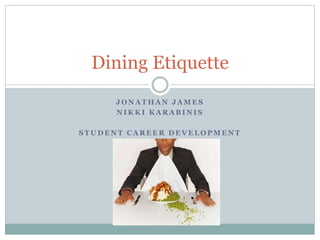
Dining Etiquette
J O N A T H A N J A M E S
N I K K I K A R A B I N I S
S T U D E N T C A R E E R D E V E L O P M E N T
http://www.youtube.com/watch?v=qnydFmqHuVo
First impressions mean
everything!
First Impressions Mean Everything
 You never get a second chance to make a first
impression.
 Many people were never taught the fundamentals of
dining etiquette.
 ….which way should I pass?
 …which fork is mine?
 …what do I do with my napkin?
 Meals can be used to observe your behavior in social
settings to see how you conduct yourself, particularly if
the job for which you are interviewing requires a
certain standard of conduct with clients and superiors.
Remember, the meal is an extension of the
interview so put your best foot forward.
When You Arrive to the Table
 If you are given a name tag, it should be placed on the right side of
your front shoulder area.
 When meeting someone…
 …rise if you are seated.
 …smile and extend your hand.
 …repeat the other person’s name in your greeting.
 Do not place any bags, purses, sunglasses, cell phones, or briefcases on
the table.
 The meal begins when the host or hostess unfolds his or her napkin. This
is your signal to do the same. Place your napkin on your lap, completely
unfolded if it is a small luncheon napkin or in half, lengthwise, if it is a
large dinner napkin. Do not shake it open.
 Bread and rolls should be broken with your fingers, in small pieces and
buttered one piece at a time.
Napkins
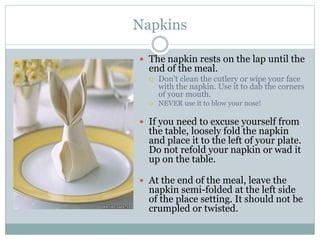
 The napkin rests on the lap until the
end of the meal.
 Don't clean the cutlery or wipe your face
with the napkin. Use it to dab the corners
of your mouth.
 NEVER use it to blow your nose!
 If you need to excuse yourself from
the table, loosely fold the napkin
and place it to the left of your plate.
Do not refold your napkin or wad it
up on the table.
 At the end of the meal, leave the
napkin semi-folded at the left side
of the place setting. It should not be
crumpled or twisted.
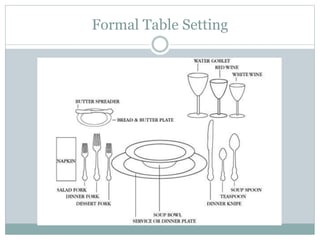
Formal Table Setting
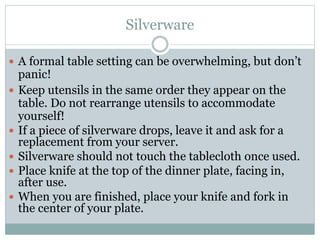
Silverware
 A formal table setting can be overwhelming, but don’t
panic!
 Keep utensils in the same order they appear on the
table. Do not rearrange utensils to accommodate
yourself!
 If a piece of silverware drops, leave it and ask for a
replacement from your server.
 Silverware should not touch the tablecloth once used.
 Place knife at the top of the dinner plate, facing in,
after use.
 When you are finished, place your knife and fork in
the center of your plate.
Using Your Silverware
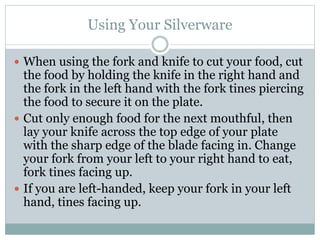
 When using the fork and knife to cut your food, cut
the food by holding the knife in the right hand and
the fork in the left hand with the fork tines piercing
the food to secure it on the plate.
 Cut only enough food for the next mouthful, then
lay your knife across the top edge of your plate
with the sharp edge of the blade facing in. Change
your fork from your left to your right hand to eat,
fork tines facing up.
 If you are left-handed, keep your fork in your left
hand, tines facing up.
During the Meal
 Wait until everyone is seated before eating and/or
until your host takes their first bite.
 When dining with others, everyone should start
and finish at the same time. If you are a fast eater
try to pace yourself. You could make the others feel
uncomfortable if you finish before they do.
 Take small bites, keep your mouth closed and finish
chewing before continuing your conversation.
 Try not to gulp your food, it isn't very attractive.
Posture
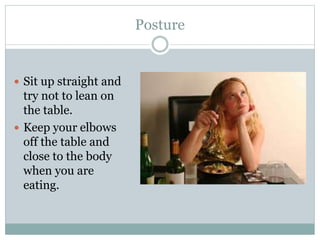
 Sit up straight and
try not to lean on
the table.
 Keep your elbows
off the table and
close to the body
when you are
eating.
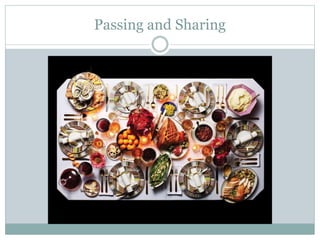
Passing and Sharing
Overcoming Challenges
 Be discrete if you have
problem with the food.
 Excuse yourself, if you have
to leave the table.
 Turn your head from the
table when you cough or
sneeze.
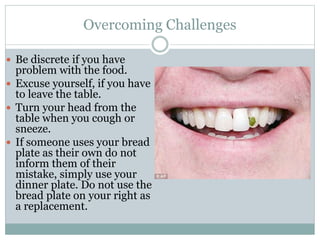
 If someone uses your bread
plate as their own do not
inform them of their
mistake, simply use your
dinner plate. Do not use the
bread plate on your right as
a replacement.
When You’re Finished…
 Don’t push your plate away from you or stack them
up.
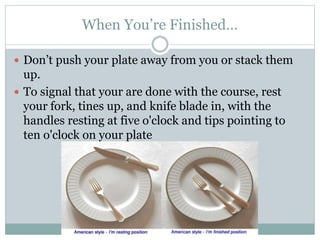
 To signal that your are done with the course, rest
your fork, tines up, and knife blade in, with the
handles resting at five o'clock and tips pointing to
ten o'clock on your plate
General Tips
 Be punctual!
 Keep up-to-date on current events in your industry
so you can have appropriate conversations.
 Remember, the meal is part of the
interview!
 Pass food from the left to the right.
 You can never say please and thank you enough,
especially to the wait staff.
 No interceptions! Snagging a roll out of the
breadbasket or taking a shake of salt when it is en
route to someone else is a no-no.
General Tips
 Butter, spreads, or dips should be transferred from the
serving dish to your plate before spreading or eating.
 Never turn a wine glass upside down to decline wine. It
is more polite to let the wine be poured and not draw
attention. Otherwise, hold your hand over the wine
glass to signal that you don't want any wine
 Do not automatically salt and pepper your food. Taste
your food before seasoning it.
 Do not blow on your food to cool it off. If it is too hot to
eat, take the hint and wait.
 Keep elbows off the table and keep your left hand in
your lap unless you are using it.
General Tips
 Do not talk with your
mouth full and chew
with your mouth closed.
 Eat in small bites and
slowly.
 Do not bring your cell
phone!
 Do not use a toothpick
or apply makeup at the
table.
Specific Food Etiquette
 Berries
 Generally, eat berries with a spoon, whether they have cream on them or not.
 Bread
 Break slices of bread, rolls and muffins in half or in small pieces never larger than one bite. Butter each bite at
a time. Small biscuits do not have to be broken. Never cut a roll with a knife.
 Clams and oysters in the half shell
 Hold the shell with the left hand and lift the clam out using your oyster fork.
 Crab, shrimp and lobster cocktails
 These are eaten with a cocktail fork.
 Fried Fantail Shrimp
 Picked up by the tail and eaten with the fingers.
 Pasta or Spaghetti
 The perfect method for eating spaghetti or other long stringy pasta is to twirl it around your fork. Use a spoon
to help if needed. It is also acceptable to cut pasta with a knife and fork.
 Potatoes
 If not already slit, cut across the top with a knife, open the potato wider with your fork, and add butter or sour
cream and chives, salt, and pepper. You may eat the skin as you go along. Don't take the insides out and put the
skin aside (or take the foil off).
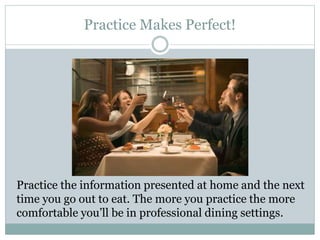
Practice Makes Perfect!
Practice the information presented at home and the next
time you go out to eat. The more you practice the more
comfortable you’ll be in professional dining settings.
References
Benet Business Network
http://findarticles.com/p/articles/mi_m1365/is_1_35/ai_n
6148221
Bremer, Jill, AICI, CIP, Dining Etiquette for the Fast-food
Generation,
www.bremercommunications.com/Dining_Etiquette.htm
Dinning Etiquette Guide: Restaurant and Dinner Party
Manners and Etiquette
http://whatscookingamerica.net/Menu/DiningEtiquetteGui
de.htm
Contact
 Nikki Karabinis
 nkarabinis@shawnee.edu
 Jonathan James
 jjames@shawnee.edu
 Peer Career
 PeerCareer@shawnee.edu

Dining etiquette

  • 1.
    Dining Etiquette J ON A T H A N J A M E S N I K K I K A R A B I N I S S T U D E N T C A R E E R D E V E L O P M E N T
  • 2.
  • 3.
    First Impressions MeanEverything  You never get a second chance to make a first impression.  Many people were never taught the fundamentals of dining etiquette.  ….which way should I pass?  …which fork is mine?  …what do I do with my napkin?  Meals can be used to observe your behavior in social settings to see how you conduct yourself, particularly if the job for which you are interviewing requires a certain standard of conduct with clients and superiors. Remember, the meal is an extension of the interview so put your best foot forward.
  • 4.
    When You Arriveto the Table  If you are given a name tag, it should be placed on the right side of your front shoulder area.  When meeting someone…  …rise if you are seated.  …smile and extend your hand.  …repeat the other person’s name in your greeting.  Do not place any bags, purses, sunglasses, cell phones, or briefcases on the table.  The meal begins when the host or hostess unfolds his or her napkin. This is your signal to do the same. Place your napkin on your lap, completely unfolded if it is a small luncheon napkin or in half, lengthwise, if it is a large dinner napkin. Do not shake it open.  Bread and rolls should be broken with your fingers, in small pieces and buttered one piece at a time.
  • 5.
    Napkins  The napkinrests on the lap until the end of the meal.  Don't clean the cutlery or wipe your face with the napkin. Use it to dab the corners of your mouth.  NEVER use it to blow your nose!  If you need to excuse yourself from the table, loosely fold the napkin and place it to the left of your plate. Do not refold your napkin or wad it up on the table.  At the end of the meal, leave the napkin semi-folded at the left side of the place setting. It should not be crumpled or twisted.
  • 6.
  • 7.
    Silverware  A formaltable setting can be overwhelming, but don’t panic!  Keep utensils in the same order they appear on the table. Do not rearrange utensils to accommodate yourself!  If a piece of silverware drops, leave it and ask for a replacement from your server.  Silverware should not touch the tablecloth once used.  Place knife at the top of the dinner plate, facing in, after use.  When you are finished, place your knife and fork in the center of your plate.
  • 8.
    Using Your Silverware When using the fork and knife to cut your food, cut the food by holding the knife in the right hand and the fork in the left hand with the fork tines piercing the food to secure it on the plate.  Cut only enough food for the next mouthful, then lay your knife across the top edge of your plate with the sharp edge of the blade facing in. Change your fork from your left to your right hand to eat, fork tines facing up.  If you are left-handed, keep your fork in your left hand, tines facing up.
  • 9.
    During the Meal Wait until everyone is seated before eating and/or until your host takes their first bite.  When dining with others, everyone should start and finish at the same time. If you are a fast eater try to pace yourself. You could make the others feel uncomfortable if you finish before they do.  Take small bites, keep your mouth closed and finish chewing before continuing your conversation.  Try not to gulp your food, it isn't very attractive.
  • 10.
    Posture  Sit upstraight and try not to lean on the table.  Keep your elbows off the table and close to the body when you are eating.
  • 11.
  • 12.
    Overcoming Challenges  Bediscrete if you have problem with the food.  Excuse yourself, if you have to leave the table.  Turn your head from the table when you cough or sneeze.  If someone uses your bread plate as their own do not inform them of their mistake, simply use your dinner plate. Do not use the bread plate on your right as a replacement.
  • 13.
    When You’re Finished… Don’t push your plate away from you or stack them up.  To signal that your are done with the course, rest your fork, tines up, and knife blade in, with the handles resting at five o'clock and tips pointing to ten o'clock on your plate
  • 14.
    General Tips  Bepunctual!  Keep up-to-date on current events in your industry so you can have appropriate conversations.  Remember, the meal is part of the interview!  Pass food from the left to the right.  You can never say please and thank you enough, especially to the wait staff.  No interceptions! Snagging a roll out of the breadbasket or taking a shake of salt when it is en route to someone else is a no-no.
  • 15.
    General Tips  Butter,spreads, or dips should be transferred from the serving dish to your plate before spreading or eating.  Never turn a wine glass upside down to decline wine. It is more polite to let the wine be poured and not draw attention. Otherwise, hold your hand over the wine glass to signal that you don't want any wine  Do not automatically salt and pepper your food. Taste your food before seasoning it.  Do not blow on your food to cool it off. If it is too hot to eat, take the hint and wait.  Keep elbows off the table and keep your left hand in your lap unless you are using it.
  • 16.
    General Tips  Donot talk with your mouth full and chew with your mouth closed.  Eat in small bites and slowly.  Do not bring your cell phone!  Do not use a toothpick or apply makeup at the table.
  • 17.
    Specific Food Etiquette Berries  Generally, eat berries with a spoon, whether they have cream on them or not.  Bread  Break slices of bread, rolls and muffins in half or in small pieces never larger than one bite. Butter each bite at a time. Small biscuits do not have to be broken. Never cut a roll with a knife.  Clams and oysters in the half shell  Hold the shell with the left hand and lift the clam out using your oyster fork.  Crab, shrimp and lobster cocktails  These are eaten with a cocktail fork.  Fried Fantail Shrimp  Picked up by the tail and eaten with the fingers.  Pasta or Spaghetti  The perfect method for eating spaghetti or other long stringy pasta is to twirl it around your fork. Use a spoon to help if needed. It is also acceptable to cut pasta with a knife and fork.  Potatoes  If not already slit, cut across the top with a knife, open the potato wider with your fork, and add butter or sour cream and chives, salt, and pepper. You may eat the skin as you go along. Don't take the insides out and put the skin aside (or take the foil off).
  • 18.
    Practice Makes Perfect! Practicethe information presented at home and the next time you go out to eat. The more you practice the more comfortable you’ll be in professional dining settings.
  • 19.
    References Benet Business Network http://findarticles.com/p/articles/mi_m1365/is_1_35/ai_n 6148221 Bremer,Jill, AICI, CIP, Dining Etiquette for the Fast-food Generation, www.bremercommunications.com/Dining_Etiquette.htm Dinning Etiquette Guide: Restaurant and Dinner Party Manners and Etiquette http://whatscookingamerica.net/Menu/DiningEtiquetteGui de.htm
  • 20.
    Contact  Nikki Karabinis nkarabinis@shawnee.edu  Jonathan James  jjames@shawnee.edu  Peer Career  PeerCareer@shawnee.edu