Why Dining Etiquette?
WhyDining Etiquette?
• A lunch interview or meeting is not a meeting
with food.
• It is a true test of your social skills and your
level of sophistication.
• Your host wants to see how you handle yourself
in a social setting.
• It’s polite to have proper dining skills when
representing yourself or your company.
3.
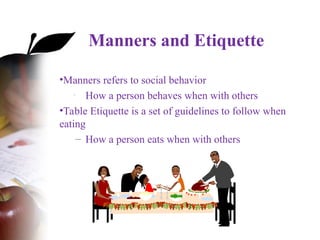
Manners and Etiquette
•Mannersrefers to social behavior
• How a person behaves when with others
•Table Etiquette is a set of guidelines to follow when
eating
– How a person eats when with others
4.
Why practice goodmanners?
• You are more confident knowing what to do.
• When you use good manners:
– You feel comfortable interacting with
others.
– You show respect for others.
– You are more relaxed in any situation.
5.
Meet and Greet
Meetand Greet
• First impressions are lasting, and it is sometimes
the only opportunity you may have.
• Therefore, a powerful and lasting introduction can
give you the edge when meeting new people for
the first time.
6.
Greetings
When meeting someone…
–rise if you are seated.
– smile and extend your hand.
– repeat the other person’s
name in your greeting.
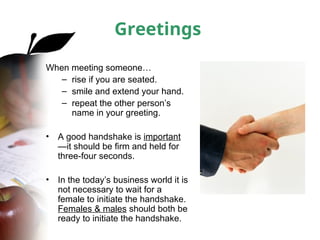
• A good handshake is important
—it should be firm and held for
three-four seconds.
• In the today’s business world it is
not necessary to wait for a
female to initiate the handshake.
Females & males should both be
ready to initiate the handshake.
Arrival
Arrival
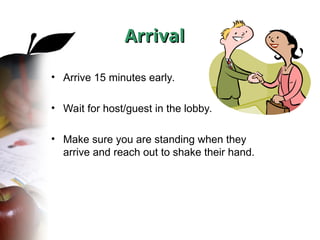
• Arrive 15minutes early.
• Wait for host/guest in the lobby.
• Make sure you are standing when they
arrive and reach out to shake their hand.
Categories of etiquetteguidelines
1. Preparing for the meal
2. During the meal
3. At the end of the meal
4. Dining away from home
11.
Preparing for themeal
Come to the table appearing
neat and clean.
– Remove your hat.
– Wash your hands and comb
your hair before coming to the
table for a meal.
– Do not comb your hair or apply
make-up at the table.
12.
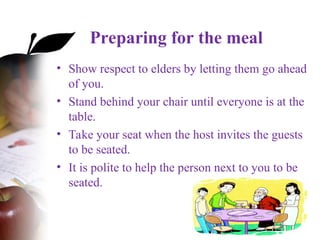
Preparing for themeal
• Show respect to elders by letting them go ahead
of you.
• Stand behind your chair until everyone is at the
table.
• Take your seat when the host invites the guests
to be seated.
• It is polite to help the person next to you to be
seated.
13.
Once Seated –The Napkin
Once Seated – The Napkin
• Wait for the host to make the first move.
• Never “flap!”
• When you leave the table, rest the
napkin on your chair.
• When finished with your meal, do not
refold the napkin; lay it to the left of your
plate.
14.
Ordering
Ordering
• Order thesame number of courses as your
host. (i.e. salad, main course, beverage)
• If unsure of price range ask the host what they
recommend.
• Do not study the menu.
• Avoid the wild food.
During the meal
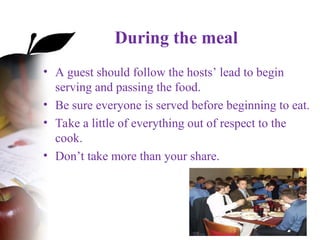
•A guest should follow the hosts’ lead to begin
serving and passing the food.
• Be sure everyone is served before beginning to eat.
• Take a little of everything out of respect to the
cook.
• Don’t take more than your share.
17.
During the meal
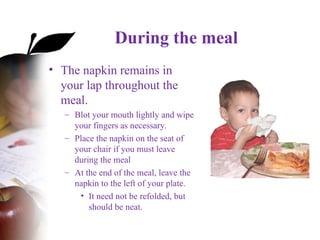
•The napkin remains in
your lap throughout the
meal.
– Blot your mouth lightly and wipe
your fingers as necessary.
– Place the napkin on the seat of
your chair if you must leave
during the meal
– At the end of the meal, leave the
napkin to the left of your plate.
• It need not be refolded, but
should be neat.
Soup
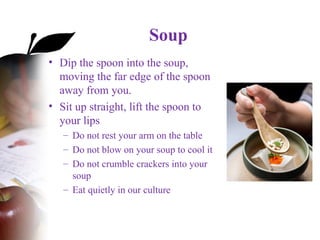
• Dip thespoon into the soup,
moving the far edge of the spoon
away from you.
• Sit up straight, lift the spoon to
your lips
– Do not rest your arm on the table
– Do not blow on your soup to cool it
– Do not crumble crackers into your
soup
– Eat quietly in our culture
20.
Sip your soup
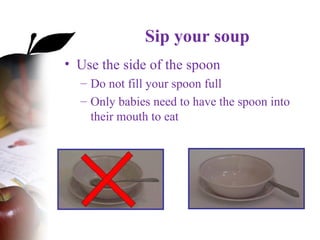
•Use the side of the spoon
– Do not fill your spoon full
– Only babies need to have the spoon into
their mouth to eat
21.
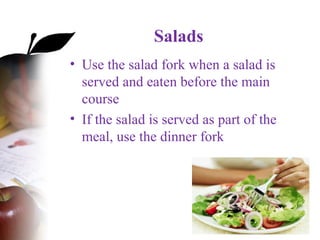
Salads
• Use thesalad fork when a salad is
served and eaten before the main
course
• If the salad is served as part of the
meal, use the dinner fork
22.
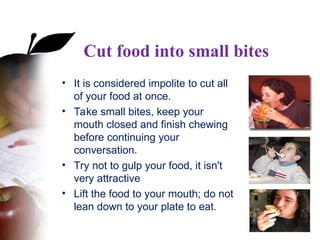
Cut food intosmall bites
• It is considered impolite to cut all
of your food at once.
• Take small bites, keep your
mouth closed and finish chewing
before continuing your
conversation.
• Try not to gulp your food, it isn't
very attractive
• Lift the food to your mouth; do not
lean down to your plate to eat.
23.
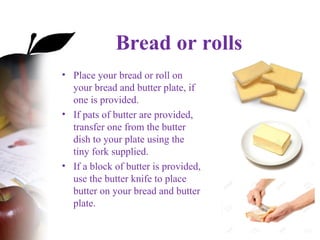
Bread or rolls
•Place your bread or roll on
your bread and butter plate, if
one is provided.
• If pats of butter are provided,
transfer one from the butter
dish to your plate using the
tiny fork supplied.
• If a block of butter is provided,
use the butter knife to place
butter on your bread and butter
plate.
24.
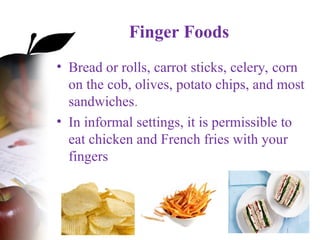
Finger Foods
• Breador rolls, carrot sticks, celery, corn
on the cob, olives, potato chips, and most
sandwiches.
• In informal settings, it is permissible to
eat chicken and French fries with your
fingers
25.
Eating
Eating
Step One
Step One
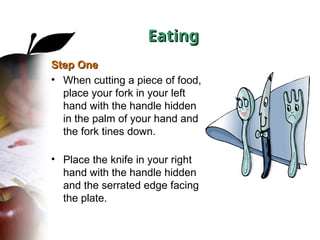
•When cutting a piece of food,
place your fork in your left
hand with the handle hidden
in the palm of your hand and
the fork tines down.
• Place the knife in your right
hand with the handle hidden
and the serrated edge facing
the plate.
26.
Step Two
Step Two
•After cutting the piece of food, lay your knife across
the top of your plate with the serrated edge facing
you.
• Transfer the fork from your left hand to your right
with the fork handle now showing between your
index finger and thumb and the tines facing up.
Step Three
Step Three
• After chewing and swallowing the food, repeat the
first three steps.
Eating
Eating
27.
Step Four
Step Four
•When you choose to lay your utensils down to rest
or to listen more intently to the people with whom
you are dining, the “rest” position is to place your
knife across the top of the plate with the serrated
edge towards you.
• Place your fork, tines up, with its handle resting on
the lower right side of the plate
Eating
Eating
28.
Step Five
Step Five
•When you are finished, place your fork across the
center of the plate with the handle to the right and
the fork tines down.
• Bring your knife from across the top of the plate
and place it next to the fork with the blade still
facing you.
• Remember: Keep with the pace of others!
Eating
Eating
29.
Meal Time Basics
MealTime Basics
Cutlery
Cutlery
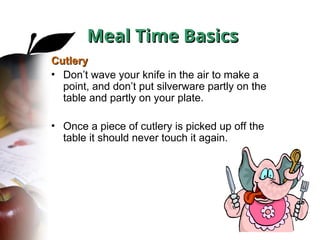
• Don’t wave your knife in the air to make a
point, and don’t put silverware partly on the
table and partly on your plate.
• Once a piece of cutlery is picked up off the
table it should never touch it again.
30.
Napkins
Napkins
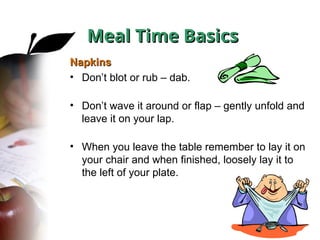
• Don’t blotor rub – dab.
• Don’t wave it around or flap – gently unfold and
leave it on your lap.
• When you leave the table remember to lay it on
your chair and when finished, loosely lay it to
the left of your plate.
Meal Time Basics
Meal Time Basics
31.
Chewing
Chewing
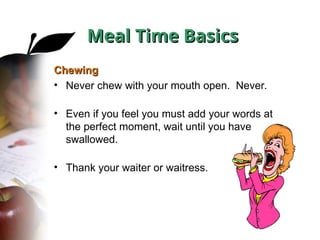
• Never chewwith your mouth open. Never.
• Even if you feel you must add your words at
the perfect moment, wait until you have
swallowed.
• Thank your waiter or waitress.
Meal Time Basics
Meal Time Basics
32.
Appearance
Appearance
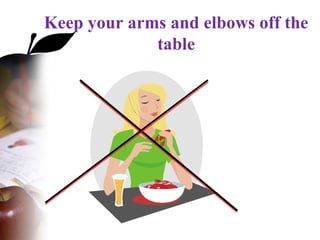
• No elbowsin the table and sit up straight.
Bread
Bread
• Tear roll or slice in to bite size pieces and butter each
one just before eating it.
• Do not butter the whole slice at the beginning.
Speed
Speed
• Watch your pace.
• Have the same number of courses as your
host/guests.
Meal Time Basics
Meal Time Basics
33.
Picking
Picking
• If youhave something trapped in your teeth,
don’t pick!
• If you must, excuse yourself and pick in the
restroom.
Purses, Briefcases
Purses, Briefcases
• Keep all items off of the table.
• This includes keys, eyeglasses, pens, basically
anything that is not part of the meal.
Meal Time Basics
Meal Time Basics
34.
Soup
Soup
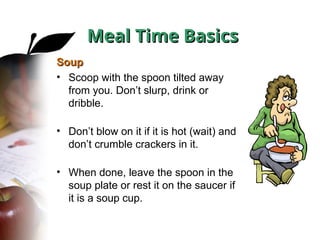
• Scoop withthe spoon tilted away
from you. Don’t slurp, drink or
dribble.
• Don’t blow on it if it is hot (wait) and
don’t crumble crackers in it.
• When done, leave the spoon in the
soup plate or rest it on the saucer if
it is a soup cup.
Meal Time Basics
Meal Time Basics
35.
Salt and peppershakers
Salt and pepper shakers
• They are married, pass them together.
• Don’t divorce the salt and pepper.
Passing
Passing
• Offer to the left then go to the right.
Seasoning
Seasoning
• Only after you taste the food first.
Cutting your food
Cutting your food
• Only enough for one mouthful.
Meal Time Basics
Meal Time Basics
36.
Pace Yourself
Pace Yourself
•When your host is done you are done.
Necktie
Necktie
• Do not flip or tuck your tie!
Ask for items to be passed
Ask for items to be passed
• Do not reach across the table.
Meal Time Basics
Meal Time Basics
37.
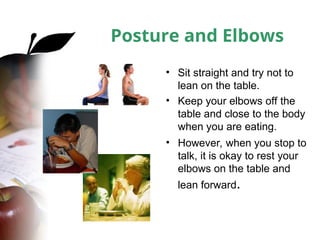
Posture and Elbows
•Sit straight and try not to
lean on the table.
• Keep your elbows off the
table and close to the body
when you are eating.
• However, when you stop to
talk, it is okay to rest your
elbows on the table and
lean forward.
38.
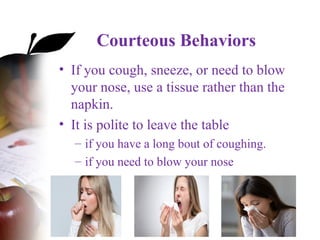
Courteous Behaviors
• Ifyou cough, sneeze, or need to blow
your nose, use a tissue rather than the
napkin.
• It is polite to leave the table
– if you have a long bout of coughing.
– if you need to blow your nose
39.
General tips
• Removefish bones from your mouth with
your finger, spoon, or napkin.
• Deposit fruit pits or seeds in your spoon.
• Do not put food from your mouth on the
table, place on the side of your plate
• Use dental floss or a toothpick in private.
40.
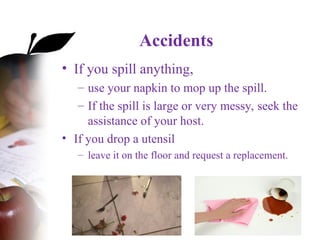
Accidents
• If youspill anything,
– use your napkin to mop up the spill.
– If the spill is large or very messy, seek the
assistance of your host.
• If you drop a utensil
– leave it on the floor and request a replacement.
Be polite
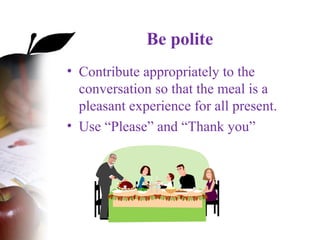
• Contributeappropriately to the
conversation so that the meal is a
pleasant experience for all present.
• Use “Please” and “Thank you”
43.
End of themeal
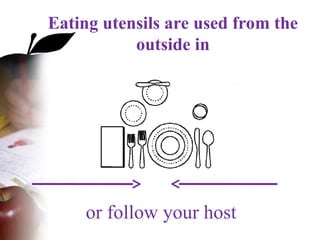
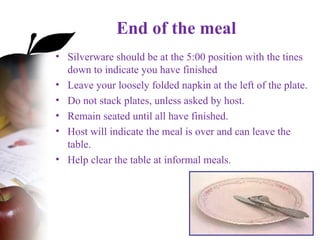
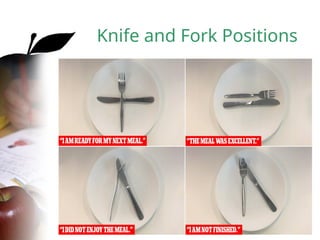
• Silverware should be at the 5:00 position with the tines
down to indicate you have finished
• Leave your loosely folded napkin at the left of the plate.
• Do not stack plates, unless asked by host.
• Remain seated until all have finished.
• Host will indicate the meal is over and can leave the
table.
• Help clear the table at informal meals.
44.
Clearing the table
•Remove the serving dishes first
• Refill beverages
• Remove the main course plates, salad,
bread and butter plates. Do not stack plates
at the table.
• Check that everyone has an eating utensil.
• Serve the dessert
45.
Dining Out
• Propertable service follows several basic
principles.
– The server will place an individual servings in
front of you.
– The server will serve all food from your left,
using the left hand
– The server will clear dishes from your right using
the right hand.
– Beverages will be served from the right.
46.
Dining with agroup
• Wait until everyone at your table is served
before you begin eating.
• Don’t begin eating until all the food is
passed if service is family style.
47.
Continental Style ismore formal
• The fork is held in the left hand and the
knife in the right.
– After cutting one bite of food, the food is
transferred to the mouth with the fork still
in the left hand, tines facing downward.
– This eliminates the transferring of cutlery
from hand to hand.
48.
Zig-Zag Style
• Theknife is laid down and the fork is
switched to the dominant hand
– Do not set the knife on the table nor should
you “bridge” the plate and table with the knife.
• Food is lifted to the mouth with the fork
tines up
• The fork is held like a pencil between the
fingers.
49.
Well mannered people
•Don’t put more on the fork or spoon than
can easily be chewed and swallow at one
time.
• Avoid talking with food in the mouth
• If asked a question, wait to answer until
the food is chewed and swallowed.
• Take small bites so they can respond
quickly to the conversation..
50.
As you areeating
• Swallow the food in your mouth before
taking a sip of a beverage.
• Drink carefully; avoid slurping or gulping.
• Your knife and fork should not bridge the
plate,
• The knife should not be placed between
the tines of the fork
51.
While eating
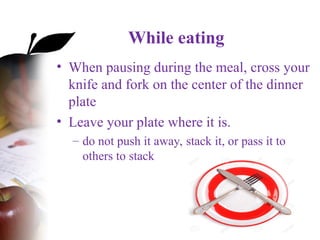
• Whenpausing during the meal, cross your
knife and fork on the center of the dinner
plate
• Leave your plate where it is.
– do not push it away, stack it, or pass it to
others to stack
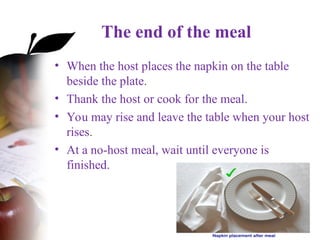
The end ofthe meal
• When the host places the napkin on the table
beside the plate.
• Thank the host or cook for the meal.
• You may rise and leave the table when your host
rises.
• At a no-host meal, wait until everyone is
finished.
54.
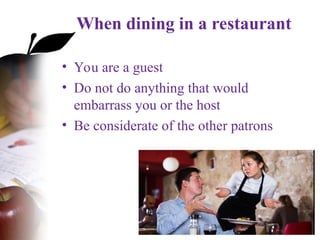
When dining ina restaurant
• You are a guest
• Do not do anything that would
embarrass you or the host
• Be considerate of the other patrons
55.
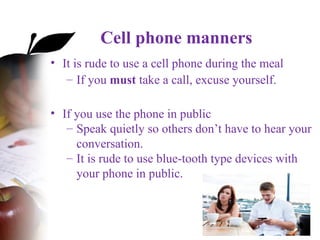
Cell phone manners
•It is rude to use a cell phone during the meal
– If you must take a call, excuse yourself.
• If you use the phone in public
– Speak quietly so others don’t have to hear your
conversation.
– It is rude to use blue-tooth type devices with
your phone in public.
56.
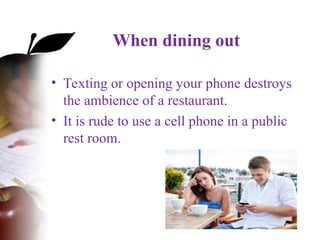
When dining out
•Texting or opening your phone destroys
the ambience of a restaurant.
• It is rude to use a cell phone in a public
rest room.
57.
Restaurant manners
• Youcan’t afford the restaurant unless you can
afford the minimum 15% tip.
• If you have a problem with your food, politely
ask the waiter to take it back.
– Do not expect the rest of your table to wait for
your plate to return.
– Is it really worth making a spectacle of yourself
and making other people wait when they are
finished eating?
58.
Good manners needto be
practiced and used in formal and
informal situations
• If you become accustomed to using
good manners
– You are more confident
– You are more comfortable
– You can think about making others
comfortable
– You show respect for other people
59.
• Try someof every food served even if you don’t like it or don’t think you will.
• Avoid playing with foods on your plate.
• Ask to have foods passed to you, rather than reaching in front of someone else
or across the table.
• Eat quietly with your mouth closed. Wait to speak until you have swallowed
any food in your mouth.
• Take small bites. Eat all that you take on your fork or spoon in one bite.
• Look neat and talk about cheerful topics to make mealtimes pleasant.
• Pass food at the table to the right with your left hand. Try not to blow on soup
to cool it - it is not polite.
• Cut salad with a knife if the pieces are too large to fit in your mouth.
• Use a small piece of bread as a “pusher” to help guide food onto your fork.
• Break off a whole piece of bread or roll into 2 or more small pieces.
• Leave your silverware on the plate or saucer under a bowl when you have
finished.
Additional Guidelines…
60.
Remember
Remember
• Never callattention to the dining
mistakes of yourself or others!
• Perception is reality, so your image is very
important.
• It will follow you wherever you go.
• Therefore, it is important that you strive to
project a positive image—one that you will be
proud of at all times.
#11 It is rude of gentlemen to wear a hat while eating. Take off the head cover when you enter a restaurant. Never eat with your hat on.
#14 If you receive a piece of food you don’t like eat the other food. You should make it look like you are eating the food.
#26 Make sure that you keep the serrated edges of the knife facing you. In some cultures if you put it facing others at the table, it means death to you.