Jaypee Business School
A Constituent of Jaypee Institute of Information Technology
(Declared Deemed to be University u/s 3 of UGC Act)
A-10, Sector 62, NOIDA, 201 307, INDIA, www.jbs.ac.in
The Digical Future-
digital-physical
mashups
Aishwarya Alagh, Jaypee Business School, M.B.A (2014-16) 14609116
Submitted to:
Prof. Ashok Kumar Wahi
PLAGIARISM REPORT
There have been discussion and forecasting that digital technology will
be going to end up and soon it will destroy physical retail, but Darrell
Rigby, head of Bain & Company's Global Innovation and Global Retail
does not believe on it. Digital and physical retail are moving hand-in-
hand instead of only digital being developing or both independently.
Darrell challenges the idea that to be genuinely troublesome a Digital
methodology must go 'unadulterated play’, which another and separate
Digital-just wander is needed.
Many retailers are involved in running their physical and digital
operation of business separately which makes customers frustrate to see
different between prices on the shelf and on website respectively. As
example given in the article, Stacy who wants to buy the Just Dance 4
video game found that on major retailer’s website for $29.97 but at
retailer’s local store, it was selling for $47.97. She was shocked to see
the differences in prices. She replied, “Can’t I just pay for it online and
take one from the shelf?” Of course not, was the response; the store and
the online operation were separate businesses, and that would mess
things up.
In recent HBR webinar “Retail that Connects: Creating the Complete
Customer Experience", Darrell Rigby describes how companies should
merge the digital and physical operational experience and make clients
to purchase goods from both as per their choice. He examines the future
of retail and shares five best practices about digital-physical mashups
discovered from global leaders.
The five rules that will help retailers to regain their business, build
competitive advantage which lead to growth.
1. Build your strategy around digital-physical fusion; it can be your
new competitive edge.
It is very difficult for the retailers to find out how to combine digital and
physical technologies but they worked hard to understand and find
solutions. They should keep on investing in the physical asset which
allow customer to face experience and at the same time should invest in
digital asset like e-commerce and mobile capabilities.
But the problem arise is that a company may stop doing business while
investing on resources which result into losses so it is very necessary to
find some skills to be lucky and your core business can return
competitive advantages. These advantages may include proprietary
customer insights, distinctive capabilities, and ways to capitalize on a
competitor’s vulnerabilities.
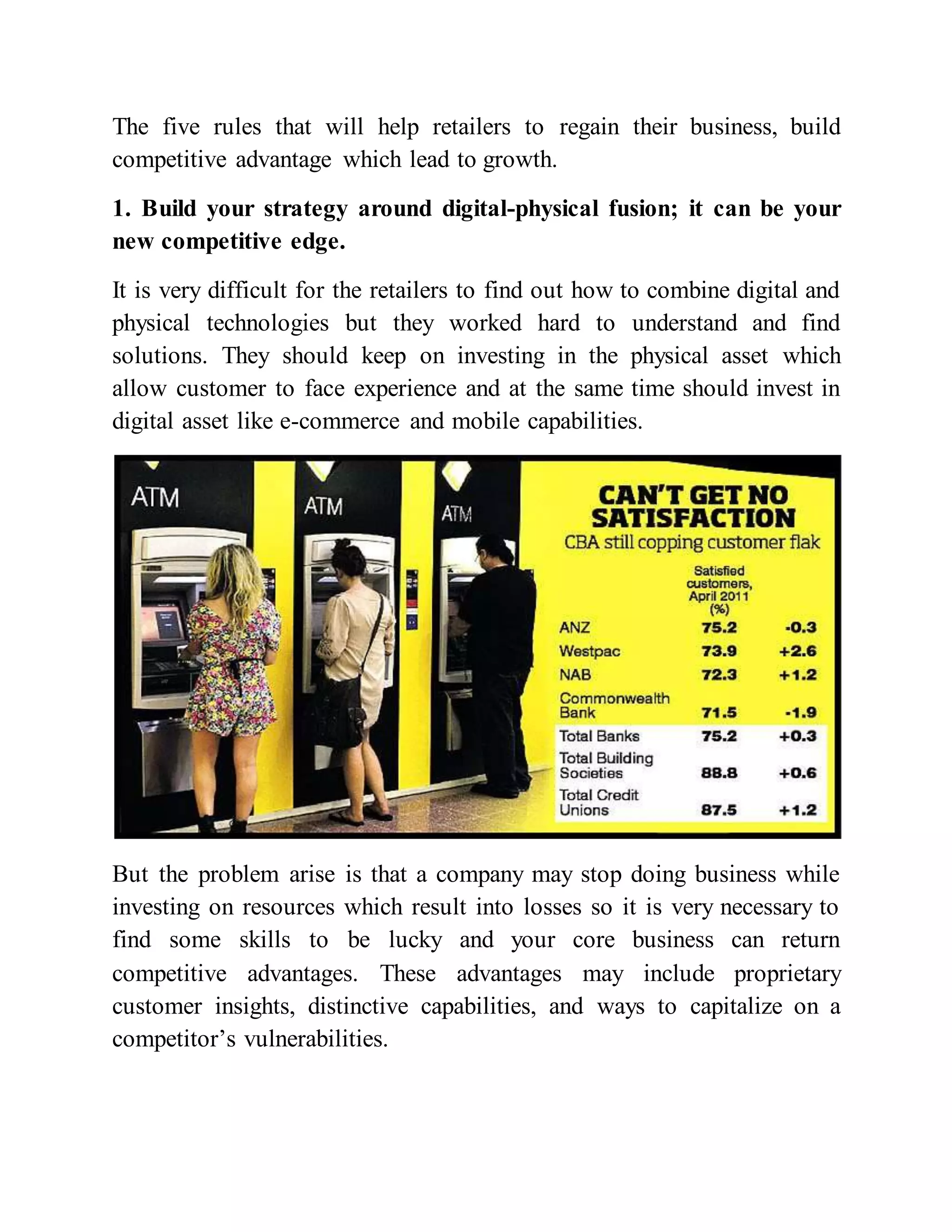
Darrell gave few examples in which one of them include the
Commonwealth Bank of Australia, who planned a Digital strategy that
was because of reducing retail outlets branches which made online
banks to capture market share and entrants to new players.
New CEO Ralph Norris, who is an IT guy, implemented a Digital
strategy which integrated online and in-person systems; a real estate app
to show home’s pictures and start a mortgage application process, and a
mobile payment app which handled by Facebook too, with many other
IT innovation achievements.
CBA’s digital-physical mashup based strategy helped them to regain
customer-satisfaction and ranked highest in retail banks in 2013. CBA’s
shares increased more than 80% from mid-2006, compared with a 9%
gain in the SP/ASX 200 index over the same period.
Rigby told that Macy's has been achieved in merging the digital with the
physical by utilizing their stores as fulfillment centers and gaining the
following advantages:
• Lower transportation costs;
• More exact delivery windows: clients need to know when their
shipments are coming;
• Reduced markdowns;
• Easier to handle seasonal benefits;
• In-store pickup improves store traffic and sales. Frequently, clients that
go in store will get extra stock;
• Increased social joint effort between the digital and physical players in
the organization to make this process work.
A strategic view of digit-physical fusion and investing on assets lead a
company to capture their current position and bringing those areas in
light which need to get great attention. With the help of this strategic,
design researchers examine the blue ocean for new opportunities which
bring innovation into existing products and services. After identifying
the adjacencies, designers create new ideas which focus on customer
requirements.
2. Add links and strengthen linkages in the customer experience.
Those retailers are winners who add links and powerful linkage within
the entire customer experience chain. A company which joined the links,
“thinks systematically about each piece of the customer experience” by
creating “innovative components and weaving them into a holistic
system.” Digital plays an important role in all of the links like new offer,
discover, evaluate, customize, purchase, receive, use and service, return
and upgrade, review etc. Retailers will be in benefit if they need
focusing on the usage of technology in innovative ways up to that limit
which give seamless experience to the customer. User and digital
expertise should make sure that connection of linkage, utilization of test
and agreement, and achieving the highest levels of customer satisfaction.
To increase the awareness of brand and building brand equity among
customers, companies need to use technology. By giving example that
how Marriott and
Liquidspace are partners
now, which give offer to
customer to book and
share their workspaces
which provide better
utilization of meeting
spaces. Harvard, MIT
and Berkeley brought new ideas of expanding physical campus beyond
the borders so that students also have option to attend free online courses
through edX. The physical-digital mashup designs are the main
parameters which build differentiation among companies acting as
competitors.
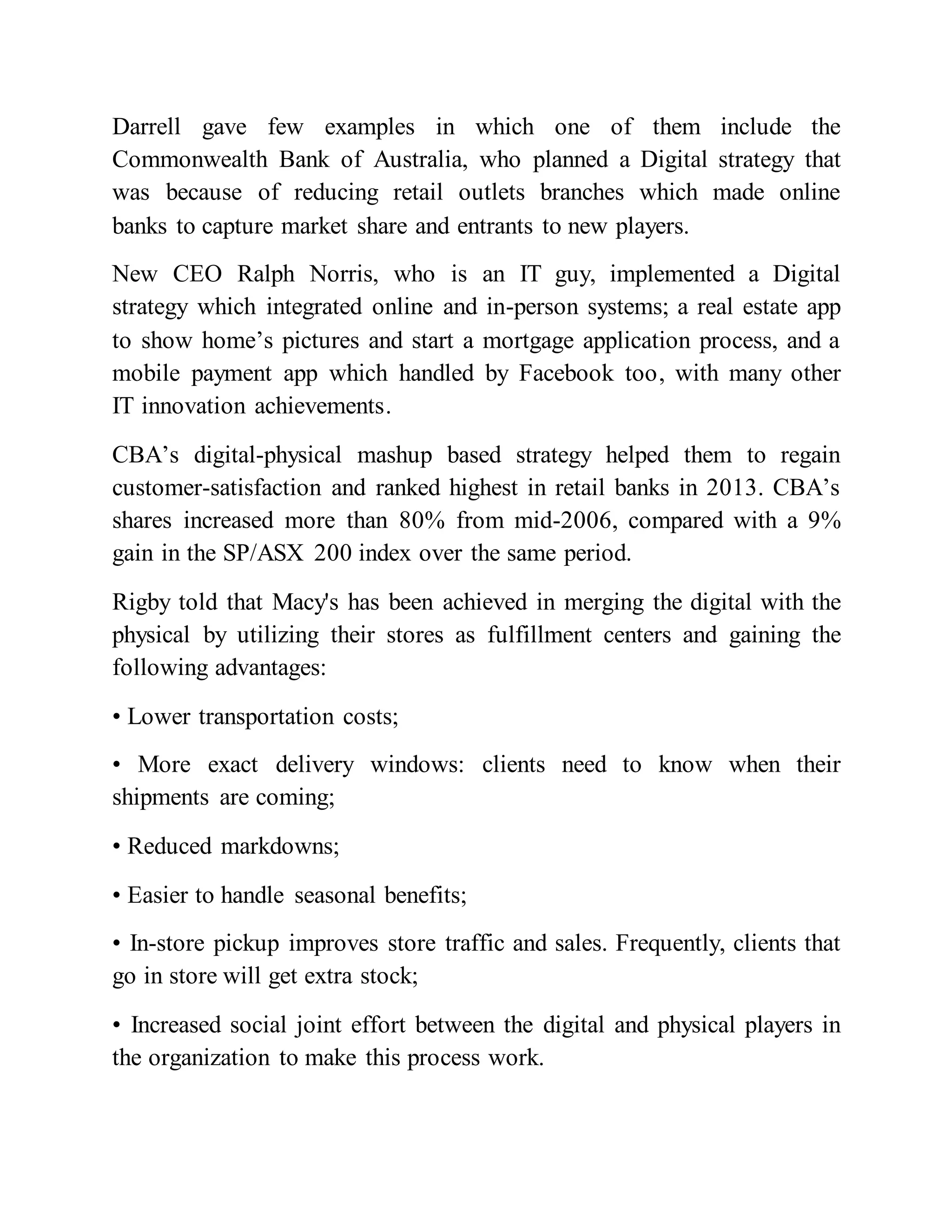
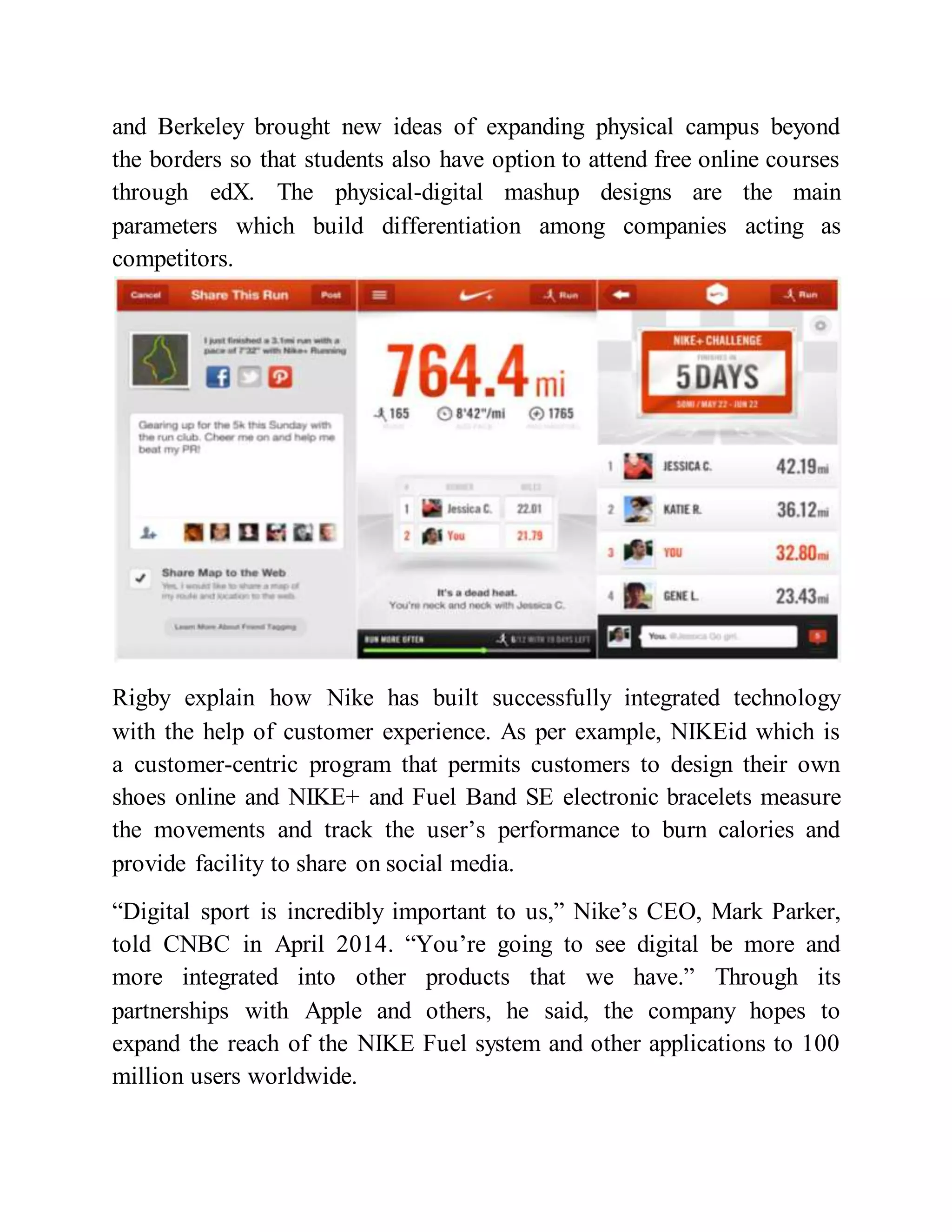
Rigby explain how Nike has built successfully integrated technology
with the help of customer experience. As per example, NIKEid which is
a customer-centric program that permits customers to design their own
shoes online and NIKE+ and Fuel Band SE electronic bracelets measure
the movements and track the user’s performance to burn calories and
provide facility to share on social media.
“Digital sport is incredibly important to us,” Nike’s CEO, Mark Parker,
told CNBC in April 2014. “You’re going to see digital be more and
more integrated into other products that we have.” Through its
partnerships with Apple and others, he said, the company hopes to
expand the reach of the NIKE Fuel system and other applications to 100
million users worldwide.
3. Transform the way you approach innovation.
To be in market and run business, it is mandatory for retailers to think in
different ways and give innovation in products and services. As leading
towards development of technology resulting acceleration in innovative
ideas so it is growth driven of digital technologies. Rigby motivate to the
developers to form teams of excellent experts who are committed to
work hard and having involvement in each step of the process to
“generate more wide-ranging, innovative, and integrated solutions.” For
industrial designers, who works as a team with collaborating feeling are
not surprise because they use to work together with engineers from the
early stages of a project, but problem occurs mostly in large corporate
firms having separate departments because of which less communication
among department cause to negative impact on creation of product and
services.
In the article, Rigby build a way for the companies to navigate how to
form digital equally giving important to physical assets. Rigby describe
the practices of digital revolution which helped companies to build a
way and tell about the important of designer which form a competitive
edge in innovation projects. From small business to large corporate
industry leading on the path of conversion of digital movement.
Industries like medical technology, healthcare, hospitality and
pharmaceutical moving towards digital transformation at crawling speed
because of regulatory limitation. The developments brought by the
designers in the digital-physical merge on the customer side with the
help of telemedicine, eHealth, mHealth, EHR, personal genomics and
Health IT. Designers keep on innovating
and bring changes in medical industries
by introducing new technologies to
satisfy the requirement of 21st century
patients.
The law describe about computing
power get multiplied twice every two
years states by Moore. It can be explain
as today retailers invest more in physical and few in digital but after ten
years, the retailers will invest three times of today and increasing
investment in digital portion. Innovation can be in the product or service
such as supply experience chain and marketing. The development tells
about the usage of technologies by customer and the retailers offer
innovation to customers.
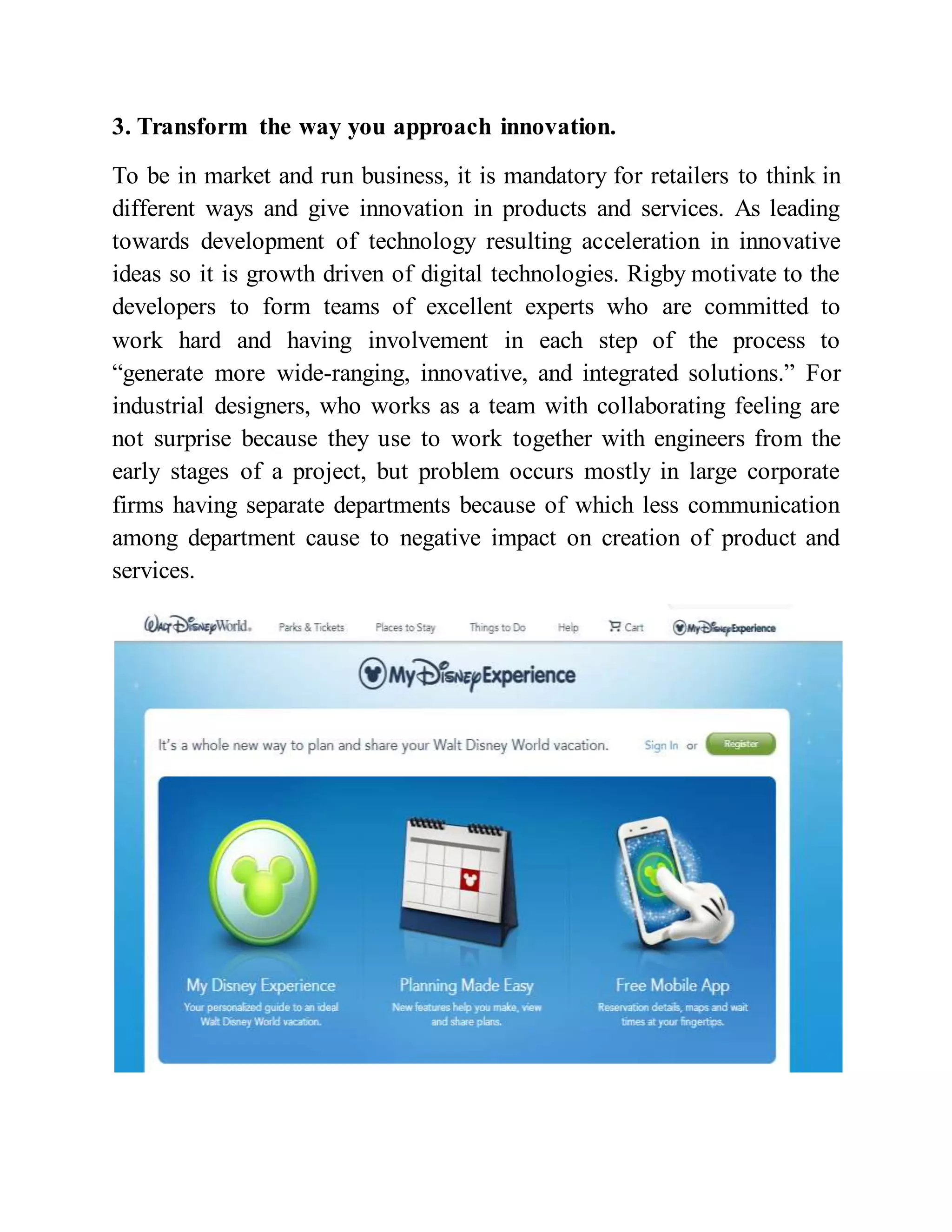
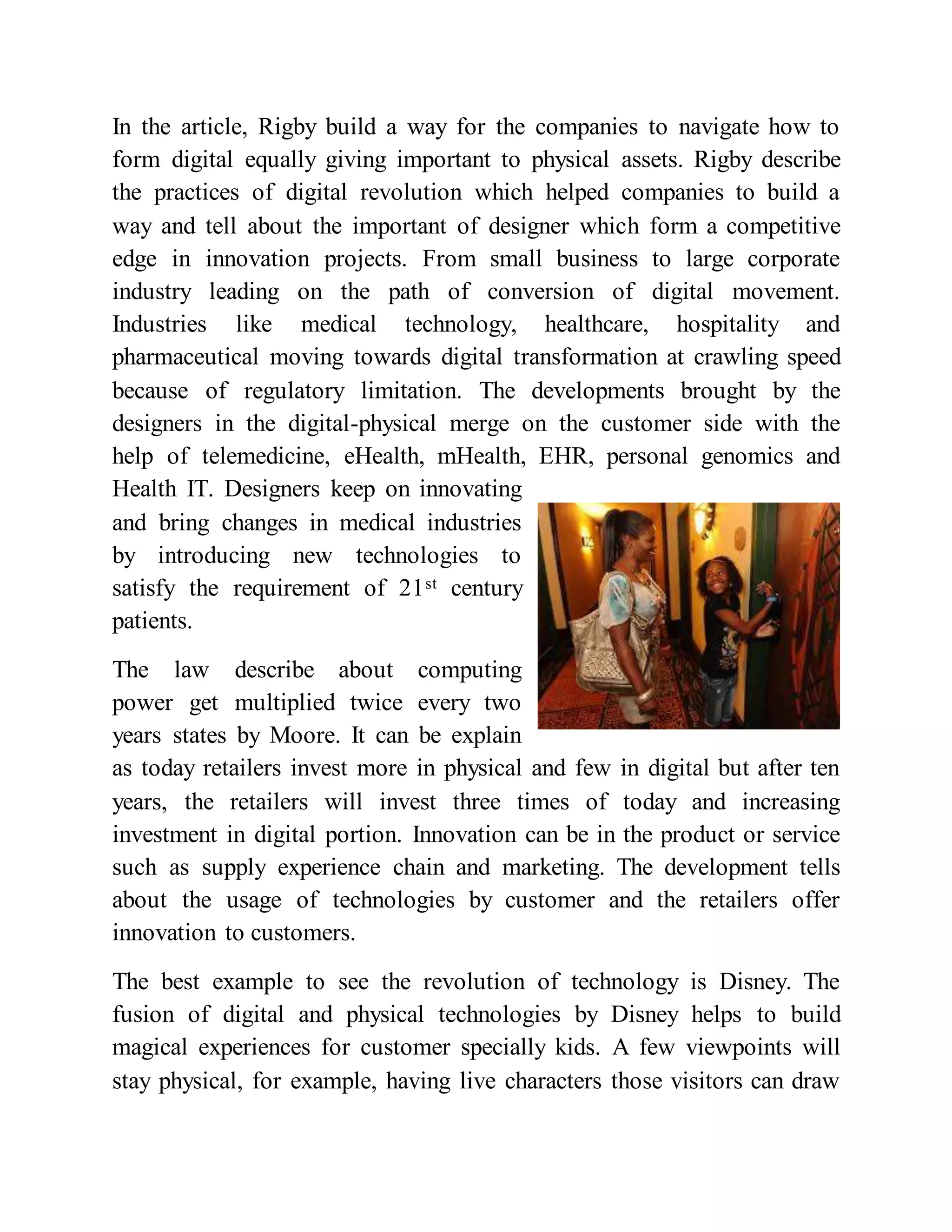
The best example to see the revolution of technology is Disney. The
fusion of digital and physical technologies by Disney helps to build
magical experiences for customer specially kids. A few viewpoints will
stay physical, for example, having live characters those visitors can draw
in with through discussions, embraces and picture-taking. Also, Disney
has the MyMagic+ framework which furnishes guests with an electronic
wristband that goes about as a ticket, room key, and charge card. This
framework permits Disney to acquire an abundance of client information
that can be utilized to customize the client experience considerably
more. Including the greater part of the organization, not only a detached
world class specialized group, is additionally the key message for
Disney, who have drawn in more than 1,000 representatives into
concocting their 'Next Generation Experience' bringing about a heap of
Digical developments that significantly enhance the client experience.
4. Organizational separation is just an interim step
When customers focus on purchasing process, they do interaction more
than one channel. Either online or store, they are not aware of difference
between digital and physical channels and not even care for this while
shopping. It is necessary for retailers to offer seamless experience to
satisfy the expectation of customers now-a-days. So, there are few steps
which explain about current position of retailers and how to achieve goal
they planned to be?
The very first step is to make them realize about their current scenario
and they have to go through three phases to achieve their goal. During
first phase, the activities involve setting up of a separate innovation lab
or digital unit. The creation of unit brings retailers to assign right talent
to attract the right customers and allow freedom and working space to
dedicated teams. This phase brings incentives and thinks big which out
of box.
Referring to Sears as an illustration of a firm that attempted and fizzled
with this methodology he rather suggests a methodology of change
rather, empowered by incorporating Digital with the current business.
As a counter he depicts how Macy's has embraced an "omnichannel"
system, utilizing innovation to increase and upgrade the store encounter
instead of attempting to administration clients far from it.
Burns has delighted in online deals accomplishment to the tune of $1.2
billion, however this is just 2.5% of their aggregate deals, and Darrell
portrays how they have under-put resources into their customary retail
business.
Interestingly Macy's has used retail locations as satisfaction
communities for online requests, has utilized new portable applications
inside of the stores and different advancements that uses one to expand
the accomplishment of the other, developing general deals by 19% in the
most recent four years. This has been because of utilizing Robert
Harrison into a Chief Digital Officer sort part, what they depict as the
Chief Omnichannel Officer.
5. Build a digital-savvy leadership team that includes the CEO.
So as to make an advanced wise administration group, Rigby
recommends a "no-official deserted" system that incorporates activities,
for example, matching a senior official with a computerized nerd or
millennial that they are obliged to meet once every week. On the off
chance that computerized advances are required to supplant the center
business, the CEO's essential undertaking is to change the blend of
organizations, not the key capacities of individuals inside of them. This
sort of corporate development is much like natural advancement:
Individual living beings don't change, yet the populace advances as
predominant species obliterate less versatile ones. Amid these
gatherings, the senior official can make inquiries that they would be
hesitant to solicit in front from their associates or that they would never
solicit in front from their top managerial staff.
Rigby exceptionally respects the administration group at Burberry for
magnificently constructing a computerized shrewd group. Previous
CEO, Angela Ahrendts united the Chief Creative Officer and Chief
Technology Officer and they made a group that would cooperate with
both very imaginative and specialized aptitudes to have the capacity to
reevaluate the whole experience for their clients. She set up a "vital
development board" and staffed it with what she saw as the most
youthful and most ground breaking chiefs in the organization. The
committee grew digitally immersive physical encounters—lives spilling
of runway shows, feature content on monster screens, computerized
mirrors that transformed into screens showing catwalk scenes—that
made store clients feel like they were going into a digical "Burberry
World."
Subsequently, strolling into a Burberry store has turned into a striking
knowledge. Ahrendt's activities have changed the brand and
reinvigorated the development of the brand in ways that pulled in a
considerable measure of consideration. Burberry leads stores include:
• Live gushing features;
• More than 500 speakers and 100 synchronized screens;
• RFID labeled attire that triggers sight and sound substance;
• All store partners convey iPads with a log of clients' buy history and
inclinations;
• A digitally empowered exhibition and occasion spaces;
• Customers can make tweaked trench coats.
Retailers that transform into the most respected organizations are those
centered on the client experience and building the abilities that will be
expected to win.
Digical’s Growing Momentum
“Digical” (combined digital and physical) innovations will hit some
organizations much harder and speedier than others, so a key first step is
to survey your organization's surroundings. What amount has the
continuous change officially changed your industry's offerings also,
aggressive flow? What amount is it prone to do as such in the next quite
a long while? You can see initially a percentage of the key discoveries:-
The scope of effect is wide. Change has been a few times as broad in
media, innovation, and telecom as in oil and gas, mining, and
development.
The greatest change is yet to come. The following quite a long while
will bring far more advancement to most commercial ventures than they
have found previously. Carriers, vehicles, and protection, for case, are
very nearly broad digical changes.
Trump cards can influence the pace of progress. A few commercial
ventures will be kept down by outside variables. Medicinal innovation
and human services, specifically, won't advance as fast as they generally
may, inferable from regulations, repayment practices, and risk issues.
The Digical Future
Enterprises today are living in the era of digital conversion. By utilizing
advances, for example, mobile portable, social, cloud, and Big Data
business can now interface, interoperate and team up over all inner and
outer channels.
It's dependent upon IT associations to drive these endeavors – and to
drive them at a quicker pace than any time in recent memory some time
recently. IT leaders have lived for quite a long time with the way that
their assets are part between the contending requests of normal
operations while attempting to bolster key endeavors.
That has never been truer than now. The influx of new technologies and
more finely-tuned best practices and processes can help the business
transform -- but only if the business has embraced the idea that the “old
way of doing things” will not work in the digital transformation.
There are scores of applications and platforms that can help enterprises
capitalize on their data; reach customers in real-time across multiple
platforms; deliver an exceptional user experience; speedily stand up
infrastructure for on-demand services; gain real-time insight into
business process and performance; and secure environments and
information from the highly dynamic threat landscape.
That need will become more pressing given a change that IT leaders see
in their very near future: Strategy building and new initiatives will
consume 36 percent of internal IT’s time over the next two years,
compared to 24 percent today, according to a IDG Research Services’
Managed IT Services study, sponsored by CenturyLink.
Digical developments are moving driving organizations in a developing
scope of organizations.
The Ford Party beats contenders mostly on account of the organization's
spearheading Ford Sync innovation; more than 50% of Fiesta purchasers
say Ford Sync was a noteworthy explanation behind their buy choice.
Delta Air Lines was bankrupt in 2005 and evaluated keep going on
Fortune's rundown of most respected aircrafts in 2007, yet it is very
productive also, number one on the magazine's rundown today. Among
the numerous explanations behind this change might be Delta's sizable
interests in digitally increasing the physical parts of flight. Its Fly Delta
application, case in point, not just gives data about flight schedules,
planes, and air terminals, additionally lets travelers record their parking
spaces, weigh in, change seats, recover tickets, pay for overabundance
stuff, track processed gear, and perspective the ground under the plane
(with Glass Bottom Jet). The hugely well known application had been
downloaded an evaluated 11 million times as of April 2014. Maybe the
surest sign that advanced advances are changing physical organizations
as opposed to demolishing them is the developing number of
computerized organizations that are themselves moving toward
advanced physical combinations.
Google, which began life as simply a computerized web crawler, is
currently delivering cell phones and tablets and shrewd glasses; it has
likewise been building driverless autos, procuring mechanical autonomy
organizations, laying physical fiber, making conveyance administrations,
and moving into joined gadgets inside the home.
Computerized retailers, for example, Warby Parker and Bonobos are
dispatching physical stores. Andy Dunn, the CEO of Bonobos, says,
"We weren't right at the starting. In 2007 we began the organization, and
we said, 'The entire world is going online just. All we're going to do is
be online.' But what we've adapted as of late is that the disconnected
from the net experience of touching and feeling garments isn't going
endlessly."
A digical lens will change how individuals see what's more; oversee
almost every action in life and business. Have a go at utilizing it. Dissect
your clients' experience affix to see how computerized advances apply.
Joining the physical and the computerized guarantees to change almost
every component of about each industry, counting yours.
digital transformation

digital transformation

  • 1.
    Jaypee Business School AConstituent of Jaypee Institute of Information Technology (Declared Deemed to be University u/s 3 of UGC Act) A-10, Sector 62, NOIDA, 201 307, INDIA, www.jbs.ac.in The Digical Future- digital-physical mashups Aishwarya Alagh, Jaypee Business School, M.B.A (2014-16) 14609116 Submitted to: Prof. Ashok Kumar Wahi
  • 2.
  • 3.
    There have beendiscussion and forecasting that digital technology will be going to end up and soon it will destroy physical retail, but Darrell Rigby, head of Bain & Company's Global Innovation and Global Retail does not believe on it. Digital and physical retail are moving hand-in- hand instead of only digital being developing or both independently. Darrell challenges the idea that to be genuinely troublesome a Digital methodology must go 'unadulterated play’, which another and separate Digital-just wander is needed. Many retailers are involved in running their physical and digital operation of business separately which makes customers frustrate to see different between prices on the shelf and on website respectively. As example given in the article, Stacy who wants to buy the Just Dance 4 video game found that on major retailer’s website for $29.97 but at retailer’s local store, it was selling for $47.97. She was shocked to see the differences in prices. She replied, “Can’t I just pay for it online and take one from the shelf?” Of course not, was the response; the store and the online operation were separate businesses, and that would mess things up. In recent HBR webinar “Retail that Connects: Creating the Complete Customer Experience", Darrell Rigby describes how companies should merge the digital and physical operational experience and make clients to purchase goods from both as per their choice. He examines the future of retail and shares five best practices about digital-physical mashups discovered from global leaders.
  • 4.
    The five rulesthat will help retailers to regain their business, build competitive advantage which lead to growth. 1. Build your strategy around digital-physical fusion; it can be your new competitive edge. It is very difficult for the retailers to find out how to combine digital and physical technologies but they worked hard to understand and find solutions. They should keep on investing in the physical asset which allow customer to face experience and at the same time should invest in digital asset like e-commerce and mobile capabilities. But the problem arise is that a company may stop doing business while investing on resources which result into losses so it is very necessary to find some skills to be lucky and your core business can return competitive advantages. These advantages may include proprietary customer insights, distinctive capabilities, and ways to capitalize on a competitor’s vulnerabilities.
  • 5.
    Darrell gave fewexamples in which one of them include the Commonwealth Bank of Australia, who planned a Digital strategy that was because of reducing retail outlets branches which made online banks to capture market share and entrants to new players. New CEO Ralph Norris, who is an IT guy, implemented a Digital strategy which integrated online and in-person systems; a real estate app to show home’s pictures and start a mortgage application process, and a mobile payment app which handled by Facebook too, with many other IT innovation achievements. CBA’s digital-physical mashup based strategy helped them to regain customer-satisfaction and ranked highest in retail banks in 2013. CBA’s shares increased more than 80% from mid-2006, compared with a 9% gain in the SP/ASX 200 index over the same period. Rigby told that Macy's has been achieved in merging the digital with the physical by utilizing their stores as fulfillment centers and gaining the following advantages: • Lower transportation costs; • More exact delivery windows: clients need to know when their shipments are coming; • Reduced markdowns; • Easier to handle seasonal benefits; • In-store pickup improves store traffic and sales. Frequently, clients that go in store will get extra stock; • Increased social joint effort between the digital and physical players in the organization to make this process work.
  • 6.
    A strategic viewof digit-physical fusion and investing on assets lead a company to capture their current position and bringing those areas in light which need to get great attention. With the help of this strategic, design researchers examine the blue ocean for new opportunities which bring innovation into existing products and services. After identifying the adjacencies, designers create new ideas which focus on customer requirements. 2. Add links and strengthen linkages in the customer experience. Those retailers are winners who add links and powerful linkage within the entire customer experience chain. A company which joined the links, “thinks systematically about each piece of the customer experience” by creating “innovative components and weaving them into a holistic system.” Digital plays an important role in all of the links like new offer, discover, evaluate, customize, purchase, receive, use and service, return and upgrade, review etc. Retailers will be in benefit if they need focusing on the usage of technology in innovative ways up to that limit which give seamless experience to the customer. User and digital expertise should make sure that connection of linkage, utilization of test and agreement, and achieving the highest levels of customer satisfaction. To increase the awareness of brand and building brand equity among customers, companies need to use technology. By giving example that how Marriott and Liquidspace are partners now, which give offer to customer to book and share their workspaces which provide better utilization of meeting spaces. Harvard, MIT
  • 7.
    and Berkeley broughtnew ideas of expanding physical campus beyond the borders so that students also have option to attend free online courses through edX. The physical-digital mashup designs are the main parameters which build differentiation among companies acting as competitors. Rigby explain how Nike has built successfully integrated technology with the help of customer experience. As per example, NIKEid which is a customer-centric program that permits customers to design their own shoes online and NIKE+ and Fuel Band SE electronic bracelets measure the movements and track the user’s performance to burn calories and provide facility to share on social media. “Digital sport is incredibly important to us,” Nike’s CEO, Mark Parker, told CNBC in April 2014. “You’re going to see digital be more and more integrated into other products that we have.” Through its partnerships with Apple and others, he said, the company hopes to expand the reach of the NIKE Fuel system and other applications to 100 million users worldwide.
  • 8.
    3. Transform theway you approach innovation. To be in market and run business, it is mandatory for retailers to think in different ways and give innovation in products and services. As leading towards development of technology resulting acceleration in innovative ideas so it is growth driven of digital technologies. Rigby motivate to the developers to form teams of excellent experts who are committed to work hard and having involvement in each step of the process to “generate more wide-ranging, innovative, and integrated solutions.” For industrial designers, who works as a team with collaborating feeling are not surprise because they use to work together with engineers from the early stages of a project, but problem occurs mostly in large corporate firms having separate departments because of which less communication among department cause to negative impact on creation of product and services.
  • 9.
    In the article,Rigby build a way for the companies to navigate how to form digital equally giving important to physical assets. Rigby describe the practices of digital revolution which helped companies to build a way and tell about the important of designer which form a competitive edge in innovation projects. From small business to large corporate industry leading on the path of conversion of digital movement. Industries like medical technology, healthcare, hospitality and pharmaceutical moving towards digital transformation at crawling speed because of regulatory limitation. The developments brought by the designers in the digital-physical merge on the customer side with the help of telemedicine, eHealth, mHealth, EHR, personal genomics and Health IT. Designers keep on innovating and bring changes in medical industries by introducing new technologies to satisfy the requirement of 21st century patients. The law describe about computing power get multiplied twice every two years states by Moore. It can be explain as today retailers invest more in physical and few in digital but after ten years, the retailers will invest three times of today and increasing investment in digital portion. Innovation can be in the product or service such as supply experience chain and marketing. The development tells about the usage of technologies by customer and the retailers offer innovation to customers. The best example to see the revolution of technology is Disney. The fusion of digital and physical technologies by Disney helps to build magical experiences for customer specially kids. A few viewpoints will stay physical, for example, having live characters those visitors can draw
  • 10.
    in with throughdiscussions, embraces and picture-taking. Also, Disney has the MyMagic+ framework which furnishes guests with an electronic wristband that goes about as a ticket, room key, and charge card. This framework permits Disney to acquire an abundance of client information that can be utilized to customize the client experience considerably more. Including the greater part of the organization, not only a detached world class specialized group, is additionally the key message for Disney, who have drawn in more than 1,000 representatives into concocting their 'Next Generation Experience' bringing about a heap of Digical developments that significantly enhance the client experience. 4. Organizational separation is just an interim step When customers focus on purchasing process, they do interaction more than one channel. Either online or store, they are not aware of difference between digital and physical channels and not even care for this while shopping. It is necessary for retailers to offer seamless experience to satisfy the expectation of customers now-a-days. So, there are few steps which explain about current position of retailers and how to achieve goal they planned to be? The very first step is to make them realize about their current scenario and they have to go through three phases to achieve their goal. During first phase, the activities involve setting up of a separate innovation lab or digital unit. The creation of unit brings retailers to assign right talent to attract the right customers and allow freedom and working space to dedicated teams. This phase brings incentives and thinks big which out of box. Referring to Sears as an illustration of a firm that attempted and fizzled with this methodology he rather suggests a methodology of change rather, empowered by incorporating Digital with the current business.
  • 11.
    As a counterhe depicts how Macy's has embraced an "omnichannel" system, utilizing innovation to increase and upgrade the store encounter instead of attempting to administration clients far from it. Burns has delighted in online deals accomplishment to the tune of $1.2 billion, however this is just 2.5% of their aggregate deals, and Darrell portrays how they have under-put resources into their customary retail business. Interestingly Macy's has used retail locations as satisfaction communities for online requests, has utilized new portable applications inside of the stores and different advancements that uses one to expand the accomplishment of the other, developing general deals by 19% in the most recent four years. This has been because of utilizing Robert Harrison into a Chief Digital Officer sort part, what they depict as the Chief Omnichannel Officer.
  • 12.
    5. Build adigital-savvy leadership team that includes the CEO. So as to make an advanced wise administration group, Rigby recommends a "no-official deserted" system that incorporates activities, for example, matching a senior official with a computerized nerd or millennial that they are obliged to meet once every week. On the off chance that computerized advances are required to supplant the center business, the CEO's essential undertaking is to change the blend of organizations, not the key capacities of individuals inside of them. This sort of corporate development is much like natural advancement: Individual living beings don't change, yet the populace advances as predominant species obliterate less versatile ones. Amid these gatherings, the senior official can make inquiries that they would be hesitant to solicit in front from their associates or that they would never solicit in front from their top managerial staff. Rigby exceptionally respects the administration group at Burberry for magnificently constructing a computerized shrewd group. Previous CEO, Angela Ahrendts united the Chief Creative Officer and Chief Technology Officer and they made a group that would cooperate with both very imaginative and specialized aptitudes to have the capacity to reevaluate the whole experience for their clients. She set up a "vital development board" and staffed it with what she saw as the most youthful and most ground breaking chiefs in the organization. The committee grew digitally immersive physical encounters—lives spilling of runway shows, feature content on monster screens, computerized mirrors that transformed into screens showing catwalk scenes—that made store clients feel like they were going into a digical "Burberry World." Subsequently, strolling into a Burberry store has turned into a striking knowledge. Ahrendt's activities have changed the brand and
  • 13.
    reinvigorated the developmentof the brand in ways that pulled in a considerable measure of consideration. Burberry leads stores include: • Live gushing features; • More than 500 speakers and 100 synchronized screens; • RFID labeled attire that triggers sight and sound substance; • All store partners convey iPads with a log of clients' buy history and inclinations; • A digitally empowered exhibition and occasion spaces; • Customers can make tweaked trench coats. Retailers that transform into the most respected organizations are those centered on the client experience and building the abilities that will be expected to win.
  • 14.
    Digical’s Growing Momentum “Digical”(combined digital and physical) innovations will hit some organizations much harder and speedier than others, so a key first step is to survey your organization's surroundings. What amount has the continuous change officially changed your industry's offerings also, aggressive flow? What amount is it prone to do as such in the next quite a long while? You can see initially a percentage of the key discoveries:- The scope of effect is wide. Change has been a few times as broad in media, innovation, and telecom as in oil and gas, mining, and development. The greatest change is yet to come. The following quite a long while will bring far more advancement to most commercial ventures than they have found previously. Carriers, vehicles, and protection, for case, are very nearly broad digical changes. Trump cards can influence the pace of progress. A few commercial ventures will be kept down by outside variables. Medicinal innovation and human services, specifically, won't advance as fast as they generally may, inferable from regulations, repayment practices, and risk issues. The Digical Future Enterprises today are living in the era of digital conversion. By utilizing advances, for example, mobile portable, social, cloud, and Big Data business can now interface, interoperate and team up over all inner and outer channels. It's dependent upon IT associations to drive these endeavors – and to drive them at a quicker pace than any time in recent memory some time recently. IT leaders have lived for quite a long time with the way that
  • 15.
    their assets arepart between the contending requests of normal operations while attempting to bolster key endeavors. That has never been truer than now. The influx of new technologies and more finely-tuned best practices and processes can help the business transform -- but only if the business has embraced the idea that the “old way of doing things” will not work in the digital transformation. There are scores of applications and platforms that can help enterprises capitalize on their data; reach customers in real-time across multiple platforms; deliver an exceptional user experience; speedily stand up infrastructure for on-demand services; gain real-time insight into business process and performance; and secure environments and information from the highly dynamic threat landscape. That need will become more pressing given a change that IT leaders see in their very near future: Strategy building and new initiatives will consume 36 percent of internal IT’s time over the next two years, compared to 24 percent today, according to a IDG Research Services’ Managed IT Services study, sponsored by CenturyLink. Digical developments are moving driving organizations in a developing scope of organizations. The Ford Party beats contenders mostly on account of the organization's spearheading Ford Sync innovation; more than 50% of Fiesta purchasers say Ford Sync was a noteworthy explanation behind their buy choice. Delta Air Lines was bankrupt in 2005 and evaluated keep going on Fortune's rundown of most respected aircrafts in 2007, yet it is very productive also, number one on the magazine's rundown today. Among the numerous explanations behind this change might be Delta's sizable interests in digitally increasing the physical parts of flight. Its Fly Delta
  • 16.
    application, case inpoint, not just gives data about flight schedules, planes, and air terminals, additionally lets travelers record their parking spaces, weigh in, change seats, recover tickets, pay for overabundance stuff, track processed gear, and perspective the ground under the plane (with Glass Bottom Jet). The hugely well known application had been downloaded an evaluated 11 million times as of April 2014. Maybe the surest sign that advanced advances are changing physical organizations as opposed to demolishing them is the developing number of computerized organizations that are themselves moving toward advanced physical combinations. Google, which began life as simply a computerized web crawler, is currently delivering cell phones and tablets and shrewd glasses; it has likewise been building driverless autos, procuring mechanical autonomy organizations, laying physical fiber, making conveyance administrations, and moving into joined gadgets inside the home. Computerized retailers, for example, Warby Parker and Bonobos are dispatching physical stores. Andy Dunn, the CEO of Bonobos, says, "We weren't right at the starting. In 2007 we began the organization, and we said, 'The entire world is going online just. All we're going to do is be online.' But what we've adapted as of late is that the disconnected from the net experience of touching and feeling garments isn't going endlessly." A digical lens will change how individuals see what's more; oversee almost every action in life and business. Have a go at utilizing it. Dissect your clients' experience affix to see how computerized advances apply. Joining the physical and the computerized guarantees to change almost every component of about each industry, counting yours.