Digital retail experiences Scenario
Opportunities and Trends, Glimpses of Current
Methodology

Research                                                    Prototyping
. Introduction                                              . Sourcing Materials and other equipments
. Studying Current Formats                                  . Implementation of the Prototype
. Field Study - Malls, Hypermarkets, E commerce and other   . Building final Prototype
. Discussing with Experts from the Industry                 . Testing
. Customer Study                                            . Refining
. Case Study of Experiential Stores, Malls and more
. Documenting                                               Documentation
. Findings and Identifying Opportunity Areas                . Research
                                                            . Process
Concept
                                                            . Conclusion
. Exploring Ideas through sketches and video examples
. Retouching Ideas, Improvisation
. Selection of Final Design / Idea
Context
Let’s think less about real estate, staff, footfall and online stores and start thinking about the
entire world as a store; one in which we can easily make instant purchases regardless of time and
place. Driven by technology, the web, community and the search for ever-richer experiences, the
world of shopping is undergoing a sweeping transformation.

Beyond an evolving the decentralized shopping experience,retailers must begin to contemplate
the impact of digital media and the effects it is having on purchase decisions. Connected devices,
whether a mobile phone or a web-enabled in-store kiosk, are making what was once a solitary trip
to the store a socially connected event. As shoppers go through the process of discovering new
products, testing them, and reflecting on their purchases, they are sharing these thoughts with
their social networks and influencing perception amongst their peer group. Retailers must
embrace and facilitate this sharing of information, and retail outlets need to evolve to create
experiences that drive
sales both in-store and within online social networks. Meanwhile, the traditional physical store
remains as important as ever, providing the environment in which a retailer can provide
an unparalleled experience. Through the dynamic use of space, the most successful store owners
are pushing the boundaries of storytelling, product testing and education - aspects of evolved
services that lead to loyalty and repeat sales.
Digital retail experience
Integrating the physical world
with digital technology (and
vice-versa) is one of the most
interesting and opportunity
rich territories of our age, and
where a lot of the most
important work in our
industry will be done over the
coming years.
tHE iNTERNATIONAL PICTURE
Brands are integrating digital to
enhance and augment the retail
experience throughout the
customer journey
how does digital media help retail
1. Drawing the customer in: engaging shop windows
2. Ambient in-store interaction, engagement, entertainment
3. Providing a richer product experience through RFID, shotcodes
and augmented reality
4. Digitally supported sales consultation and advice
5. The evolution of the fitting room: augmented reality browsing and
customization
6. Facilitating social shopping: getting a second opinion in real-time
7. Before you leave: digitally-enabled value adds
8. Leaving a great experience and a recall value.
1. Engaging shop windows
The digital retail experience starts
before customers have even entered
the store. Here’s a range of examples
illustrating how shop windows are
increasingly reactive, interactive, and
even commerce enabled.
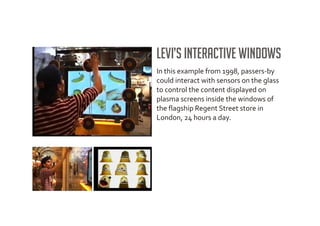
Levi’s interactive windows
In this example from 1998, passers-by
could interact with sensors on the glass
to control the content displayed on
plasma screens inside the windows of
the flagship Regent Street store in
London, 24 hours a day.
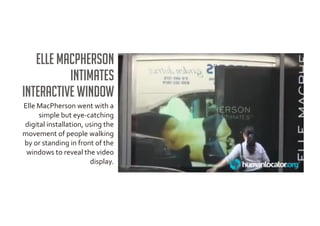
Elle MacPherson
          Intimates
interactive window
Elle MacPherson went with a
     simple but eye-catching
digital installation, using the
movement of people walking
by or standing in front of the
 windows to reveal the video
                       display.
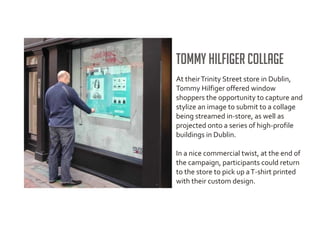
Tommy Hilfiger Collage
At their Trinity Street store in Dublin,
Tommy Hilfiger offered window
shoppers the opportunity to capture and
stylize an image to submit to a collage
being streamed in-store, as well as
projected onto a series of high-profile
buildings in Dublin.

In a nice commercial twist, at the end of
the campaign, participants could return
to the store to pick up a T-shirt printed
with their custom design.
Esprit Mirror Mirror
Esprit borrowed from Disney mythology to create their “Mirror Mirror” installation,
where a fairy godmother calls out to passerbys to brush away some snow from a
mirror. The magic mirror then takes a photo of the shopper which is superimposed
onto a virtual mannequin.

From there the product experience begins, with the now hooked-in shopper able
to apply various outfits to their virtual self, including professionally designed
haircuts and 50 items from Esprit’s current range.

The styling process results in a “model card” which is projected in-store, allowing
the shopper to find and purchase the items they’ve selected. The model card could
also be accessed from a mobile site using a custom QR code displayed in the shop
window, and from there shared on to the Esprit Facebook page.
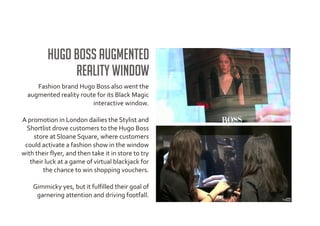
Hugo Boss augmented
               reality window
     Fashion brand Hugo Boss also went the
  augmented reality route for its Black Magic
                        interactive window.

A promotion in London dailies the Stylist and
  Shortlist drove customers to the Hugo Boss
    store at Sloane Square, where customers
 could activate a fashion show in the window
with their flyer, and then take it in store to try
   their luck at a game of virtual blackjack for
        the chance to win shopping vouchers.

    Gimmicky yes, but it fulfilled their goal of
     garnering attention and driving footfall.
2. Ambient in-store interaction,
engagement, entertainment
Once you’ve been hooked into the
store, digital installations will engage,
immerse and entertain you, enticing
you to stay and shop.
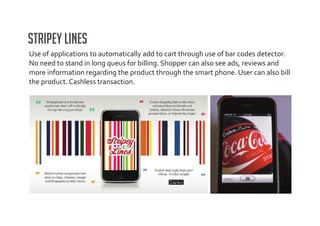
Stripey Lines
Use of applications to automatically add to cart through use of bar codes detector.
No need to stand in long queus for billing. Shopper can also see ads, reviews and
more information regarding the product through the smart phone. User can also bill
the product. Cashless transaction.
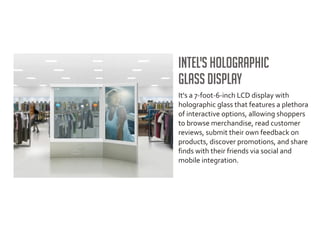
Intel's holographic
glass display
It's a 7-foot-6-inch LCD display with
holographic glass that features a plethora
of interactive options, allowing shoppers
to browse merchandise, read customer
reviews, submit their own feedback on
products, discover promotions, and share
finds with their friends via social and
mobile integration.
App Transforms iPhone and iPad Into Credit Car d Machine
Square is a new mobile payment system for the iPhone and iPad that enablespeople to check out from anywhere. A small, plastic
card reader fits into the headphone jack, transferring the credit card’s swipe data to the app or details can be entered manually
without the need to swipe. After an employee enters the amount to charge, the customer confirms by simply entering their
signature with their finger and then the receipt is sent to the customer’s email address.

www .squareup.com
3. Providing a richer product
experience
Once you’re shopping, digital
technology including shotcode, RFID
tagged product and reader displays,
and augmented reality are able to
provide a wealth of detail around the
product you’re interested in, from
related products, to reviews, to
promotions.
Lego kiosk
            One of the earliest examples of
    augmented reality was Lego’s in-store
kiosk. The idea is simple — hold up the box
    to the kiosk, and you can see what the
          assembled product will look like.
4. Digitally supported sales
consultation and advice
The shop assistant can use digital
technologies as well to help you
evaluate and compare your choices.
Diesel Ginza Interactive
Mirror
At Diesel’s store in Ginza, an interactive
mirror was designed to enhance the
communication between the sales
assistant and the shopper. A digital
camera can snap photos of up to six
outfits, allowing the shopper and
salesperson to compare them against
each other.
5. The evolution of the fitting
room
Once you’ve got some items picked
out, augmented reality fitting rooms
enable rapid browsing and colour
selection.
Adidas augmented reality
Shoe shopping
The idea is an evolution of a virtual-shoe
fitting mirror released back in 2007 at
the Adidas Paris flagship store, which
allowed shoppers to virtually try on
different footwear.
Fraunhofer Institute for
Telecommunications
Back in 2008 researchers at the
Fraunhofer Institute for
Telecommunications presented a “virtual
mirror” that would allow consumers to do
just that via a touchscreen interface on
the mirror, which may be more practical
than the phone. However you can see
that the issue of drapery was still
obviously not being addressed at this
point, which is where Adidas was looking
to innovate a bit further.
6. Facilitating social shopping :
getting a second opinion in
real-time
Once you’ve got your items picked
out, share them virtually with your
friends or significant others to get
their second opinions.
Diesel Cam
Diesel stores in Spain now come equipped
with Diesel Cam, which enables shoppers
to photograph themselves with clothes
they are trying on and immediately post
the photo via Facebook Connect to get
feedback from friends, or simply show off.
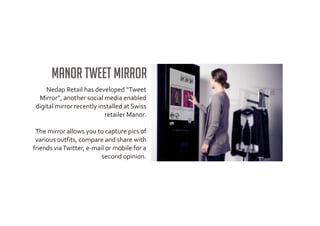
Manor Tweet Mirror
     Nedap Retail has developed “Tweet
  Mirror”, another social media enabled
 digital mirror recently installed at Swiss
                           retailer Manor.

 The mirror allows you to capture pics of
 various outfits, compare and share with
friends via Twitter, e-mail or mobile for a
                          second opinion.
Entire World As Display
Innovation group Frog Design has envisioned a concept scenario called ThingBook, in which a future where every object is
connected to the internet plays a critical role in how we might eventually shop for products. With every visible thing connected as
a data point, users will be able to instantly research information about items such as clothes they see others wearing in the
streets using image recognition systems on their mobile devices and pay for them through mobile systems. This access will
enable people to shop and buy from anywhere.

www .frogdesign.com
The Indian Retail picture..
Emerging Slowly.... Few of them
can be seen in experience shops
like titan. A lot of digital
possibilities are restricted to
display sign-age and
information only because of
cost factors and others.
Digital signage
Digital signage in the broad sense has been in use for
decades in the form of LED ticker signs and LED video walls
its recent growth it has yet to become a major public
medium, due in part to the following negative factors,

Lack of interoperability
Complex value chain
Lack of understanding
Understanding the industry
Titan Experience Zone (TEZ)
Titan Industries Ltd. launched India’s first
watch experience zone to mark the 25th
anniversary of the Company’s birth. This
unique centre, called the Titan Experience
Zone (TEZ), takes consumers through a
delightful and interactive voyage in the world
of watches. Crafted with the latest video,
audio and sensory technology by Titan Global
Design, in collaboration with Experiential
Design Lab, an Indo-Italian design firm, this
experience zone is yet another pioneering
offering from Titan.
reebok
Kreate is a touchscreen based kiosk which allows shoppers to customise elements
and create thier own unique code for the seletec design whic is used by Reebok to
manufacture and deliver the shoe at your doorstep

Project by Codesign
lEVI Strauss & Co. Wall of Fame
                                  The History Wall at the Rivet Store in Bangalore is a
                                  visual and virtual walk through a hundred fifty years
                                  of levis heritage and world History.
                                  A seamless narrative was created that engages the
                                  user with the brand's travelouge through time. A
                                  smart thouch screen, combined with customised
                                  electronics, slides along the length of the history
                                  wall and detects the decades mapped on the wall to
                                  reveal detail informtion for the corresponding
                                  decade. The visual interface mimics the
                                  spontaneous abung=dance of Levi's fanatic's
                                  scrapbook.
ASIAN PAINTS COLOUR STORE
This 2,700 square feet experiential space is completely dedicated to the experience of
Colour and home decor, and does not engage in retail/sale.
The Asian Paints Colour Store, Delhi invites shoppers to personalise the potential of colour
for their homes.
The experience begins with a large cloud chandelier at the reception, which reacts to
visitors with a colourful 'cloudburst' when they step on floor-pads of various colours.
And other digitally enabled activities enchance the experience of the place
Done by - www. experientialdesignlab.com
titan Industies- Xylys
                         Xylys is a premium brand of watches by
                         titan. To distinguish the exclusive Xylys
                         showrooms, a unique shopping
                         experience and an interactive exhibit on
                         time was designed and executed in
                         Bangalore, Hyderabad and mumbai.
                         The river of time is an interactive
                         installation celebrating time with a
                         vistual river that flows endlessly as an apt
                         metaphor of the same. The flowers and
                         leaves floating on the virtual river can be
                         touched, to reveal fifty multi-media rich
                         narratives, ranging from historical to
                         cultural and scientific notions of time.
Summary
The integration of digital technologies into the retail space is still
nascent, but it’s clear there is potential for enhancing the customer
experience throughout all aspects of their store visit.

Here’s a quick recap of some of the common threads in the above for
how digital is being used in the retail environment:

? attention, engaging customers and actively driving them
Attracting
into the store
?intelligent, real-time interactive displays
 Providing
? context sensitive promotions and real-time sales and
 Delivering
offers
?
? the shopping experience, including easier
Enhancing
browsing/fitting, enhancing peer and shop assistant review, easy
access to product reviews and details
? customer demographic and behaviour data
  Capturing
? in-store experiences
  Providing
?a seamless connection between online and retail profiles,
  Creating
enabling social shopping
? Proliferating interactive touchscreens through the technology
getting cheaper and more reliable
Resources
BLOGS
Makezine Blog "celebrates your right to tweak, hack, and
bend any technology to your own will."They also publish
makezine as a Quarterly Volume of some of the best
creative uses of appropriated technology.
Instructables is where you learn to make just about any
thing you might need and lots of things you probably don't
too.
Create Digital Music & Create Digital Motion have
interesting articles quite regularily about building interfaces
and devices for interaction and performance for inspiration.
Understanding the industry
Resources
ELECTRONICS
Tom Igoe's Useful collection of resources, examples, and
lecture notes for the physical computing courses at ITP
LOW TECH SENSORS AND ACTUATORS. (by Usman
Haque www.haque.co.uk and Adam Somlai-Fischer
www.aether.hu)
Resources
INTERFACE BOARDS
Arduino – . Arduino can be used to develop stand-alone
interactive objects or can be connected to software on your
computer. Also check out the freeduino site for ideas what
to do with an Arduino
BASIC Stamp – Simple commands such as turning devices
on or off, interfacing with sensors, etc. More advanced
commands let the BASIC Stamp module interface with
other integrated circuits, communicate with each other,
and operate in networks.
Make Controller is a line of hardware tools that provide
ways to create interactive devices, machines, and
environments by controlling a wide range of sensors and
actuators.
Resources
SOFTWARE
Processing (free) – An open source programming language
and environment for people who want to program images,
animation, and sound.
MaxMSP – A graphical programming environment, which
means you create your own software using a visual toolkit
of objects, and connect them together with patch cords.
VVVV (free) – is a toolkit for real time video synthesis. It is
designed to facilitate the handling of large media
environments with physical interfaces, real-time motion
graphics, audio and video that can interact with many users
simultaneously.
Pure Data (free) – A free real-time computer music
software package resembling Max.
MORE TO COME...

Research part 1 context & market study

  • 1.
    Digital retail experiencesScenario Opportunities and Trends, Glimpses of Current
  • 2.
    Methodology Research Prototyping . Introduction . Sourcing Materials and other equipments . Studying Current Formats . Implementation of the Prototype . Field Study - Malls, Hypermarkets, E commerce and other . Building final Prototype . Discussing with Experts from the Industry . Testing . Customer Study . Refining . Case Study of Experiential Stores, Malls and more . Documenting Documentation . Findings and Identifying Opportunity Areas . Research . Process Concept . Conclusion . Exploring Ideas through sketches and video examples . Retouching Ideas, Improvisation . Selection of Final Design / Idea
  • 3.
    Context Let’s think lessabout real estate, staff, footfall and online stores and start thinking about the entire world as a store; one in which we can easily make instant purchases regardless of time and place. Driven by technology, the web, community and the search for ever-richer experiences, the world of shopping is undergoing a sweeping transformation. Beyond an evolving the decentralized shopping experience,retailers must begin to contemplate the impact of digital media and the effects it is having on purchase decisions. Connected devices, whether a mobile phone or a web-enabled in-store kiosk, are making what was once a solitary trip to the store a socially connected event. As shoppers go through the process of discovering new products, testing them, and reflecting on their purchases, they are sharing these thoughts with their social networks and influencing perception amongst their peer group. Retailers must embrace and facilitate this sharing of information, and retail outlets need to evolve to create experiences that drive sales both in-store and within online social networks. Meanwhile, the traditional physical store remains as important as ever, providing the environment in which a retailer can provide an unparalleled experience. Through the dynamic use of space, the most successful store owners are pushing the boundaries of storytelling, product testing and education - aspects of evolved services that lead to loyalty and repeat sales.
  • 4.
    Digital retail experience Integratingthe physical world with digital technology (and vice-versa) is one of the most interesting and opportunity rich territories of our age, and where a lot of the most important work in our industry will be done over the coming years.
  • 5.
    tHE iNTERNATIONAL PICTURE Brandsare integrating digital to enhance and augment the retail experience throughout the customer journey
  • 6.
    how does digitalmedia help retail 1. Drawing the customer in: engaging shop windows 2. Ambient in-store interaction, engagement, entertainment 3. Providing a richer product experience through RFID, shotcodes and augmented reality 4. Digitally supported sales consultation and advice 5. The evolution of the fitting room: augmented reality browsing and customization 6. Facilitating social shopping: getting a second opinion in real-time 7. Before you leave: digitally-enabled value adds 8. Leaving a great experience and a recall value.
  • 7.
    1. Engaging shopwindows The digital retail experience starts before customers have even entered the store. Here’s a range of examples illustrating how shop windows are increasingly reactive, interactive, and even commerce enabled.
  • 8.
    Levi’s interactive windows Inthis example from 1998, passers-by could interact with sensors on the glass to control the content displayed on plasma screens inside the windows of the flagship Regent Street store in London, 24 hours a day.
  • 9.
    Elle MacPherson Intimates interactive window Elle MacPherson went with a simple but eye-catching digital installation, using the movement of people walking by or standing in front of the windows to reveal the video display.
  • 10.
    Tommy Hilfiger Collage Attheir Trinity Street store in Dublin, Tommy Hilfiger offered window shoppers the opportunity to capture and stylize an image to submit to a collage being streamed in-store, as well as projected onto a series of high-profile buildings in Dublin. In a nice commercial twist, at the end of the campaign, participants could return to the store to pick up a T-shirt printed with their custom design.
  • 11.
    Esprit Mirror Mirror Espritborrowed from Disney mythology to create their “Mirror Mirror” installation, where a fairy godmother calls out to passerbys to brush away some snow from a mirror. The magic mirror then takes a photo of the shopper which is superimposed onto a virtual mannequin. From there the product experience begins, with the now hooked-in shopper able to apply various outfits to their virtual self, including professionally designed haircuts and 50 items from Esprit’s current range. The styling process results in a “model card” which is projected in-store, allowing the shopper to find and purchase the items they’ve selected. The model card could also be accessed from a mobile site using a custom QR code displayed in the shop window, and from there shared on to the Esprit Facebook page.
  • 12.
    Hugo Boss augmented reality window Fashion brand Hugo Boss also went the augmented reality route for its Black Magic interactive window. A promotion in London dailies the Stylist and Shortlist drove customers to the Hugo Boss store at Sloane Square, where customers could activate a fashion show in the window with their flyer, and then take it in store to try their luck at a game of virtual blackjack for the chance to win shopping vouchers. Gimmicky yes, but it fulfilled their goal of garnering attention and driving footfall.
  • 13.
    2. Ambient in-storeinteraction, engagement, entertainment Once you’ve been hooked into the store, digital installations will engage, immerse and entertain you, enticing you to stay and shop.
  • 14.
    Stripey Lines Use ofapplications to automatically add to cart through use of bar codes detector. No need to stand in long queus for billing. Shopper can also see ads, reviews and more information regarding the product through the smart phone. User can also bill the product. Cashless transaction.
  • 15.
    Intel's holographic glass display It'sa 7-foot-6-inch LCD display with holographic glass that features a plethora of interactive options, allowing shoppers to browse merchandise, read customer reviews, submit their own feedback on products, discover promotions, and share finds with their friends via social and mobile integration.
  • 16.
    App Transforms iPhoneand iPad Into Credit Car d Machine Square is a new mobile payment system for the iPhone and iPad that enablespeople to check out from anywhere. A small, plastic card reader fits into the headphone jack, transferring the credit card’s swipe data to the app or details can be entered manually without the need to swipe. After an employee enters the amount to charge, the customer confirms by simply entering their signature with their finger and then the receipt is sent to the customer’s email address. www .squareup.com
  • 17.
    3. Providing aricher product experience Once you’re shopping, digital technology including shotcode, RFID tagged product and reader displays, and augmented reality are able to provide a wealth of detail around the product you’re interested in, from related products, to reviews, to promotions.
  • 18.
    Lego kiosk One of the earliest examples of augmented reality was Lego’s in-store kiosk. The idea is simple — hold up the box to the kiosk, and you can see what the assembled product will look like.
  • 19.
    4. Digitally supportedsales consultation and advice The shop assistant can use digital technologies as well to help you evaluate and compare your choices.
  • 20.
    Diesel Ginza Interactive Mirror AtDiesel’s store in Ginza, an interactive mirror was designed to enhance the communication between the sales assistant and the shopper. A digital camera can snap photos of up to six outfits, allowing the shopper and salesperson to compare them against each other.
  • 21.
    5. The evolutionof the fitting room Once you’ve got some items picked out, augmented reality fitting rooms enable rapid browsing and colour selection.
  • 22.
    Adidas augmented reality Shoeshopping The idea is an evolution of a virtual-shoe fitting mirror released back in 2007 at the Adidas Paris flagship store, which allowed shoppers to virtually try on different footwear.
  • 23.
    Fraunhofer Institute for Telecommunications Backin 2008 researchers at the Fraunhofer Institute for Telecommunications presented a “virtual mirror” that would allow consumers to do just that via a touchscreen interface on the mirror, which may be more practical than the phone. However you can see that the issue of drapery was still obviously not being addressed at this point, which is where Adidas was looking to innovate a bit further.
  • 24.
    6. Facilitating socialshopping : getting a second opinion in real-time Once you’ve got your items picked out, share them virtually with your friends or significant others to get their second opinions.
  • 25.
    Diesel Cam Diesel storesin Spain now come equipped with Diesel Cam, which enables shoppers to photograph themselves with clothes they are trying on and immediately post the photo via Facebook Connect to get feedback from friends, or simply show off.
  • 26.
    Manor Tweet Mirror Nedap Retail has developed “Tweet Mirror”, another social media enabled digital mirror recently installed at Swiss retailer Manor. The mirror allows you to capture pics of various outfits, compare and share with friends via Twitter, e-mail or mobile for a second opinion.
  • 27.
    Entire World AsDisplay Innovation group Frog Design has envisioned a concept scenario called ThingBook, in which a future where every object is connected to the internet plays a critical role in how we might eventually shop for products. With every visible thing connected as a data point, users will be able to instantly research information about items such as clothes they see others wearing in the streets using image recognition systems on their mobile devices and pay for them through mobile systems. This access will enable people to shop and buy from anywhere. www .frogdesign.com
  • 28.
    The Indian Retailpicture.. Emerging Slowly.... Few of them can be seen in experience shops like titan. A lot of digital possibilities are restricted to display sign-age and information only because of cost factors and others.
  • 29.
    Digital signage Digital signagein the broad sense has been in use for decades in the form of LED ticker signs and LED video walls its recent growth it has yet to become a major public medium, due in part to the following negative factors, Lack of interoperability Complex value chain Lack of understanding Understanding the industry
  • 30.
    Titan Experience Zone(TEZ) Titan Industries Ltd. launched India’s first watch experience zone to mark the 25th anniversary of the Company’s birth. This unique centre, called the Titan Experience Zone (TEZ), takes consumers through a delightful and interactive voyage in the world of watches. Crafted with the latest video, audio and sensory technology by Titan Global Design, in collaboration with Experiential Design Lab, an Indo-Italian design firm, this experience zone is yet another pioneering offering from Titan.
  • 31.
    reebok Kreate is atouchscreen based kiosk which allows shoppers to customise elements and create thier own unique code for the seletec design whic is used by Reebok to manufacture and deliver the shoe at your doorstep Project by Codesign
  • 32.
    lEVI Strauss &Co. Wall of Fame The History Wall at the Rivet Store in Bangalore is a visual and virtual walk through a hundred fifty years of levis heritage and world History. A seamless narrative was created that engages the user with the brand's travelouge through time. A smart thouch screen, combined with customised electronics, slides along the length of the history wall and detects the decades mapped on the wall to reveal detail informtion for the corresponding decade. The visual interface mimics the spontaneous abung=dance of Levi's fanatic's scrapbook.
  • 33.
    ASIAN PAINTS COLOURSTORE This 2,700 square feet experiential space is completely dedicated to the experience of Colour and home decor, and does not engage in retail/sale. The Asian Paints Colour Store, Delhi invites shoppers to personalise the potential of colour for their homes. The experience begins with a large cloud chandelier at the reception, which reacts to visitors with a colourful 'cloudburst' when they step on floor-pads of various colours. And other digitally enabled activities enchance the experience of the place Done by - www. experientialdesignlab.com
  • 34.
    titan Industies- Xylys Xylys is a premium brand of watches by titan. To distinguish the exclusive Xylys showrooms, a unique shopping experience and an interactive exhibit on time was designed and executed in Bangalore, Hyderabad and mumbai. The river of time is an interactive installation celebrating time with a vistual river that flows endlessly as an apt metaphor of the same. The flowers and leaves floating on the virtual river can be touched, to reveal fifty multi-media rich narratives, ranging from historical to cultural and scientific notions of time.
  • 35.
    Summary The integration ofdigital technologies into the retail space is still nascent, but it’s clear there is potential for enhancing the customer experience throughout all aspects of their store visit. Here’s a quick recap of some of the common threads in the above for how digital is being used in the retail environment: ? attention, engaging customers and actively driving them Attracting into the store ?intelligent, real-time interactive displays Providing ? context sensitive promotions and real-time sales and Delivering offers
  • 36.
    ? ? the shoppingexperience, including easier Enhancing browsing/fitting, enhancing peer and shop assistant review, easy access to product reviews and details ? customer demographic and behaviour data Capturing ? in-store experiences Providing ?a seamless connection between online and retail profiles, Creating enabling social shopping ? Proliferating interactive touchscreens through the technology getting cheaper and more reliable
  • 37.
    Resources BLOGS Makezine Blog "celebratesyour right to tweak, hack, and bend any technology to your own will."They also publish makezine as a Quarterly Volume of some of the best creative uses of appropriated technology. Instructables is where you learn to make just about any thing you might need and lots of things you probably don't too. Create Digital Music & Create Digital Motion have interesting articles quite regularily about building interfaces and devices for interaction and performance for inspiration. Understanding the industry
  • 38.
    Resources ELECTRONICS Tom Igoe's Usefulcollection of resources, examples, and lecture notes for the physical computing courses at ITP LOW TECH SENSORS AND ACTUATORS. (by Usman Haque www.haque.co.uk and Adam Somlai-Fischer www.aether.hu)
  • 39.
    Resources INTERFACE BOARDS Arduino –. Arduino can be used to develop stand-alone interactive objects or can be connected to software on your computer. Also check out the freeduino site for ideas what to do with an Arduino BASIC Stamp – Simple commands such as turning devices on or off, interfacing with sensors, etc. More advanced commands let the BASIC Stamp module interface with other integrated circuits, communicate with each other, and operate in networks. Make Controller is a line of hardware tools that provide ways to create interactive devices, machines, and environments by controlling a wide range of sensors and actuators.
  • 40.
    Resources SOFTWARE Processing (free) –An open source programming language and environment for people who want to program images, animation, and sound. MaxMSP – A graphical programming environment, which means you create your own software using a visual toolkit of objects, and connect them together with patch cords. VVVV (free) – is a toolkit for real time video synthesis. It is designed to facilitate the handling of large media environments with physical interfaces, real-time motion graphics, audio and video that can interact with many users simultaneously. Pure Data (free) – A free real-time computer music software package resembling Max.
  • 41.