National Institute of Technology Calicut
Digital Signal Processing
Dr. Rakesh R Warier
National Institute of Technology Calicut 2
Applications of Digital Signal Processing
• Audio and speech processing,
• Sonar, radar and other sensor array processing,
• Spectral density estimation,
• Digital image processing,
• Data compression,
• Signal processing for telecommunications,
• Control systems,
• Biomedical engineering,
• and Seismology, among others
National Institute of Technology Calicut 3
Contents
• Review of Signals and Systems
• Analysis and representation of discrete-time signal systems, including
discrete-time convolution,
• Difference equations, the z-transform, and the discrete-time Fourier
transform. Emphasis is placed on the similarities and distinctions
between discrete-time,
• Digital filters, (FIR and IIR),
• Fast Fourier transform algorithm.
National Institute of Technology Calicut 4
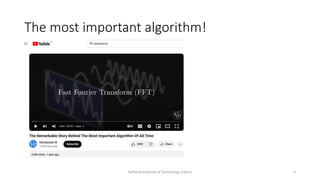
The most important algorithm!
National Institute of Technology Calicut 5
Review of signals and systems
• What is a signal?
• What is a system?
• Analog vs Digital
National Institute of Technology Calicut 6
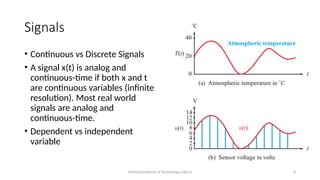
Signals
• Continuous vs Discrete Signals
• A signal x(t) is analog and
continuous-time if both x and t
are continuous variables (infinite
resolution). Most real world
signals are analog and
continuous-time.
• Dependent vs independent
variable
National Institute of Technology Calicut 7
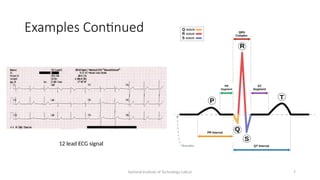
Examples Continued
12 lead ECG signal
National Institute of Technology Calicut 8
Discrete Signals
• Representations
• Bracket notation
• Stem plot
National Institute of Technology Calicut 9
Digital vs Discrete-time
• A signal x[n] is analog and discrete-
time if the values of x are continuous
but time n is discrete (integer-valued).
• A signal x[n] is digital and discrete-time
if the values of x are discrete (i.e.,
quantized) and time n also is discrete
(integer-valued). Computers store and
process digital discrete-time signals.
Not covered in this course.
National Institute of Technology Calicut 10
Deterministic vs Random Signals
• Any signal that can be represented by
a unique model (formula, table or
mathematical expression) without any
uncertainty is called deterministic
signal.
• In many practical applications, there
are signals that cannot be described
by any reasonable accuracy by any
explicit mathematical formula, and
they evolve in an unpredictable
manner and are called random signals.
National Institute of Technology Calicut 11
Continuous time Sinusoids
• Continuous time sinusoids with
different frequencies are distinct.
• Increasing frequency results in
increasing oscillations
National Institute of Technology Calicut 12
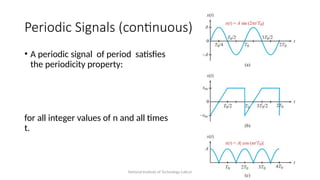
Periodic Signals (continuous)
• A periodic signal of period satisfies
the periodicity property:
for all integer values of n and all times
t.
National Institute of Technology Calicut 13
Frequency (discrete time signal)
• A discrete signal is periodic with period N>0 if
, for all
Smallest value for which this is true is called the fundamental
period.
National Institute of Technology Calicut 14
Example
• Find the frequency (=50)
• Solve for N
National Institute of Technology Calicut 15
Example
• Find the frequency ()
• Solve for N
National Institute of Technology Calicut 16
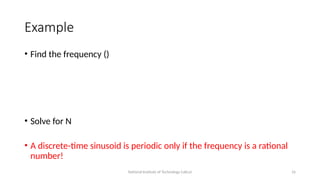
Example
• Find the frequency ()
• Solve for N
• A discrete-time sinusoid is periodic only if the frequency is a rational
number!
National Institute of Technology Calicut 17
Frequency in discrete-time signals
National Institute of Technology Calicut 18
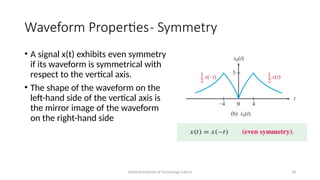
Waveform Properties- Symmetry
• A signal x(t) exhibits even symmetry
if its waveform is symmetrical with
respect to the vertical axis.
• The shape of the waveform on the
left-hand side of the vertical axis is
the mirror image of the waveform
on the right-hand side
National Institute of Technology Calicut 19
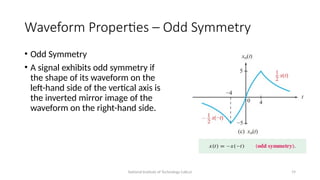
Waveform Properties – Odd Symmetry
• Odd Symmetry
• A signal exhibits odd symmetry if
the shape of its waveform on the
left-hand side of the vertical axis is
the inverted mirror image of the
waveform on the right-hand side.
National Institute of Technology Calicut 20
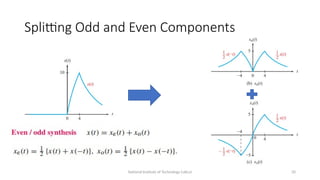
Splitting Odd and Even Components
National Institute of Technology Calicut 21
Fourier Formula
National Institute of Technology Calicut 22
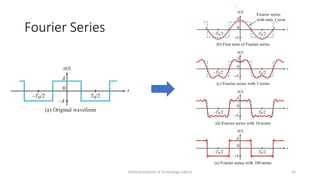
Fourier Series
National Institute of Technology Calicut 23
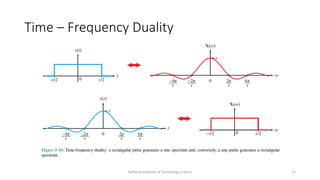
Time – Frequency Duality
National Institute of Technology Calicut 24
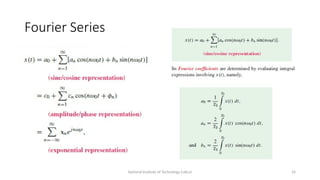
Fourier Series
National Institute of Technology Calicut 25
Sampling
• Consider a sinusoidal signal
x(t) = cos(2π1000t),
sampled at fs = 8000 samples per
second.
• The sampling interval is Ts = 1/8000 s,
National Institute of Technology Calicut 26
Sampling Theorem
• Let x(t) be a real-valued, continuous-time,
low pass signal bandlimited to a maximum
frequency of B Hz.
• Let x[n] = x(nTs) be the sequence of numbers
obtained by sampling x(t) at a sampling rate
of fs samples per second, that is, every Ts =
1/fs seconds.
• Then x(t) can be uniquely reconstructed from
its samples x[n] if and only if fs > 2B.
• The sampling rate must exceed double the
bandwidth.
• The minimum sampling rate 2B is called the
Nyquist sampling rate.
National Institute of Technology Calicut 27
National Institute of Technology Calicut 28
National Institute of Technology Calicut 29
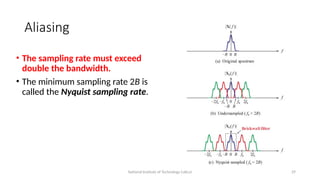
Aliasing
• The sampling rate must exceed
double the bandwidth.
• The minimum sampling rate 2B is
called the Nyquist sampling rate.
National Institute of Technology Calicut 30
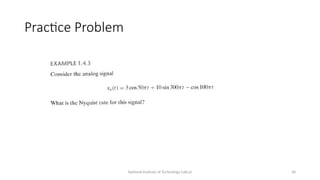
Practice Problem
National Institute of Technology Calicut 31
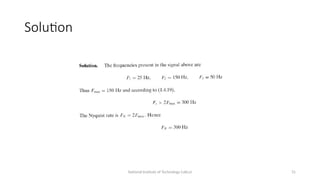
Solution
National Institute of Technology Calicut 32
Sampling at Nyquist rate
National Institute of Technology Calicut 33
Homework
National Institute of Technology Calicut 34
References
• Digital Signal Processing: Principles, Algorithms, and Applications,
John G. Proakis. Northeastern University. Dimitris G. Manolakis.
Boston College, 4th
ed.

Digital signal processing lectures on signals

  • 1.
    National Institute ofTechnology Calicut Digital Signal Processing Dr. Rakesh R Warier
  • 2.
    National Institute ofTechnology Calicut 2 Applications of Digital Signal Processing • Audio and speech processing, • Sonar, radar and other sensor array processing, • Spectral density estimation, • Digital image processing, • Data compression, • Signal processing for telecommunications, • Control systems, • Biomedical engineering, • and Seismology, among others
  • 3.
    National Institute ofTechnology Calicut 3 Contents • Review of Signals and Systems • Analysis and representation of discrete-time signal systems, including discrete-time convolution, • Difference equations, the z-transform, and the discrete-time Fourier transform. Emphasis is placed on the similarities and distinctions between discrete-time, • Digital filters, (FIR and IIR), • Fast Fourier transform algorithm.
  • 4.
    National Institute ofTechnology Calicut 4 The most important algorithm!
  • 5.
    National Institute ofTechnology Calicut 5 Review of signals and systems • What is a signal? • What is a system? • Analog vs Digital
  • 6.
    National Institute ofTechnology Calicut 6 Signals • Continuous vs Discrete Signals • A signal x(t) is analog and continuous-time if both x and t are continuous variables (infinite resolution). Most real world signals are analog and continuous-time. • Dependent vs independent variable
  • 7.
    National Institute ofTechnology Calicut 7 Examples Continued 12 lead ECG signal
  • 8.
    National Institute ofTechnology Calicut 8 Discrete Signals • Representations • Bracket notation • Stem plot
  • 9.
    National Institute ofTechnology Calicut 9 Digital vs Discrete-time • A signal x[n] is analog and discrete- time if the values of x are continuous but time n is discrete (integer-valued). • A signal x[n] is digital and discrete-time if the values of x are discrete (i.e., quantized) and time n also is discrete (integer-valued). Computers store and process digital discrete-time signals. Not covered in this course.
  • 10.
    National Institute ofTechnology Calicut 10 Deterministic vs Random Signals • Any signal that can be represented by a unique model (formula, table or mathematical expression) without any uncertainty is called deterministic signal. • In many practical applications, there are signals that cannot be described by any reasonable accuracy by any explicit mathematical formula, and they evolve in an unpredictable manner and are called random signals.
  • 11.
    National Institute ofTechnology Calicut 11 Continuous time Sinusoids • Continuous time sinusoids with different frequencies are distinct. • Increasing frequency results in increasing oscillations
  • 12.
    National Institute ofTechnology Calicut 12 Periodic Signals (continuous) • A periodic signal of period satisfies the periodicity property: for all integer values of n and all times t.
  • 13.
    National Institute ofTechnology Calicut 13 Frequency (discrete time signal) • A discrete signal is periodic with period N>0 if , for all Smallest value for which this is true is called the fundamental period.
  • 14.
    National Institute ofTechnology Calicut 14 Example • Find the frequency (=50) • Solve for N
  • 15.
    National Institute ofTechnology Calicut 15 Example • Find the frequency () • Solve for N
  • 16.
    National Institute ofTechnology Calicut 16 Example • Find the frequency () • Solve for N • A discrete-time sinusoid is periodic only if the frequency is a rational number!
  • 17.
    National Institute ofTechnology Calicut 17 Frequency in discrete-time signals
  • 18.
    National Institute ofTechnology Calicut 18 Waveform Properties- Symmetry • A signal x(t) exhibits even symmetry if its waveform is symmetrical with respect to the vertical axis. • The shape of the waveform on the left-hand side of the vertical axis is the mirror image of the waveform on the right-hand side
  • 19.
    National Institute ofTechnology Calicut 19 Waveform Properties – Odd Symmetry • Odd Symmetry • A signal exhibits odd symmetry if the shape of its waveform on the left-hand side of the vertical axis is the inverted mirror image of the waveform on the right-hand side.
  • 20.
    National Institute ofTechnology Calicut 20 Splitting Odd and Even Components
  • 21.
    National Institute ofTechnology Calicut 21 Fourier Formula
  • 22.
    National Institute ofTechnology Calicut 22 Fourier Series
  • 23.
    National Institute ofTechnology Calicut 23 Time – Frequency Duality
  • 24.
    National Institute ofTechnology Calicut 24 Fourier Series
  • 25.
    National Institute ofTechnology Calicut 25 Sampling • Consider a sinusoidal signal x(t) = cos(2π1000t), sampled at fs = 8000 samples per second. • The sampling interval is Ts = 1/8000 s,
  • 26.
    National Institute ofTechnology Calicut 26 Sampling Theorem • Let x(t) be a real-valued, continuous-time, low pass signal bandlimited to a maximum frequency of B Hz. • Let x[n] = x(nTs) be the sequence of numbers obtained by sampling x(t) at a sampling rate of fs samples per second, that is, every Ts = 1/fs seconds. • Then x(t) can be uniquely reconstructed from its samples x[n] if and only if fs > 2B. • The sampling rate must exceed double the bandwidth. • The minimum sampling rate 2B is called the Nyquist sampling rate.
  • 27.
    National Institute ofTechnology Calicut 27
  • 28.
    National Institute ofTechnology Calicut 28
  • 29.
    National Institute ofTechnology Calicut 29 Aliasing • The sampling rate must exceed double the bandwidth. • The minimum sampling rate 2B is called the Nyquist sampling rate.
  • 30.
    National Institute ofTechnology Calicut 30 Practice Problem
  • 31.
    National Institute ofTechnology Calicut 31 Solution
  • 32.
    National Institute ofTechnology Calicut 32 Sampling at Nyquist rate
  • 33.
    National Institute ofTechnology Calicut 33 Homework
  • 34.
    National Institute ofTechnology Calicut 34 References • Digital Signal Processing: Principles, Algorithms, and Applications, John G. Proakis. Northeastern University. Dimitris G. Manolakis. Boston College, 4th ed.