WHAT IS DIGITALSERVICES?
any service that is (1)supplied over the internet or other
electronic network with the use of information technology and
where the supply of the service is (2)essentially automated
Core Concepts
• Website, a Mobile App, Cloud
computing, such as software as a
service (SaaS) or platform as a service
(PaaS), an application programming
interface (API).
3.
DIGITAL SERVICES IN
PHILIPPINES
•October 2024
• (RA) No. 12023
• Department of Finance; the new law
ensures equitable tax treatment on all
digital businesses providing services in the
Philippines
• 12% value-added tax (VAT)
4.
DIGITAL SERVICES IN
PHILIPPINES
•(1) online search engine;
• (2) online marketplace or e-marketplace;
• (3) cloud service;
• (4) online media and advertising;
• (5) online platform; or
• (6) digital goods.
5.
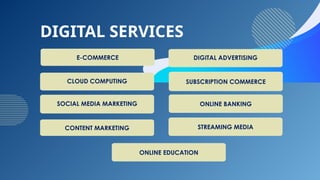
E-COMMERCE
CLOUD COMPUTING
SOCIAL MEDIAMARKETING
DIGITAL ADVERTISING
SUBSCRIPTION COMMERCE
ONLINE BANKING
DIGITAL SERVICES
CONTENT MARKETING STREAMING MEDIA
ONLINE EDUCATION
6.
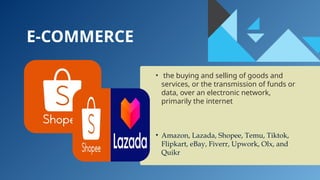
E-COMMERCE
• the buyingand selling of goods and
services, or the transmission of funds or
data, over an electronic network,
primarily the internet
• Amazon, Lazada, Shopee, Temu, Tiktok,
Flipkart, eBay, Fiverr, Upwork, Olx, and
Quikr
7.
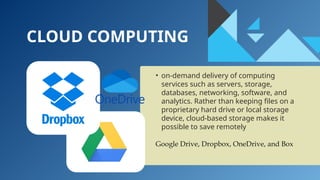
CLOUD COMPUTING
• on-demanddelivery of computing
services such as servers, storage,
databases, networking, software, and
analytics. Rather than keeping files on a
proprietary hard drive or local storage
device, cloud-based storage makes it
possible to save remotely
Google Drive, Dropbox, OneDrive, and Box
8.
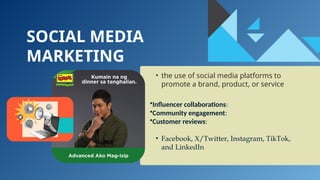
SOCIAL MEDIA
MARKETING
• theuse of social media platforms to
promote a brand, product, or service
•Influencer collaborations:
•Community engagement:
•Customer reviews:
• Facebook, X/Twitter, Instagram, TikTok,
and LinkedIn
CONTENT MARKETING
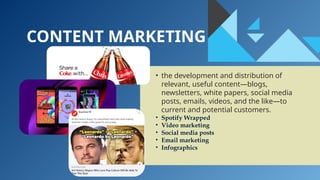
• thedevelopment and distribution of
relevant, useful content—blogs,
newsletters, white papers, social media
posts, emails, videos, and the like—to
current and potential customers.
• Spotify Wrapped
• Video marketing
• Social media posts
• Email marketing
• Infographics
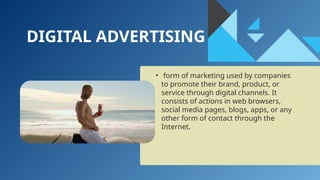
DIGITAL ADVERTISING
• formof marketing used by companies
to promote their brand, product, or
service through digital channels. It
consists of actions in web browsers,
social media pages, blogs, apps, or any
other form of contact through the
Internet.
16.
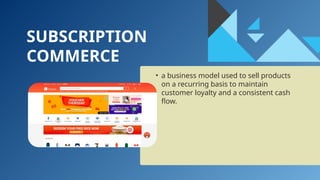
SUBSCRIPTION
COMMERCE
• a businessmodel used to sell products
on a recurring basis to maintain
customer loyalty and a consistent cash
flow.
17.
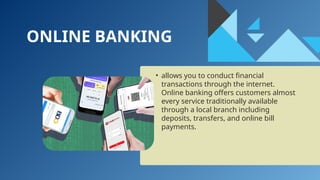
ONLINE BANKING
• allowsyou to conduct financial
transactions through the internet.
Online banking offers customers almost
every service traditionally available
through a local branch including
deposits, transfers, and online bill
payments.
18.
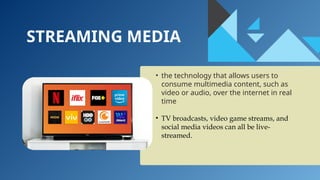
STREAMING MEDIA
• thetechnology that allows users to
consume multimedia content, such as
video or audio, over the internet in real
time
• TV broadcasts, video game streams, and
social media videos can all be live-
streamed.
19.
ONLINE EDUCATION
• theuse of technology to improve
teaching and learning, and includes
online education, virtual learning, and e-
learning.
• E-learning
• Online education
• Virtual learning
e.g.
Moodle, MOOC, Udemy, Google classroom
20.
Philippine lawthat aims to make mobile
phone users more accountable and to
reduce cybercrime.
enacted on December 27, 2022
Prevent Smishing Attacks
curb cybercriminal activities.
Subscriber Identity Module
(SIM) Registration Act
REPUBLIC ACT NO. 11934
21.
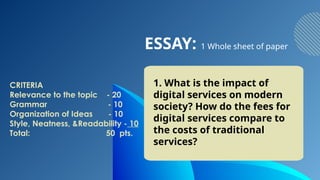
ESSAY: 1 Wholesheet of paper
1. What is the impact of
digital services on modern
society? How do the fees for
digital services compare to
the costs of traditional
services?
CRITERIA
Relevance to the topic - 20
Grammar - 10
Organization of Ideas - 10
Style, Neatness, &Readability - 10
Total: 50 pts.
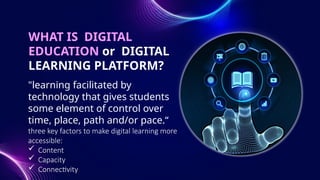
WHAT IS DIGITAL
EDUCATIONor DIGITAL
LEARNING PLATFORM?
"learning facilitated by
technology that gives students
some element of control over
time, place, path and/or pace.“
three key factors to make digital learning more
accessible:
Content
Capacity
Connectivity
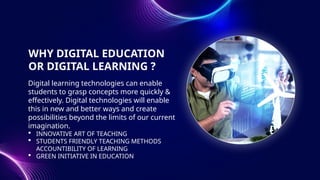
WHY DIGITAL EDUCATION
ORDIGITAL LEARNING ?
Digital learning technologies can enable
students to grasp concepts more quickly &
effectively. Digital technologies will enable
this in new and better ways and create
possibilities beyond the limits of our current
imagination.
INNOVATIVE ART OF TEACHING
STUDENTS FRIENDLY TEACHING METHODS
ACCOUNTIBILITY OF LEARNING
GREEN INITIATIVE IN EDUCATION
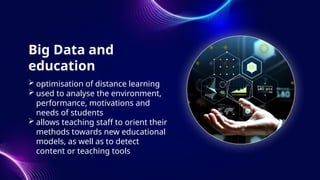
Big Data and
education
optimisation of distance learning
used to analyse the environment,
performance, motivations and
needs of students
allows teaching staff to orient their
methods towards new educational
models, as well as to detect
content or teaching tools
32.
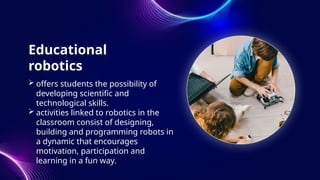
Educational
robotics
offers studentsthe possibility of
developing scientific and
technological skills.
activities linked to robotics in the
classroom consist of designing,
building and programming robots in
a dynamic that encourages
motivation, participation and
learning in a fun way.
33.
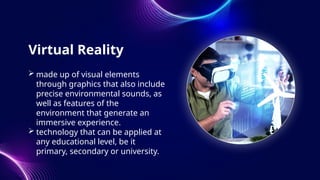
Virtual Reality
madeup of visual elements
through graphics that also include
precise environmental sounds, as
well as features of the
environment that generate an
immersive experience.
technology that can be applied at
any educational level, be it
primary, secondary or university.
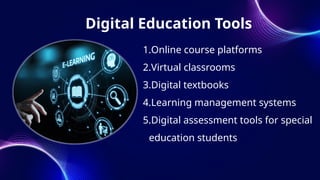
Digital Education Tools
1.Onlinecourse platforms
2.Virtual classrooms
3.Digital textbooks
4.Learning management systems
5.Digital assessment tools for special
education students
36.
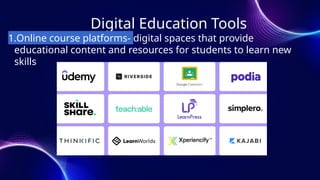
Digital Education Tools
1.Onlinecourse platforms- digital spaces that provide
educational content and resources for students to learn new
skills
37.
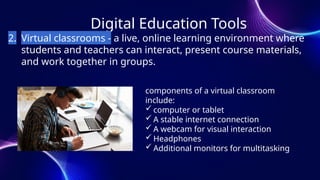
Digital Education Tools
2.Virtual classrooms - a live, online learning environment where
students and teachers can interact, present course materials,
and work together in groups.
components of a virtual classroom
include:
computer or tablet
A stable internet connection
A webcam for visual interaction
Headphones
Additional monitors for multitasking
38.
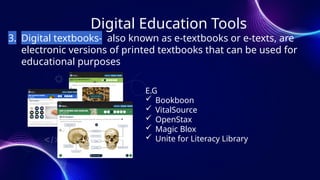
Digital Education Tools
3.Digital textbooks- also known as e-textbooks or e-texts, are
electronic versions of printed textbooks that can be used for
educational purposes
E.G
Bookboon
VitalSource
OpenStax
Magic Blox
Unite for Literacy Library
39.
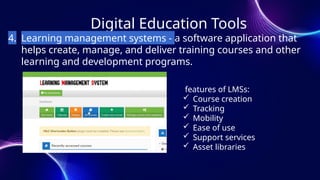
Digital Education Tools
4.Learning management systems - a software application that
helps create, manage, and deliver training courses and other
learning and development programs.
features of LMSs:
Course creation
Tracking
Mobility
Ease of use
Support services
Asset libraries
40.
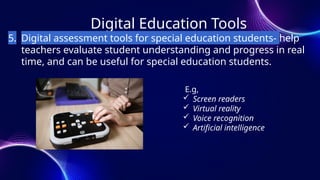
Digital Education Tools
5.Digital assessment tools for special education students- help
teachers evaluate student understanding and progress in real
time, and can be useful for special education students.
E.g,
Screen readers
Virtual reality
Voice recognition
Artificial intelligence
GENERAL RULES FORDEBATE
1. Each student will have one chance to put forward a rebuttal
(the act of saying or proving that a statement or criticism is false)
2. Each rebuttal will be a maximum of one minute
3. First proponent states why s/he agrees with the topic.
4. First opponent states why s/he disagrees with the topic.
5. Second proponent issues a rebuttal against the first
opponent.
6. Second opponent issues a rebuttal against the first
proponent.
7. Proponents offer their summary.
8. Opponents also offer their summary.
#2
IN SHORT any service that is delivered electronically over the internet.
If either of these conditions is not met, the service cannot be considered a “digital service” and will instead fall under the traditional definition of services for VAT purposes.
#3 , October 2024, Philippines joined the growing list of countries like Indonesia, Malaysia, Thailand, Singapore, and Japan
RA No. 12023 explicitly includes digital services consumed in the Philippines within the scope of Philippine taxation. Under its provisions, the supply of digital services, whether rendered by a resident or non-resident digital service provider (DSP), is considered among the transactions specifically subject to 12% value-added tax (VAT).
classified supply of digital services as a sale or exchange of service subject to 12% VAT.
#4 As provided under the law, digital services shall include:
#6 As provided under the law, digital services shall include:
#7 As provided under the law, digital services shall include:
#8 Influencer collaborations: Partner with influencers to reach and resonate with target audiences
Community engagement: Build and nurture communities around brands through interactions and discussions
Customer reviews: Encourage people to share information about your product on social media
#18 Benefits
Streaming media allows users to play content immediately, without having to download the entire file.
#20 Accountability
The law requires mobile users to register their SIM cards with their telco provider before activation.
Cybercrime reduction
The law aims to reduce cybercrime, including phishing, fraud, threats, and cyberbullying.
Other issues
The law also aims to address issues related to trolling, hate speech, and online disinformation.
The law was enacted on December 27, 2022, and requires mobile subscribers to register by April 26, 2023. As of March, 43.67 million mobile subscribers out of 169 million had registered.
#23 In short, the use of digital tools and technologies to improve the learning experience for students
Digital education is being seen as an alternative to the traditional education process of chalk and talk.
#25 (Innovative teaching)Flipped classrooms: Students watch lectures at home and complete assignments in class
Blended classrooms: Students use technology in the classroom to experience it in the real world
Innovative teaching materials: Use charts, maps, videos, images, diagrams, and flashcard
Green initiative ed.
Virtual classrooms
Reducing the need for physical infrastructure, which can decrease energy usage for heating, cooling, and lighting.
Cloud-based resources
Using cloud-based resources, like Google Workspace, to reduce energy consumption and CO2 emissions.
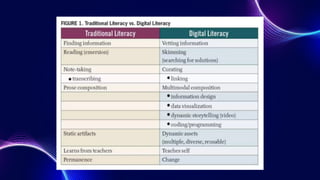
#26 How do you compare the Traditional education and Digital Education?
#33 human brain retains 10% of what it reads and 20% of what it hears, a percentage that rises to 90% of what it experiences.
#37 computer or tablet for accessing tools and participating in activities
A stable internet connection for communication and accessing resources
A webcam for visual interaction
Headphones to improve audio clarity and minimize background noise
Additional monitors for multitasking
#39 Course creation
Teachers can use LMSs to create and integrate course materials, align content and assessments, and create customized tests.
Tracking
Teachers can use LMSs to track studying progress and articulate learning goals.
Mobility
LMSs can be accessed on mobile devices, allowing learners to access training materials whenever they need them.
Ease of use
Enterprise LMSs are designed to be easy to use and often include an intuitive user interface.
Support services
Enterprise LMSs often come with a range of support services.
Asset libraries
Some LMSs include asset libraries to help with the development and deployment of online training materials.
#40 Screen reader software provides image descriptions and describes what’s happening on a screen.
Voice recognition. For motor or visual impairments, voice recognition s
oftware can perform a student’s request at the sound of their voice. Students can speak to their teachers, create assignments and direct apps.
Artificial intelligence. AI can help teachers by personalizing lessons and anticipating their needs. Students can use AI to transcribe class notes and create their own written documents by using braille or voice commands.












![Polymer [ बहुलक ] Chemistry Notes PDF - Irfanullah Mehar - JJ Sir Chemistry.pdf](https://cdn.slidesharecdn.com/ss_thumbnails/polymerchemistrynotespdf-irfanullahmehar-jjsirchemistry-260210172118-3f9b37f7-thumbnail.jpg?width=640&height=640&fit=bounds)


![ANIMAL_CELL_,_TISSUE_AND_ORGAN_CULTURE[1].pptx](https://cdn.slidesharecdn.com/ss_thumbnails/animalcelltissueandorganculture1-260204172026-4462b440-thumbnail.jpg?width=640&height=640&fit=bounds)


