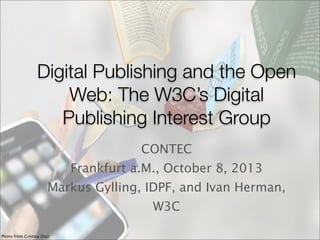


Digital Publishing and the Open
Web: The W3C’s Digital
Publishing Interest Group
CONTEC
Frankfurt a.M., October 8, 2013
Markus Gylling, IDPF, and Ivan Herman,
W3C
Photo from Cristina Diaz
These slides will be available on-line:
http://www.w3.org/2013/Talks/1008-Frankfurt-MGIH/Talk.pdf
Some words on the International
Digital Publishing Forum (IDPF)
http://www.idpf.org
International Digital Publishing Forum (IDPF)
} Not for profit Trade and Standards organization with
< 400 members from 40+ countries, working together
to advance the Digital Publishing Ecosystem with
open, interoperable standards
} Members include publishers, vendors, libraries,
national associations, government and industry
organizations
} Focus is EPUB digital publication format
} Includes large accessibility contingent, e.g. DAISY
Consortium
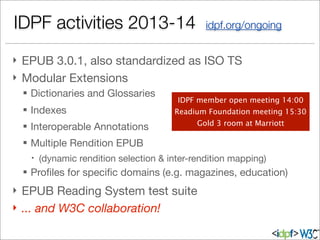
IDPF activities 2013-14 idpf.org/ongoing
} EPUB 3.0.1, also standardized as ISO TS
} Modular Extensions
§ Dictionaries and Glossaries
§ Indexes
§ Interoperable Annotations
§ Multiple Rendition EPUB
– (dynamic rendition selection & inter-rendition mapping)
§ Profiles for specific domains (e.g. magazines, education)
} EPUB Reading System test suite
} ... and W3C collaboration!
IDPF member open meeting 14:00
Readium Foundation meeting 15:30
Gold 3 room at Marriott
Some words on the World Wide
Web Consortium (W3C)
http://www.w3.org
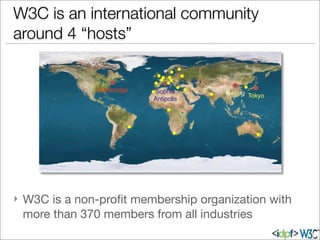
} W3C is a non-profit membership organization with
more than 370 members from all industries
W3C is an international community
around 4 “hosts”
Cambridge
Tokyo
Sophia
Antipolis
Beijing
} Develops specifications (i.e., Web standards)
§ e.g., HTML, SVG, …
} Develops guidelines, best practices
§ e.g., Web Content Accessibility Guidelines, Data Publishing
Best Practices, …
} Provides diverse forums for discussions
} Offers a validation suite and service, various courses,
documentations
What W3C does
} Major software developments, standard
implementation (except for proof of concepts)
} Conduct independent research (it does what the
members want it to do…)
} Act as a legislative body (e.g., to require certain
implementations to happen)
What W3C does not do
What does W3C have to do with
publishing?
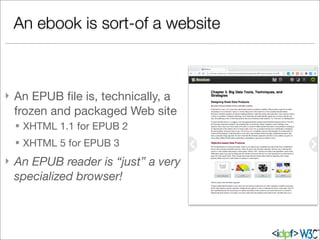
} An EPUB file is, technically, a
frozen and packaged Web site
§ XHTML 1.1 for EPUB 2
§ XHTML 5 for EPUB 3
} An EPUB reader is “just” a very
specialized browser!
An ebook is sort-of a website
• Web pages are more attractive, interactive
and intelligent
• HTML5, SVG, or CSS provides cross-
browser and cross-device interoperability
• Video, audio, etc., are a first-class citizens
• Data integration has been simplified
• It has tools for social networking (privacy,
security, identity)
• Is the most interoperable platform in the
industry
The Web has become an Open Web
Platform
} EPUB 3 has picked up on many of the OWP features
§ uses HTML5, i.e., includes audio and video as first class
objects
§ SVG comes to the fore
§ CSS 3 instead of older versions of CSS
§ (limited) scripting
§ MathML
The Open Web Platform has
influenced publishing
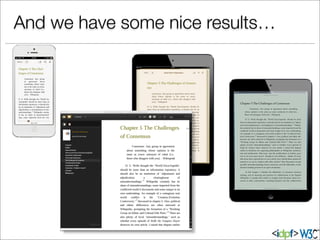
And we have some nice results…
GSE Mathematics Interactive Revision textbook — http://www.youtube.com/watch?v=cneNkRmI5wg
And we have some nice results…
GSE Mathematics Interactive Revision textbook — http://www.youtube.com/watch?v=cneNkRmI5wg
Is everything perfect and fine?
i.e., are publishers and the Web
coexisting perfectly?
Photo from Ivan Herman
} Most of the publishing industry players have just
been “users” of Web technologies
} Technology evolution has been driven by “traditional”
Web browsing
No… L
The specific needs and priorities of
publishing may not be reflected in the
evolution of the Web!
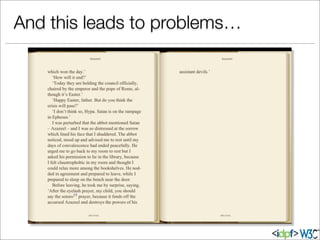
And this leads to problems…
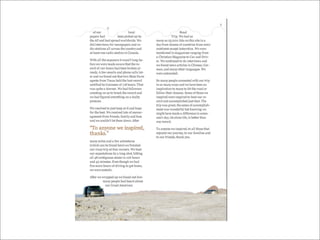
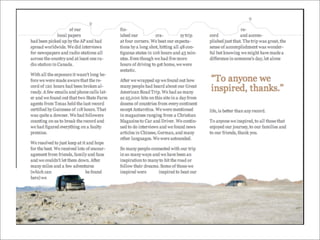
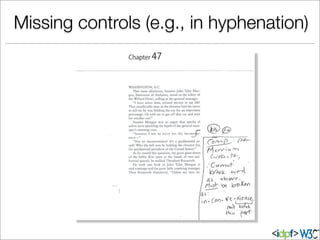
Missing controls (e.g., in hyphenation)
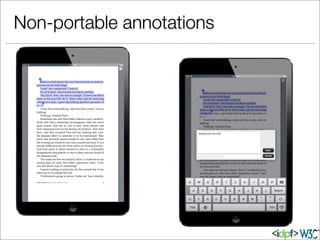
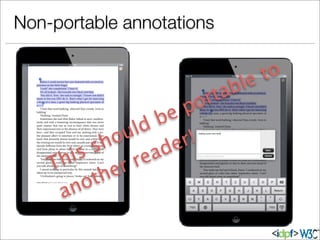
Non-portable annotations
This should be portable to
another reader!
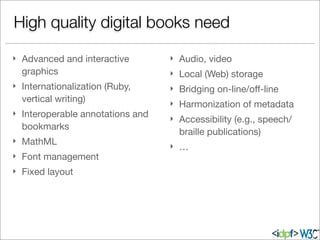
} Advanced and interactive
graphics
} Internationalization (Ruby,
vertical writing)
} Interoperable annotations and
bookmarks
} MathML
} Font management
} Fixed layout
} Audio, video
} Local (Web) storage
} Bridging on-line/off-line
} Harmonization of metadata
} Accessibility (e.g., speech/
braille publications)
} …
High quality digital books need
} Advanced and interactive
graphics
} Internationalization (Ruby,
vertical writing)
} Interoperable annotations and
bookmarks
} MathML
} Font management
} Fixed layout
} Audio, video
} Local (Web) storage
} Bridging on-line/off-line
} Harmonization of metadata
} Accessibility (e.g., speech/
braille publications)
} …
High quality digital books need
Most of these are being worked on at W3C, but
still need extra care and clear requirements!
To repeat…
The specific needs and priorities of the
publishing industry may not be reflected
in the evolution of the Web!
The technology evolution of the Web has
been driven by “traditional” Web browsing
How can we move on?
Increasing cooperation between the IDPF
and W3C
} Presence on one another’s events
§ Jeff Jaffe (W3C CEO) at IDPF events in NYC and Boston
§ Markus Gylling (IDPF CTO) at W3C’s general meeting in
Tokyo
} Workshop organized jointly: “eBooks: Great
Expectations”
} We are also here… :-)
The	
  objec)ve	
  of	
  the	
  IDPF-­‐W3C	
  rela)onship	
  is	
  to	
  
ensure	
  that	
  the	
  EPUB	
  requirements	
  become	
  part	
  
of	
  the	
  central	
  considera8ons	
  to	
  the	
  future	
  
evolu8on	
  of	
  the	
  OWP
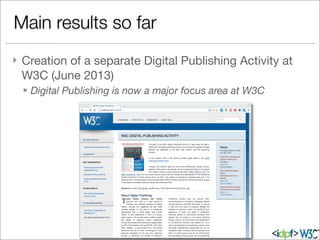
} Creation of a separate Digital Publishing Activity at
W3C (June 2013)
§ Digital Publishing is now a major focus area at W3C
Main results so far
} Co-chaired by Markus Gylling (IDPF) and Madi
Salomon (Pearson)
New Digital Publishing Activity and
Interest Group at W3C
“The mission of the Digital Publishing Interest Group, […] a forum
for experts in the digital publishing ecosystem […] for technical
discussions, gathering use cases and to better align existing
formats and technologies (e.g., EPUB) with the broader Open
Web Platform.”
The W3C Digital Publishing Interest Group
current & projected focus areas
http://www.w3.org/dpub/IG/wiki/Main_Page
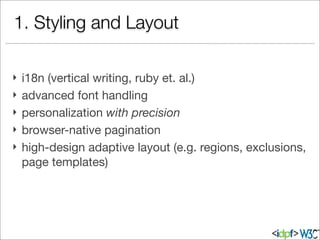
1. Styling and Layout
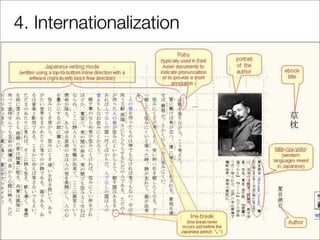
} i18n (vertical writing, ruby et. al.)
} advanced font handling
} personalization with precision
} browser-native pagination
} high-design adaptive layout (e.g. regions, exclusions,
page templates)
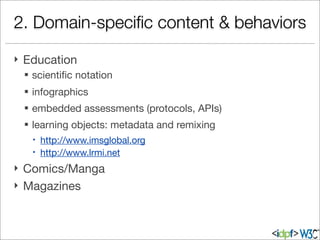
2. Domain-specific content & behaviors
} Education
§ scientific notation
§ infographics
§ embedded assessments (protocols, APIs)
§ learning objects: metadata and remixing
– http://www.imsglobal.org
– http://www.lrmi.net
} Comics/Manga
} Magazines
3. Accessibility and Personalization
} Integration of Web accessibility principles in ebooks
§ making sense of dynamic content
§ structural semantic vocabularies (for education and more)
} Speech, braille and longform publications
Accessibility is just an extreme case of
personalization
4. Internationalization
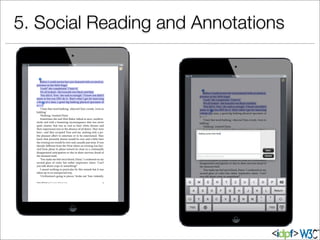
5. Social Reading and Annotations
6. Packaging and Distribution
} online and contained/portable as states, not
manifestations
} discoverability
} direct vs abstract addressing
§ inter-publication linking (DOI, XRI et. al.)
Bridging online and offline/portable
Thank you for your
attention!
http://www.w3.org/2013/Talks/1008-Frankfurt-MGIH/Talk.pdf

Digital Publishing and the Open Web Platform

  • 1.
    Digital Publishing andthe Open Web: The W3C’s Digital Publishing Interest Group CONTEC Frankfurt a.M., October 8, 2013 Markus Gylling, IDPF, and Ivan Herman, W3C Photo from Cristina Diaz
  • 2.
    These slides willbe available on-line: http://www.w3.org/2013/Talks/1008-Frankfurt-MGIH/Talk.pdf
  • 3.
    Some words onthe International Digital Publishing Forum (IDPF) http://www.idpf.org
  • 4.
    International Digital PublishingForum (IDPF) } Not for profit Trade and Standards organization with < 400 members from 40+ countries, working together to advance the Digital Publishing Ecosystem with open, interoperable standards } Members include publishers, vendors, libraries, national associations, government and industry organizations } Focus is EPUB digital publication format } Includes large accessibility contingent, e.g. DAISY Consortium
  • 5.
    IDPF activities 2013-14idpf.org/ongoing } EPUB 3.0.1, also standardized as ISO TS } Modular Extensions § Dictionaries and Glossaries § Indexes § Interoperable Annotations § Multiple Rendition EPUB – (dynamic rendition selection & inter-rendition mapping) § Profiles for specific domains (e.g. magazines, education) } EPUB Reading System test suite } ... and W3C collaboration! IDPF member open meeting 14:00 Readium Foundation meeting 15:30 Gold 3 room at Marriott
  • 6.
    Some words onthe World Wide Web Consortium (W3C) http://www.w3.org
  • 7.
    } W3C isa non-profit membership organization with more than 370 members from all industries W3C is an international community around 4 “hosts” Cambridge Tokyo Sophia Antipolis Beijing
  • 8.
    } Develops specifications(i.e., Web standards) § e.g., HTML, SVG, … } Develops guidelines, best practices § e.g., Web Content Accessibility Guidelines, Data Publishing Best Practices, … } Provides diverse forums for discussions } Offers a validation suite and service, various courses, documentations What W3C does
  • 9.
    } Major softwaredevelopments, standard implementation (except for proof of concepts) } Conduct independent research (it does what the members want it to do…) } Act as a legislative body (e.g., to require certain implementations to happen) What W3C does not do
  • 10.
    What does W3Chave to do with publishing?
  • 11.
    } An EPUBfile is, technically, a frozen and packaged Web site § XHTML 1.1 for EPUB 2 § XHTML 5 for EPUB 3 } An EPUB reader is “just” a very specialized browser! An ebook is sort-of a website
  • 12.
    • Web pagesare more attractive, interactive and intelligent • HTML5, SVG, or CSS provides cross- browser and cross-device interoperability • Video, audio, etc., are a first-class citizens • Data integration has been simplified • It has tools for social networking (privacy, security, identity) • Is the most interoperable platform in the industry The Web has become an Open Web Platform
  • 13.
    } EPUB 3has picked up on many of the OWP features § uses HTML5, i.e., includes audio and video as first class objects § SVG comes to the fore § CSS 3 instead of older versions of CSS § (limited) scripting § MathML The Open Web Platform has influenced publishing
  • 14.
    And we havesome nice results…
  • 15.
    And we havesome nice results… GSE Mathematics Interactive Revision textbook — http://www.youtube.com/watch?v=cneNkRmI5wg
  • 16.
    And we havesome nice results… GSE Mathematics Interactive Revision textbook — http://www.youtube.com/watch?v=cneNkRmI5wg
  • 17.
    Is everything perfectand fine? i.e., are publishers and the Web coexisting perfectly? Photo from Ivan Herman
  • 18.
    } Most ofthe publishing industry players have just been “users” of Web technologies } Technology evolution has been driven by “traditional” Web browsing No… L The specific needs and priorities of publishing may not be reflected in the evolution of the Web!
  • 19.
    And this leadsto problems…
  • 20.
    Missing controls (e.g.,in hyphenation)
  • 21.
  • 22.
    Non-portable annotations This shouldbe portable to another reader!
  • 23.
    } Advanced andinteractive graphics } Internationalization (Ruby, vertical writing) } Interoperable annotations and bookmarks } MathML } Font management } Fixed layout } Audio, video } Local (Web) storage } Bridging on-line/off-line } Harmonization of metadata } Accessibility (e.g., speech/ braille publications) } … High quality digital books need
  • 24.
    } Advanced andinteractive graphics } Internationalization (Ruby, vertical writing) } Interoperable annotations and bookmarks } MathML } Font management } Fixed layout } Audio, video } Local (Web) storage } Bridging on-line/off-line } Harmonization of metadata } Accessibility (e.g., speech/ braille publications) } … High quality digital books need Most of these are being worked on at W3C, but still need extra care and clear requirements!
  • 25.
    To repeat… The specificneeds and priorities of the publishing industry may not be reflected in the evolution of the Web! The technology evolution of the Web has been driven by “traditional” Web browsing
  • 26.
    How can wemove on?
  • 27.
    Increasing cooperation betweenthe IDPF and W3C } Presence on one another’s events § Jeff Jaffe (W3C CEO) at IDPF events in NYC and Boston § Markus Gylling (IDPF CTO) at W3C’s general meeting in Tokyo } Workshop organized jointly: “eBooks: Great Expectations” } We are also here… :-)
  • 28.
    The  objec)ve  of  the  IDPF-­‐W3C  rela)onship  is  to   ensure  that  the  EPUB  requirements  become  part   of  the  central  considera8ons  to  the  future   evolu8on  of  the  OWP
  • 29.
    } Creation ofa separate Digital Publishing Activity at W3C (June 2013) § Digital Publishing is now a major focus area at W3C Main results so far
  • 30.
    } Co-chaired byMarkus Gylling (IDPF) and Madi Salomon (Pearson) New Digital Publishing Activity and Interest Group at W3C “The mission of the Digital Publishing Interest Group, […] a forum for experts in the digital publishing ecosystem […] for technical discussions, gathering use cases and to better align existing formats and technologies (e.g., EPUB) with the broader Open Web Platform.”
  • 31.
    The W3C DigitalPublishing Interest Group current & projected focus areas http://www.w3.org/dpub/IG/wiki/Main_Page
  • 32.
    1. Styling andLayout } i18n (vertical writing, ruby et. al.) } advanced font handling } personalization with precision } browser-native pagination } high-design adaptive layout (e.g. regions, exclusions, page templates)
  • 35.
    2. Domain-specific content& behaviors } Education § scientific notation § infographics § embedded assessments (protocols, APIs) § learning objects: metadata and remixing – http://www.imsglobal.org – http://www.lrmi.net } Comics/Manga } Magazines
  • 36.
    3. Accessibility andPersonalization } Integration of Web accessibility principles in ebooks § making sense of dynamic content § structural semantic vocabularies (for education and more) } Speech, braille and longform publications Accessibility is just an extreme case of personalization
  • 37.
  • 38.
    5. Social Readingand Annotations
  • 39.
    6. Packaging andDistribution } online and contained/portable as states, not manifestations } discoverability } direct vs abstract addressing § inter-publication linking (DOI, XRI et. al.) Bridging online and offline/portable
  • 40.
    Thank you foryour attention! http://www.w3.org/2013/Talks/1008-Frankfurt-MGIH/Talk.pdf