Publishing and the Open Web
Platform
Ivan Herman, W3C
W3C Track, WWW 2014 Conference
2014-4-9, Seoul, Korea
Photo from Cristina Diaz
These slides are available on-line:
!
http://www.w3.org/2014/Talks/0409-Seoul-IH/
} Reading

§ Hyperlinks (i.e., non-linear reading)
} Publishing

§ Global distribution

§ Anyone could publish (low barriers)
§ New advertising opportunities (search engines, pop-ups)

} But… 

§ impoverished style, layout of early Web no match for print

§ low resolution screens, slow processors
20 years ago the Web created

new experiences for publishing
Trends of past decade have further
transformed reading, publishing
} Internet everywhere

} Mobility

} Social

} Customization

} Cloud

} Broadband

} Multi-function devices

} Much higher quality display,
typesetting, speed
Many industries feeling the impact
} Mobile

} Television

} Automotive

} Health Care

} Gaming

} Digital signage

} Government
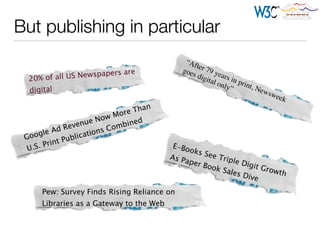
But publishing in particular
“After 79 years in print, Newsweek
goes digital only”
Google Ad Revenue Now More Than
U.S. Print Publications Combined
Pew: Survey Finds Rising Reliance on
Libraries as a Gateway to the Web
E-Books See Triple Digit Growth
As Paper Book Sales Dive
20% of all US Newspapers are
digital
But publishing in particular
} Pew: “News is becoming a shared social experience as people
exchange links and recommendations as a form of cultural currency in
their social networks.”

} Global eBook report: “Major [US] trade publishers have reported a
market share for ebook revenues around the 30% mark […] 20% of
the UK book market was digital”

} The Bookseller: “In all of 2012, e-book sales doubled their volume […]
in the United Kingdom”

} Global eBook report: “Ebooks have started to transform the entire
ecosystem of publishing and reading. By 2014, expect the entire
value chain to be under scrutiny from all sides.”
That is because Publishing = Web
} Web is “intimately” tied to the
intrinsic purpose of publishing

§ the Web’s impact on automotive,
government, health care, etc., is
secondary to their intrinsic purposes.
That is because Publishing = Web
} Publishing industry has leveraged the
Web for 20 years

§ parts of industry have been early adopters

} Tomorrow they will be fully part of the
Web

§ ebooks, magazines, journals picking up the
technology today
The Web has become an Open Web Platform
• Web pages are more attractive, interactive
and intelligent

• HTML5, SVG, or CSS provides cross-
browser and cross-device interoperability 

• Video, audio, etc., are a first-class citizens

• Data integration has been simplified

• It has tools for social networking (privacy,
security, identity)

• Is the most interoperable platform in the
industry
Example for what “Ebooks picking up
the technology today” means: EPUB3
} EPUB3 is the standard for Digital Books

} Defined by the International Digital Publishing Forum
(IDPF)

} These days virtually all digital books (except for
Amazon’s) rely on EPUB
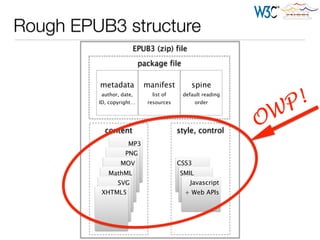
EPUB3 (zip) file
Rough EPUB3 structure
content
MP3
PNG
MOV
MathML
SVG
XHTML5
style, control
CSS3
SMIL
Javascript
+ Web APIs
package file
metadata
author, date,
ID, copyright…
manifest
list of
resources
spine
default reading
order
OWP!
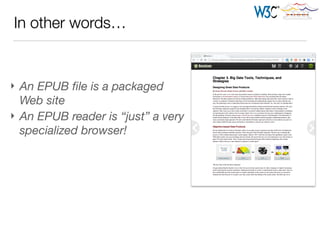
In other words…
} An EPUB file is a packaged
Web site
} An EPUB reader is “just” a very
specialized browser!
Examples for the Open Web Platform
influencing publishing
} EPUB 3 has picked up on many of the OWP features

§ uses HTML5, i.e., includes audio and video as first class
objects

§ SVG and Canvas comes to the fore

§ CSS 3 instead of older versions of CSS

§ (limited) scripting

§ MathML

} Magazine and journal publications on-line are at the
forefront of OWP usage

} The “back-end”, production side is looking at OWP
to simplify the author-to-(e)book workflow
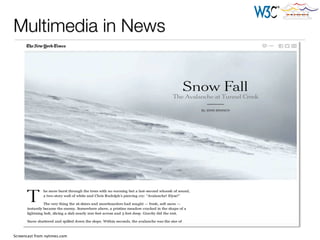
Screencast from nytimes.com
Multimedia in News
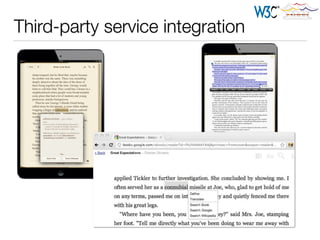
Third-party service integration
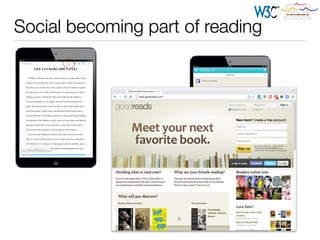
Social becoming part of reading
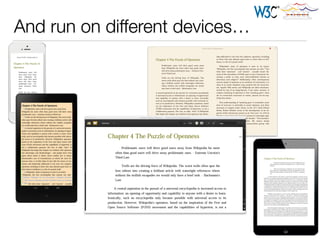
And run on different devices…
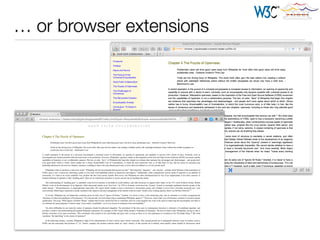
… or browser extensions
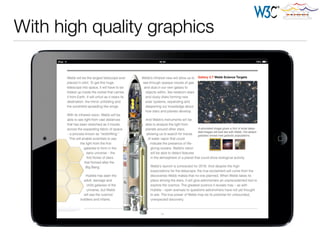
With high quality graphics
Is everything perfect and fine?
Photo from Ivan Herman
} Most of the publishing industry players have just
been “users” of Web technologies

} Technology evolution has been driven by
“traditional” Web browsing
No… L
The specific needs and priorities of the
publishing industry may not be reflected in
the evolution of the Web!
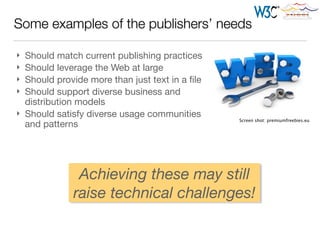
Some examples of the publishers’ needs
} Should match current publishing practices

} Should leverage the Web at large

} Should provide more than just text in a file

} Should support diverse business and
distribution models

} Should satisfy diverse usage communities
and patterns
Screen shot: premiumfreebies.eu
Achieving these may still
raise technical challenges!
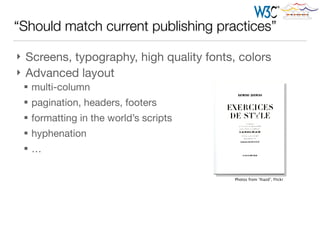
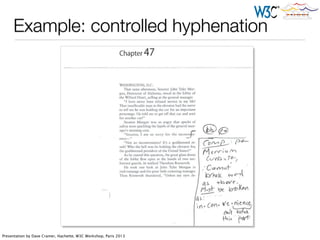
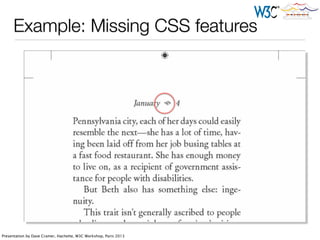
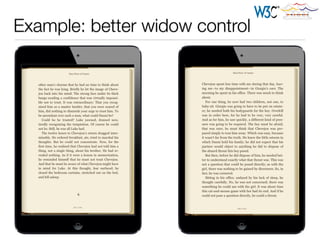
“Should match current publishing practices”
} Screens, typography, high quality fonts, colors

} Advanced layout 

§ multi-column

§ pagination, headers, footers

§ formatting in the world’s scripts

§ hyphenation

§ …
Photos from “lliazd”, Flickr
Example: controlled hyphenation
Presentation by Dave Cramer, Hachette, W3C Workshop, Paris 2013
Example: Missing CSS features
Presentation by Dave Cramer, Hachette, W3C Workshop, Paris 2013
Example: better widow control
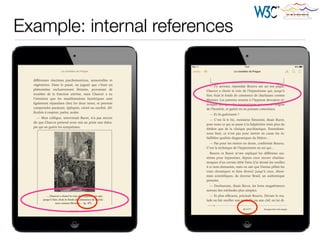
Example: internal references
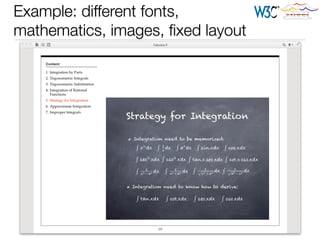
Example: different fonts,
mathematics, images, fixed layout
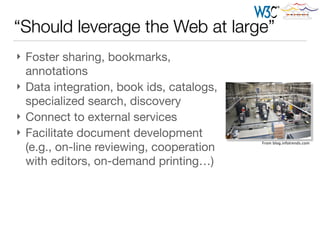
“Should leverage the Web at large”
} Foster sharing, bookmarks,
annotations

} Data integration, book ids, catalogs,
specialized search, discovery

} Connect to external services

} Facilitate document development
(e.g., on-line reviewing, cooperation
with editors, on-demand printing…)
From blog.infotrends.com
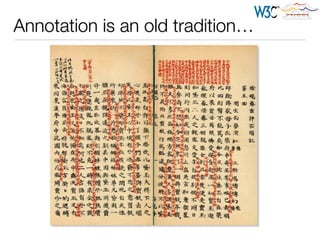
Annotation is an old tradition…
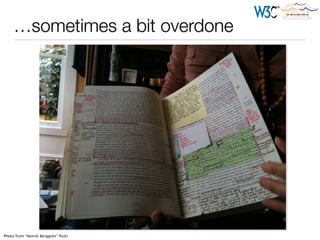
…sometimes a bit overdone
Photo from “Henrik Berggren” flickr
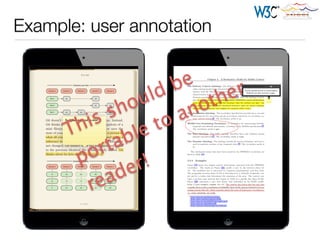
Example: user annotation
This should be
portable to another
reader!
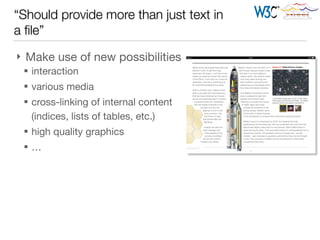
“Should provide more than just text in
a file”
} Make use of new possibilities

§ interaction

§ various media

§ cross-linking of internal content
(indices, lists of tables, etc.)

§ high quality graphics

§ …
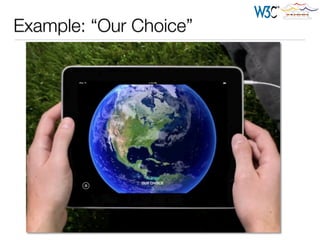
Example: “Our Choice”
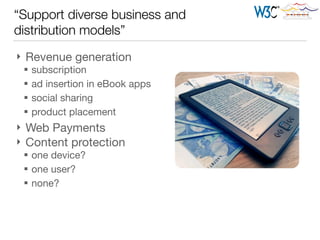
“Support diverse business and
distribution models”
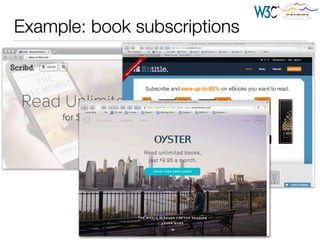
} Revenue generation

§ subscription

§ ad insertion in eBook apps

§ social sharing

§ product placement

} Web Payments

} Content protection

§ one device?

§ one user?

§ none?
Example: book subscriptions
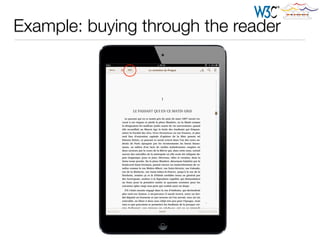
Example: buying through the reader
“Should satisfy diverse usage
communities and patterns”
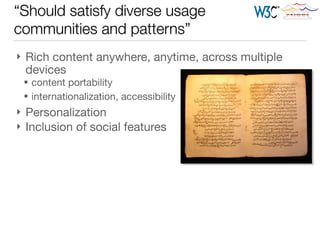
} Rich content anywhere, anytime, across multiple
devices

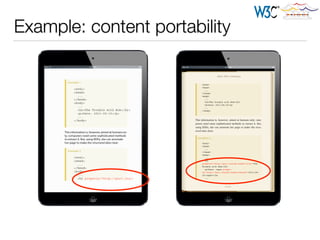
§ content portability

§ internationalization, accessibility

} Personalization

} Inclusion of social features
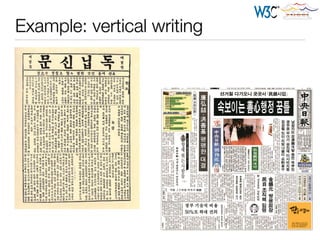
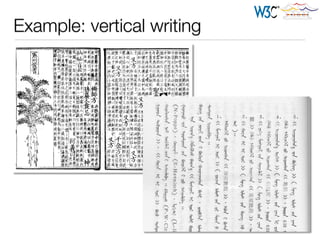
Example: vertical writing
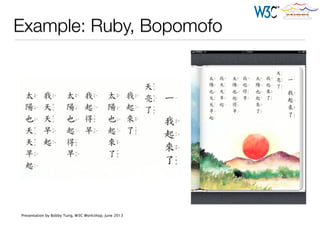
Example: Ruby, Bopomofo
Presentation by Bobby Tung, W3C Workshop, June 2013
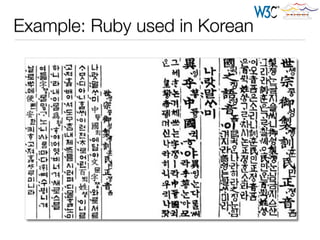
Example: Ruby used in Korean
Example: content portability
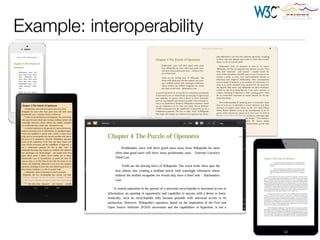
Example: interoperability
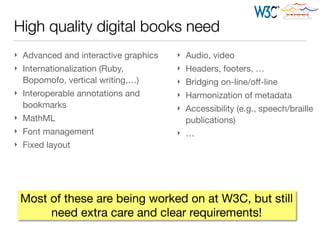
High quality digital books need
} Advanced and interactive graphics

} Internationalization (Ruby,
Bopomofo, vertical writing,…)

} Interoperable annotations and
bookmarks

} MathML

} Font management

} Fixed layout
Most of these are being worked on at W3C, but still
need extra care and clear requirements!
} Audio, video

} Headers, footers, …

} Bridging on-line/off-line

} Harmonization of metadata

} Accessibility (e.g., speech/braille
publications)

} …
To repeat…
The specific needs and priorities of the
publishing industry may not be reflected in
the evolution of the Web!
The technology evolution of the Web has
been driven by “traditional” Web browsing
Photo by Ivan Herman
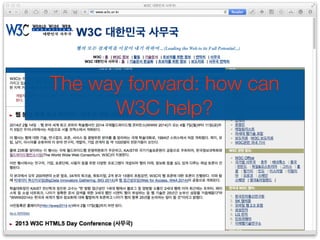
The way forward: how can
W3C help?
Cooperation
} Develop cooperation with relevant organizations:
IDPF, BISG, BIC, EDItEUR, …

} Try to be on one another’s events, build contacts

} Create bridges between the developers’
communities and publishers

} Ensure that the publishers’ requirements are
channeled to the relevant W3C groups
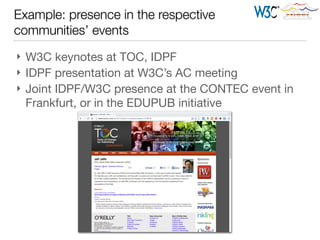
Example: presence in the respective
communities’ events
} W3C keynotes at TOC, IDPF

} IDPF presentation at W3C’s AC meeting

} Joint IDPF/W3C presence at the CONTEC event in
Frankfurt, or in the EDUPUB initiative
W3C’s Workshop series
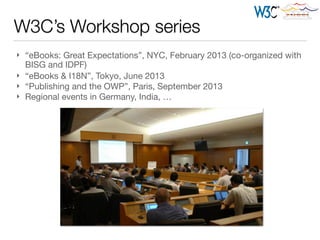
} “eBooks: Great Expectations”, NYC, February 2013 (co-organized with
BISG and IDPF)

} “eBooks & I18N”, Tokyo, June 2013

} “Publishing and the OWP”, Paris, September 2013

} Regional events in Germany, India, …
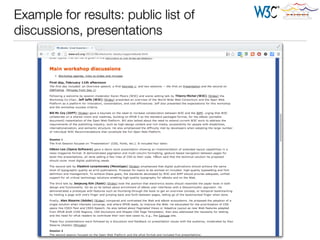
Example for results: public list of
discussions, presentations
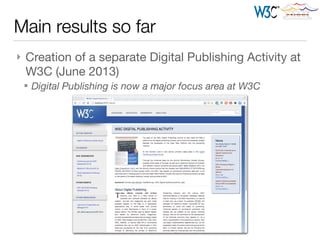
Main results so far
} Creation of a separate Digital Publishing Activity at
W3C (June 2013)

§ Digital Publishing is now a major focus area at W3C
New Digital Publishing Interest Group
} Co-chaired by Markus Gylling (IDPF) and Liza Daly
(Safari Books Online)
“The mission of the Digital Publishing Interest Group, […] a forum
for experts in the digital publishing ecosystem […] for technical
discussions, gathering use cases and to better align existing
formats and technologies (e.g., EPUB) with the broader Open
Web Platform.”
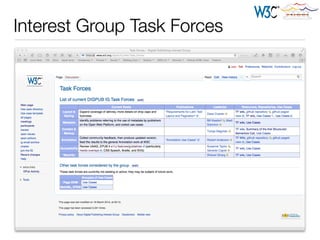
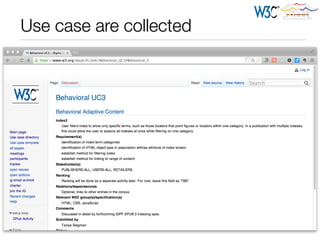
} The interest group collects use cases and
requirements

§ these requirements will be channeled to the CSS, HTML,
MathML, SVG, etc., Working Groups

§ members of the IG will also join these groups, if necessary, to
develop the necessary technologies

} The interest group will contribute to the general
OWP interoperability testing effort at W3C

§ ensuring that the special publishing issues are also properly
tested by implementations
In practice…
Interest Group Task Forces
Use case are collected
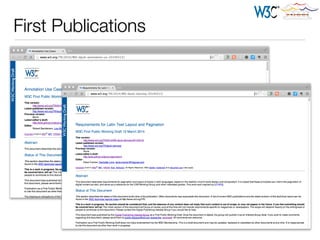
First Publications
Possible future work: annotation
} We have already seen how important annotation is

} Actually: this is not a digital publishing issue only!

§ annotation on Web pages, data, etc., would be very
important, too
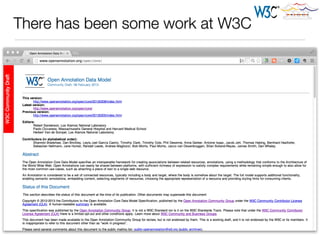
There has been some work at W3C
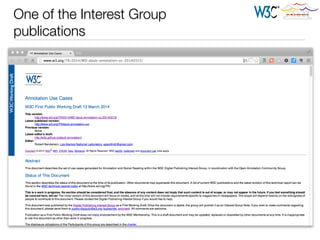
One of the Interest Group
publications
Current plans
} A draft charter has been made public in February

} Just had a Workshop in San Francisco, 2nd of April:
≈50 people

§ a number of presentations

§ the draft charter was discussed in a separate, 1½ hour
session

§ A charter should be finalized in the coming weeks

} A Working Group may start at the end of the summer
or early autumn

§ interestingly, publishing community representatives and
“traditional” Web communities would work together!
} Companies outside of W3C can follow what is
happening in, say, the CSS Working Group

} But nothing can replace the influence of a company
being around the table!
It is important that major players join
W3C!
Industry Collaboration is Key
Nothing can replace the influence of a company being
around the table!

!
} Publishing ecosystem players are getting involved:

§ Adobe, Canon, Hachette, Intel, Int’l Webmasters’
Association, Google, Rakuten, Monotype, Nokia, Pearson,
Apple,… 

§ Discussions with many other publishers on-going
The future: Publishing = Web

!
Work with W3C work to make this a
reality!
Conclusions
Photo by Ivan Herman
Thank you for your attention!
http://www.w3.org/2014/Talks/0409-Seoul-IH/

W3C and Digital Publishing

  • 1.
    Publishing and theOpen Web Platform Ivan Herman, W3C W3C Track, WWW 2014 Conference 2014-4-9, Seoul, Korea Photo from Cristina Diaz
  • 2.
    These slides areavailable on-line: ! http://www.w3.org/2014/Talks/0409-Seoul-IH/
  • 3.
    } Reading § Hyperlinks(i.e., non-linear reading) } Publishing § Global distribution § Anyone could publish (low barriers) § New advertising opportunities (search engines, pop-ups) } But… § impoverished style, layout of early Web no match for print § low resolution screens, slow processors 20 years ago the Web created
 new experiences for publishing
  • 4.
    Trends of pastdecade have further transformed reading, publishing } Internet everywhere } Mobility } Social } Customization } Cloud } Broadband } Multi-function devices } Much higher quality display, typesetting, speed
  • 5.
    Many industries feelingthe impact } Mobile } Television } Automotive } Health Care } Gaming } Digital signage } Government
  • 6.
    But publishing inparticular “After 79 years in print, Newsweek goes digital only” Google Ad Revenue Now More Than U.S. Print Publications Combined Pew: Survey Finds Rising Reliance on Libraries as a Gateway to the Web E-Books See Triple Digit Growth As Paper Book Sales Dive 20% of all US Newspapers are digital
  • 7.
    But publishing inparticular } Pew: “News is becoming a shared social experience as people exchange links and recommendations as a form of cultural currency in their social networks.” } Global eBook report: “Major [US] trade publishers have reported a market share for ebook revenues around the 30% mark […] 20% of the UK book market was digital” } The Bookseller: “In all of 2012, e-book sales doubled their volume […] in the United Kingdom” } Global eBook report: “Ebooks have started to transform the entire ecosystem of publishing and reading. By 2014, expect the entire value chain to be under scrutiny from all sides.”
  • 8.
    That is becausePublishing = Web } Web is “intimately” tied to the intrinsic purpose of publishing § the Web’s impact on automotive, government, health care, etc., is secondary to their intrinsic purposes.
  • 9.
    That is becausePublishing = Web } Publishing industry has leveraged the Web for 20 years § parts of industry have been early adopters } Tomorrow they will be fully part of the Web § ebooks, magazines, journals picking up the technology today
  • 10.
    The Web hasbecome an Open Web Platform • Web pages are more attractive, interactive and intelligent • HTML5, SVG, or CSS provides cross- browser and cross-device interoperability • Video, audio, etc., are a first-class citizens • Data integration has been simplified • It has tools for social networking (privacy, security, identity) • Is the most interoperable platform in the industry
  • 11.
    Example for what“Ebooks picking up the technology today” means: EPUB3 } EPUB3 is the standard for Digital Books } Defined by the International Digital Publishing Forum (IDPF) } These days virtually all digital books (except for Amazon’s) rely on EPUB
  • 12.
    EPUB3 (zip) file RoughEPUB3 structure content MP3 PNG MOV MathML SVG XHTML5 style, control CSS3 SMIL Javascript + Web APIs package file metadata author, date, ID, copyright… manifest list of resources spine default reading order OWP!
  • 13.
    In other words… }An EPUB file is a packaged Web site } An EPUB reader is “just” a very specialized browser!
  • 14.
    Examples for theOpen Web Platform influencing publishing } EPUB 3 has picked up on many of the OWP features § uses HTML5, i.e., includes audio and video as first class objects § SVG and Canvas comes to the fore § CSS 3 instead of older versions of CSS § (limited) scripting § MathML } Magazine and journal publications on-line are at the forefront of OWP usage } The “back-end”, production side is looking at OWP to simplify the author-to-(e)book workflow
  • 15.
  • 16.
  • 17.
  • 18.
    And run ondifferent devices…
  • 19.
    … or browserextensions
  • 20.
  • 21.
    Is everything perfectand fine? Photo from Ivan Herman
  • 22.
    } Most ofthe publishing industry players have just been “users” of Web technologies } Technology evolution has been driven by “traditional” Web browsing No… L The specific needs and priorities of the publishing industry may not be reflected in the evolution of the Web!
  • 23.
    Some examples ofthe publishers’ needs } Should match current publishing practices } Should leverage the Web at large } Should provide more than just text in a file } Should support diverse business and distribution models } Should satisfy diverse usage communities and patterns Screen shot: premiumfreebies.eu Achieving these may still raise technical challenges!
  • 24.
    “Should match currentpublishing practices” } Screens, typography, high quality fonts, colors } Advanced layout § multi-column § pagination, headers, footers § formatting in the world’s scripts § hyphenation § … Photos from “lliazd”, Flickr
  • 25.
    Example: controlled hyphenation Presentationby Dave Cramer, Hachette, W3C Workshop, Paris 2013
  • 26.
    Example: Missing CSSfeatures Presentation by Dave Cramer, Hachette, W3C Workshop, Paris 2013
  • 27.
  • 28.
  • 29.
  • 30.
    “Should leverage theWeb at large” } Foster sharing, bookmarks, annotations } Data integration, book ids, catalogs, specialized search, discovery } Connect to external services } Facilitate document development (e.g., on-line reviewing, cooperation with editors, on-demand printing…) From blog.infotrends.com
  • 31.
    Annotation is anold tradition…
  • 32.
    …sometimes a bitoverdone Photo from “Henrik Berggren” flickr
  • 33.
    Example: user annotation Thisshould be portable to another reader!
  • 34.
    “Should provide morethan just text in a file” } Make use of new possibilities § interaction § various media § cross-linking of internal content (indices, lists of tables, etc.) § high quality graphics § …
  • 35.
  • 36.
    “Support diverse businessand distribution models” } Revenue generation § subscription § ad insertion in eBook apps § social sharing § product placement } Web Payments } Content protection § one device? § one user? § none?
  • 37.
  • 38.
  • 39.
    “Should satisfy diverseusage communities and patterns” } Rich content anywhere, anytime, across multiple devices § content portability § internationalization, accessibility } Personalization } Inclusion of social features
  • 40.
  • 41.
  • 42.
    Example: Ruby, Bopomofo Presentationby Bobby Tung, W3C Workshop, June 2013
  • 43.
  • 44.
  • 45.
  • 46.
    High quality digitalbooks need } Advanced and interactive graphics } Internationalization (Ruby, Bopomofo, vertical writing,…) } Interoperable annotations and bookmarks } MathML } Font management } Fixed layout Most of these are being worked on at W3C, but still need extra care and clear requirements! } Audio, video } Headers, footers, … } Bridging on-line/off-line } Harmonization of metadata } Accessibility (e.g., speech/braille publications) } …
  • 47.
    To repeat… The specificneeds and priorities of the publishing industry may not be reflected in the evolution of the Web! The technology evolution of the Web has been driven by “traditional” Web browsing
  • 48.
    Photo by IvanHerman The way forward: how can W3C help?
  • 49.
    Cooperation } Develop cooperationwith relevant organizations: IDPF, BISG, BIC, EDItEUR, … } Try to be on one another’s events, build contacts } Create bridges between the developers’ communities and publishers } Ensure that the publishers’ requirements are channeled to the relevant W3C groups
  • 50.
    Example: presence inthe respective communities’ events } W3C keynotes at TOC, IDPF } IDPF presentation at W3C’s AC meeting } Joint IDPF/W3C presence at the CONTEC event in Frankfurt, or in the EDUPUB initiative
  • 51.
    W3C’s Workshop series }“eBooks: Great Expectations”, NYC, February 2013 (co-organized with BISG and IDPF) } “eBooks & I18N”, Tokyo, June 2013 } “Publishing and the OWP”, Paris, September 2013 } Regional events in Germany, India, …
  • 52.
    Example for results:public list of discussions, presentations
  • 53.
    Main results sofar } Creation of a separate Digital Publishing Activity at W3C (June 2013) § Digital Publishing is now a major focus area at W3C
  • 54.
    New Digital PublishingInterest Group } Co-chaired by Markus Gylling (IDPF) and Liza Daly (Safari Books Online) “The mission of the Digital Publishing Interest Group, […] a forum for experts in the digital publishing ecosystem […] for technical discussions, gathering use cases and to better align existing formats and technologies (e.g., EPUB) with the broader Open Web Platform.”
  • 55.
    } The interestgroup collects use cases and requirements § these requirements will be channeled to the CSS, HTML, MathML, SVG, etc., Working Groups § members of the IG will also join these groups, if necessary, to develop the necessary technologies } The interest group will contribute to the general OWP interoperability testing effort at W3C § ensuring that the special publishing issues are also properly tested by implementations In practice…
  • 56.
  • 57.
    Use case arecollected
  • 58.
  • 59.
    Possible future work:annotation } We have already seen how important annotation is } Actually: this is not a digital publishing issue only! § annotation on Web pages, data, etc., would be very important, too
  • 60.
    There has beensome work at W3C
  • 61.
    One of theInterest Group publications
  • 62.
    Current plans } Adraft charter has been made public in February } Just had a Workshop in San Francisco, 2nd of April: ≈50 people § a number of presentations § the draft charter was discussed in a separate, 1½ hour session § A charter should be finalized in the coming weeks } A Working Group may start at the end of the summer or early autumn § interestingly, publishing community representatives and “traditional” Web communities would work together!
  • 63.
    } Companies outsideof W3C can follow what is happening in, say, the CSS Working Group } But nothing can replace the influence of a company being around the table! It is important that major players join W3C!
  • 64.
    Industry Collaboration isKey Nothing can replace the influence of a company being around the table! ! } Publishing ecosystem players are getting involved: § Adobe, Canon, Hachette, Intel, Int’l Webmasters’ Association, Google, Rakuten, Monotype, Nokia, Pearson, Apple,… § Discussions with many other publishers on-going
  • 65.
    The future: Publishing= Web ! Work with W3C work to make this a reality! Conclusions Photo by Ivan Herman
  • 66.
    Thank you foryour attention! http://www.w3.org/2014/Talks/0409-Seoul-IH/