MBBC Digital Learning Program
Parent Information and Support Evening
Program for tonight
• Introductions
• What we’re doing and why
• How it looks in a class
• Devices
• Where to from here
• Panel – Q & A
A digital life
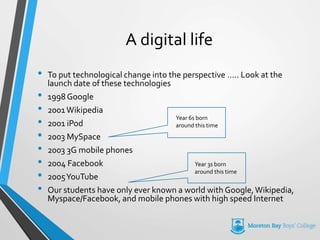
• To put technological change into the perspective ….. Look at the
launch date of these technologies
• 1998Google
• 2001Wikipedia
• 2001 iPod
• 2003 MySpace
• 2003 3G mobile phones
• 2004 Facebook
• 2005YouTube
• Our students have only ever known a world with Google,Wikipedia,
Myspace/Facebook, and mobile phones with high speed Internet
Year 6s born
around this time
Year 3s born
around this time
Why eLearning?
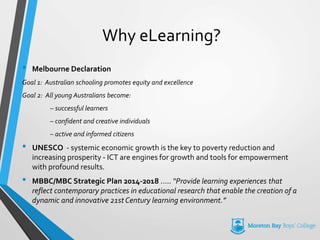
• Melbourne Declaration
Goal 1: Australian schooling promotes equity and excellence
Goal 2: All young Australians become:
– successful learners
– confident and creative individuals
– active and informed citizens
• UNESCO - systemic economic growth is the key to poverty reduction and
increasing prosperity - ICT are engines for growth and tools for empowerment
with profound results.
• MBBC/MBC Strategic Plan 2014-2018 ….. “Provide learning experiences that
reflect contemporary practices in educational research that enable the creation of a
dynamic and innovative 21st Century learning environment.”
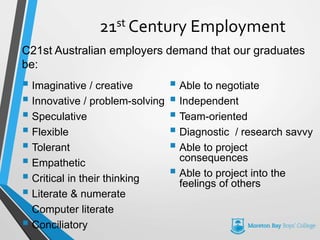
21st Century Employment
 Imaginative / creative
 Innovative / problem-solving
 Speculative
 Flexible
 Tolerant
 Empathetic
 Critical in their thinking
 Literate & numerate
 Computer literate
 Conciliatory
 Able to negotiate
 Independent
 Team-oriented
 Diagnostic / research savvy
 Able to project
consequences
 Able to project into the
feelings of others
C21st Australian employers demand that our graduates
be:
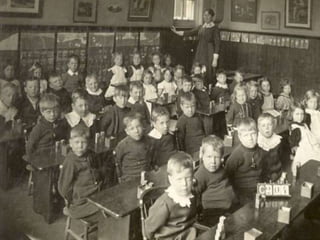
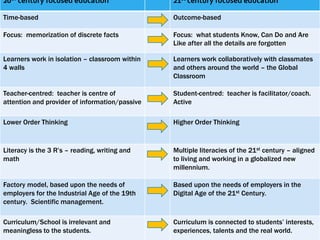
20th century focused education 21st century focused education
Time-based Outcome-based
Focus: memorization of discrete facts Focus: what students Know, Can Do and Are
Like after all the details are forgotten
Learners work in isolation – classroom within
4 walls
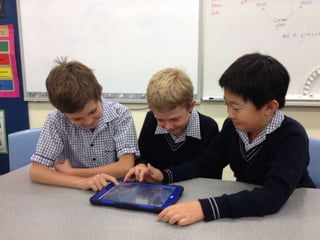
Learners work collaboratively with classmates
and others around the world – the Global
Classroom
Teacher-centred: teacher is centre of
attention and provider of information/passive
Student-centred: teacher is facilitator/coach.
Active
Lower Order Thinking Higher Order Thinking
Literacy is the 3 R’s – reading, writing and
math
Multiple literacies of the 21st century – aligned
to living and working in a globalized new
millennium.
Factory model, based upon the needs of
employers for the Industrial Age of the 19th
century. Scientific management.
Based upon the needs of employers in the
Digital Age of the 21st Century.
Curriculum/School is irrelevant and
meaningless to the students.
Curriculum is connected to students’ interests,
experiences, talents and the real world.
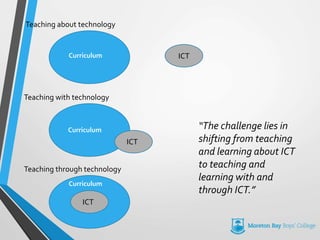
Teaching about technology
Teaching with technology
Teaching through technology
ICT
ICT
ICT
Curriculum
Curriculum
Curriculum
“The challenge lies in
shifting from teaching
and learning about ICT
to teaching and
learning with and
through ICT.”
Background
• Current IT provision
• Fibre link
• Discussion paper to Principal and Board - research
• Appointment of eLearning Co-ordinator
• BoardWorking Party
• Wireless upgrade, internet bandwidth, PD
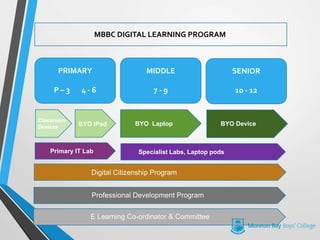
MBBC DIGITAL LEARNING PROGRAM
PRIMARY
P – 3 4 - 6
MIDDLE
7 - 9
SENIOR
10 - 12
Digital Citizenship Program
Classroom
Devices BYO iPad BYO Laptop BYO Device
Professional Development Program
E Learning Co-ordinator & Committee
Primary IT Lab Specialist Labs, Laptop pods
Why BYOD?
• Learning anytime, anywhere without schedule or access restrictions
• Parent-financed, allowing schools to devote much-needed funding to other programs or
technologies
• Devices are commonly more up- to-date with newer features
• Development of time management skills for students
• Care of the devices – Students learning to take responsibility
• Efficiency- Personalized devices…(1 device for school & home)
• Allows for immediate application in the classroom
• Replicates a technology-rich environment already common in higher education and business
• Flexibility—support different learners with different needs
Where to from here
• The website Digital Learning Hub
http://mbbc.qld.edu.au/curriculum/digital-
learning/
• Further Information and Support evenings
• Day 0 forYear 4 boys
• Follow up letter with details and specifications
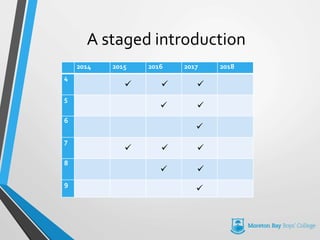
2014 2015 2016 2017 2018
4
  
5
 
6

7
  
8
 
9

A staged introduction
Digital learning program information night

Digital learning program information night

  • 1.
    MBBC Digital LearningProgram Parent Information and Support Evening
  • 2.
    Program for tonight •Introductions • What we’re doing and why • How it looks in a class • Devices • Where to from here • Panel – Q & A
  • 3.
    A digital life •To put technological change into the perspective ….. Look at the launch date of these technologies • 1998Google • 2001Wikipedia • 2001 iPod • 2003 MySpace • 2003 3G mobile phones • 2004 Facebook • 2005YouTube • Our students have only ever known a world with Google,Wikipedia, Myspace/Facebook, and mobile phones with high speed Internet Year 6s born around this time Year 3s born around this time
  • 4.
    Why eLearning? • MelbourneDeclaration Goal 1: Australian schooling promotes equity and excellence Goal 2: All young Australians become: – successful learners – confident and creative individuals – active and informed citizens • UNESCO - systemic economic growth is the key to poverty reduction and increasing prosperity - ICT are engines for growth and tools for empowerment with profound results. • MBBC/MBC Strategic Plan 2014-2018 ….. “Provide learning experiences that reflect contemporary practices in educational research that enable the creation of a dynamic and innovative 21st Century learning environment.”
  • 5.
    21st Century Employment Imaginative / creative  Innovative / problem-solving  Speculative  Flexible  Tolerant  Empathetic  Critical in their thinking  Literate & numerate  Computer literate  Conciliatory  Able to negotiate  Independent  Team-oriented  Diagnostic / research savvy  Able to project consequences  Able to project into the feelings of others C21st Australian employers demand that our graduates be:
  • 8.
    20th century focusededucation 21st century focused education Time-based Outcome-based Focus: memorization of discrete facts Focus: what students Know, Can Do and Are Like after all the details are forgotten Learners work in isolation – classroom within 4 walls Learners work collaboratively with classmates and others around the world – the Global Classroom Teacher-centred: teacher is centre of attention and provider of information/passive Student-centred: teacher is facilitator/coach. Active Lower Order Thinking Higher Order Thinking Literacy is the 3 R’s – reading, writing and math Multiple literacies of the 21st century – aligned to living and working in a globalized new millennium. Factory model, based upon the needs of employers for the Industrial Age of the 19th century. Scientific management. Based upon the needs of employers in the Digital Age of the 21st Century. Curriculum/School is irrelevant and meaningless to the students. Curriculum is connected to students’ interests, experiences, talents and the real world.
  • 9.
    Teaching about technology Teachingwith technology Teaching through technology ICT ICT ICT Curriculum Curriculum Curriculum “The challenge lies in shifting from teaching and learning about ICT to teaching and learning with and through ICT.”
  • 10.
    Background • Current ITprovision • Fibre link • Discussion paper to Principal and Board - research • Appointment of eLearning Co-ordinator • BoardWorking Party • Wireless upgrade, internet bandwidth, PD
  • 11.
    MBBC DIGITAL LEARNINGPROGRAM PRIMARY P – 3 4 - 6 MIDDLE 7 - 9 SENIOR 10 - 12 Digital Citizenship Program Classroom Devices BYO iPad BYO Laptop BYO Device Professional Development Program E Learning Co-ordinator & Committee Primary IT Lab Specialist Labs, Laptop pods
  • 12.
    Why BYOD? • Learninganytime, anywhere without schedule or access restrictions • Parent-financed, allowing schools to devote much-needed funding to other programs or technologies • Devices are commonly more up- to-date with newer features • Development of time management skills for students • Care of the devices – Students learning to take responsibility • Efficiency- Personalized devices…(1 device for school & home) • Allows for immediate application in the classroom • Replicates a technology-rich environment already common in higher education and business • Flexibility—support different learners with different needs
  • 13.
    Where to fromhere • The website Digital Learning Hub http://mbbc.qld.edu.au/curriculum/digital- learning/ • Further Information and Support evenings • Day 0 forYear 4 boys • Follow up letter with details and specifications
  • 14.
    2014 2015 20162017 2018 4    5   6  7    8   9  A staged introduction