DIGITAL
INDIA
MISSION
Introduction
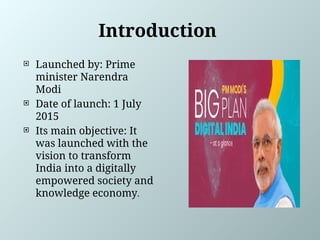
 Launched by: Prime
minister Narendra
Modi
 Date of launch: 1 July
2015
 Its main objective: It
was launched with the
vision to transform
India into a digitally
empowered society and
knowledge economy.
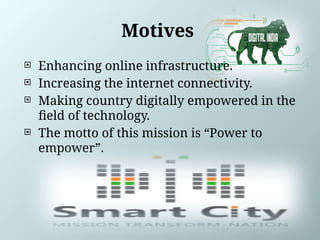
Motives
 Enhancing online infrastructure.
 Increasing the internet connectivity.
 Making country digitally empowered in the
field of technology.
 The motto of this mission is “Power to
empower”.
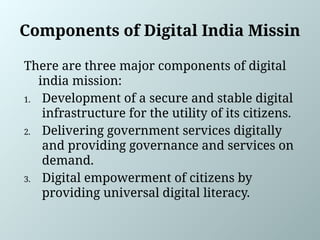
Components of Digital India Missin
There are three major components of digital
india mission:
1. Development of a secure and stable digital
infrastructure for the utility of its citizens.
2. Delivering government services digitally
and providing governance and services on
demand.
3. Digital empowerment of citizens by
providing universal digital literacy.
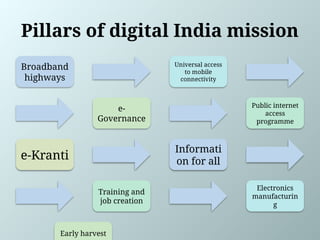
Pillars of digital India mission
Broadband
highways
Universal access
to mobile
connectivity
Public internet
access
programme
e-
Governance
e-Kranti
Informati
on for all
Electronics
manufacturin
g
Training and
job creation
Early harvest
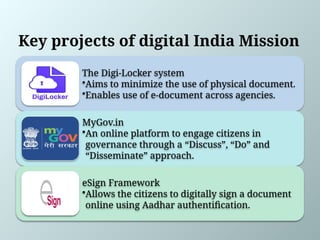
Key projects of digital India Mission
The Digi-Locker system
•Aims to minimize the use of physical document.
•Enables use of e-document across agencies.
MyGov.in
•An online platform to engage citizens in
governance through a “Discuss”, “Do” and
“Disseminate” approach.
eSign Framework
•Allows the citizens to digitally sign a document
online using Aadhar authentification.
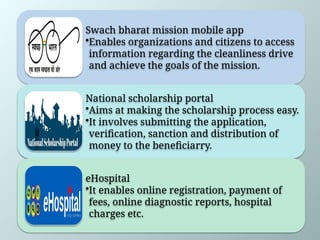
Swach bharat mission mobile app
•Enables organizations and citizens to access
information regarding the cleanliness drive
and achieve the goals of the mission.
National scholarship portal
•Aims at making the scholarship process easy.
•It involves submitting the application,
verification, sanction and distribution of
money to the beneficiarry.
eHospital
•It enables online registration, payment of
fees, online diagnostic reports, hospital
charges etc.
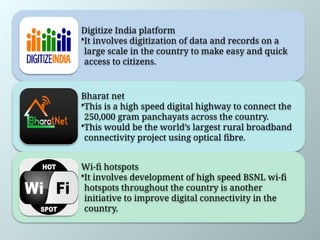
Digitize India platform
•It involves digitization of data and records on a
large scale in the country to make easy and quick
access to citizens.
Bharat net
•This is a high speed digital highway to connect the
250,000 gram panchayats across the country.
•This would be the world’s largest rural broadband
connectivity project using optical fibre.
Wi-fi hotspots
•It involves development of high speed BSNL wi-fi
hotspots throughout the country is another
initiative to improve digital connectivity in the
country.
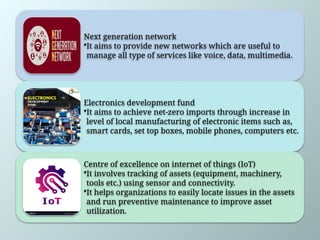
Next generation network
•It aims to provide new networks which are useful to
manage all type of services like voice, data, multimedia.
Electronics development fund
•It aims to achieve net-zero imports through increase in
level of local manufacturing of electronic items such as,
smart cards, set top boxes, mobile phones, computers etc.
Centre of excellence on internet of things (IoT)
•It involves tracking of assets (equipment, machinery,
tools etc.) using sensor and connectivity.
•It helps organizations to easily locate issues in the assets
and run preventive maintenance to improve asset
utilization.
Challenges
 To accommodate such a vast amount of data
India will require massive data centers with
mirroring , mean package of data at alternative
sides.
 Require a large amount of investment and
these data centers have to be technically
robust in order to prevent any failure.
 The biggest challenge is cyber crime in order
to safe guard the data, the government must
strengthen the cyber laws of the country and
have inbuilt security system.
Future vision
 The overall scope of Digital India is to
prepare it for a knowledge future.
 It has to transform IT+ IT= IT and realize
(India Talent)+(Information Technology )= (India
Tomorrow)
This will help to make technology an enabler
of change . If India can implement this
mission efficiently it will make a huge step
in global progress.
Facts and figures
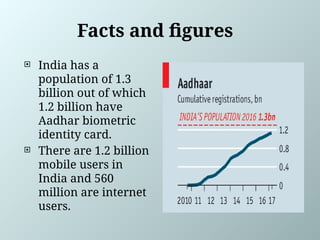
 India has a
population of 1.3
billion out of which
1.2 billion have
Aadhar biometric
identity card.
 There are 1.2 billion
mobile users in
India and 560
million are internet
users.
 The Digital India mission aims to make 6
crore rural households digitally literate by
March 2020.
 Whereby at least one member from each
household will be digitally literate.
It will transform the entire ecosystem of
public services through the use of IT.
Government of India has launched this
mission to make India a knowledge
economy which is digitally empowered.

DIGITAL INDIA MISSION Ppt

  • 1.
  • 2.
    Introduction  Launched by:Prime minister Narendra Modi  Date of launch: 1 July 2015  Its main objective: It was launched with the vision to transform India into a digitally empowered society and knowledge economy.
  • 3.
    Motives  Enhancing onlineinfrastructure.  Increasing the internet connectivity.  Making country digitally empowered in the field of technology.  The motto of this mission is “Power to empower”.
  • 4.
    Components of DigitalIndia Missin There are three major components of digital india mission: 1. Development of a secure and stable digital infrastructure for the utility of its citizens. 2. Delivering government services digitally and providing governance and services on demand. 3. Digital empowerment of citizens by providing universal digital literacy.
  • 5.
    Pillars of digitalIndia mission Broadband highways Universal access to mobile connectivity Public internet access programme e- Governance e-Kranti Informati on for all Electronics manufacturin g Training and job creation Early harvest
  • 6.
    Key projects ofdigital India Mission The Digi-Locker system •Aims to minimize the use of physical document. •Enables use of e-document across agencies. MyGov.in •An online platform to engage citizens in governance through a “Discuss”, “Do” and “Disseminate” approach. eSign Framework •Allows the citizens to digitally sign a document online using Aadhar authentification.
  • 7.
    Swach bharat missionmobile app •Enables organizations and citizens to access information regarding the cleanliness drive and achieve the goals of the mission. National scholarship portal •Aims at making the scholarship process easy. •It involves submitting the application, verification, sanction and distribution of money to the beneficiarry. eHospital •It enables online registration, payment of fees, online diagnostic reports, hospital charges etc.
  • 8.
    Digitize India platform •Itinvolves digitization of data and records on a large scale in the country to make easy and quick access to citizens. Bharat net •This is a high speed digital highway to connect the 250,000 gram panchayats across the country. •This would be the world’s largest rural broadband connectivity project using optical fibre. Wi-fi hotspots •It involves development of high speed BSNL wi-fi hotspots throughout the country is another initiative to improve digital connectivity in the country.
  • 9.
    Next generation network •Itaims to provide new networks which are useful to manage all type of services like voice, data, multimedia. Electronics development fund •It aims to achieve net-zero imports through increase in level of local manufacturing of electronic items such as, smart cards, set top boxes, mobile phones, computers etc. Centre of excellence on internet of things (IoT) •It involves tracking of assets (equipment, machinery, tools etc.) using sensor and connectivity. •It helps organizations to easily locate issues in the assets and run preventive maintenance to improve asset utilization.
  • 10.
    Challenges  To accommodatesuch a vast amount of data India will require massive data centers with mirroring , mean package of data at alternative sides.  Require a large amount of investment and these data centers have to be technically robust in order to prevent any failure.  The biggest challenge is cyber crime in order to safe guard the data, the government must strengthen the cyber laws of the country and have inbuilt security system.
  • 11.
    Future vision  Theoverall scope of Digital India is to prepare it for a knowledge future.  It has to transform IT+ IT= IT and realize (India Talent)+(Information Technology )= (India Tomorrow) This will help to make technology an enabler of change . If India can implement this mission efficiently it will make a huge step in global progress.
  • 12.
    Facts and figures India has a population of 1.3 billion out of which 1.2 billion have Aadhar biometric identity card.  There are 1.2 billion mobile users in India and 560 million are internet users.
  • 13.
     The DigitalIndia mission aims to make 6 crore rural households digitally literate by March 2020.  Whereby at least one member from each household will be digitally literate. It will transform the entire ecosystem of public services through the use of IT. Government of India has launched this mission to make India a knowledge economy which is digitally empowered.