CM3106 Chapter 1: Introduction to 
Multimedia 
Prof David Marshall 
dave.marshall@cs.cardiff.ac.uk 
and 
Dr Kirill Sidorov 
K.Sidorov@cs.cf.ac.uk 
www.facebook.com/kirill.sidorov 
School of Computer Science & Informatics 
Cardi University, UK
Introduction to Multimedia 
What is Multimedia? 
CM3106 Chapter 1 Introduction to Multimedia 2
What is Multimedia? 
Multimedia can have many de
nitions these include: 
A computer system perspective de
nition: 
Multimedia means that computer information can be 
represented through audio, video, and animation in addition to 
traditional media (i.e., text, graphics/drawings, images). 
CM3106 Chapter 1 Introduction to Multimedia 3
General De
nition 
A good general working de
nition for this module is: 
Multimedia is the
eld concerned with the computer 
controlled integration of text, graphics, drawings, still and 
moving images (Video), animation, audio, and any other 
media where every type of information can be represented, 
stored, transmitted and processed digitally. 
CM3106 Chapter 1 Introduction to Multimedia 4
Multimedia Application De
nition 
Multimedia Application: 
A Multimedia Application is an application which uses a 
collection of multiple media sources e.g. text, graphics, 
images, sound/audio, animation and/or video. 
CM3106 Chapter 1 Introduction to Multimedia 5
What is HyperText and HyperMedia? 
Hypertext is a text which contains links to other texts. 
The term was invented by Ted Nelson around 1965. 
CM3106 Chapter 1 Introduction to Multimedia 6
HyperText Navigation 
Traversal through pages of hypertext is therefore usually 
non-linear (as indicated below). 
This has implications in layout and organisation of material | 
and depends a lot on the application at hand. 
CM3106 Chapter 1 Introduction to Multimedia 7
Hypermedia 
Hypermedia de
nition: 
HyperMedia is not constrained to be text-based. It can include 
other media, e.g., graphics, images, and especially continuous 
media { sound and video. 
CM3106 Chapter 1 Introduction to Multimedia 8
Example Hypermedia Applications? 
Example 
CM3106 Chapter 1 Introduction to Multimedia 9
Example Hypermedia Applications? 
The World Wide Web (WWW) is a clear example of a 
hypermedia application. 
Powerpoint 
Adobe Acrobat (or other PDF software) 
Adobe Flash 
Many many others? 
CM3106 Chapter 1 Introduction to Multimedia 10
Multimedia Applications 
Examples of Multimedia Applications include: 
World Wide Web 
Multimedia Authoring, e.g. Adobe/Macromedia Director 
Hypermedia courseware 
Video-on-demand 
Interactive TV 
Computer Games 
Virtual reality 
Digital video editing and production systems 
Multimedia Database systems 
CM3106 Chapter 1 Introduction to Multimedia 11
Multimedia Systems 
Multimedia System De
nition 
A Multimedia System is a system capable of processing 
multimedia data and applications. 
A Multimedia System is characterised by the processing, 
storage, generation, manipulation and rendition of Multimedia 
information. 
CM3106 Chapter 1 Introduction to Multimedia 12
Characteristics of a Multimedia System 
A Multimedia system has four basic characteristics: 
Multimedia systems must be computer controlled. 
Multimedia systems are integrated. 
The information they handle must be represented 
digitally. 
The interface to the
nal presentation of media is usually 
interactive. 
CM3106 Chapter 1 Introduction to Multimedia 13
Challenges for Multimedia Systems 
Distributed Networks 
Temporal relationship between data 
Render dierent data at same time | continuously. 
Sequencing within the media: 
playing frames in correct order/time frame in video 
Synchronisation | inter-media scheduling 
E.g. Video and Audio | Lip synchronisation is clearly 
important for humans to watch playback of video and 
audio and even animation and audio. 
Ever tried watching an out of (lip) sync
lm for a long 
time? 
CM3106 Chapter 1 Introduction to Multimedia 14
Key Issues for Multimedia Systems 
The key issues multimedia systems need to deal with here are: 
How to represent and store temporal information. 
How to strictly maintain the temporal relationships on 
play back/retrieval 
What process are involved in the above. 
Data has to represented digitally | Analog{Digital 
Conversion, Sampling etc. 
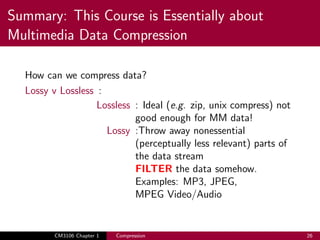
Large Data Requirements | bandwidth, storage, 
Data compression is usually 
mandatory 
CM3106 Chapter 1 Introduction to Multimedia 15
Desirable Features for a Multimedia System 
Given the above challenges the following feature a desirable (if 
not a prerequisite) for a Multimedia System: 
Very High Processing Power | needed to deal with large data 
processing and real time delivery of media. 
Special hardware commonplace. 
Multimedia Capable File System | needed to deliver 
real-time media | e.g. Video/Audio Streaming. 
Special Hardware/Software needed { e.g. RAID technology. 
Data Representations | File Formats that support 
multimedia should be easy to handle yet allow for 
compression/decompression in real-time. 
CM3106 Chapter 1 Introduction to Multimedia 16
Desirable Features for a Multimedia System (cont.) 
Ecient and High I/O | input and output to the

library management system

  • 1.
    CM3106 Chapter 1:Introduction to Multimedia Prof David Marshall dave.marshall@cs.cardiff.ac.uk and Dr Kirill Sidorov K.Sidorov@cs.cf.ac.uk www.facebook.com/kirill.sidorov School of Computer Science & Informatics Cardi University, UK
  • 2.
    Introduction to Multimedia What is Multimedia? CM3106 Chapter 1 Introduction to Multimedia 2
  • 3.
    What is Multimedia? Multimedia can have many de
  • 4.
    nitions these include: A computer system perspective de
  • 5.
    nition: Multimedia meansthat computer information can be represented through audio, video, and animation in addition to traditional media (i.e., text, graphics/drawings, images). CM3106 Chapter 1 Introduction to Multimedia 3
  • 6.
  • 7.
    nition A goodgeneral working de
  • 8.
    nition for thismodule is: Multimedia is the
  • 9.
    eld concerned withthe computer controlled integration of text, graphics, drawings, still and moving images (Video), animation, audio, and any other media where every type of information can be represented, stored, transmitted and processed digitally. CM3106 Chapter 1 Introduction to Multimedia 4
  • 10.
  • 11.
    nition Multimedia Application: A Multimedia Application is an application which uses a collection of multiple media sources e.g. text, graphics, images, sound/audio, animation and/or video. CM3106 Chapter 1 Introduction to Multimedia 5
  • 12.
    What is HyperTextand HyperMedia? Hypertext is a text which contains links to other texts. The term was invented by Ted Nelson around 1965. CM3106 Chapter 1 Introduction to Multimedia 6
  • 13.
    HyperText Navigation Traversalthrough pages of hypertext is therefore usually non-linear (as indicated below). This has implications in layout and organisation of material | and depends a lot on the application at hand. CM3106 Chapter 1 Introduction to Multimedia 7
  • 14.
  • 15.
    nition: HyperMedia isnot constrained to be text-based. It can include other media, e.g., graphics, images, and especially continuous media { sound and video. CM3106 Chapter 1 Introduction to Multimedia 8
  • 16.
    Example Hypermedia Applications? Example CM3106 Chapter 1 Introduction to Multimedia 9
  • 17.
    Example Hypermedia Applications? The World Wide Web (WWW) is a clear example of a hypermedia application. Powerpoint Adobe Acrobat (or other PDF software) Adobe Flash Many many others? CM3106 Chapter 1 Introduction to Multimedia 10
  • 18.
    Multimedia Applications Examplesof Multimedia Applications include: World Wide Web Multimedia Authoring, e.g. Adobe/Macromedia Director Hypermedia courseware Video-on-demand Interactive TV Computer Games Virtual reality Digital video editing and production systems Multimedia Database systems CM3106 Chapter 1 Introduction to Multimedia 11
  • 19.
  • 20.
    nition A MultimediaSystem is a system capable of processing multimedia data and applications. A Multimedia System is characterised by the processing, storage, generation, manipulation and rendition of Multimedia information. CM3106 Chapter 1 Introduction to Multimedia 12
  • 21.
    Characteristics of aMultimedia System A Multimedia system has four basic characteristics: Multimedia systems must be computer controlled. Multimedia systems are integrated. The information they handle must be represented digitally. The interface to the
  • 22.
    nal presentation ofmedia is usually interactive. CM3106 Chapter 1 Introduction to Multimedia 13
  • 23.
    Challenges for MultimediaSystems Distributed Networks Temporal relationship between data Render dierent data at same time | continuously. Sequencing within the media: playing frames in correct order/time frame in video Synchronisation | inter-media scheduling E.g. Video and Audio | Lip synchronisation is clearly important for humans to watch playback of video and audio and even animation and audio. Ever tried watching an out of (lip) sync
  • 24.
    lm for along time? CM3106 Chapter 1 Introduction to Multimedia 14
  • 25.
    Key Issues forMultimedia Systems The key issues multimedia systems need to deal with here are: How to represent and store temporal information. How to strictly maintain the temporal relationships on play back/retrieval What process are involved in the above. Data has to represented digitally | Analog{Digital Conversion, Sampling etc. Large Data Requirements | bandwidth, storage, Data compression is usually mandatory CM3106 Chapter 1 Introduction to Multimedia 15
  • 26.
    Desirable Features fora Multimedia System Given the above challenges the following feature a desirable (if not a prerequisite) for a Multimedia System: Very High Processing Power | needed to deal with large data processing and real time delivery of media. Special hardware commonplace. Multimedia Capable File System | needed to deliver real-time media | e.g. Video/Audio Streaming. Special Hardware/Software needed { e.g. RAID technology. Data Representations | File Formats that support multimedia should be easy to handle yet allow for compression/decompression in real-time. CM3106 Chapter 1 Introduction to Multimedia 16
  • 27.
    Desirable Features fora Multimedia System (cont.) Ecient and High I/O | input and output to the