

Digital Innovations in Asia Looking back, looking ahead 
Mark Inkster 
Chief Digital Officer 
Aegon Asia 
Singapore, 7 November 2014 
Asia Distribution Conference
2 
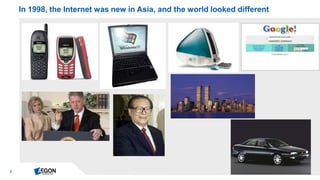
In 1998, the Internet was new in Asia, and the world looked different
3 
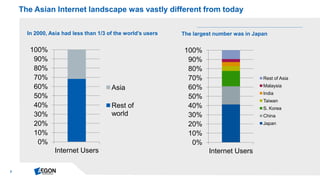
The Asian Internet landscape was vastly different from today 
In 2000, Asia had less than 1/3 of the world’s users 
0% 
10% 
20% 
30% 
40% 
50% 
60% 
70% 
80% 
90% 
100% 
Internet Users 
Asia 
Rest of world 
The largest number was in Japan 
0% 
10% 
20% 
30% 
40% 
50% 
60% 
70% 
80% 
90% 
100% 
Internet Users 
Rest of Asia 
Malaysia 
India 
Taiwan 
S. Korea 
China 
Japan
4 
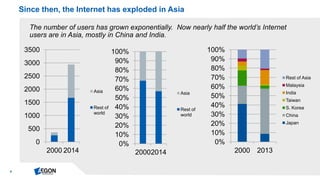
The number of users has grown exponentially. Now nearly half the world’s Internet users are in Asia, mostly in China and India. 
Since then, the Internet has exploded in Asia 
0% 
10% 
20% 
30% 
40% 
50% 
60% 
70% 
80% 
90% 
100% 
2000 
2014 
Asia 
Rest of world 
0% 
10% 
20% 
30% 
40% 
50% 
60% 
70% 
80% 
90% 
100% 
2000 
2013 
Rest of Asia 
Malaysia 
India 
Taiwan 
S. Korea 
China 
Japan 
0 
500 
1000 
1500 
2000 
2500 
3000 
3500 
2000 
2014 
Asia 
Rest of world
5 
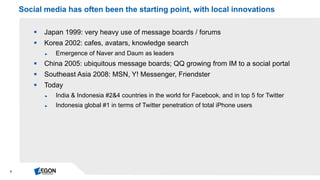
Japan 1999: very heavy use of message boards / forums 
Korea 2002: cafes, avatars, knowledge search 
►Emergence of Naver and Daum as leaders 
China 2005: ubiquitous message boards; QQ growing from IM to a social portal 
Southeast Asia 2008: MSN, Y! Messenger, Friendster 
Today 
►India & Indonesia #2&4 countries in the world for Facebook, and in top 5 for Twitter 
►Indonesia global #1 in terms of Twitter penetration of total iPhone users 
Social media has often been the starting point, with local innovations
6 
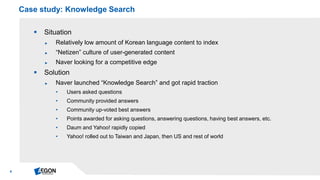
Situation 
►Relatively low amount of Korean language content to index 
►“Netizen” culture of user-generated content 
►Naver looking for a competitive edge 
Solution 
►Naver launched “Knowledge Search” and got rapid traction 
•Users asked questions 
•Community provided answers 
•Community up-voted best answers 
•Points awarded for asking questions, answering questions, having best answers, etc. 
•Daum and Yahoo! rapidly copied 
•Yahoo! rolled out to Taiwan and Japan, then US and rest of world 
Case study: Knowledge Search
7 
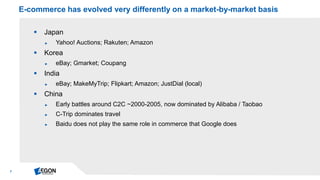
Japan 
►Yahoo! Auctions; Rakuten; Amazon 
Korea 
►eBay; Gmarket; Coupang 
India 
►eBay; MakeMyTrip; Flipkart; Amazon; JustDial (local) 
China 
►Early battles around C2C ~2000-2005, now dominated by Alibaba / Taobao 
►C-Trip dominates travel 
►Baidu does not play the same role in commerce that Google does 
E-commerce has evolved very differently on a market-by-market basis
8 
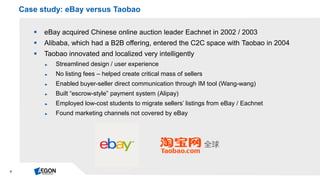
eBay acquired Chinese online auction leader Eachnet in 2002 / 2003 
Alibaba, which had a B2B offering, entered the C2C space with Taobao in 2004 
Taobao innovated and localized very intelligently 
►Streamlined design / user experience 
►No listing fees – helped create critical mass of sellers 
►Enabled buyer-seller direct communication through IM tool (Wang-wang) 
►Built “escrow-style” payment system (Alipay) 
►Employed low-cost students to migrate sellers’ listings from eBay / Eachnet 
►Found marketing channels not covered by eBay 
Case study: eBay versus Taobao
9 
Goal was to build an online travel agency, but users and infrastructure were not ready 
Started with membership cards, call center, web site 
Added travel guides and reviews 
Set up physical desks at airports 
Over time, traffic shifted from call-center to web / mobile 
Case study: Ctrip
10 
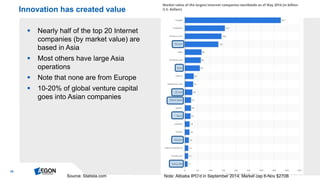
Nearly half of the top 20 Internet companies (by market value) are based in Asia 
Most others have large Asia operations 
Note that none are from Europe 
10-20% of global venture capital goes into Asian companies 
Innovation has created value 
Source: Statista.com 
Note: Alibaba IPO’d in September 2014; Market cap 6-Nov $270B
11 
How do these trends extrapolate into the future, and what does it mean for insurance?
12 
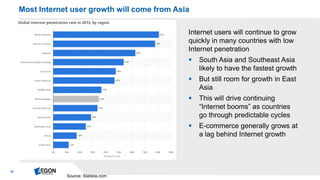
Internet users will continue to grow quickly in many countries with low Internet penetration 
South Asia and Southeast Asia likely to have the fastest growth 
But still room for growth in East Asia 
This will drive continuing “Internet booms” as countries go through predictable cycles 
E-commerce generally grows at a lag behind Internet growth 
Most Internet user growth will come from Asia 
Source: Statista.com
13 
Relatively self-contained ecosystems in China, Japan and Korea 
Australia tightly integrated with the global system 
India big enough that there will be local giants, but integrated enough with the global Internet system that some global players will also win 
Southeast Asia will be a mix of local, regional and global winners 
Asia will evolve along different paths than the US or Europe have taken 
►Mobile-centric 
►More online/offline combined models, especially in emerging markets 
►Skipping generations (e.g., Facebook instead of message boards) 
The Internet will continue to be complex in Asia
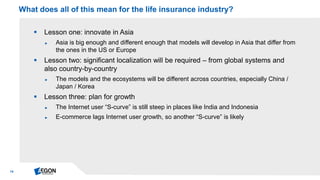
14 
Lesson one: innovate in Asia 
►Asia is big enough and different enough that models will develop in Asia that differ from the ones in the US or Europe 
Lesson two: significant localization will be required – from global systems and also country-by-country 
►The models and the ecosystems will be different across countries, especially China / Japan / Korea 
Lesson three: plan for growth 
►The Internet user “S-curve” is still steep in places like India and Indonesia 
►E-commerce lags Internet user growth, so another “S-curve” is likely 
What does all of this mean for the life insurance industry?
15 
Q & A

Digital Innovations in Asia by Mark Inkster

  • 1.
    Digital Innovations inAsia Looking back, looking ahead Mark Inkster Chief Digital Officer Aegon Asia Singapore, 7 November 2014 Asia Distribution Conference
  • 2.
    2 In 1998,the Internet was new in Asia, and the world looked different
  • 3.
    3 The AsianInternet landscape was vastly different from today In 2000, Asia had less than 1/3 of the world’s users 0% 10% 20% 30% 40% 50% 60% 70% 80% 90% 100% Internet Users Asia Rest of world The largest number was in Japan 0% 10% 20% 30% 40% 50% 60% 70% 80% 90% 100% Internet Users Rest of Asia Malaysia India Taiwan S. Korea China Japan
  • 4.
    4 The numberof users has grown exponentially. Now nearly half the world’s Internet users are in Asia, mostly in China and India. Since then, the Internet has exploded in Asia 0% 10% 20% 30% 40% 50% 60% 70% 80% 90% 100% 2000 2014 Asia Rest of world 0% 10% 20% 30% 40% 50% 60% 70% 80% 90% 100% 2000 2013 Rest of Asia Malaysia India Taiwan S. Korea China Japan 0 500 1000 1500 2000 2500 3000 3500 2000 2014 Asia Rest of world
  • 5.
    5 Japan 1999:very heavy use of message boards / forums Korea 2002: cafes, avatars, knowledge search ►Emergence of Naver and Daum as leaders China 2005: ubiquitous message boards; QQ growing from IM to a social portal Southeast Asia 2008: MSN, Y! Messenger, Friendster Today ►India & Indonesia #2&4 countries in the world for Facebook, and in top 5 for Twitter ►Indonesia global #1 in terms of Twitter penetration of total iPhone users Social media has often been the starting point, with local innovations
  • 6.
    6 Situation ►Relativelylow amount of Korean language content to index ►“Netizen” culture of user-generated content ►Naver looking for a competitive edge Solution ►Naver launched “Knowledge Search” and got rapid traction •Users asked questions •Community provided answers •Community up-voted best answers •Points awarded for asking questions, answering questions, having best answers, etc. •Daum and Yahoo! rapidly copied •Yahoo! rolled out to Taiwan and Japan, then US and rest of world Case study: Knowledge Search
  • 7.
    7 Japan ►Yahoo!Auctions; Rakuten; Amazon Korea ►eBay; Gmarket; Coupang India ►eBay; MakeMyTrip; Flipkart; Amazon; JustDial (local) China ►Early battles around C2C ~2000-2005, now dominated by Alibaba / Taobao ►C-Trip dominates travel ►Baidu does not play the same role in commerce that Google does E-commerce has evolved very differently on a market-by-market basis
  • 8.
    8 eBay acquiredChinese online auction leader Eachnet in 2002 / 2003 Alibaba, which had a B2B offering, entered the C2C space with Taobao in 2004 Taobao innovated and localized very intelligently ►Streamlined design / user experience ►No listing fees – helped create critical mass of sellers ►Enabled buyer-seller direct communication through IM tool (Wang-wang) ►Built “escrow-style” payment system (Alipay) ►Employed low-cost students to migrate sellers’ listings from eBay / Eachnet ►Found marketing channels not covered by eBay Case study: eBay versus Taobao
  • 9.
    9 Goal wasto build an online travel agency, but users and infrastructure were not ready Started with membership cards, call center, web site Added travel guides and reviews Set up physical desks at airports Over time, traffic shifted from call-center to web / mobile Case study: Ctrip
  • 10.
    10 Nearly halfof the top 20 Internet companies (by market value) are based in Asia Most others have large Asia operations Note that none are from Europe 10-20% of global venture capital goes into Asian companies Innovation has created value Source: Statista.com Note: Alibaba IPO’d in September 2014; Market cap 6-Nov $270B
  • 11.
    11 How dothese trends extrapolate into the future, and what does it mean for insurance?
  • 12.
    12 Internet userswill continue to grow quickly in many countries with low Internet penetration South Asia and Southeast Asia likely to have the fastest growth But still room for growth in East Asia This will drive continuing “Internet booms” as countries go through predictable cycles E-commerce generally grows at a lag behind Internet growth Most Internet user growth will come from Asia Source: Statista.com
  • 13.
    13 Relatively self-containedecosystems in China, Japan and Korea Australia tightly integrated with the global system India big enough that there will be local giants, but integrated enough with the global Internet system that some global players will also win Southeast Asia will be a mix of local, regional and global winners Asia will evolve along different paths than the US or Europe have taken ►Mobile-centric ►More online/offline combined models, especially in emerging markets ►Skipping generations (e.g., Facebook instead of message boards) The Internet will continue to be complex in Asia
  • 14.
    14 Lesson one:innovate in Asia ►Asia is big enough and different enough that models will develop in Asia that differ from the ones in the US or Europe Lesson two: significant localization will be required – from global systems and also country-by-country ►The models and the ecosystems will be different across countries, especially China / Japan / Korea Lesson three: plan for growth ►The Internet user “S-curve” is still steep in places like India and Indonesia ►E-commerce lags Internet user growth, so another “S-curve” is likely What does all of this mean for the life insurance industry?
  • 15.