Peter Brantley       EU Presidency
Open Book Alliance   Madrid Spain
San Francisco        04.2010
“[A] book is a machine to think with.”

- I. A. Richards,
- Principles of Literary Criticism, 1924
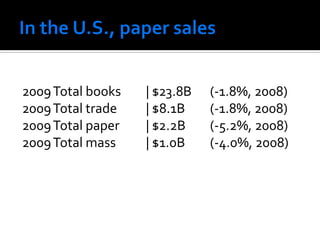
2009 Total books   | $23.8B   (-1.8%, 2008)
2009 Total trade   | $8.1B    (-1.8%, 2008)
2009 Total paper   | $2.2B    (-5.2%, 2008)
2009 Total mass    | $1.0B    (-4.0%, 2008)
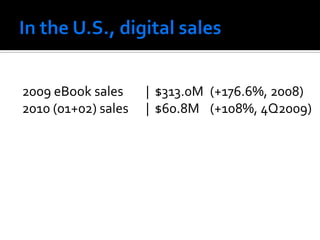
2009 eBook sales     | $313.0M (+176.6%, 2008)
2010 (01+02) sales   | $60.8M (+108%, 4Q2009)
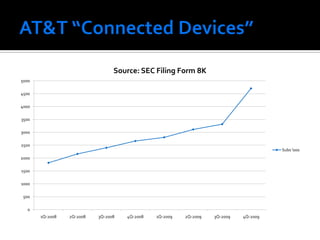
Source: SEC Filing Form 8K
5000

4500

4000

3500

3000

2500
                                                                                       Subs '000
2000

1500

1000

 500

  0
       1Q-2008   2Q-2008   3Q-2008   4Q-2008   1Q-2009   2Q-2009   3Q-2009   4Q-2009
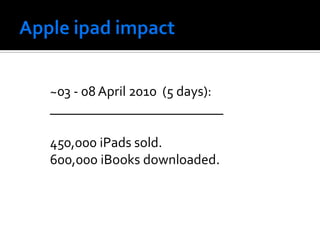
~03 - 08 April 2010 (5 days):
_________________________

450,000 iPads sold.
600,000 iBooks downloaded.
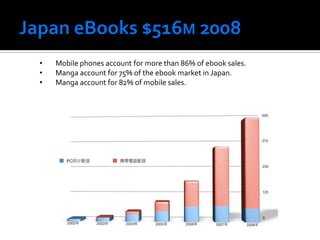
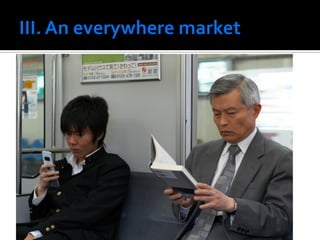
•   Mobile phones account for more than 86% of ebook sales.
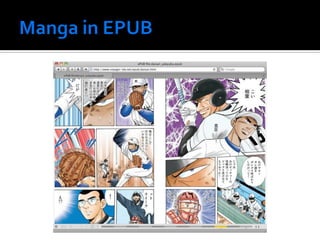
•   Manga account for 75% of the ebook market in Japan.
•   Manga account for 82% of mobile sales.
Historically, PDF for print page representation.
IDPF’s EPUB for reflowable content.

EPUB = “web site in a file”
EPUB = xhtml + css + metadata

Apple and Google utilize EPUB format.
Amazon MOBI - proprietary.
EPUB = (also) DTBook + css + metadata

EPUB and DAISY aligning next generation
formats to ensure their continued interop.

Designing for the web aids accessible design.
EPUB + TTS will become more prevalent.
Open source TTS engines (e.g. Festival).
Devices, Delivery, Stores

 Early ebook systems married devices with
 delivery and existing stores. Apple iBooks,
 Amazon Kindle, B&N Nook.

 Trend is to promulgate the buying and
 reading experiences through the web.
“Devices without web connections
are not landlocked, they are landfill.”

“Cloud based systems offer users
flexibility and ebook capabilities
beyond just text on the screen.”

              - Liza Daly, Threepress Consulting
Ebooks are being enhanced with non-textual
media (video, audio, interactivity) and reader
driven non-linear narratives.

“Many of Penguin’s iPad books seem hardly
to resemble “books” at all, but rather very
interactive learning experiences ... ”
                         - PaidContent UK
Apple and Google are investing in HTML5.
Next generation web document standard.
Streamlined media, structure, data handling.

 Most major web browsers moving to support
 HTML5, including those on “smartphones”.

 Designing for the future of EPUB =
 designing for the (mobile) web.
Pressure to move digital books from self-
    contained packages of media assets to a set
    of pointers to network located resources.

    Impacts:

 Mobile access (size, complexity)
 Rights manifests (use vs. acquisition)
 Content sourcing (contracted vs. user gen)
Networked digital books will stretch our
understanding of what a book can be.

Digital book experiences of the future will be
delivered in browser-based reading engines.
What readers want to have ..

Be able to find the books they want,
in the formats that they can use, for
the reading platform of their choice.
What publishers, libraries, bookstores want -

Make books available for discovery,
with accurate descriptive information,
at as many different places as possible,
under the sales / use terms permitted.
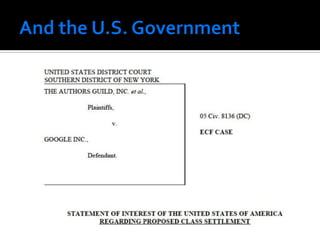
The U.S. Department of Justice advocates:

“[book] data provided should be available in
multiple, standard, open formats supported
by a wide variety of different applications,
devices, and screens.”
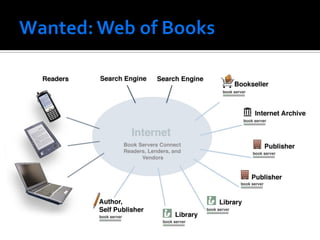
Creating a new architecture using common,
open standards that permits people to find,
buy, acquire, and read books from any source,
on any platform, using many different ebook
applications.
A list of the titles available -

 information about each title,
 formats the title is available in,
 costs associated with the title &
 ways the title can be acquired.
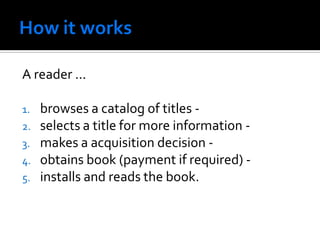
A reader ...

1.   browses a catalog of titles -
2.   selects a title for more information -
3.   makes a acquisition decision -
4.   obtains book (payment if required) -
5.   installs and reads the book.
Because we use open standards for
    describing data, it is possible to link
    bibliographic book data more easily.

      Book reviews
      Reading lists
      Annotations
An open and freely accessible digital public
library is the cornerstone of our democratic
society.

A fundamental right to basic information
access regardless of income or location is
essential for societal development.
Private + Public partnerships combine the
vision and guardianship role of government
with ingenuity, resources, and flexibility of
the private sector.

In the U.S., the Library of Congress and the
Copyright Office are integral to any solution
helping to realize this vision.
Copyright protection is a primary catalyst 4
authorship and creativity. The legitimate
rights of authors & publishers should not be
preemptively seized by private agreements.

 Rightsholders must retain reasonable levels
of control over the use of works conditioned
through legislative processes.
Digitization of works with uncertain rights
(“orphan works”) should be deposited into
national public library infrastructures.

Legislation endorsing digital deposit and
providing for licensed access mechanisms can
engender viable markets for consumer access
to digitized books.
Regulated, interactive public-private rights
registries can permit the rapid identification
of works while maintaining control, licensing,
and compensation for books with known
copyright holders.

Books know no borders. Core rights data
must be exposed through an internationally
specified network of registry managers.
Contact :

             peter brantley

             internet archive
             san francisco ca

            @naypinya (twitter)
            peter @archive.org

Digital book markets: Building markets for access

  • 1.
    Peter Brantley EU Presidency Open Book Alliance Madrid Spain San Francisco 04.2010
  • 3.
    “[A] book isa machine to think with.” - I. A. Richards, - Principles of Literary Criticism, 1924
  • 4.
    2009 Total books | $23.8B (-1.8%, 2008) 2009 Total trade | $8.1B (-1.8%, 2008) 2009 Total paper | $2.2B (-5.2%, 2008) 2009 Total mass | $1.0B (-4.0%, 2008)
  • 5.
    2009 eBook sales | $313.0M (+176.6%, 2008) 2010 (01+02) sales | $60.8M (+108%, 4Q2009)
  • 7.
    Source: SEC FilingForm 8K 5000 4500 4000 3500 3000 2500 Subs '000 2000 1500 1000 500 0 1Q-2008 2Q-2008 3Q-2008 4Q-2008 1Q-2009 2Q-2009 3Q-2009 4Q-2009
  • 8.
    ~03 - 08April 2010 (5 days): _________________________ 450,000 iPads sold. 600,000 iBooks downloaded.
  • 9.
    Mobile phones account for more than 86% of ebook sales. • Manga account for 75% of the ebook market in Japan. • Manga account for 82% of mobile sales.
  • 11.
    Historically, PDF forprint page representation. IDPF’s EPUB for reflowable content. EPUB = “web site in a file” EPUB = xhtml + css + metadata Apple and Google utilize EPUB format. Amazon MOBI - proprietary.
  • 12.
    EPUB = (also)DTBook + css + metadata EPUB and DAISY aligning next generation formats to ensure their continued interop. Designing for the web aids accessible design. EPUB + TTS will become more prevalent. Open source TTS engines (e.g. Festival).
  • 13.
    Devices, Delivery, Stores Early ebook systems married devices with delivery and existing stores. Apple iBooks, Amazon Kindle, B&N Nook. Trend is to promulgate the buying and reading experiences through the web.
  • 14.
    “Devices without webconnections are not landlocked, they are landfill.” “Cloud based systems offer users flexibility and ebook capabilities beyond just text on the screen.” - Liza Daly, Threepress Consulting
  • 15.
    Ebooks are beingenhanced with non-textual media (video, audio, interactivity) and reader driven non-linear narratives. “Many of Penguin’s iPad books seem hardly to resemble “books” at all, but rather very interactive learning experiences ... ” - PaidContent UK
  • 16.
    Apple and Googleare investing in HTML5. Next generation web document standard. Streamlined media, structure, data handling. Most major web browsers moving to support HTML5, including those on “smartphones”. Designing for the future of EPUB = designing for the (mobile) web.
  • 17.
    Pressure to movedigital books from self- contained packages of media assets to a set of pointers to network located resources. Impacts:  Mobile access (size, complexity)  Rights manifests (use vs. acquisition)  Content sourcing (contracted vs. user gen)
  • 18.
    Networked digital bookswill stretch our understanding of what a book can be. Digital book experiences of the future will be delivered in browser-based reading engines.
  • 20.
    What readers wantto have .. Be able to find the books they want, in the formats that they can use, for the reading platform of their choice.
  • 21.
    What publishers, libraries,bookstores want - Make books available for discovery, with accurate descriptive information, at as many different places as possible, under the sales / use terms permitted.
  • 23.
    The U.S. Departmentof Justice advocates: “[book] data provided should be available in multiple, standard, open formats supported by a wide variety of different applications, devices, and screens.”
  • 25.
    Creating a newarchitecture using common, open standards that permits people to find, buy, acquire, and read books from any source, on any platform, using many different ebook applications.
  • 27.
    A list ofthe titles available -  information about each title,  formats the title is available in,  costs associated with the title &  ways the title can be acquired.
  • 28.
    A reader ... 1. browses a catalog of titles - 2. selects a title for more information - 3. makes a acquisition decision - 4. obtains book (payment if required) - 5. installs and reads the book.
  • 29.
    Because we useopen standards for describing data, it is possible to link bibliographic book data more easily.  Book reviews  Reading lists  Annotations
  • 32.
    An open andfreely accessible digital public library is the cornerstone of our democratic society. A fundamental right to basic information access regardless of income or location is essential for societal development.
  • 33.
    Private + Publicpartnerships combine the vision and guardianship role of government with ingenuity, resources, and flexibility of the private sector. In the U.S., the Library of Congress and the Copyright Office are integral to any solution helping to realize this vision.
  • 34.
    Copyright protection isa primary catalyst 4 authorship and creativity. The legitimate rights of authors & publishers should not be preemptively seized by private agreements. Rightsholders must retain reasonable levels of control over the use of works conditioned through legislative processes.
  • 35.
    Digitization of workswith uncertain rights (“orphan works”) should be deposited into national public library infrastructures. Legislation endorsing digital deposit and providing for licensed access mechanisms can engender viable markets for consumer access to digitized books.
  • 36.
    Regulated, interactive public-privaterights registries can permit the rapid identification of works while maintaining control, licensing, and compensation for books with known copyright holders. Books know no borders. Core rights data must be exposed through an internationally specified network of registry managers.
  • 38.
    Contact : peter brantley internet archive san francisco ca @naypinya (twitter) peter @archive.org