#Digidisciple: issues and
opportunities for the Christian
sector in a digital age
Dr Bex Lewis, Research Fellow in Social
Media and Online Learning, CODEC, St
John’s, Durham University
@drbexl
@drbexl
@drbexl
@drbexl
@drbexl
@drbexl
@drbexl
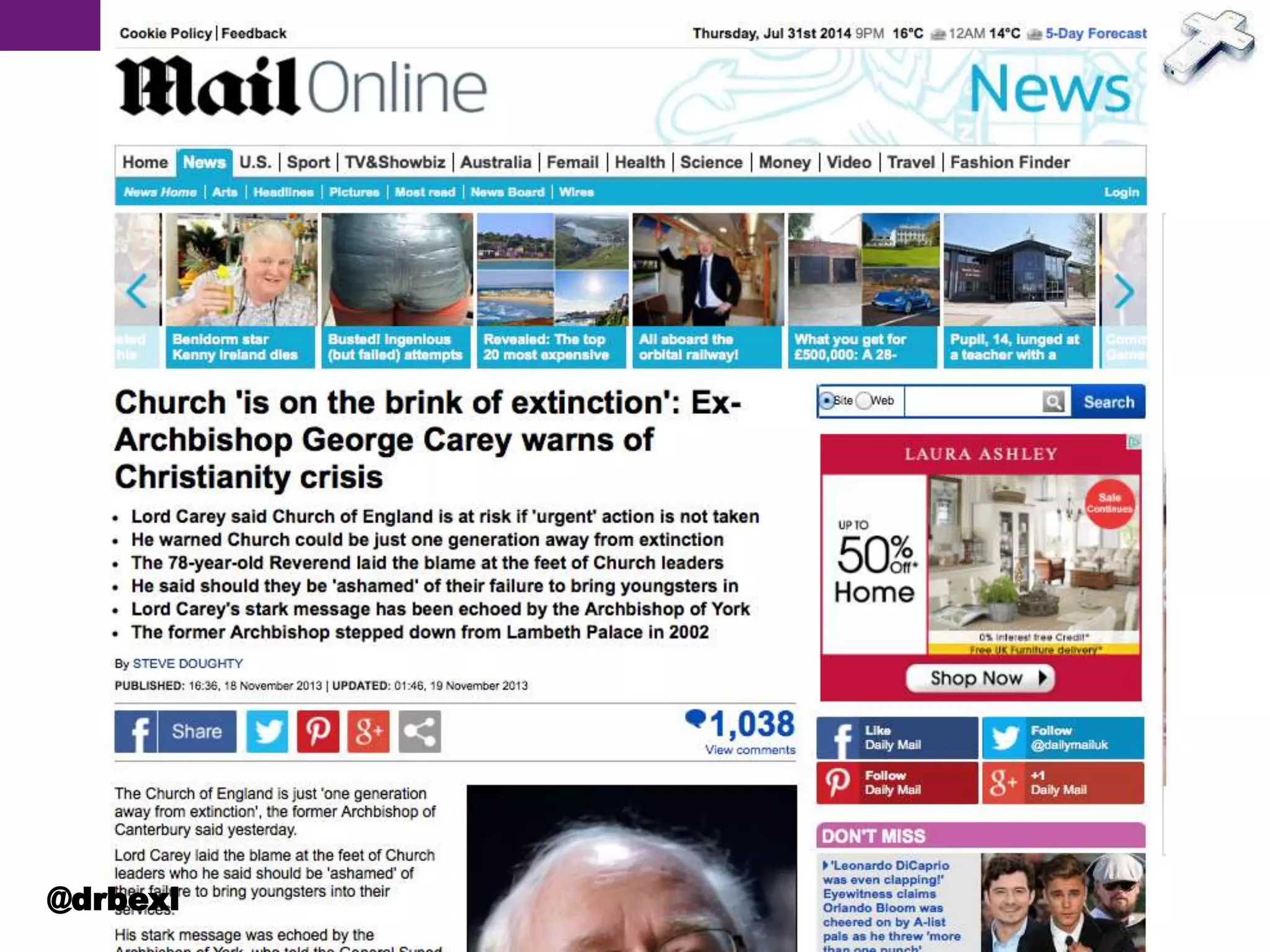
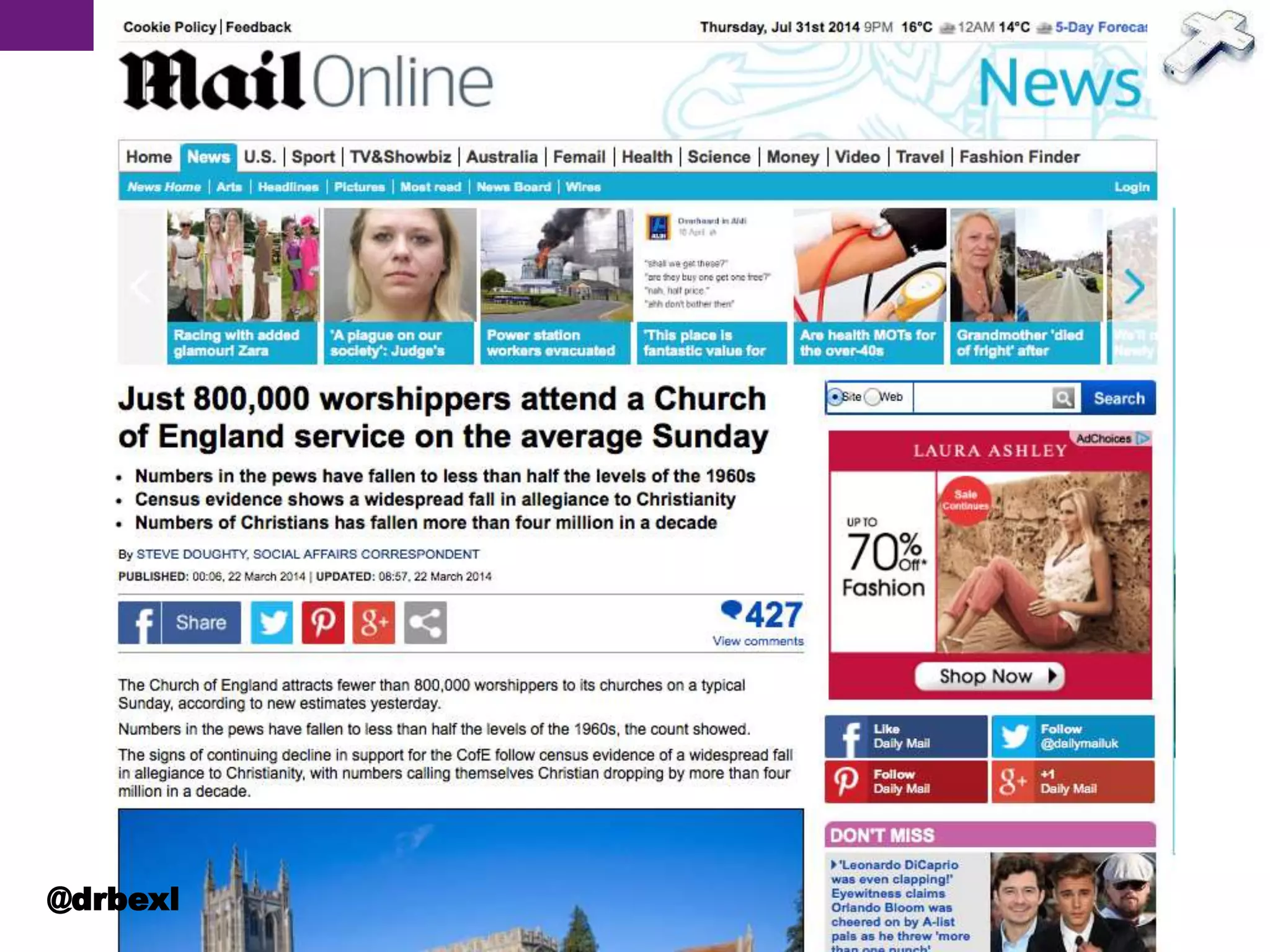
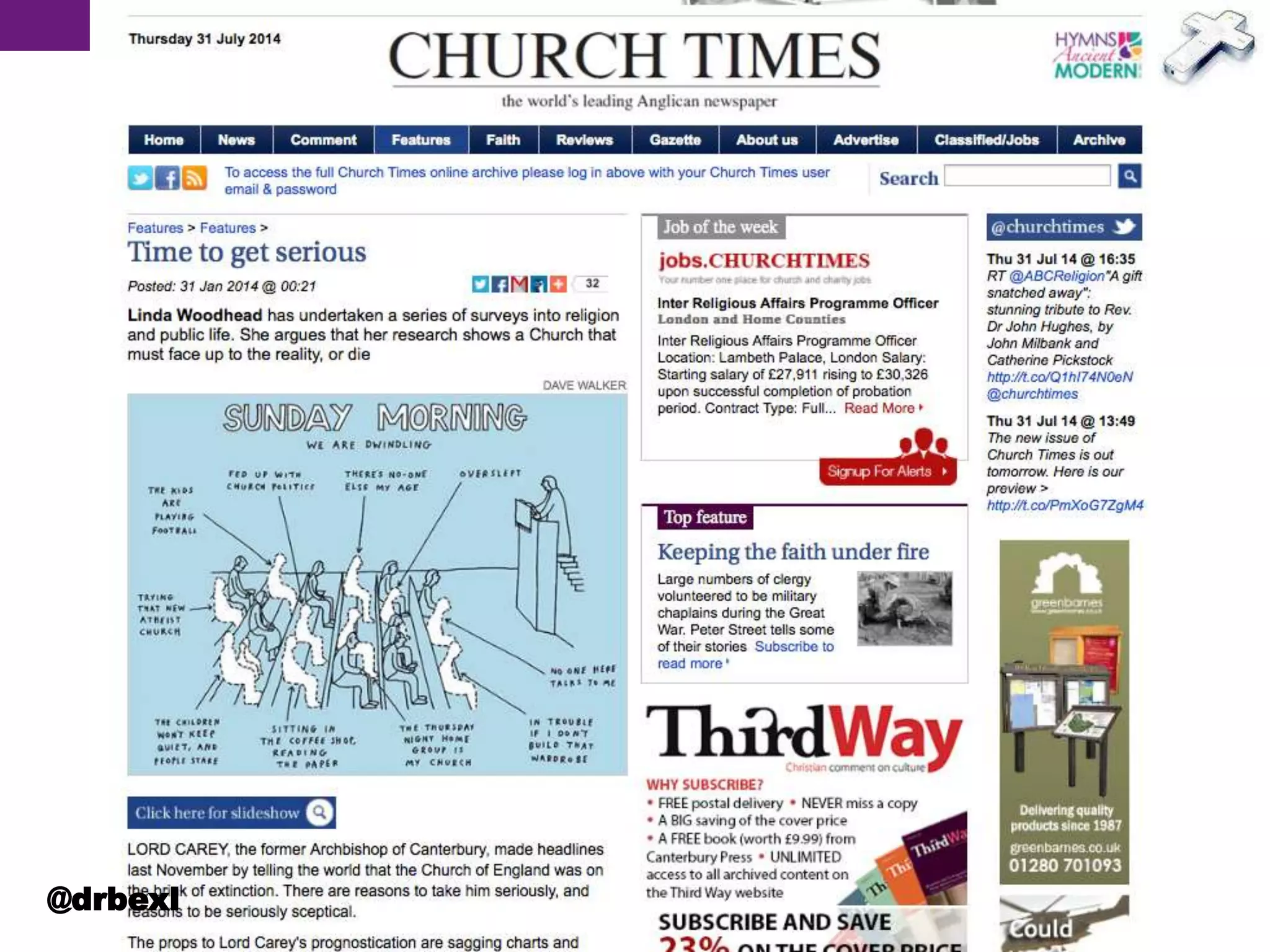
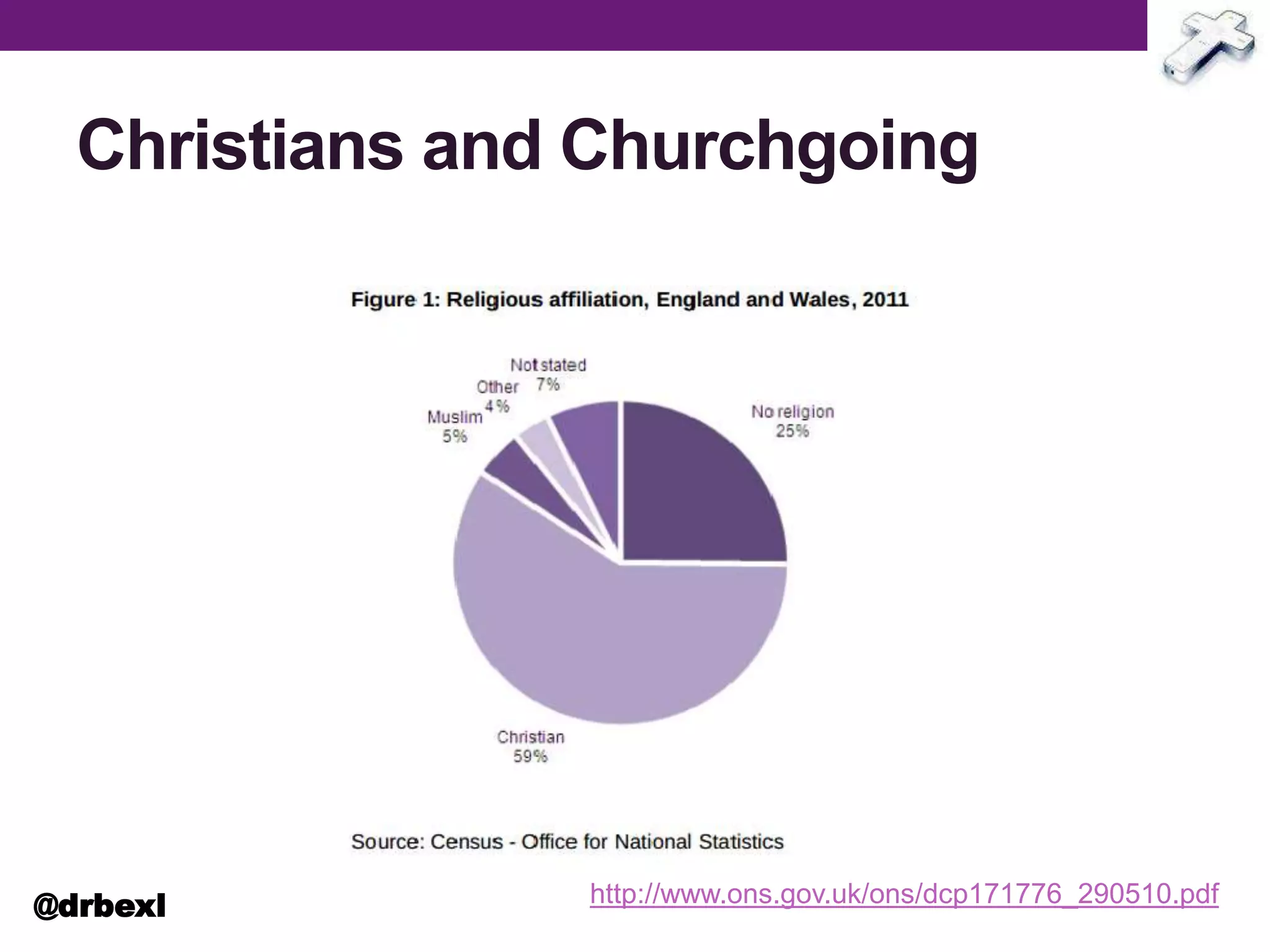
Christians and Churchgoing
http://www.ons.gov.uk/ons/dcp171776_290510.pdf@drbexl
The Church Front Door?
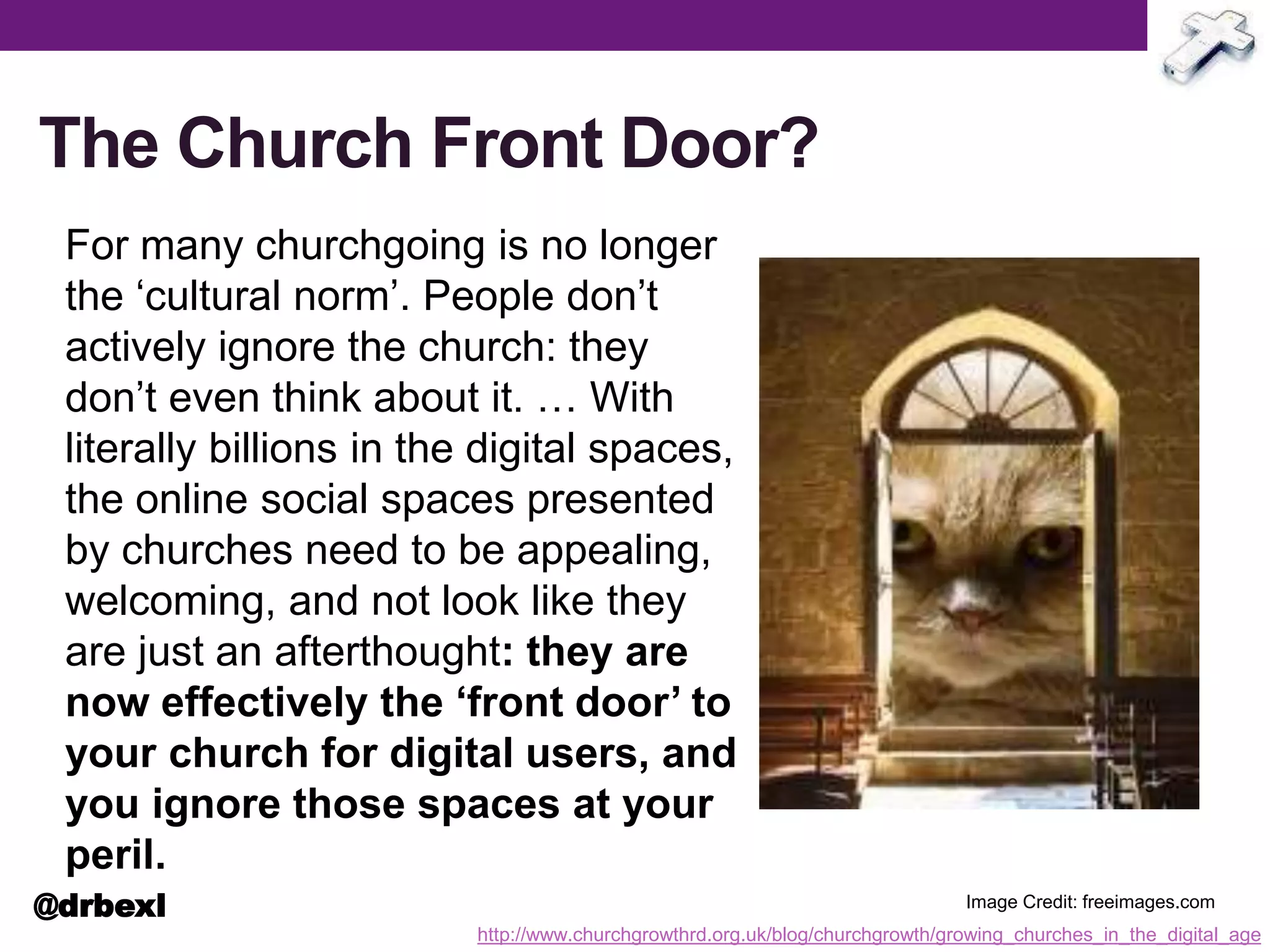
For many churchgoing is no longer
the ‘cultural norm’. People don’t
actively ignore the church: they
don’t even think about it. … With
literally billions in the digital spaces,
the online social spaces presented
by churches need to be appealing,
welcoming, and not look like they
are just an afterthought: they are
now effectively the ‘front door’ to
your church for digital users, and
you ignore those spaces at your
peril.
http://www.churchgrowthrd.org.uk/blog/churchgrowth/growing_churches_in_the_digital_age
Image Credit: freeimages.com@drbexl
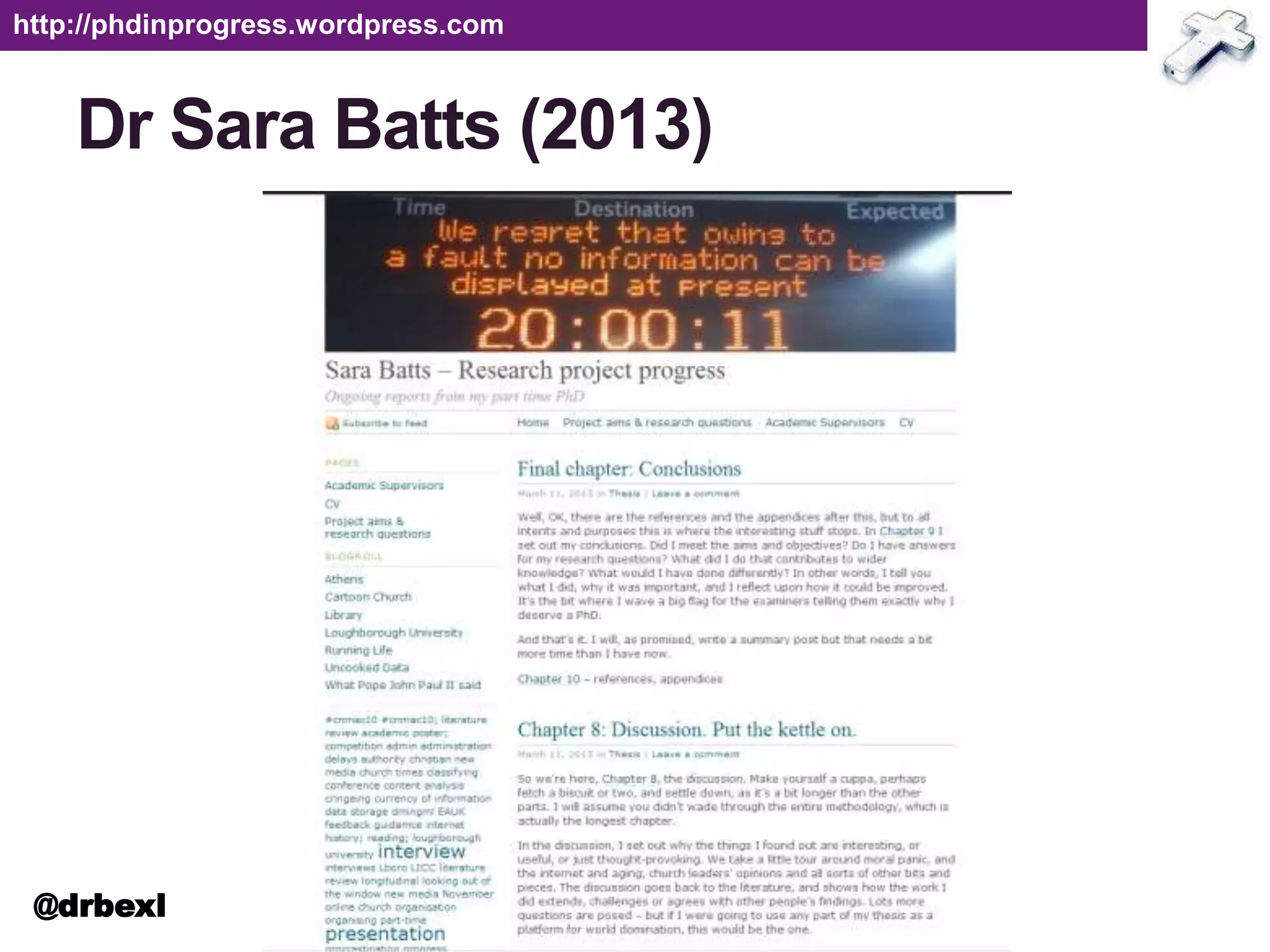
Dr Sara Batts (2013)
http://phdinprogress.wordpress.com
@drbexl
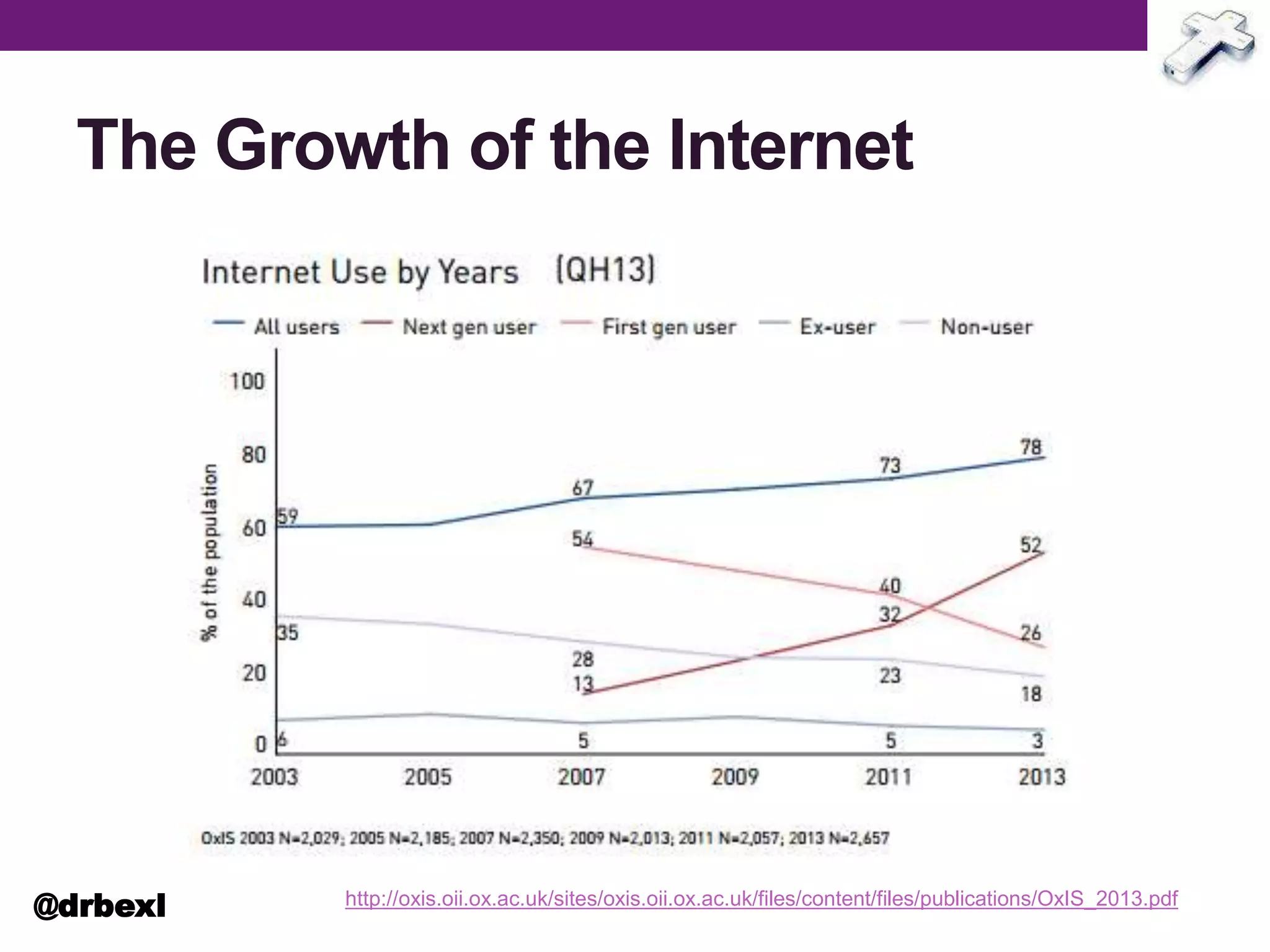
The Growth of the Internet
http://oxis.oii.ox.ac.uk/sites/oxis.oii.ox.ac.uk/files/content/files/publications/OxIS_2013.pdf
@drbexl
"If you want to build a presence in the social media
platform, then you need to be present."
- @unmarketing
@drbexl
@drbexl
The digital environment is not a parallel or purely virtual
world, but is part of the daily experience of many people,
especially the young. Social networks are the result of
human interaction, but for their part they also reshape the
dynamics of communication, which builds relationships: a
considered understanding of this environment is
therefore a prerequisite for a significant presence
there.
Pope Benedict XVI (2013)
@drbexl
“Bringing the young in…?”
• “Jake told the executive that he
never goes directly to a brand like
this man’s newspaper or even to
blogs he likes. ... he reads a lot of
news – far more than I did at his
age. But he goes to that news only
via the links from Digg, friends’
blogs, and Twitter. He travels all
around the internet that is edited by
his peers because he trusts them
and knows they share his
interests. The web of trust is built
at eye-level, peer-to-peer.” (Jarvis,
p.86, my emphasis)
@drbexl
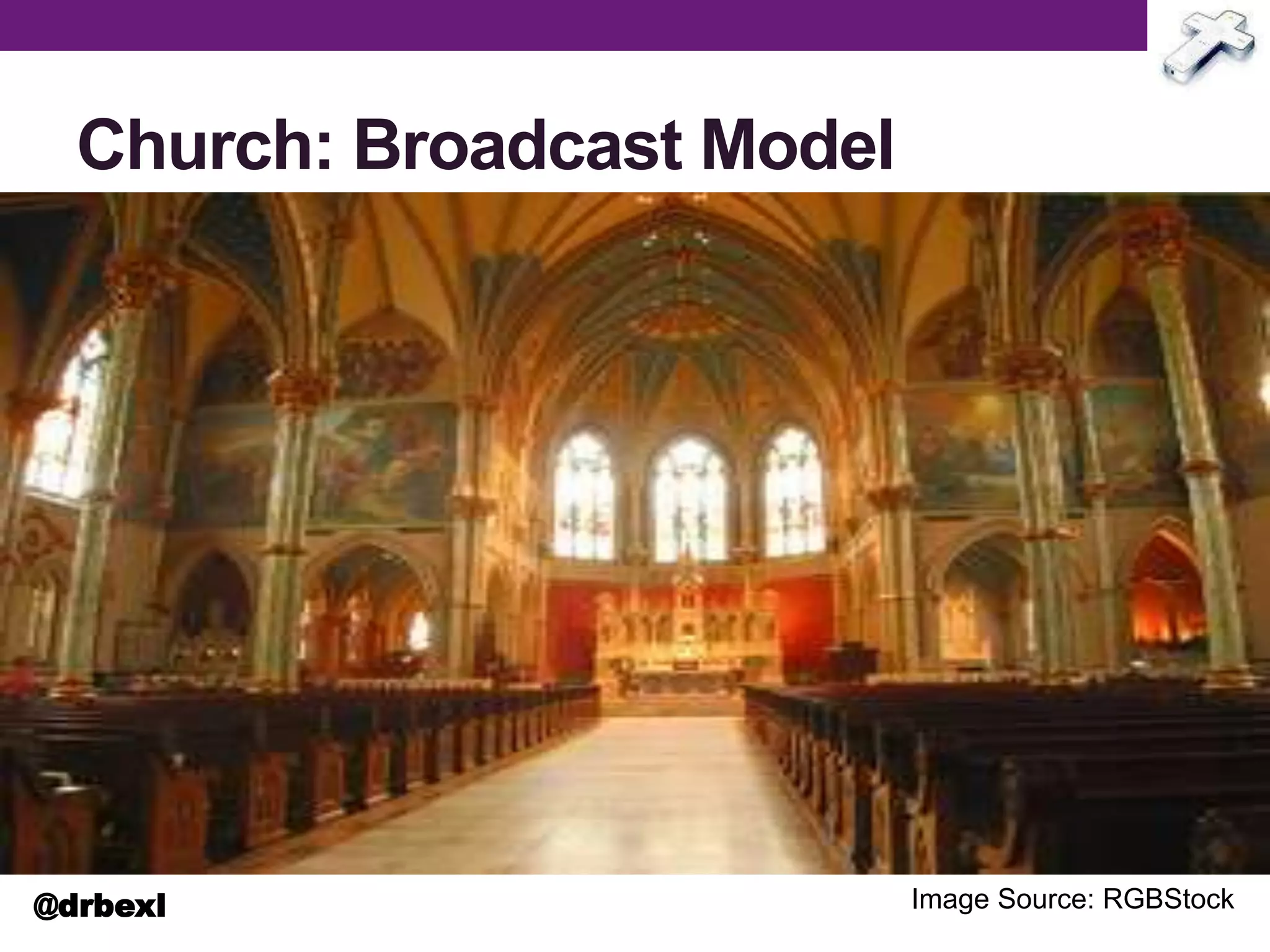
Church: Broadcast Model
Image Source: RGBStock@drbexl
Image Source: Stockfresh@drbexl
New Opportunities
Image Source: Stockfresh@drbexl
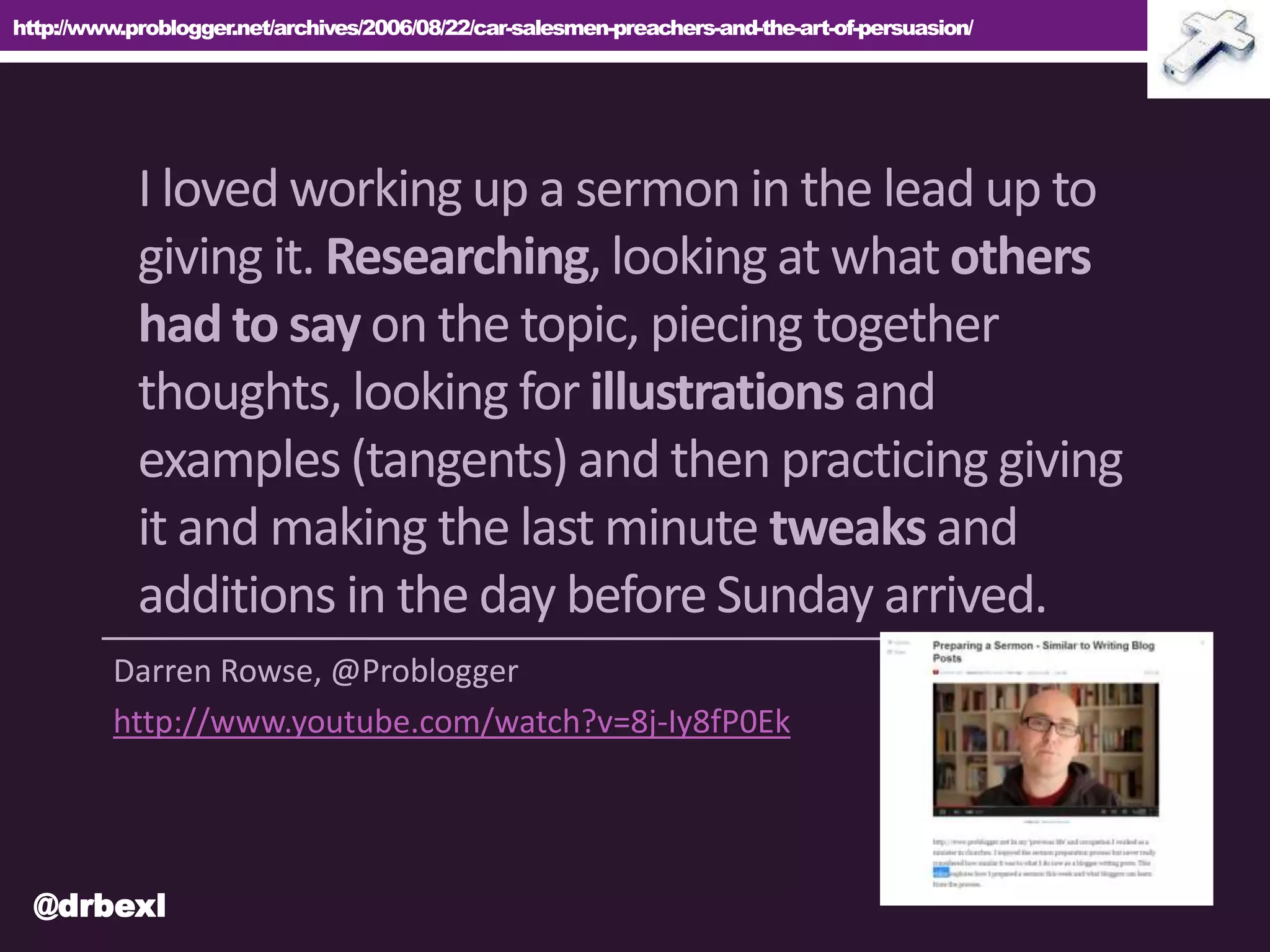
http://www.problogger.net/archives/2006/08/22/car-salesmen-preachers-and-the-art-of-persuasion/
Darren Rowse, @Problogger
http://www.youtube.com/watch?v=8j-Iy8fP0Ek
I loved working up a sermon in the lead up to
giving it. Researching,looking at what others
had to say on the topic, piecing together
thoughts, looking for illustrations and
examples (tangents) and then practicing giving
it and making the last minute tweaks and
additions in the day before Sunday arrived.
@drbexl
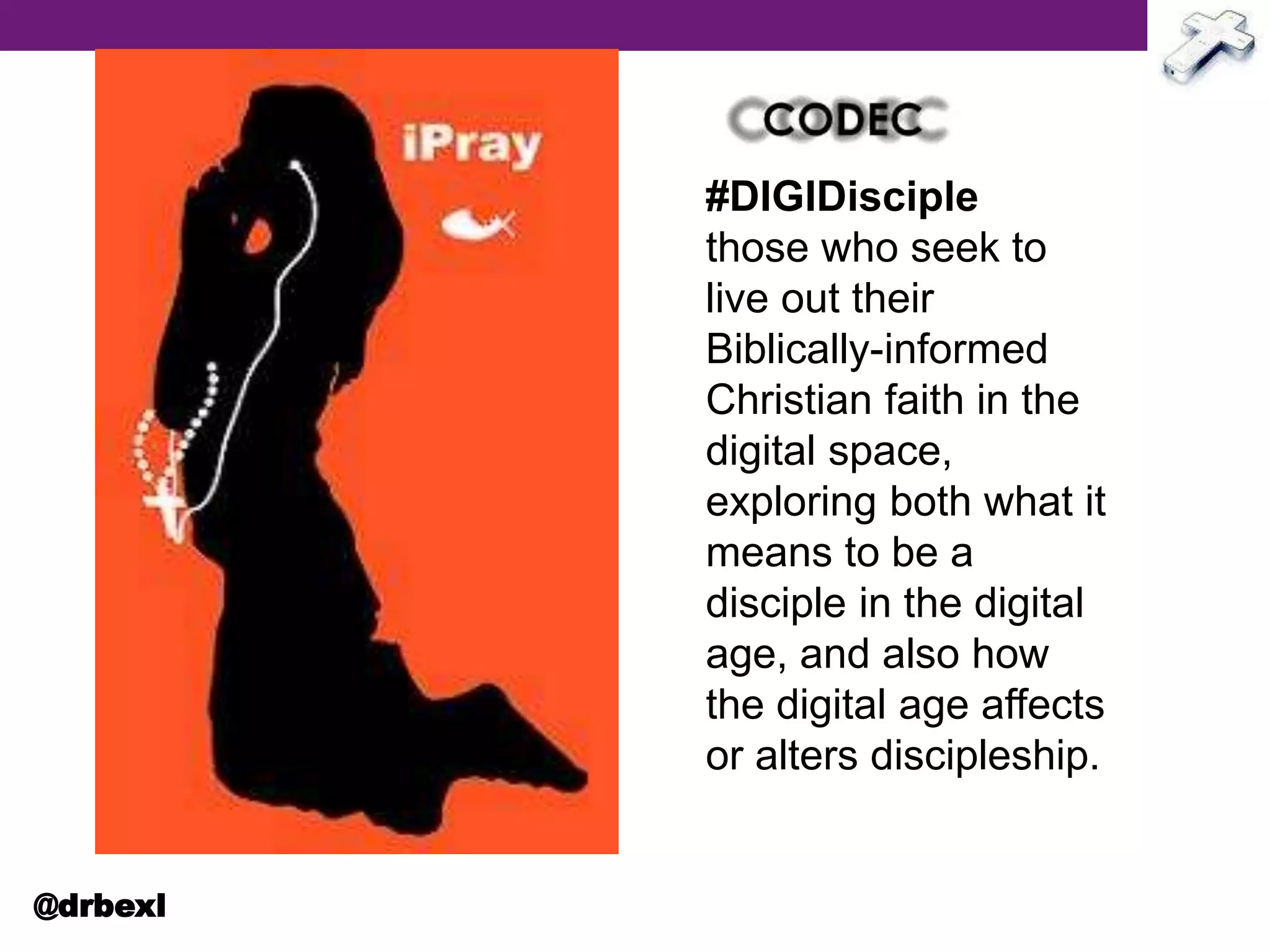
#DIGIDisciple
those who seek to
live out their
Biblically-informed
Christian faith in the
digital space,
exploring both what it
means to be a
disciple in the digital
age, and also how
the digital age affects
or alters discipleship.
@drbexl
[If we are…] means by which God
communicates and reveals himself through his
spirit, then our blog posts, status updates, tweets,
artistic images, and online comments should be
products of a life transformed by Christ and
indwelled by his spirit. As restored image
bearers, our online presence and activity
should image the triune god.
Byers, A. Theomedia (2013, 196)
@drbexl
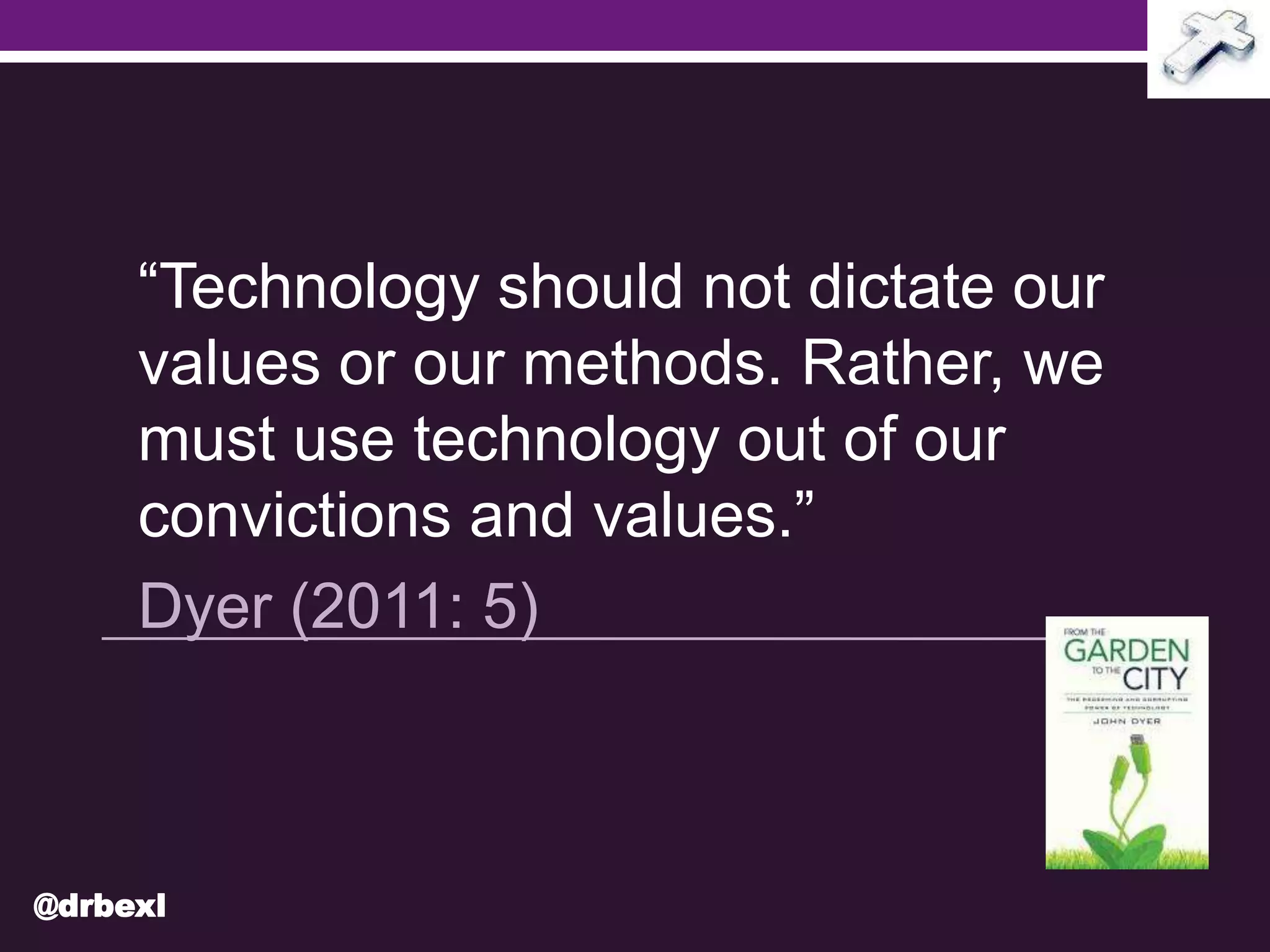
“Technology should not dictate our
values or our methods. Rather, we
must use technology out of our
convictions and values.”
Dyer (2011: 5)
@drbexl
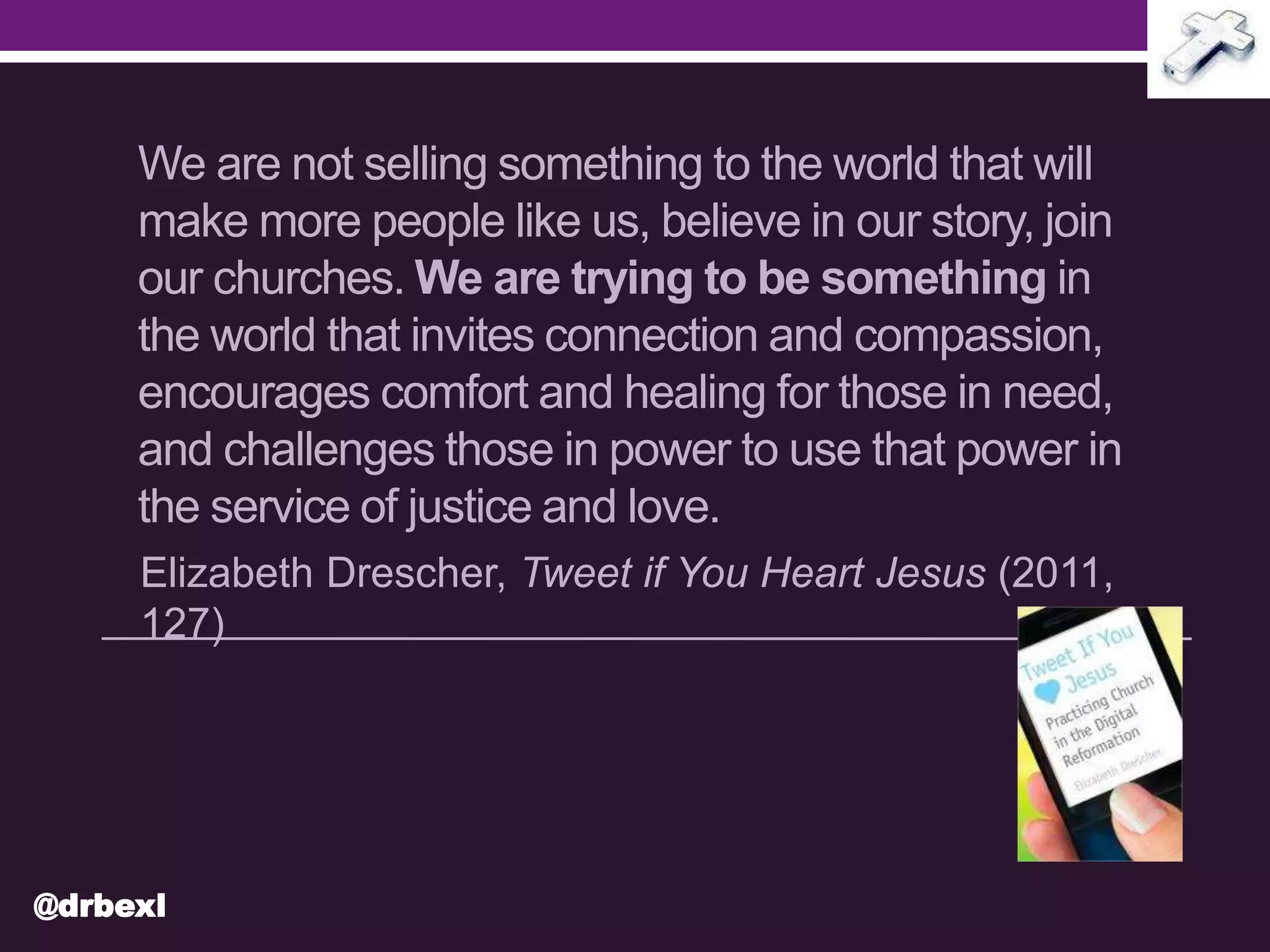
We are not selling something to the world that will
make more people like us, believe in our story, join
our churches. We are trying to be something in
the world that invites connection and compassion,
encourages comfort and healing for those in need,
and challenges those in power to use that power in
the service of justice and love.
Elizabeth Drescher, Tweet if You Heart Jesus (2011,
127)
@drbexl
On the Emmaus road, Jesus was recognized in
the breaking of bread rather than in the exegesis
of scripture. That’s an intriguing lesson to learn
when so much of the web and so much of digital
communication is about proclamation rather than
reception.
Phillips et al, 2013: 10
@drbexl
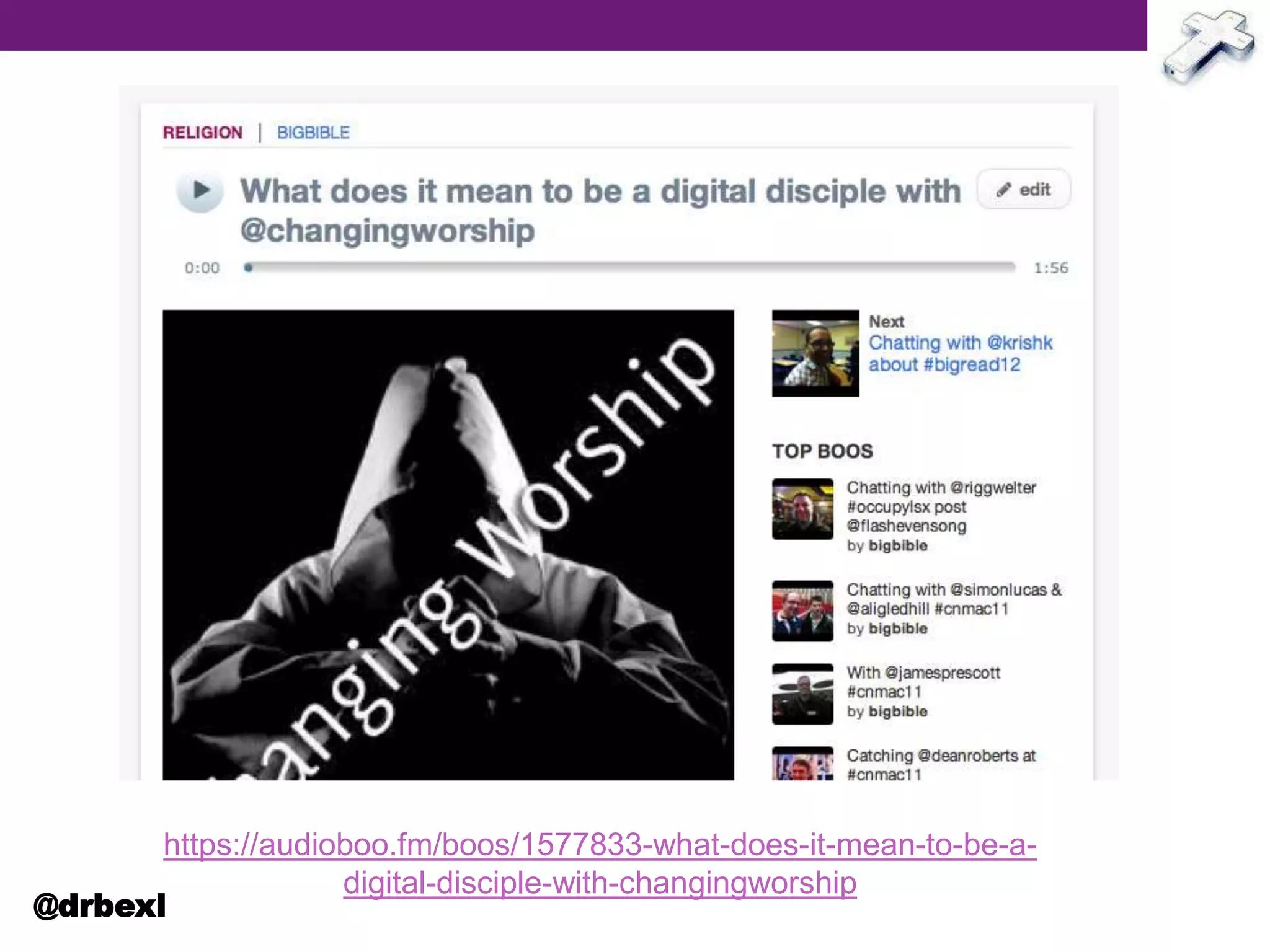
https://audioboo.fm/boos/1577833-what-does-it-mean-to-be-a-
digital-disciple-with-changingworship
@drbexl
It’s something about the informality and distance;
the ability to pause and think, which can be
difficult in a conversation; and the way
discussions can pick up where they left off
several hours, days or weeks later.
Emma Major, BIGBible Post, 2012
@drbexl
Evangelism Online?
1)“Godslots”
2)“Being” online
3)Social Justice
See more via @vahva
@drbexl
Thank You! Questions?
@drbexl

Digidisciple: Issues and Opportunities for the Christian Sector in a Digital Age #IMRC14

  • 1.
    #Digidisciple: issues and opportunitiesfor the Christian sector in a digital age Dr Bex Lewis, Research Fellow in Social Media and Online Learning, CODEC, St John’s, Durham University @drbexl
  • 2.
  • 3.
  • 4.
  • 5.
  • 6.
  • 7.
  • 8.
  • 9.
    The Church FrontDoor? For many churchgoing is no longer the ‘cultural norm’. People don’t actively ignore the church: they don’t even think about it. … With literally billions in the digital spaces, the online social spaces presented by churches need to be appealing, welcoming, and not look like they are just an afterthought: they are now effectively the ‘front door’ to your church for digital users, and you ignore those spaces at your peril. http://www.churchgrowthrd.org.uk/blog/churchgrowth/growing_churches_in_the_digital_age Image Credit: freeimages.com@drbexl
  • 10.
    Dr Sara Batts(2013) http://phdinprogress.wordpress.com @drbexl
  • 11.
    The Growth ofthe Internet http://oxis.oii.ox.ac.uk/sites/oxis.oii.ox.ac.uk/files/content/files/publications/OxIS_2013.pdf @drbexl
  • 12.
    "If you wantto build a presence in the social media platform, then you need to be present." - @unmarketing @drbexl
  • 13.
  • 14.
    The digital environmentis not a parallel or purely virtual world, but is part of the daily experience of many people, especially the young. Social networks are the result of human interaction, but for their part they also reshape the dynamics of communication, which builds relationships: a considered understanding of this environment is therefore a prerequisite for a significant presence there. Pope Benedict XVI (2013) @drbexl
  • 15.
    “Bringing the youngin…?” • “Jake told the executive that he never goes directly to a brand like this man’s newspaper or even to blogs he likes. ... he reads a lot of news – far more than I did at his age. But he goes to that news only via the links from Digg, friends’ blogs, and Twitter. He travels all around the internet that is edited by his peers because he trusts them and knows they share his interests. The web of trust is built at eye-level, peer-to-peer.” (Jarvis, p.86, my emphasis) @drbexl
  • 16.
    Church: Broadcast Model ImageSource: RGBStock@drbexl
  • 17.
  • 18.
  • 19.
    http://www.problogger.net/archives/2006/08/22/car-salesmen-preachers-and-the-art-of-persuasion/ Darren Rowse, @Problogger http://www.youtube.com/watch?v=8j-Iy8fP0Ek Iloved working up a sermon in the lead up to giving it. Researching,looking at what others had to say on the topic, piecing together thoughts, looking for illustrations and examples (tangents) and then practicing giving it and making the last minute tweaks and additions in the day before Sunday arrived. @drbexl
  • 20.
    #DIGIDisciple those who seekto live out their Biblically-informed Christian faith in the digital space, exploring both what it means to be a disciple in the digital age, and also how the digital age affects or alters discipleship. @drbexl
  • 21.
    [If we are…]means by which God communicates and reveals himself through his spirit, then our blog posts, status updates, tweets, artistic images, and online comments should be products of a life transformed by Christ and indwelled by his spirit. As restored image bearers, our online presence and activity should image the triune god. Byers, A. Theomedia (2013, 196) @drbexl
  • 22.
    “Technology should notdictate our values or our methods. Rather, we must use technology out of our convictions and values.” Dyer (2011: 5) @drbexl
  • 23.
    We are notselling something to the world that will make more people like us, believe in our story, join our churches. We are trying to be something in the world that invites connection and compassion, encourages comfort and healing for those in need, and challenges those in power to use that power in the service of justice and love. Elizabeth Drescher, Tweet if You Heart Jesus (2011, 127) @drbexl
  • 24.
    On the Emmausroad, Jesus was recognized in the breaking of bread rather than in the exegesis of scripture. That’s an intriguing lesson to learn when so much of the web and so much of digital communication is about proclamation rather than reception. Phillips et al, 2013: 10 @drbexl
  • 25.
  • 26.
    It’s something aboutthe informality and distance; the ability to pause and think, which can be difficult in a conversation; and the way discussions can pick up where they left off several hours, days or weeks later. Emma Major, BIGBible Post, 2012 @drbexl
  • 27.
  • 28.

Editor's Notes

  • #21 Project draws on voices from the pew, the pulpit and the academy - #Digidisciple(s) have written on a huge range of topics, including tweeting in church (controversial), legal and ethical questions, reviews of the latest scholarship, demonstrating graceful communication, thinking before tweeting, the importance of listening, undertaken a digital pilgrimage, relationship development online, authenticity, drawing upon best practice in the secular world, the use of language, attitude, and wellbeing – including taking digital time out. Overall, the group explores how digital practices and values (e.g. social, always-on, immediate, responsive, iterative, accountable, avatar use) contribute to contemporary discipleship and how discipleship values (e.g. authenticity, integrity, discernment) shape the digital environments that are engaged with. Since 2011, The BIGBible Project has created a network of #DIGIDisciples who contribute to a blog questioning what it means to be a Christian in the digital age and in the digital environment. As Elizabeth Dresher would point out, the churches natural style fits the pattern of the social media world  – that of participation and creativity rather than a broadcast hierarchical structure. #DIGIDisciples look to see what digital technologies allow us to do differently, as well as how they may impact our behaviours online. #DIGIDisciples subscribe to the belief that our spiritual lives are 24/7, and that we need to take seriously our Christian presence both online and offline, questioning whether we are we the same person, living by the same values in both environments, modeling Christlike behaviour. Voices are from across the ecumenical spectrum, and at all levels of online expertise (or none) have participated. The conference paper will draw from the rich collection of over 2,500 #digidisciple posts to demonstrate the potential that the digital has offered churches, whilst also highlighting some of the issues that have been raised.
  • #22 Byers, theological consultant for The BIGBible Project (2013: 196), notes that if we ourselves are the [quote] The basic message of Christianity remains the same, and Byers challenges Christians not to be competent with digital media, but inept with the media of God…
  • #23 Echoed by Dyer (2011: 25) offers caution for modern day disciples: [quote] Digital technology is addressed more within a framework of affordances and constraints (following Gibson, 1977): what does each new development in technology make possible, what does it limit, and what choices are therefore available?
  • #24 The church has never been about ‘bums on seats’ but transformational living. Many of those who enjoy the digital spaces are skeptical about being ‘preached to’. We live in a world of “pull” rather than “push” media (show me why I will be interested, rather than tell me I should be interested), but as Drescher (2011, 127) from Santa Clara University says: [quote] not SELLING but BEING
  • #25 In a world where the church seems daunting and unapproachable, the relationship feel that Facebook gives is really important. David Keen, a vicar in Yeovil, offered a community Facebook chat (2013) because he felt that “the church has often been accused of answering questions nobody is asking”, and this gave an opportunity to be asked ‘real’ questions in an interactive, rather than a broadcast, way.   The answers didn’t need to be ‘right’, but the participants needed to feel listened to, and that they could relate to the conversation on their own terms, rather than as subjects of an evangelistic agenda: [quote]
  • #26 Rev Prof Maggi Dawn noted at the inaugural ‘Christians in New Media Conference’ (2010) that it can take some time for online users to grow comfortable in their ‘voices’, something that Rev Robb Sutherland (2013) describes as becoming comfortable in a ‘digital skin’ that was consistent with his physical presence. (2 mins) … “being comfortable in your own digital skin” [digital not a replacement for other aspects of life, but part of it…]
  • #27 Online, with relationships/trust developed – people are prepared to ask questions - Emma Major said in 2012, where a friend said to her: “Christianity seems safer online; I can ask the questions without having to look stupid for asking them.” Emma noted that [quote] – as it takes away the formality that many associate with church.
  • #28 Bryony’s recent thesis, 300+ returns – found 3 major ways people share online … lots of opportunities, so long as we can move away from the fear … more “Social Media for the Scared” please…
  • #29 The headlines = lots of bad news, but there’s been some good news (what is the reality, and does the bigger picture matter to us?) … thinking particularly about the official church There’s so much going on that (Sunday) church is not in many people’s minds, and churches are not at forefront of seizing the digital opportunities Need to be ‘present’ in such an active space, is a lot of emphasis on ‘the young’ (the missing generation, the digital native = care with this) The broadcast church, needs to seize the interactive opportunities – find examples of good practice… is a growing field of study (as we know) Getting in a range of voices (particularly from pew & pulpit, but seeking more from the academy) re what it means to be a disciple in the digital age = especially if its about networks of networks, rather than organisations…