AS Level Biology Lesson 1
DIFFUSION Particles are never still – they move all the time. Particles move in every direction, but, the net effect is that they spread from where there are a lot to where there are few. This movement is called  diffusion.
Diffusion….defined as.. The net movement of molecules or ions from a region of their high concentration to a region of their lower concentration.
Occurs in living and non-living systems wherever there is a concentration gradient. Will continue until particles are distributed evenly throughout the system. When uniform concentration is achieved, molecules still move, but there is no net movement is a particular direction.
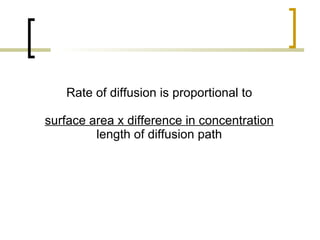
The rate of diffusion The rate of diffusion in a given direction across an exchange surface: is directly proportional to the area of the surface is directly proportional to the concentration gradient is inversely proportional to the distance (length of the diffusion pathway)
Rate of diffusion is proportional to surface area x difference in concentration length of diffusion path
In living systems The simple diffusion of a substance into or out of a cell which does not require energy is known as  passive diffusion. Diffusion through a membrane will be affected by the nature of the membrane and the size and type of molecule or ion diffusion through it.

Diffusion

  • 1.
  • 2.
    DIFFUSION Particles arenever still – they move all the time. Particles move in every direction, but, the net effect is that they spread from where there are a lot to where there are few. This movement is called diffusion.
  • 3.
    Diffusion….defined as.. Thenet movement of molecules or ions from a region of their high concentration to a region of their lower concentration.
  • 4.
    Occurs in livingand non-living systems wherever there is a concentration gradient. Will continue until particles are distributed evenly throughout the system. When uniform concentration is achieved, molecules still move, but there is no net movement is a particular direction.
  • 5.
    The rate ofdiffusion The rate of diffusion in a given direction across an exchange surface: is directly proportional to the area of the surface is directly proportional to the concentration gradient is inversely proportional to the distance (length of the diffusion pathway)
  • 6.
    Rate of diffusionis proportional to surface area x difference in concentration length of diffusion path
  • 7.
    In living systemsThe simple diffusion of a substance into or out of a cell which does not require energy is known as passive diffusion. Diffusion through a membrane will be affected by the nature of the membrane and the size and type of molecule or ion diffusion through it.